
Gold is the finish I’m asked about more than any other, and it’s also the one couples most often overdo. A few torn flakes of leaf on an ivory tier look polished; a cake painted gold from top to bottom can look like a trophy. The range in between is wide: soft romantic leaf, crisp painted lines, a single bold metallic tier, alongside the pearls, vintage piping and sculptural shapes that are popular right now. Gold also sits happily next to ivory, blush, sage, black and even pale blue, so it adapts to most venues and seasons. Here are twenty ways I’d use it, with notes on how each one is actually made.
Leaf, Dust or Paint? Not Every Gold Is Meant to Be Eaten
Three products make a cake look gold, and only some of them belong in your mouth. This is the conversation I have with every couple who asks for metallic details.
- Edible gold leaf is real gold, beaten very thin. It’s safe to eat in the small amounts used on cakes, it doesn’t tarnish, and it gives the brightest shine.
- Lustre and highlighter dusts come in two kinds. Some are labelled edible. Others say non-toxic, which means they’re for decoration only, and I keep those on toppers, panels or pieces that come off before cutting.
- Gold paint is usually lustre dust mixed with a little clear alcohol that evaporates. It’s only as edible as the dust it was made from.
Ask your baker which one they plan to use on each part of the cake. A good baker won’t mind the question, and it matters most for children and anyone pregnant.
1. White And Gold Wedding Cake
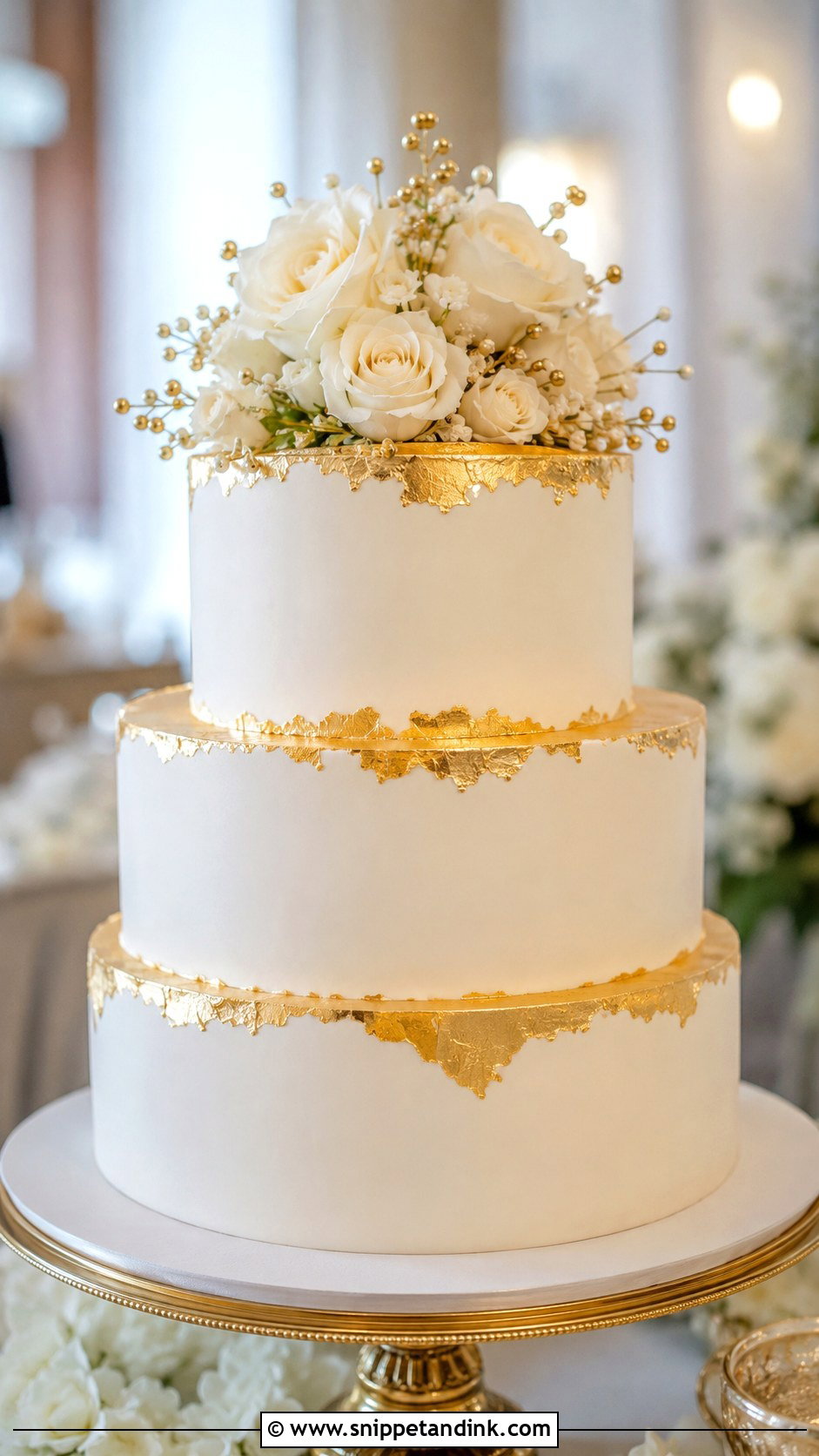
If you’re torn, start here. White and gold suits a ballroom, a garden or a hotel with equal ease, and it’s the design I’d pick when the florals aren’t settled yet. I lay leaf in uneven patches along the top edge of each tier, never in a neat band, because irregular edges look hand-finished while straight ones look printed. White roses, orchids or cream sugar flowers soften it. A plain gold-rimmed stand is enough; a heavily decorated one competes.
2. Gold Leaf Wedding Cake
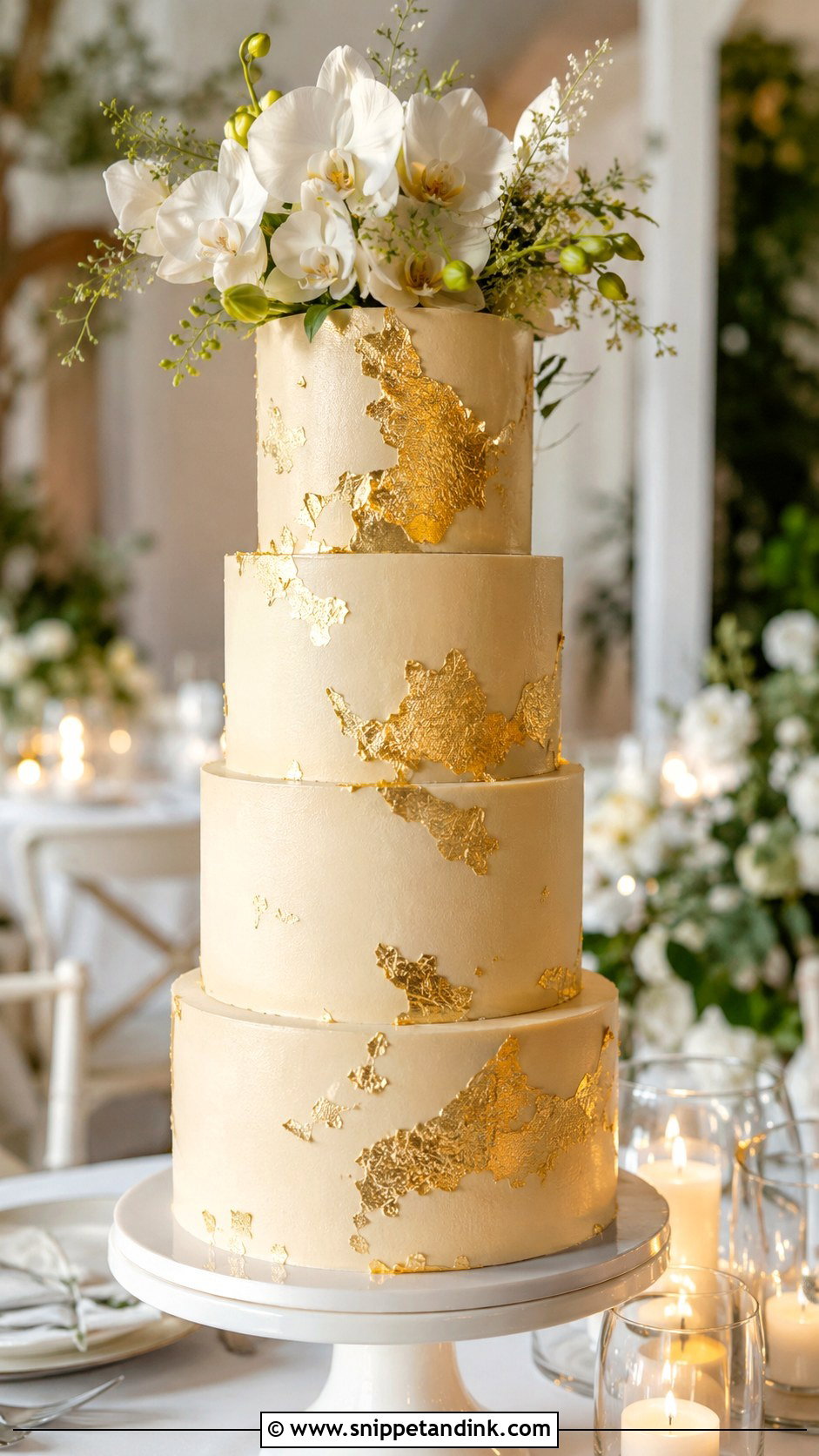
Real edible leaf is so thin that it sticks to your fingertips the moment you touch it, which is why I lift it with a soft brush or tweezers and press it onto chilled frosting or slightly dampened fondant. You can scatter small flakes, trace the tier seams or press large torn sheets for a bolder look. Ivory, champagne and soft blush bases show it off best. I’d ask for organic placement rather than perfect squares; broken edges catch the light from more angles. A little greenery or a few sugar petals is all it needs.
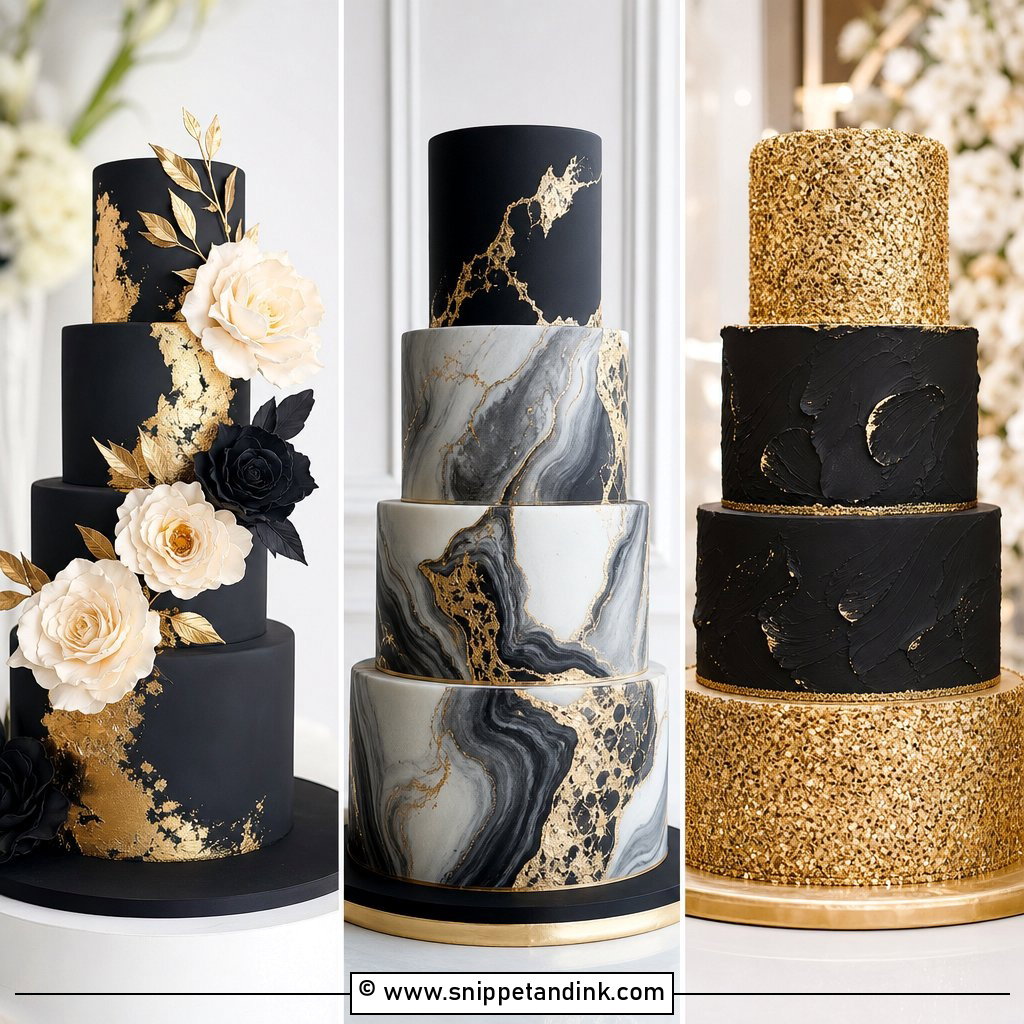
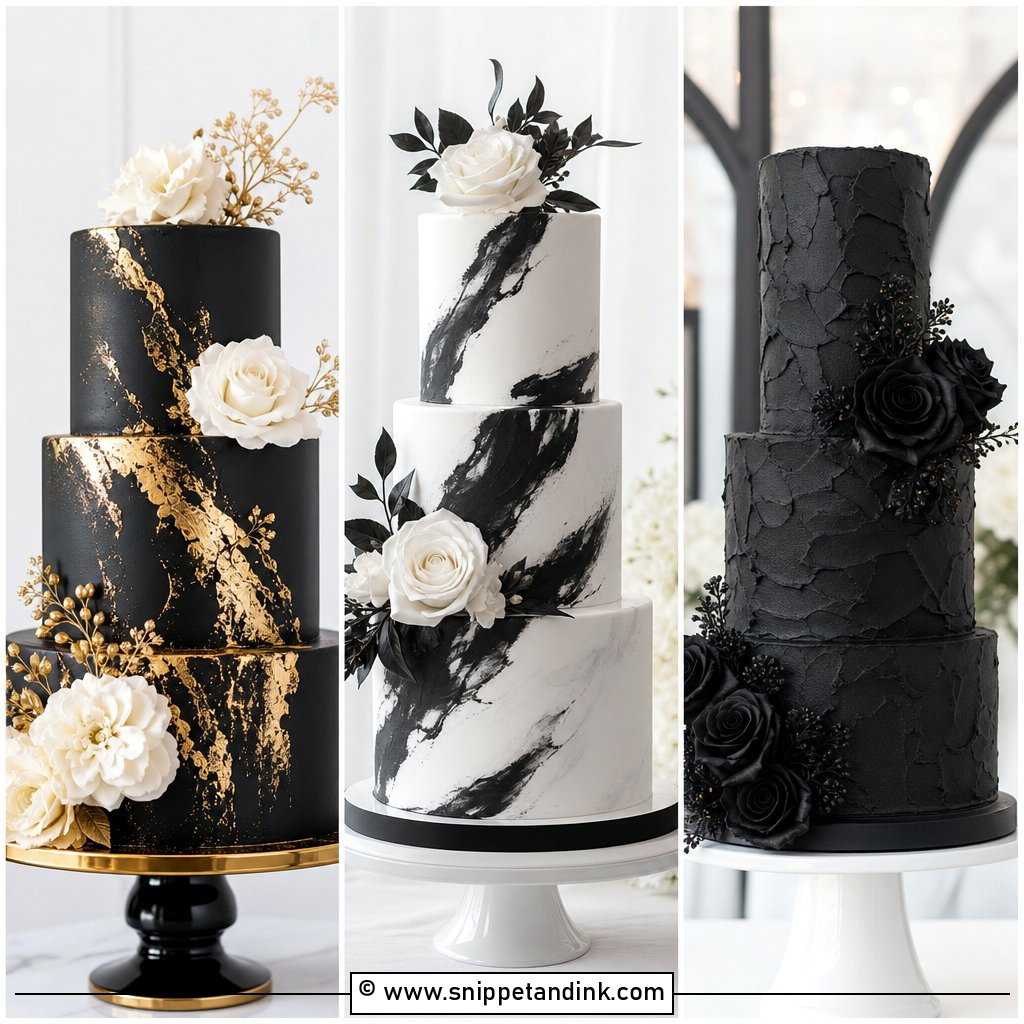
3. Black And Gold Wedding Cake
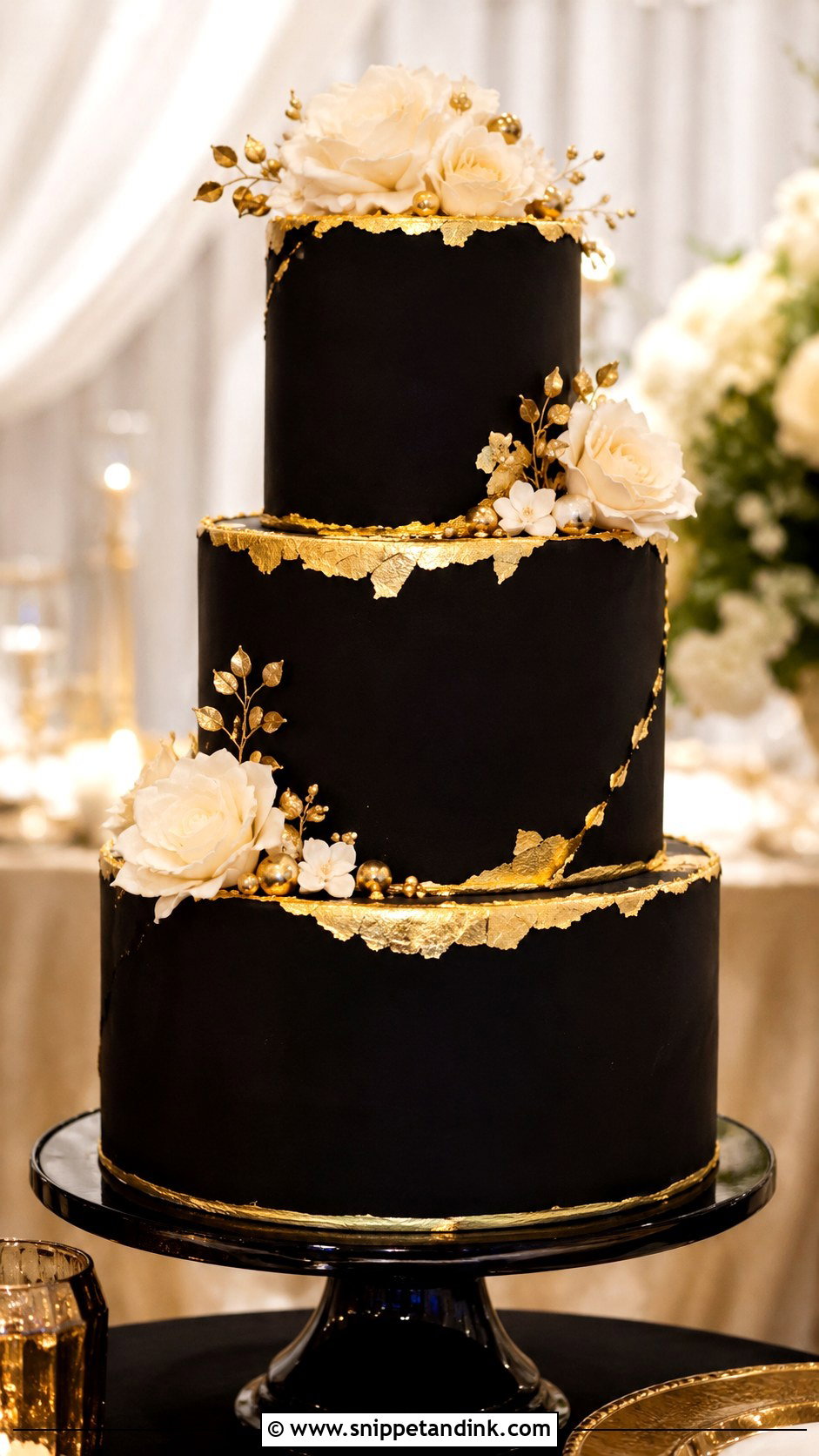
Black fondant gives gold the deepest possible background, and on a matte surface the leaf almost glows. Two cautions from the work itself: very dark fondant can taste slightly bitter from the amount of colour in it, and it shows every fingerprint and speck of dust, so it’s handled with gloves and finished last. Balance the darkness with white sugar flowers or ivory roses. One black tier, one white and one marbled tier with gold veining is a combination I like a lot. It wants warm, low lighting to look its best, which makes it an evening cake.
4. Rose Gold Wedding Cake
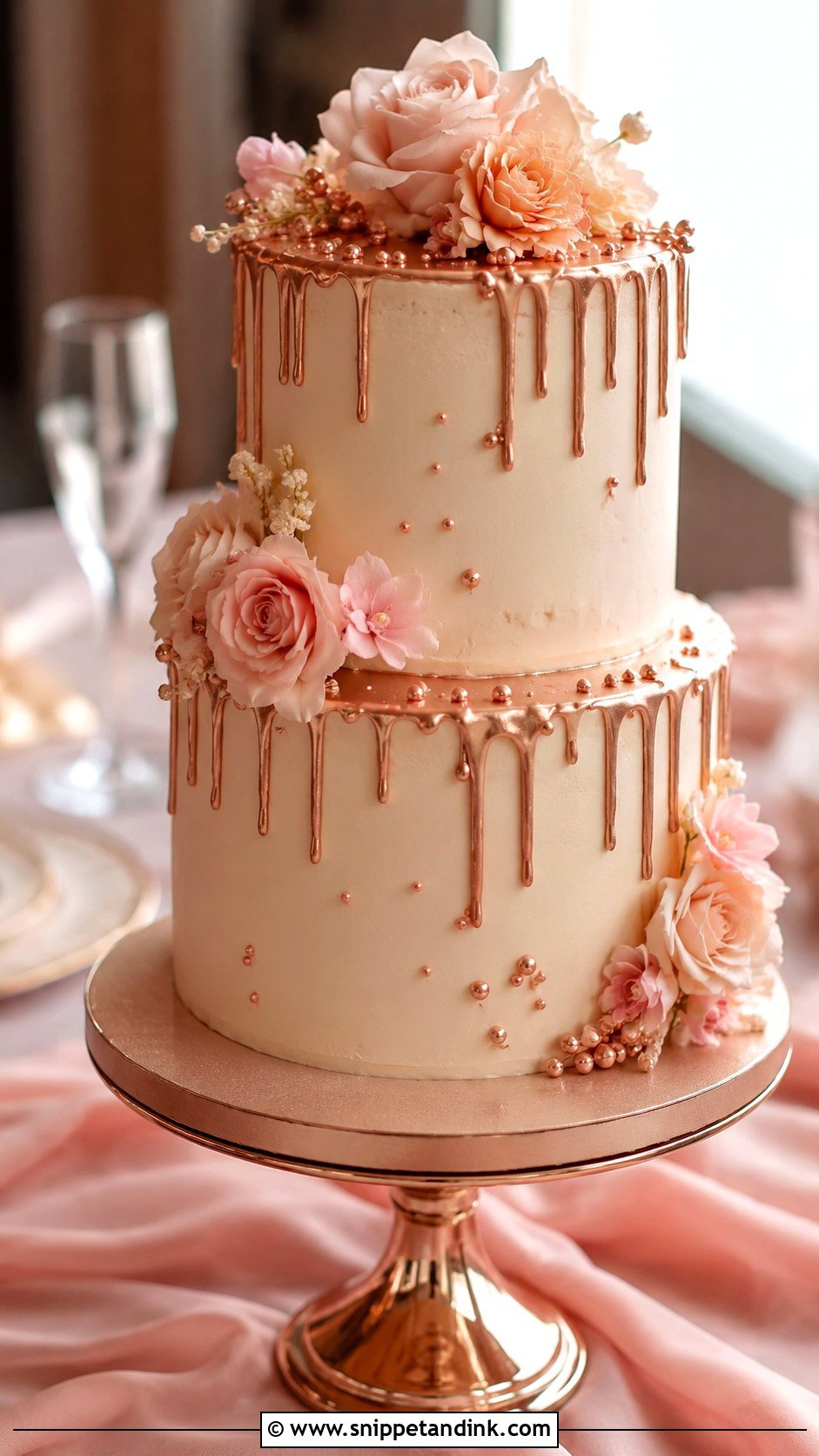
Rose gold is warmer and softer than yellow gold, so it suits blush, mauve and champagne palettes far better. There’s no single rose gold colour, though. Most rose gold finishes are mixed from gold and pink lustre, and each batch shifts slightly, so if your stationery or bridesmaid dresses are a particular rose gold, bring a sample and I’ll match to it. A drip, brushed strokes or a full metallic bottom tier on pale ivory all work. Buttercream gives a softer finish here, fondant a sleeker one. Pair it with blush garden roses or a few pearls.
5. Gold Drip Wedding Cake
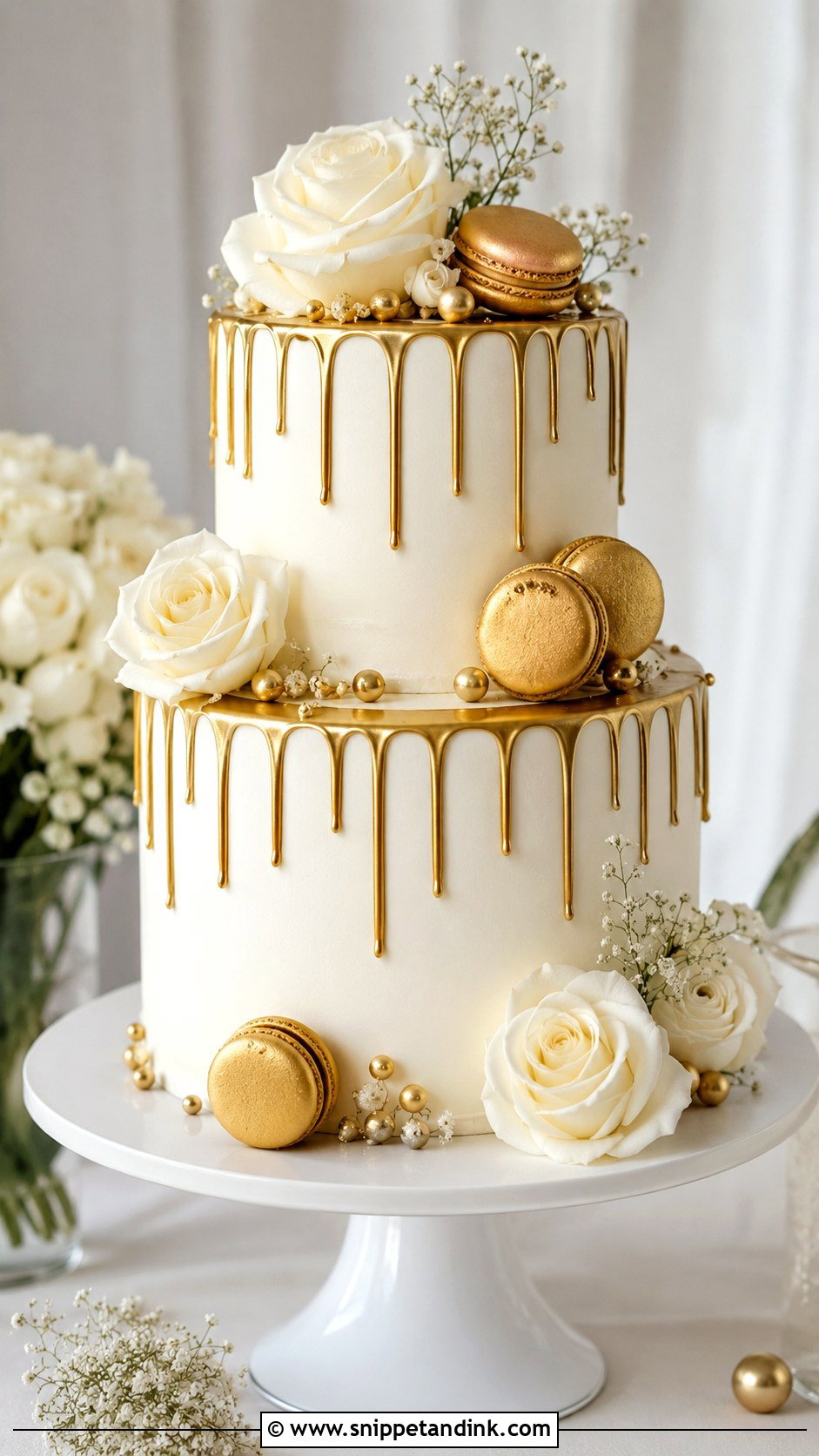
A gold drip starts as a ganache drip, usually white chocolate, which is left to set and then painted with metallic colour mixed into a little alcohol that evaporates as it dries. Getting the drip length even is all about ganache temperature: too warm and it runs to the board, too cool and it stops in stubby blobs. I test a drip on the back of the tier first. One tier or every tier both work. Crown the top with fresh roses, macarons or gold pearls, and it reads as festive rather than formal.
6. Marble And Gold Wedding Cake
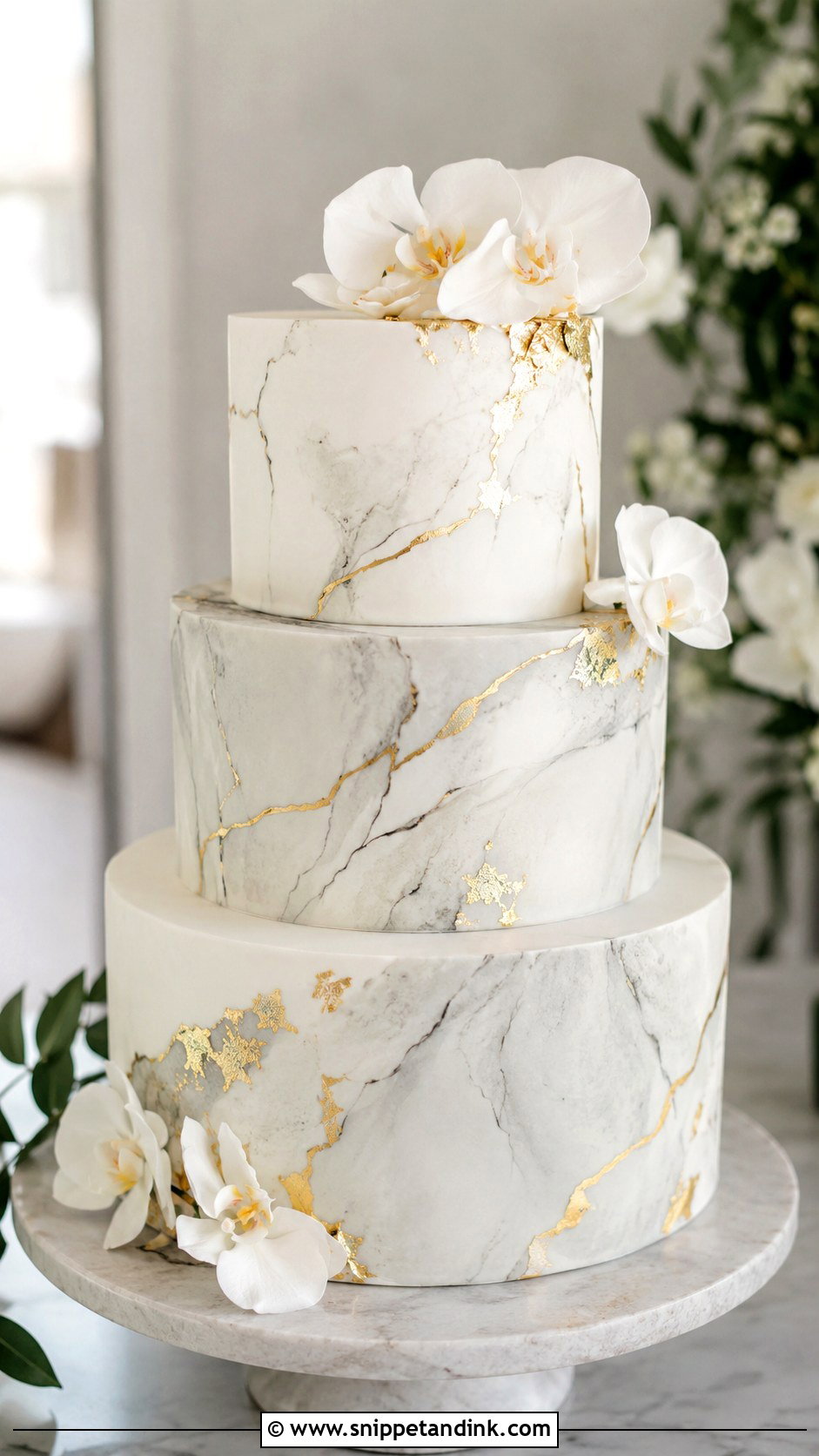
Marbling fondant means folding grey or blush colour through white paste and rolling it so the streaks stretch into veins. Every tier comes out different, which is the appeal. I paint gold along a few of those veins afterwards, not all of them, otherwise the stone effect turns into a pattern. Fondant really is the right surface for this; buttercream marbling is possible but softer and less like stone. White orchids or a couple of small roses are enough decoration. It suits galleries, lofts and spaces with stone or glass.
7. Gold Tier Wedding Cake
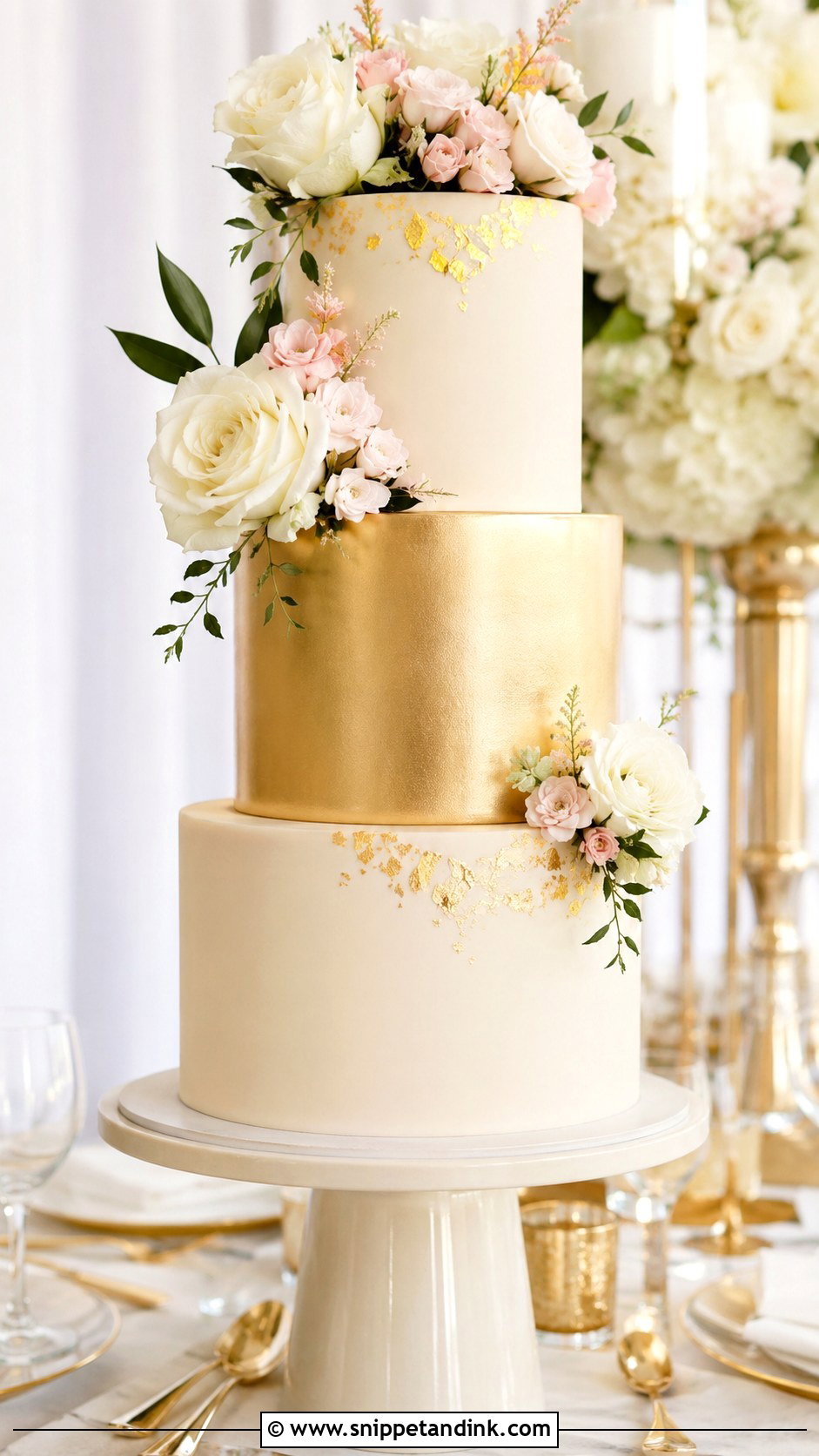
One fully gold tier gives the metallic finish a purpose. The other tiers stay white, ivory or blush, and the gold tier becomes the focal point. I’d make it the bottom or middle tier; a gold top tier tends to look top-heavy. Smooth metallic fondant, textured leaf and brushed buttercream all give different effects, so look at samples under warm light before deciding. Flowers across the tier join soften the transition. It’s the design I suggest when the room already has gold chargers or chairs, since the cake echoes them from across the space.
8. Two Tier Gold Wedding Cake
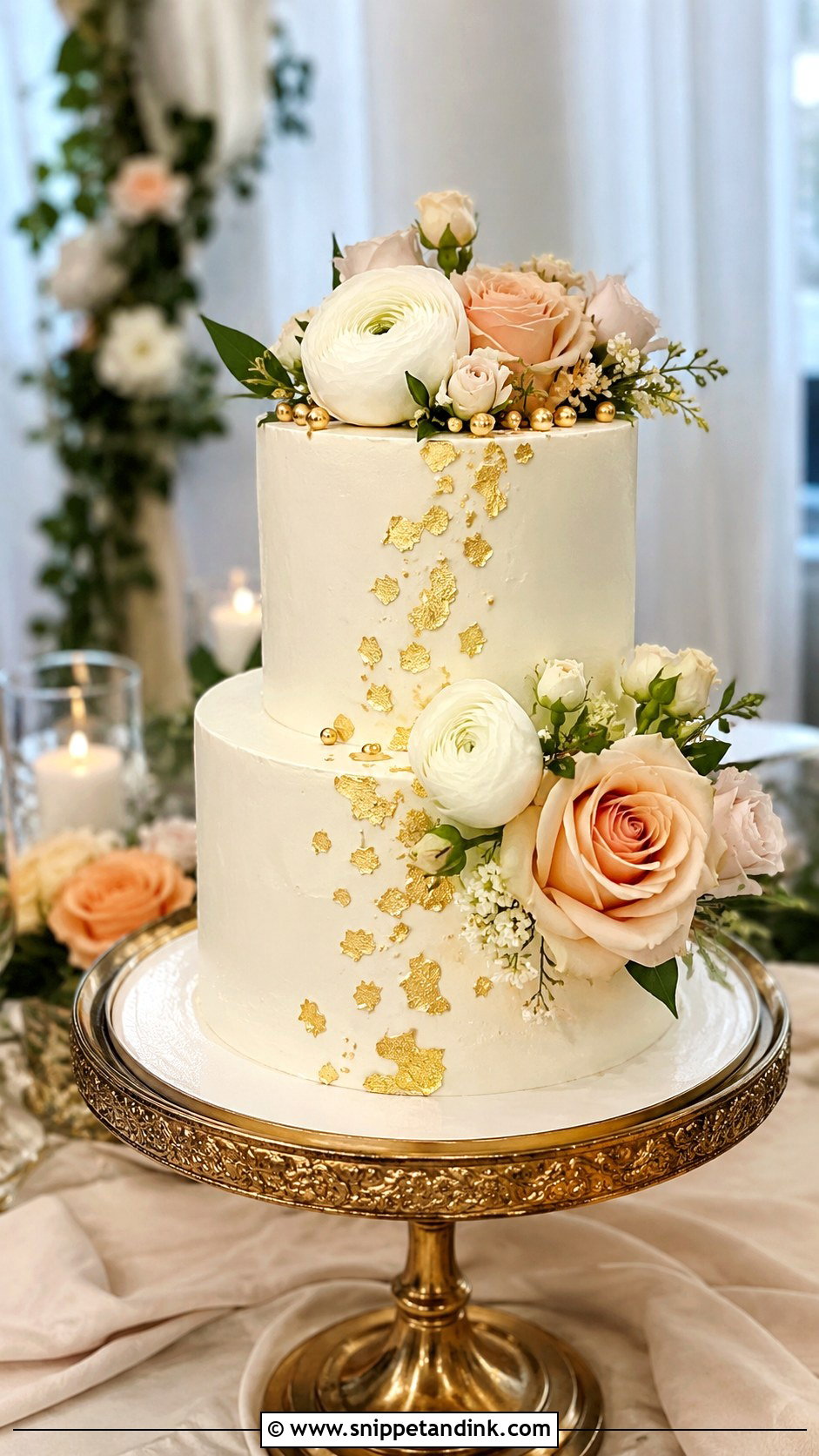
Two tiers can still hold the room. With less surface, I’d keep gold to one side of a white buttercream cake, or do a gold bottom tier under a white top for contrast. Blush roses or white ranunculus add fullness without height. Put it on a raised stand. A small cake on a flat board can disappear on a long table, and a stand brings it up into the photos. Many couples serve kitchen sheet cake alongside a cake this size, which keeps the cost down for a bigger guest count.
9. Three Tier Gold Wedding Cake
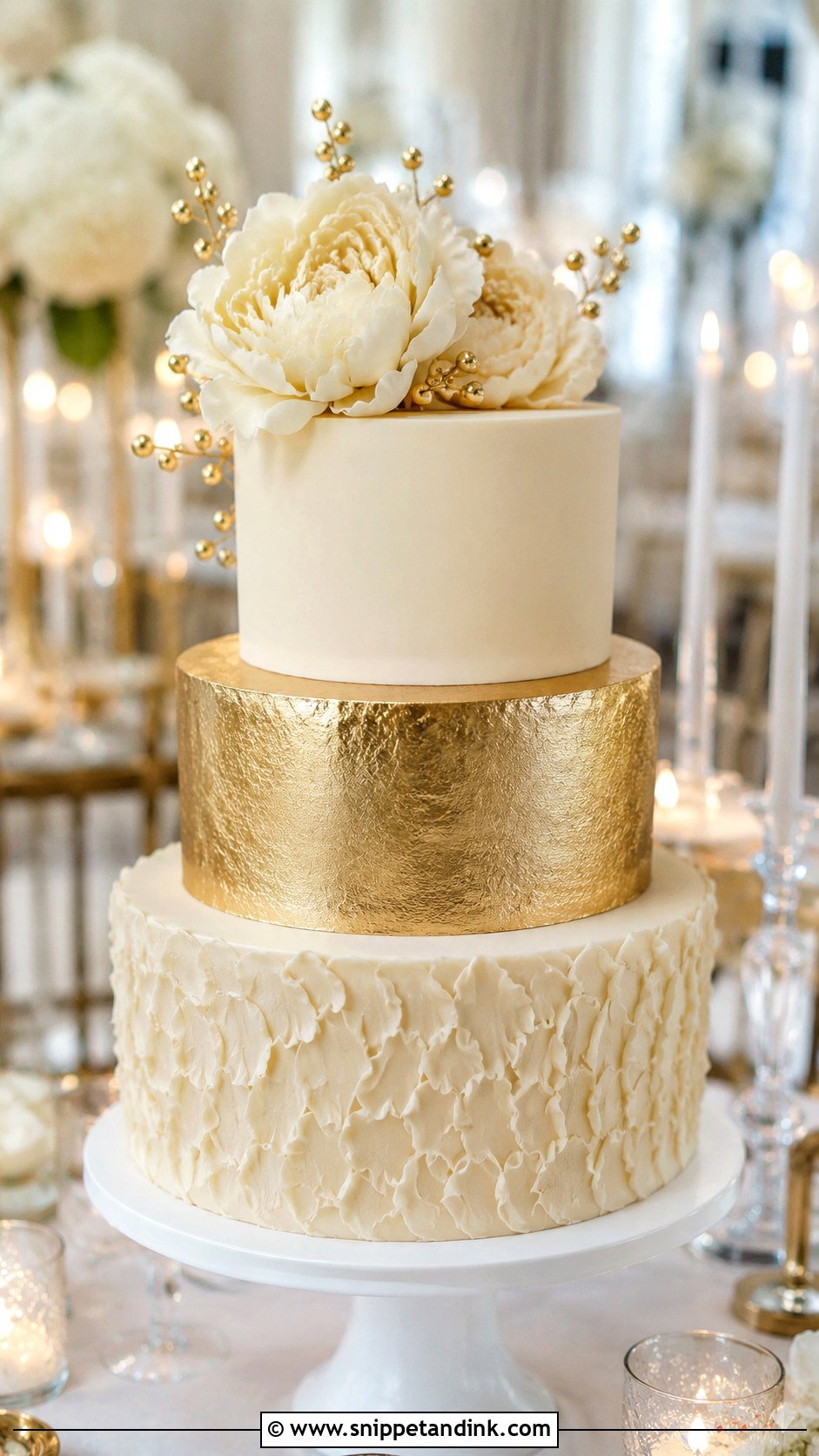
A three tier gold wedding cake gives me room to use a different gold technique on each tier without it feeling crowded: smooth fondant with a painted line on one, leaf on another, fine piping on the third. Three tiers serves a mid-sized reception and still fits through most venue doorways fully stacked, which matters more than people think. Formal venues suit ivory sugar flowers and pearls; a garden suits fresh blooms. It’s a traditional shape, so the gold is what makes it feel current.
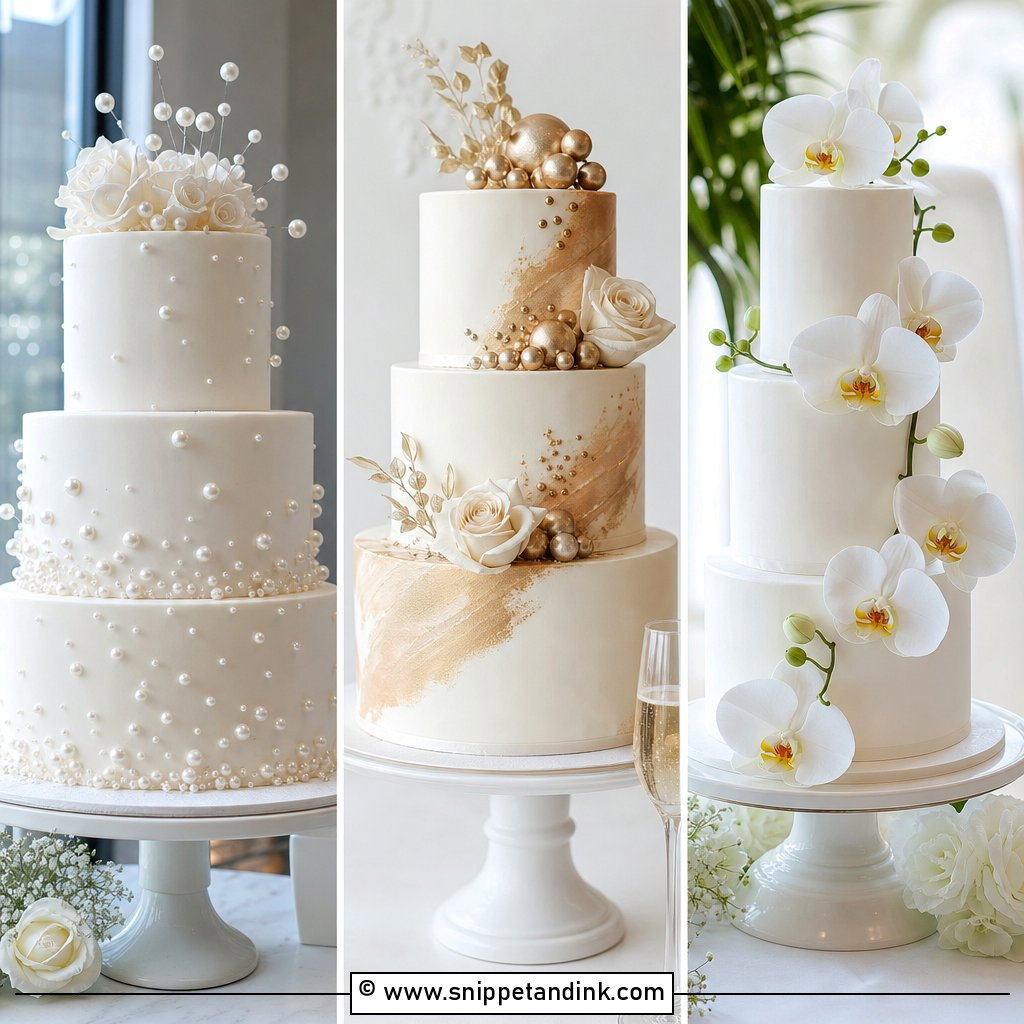
10. Gold Pearl Wedding Cake
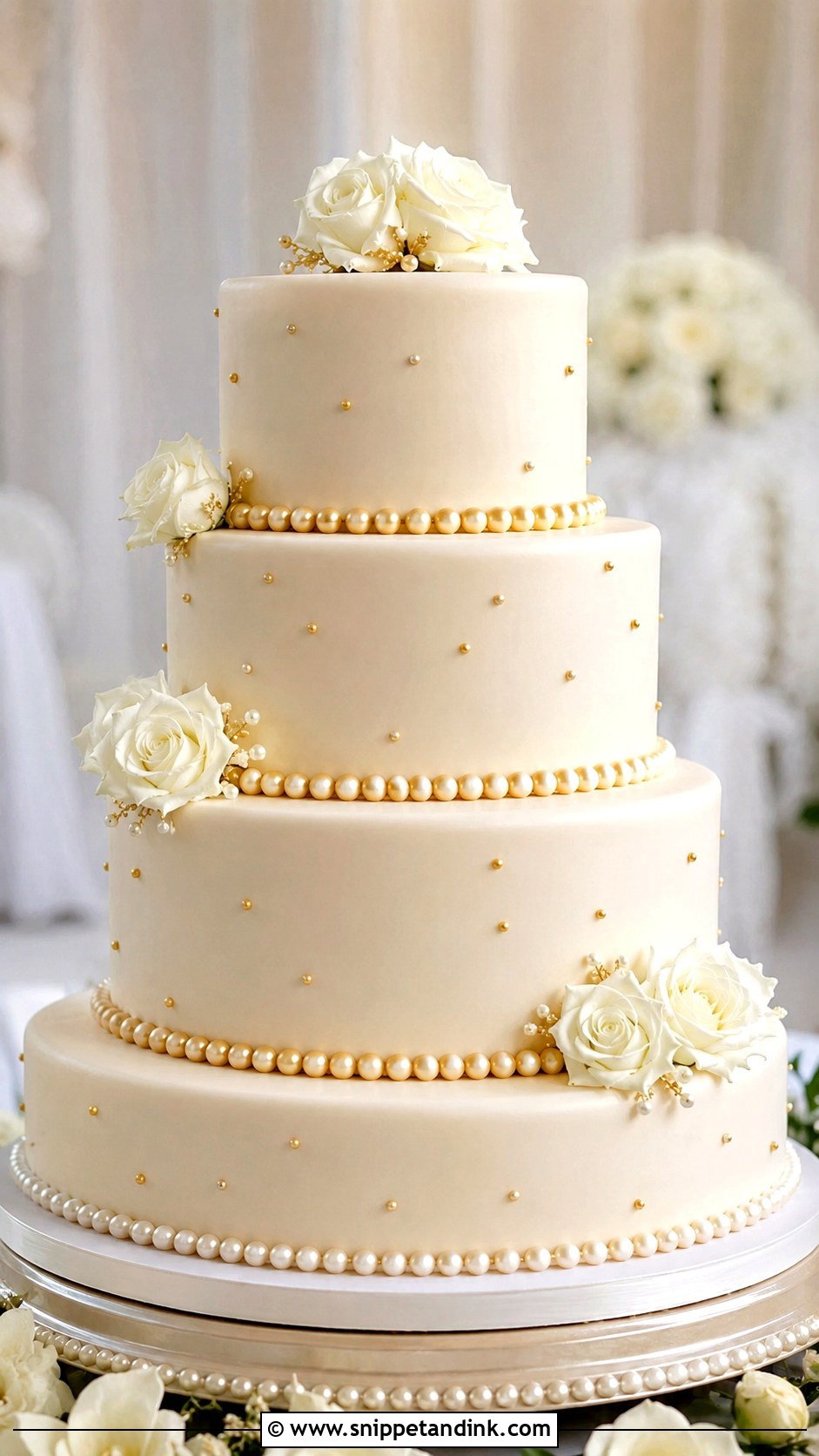
Gold pearls are piped or set one by one, and the risk is overcrowding. I like a single row at each tier base, or a light scatter of edible pearls among tiny metallic dots, with plenty of smooth ivory showing between them. Sugar pearls can be hard to bite, so I keep larger ones to borders that guests rarely eat. Satin linens and candlelight are its natural setting. White roses, lisianthus or sugar peonies keep the flowers simple.
11. Gold Floral Wedding Cake
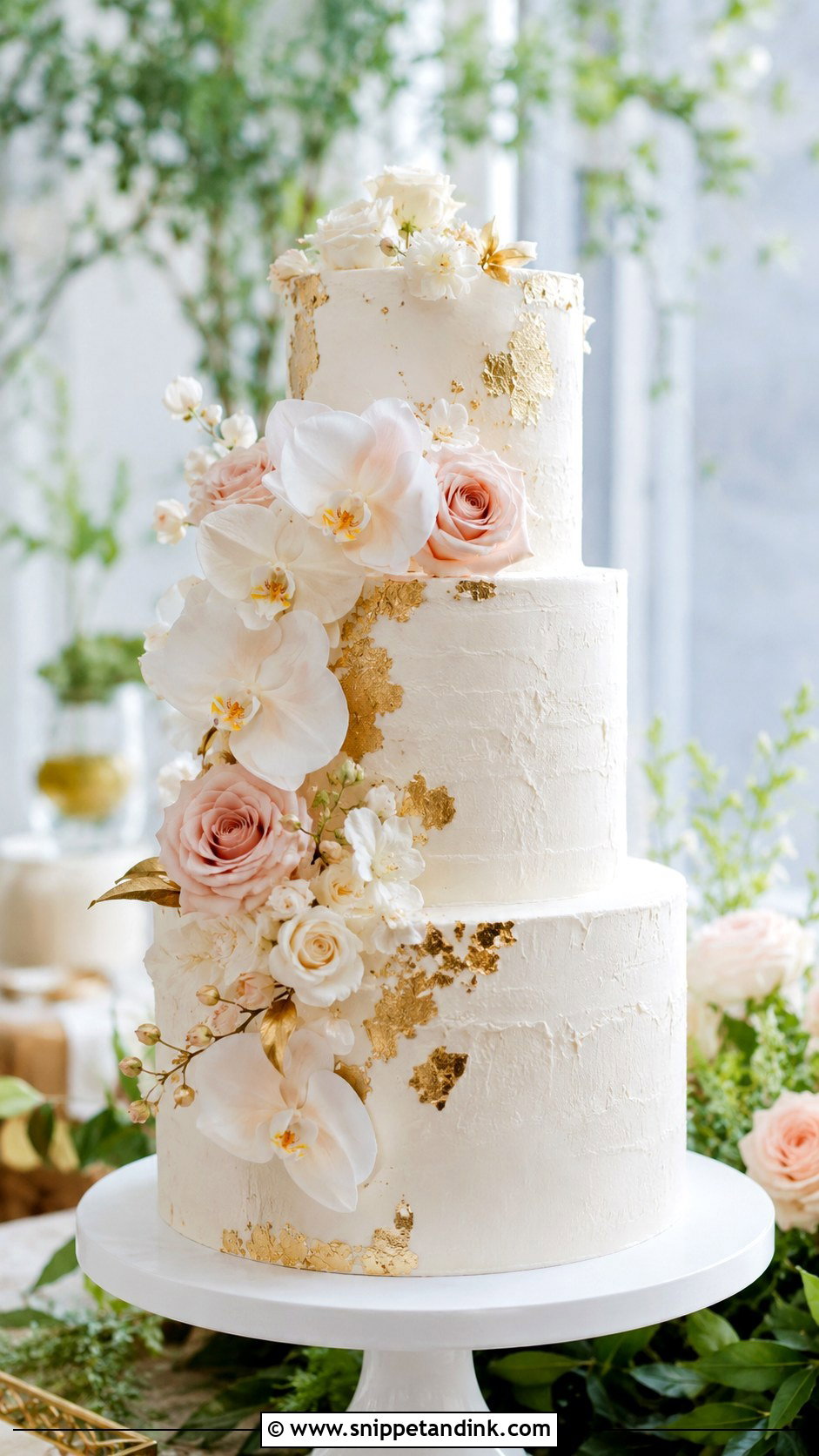
Here the gold should touch the flowers rather than float somewhere else on the tier. I brush the edges of sugar petals with metallic dust, or press leaf close to where fresh blooms sit, so the two details read as one. White roses keep it classic, blush flowers soften it and orchids pull it modern. If you’re using fresh flowers, ask how they’ll be placed; stems shouldn’t go straight into the cake, and many florist flowers aren’t food safe. This is the cake for weddings where the florals are the main event.
12. Gold Geode Wedding Cake
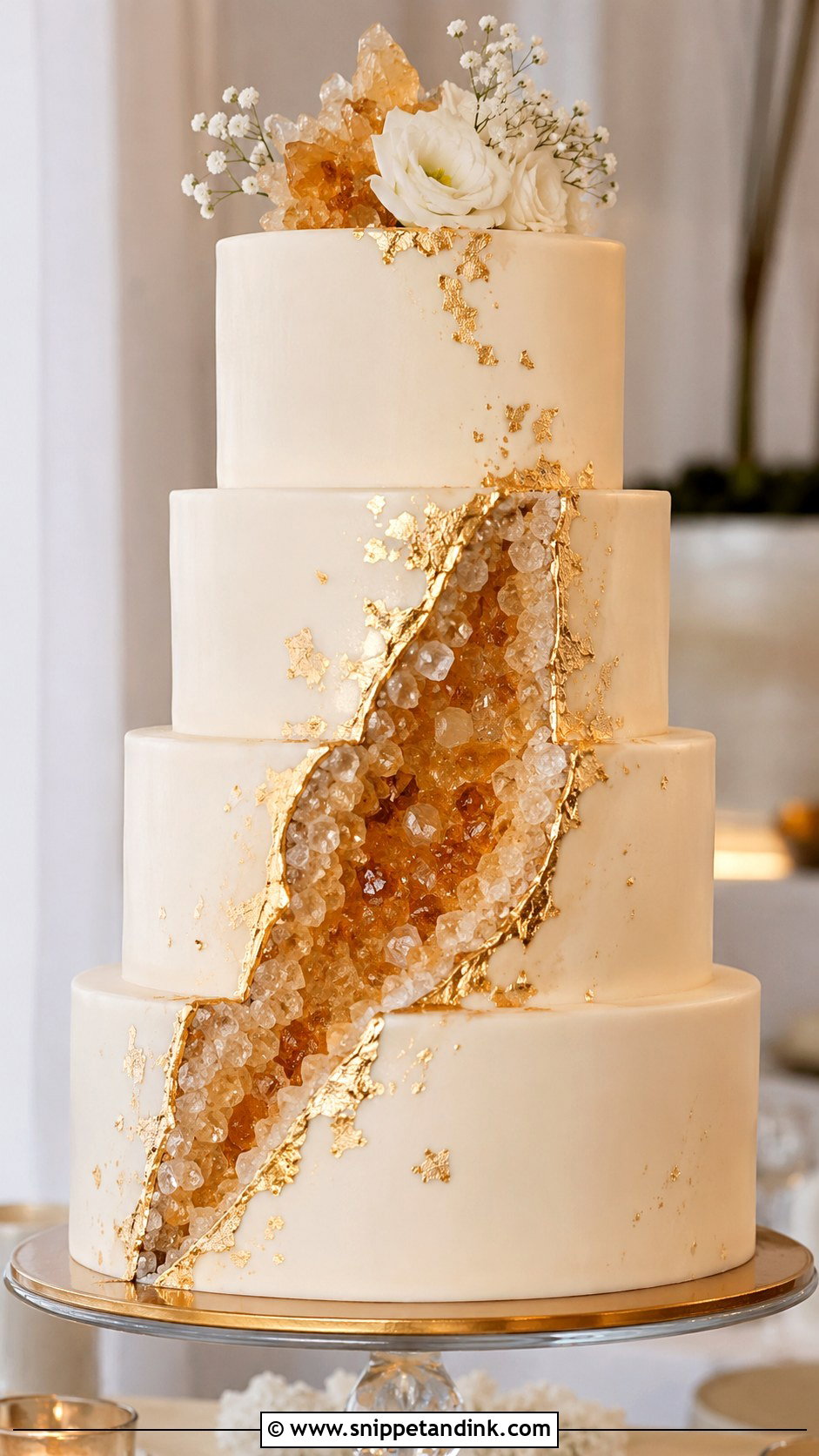
Geodes are carved into the side of a tier and filled with rock candy or isomalt crystals in white, blush, amber or champagne, then rimmed with gold. It’s heavy work, both in hours and in actual weight, so the tier needs firm support. Both kinds of crystal hate humidity; they go cloudy and sticky in a damp tent, so I’d only do this indoors. Keep the rest of the tall two or three tier cake clean so the geode stays the focus. It suits desert-inspired weddings and rooms with natural stone.
13. Gold Sequin Wedding Cake
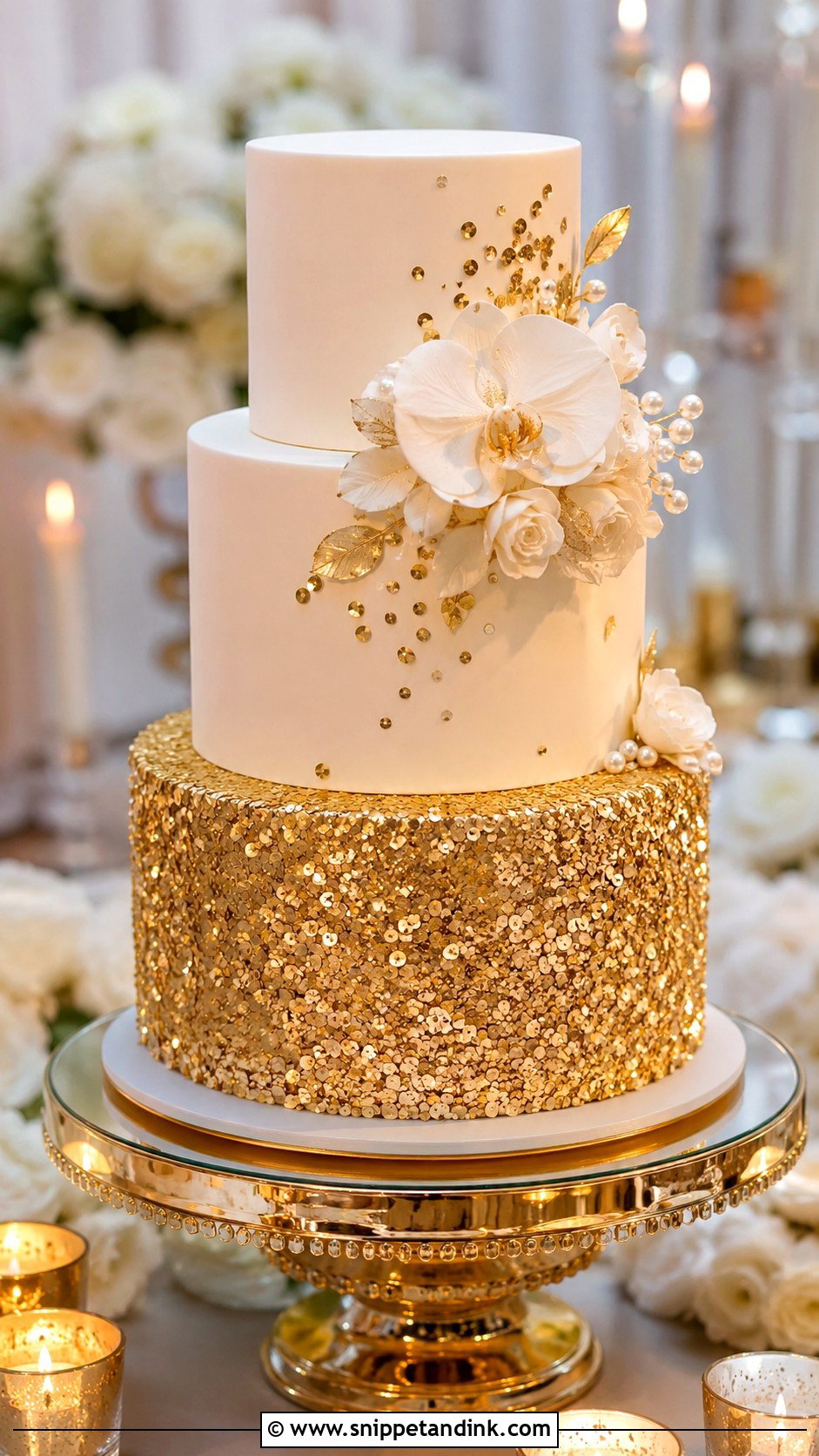
Sequins on a cake are usually tiny discs of fondant or sugar, painted gold and applied by hand, row after row. That’s slow, so I’d limit it to one tier and let the others stay smooth. A white top tier with sugar flowers calms the shine. Under candlelight the overlapping discs flicker, which is the whole point, but the table around it should be plain. Formal ballroom receptions suit it best.
14. Gold Painted Wedding Cake
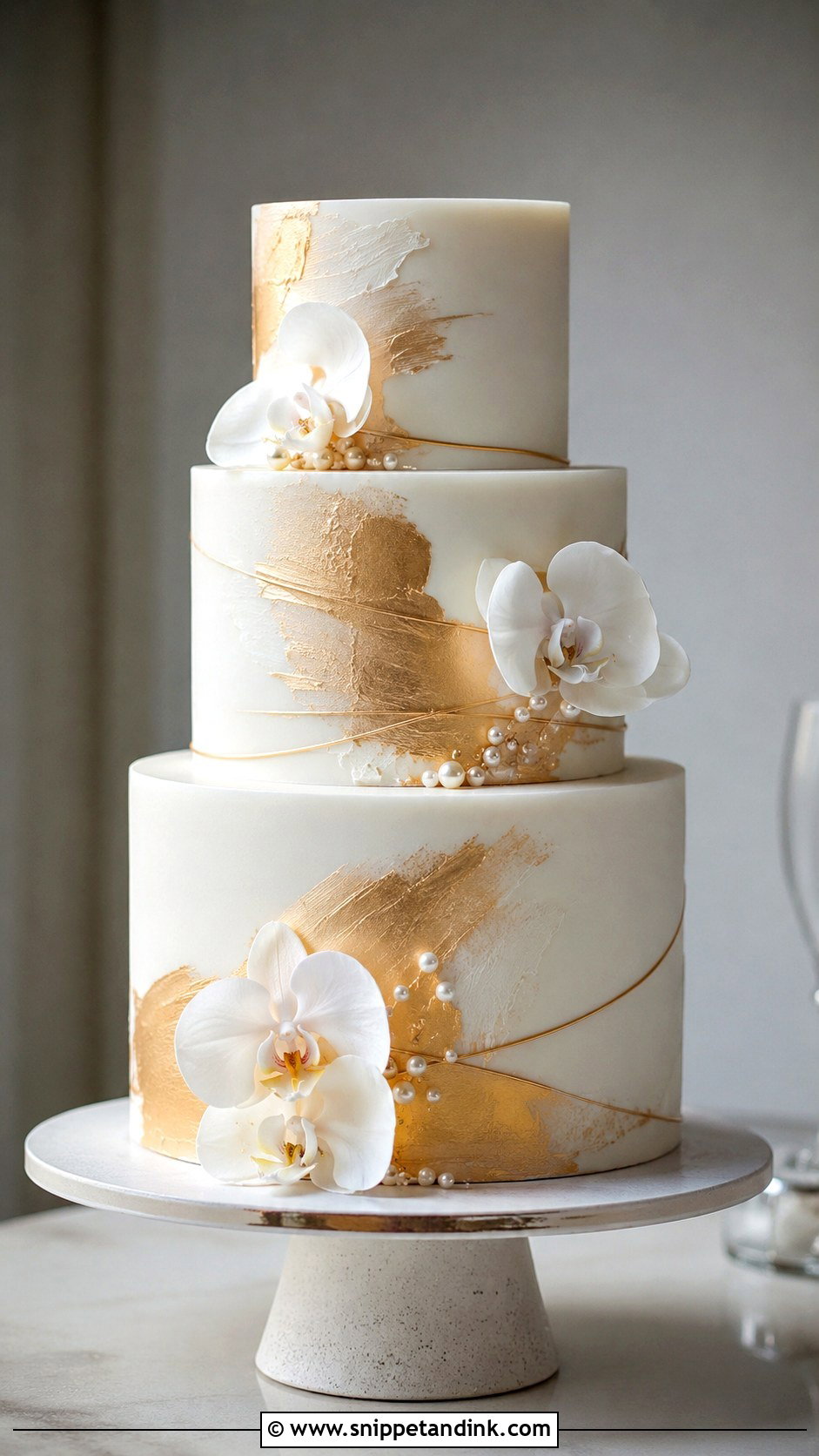
Painted gold is mixed from metallic dust and a few drops of clear alcohol, then brushed onto set fondant in strokes, vines or abstract marks. Fondant takes the cleanest lines; buttercream needs to be well chilled and still gives a softer, more textured stroke. I’ll often copy a motif from your invitations so the cake connects to the stationery. White, ivory, blush or pale grey bases work. Hold back on flowers or they’ll cover the brushwork you’re paying for.

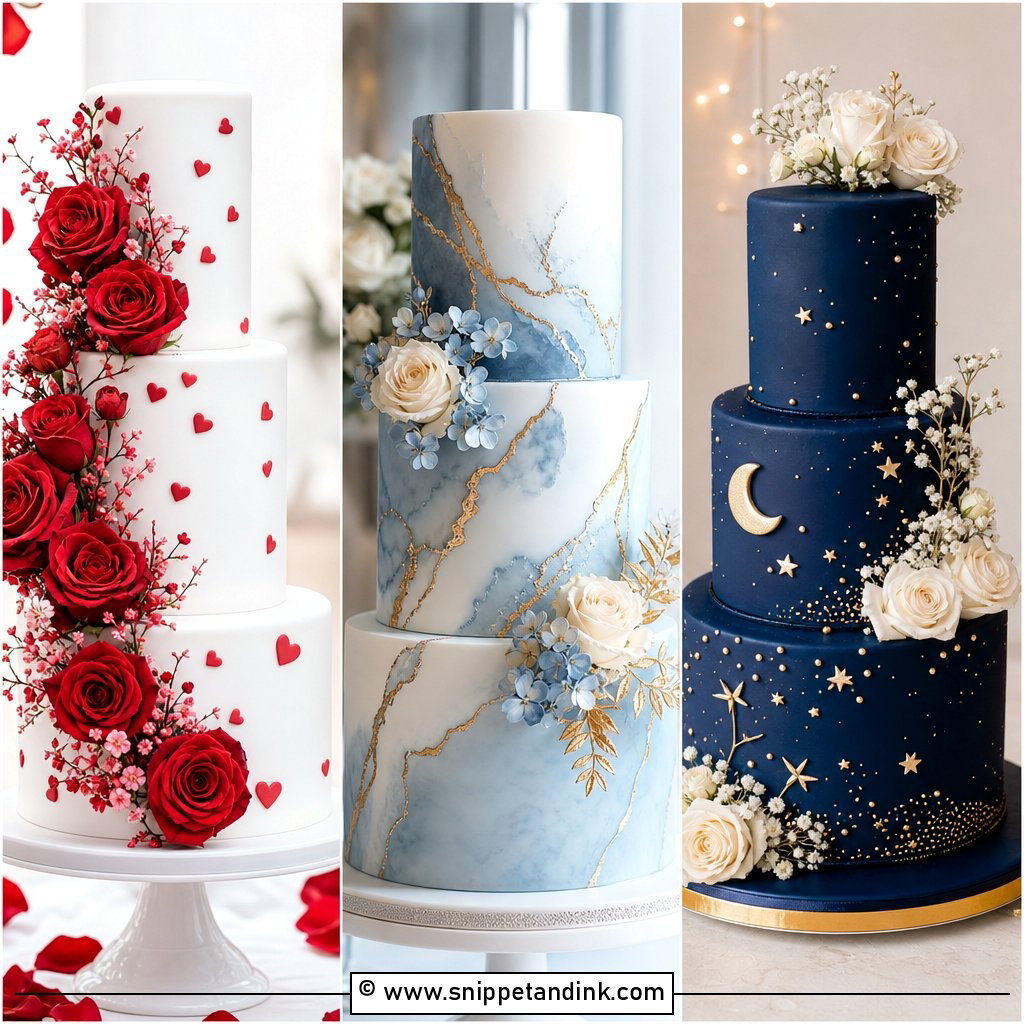
15. Gold Lace Wedding Cake
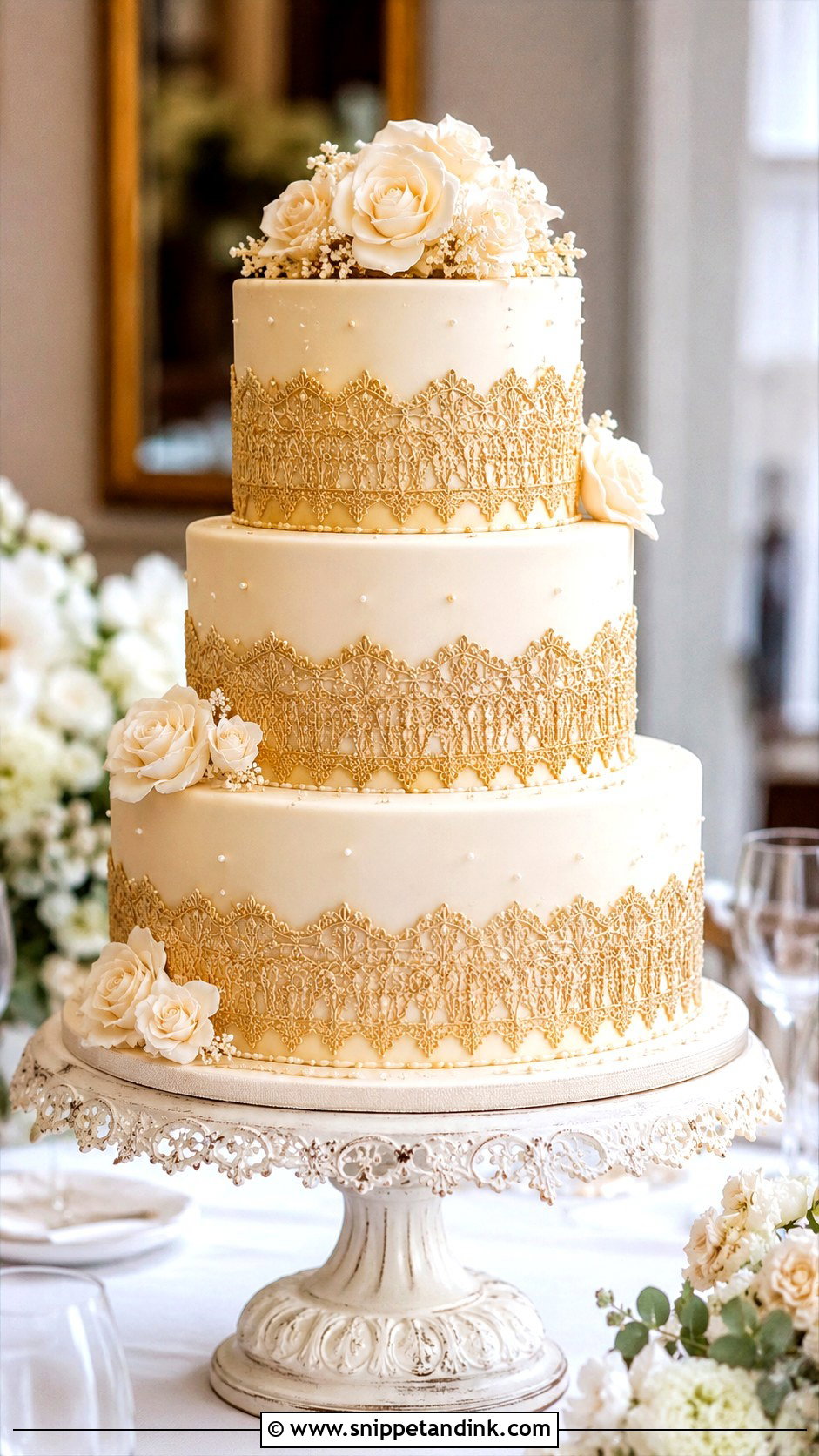
A gold lace wedding cake can be made three ways: piped royal icing lace, a silicone lace mat pressed into fondant, or lace painted on by hand. Piped lace is the most delicate and the most fragile in transport; mat-pressed lace is sturdier and very even. Gold lace looks warm on ivory or champagne tiers. Add pearl borders or small sugar roses for a vintage feel, or keep the lace to one tier for a cleaner version. If your gown has a distinctive lace, bring a photo; I can often echo the motif.
16. Gold Ombre Wedding Cake
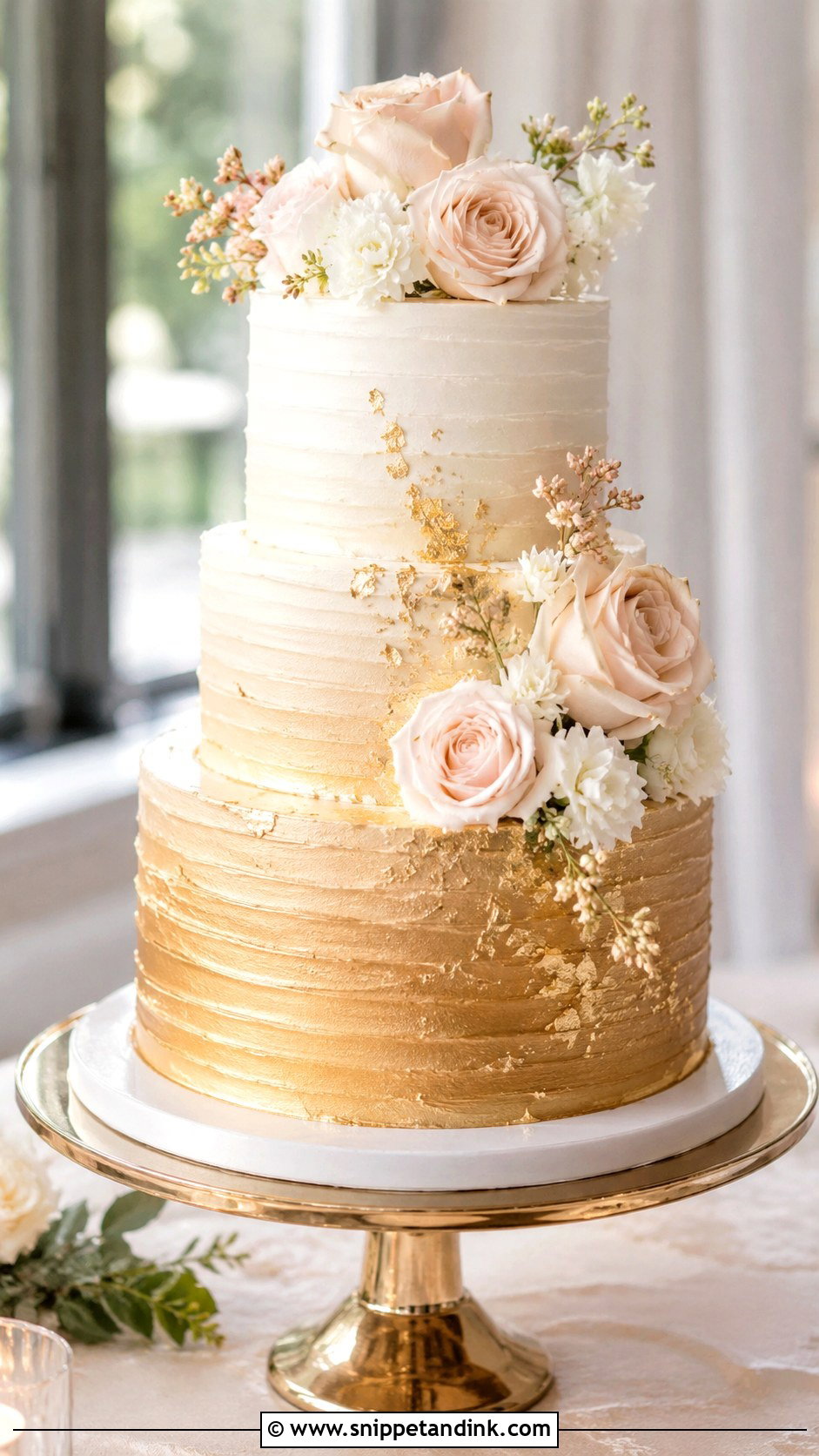
Ombré in gold is tricky because metallic colour doesn’t blend like ordinary colouring. I build the fade with tinted buttercream or fondant from ivory to champagne to a warm caramel, then add leaf only around the darkest band to give it richness. Buttercream ombré looks soft and slightly textured; fondant looks smoother. Keep any white or blush flowers on the light end. It gives gold a leading role with some movement in it.
17. Gold Arch Wedding Cake
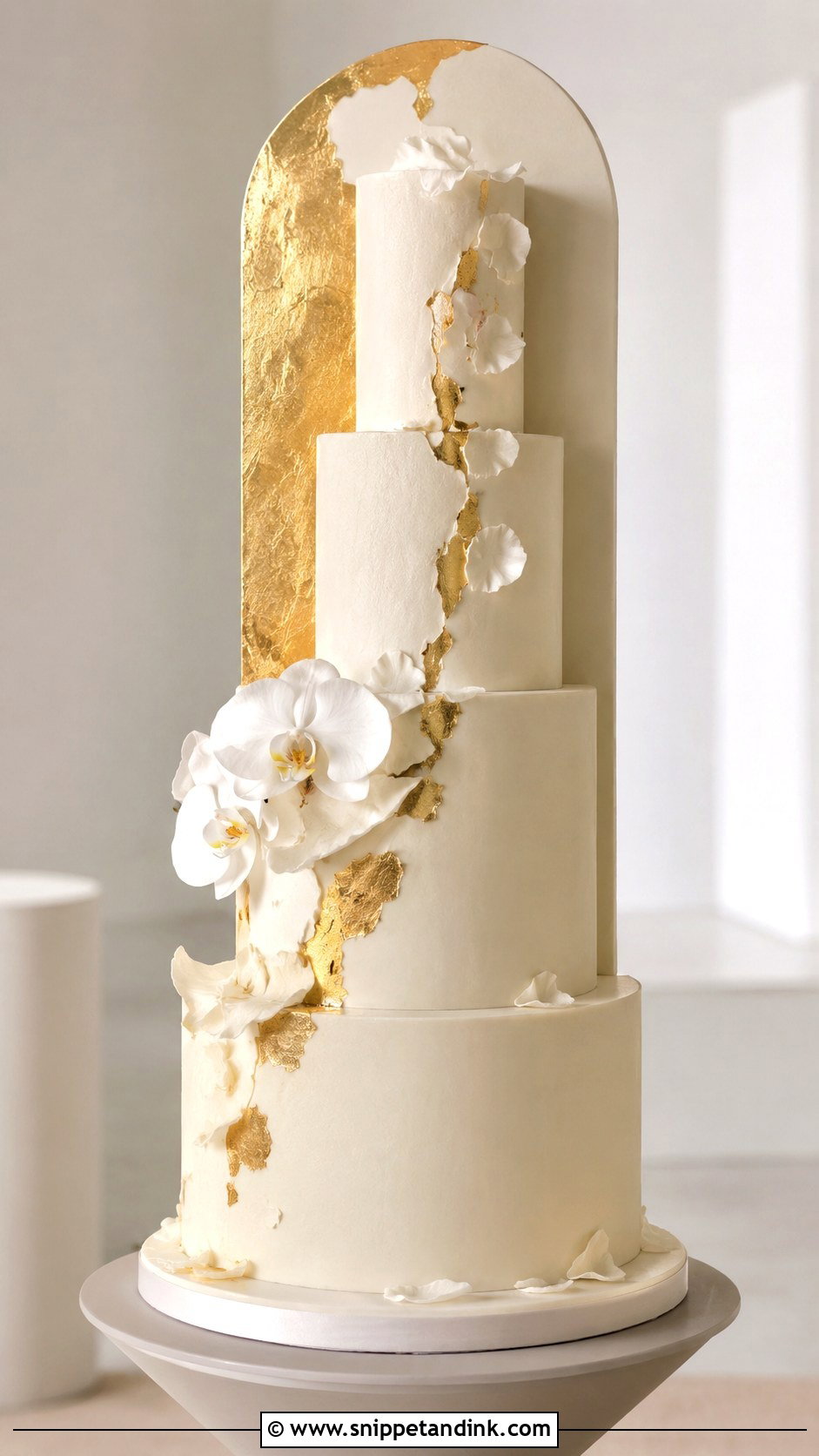
Arches and half-moon panels are made from fondant or gum paste dried over a curved form for days before assembly, so they need planning. The panel can be edged in gold or leafed across its face, standing behind or around plain white tiers. I always check the venue table depth for this design, because a backdrop panel makes the cake deeper than a normal round. Ivory, champagne and soft florals keep it clean. It reads more like a piece of decor than a dessert, which is exactly why gallery and modern venues love it.
18. Gold Ruffle Wedding Cake
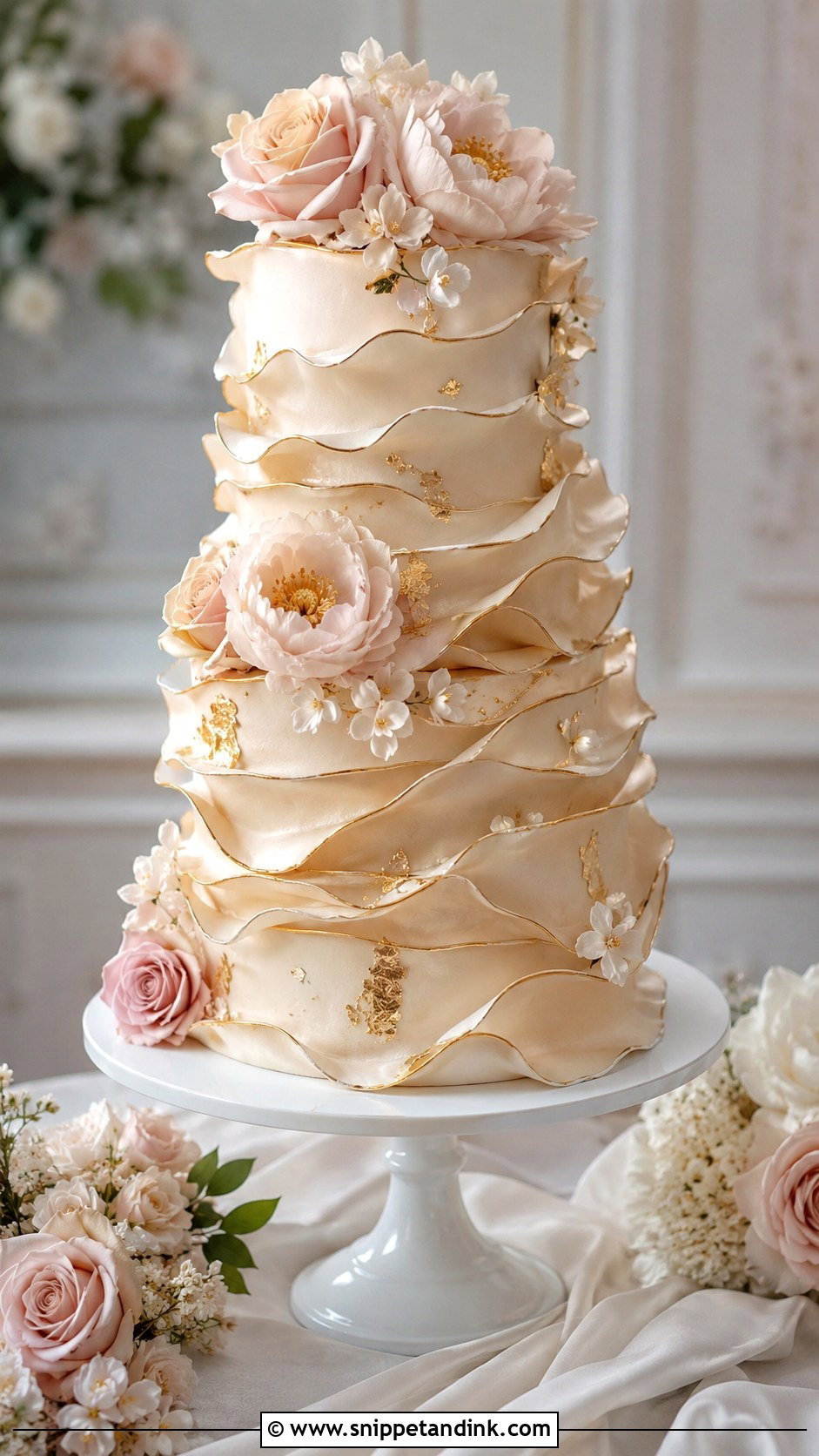
Ruffles are cut from thin fondant, wafer paper or piped in buttercream, then the edges are kissed with gold dust so they shimmer when light hits the folds. Wafer paper ruffles are the lightest, but they wilt in humidity, so I’d use fondant for a summer garden. Ivory, blush or pale champagne suits it. For more drama, add leaf between ruffle layers or put one smooth gold tier under ruffled ones. Keep flowers airy, like sugar peonies or small blossoms.
19. Gold Vintage Wedding Cake
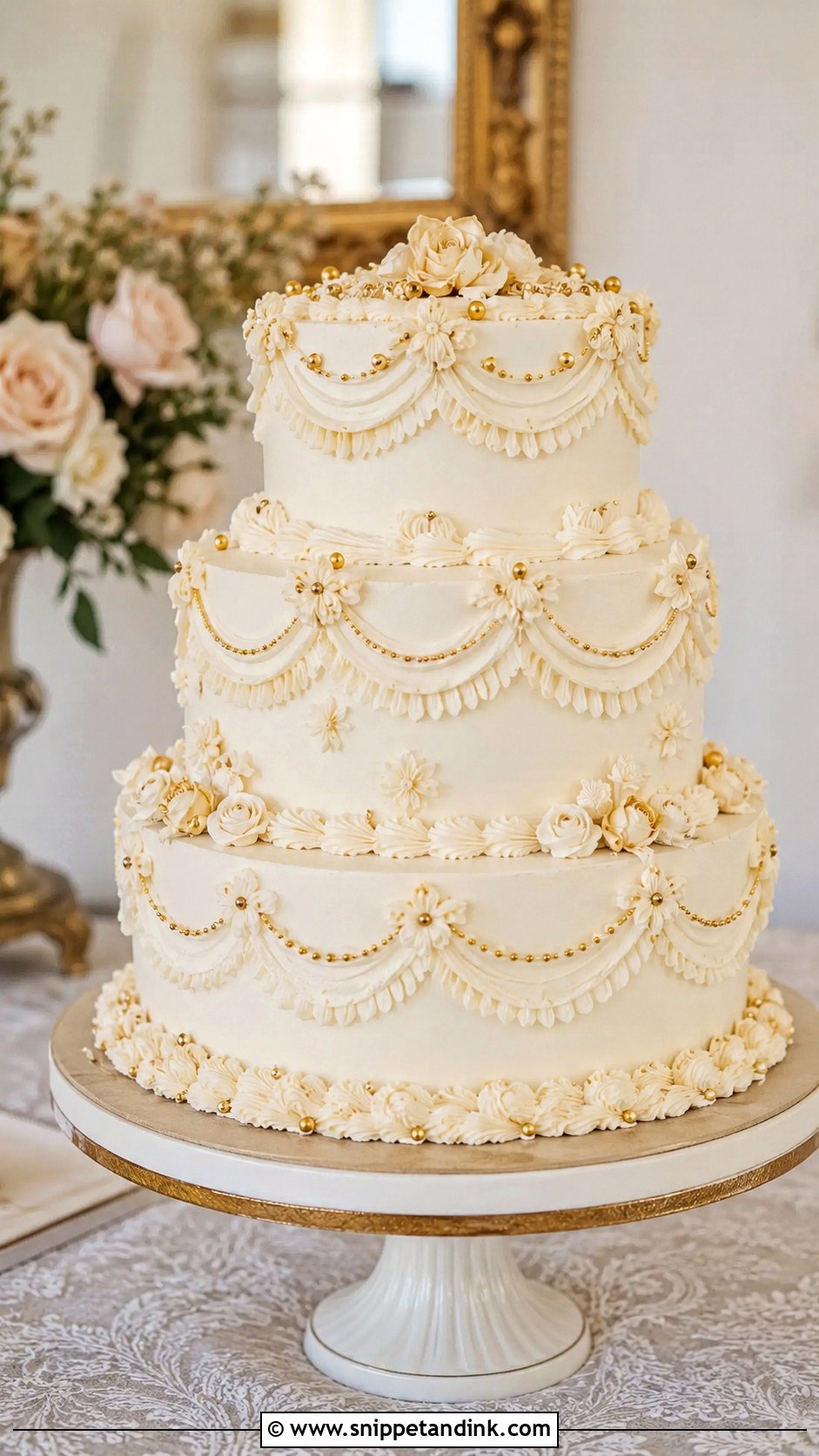
Lambeth piping, layered scallops and swags piped in rows, is what gives a gold vintage cake its depth, and I’d keep the gold to the edges of that piping rather than flooding it. A gold-tipped shell border or gilded pearls on a white or ivory base keeps it charming instead of heavy. If you love old-fashioned piping, scalloped borders, allow extra lead time with your baker; this much piping takes hours per tier. Small sugar roses or a simple topper finish it. It suits couples who like nostalgia with a polished edge.



20. Gold Minimalist Wedding Cake
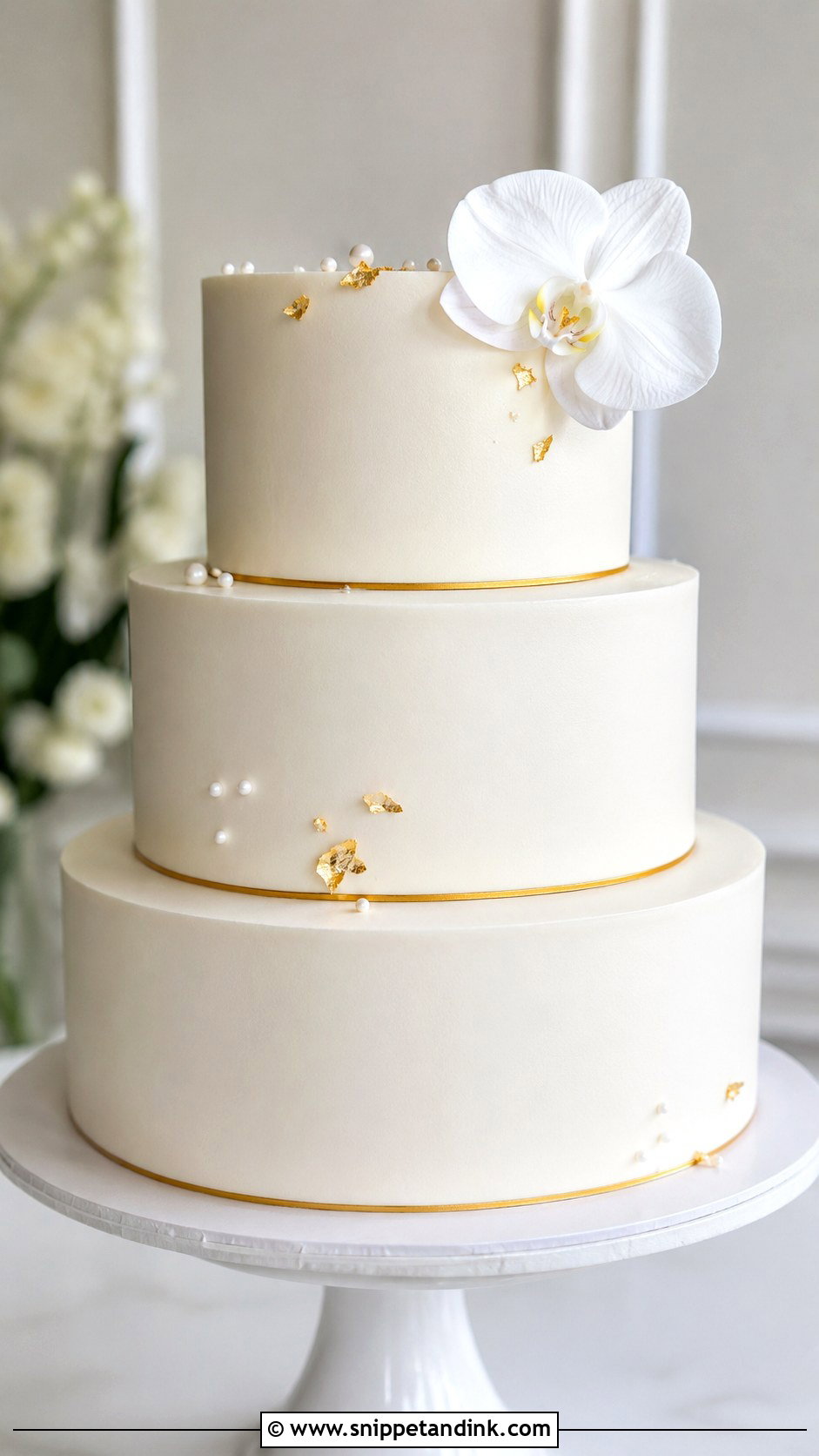
With one gold detail and nothing else, the finish has to be flawless. Smooth white or ivory frosting with sharp edges, then a thin gold line around each tier, one patch of leaf or a single painted stroke. Restraint is the design. One fresh orchid, a small cluster of roses or no flowers at all. I’d ask to see close-up photos of a baker’s sharp-edged work before booking this one, since there’s nowhere for a wobble to hide. It suits intimate weddings and calm modern rooms.
Gold Under Candlelight, Daylight and a Camera Flash
Metallic finishes don’t have a fixed colour. They reflect whatever light is in the room, and that’s the part couples rarely see coming.
Warm candlelight and tungsten bulbs make gold look rich and deep. Cool daylight from big windows can make the same leaf look pale, almost brassy, and a mirror-smooth metallic tier can flare into a white blob when a flash hits it straight on. Brushed or textured gold handles a flash far better than a polished surface.
A few things I do for a gold cake
- Look at samples under light like your reception’s, not the bright light of a studio.
- Angle the cake table so the main gold detail faces the room, not a window behind it.
- Apply delicate leaf close to delivery day so it doesn’t get scuffed in a busy fridge.
- Brief your photographer that the cake is metallic; they’ll often bounce the flash off a wall instead.
Then at cutting time, ask the catering team to remove toppers and any decoration-only pieces before the cake is sliced, so nothing inedible ends up on a guest’s plate.
How Much Shine Can Your Room Take?
Gold can suit almost any wedding once it’s in proportion. For classic, think white and gold, pearl accents or gold lace. For drama, black and gold, sequins or a full gold tier. Softer weddings suit rose gold, ruffles, florals and ombré. Your venue lighting decides a lot of it, so tell your baker where the cake will stand, ask which finishes are edible, and look at the cake from across the room as well as up close.
You'll Like These Ideas:




Leave a Reply