
Khaleeji henna is built on bold shapes and open skin. Where dense Indian bridal mehndi fills every gap, the Gulf style uses large flowers, sweeping vines, paisleys and filled fingertips with deliberate space between them, so bangles and embroidered sleeves still have room to show. I apply it for henna nights, nikah ceremonies, walima looks and destination weddings, and the same principle holds at each: fewer motifs, drawn with more confidence. Below are twenty bridal layouts, from full hands and forearms to feet, with notes on how each one is applied and who it suits.
What Makes a Design Read as Khaleeji
When I draw for a Khaleeji bride, I work with a slightly thicker cone line than I would for Indian bridal work. The outlines of the big flowers are bold, the inside is shaded or left half open, and the gaps between motif groups are planned rather than leftover. That spacing is the signature. If an artist fills it with tiny filler patterns, the design loses its Gulf character.
Fingertips are the other marker. Gulf brides often have the tips fully filled, sometimes up to the first knuckle, which frames the hand and stains to an even, deep color. Bring a photo of your outfit to the consultation, not only henna pictures. Sleeve length and how much jewelry you’ll wear decide how far up the arm the design should travel.
1. Full Hand Khaleeji Bridal Henna
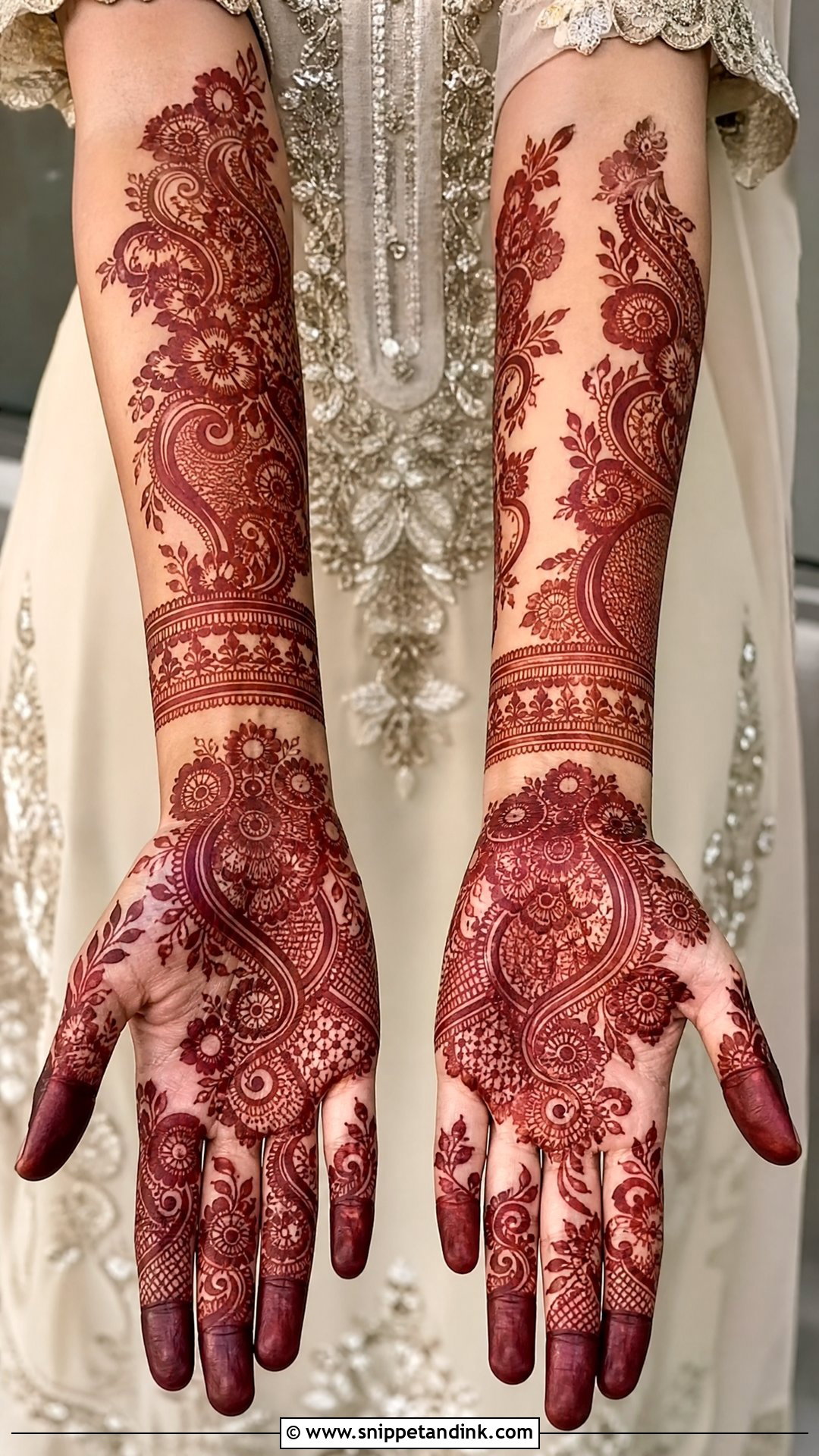
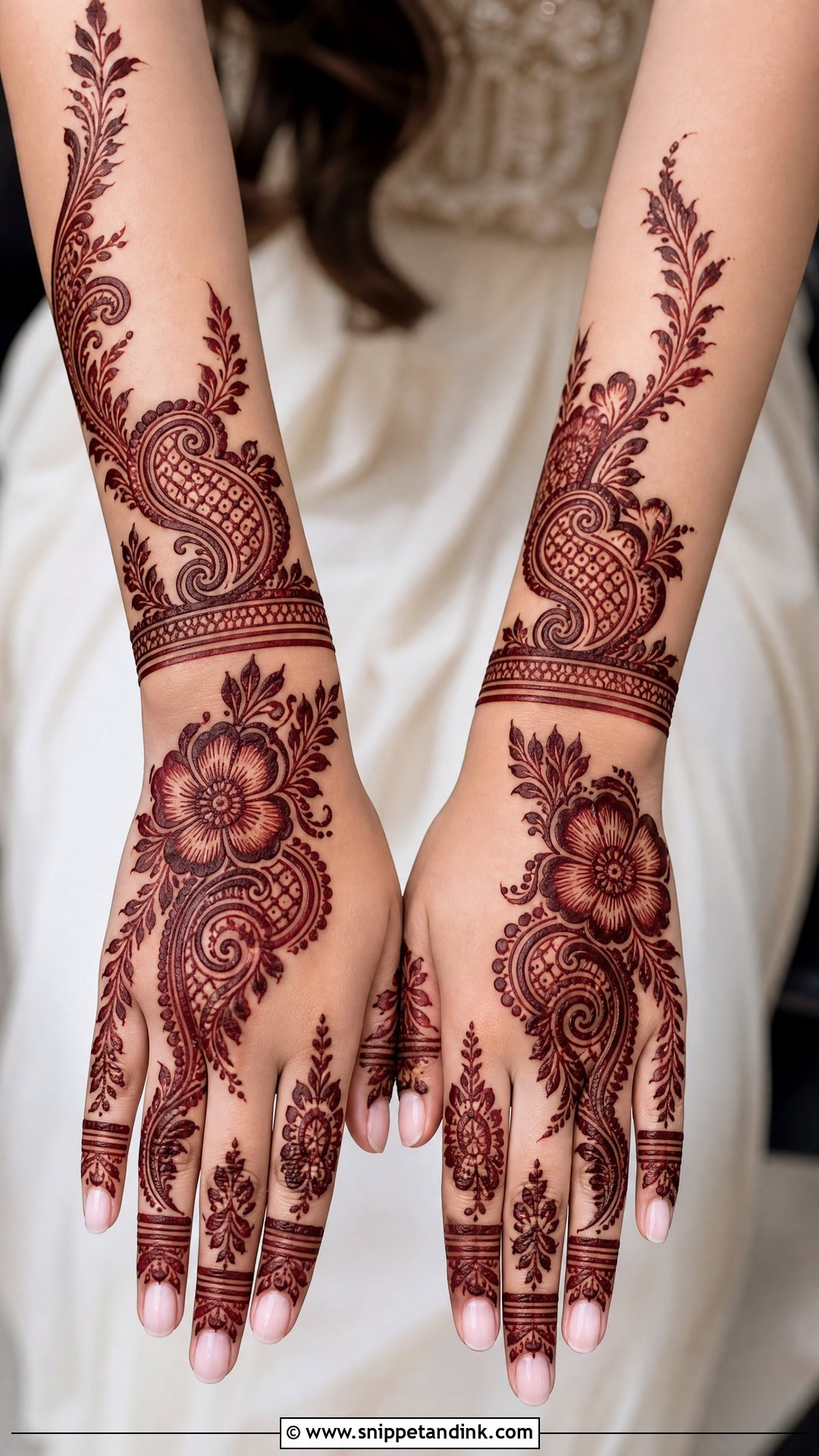
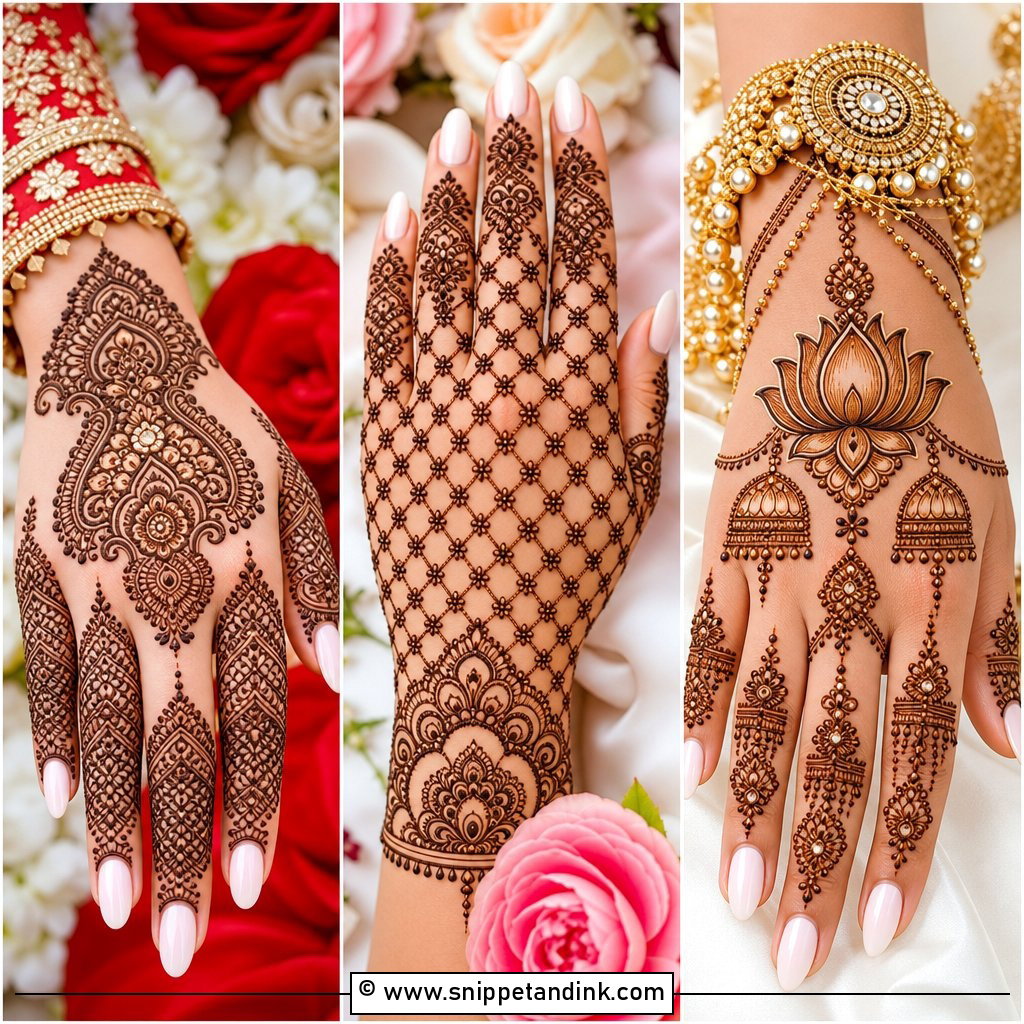
This is the classic bridal layout: palm, back hand, fingers, wrist and lower forearm, with bold flowers, paisley curves and filled fingertips. What makes it Khaleeji rather than simply busy is contrast. I outline the big flowers in a thick line, shade inside them, and leave clear skin between motif groups so the hand reads from across the room. Ask for mirrored hands for a formal look, or slightly different layouts if you’d like the artist’s hand to show. On a deep maroon stain with gold bangles, it looks rich without turning into a dark glove.
2. Arabic Khaleeji Bridal Henna
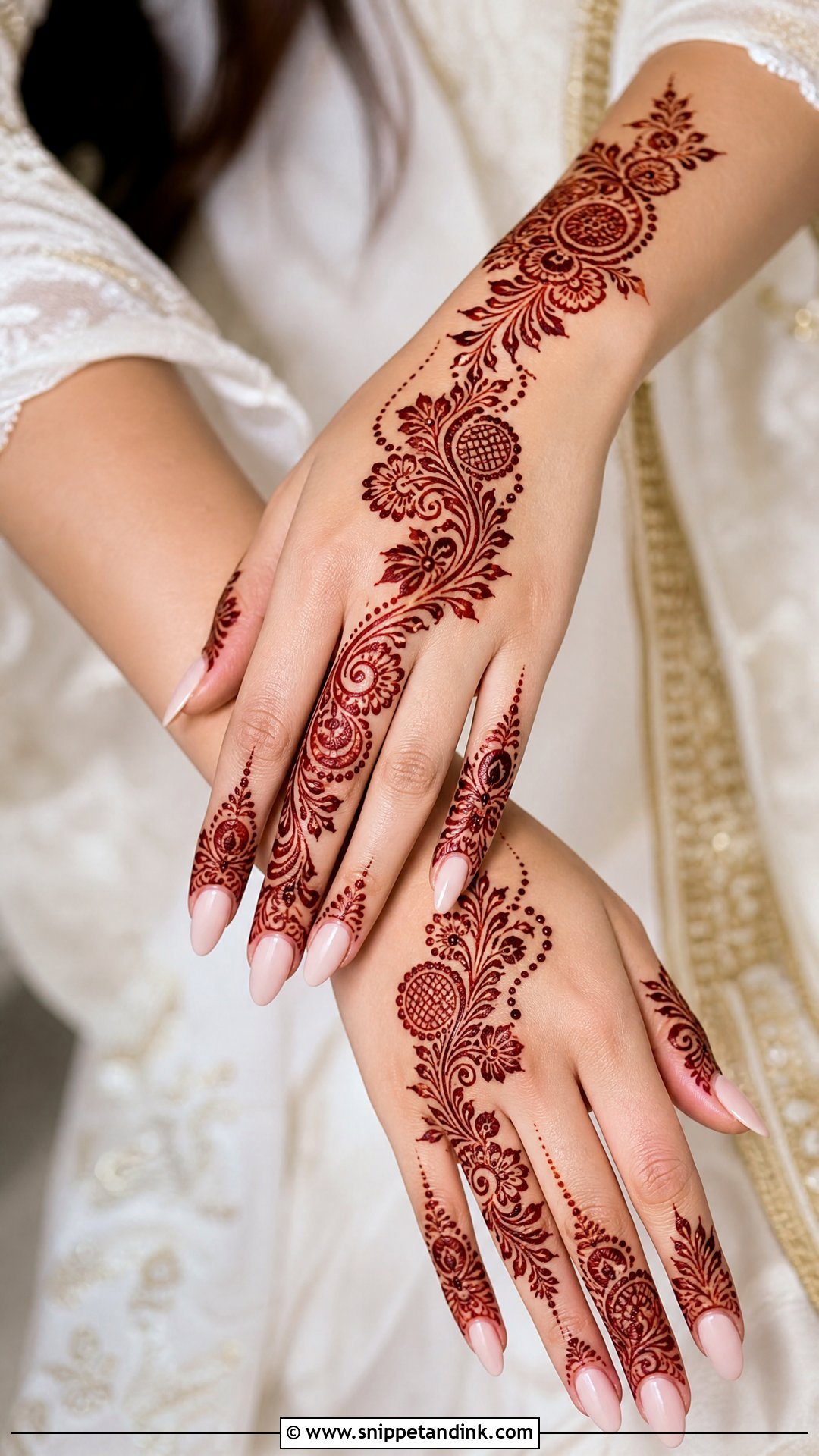
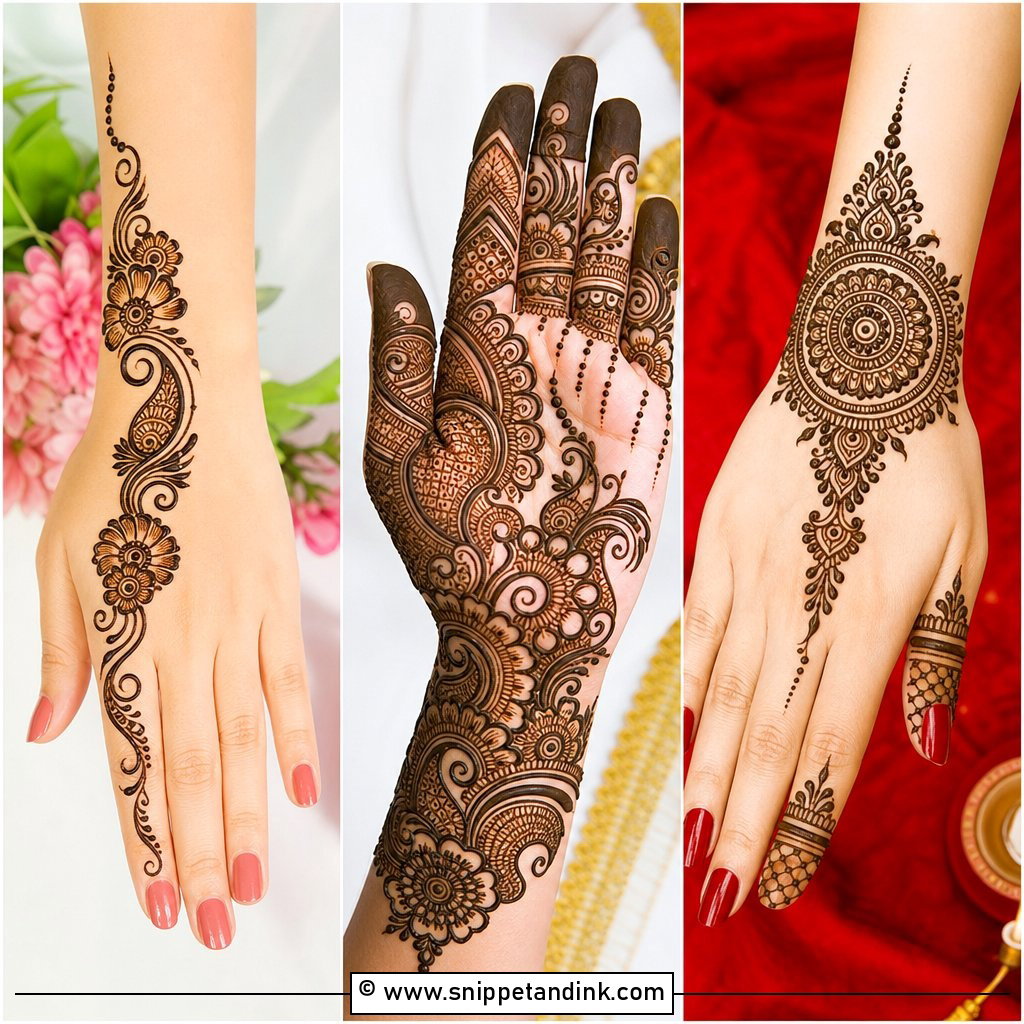
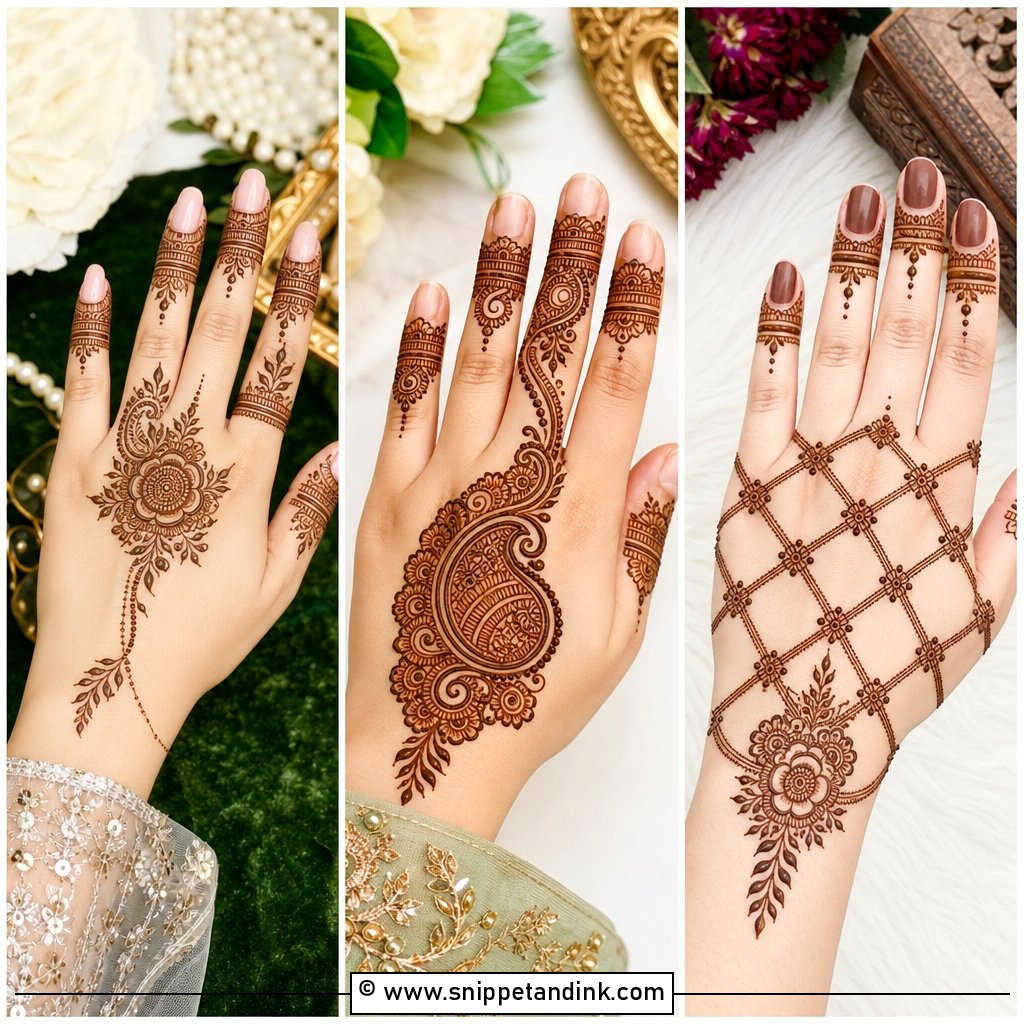
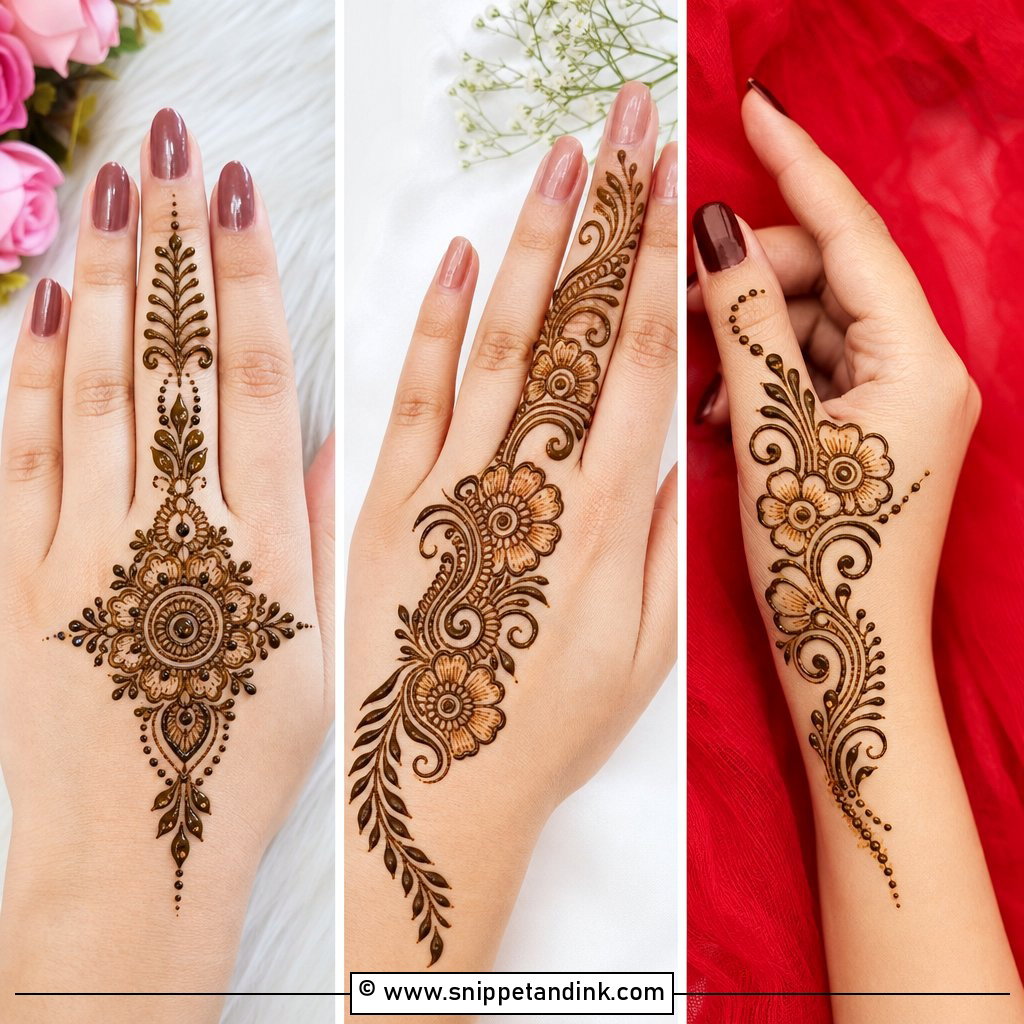
The Arabic version runs diagonally, usually from the outer wrist toward the index finger, with a few large flowers and curved leaves and plenty of empty space either side. That diagonal gives the hand its movement, and I place it only after watching how the bride holds her hands at rest, since a trail that fights the natural angle looks crooked in photos. Fingers get stacked lines, dots and leafy tips. It sits comfortably with Gulf, Arab, South Asian and fusion outfits, and it’s one of the quicker bridal layouts to apply.
3. Dubai Khaleeji Bridal Henna
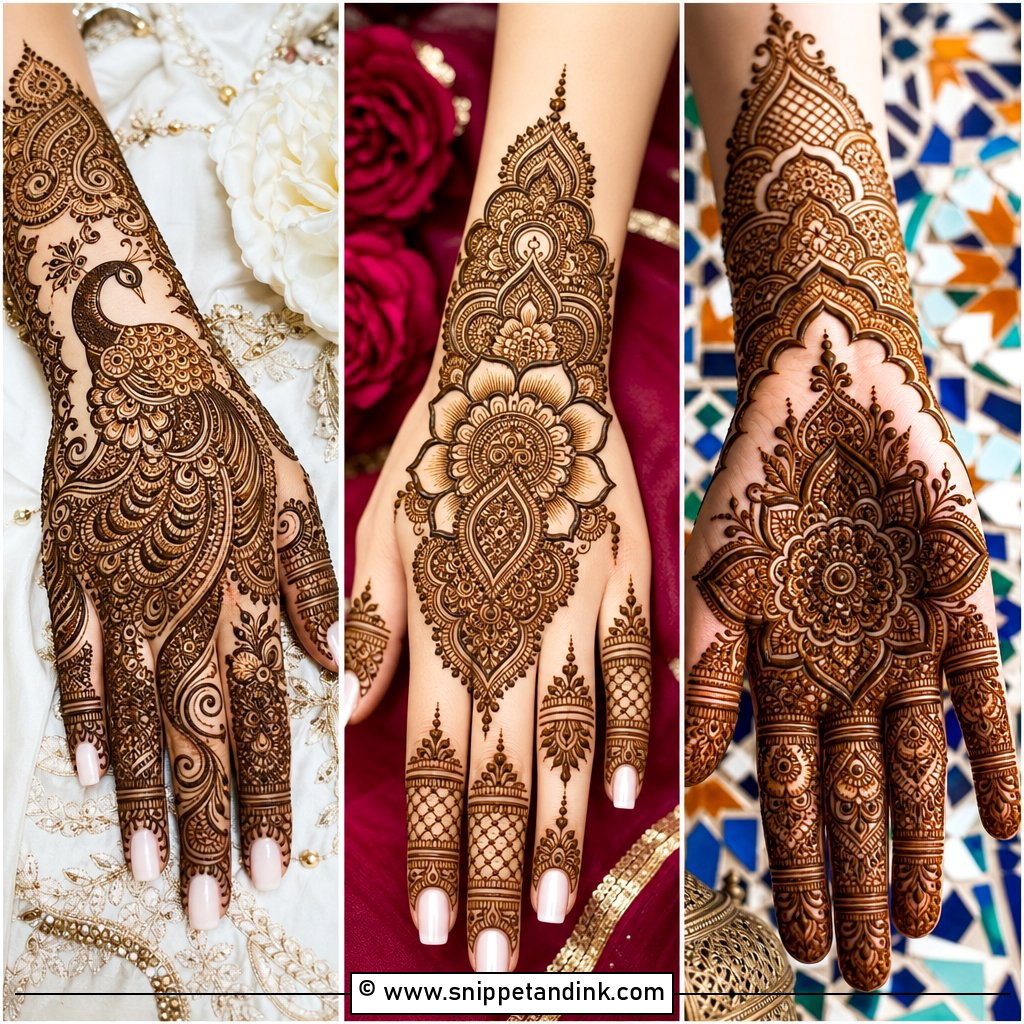
Dubai Khaleeji bridal henna is the polished salon version, with neat symmetry, clean spacing, bracelet bands and very tidy finger work. It usually starts at the fingertips, moves through large open flowers on the back of the hand and ends in layered cuffs at the wrist or forearm, with mandalas or paisleys on the palm. Precision is the whole point, so it needs a steady artist and a bride who can keep her hands still. A wobble in a straight cuff line shows far more than one in a flowing vine. Champagne, ivory, emerald and burgundy outfits with gold jewelry all suit it.
4. Emirati Bridal Henna Design
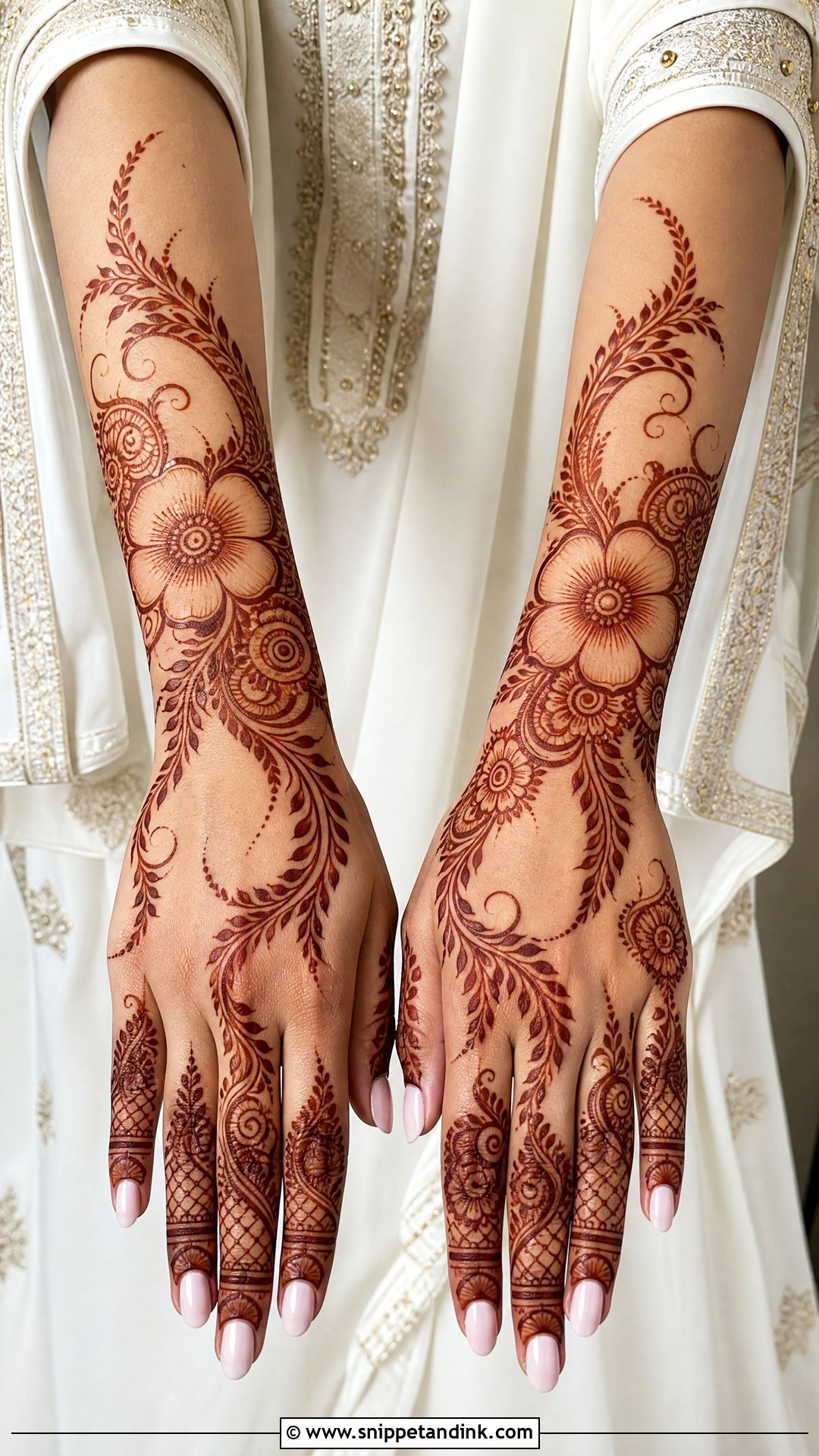
Emirati bridal designs lean on large rounded flowers, curved leafy trails and strong finger patterns, usually covering palm and back hand and fading softly toward the forearm. You can keep it traditional with rounded blooms and paisleys, or sharpen it with neat bracelet borders and slim vines. Here the finish depends on the stain more than the pattern. The deep reddish-brown brides want only comes from fresh paste left on long enough. For a henna night, it celebrates without hiding the shape of the hand.
5. Saudi Khaleeji Bridal Henna
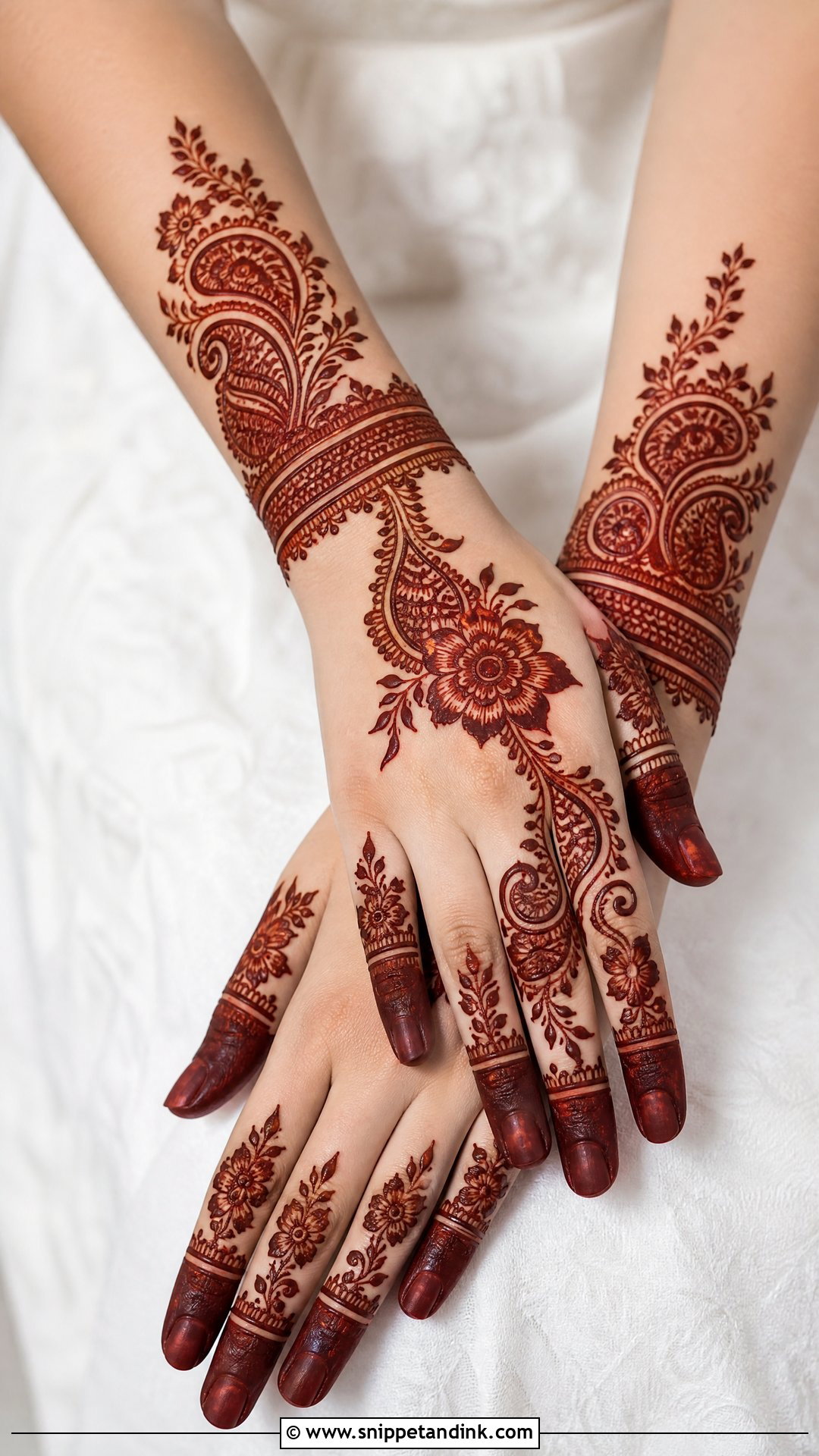
Saudi bridal henna is the boldest on this list, with heavy fingertips, thick floral trails, paisley panels and wrist bands meant to be seen from a distance. A large central flower or paisley arrangement anchors the palm, and vines on the back of the hand run toward the fingers. I use a slightly wider cone opening for the main outlines, then switch to a fine tip for shading and dotted borders, so the design has depth instead of flat blocks. Pair it with gold and a traditional dress; next to minimal jewelry it can overpower.
6. Qatari Bridal Henna Design
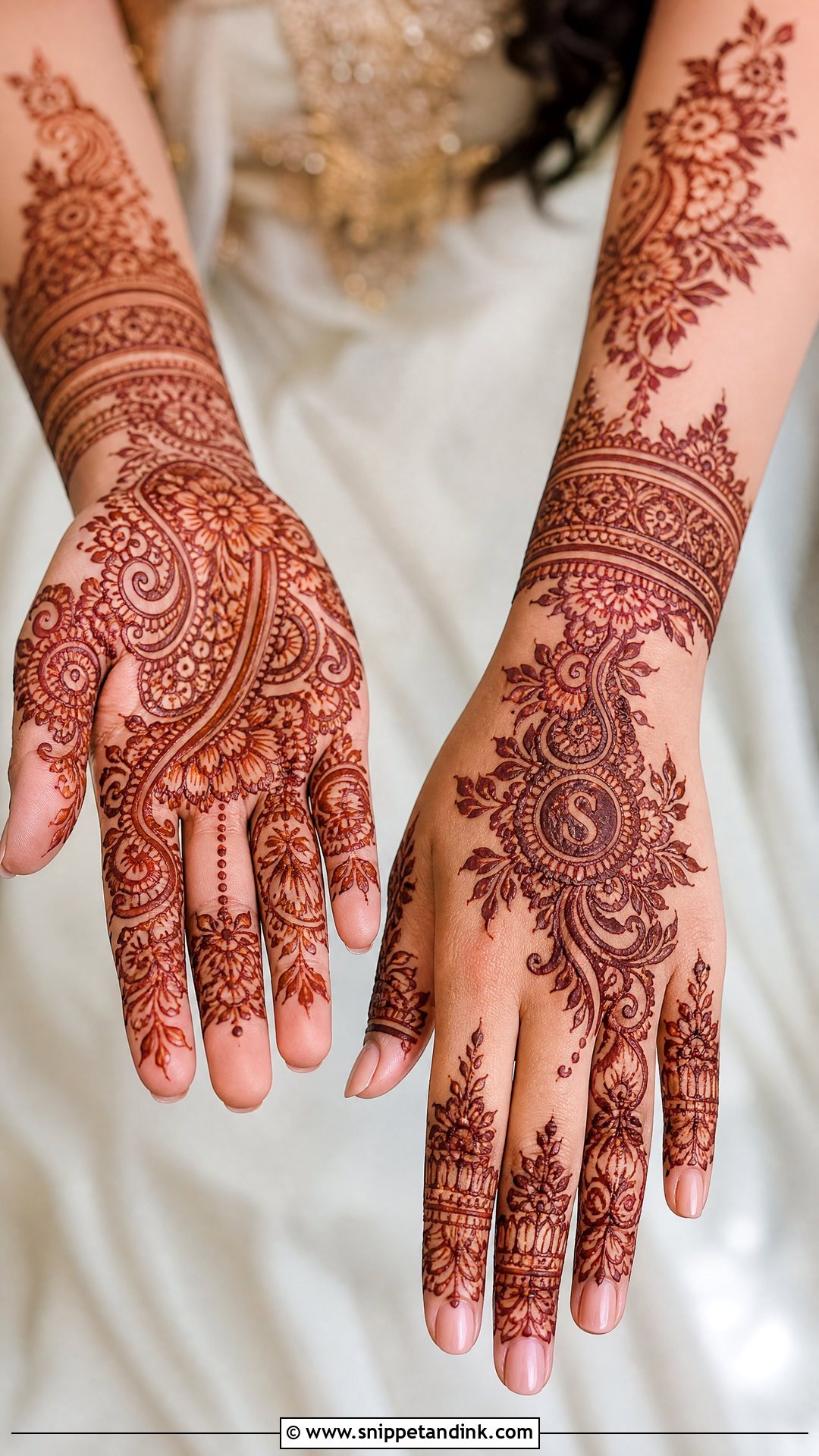
Qatari designs balance palm coverage and detailed fingertips with wide floral trails toward the wrist, kept open enough to stay soft. A bracelet-style cuff on the back hand, tied into the vines, gives a jewelry effect. Many brides ask me to hide initials in this one. I tuck them into a leaf or petal where the lines already curve, so they don’t look stamped on. A deep maroon stain makes the detail clear in close-up portraits.
7. Kuwaiti Khaleeji Bridal Henna
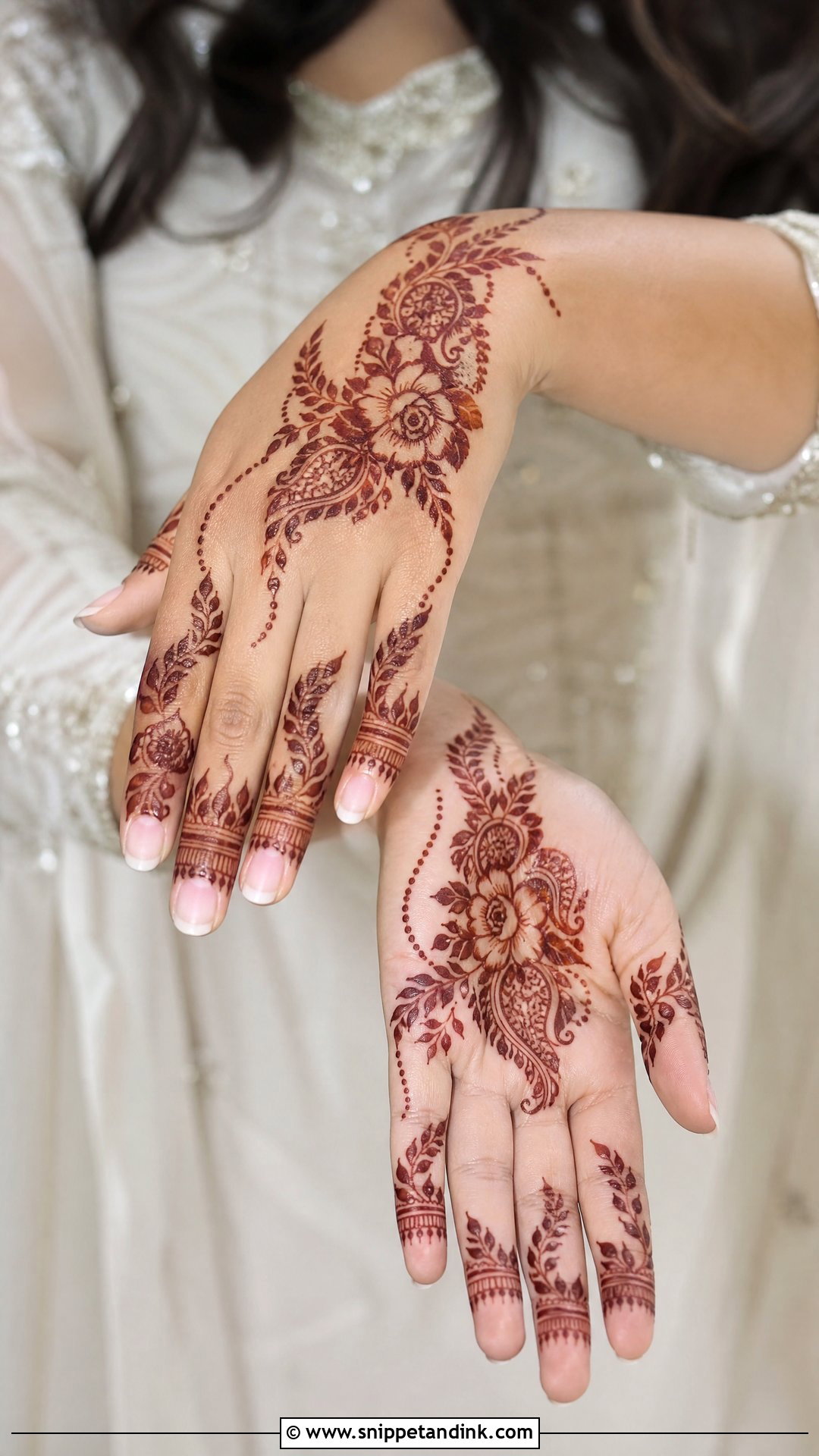
Kuwaiti layouts are the most balanced of the regional styles: neat floral clusters, leafy curves and fine dots with open space, full enough for a bride but lighter than dense mehndi. The usual version puts a flowing floral trail on the back of the hand with bracelet bands at the wrist, and repeats the central flower on the palm with detailed fingertips. I’d suggest it to brides who want tradition but dislike a heavy hand. It’s also a sensible size for an engagement or a small wedding where you don’t want to sit for hours.
8. Bahraini Bridal Henna Design
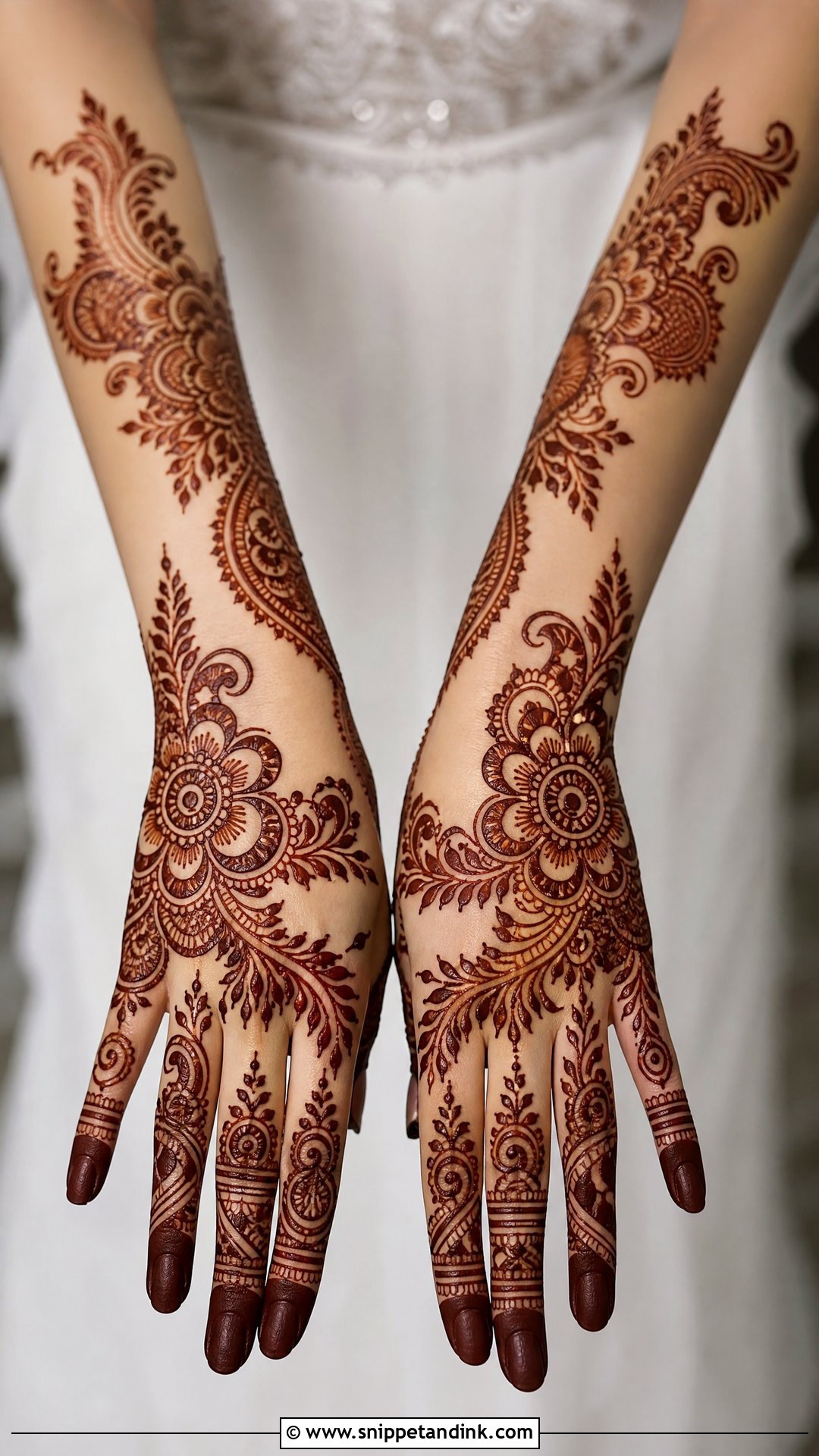
Bahraini bridal henna uses rounded flowers, small paisleys, fine stems and half-moon borders, matched across both palms and back hands with cuff details at the wrists. The fingers carry rings, lines and leafy tips, so the hand looks dressed before you put on a single piece of jewelry. Because the elements are small, it relies on a fine, consistent line; paste that’s mixed too thick will blob the dots together. Pearls, gold bangles and soft makeup sit well with it.
9. Omani Khaleeji Bridal Henna
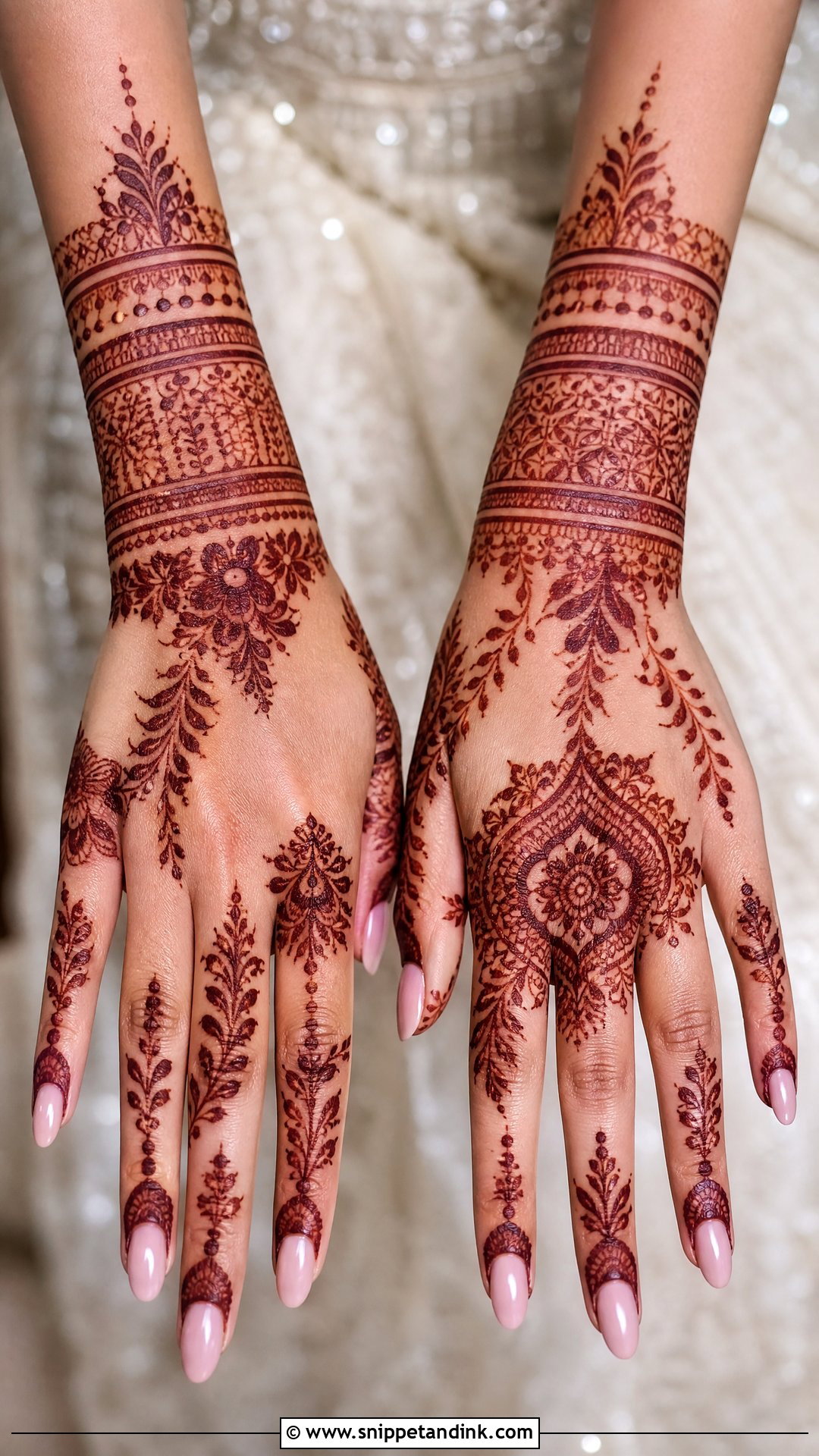
Omani layouts mix soft Gulf florals with more structured, geometric bands near the wrist. A large circular or floral center sits in the palm, the fingers get repeated fine lines and dotted tips, and a vine climbs from the wrist to the middle finger on the back. The geometric band is the part I plan first. It has to sit level around a wrist that isn’t a perfect cylinder, so I mark its position with a few dots before drawing anything else.
10. Khaleeji Bridal Henna For Back Hand
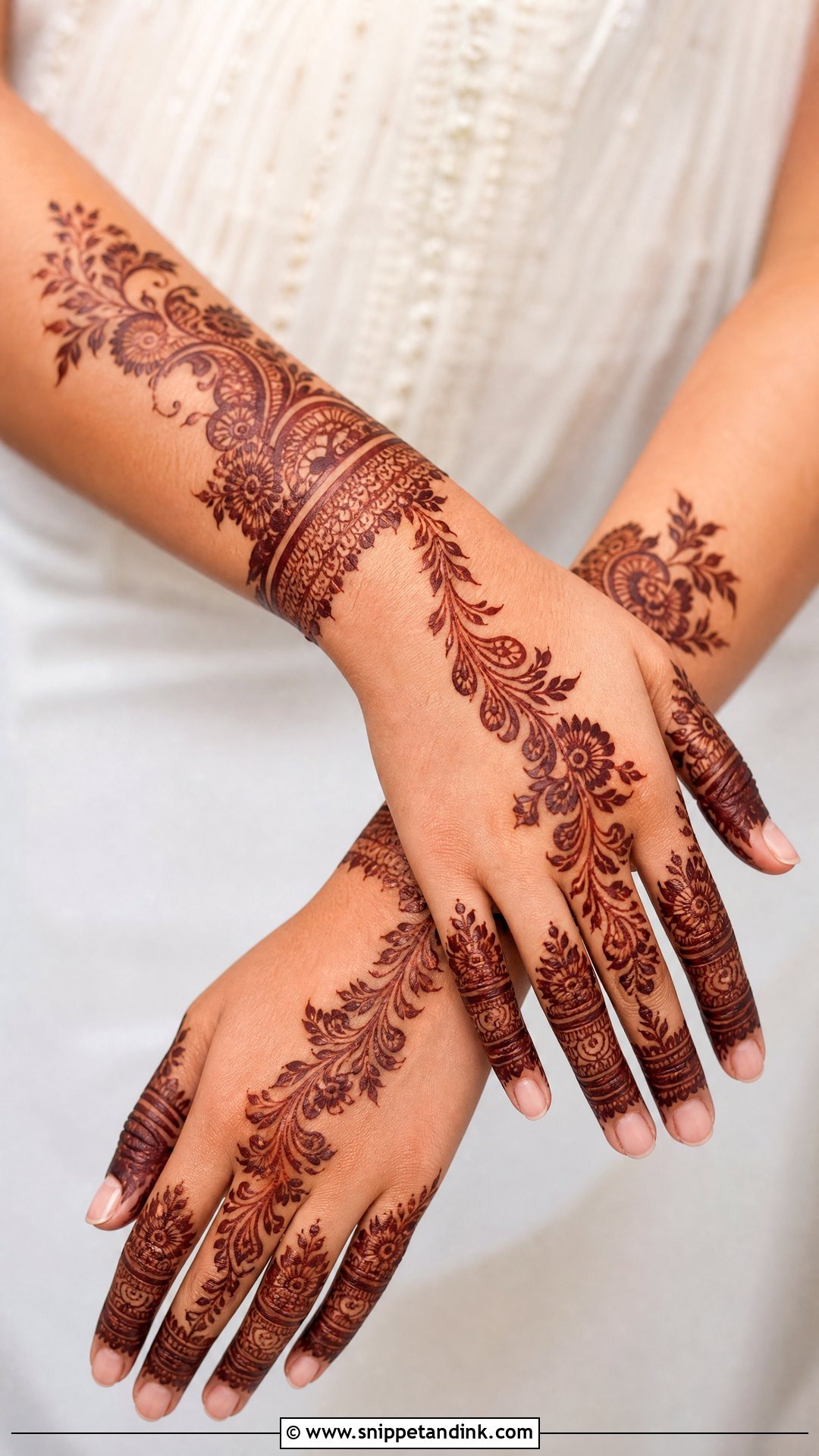
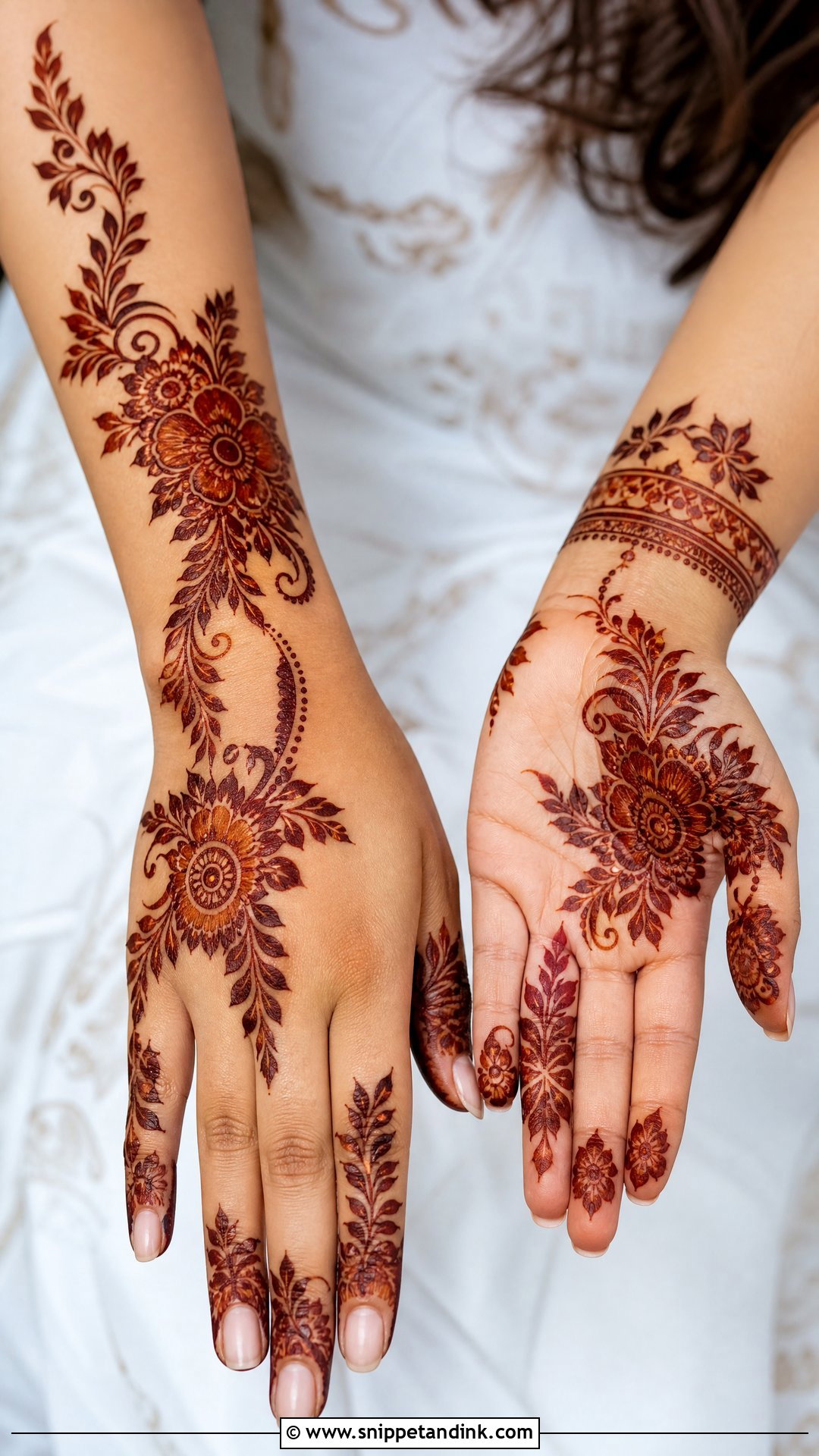
Back-hand designs put the focus where rings and bangles sit. The layout is usually a flowing trail from the wrist to the fingers with large flowers, leaves and paisleys, finished with a cuff and finger bands. Negative space around the motifs makes the hand look longer, and on short or wide hands I keep the trail narrow for that reason. This is the side that shows in ring shots and when you hold the bouquet. It also stains a shade lighter than the palm, so it needs fresh paste and a long sit.
11. Khaleeji Bridal Henna For Palm
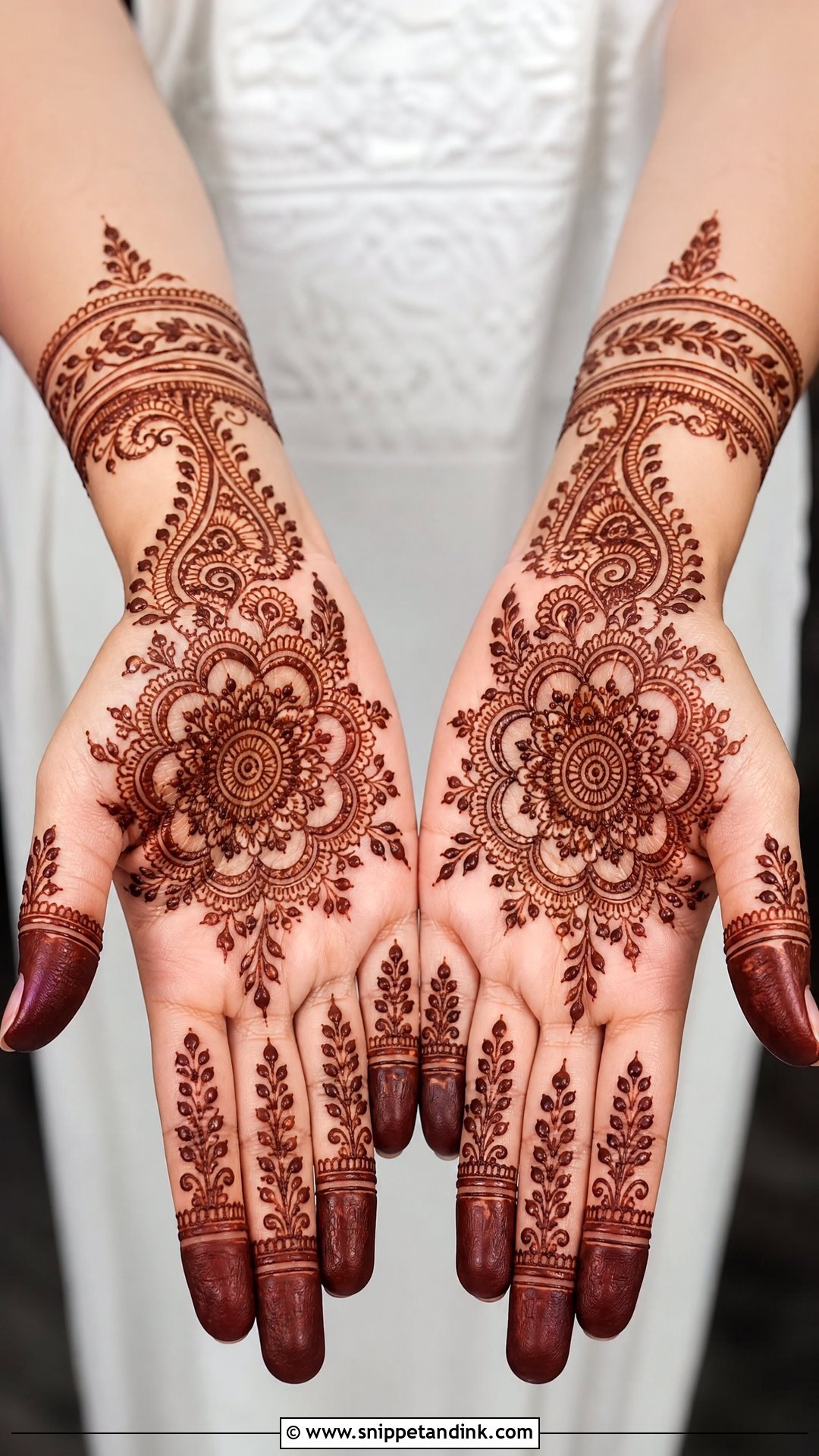
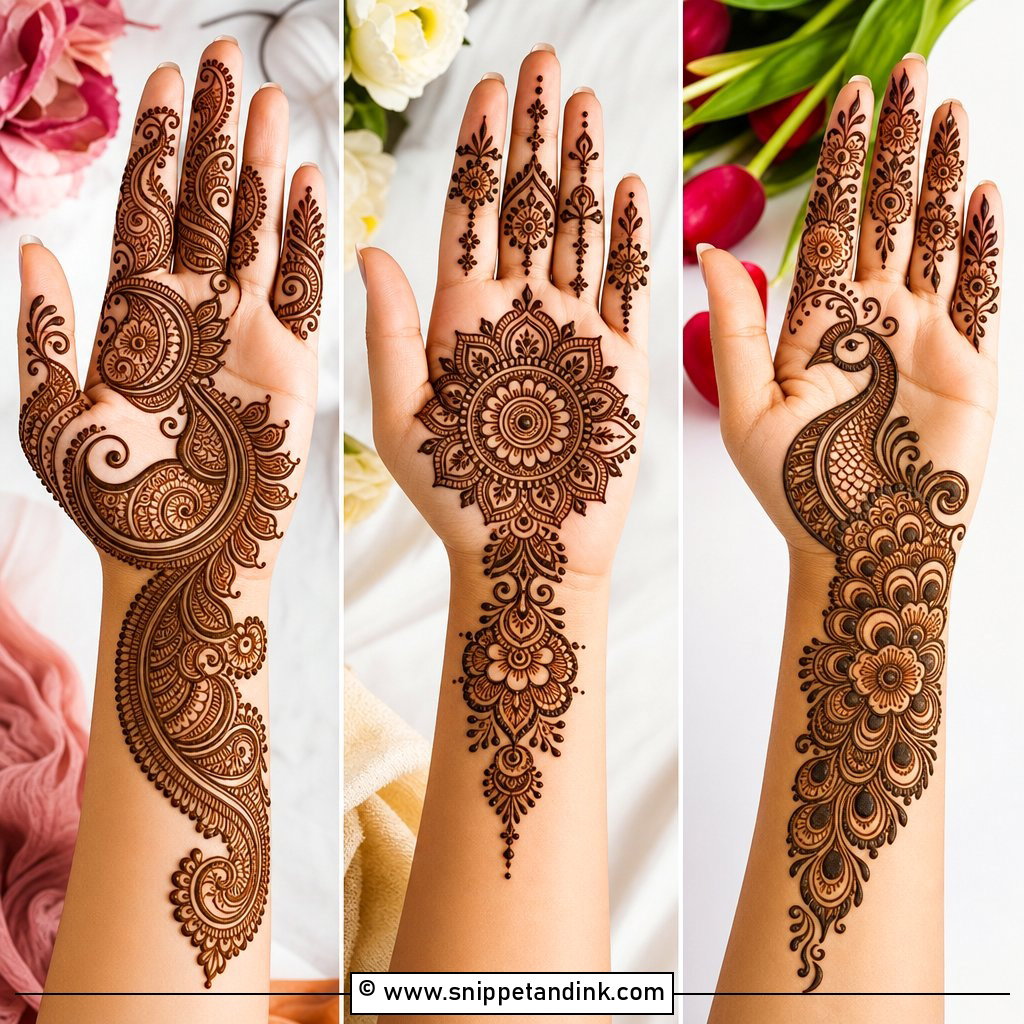
Khaleeji bridal henna for palm carries the most ceremony, since the palm has always been the heart of a henna night and is where henna stains darkest. A complete design has a central flower or mandala-style circle, paisley vines and detailed fingertips, with small gaps left so it stays light. Symmetrical palms look formal; two different layouts feel more personal. Keep your hands flat while it dries, because the palm creases the moment you curl your fingers and wet lines smudge into each other. Done right, it reads clearly in blessings, photos and close-up video.
12. Khaleeji Bridal Henna With Paisley
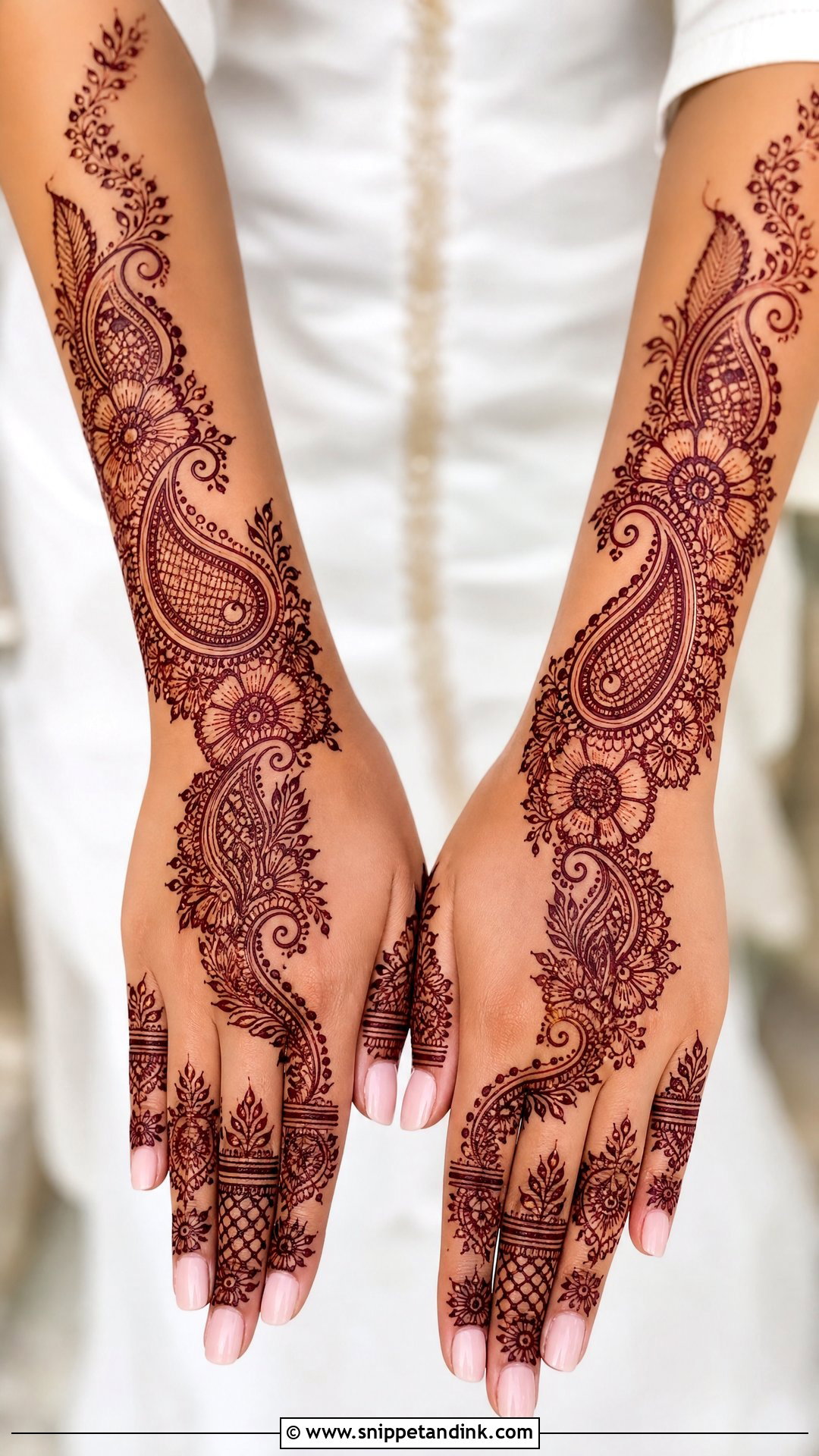
Paisleys bring movement. In a Khaleeji layout they’re drawn larger and more open than in Indian work, surrounded by flowers, leaves and curved trails that run from the wrist across the hand to the fingertips. You can ask for shaded paisleys for depth or fine crosshatching inside them. They flatter long hands most, because the curve follows the line of the fingers. On small hands I cut back to one paisley per side so they don’t crowd each other.
13. Floral Khaleeji Bridal Henna
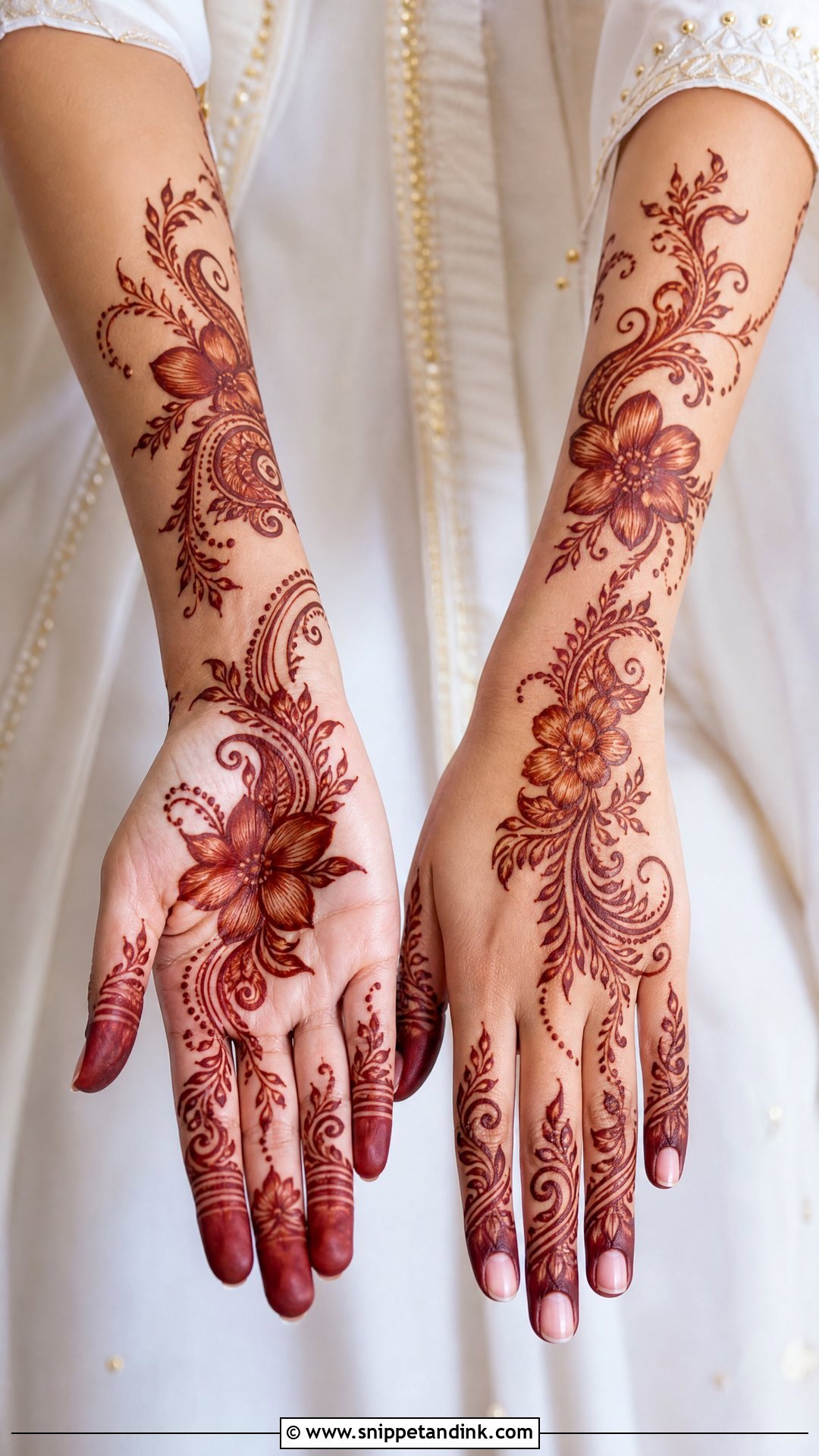
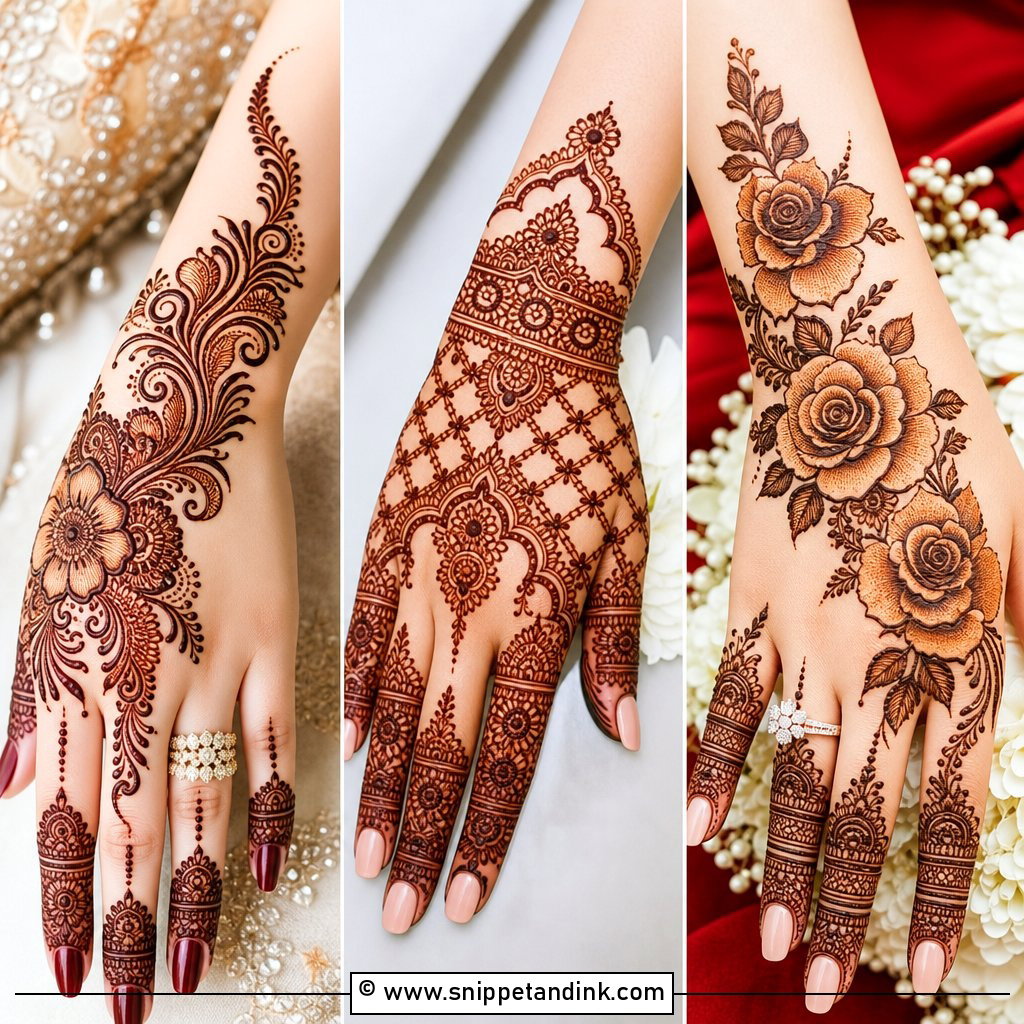
Floral layouts are what most Gulf brides ask me for first. Large flowers lead, and vines, swirls and soft paisleys build around them across palm, back hand, fingers and wrist, with space kept between motifs. Big flowers read clearly at a distance and suit nearly every hand shape, which makes this the safe pick if you can’t decide. Matching both hands gives a neat finish with soft glam makeup and embroidered sleeves.
14. Khaleeji Bridal Henna With Jaali
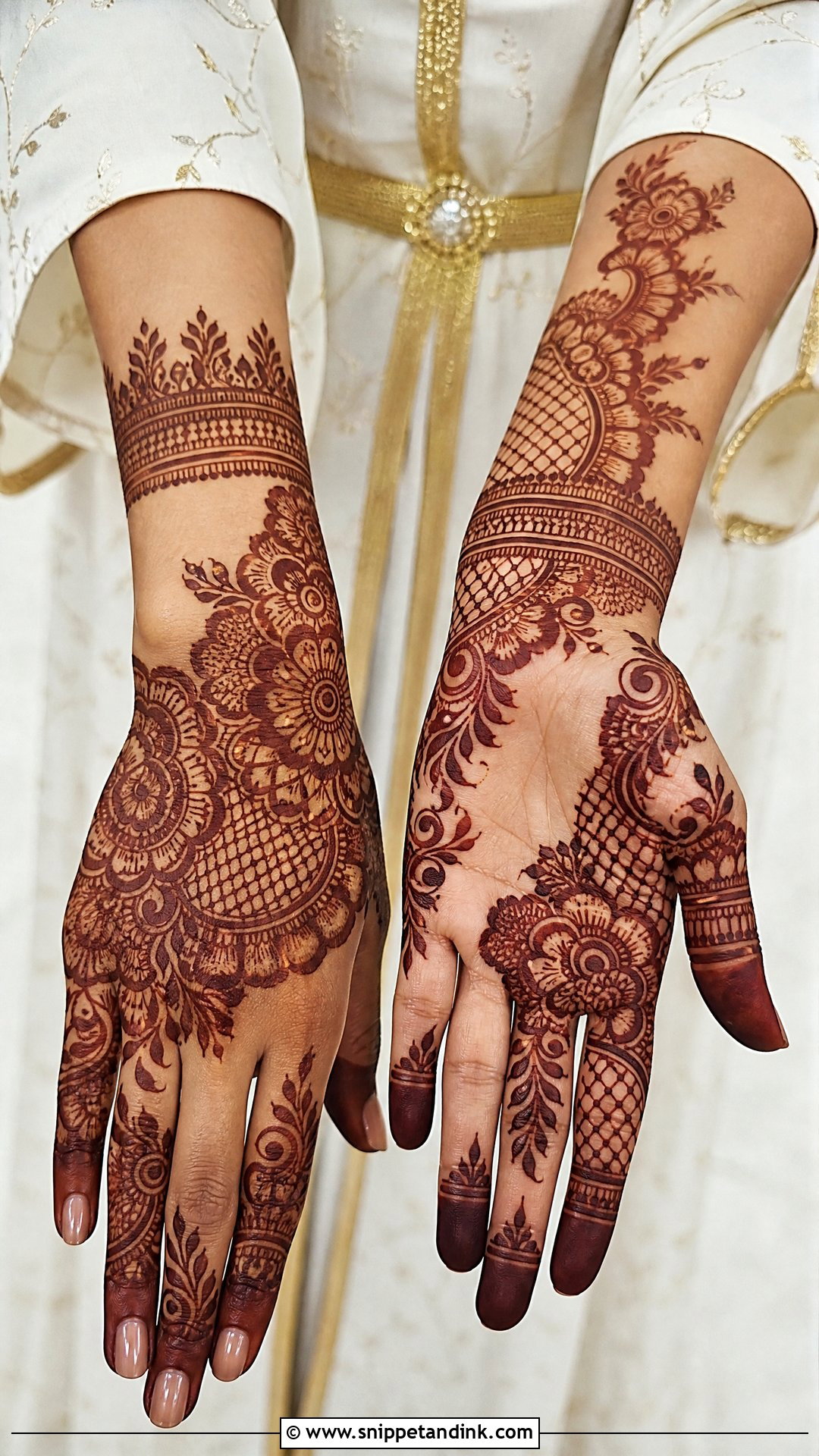
Jaali is a fine mesh drawn inside paisleys, between floral trails or as a bracelet band, and against the bold Khaleeji flowers it gives the hand a lace effect. It takes patience. The grid lines have to be thin and evenly spaced, and if the paste spreads they merge into a dark patch. I keep jaali panels small for brides whose hands get warm and damp, or when I’m applying in humid weather. On a deep maroon stain, the contrast between mesh and open skin is very clear in close-ups.
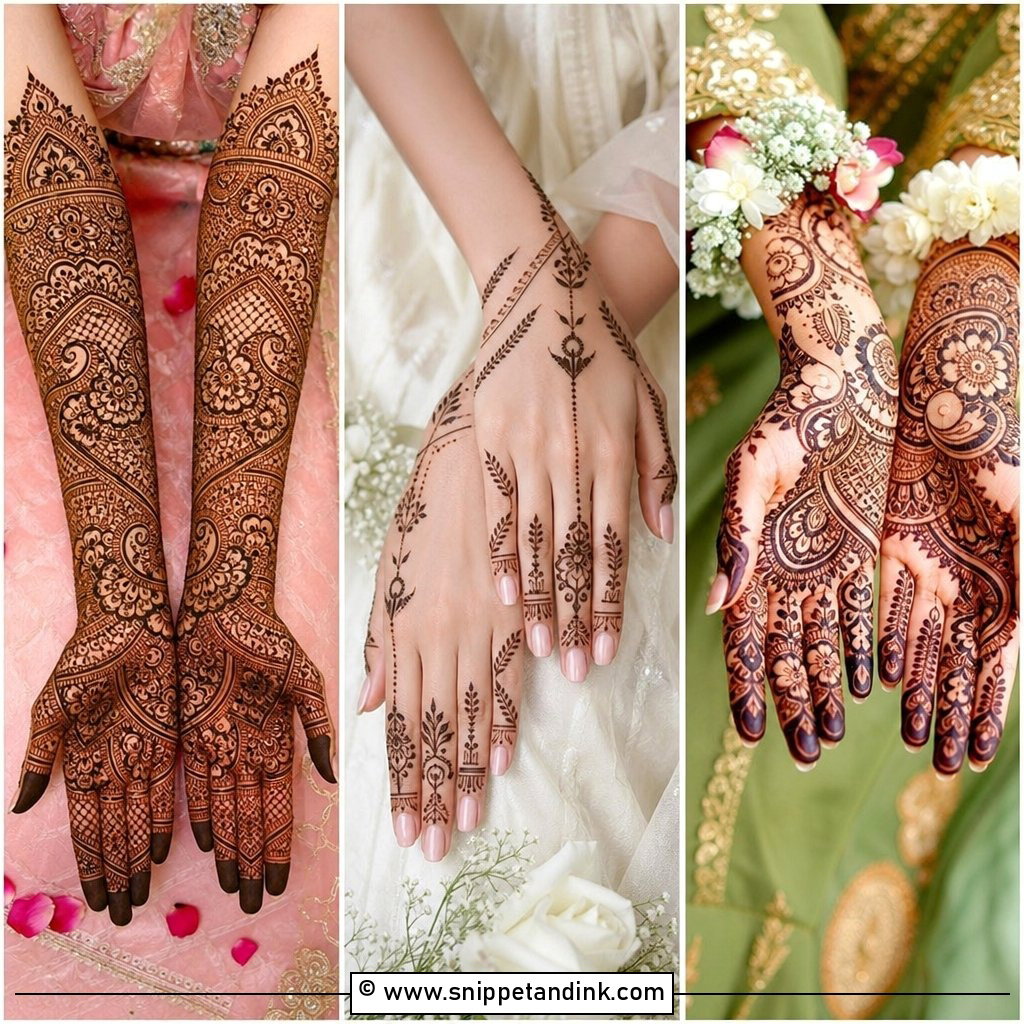


15. Khaleeji Bridal Henna With Mandala
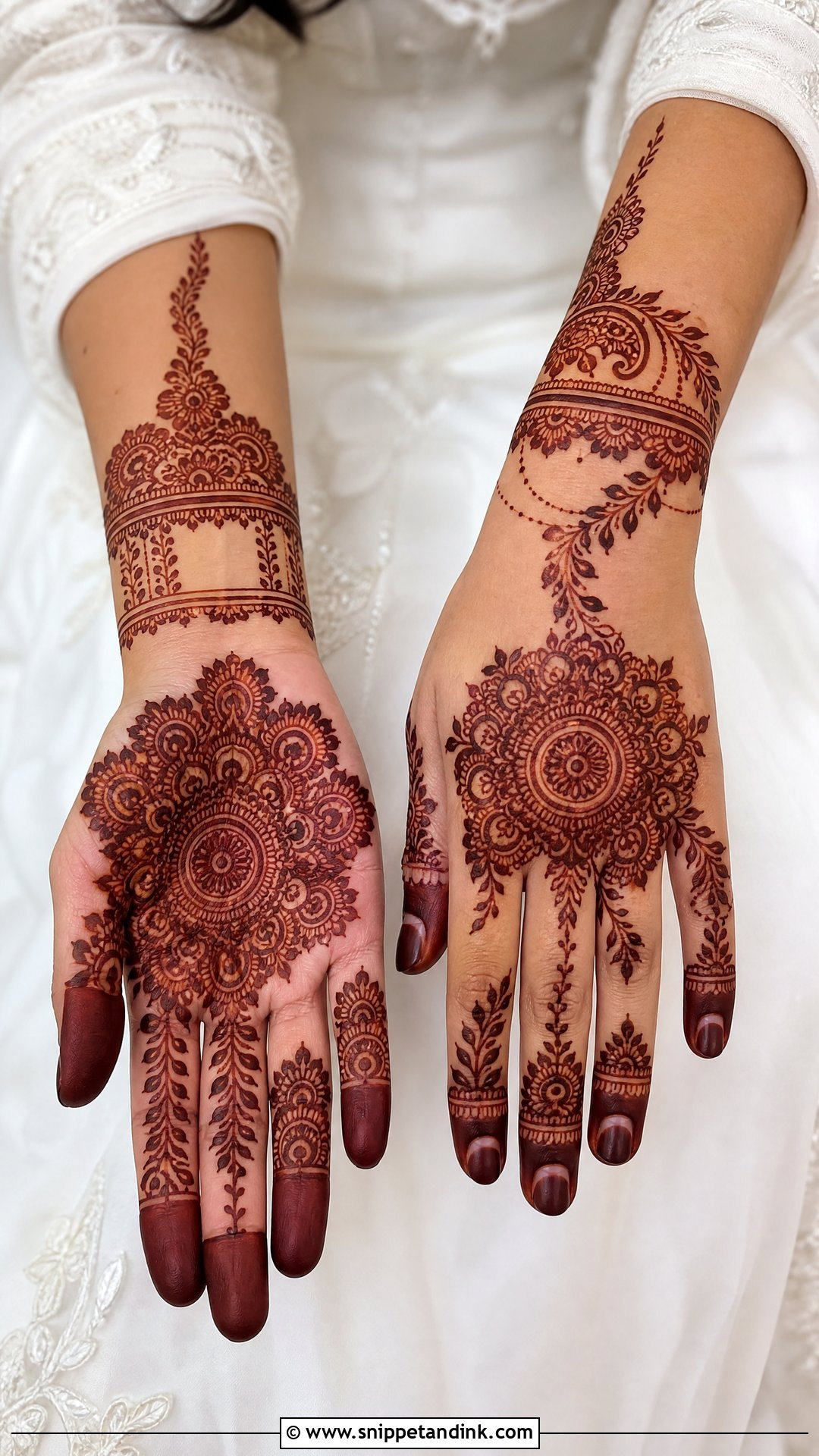
A round mandala centered in the palm, surrounded by floral trails and leafy borders, adds symmetry to the Gulf style. On the back hand it sits near the middle and connects to the fingers with fine chains or vines. Getting a circle truly round on a curved palm is harder than it looks, so I build it outward ring by ring from a single center dot. Filled fingertips and wrist cuffs give it more weight when both hands need to look coordinated.
16. Simple Khaleeji Bridal Henna
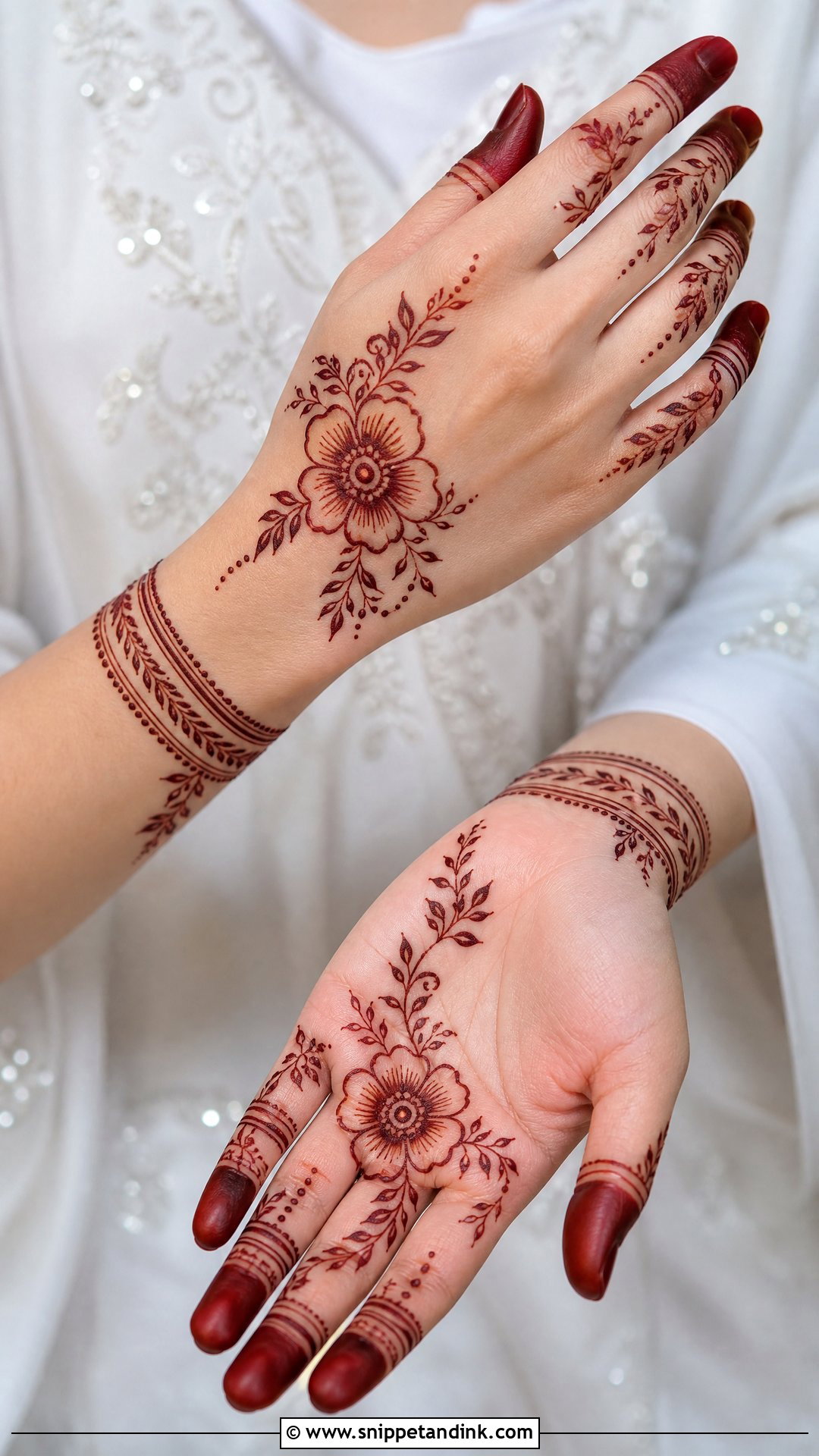
Fewer motifs, kept bold: a large flower on the back hand, a soft vine across the palm, neat finger details and a slim cuff make a complete bridal set. I recommend it for small weddings, civil ceremonies, destination trips and brides who can’t sit for hours. It still reads as festive because Khaleeji henna relies on confident shapes and clean spacing rather than coverage. What it can’t hide is a weak stain, so a simple design needs the same fresh paste and aftercare as a heavy one.
17. Heavy Khaleeji Bridal Henna
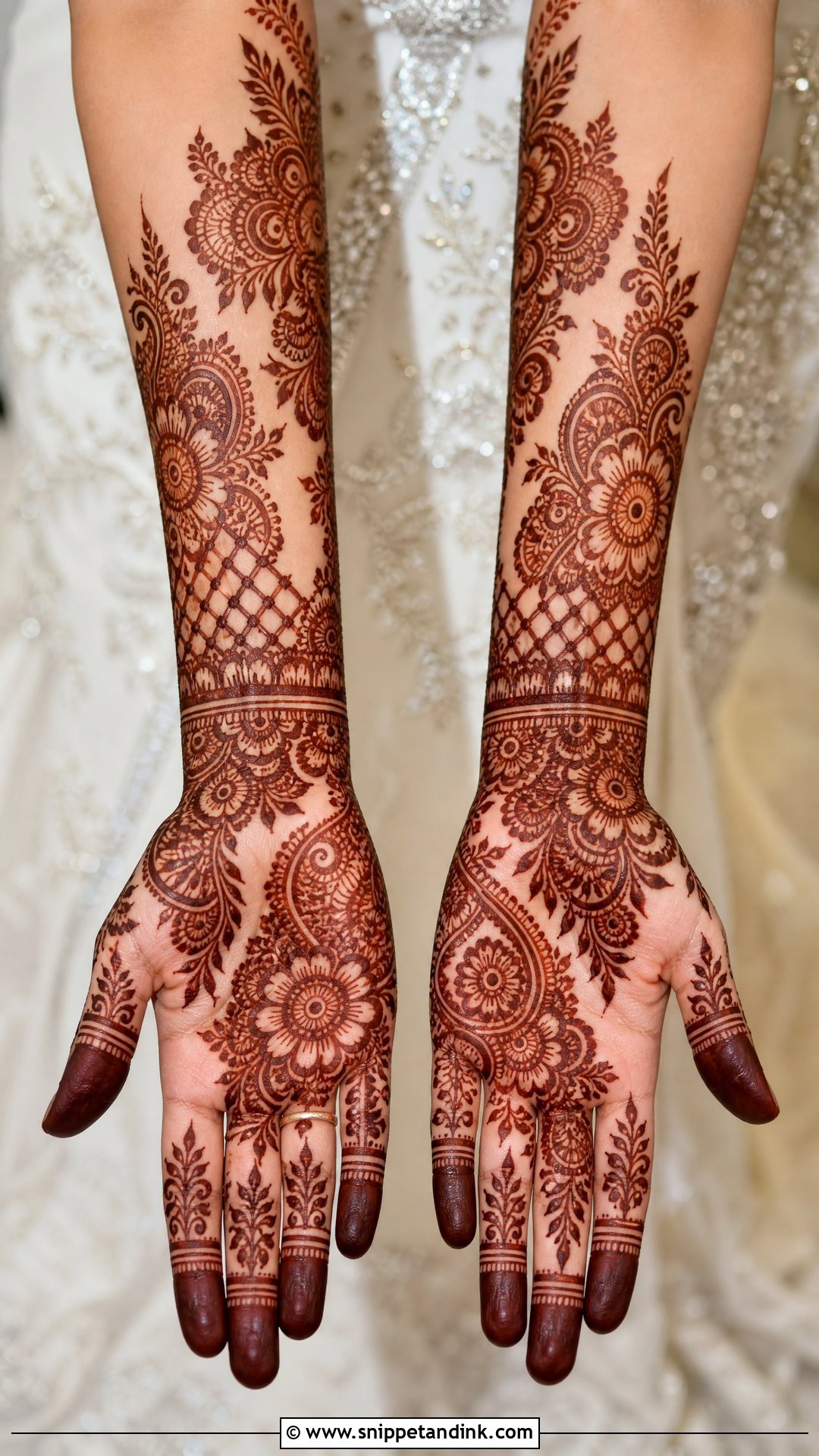
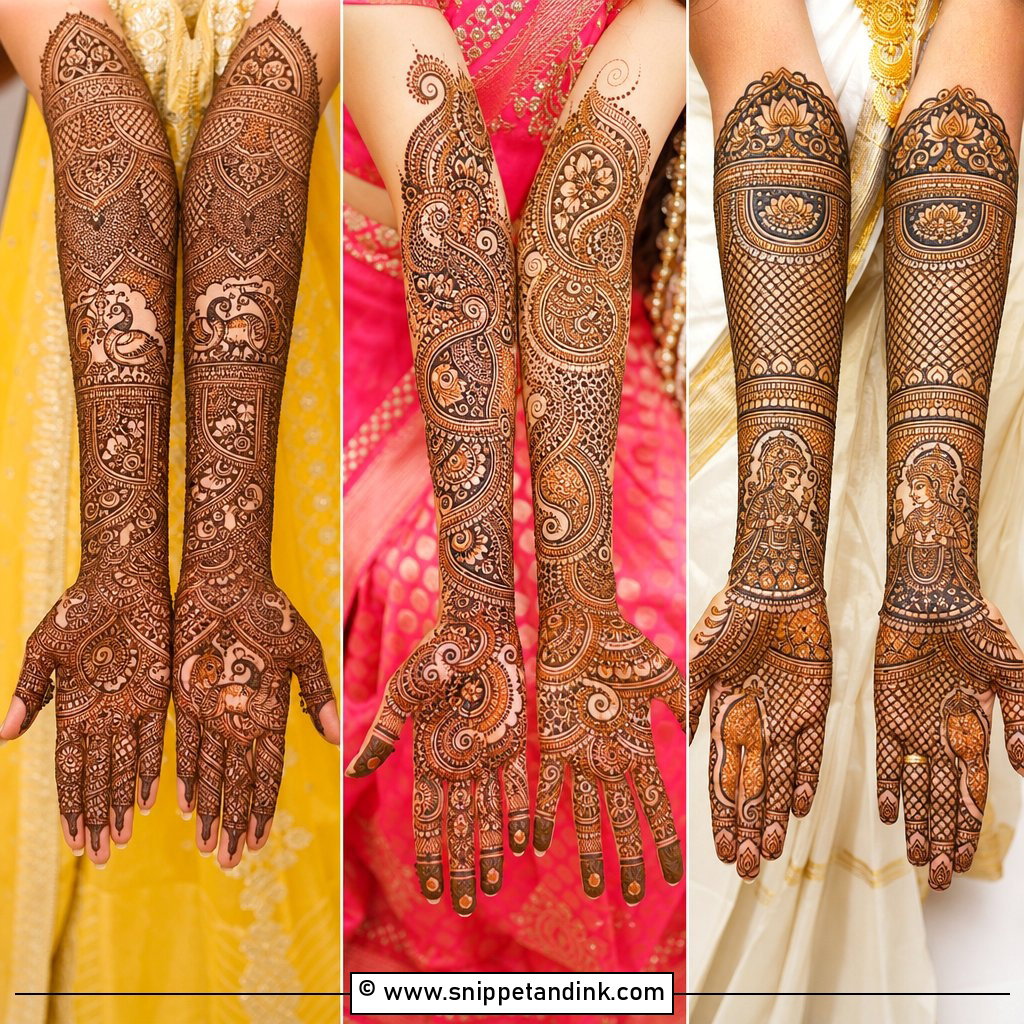
Heavy layouts cover the full palm, back hand, fingers, wrist and forearm with layered florals, paisleys, jaali and bands, often with matching feet. Even here I plan the open areas before I start, because without them it stops looking Khaleeji and becomes standard dense mehndi. Expect to sit for several hours across hands and feet, and plan to rest afterward while the paste dries. Save it for traditional henna nights and large weddings where your hands will be the focus.
18. Modern Khaleeji Bridal Henna
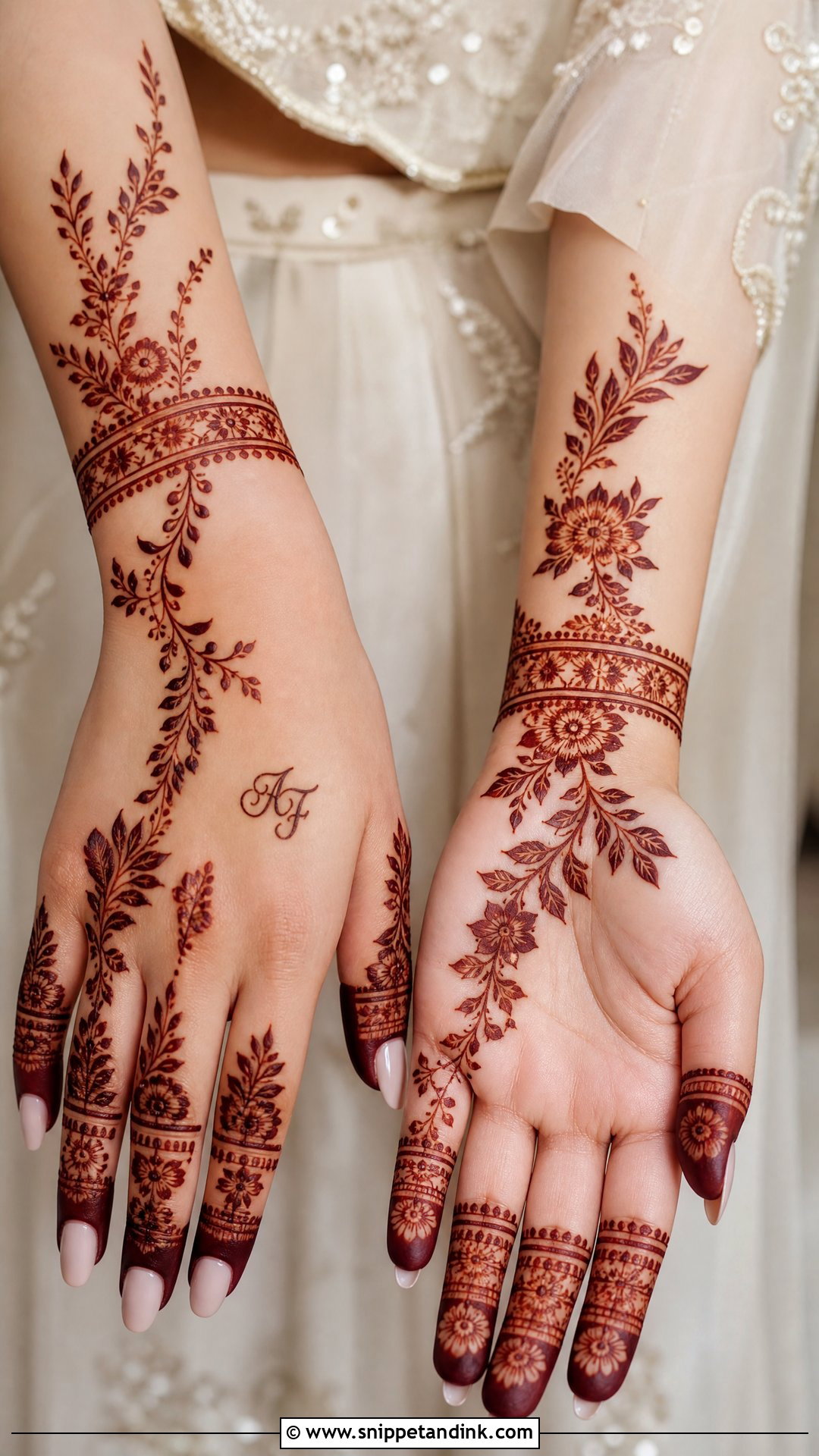
Modern Khaleeji bridal henna keeps the bold florals but adds bracelet cuffs, ring-style finger details and smooth vines with plenty of space around them. Asymmetry is common: one hand carries a strong back-hand trail, the other a detailed palm. Brides in contemporary gowns, pastel lehengas or kaftans tend to like it because it gives a soft statement instead of a packed hand. Initials, a wedding date or a tiny symbol slot in easily.
19. Khaleeji Bridal Henna For Feet
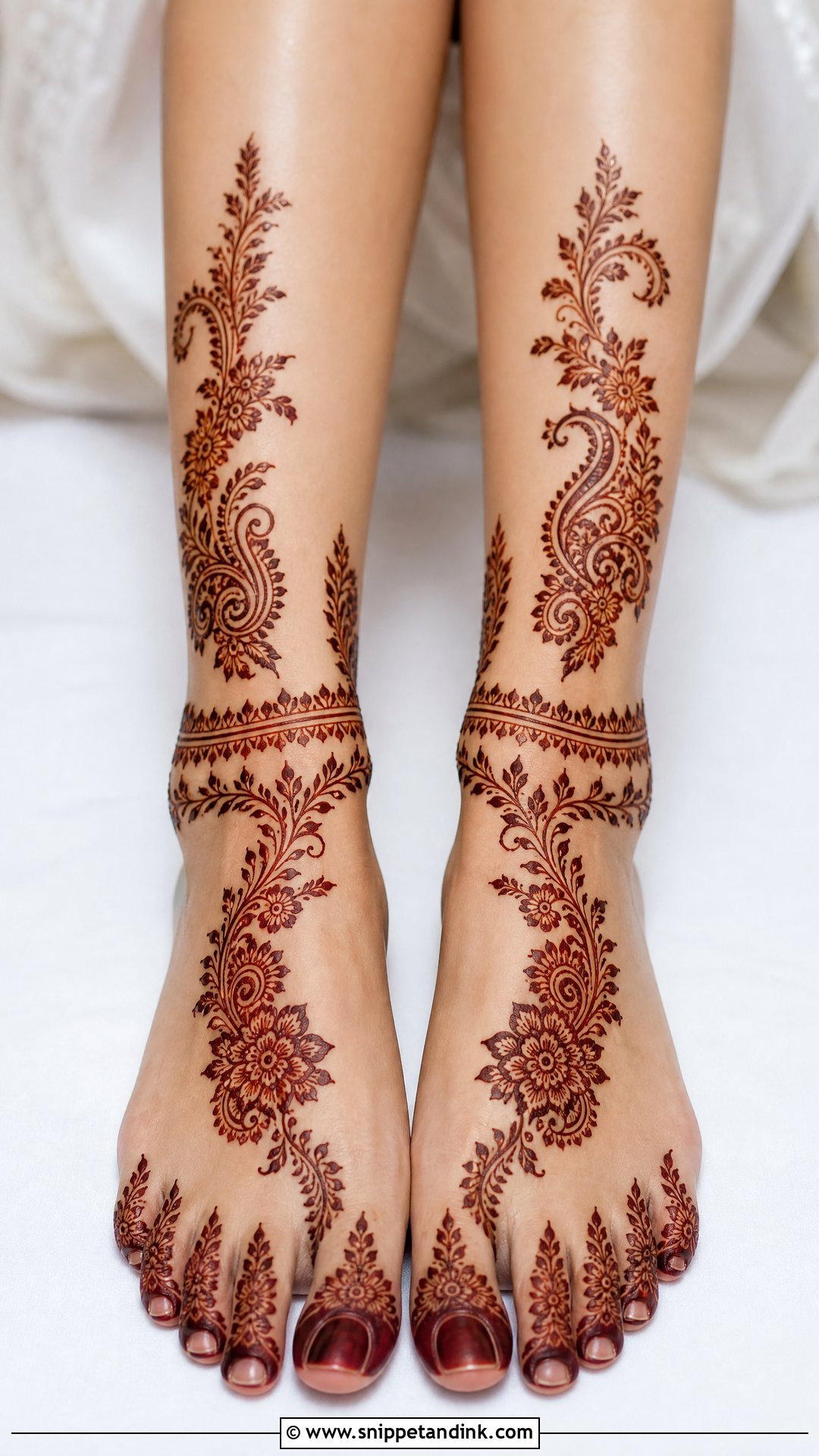
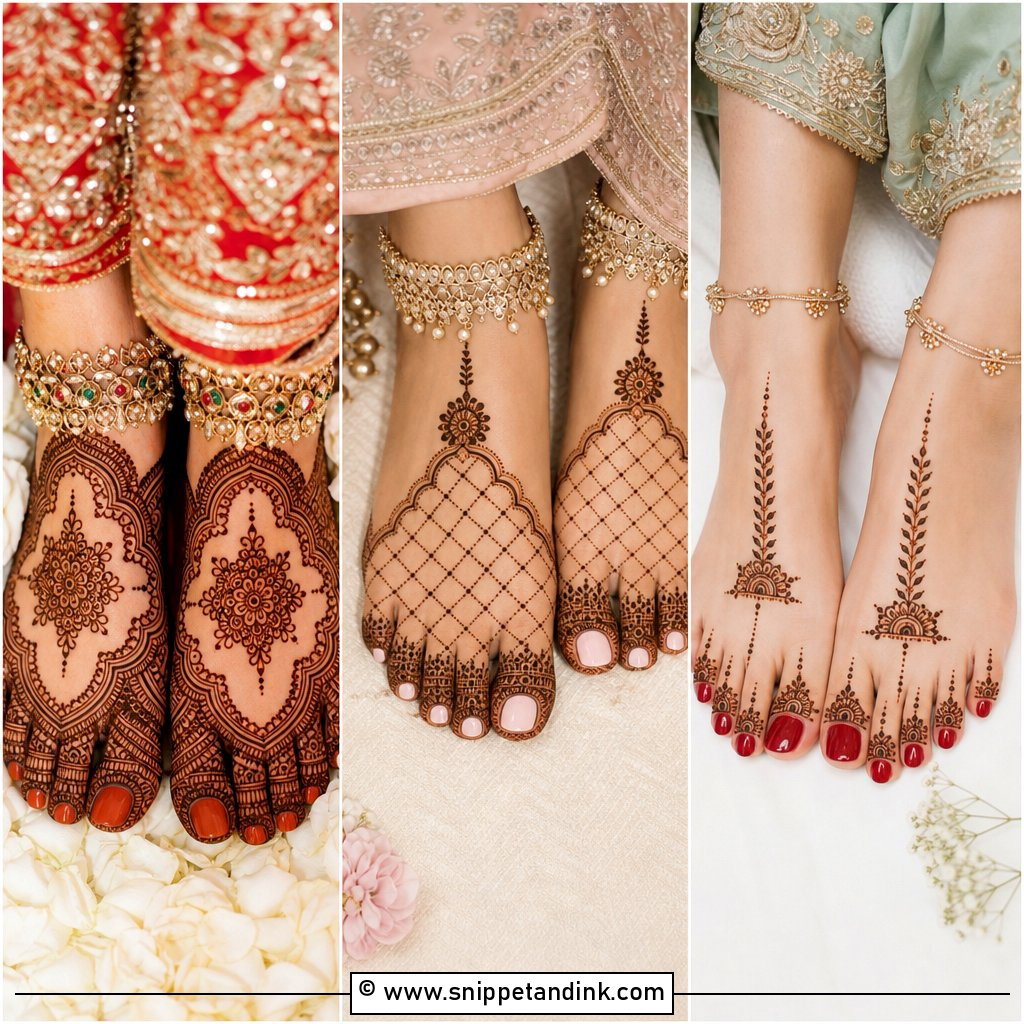
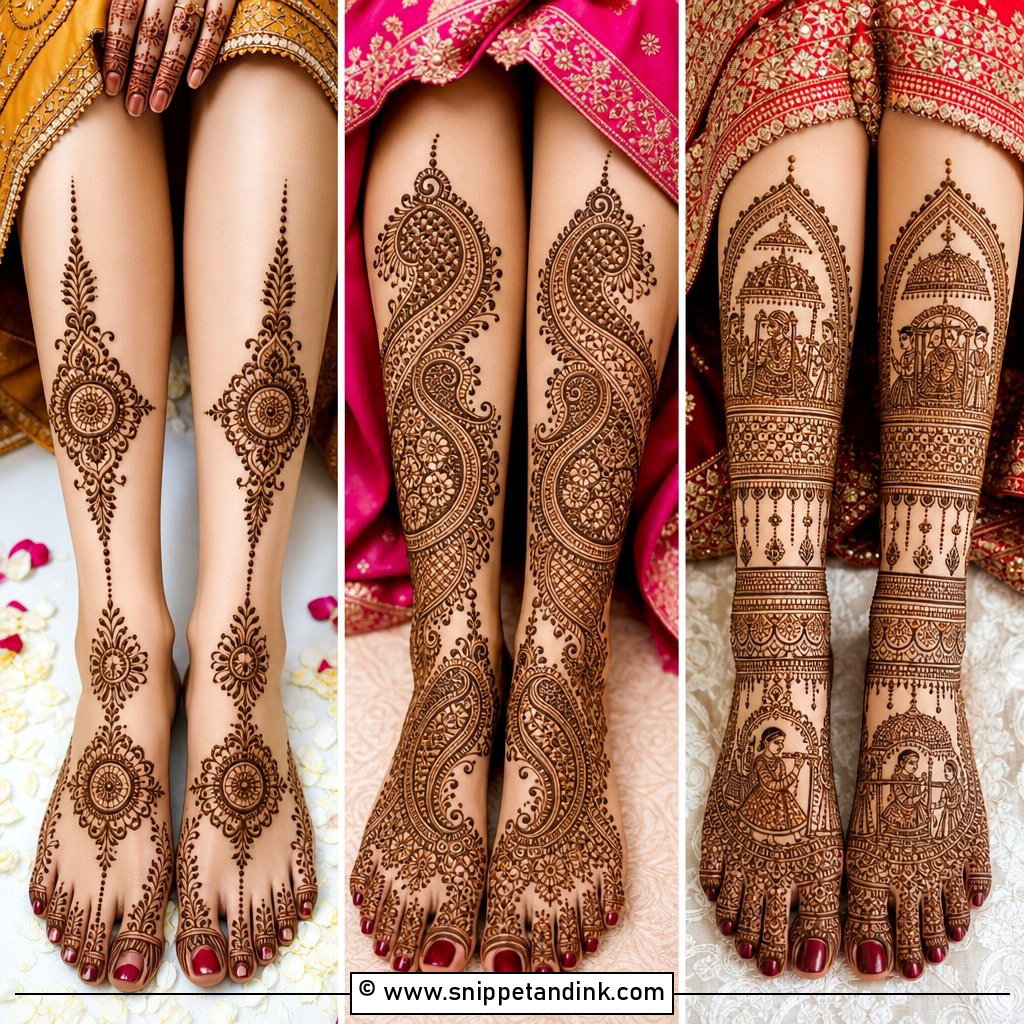
Feet complete the look under open sandals. A design can cover the toes, the top of the foot, the ankle and lower leg with floral trails, paisleys and anklet-style bands, with open space around the main motifs. Filled toe tips are classic, and ankle cuffs read as henna jewelry. Feet usually stain darker than hands, so I keep the layout more open here to stop it looking heavy beside the hands. I also ask brides to stay off their feet while the paste dries, since walking cracks it before it has done its work.

20. Khaleeji Bridal Henna With Hidden Name
Hiding the groom’s name or initials in the design is a henna-night custom many families still enjoy, with the groom hunting for it afterward. I tuck the letters into a paisley, jaali panel, floral center or bracelet band, following curves that are already there so they vanish from a distance. It needs medium to full coverage; on a sparse design there’s nowhere to hide them. Give your artist the exact spelling in advance, and say which script you want.
Two Days Out: Planning the Stain for the Nikah
Natural henna doesn’t show its final color when the paste comes off. It starts orange and darkens to reddish-brown over the next day or two. That’s why I usually apply bridal henna one to two days before the main event, so the stain is at its deepest when the photos are taken, not the morning after.
Aftercare I give every bride
- Keep the paste on as long as you comfortably can, ideally six hours or overnight, wrapped loosely if you sleep in it.
- Dab a lemon and sugar mix over the dry paste to keep it stuck to the skin, without soaking it.
- Scrape the paste off rather than washing it, and keep water away for the next several hours.
- Keep your hands warm, and skip scrubbing, chlorine pools and harsh soaps until after the wedding.
Black Henna and Fast-Stain Cones I Won’t Use
Real henna stains in the orange-to-brown range and never comes off the skin black. A paste that stains black within an hour almost certainly contains PPD, a hair-dye chemical that can cause blistering, scarring and a lasting allergy. Some ready-made cones also carry chemical dyes to rush the color. Ask your artist what’s in her paste. A careful artist mixes her own from henna powder, lemon juice or water, sugar and an essential oil, and will happily tell you. If your skin is sensitive, ask for a small patch test a few days before.
Your Sleeve Length Should Set the Coverage
Khaleeji henna gives you a lot of room to choose, from full hands and open Arabic trails to jaali, paisleys and matching feet. I’d start from the outfit. Long embroidered sleeves hide the forearm, so put the detail on hands and fingers; short or sheer sleeves can carry the design up the arm. Then think about your jewelry and how dark you want the stain. Book your artist early, insist on fresh natural paste, and pick motifs that mean something to you.
You'll Like These Ideas:




Leave a Reply