
In a South Indian wedding the hair is never an afterthought, because it carries the flowers, the gold and a good share of the ritual weight of the day. Most of the brides I work with start by picturing cascading jasmine braids, then realise they also need a second look for the reception and something lighter for the haldi. The 20 styles below run from the full poola jada to pearl plaits and pastel buns. Under each one I’ve noted how it actually holds, what hair it needs underneath, and where I’d talk a bride out of it.
Ordering Jasmine So It Opens at the Right Moment
Mogra strings for bridal hair are bought as closed buds, and that is deliberate. The buds open over several hours once they warm up, so if they arrive fully open the night before, they’ll be tired and browning by the muhurtham. I ask families to collect them on the morning itself, or late the previous evening for a dawn ceremony.
Until I pin them, I keep the strings wrapped in a damp cotton cloth somewhere cool, away from direct fan air. A fridge is fine for a few hours if the strings sit in a box, but never in direct contact with ice, because cold-burned petals turn brown at the edges. Handle them as little as possible; every squeeze bruises the bud.
- Order more than you think. A full poola jada or veni bun takes many metres of strings, and I always want spares for repairs after photos.
- Ask for strings made with tight, evenly spaced buds. Gappy strings show hair through them.
- Plan who carries the flowers to the venue. A hot car boot will open the buds early.
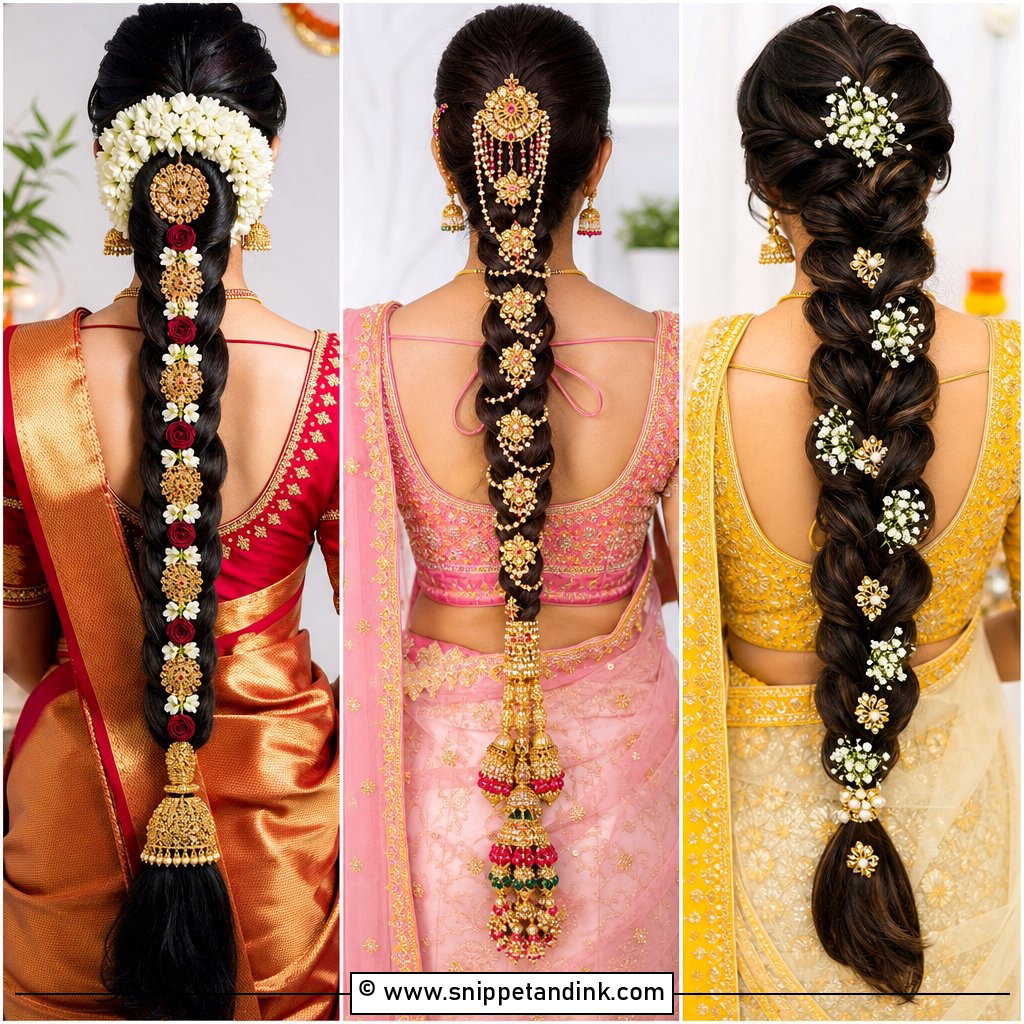
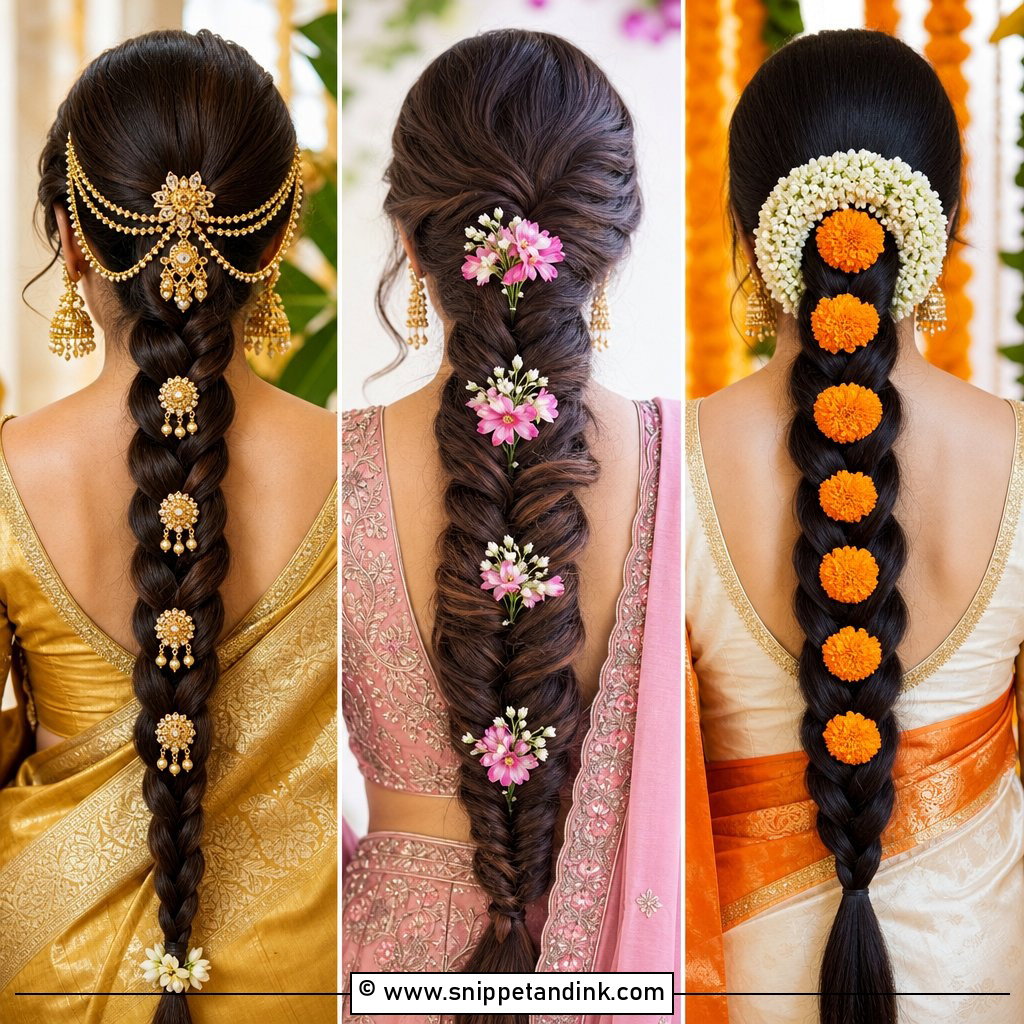
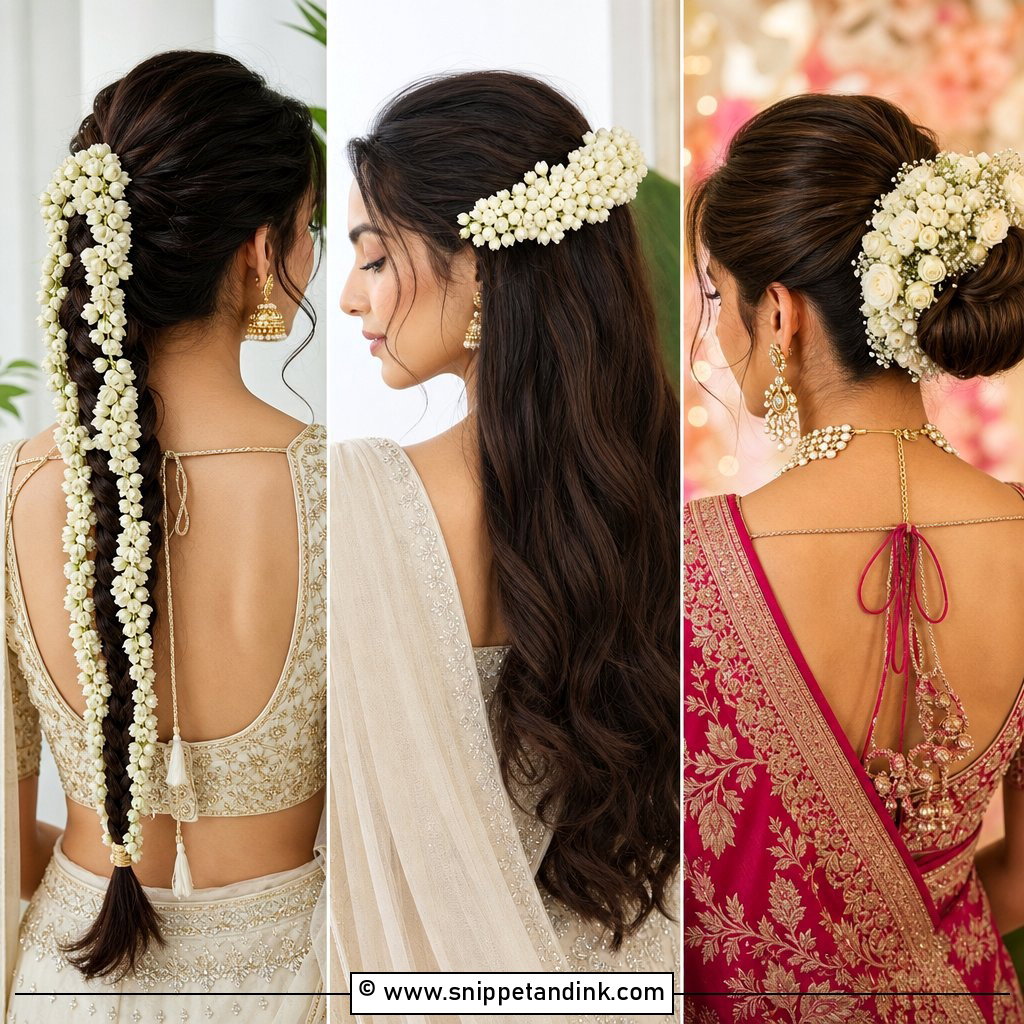
1. Traditional Jasmine Gajra Braid
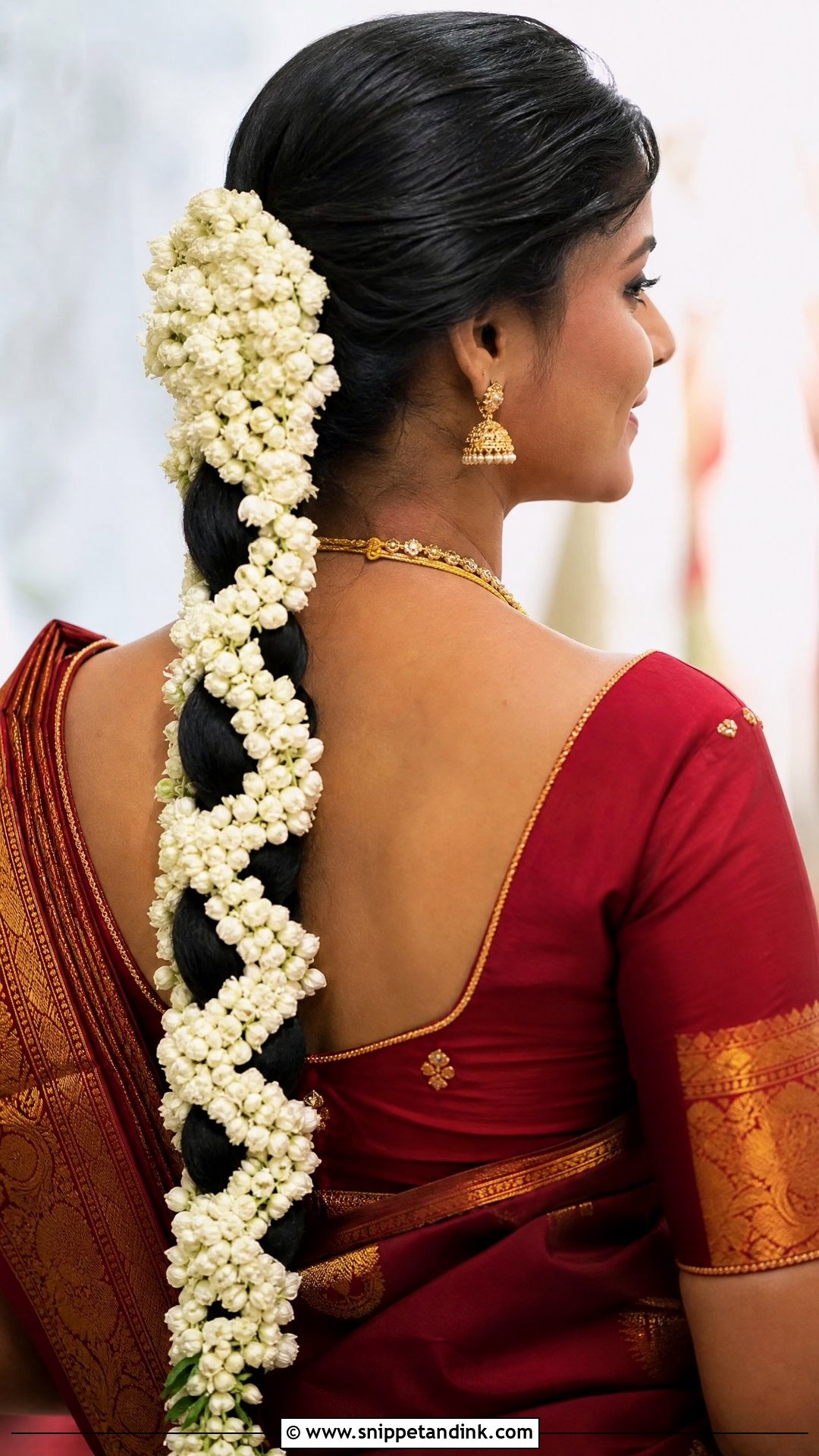
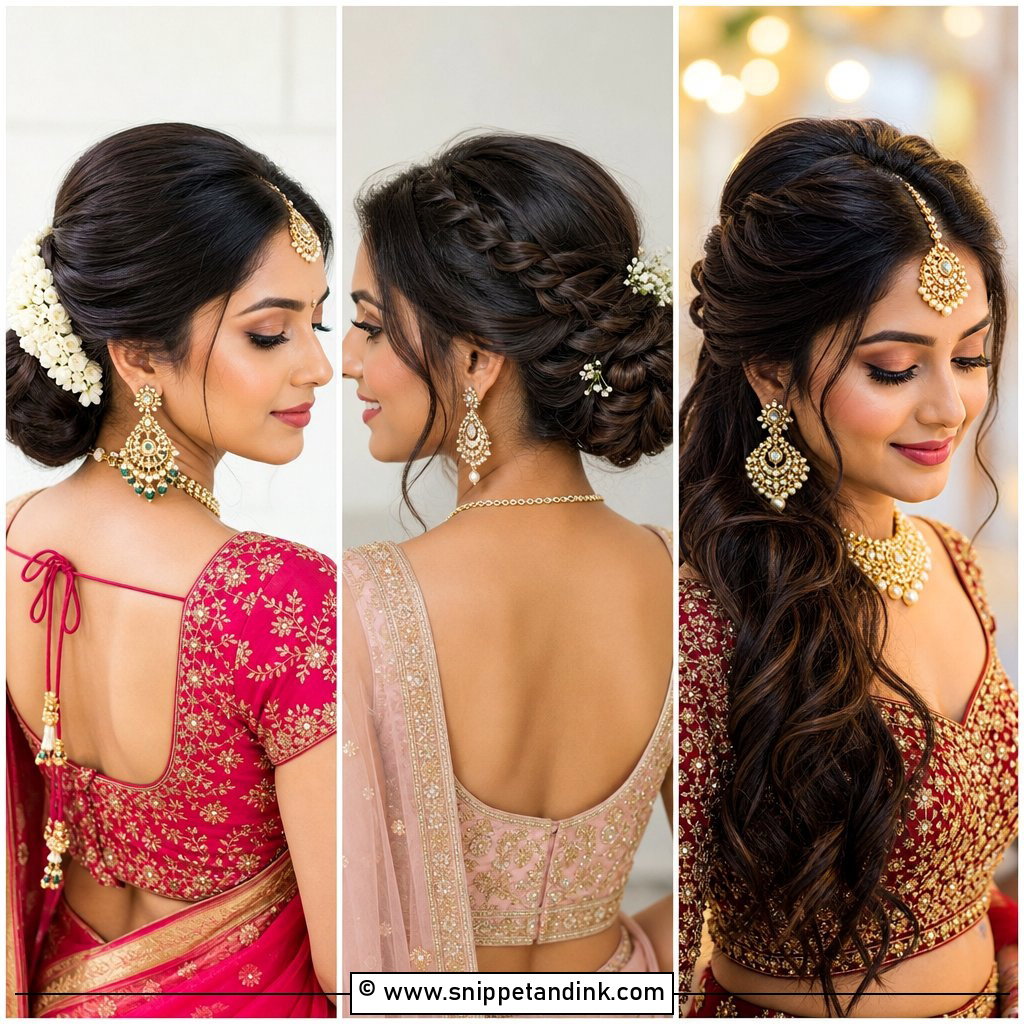
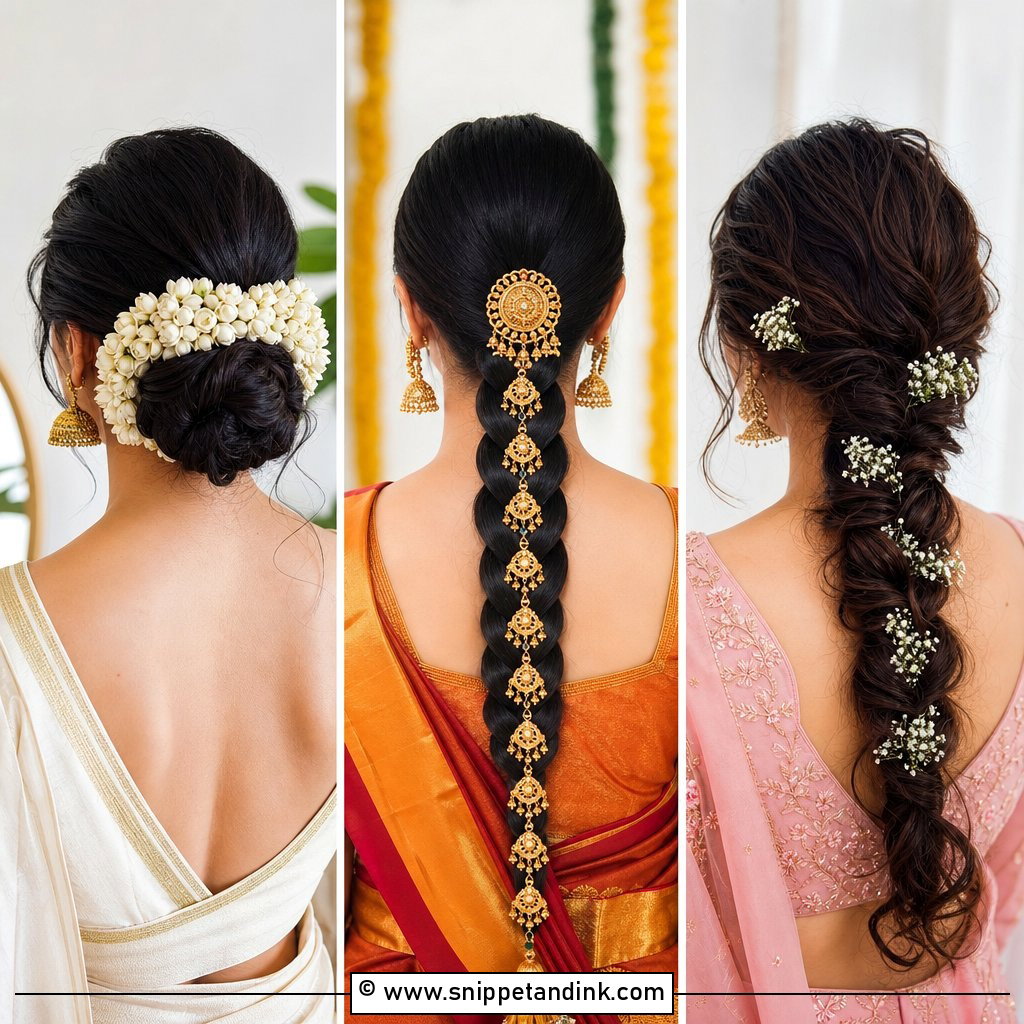
The long, thick braid wrapped in mogra is the look most families expect, and it earns its place: the white strings against dark hair read clearly from the back of a hall. I plait it firm but not tight at the nape, because a braid pulled hard there starts to ache by the second hour of rituals. The jasmine goes on last, anchored with U-pins into the braid itself rather than just tied around it, so it doesn’t slide down when you sit and stand. If your own length stops mid-back, a matching hair extension braided in from the crown gives the classic length without anyone noticing.
2. Poola Jada Floral Braid
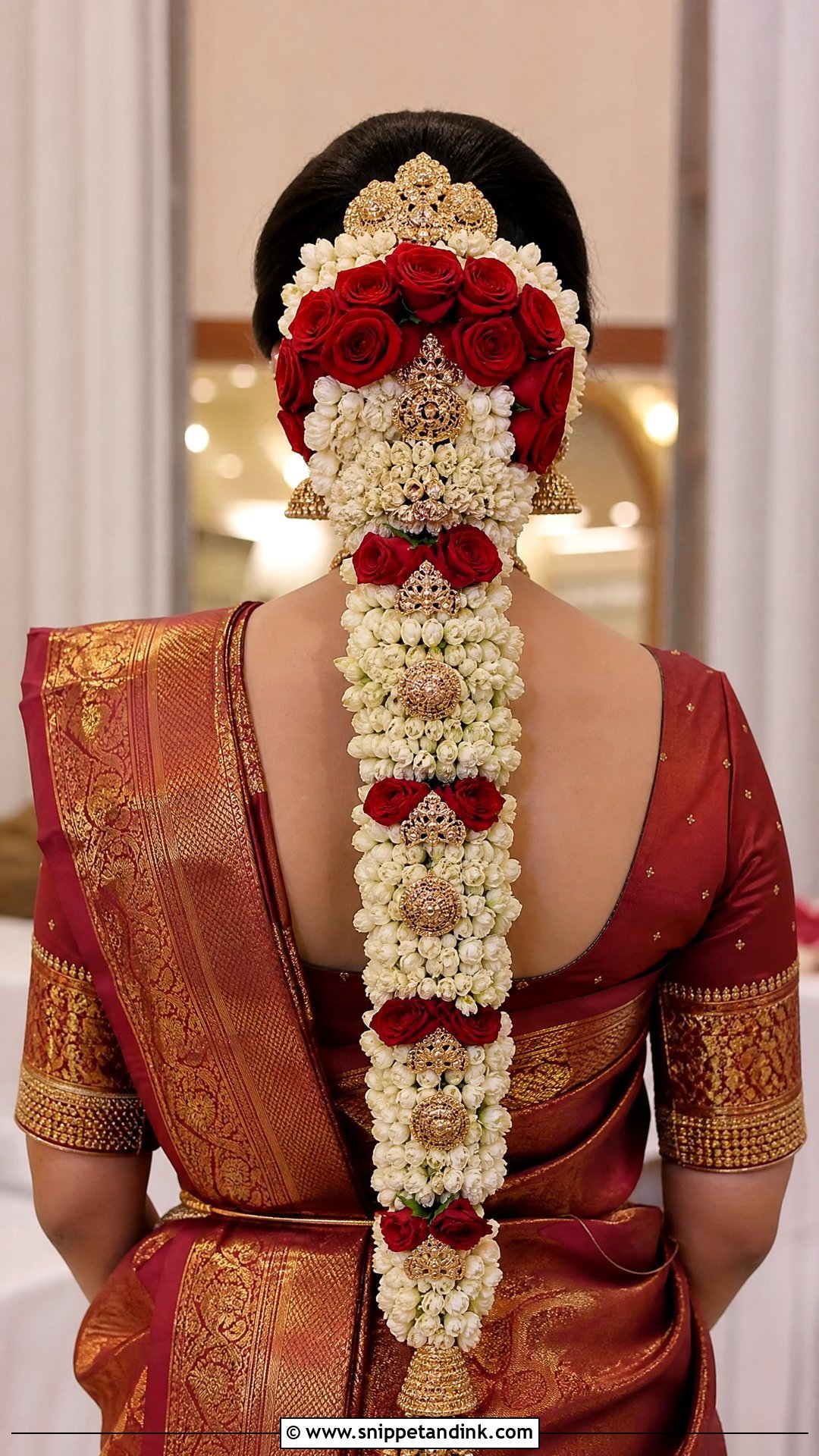
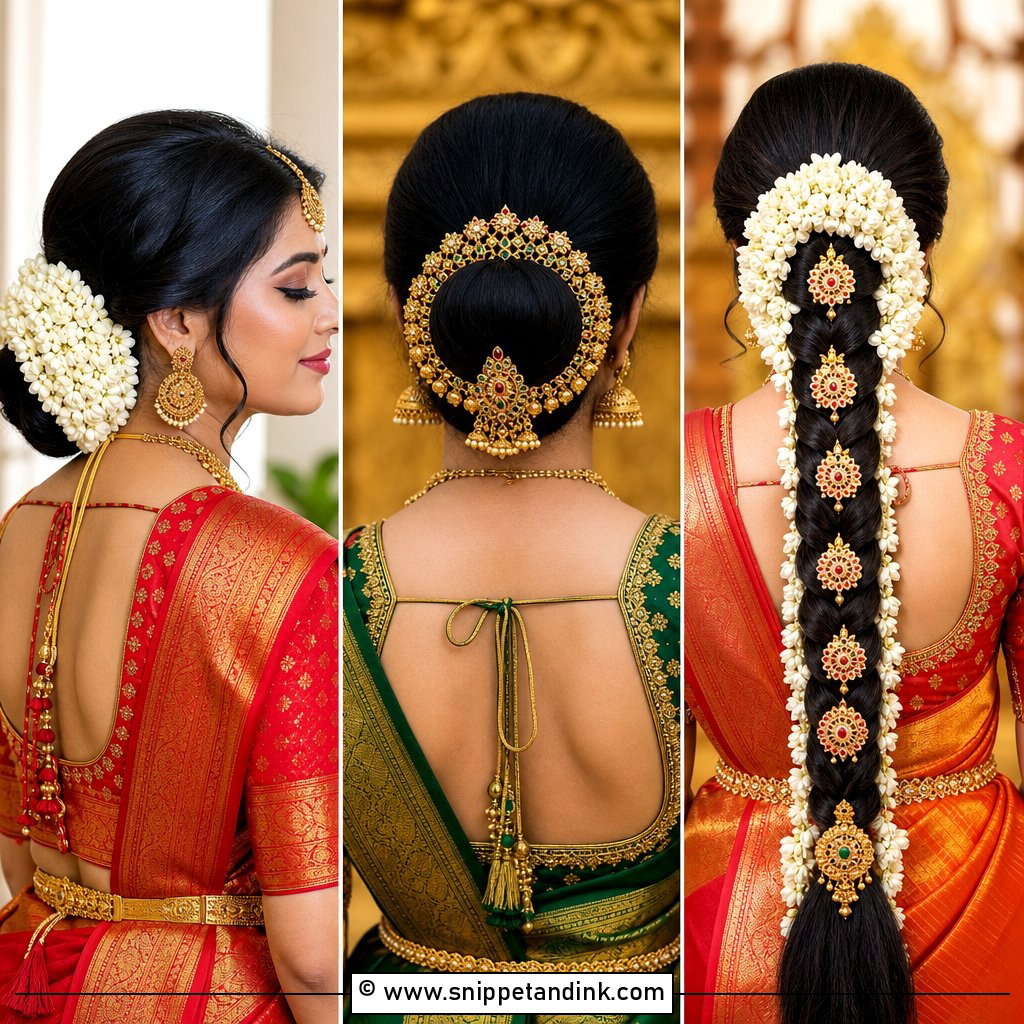
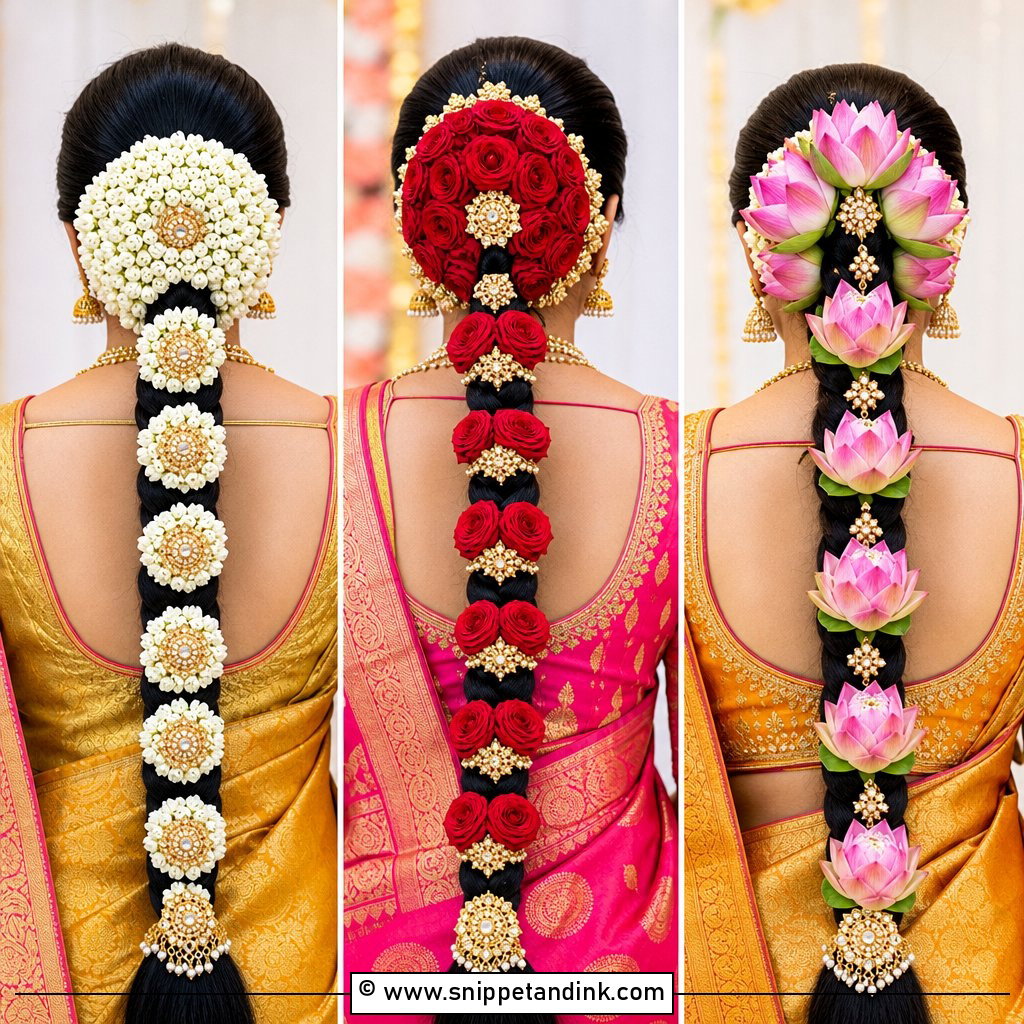
The poola jada is the heaviest thing I’ll ever pin to a bride’s head, and it needs planning. Rows of jasmine, roses and gold pieces are built down the length of the braid into a tapered column, and many Telugu brides still won’t consider anything else for the muhurtham. I always build it on a firm base braid with a few hidden elastics along its length so the weight spreads out instead of hanging off the crown. Ask whether your florist is making it fresh or whether you’ll use a ready-made jada, because fresh ones weigh noticeably more and need a stronger anchor.
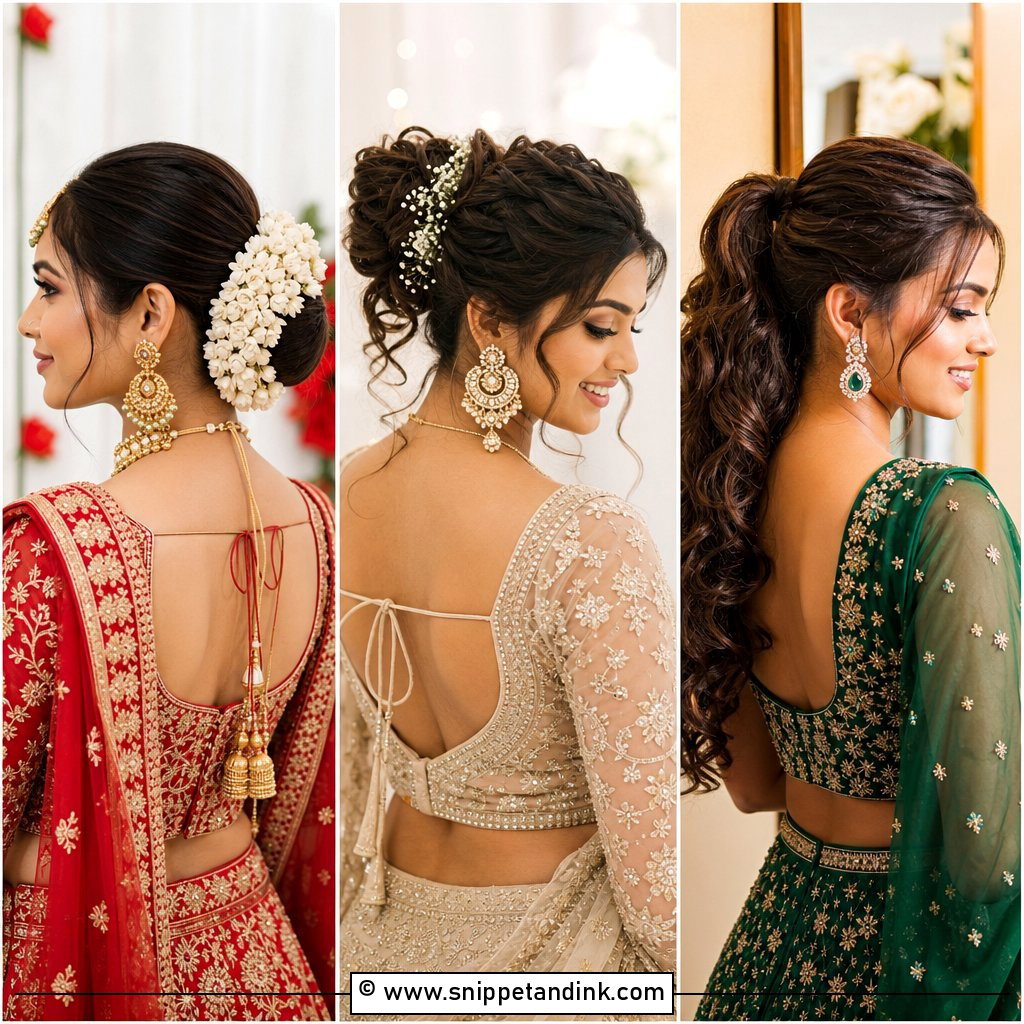
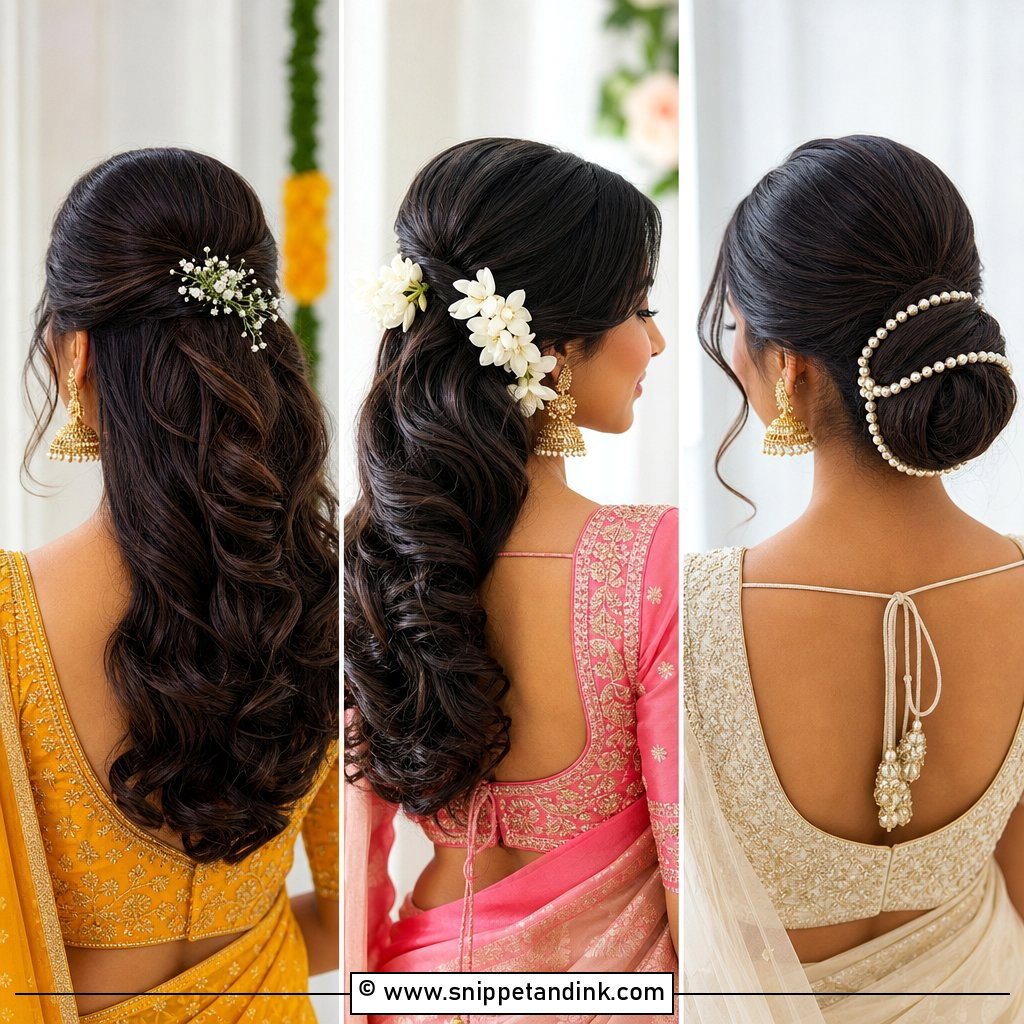
3. Low Floral Bun With Gajra
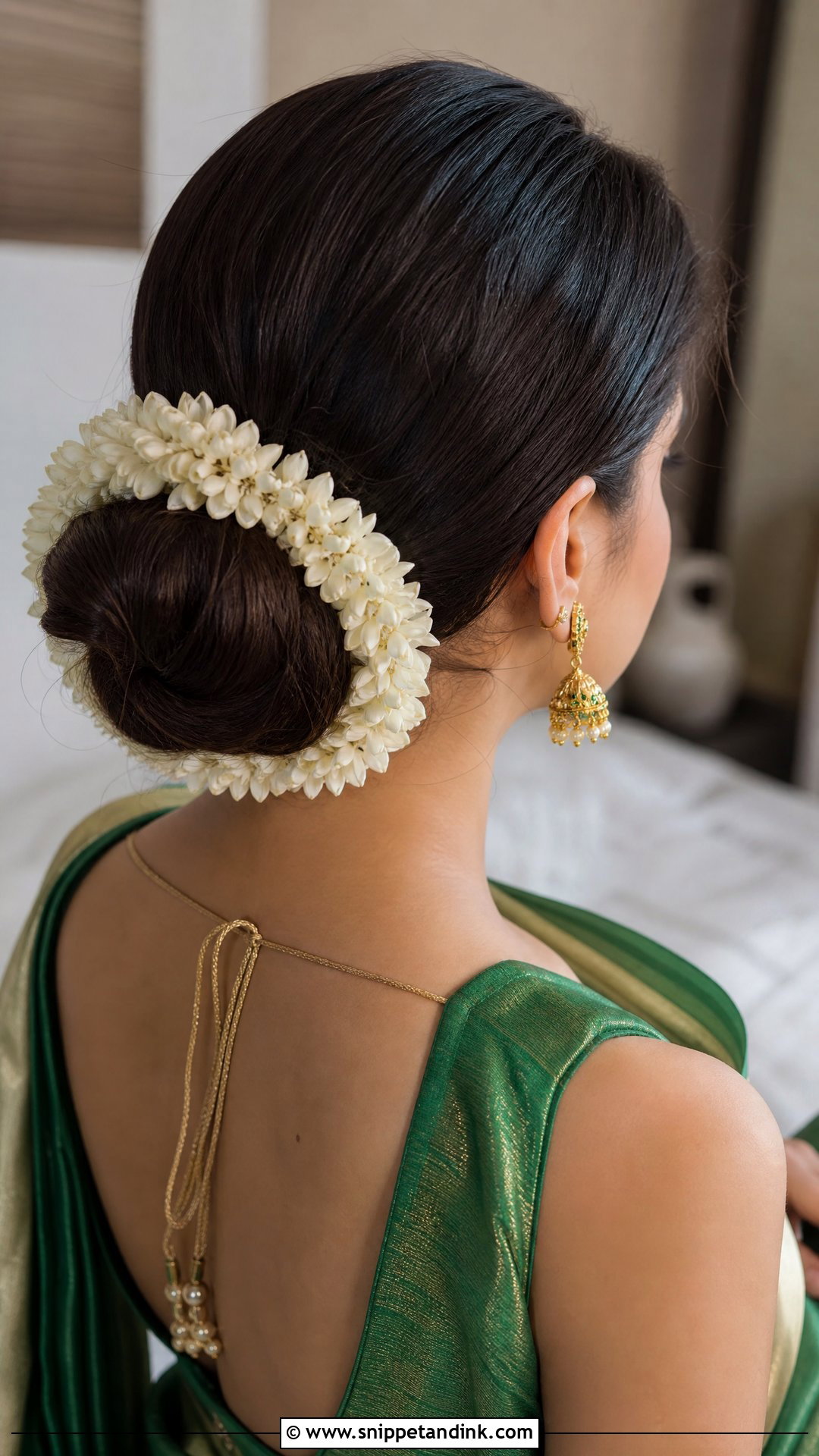
A low bun circled with a gajra is the style I suggest when a bride tells me she gets headaches from tight hair. The bun sits at the nape, so nothing tugs at the crown, and the jasmine ring frames it from every angle. I pad it lightly for medium hair and leave out padding entirely for thick hair, otherwise it starts to look like a cushion. A couple of loose strands near the face are fine, but I keep them short so they don’t stick to sweat or lipstick during the ceremony.
4. Half-Up Half-Down With Soft Curls
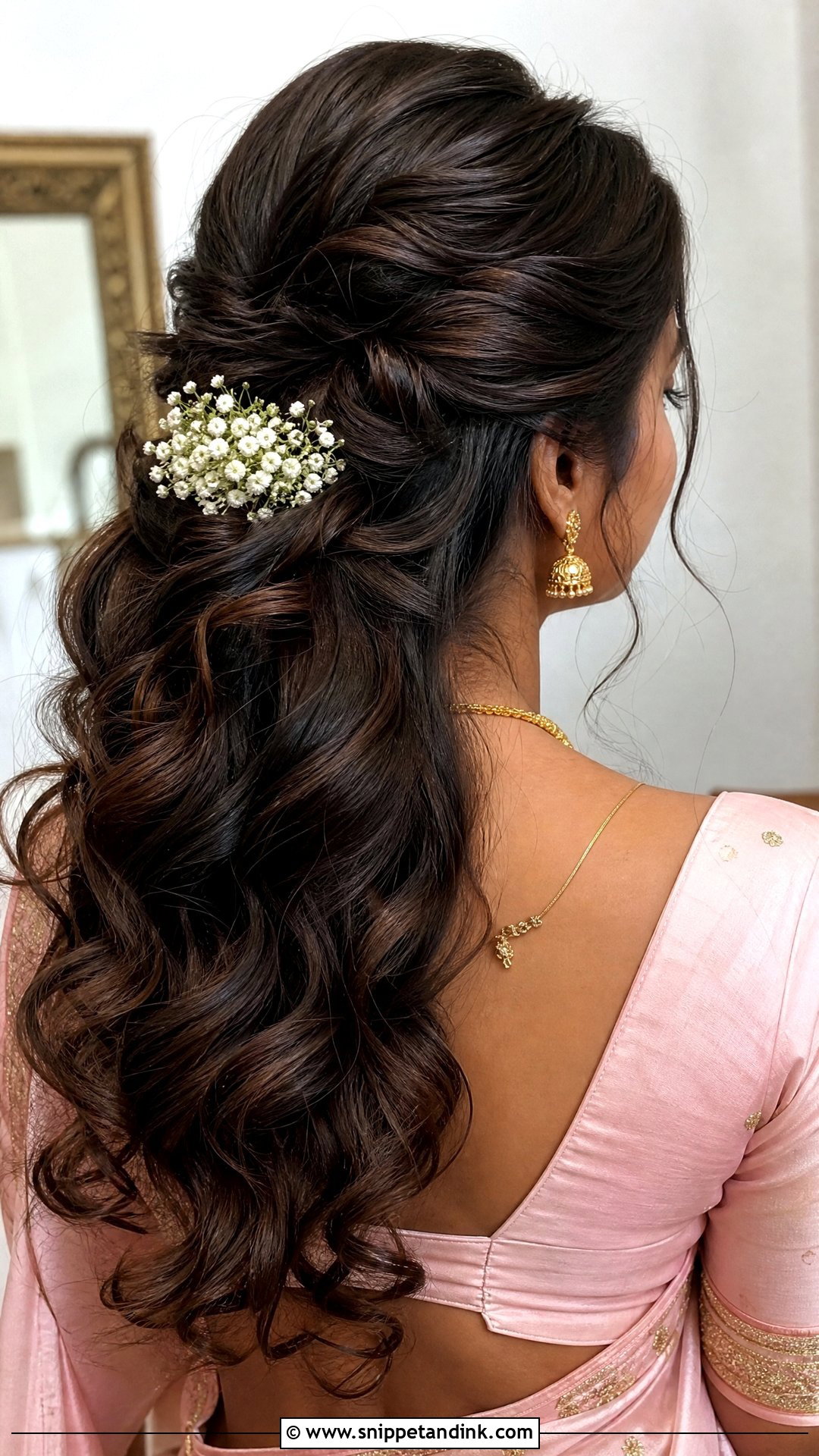
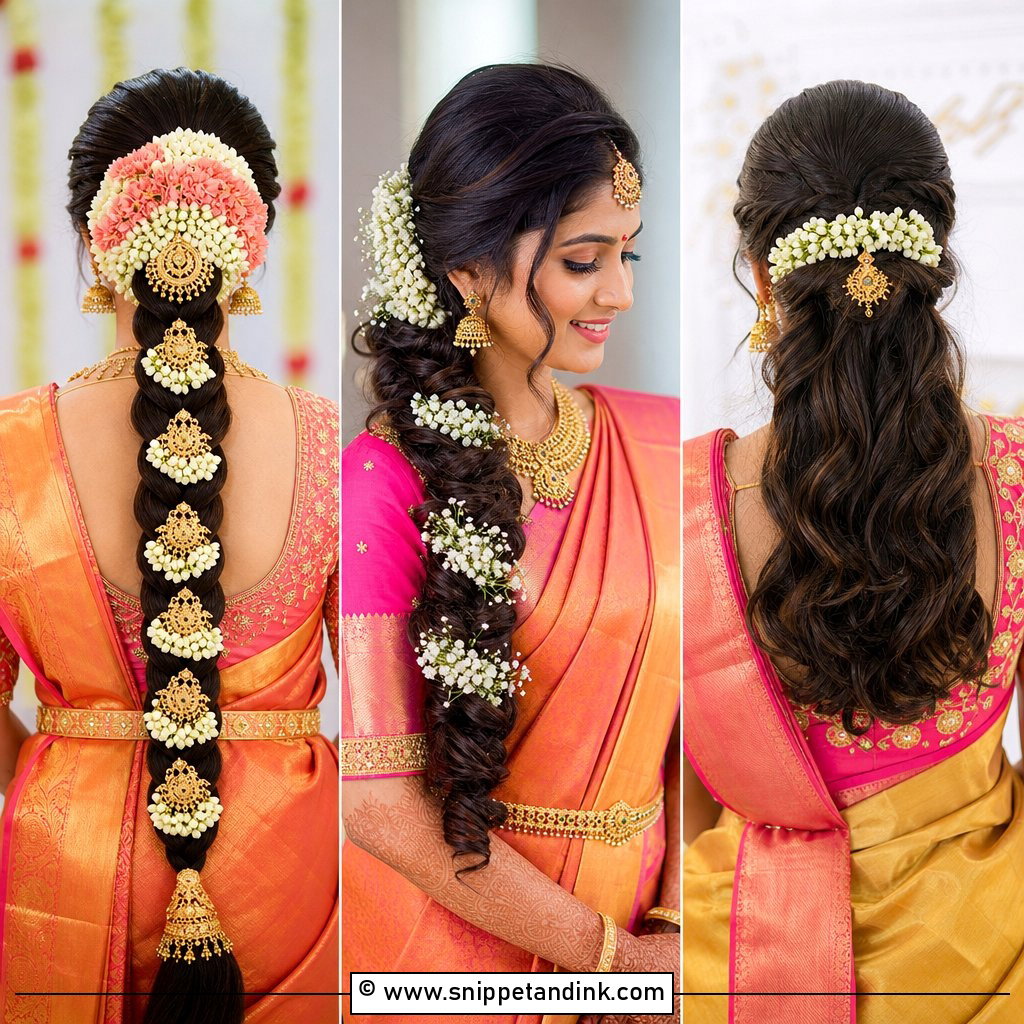
Half-up with curls works best at the reception, after the heavy ritual jewellery comes off. The crown section is gathered and pinned with a small jasmine cluster or a single floral accent, and the lengths fall in curls over the shoulders. My honest caution is about the curls: in coastal humidity they relax fast, so I set them with a hot tool, pin each one up to cool, and only release them just before you step out. Fine straight hair needs that extra step more than anyone.
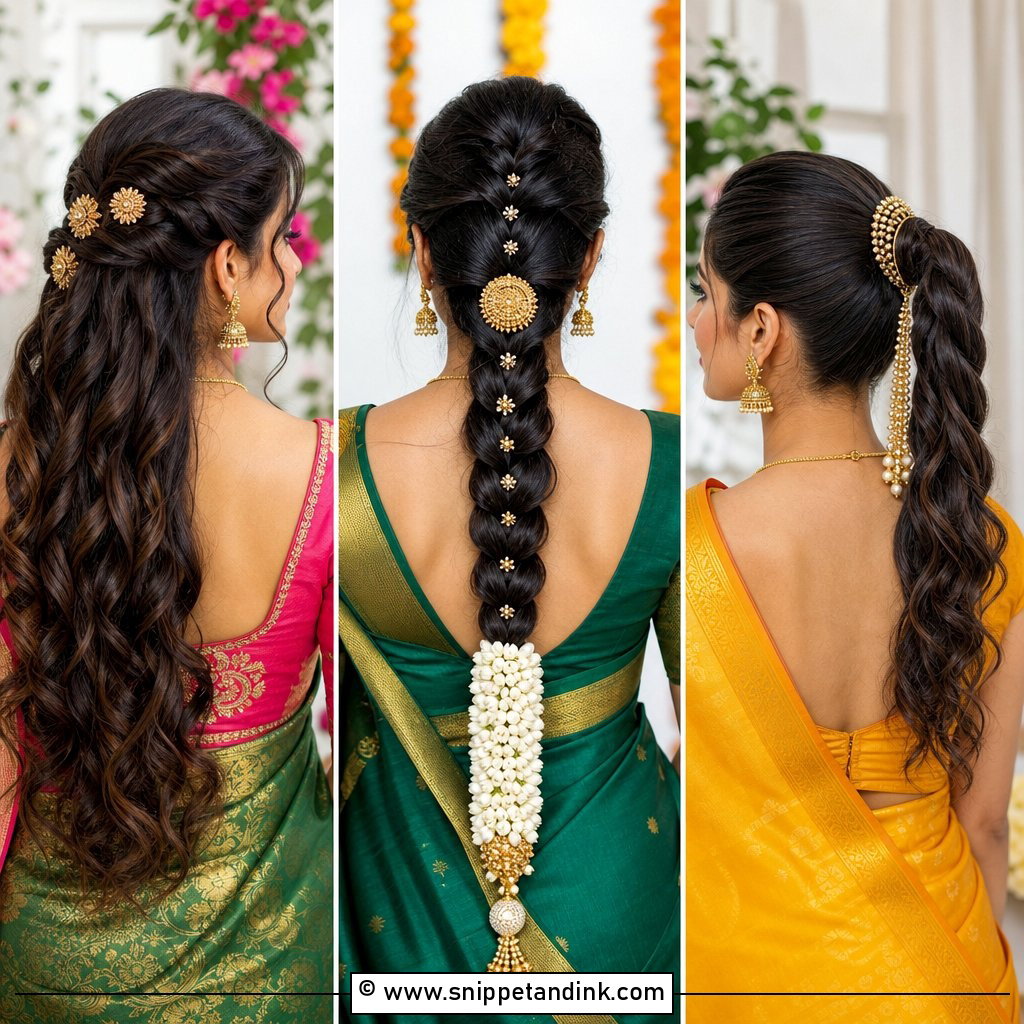
5. Kondai Bun With Gold Accessories
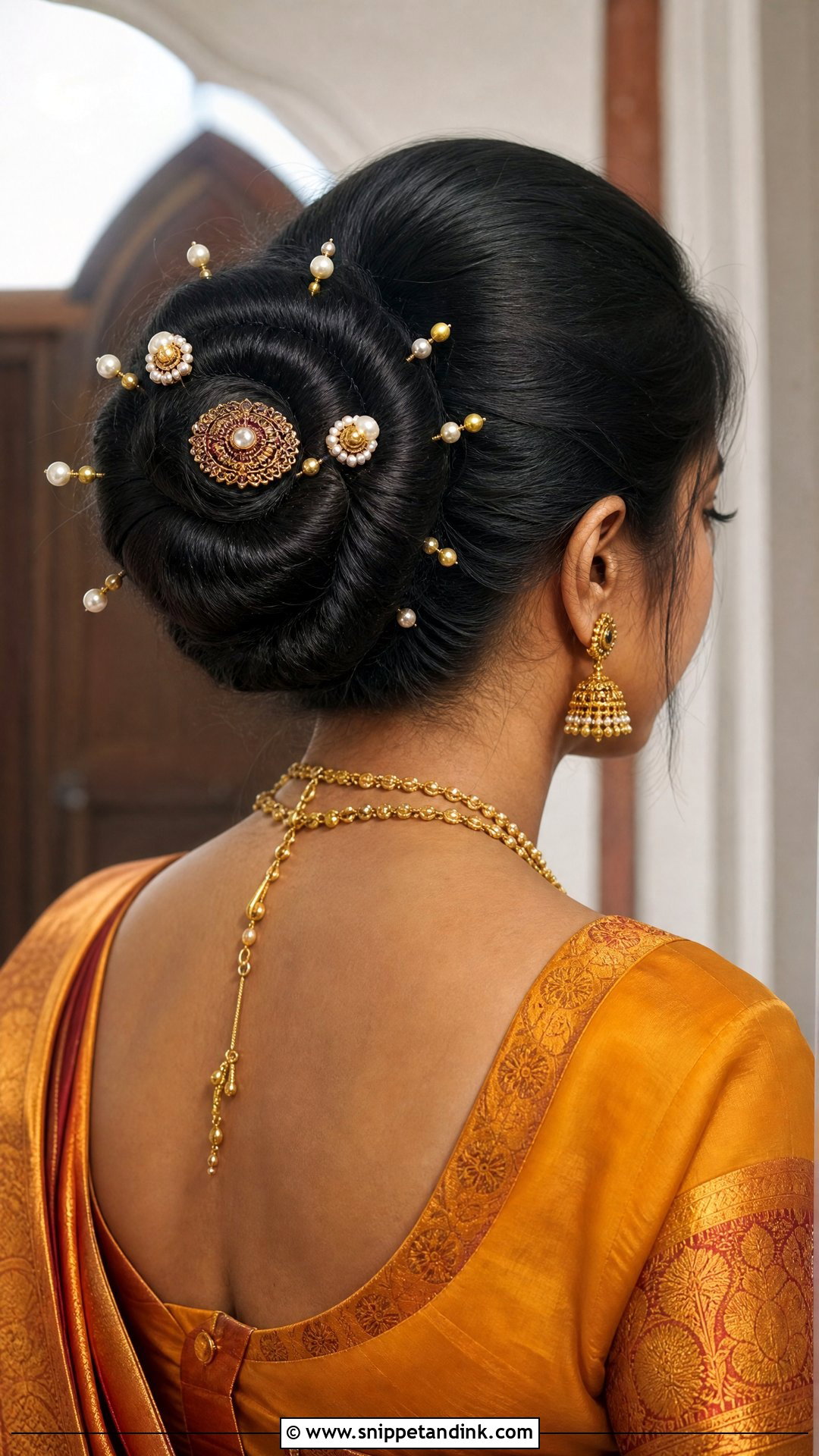
Popular across Tamil Nadu and Kerala, the kondai is a sculpted bun studded with gold pins, pearls or a central brooch, often ringed with a thin garland. I place it high or mid-crown depending on the neckline of the blouse: a high kondai shows off a deep back neck, a mid one balances heavy jhumkas. Because it is built around a padded base, it holds its shape for the whole day and survives repeated bowing. The trade-off is weight at the crown, so I check it at the trial with your actual ornaments, not lighter stand-ins.
6. Veni-Style Circular Bun
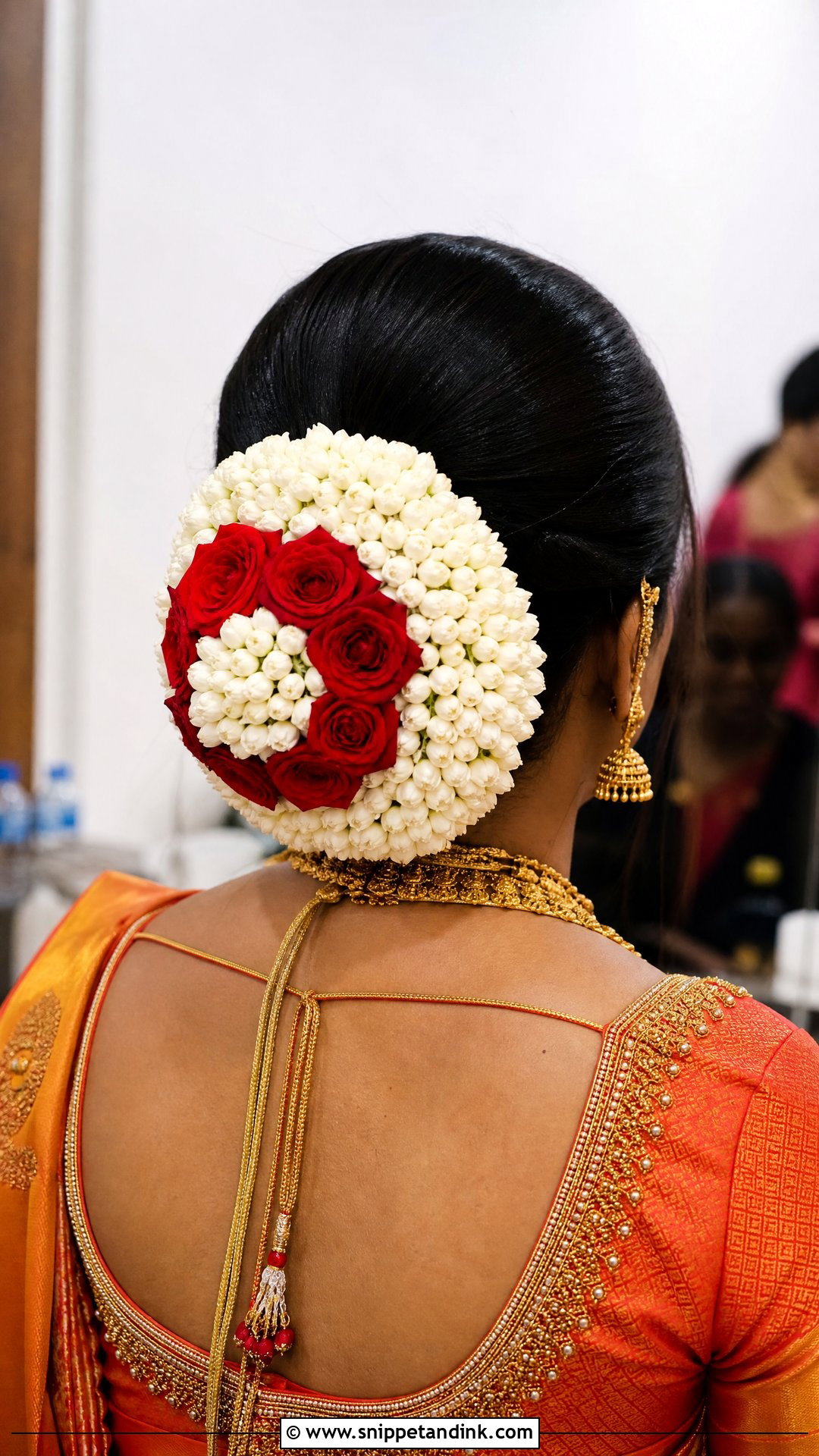
The veni-style bun hides a low circular bun completely under jasmine and roses, so from behind you see only flowers. The red or pink rose against white jasmine gives it colour that holds up in photographs taken in dim mandapam light. It suits thick, long hair because the bun has to be solid enough to take dozens of pins. On thinner hair I build the bun around a donut and pin the veni into the donut as well as the hair, which takes the strain off your scalp.
7. Pearl-Lined Braid
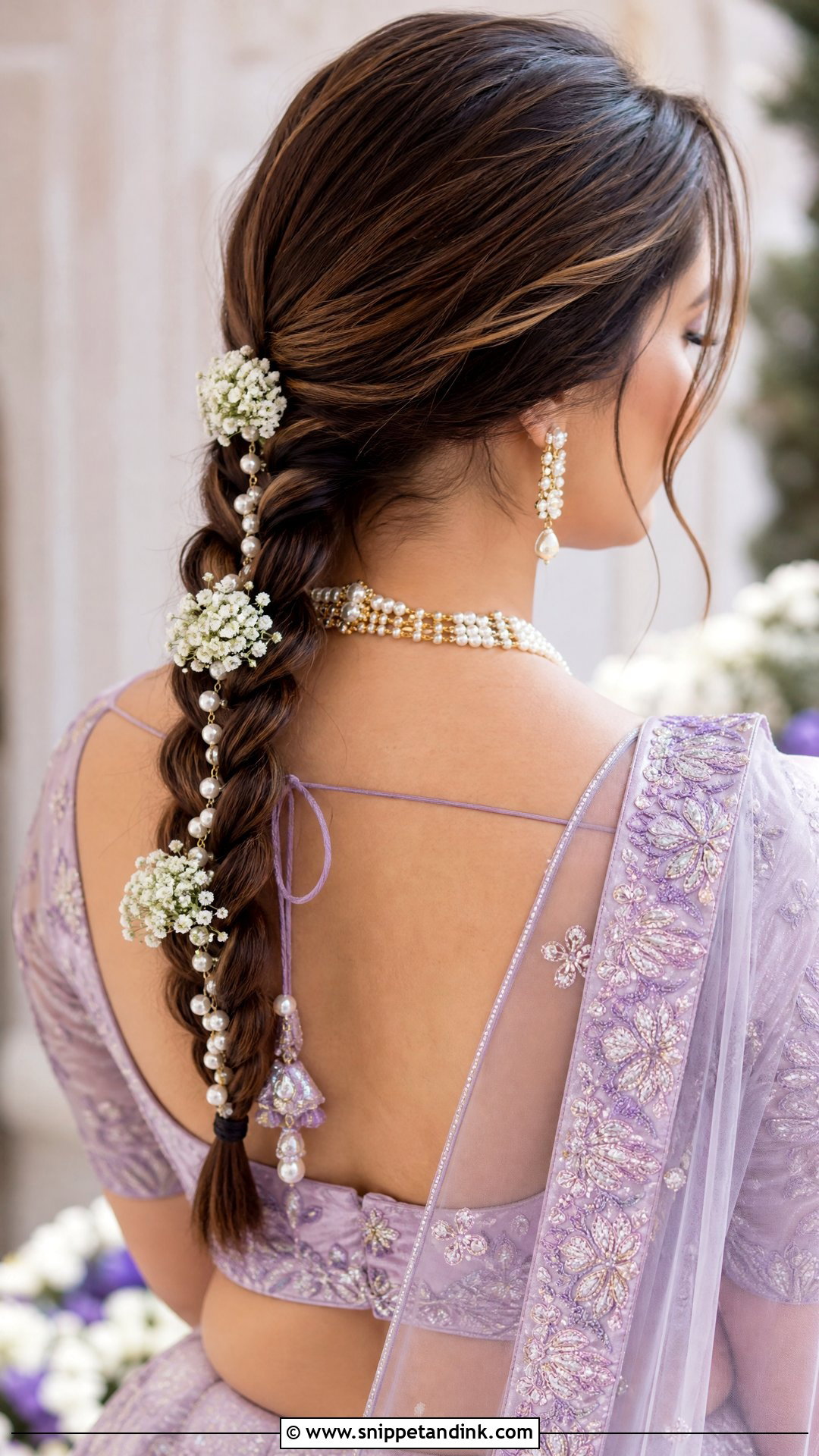
Pearl strings woven through a plait give a softer finish than heavy florals, and I like them for engagement and reception looks with pastel sarees or lehengas. I thread the pearls in as I braid rather than wrapping them afterwards, which keeps them flat and stops them from twisting into clumps. Mixing in tiny white flowers adds texture. Keep in mind that pearl strands add slip to the braid, so I finish with a tighter elastic than usual and hide it under a small ornament.
8. Open Hair With Diamond Accents
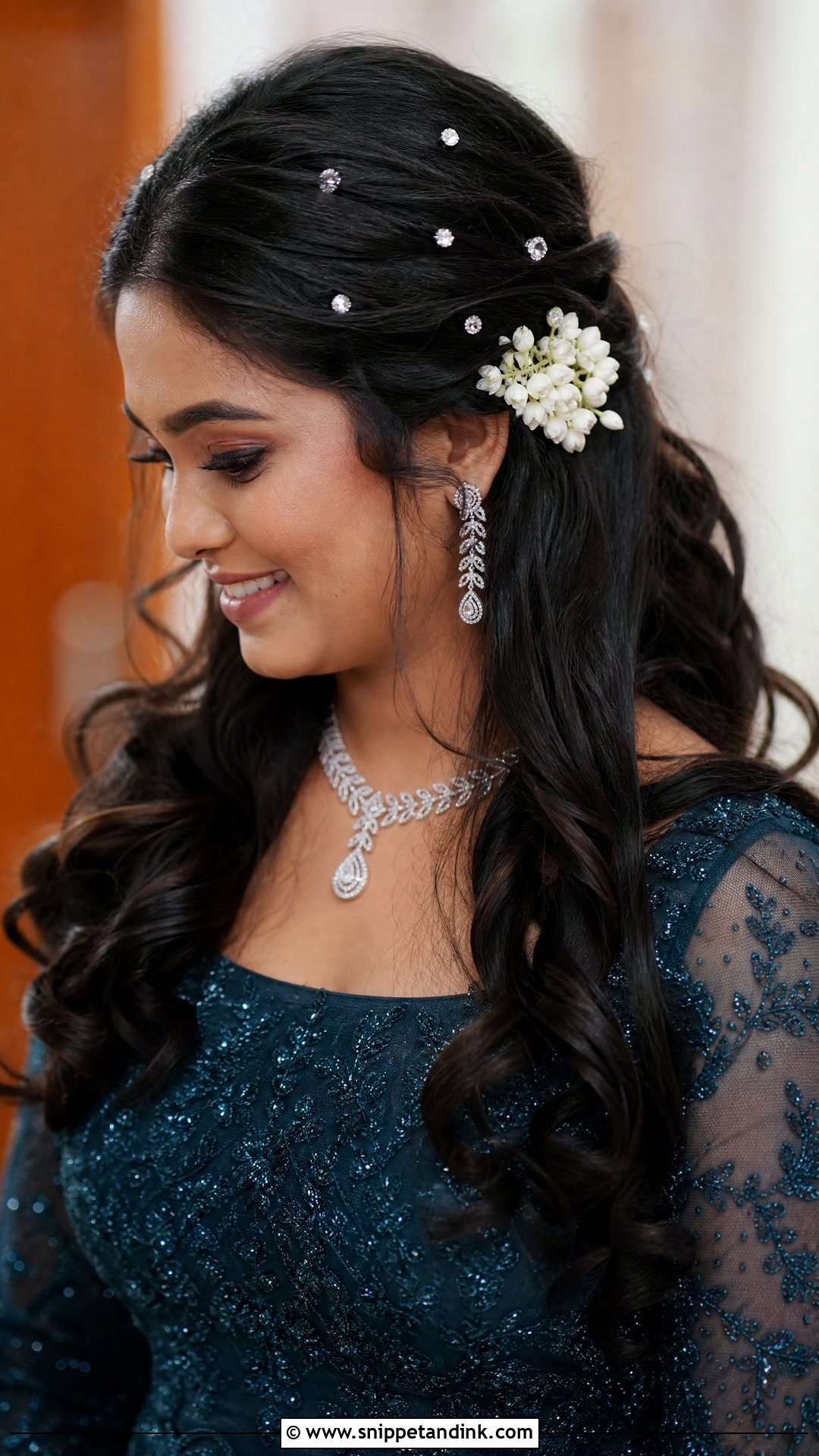
Open hair with diamond pins is the request I hear most for the sangeet and reception. Loose waves fall freely while a hairline accessory or a few sparkling pins add shine, and a jasmine strand tucked behind one ear keeps a traditional note. My warning: open hair is the least forgiving style for a long, humid evening. I prep with a light mousse at the root, curl in larger sections than you’d think, and pin every jewelled piece into a small hidden braid so it can’t slip down the hair shaft.
9. Pastel Faux Flower Bun
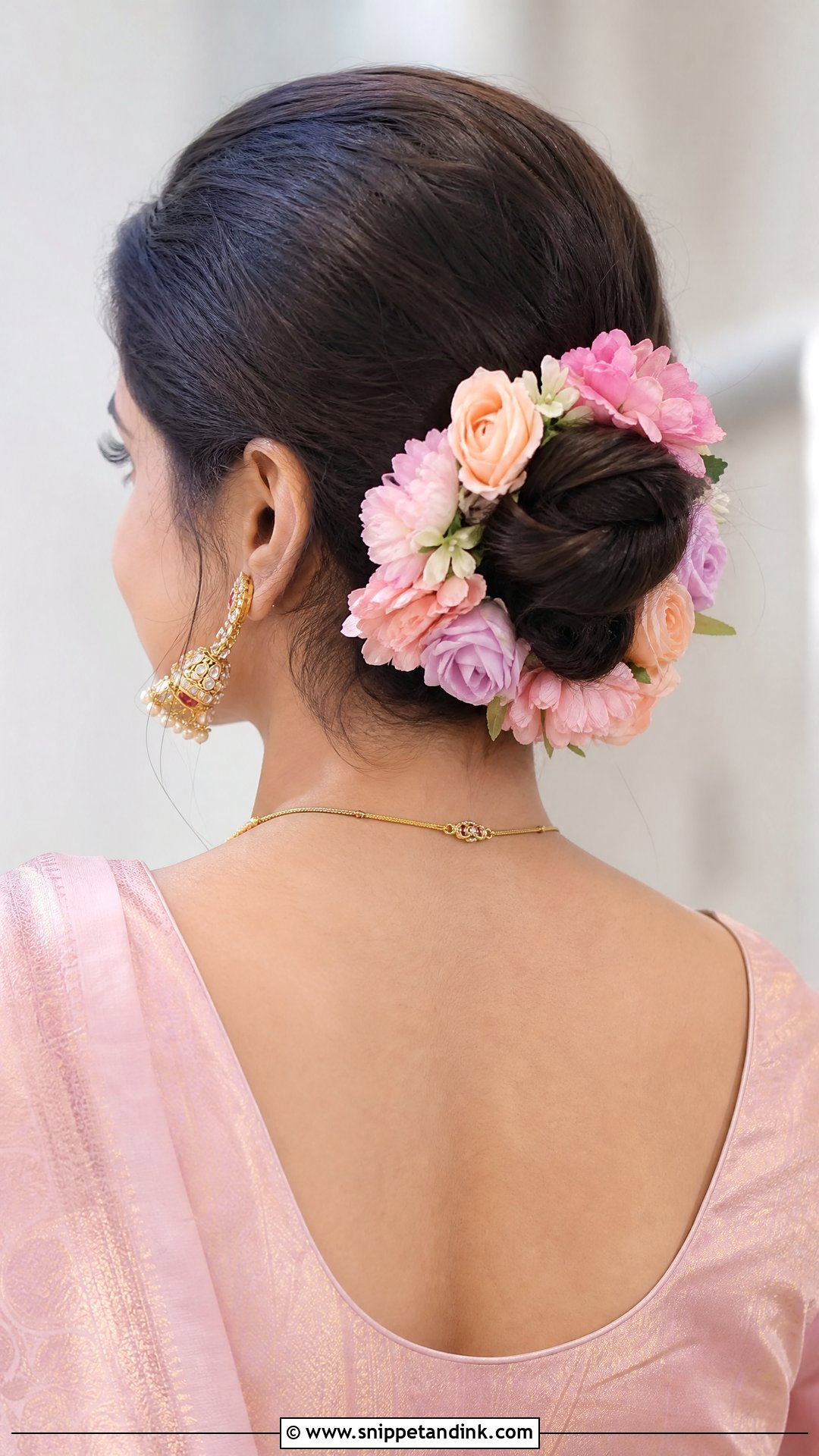
Faux flowers in blush, lavender or peach on a neat bun suit daytime ceremonies and intimate functions, and they solve a real problem: they don’t wilt under lights or brown from body heat. I prefer silk or good fabric blooms with wire stems that I can bend and pin flat, because cheap plastic ones catch the camera flash and look shiny. Pair them with a pastel silk saree, and keep the bun itself smooth so the colour does the work.
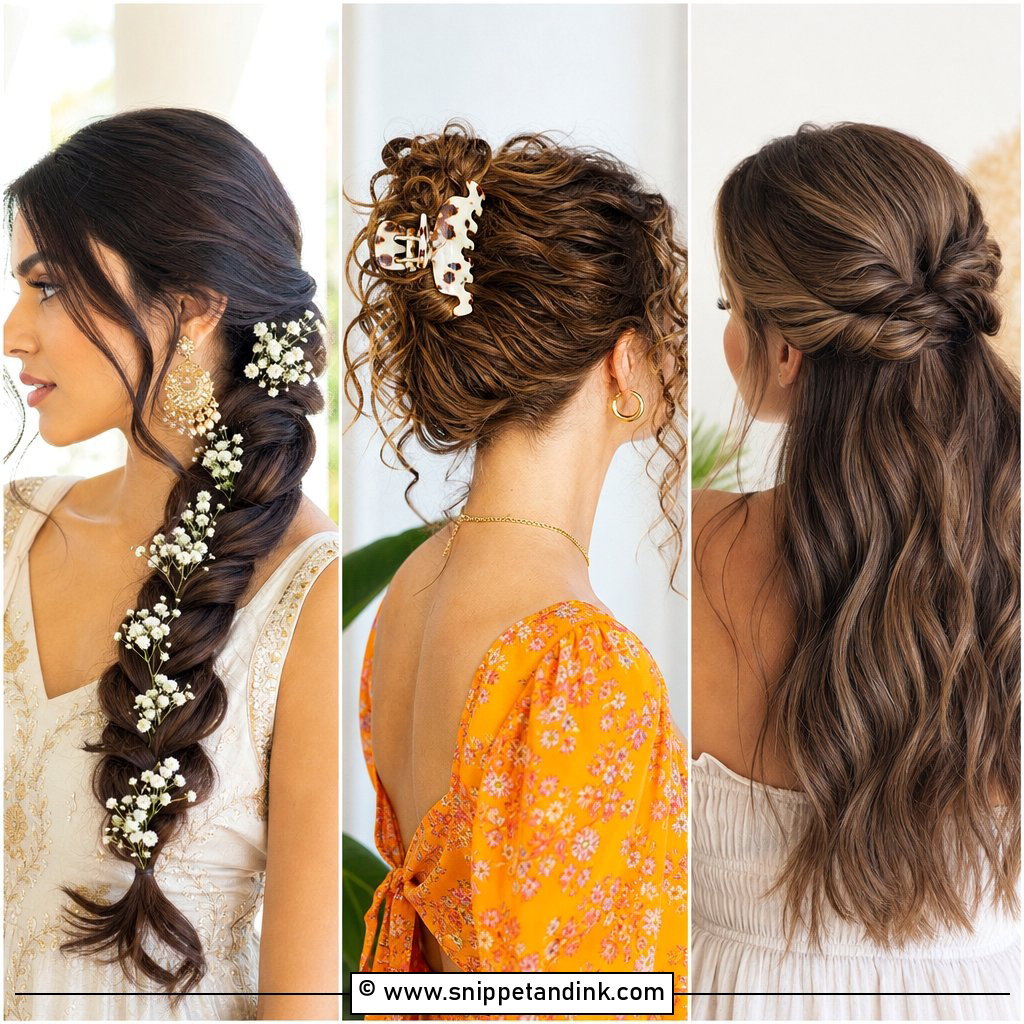
10. Messy Braid With Baby’s Breath
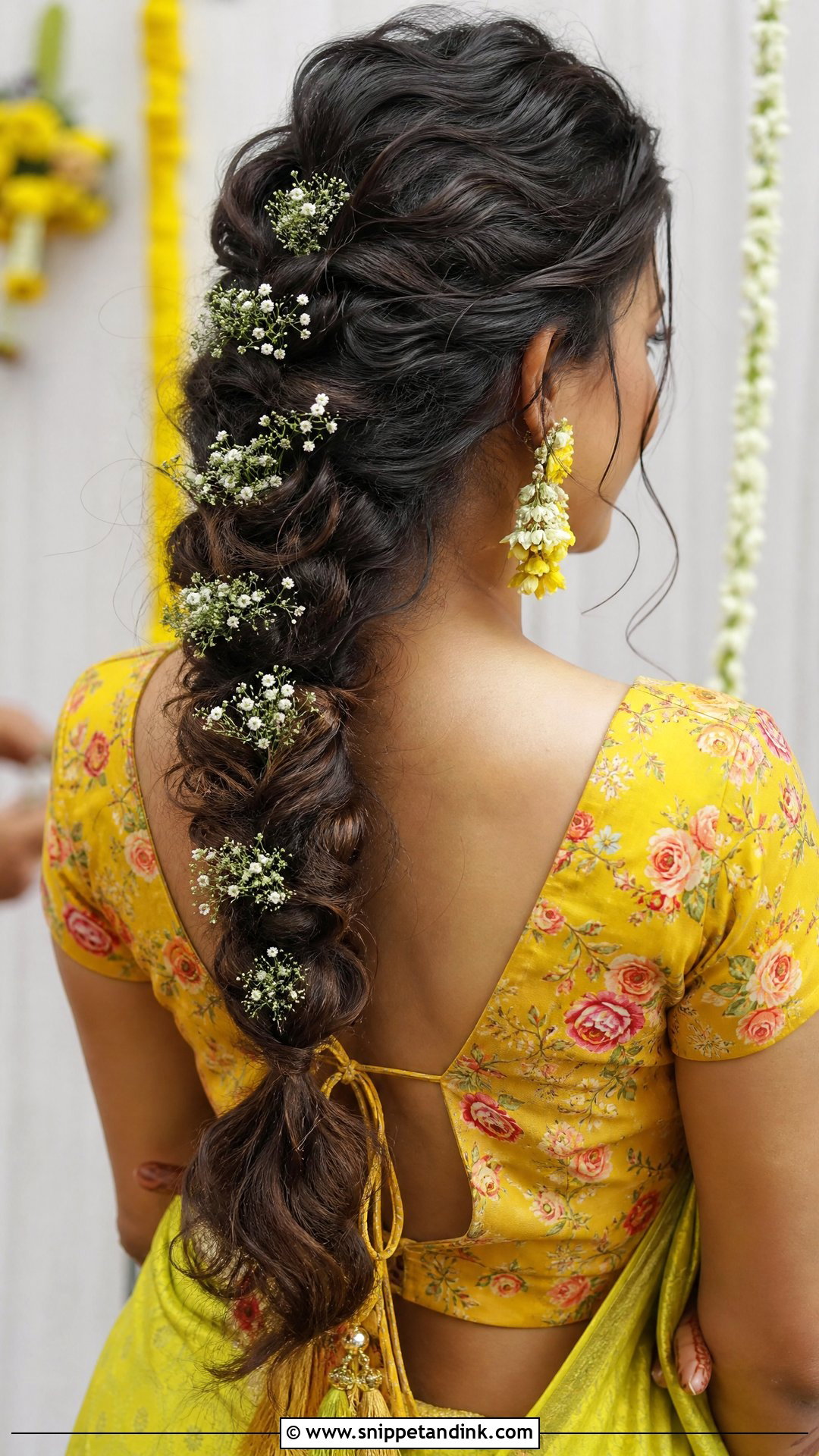
Baby’s breath on a loose, tousled braid is airy and light, which makes it a good fit for mehendi or haldi when you’ll be moving around and sitting on the floor. I pull the braid apart gently after plaiting to widen it, then tuck the sprigs in small bunches so each one has hair gripping it. Fresh baby’s breath dries quickly but keeps its shape, so it still looks right hours later. It does shed tiny petals, so I leave it off brides who’ll be wearing dark velvet.
11. Side Swept Curls With Flowers
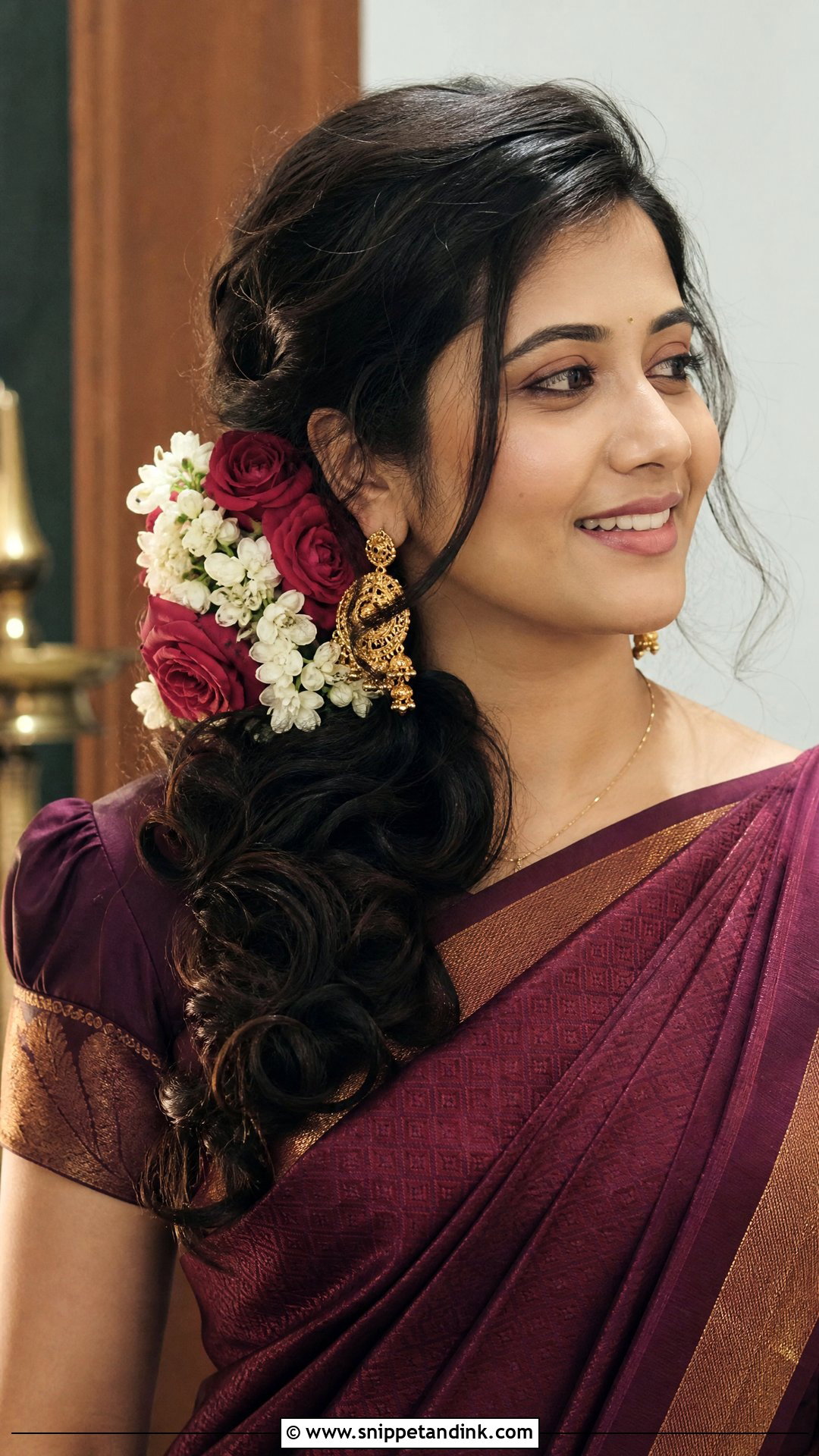
Side-swept curls gather all the hair over one shoulder, with jasmine or rose clusters placed near the part. I choose the side by the earring you most want seen and by which way you’ll be facing the stage, since the bare side is the one the camera gets. Curls only last on hair that holds a set, so on silky straight hair I set them the night before in pin curls or switch you to a softer wave. It works best at cocktail and reception functions.
12. Hydrangea Bridal Bun
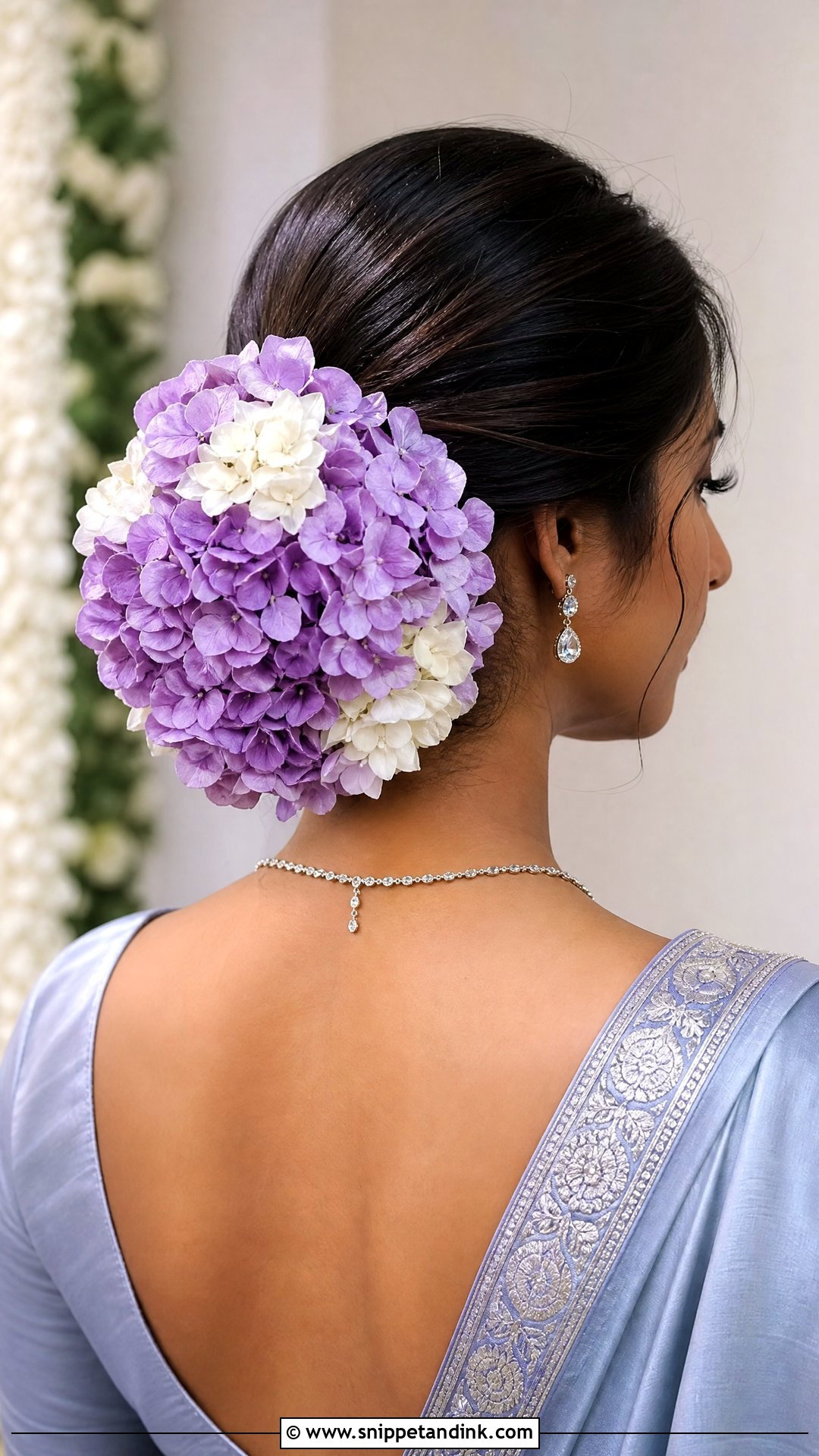
Hydrangea clusters around a sleek bun give volume and colour in white, blue or lilac without a single jasmine string. The heads are big and soft, so a few go a long way. As a stylist I’ll flag one issue: fresh hydrangeas wilt fast once out of water, especially in a warm hall. I ask the florist to condition them well, and I pin them on as late as possible or switch to good preserved heads for a long evening. They suit receptions and fusion outfits more than temple-jewellery ceremonies.
13. Maang Tikka Centered Bun
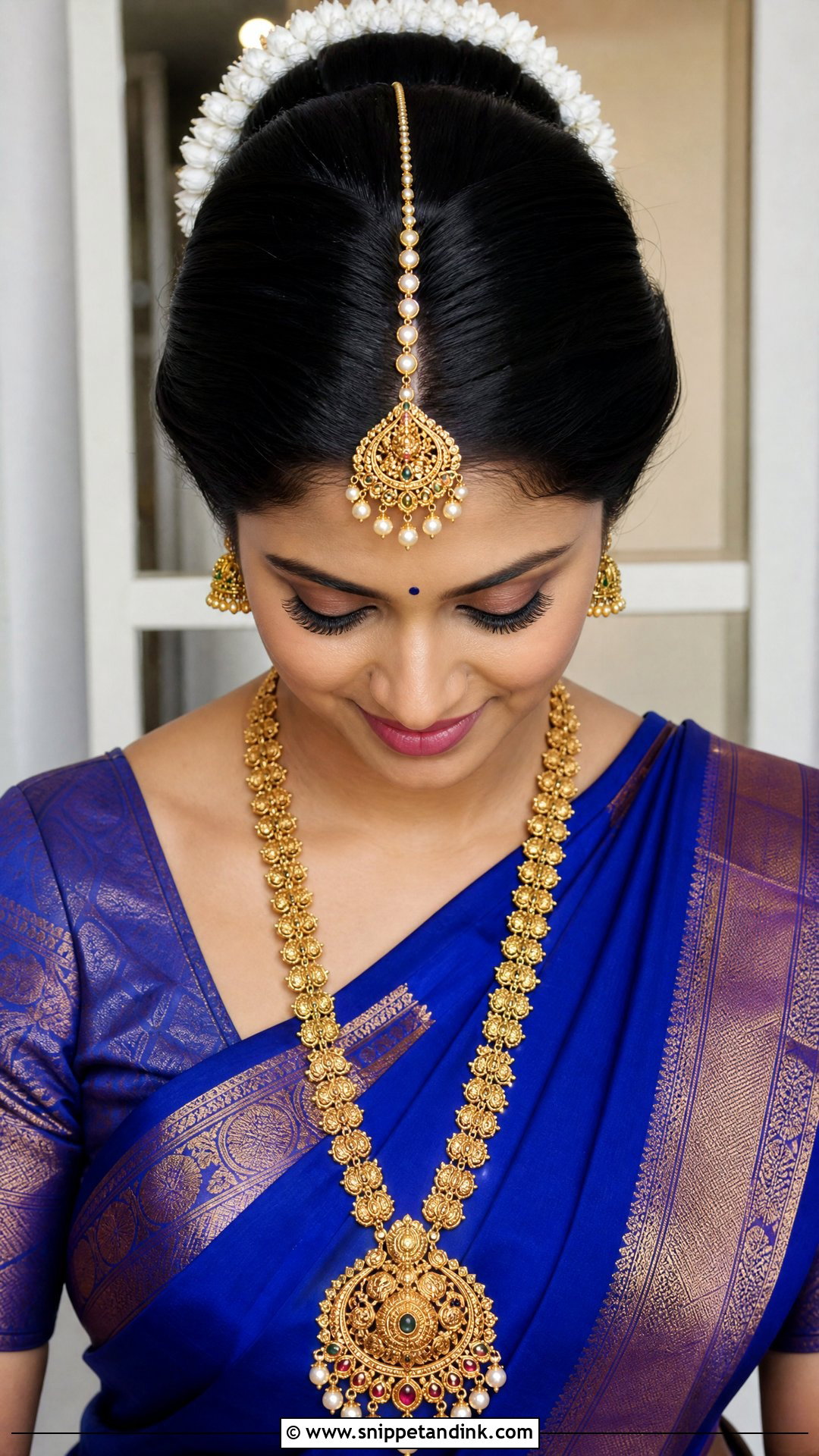
A polished bun with the maang tikka centred on the parting is all about symmetry, so the parting has to be dead straight. I set the tikka chain first, check it sits exactly on the centre line, and only then build the bun around it. A thin floral garland or pearl detail around the bun finishes it. This works on almost any length because extensions or padding fill the bun out, and it keeps the focus on the face and the temple jewellery set.
14. Braided Crown With Jasmine
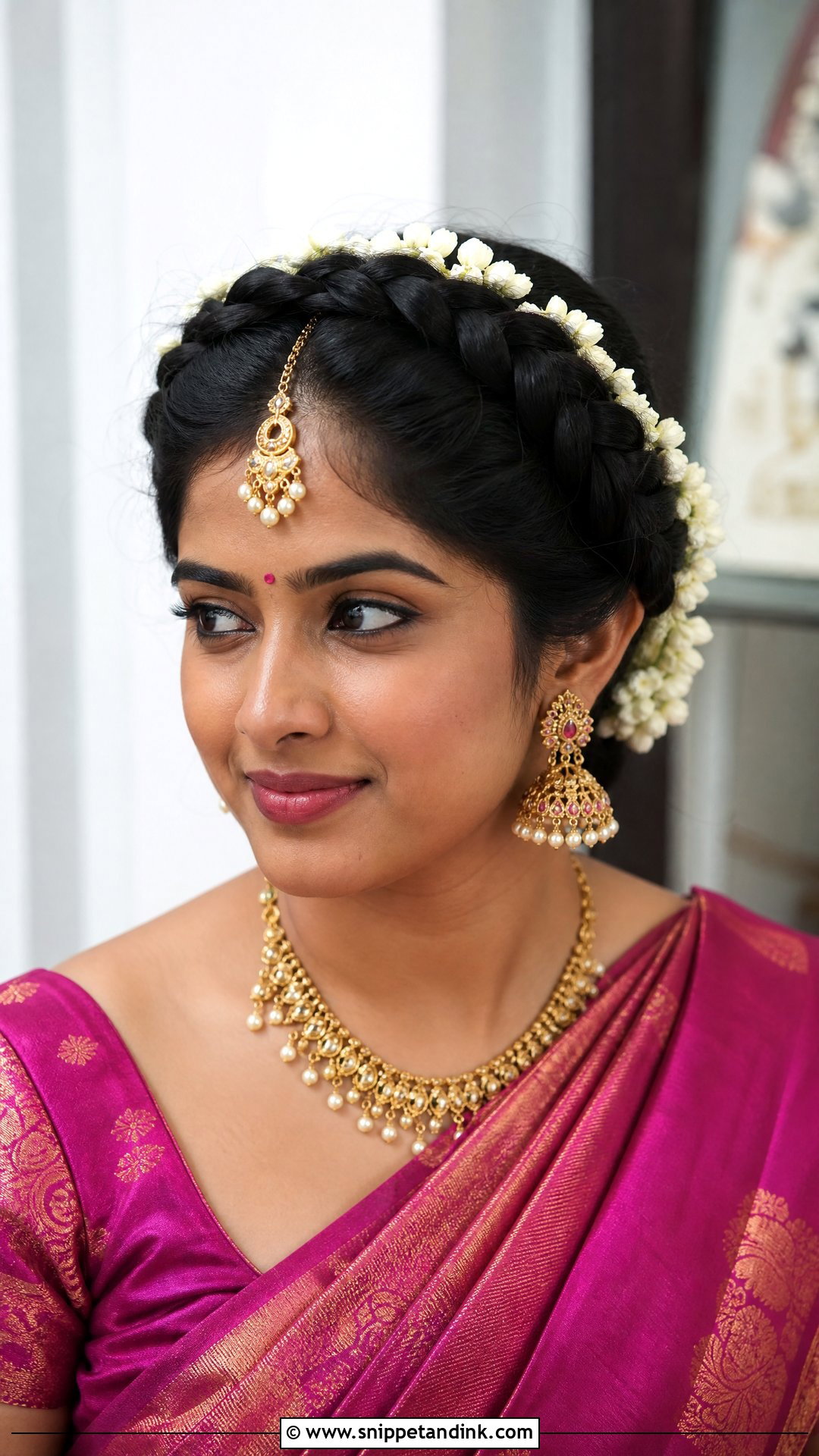
A braided crown dotted with jasmine wraps a plait around the head like a halo and keeps every strand off the face through long ceremonies. It pairs well with bold earrings and a maang tikka, since there’s nothing hanging near either. On long, thick hair it’s easy; on shorter lengths I add a separate braided extension for the crown and blend it in. Pin the crown along its underside with small hairpins every few centimetres, otherwise the weight of the flowers pulls it backwards over the day.
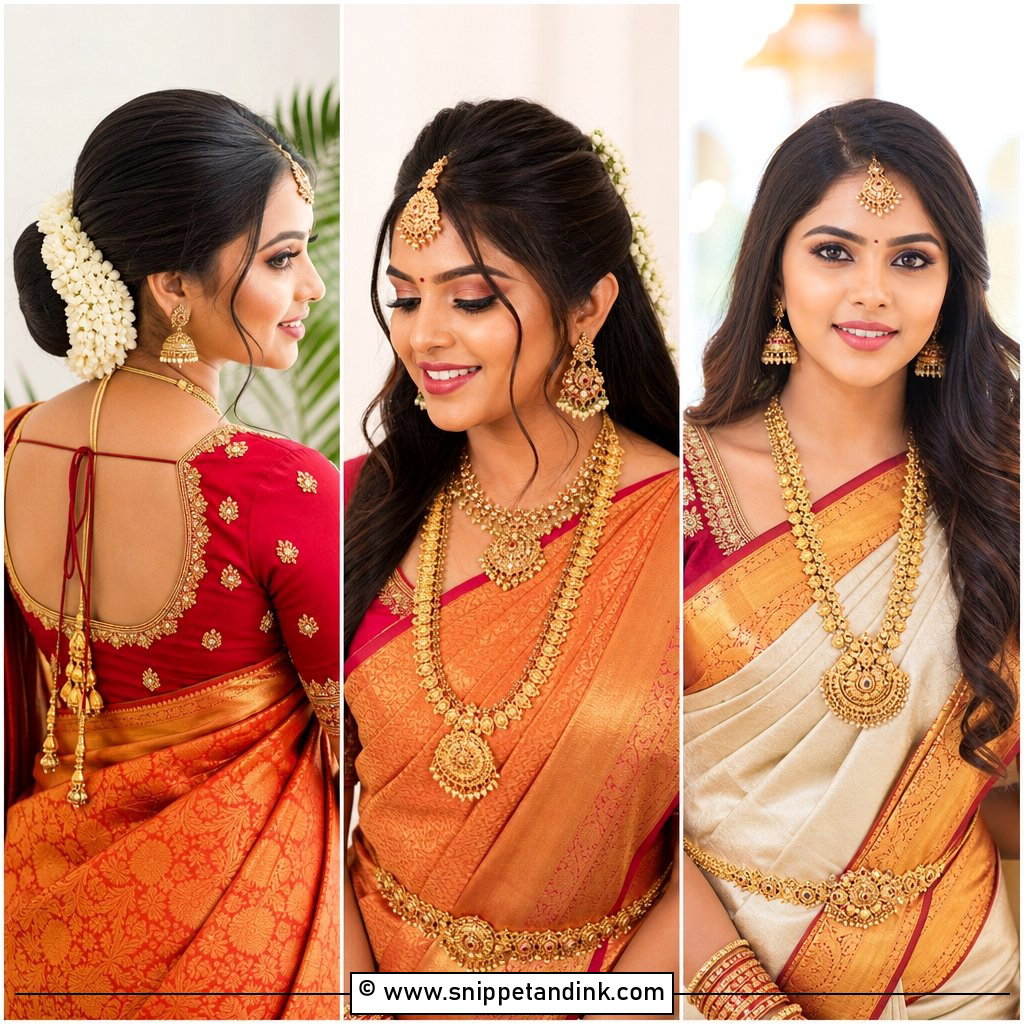
15. Fishtail Braid With Floral Accents
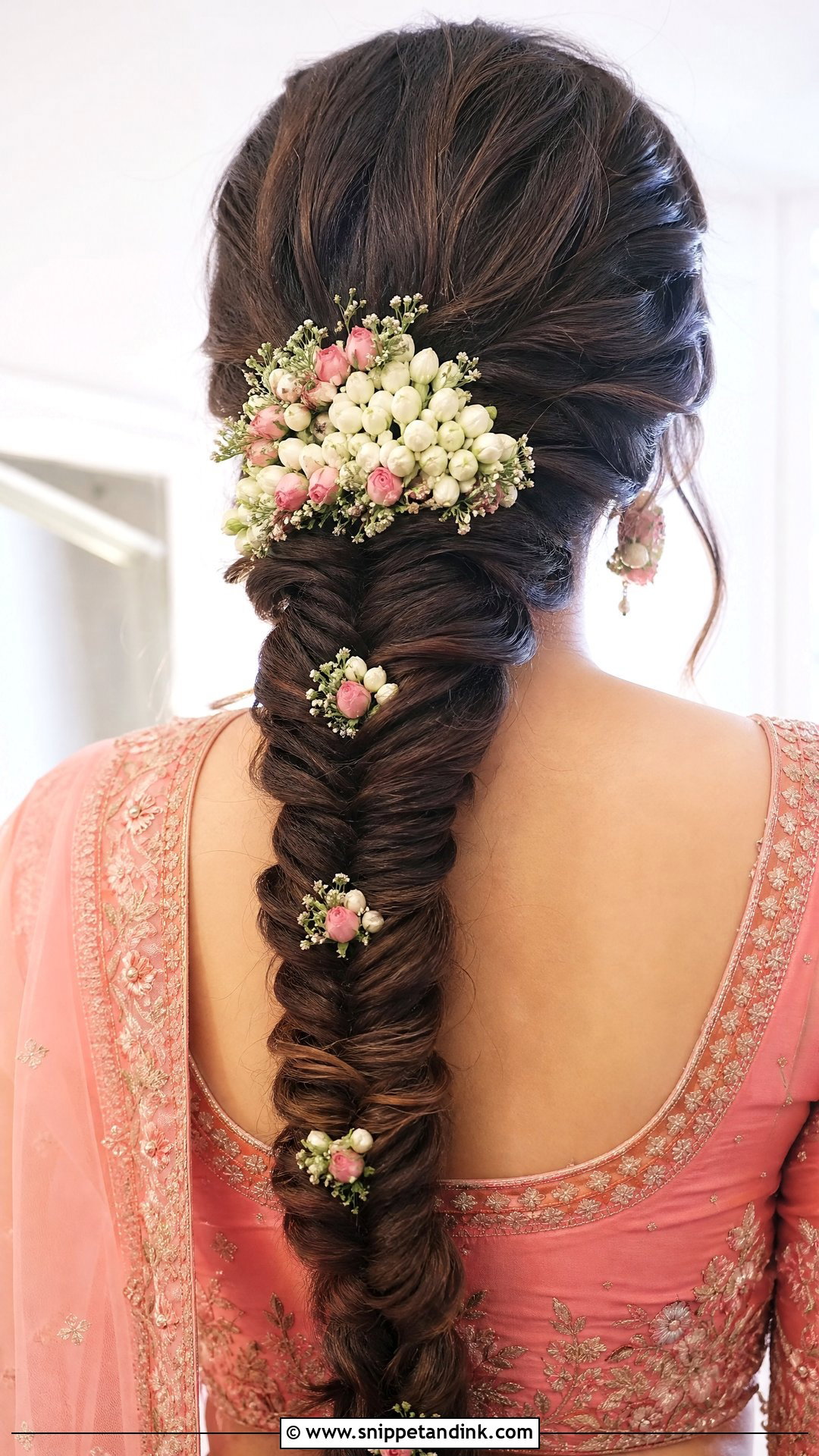
The fishtail gives a woven, herringbone texture that reads more detailed than a three-strand plait, with jasmine buds or tiny roses tucked along its length. It suits sangeet, mehendi and reception looks with a flowing lehenga. My one caution: a fishtail on fine hair can look sparse once loosened, so I add a clip-in weft underneath before I start. On thick hair it stays put for hours without much product.
16. Bun With Bejeweled Butterfly Accessories
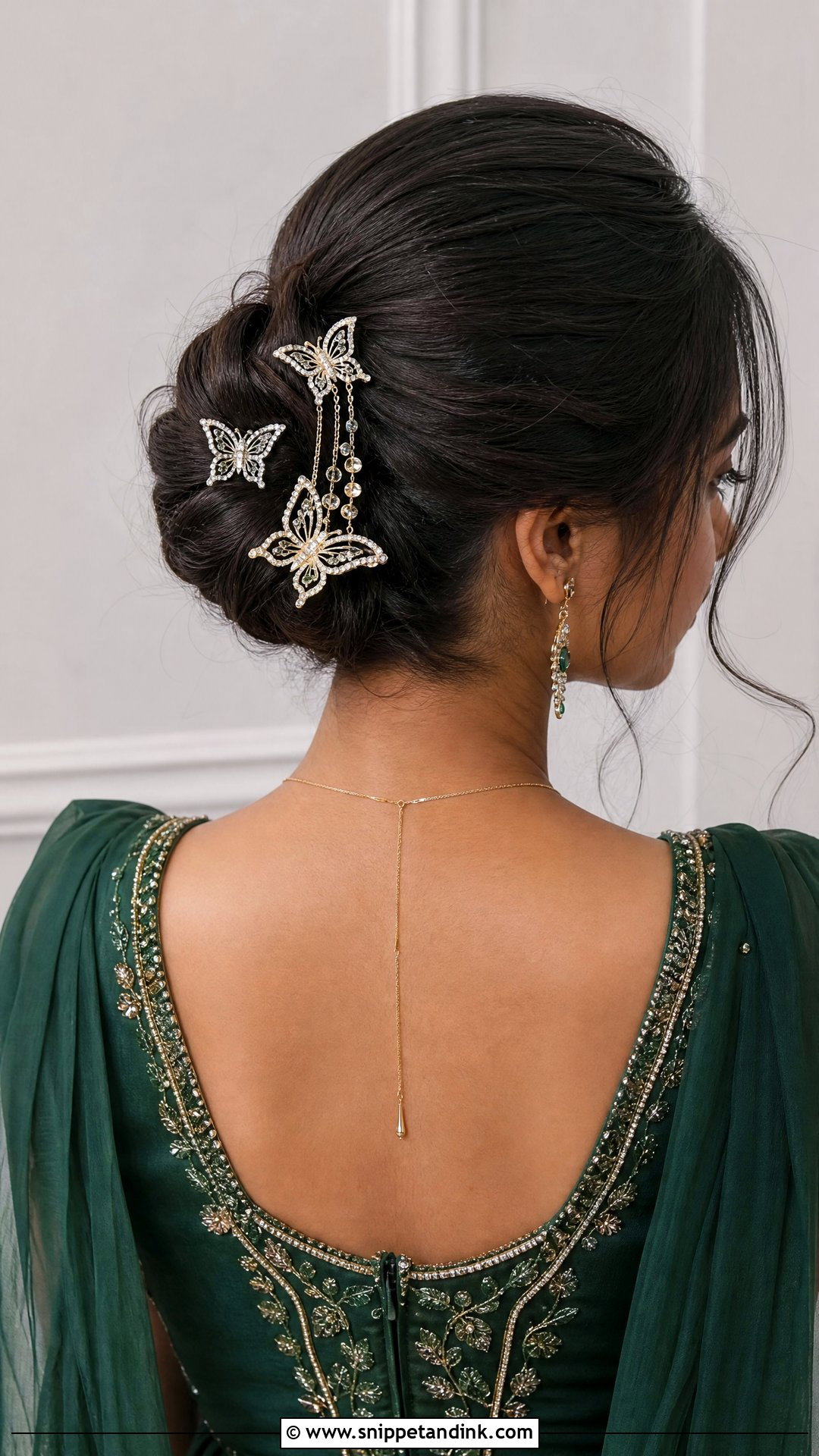
Bejewelled butterfly pins on a neat bun are for the bride who wants something unexpected at the reception. I cluster them off-centre rather than lining them up, which looks more natural from the side. The pins themselves are often heavy for their size, so I slide each one into a small hidden braid or a crossed pair of bobby pins first. It works with traditional or fusion outfits, and padding or extensions make it possible on most hair lengths.
17. Loose Waves With Side Gajra
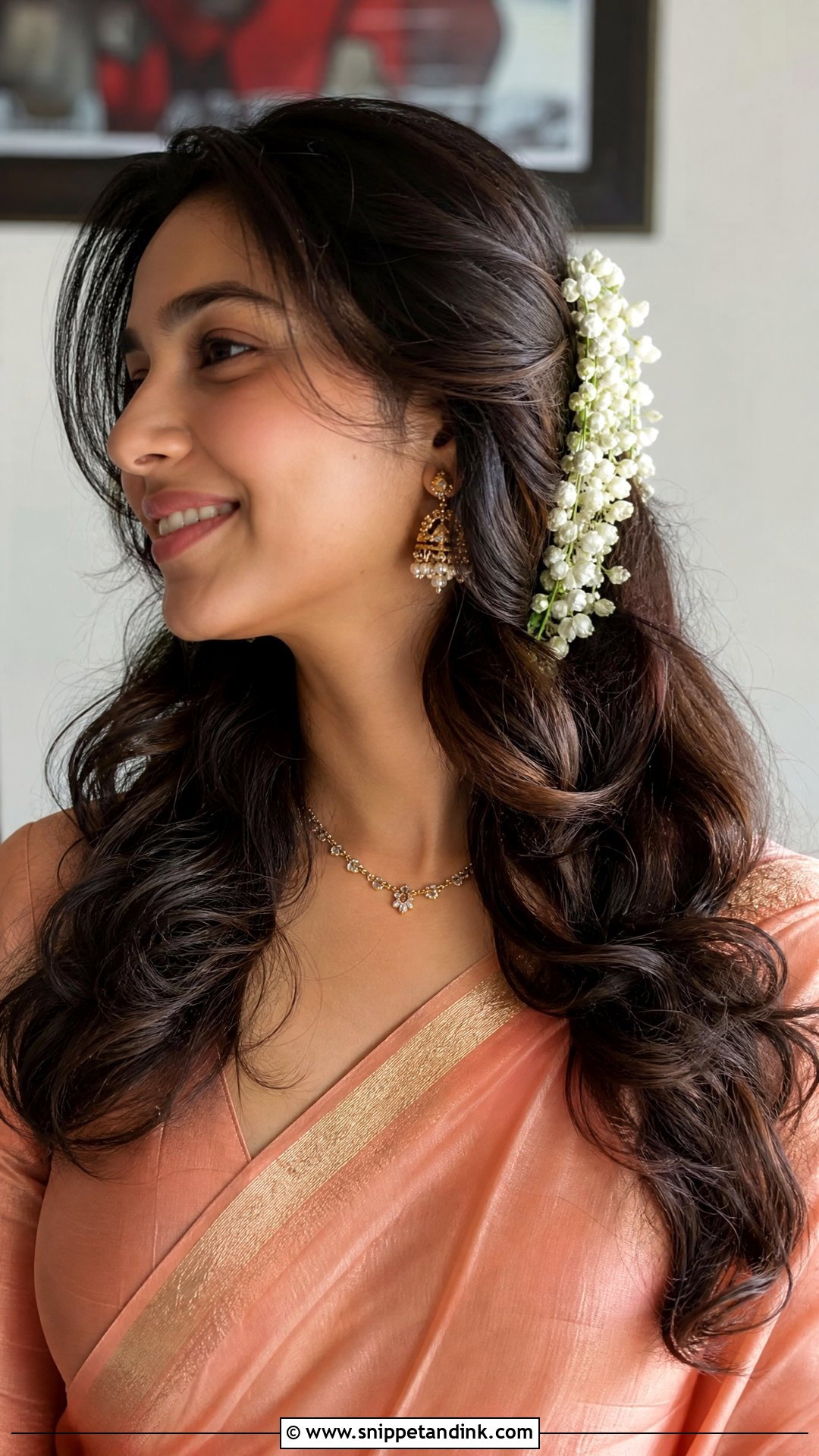
Loose waves with a side gajra are my go-to for daytime pre-wedding events, when a bride wants her hair down but still wants jasmine. The string runs along one side above the ear, pinned into a tiny braid I hide beneath the top layer. Waves suit medium to long hair with natural body. Expect them to soften by the afternoon in humid weather; that’s normal, and a light hand of hairspray at the start helps more than reapplying later.
18. Donut Bun With Rose Garland
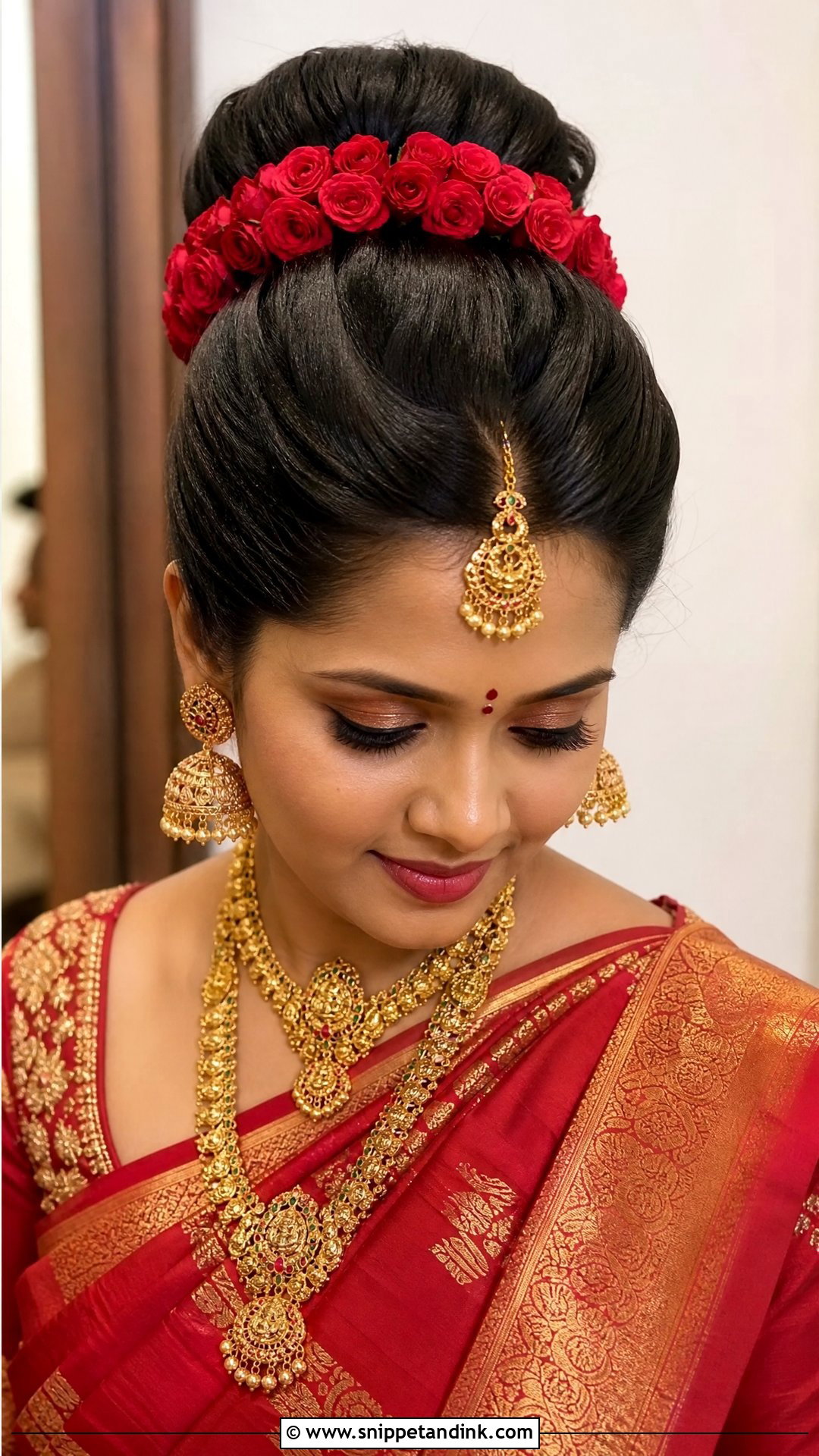
A donut bun wrapped in a rose garland gives height and a full round shape, with strings of roses encircling it against dark hair and gold jewellery. Since the donut provides the volume, this works for nearly any hair type, including fine hair. I match the donut colour closely to your hair so no gap shows between rose strings. Roses are heavier than jasmine, so I pin the garland into the donut rather than relying on the hair alone, and it then stays put through the rituals.
19. Sleek Low Bun With Temple Jewelry
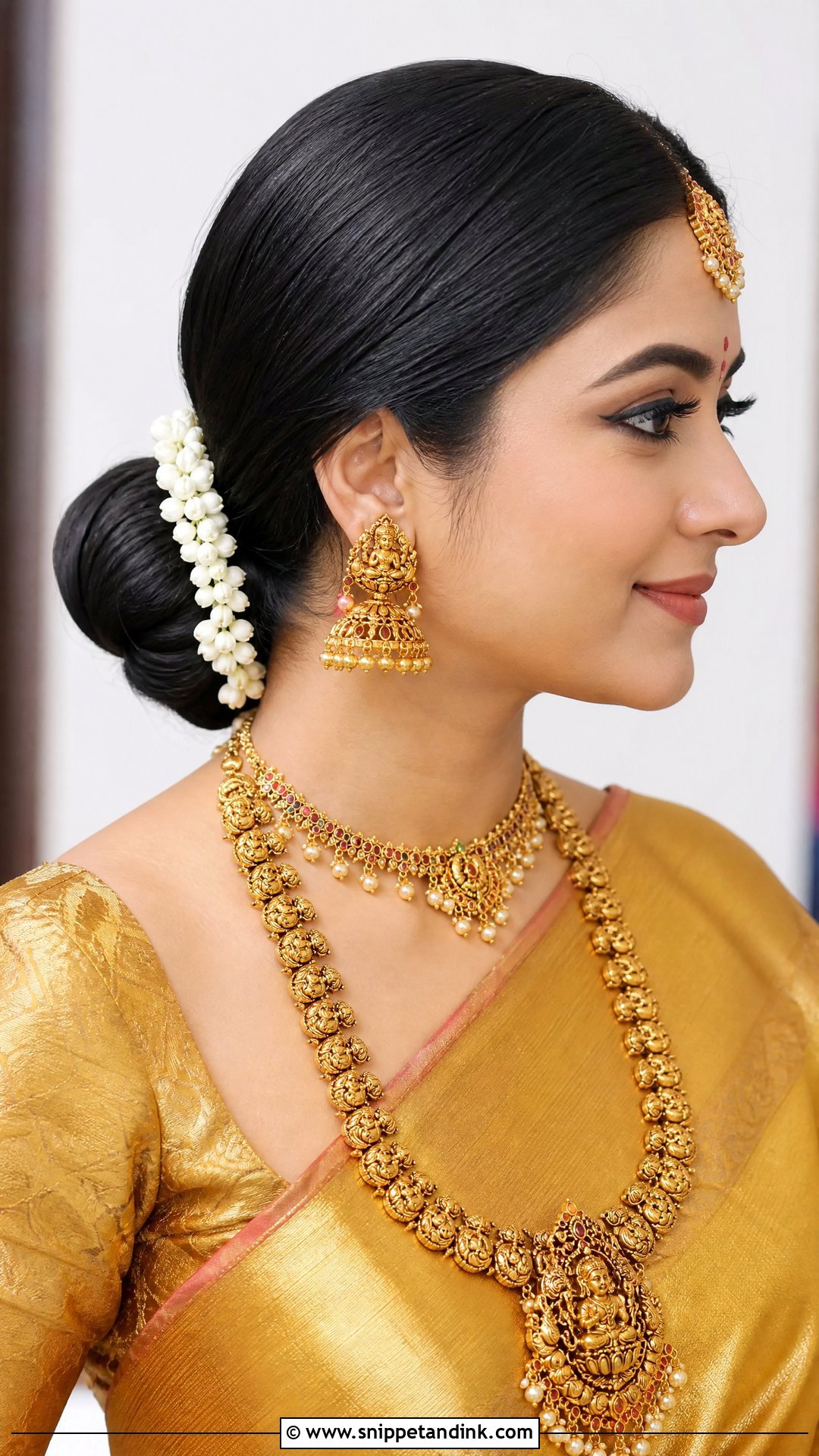
The sleek low bun is for the bride who wants her temple jewellery and maang tikka to carry the look. I smooth the hair back with a little serum and a fine-tooth comb, tie it at the nape, then wrap and pin it tight. A thin jasmine strand or one decorative pin keeps it bridal. It suits all lengths and is the easiest style to keep neat over a long day, which is why I often recommend it for brides changing outfits several times.
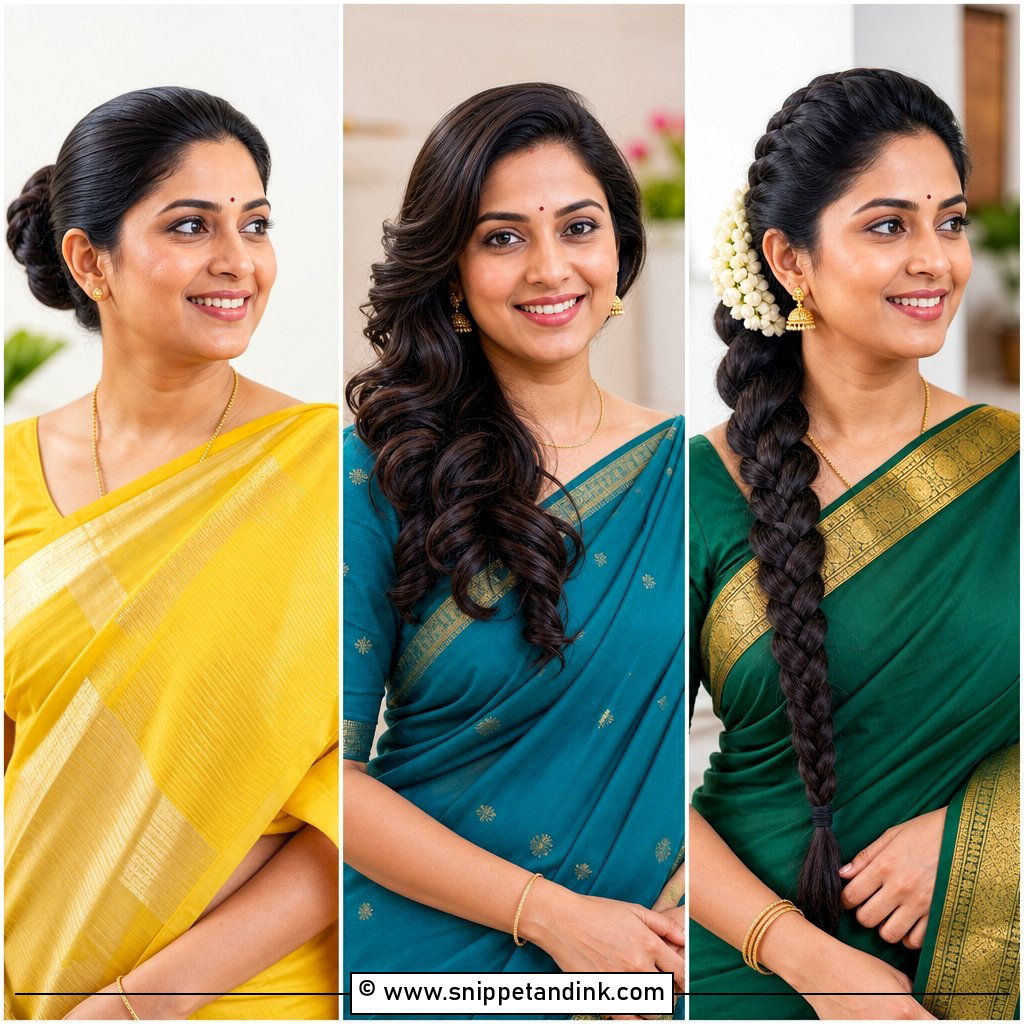
20. Twisted Updo With Mogra Strings
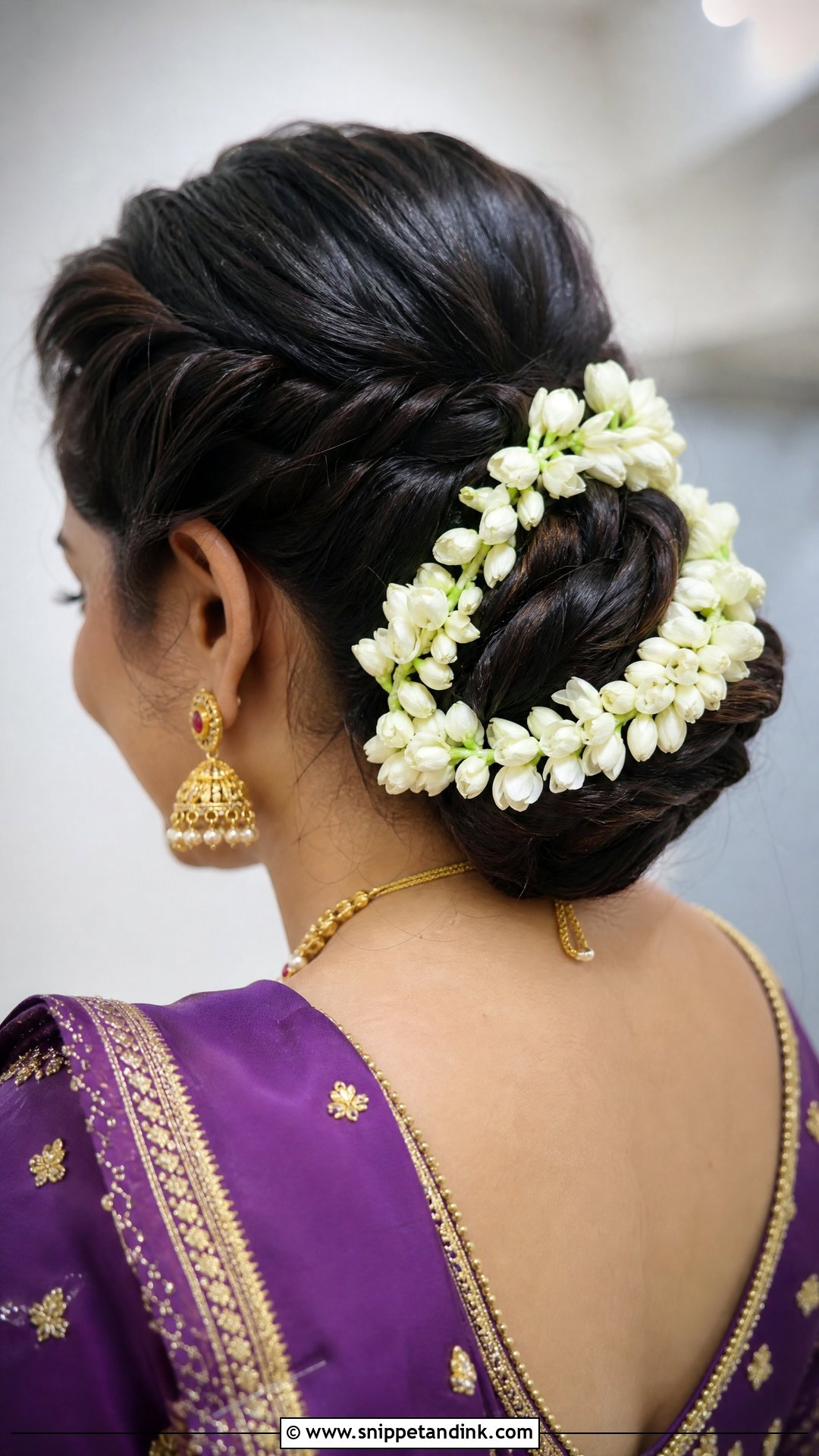
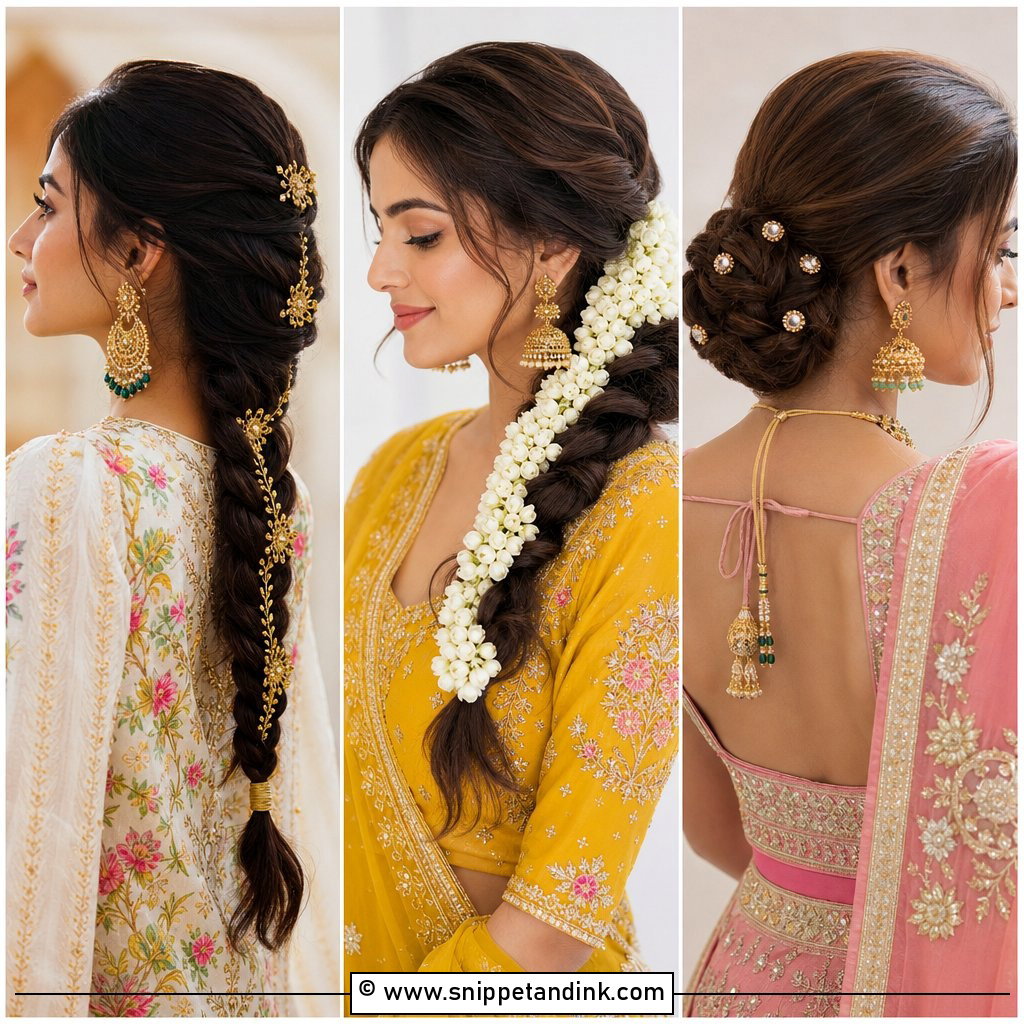
A twisted updo with mogra strings combines sculpted shape with fragrance. I twist sections of hair and pin each one into place before laying the jasmine strands in the grooves between twists, so the flowers look built in rather than draped over. It keeps hair off the neck and shows the earrings clearly, and it’s sturdy enough for grand ceremonies. Medium to long hair works best, because very short sections won’t twist cleanly.
Can Fine or Shoulder-Length Hair Carry a Traditional Look?
Yes, with a little help underneath. Most of the classic South Indian bridal styles were designed around long, heavy hair, and I don’t pretend otherwise. For brides with fine or shoulder-length hair, I build the structure first and let your own hair cover it.
For braids
I braid a long hair extension in from just below the crown, matched to your colour. Your hair covers the join, and the extension takes the weight of the jada or jasmine strings so your roots don’t pull.
For buns
A mesh donut or padded base gives the kondai and veni buns their shape. Pinning the flowers into the padding instead of the hair is what keeps fine hair comfortable after six or seven hours.
Three Outfit Changes, One Head of Hair
South Indian weddings often move from muhurtham to lunch to reception in one day, and each change means a different saree or lehenga. Taking a poola jada down is slow and pulls on the hair, so I plan the sequence at the trial: heavy braid or kondai for the rituals, then a style that can be built from that base without washing out the product.
A braided base, for example, can be unpinned and curled into a side sweep for the evening. A sleek bun can take new flowers or butterfly pins in minutes. If your stylist won’t be with you all day, ask her to teach a relative how to remove the jada without cutting the strings out of your hair.
From Muhurtham to Reception, One Style at a Time
Look at your hair length, your outfit changes and how long you’ll be seated, and the shortlist usually writes itself. The poola jada and gajra braids belong to the ritual, the kondai and sleek buns carry heavy gold well, and the pearl plaits, hydrangeas and bejeweled butterflies come into their own at the reception. Bring screenshots of two or three favourites to your trial along with your real jewellery, and let your stylist tell you which one your hair can hold for the whole day.
You'll Like These Ideas:







Leave a Reply