
An initial is the smallest thing I draw on a hand and the one people check first. The letter R might be your own name, your partner’s, a parent’s or a child’s, and it can sit boldly in the center of the palm or hide inside a flower for someone to search for at the ceremony. It fits bridal mehndi, engagement henna, Eid and anniversaries alike, and it blends into mandala, jaali, Arabic and Indo-Arabic work. Below are twenty placements and styles, from a single letter on the finger to full bridal hands, with notes on what keeps the R readable once the paste comes off.
Drawing an R That Survives the Stain
Henna paste is thicker on the skin than the stain it leaves, and the stain darkens and spreads very slightly over the next two days. That’s why initials drawn too small turn into blobs. The R has a closed bowl at the top, and that little loop is the first thing to fill in, so I draw it wider and more open than I’d write it on paper.
Which way should the letter face?
Decide this before the cone touches skin. An R drawn to read the right way up for you will look upside down to anyone across a table, and in photos the hand is usually turned toward the camera. For bridal hands I usually orient the letter for the viewer, since it’s meant to be found. For a personal initial you’ll look at yourself, face it toward you.
- Script R: soft and flowing, best inside florals and Arabic trails.
- Block or serif R: easiest to read from a distance, good for minimal and finger designs.
- The Devanagari letter for R or the Urdu ra: a quieter way to hide an initial, and meaningful to many families.
1. R Name Mehndi Design Front Hand
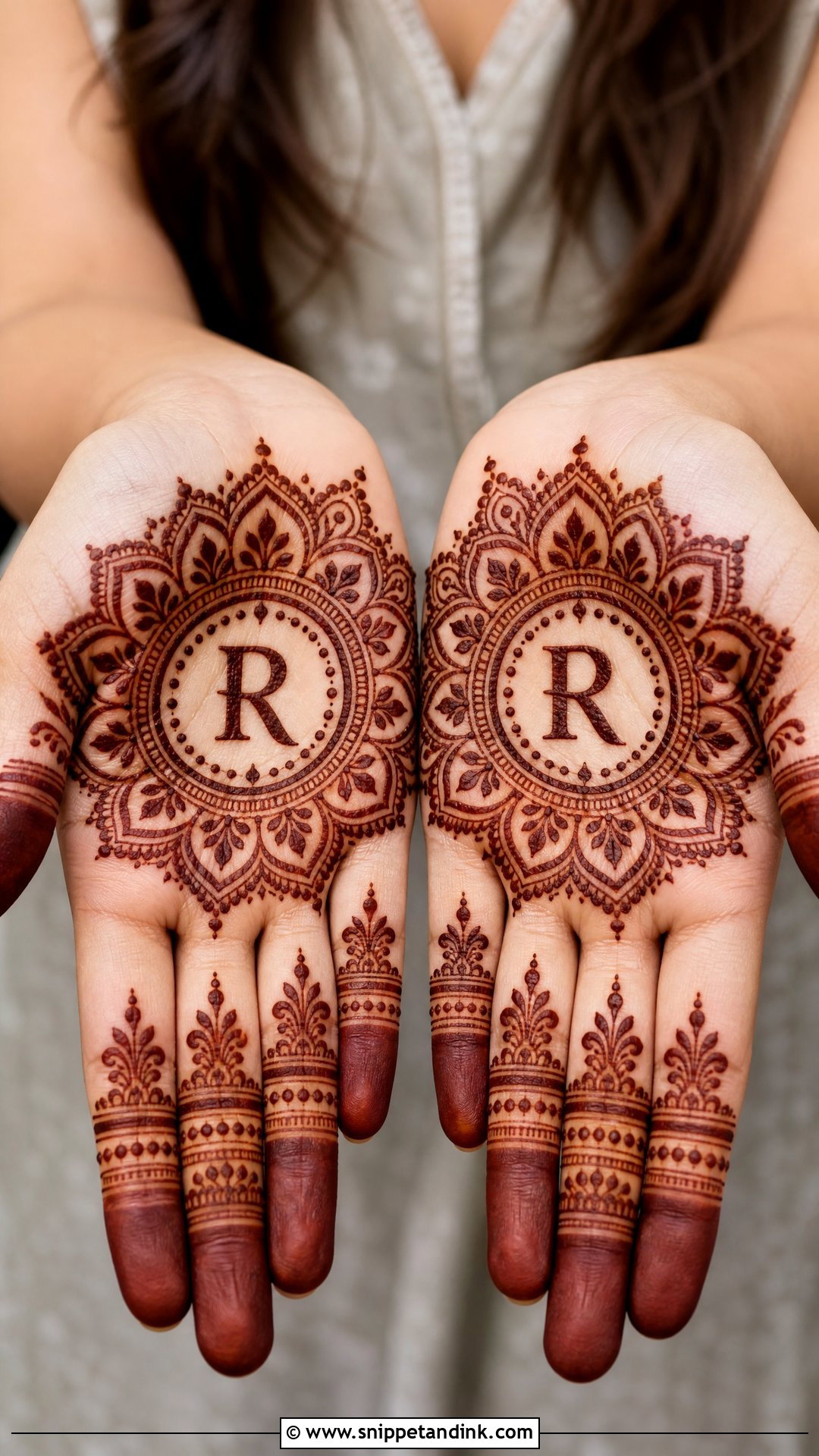
On the palm, the initial gets the darkest stain on the whole hand, because palm skin is thick and takes henna deeply. I draw a medium R name mehndi design in the center and build a soft mandala, small petals and dotted borders around it, with leafy lines and thin bands on the fingers. The mistake I see most is filler packed right up to the letter. Leave a clear ring of skin around the R, outline it boldly, and keep the finer details outside that ring.
2. R Name Mehndi Design Back Hand
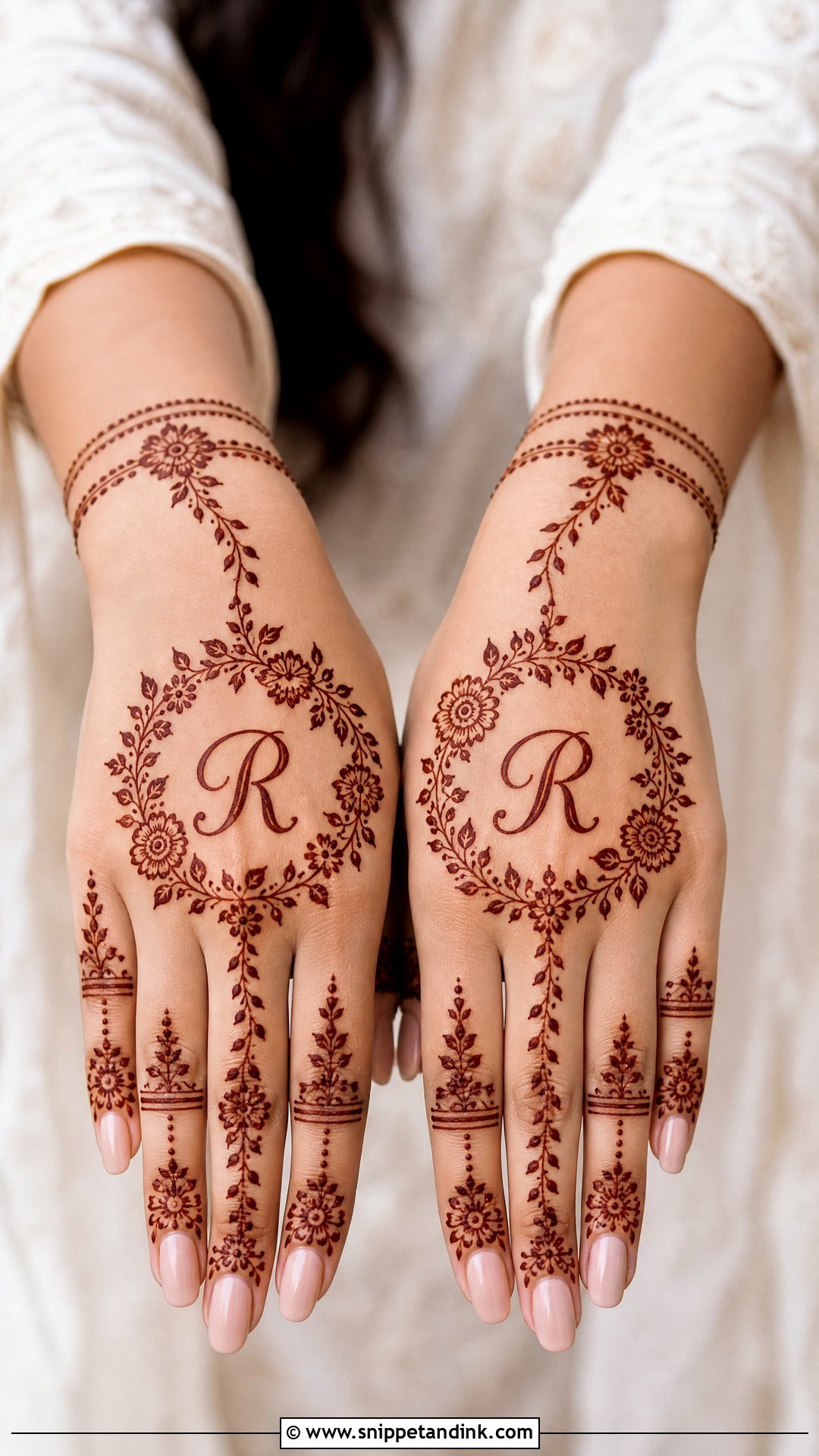
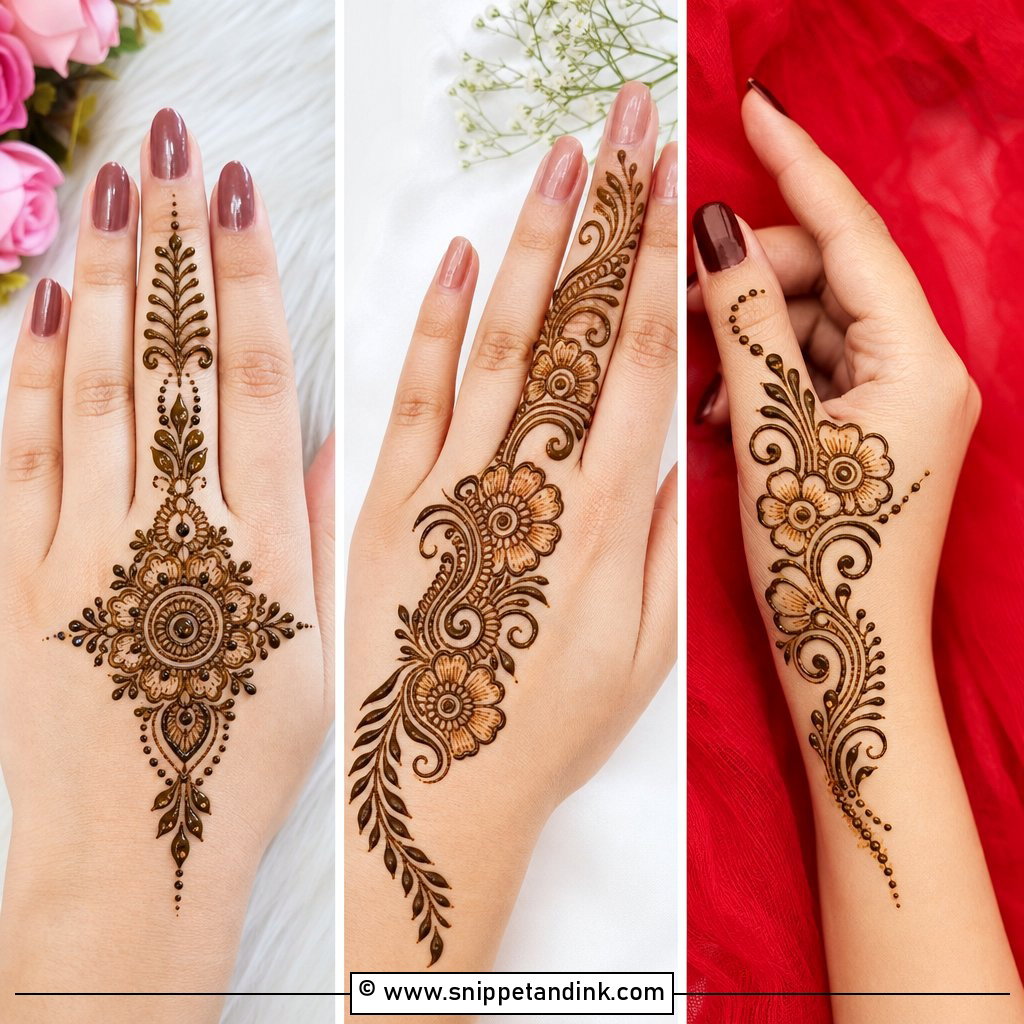
The back of the hand is the placement everyone sees, in photos and in every gesture. I set the R near the center inside a floral frame or a round bracelet motif, then run a vine toward the index or ring finger, with leaves and dots curving around the knuckles. Back-hand skin stains lighter than the palm, usually a warm orange-brown rather than deep maroon, so I draw the letter a little thicker here to compensate. It suits bridesmaids, sisters and cousins who want something personal without covering the palm.
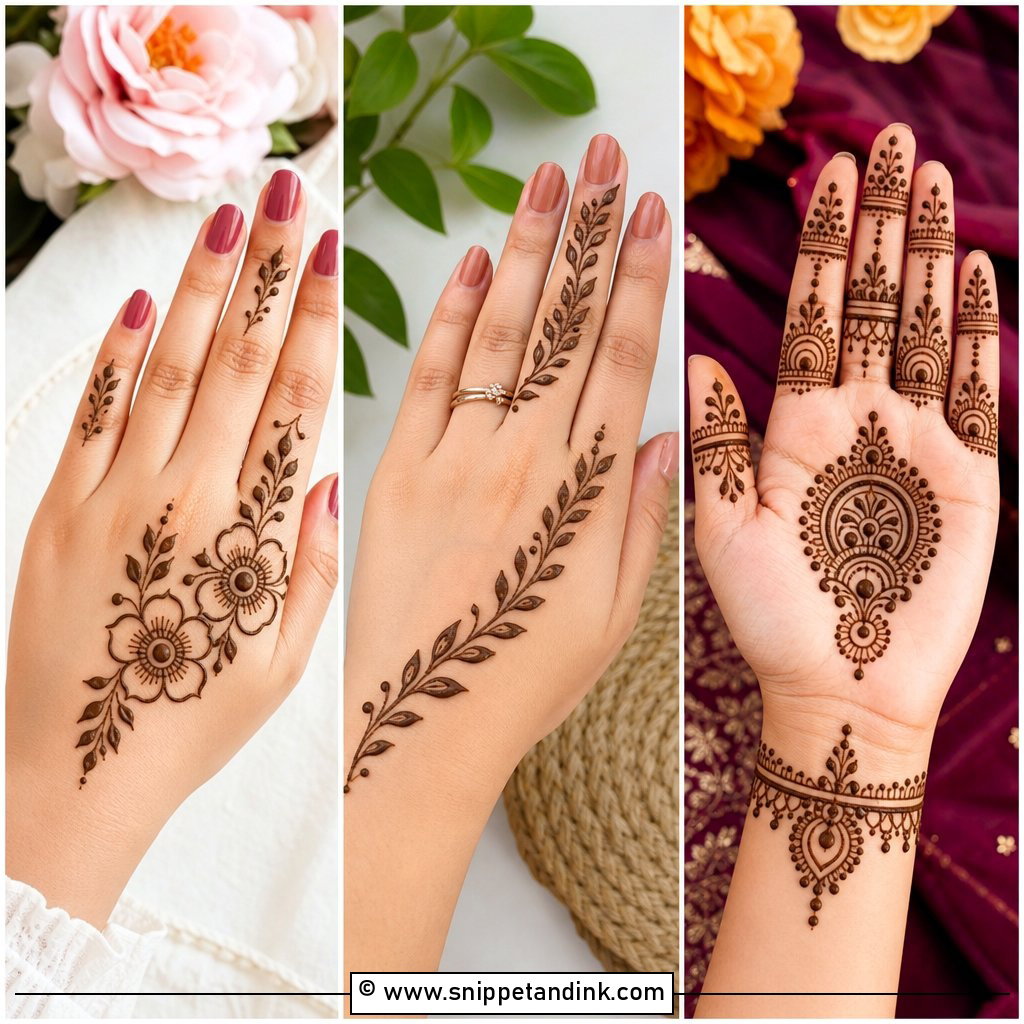
3. R Name Mehndi Design Simple
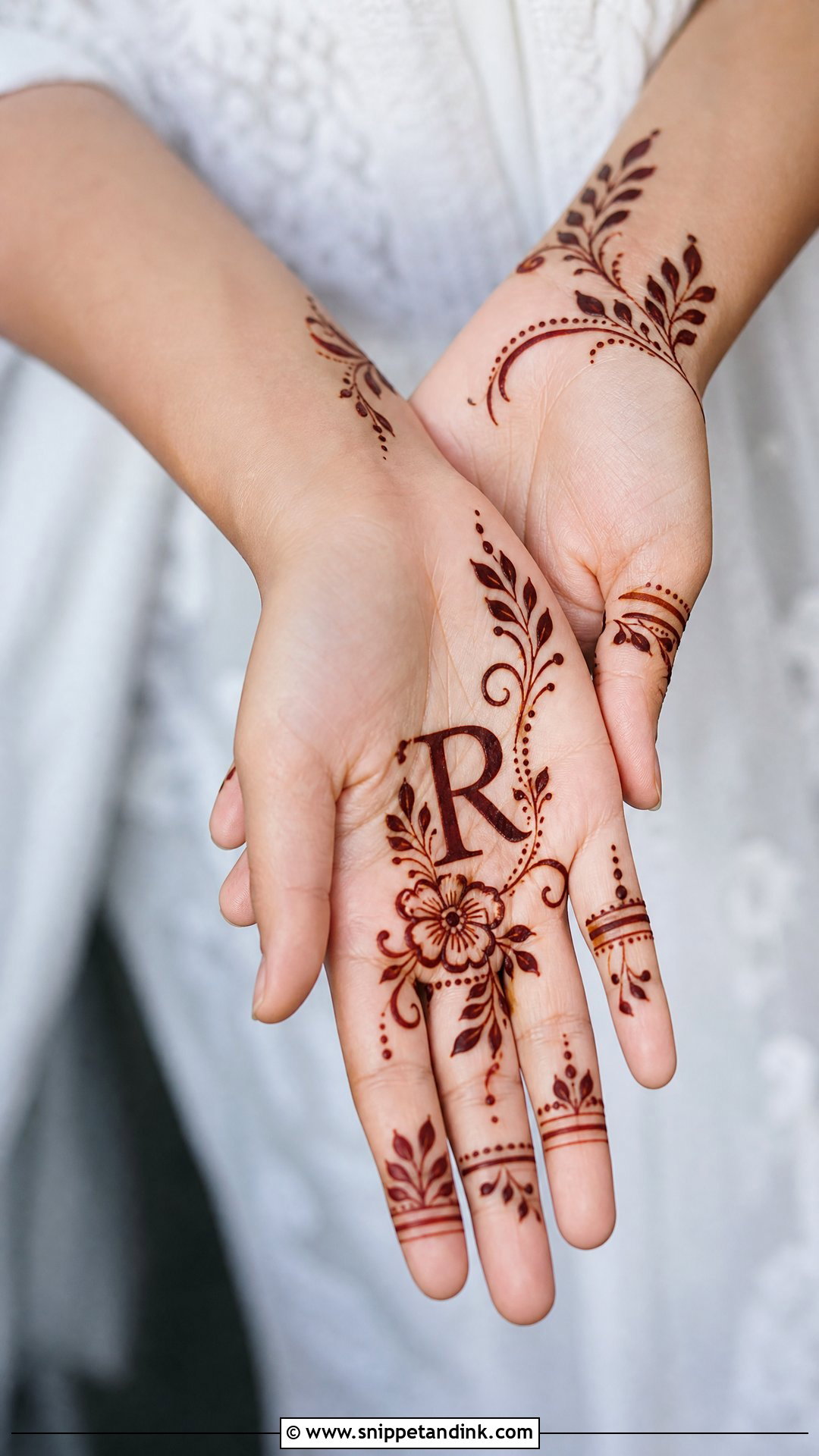
A clean design says more than a crowded one. A bold R on the palm or back hand, one small flower beside it, two or three curved lines and a dotted trail are enough. Fingers stay light with single lines or ring bands. There’s no shading or dense fill, so it’s a good first design for someone learning to pipe a cone, and it takes only a few minutes to apply at an Eid gathering or a family party. What makes or breaks it is the letter itself: one smooth, unbroken stroke for the curve, without stopping halfway.
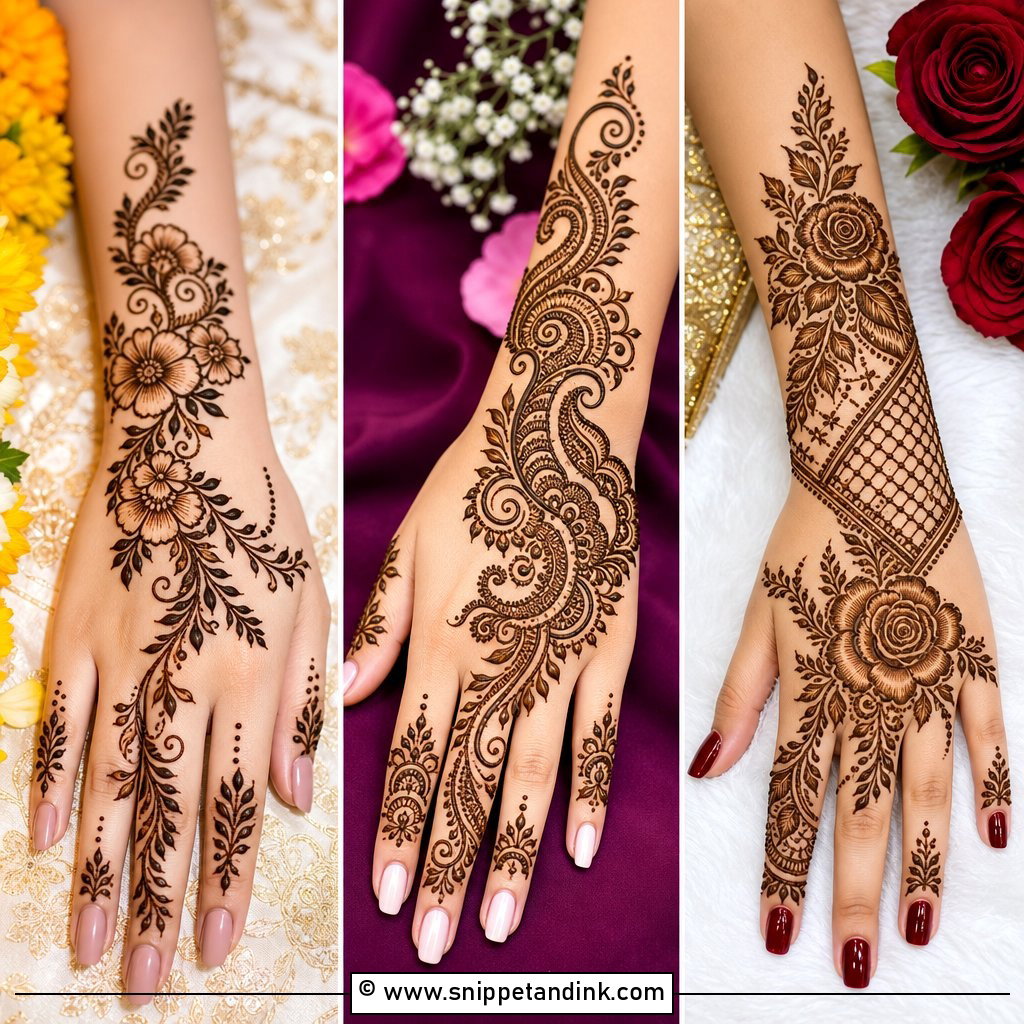
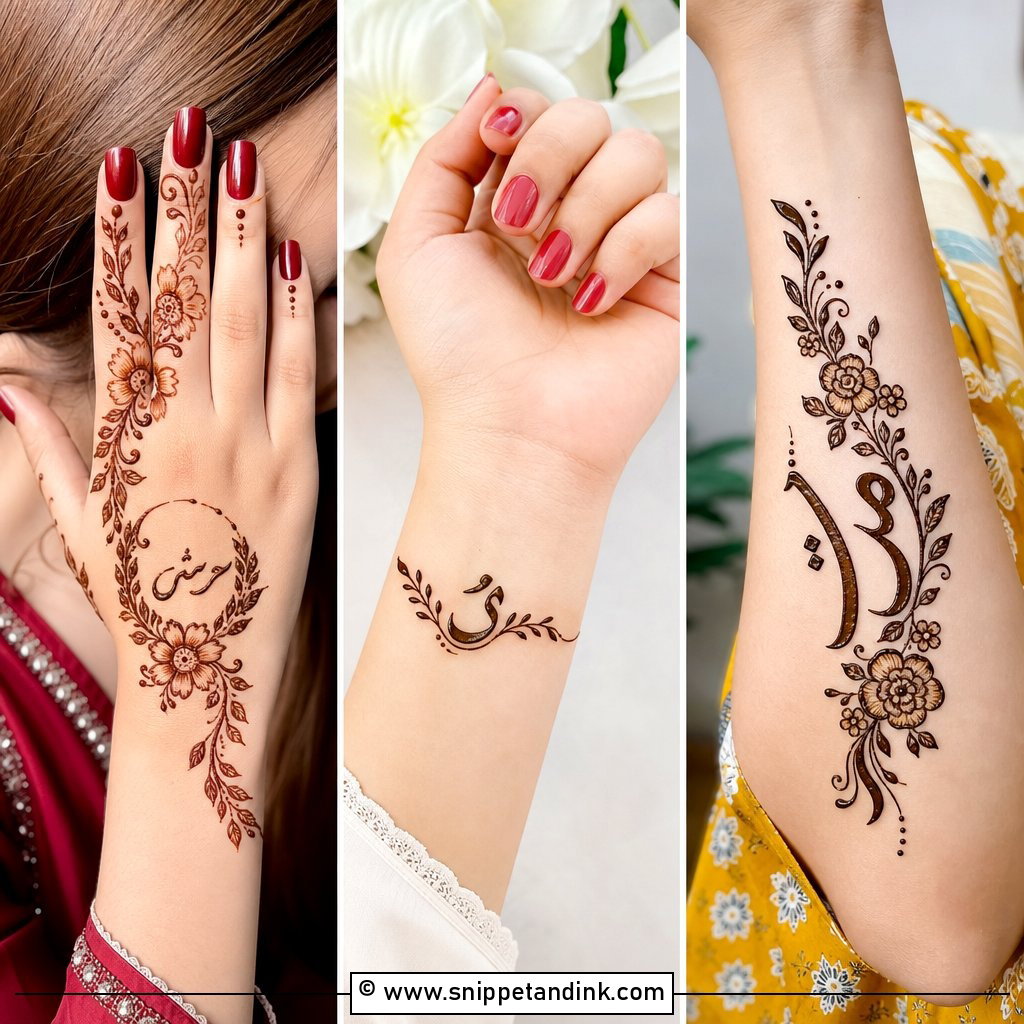
4. R Name Mehndi Design Arabic
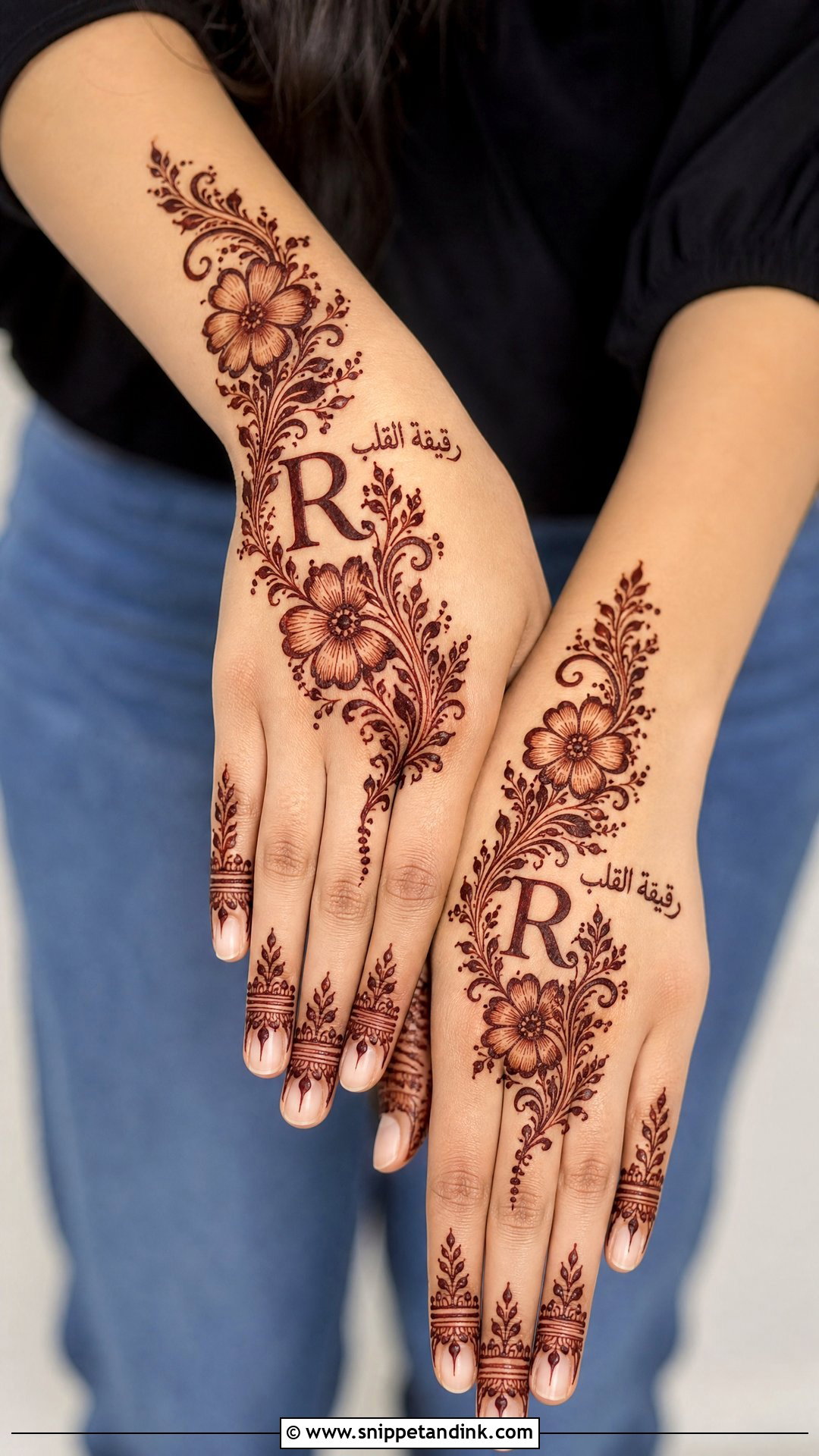
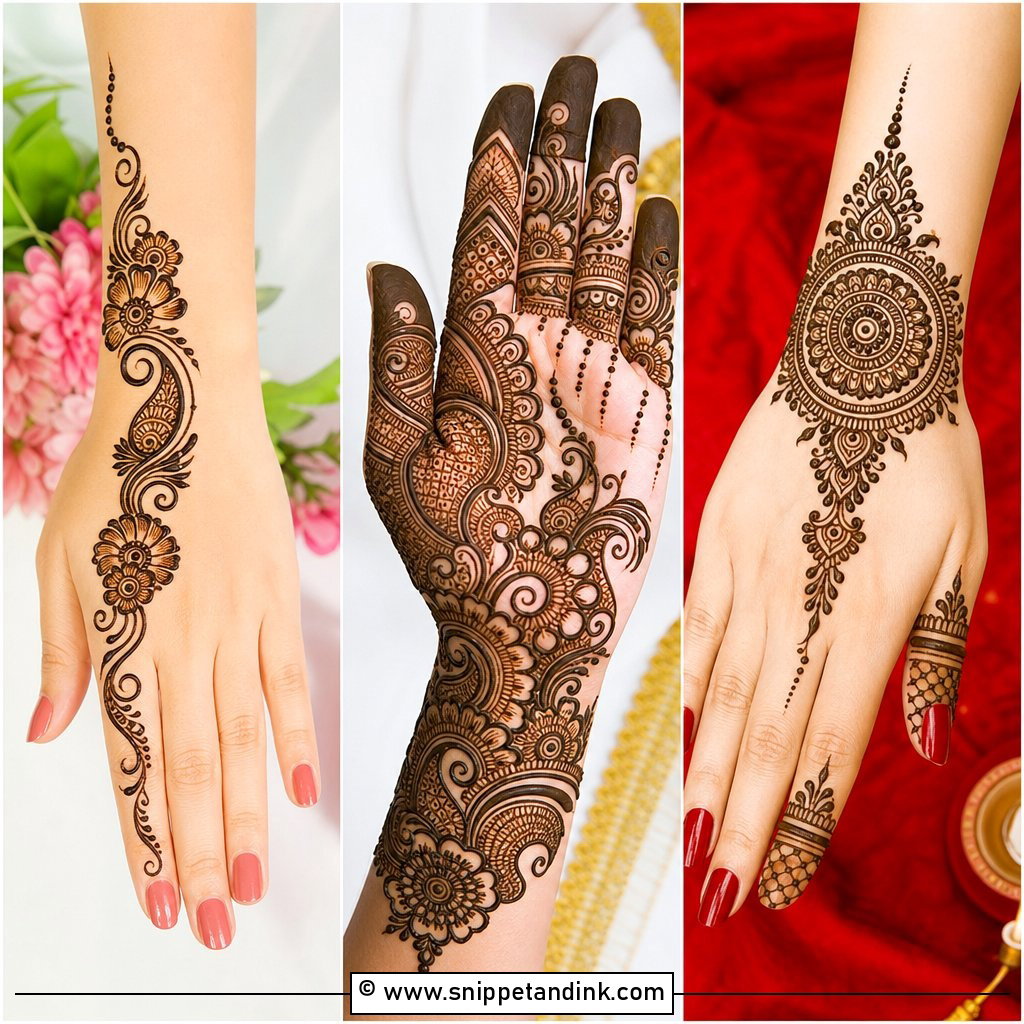
Arabic work leans on open skin, big flowers and a diagonal trail, which gives an initial plenty of room. I usually place the R near the wrist or lower palm and let the floral trail sweep across toward the index finger, with leafy stems, swirls and shaded petals. Shading in Arabic mehndi is done with thinner, lighter strokes inside the petals, and I keep it away from the letter so the R stays the darkest solid line. Extending the trail onto one or two fingers finishes it without covering the hand.
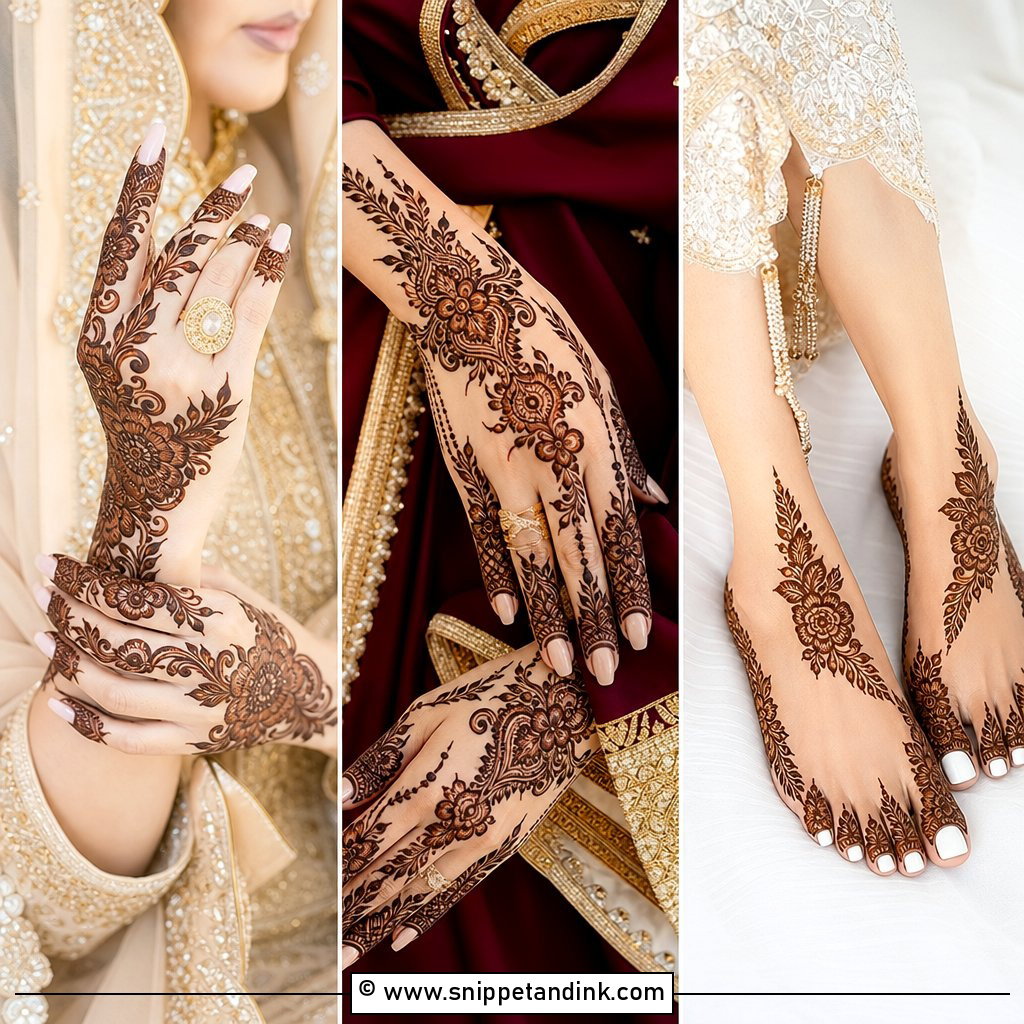
5. R Name Mehndi Design Bridal
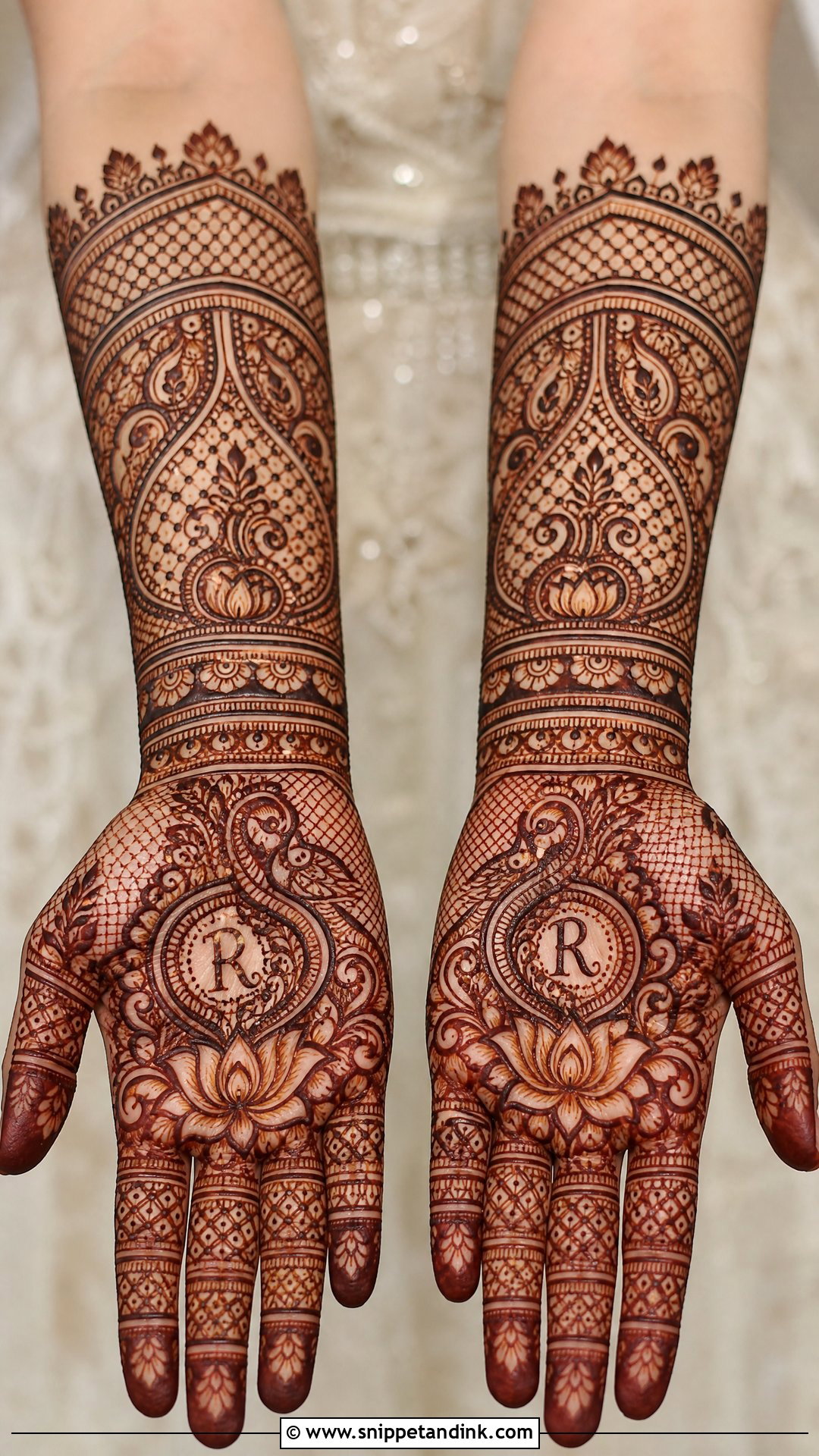
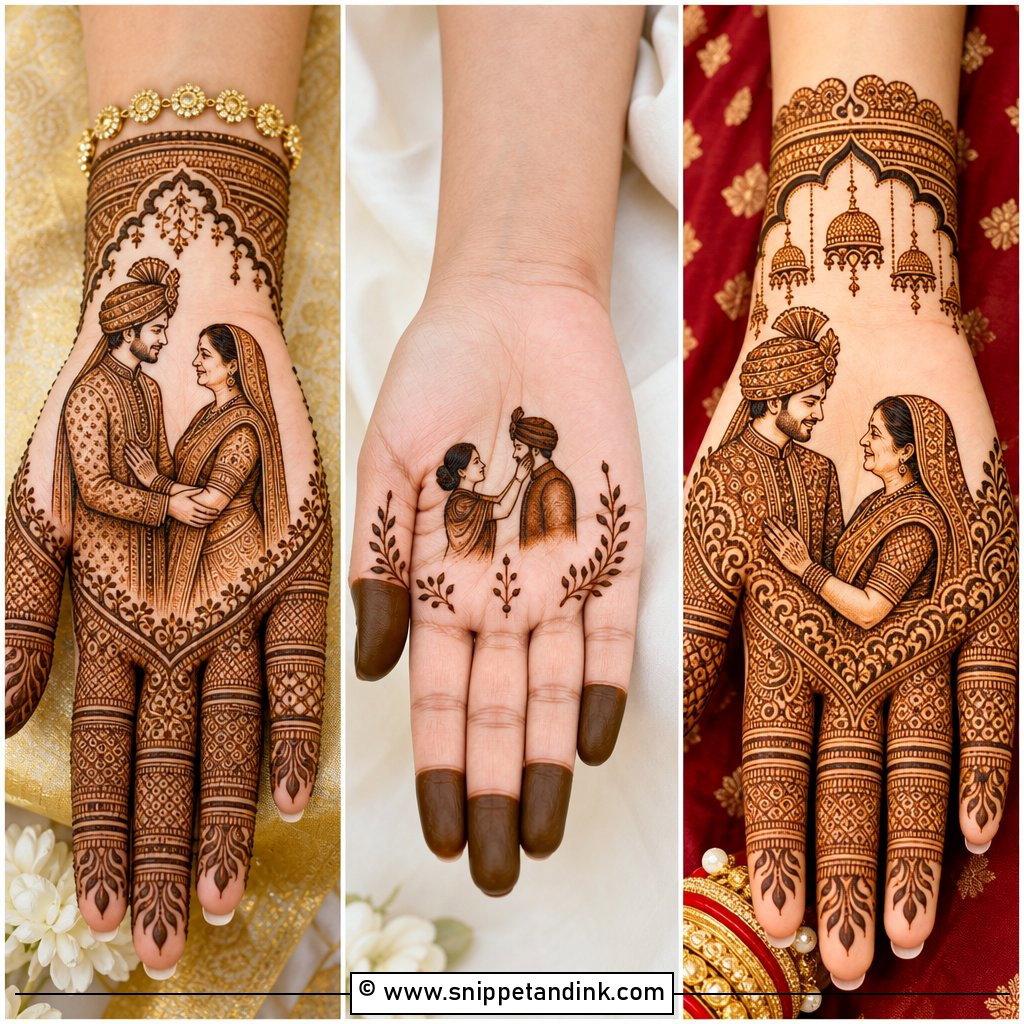
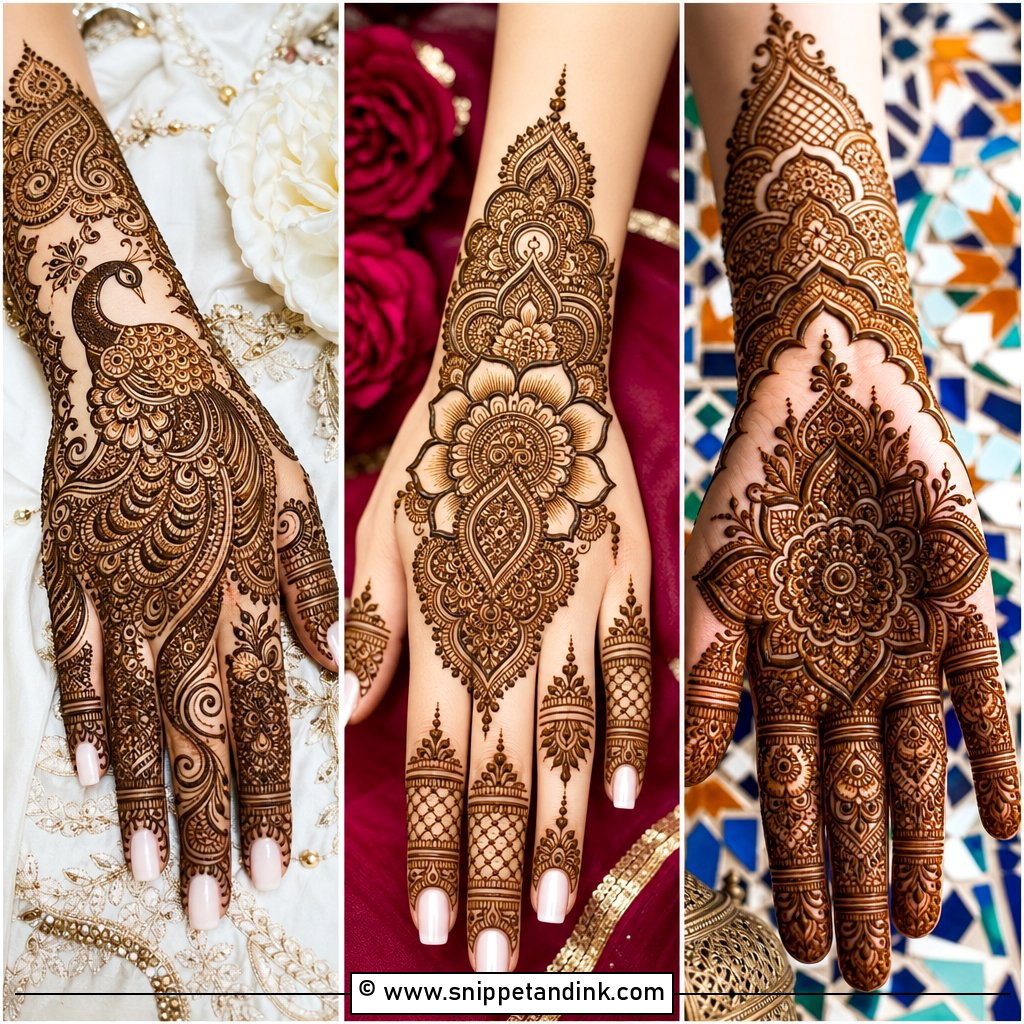
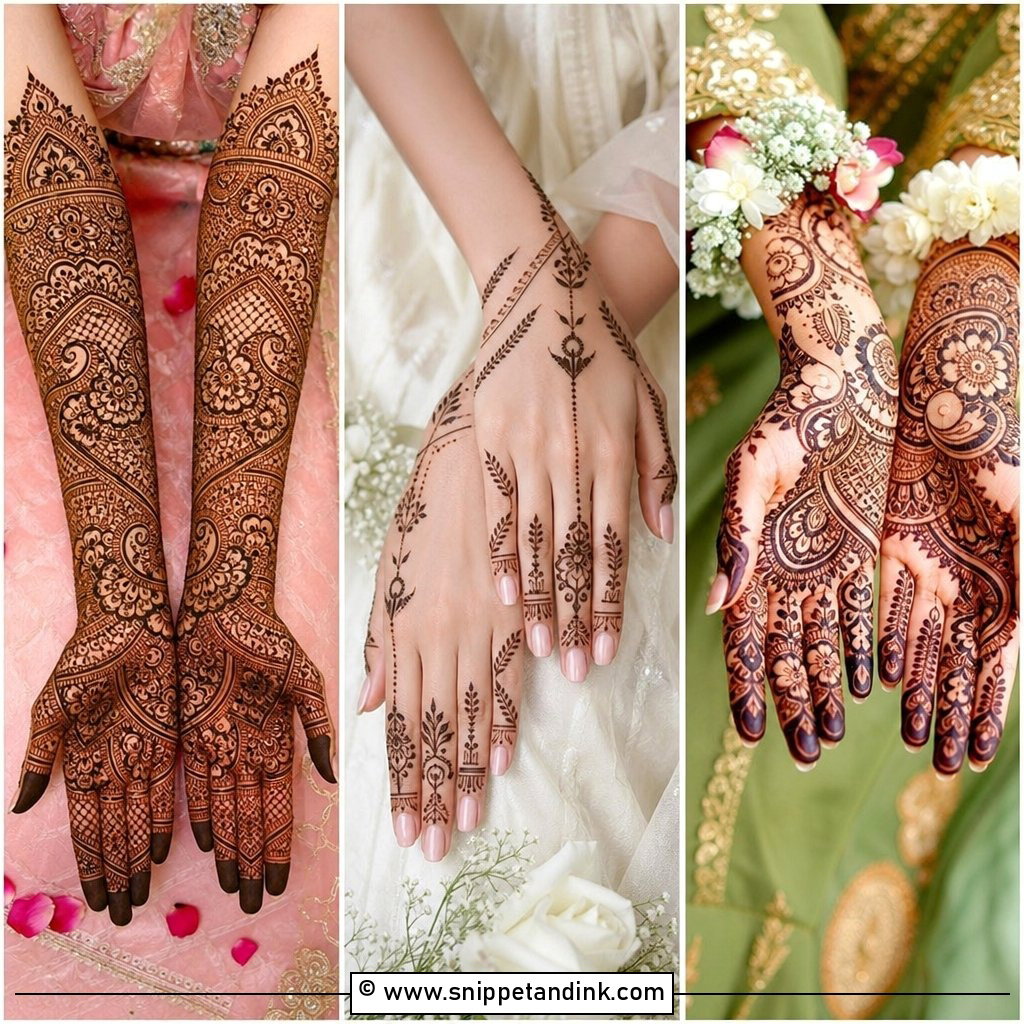
In a bridal hand the initial is usually tucked into the design rather than shown off, partly for the tradition of the groom searching for it. I hide the R inside a heart, lotus, paisley or a small name panel, surrounded by peacocks, jaali mesh, paisleys, florals and borders running from wrist to forearm. The trick is making it findable. I draw the R with a slightly heavier line than the filler around it, so it can be spotted on a close look but doesn’t jump out across the room. Full bridal coverage takes many hours, so book the artist for the day before the wedding at the latest.
6. R Name Mehndi Design With Heart
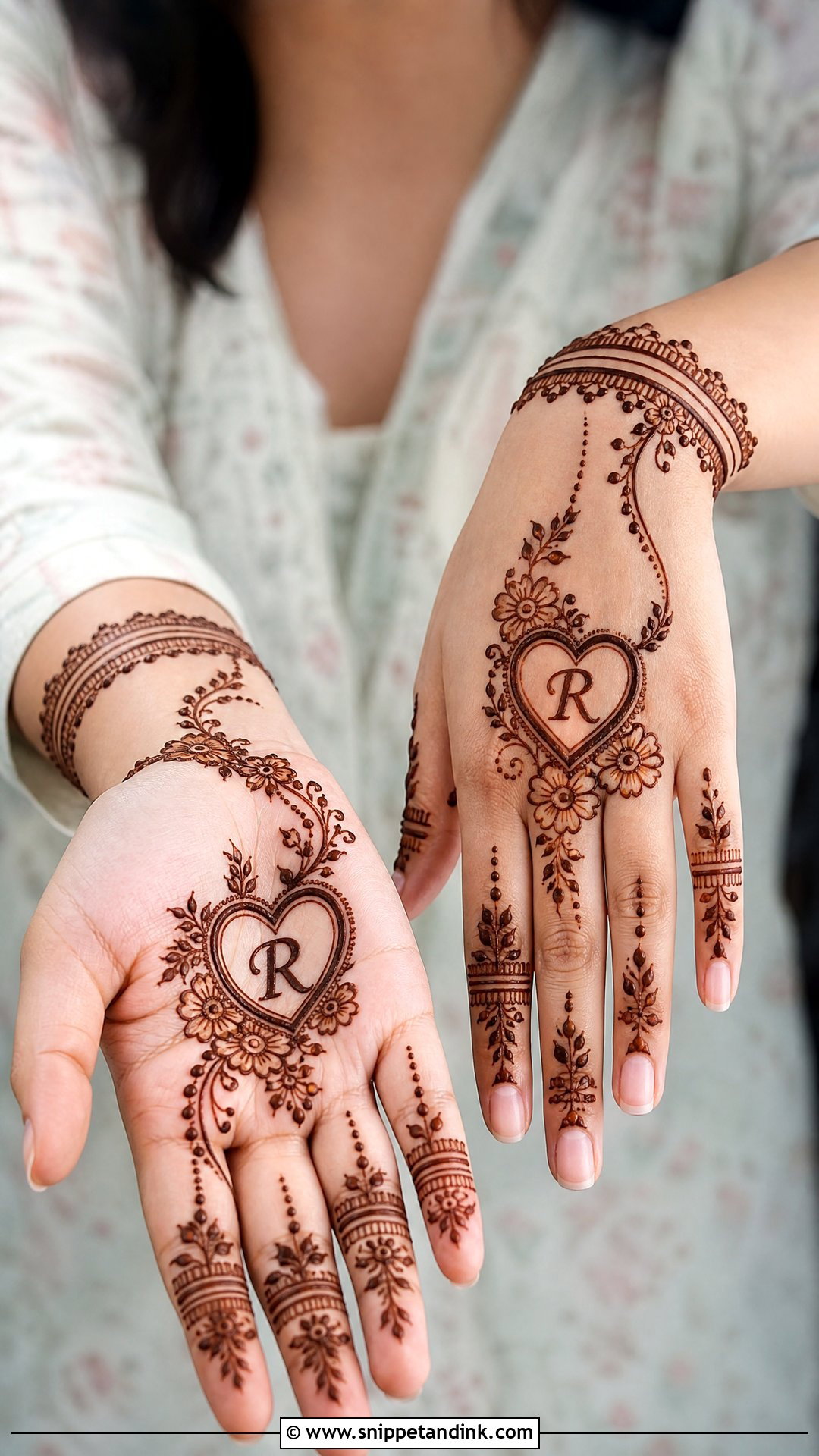
A heart is the most direct frame for an initial, which is why it shows up so often in engagement, anniversary, or romantic bridal mehndi. Put the R inside a small heart on the palm, wrist or back hand, then soften it with vines, tiny flowers and dots. I sometimes build the heart into a wrist bracelet so a floral trail can run up to the fingers. Hearts look wobbly when the two lobes don’t match, so I draw both sides lightly first and then go over the line once with a steady hand. A date or a second initial fits beside it on the other hand.
7. R Name Mehndi Design With Mandala
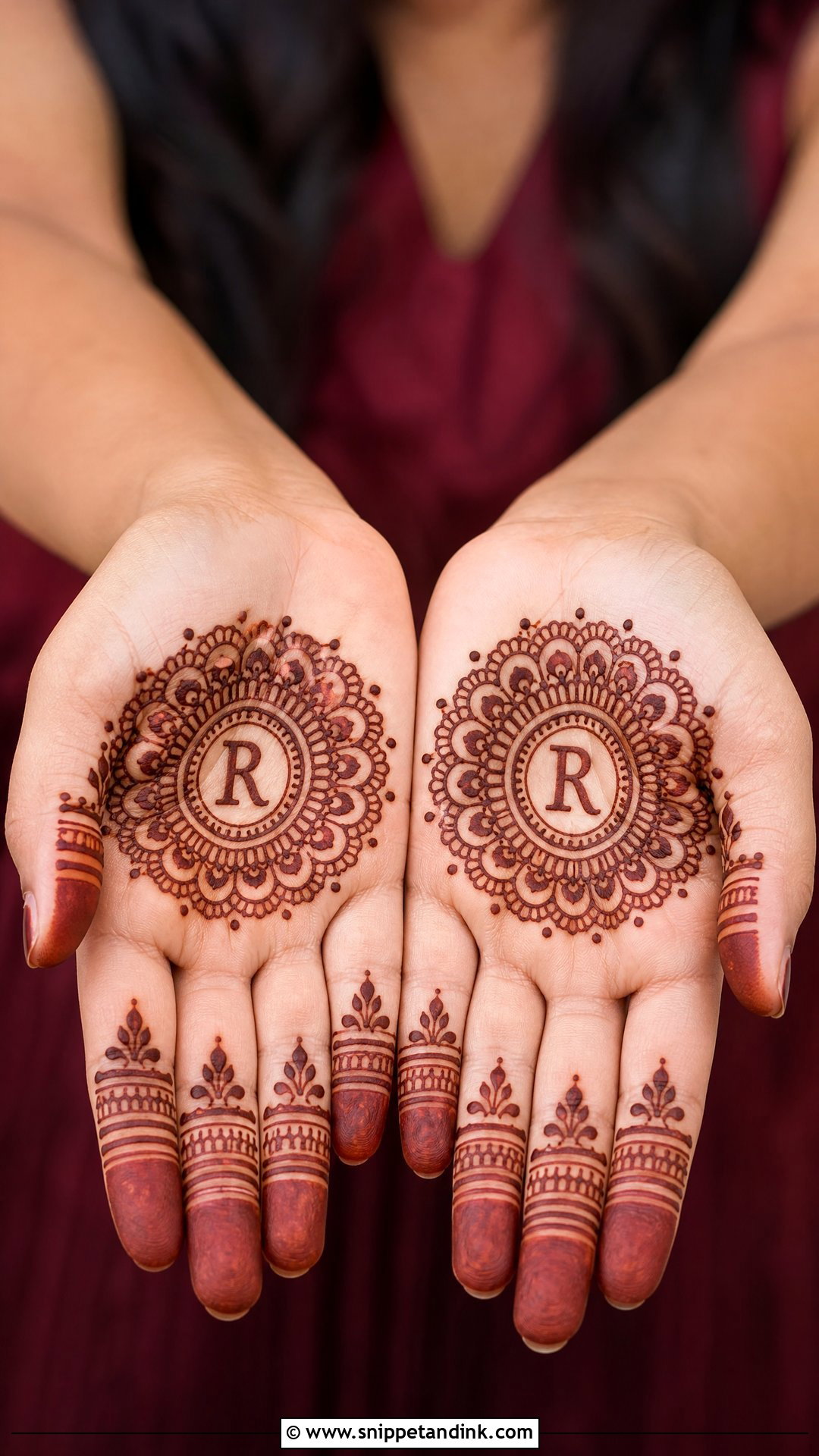
Symmetry is the whole point of a mandala, and it protects the letter well. I start with a clean circle in the palm or on the back hand, write the R inside, and then build out with petals, dots, scalloped rings and fine circular borders. The outermost ring gets the thickest line, which holds the shape together when the stain deepens. Fingertips can carry half-mandala caps or thin leafy bands. It sits comfortably at a puja, a festival or a wedding.
8. R Name Mehndi Design With Flower
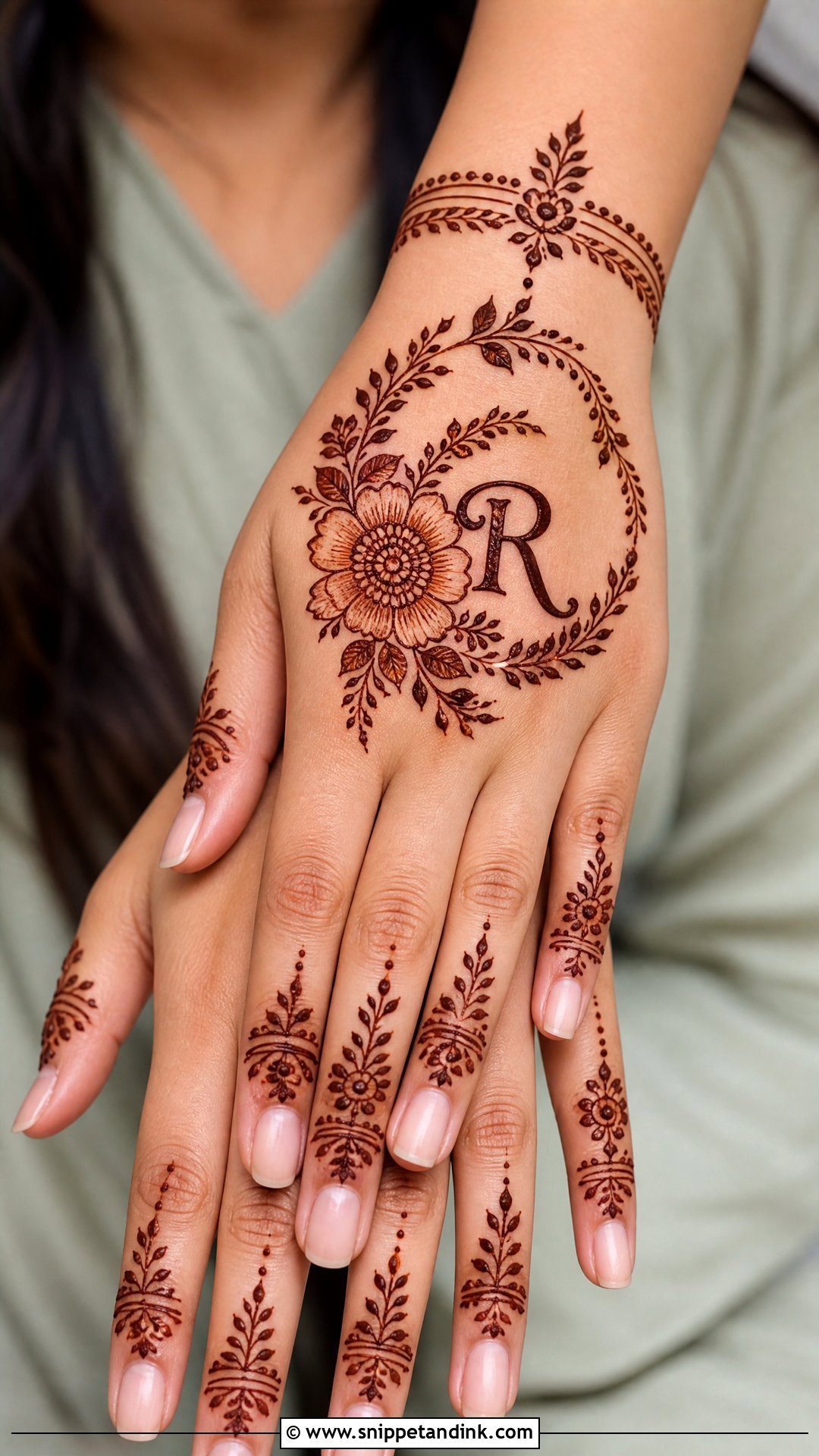
Flowers soften the hard angles of the R, especially the straight leg. I draw the letter beside one large bloom on the back hand, or set it inside a small floral wreath on the palm, then add petals, leaves and buds until the hand feels complete. Fingers can take thin vines or little flower chains. Open floral shapes with skin showing between petals read more modern, and they dry faster too, which matters at a busy event where guests are waiting their turn.
9. R Name Mehndi Design With Rose
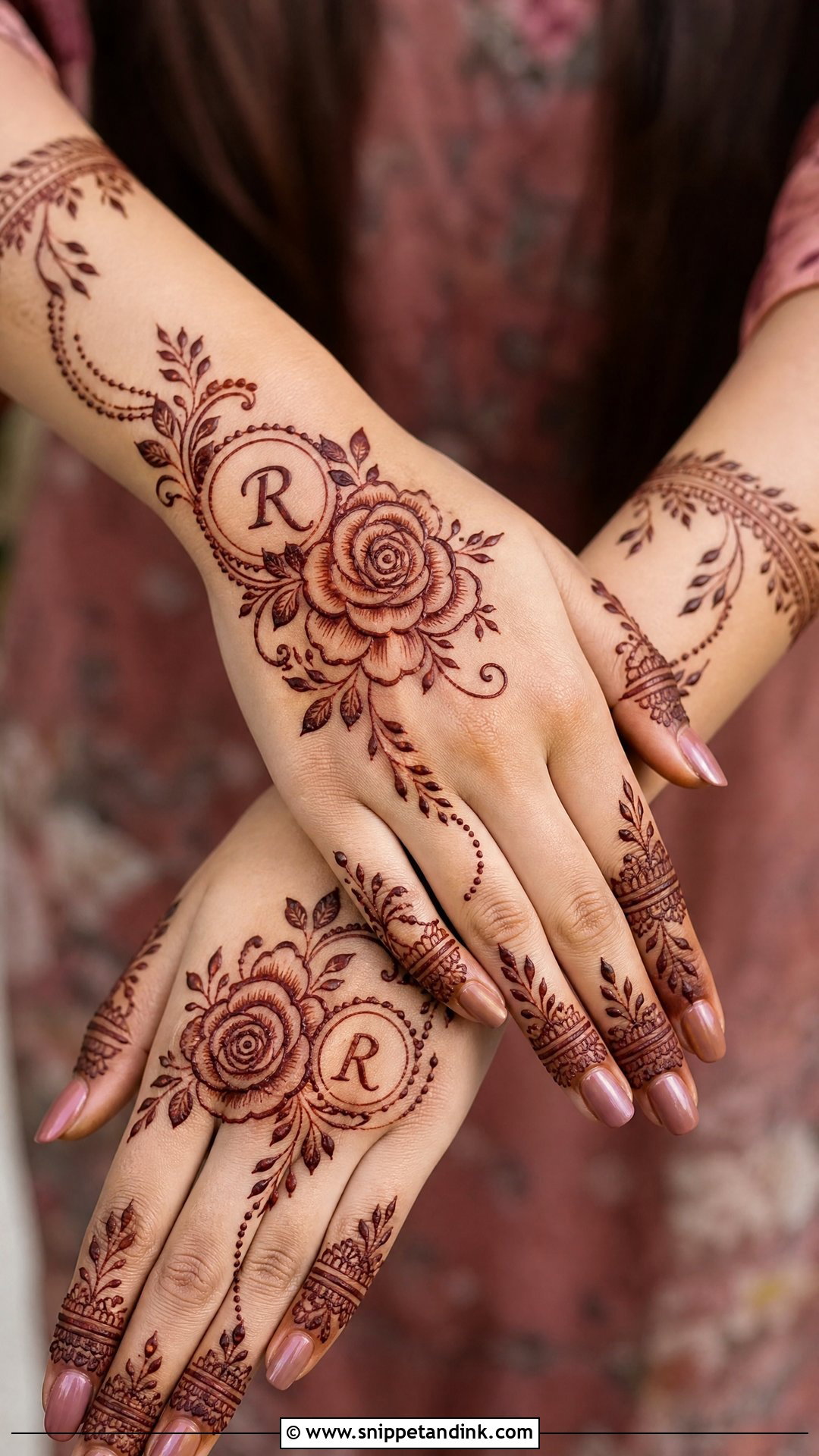
Roses are trickier to draw than they look, because a rose is made of overlapping curved petals and each one needs its own stroke. I place the R beside a detailed rose on the back hand, with leaves and curved stems trailing toward the wrist and fingers, and add light shading so the petals have depth. Another version puts the letter inside a ring of small roses. Keep the rest of the hand plain. It pairs well with pastel and Indo-Western outfits and fine bracelets.
10. R Name Mehndi Design With Peacock
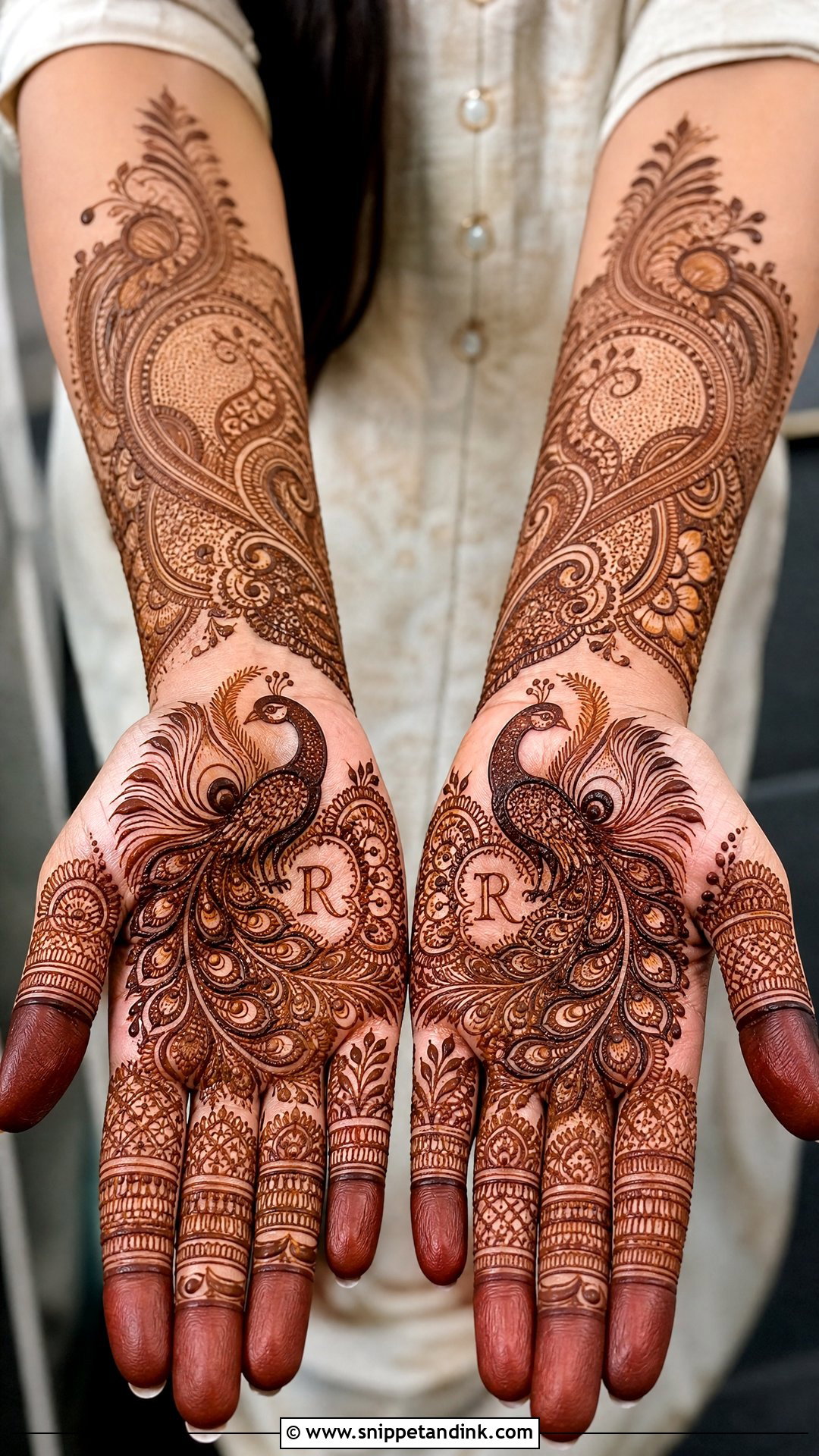
Peacocks need space: the neck, the body and the fanned feathers all want their own room, so this works best on the palm or as a wrist-to-forearm design. The R can hide inside one feather eye, sit near the bird’s body, or go in a small decorative frame beside it. Paisleys, feather lines, dots and floral filler complete the hand. I use the finest tip of the cone for the feathers and a firmer line for the letter, otherwise the R gets lost in all that detail. It’s one of the most traditional choices for a bride.
11. R Name Mehndi Design With Paisley
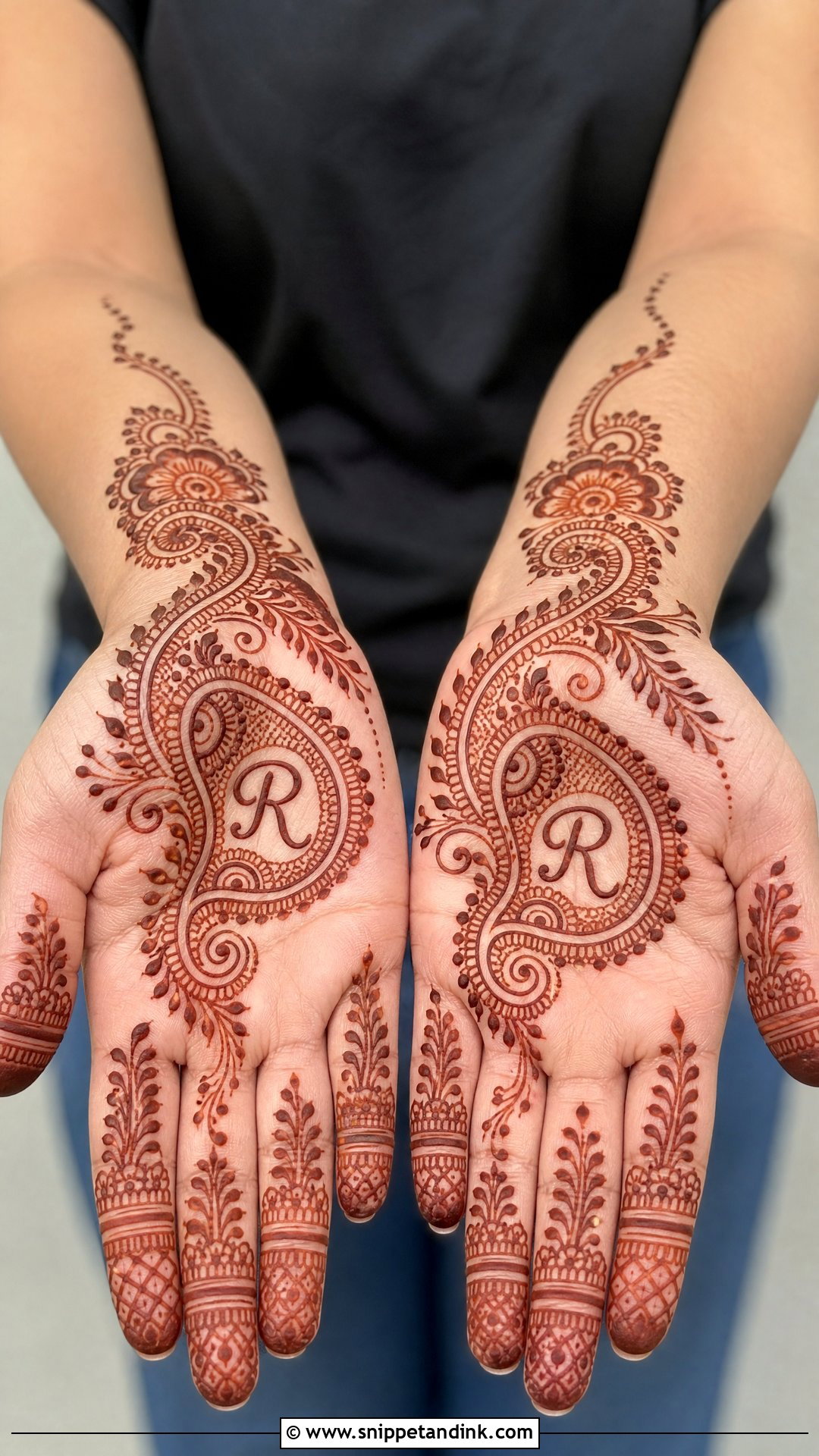
A paisley has a natural pocket in its rounded end, and that pocket is the obvious home for an initial. I put the R inside one large paisley on the palm, or set it in the center of a paisley chain across the back hand, then fill the shapes with tiny leaves, dots and petal lines. Fingertips can carry smaller paisleys or bands. Draw the R slightly larger than anything filling the paisley around it; when the filler and the letter are the same scale, the initial disappears. Coverage can stay light or go heavy.
12. R Name Mehndi Design With Jaali
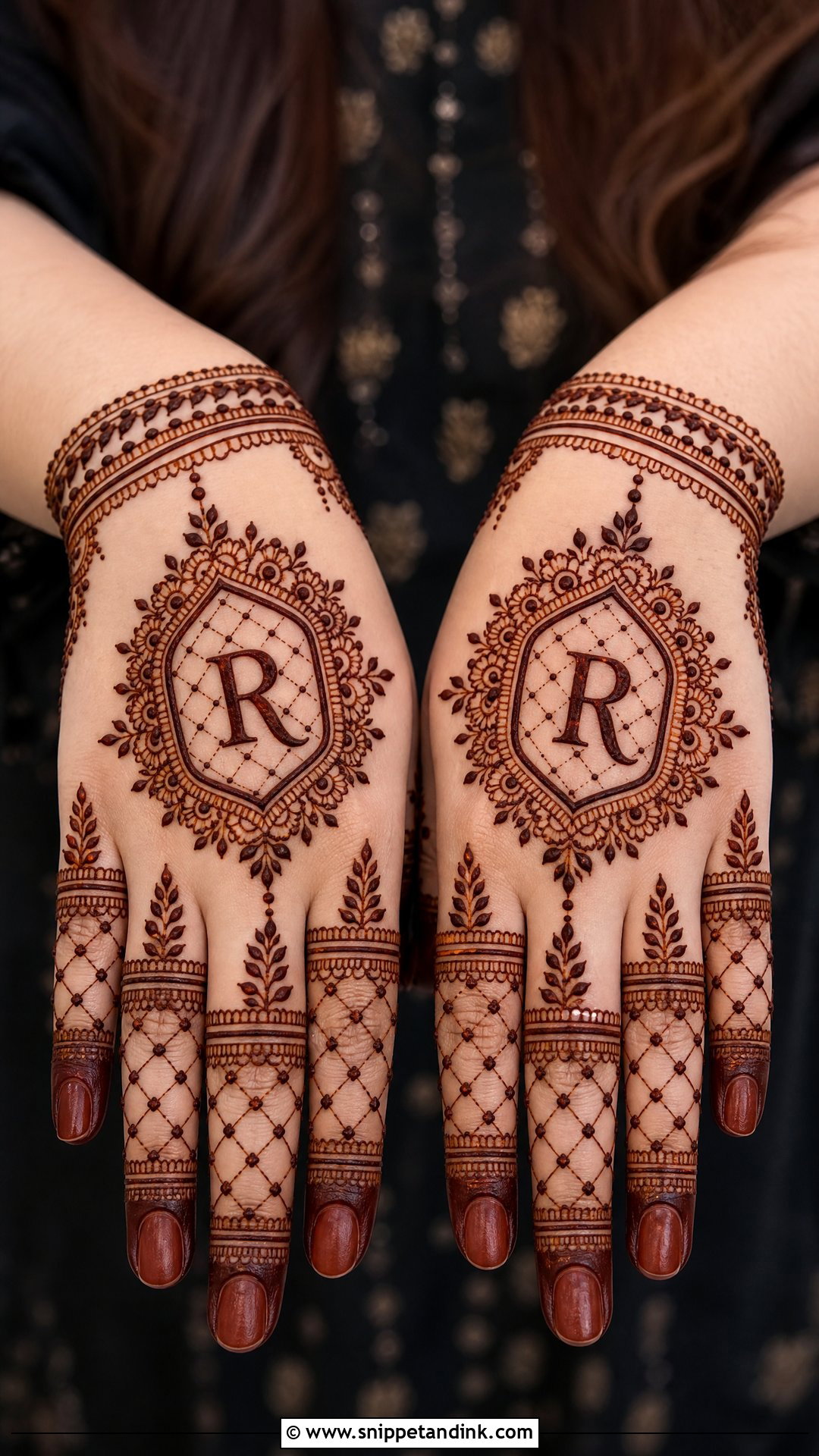
Jaali, the fine crisscross mesh, makes a hand look like it’s wearing lace. I leave a small empty frame for a bold R, then cover the surrounding palm or back hand with the mesh, a tiny dot at each crossing, and floral borders to soften the edges. Fingers take diagonal netting, leaf bands or simple lines. Mesh is unforgiving if the lines drift, so I keep the cone pressure steady and the spacing even. Fresh paste also spreads a little as it settles, so lines drawn too close together can merge into a solid patch once the stain develops.
13. R Name Mehndi Design For Fingers
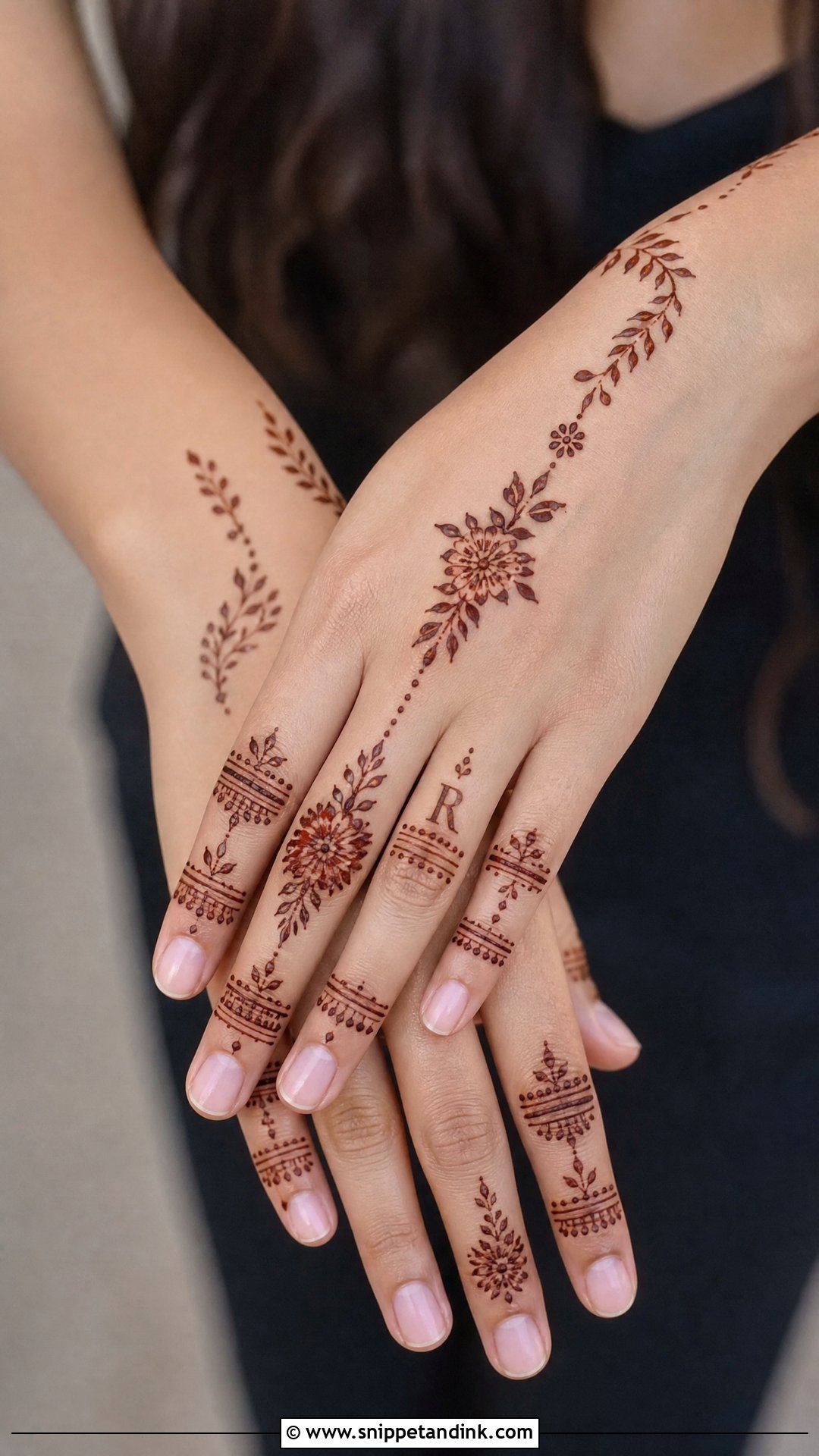
For the most minimal option, the letter goes on a finger: on the ring finger, the middle finger, or right at the base like a small charm. I add tiny dots, a leafy line and a ring-style band around it and keep the palm mostly bare. Fingers stain dark and fast, but they’re also where henna fades first, from handwashing. It’s an easy choice for someone heading back to work in a day or two. Keep the letter small but bold, with very little detail around it.
14. R Name Mehndi Design For Wrist
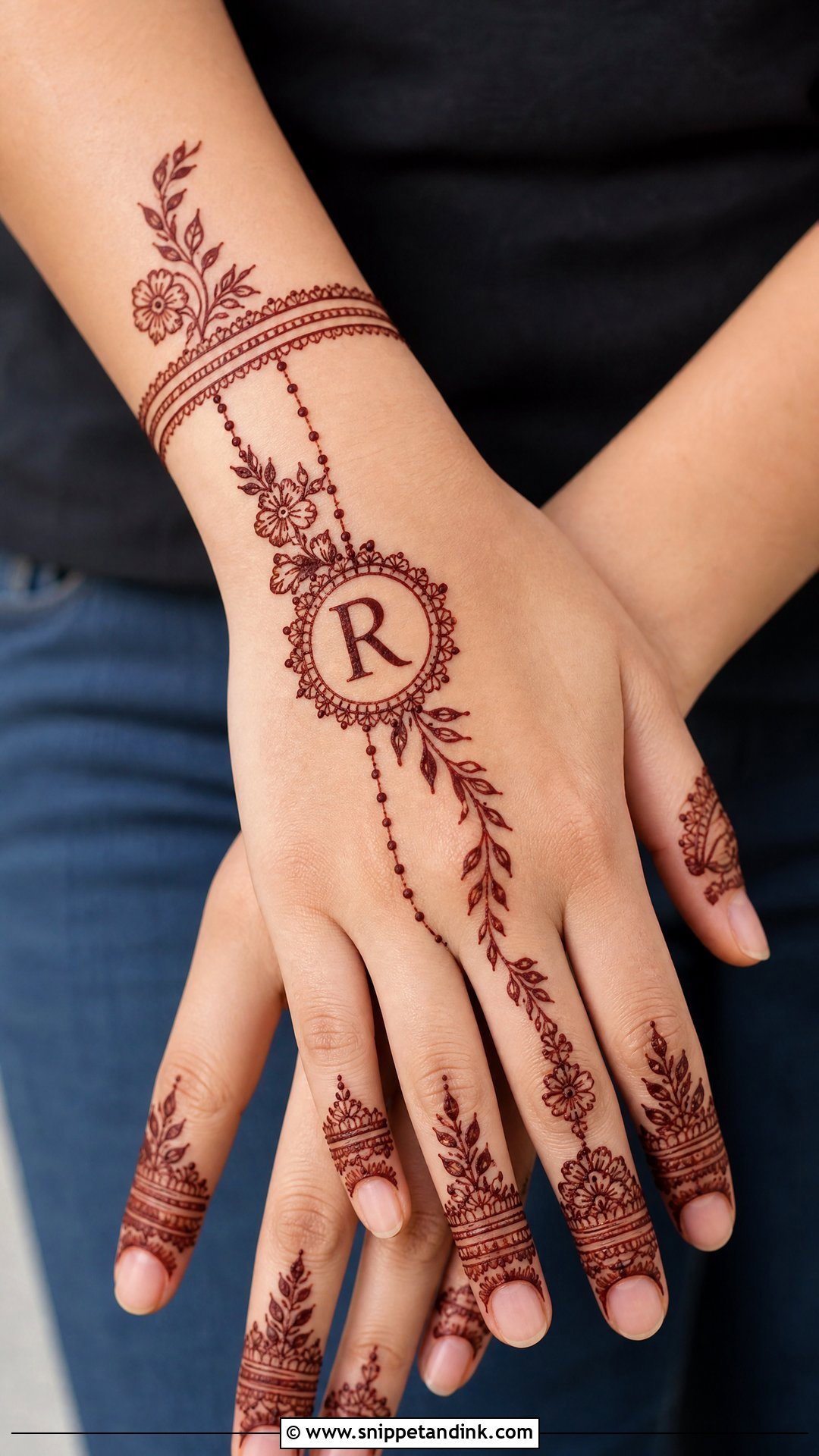
Here the henna works like a bracelet. I set the R inside a small round, heart or floral charm in the center of the wrist and build bracelet lines on both sides with dots, leaves, tiny flowers and chain patterns. A short vine can climb onto the back hand, or it can stay at the wrist alone. Follow the natural curve of the wrist bone rather than drawing a straight band; a straight line looks crooked as soon as the hand bends. Quick to apply, so it works well for bridesmaids and mehndi-night guests.


15. R Name Mehndi Design Full Hand
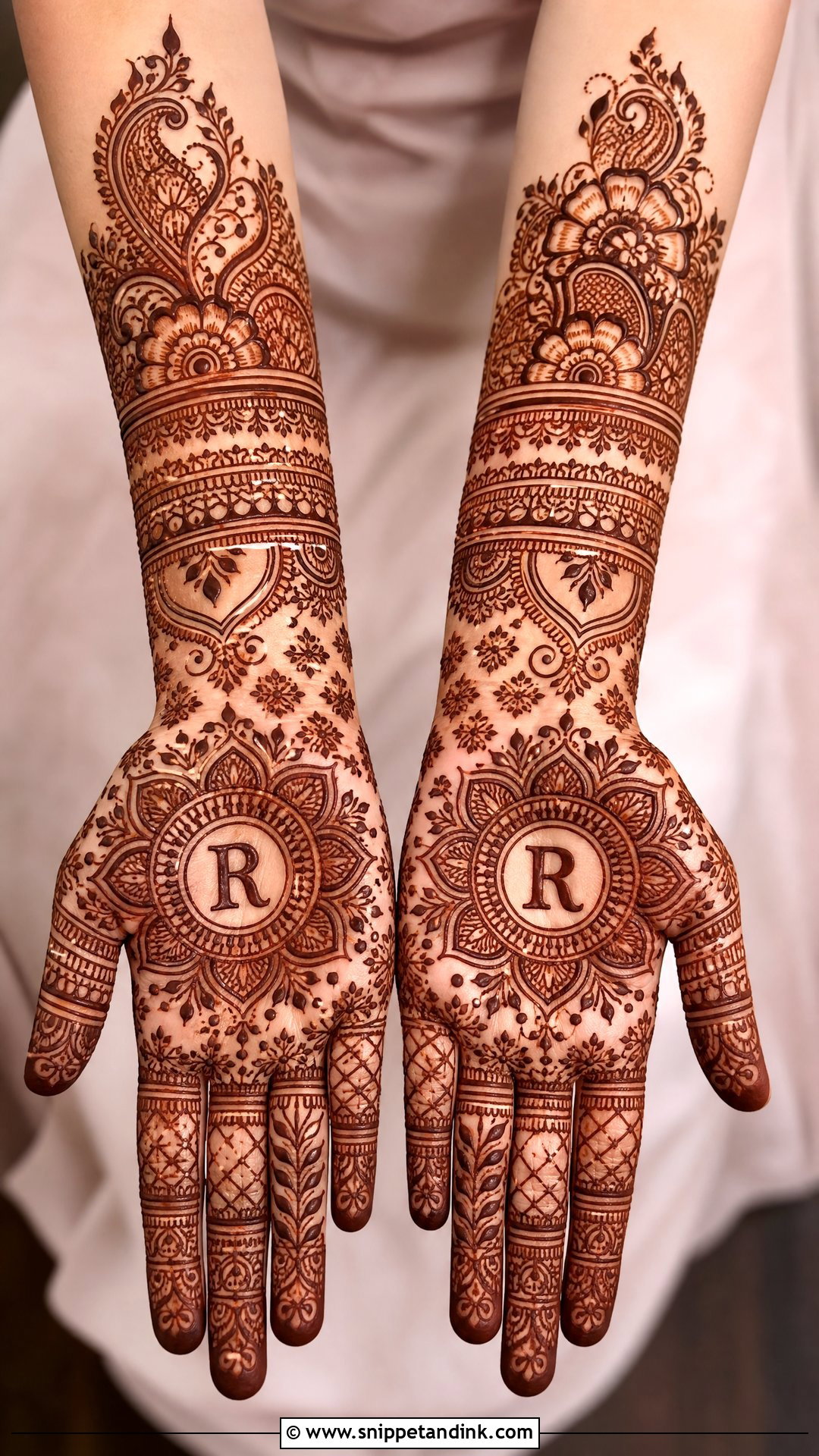
Full coverage gives you the richest look, and the most risk of losing the letter. The R can sit in the palm, inside a mandala, or in a name panel near the wrist, with paisleys, flowers, jaali, leafy vines and finger detail across the rest of the hand and layered bracelet bands up the forearm. Because there’s so much going on, I outline the R clearly and keep a margin of bare skin around it. Full hands also need the paste left on longer, so plan an evening when you can sit still.
16. R Name Mehndi Design Half Hand
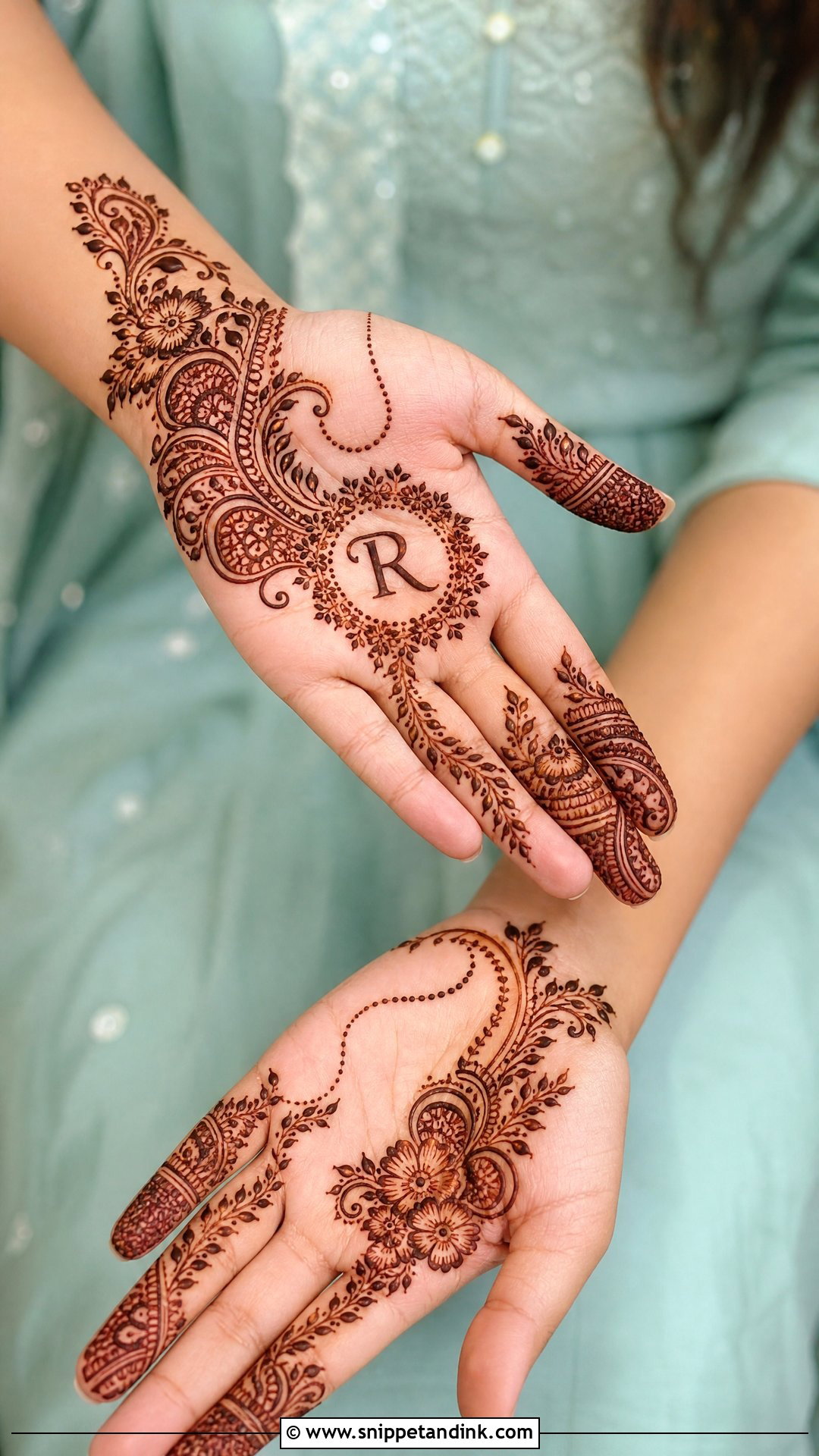
Half-hand coverage gives you real detail without the hours a bridal hand takes. I start at the wrist or lower palm and work up to the fingers, with the R in a central floral frame, mandala or paisley and leafy trails, dots and soft borders linking everything. Leaving one side of the hand more open makes it look modern. It suits bridesmaids and family functions, and works for Eid or Karwa Chauth when you want something done in a single sitting. The balance of filled and empty areas is what gives it shape.
17. R Name Mehndi Design Minimal
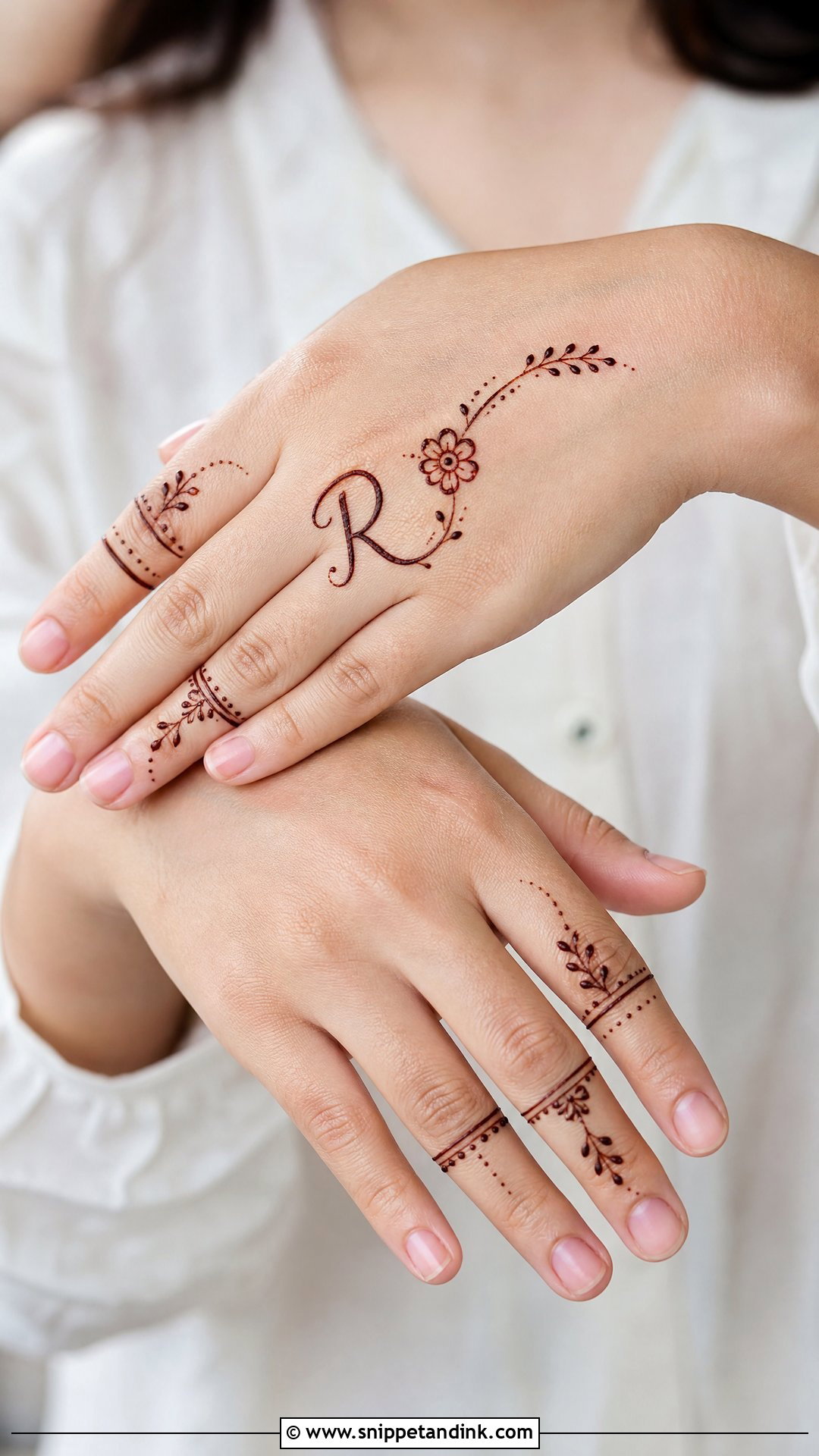
The smallest design on this list: a little R on the back of the hand with a thin curved vine, a tiny flower and a few dots, plus simple rings or single lines on the fingers. No shading, no heavy borders. With so few lines, every wobble shows, so the line work has to be smooth and the spacing deliberate. It’s a good way to try personalized henna for the first time, and the letter stays clear in photos because nothing competes with it.
18. R Name Mehndi Design Indo Arabic
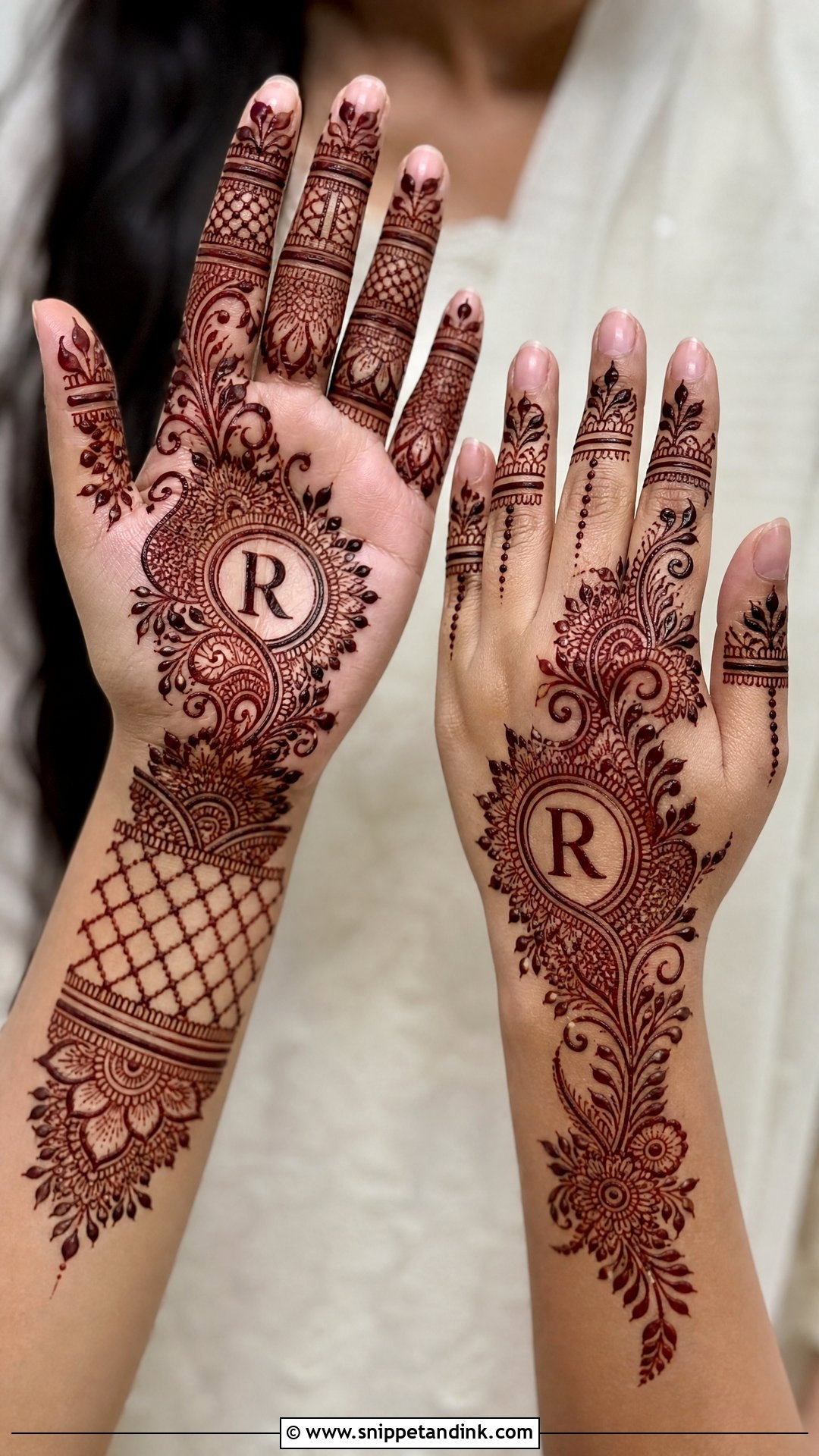
Indo-Arabic combines Indian density with Arabic flow. I set the R inside a flower, paisley or small mandala and let a bold Arabic trail cross the hand, then fill some sections with Indian-style dots, fine lines and jaali while others stay open. It suits both palm and back hand, and it’s popular for sangeet and Eid photos. Make the letter part of the main trail so it looks planned. When an initial is squeezed in after the trail is drawn, it always looks like an afterthought.
19. R Name Mehndi Design For Engagement
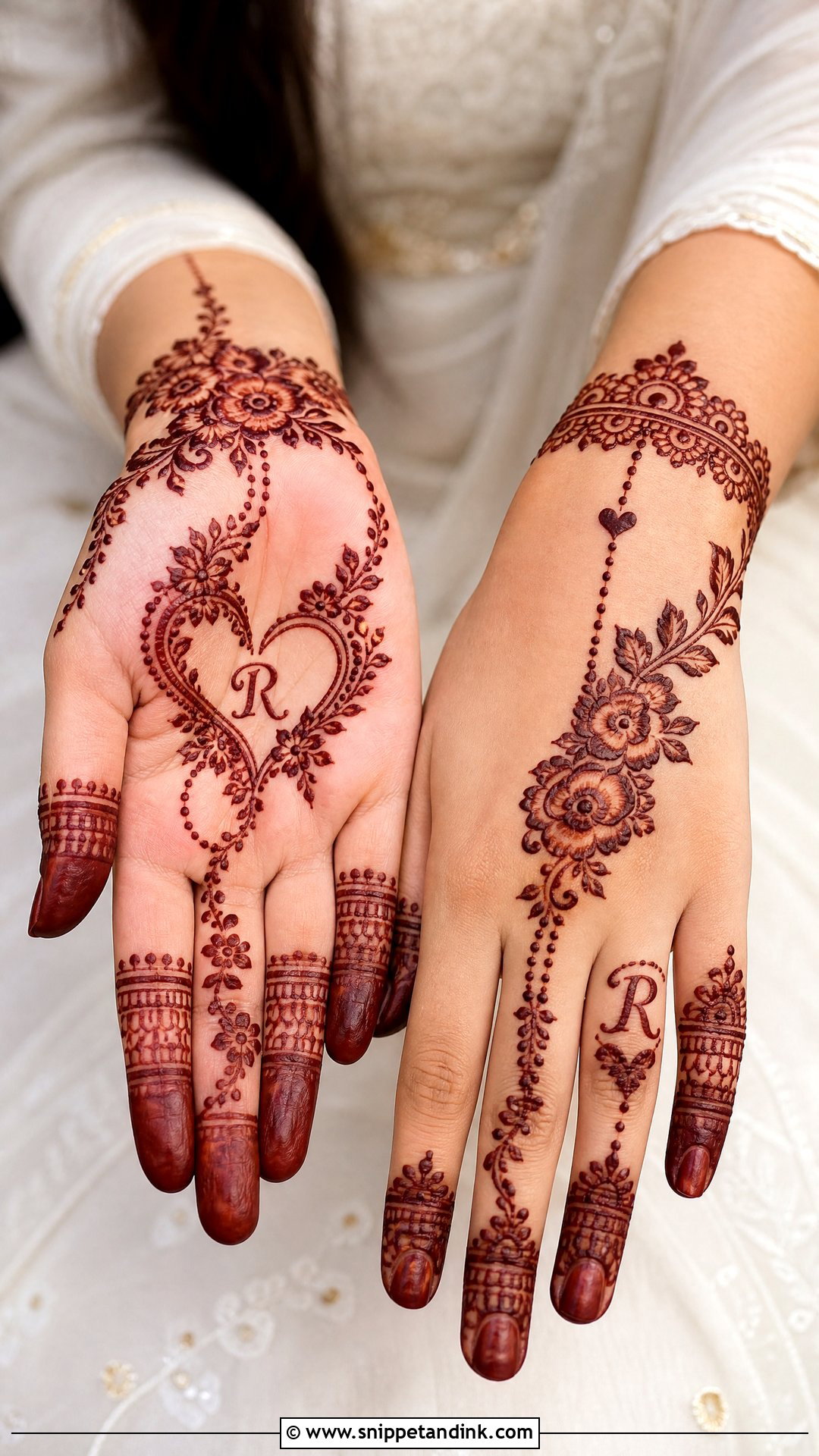
At an engagement the ring is the star, so I plan the henna around it. The R goes near the ring finger or inside a heart on the palm, with flowers, finger bands, delicate dots and a bracelet at the wrist. Medium coverage leaves the ring visible, and I keep the base of the ring finger fairly clear so the band doesn’t sit on top of wet detail. You can add a tiny date or a matching initial on the other hand. Apply the henna before the ring goes on, or take the ring off until the paste is dry.

20. R Name Mehndi Design For Kids
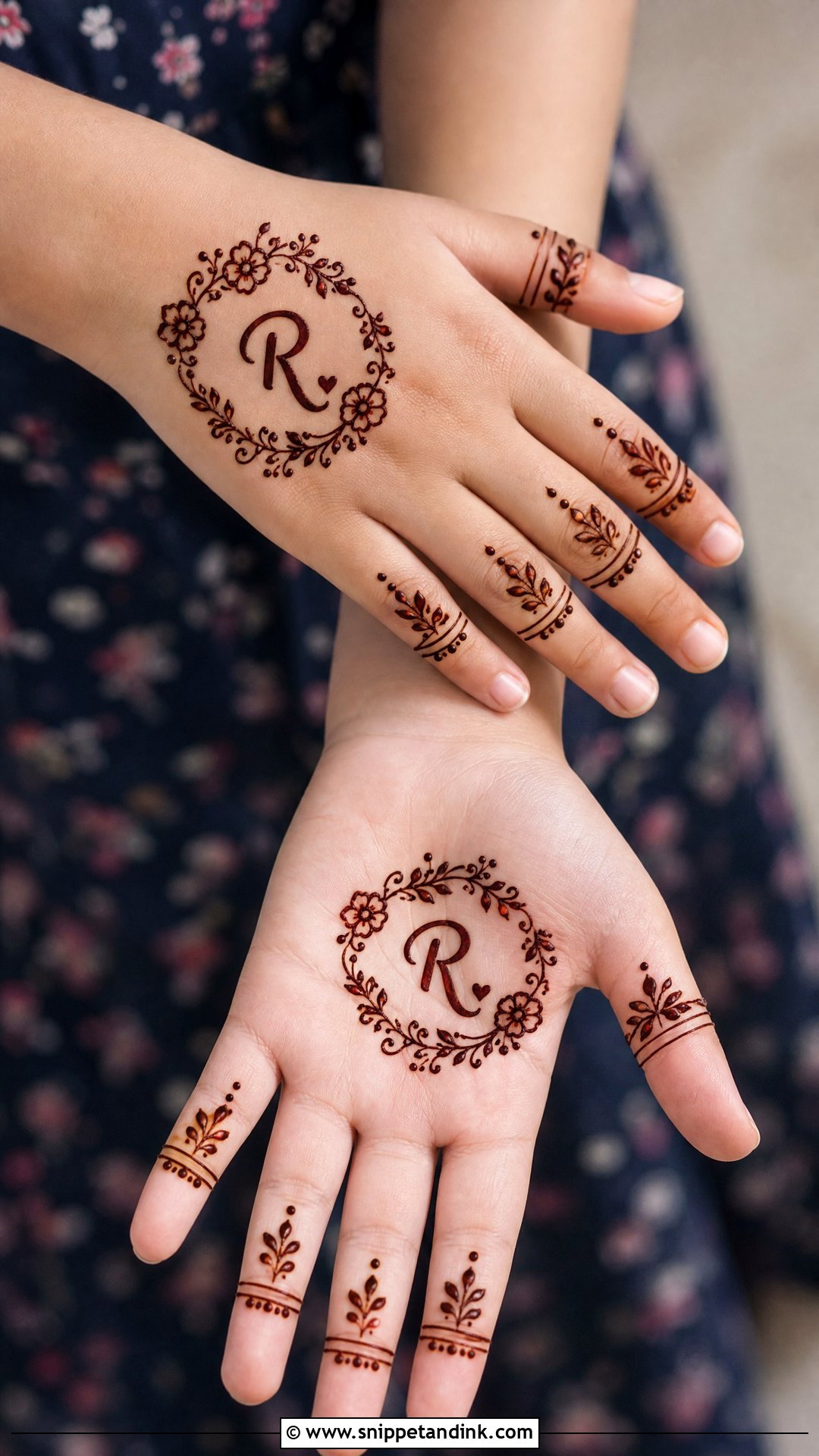
Children won’t sit still for long, so I keep their designs quick and open: a small R on the palm or back hand with a flower, some petal shapes, dots and curved lines, and light finger detail. Dense patterns stay wet for too long and get smudged. Use only natural henna for children. Dark “black henna” cones can contain PPD, a hair-dye chemical that can cause serious skin reactions and lasting sensitization, and I’d never put it on a child or an adult. A simple R in a little floral frame is usually all they want.
The First 48 Hours Decide How Dark the Initial Gets
Fresh, natural henna stains orange when the paste comes off, then deepens to reddish brown over a day or two. How dark it ends up depends largely on what you do in that window.
- Leave the paste on for as long as you comfortably can, ideally several hours or overnight. Dabbing on a little lemon and sugar mix helps it stay stuck to the skin.
- Scrape the dry paste off rather than washing it. A blunt knife edge or your fingernail works.
- Keep water off the design for as long as possible afterward, ideally the rest of the day.
- Stay warm. Henna develops better on warm skin, so a cold room slows the stain.
- Avoid chlorine pools, scrubs and harsh soap for the first few days.
Expect the palms and fingertips to come out darker than the back of the hand and the wrist. If the R sits on the back hand, that’s another reason to give it a thicker line from the start.
Hidden or Bold, the R Has to Be Findable
An initial makes henna personal only if it can be read once the stain develops. From simple finger patterns to full bridal hands, every design here can be scaled to your event, outfit and the time you have to sit. For a bold look, go to the peacock, jaali or full bridal hand. For something lighter, the wrist, finger and minimal designs are quicker and gentler on a busy schedule. Whichever you choose, ask your artist to draw the R first and build the rest around it.
You'll Like These Ideas:




Leave a Reply