
Most Scottish brides still wear ivory or white, and the heritage arrives in the details: a sash, a bodice, a train, the ribbon on a bouquet, sometimes nothing more than the color of the shoes. Tartan is a strong pattern, so a large part of my job is deciding how much of it a gown can carry before the dress disappears behind the cloth. A family tartan, a district sett or simply colors that suit a stone chapel are all honest starting points. Below are twenty complete looks, from a full tartan ball gown to a single Celtic knot stitched at the cuff, each with the shoes, jewelry and outer layers I’d put with it for a castle wedding or a Highland elopement.
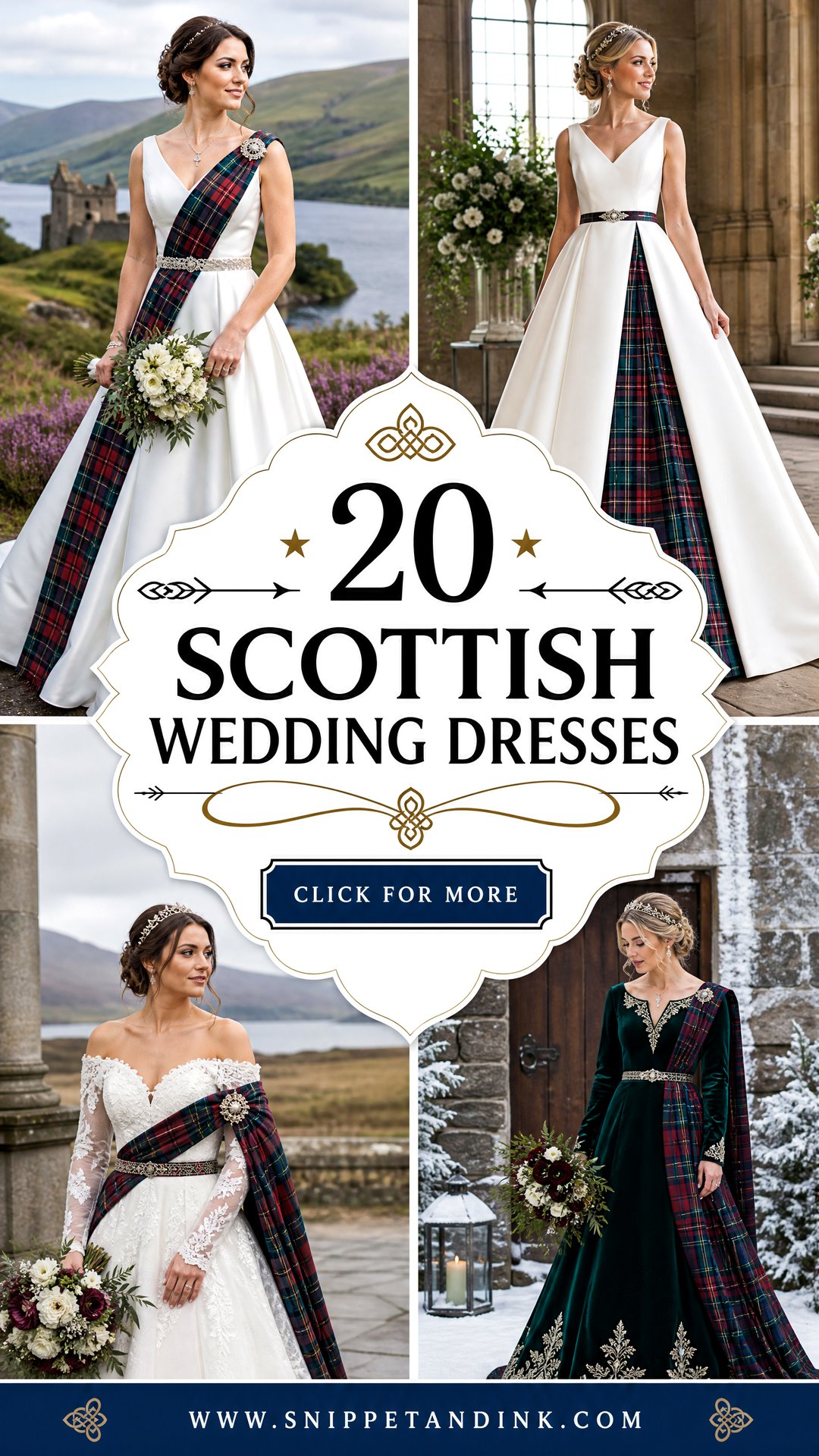
Whose Tartan Can You Wear on Your Wedding Day?
The first thing I ask a Scottish bride isn’t about silhouette but about the cloth. Does your family have a tartan, and do you want to wear it? The answer shapes everything from the dress pattern to how early the fabric has to be ordered.
Clan, district and open setts
A clan tartan can be worn by anyone with that surname or a family connection to it, and by custom a bride may wear her own clan’s tartan or her groom’s. If neither family has one, a district tartan tied to a region or town is a respectful choice, and a few setts, Black Watch among them, are generally treated as open to everyone. Many clans also have a dress variant with much more white in it, originally made for dancing, and it often sits more comfortably beside an ivory gown than the everyday version.
Cloth weight and waiting time
Kilt-weight wool holds a pleat well but is too heavy and warm for most bodices. For dresses I look for a lighter wool or a silk tartan, and I ask the supplier which weights they actually weave in that sett. Less common tartans may only be produced in short runs, so the wait can stretch to months. I order swatches first and the fabric as soon as the design is settled, never after the first fitting.
1. Full Tartan Ball Gown Scottish Wedding Dress
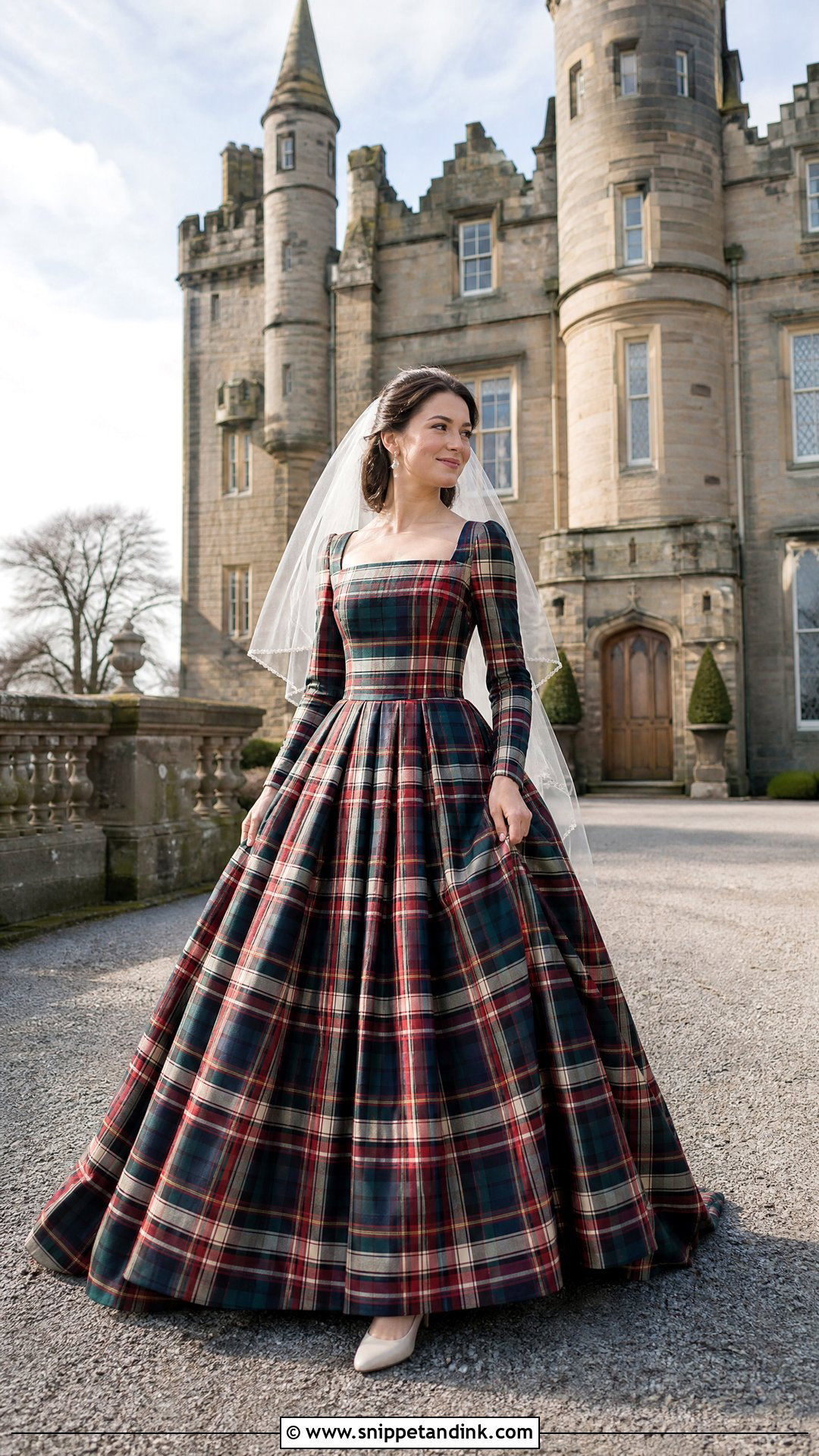
A full tartan ball gown is the boldest option here, and it lives or dies on the skirt. I ask for deep pleats that open as the bride walks, because a flat-pressed skirt hides the sett and turns it into a blur of color from a distance. Red, green, navy and cream setts read clearly against grey stone and open hills. Keep the neckline plain, square or bateau, so the cloth does the talking, then add ivory block heels, pearl drops, a clean fingertip veil and a small posy of white roses and thistle. Real kilt-weight wool is stiff and warm, so for most brides I’d suggest silk tartan or taffeta, which moves and travels far better.
2. White Dress With Tartan Sash Scottish Wedding Dress
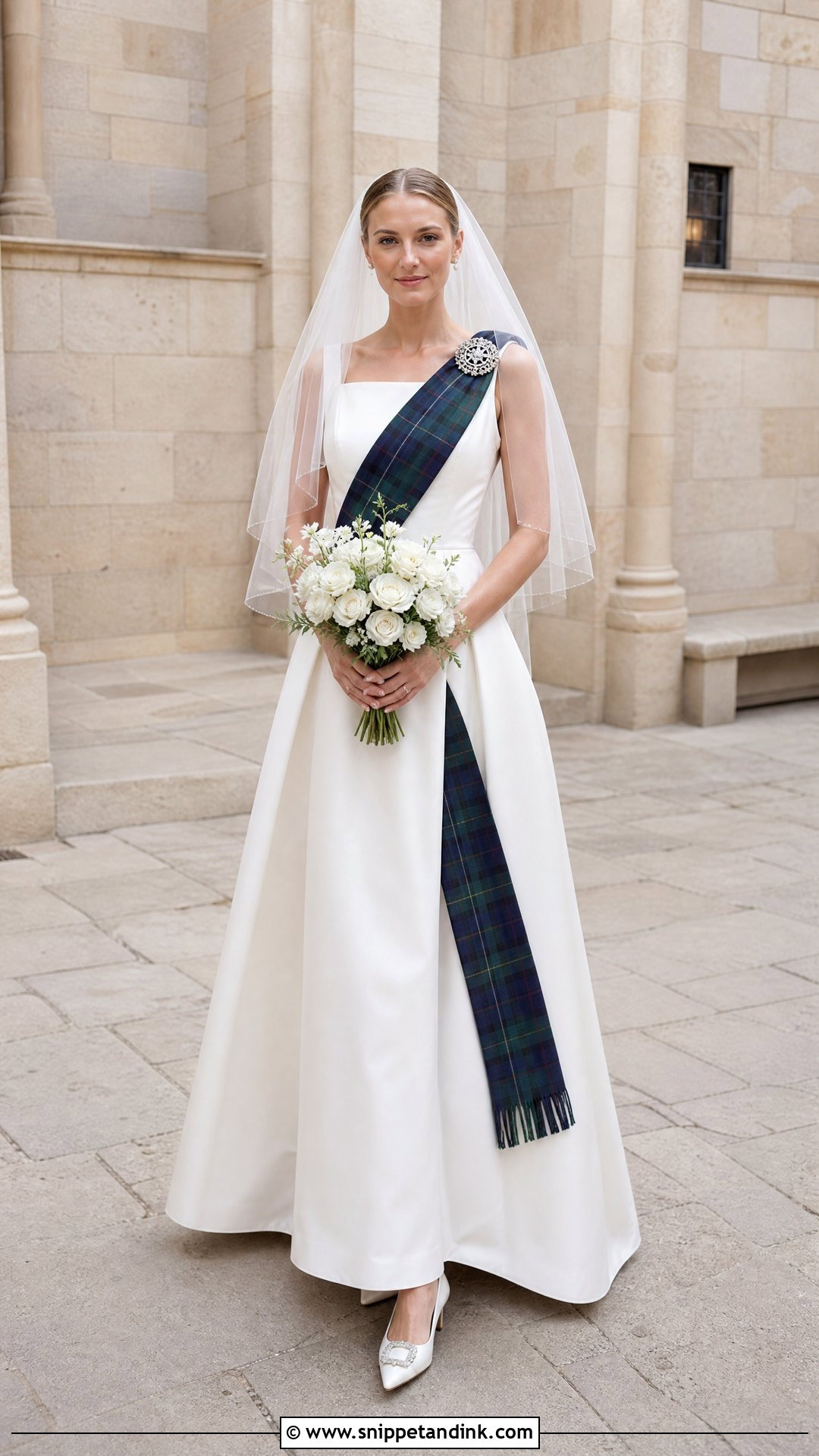
A plain white A-line gown with a tartan sash is the gentlest way in, and it’s the one I suggest to brides who feel unsure about pattern. Traditionally a woman’s sash sits over the right shoulder and crosses the bodice, though it can also wrap the waist like a belt; pin it with a silver Celtic brooch. The sash has long been part of formal Scottish dress for women, which is why it carries clan meaning without needing a whole tartan gown. Pick a dress with little beading, since sequins snag wool and fight the stripes. Pointed ivory heels, a structured bouquet and pearl studs keep everything else quiet. One practical habit of mine: I stitch a hidden thread loop inside the bodice so the sash doesn’t creep toward the arm during the first dance.
3. Lace Dress With Tartan Train Scottish Wedding Dress
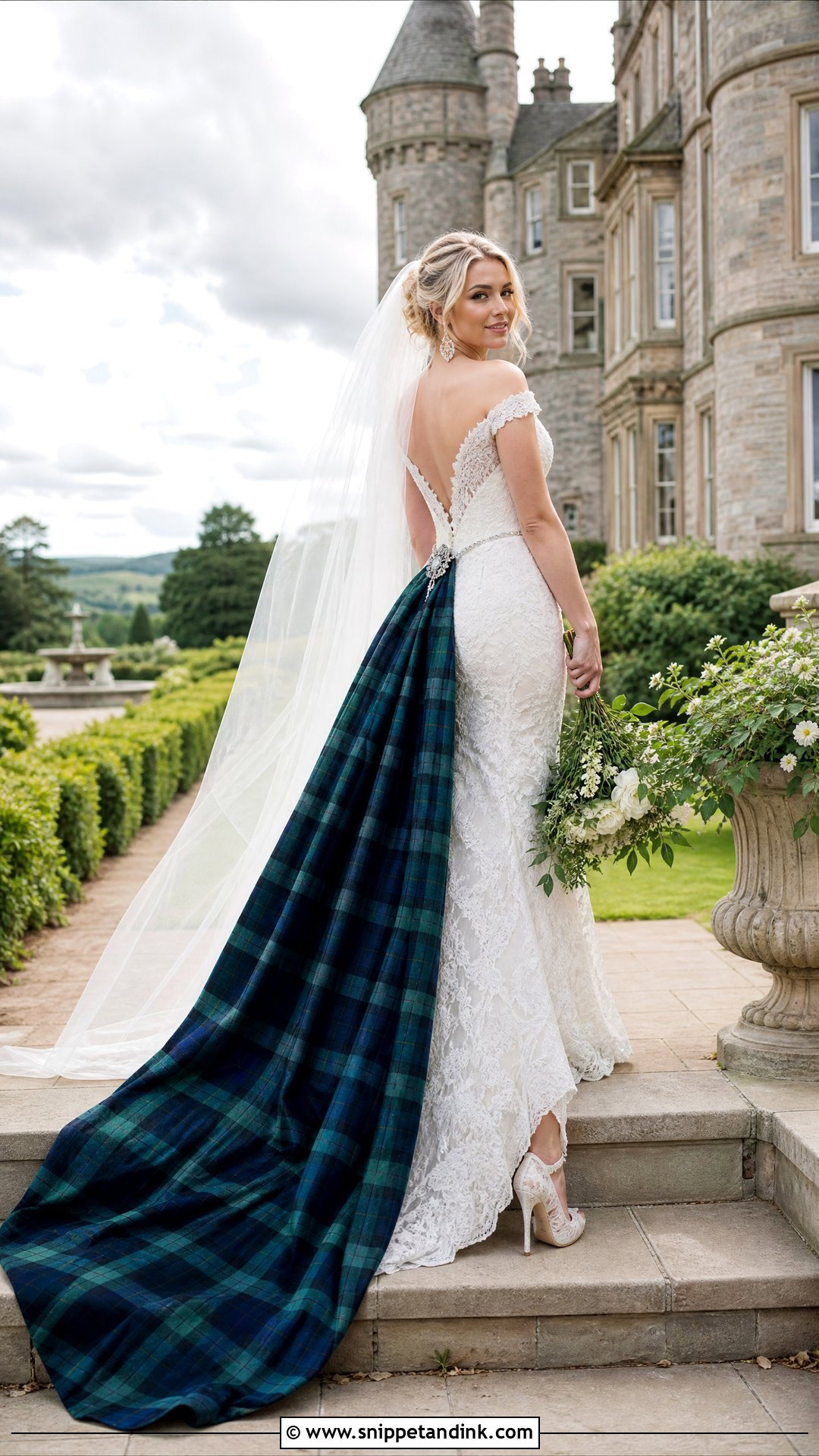
Lace against a tartan train is my favorite contrast on this list, because the soft fabric and the structured one each make the other look better. Start from an ivory column or fit-and-flare lace dress and attach the train at the back waist, so the pattern frames the gown and never covers the lace bodice. Made-to-measure tartan trains are now a regular request in Scottish bridalwear. Take the sett from the wedding colors, or from the groom’s kilt if he’s wearing one. I fix trains with hooks and thread bars rather than press studs, which pop open on stairs. Lace-covered heels, a long veil and a loose bouquet of white flowers finish it, and once the train comes off after the ceremony you have a lighter reception dress without a second gown.
4. Satin Dress With Tartan Bodice Scottish Wedding Dress
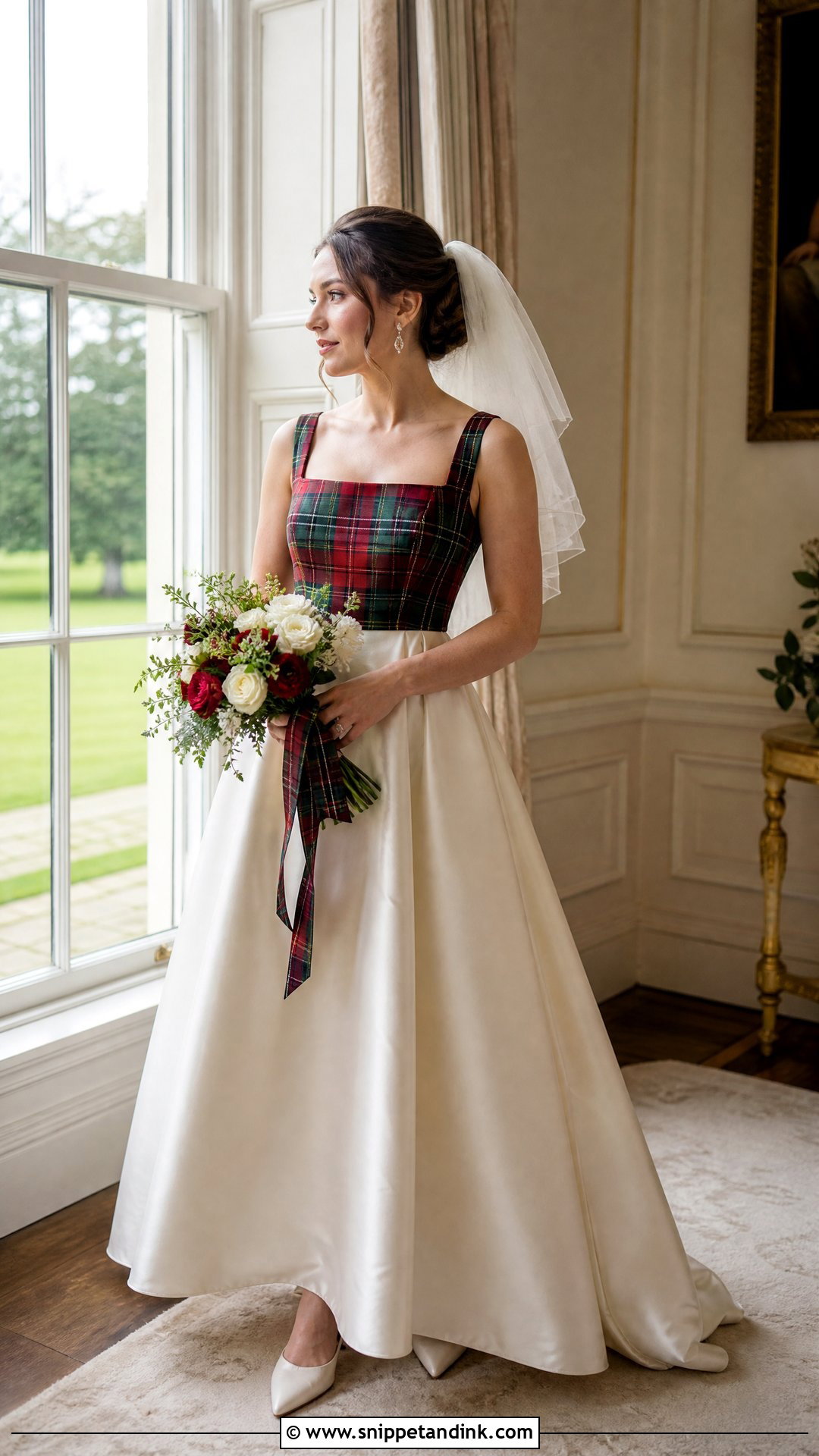
A fitted tartan bodice over ivory satin keeps the pattern close to the face, which is where the camera spends most of the day, including every seated shot at the top table. A square neck, wide straps or a gentle V all suit it, with the satin skirt falling from the natural waist. Ribbon cut from the same tartan around the bouquet stems ties the two halves together. Satin pumps, a short veil and small crystal earrings are plenty. Firm woven tartan has no stretch at all, so I’d never skip the final fitting: I want the bride to sit, eat and take a full breath in it. A removable satin bolero covers the shoulders for a church ceremony.
5. A-Line Tartan Panel Scottish Wedding Dress
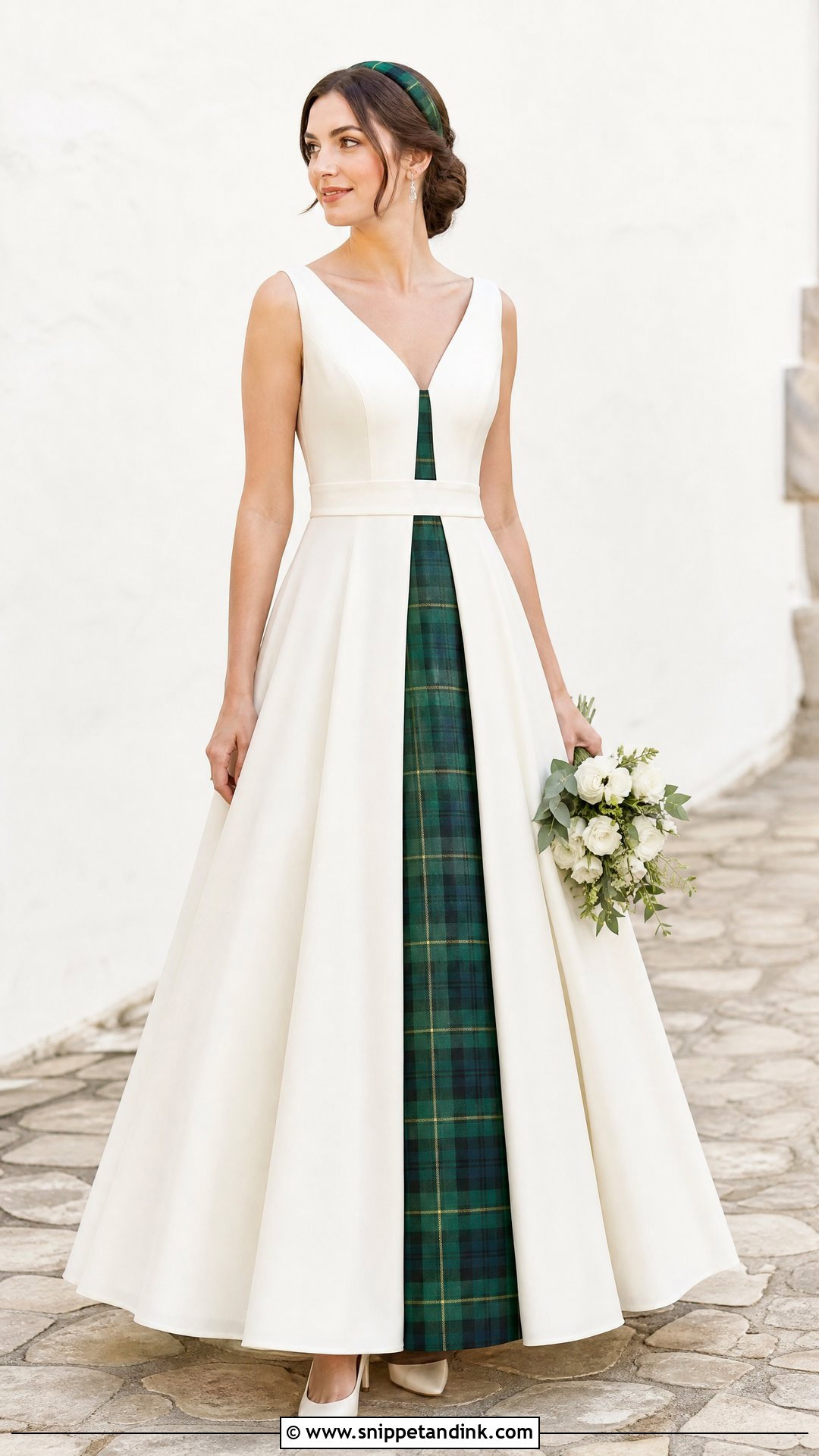
A center-front panel works like a vertical stripe. It lengthens the body and stops a bright sett from taking over an otherwise classic white gown. I’d run it from waist to hem on an ivory A-line, with a second matching panel set beneath the train so there is something to see as the bride walks away. Low ivory heels or flats make sense, because castle grounds mean grass, gravel and worn stone floors. A narrow tartan headband, silver studs and plain ivory bouquet ribbon complete it. Ask the dressmaker to center the panel on the strongest line of the sett; an off-center cut is obvious from the aisle.
6. Long Sleeve Highland Scottish Wedding Dress
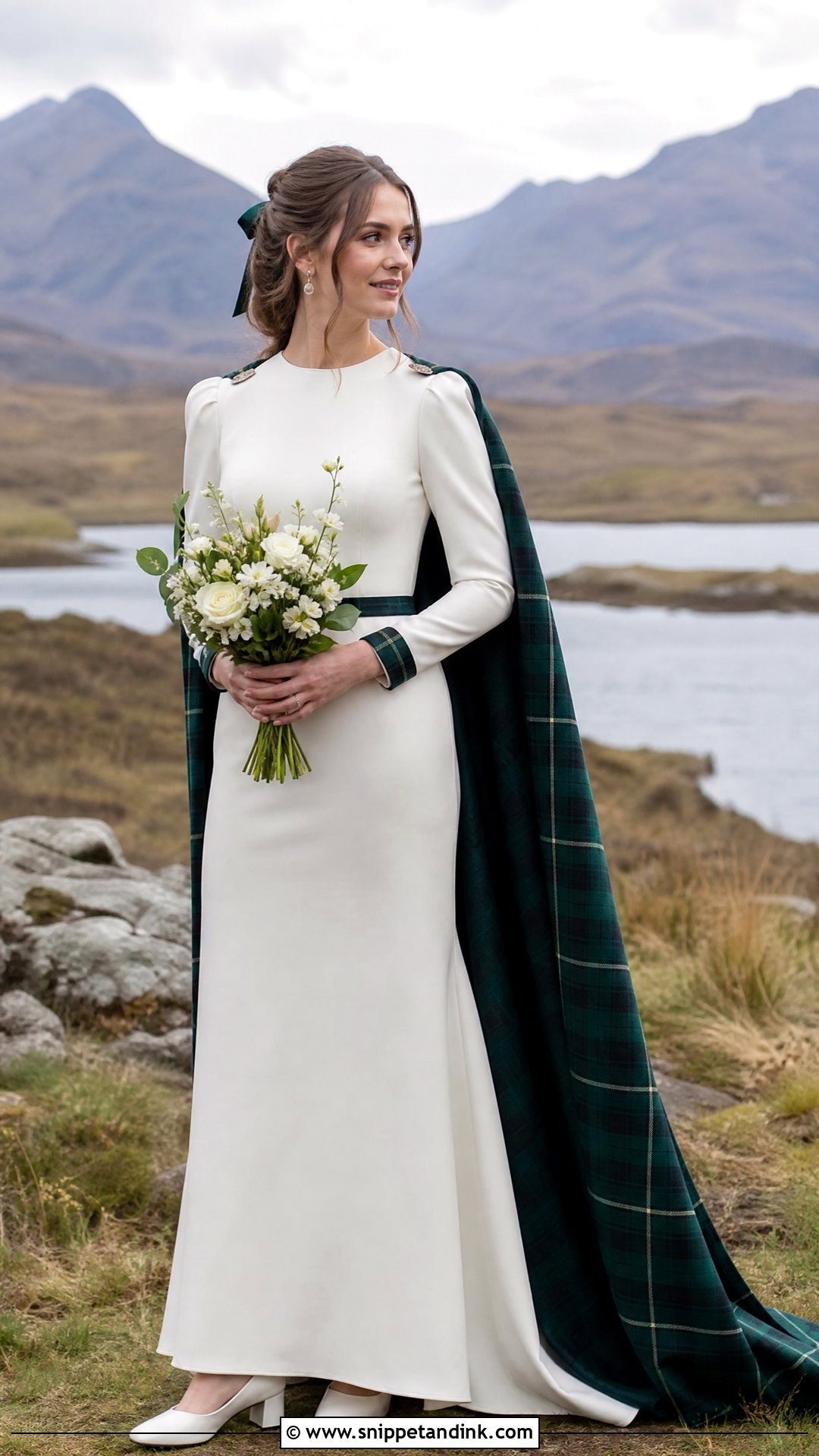
Long sleeves earn their place in the Highlands, where a summer evening can turn cold within the hour. I like ivory crepe for this one because it moves well outdoors and doesn’t show wind creases the way satin does. Tartan can come in through turned-back cuffs, covered buttons or a narrow waistband, and a detachable wool tartan cape handles the walk between locations. Closed-toe block heels, a velvet hair ribbon, silver Celtic earrings and a bouquet with fern and a touch of heather purple suit the landscape. Keep the train short on uneven ground, and have a wrist loop sewn in so the hem lifts with one hand.
7. Off Shoulder Tartan Scottish Wedding Dress
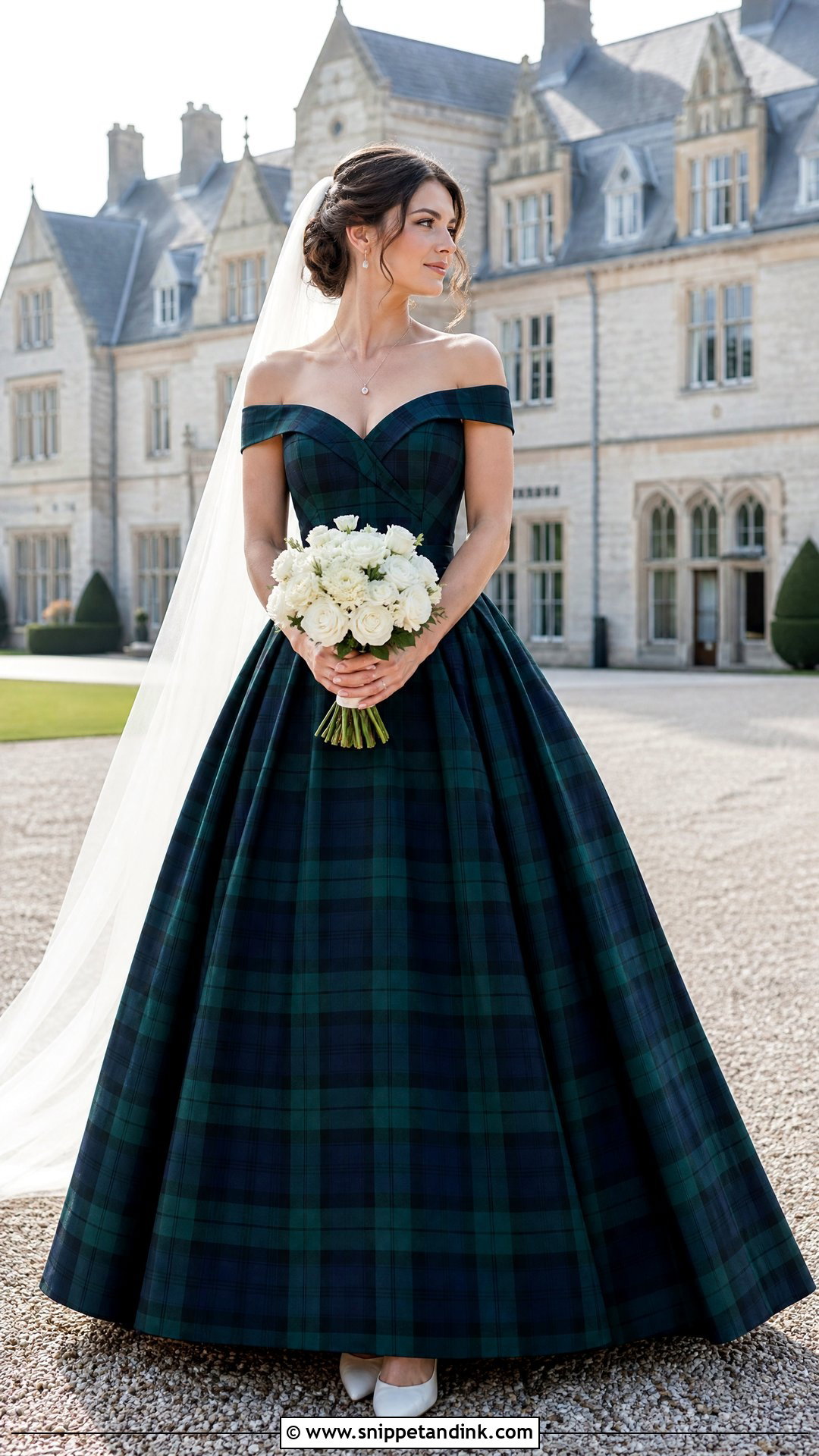
Off-the-shoulder tartan is romantic, but only if the bodice is boned to stay up by itself. At fittings I have the bride lift both arms as if hugging someone; if the neckline slides, it needs more structure. Muted reds, dark greens and navy look grown-up rather than costume-like. Balance the open neckline with a fine pendant and small earrings, pin the hair softly, and keep a cathedral veil plain so the eye has somewhere to rest. A compact bouquet won’t hide the waist, and a fitted ivory cape covers the shoulders on a cold day. Every seam and closure needs the lines matched, and a curved neckline is where a rushed alteration shows first.
8. Square Neck Plaid Scottish Wedding Dress
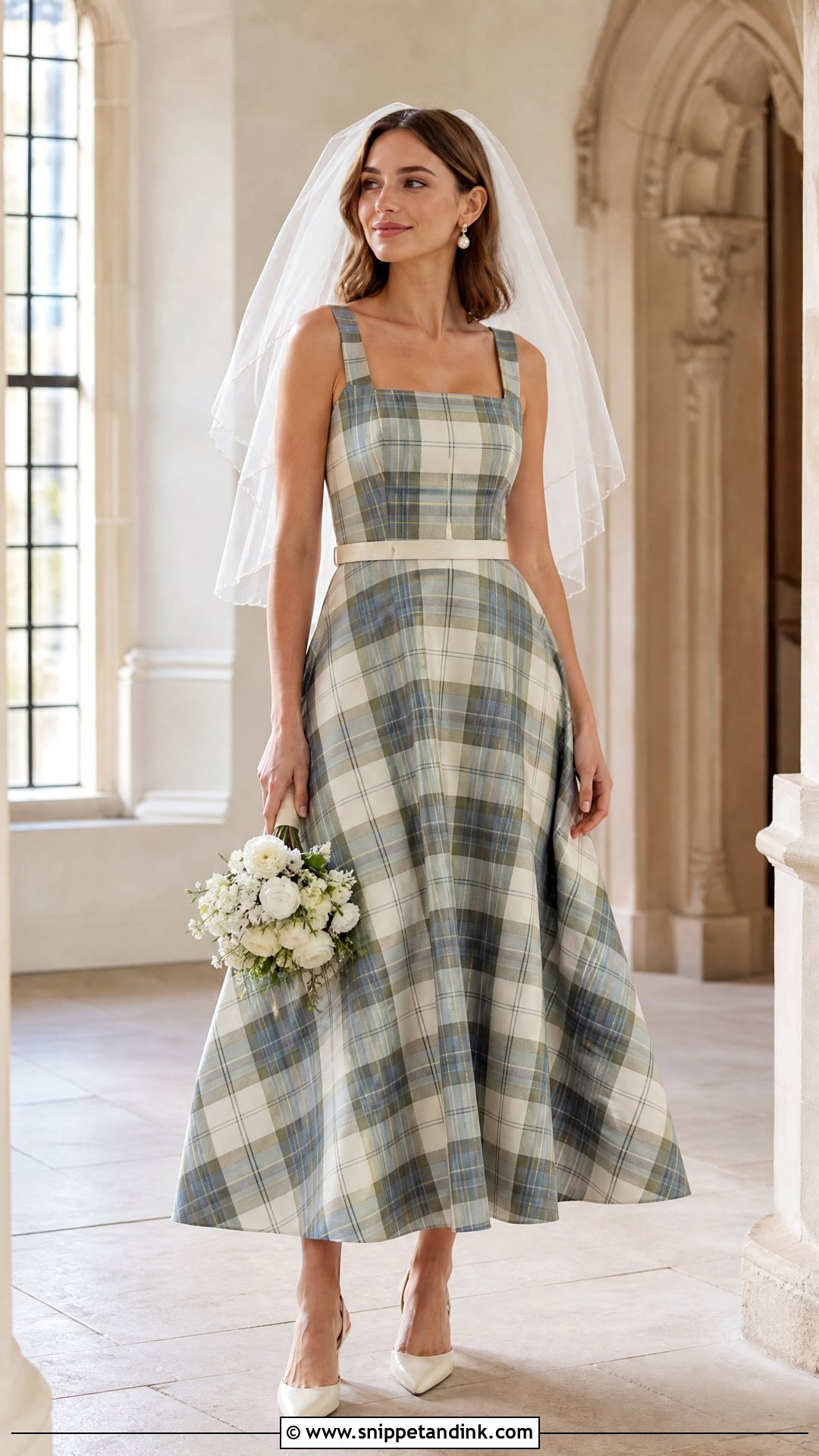
Square necks and plaid suit each other because both are built from straight lines. Choose a muted sett in ivory, soft blue, sage or grey rather than a high-contrast one, supported by a fitted bodice and wide straps over an A-line skirt. A slim ivory belt breaks the pattern at the waist. Add pearl earrings, ivory slingbacks and a shoulder-length veil, and let a few blue accents among white flowers pick up the lighter lines in the cloth. I’d wear this neckline with an updo or low bun so the collarbones stay visible, and I’d keep every other pattern out of the outfit.
9. Tea Length Tartan Scottish Wedding Dress
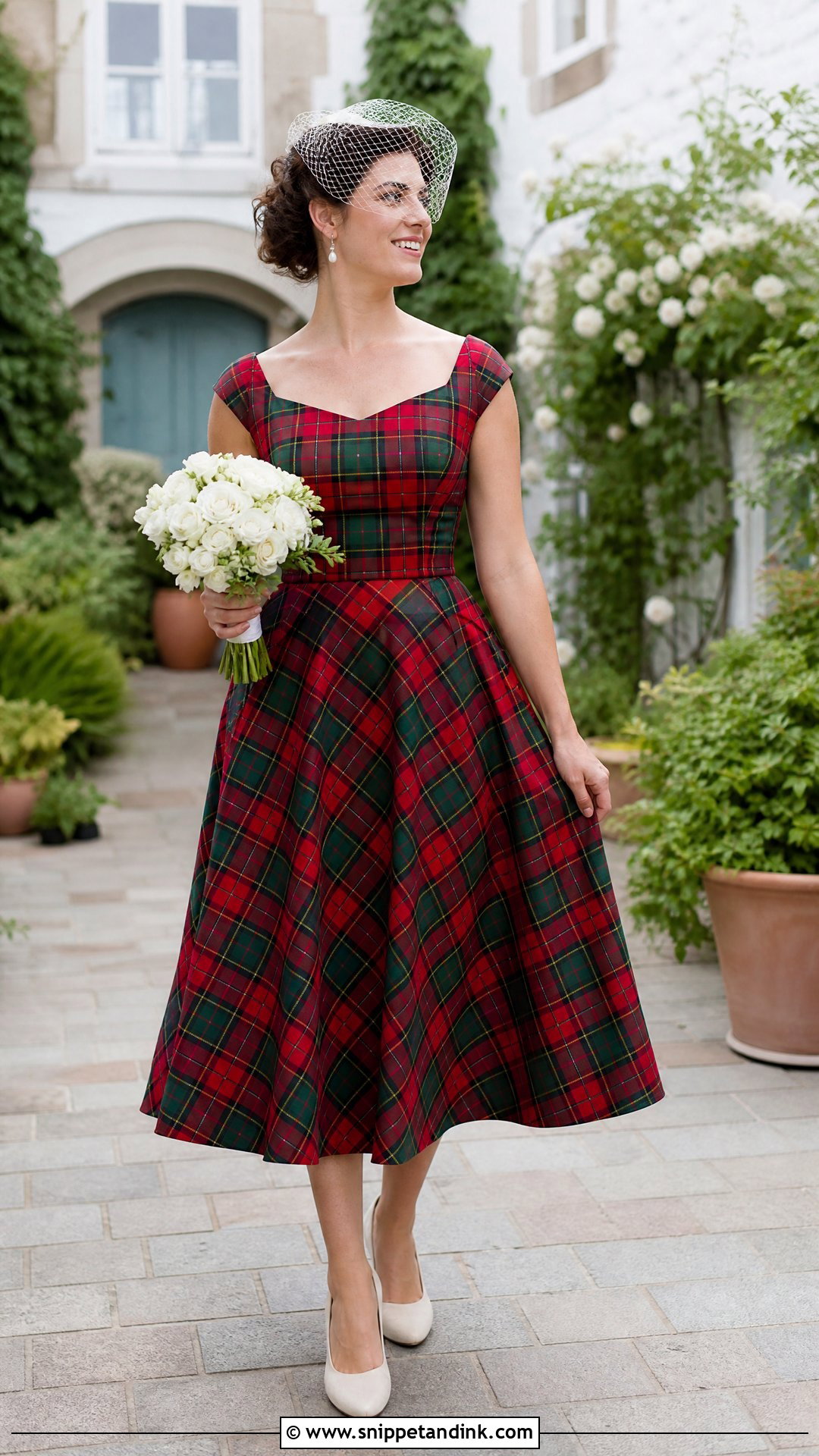
Tea length is a happy choice for a smaller celebration or a daytime ceremony, and it’s the easiest dress here to dance in. The hem should land between knee and ankle. I always pin it with the bride standing in her actual wedding shoes, because a different heel height moves the hemline more than people expect. With the shoes on show, ivory pumps, velvet flats or neat low block heels matter more than usual. A birdcage veil or satin headband suits the vintage proportions, with pearls and short gloves if she likes them. The tartan already gives the eye plenty of movement, so leave the ruffles off.
10. Boho Scottish Wedding Dress With Plaid Wrap
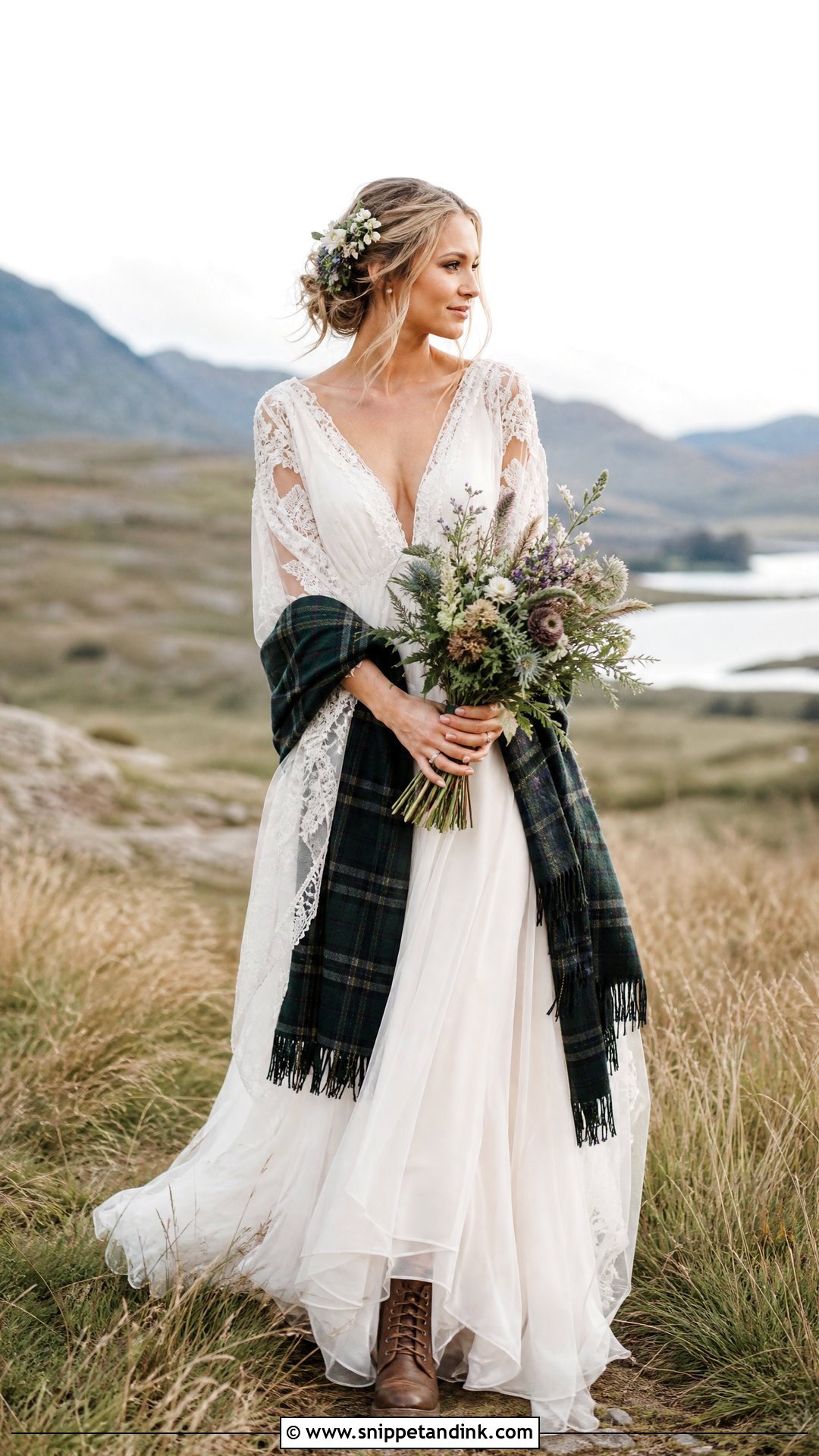
This is the outdoor bride’s look: an ivory chiffon or lace gown with loose sleeves and a soft waist, and a brushed tartan wrap around the shoulders for warmth. Forest green, dusty blue, heather and muted brown setts sit best in open country. Leather ankle boots make real sense on a hillside, and the wrap can drop to the elbows for portraits or come off indoors. Where I see this go wrong is too much at once, because fringe, lace, plaid and flowers together turn busy quickly. Start from a plain dress and add one fine necklace and small earrings to finish this relaxed Highland bridal look.
11. Winter Velvet Scottish Wedding Dress With Tartan
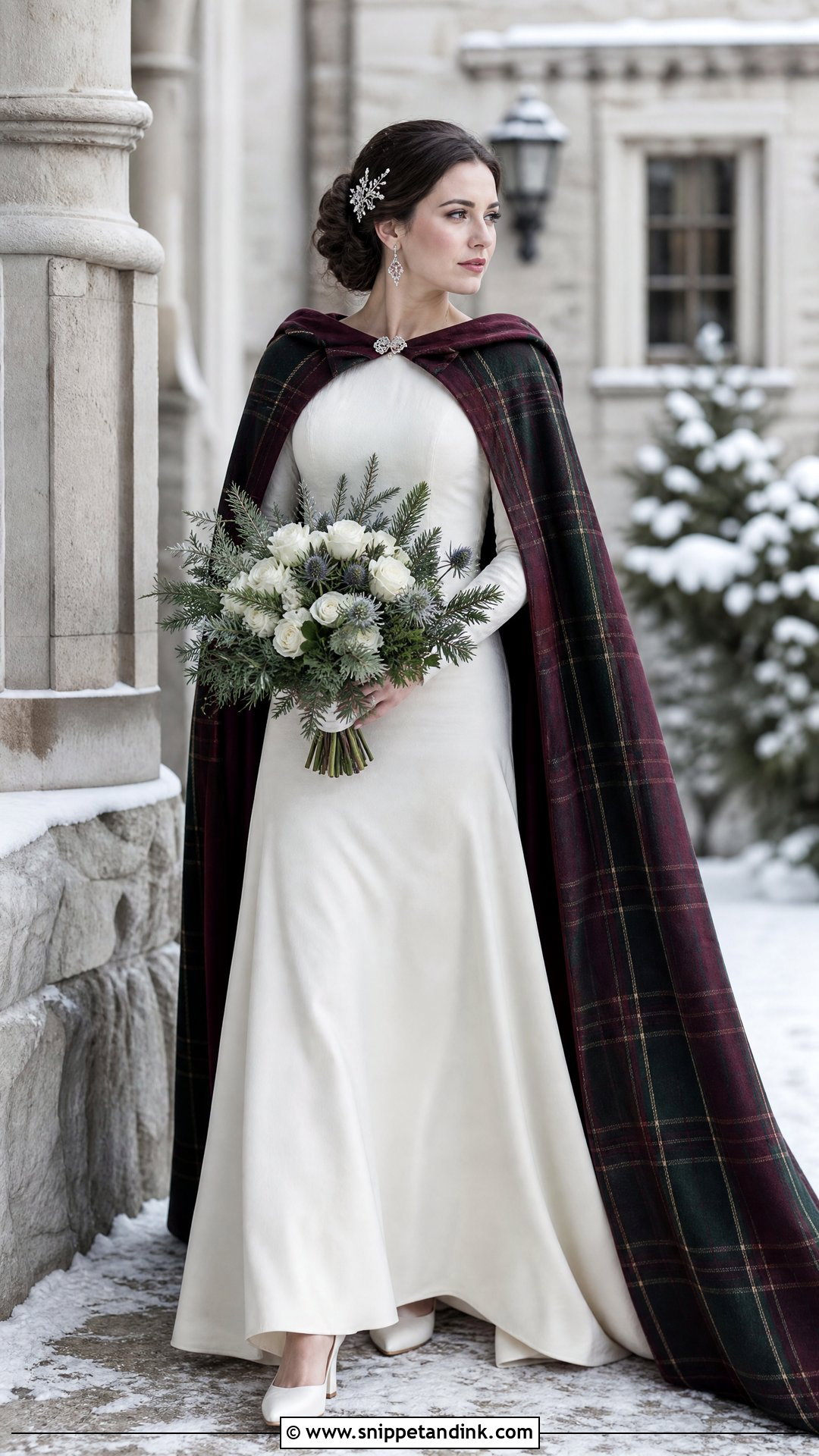
Velvet is warm and rich in winter light, but I treat it with care. The pile catches light differently depending on which way it runs, so every panel has to be cut in the same direction or the skirt shows patches of two shades. An ivory velvet gown with long sleeves and a softly fitted waist is the base; add a satin-lined tartan cape, or bring the pattern in through a wide sash and matching shoes. Deep green, burgundy and midnight blue all sit well against bright ivory. Finish with closed-toe heels, a crystal comb, silver drops and a bouquet of white flowers with evergreen. Velvet also crushes on a long car ride, so I tell brides to lift the back of the skirt before they sit.
12. Plus Size Scottish Wedding Dress With Tartan Waist
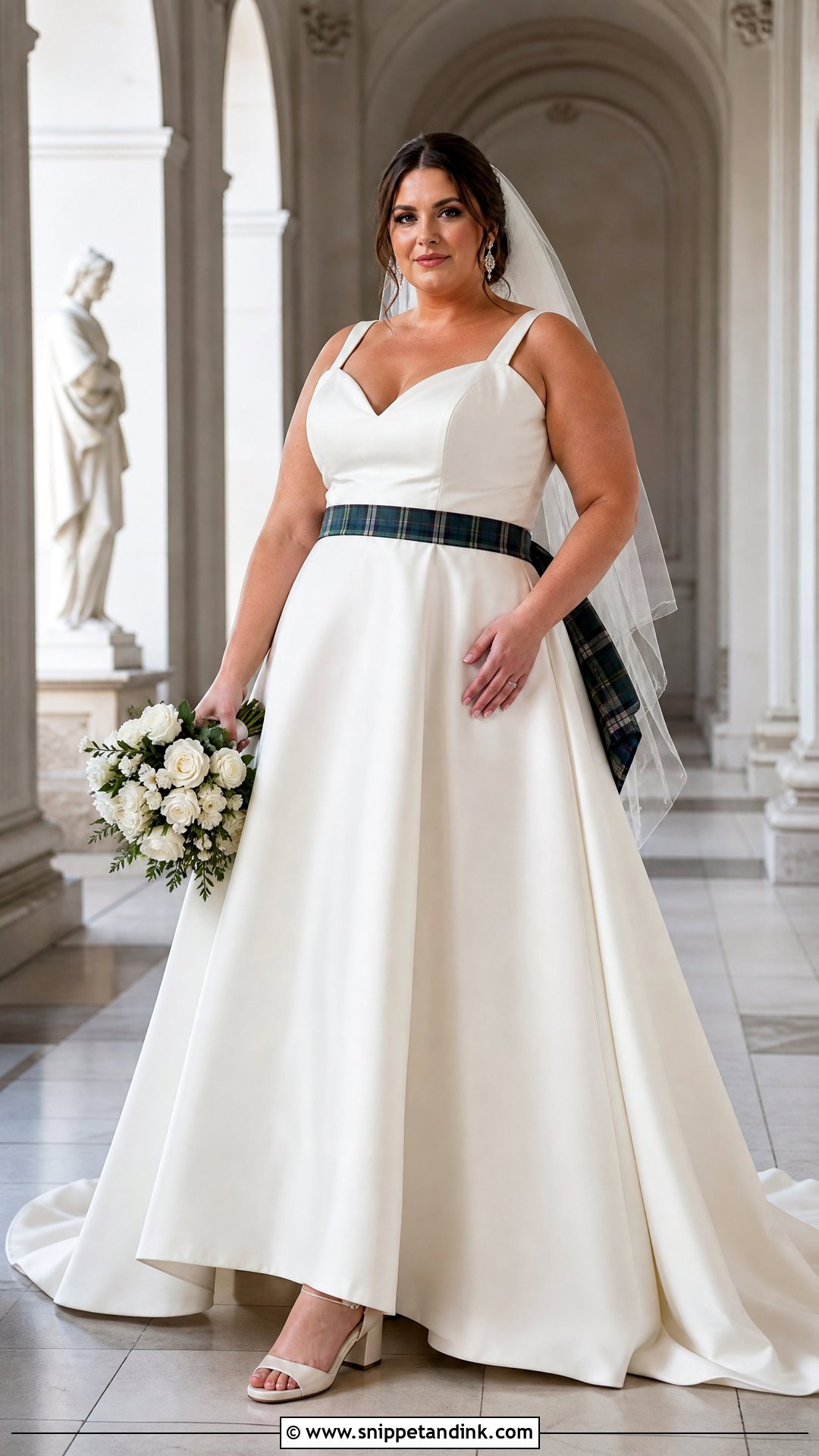
On a plus-size gown, a tartan waistband defines the waist without breaking the line of the skirt, provided it’s built properly. I’d start with a supportive ivory A-line: a structured bodice, comfortable straps and a skirt that skims the hips. Place the tartan at the natural waist, or a little higher if that feels better in the mirror, and carry the pattern down the back with a detachable bow or short sash tail. Add cushioned block heels, a fingertip veil and earrings that bring light up to the face. The thing I check most is that the band stays flat when she sits. A soft band rolls, so ask for interior boning or a petersham backing. Pick the silhouette on comfort and how you feel in it, not on rules about body types.
13. Modest Scottish Wedding Dress With Tartan Cape
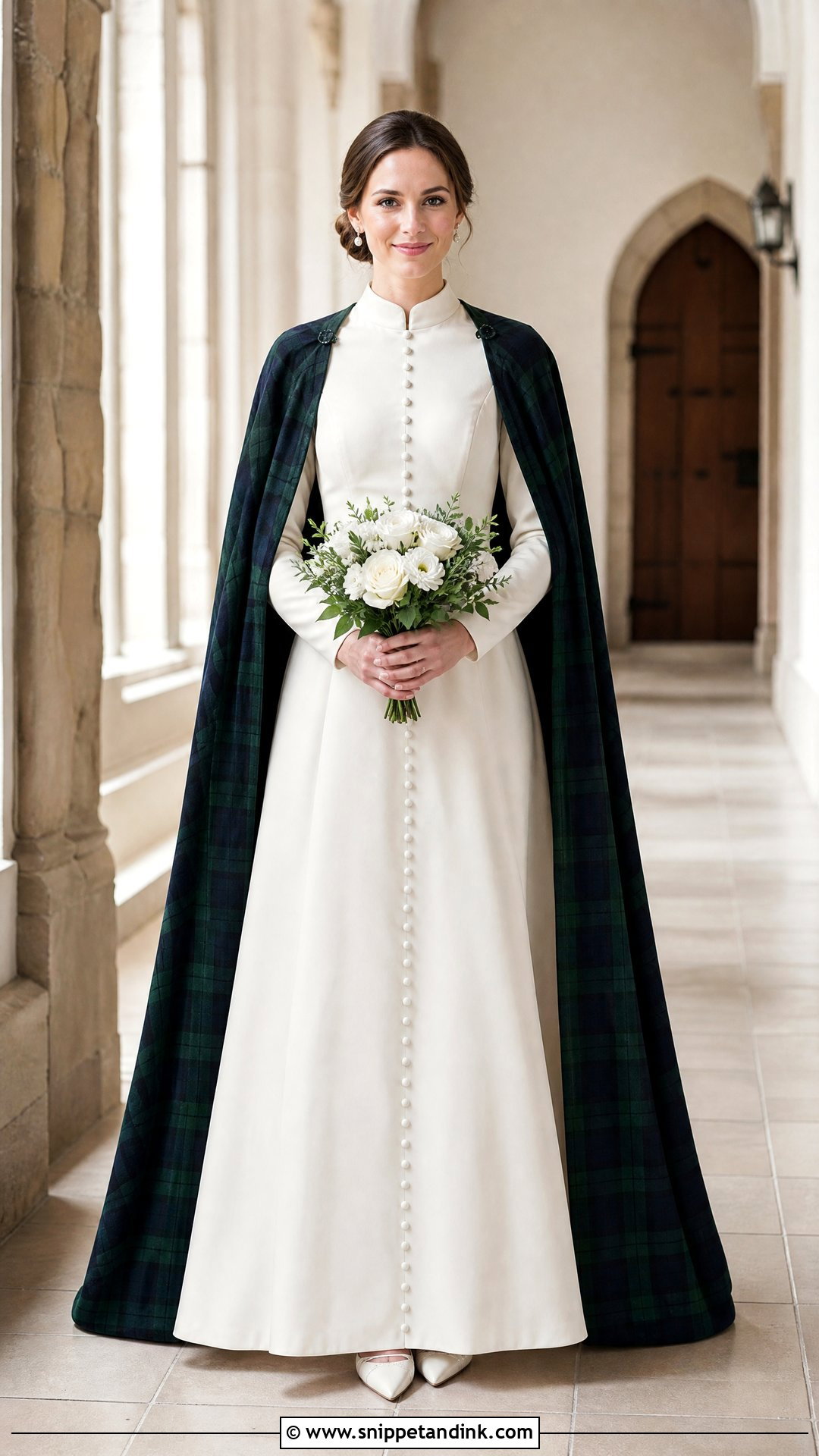
A high-neck ivory gown under a long tartan cape gives full coverage and plenty of drama. A bateau neckline, fitted sleeves, a clean A-line skirt and covered buttons down the back make a sound base. The cape should fasten at the collar and fall behind the shoulders, so the dress still shows from the front. A soft wool blend suits autumn; a lighter tartan works for spring or an indoor ceremony. Pointed ivory flats, a low bun and pearl earrings finish it. I’d insist on a smooth lining, because a wool cape rubbing over lace or buttons all day will pull threads. You also get two looks from it: cape on for portraits, cape off for the party.
14. Modern Minimal Scottish Wedding Dress With Tartan Bow
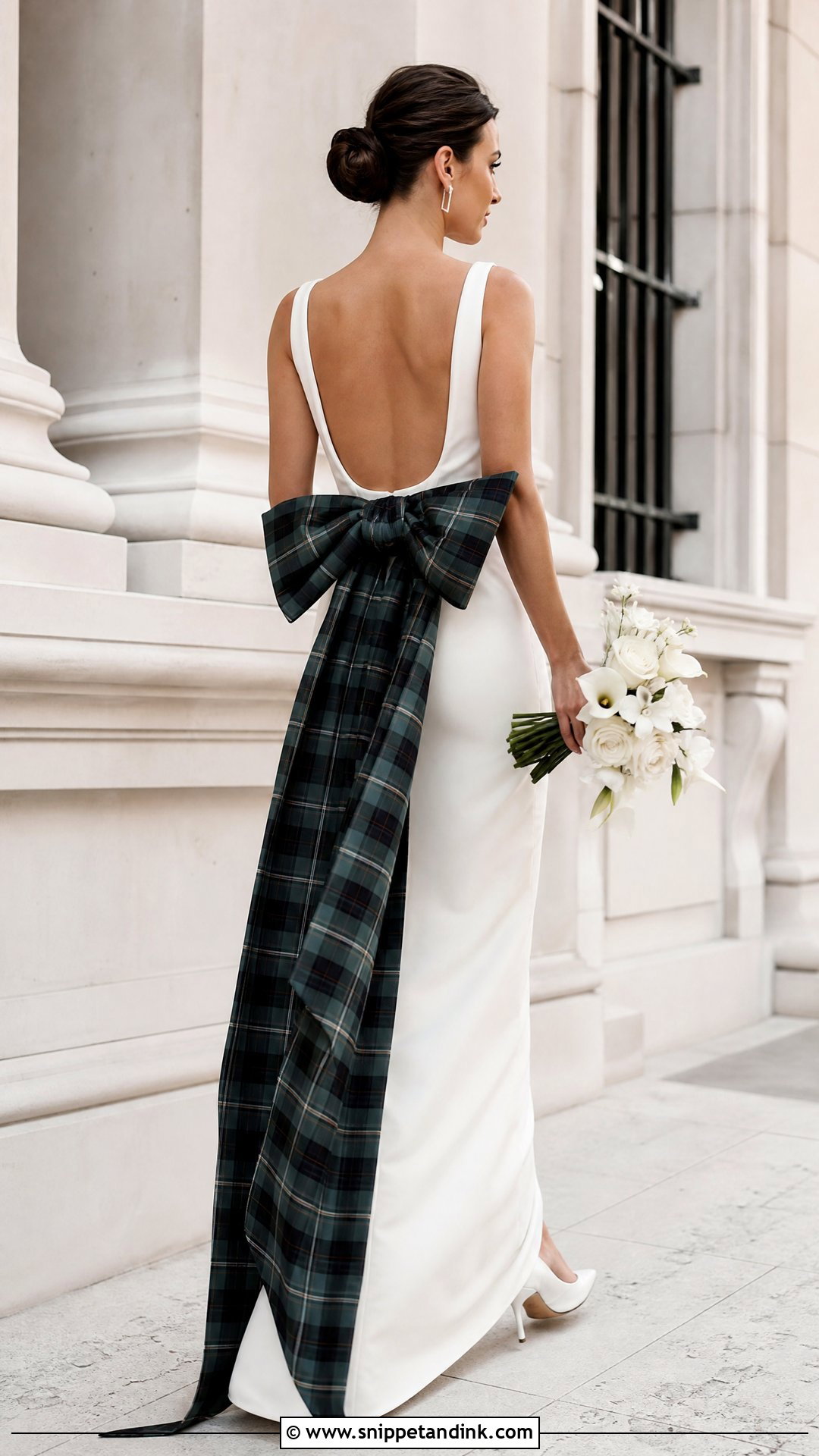
One detail on a minimal gown carries more weight than five on a busy one. Take a sleek ivory column with a straight neckline and wide straps, then add an oversized tartan bow at the back waist, its long tails falling over the skirt like a narrow train. Make it detachable. Pointed pumps, geometric silver earrings and a smooth low bun keep the lines clean, and a bouquet of a single flower variety looks better here than a loose mix. Echo one color from the sett in a hairpin or the bouquet ribbon. Proportion is the real risk: on a petite frame I scale the bow down, since an oversized one can start to look like gift wrap.
15. Celtic Embroidered Scottish Wedding Dress
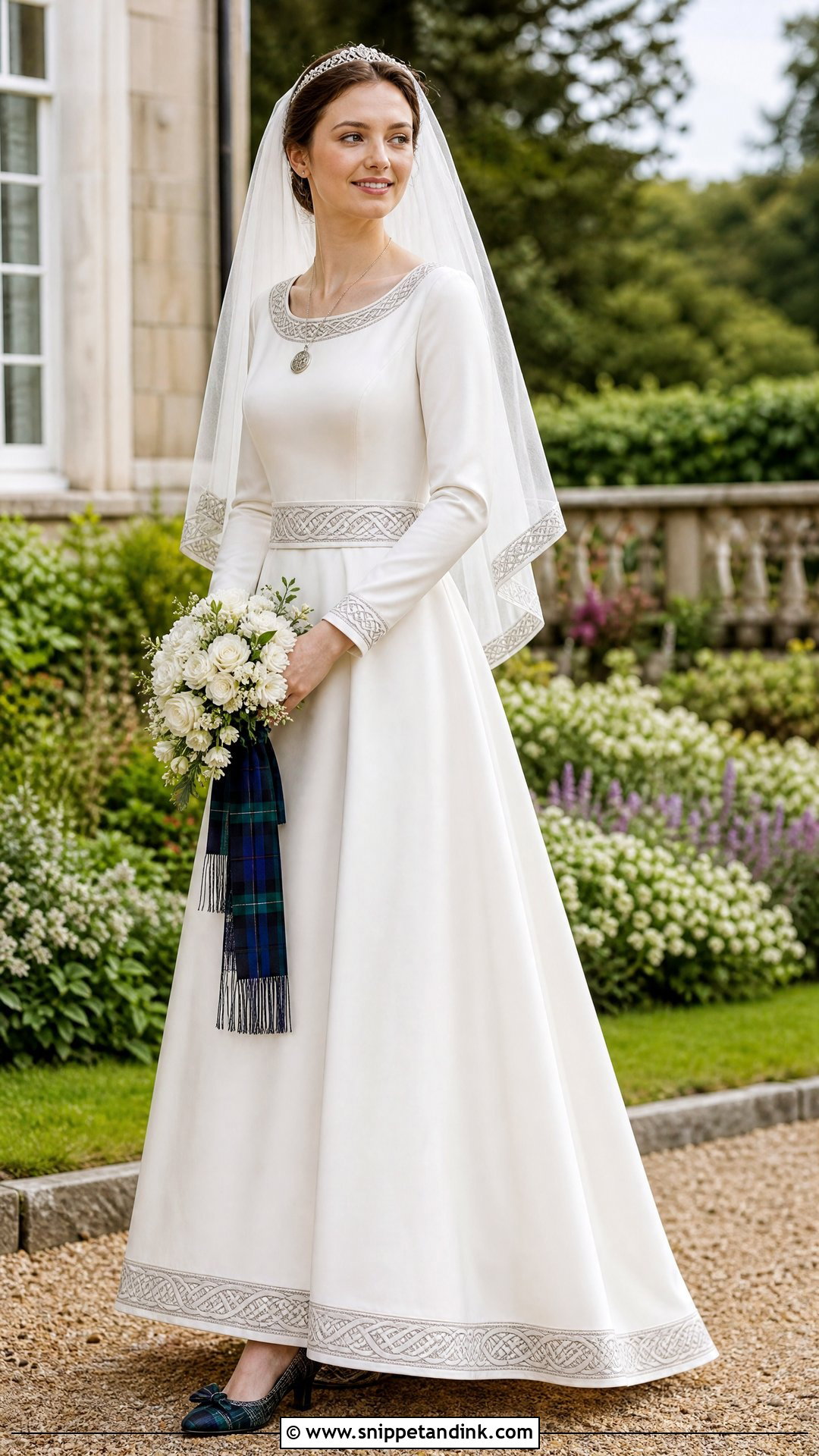
Celtic knotwork gives a gown Scottish character without any tartan at all, which suits brides whose family has no sett of its own. I’d keep the embroidery to two or three places, chosen from the neckline, cuffs, waist and hem. Silver, soft gold, pale green or tonal ivory thread all look refined, and tonal is the subtlest on camera. A fitted long-sleeve bodice and flowing A-line skirt give the work room. Tartan can still appear in low heels, a small clutch or the bouquet ribbon, alongside a silver knot pendant and a light chapel veil. Ask the embroiderer to keep larger motifs off areas that stretch or gather, because dense stitching puckers there.
16. Isabella MacTavish Scottish Wedding Dress
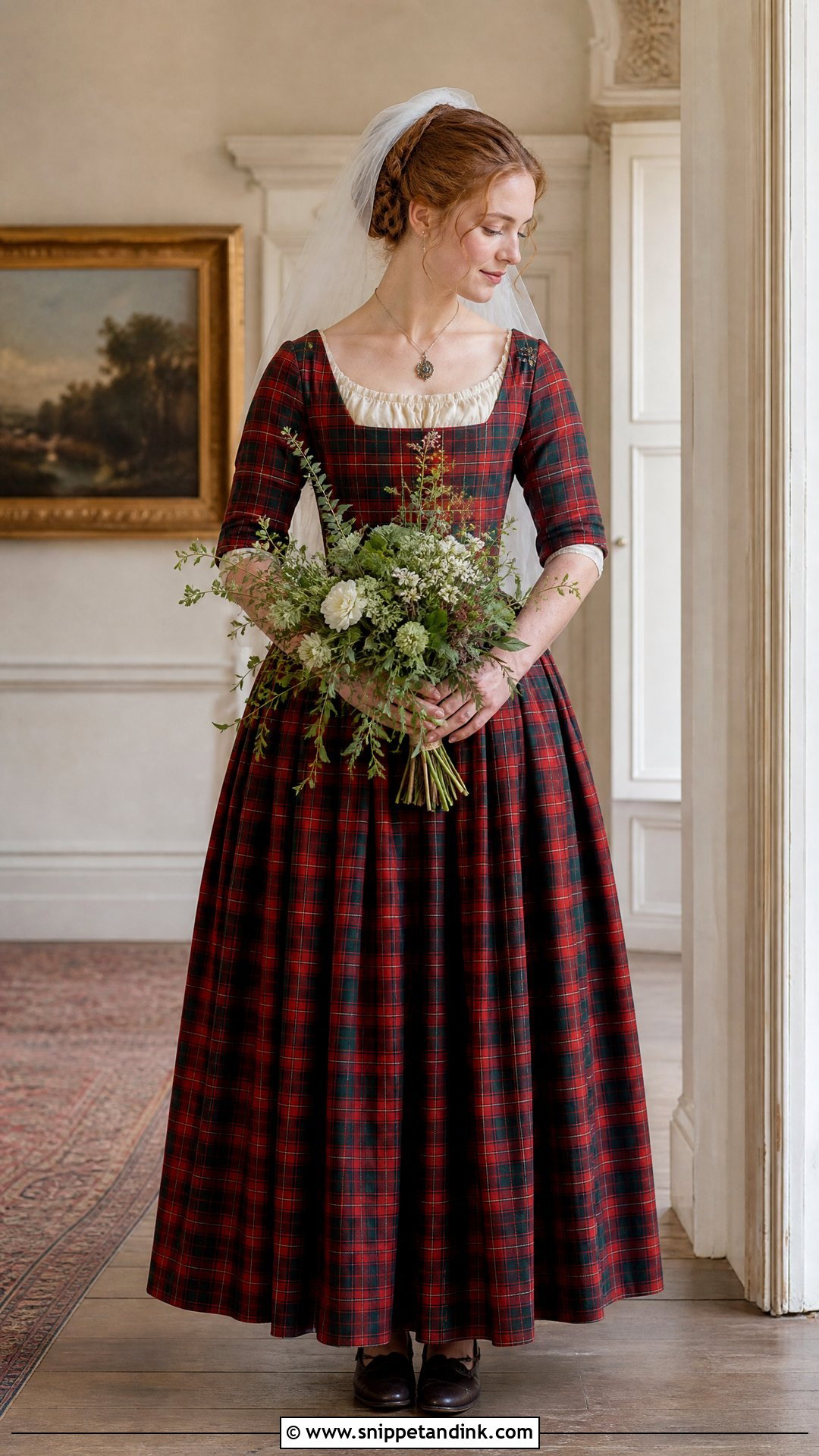
Brides who love historical dress often ask about the tartan wedding gown of Isabella MacTavish Fraser, which still survives. It’s a late-18th-century dress and one of very few complete women’s tartan garments left from that era. I wouldn’t copy it as a costume. Take its essentials, a fitted red tartan bodice, elbow-length sleeves, a gathered skirt and an ivory insert at the neckline, then simplify the construction and raise the hem for modern shoes. Low leather shoes, a small pendant, softly pinned hair under a plain veil and a hand-tied bouquet suit it. It sits naturally in a museum venue or an old house with its own history.
17. Black Watch Tartan Scottish Wedding Dress
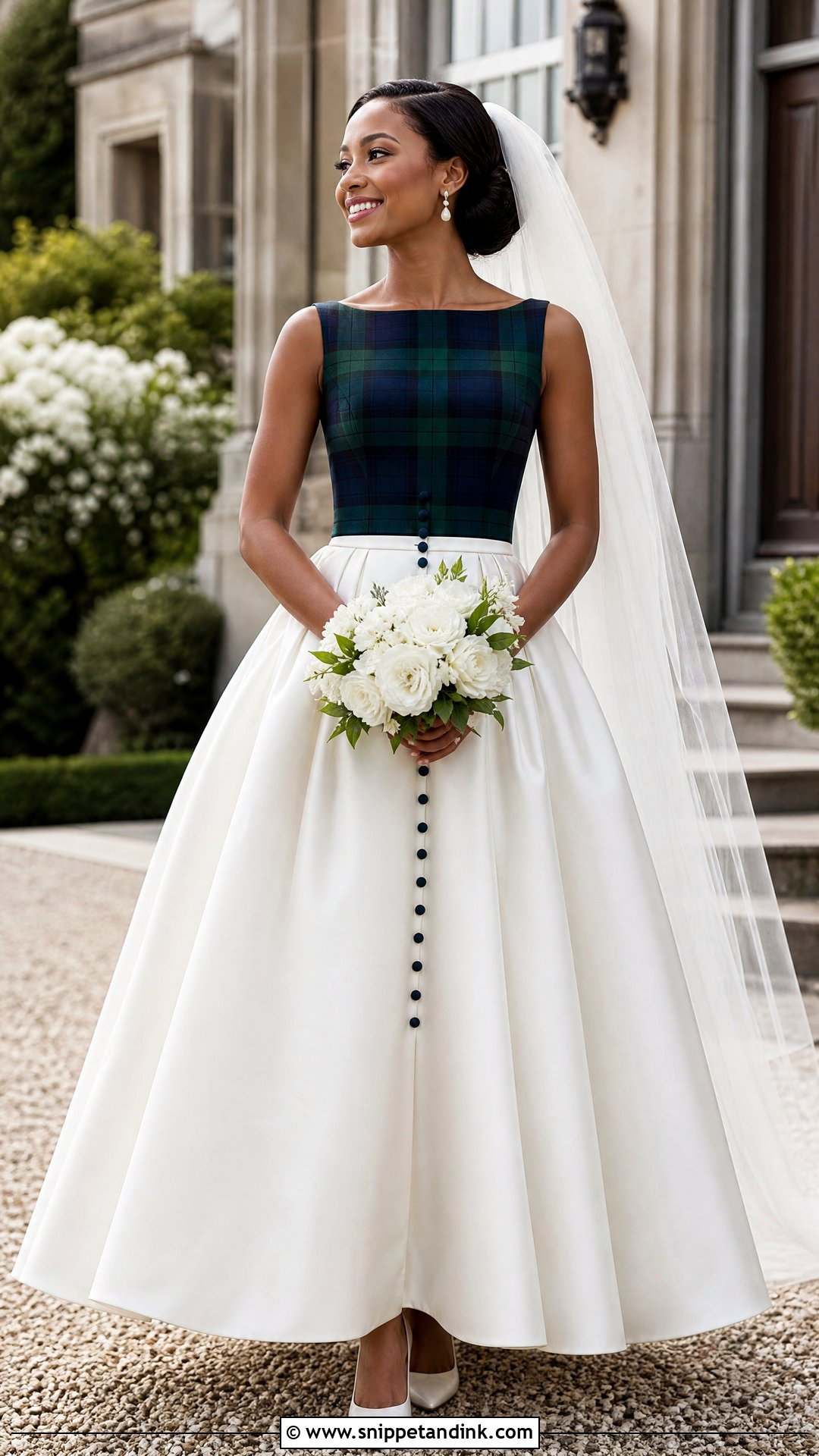
Black Watch is navy, green and black, so it’s dark. That is its appeal and its risk, because under a grey sky the whole outfit can go heavy. Use it in a fitted bodice over a full ivory satin skirt, or reverse it with an ivory top and tartan skirt, then keep everything else bright: ivory pumps, pearl earrings, silver jewelry and a white bouquet. A row of tartan-covered buttons links bodice and skirt without another big block of pattern, and a plain tulle veil keeps the back visible. It’s a natural autumn and winter sett, and in a lighter cloth it can carry into spring.
18. Red Tartan Scottish Wedding Dress
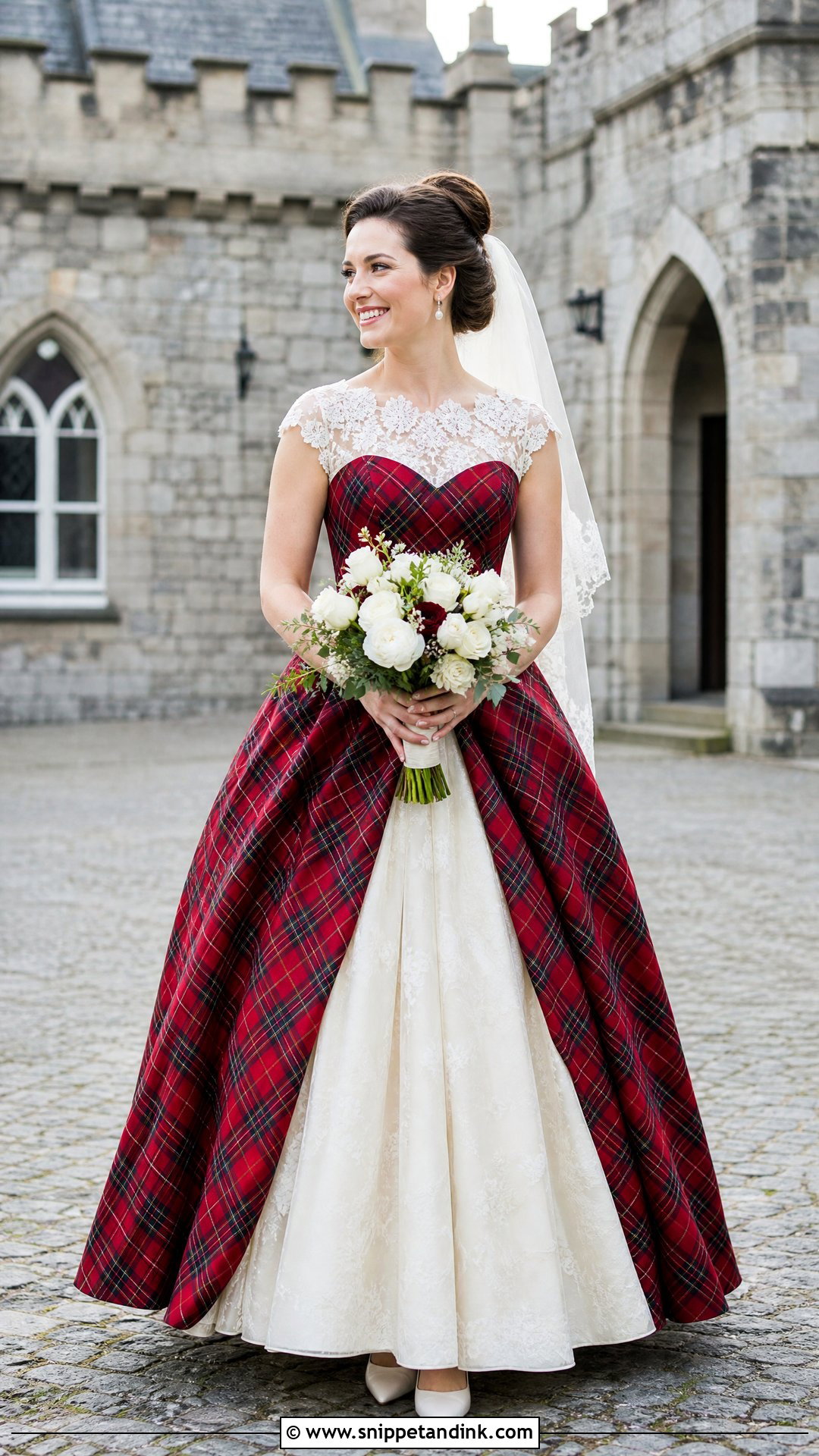
With red tartan, the sett matters more than the shade. I steer brides toward one that mixes red with ivory, black or deep green rather than several equally bright colors, which can flicker on camera. A fitted bodice and full skirt is the classic cut; an ivory lace neckline softens red near the face, and a plain underskirt gives the eye a rest. If a full tartan gown feels like too much, try a red tartan skirt with a clean ivory satin top. Ivory heels, a simple veil and mostly white flowers with a few deep red accents finish it. The test of a well-made red tartan dress is at the seams, where the horizontal and vertical lines should meet on every one.
19. Green Tartan Scottish Wedding Dress
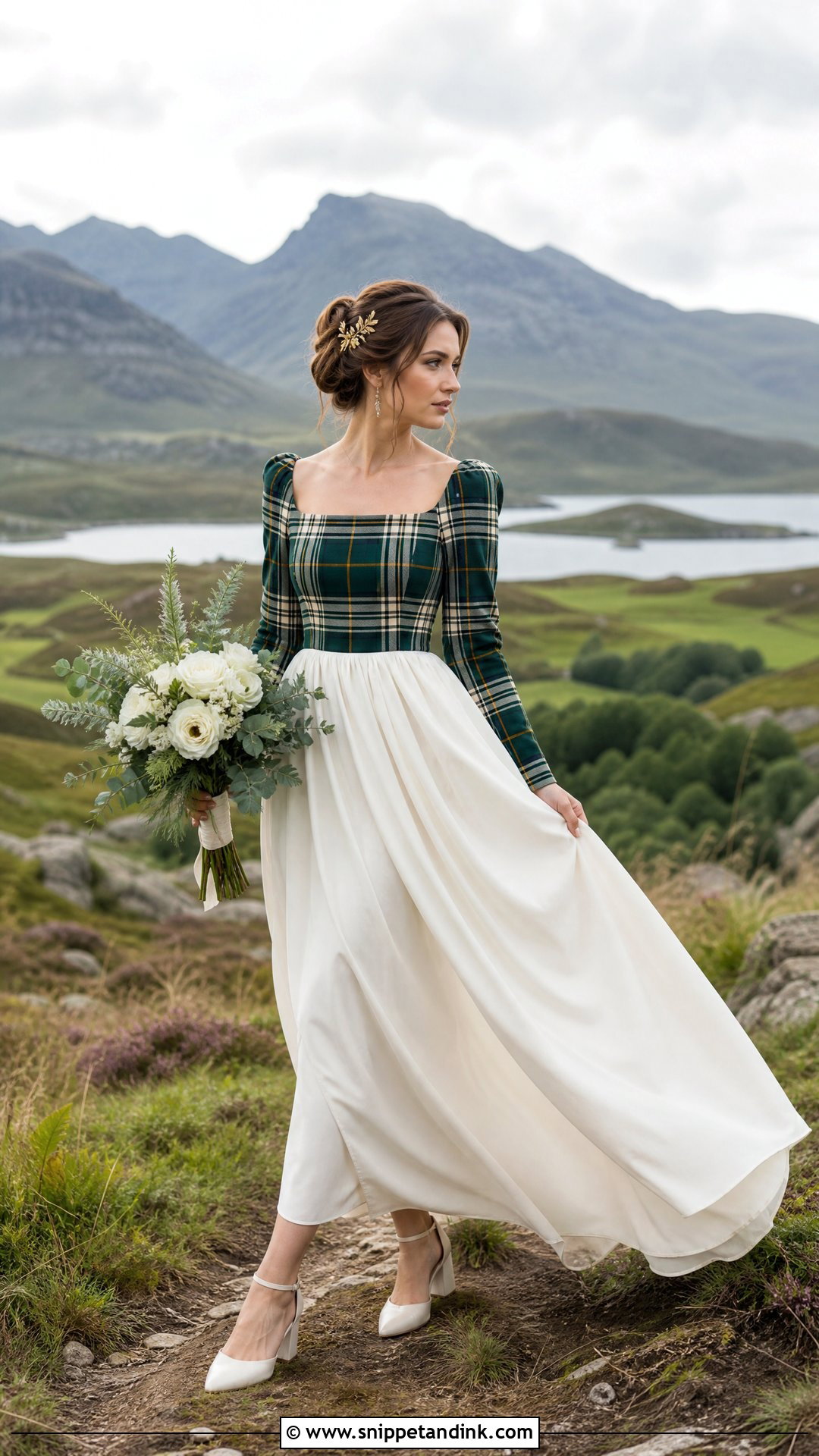
Green tartan echoes the hills, and a sett of forest green, navy and cream with a thin gold line is the one I reach for first. A sleeveless fitted bodice over a flowing ivory skirt is balanced; an all-tartan A-line is bolder. Ivory block heels, a gold hair comb, understated drop earrings and a bouquet heavy on greenery suit an outdoor setting. If it’s cold, add an ivory wool cape rather than another plaid. Before you commit, take the swatch outside. Daylight often pulls a green sett toward blue or yellow in a way the shop lighting never shows you.
20. Detachable Tartan Overskirt Scottish Wedding Dress
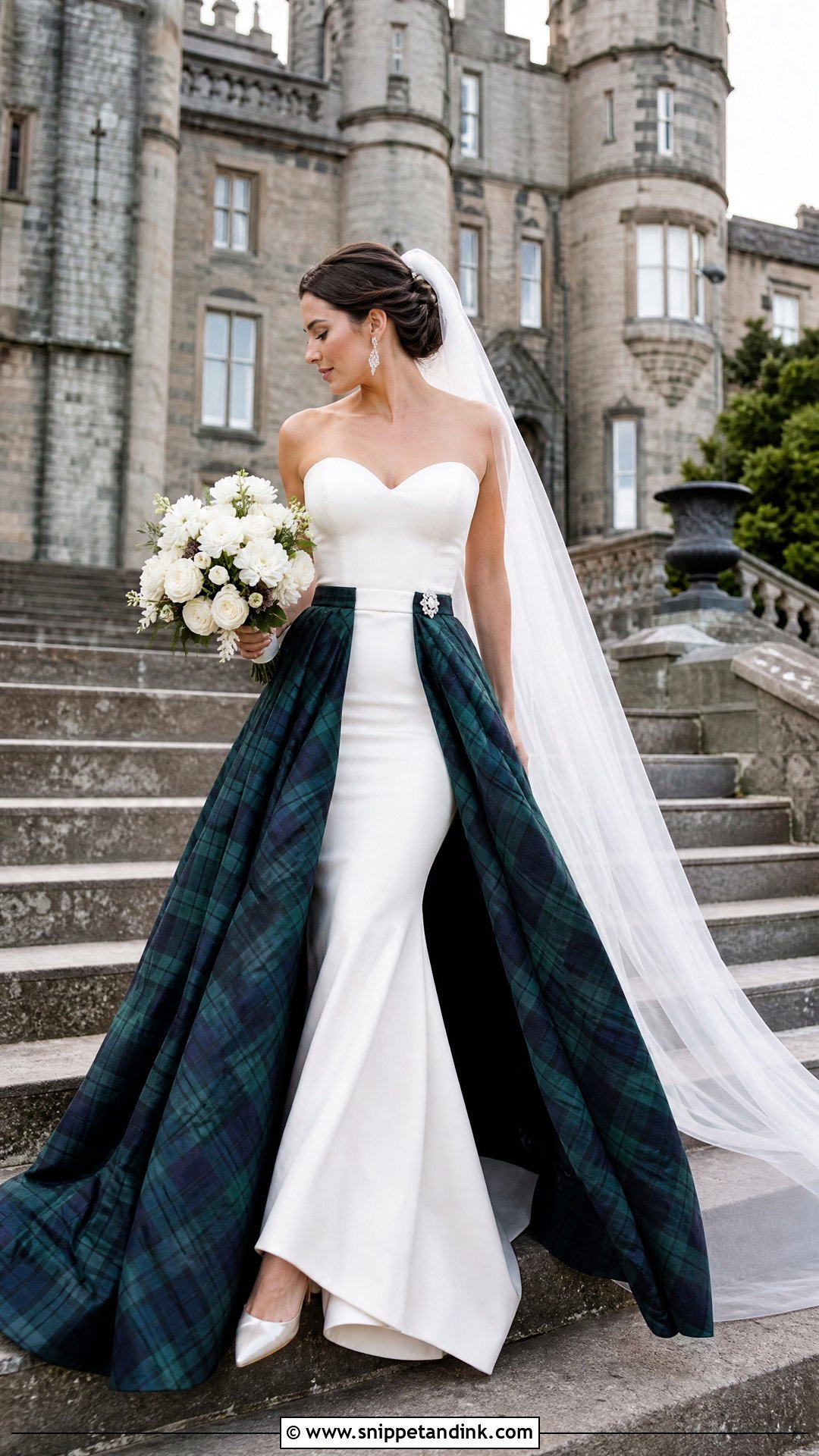
A detachable overskirt gives you two outfits: a fitted ivory crepe or satin gown, plus a full tartan overskirt for the ceremony, open slightly at the front to show the white beneath. The underdress has to stand on its own, so I fit it first and the overskirt second. Wear a long plain veil with the overskirt, and when the layer comes off for dancing, swap the veil for a jeweled comb or a narrow tartan ribbon. Ask for a fastening a bridesmaid can undo in a minute, such as hidden hooks or a concealed button band. You get the heritage moment at the altar and a modern dress for the ceilidh.
Extra Yardage and Matched Lines at Every Fitting
Tartan is a repeating grid, and every seam has to land on the same line on both sides. That costs cloth. A tartan dress usually needs noticeably more fabric than the same design in plain satin, and the dressmaker should work out the amount from the size of the sett, not from a standard pattern chart. These are the points I agree with a dressmaker before the scissors come out:
- Which line of the sett runs down the center front and center back.
- That side seams, the zip and the bodice-to-skirt join are all matched, since guests stand close enough to notice them.
- That the bride brings her actual shoes and underwear to every fitting, because a shift in waist height moves the whole pattern.
- A spare length of the same cloth for repairs, a groom’s tie or a bouquet wrap later.
Rain, Moths and the Morning After
Wool tartan copes with a Highland shower better than satin does. Light rain sits on the surface and dries without leaving marks, while silk can water-spot wherever a drop lands. I pack a small travel steamer and a clean white cloth for the portraits, and I tell brides to blot rain, never rub it.
After the wedding, have the dress cleaned by a specialist before it goes into storage, and tell them which parts are wool, silk or velvet, since each needs different handling. Fold it in acid-free tissue inside a breathable box rather than plastic. Clothes moths love wool, so a cedar block in the cupboard and a quick look every few months will protect any tartan piece you hope to hand down.
Tartan Works Hardest When It Means Something to You
Tartan can cover a whole gown, form a train, mark the waist or turn up in one accessory, and lace, satin, velvet, chiffon and Celtic embroidery give you even more to work with. Before ordering fabric, think through the season, the venue floor and how much you’ll be sitting, walking and dancing. Budget for good tailoring above everything else, because tartan exposes a crooked seam at once. Then let the meaning of the pattern lead. The right dress belongs to the bride wearing it, not to a formula.
You'll Like These Ideas:



Leave a Reply