
A full bridal hand is the biggest canvas I get to work on, and it asks for a plan before the first line goes down. Full hand designs leave room for dense florals, paisleys, mandalas, jaali, couple portraits and hidden names, but they also take hours of sitting and a careful choice of style. Classic Indian coverage, open Arabic trails, Indo-Arabic fusion, Rajasthani storytelling and modern layouts with negative space all read very differently once the stain develops. The twenty styles below are the ones brides ask me about most, with notes on how each one behaves on real skin and who it suits.
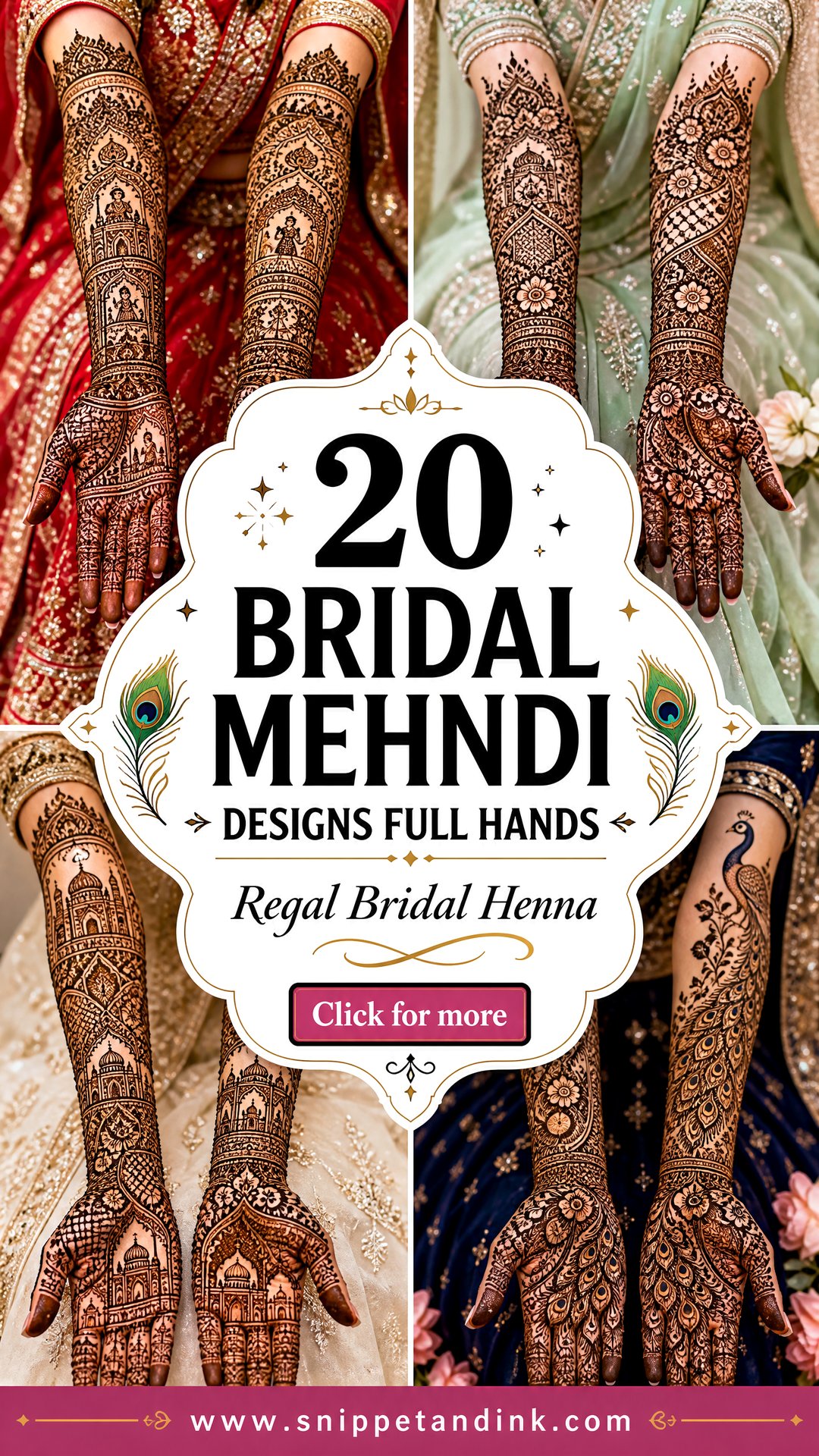
How Long a Full Bridal Hand Takes to Draw and Dry
Brides often book a full-hand design without realising how long they will be sitting. Dense coverage from fingertips to elbow on both hands, palms and backs, takes several hours of drawing, and feet add more on top. Arabic and minimal layouts are quicker. Then the paste has to dry and stay on, ideally for six hours or longer, so the evening you choose is effectively your whole evening.
This is how I plan a bridal session:
- I schedule application one to two days before the wedding, because the stain keeps darkening for about 48 hours and should peak on the day itself, not before.
- Hands go on clean, dry skin. No lotion, oil or fresh waxing that morning; scrub gently the day before instead.
- Eat first and use the bathroom first. Once both hands are covered, you need someone else to feed you.
- Wear a loose, front-opening top with short sleeves you will not mind staining.
- I insist on natural henna only. So-called black henna can contain PPD, a dye that causes serious skin reactions, so ask your artist what is in her cone.
Matching coverage to your sleeves
Before I draw, I ask how long the blouse or kurta sleeves are. There is no point in hours of forearm detail that will vanish under full sleeves, and with three-quarter sleeves I end the design with a deliberate border just below the hem, so the edge looks planned rather than cut off.
1. Indian Bridal Mehndi Full Hands
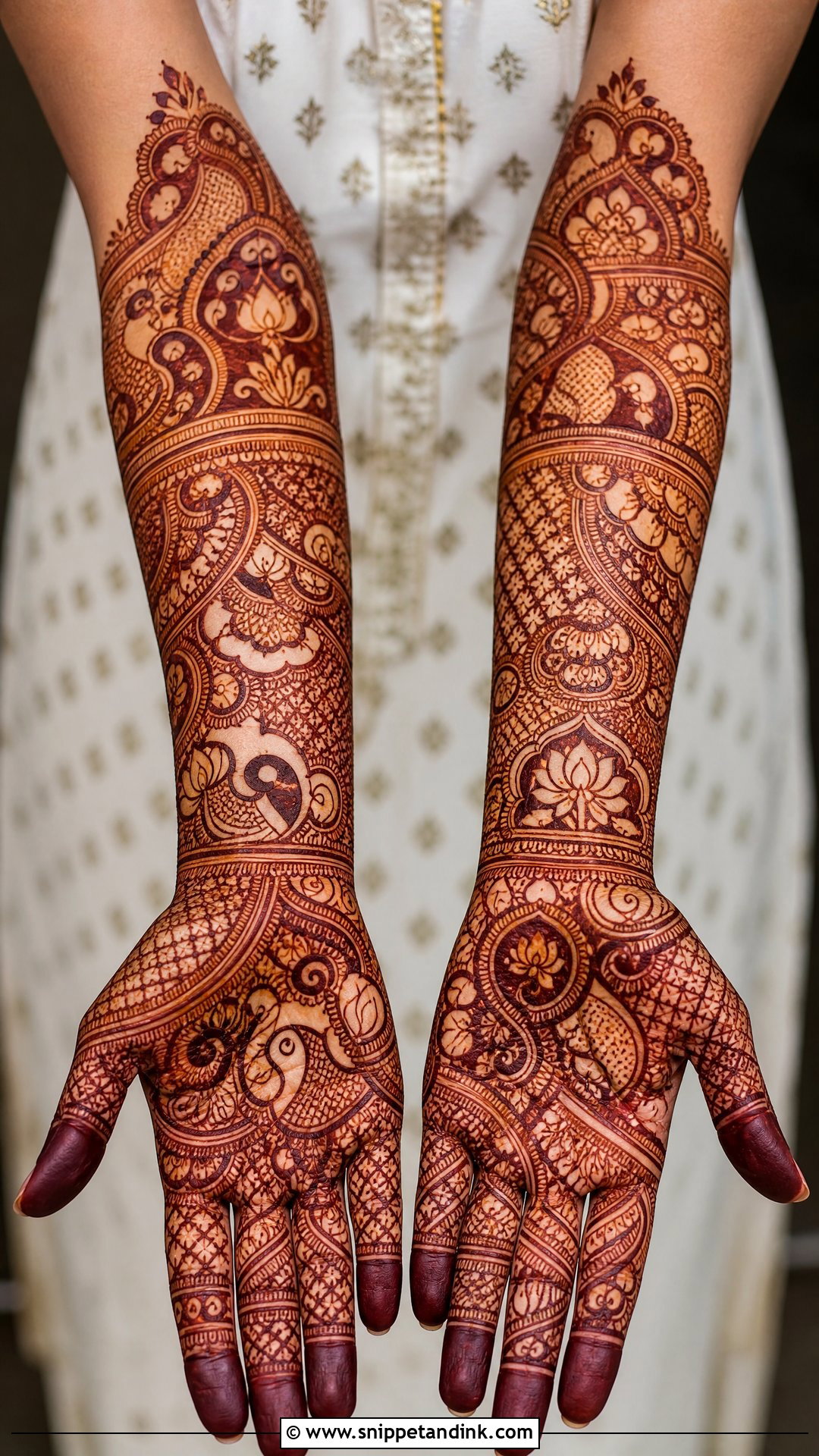
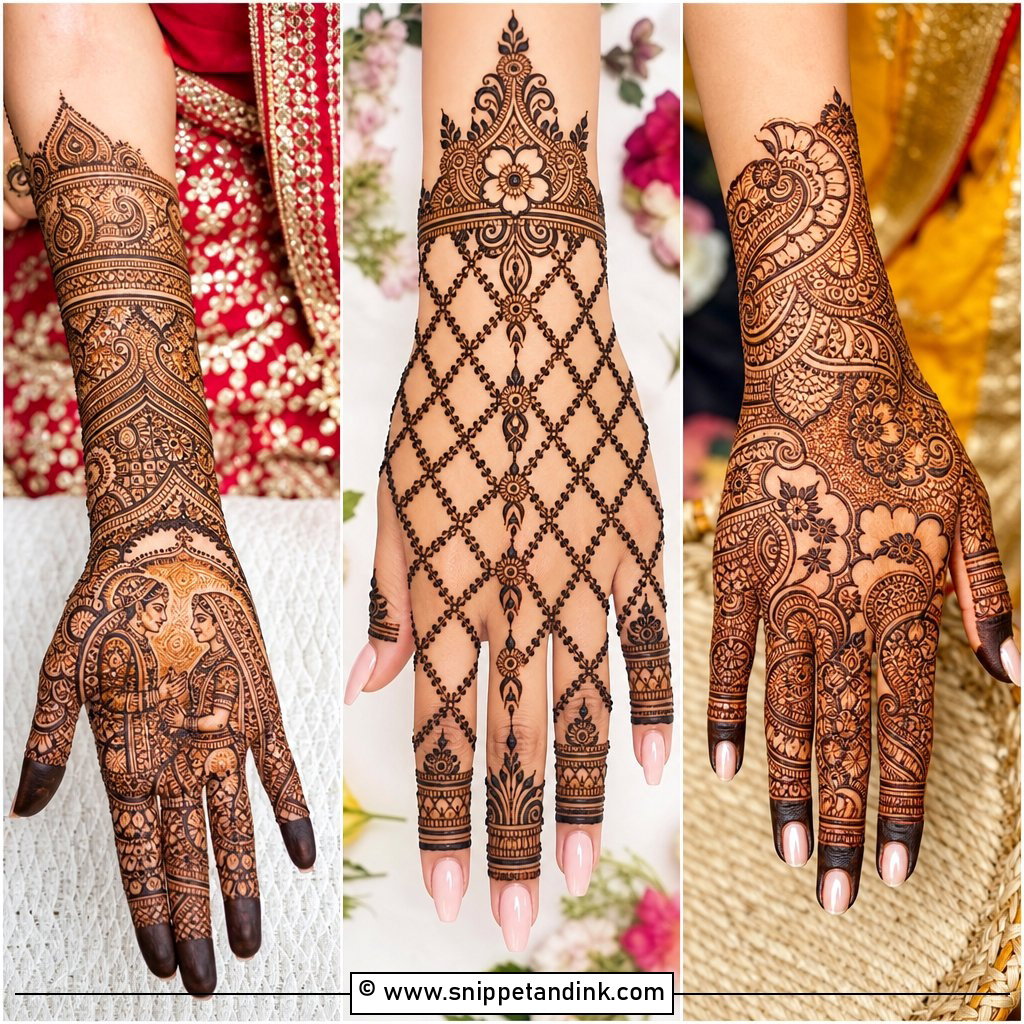
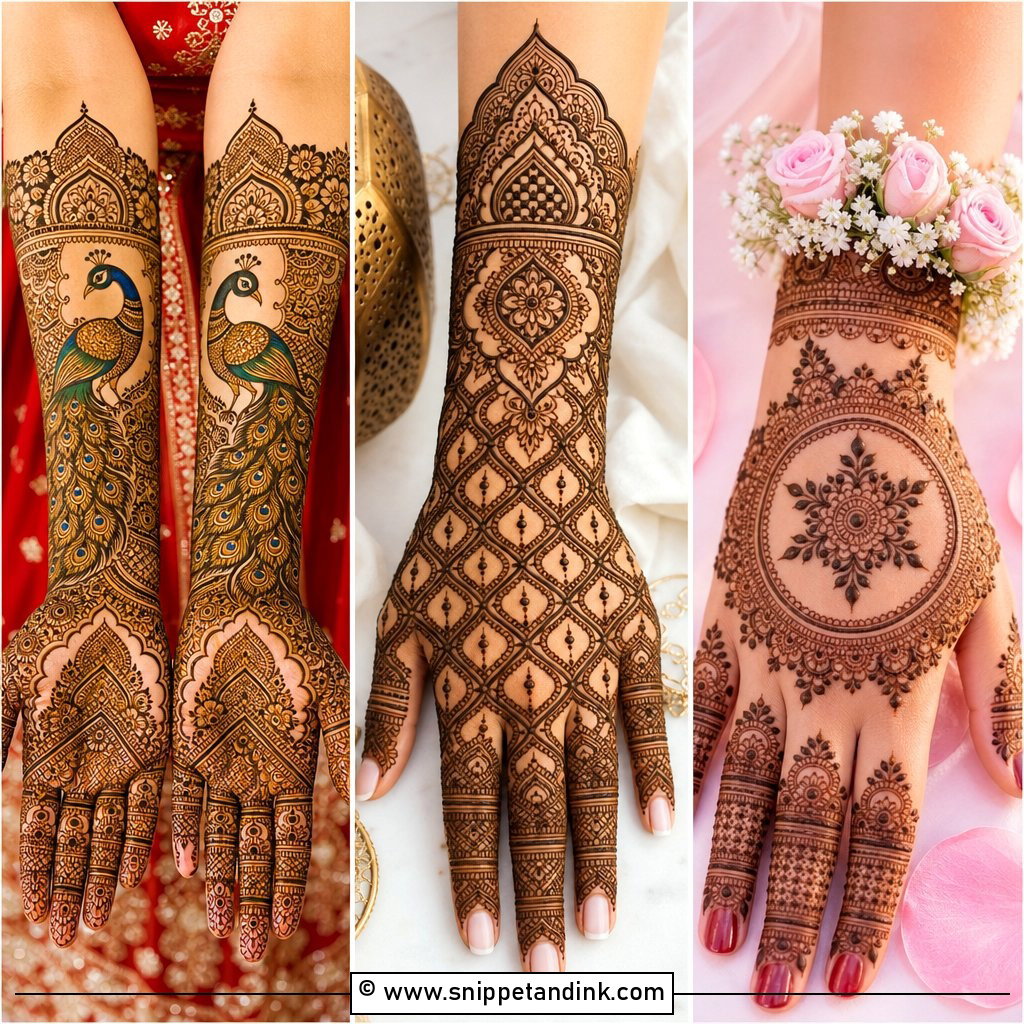
This is the densest traditional layout: palms, fingers, wrists and forearms packed with fine lines, paisleys, lotus shapes, peacocks and tiny fillers. Because there is almost no bare skin, the eye reads the whole hand as one deep colour, which is why it looks so rich in close portraits with heavy bangles. The catch is time. I need a long, unhurried session for this, and the bride has to keep still while the fine filler dries, or the lines smudge into each other. Initials or the wedding date fit easily inside the paisleys if you want something personal tucked in.
2. Arabic Bridal Mehndi Full Hands
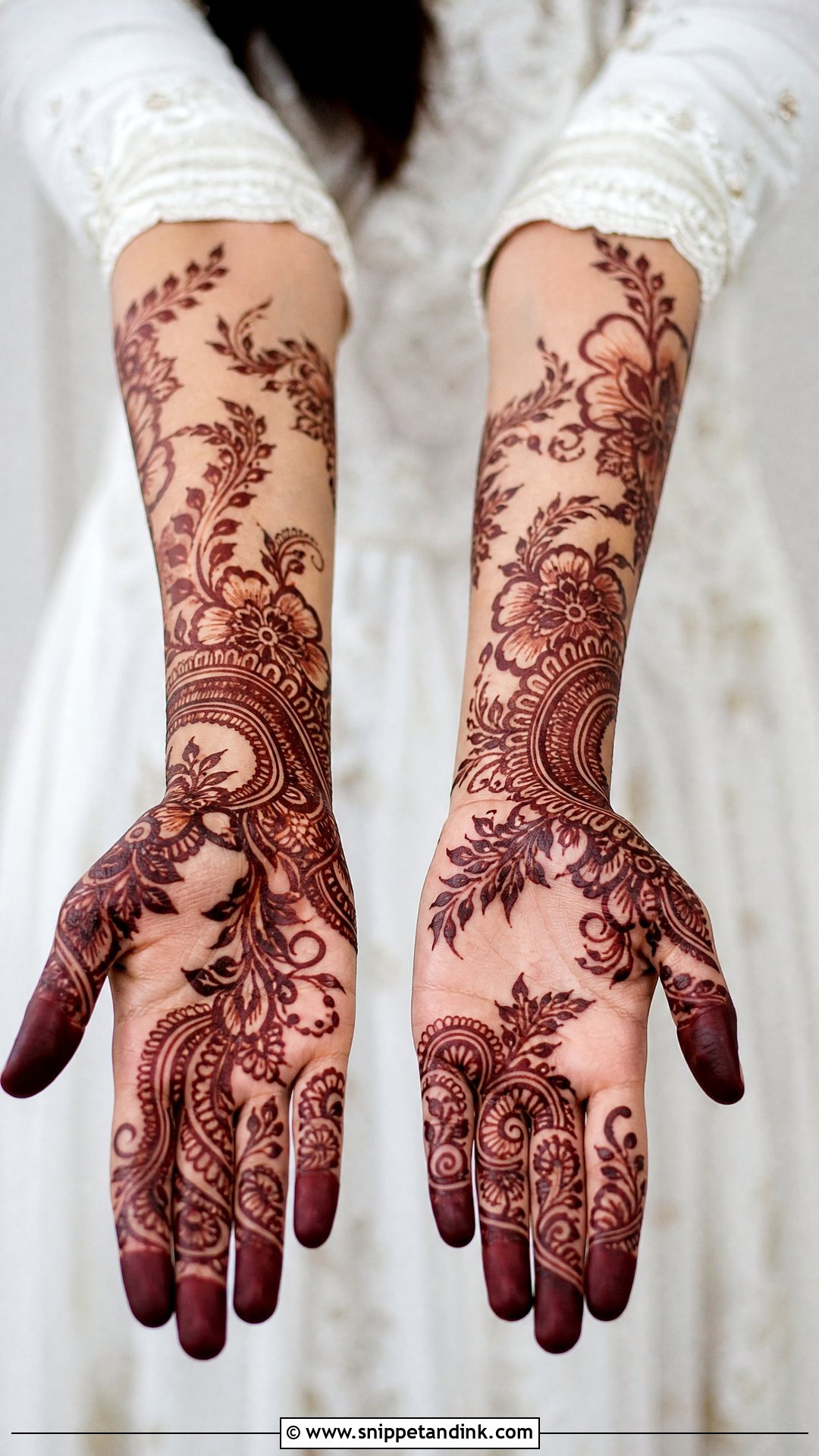
Arabic layouts run a diagonal trail of large flowers and leaves from the fingertips across the palm and around the wrist, with plenty of skin showing between the motifs. I draw these with a slightly thicker cone line, and the bold shapes stay readable even from the back of a room. Application is far quicker than dense Indian work, so I often suggest it to brides who get restless or have a packed mehndi night. It sits well with pastel lehengas and lighter jewellery, where a packed hand would fight the outfit.
3. Indo Arabic Bridal Mehndi Full Hands
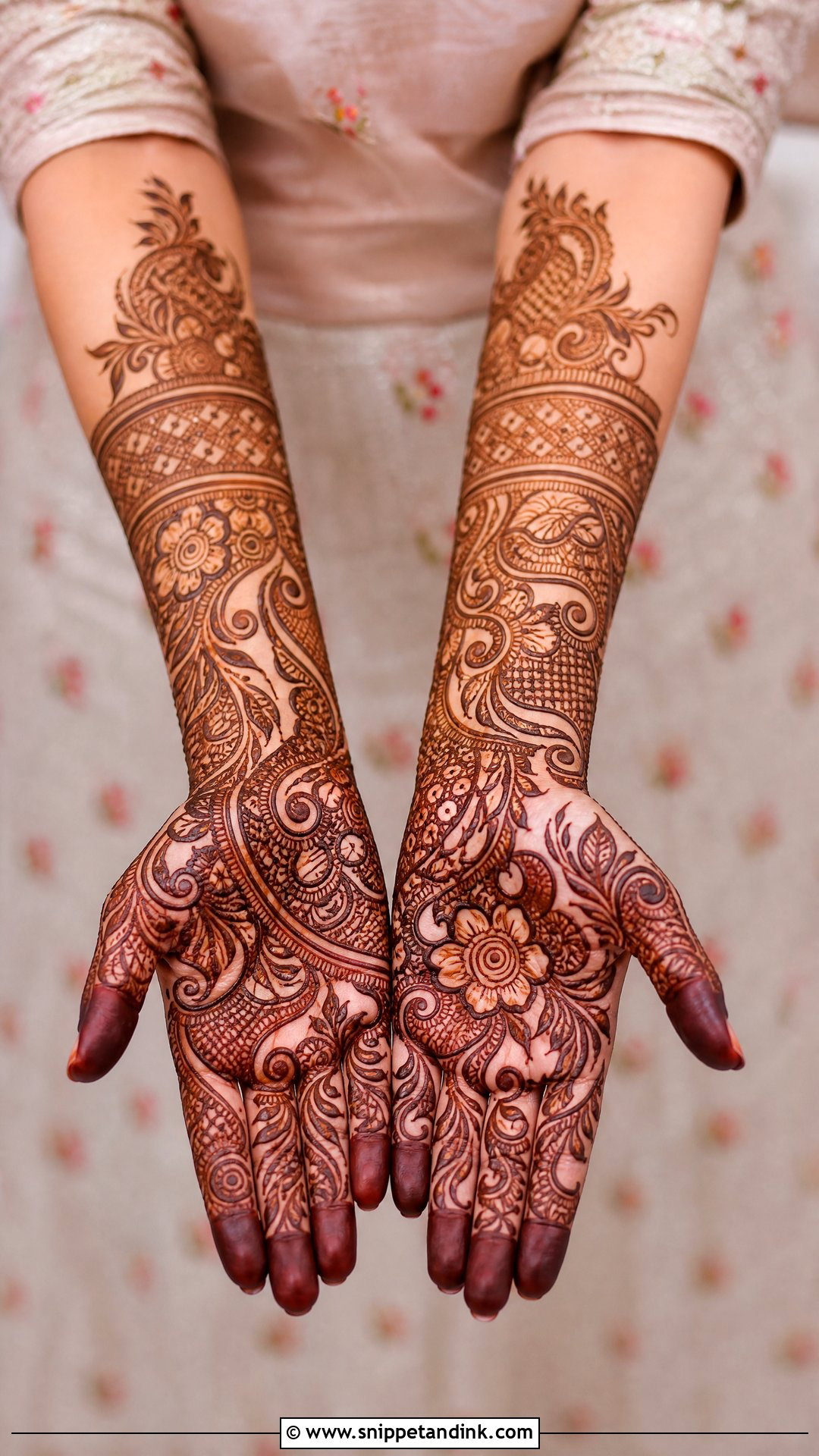
Indo-Arabic keeps the big flowers and open spaces of Arabic work, then fills the larger shapes with Indian detail: lined paisleys, jaali borders, neatly covered fingertips. My advice is to agree on the direction of the main floral trail first, because if it flows the same way on palm and back hand from fingers to forearm, the whole design looks deliberate. You get the richness of traditional detail without the hours a fully packed hand demands, which makes it a sensible middle ground for a lot of brides.
4. Rajasthani Bridal Mehndi Full Hands
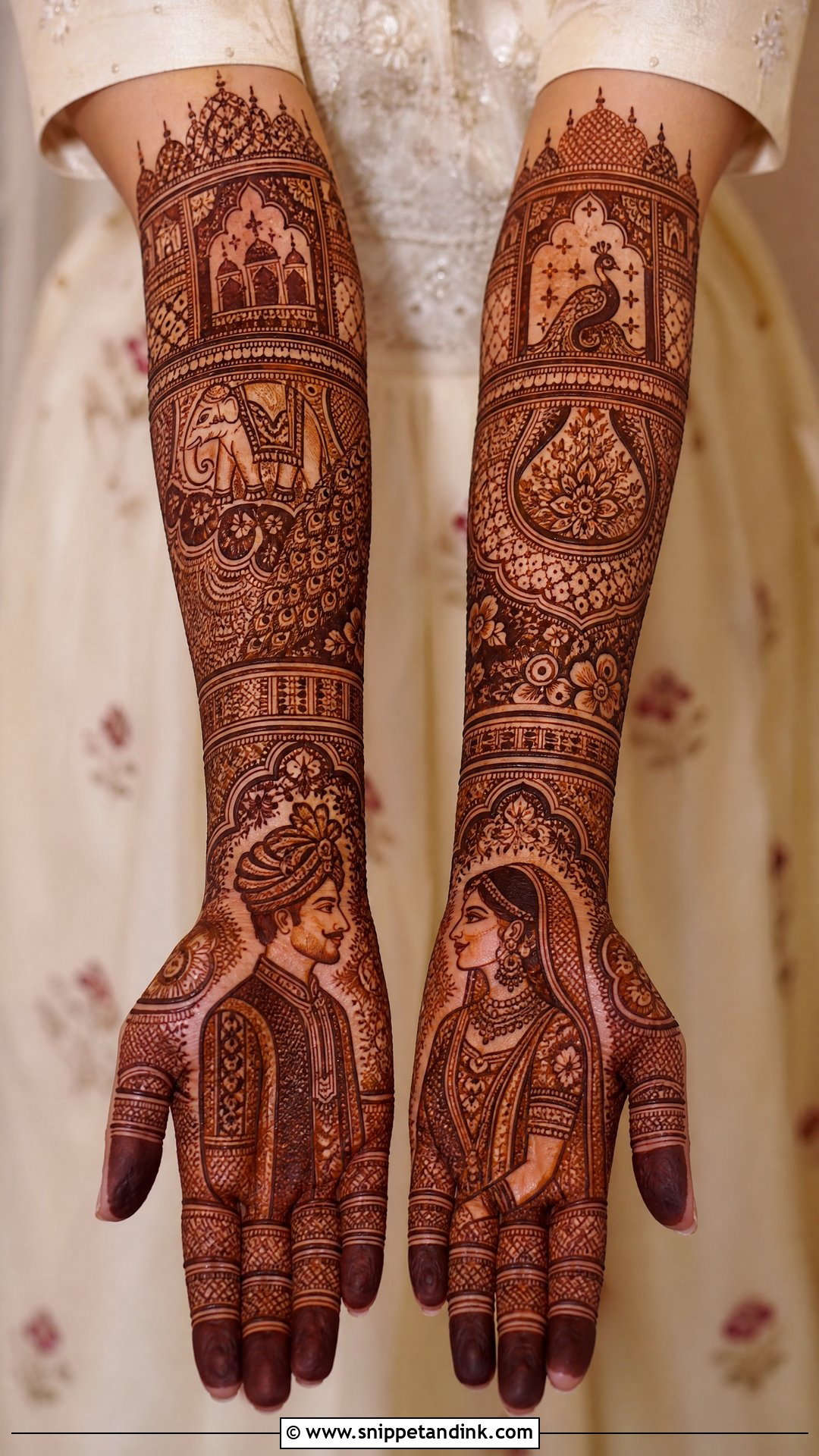
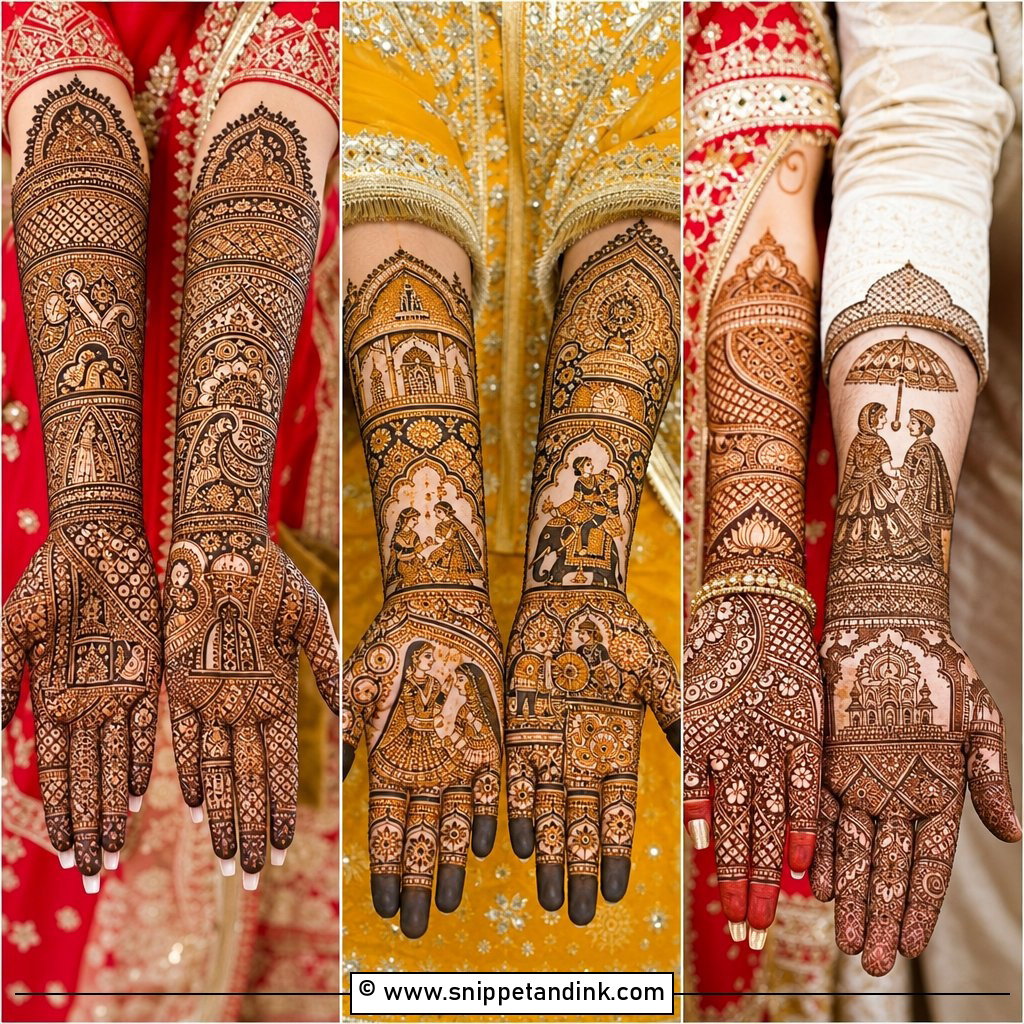
Rajasthani work tells a story: bride and groom figures, royal arches, elephants, dhol players, kalash and palace details, usually in a dense, symmetrical layout that runs well past the wrist. Not every artist is comfortable with figures, so I’d ask to see faces they have drawn before booking. Tiny elements like eyes and jewellery need a very fine cone tip and paste without lumps, otherwise they blur as the paste dries. Plan for a long sitting and a rich, heavily embroidered outfit; this style can overpower a minimal one.
5. Marwari Bridal Mehndi Full Hands
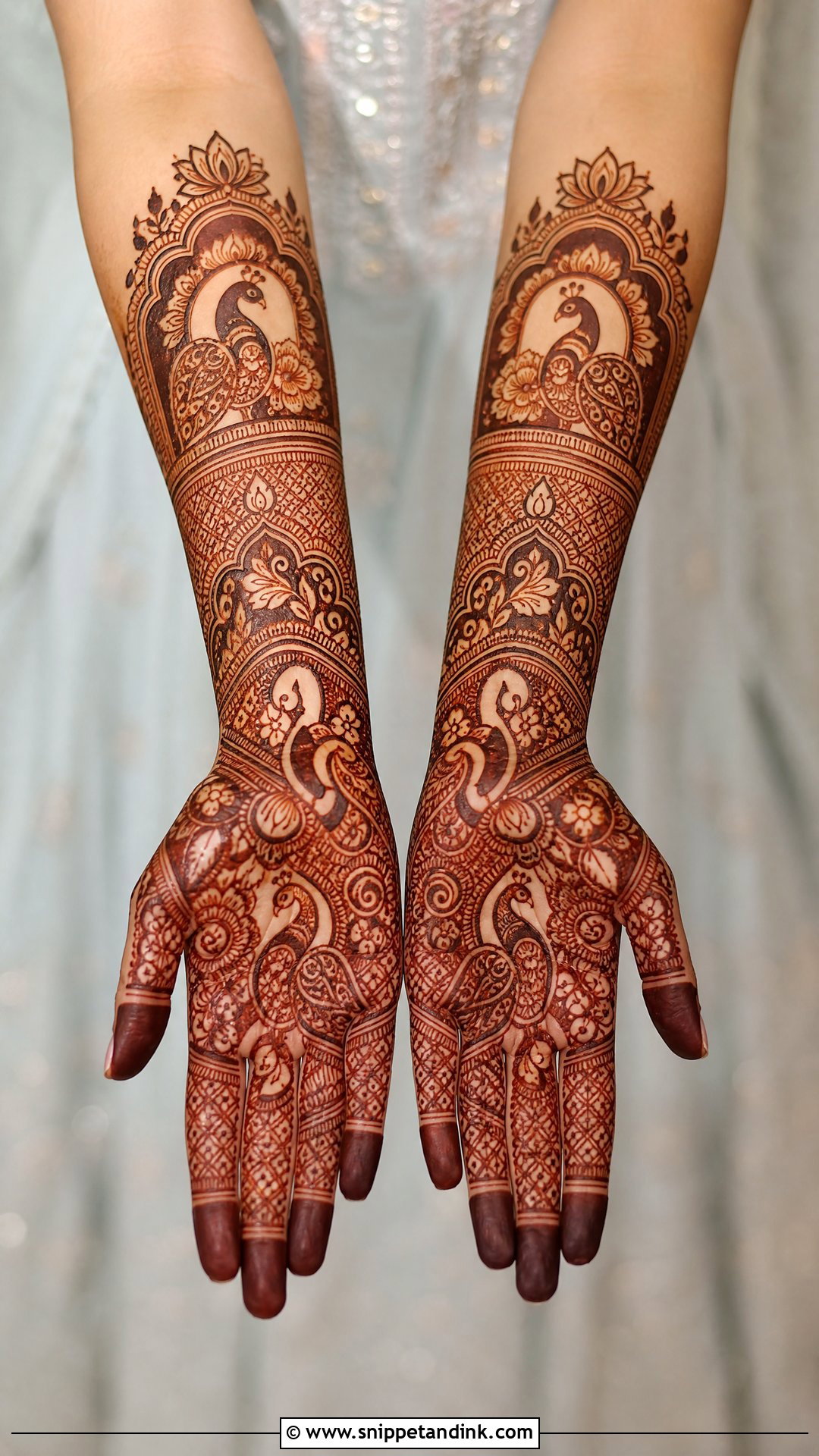
Marwari designs lean on mirror symmetry, fine paisleys, peacocks, lotus flowers, small bridal portraits and ornate wrist cuffs, with the palms carrying the main scene and the fingers and forearms filled with repeating detail. Red, maroon, orange and bandhani or leheriya outfits suit it best because the deep maroon stain sits naturally against warm colours. When I tuck a groom’s name into a Marwari hand, I hide it inside the cuff pattern rather than the palm centre, since the palm is where everyone looks first.
6. Pakistani Bridal Mehndi Full Hands
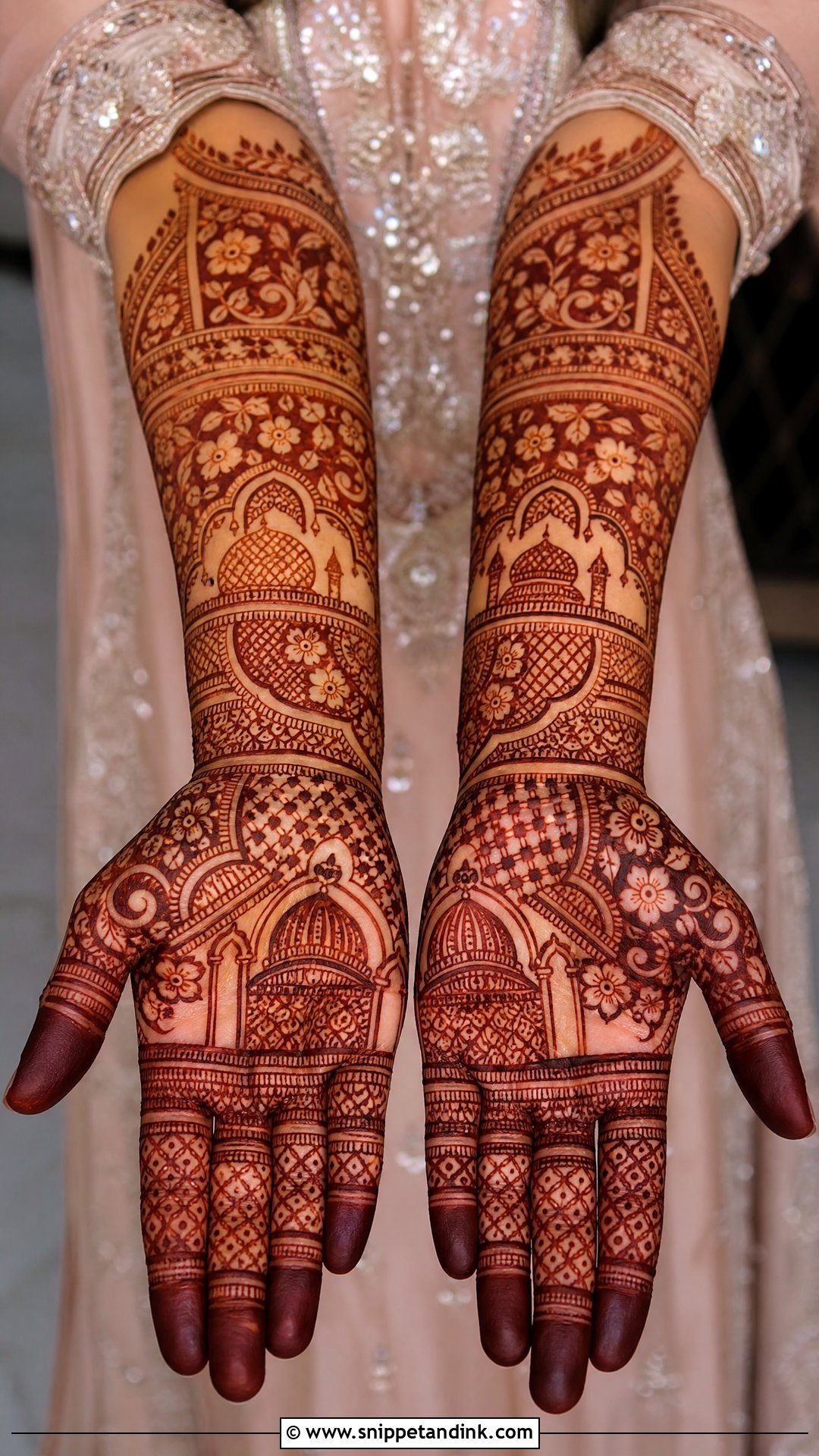
Pakistani bridal patterns tend to be structured: floral vines, domes, jaali panels, paisley clusters, leafy borders and fully filled fingertips, with strong bands running from wrist to forearm. Many use shaded petals and bold outlines. Shading is done by thinning the paste stroke, and it stains lighter than solid fill, so the contrast between outline and shading is what gives depth once the colour darkens. Full coverage here reads ordered rather than busy, and it pairs naturally with ghararas, shararas and heavily embroidered lehengas.
7. Mughlai Bridal Mehndi Full Hands
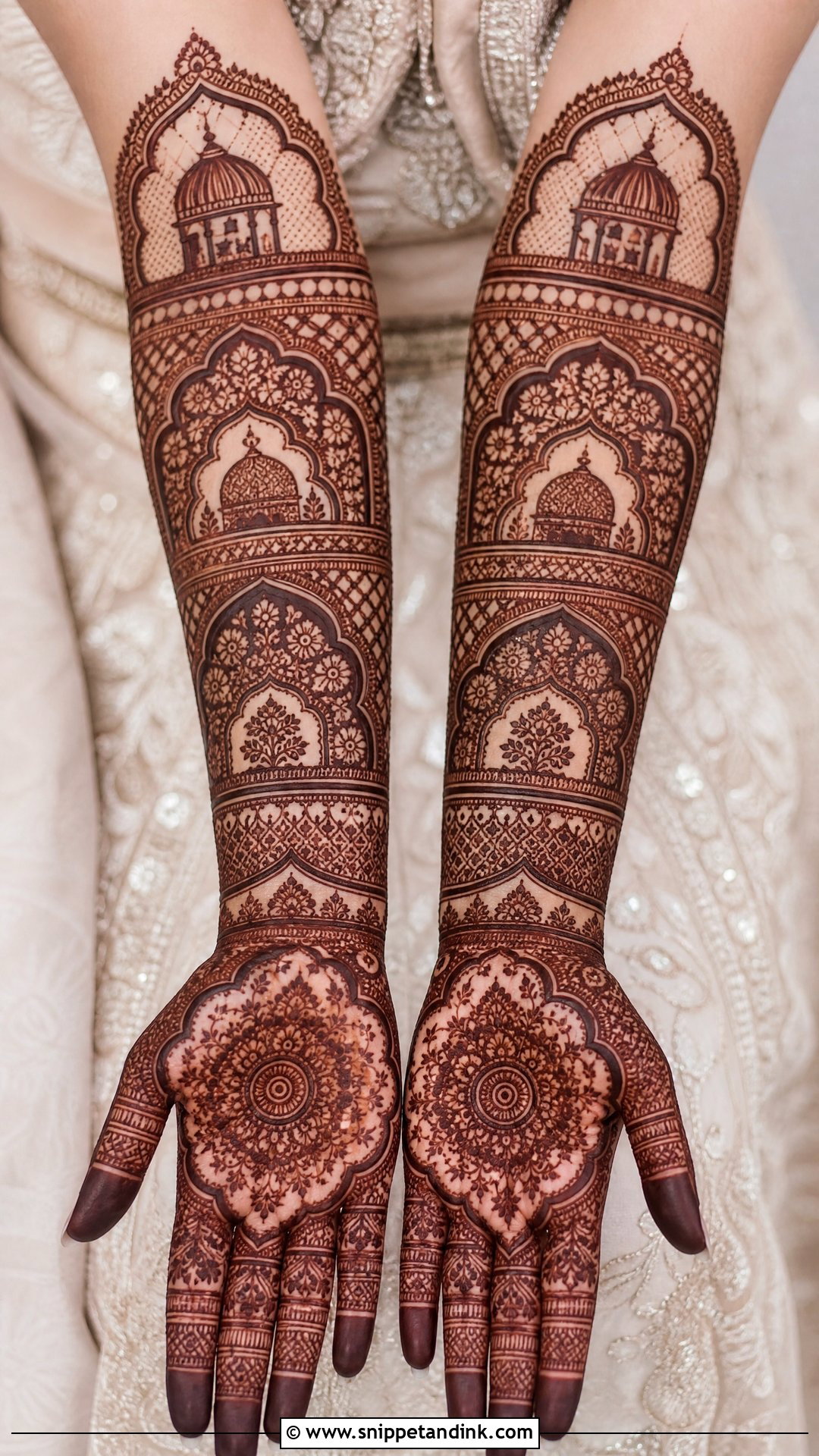
Mughlai designs borrow from architecture, so the hand looks almost carved: arches, domes, centred mandalas on the palm, layered borders and jaali on the wrists and forearms. Precision matters more than density here. If one arch leans or a border wobbles, the symmetry breaks and you notice it in every photo, so I map the main frames with a few dots before committing to lines. Velvet, zari work and kundan jewellery suit this style, and so do brides who prefer a mature, quieter look.
8. Peacock Bridal Mehndi Full Hands
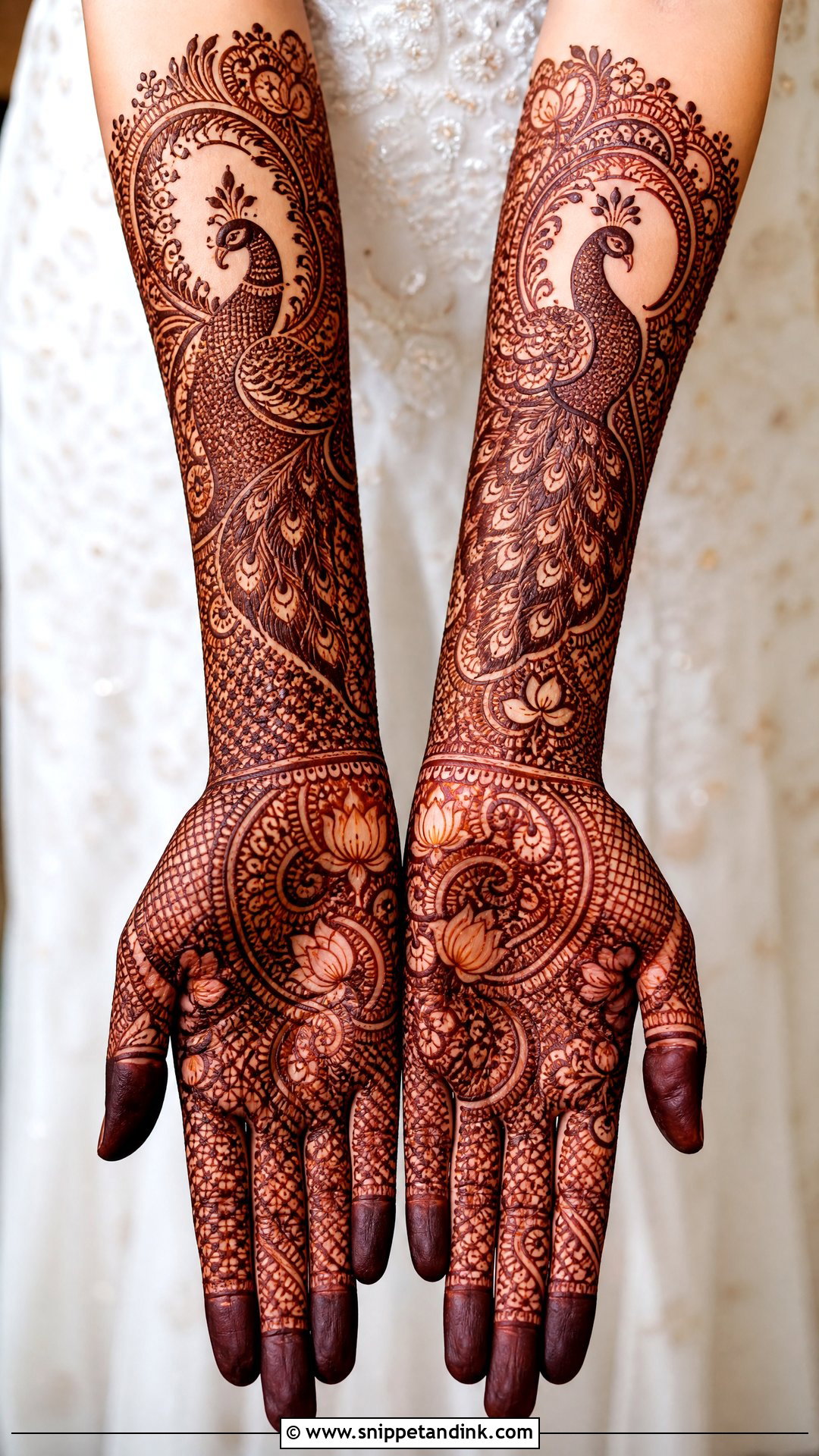
Peacock bridal mehndi full hands stay popular because the bird’s curve follows the shape of the hand so naturally. I place the peacock on the palm, along the forearm or as a mirrored pair across both hands, then build feathers, paisleys, lotus and leaf trails around it. Feather eyes need care: if the paste is too wet they flood into blobs. A single strong bird gives the photographer an obvious focal point, and it sits comfortably within Indian, Rajasthani and Indo-Arabic layouts.
9. Lotus Bridal Mehndi Full Hands
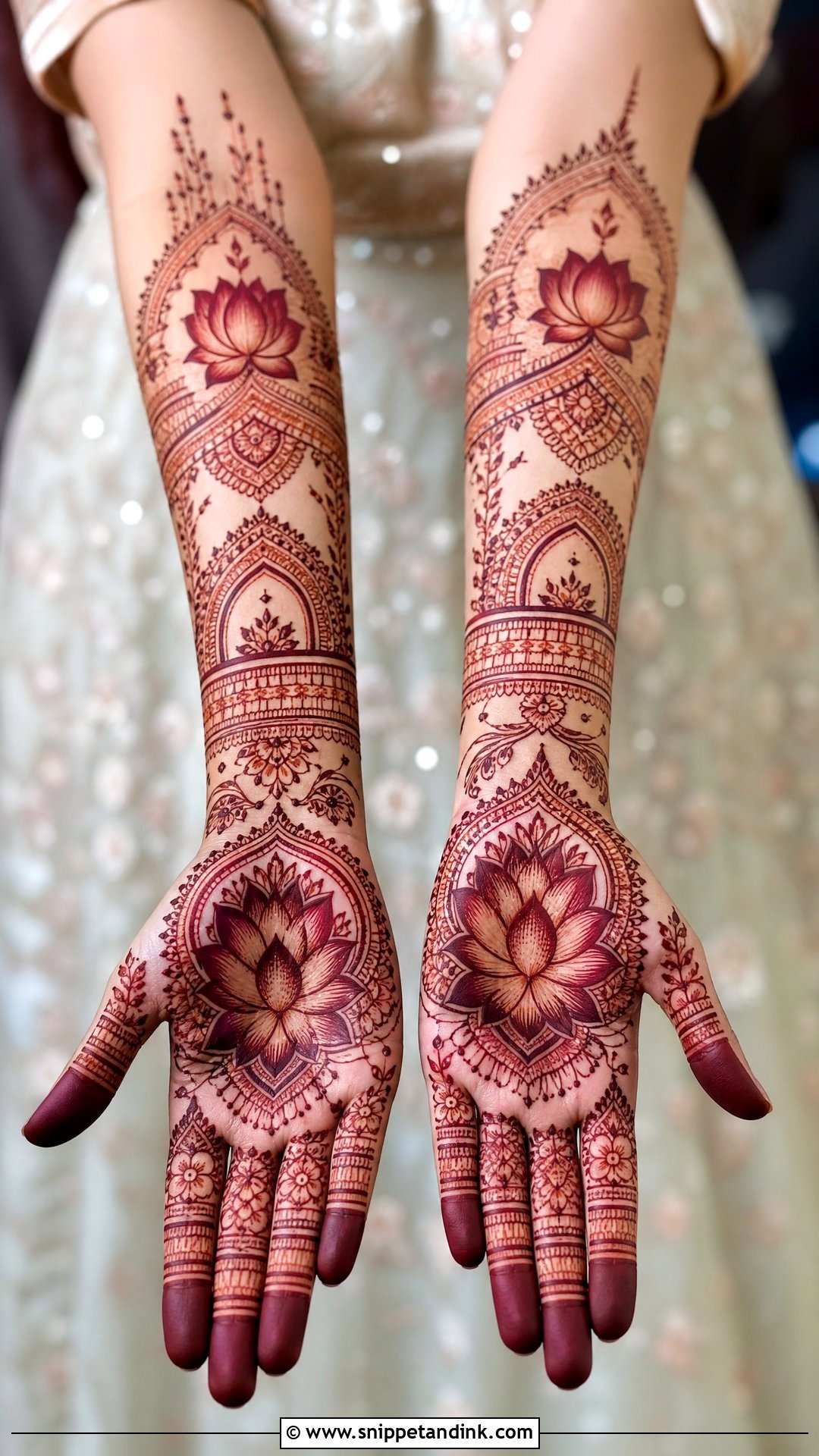
Lotus petals give a design natural structure, so a lotus layout stays clean even when it is detailed. I usually anchor one large lotus in the palm and repeat smaller ones along the forearm or inside the wrist bands, with mandala rings, dots, leaf trails and a little jaali for depth. Dark, fully filled fingertips with crisp, unfilled petals is the combination that photographs most clearly. It suits brides wearing pastels or temple jewellery who want something feminine but not heavy.
10. Mandala Bridal Mehndi Full Hands
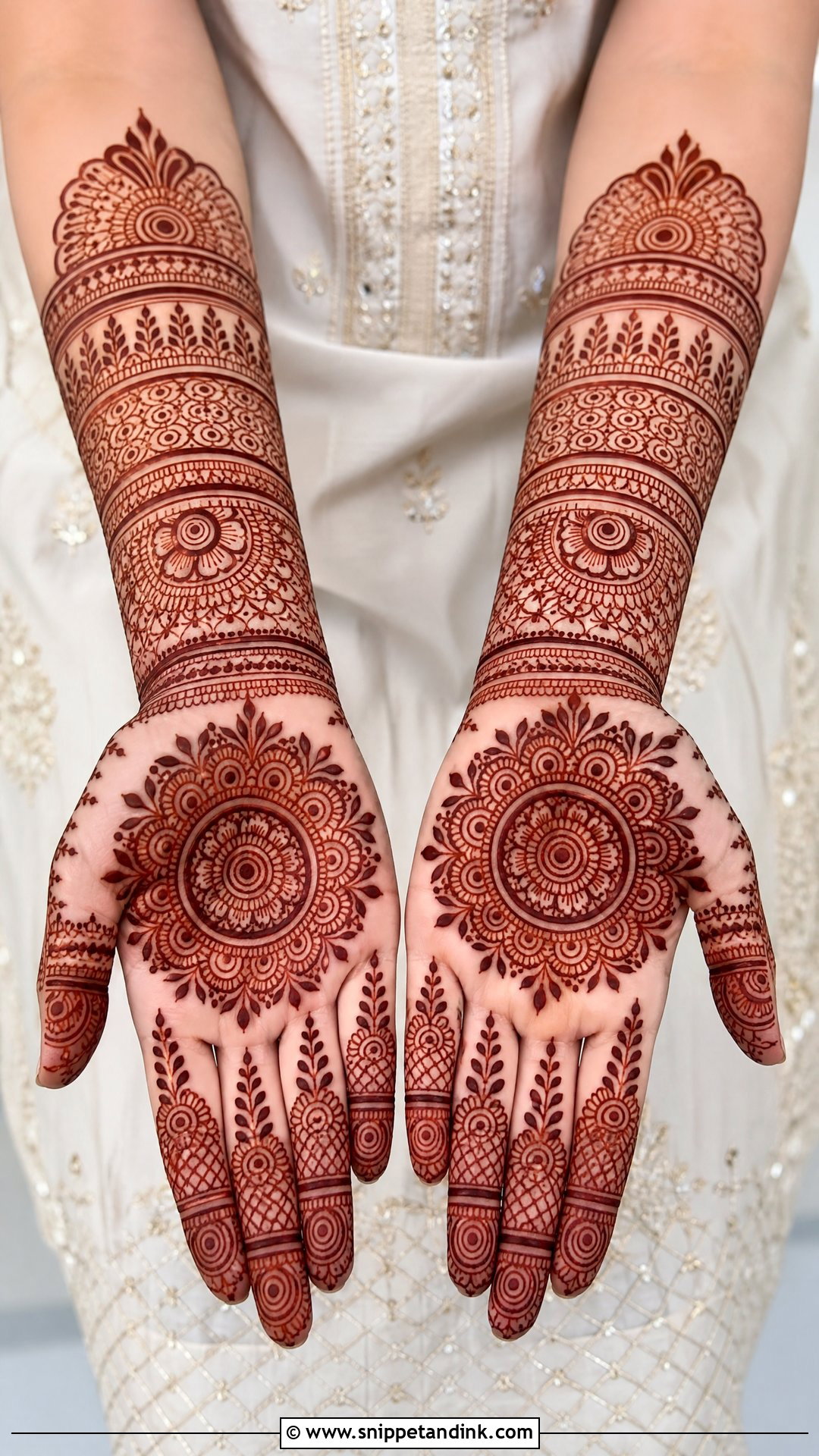
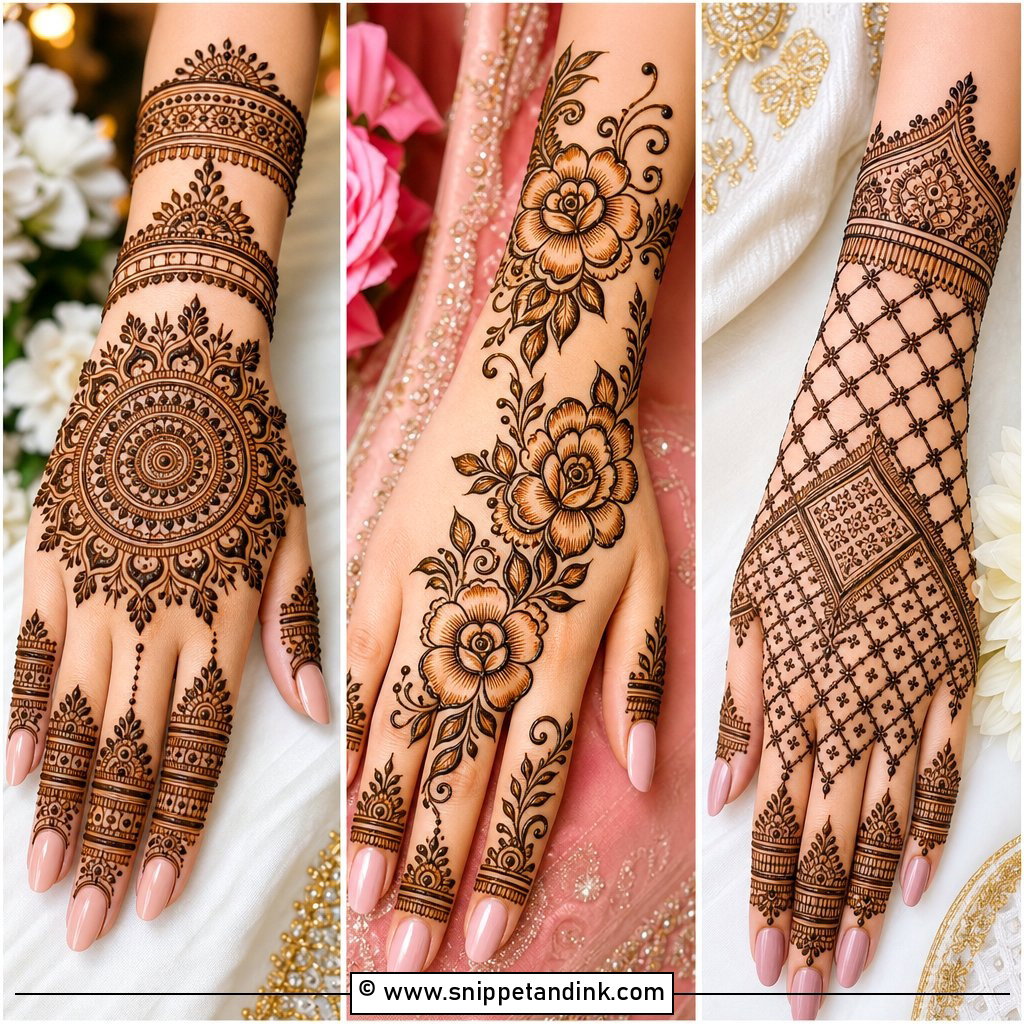
Mandalas are the easiest style for guests to read in photos: one centred circle on the palm or back hand that grows outward in rings of petals, dots and fine borders. Fingers get leafy lines, checks or shaded tips, and matching bands carry the pattern up the arm. The thing I watch is centring. A palm is not flat, and a mandala placed slightly too close to the thumb looks lopsided once the hand relaxes, so I have the bride hold her hand in a natural cupped position while I mark the centre. The style scales well from simple to intricate.
11. Jaali Bridal Mehndi Full Hands
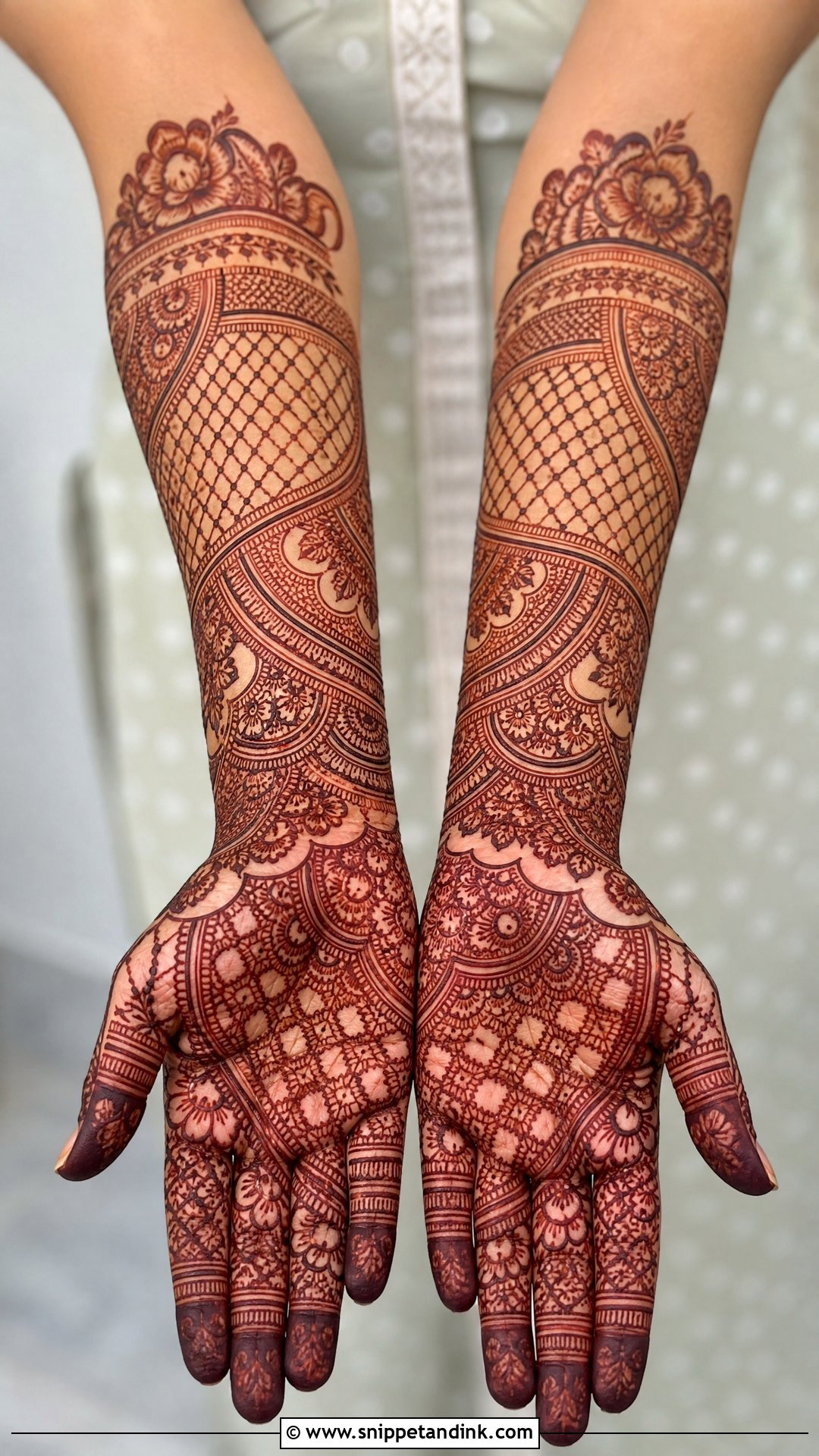
Jaali is fine mesh, and it can cover the back of the hand, sections of the palm, wrist cuffs or forearm panels. On its own it can look flat, so I frame it with flowers, paisleys or a bold border. The lace effect really comes alive under bangles, rings and hand chains, almost like a second piece of jewellery. The skill is in varying the mesh size; uniform grids over large areas look machine-made. Mesh lines are thin, and thin lines stain lighter, so I’d only put jaali on areas that stain well, such as the hand rather than the upper forearm.
12. Floral Bridal Mehndi Full Hands
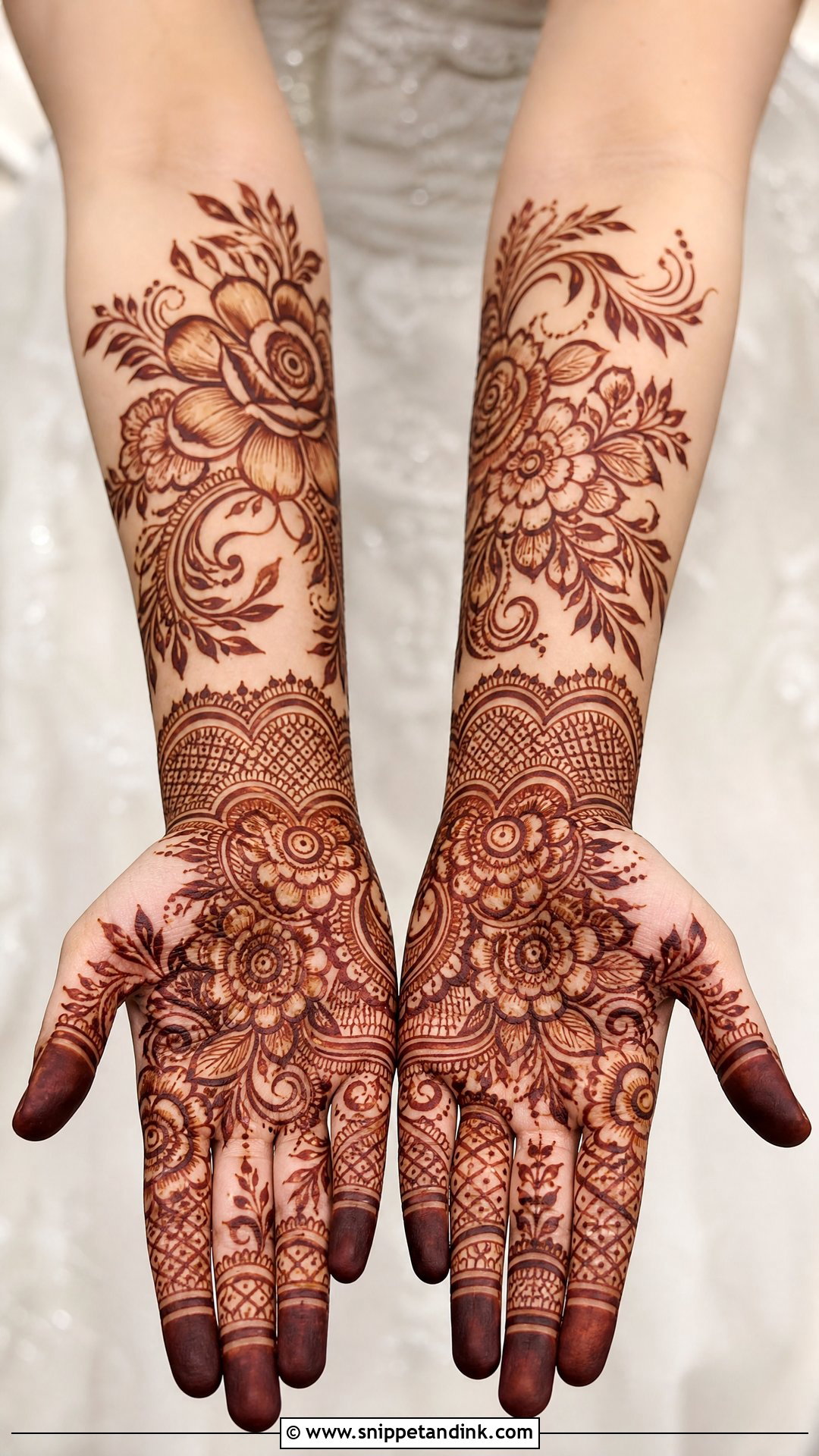
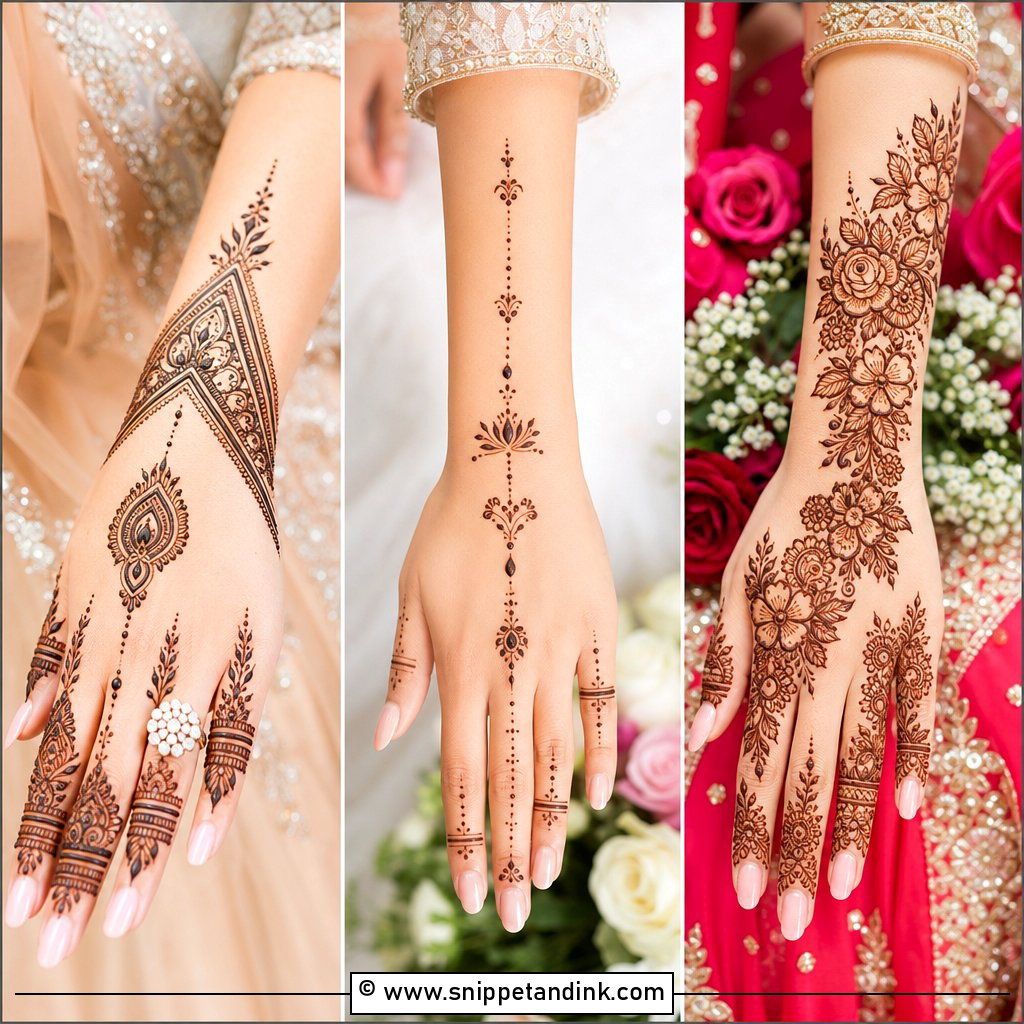
Floral layouts are the most adaptable style I draw. Roses, lotus petals, small blossoms, leafy vines and shaded clusters can be packed tightly for a traditional bride or spaced out for a modern one. A typical full hand starts with filled fingertips, carries large flowers across the palm, and finishes with trails or bands on the wrist and forearm. Outlines keep it clean and shading on the petals adds depth, so ask your artist to show you both on a practice sheet before the day. It suits daytime ceremonies and pastel outfits especially well.
13. Paisley Bridal Mehndi Full Hands
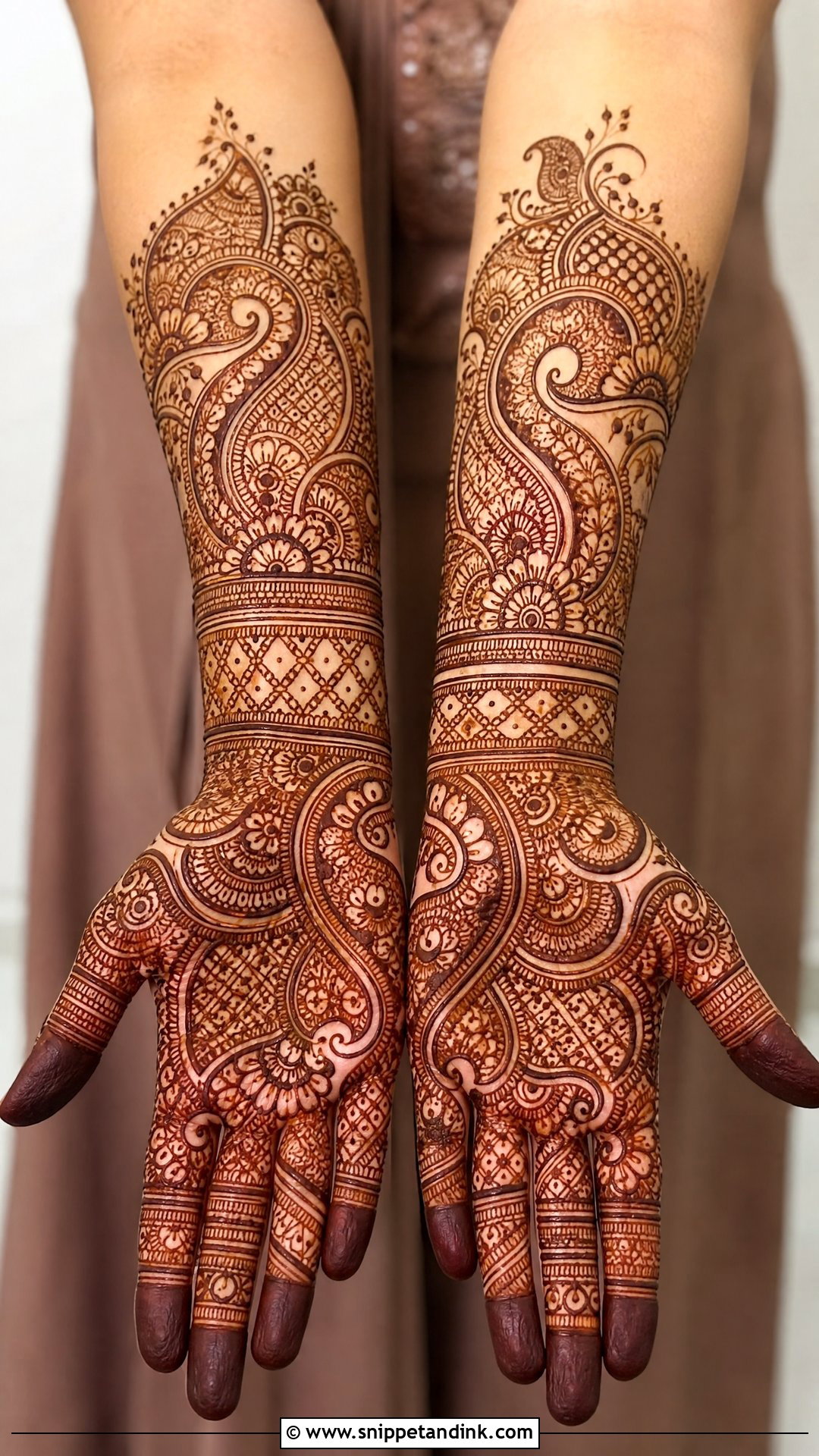
Paisleys follow the curve of the palm and forearm better than almost any other motif, which is why they have stayed in bridal work for so long. I usually draw a few large paisleys as the main shapes and fill them with flowers, dots, lines, checks and tiny leaves, then surround them with jaali, mandalas or traditional borders. Ask for the paisleys to point the same way on both hands; mismatched flow is the most common thing brides notice afterwards. It works with almost any outfit and jewellery, and it never relies on figures or storytelling.
14. Portrait Bridal Mehndi Full Hands
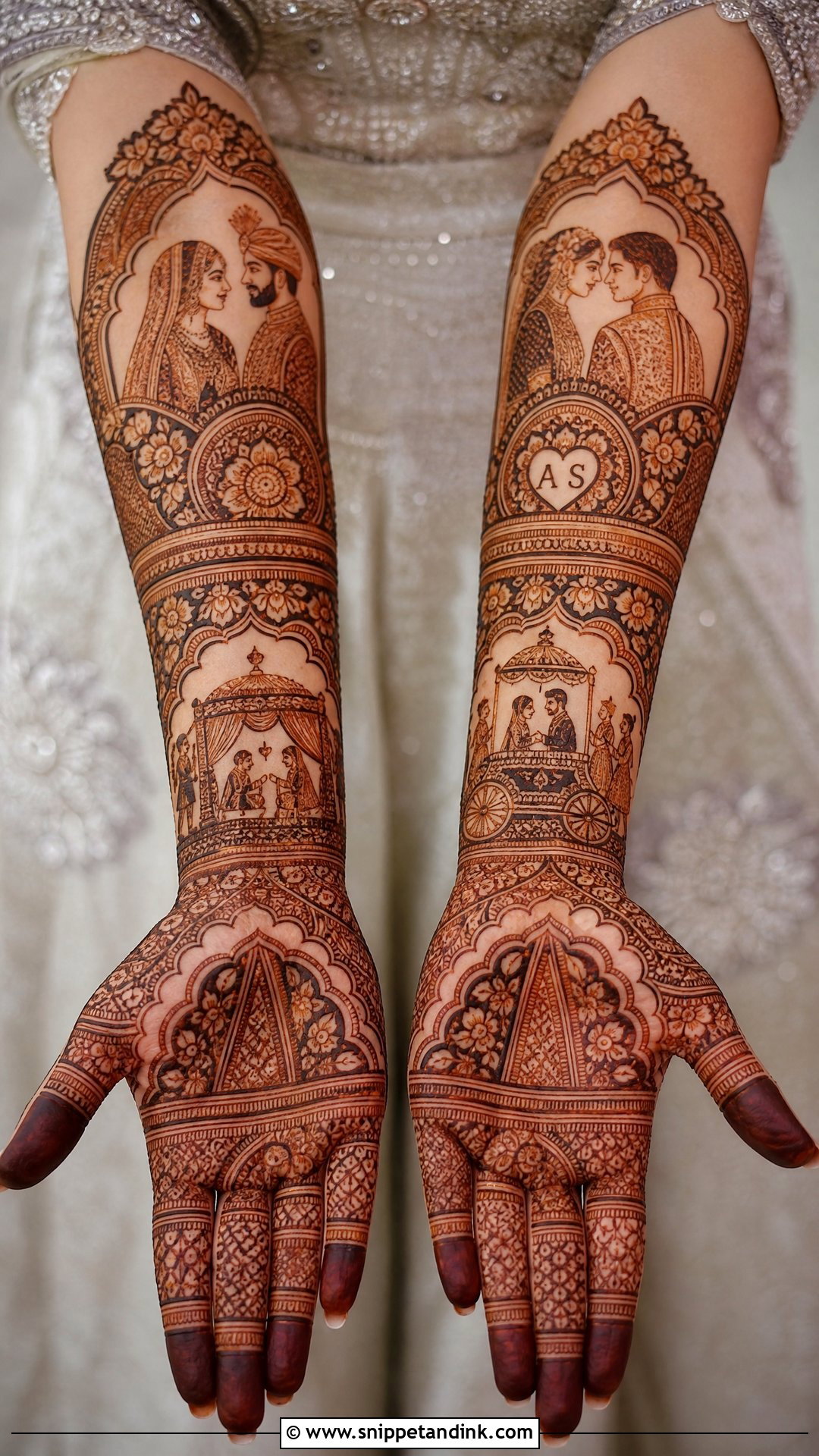
Portrait mehndi puts small bride and groom faces, varmala scenes, doli details or couple silhouettes onto the palms or forearms, framed with paisleys, florals and fine filler. Faces are the hardest thing I draw in henna. Paste spreads slightly as it settles, so features have to be drawn smaller and cleaner than you would think. Bring reference images, agree on the scene in advance, and book extra time. Done well, it becomes the close-up everyone asks for, especially with initials or the date added.
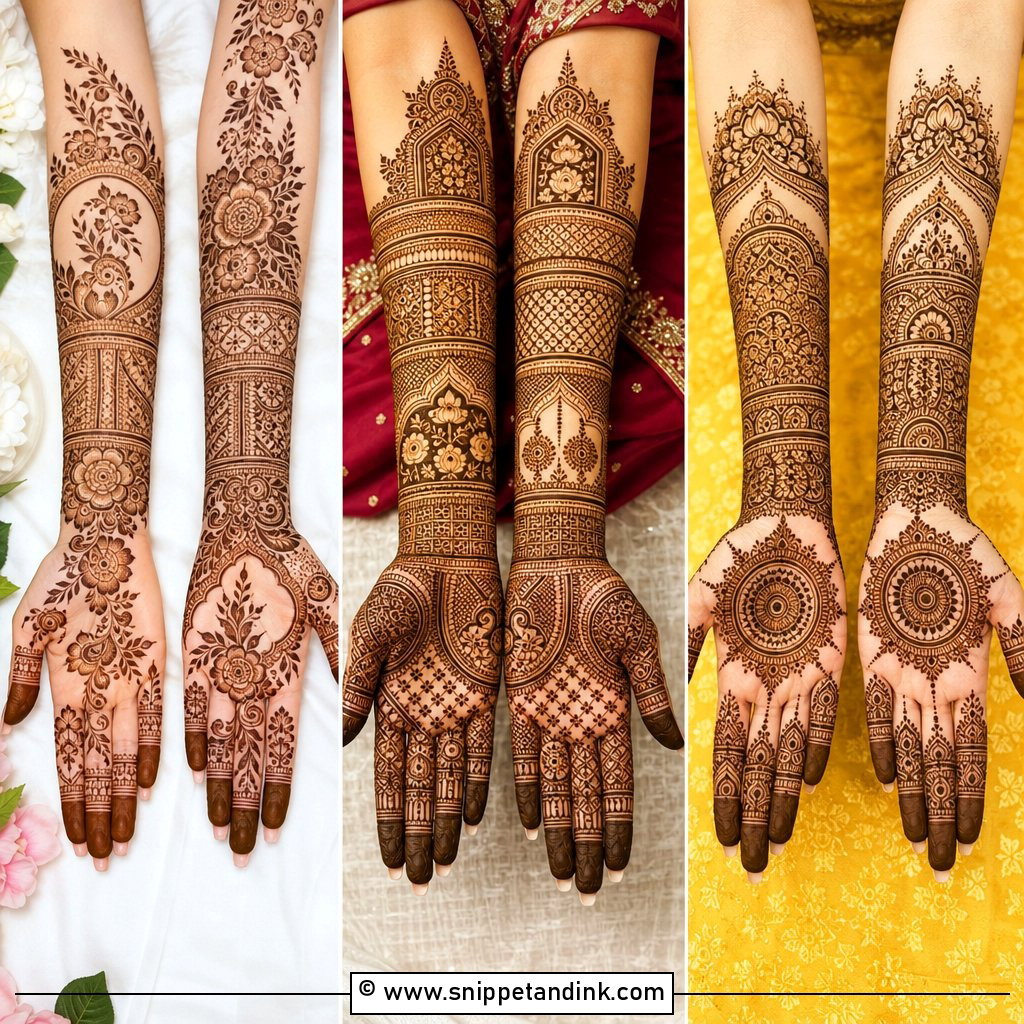

15. Minimal Bridal Mehndi Full Hands
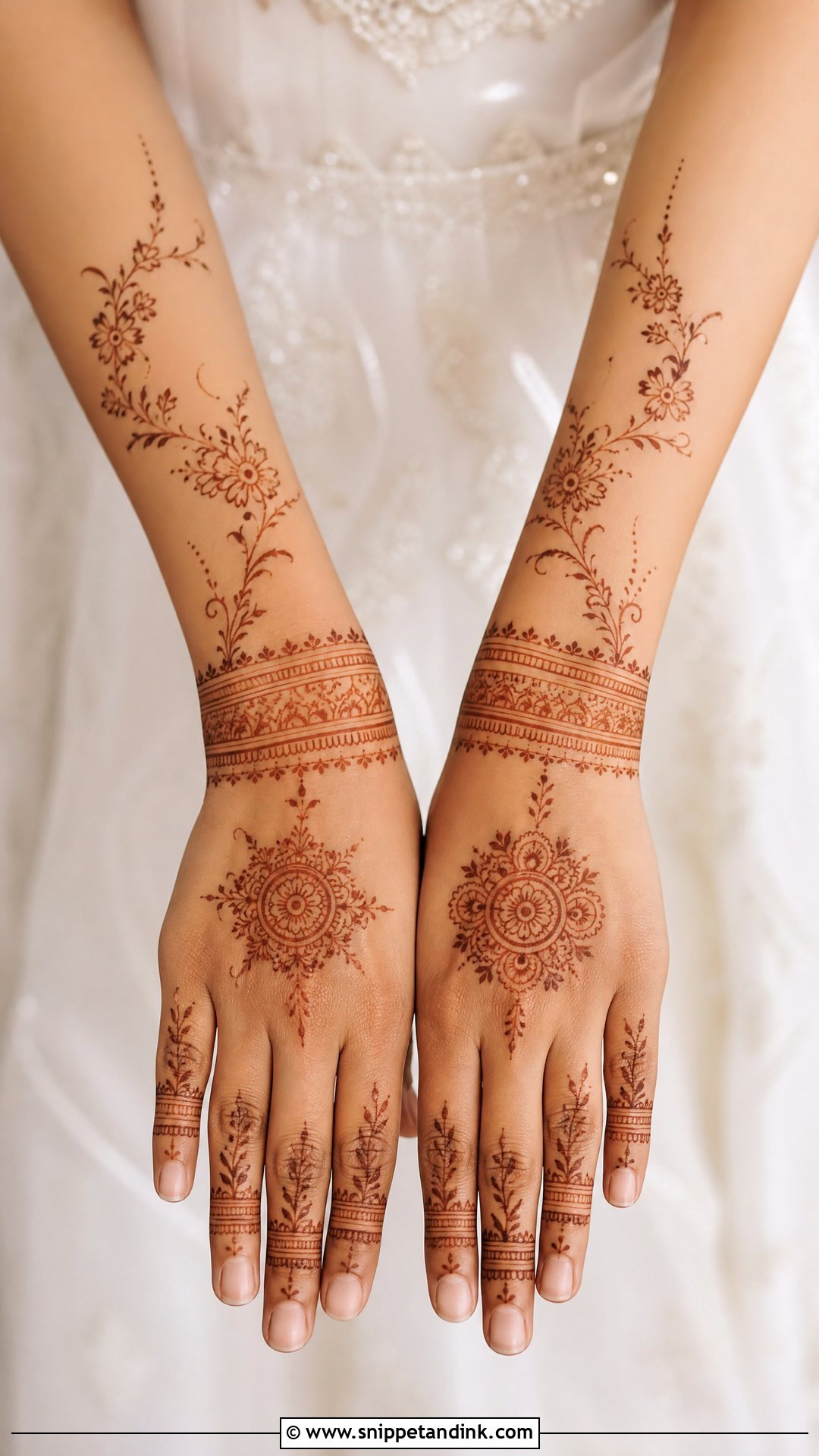
Minimal full hands still run from fingers to forearms, just with open spacing: clean florals, thin vines, a simple mandala and neat wrist bands. The empty skin is part of the design, so every line has to be crisp and placed with intent, because there is no dense filler to hide a shaky stroke. I suggest it to brides wearing organza, pearls and soft makeup, and to anyone who finds a packed hand too heavy. It is also kinder on a tight schedule.
16. Modern Bridal Mehndi Full Hands
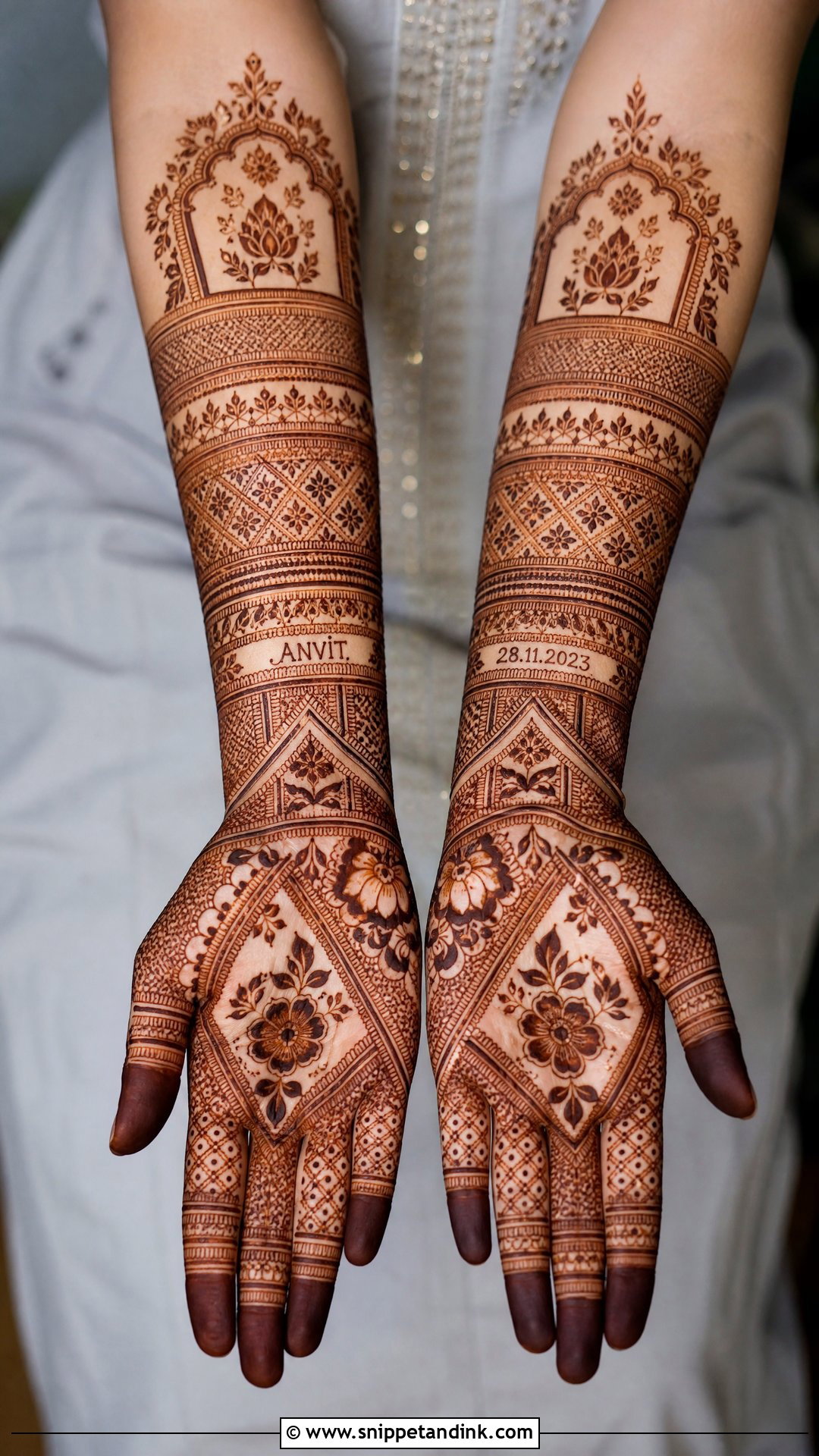
Modern layouts mix traditional motifs with geometric panels, spaced florals, negative space, sleek cuffs and bold fingertips. They can be symmetrical or deliberately uneven, which I like for fusion outfits. Small hidden details such as names, dates or a symbol that matters to the couple fit neatly into the clean panels. Coverage is full without feeling crowded, and the sharp edges hold up well in close-up photos at destination weddings.
17. Moroccan Bridal Mehndi Full Hands
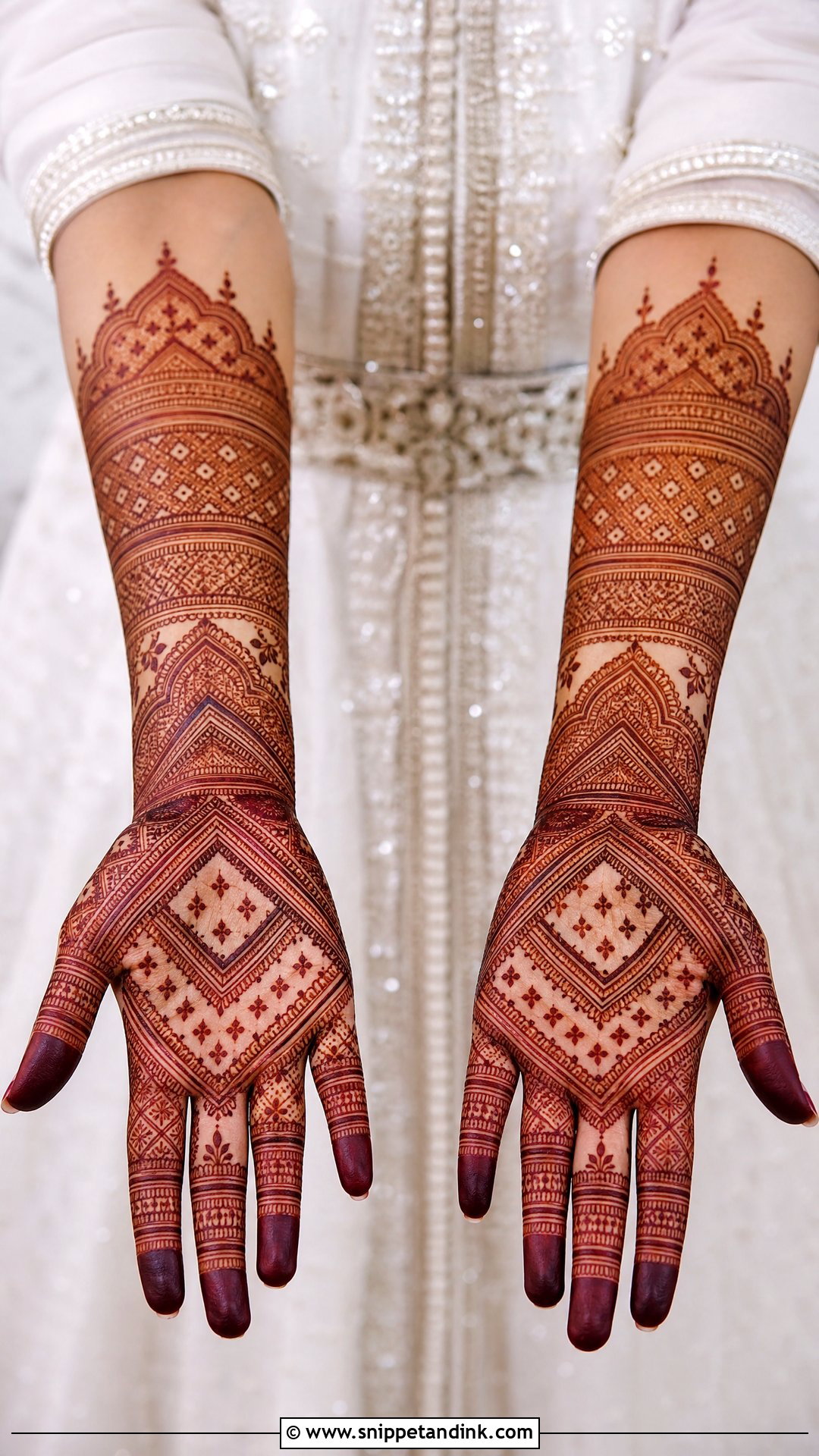
Moroccan work swaps soft florals for diamonds, grids, dots, chevrons and structured bands. On its own it can look more graphic than bridal, so I soften it with a few small flowers or leaf accents. Expect strong finger detail, patterned palms and cuff-like forearm sections. Straight lines are less forgiving than curves, because any wobble shows, so check that your artist’s geometric samples are genuinely straight. It suits brides who want clean shapes and high contrast with fusion jewellery.
18. Gulf Bridal Mehndi Full Hands
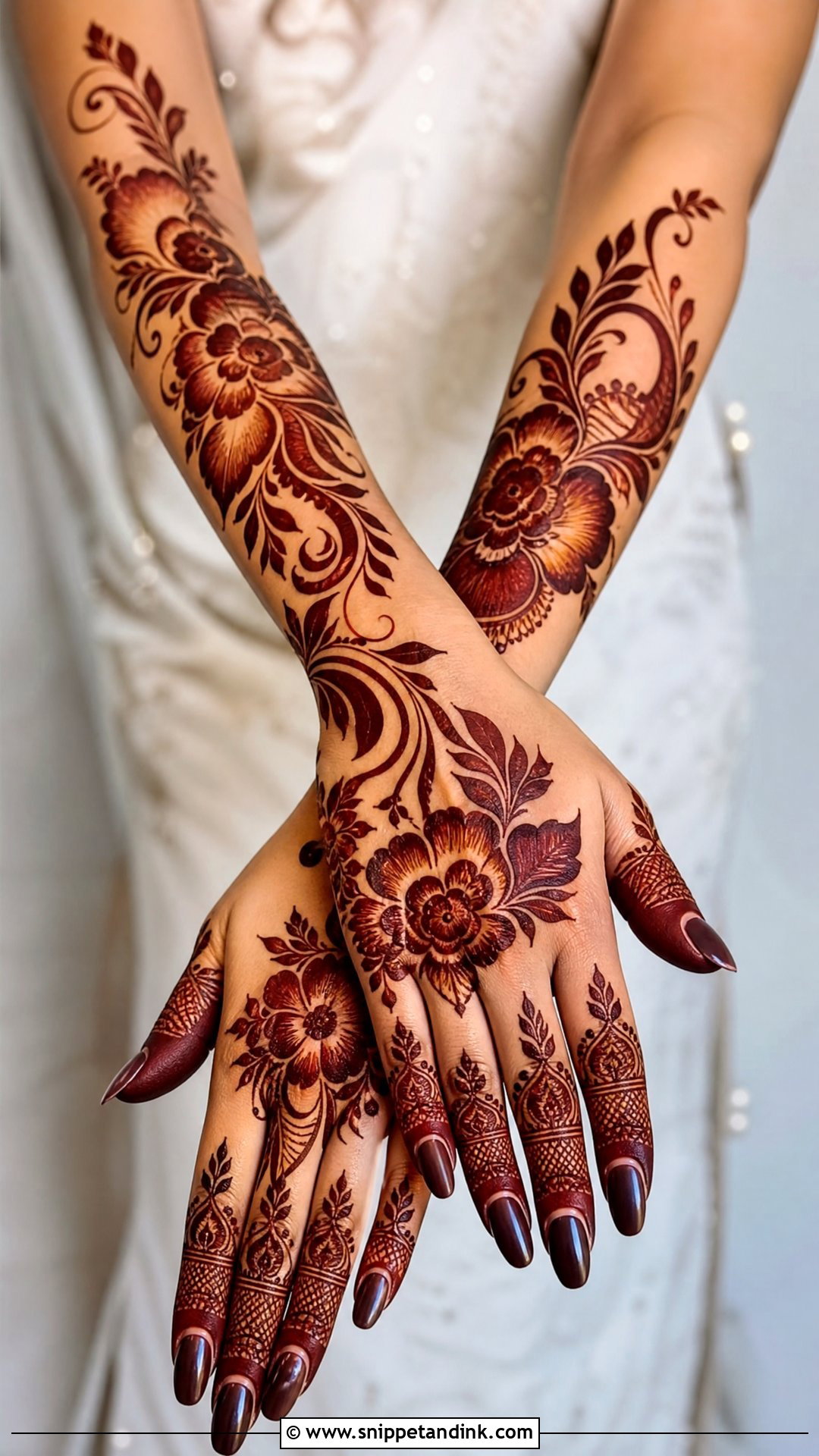
Gulf or Khaleeji-inspired designs use bold flowers, leafy curves, thick outlines and generous empty space, flowing from fingers to forearms in large sections with smaller detail inside the petals. Thick lines carry more paste, and more paste on skin usually means a deeper, more even stain, which is why these designs read so clearly from a distance. It gives drama without density. I like it with gold jewellery and rich fabrics, and it gives Arabic openness a more glamorous finish.
19. Back Hand Bridal Mehndi Full Hands
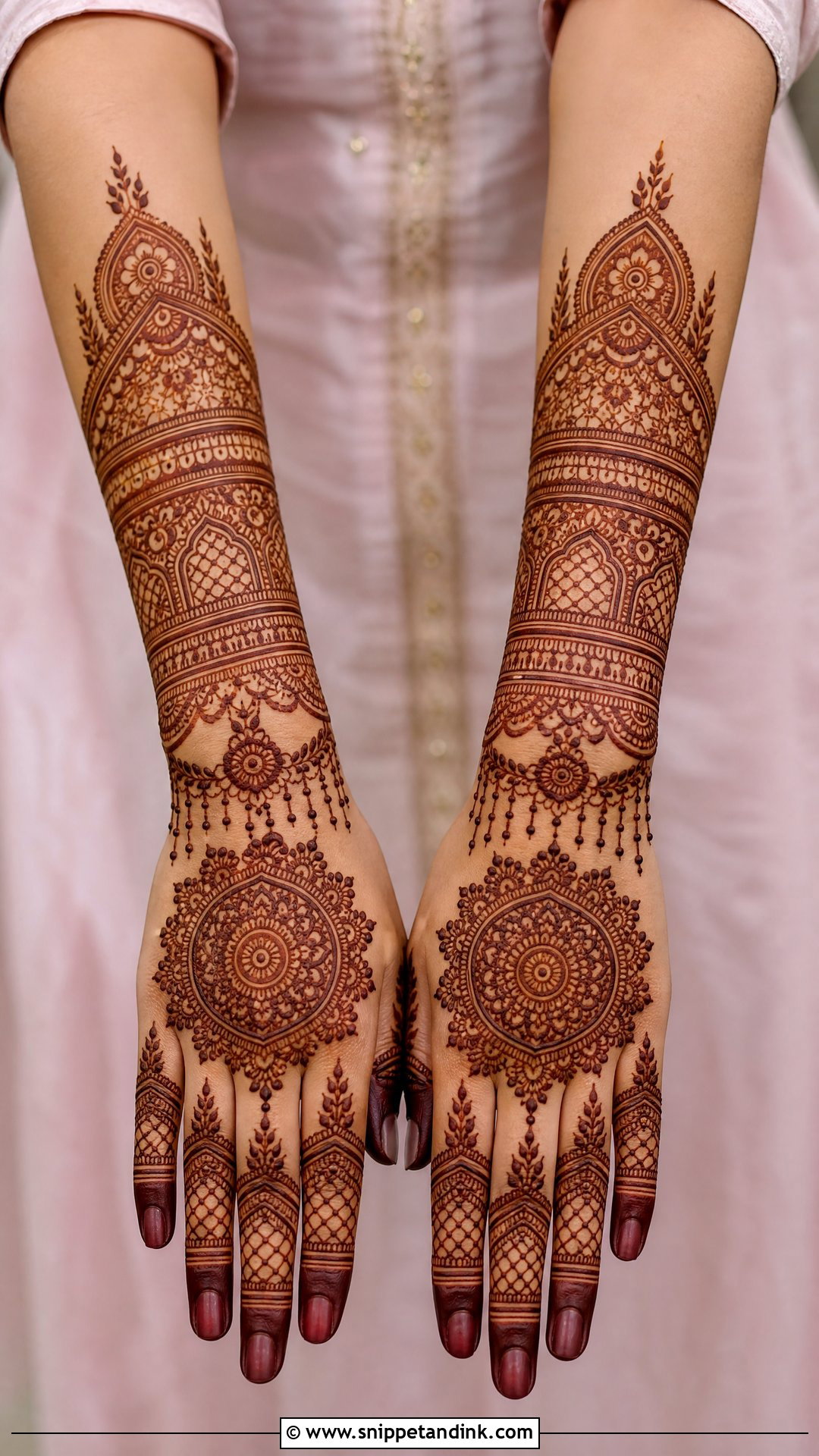
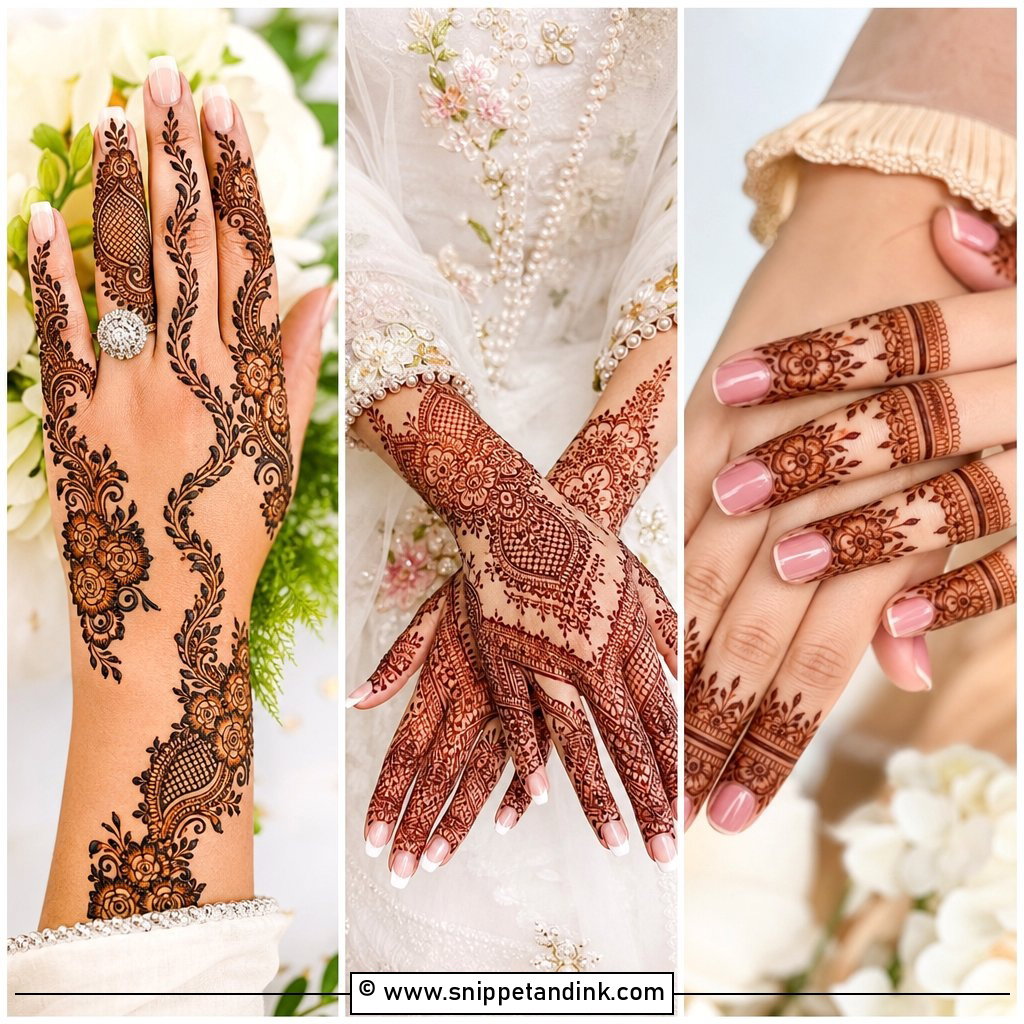
The back of the hand is in every ring, bangle and portrait shot, yet it is often rushed at the end of a long session. Decorative trails, mandalas, jaali panels, bracelet bands and detailed fingers all work here, matching the palm or with a layout of its own. Back hand mehndi can also leave open areas that show off rings and hand chains. Be aware that skin on the back of the hand stains lighter than the palm, so I use bolder lines there to balance the colour. Treat it as its own design, not an afterthought.

20. Bridal Mehndi Full Hands With Name
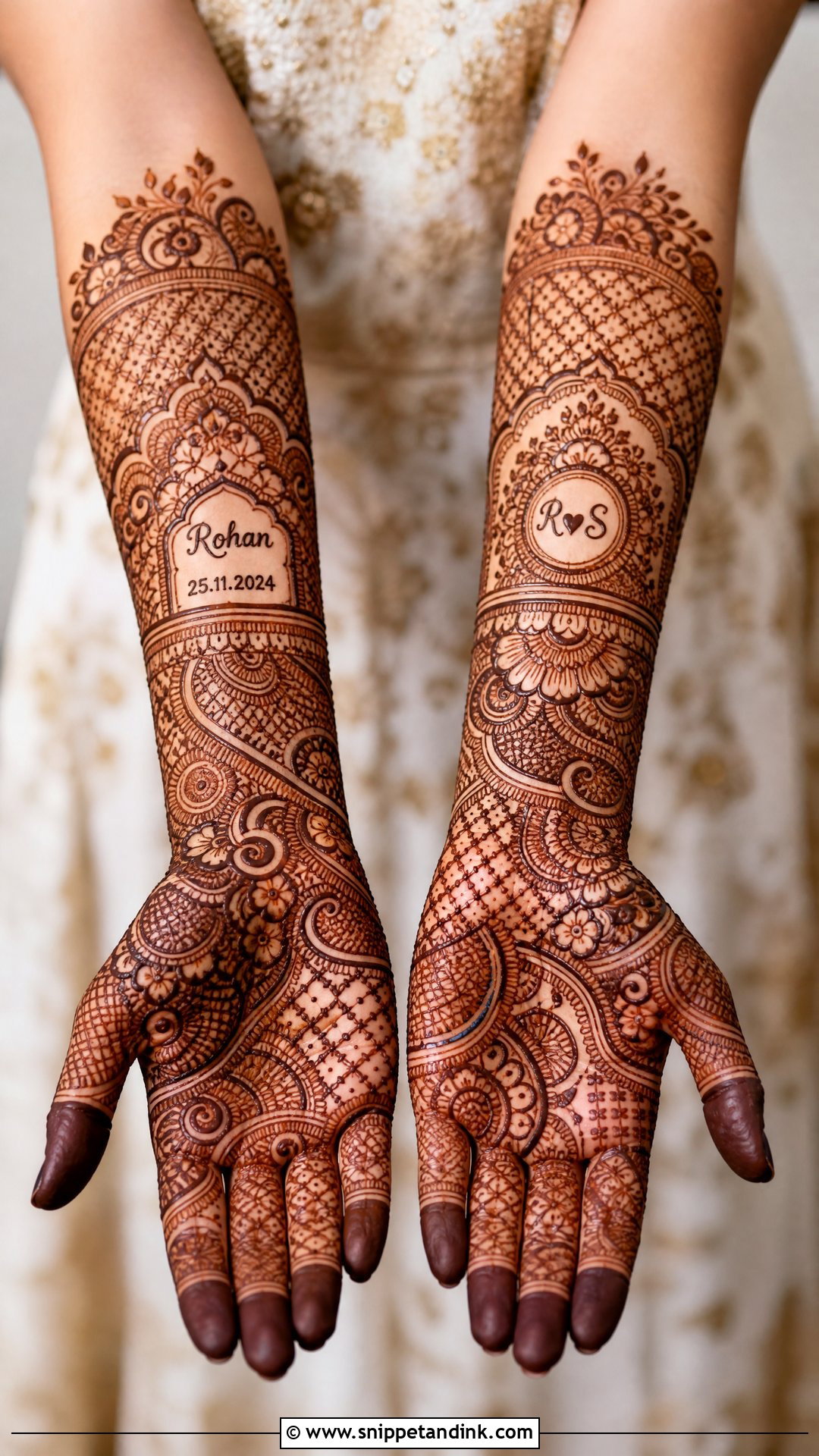
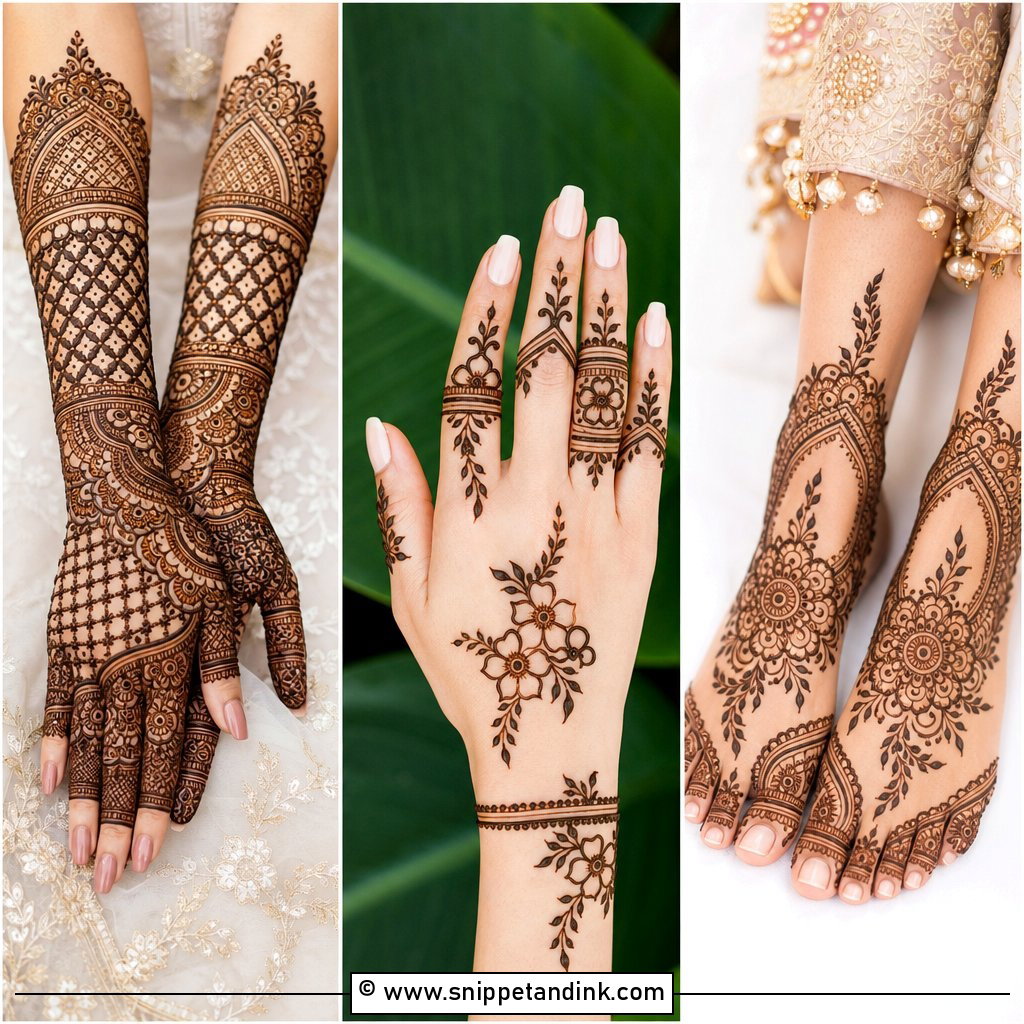
Hiding a name is the part of bridal mehndi that guests enjoy most. The groom’s name, initials, the date or a small meaningful word can sit inside paisleys, jaali, flowers, wrist bands or portrait scenes. The trick is not to make it obvious. I write the letters in the same line weight as the surrounding filler so they blend in and become a small search for the groom. It works in Indian, Arabic, Indo-Arabic, Rajasthani and modern layouts, and a tiny symbol for a shared place is just as personal as letters.
Coaxing the Darkest Stain After the Paste Comes Off
The colour you see when the paste flakes off is bright orange, and it often worries brides. That is normal. Henna oxidises on the skin and moves through red to deep maroon over the next day or two, and the darkest point is usually around 48 hours.
- Leave the paste on as long as you can, overnight if possible. Wrap loosely in tissue for sleep rather than tight plastic, which makes it sweat and smudge.
- Dab a little lemon and sugar mix on once the paste has dried, so it stays stuck to the skin. Do not soak it.
- Scrape the dried paste off with a blunt edge or your fingers. Do not wash it off.
- Keep water away for as long as you can, ideally 12 to 24 hours. Rub in a little coconut or mustard oil instead.
- Keep your hands warm. Warmth deepens the stain, which is why many families still hold their hands over clove smoke.
Why the forearm looks paler than the palm
Palms and fingertips have thicker skin, so they hold more dye and stain darkest. Forearms and the back of the hand will always come out a few shades lighter, even with the same paste. I tell brides this before the session so they do not think something went wrong. After the wedding, avoid scrubs, chlorinated pools and hand sanitiser for a few days and the colour will fade slowly and evenly over one to three weeks.
Dense, Open or Somewhere Between?
Start with the mood. Dense Indian and Rajasthani designs feel traditional and grand, while Arabic, Gulf, and minimal designs feel lighter and more open. Indo-Arabic, Mughlai, floral, paisley and jaali patterns sit in the middle. Then check coverage against your sleeves and jewellery, and be honest about how long you can sit still. When you book, ask the artist about her paste and how she handles symmetry across both hands, because a good recipe and a steady layout matter more to the final result than which of these twenty styles you pick.
You'll Like These Ideas:








Leave a Reply