
Couple mehndi is the work I enjoy planning most, because it’s the one design that has to make sense on two people at once. A bride might want her whole wedding drawn across both palms: the baraat, the mandap, the garland exchange, the groom’s face. Her partner might want one clean motif on the wrist. Both are right, as long as they connect. Below are 20 ideas for couple designs, from dense Rajasthani storytelling to a single shared initial, with notes on what each needs from the cone and from your skin to show up clearly once the stain develops.
Two People, One Mehndi Evening: Planning the Hours
Couples often underestimate how differently the two appointments run. A full bridal portrait design on both hands and forearms can take several hours of sitting still, while a groom’s palm motif usually takes well under an hour. I schedule the bride first and the groom near the end, so he isn’t sitting with wet paste while she’s still being drawn.
Timing matters more than most people realise. Natural henna comes off orange and darkens to its deepest colour over the next one to two days. That’s why I like the bride’s application one or two days before the wedding, never the night before if portraits are involved. You want the faces at their darkest during the ceremony, not still orange.
Bring these to your consultation
- Both names spelled exactly as you want them, plus the wedding date
- Two or three reference photos, with a note on what you like in each
- Your outfit colours and how high your sleeves sit
- How much coverage each partner wants, and how long each can sit
- Any skin sensitivity, so the artist can check the oils in the paste
Ask your artist what goes into their paste. Natural henna is mixed with lemon or water, sugar and essential oils, and it stains brown to maroon. Paste that promises a black stain in an hour usually contains chemical dye and can cause serious skin reactions, so it has no place at a wedding.
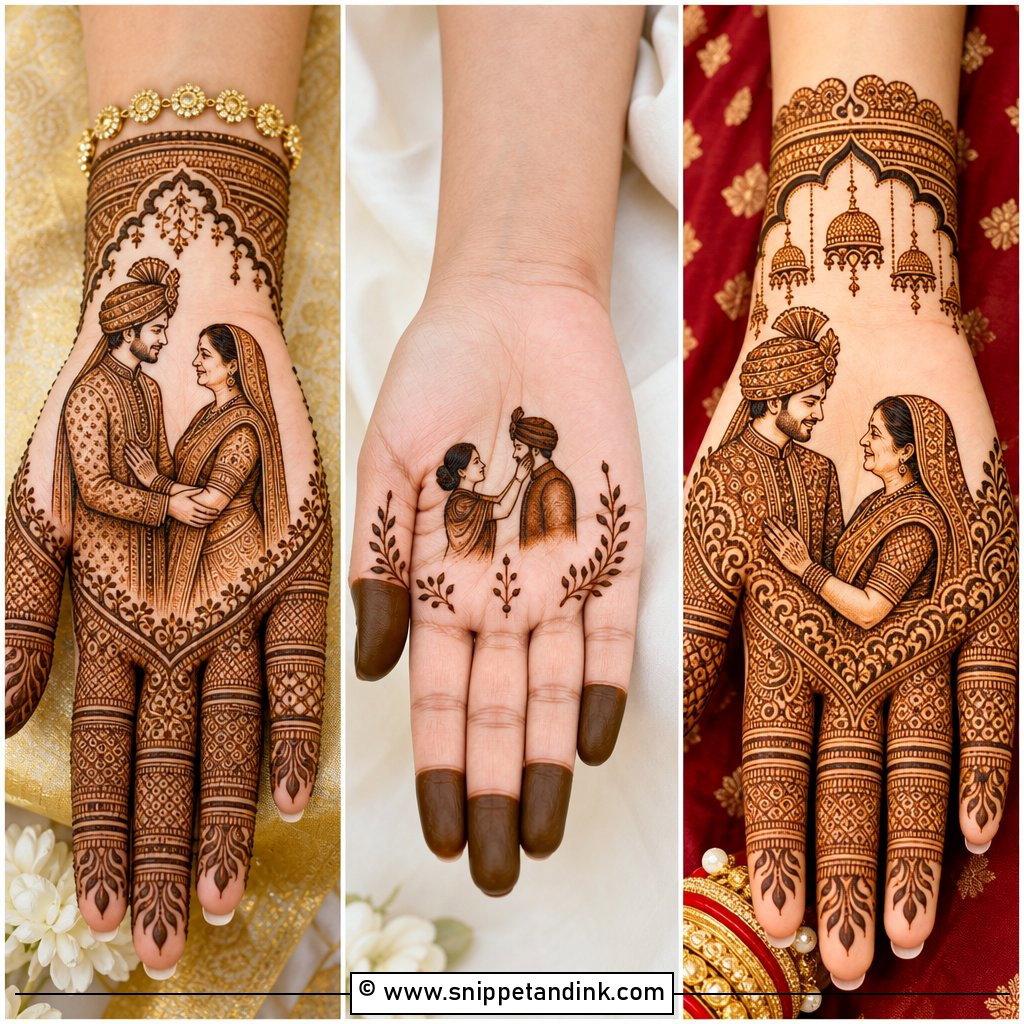
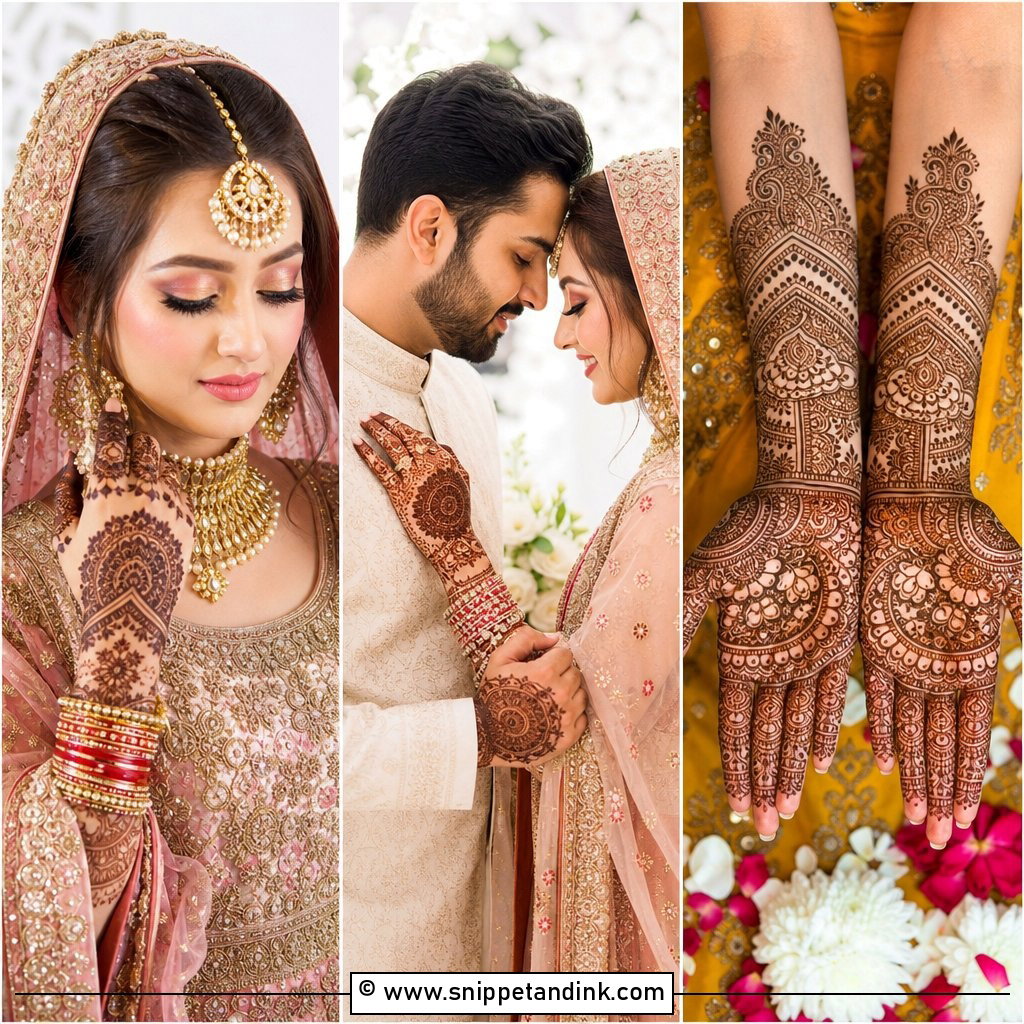
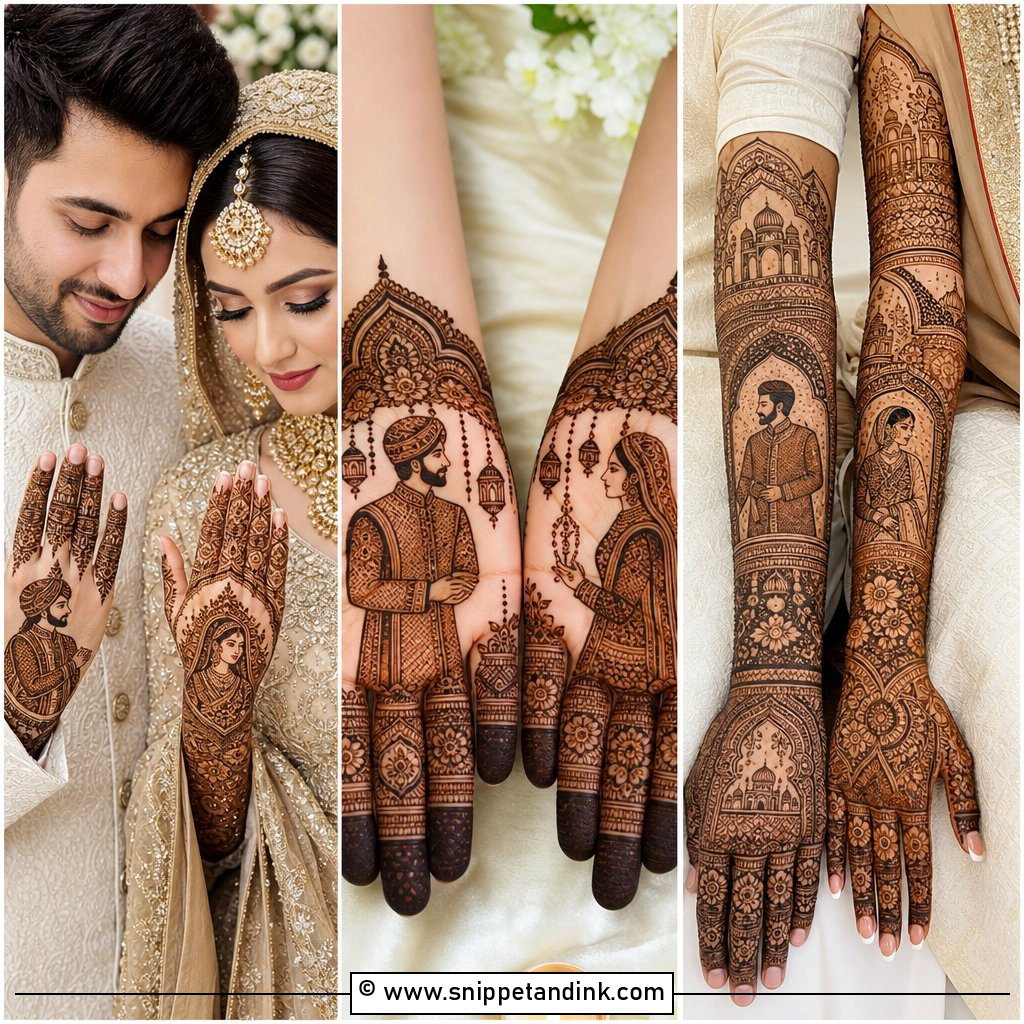
1. Full Hand Bride And Groom Portrait Mehndi
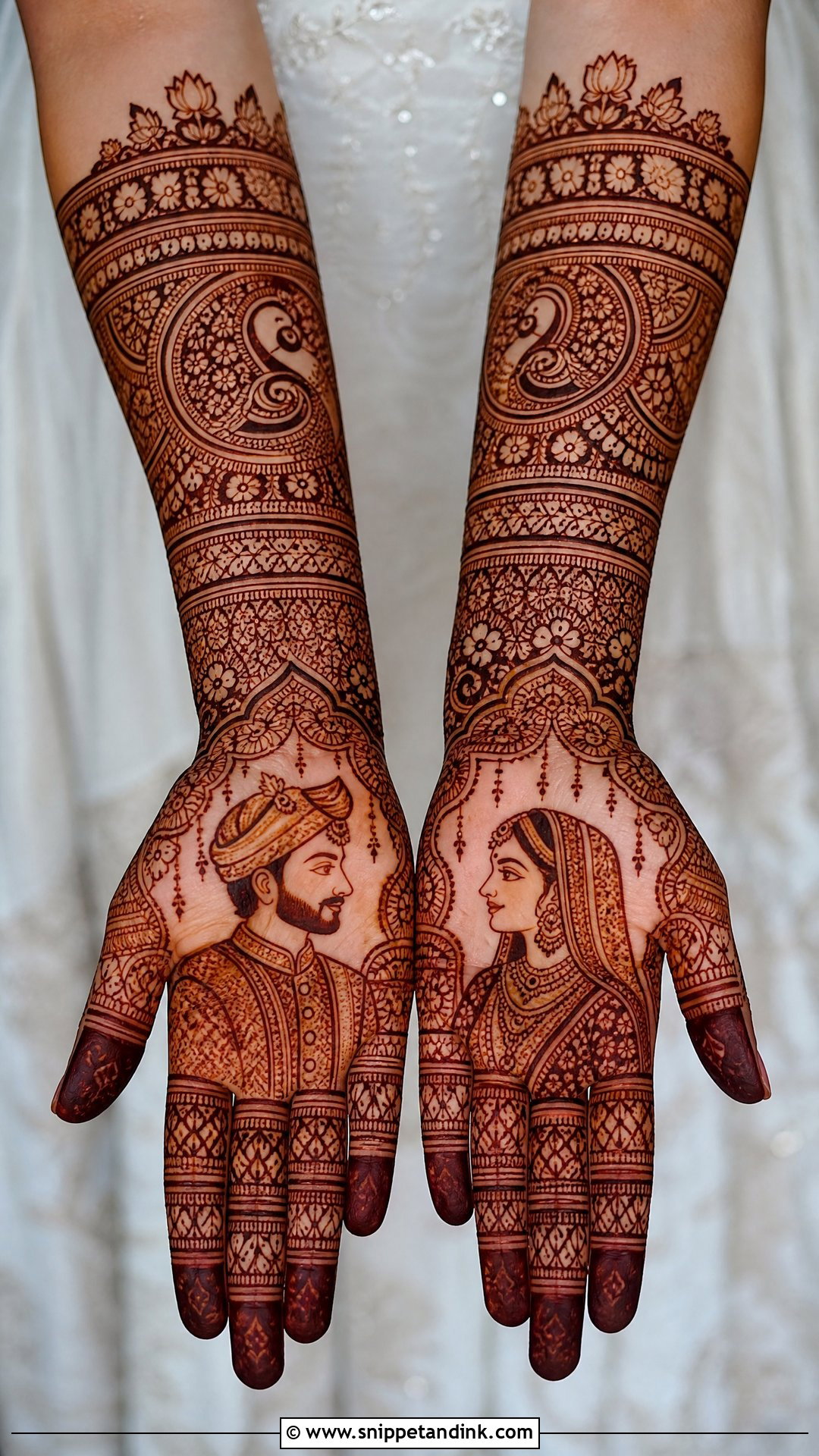
Portrait work across both hands is the most requested bridal design I do, and the most demanding. The bride’s face usually sits on one palm, the groom’s on the other, framed by a mandap, peacocks and paisleys, with dense filling up to the forearm. When the hands come together, the story joins. Faces are tiny, so I keep a clear ring of open skin around each one. Henna spreads slightly as it stains, and a face with no breathing space turns into a dark blot by the second day.
2. Rajasthani Bride And Groom Mehndi
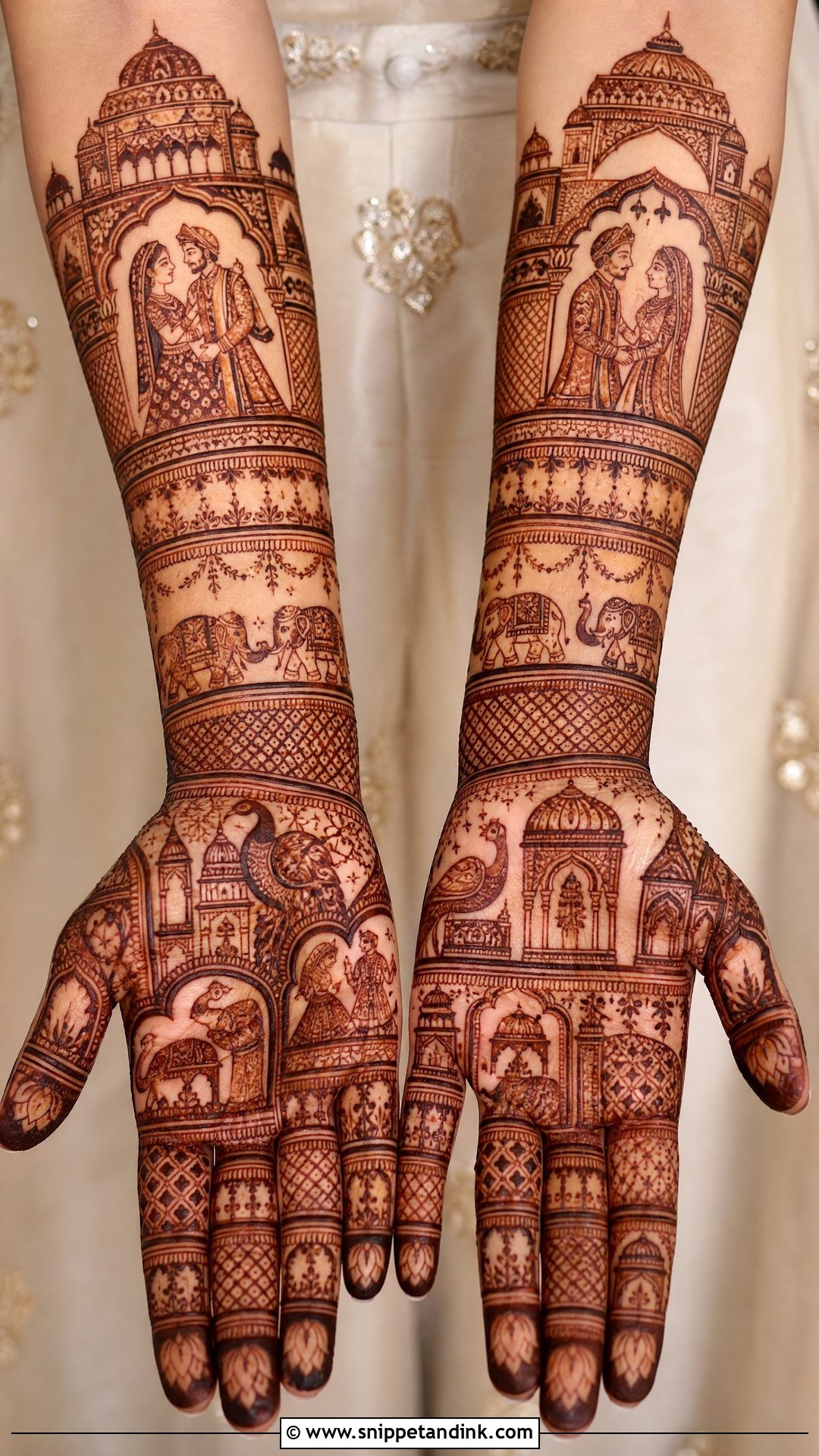
Rajasthani bride and groom mehndi leaves almost no skin bare: little dulha-dulhan figures, elephants, palanquins, lotus borders, jaali and palace arches running from fingertip to forearm. It is slow to apply, and it rewards patience. The danger is that the couple figures get lost in all that filling. I outline them with a slightly thicker line than the surrounding pattern so they read first in close-up photos. Pair it with heavy jewellery and a traditional lehenga; it looks underdressed with anything minimal.
3. Indian Bride And Groom Mehndi
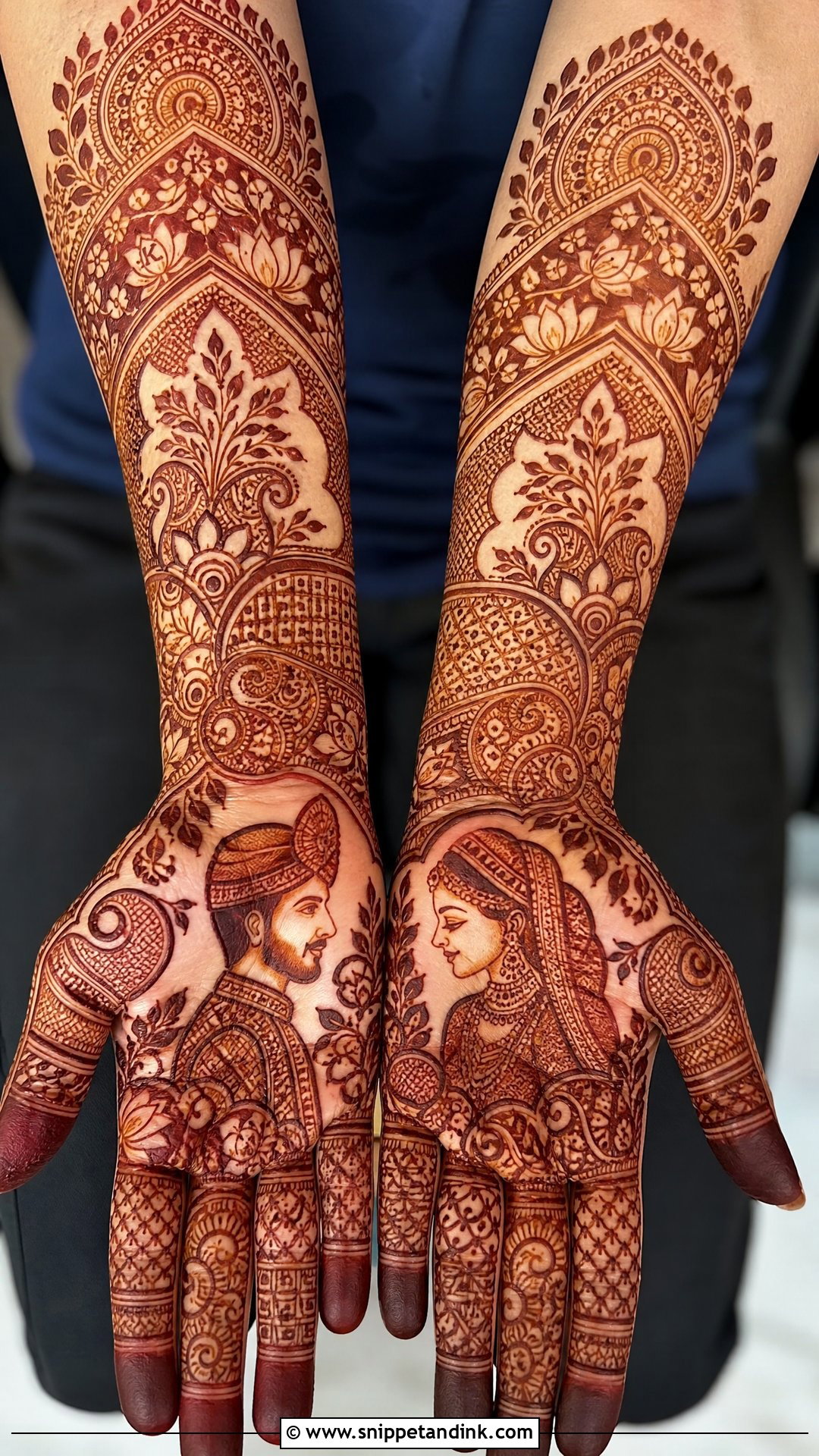
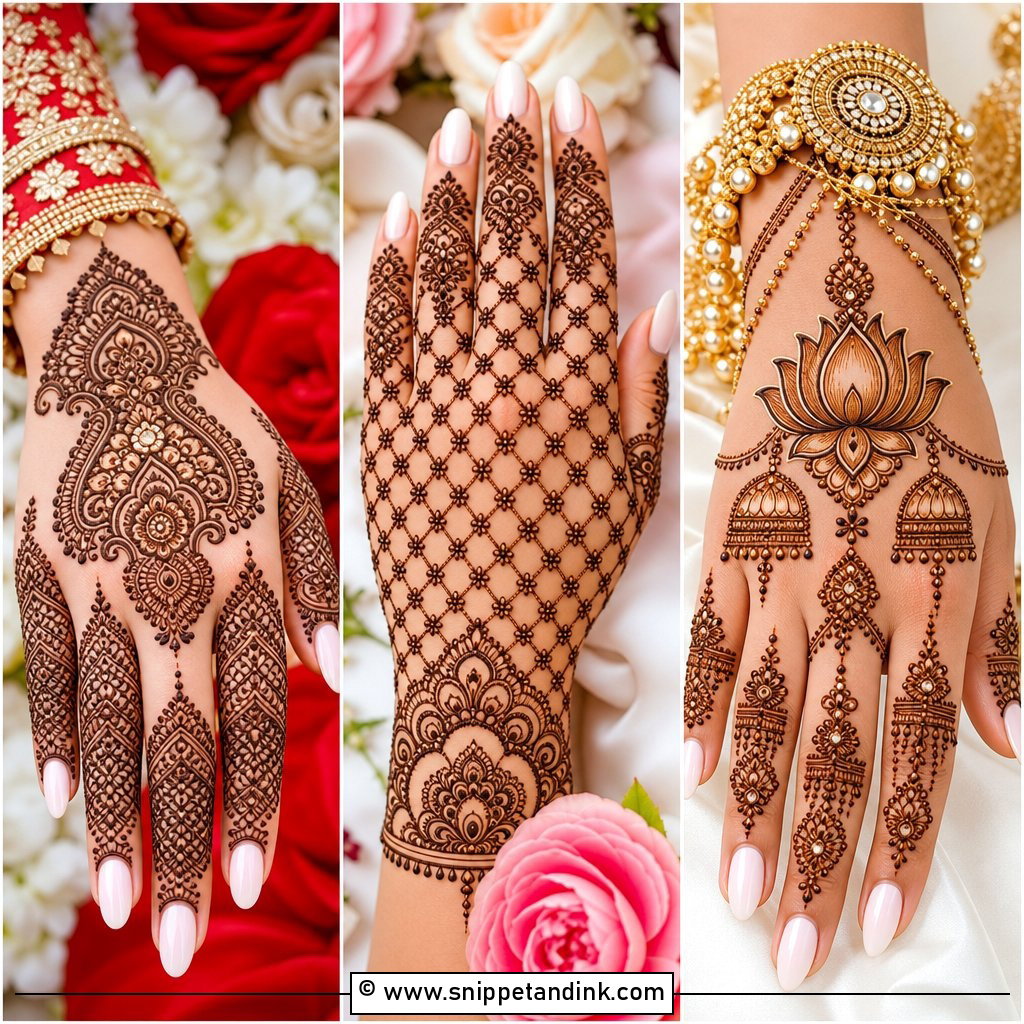
Classic Indian layouts build on paisleys, lotus, mandalas, vines and kalash motifs, with the couple placed as the centrepiece or woven into the story. It suits families who want tradition without anything experimental. Many brides ask me to hide the groom’s name somewhere in the pattern for the name-finding game after the wedding. I’ll tuck it into a petal or paisley, but never across a palm crease, where the line breaks when the hand bends. Full palms and forearms take this style best because the filling has room to breathe.
4. Arabic Bride And Groom Mehndi
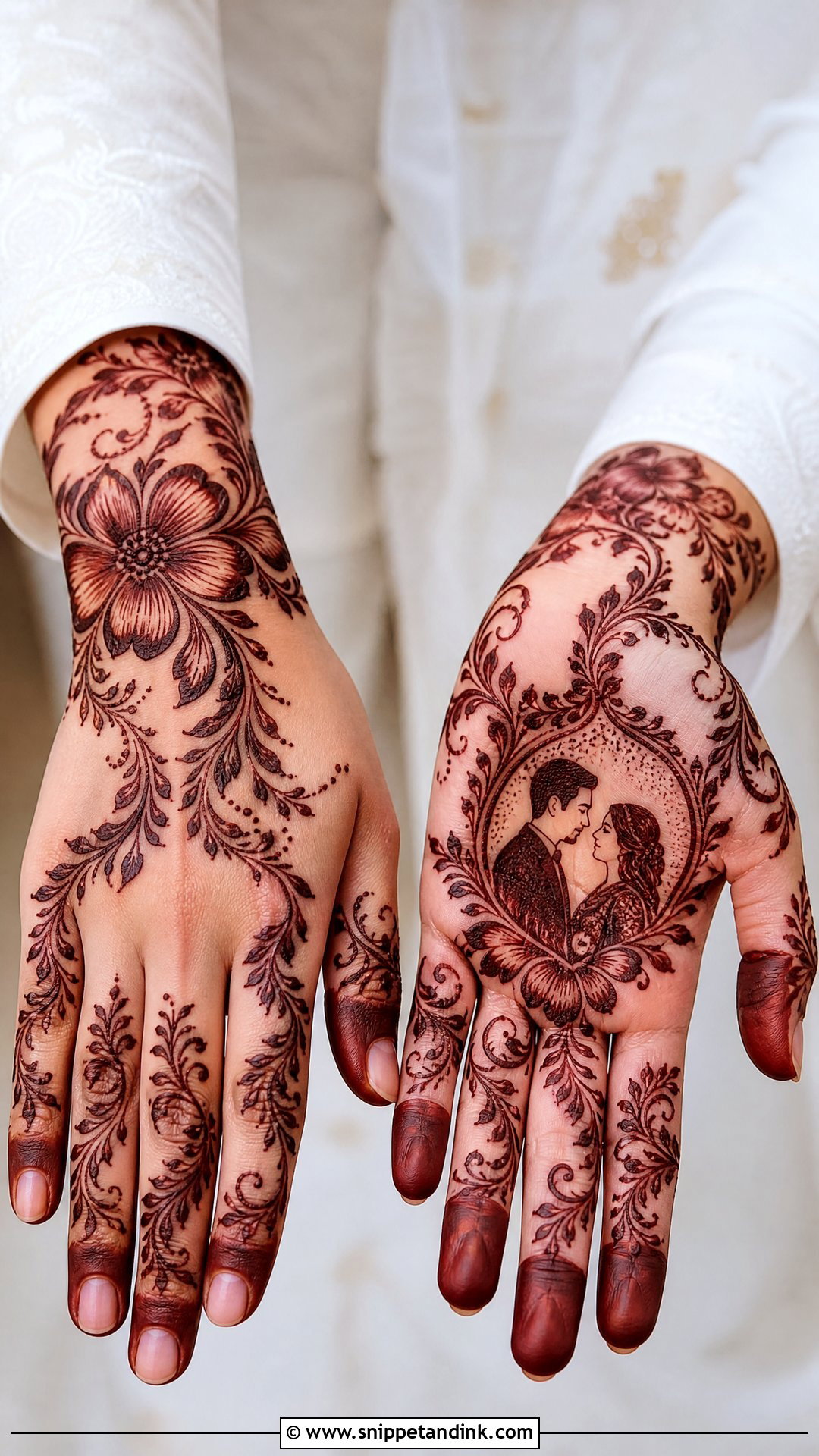
Arabic work uses flowing trails, shaded petals and plenty of open skin, with a small portrait or a pair of initials sitting at the palm or wrist. It’s lighter to wear and faster to apply, which makes it a comfortable choice for the engagement, the nikah or a modern function. The bold strokes stain clearly, so the design still reads well after a week of fading. I keep the portrait compact here, about the size of a coin, so it sits inside the trail instead of interrupting it.
5. Indo-Arabic Bride And Groom Mehndi
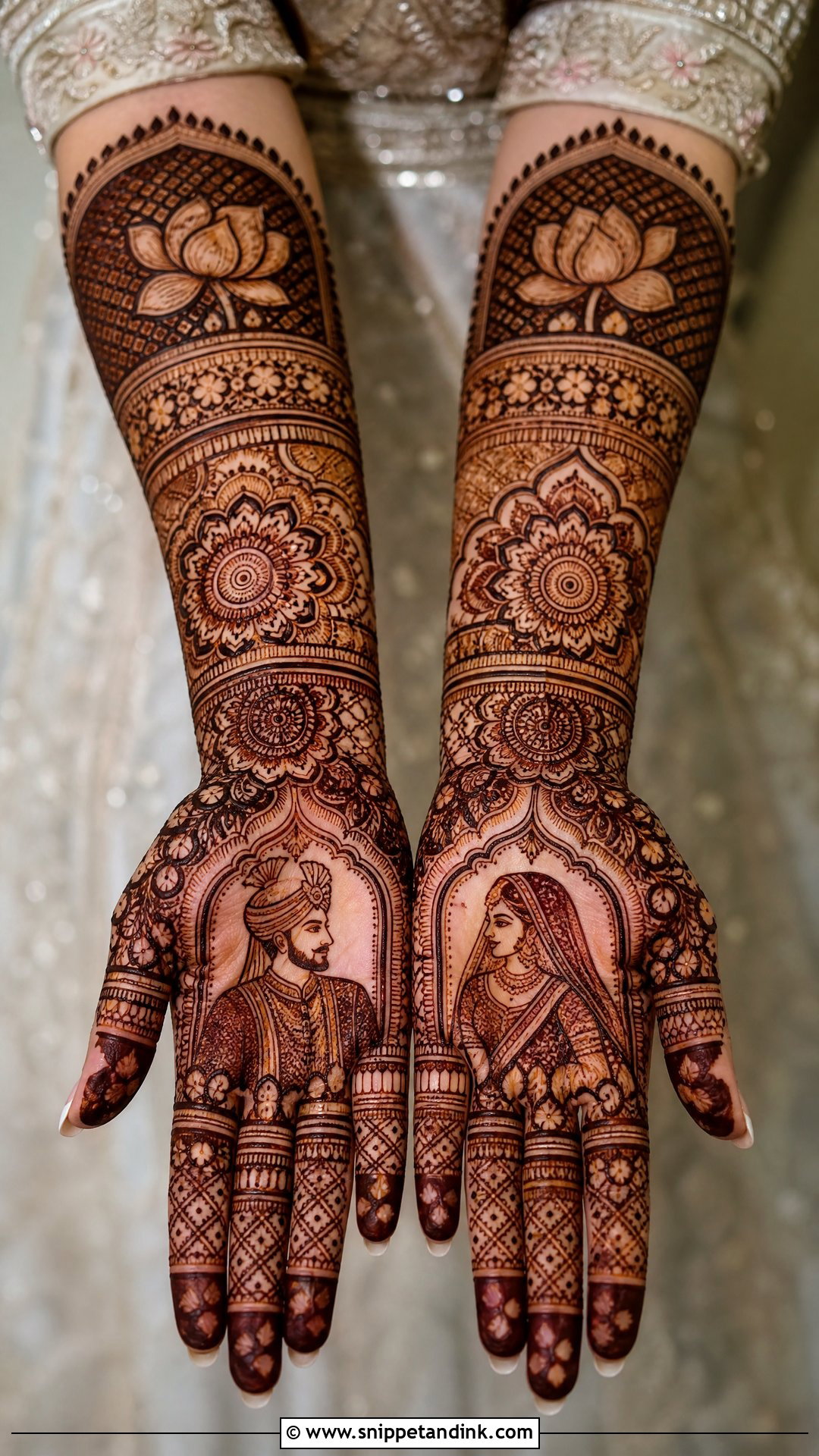
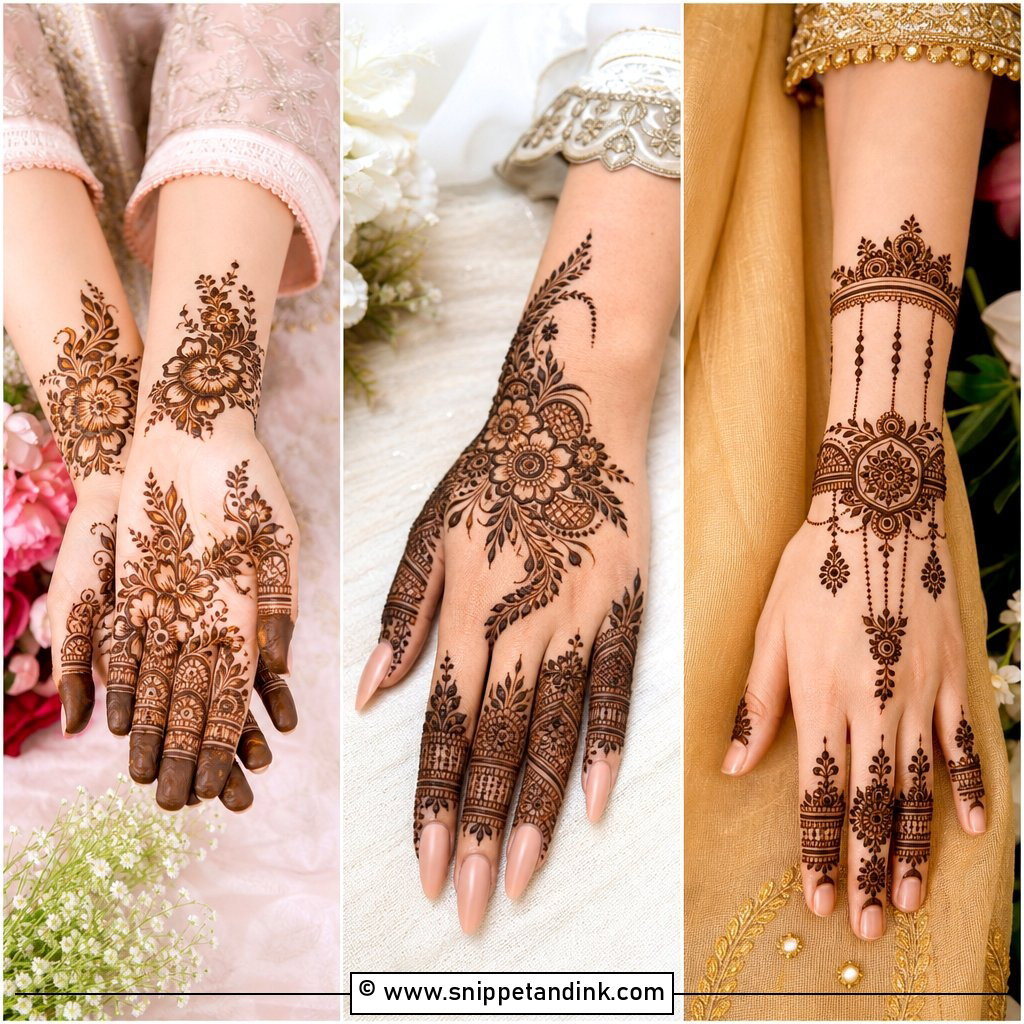
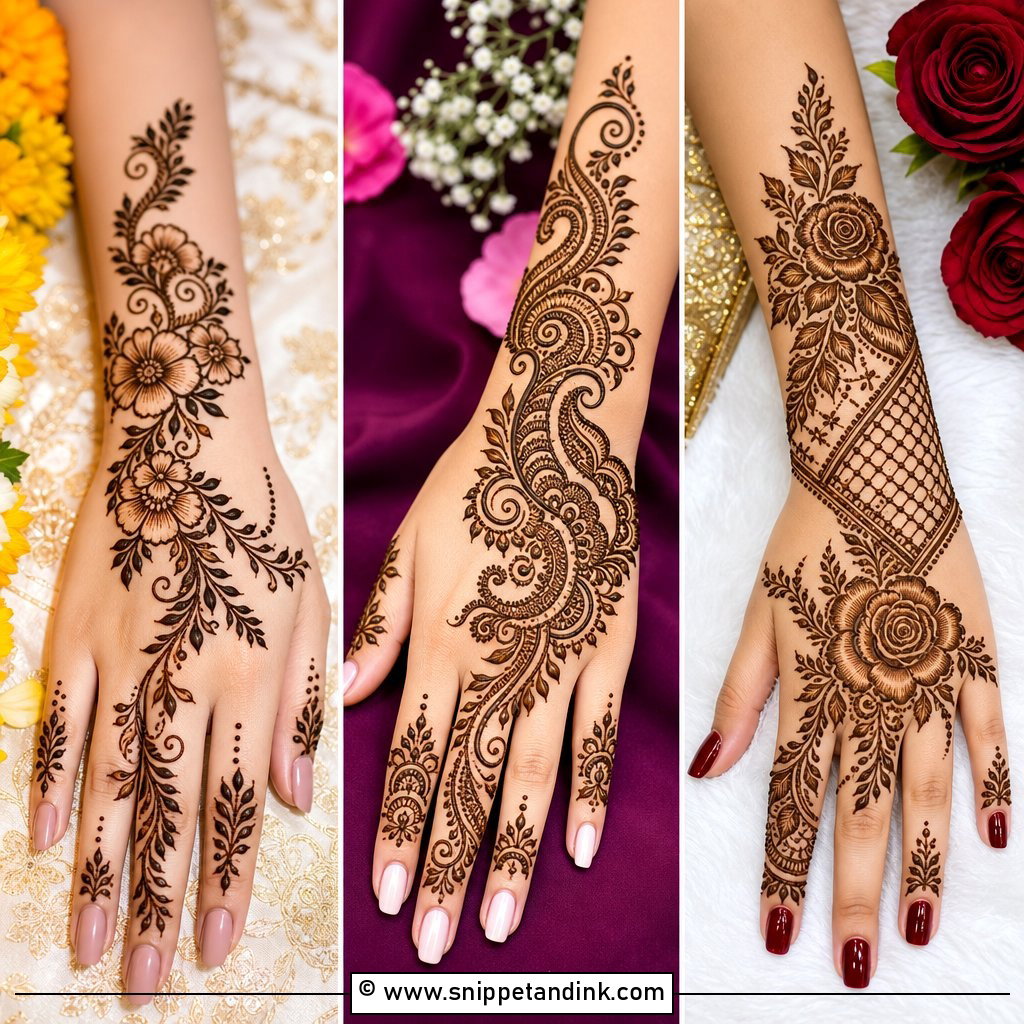
Indo-Arabic combines Indian filling with the open flow of Arabic patterns: bold floral trails, paisley sections, a mandala, a jaali panel, and the couple motif as the focal point. It’s what I suggest when a bride wants detail but doesn’t want her hands to look crowded. The gaps between sections do real work: they let each motif stand out on its own. Diagonal trails also make the fingers look longer, which helps on shorter hands.
6. Minimal Bride And Groom Mehndi
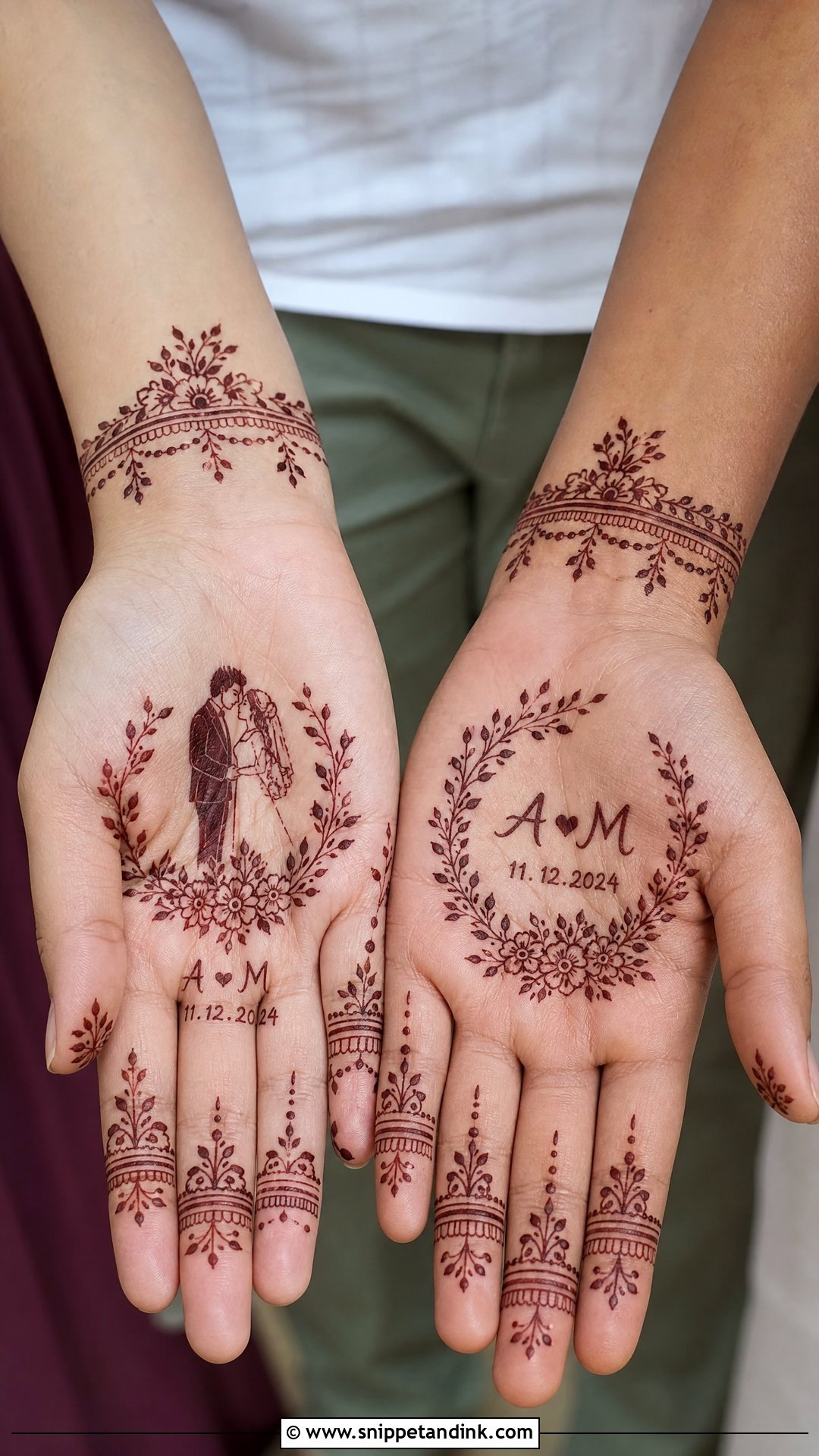
Minimal couple designs keep the meaning and drop the coverage: a tiny couple outline, initials, a date, a ring motif, a small mandala, or a fine band at the wrist. The bride can run a delicate vine up a finger or two; the groom keeps his centred on the palm. These take under an hour each, so they suit intimate ceremonies or couples with a tight schedule. The one thing I won’t do is draw the lines too thin. A hairline stroke often stains patchy, so I go fine but steady.
7. Bride And Groom Name Mehndi
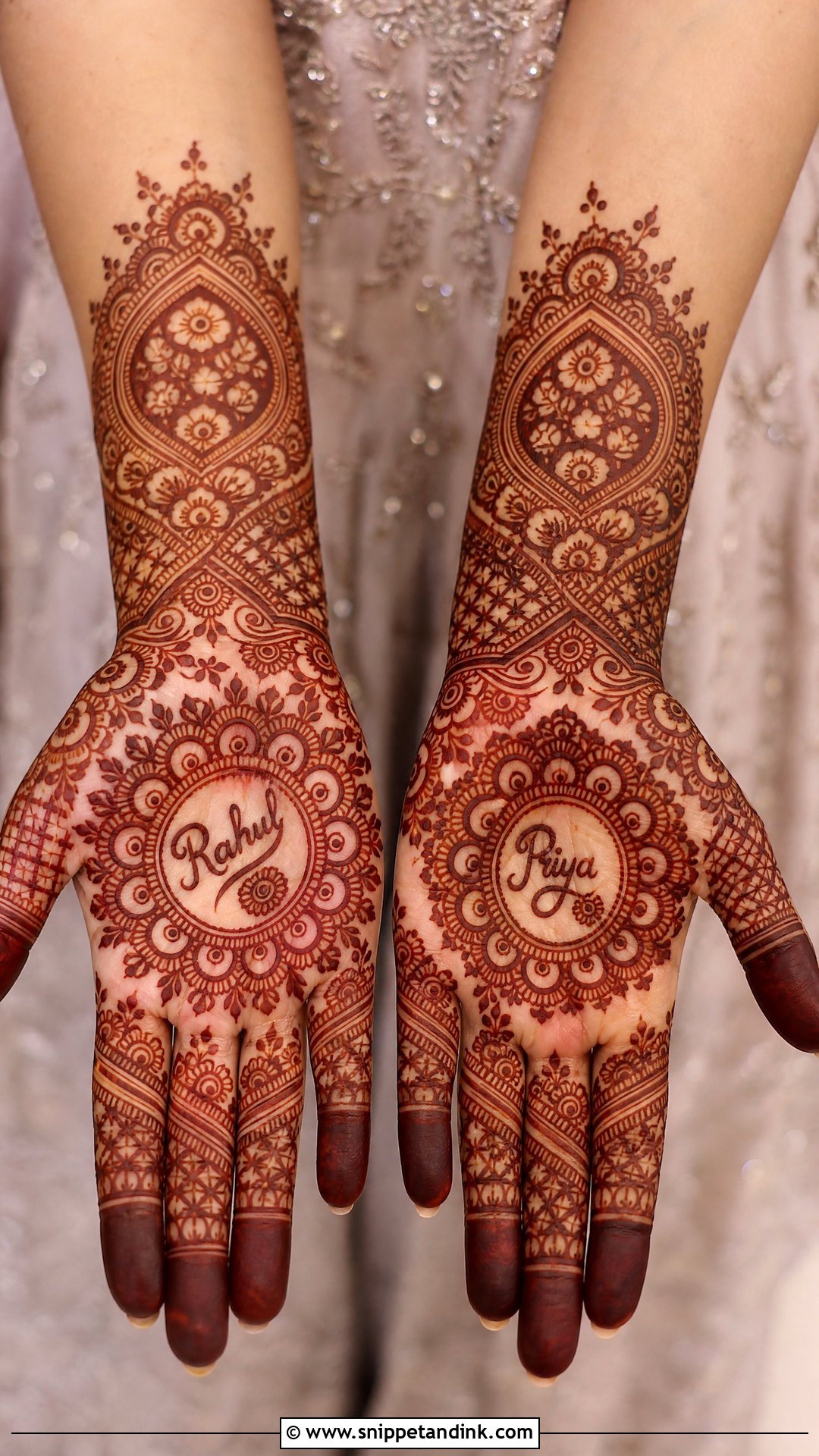
Names are the most personal detail you can add, and the hardest to hide well. On the bride, I work the groom’s name into the curve of a paisley, a petal or the lattice of a jaali panel. On the groom, the bride’s initials usually sit in a small circle at the palm or wrist. It can be full-hand, half-hand or tiny. Write the name out clearly for your artist before the appointment, including spelling in the script you want, because a name drawn backwards on a mirror-image hand is a surprisingly common slip.
8. Bride And Groom Initials Mehndi
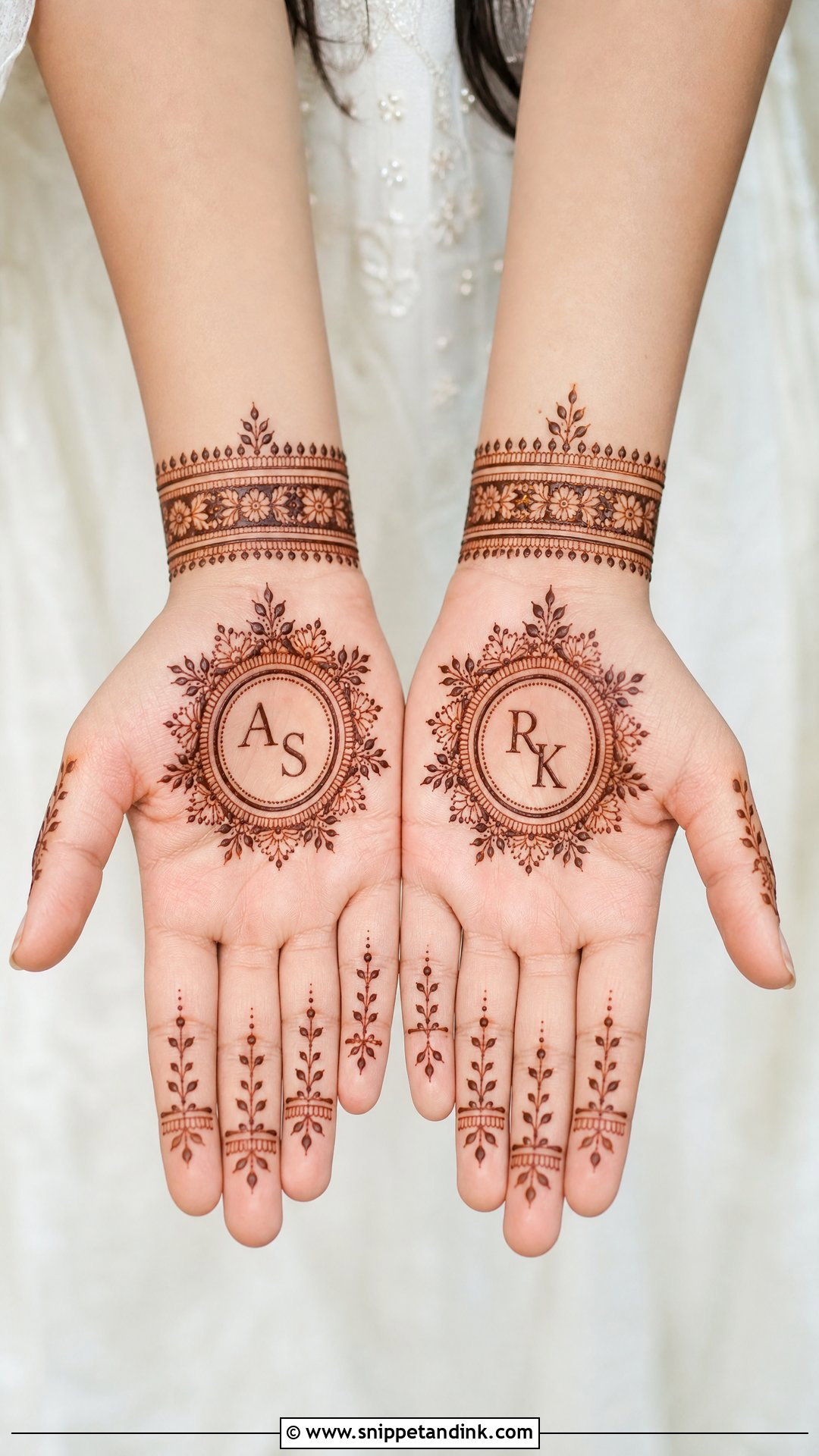
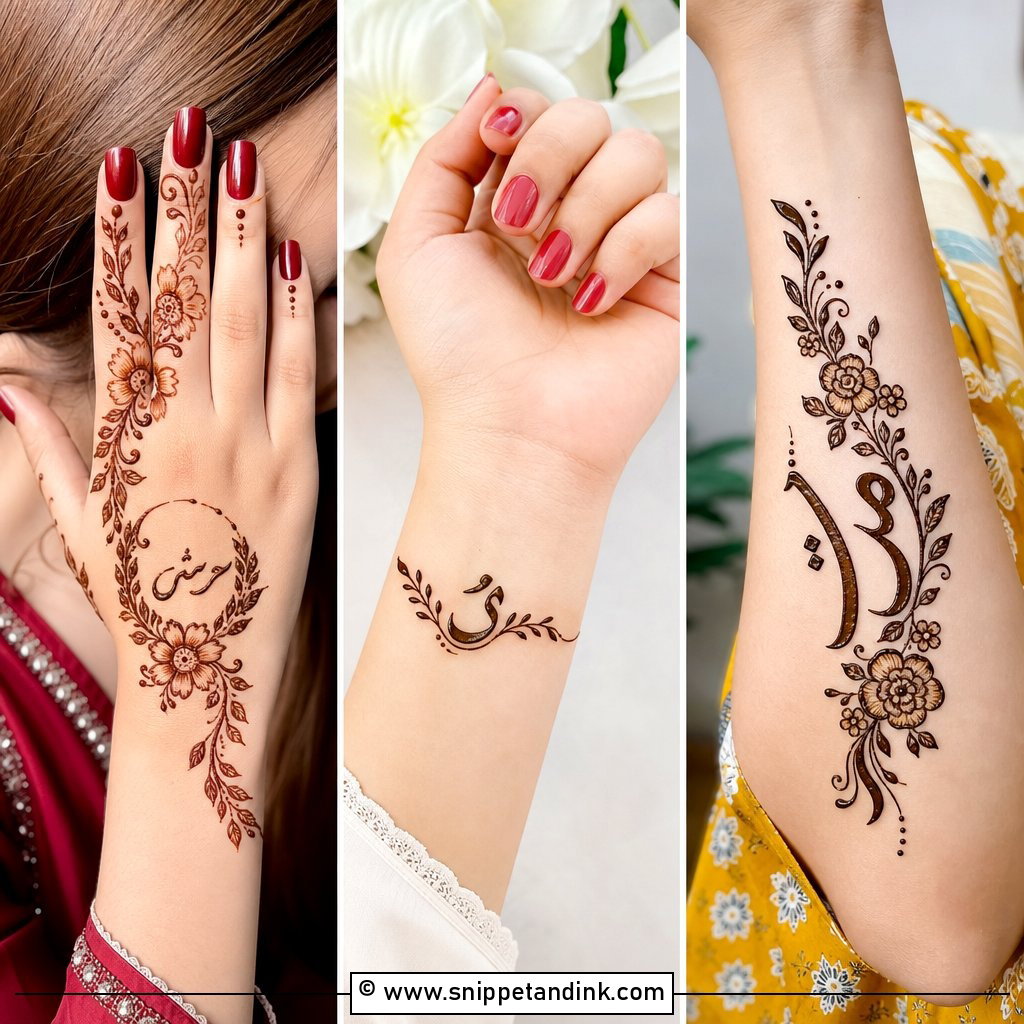
Initials are the subtle version of a name design, and they suit couples who find portraits too much. I place them in a mandala, a floral frame, a bracelet band or a small heart. The bride can carry them inside full-hand work while the groom wears them as a single palm centrepiece with a wrist border. Use the same letter style on both partners so the link is obvious when your hands are photographed together.
9. Bride And Groom Wedding Date Mehndi
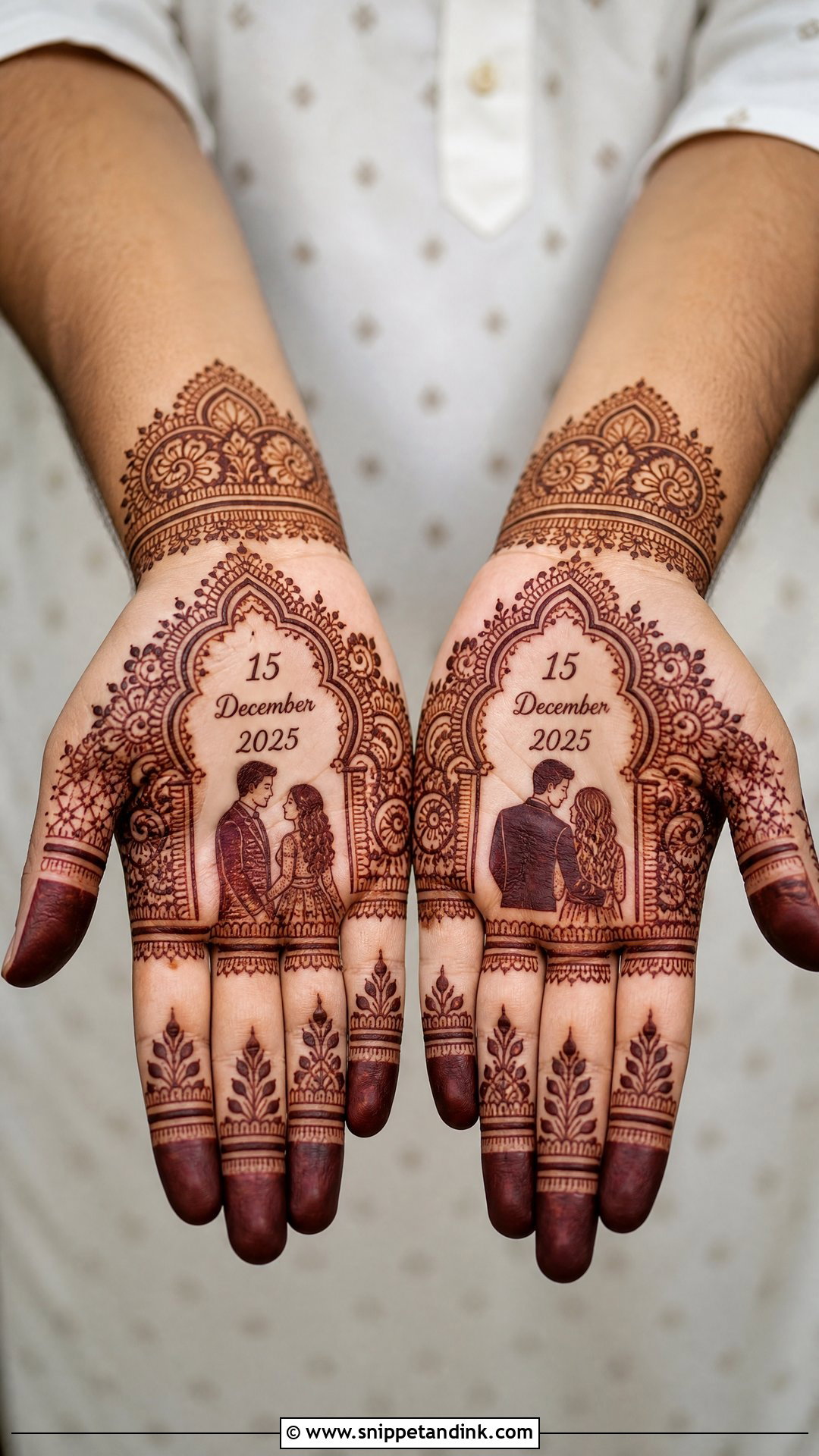
A date needs more care than it looks. Numbers are small, and an 8 or a 6 drawn too tightly fills in and becomes a dot once the paste spreads. I leave a clear gap between every digit and draw them slightly larger than feels natural. The date can sit in the bride’s wrist band, under an arch or beside small couple figures, and the groom can wear it as a bracelet design. It’s a good detail for pre-wedding shoots too, because a clear date photographs well.
10. Bride And Groom Jaimala Mehndi
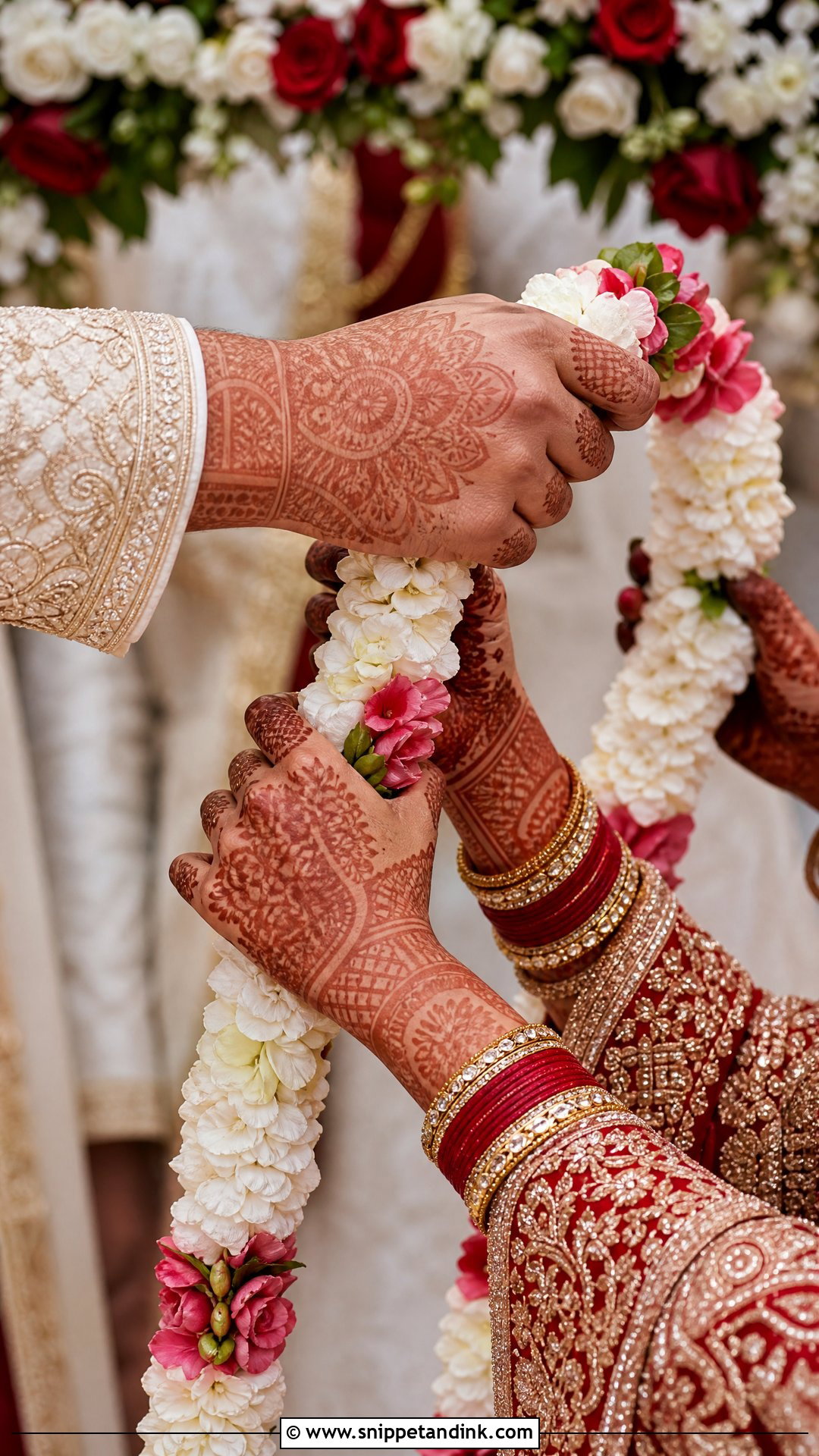
The garland exchange is one of the happiest scenes to draw: the couple facing each other under a mandap or floral arch, with lotus borders, hanging bells, paisleys and filled fingertips around them. It needs the flat centre of the palm. I’ve learned to keep the scene itself uncluttered and let the filling around it be simpler, otherwise the eye doesn’t know where to land. Mehndi that tells a story reads best when it has one clear moment.
11. Bride And Groom Mandap Mehndi
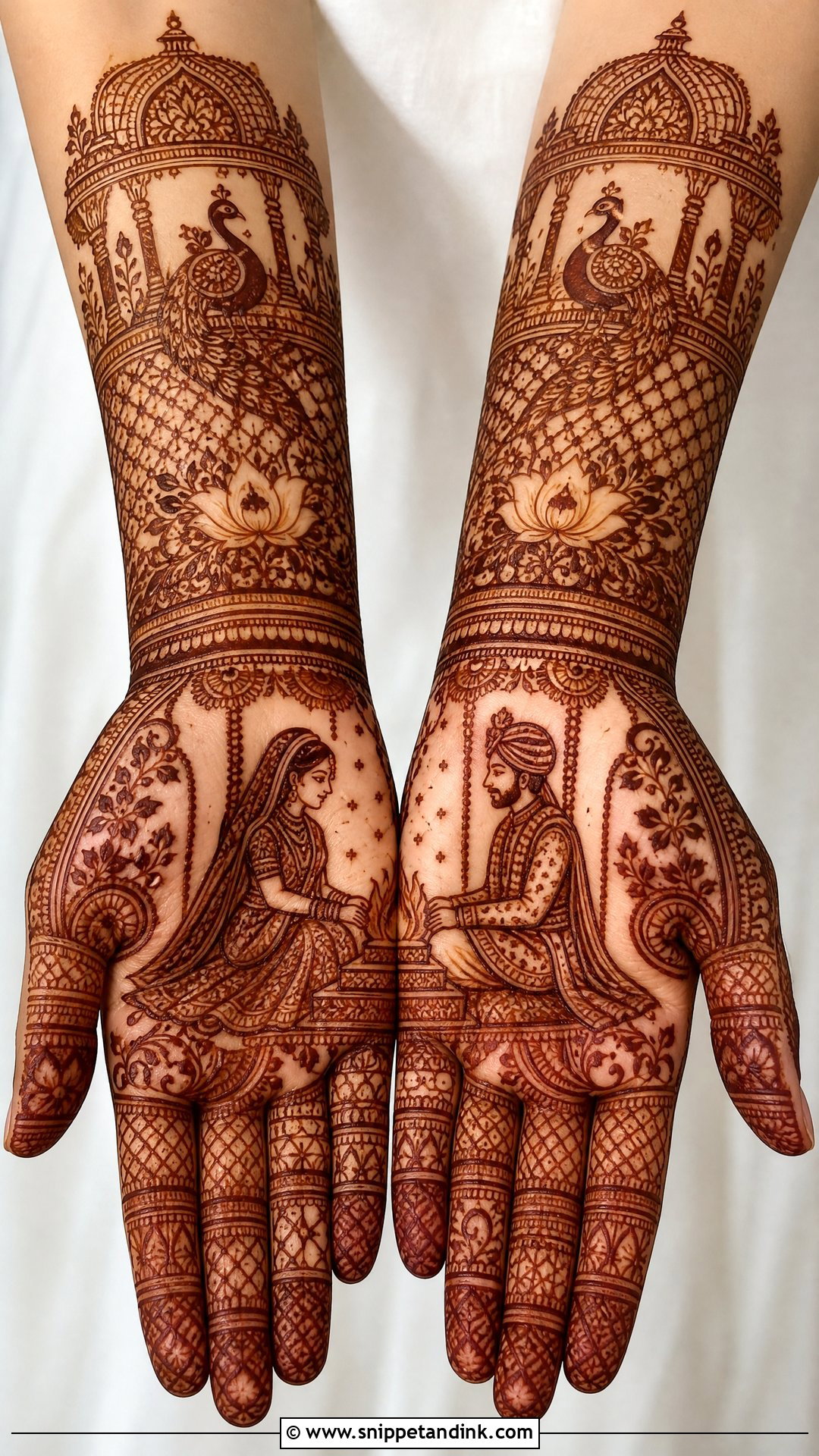
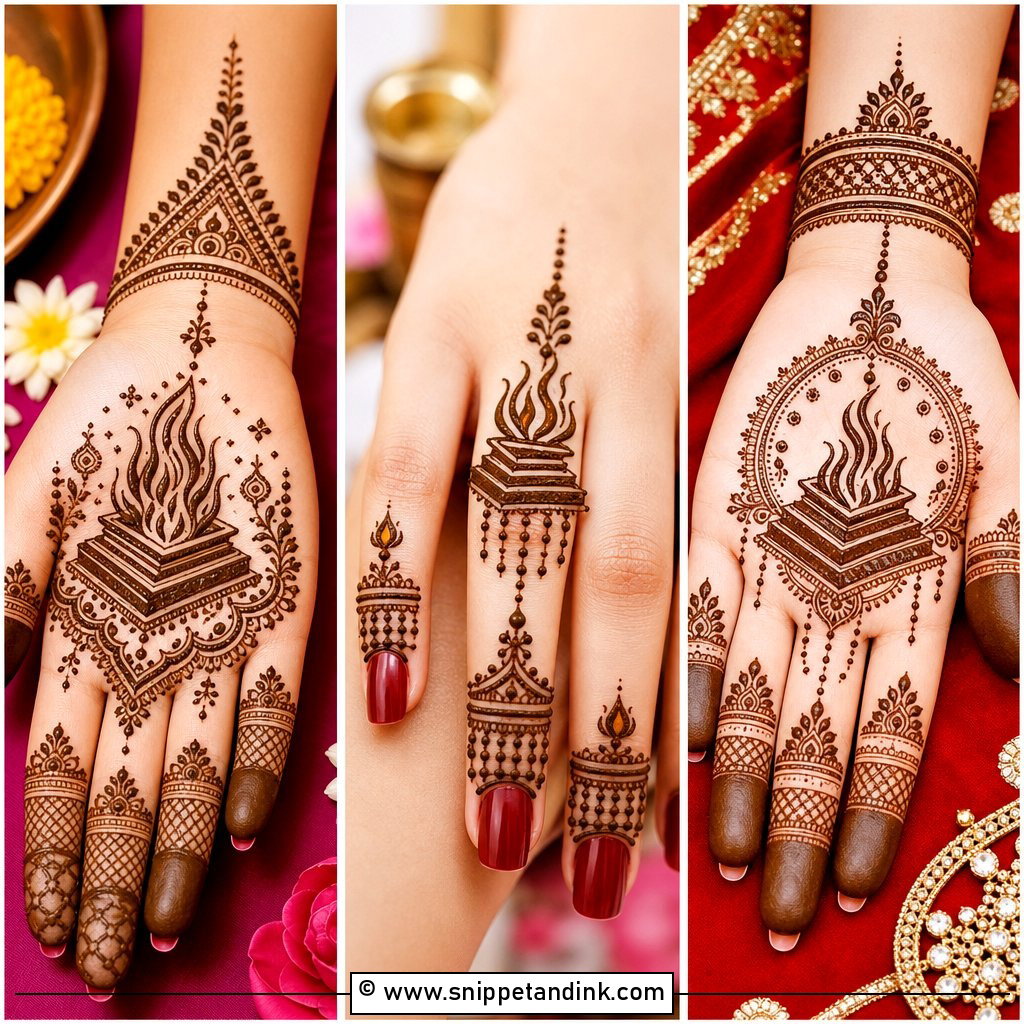
A mandap design frames the couple inside the wedding pavilion, with pillars, florals, the sacred fire and small ritual details. It belongs in full-hand Indian or Rajasthani work, with peacocks, lotus and lattice bands around it. Architecture is unforgiving in henna. Pillars have to be straight and the roof has to be symmetrical, and a wobble shows. Ask to see an artist’s previous mandap work, not only their florals, before booking this one.
12. Bride And Groom Baraat Mehndi
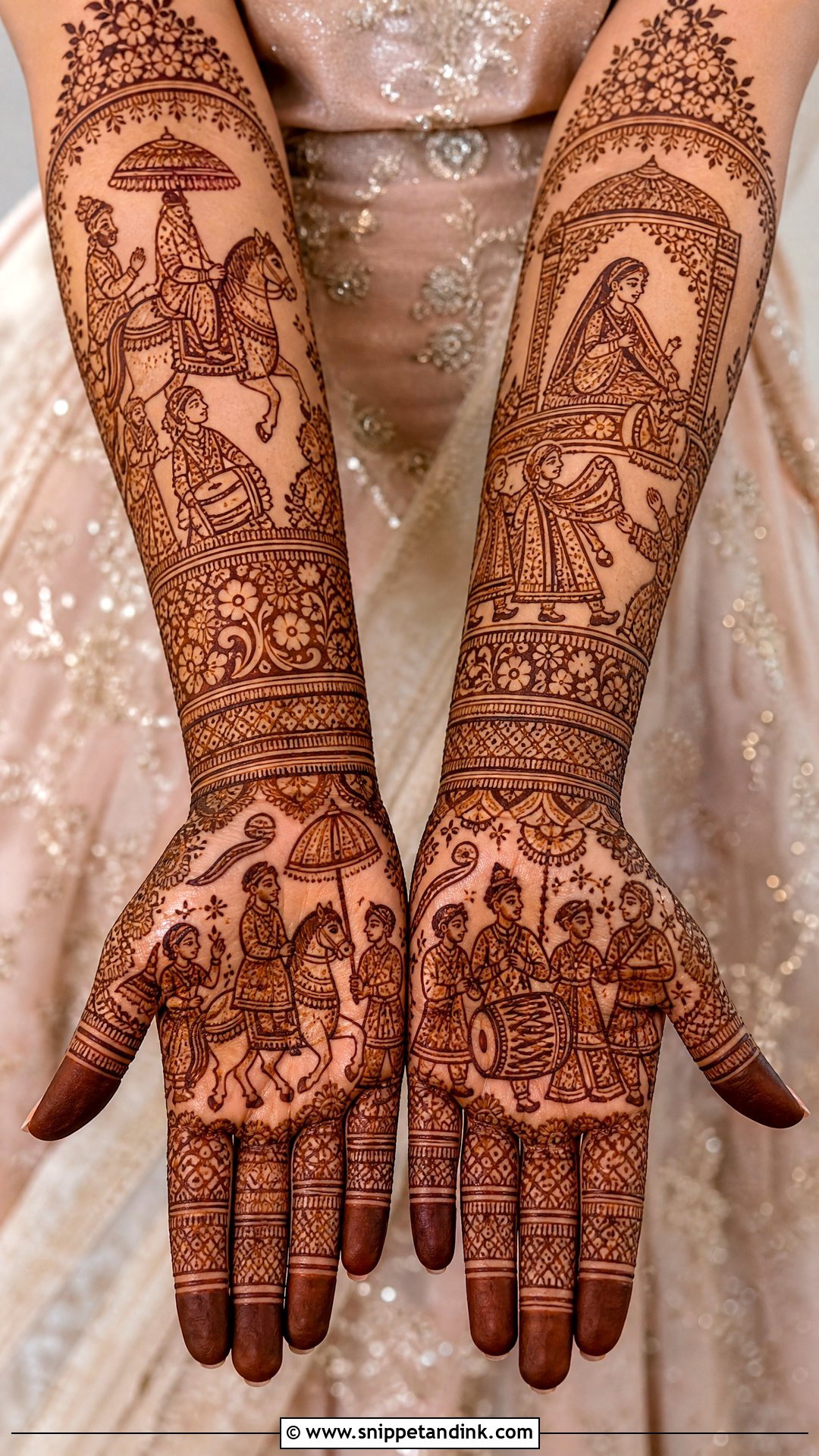
The baraat brings movement onto the hand: the groom on a horse, dhol players, dancing figures and the bride waiting under an arch. It’s detailed, so it needs full palms and forearms. I usually split it, with the procession on one hand and the bride or mandap on the other, then tie both together with matching borders at the wrist. Splitting it stops either palm from becoming too dense to read.
13. Bride And Groom Peacock Mehndi
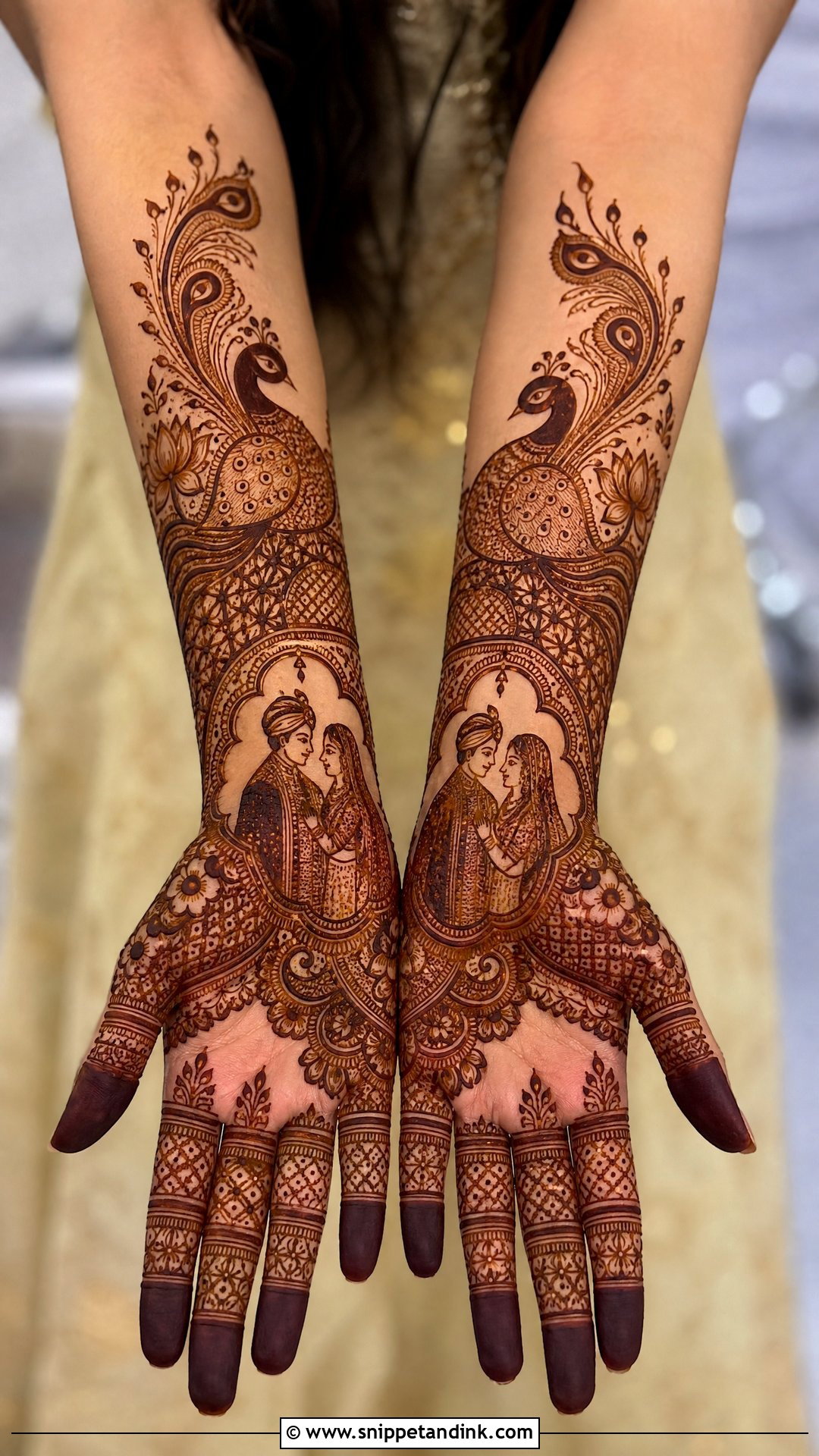
Peacocks earn their place in bridal henna because the feathers give long, graceful curves that fill space beautifully. The couple can sit between two birds, inside a feather frame or near a central mandala, with vines, small paisleys and fine mesh on the fingers. On longer hands I let the feathers trail toward the wrist so the design flows from palm to arm. On a small hand, two full peacocks can crowd the portrait, so I’ll use one.
14. Bride And Groom Mandala Mehndi
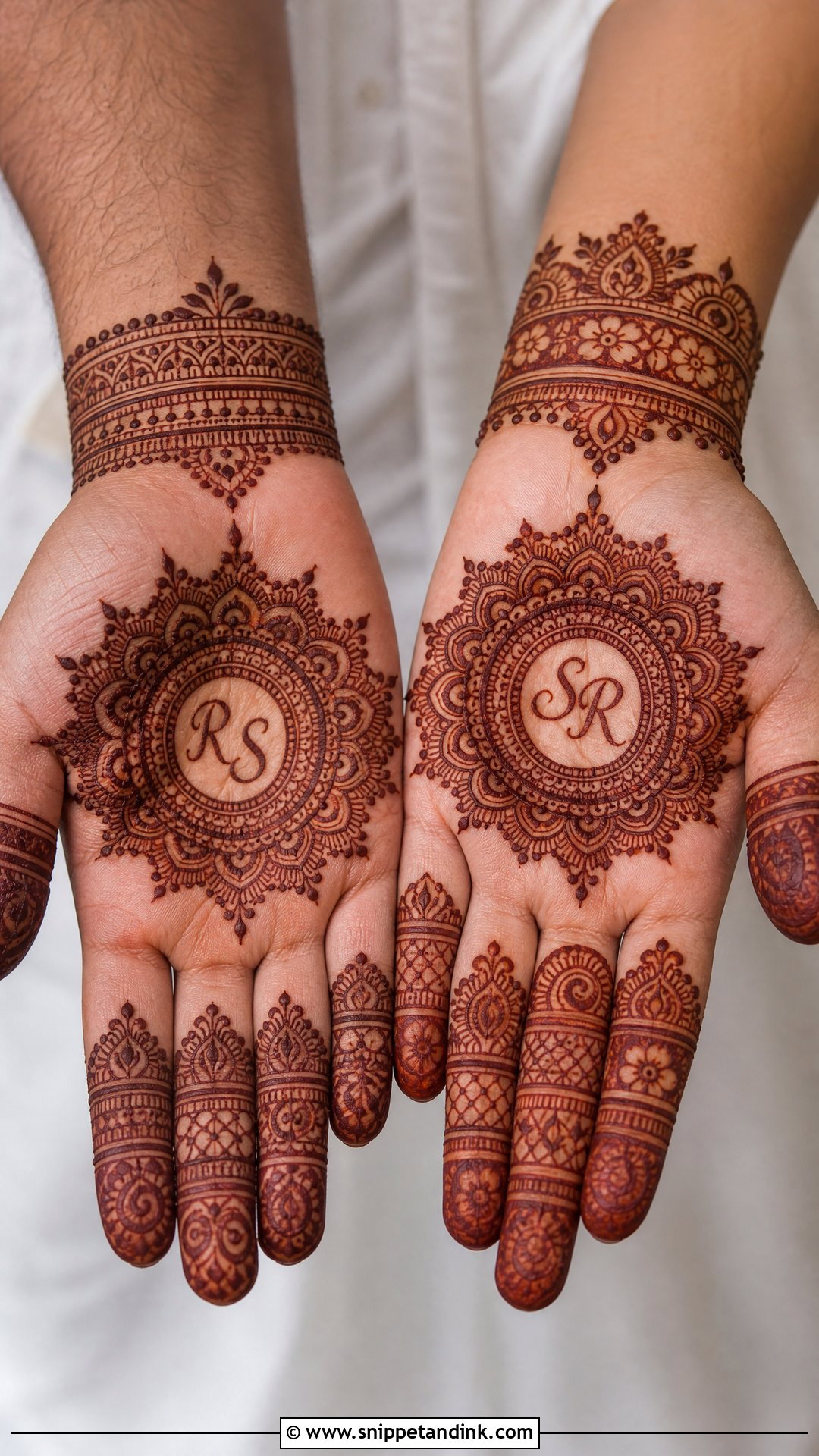
Mandalas suit brides who like symmetry. The palm holds a round centre with initials, tiny portraits or a wedding symbol, and layers of petals, dots and paisleys grow outward, finished with bracelet bands and finger patterns. You control the weight by the number of rings. Mandalas look balanced on any hand size, which makes them the easiest motif to share with a groom; his can be the same centre with fewer layers.
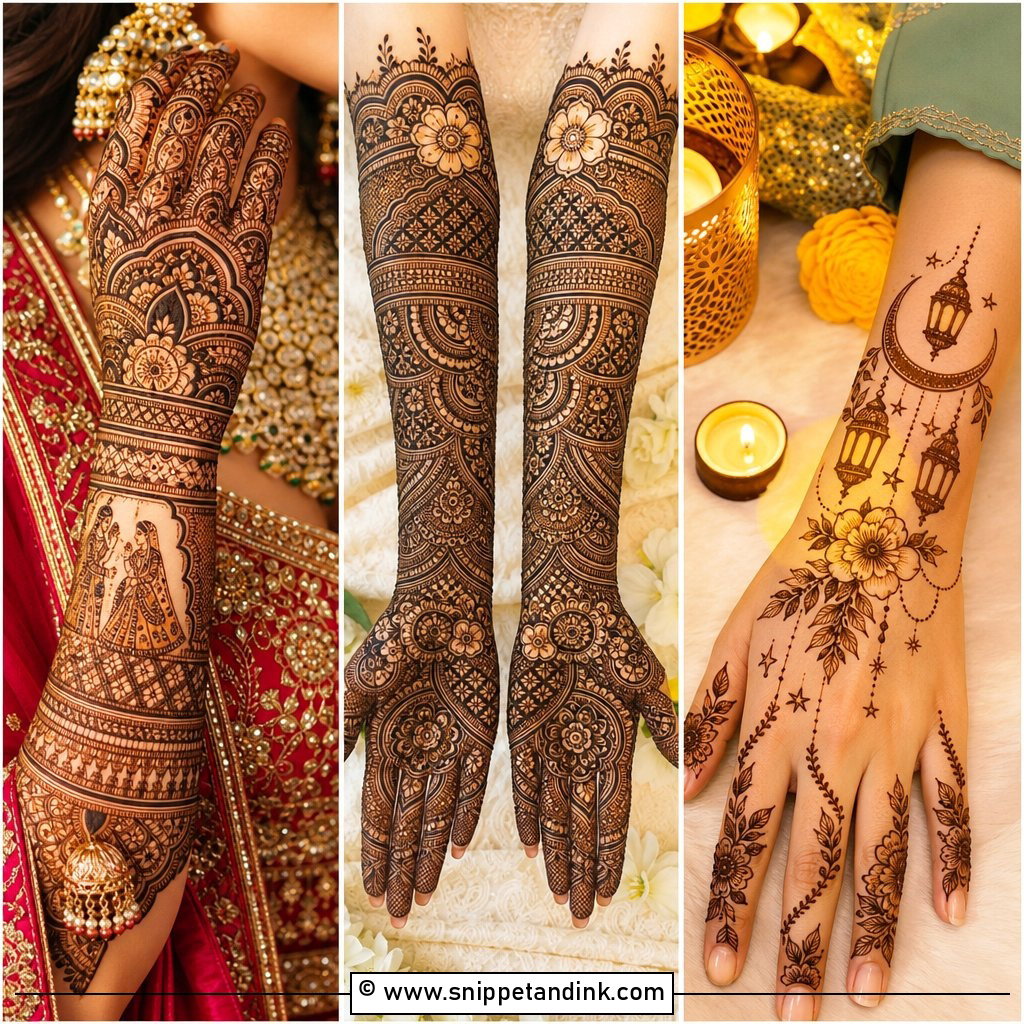


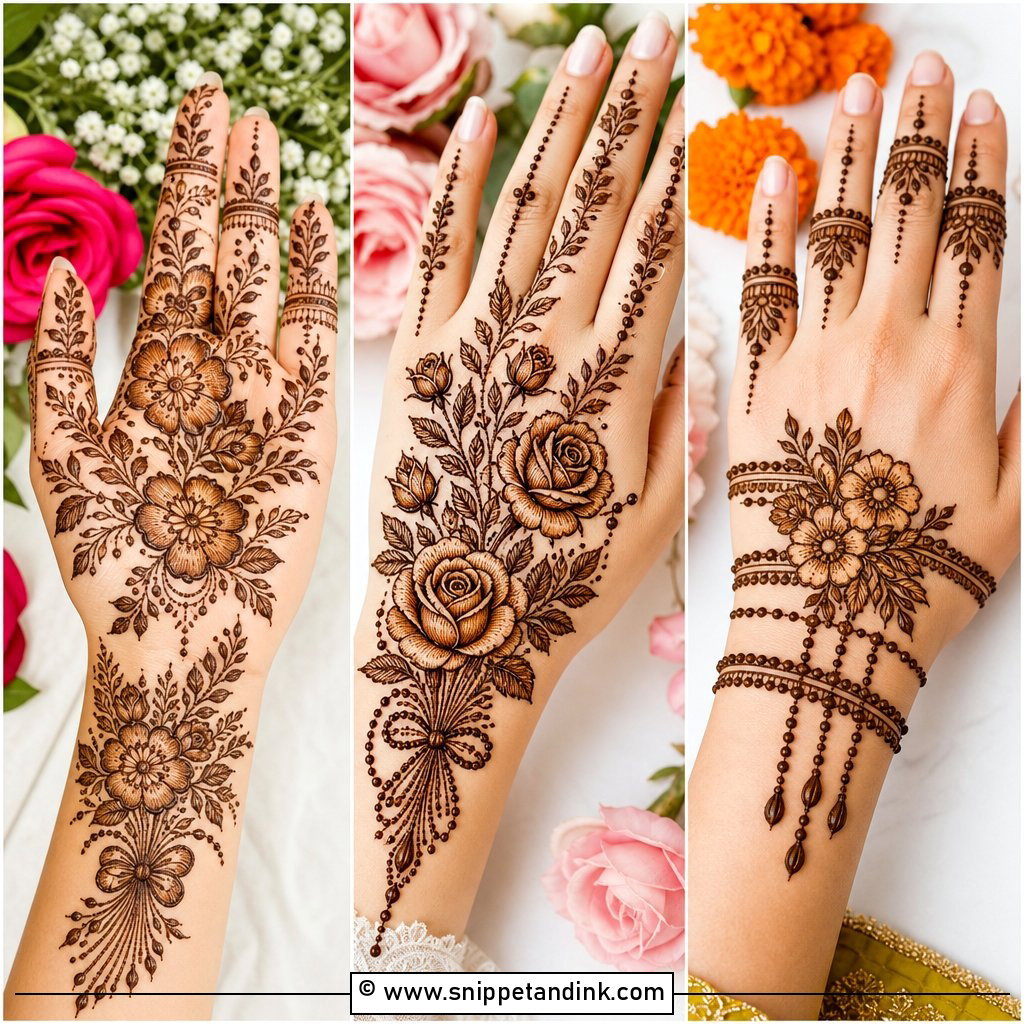
15. Bride And Groom Back Hand Mehndi
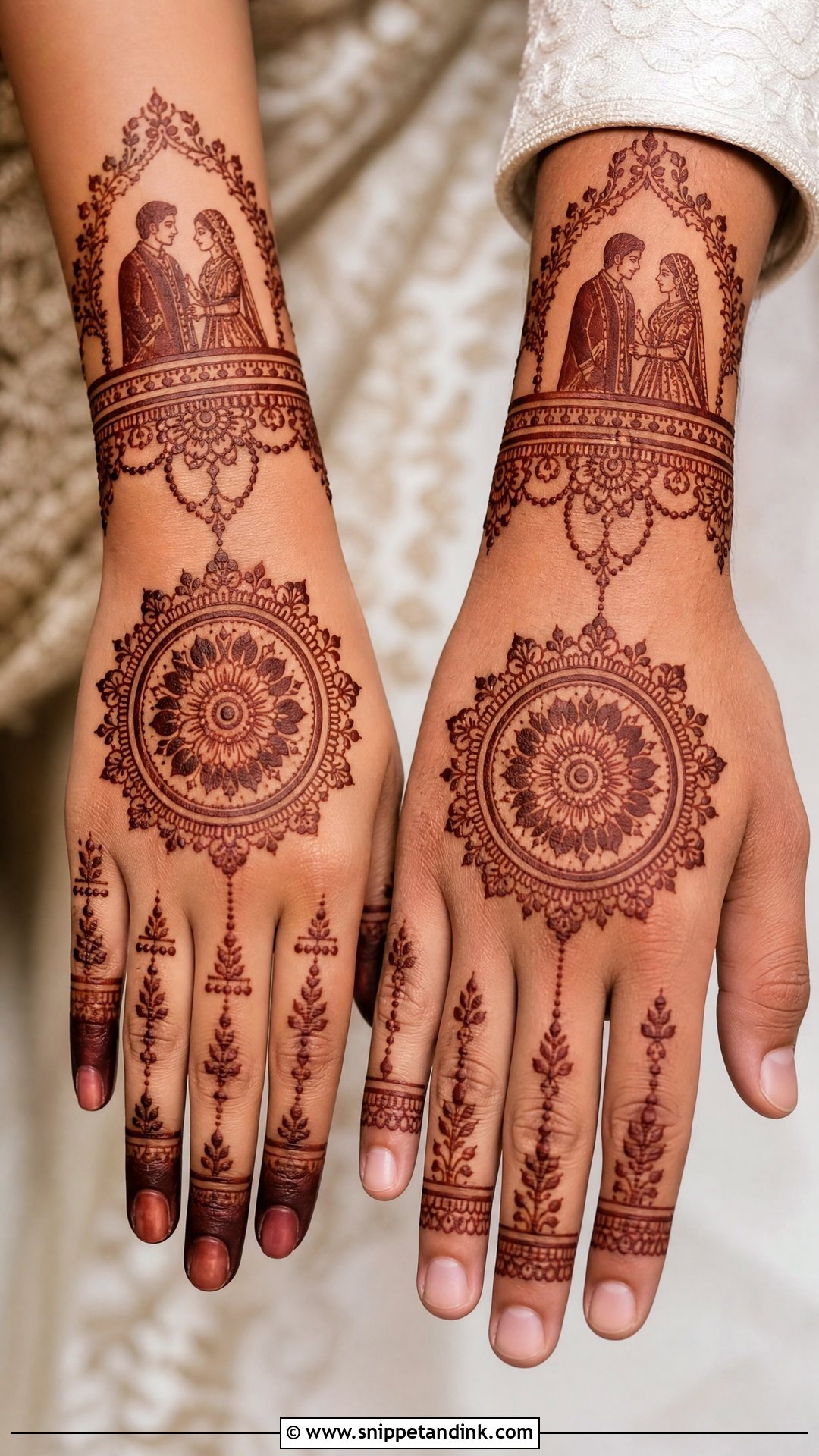
The back of the hand is what shows in ring shots and most hand poses, so it deserves as much thought as the palm. A portrait near the wrist, a mandala in the centre, floral chains over the fingers and bracelet bands work well here. One thing to know: the back of the hand stains lighter than the palm, because the skin is thinner and drier. I draw slightly bolder lines here to make up for it. Grooms can wear a simpler version with initials or one motif.
16. Bride And Groom Front Hand Mehndi
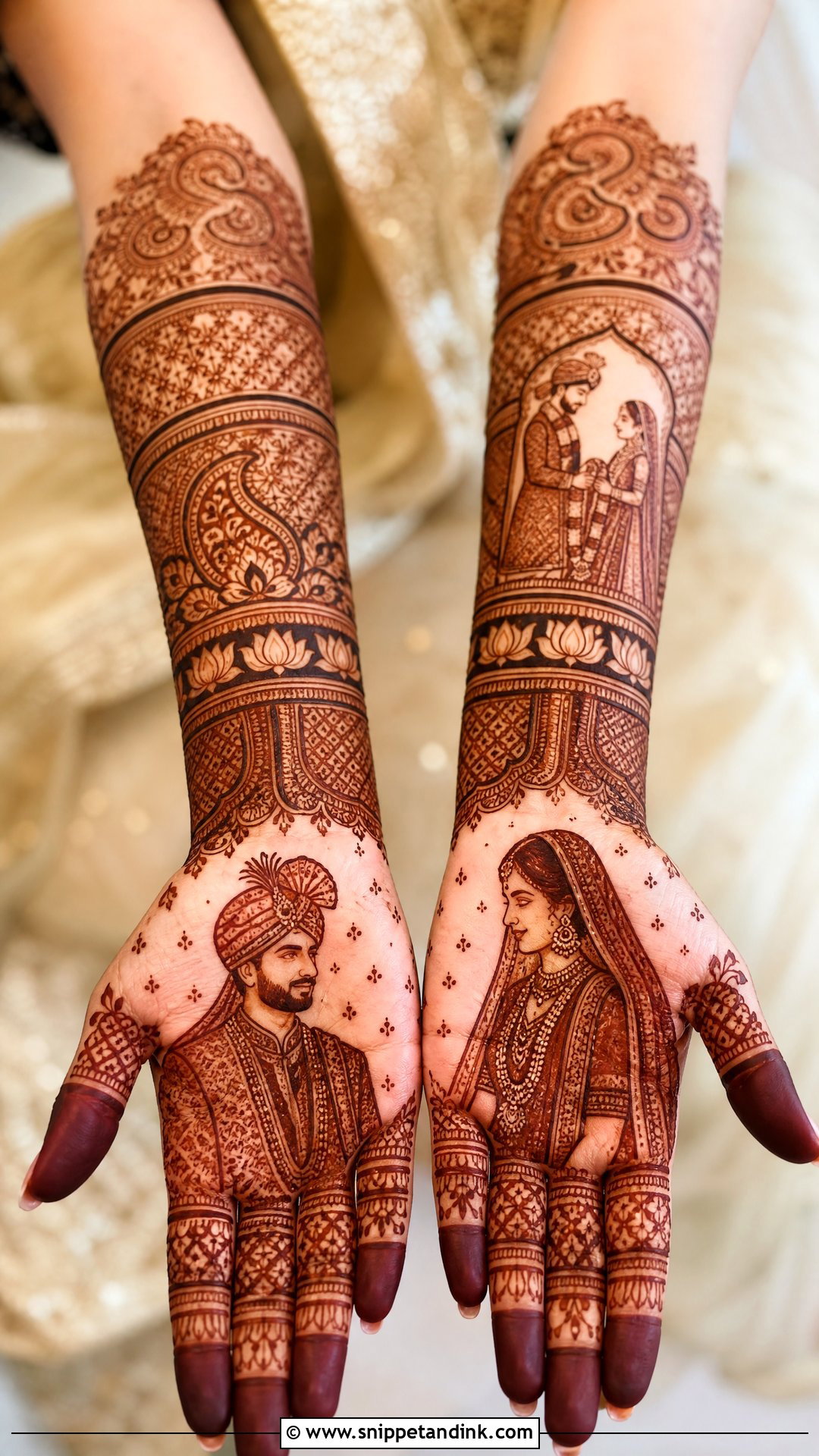
Palms are the best canvas for storytelling and the place the stain comes out darkest. Portraits, garland scenes, the mandap, names and dates all sit here, with paisleys, flowers and mesh on the fingers and wrists. The story can be split across both hands. My rule is one major couple element per palm and supporting pattern around it; three focal points on one palm compete, and the hand ends up looking busy rather than rich.
17. Bride And Groom Half Hand Mehndi
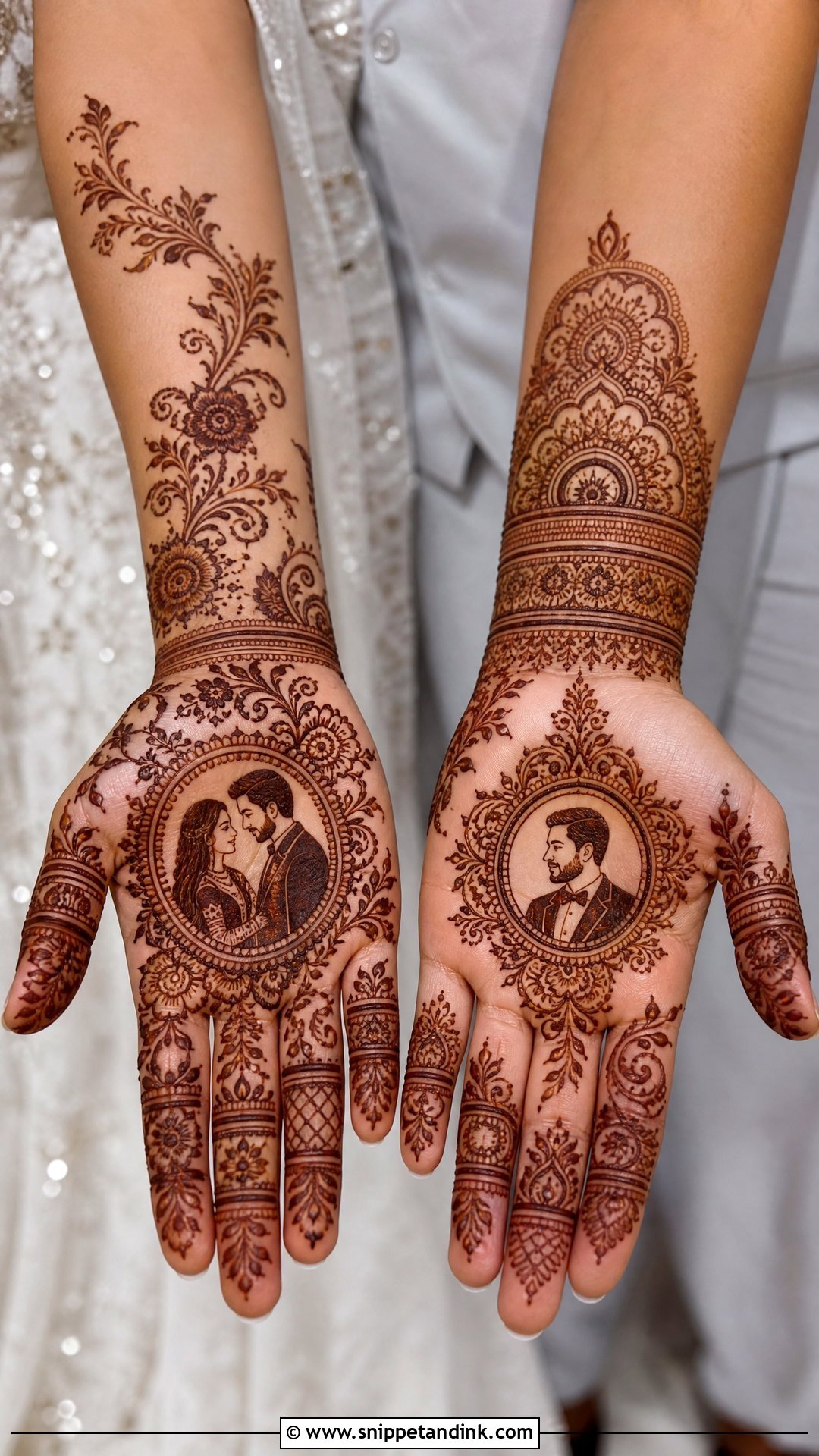
Half-hand coverage stops a little past the wrist and still feels bridal. The palm, fingers and wrist carry a portrait, initials, florals or a mandala. It’s quicker to apply and easier to sit through, which matters when the mehndi is the same week as everything else. It’s a sensible choice for the engagement, roka or a court wedding. I finish the wrist with a proper decorative edge so it looks deliberate rather than cut off.
18. Bride And Groom Groom Mehndi
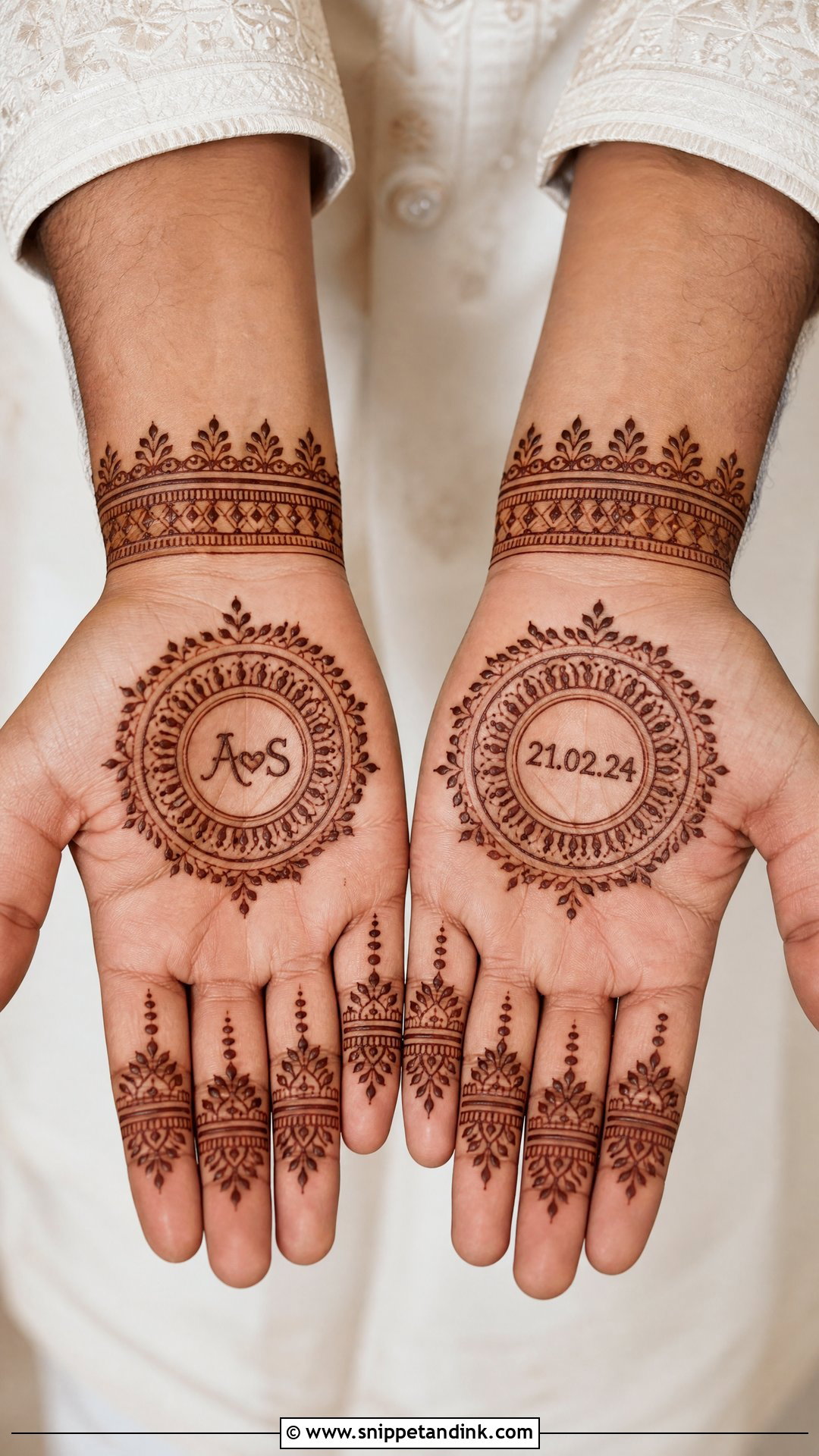
Most grooms I draw for want something clean they can sit through in under an hour. A palm mandala, the bride’s initials, the date, a small couple outline, a geometric border or a wrist band are all common. Strong lines, open spacing and a centred motif look best on a man’s hand. Wide palms take a larger mandala than you’d expect, and a design that’s too small looks lost. Share one detail with the bride’s design so the two read as a pair.
19. Matching Bride And Groom Mehndi
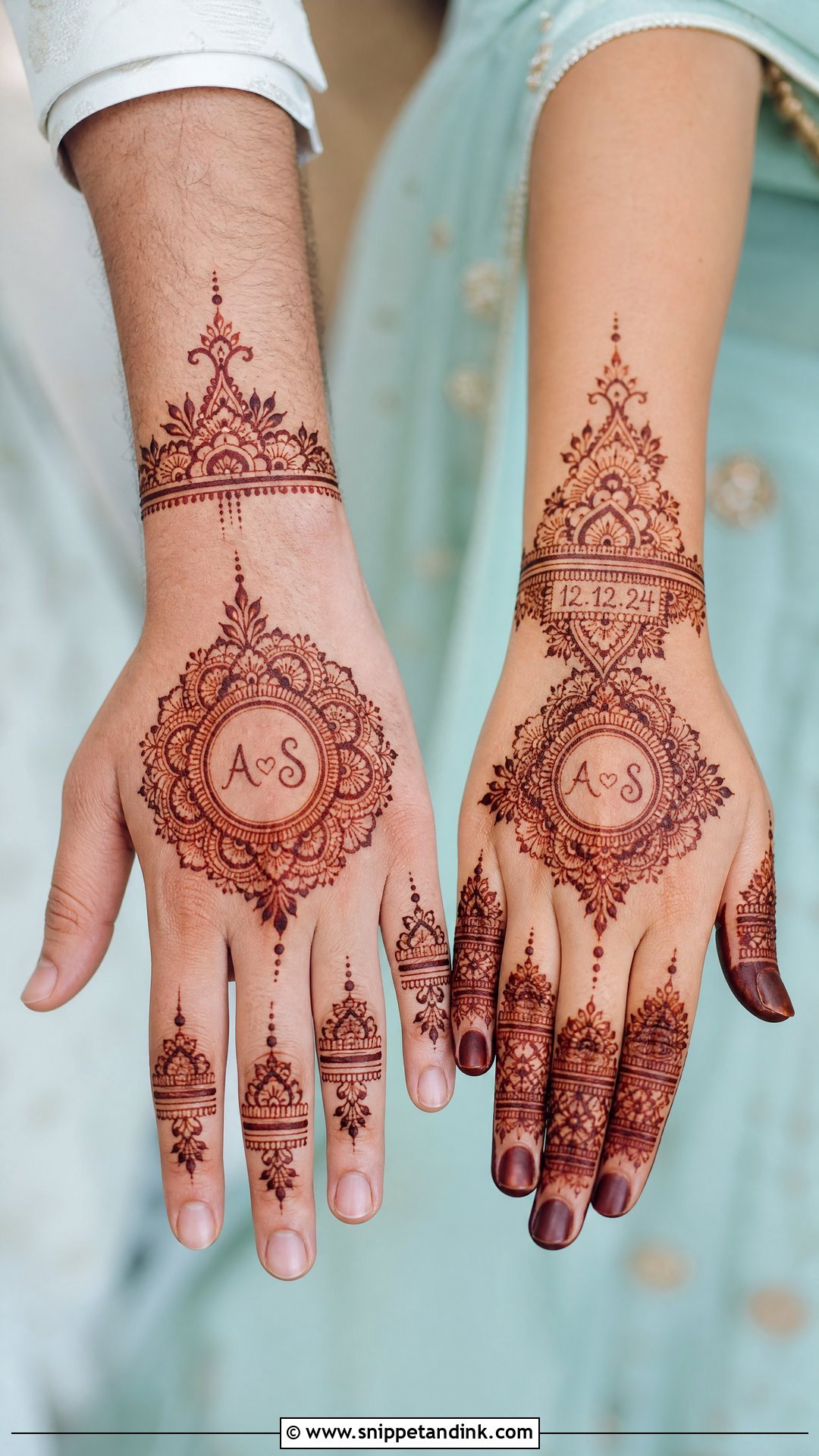
Matching bride and groom mehndi works best when it’s linked, not identical. The bride wears the rich full-hand version and the groom wears one element of it: the same initials, date, mandala, border, peacock feather or couple symbol. When you hold hands for photos, the connection is easy to spot. I plan both designs at the same consultation so the shared motif is drawn the same way on each partner.
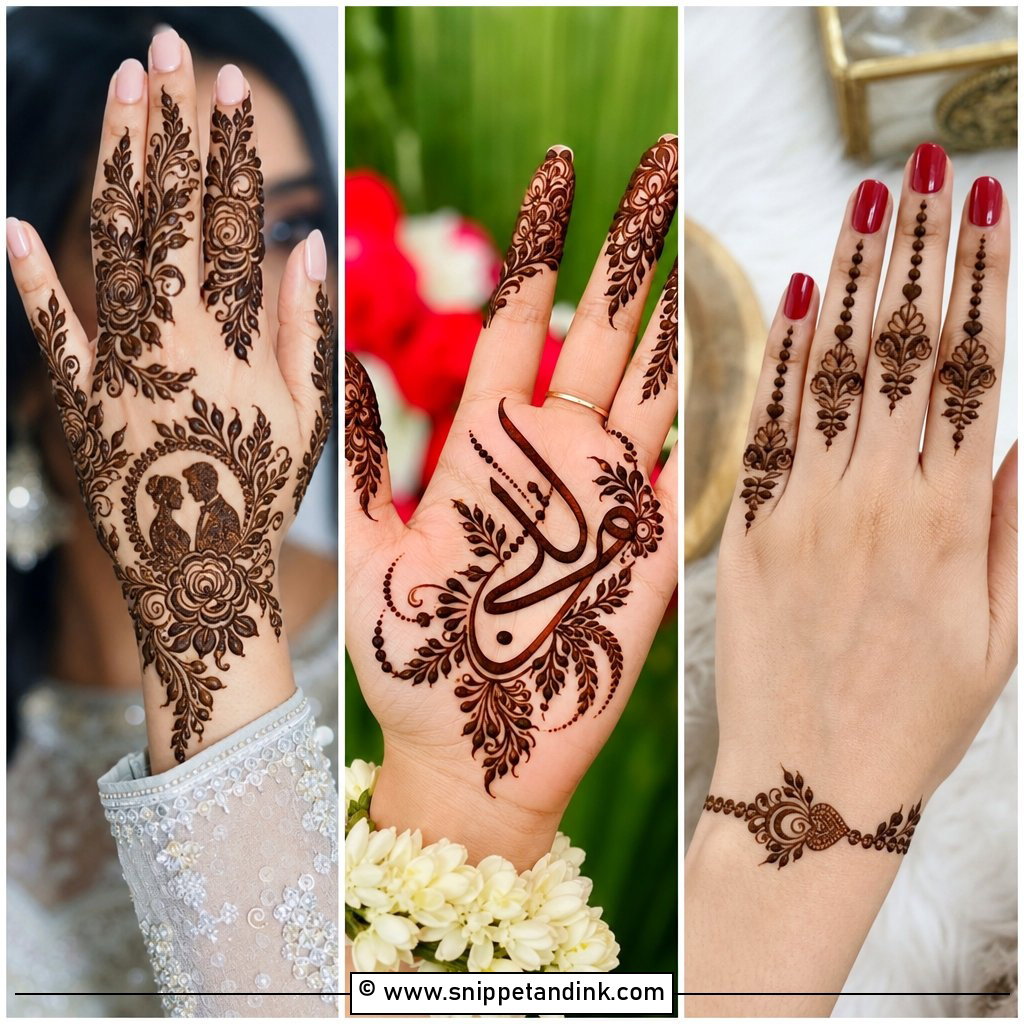
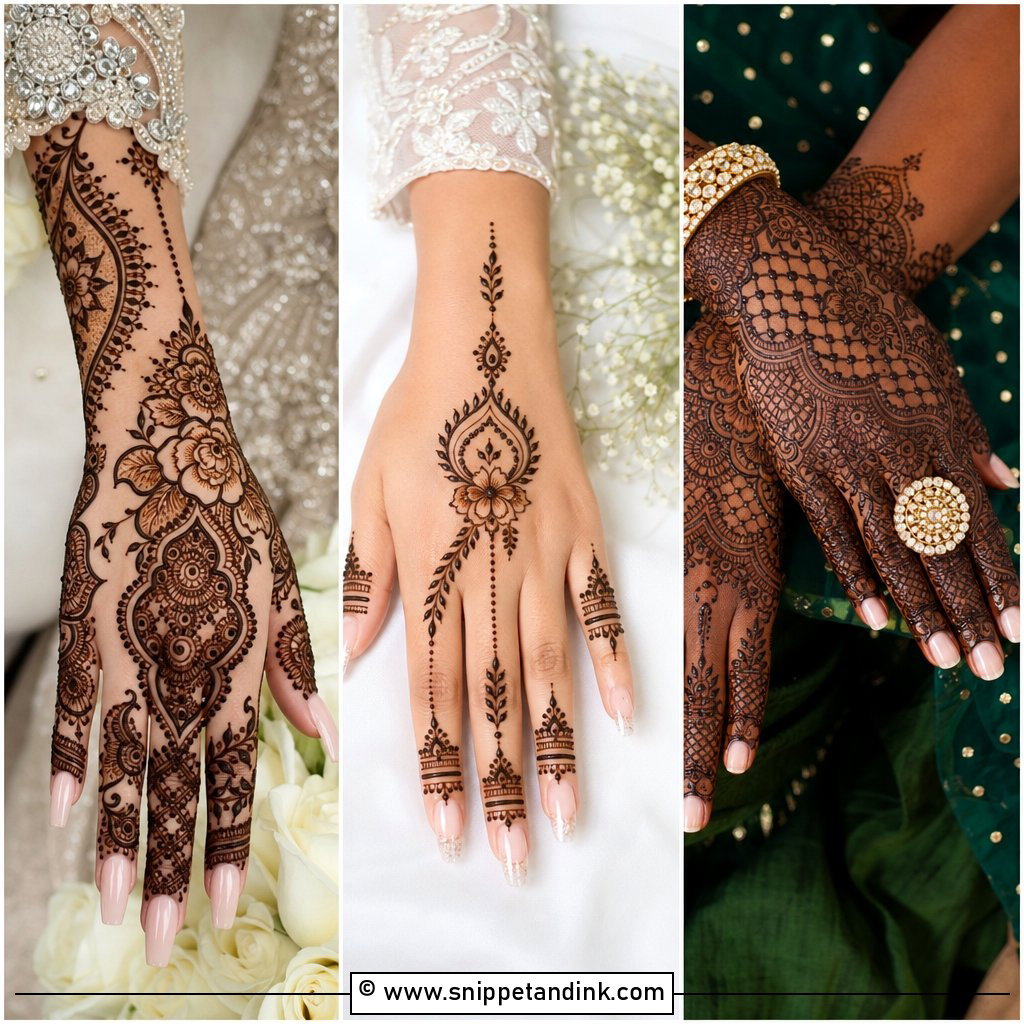
20. Modern Bride And Groom Mehndi
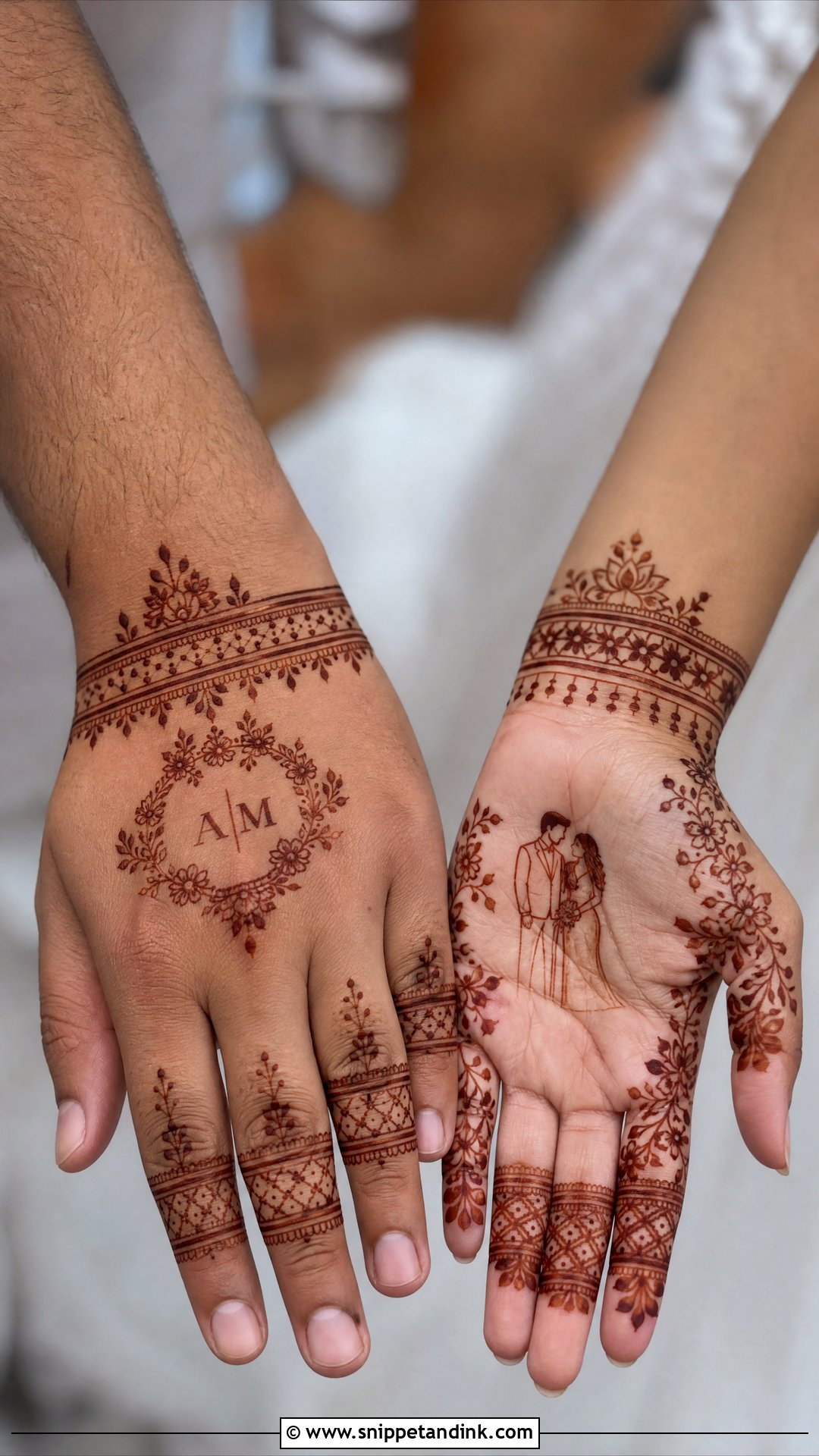
Modern couple designs lean on fine-line florals, negative space, geometric grids and bracelet bands, with initials, a date or small couple art as the personal touch. They skip dense filling in favour of clean placement. This style goes well with pastel outfits and minimal jewellery. The groom can match with a wrist band or a palm motif. Keep at least one meaningful element in it, or it can read as party henna rather than wedding mehndi.
How Fine Portrait Lines Survive the First 48 Hours
Detailed couple faces are the first thing to suffer from poor aftercare. Leave the dried paste on for as long as you comfortably can, ideally overnight. I dab a lemon and sugar mix over the drying design so it stays on the skin instead of flaking early.
- Scrape the dried paste off with a blunt edge or your fingers. Don’t wash it off.
- Keep the hands away from water for the next twelve hours or so.
- Rub a little balm or oil over the design before any shower to protect it.
- Keep your hands warm; henna darkens better on warm skin.
- Skip scrubs, hand sanitiser and swimming pools until after the wedding.
Don’t panic when the faces look pale orange the next morning. That’s normal. They darken through the day, and the palms usually end up deepest. If a tiny detail has blurred, nothing can be redrawn into a stain, so the fix happens earlier: open space around portraits and a steady line at application.
Which Story Belongs on Your Hands?
Start with what you want the mehndi to say, then decide how much skin it needs. Full Indian, Rajasthani, mandap and baraat designs tell a whole wedding; Arabic, initials and half-hand designs say one thing clearly and are easier to wear. Pick one shared detail for both partners. Bring your references, your names and your date written out, and the outfit colours to the consultation, and your artist can plan both sets of hands as one design.
You'll Like These Ideas:



Leave a Reply