
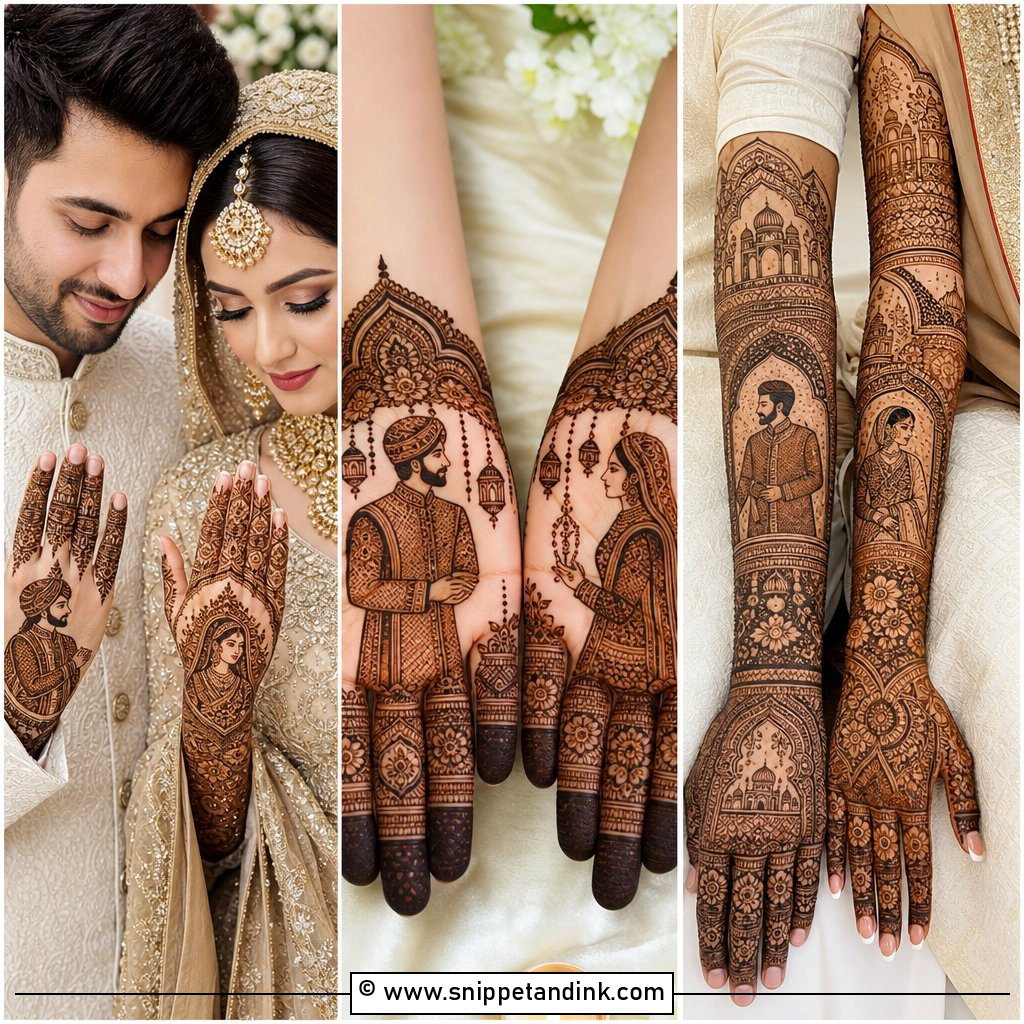
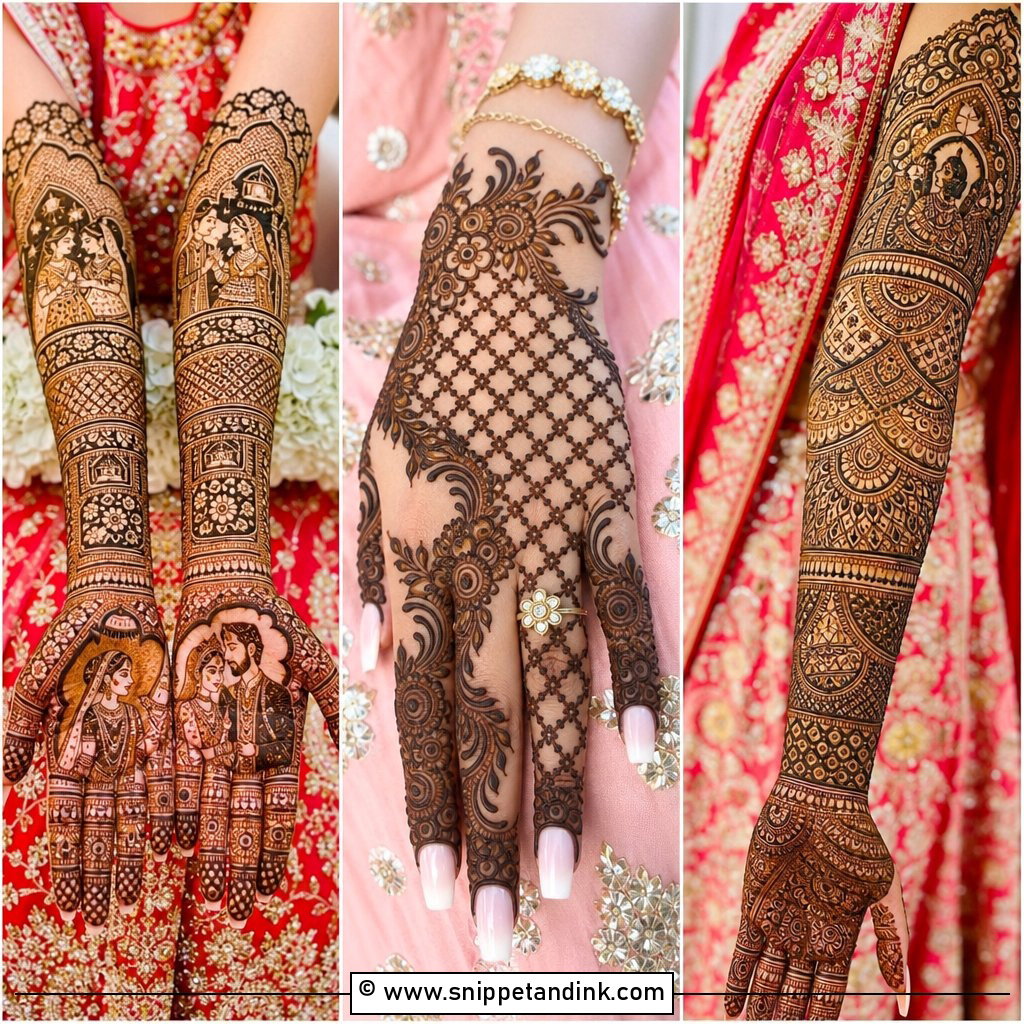
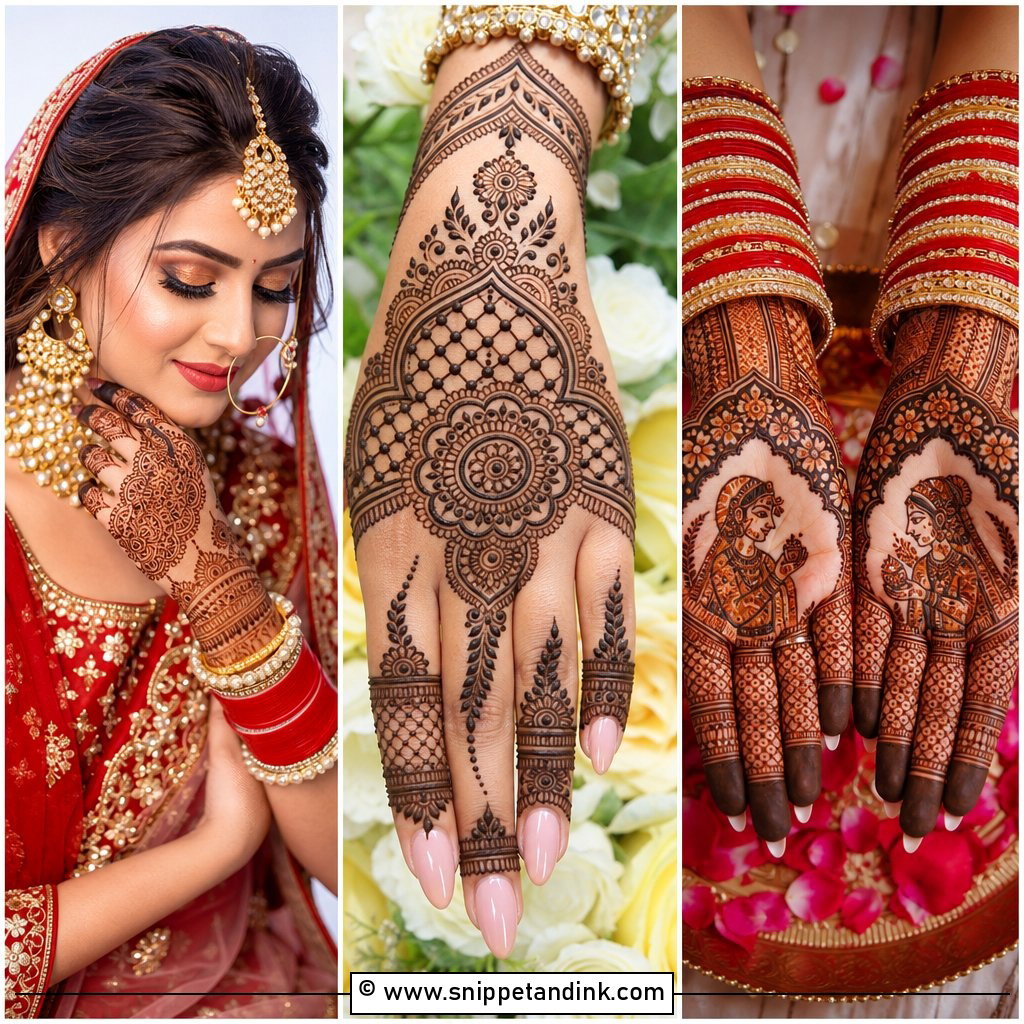
A dulha dulhan design puts the couple themselves on the bride’s hands: her portrait on one palm, his on the other, so the story only completes when she brings her hands together. Around those two faces go the scenes and symbols of the wedding, the varmala, the mandap, the baraat, peacocks, lotus, jaali, paisleys and mandalas. It is the most demanding kind of bridal henna I draw, because a face forgives far less than a flower does. Below are 30 layouts, from full Rajasthani storytelling to small palm silhouettes, along with notes on placement, sizing and what each one asks of your artist and of your patience.
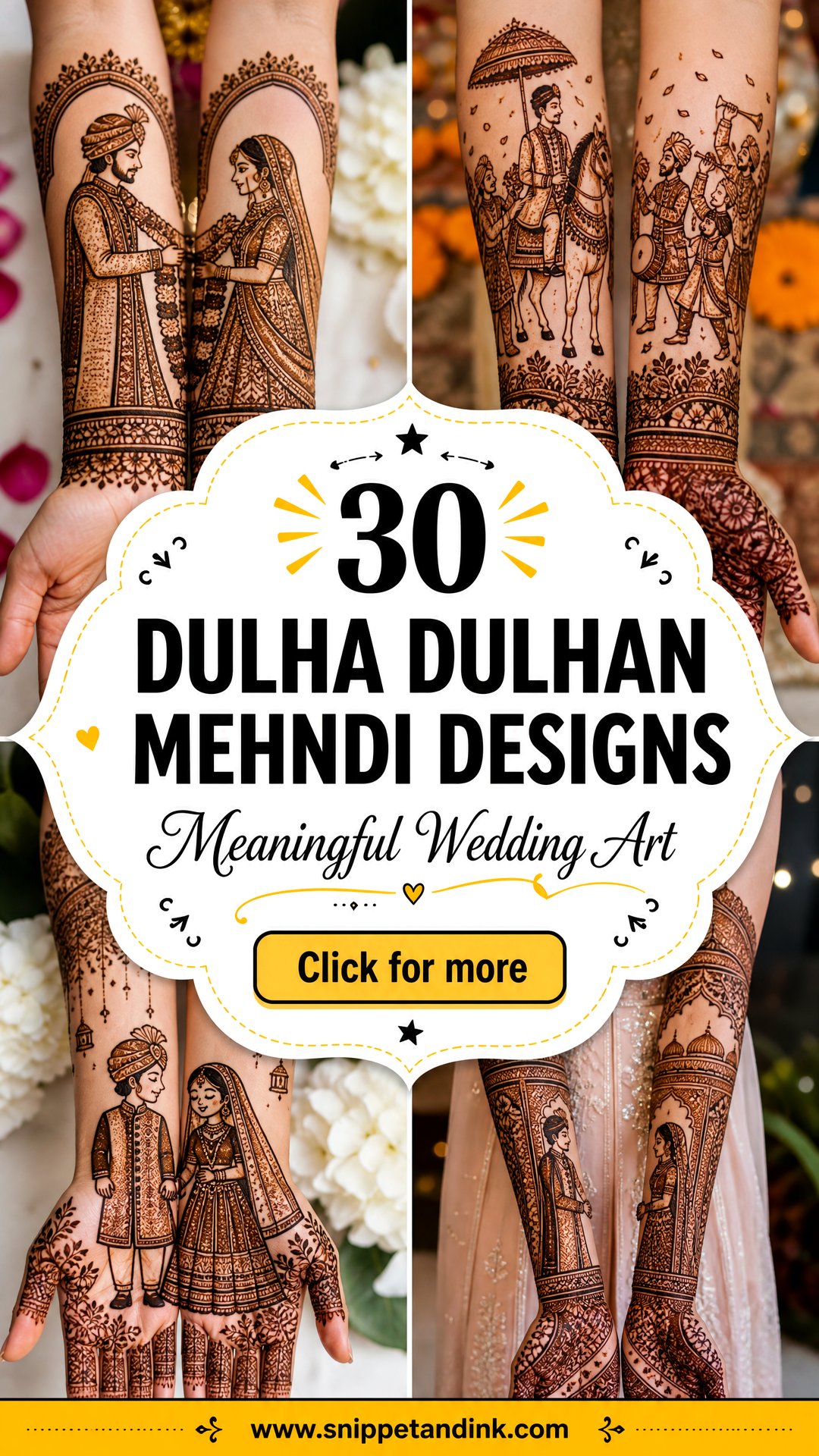
A Portrait Hand Is a Full-Day Booking
Brides are often surprised by how long these designs take. Faces, figures and scenes are drawn slowly, with the finest tip, and a full front-and-back portrait layout to the elbow can take the better part of a day. Add feet or legs and it runs longer. Times vary widely by artist and design, so ask for an honest estimate when you book rather than assuming it fits around your other events.
Planning the sitting
I prefer the bridal mehndi a day or two before the wedding, so the stain has time to darken from orange to its deepest shade. Eat properly before we start, because once both hands are covered you will need someone to feed you. Use the bathroom right before your palms are done. Wear a loose top with sleeves that push well above the elbow, and plan for someone to sit with you, since you will be still for hours.
Feet are usually drawn first, while you can still sit comfortably, then the hands. Portraits take priority over filler, so if time runs short, the forearm details are what should be simplified, not the faces.
1. Full Hand Dulha Dulhan Mehndi Design
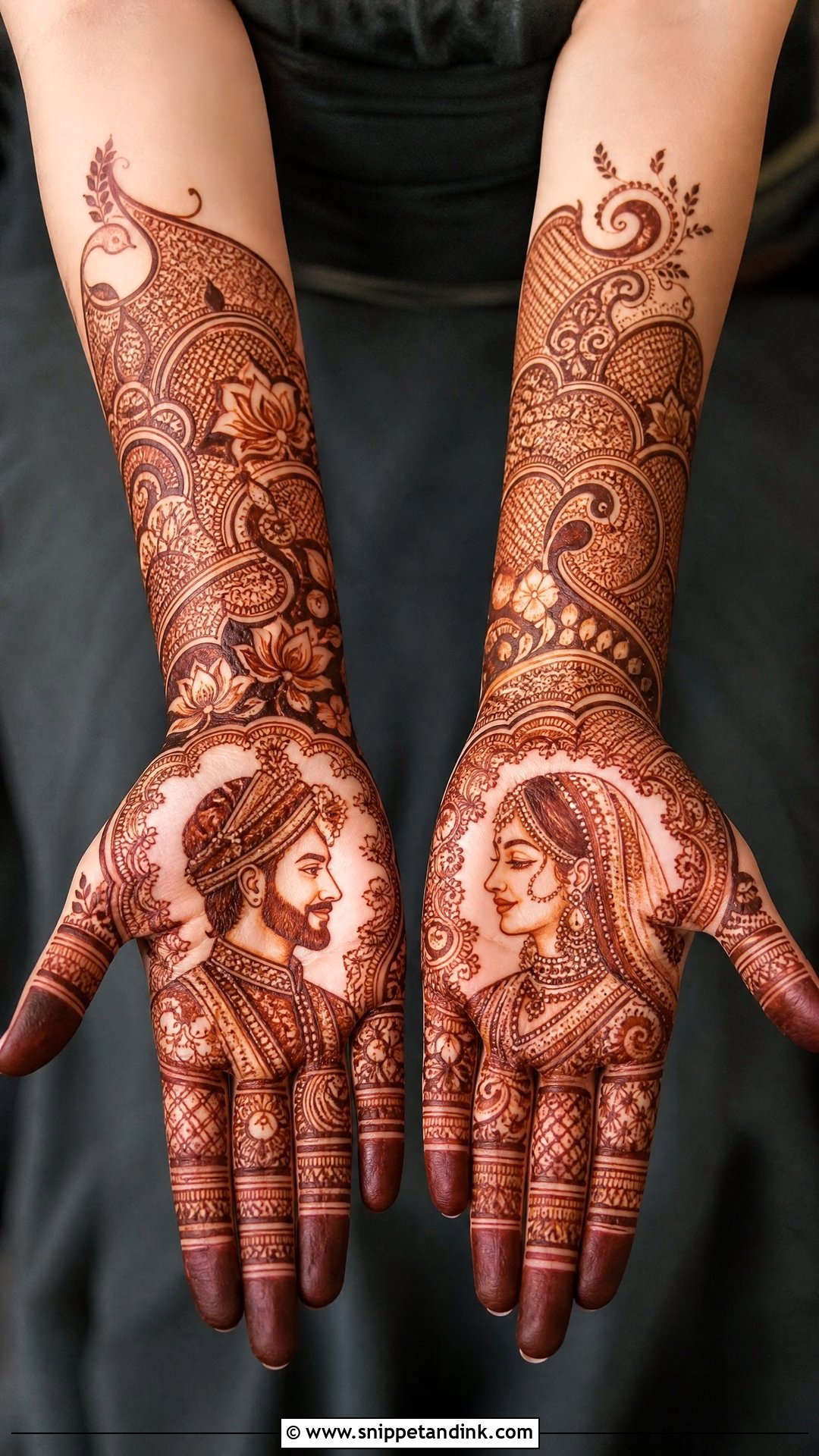
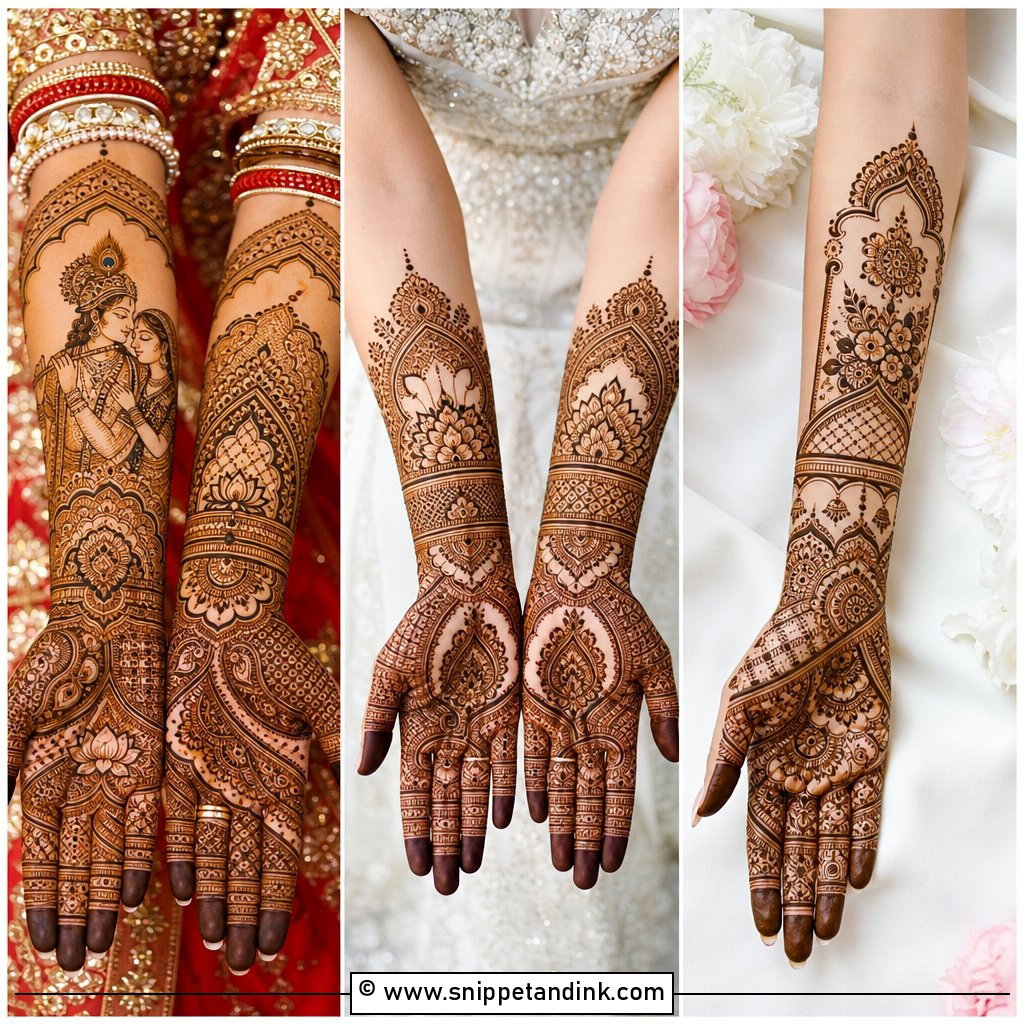
This is the classic arrangement: dulha on one palm, dulhan on the other, with paisleys, lotus, peacock curves, jaali panels and fine filler running from fingertips to forearm. A full hand dulha dulhan mehndi design needs that full length, because squeezing the portraits into the palm alone leaves no room for a frame. I draw the faces a touch larger than anything around them. If the filler motifs match the faces in scale, the eye can’t find the couple in a photo.
2. Dulha Dulhan Portrait Mehndi Design
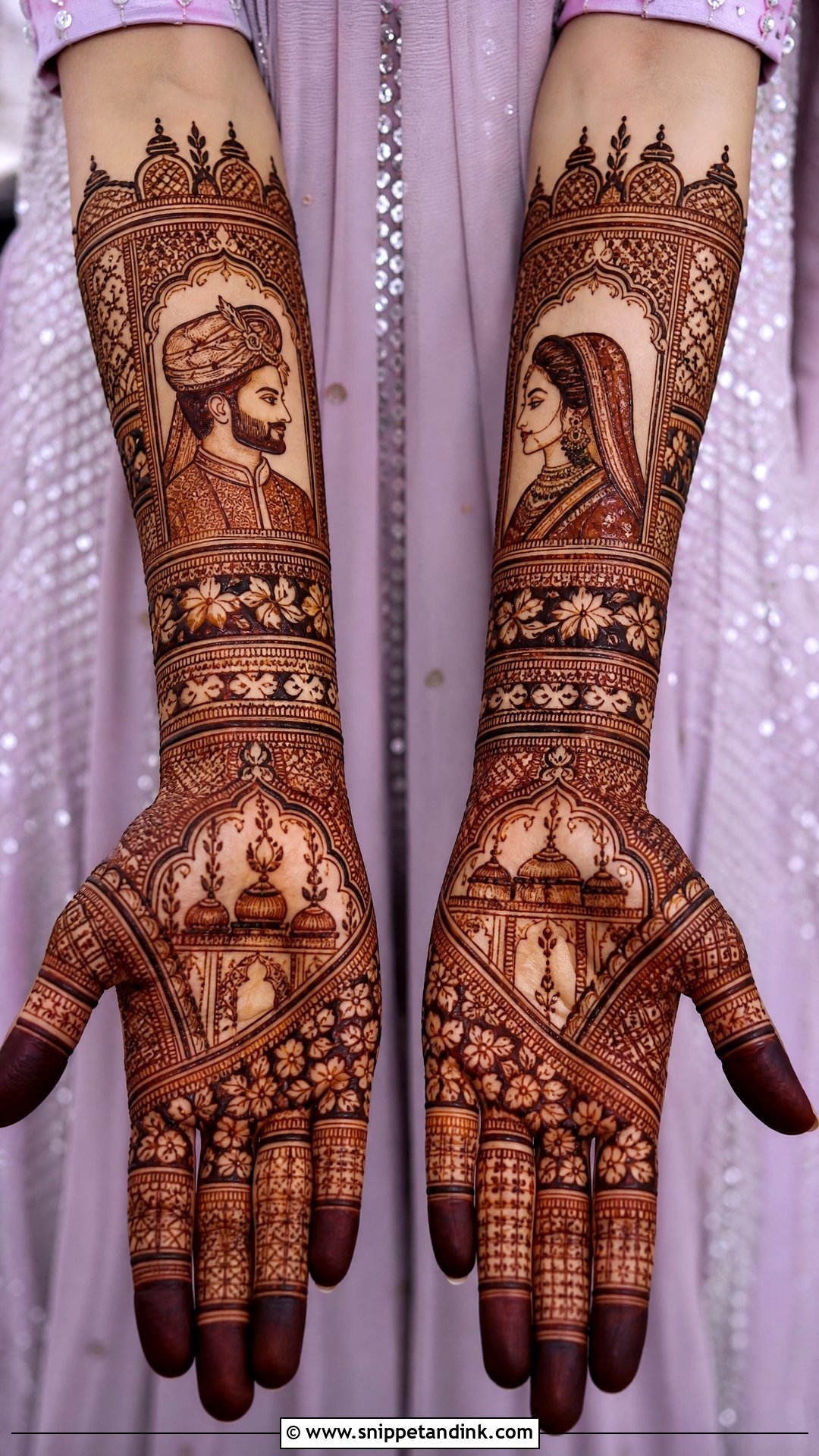
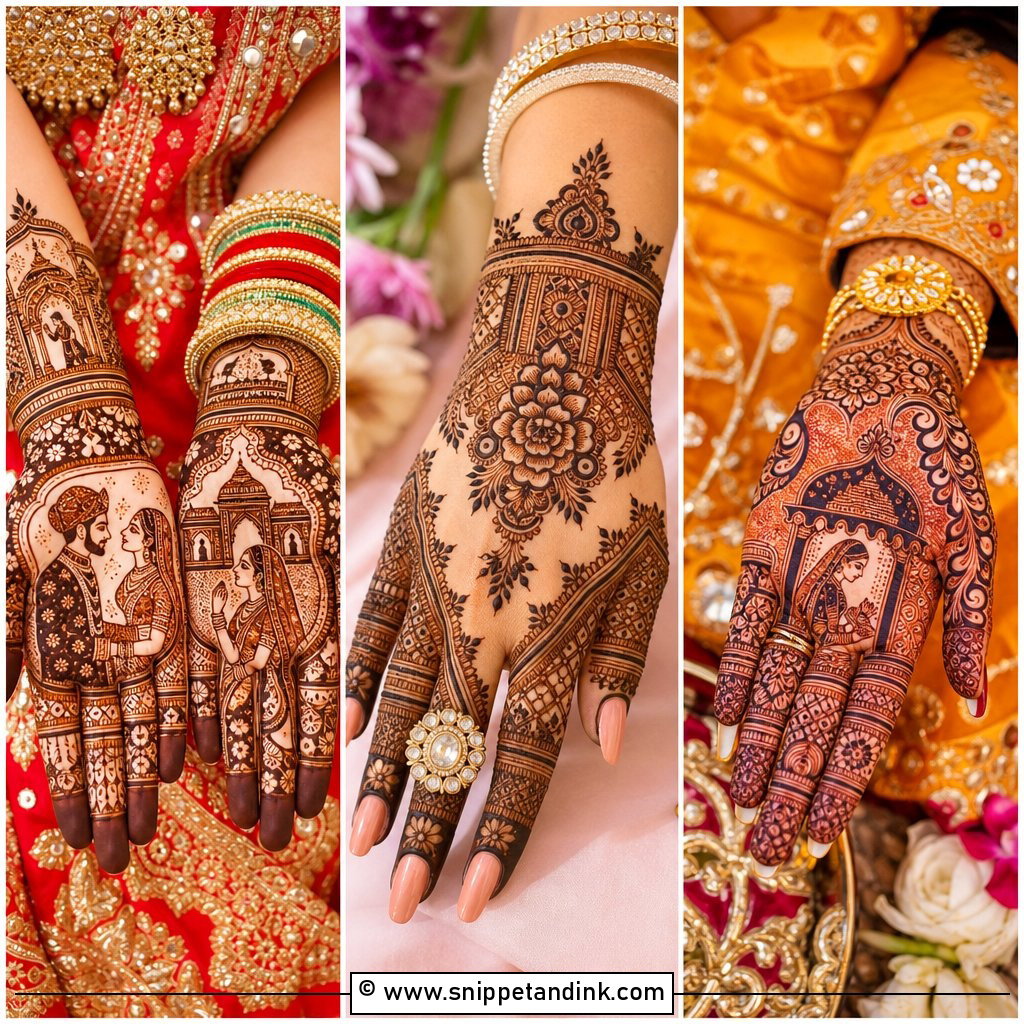
Faces are where you find out whether an artist is good. The bride usually wears a veil and jewelry and the groom a turban, sherwani or sehra, and every one of those details is drawn with the finest cone tip I have. Eyes and lips are the riskiest strokes; a line that’s slightly too thick turns a smile into a frown once the stain darkens. That’s why I keep the area around each portrait clear and put the busy work, checkered fills and leafy chains, on the fingers and forearm instead.
3. Bride And Groom Palm Mehndi Design
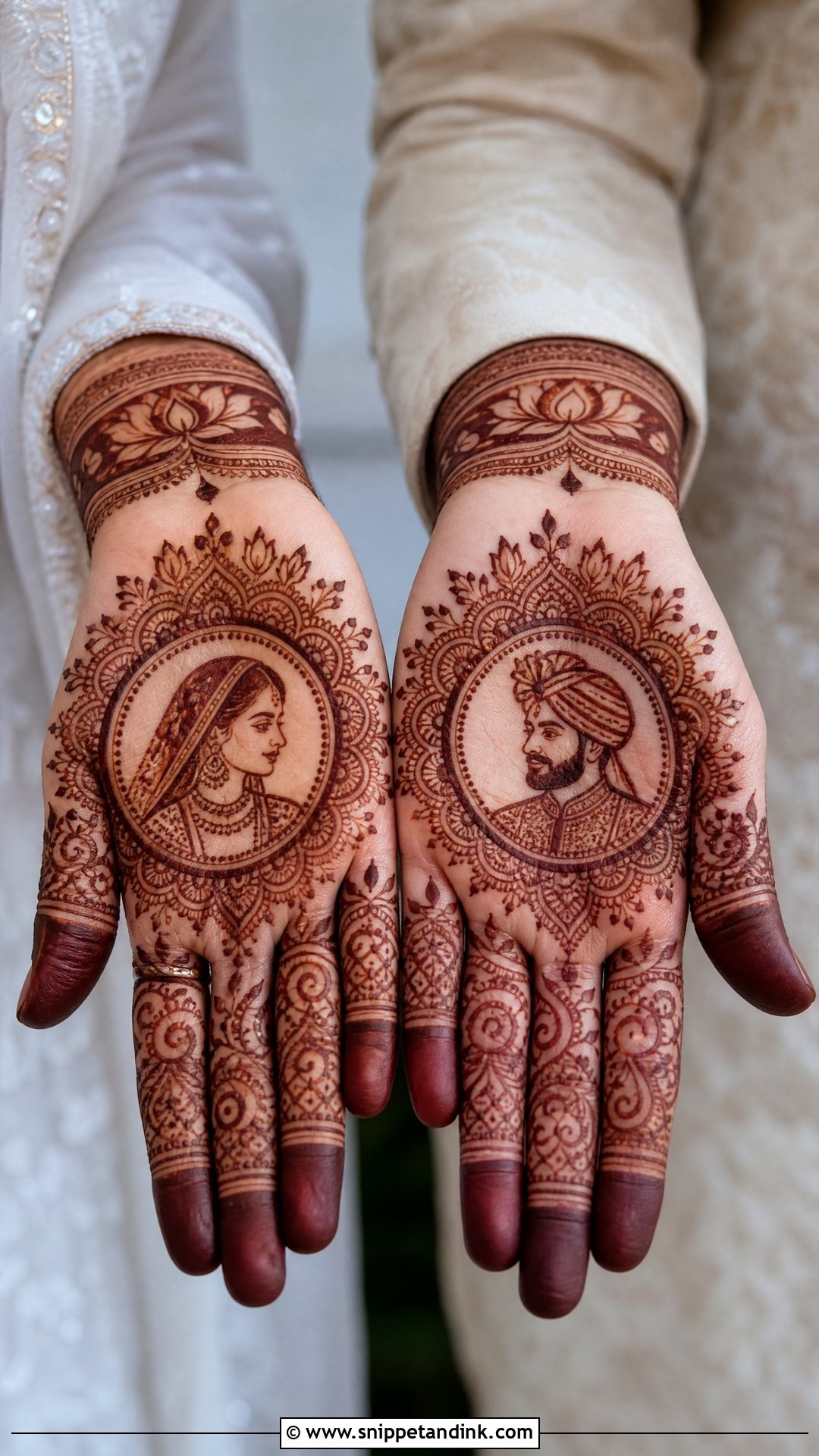
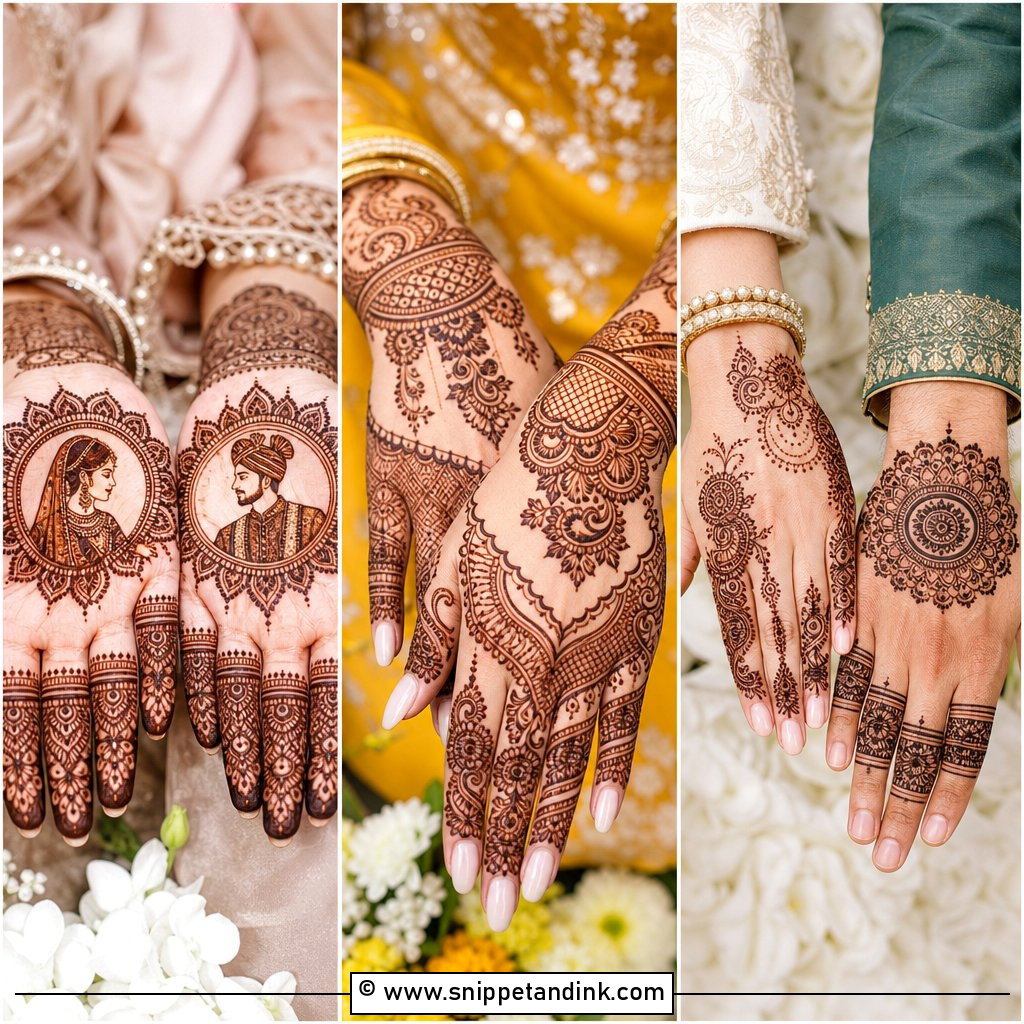
Palms are the flattest, steadiest canvas on the body, which makes them the natural home for circular portrait frames and mirror layouts. One palm holds the bride, the other the groom, with bells, lotus petals and paisley vines around them. Even at medium coverage the design stays clean, because the portrait zones are kept open. I outline the faces boldly and soften the fillers toward the edge of the palm, so the strongest contrast sits where the story is.
4. Dulha Dulhan Back Hand Mehndi Design
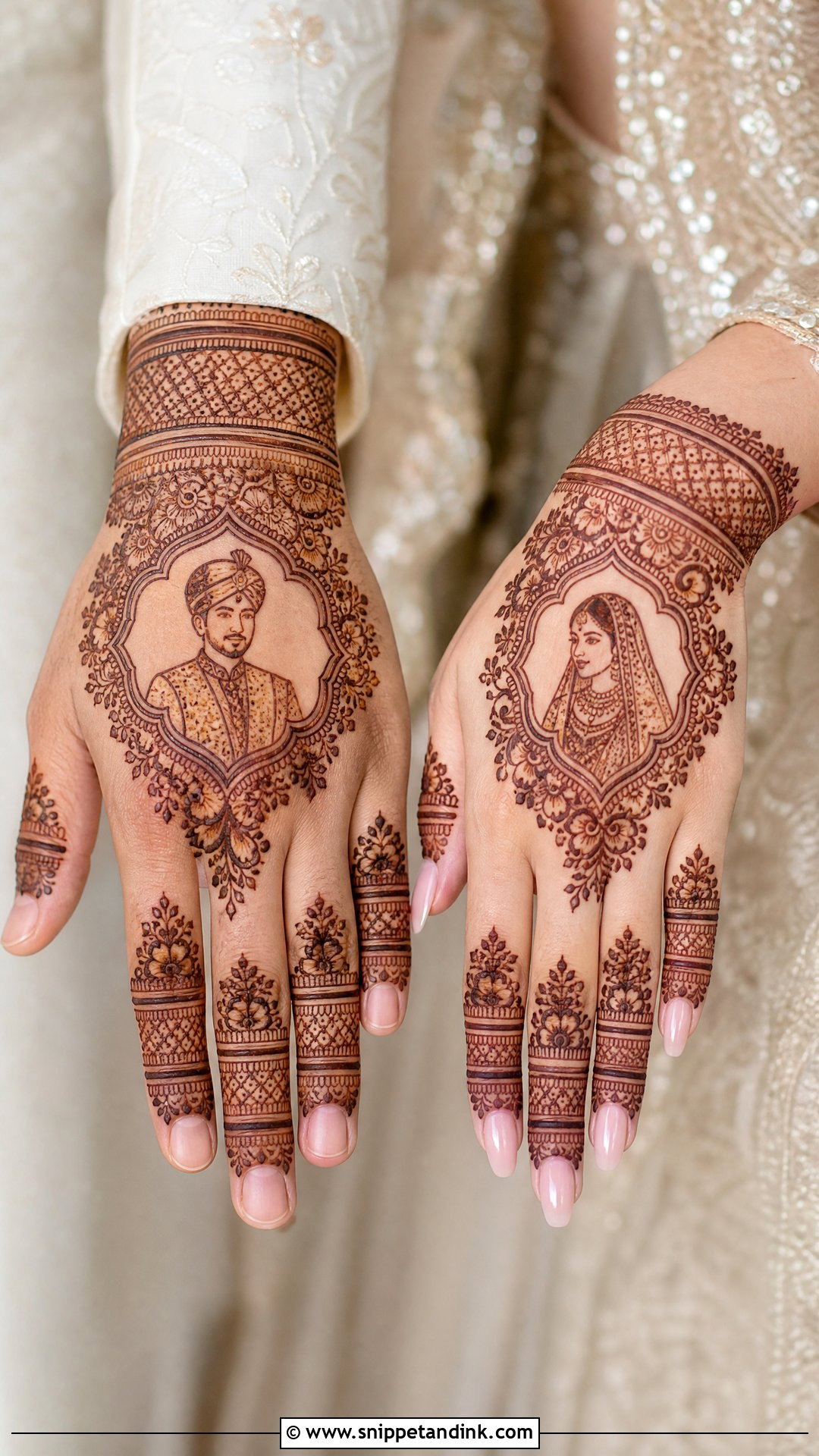
The back hand is what the camera sees in ring, kalire and jewelry shots, so a dulha dulhan back hand mehndi design gets photographed more than people realise. The skin there moves over tendons and knuckles, which distorts a face every time the hand flexes. I place the portrait in a framed area at the center or just above the wrist, where the surface stays flattest. Matching cuffs and finger patterns then tie the two hands together, with floral trails and half-mandalas filling around.
5. Dulha Dulhan Front Hand Mehndi Design
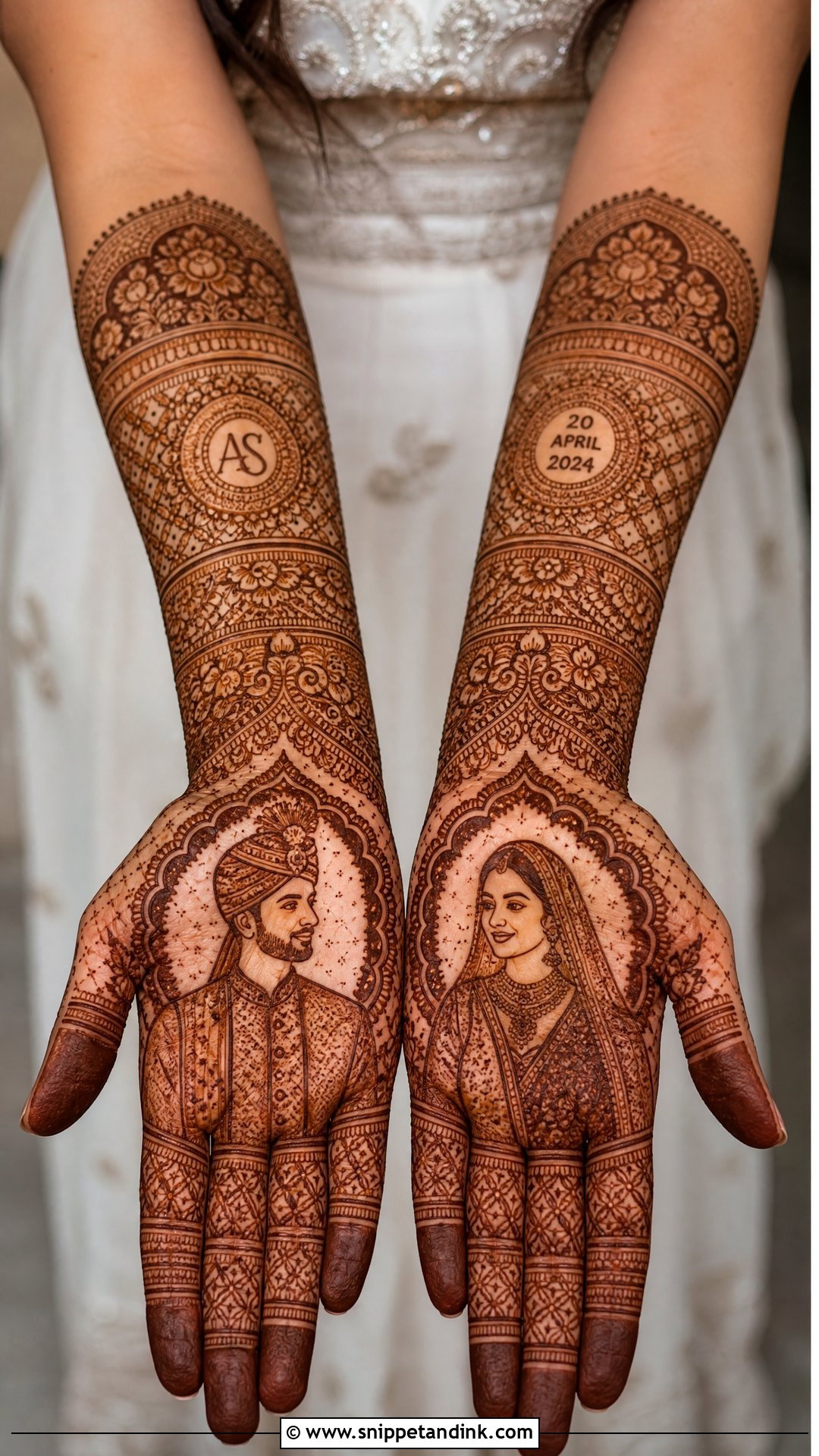
Front hands are on show during the rituals themselves, which is why many brides put their most important details here: portraits, a varmala scene, the date, hidden initials. Palm skin also takes the darkest stain on the hand, so anything that must read clearly belongs on this side. Dense Indian fillers give a classic finish, while leaving open spacing between florals pushes it more modern. Extend toward the wrist or forearm only if your sleeves will show it.
6. Dulha Dulhan Varmala Mehndi Design
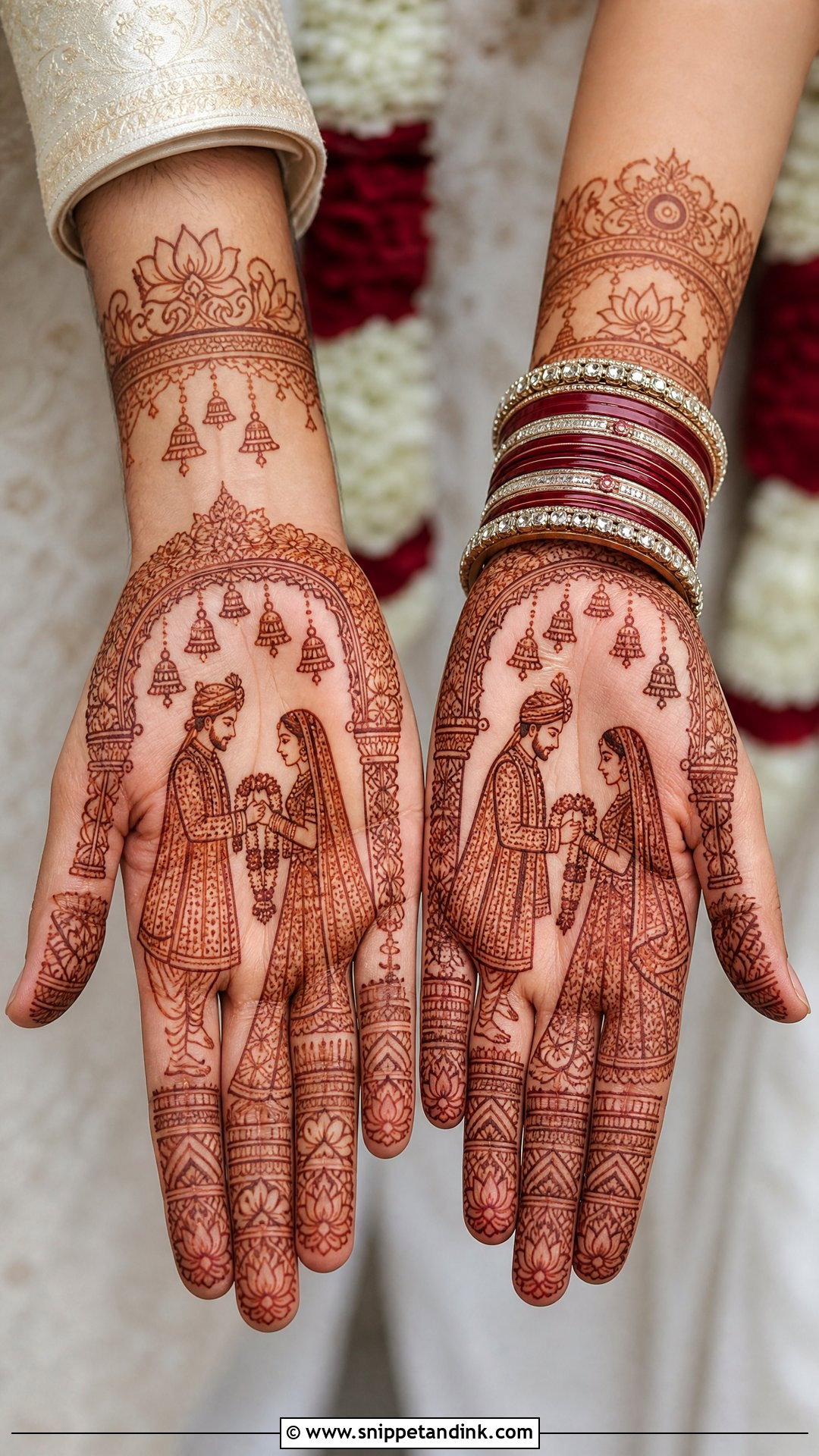
Here the design shows the garland exchange itself: bride and groom facing each other inside an arch, mandap or royal frame, split across both palms so the moment completes when the hands meet. Flower strings, bells, paisleys and leafy borders surround it. The figures are the hard part. Full bodies at palm scale get tiny, so I draw them from the waist up at a medium size and keep clear skin around them. Otherwise the scene sinks into the fillers.
7. Dulha Dulhan Mandap Mehndi Design
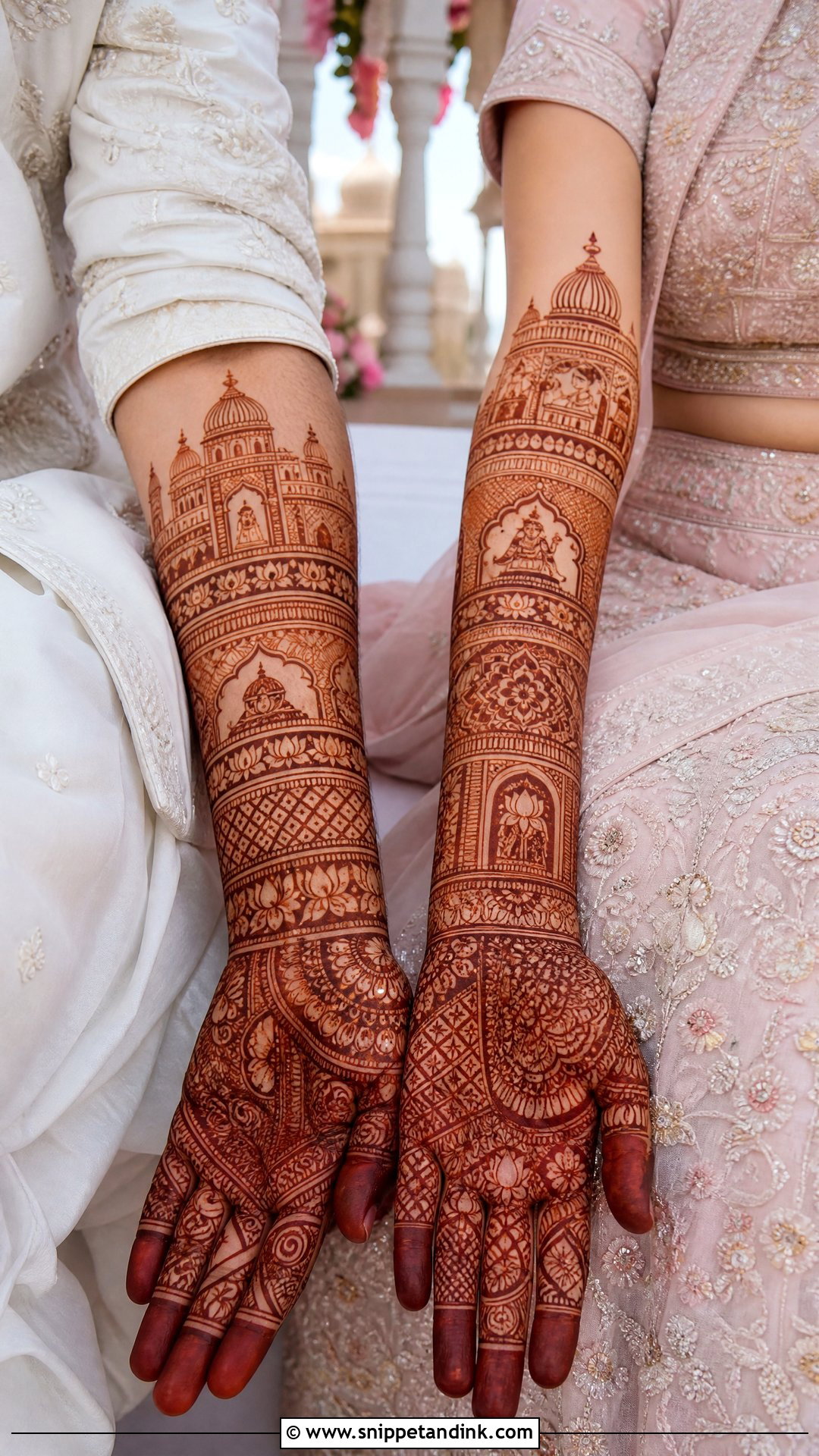
A mandap scene needs width and height: pillars, drapes, floral strings and the couple seated beneath. Full hands carry it best, with the couple on the palms and temple-style domes, lotus borders and paisleys climbing the forearms. Contrast is what keeps it from going muddy. I make the pillar and canopy lines bold and keep the background patterns noticeably finer, so the ceremony still stands out once the whole hand has darkened to reddish brown or maroon.
8. Dulha Dulhan Baraat Mehndi Design
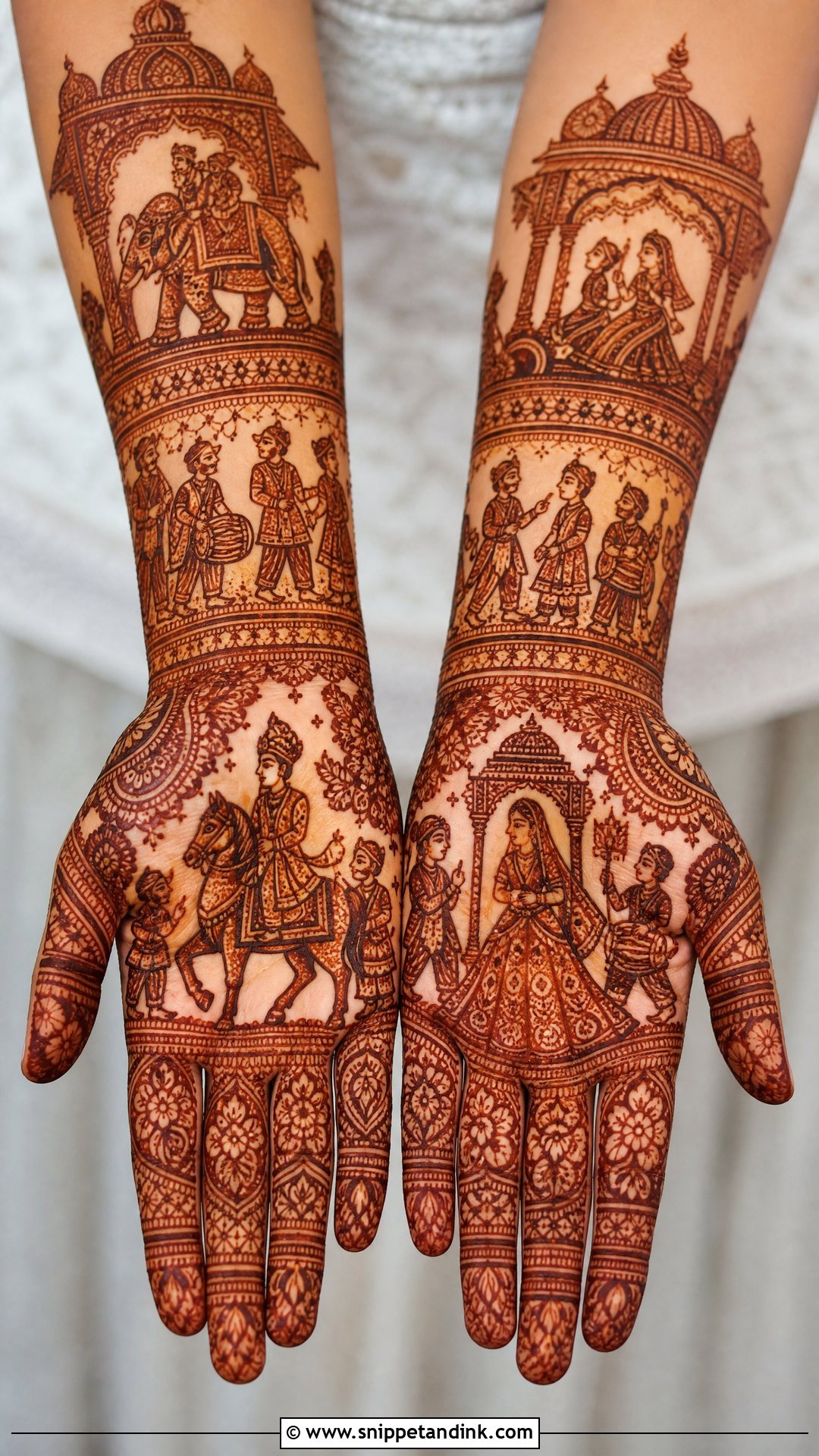
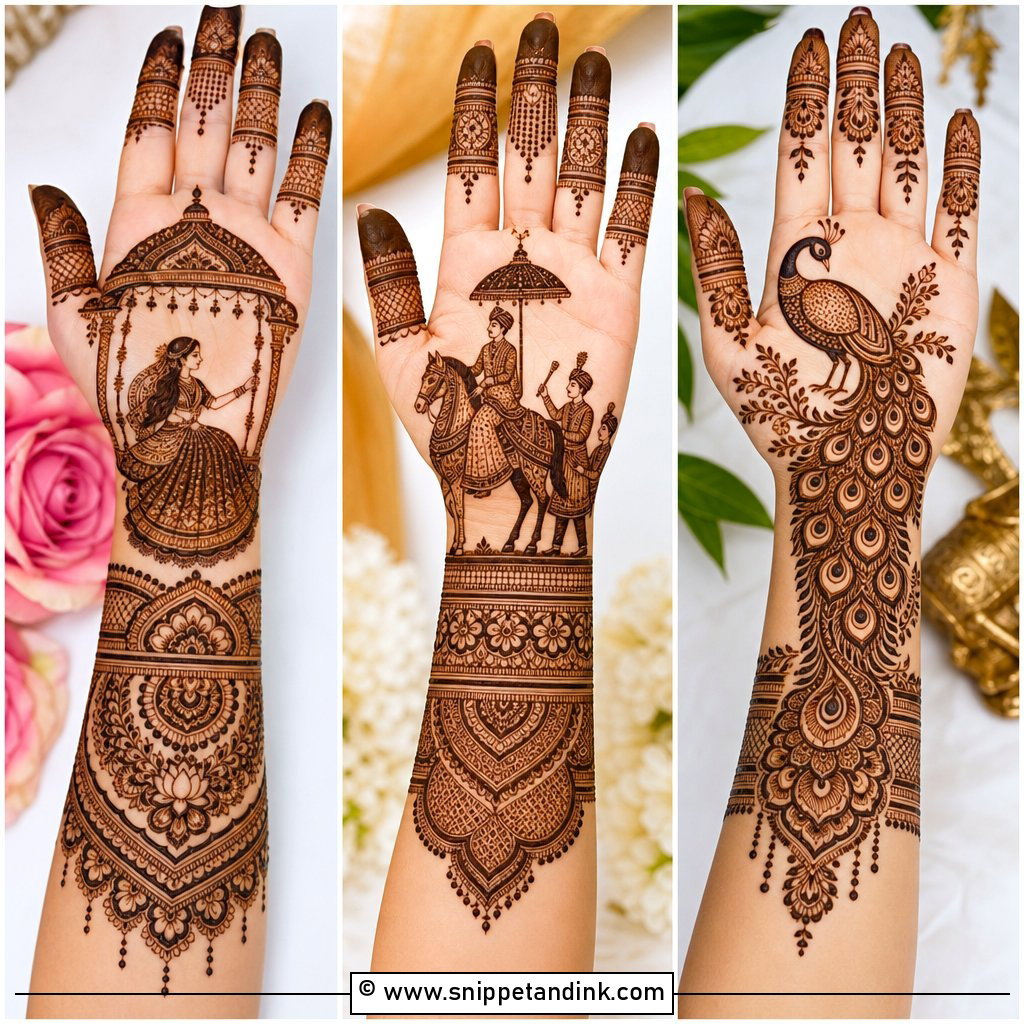
Can mehndi show the joy of the wedding procession? A dulha dulhan baraat mehndi design tries to, with the groom on a horse, dhol players, dancing guests and sometimes elephants, while the bride waits under an arch or window on the other hand. Many small figures need room, so baraat scenes really want forearm-to-elbow coverage. I keep the palms for the two main figures and let the procession travel up the arm in stacked bands. On a short sitting, I’d drop the baraat before I’d shrink it.
9. Dulha Dulhan Peacock Mehndi Design
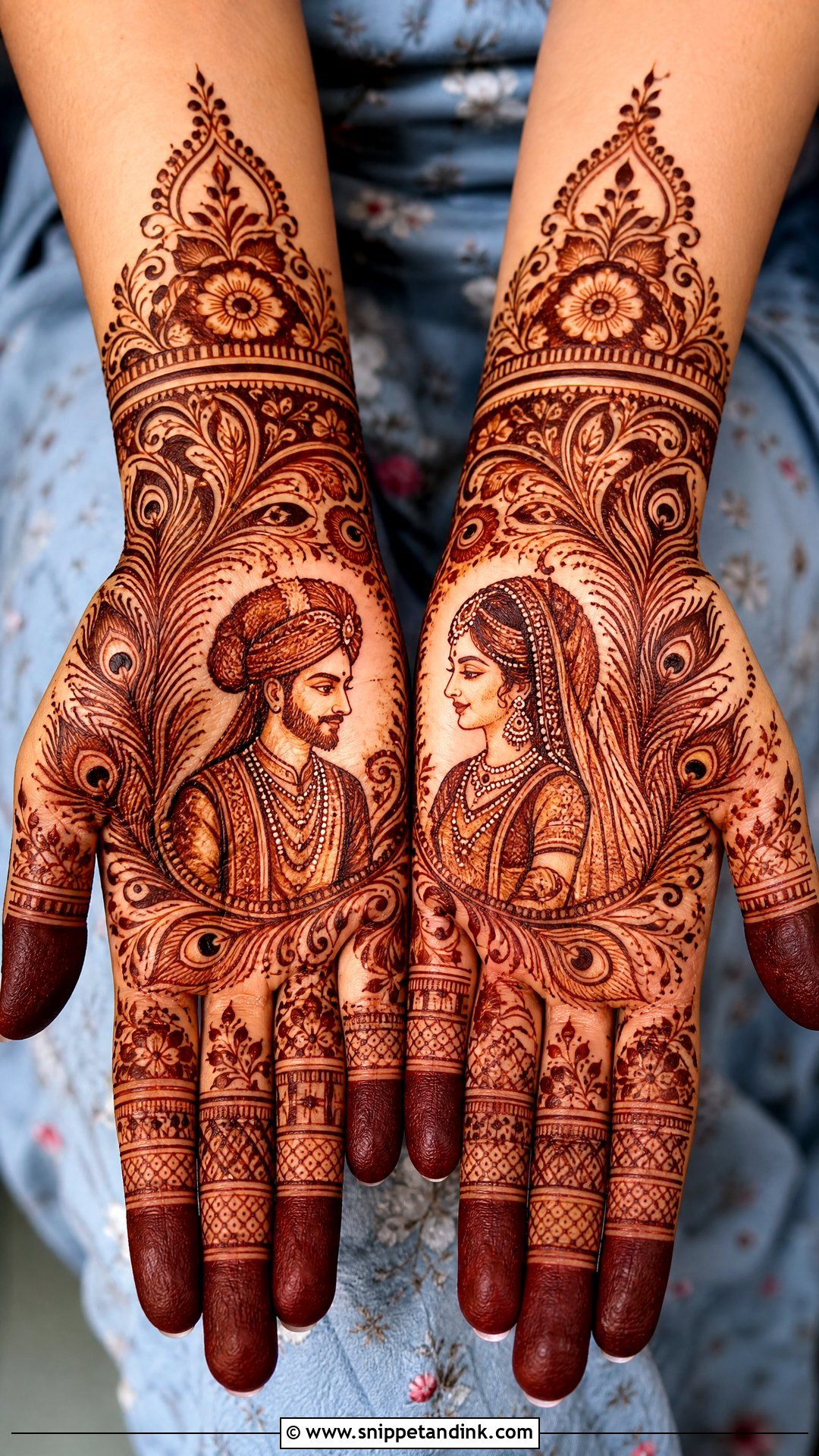
The peacock can frame the bride’s portrait, curve around the groom’s turban or perch between the two as a royal symbol, and its feathers double as filler for the fingers and wrists. It suits dense layouts, yet it turns messy fast if the scale isn’t controlled. I put the large peacock shapes near the wrist or palm and shrink the feather details as they move along the fingers. That gradient keeps the hand from feeling crowded even when it’s full.
10. Dulha Dulhan Lotus Mehndi Design
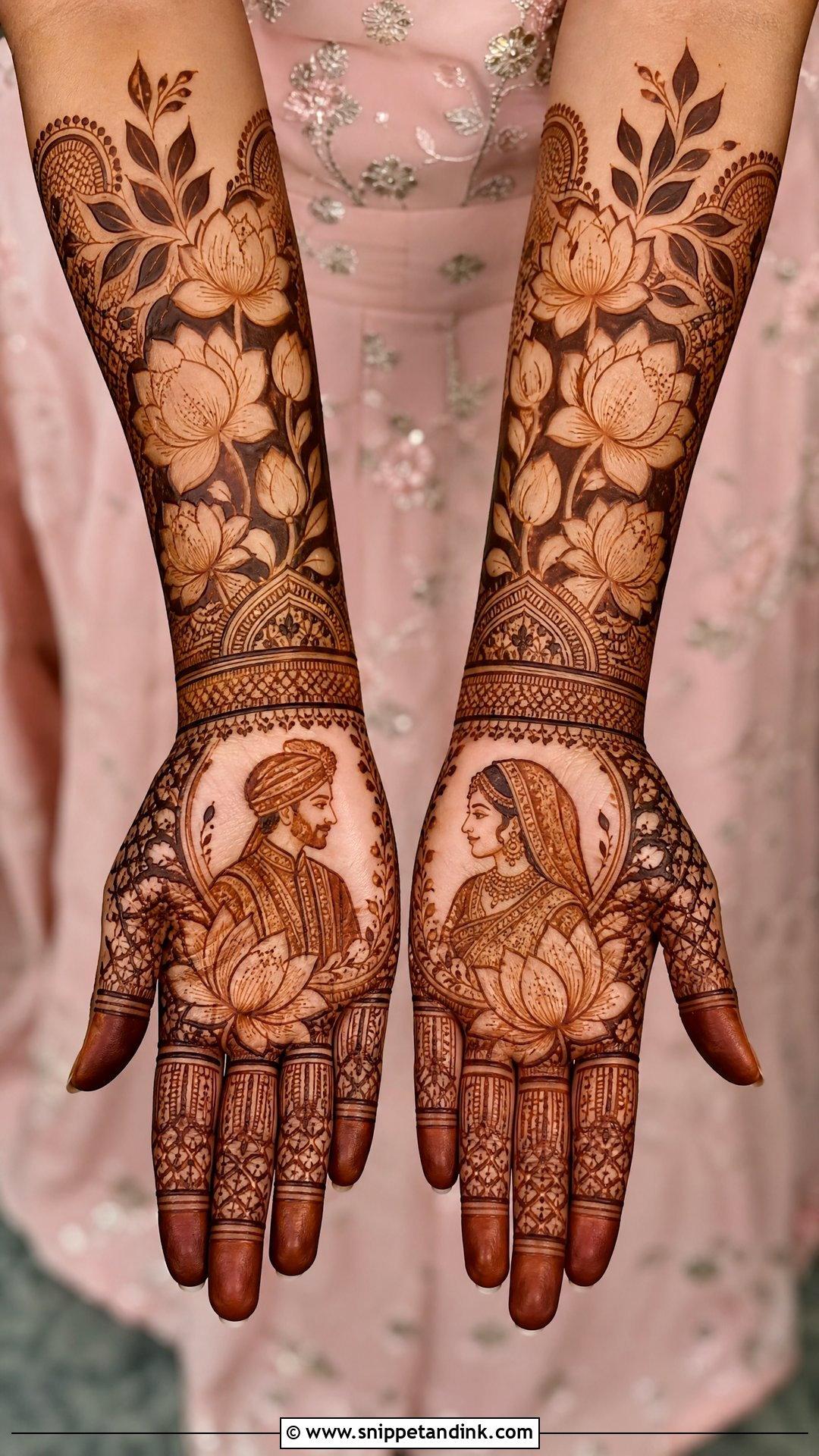
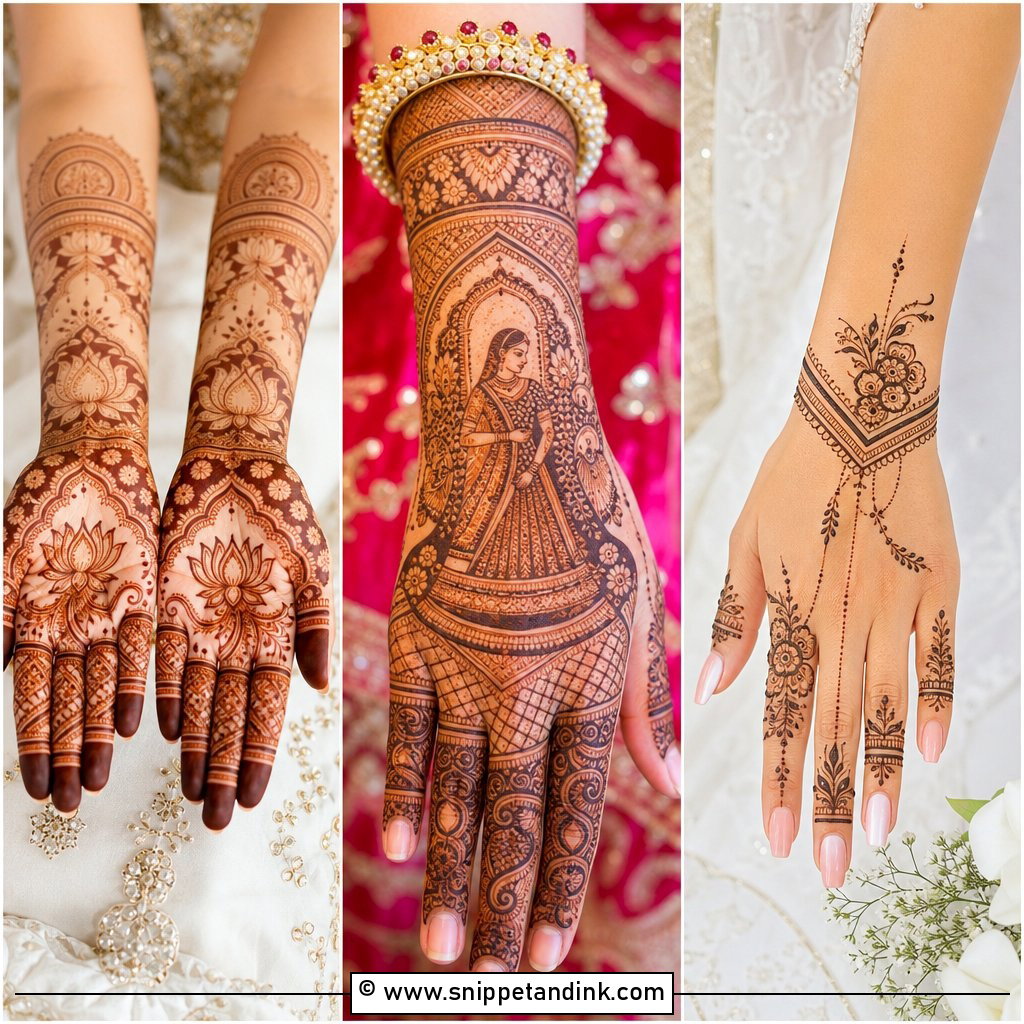
Lotus is the gentler option. Its petals can frame the portraits, decorate a mandap or ring the wrist, and its rounded shapes leave more breathing room than heavy paisley work does. I layer the blooms outward from the palm toward the fingers and forearm, adding fine dots and leaf chains between them. It sits comfortably beside lehengas, sarees and most bridal jewelry because the motif is classic without being busy.
11. Dulha Dulhan Paisley Mehndi Design
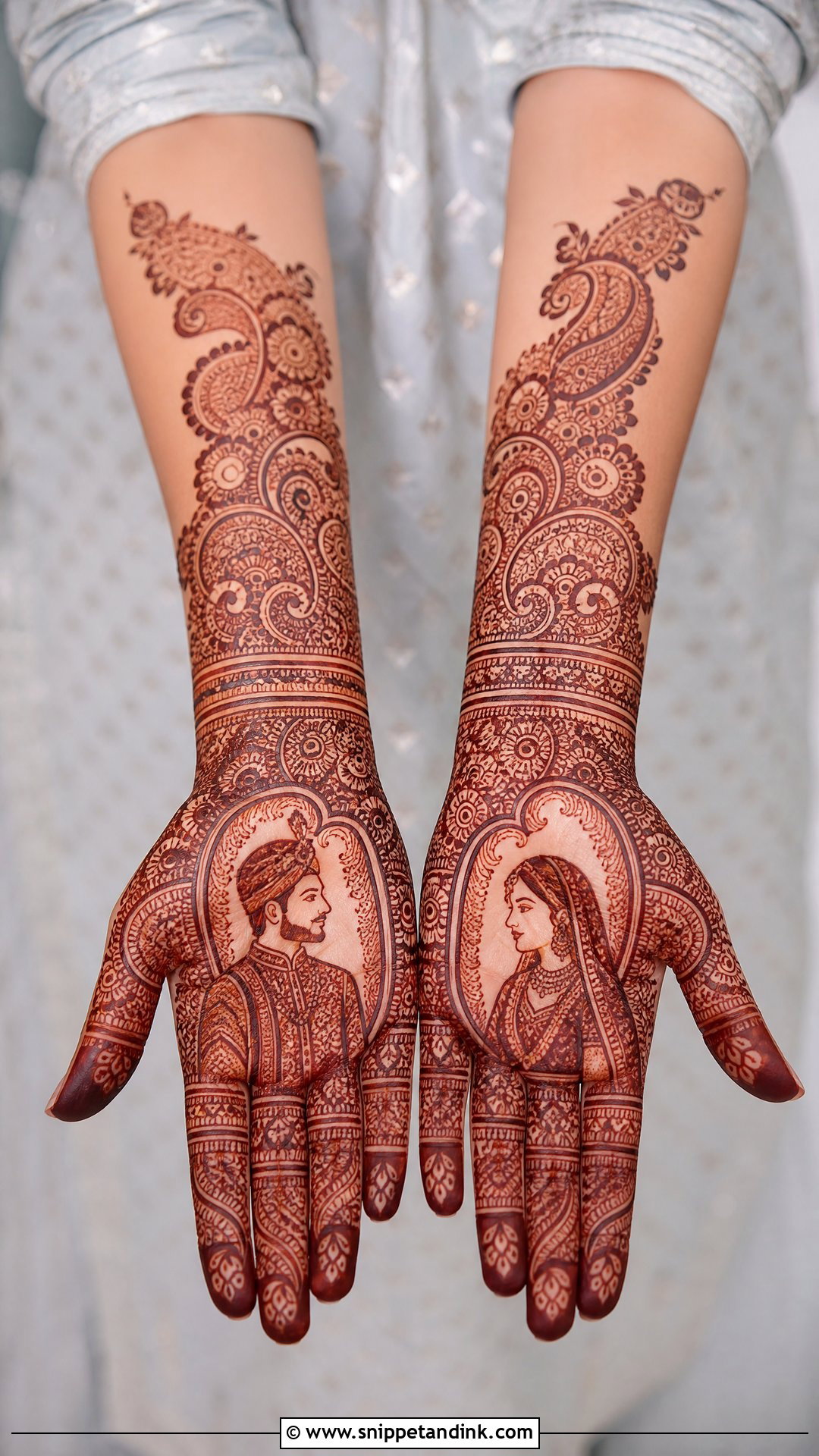
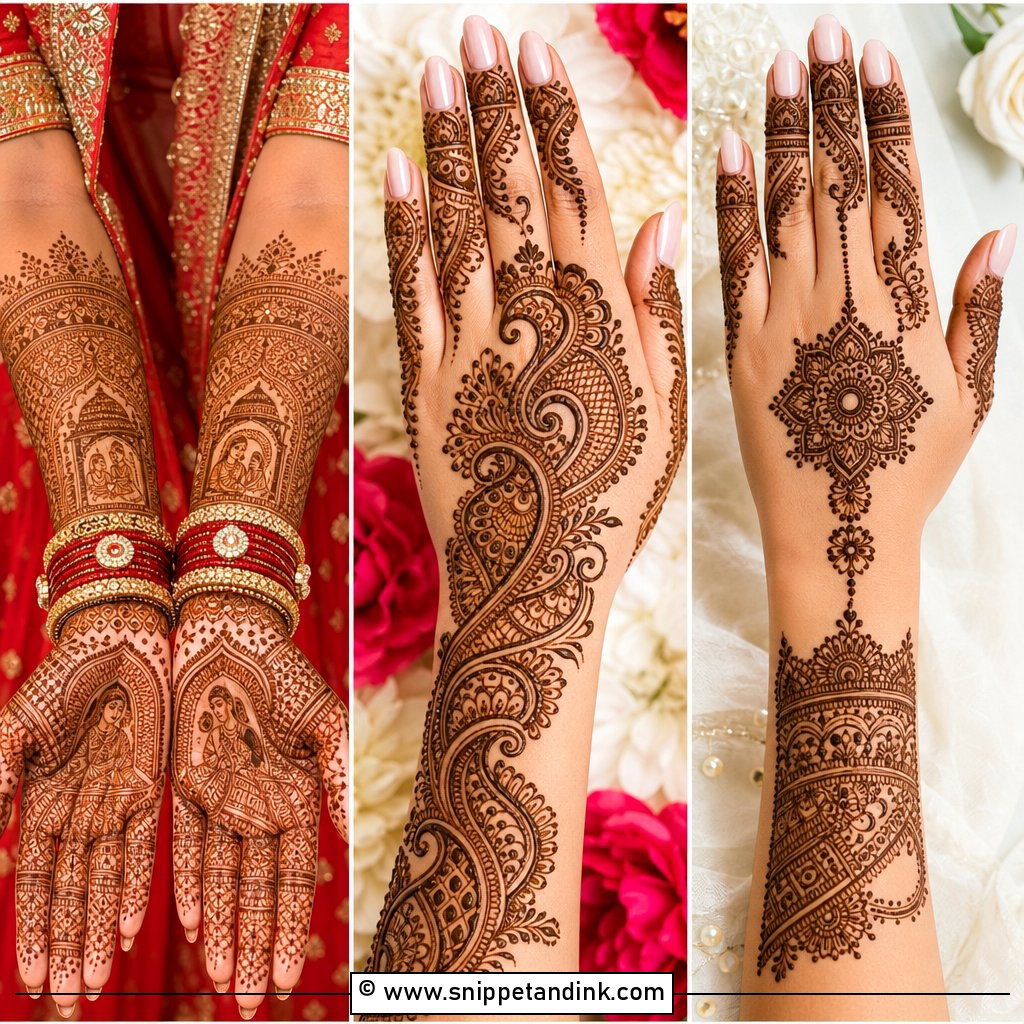
Paisleys are the workhorse of Indian bridal henna, and they bend around portraits, mandalas and wedding symbols better than any other shape. The couple sits inside rounded palm frames while large paisleys sweep across the wrists and forearms, and small ones repeat on the fingers. Coverage is strong and the design has depth in photos. To keep it readable with faces in the mix, I give each paisley a bold outline and fill it with tiny florals rather than more lines.
12. Dulha Dulhan Jaali Mehndi Design
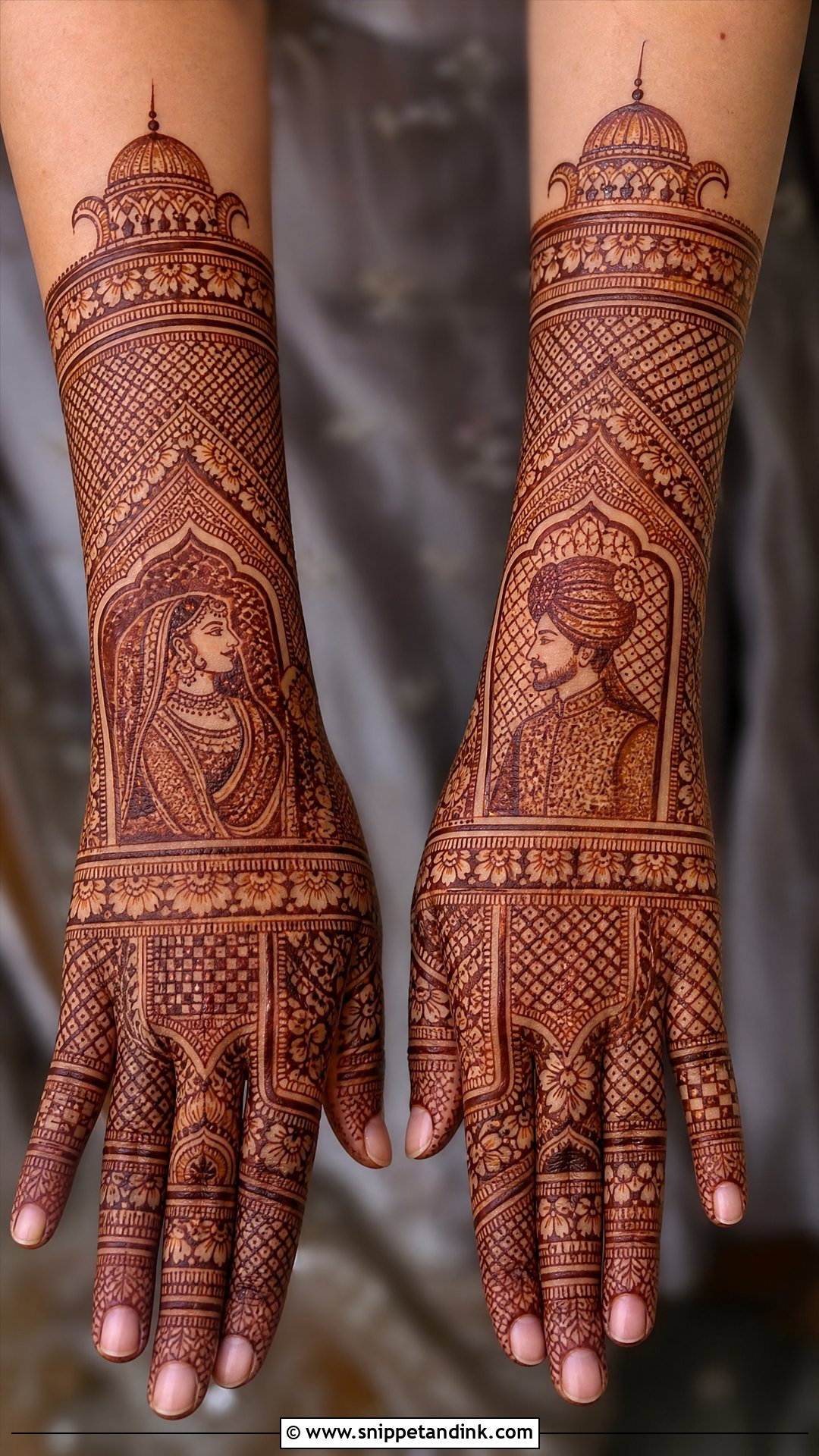
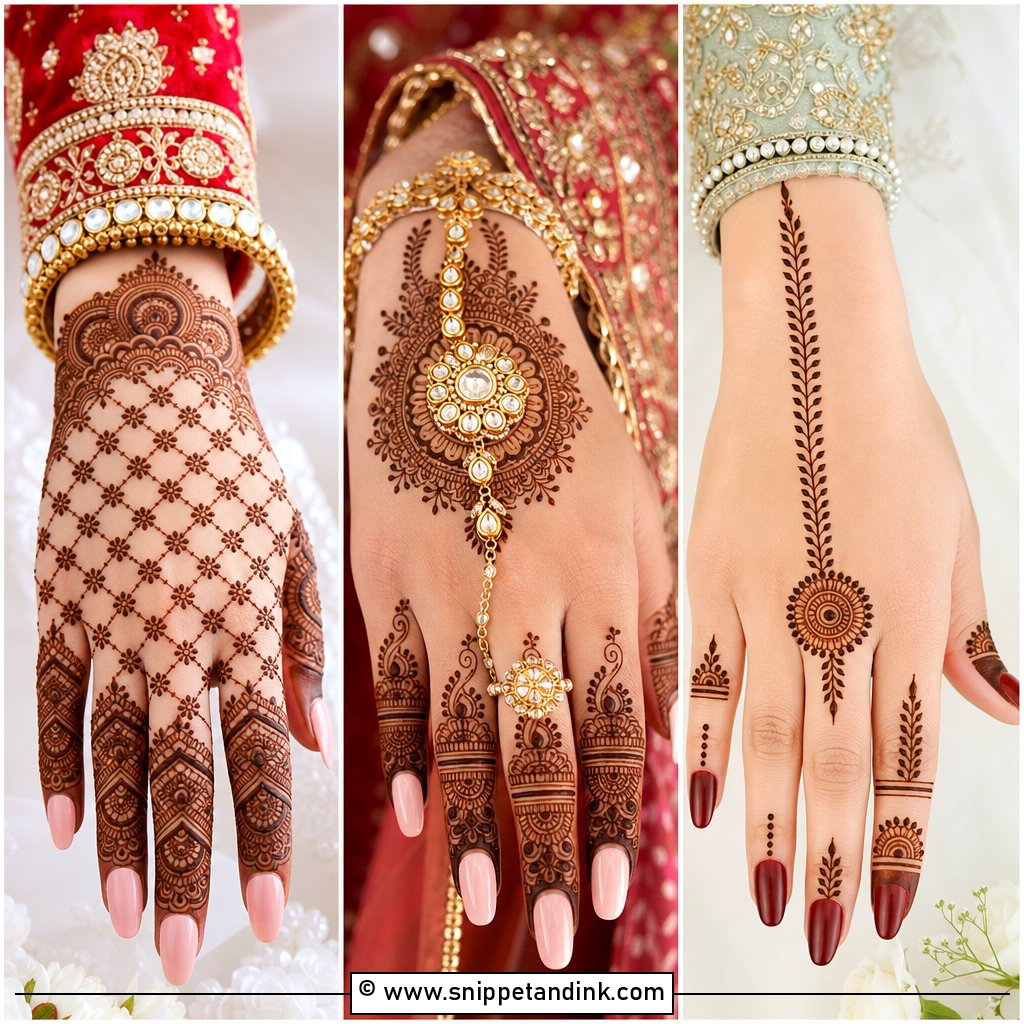
Jaali, the mesh pattern, works as a backdrop here: behind the portraits, across the wrists or as neat checkered panels on the fingers. Organized texture suits brides who dislike packed fillers. One request I always make is to shade some squares of the mesh and leave others empty. A uniform grid looks flat and can swallow the portraits, while the alternating pattern gives depth and pushes the couple forward.
13. Dulha Dulhan Mandala Mehndi Design
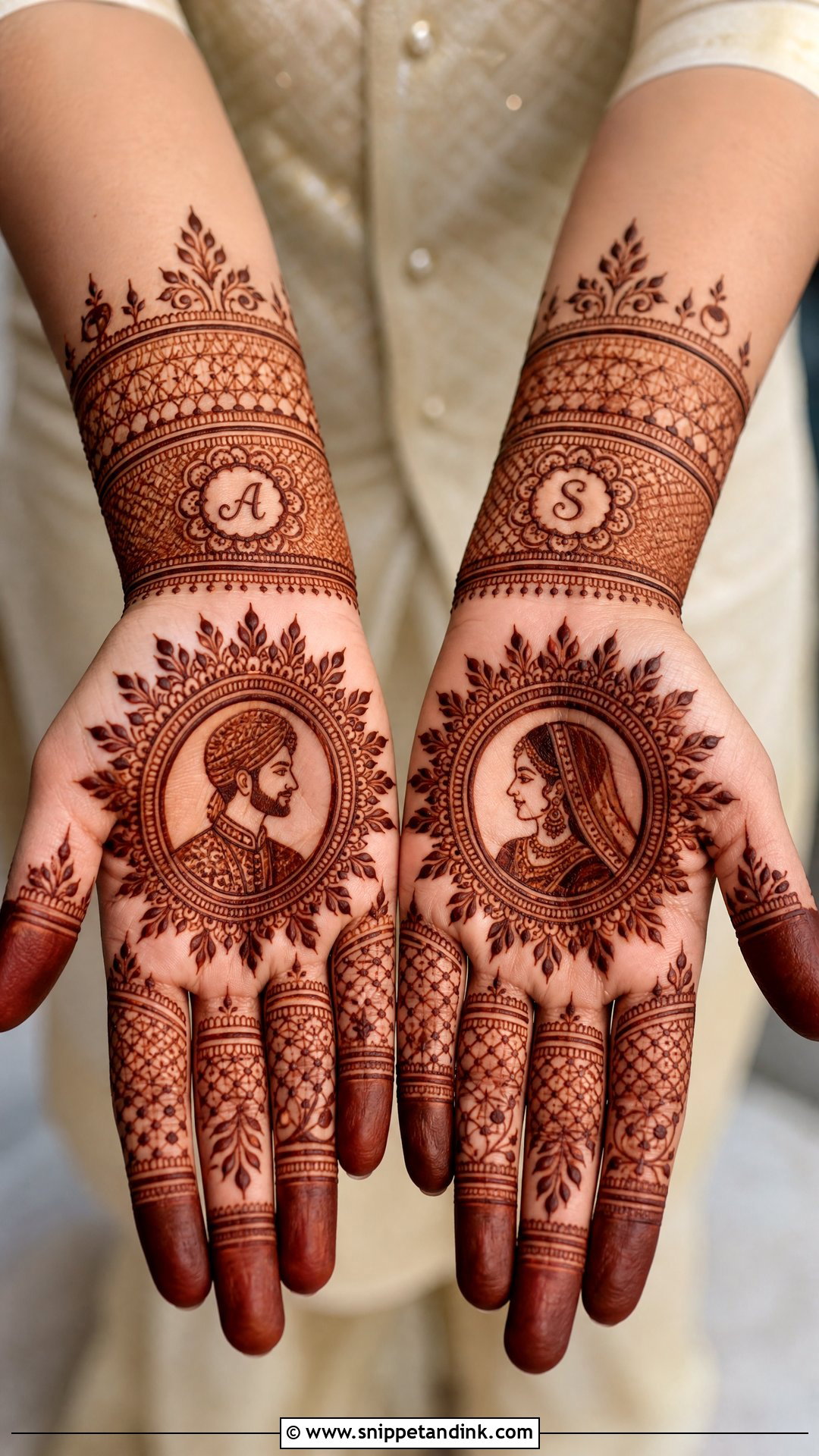
Symmetry is the appeal. Round mandala frames on each palm hold the bride on one side and the groom on the other, with rings of petals, dots, leaves and lace-like detail built outward. It works on the front or back of the hand and suits brides who prefer structure to busy storytelling. If it feels too abstract, a set of initials, the date or a tiny varmala near the mandala’s edge brings the wedding back into it.
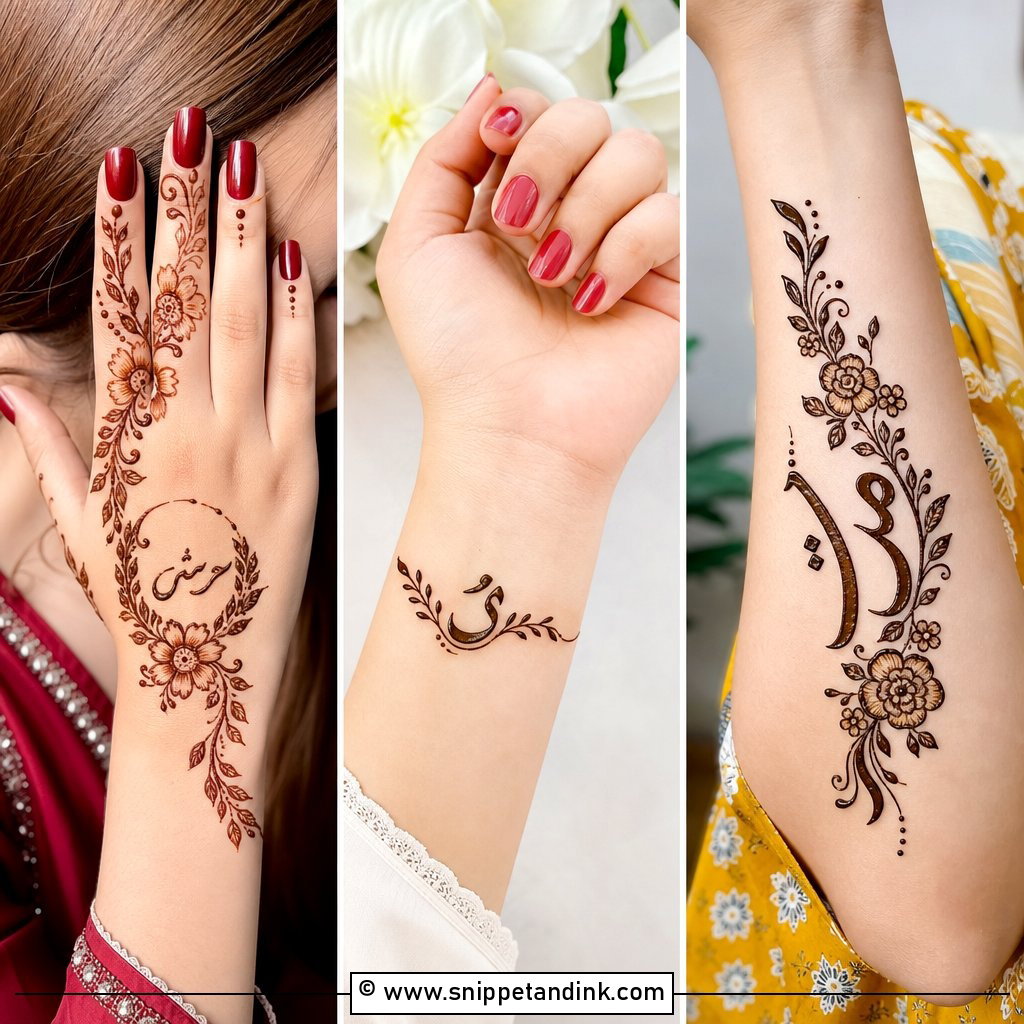
14. Dulha Dulhan Arabic Mehndi Design
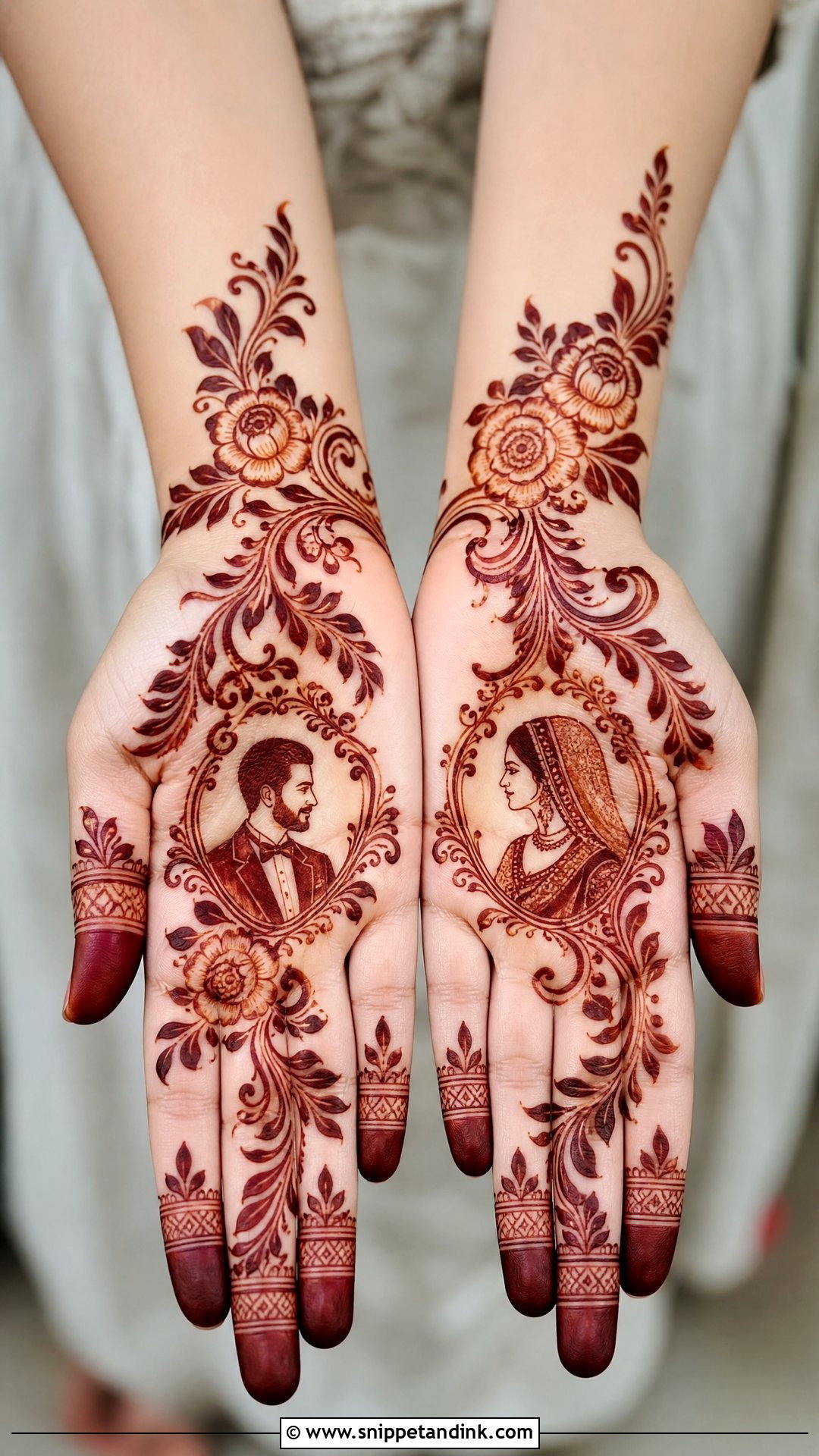
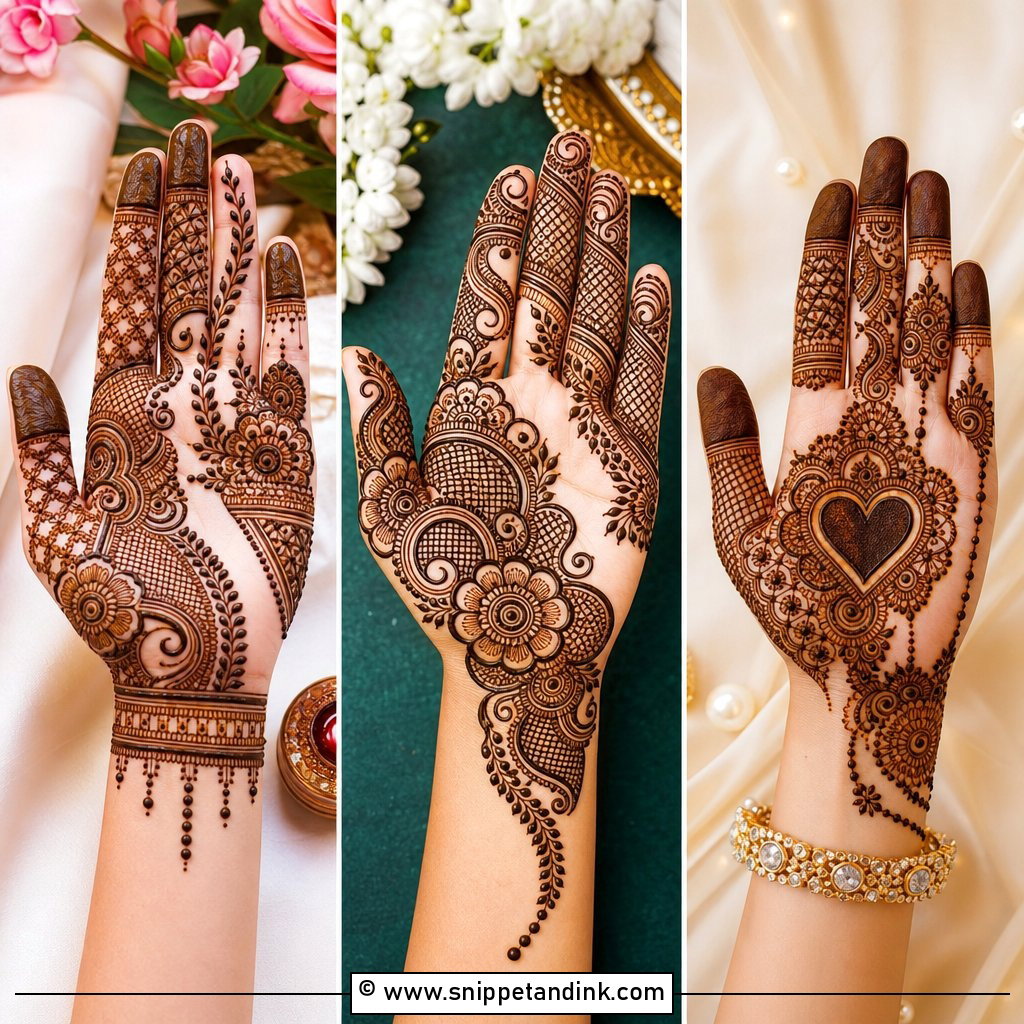
Arabic layouts are lighter: bold floral trails, flowing vines and open skin, with a central bride-groom portrait or couple frame. The trail usually runs diagonally from one side of the palm to the opposite wrist, and the fingers get matching floral bands. Open skin around the faces makes them easier to spot than in dense work. It’s also much quicker to apply, a real consideration if your mehndi falls on a crowded day.
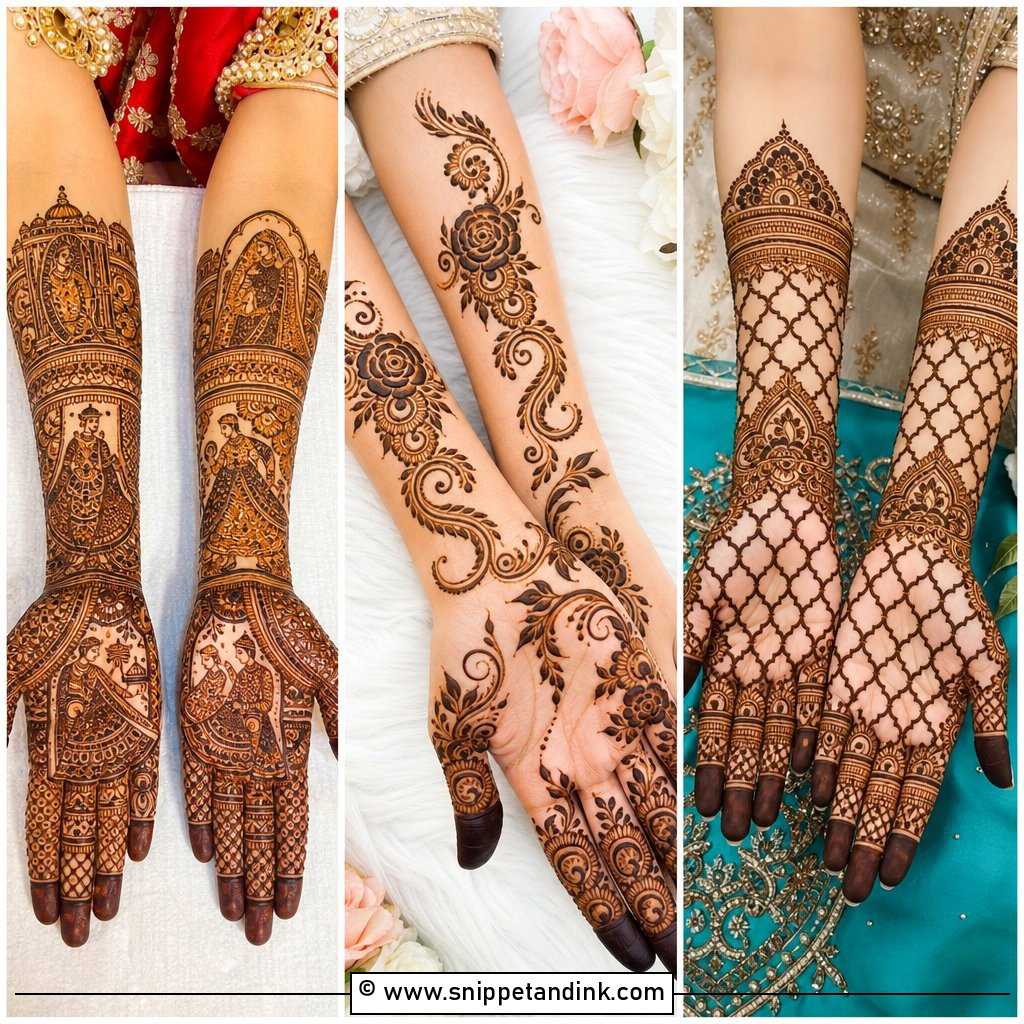


15. Indo Arabic Dulha Dulhan Mehndi Design
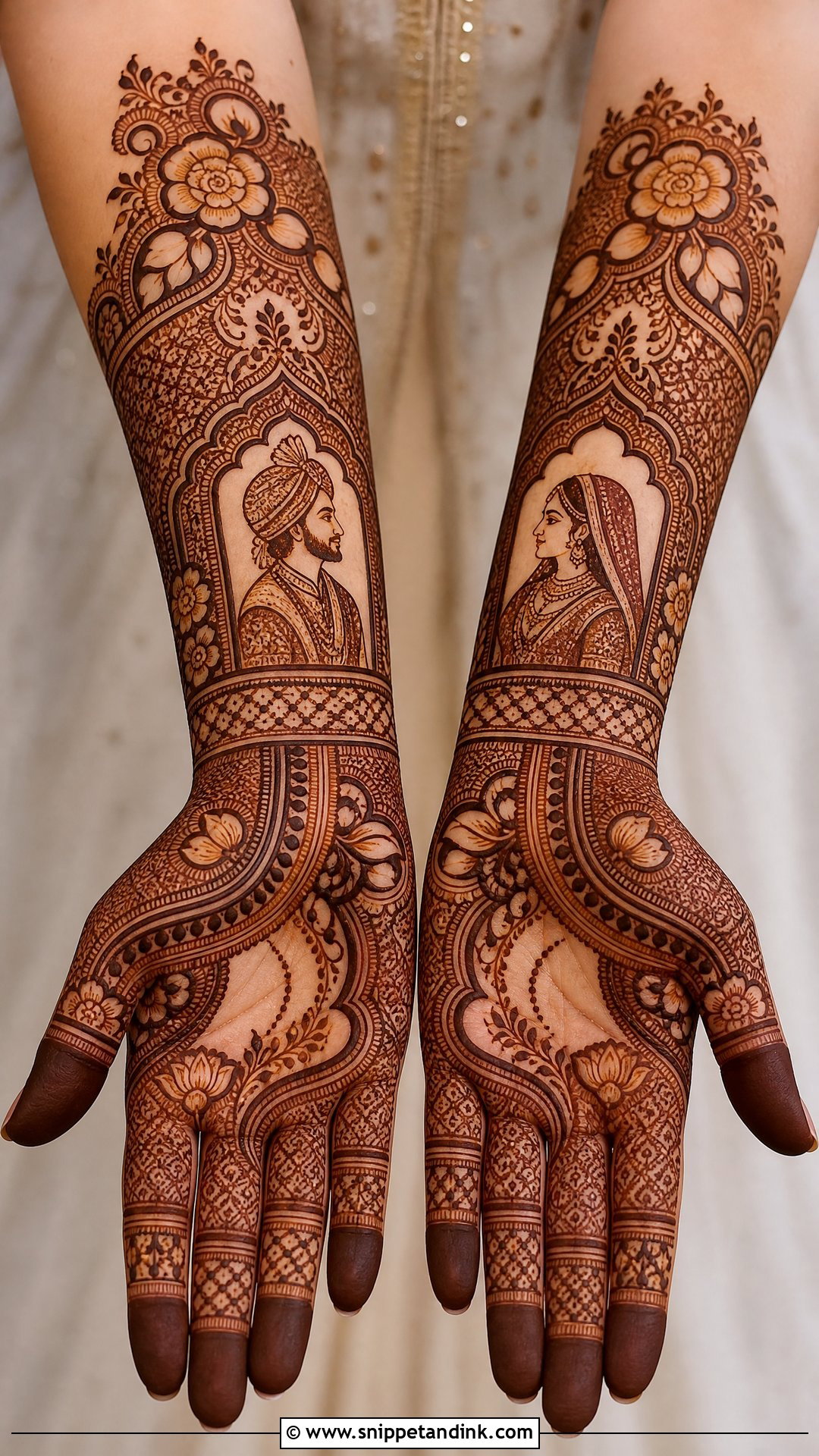
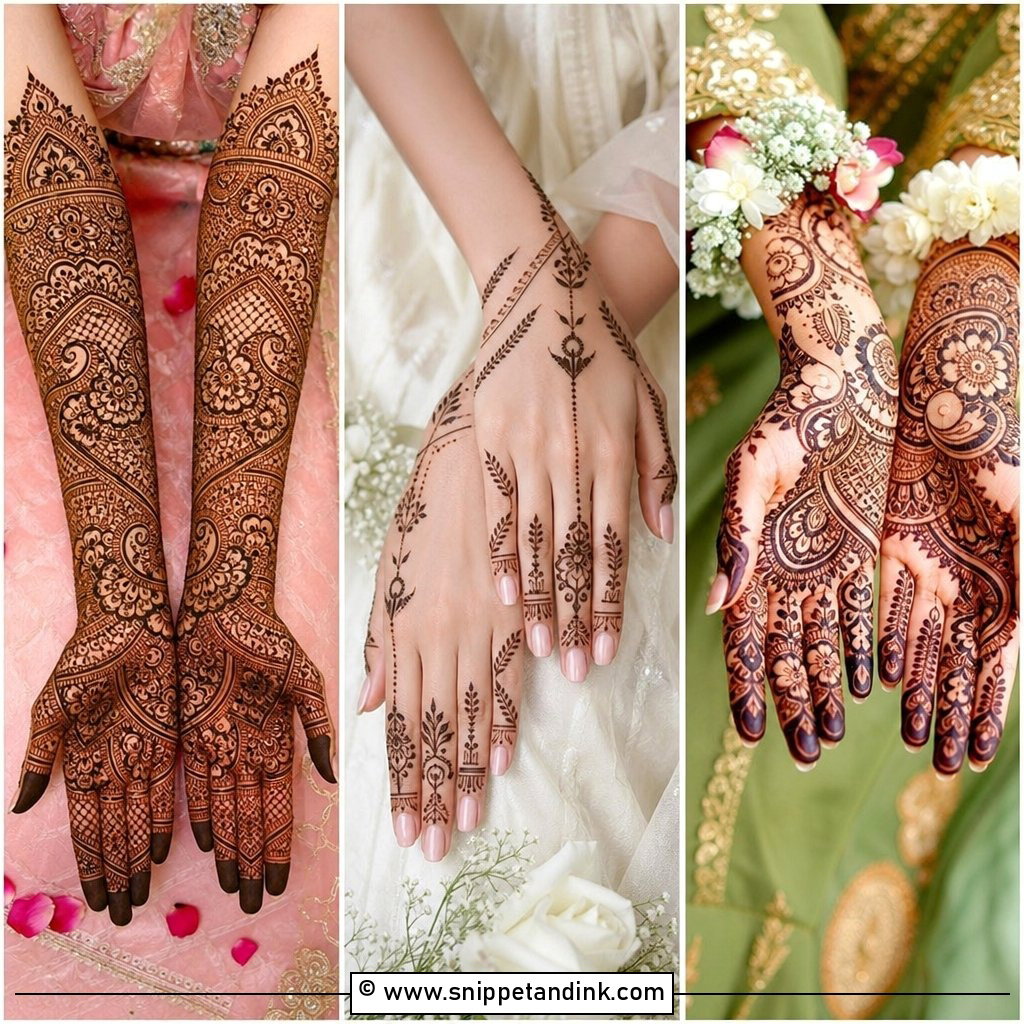
An Indo Arabic dulha dulhan mehndi design takes the bold flow of Arabic henna and adds the detailed fillers of Indian bridal mehndi. The portraits sit in the palm or wrist area while floral trails, paisleys, jaali strips and shaded leaves move across the hand. I like keeping one side of the hand open and the other more detailed; that asymmetry lets the faces sit in the quieter part. It adapts well to an engagement, nikah or sangeet as well as the wedding itself.
16. Simple Dulha Dulhan Mehndi Design
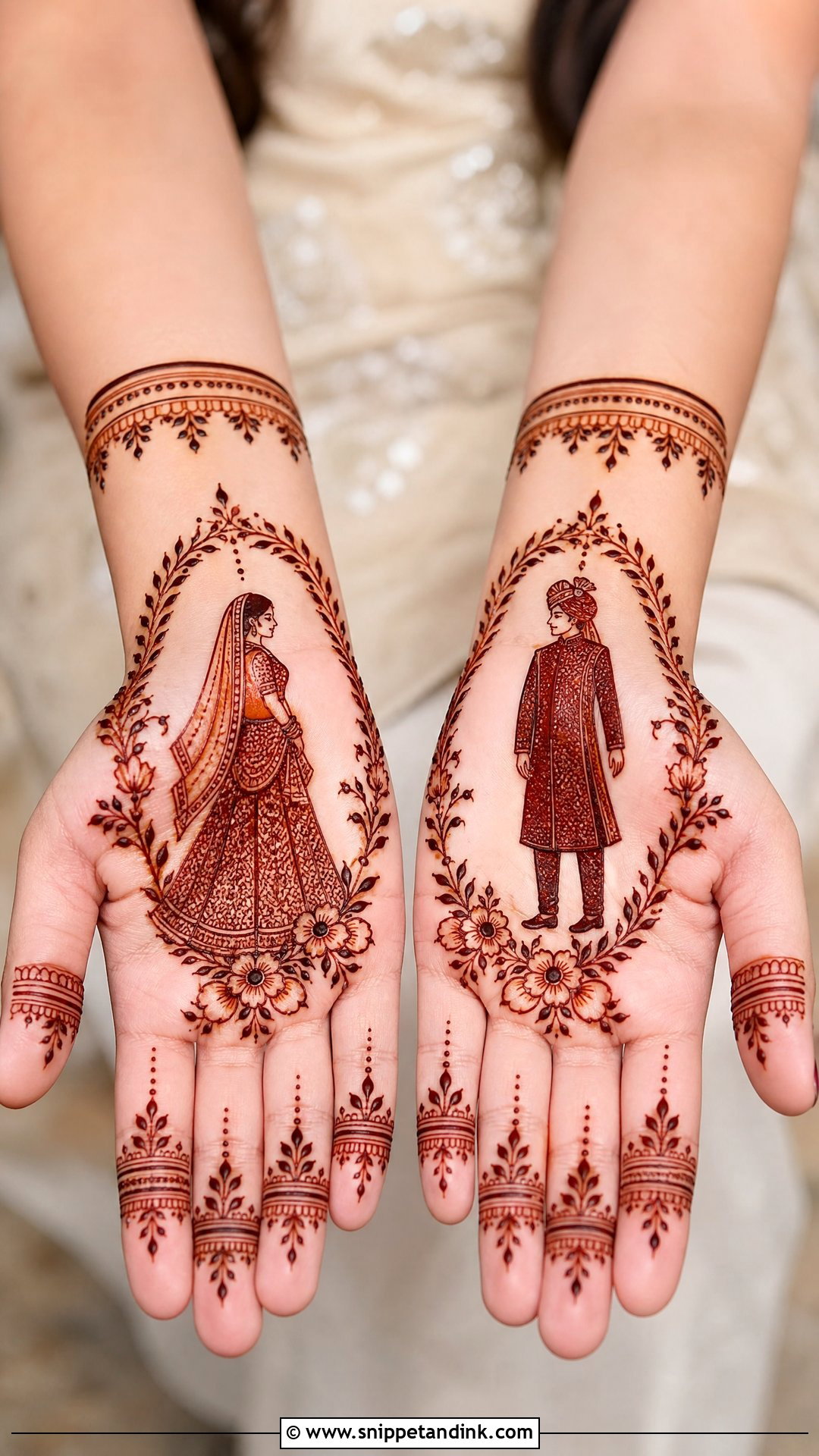
Small bride and groom silhouettes on the palms, with clean flowers, leaves, dots and finger bands everywhere else. Instead of filling every space, the layout lets open skin do half the work. Silhouettes are far more forgiving than detailed faces, which makes this a sensible choice if you can’t book a specialist portrait artist. It also suits sisters of the bride and small ceremonies. Neat outlines matter more than quantity here.
17. Modern Dulha Dulhan Mehndi Design
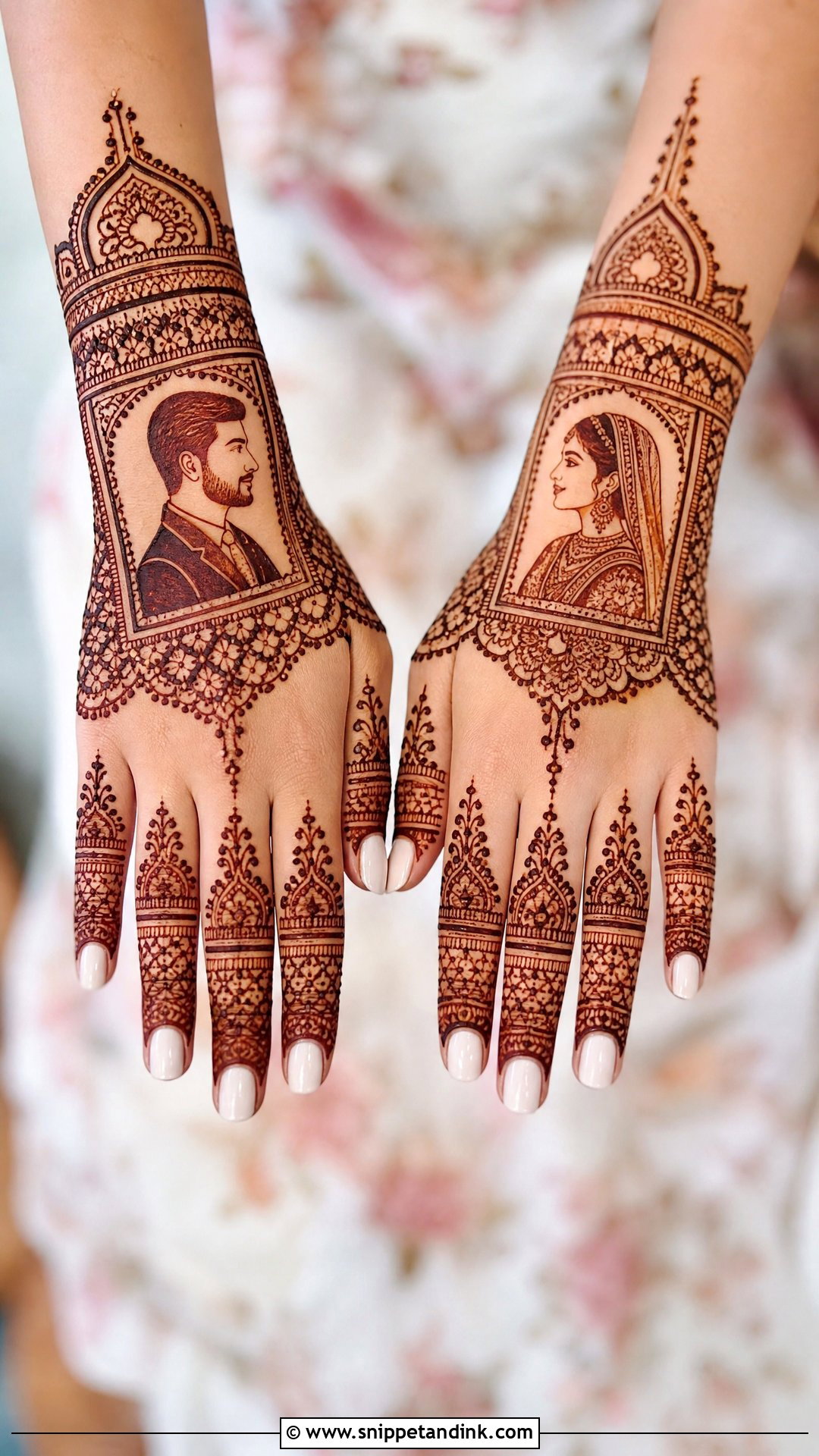
Modern versions use cleaner spacing, portrait frames, initials and softer flow: half-mandalas, minimal florals, geometric panels and bracelet-style wrists. The couple might be simple faces, side profiles or stylized figures. My one rule is a single strong focal point per hand. Pile on too many modern elements and the couple becomes one detail among many, which defeats the whole point of the theme. It sits well with pastel outfits and lighter jewelry.
18. Minimal Dulha Dulhan Mehndi Design
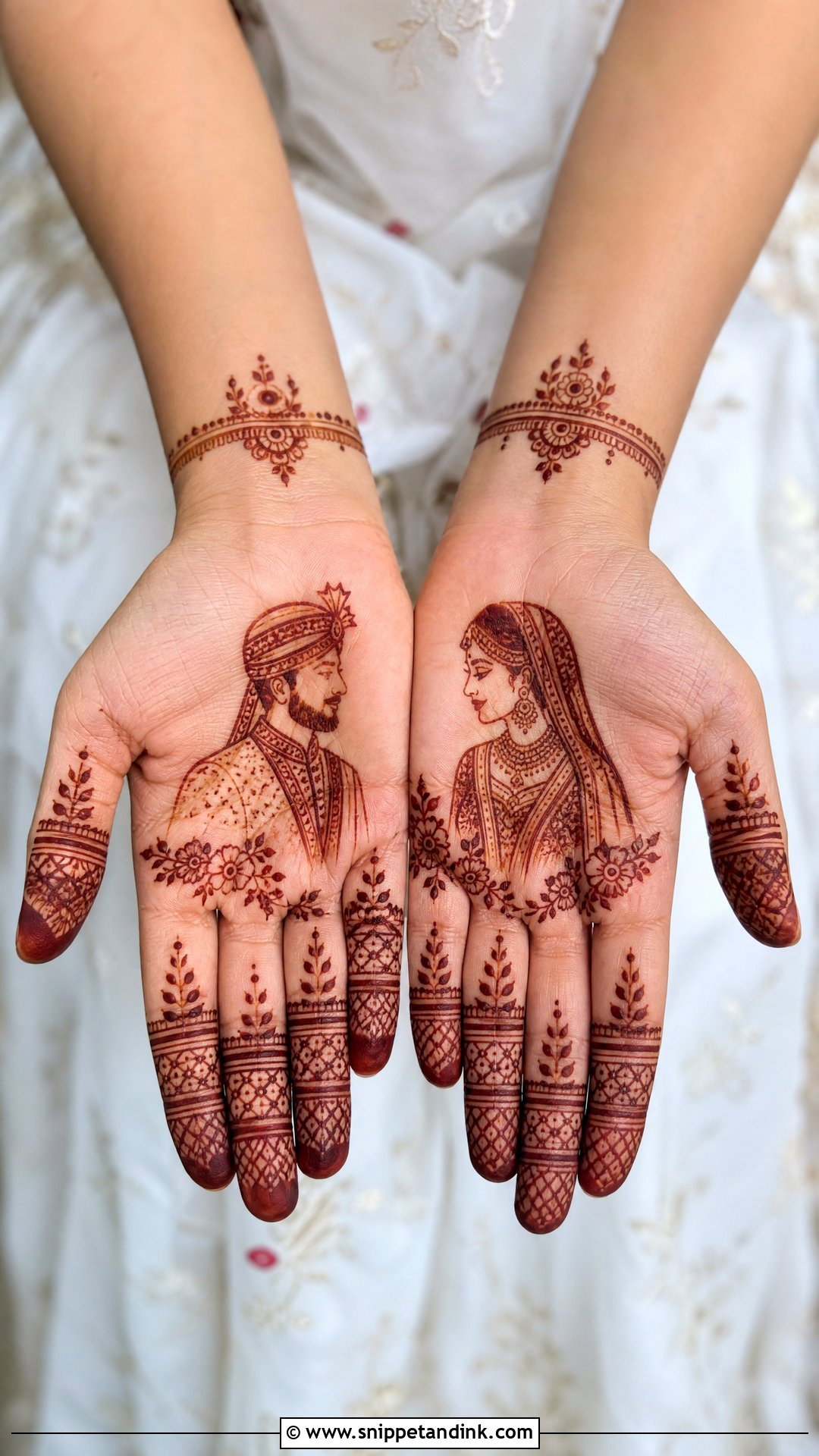
Small couple portraits on the palms, delicate finger lines, tiny florals and slim wrist cuffs keep this one light enough for an engagement, a court wedding or pre-wedding photos. The open space also leaves room for rings and nail colour to show. Small portraits are tricky, though: the smaller the face, the fewer lines it can hold before it blurs, so I simplify the features rather than shrinking every detail. A mini varmala or a date can add a bridal note without weight.
19. Royal Dulha Dulhan Mehndi Design
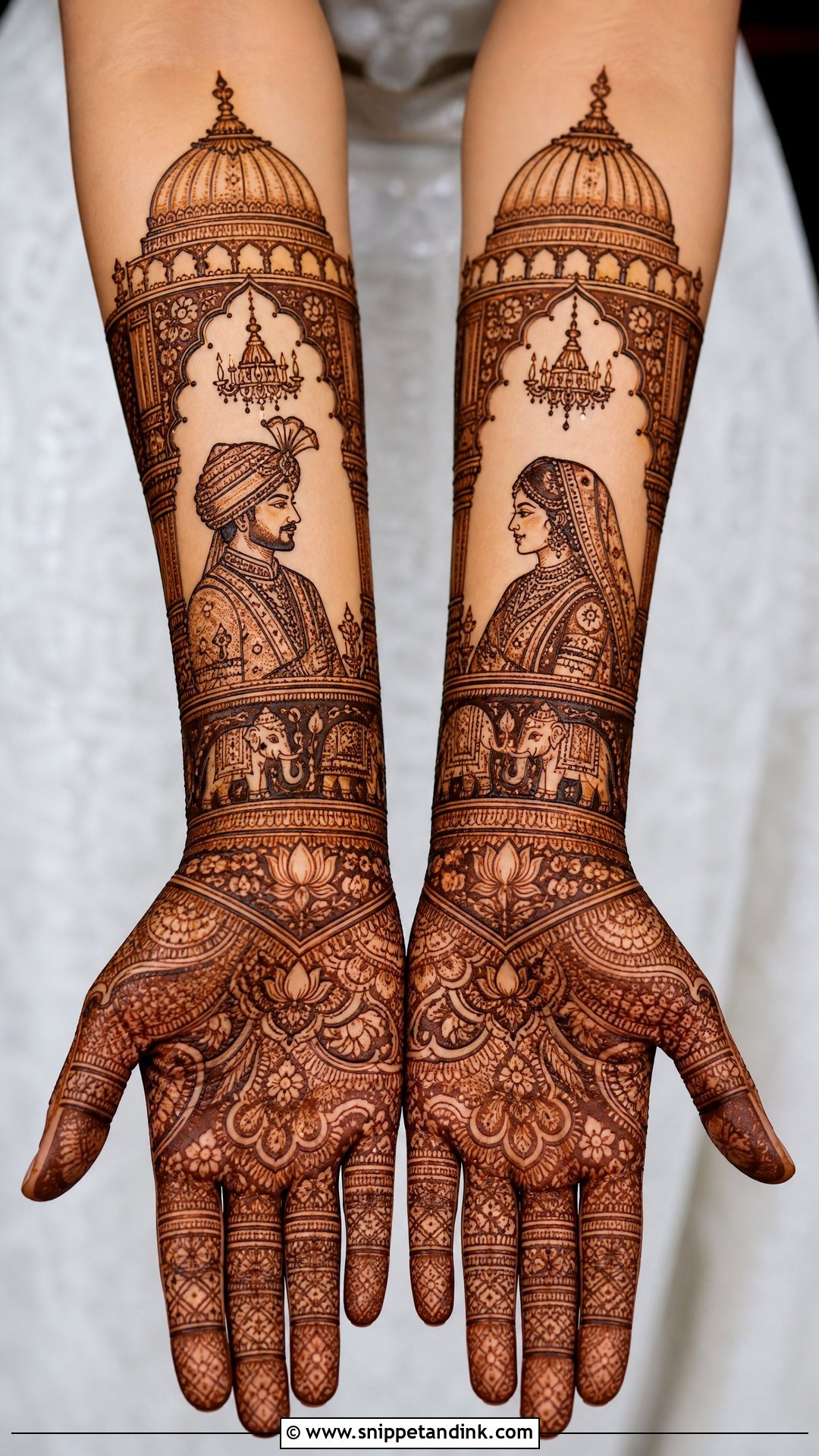
Palace arches, domes, elephants, chandeliers and detailed portraits give this layout its grandeur. The dulha appears in a turban or on horseback, the dulhan veiled with jewelry-inspired patterning. It needs full-hand or forearm coverage and strong symmetry between the two hands, so I mirror the arch frames on both palms and repeat the palace borders at both wrists. Traditional red, maroon or heavily embroidered outfits carry it best; with a pale pastel lehenga it can look heavier than the outfit.
20. Rajasthani Dulha Dulhan Mehndi Design
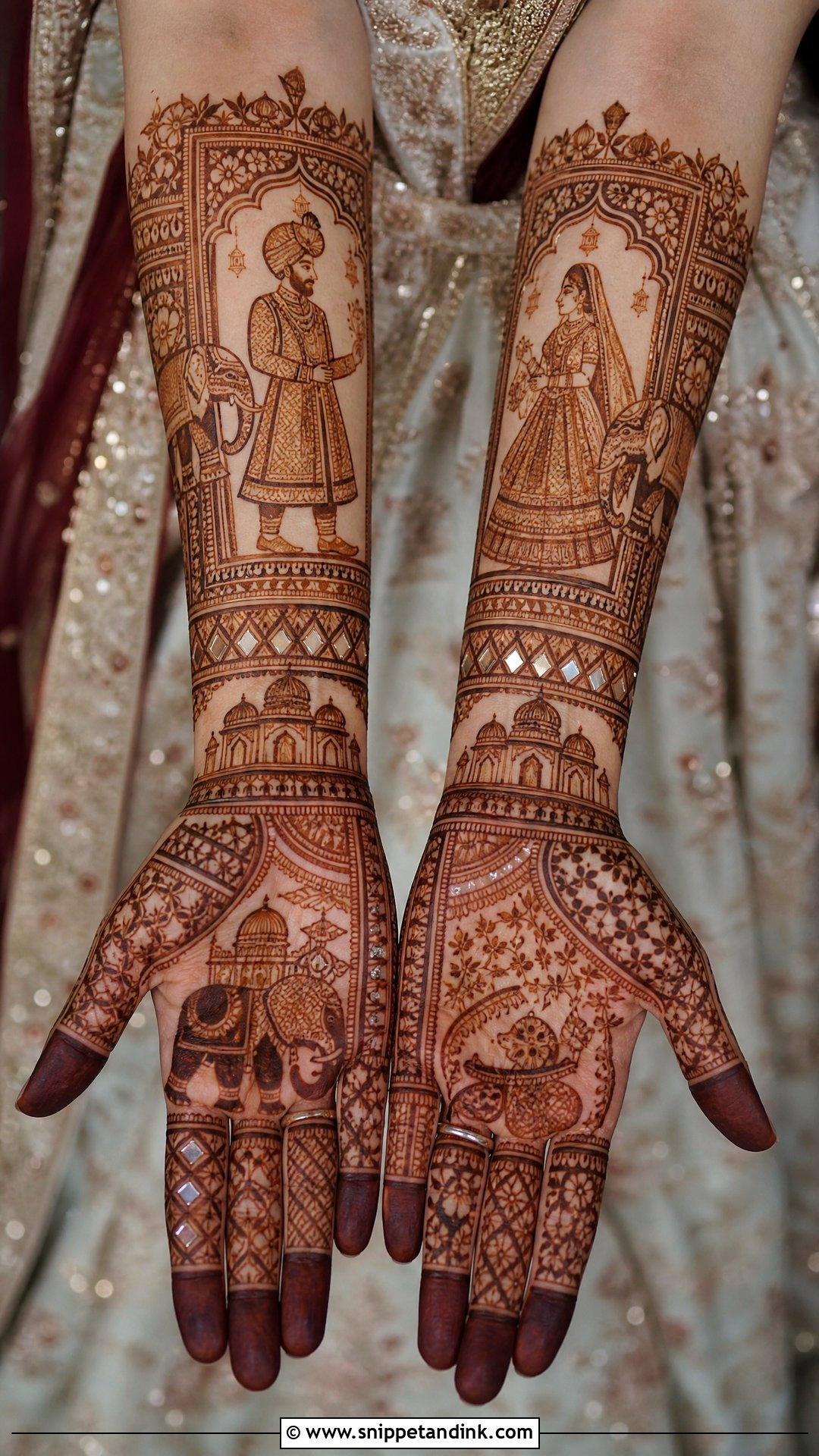
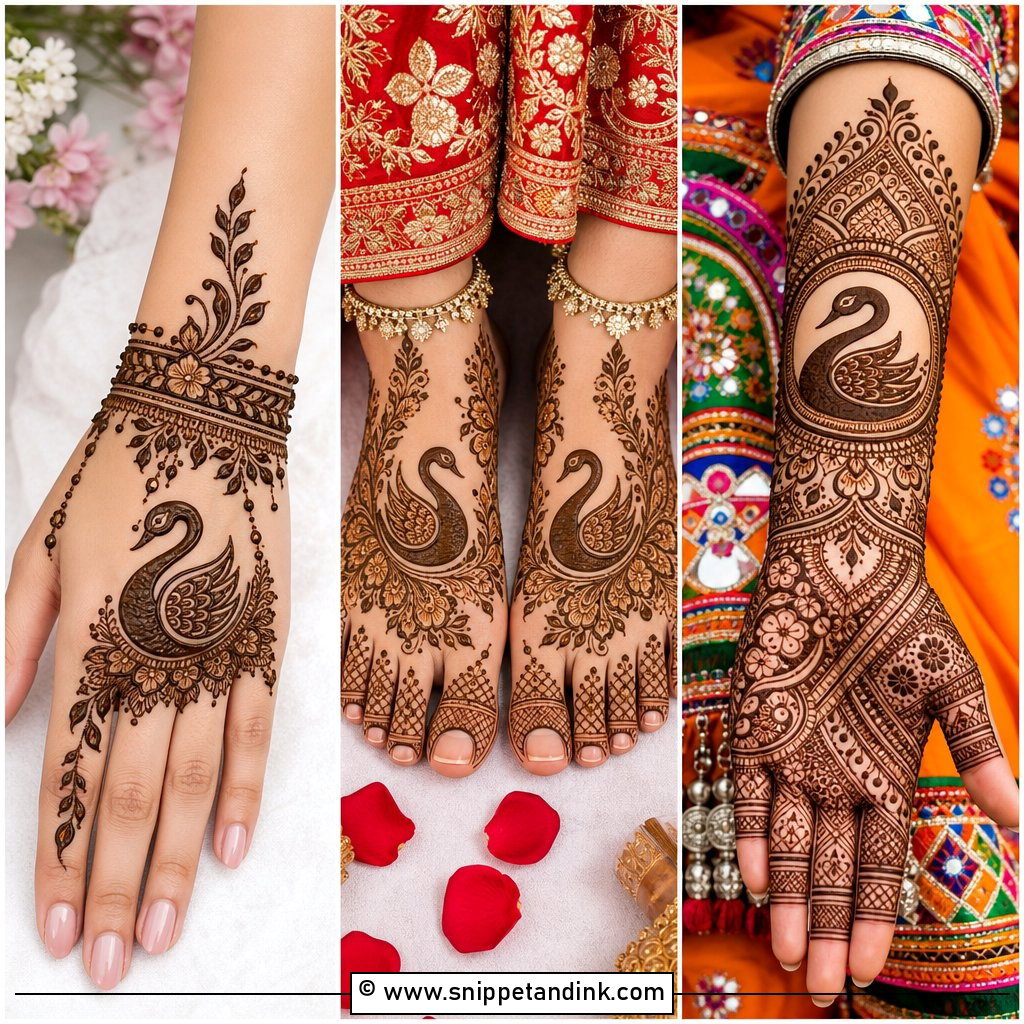
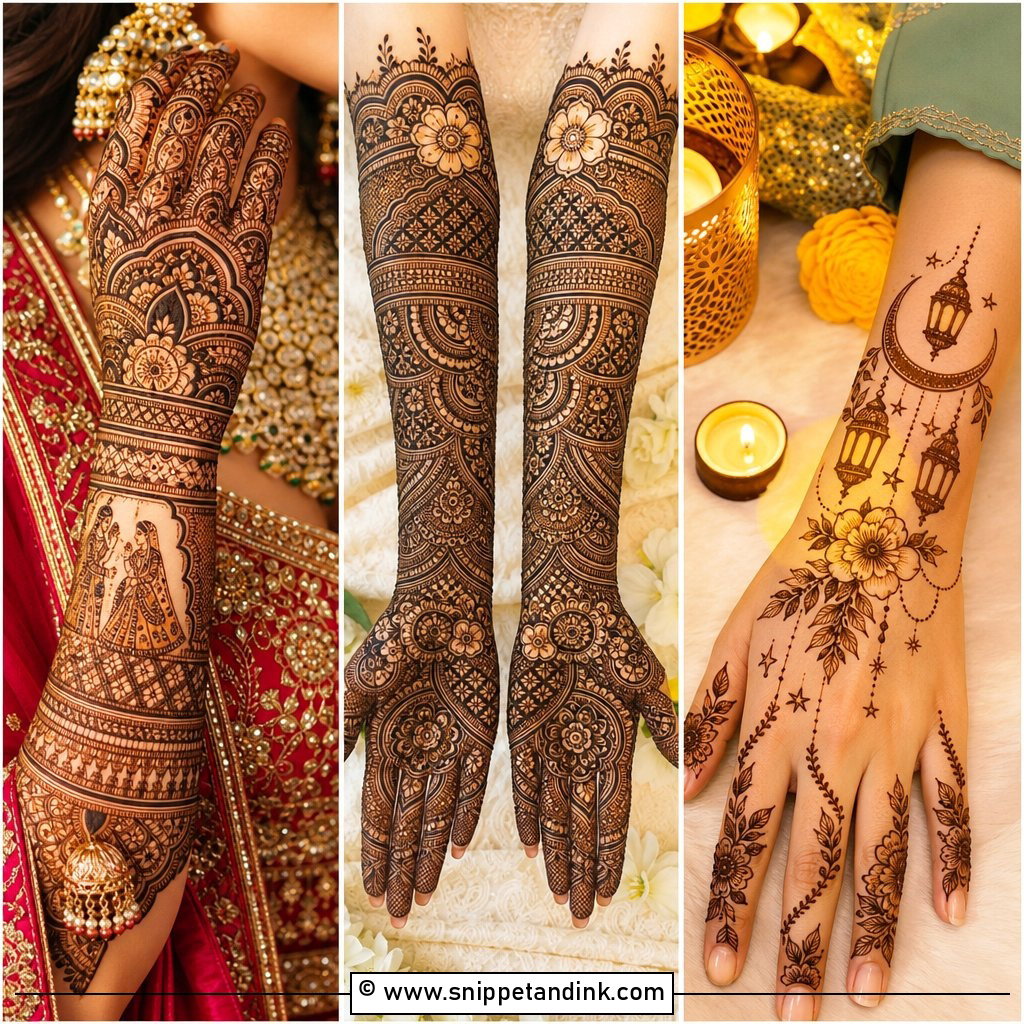
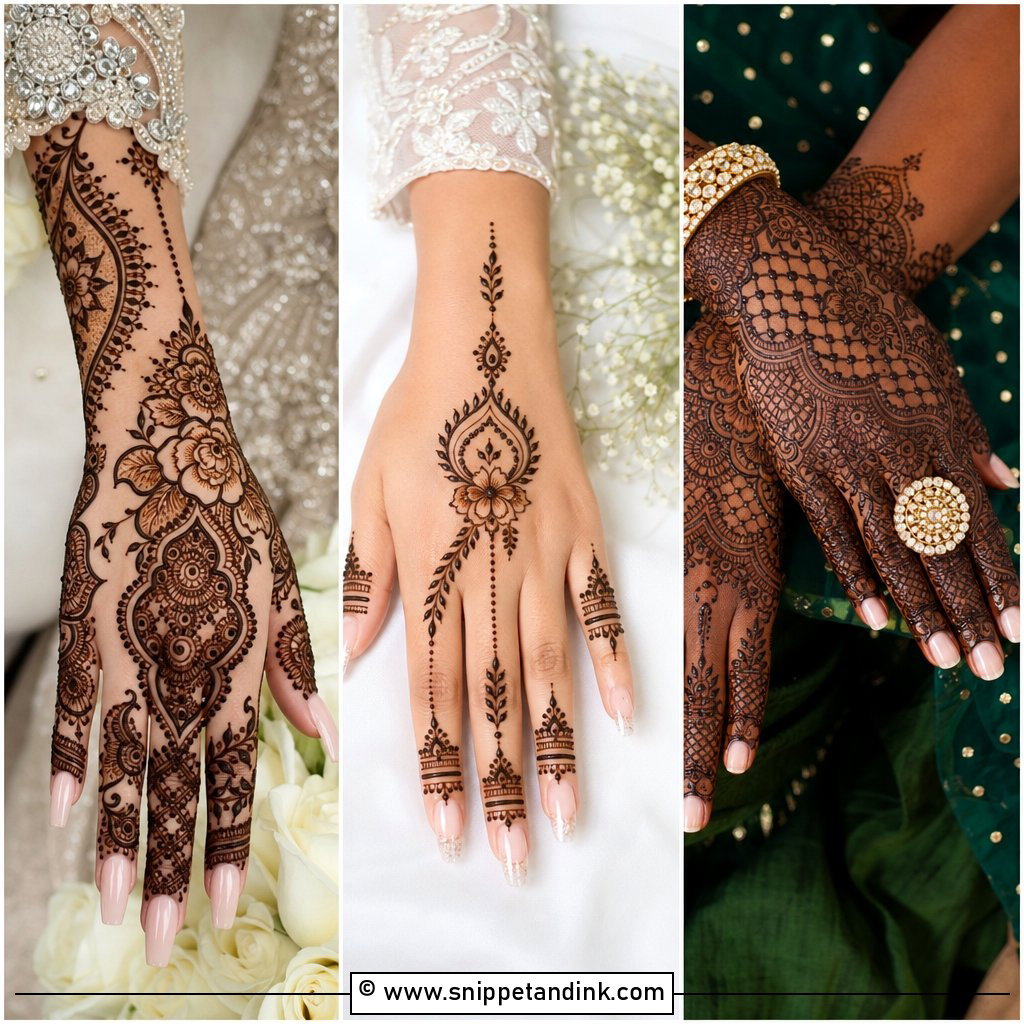
A Rajasthani dulha dulhan mehndi design is heritage storytelling: a turbaned groom, a veiled bride, folk-style figures, elephants, mirror-work patterns, palace elements, even a dhol, a palki and carved windows. Intricate folk detail needs full-hand placement. I keep the main couple noticeably larger than the cultural motifs around them, because in this style everything is detailed and only scale tells the eye where to look first. Expect it to be one of the longest sittings in this list.
21. Punjabi Dulha Dulhan Mehndi Design
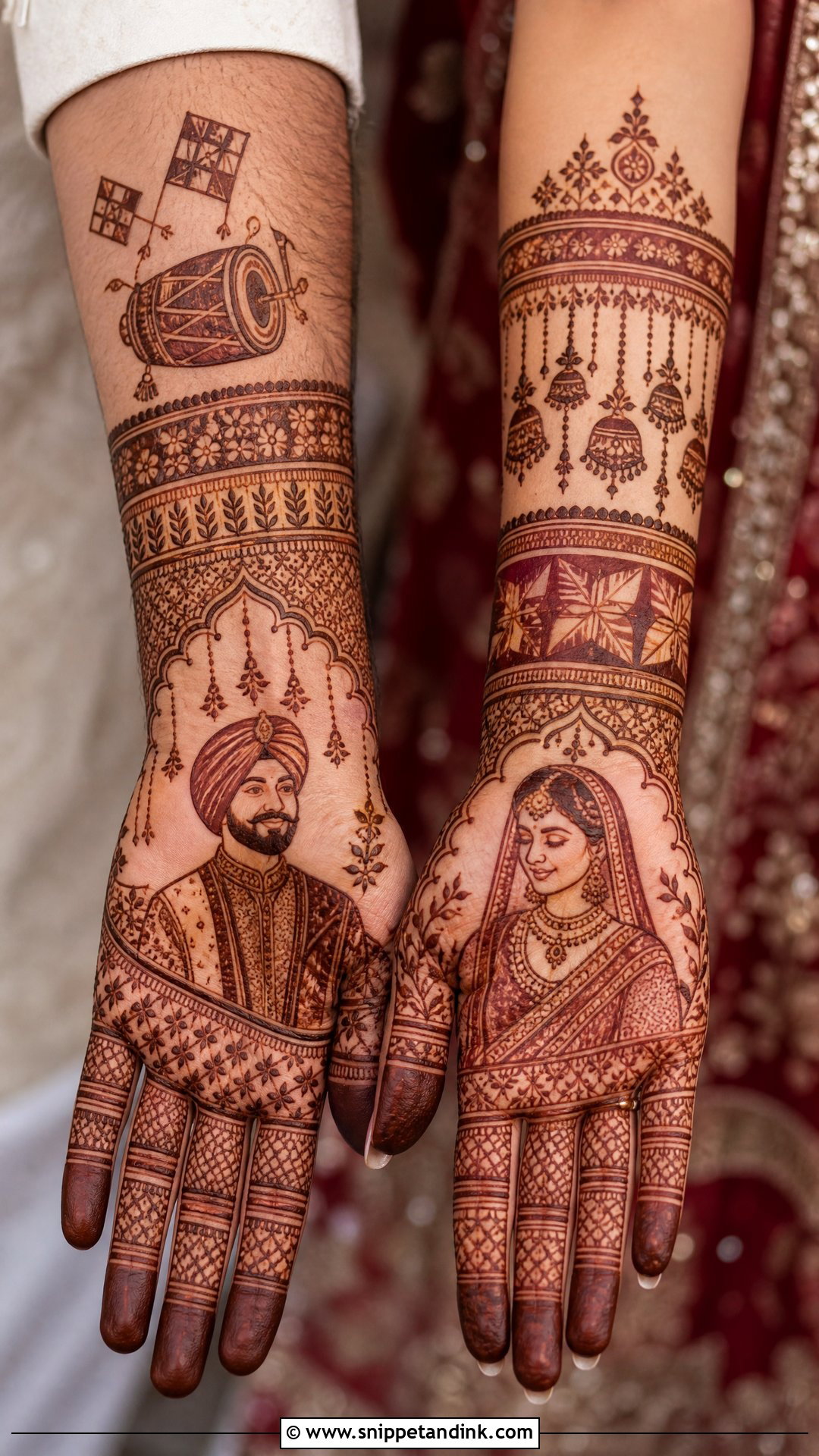
Punjabi designs bring the celebration onto the hands: the couple, dhol motifs, kalire, chooda-inspired bands and phulkari-style patterns. Wrist sections drawn like bangles echo the chooda she’ll be wearing. Bold outlines and lively fillers suit the mood. Keep in mind that the chooda sits on the forearm for weeks in many families, so the wrist henna will be partly hidden; I put the most important figures on the palms for that reason. Hidden initials for the groom fit in naturally.
22. South Indian Dulha Dulhan Mehndi Design
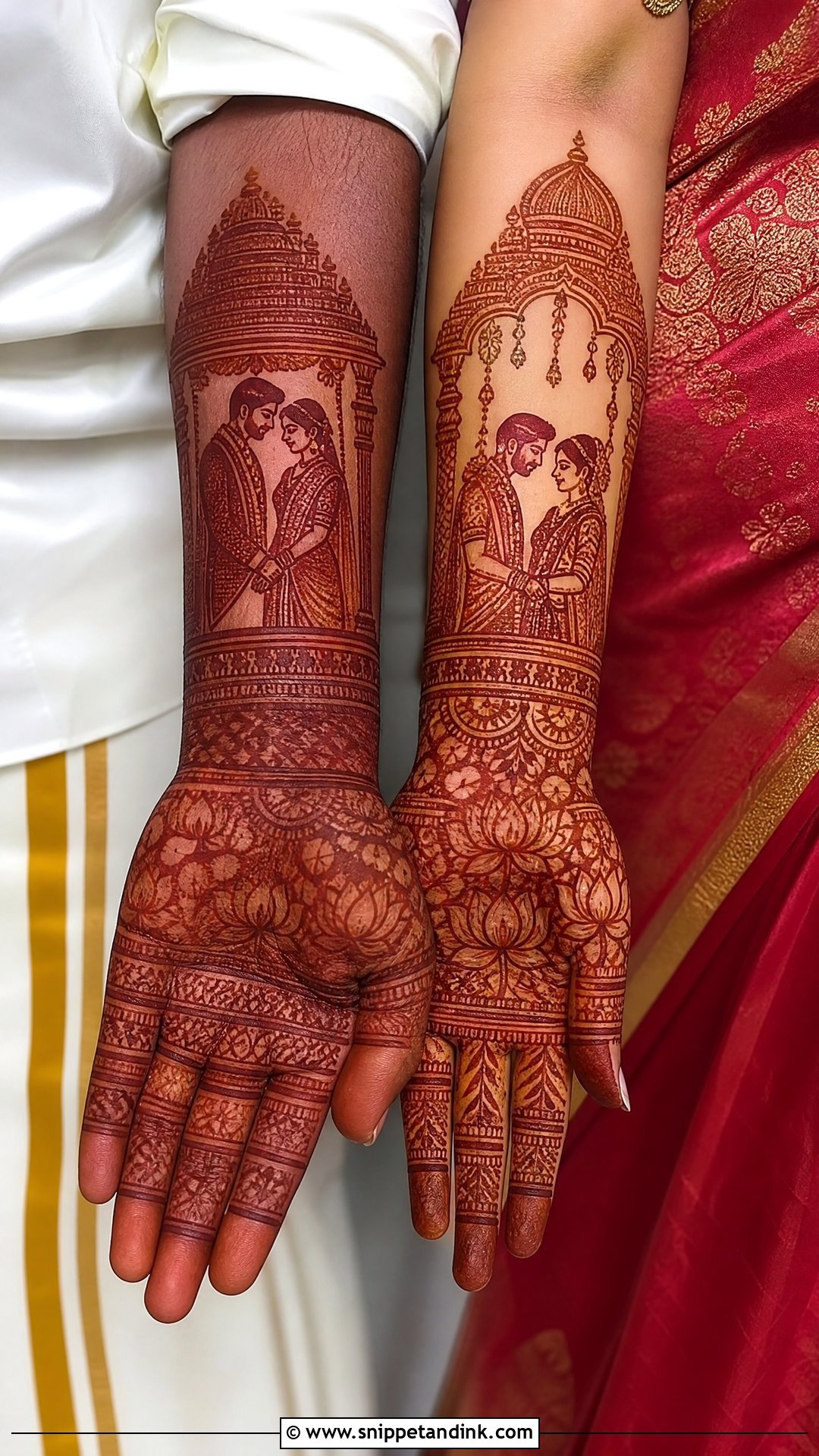
Temple borders, lotus, jewelry chains, mango motifs and a couple in traditional South Indian wedding attire define this one, with the bride shown in her bridal bun or jewelry. The palm holds the couple and the forearm carries temple bells, mandap pillars and layered borders. Clean symmetry suits it far better than crowding. It pairs naturally with silk sarees, temple jewelry and gold bangles, which already bring plenty of detail to the frame.
23. Muslim Dulha Dulhan Mehndi Design
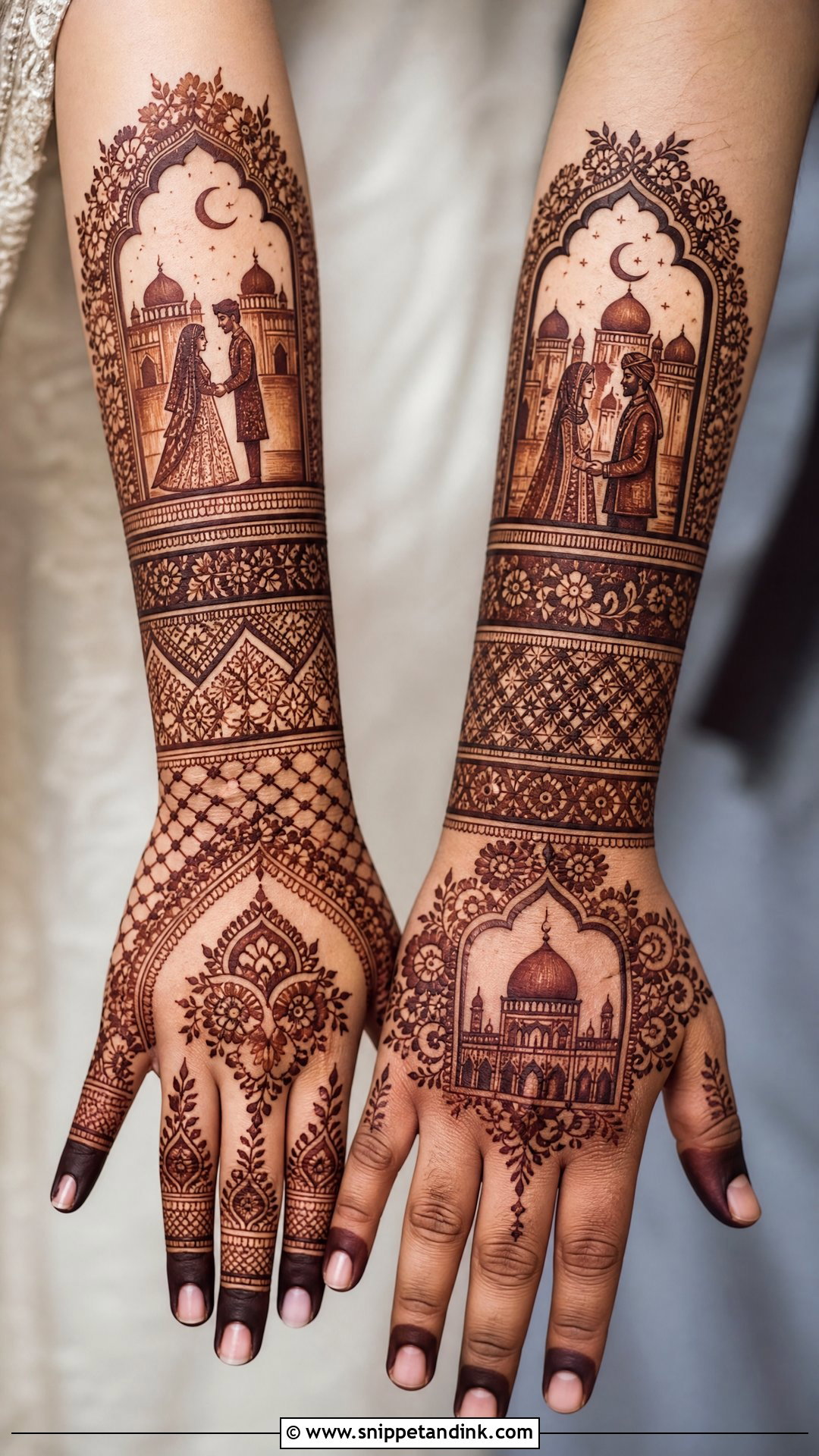
Domes, arches, florals, crescent moons, jaali and graceful couple frames carry this design, with the dulhan in a dupatta and the dulha in a sherwani. Arabic and Indo-Arabic elements blend naturally with it. Some families prefer figures to stay small or symbolic, so I always ask before drawing detailed faces; a couple frame with initials inside can carry the same meaning. Smooth line work and balanced spacing keep it refined across palms, back hands and wrists.
24. Pakistani Dulha Dulhan Mehndi Design
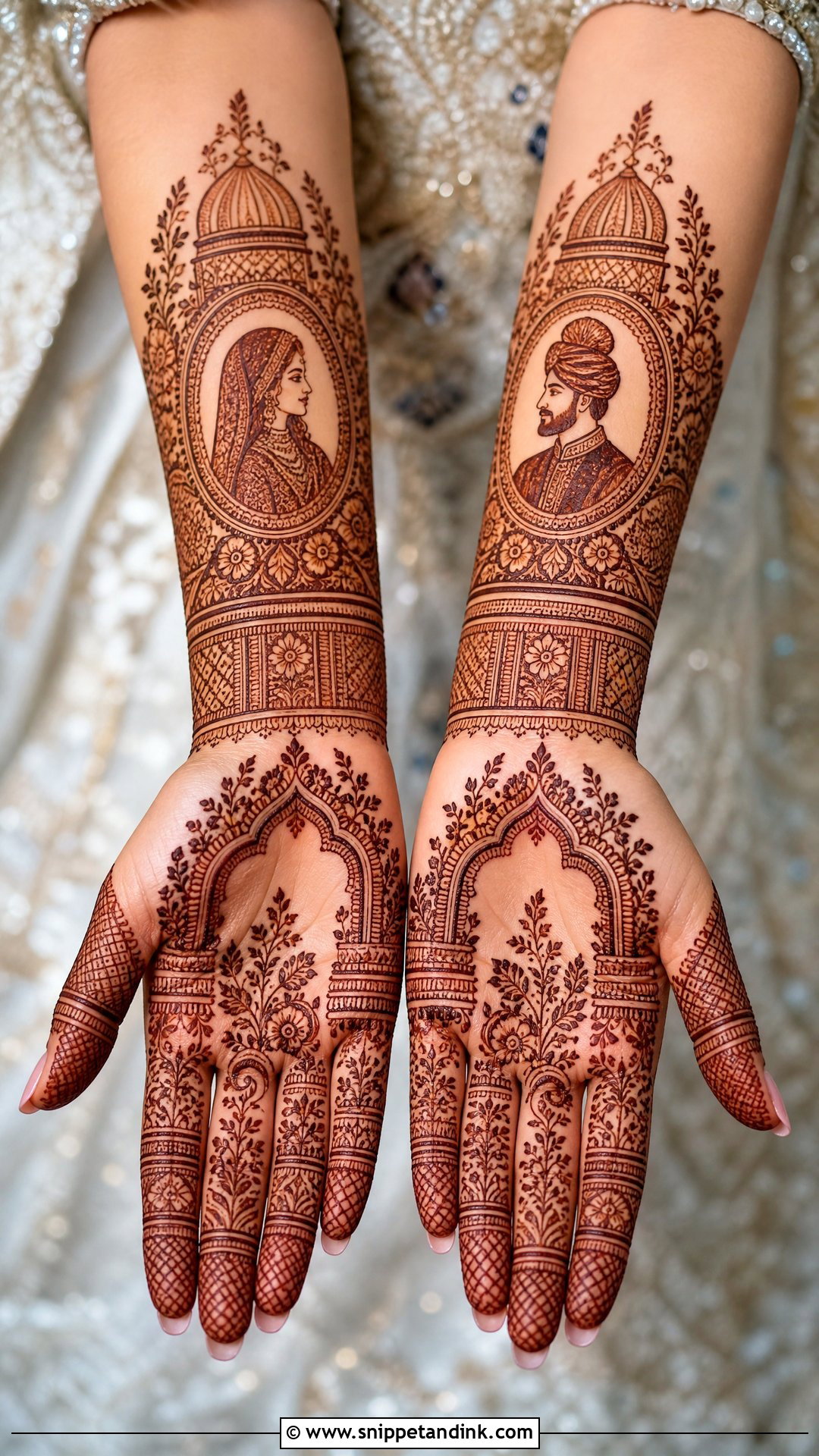
Pakistani bridal mehndi combines graceful florals, detailed jaali, domes, leafy trails and couple portraits, and it can be dense or slightly open. Oval portrait frames on the palms with jewelry-style cuffs at the wrists are a common layout. It travels across functions, from mehndi night through the nikah, baraat and walima. Since it will be photographed over several days, I’d keep the fingers detailed but not packed; the fingertips stain darkest and dense work there merges into solid colour first.
25. Dulha Dulhan Name Mehndi Design
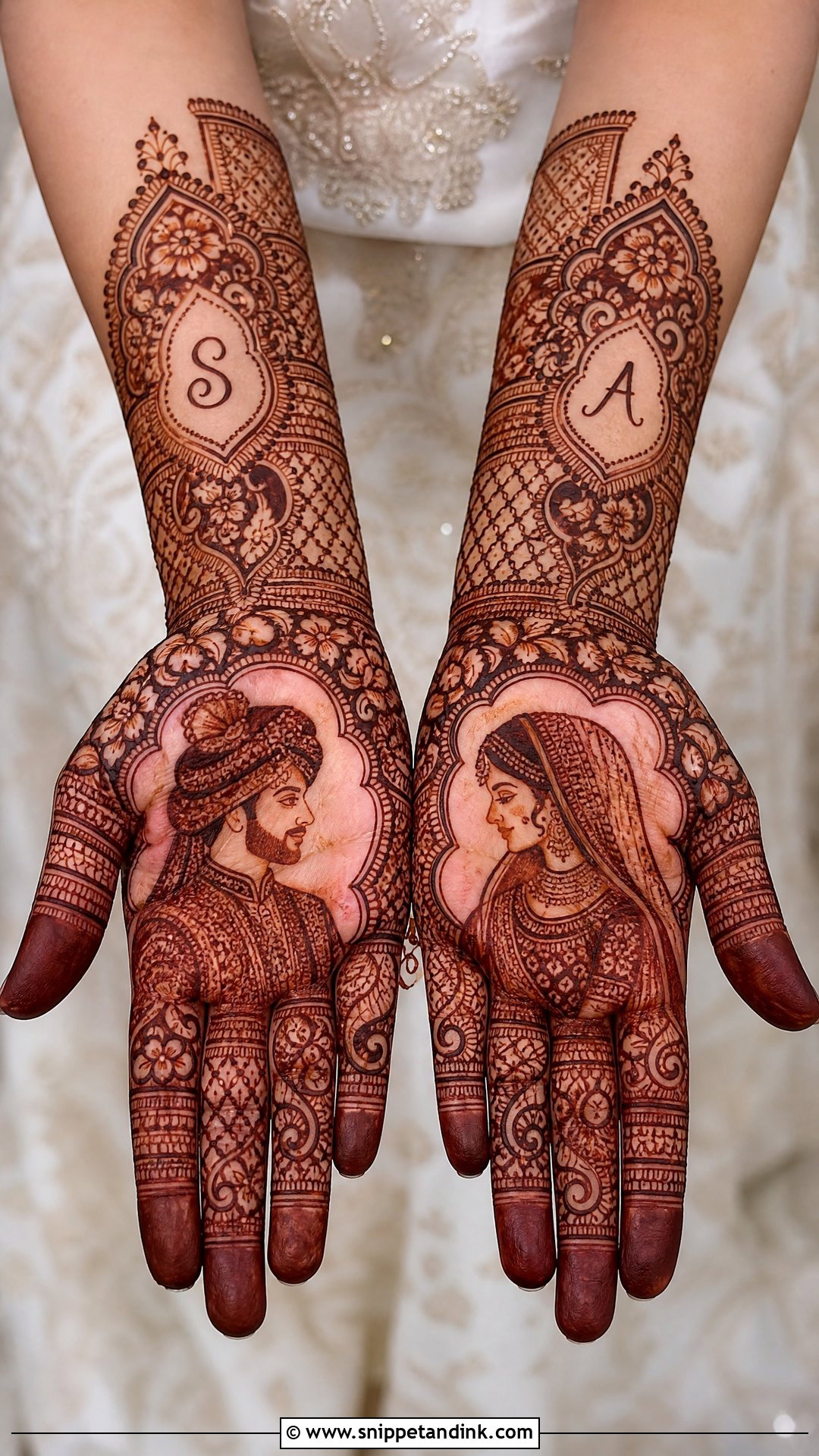
Hiding the groom’s name in the bride’s mehndi is a game many families still play, and it makes for a good moment at the reception when he searches for it. The portraits sit on the palms while his name, initials or the date is tucked into a paisley, leaf, jaali panel or wrist band. The hiding place matters: too obvious and the game is over in seconds, too tiny and it blurs when the stain spreads. I write the letters with a fine cone, one stroke each, inside a small heart or floral frame.
26. Dulha Dulhan Hashtag Mehndi Design
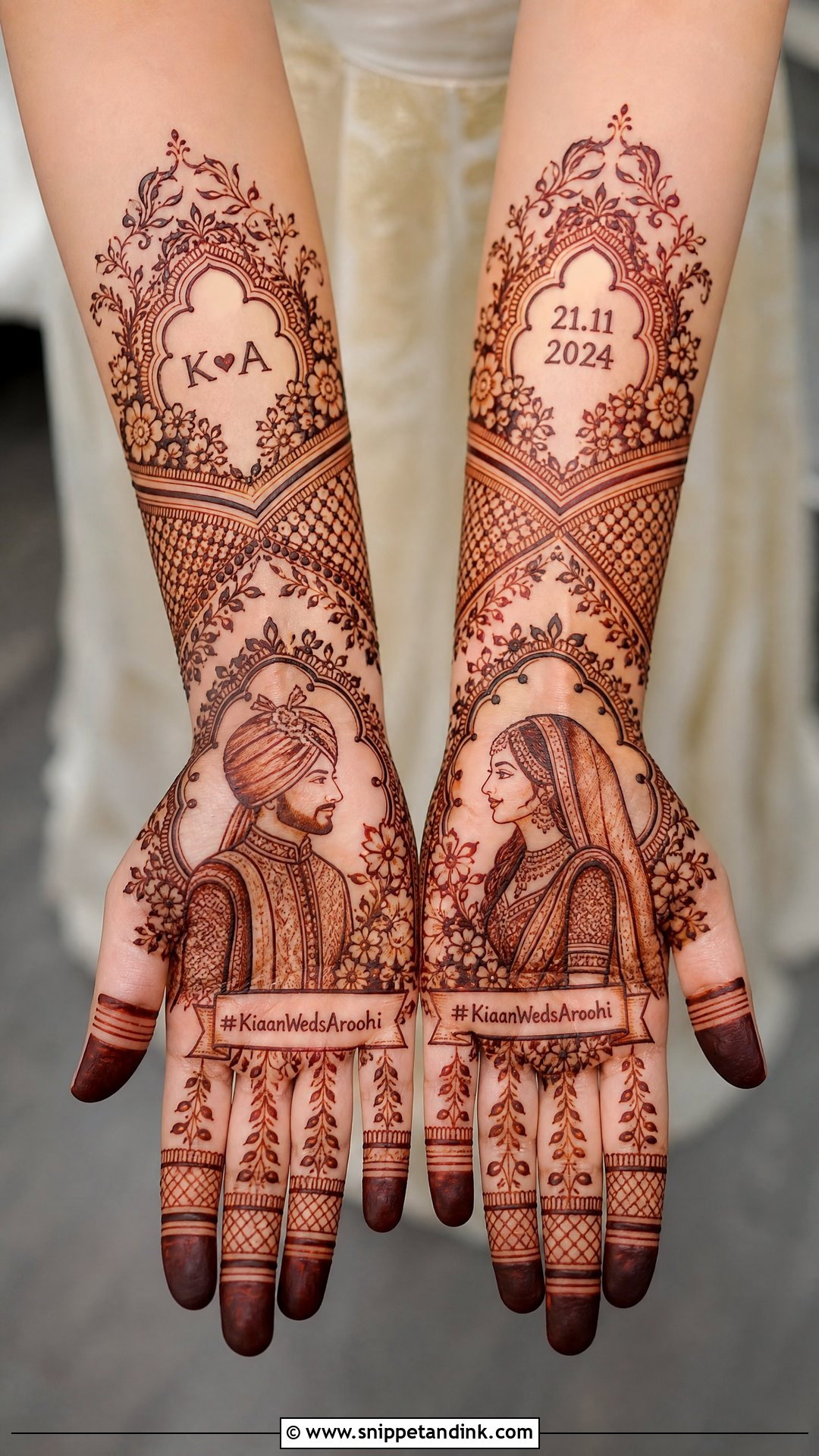
A wedding hashtag can sit near the wrist, along the forearm or inside a small banner, with the couple on the palms. Lettering is the risk. Henna lines spread slightly as they stain, so a fancy script with tight loops fills in and becomes unreadable; I use plain, slightly spaced letters. Florals, dots and light borders around it work better than heavy fillers. It suits couples who expect plenty of social sharing.
27. Dulha Dulhan Wedding Date Mehndi Design
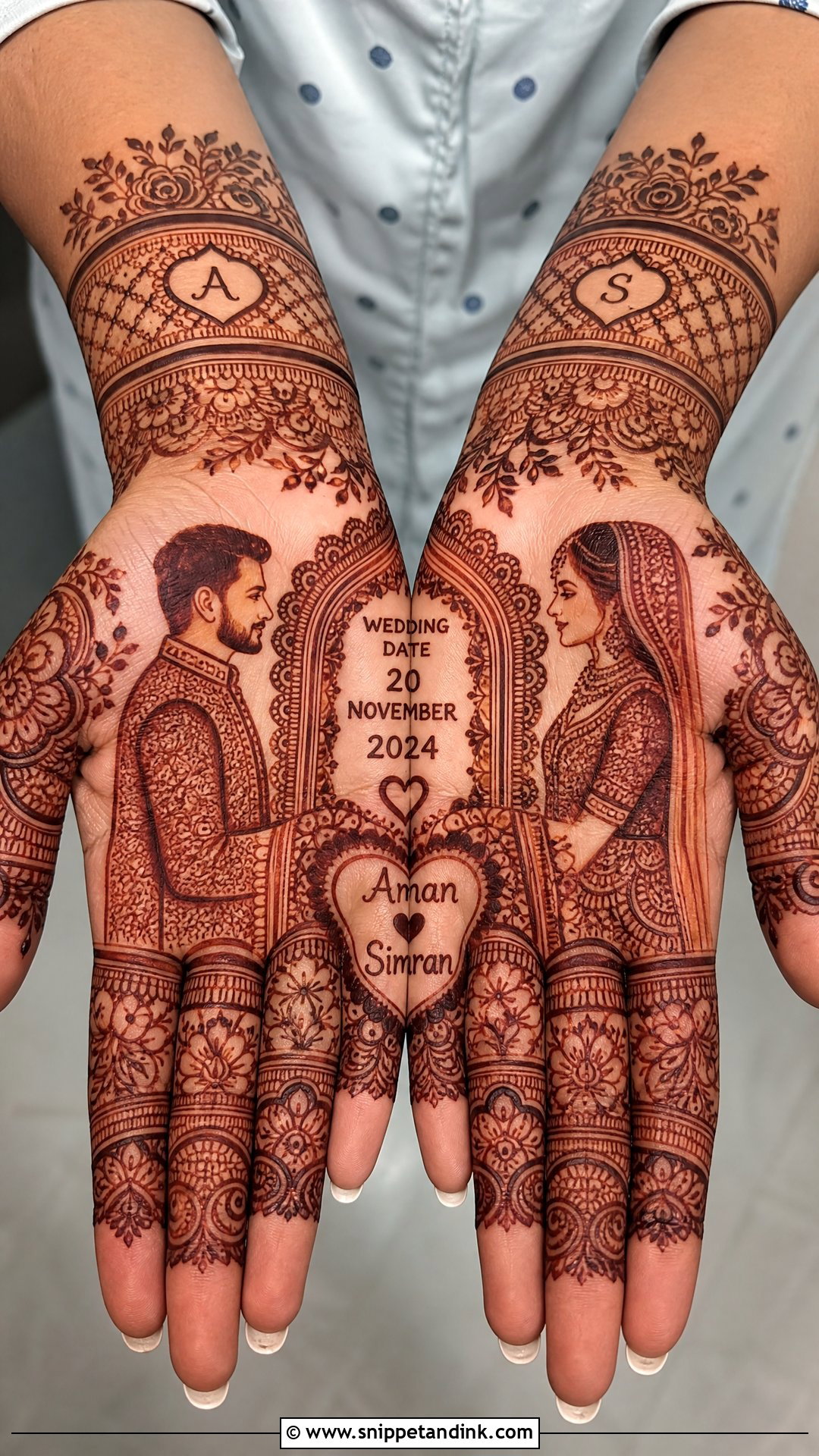
The date can go beneath the portraits, inside a mandap frame, on the wrist cuff or along a forearm border, turning the henna into a keepsake in photos. Simple digits read best. Curly numbers in henna start to look like each other, especially 3, 8 and 9, so I stick to clean forms and leave a little more space between digits than you’d think necessary. A small arch or plaque frames it neatly.
28. Dulha Dulhan Feet Mehndi Design
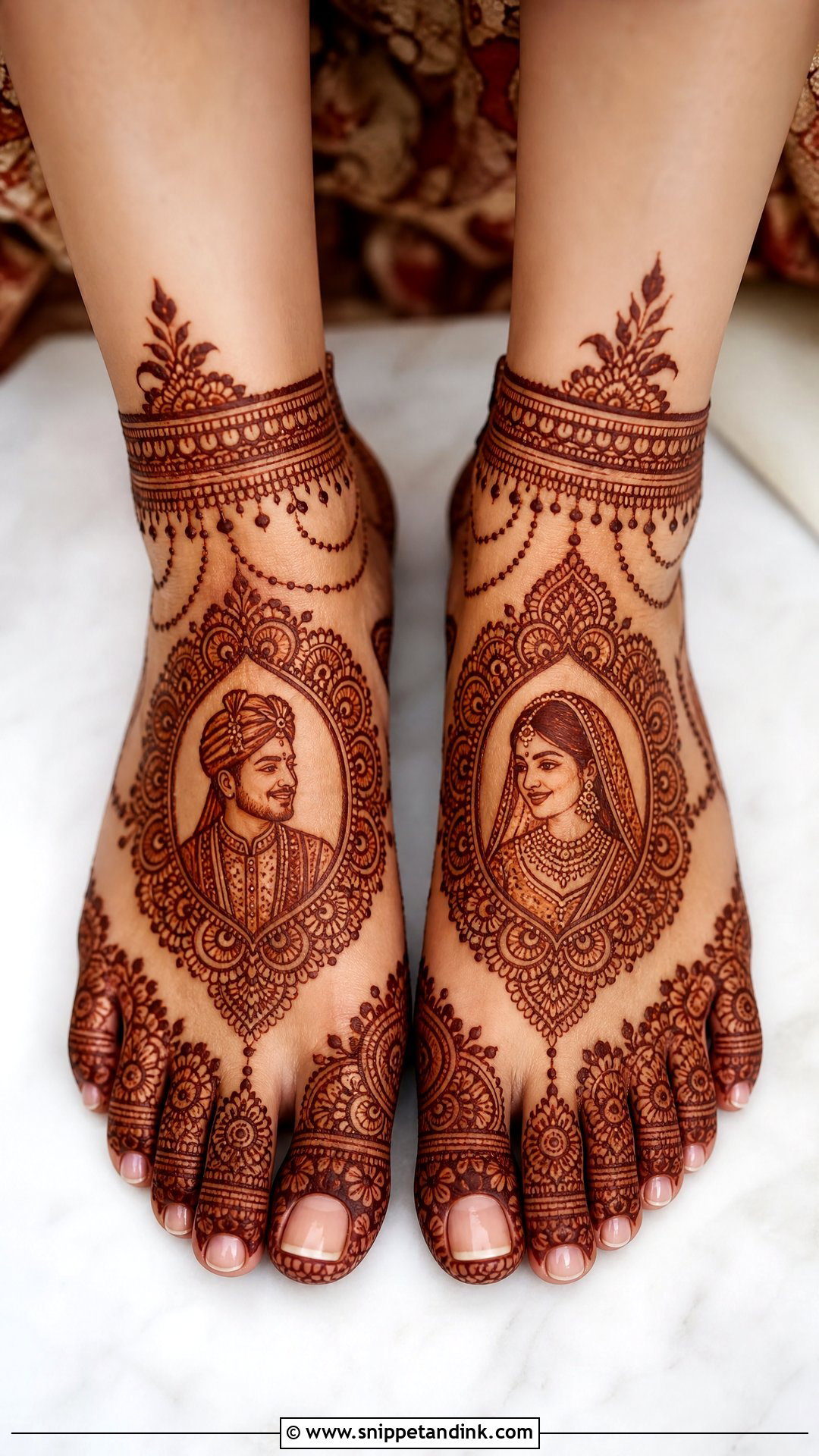
Feet extend the theme beyond the hands: a small bride or groom portrait on the top of each foot, with anklet bands, florals, paisleys and dotted chains around the ankles. Feet curve and flex, so portraits there must be simple and placed on the flattest area just above the toes. The soles and edges stain deep while the top of the foot stays lighter, which is another reason I keep the faces bold. Matching motifs on the toes finish it, and it pairs with payal and toe rings.
29. Dulha Dulhan Leg Mehndi Design
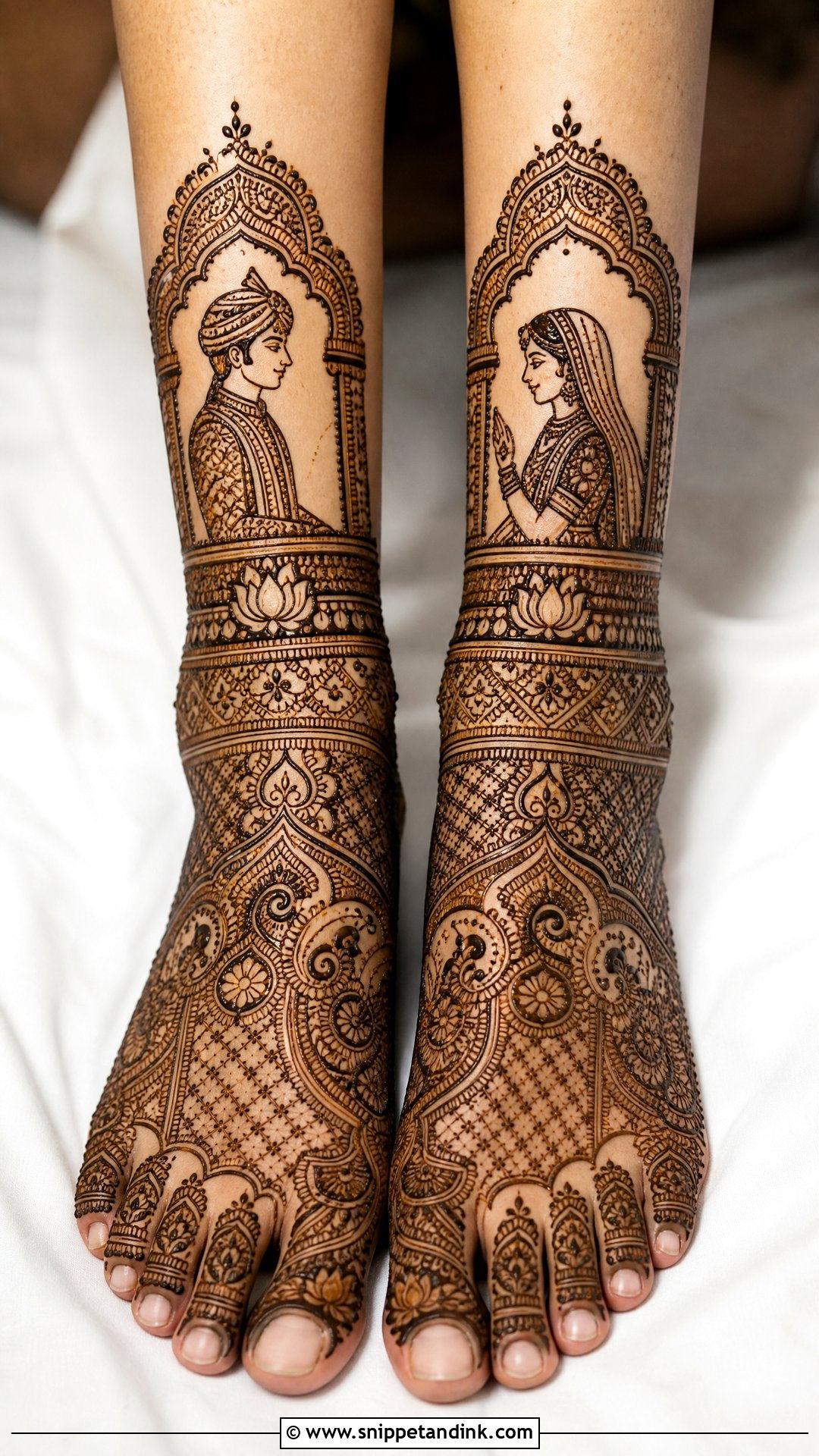
A dulha dulhan leg mehndi design rises from the feet toward the calves with portraits, mandap arches, lotus borders and anklet patterns. Most of it will only show when the lehenga lifts during the pheras or when you sit, so I place the couple low, near the ankle or top of the foot, where it actually gets seen. Fine vines, paisleys and mesh connect the sections. Leg henna adds a lot of sitting time, and those hours come on top of a full bridal hand.
30. Dulha Dulhan Elbow Length Mehndi Design
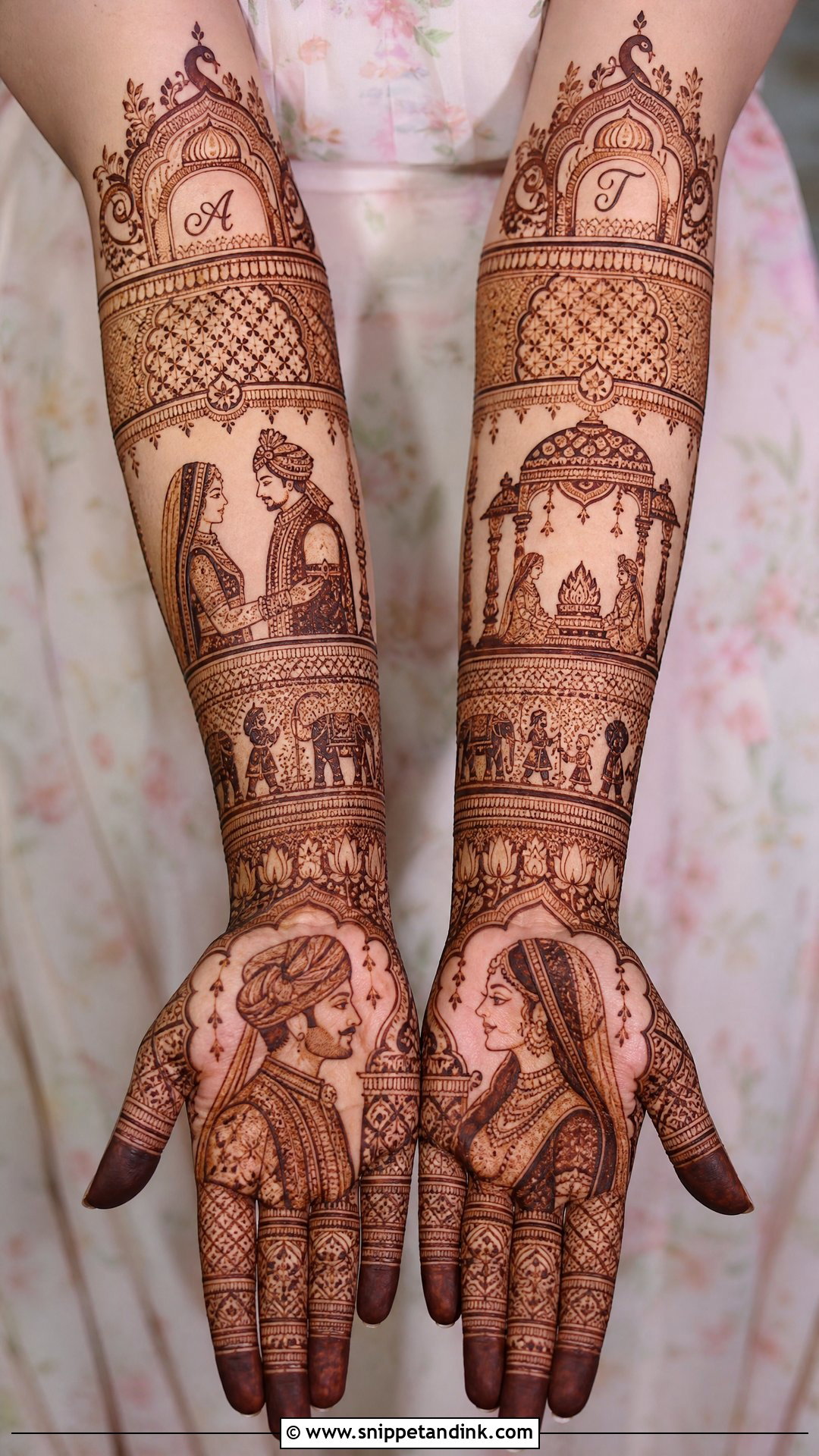
Elbow length gives room for everything: portraits, a mandap scene, baraat, peacocks, lotus, jaali and initials, with the palms holding the couple and the forearms telling the rest of the story. It takes many hours to apply. What separates a good elbow-length design from a cluttered one is clear breaks between the major motifs; I plan those dividing bands before drawing any scene. When every section has room, even a heavily detailed arm reads in order from palm to elbow.
Faces That Still Read After the Stain Darkens
A portrait that looks crisp in wet paste can blur once the dye settles, because henna lines spread a fraction as they stain and every line on a face sits very close to the next. Before you commit to an artist, look at photos of their finished stains, not only the paste. Paste photos flatter everyone.
- Faces drawn at palm scale should be roughly the size of a large coin or bigger. Smaller than that and the eyes and mouth merge.
- The bride’s and groom’s features should look different from each other. If both portraits share the same face with a different headdress, the artist is working from a template.
- Look at the eyes in the stained photos. If they’ve filled in solid, the lines were too thick or too close.
- Check the space around each portrait. A thin ring of bare skin is what lets a face stand out from the filler.
Protecting the portraits while they develop
Palms take the darkest stain, which helps the faces, but they also rub against everything. Keep the paste on for as long as you can, ideally overnight, and scrape it off rather than washing it. Avoid water on the palms for the first day. A smudge across a flower disappears into the pattern; a smudge across an eye changes the whole expression, so take the extra care with your palms in particular.
Where the Couple Sits Decides the Rest of the Hand
A dulha dulhan design is a portrait of your wedding before it happens: the couple, the ceremony and the people around them, drawn on your hands. Portraits, initials, dates, varmala scenes, mandap art and regional details can all be mixed. Decide how many hours you can sit, what your outfit will cover and which artist can genuinely draw a face, then build the layout from there. Full or elbow-length coverage suits a grand look; Arabic, minimal and modern layouts keep the theme with less time and weight.
You'll Like These Ideas:




Leave a Reply