
Henna stopped being one look a long time ago. In a single week I might pipe full bridal coverage, an airy Arabic trail, a clean mandala, a few modern finger bands and a Moroccan grid. Which one suits you comes down to the occasion, your outfit, the shape of your hand, how long you can sit still and how dark you want the stain to read. Dense Indian work carries a wedding; spaced Arabic flow looks fresh at Eid or a family dinner; a few lines on the back of the hand cover a quick function. I’ve grouped 35 designs below by style, occasion and wearer, with what I’d tell you about each one if you were sitting across from me.
How Long Each Level of Coverage Keeps You in the Chair
The first thing I ask anyone booking henna is not which design but how much time they have. Coverage decides the clock far more than style does, and it decides how long you’ll be sitting with wet paste afterwards. These are rough working times for an experienced artist; they vary with the detail and with how still you can keep your hands.
- Fingers, a wrist band or a small mandala: often around 10 to 20 minutes for both hands.
- Arabic or half-hand trails on both hands, one side only: commonly 30 minutes to an hour.
- Front and back of both hands to the wrist: plan for a couple of hours.
- Full bridal hands to the elbow plus feet: often a long afternoon or evening, sometimes split across two sessions.
After the last line, the paste needs roughly 20 to 30 minutes to dry on the surface, then several more hours on the skin to stain properly. I tell clients to eat, use the bathroom and set out their clothes before we start.
1. Full Hand Bridal Mehndi Design
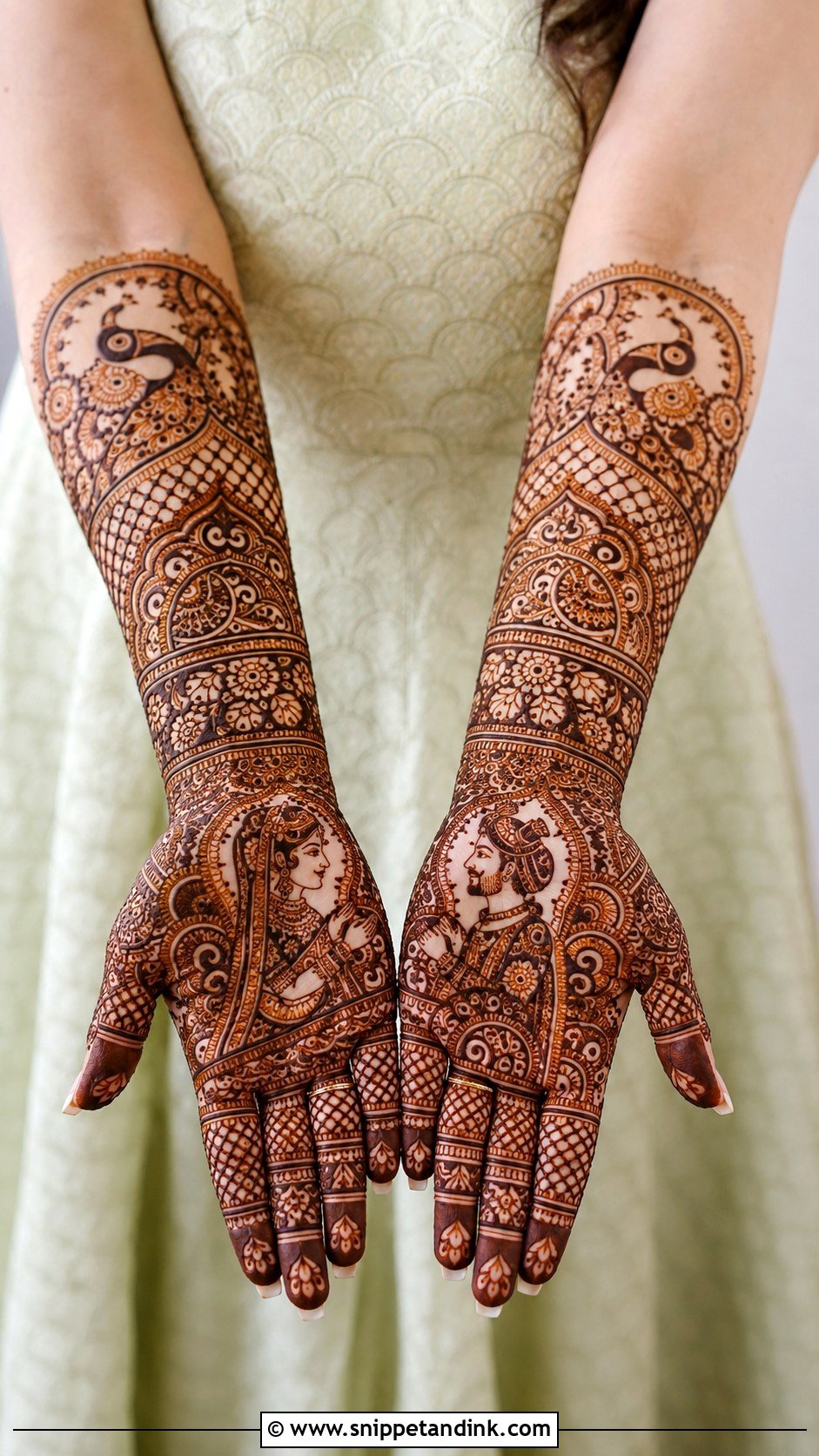
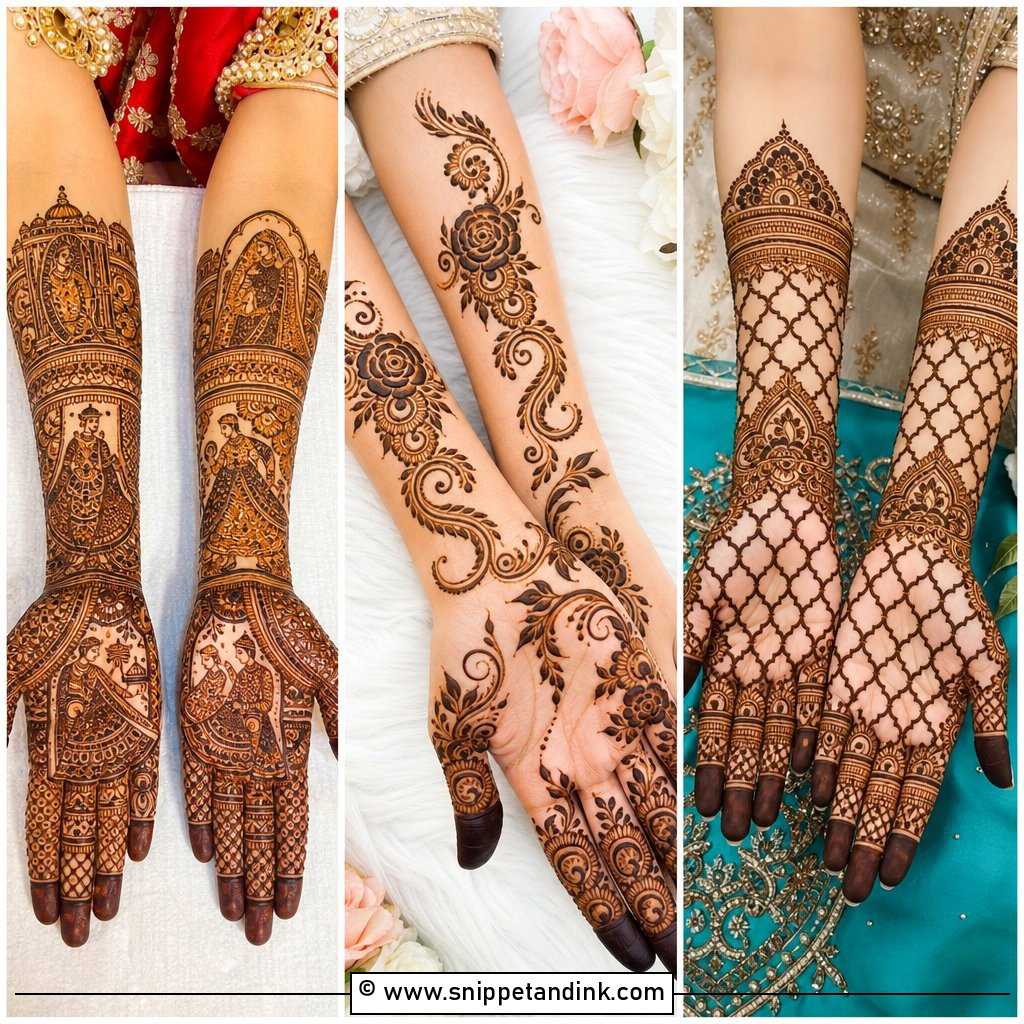
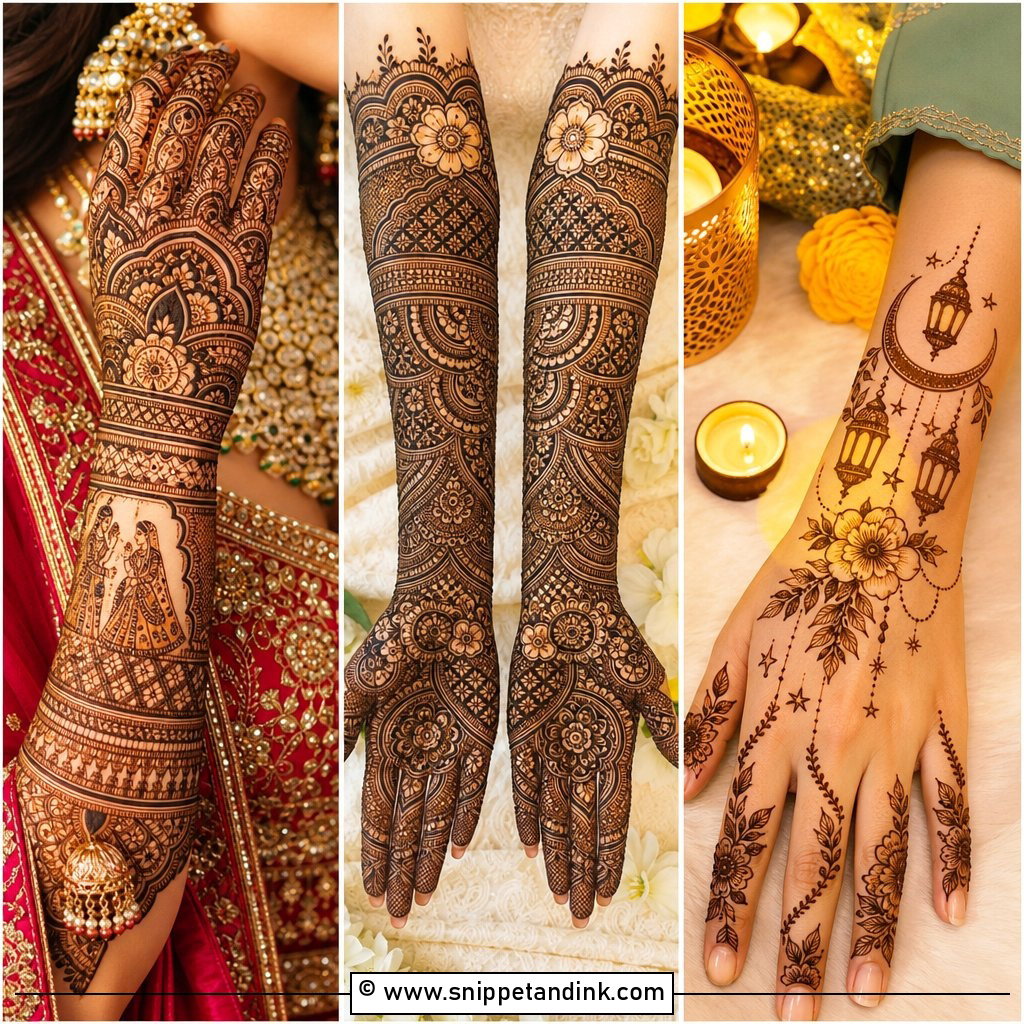
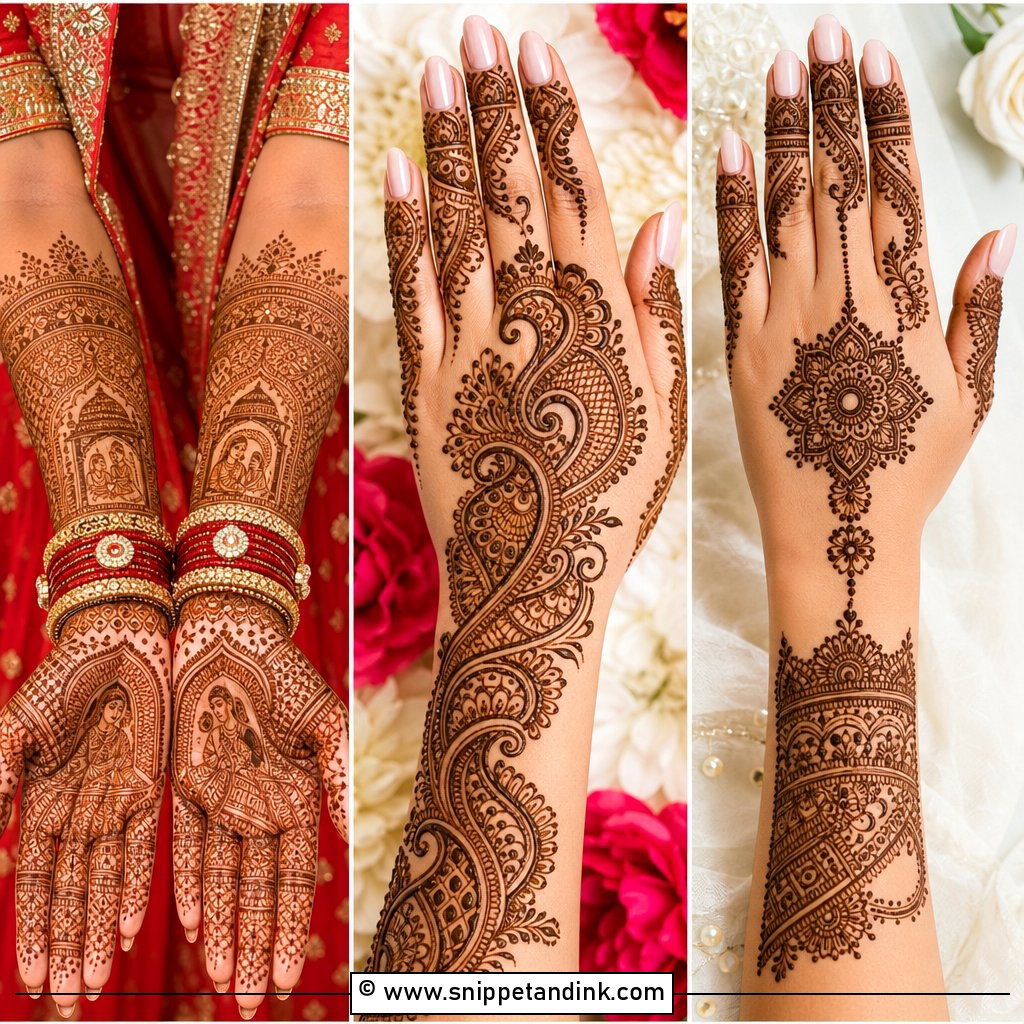
This is the long sitting: palm, back of the hand, fingers, wrist and forearm, filled with paisleys, florals, mandalas, jaali and fine fillers. I plan the two hands as a pair rather than mirror copies, so they relate to each other without looking stamped. Initials, wedding symbols or a small personal motif can be hidden in the filling for the groom to find. Bring snacks and someone to hold your phone. Once the paste is on both hands, you are not doing anything for yourself for a few hours.
2. Arabic Mehndi Design For Hands
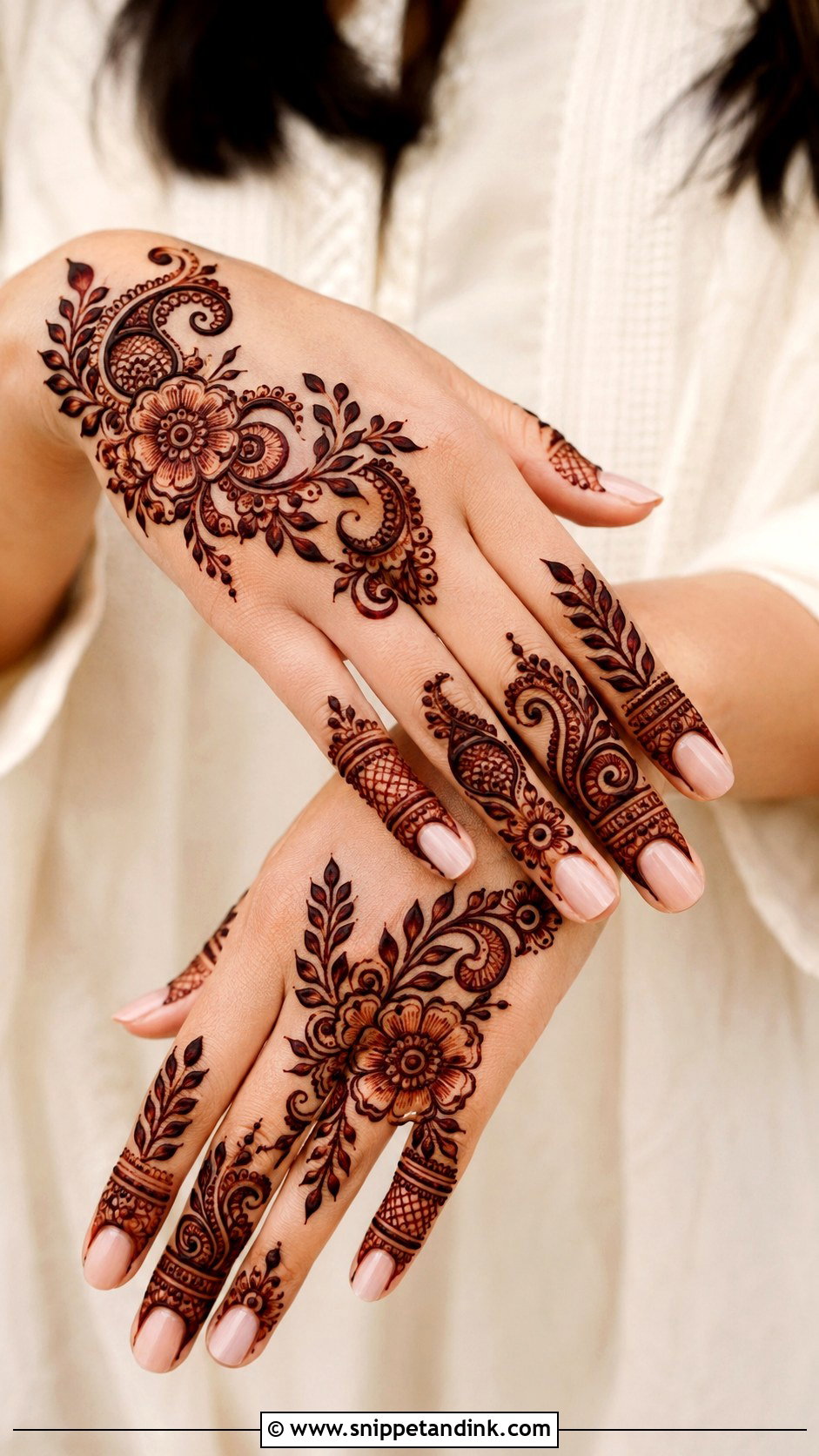
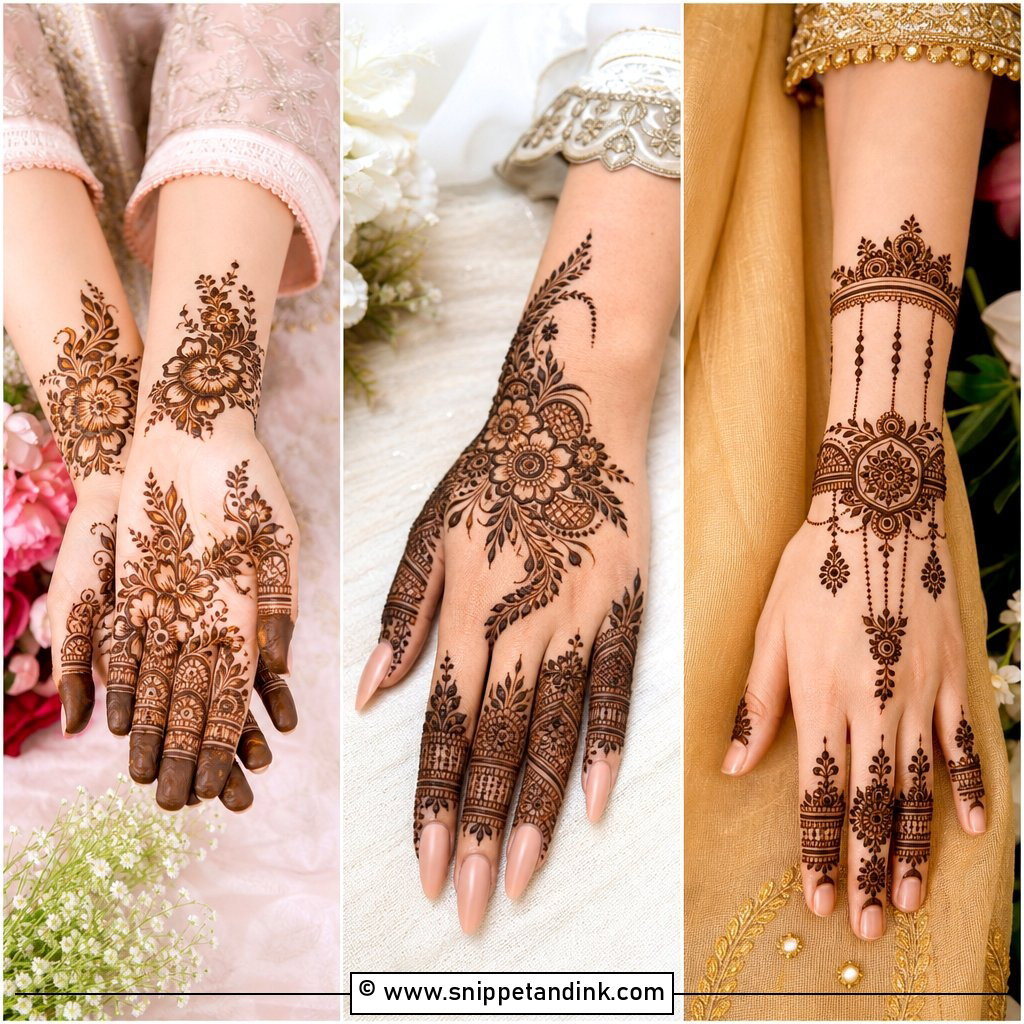
Arabic work moves on a diagonal from one side of the wrist toward the fingers, with big flowers, leafy vines, curved paisleys, dots and shaded petals, and lots of bare skin in between. It applies far faster than dense filling. That open skin is the point: the thick lines stain dark and stand out sharply in photos. I suggest it for Eid, Diwali, engagements and small home celebrations, and for anyone who wants festive hands in under an hour.
3. Simple Front Hand Mehndi Design
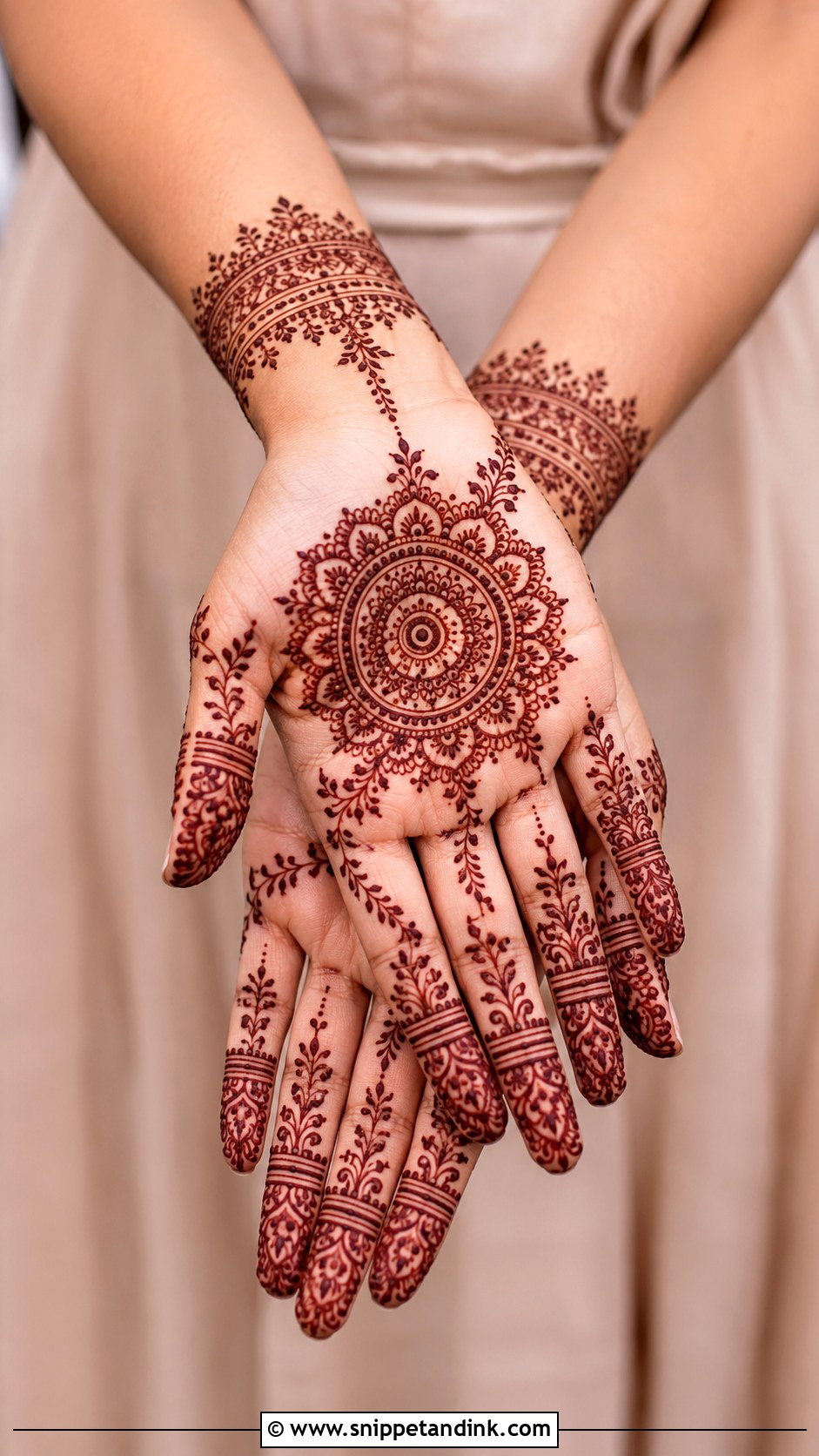
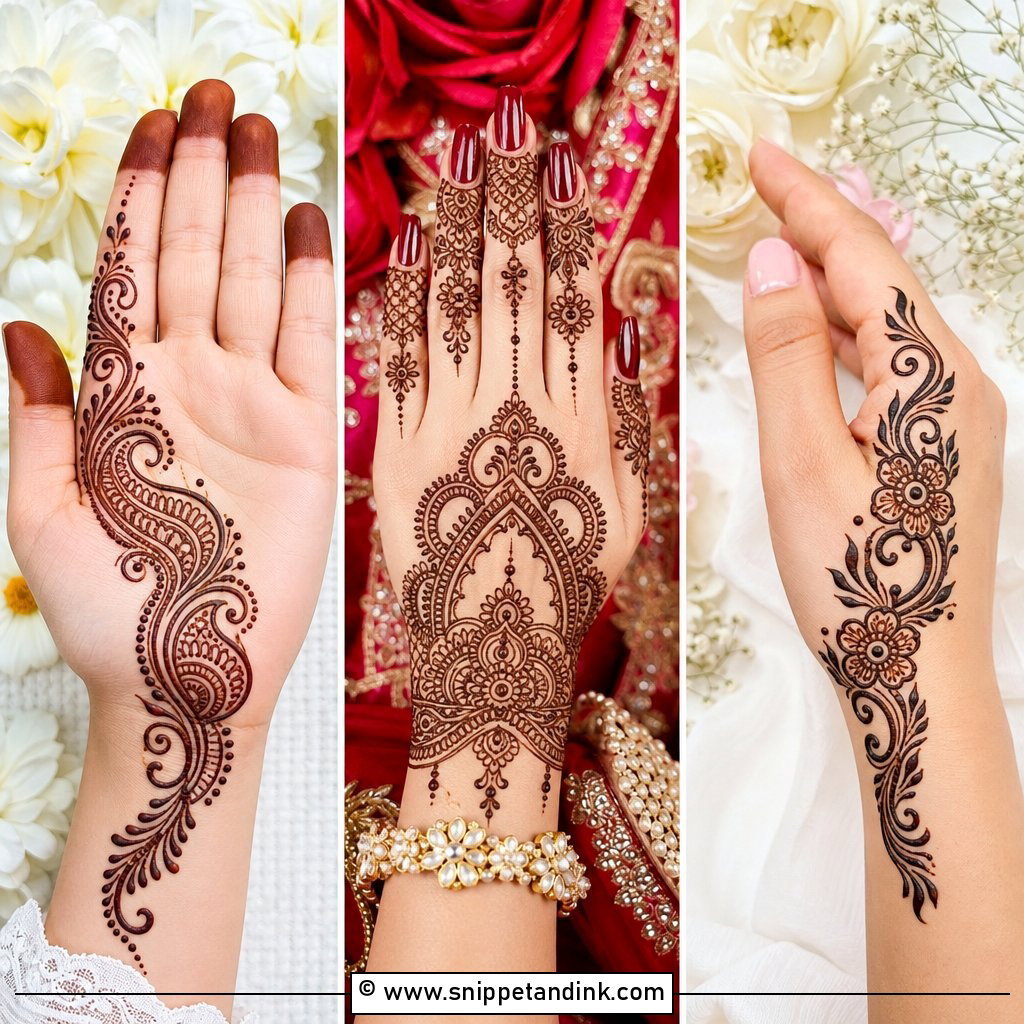
A neat mandala, floral circle or paisley cluster in the palm, matching vines or dots on the fingers and a bracelet border at the wrist. That’s it, and that’s why it works. It suits younger hands and casual festive days. If you’re practising on yourself, this is the design to learn on, because uneven spacing is the only real trap. Space the finger details the same distance apart on every finger and it will look finished.
4. Back Hand Mehndi Design
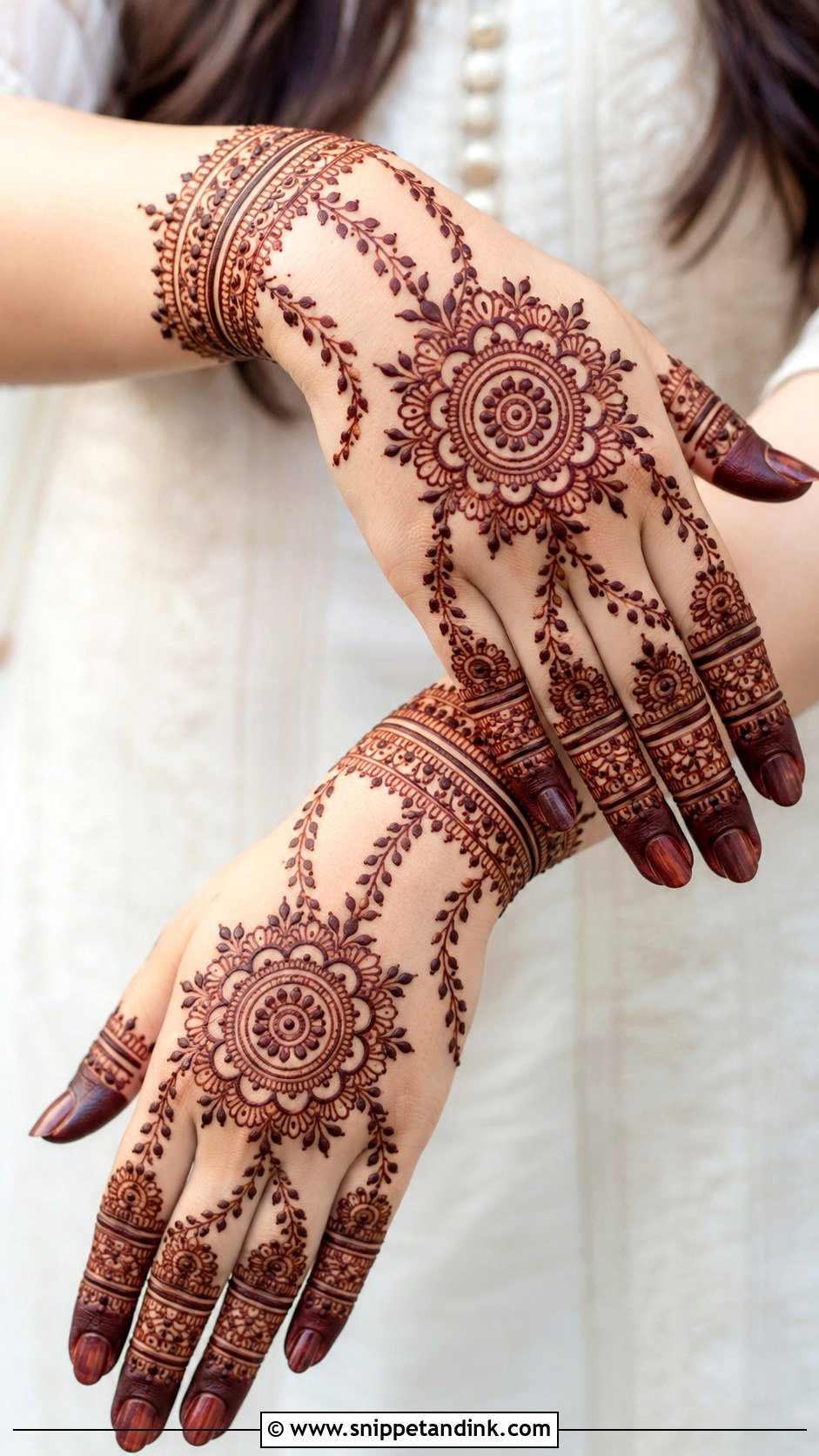
The back of the hand is what people see while you’re wearing rings and bangles, so it has become many clients’ favourite spot. A centre mandala, floral chain, leafy trail or bracelet pattern runs from wrist to fingers. I make the wrist slightly heavier and let the pattern taper toward the fingertips, which gives a jewellery-like shape. One thing to know: the back of the hand stains lighter than the palm because the skin is thinner, so I pipe these lines a touch bolder.
5. Indo Arabic Mehndi Design
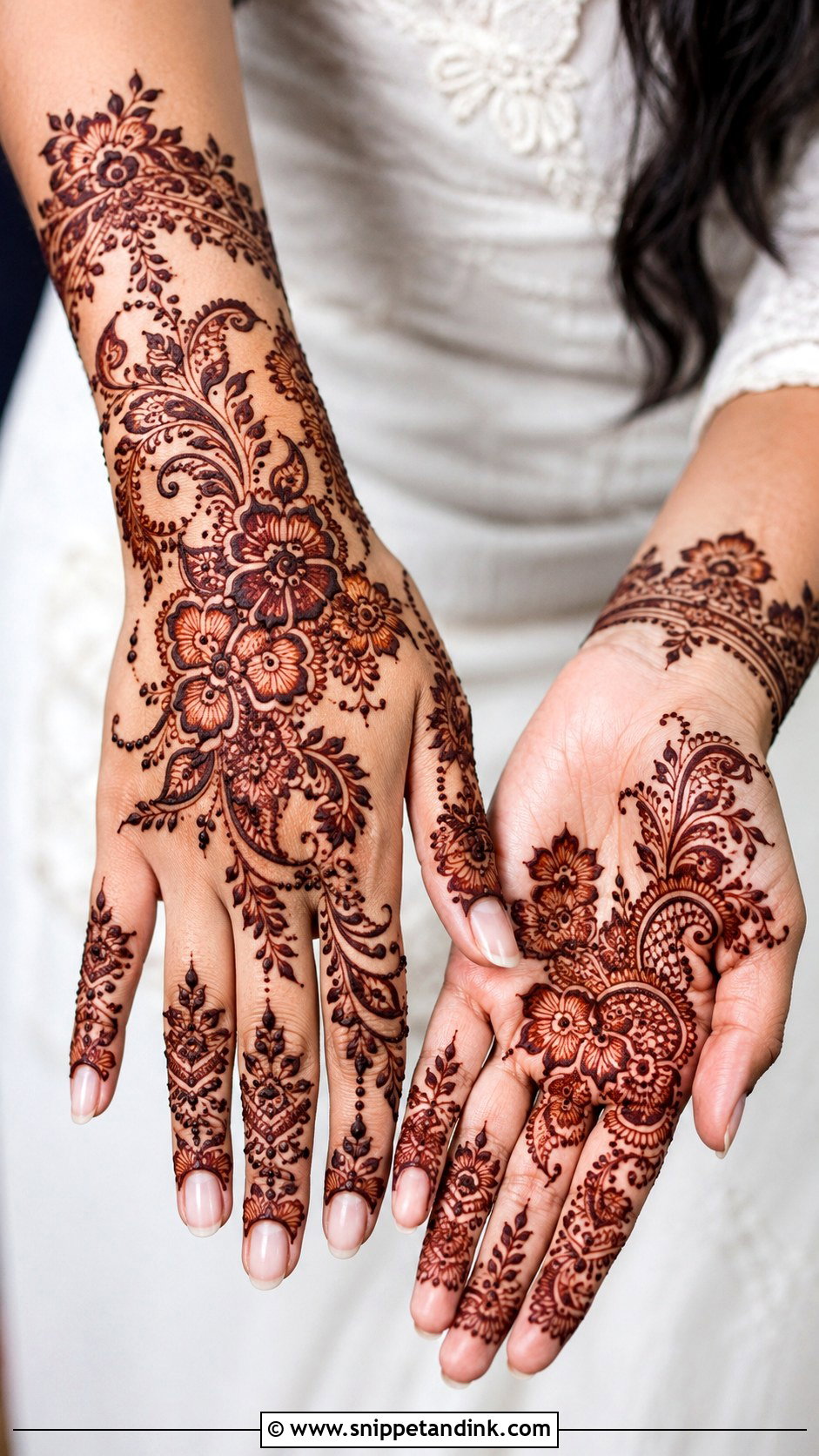
Indo-Arabic takes Arabic structure, the bold floral trail and open spacing, and fills it with Indian detail: tiny leaves, dots, checks, spirals and lace edges. A popular version starts with a wrist cuff, moves into a paisley and floral trail, and ends on decorated fingertips. It sits between Arabic and full bridal in both density and sitting time. I find it works equally well on front and back, which makes it easy to match both sides of the hand.
6. Modern Finger Mehndi Design
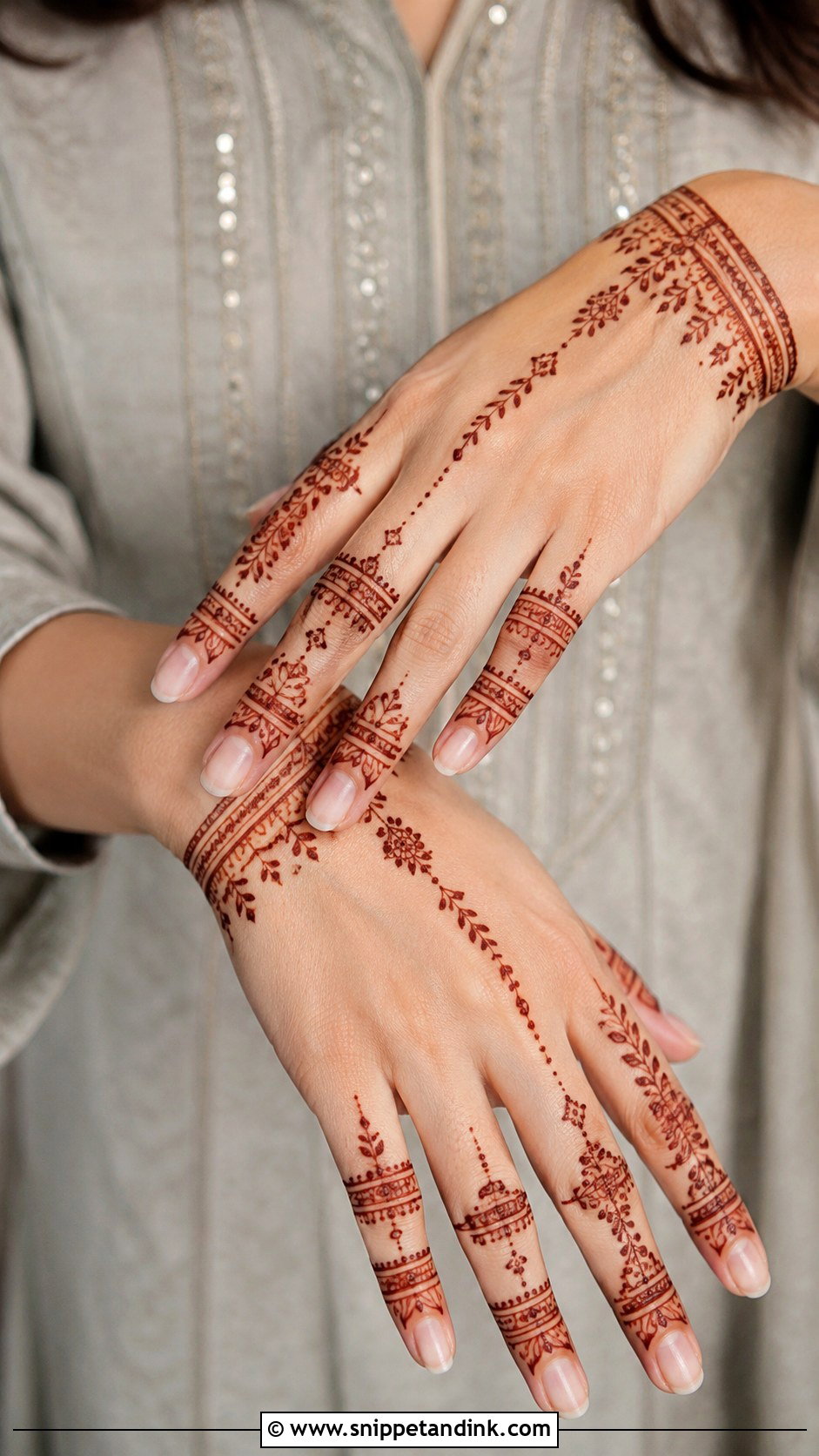
Finger-focused henna leaves most of the hand bare and puts the work into ring bands, leafy lines, dot chains, small flowers and slim geometric borders, with a fine bracelet at the wrist. It looks sharp with a fresh manicure. One honest drawback: henna stains cuticles and the skin around the nail easily, so if you’re having nails done, get them done first and let me work around them.
7. Mandala Mehndi Design
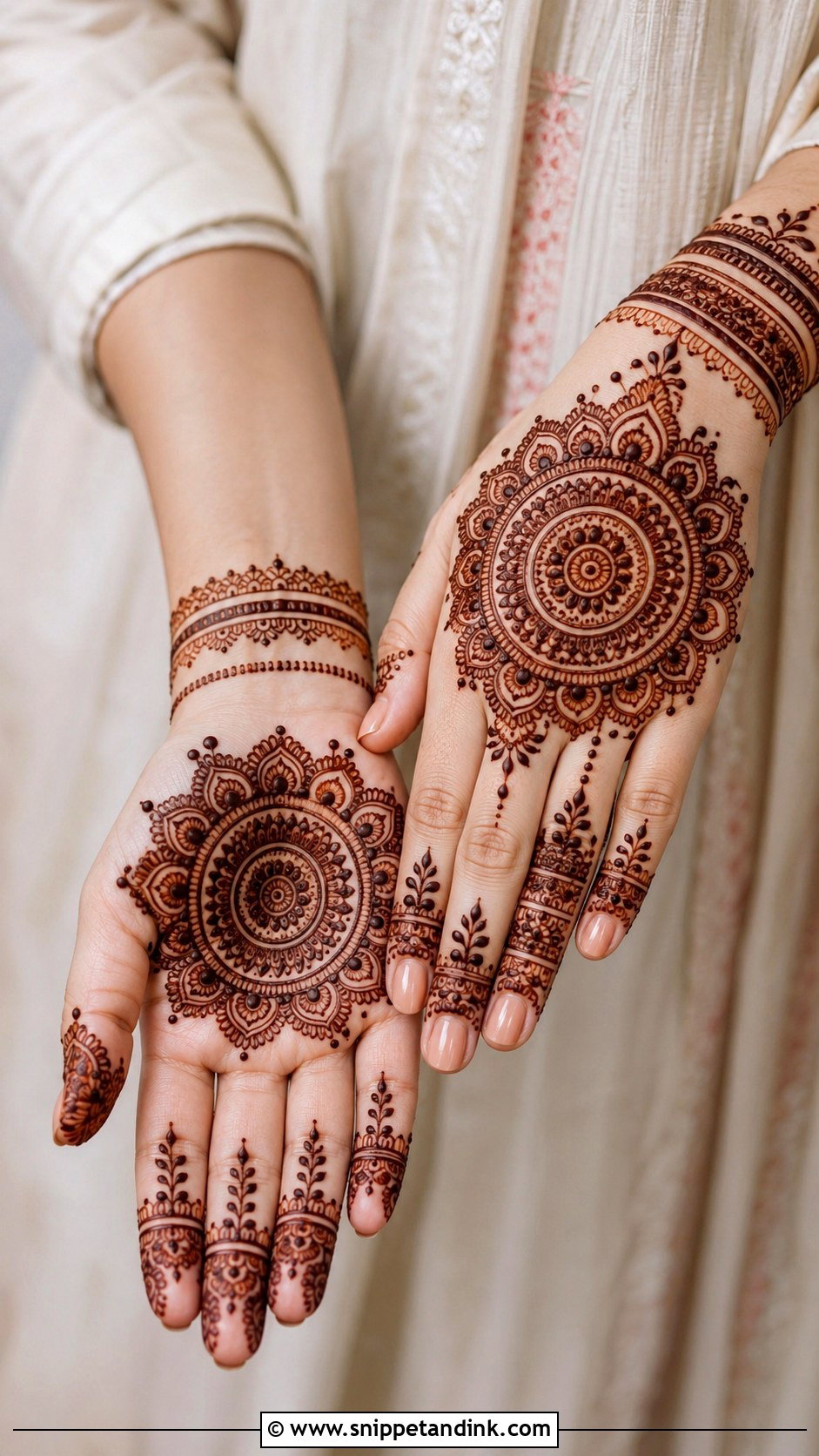
Circles suit the hand. A mandala in the centre of the palm or the back of the hand gives one clear focal point, and finger details, wrist bands and surrounding dots carry the eye outward. Keep the circle plain with petals and dots, or layer it with scallops and fine rings. Every age group I work with asks for some version of this. I mark the centre point first and build out ring by ring, which is the only reliable way to keep it round.
8. Floral Mehndi Design
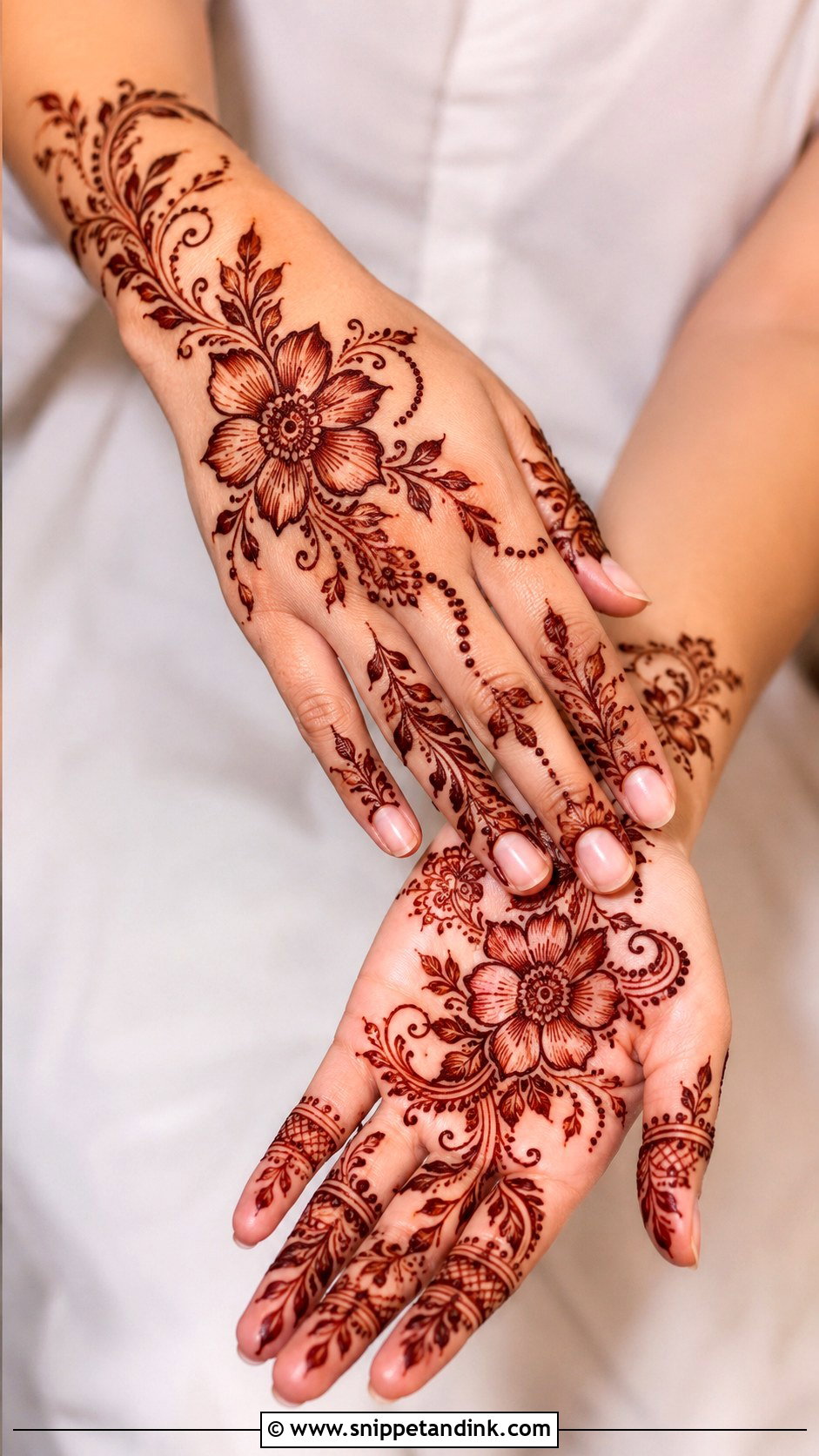
Large flowers on the palm or back of the hand, leafy stems running up the fingers, and a vine extension at the wrist. Petals can be shaded, outlined, layered or filled with tiny strokes, and flowers mix happily with paisleys, swirls and mesh. For a modern feel I leave open gaps around bold blooms. For a traditional one I add small fillers round every petal. At a haldi, keep the design on the lighter side: turmeric paste on fresh henna can muddy the early stain.
9. Paisley Mehndi Design
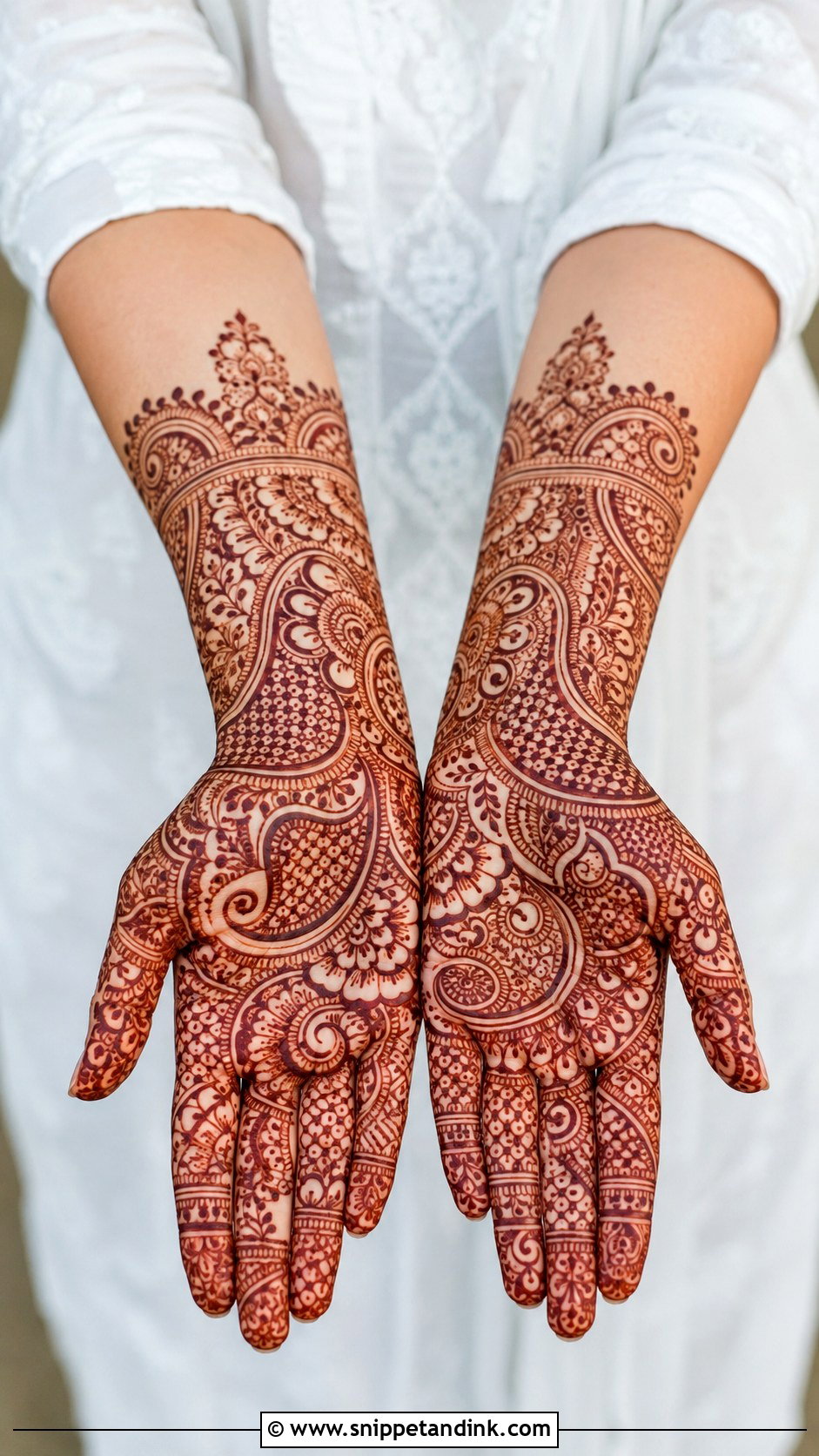
Mango-shaped paisleys are the backbone of Indian henna. Large ones anchor the palm or back of the hand, connected by florals, leaves, curves, dots and fine lines, in a diagonal, circular or dense bridal layout. Each paisley can hold its own detail inside, such as checks, petals, curls or tiny vines. I like paisleys for mixed family groups because they read as traditional to grandmothers and still look crisp to younger guests. The bold outline plus fine interior also gives an even, rich stain.
10. Peacock Mehndi Design
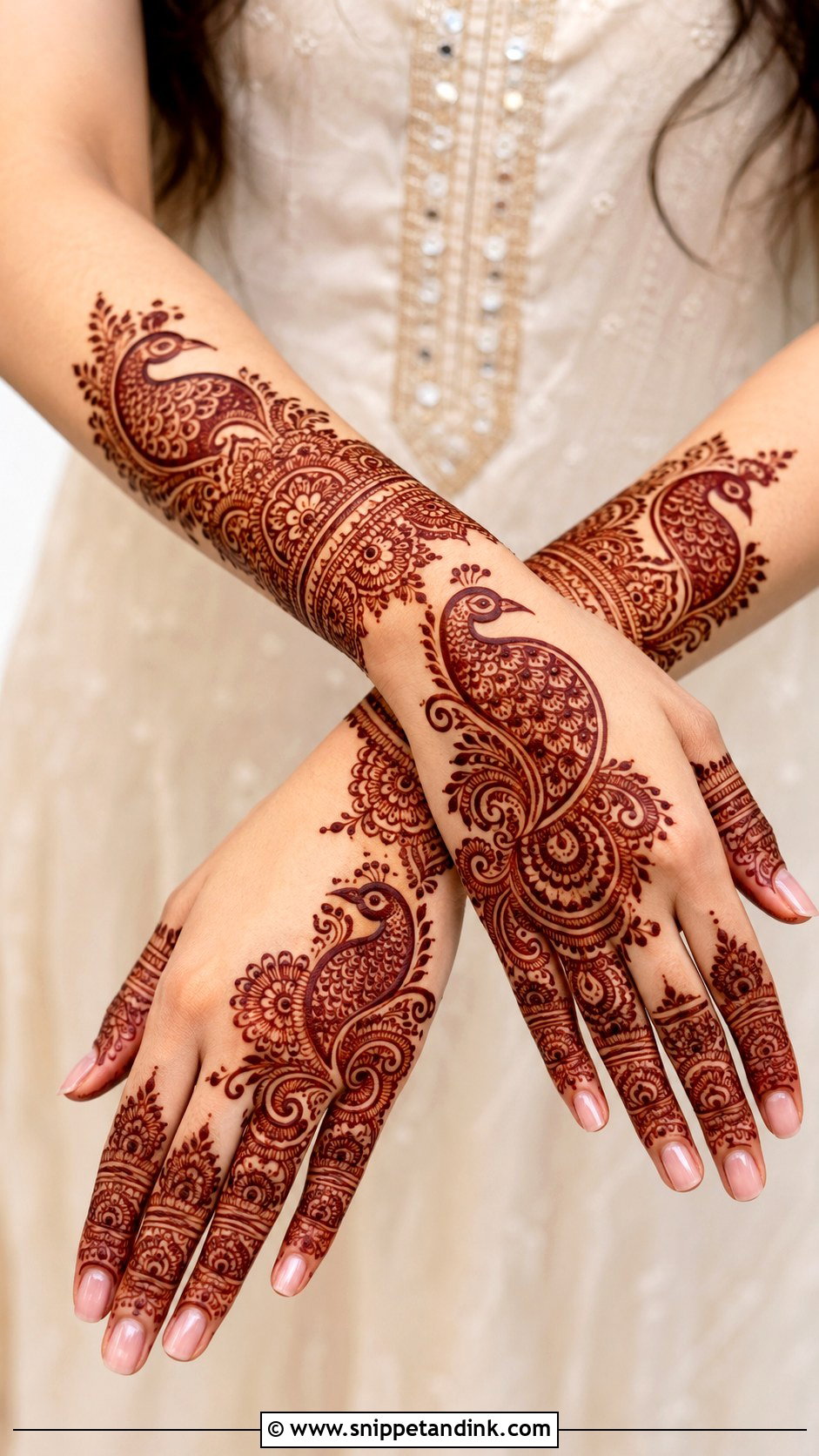
A single peacock across the palm, a pair split across both hands, or a peacock trail on the back of the hand with feathers sweeping toward the wrist. Feather work uses curved lines, dots, paisleys and fine mesh. Brides love the symbolism. My one rule is that the bird stays readable: I draw the head and neck first with a firm line, then build detail around it, never on top of it.
11. Jaali Mehndi Design
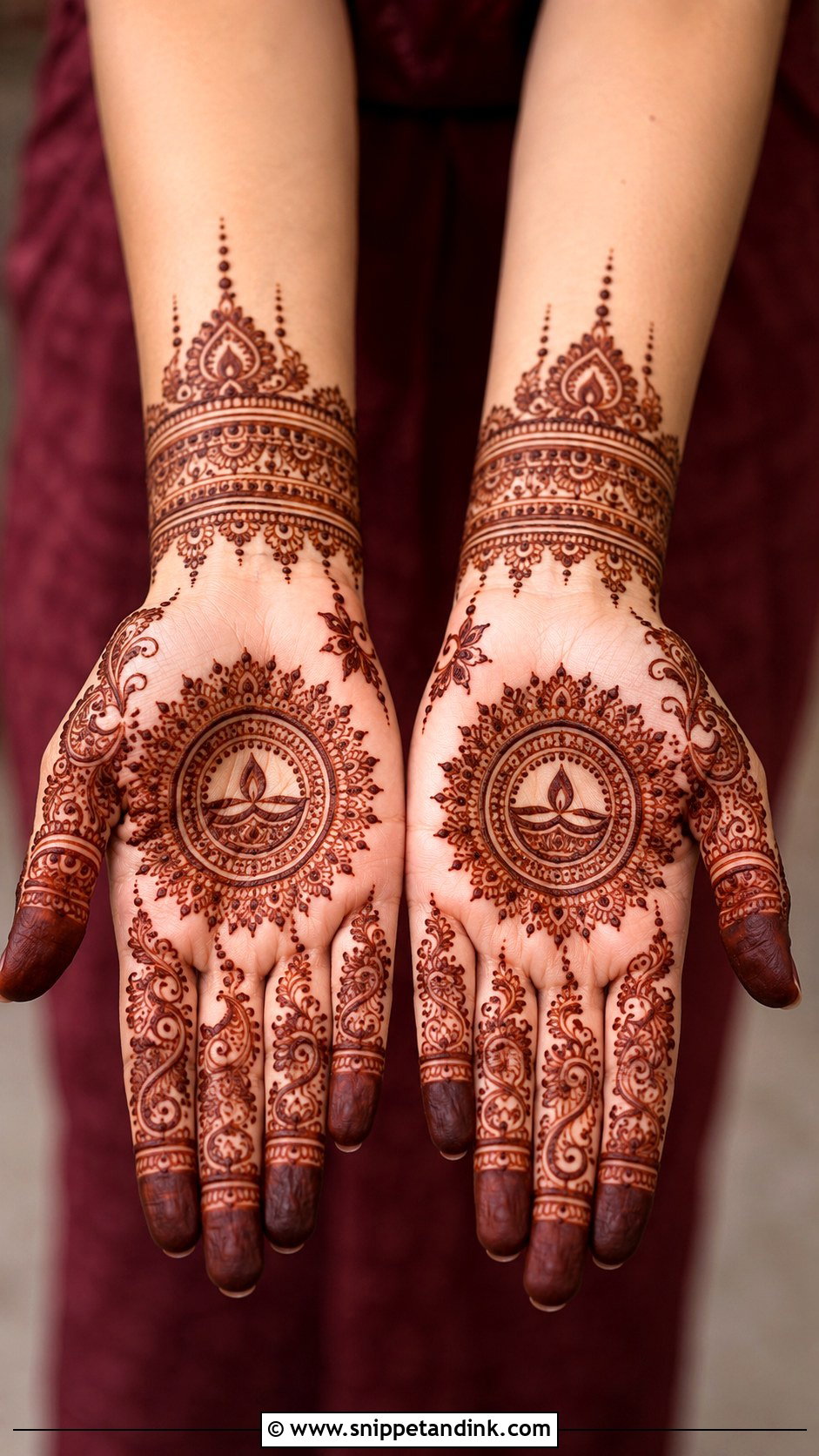
Jaali is mesh: diamond, square or curved net laid over the back of the hand, palm, fingers or wrist, framed by floral borders, paisley corners and bracelet cuffs. It gives contrast without heaviness, which is why it suits engagements and receptions. Even spacing is the hard part. I mix one or two jaali sections with solid motifs and some open skin; a whole hand of mesh looks like a glove from a distance.
12. Minimal Mehndi Design
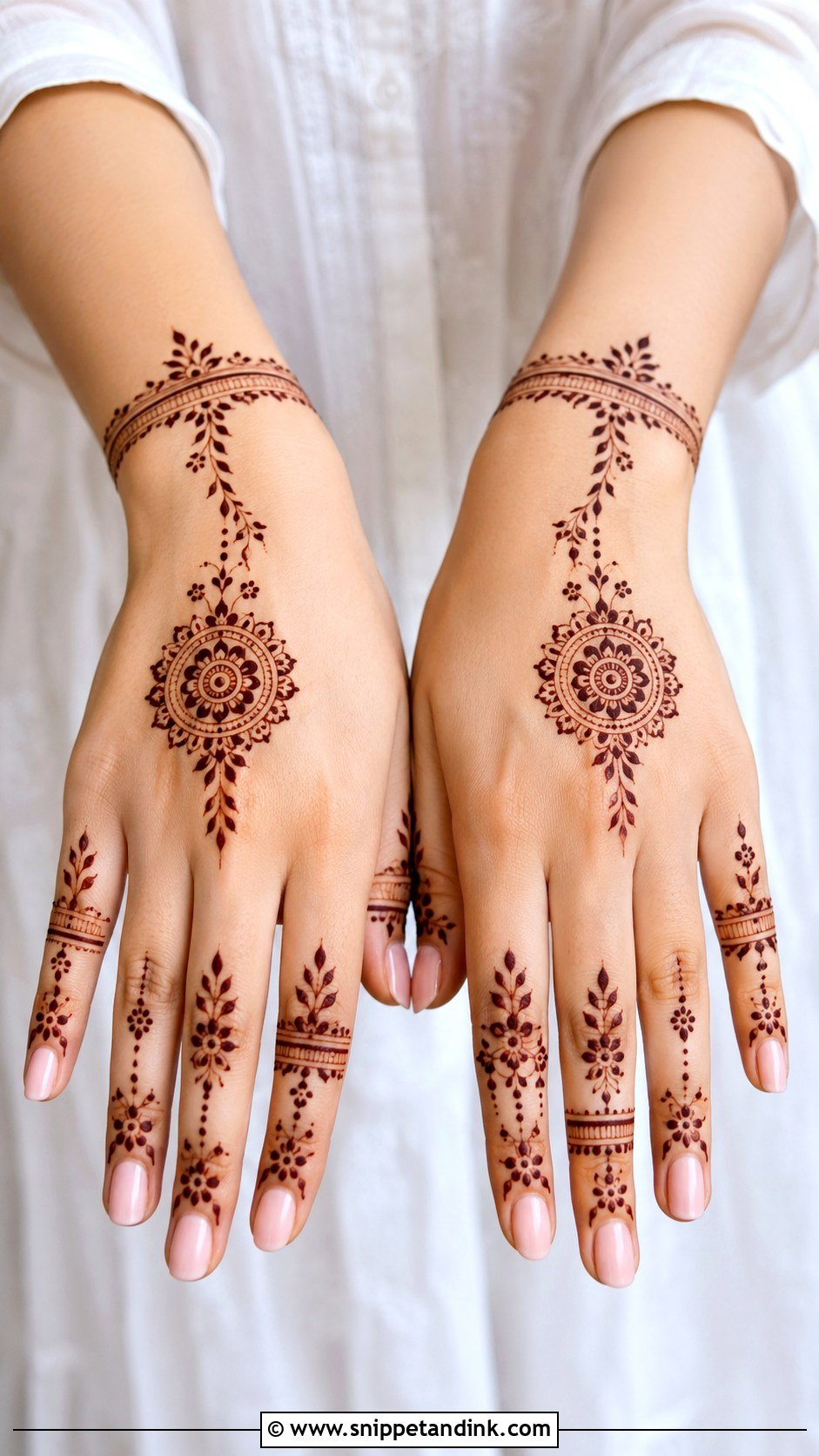
A small mandala, a slim wrist band, delicate finger lines and a leafy trail, repeated neatly on both hands. Minimal henna has to look planned, so every motif should connect to something. It suits office celebrations, quick Eid gatherings and brides who want something understated for a pre-wedding event. Fine lines stain paler than thick ones, so I’d keep the main lines medium weight if you want the colour to show.
13. Bridal Back Hand Mehndi Design
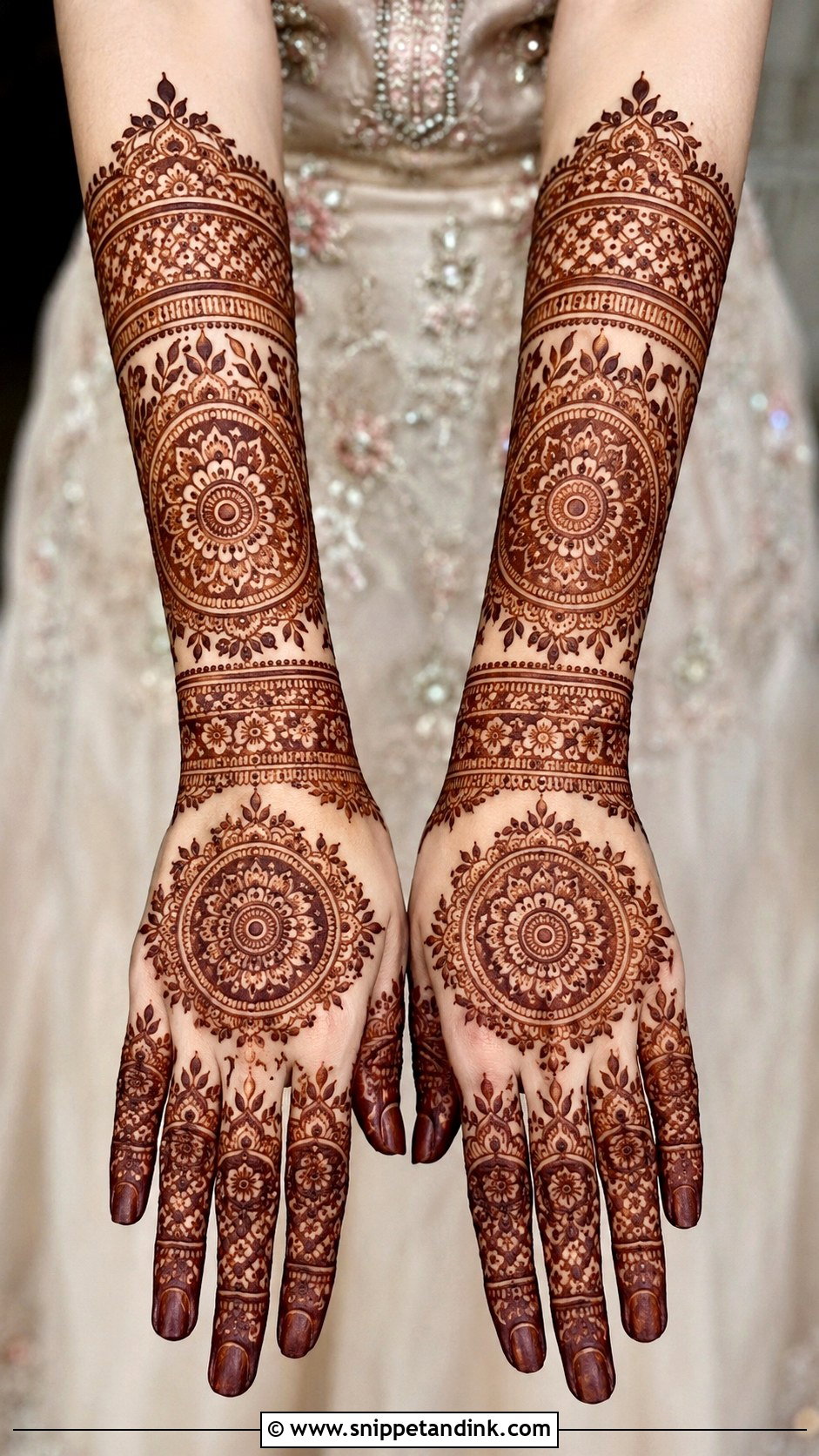
On the wedding day, the back of the hand shows in every ring, bangle and haath phool shot. A wrist-to-forearm cuff, layered mandala, floral vines, jaali panels and richly decorated fingers are the usual elements, with bride-and-groom symbols or initials if you want them. Balance is what I spend my time on. A strong centre motif with fingers that are full but tidy keeps the hand from looking busy under heavy jewellery.
14. Engagement Mehndi Design
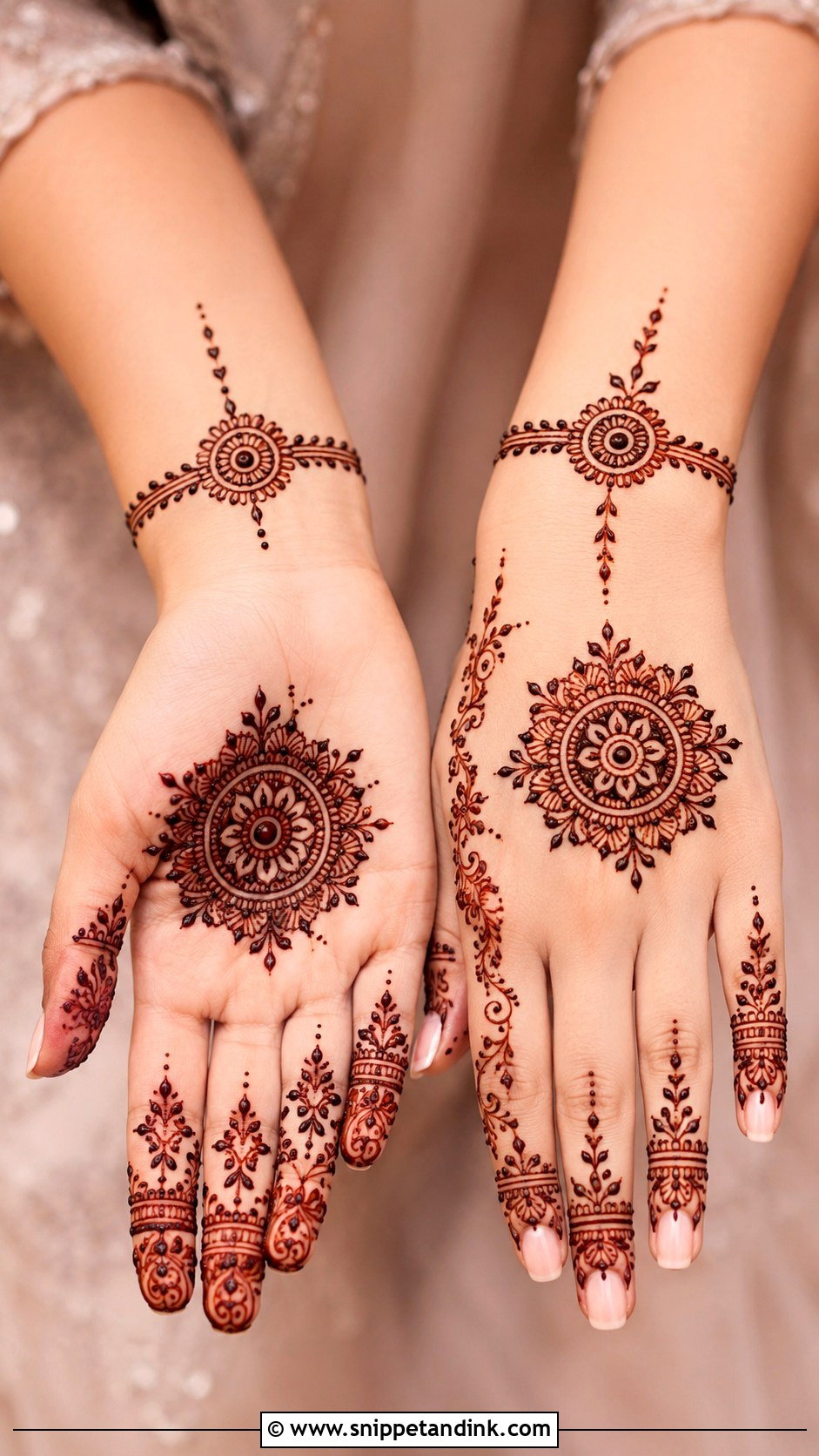
Engagement henna can be lighter than bridal and still photograph well. Floral trails, ring-style finger bands, a back-hand mandala and a soft wrist cuff are enough. Many clients want the back of the hand done because that’s what faces the camera during the ring exchange. I keep the ring finger itself fairly open so the ring isn’t lost against dark henna, and a subtle date or initials can go along the side of the hand.
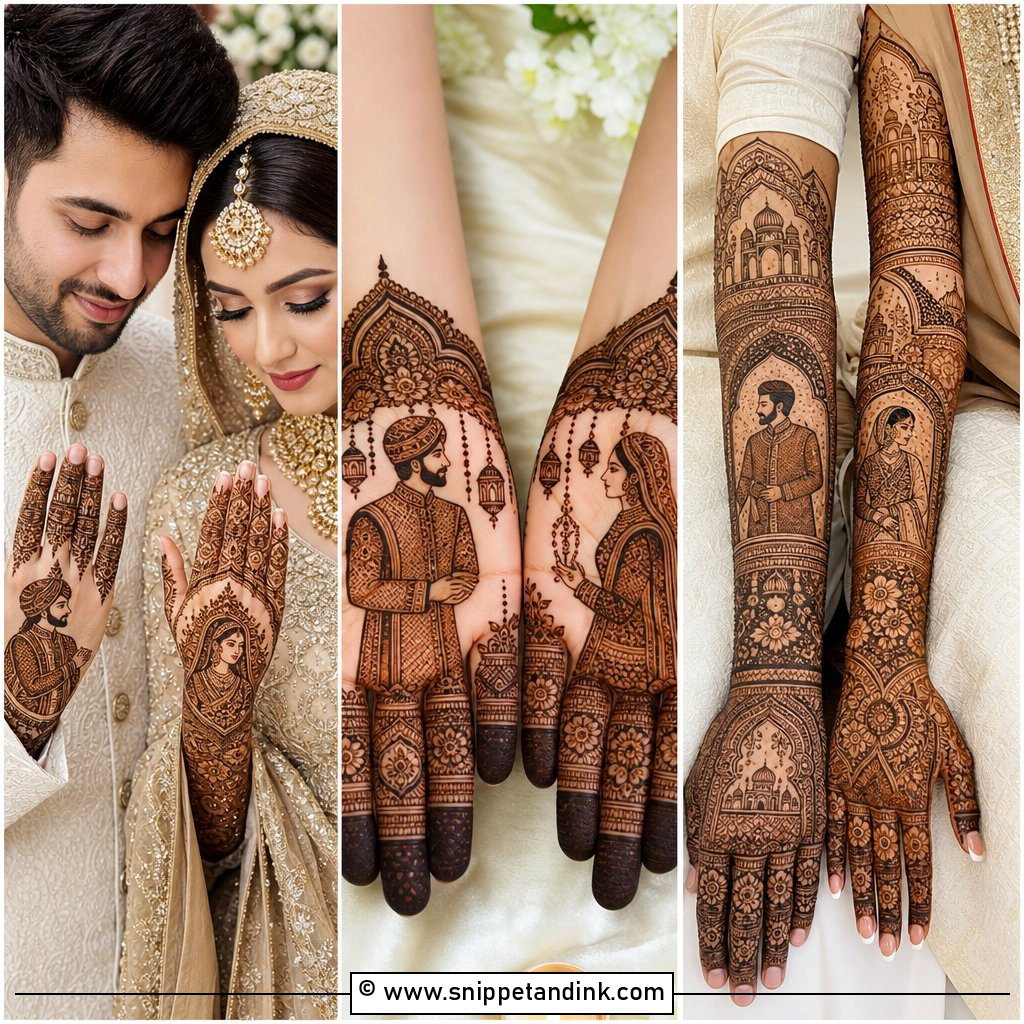
15. Eid Mehndi Design
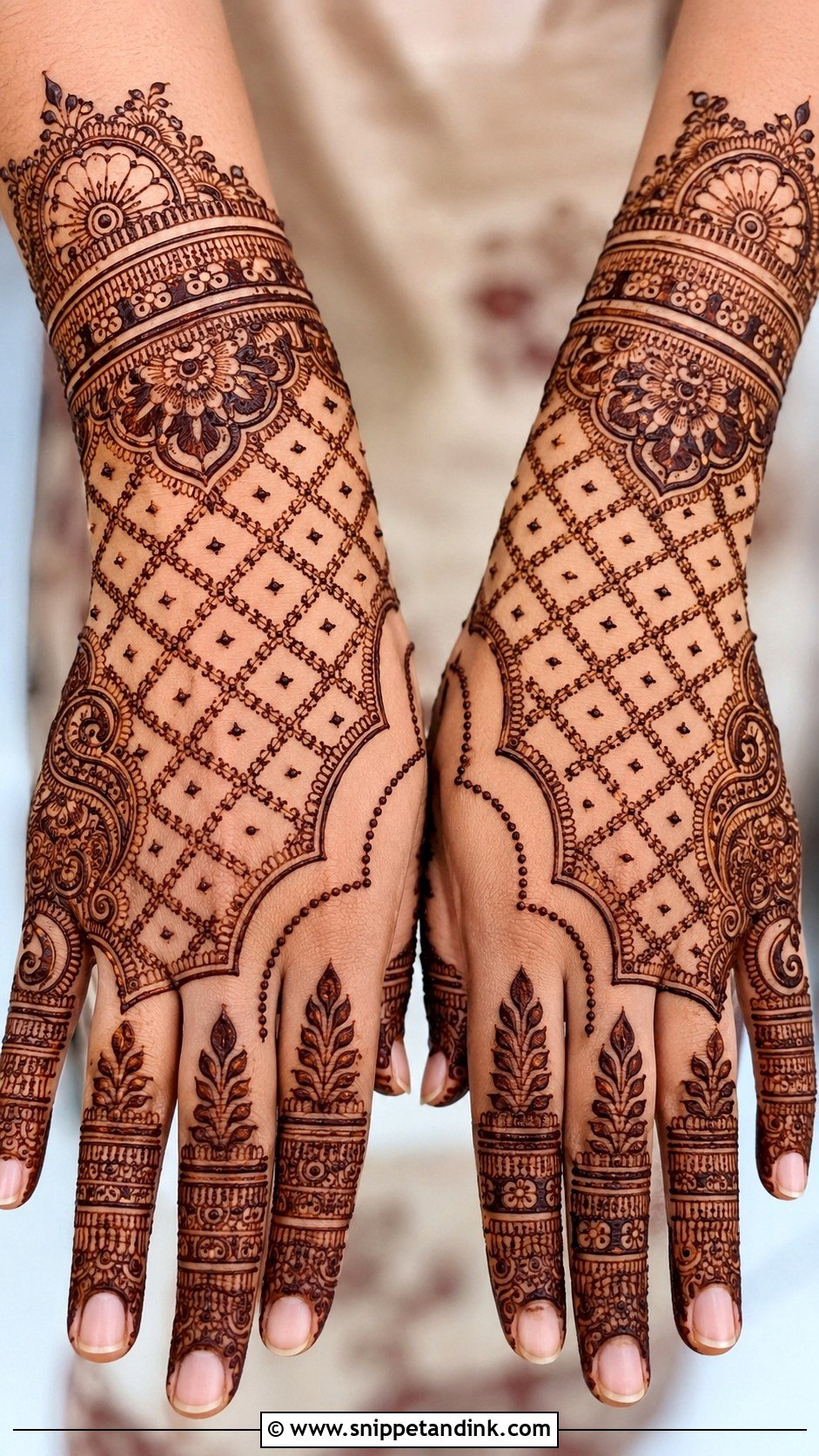
Eid henna is usually applied the night before, between cooking and ironing outfits, so it needs to be festive but fast. Arabic florals, crescent curves, leafy trails, mandalas, fingertip work and a wrist border all fit. Indo-Arabic layouts are popular because the open spacing keeps sitting time down. I like to give the two hands the same flow with small differences in the motifs; it looks more natural than mirrored hands.
16. Diwali Mehndi Design
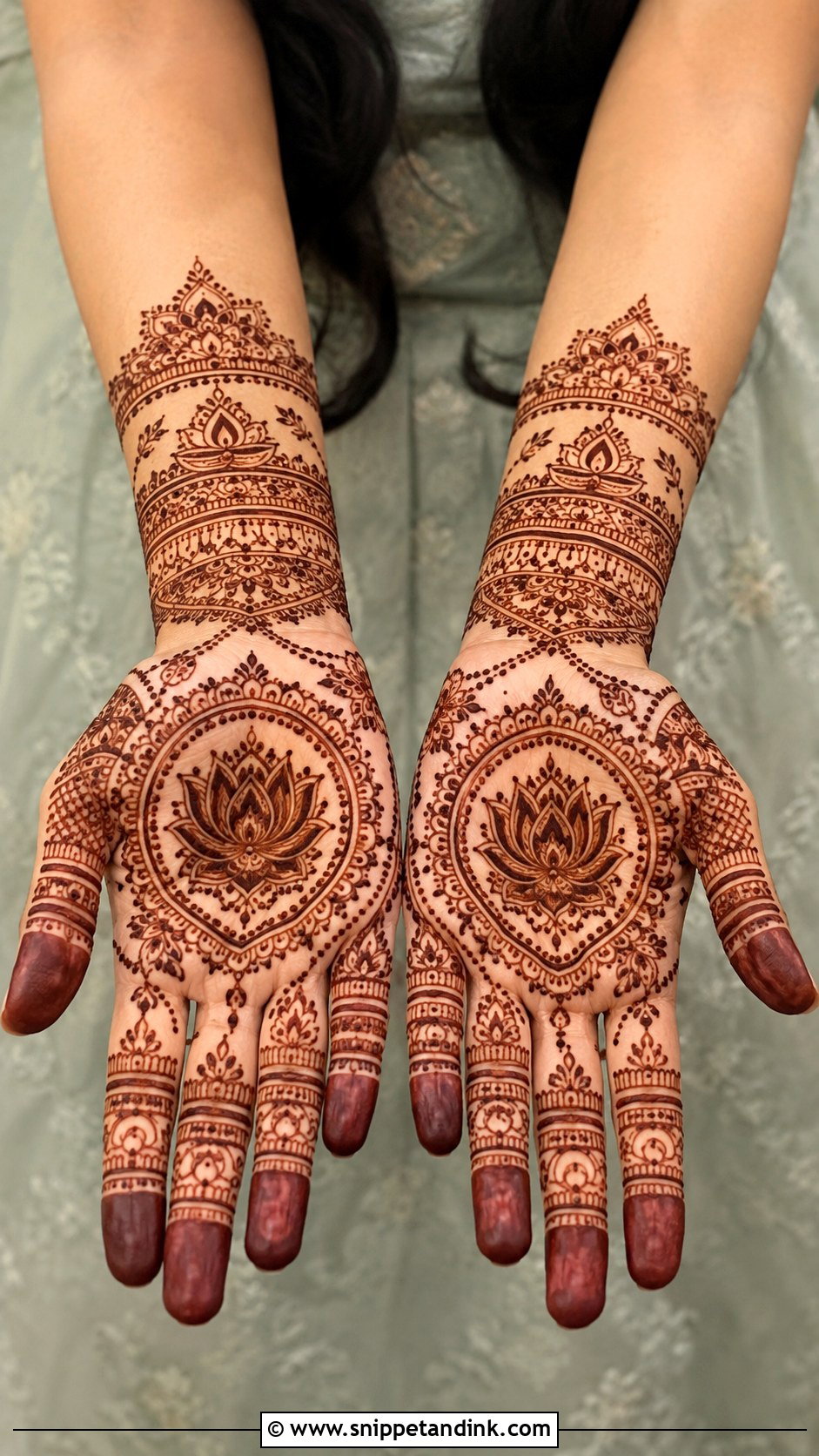
A circular palm centrepiece, neat lines and leaf chains on the fingers, diya shapes, paisleys and a fine wrist border. Back-hand Diwali designs look good with a bracelet pattern and a small floral trail. You’ll be handling diyas, sweets and gifts all evening, so medium coverage applied a day early is the sensible plan. Fresh paste and an open flame are a bad combination.
17. Karwa Chauth Mehndi Design
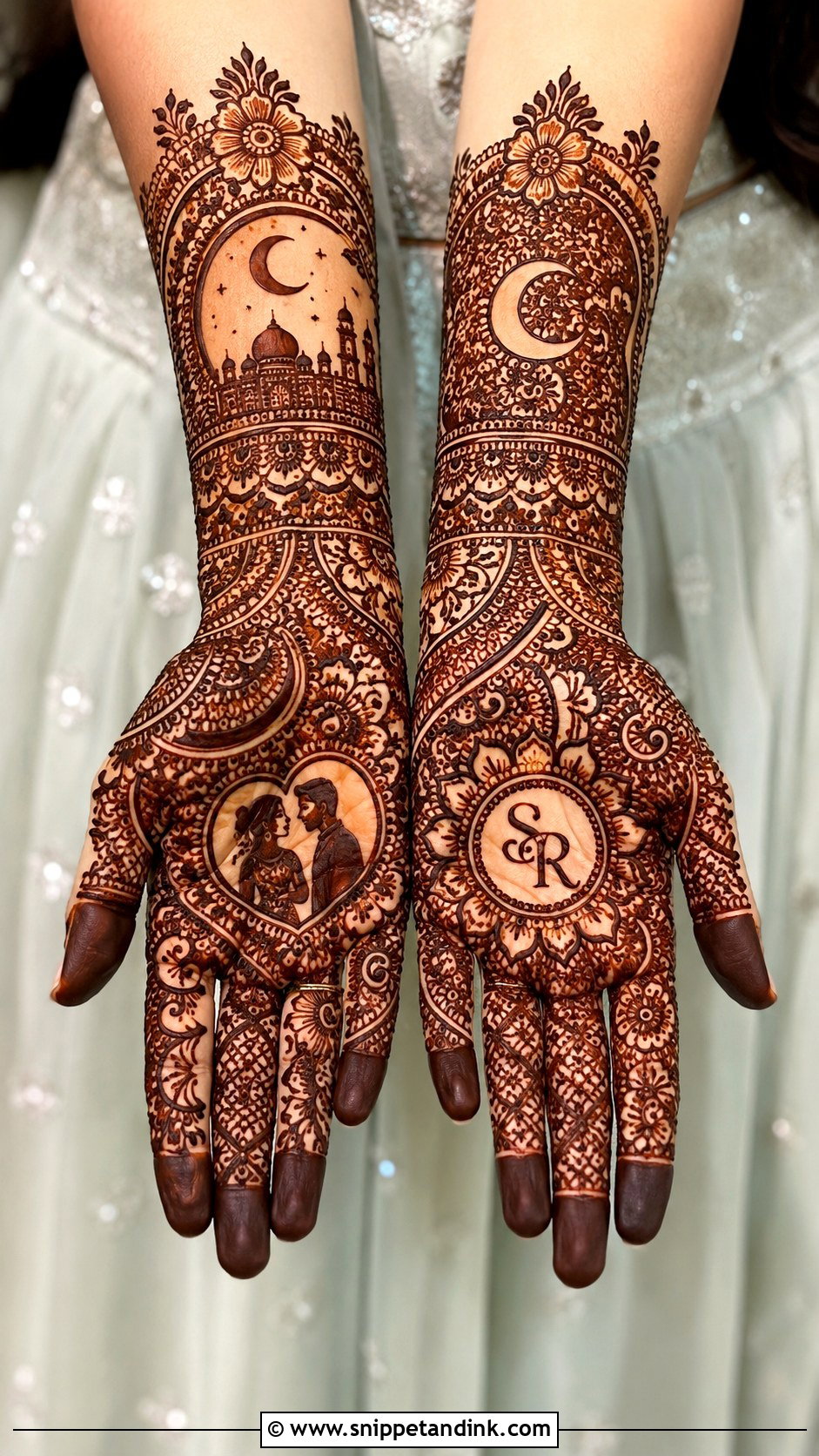
Karwa Chauth henna tends to be detailed: full palms, decorated fingers, wrist cuffs, paisleys, florals and jaali, with couple initials or a small moon motif. Front-hand patterns are popular because the palms show during the rituals. Since many women are fasting that day, I suggest booking the evening before. Sitting for heavy henna while fasting is hard going, and the extra night also deepens the stain.
18. Raksha Bandhan Mehndi Design
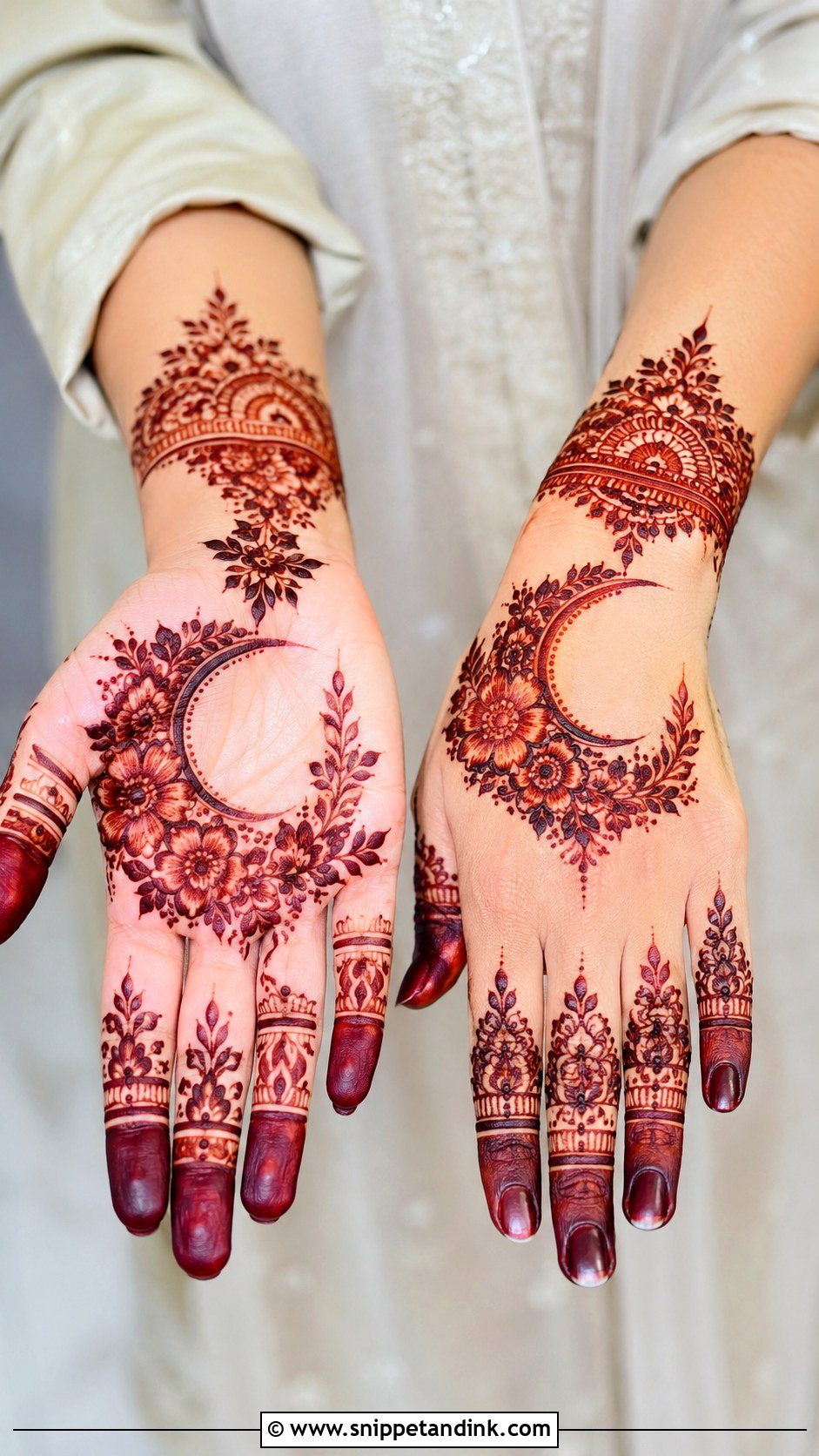
Rakhi day is short and sweet, and a Raksha Bandhan mehndi design doesn’t need heavy coverage. A small palm mandala, leafy finger lines, floral corners and a delicate wrist band that looks like a bracelet are plenty, since your hands are on show while tying the rakhi. Dots, petals and curved vines finish it off. It’s a short sitting, which suits sisters and young girls who’d rather be eating sweets than waiting for paste to dry.
19. Wedding Guest Mehndi Design
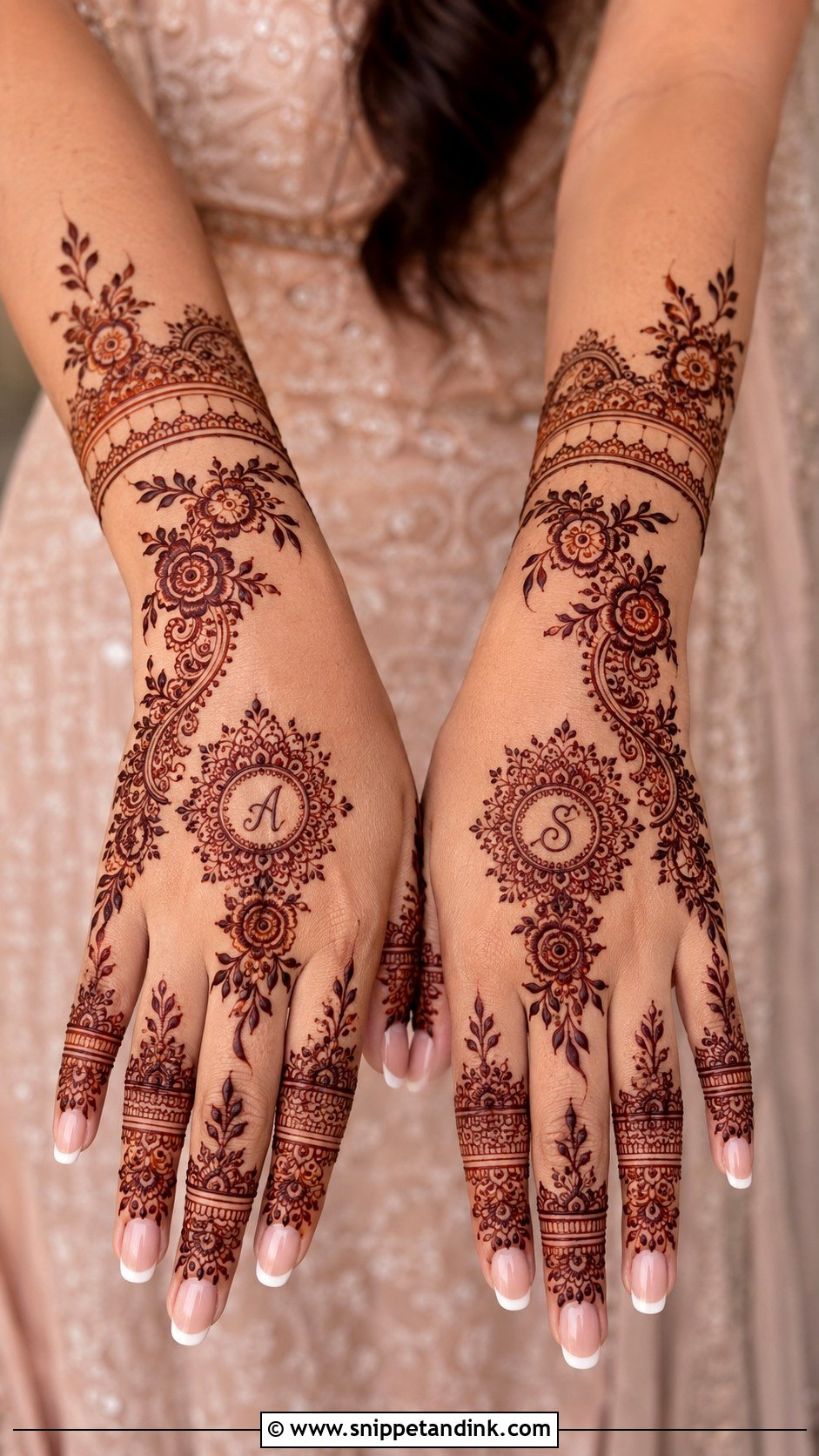
As a guest, you want festive hands that don’t compete with the bride. An Arabic trail, a back-hand mandala, a floral wrist cuff or a simple palm with decorated fingers all do that. Medium coverage is easiest to carry through several events. Match it to your outfit: heavily embellished clothes look best with cleaner henna and open space, while a plain outfit can take bolder flowers or paisleys.



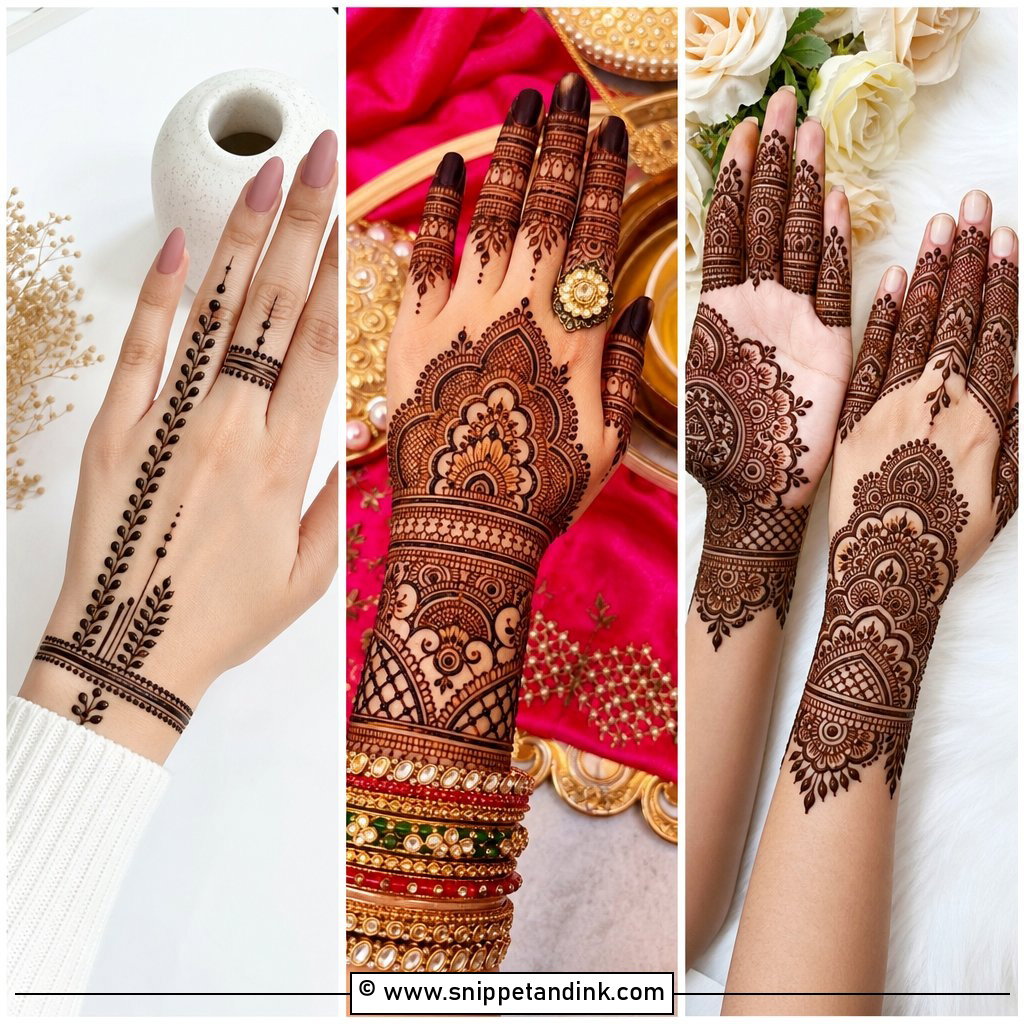
20. Bridesmaid Mehndi Design
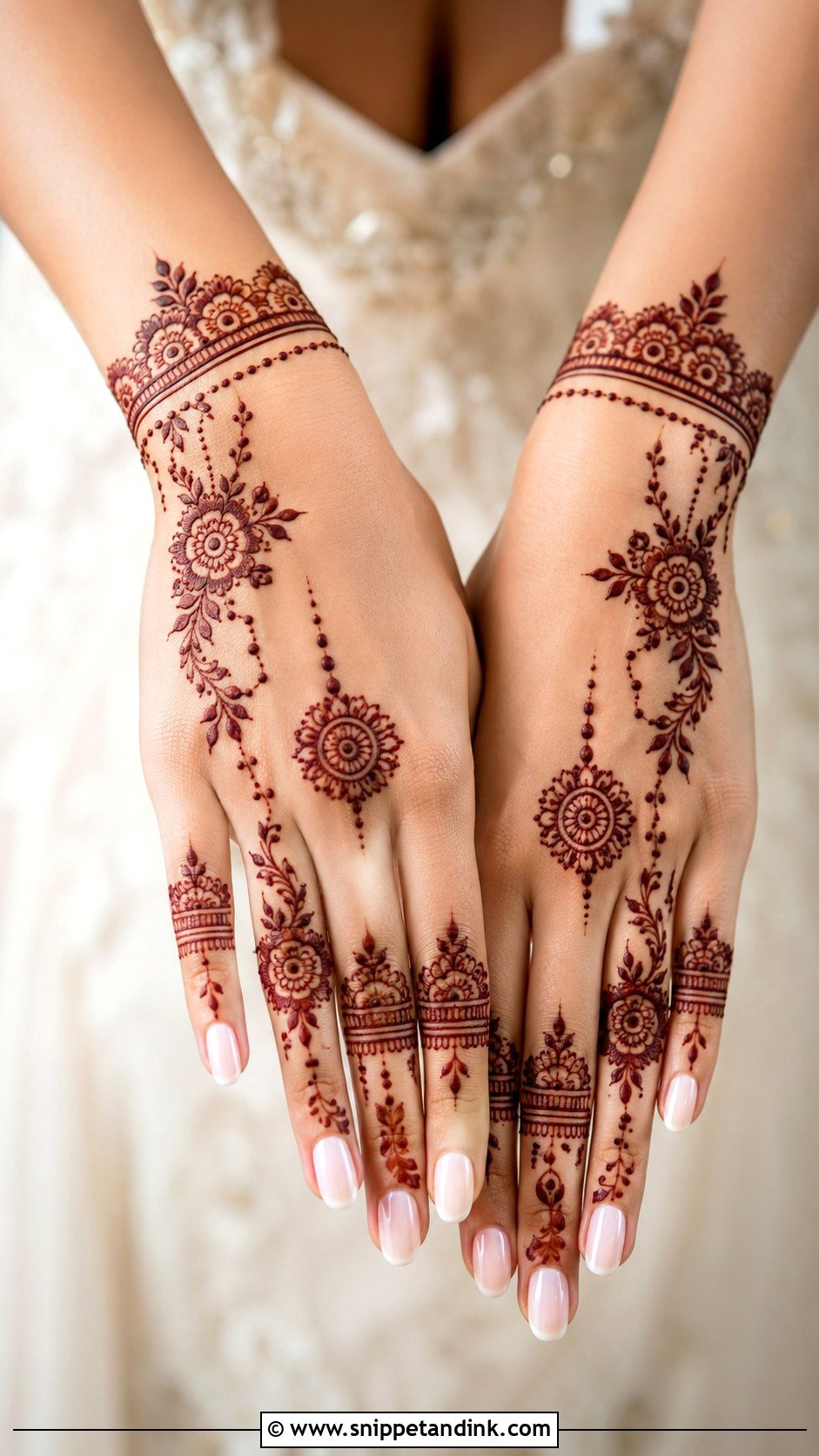
The rule I give every bridal party: a Bridesmaid mehndi design should be coordinated and clearly lighter than the bride’s. Floral back-hand trails, ring-style fingers, wrist cuffs and small mandalas work, and Indo-Arabic or minimal Arabic layouts keep everyone mobile for dancing and running errands. I often give the whole party one shared element, the same wrist band or flower trail, so the hands look connected in group shots. Motifs need to be bold enough to read at group-photo distance.
21. Kids Mehndi Design
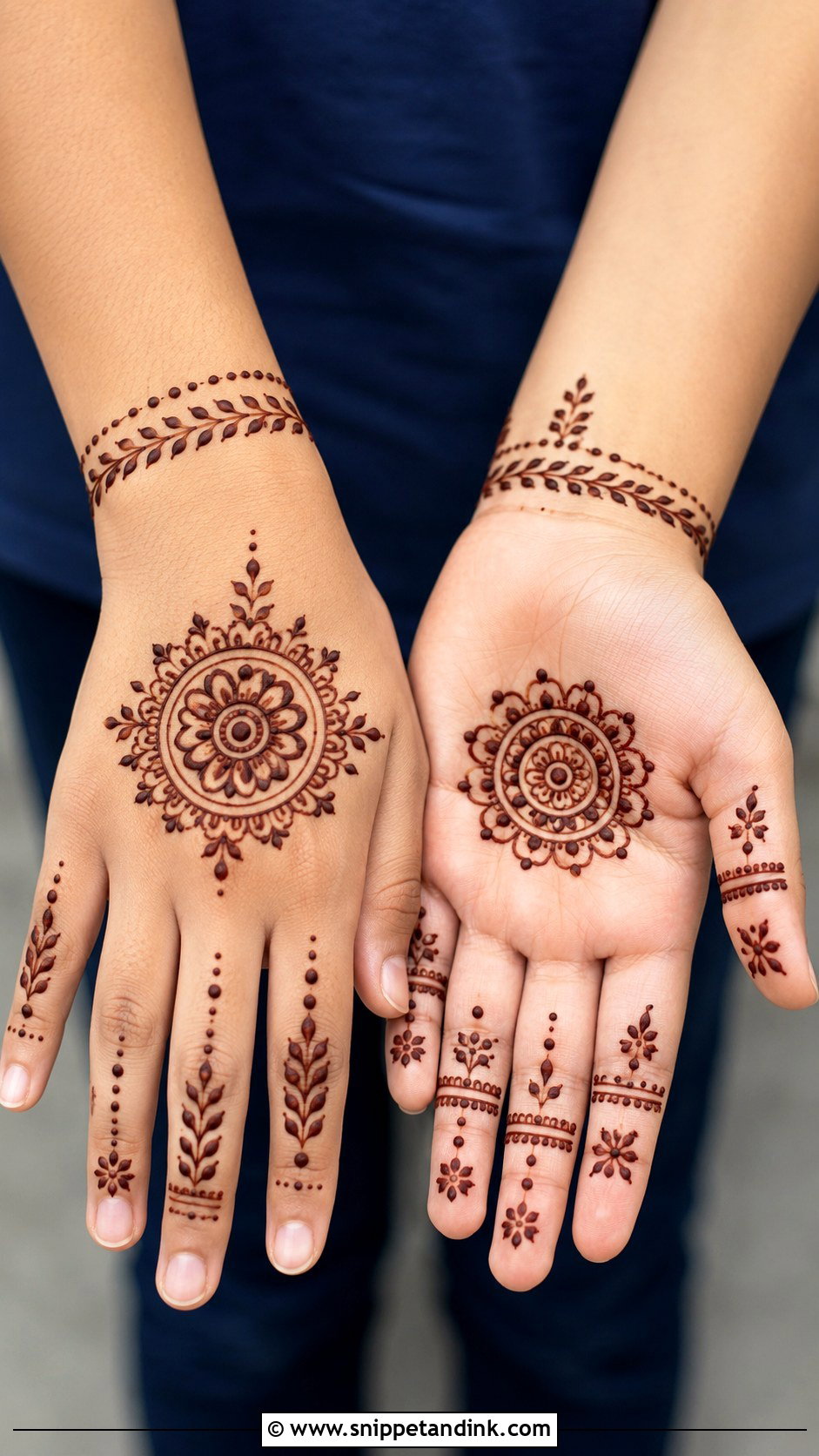
Children give you about ten minutes of patience, so any Kids mehndi design has to be quick: a small flower, simple mandala, butterfly shape, leafy bracelet or a few finger dots. Children won’t sit still for long, and the back of the hand is easier because they’re less likely to smudge it while it dries. I use bold, simple lines so the stain still reads clearly. And I only ever use natural, plant-based paste on children, never a black or instant cone.
22. Teen Mehndi Design
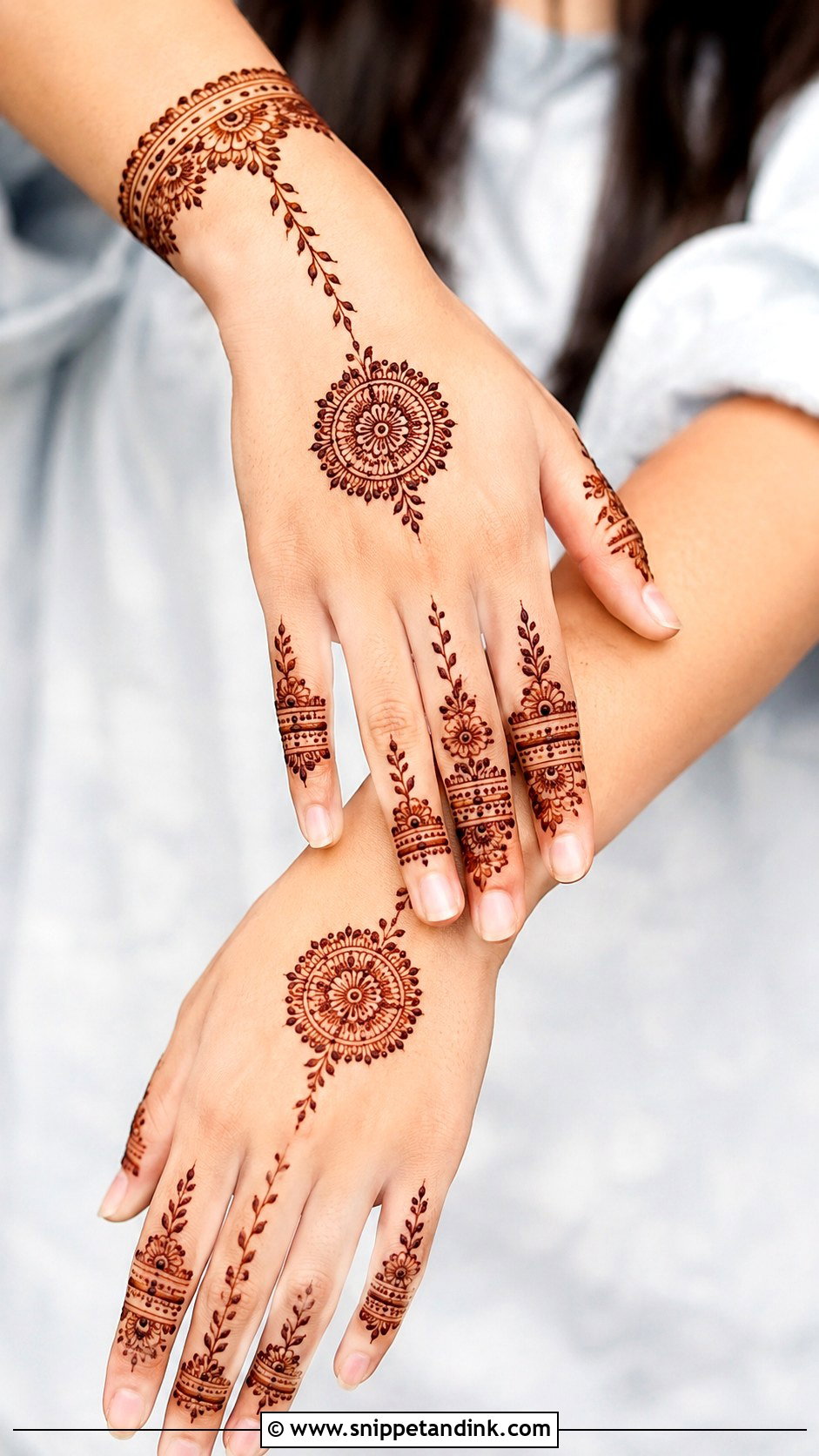
Teenagers usually want something fresh and not too heavy: modern finger bands, tiny flowers, leafy trails, small mandalas and bracelet wrists. Back-hand designs are popular because they’re easy to show off in photos. For school-friendly events keep it minimal; for weddings and festivals it can go a bit fuller. I’d hold off on dense bridal patterns unless the occasion genuinely calls for them.
23. Easy Mehndi Design For Beginners
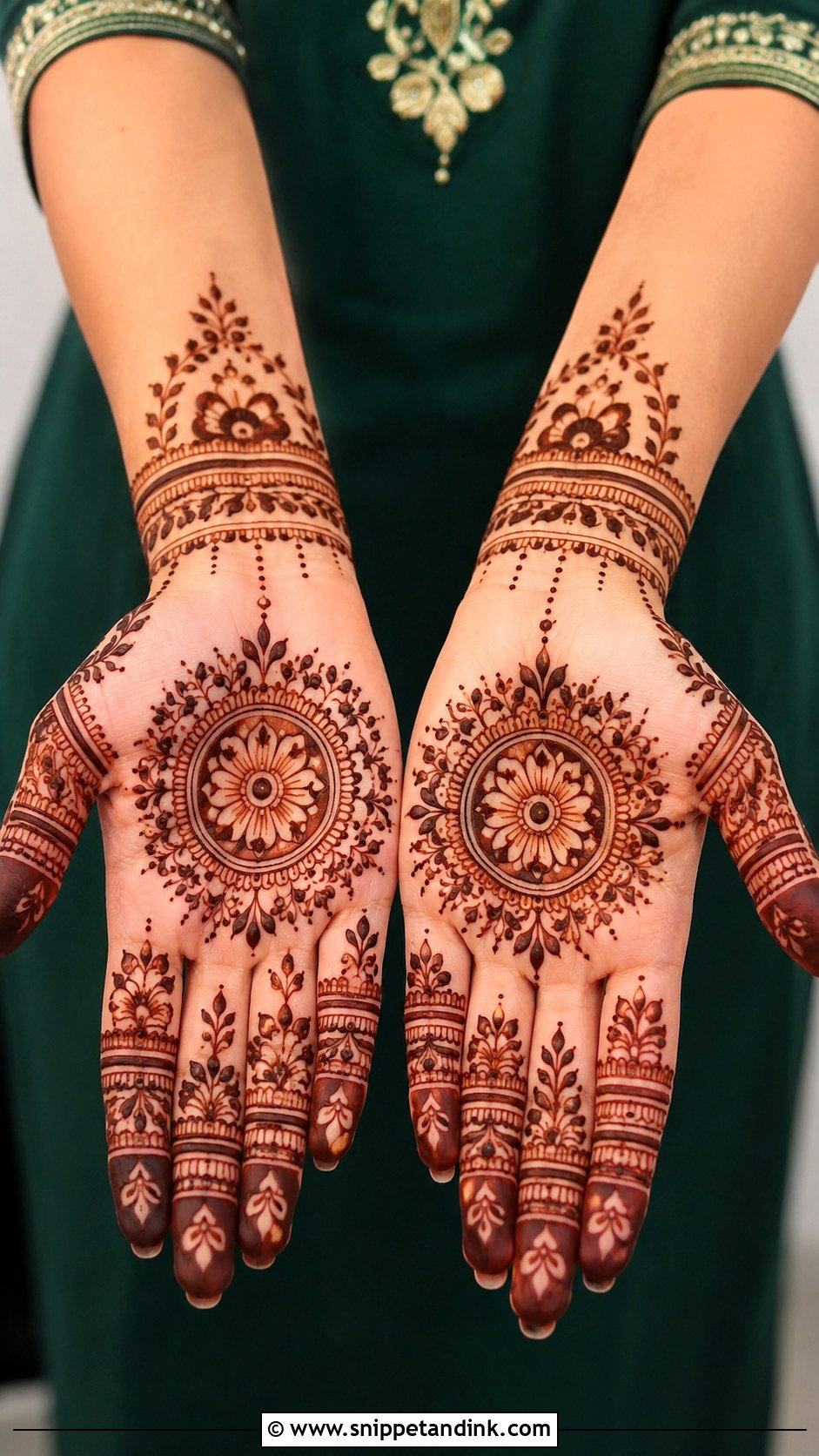
If you’re learning, start with a central flower or mandala on the palm, then dots, leaves, curved lines, finger bands and a small wrist border. Skip tiny fillers until your pressure is steady, because shaky fillers are what make beginner work look messy. Arabic trails are forgiving; the open space hides small mistakes. Practise on paper first, holding the cone like a pen and squeezing gently from the top, not the middle.
24. Heavy Mehndi Design
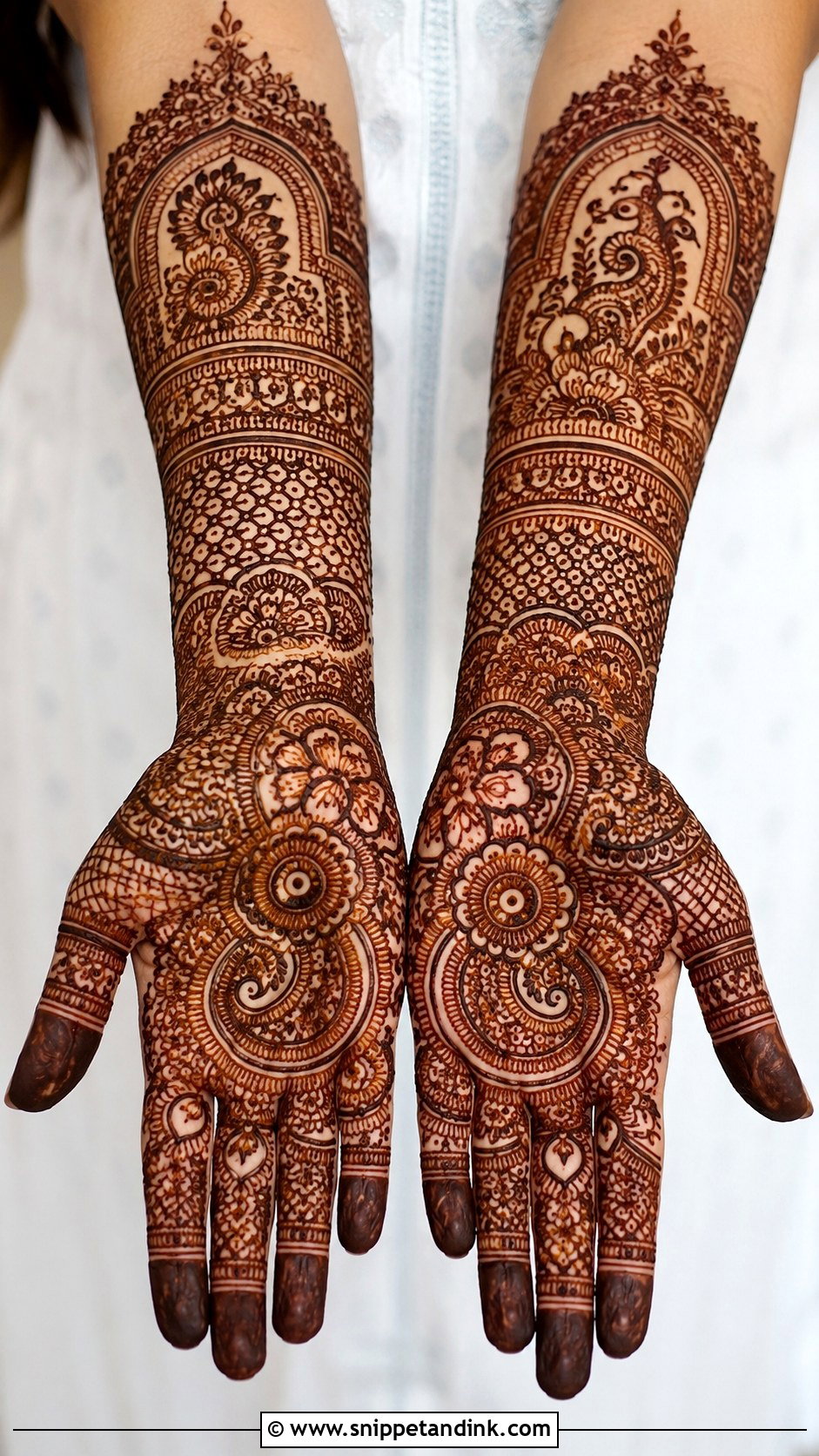
Heavy henna covers most of the palm, back of the hand, fingers and wrist, sometimes the forearm, with paisleys, peacocks, florals, mandalas, jaali, lace borders and tiny fillers. It’s for brides, close family and major festivals. Without planning, it turns crowded. I separate sections with bold outlines and keep the fine work inside each section, which is what lets the stain look rich instead of muddy.

25. Half Hand Mehndi Design
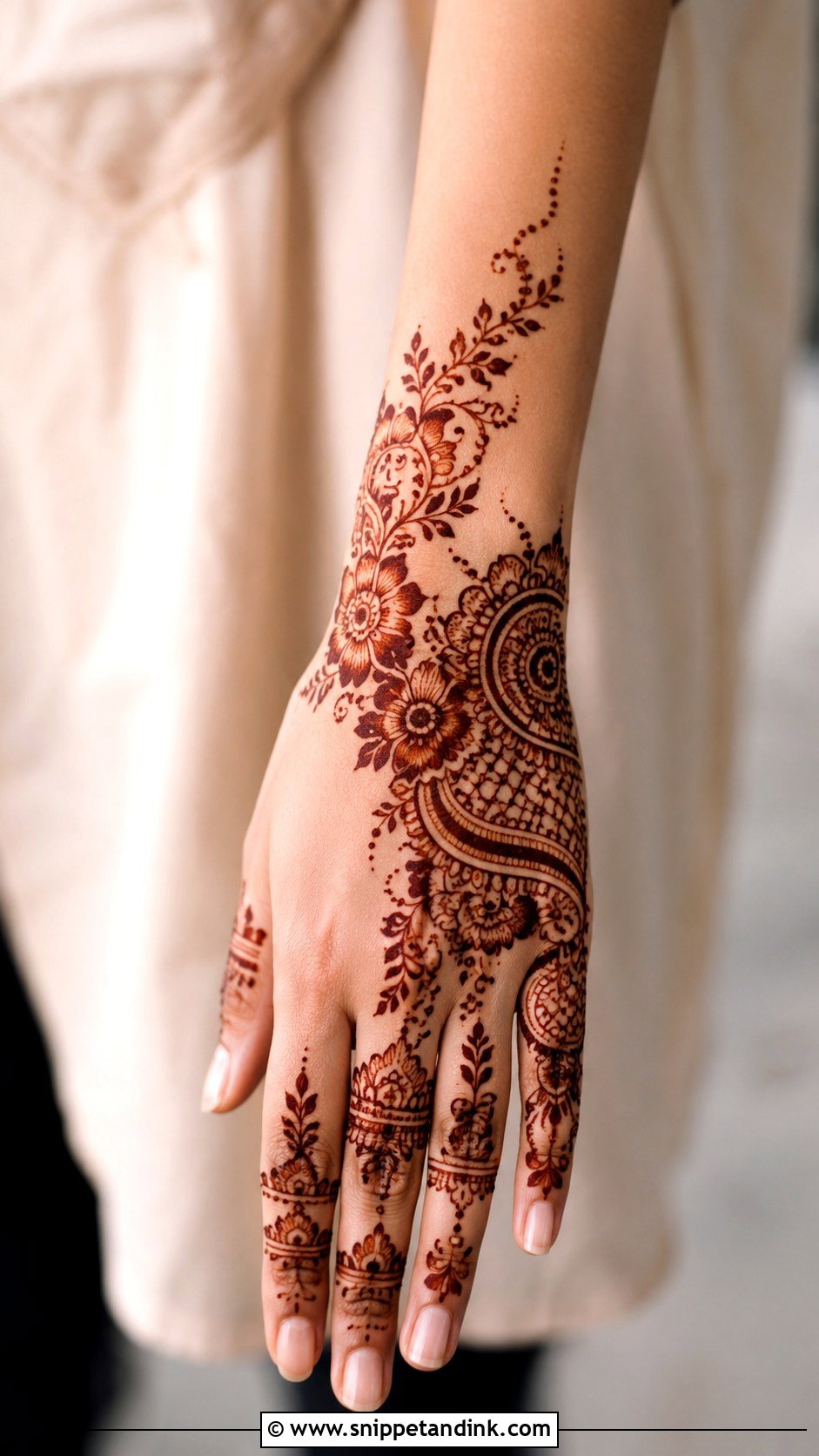
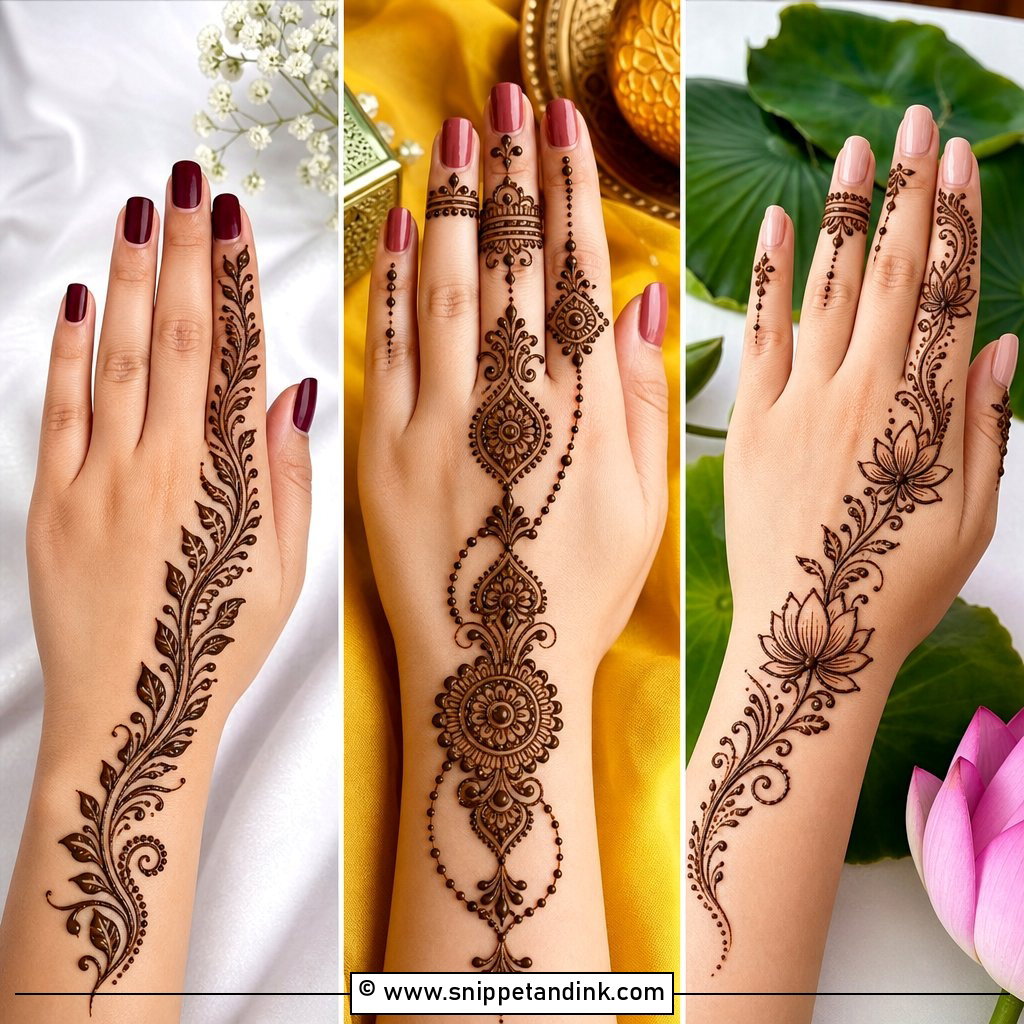
Half-hand designs sit between minimal and full: the palm up to the wrist, or the back of the hand from the fingers to the middle. Diagonal Arabic trails, half mandalas, floral corners and bracelet extensions are common. It suits guests, bridesmaids and teens. The design must connect to the fingers and wrist, or it looks like separate pieces that were never finished.
26. Wrist Mehndi Design
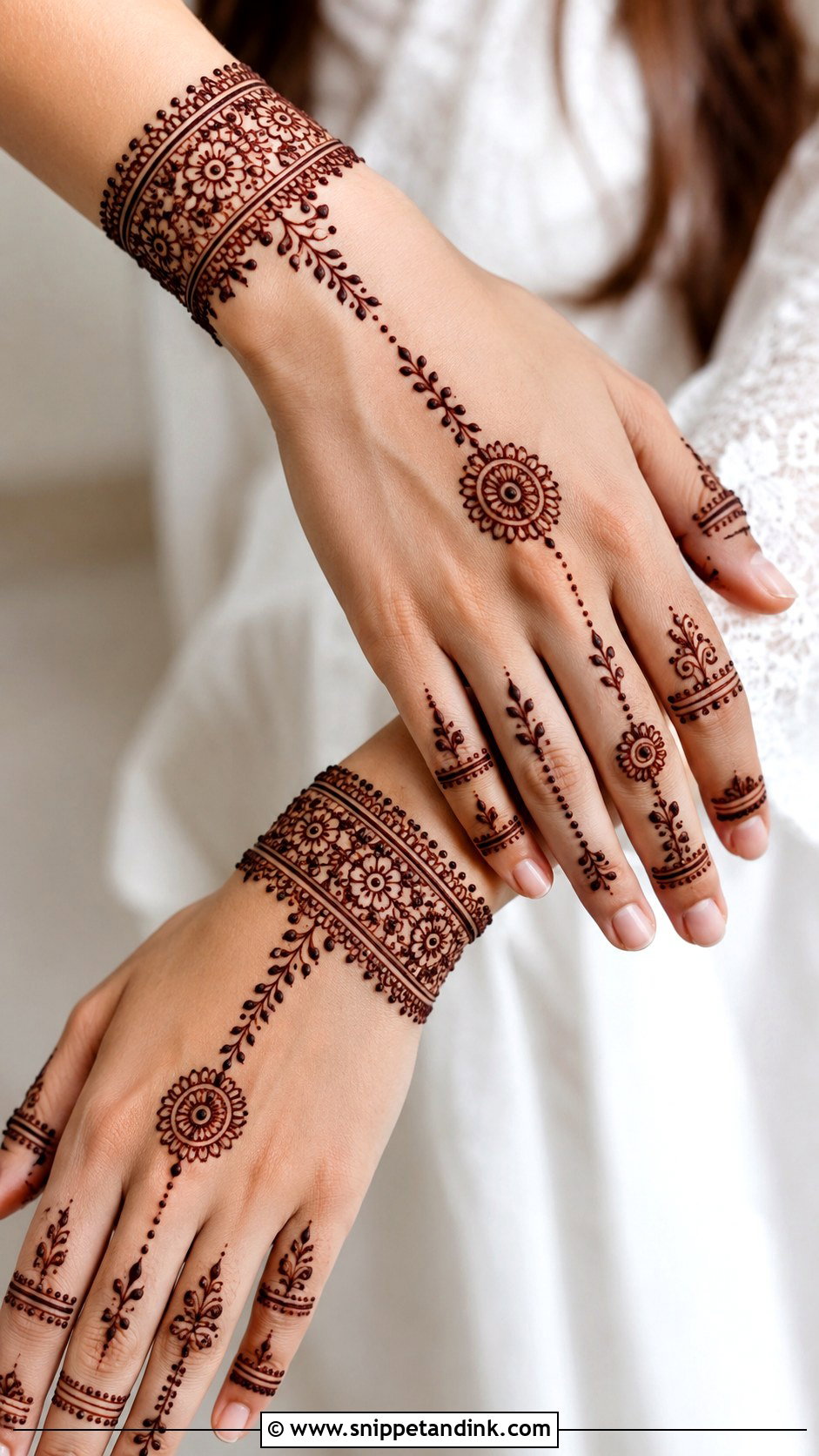
A cuff around the wrist, a small trail moving into the hand and matching finger detail. The cuff can be floral, geometric, leafy or lace-like. It reads as hand jewellery and pairs well with rings, especially on the back of the hand. I draw the cuff first and check it is level on both sides of the wrist before adding the trail, since a tilted band is obvious once you wear a watch or bangle over it.
27. Bracelet Mehndi Design
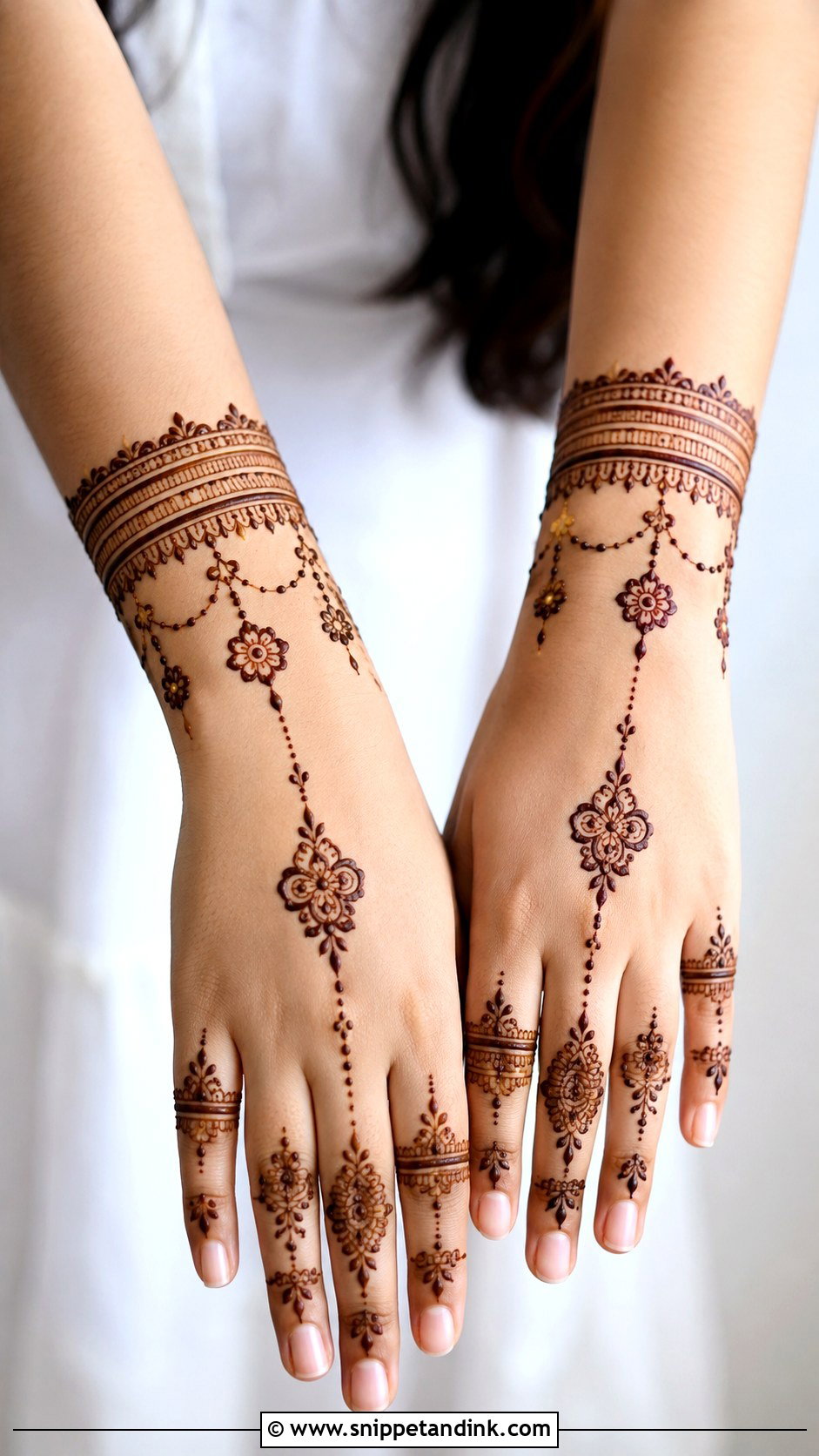
Bracelet henna is the more decorative cousin of the wrist design: layered cuffs, chain-like dots, floral charms, finger rings and a central back-hand motif, all wrapping the hand like jewellery. It suits people who don’t want heavy palms but still want something eye-catching, and it sits comfortably with both modern and traditional clothes. Even spacing between the cuff layers matters more than how much detail goes inside them.
28. Ring Mehndi Design
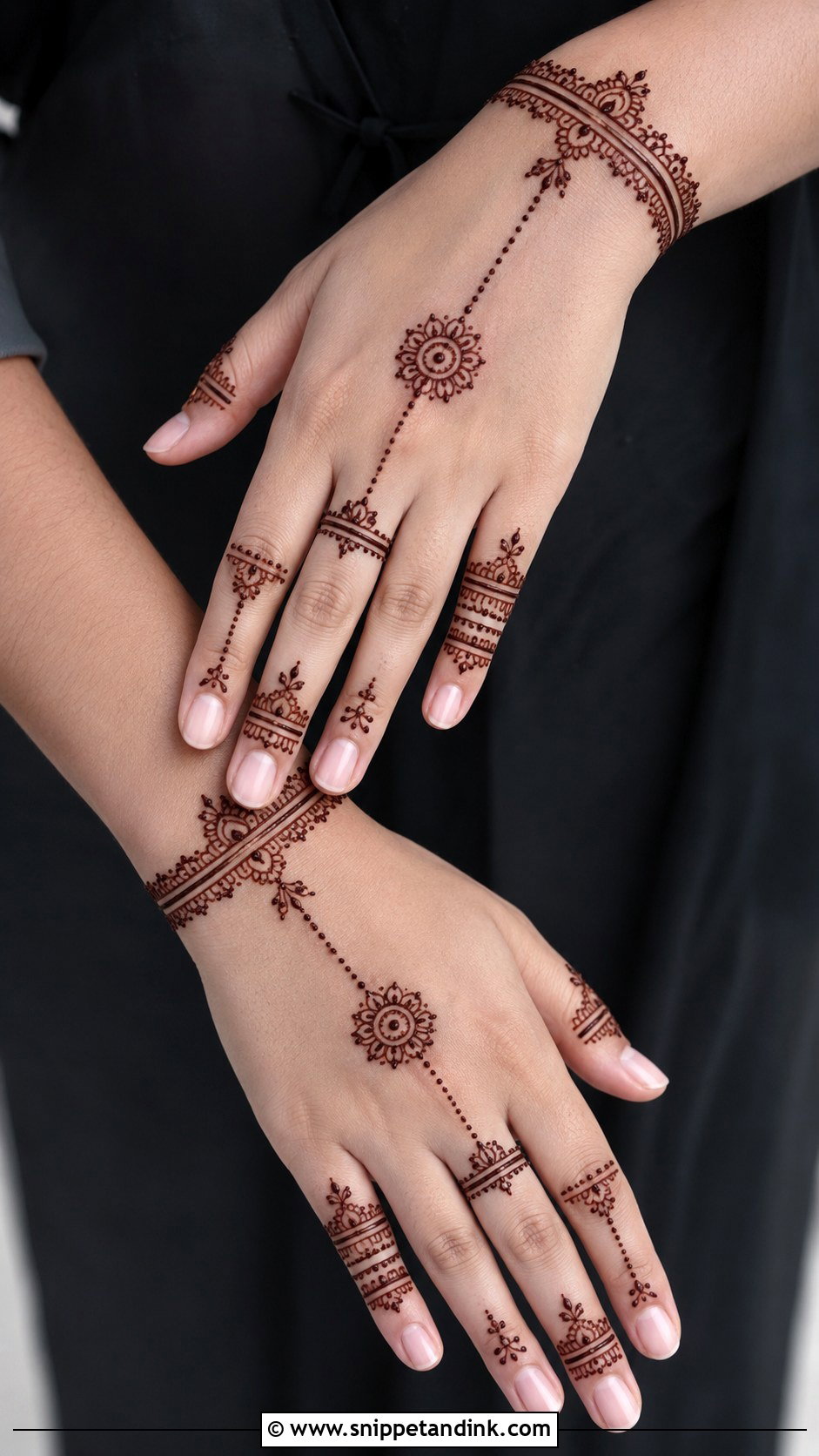
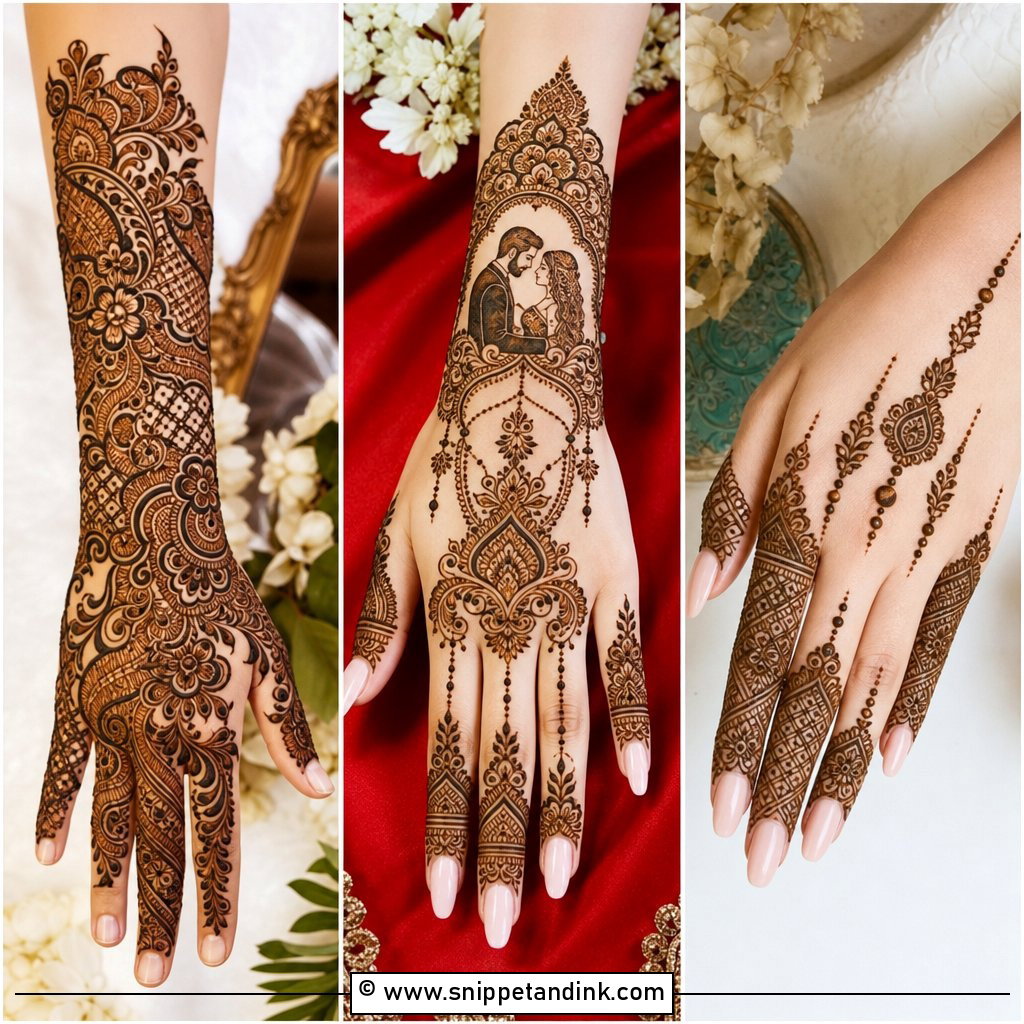
Decorative bands around the fingers, chains leading to a centre motif and a wrist cuff to close it. Ring designs draw the eye to the hands, so they’re a natural fit for engagements. Keep the fingertips neat and the actual ring area uncluttered; I leave a clean gap where the real ring will sit so it doesn’t hide half the pattern. A few florals or tiny jaali sections are enough detail.
29. Moroccan Mehndi Design
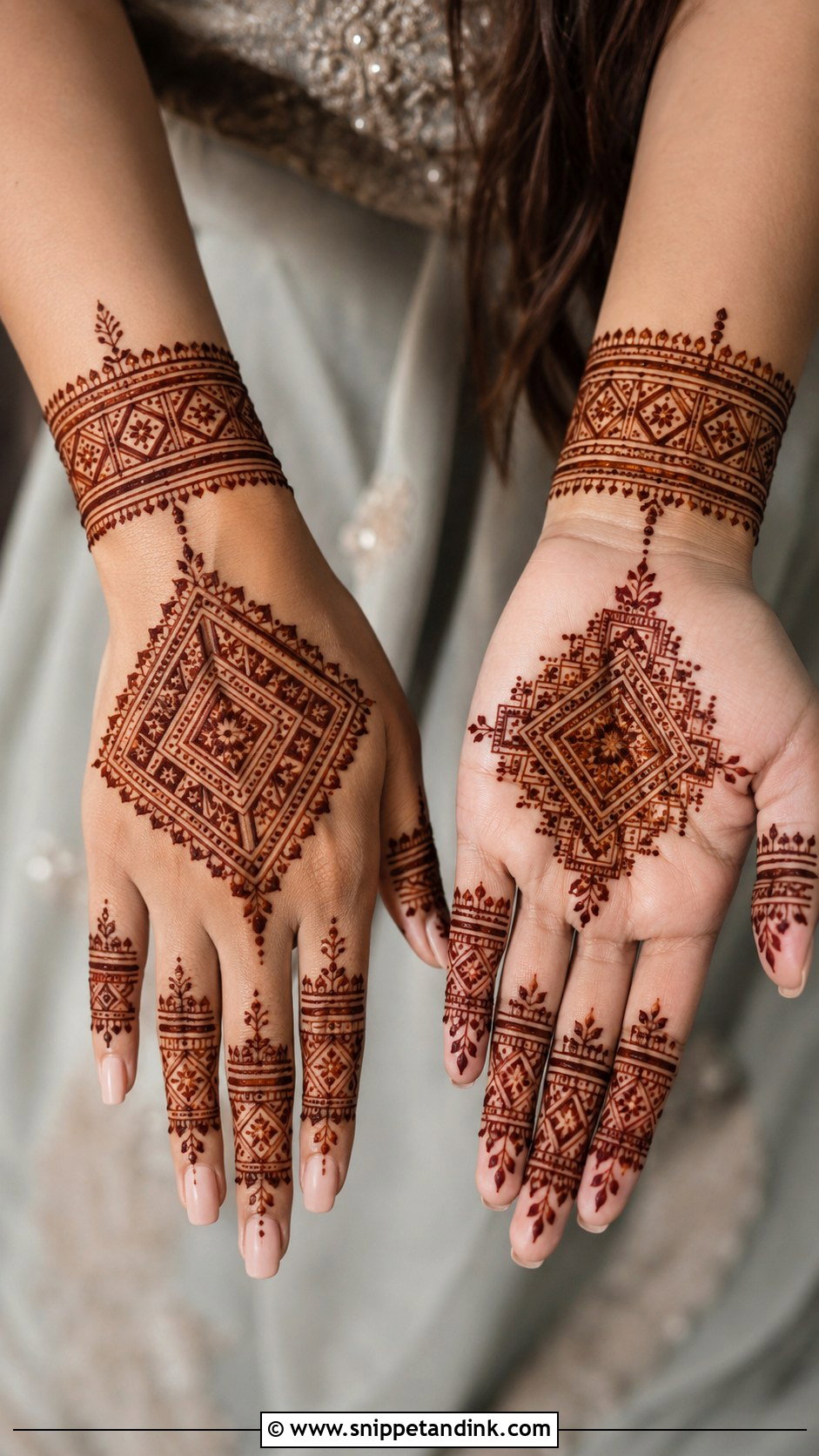
Moroccan henna is geometry: diamonds, triangles, straight lines, grids, dots and patterned bands across the palm or back of the hand. It feels graphic next to floral Indian and Arabic work and suits people who prefer clean shapes to soft vines. It can cover the full hand or stay in a wrist-to-finger strip. Straight lines take more control than curves, so expect your artist to work slowly here, and expect the result to show any wobble.
30. Gulf Mehndi Design
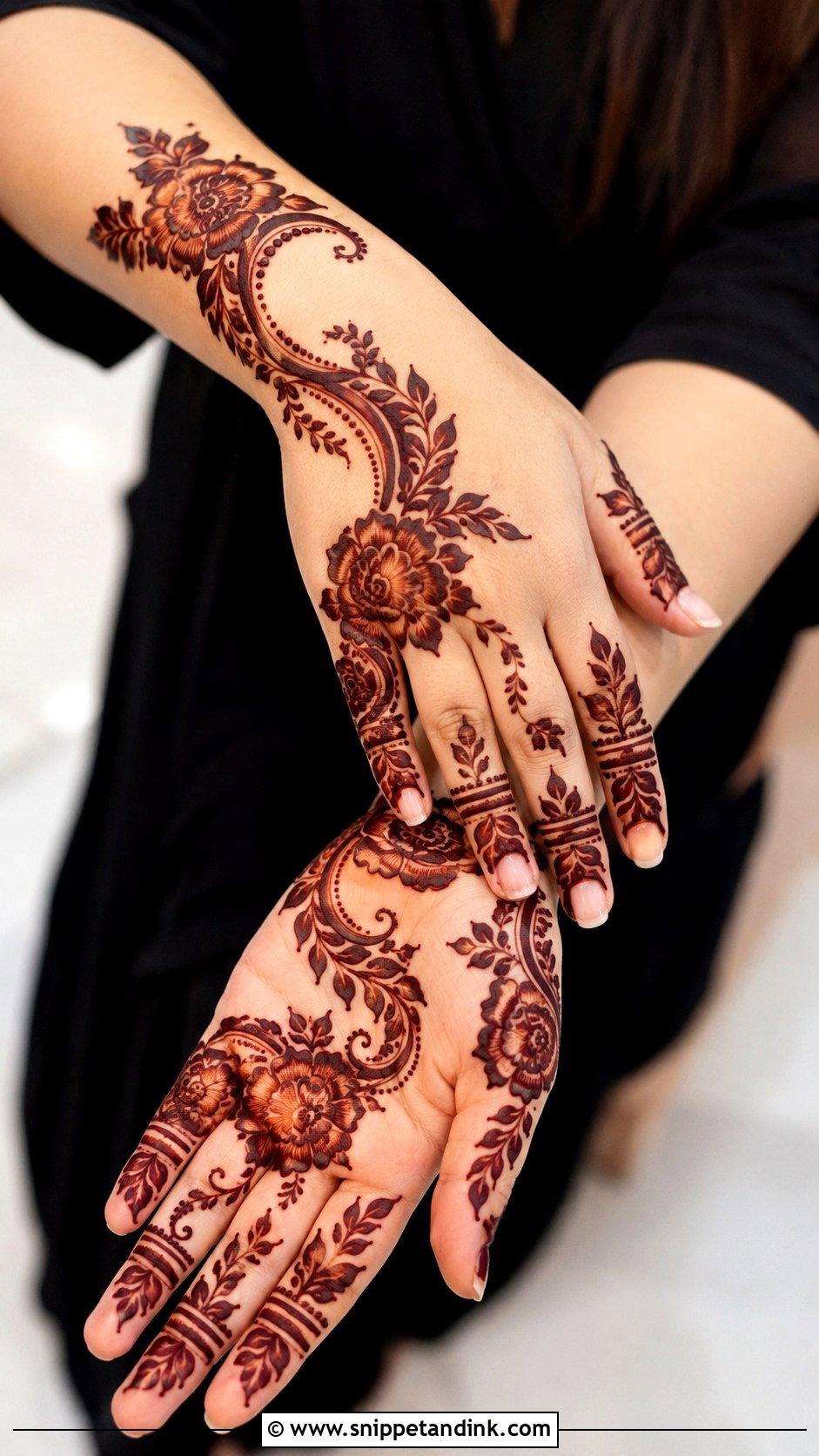
Big shapes and confident spacing define a Gulf mehndi design, which draws on Khaleeji styles: bold florals, leafy trails, open skin and shaded details, with large motifs placed decisively instead of fine filling everywhere. It can sweep across the back of the hand, the palm or the forearm in dramatic curves. Shaded petals and thick outlines are why it stains so boldly once dry. I recommend it for evening events, where low light swallows fine detail but holds big shapes.
31. Pakistani Mehndi Design
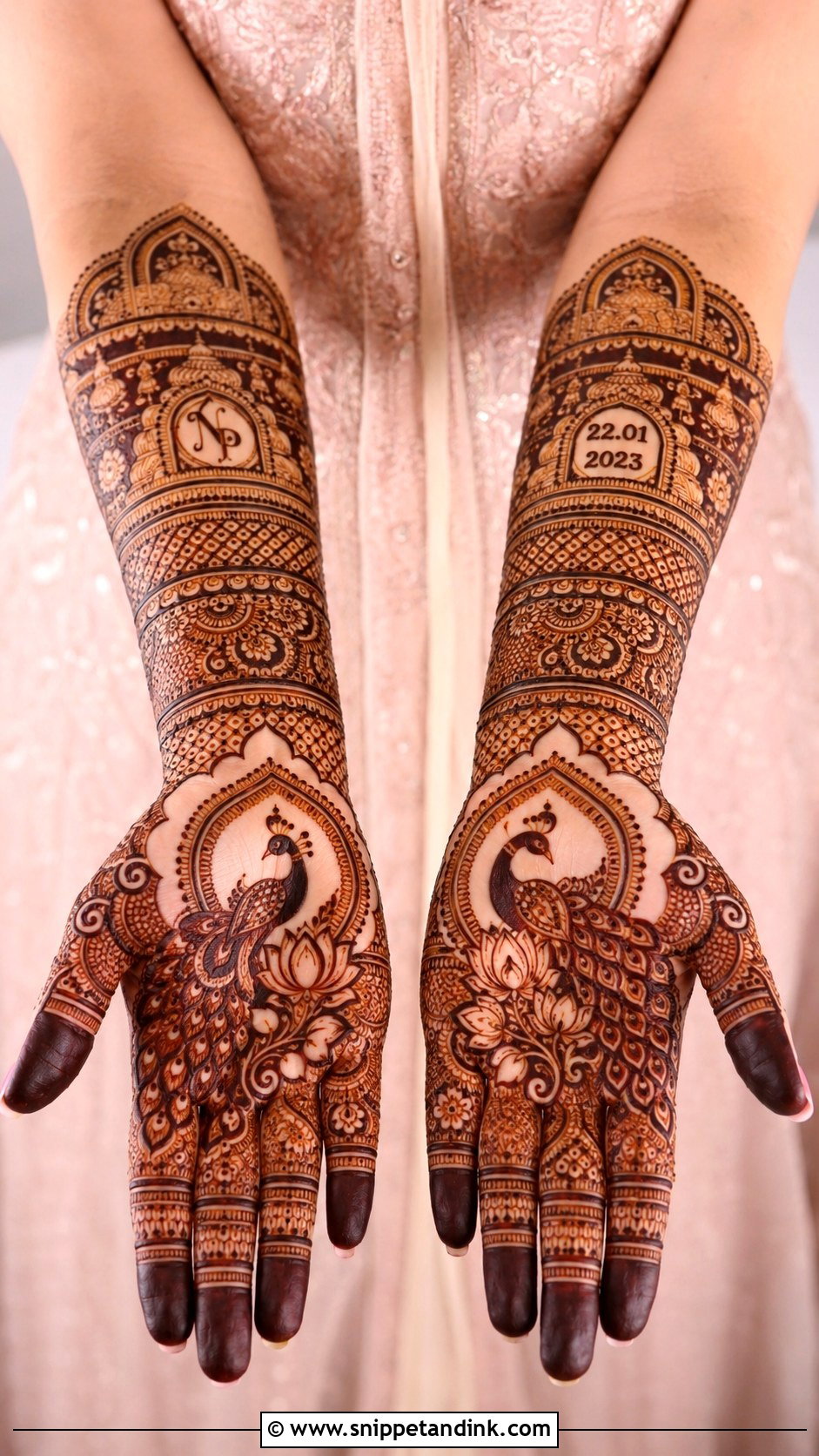
Pakistani designs blend Indian detail with Arabic flow and finish with delicate lace edges: dense palms, floral trails, mandalas, jaali, paisleys and decorated fingers. Bridal versions run up the forearm; festive ones stay around the hands and wrists. Strong borders and balanced empty spaces are what keep it from looking flat. It’s a frequent request for mehndi nights and Eid alike.
32. Rajasthani Mehndi Design
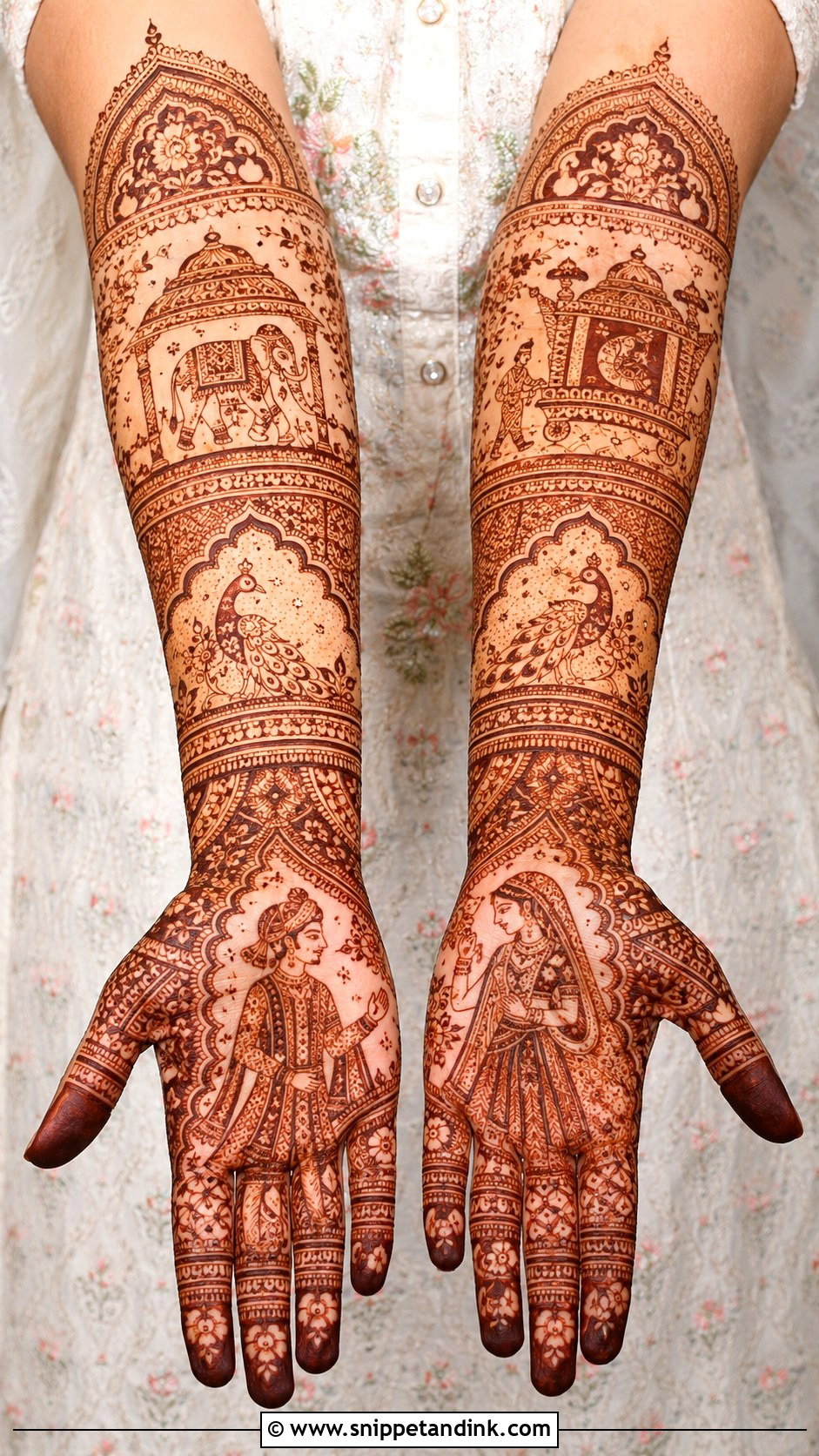
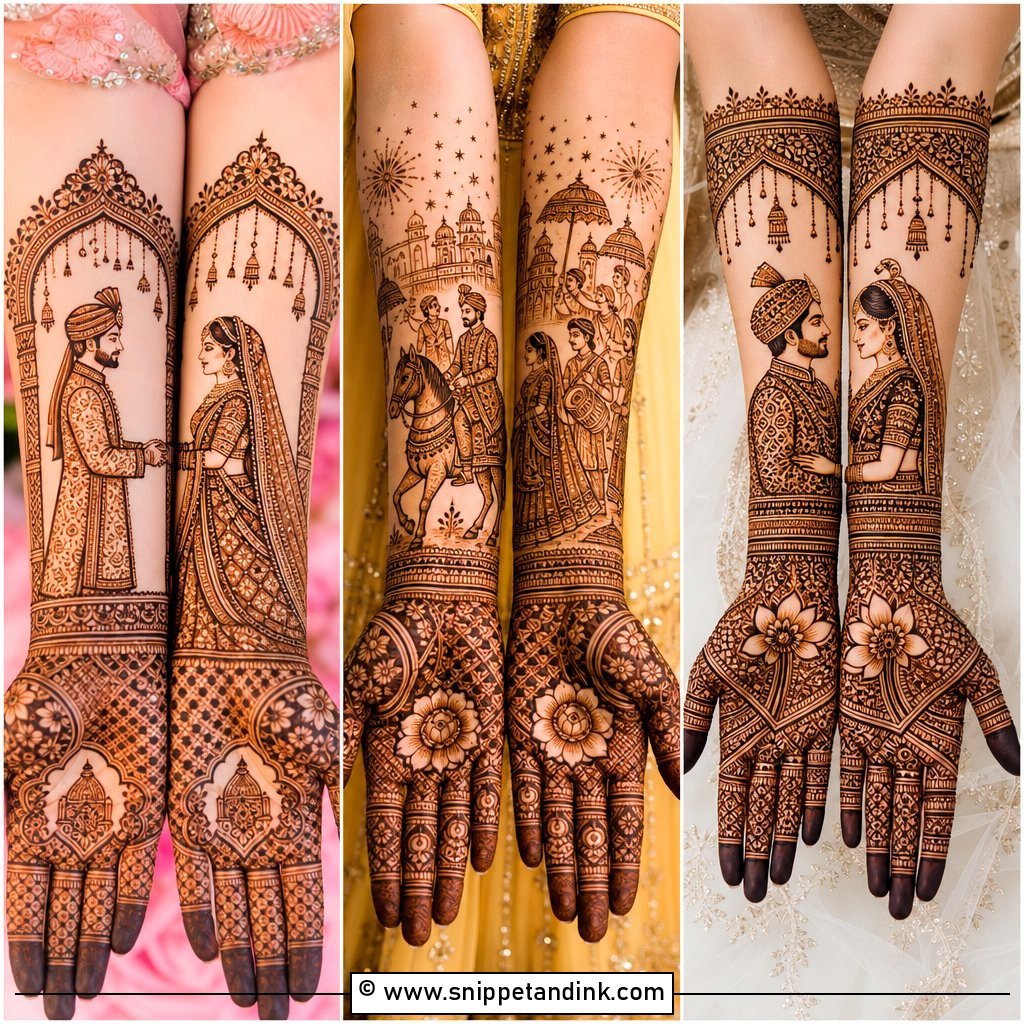
Rajasthani henna tells a story with bride and groom figures, peacocks, elephants, palanquins, paisleys, florals and dense fillers. The two hands often carry different scenes that join into one wedding story when held together. It takes real patience in the chair. For a lighter version, I keep the figures on the palms and leave the wrists less dense, which also shortens the sitting.
33. Royal Bridal Mehndi Design
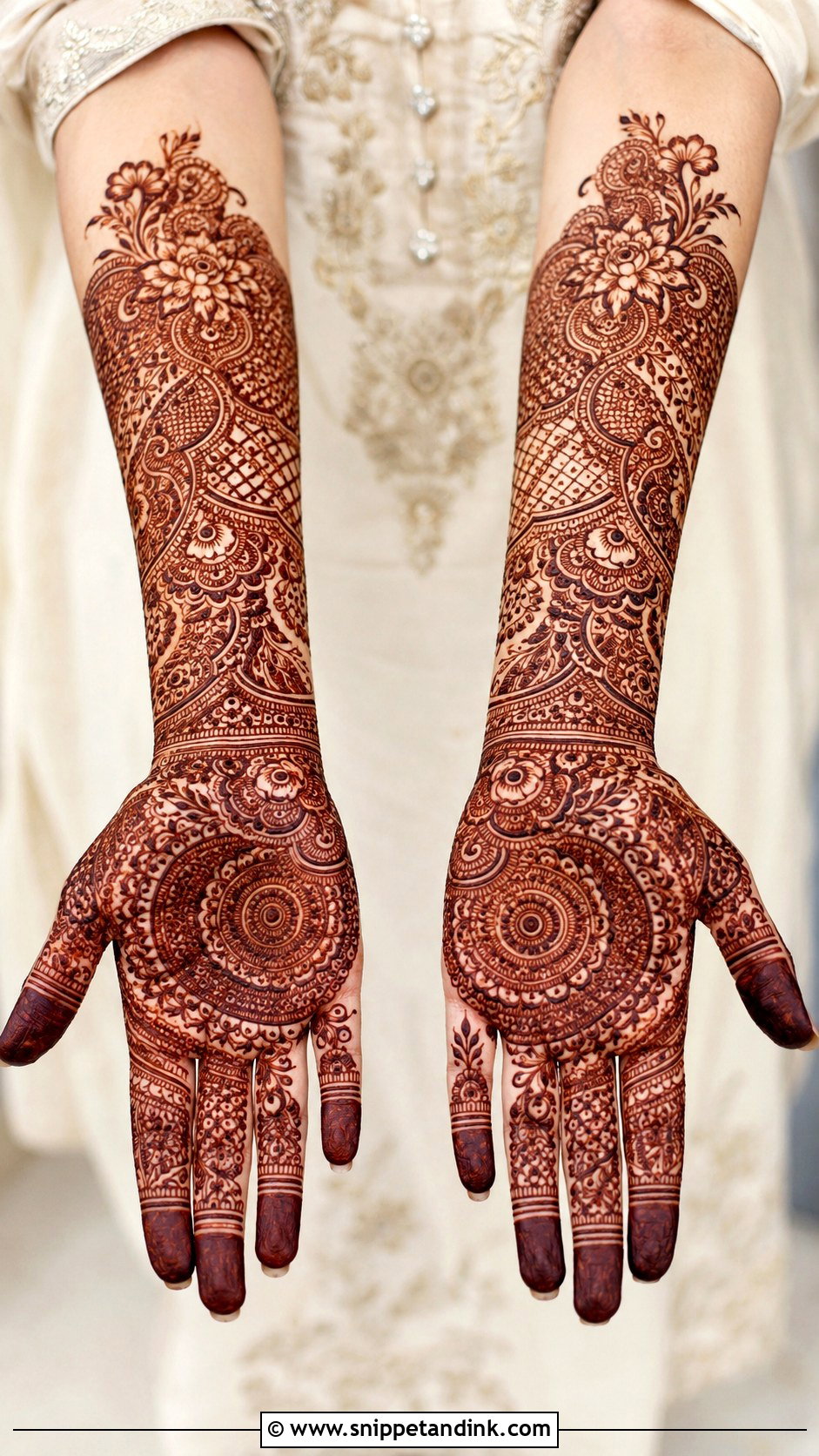
At its fullest, a Royal bridal mehndi design means full-hand coverage with a forearm extension, peacocks, jaali, lotus flowers, paisleys and personal wedding details. Large motifs give it structure and tiny fillers give it richness. I plan both hands together, particularly when a motif is split between them so it only completes when the hands meet. It takes the longest of anything here, and it rewards close-up portraits more than anything else on this list.
34. Foot Mehndi Design
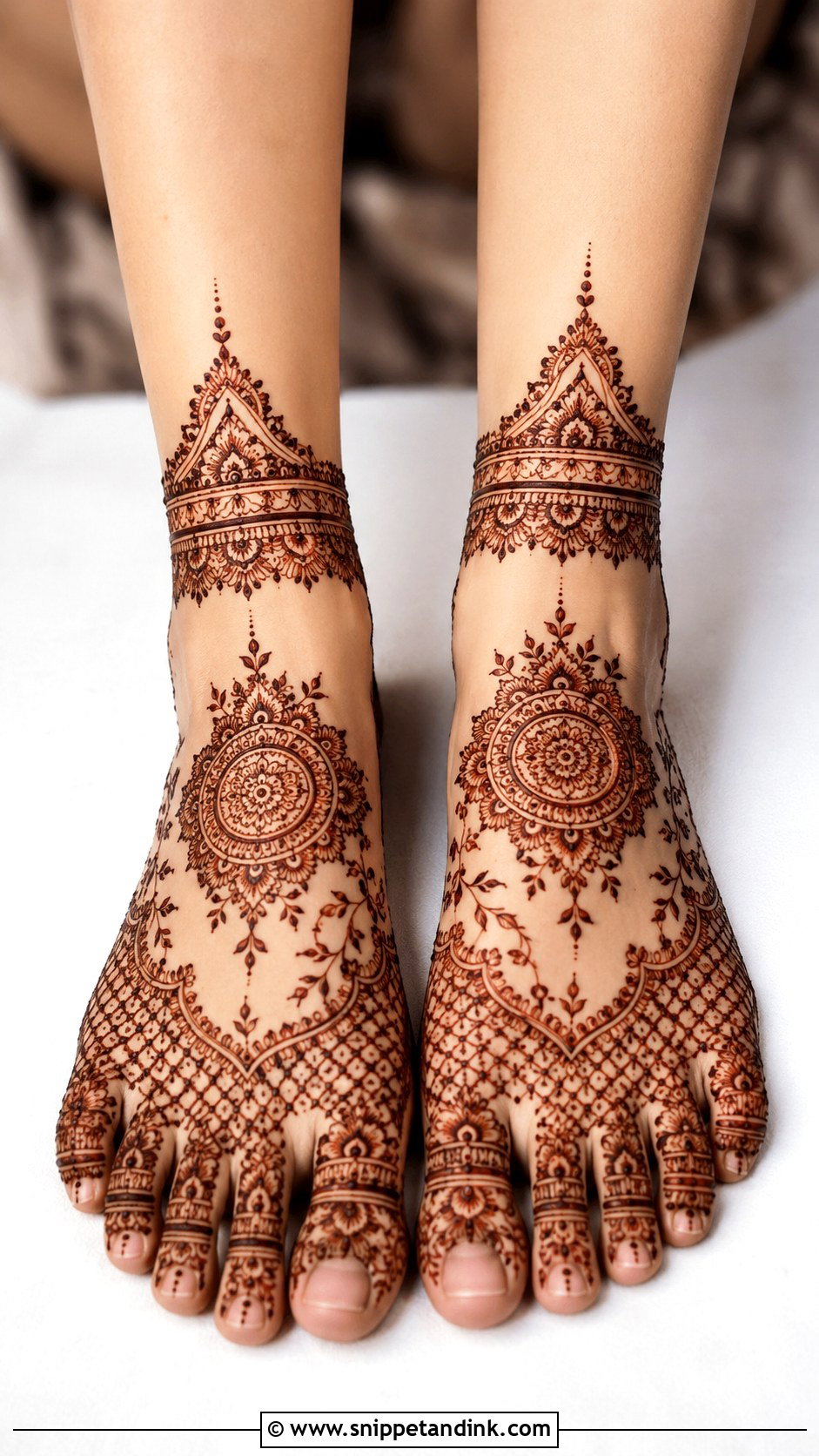
Feet complete a bridal or festive look: toes, the top of the foot, the ankle and sometimes the lower leg, with mandalas, anklet borders, floral vines, paisleys, jaali and toe detail. Brides usually go heavier; guests often prefer an anklet or a side trail. Foot skin stains well, but the paste needs longer to dry and gets knocked easily, so I do feet last and ask you to keep them up on a cushion. Plan your shoes for the next day too; tight straps rub fresh stain.
35. Modern Minimal Bridal Mehndi Design
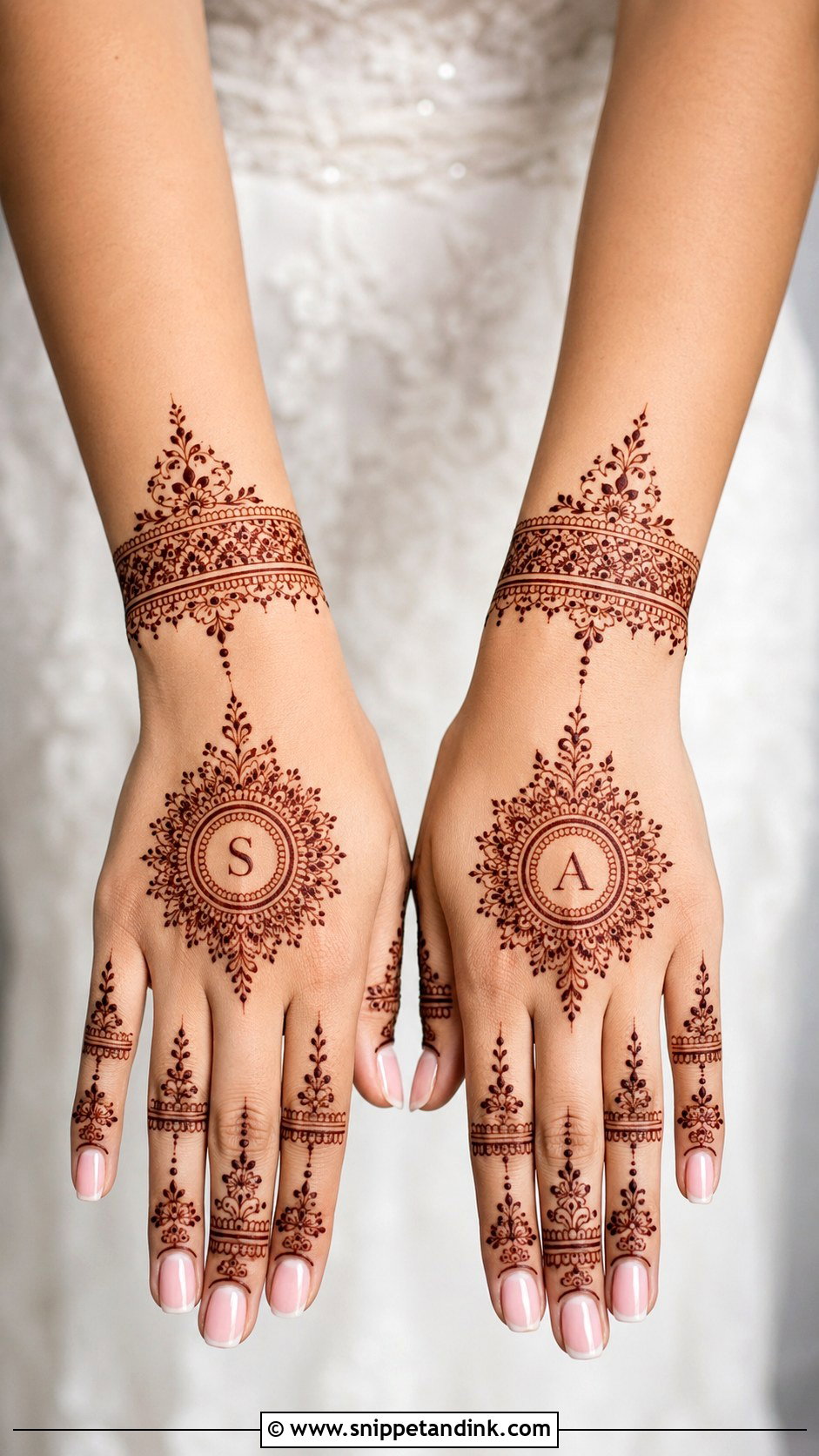
Minimal bridal henna swaps dense coverage for a clean back-hand mandala, fine finger detail, delicate cuffs, small florals and subtle initials. Negative space, asymmetric trails and bracelet layouts give it a contemporary feel, and because so much skin shows, every line is visible in close-ups. That cuts both ways: there’s nowhere for a shaky line to hide, so book an experienced artist. It also suits brides who’d rather not sit for half a day.
Safety Checks I Make Before Any Henna Touches Skin
Real henna paste is made from dried, powdered henna leaves mixed with liquid, sugar and essential oil. It goes on green-brown and stains orange, then darkens to reddish brown over a day or two. Anything that goes on jet black, or promises a dark stain within an hour, is a warning sign. So-called black henna can contain a hair-dye chemical that causes blistering and lasting allergies, and I won’t use it on anyone.
Children, sensitive skin and first-timers
- If you’ve never had henna, ask for a small dot on the inner arm a day or two ahead and watch for itching or redness.
- Mention eczema, broken skin or recent waxing on the hands. I work around those patches.
- Some essential oils used in paste, tea tree and clove especially, irritate sensitive skin. A good artist can mix a gentler batch.
- Henna is generally not advised for babies and young children with G6PD deficiency. If that’s in the family, check with a doctor first.
Why the back of your hand looks lighter
Thin skin takes less dye. Palms and fingertips can go almost burgundy while the back of the same hand settles at a warm brown, and that’s normal. If you want the back-of-hand design to match your palms in photos, ask for slightly bolder lines there, keep the paste on overnight, and keep both hands dry for the first day.
Match the Henna to the Hours You Have and the Event You’re Dressing For
Every style here can be traditional, modern, bold, minimal or bridal; what decides it is the event. Full-hand Indian and Rajasthani patterns belong at big weddings, while Arabic, Indo-Arabic, Gulf and Moroccan work suits people who like clear flow and open space. Finger, bracelet and ring designs cover quick events and modern outfits, and mandalas, florals, paisleys and back-hand trails never look out of place at a festival. Pick the coverage you have time for, then the motif you love.
You'll Like These Ideas:






Leave a Reply