
Bridal mehndi is the one part of the wedding look that is drawn on the bride herself, and it carries blessings as much as decoration. The traditional motifs all have a place: peacocks, paisleys, lotus, elephants, the kalash, the doli and whole baraat scenes. Regional styles differ a great deal too. A royal Rajasthani layout reads nothing like a Gujarati or South Indian one, and Marwari, Punjabi and Mughal-inspired work each have their own habits. When a bride sits down with me, I want to know her outfit, which ceremonies the hands will be seen at and how long she can sit still. The 25 designs below cover the classic choices, from dense front hands to back-hand work and forearm extensions, along with personal touches like the groom’s name or the wedding date.
Planning Mehndi Night Around How Henna Darkens
Henna doesn’t show its true color when the paste comes off. It starts bright orange and deepens over the next day or two toward red-brown or maroon. That’s why I ask brides to schedule their mehndi one to two days before the wedding, so the stain is at its darkest for the ceremony rather than still orange.
Give the appointment more time than you think. Full bridal hands and feet with forearms can take most of a day, and a dense Marwari or Rajasthani design takes longer still. Eat before you sit down, use the restroom, and have someone with you who can feed you and hold your phone. Once the paste is on, your hands are out of use for hours.
Natural Henna or Chemical Cones? Ask Before She Starts
Real henna paste is made from the dried, powdered leaves of the henna plant mixed with liquid, sugar and essential oils. It stains in shades of orange to deep brown, never black. Anything sold as black henna, or a cone that promises instant dark color, may contain PPD or other chemical dyes, which can cause blistering and lasting skin reactions.
- Ask your artist what is in her paste and whether she mixes it herself.
- Ask for a small patch on your inner arm a few days before, especially if your skin is sensitive.
- Be wary of any cone that claims to stain dark in minutes. Natural henna needs hours.
1. Full Hand Indian Bridal Mehndi Design
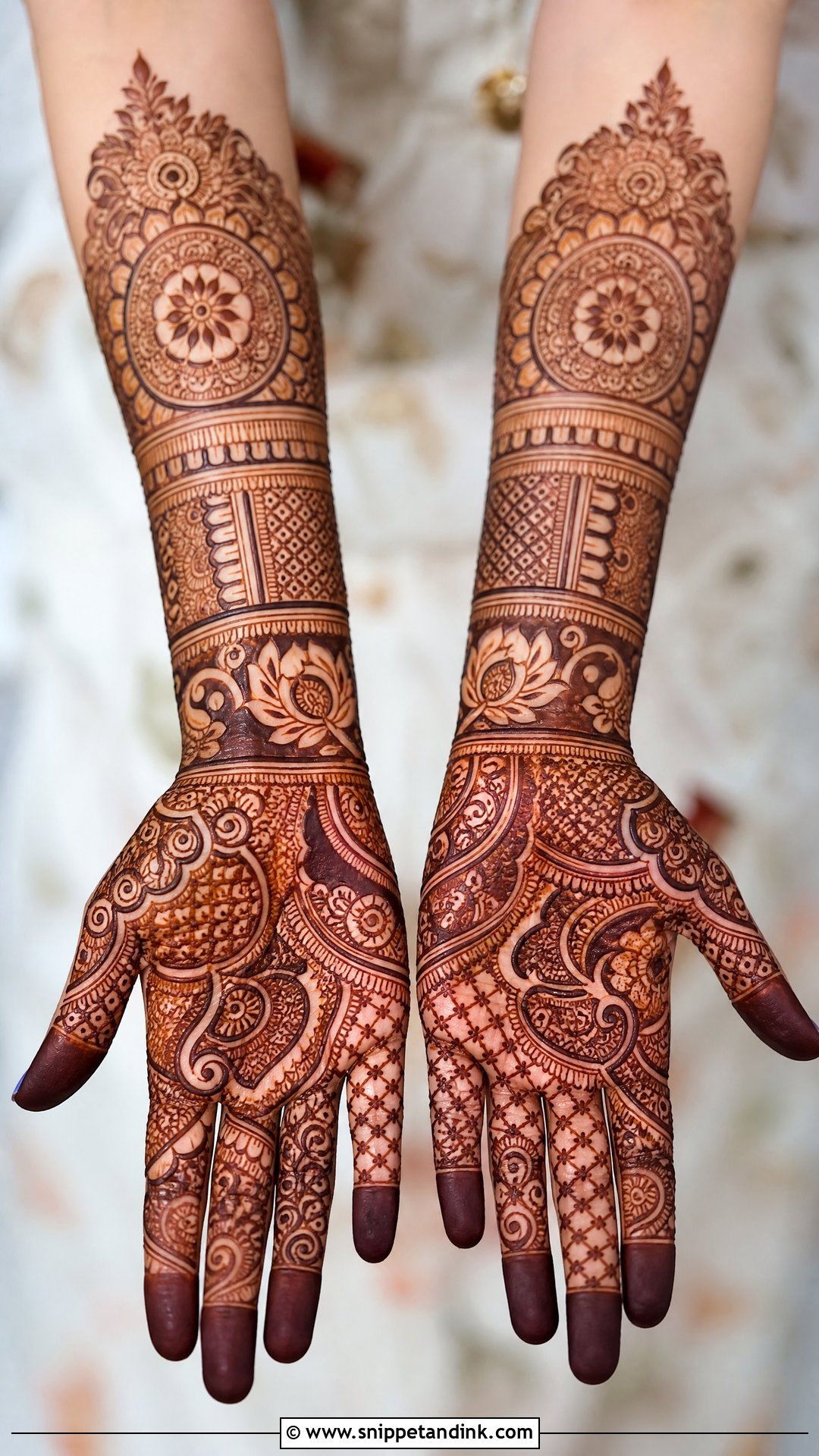
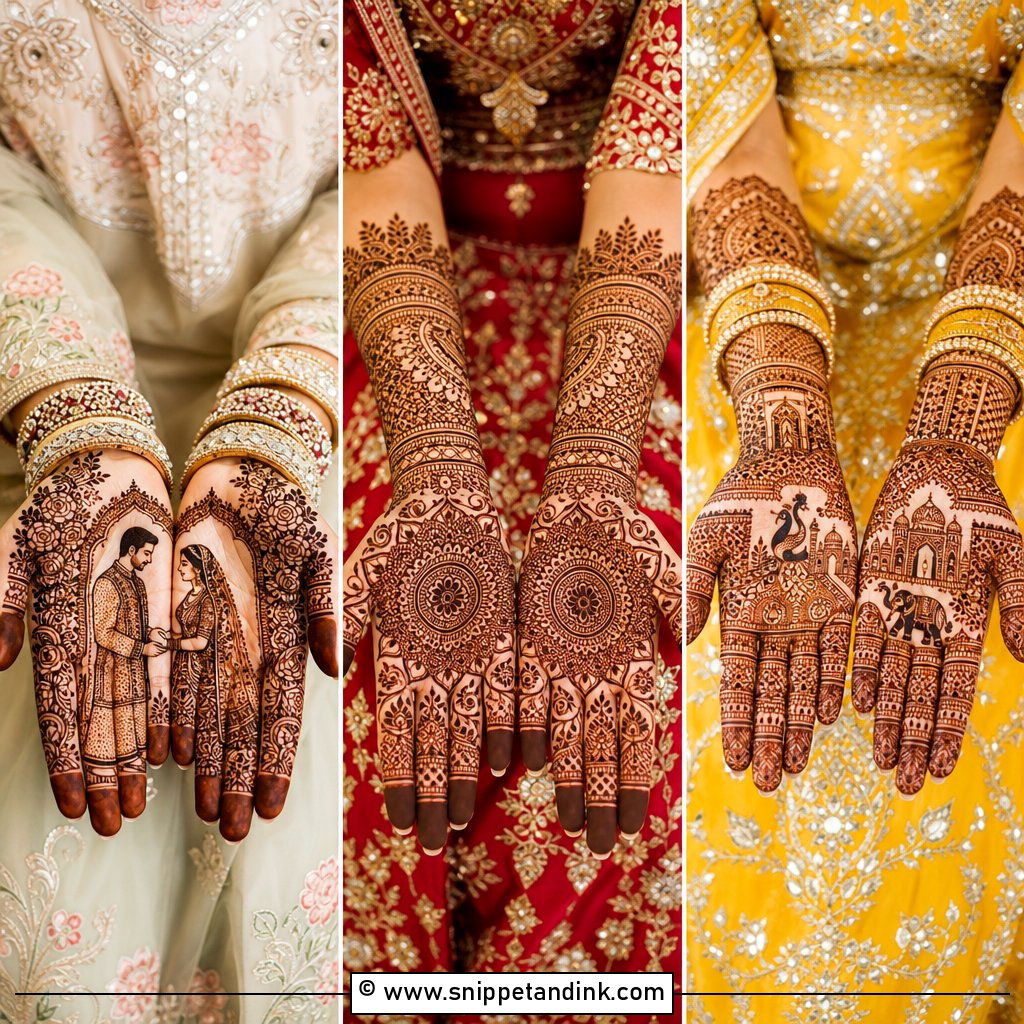
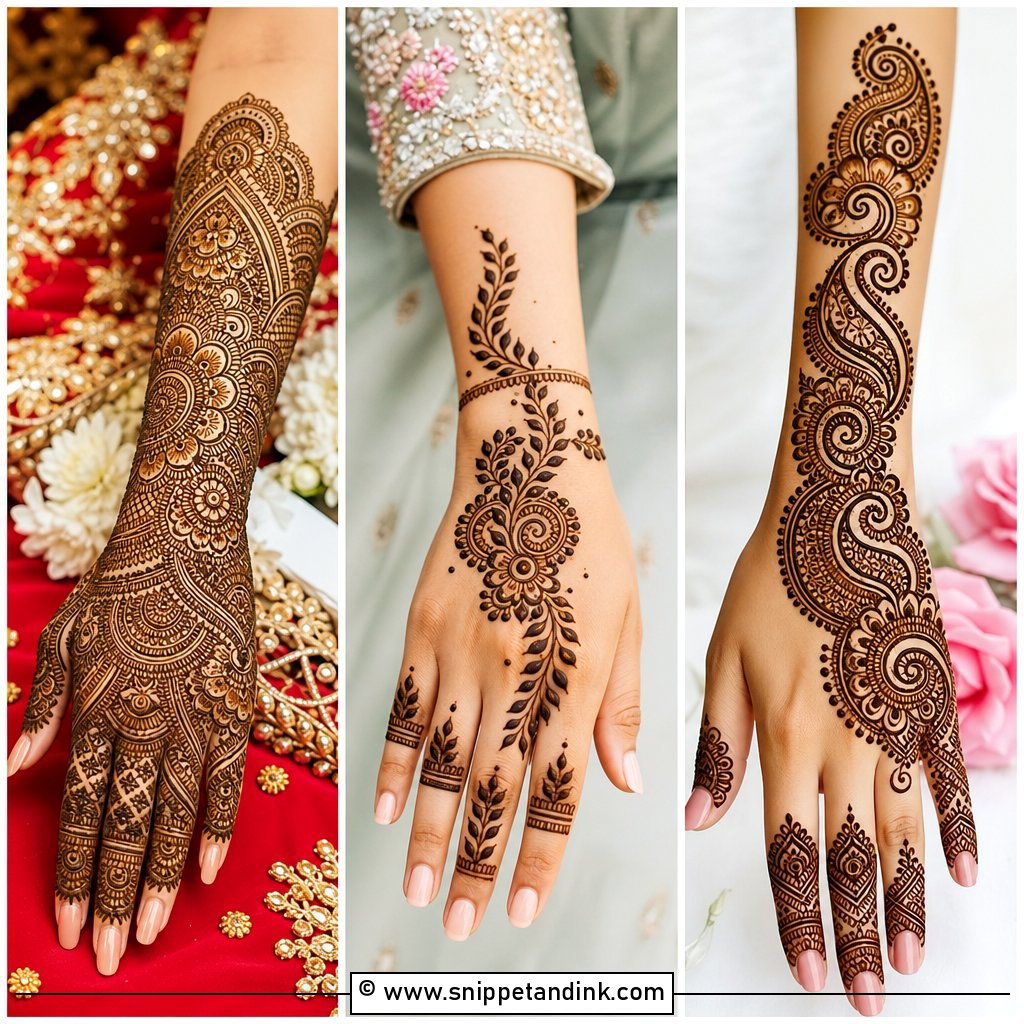
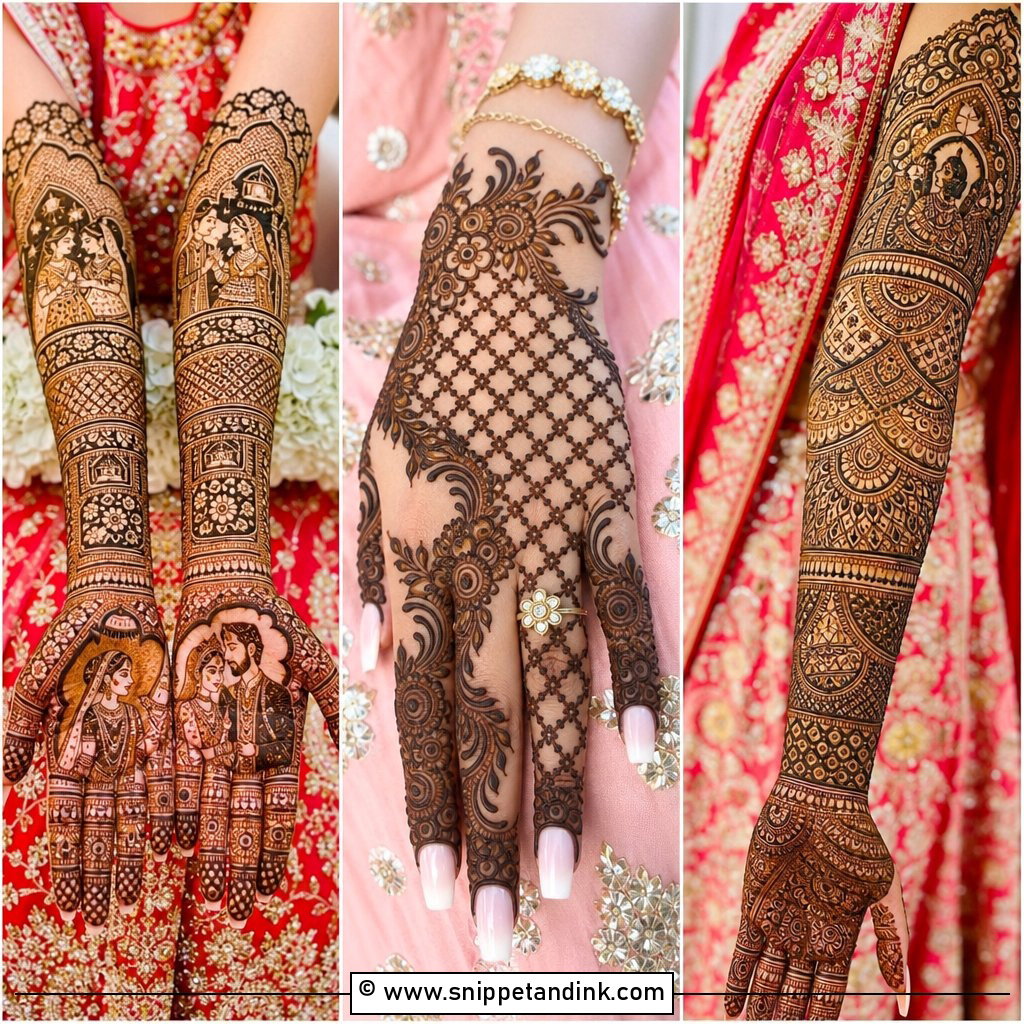
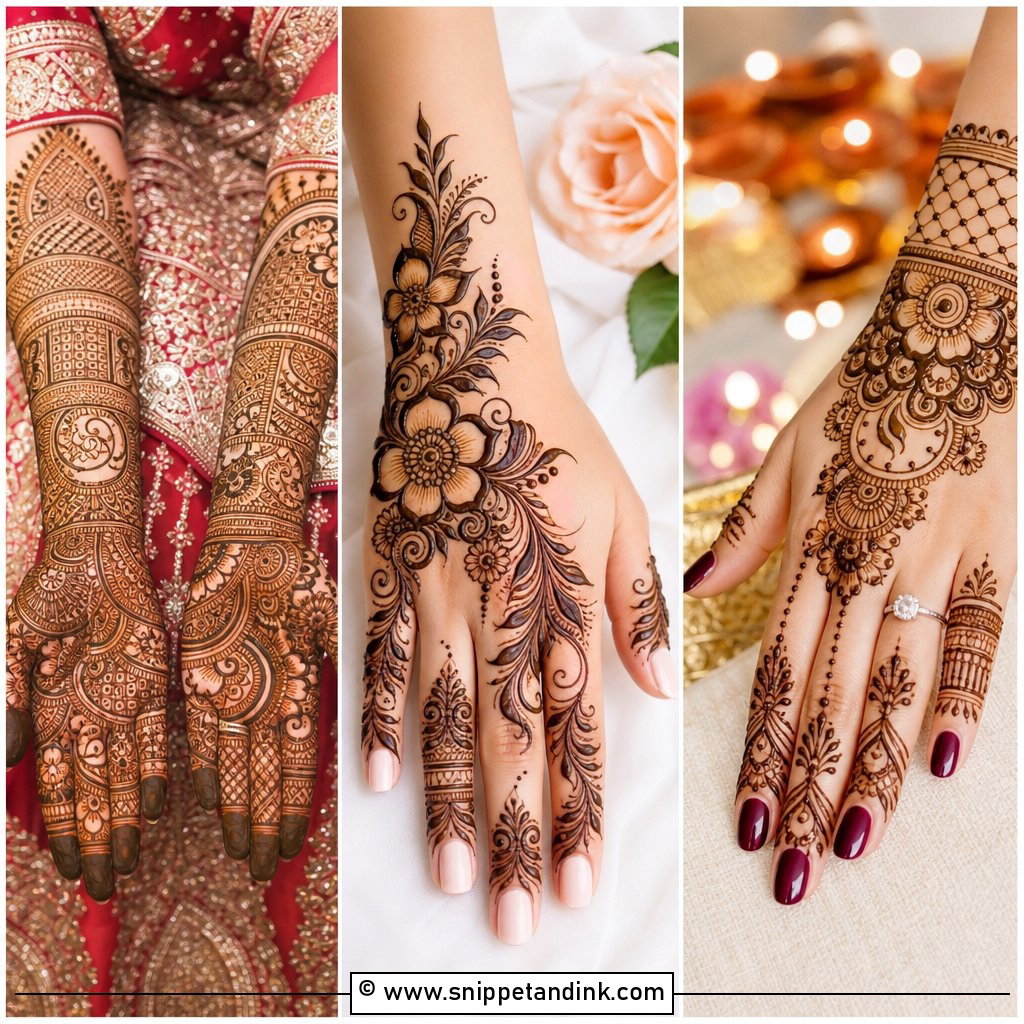
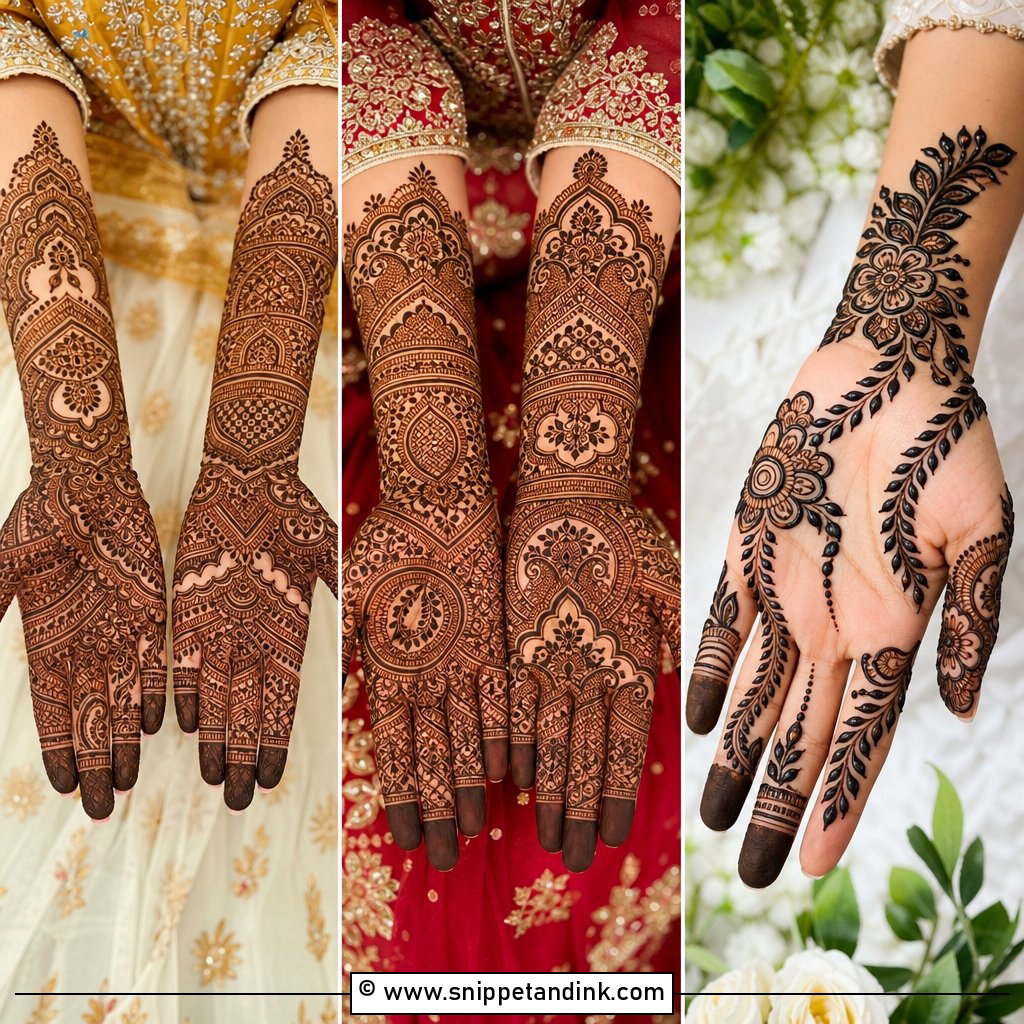
Full-hand bridal mehndi starts at the fingertips and runs past the wrist, often well up the forearm, with almost no empty skin. The palms carry the main motifs, such as mandalas, paisleys, lotus or a dulha-dulhan pair, while the back hands take jaali, vines and bracelet bands. Because so little skin is left bare, the finished stain reads as a deep, continuous color. I always draw the two hands as partners rather than mirror copies. Exact symmetry is nearly impossible freehand and tends to show its small differences, while a deliberate variation looks handmade and intentional. Plan for a long sitting: full hands and forearms take several hours.
2. Rajasthani Bridal Mehndi Design
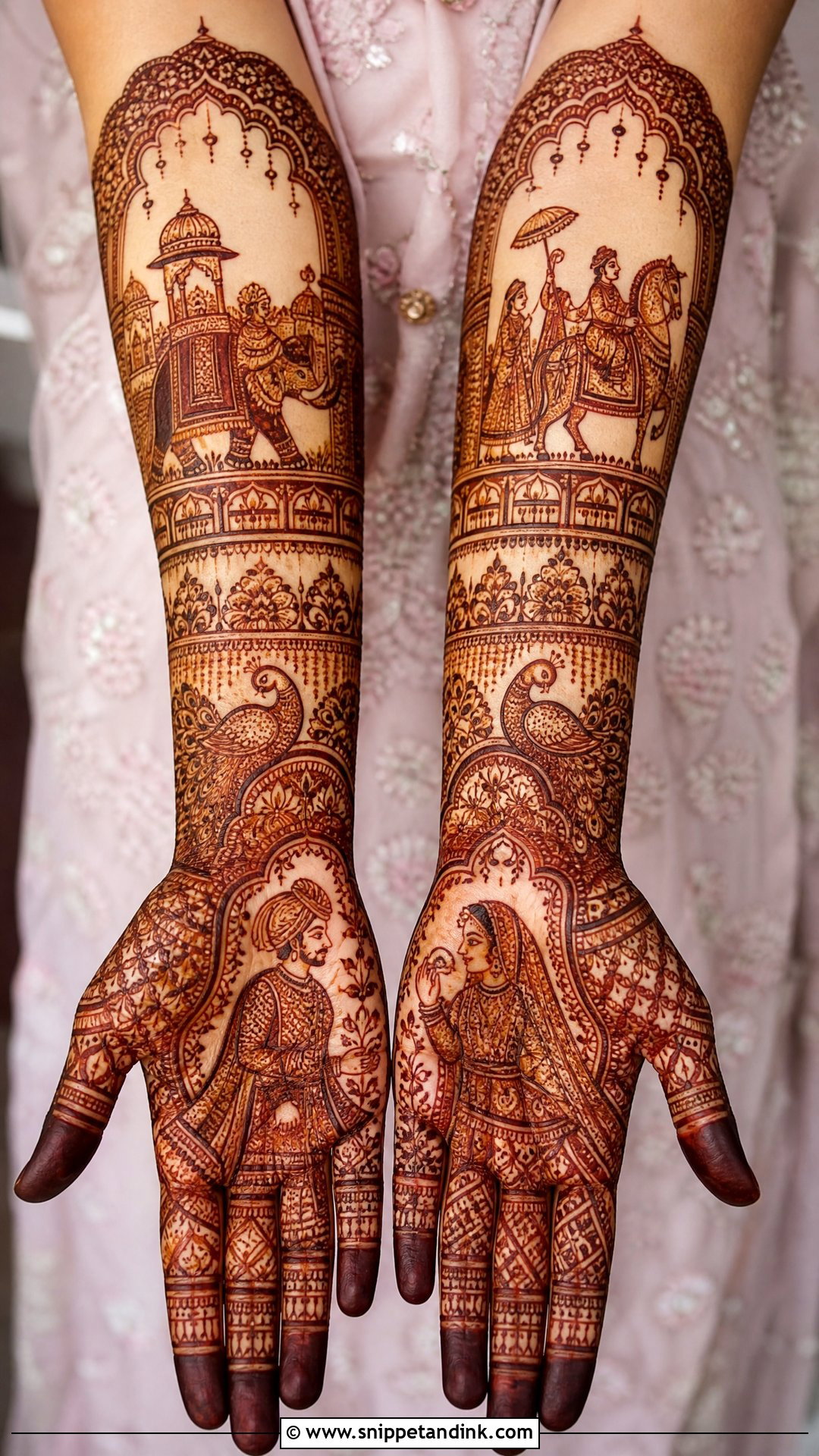
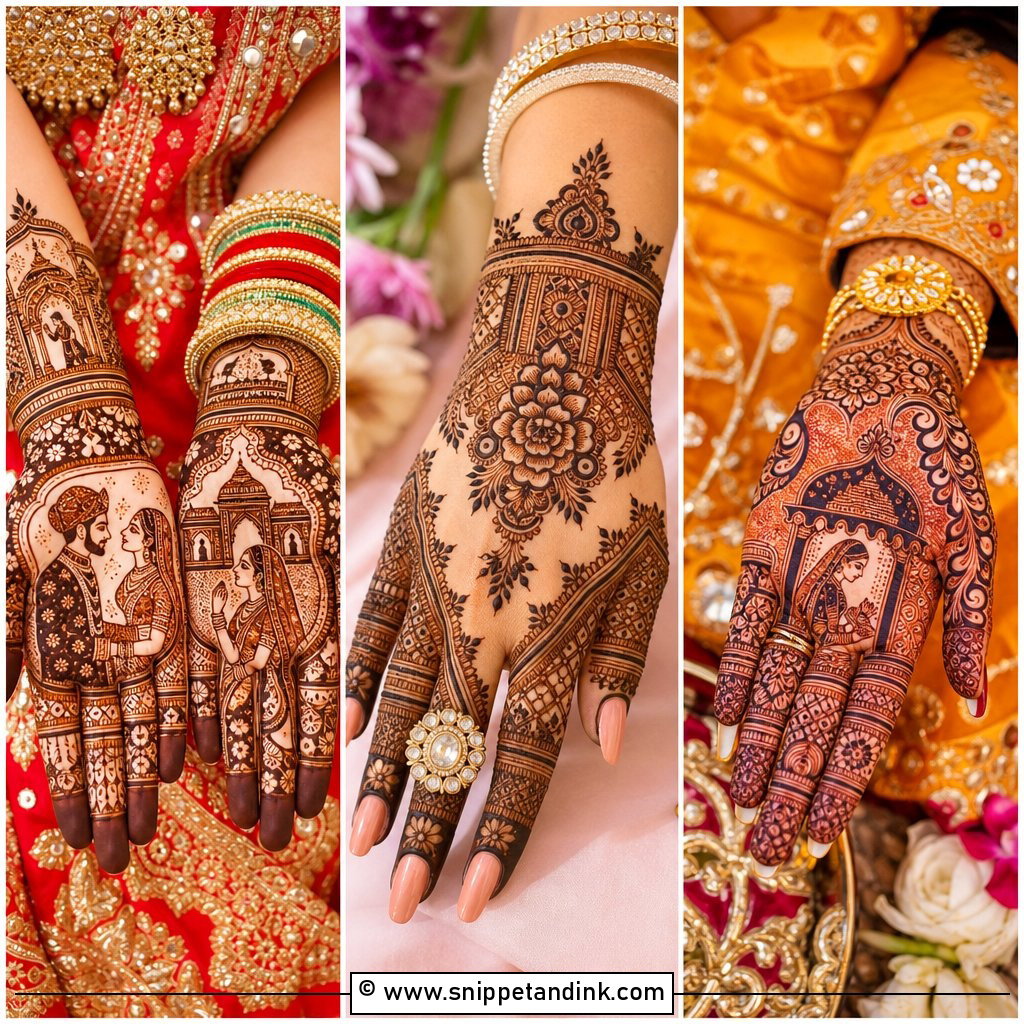
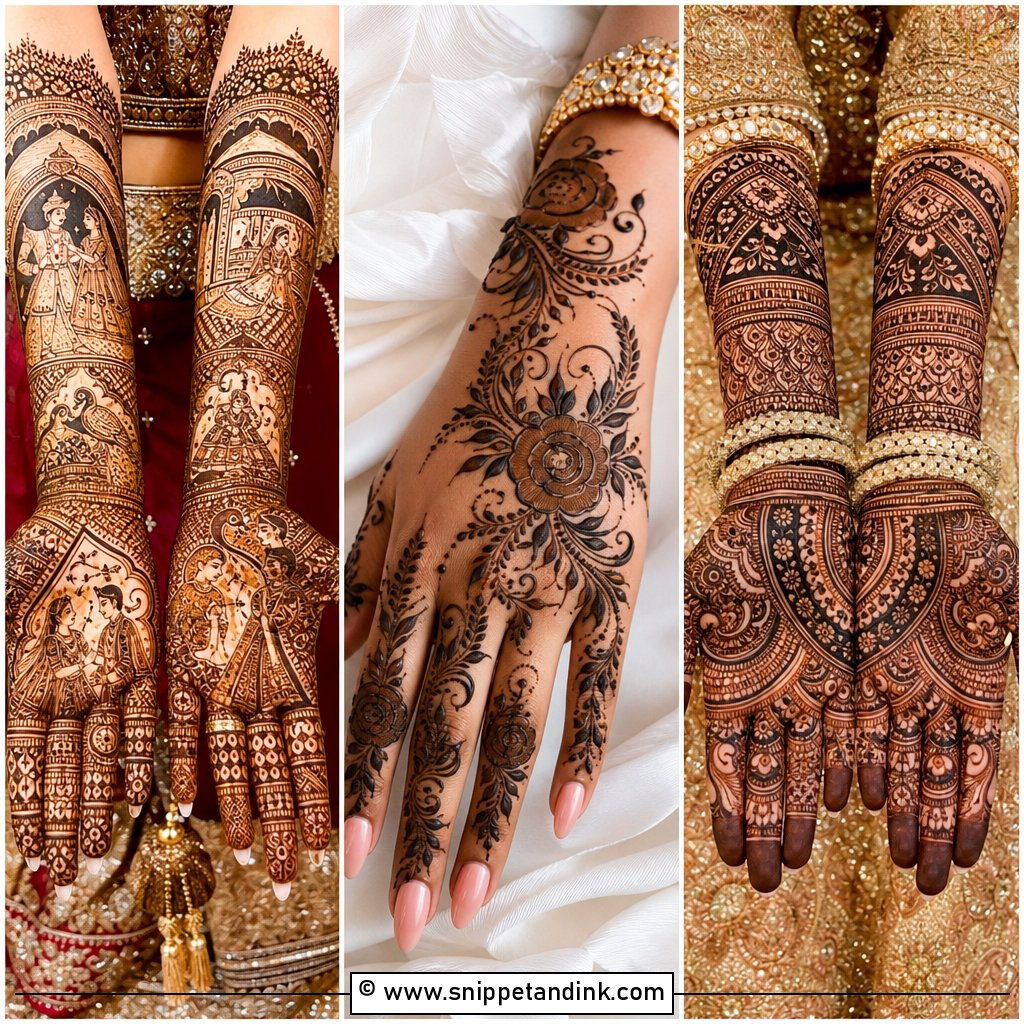
Rajasthani mehndi is storytelling mehndi. Bride and groom portraits, royal processions, palanquins, elephants, peacocks and palace borders fill the palms, fingers, wrists and forearms in very fine line work. It suits heavy lehengas, poshak-style outfits, bandhani dupattas and kundan or polki jewelry. A common layout puts the bride on one hand and the groom on the other, so the story completes when she holds her hands together. The fine lines are what make it, and they’re also what blurs first if the paste is too runny or the bride moves before it sets. I mix a thicker paste for this work.
3. Dulha Dulhan Bridal Mehndi Design
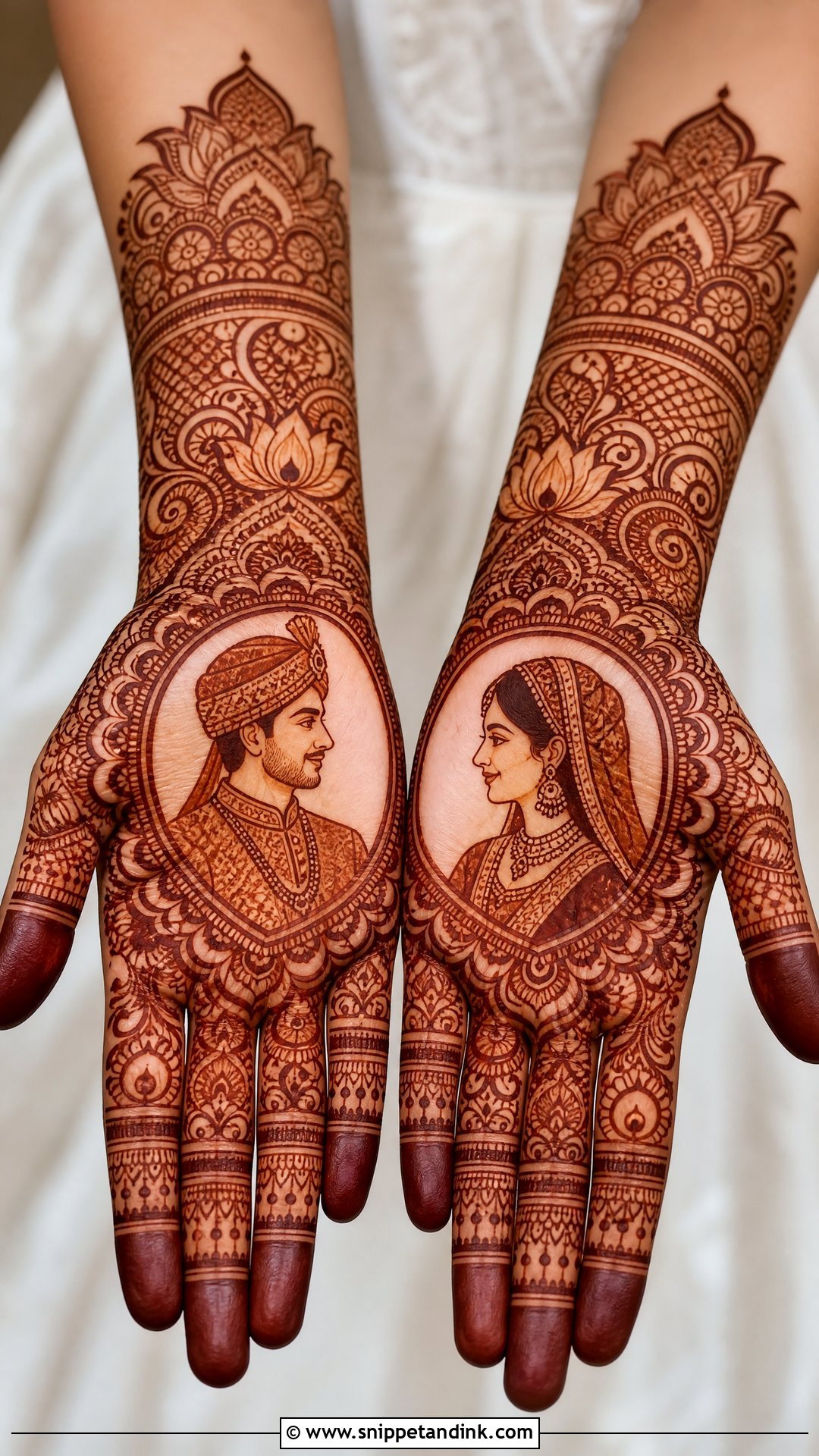
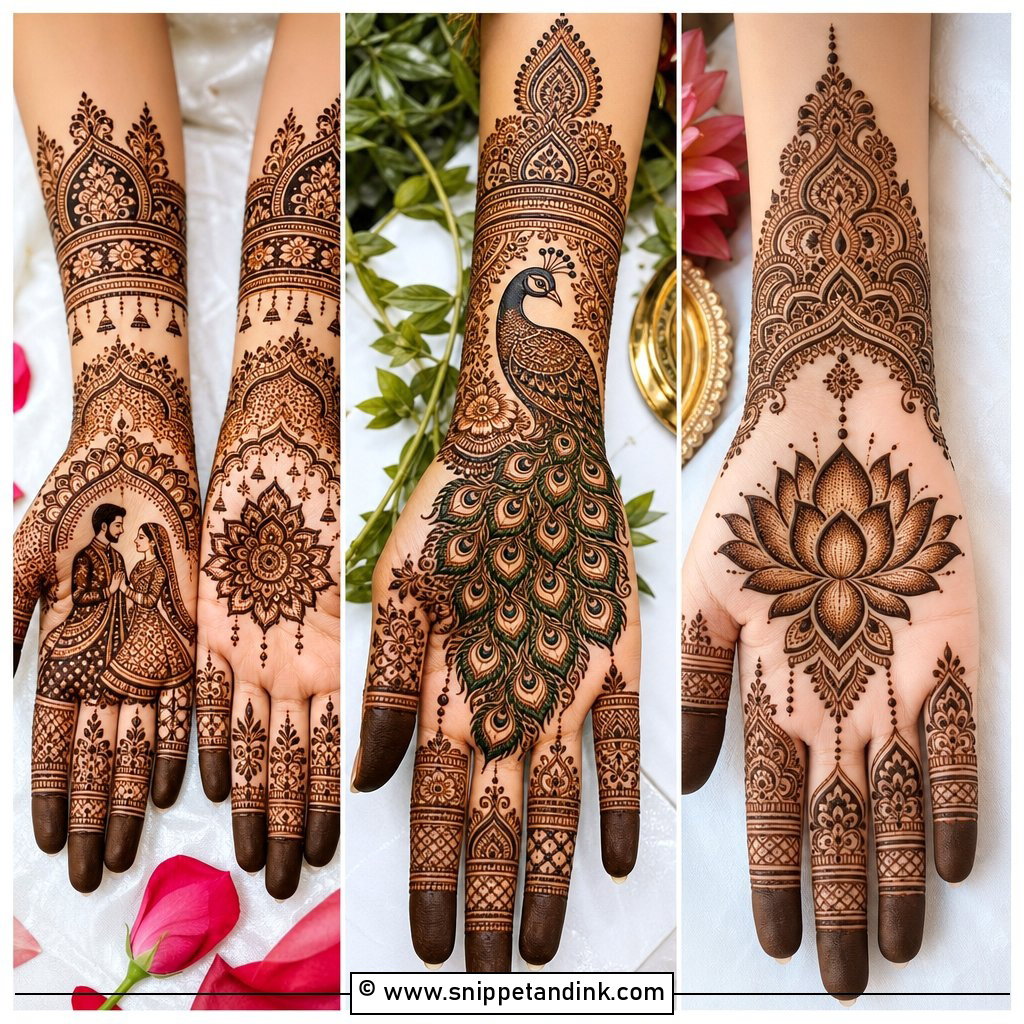
The dulha-dulhan design places the couple at the center of the palms or forearms, usually drawn in profile and in wedding dress, framed by mandalas, paisleys and fine fillers. It is one of the most requested bridal designs I draw. Faces are the hardest part of mehndi to get right, because a few millimeters change the expression, so this is where an artist’s portfolio matters most. Ask to see faces she has drawn before. I keep a clear outline around each figure; dense fillers crowding the couple make the faces disappear once the stain darkens.
4. Peacock Bridal Mehndi Design
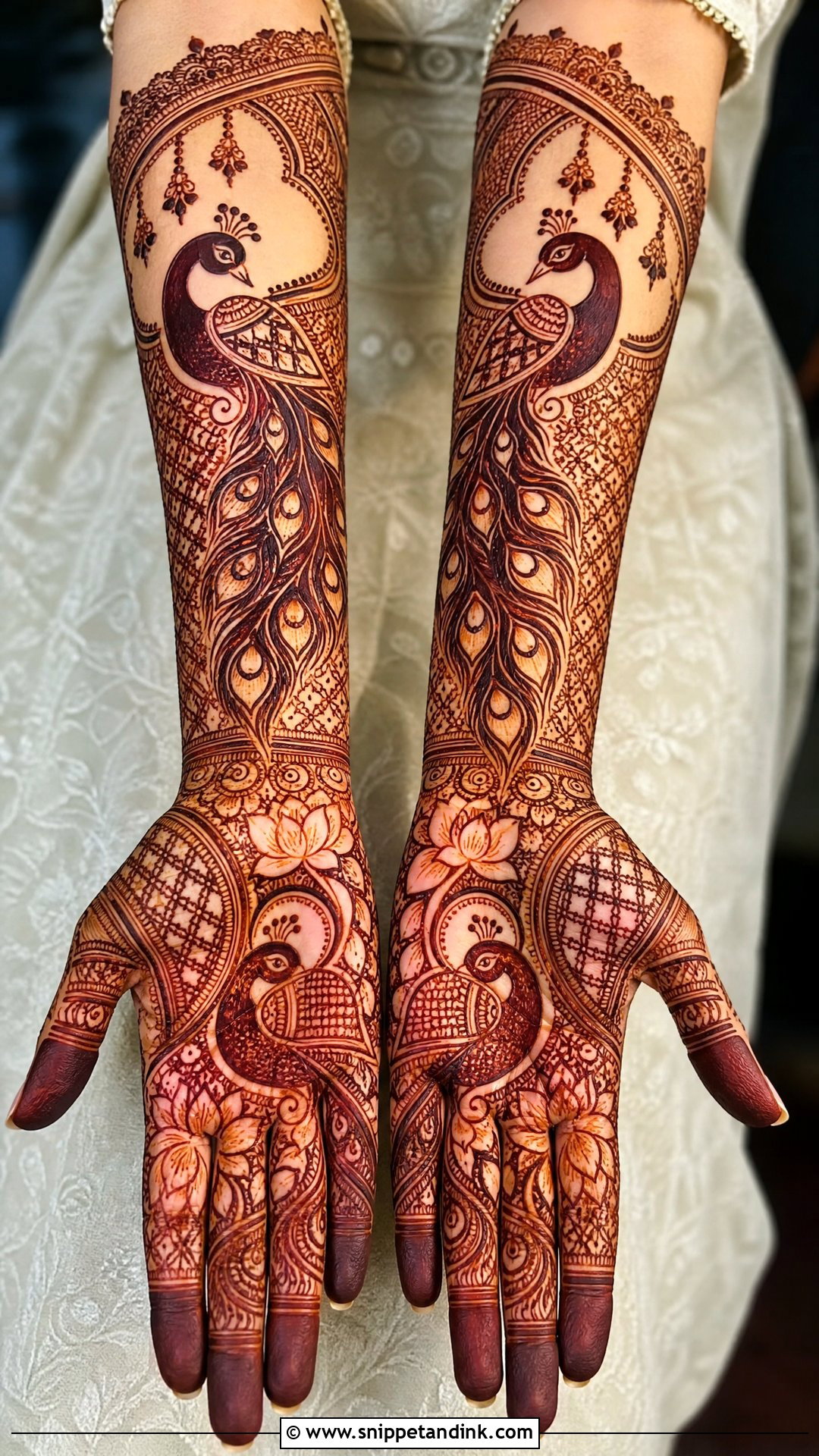
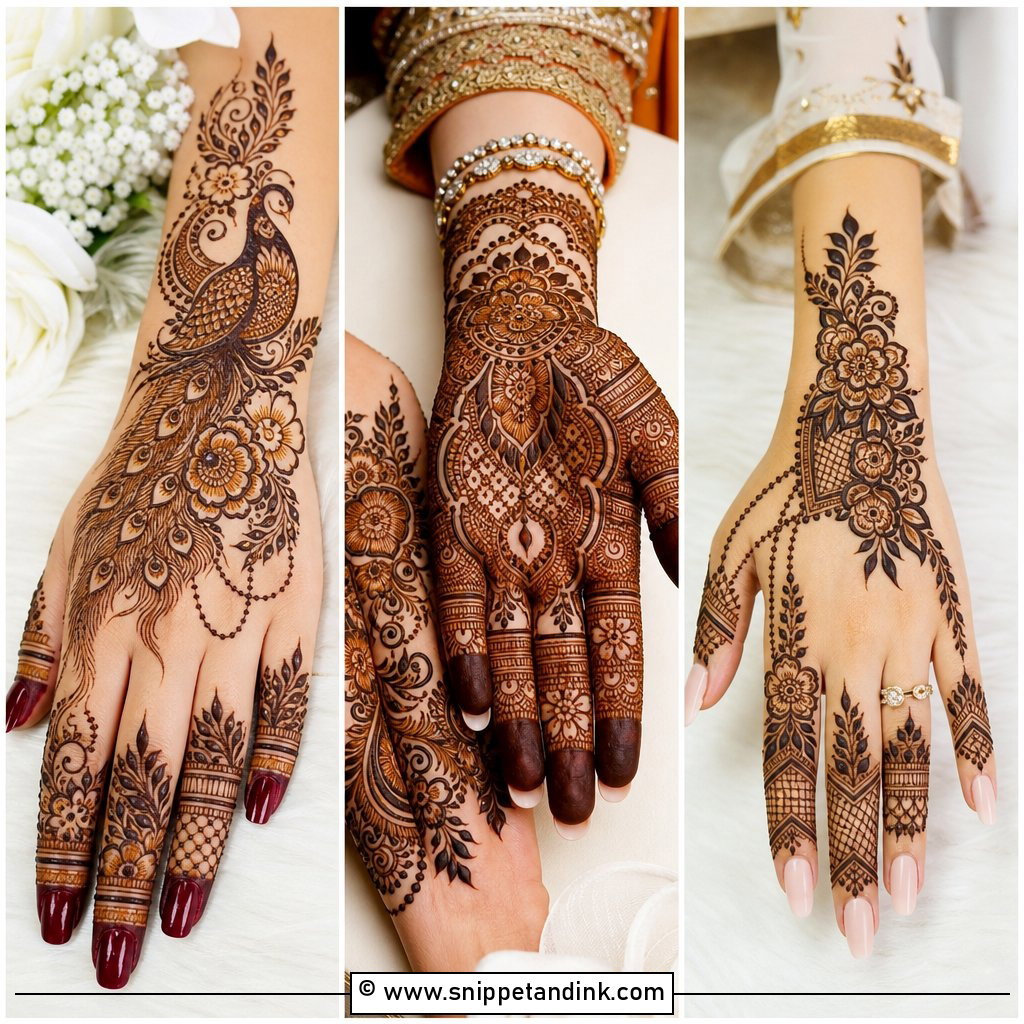
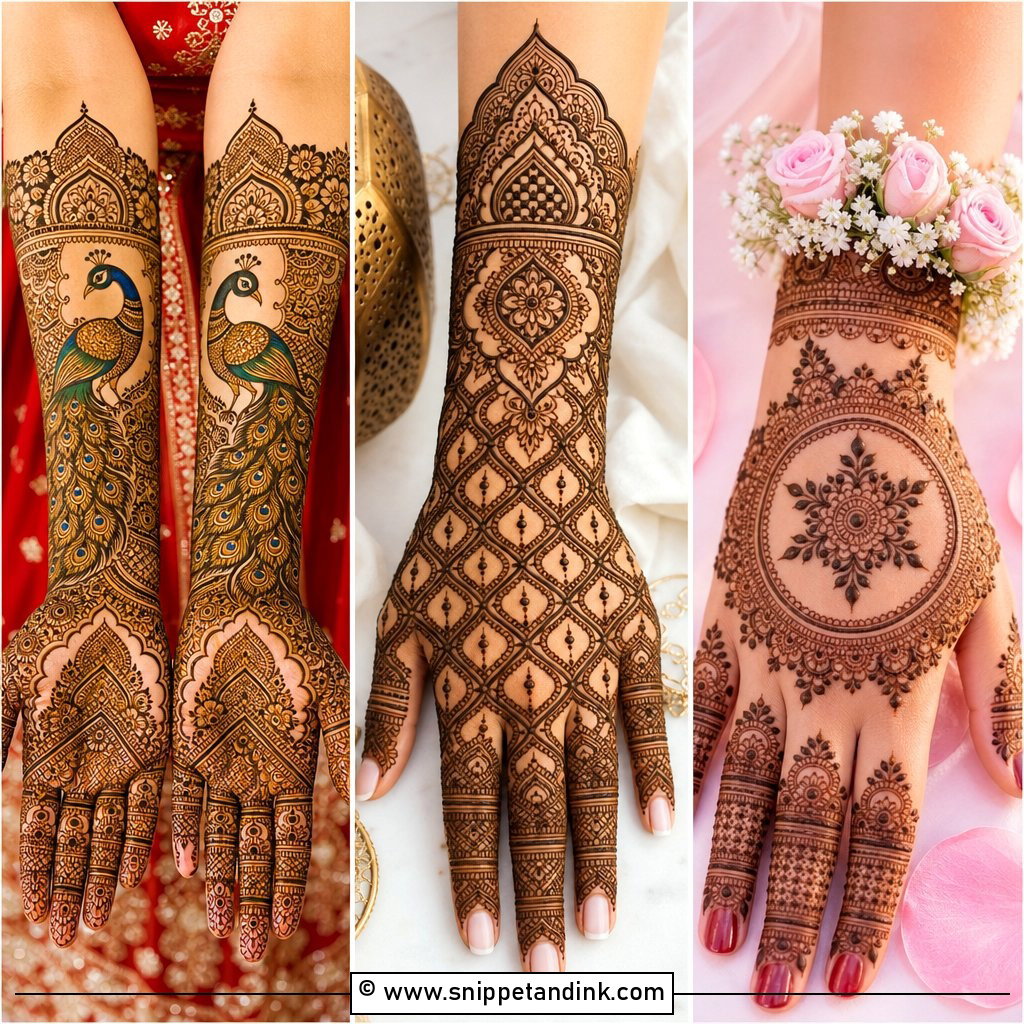
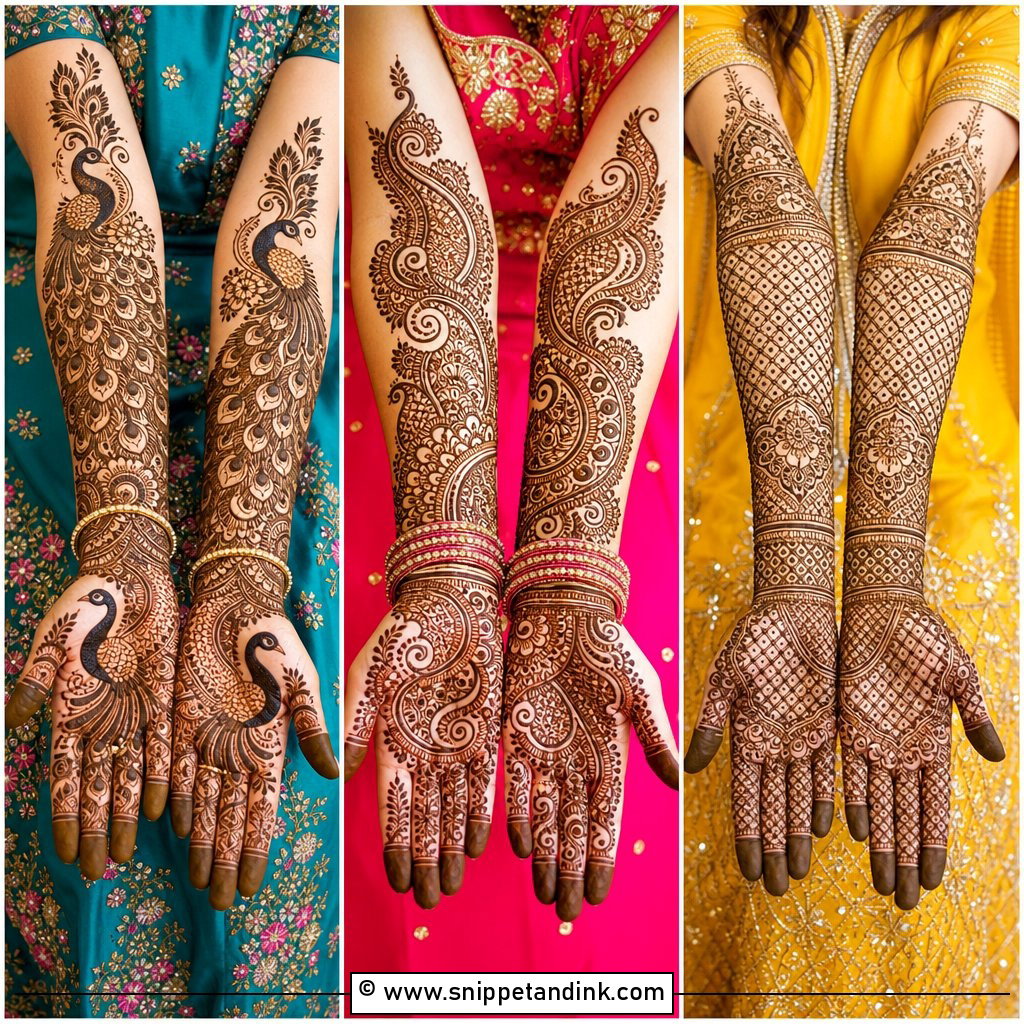
The peacock sits naturally in a hand. Its curved neck fits the base of the palm or the inner wrist, and the tail feathers can sweep into paisleys, vines and mesh along the fingers or forearm. When a bride wants a traditional motif without portraits, this is the one I suggest most. It can be one bold central bird or several smaller ones repeated up the arm. The detail that makes it read well in the final stain is the feather eyes: I fill them with fine lines and dots and leave a tiny ring of skin around each, so they still stand out once the color goes deep.
5. Paisley Bridal Mehndi Design
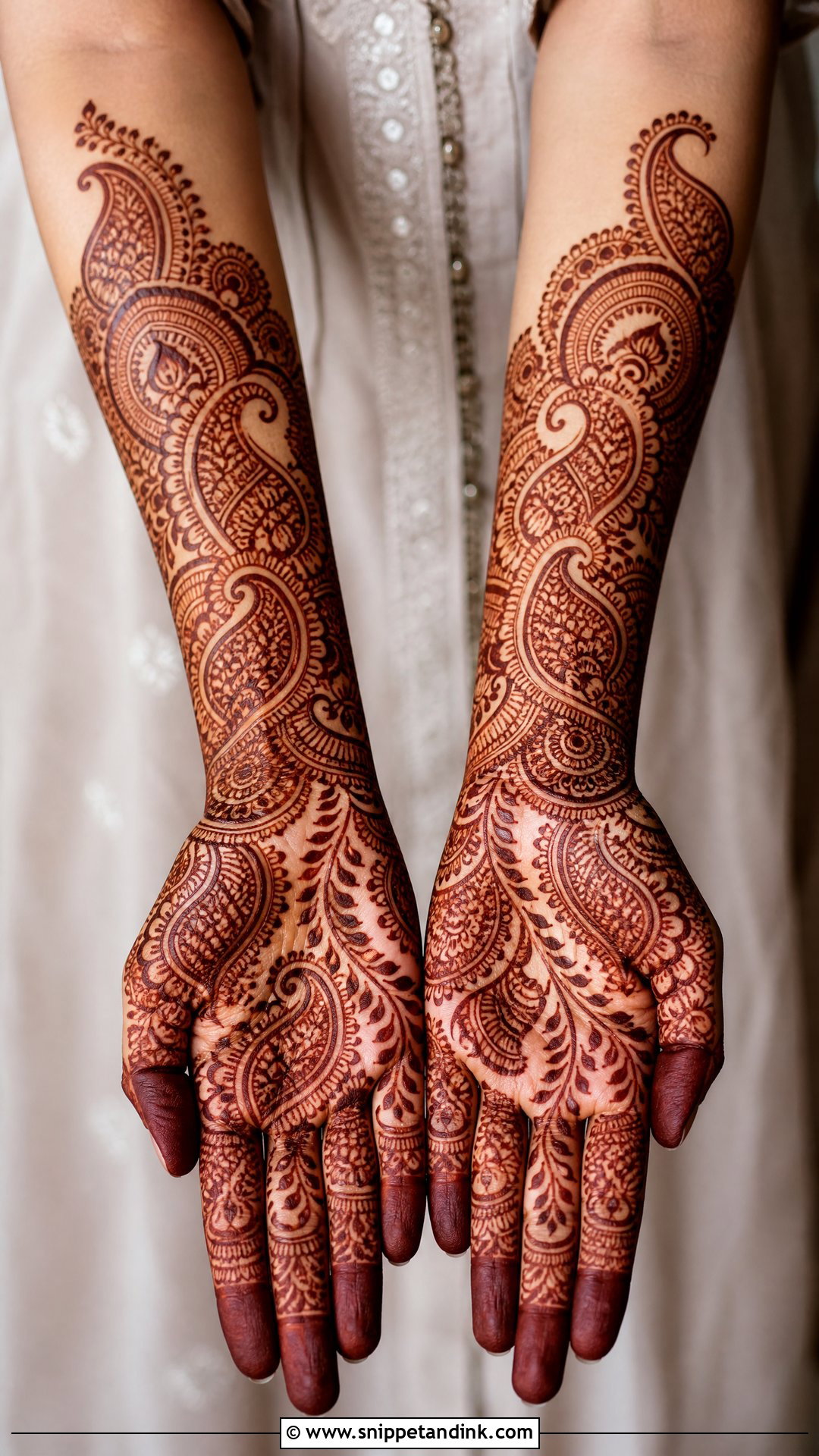
Paisley, the mango or kairi shape, is the most adaptable motif in mehndi. It can be drawn large, tiny, stacked or woven into other patterns, so it fits any hand. A bridal paisley design usually covers the palm and forearm in layered paisleys with floral filling, leafy vines, dots and shaded lines. On broad palms I use fewer, larger paisleys; on narrow hands, slim paisley trails that follow the length of the fingers. It suits brides who want full tradition without figures. The shading inside each paisley is where the artist’s hand shows, and it’s worth looking for in a portfolio.
6. Mandala Bridal Mehndi Design
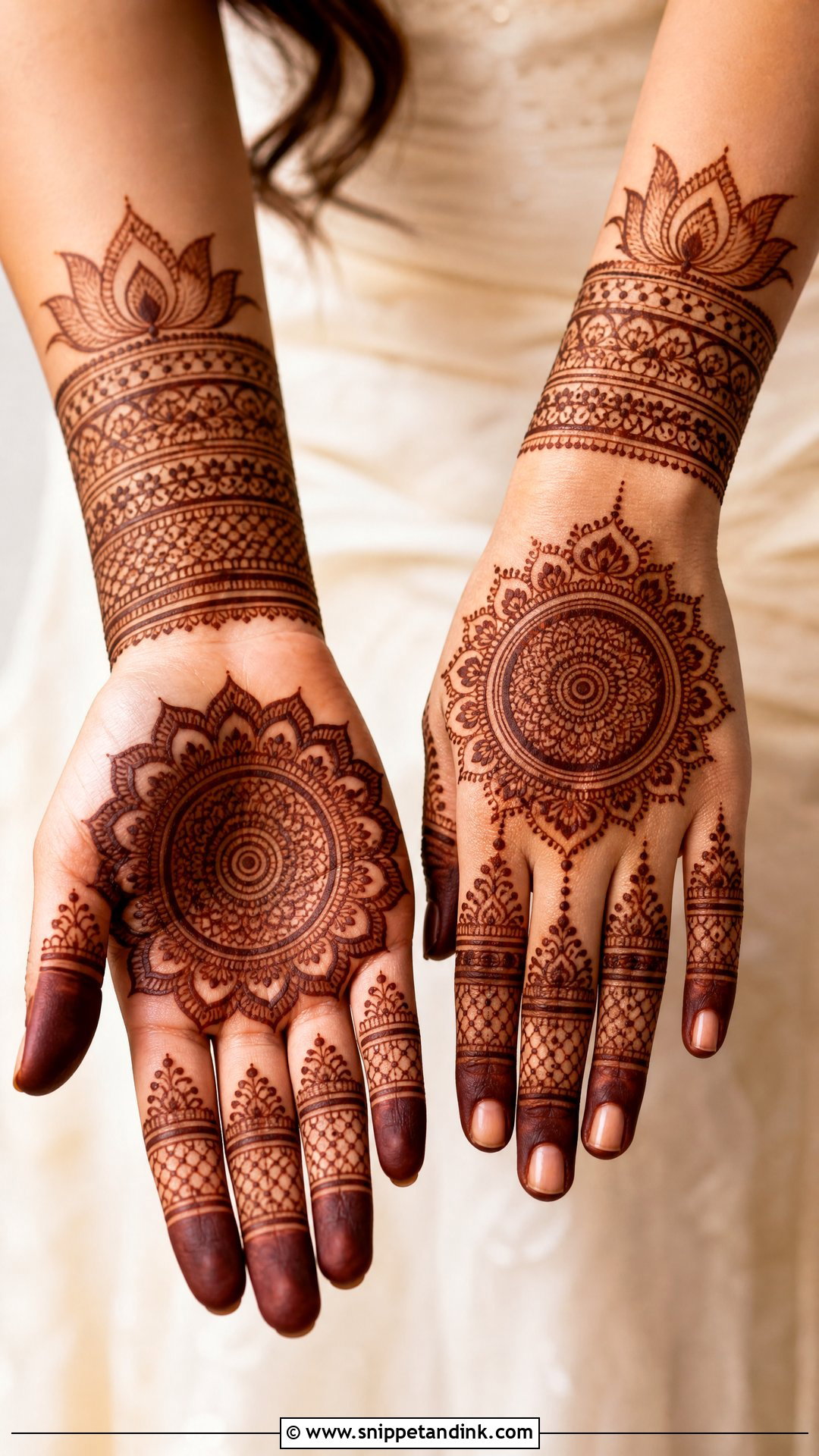
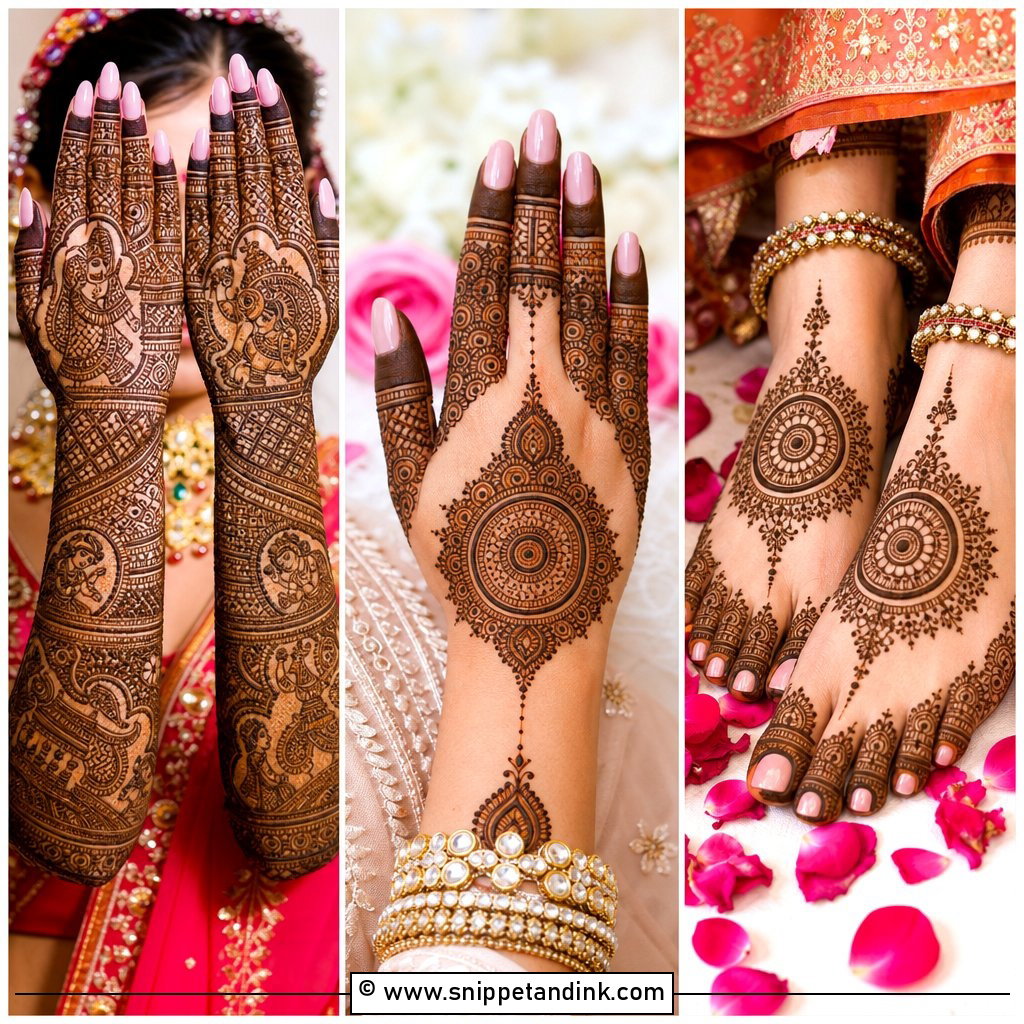
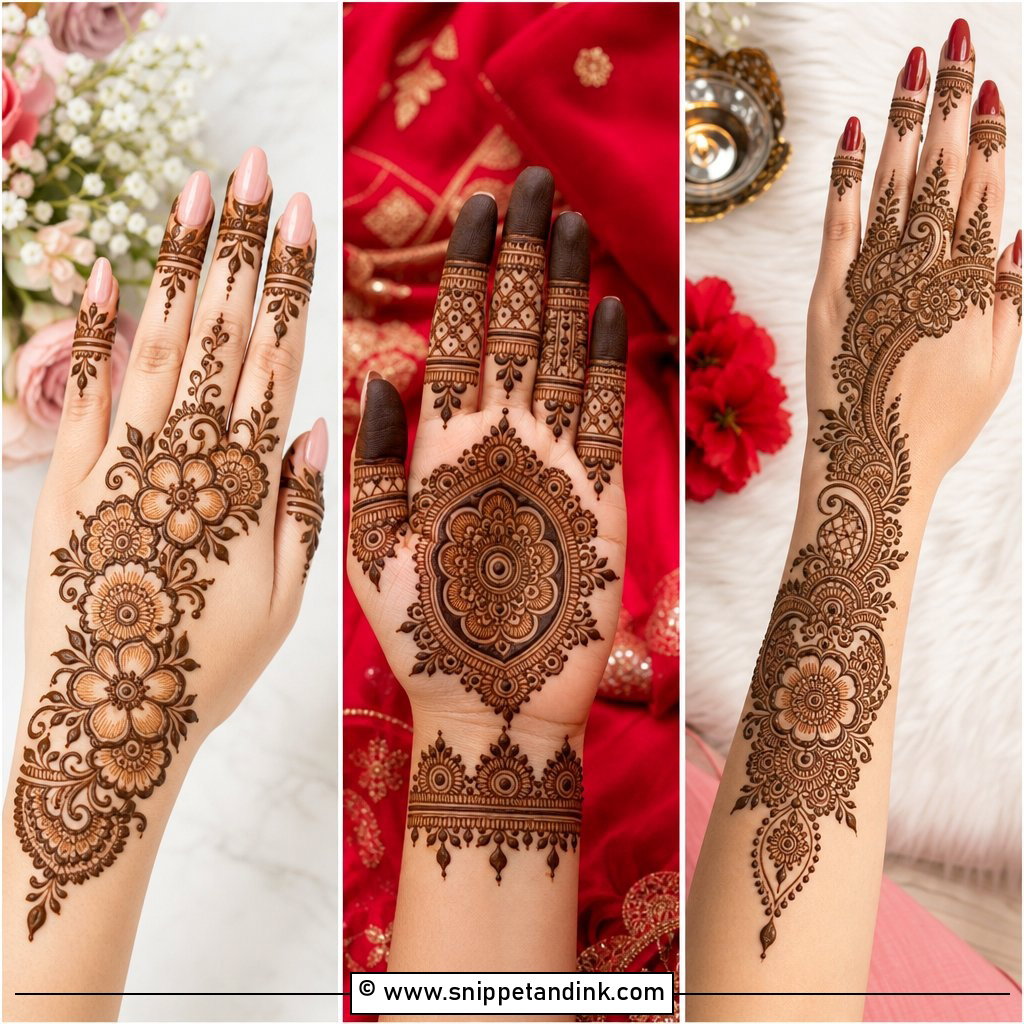
A bridal mandala starts as a circle in the center of the palm, then grows outward in rings of petals, dots, leaves and fine lines. On its own it can look too simple for a bride, so I connect it to heavy fingertips, wrist cuffs, side paisleys and forearm extensions. The result is orderly and calm. The palm center is also where henna stains darkest, which gives a mandala a strong, clear focal point. On the back of the hand, a mandala sits well above the knuckles. Leave a little negative space around the outer ring so the circle doesn’t merge into the fillers.
7. Lotus Bridal Mehndi Design
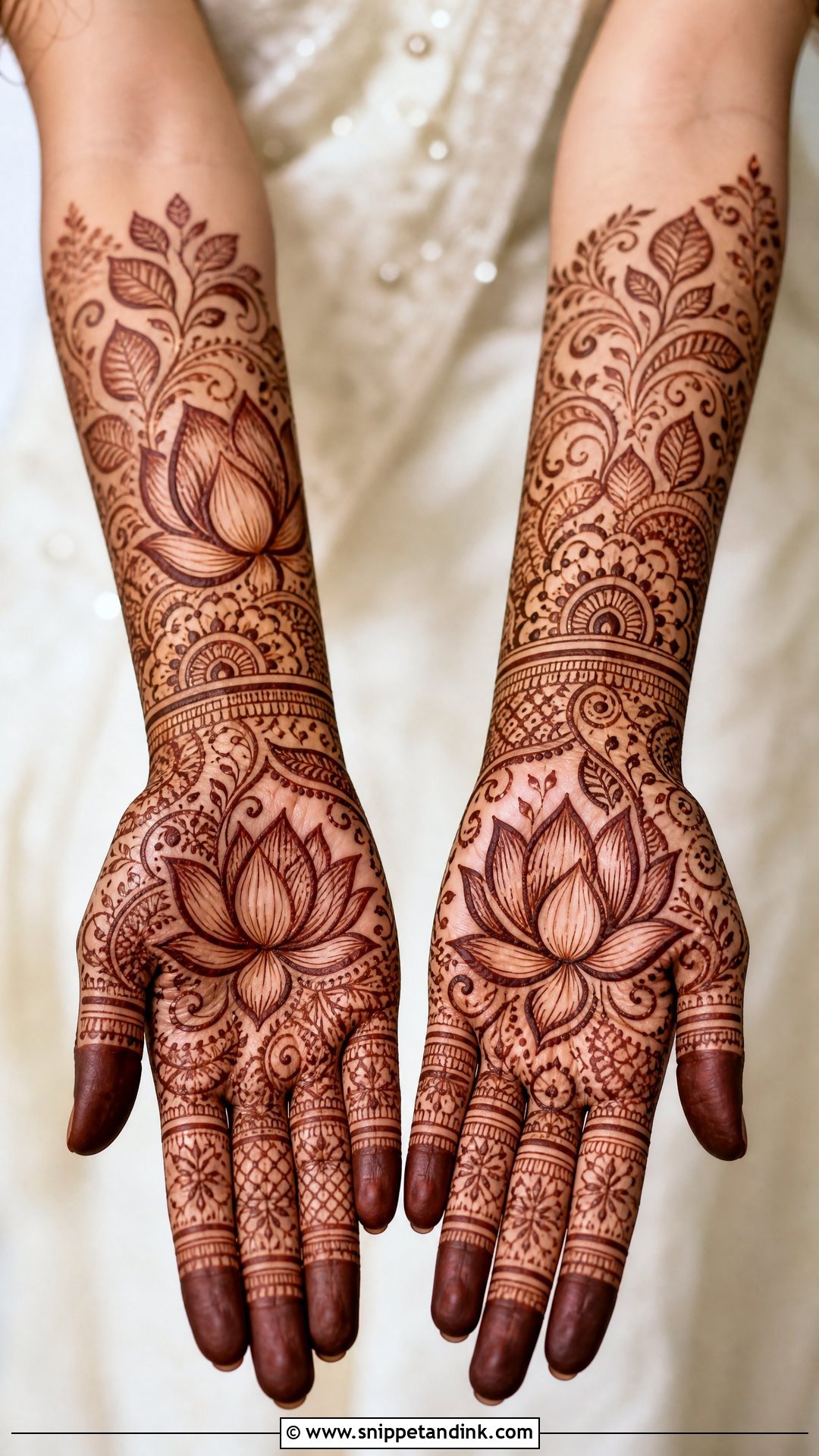
Lotus motifs suit both small and large hands, because the petals can be drawn wide or narrow. I place them on the palm, wrist or forearm with leaves, vines, dots and paisley fillers around them, using large blooms at the palm, small ones on the fingers and layered petal bands near the wrist. It pairs well with pastel, ivory, pink, peach and traditional red outfits. The one mistake I avoid is filling the petals solid: the lotus loses its shape against dense detail. A bold outline and fine inner veins keep it readable.
8. Jaali Bridal Mehndi Design
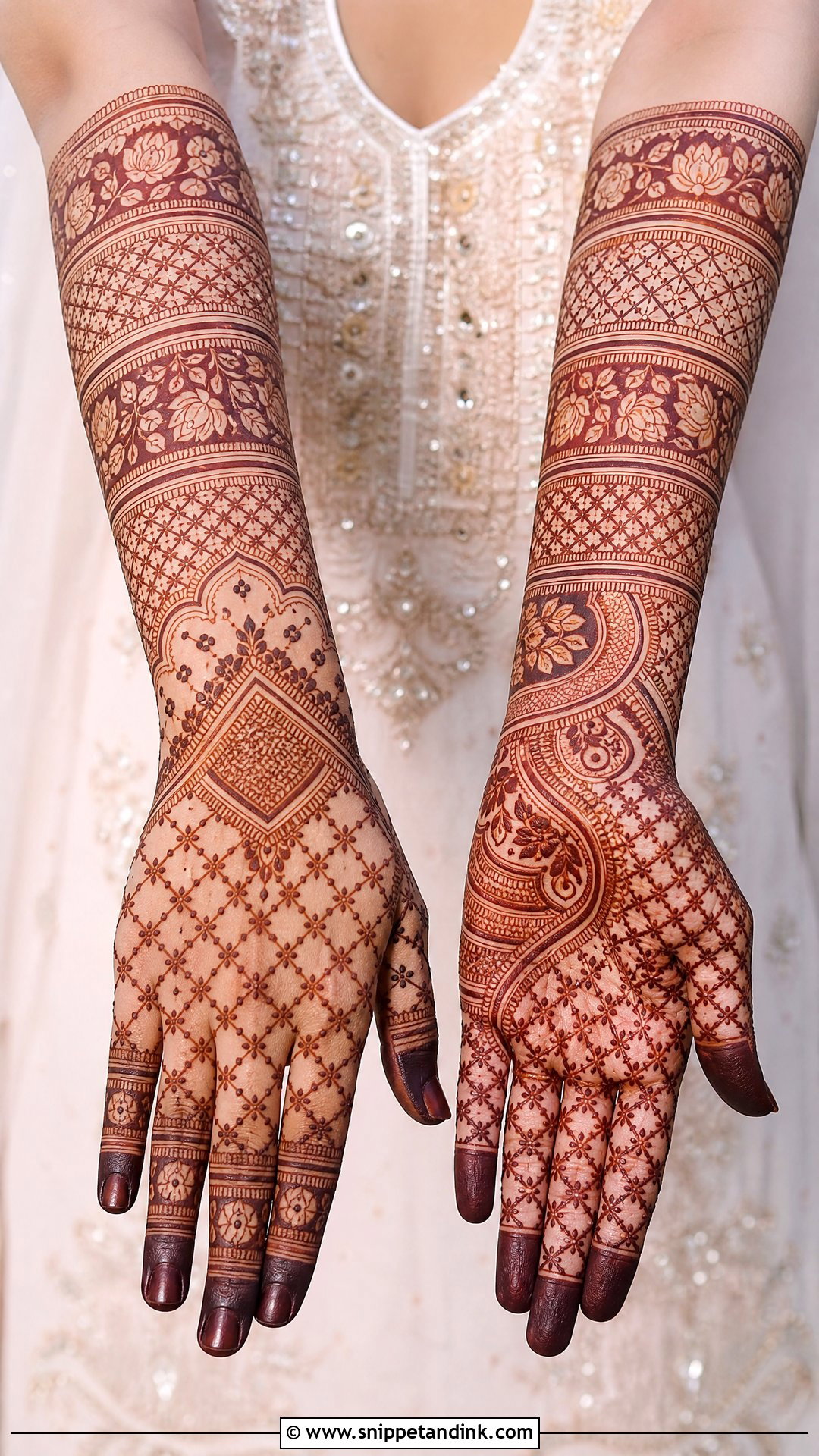
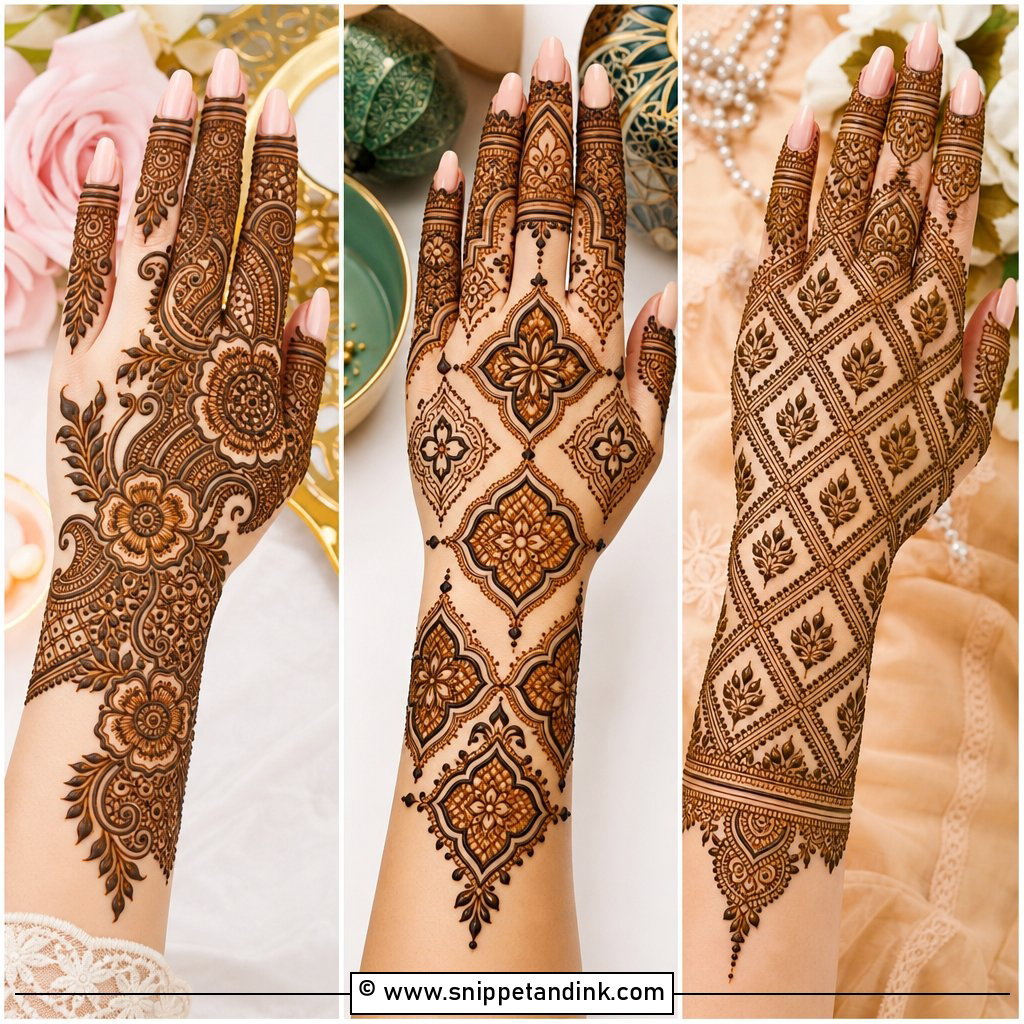
Jaali bridal mehndi design uses mesh, lattice and net-like panels across the palms, back hands, fingers and forearms. The grid can be simple diamonds, curved lines or intricate panels with dots and tiny florals, and it gives the hand a jewelry-like look next to bracelet bands and finger rings. In bridal work, jaali isn’t left sparse; it’s combined with paisleys, mandalas, peacocks and floral borders. Long vertical jaali panels make the hand look longer, which is why I use them on back hands when a bride asks for slimmer-looking hands in ring photos. The lines must be evenly spaced, or the grid looks wobbly once it stains.
9. Elephant Bridal Mehndi Design
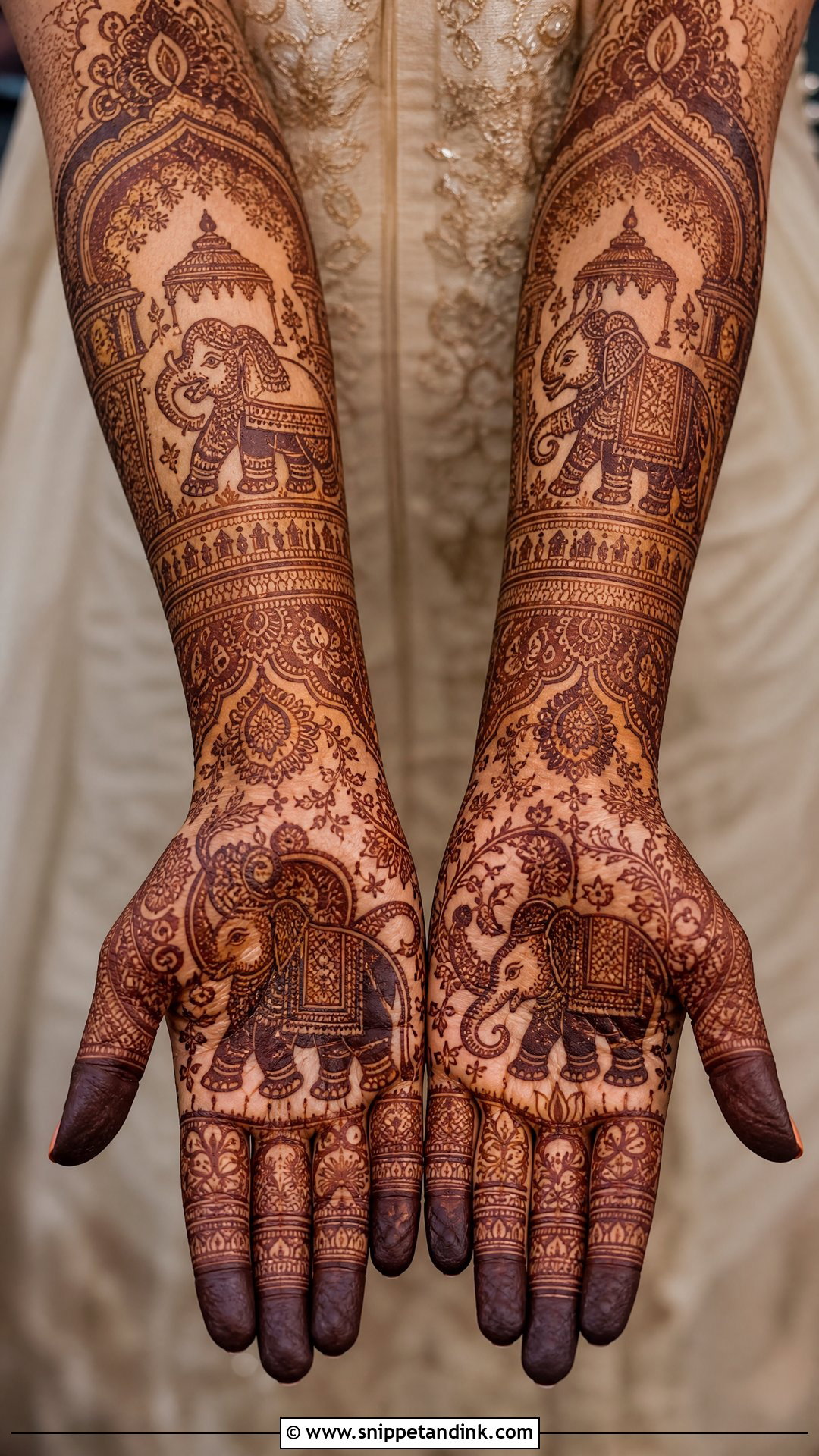
Elephants bring a royal procession feeling, often drawn on the forearms, wrists or lower palms and dressed in decorative blankets and bells. They suit Rajasthani and royal themes and give symbolism without portraits. An elephant needs space, so I outline it first and surround it with lighter fillers before any dense border goes on. Peacocks, lotus, paisleys and palace arches complete it. I like one elephant on each forearm facing inward, toward each other, so the two arms read as a pair when she holds her hands together.
10. Kalash Bridal Mehndi Design
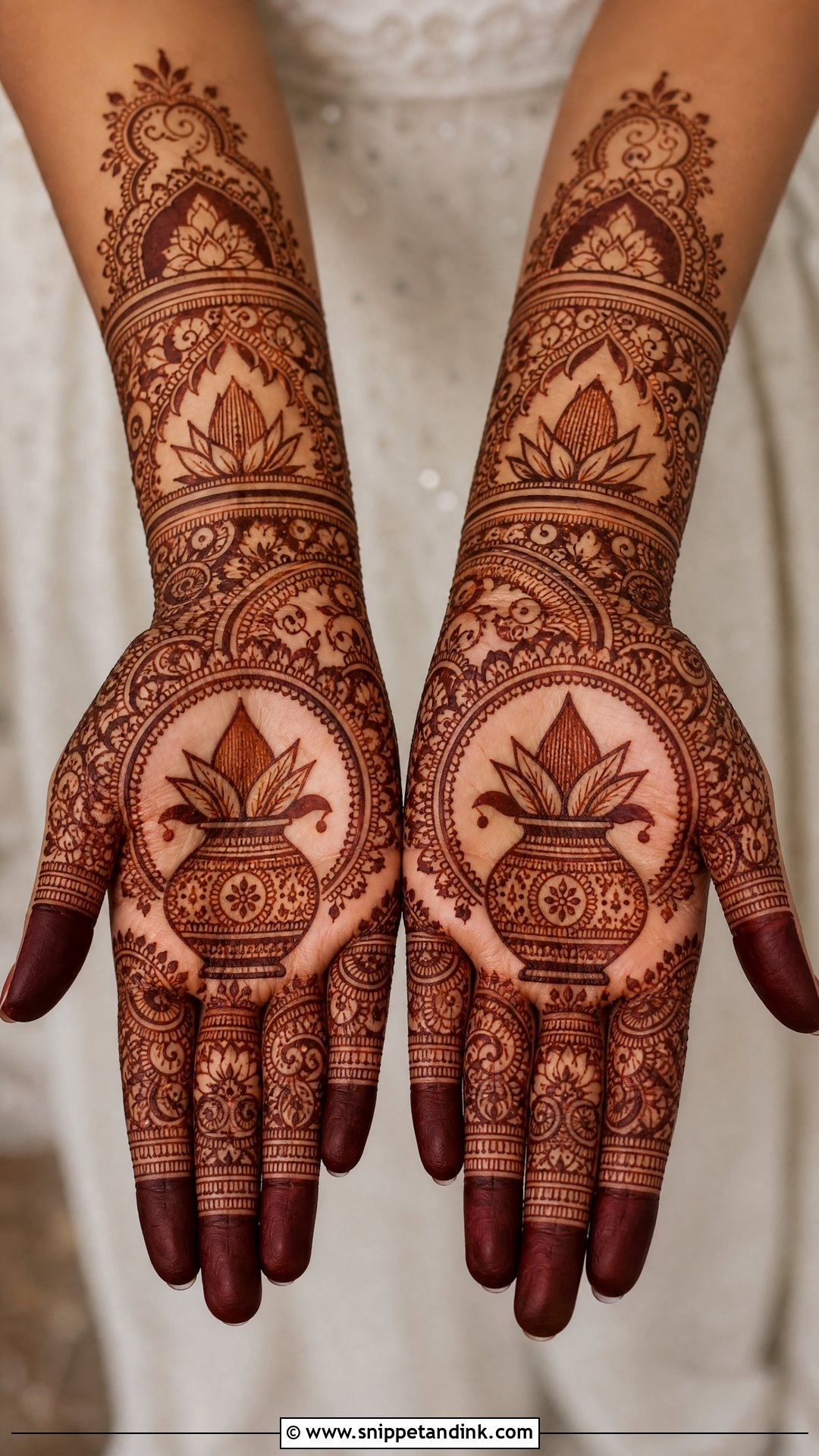
The kalash, the sacred pot with mango leaves and a coconut, is an auspicious symbol, and brides who want their mehndi tied to the rituals often ask for it. I draw it on the palm, near the wrist or inside a forearm panel, framed by floral borders and fine decorative lines. Mandalas, paisleys, lotus and detailed fingertips round it out. The kalash needs room to be recognized; squeezed between other motifs it can look like just another shape. I usually give it the center of one palm.
11. Marwari Bridal Mehndi Design
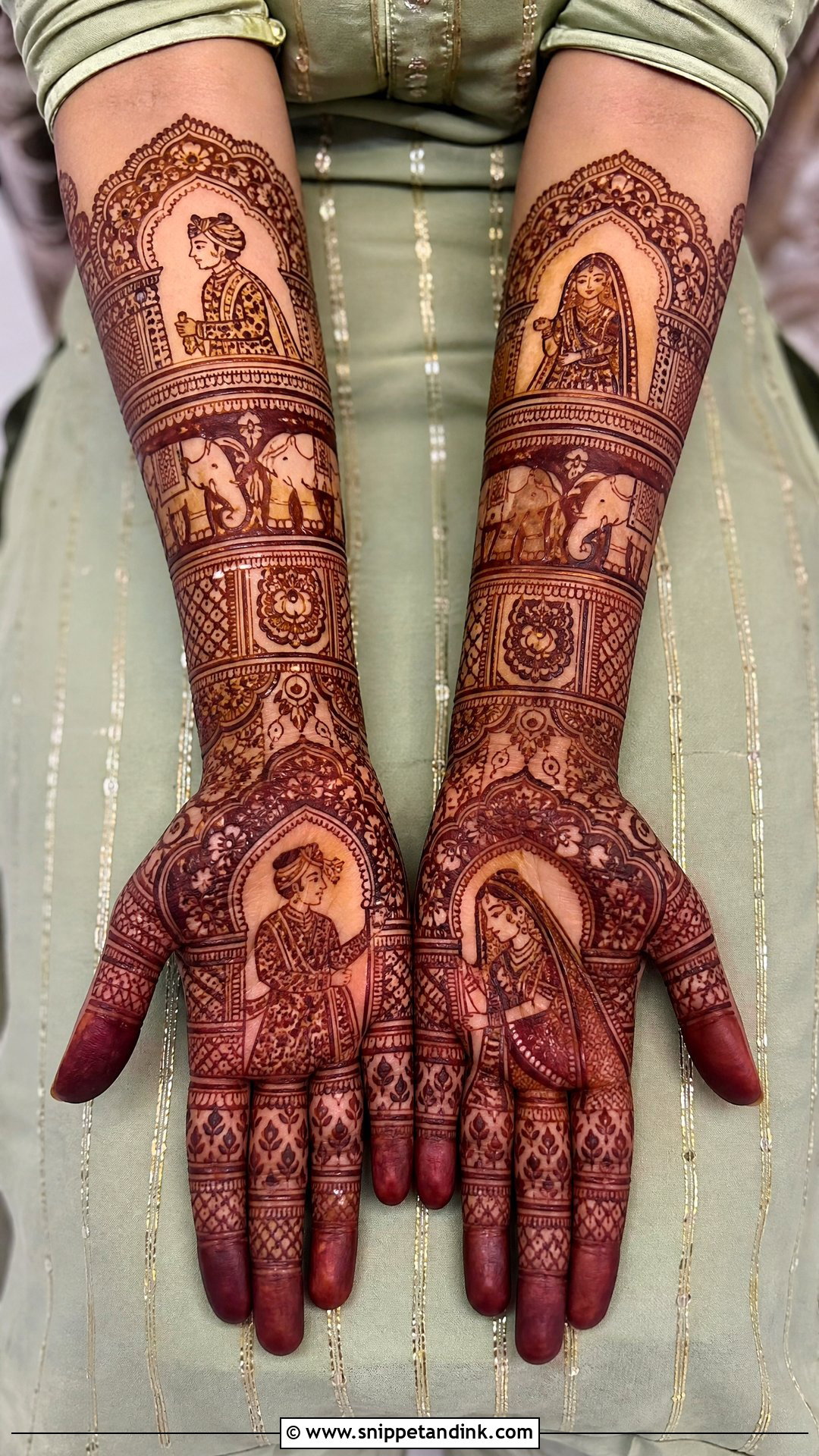
Marwari mehndi is dense, finely detailed and full of figures: bride and groom, peacocks, elephants, the doli and decorative arches, with very little bare skin. That density gives a rich stain once the paste comes off. It takes the longest to apply of any style here, so it suits brides who enjoy heavy mehndi and can sit for it. Lehengas, heavy bangles, borla and matha patti suit it. Even in a full design, I keep a hairline of space between major motifs so each one stays visible after the color deepens.
12. Gujarati Bridal Mehndi Design
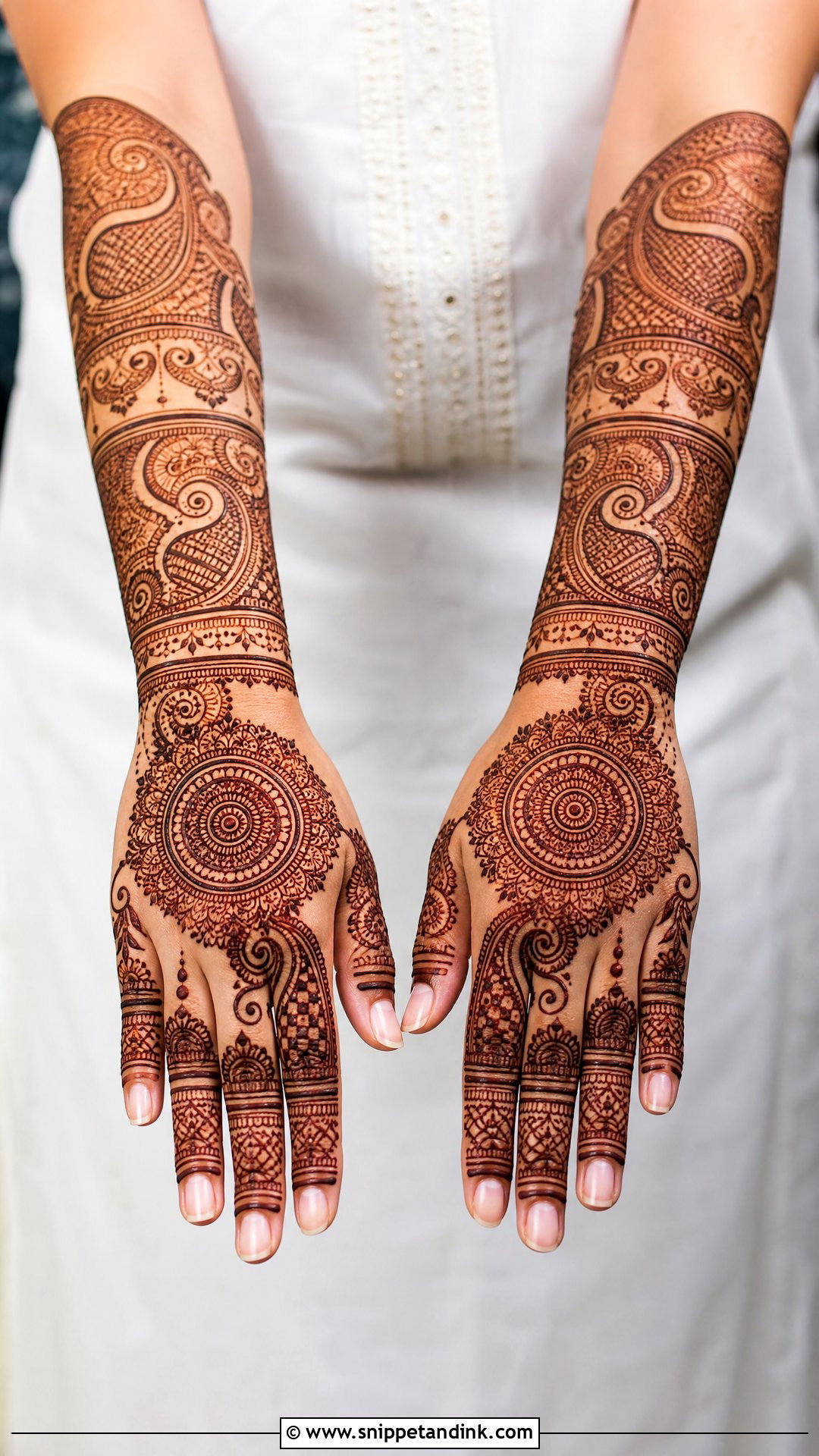
Gujarati bridal mehndi blends mandalas, paisleys, peacocks and checkered details into a full or medium-heavy layout, often with a circular palm center, detailed fingertips, wrist bands and symmetrical forearms. Some brides ask for initials hidden inside. It suits garba nights and close-up wedding photos, and it pairs naturally with mirror work, bandhani, patola and bright colors. I keep the back hand a little lighter and more jewelry-like, so it doesn’t fight with bangles and rings.
13. Punjabi Bridal Mehndi Design
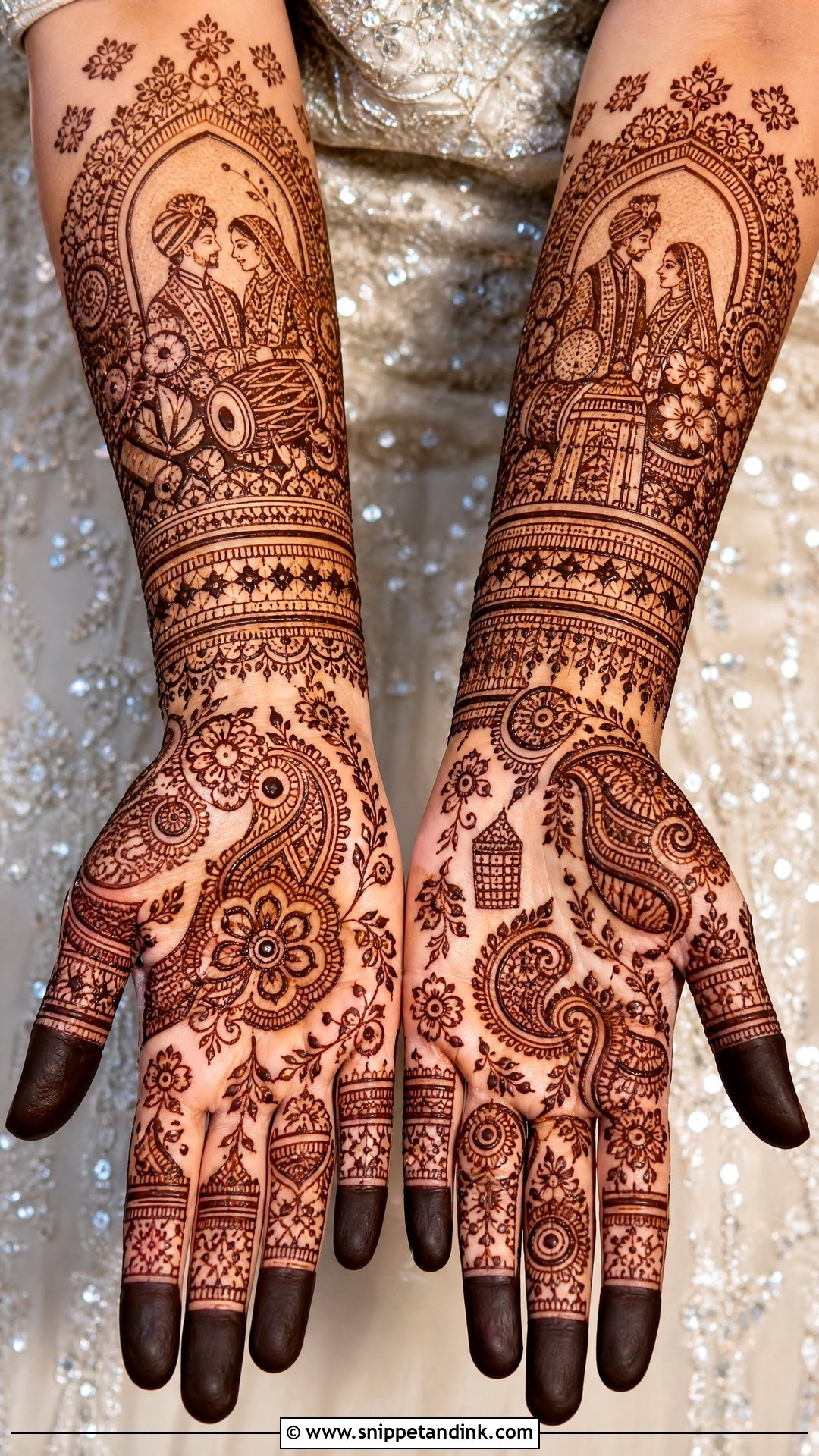
Punjabi bridal mehndi is bold and festive: full palms, heavy fingers, floral vines, paisleys, couple details, dhol motifs and bracelet-style wrists. It’s intricate, but it has a lively flow. It’s usually seen alongside bright lehengas, phulkari details, chooda, kaleere and statement rings. I take it to the mid-forearm and fill the fingertips completely, because deep red-brown tips against a red chooda is the look most Punjabi brides have in mind. One practical note: the chooda covers the wrist for weeks, so the design under it matters less than what shows above and below it.
14. South Indian Bridal Mehndi Design
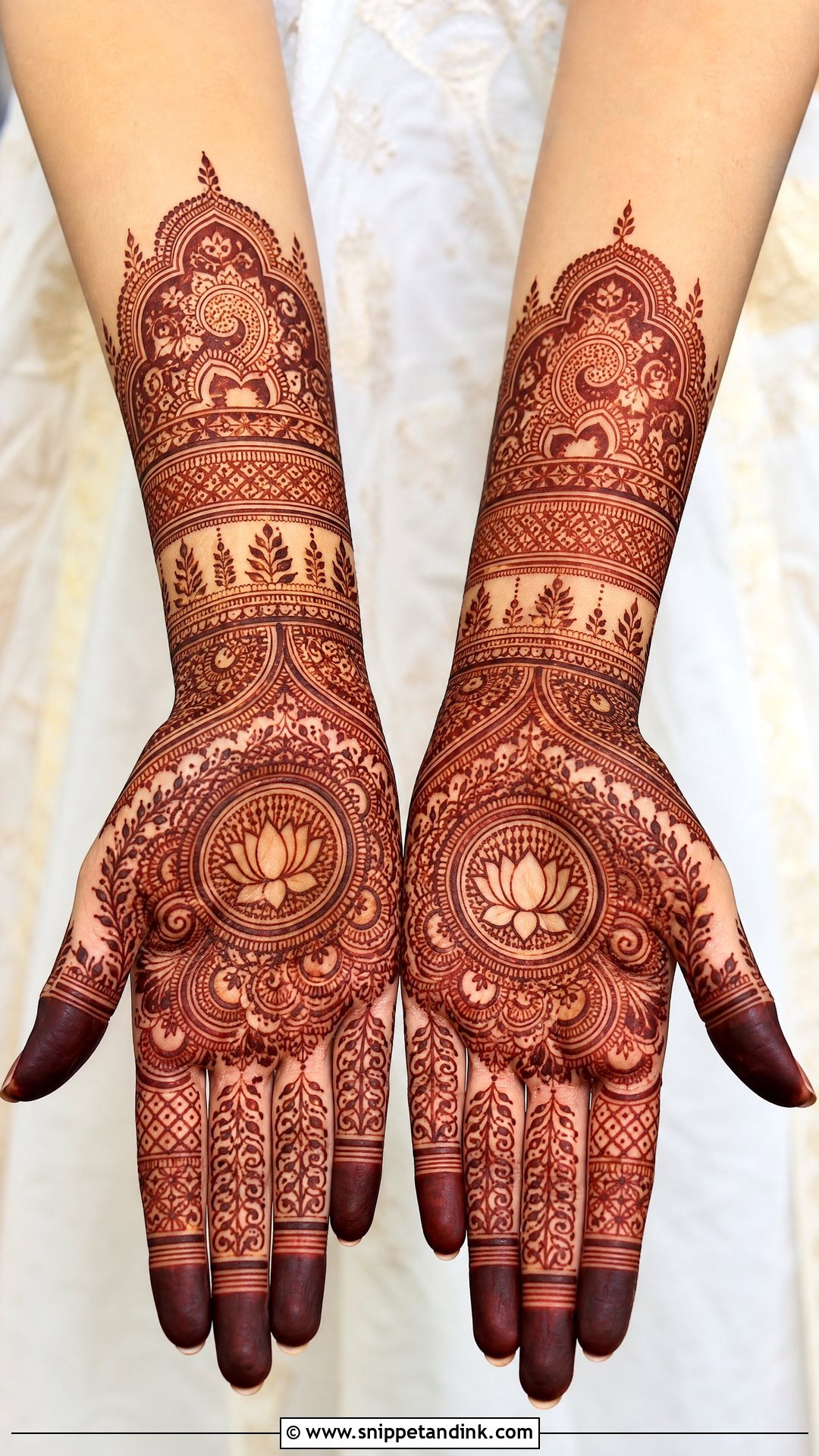
Traditionally, many South Indian brides put the emphasis on jewelry, flowers and silk sarees, but bridal mehndi has become a common part of the look. The South Indian style I draw leans elegant and symmetrical: lotus motifs, temple borders, mango patterns, mandalas, leafy vines and ornamental wrist bands. It sits well with Kanjivaram sarees, gold temple jewelry and jasmine in the hair. Coverage can be full or medium-heavy. Neat mango motifs and lotus elements suit it better than modern empty spaces.
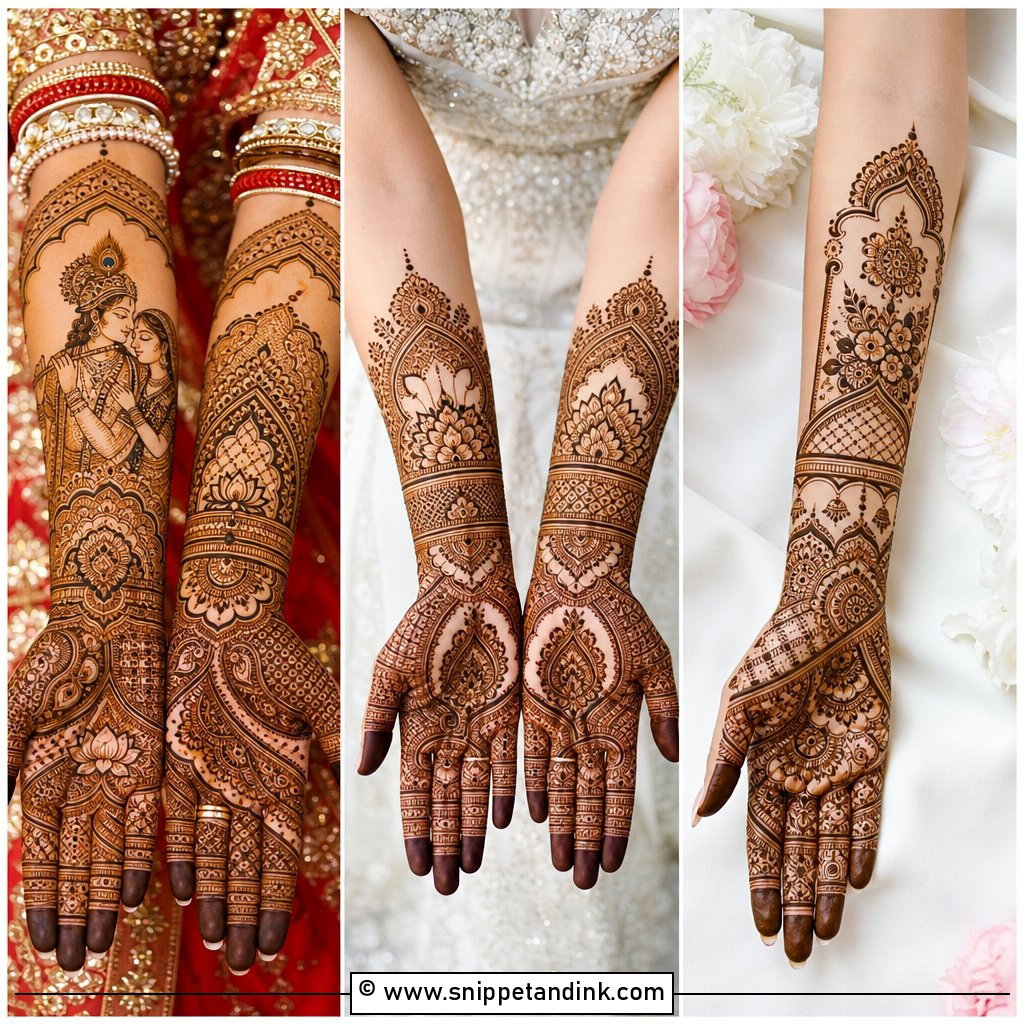
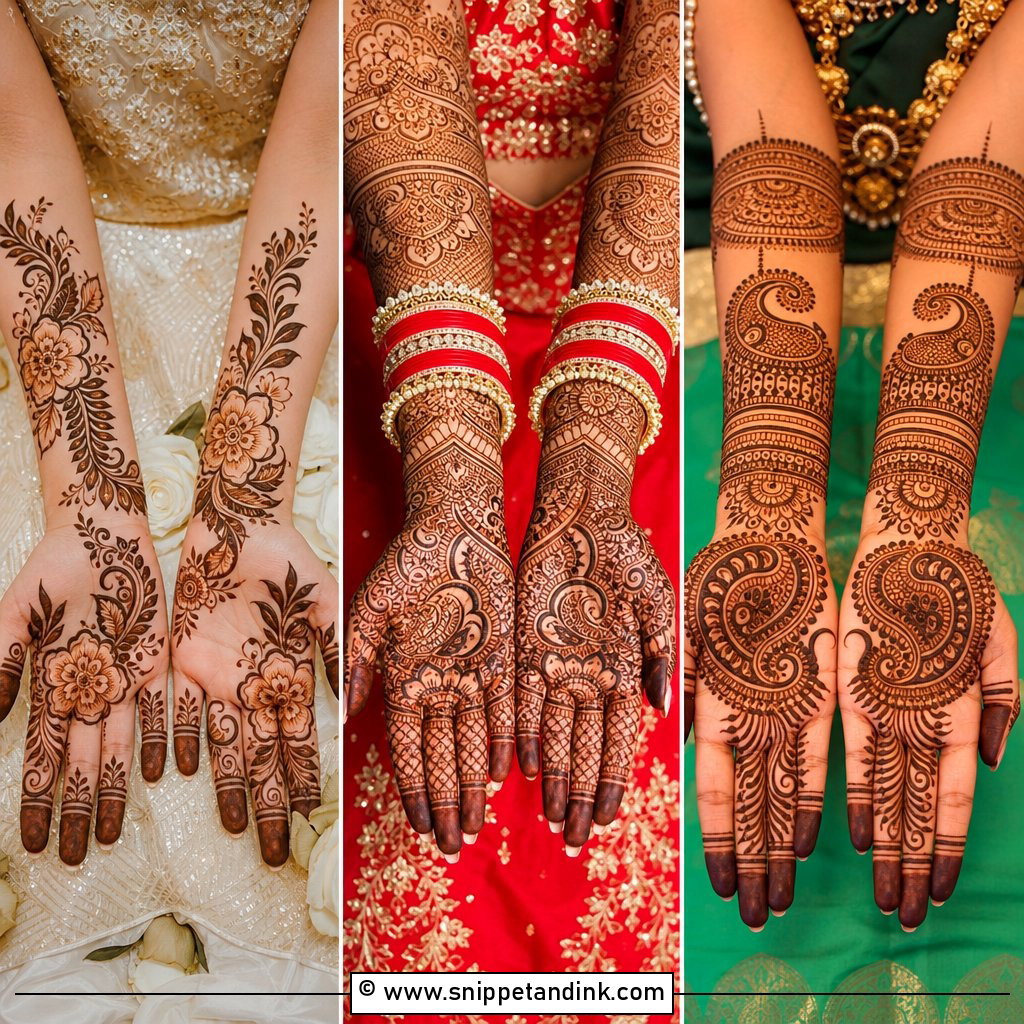
15. Mughal Bridal Mehndi Design
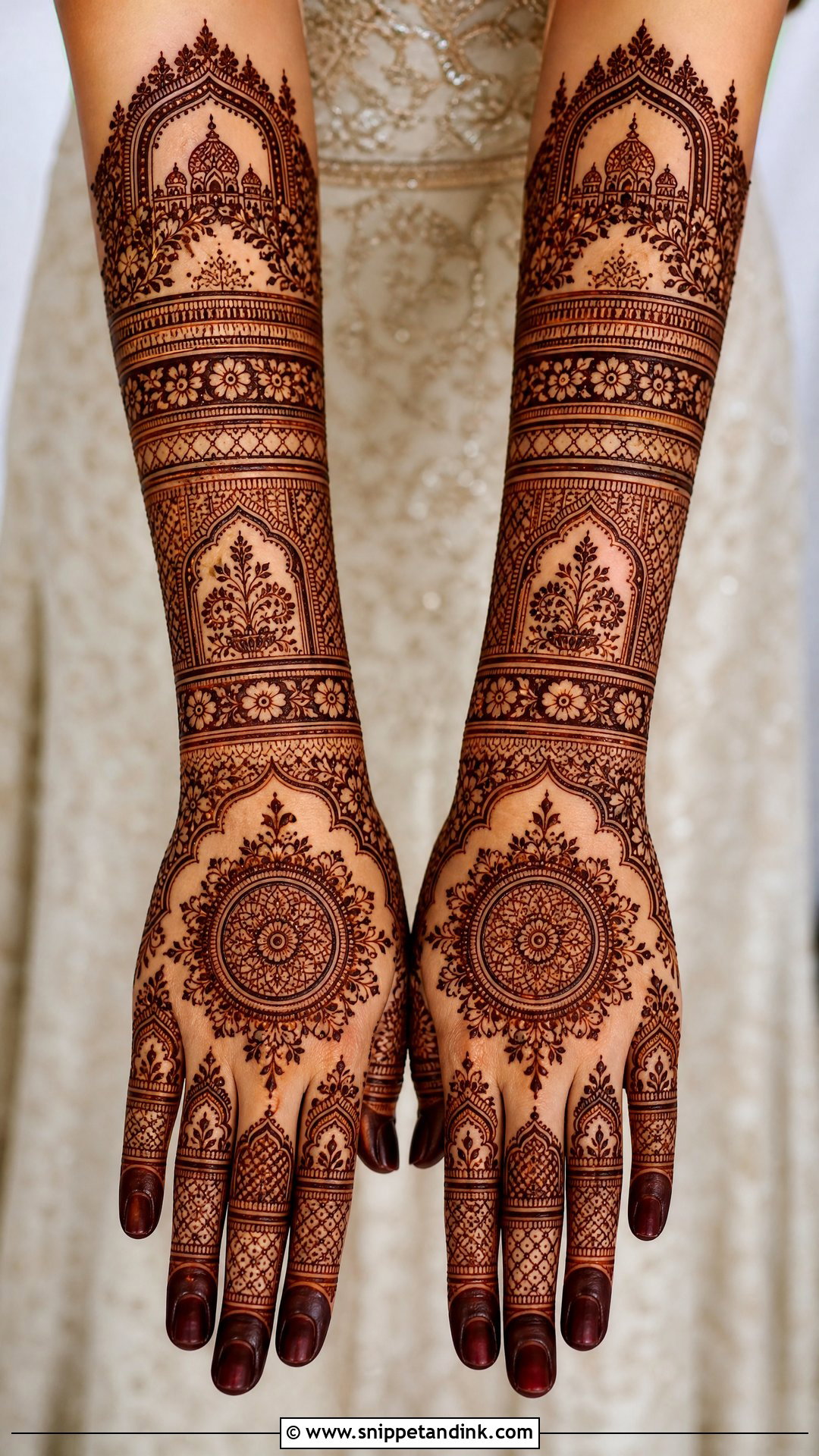
Mughal mehndi is built from arches, domes, floral vines, jaali panels and strict ornamental symmetry, so it feels regal without any figures. The palms take framed mandalas or floral medallions, while the wrists and forearms carry palace arches and net patterns. Velvet, zardozi, brocade, shararas and heavily embroidered lehengas suit it. This style depends on fine, even lines and careful spacing. Too many fillers hide the architecture, so I balance dense sections against clean outlines.
16. Doli Bridal Mehndi Design
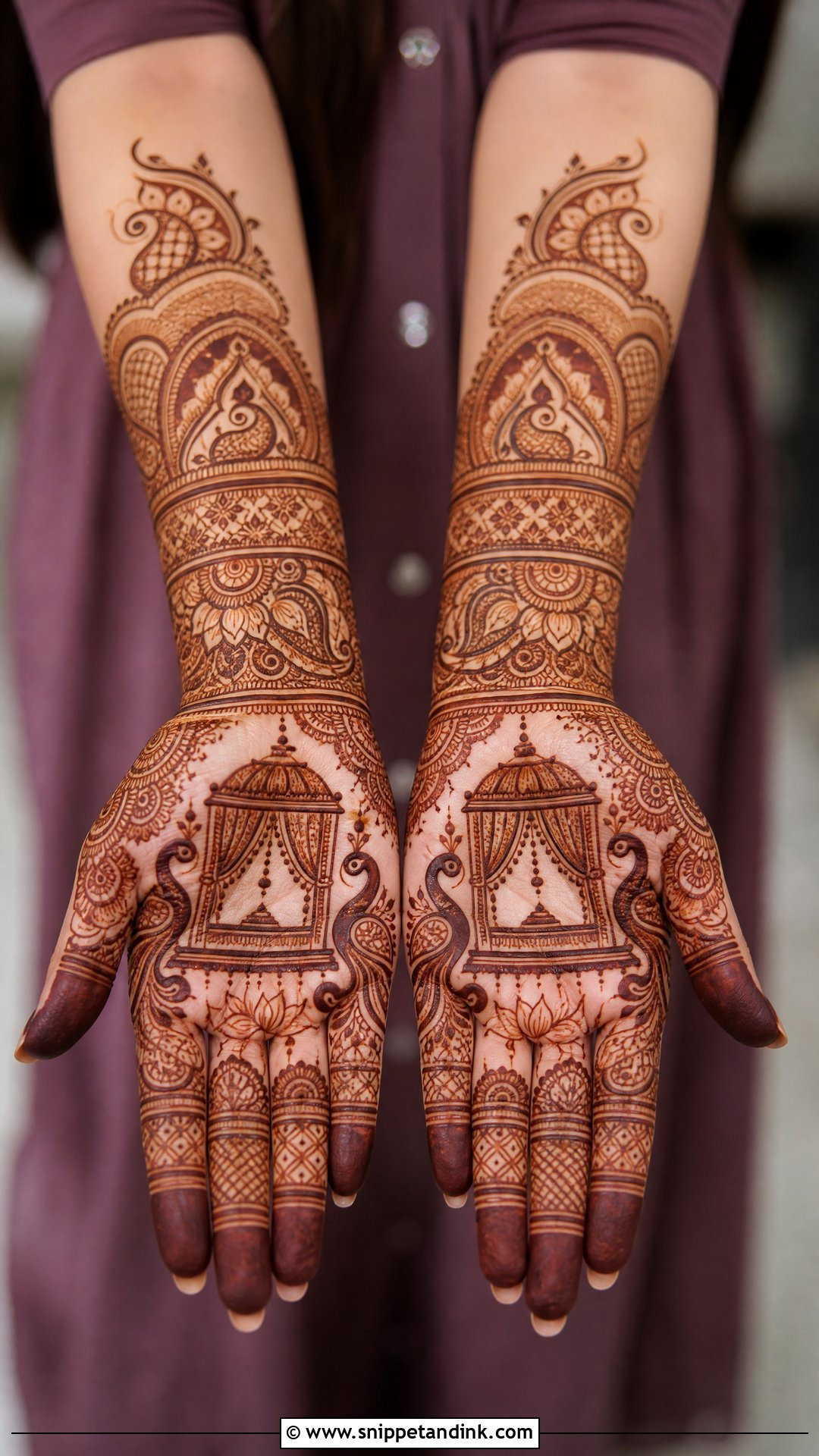
The doli represents the bride’s departure and journey into her new life, which is why it is such an emotional motif. It usually sits on the palm or forearm, surrounded by flowers, paisleys, peacocks, leaves and borders. Some brides put the doli on one hand and the baraat or the groom on the other, so the two hands tell the whole story. Give the doli a clear central space. Its fine curtains, hanging tassels and tiny floral accents are what make it read as a palanquin rather than a box.
17. Baraat Bridal Mehndi Design
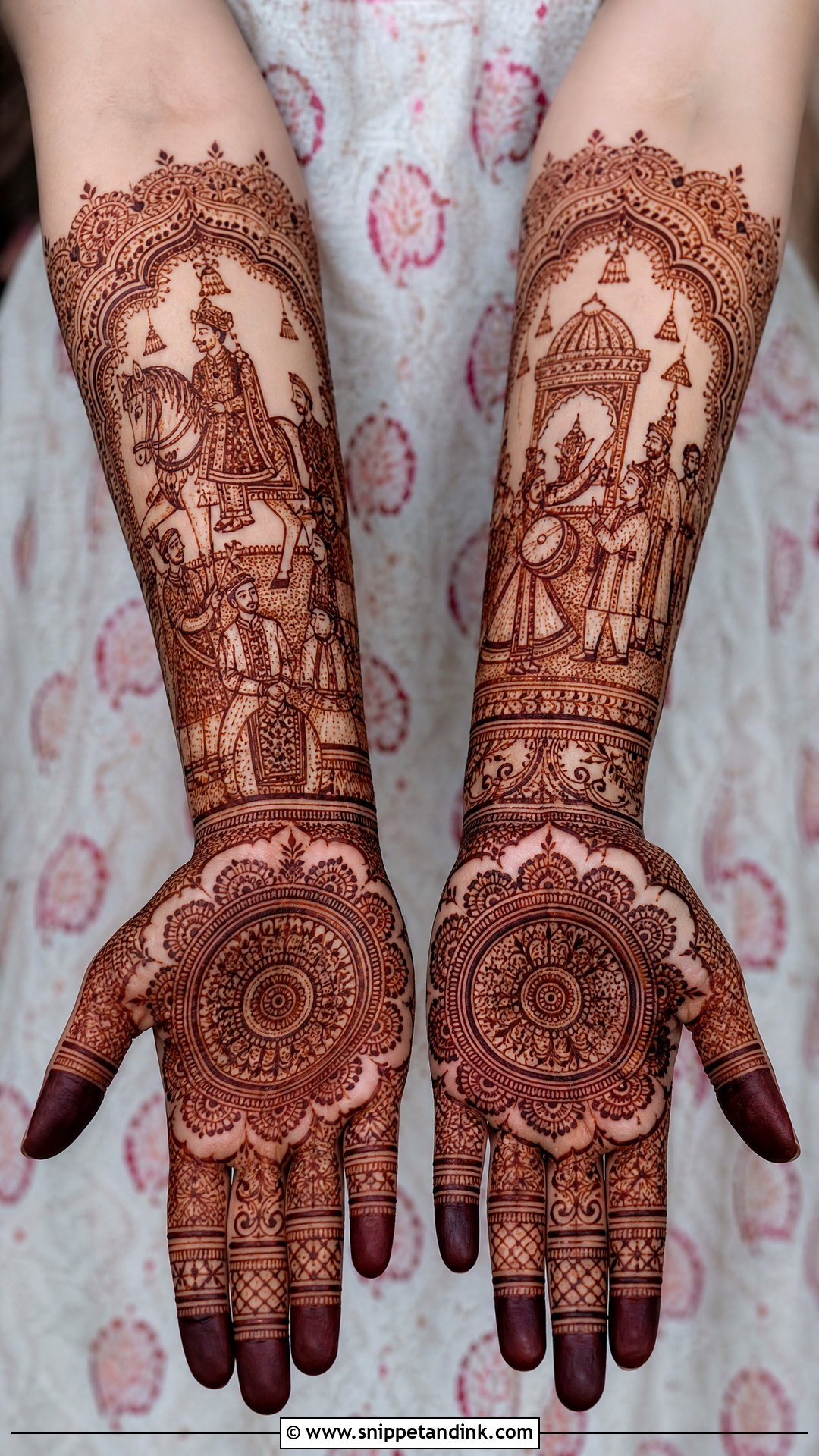
A baraat design turns the forearm into a procession: the groom on horseback, musicians, dhol players, elephants and decorated arches. The figures are small, so this needs an artist with very steady line work; ask to see a previous baraat before booking. The forearm is the right place for it, since it offers the longest stretch of skin. I then give the palms mandalas, paisleys or the couple to complete the theme. Using the scene on one arm and complementary patterns on the other keeps it from looking crowded.
18. Bridal Mehndi Design With Groom Name
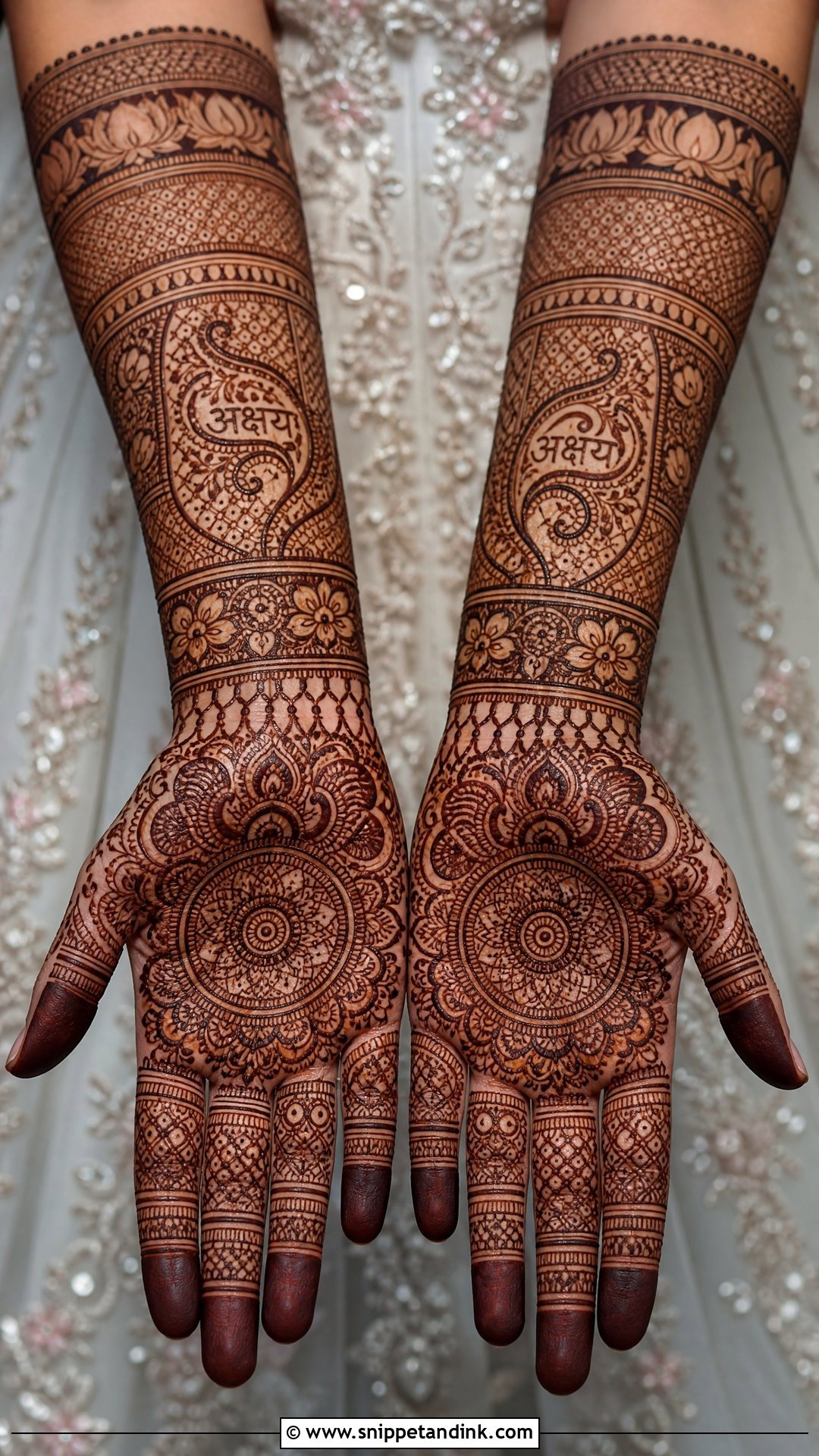
Hiding the groom’s name in the mehndi is a well-loved tradition, and the search for it after the wedding is part of the fun. I tuck the name or initials into paisleys, vines, mandalas, jaali or wrist bands, while the rest of the design stays fully traditional. The skill is hiding it so it blends into the lines yet is still readable when found. I usually write it in the script the couple will read most easily, and I tell the bride where it is, in case the search goes on too long.
19. Bridal Mehndi Design With Wedding Date
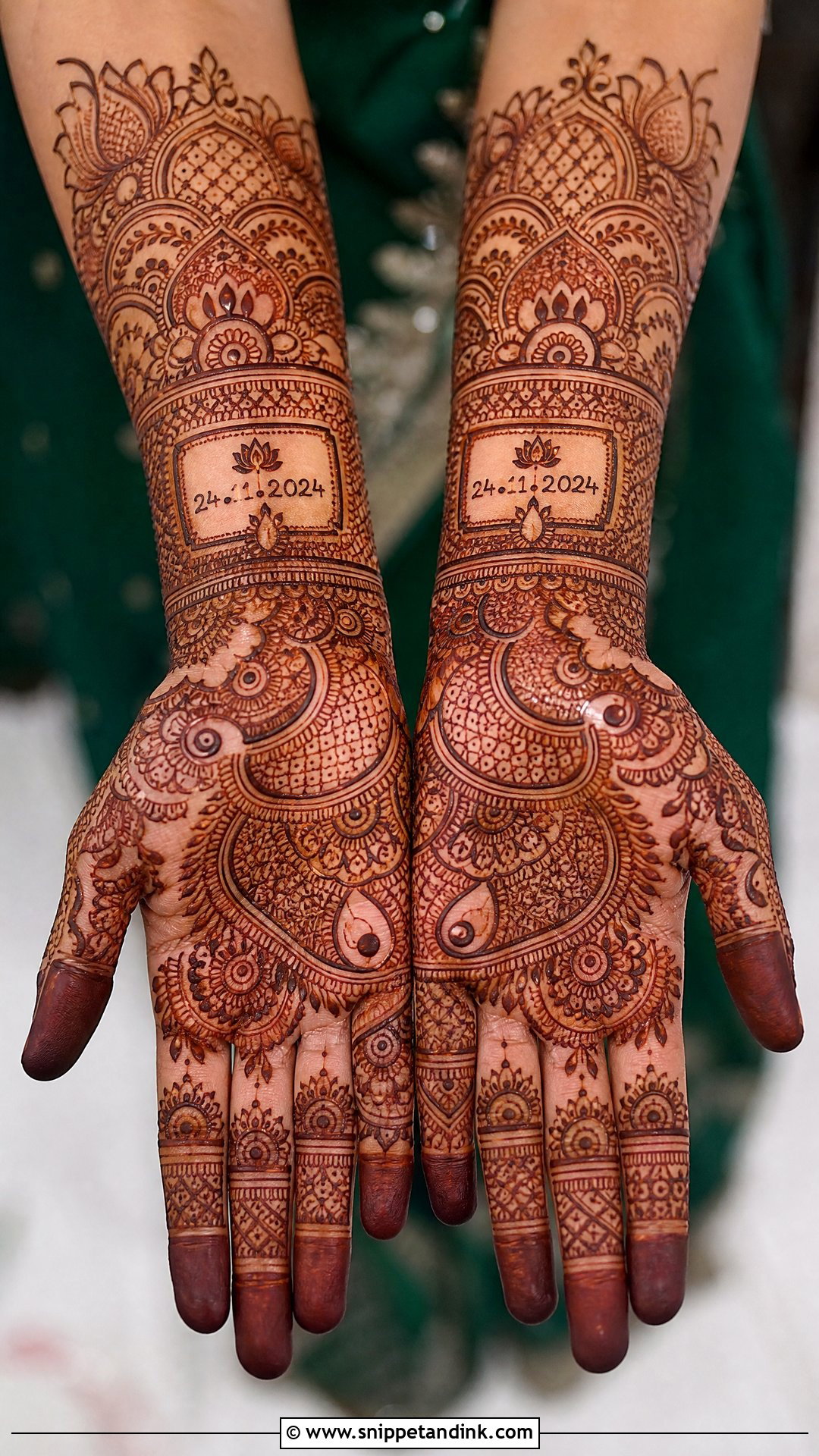
A wedding date turns the mehndi into a keepsake. I place it near the wrist, in a small frame, along a vine or inside a mandala border, surrounded by paisleys, peacocks, lotus and jaali. Small numbers look better than large ones, which overpower the design. Numerals are drawn in solid lines, and they’re easy to smudge, so I let the date set fully before working around it. A hidden placement looks more graceful than a bold one.
20. Bridal Mehndi Design With Love Story
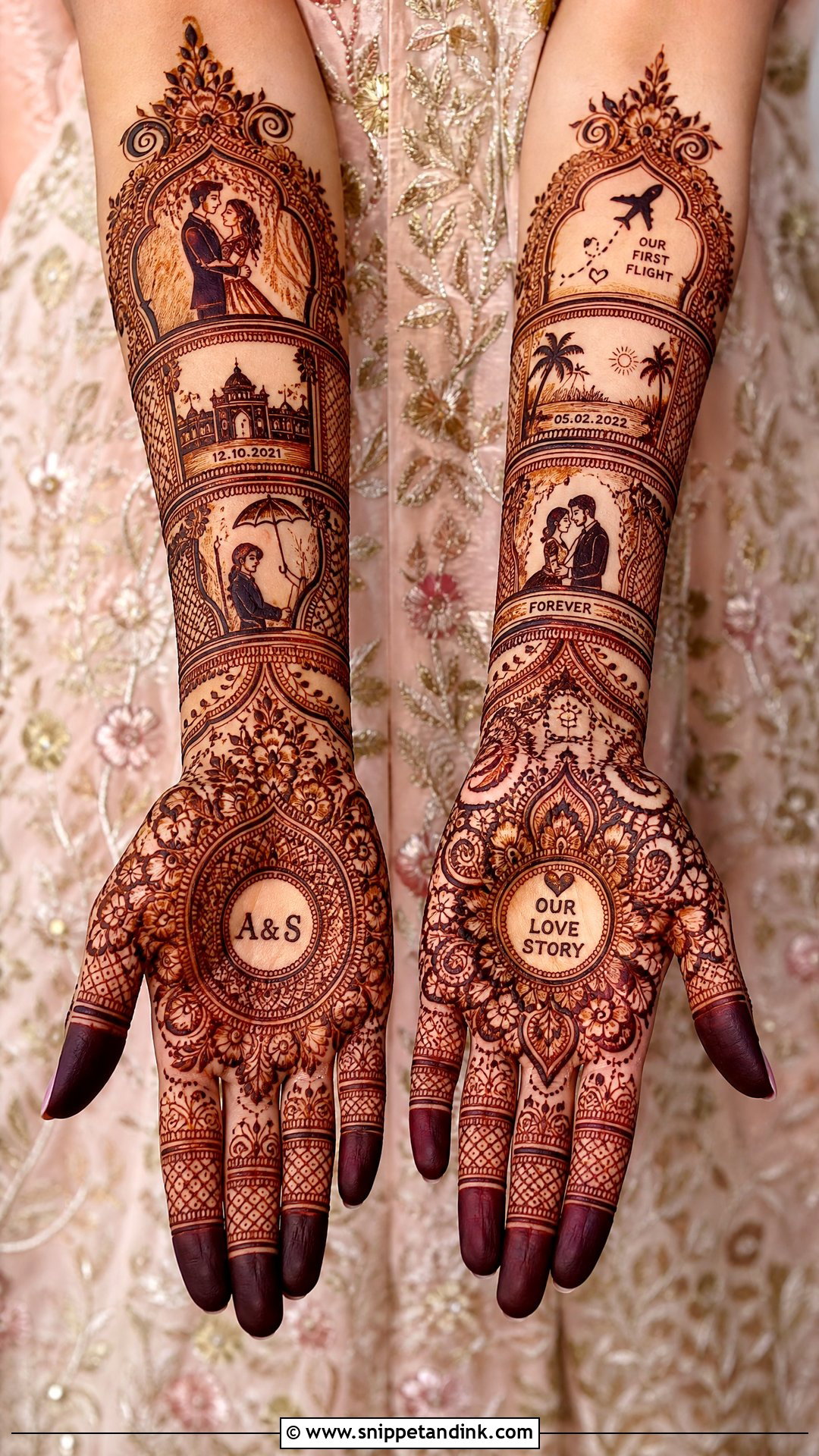
Love story mehndi adds small symbols from the couple’s own story: where they met, a favorite place, a proposal detail, a shared hobby, initials. I place them inside traditional frames, vines and paisley panels so the hands still look bridal. The risk is clutter. Two or three meaningful symbols are plenty; I encourage the bride to choose those before the appointment, because deciding in the chair adds time and the design suffers. The rest stays classic.
21. Bridal Mehndi Design For Small Hands
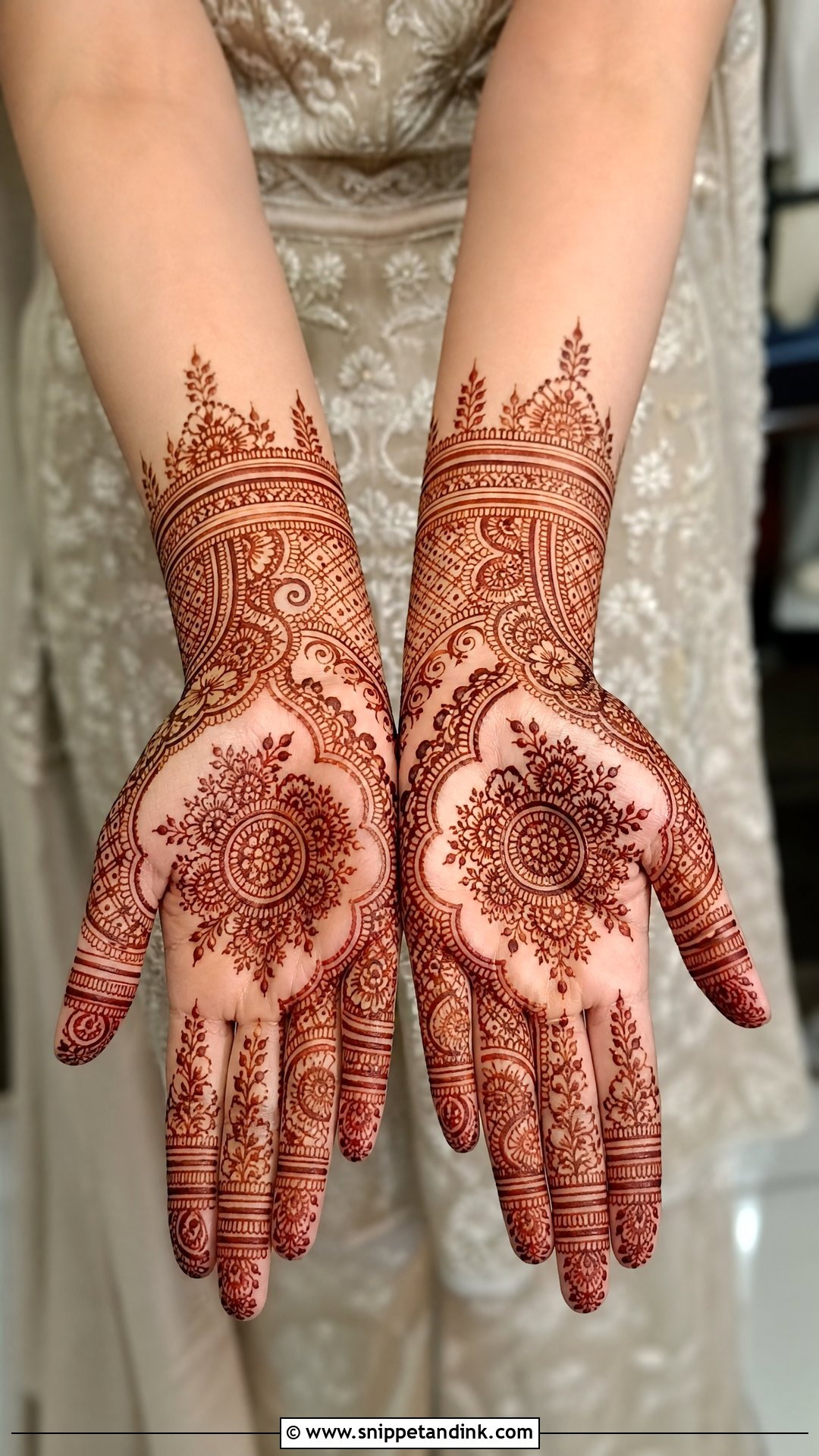
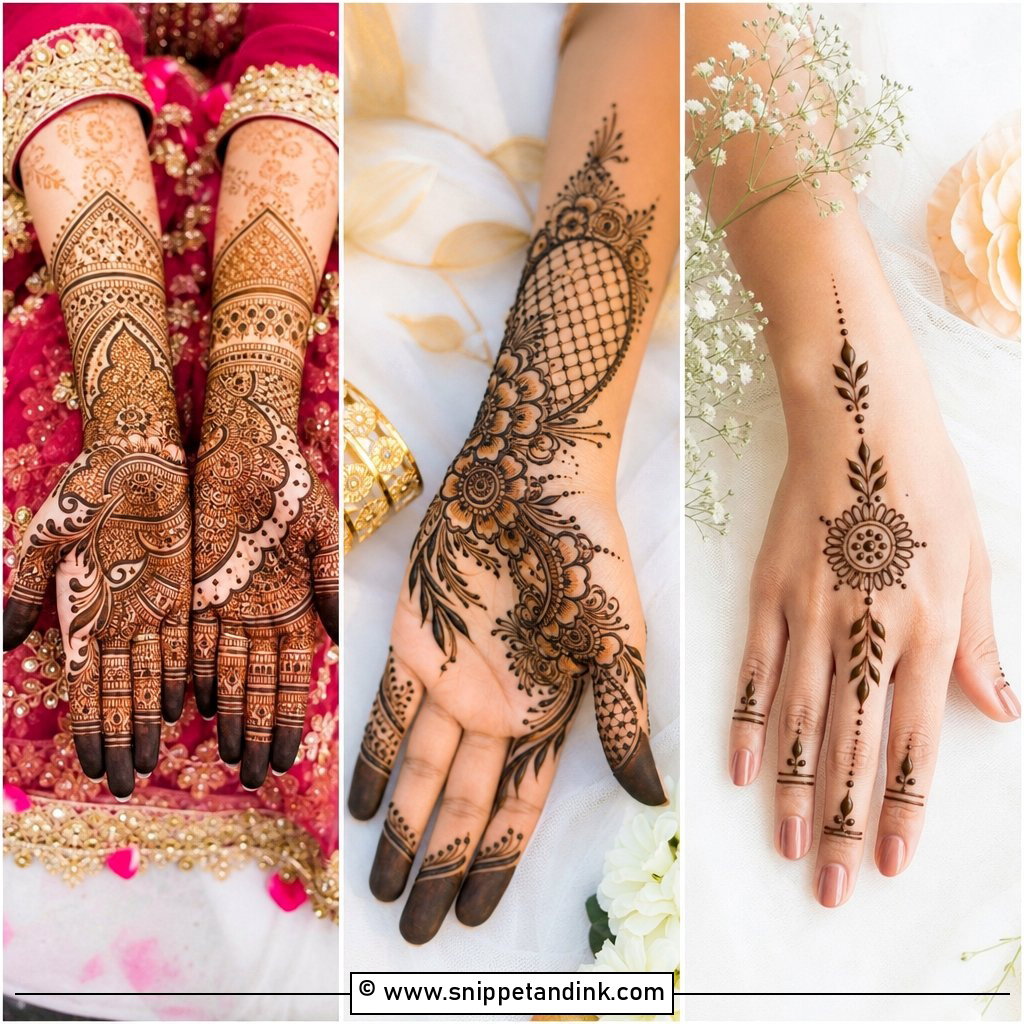
On small hands, the aim is detail without crowding. I use medium-sized motifs, slim paisleys, neat mandalas, narrow jaali and lighter wrist extensions, and I avoid big portraits and thick borders that swallow the shape of the hand. Vertical vines and long finger patterns make the hands look longer. One strong motif in the palm center, a mandala, a lotus or a compact couple frame, gives it a focus. Filled fingertips keep it bridal.
22. Bridal Mehndi Design For Long Fingers
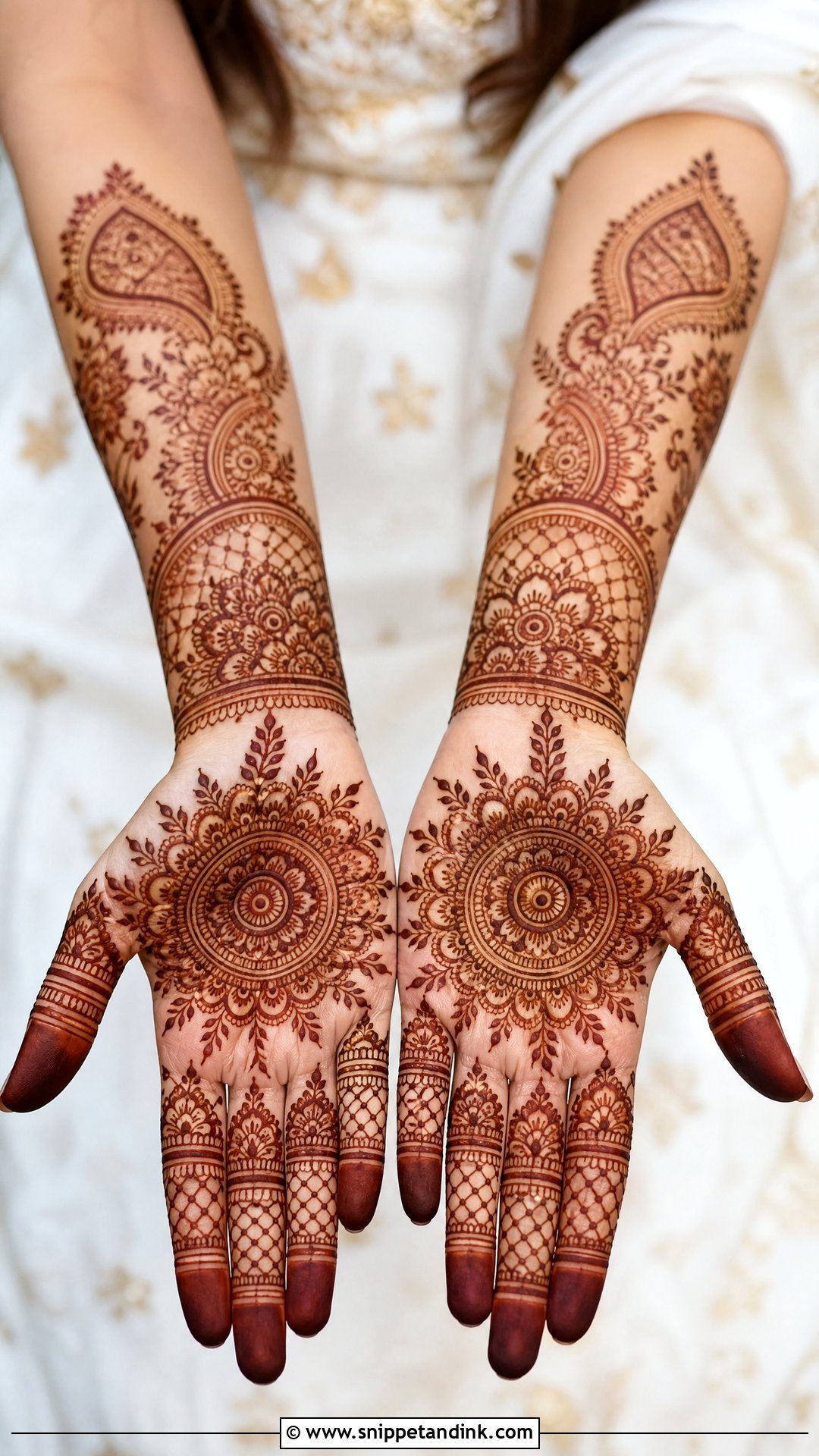
Long fingers give me room for bands, vines, grids and fingertip work. A bridal mehndi design for long fingers can stack ring patterns, leafy trails, fine jaali, mini paisleys and shaded florals, while the palm stays dense with mandalas, peacocks or couple motifs. I fill the knuckle area rather than leaving it blank, because gaps there look unfinished in close-ups. Wrist cuffs and forearm extensions balance the length. Ring ceremony photos are where this design shows best.
23. Back Hand Bridal Mehndi Design
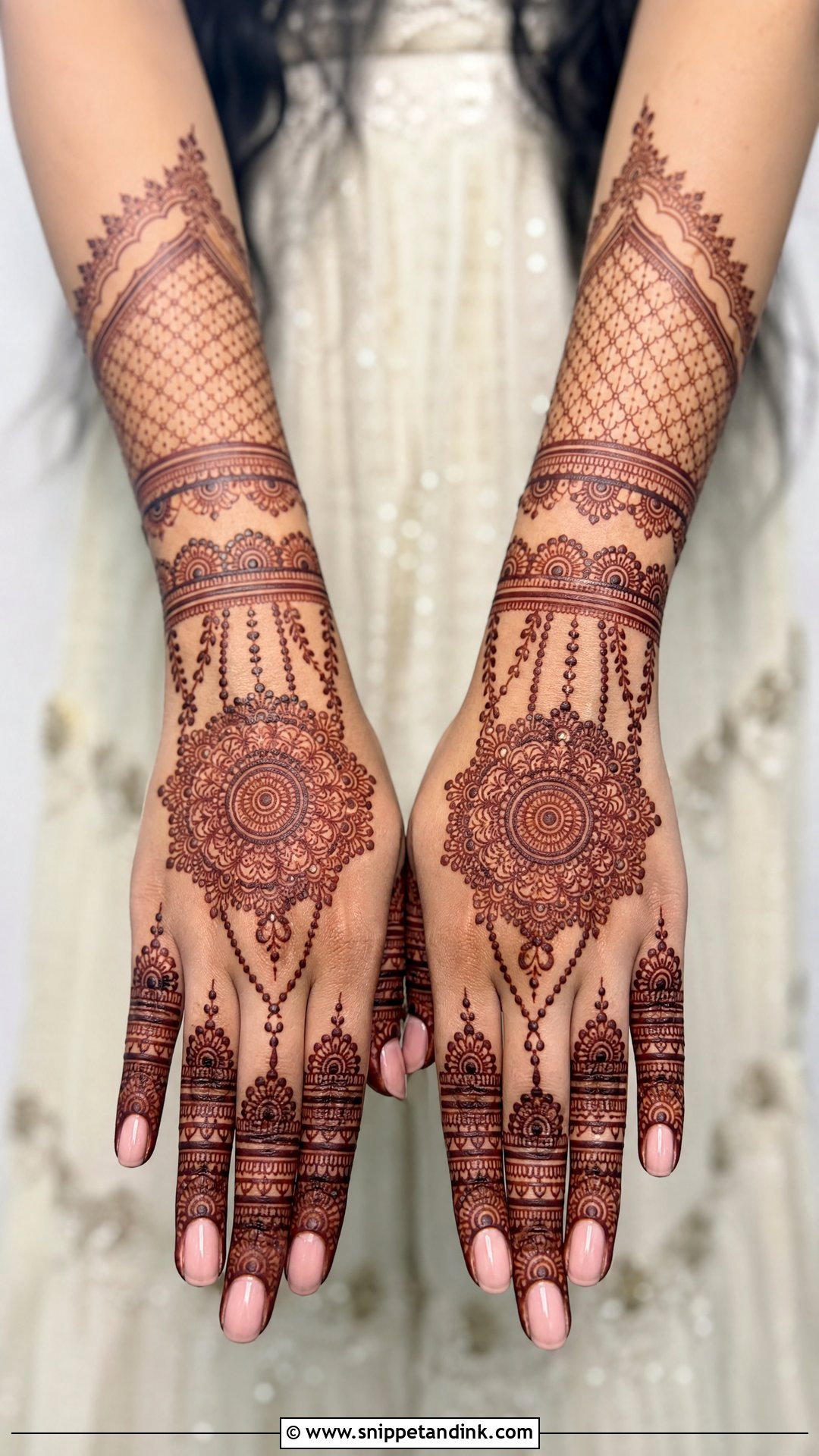
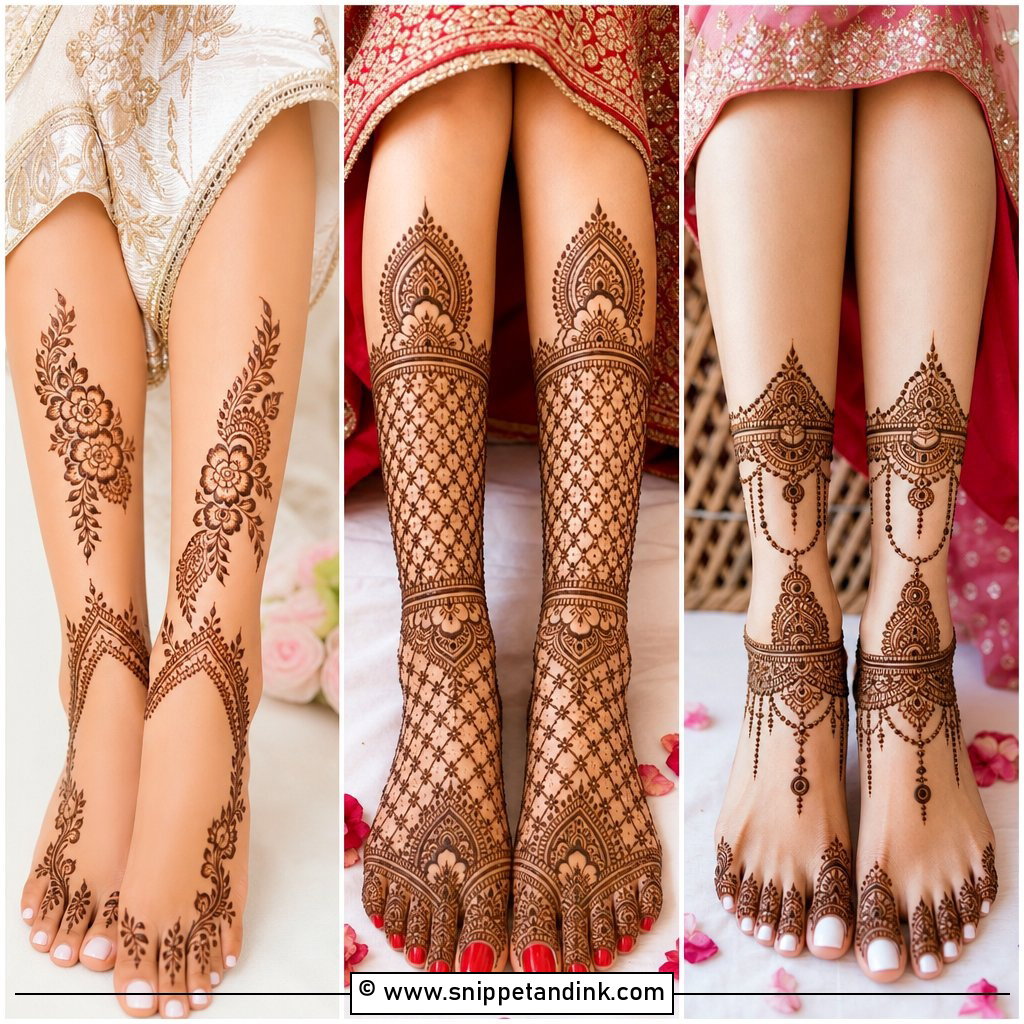
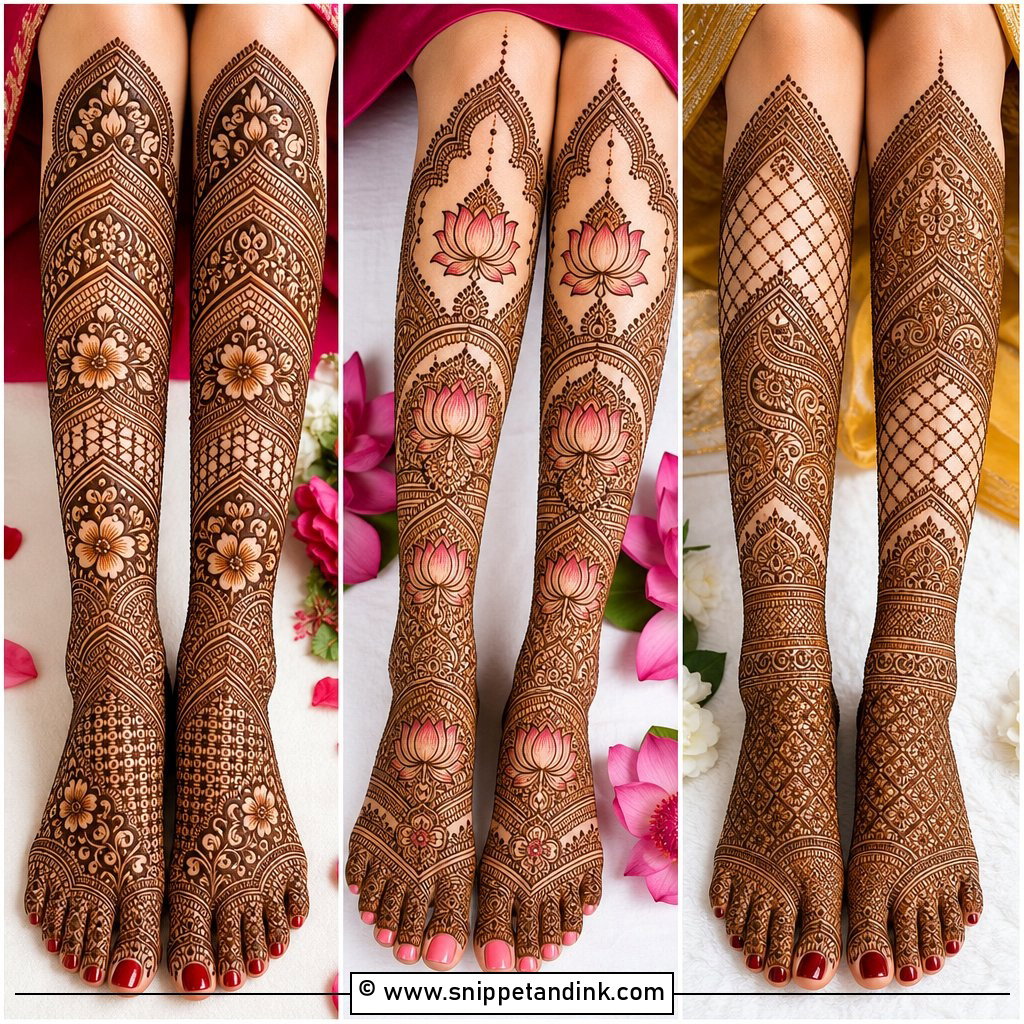
A back hand bridal mehndi design is what people see most in ring shots and with bangles. Bracelet patterns, haathphool-style chains, mandalas, jaali, florals and finger extensions all work here. Be aware that the back of the hand stains lighter than the palm because henna stains the outer layer of skin, and that layer is much thinner there than on the palm, so I keep the back-hand lines a touch bolder. A central mandala or floral medallion sits well above the knuckles, with cuff bands at the wrist and fine finger fills.
24. Front Hand Bridal Mehndi Design
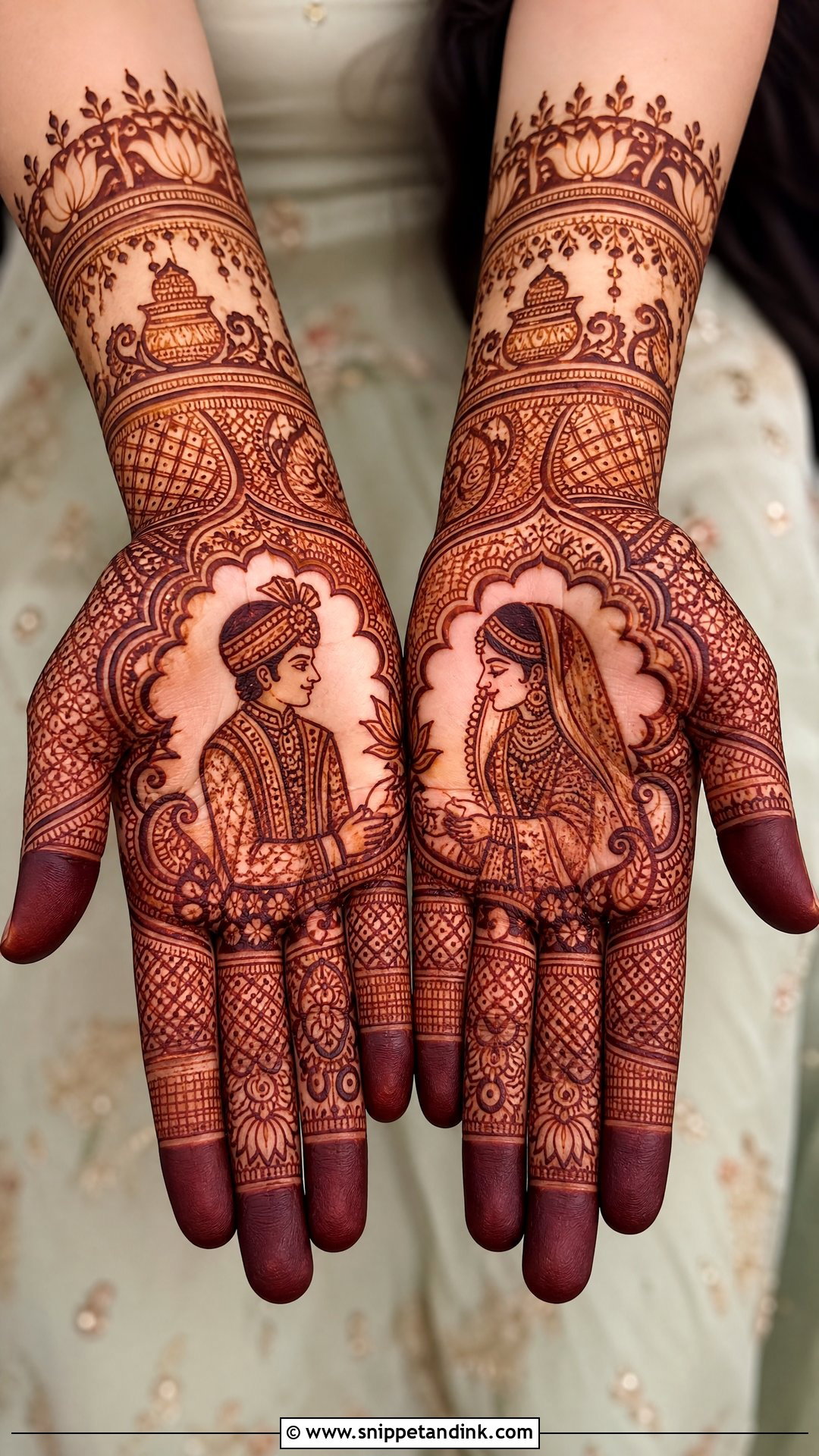
The palms carry the most meaningful motifs: mandalas, dulha-dulhan portraits, kalash, lotus, peacock, doli or a wedding scene in the center. Fingers are usually filled heavily, and the wrists get bangle or floral cuffs. Palms take henna color very well, so the stain here is the deepest on the body. I keep one clear focal point on each palm rather than several large motifs competing, and fill around it with dots, vines, mesh and paisleys. The front hands are the emotional center of the bridal design.
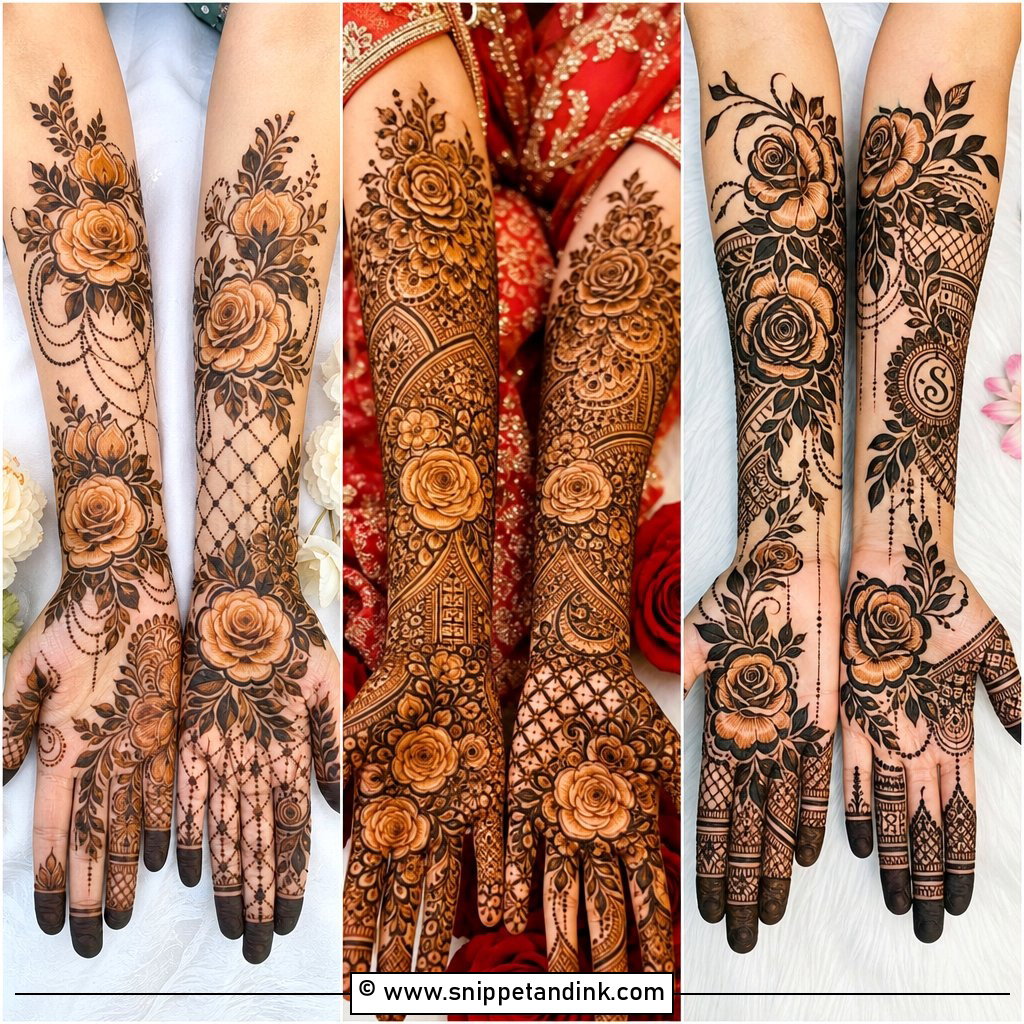
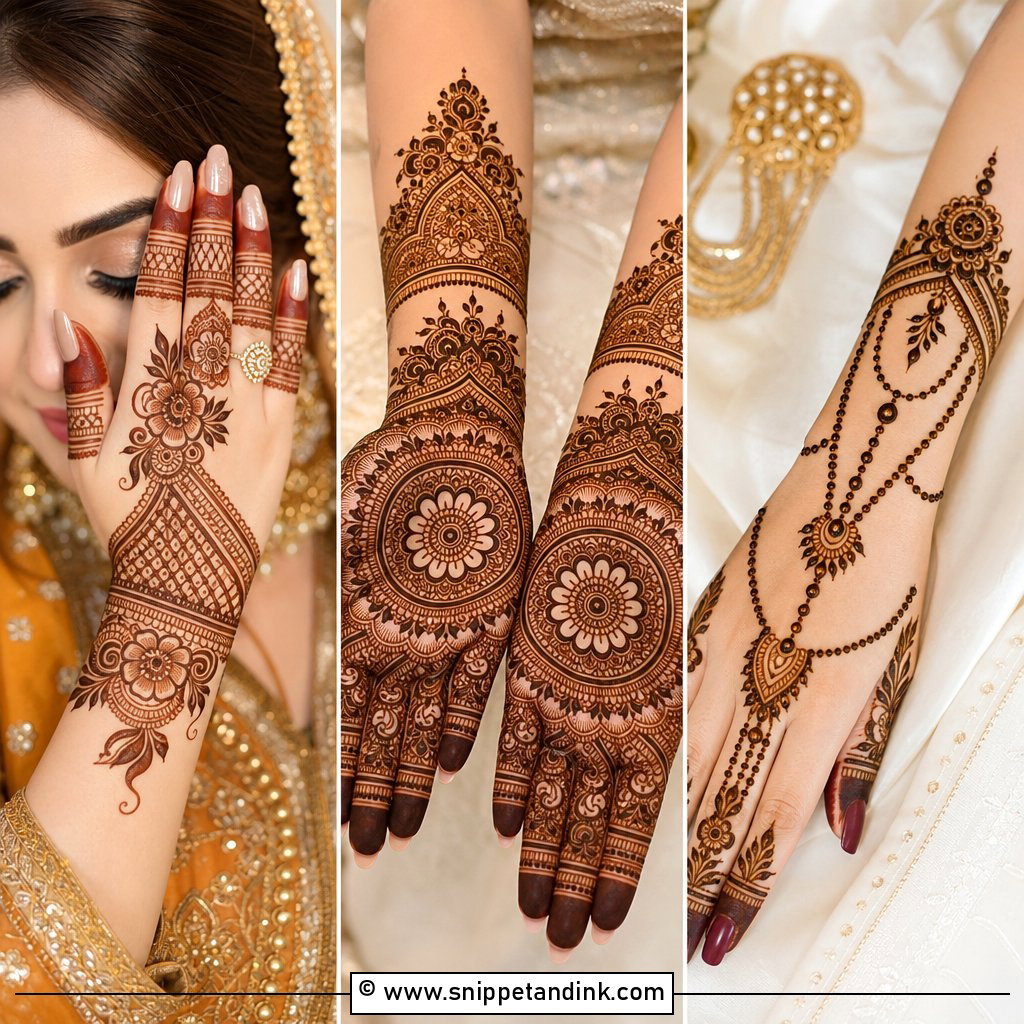
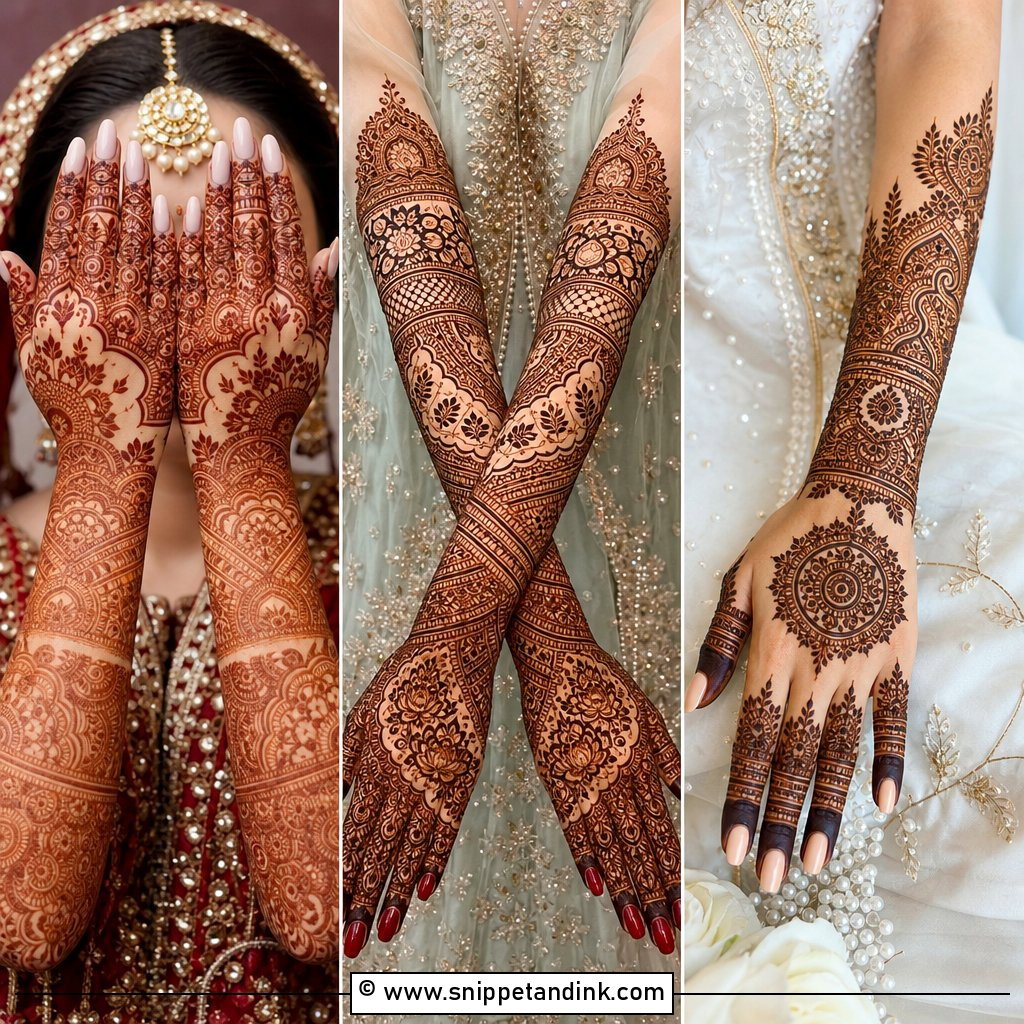
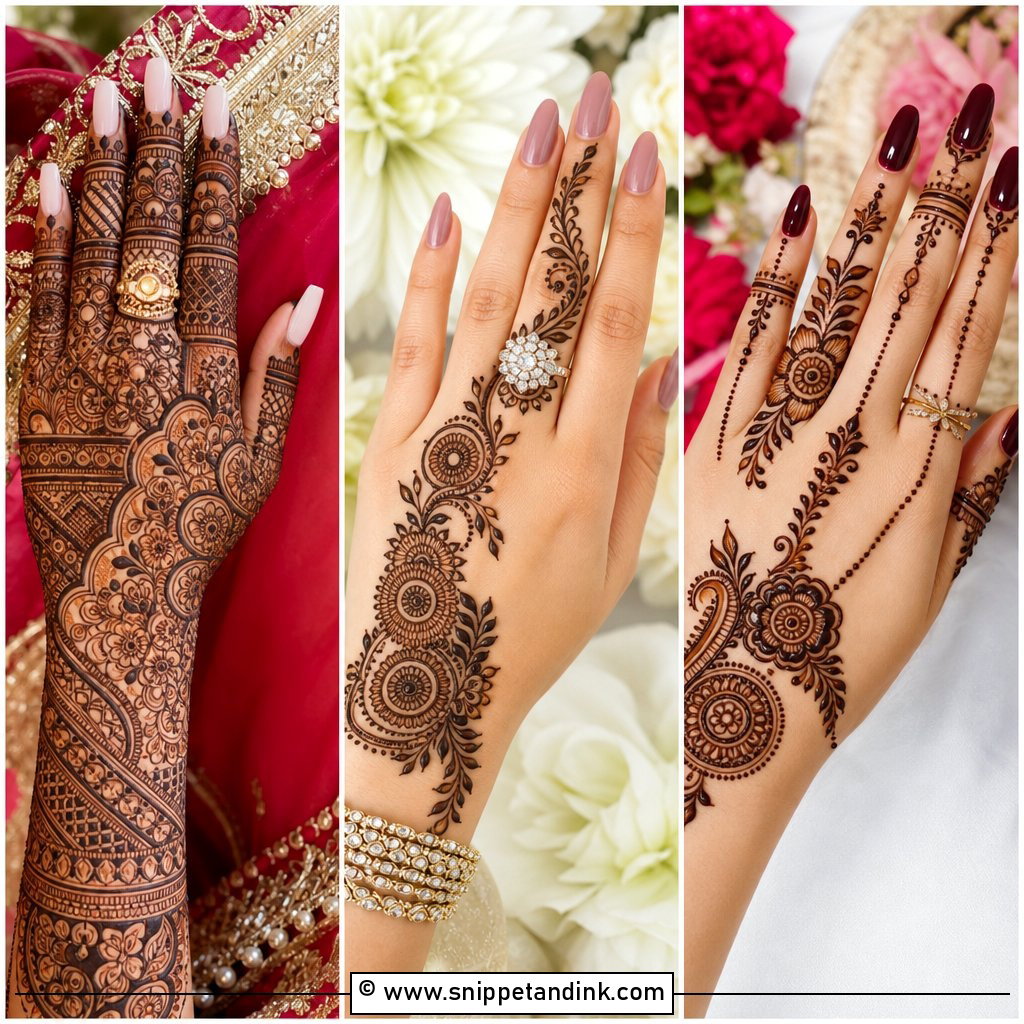
25. Wrist To Forearm Bridal Mehndi Design
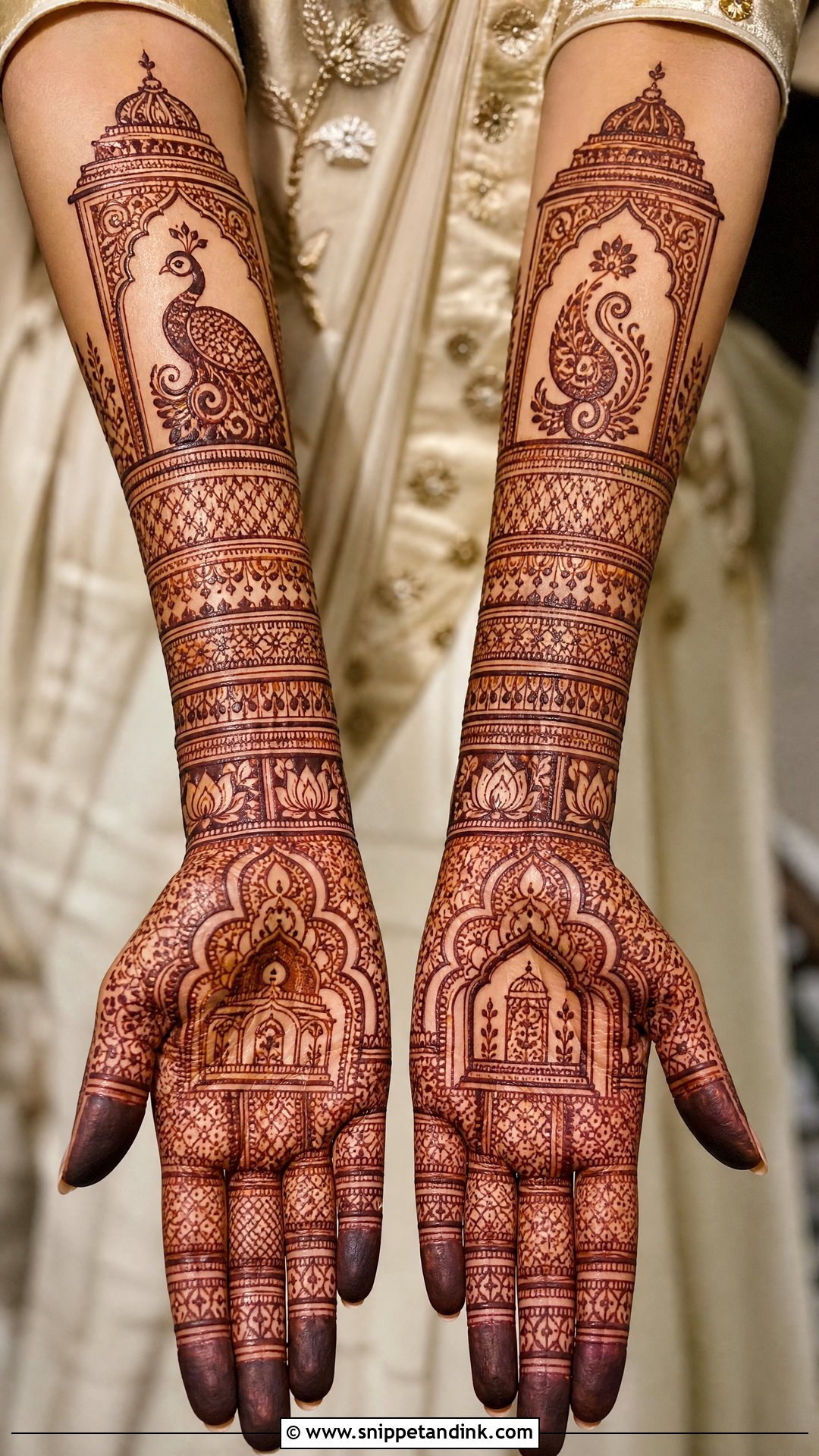
A wrist to forearm bridal mehndi design makes the mehndi visible beyond the hands, which matters with short or sheer sleeves. The pattern might carry stacked bangles, peacock panels, lotus trails, paisley rows, jaali, couple art or palace arches. The wrist has to join the palm smoothly so the design doesn’t look broken at the crease. The forearm also leaves space for initials, dates or small story symbols. Expect a lighter stain the higher up the arm it goes, and plan the length around how long you can sit.
From Paste to Maroon: the Forty-Eight Hours After
Most of the color is decided after I leave. These are the instructions I give every bride.
- Keep the paste on for at least six to eight hours. Overnight is better if you can sleep with your hands wrapped in loose cotton or tissue.
- Dab on a light lemon and sugar mix once the paste starts to dry. It keeps the paste stuck to the skin. Don’t soak it.
- Scrape the dried paste off with a blunt edge or your fingers. Don’t wash it off.
- Avoid water on the design for as long as you can, ideally the rest of that day. Warmth helps, and many brides hold their hands near a gentle heat source.
- Skip waxing, scrubs and chlorine before the wedding. Anything that exfoliates takes the stain with it.
Palms and fingers will always stain darker than the backs of the hands and the forearms. That’s how skin takes henna, not a sign that anything went wrong. The design will fade gradually over one to three weeks, usually peeling first where your hands rub most.
Your Hands, Your Outfit and How Long You Can Sit
Traditional bridal mehndi has a design for every bride, from Rajasthani storytelling to mandalas, paisleys, lotus, peacocks, jaali and hidden personal details. The heaviest design isn’t automatically the best. The best one suits your hands, outfit, jewelry, ceremonies and patience. If you love full tradition, go dense and take it up the forearm. If you prefer balance, choose clear focal motifs with fine fillers. Book an experienced artist, give the application the hours it needs, and look after the stain once the paste comes off.
You'll Like These Ideas:


Leave a Reply