
What sets Pakistani bridal mehndi apart is structure. The fine filling comes from the Indian tradition, the flowing vines from Arabic work and the arches and symmetry from Mughal design, and a good bridal hand uses all three without looking crowded. On the day, your hands sit next to your jewellery, your dupatta border and your face in nearly every portrait, so the design has to work with all of them. Some brides want every inch filled, with the groom’s initials hidden somewhere for him to hunt for. Others ask me for open back-hand work, bold florals or bracelet-style henna that still reads as traditional. Below are the 25 layouts I’m asked for most, with notes on how each one stains, how long it takes to sit for, and who it suits.
Timing Your Mehndi Between the Dholki and the Baraat
Henna doesn’t look its best on the day it goes on. When the paste comes off, the stain is a bright orange, and it deepens toward reddish brown or maroon over the next day or two. That’s why I ask brides to have their bridal mehndi applied one to two days before the baraat, which usually means the mehndi night itself. Any earlier and the edges start to fade by the walima; any later and you’ll walk into the baraat with orange hands.
Heavy full-hand work with feet can take several hours, so block out the whole afternoon or evening. Book an artist with a bridal portfolio of photographed stains, not just fresh paste, because wet henna always looks crisp and the stain is what you’re paying for.
What to bring to your appointment
- Close-up photos of your baraat and walima outfits, especially sleeve length and embroidery.
- Your haath phool, rings and bangles, or photos of them, so chain lines can be planned around the jewellery.
- The exact spelling and script for any hidden name or date.
- Which hand you use most. I finish that hand last so it isn’t smudged while the other dries.
- Anything you’re allergic to, including essential oils, so a patch test can be done ahead of time.
1. Full Hand Pakistani Bridal Mehndi
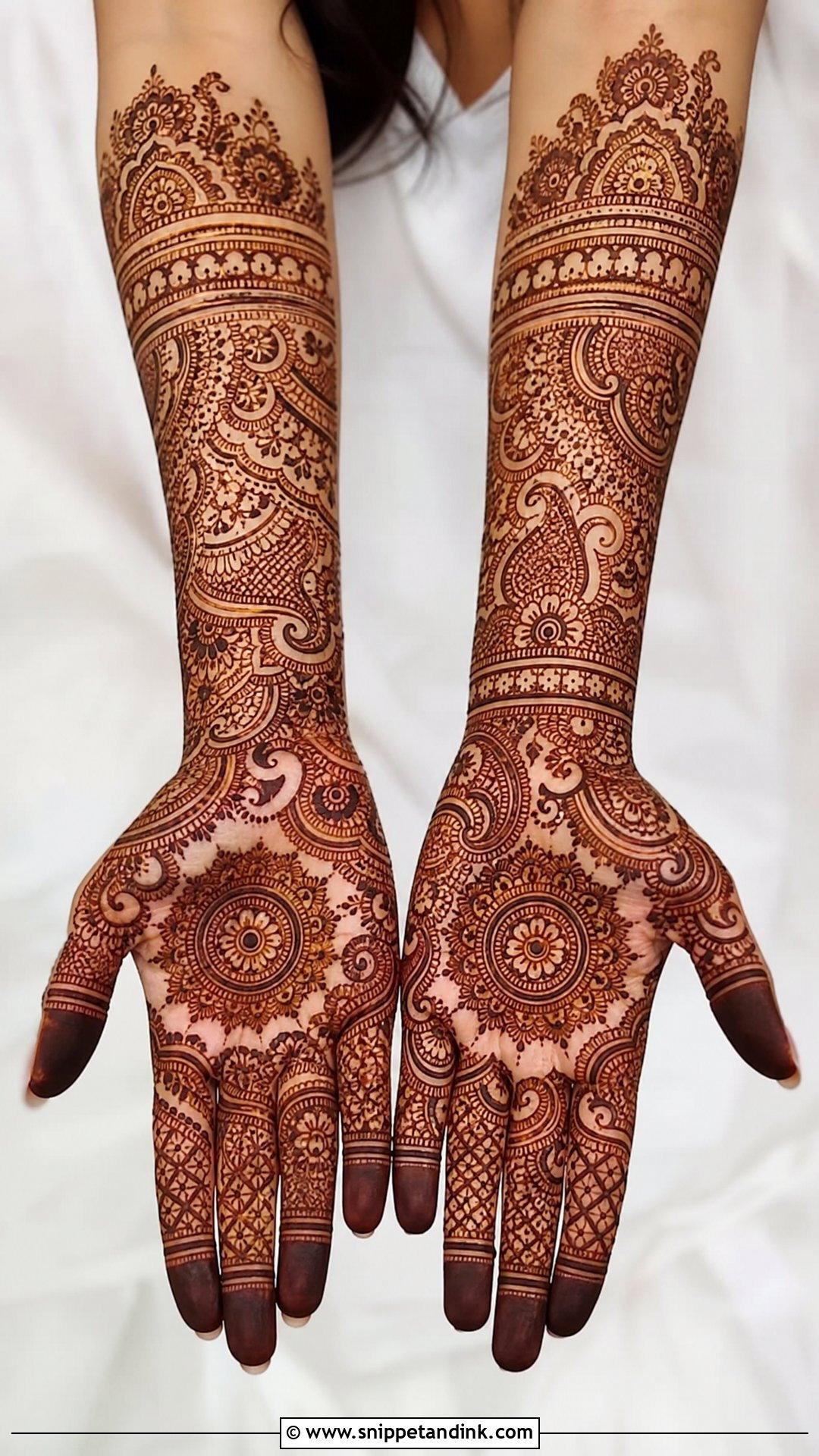
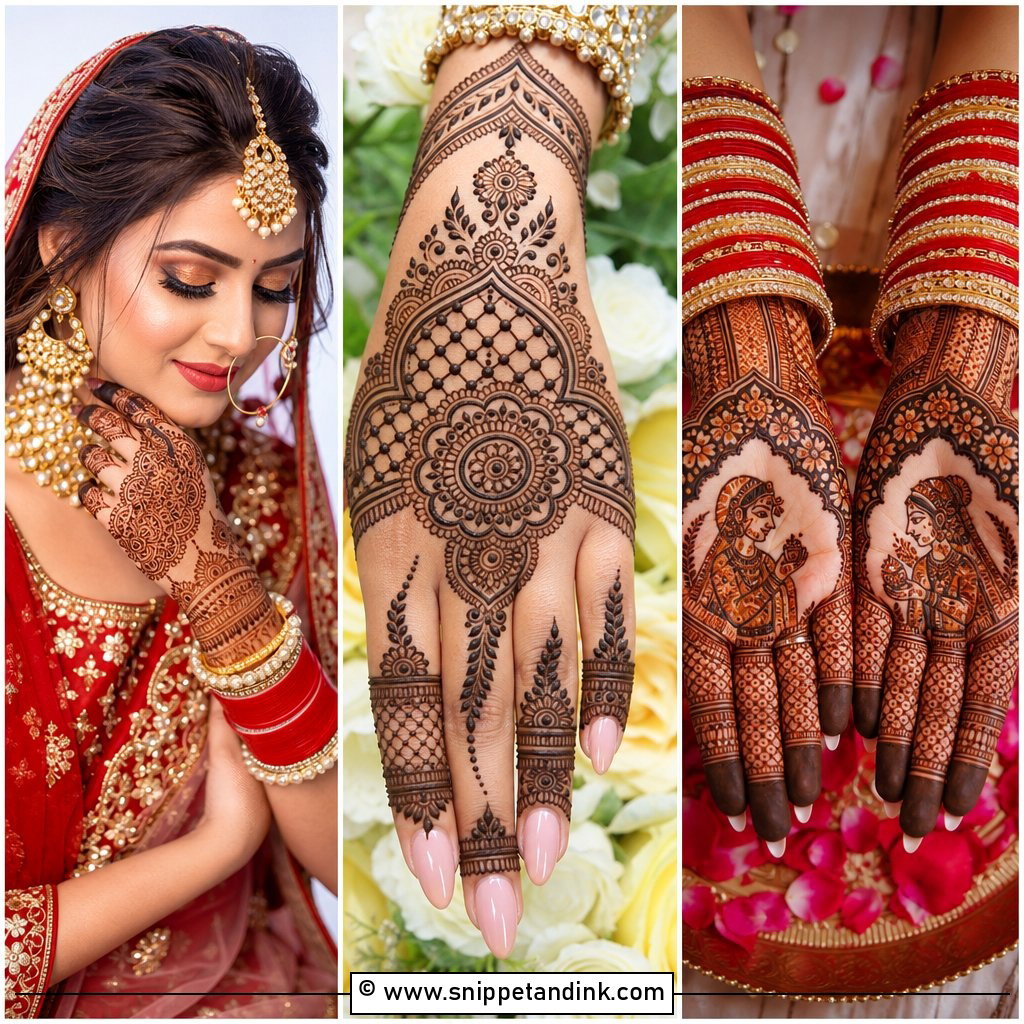
The full hand is the layout most brides picture when they think of a Pakistani dulhan: palms, backs, wrists and arms covered in paisleys, florals, mandalas and fine filling held together by bold outlines. When I map one, I draw the main outlines on both hands first and only then start filling, because if you finish one hand completely the second rarely matches. The groom’s initial, the date or a small personal symbol can be tucked inside a paisley. Expect to sit for several hours. Against red, maroon, gold, ivory or deep green outfits, a dense full hand is what fills the frame in baraat photos.
2. Pakistani Dulhan Mehndi Design
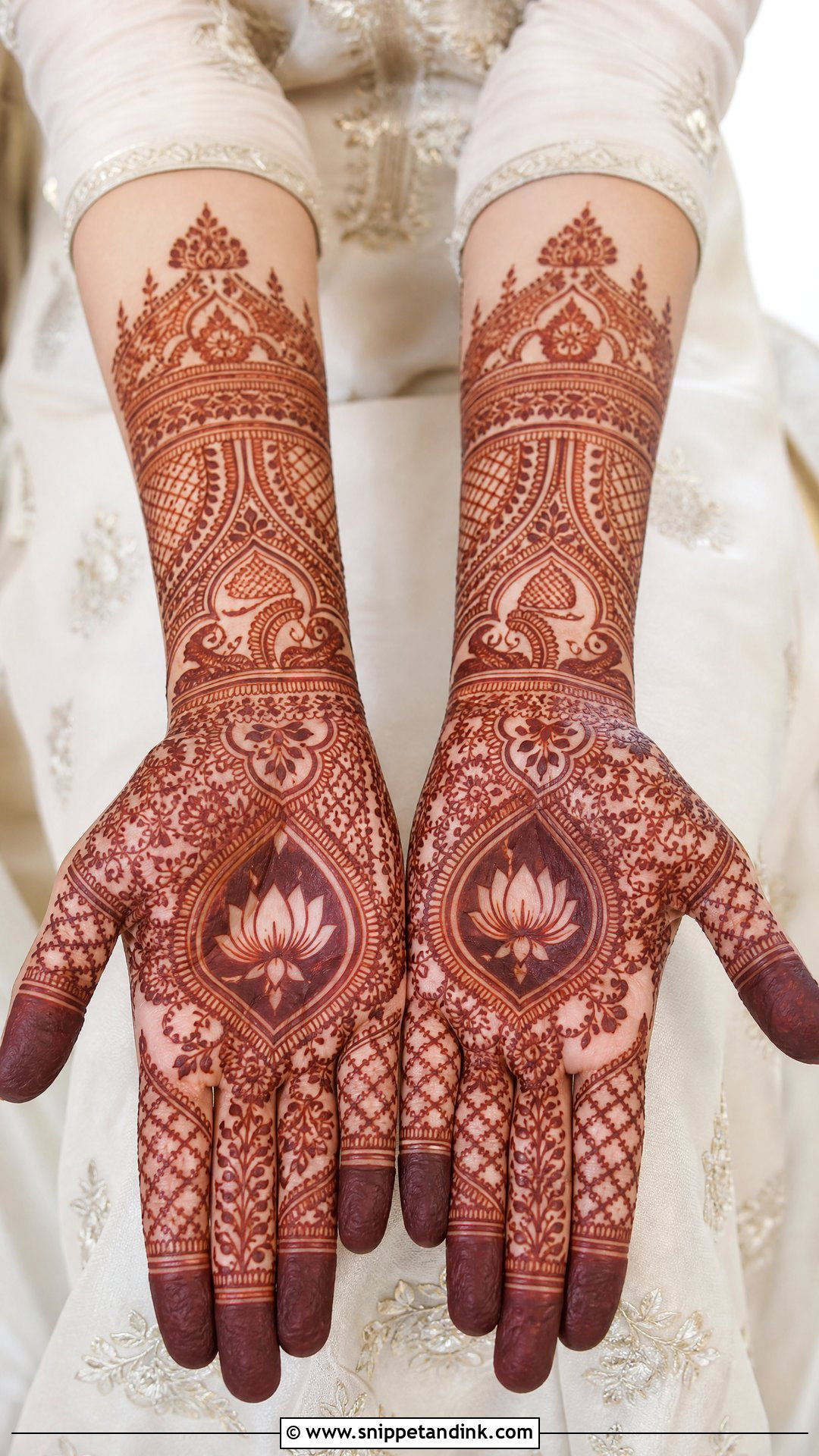
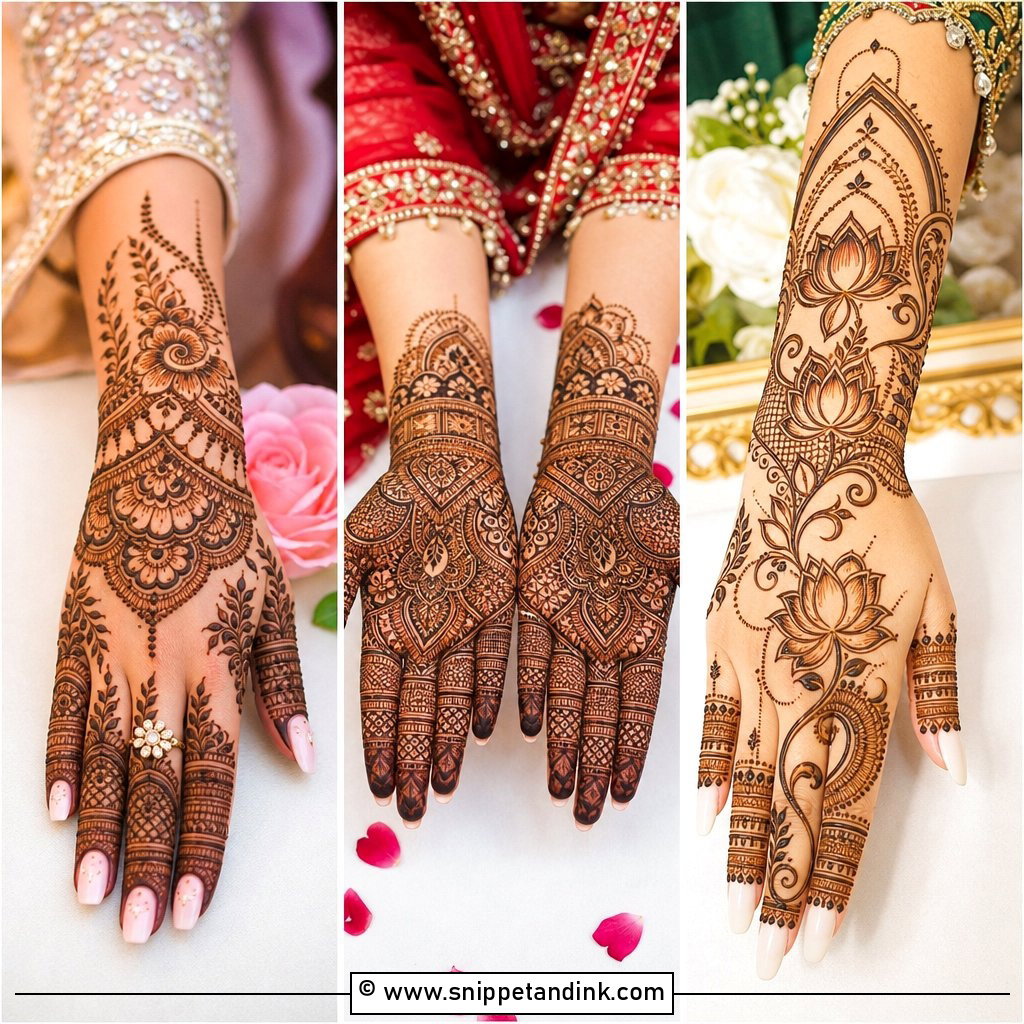
A dulhan design is the most culturally loaded layout here, with dense palm work, ornamental wrist bands, decorated fingers and forearm panels packed with traditional pattern. Look closely and you’ll find lotus shapes, paisley vines, jaali mesh, peacock accents and small bridal symbols. Nothing is placed at random; each motif sits in a frame. Most brides wear it for the baraat, where it stands up against heavy bangles and jewellery. If your outfit has distinctive embroidery, bring a close-up photo of it to your appointment, because I can repeat its shapes in the borders and the whole look starts to feel planned.
3. Pakistani Bridal Front Hand Mehndi
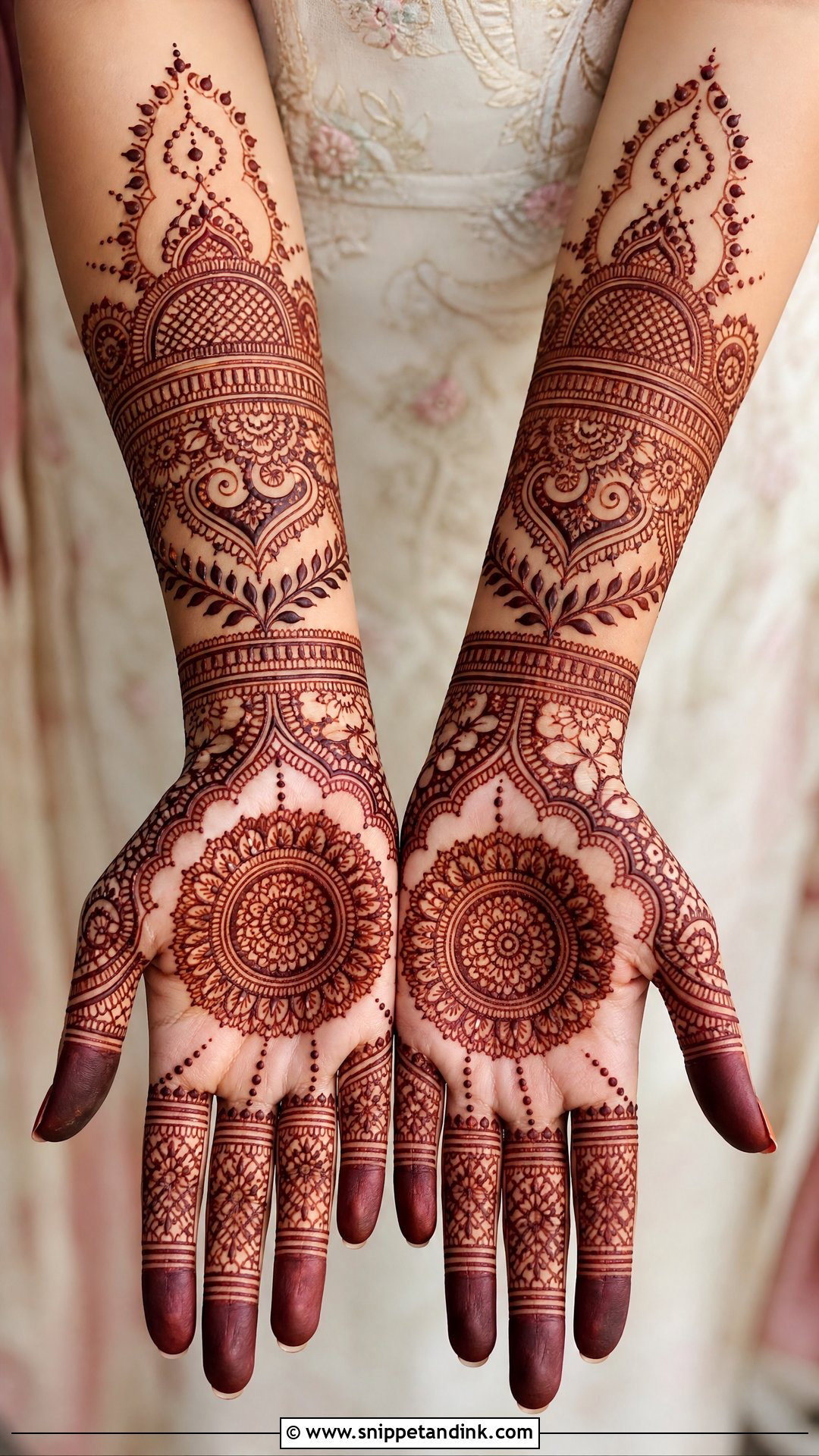
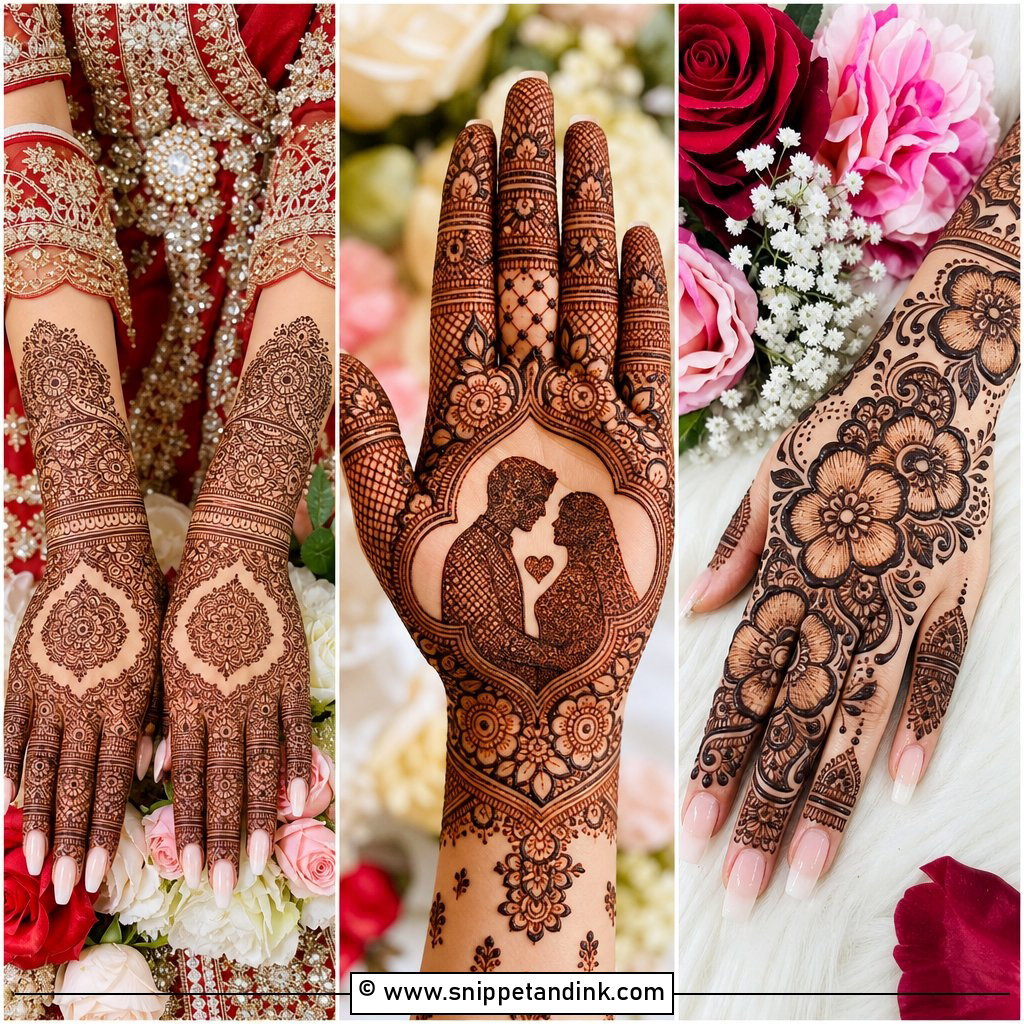
Palms take the darkest stain on the body, after the fingertips, because the skin there is thicker and holds more of the dye. That’s why front-hand designs carry the most visible colour. Most start from a central mandala, a tikki, a bride-and-groom panel or a large floral medallion, with paisley borders, leafy trails, dots and filled fingers around it. The wrist and forearm can finish with cuffs or layered arches. Palms are what you show during rituals and in close-ups, so I keep the palm detail a little more open than the back: very fine filling on a palm can bleed together as the stain deepens, and the design loses its edges.
4. Pakistani Bridal Back Hand Mehndi
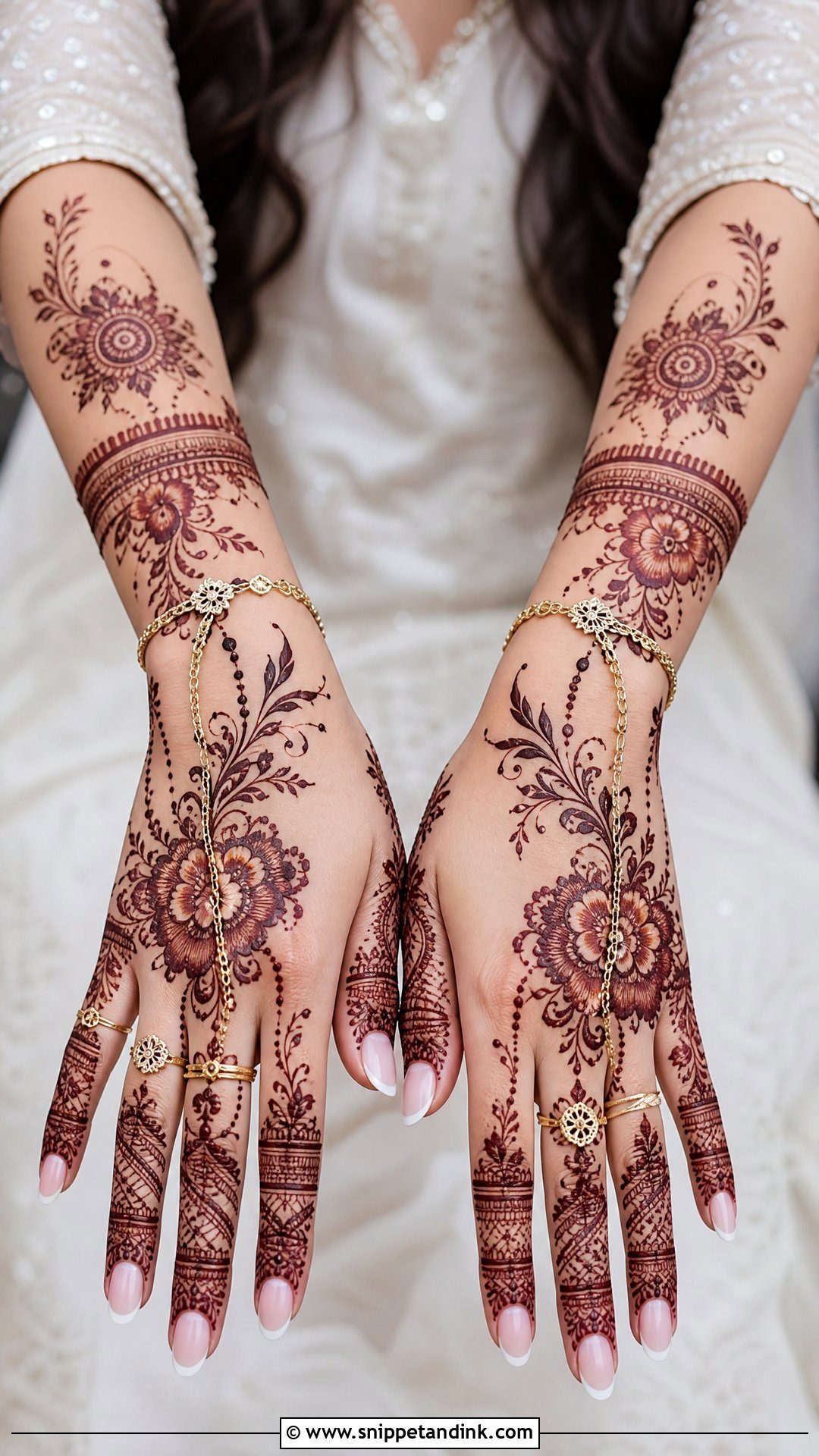
The back of the hand is what everyone sees as you hold a dupatta, a clutch or a cup of tea, so this is where layout matters most. I build it from bracelet patterns, ring chains, floral vines, mandalas and shaded leaves, with coordinated fingertips or leafy bands on the fingers. For a heavier version, lace-like panels can run up toward the wrist and forearm. One thing to know: the back of the hand stains lighter than the palm, so I use bolder lines here than I would on the palm to keep the pattern readable. If you’re wearing a haath phool, bring it to the appointment and I’ll plan the chain lines so they sit along the jewellery rather than under it.
5. Heavy Pakistani Bridal Mehndi
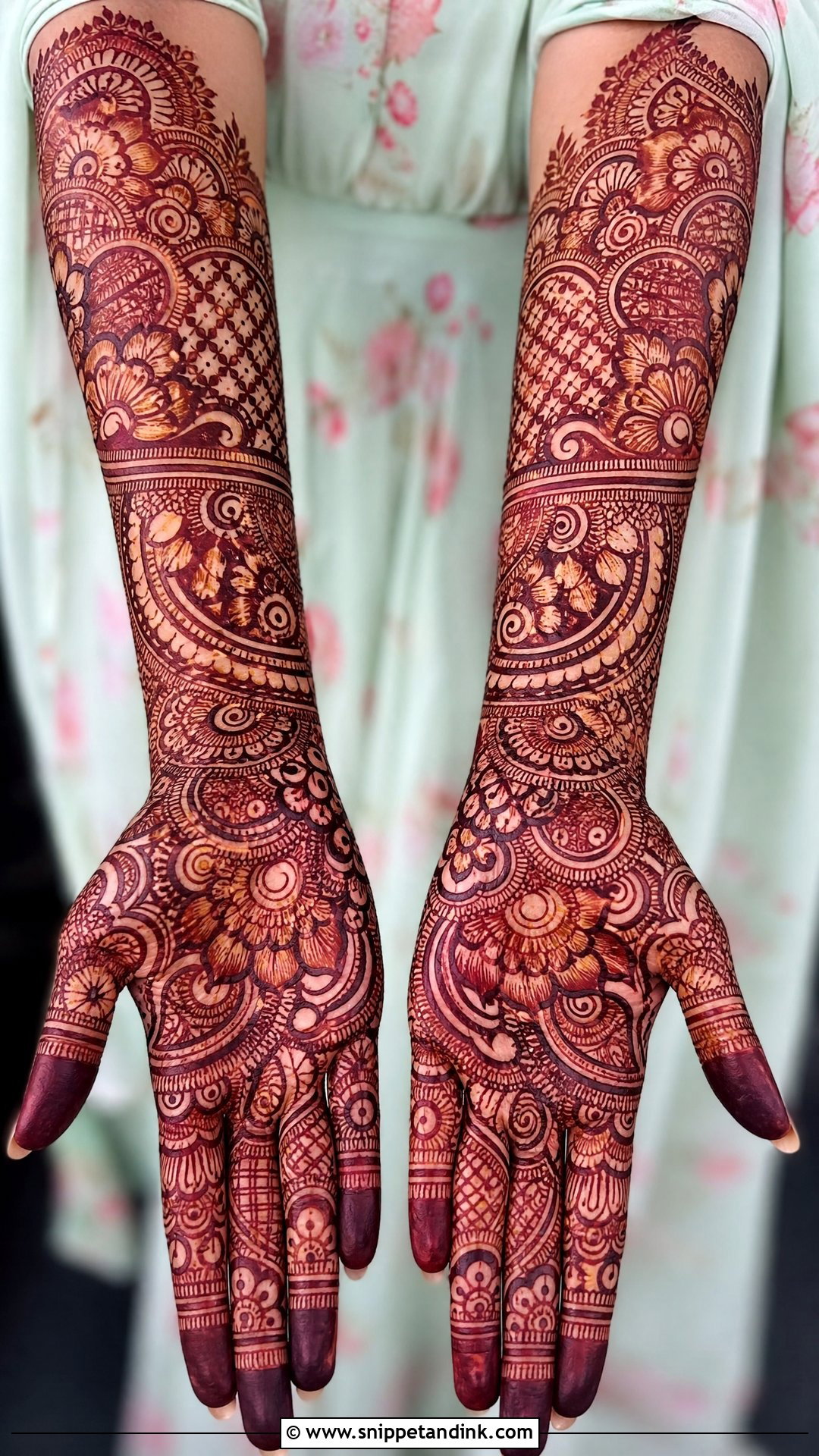
Heavy bridal mehndi is for the bride who wants maximum detail and a royal finish. Tight motifs, layered borders, shaded florals and delicate grids fill the hand, with small negative spaces left deliberately so the pattern still reads from a distance. It often runs past the wrist and up the forearm. This is the longest application on the list, so eat beforehand, use the bathroom, and sit somewhere you can stay still for hours. It suits the weight of traditional lehengas, ghararas and shararas with dense embroidery. I always put bold outlines around the major motifs, because fine work on its own can blur as the paste dries and lifts.
6. Simple Pakistani Bridal Mehndi
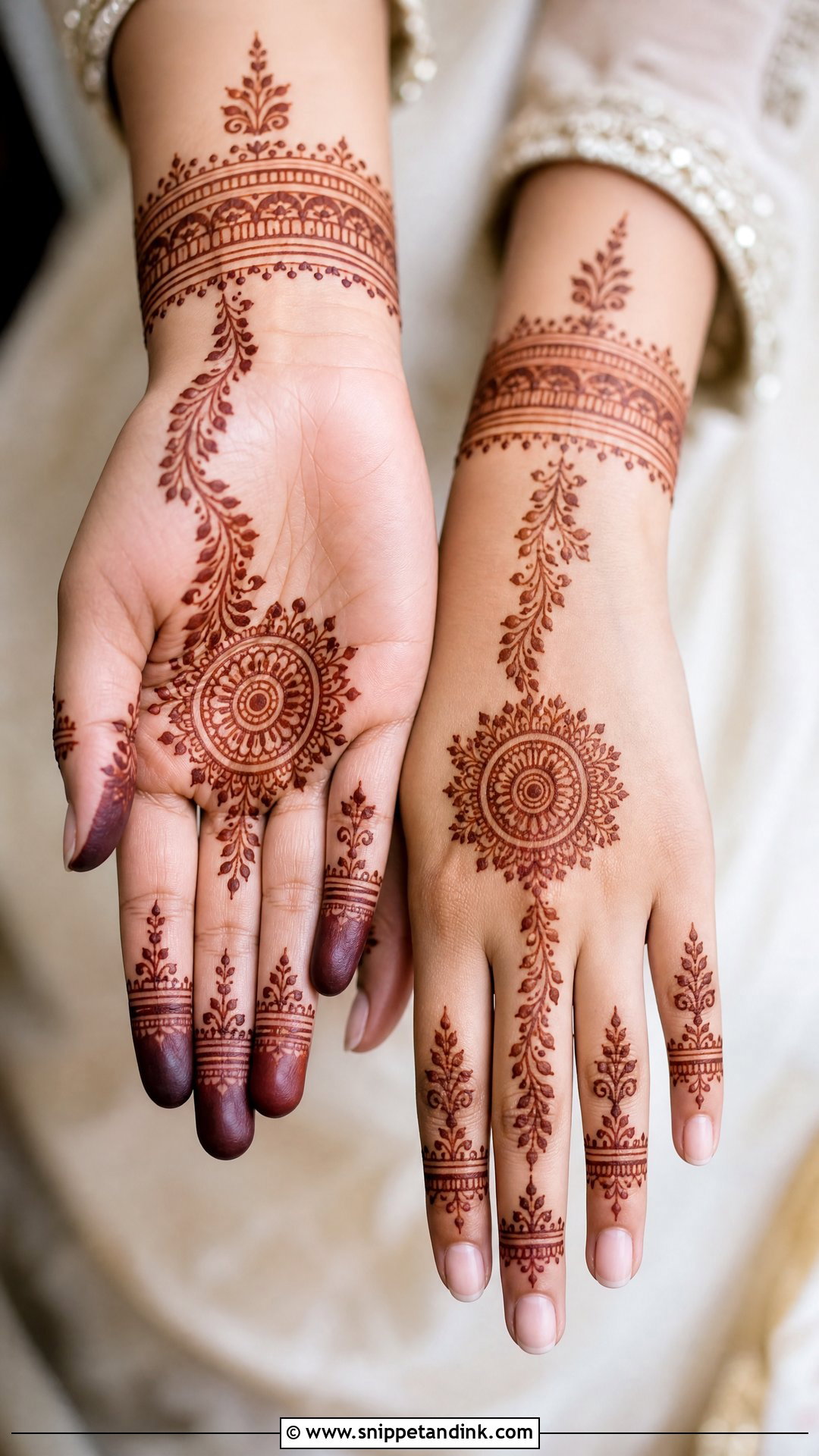
Lighter coverage still has to look bridal, and that comes down to finishing. A simple design might be a clean palm mandala, floral trails, bracelet cuffs and lightly decorated fingers, but the spacing and symmetry have to be exact, since there’s no dense filling to hide a wobble. I suggest it for nikah brides, intimate weddings and anyone wearing blush, ivory, champagne or pastel. It also leaves room for jewellery, embroidered sleeves or nail art to be noticed. Give it one strong focal point on the palm or back of the hand, and connect that to the wrist with neat detail.
7. Arabic Pakistani Bridal Mehndi
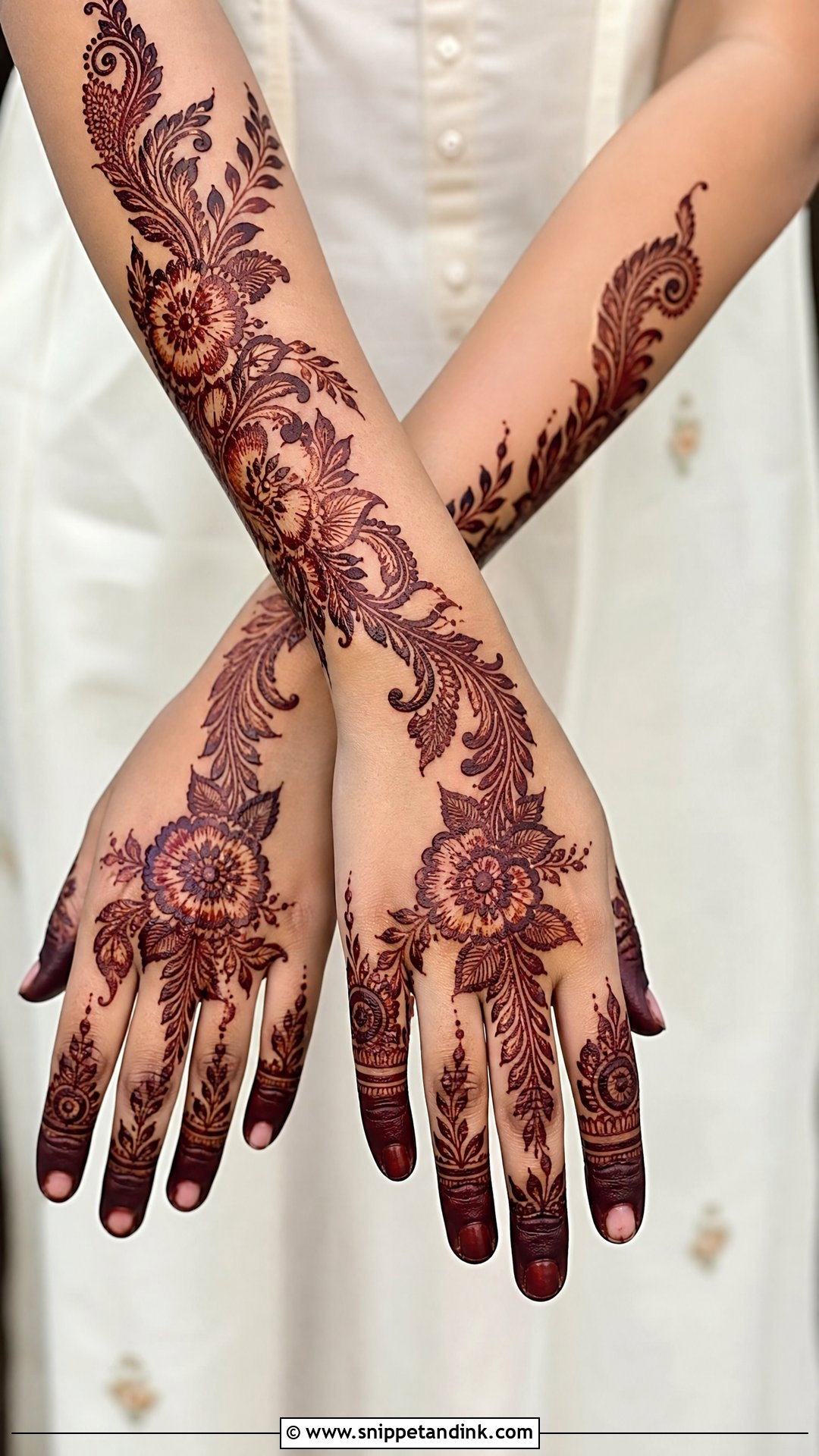
Arabic-style bridal work moves on a diagonal, from the fingers across to the wrist or forearm, with open skin left between the flowers, leaves and paisleys. That open space is the point: it looks lighter and more modern than dense Pakistani filling. It’s also quicker to apply, which matters on a busy mehndi night. The diagonal flatters long fingers and leaves room for statement rings. To make it bridal rather than casual, I add shaded petals, fine filler lines inside the bigger shapes and a decorated cuff at the wrist so the design looks finished.
8. Indo Arabic Pakistani Bridal Mehndi
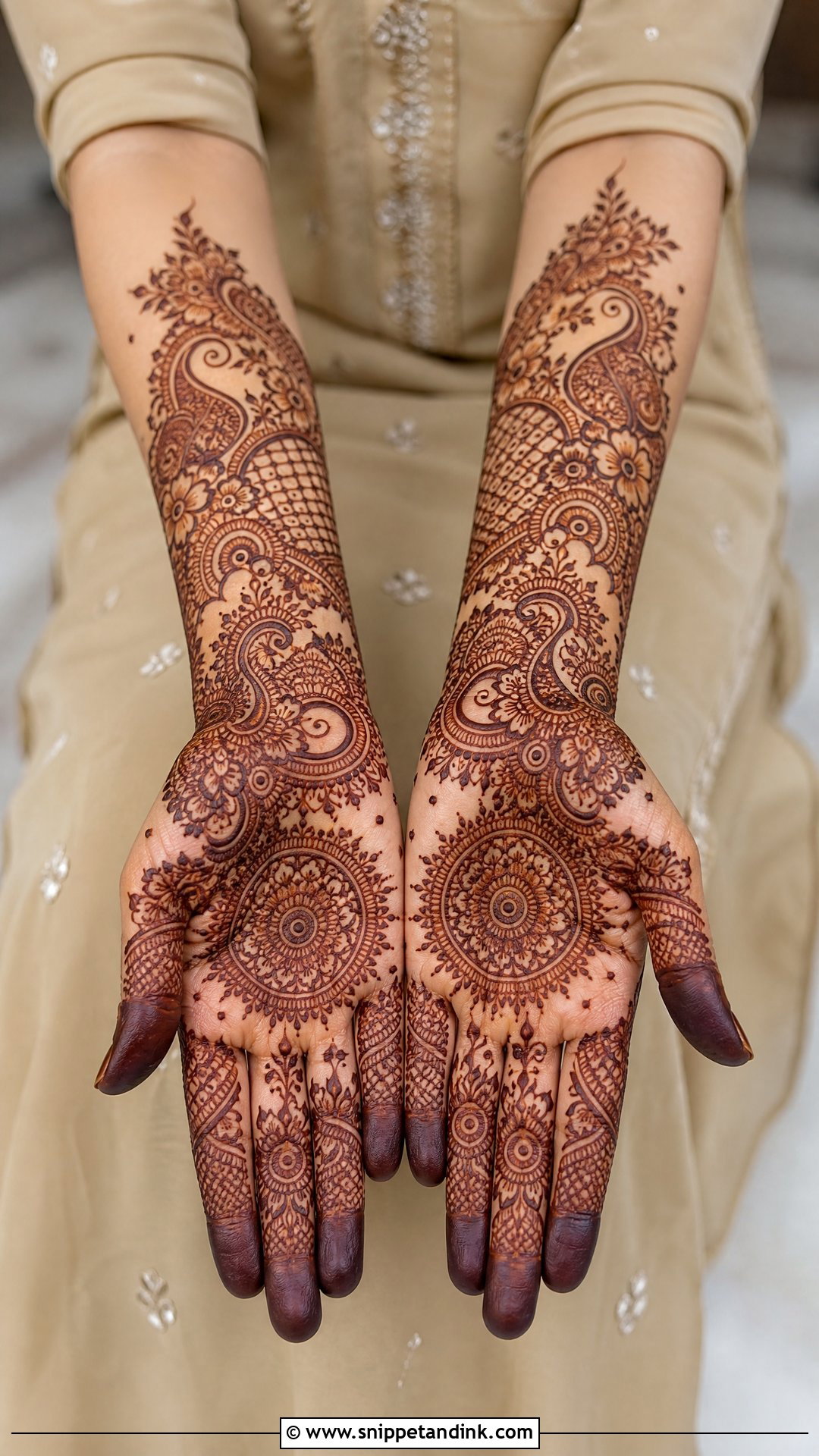
Indo Arabic Pakistani bridal mehndi sits halfway between the two traditions, with Indian fine filling, Arabic floral trails and Pakistani symmetry. A mandala or paisley centrepiece anchors the palm while the fingers and wrists carry bolder vines, jaali sections and dotted accents. Its strength is flexibility: I can make it heavy for the baraat or open it up for the mehndi night or nikah. The larger motifs also read clearly from across a room. Ask for the flow to run continuously from fingertip to forearm; a break at the wrist is the most common thing that makes a fusion design look like two separate patterns.
9. Tikki Pakistani Bridal Mehndi
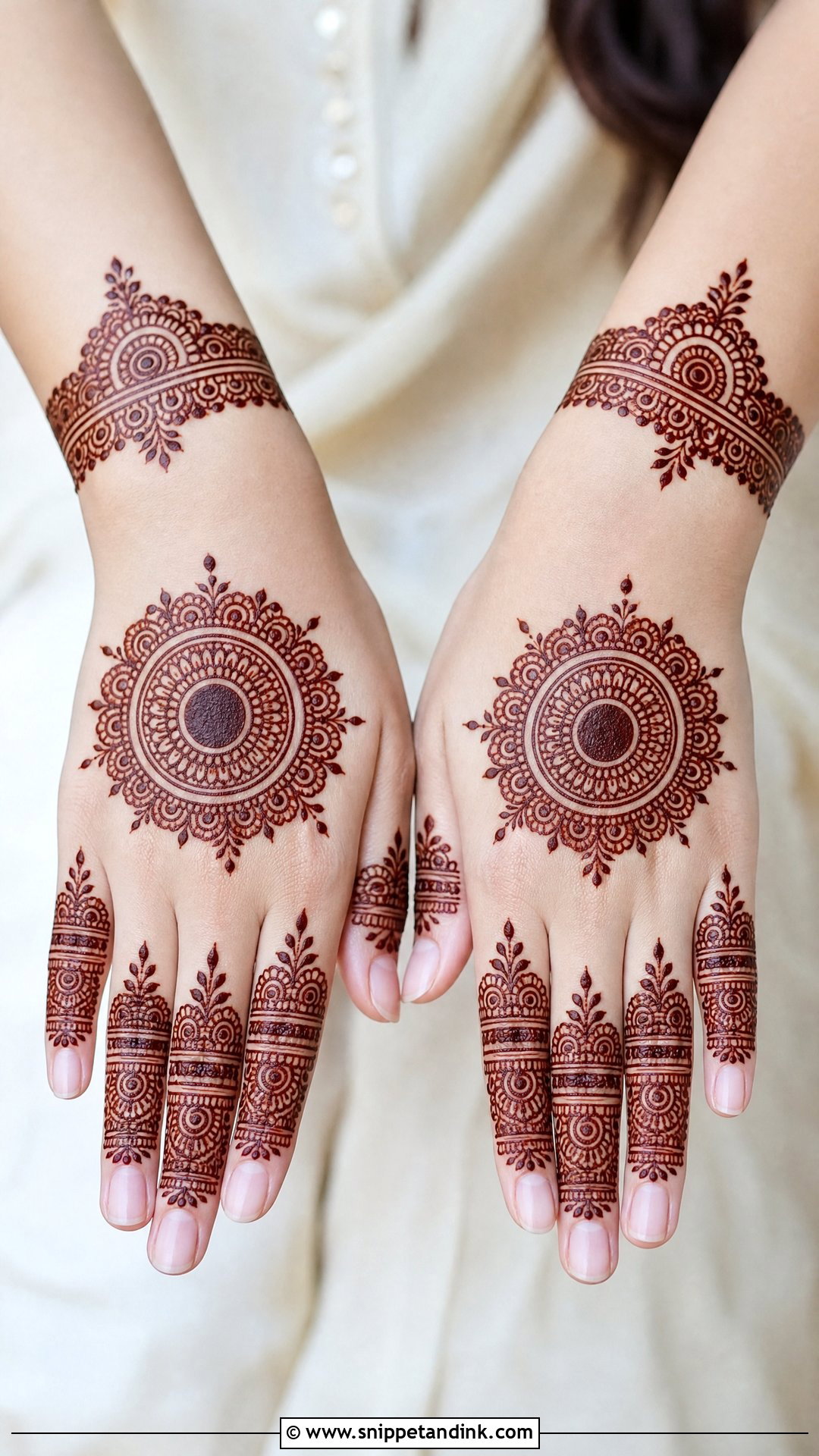
A tikki is the round central motif that sits on the palm or the back of the hand, and it can be as plain as a bold filled circle or as detailed as a flower of petals, dots and rings. On its own it’s a little bare for a bride, so I pair it with decorated fingers, bracelet cuffs and fine wrist work. A filled tikki in the centre of the palm also gives you one patch of solid, dark stain, which some brides prefer to fine line. The circles have to be even. I draw the outer ring first in light dots, check it from above, and only then commit to the full line.
10. Mandala Pakistani Bridal Mehndi
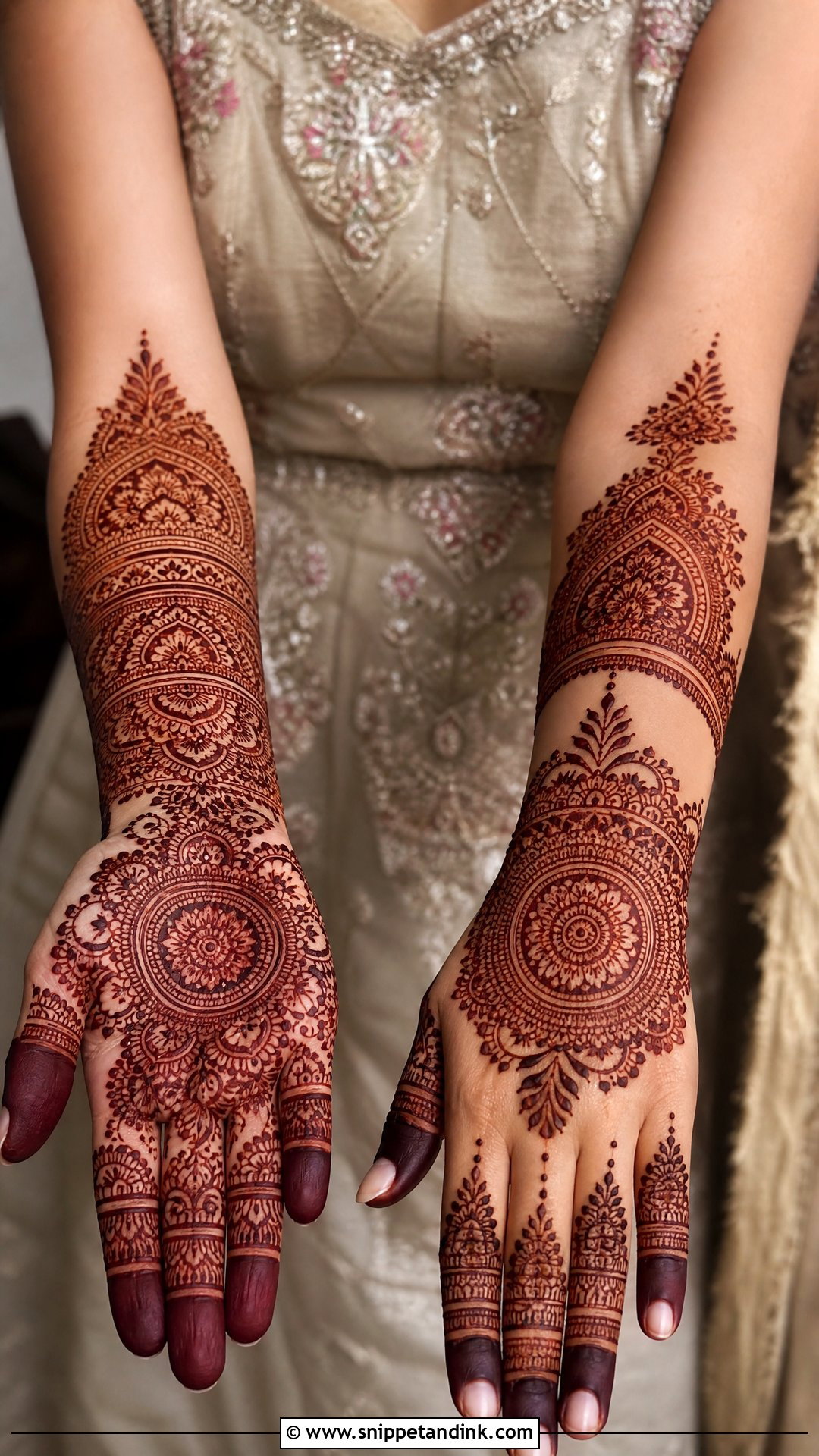
Mandala work starts with a circle on the palm or back of the hand, then grows outward in rings of petals, dots, leaves and lace-like borders, with filled fingertips, wrist cuffs and forearm extensions for a bridal version. It suits brides who like order more than scattered motifs, and it sits well with round jewellery settings and bangles. Density is flexible, from full and packed to soft and minimal. What can’t be flexible is the line work. A mandala shows every uneven petal, so it needs an artist with a very steady hand and a cone of the right consistency, smooth enough to flow without blobbing.
11. Peacock Pakistani Bridal Mehndi
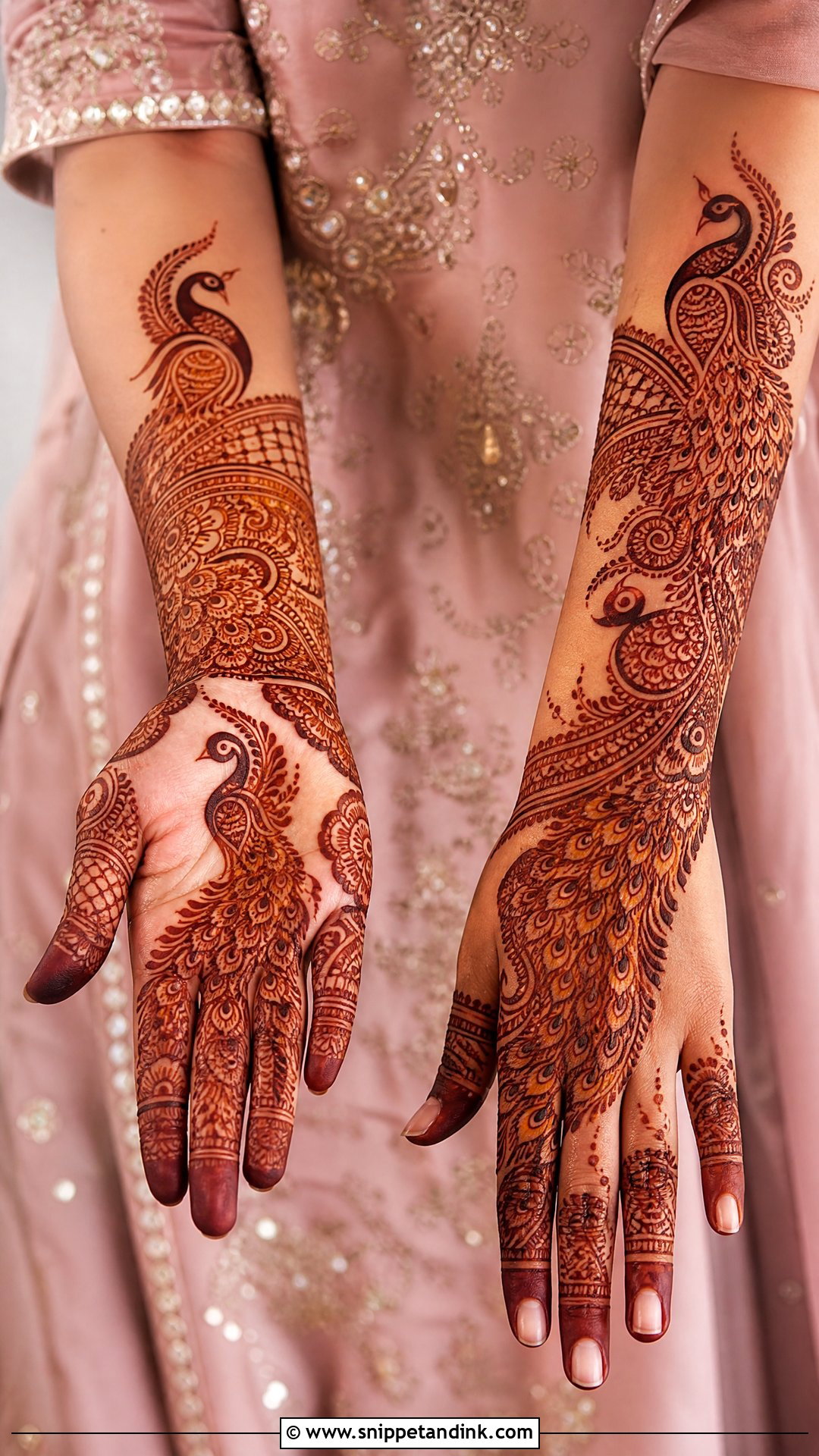
The peacock is one of the oldest motifs in South Asian mehndi, and it can sit on the palm, the back of the hand, the wrist or the forearm, surrounded by paisleys, flowers, feathers and fine filler. The tail is where it gets interesting: drawn out into curved vines or layered feather shapes, it can carry the whole design up the arm. My advice is to choose one large peacock as the focal point rather than several small ones, with lighter detailing around it. Two or three birds on one hand nearly always looks crowded once the stain darkens. Jewel-toned outfits and gold accessories suit it.
12. Paisley Pakistani Bridal Mehndi
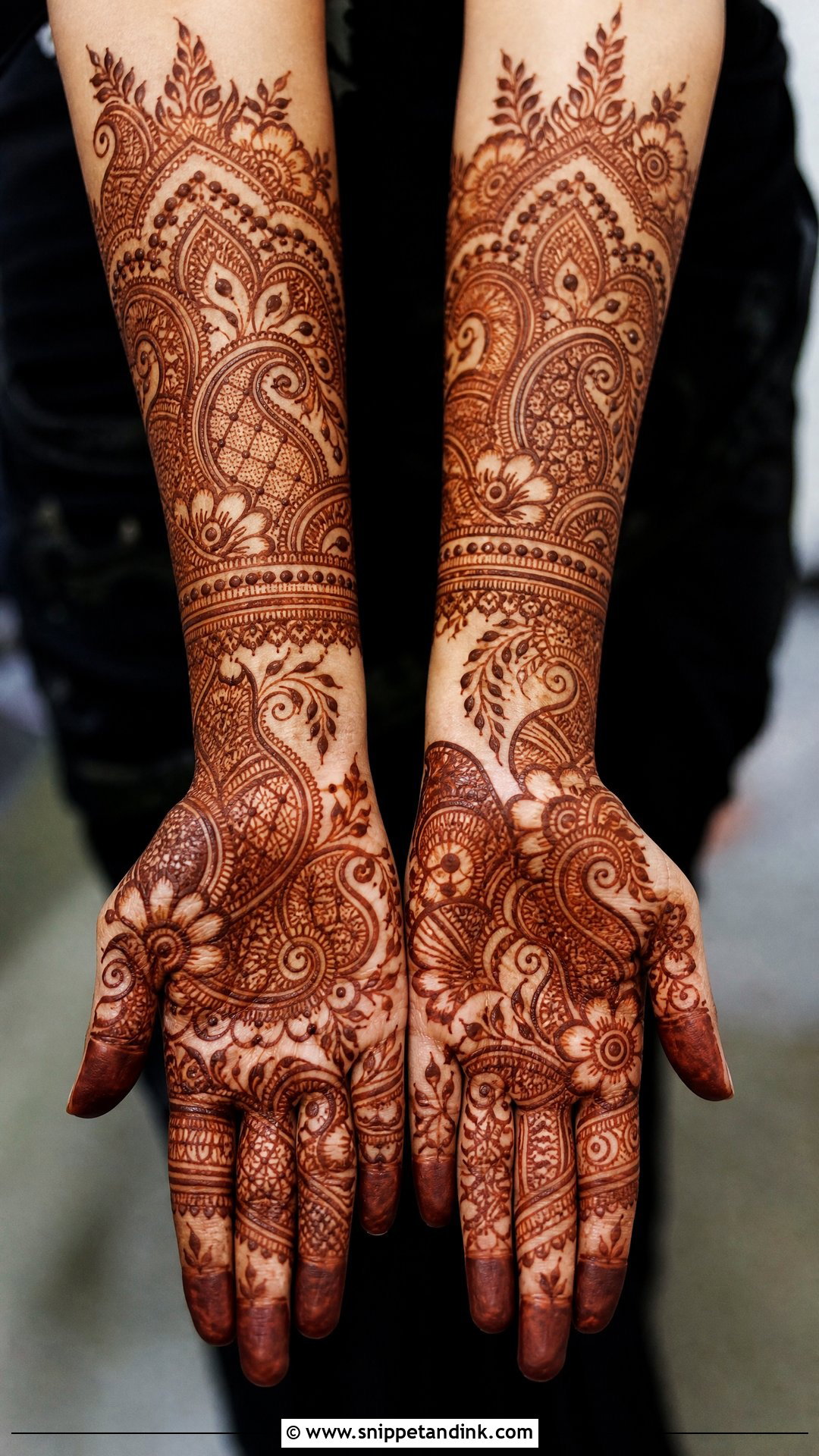
Paisleys are popular for a practical reason: the curved teardrop follows the shape of fingers, wrists and forearms, so the pattern flows along the arm without leaving awkward gaps. That makes them the backbone of most full-hand designs. Small packed paisleys give a dense traditional effect, while larger ones with floral filling look cleaner and more modern. I add dots, leaves, jaali mesh and shaded petals inside them for depth. If your outfit is embroidered with similar curves, the paisleys tie hand and fabric together nicely.
13. Floral Pakistani Bridal Mehndi
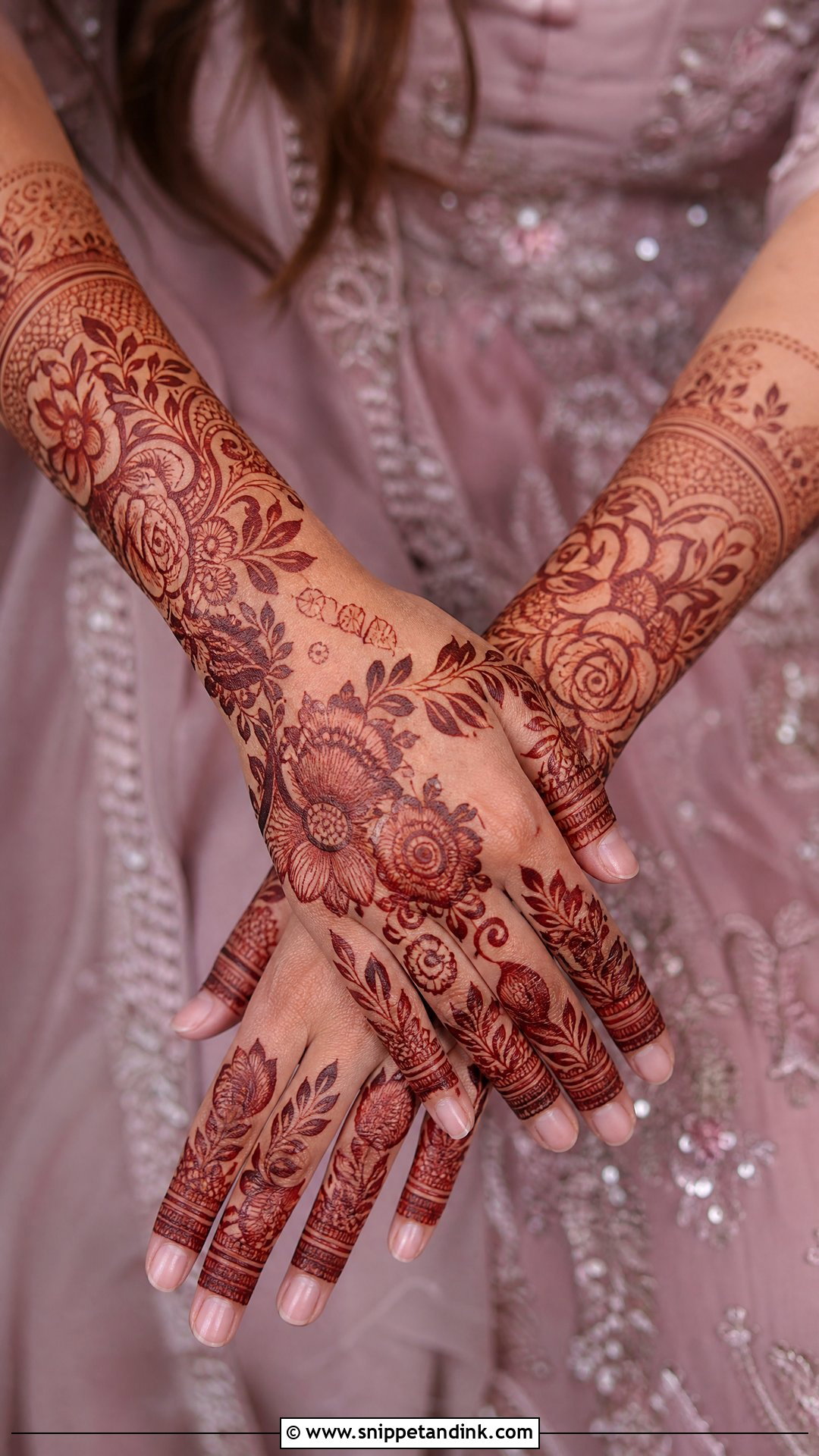
Florals are the easiest motif to adjust to a bride’s taste: roses, lotus shapes, leafy vines, small blossoms and shaded petals, spread across palms and backs of hands. On their own they can read as casual party henna, so for a Pakistani bridal look I pair them with detailed fingers, wrist cuffs, paisley borders and fine filler. Brides in pastel, ivory, peach or gold often lean this way. For a modern finish, I’d use larger flowers with open spacing; for a traditional one, smaller flowers with dense detail between them.
14. Jaali Pakistani Bridal Mehndi
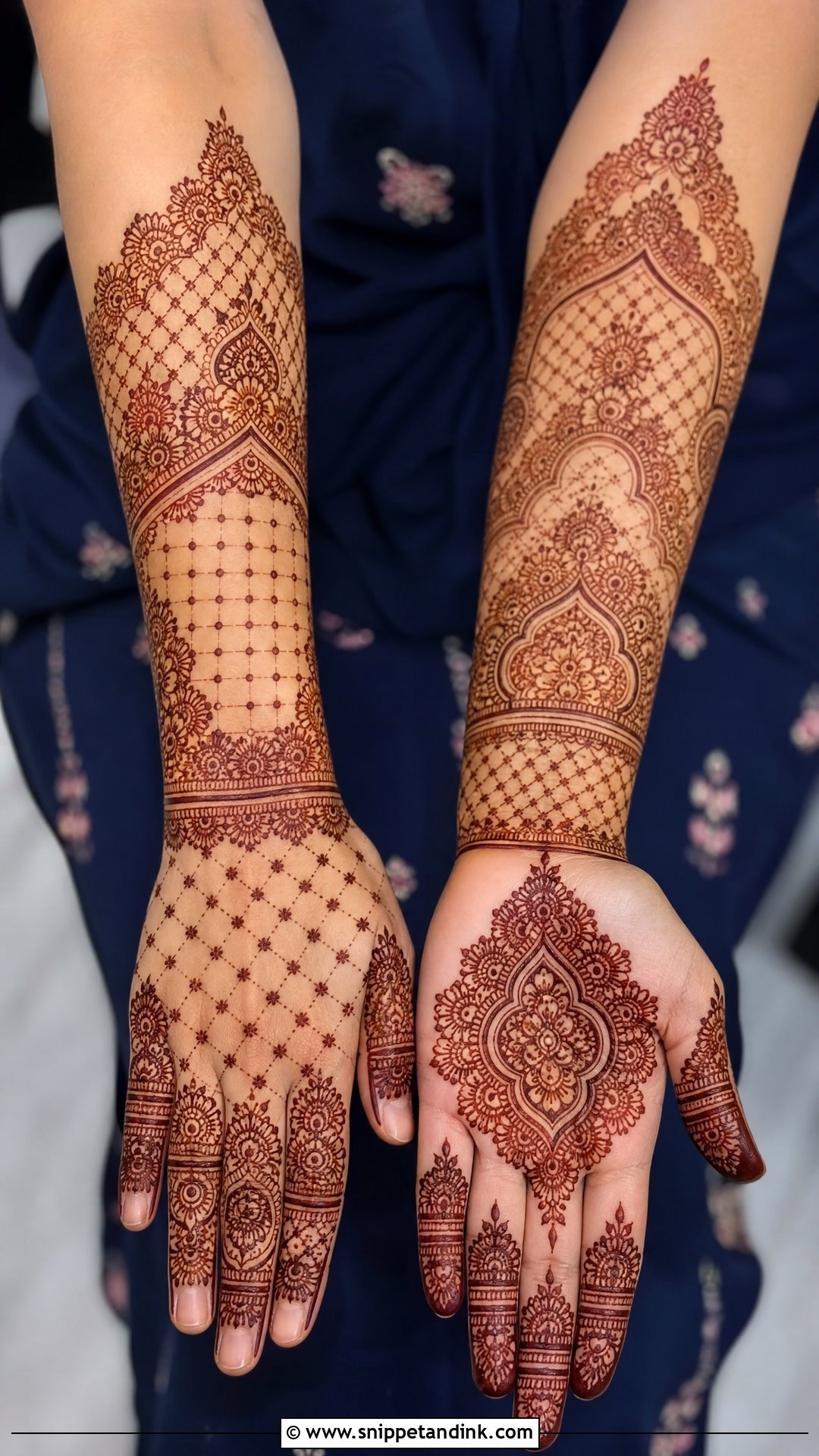
Jaali Pakistani bridal mehndi uses a mesh of fine crossing lines that looks like lace. Grid work is unforgiving: one line drawn at a slightly different angle shows across the whole panel. I place jaali on the back of the hand, palm corners, wrist or forearm, framed with florals, paisleys, dots and bracelet borders, so the open grid contrasts with filled areas. It adds texture in photos without overwhelming the hand. I wouldn’t use it everywhere, though. Mixed with larger motifs it stays balanced, and it looks especially refined next to sleeves with net, lace or cutwork.
15. Mughal Pakistani Bridal Mehndi
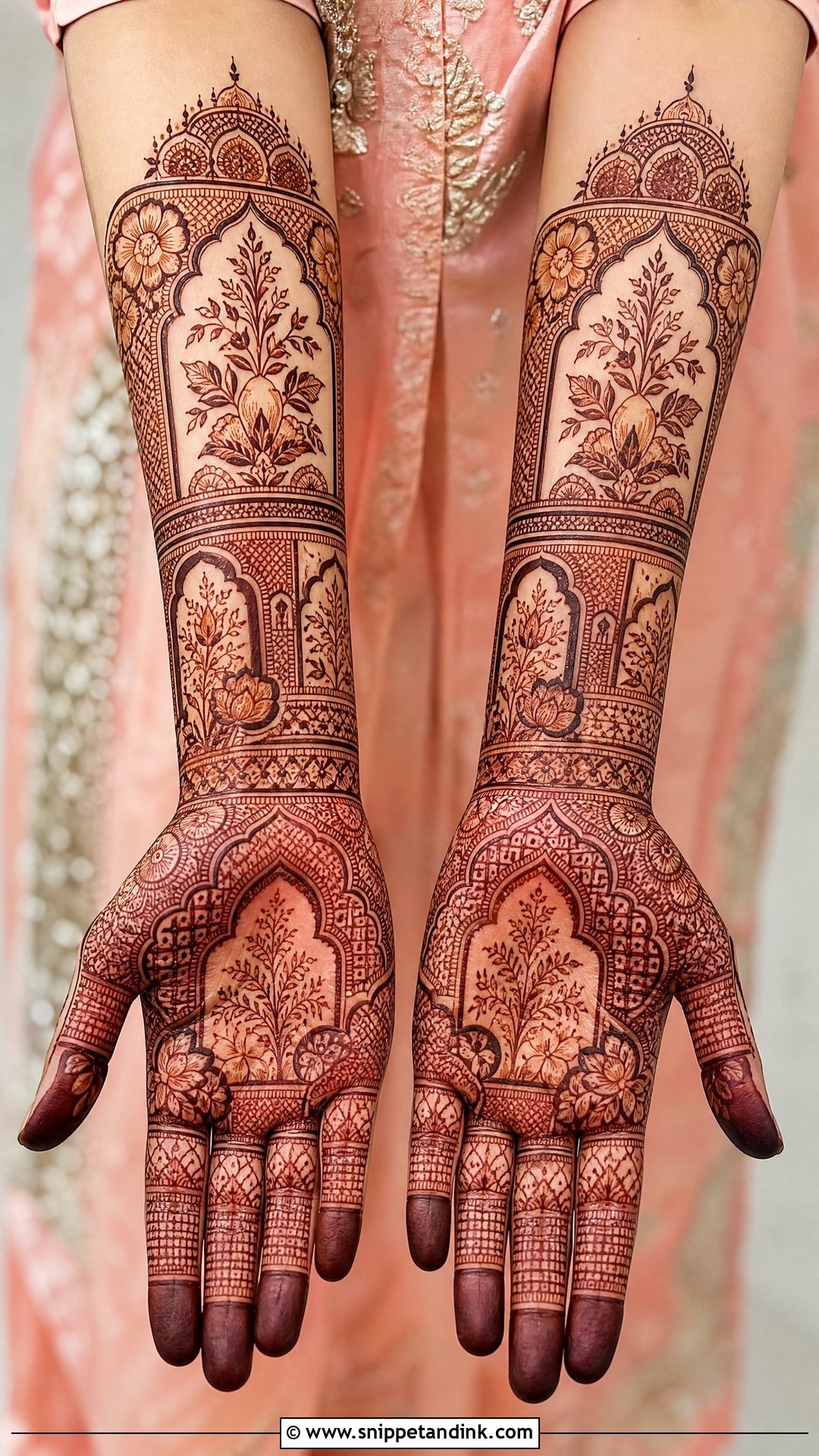
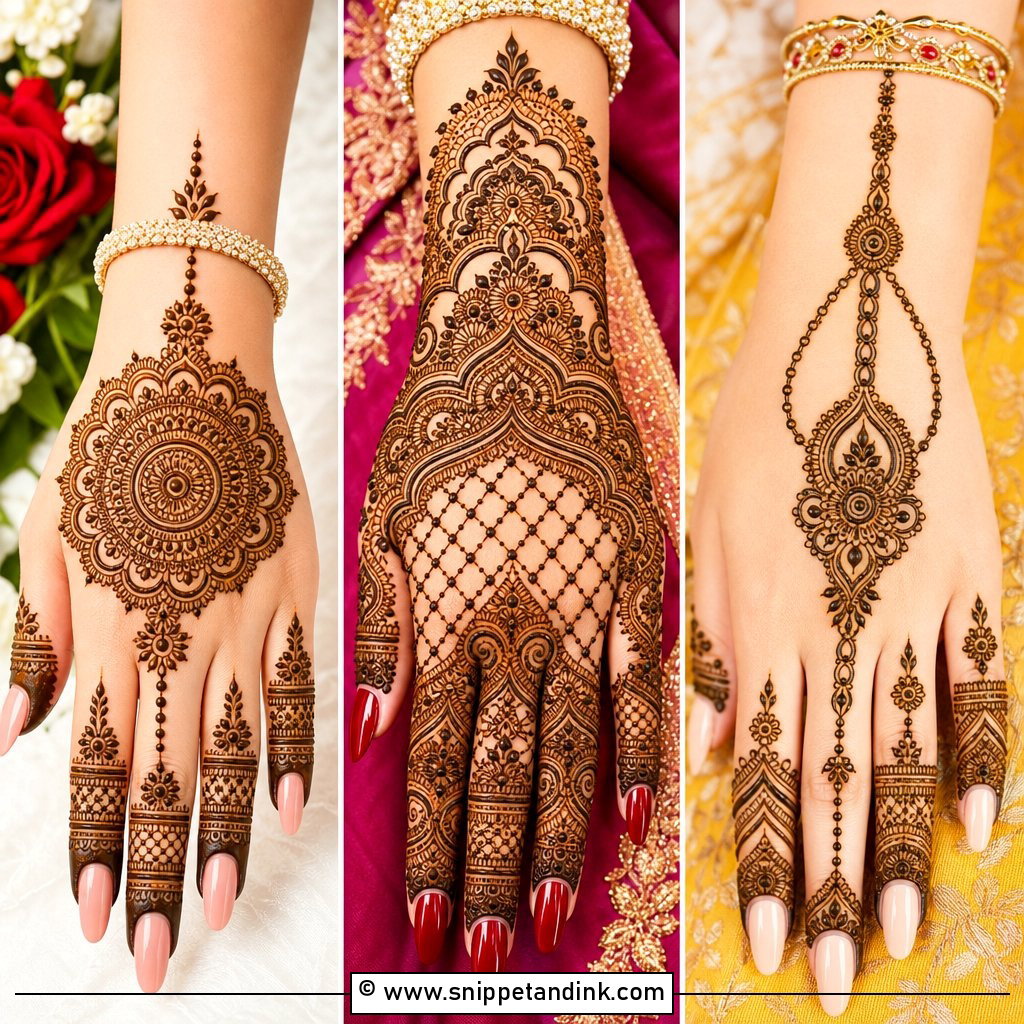
Mughal designs borrow from architecture: arches, domes, garden layouts and ornamental framing. Expect curved arch panels, floral vines, miniature detail and symmetrical wrist-to-forearm layouts. It feels regal and suits heavily embroidered Pakistani outfits. Brides who love heritage looks sometimes ask for small palace-style borders or framed motifs on the palms. Because the structure is so formal, both hands must repeat the same shapes, and I mark the arch positions on both arms before drawing anything. Heavy is fine; messy isn’t. Strong outlines, fine filling and spacing that’s been thought about make it look rich.
16. Royal Pakistani Bridal Mehndi
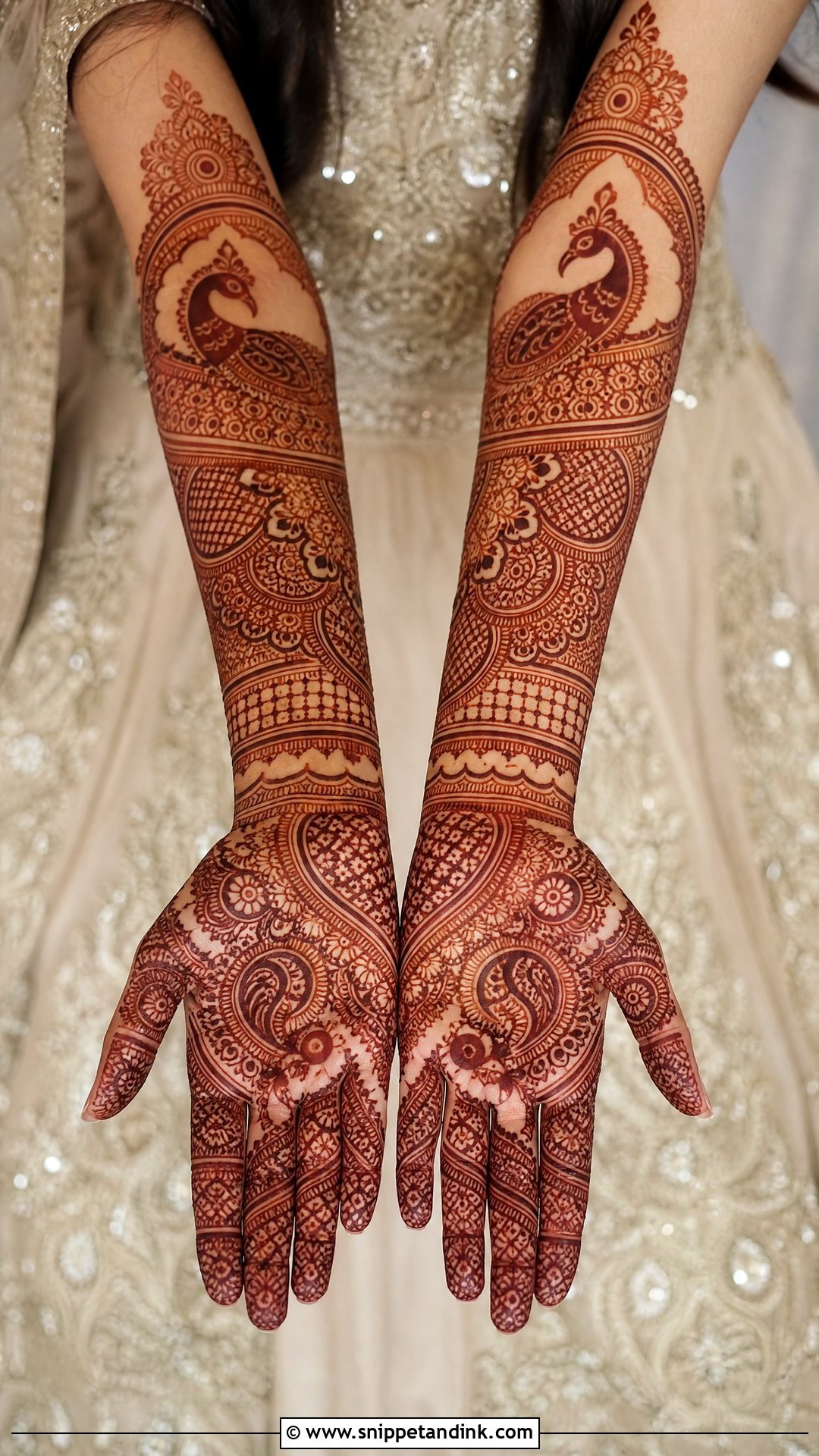
Royal designs combine almost everything: peacocks, paisleys, florals, mandalas, jaali and ornamental wrist cuffs in one full-coverage layout with bold centre motifs and long forearm extensions. The danger with that much content is chaos, so I organise it into clear zones before I start, a different motif family on the palm, the back and the arm. Most brides wear it for the main ceremony, where it matches heavy jewellery and embroidery and gives a dramatic hand portrait. Ask for deeper borders around the major shapes and smaller fillers inside them, so each motif still stands out once the stain develops into deep maroon.
17. Minimal Pakistani Bridal Mehndi
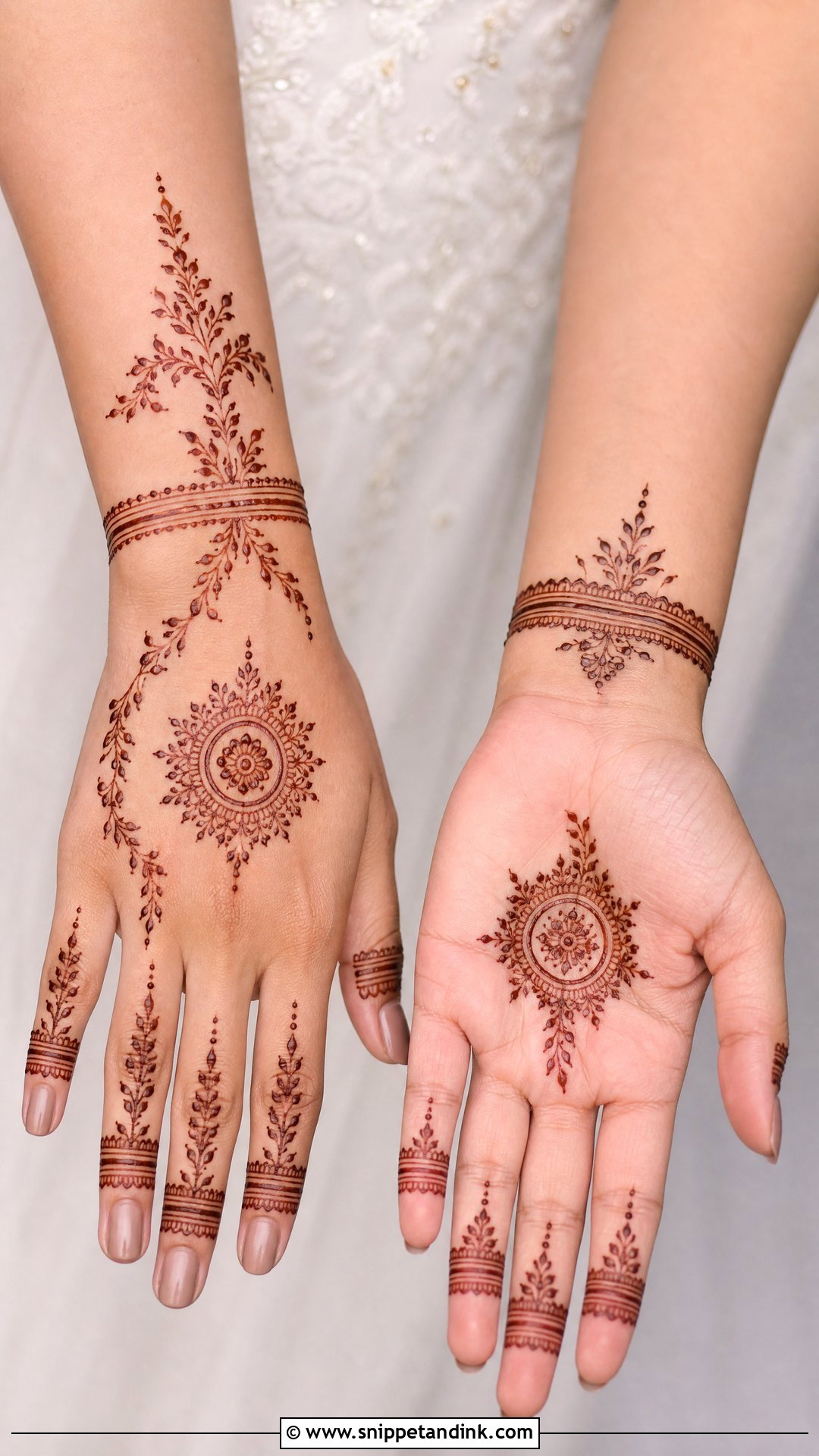
Minimal bridal work leaves more skin showing: fine florals, finger detail, a soft mandala, bracelet bands or one light trail to the wrist. It suits nikah ceremonies, civil and destination weddings, and contemporary Pakistani outfits. Minimal is not the same as plain, and it’s actually harder to hide mistakes in. Every line has to be clean and every gap has to look intentional. A small hidden initial or date adds something personal without adding weight.
18. Modern Pakistani Bridal Mehndi
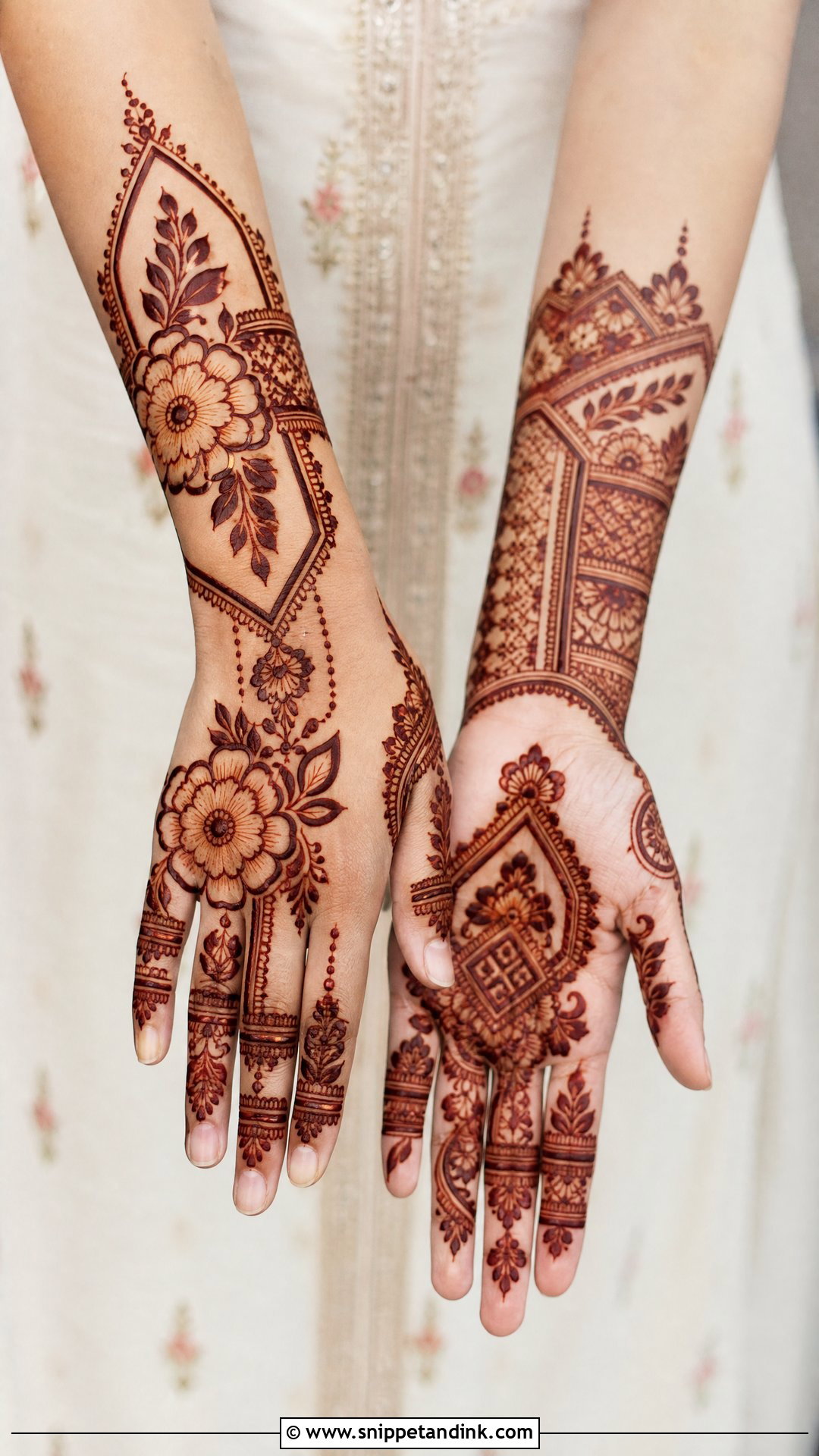
Modern Pakistani mehndi keeps the motifs but changes the layout: clean negative space, bold florals, geometric panels, bracelet shapes and asymmetric trails. It’s lighter than classic full-hand work and still reads as bridal. It pairs well with structured outfits, sleek jewellery and softer makeup. My one rule is to choose one modern element, such as open spacing or geometric cuffs, and combine it with traditional Pakistani motifs. Make everything modern and the hand starts to look like a festival design rather than a bride’s.
19. Pakistani Bridal Finger Mehndi
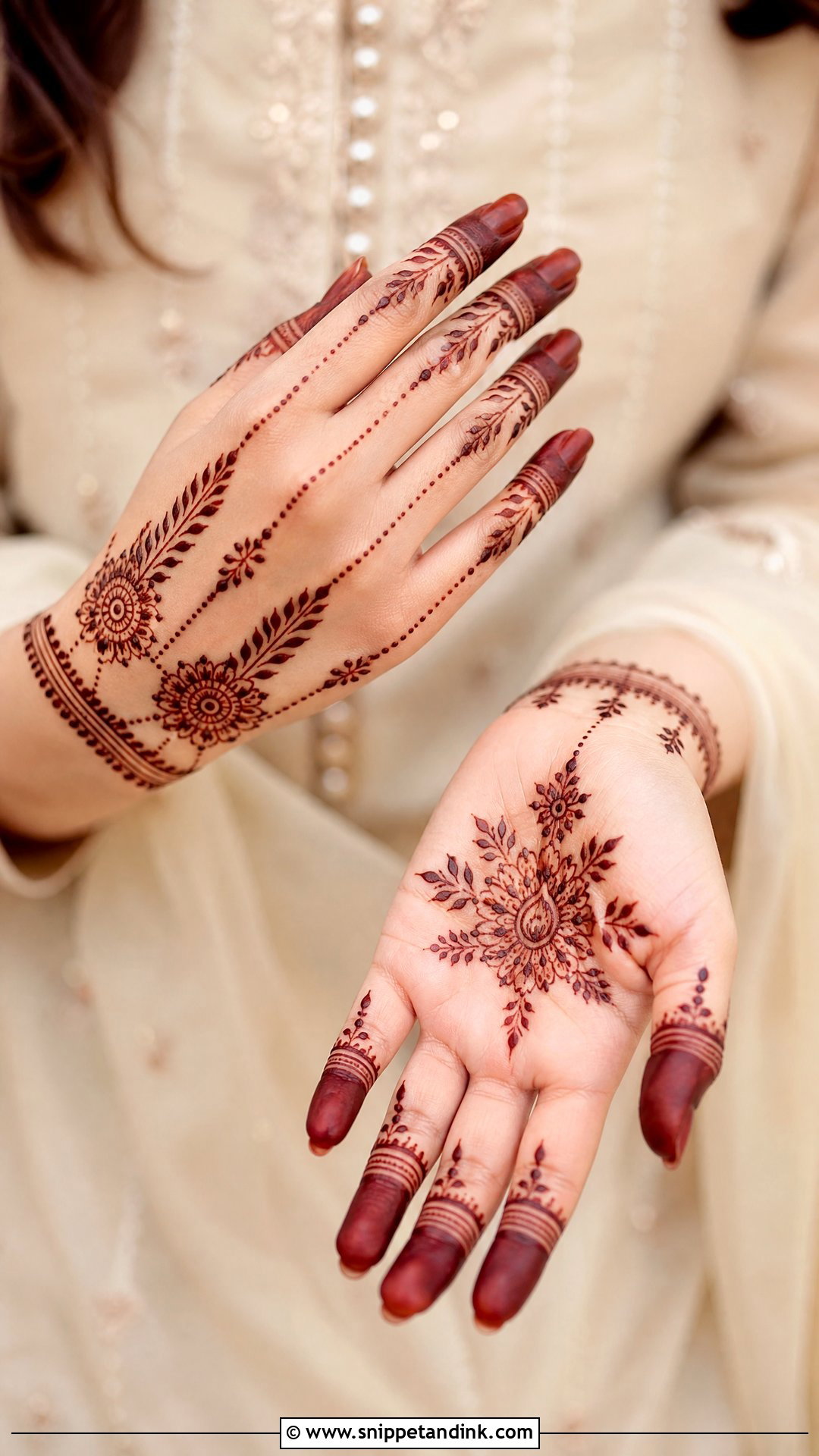
Fingers stain darkest of anywhere on the hand, so finger work is often what shows most in ring and nail photos. It can mean filled tips, ring bands, leafy chains, tiny florals, dots and fine linework. What I avoid is fingers that look like a separate design; they need to connect to palm motifs, wrist cuffs or back-hand trails. Repeated bands make long fingers look longer still. On shorter fingers I use fewer, finer bands, because many thick rings across a short finger tend to make it look stubby.


20. Bracelet Pakistani Bridal Mehndi
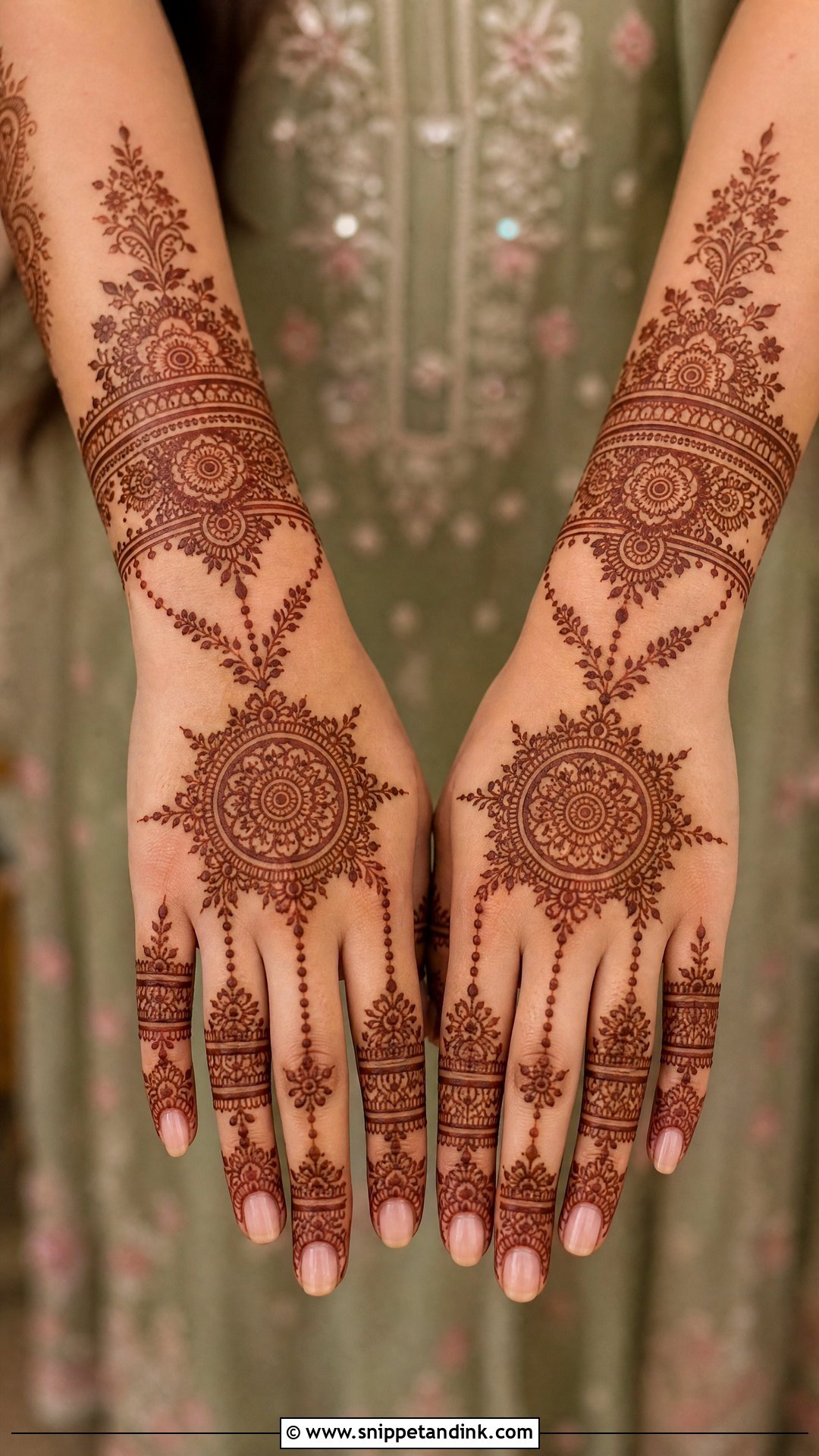
Bracelet mehndi is a back-hand layout that imitates jewellery, with wrist cuffs, ring chains, finger bands and floral or mandala detail across the hand. Because it already looks like a haath phool, it’s ideal under stacked bangles or a real hand chain, as long as the drawn chains don’t fight the metal ones. It can be minimal for nikah or heavier for the wedding day, with forearm bands and filled fingertips added. Ask your artist to line the chains up with your knuckles and fingers. A chain that runs a few millimetres off-centre looks crooked in every photo.
21. Pakistani Bridal Mehndi With Groom Name
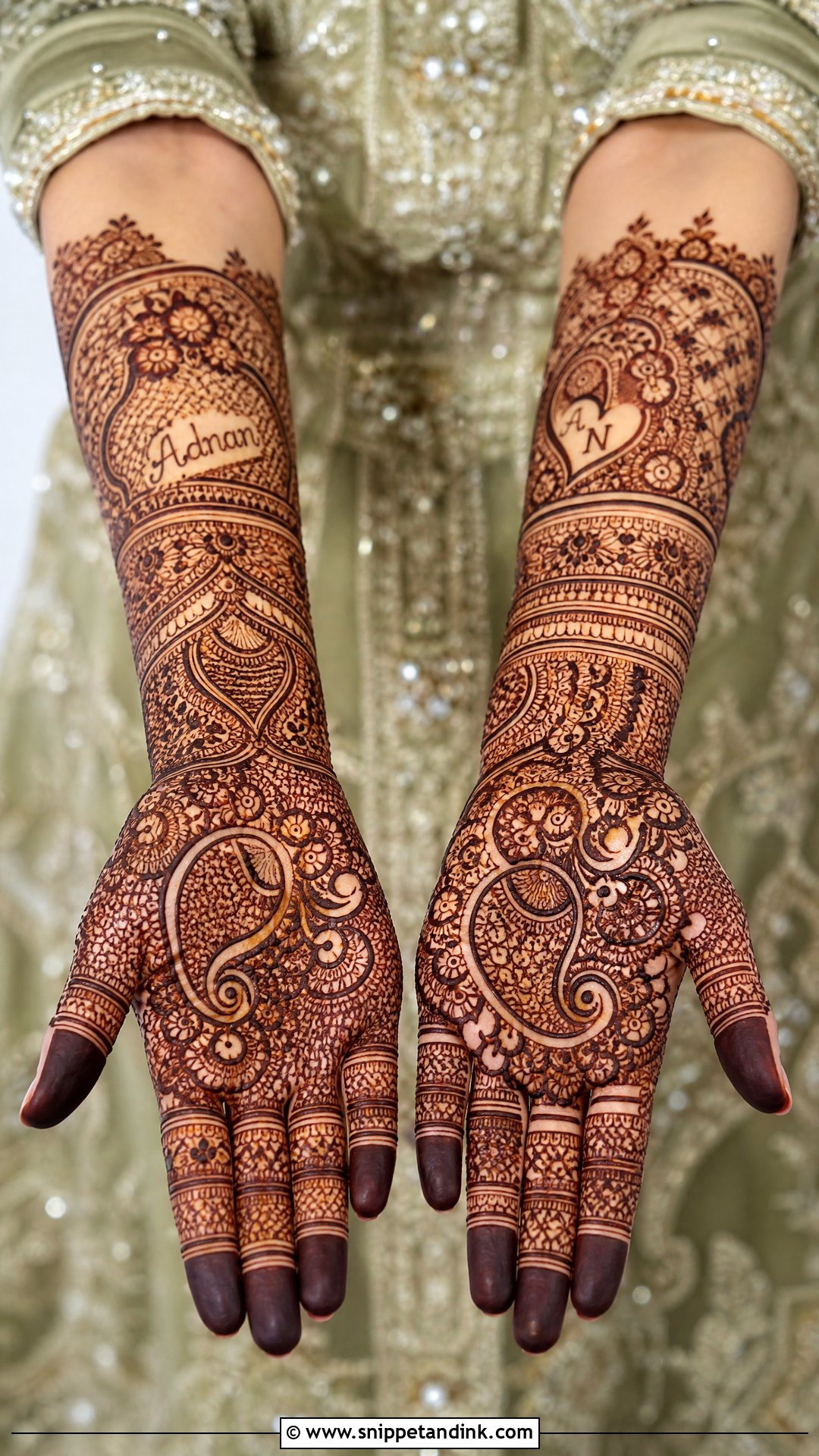
Hiding the groom name is one of the best-loved games at a Pakistani wedding, where the groom gets teased until he finds it. Initials, the full name or the date can be tucked inside paisleys, petals, jaali sections or wrist borders, in a heavy, simple, Arabic or traditional design. The trick is hiding it fairly: visible enough to find, but woven in so it doesn’t break the pattern. Decide on the spelling and script before the appointment and write it down for your artist, because a name added in a hurry often ends up squeezed into whatever space is left.
22. Pakistani Bridal Mehndi With Portrait
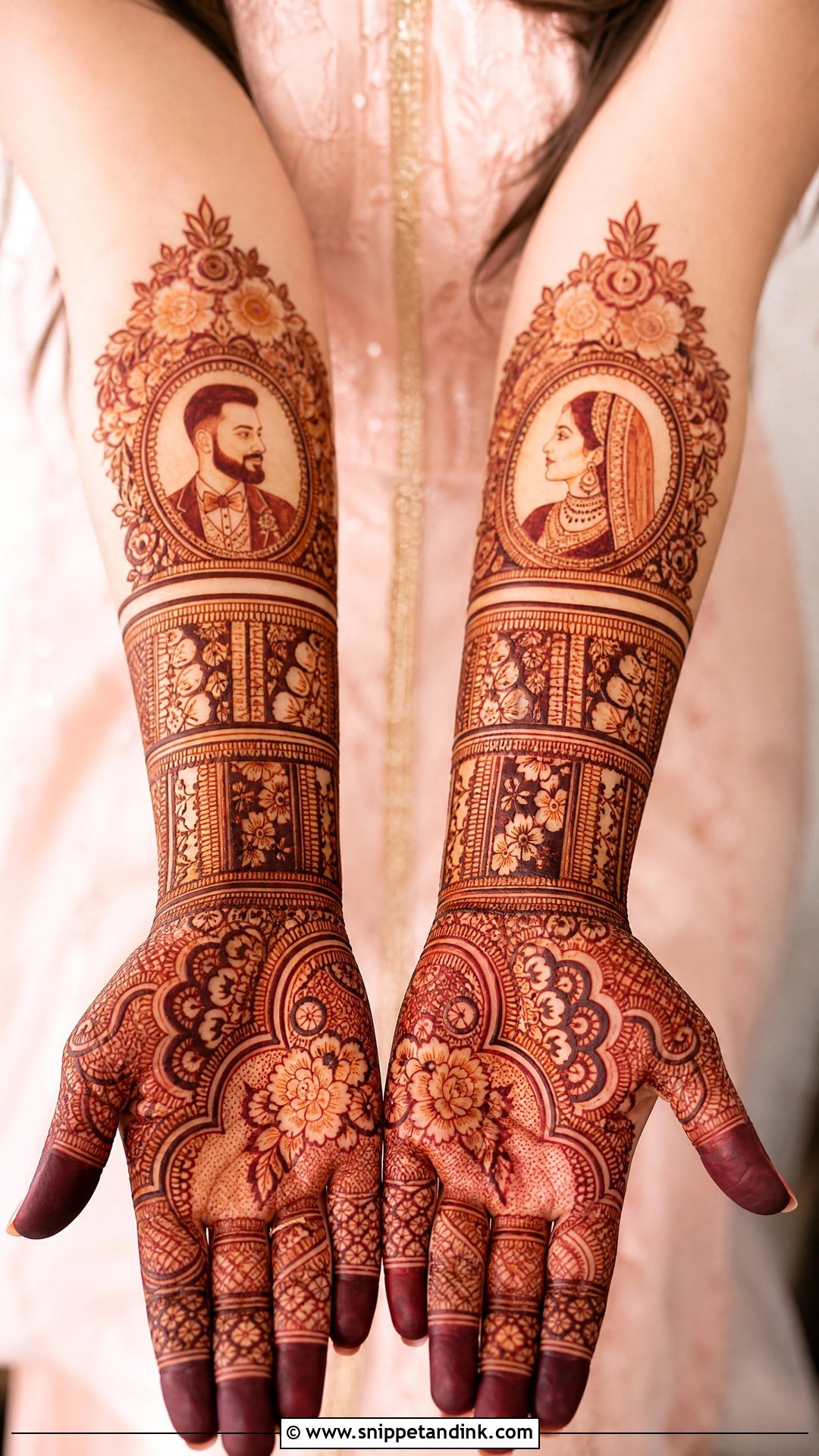
Portrait mehndi turns the palm into a scene: a bride and groom, a doli, a baraat symbol or a small couple silhouette, surrounded by dense Pakistani detail, florals, paisleys and wrist-to-forearm panels. It needs an artist who has drawn faces in henna before, since proportions and steady lines matter far more than with floral work, and a crooked face is very hard to fix in paste. Book extra time. It suits a bride who wants something custom rather than a common pattern. Keep the surrounding motifs quieter so the figures stay the focus.
23. Pakistani Bridal Forearm Mehndi
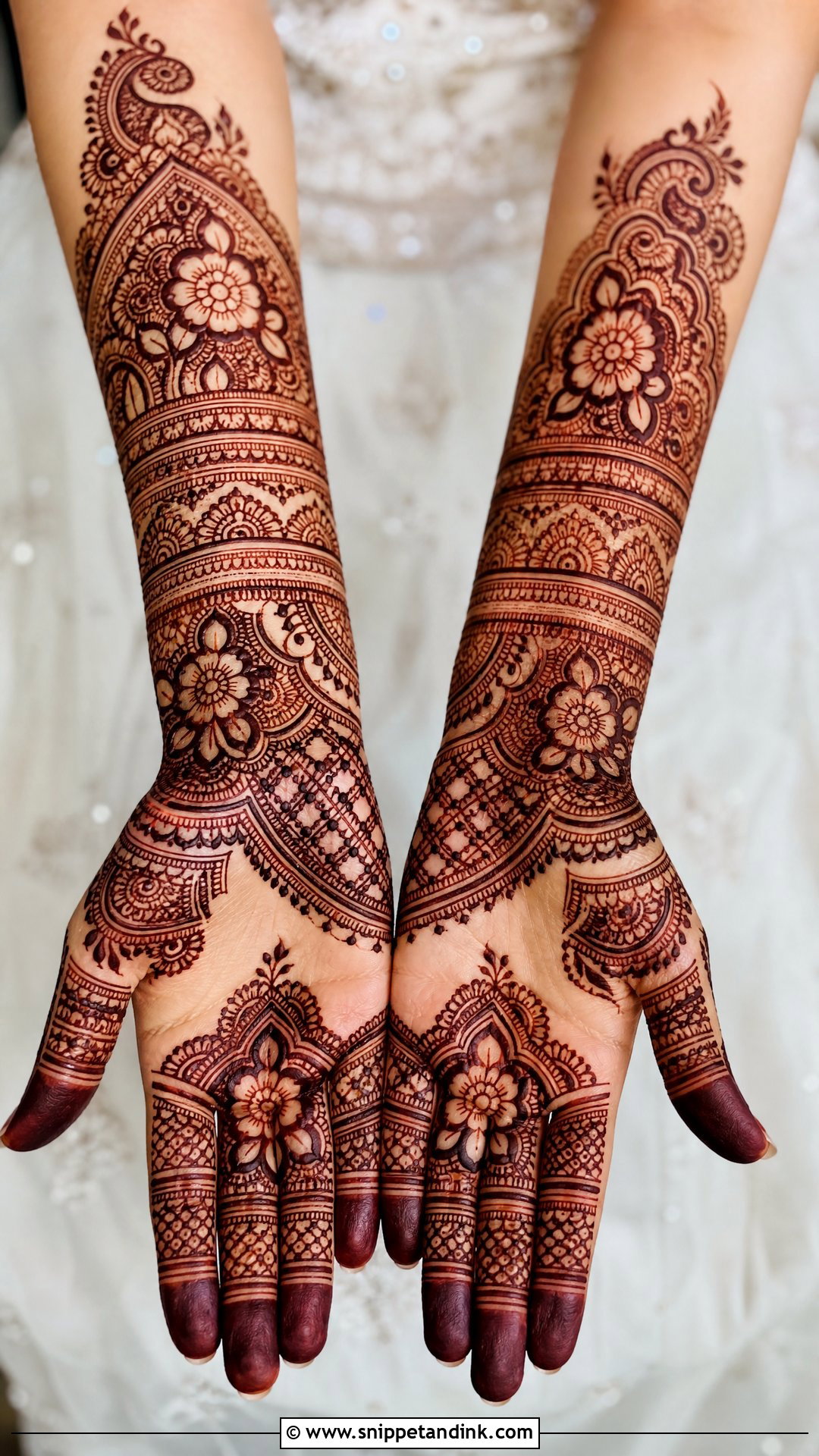
Forearm mehndi carries the design past the wrist with stacked cuffs, floral panels, paisley trails, jaali, arches and fine filler. It matters most with short or sheer sleeves, where the arms stay visible all day. The forearm stains lighter than the hand, a little more orange-brown, so I use the boldest motifs at that end. The pattern should taper as it climbs and flow out of the hand rather than sitting on the arm like a separate block. A soft taper toward the elbow is also kinder to wear.
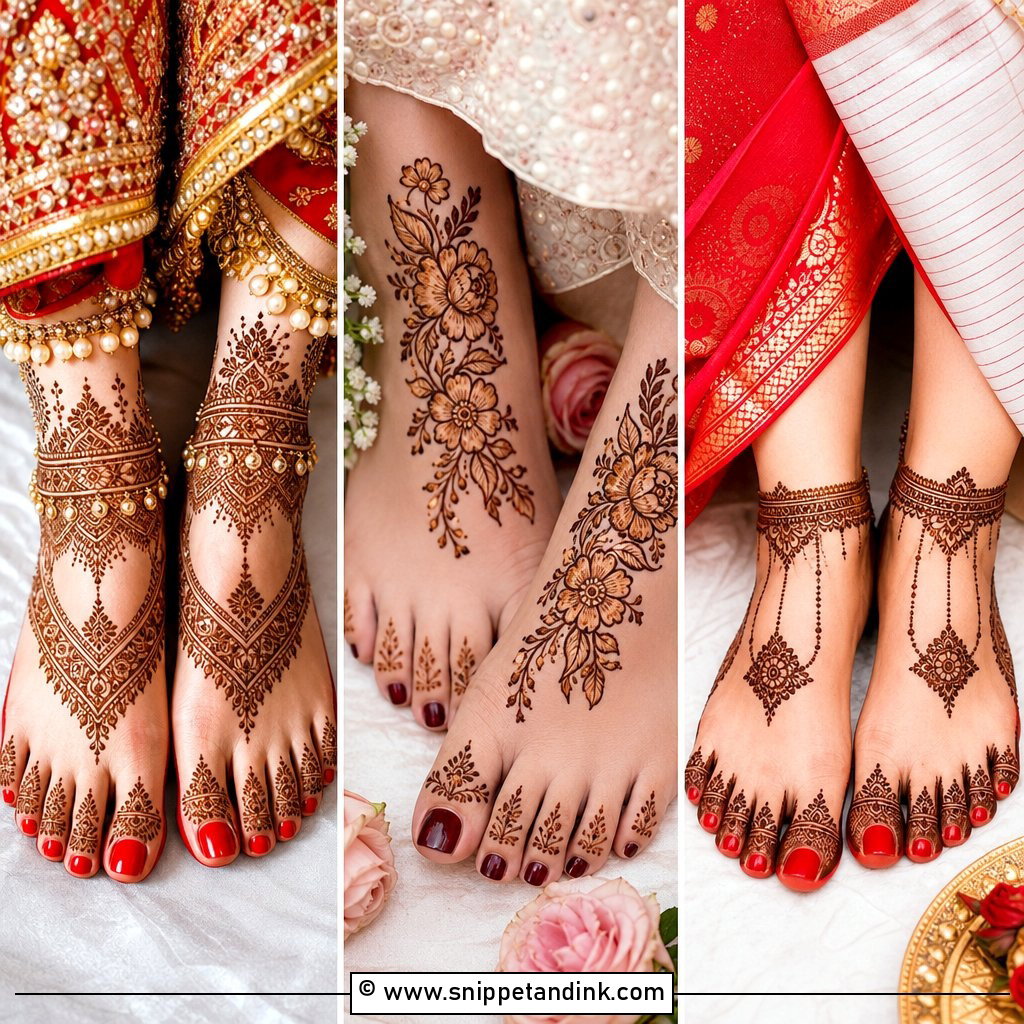
24. Pakistani Bridal Feet Mehndi
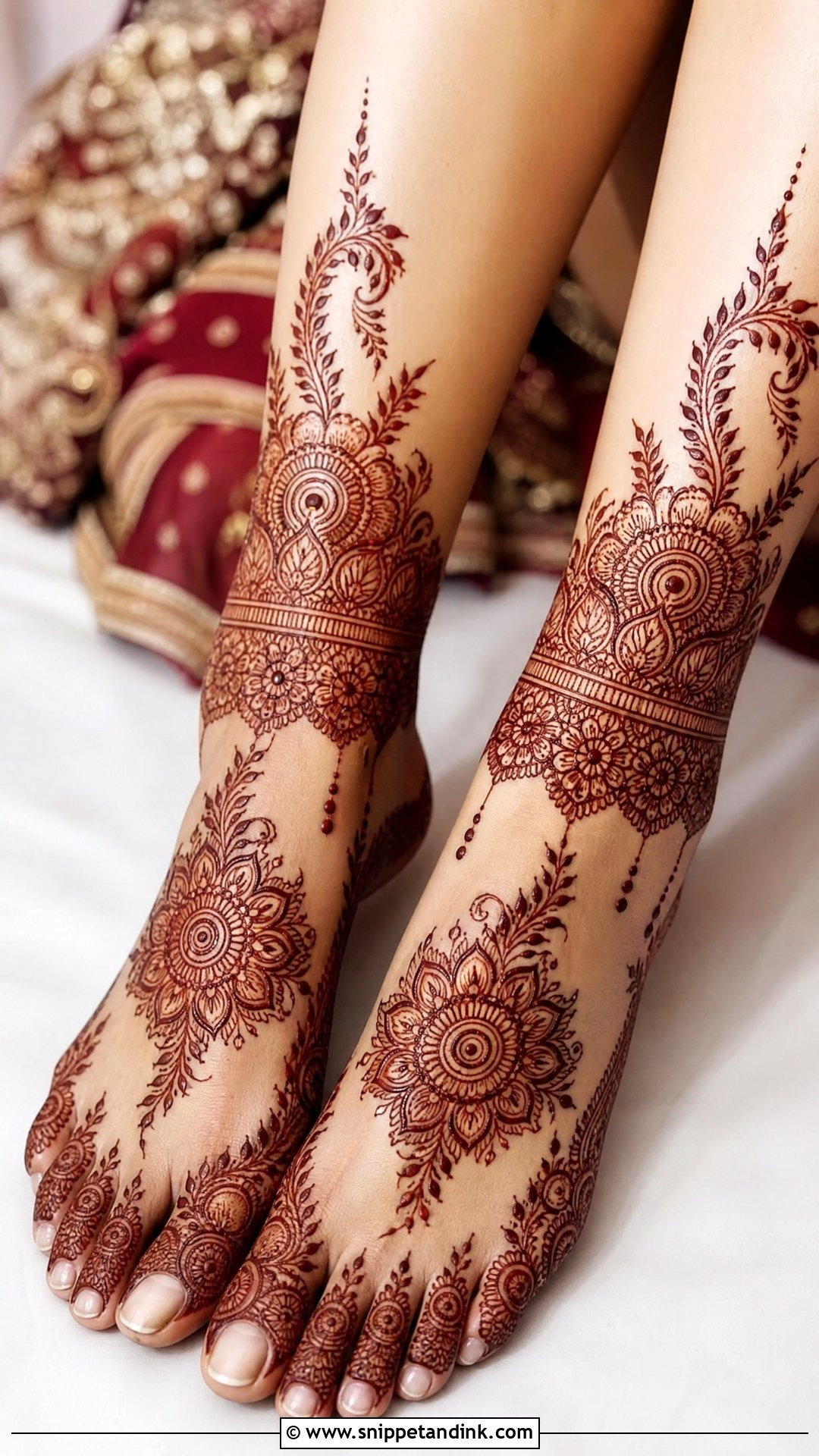
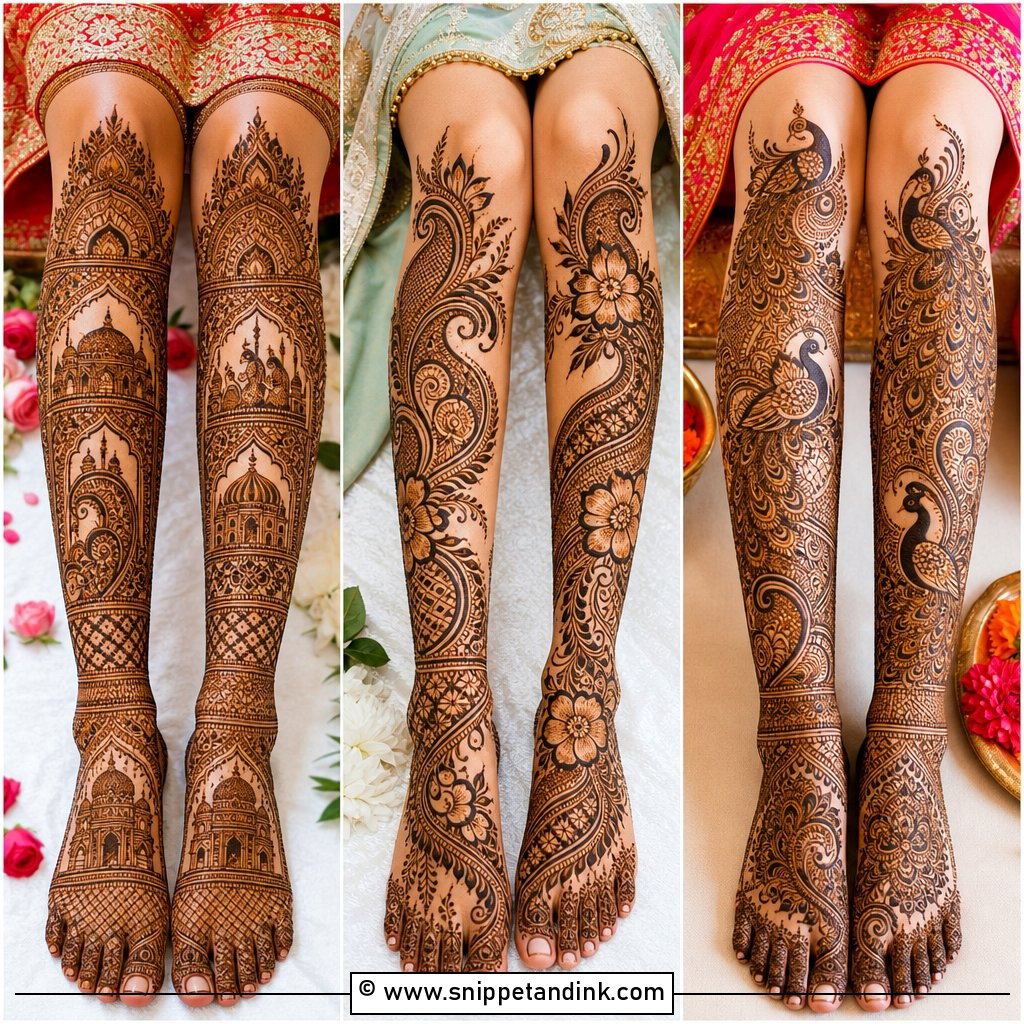
Feet complete the look from head to toe, with toes, the tops of the feet, ankles and sometimes the lower legs covered in florals, paisleys, anklet bands, mandalas and fine vines. The soles stain very dark while the tops of the feet stain lighter, so the design should frame the toes and ankle clearly for seated portraits with open sandals and payal. Feet need the longest undisturbed drying time, and you can’t walk while the paste is wet, so I usually do them first and the hands after, or plan for someone to help you move. Heavy or simple, it depends on comfort and how much time you have before the next ceremony.
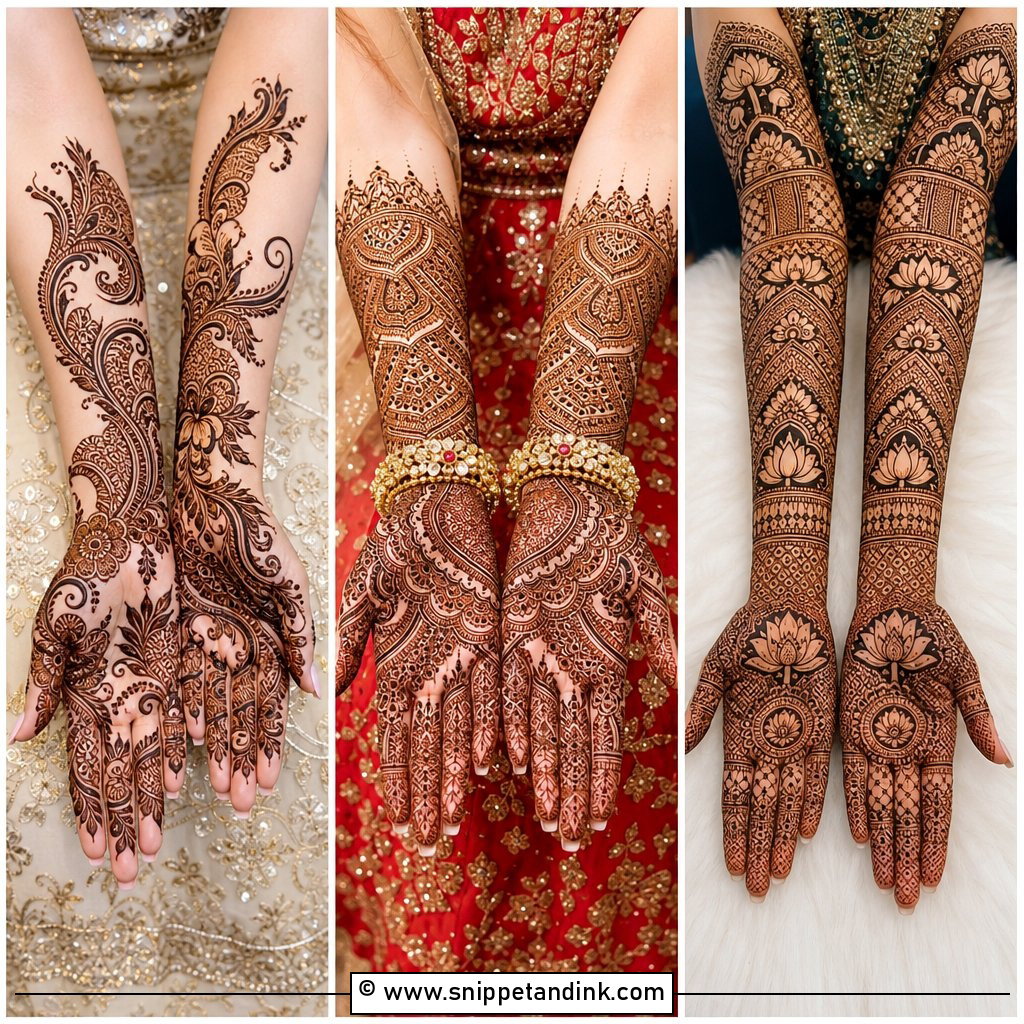
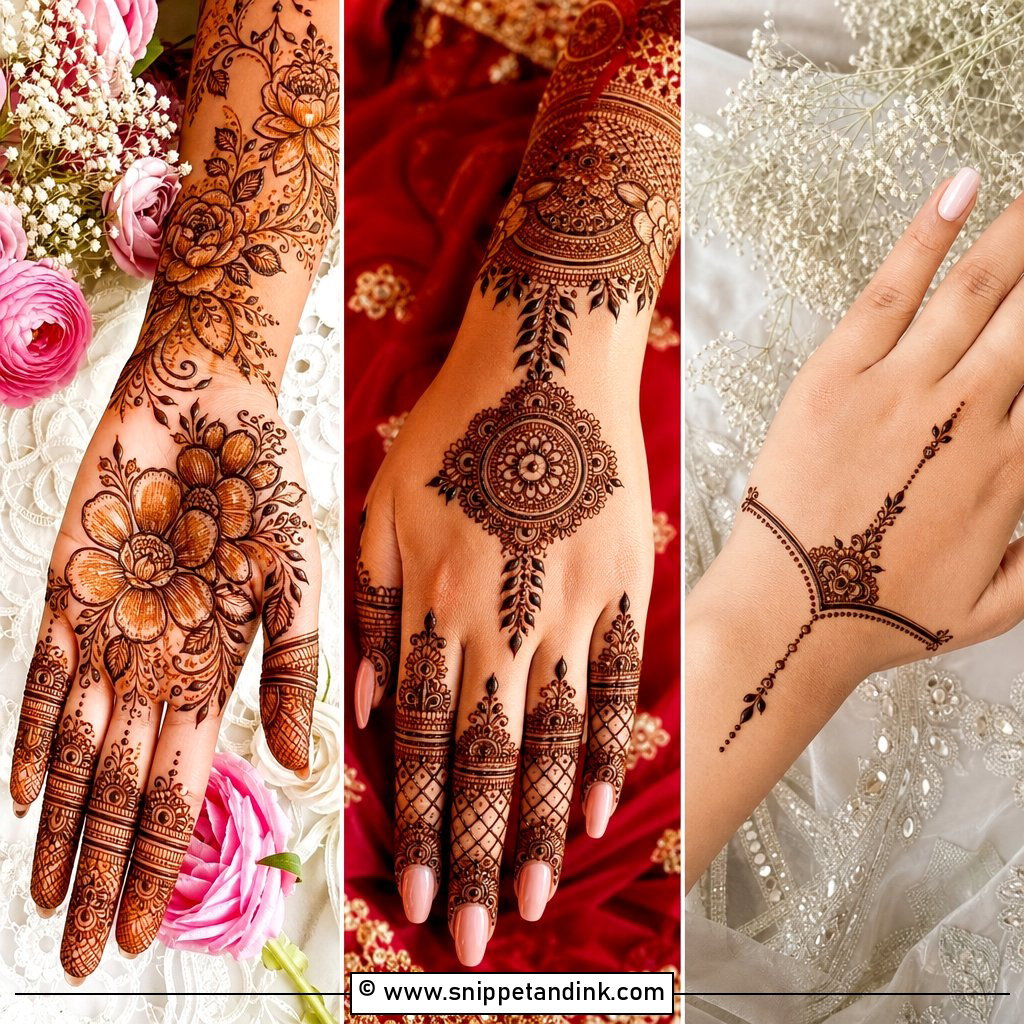


25. Pakistani Bridal Mehndi For Walima
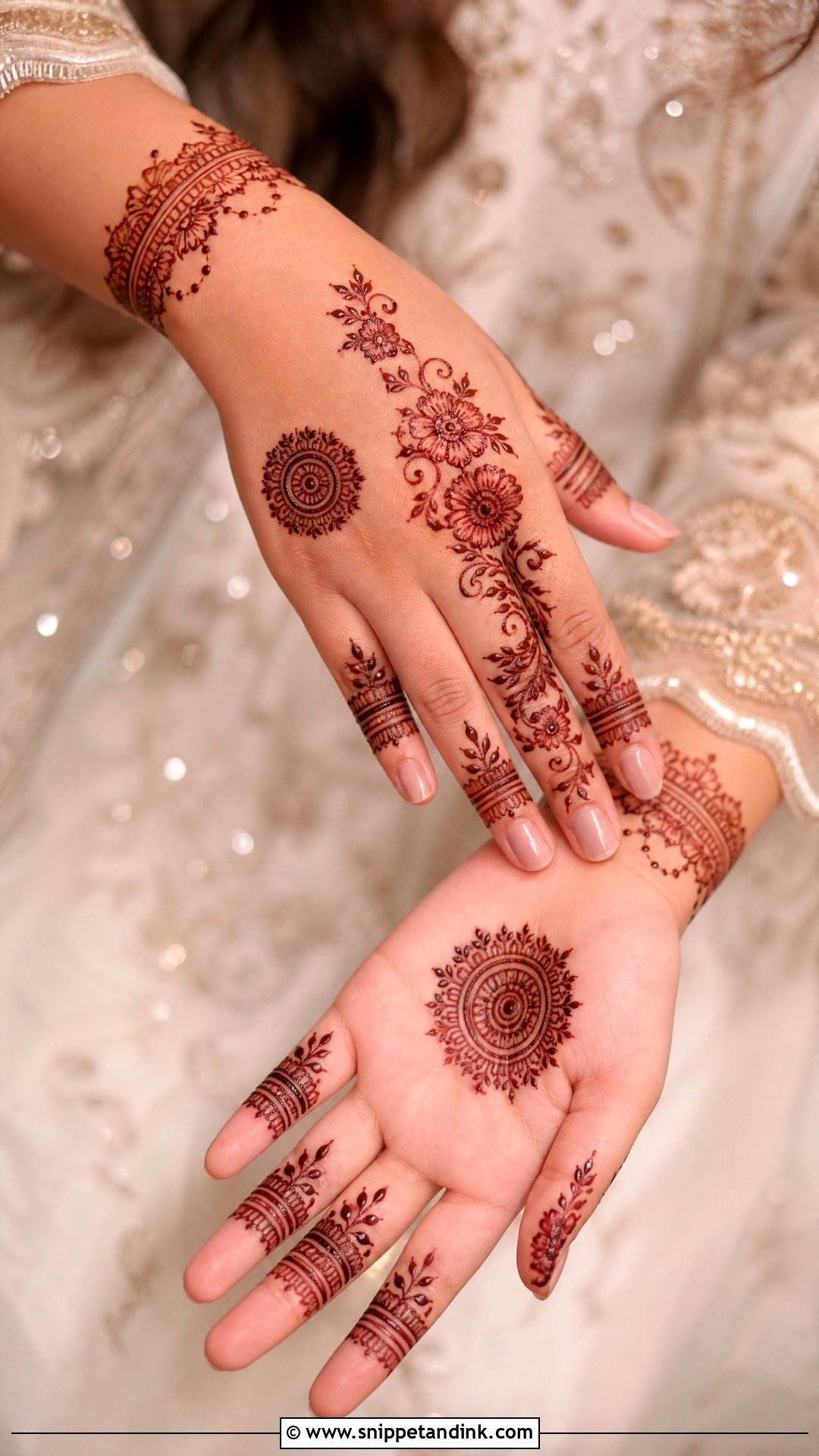
The walima look is usually lighter and cleaner than the baraat: elegant back-hand patterns, floral trails, bracelet cuffs or half-filled palms to suit softer walima outfits in champagne, silver, pastel, ivory or muted gold. Most brides don’t get new mehndi for the walima at all, since the bridal stain from a day or two earlier is often at its darkest then. If you want a separate design, it needs to go on before the baraat, so plan it as part of the same session or a lighter one earlier. Keep the motifs neat and skip dense forearm filling for a polished last look.
Caring for the Stain Once the Paste Comes Off
Most of a dark stain comes from what you do after I leave. Natural henna needs time on the skin, and the longer the paste stays on, the deeper the colour. I ask brides to keep it on for at least six hours, and overnight if they can sleep with their hands wrapped. A light dab of lemon and sugar keeps the paste stuck to the skin as it dries.
- Scrape the dried paste off with a blunt edge or your fingernail. Don’t wash it off.
- Keep water off your hands for as long as you can, ideally the first twelve hours or more.
- Keep your hands warm. Stains darken more in warmth, which is why many families hold hands over clove smoke.
- Rub a little oil or balm over the design before showering in the days after, so soap and water don’t fade it early.
- Avoid scrubs, bleach and chlorinated pools until after the walima.
Why I won’t use instant black cones
Real henna never stains black. Cones sold as black mehndi or promising a dark stain in an hour often contain PPD or other dyes, which can cause blistering and allergic reactions that last long after the wedding. Fresh paste made from body art quality henna, lemon juice and sugar, with a skin-safe essential oil, smells earthy and stains orange first. If your artist’s cone stains dark brown the moment it’s scraped off, ask what’s in it before it touches your skin.
Mehndi Is the Detail Guests Ask to See Up Close
There’s a Pakistani bridal design for every kind of bride, from dense traditional dulhan hands to modern floral trails and bracelet layouts. Match it to your outfit, your jewellery, the ceremony and how long you can sit still. Heritage lovers will gravitate to full-hand, paisley, peacock or Mughal work. Softer styles mean minimal, Arabic, tikki or walima designs. Whichever you choose, book an artist whose bridal work you’ve seen on real hands, agree on coverage before the day, and give the paste enough time on your skin. Done well, the mehndi is what guests reach for and ask to see up close.
You'll Like These Ideas:









Leave a Reply