
Palms get admired at the mehndi night, but it is the back of the hand that ends up in the wedding album: under the chooda, around the kaleere, on top of the dupatta, beside the rings. That is why I treat the back of the hand as part of the bride’s henna look in its own right, not as the leftover side. It takes mandalas, florals, jaali, paisleys, bracelet bands and full forearm work, and it can be dense Indian, airy Arabic, Indo-Arabic or modern and sparse. What matters most is that the design still reads clearly once it stains, rather than turning into a patchy brown mass. Here are thirty bridal layouts with my working notes on each.
Briefing Your Artist on the Back of the Hand
Brides tend to arrive with a folder of palm designs and very little about the back. A few details from you change how I lay out that side completely.
- Your bangles. A chooda or a tall bangle stack covers a good part of the forearm, so heavy work there will be hidden. I’d rather put that effort into the hand and the wrist line just below where the bangles sit.
- Your sleeves. Sheer or short sleeves show the forearm; full sleeves mean the design should end at the wrist.
- Your jewellery. If you are wearing a haath phool, bring it. Drawn chains that run under the real ones look neat; chains that cross them look cluttered.
- Your nails. A dark or red manicure suits dense fingertips, while a nude manicure suits lighter finger work.
- Hidden details. Names, dates or small symbols need planning before the first line, not halfway through.
Also tell your artist which hand you’ll hold the bouquet, phone or dupatta in during portraits. The hand that faces the camera more often deserves the clearer central motif.
1. Full Back Hand Bridal Mehndi Design
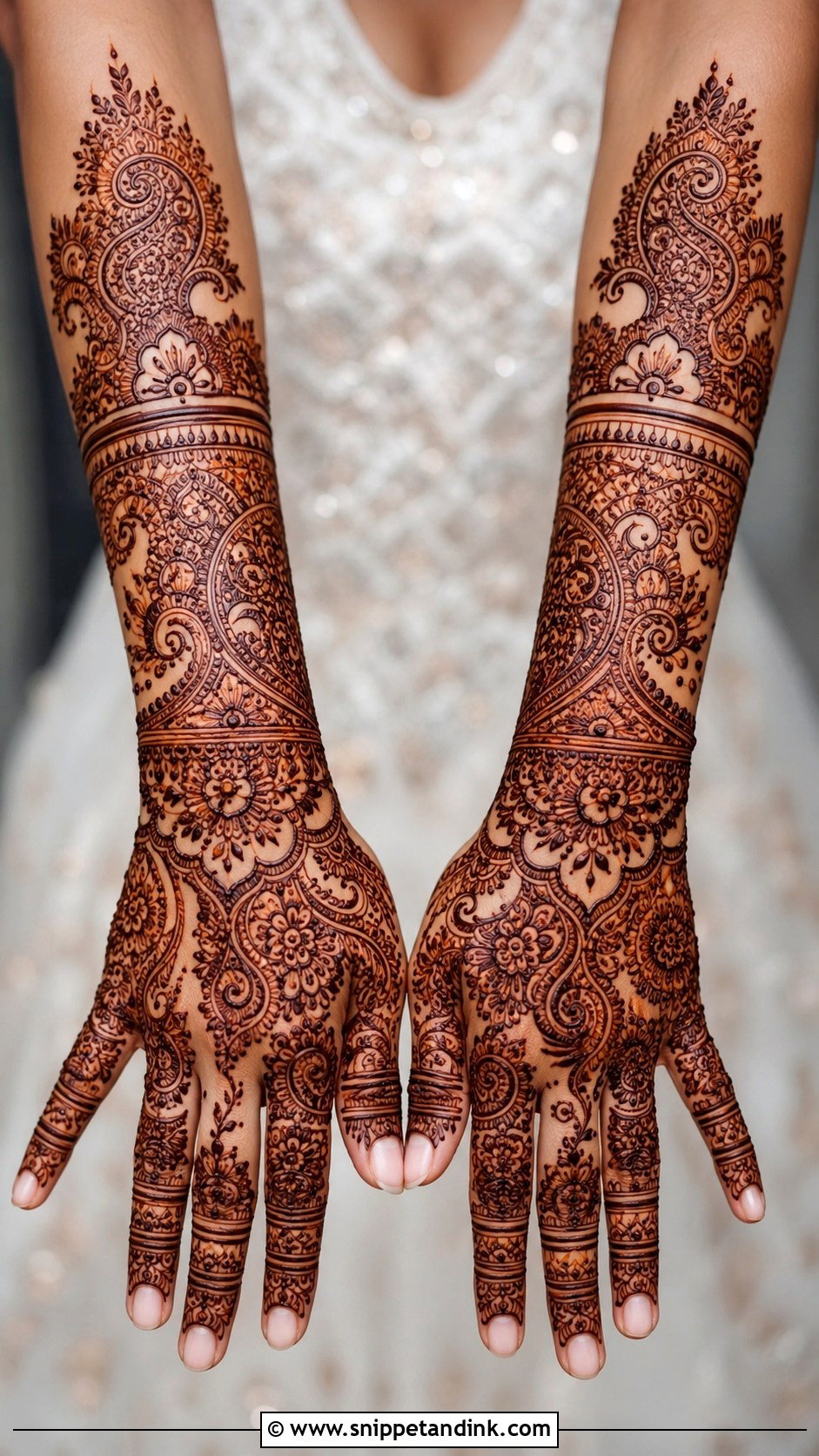
Full coverage runs from the fingertips over the back of the hand toward the wrist or forearm, built from paisleys, floral vines, small leaves, dots, shaded spaces and fine filling. Done well, nothing feels empty and yet every motif can still be picked out. I make the central motif slightly bolder than its surroundings, since a strong centre gives the eye somewhere to land in photographs. It suits heavy bangles, red bridal outfits and gold jewellery. If a lot of your arm will be under the chooda, tell your artist, because there is no point filling skin that will be hidden.
2. Indian Back Hand Bridal Mehndi Design
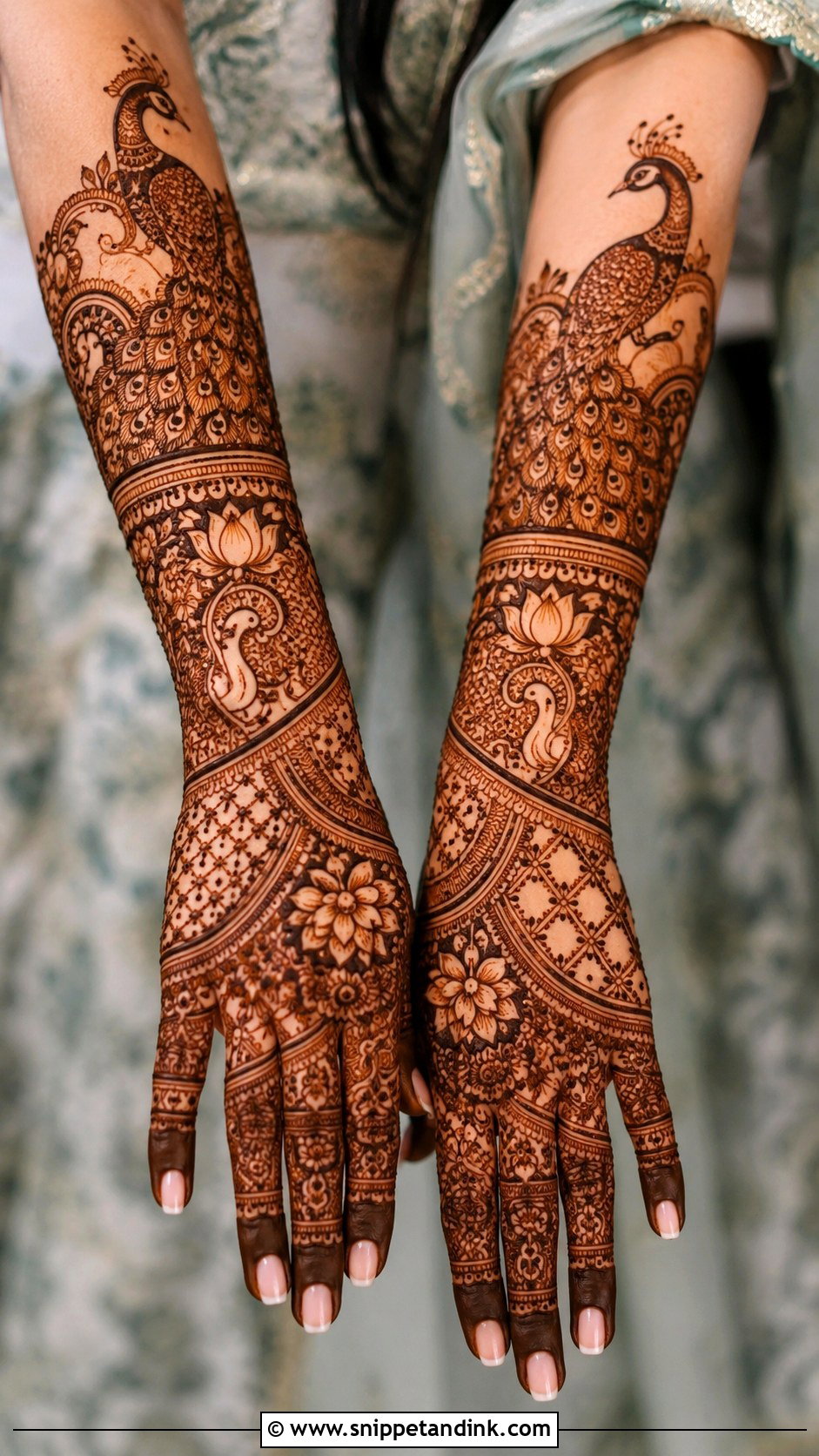
Dense, traditional and almost no bare skin: that is Indian bridal work. Peacocks, paisleys, lotus flowers, curved vines, mesh and tiny filler strokes cover the hand, the fingers are fully decorated and the wrist often carries bracelet bands or kalash details. Contrast is what stops it looking muddy. I switch between a thicker cone tip for outlines and a very fine one for the inner work, so the eye can tell structure from texture. It belongs with silk lehengas, sarees, kundan jewellery and stacked bangles.
3. Arabic Back Hand Bridal Mehndi Design
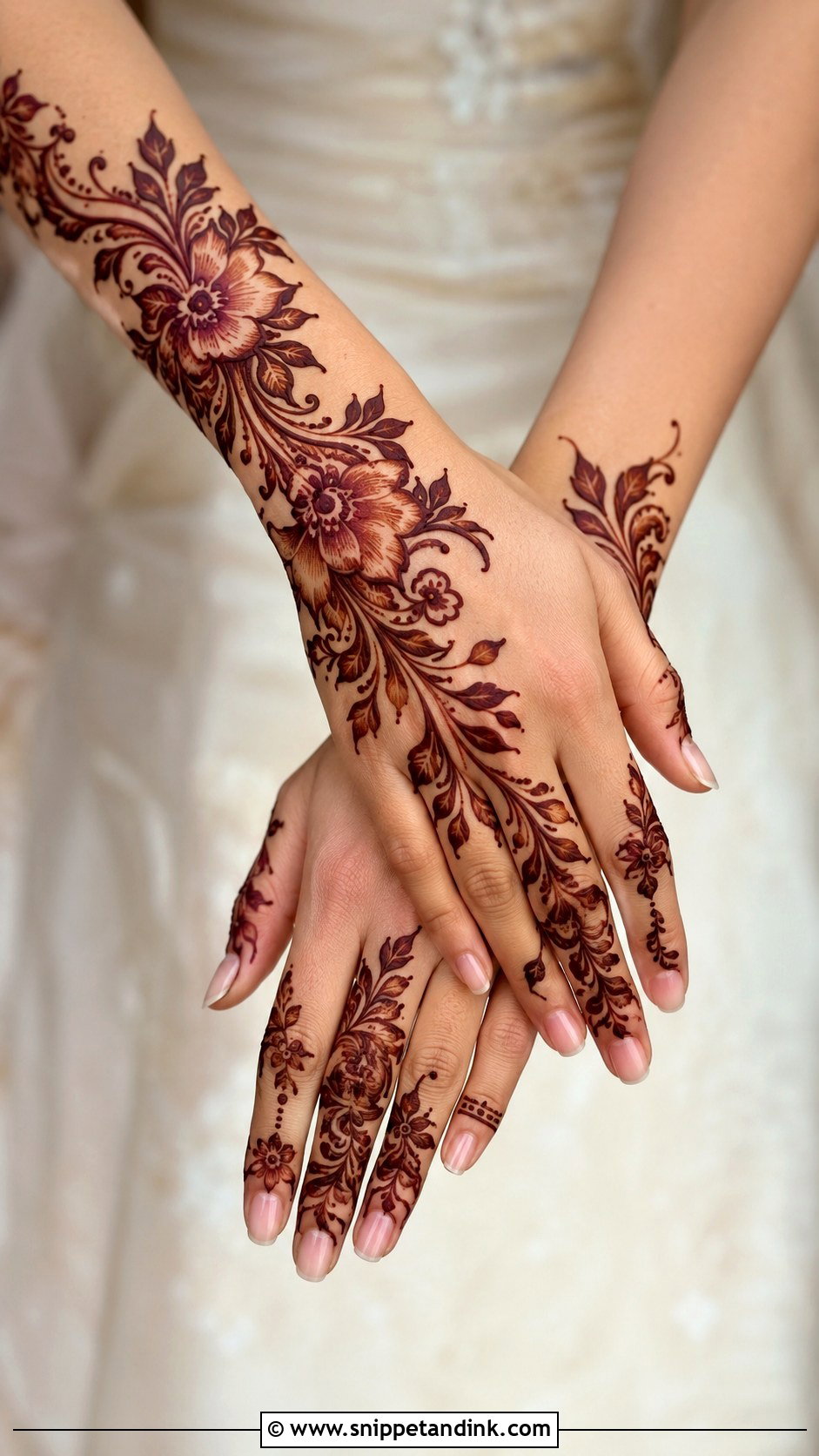
Arabic bridal mehndi doesn’t try to cover every inch. Flowing floral trails, leafy curves and open skin carry a diagonal from one side of the wrist across the hand to decorated fingers. Thick outlines and soft shading make the flowers stand out once stained. I’d suggest it for nikah brides, brides with a short sitting window and anyone wearing lighter jewellery. Bold Arabic outlines also stain more evenly on the back of the hand than fine Indian filler, which is a practical advantage on this side.
4. Indo Arabic Back Hand Bridal Mehndi Design
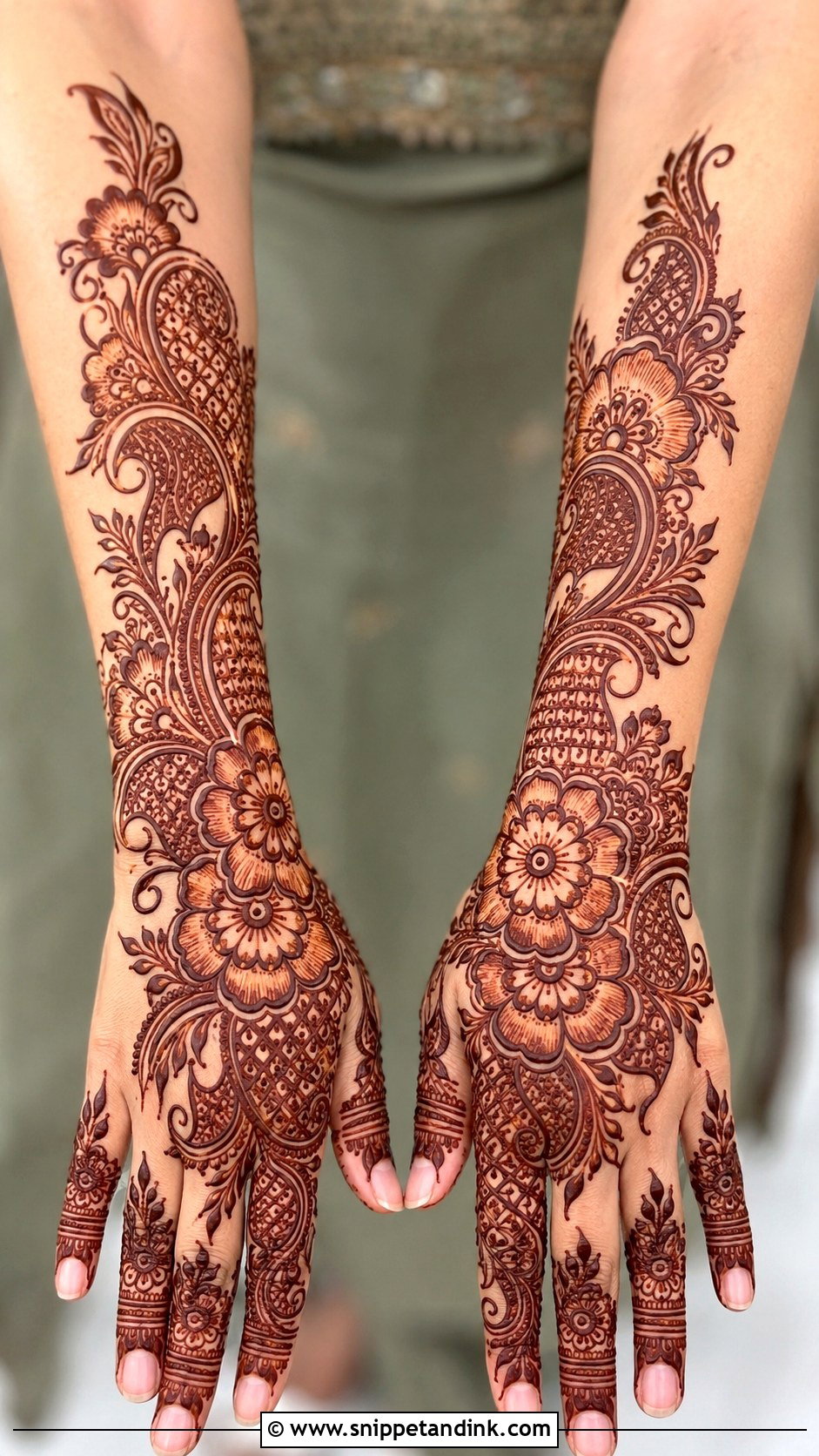
Indo-Arabic pairs the bold flow of Arabic work with Indian-style filling: large flowers, paisleys, leafy vines, small jaali sections and fine dots. You get bridal richness without the hand looking heavy, and the bold motifs still read from across a room. My usual balance is detailed fingers and a slightly open centre. It is the layout I find suits the widest range of outfits, from pastel lehengas to deep maroon bridal wear.
5. Mandala Back Hand Bridal Mehndi Design
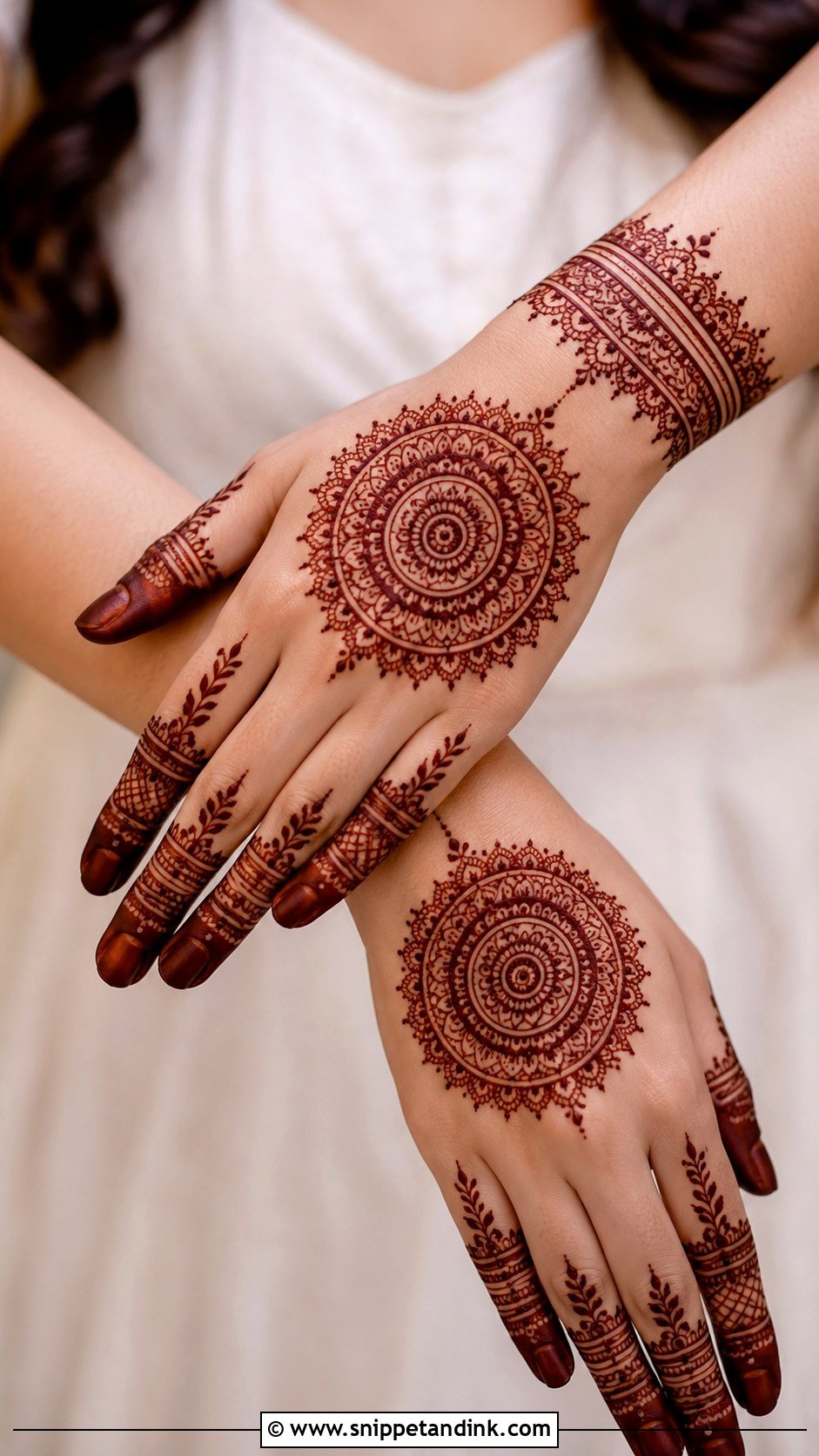
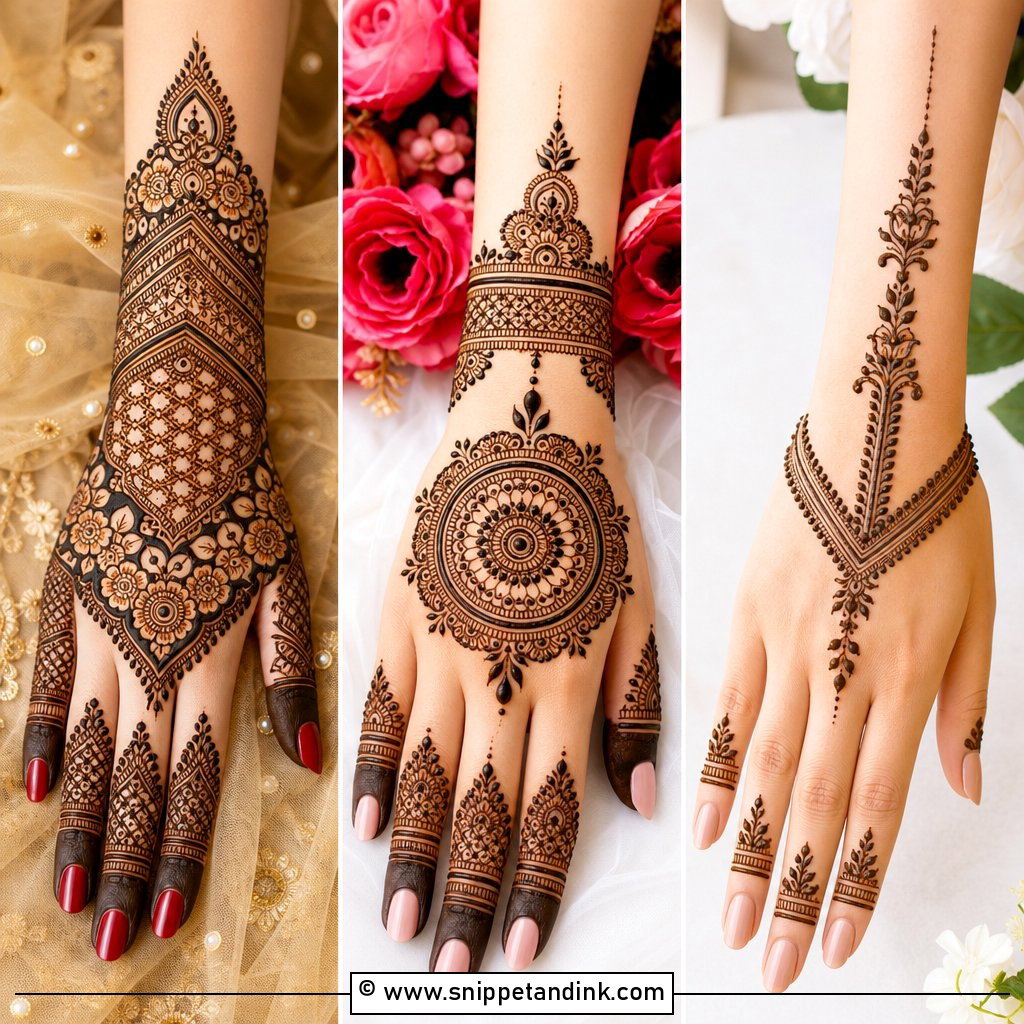
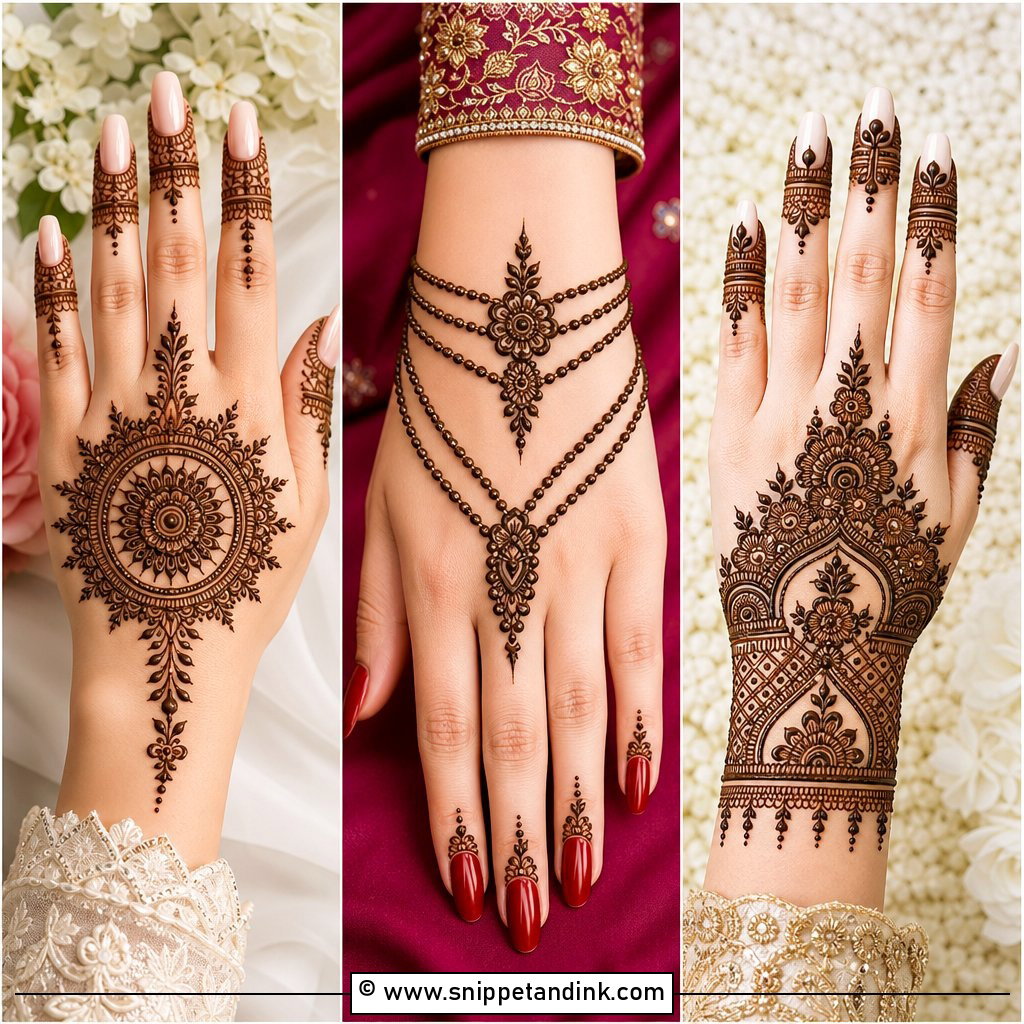
A mandala back hand design looks simple at first, then rewards a closer look. One circle sits at the centre of the back of the hand, with finger work and wrist bands completing it. For a bride I enrich the mandala with petals, dotted rings, paisley borders and fine lace-like filling. Symmetry is the appeal, and it also gives rings and haath phool a natural centre to sit around. To make it fully bridal, extend it toward the wrist with layered bracelet bands.
6. Floral Back Hand Bridal Mehndi Design
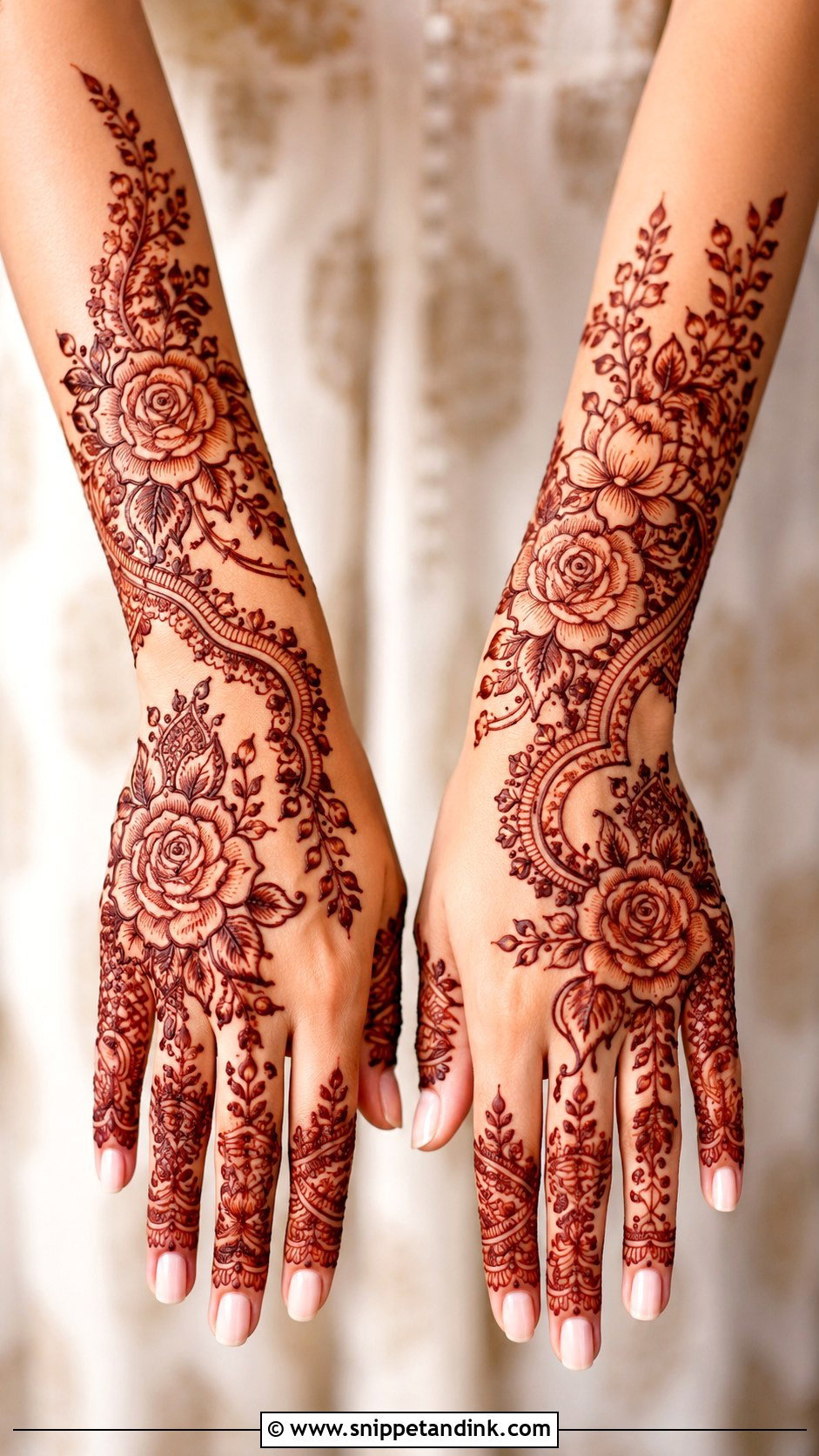
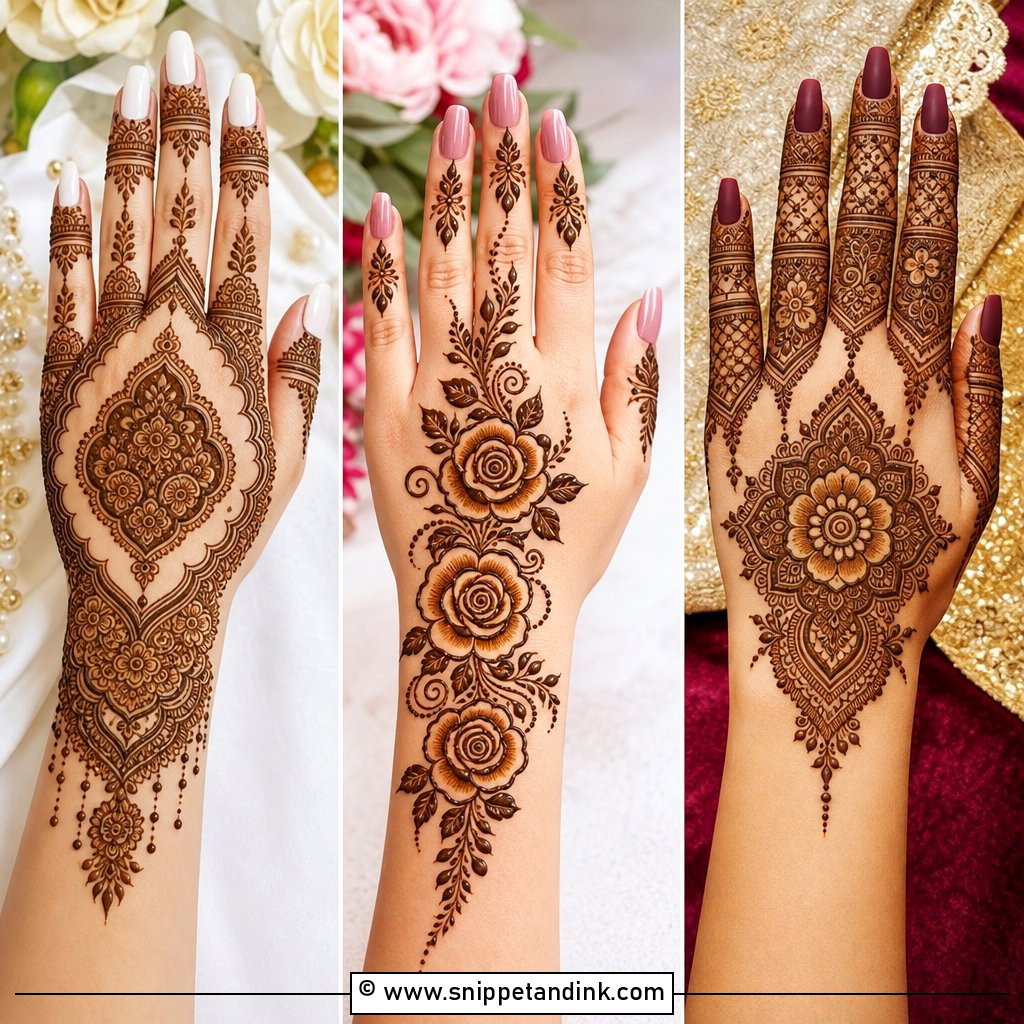
Florals across the back of the hand keep bridal mehndi fresh: roses, lotus blooms, small buds, leafy trails and shaded petals, full or semi-filled. Large flowers lean Arabic; tiny floral fillers lean Indian. Choose this for a daytime or garden wedding, or a pastel outfit. I outline each bloom boldly and keep the shading inside it fine, so the petals look layered rather than flat once the paste is scraped off.
7. Paisley Back Hand Bridal Mehndi Design
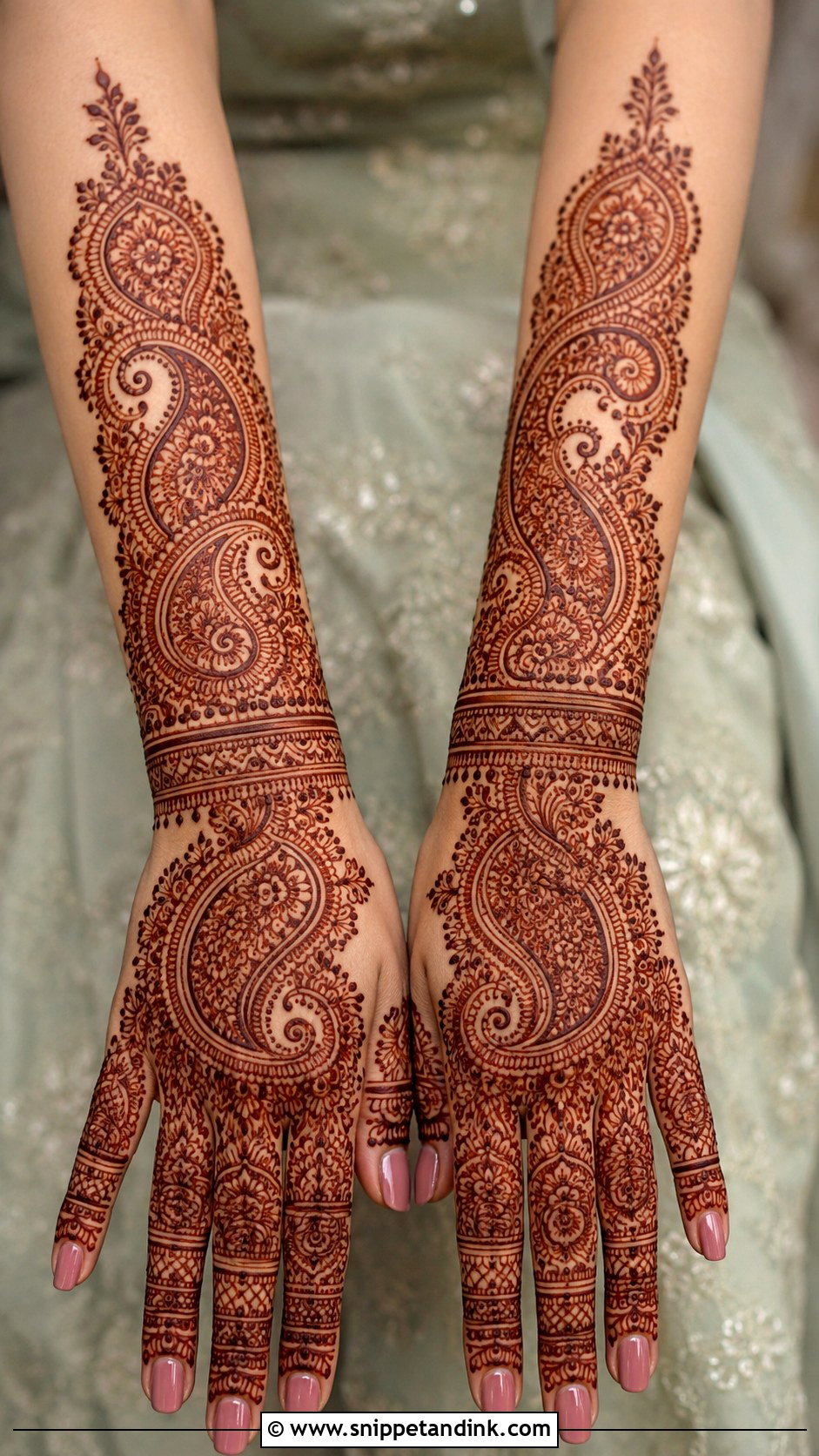
Paisleys follow the curve of the hand naturally, which is why they have stayed a bridal staple for so long. Layered paisleys, small florals, leafy edges, dotted borders and spiral filling give a rich effect without portraits or complicated scenes. They suit traditional and fusion outfits equally. For a heavier look, I carry paisleys up the forearm, scaling them up as they go so the arm doesn’t look busier than the hand. For a lighter one, a single large paisley with detailed fingers and a bracelet band is enough.
8. Peacock Back Hand Bridal Mehndi Design
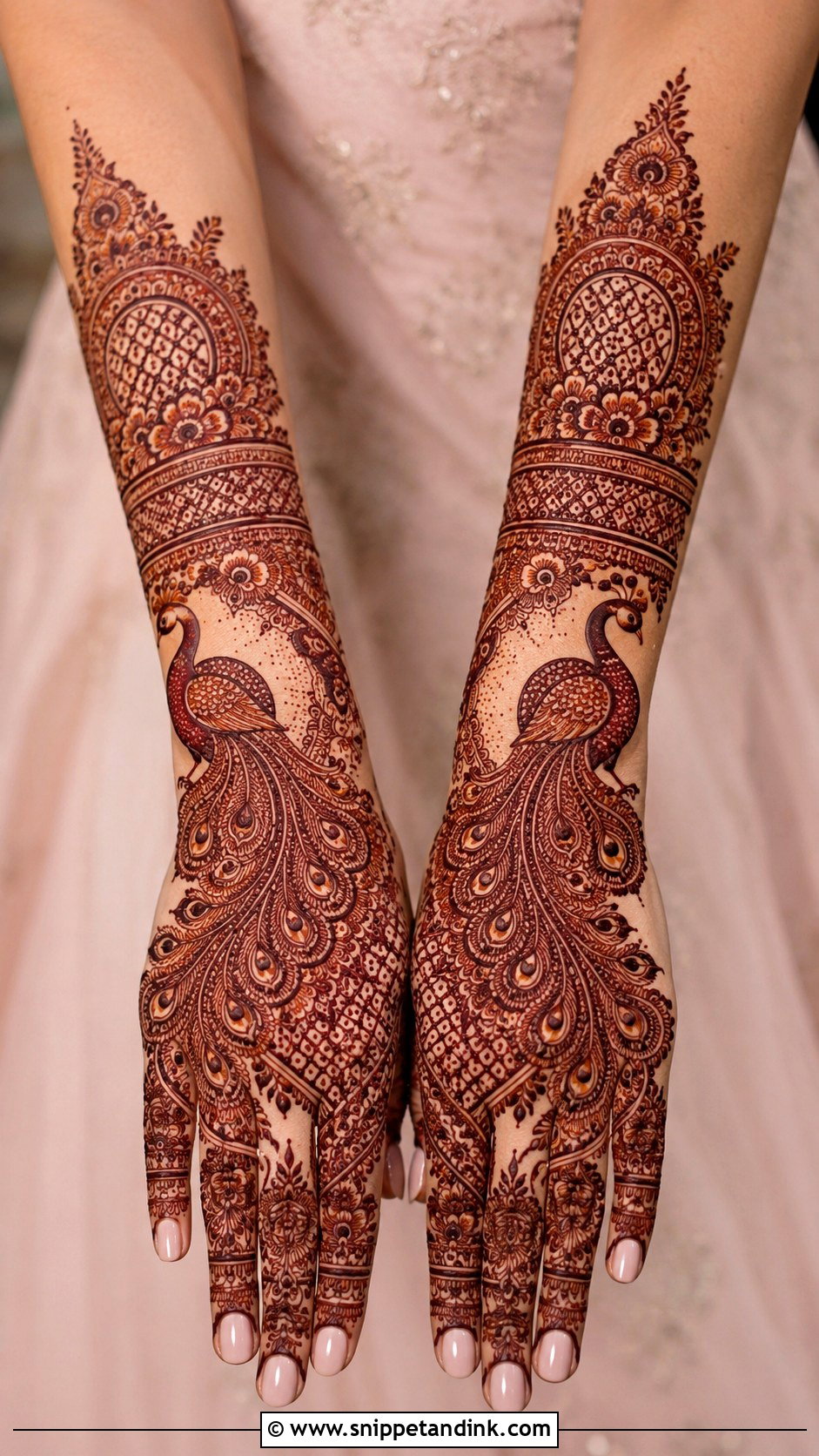
The peacock gives a bridal hand one strong focal point with a royal, traditional feel. It can sit at the centre, around the wrist or along a diagonal, with feathers that allow curves, dots, leaf shapes and fine lines. Pair it with paisleys, florals and jaali for balance. The mistake I see most is a peacock drawn too small: once stained, a tiny bird reads as a blob. I make the body large enough that the neck curve and crest are clear from arm’s length, which is how most guests will see it.
9. Jaali Back Hand Bridal Mehndi Design
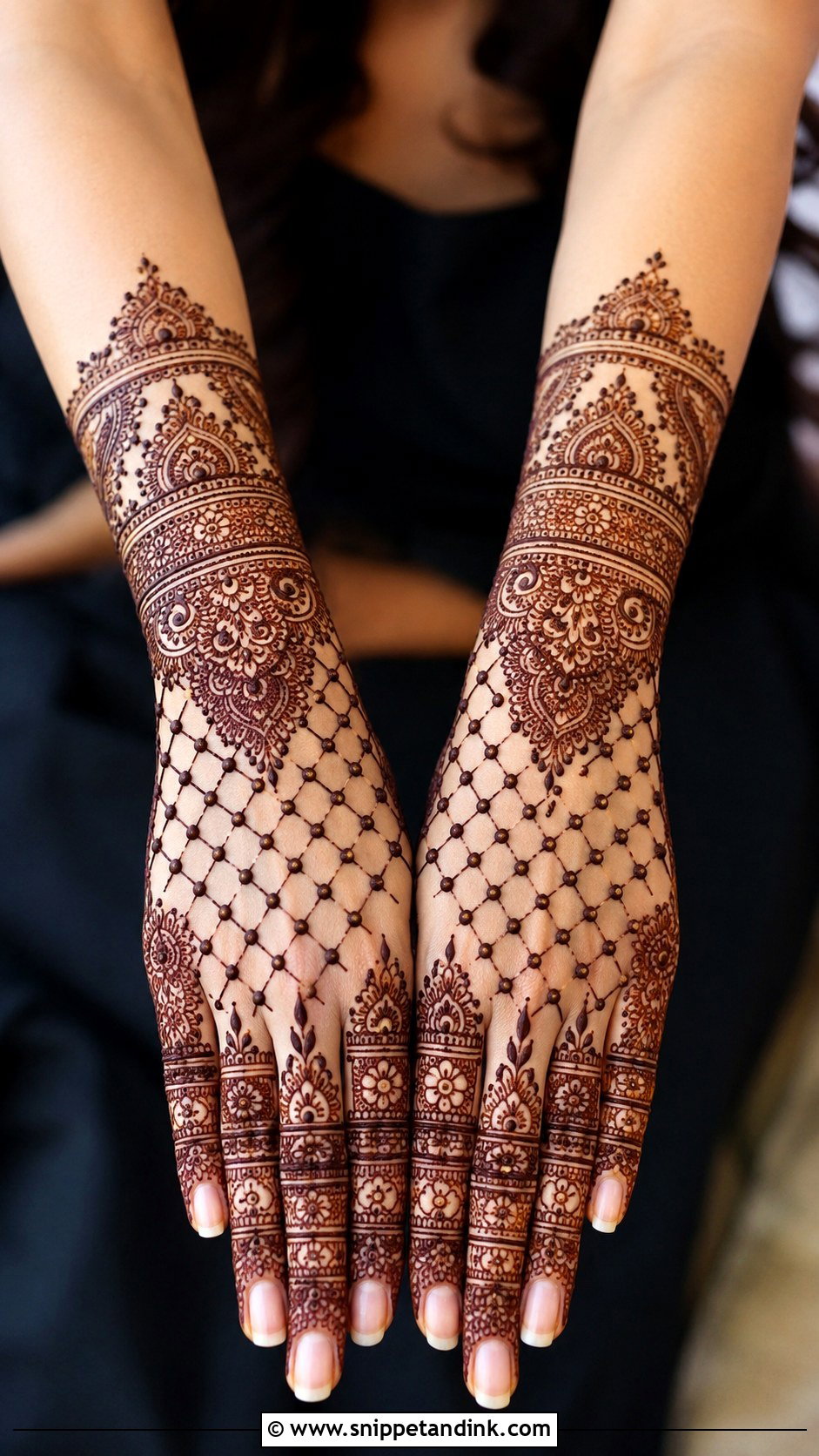
Jaali gives the back of the hand a lace effect, whether it covers the centre, fingers, wrist or forearm. In bridal work I combine it with flowers, paisleys, mandalas and bracelet borders, and the open cells of the mesh act as negative space. Slim hands usually suit a diagonal jaali; broader hands can carry larger grid sections. I keep the lines even and drop a tiny dot or accent into some cells, which stops a large grid looking mechanical.
10. Jewelry Back Hand Bridal Mehndi Design
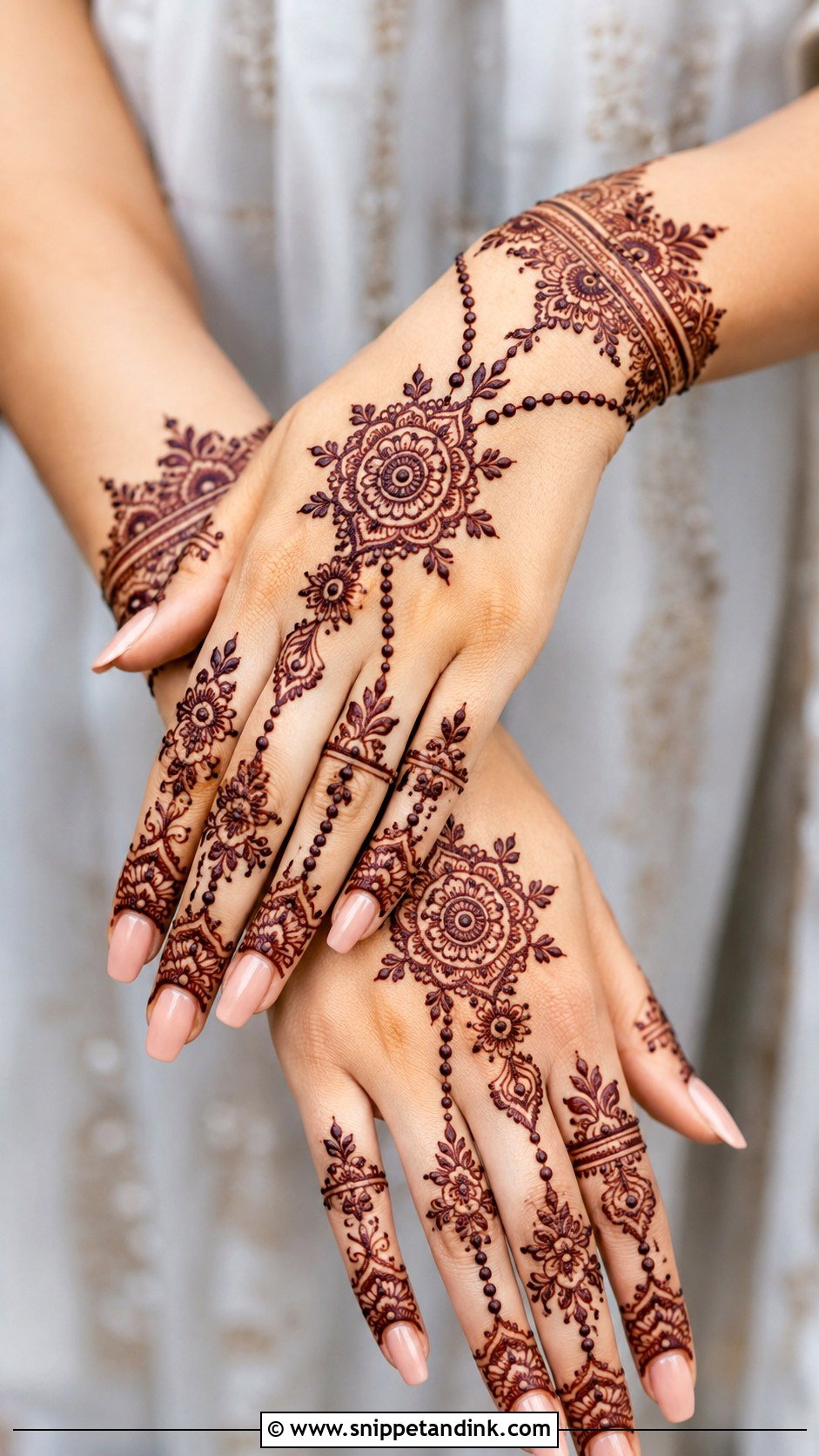
Jewellery mehndi is essentially a haath phool drawn in henna: a central motif, chain-like lines, ring patterns on the fingers and bracelet bands near the wrist. For the wedding itself I make it fuller, with florals, beads, dots and layered wrist cuffs. Because it follows where real jewellery sits, I ask brides to bring their haath phool or a photo of it to the sitting, so the drawn chains line up with the real ones instead of running beside them.
11. Bracelet Back Hand Bridal Mehndi Design
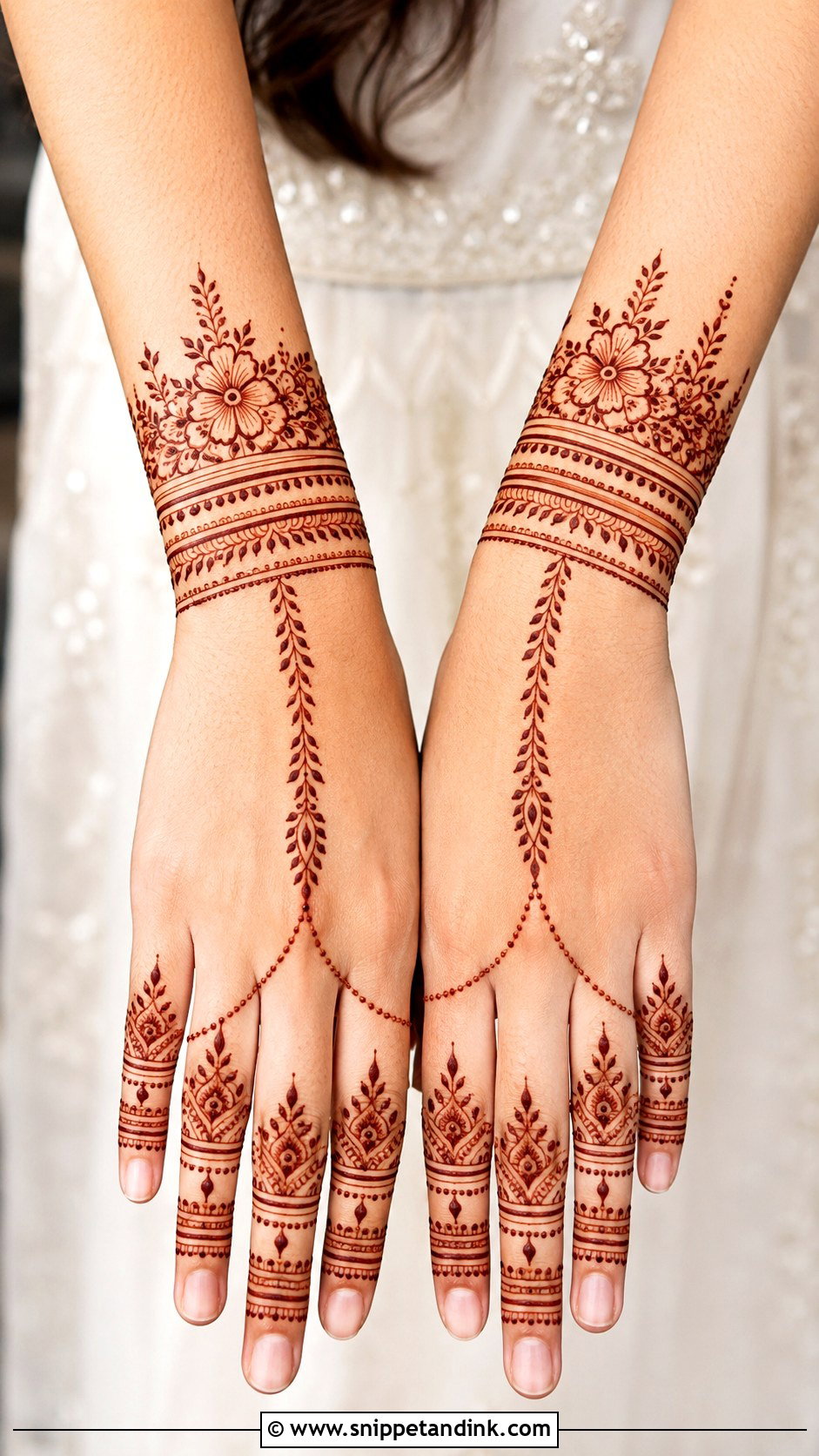
Bracelet layouts put the weight at the wrist and taper softly toward the fingers: stacked bands, floral cuffs, leafy bracelets, geometric borders and fine chains. On their own they suit engagement, haldi or mehndi night, when comfort matters and the hands need to be free sooner. For the wedding day, I make the bracelet section heavier and link it to a central motif on the hand. The wrist stays the highlight, but the design no longer looks unfinished.
12. Finger Back Hand Bridal Mehndi Design
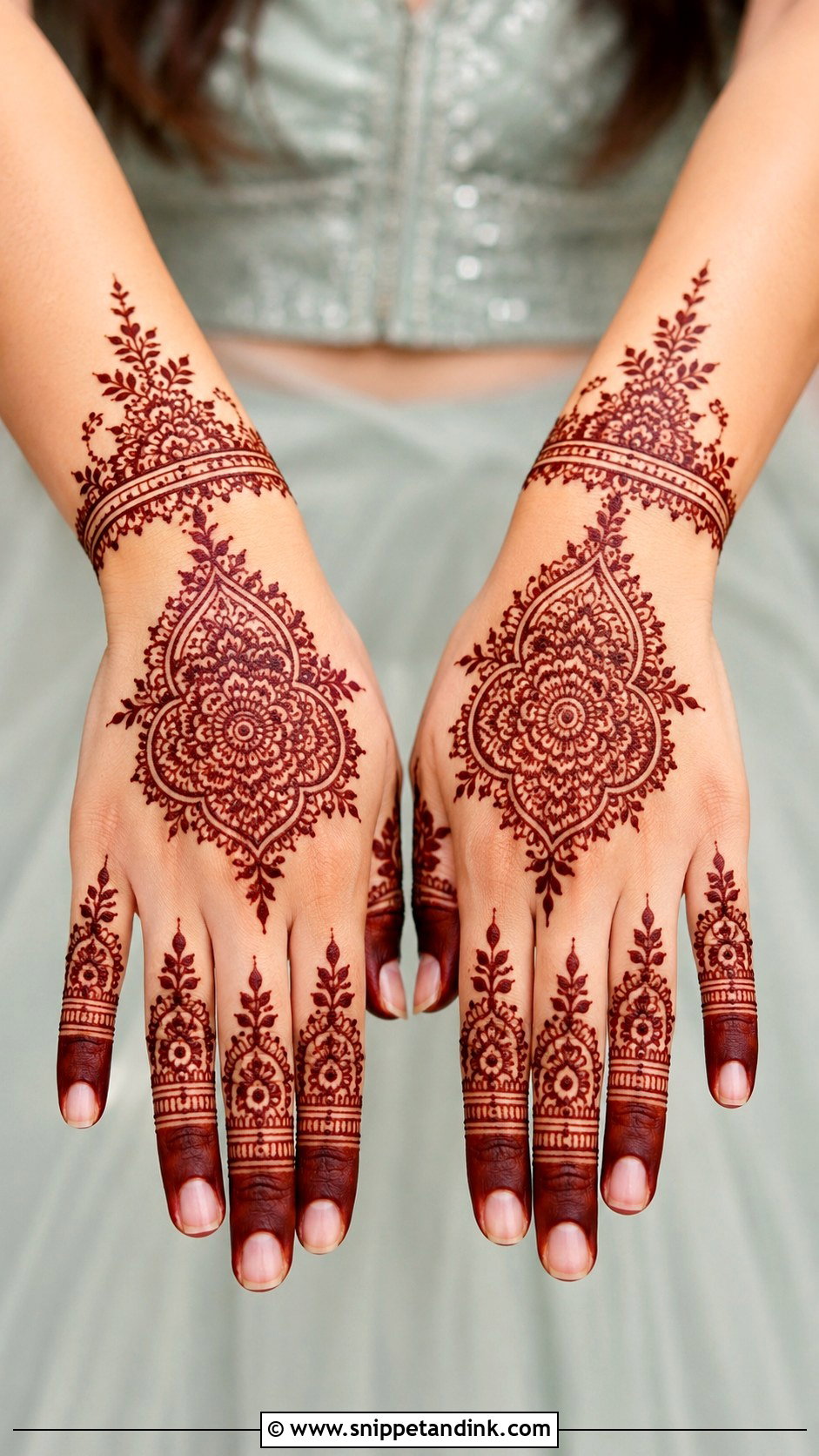
This is a complete back-hand design that happens to put its strongest detail on the fingers: detailed fingertips, ring bands, leafy lines, tiny florals and a central motif tying it together. It suits brides who want rings, nails and henna to work as one picture, and it photographs well with hands resting on the dupatta. Finger lines sit close together, so I let each finger dry for a moment before starting the next to avoid smudging the neighbour. Clean spacing between fingers is what keeps it sharp after staining.
13. Minimal Back Hand Bridal Mehndi Design
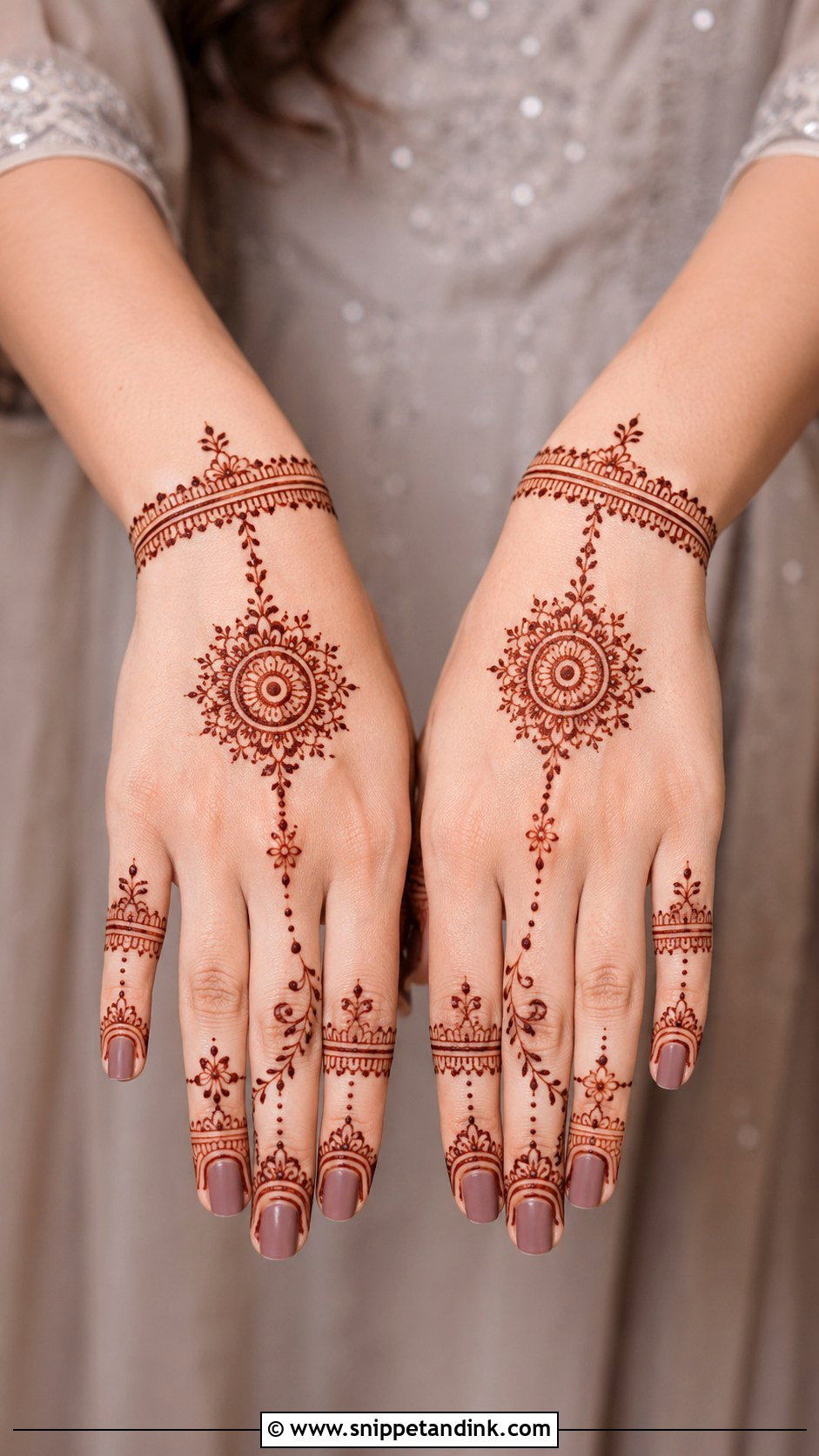
Minimal bridal work rests on one strong focal point: a small mandala, delicate vines, simple finger bands and a soft wrist detail. It suits intimate weddings, civil ceremonies and destination weddings, along with pastel outfits and pearl jewellery. With so little paste on the skin, every line counts. I avoid very hairline strokes here, because on the back of the hand they tend to stain faintly and can vanish in photos, and I check spacing from a step back before adding anything.
14. Simple Back Hand Bridal Mehndi Design
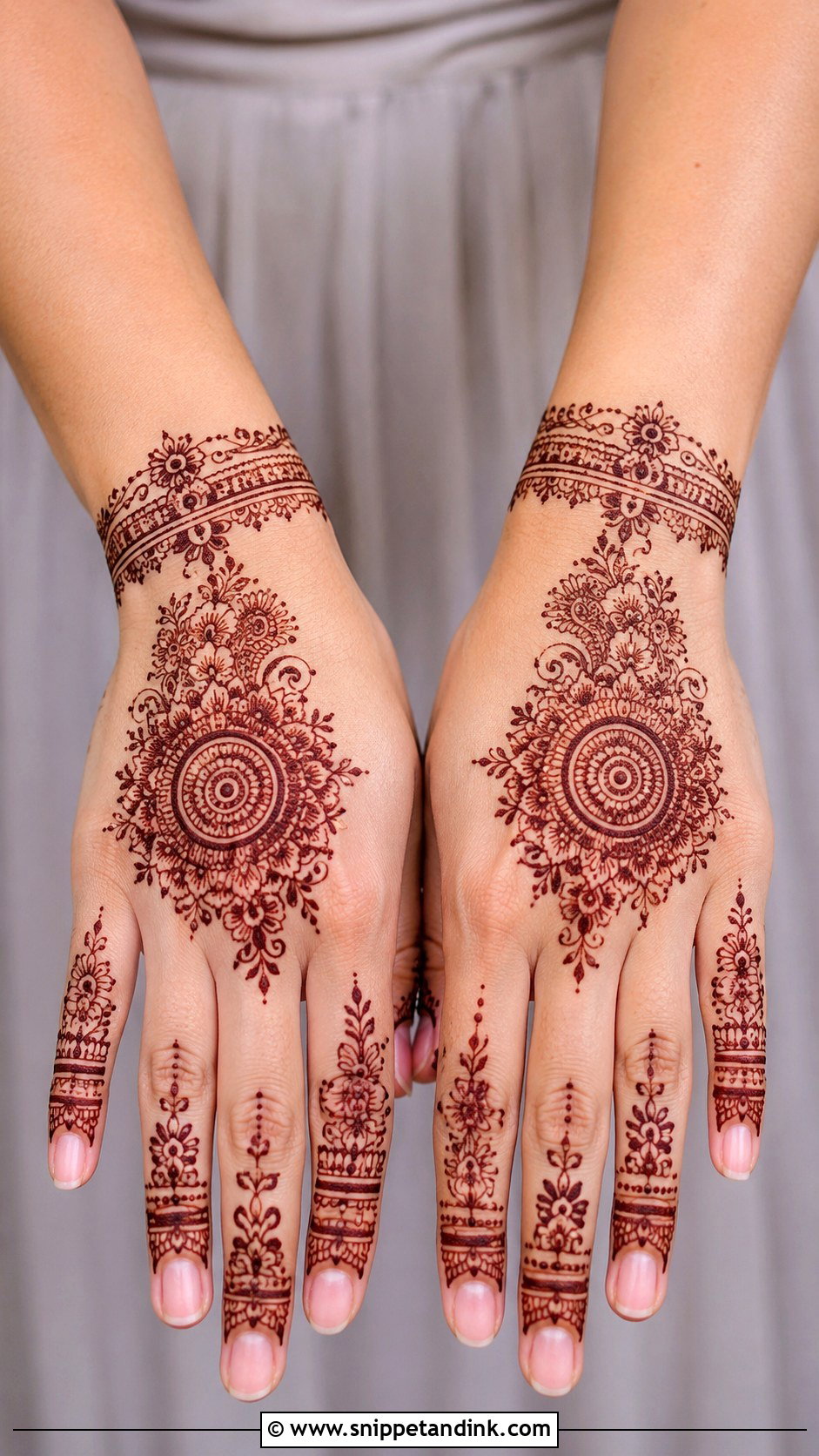
Simple doesn’t mean plain; it means the pattern has room to breathe. A round centre motif, decorated fingers, a wrist band and a few floral or paisley details are enough for a bridal photograph if the shapes are clean. Bold outlines with small fillers give the most visible stain. It is the layout I’d suggest if your sitting time is short, or if you want a lighter design for the rituals before the wedding.


15. Heavy Back Hand Bridal Mehndi Design
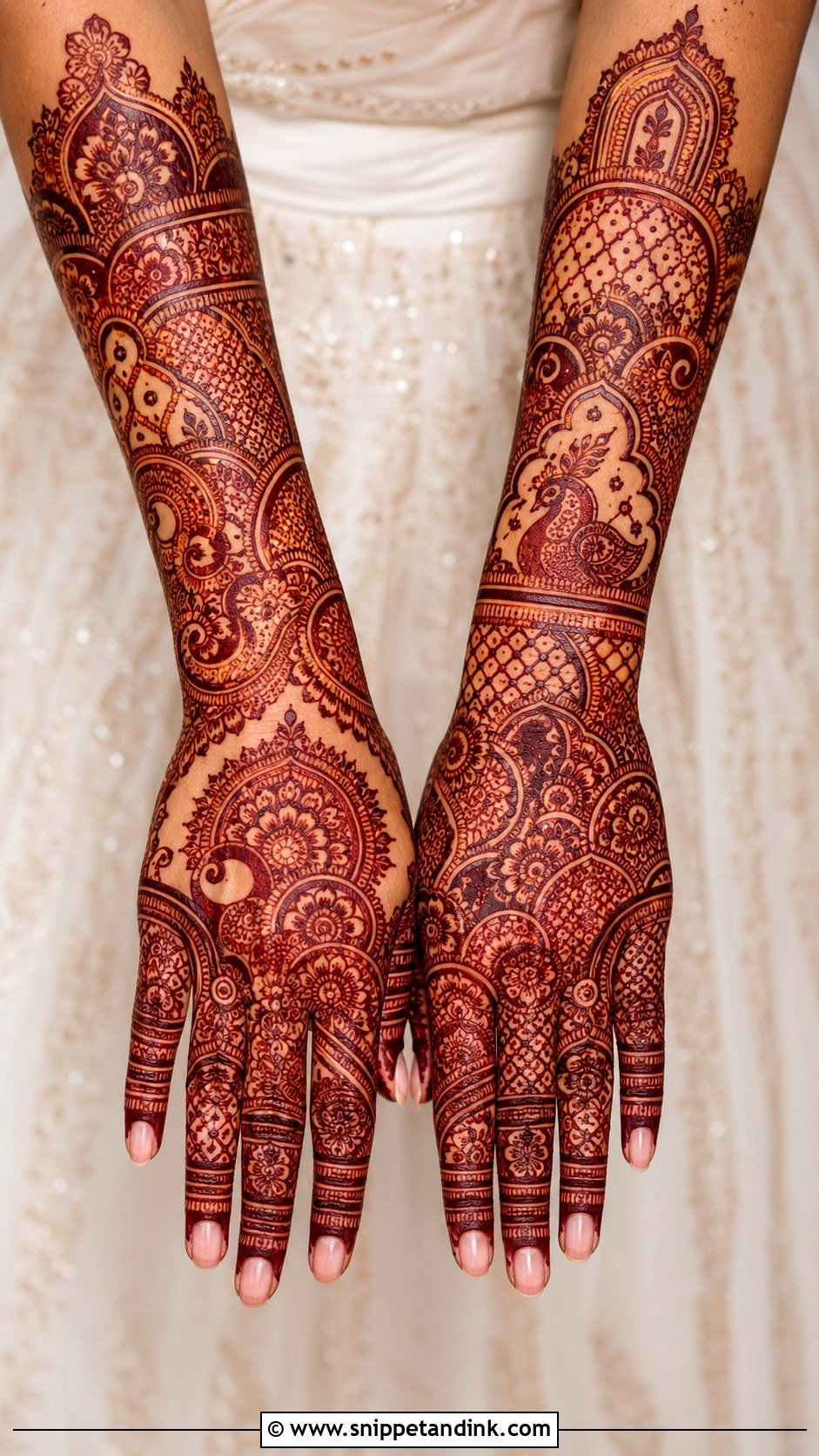
Heavy bridal work covers fingers, back of the hand, wrist and forearm with paisleys, florals, peacocks, jaali, tiny leaves, domes and layered borders. It reads as luxurious and traditional, and it suits rich outfits, large bangle sets and traditional jewellery. Spacing is the whole challenge. Without strong outlines and small gaps between elements, the details merge into one dark patch once the stain develops. Plan for a long sitting; this one fills an afternoon.
16. Modern Back Hand Bridal Mehndi Design
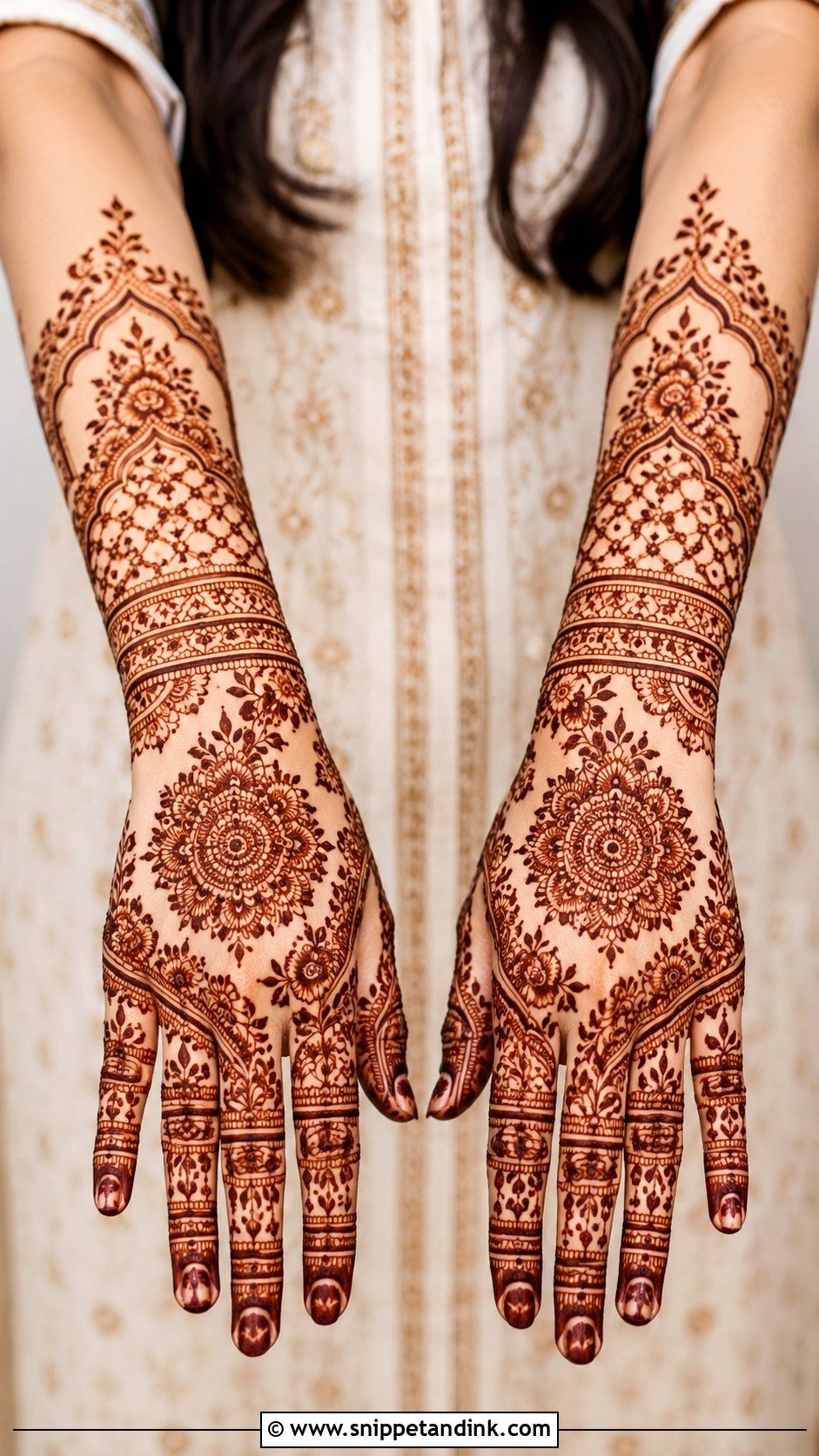
Modern bridal designs rely on clear shapes and open space: bold florals, geometric bands, simple mandalas and neat finger details. A structured wrist, open centre and detailed fingers is the combination I come back to most. It suits contemporary lehengas, fusion outfits, minimal jewellery and soft glam makeup. The risk is that it can look unfinished if the open areas aren’t deliberate, so I sketch the empty spaces as carefully as the motifs.
17. Back Full Hand Bridal Mehndi Design
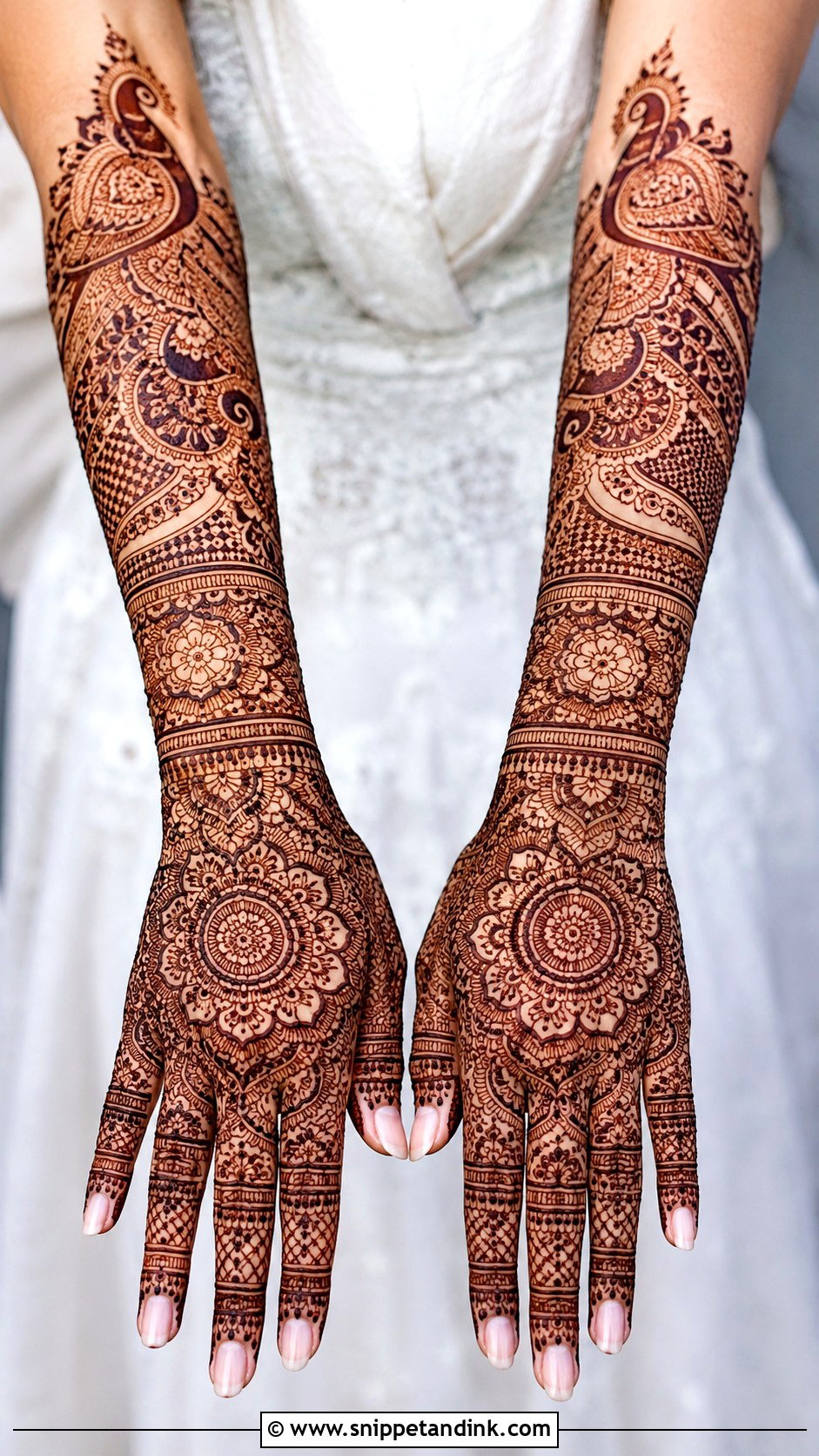
Fingertips to forearm, this is the full statement, in Indian, Arabic or Indo-Arabic style or a mix. Florals, paisleys, mandalas, peacocks, mesh panels and bracelet borders all appear, and it has to work in both close-ups and full-arm shots. I give the forearm larger motifs than the hand so the whole arm doesn’t look uniformly busy, and I join hand and wrist with flowing lines or bands. Under sheer sleeves and bangles it looks complete from every angle.
18. Back Hand Bridal Mehndi Design With Names
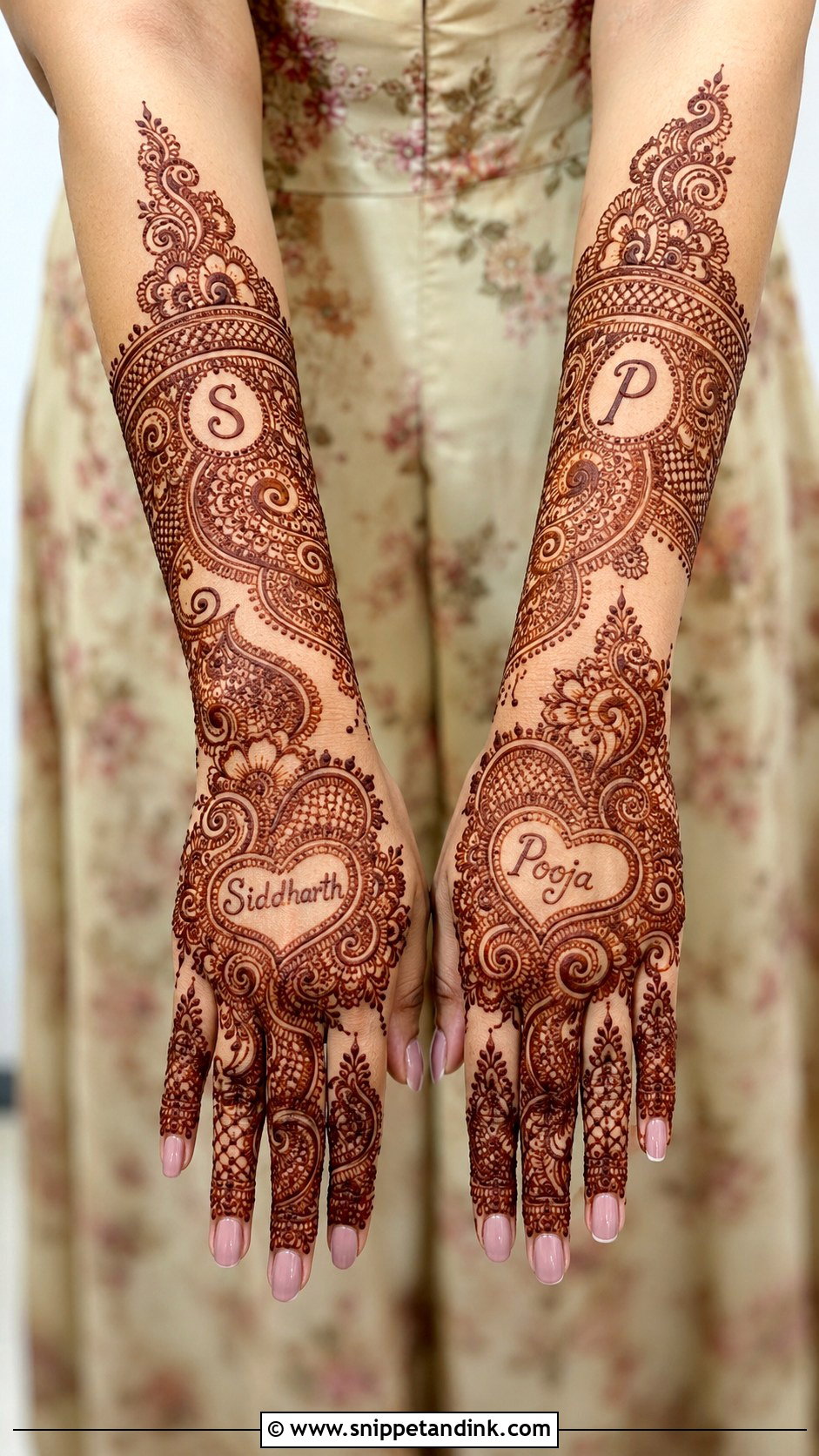
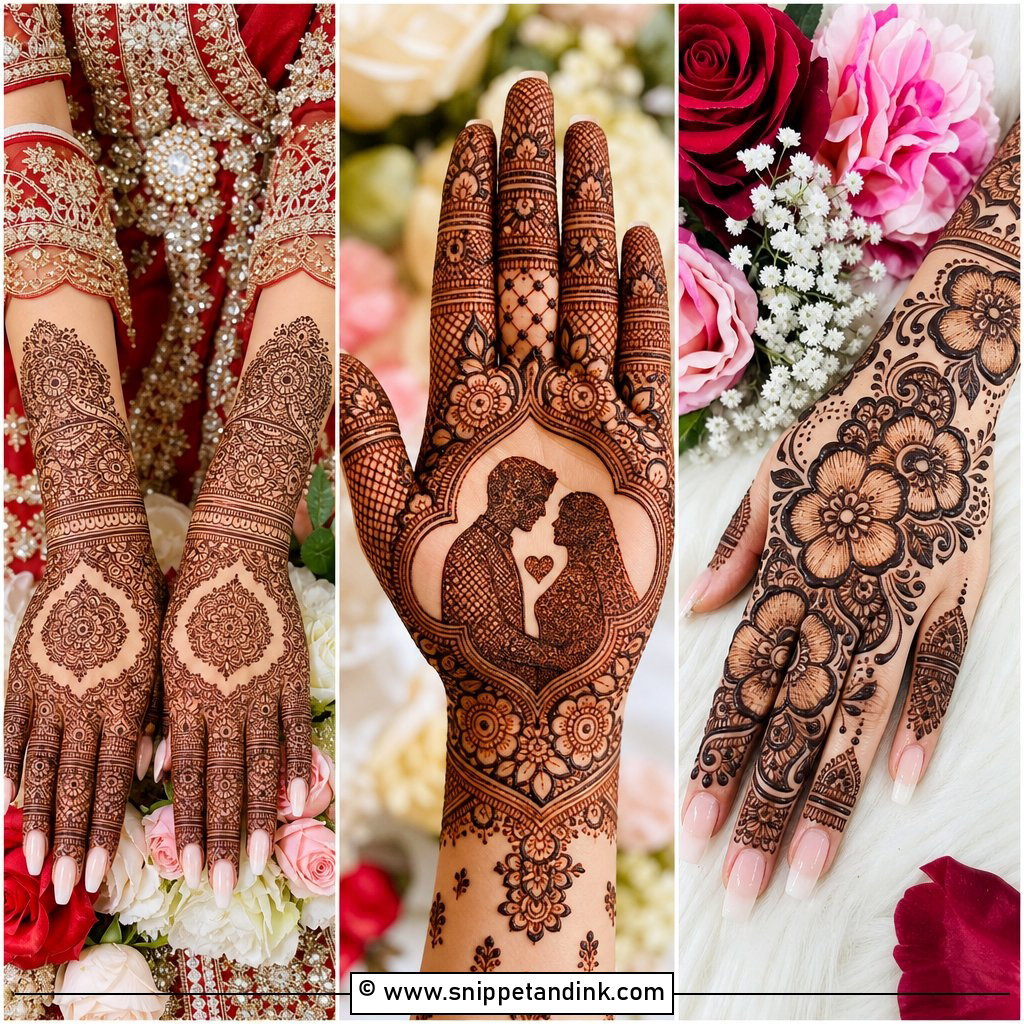
Names are a lovely private detail. I hide the groom’s name inside a paisley, along a bracelet band, inside a floral curve or within the forearm pattern; initials, the wedding date or small shared symbols work the same way. The lettering must stay readable, so I write it slightly larger than the surrounding filler and on flat skin, never across a knuckle. In many families the groom has to find his name later, which is half the fun.
19. Back Hand Bridal Mehndi Design With Bride Groom Art
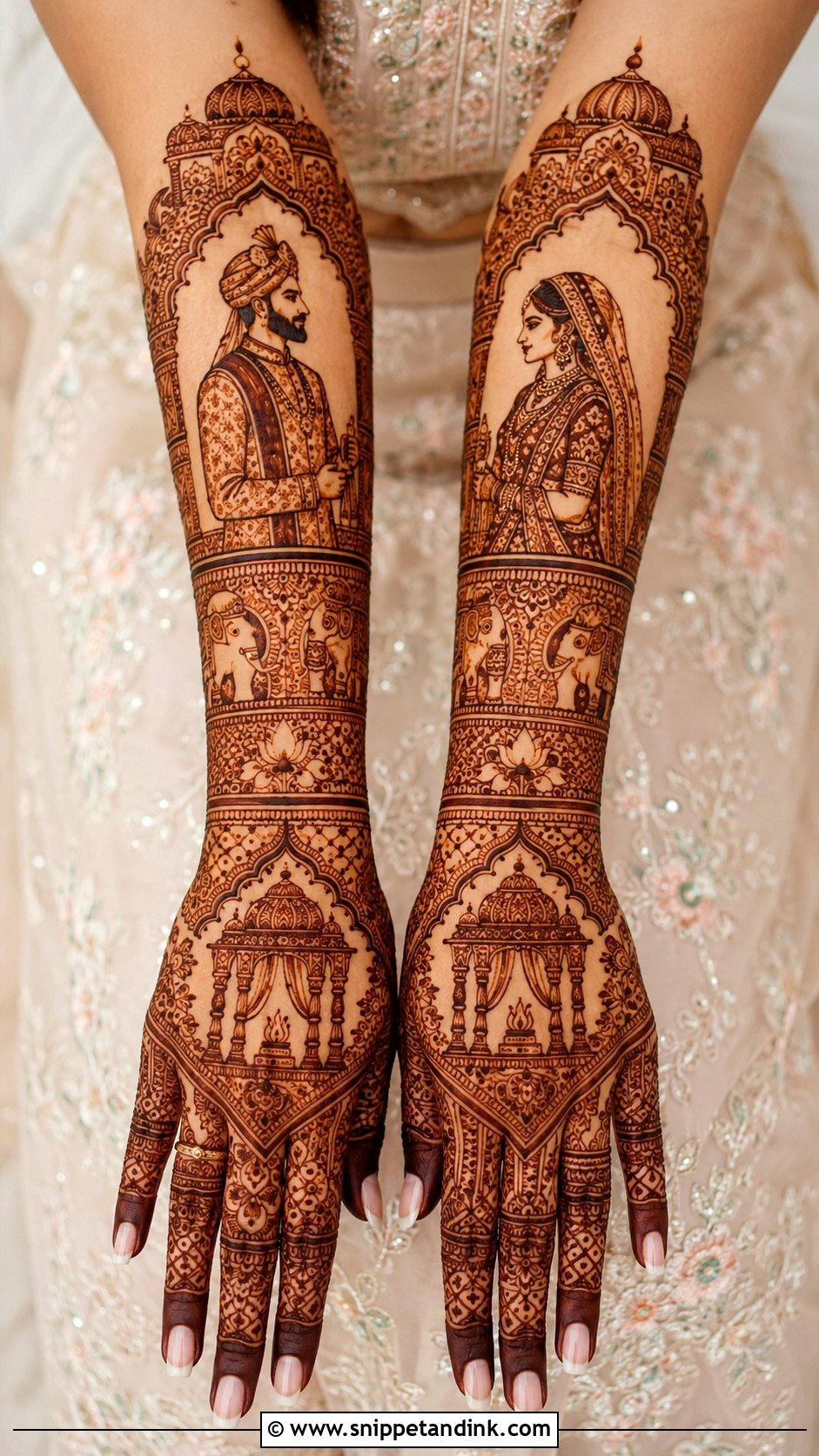
Bride and groom figures turn the hands into a story, with mandap shapes, florals, paisleys, dhol details and fine fillers around the portraits. Faces need space and confident linework; a crowded portrait loses its features once stained. I usually place the figures on the back of each hand facing one another, or move them to the forearm where there is more room. Clear outlines matter more than heavy filling here. Allow extra sitting time and choose an artist whose portfolio shows faces she has actually drawn.


20. Rajasthani Back Hand Bridal Mehndi Design
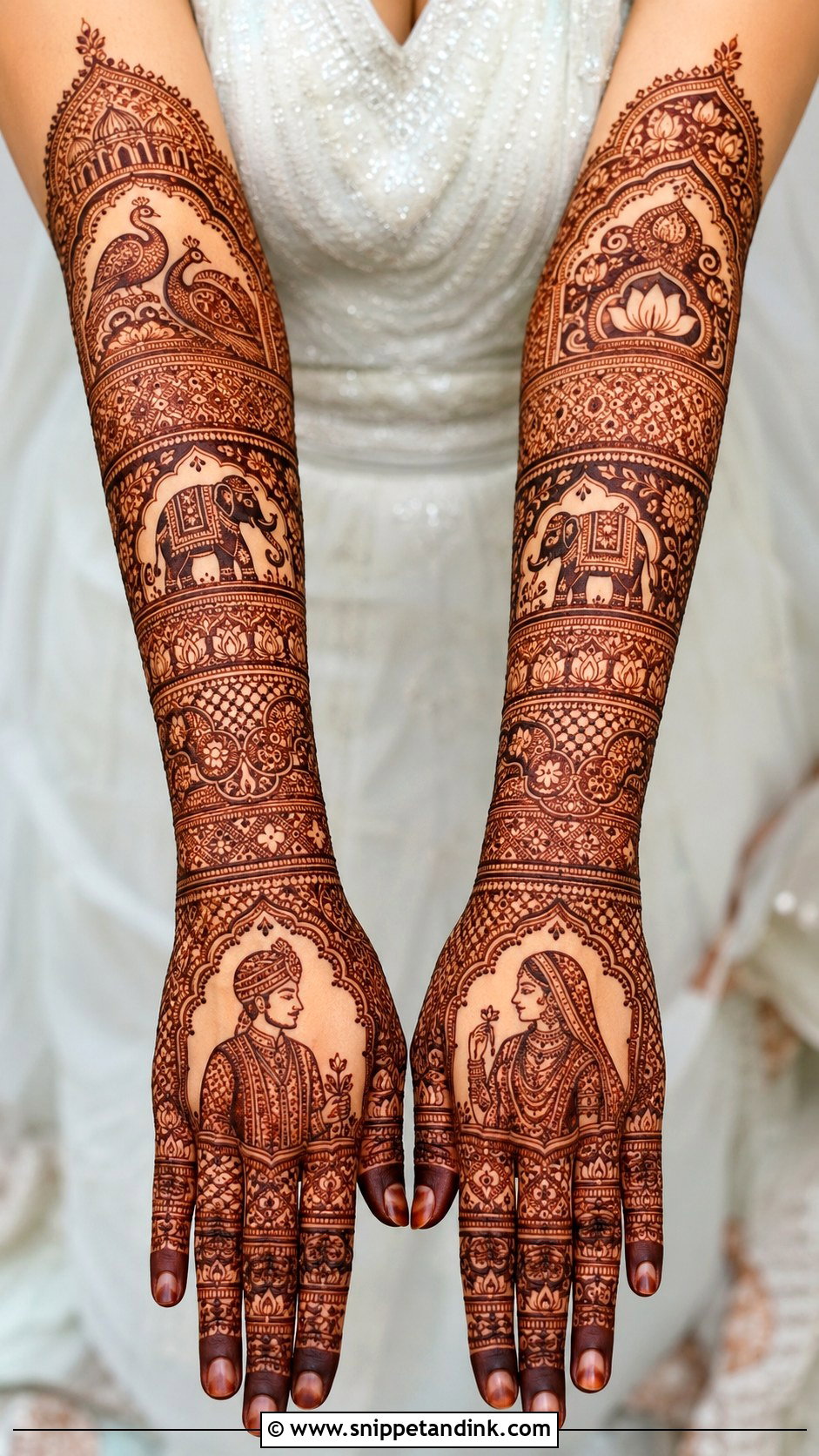
A Rajasthani back hand bridal design is heritage work: bride and groom figures, royal arches, peacocks, elephants, paisleys, lotus motifs and dense fillers. The back of the hand usually carries one central royal motif, while the wrist and forearm hold layered borders and storytelling scenes. It pairs naturally with bandhani, gota, mirror work and heavy lehengas. This style is unforgiving of rushed work, so book an artist with real experience in it and give her enough time.
21. Pakistani Back Hand Bridal Mehndi Design
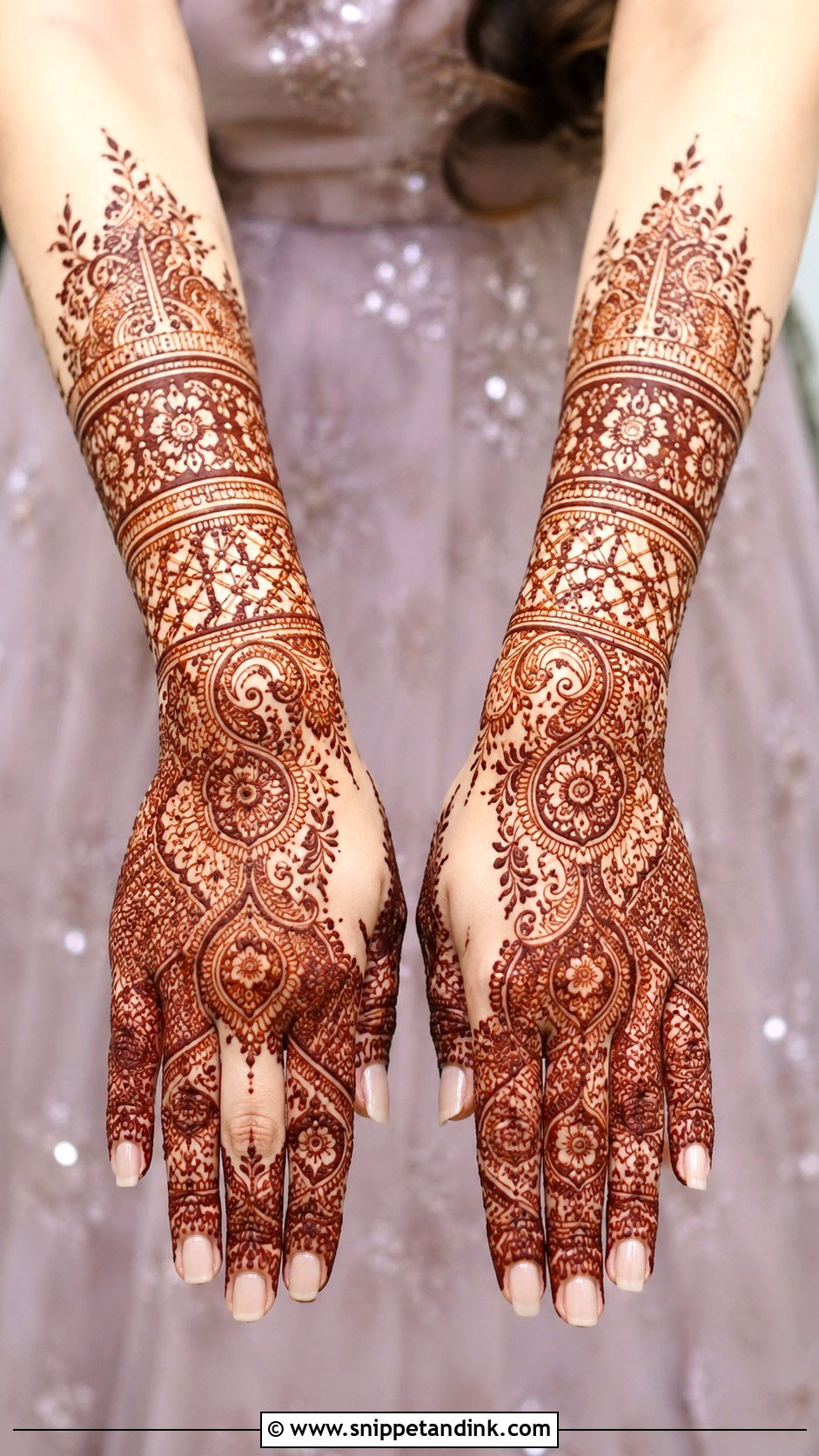
Pakistani bridal mehndi balances fine detailing with graceful open space: floral vines, domes, paisleys, leafy trails, jaali panels and bold outlines. The fingers are usually fully filled, while the wrist carries cuff-like bands or architectural detail. It works across nikah, walima and the wedding day, which makes it practical when one design has to last through several events. Small shaded flowers and curved borders soften the structure.
22. Moroccan Back Hand Bridal Mehndi Design
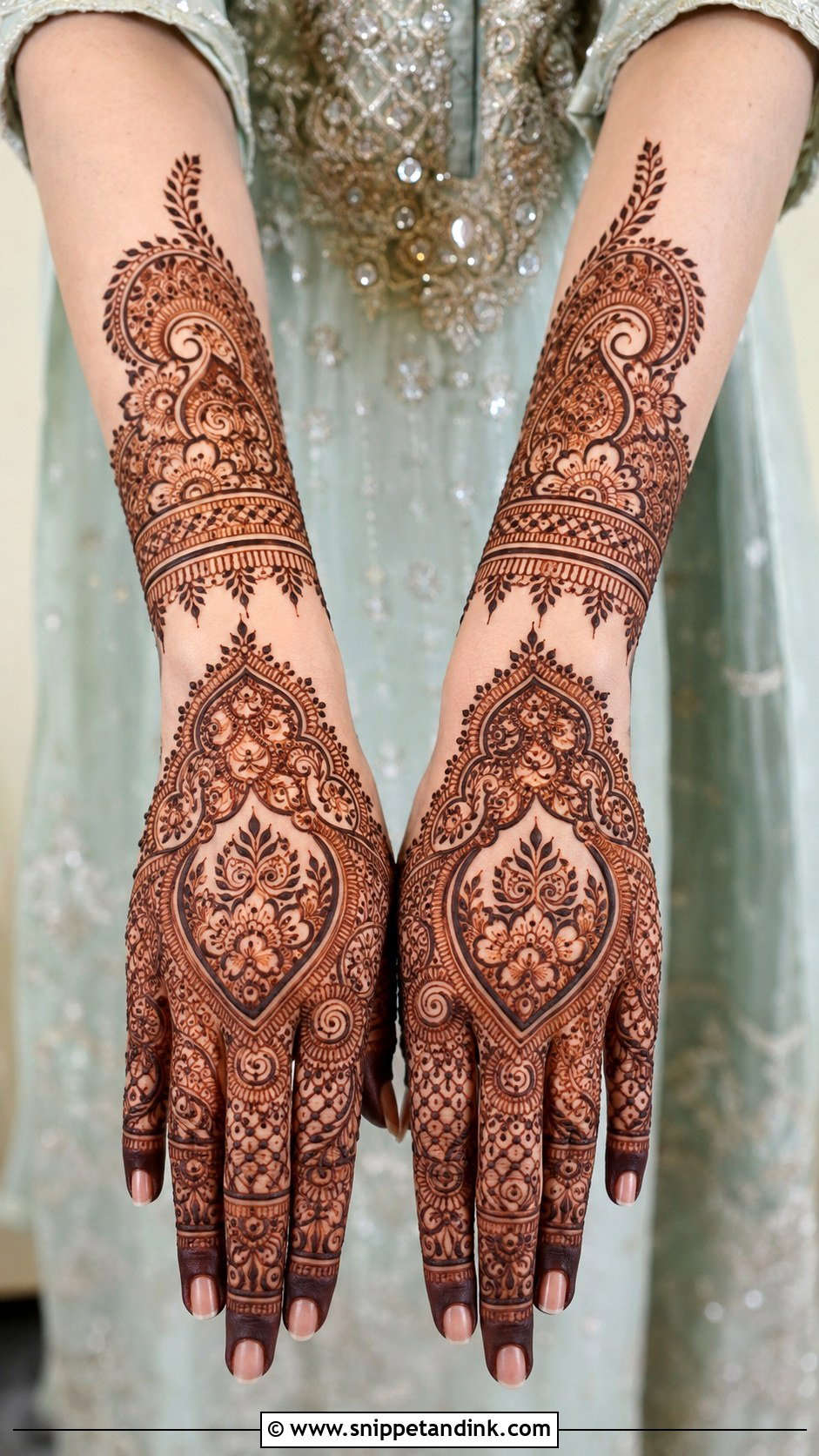
Moroccan-inspired bridal work trades florals and paisleys for diamonds, lines, triangles, grids and structured bands, softened with small leaves, dots and bracelet details. Symmetry and clean pattern work are its strengths. Straight lines show every tremor in the cone, so I draw them in short, steady strokes and join them carefully rather than pulling one long line. It suits modern outfits, metallic jewellery and brides who want something unusual.
23. Gulf Back Hand Bridal Mehndi Design
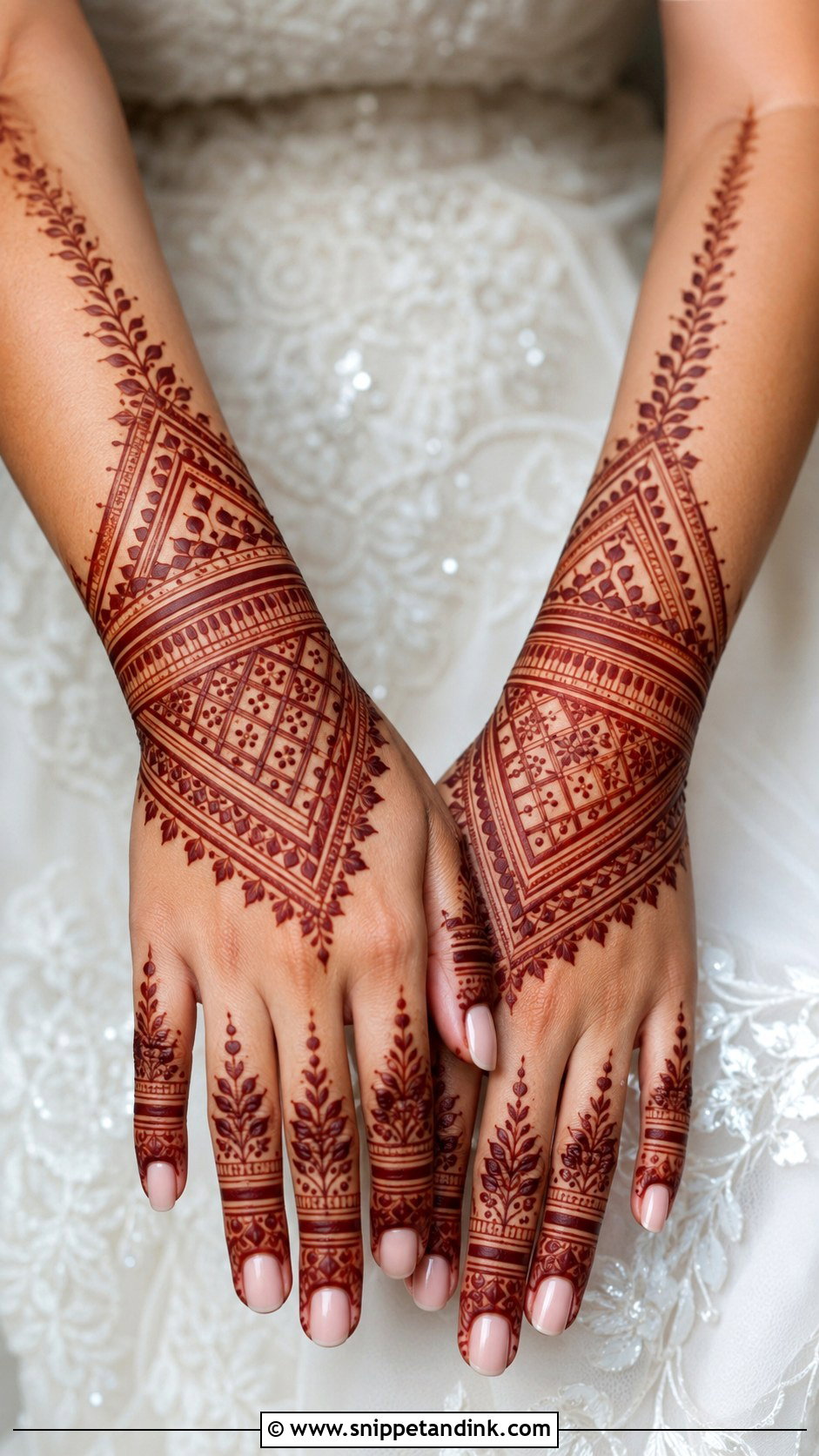
Gulf or Khaleeji layouts use large flowers, leafy vines, curved strokes and wide areas of bare skin, usually travelling diagonally from wrist to fingers. They read as bold without needing dense filling. The thick outlines are the point, since they take a deep stain and stay visible from a distance. For a bridal finish I add decorated fingertips, wrist bands and a few fine fillers. It reads quickly in a photograph, and I’d point anyone after deep, visible colour toward it.
24. Lotus Back Hand Bridal Mehndi Design
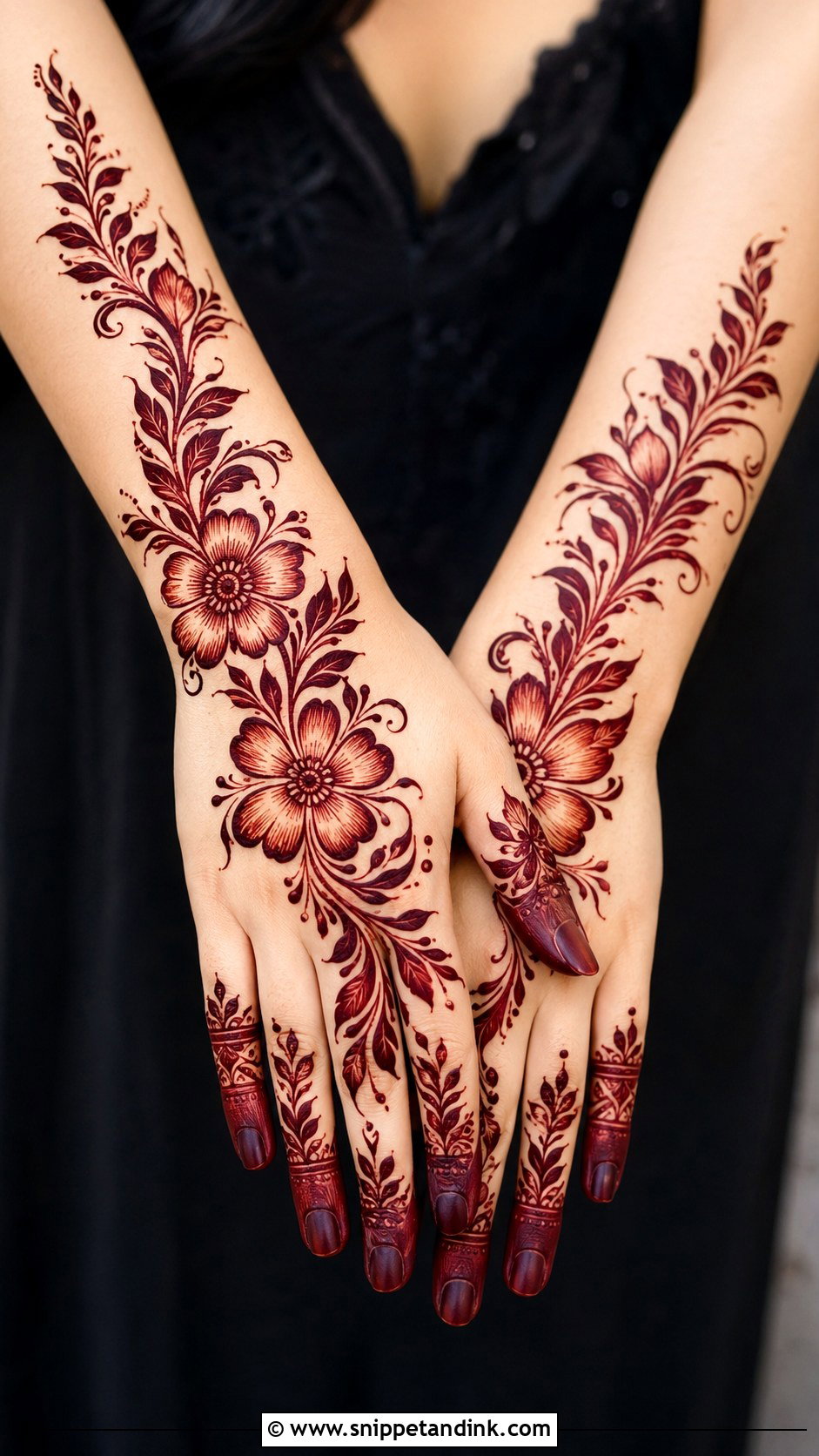
A lotus back hand bridal design can use the lotus as the centre, repeat it along the wrist or weave it among paisleys and vines. Layered petals give a soft but detailed look. I keep the central lotus bold and surround it with fine dots, curls and bracelet bands. It sits within Indian and Indo-Arabic layouts equally well, and it suits temple jewellery and silk outfits.

25. Rose Back Hand Bridal Mehndi Design
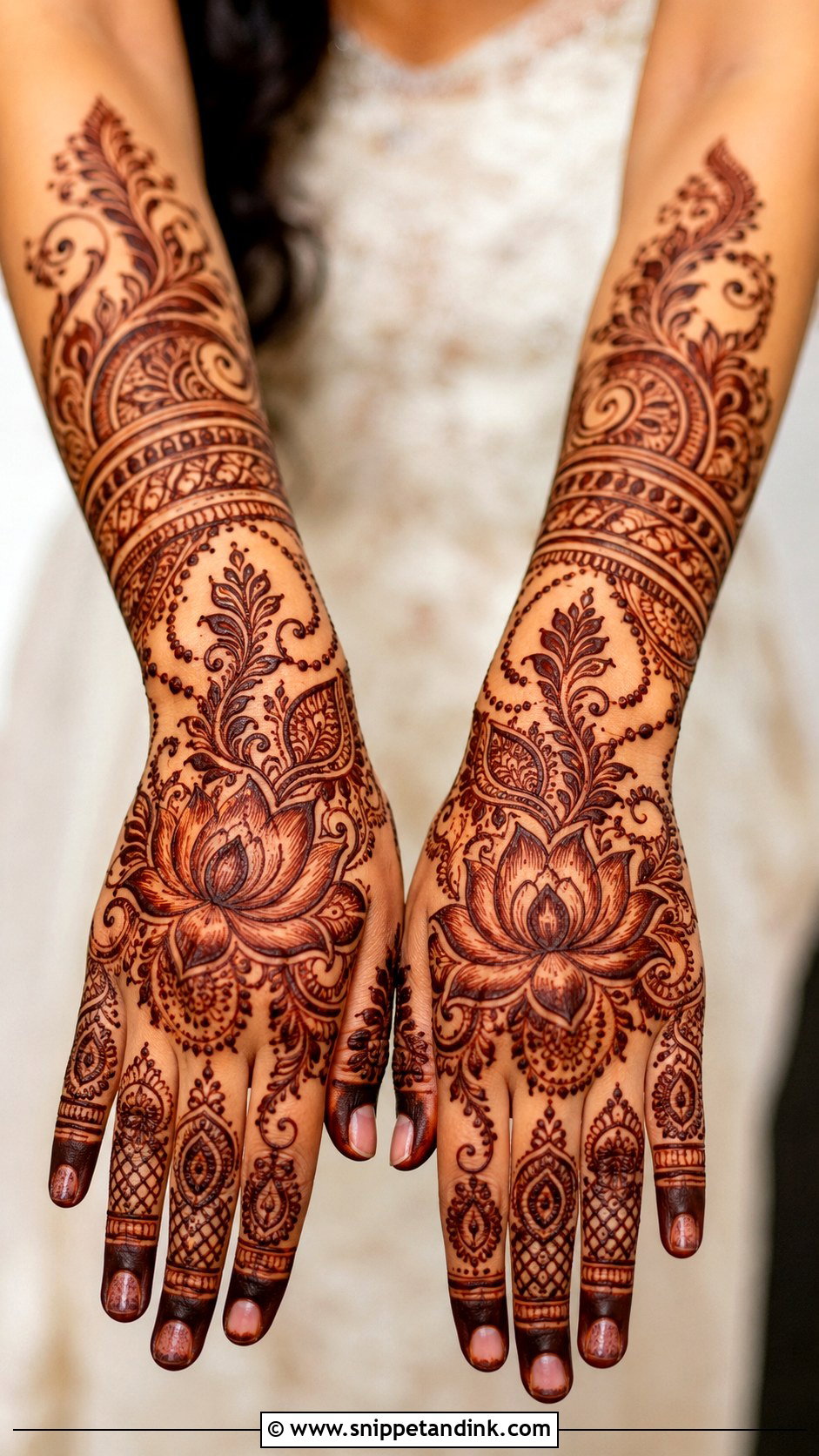
Roses suit a bride who prefers floral elegance over dense traditional motifs. Large blooms sit across the back of the hand, with smaller roses and leaves trailing toward fingers and wrist. Shaded outer petals make the roses look fuller once stained. Finger patterns, dotted chains and a bracelet band turn it into a wedding-ready design. It works with pastel lehengas, blush makeup and fine jewellery, and it is a good fit for an engagement too.
26. Chain Back Hand Bridal Mehndi Design
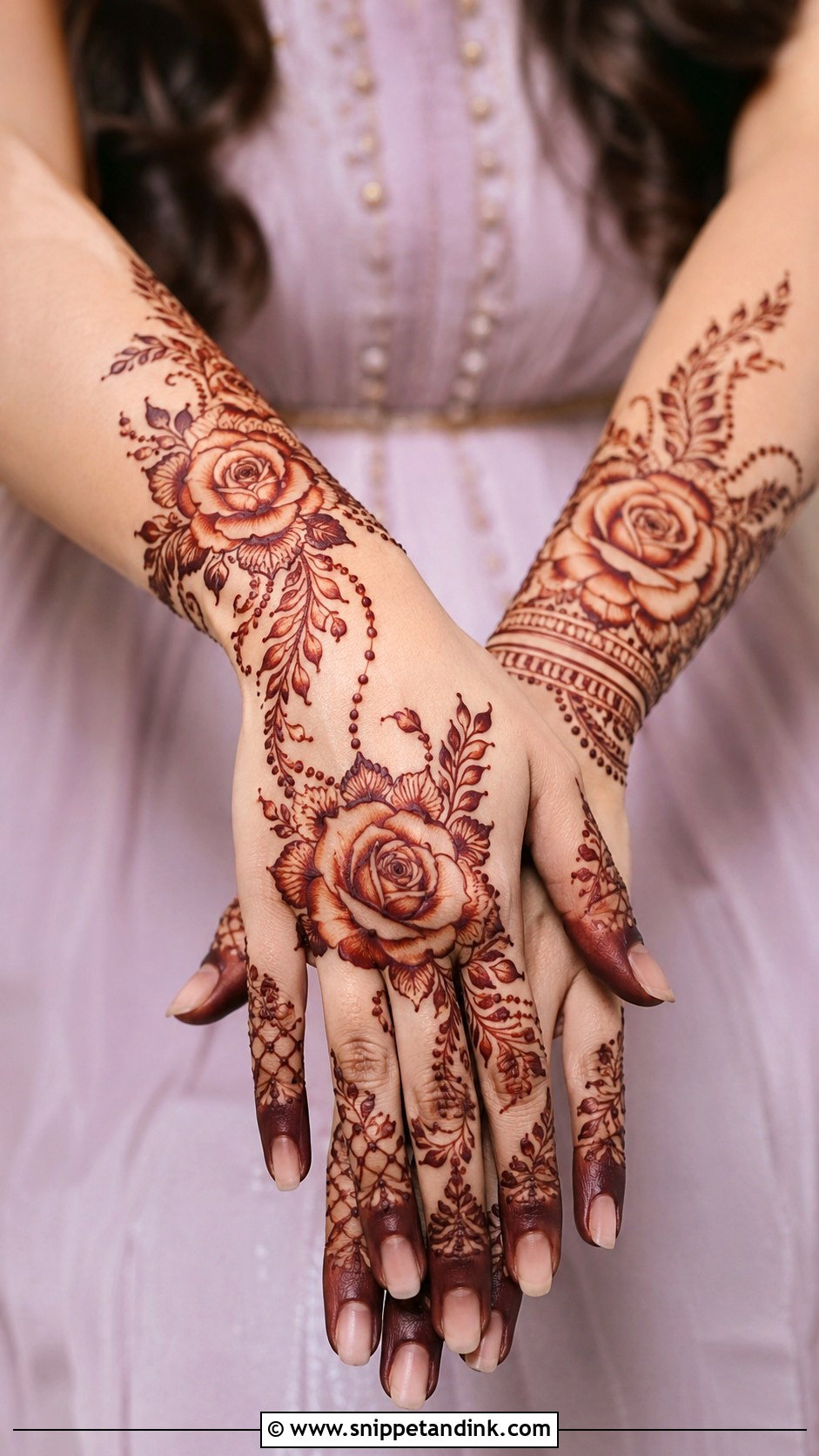
Chain designs link the fingers to the wrist with fine lines, dots, beads and small florals, giving the effect of hand jewellery while staying light. A central mandala, paisley cluster or floral cuff makes it bridal. It shows off rings and manicured nails, and sits well next to a real haath phool. The lines have to be smooth and evenly weighted; I use a fine cone and keep the paste slightly thicker so the chains don’t spread or break as they dry.
27. Cuff Back Hand Bridal Mehndi Design
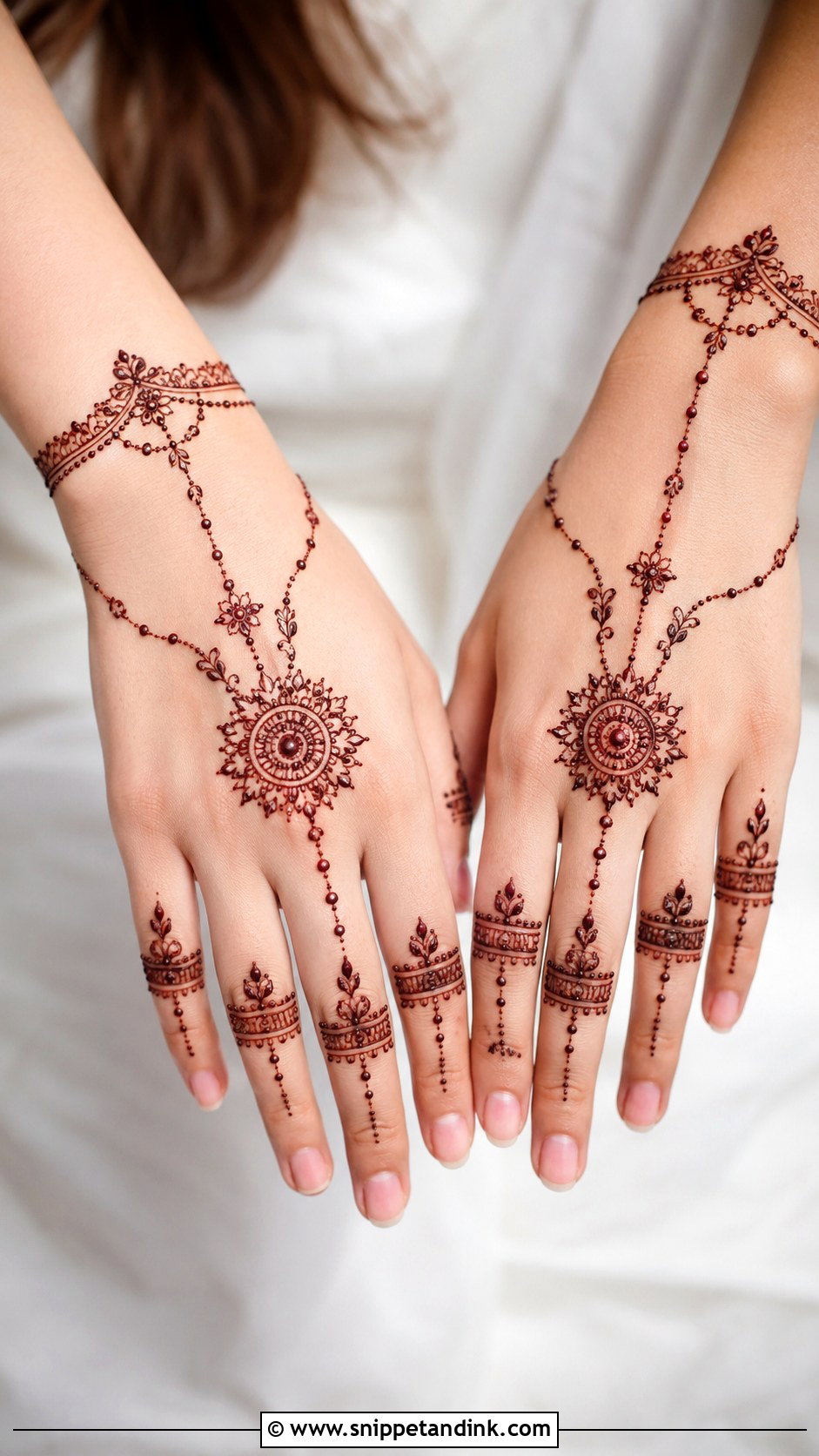
A cuff puts a bold band around the wrist and lower hand, filled with florals, paisleys, jaali, geometric borders or layered bands, then reaches toward the fingers with vines, chains or a central motif. The wrist looks decorated before a single bangle goes on, and the cuff stays visible under bridal sleeves. For a heavier version, ask for a wide band with detailed filling and matching finger work. Check where your chooda will sit first, so the cuff peeks out above it rather than disappearing beneath.
28. Symmetrical Back Hand Bridal Mehndi Design
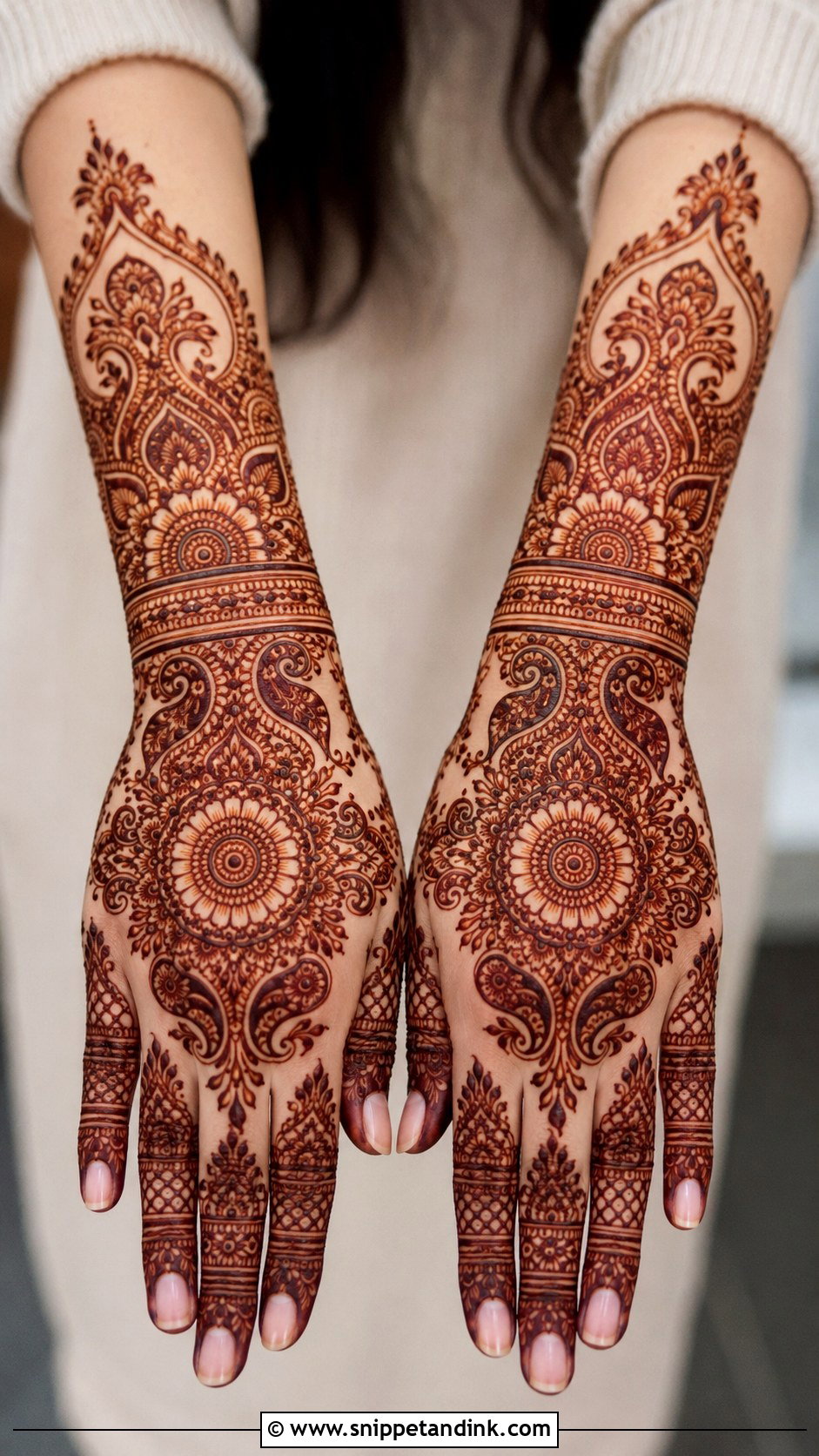
Symmetrical designs repeat the same motifs on both hands: matching mandalas, florals, paisleys, fingers and wrist bands. They look calm and orderly, especially when both hands are placed together for photos. Getting two hands to match takes more care than it sounds, because no two hands are the same size. I draw the main motif on one hand, then mirror its placement on the other using the knuckles and wrist bone as reference points, rather than copying measurements.
29. Negative Space Back Hand Bridal Mehndi Design
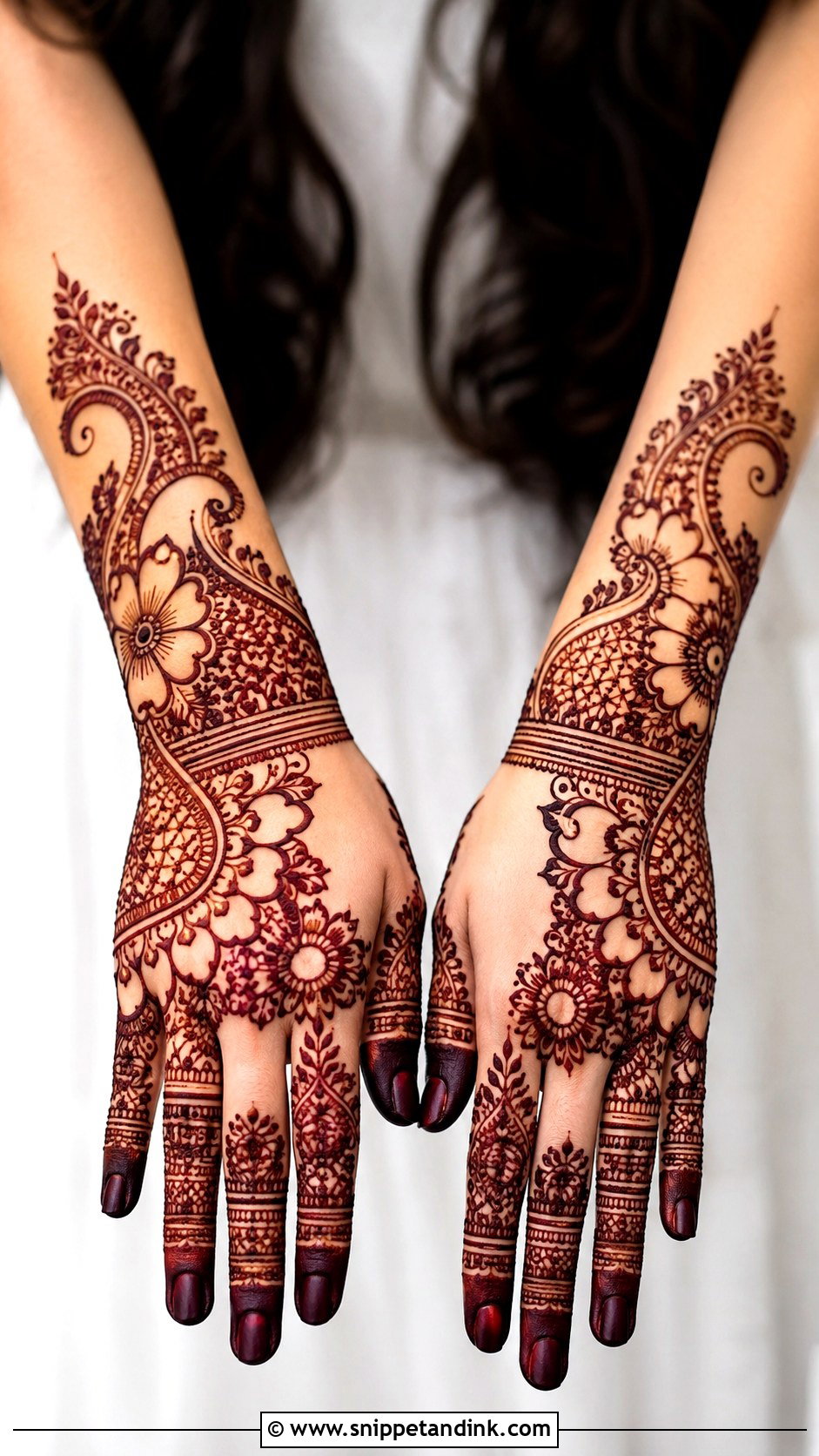
Negative space designs treat bare skin as part of the pattern, so florals, mandalas, paisleys or geometric shapes sit with clean gaps around them. On the back of the hand that openness keeps the design from looking crowded in photos, and each motif has room to stain evenly. Detailed fingers and a wrist band keep it complete. It is a good choice if you want something current that still reads as bridal.
30. Back Hand Bridal Mehndi Design For Engagement
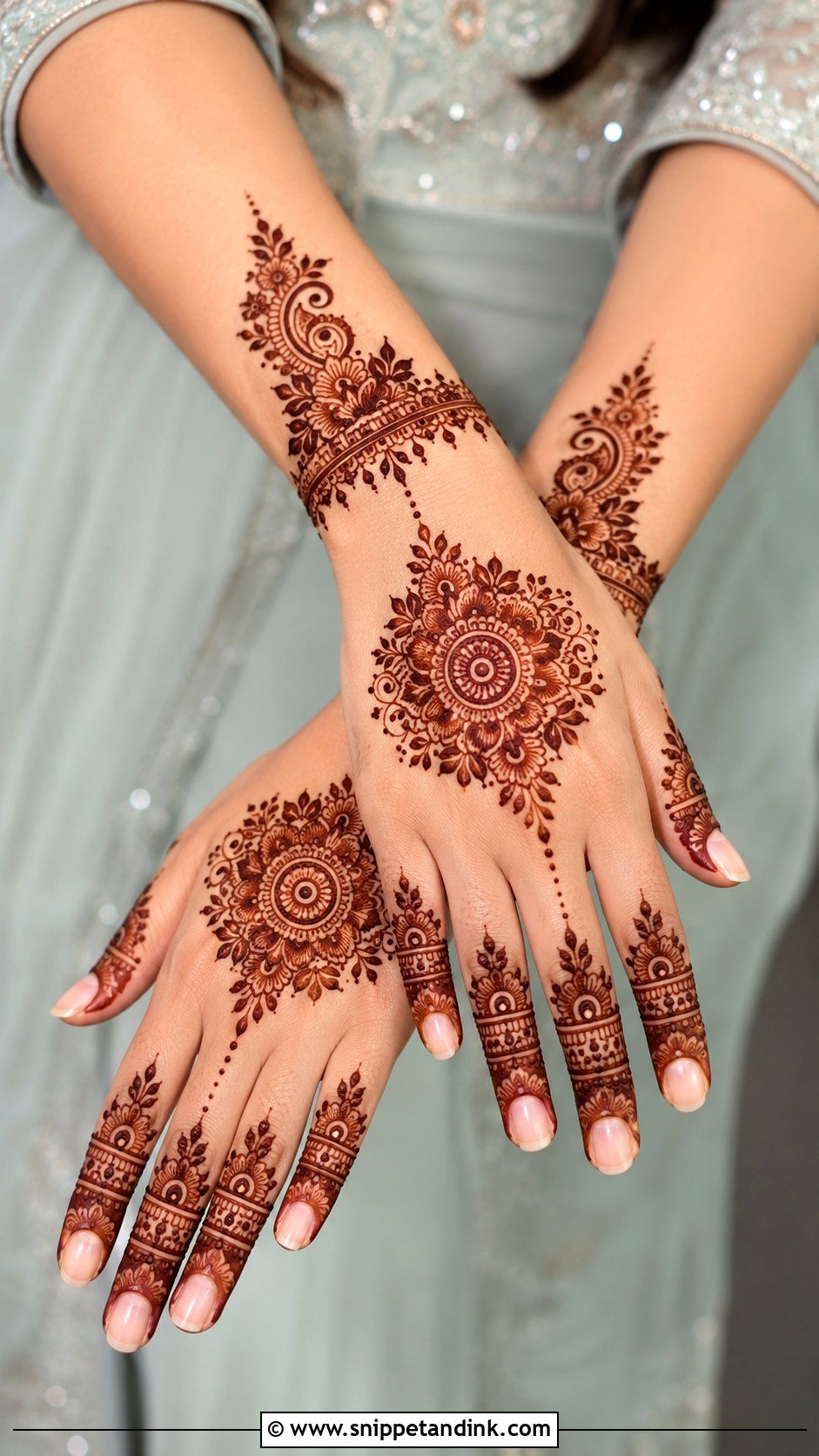
A back hand bridal mehndi design for engagement should sit a step lighter than wedding-day mehndi: a central mandala, floral trails, finger bands, small paisleys and a neat wrist detail. Engagement photos focus on the ring, so I keep the ring finger decorated but clear at the base. It works with gowns, sarees, lehengas and Indo-western outfits, with Arabic spacing for a modern feel or Indian detail for a traditional one.
A Bridal Sitting Lasts Hours, So Prepare Your Hands the Day Before
Full bridal mehndi on both hands, front and back, commonly takes several hours, longer for portraits or forearm work. Most of my brides book it one to two days before the wedding, so the stain has time to deepen from orange to a rich brown by the ceremony.
Do These Before the Paste Goes On
- Waxing, threading, manicures, hand scrubs and facials that involve your hands. Anything abrasive after mehndi strips stain from the back of the hand first.
- Wash and dry your hands, and skip lotion, oil or sunscreen on the day; a greasy layer stops paste gripping the skin.
- Wear a loose top with wide sleeves that you won’t need to pull over your head afterwards.
- Eat properly and use the bathroom just before we start. Line up someone to hold your phone and feed you.
After the Paste Comes Off
Scrape the dry paste away rather than washing it, then keep water off for as long as you can that first day. Bangles and rings rubbing the back of the hand will slowly fade the stain at the wrist and knuckles over the following days, which is normal. A thin layer of balm before you put your jewellery on helps the design stay crisp through the photographs.
Plan the Back of the Hand Around Your Bangles and Sleeves
The back of the hand shapes how your hands look in almost every wedding photograph. Dense Indian work and airy Arabic trails both have their place; the right one depends on your outfit, jewellery, ceremonies, hand shape and how long you can sit. If you lean traditional, look at paisleys, peacocks, jaali or full coverage. If you prefer something current, try negative space, jewellery patterns, chains or a minimal mandala. In every case I’d ask for clean spacing and outlines strong enough to survive the stain, and I’d show your artist exactly where your bangles and sleeves will sit.
You'll Like These Ideas:










Leave a Reply