
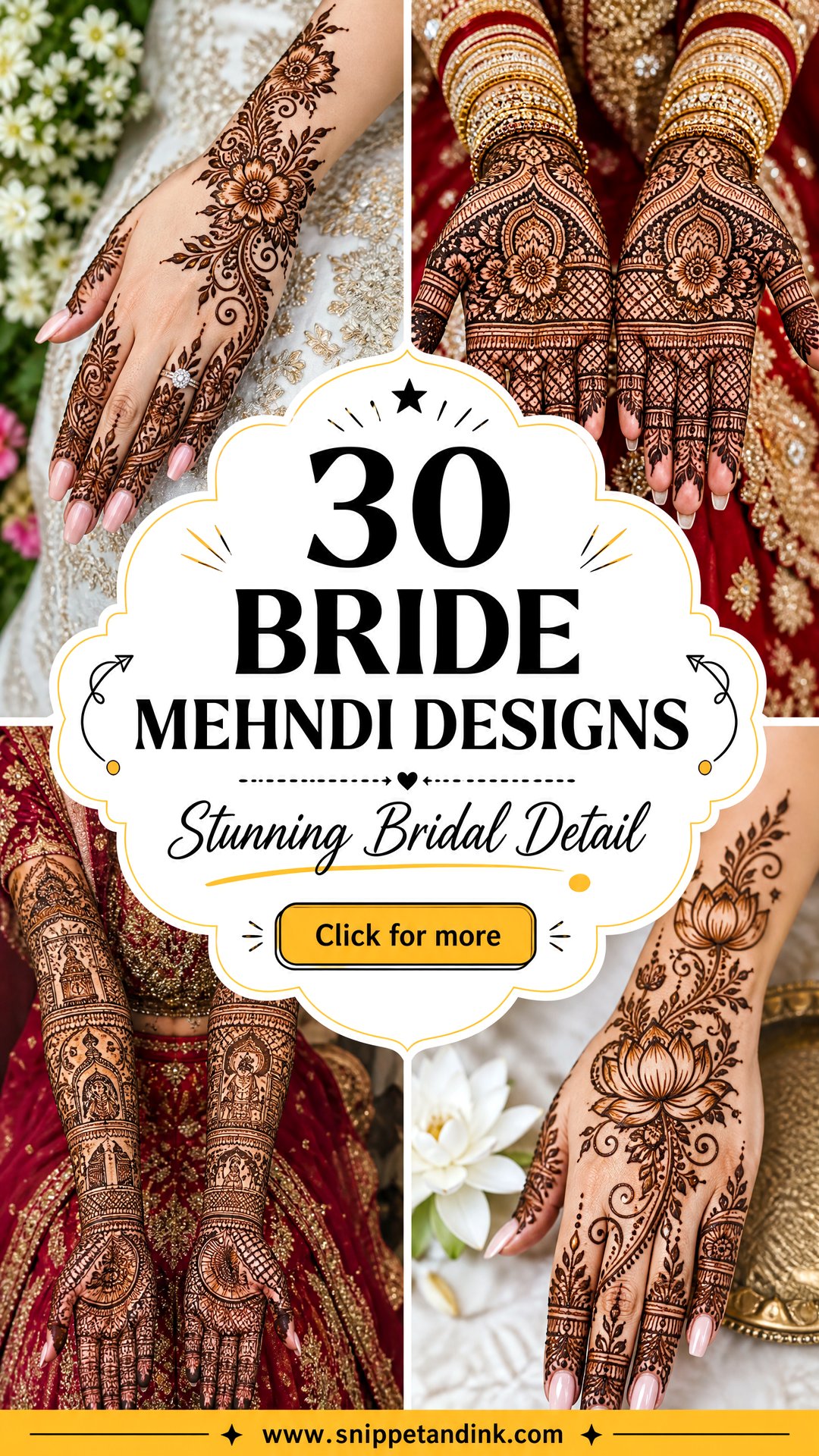
Bridal henna is the one part of the wedding look that is drawn straight onto you, so it has to suit your hands, your outfit and the hours you can actually sit still. The range is wide: traditional full-hand Indian work, airy Arabic trails, modern negative-space layouts, Gulf florals with heavy shading, even tiny portraits of the couple. Some brides want dense artwork to the elbow. Others want clean palms, bold fingers and a bracelet at the wrist. Below are thirty bridal designs I’d be happy to put on a bride, with notes on how each one stains, sits and wears through a long day of rituals.
How Long Each Level of Coverage Keeps You in the Chair
Brides tend to choose a design from photos and only later ask how long it takes. I’d reverse that. The amount of henna on your skin decides how long you sit, how long you can’t use your hands, and how early in the week you need to book. Timings below are rough and vary a lot with the artist’s speed and how detailed the filling is.
- Minimal or front-only designs on both hands: often one to two hours.
- Full hands to the wrist, front and back: commonly three to four hours.
- Elbow-length arms plus feet, or a portrait design: anywhere from five hours to most of a day, sometimes with two artists working at once.
Drying time comes on top of that. Paste needs to stay on for several hours after the last line, and the longer it stays, the deeper the stain. That’s why I ask brides to plan the application one to two days before the wedding. A henna stain starts orange when the paste comes off and darkens over the next day or two, so applying the night before can leave you with a bright carrot color at the ceremony.
A small test patch is worth the trip
Skin takes henna differently. Warm, well-moisturized hands usually go darker; cold hands and dry skin often stay lighter. A dot on the palm a few weeks ahead tells you how your skin responds and whether you react to the paste at all, which is far better to learn then than the night of the mehndi.
1. Full Hand Bridal Mehndi Design
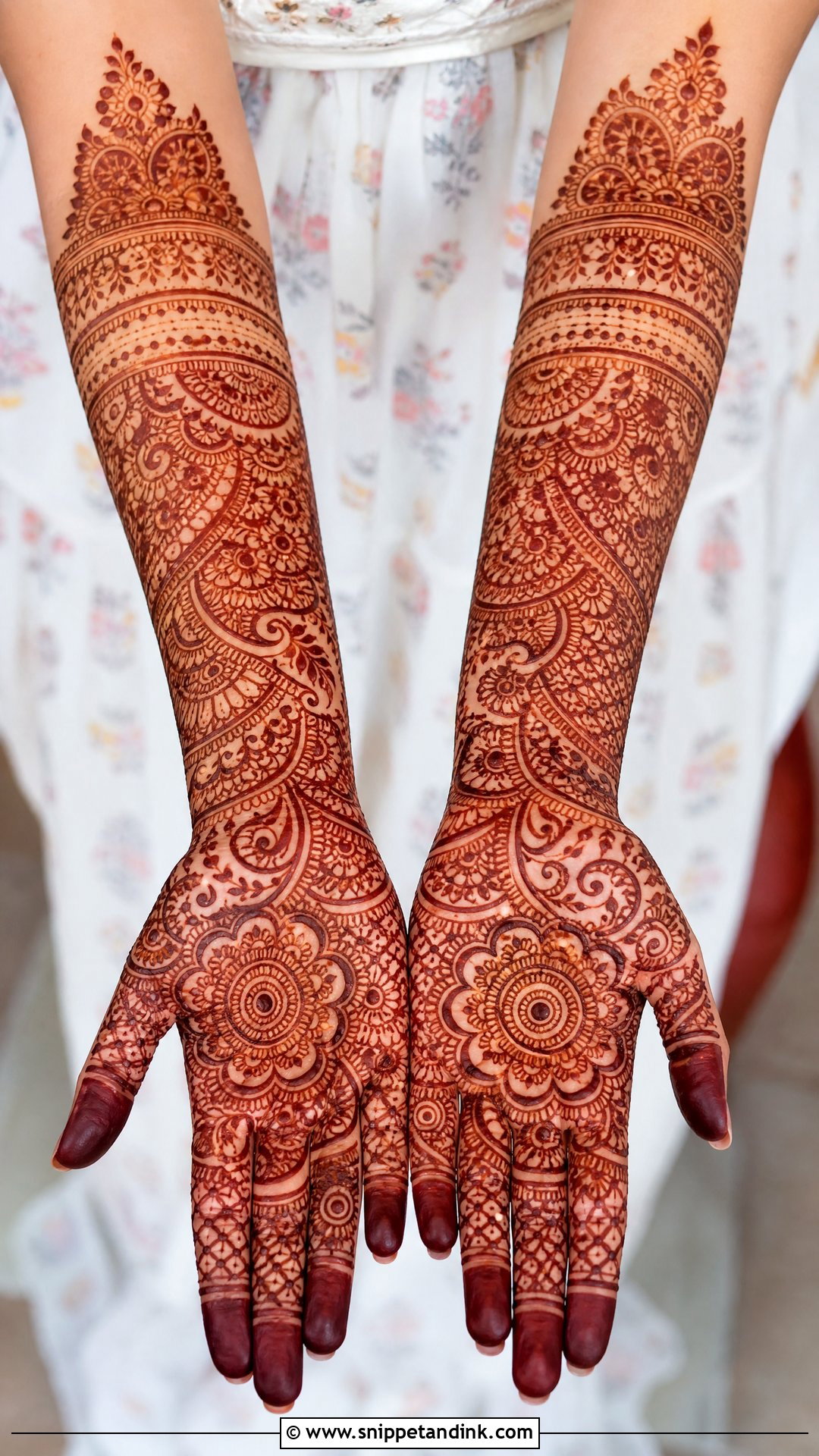
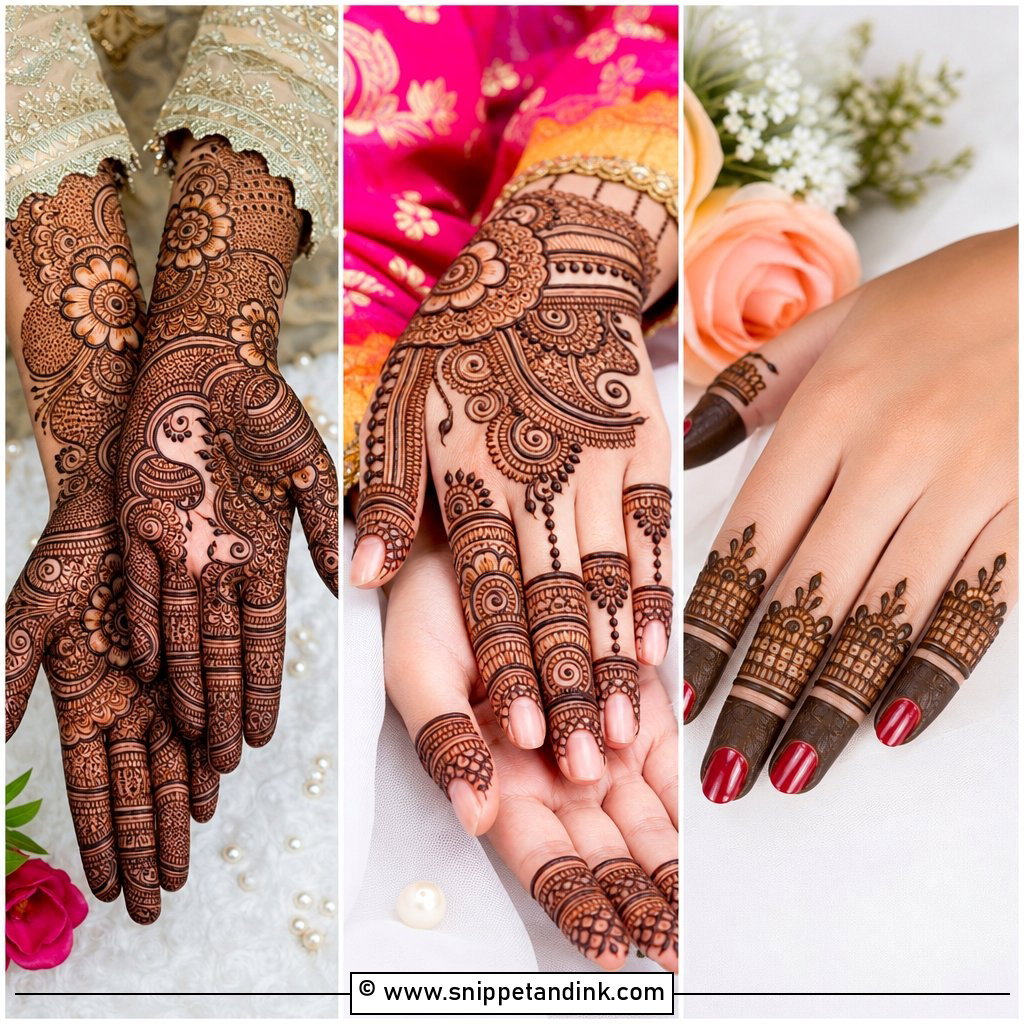
Full coverage from fingertips to wrist or forearm is still the design most brides picture first. The palm fills with paisleys, florals, leafy fillers and a mandala or two, and the fingers are worked all the way to the tips, which is where the stain comes up darkest. The risk with this much paste is a muddy result: fine filler lines sit so close that they bleed together as the stain develops. When I draw it, I leave tiny breathing gaps between the dense zones on purpose, because those gaps are what make the pattern readable in a close-up. Heavily embroidered lehengas and sarees can carry this level of detail without the hands competing.
2. Indian Bridal Mehndi Design
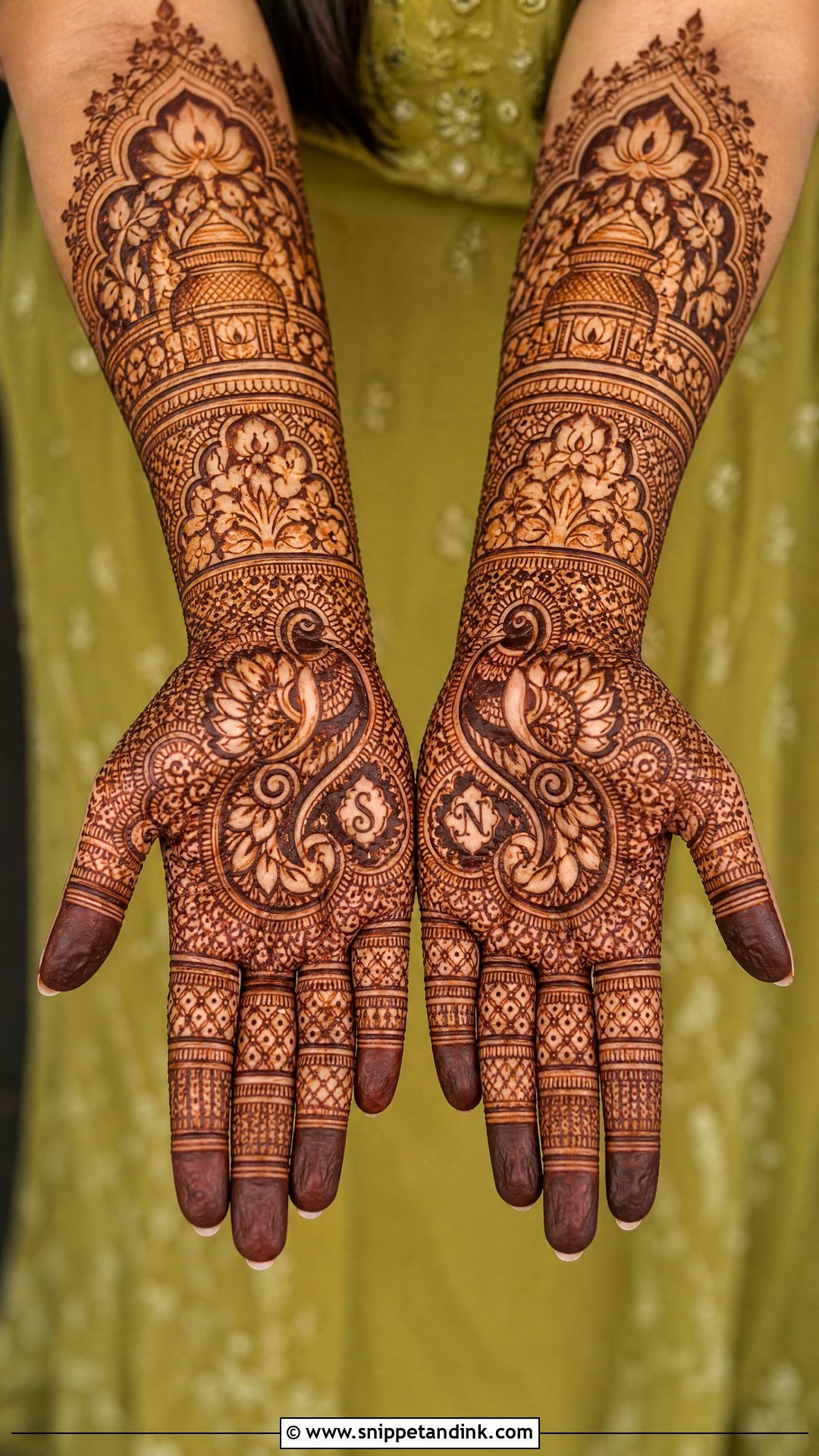
Indian bridal work tells a story across the whole hand. Peacocks, lotus flowers, kalash motifs, paisley vines and a bride and groom pair are the usual cast, with the central palm often holding a small wedding scene and the wrists filled with layered bands and jaali mesh. I coordinate the two hands rather than mirroring them exactly, so the bride side and groom side each have their own focal point. Initials or a date tucked into a paisley give guests something to hunt for during the rituals, and that game tends to keep everyone laughing through a long sitting.
3. Arabic Bridal Mehndi Design
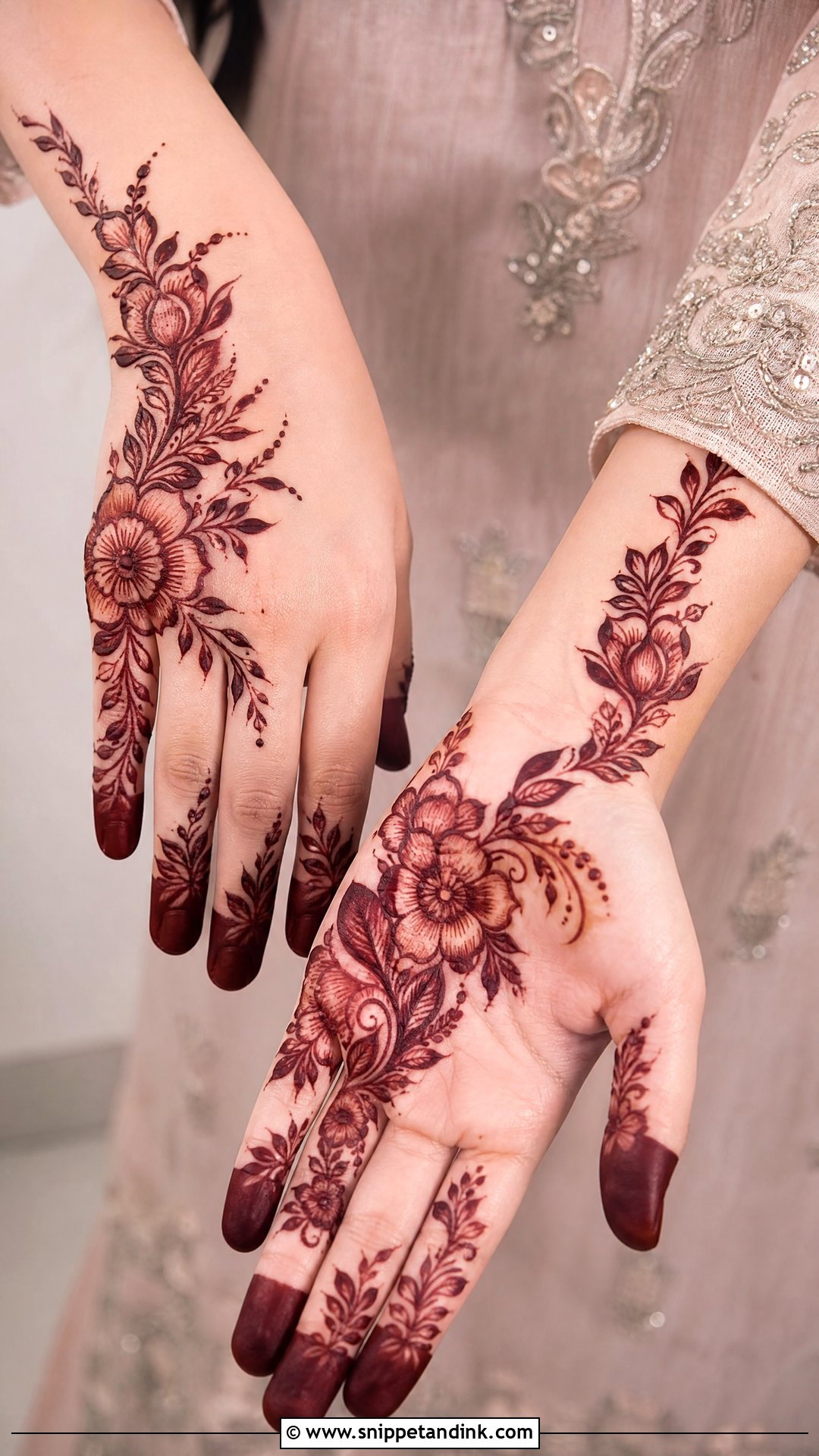
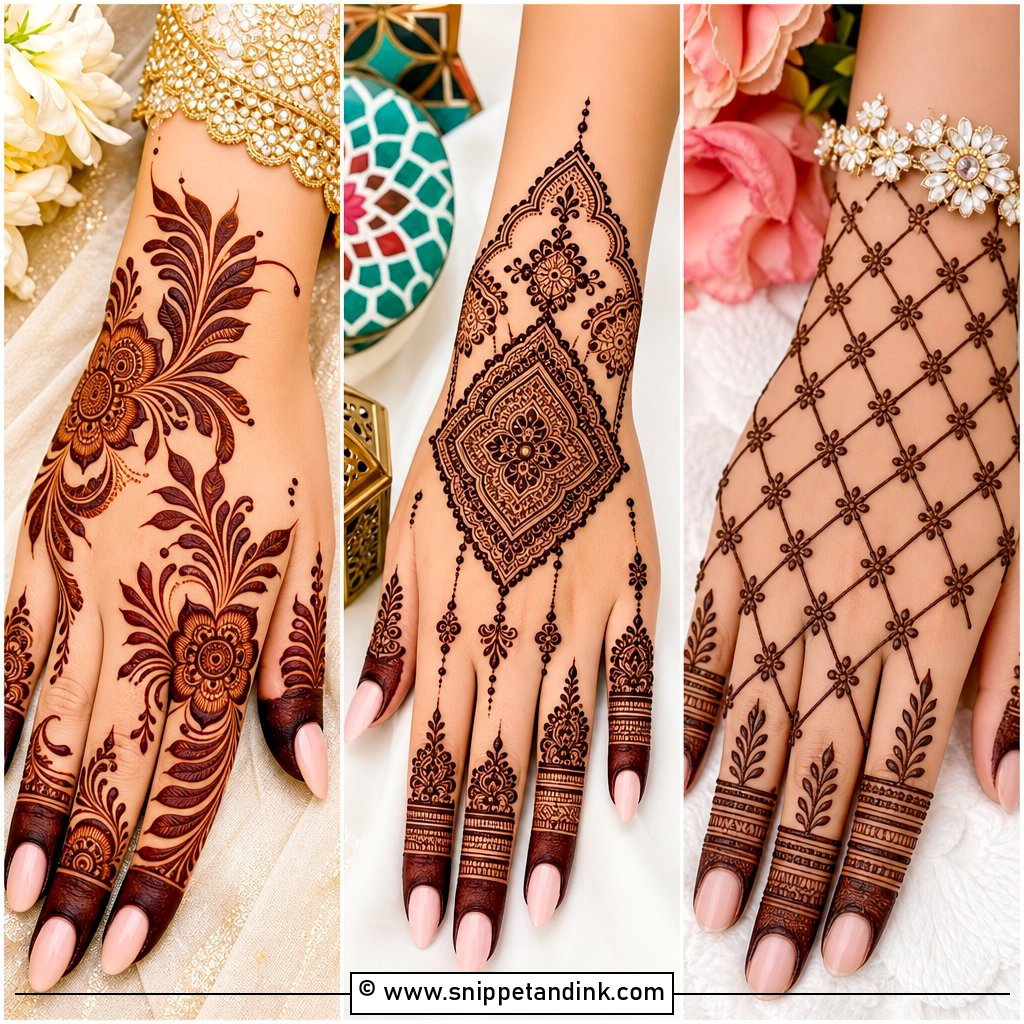
Arabic henna gets its look from bold, thick strokes running in diagonal trails across the palm and back of the hand, with plenty of bare skin left in between. Thick lines carry more paste, so they stain deeper than fine Indian filling and stay crisp as they darken. That makes this a good pick if you can’t sit for six hours. For a bridal version I extend the trail to the wrist, finish every finger and add a matching cuff. Pastel lehengas and shararas suit the lighter coverage well.
4. Indo Arabic Bridal Mehndi Design
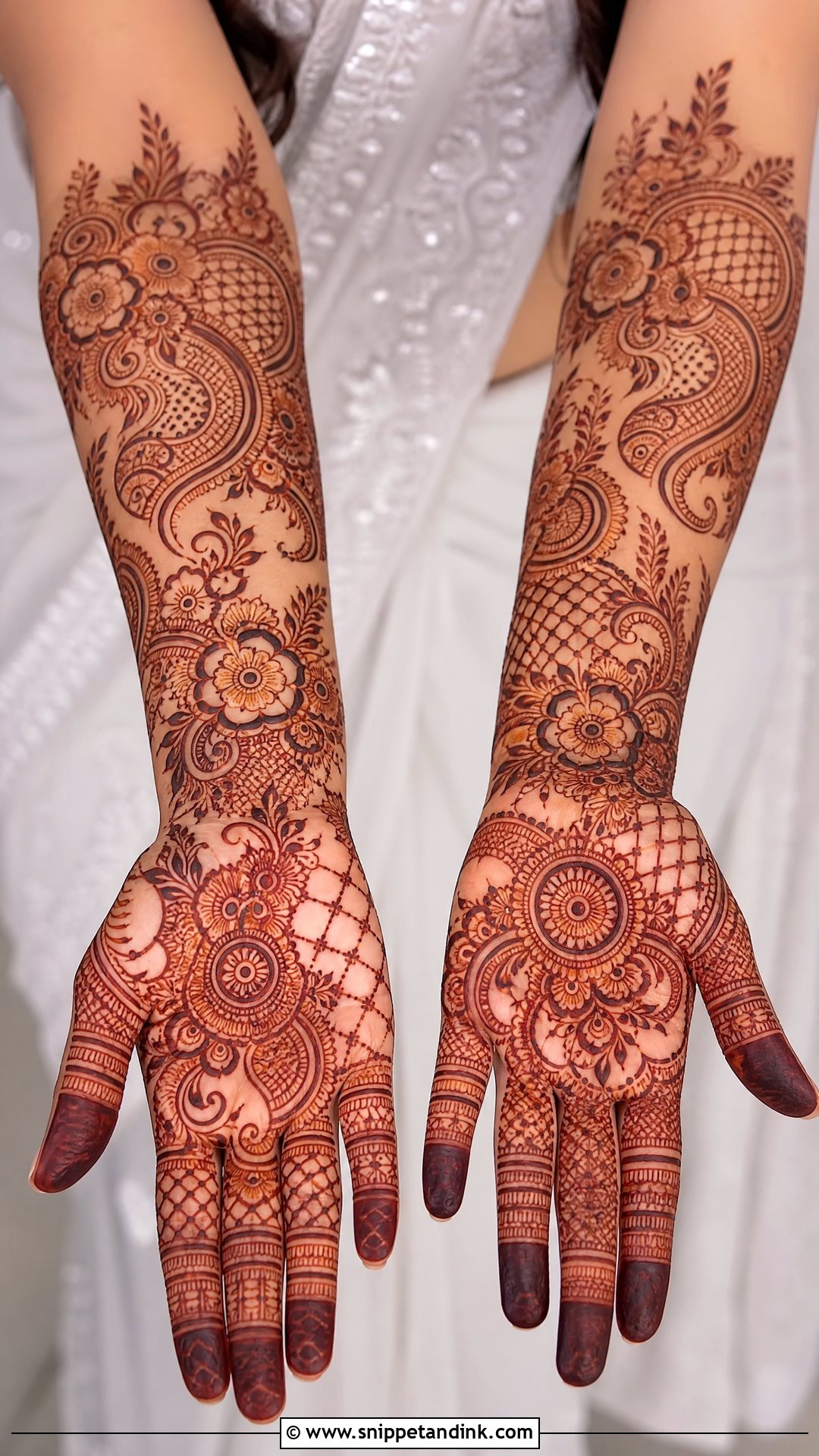
Indo Arabic is my answer when a bride says she wants detail but hates looking crowded. The structure comes from Arabic flow, large floral trails and open space, and the inside of those shapes gets Indian filling: paisleys, mandala centers, fine jaali and detailed fingertips. I usually load the palm more heavily and keep the back hand lighter with bracelet bands and a leafy vine. It holds up well at destination weddings, since the open areas mean less paste to dry in heat and less to smudge while you travel.
5. Rajasthani Bridal Mehndi Design
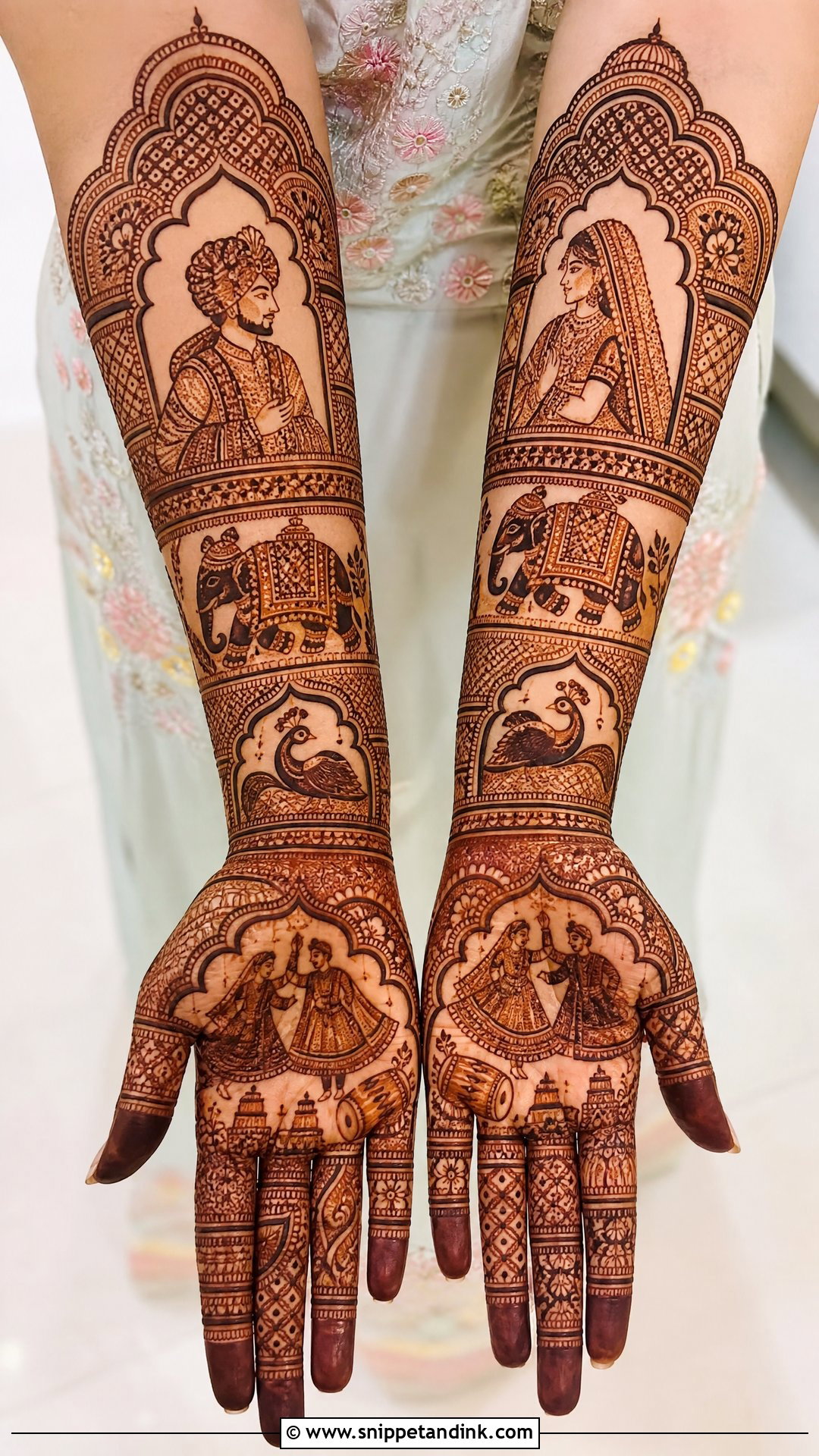
Rajasthani mehndi is the royal, crowded one: bride and groom portraits, elephants, peacocks, palaces, dhol players and layered traditional borders, with almost no empty skin from fingertips to forearm. It is slow work. Expect a long sitting, and choose an artist whose portfolio shows clean line work up close, because a shaky hand turns this much detail into a brown blur once the stain darkens. Red, maroon and gold outfits sit naturally next to it. Family symbols or a ritual scene can go into the palm if you want something nobody else has.
6. Marwari Bridal Mehndi Design
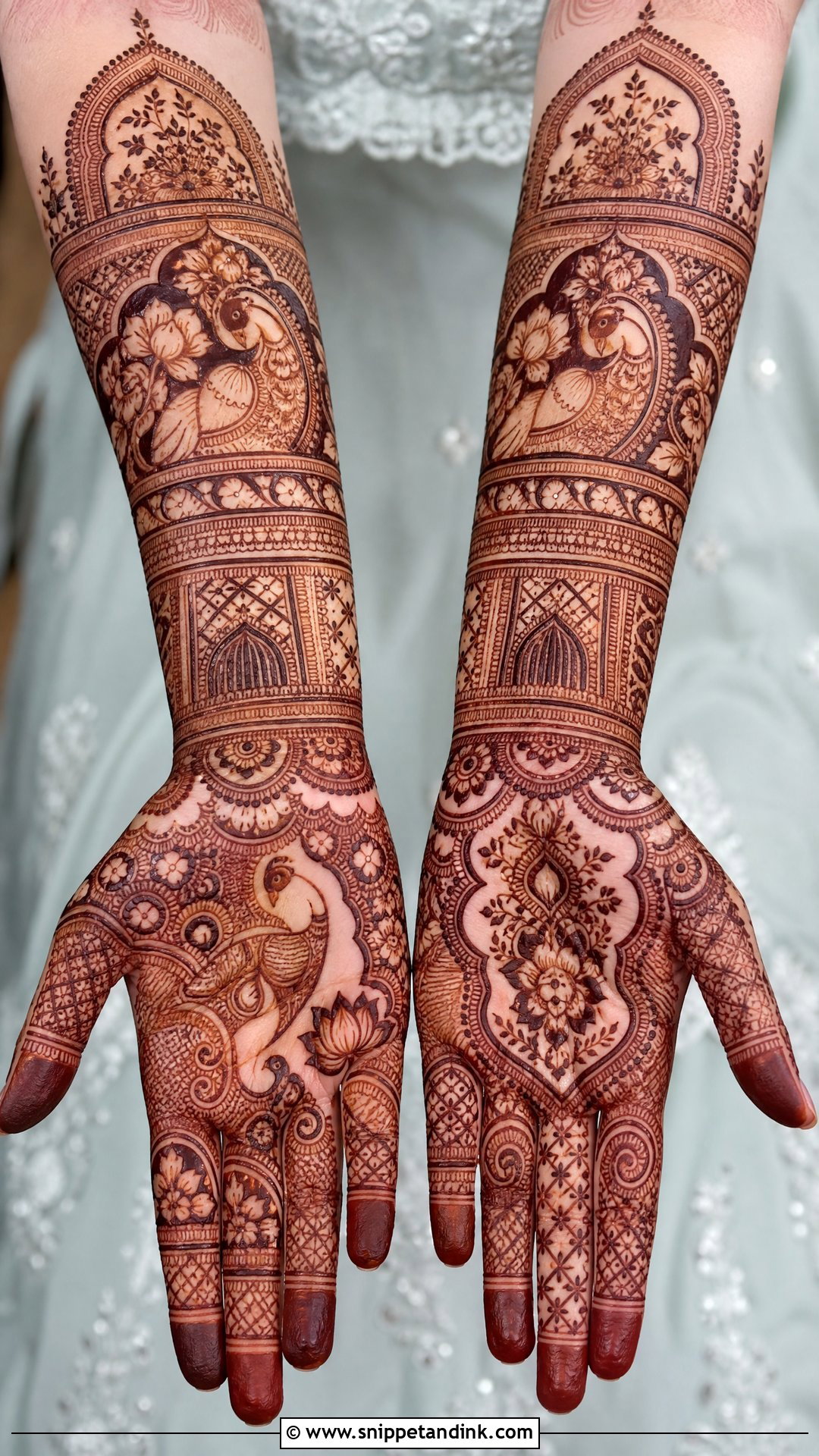
Marwari designs are dense too, but they read as ornament rather than as a picture book. Peacock pairs, paisley chains, lotus details, fine grids and banded rows that climb the forearm give it a strong, even rhythm. The wrists often end up looking like stacked bangles, which is why I like it for brides wearing heavy gold. I ask for a little clean spacing around each main motif before I start, since the stain spreads slightly and a peacock with no margin disappears into the grid around it.
7. Pakistani Bridal Mehndi Design
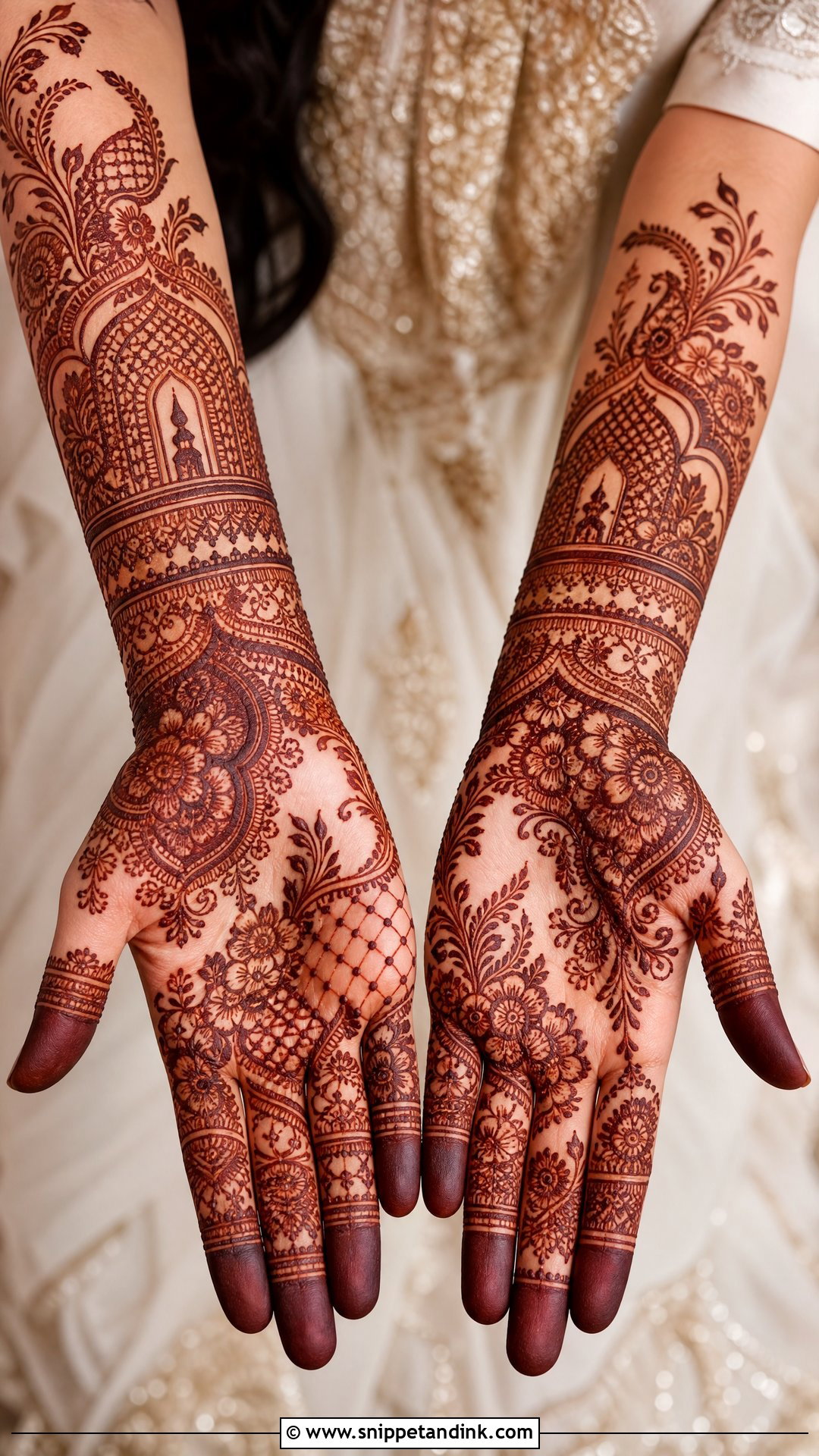
Pakistani bridal mehndi sits between two traditions: Indian-style filling inside a softer, Arabic-leaning flow. Florals, domes, paisleys, jaali mesh, bracelet cuffs and full fingertips are typical, usually denser on the palms and more open on the back. Because a Pakistani wedding often runs over several functions, I think about which event the stain will peak for. Henna applied for nikkah, walima, mehndi night and reception photos will be darkest a day or two after application and fading by the last event. Wrist length or elbow length both work, and a pair of initials adds a personal note without making it busy.
8. Royal Bridal Mehndi Design
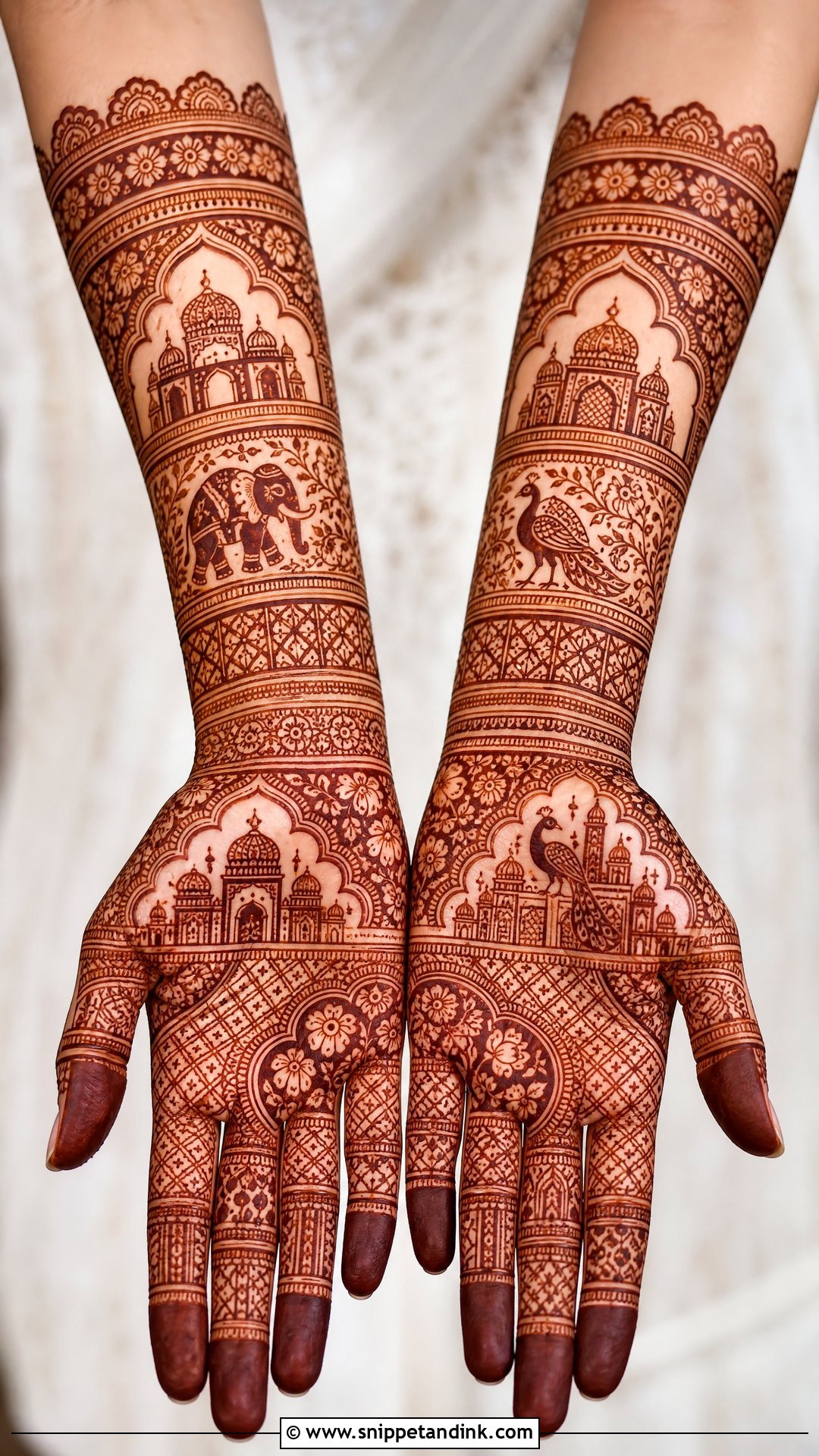
A royal layout is about scale and hierarchy: palace arches, elephants, peacocks, ornamental grids, floral borders and layered wrist cuffs, with one clear focal point on each palm. The mistake I see most is the same filler repeated over every inch, which flattens the whole design. I vary textures between sections instead, so the arches and figures stand forward from the background. Heavy lehengas and traditional jewelry match it best. Look at it from across the room and then from a ring-ceremony close-up; a good royal design works at both distances.
9. Simple Bridal Mehndi Design
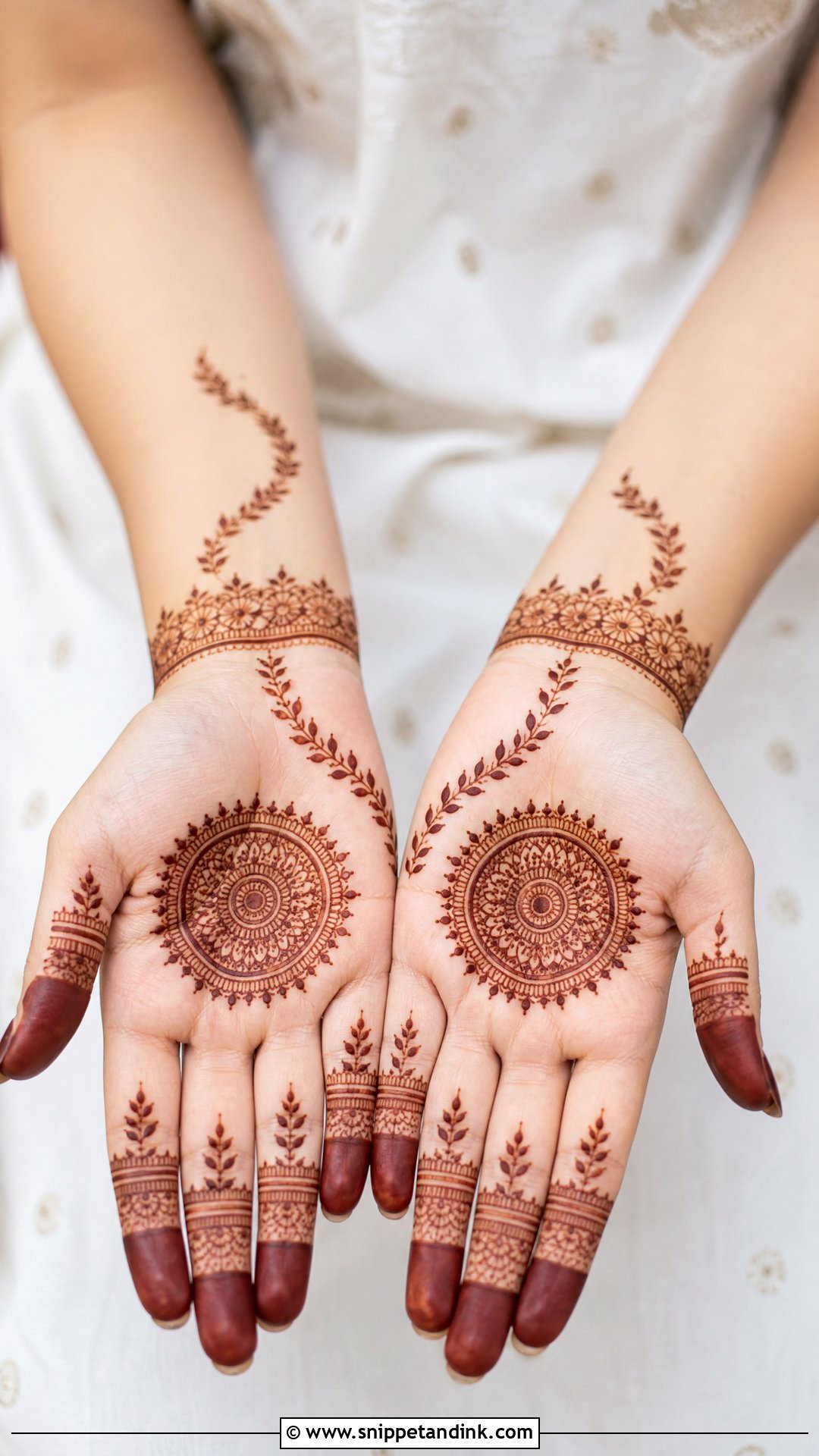
Simple doesn’t have to mean unfinished. A neat palm mandala, fully worked fingers, a floral wrist band and a couple of leafy trails can look completely bridal when the placement is balanced on both hands and the lines are clean. It takes far less time to apply and dry, which matters if your henna night is also a party you want to enjoy. I’d suggest it when the outfit is heavily embellished, since the hands then don’t fight the embroidery. A deep stain matters more here than in any dense design, so look after the paste carefully.
10. Minimal Bridal Mehndi Design
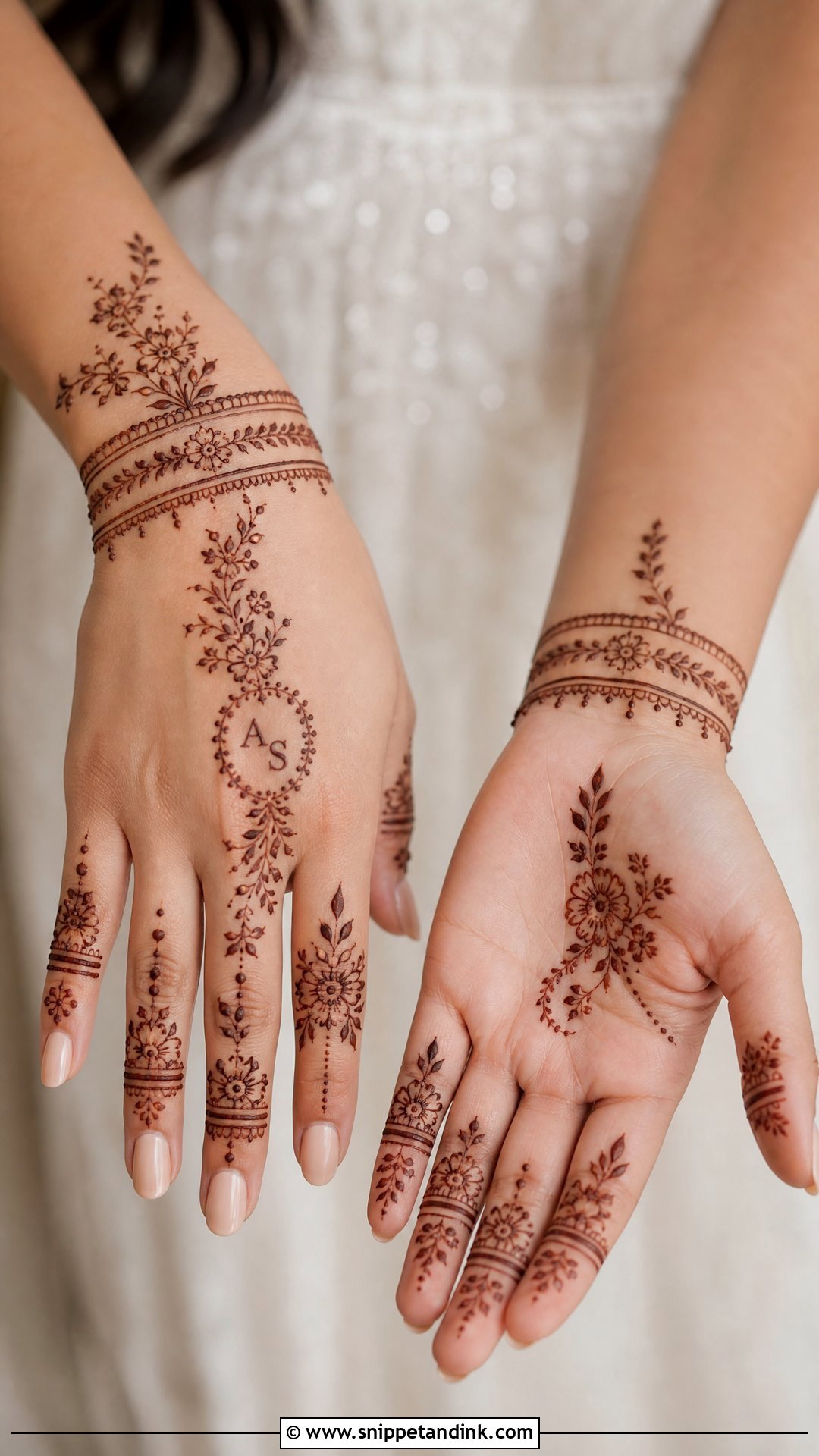
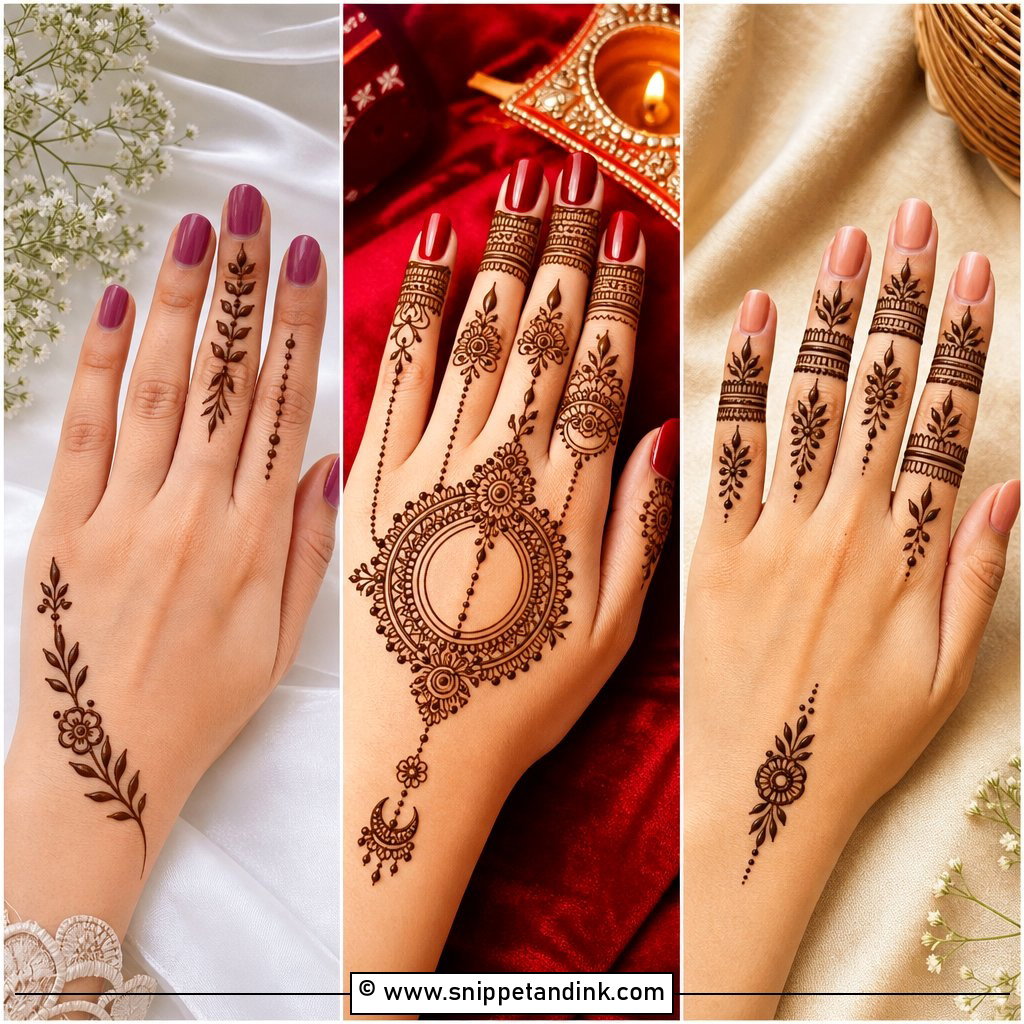
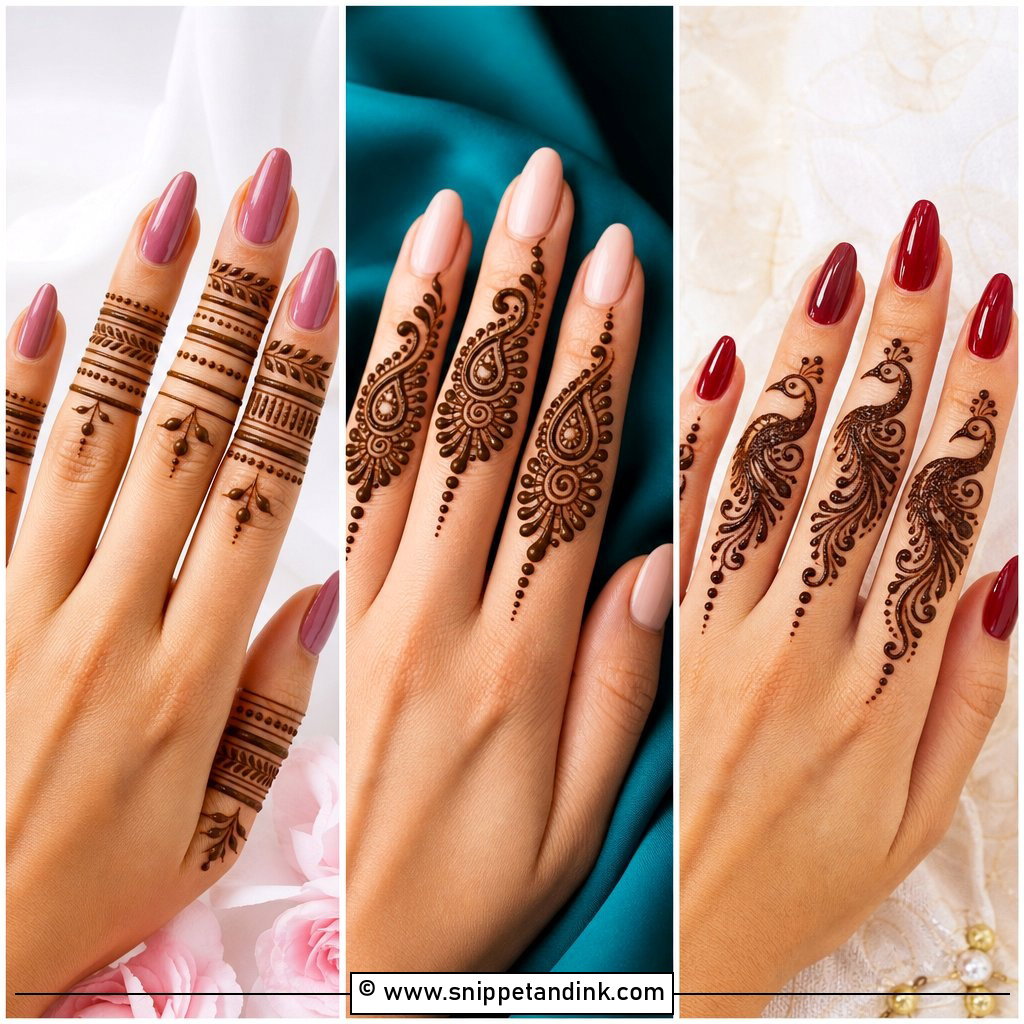
Minimal bridal henna picks a few areas, usually the fingers, one side of the palm, the wrist or a single small central motif, and leaves the rest bare. Thin vines, tiny florals, dots and ring bands do the work. One thing brides don’t expect: very fine lines stain lighter than bold ones, so with this little paste on the skin I draw the lines a touch thicker than they look in reference photos. Courthouse weddings and small ceremonies suit it well. Add one personal detail, initials or a date, and it reads as bridal rather than as a guest’s henna.
11. Modern Bridal Mehndi Design
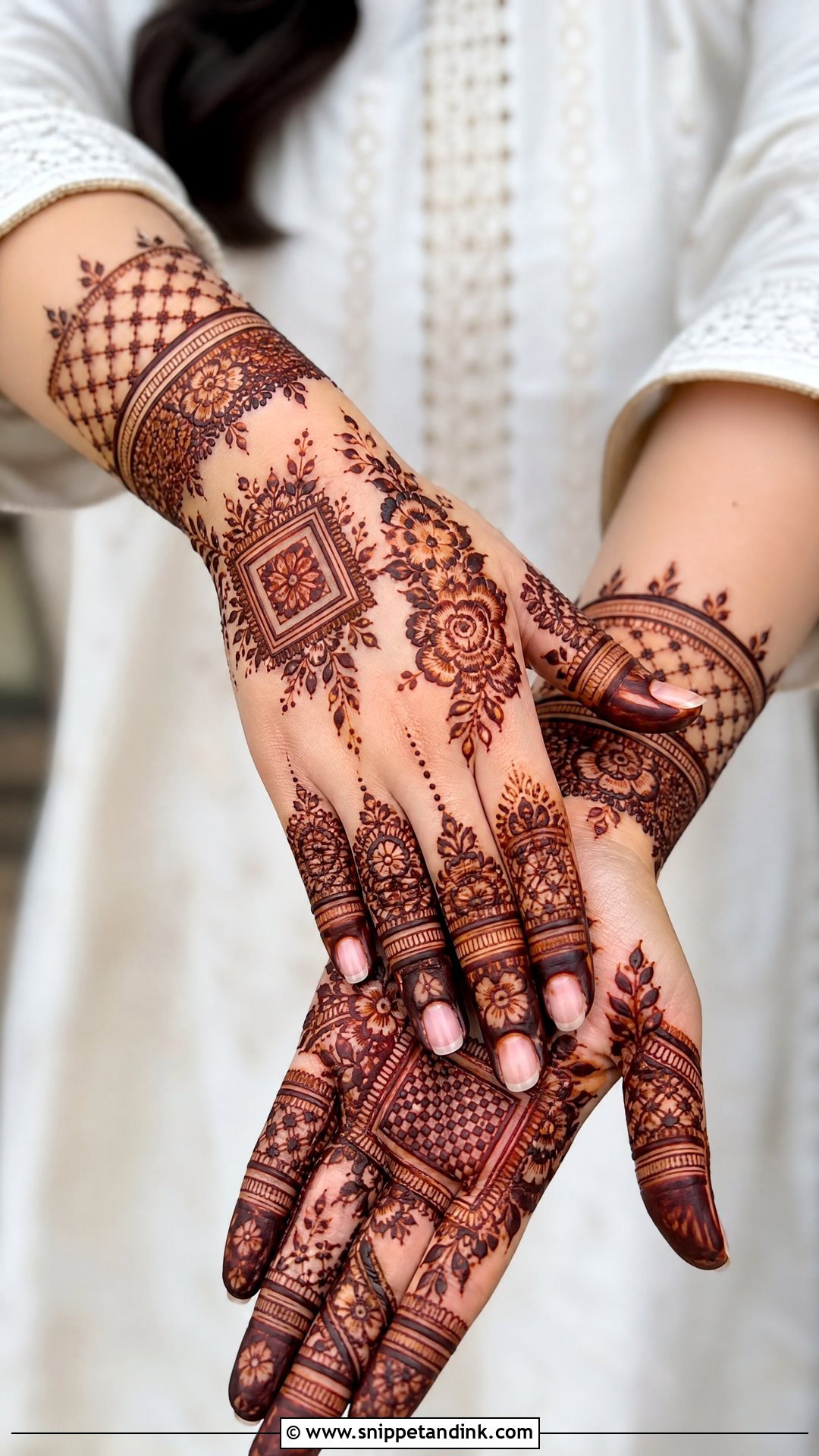
Modern layouts use spacing as part of the design. Geometric grids, floral trails, bold finger work, half-and-half palms and bracelet cuffs sit next to deliberate bare skin, so each motif gets room. You can still bring in paisleys and mandalas; I simply frame them with straight lines and square borders. The thing that holds a modern design together is one theme carried across both hands. When the left hand is geometric and the right hand is floral, it looks like two different appointments. Fusion and classic outfits both work with it.
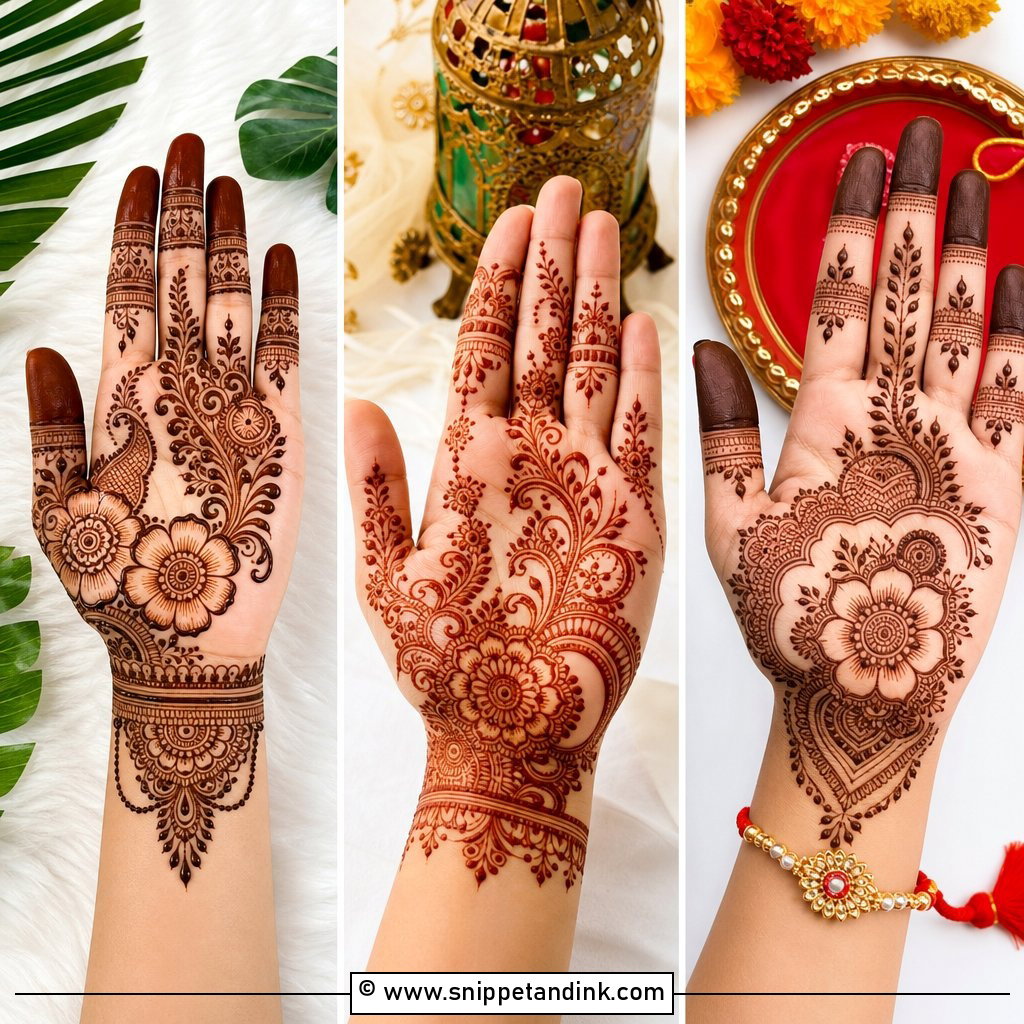
12. Front Hand Bridal Mehndi Design
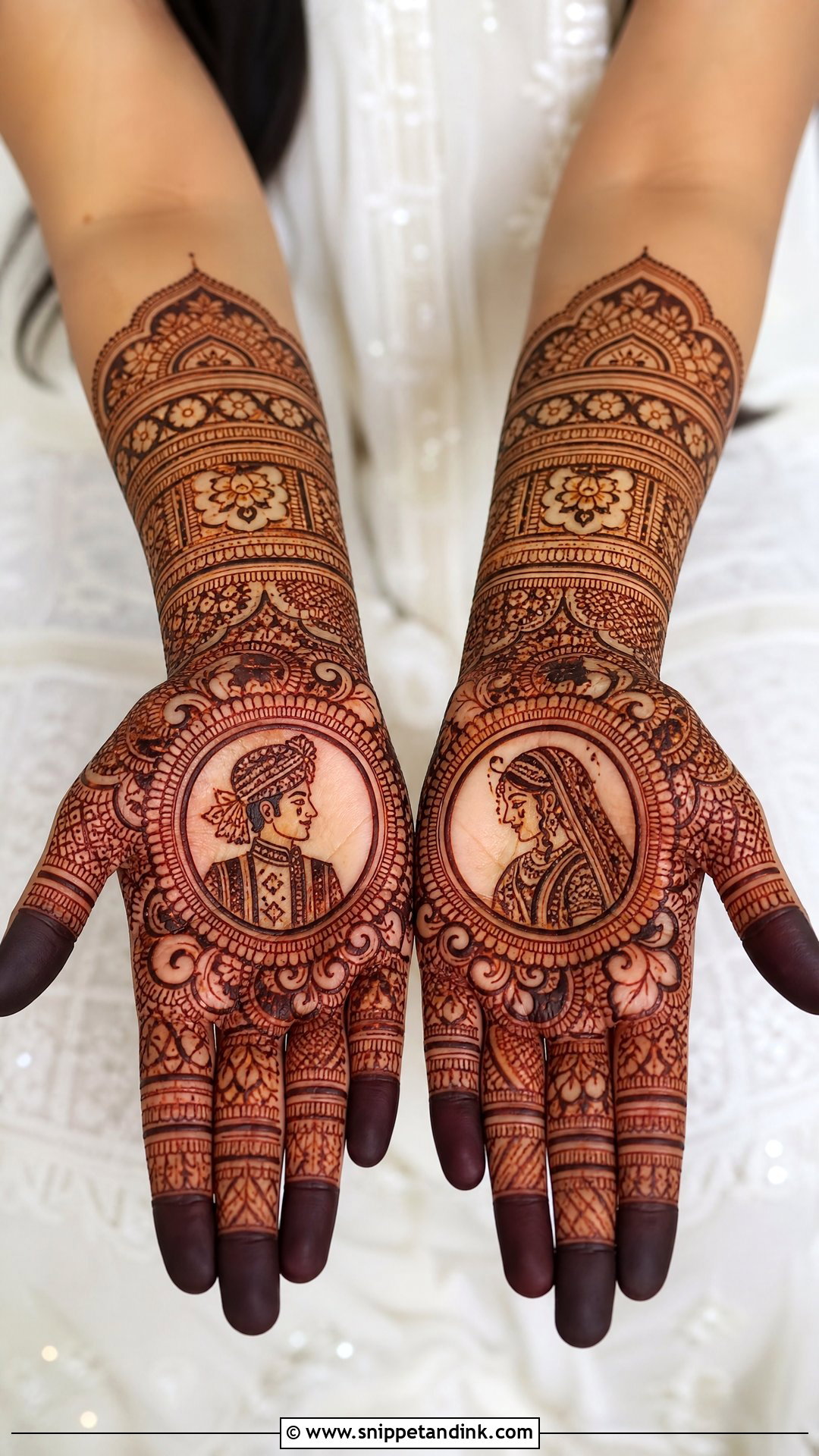
Front hand work puts everything on the palms, fingers and inner wrists, the area that shows during almost every ritual and every ring photo. Palm skin is thicker and takes henna well, so this is where the deepest color of the whole design will appear. A full front can hold a large mandala, paisley borders, floral fillers, bride and groom figures and dense fingertips. For a softer look I leave open space around the center instead. Watch the join at the wrist: if the palm design just stops, it looks cut off when your hands are held out for a blessing.
13. Back Hand Bridal Mehndi Design
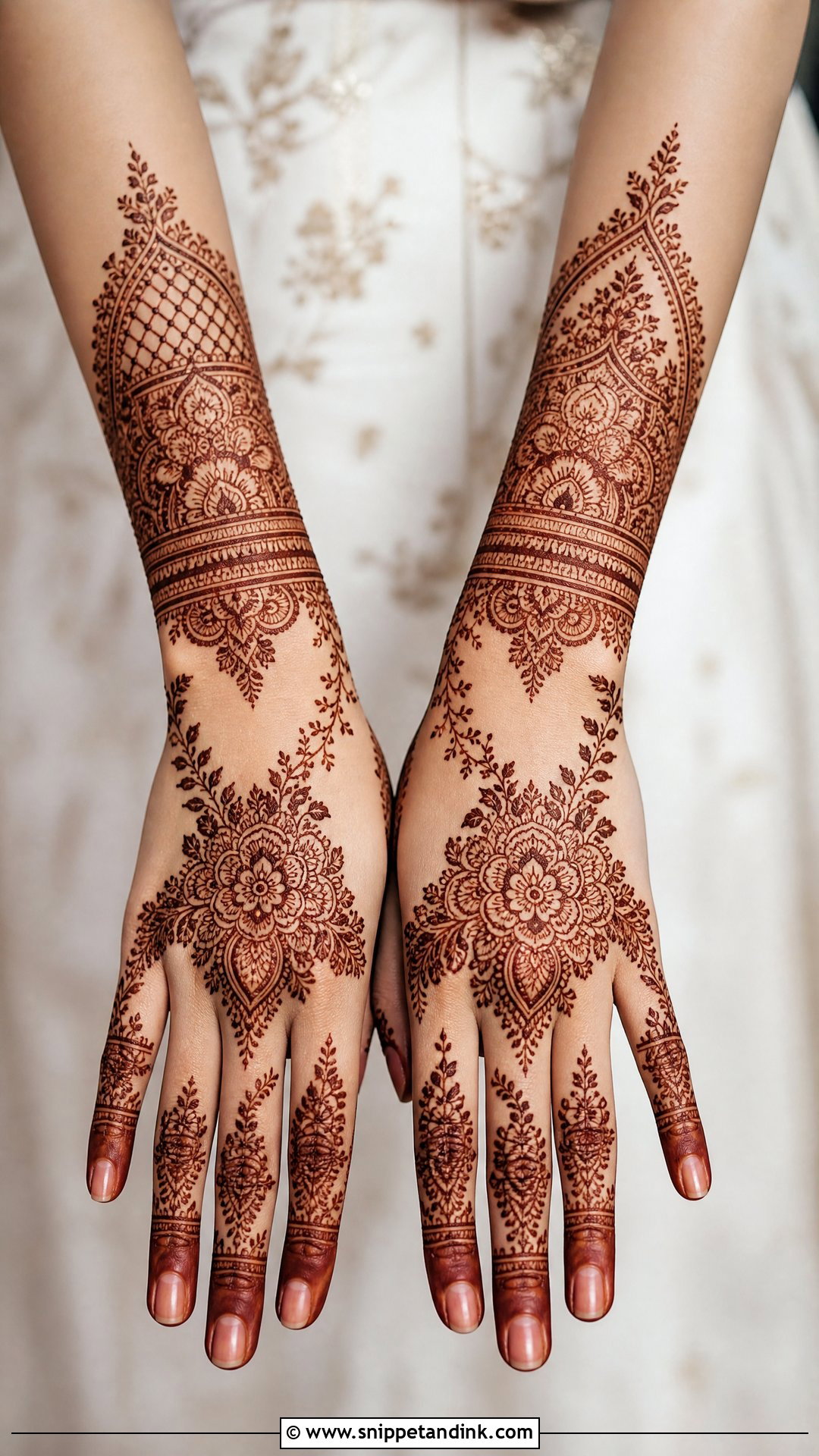
Back hand bridal mehndi design has to share space with rings, bangles and haath phool, so I always ask to see the jewelry before I draw. Bracelet bands, finger detailing, floral trails, mandalas, jaali and wrist-to-forearm extensions all fit here. Be aware that the back of the hand stains lighter than the palm, so the same design will look a shade softer on that side. Symmetrical motifs feel classic; a diagonal floral with negative space feels newer. Either way, keep the fingers neat. They are the first thing a camera finds.
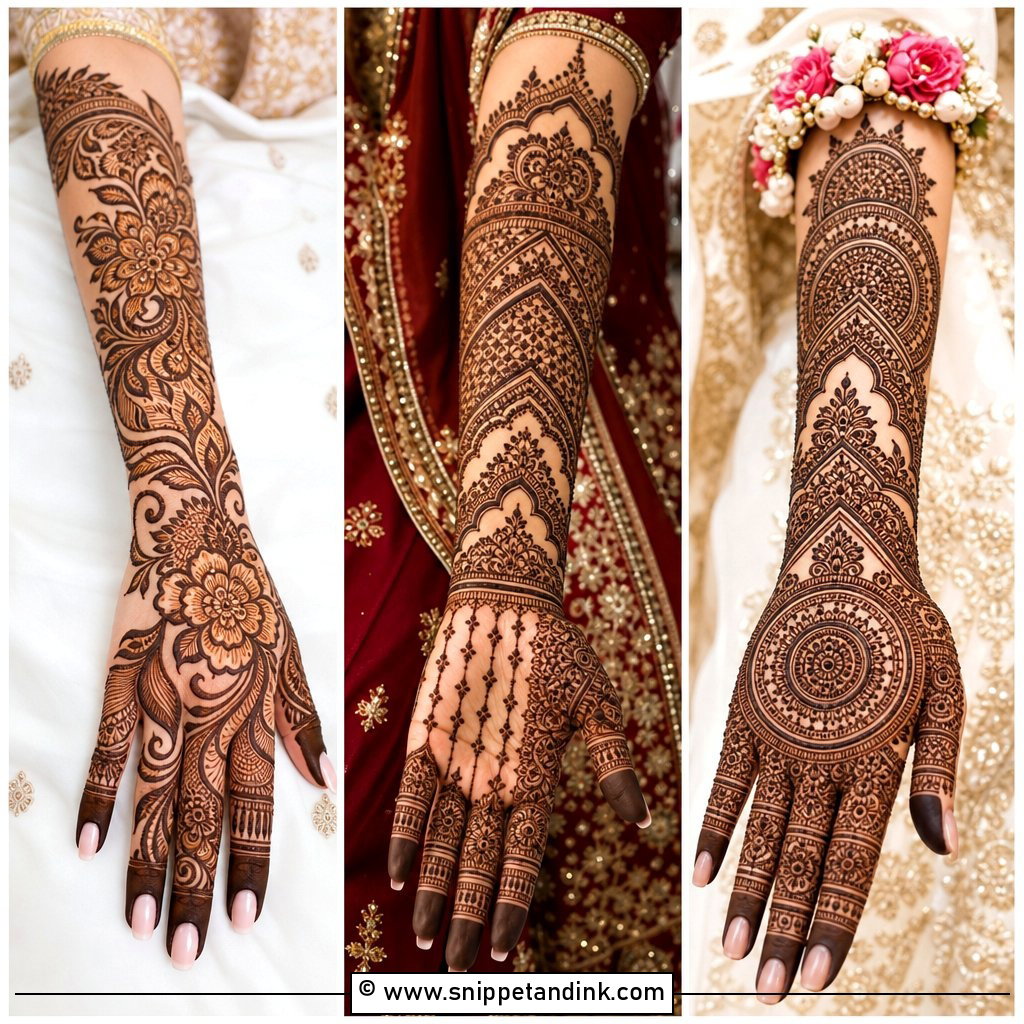
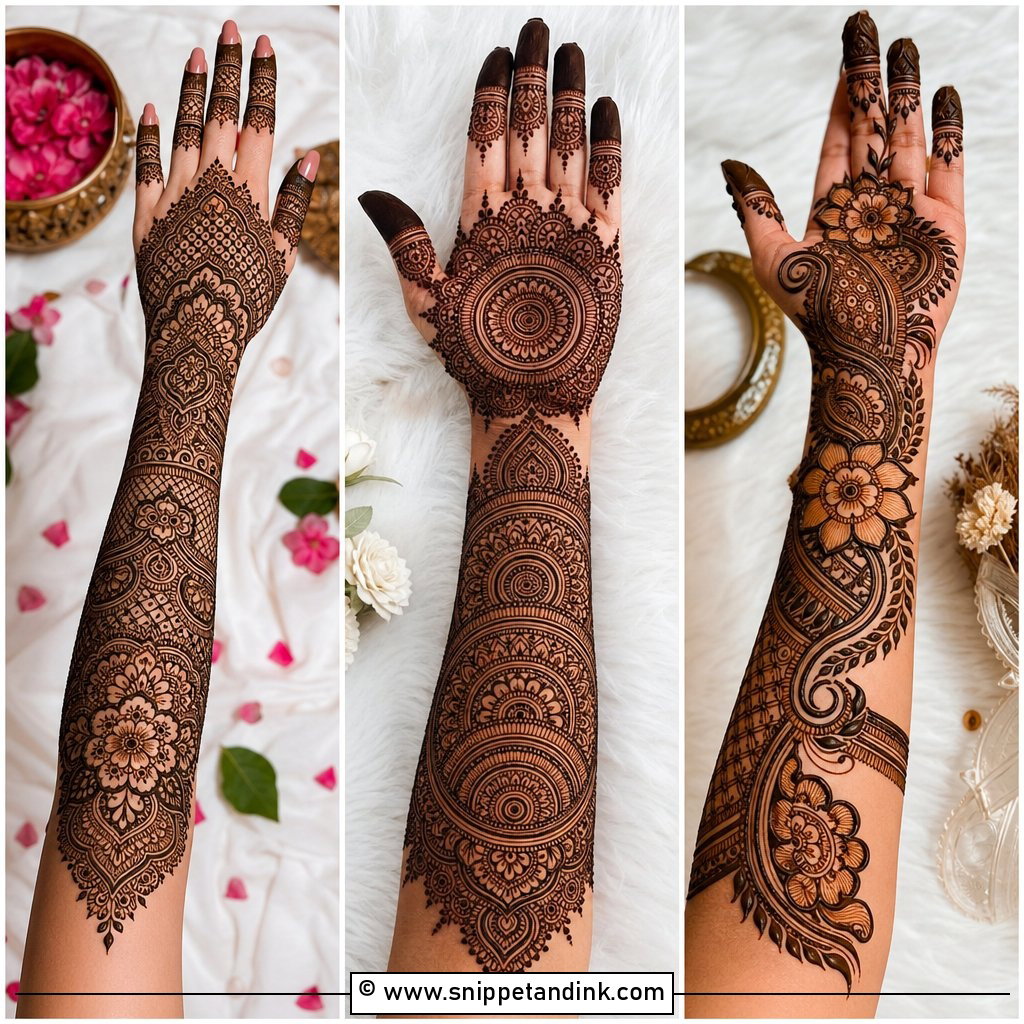
14. Full Arm Bridal Mehndi Design
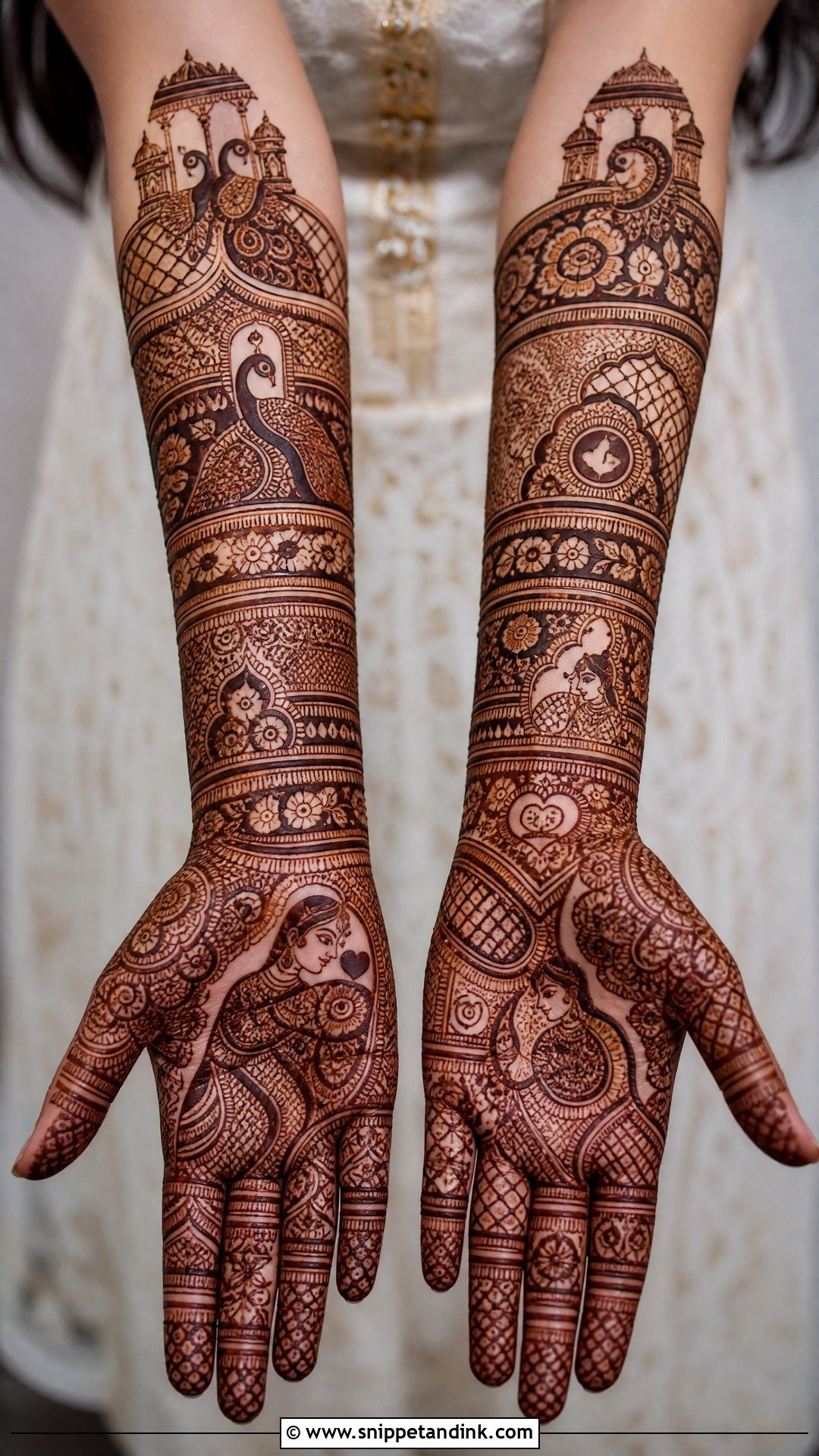
Full arm designs run from fingertips to the elbow or beyond, with bridal motifs on the palms and stacked bands, florals, peacocks, jaali and personal symbols up the forearm. It is a long sitting, often split between two artists working on one arm each, and you can’t use your hands for hours while it dries. Forearm skin stains lighter than the hands, so expect a gradient from deep maroon at the fingers to a warmer brown near the elbow; that is normal. Sheer or short sleeves let the work show. I break the arm into sections with different textures so it stays readable rather than one long brown sleeve.
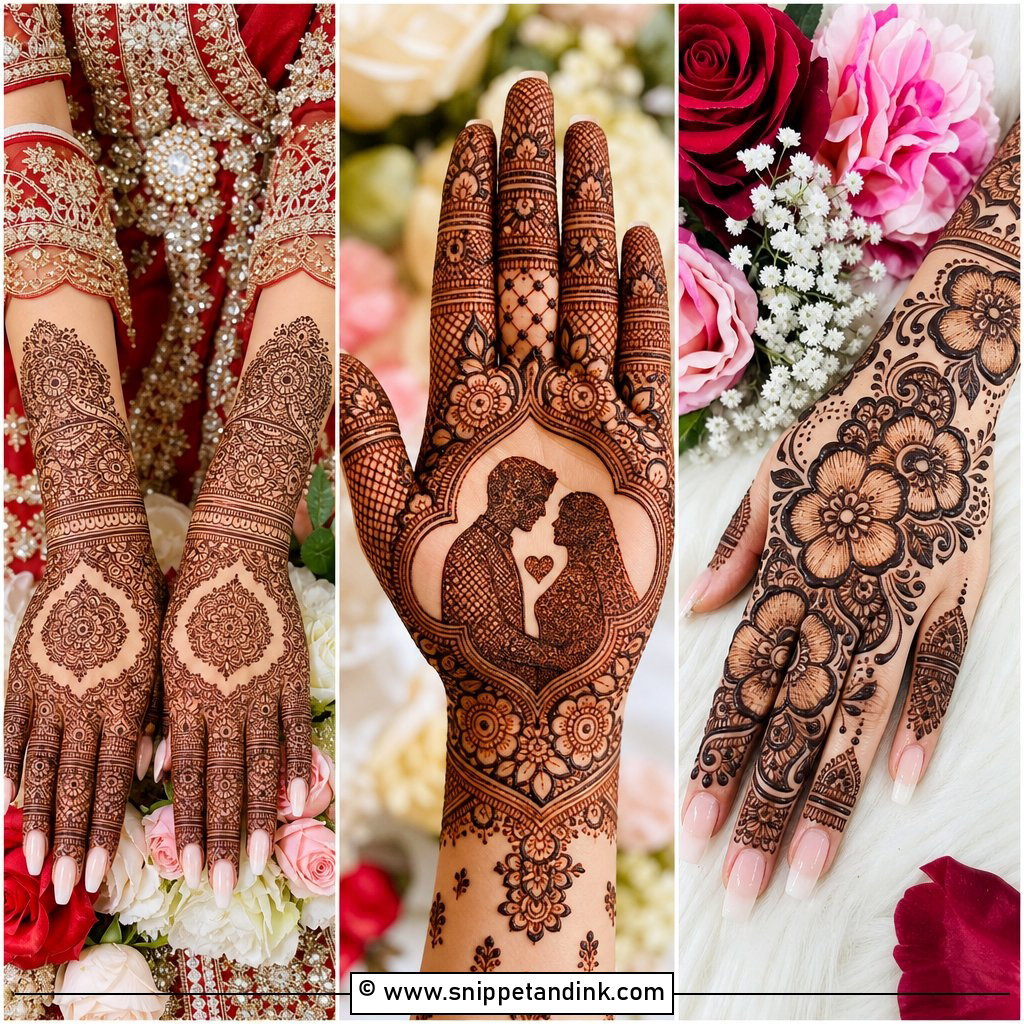
15. Bridal Mehndi Design With Name
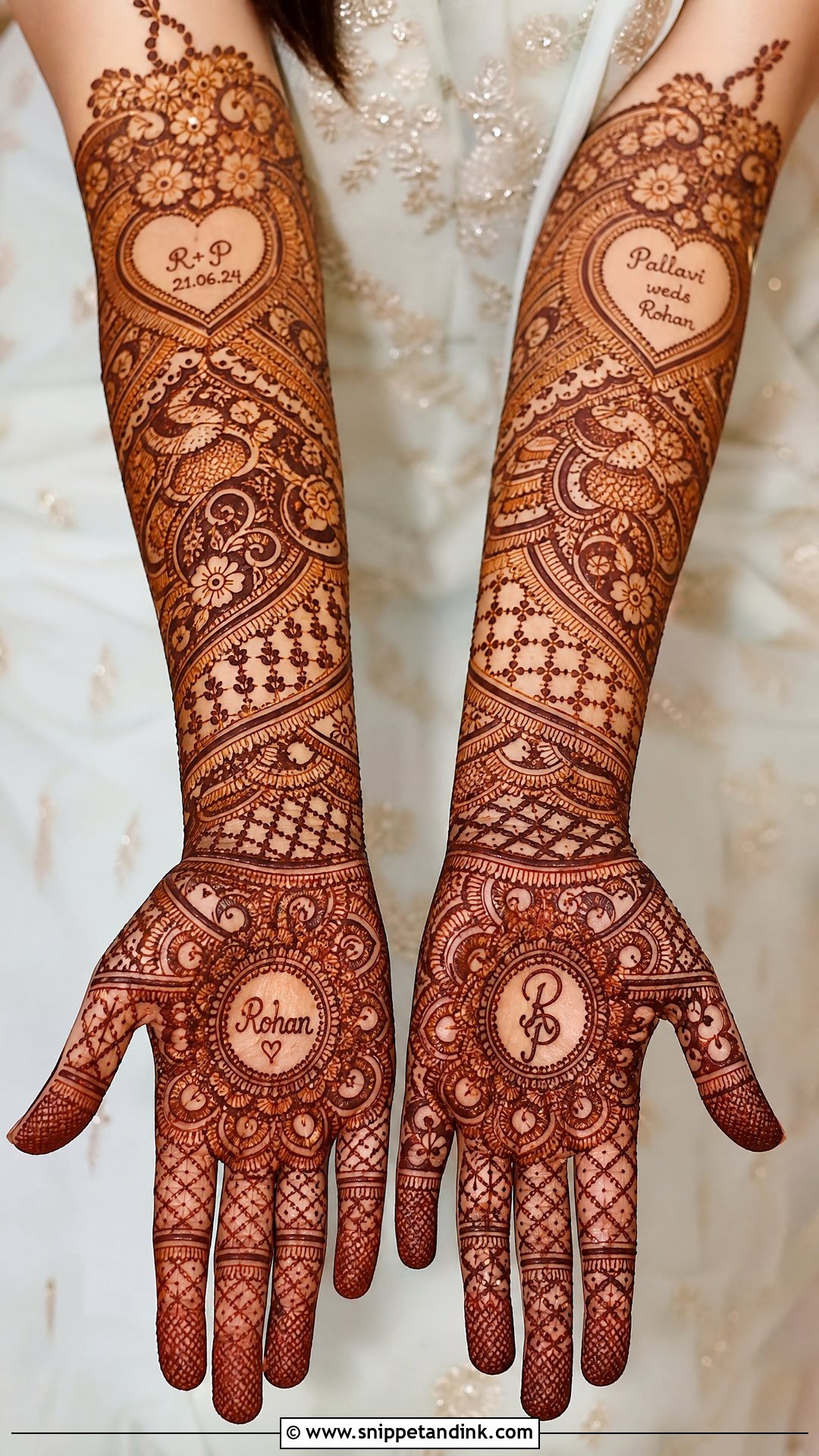
Hiding the groom’s name is one of the oldest henna games, and still one of the most requested. His name or initials go inside a paisley, a jaali panel, a flower center or a wrist band, inside any base style you like. The trick is legibility: letters drawn with a very fine tip can close up as the stain spreads, so I draw them slightly larger and more open than the surrounding filler. Readable when found, invisible at a glance. A date or a tiny heart can join the name, but keep the rest of the design calm so the search actually takes a while.
16. Bride And Groom Mehndi Design
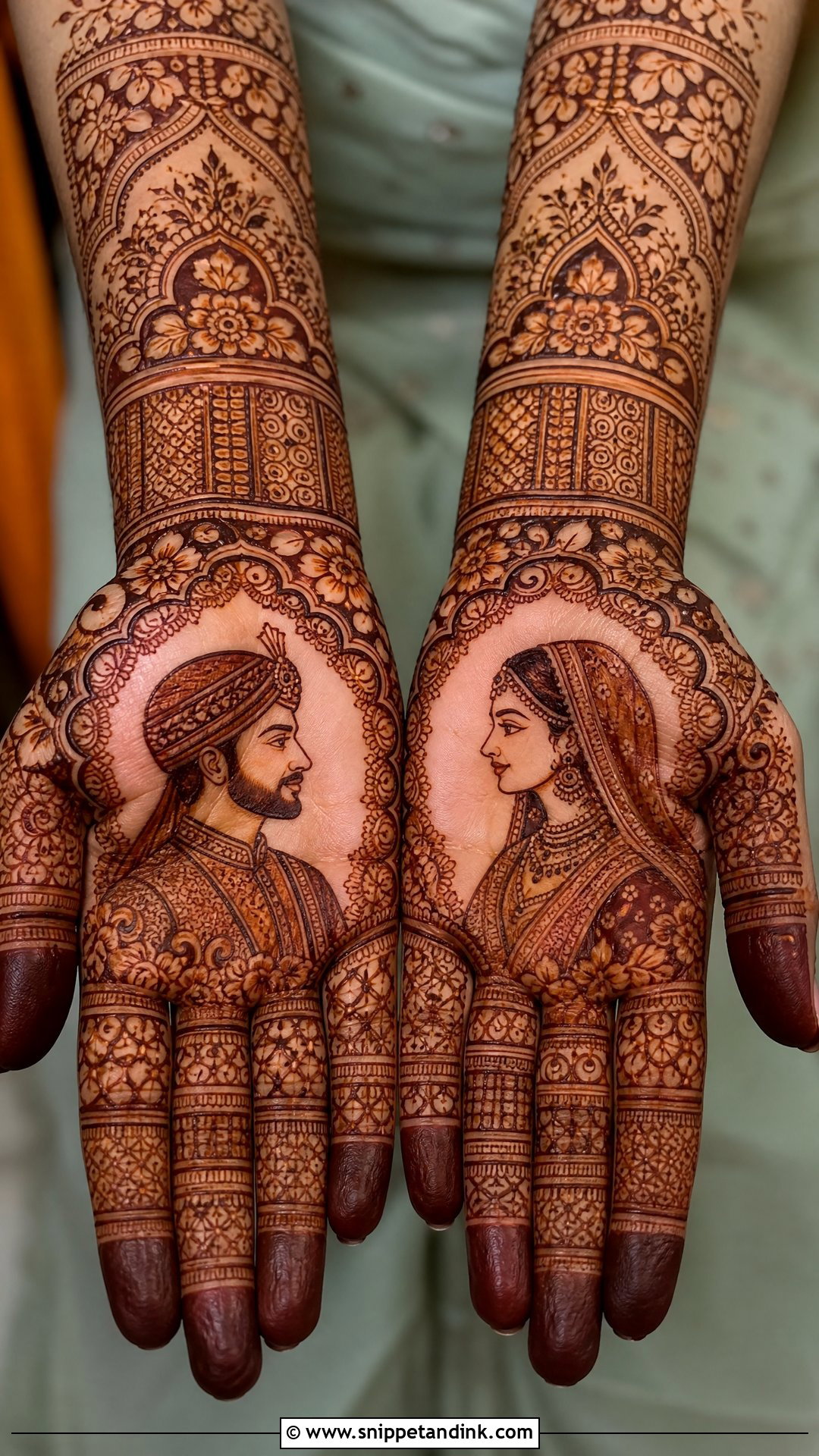
Couple designs put a small bride on one palm and a groom on the other, usually framed by paisleys, florals or traditional arches. What makes or breaks them is space. Faces squeezed into a tiny palm lose their eyes and lips as the stain darkens, so on small hands I simplify the figures and let the frame carry the detail. The wrists and forearms then continue with full patterning. Traditional weddings with a photographer who shoots detail close-ups get the most out of this one.
17. Portrait Bridal Mehndi Design
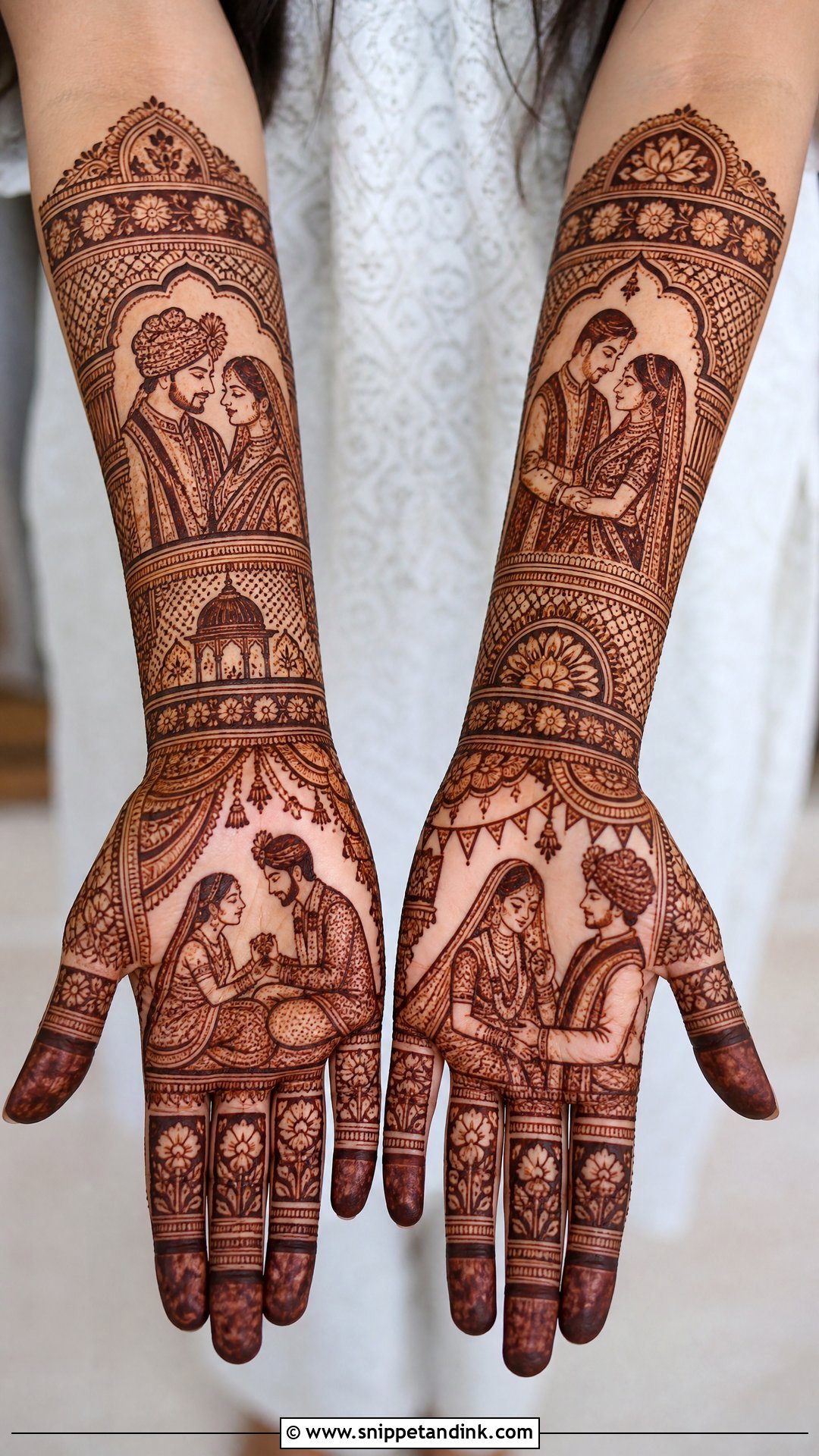
Portrait mehndi goes further than a couple pair: actual faces, figures or a ceremony scene, shaded with the cone. Only book it with an artist who can show you portrait work photographed after the stain developed, not just fresh paste, because proportions that look right in wet henna can drift as the color settles. The palms are the best canvas for the main faces since they stain darkest. Florals, grids and bands around them should support the portrait, not compete with it. For a one-of-a-kind design, this is it, but it needs the most experienced hand of anything on this list.
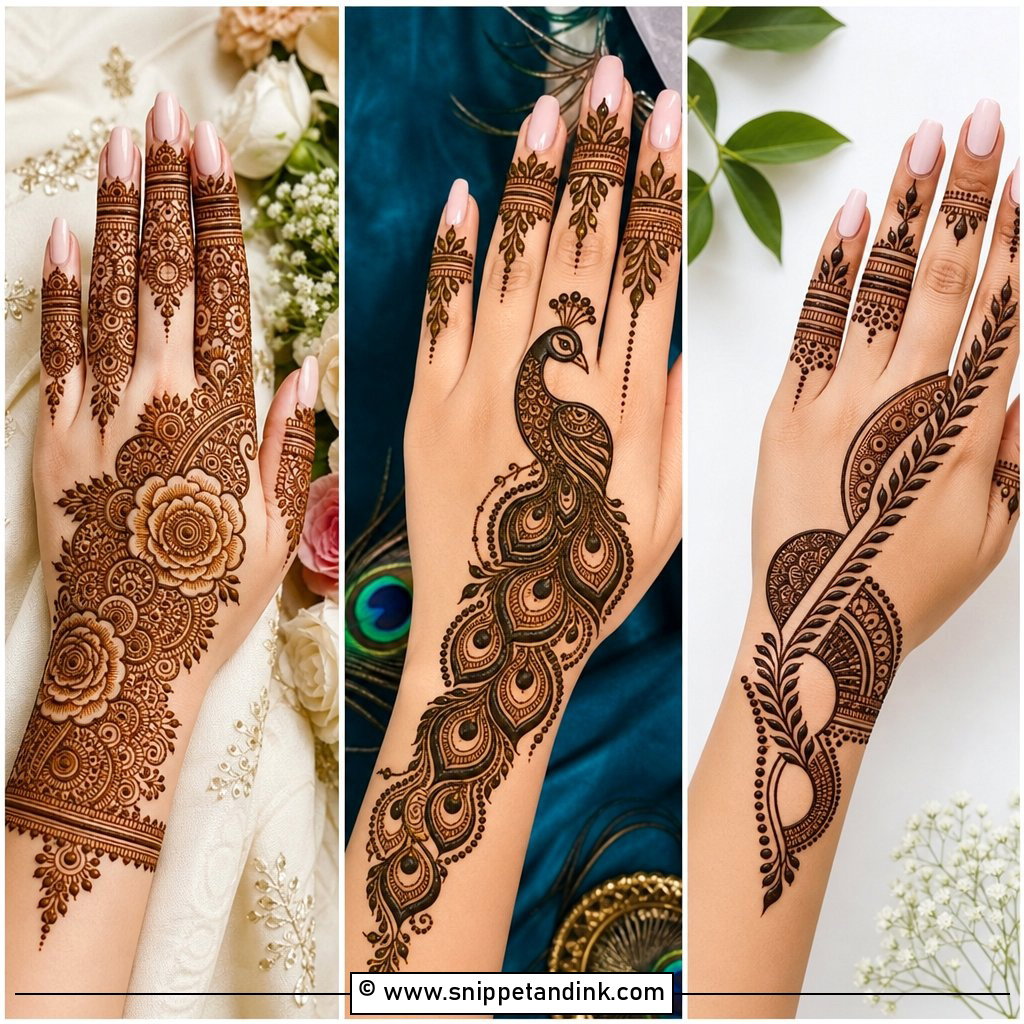
18. Peacock Bridal Mehndi Design
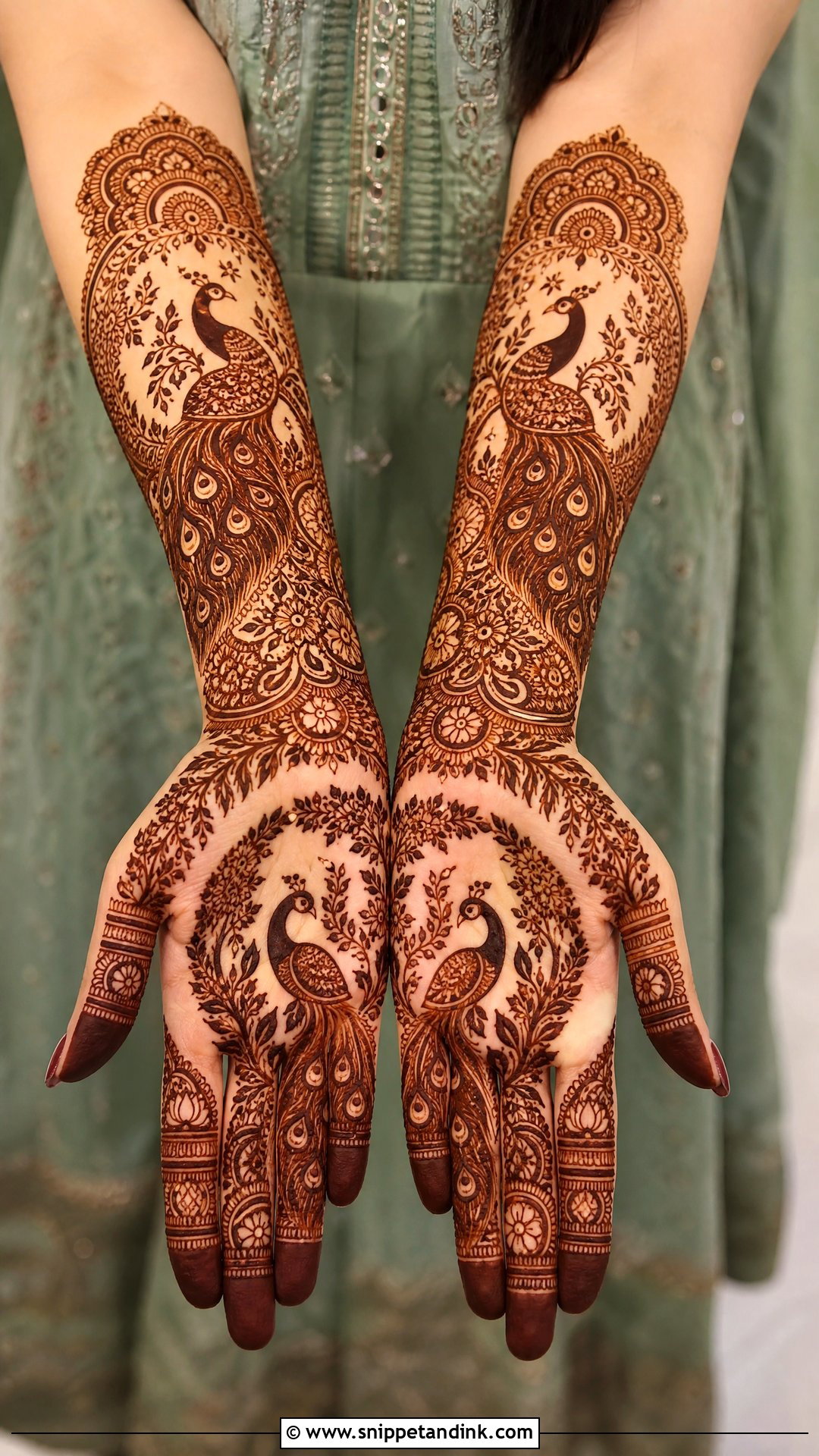
Peacocks earn their place in bridal henna because the long neck and tail create movement across the hand. One can sit on the palm, the back of the hand, the wrist or the forearm, surrounded by feathers, vines and paisleys. I fill the tail with fine lines, dots and shaded curves for depth, but I keep the eye of each feather open and bold so it stays visible after staining. Pairs facing each other across both palms feel balanced. If portraits feel too much but you still want something cultural, a peacock is where I’d start.
19. Lotus Bridal Mehndi Design
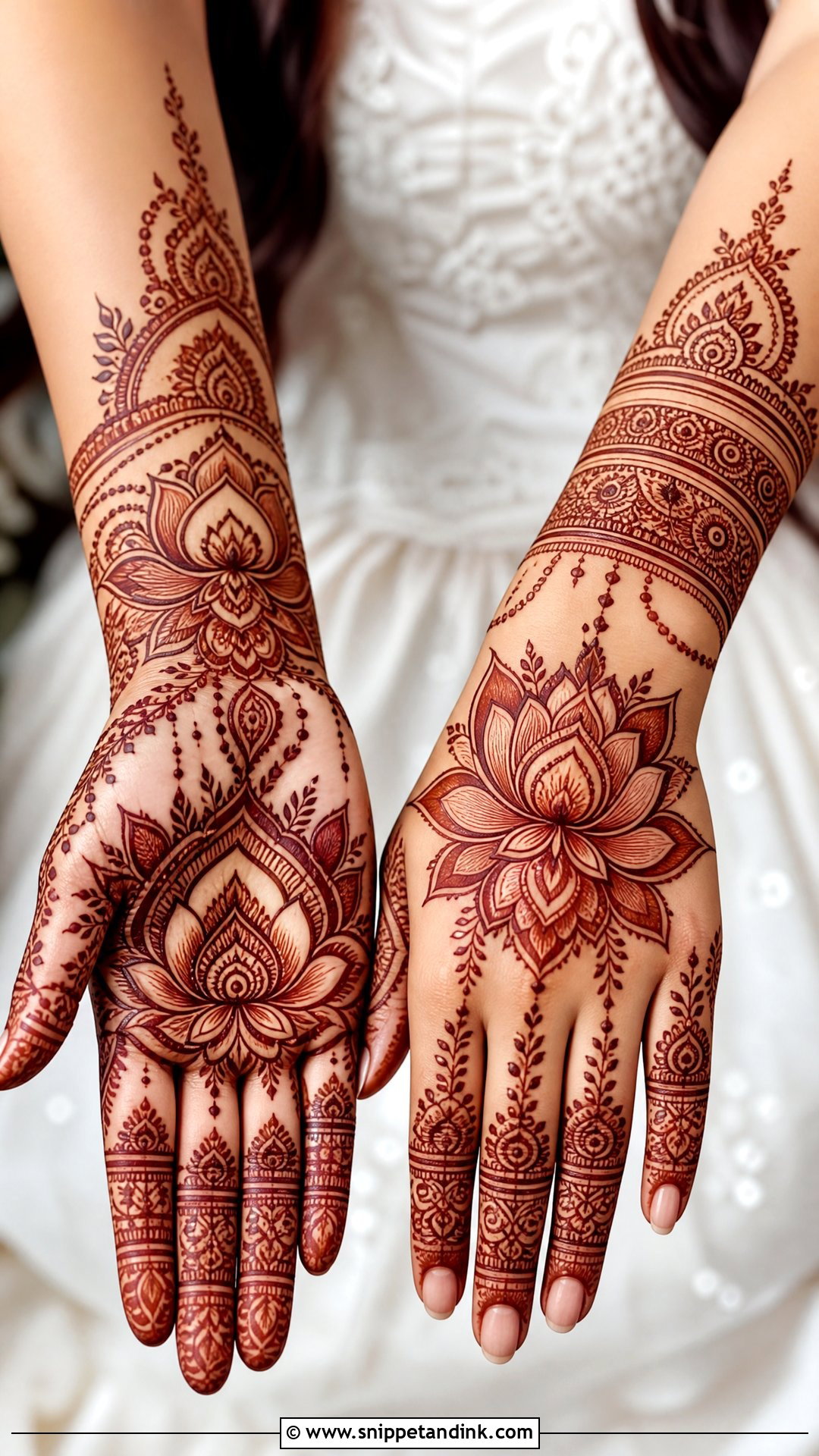
Lotus bridal mehndi design has a calm, sacred feel without the heavy storytelling of a portrait. The lotus can be the palm centerpiece, a wrist cuff detail or a repeated flower up the forearm, and it sits naturally with mandalas, dots and leafy vines. Its broad petals leave clear spacing between shapes, which is why the stain reads so cleanly in photos. I’ll fill the petals densely for a traditional finish or leave them as bold outlines for a modern one. Ivory and pastel outfits suit the outlined version especially.



20. Mandala Bridal Mehndi Design
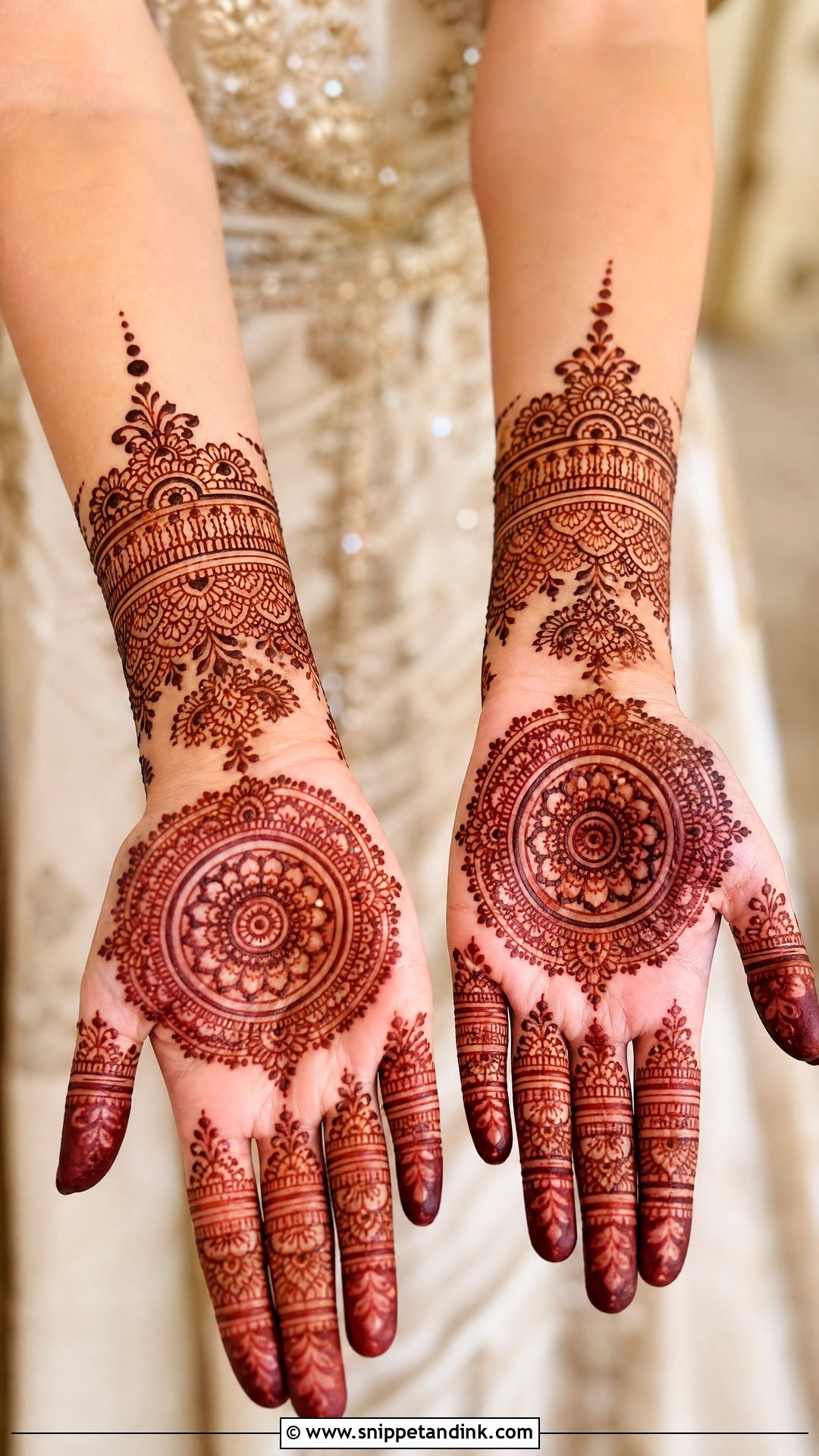
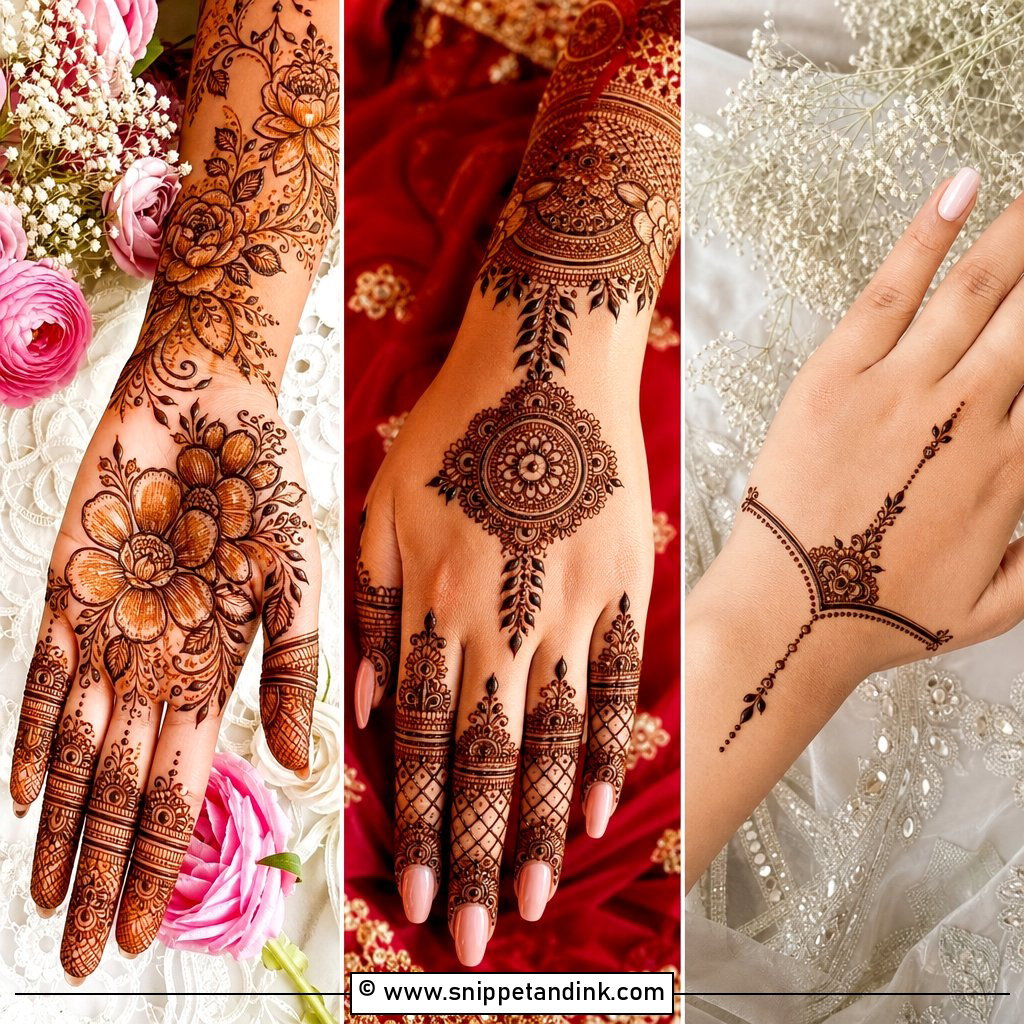
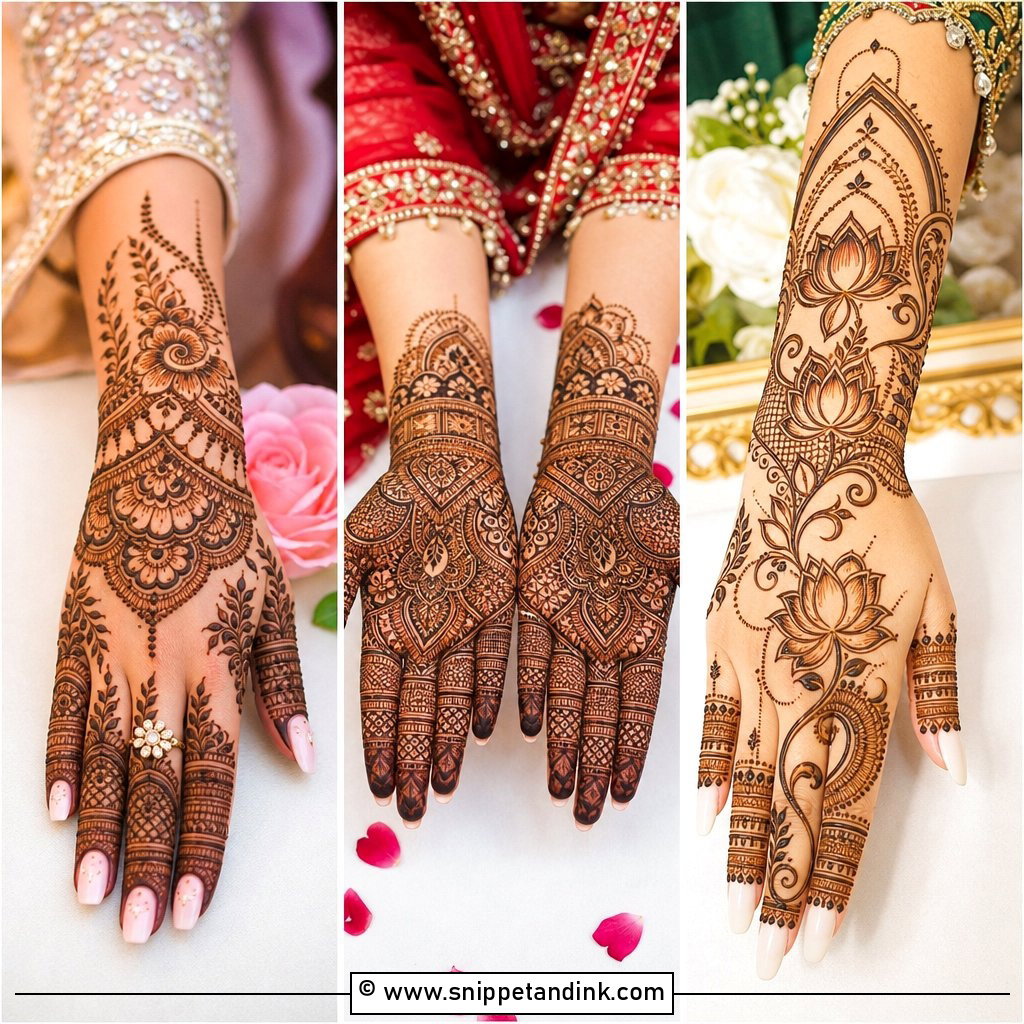
Mandala palms work through symmetry: a circle at the center of the palm, then bands, florals and fillers carrying the design out along the fingers and up the wrist. I measure the circle against the palm before drawing, since a mandala that’s too big for a small hand runs off the edges and loses its shape. Sized properly, it actually suits small hands better than most designs, because the round center gives the palm structure. Spacious or dense, it holds its geometry well as it darkens. Match the back hand with cuffs so the front doesn’t look finished on its own.
21. Jaali Bridal Mehndi Design
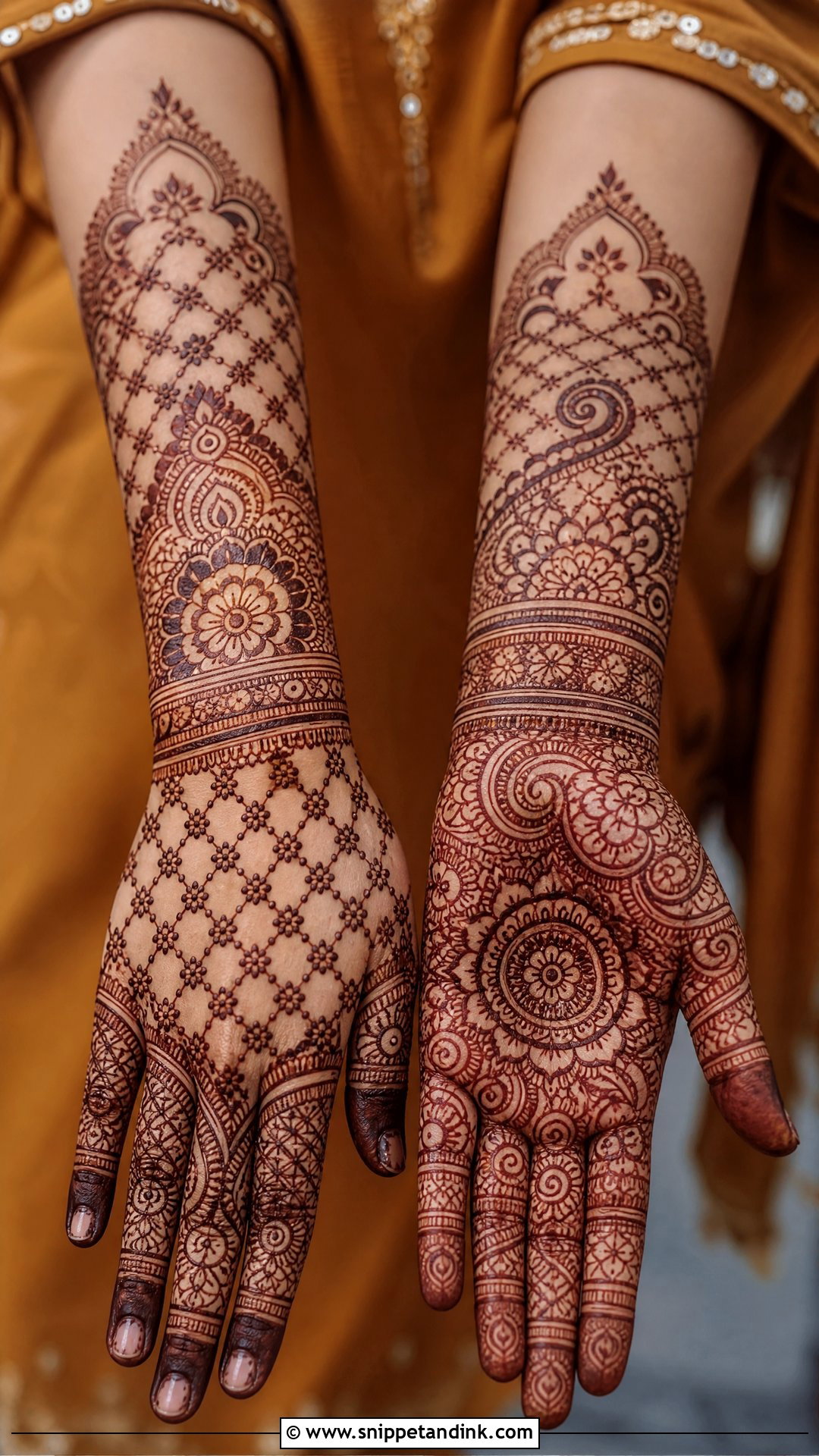
Jaali is the mesh pattern, a grid of crossing lines that adds texture without the weight of solid fill. It can cover palms, backs, fingers or forearms, mixed with flowers, paisleys, mandalas and bracelet bands. Even spacing is everything here. If the lines drift closer together in one corner, the stain merges that patch into a dark smudge, so I keep a steady gap and mark the intersections with small dots or petals. Use jaali as the main theme or as a background behind larger motifs. With rings and haath phool on, the mesh reads almost like lace.
22. Floral Bridal Mehndi Design
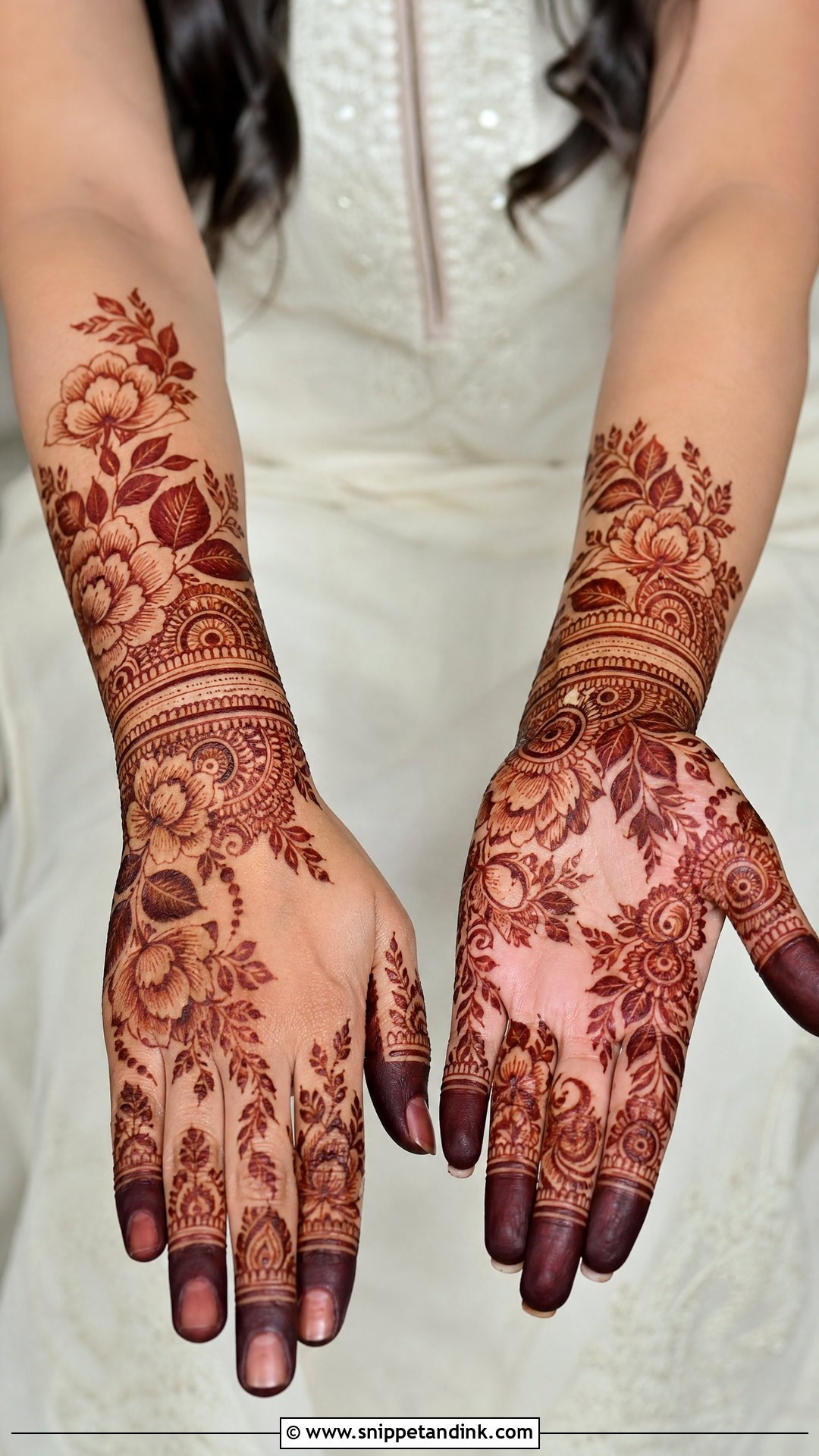
Florals are the most adaptable choice on the list. Large flowers on the palm, leafy vines on the back, detailed fingers and a wrist bracelet can be drawn in an Indian, Arabic, Indo-Arabic or Gulf layout, so they fit nearly any outfit. Big shaded flowers with open space give bold impact; smaller flowers packed with paisleys give traditional richness. I also use vines to lengthen short fingers, running a trail from the knuckle up to the tip so the eye travels the full length. If storytelling designs feel too complicated, start here.
23. Paisley Bridal Mehndi Design
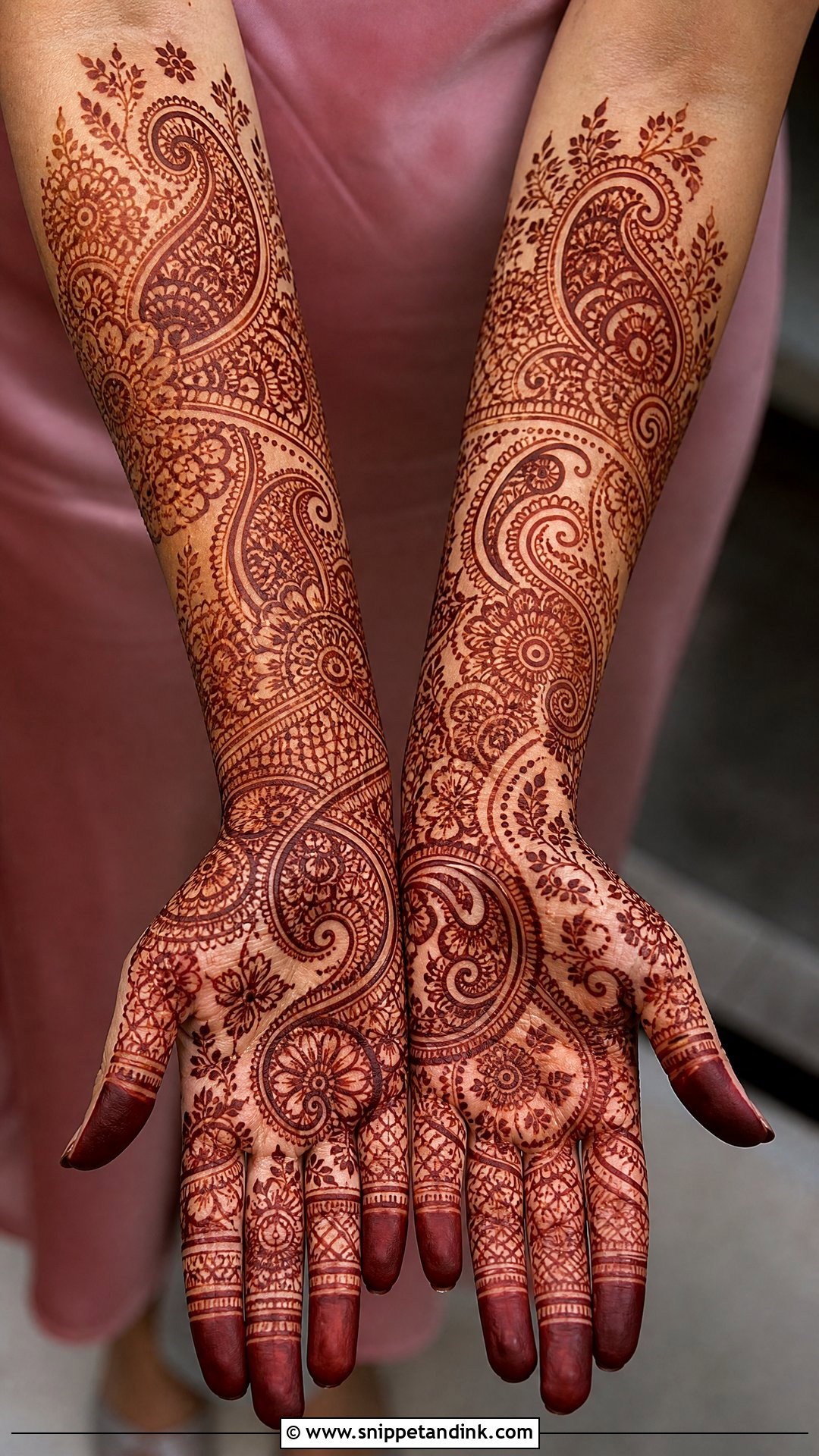
The paisley, or mango motif, is the backbone of classic wedding henna. Paisleys can flow across the palm, curl around the wrist or stack up the forearm, and they pair with almost everything: flowers, leaves, dots, mandalas, peacocks, jaali. A large paisley makes a focal point; small ones fill awkward gaps. Their curved outline also holds a thick, steady line, which is a big reason paisley-heavy designs stain so clearly. Ask for detailed fingers and a coordinated back hand, and you have a traditional bridal set with no pictorial scenes at all.
24. Bracelet Bridal Mehndi Design
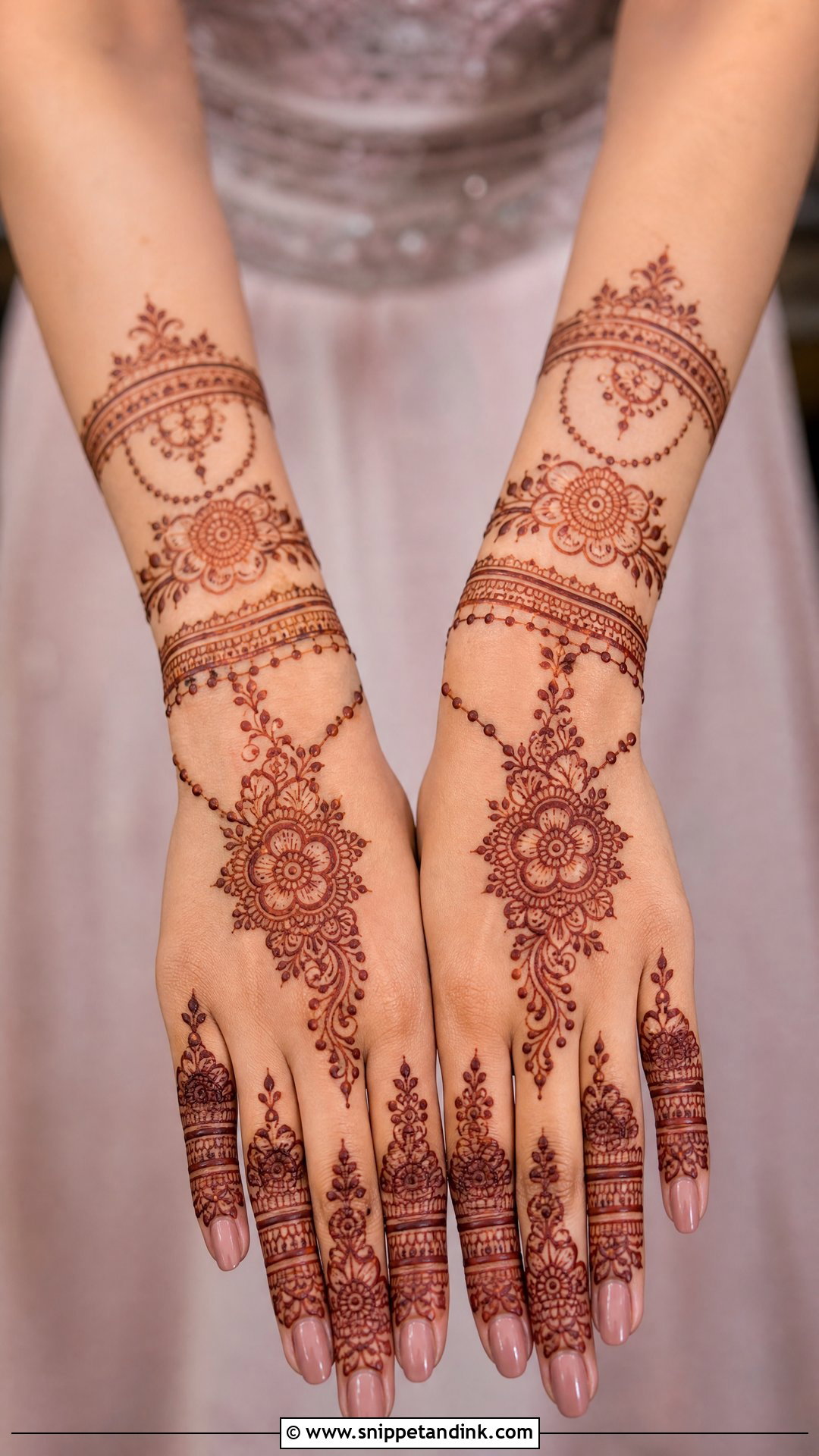
Bracelet designs make the wrist and back hand look dressed in jewelry: ring bands on the fingers, chains across the back, a floral center and stacked cuffs at the wrist. They sit nicely under real bangles and haath phool because they echo the same lines. The palm can stay simple or carry a small matching mandala. Engagement ceremonies and nikkah events suit this lighter style. Symmetry matters more than usual; a chain that sits higher on one hand looks like a mistake rather than a choice.
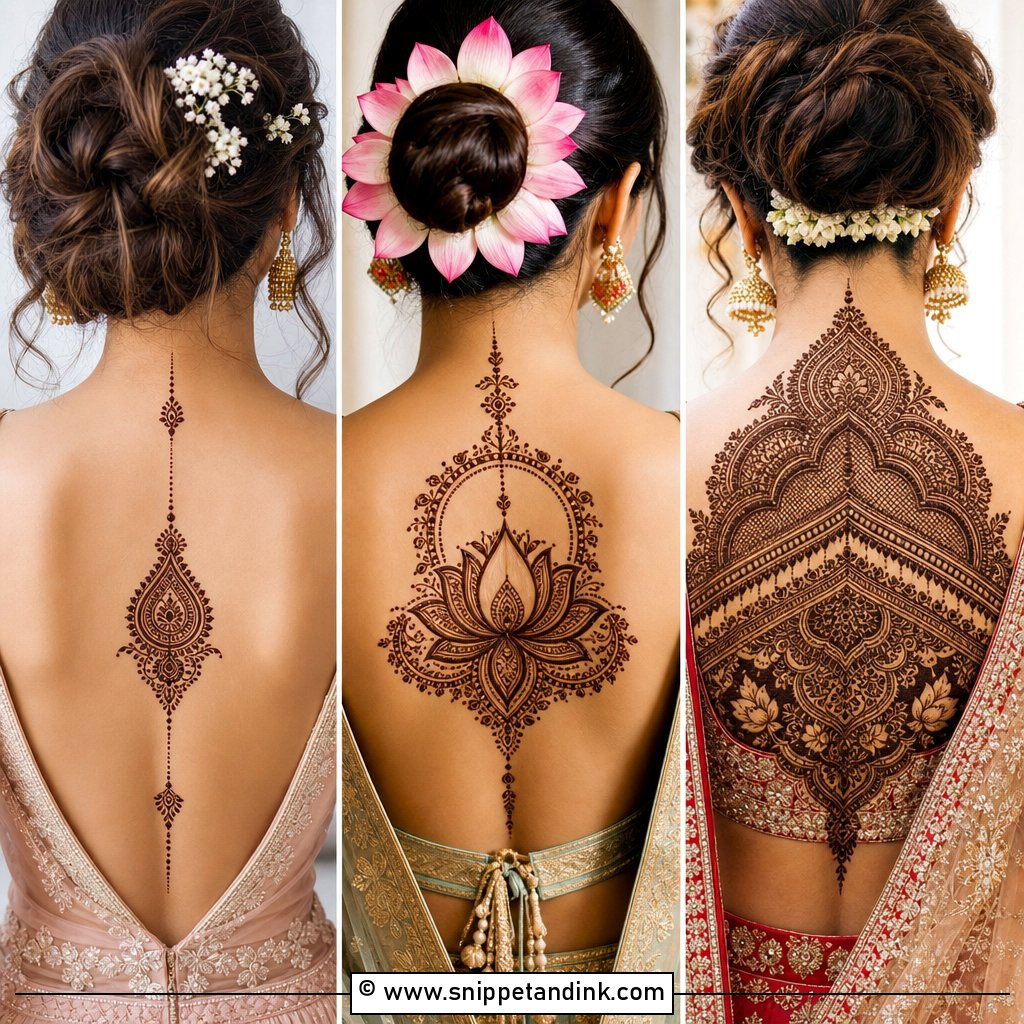
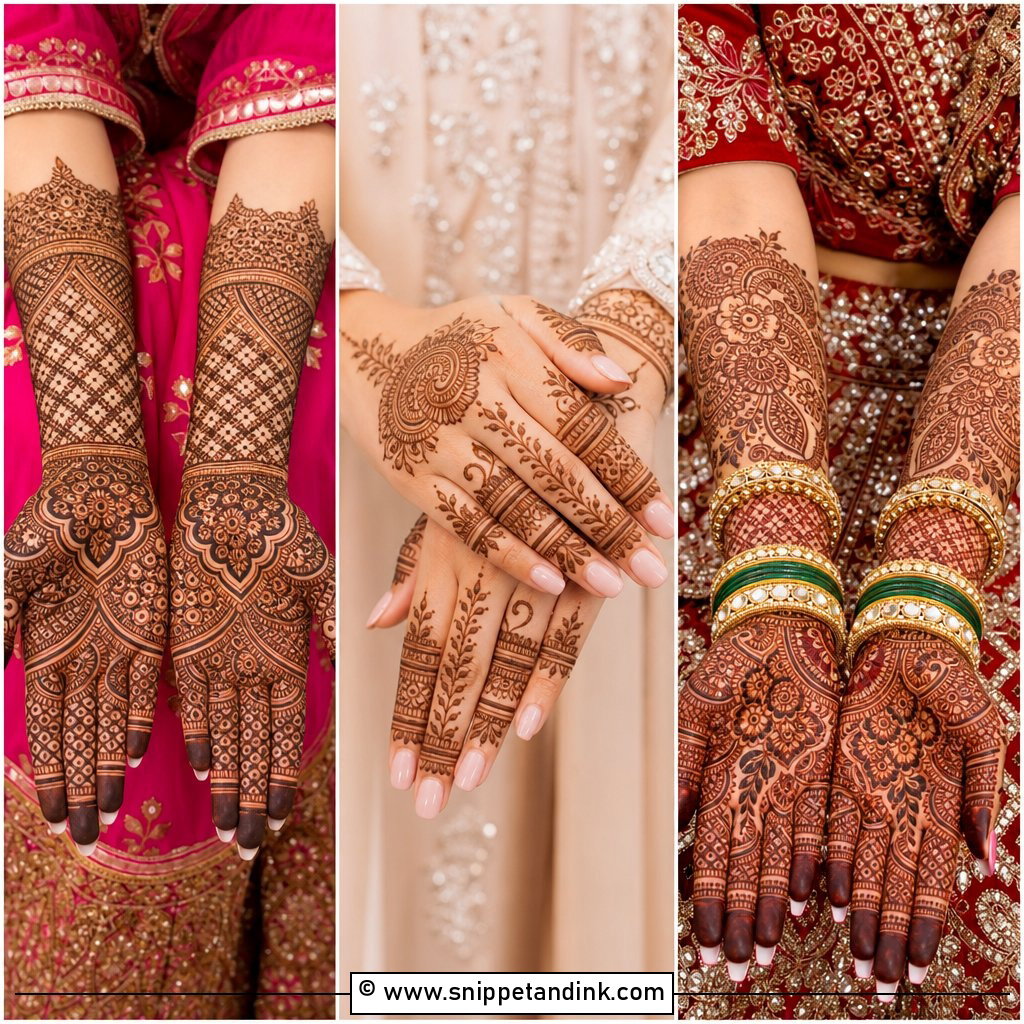
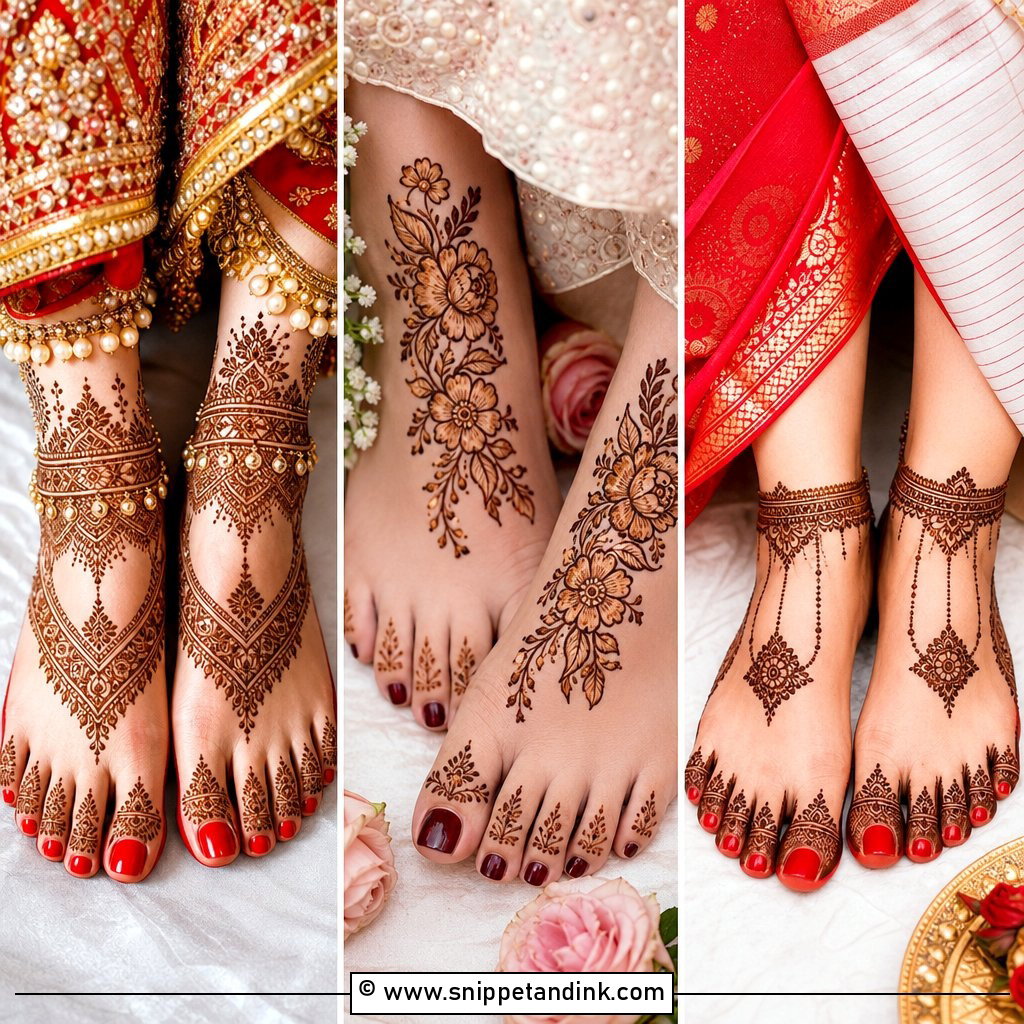

25. Jewelry Bridal Mehndi Design
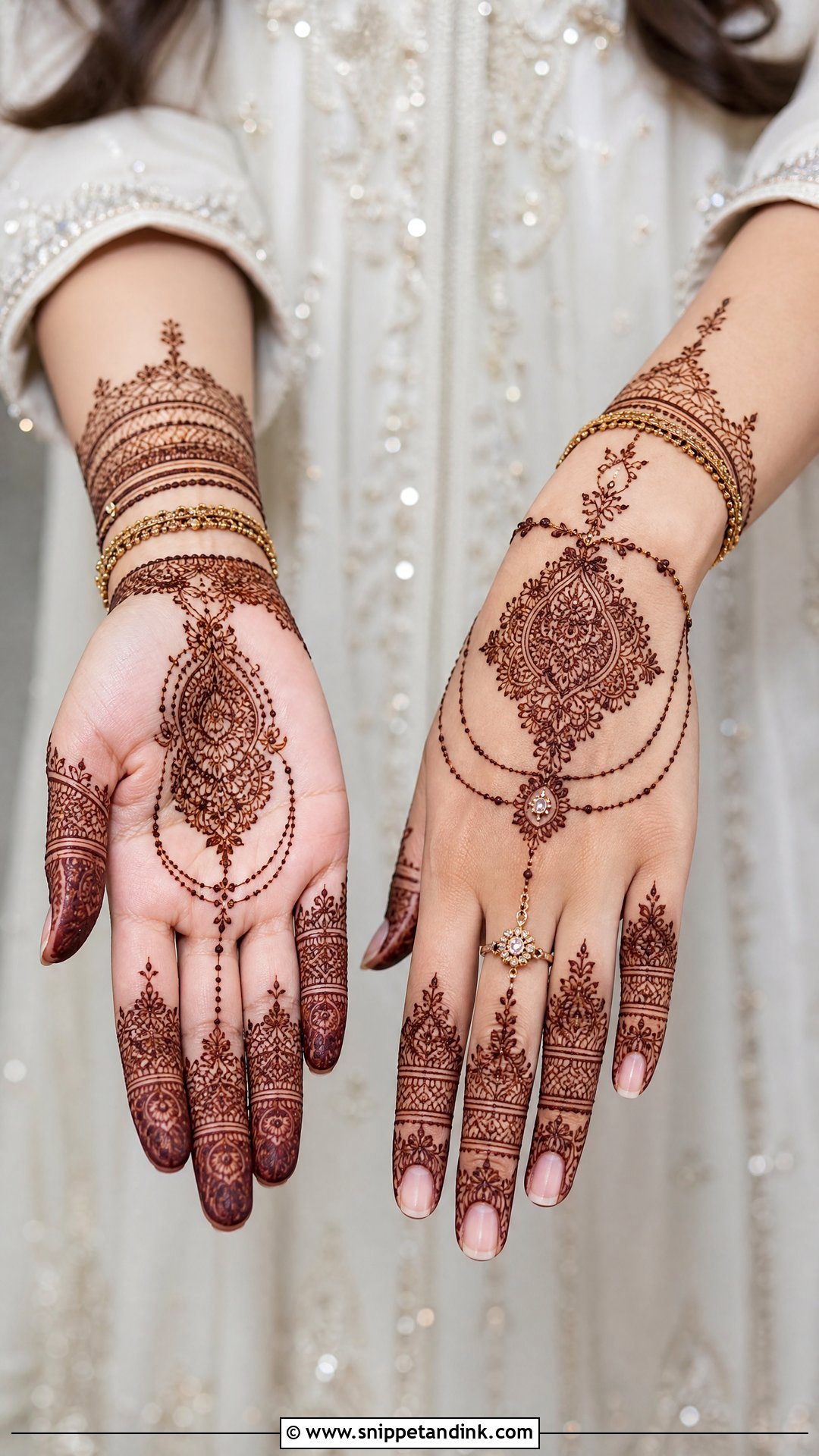
Jewelry mehndi borrows from hand harnesses: connected lines running from each finger to a central motif and down to a wrist cuff, with a softer matching design on the palm. Coverage is lighter than a traditional full hand, so it dries faster and suits a bride who’d rather not lose her whole evening to sitting still. I add floral centers and dotted chains for weight. It stands on its own if you’re going light on real accessories, and it layers well under rings if you’re not. Just tell your artist which fingers will carry rings so the chains don’t end under a band.
26. Moroccan Bridal Mehndi Design
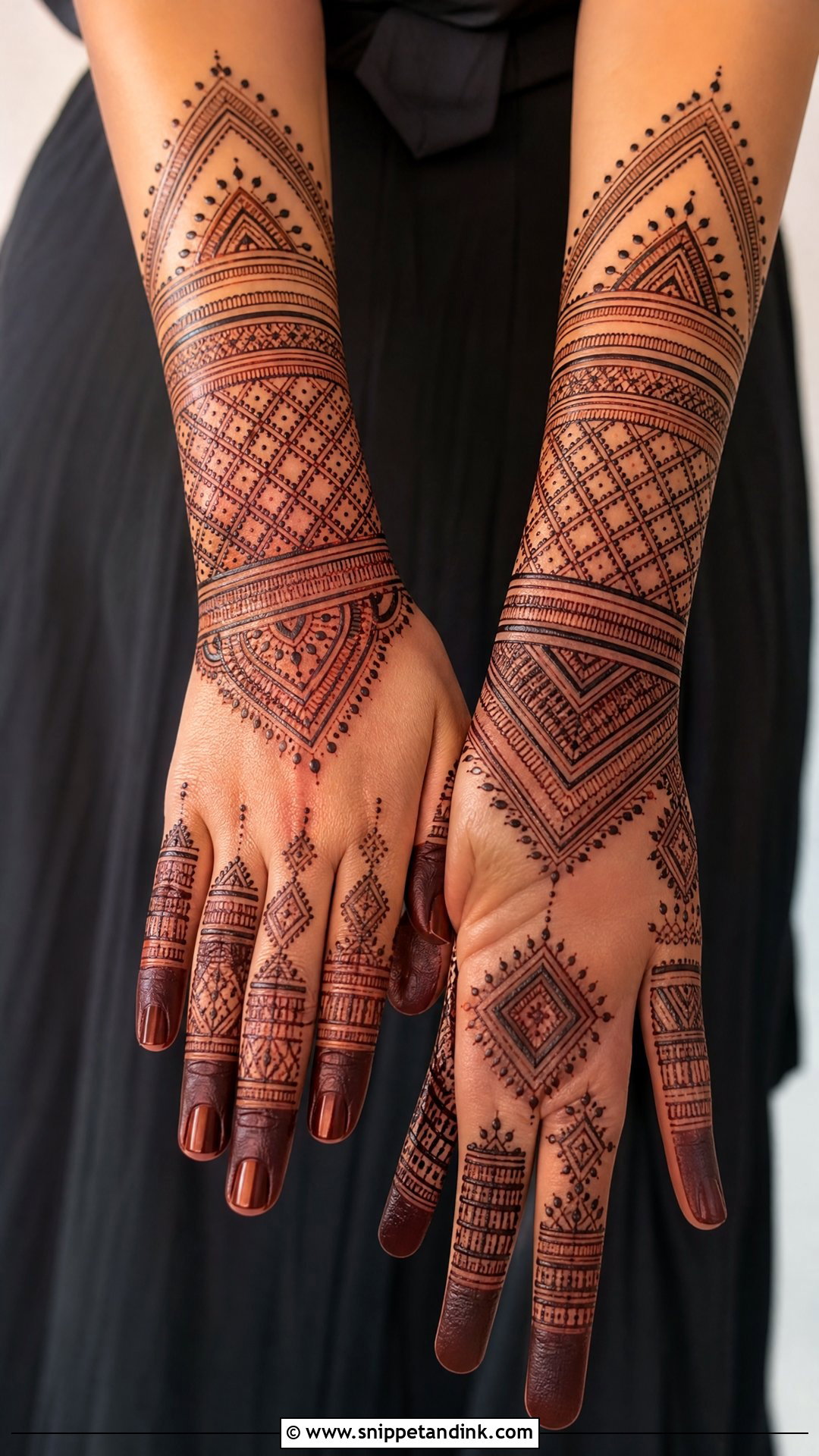
Moroccan henna swaps flowers for geometry: diamonds, straight lines, dots, grids and strict symmetry, repeated in sections across the palms, fingers, wrists and forearms. It is one of the clearest alternatives to Indian or Arabic patterns. Straight lines are less forgiving than curves, though. Any wobble shows, so this style needs a confident, steady hand and usually a slower pace. A few small flowers or a leafy border can soften the edges, but keep the main structure geometric. Long fingers show off the repeated bands especially well.
27. Gulf Bridal Mehndi Design
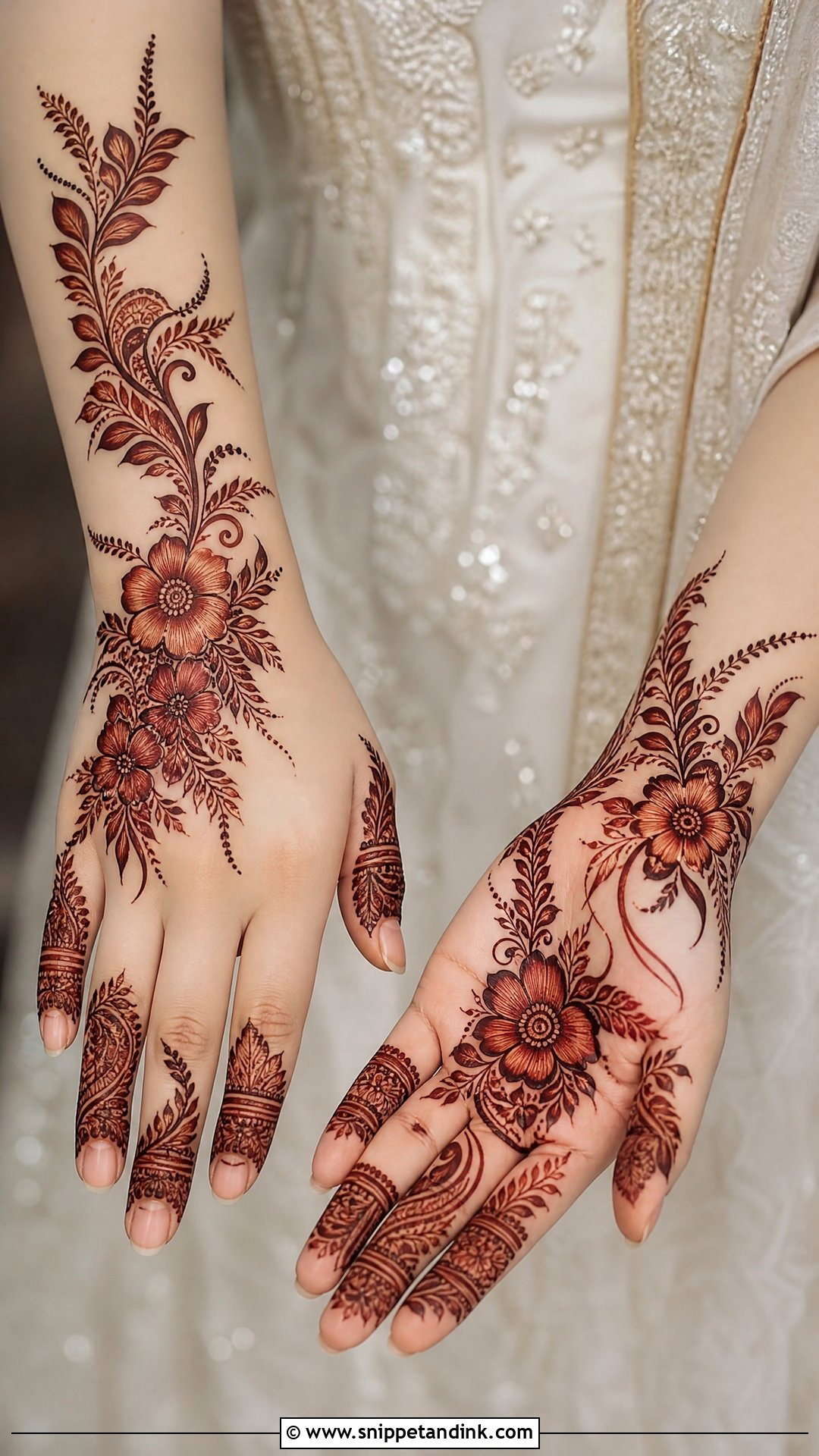
Gulf bridal henna, often called Khaleeji-inspired henna, is built on bold florals, leafy trails and shaded petals with plenty of open skin. The shading is done by thinning the paste in sections, which leaves petals with a gradient from deep to light once the stain develops. Large motifs sweep from the fingers toward the wrist. For a bride, I add fuller finger detail, wrist cuffs and matching palm accents. The big shapes stay legible in low light, which makes this a smart pick for evening ceremonies.
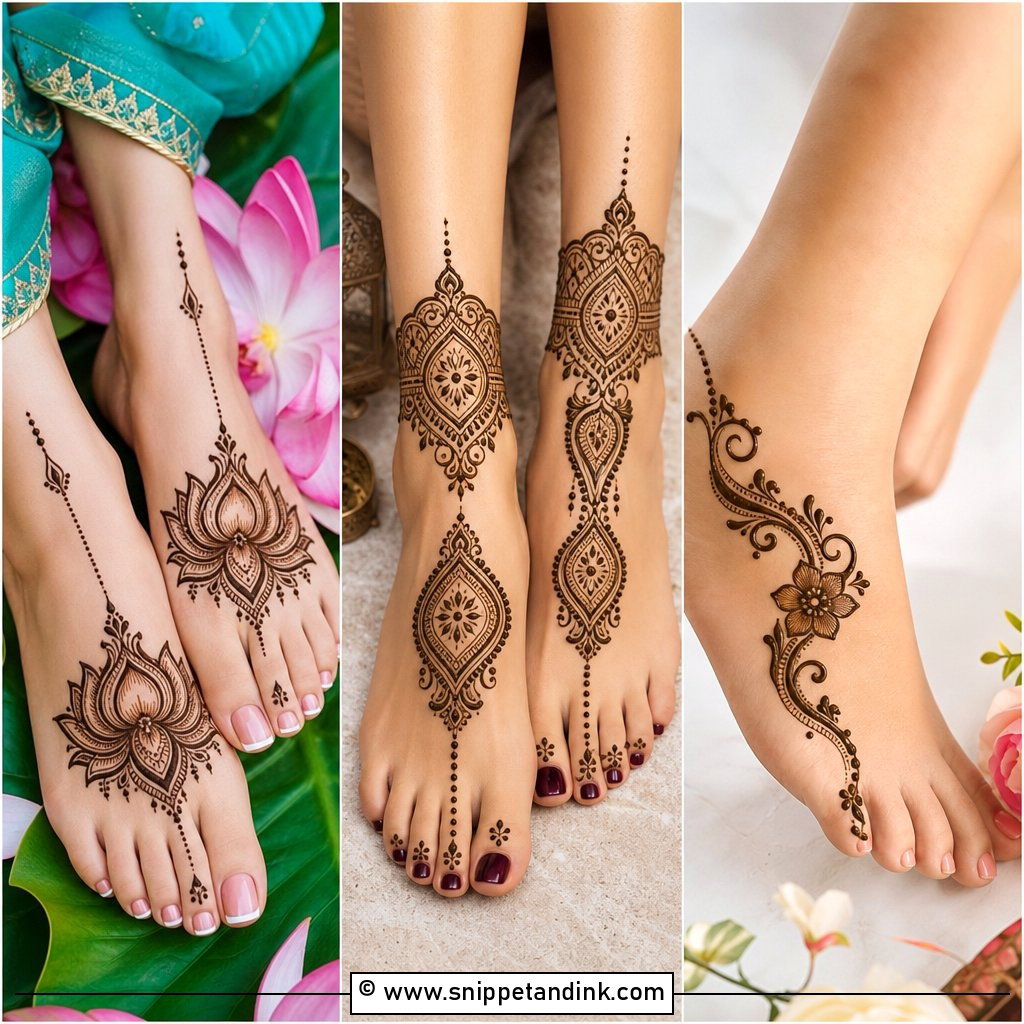
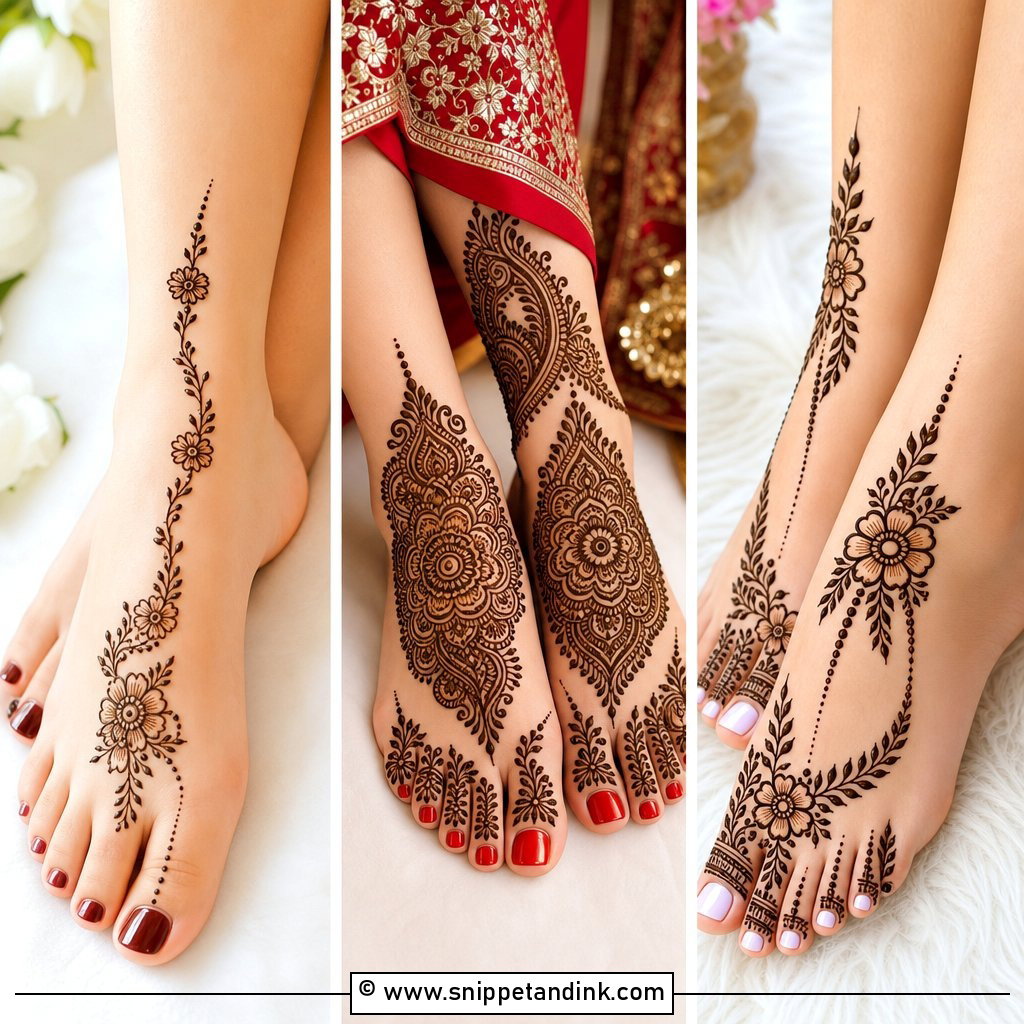
28. Bridal Foot Mehndi Design
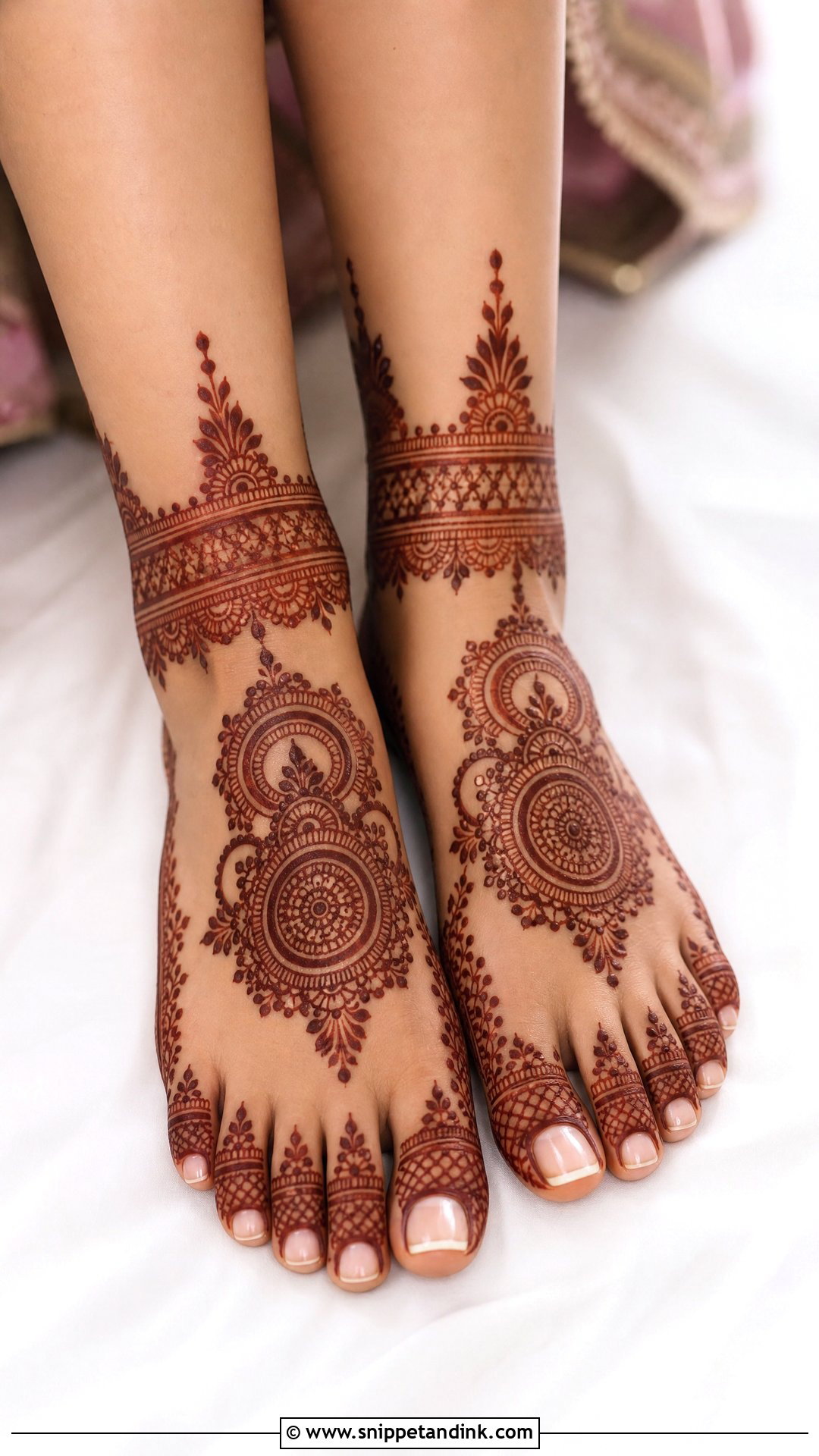
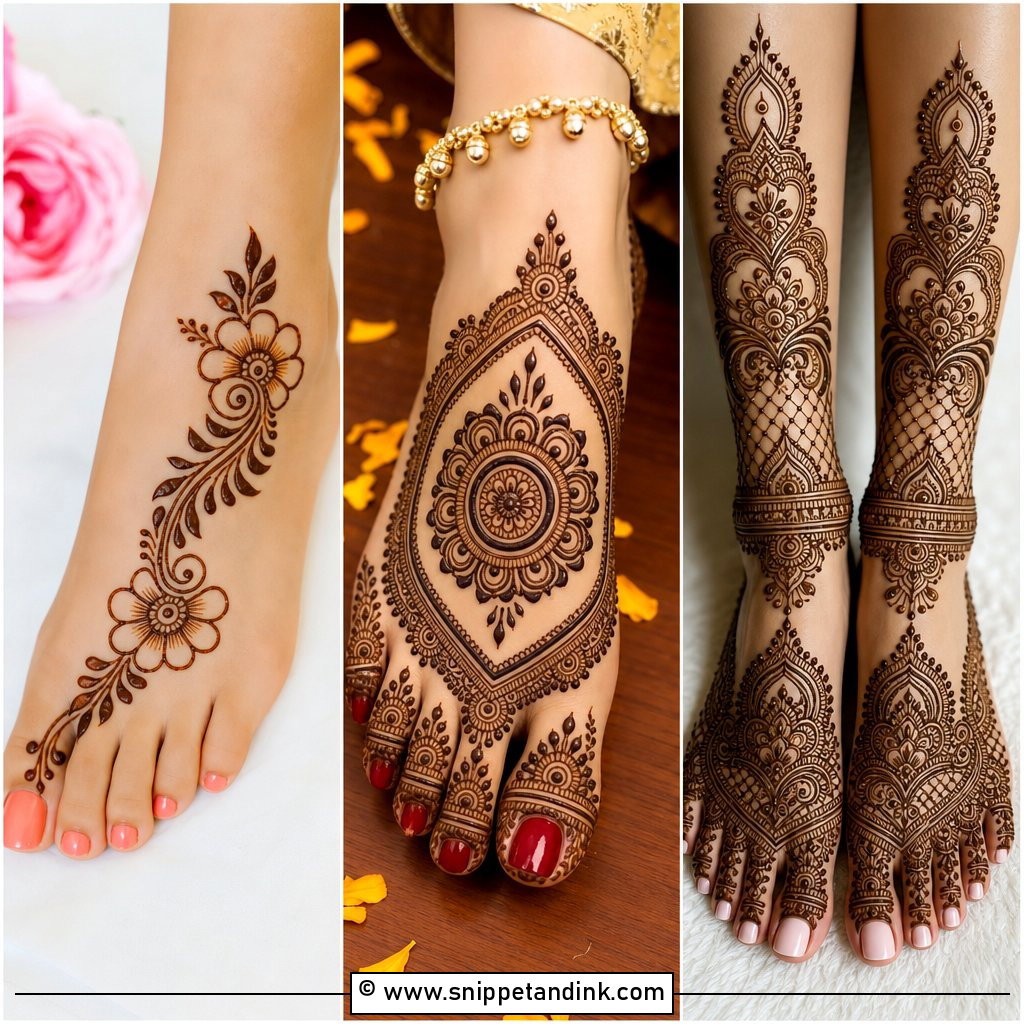
Foot henna finishes the look for brides in anklets and open sandals. A full design can include a mandala on top of the foot, floral trails along the sides, decorated toes and ankle bands, and some brides add the soles for a traditional finish. Soles take stain very deeply, almost as dark as palms. Keep the feet in the same style as the hands, even if a little simpler. Plan to sit with your feet up while it dries, and keep paste thin along strap lines, since thick paste there gets rubbed off by your shoes before it has had time to stain.
29. Bridal Leg Mehndi Design
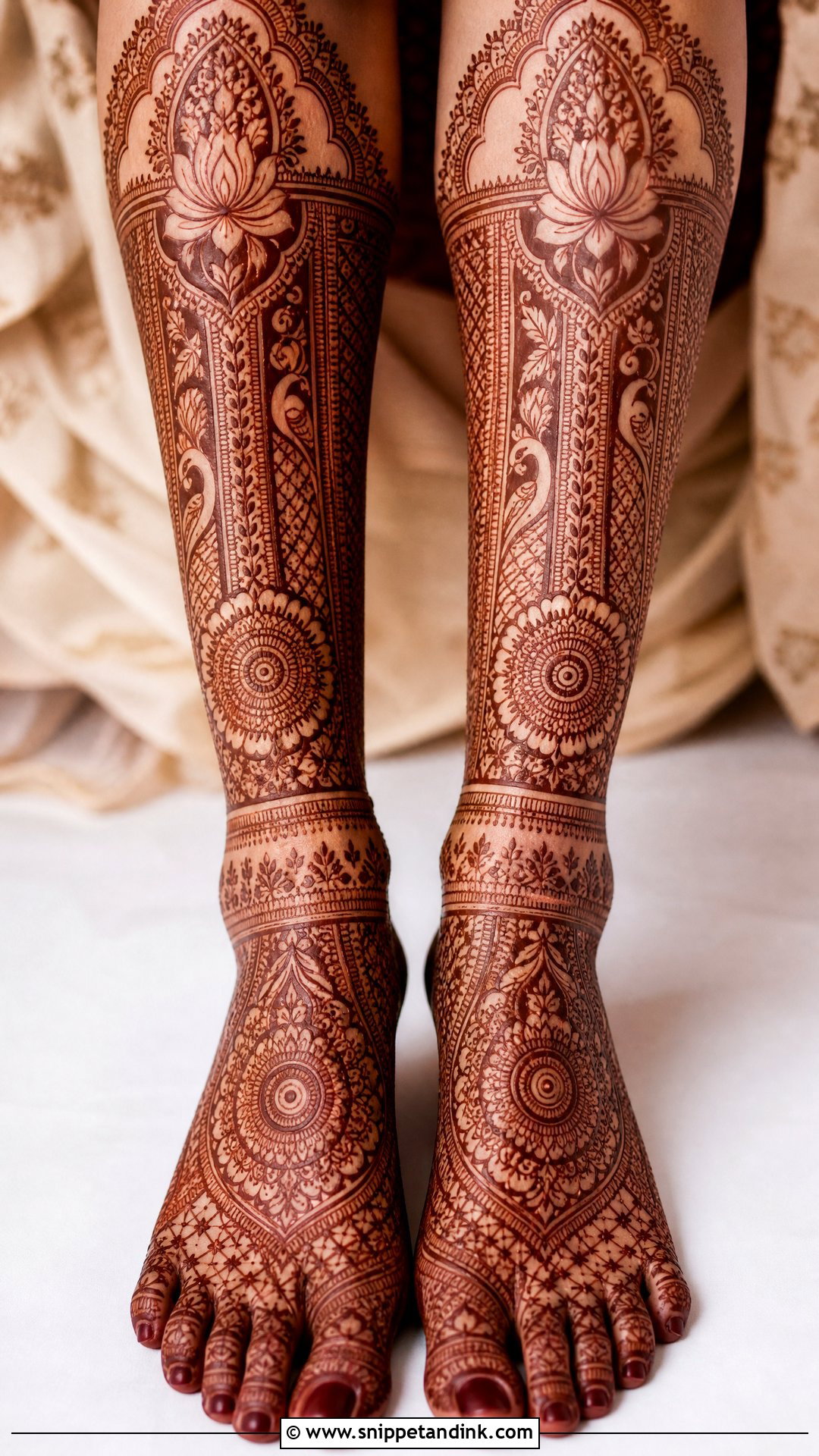
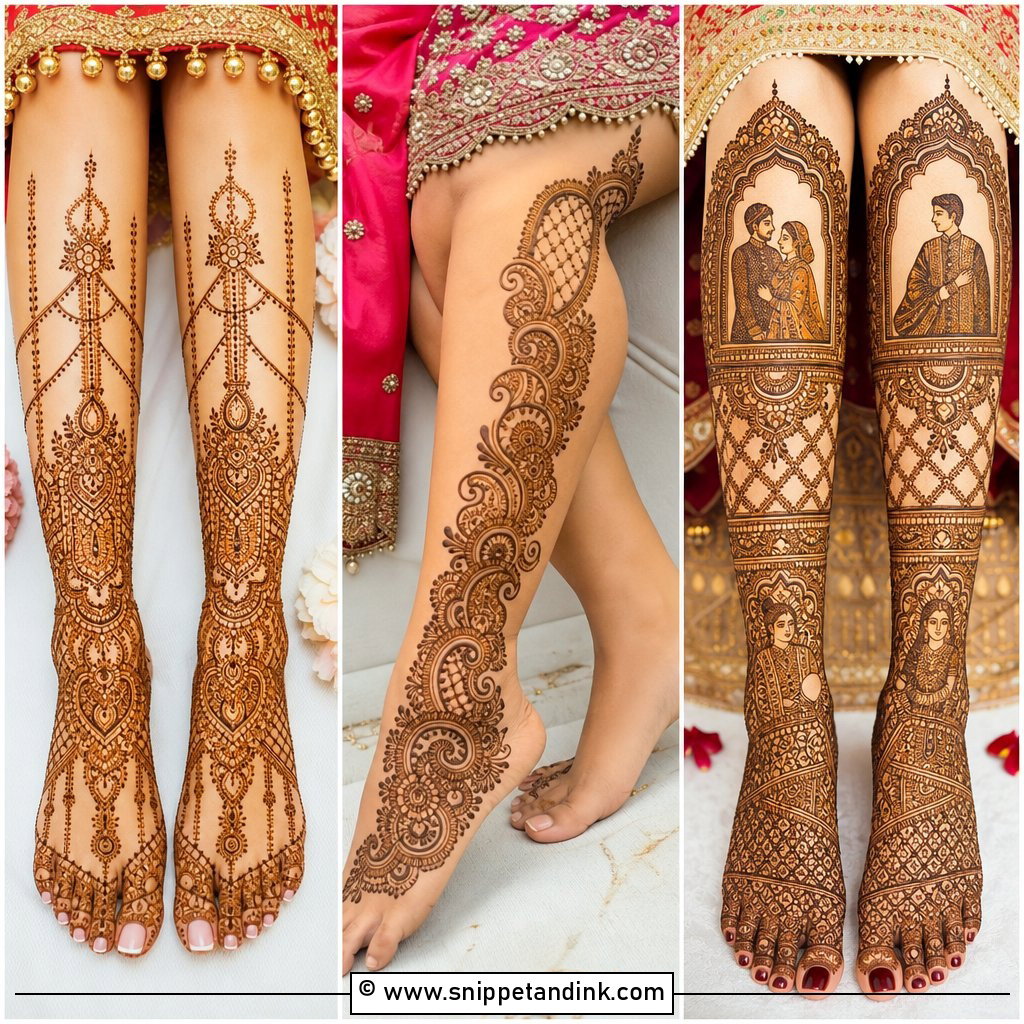
Leg designs carry the work above the ankle onto the calves or lower legs with anklet bands, lotus motifs, paisley trails, peacocks, mandalas and fine jaali. I keep the flow vertical so the leg looks longer. Leg skin generally stains lighter than feet, so bolder lines help here. If your hands are heavily detailed, repeat a couple of the same motifs so the set looks planned together. This adds real time to an already long session, so book it as its own block with drying and resting time, not squeezed in at the end.
30. Personalized Bridal Mehndi Design
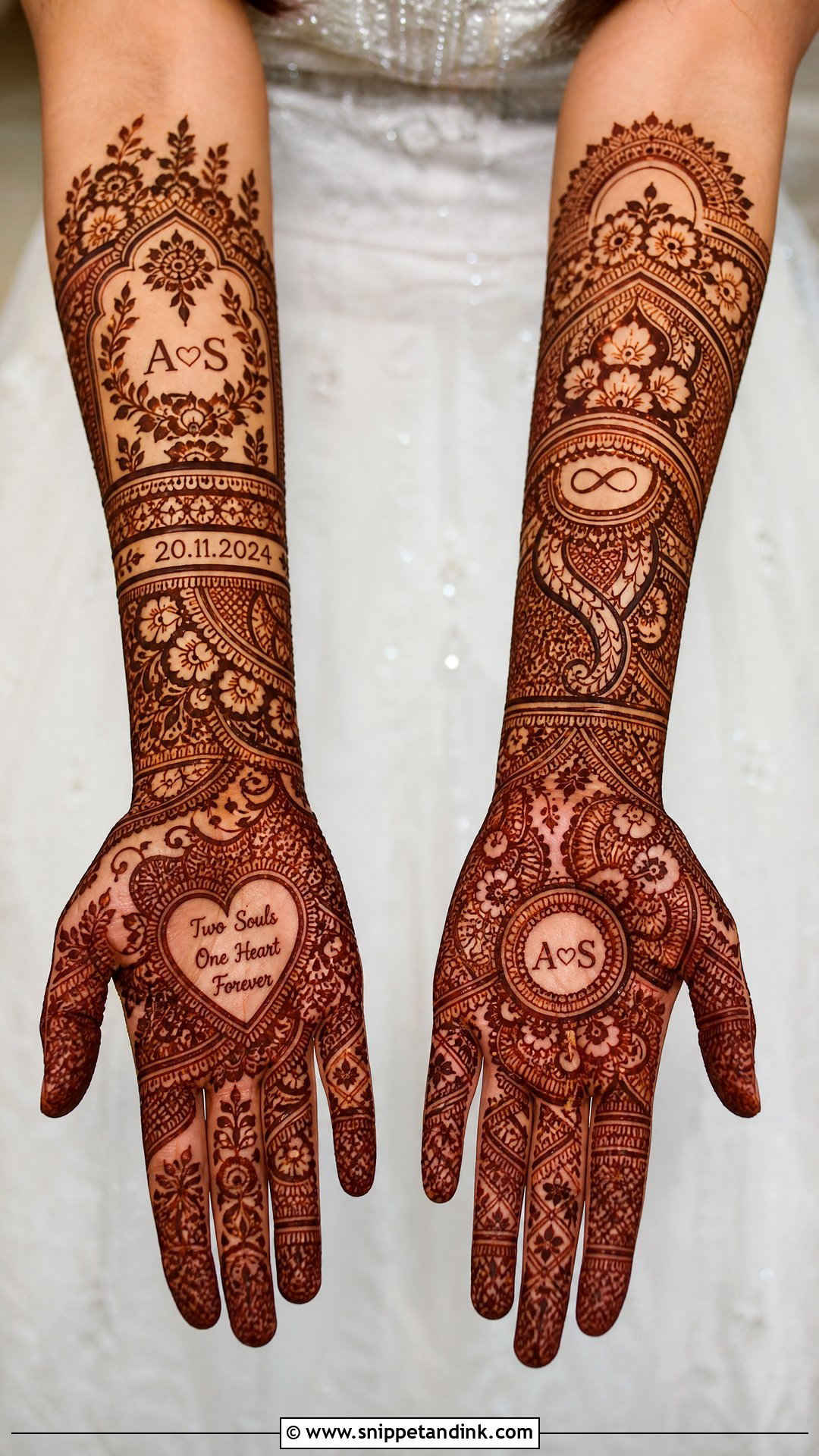
Personalized henna puts your own story into the pattern: initials, the wedding date, a place you both love, a cultural motif, even a small pet. The base can be Indian, Arabic, Indo-Arabic, minimal or modern. Placement is the craft part. I tuck personal details into existing shapes so the flow of the design stays intact, rather than dropping them in like stickers. Two or three additions is the right number; past that, the hand starts to look like a scrapbook. Bring the list to your consultation so the artist can plan where each one goes before the cone touches skin.
From Wet Paste to Deep Maroon on the Wedding Morning
The artist controls the drawing. The color is mostly up to you in the hours after I leave. Most disappointing stains I see come from paste scraped off too soon or hands washed the same evening.
- Leave the paste on as long as you can bear, ideally overnight. Six hours is a reasonable minimum for bridal work.
- Once the surface dries, dab on a light lemon and sugar mix so the paste stays stuck to the skin. Dab, don’t soak it.
- Keep your hands warm. A cold room slows the stain; wrapping loosely in tissue or cotton gloves for sleep helps.
- Scrape the dry paste off with a blunt edge or your fingers. Don’t wash it off.
- Avoid water for as long as possible afterward, ideally the next twelve hours, and rub a little balm or oil over the design before showers.
- Skip waxing, scrubs, hand sanitizer and a manicure after application. Anything that strips skin strips stain.
Expect the color to peak about a day or two after removal, then fade gradually as skin renews over the following week or two, with palms holding on longest.
Ask what is in the cone
Natural henna paste is made from henna powder, a liquid such as lemon juice or water, sugar and an essential oil, and it only ever stains in shades of orange, red and brown. If a cone promises an instant black stain or the artist won’t tell you the ingredients, say no. So-called black henna can contain chemical dyes that cause blistering and lasting allergic reactions, and a wedding week is the worst possible time to find that out.
Settle the Coverage, Then Let Your Artist Draw
Decide the overall look first and the motifs second. Dense Indian or Rajasthani coverage, Arabic trails, a minimal layout or a jewelry-style back hand each ask for a different amount of sitting time and a different relationship with your outfit and rings. Then add the personal layer: initials, a portrait, a date. A skilled artist can fit any of these thirty ideas to your hand shape and wedding theme, as long as you arrive knowing what you want your hands to say in the photos you’ll look at for years.
You'll Like These Ideas:



Leave a Reply