
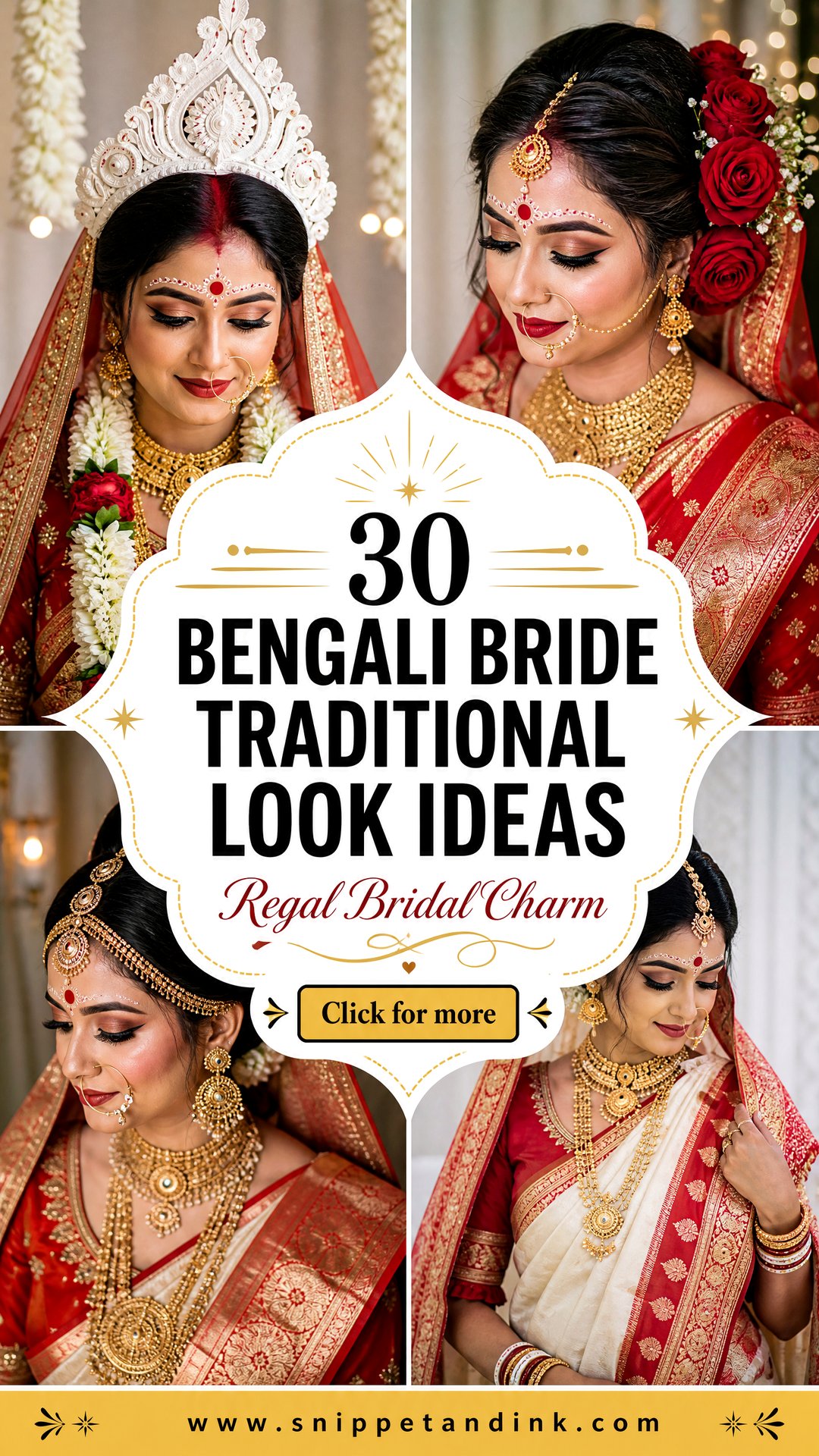
A Bengali bride is built in layers, and each one has its own reason for being there: the red Banarasi, the white shola mukut, alta on the hands and feet, shakha pola on the wrists, chandan drawn across the forehead and gold stacked from collar to waist. When I get a Bengali bride ready, I’m not only doing her face; I’m planning how all of those pieces sit together and how they’ll hold through a long evening of rituals. The thirty looks below start with the classic red and gold and move through white with a red border, maroon, cream, pastels and jewel colours, with notes on what I’d watch for in each.
The Order I Dress a Bengali Bride In, and Why It Matters
Every look below has the same basic pieces, and the order they go on decides whether they still look neat at the end of the night. This is the sequence I follow on the wedding day.
- Alta first, on the feet and palms, so it has time to dry fully before anything touches it.
- Skin prep and base, while the bride is still in a loose top that can come off over the head.
- Hair: the centre part and padded low bun that will hold the mukut.
- Saree drape and blouse, with pleats pinned on the inside.
- Jewellery from the neck outward: choker, long necklace, earrings, nath, then bangles with shakha pola.
- Eyes, lips, bindi and chandan last, so nothing rubs them while the saree goes on.
- Flowers and the shola mukut at the very end, just before she leaves the room.
Allow plenty of time. A full Bengali bridal look with draping usually takes several hours, and the chandan alone can take a while on a detailed pattern. Rushing the alta or chandan is the most common reason they smudge later.
1. Red Banarasi Bengali Bride Look
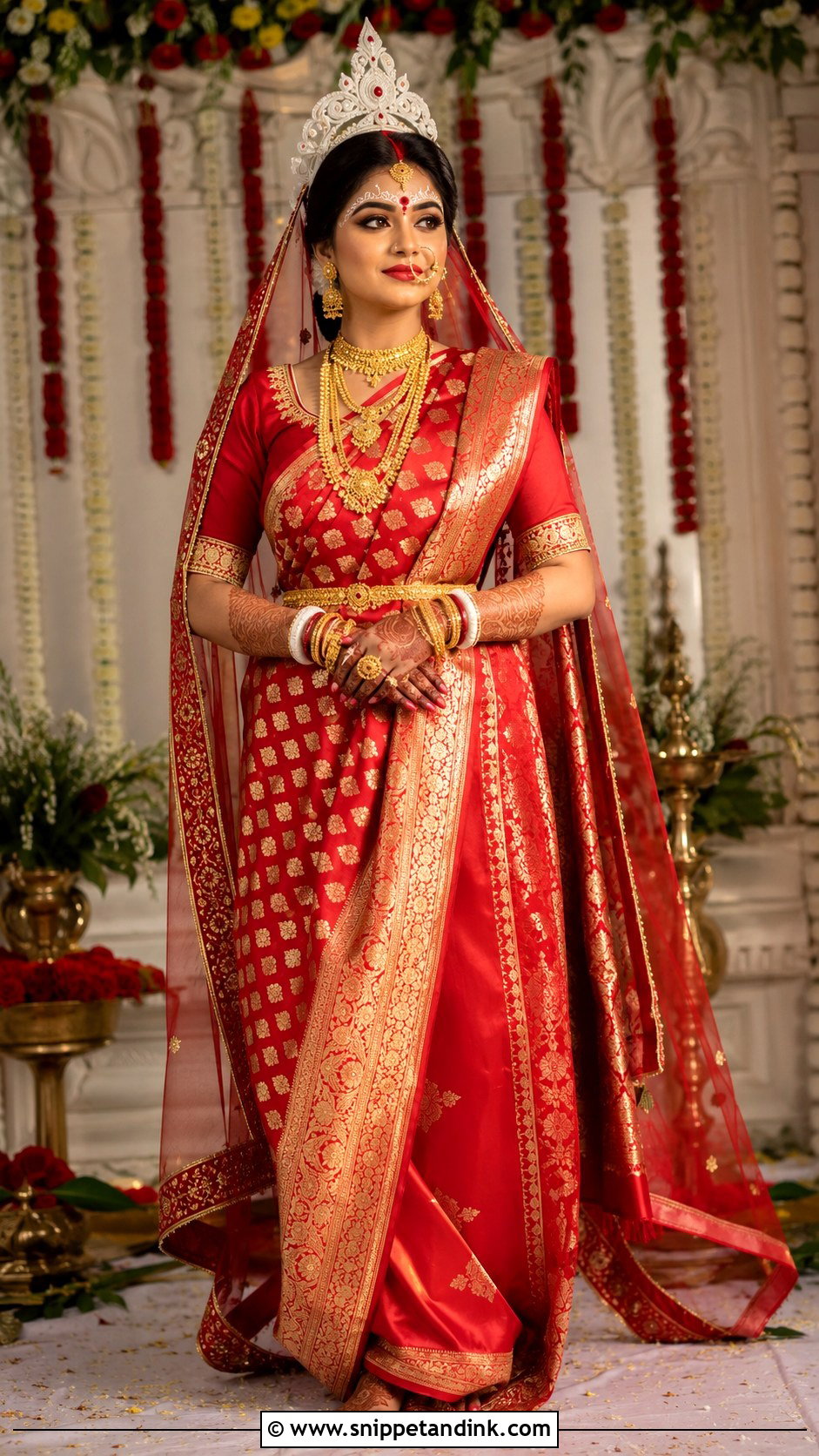
Deep red Banarasi silk with heavy gold zari is the look most families picture, and it’s still the one I’m asked for most for the main ceremony. A fitted red or gold blouse, a traditional drape with the pallu shown off, then gold in layers: choker, long haar, jhumkas, tikli, nath, shakha pola and bangles. The white shola mukut makes it unmistakably Bengali. For the face I keep to the classic kohl-lined eyes, red lips, a round red bindi and chandan work. Heavy zari is stiff, so I always drape the saree before the jewellery goes on, otherwise the necklaces sit on top of the pleats and tilt.
2. White And Red Bengali Bride Look
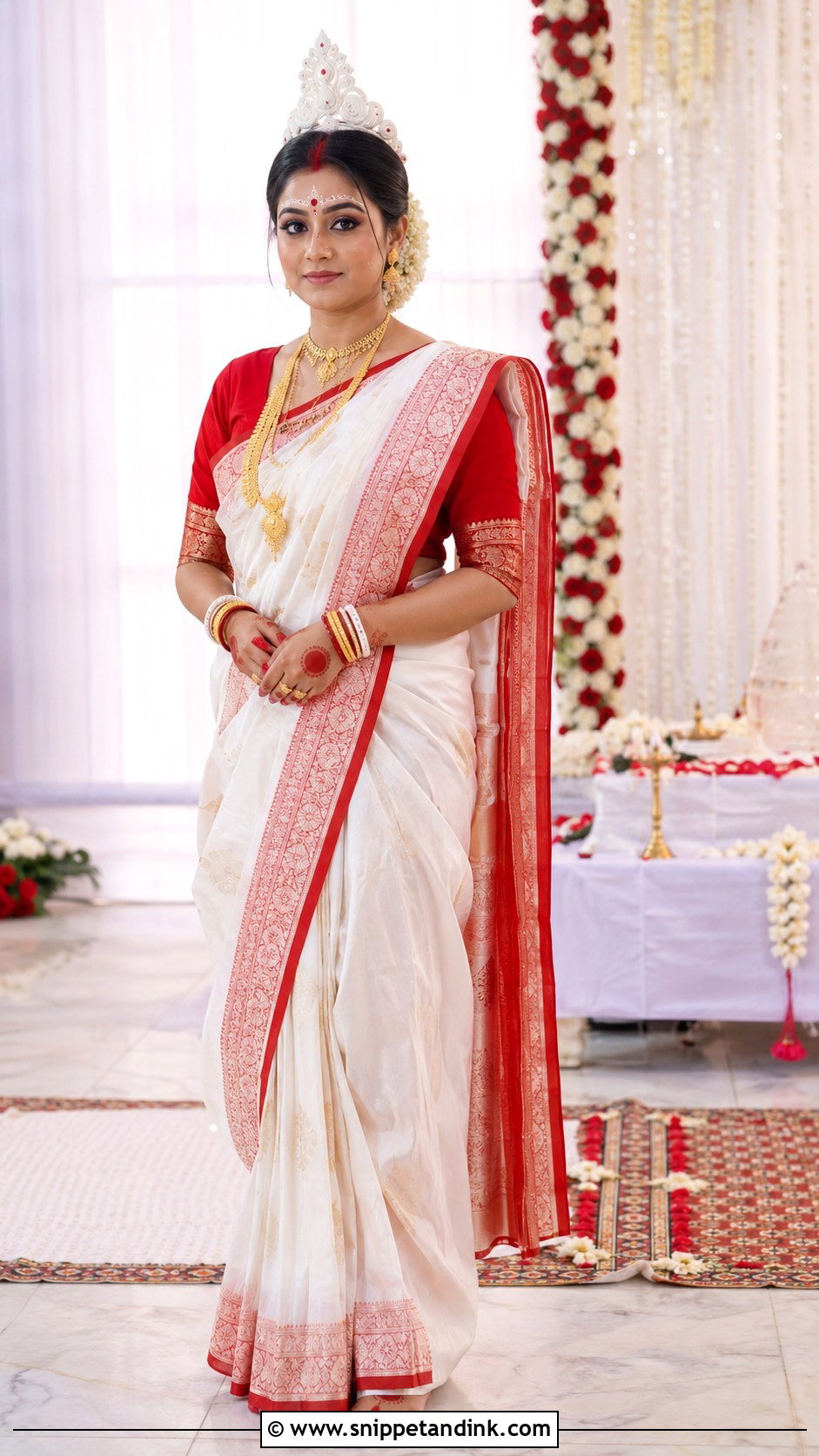
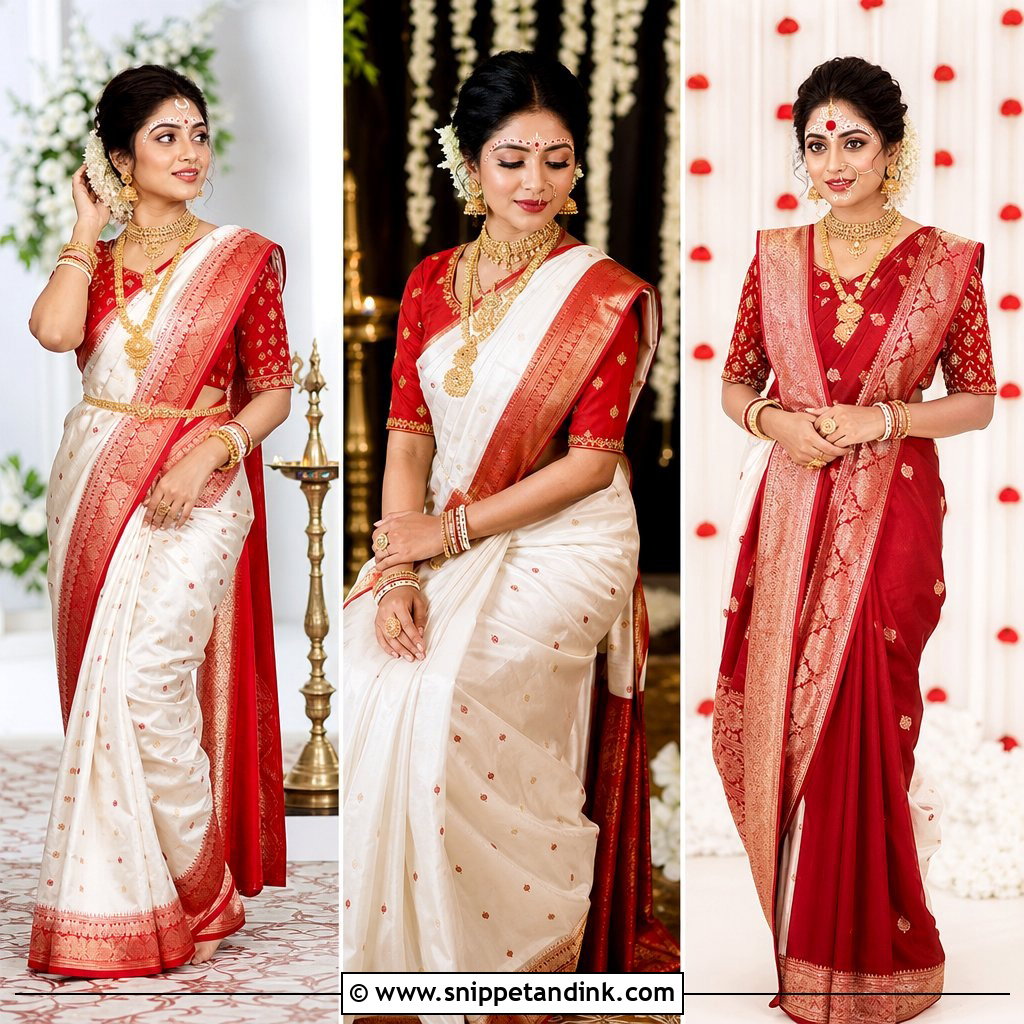
Laal paar, the white silk saree with a broad red border, is the traditional base for many Bengali brides and still feels the most rooted. A red blouse keeps the red and white balance strong. Gold matters more here than with a red saree, because it warms the white and stops the look reading too plain under evening light. Shakha pola, a gold tikli, layered necklaces and a simple mukut finish it. In photos, white silk can blow out under flash, so I give the skin slightly more warmth and definition than I would for a red saree.
3. Maroon Banarasi Bengali Bride Look
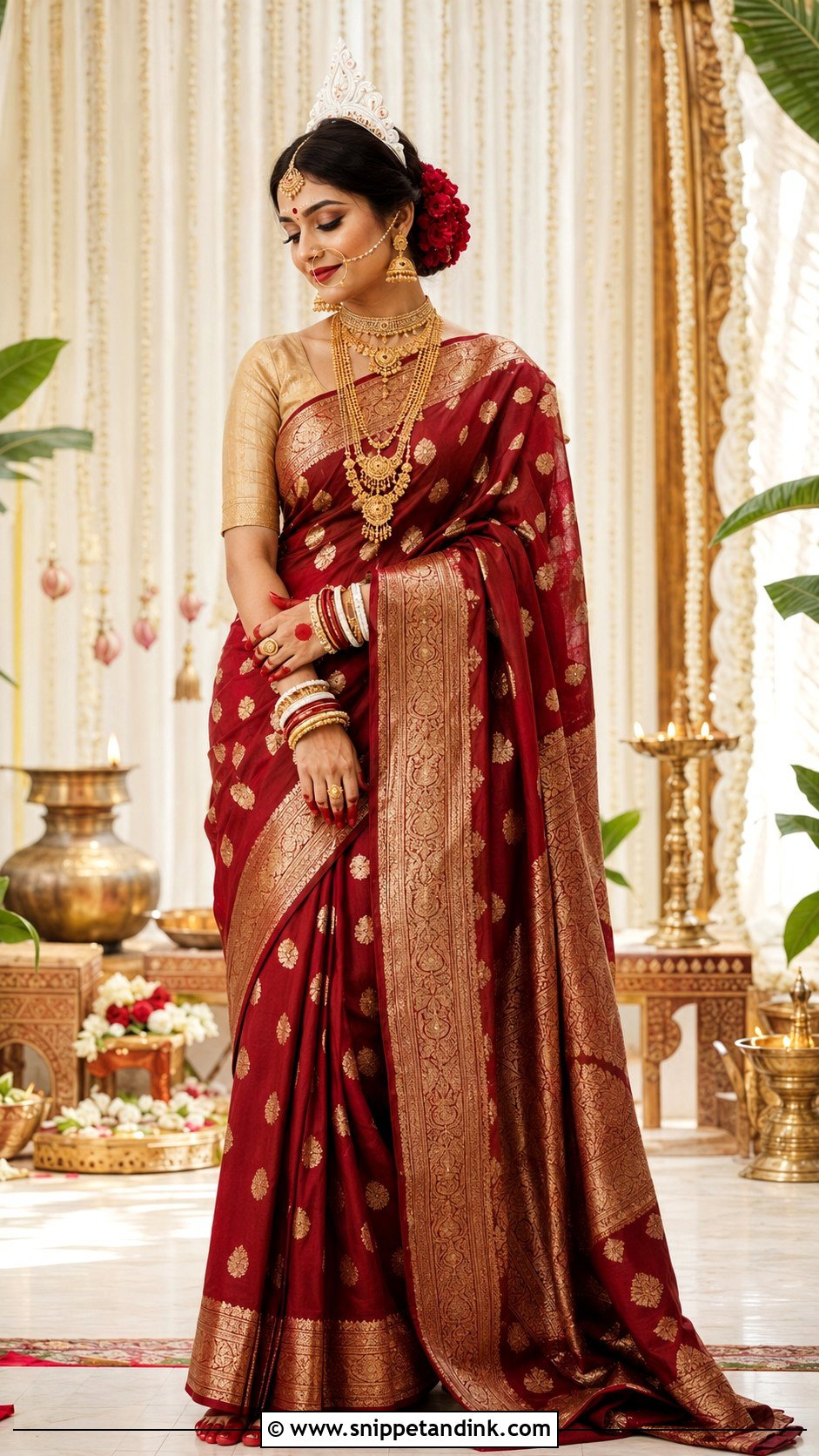
Maroon reads deeper and a little more grown-up than bright red, and a maroon Banarasi Bengali bride look suits evening rituals especially well. Antique gold zari and antique gold jewellery work best with it, since bright yellow gold can look brassy against such a dark base. A matching or dull gold blouse, a layered necklace set, wide bangles, tikli, nath and statement earrings complete it, with a white mukut and a low bun with red flowers. I’d pick a red-maroon lip rather than a true red so the mouth doesn’t fight the saree.
4. Gold Banarasi Bengali Bride Look
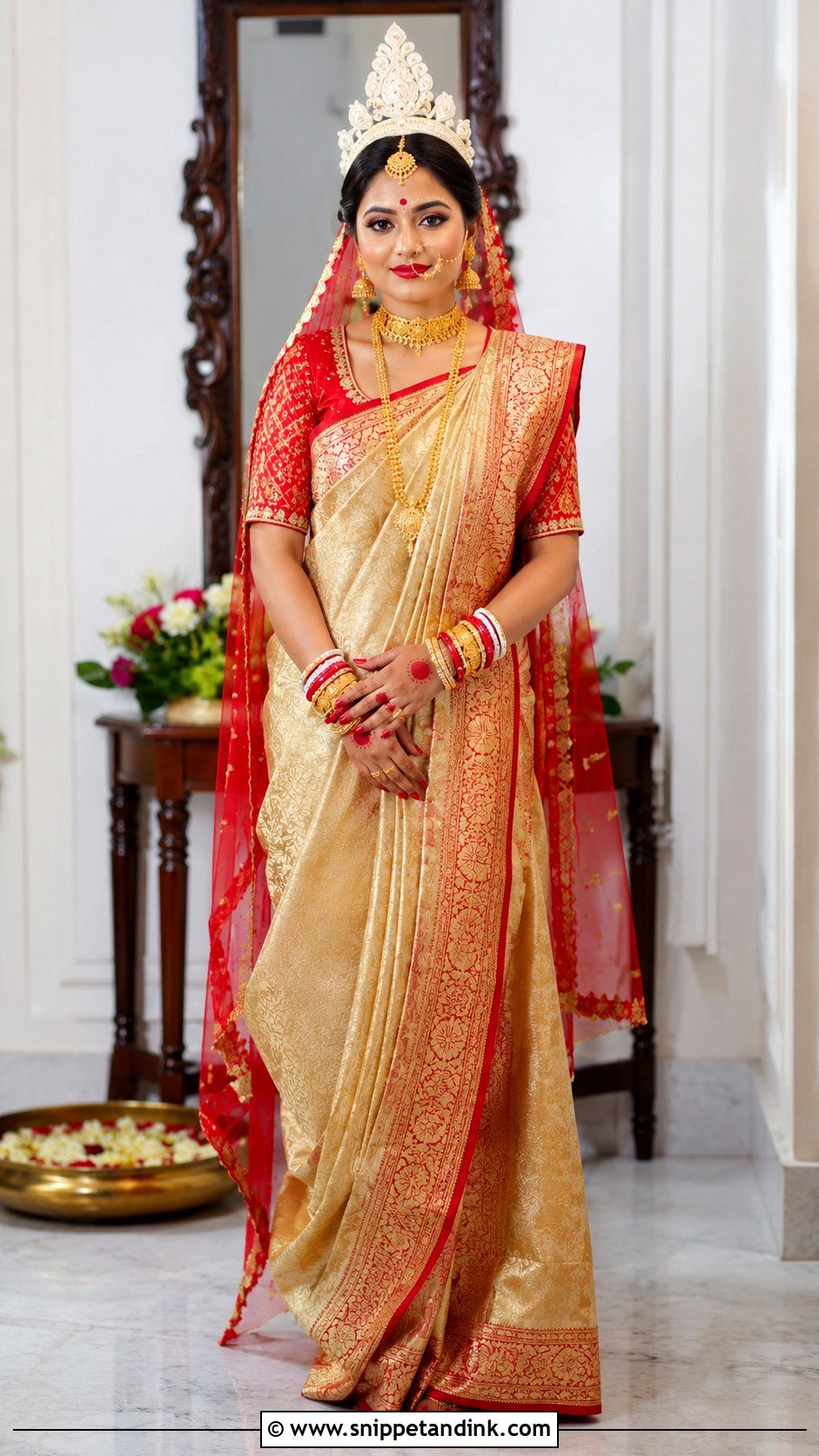
Gold Banarasi brings the glow without the full weight of red. I’d keep red, maroon or copper in the zari or border to tie it to tradition, and a red blouse gives the contrast that makes it feel ceremonial. Choker, long necklace, jhumkas, tikli, stacked bangles and shakha pola go on top. The shola mukut stands out nicely against all that metal. Gold sarees reflect light onto the face, so I keep the base satin rather than shimmery; warm bronze eyes and a red lip are enough.
5. Red Silk Bengali Bride Look
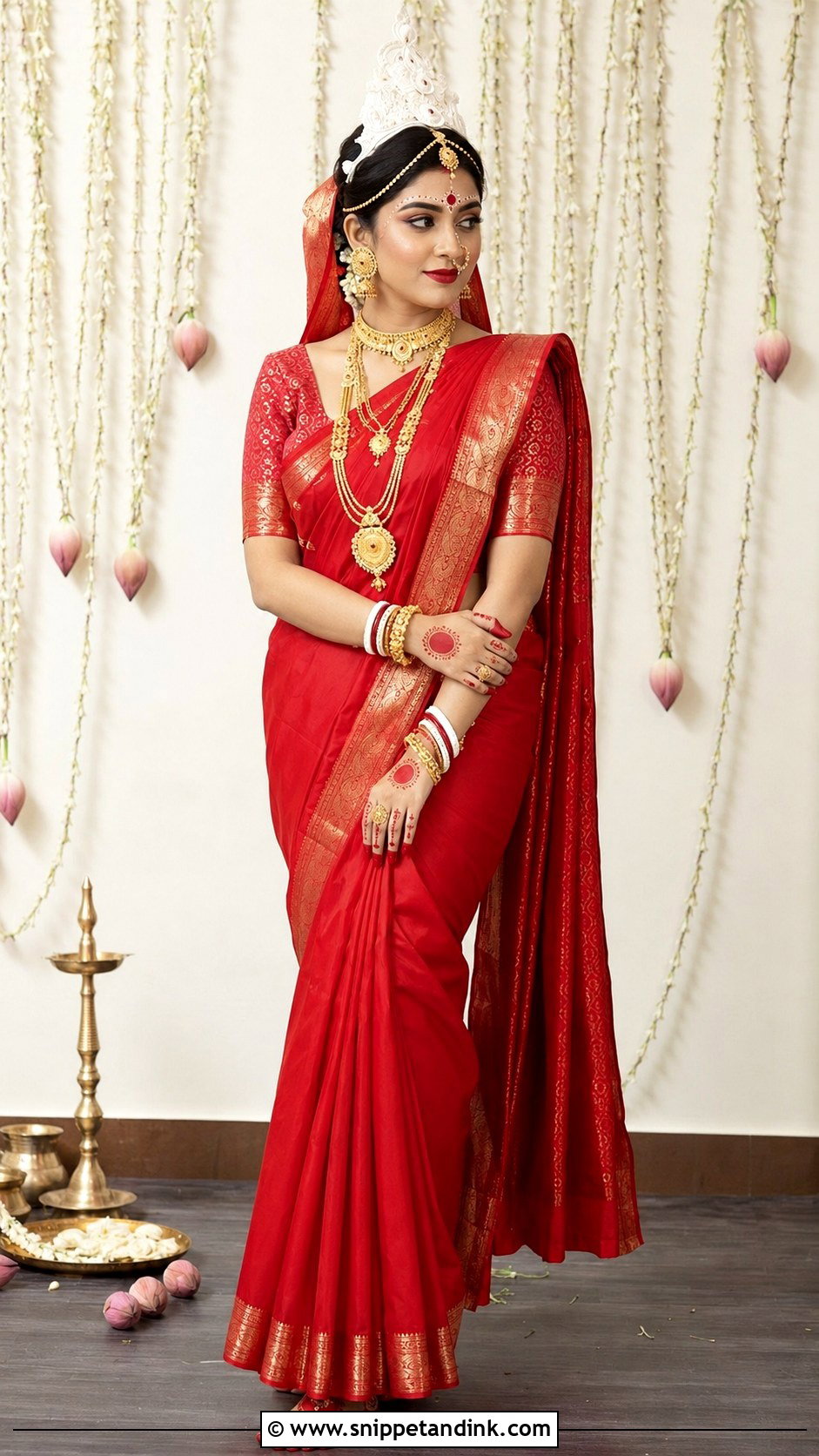
Plain red silk with a simple gold border is my favourite canvas when a bride wants to wear more jewellery, because the saree isn’t competing. Pair it with a structured blouse in red, gold or brocade, then go fuller on the jewellery: choker with a long haar, jhumkas, tikli, nath and shakha pola. A neat centre-parted bun holds the mukut well. Lighter silk is also far easier to sit in through hours of rituals than a stiff Banarasi, which brides appreciate around midnight.
6. Red And Gold Bengali Bride Look
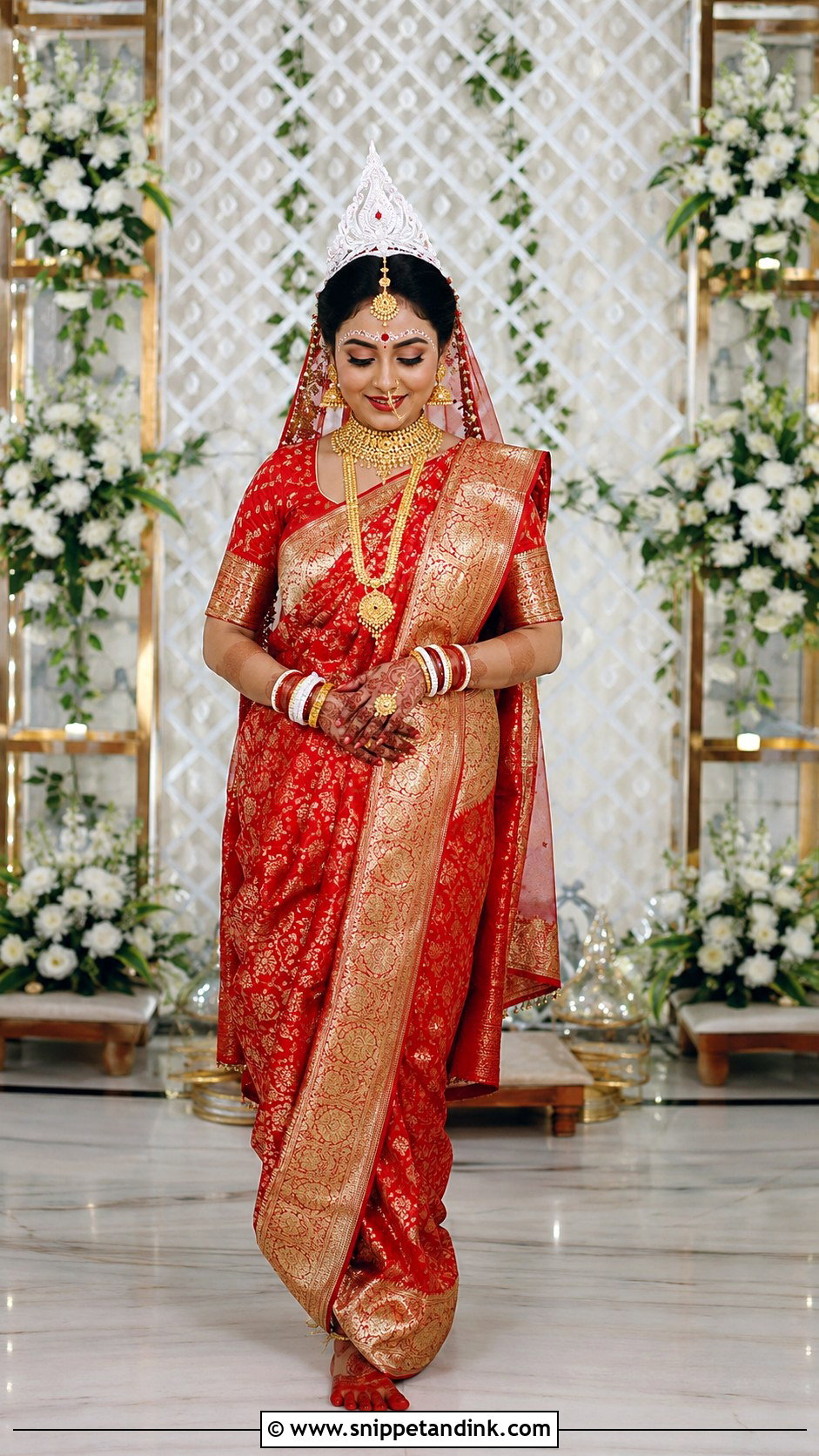
Red with gold is the auspicious pairing, but the trap is too much gold around the face. I’d keep a clear gap between the choker and the jhumkas, and choose either a big nath or a heavy tikli, not both at full size. A red saree with heavy zari, a gold blouse and a drape that shows the border clearly is the base. The mukut softens all that metal. Red lipstick, a fine wing, a bold bindi and neat chandan dots finish the face.
7. Bengali Bride Look With Shola Mukut
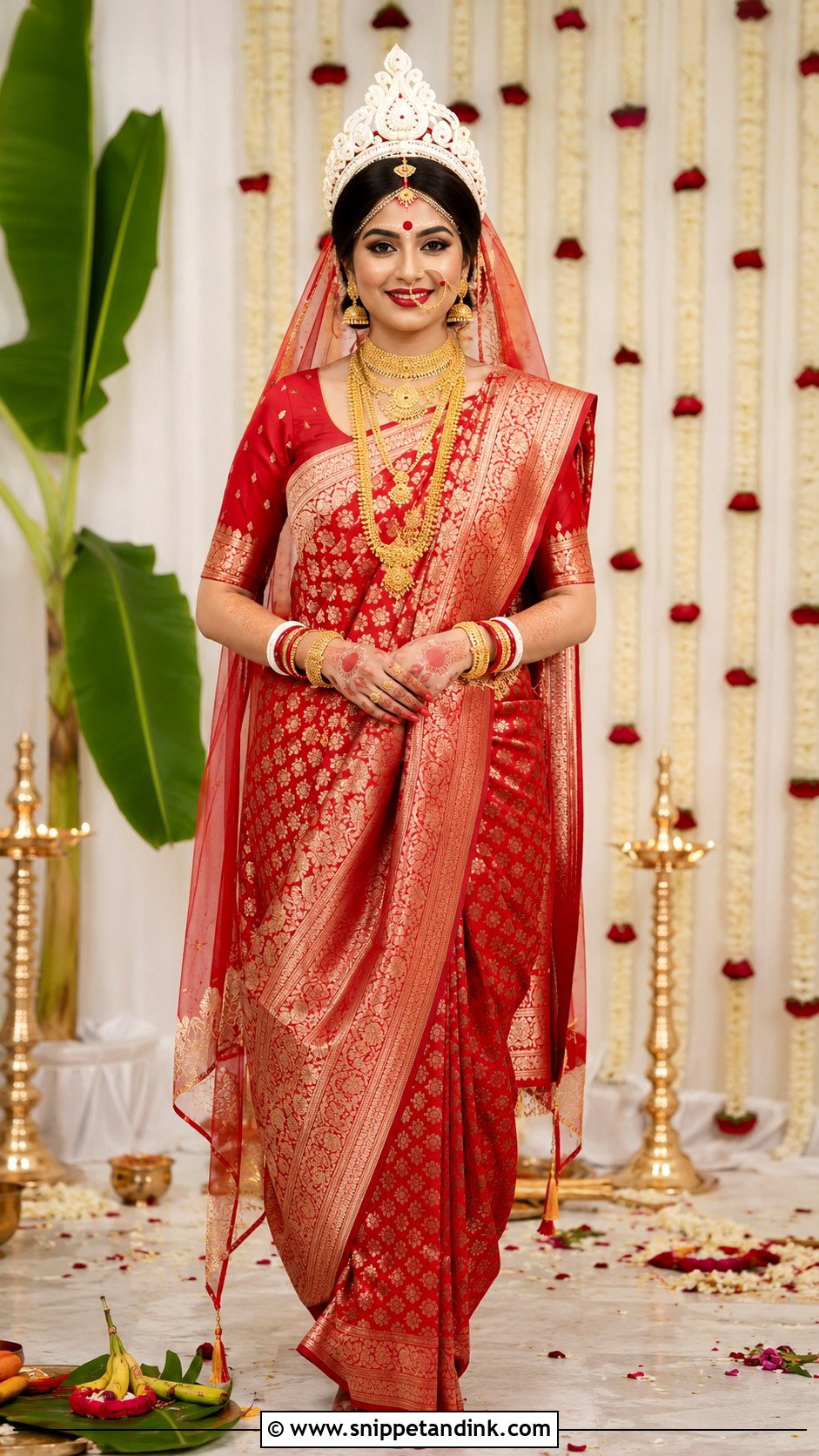
The shola mukut is made from the pith of a marsh plant, carved into a white crown, and it’s surprisingly light but fragile. Since it dominates the head, I pair it with red Banarasi or laal paar for the classic effect, and a fitted blouse with elbow sleeves or brocade. Jewellery should frame the face without crowding the crown. I pin the mukut into a firm, padded low bun with U-pins rather than resting it on loose hair; it sits straighter and survives every bow during the rituals. Chandan, red lips, kohl, shakha pola and alta finish it.
8. Bengali Bride Look With Gold Jewelry
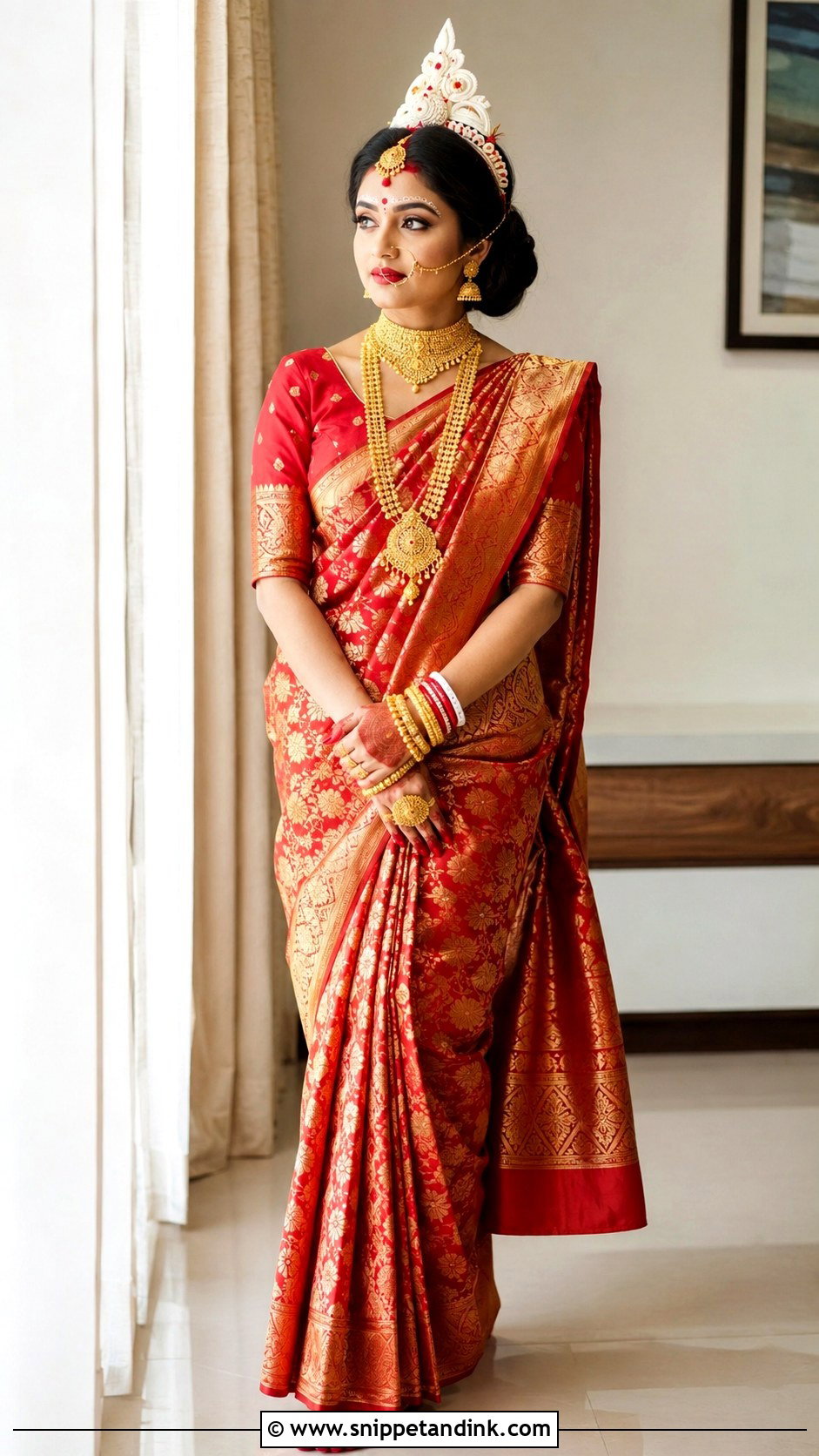
Family gold usually goes into the wedding, and this look is built around showing it. Red, maroon or laal paar all work as the base. A choker frames the neckline and a long necklace adds length; jhumkas, tikli, a nath, bangles and shakha pola follow, with a waist chain if the drape allows. When the jewellery is heavy, keep the blouse plain. Old pieces sometimes have worn hooks or weak clasps, so I check every one at the trial and add a safety thread where needed.
9. Bengali Bride Look With Alta
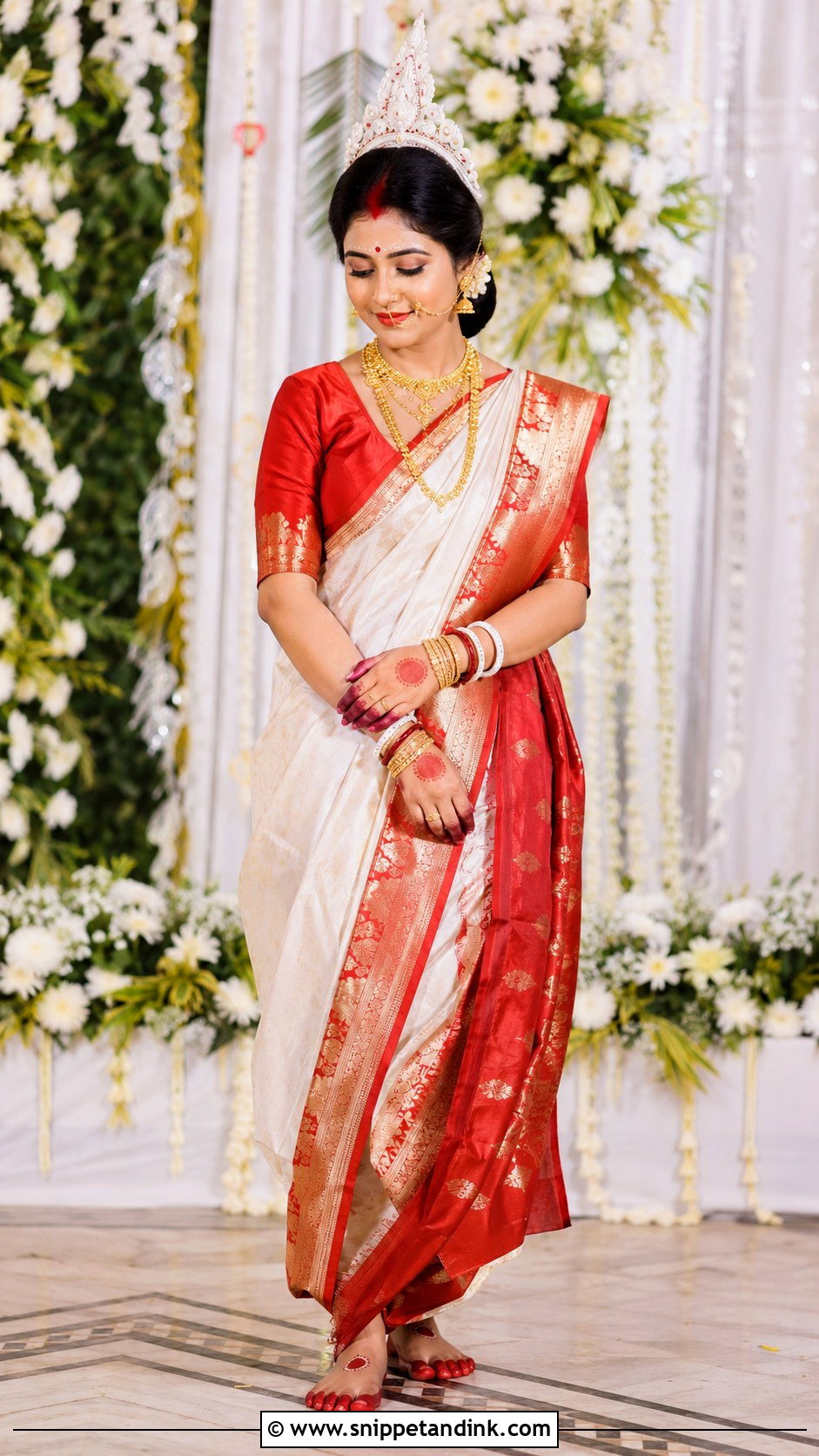
Alta is the red dye painted on the edges of the feet and the palms, and it looks sharpest against red or white-and-red sarees. It goes on early because it needs time to dry fully; wet alta transfers onto the saree hem the moment the bride stands. I paint a clean border around the sole and sometimes a dot pattern on the toes, then keep the drape a little higher so the feet show in photos. Shakha pola, gold rings, a tikli, jhumkas, a mukut, red lips, kajal and soft chandan complete it.
10. Bengali Bride Look With Shakha Pola
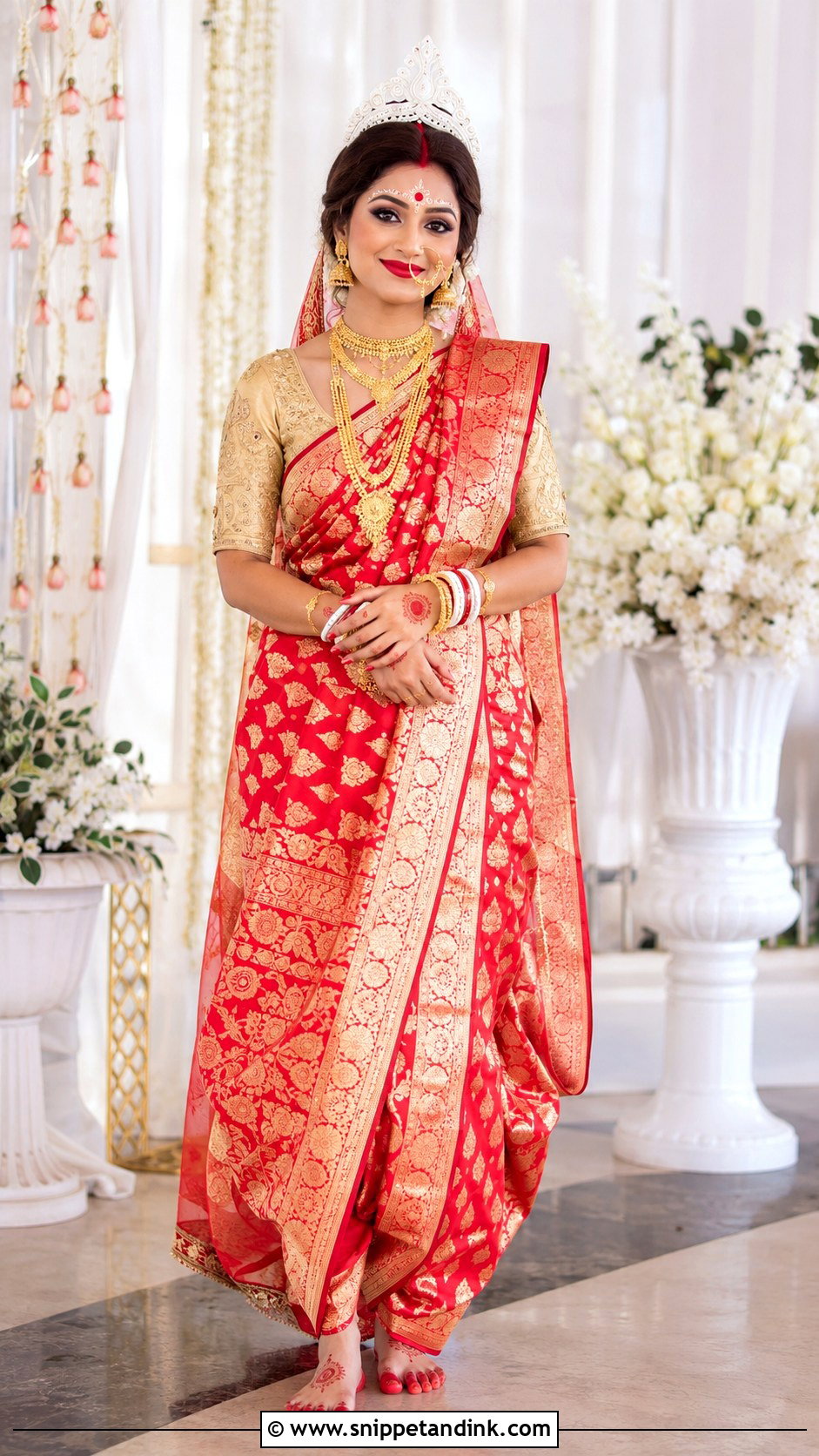
Shakha pola are the white conch and red coral bangles a Bengali bride receives on the wedding morning, and they’re meant to be seen. I stack them with gold bangles between, so the white and red don’t disappear into a solid band of gold. Red Banarasi, laal paar or maroon silk all echo the colours. A red, gold or ivory blouse, gold necklaces, jhumkas, tikli and mukut finish the outfit. Conch bangles can crack if they knock hard against something, so I remind brides to slip them on carefully and keep them away from tiled walls when washing hands.
11. Bengali Bride Look With Chandan Art
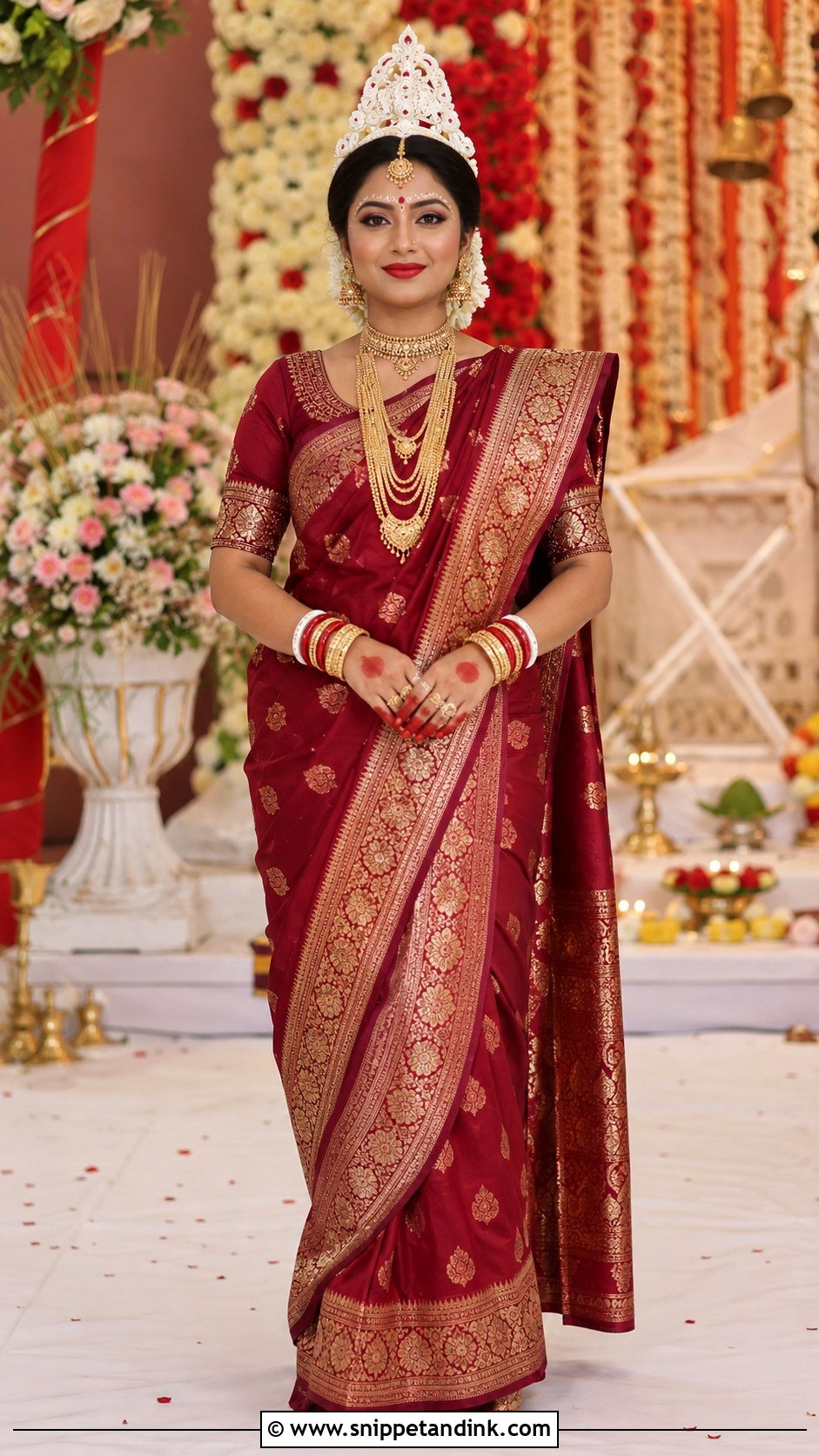
Chandan art is the part of the look I spend most time on. The dots and curves run across the forehead and down along the brows, usually in white with red accents. Real sandalwood paste cracks and flakes as it dries, so I often draw the pattern with a fine brush in a long-wearing white cosmetic paint and keep the design proportionate to the forehead. Keep the jewellery around it balanced: tikli, bindi, jhumkas, layered gold, shakha pola and mukut. A sleek low bun leaves the pattern visible, and kohl eyes with a red lip complete the traditional Bengali face art.
12. Bengali Bride Look With Red Bindi
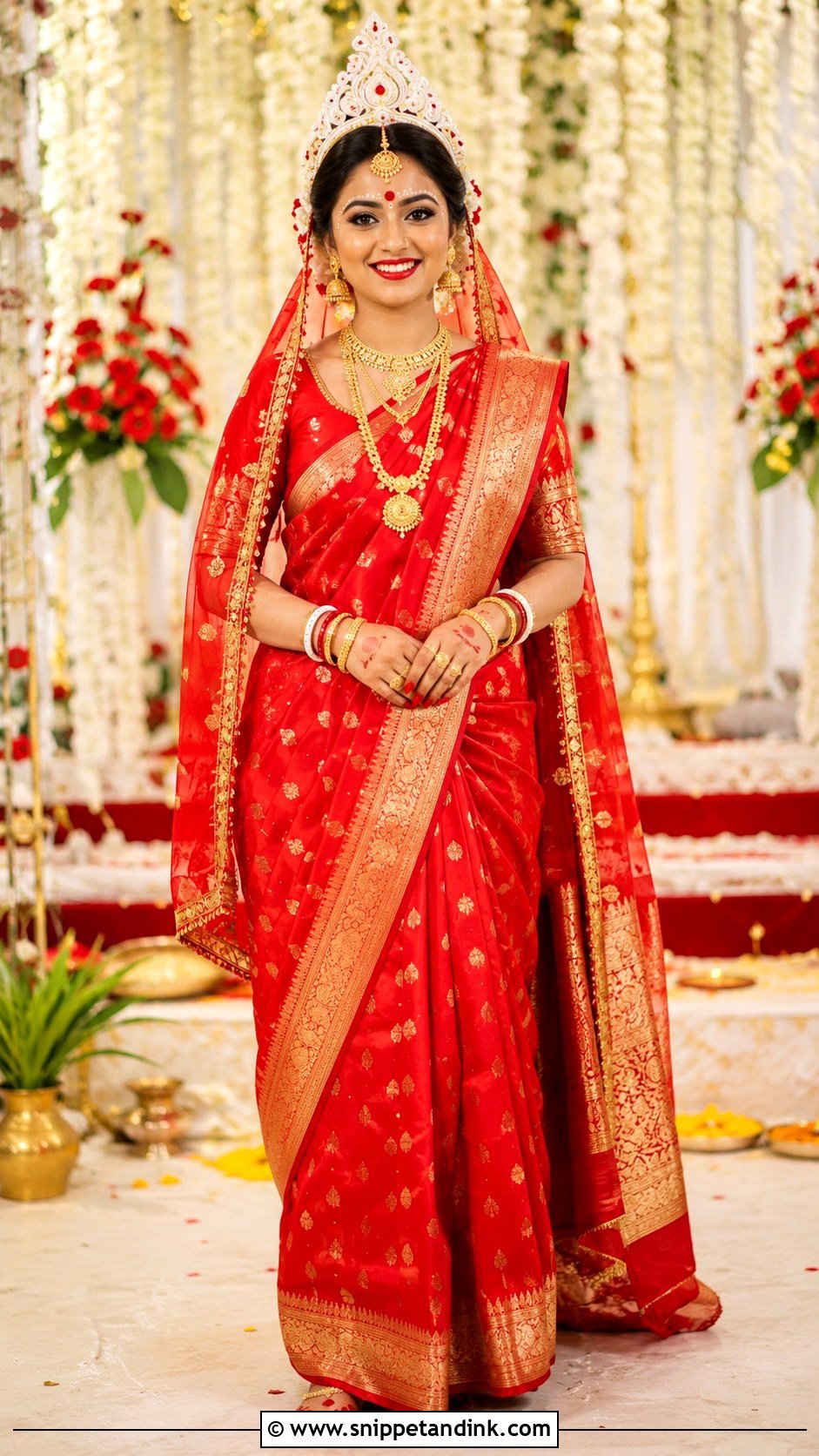
The red bindi is small but it anchors the whole face. I place it at the centre of the forehead first and build the chandan pattern around it, never the other way round, because a bindi set after the pattern almost always sits slightly off-centre. A tikli or matha jewellery can hang just above it. Red, maroon, gold or laal paar sarees all suit. Kajal, soft blush and red lips keep the rest of the face classic.
13. Bengali Bride Look With Nath
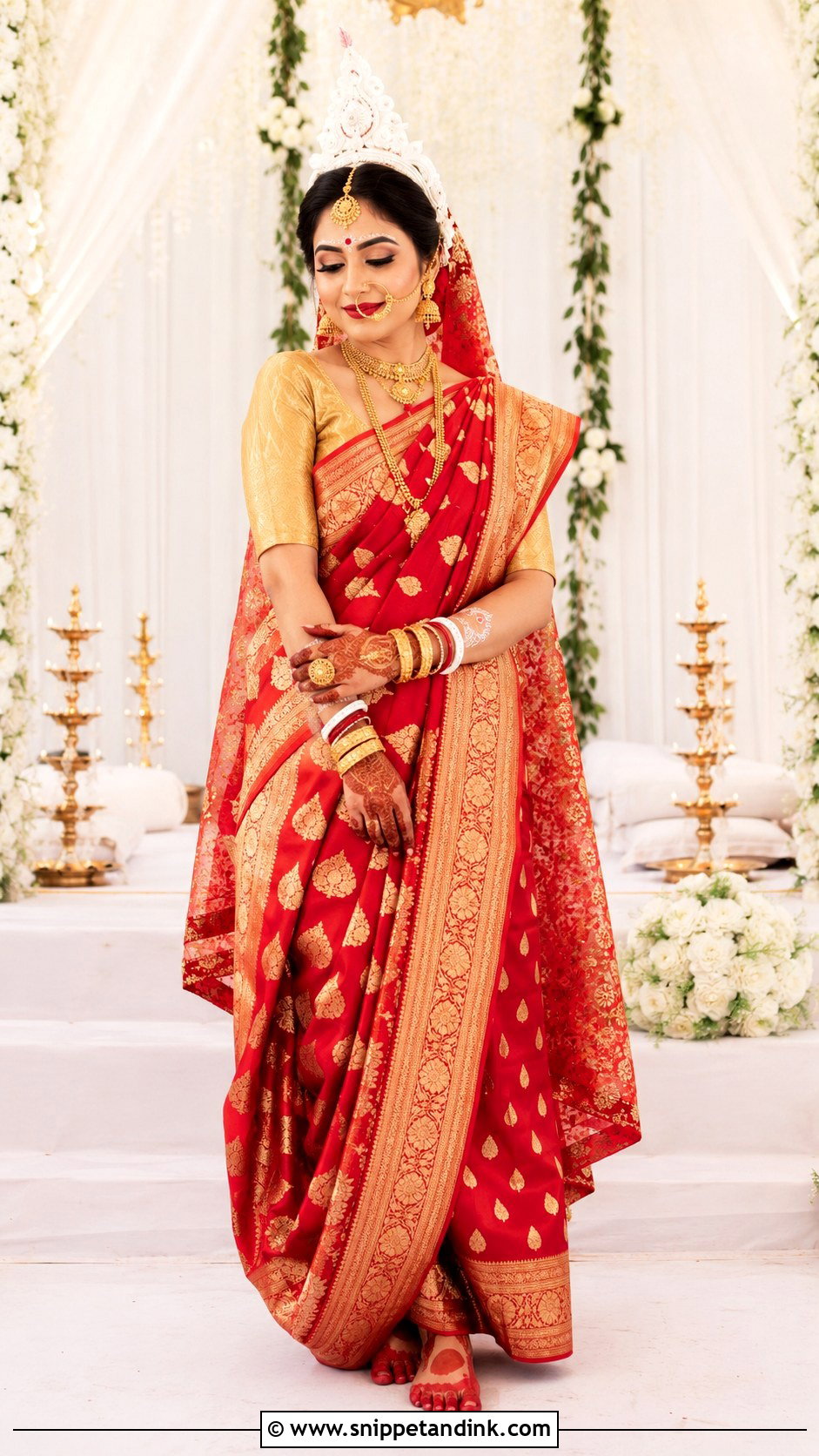
Naths come in two broad kinds: a large ring with a chain that hooks into the hair, and a simpler gold stud or small ring. The chained nath is more ceremonial but heavier, and I always clip the chain into the hair behind the ear so it carries most of the weight, not the nostril. Red Banarasi or maroon silk balances it well. A tikli, jhumkas, layered necklaces, shakha pola and mukut complete the look, with a clean blouse neckline and a sleek centre-parted bun. Try it on at the trial; a nath that’s never been worn can feel very strange through a long ceremony.
14. Bengali Bride Look With Low Bun
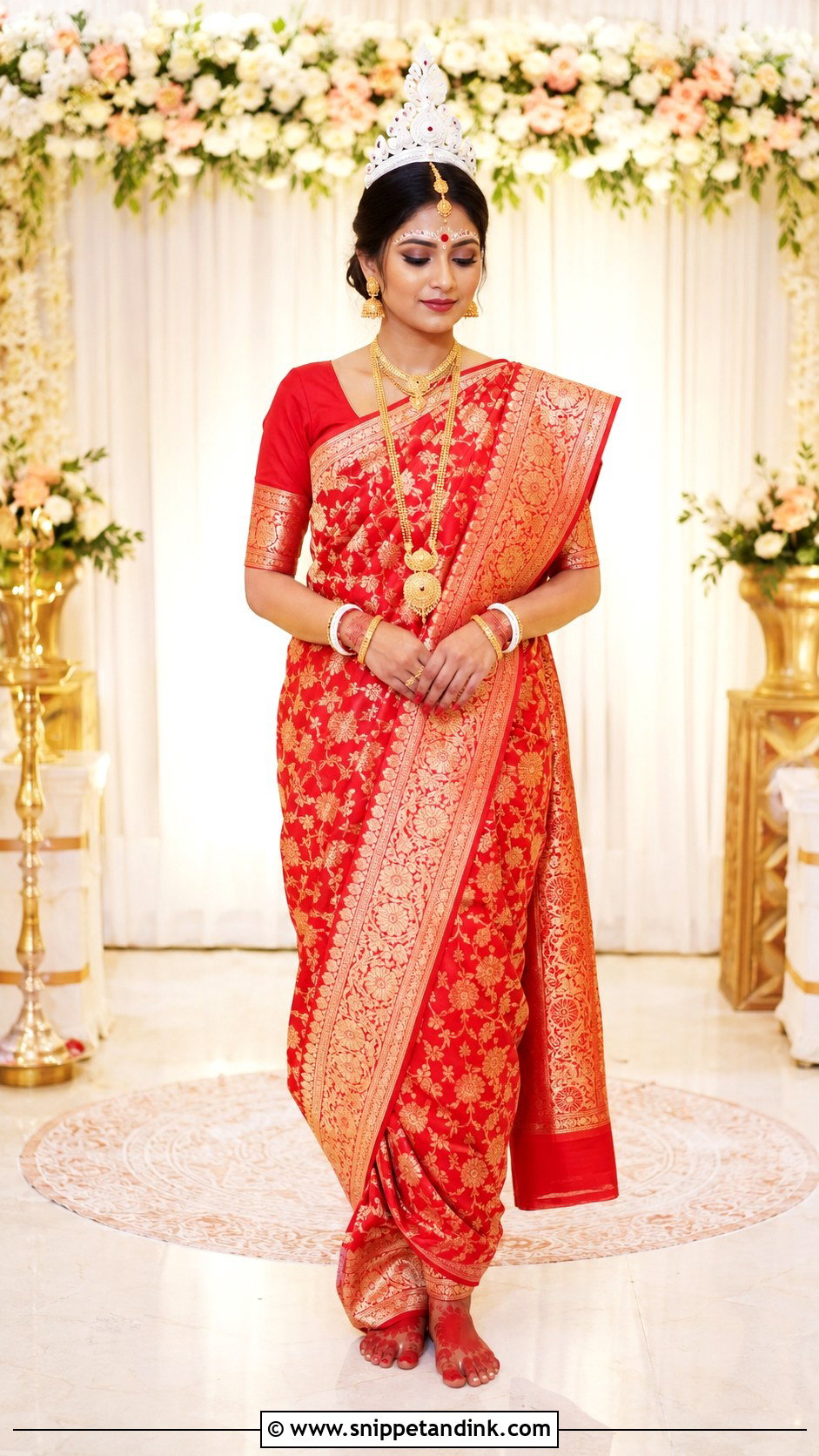
Practically, the low bun is the hairstyle that holds a Bengali bridal look together. It anchors the mukut, carries flowers and gold hair jewellery, and leaves the face open for chandan and earrings. Centre part, smooth sides, bun at the nape: I pad it with a doughnut or hair filler so pins have something to grip. Red Banarasi, laal paar or gold sarees all suit, with layered necklaces, shakha pola and alta. It’s the most secure option for rituals that involve a lot of bowing and sitting on the floor.
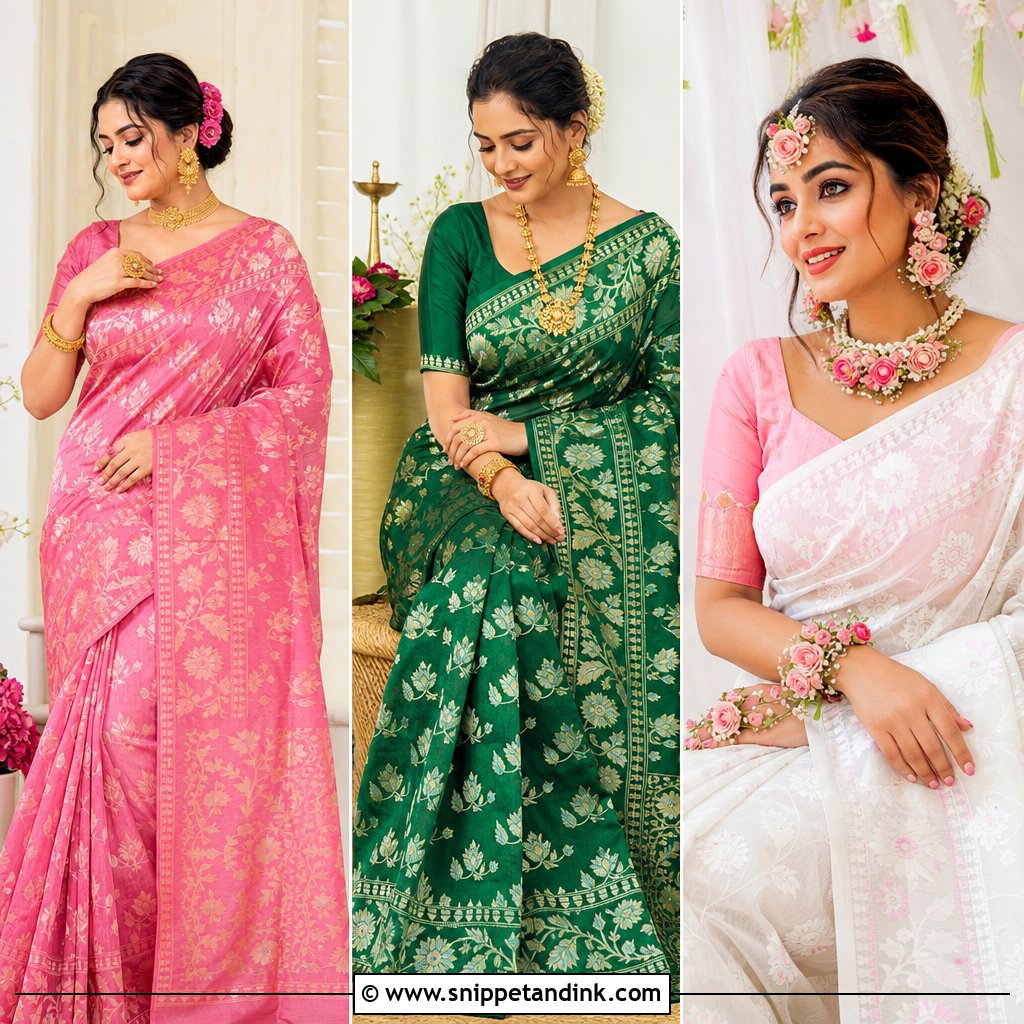
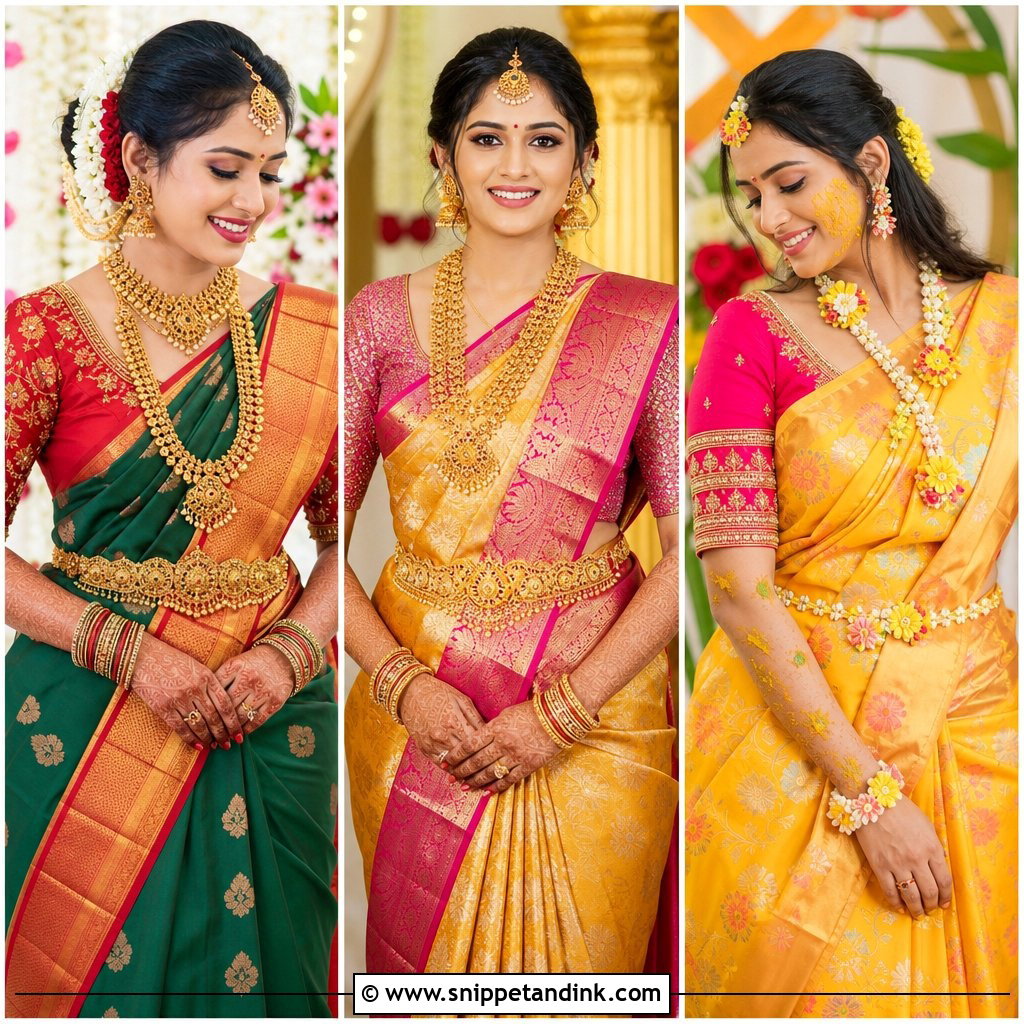
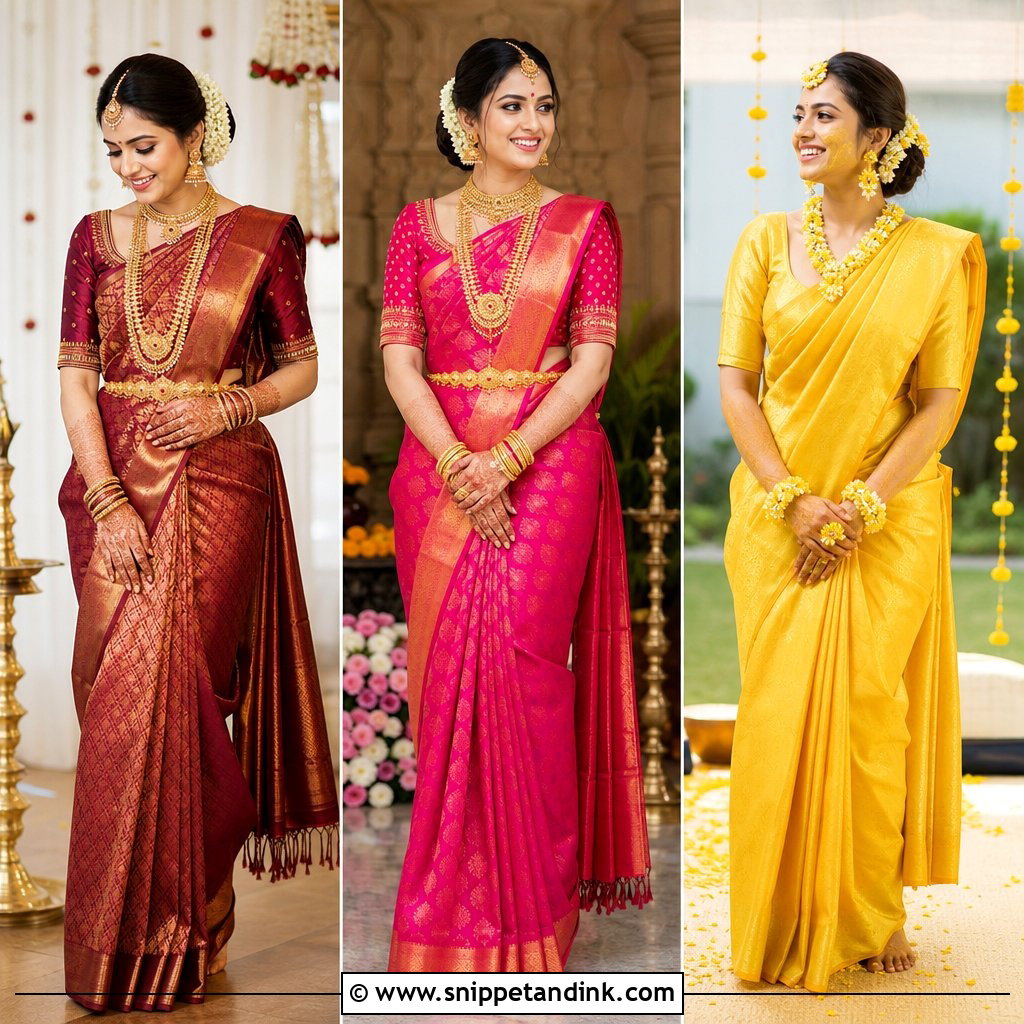
15. Bengali Bride Look With Jasmine Bun
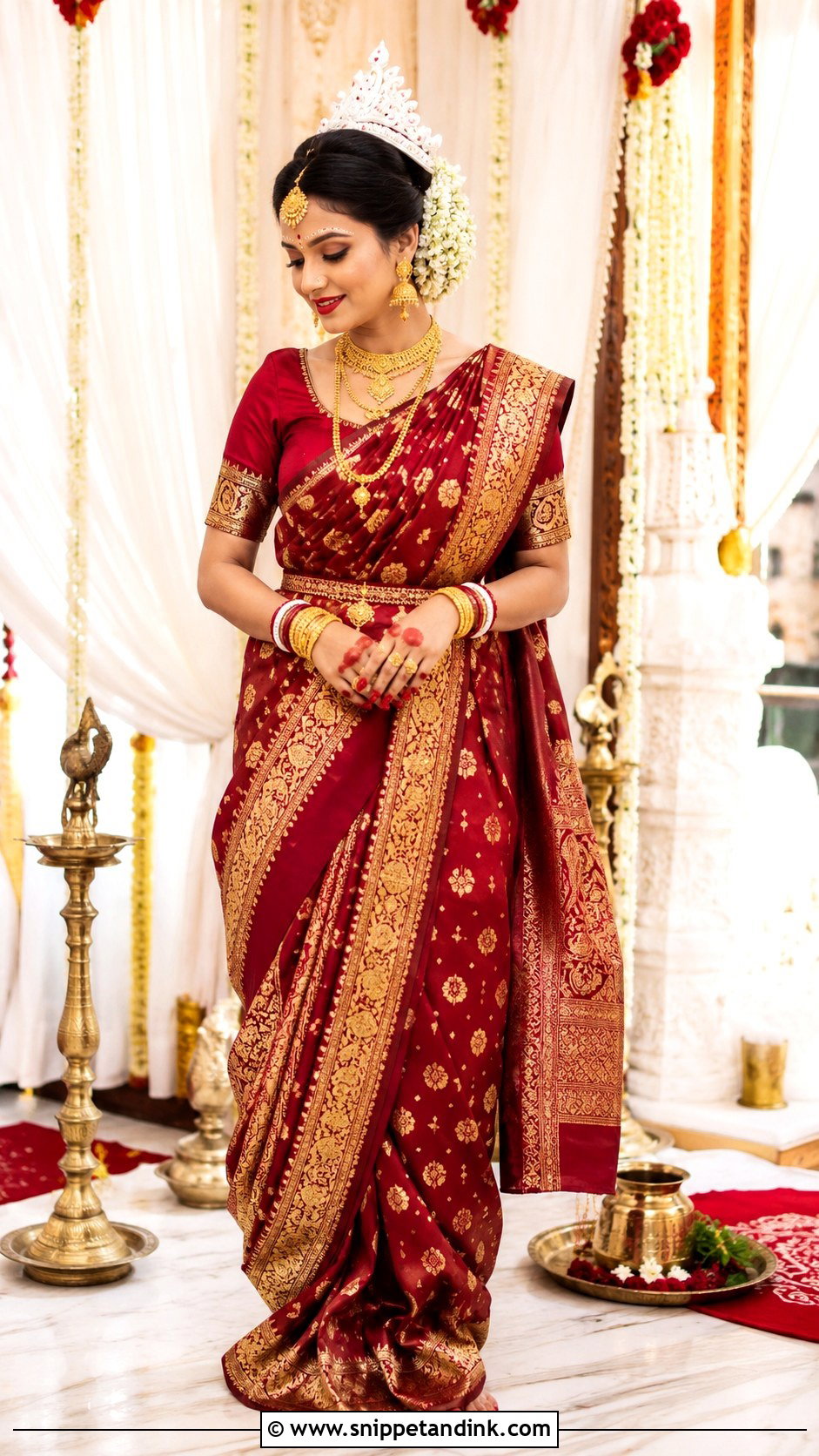
Jasmine adds scent as well as colour, and the white flowers echo the shola mukut against a red or maroon saree. Style the hair in a low bun wrapped with jasmine flowers, then add the tikli, jhumkas, layered necklaces, shakha pola and alta. Jasmine strings brown within a few hours in warm rooms, so I ask families to bring them fresh in the afternoon and keep them wrapped in a damp cloth until the last moment. Red lips, kajal and chandan keep the face classic.
16. Bengali Bride Look With Red Roses
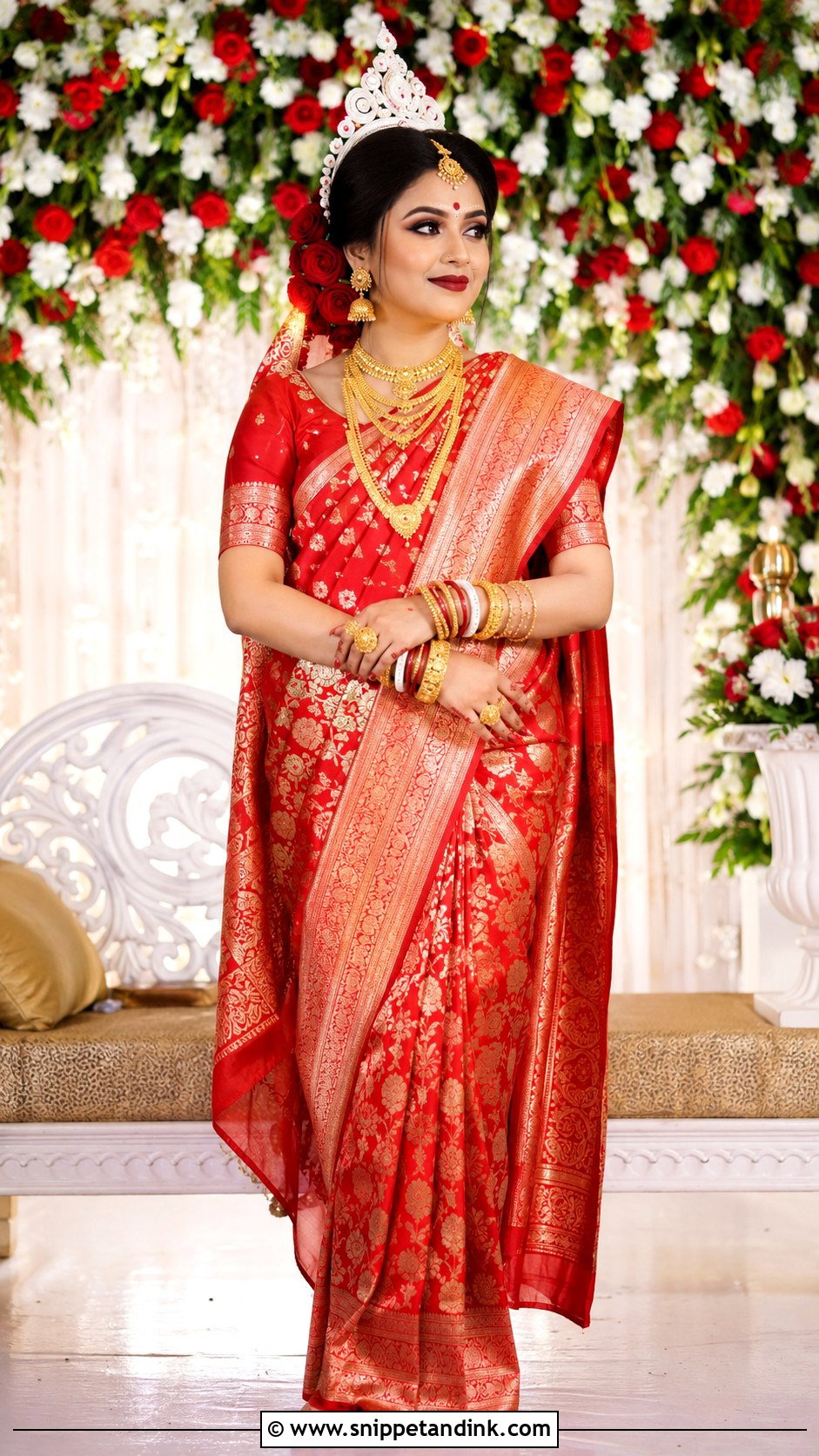
Fresh red roses in the bun blend into a red or maroon saree, so the look feels full without extra gold. Rose heads are heavier than jasmine and need their own pins; I wire the stems short and tuck them into the bun’s padding so they don’t swing loose. Gold necklaces, jhumkas, tikli, shakha pola and a white mukut finish it. I keep the face bold but balanced, with red lips, defined eyes and a clean base, and alta on the hands and feet ties the reds together.
17. Bengali Bride Look With Temple Jewelry
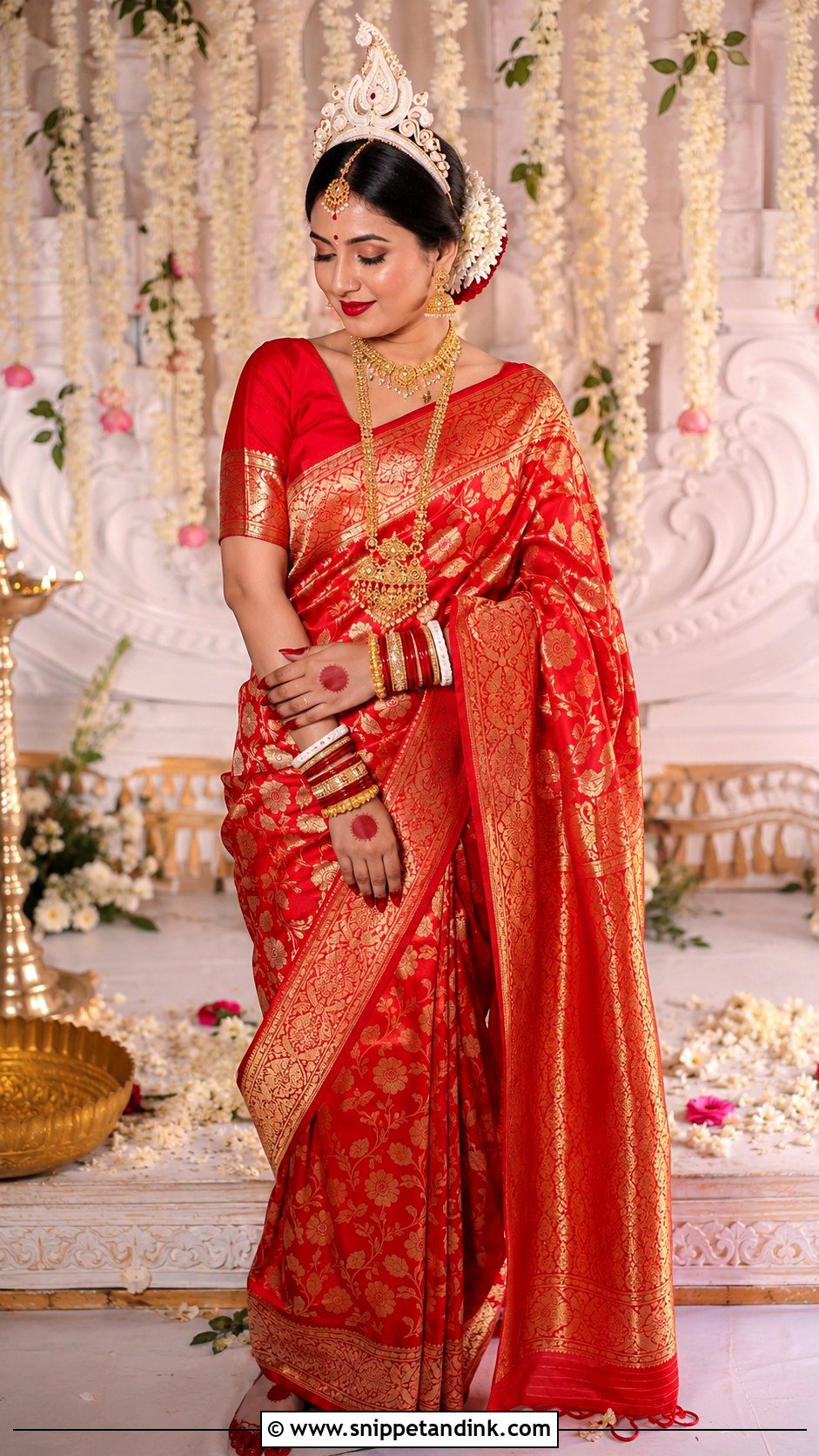
Temple jewellery comes from South Indian tradition, with deity and temple motifs worked in gold, and it brings a heritage feel to a Bengali saree. The pieces are busy, so I’d pair them with a cleaner red, maroon or gold silk rather than the heaviest Banarasi. Temple choker, long necklace, jhumkas, bangles and tikli give the structure; shakha pola keeps the Bengali identity clear, and the shola mukut still sits well against warm gold. Red lips, kajal and soft highlighter keep the face warm.
18. Bengali Bride Look With Antique Gold Jewelry
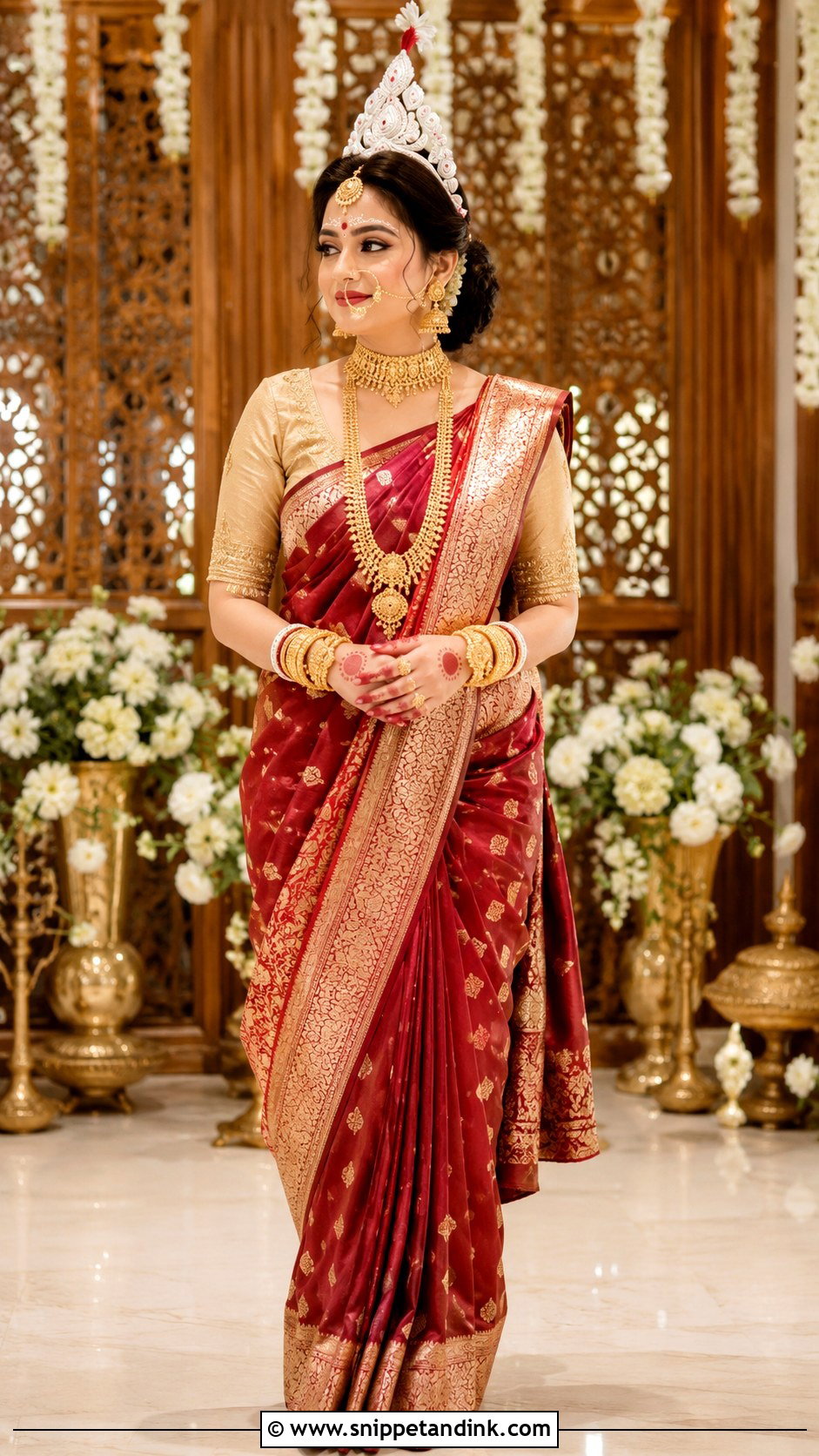
Antique gold has a darker, matte finish that softens the shine, so the whole look reads older and richer. It sits best against maroon, deep red or a rust Banarasi. A choker, long haar, jhumkas, tikli, bangles and a traditional nath, with a blouse in matching or dull gold. A low bun, mukut, chandan and red bindi complete it. When a bride is mixing family pieces of different ages, antique finish helps everything look as if it belongs together, even when the bright and aged gold don’t quite match.
19. Bengali Bride Look With Kundan Jewelry
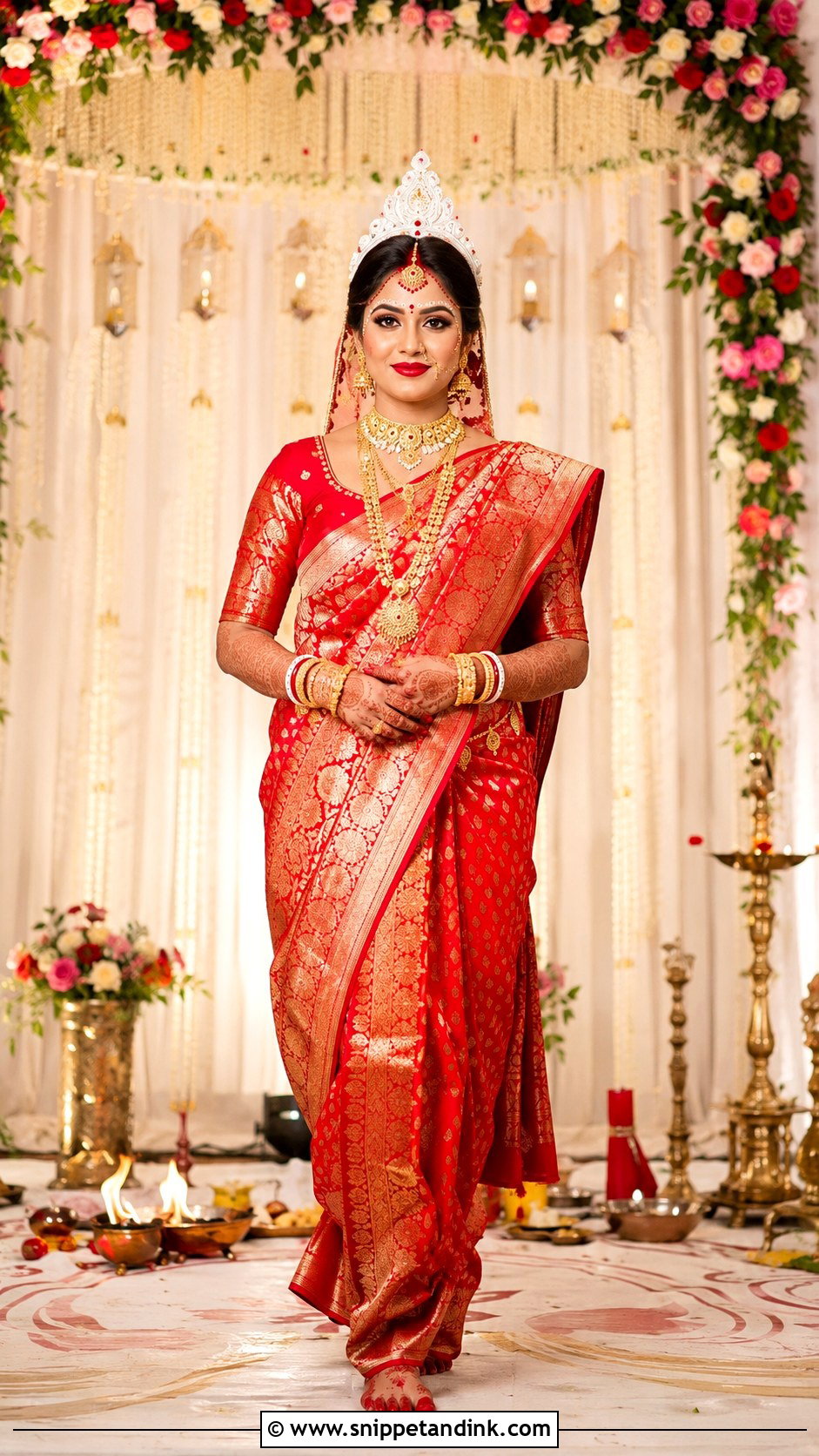
Kundan brings a North Indian touch, with glass stones set in gold foil, and it can look lovely over a Bengali base as long as the Bengali markers stay. Red Banarasi or laal paar with a Kundan choker, long necklace, tikli, earrings and bangles works with a simple blouse. Keep shakha pola and the mukut, otherwise the look slides into a different tradition altogether. Kundan sets catch bright ceremony lighting well. Polished red lips, defined eyes and chandan details finish the face.
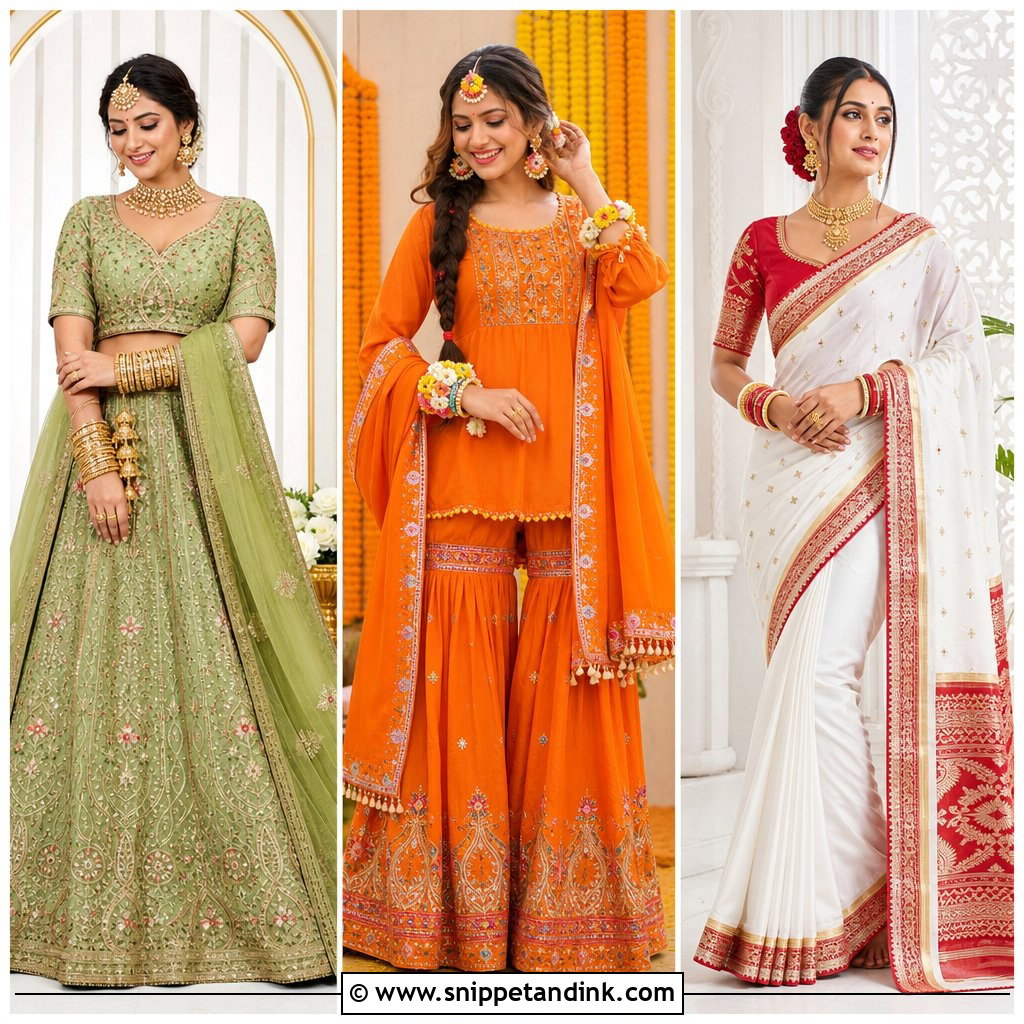

20. Bengali Bride Look With Pearl Jewelry
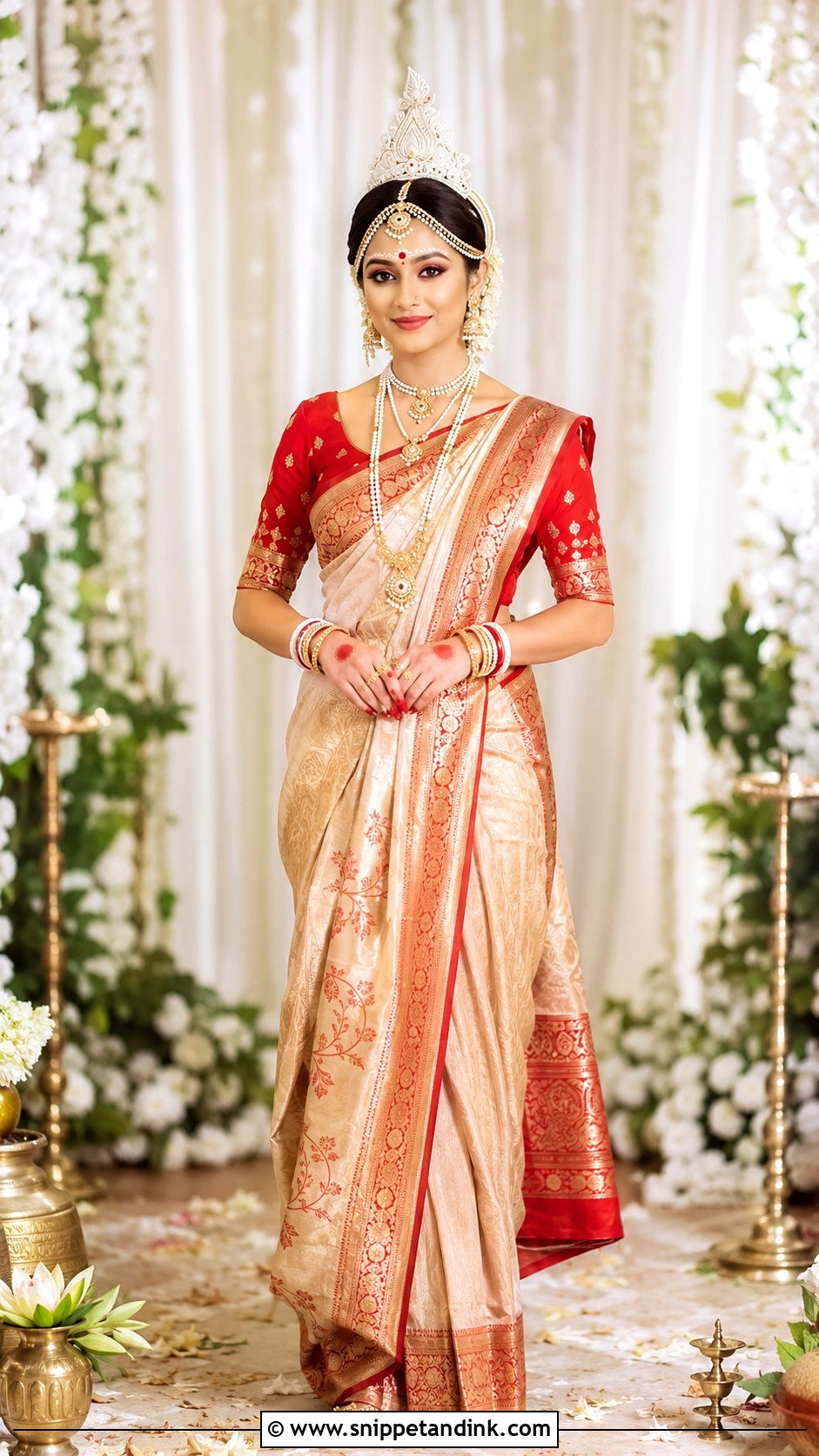
Pearls soften everything around them, so I pair them with laal paar, cream Banarasi or light gold silk rather than a dark saree. Pearl and gold necklaces, pearl jhumkas, a tikli, bangles and shakha pola, with the white mukut, all sit in the same family of whites. With pearls I keep makeup fresher: soft kajal and a red lip, with delicate chandan. A jasmine bun brings it together. If the base is very pale, add a touch more warmth to the cheeks so the face doesn’t look flat under flash.
21. Bengali Bride Look With Cream Saree
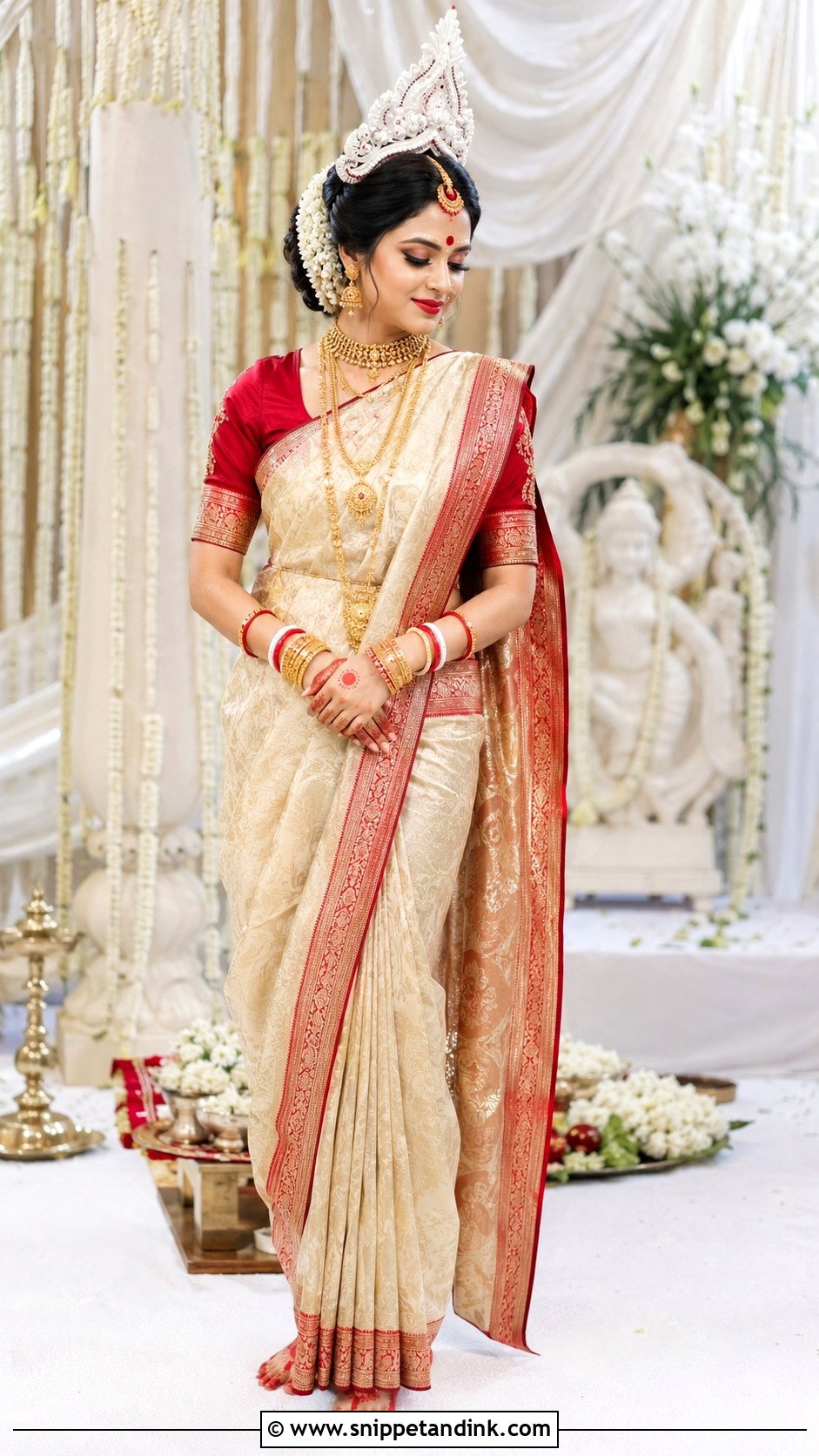
Cream sarees with a red or gold border are softer than laal paar but still ceremonial. A red blouse pushes it toward bridal; a gold blouse keeps it subtle. Gold jewellery, shakha pola, tikli, jhumkas and the mukut go on top. Pale sarees need contrast in the face, so I’d keep a definite red lip, a bold bindi and visible alta; skipping them makes the whole look go pale in photos. A low bun with jasmine suits it.
22. Bengali Bride Look With Ivory Saree
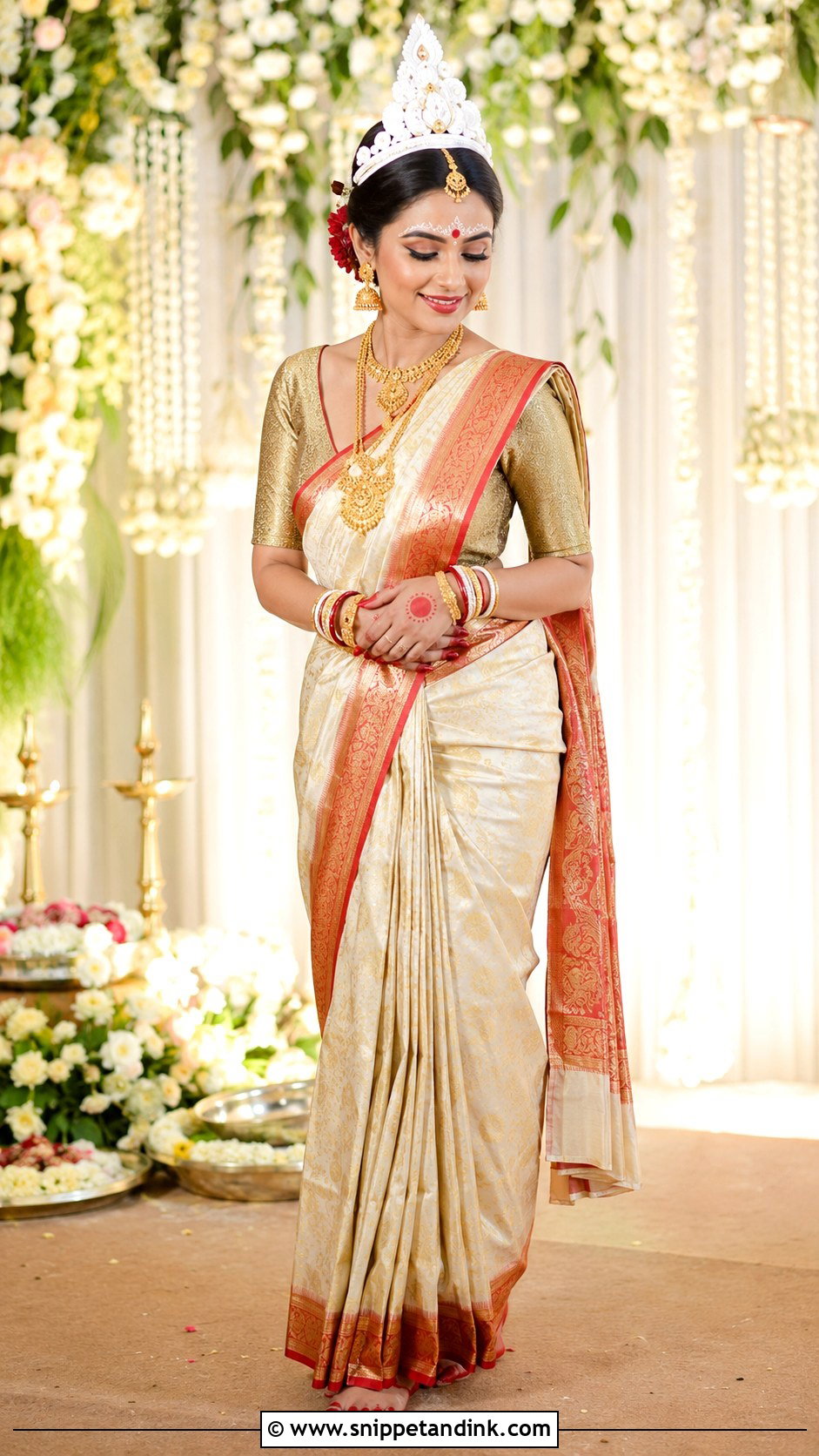
Ivory silk with gold zari looks quietly expensive, and a red border brings it closer to Bengali tradition. Pair it with a red or antique gold blouse. Gold jewellery warms it, and shakha pola adds the red and white contrast. A mukut, tikli, layered necklaces, jhumkas and alta make it ready for the ceremony. Ivory reflects light up into the face, so I set the base with a little more powder than usual to keep shine down, and I define the eyes and lips clearly so the face stands out against the saree.
23. Bengali Bride Look With Pastel Saree
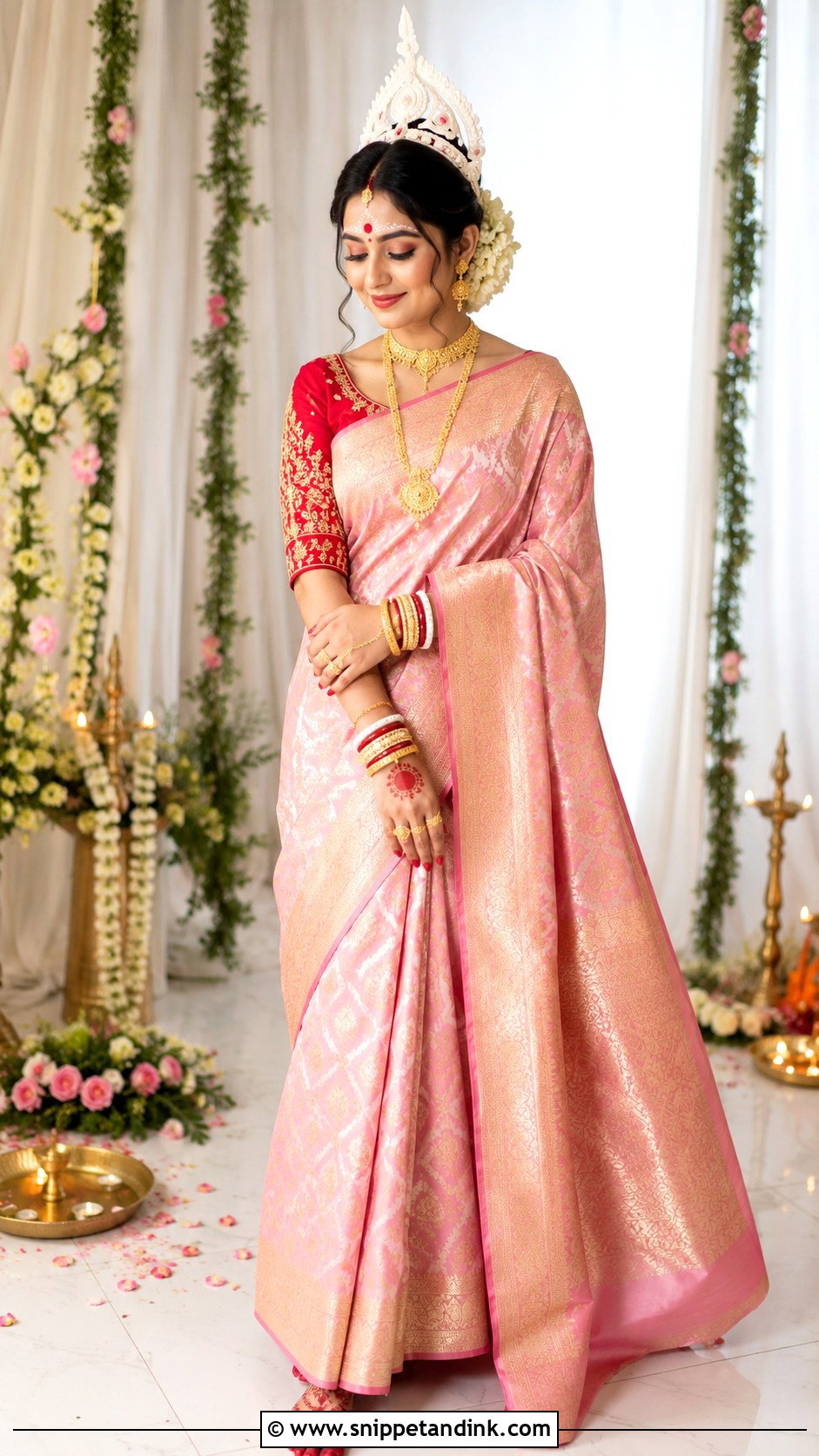
Pastel sarees work for a Bengali bride only when the traditional markers are strong. A pastel pink, peach or soft gold Banarasi with rich zari, plus a red or gold blouse, gives bridal contrast. Then hold on to every Bengali detail: shakha pola, alta, chandan, a red bindi and the shola mukut. Gold grounds the pale colour better than modern silver or diamond pieces. I’d avoid a pastel lip here; red keeps the face ceremonial even when the saree is soft.
24. Bengali Bride Look With Green Saree
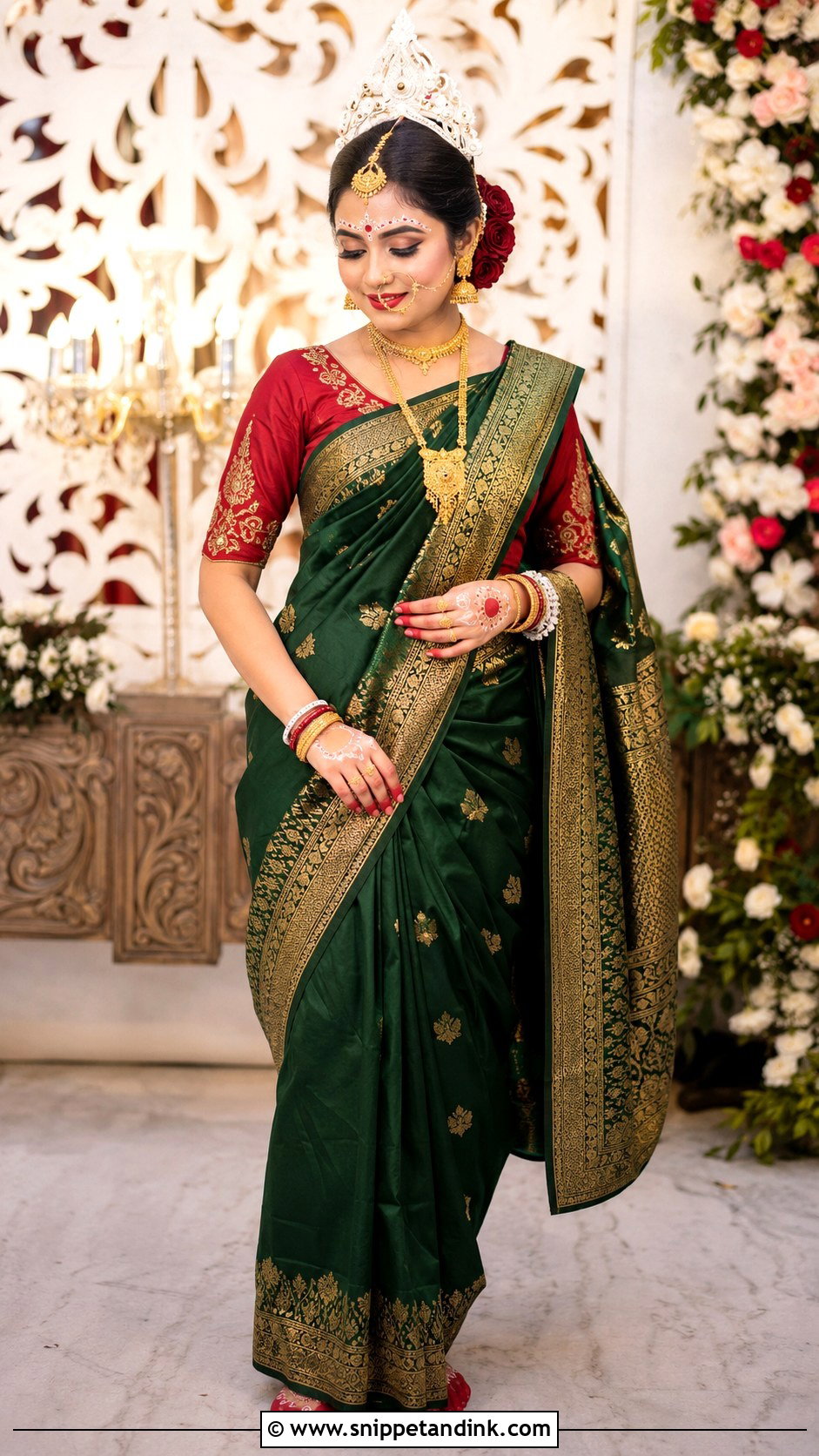
Green is less expected, but deep emerald or bottle green silk with gold zari looks rich and festive. A red blouse brings back the auspicious red, and red lips and alta tie it to Bengali symbolism. Traditional gold, shakha pola, a tikli, jhumkas, a nath and the mukut finish it. In makeup, green makes red look brighter, so I usually pick a slightly deeper red lip so it doesn’t look orange beside the saree. A sleek bun with red flowers or jasmine suits it.


25. Bengali Bride Look With Blue Banarasi Saree
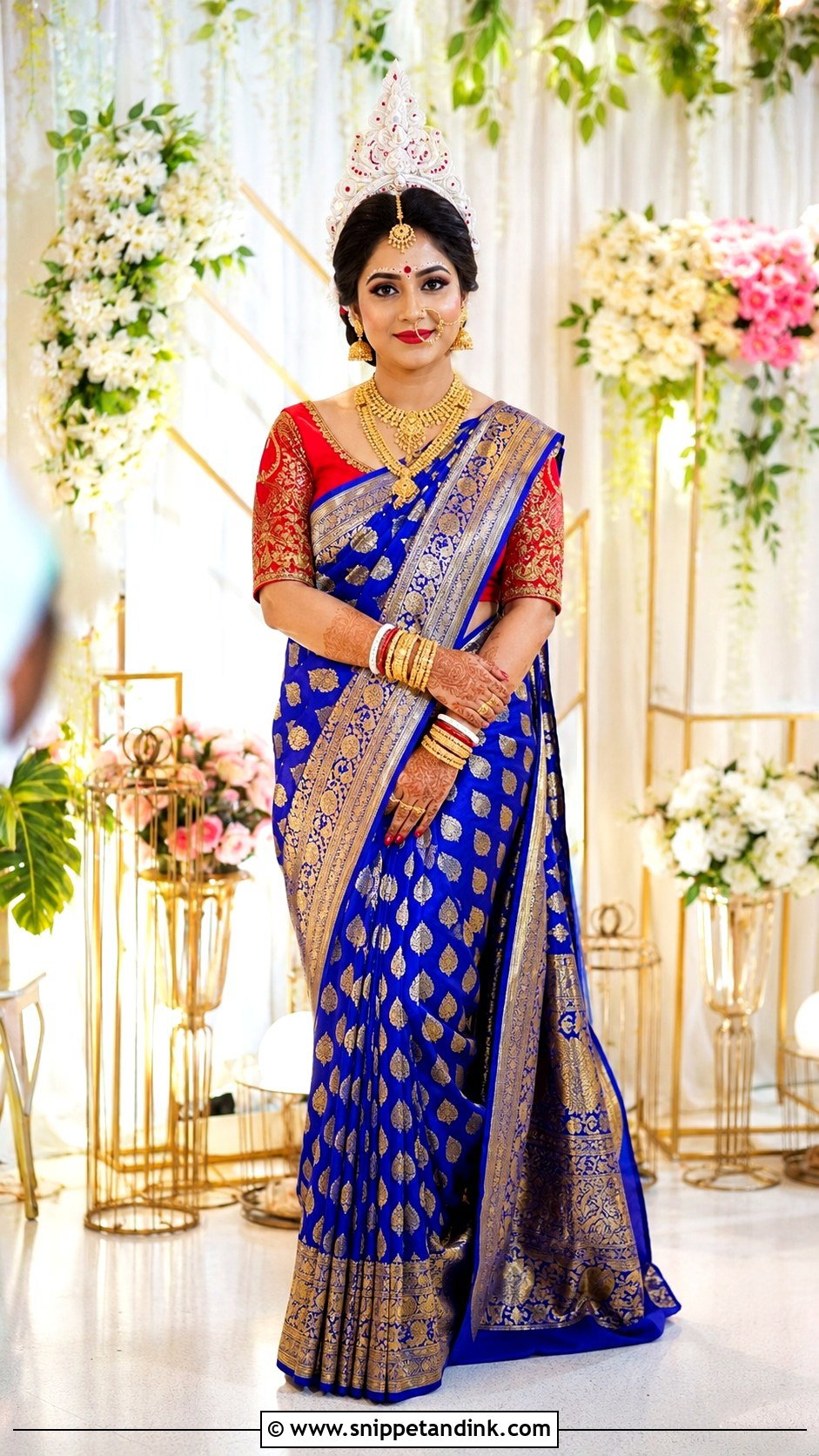
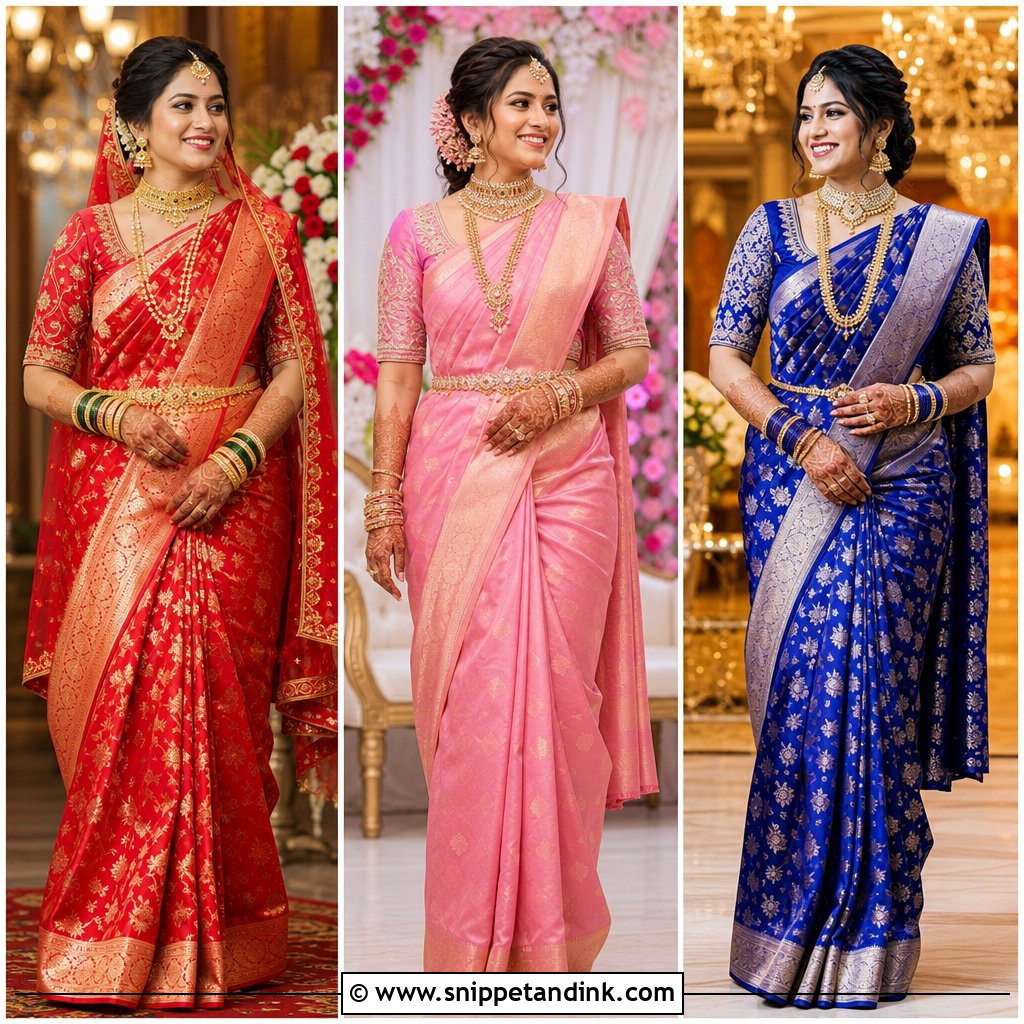
Royal blue or navy Banarasi with gold zari is a jewel-tone choice that still sits within tradition when paired with a red or gold blouse. Traditional gold keeps it grounded, and shakha pola with alta brings in the wedding symbolism. The white mukut stands out sharply against blue, especially over a neat low bun. Blue can make warm skin look slightly grey in shadow, so I add a little more warmth to the cheeks and keep the red lip clear.
26. Bengali Bride Look With Purple Saree
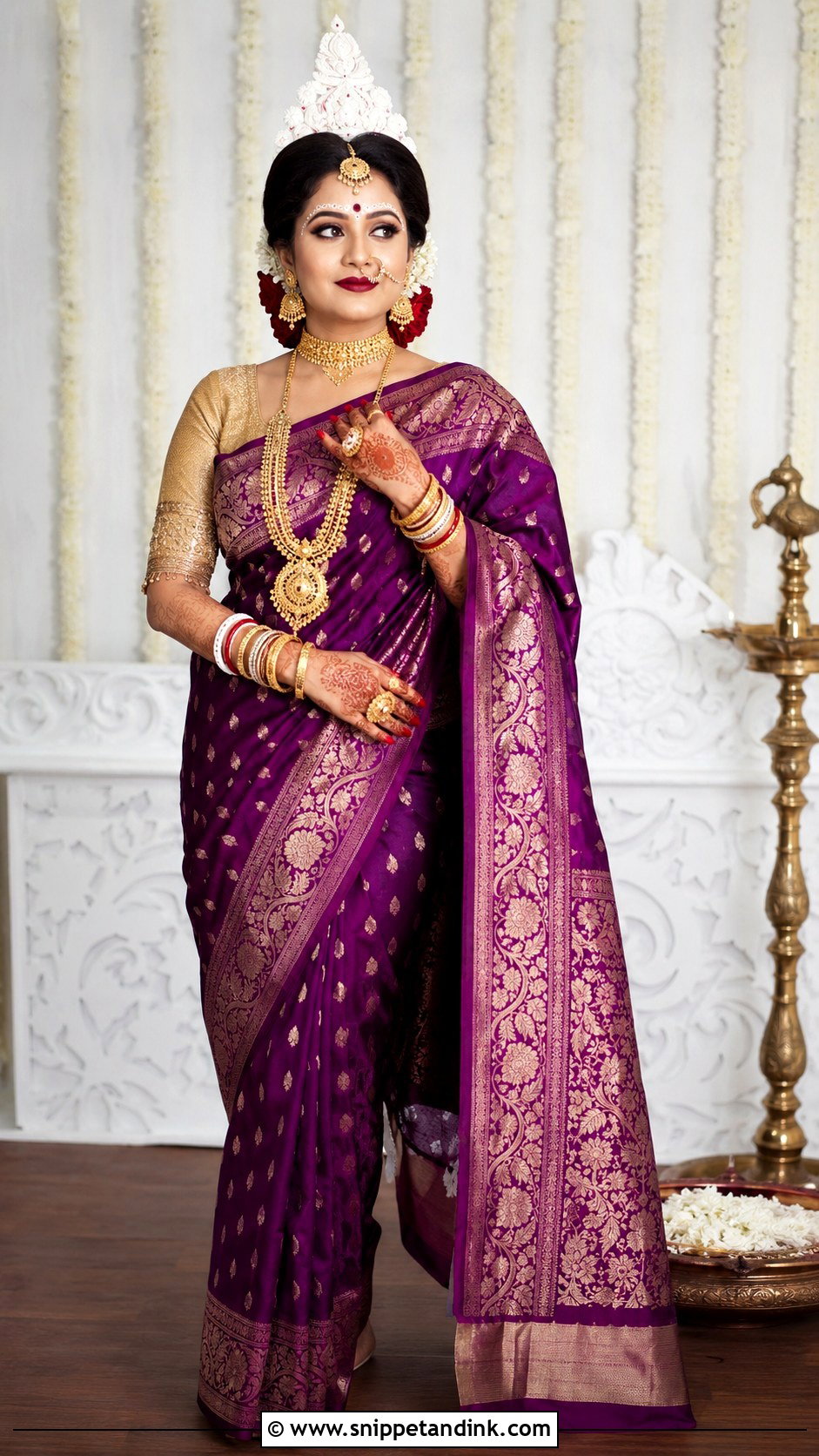
Deep purple Banarasi with antique gold zari looks regal, and it’s one of the colours where antique gold beats bright gold every time. A gold blouse or a purple blouse with traditional embroidery both work. Layered necklaces, jhumkas, tikli and bangles in antique gold, then shakha pola, alta and the shola mukut. I’d go berry-red on the lips rather than orange-red, which clashes with purple. Kajal and chandan keep the face fully Bengali.
27. Bengali Bride Look With Orange Saree
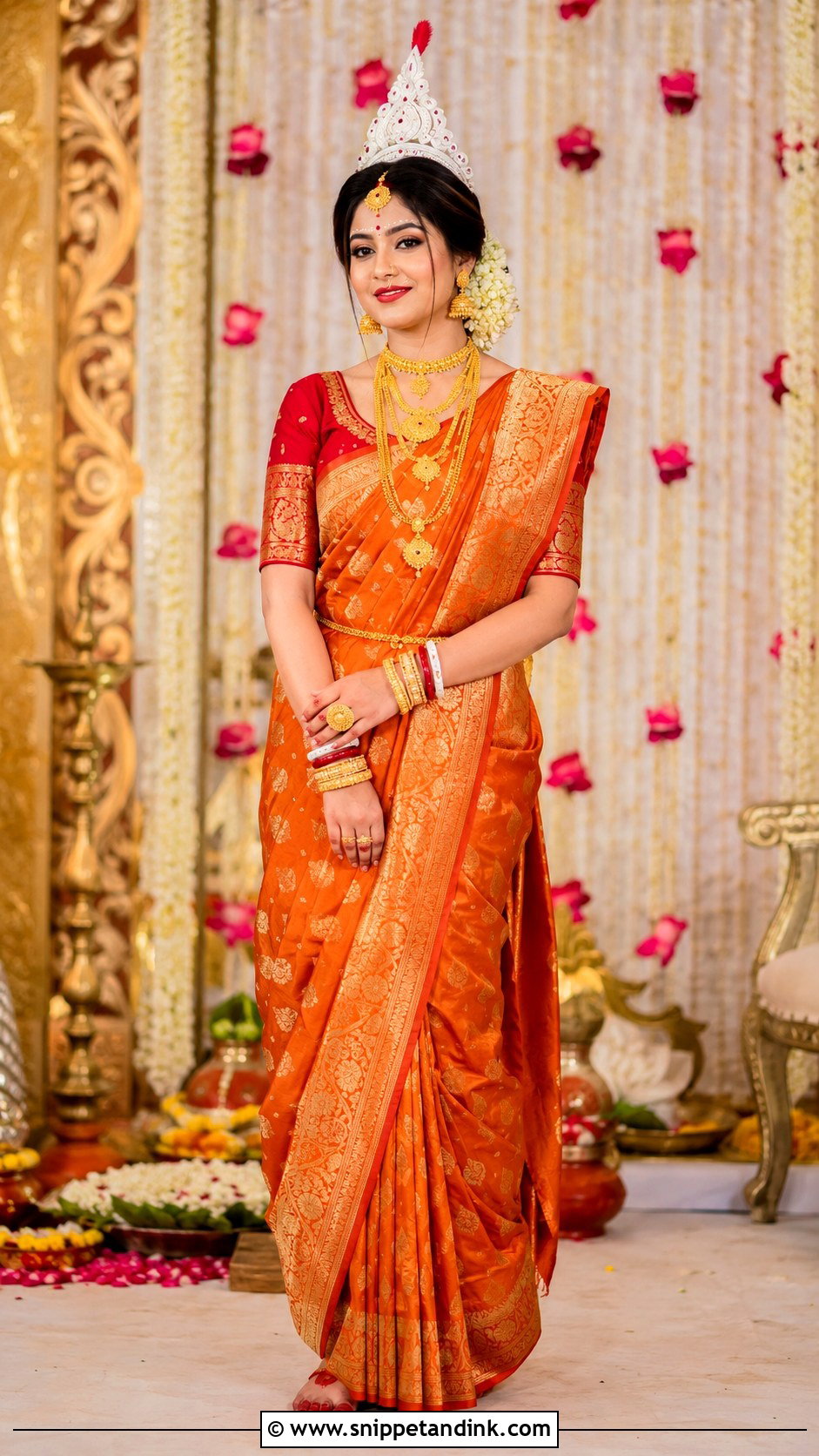
Burnt orange, vermilion and saffron silk all sit in the same warm family as alta and red lips, so this look holds together naturally. A red blouse makes it more classic; a gold blouse softer. Gold necklaces, a tikli, jhumkas, shakha pola and the mukut finish the jewellery. Orange can make the skin look sallow if the foundation is too yellow, so I match the base carefully at the trial. A low bun with jasmine or red flowers suits it.
28. Bengali Bride Look With Red Veil
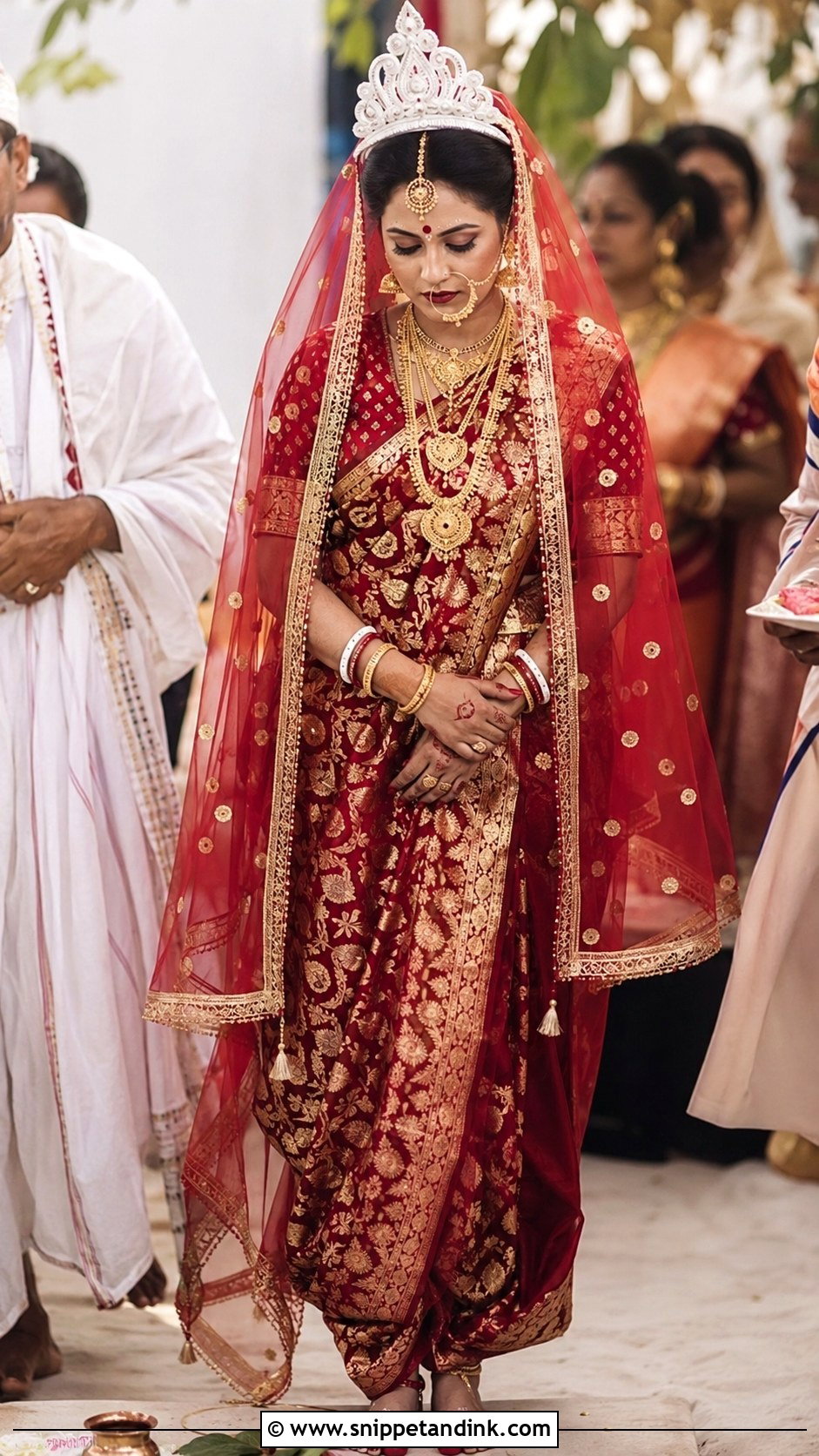
The red veil, or ghomta, is draped lightly over the head for ceremony moments. Over a red or maroon Banarasi, choose a sheer net or georgette veil so the mukut and jewellery show through. A structured blouse matters because the veil frames the upper body. Gold necklaces, jhumkas, tikli, nath, shakha pola and bangles finish it. The veil rubs against the cheeks and forehead, so I set the chandan and base well, and pin the veil to the bun under the mukut rather than letting it rest on the crown.
29. Bengali Bride Look With Traditional Saree Draping
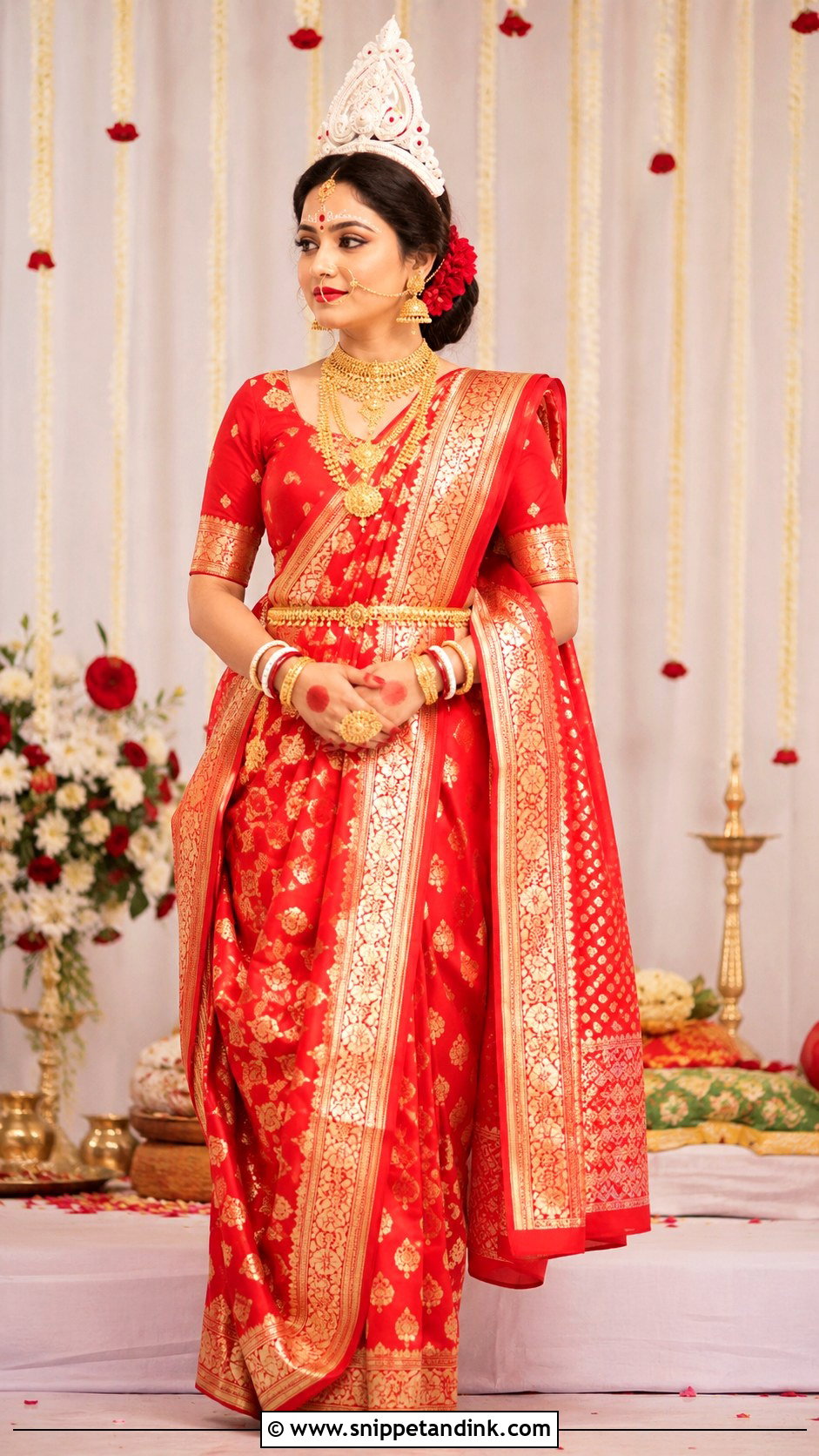
The drape shapes the whole silhouette. The traditional Bengali style has wide, visible pleats and a pallu brought over the shoulder, and many brides finish it with the pallu pulled over the head as a ghomta. Red Banarasi, laal paar or maroon silk all drape well. The border should run clearly along the front so it shows in photos. A fitted blouse, layered necklaces, jhumkas, tikli, shakha pola and mukut go on top, with alta and a low bun. A heavy Banarasi needs more safety pins than people expect, placed inside the pleats where they won’t show.
30. Bengali Bride Look With Heirloom Saree
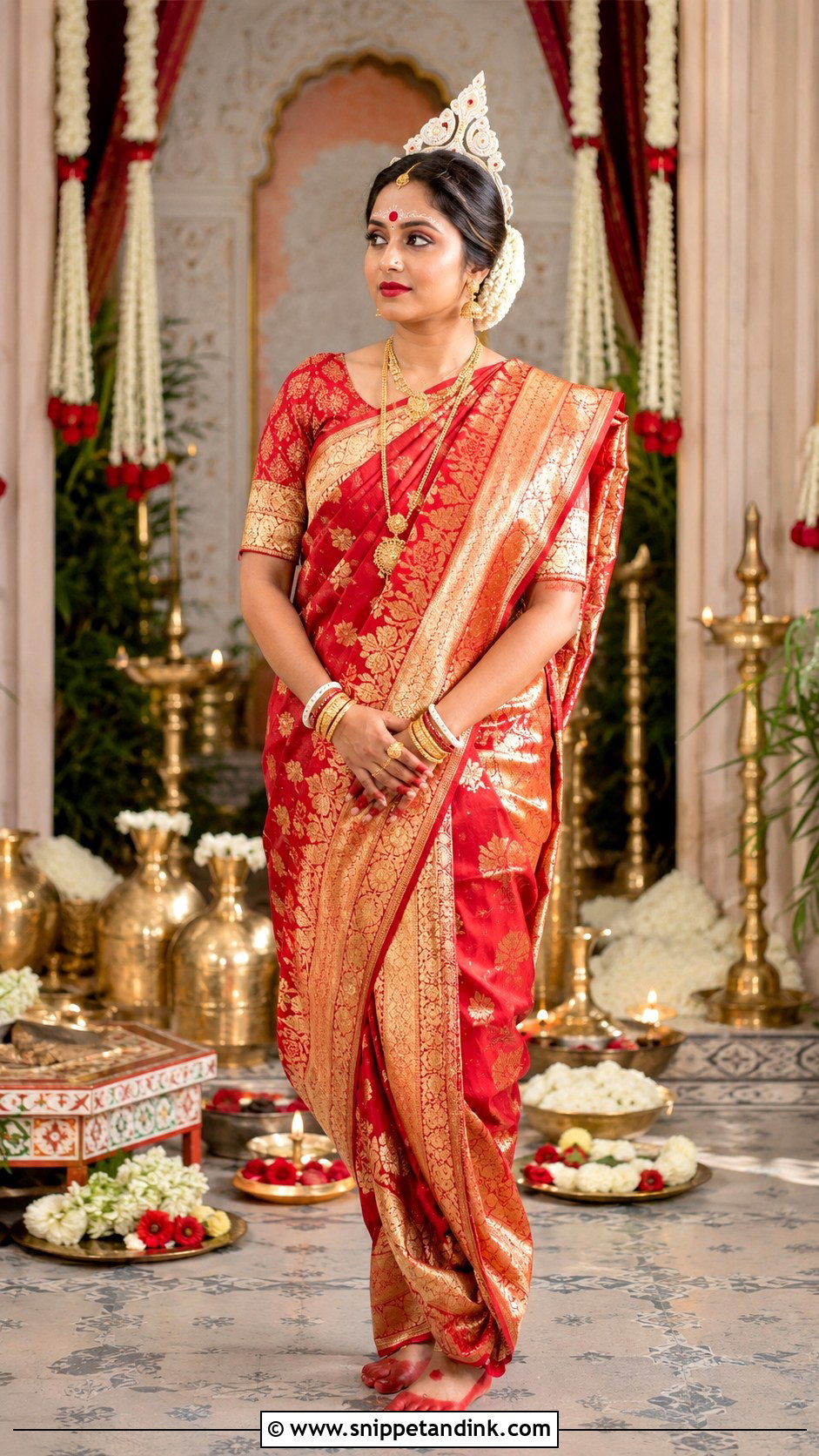
Heirloom sarees carry the most emotion of any look here, and they need the most care. Older silk can be weak along the folds, so I avoid heavy pins and use small brooch pins through the blouse instead of through the silk wherever possible. Red, maroon, laal paar or gold, the styling still has to feel bridal: a well-fitted blouse, traditional gold, shakha pola, tikli, jhumkas and the shola mukut. Red lips, chandan, alta and a neat low bun bring the full look together for a bride honouring her mother or grandmother.
Holding Chandan, Kajal and Alta Through a Long Night of Rituals
A Bengali wedding often runs late into the night, and the bride spends much of it seated near the sacred fire, which is warm and smoky. At subho drishti she holds betel leaves in front of her face; at sindoor daan the vermilion often falls onto the nose. All of that is part of the tradition, and the makeup has to be planned around it.
- Use a long-wearing, sweat-resistant base and set it lightly in layers rather than one heavy coat of powder.
- Choose a smudge-proof kajal; standard kohl melts in the heat near the fire.
- Draw chandan with a long-wearing cosmetic paint and keep the lines thin. Thick paste cracks as the skin moves.
- Blot the lips before subho drishti so the colour doesn’t print onto the betel leaves.
- Give a bridesmaid blotting papers, cotton buds, a little white paint and a red lip pencil for touch-ups between rituals.
Carrying a Heavy Banarasi and Mukut for Hours
A heavy Banarasi, layered gold and a mukut add up to real weight, and brides sit on the floor or a low piri for long stretches. I pin the pallu so its weight rests on the blouse shoulder rather than pulling at the neck, and I check that the mukut pins don’t press on one spot of the scalp. If something pinches during the trial, it will hurt by the third hour, so say so then. Many brides fast on the wedding day by custom, so ask the family what is allowed, even just water or fruit; a fasting bride in a tight blouse and heavy gold is the one most likely to feel faint.
Saree, Gold, Mukut and Alta Should Look Like One Bride
A traditional Bengali bridal look has a lot of parts, and that’s what makes it so rich. Some brides want the classic red Banarasi with gold and mukut; others reach for cream, ivory, maroon, green or pastel with strong cultural details. What matters is that the saree, blouse, jewellery, hair, mukut, shakha pola, alta, makeup and drape agree with each other. Plan them together at one trial, and choose the version you’ll feel comfortable in from the first ritual of the evening to the last.
You'll Like These Ideas:



Leave a Reply