
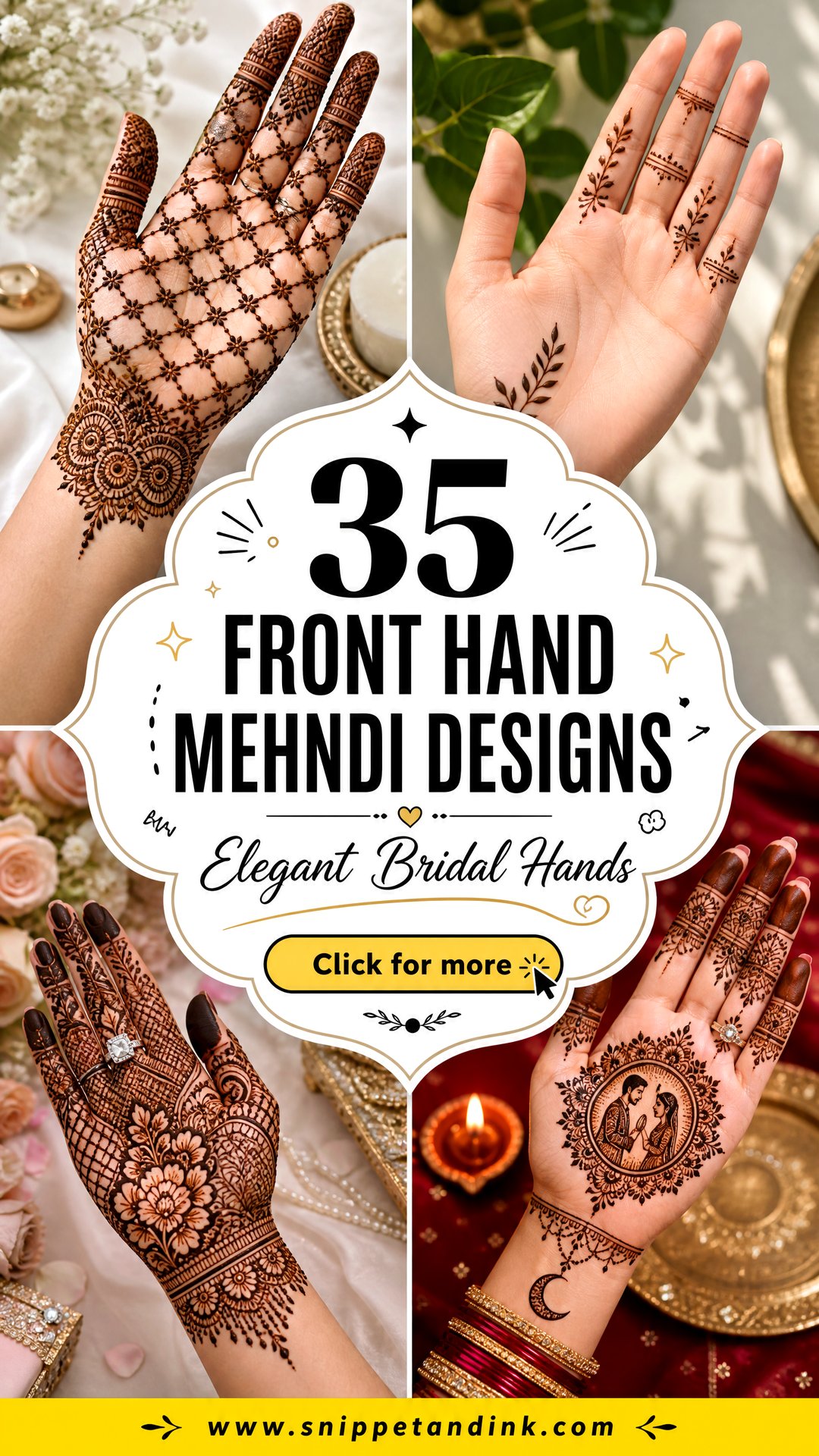
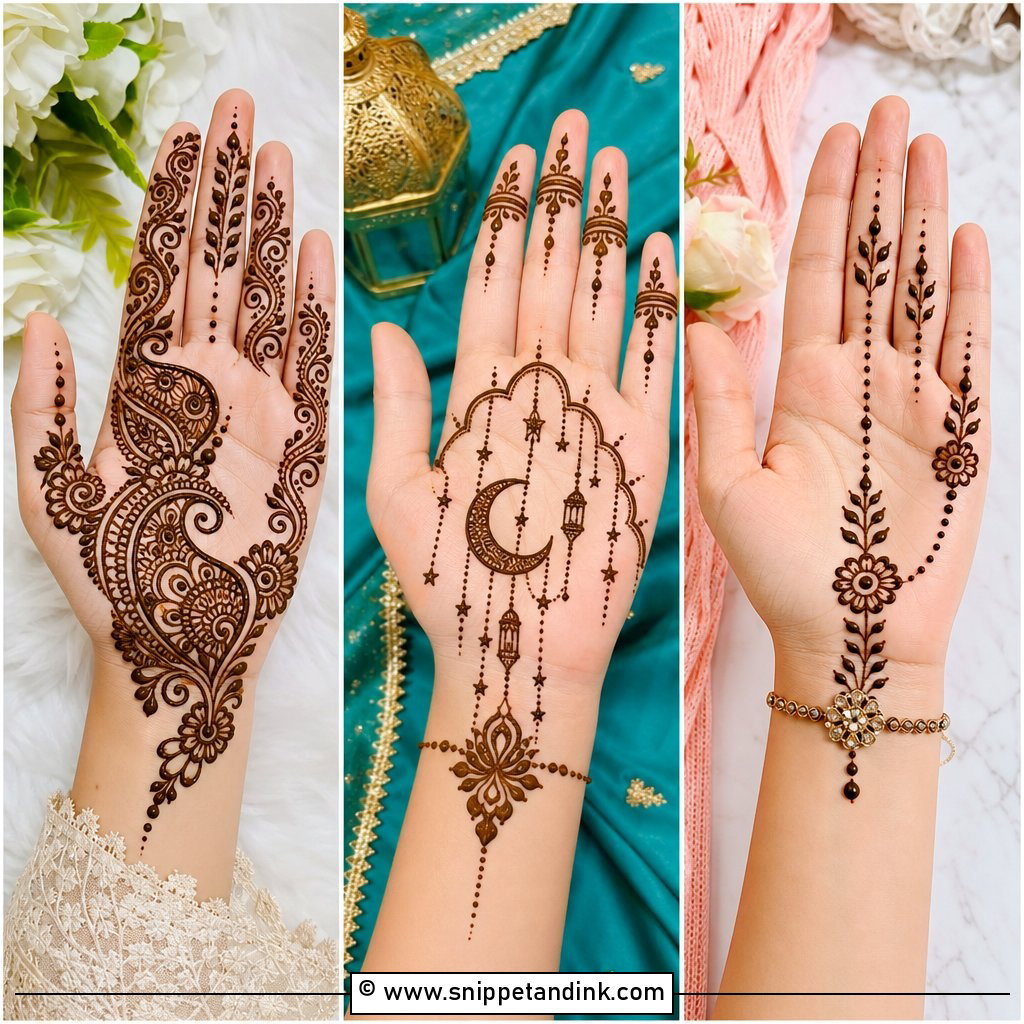
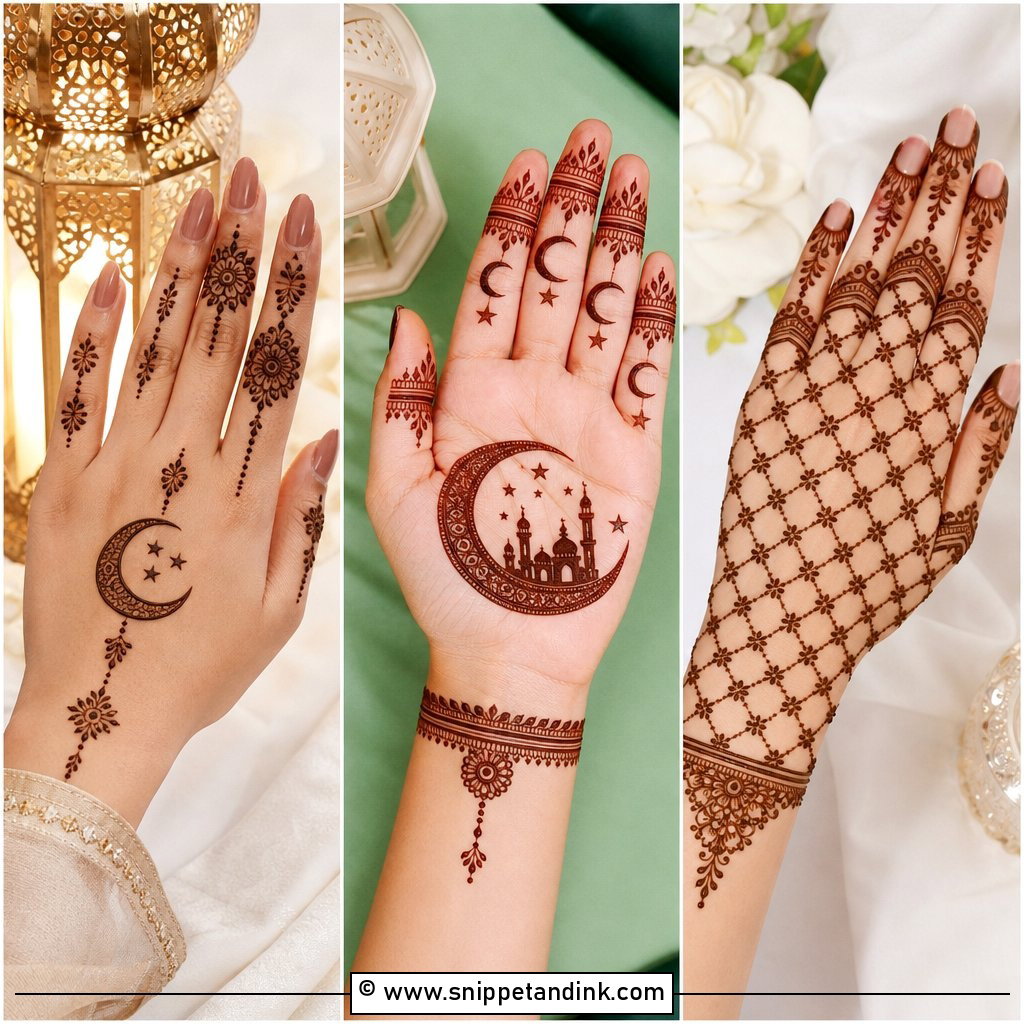
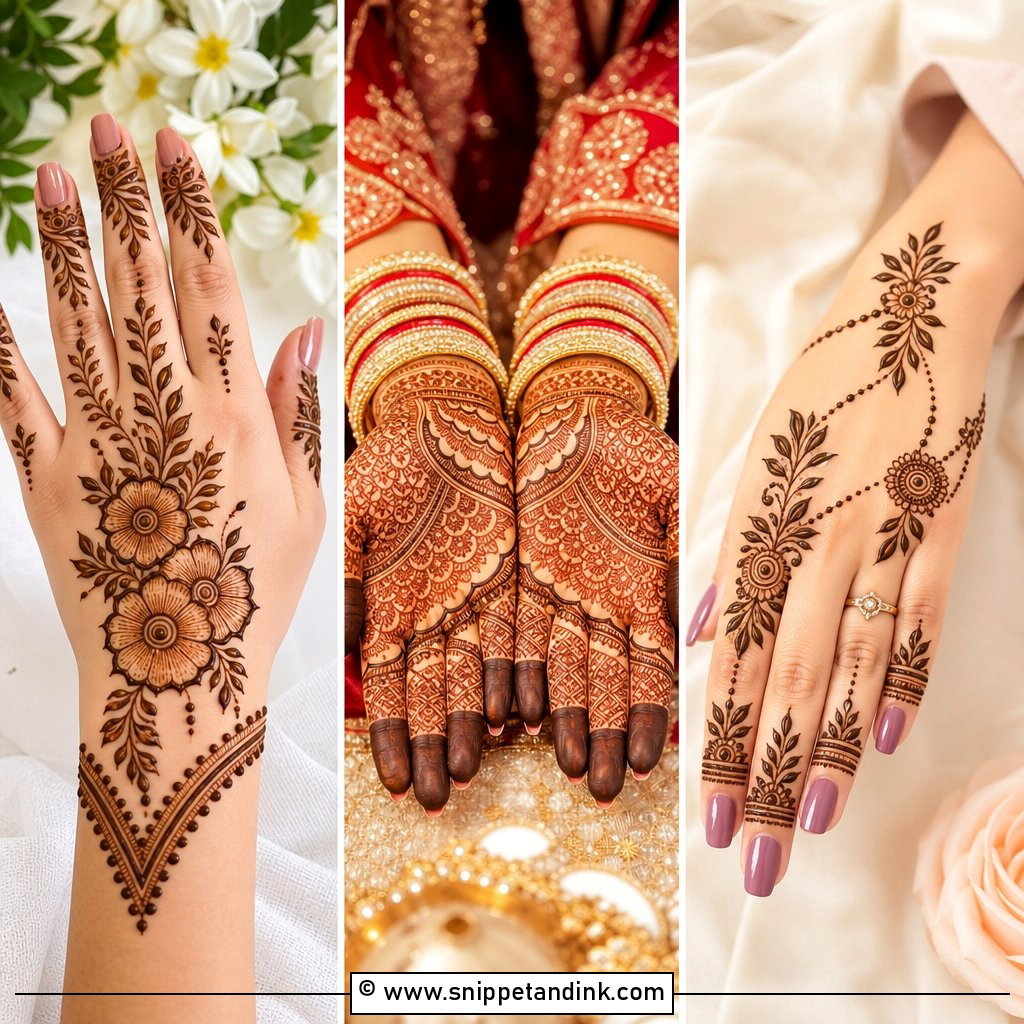
Ask any henna artist which side of the hand matters most and you’ll get the same answer: the palm. It’s what you offer for the ring, what you fold in your lap, what you hold up to the camera. It also gives me the most room to work, enough for mandalas, flowers, paisleys, jaali, vines and wrist cuffs. The 35 palm designs below run from a single tikki to full bridal storytelling. I’ve written each one up the way I’d talk a client through it at my table: what it suits, how long it takes, and the detail that decides whether it looks clean or crowded two days later.
Why One Palm Goes Maroon and Another Stays Orange
Most of a dark stain is decided before the cone touches your hand. The design matters far less than the paste, and the paste is something you can ask any artist about.
- Fresh, finely sifted henna powder. Old powder loses its dye, and coarse powder clogs fine cone tips.
- Time to release dye. Natural henna paste usually rests for several hours to a day after mixing before it’s ready, depending on the powder and the room temperature. Paste used too early stains weakly.
- Essential oils suited to skin, such as eucalyptus or tea tree, which many artists add to help the stain develop. If you’re pregnant or have sensitive skin, ask what’s in the mix.
- Cones that are either freshly made or frozen. Paste left in a warm cone for days loses strength.
The hand matters too. I ask clients to come with clean, dry palms and no lotion, and to skip waxing or scrubbing the hands that day. Then the paste needs to stay on long enough. I tell brides to plan for at least six hours, and overnight is better. When someone shows me a pale stain, the usual story is that the paste came off after an hour.
1. Simple Front Hand Mehndi Design
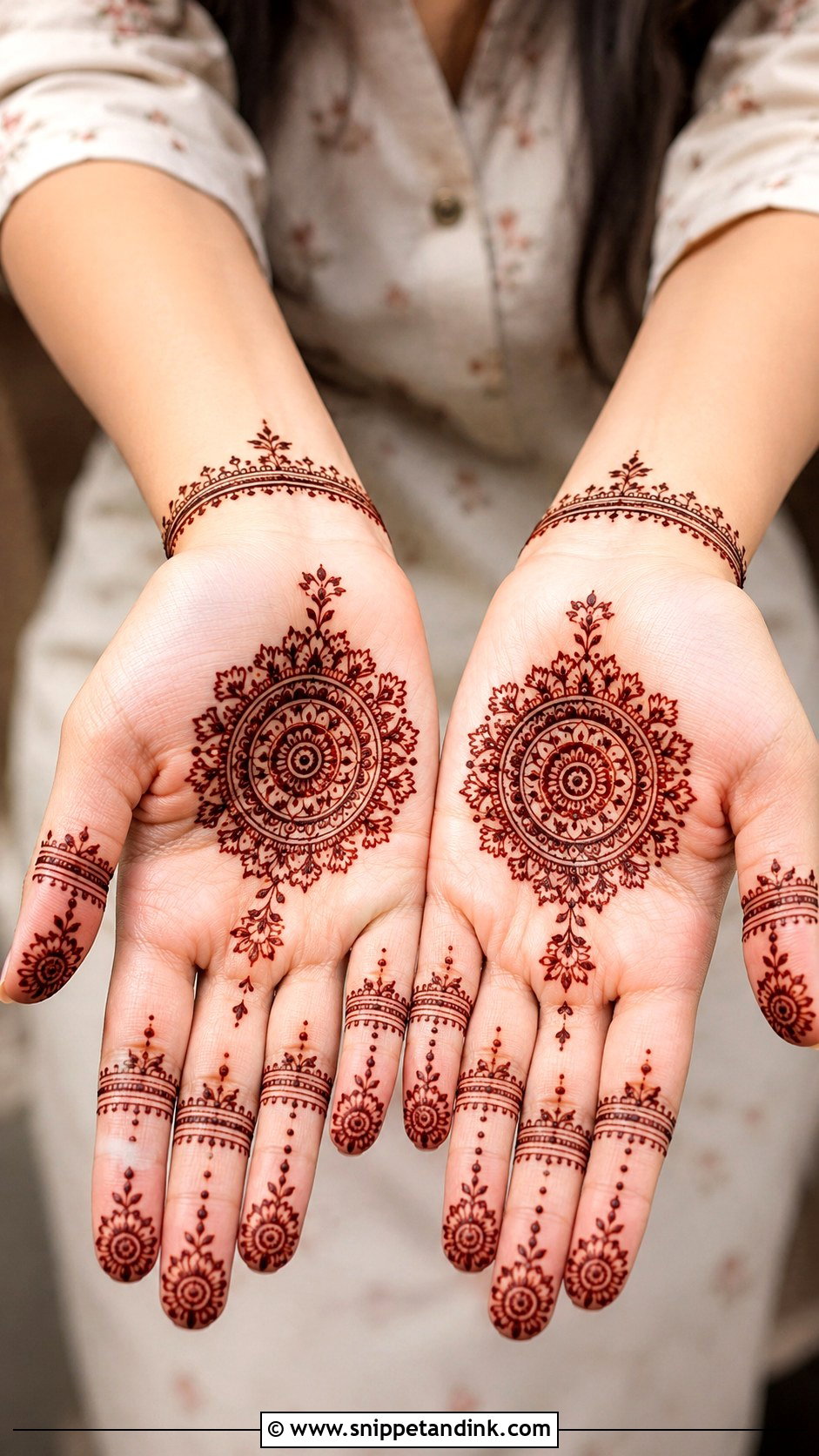
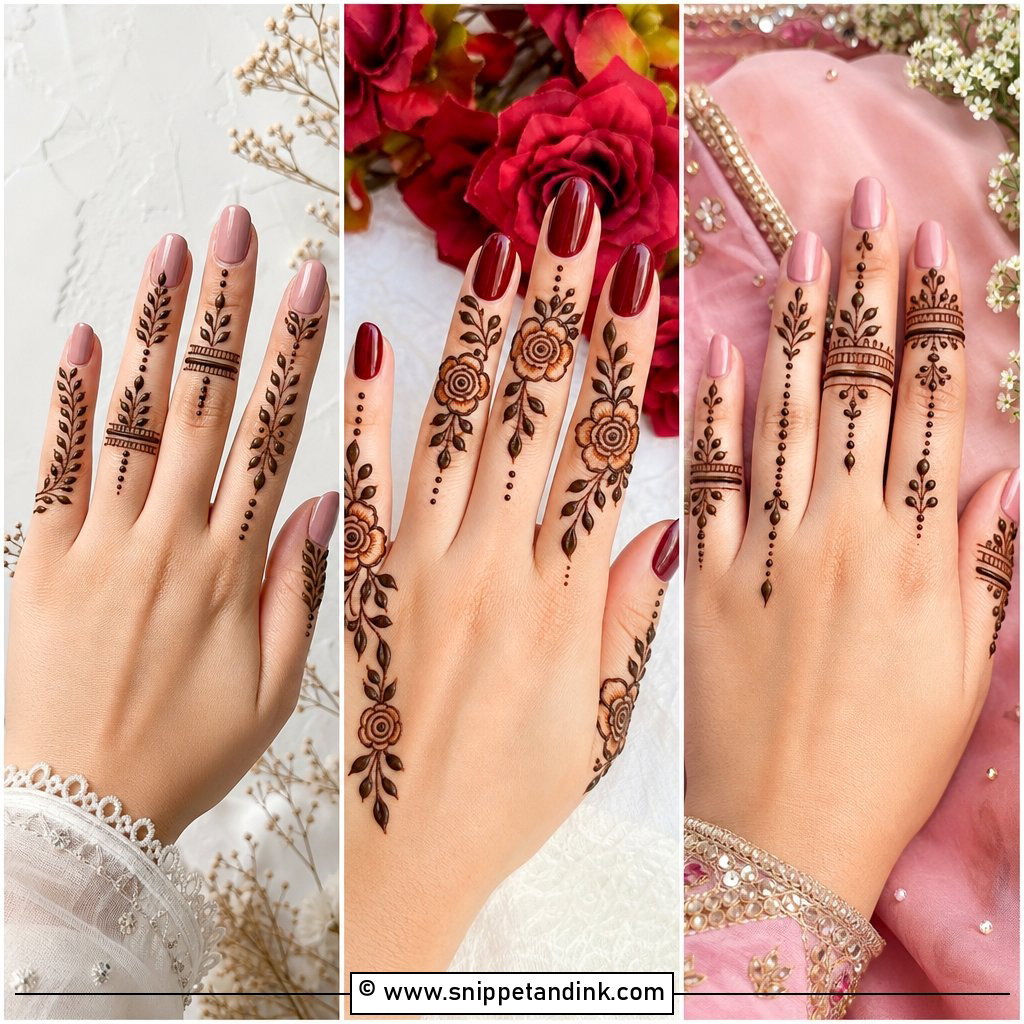
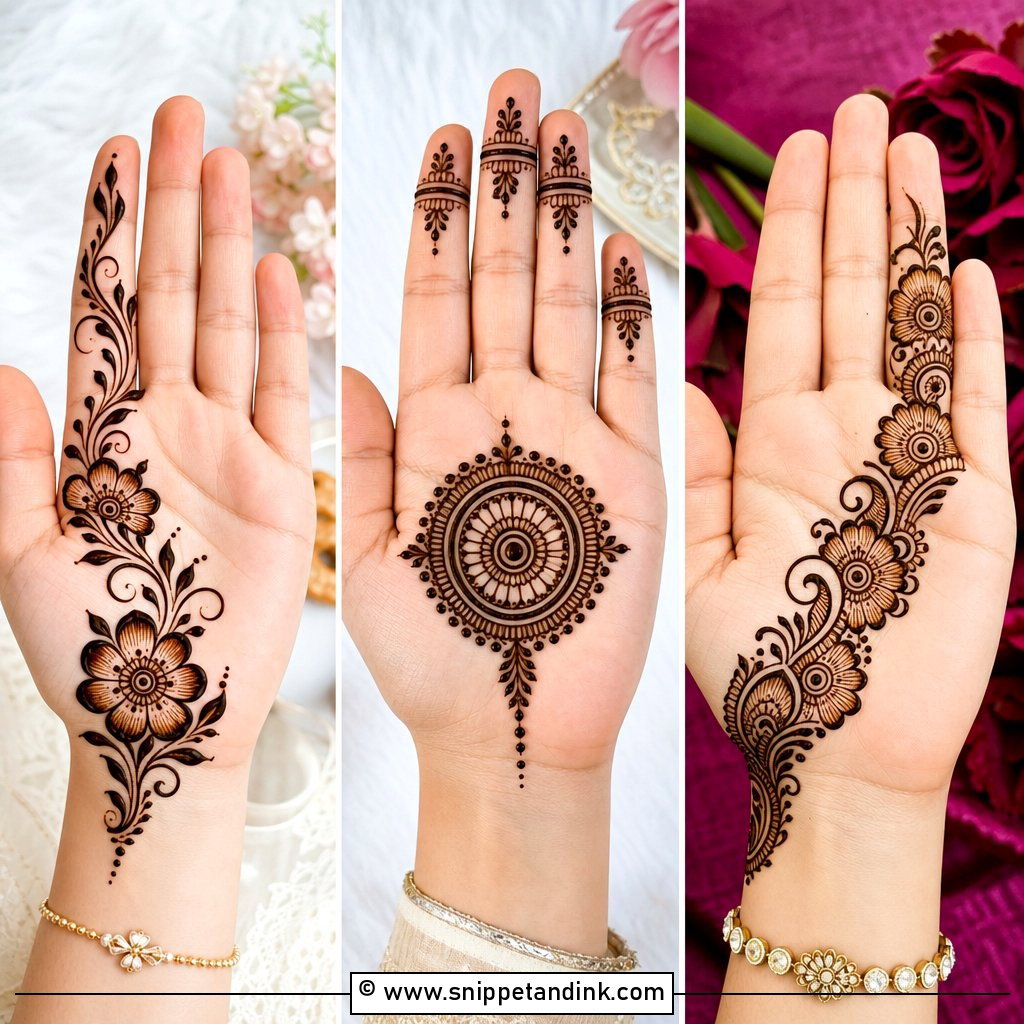
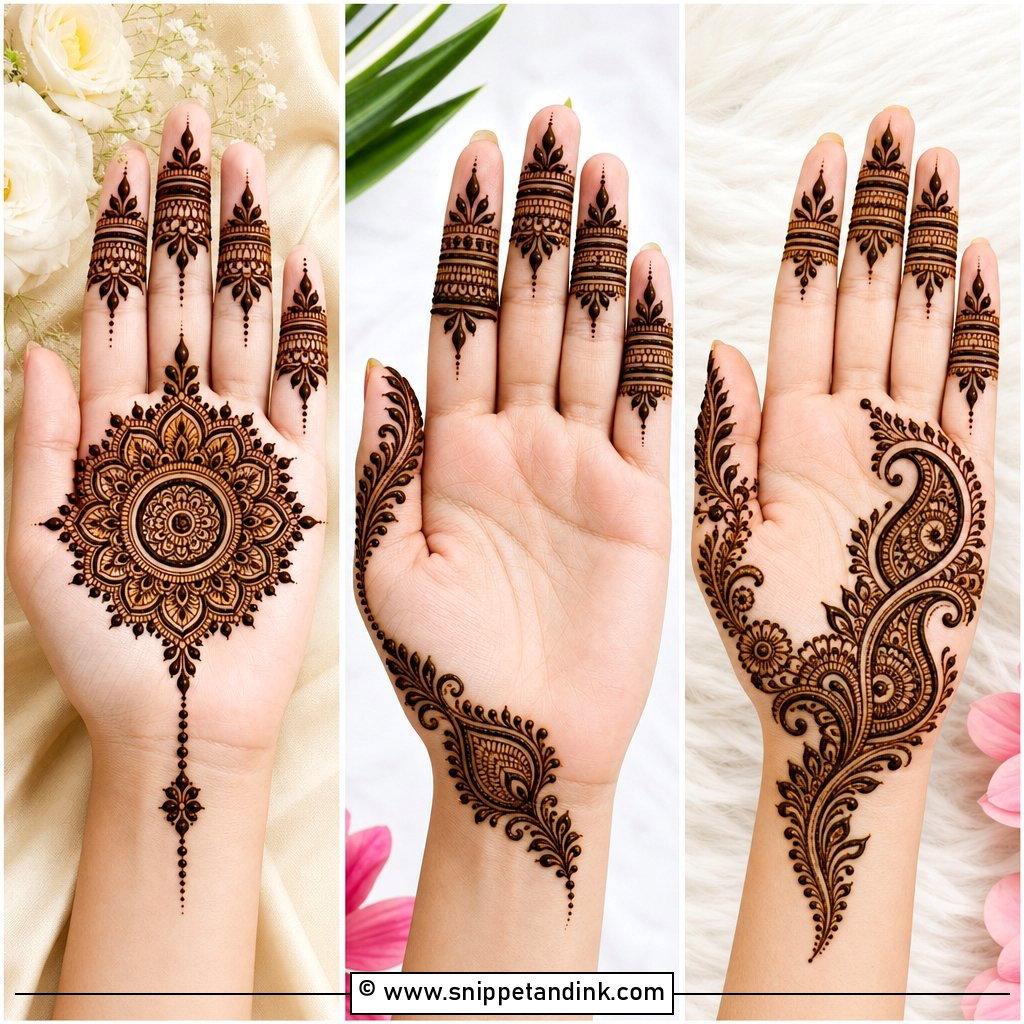
Start here if you’ve never sat for mehndi. A neat mandala or small floral circle in the palm, light bands and leaves on the fingers, one slim line at the wrist. The spacing is forgiving, the shapes are easy to repeat, and it’s dry before your tea gets cold. I leave a ring of bare skin around the center motif so it reads clearly from a distance. Good for school events, small festivals and anyone who wants something to wear to work the next day.
2. Arabic Front Hand Mehndi Design
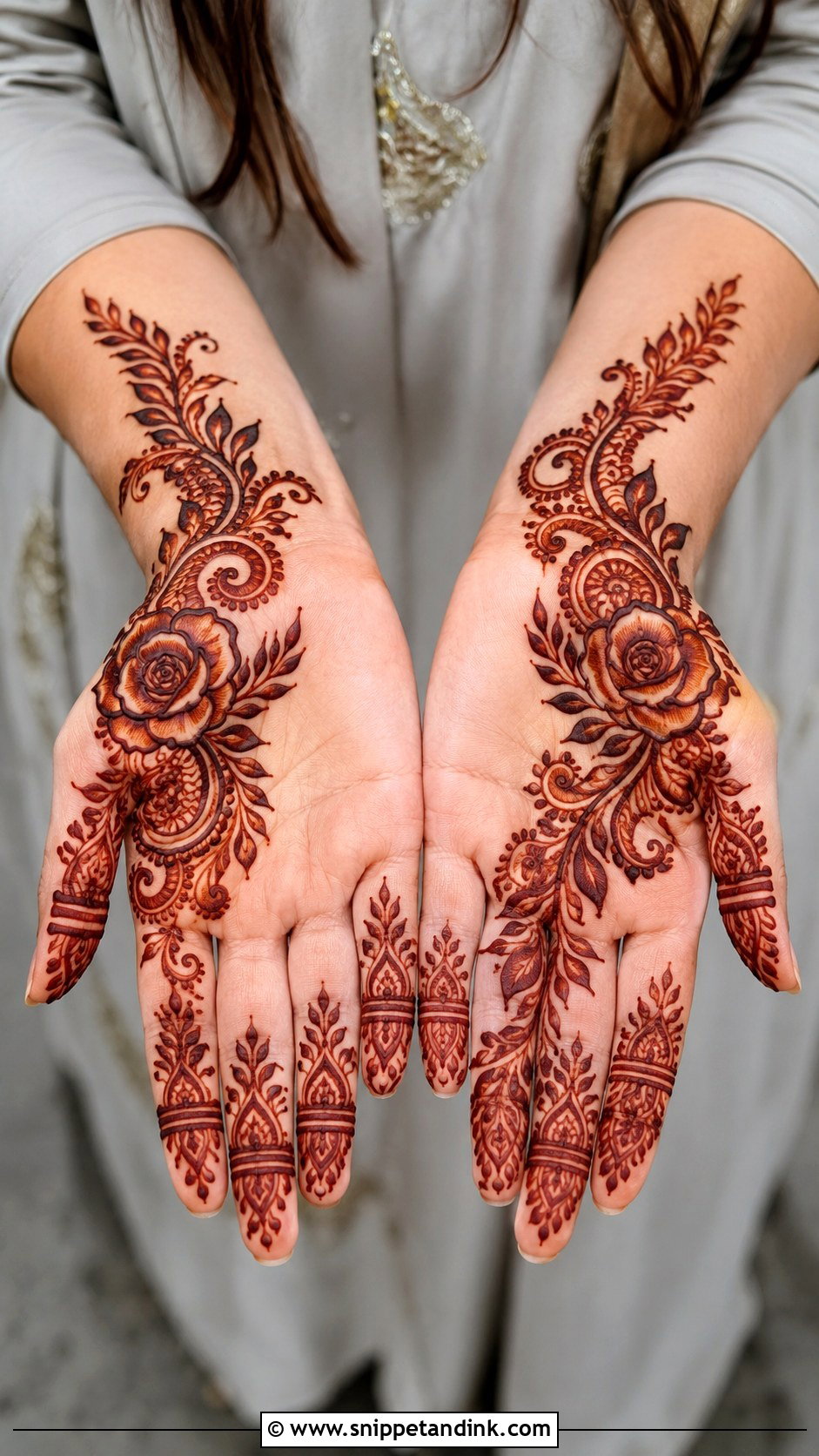
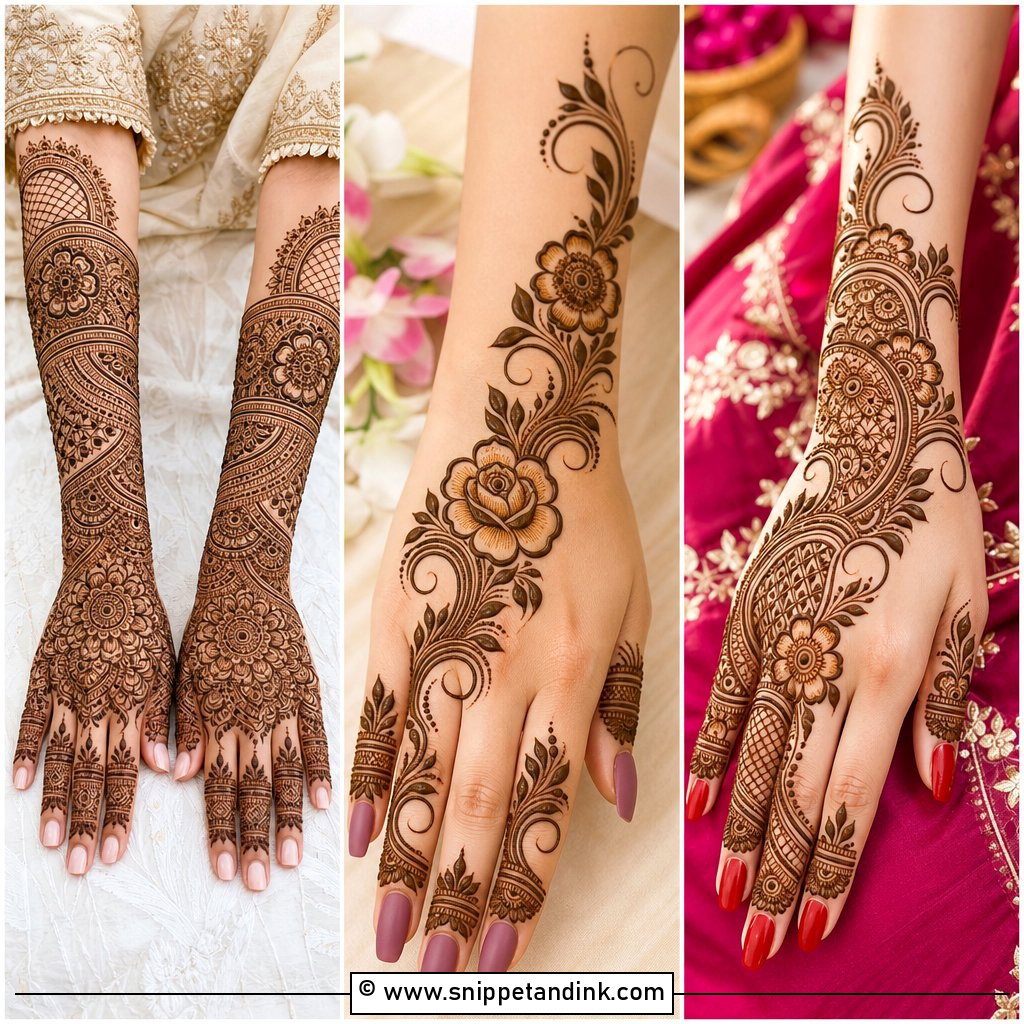
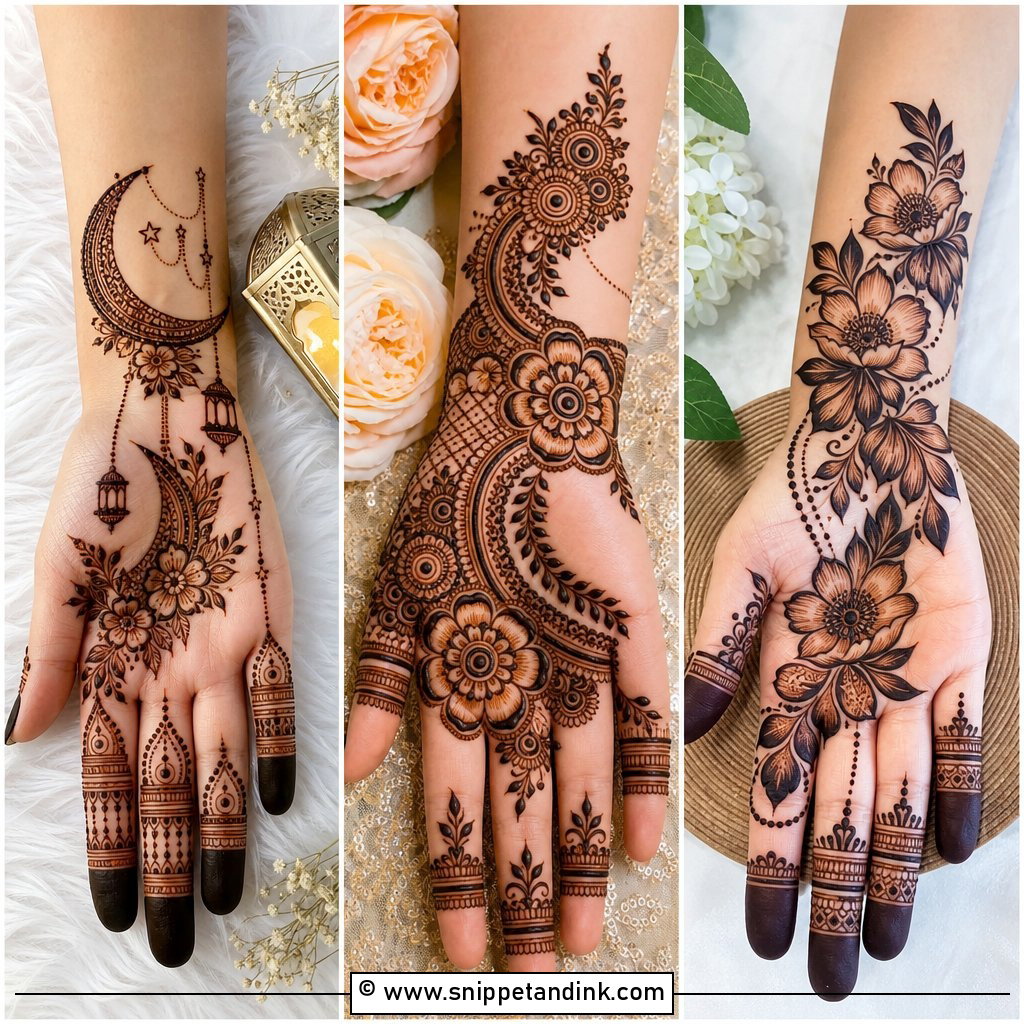
Arabic palms are about movement. A diagonal trail of large flowers, curved leaves, paisleys and shaded petals runs from the wrist to the fingers, and the bare skin around it is as much a part of the design as the henna. Thick outlines with fine inner detail is the formula. I check the client’s hand relaxed and slightly cupped before I commit to an angle, because a trail that looks right on a flat palm can bend oddly when the fingers curl.
3. Full Front Hand Mehndi Design
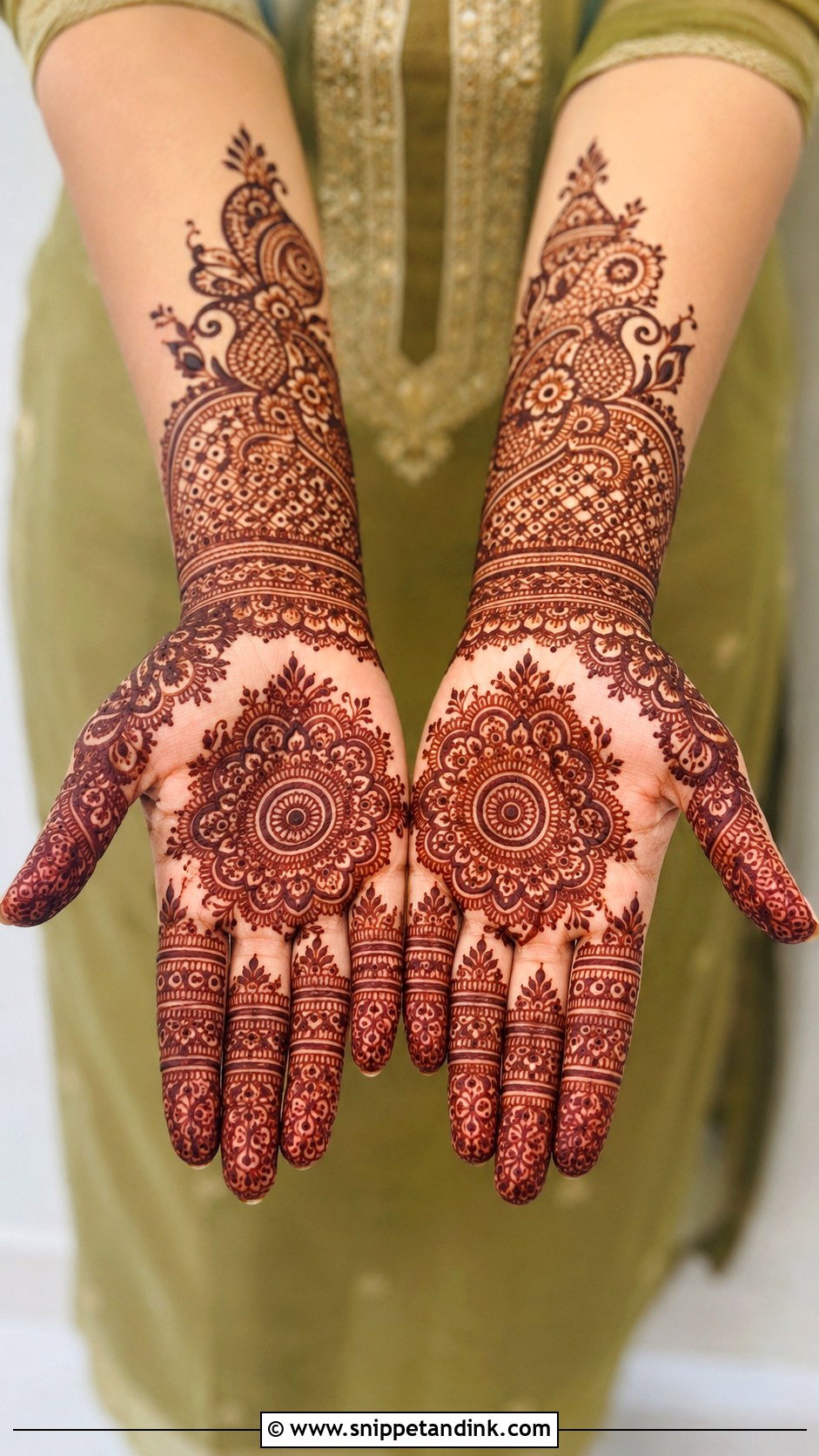
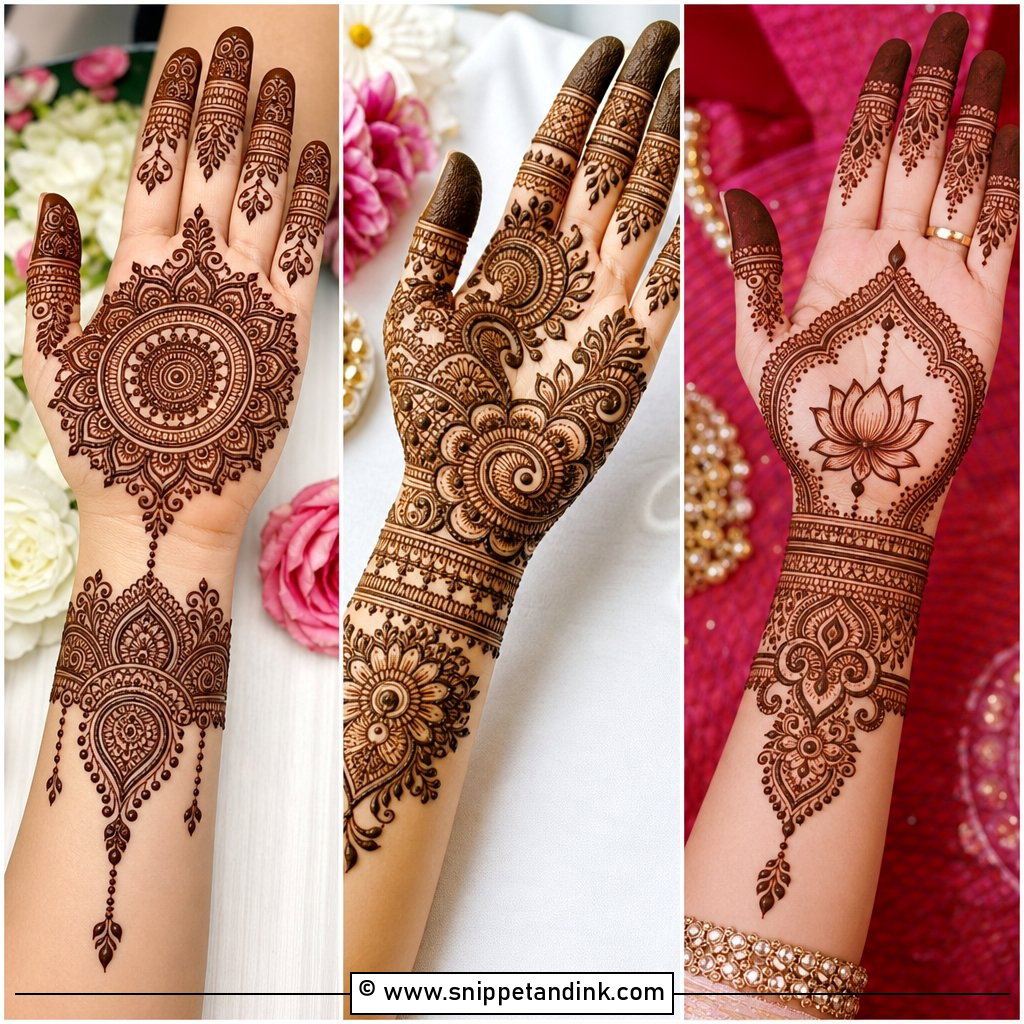
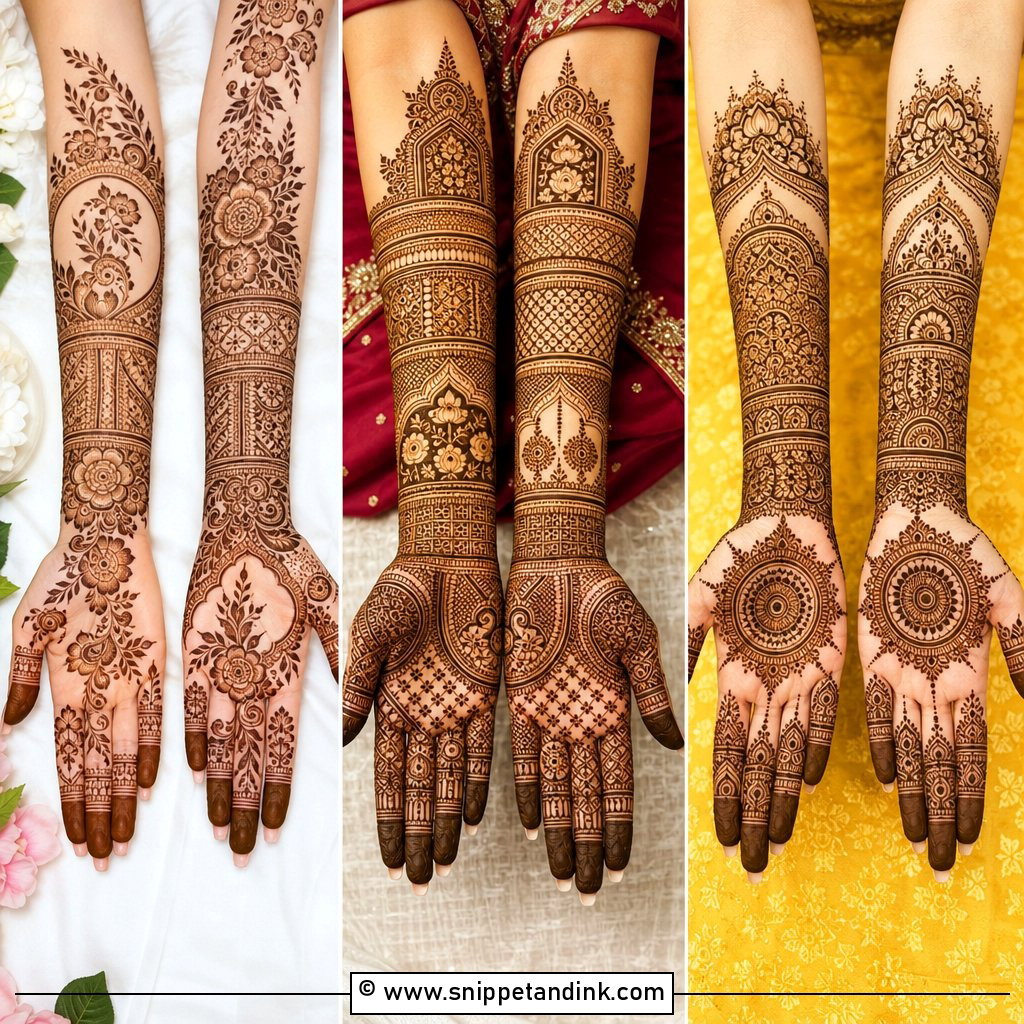
Fingertip to wrist, every bit of the palm covered: a central mandala, paisley cluster or floral medallion, with vines, dots, leaf chains and fine mesh filling the rest. It suits weddings, engagements, Eid and Diwali. The fingers have to feel joined to the palm rather than stuck on, so I carry one repeated band from the palm up each finger. And I divide the palm into sections before I start filling. Full coverage without a plan is how a hand ends up looking muddy.
4. Bridal Front Hand Mehndi Design
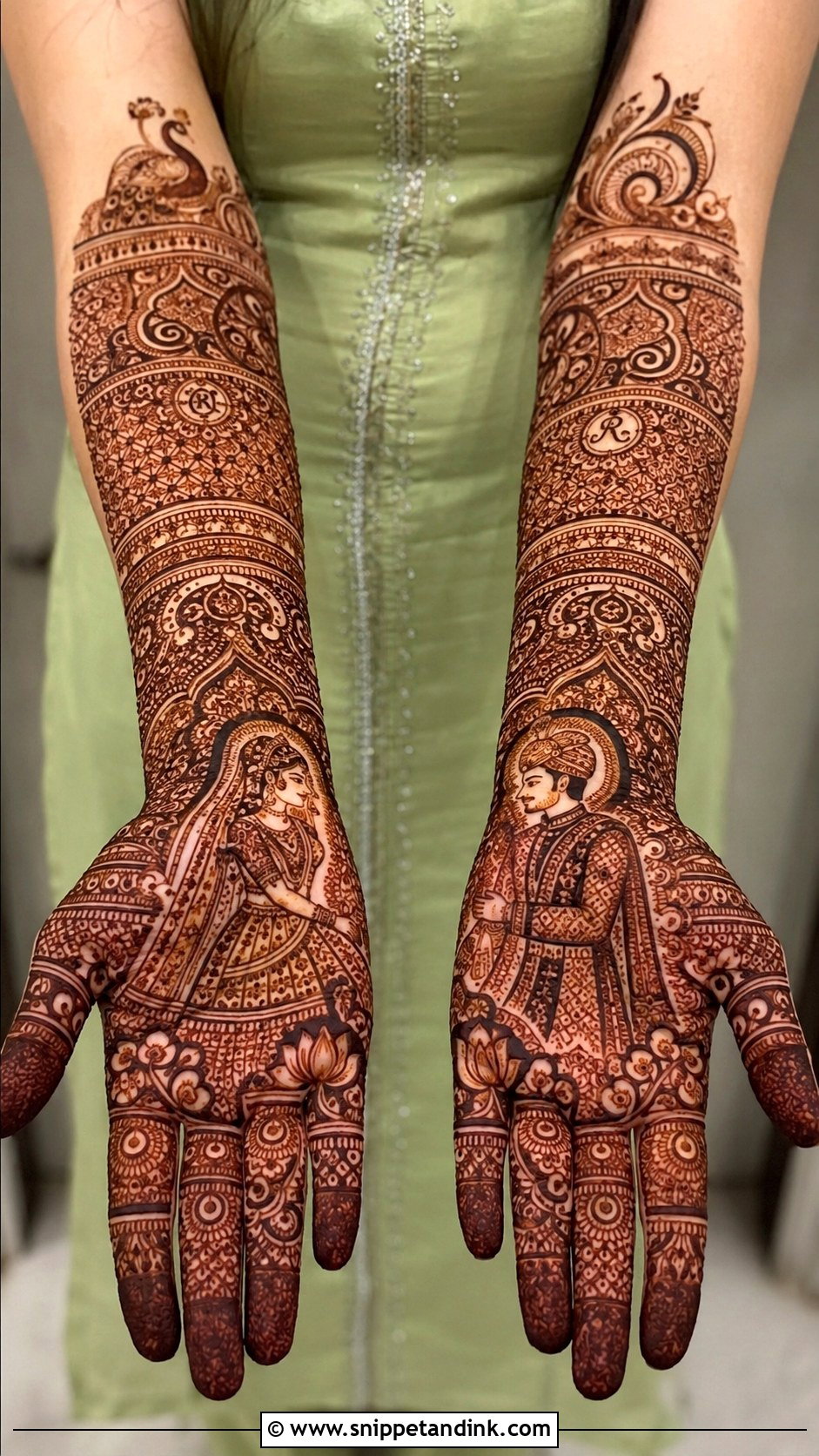
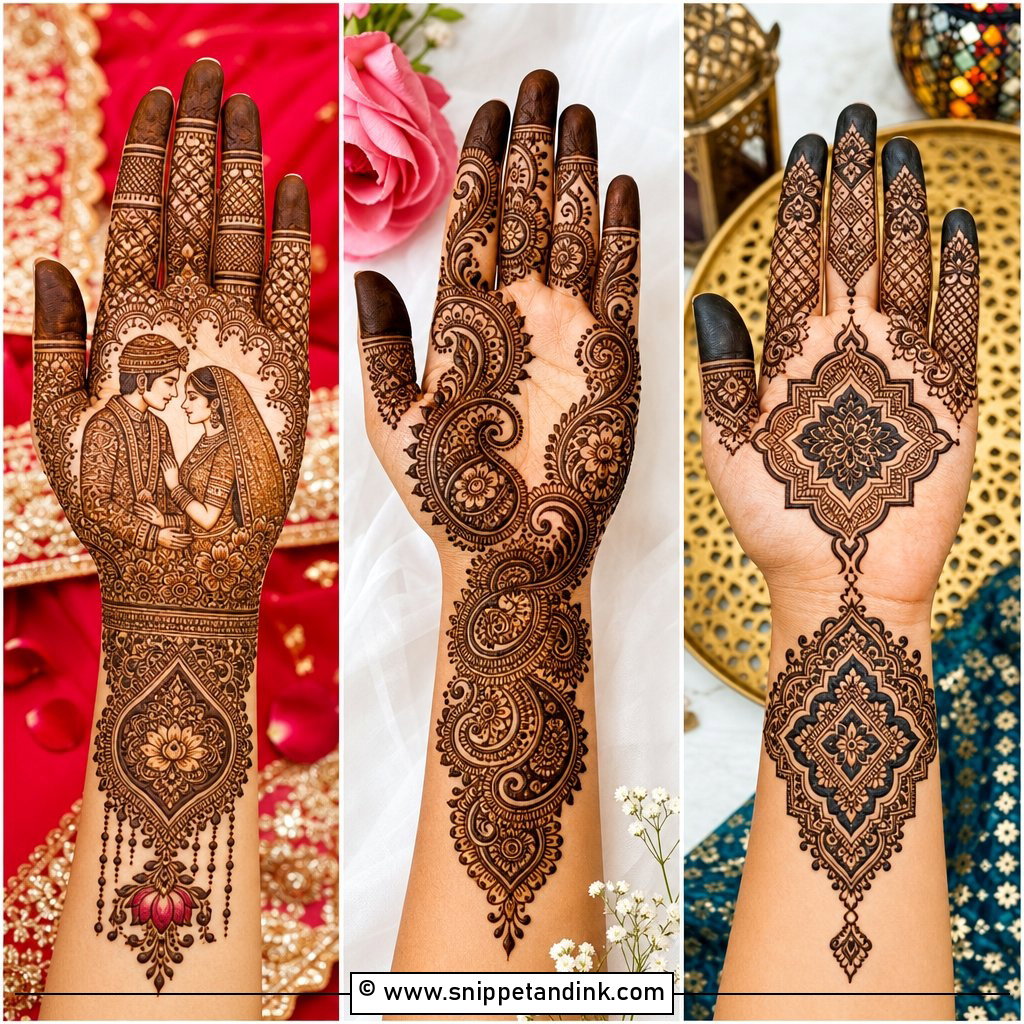
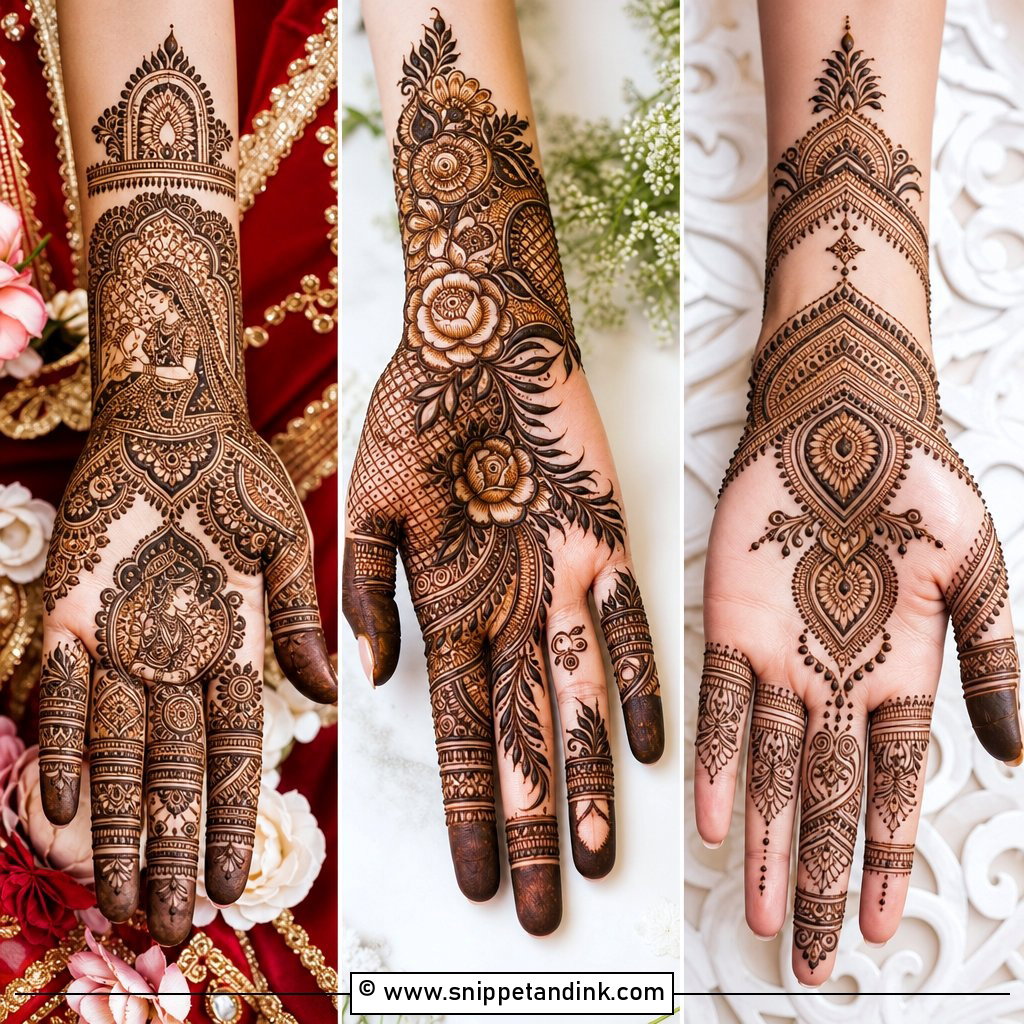
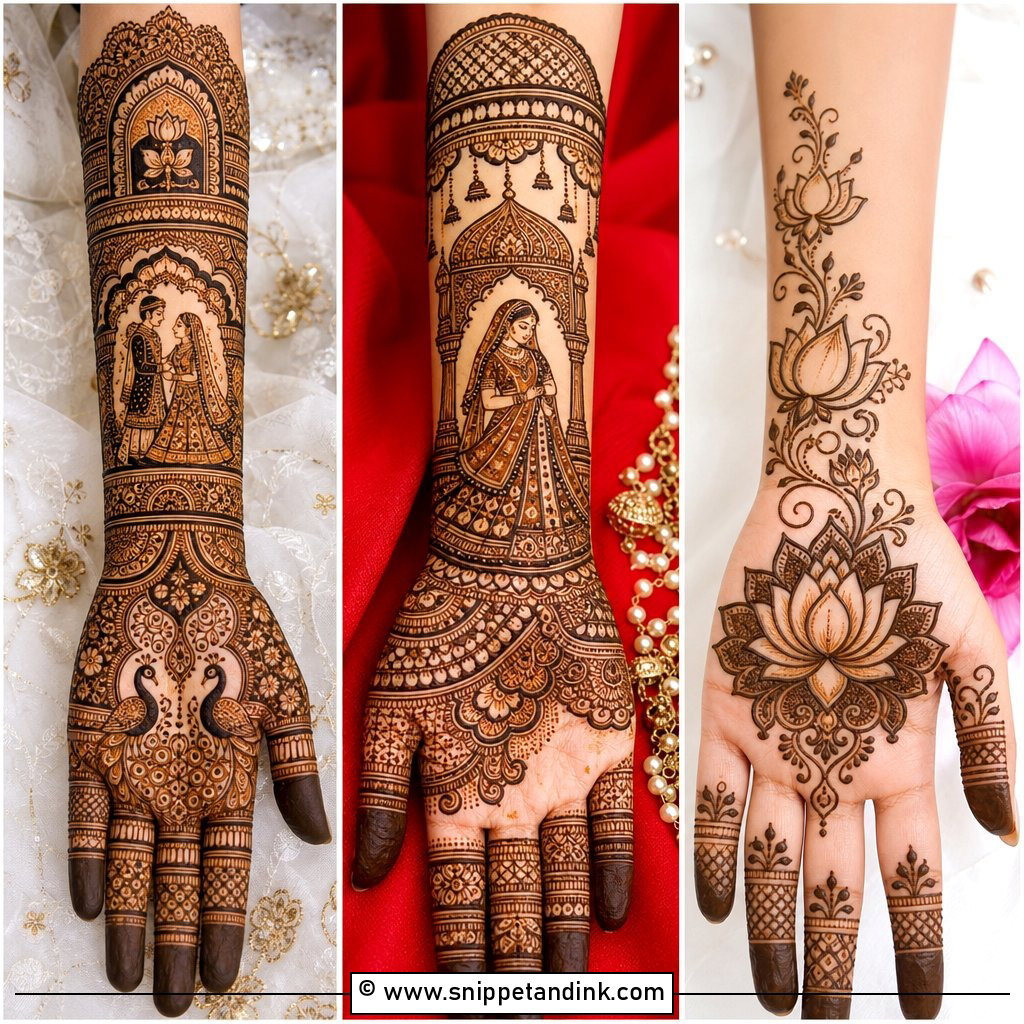
Bridal palms usually run past the wrist, with peacocks, paisleys, a bride and groom pair, lotus motifs or initials hidden in the pattern, fine net and tiny florals on the fingers, and a cuff at the wrist. I like the two hands to work as a pair, either mirrored or telling one story across both, so the groom’s figure on one palm faces the bride’s on the other. Dense Indian coverage and a lighter version with a little negative space are both valid. The finishing details take the longest, so I never rush the last hour.
5. Front Hand Mandala Mehndi Design
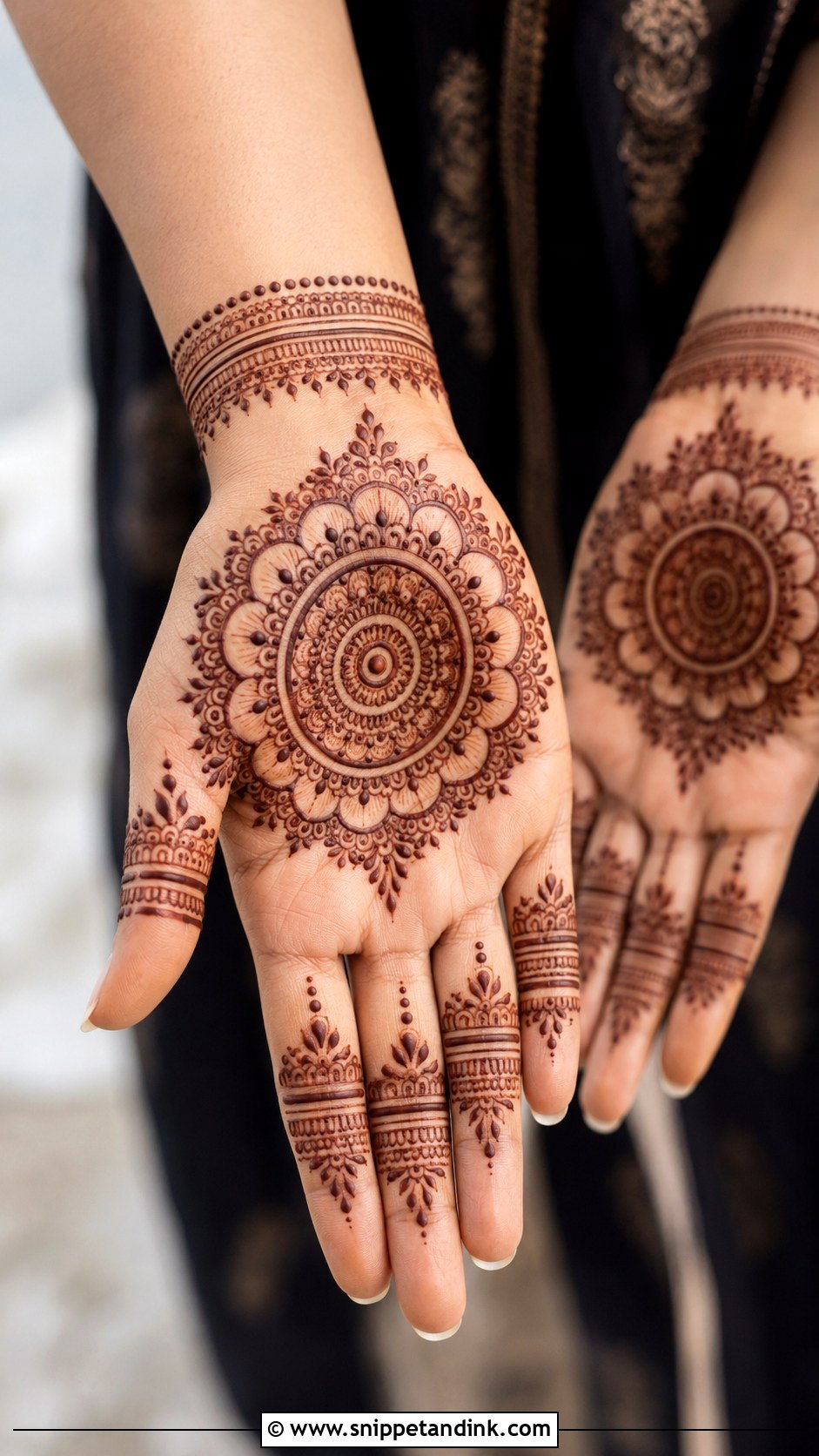
One circle, centered in the palm, built from rings, petals, dots, scallops and tiny leaf borders. It flatters almost every hand and takes much less time than a full design. Where clients go wrong is placing it too close to the fingers. The visual center of the palm is lower than people expect, roughly where the palm hollows when you cup your hand. A clean gap around the circle and a matching mini motif on each finger finish it.
6. Floral Front Hand Mehndi Design
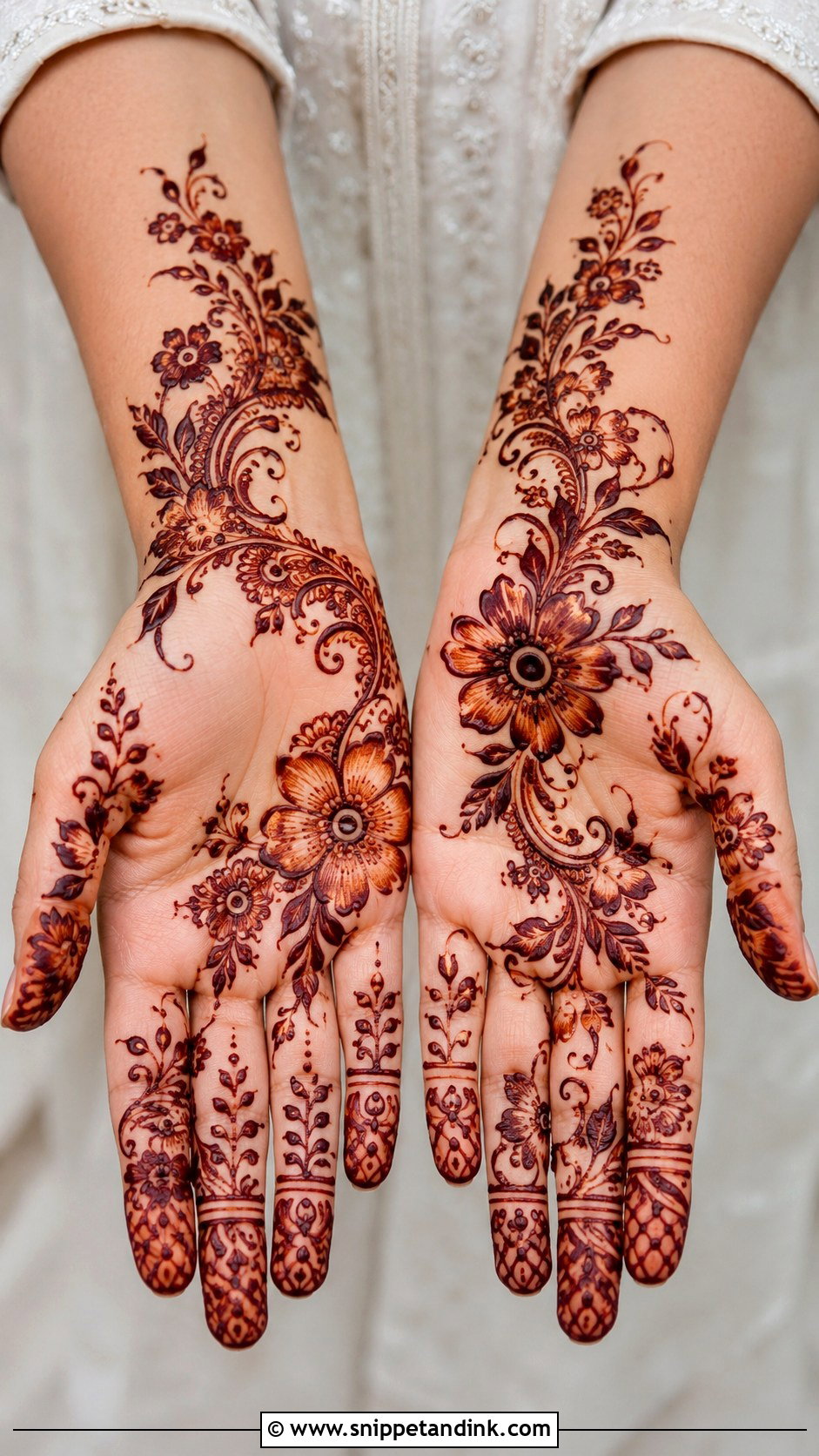
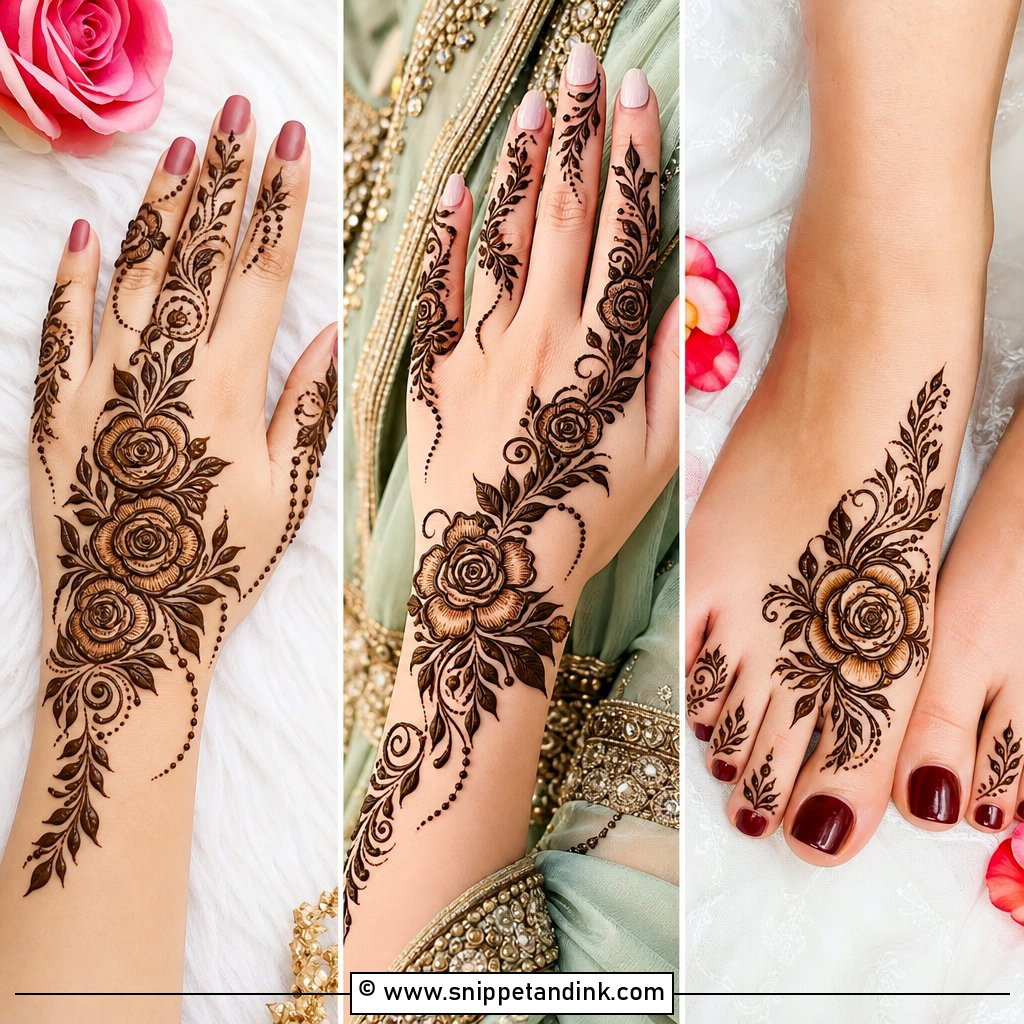
Roses, lotus shapes and five-petal blossoms spread from the wrist toward the fingers, either light and Arabic in spirit or packed with Indian-style fillers. My usual layout is one large flower on the palm supported by smaller buds, leaves and curved vines, with leafy trails on the fingers. Shading the petals gives depth. Daytime functions and bridesmaid mehndi suit it well, as long as there’s enough open skin between the blooms to keep them from merging once the color deepens.
7. Indian Front Hand Mehndi Design
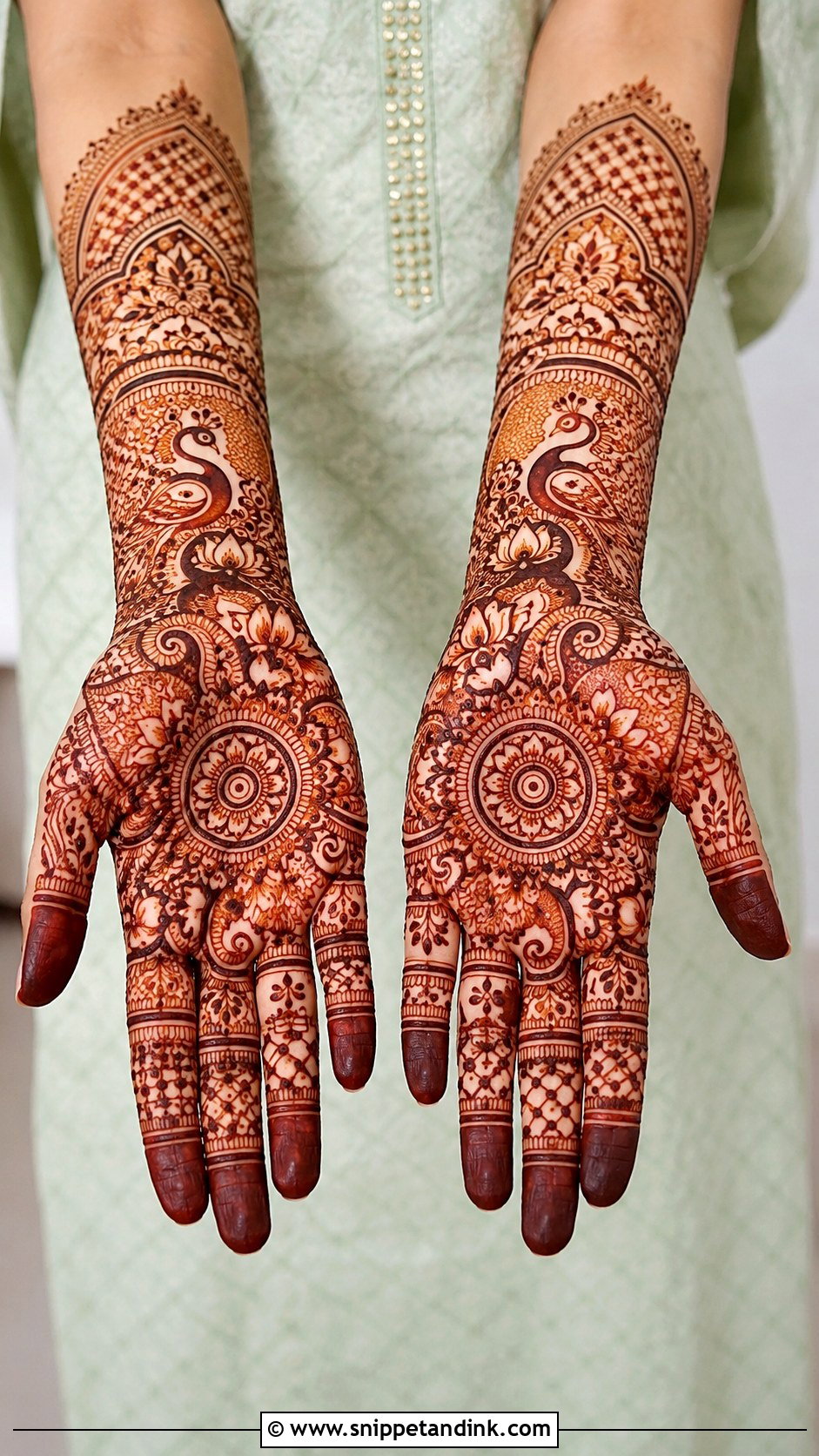
Indian palm work is dense and symmetrical: paisleys, peacocks, lotus flowers, mandalas and fine fill, with bands, dots, checks and curls packed onto the fingers and a bangle border or cuff at the wrist. It’s the style for weddings, pujas, Karva Chauth and Diwali. It asks for patience and a very smooth paste, because fine Indian lines show every lump. Even at full density, I keep clear sections so each motif stands out.
8. Indo-Arabic Front Hand Mehndi Design
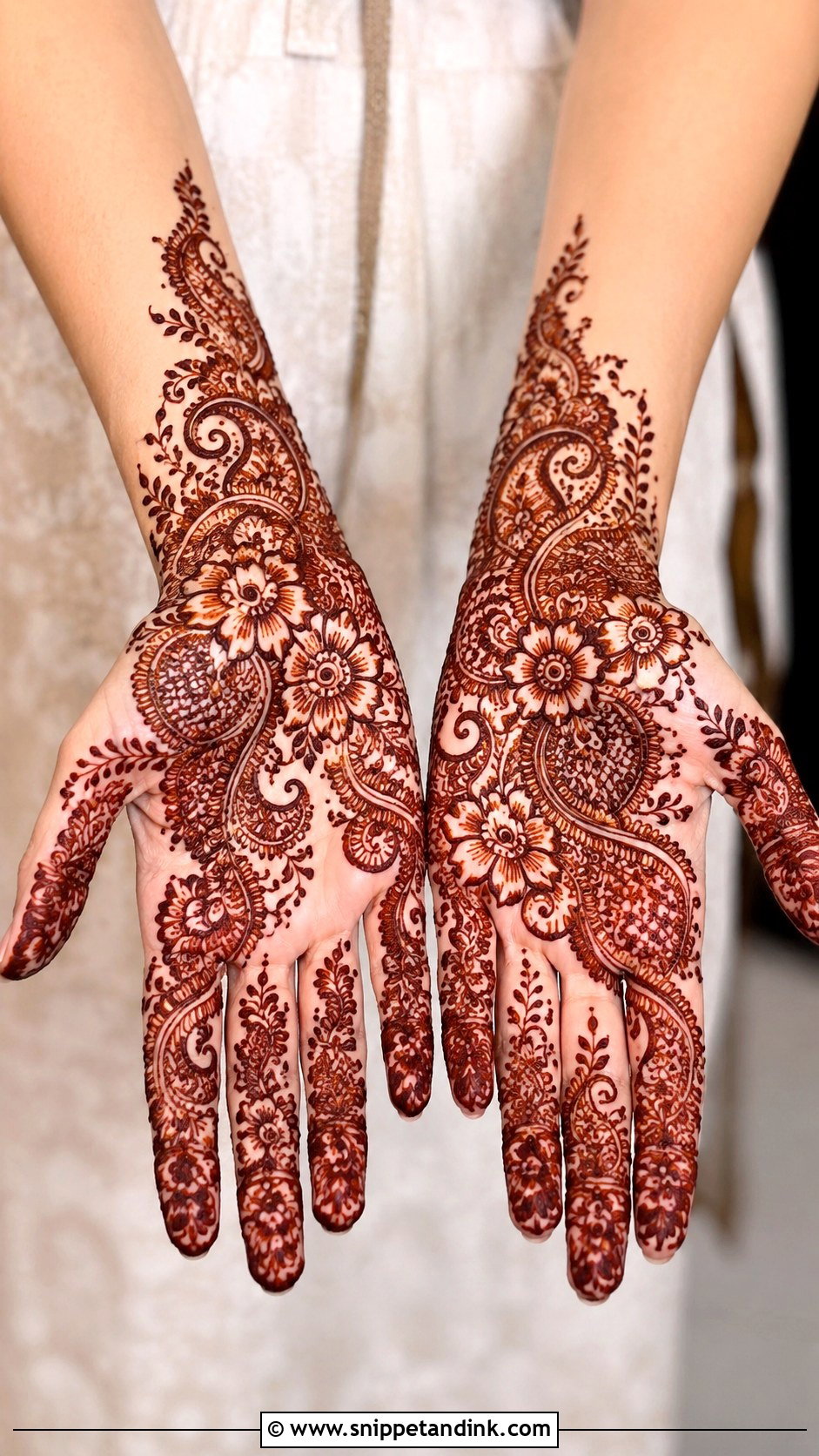
The fusion layout: a large Arabic floral or paisley trail, filled with Indian inner lines, dots, mesh and small leaves. The palm ends up fuller than pure Arabic but keeps enough open space to feel current. Sangeet nights, Eid gatherings and bridesmaids are where I draw it most. Bold outer strokes and fine detail inside the shapes; reverse that and the design loses its structure.
9. Modern Front Hand Mehndi Design
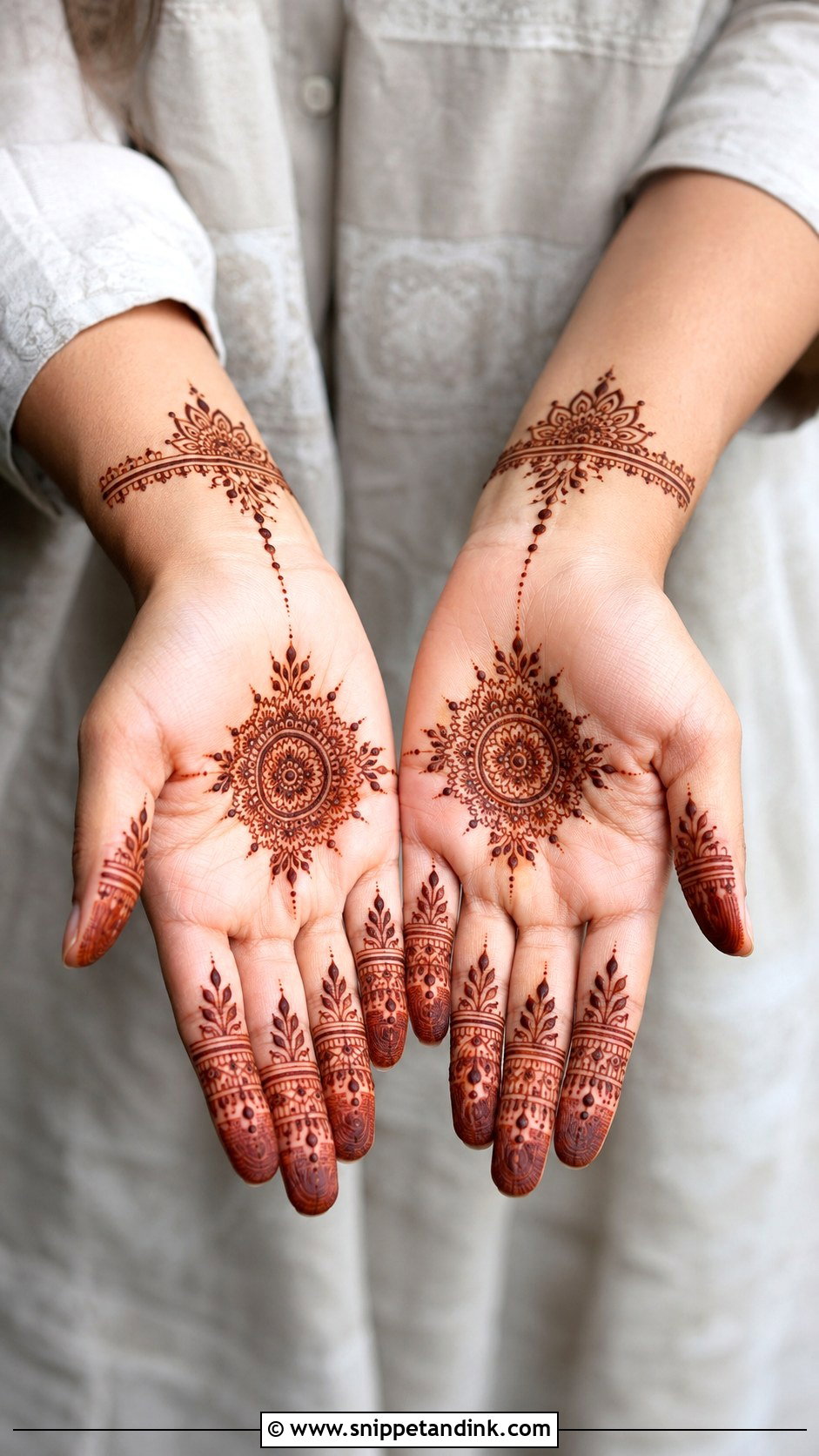
Modern palms skip full coverage. A half-palm layout, a bracelet-style wrist, finger bands or a mandala floating in open skin, often with geometric lines, minimal florals or negative-space curves. It sits well at office-friendly events and smaller celebrations. I avoid tiny fillers in this style altogether. Every element needs breathing room, and one crowded corner breaks the whole effect.
10. Easy Front Hand Mehndi Design
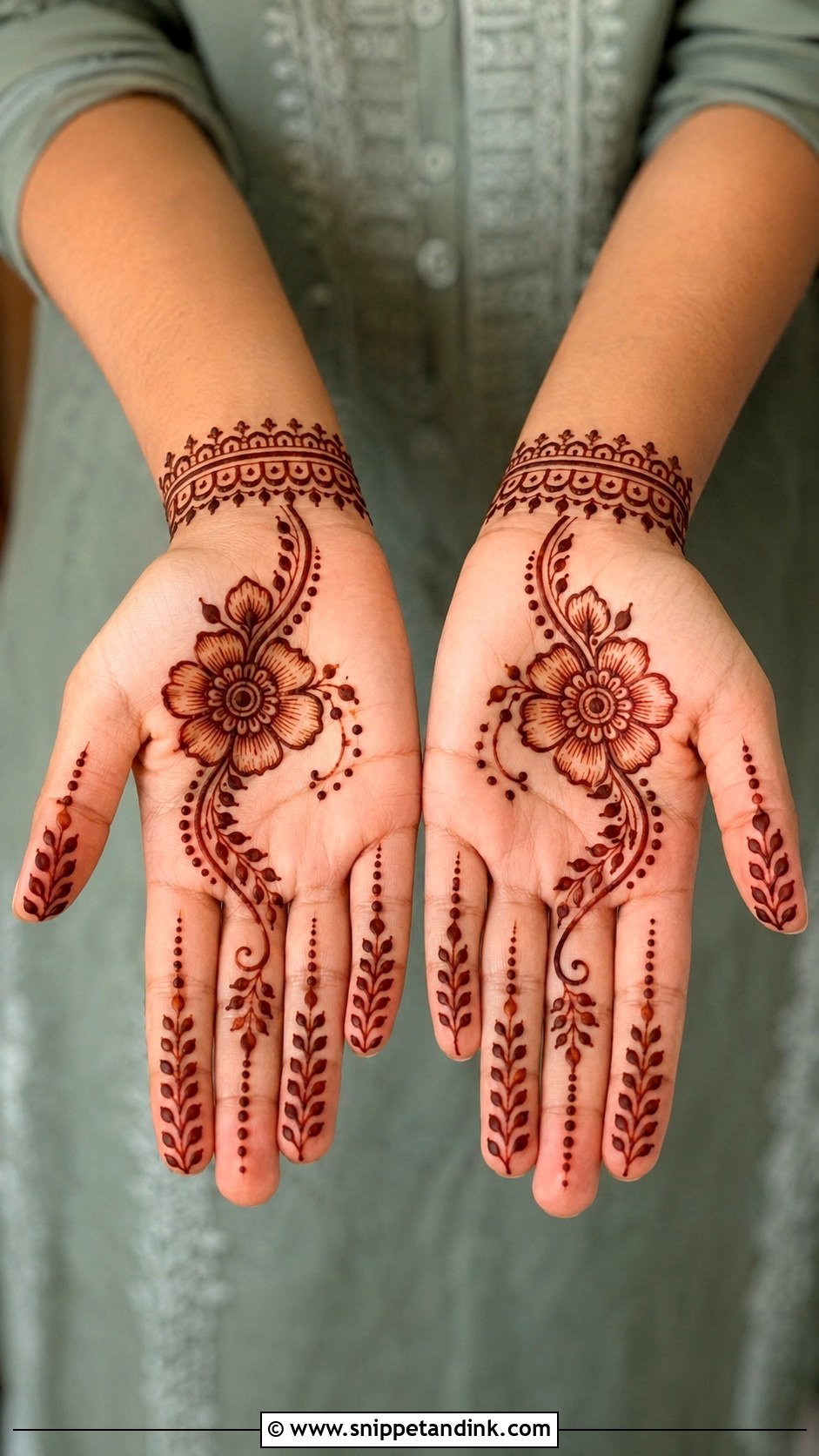
If you’re doing your own mehndi, this is the one to try: a basic palm flower, round mandala or curved vine, then dots, leaves and simple finger lines. No complex symmetry, no tiny packed detail. Repeating one shape makes a pattern look fuller for very little effort. Draw slowly and keep the pressure on the cone steady; most wobbly lines come from squeezing harder as the cone empties, not from an unsteady hand.
11. Front Hand Mehndi Design For Beginners
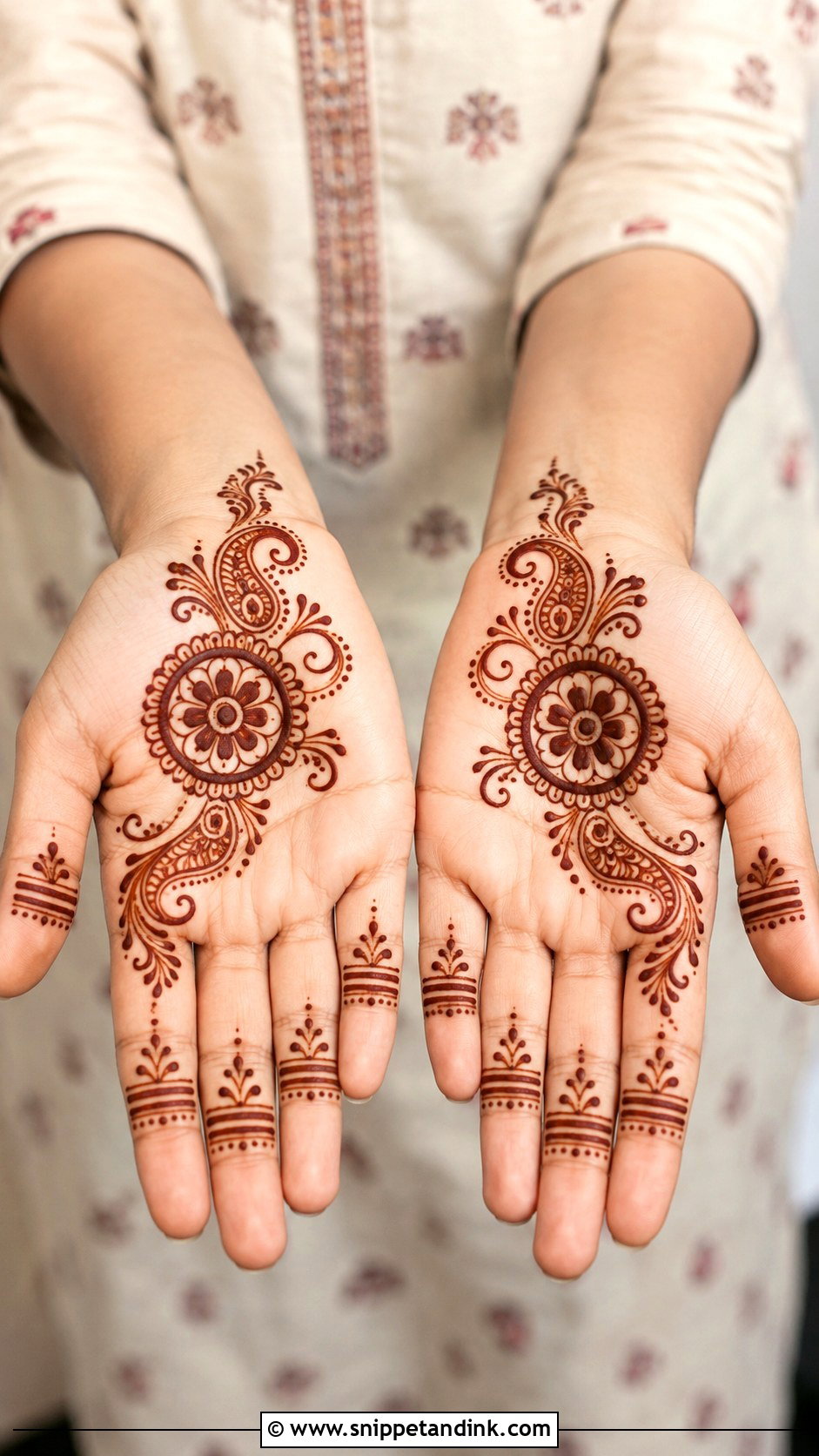
Learning on your own palm is awkward because you’re drawing upside down with your weaker hand, so I’d practice on paper or a friend first. Build from shapes you can control: a flower, circle or small paisley in the center, curved vines around it, then bands, dots and tiny leaves on the fingers. Leave jaali and bridal figures for later. If one side looks empty, a small cluster of dots fills it better than an ambitious motif you’re not ready for.
12. Front Hand Finger Mehndi Design
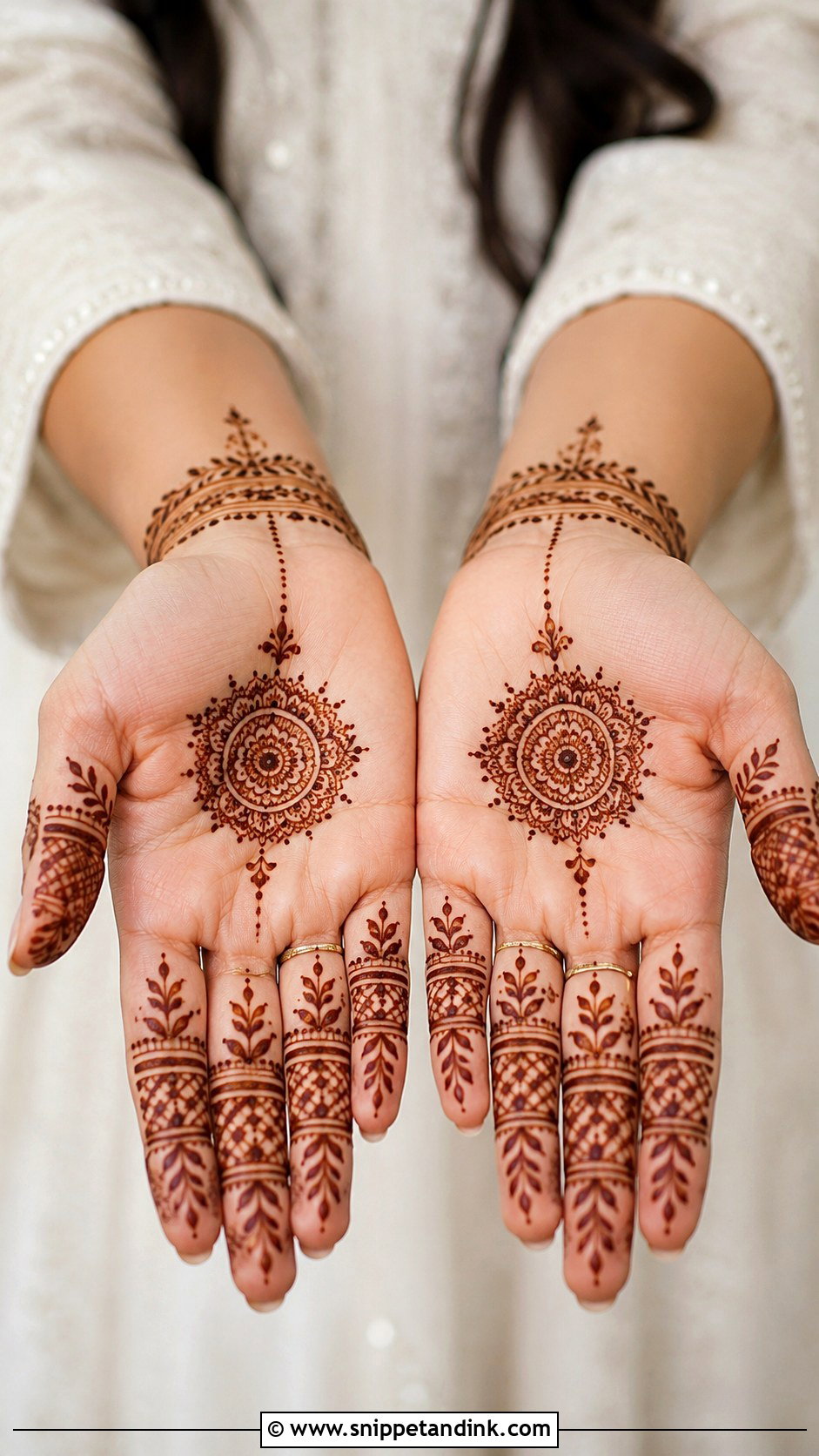
Fingers carry the design here while the palm stays light: bands, leafy vines, checks and fingertip caps, with a small mandala or dotted chain in the center. It’s quick and reads modern. Each finger can match or vary slightly, but they should all connect back to the palm, even if it’s only a thin line at the base. Fingertips stain darker than anywhere else on the hand, so I keep caps thin unless the client wants near-black tips.
13. Front Hand Palm Mehndi Design
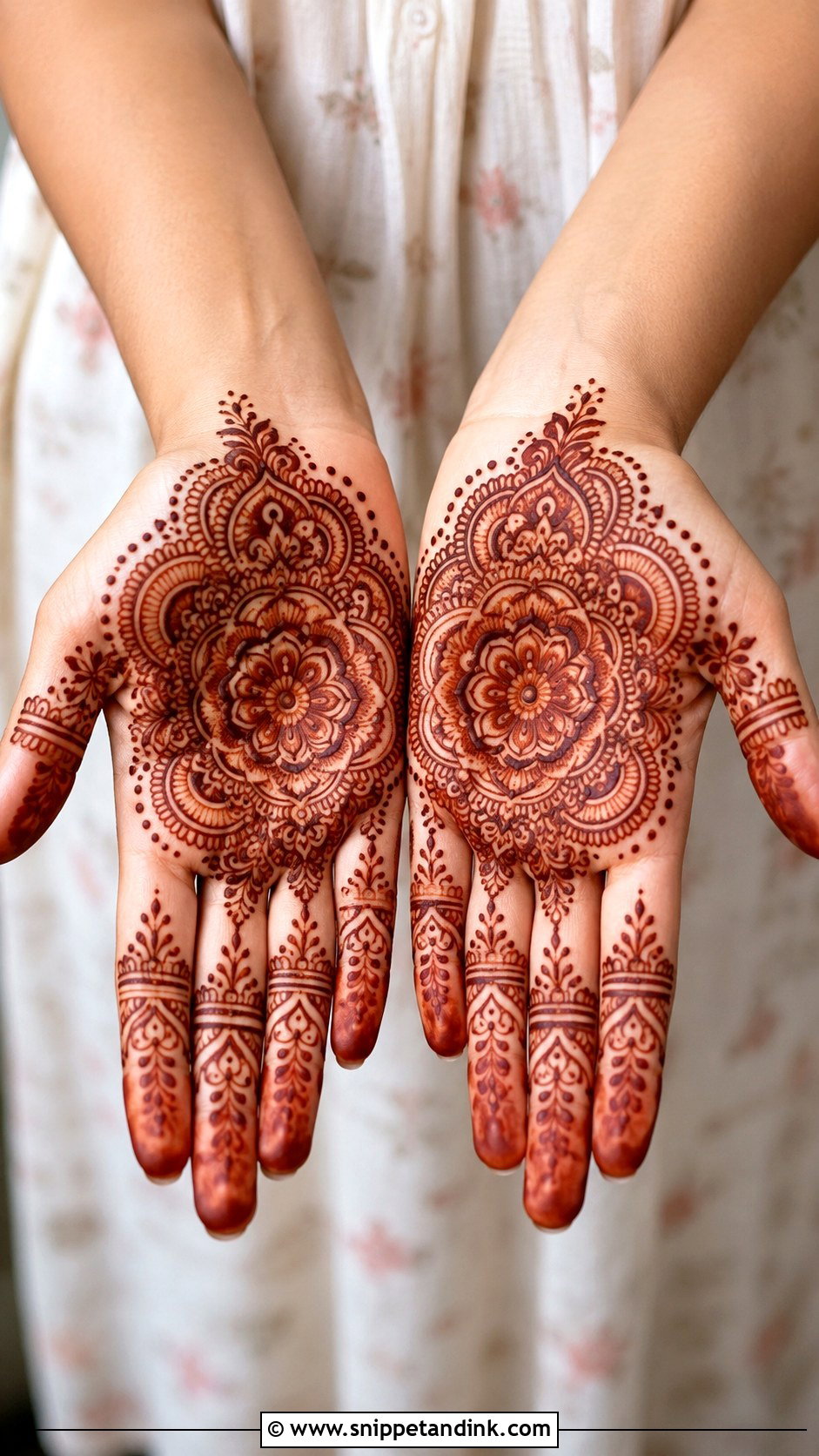
All the attention goes to the palm: a large mandala, floral cluster, paisley pair, lotus circle or geometric medallion, with simple fingers. It shows strongly in photos and suits small hands because it doesn’t need to travel far. Keep the outer palm tidy with dots, small leaves or scallops. A rule I follow: the busier the palm, the lighter the fingers.
14. Front Hand Wrist Mehndi Design
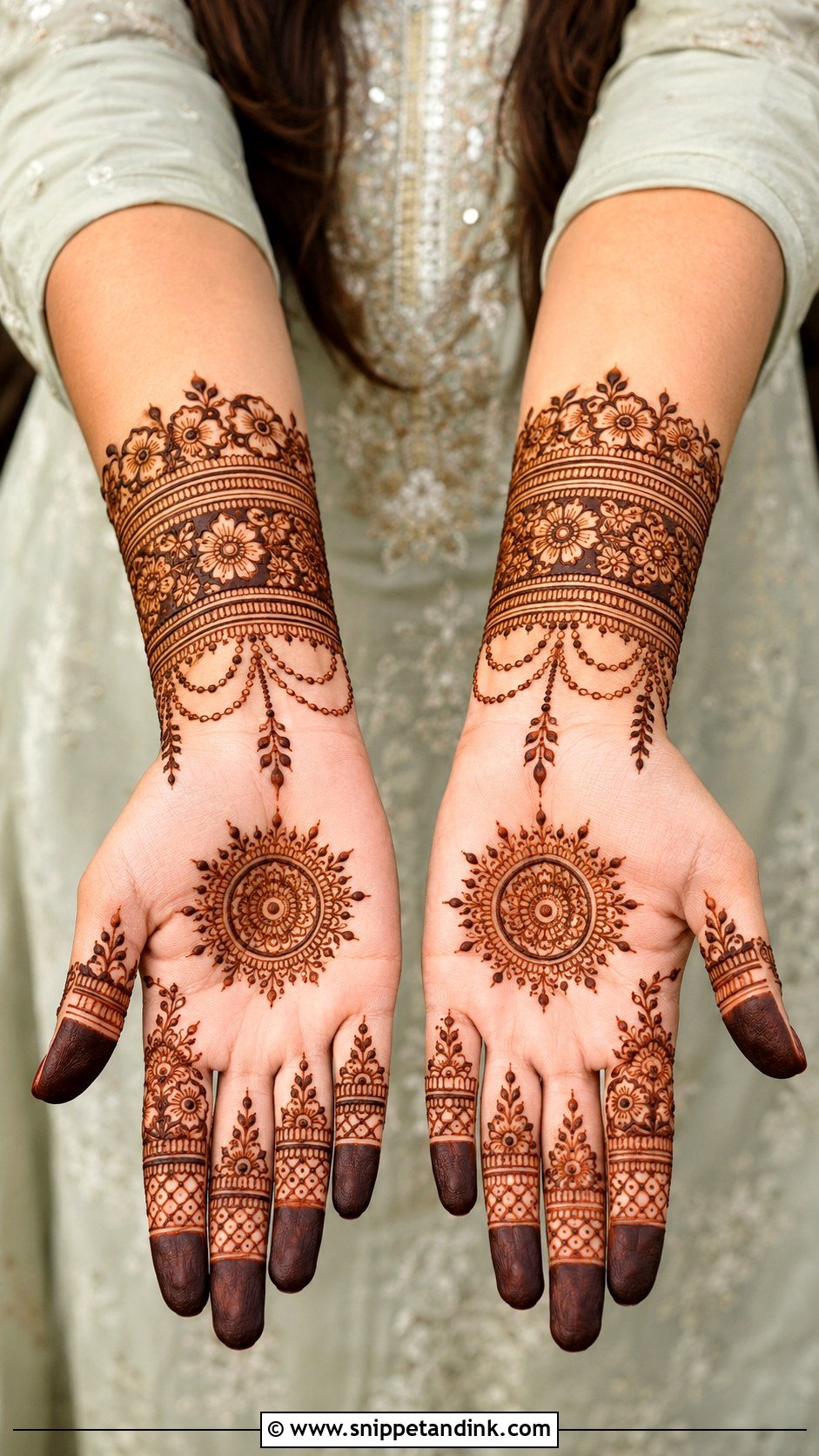
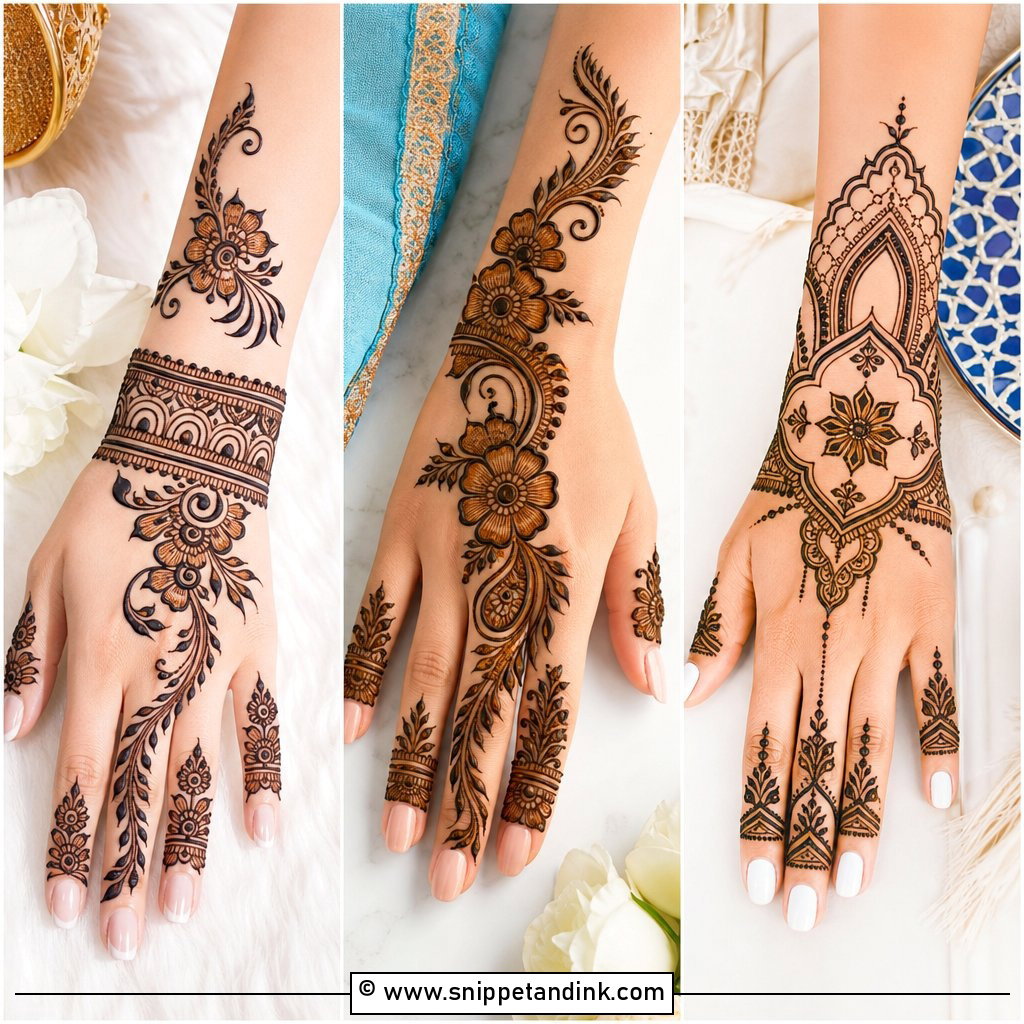
The wrist becomes jewelry, with bangles, cuffs, floral bands, jaali strips or chains, and the palm holds a simple mandala or a flowing Arabic trail leading down into the cuff. It looks complete without covering the forearm. I make the wrist band slightly wider than the finger detail so it anchors the hand. Wrist skin stains lighter than the palm, so the cuff lines need to be drawn a touch bolder to keep up.
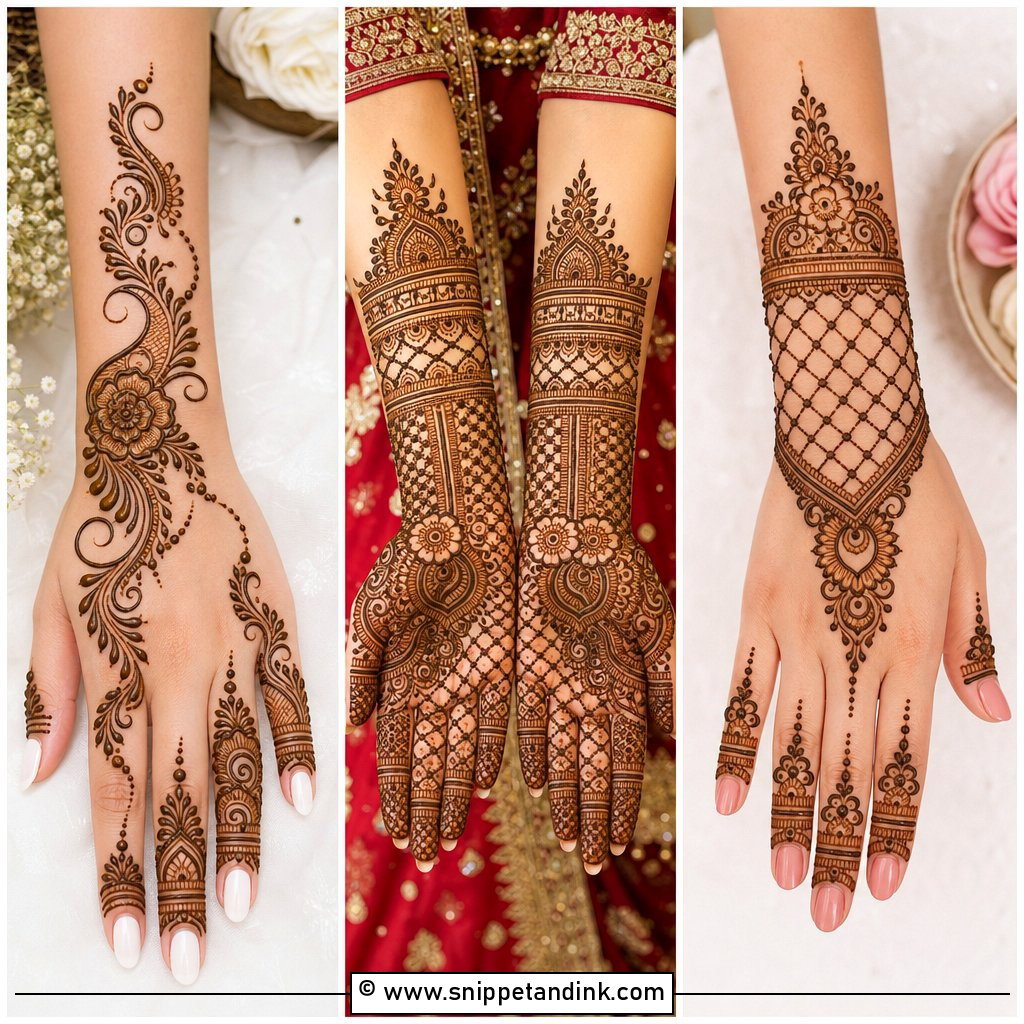
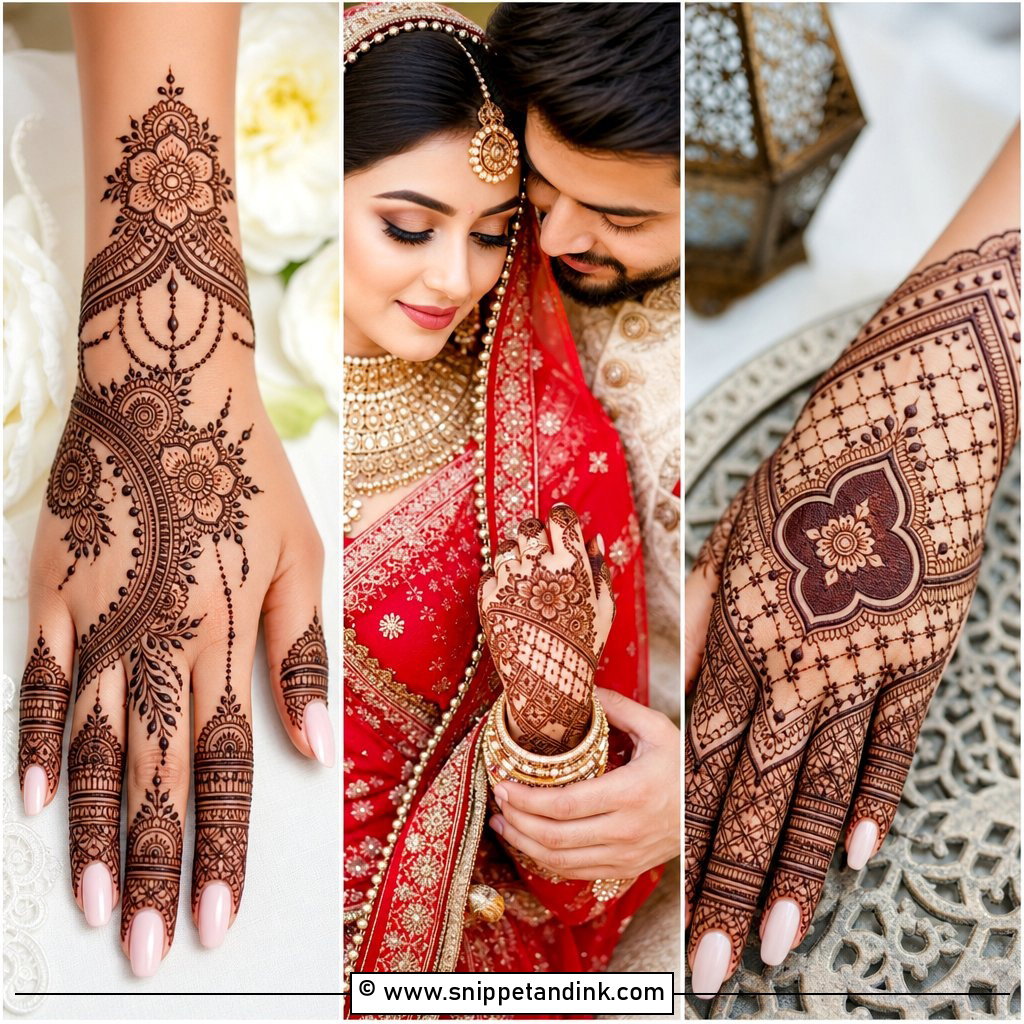
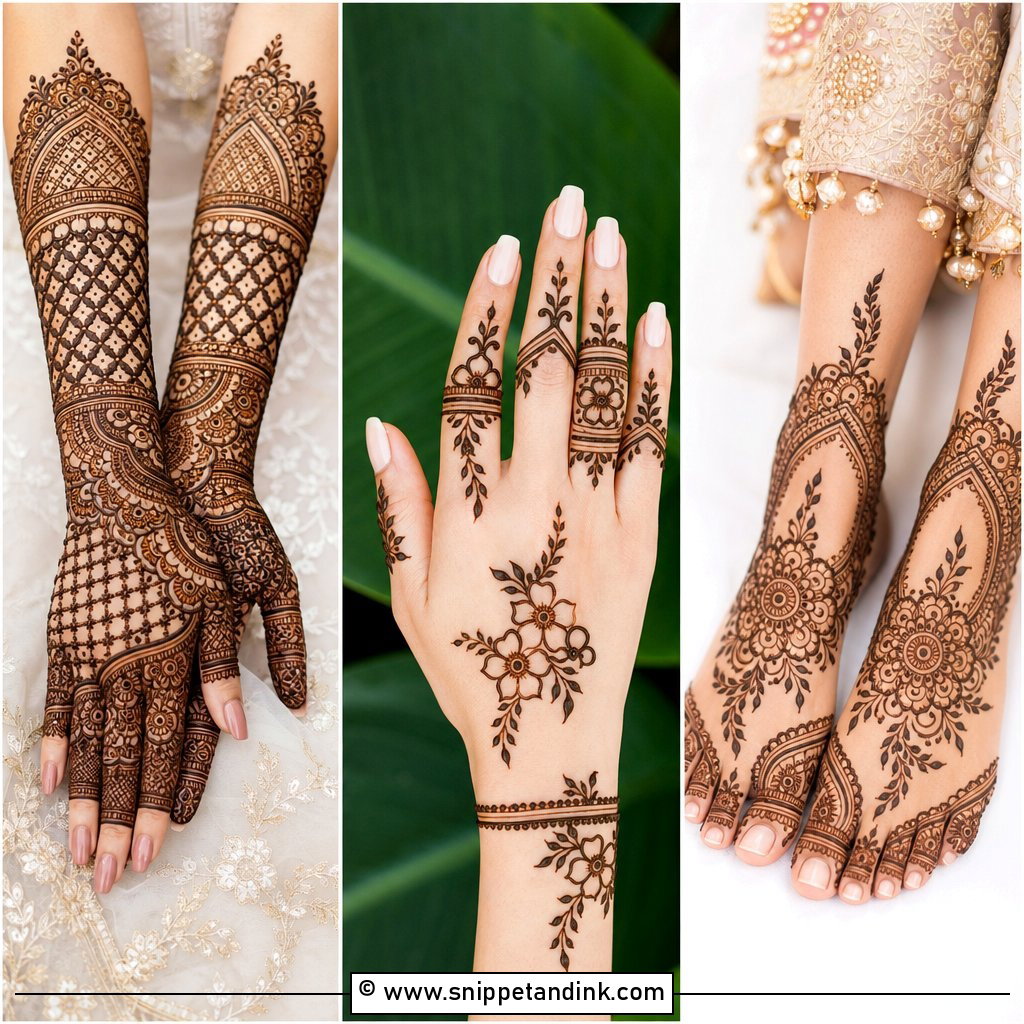
15. Front Hand Bracelet Mehndi Design
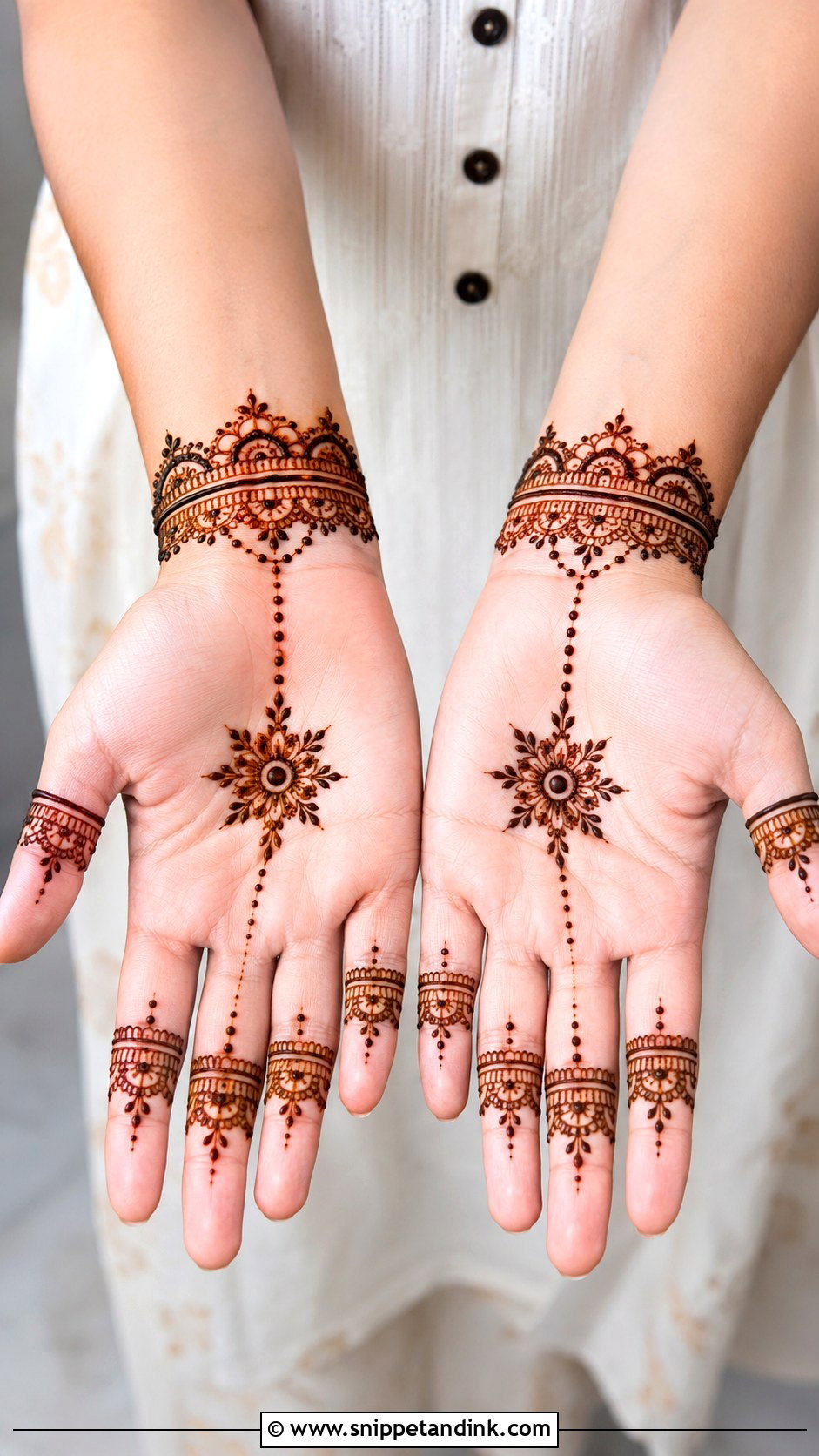
A decorative wrist band linked to the palm or fingers with chains, dots and thin vines, with either an open palm and small flower or a mandala that ties back to the bracelet. It wears well with bangles and rings. Clean borders on the band, repeated detail and evenly spaced chains are what make it look like jewelry rather than a doodle. I draw the chain links last, once I can see exactly where the bracelet sits.
16. Front Hand Jaali Mehndi Design
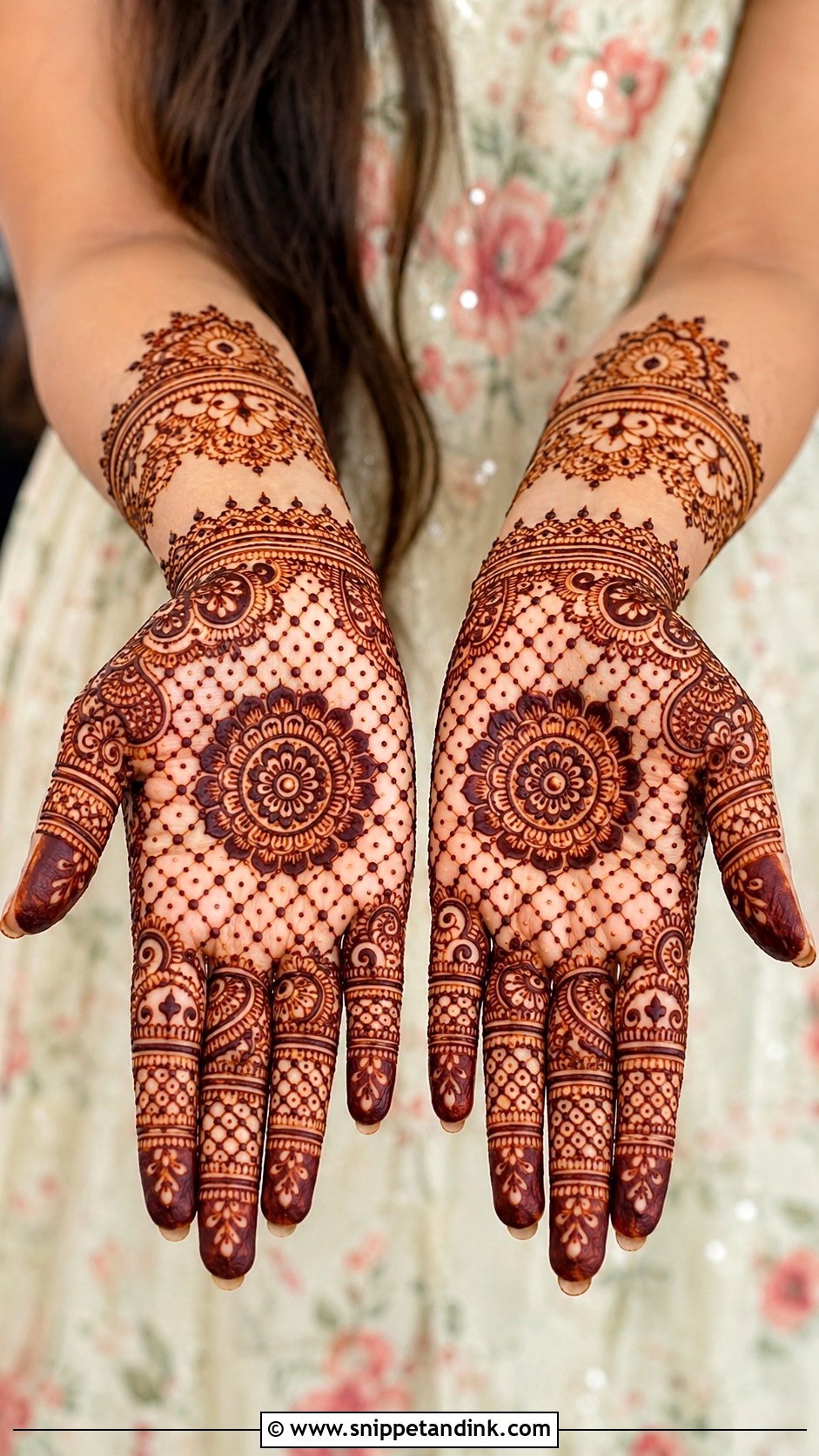
Mesh on the palm gives a lace effect, either across one side, around a mandala or inside paisleys and flowers. The repeating grid keeps even a detailed hand organized. Pair it with open floral sections or bold borders so the net has edges. Even squares are what separate professional jaali from amateur; I pull all the lines in one direction across a section first, then cross them, rather than drawing square by square.
17. Front Hand Paisley Mehndi Design
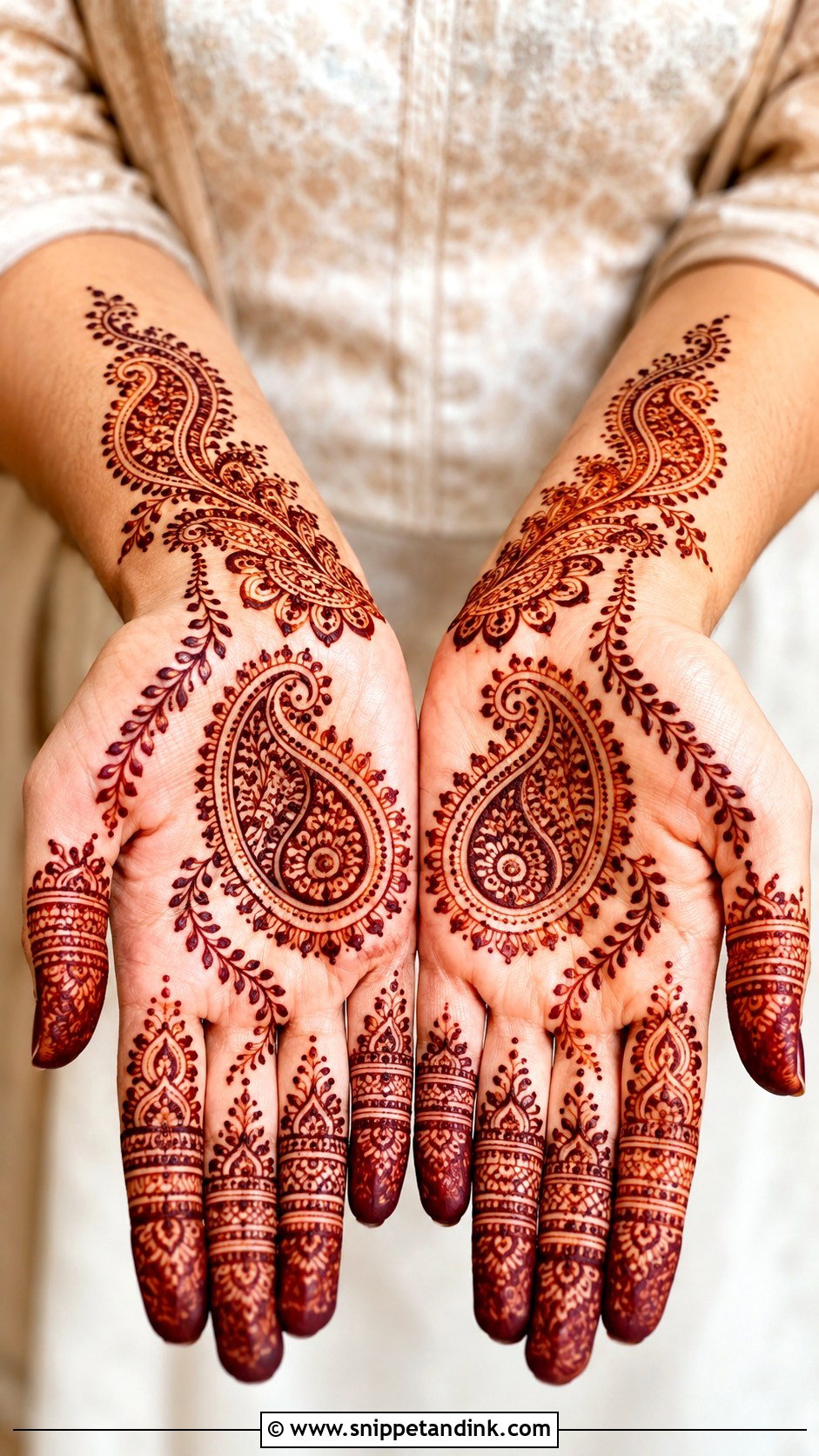
A paisley is a curved teardrop that can be tiny or palm-sized, empty or heavily filled. One large paisley on the palm with flowers, leaves, dots and borders around it, and mini paisleys on the fingers, is a layout that works for weddings, Eid and Diwali alike. Fill each one with fine lines and shaded curves for richness, or leave the inside open and lean on a bold outline for something lighter. I draw the outer curve in one stroke; a paisley built from short strokes always shows its joins.
18. Front Hand Peacock Mehndi Design
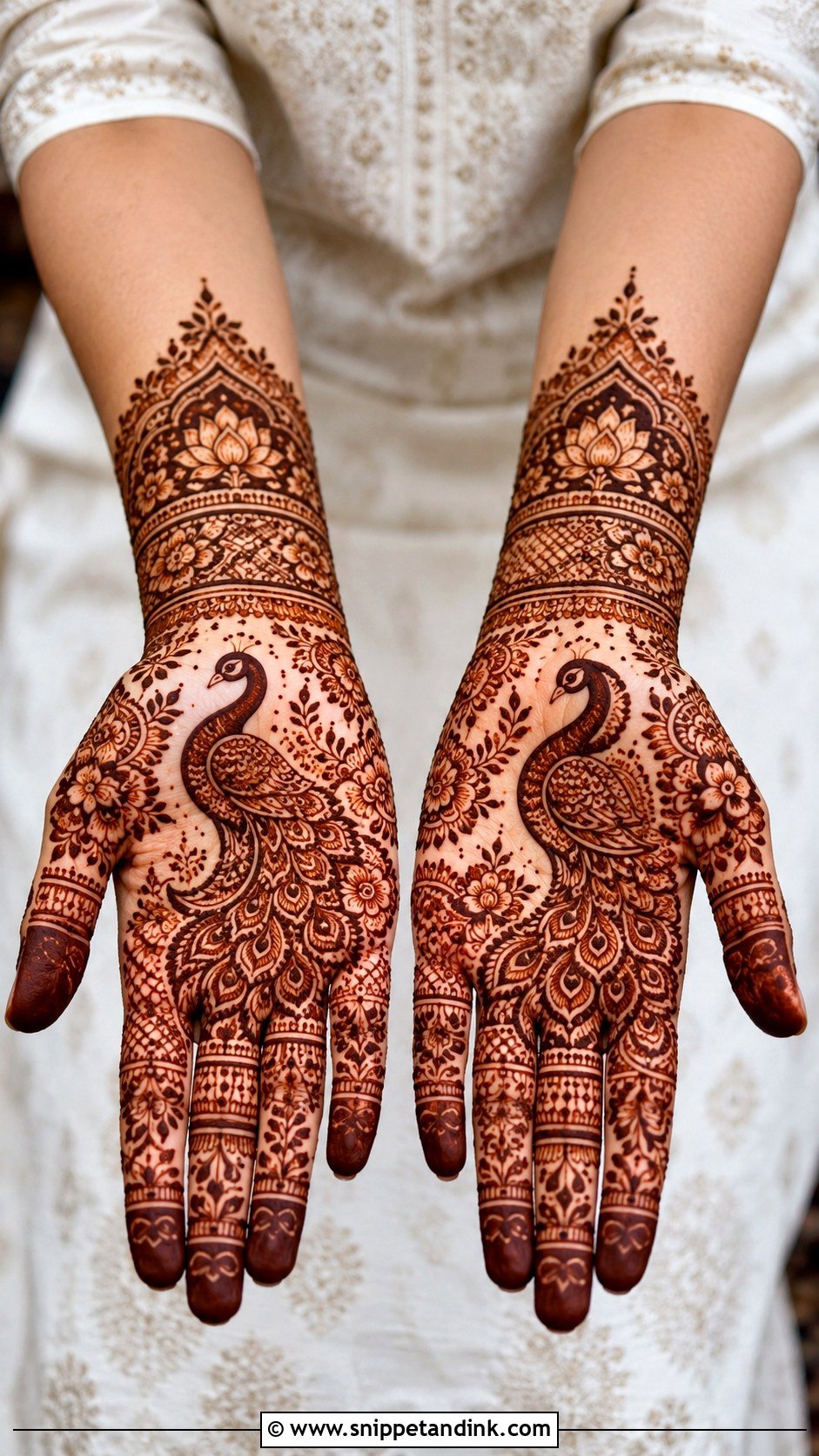
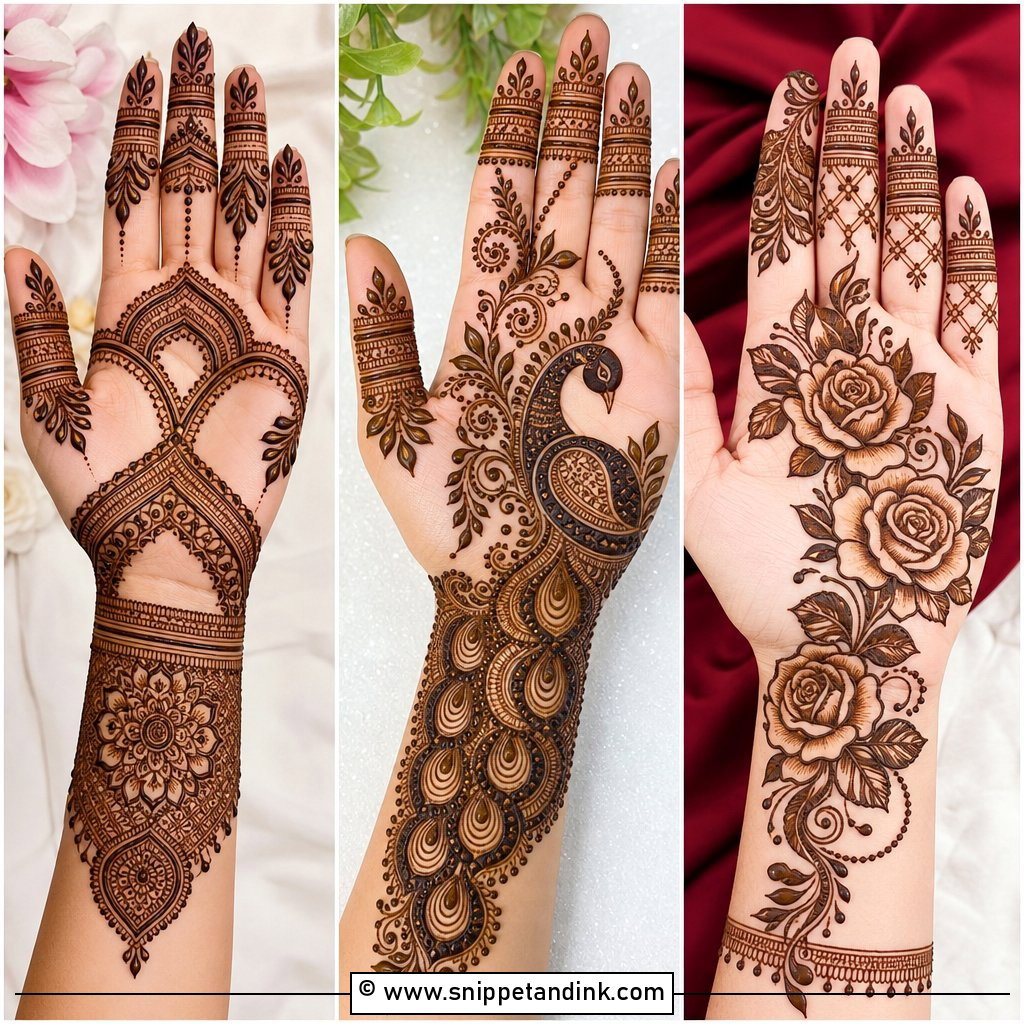
A front hand peacock mehndi design can place one bird in the center of the palm, curve it along the wrist or mirror a pair across both hands so they face each other when the palms come together. The body is filled with fine lines, dots and feathers, surrounded by flowers, vines and jaali. The risk is losing the bird in the fill. I settle the head, neck and body first, then work outward, and I stop filling before the silhouette disappears.
19. Front Hand Lotus Mehndi Design
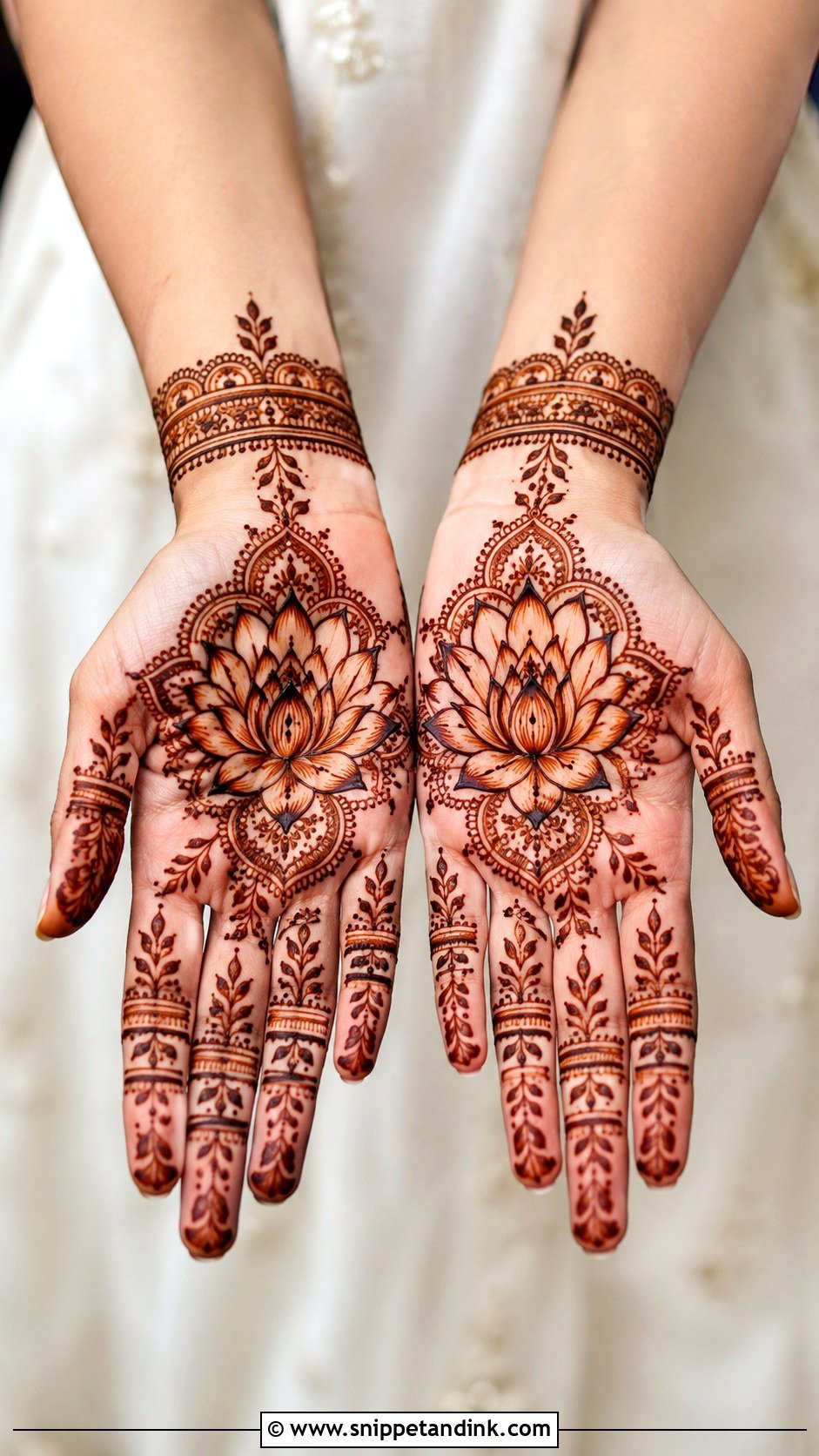
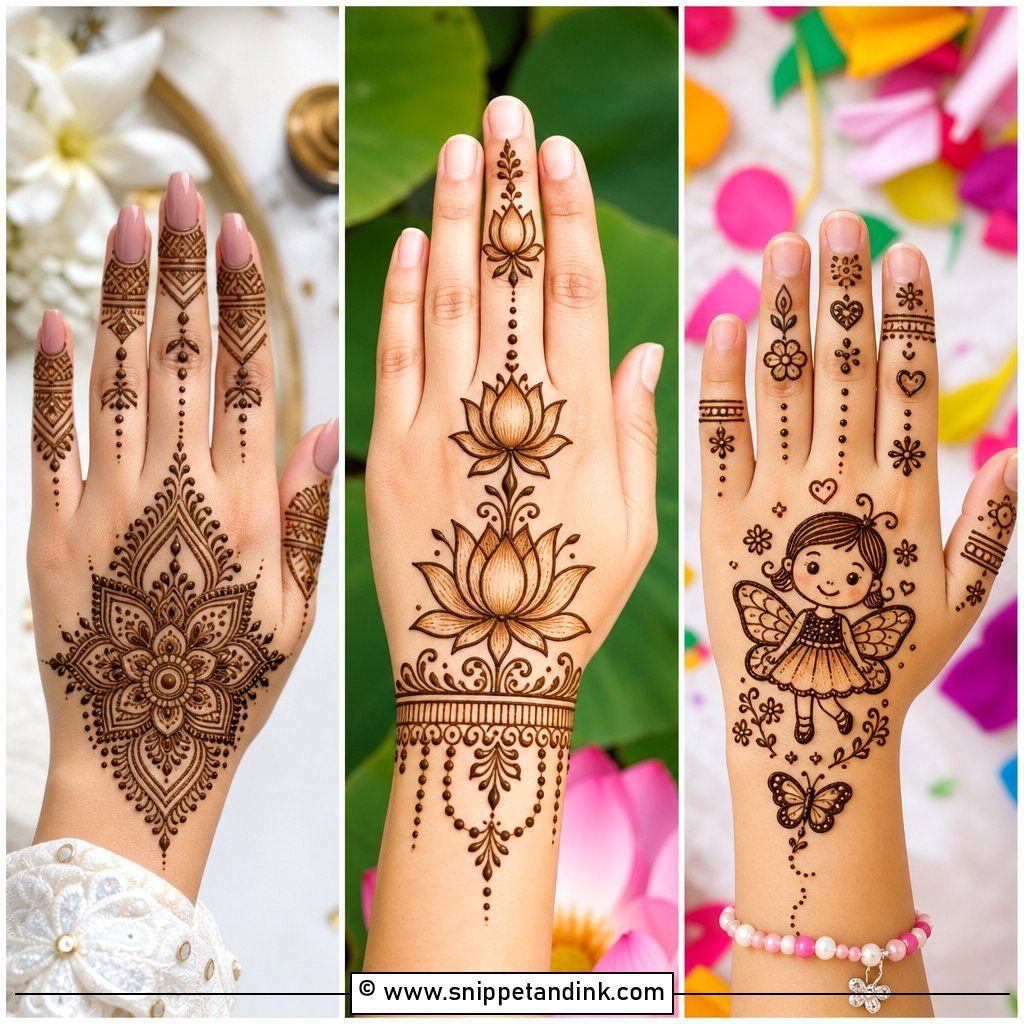
A lotus can be one large bloom in the palm or repeated in layers across the hand, alongside mandalas, paisleys, leaf chains and a wrist cuff. It’s a natural choice for poojas and festive mornings. Layered petals with small dots or shading give depth. Make each petal wider than seems necessary, because henna lines spread slightly as the paste sits, and narrow petals close up into a solid shape.
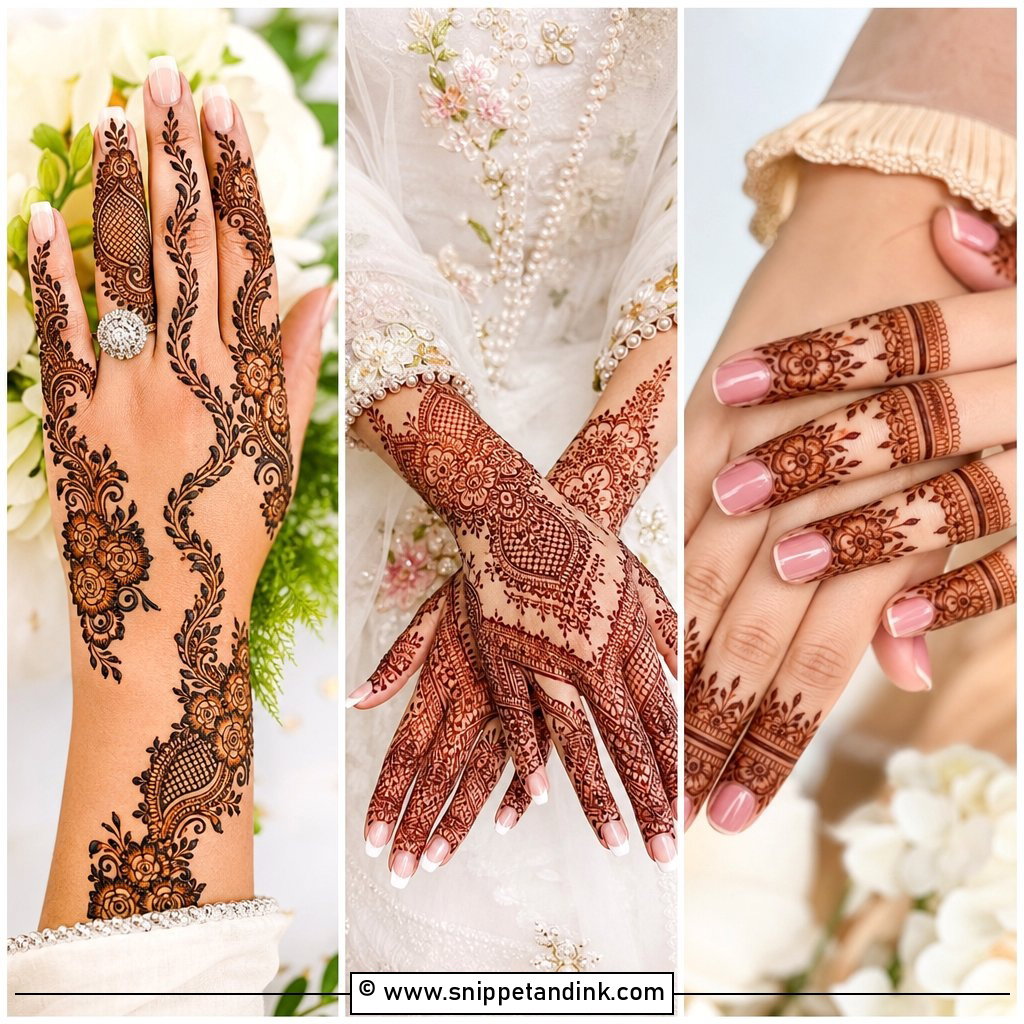
20. Front Hand Rose Mehndi Design
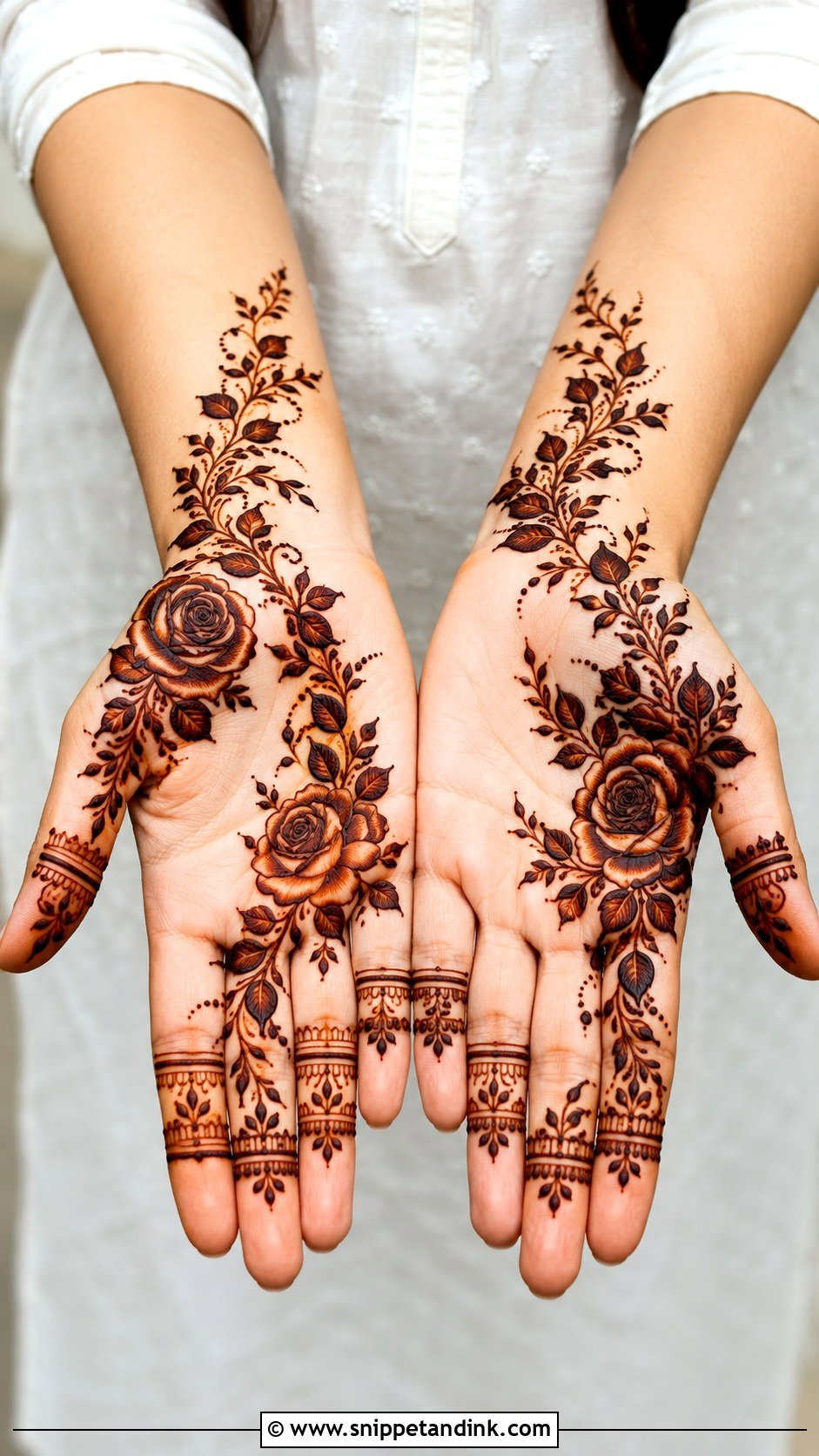
Roses suit Arabic and Indo-Arabic palms because their rounded petals read bold from across a room. A large rose near the wrist or in the palm, smaller blooms and leaves trailing toward the fingers, shading for depth and open skin for air. A henna rose is recognizable by its tight center and looser outer petals; make every petal the same size and it becomes a spiral. Leafy vines and dotted trails finish it.
21. Front Hand Leaf Mehndi Design
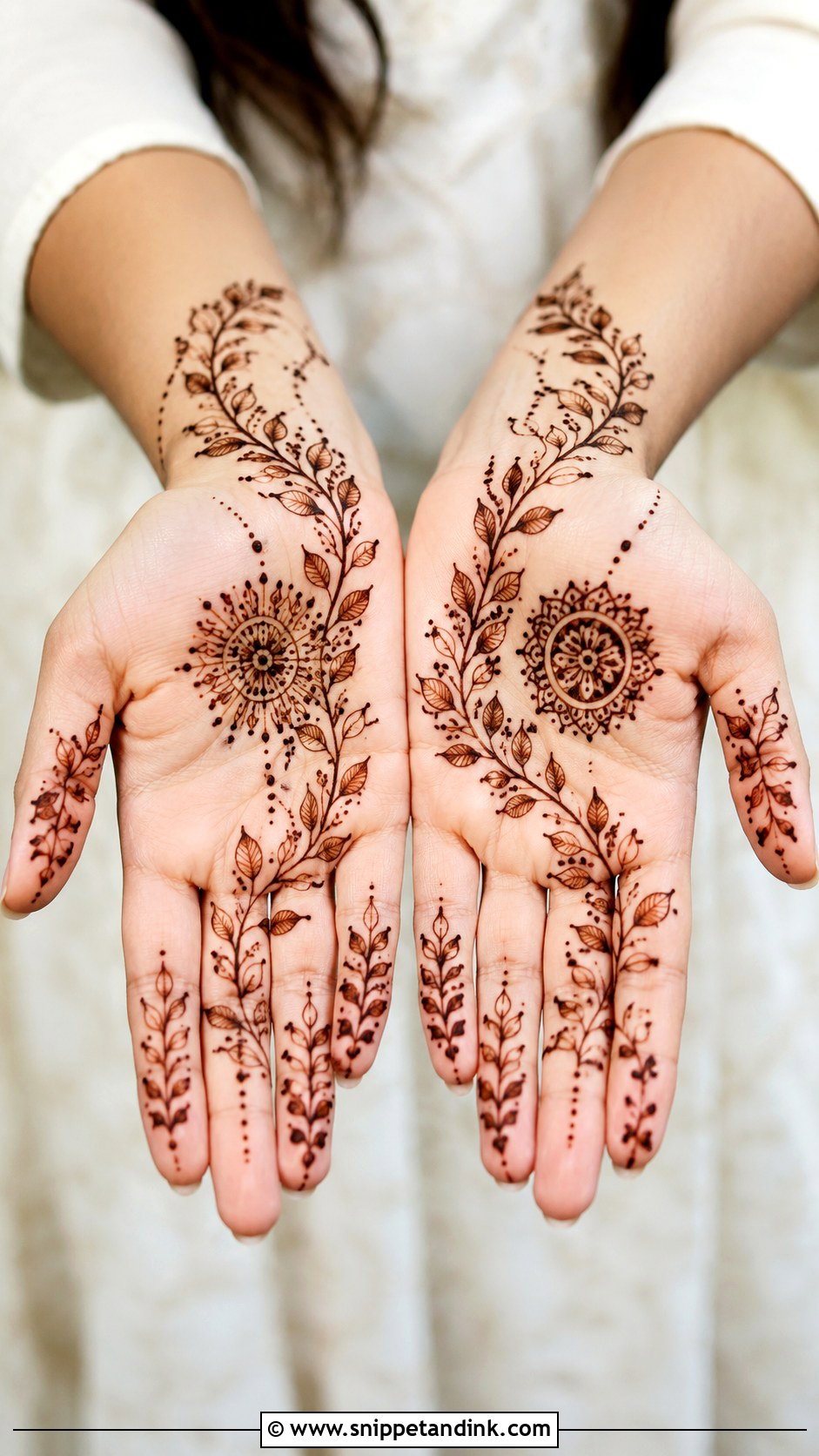
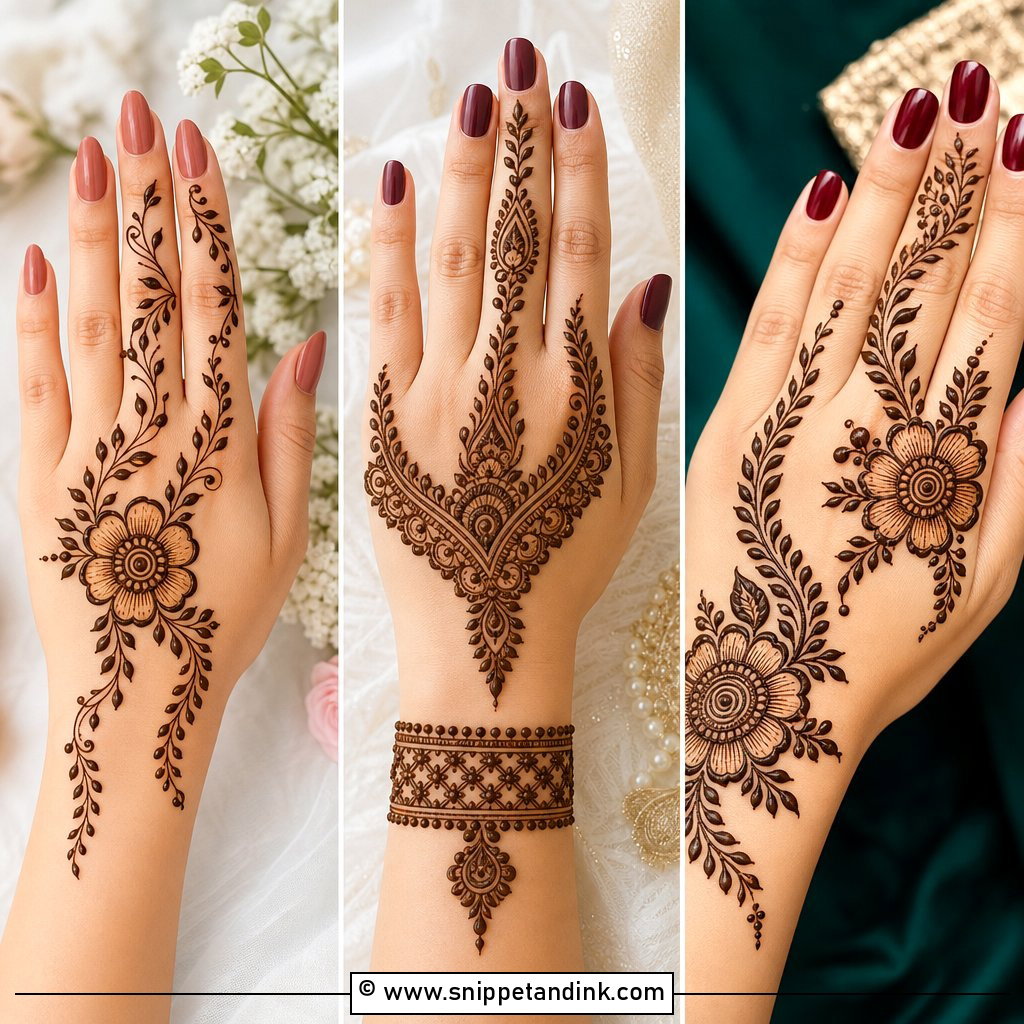
Leaves are the easiest motif to repeat well, which makes this a good palm for beginners and for minimal looks. One vine from the wrist to the index finger, or several branches around a small palm motif. Bold filled leaves, slim outlines or shaded ones each give a different mood. Varying the leaf sizes along the vine, with a few dots between them, is what gives it movement.
22. Front Hand Tikki Mehndi Design
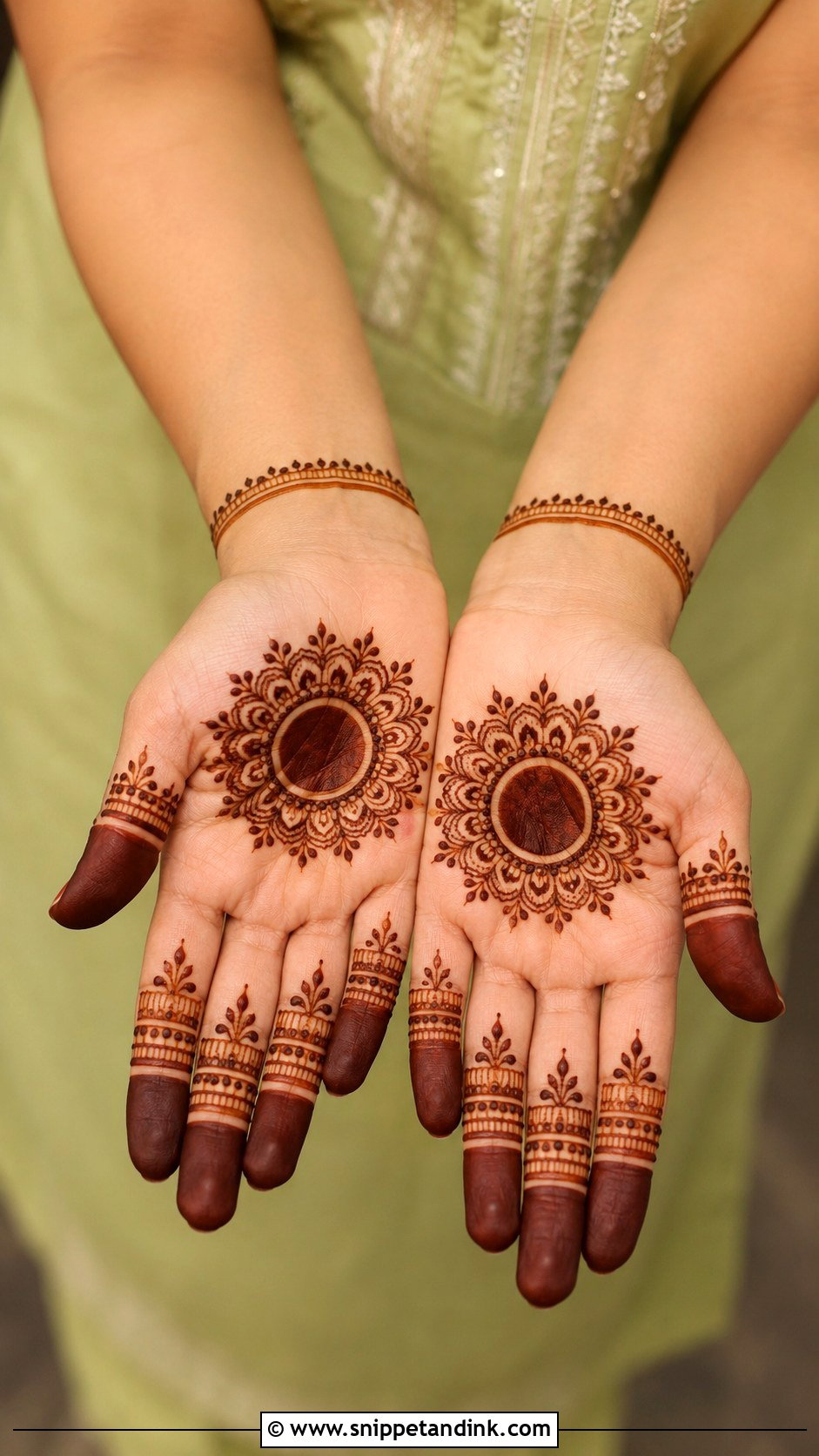
A front hand tikki mehndi design is a solid round circle in the middle of the palm, ringed with dots, petals or bands, with simple finger detail. It’s one of the oldest palm patterns there is and one of the quickest. Because the tikki is filled solid, it holds a lot of paste and stains very dark, which is why it looks so bold after a day. Keep it centered and even. Matching fingertip caps tie it together.
23. Front Hand Moroccan Mehndi Design
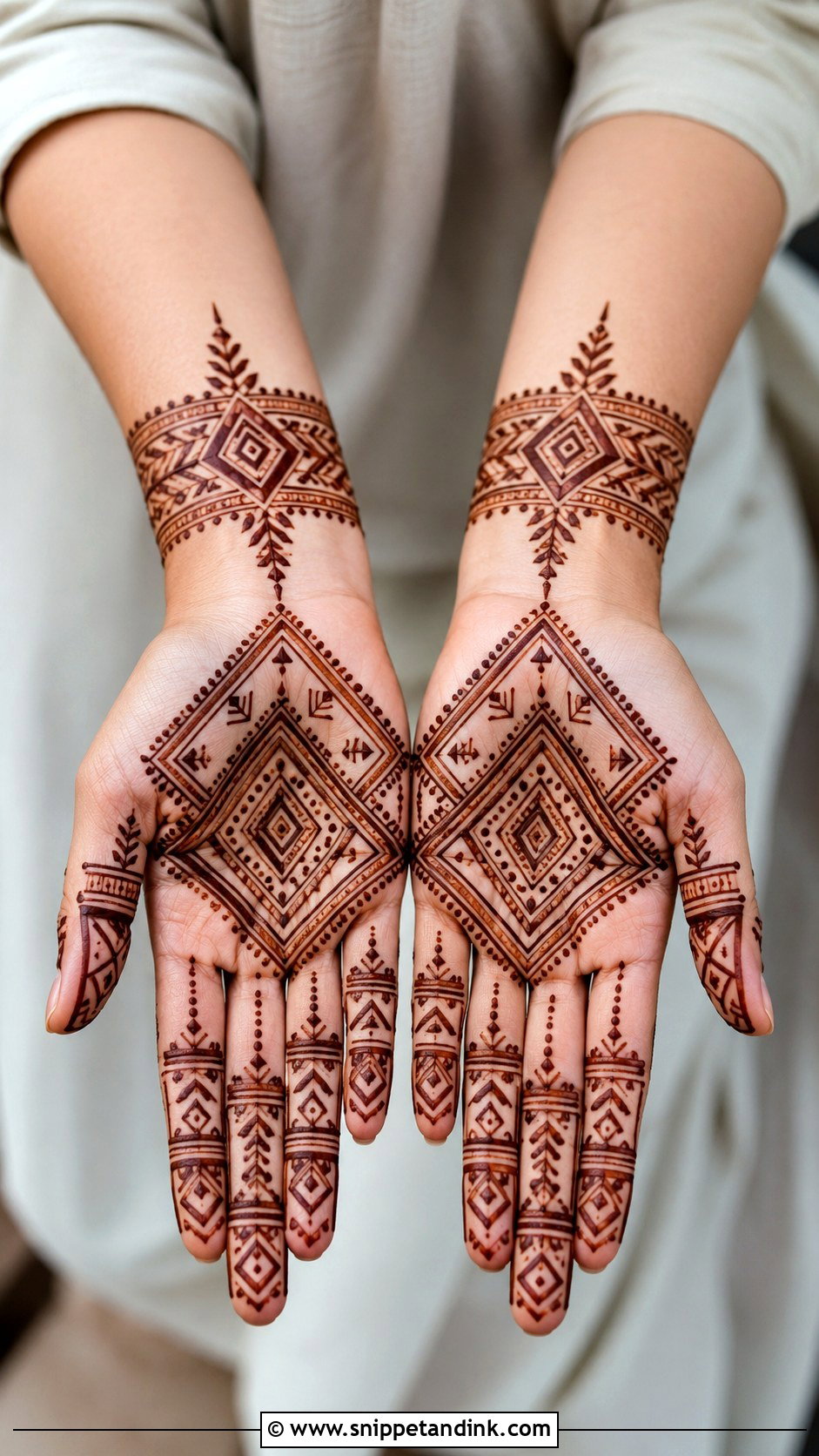
Geometry in place of flowers: straight lines, diamonds, triangles and layered blocks, with a diamond grid or angular bands on the palm and line work with triangle accents on the fingers. It suits someone who wants a palm nobody else at the party will have. Straight lines on a curved, creased palm are harder than they look, so I have the client rest her hand flat on a cushion and I draw in short, checked strokes. A few dots can soften it without losing the structure.
24. Front Hand Gulf Mehndi Design
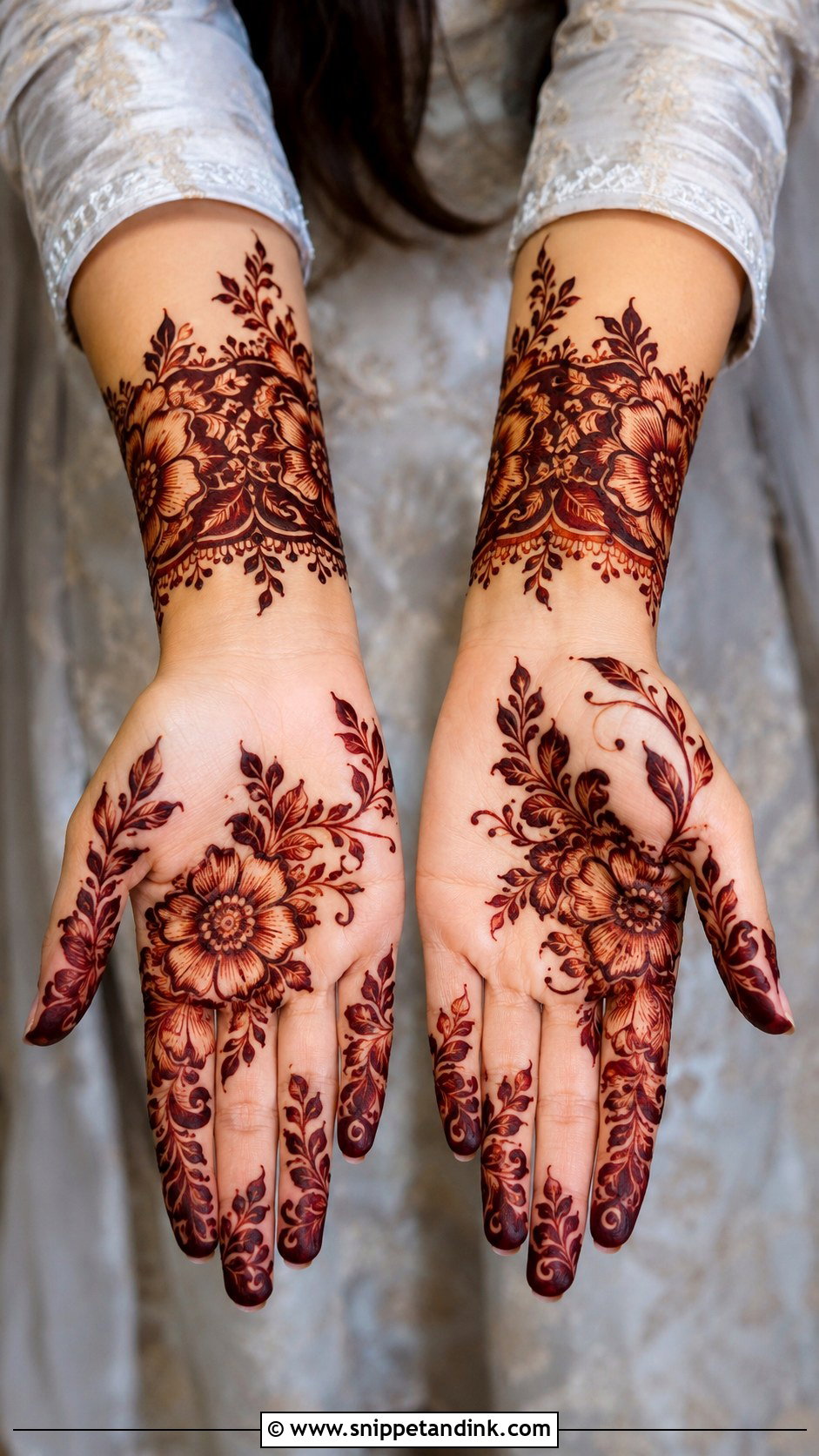
Gulf or Khaleeji palms use big blooms, leafy curves and dramatic bare skin, often covering one side of the palm and leaving the other open. Thick outlines, minimal inner detail. The wrist gets a wide floral cuff or a soft vine linking up to the palm. Those heavy lines carry a lot of paste and stain deep and even, which suits evening celebrations and Eid. The confidence of the stroke is what makes it; hesitant, thin lines look wrong in this style.
25. Front Hand Rajasthani Mehndi Design
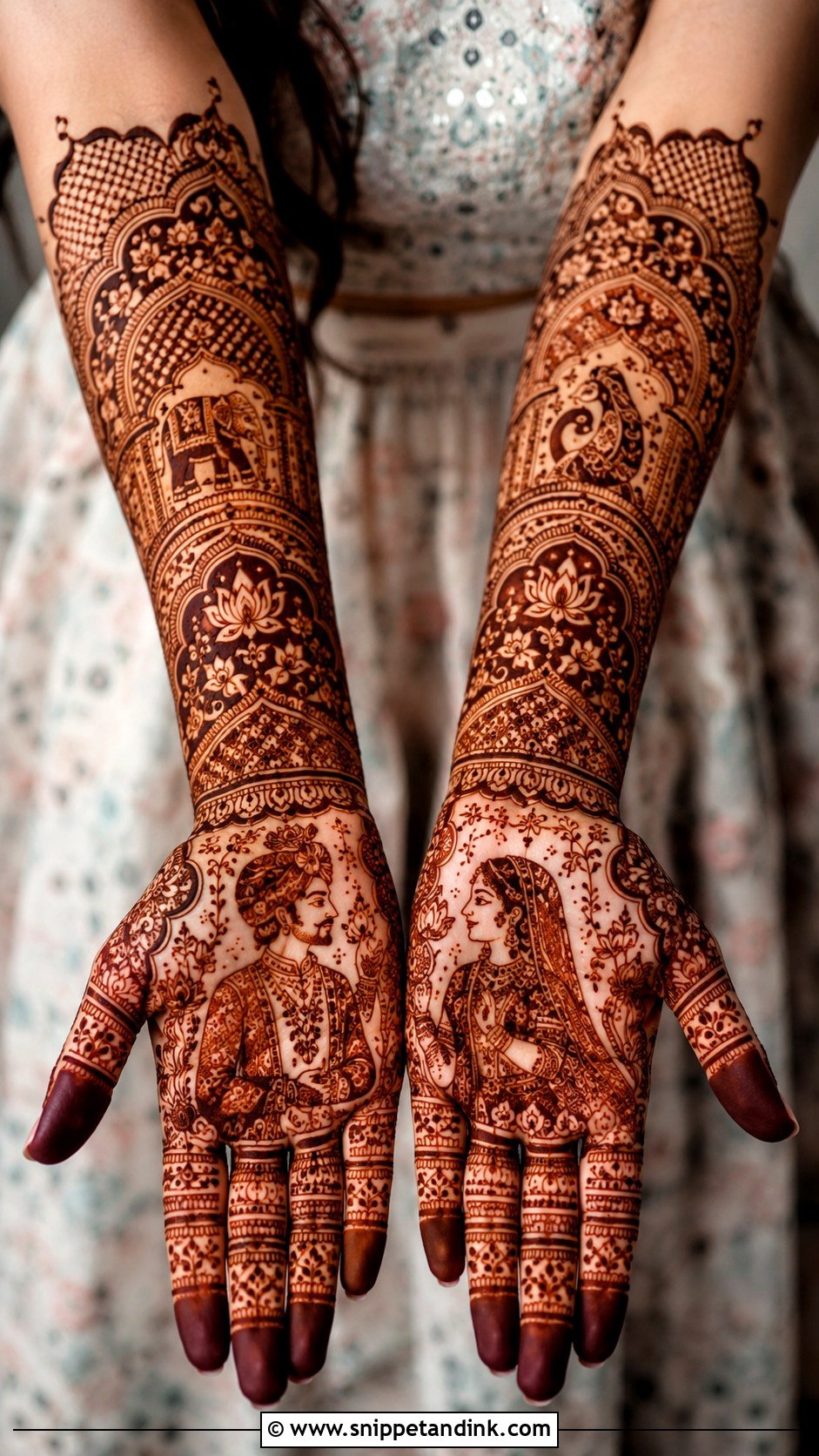
Rajasthani work tells stories: royal figures, a bride and groom, peacocks, elephants, lotuses and fine fill across the palm, fingers and wrist, sometimes up the forearm. It’s for brides and major traditional events. Planning is everything in a design this dense. I block out the sections and draw the large figures on the palm first, then the smaller patterns on the fingers, so the narrative stays readable and the fill never buries the faces.
26. Front Hand Khafif Mehndi Design
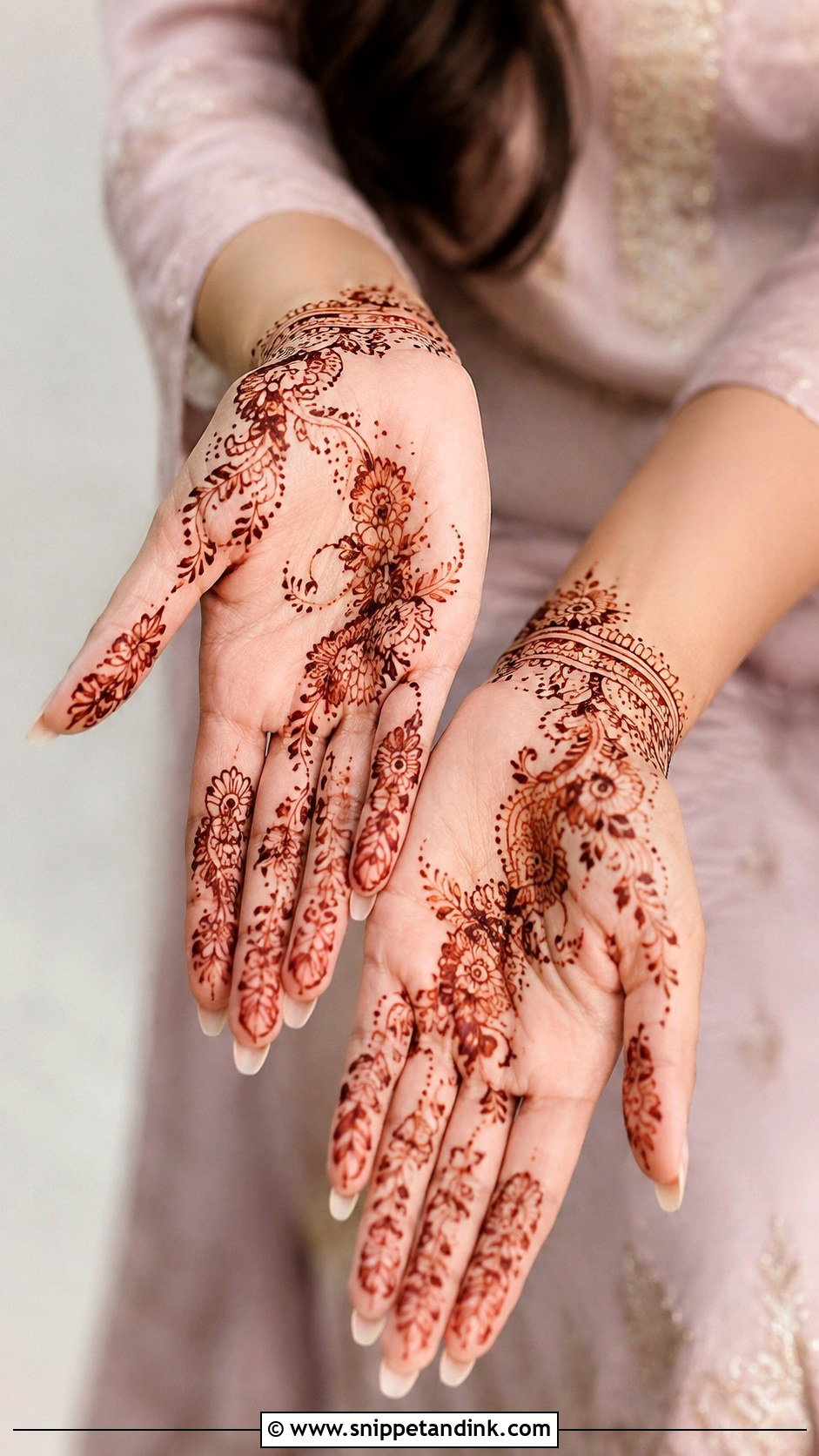
Khafif means light, and the style is exactly that: fine lines, small flowers, lace-like curves, leaves and open space, usually in a soft diagonal from the wrist toward the fingers. It suits engagement events, Eid and bridesmaids. The beauty depends on thin, even strokes, so I use a cone with a very fine tip and a slightly looser paste. Thick lines everywhere and it stops being khafif.
27. Front Hand Minimal Mehndi Design
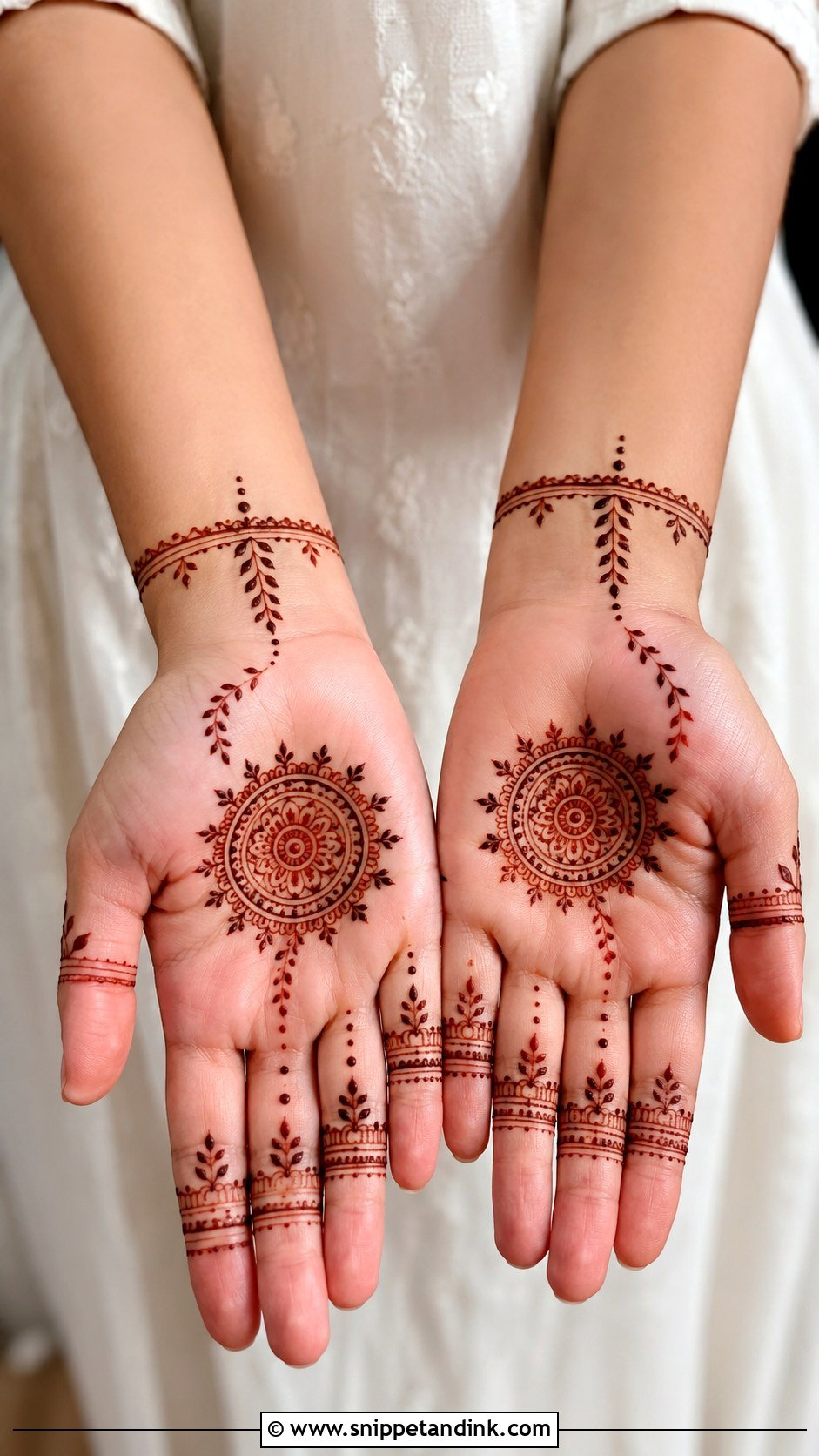
A small palm mandala, thin finger bands, a light vine or a wrist accent, and plenty of bare skin. Minimal mehndi works on every hand size and suits people who don’t like dense henna or need to look office-ready the next day. With so few lines, each one has to be deliberate. A few dots, leaves or petals are enough.
28. Front Hand Half Hand Mehndi Design
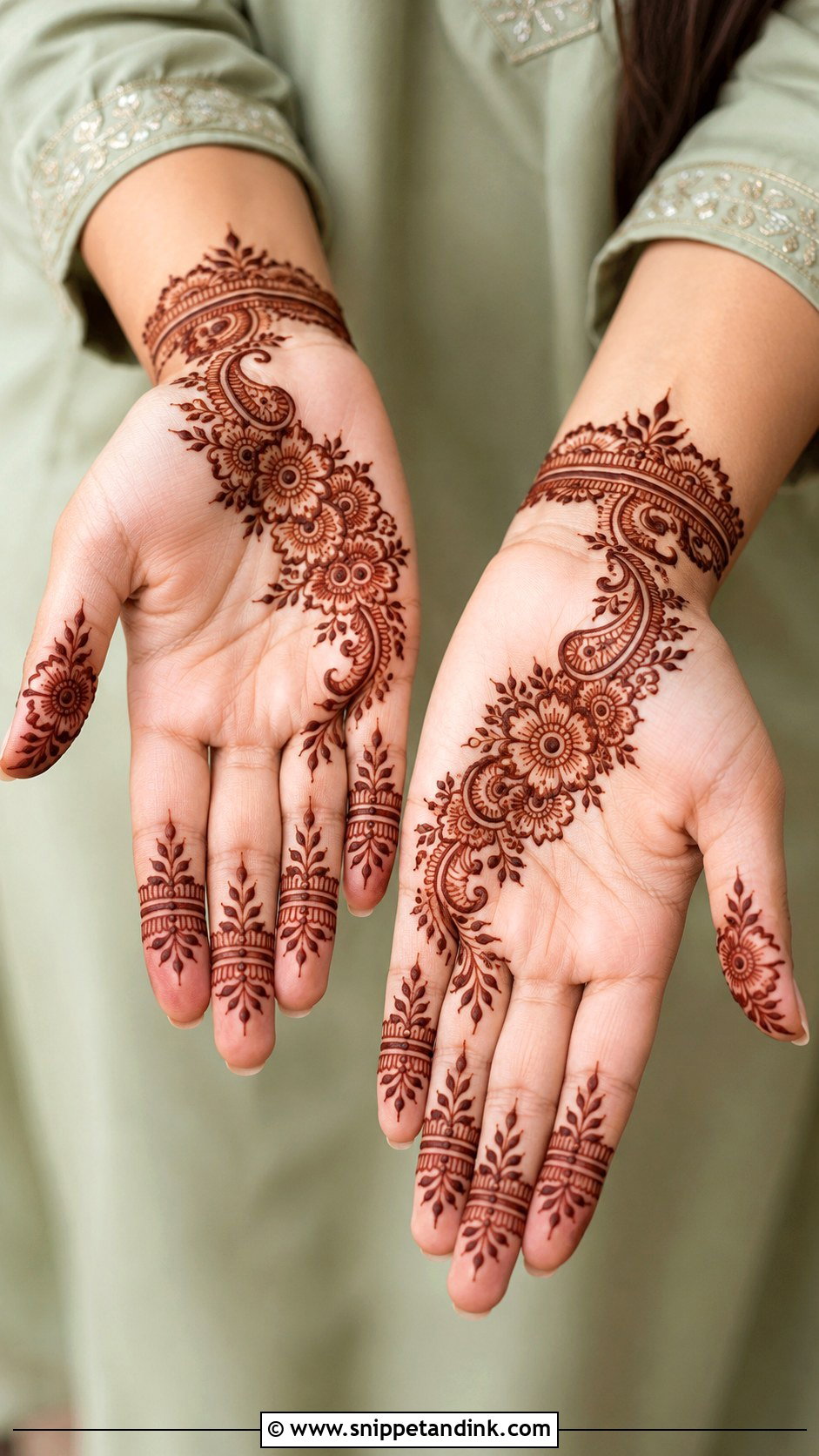
Half-hand palms decorate one diagonal side, the lower palm near the wrist or the upper palm toward the fingers, with Arabic trails, floral clusters, paisley chains or a mandala. They’re light, quick and festive. The thing that separates a finished half design from an unfinished full one is connection: I always link the decorated area to at least two fingers or a wrist border, so the open space reads as a choice.
29. Front Hand Eid Mehndi Design
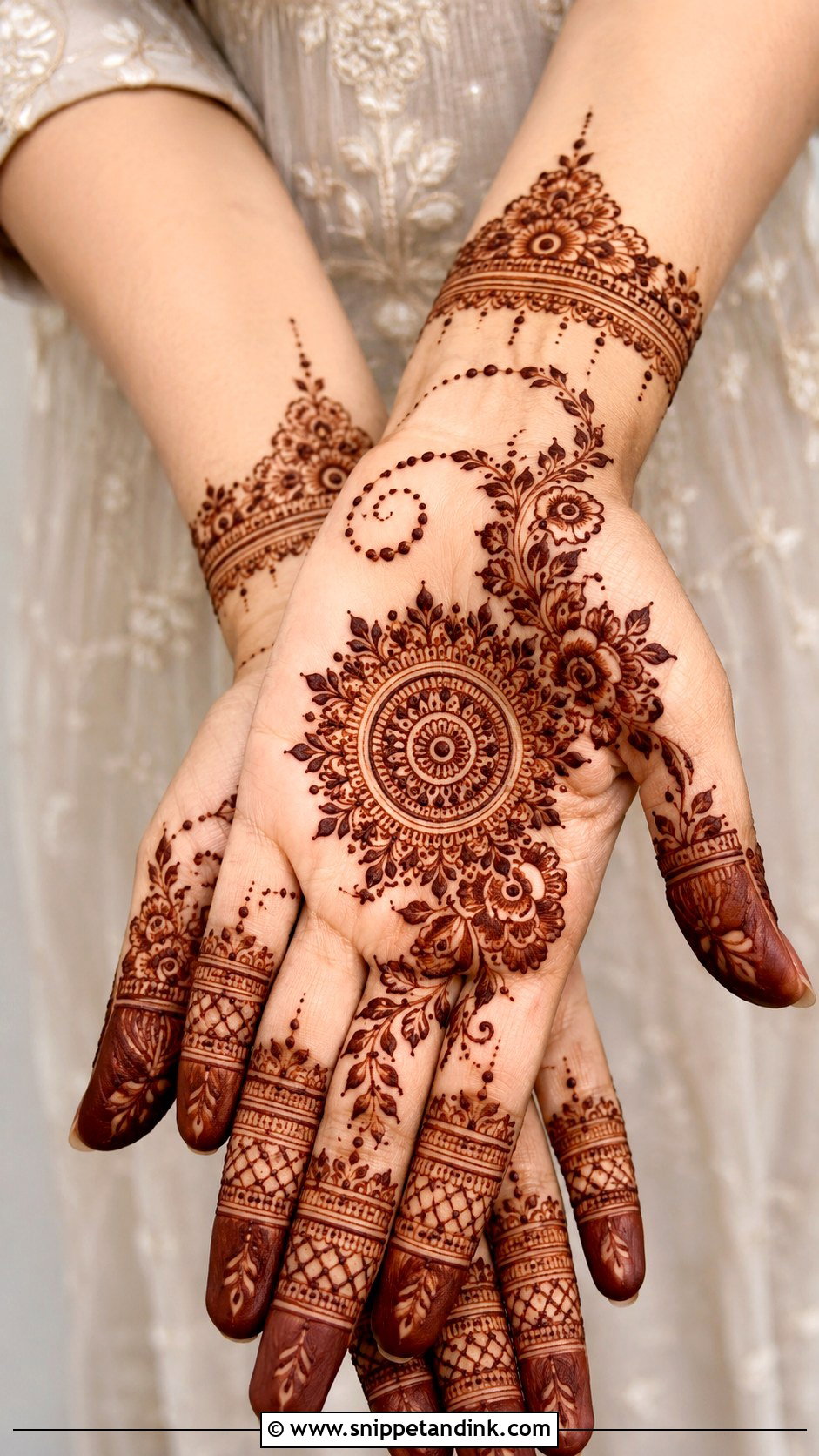
Eid palms need to look festive and dry quickly, since everyone wants mehndi on Chand Raat and the queue is long. Arabic florals, tikki patterns, leafy trails, bracelet designs and light full-hand layouts all work. A central palm motif with decorated fingers is the dependable option; a diagonal floral trail is the more modern one. Both hands should feel coordinated, even if they aren’t identical.
30. Front Hand Wedding Mehndi Design
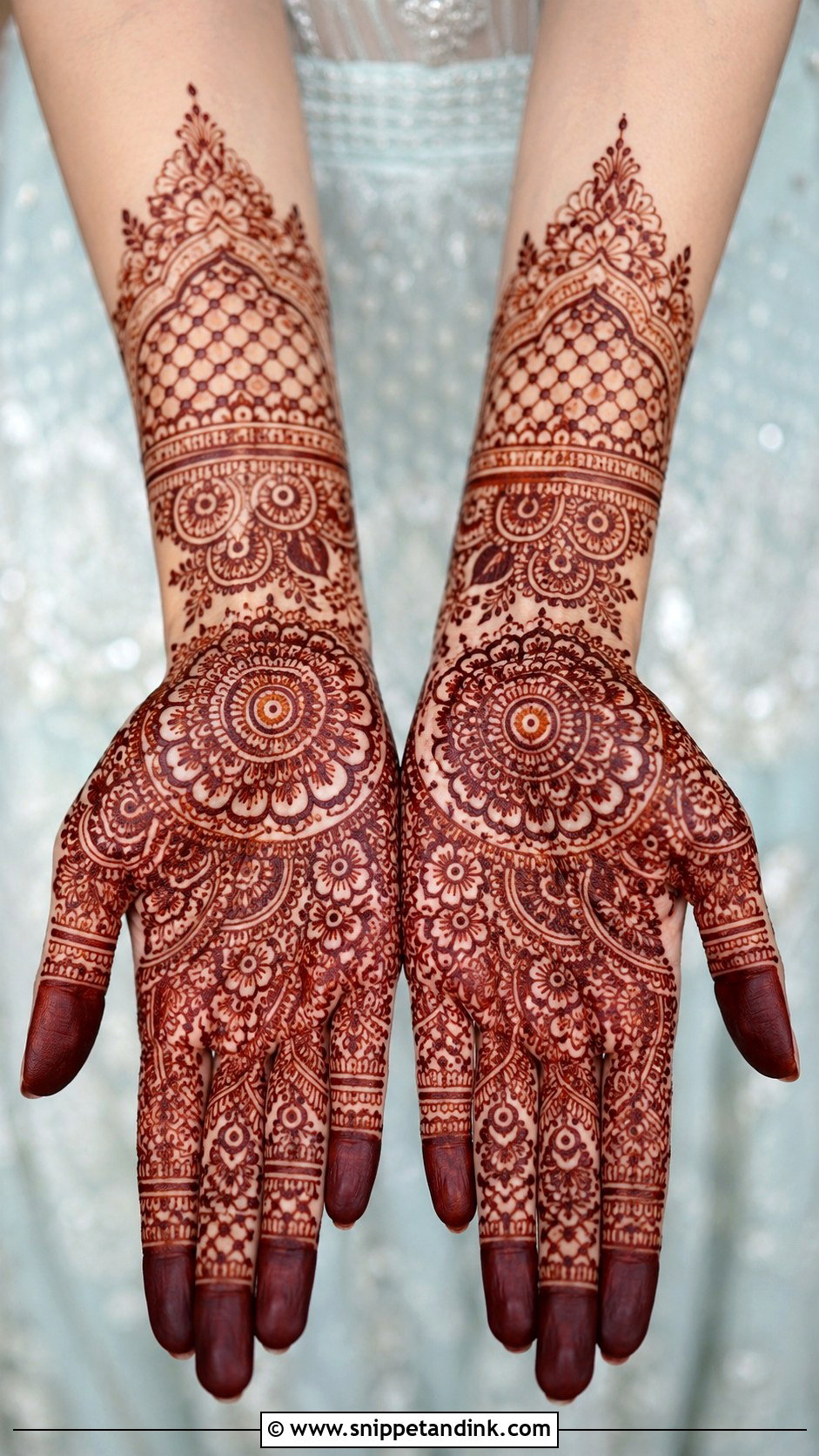
Wedding guests, sisters and close family can wear a rich palm without crossing into bridal territory. Flowers, paisleys, jaali, mandalas and wrist cuffs, but no portraits or names, which most families keep for the bride. A full palm with detailed fingers looks festive; Indo-Arabic florals with bold outlines and open space are the lighter route. Look at your sleeves before choosing. Short or embellished sleeves put the wrist in every photo, so I make sure that part is especially neat.
31. Front Hand Engagement Mehndi Design
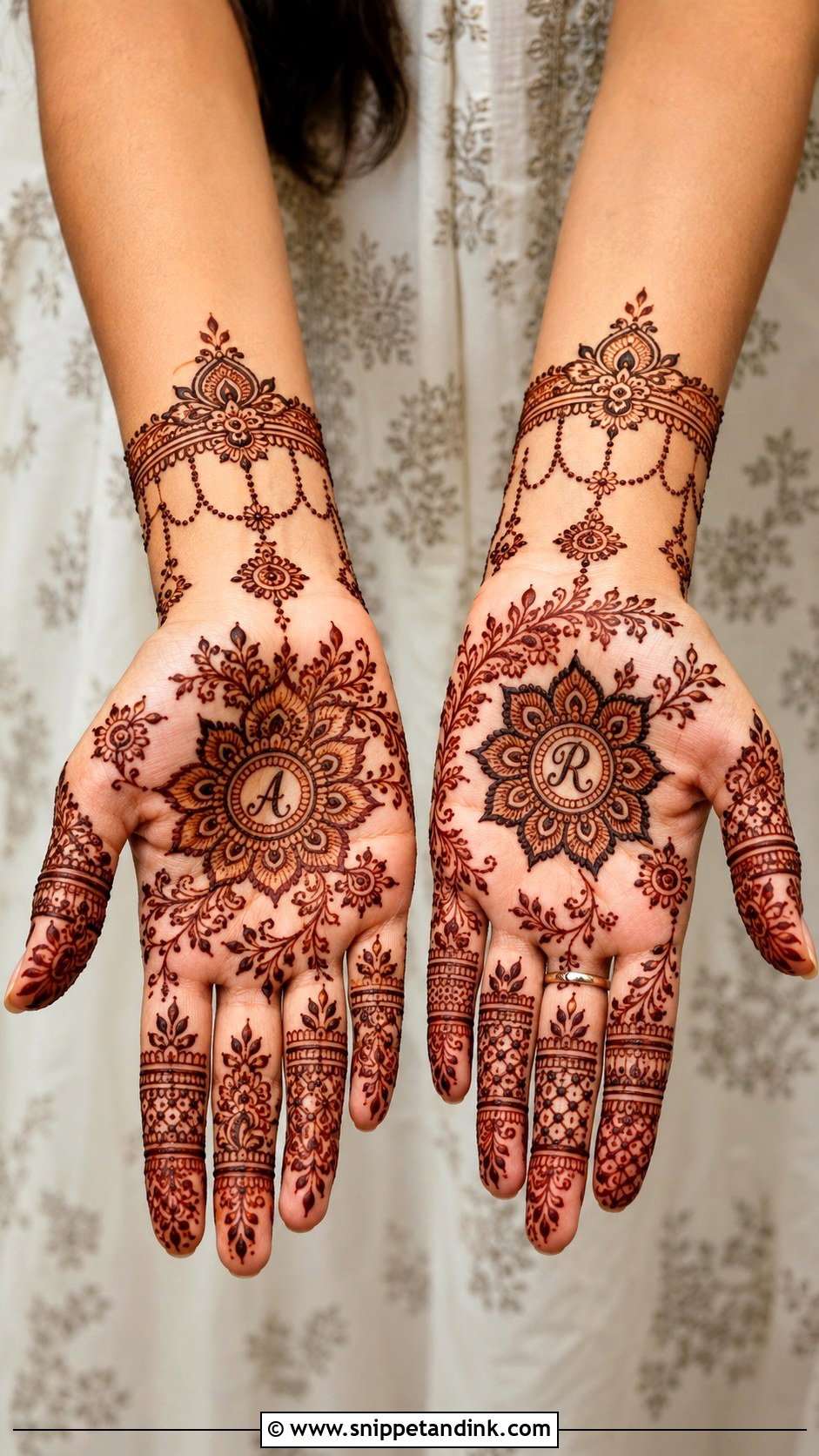
A front hand engagement mehndi design has to frame the ring. A floral mandala, fine finger bands, bracelet chains or a soft Arabic trail all work, but I keep the base of the ring finger lightly decorated so the ring isn’t sitting on a dense patch of henna. Tiny initials or a small personal motif can go in, kept subtle. It should land somewhere between bridal and casual: polished, delicate, with a clean wrist finish.
32. Front Hand Karva Chauth Mehndi Design
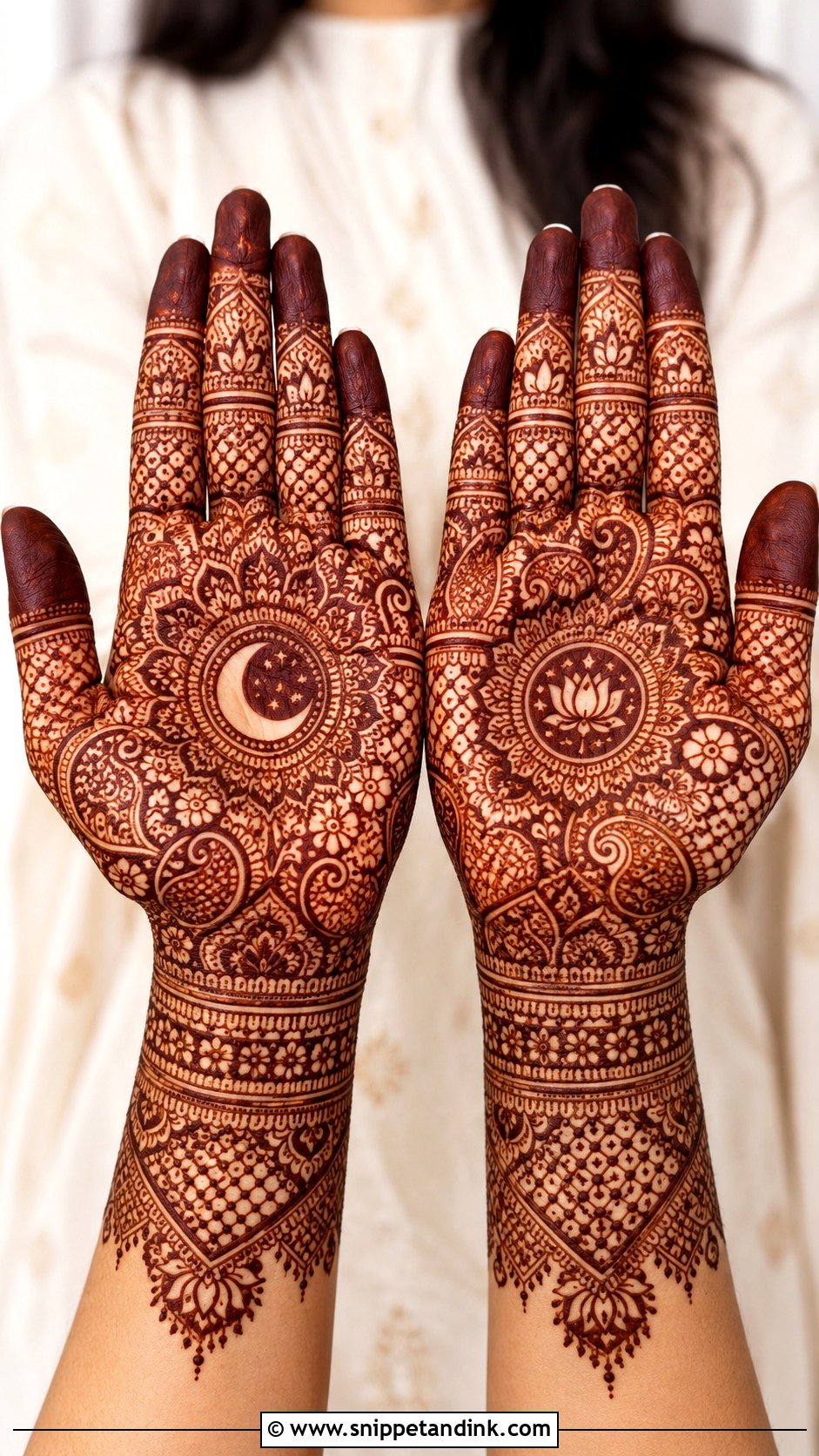
A front hand Karva Chauth mehndi design is usually traditional and full: moon motifs, mandalas, paisleys, lotus flowers, jaali and complete palm coverage, sometimes with a couple’s figures or symbolic shapes. The palms are on show during the rituals, especially when holding the thali and sieve at moonrise. A rich mandala with filled fingers is the classic; an Arabic trail with a wrist cuff is the modern alternative. Since the fast starts at dawn, I usually apply the mehndi the day before so it’s dark by the evening puja.
33. Front Hand Diwali Mehndi Design
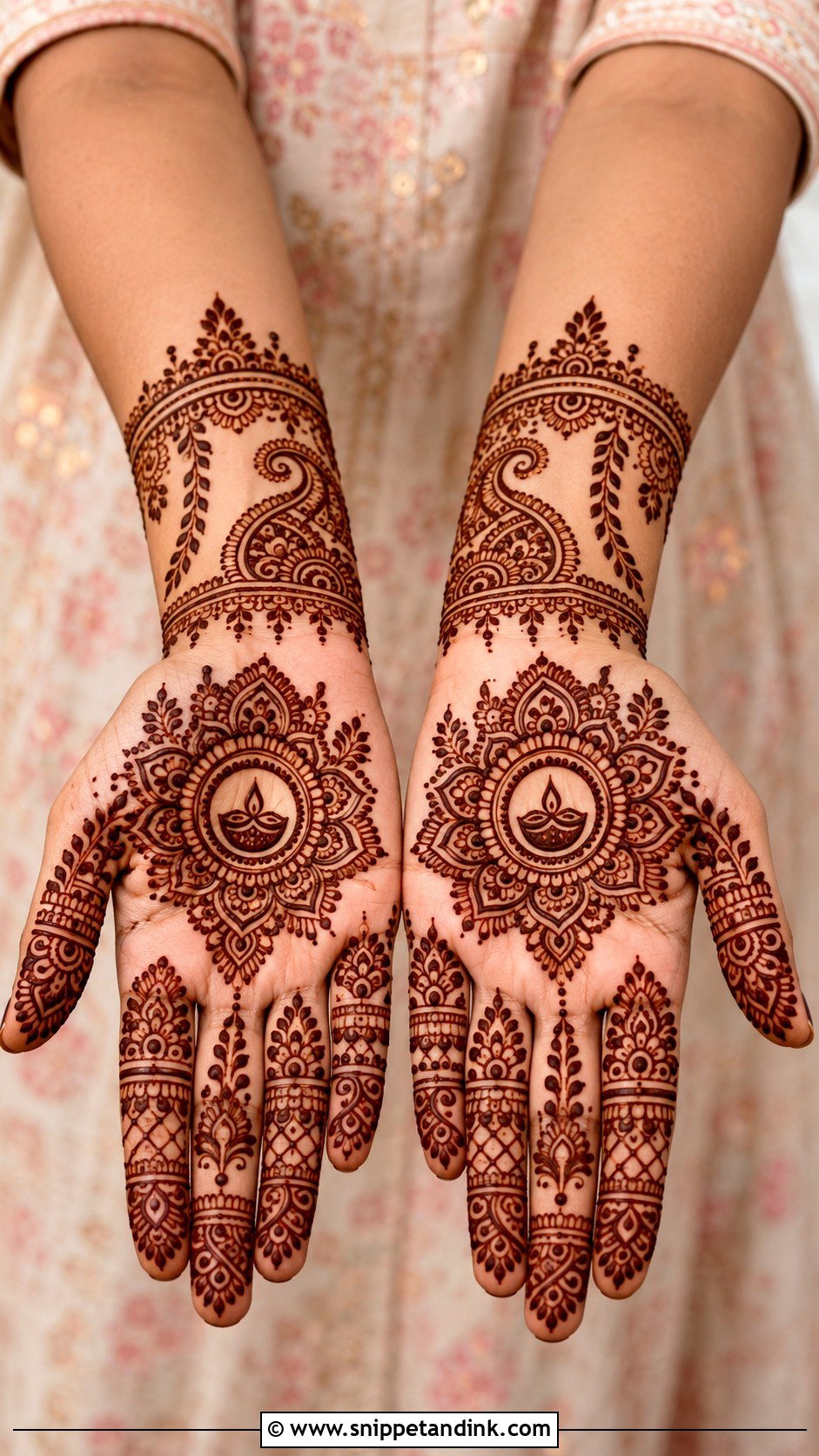
Diwali brings bangles and traditional jewelry, so bracelet patterns, mandalas, florals and paisleys make sense. A central tikki with a wrist border is the simple version; a fuller Indian layout is the festive one. Diya-shaped curves and dot chains are a nice seasonal touch. With so much happening around the hands, from lighting lamps to handling sweets, I keep the motifs clear rather than cramped so they survive a busy evening.
34. Front Hand Kids Mehndi Design
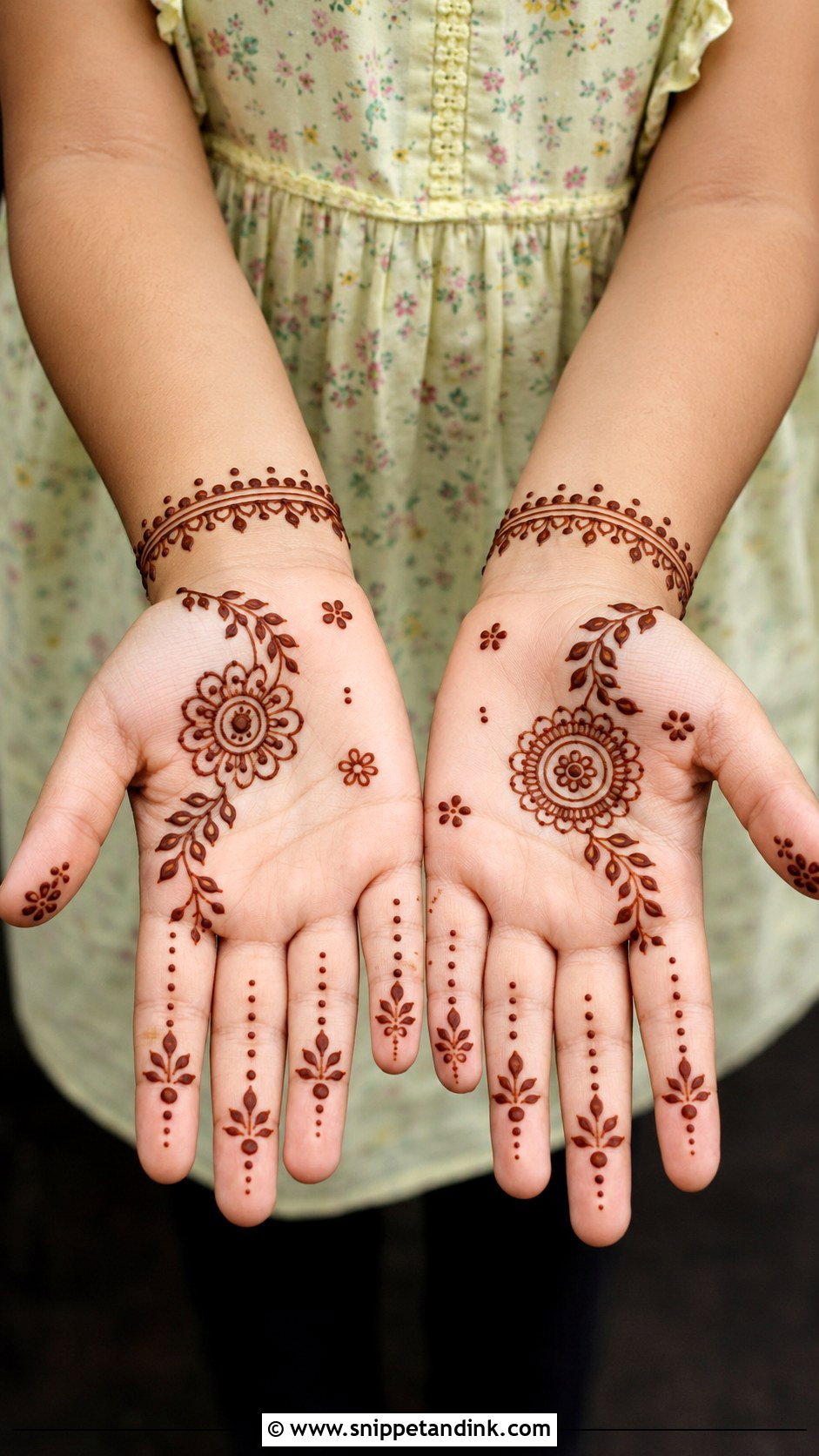
Children want something cute and fast: a small flower, simple mandala, butterfly shape or leafy vine, with dots or tiny bands on the fingers and maybe a small wrist bracelet. Dense patterns get smudged before they dry, so I use rounded shapes and open space. Only natural henna on children, never the dark pre-mixed cones that promise an instant black stain.
35. Front Hand Party Mehndi Design
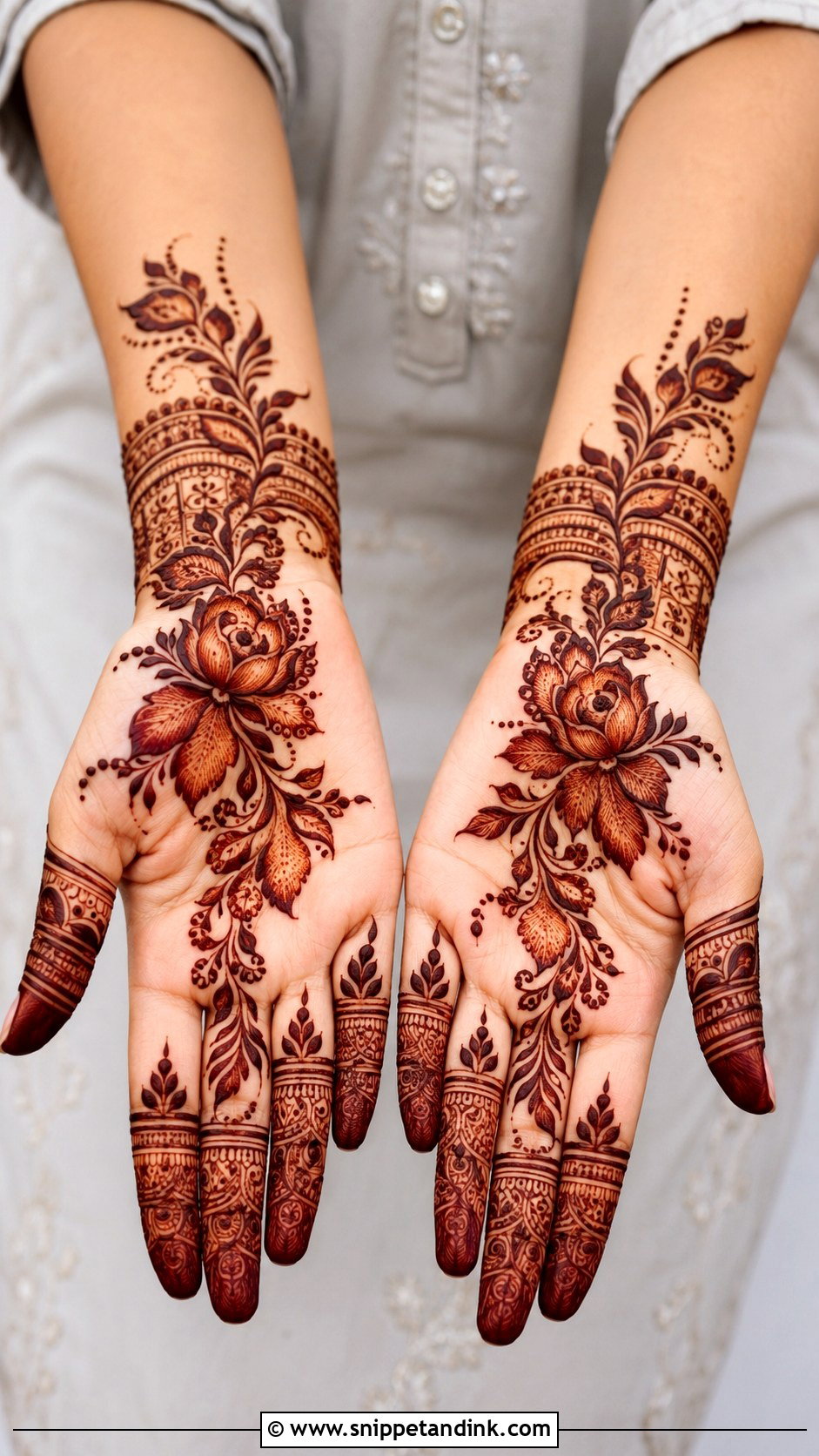
Party palms sit between everyday henna and wedding mehndi. A bold floral trail, a modern finger pattern, a bracelet cuff or a half-palm design with negative space gets enough impact without hours in a chair. Arabic and Indo-Arabic layouts give the most effect for the fewest elements. Think about your nails and rings before choosing; a heavy fingertip fill fights with a bright manicure. Shaded flowers, dots along the vines and a slim wrist line finish it.
Who Sits First on Mehndi Night
On a wedding mehndi night, the order of the queue decides how well everyone’s palms turn out. The bride sits first, often in a separate session the day before, because a full bridal set can take most of a day and she needs time to rest with the paste on. Close family follow, then guests. Guest palms are quick, but a long queue adds up, and the last people done get the least time with paste on before they go home and wash.
If you’re organizing it, tell the artist roughly how many guests to expect and how much coverage each will get. That decides whether one artist is enough or you need two or three. Agree on a simple guest menu, perhaps a palm design and a finger design, so nobody asks for a bridal hand at nine at night.
If the Stain Comes Out Patchy
Patches usually mean the paste lifted early in places, lotion was on the skin, or those spots got wet. There is no safe way to darken a finished stain quickly, and anything that claims to is worth avoiding. What does help is warmth and patience: the color keeps deepening for up to two days. If it’s still uneven on the day, tell your photographer; angling the palms toward soft light and leading with the evenly stained hand hides a lot. Next time, ask for the paste to be sealed and left on overnight.
Heavier Isn’t Always Better on a Palm
Start with the occasion and how much coverage you actually want, and the list narrows quickly. Mandalas, tikki patterns and finger designs suit quick wear. Arabic, Gulf and khafif feel airy. Indian, Rajasthani and full bridal palms carry tradition. Of the 35 palms here, the heaviest one is rarely the best one for you. The right design suits your hand shape, your outfit and the hours you can sit, and with clean lines and spacing, a simple palm can look as considered as a bridal one.
You'll Like These Ideas:


Leave a Reply