
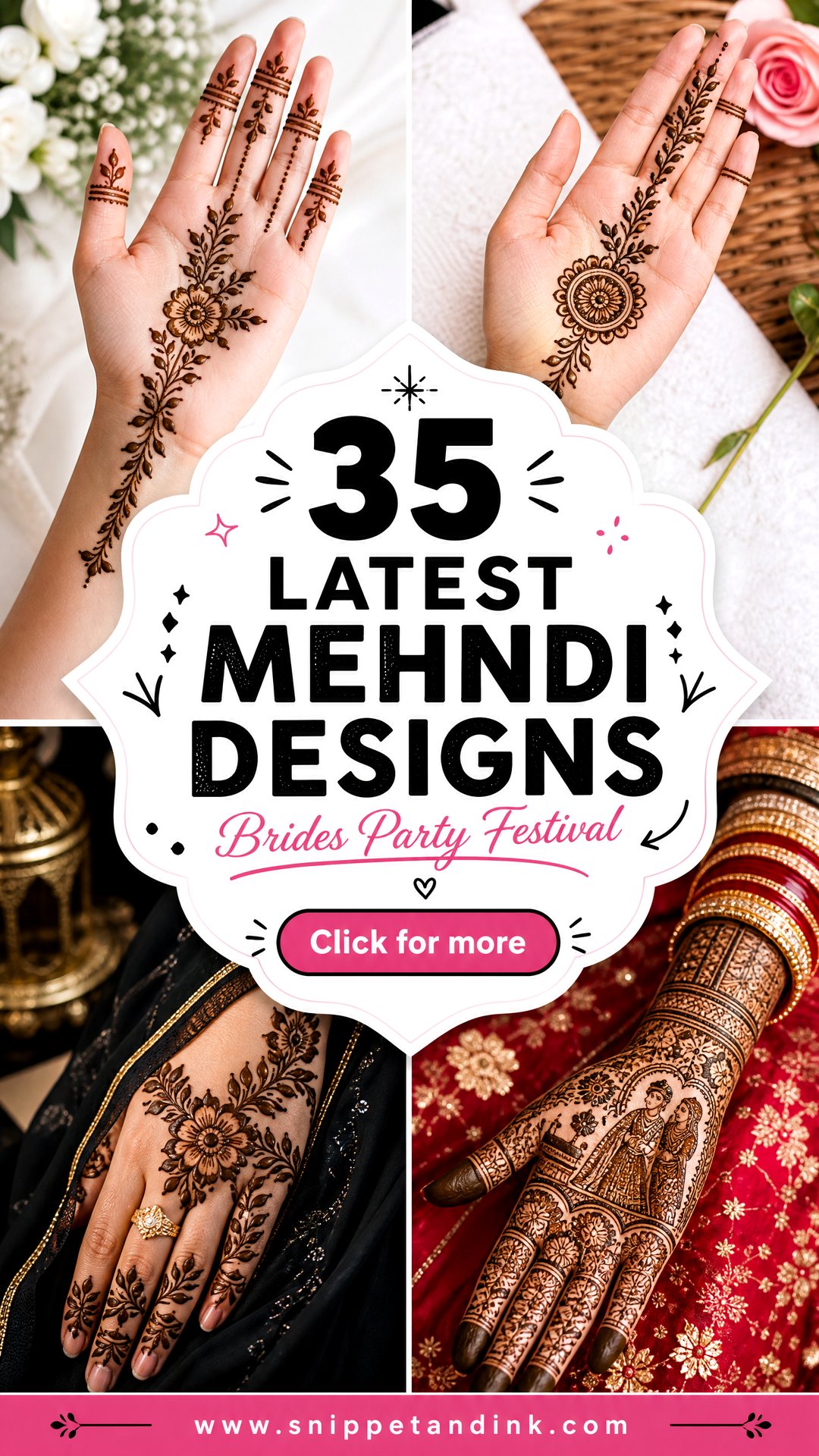
Most of the hands I decorate this year ask for the same thing: enough detail to feel like an occasion, and enough bare skin that the stain still reads from across a room. The requests I hear most are Arabic floral trails, full bridal coverage, mandala back hands, fine khafif work, Indo-Arabic fusion, peacocks and a few slim bands on the fingers. Which one suits you depends less on fashion than on three practical things: the event, how long you can sit still, and how deeply your skin takes henna. Below are 35 designs I’d happily draw, from ten-minute finger work to bridal arms that take an afternoon, with notes on how each one behaves once the paste comes off.
Sizing Up a Design Against Your Sitting Time and Skin
The first thing I ask a client isn’t which motif she likes. It’s how long she can keep her hands still, and what she has to do with them for the rest of the day. A design that’s right on paper can be wrong for an afternoon when you’re also cooking for forty relatives.
- Finger bands, bracelets and single vines: minutes per hand, and you can usually carry on with light tasks once the paste has dried.
- Arabic, Khaleeji and half hand designs: a short sitting for both hands, with most of your palms left free.
- Full bridal hands, Rajasthani and full arm work: several hours with a skilled artist, often longer when both sides of the hand and arm are covered. Times vary a lot by artist and detail.
Then add the time the paste needs on the skin. I ask brides to keep it on for at least six hours, and overnight is better. That’s why I schedule bridal mehndi a day or two before the wedding, never the morning of.
When your skin stains pale
Henna stains thick, warm skin deepest, which is why palms come out darker than wrists and arms. Cold hands, very dry skin and skin that’s been scrubbed or waxed the same day all take colour less well. If you know you stain light, choose bolder lines and more open space. A very fine, dense pattern on pale-staining skin tends to look washed out rather than intricate.
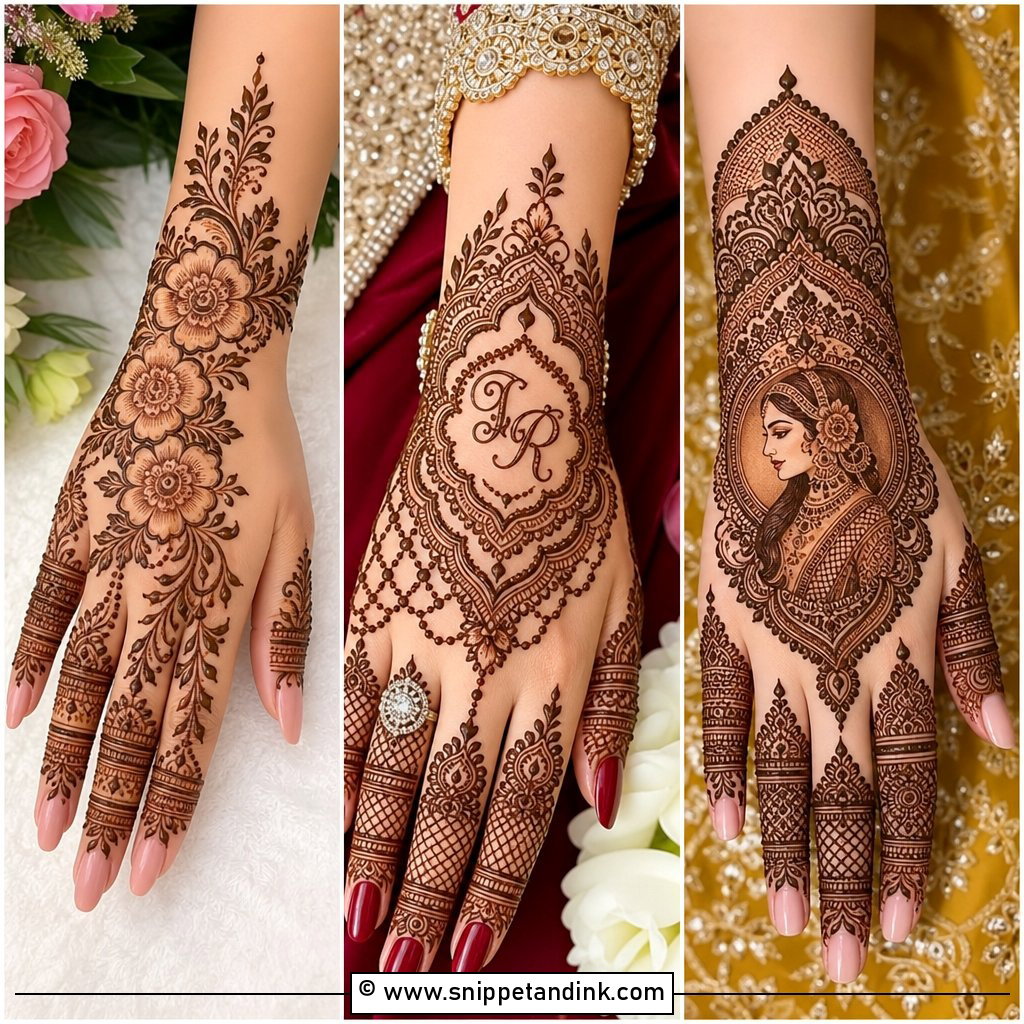
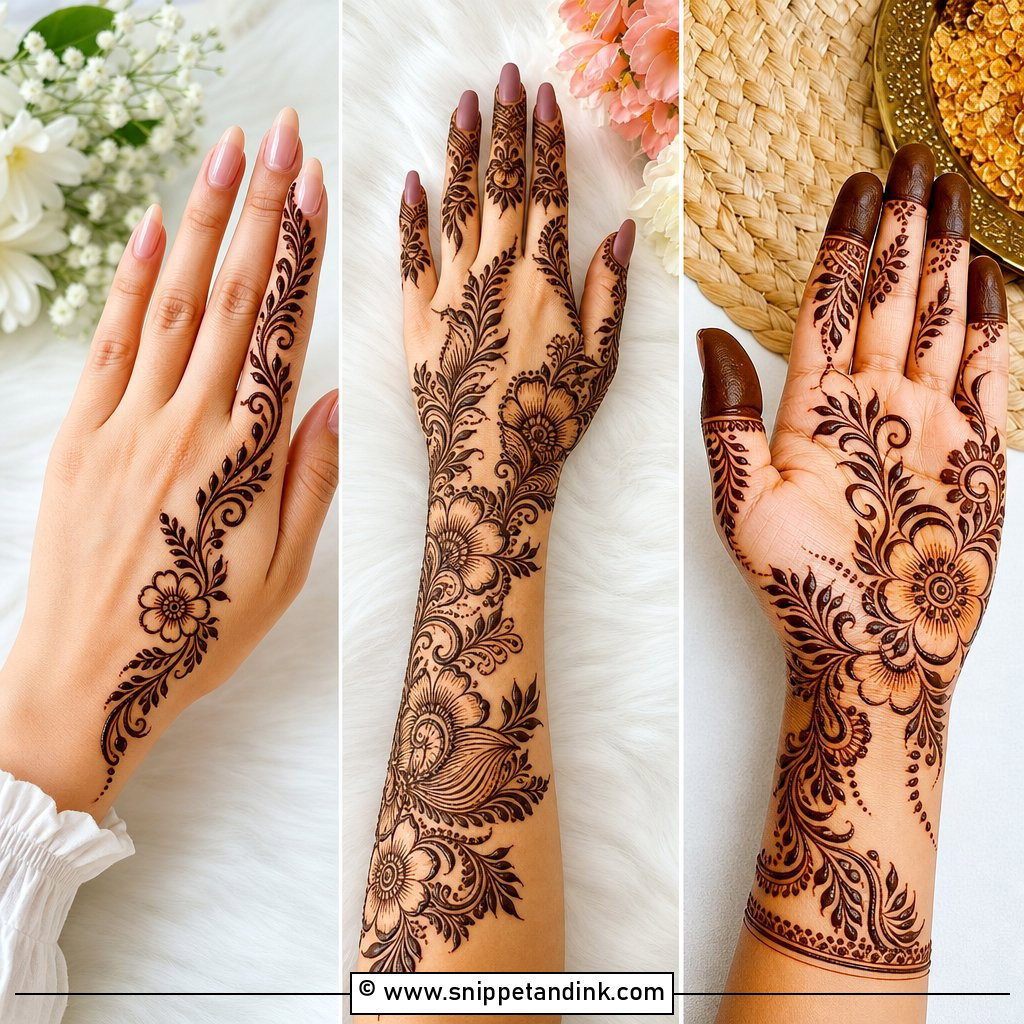
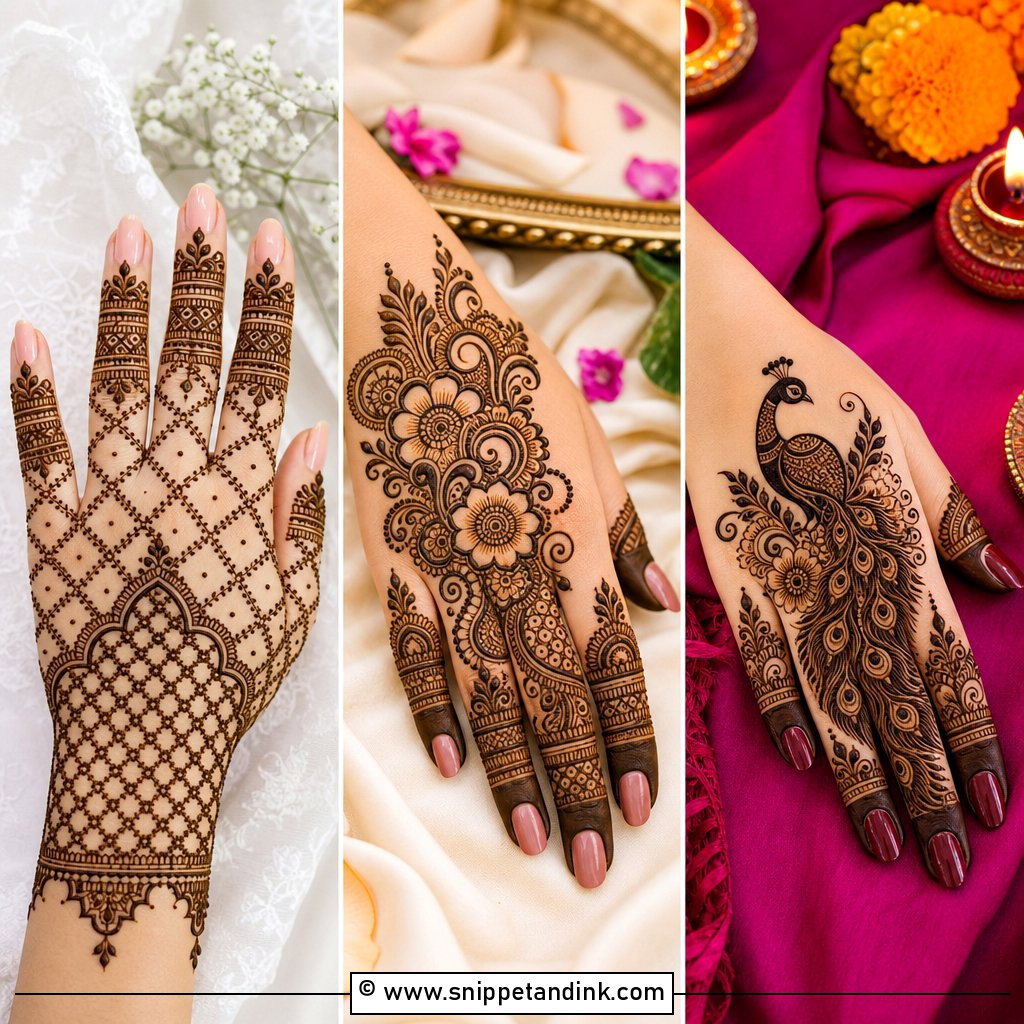
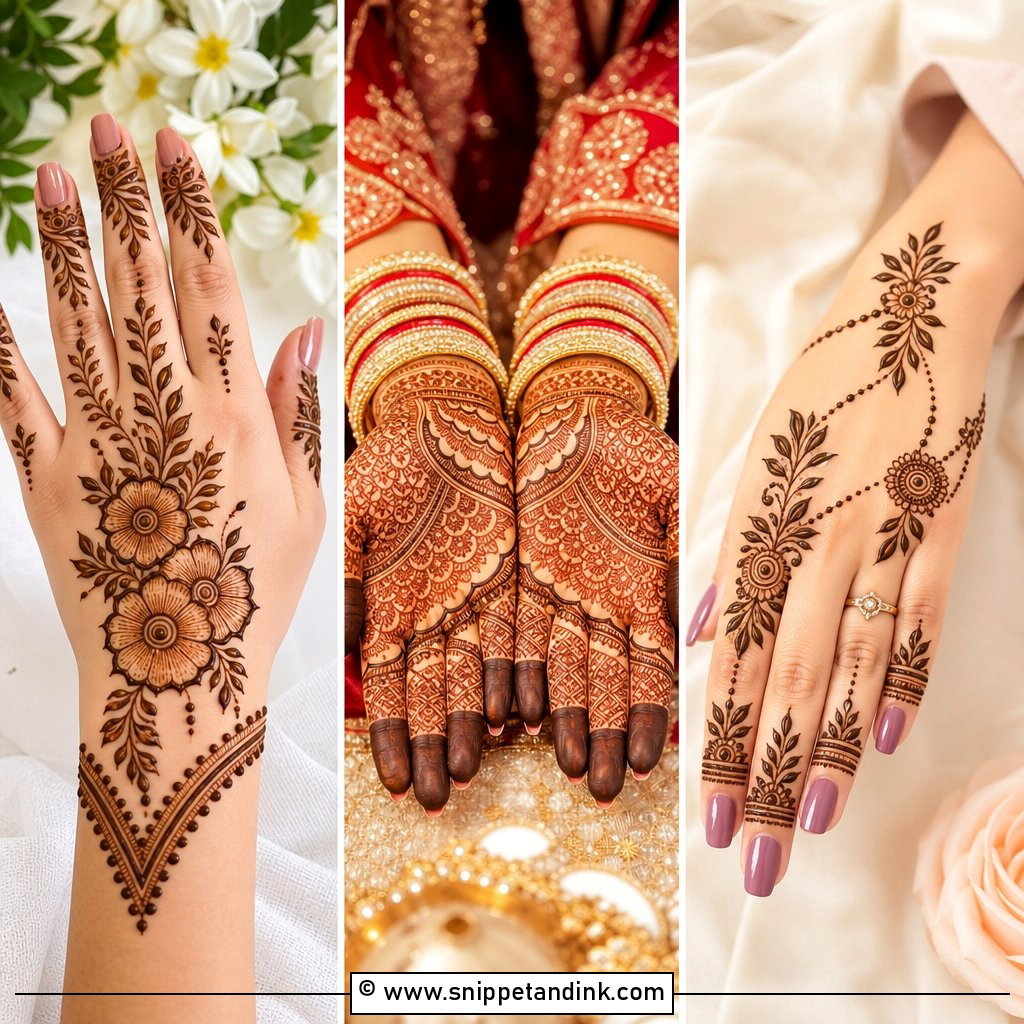
1. Arabic Back Hand Mehndi Design
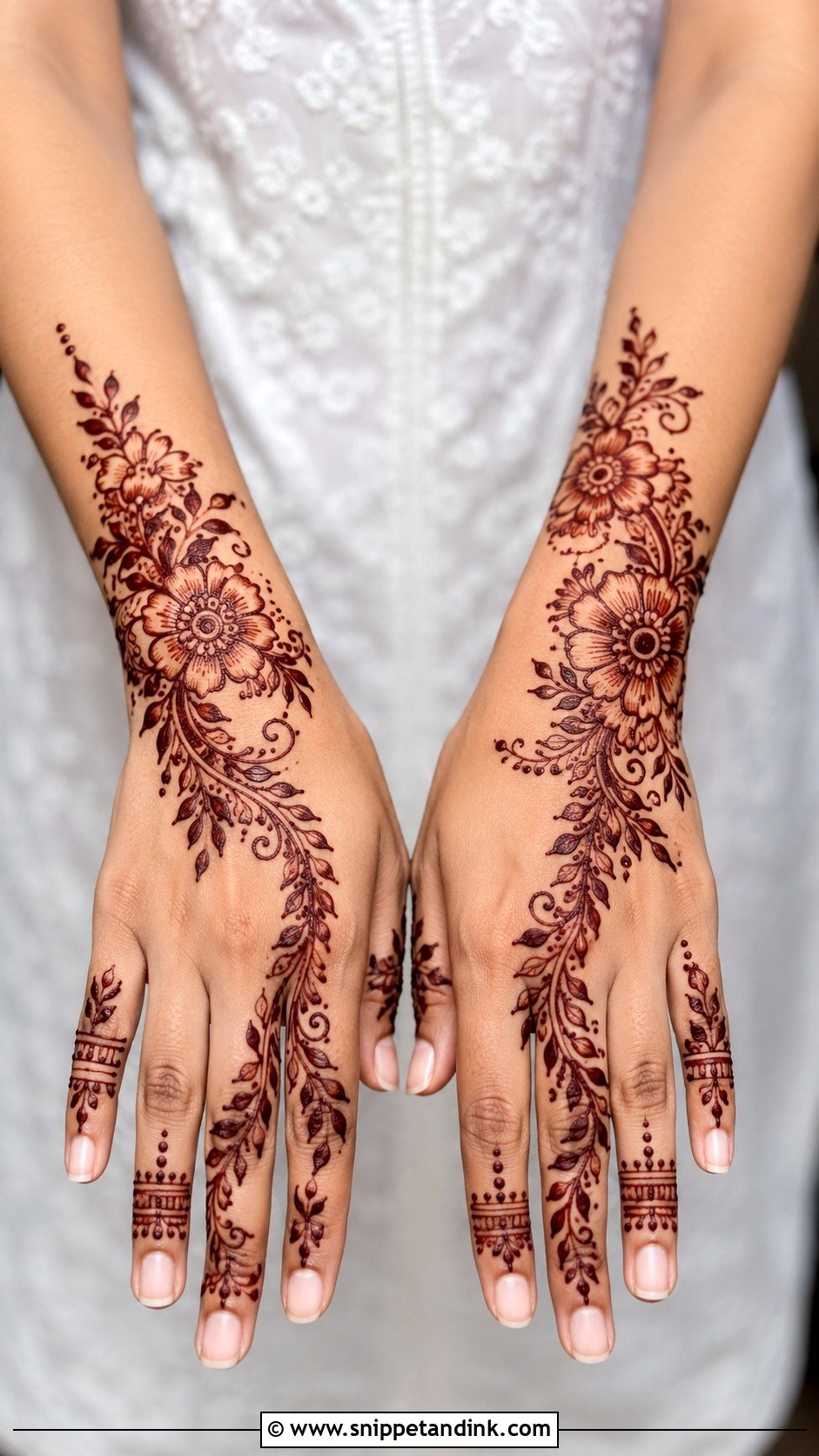
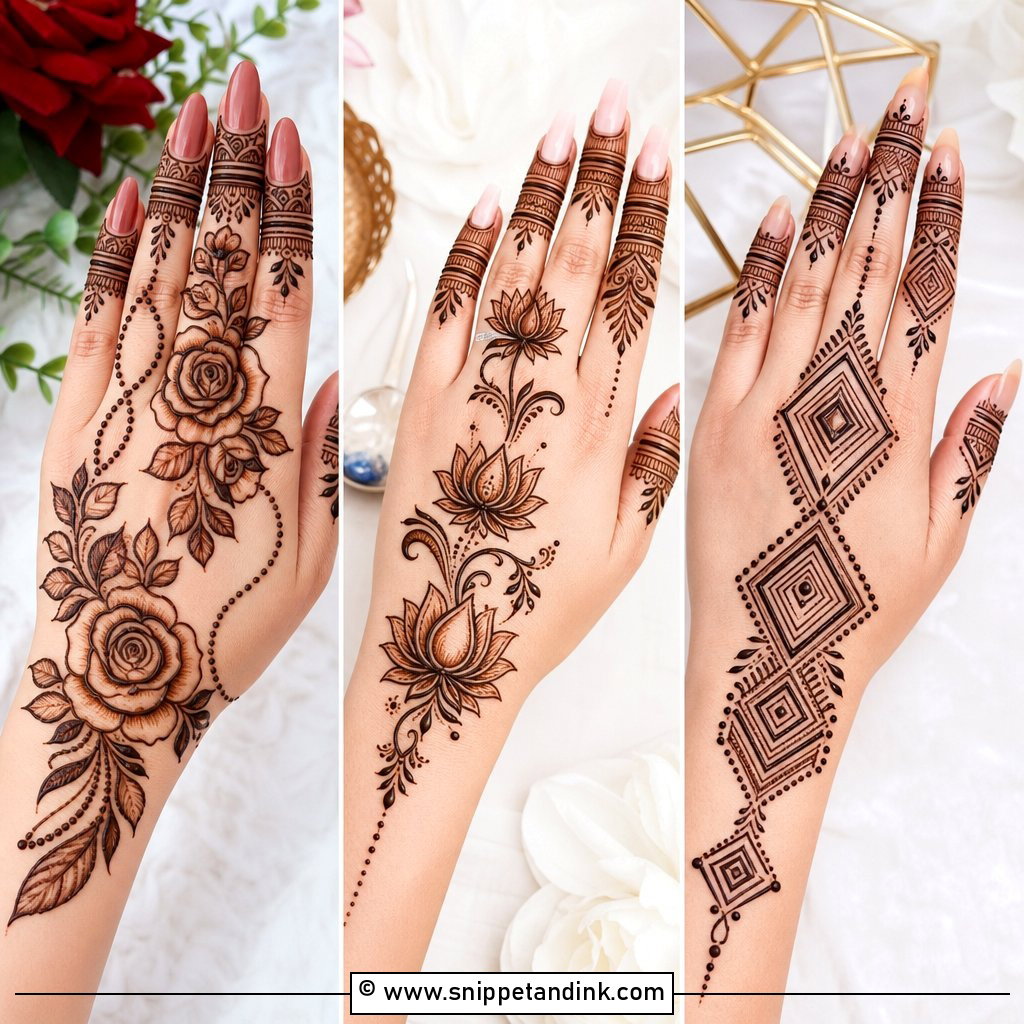
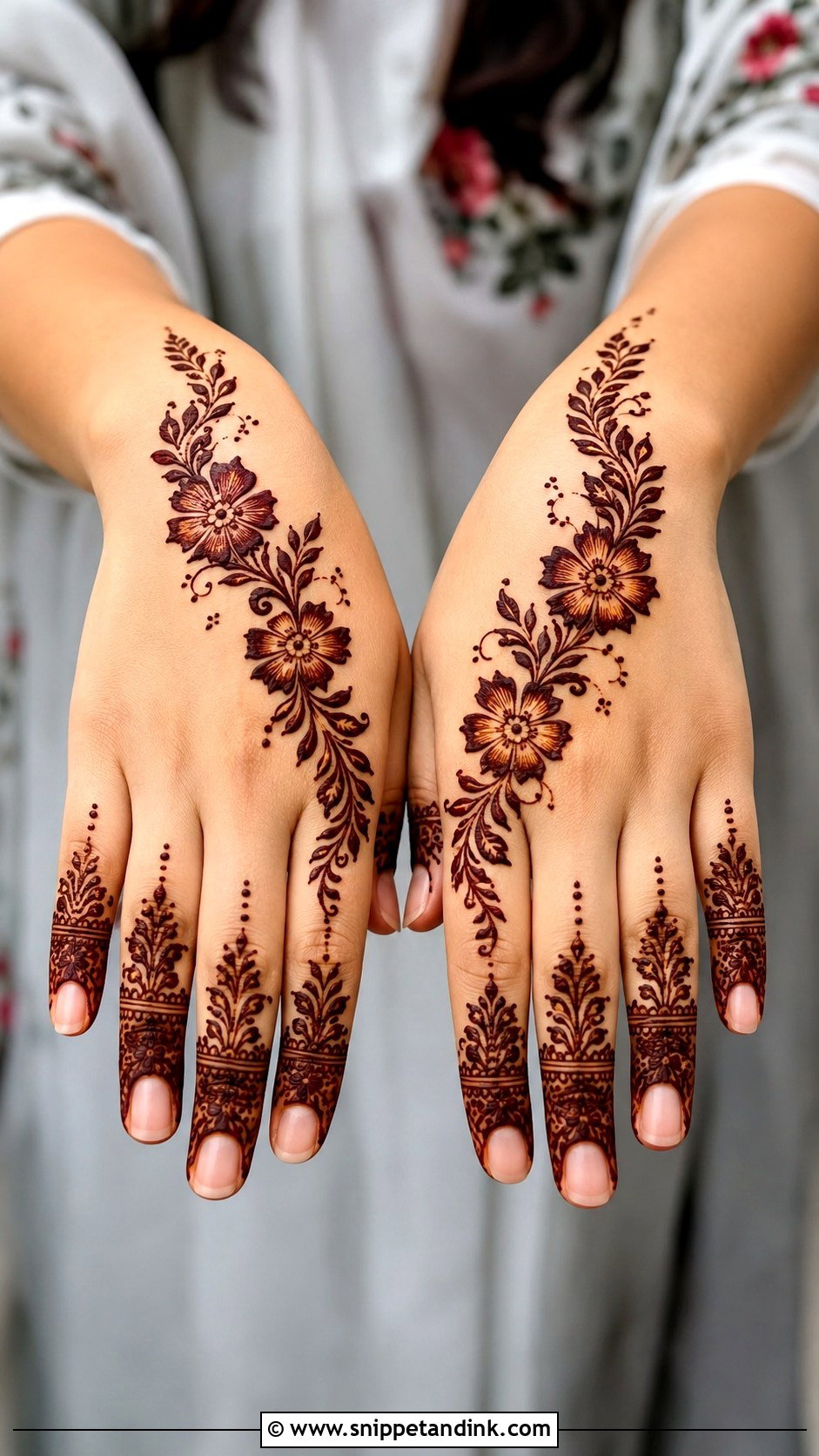
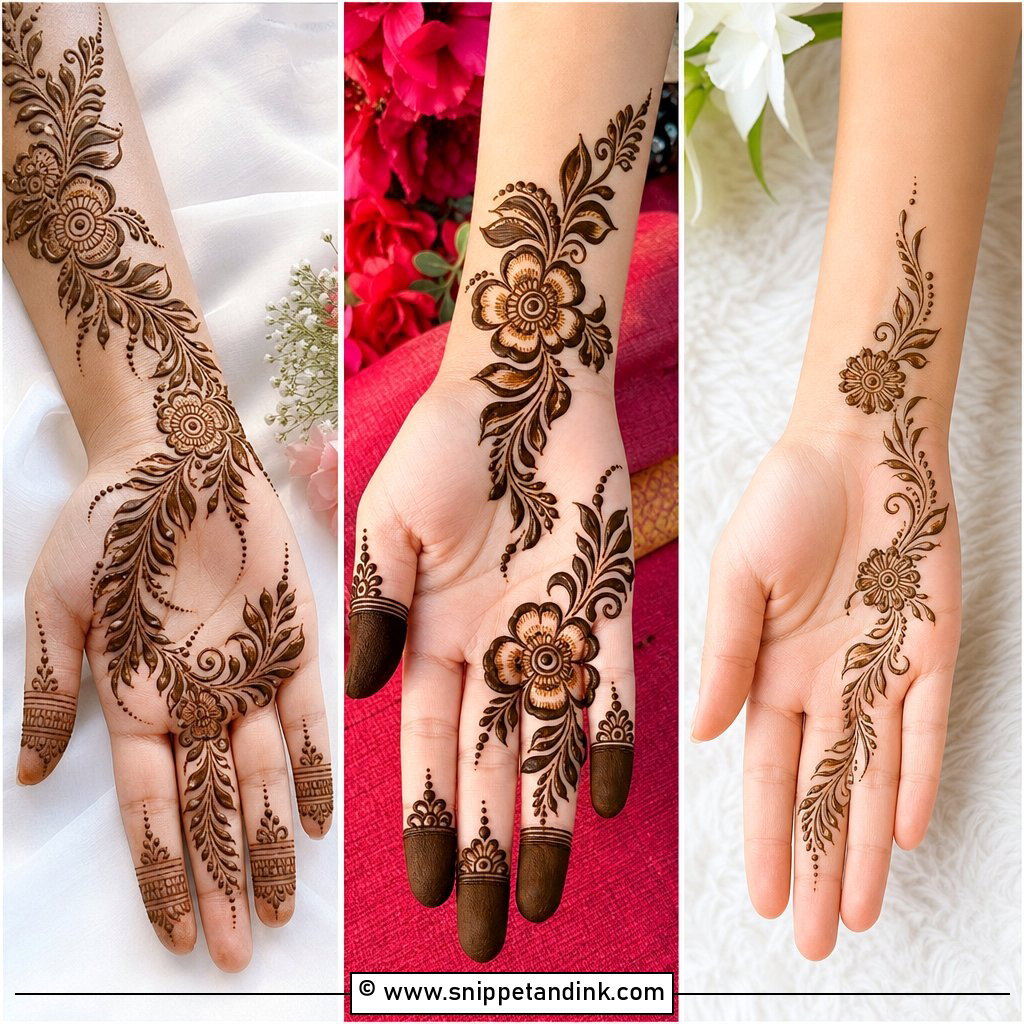
This is the design I’m asked for most at Eid and family weddings, and it earns that. I start at the wrist with one large flower, then pull leafy vines on a diagonal toward the index or middle finger, leaving wide gaps of bare skin between motifs. Those gaps are the design. Fill them and the hand turns muddy once the stain darkens and the lines spread a fraction. I keep the fingers to dots, leaves and a slim band so rings sit cleanly on top.
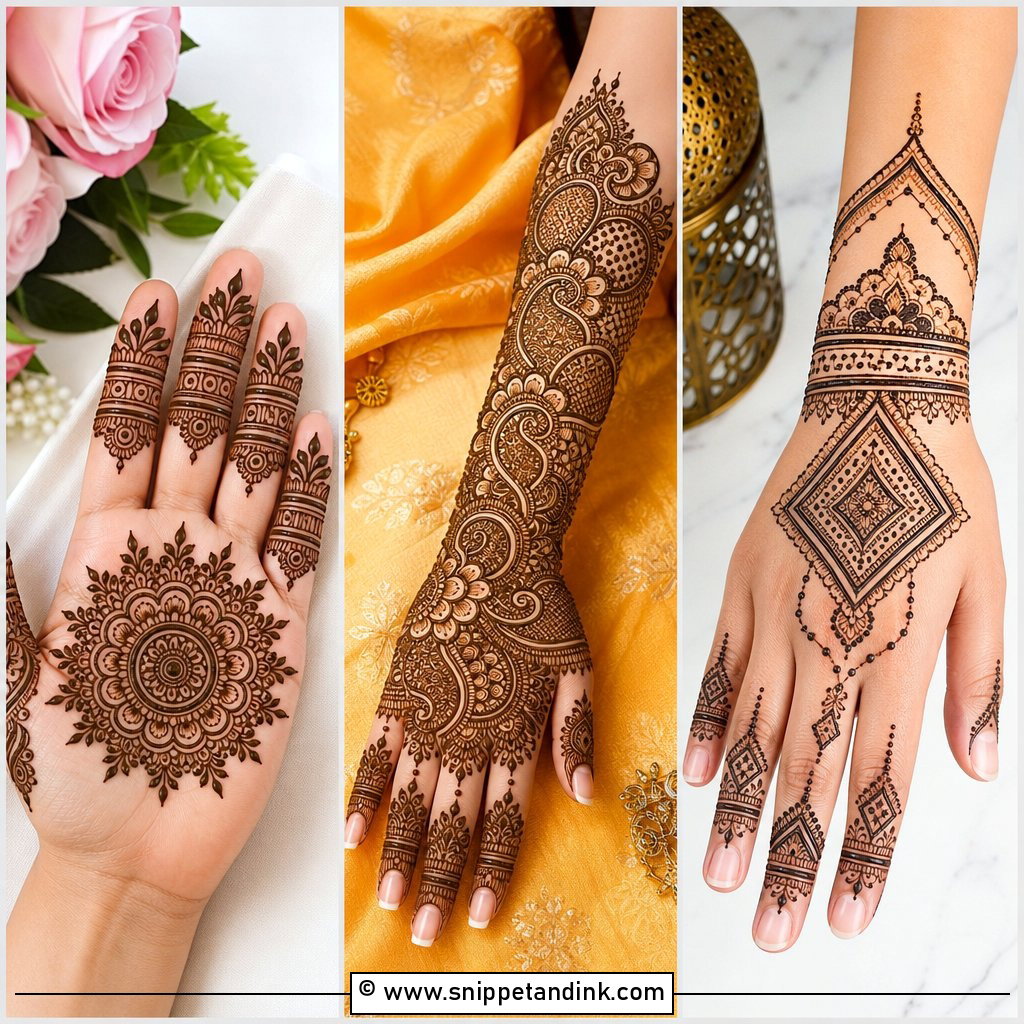
2. Simple Front Hand Mehndi Design
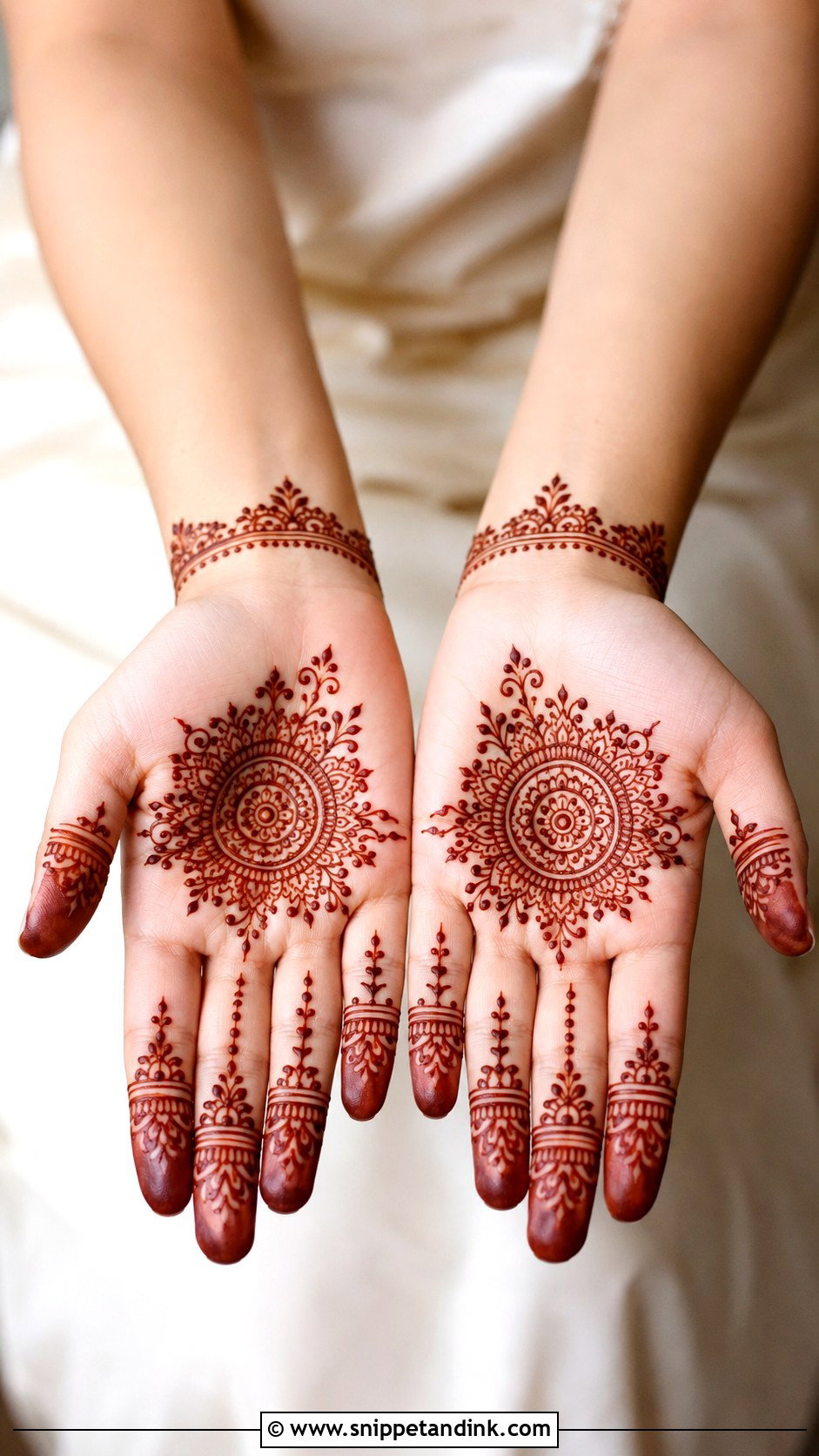
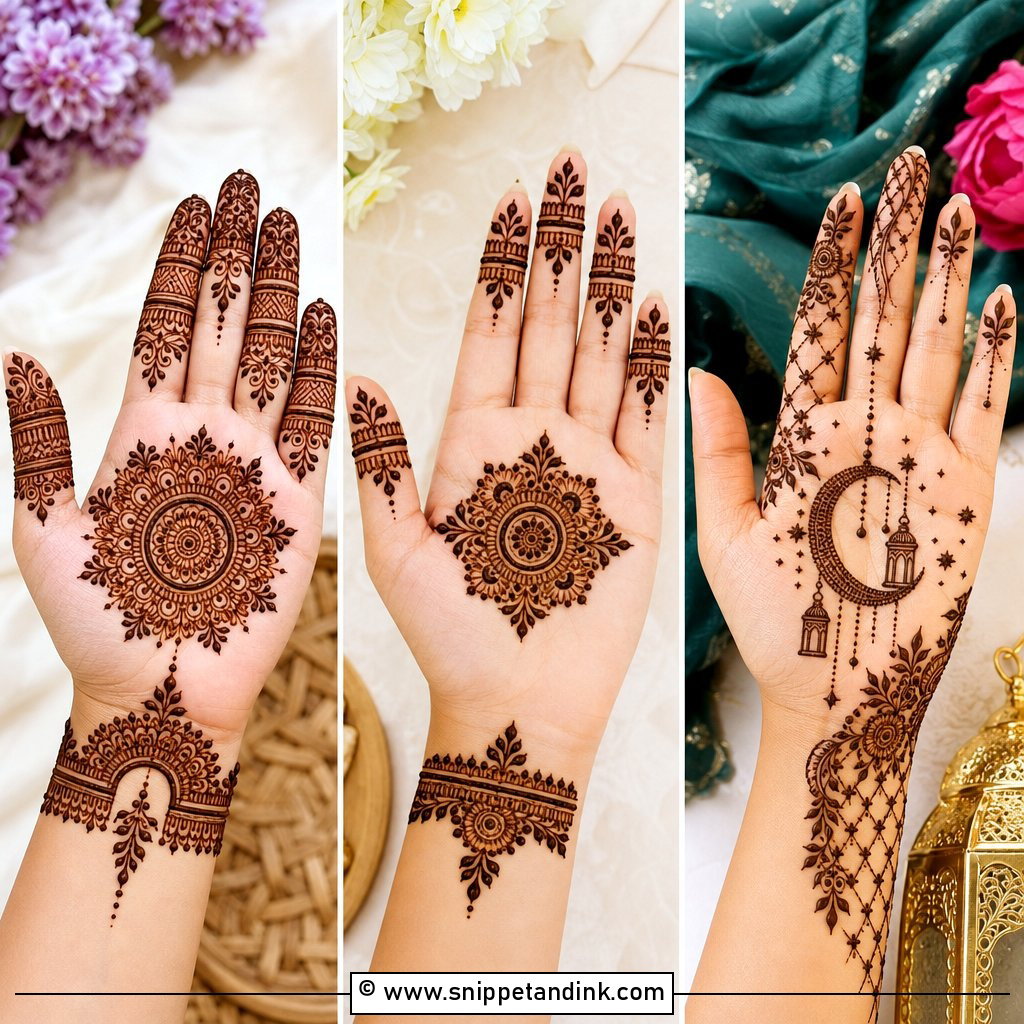
A simple palm design lives or dies on the mandala and the space around it. I draw the centre circle first, a little below the middle of the palm where the hand folds least, then add small floral curves and plain fingertip caps. Palms stain darker than anywhere else on the hand, so even an open layout comes out rich here. It’s a good first design for anyone learning, because it repeats dots, petals and curved borders. Two thin bracelet lines at the wrist close it off.
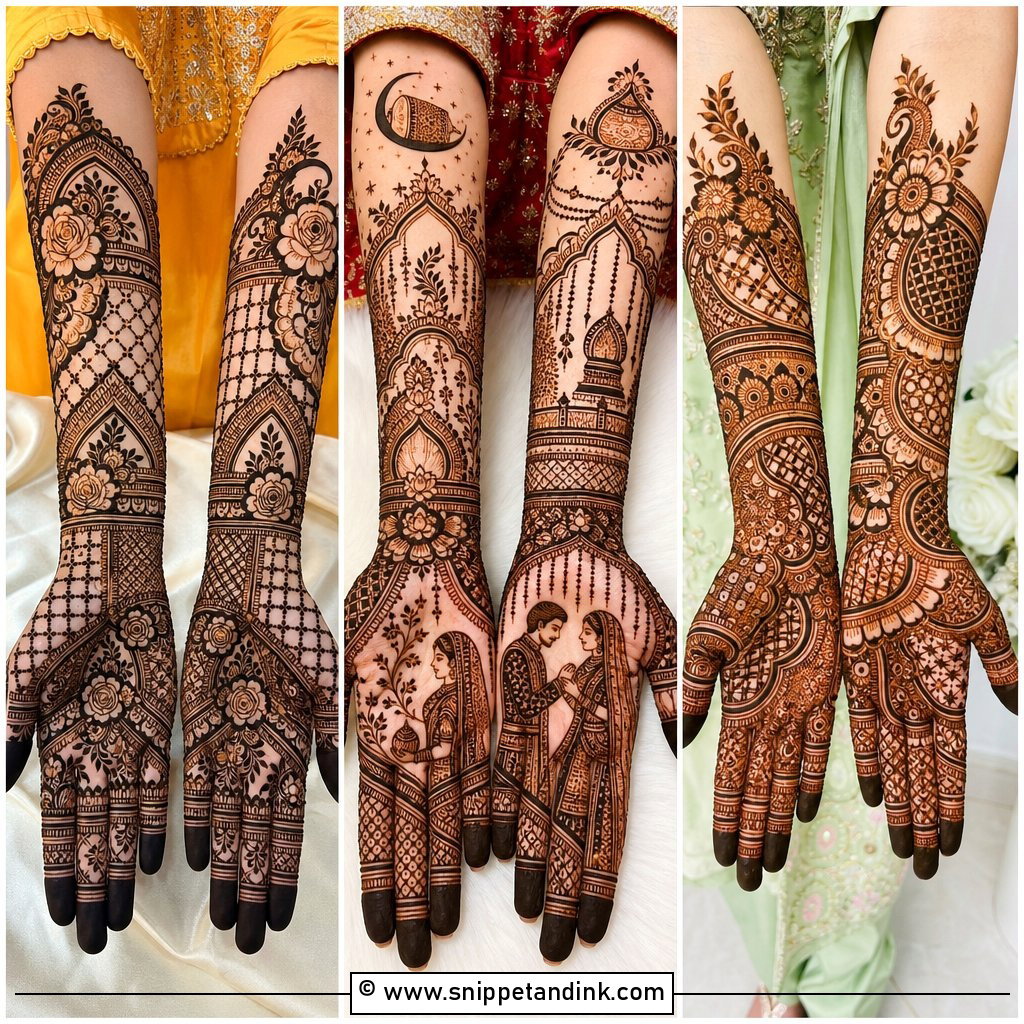
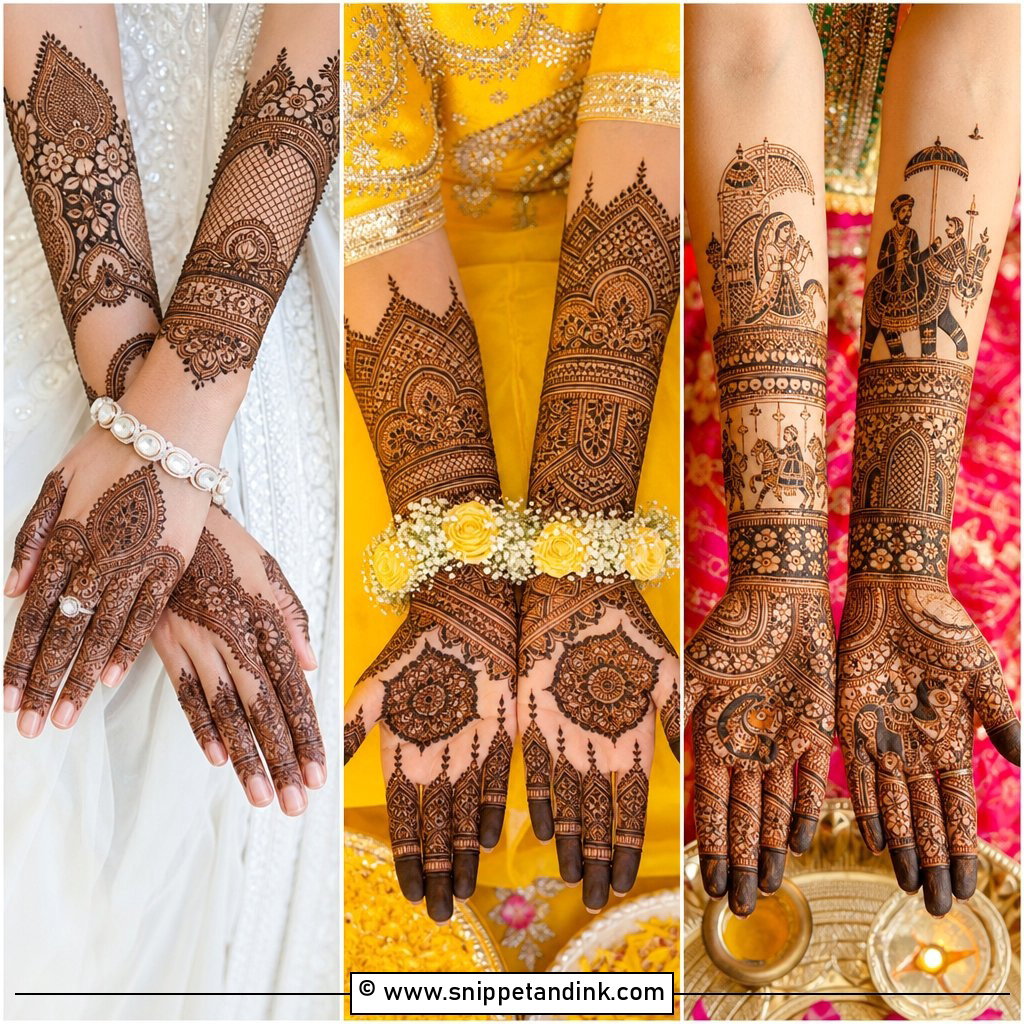
3. Full Hand Bridal Mehndi Design
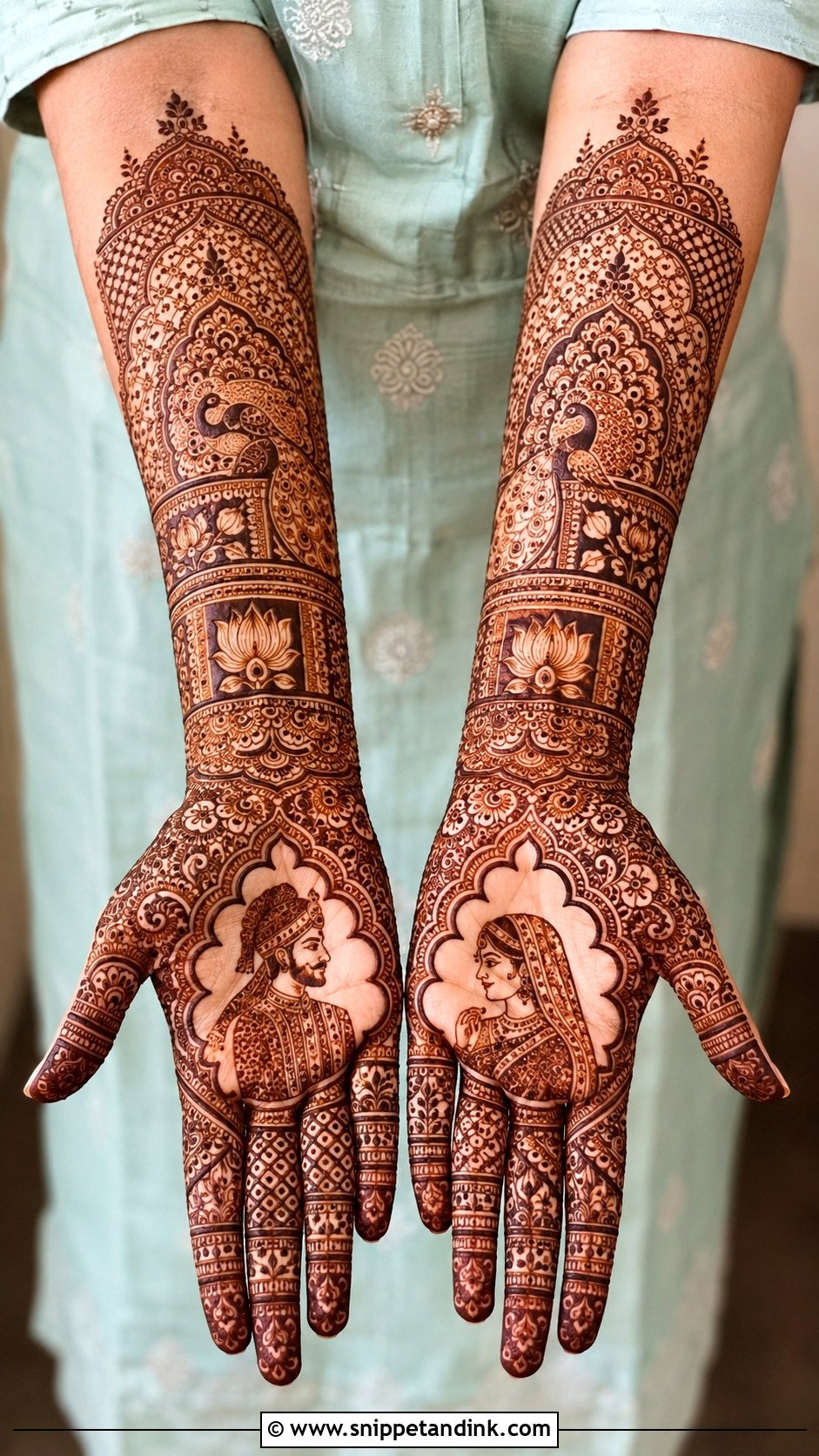
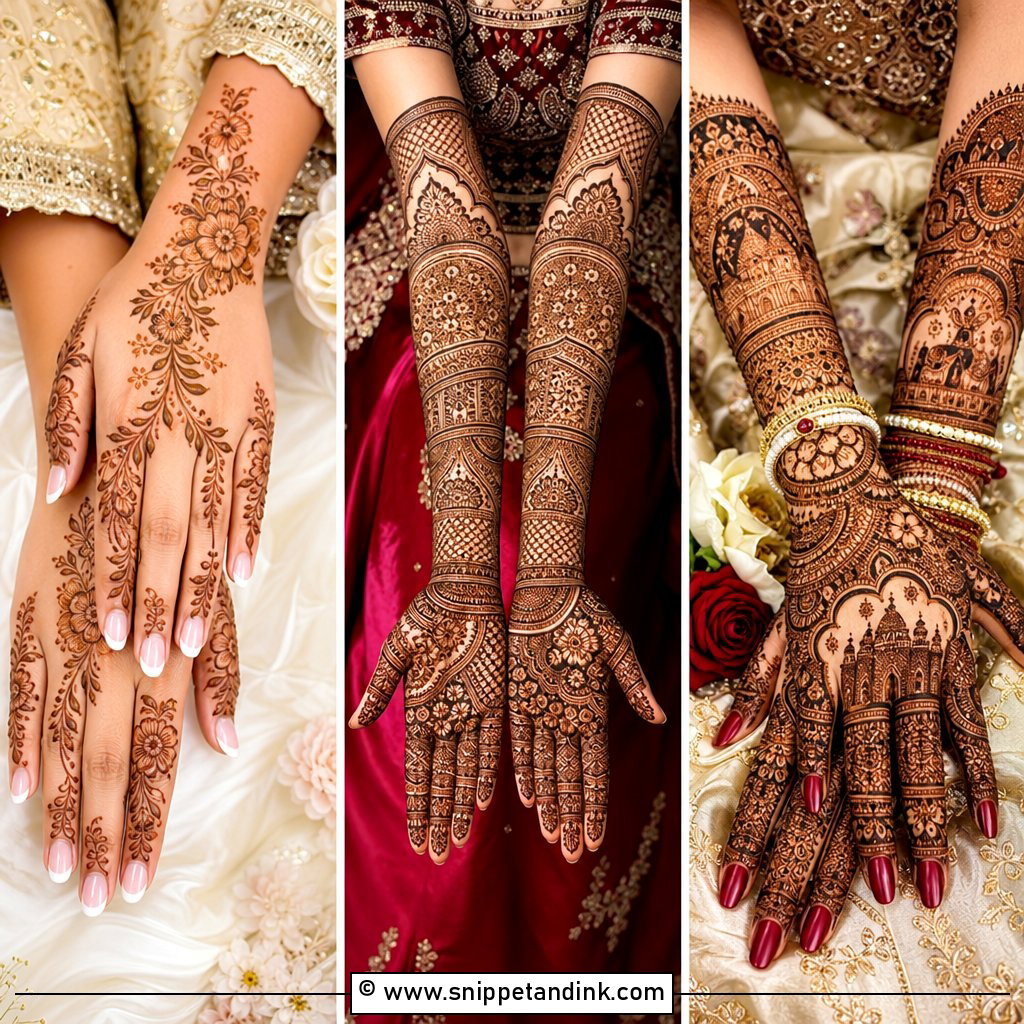
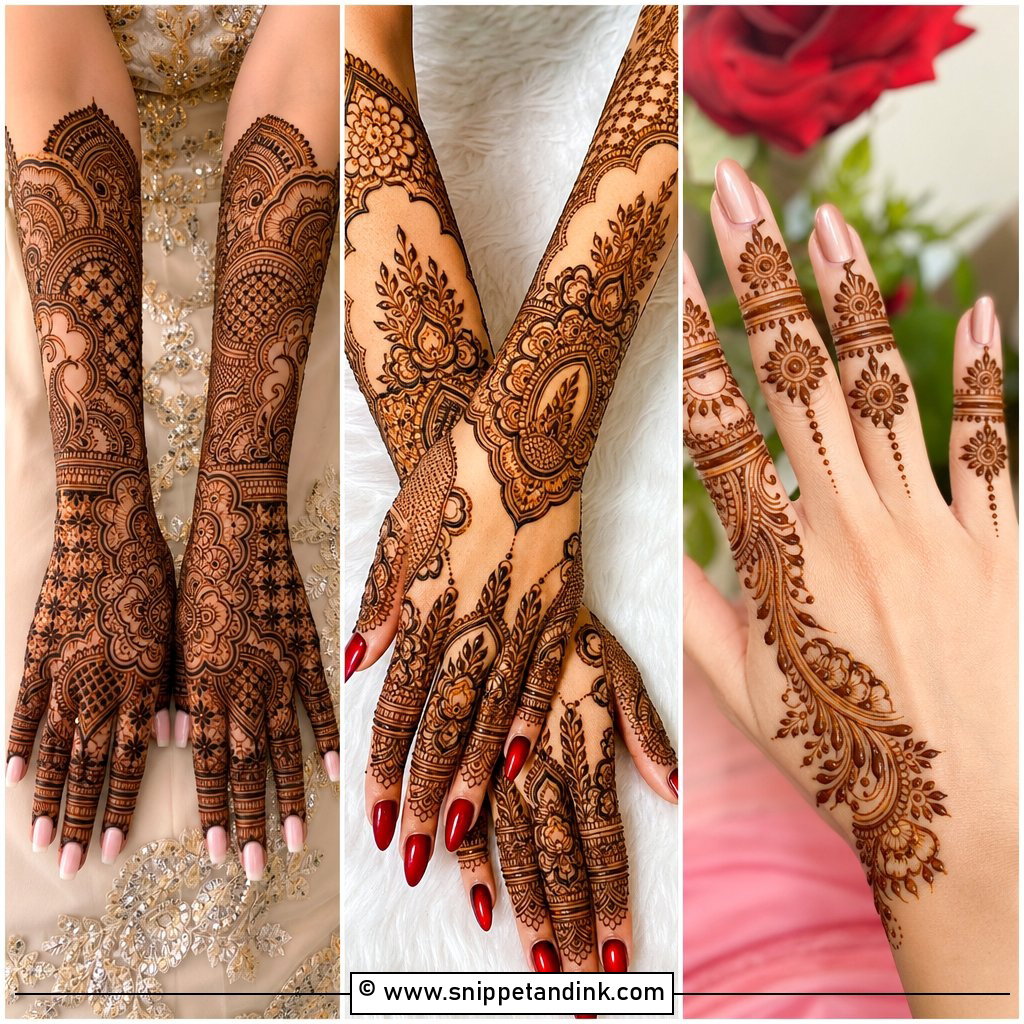
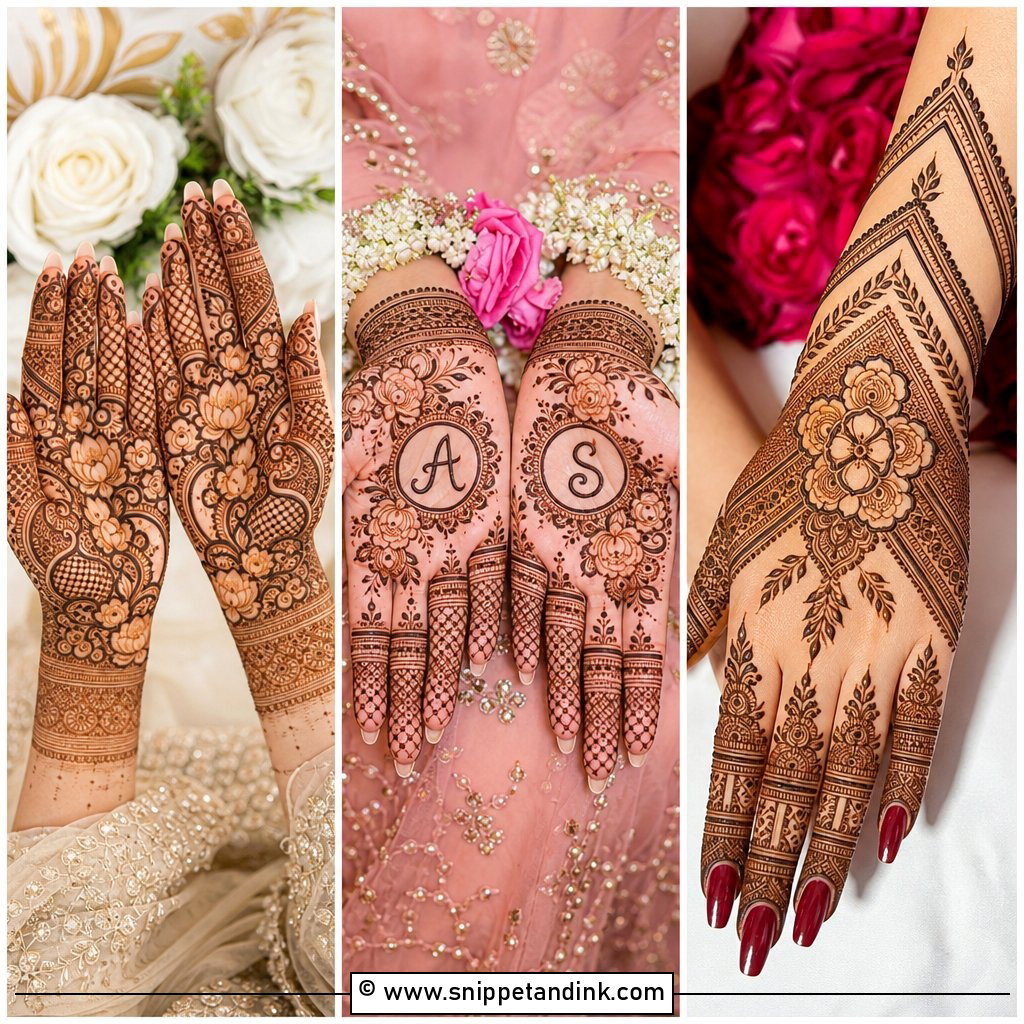
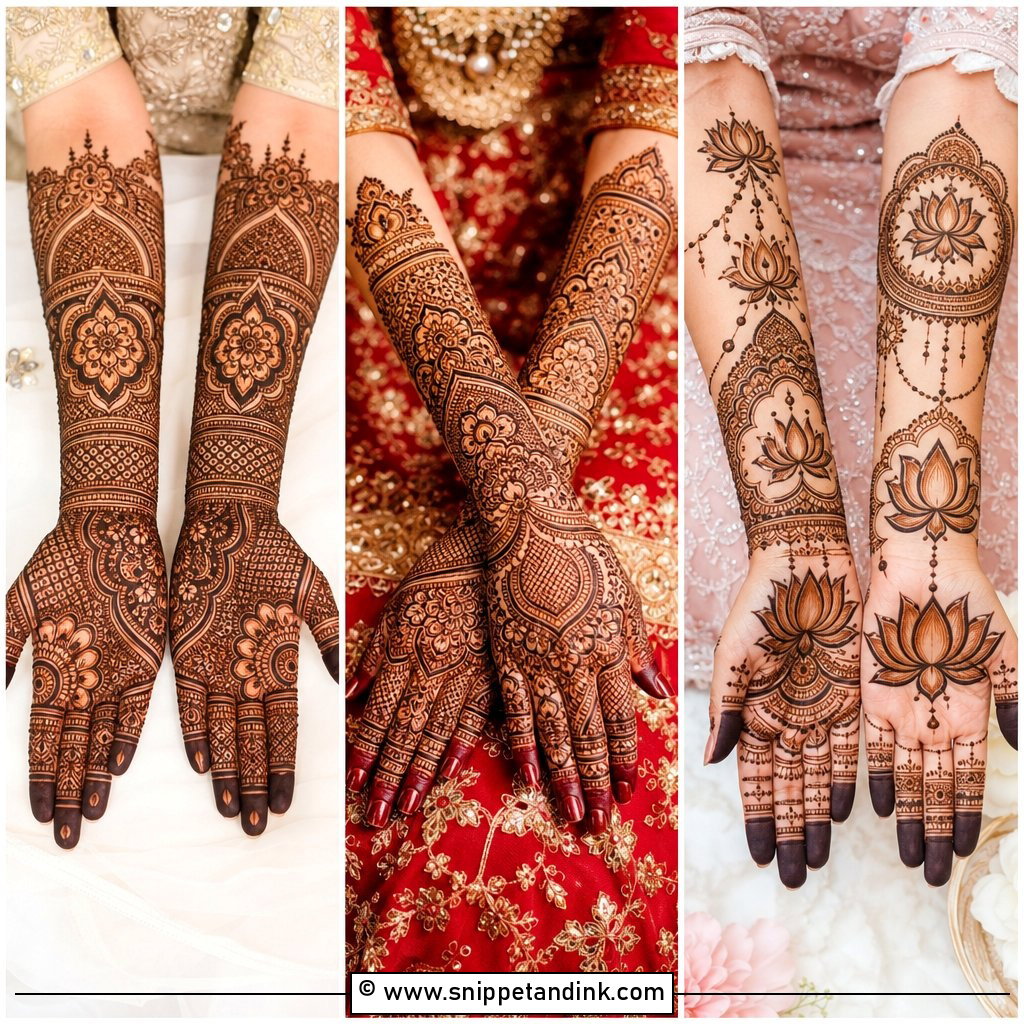
Full bridal coverage takes in palms, fingers, wrists and forearms, and on a bride it means a long sitting, usually several hours for both sides. The motifs are familiar: paisleys, peacocks, lotus, jaali mesh, bride-and-groom figures and hidden initials. What separates a clean bridal hand from a crowded one is zoning. I plan a main palm motif first, then the wrist bands, then the forearm panels, and only start filling once that structure is drawn. If you can’t sit that long, or your skin tends to stain pale, I’d steer you toward something with more open space.
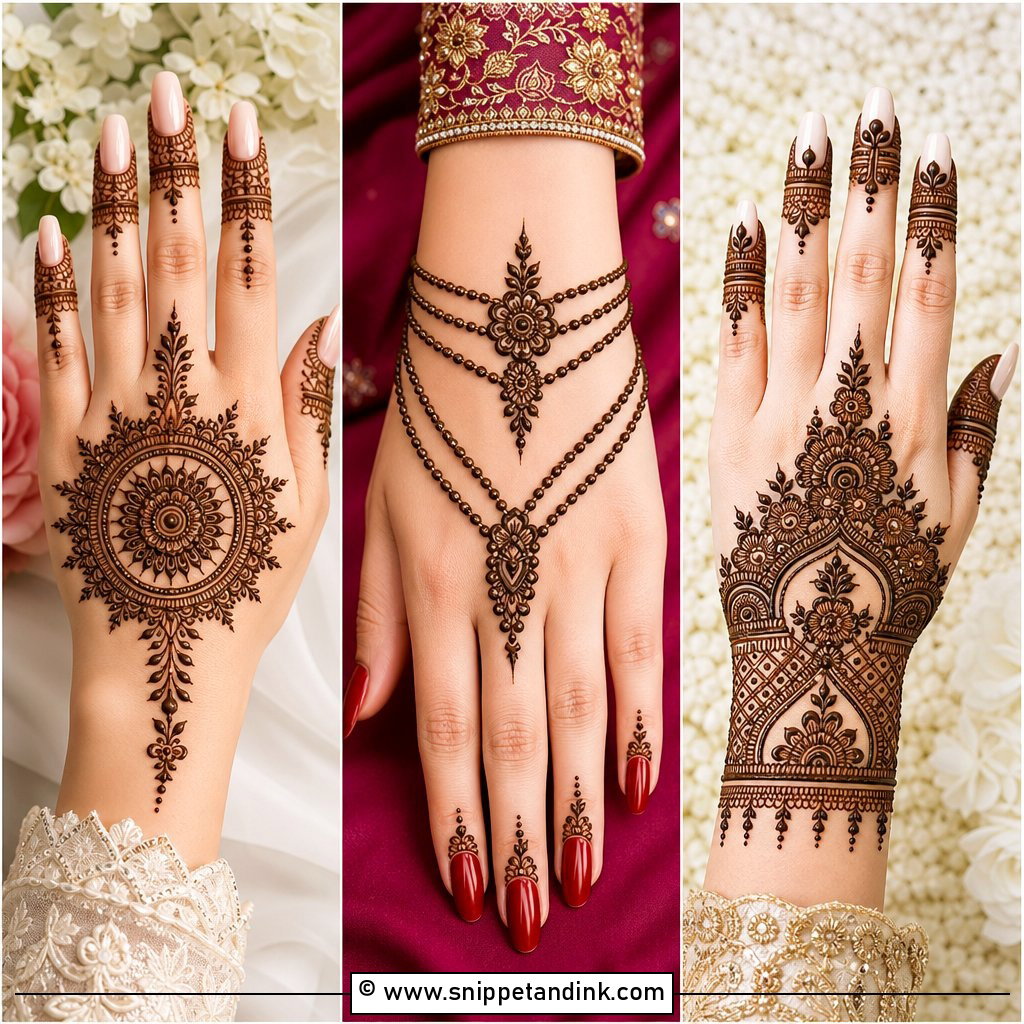
4. Mandala Back Hand Mehndi Design
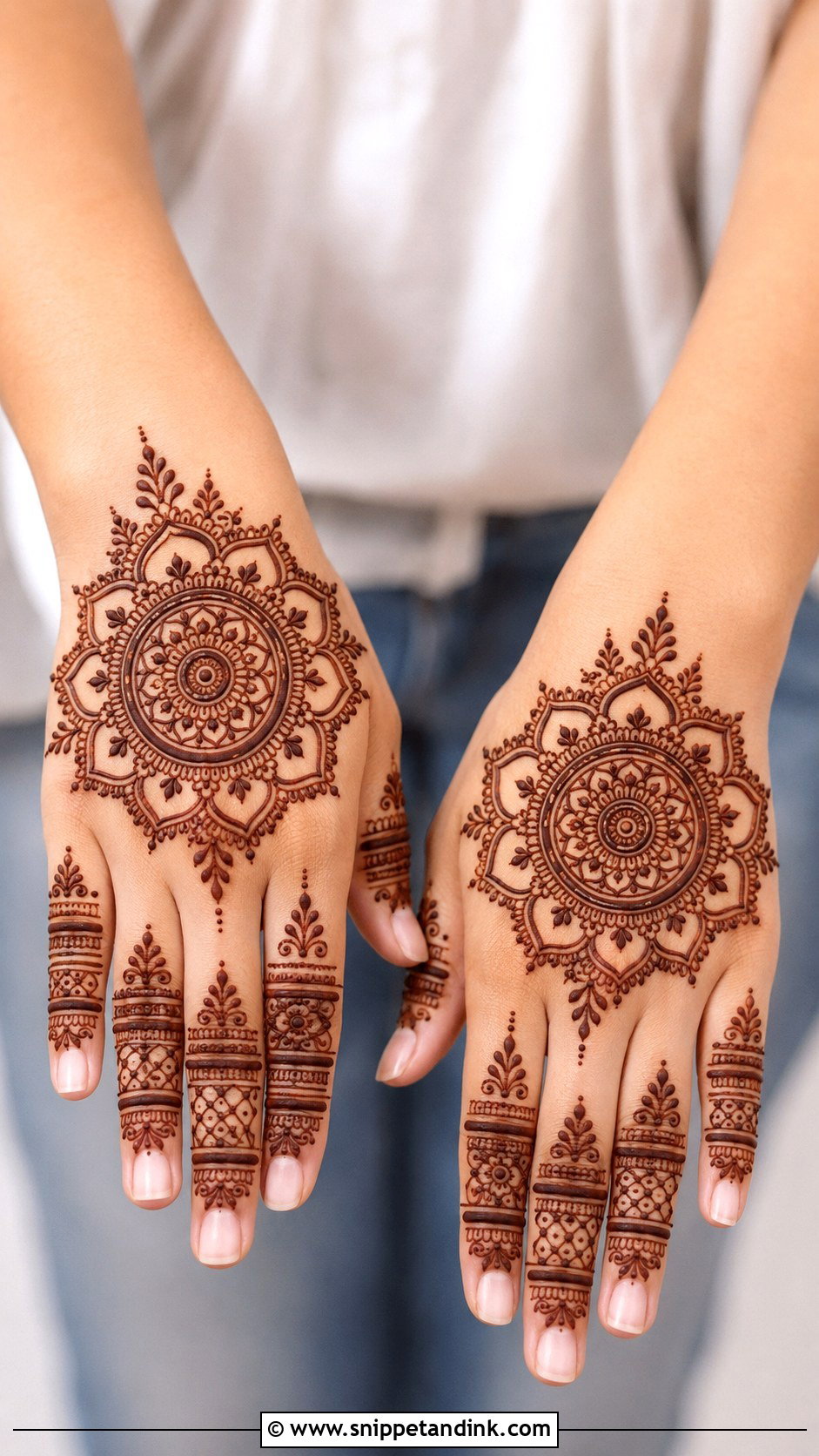
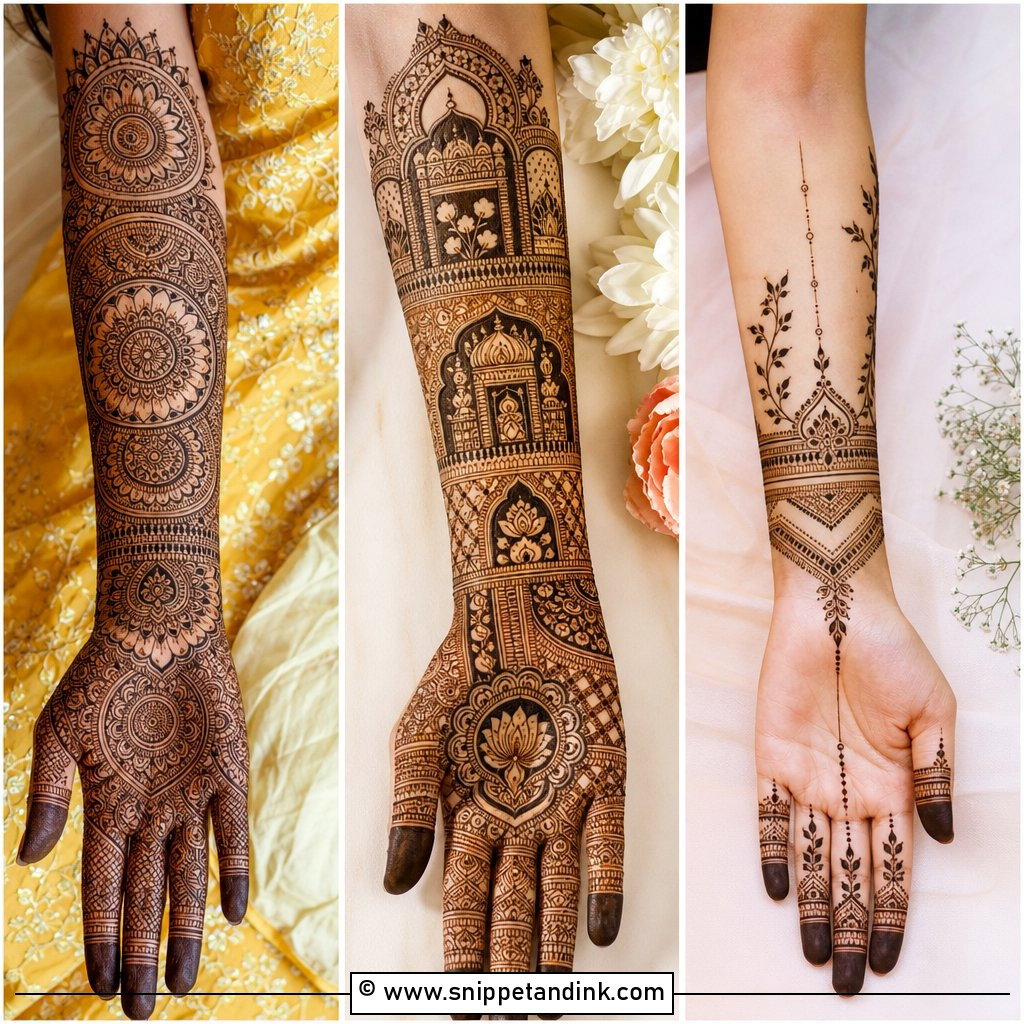
The round centre of a mandala balances almost any hand, which is why I reach for it on short, wide hands where a diagonal trail can look cramped. I place the circle in the middle of the back hand and build outward in rings of dots, petals and fine lines, with matching bands on the fingers. For a fresher version I leave a clear ring of bare skin around the mandala and keep the wrist empty, which also leaves room for a bangle stack.
5. Indo-Arabic Mehndi Design
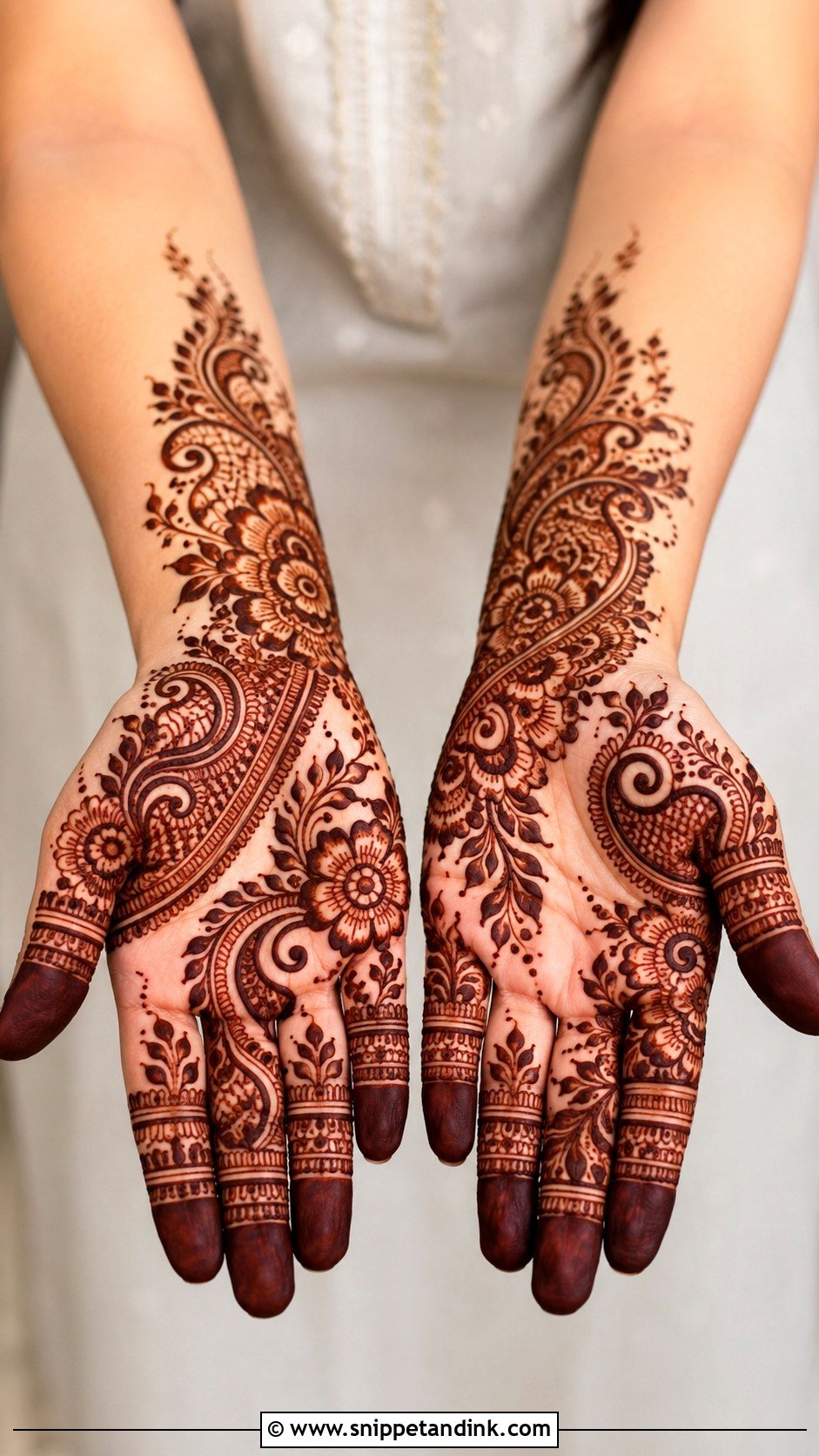
Indo-Arabic is a compromise I like: Arabic flow for the bones of the design, Indian detail in a few chosen pockets. I draw the large flowers, paisleys and leafy trail on a diagonal first, shade a few petals, then fill only selected areas with fine lines, dots and tiny checks. The trap is filling every pocket because the cone is already in your hand. Stop at two or three filled zones and the hand still breathes. It sits comfortably at engagements, sangeet, Eid, Diwali and on wedding guests.
6. Minimal Finger Mehndi Design
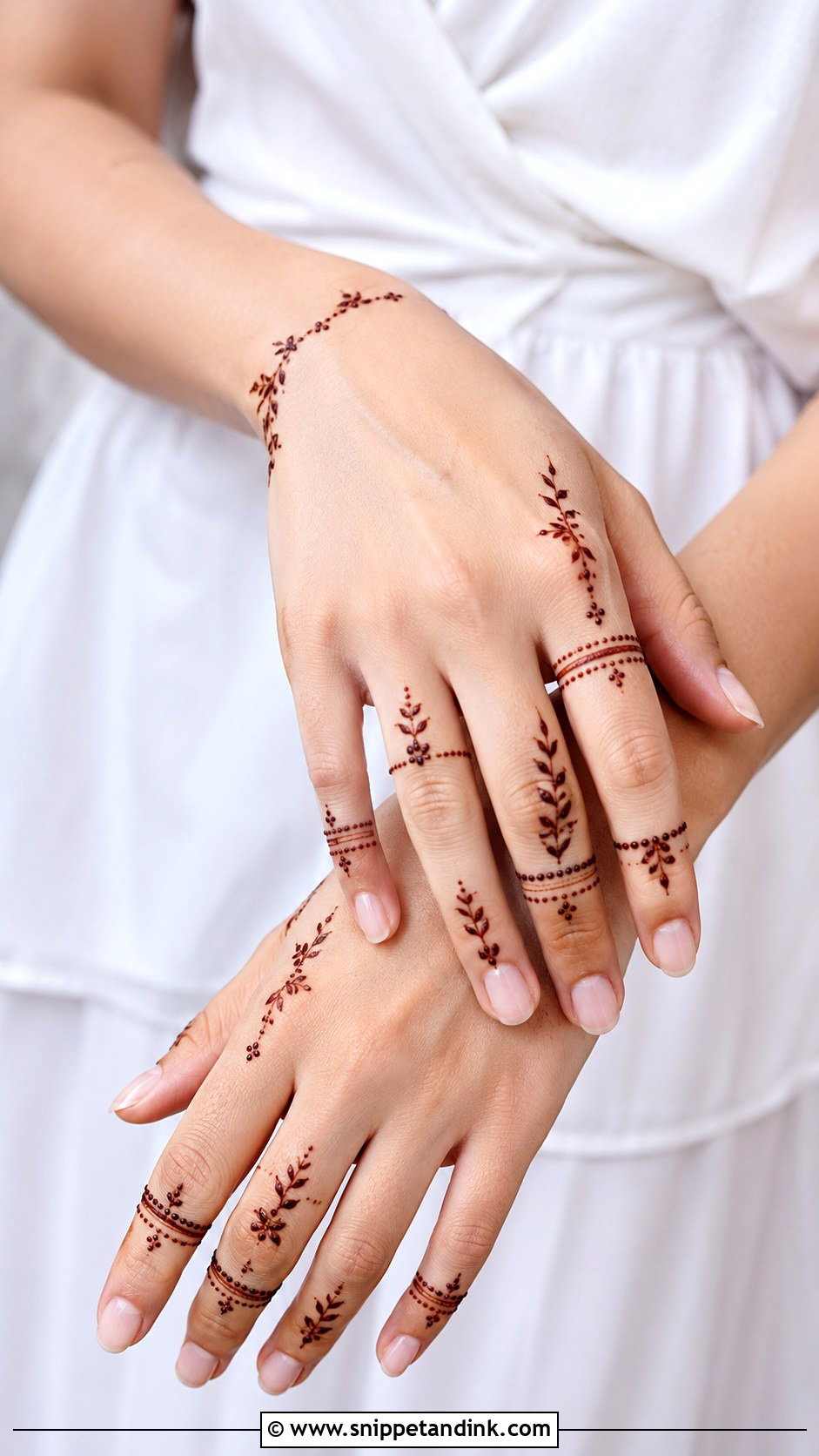
Finger-only mehndi takes me a few minutes per hand and wears well with rings, because the bands read like extra jewelry. I leave the back of the hand mostly bare, maybe with a small wrist chain. One thing to know before you pick it: fingertips stain dark and fast, but the sides of the fingers rub constantly, so fine side details fade first. I space the bands evenly and keep the tiny leaves on top of the finger, where they last longest.
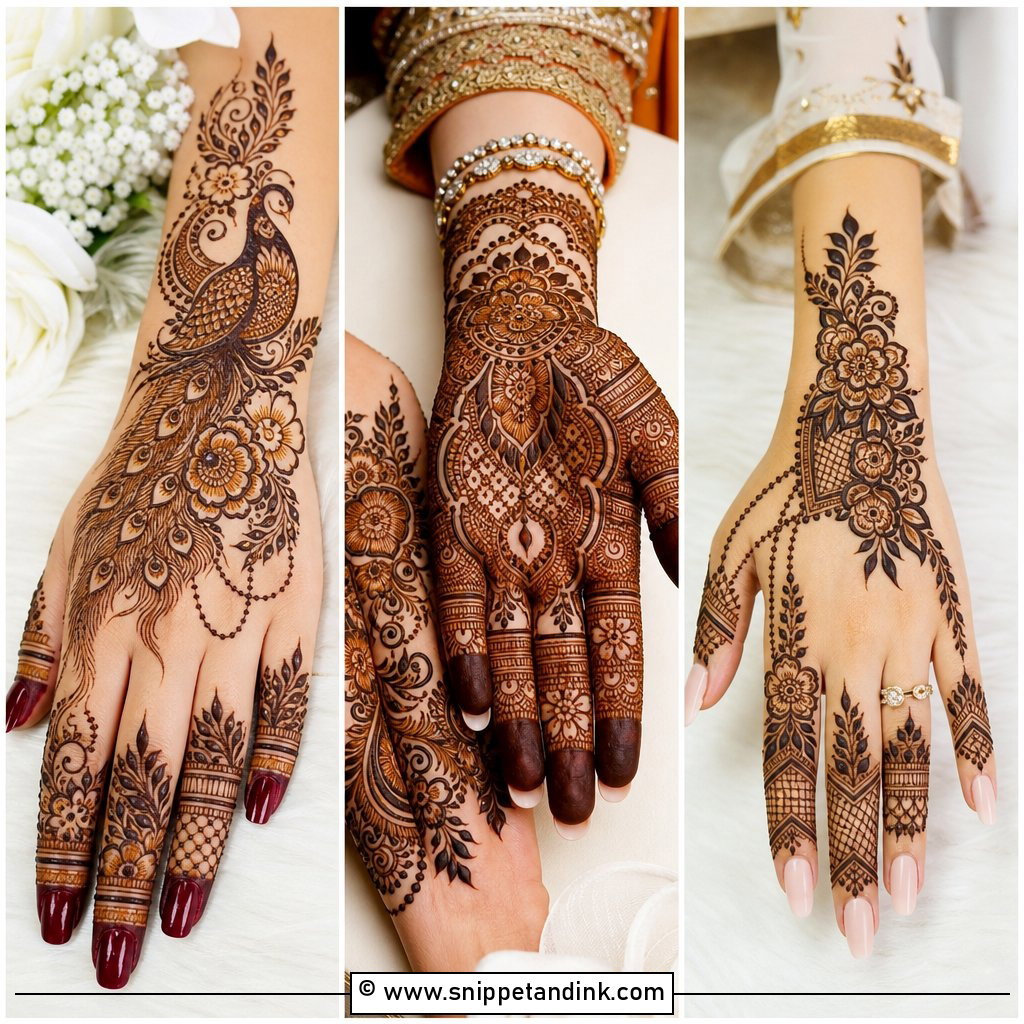
7. Peacock Mehndi Design
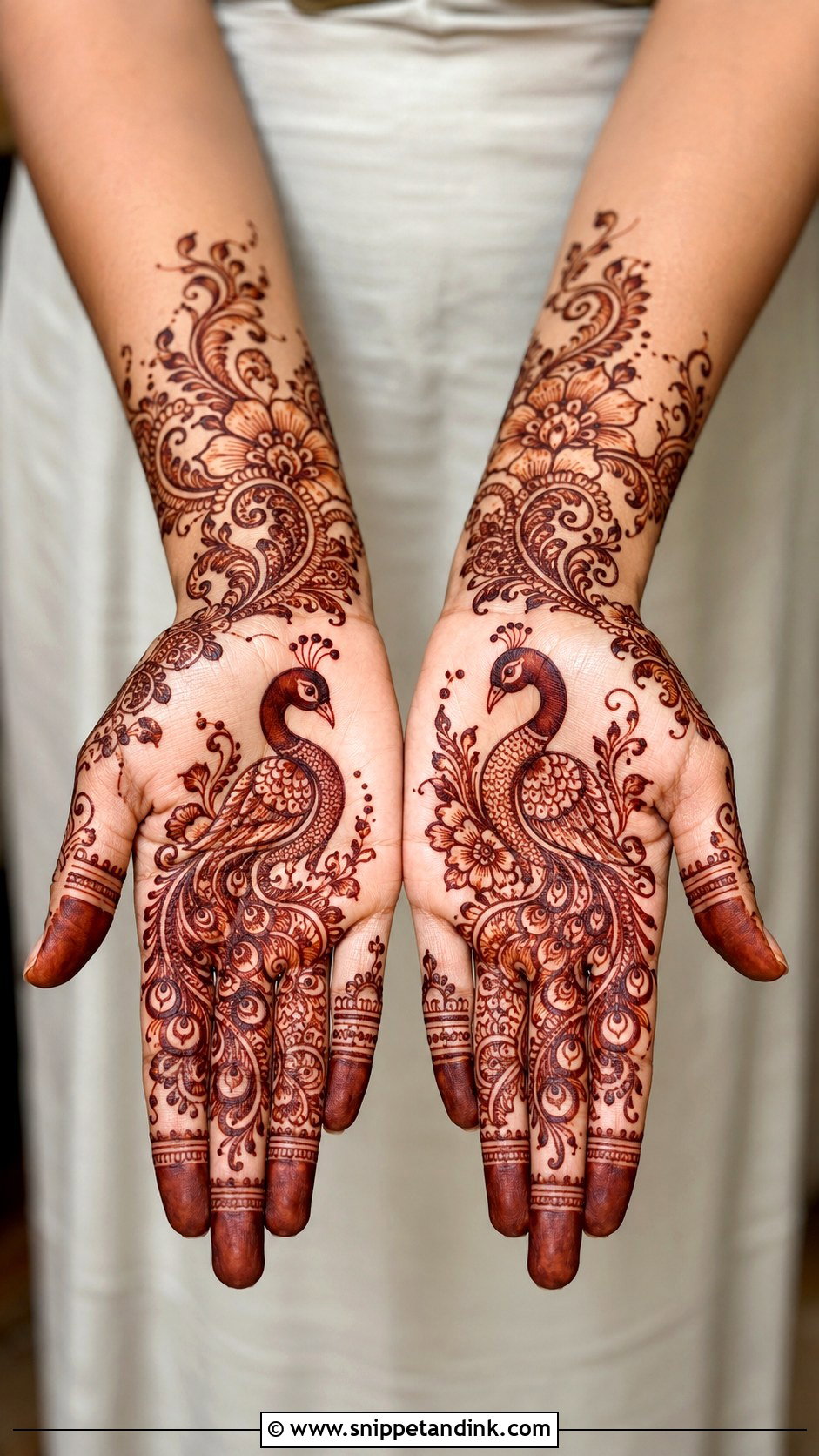
I draw the peacock’s body first and give it the most detail, then let the feathers relax into paisleys, vines and loose floral curves. Packing the feathers as tightly as the body is the usual mistake; at stain stage the two merge into one dark shape. Palm, back hand or forearm all work. A bride can add lotus or jaali panels around it, while a single peacock on the back hand with airy fingers is plenty for a festival.
8. Floral Mehndi Design
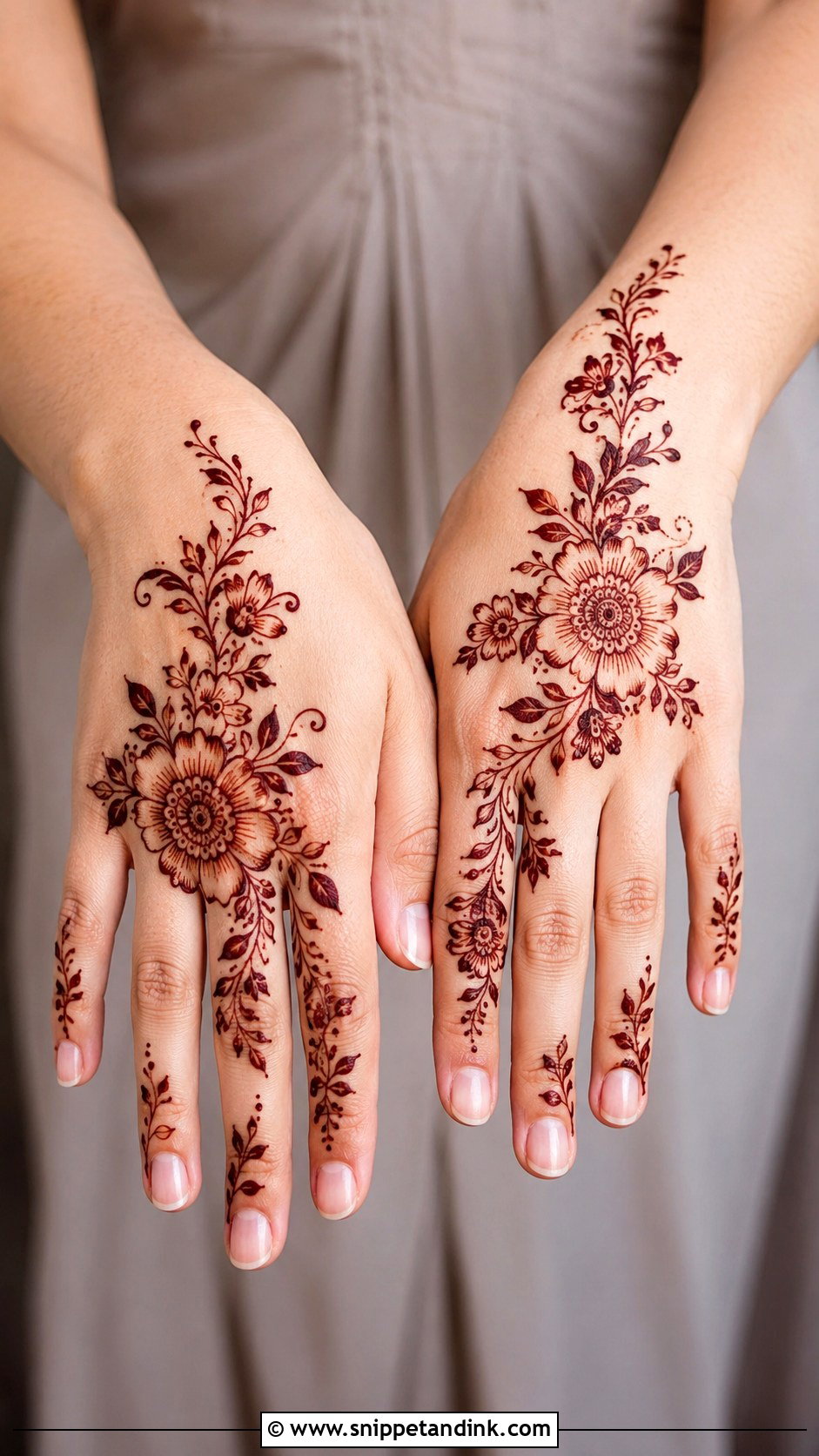
Floral work forgives. A wobbly petal just becomes a different petal, which is why I recommend it to nervous first-timers and use it constantly myself. It can run bold like Arabic or dense like Indian, depending on how much filling you want. My usual layout puts one large bloom near the wrist or in the centre of the back hand and trails a vine toward the fingers, with the background left clean so each flower stays readable.
9. Khafif Mehndi Design
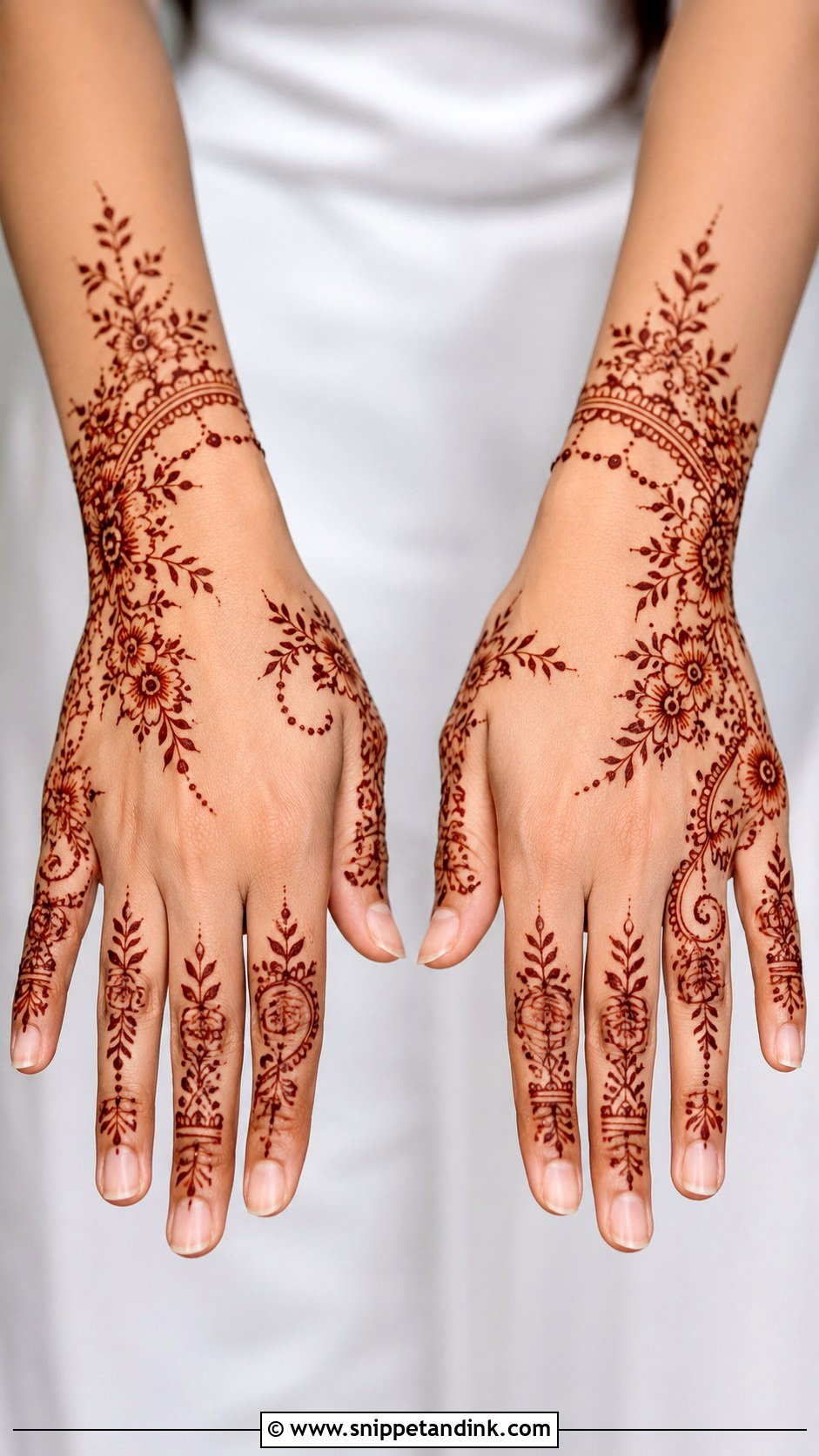
Khafif is fine-line Gulf-style work: small florals, leafy sprays, lace borders and slim paisleys, all with air around them. It depends on paste quality more than any other style here. I cut the cone tip very small and need paste that’s smooth and slightly stringy; lumpy paste breaks the line mid-stroke and there’s no hiding it. Bridesmaids and engagement guests ask for it often because it looks detailed without any heavy blocks of colour.
10. Bridal Portrait Mehndi Design
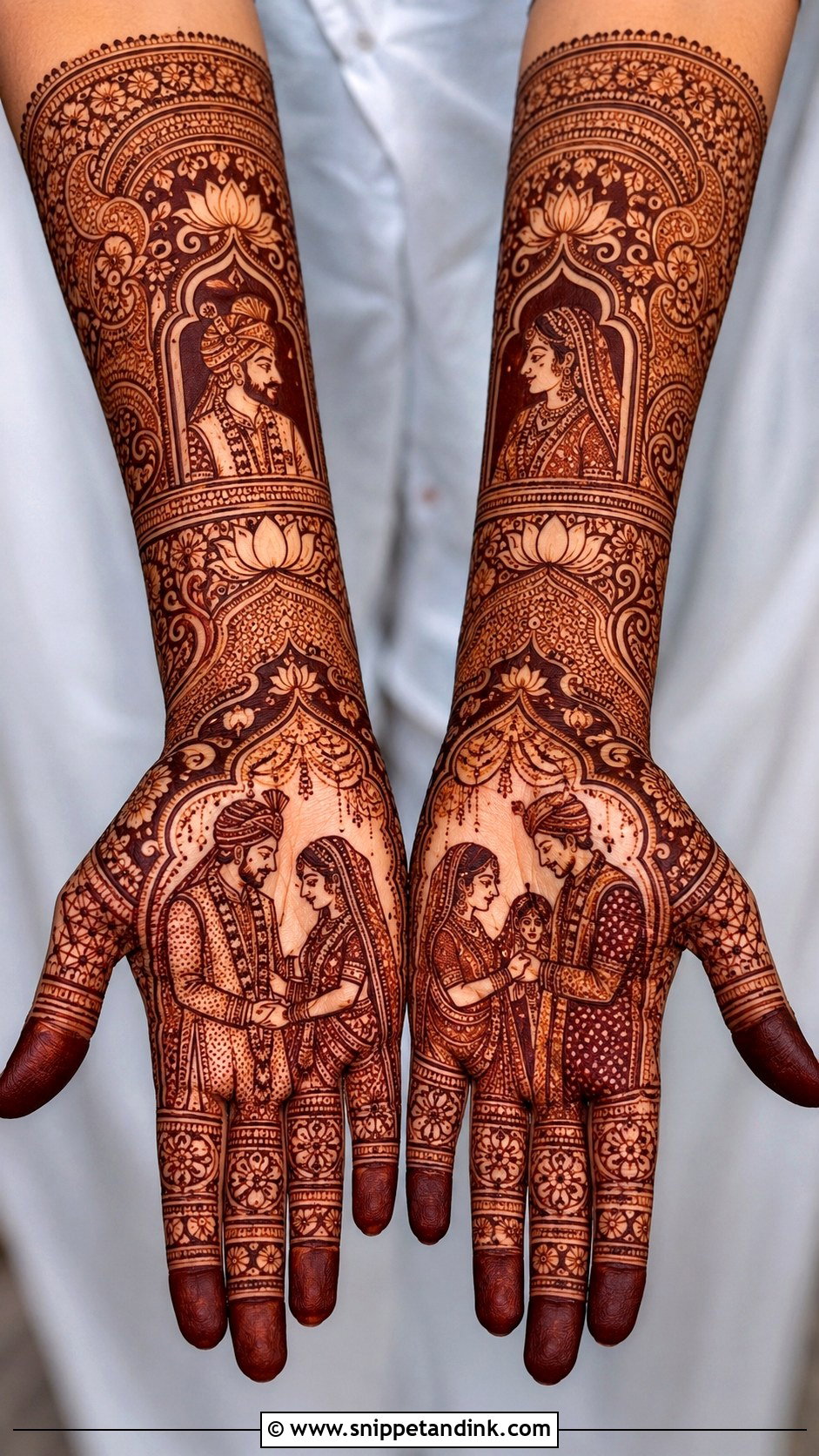
Portrait mehndi tells a story: bride-and-groom figures, wedding scenes, varmala moments, a palanquin, names and the date. I’d only book this with an artist whose portfolio shows clear faces at stain stage, not just in fresh paste, because eyes and noses blur when lines sit too close together. The figures usually go on the palms, with paisley, lotus and mesh fillers around them, and they need full-hand or full-arm coverage to have room. Ask your artist to sketch the scene on paper before the day so you can change it calmly.
11. Jaali Mehndi Design
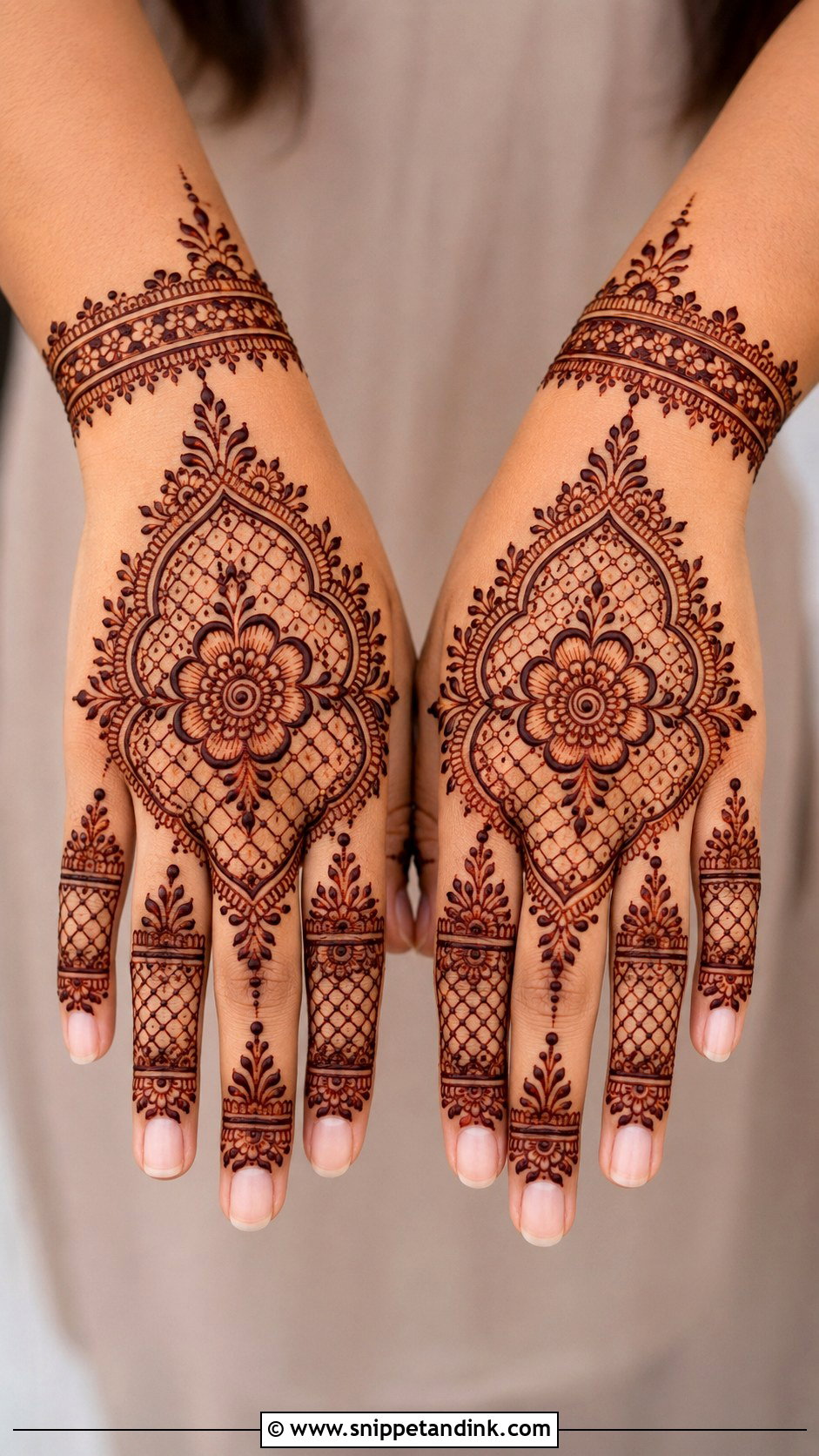
Jaali gives a lace effect with mesh and crisscross grids, usually framing a central floral or mandala. I use it in sections, never across the whole hand; a hand that’s all mesh loses its contrast and the stain reads as a brown blur. Keep the grid lines evenly spaced and border each panel with dots or tiny leaves. It works on the back hand, palm, fingers and up the forearm, and it sits well next to heavy bridal jewelry.
12. Rose Mehndi Design
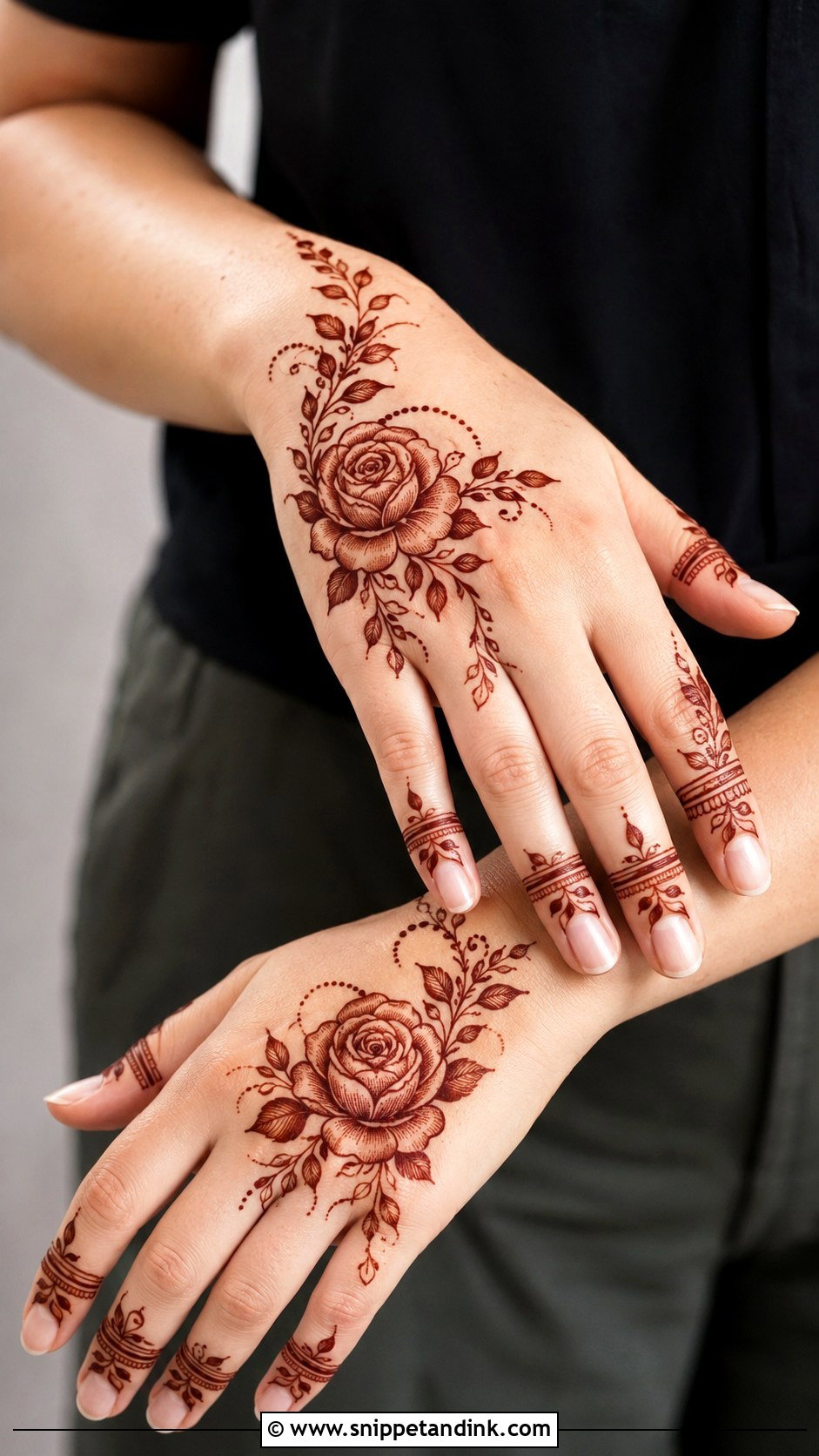
Roses are where shading earns its keep. I outline one large rose on the back hand or palm, shade the inner petals with light strokes, then add smaller roses, leaves and a trailing vine with plenty of bare skin around them. A diagonal trail from wrist to index finger is the version I draw most right now. Keep the finger bands plain so the roses stay the focus.
13. Bridal Back Hand Mehndi Design
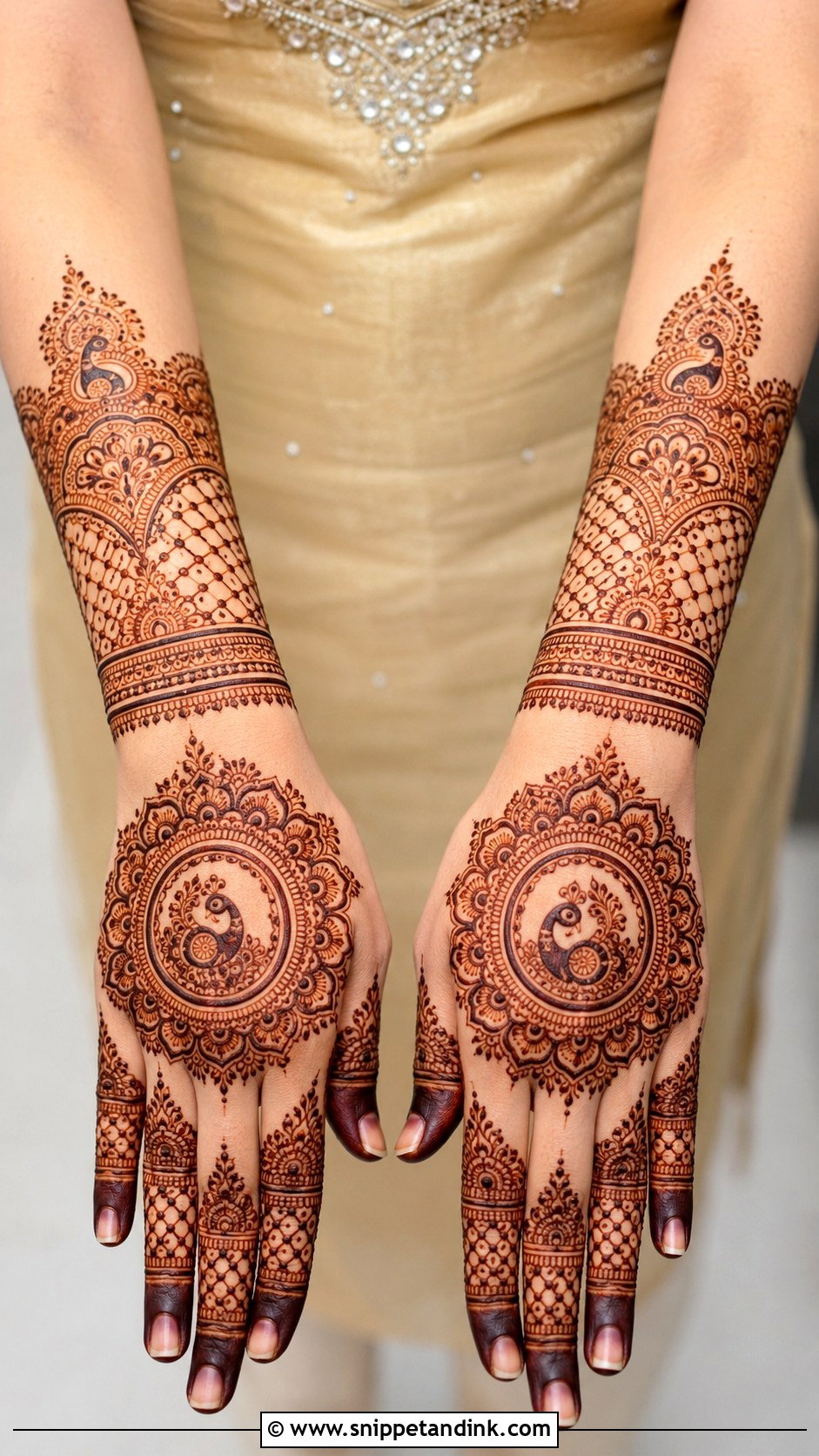
The back of the hand appears in more wedding photographs than the palm: ring shots, holding the bouquet, hands resting on the lehenga. So I give it one strong focal point, whether a mandala, peacock, floral medallion or jaali panel, and let fine lines, leaves and bands fill the fingers. Before drawing, I check where the bride’s bangles and hathphool will sit so the jewelry doesn’t cover the best part. Initials and small wedding symbols can hide inside the pattern; keep them small enough that the groom genuinely has to search.
14. Modern Mehndi Design
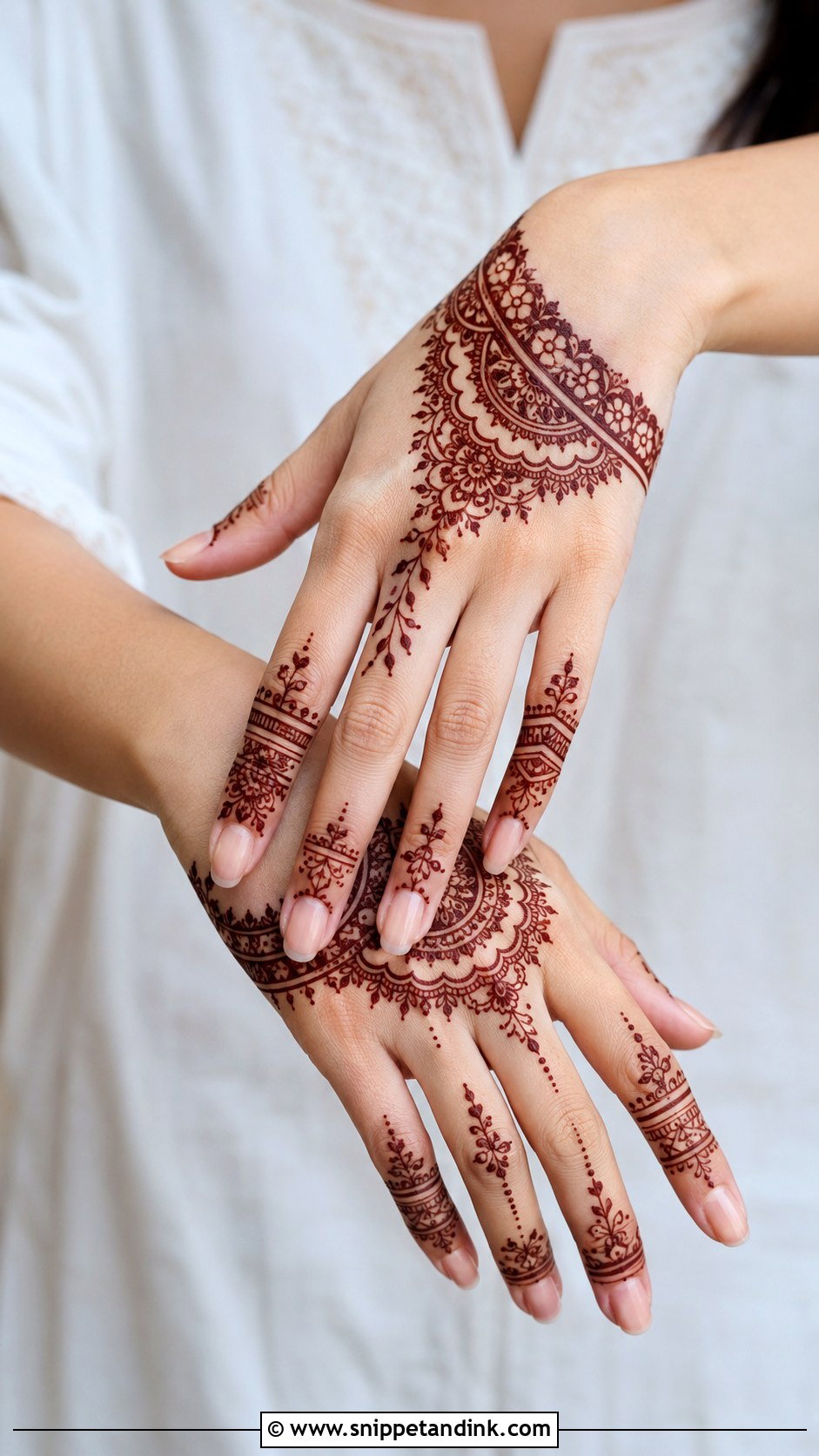
Modern layouts trade coverage for spacing: half-mandalas, slim vines, geometric bands and small florals with plenty of bare skin between them. On the back hand that might be a wrist cuff, one centre motif and detailed fingertips; on the palm, a minimal mandala with open borders. My test is to step back and ask whether the empty space looks intended. If it looks like I ran out of time, I add one connecting element, not five.
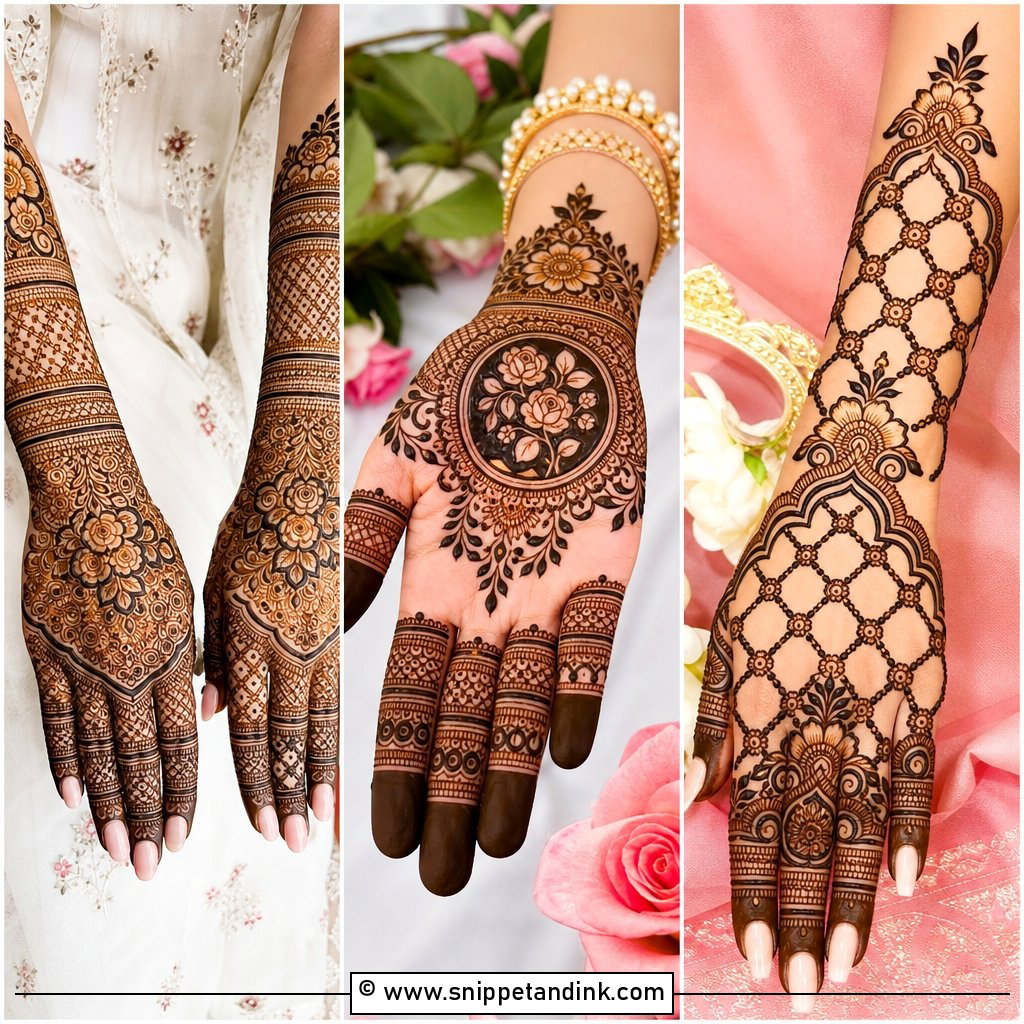
15. Heavy Indian Mehndi Design
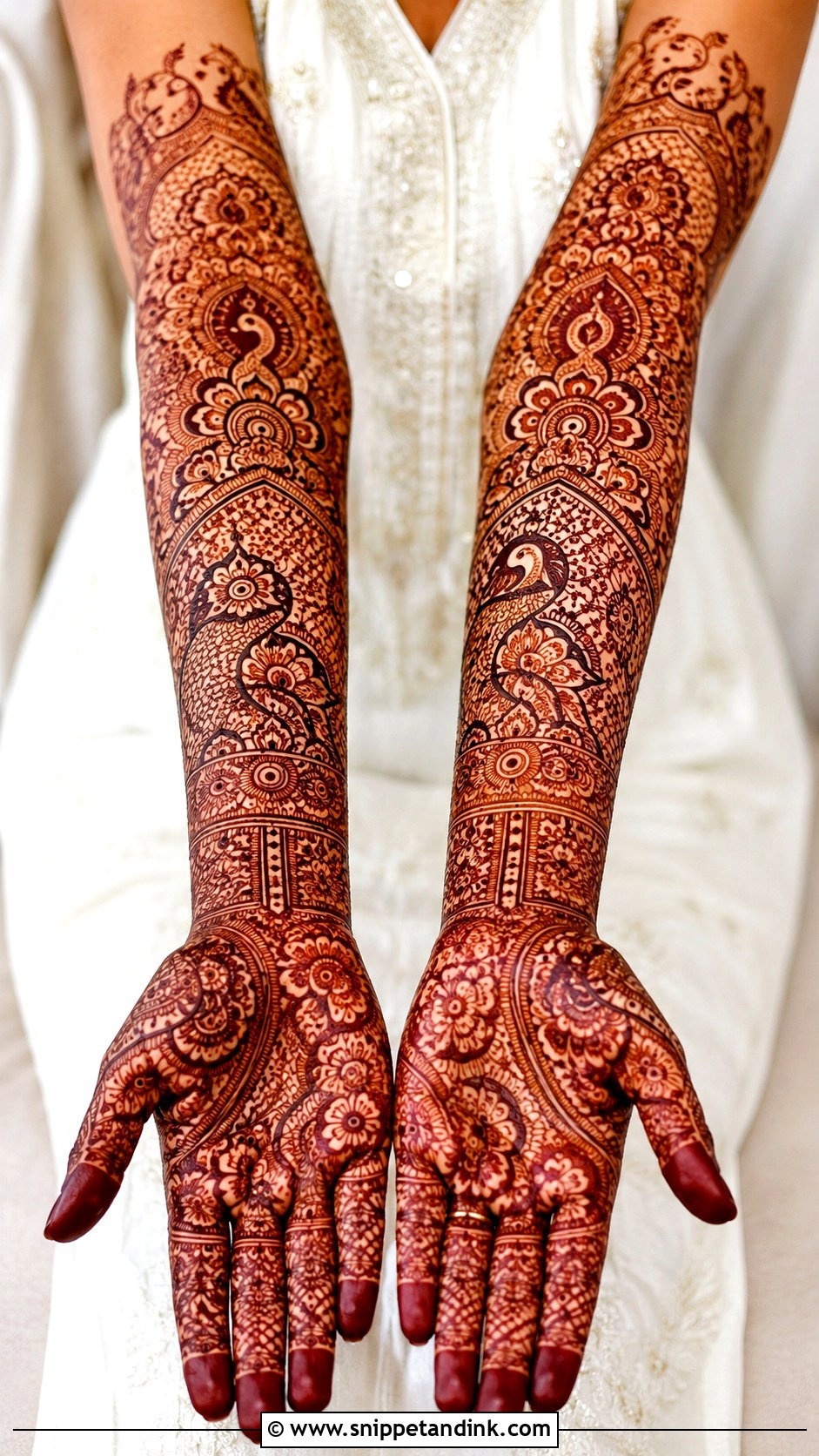
Heavy Indian mehndi leaves almost no bare skin: dense filling, fine lines, paisleys, florals, mandalas, peacocks and wedding symbols from fingertips to forearms. That density is what makes it rich, and also what makes it unreadable if nobody divides it. I section the hand with borders and bands, put larger motifs in the centre and smaller fillers around them. Patience matters on both sides of the cone, because the paste then needs hours on the skin. It belongs at weddings, Karwa Chauth and the major festivals.
16. Easy Mehndi Design For Beginners
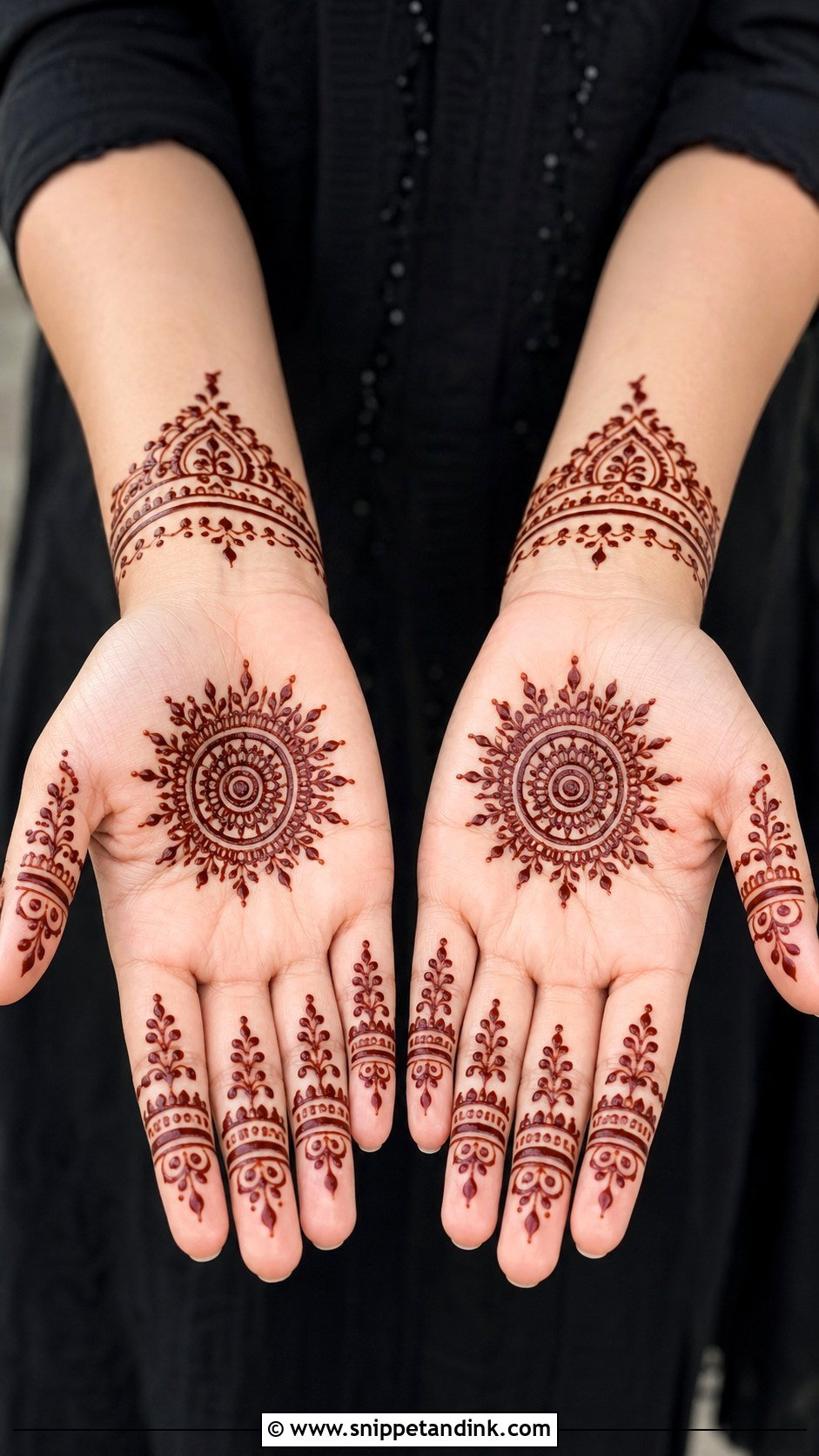
When I teach beginners, I start them on the back hand. There are no palm creases pulling the line sideways, and the skin is flatter. A full hand can be built from dots, petals, leaves, swirls and curves alone: a centre mandala, simple vines at the wrist, the same finger pattern repeated on every finger. Repetition is what makes simple work look finished. Practise cone pressure on paper first, since most early mistakes come from squeezing too hard rather than from shaky hands.
17. Gulf Khaleeji Mehndi Design
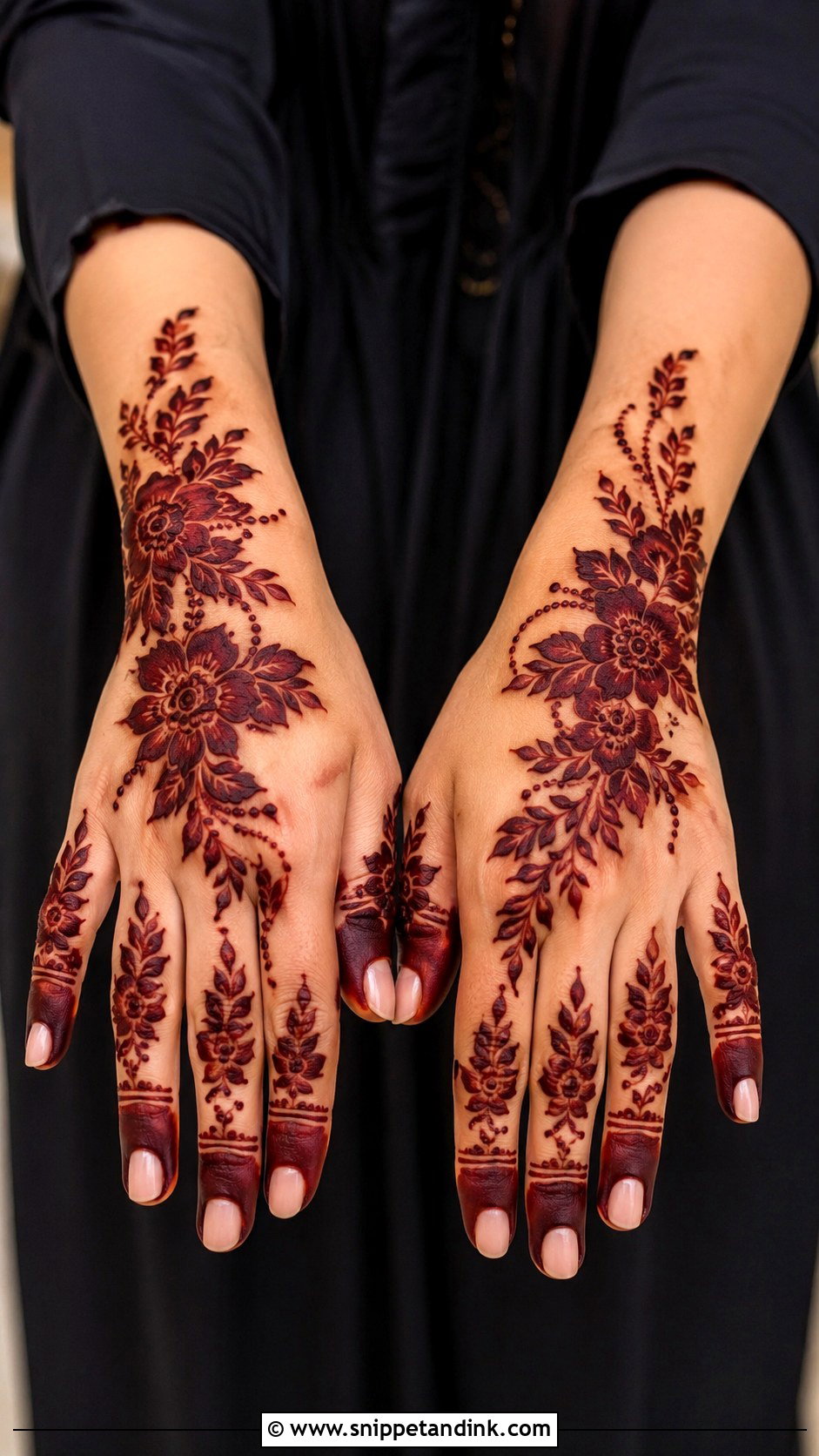
Khaleeji is bold and sweeping, with big floral clusters, leafy branches, thick fingertips and wide stretches of open skin. A complete look often starts with a large flower near the wrist and sweeps across the back hand. I cut a slightly larger cone opening here because the outlines need to be thick and confident, and thick lines also survive the first week of hand-washing better than fine ones. It gives a strong henna look in far less time than a heavy bridal pattern, which is why it’s so popular the night before Eid.
18. Moroccan Mehndi Design
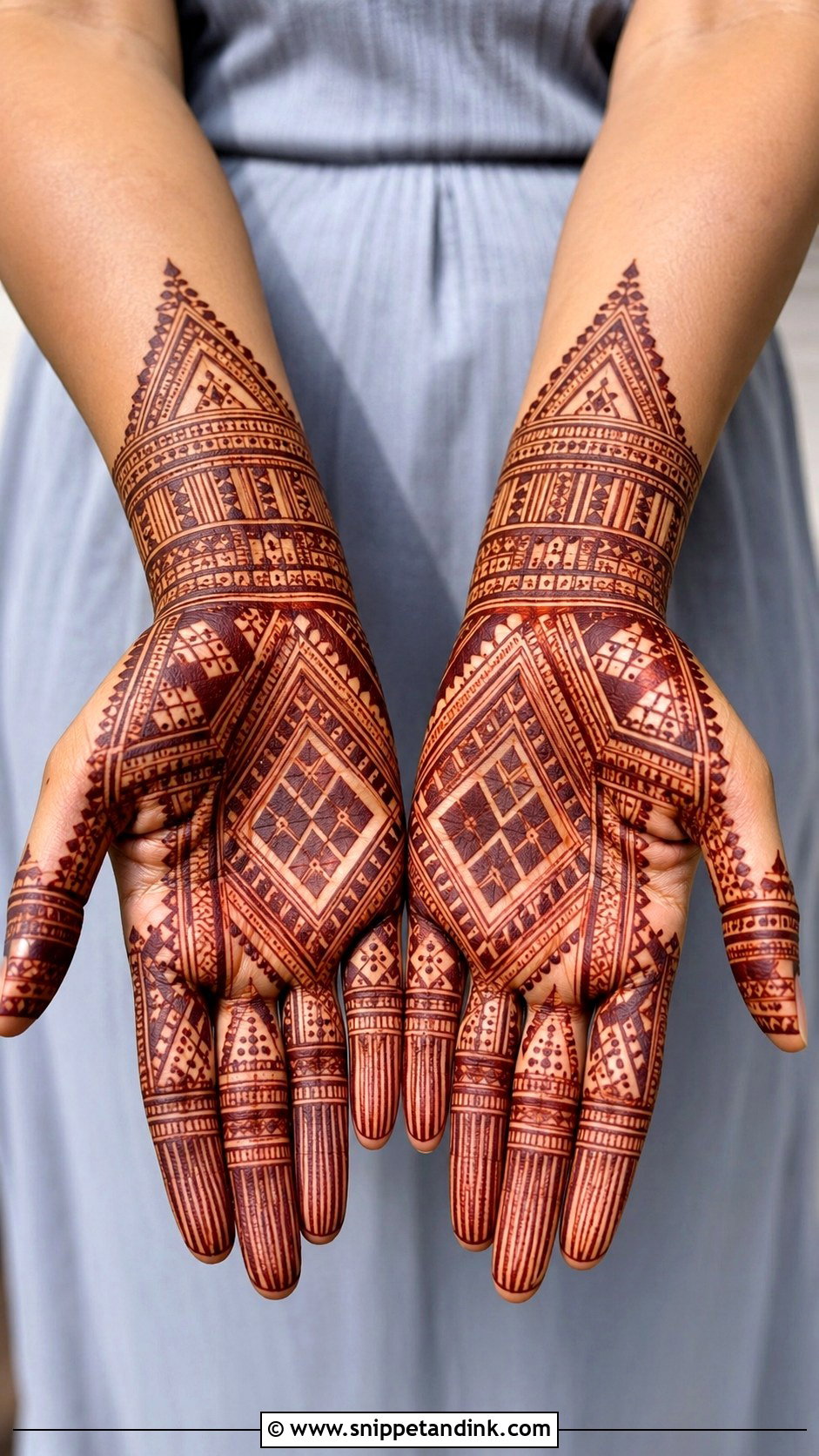
Moroccan henna swaps flowers for geometry: diamonds, triangles, straight lines, zigzags and symmetrical bands, often covering the palm and fingers in structured panels with bracelet borders at the wrist. Straight lines forgive far less than curves, so I often mark a few guide dots first to keep the spacing even. I suggest it to anyone who finds florals too sweet for their outfit. Small dots and thin connecting lines soften it if the full graphic version feels severe.
19. Engagement Mehndi Design
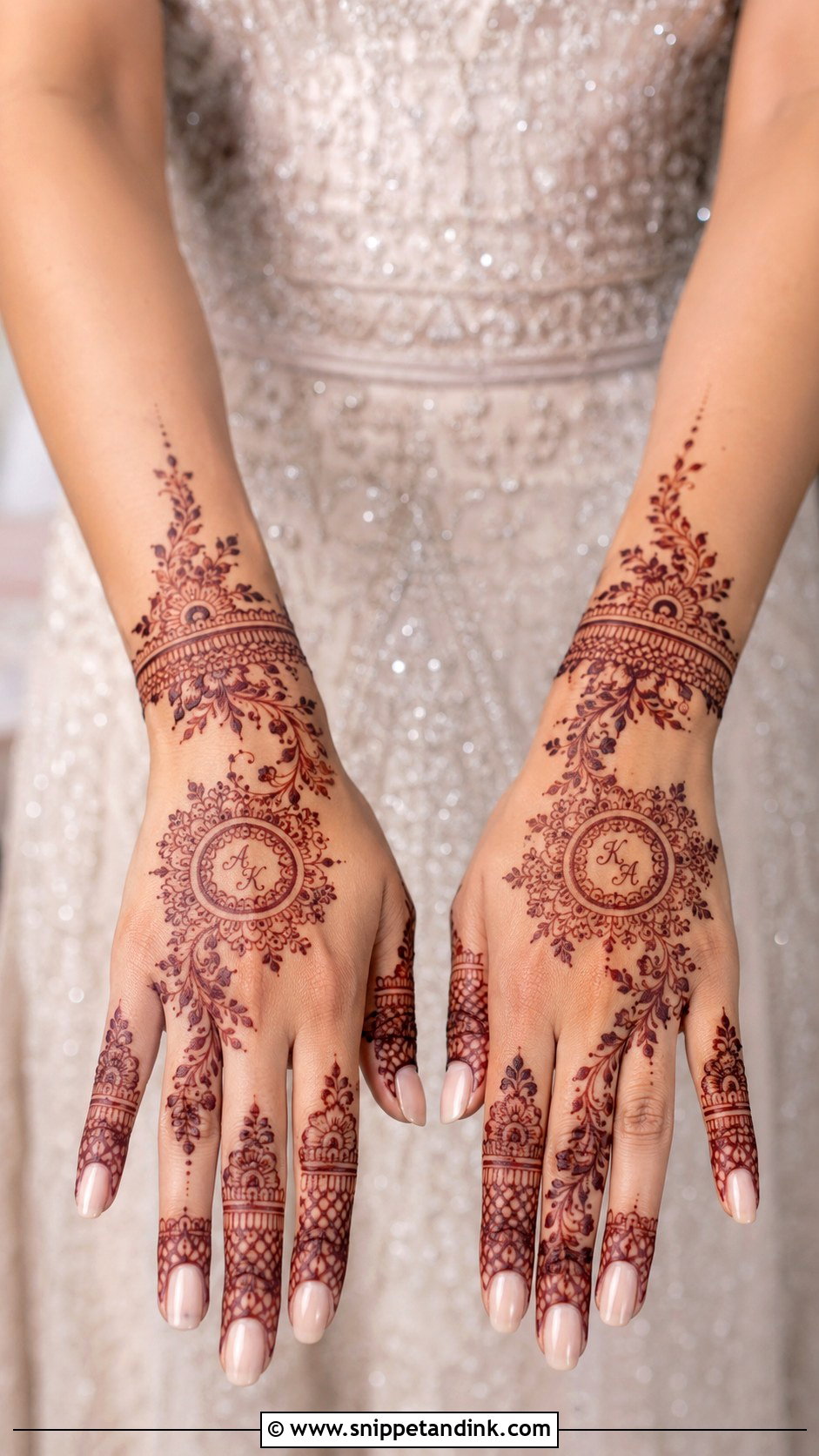
Engagement mehndi should stay a step lighter than your bridal design, so the wedding hands still feel like the bigger moment. I usually concentrate on the back hand, since that’s the side in every ring photo, with a floral trail or small mandala, fine finger detail and a bracelet at the wrist. I leave the base of the ring finger slightly open so the ring isn’t lost in pattern. Initials or a tiny date can sit in the design if they stay subtle, and the palm can carry a light centre motif. It goes with gowns, lehengas, sarees and Indo-western outfits alike.
20. Eid Mehndi Design
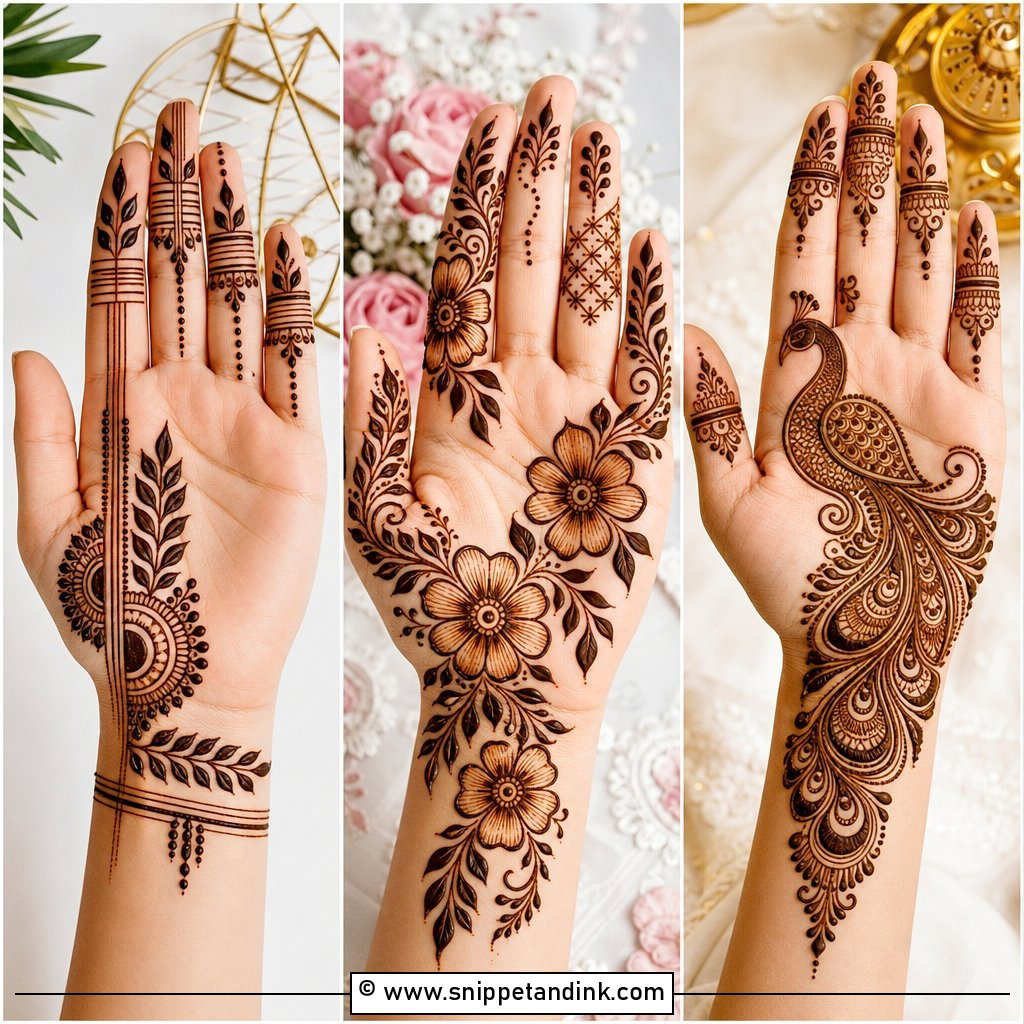
Eid henna usually goes on the night before, often at home with family, so I keep it quick: Arabic florals, khafif details, back hand trails. A full version might be a diagonal vine from wrist to finger with bold flowers, leafy curves and decorated tips; a lighter one is a mandala back hand with simple finger bands. Night application is a real advantage, because the paste can stay on while you sleep. Scrape it off dry in the morning instead of washing it, and keep water away for several hours so the stain keeps deepening.
21. Diwali Mehndi Design
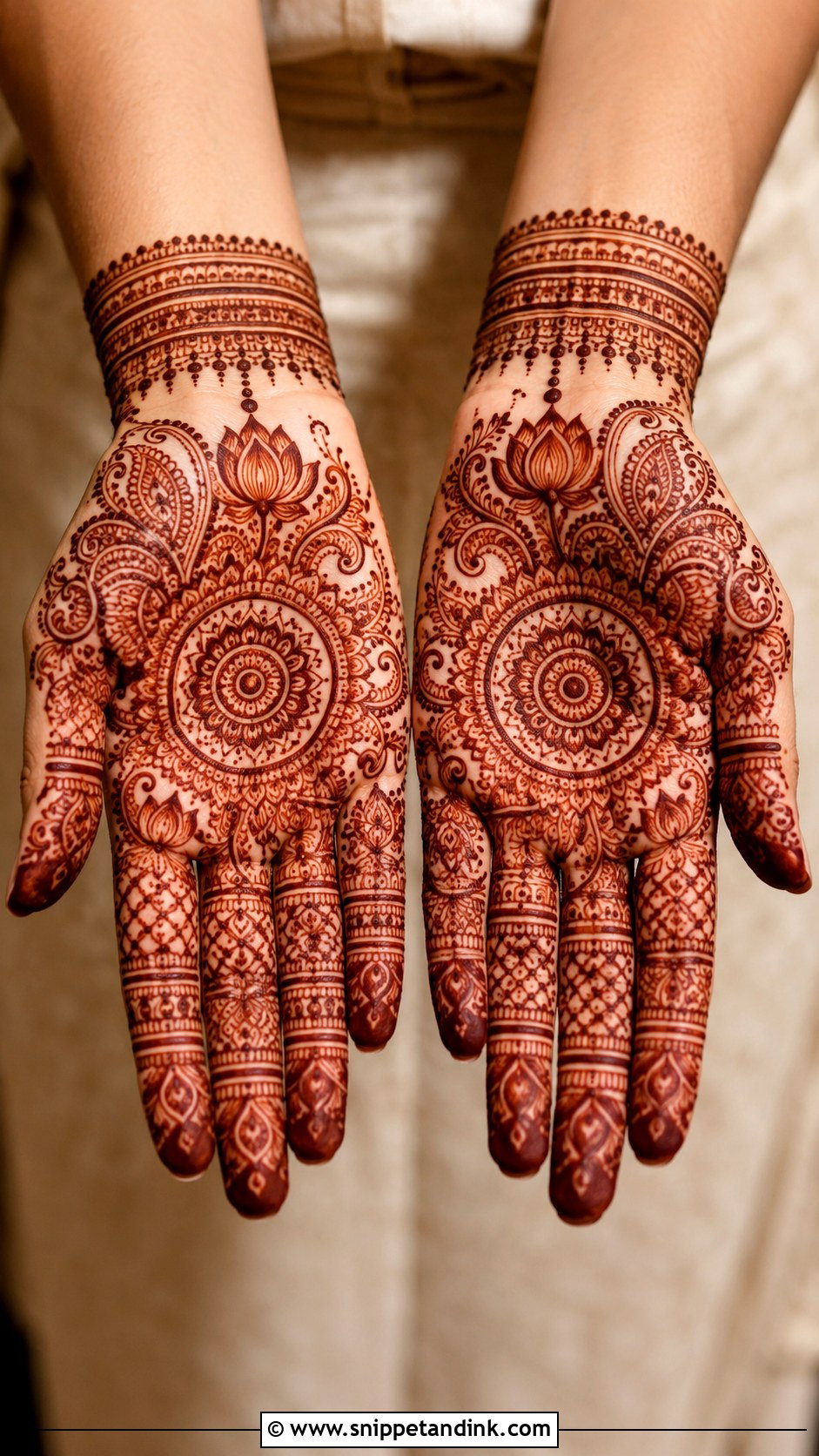
Diwali designs lean on lotus, mandalas, paisleys and dotted borders, with a circular motif on the palm and neat repeats on the fingers. Crowding is a real risk here. Festival photos are often taken in low lamp light, and dense patterns lose their definition in it, so I leave clear gaps between motifs. Symmetrical hands feel traditional; one heavier hand paired with one airy hand feels more current.
22. Karwa Chauth Mehndi Design
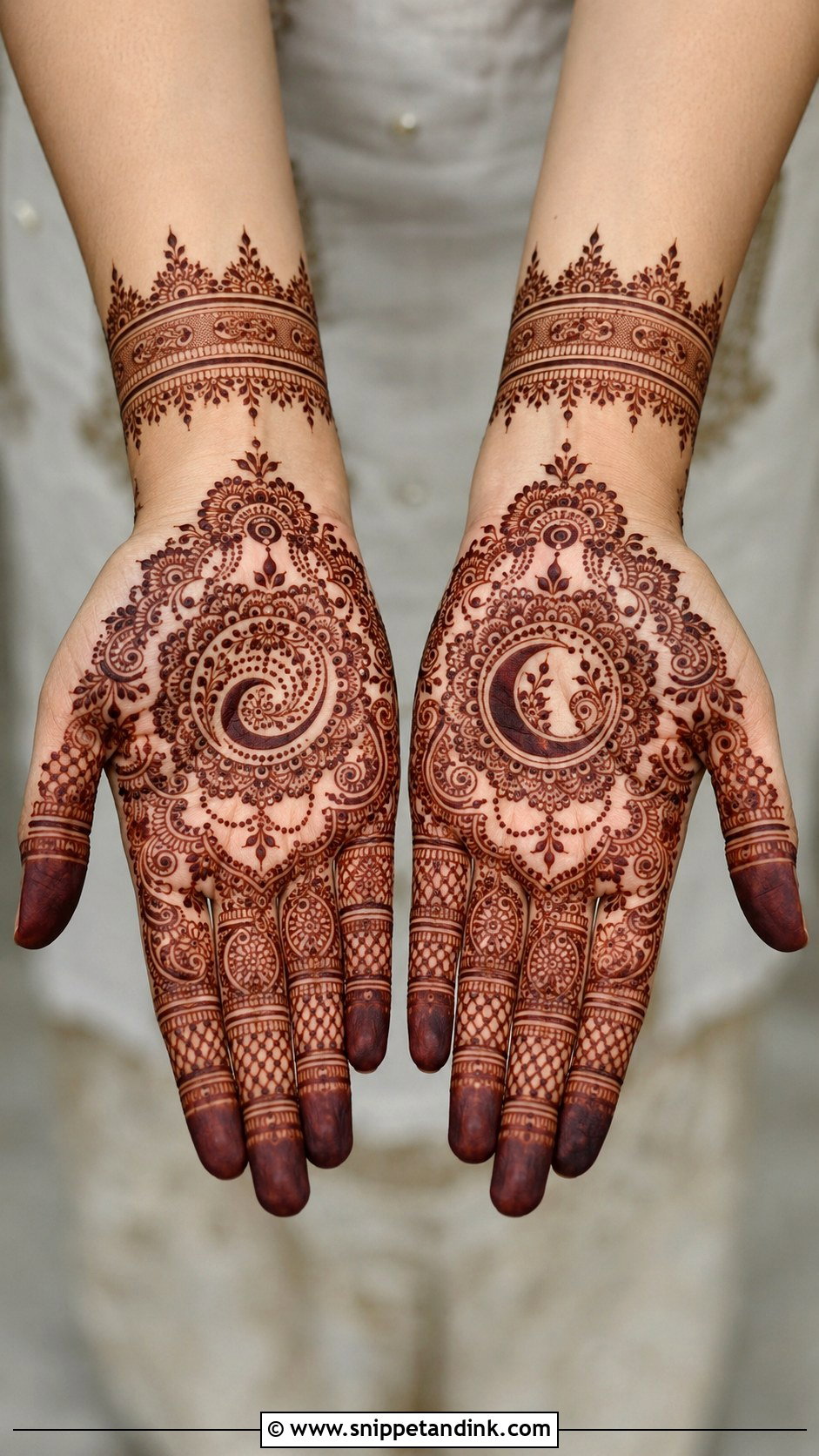
Karwa Chauth hands are usually full palm: paisleys, florals, mandalas and fine filling, sometimes with bride-groom figures, a moon motif or hidden initials. Many women apply it a day or so before the fast, and that timing is sound, because a henna stain reaches its darkest a day or two after the paste comes off. A lighter option is a detailed mandala palm with a floral wrist cuff. Red, maroon and gold outfits carry the deep stain well.
23. Pakistani Mehndi Design
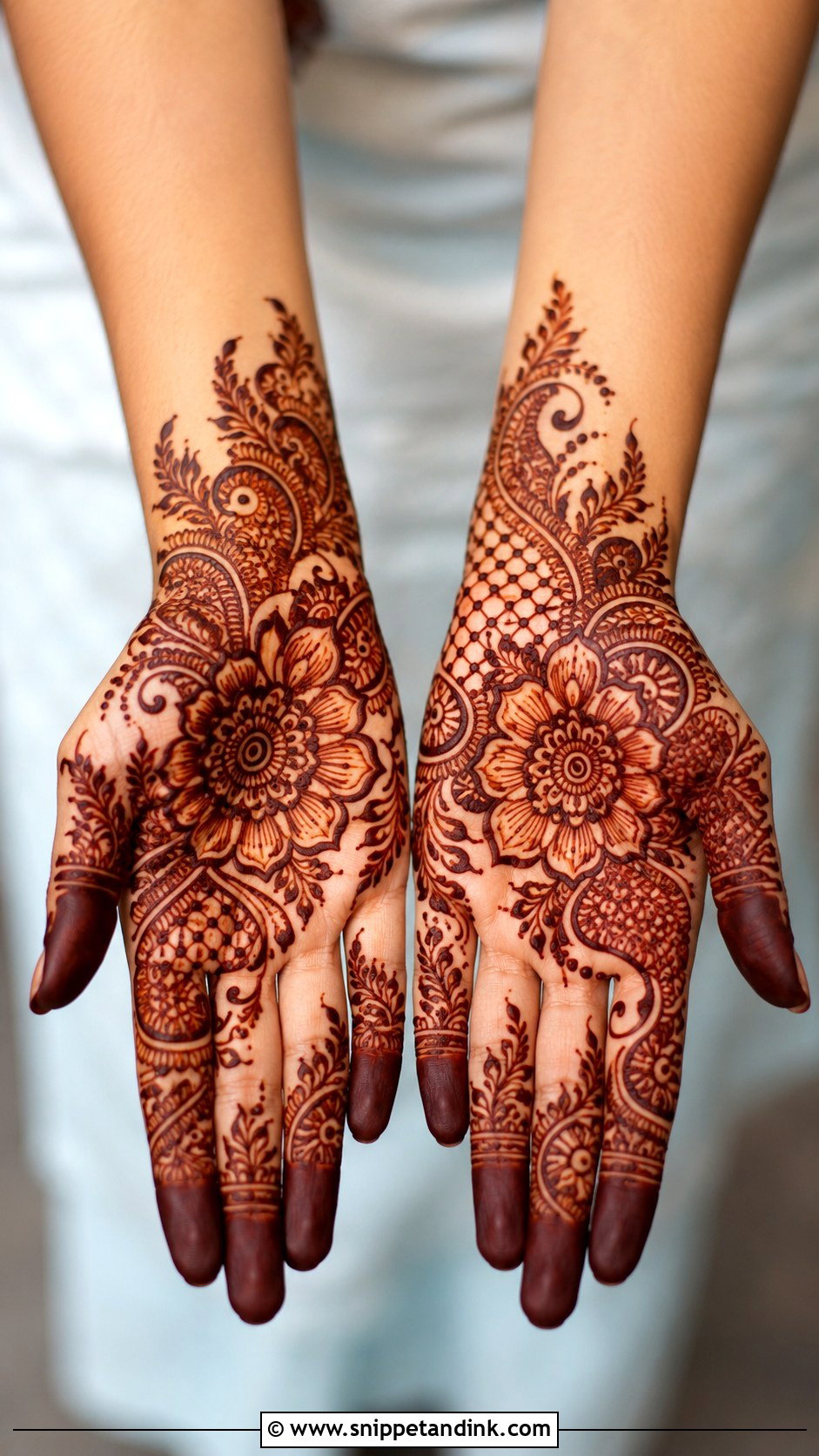
Pakistani designs blend Indian detail with Arabic flow: bold florals, paisleys, fine mesh, leafy trails and filled fingertips. Bridal versions usually cover both sides of the hand and run up the forearm, while Eid versions concentrate on a diagonal back hand. I like how this style keeps pockets of bare skin even at bridal density, which keeps the stain readable. If full Indian filling feels too heavy and Arabic feels too sparse, this is the middle ground I’d point you to.
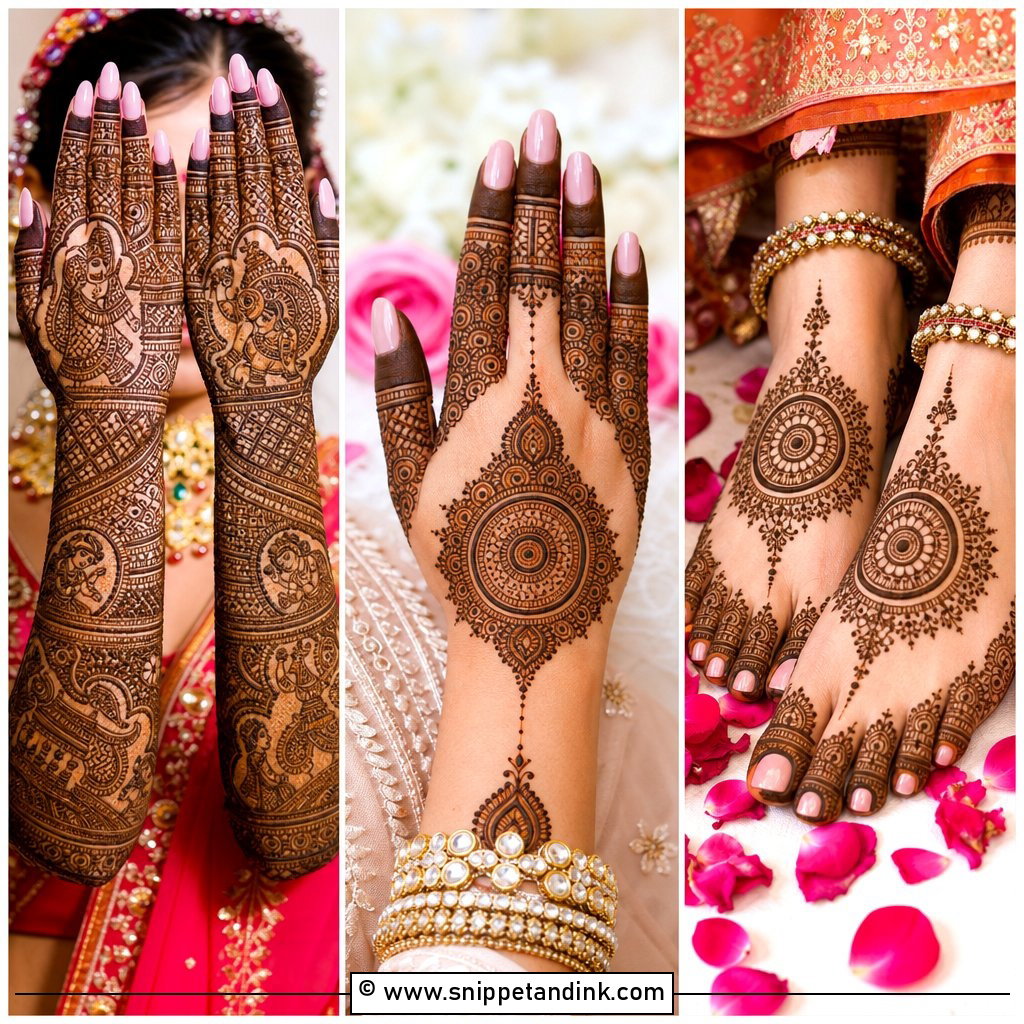
24. Rajasthani Bridal Mehndi Design
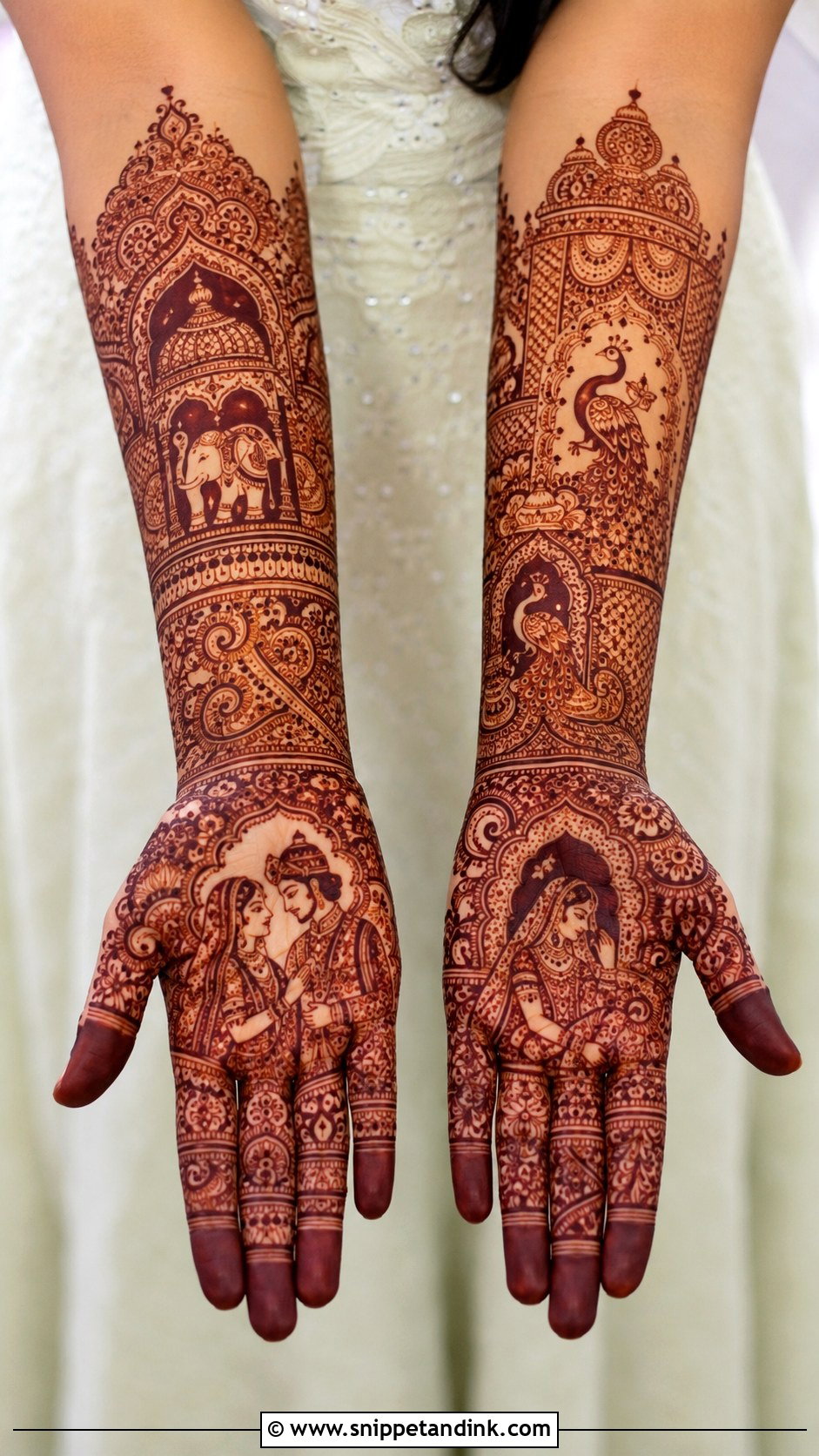
Rajasthani bridal work is the most narrative style I draw: bride-and-groom figures, elephants, peacocks, royal arches, paisleys and dense fine-line filling over hands and forearms. Planning comes before the cone. I place the large figures in the palm or on the forearm first, because faces and elephants need the deepest stain to show, then connect everything with smaller fillers. It’s slow, careful work. Expect the longest sitting of any design on this list.
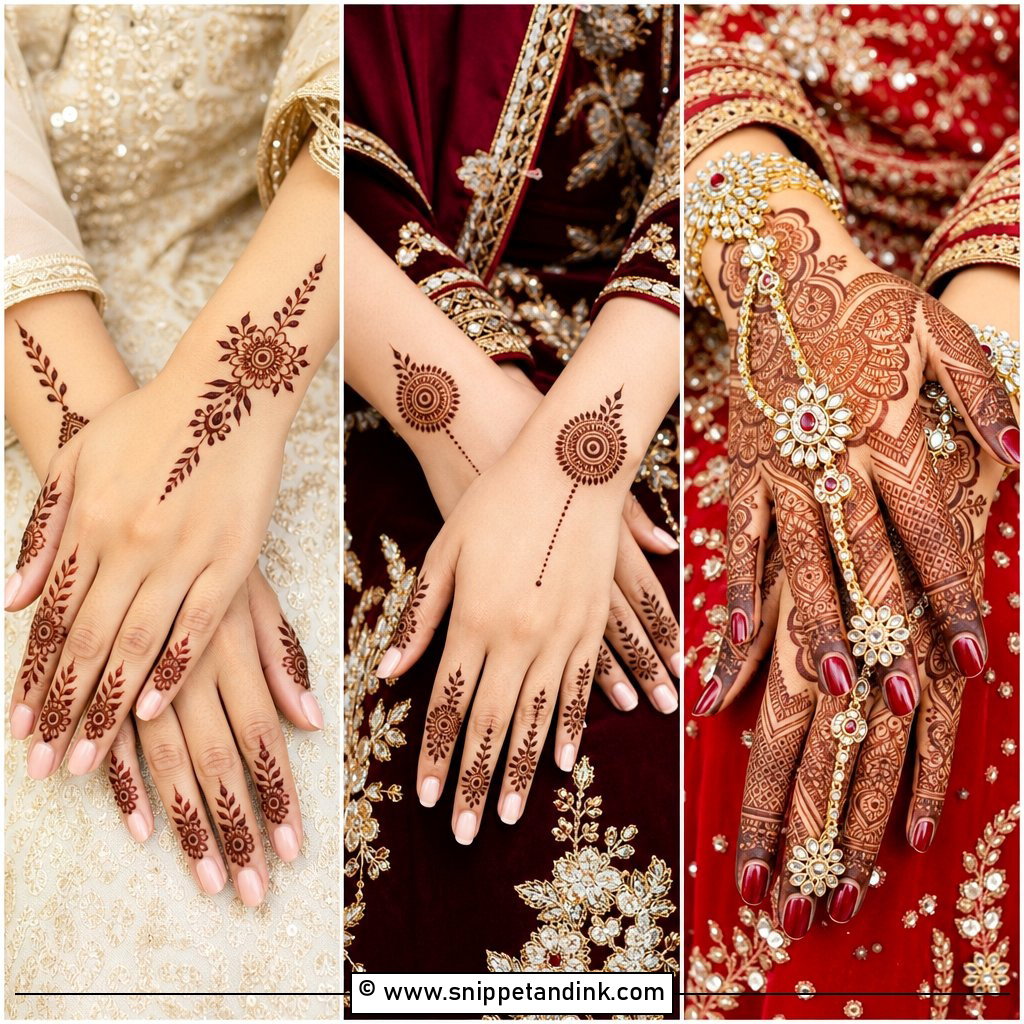
25. Lotus Mehndi Design
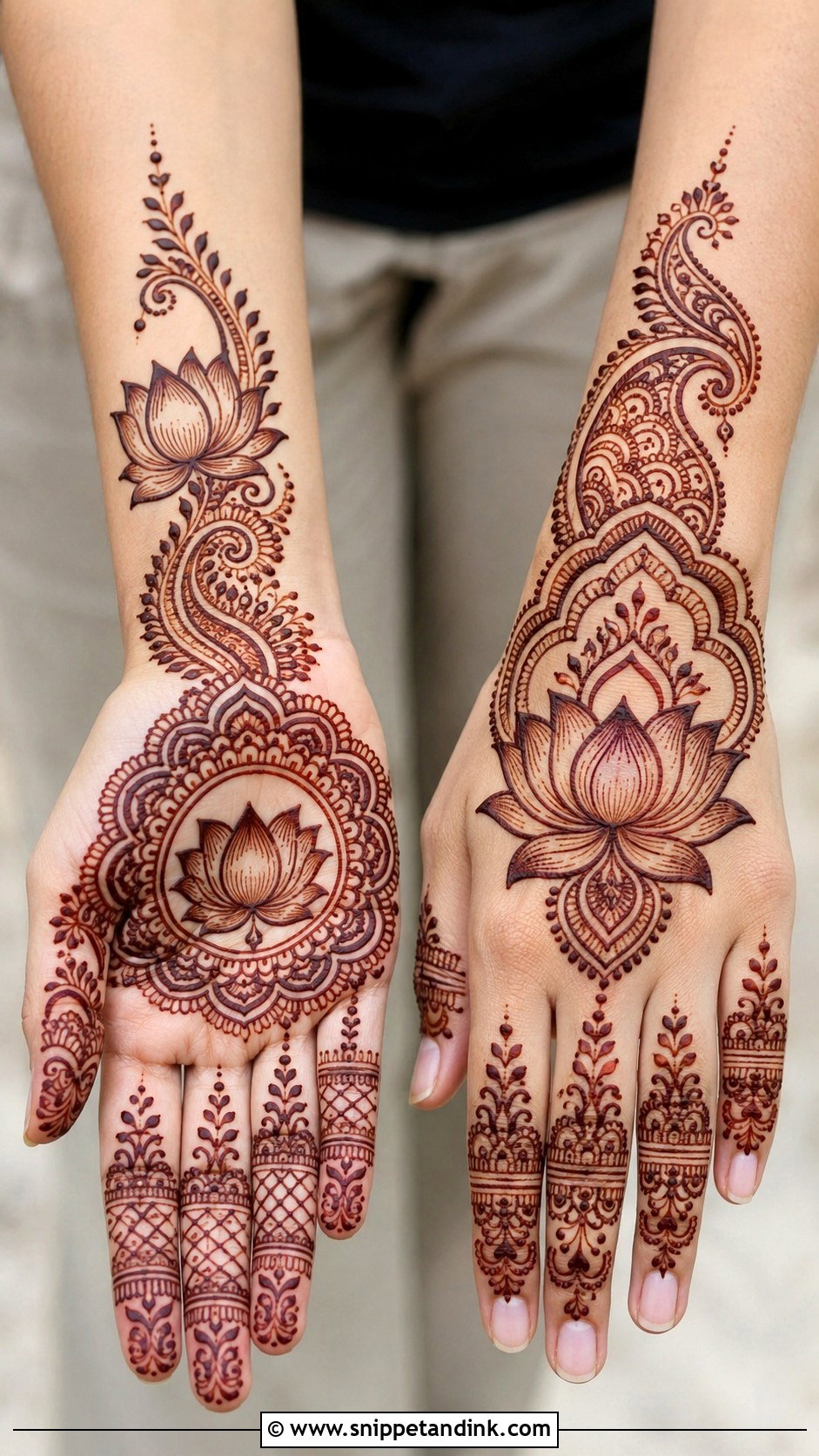
A lotus works as a single anchor, whether in the centre of the palm, the middle of the back hand or at the wrist. Around it I build layered petals, paisley borders, dots, vines or mandala rings, sometimes with fine jaali panels. Petal layering is the thing to check in an artist’s portfolio: if the inner and outer petals are drawn too close, they merge into one blob as the stain darkens. One large lotus on the back hand with open space and slim, detailed fingers is the modern take.
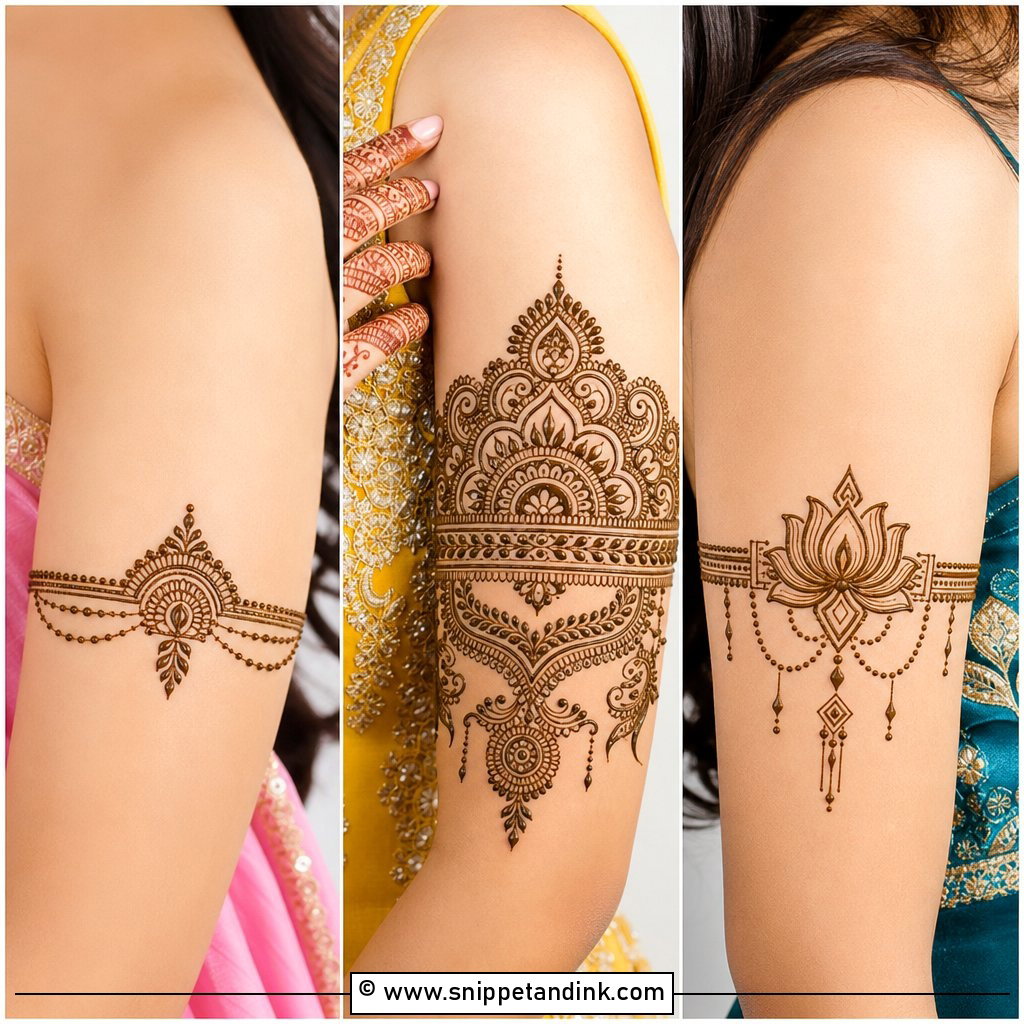
26. Bracelet Mehndi Design
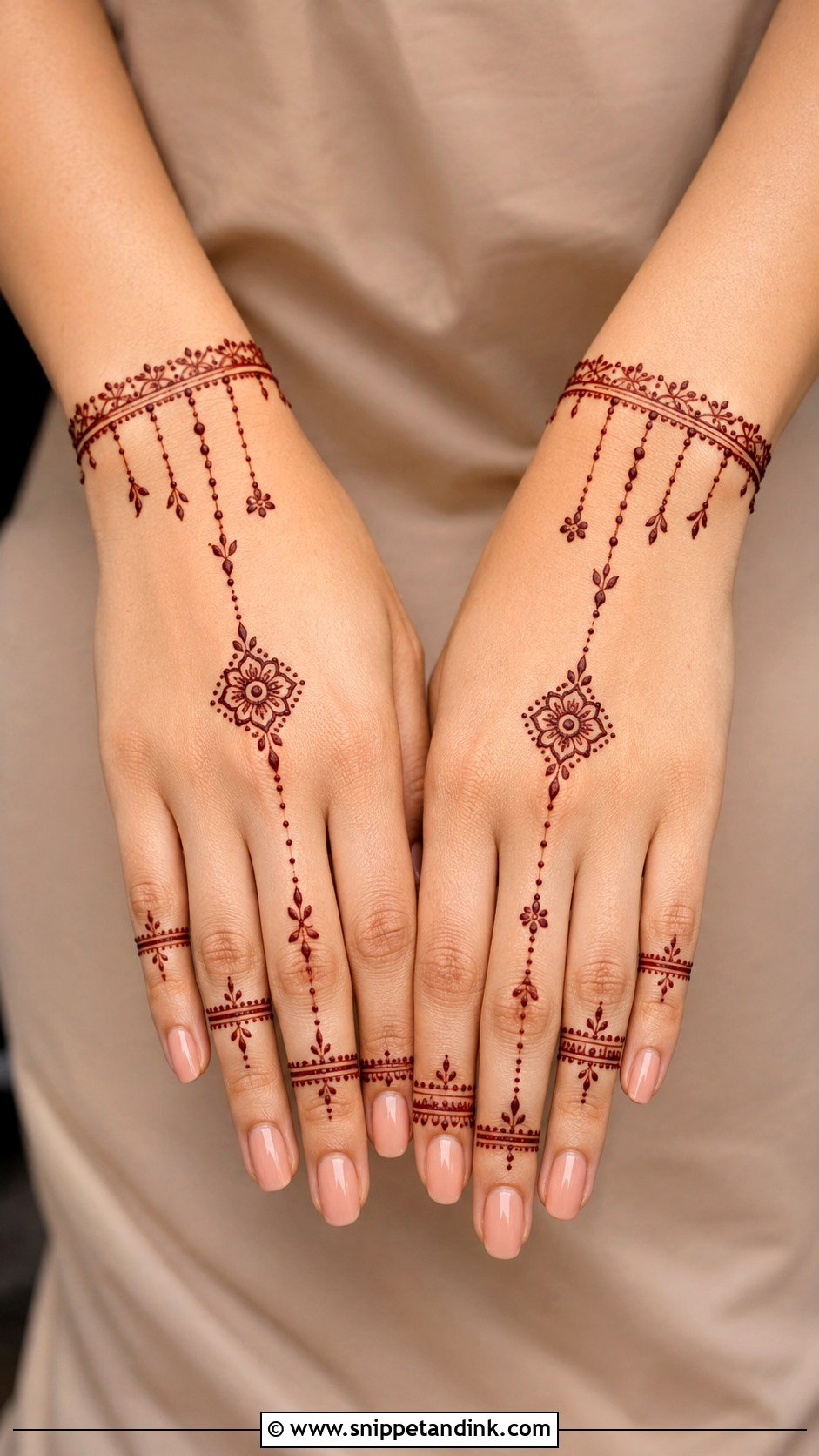
Bracelet mehndi draws a cuff at the wrist, then chain lines and small charms across the back hand to a centre motif, plus finger details. Because the lines run lengthwise, they make fingers look longer, which is why I suggest it to clients with shorter hands. Keep it simple with thin chains and dots, or build it up with florals and leafy borders. Every chain must connect cleanly; a broken link reads as a mistake, not a choice.
27. Full Arm Mehndi Design
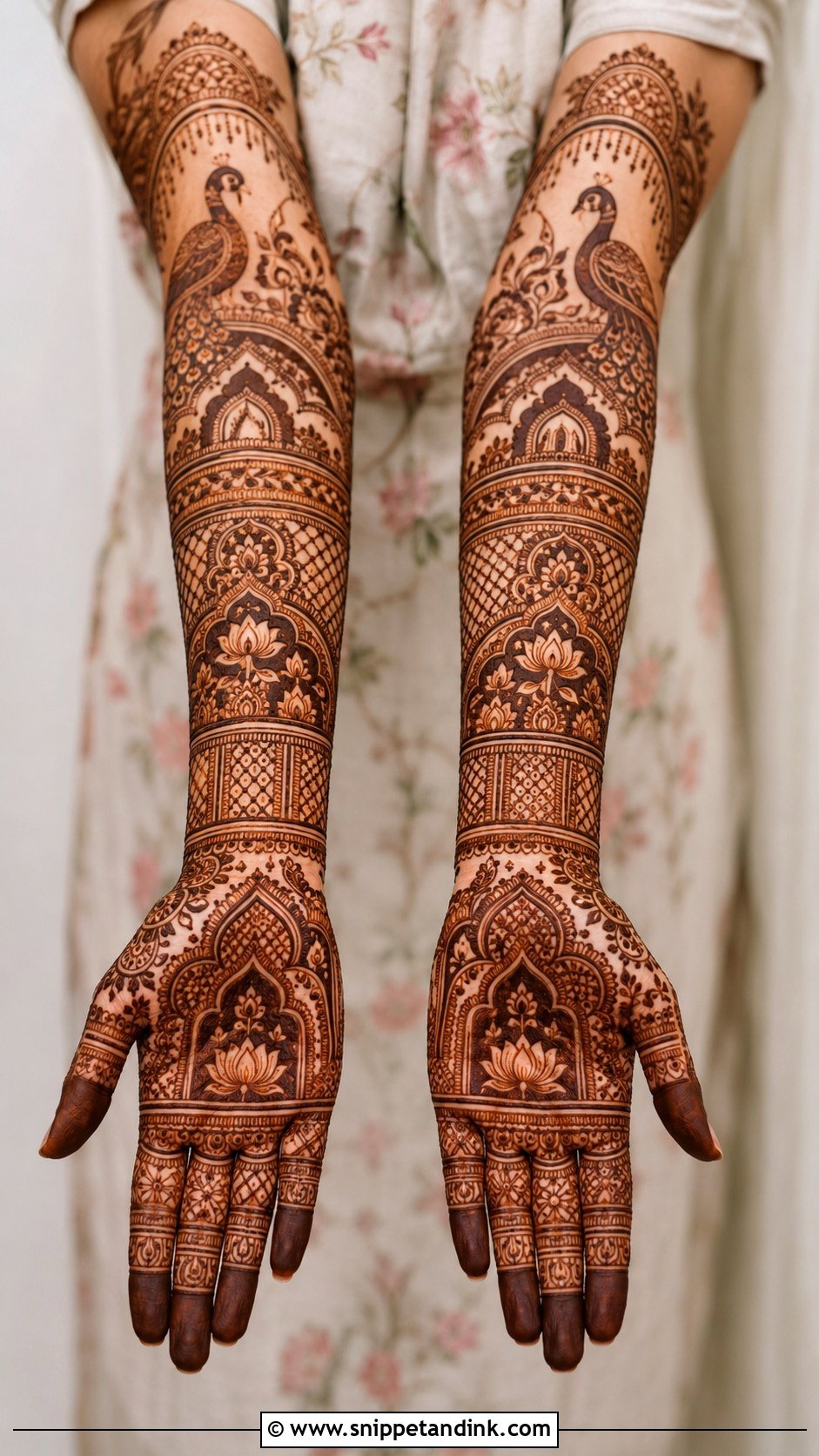
Full arm mehndi runs from the fingertips past the wrist toward the elbow, with portraits, peacocks, paisleys, lotus, mandalas, jaali and ornamental bands. On the forearm I alternate narrow bands with larger panels so the eye has somewhere to rest. Know before booking that arm skin stains noticeably lighter than the palms, so the forearm will read paler than your hands even with excellent paste. It’s a long application, and you’ll want someone to help you eat and dress afterward.
28. Half Hand Mehndi Design
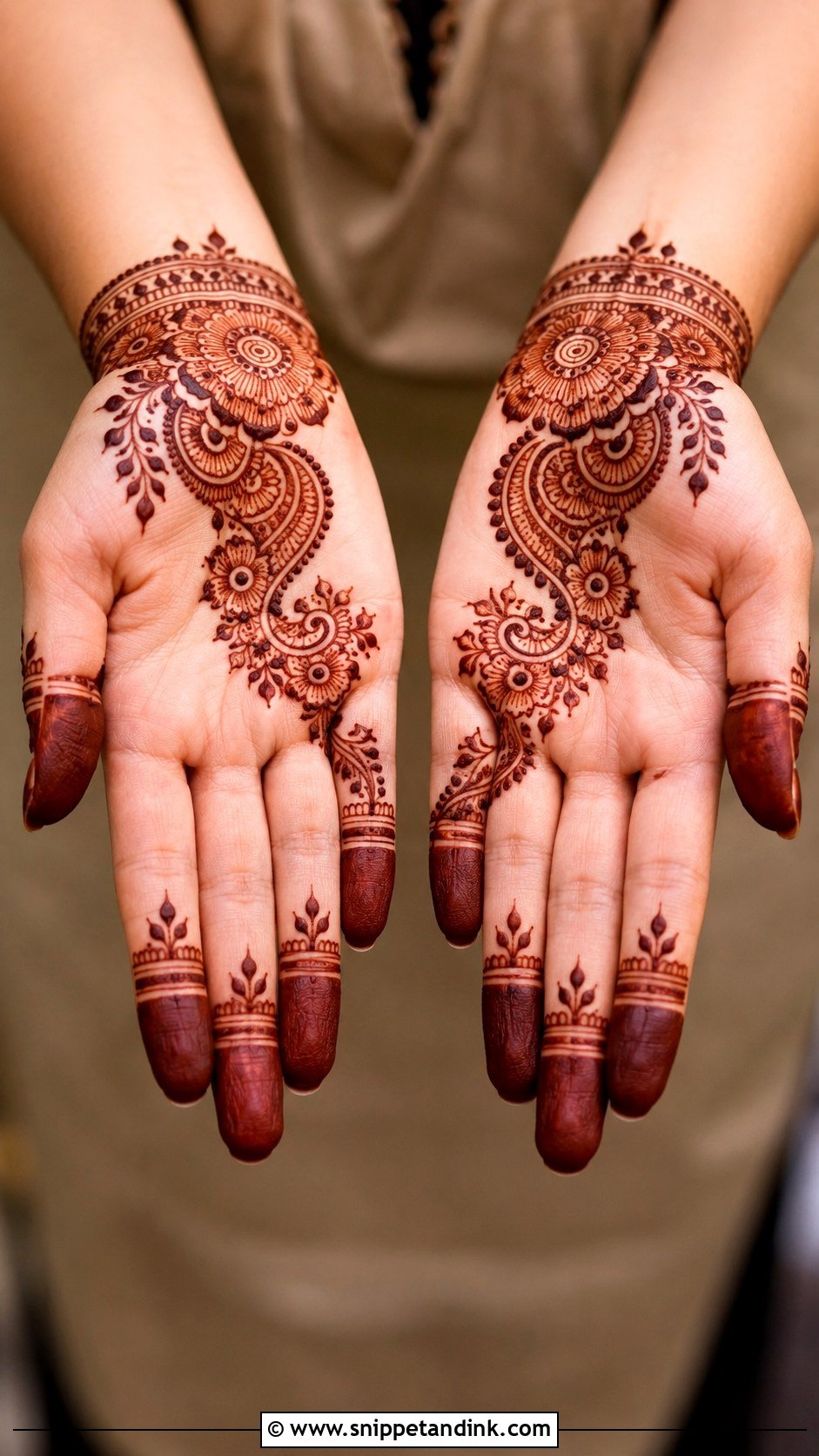
Half hand covers either the palm and fingers or the back hand and wrist, and leaves the rest bare. A mandala, floral trail, paisley curve or bracelet pattern carries it. I suggest it to guests and bridesmaids who need to look festive but still use their hands at the event, and to anyone short on time. Keep one clear main motif and let the fingers repeat its pattern language. I always end a half design at a natural line, like the wrist crease, so the edge looks planned rather than abandoned.
29. Jewelry Mehndi Design
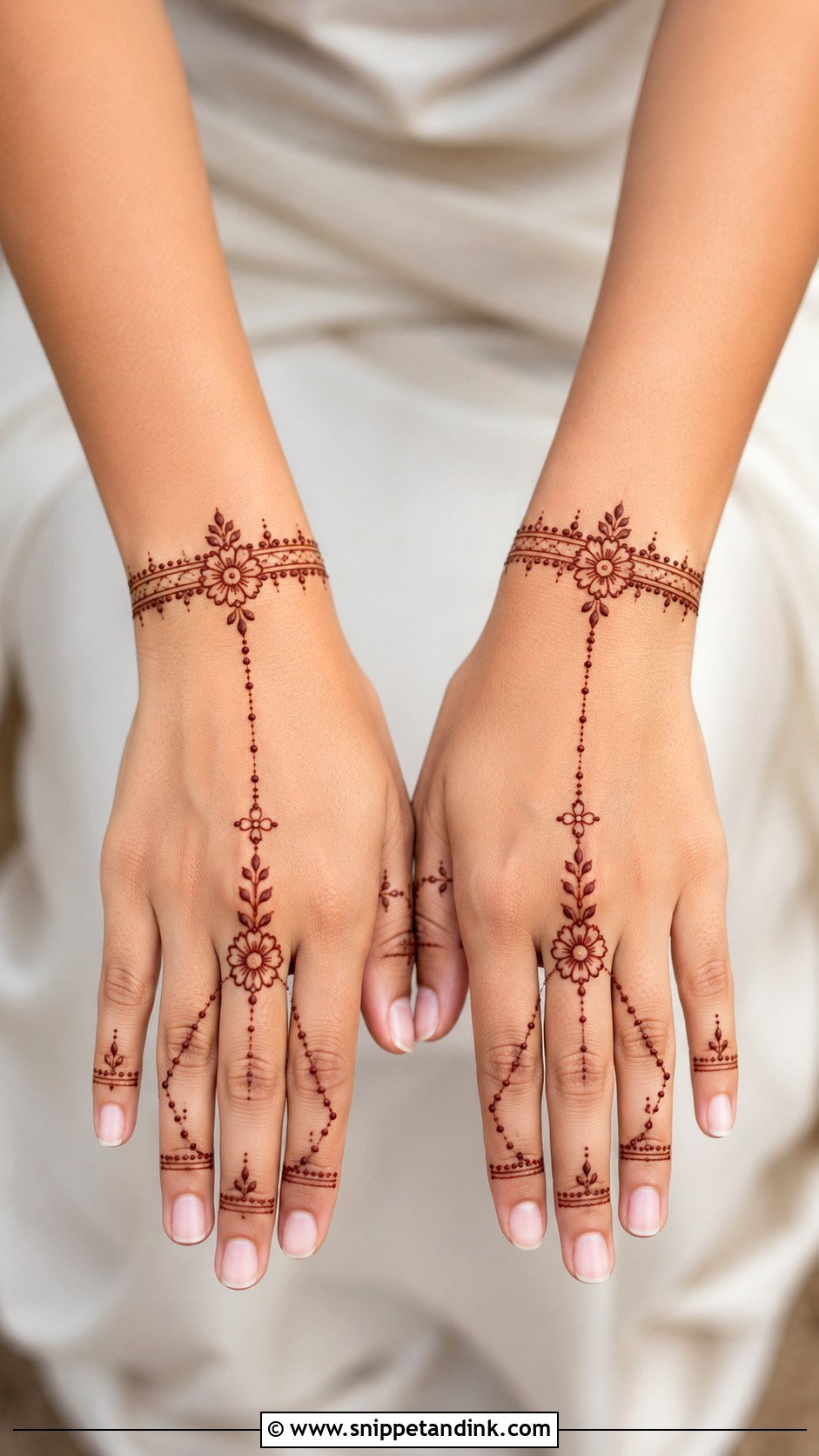
Jewelry mehndi imitates accessories: ring chains, bracelet cuffs, hathphool-style links, dotted strings and finger bands, usually starting at the wrist and running to one or more fingers. If you’ll wear a real hathphool, I draw around where it sits rather than under it, otherwise the henna chain and the metal chain fight each other in photos. Slim chains and small floral charms keep it light enough for engagement shoots, bridesmaids and minimal bridal events.
30. Shaded Mehndi Design
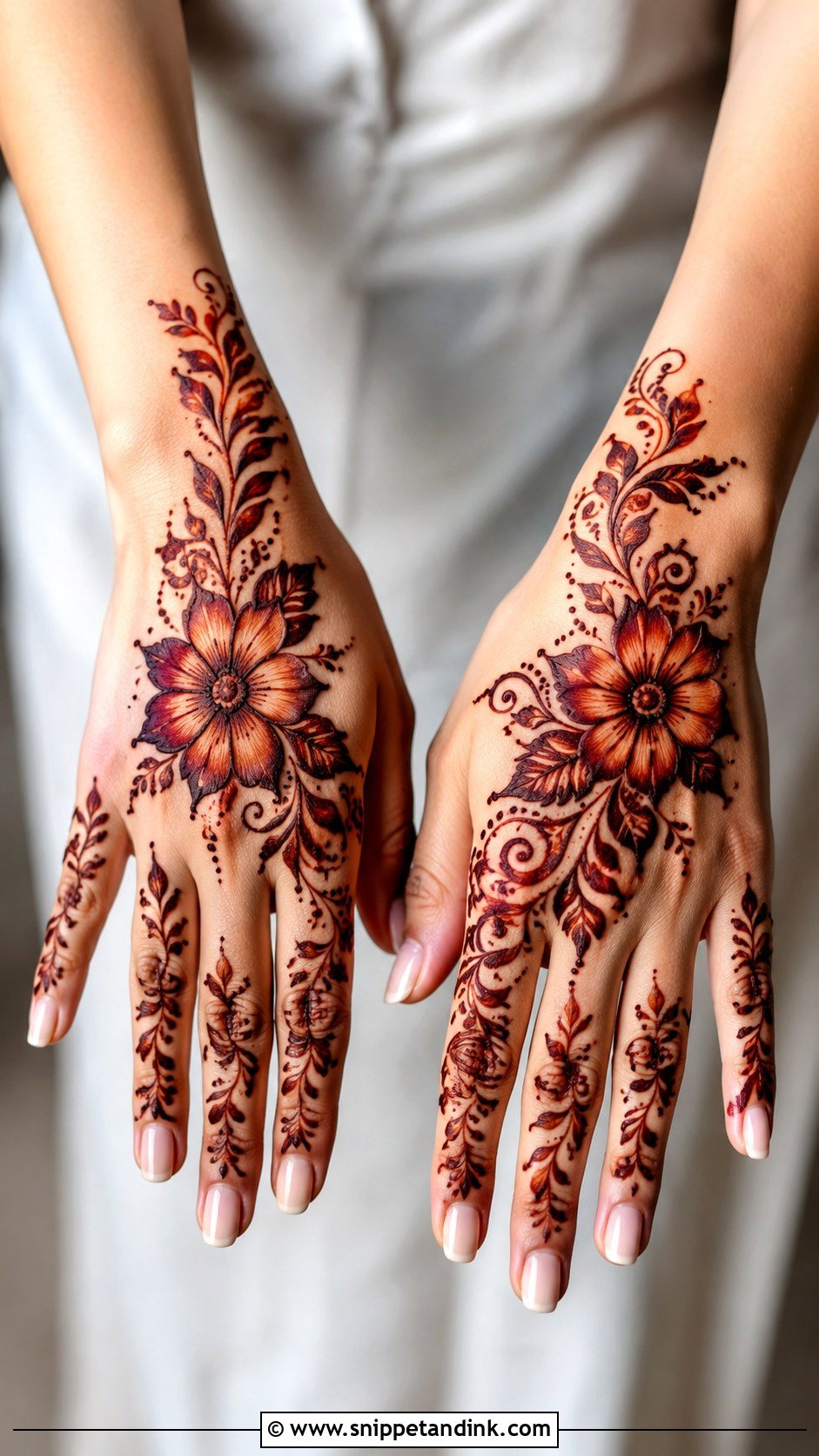
Shading fills selected petals, leaves and paisleys with light strokes instead of solid henna, which gives depth to bold Arabic flowers, roses and lotus. The whole technique is pressure. I outline first, let it set for a moment, then add the inner strokes with a very light squeeze. Press too hard and the shading floods into the outline, and that looks smudged once it stains.
31. Geometric Mehndi Design
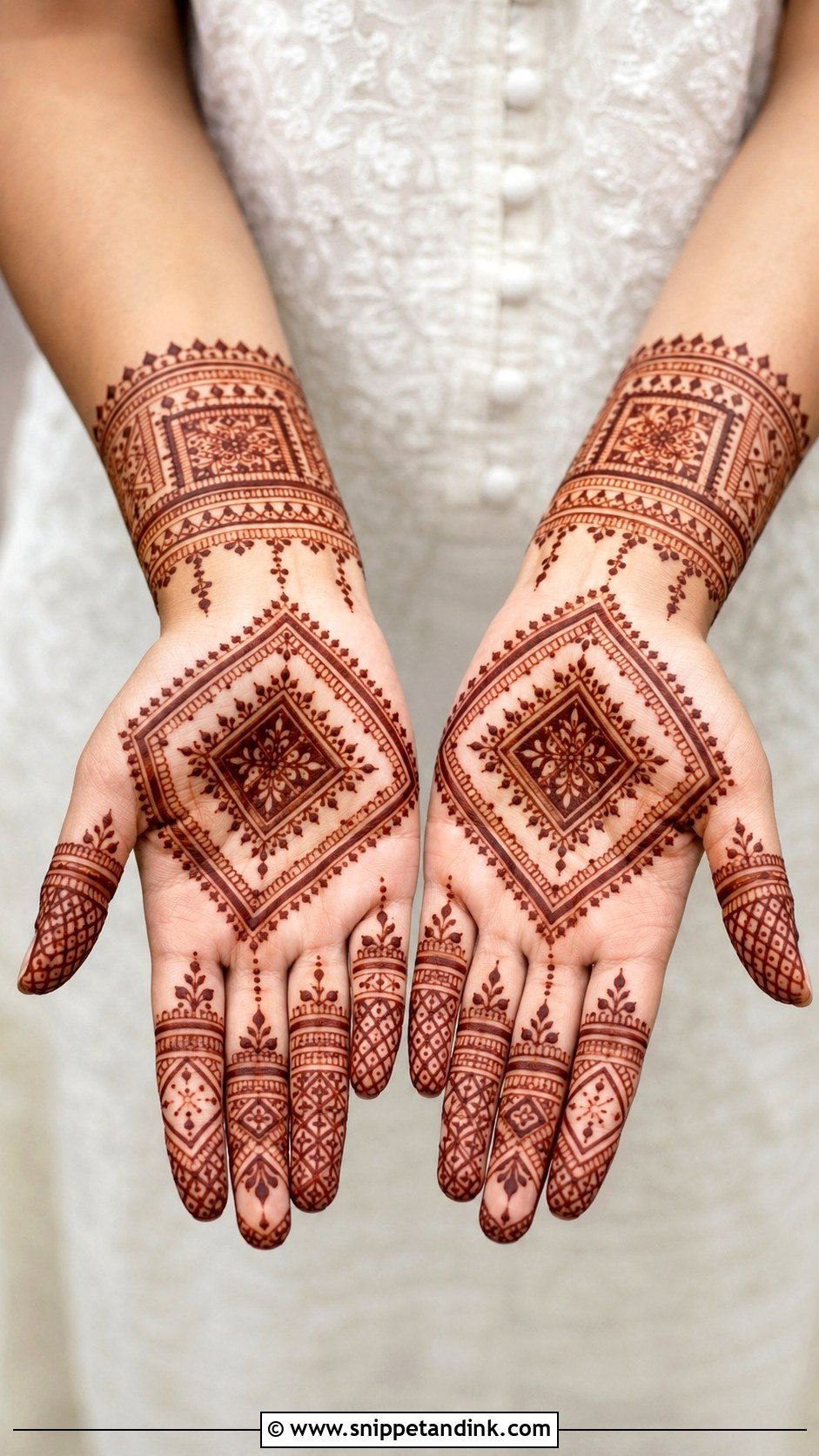
Geometric designs use diamonds, triangles, squares, straight bands, grids and dotted borders on the palm or back hand. A wrist cuff, a central diamond and repeating finger bands make a clean starting layout. Hands aren’t flat, though, and a straight line drawn on a relaxed hand bends when the fingers move, so I ask clients to keep the hand flat and still for the long lines. Small leaves or dots soften the grid if you’d like it less stark.
32. Vine Mehndi Design
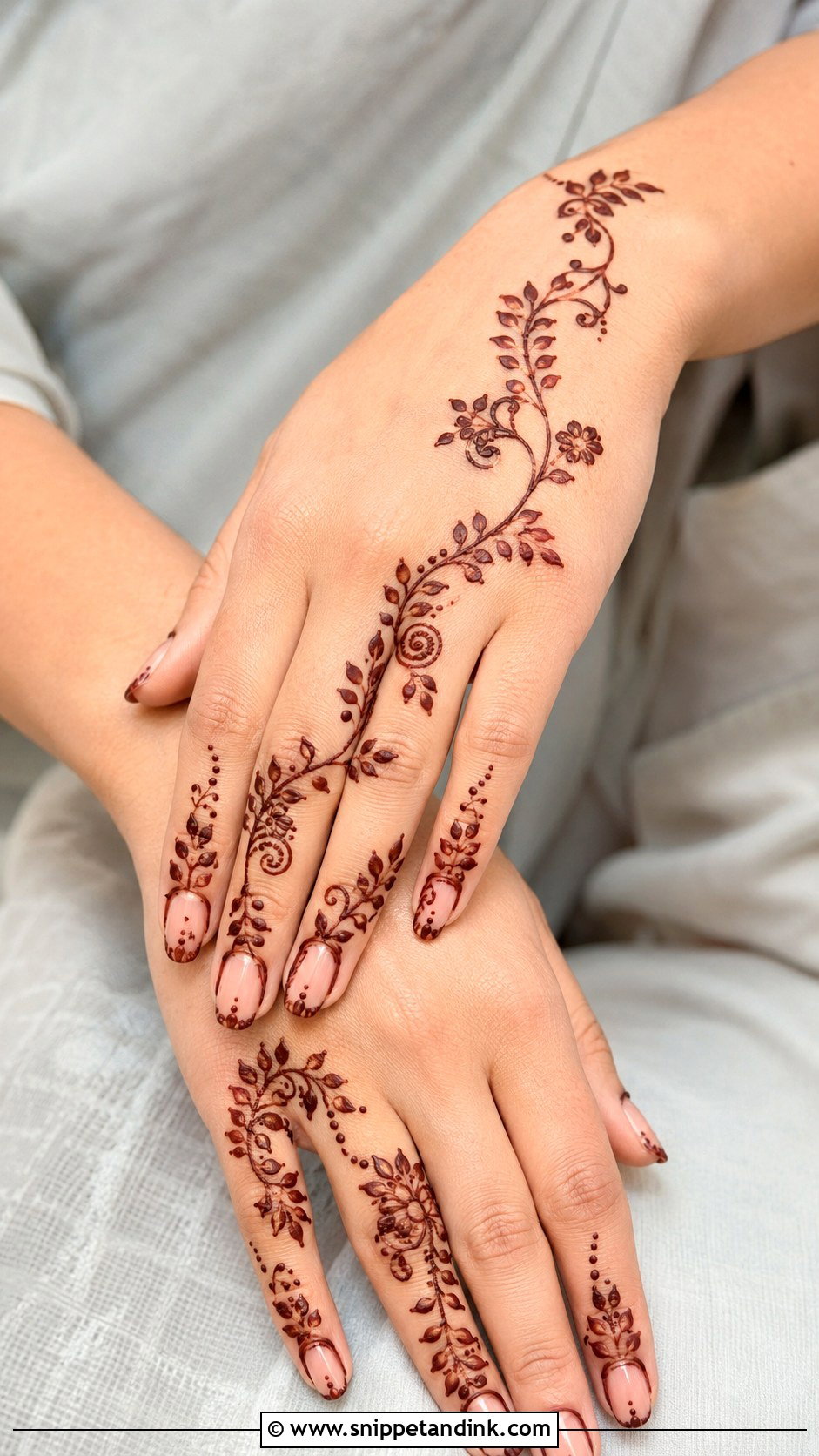
A vine flows from wrist to fingers with leaves, buds, small flowers and curved stems, either on a diagonal across the back hand or wrapped around a palm motif. It’s the design I give anyone worried about mistakes, because a slip simply becomes another leaf. Bold flowers at the wrist and fingertips make it richer; thin leafy lines and dots keep it light enough for casual functions and bridesmaids.
33. Front And Back Hand Mehndi Design
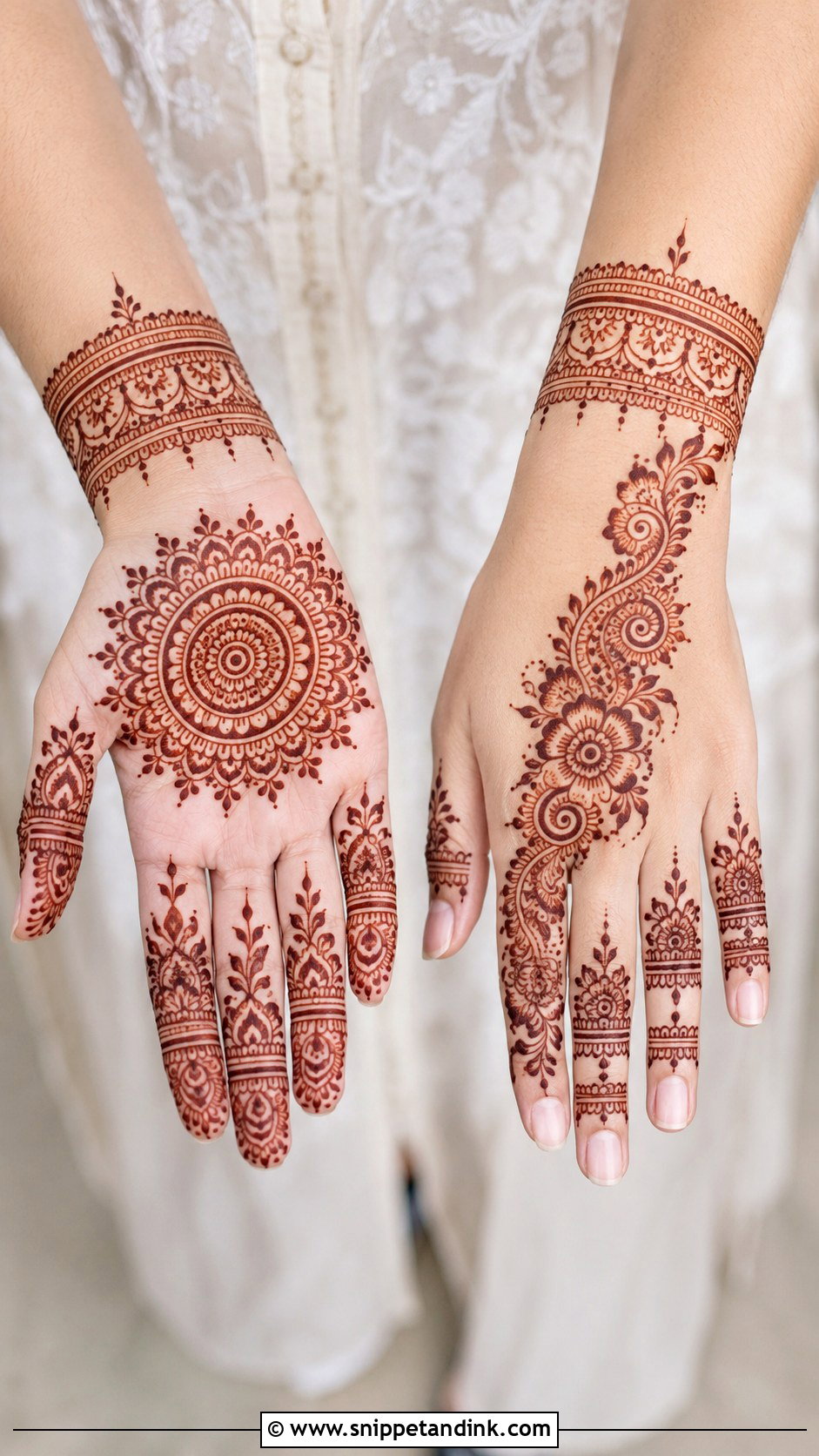
Front and back don’t have to match, but they should share a motif. Think of a palm mandala or paisley filling on the front and a bracelet, Arabic trail or medallion on the back, tied together by the same flower or border. Palms carry the detail for the rituals; back hands carry the photographs. I make one side heavier and the other more open, because matching both at full density usually looks heavy overall.
34. Kids Mehndi Design
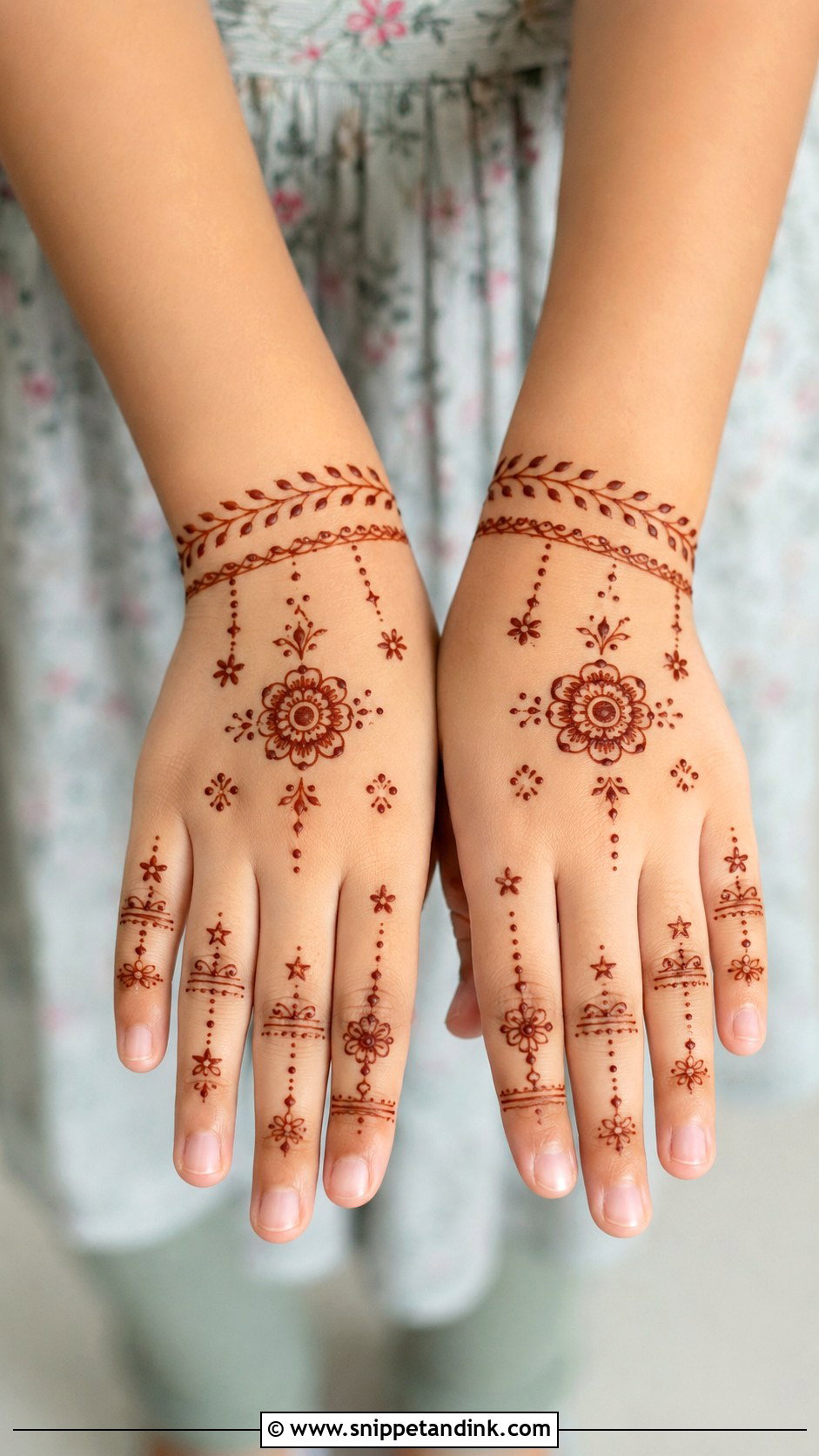
Children don’t sit still for long, so I keep their designs small and bold: little flowers, stars, a simple mandala, a leafy bracelet, tiny finger dots. Back hands dry faster and are easier to protect from sleeves and curious mouths. Use only natural henna with a short ingredient list, and try a small test spot first on very young or sensitive skin. A wrist band with a flower trail to one finger is plenty for Eid, birthdays or a family wedding.
35. White Mehndi Design
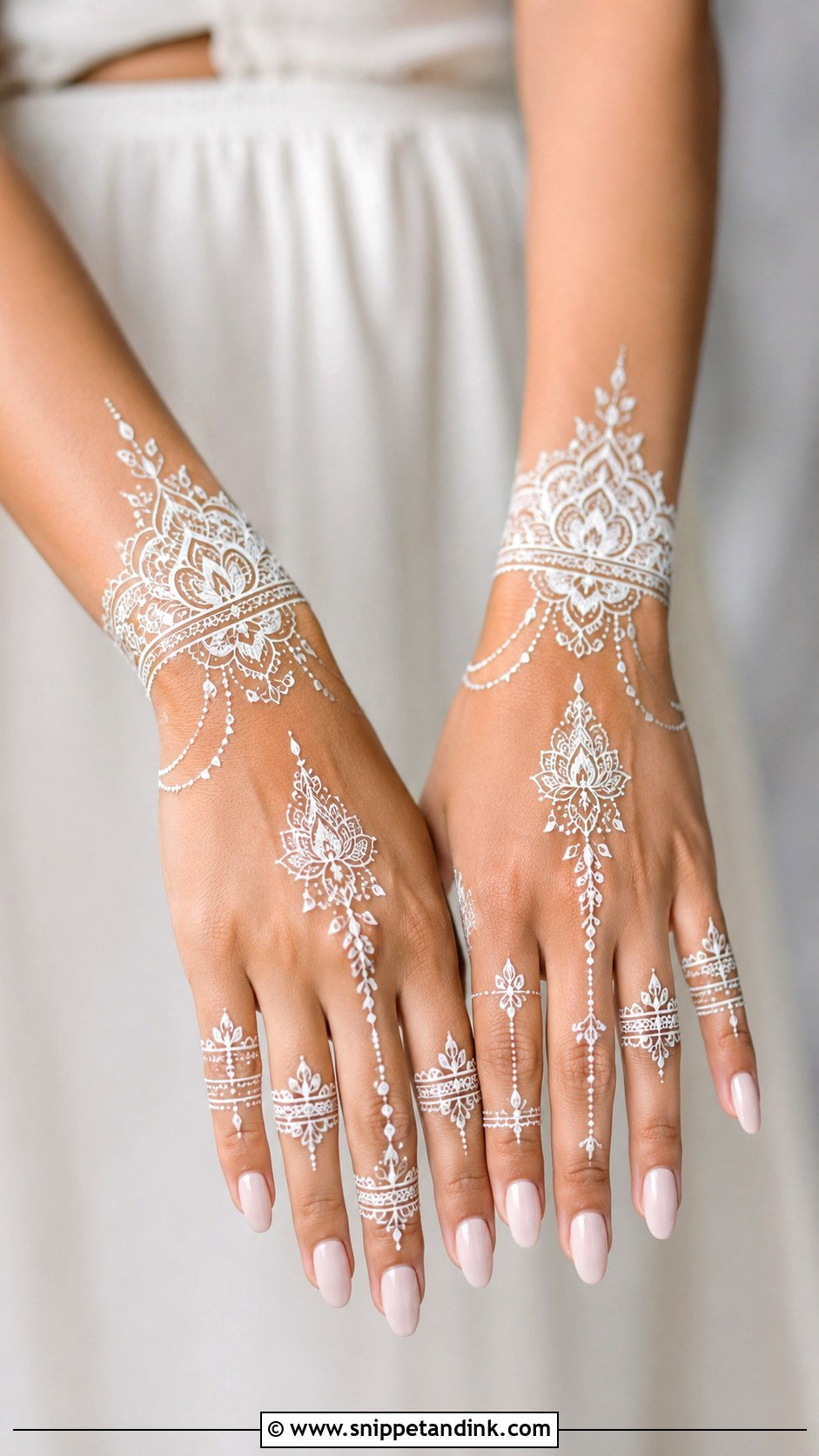
White mehndi isn’t henna at all. It’s a body paint or skin-safe adhesive that sits on top of the skin, so there’s no stain, and it lasts a day or so before rubbing off. Lace back hands, floral cuffs, finger bands and dotted chains show strongly against deeper skin tones and with pastel or bright outfits. Because the white is so visible, I keep it less dense than I would with henna. Ask what the product actually is and patch test it, since some adhesive-based pastes irritate skin.
Darkening the Stain Once the Paste Comes Off
Fresh henna always surprises people. When the dried paste comes off, the skin underneath is bright orange, and new clients sometimes think the cone was bad. It isn’t. The colour oxidises over the next day or two, moving through red toward deep brown or maroon, and it’s at its darkest somewhere around the second day.
- While the paste is drying, I dab on a little lemon juice and sugar so it stays stuck to the skin and doesn’t flake off early.
- Keep it on as long as you can bear, then scrape or rub it away dry. Don’t wash it off.
- Avoid water for the rest of that day if possible. Warmth helps the colour develop, so keep your hands warm rather than cold.
- Before you do wash, rub on a little balm or oil to protect the stain. Skip hand sanitiser, chlorine, scrubs and waxing on decorated skin.
- Expect the design to last one to three weeks, fading first wherever the skin rubs most: the sides of the fingers and the centre of the palm.
A Cone That Stains Black in an Hour Isn’t Henna
Natural henna never stains black, and it never gives full colour straight away. Cones sold as instant, black or jet-dark often contain PPD or other dyes that can cause blistering and lasting allergic reactions. I make my own paste from henna powder, lemon juice or water, sugar and an essential oil, and any artist you book should be able to tell you exactly what’s in hers.
If you’ve never worn henna before, or you react to fragrances, ask for a small test spot a couple of days ahead. The same goes if you’re pregnant, since some of the essential oils used in paste are worth checking with your doctor first. Itching, raised skin or blisters under a design are not normal, and you should get them looked at rather than waiting for them to fade.
Fitting the Design to the Day You Have
Henna has room for almost any taste now, from a bold Arabic back hand to a full bridal arm, a clean mandala, a fine khafif layout or a jewelry-style cuff. When I help someone decide, I ask about the event and the hours they can give me before I ask about motifs. Short on time? Finger, vine or bracelet work. Want a wedding statement? Full hand, Rajasthani, portrait or heavy Indian. Whatever you pick, the cone only gives you the outline. The aftercare decides how dark it ends up.
You'll Like These Ideas:


Leave a Reply