
The back of the hand is the side people actually see: when you hold a bouquet, rest your hands in your lap, greet guests or pose for the ring shot. That’s why so many brides and guests ask me for something there rather than a heavy palm. Modern minimal back hand mehndi designs lean on open space and placement: a small mandala, a fine floral trail, a bracelet, or detail kept to the fingers. They suit Eid, weddings, engagements, Karva Chauth, Diwali and baby showers equally well. Here are thirty I draw regularly, with what each one needs from your hand and from the paste to look right.
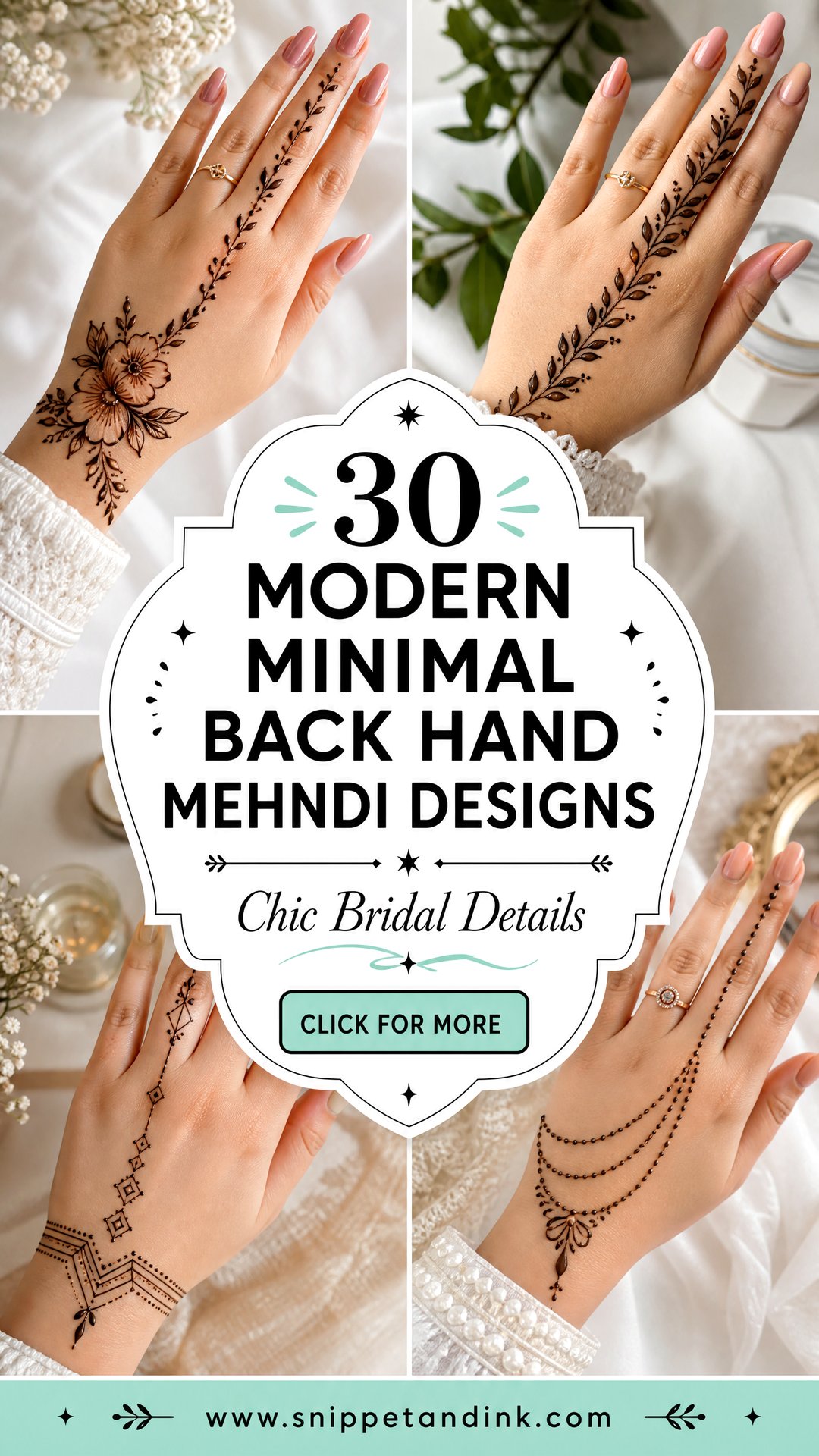
How I Map a Design Onto the Back of Your Hand
The back of the hand moves more than people realize. Knuckles fold, tendons rise when you grip, and the skin over the wrist creases every time you bend it. A design drawn on a flat, relaxed hand can look distorted the moment you hold a glass. So before I start, I ask you to make a loose fist and spread your fingers, and I watch where the skin stretches.
- Large circles and mandalas go on the flat area between the wrist and the knuckles, never across the knuckle ridge.
- Diagonal trails follow the line of the tendons, so they stay smooth when your fingers move.
- Finger bands sit between the joints, not on them, so they don’t crack and fade where the skin folds.
- On a broad hand, I set the main motif slightly off-center; on a narrow one, a single central motif usually looks better.
It also helps to know which hand will be photographed. Right-handed brides usually hold the bouquet in the left, so that back hand ends up in more pictures than you’d think.
1. Minimal Floral Back Hand Mehndi Design
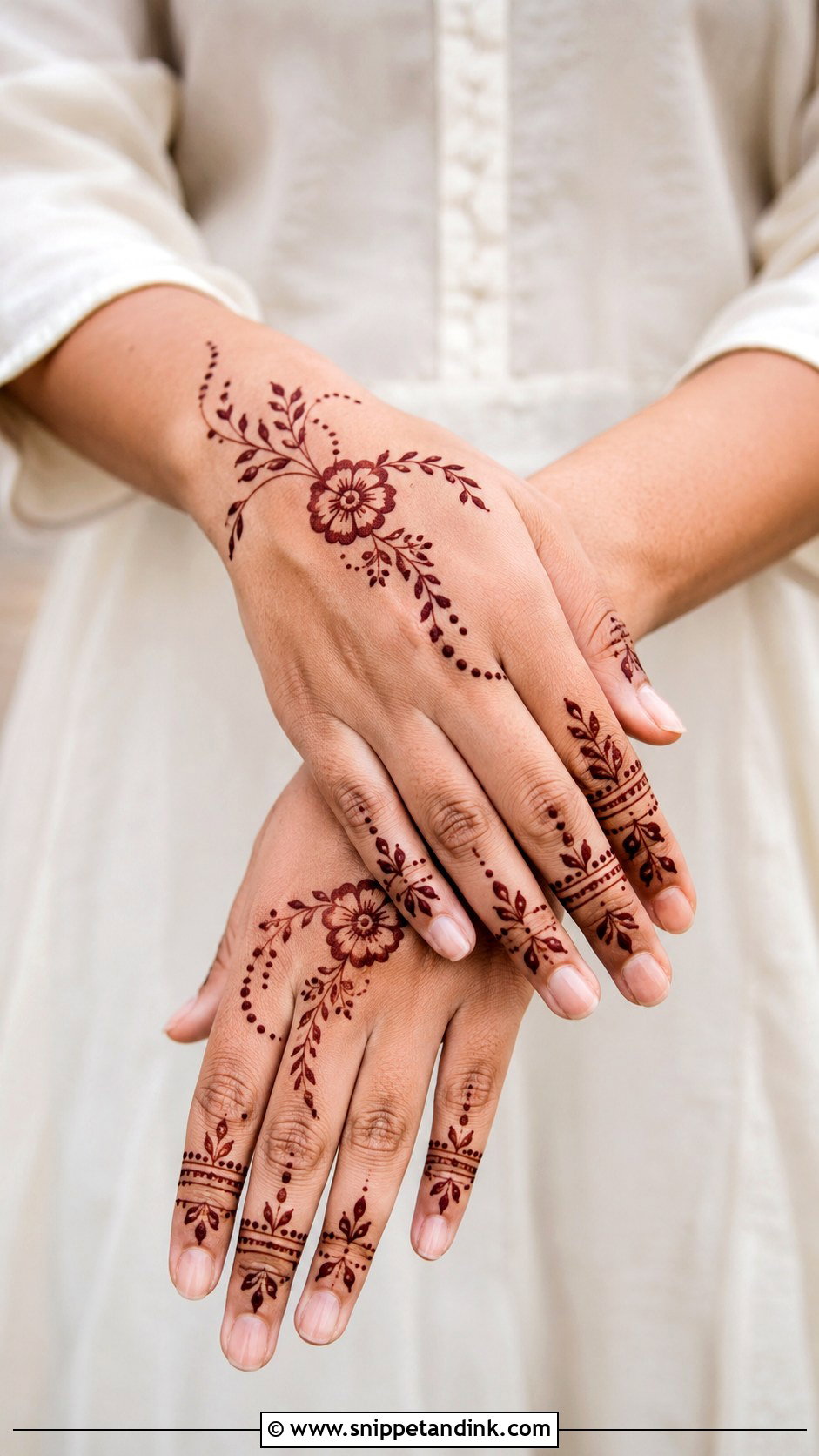
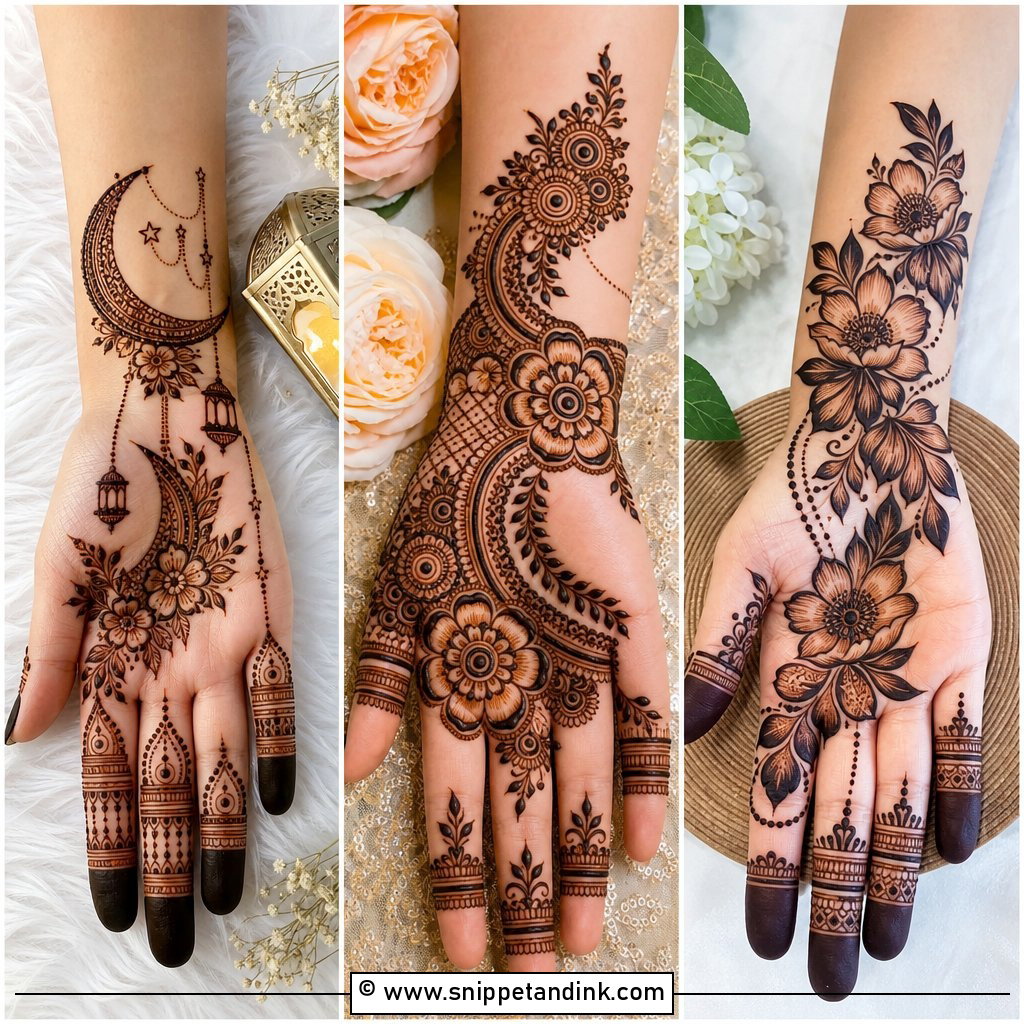
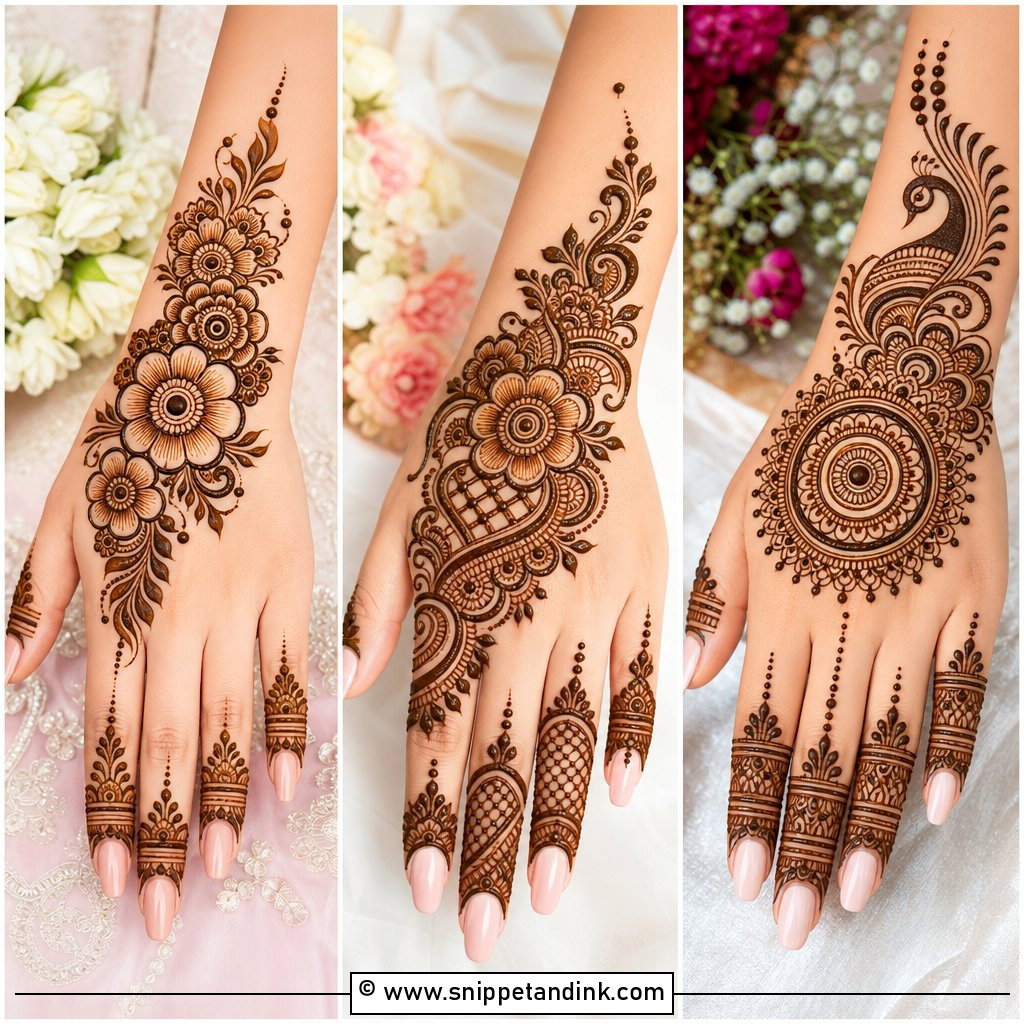
One medium flower near the center or side of the back hand, then thin vines, tiny leaves and dotted curves toward the fingers or wrist. I usually set the flower slightly off-center, toward the thumb, because a dead-center flower can look stamped on rather than drawn for that hand. There’s no dense filling, so it’s forgiving for beginners. Keep the fingertips to small petals, dots or fine ring bands and the empty space does the rest.
2. Simple Mandala Back Hand Mehndi Design
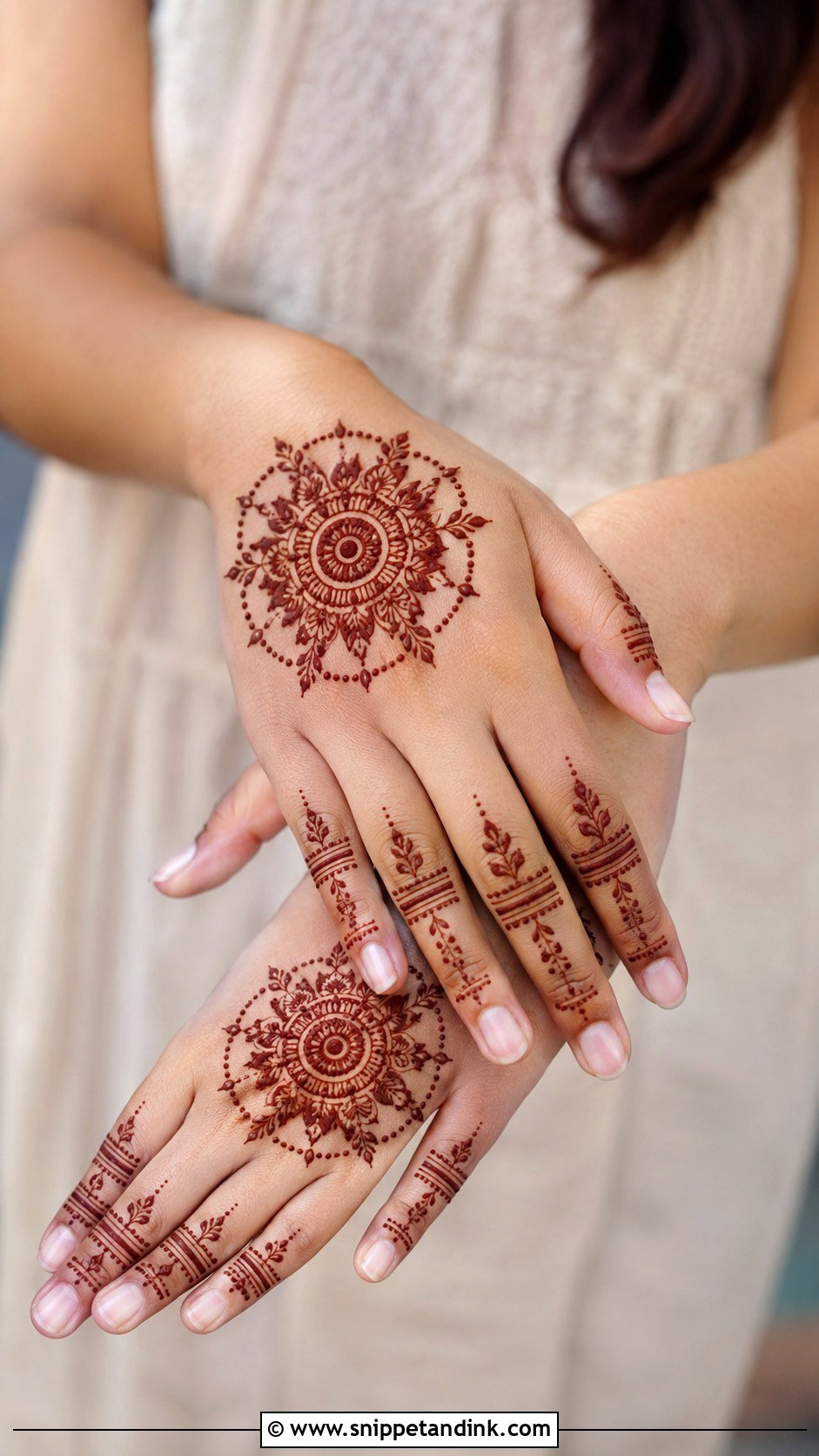
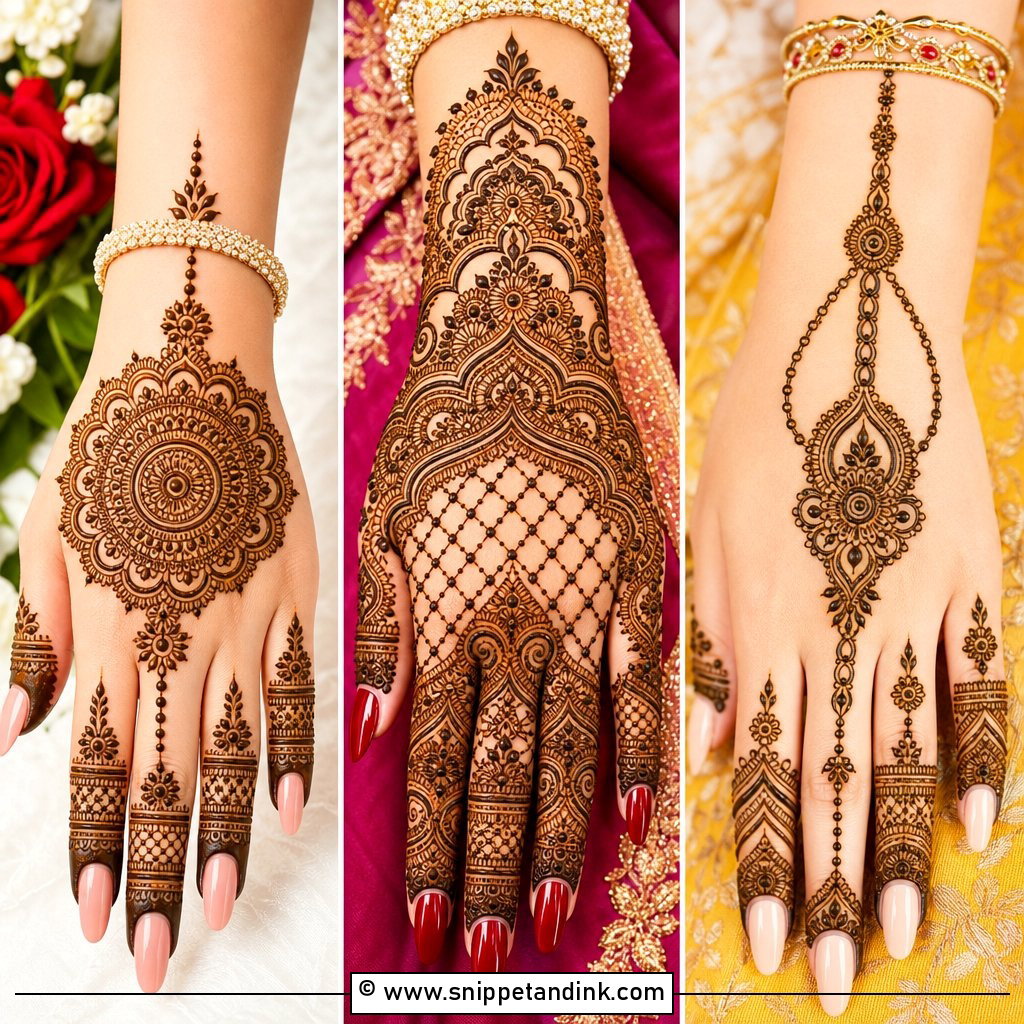
The mandala sits over the flat middle of the back hand, which matters: if it creeps up onto the knuckles, the circle distorts every time you make a fist. I draw the outer border first so the shape is round, then fill neat petals, dots and thin rings inward. The fingers get small lines, leafy tips or matching dots. Leave skin showing between the mandala, the fingers and the wrist, and the round shape draws the eye naturally in photos.
3. Arabic Trail Back Hand Mehndi Design
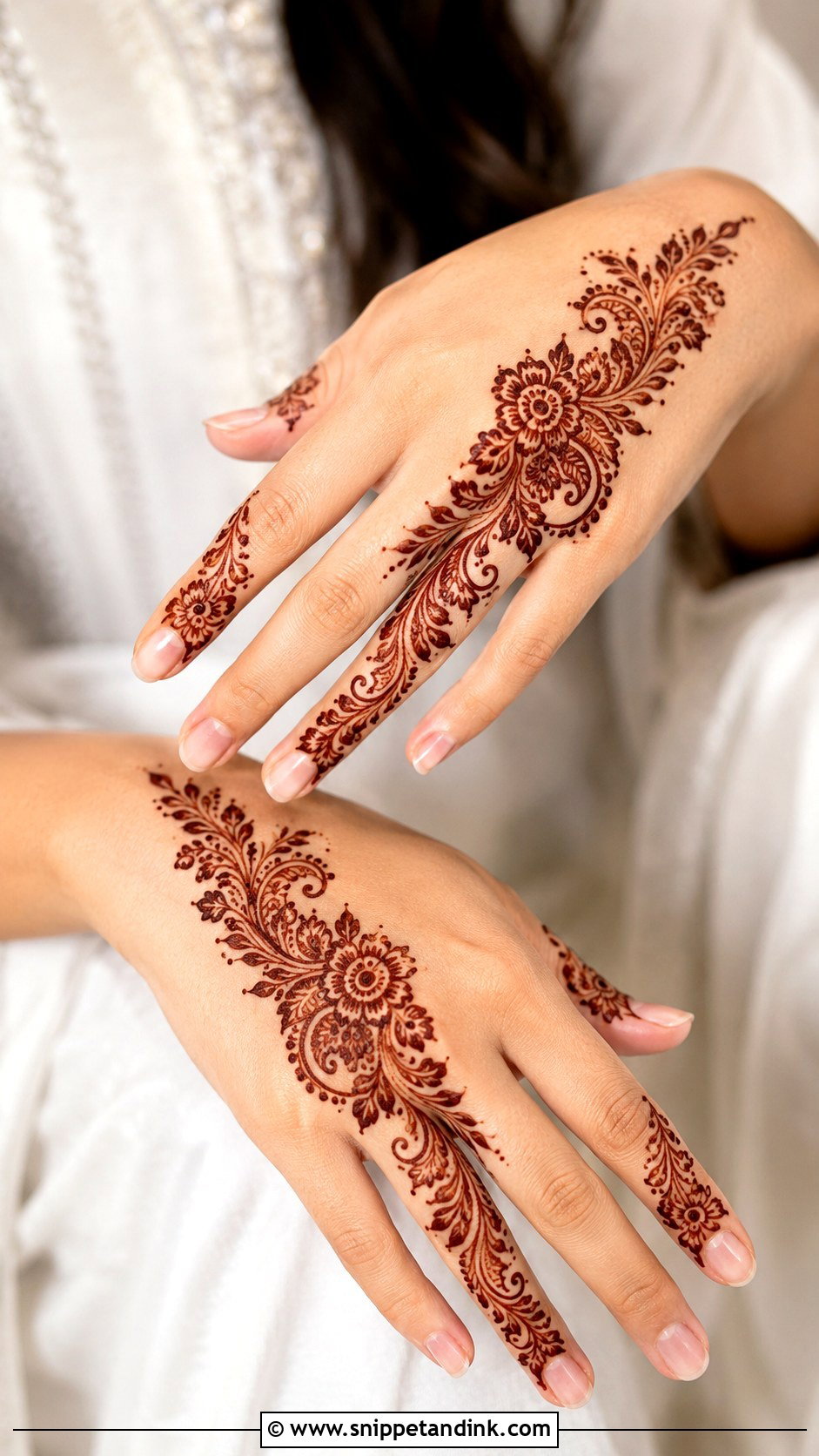
An Arabic trail runs diagonally from the wrist toward the index or middle finger, built from flowers, leaves, curved lines and a few small paisleys. The diagonal follows the tendons on the back of the hand, which is why it looks so natural there. I keep the trail slim for a modern version and only add thick shading when someone asks for a bolder Arabic finish. Half-flower tips or fine vines on the fingers finish it.
4. Bracelet Back Hand Mehndi Design
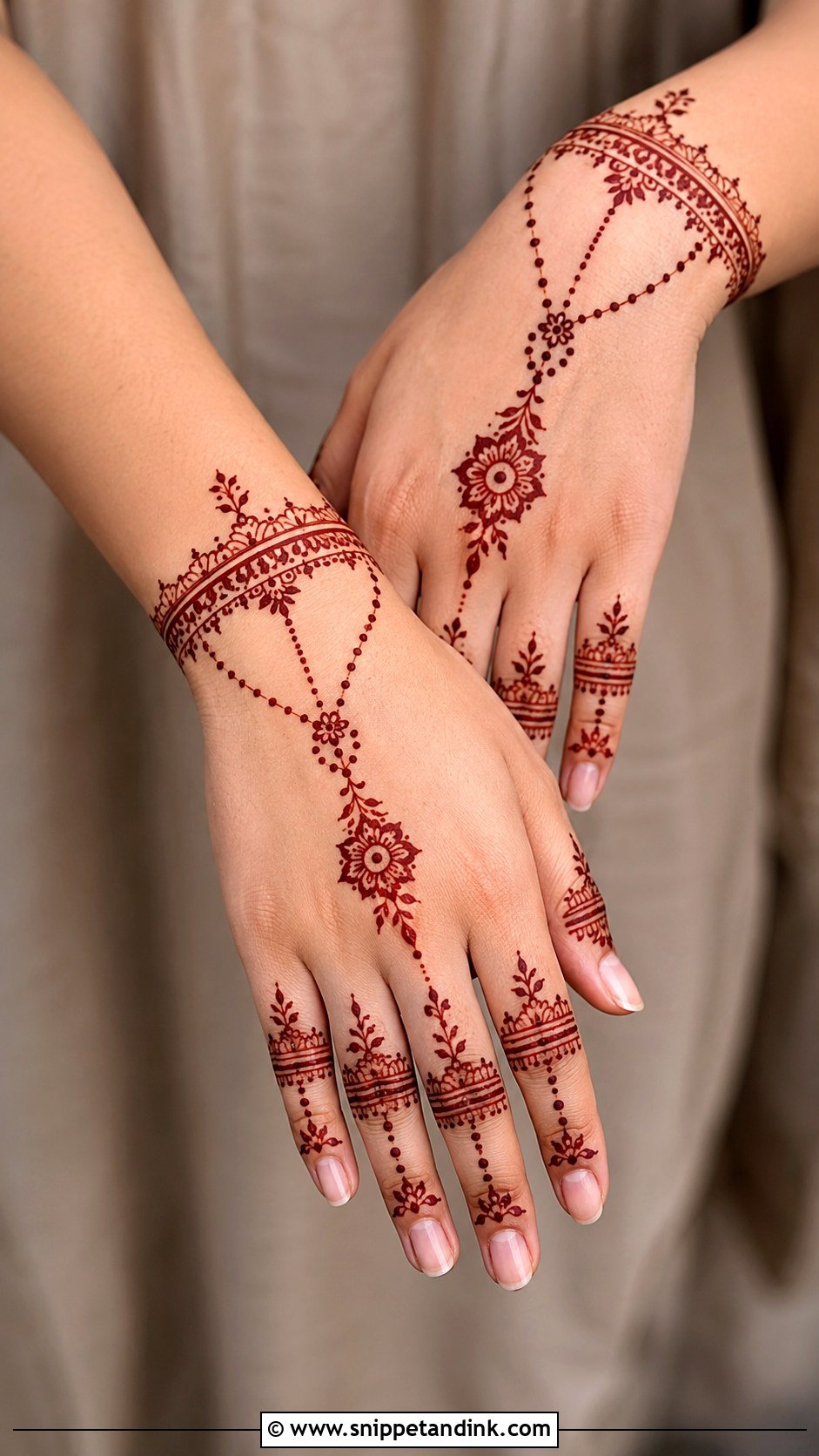
A bracelet back hand mehndi design starts with a thin bangle-like band at the wrist and connects to the fingers through chains, dots or one small central motif, imitating a haath phool. The band should stay narrow; a wide one gets rubbed by real bangles and fades unevenly. I add one small flower, mandala or paisley on the back hand and finger rings in fine lines and dots. It’s a reliable choice for engagements, Eid and smaller wedding events.
5. Finger Focus Back Hand Mehndi Design
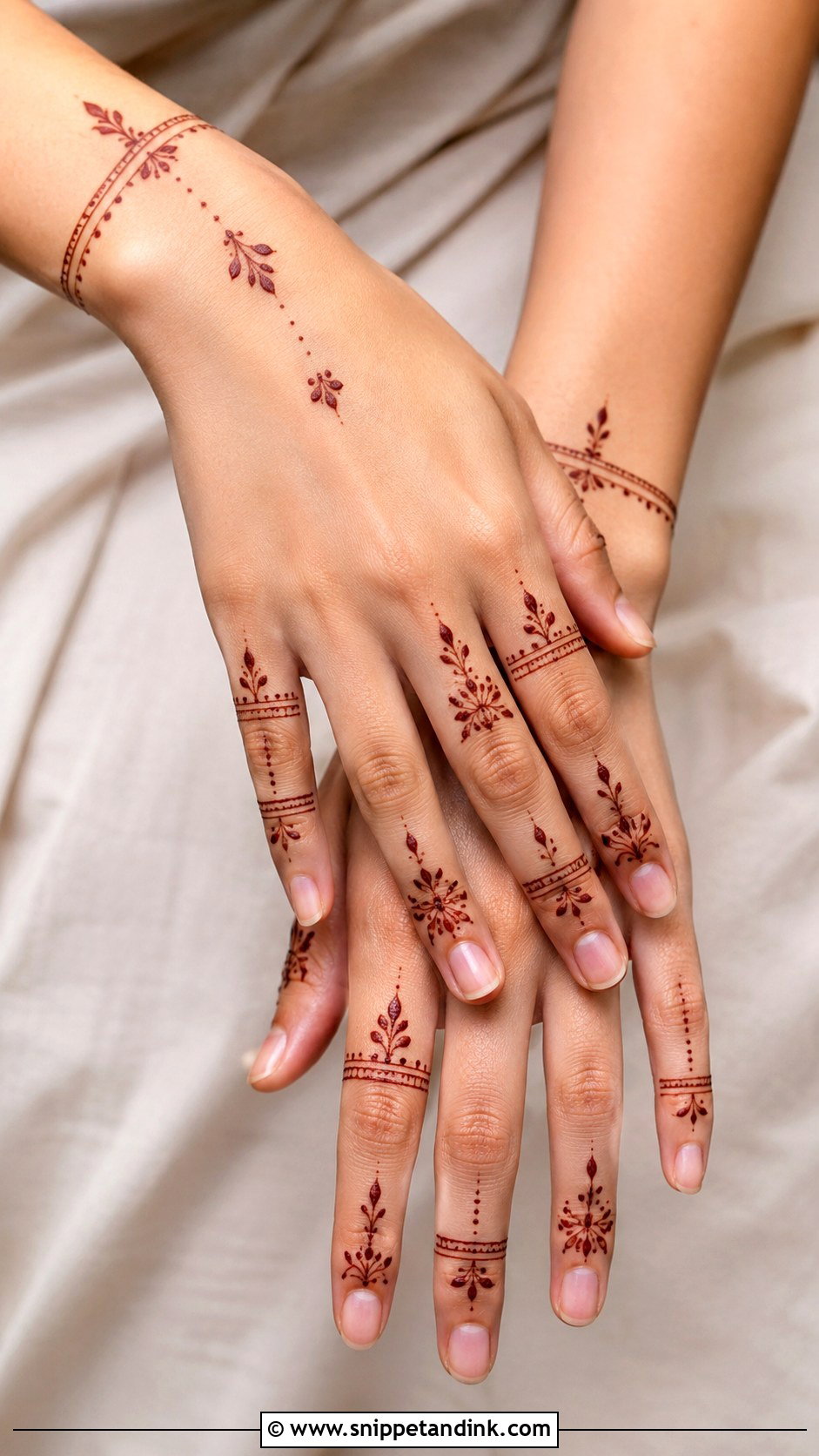
Leave the back of the hand open and put the work on the fingers, from the tips down to the knuckles: small lines, dots, leafy bands or tiny florals, with an optional wrist band. I like making each finger slightly different while keeping the spacing consistent, so it looks designed rather than random. Fingers stain darker than the back hand, so this layout gives a deep color with very little paste. Expect it to fade faster with frequent hand washing.
6. Leafy Vine Back Hand Mehndi Design
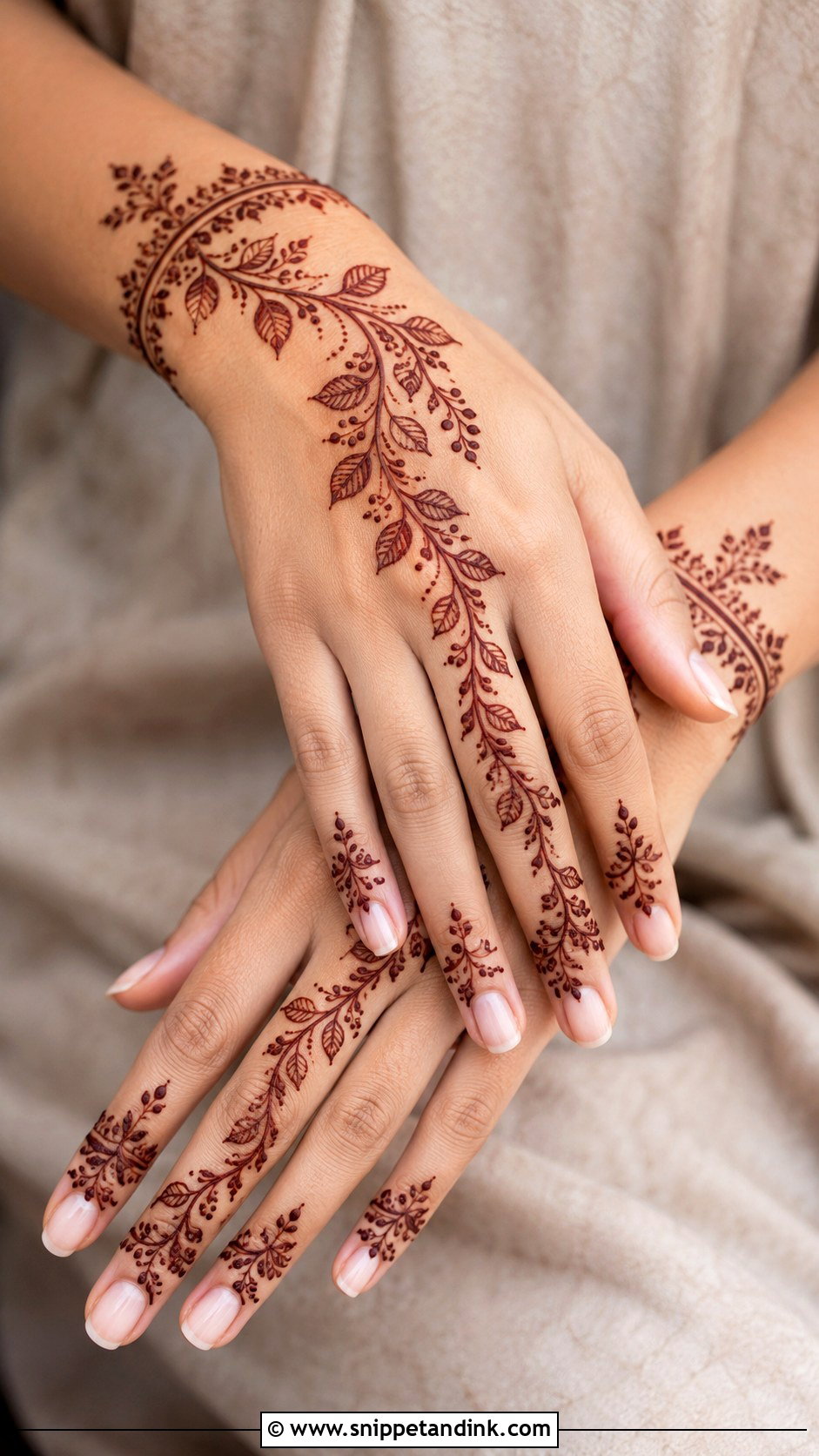
A single vine curves from the wrist to one finger, with small leaves along it and dots or tiny buds to keep the movement going. Even spacing of the leaves is the whole skill here; bunch them and the vine looks clumsy. If it feels too plain, I add a small flower near the wrist or just below the knuckle rather than more leaves. Bridesmaids and casual celebrations suit it well.
7. Modern Ring Back Hand Mehndi Design
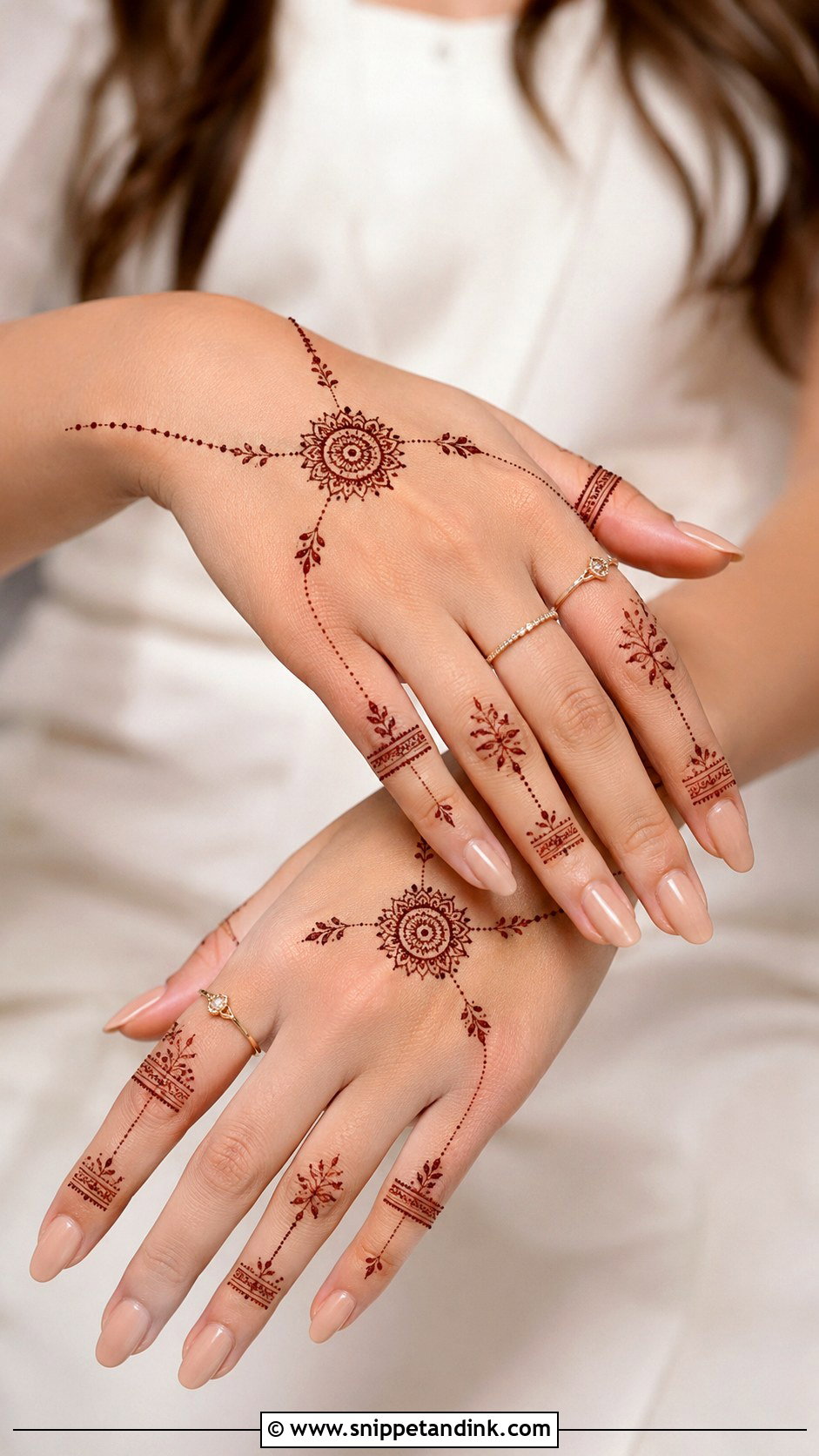
Small ring patterns around the fingers connect to a tiny motif on the back hand, which might be a small mandala, a flower, a heart-shaped paisley or a diamond, through thin dotted chains. The dots in those chains need to be close and evenly sized, or they stain as separate specks rather than a chain. It looks finished on its own and also sits well under real rings and bangles. Keep the bands narrow.
8. Geometric Back Hand Mehndi Design
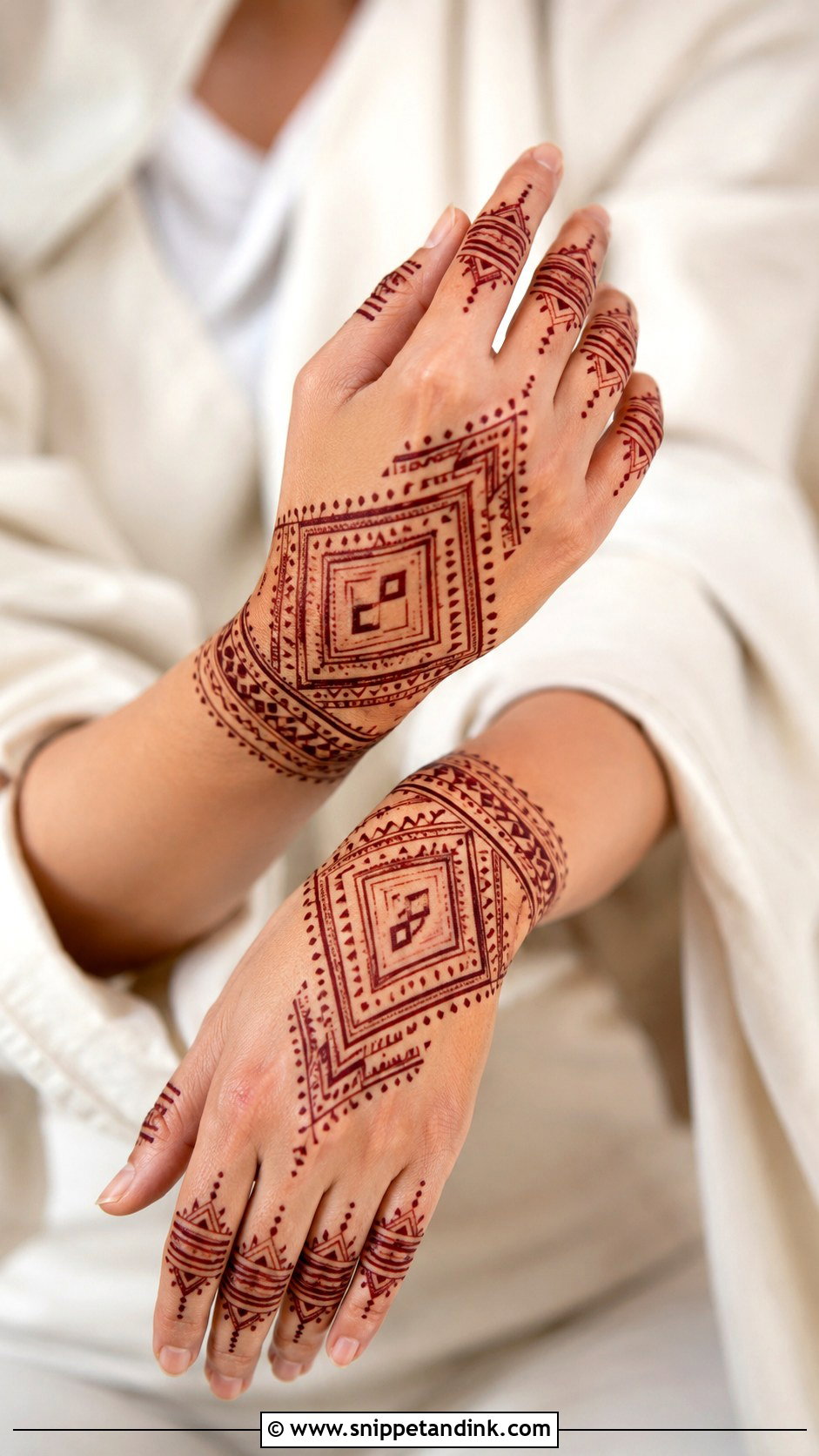
Triangles, diamonds, straight lines, chevrons, grids or box patterns move from the wrist toward the fingers in a structured trail. Straight lines show every wobble, so I draw them with steady, continuous pressure rather than short strokes. Tiny dots or a few small leaves soften the geometry. Thin lines and clear spacing are what keep it minimal; thick lines turn it into a heavy block. Fusion outfits and modern styling suit it best.
9. Minimal Jaali Back Hand Mehndi Design
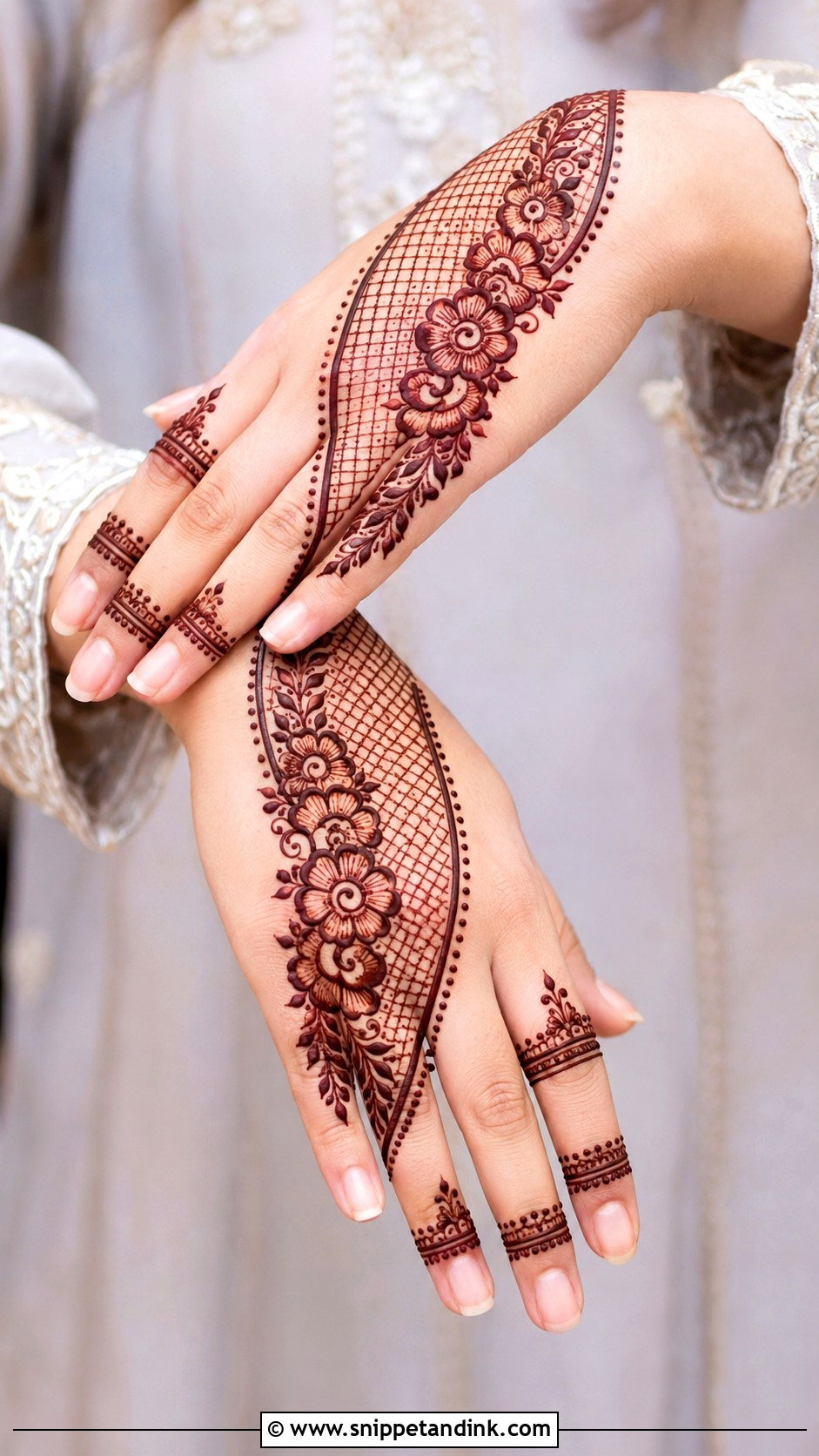
Jaali works best in one controlled section: a diagonal panel, a wrist cuff or a finger block, with the rest of the hand open around it. I keep the mesh squares small and even, and I only draw jaali with smooth, well-strained paste, since lumps make the crossing lines bleed and the mesh stains as a solid patch. A small flower or leaf cluster beside the panel softens it.
10. Half Hand Back Hand Mehndi Design
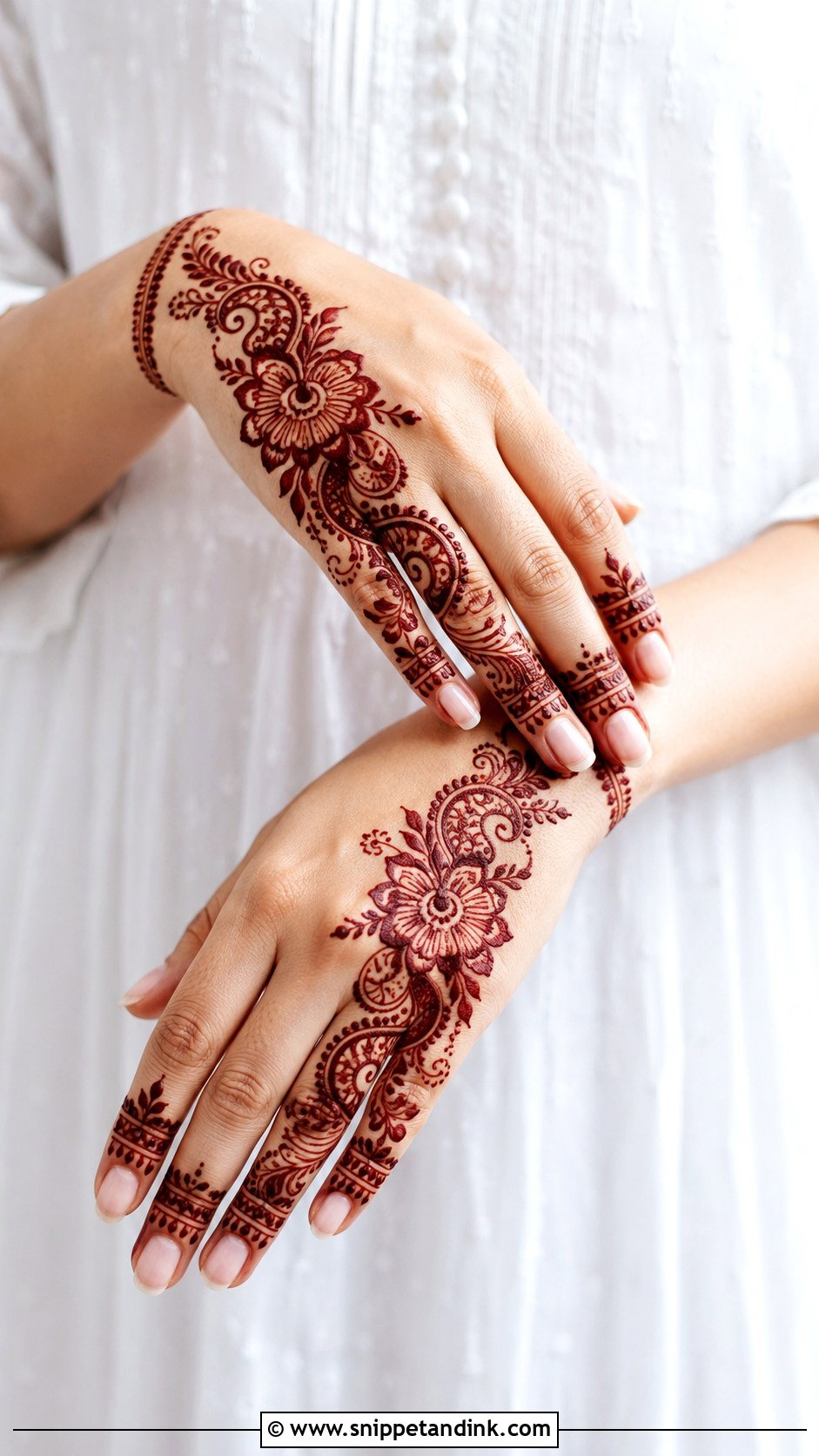
One side or section of the back hand is covered, from the wrist to the ring finger or from the thumb side toward the center, and the other side stays bare. It’s fuller than finger henna and lighter than a traditional back hand. Flowers, paisleys, vines and dots all suit it. Where the design stops is what decides whether it looks intended or unfinished, so I end it along a natural line, such as the line of a tendon or a knuckle row, and tie it together with a slim wrist border.
11. Small Paisley Back Hand Mehndi Design
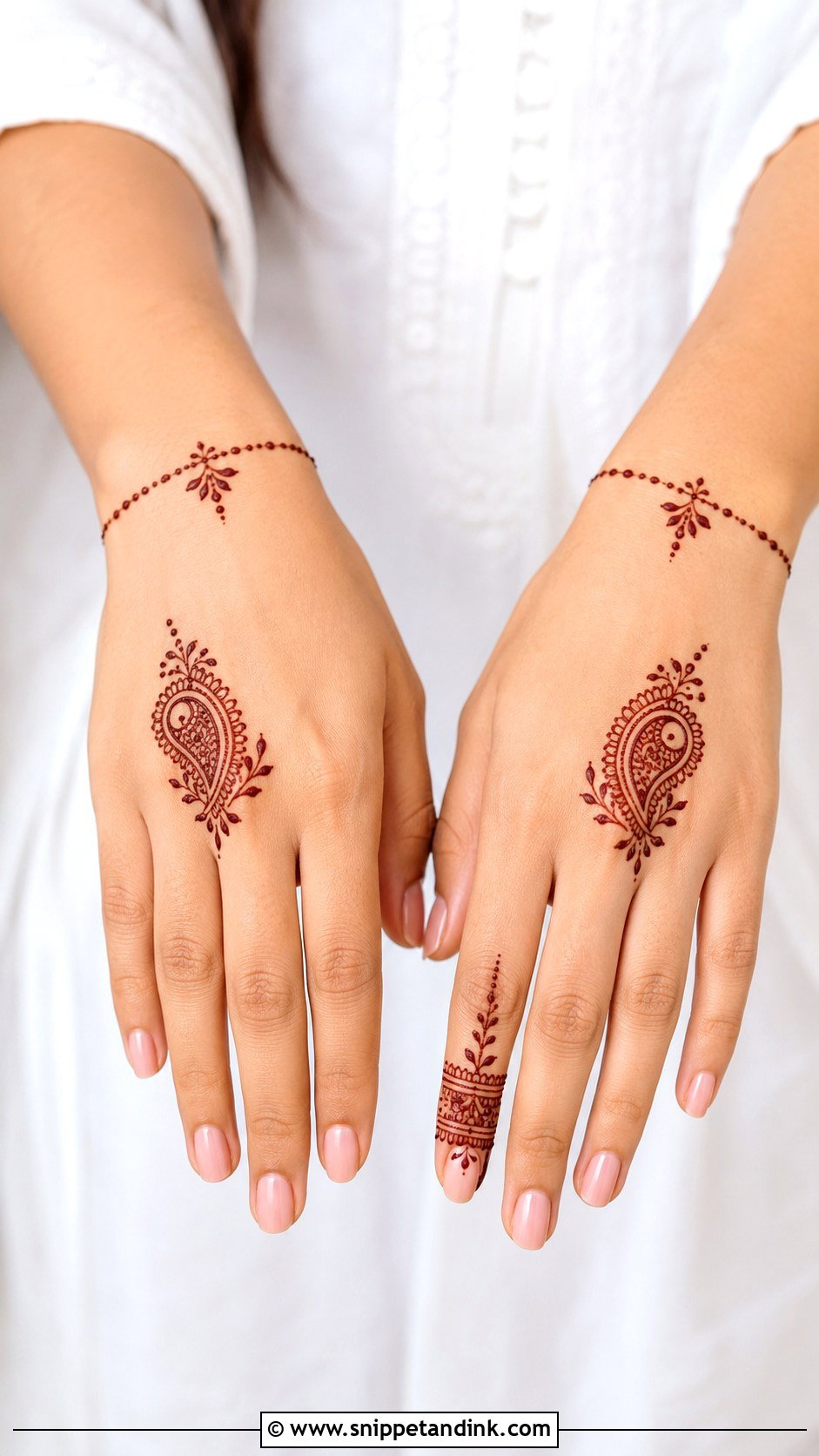
Paisleys follow the curve of the hand naturally, so a small one near the center, wrist or side sits well with tiny leaves, dots, curved lines and small flowers around it. For a minimal version I make the outline bold and keep the inside simple; filling a paisley densely is what makes back-hand henna look heavy. Pair it with one decorated finger or a thin bracelet band.
12. Minimal Rose Back Hand Mehndi Design
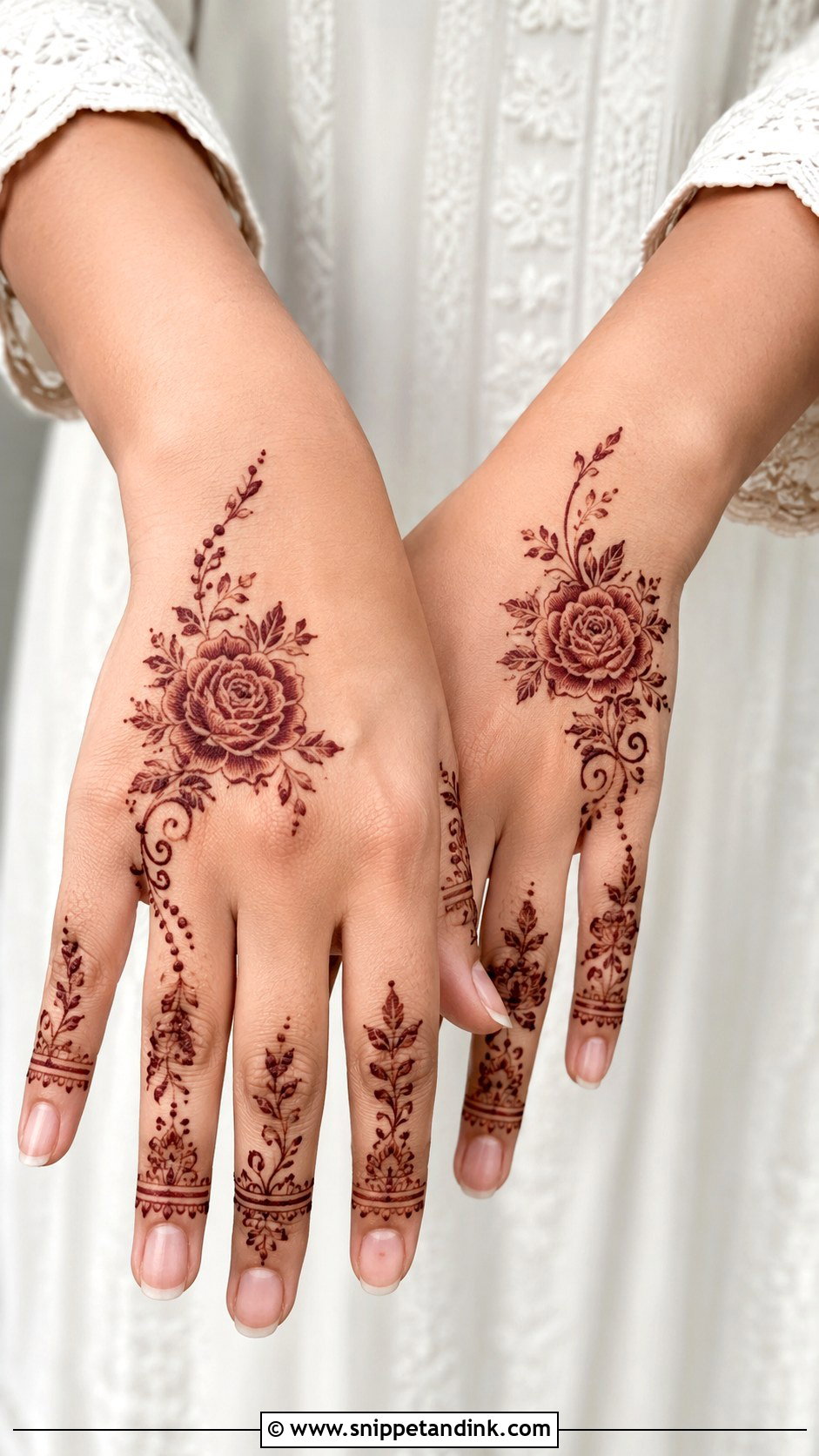
The rose goes at the center, near the thumb side or along a diagonal trail, with thin petals, small leaves and curved stems. Roses are the motif most likely to stain as a blob, because the petal layers sit close together and the paste spreads slightly as it dries. I leave visible gaps between the layers. Tiny rosebuds or ring bands on the fingers and plenty of blank space around the main flower keep it clean for engagements, Eid and bridesmaid henna.
13. Dot Chain Back Hand Mehndi Design
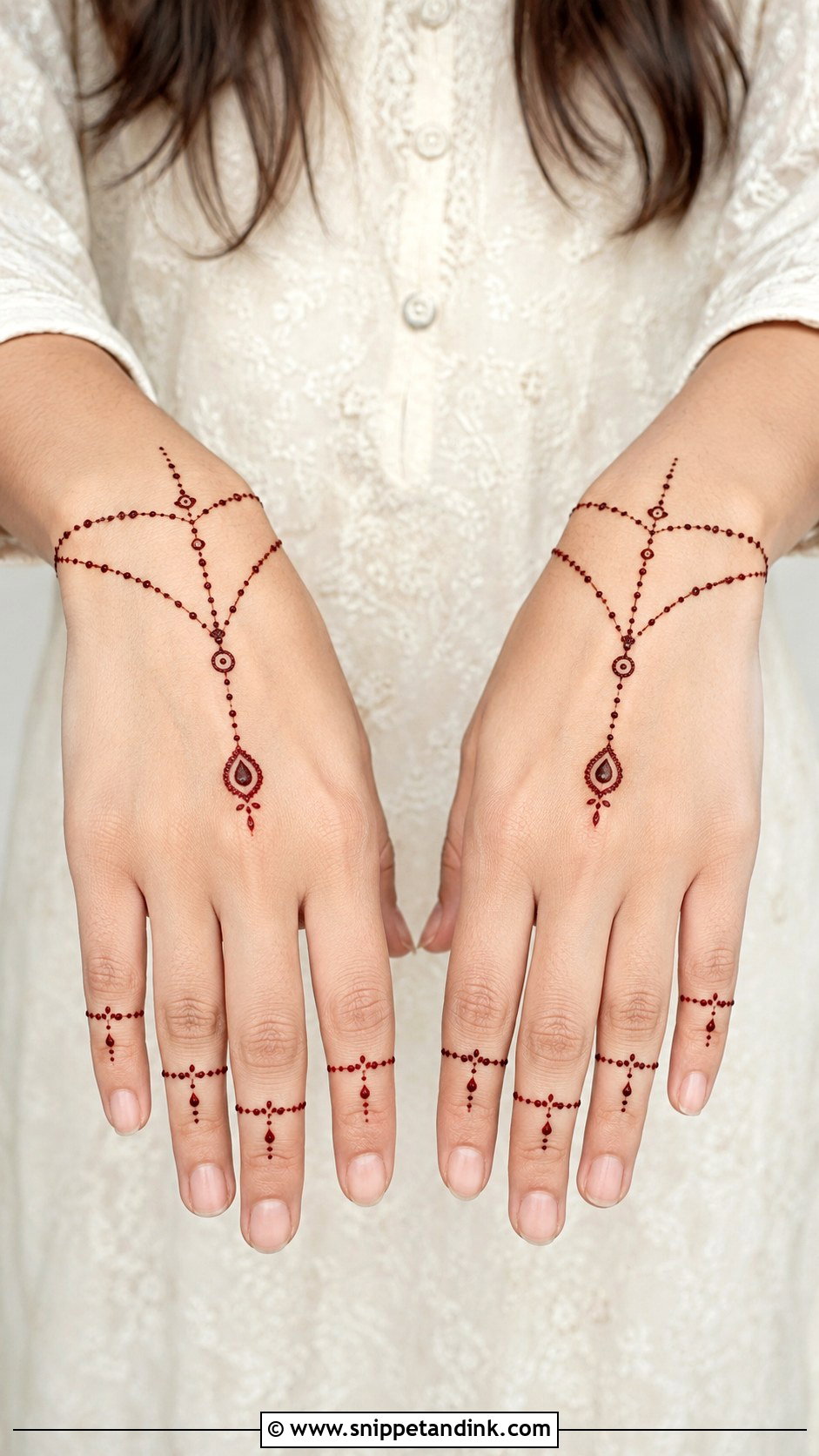
A delicate chain of dots, tiny circles and thin connecting lines running from the wrist to one or two fingers, with a small flower, mandala or teardrop where the chains meet. There’s very little paste on the skin, so it dries quickly. The one thing that makes or breaks it is consistency: the dots must be the same size and the same distance apart. That small discipline is what makes it look like jewelry.
14. Minimal Peacock Back Hand Mehndi Design
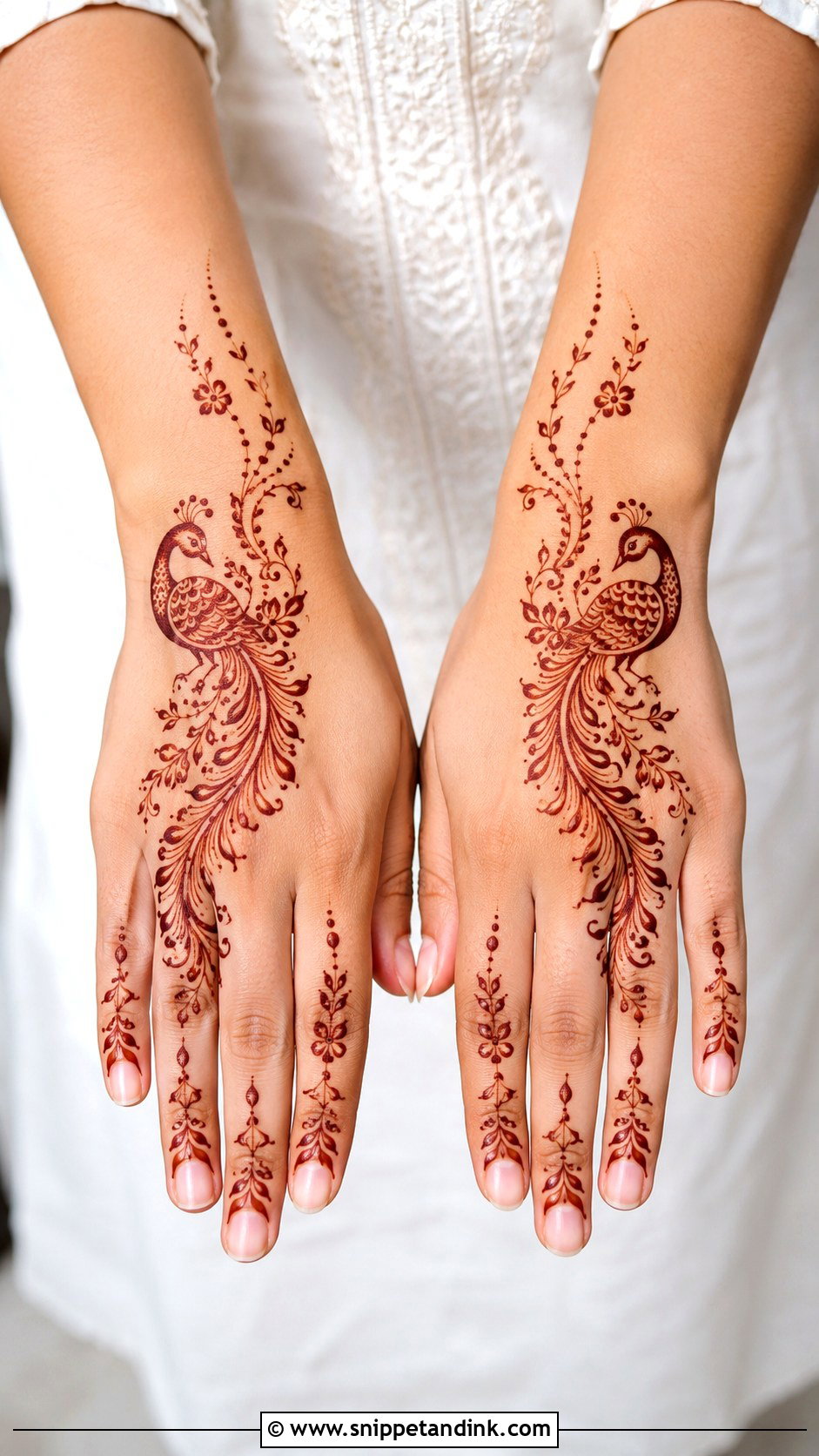
Instead of a large detailed peacock, I draw a small bird outline with a simple feather curve near the wrist or center of the hand, then soft vines toward the fingers. Fine dots, small petals and curved feather lines finish it. The feathers stay open; filled feathers lose their shape once the stain deepens. It’s meaningful for festive days without looking bridal-heavy.
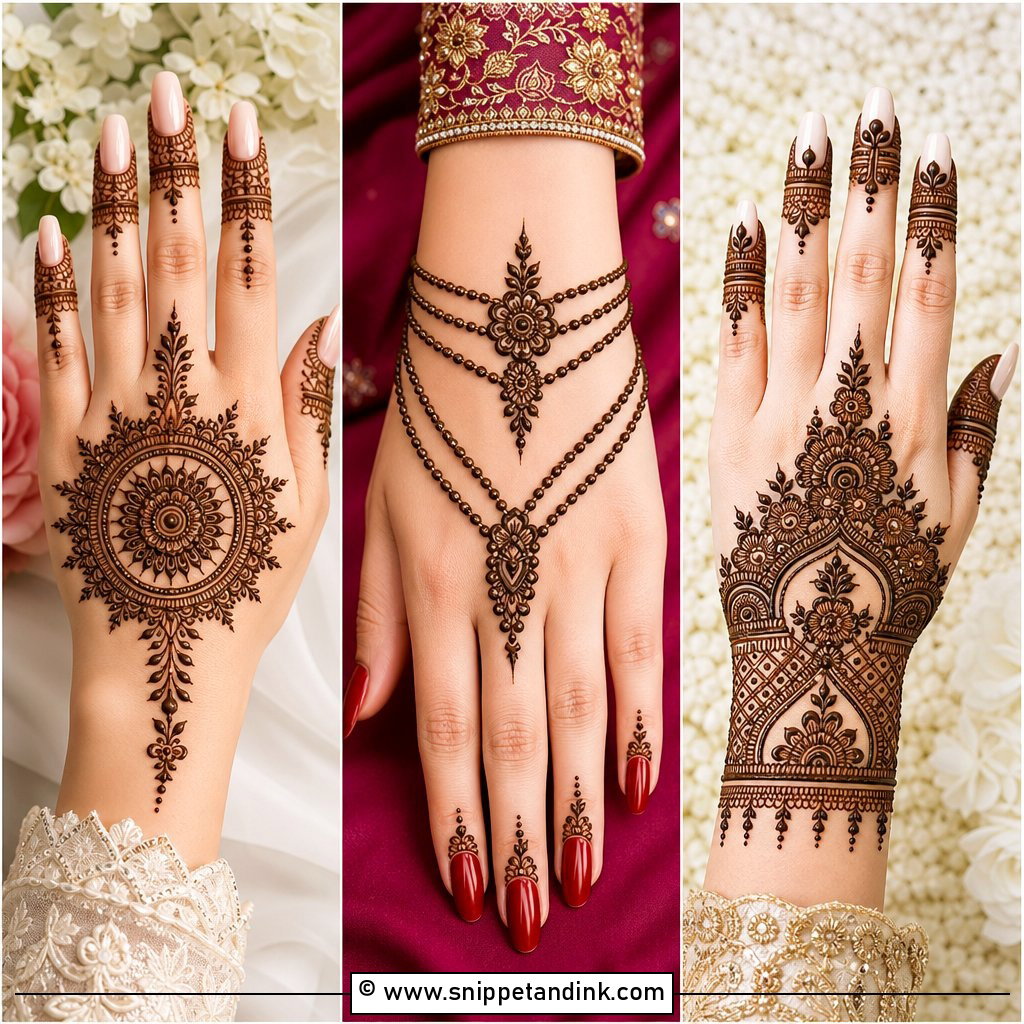
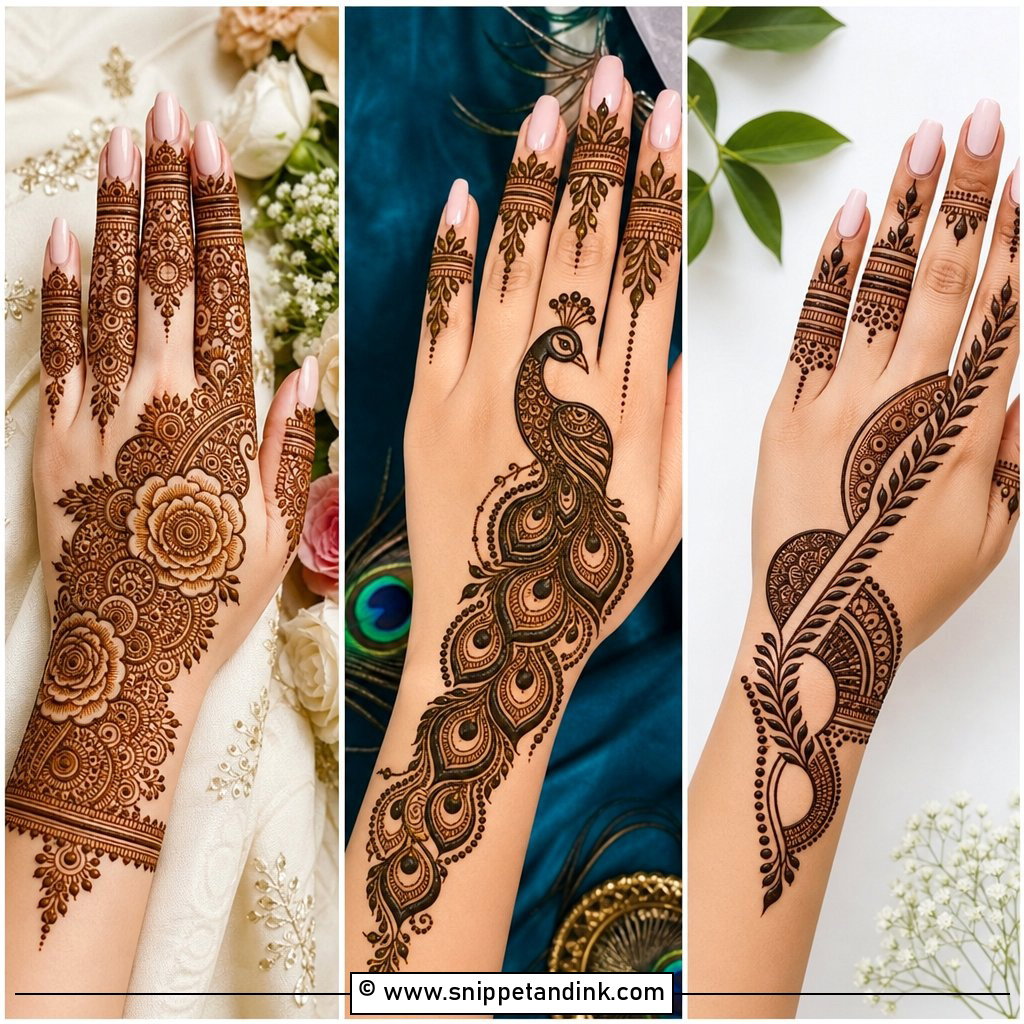
15. Wrist Cuff Back Hand Mehndi Design
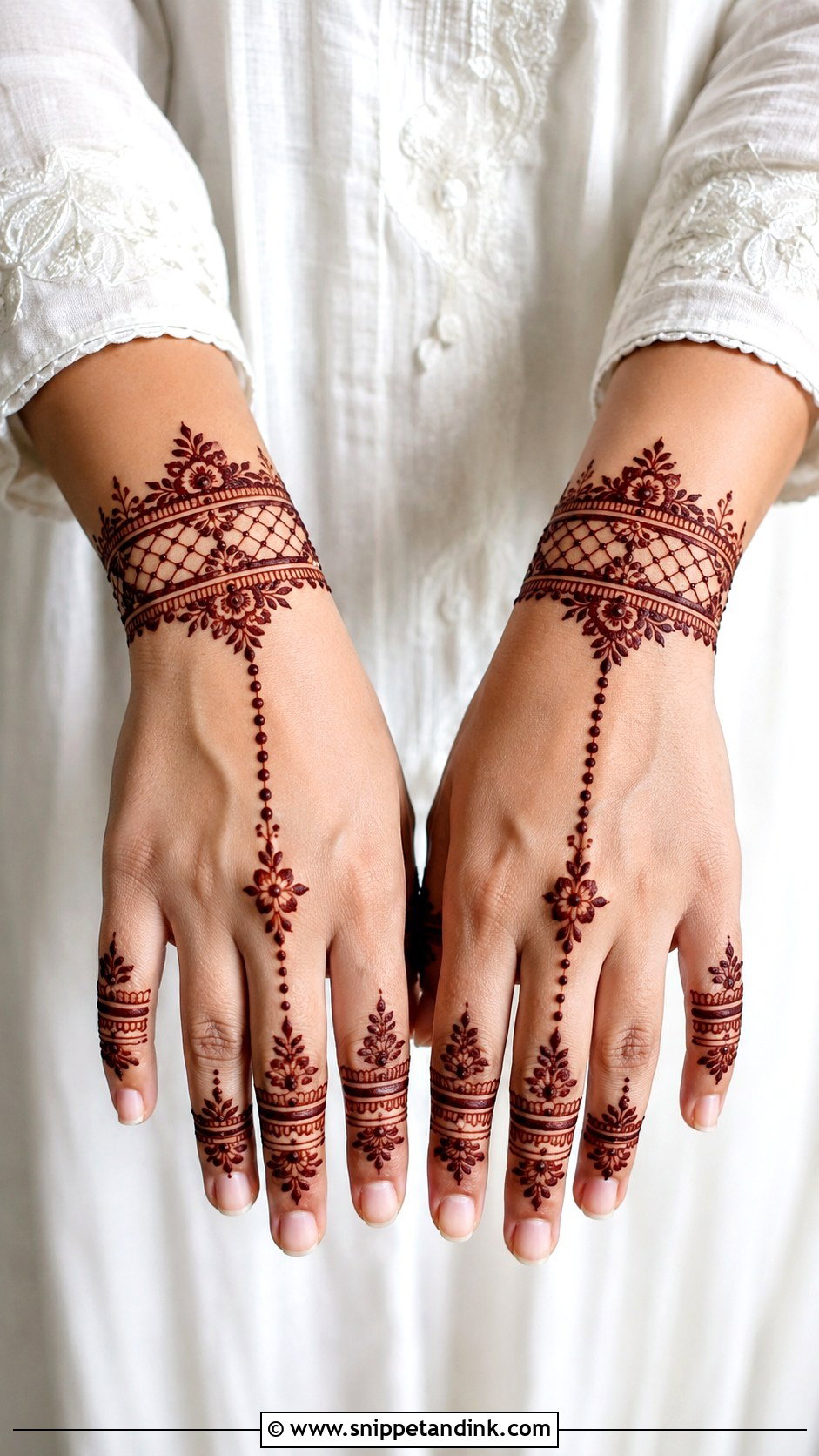
The weight here sits at the wrist: thin bands, small florals, dots and perhaps a jaali strip, with a delicate chain or vine running up to the middle finger. Keep the cuff slim. A wide cuff becomes heavy quickly, and the wrist stains lighter than the hand anyway, so a broad band of pale orange isn’t flattering. Matching finger bands balance it.
16. Minimal Heart Back Hand Mehndi Design
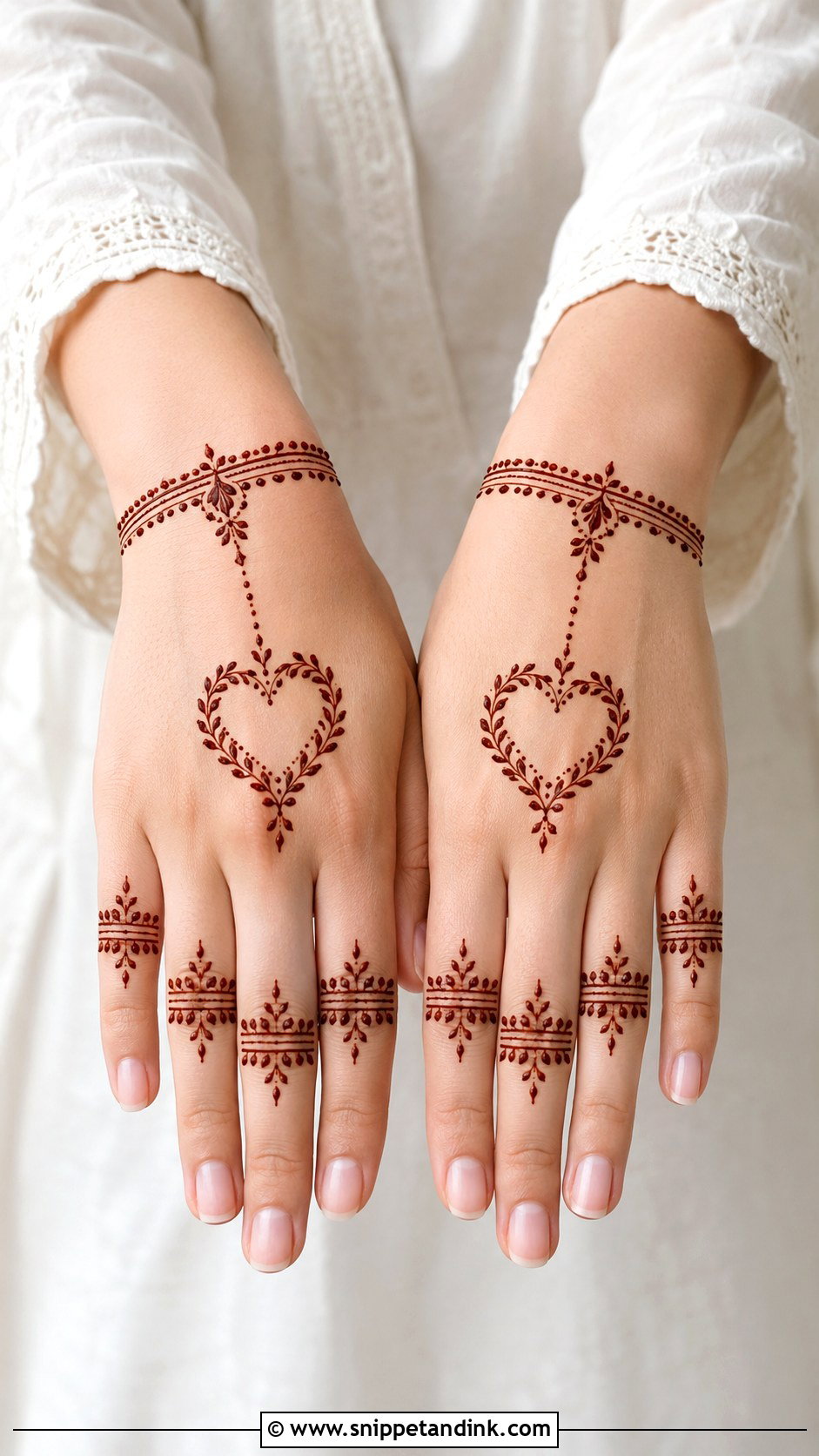
The heart doesn’t need to be bold or cartoonish. I build it from small leaves, petals, dots or fine curved lines near the center of the back hand, then connect it to the fingers with thin chains or vines, plus a small wrist detail. One heart is enough; repeating large hearts across the hand starts to look like a sticker sheet. Engagements, anniversaries and younger wearers suit it.
17. Minimal Eid Back Hand Mehndi Design
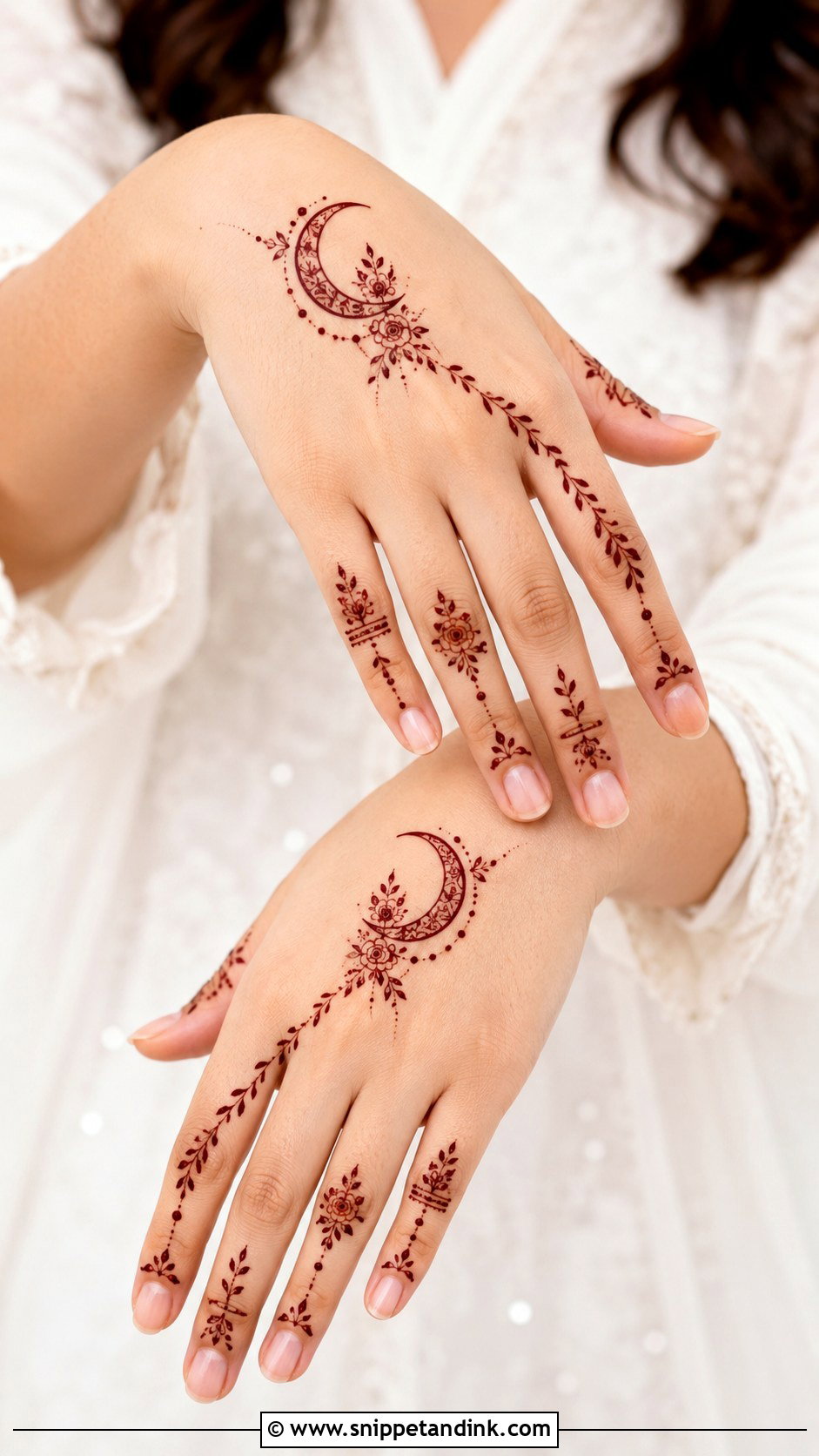
Crescents, small florals, dot chains, leafy trails and wrist bands are the usual Eid choices, often placed diagonally so the hand looks longer. Fingers stay lightly decorated. On Chand Raat I may have a long queue of hands, and a design like this dries fast enough for people to get home and sleep with the paste on. A small crescent with a flower or a star-like cluster of dots gives it the festive touch.
18. Modern Bridal Back Hand Mehndi Design
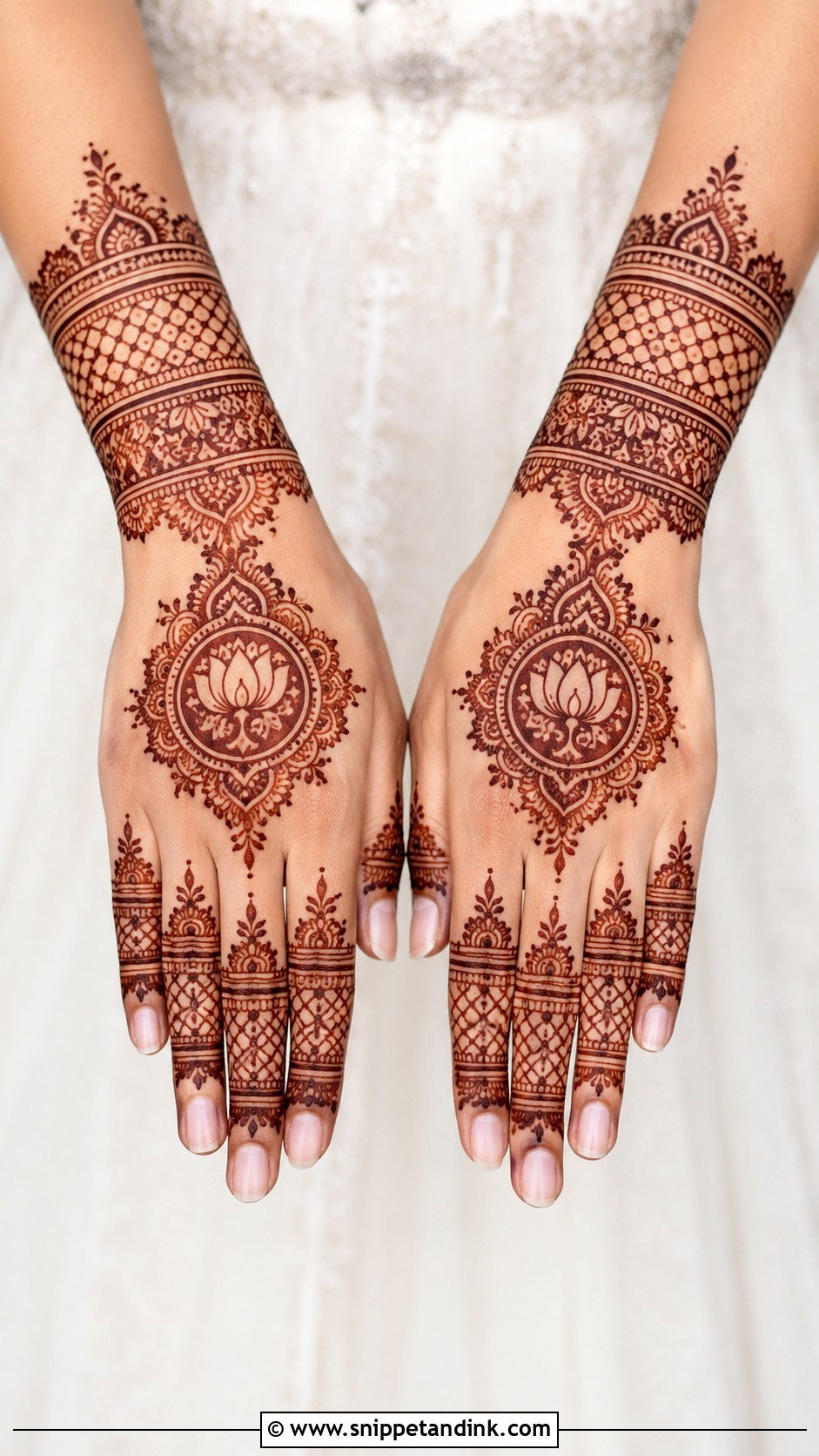
A bridal back hand can stay minimal if the layout is planned: a graceful center motif, a clean wrist band and detailed but spaced-out fingers, with paisley, florals, jaali or small lotus shapes used lightly. Brides choose it for a registry, engagement, nikah, roka or intimate wedding. Symmetry between the two hands matters more for a bride than for anyone else, because the hands are photographed side by side, so I measure placement on both before drawing either. The skin should still show.
19. Indo Arabic Back Hand Mehndi Design
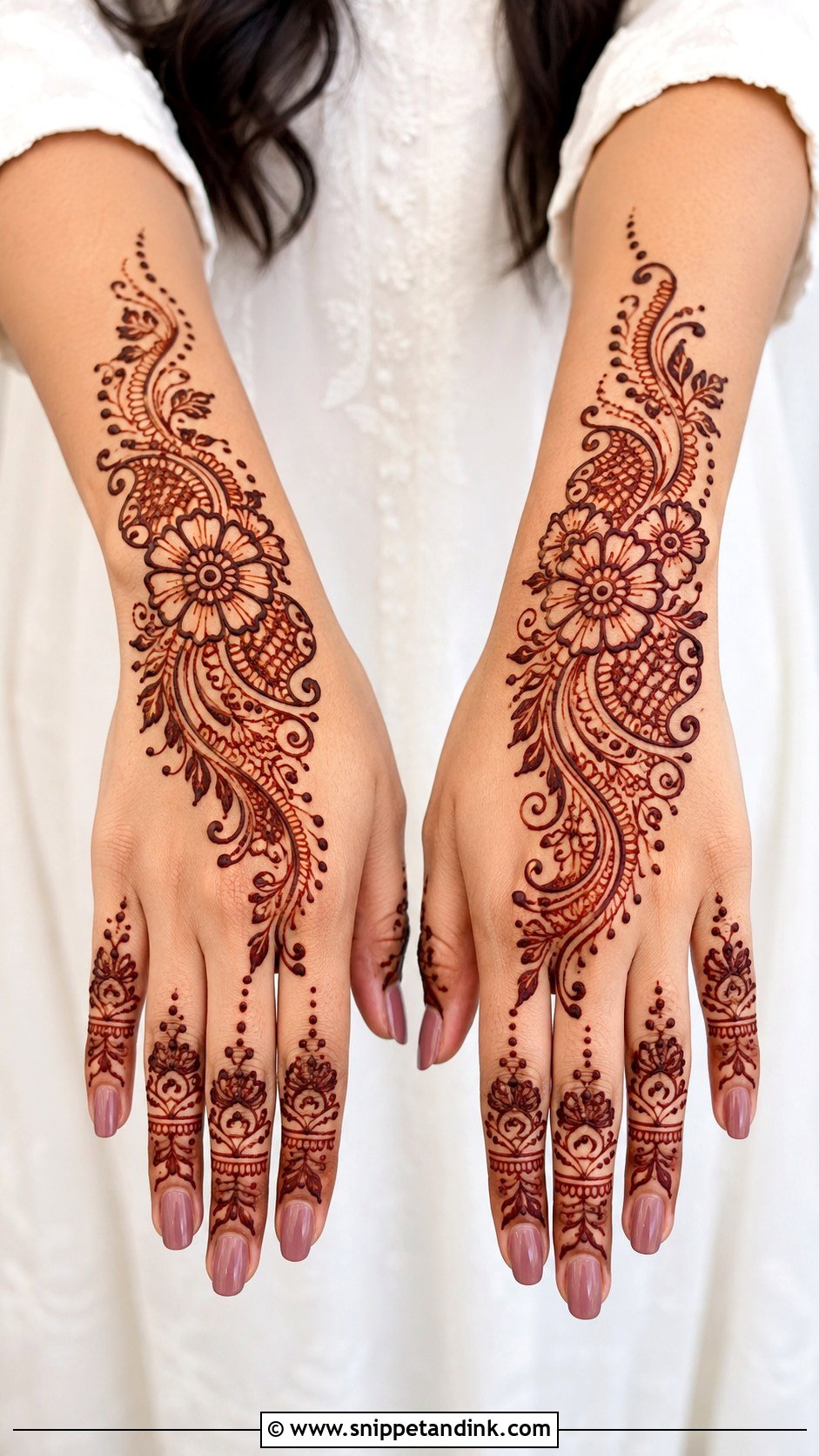
An Indo Arabic back hand mehndi design uses a diagonal floral trail as the base and layers in Indian-style dots, paisley outlines and fine finger borders. Open gaps between motifs keep it light. I avoid filling every petal, which is the habit that tips this style back into full traditional coverage. A slim wrist curve and one detailed finger complete it for weddings, festivals and family gatherings.



20. Moroccan Back Hand Mehndi Design
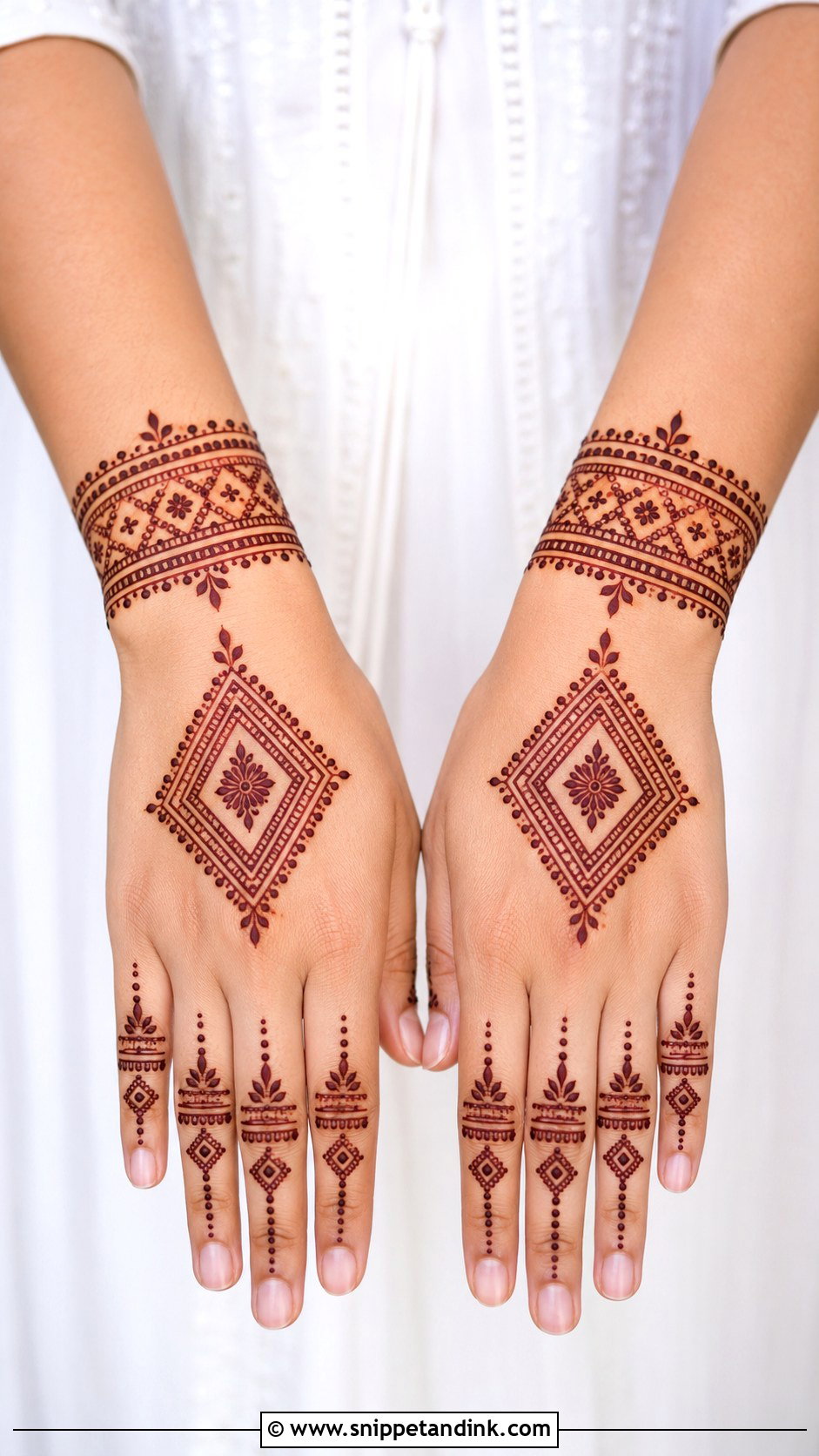
Diamonds, straight lines, small squares, dots and repeating borders: a geometric band across the wrist connects to a neat diamond near the center, with simple finger lines. Moroccan-inspired henna depends on symmetry and even spacing, so I keep tiny fillers to a minimum. It sits well with plain outfits and bold jewelry, and it’s one of the most distinctive layouts here.
21. Gulf Back Hand Mehndi Design
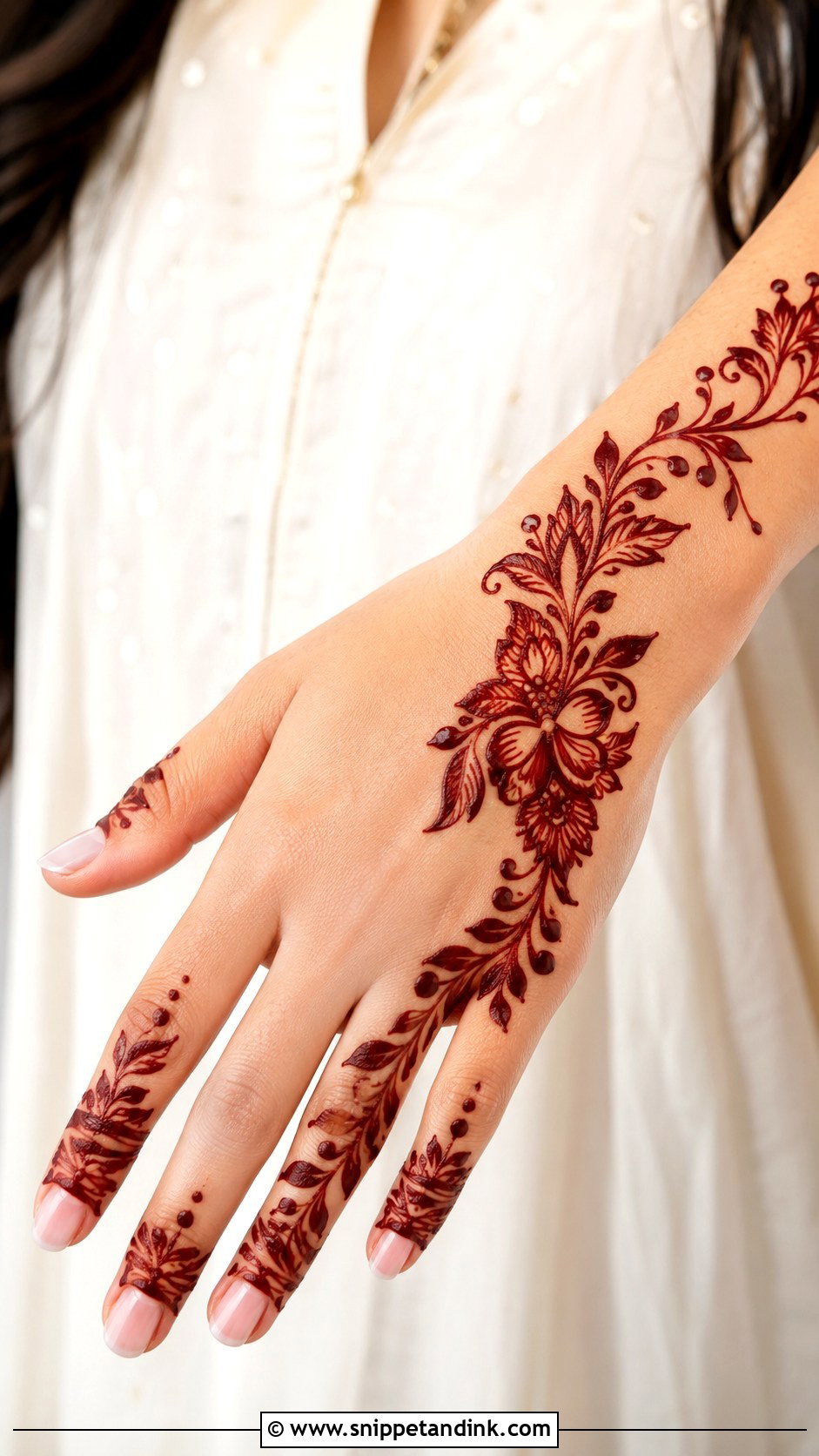
Gulf henna places bold florals and flowing leaves on one side of the hand and leaves the other clean, with a flower trail moving from the wrist toward the index finger. I keep the flowers medium-sized and reduce the inner detailing, and use shaded leaves for depth. Large shapes need good paste coverage; a thin patch in a big flower shows as a pale spot. It reads well from across a room, which makes it a good choice for Eid, weddings and dinners.
22. Minimal Lotus Back Hand Mehndi Design
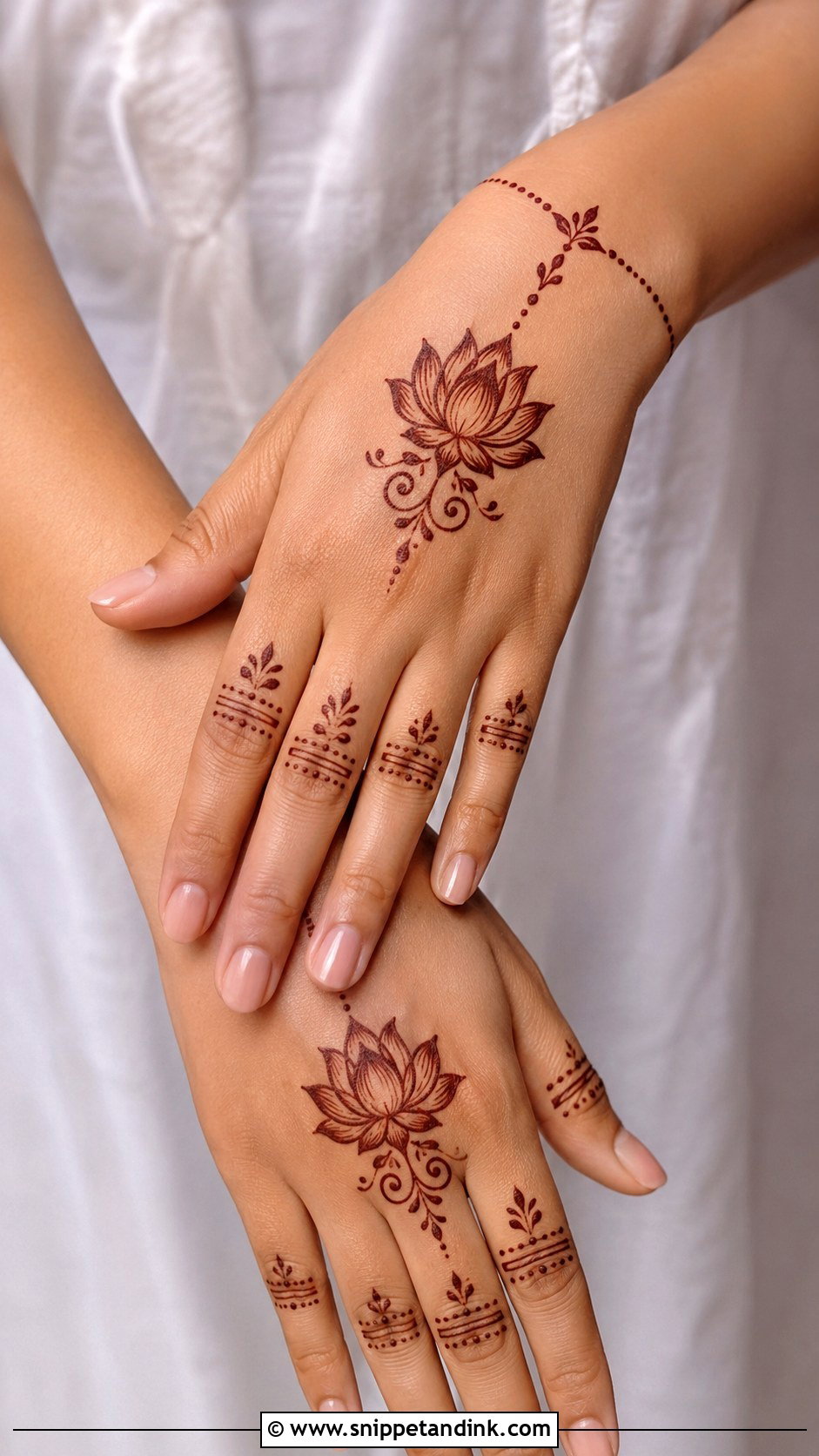
A lotus sits at the center or near the wrist with clean petals opening outward, plus fine dots, small leaves and a soft trail toward the fingers. It needs empty space around it to be recognized. I keep the petals open and use only a few fine lines inside them. Light finger bands or tiny petal tips finish it for festivals, pujas and simpler bridal events.
23. Negative Space Back Hand Mehndi Design
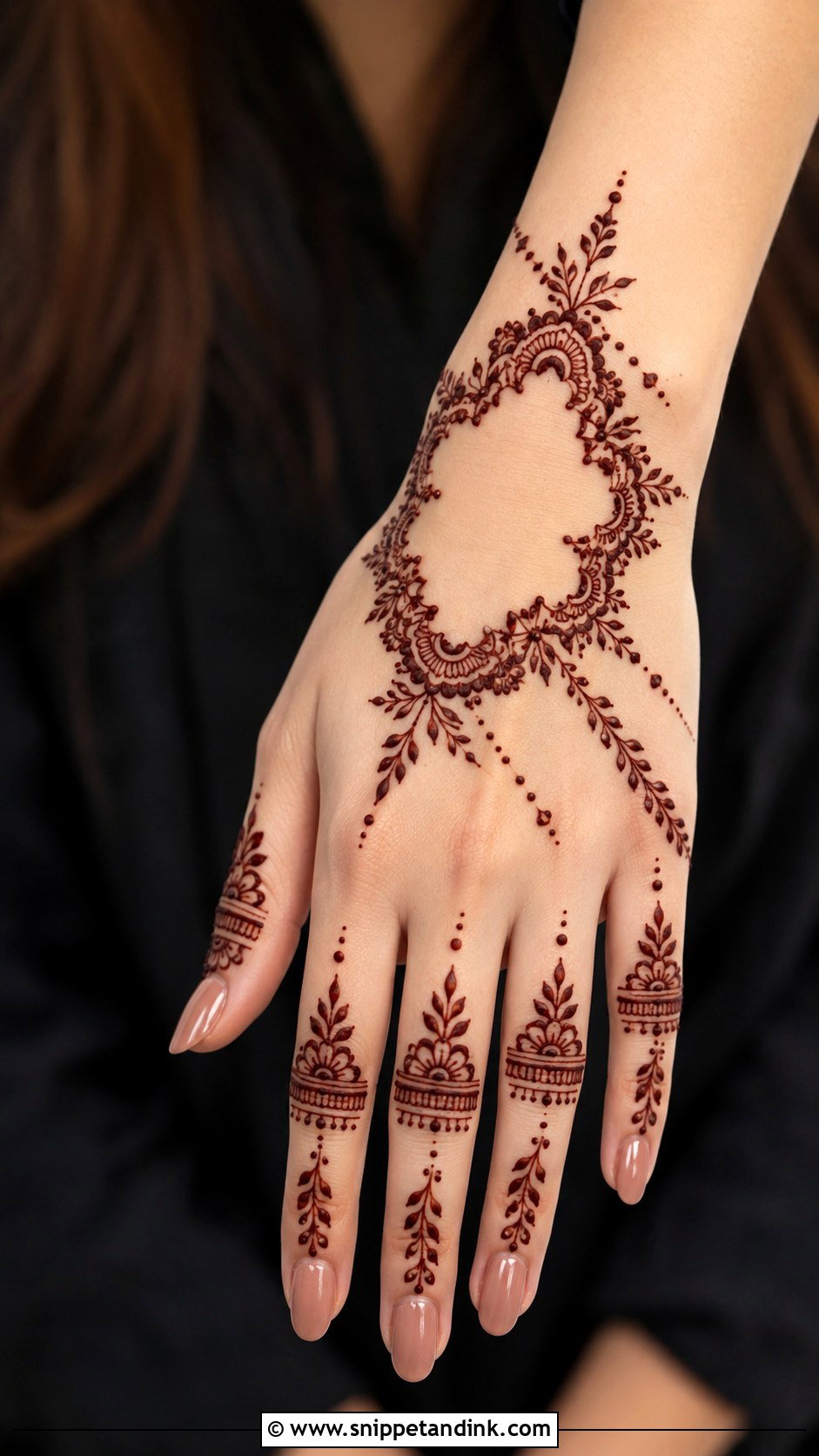
Here the bare skin is part of the pattern: a floral frame, a half mandala, a diagonal vine or geometric panels that deliberately leave clean areas between them. I sketch the empty shapes in my head before drawing, because the gaps have to look planned, not like I ran out of time. Spacing adjusts easily to any hand size. Neat outlines and no extra filling are what let the contrast show.
24. Minimal Finger Ring Back Hand Mehndi Design
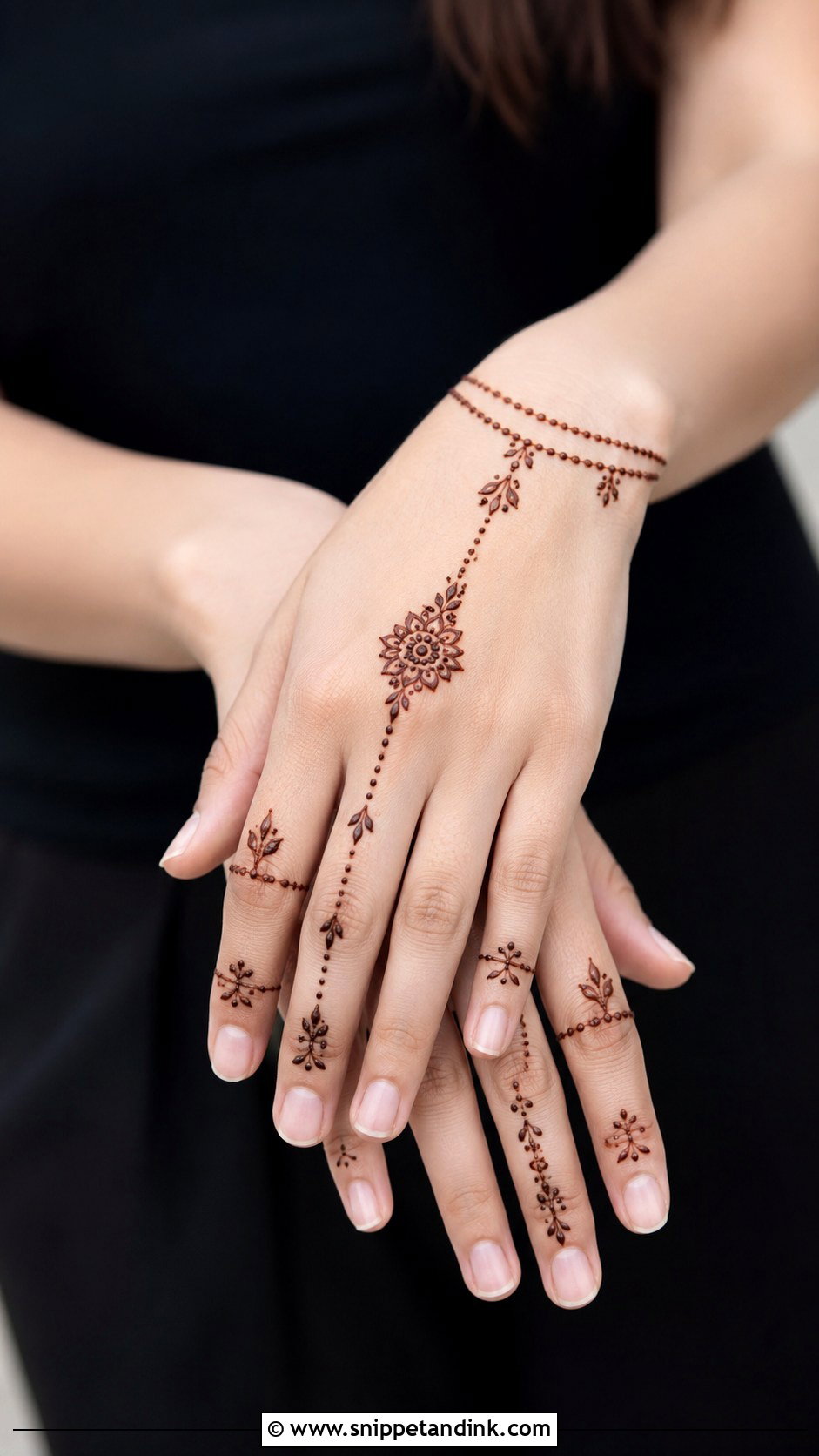
Each finger gets a small band, a dot chain or a tiny leaf ring, and the back hand has one small central charm connected by thin lines. It’s very light, but it looks complete because each piece is placed with intent. Keep the rings thin and don’t cover the whole finger. A small dot chain at the wrist adds balance. It’s one of my go-to designs for office-friendly festive henna.


25. Minimal Butterfly Back Hand Mehndi Design
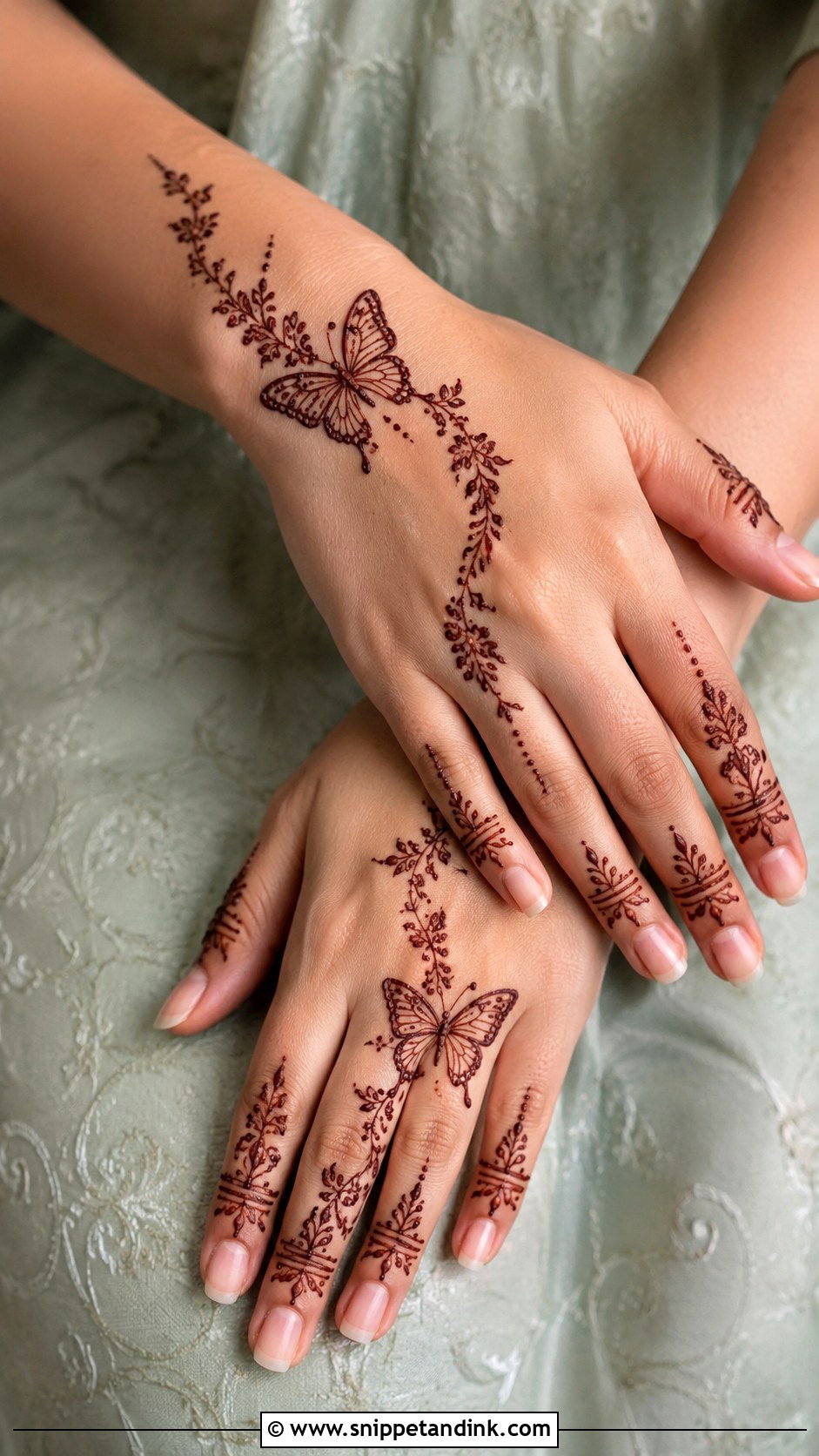
A small to medium butterfly near the center or toward the thumb side, with fine wings, small dots, tiny leaves and light florals around it, plus a slim trail toward one finger. Size is what keeps it from looking childish; a large butterfly with shaded wings quickly turns into a kids’ design. I outline the wings cleanly and leave them open. Birthdays and casual celebrations suit it.
26. Simple Back Hand Mehndi Design For Beginners
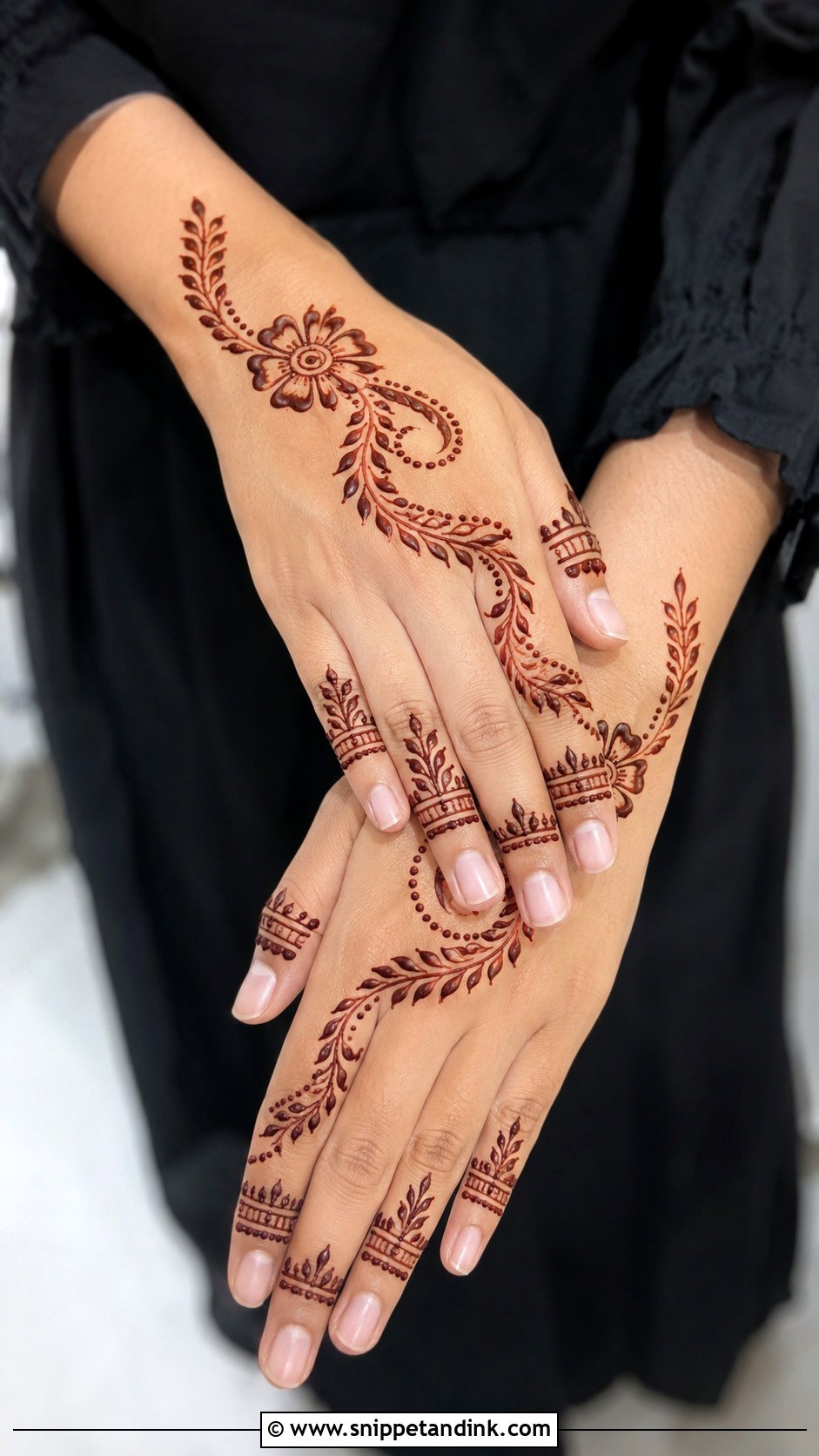
A simple back hand mehndi design for beginners should be easy to draw and hard to ruin: a small central flower or mandala, dots, curved lines, basic leaves, and small bands or dots on the fingers. Good spacing does more than complex detail. If a line wobbles, a dot or tiny leaf next to it hides the flaw. I’d start with a soft diagonal rather than perfect symmetry, which is much harder to achieve on your own non-dominant hand.
27. Minimal Back Hand Mehndi Design For Kids
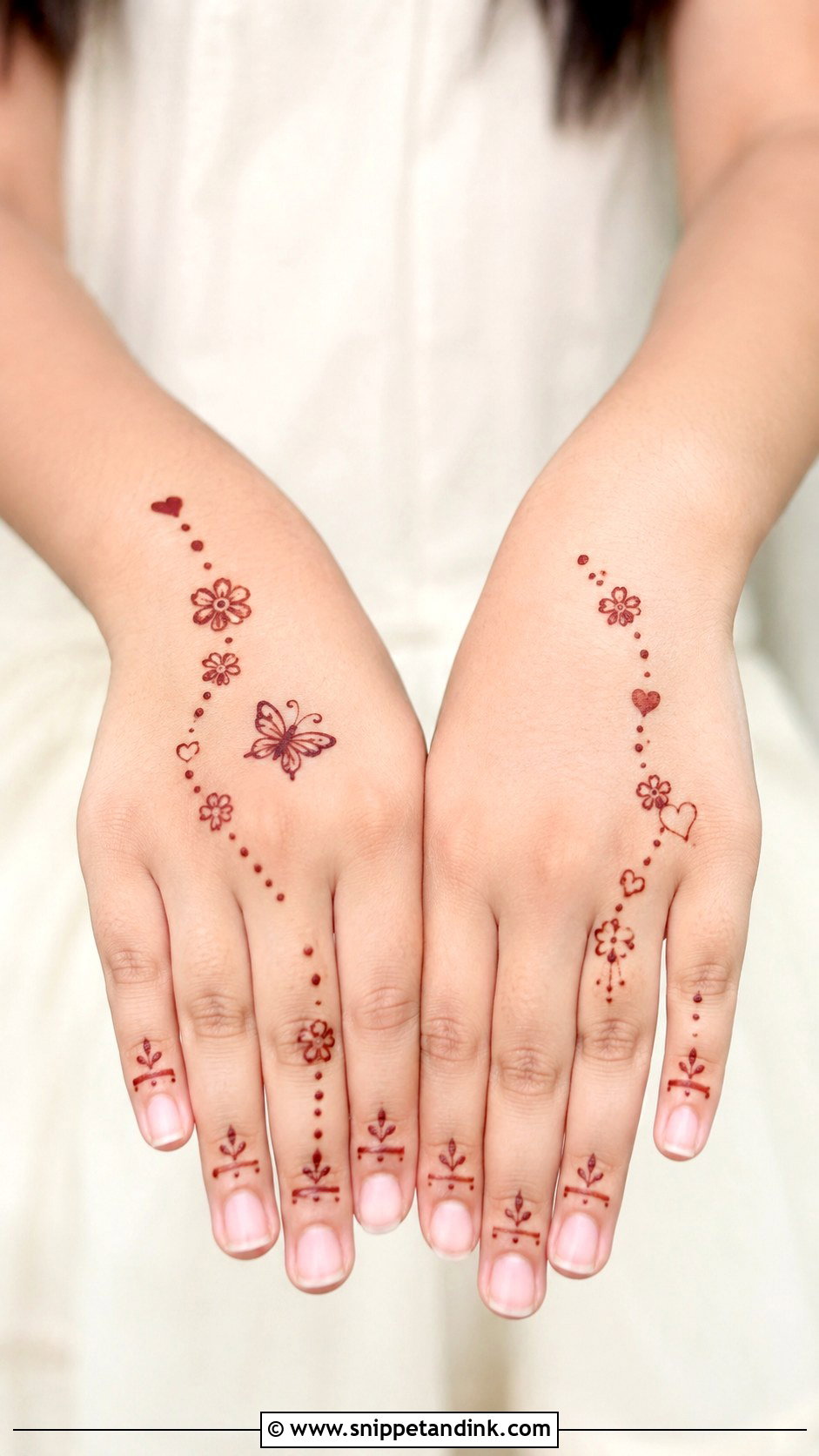
For kids: small flowers, tiny hearts, stars, butterflies and dots in the center of the back hand and on one or two fingers. Limiting the area means it dries faster before a restless hand smudges it. Very fine crowded lines are the first thing to smear, so I avoid them. A small flower with a dotted trail toward the wrist is enough. I use only natural henna on children and would ask any artist to confirm theirs is natural before starting.
28. Minimal Back Hand Mehndi Design For Short Fingers
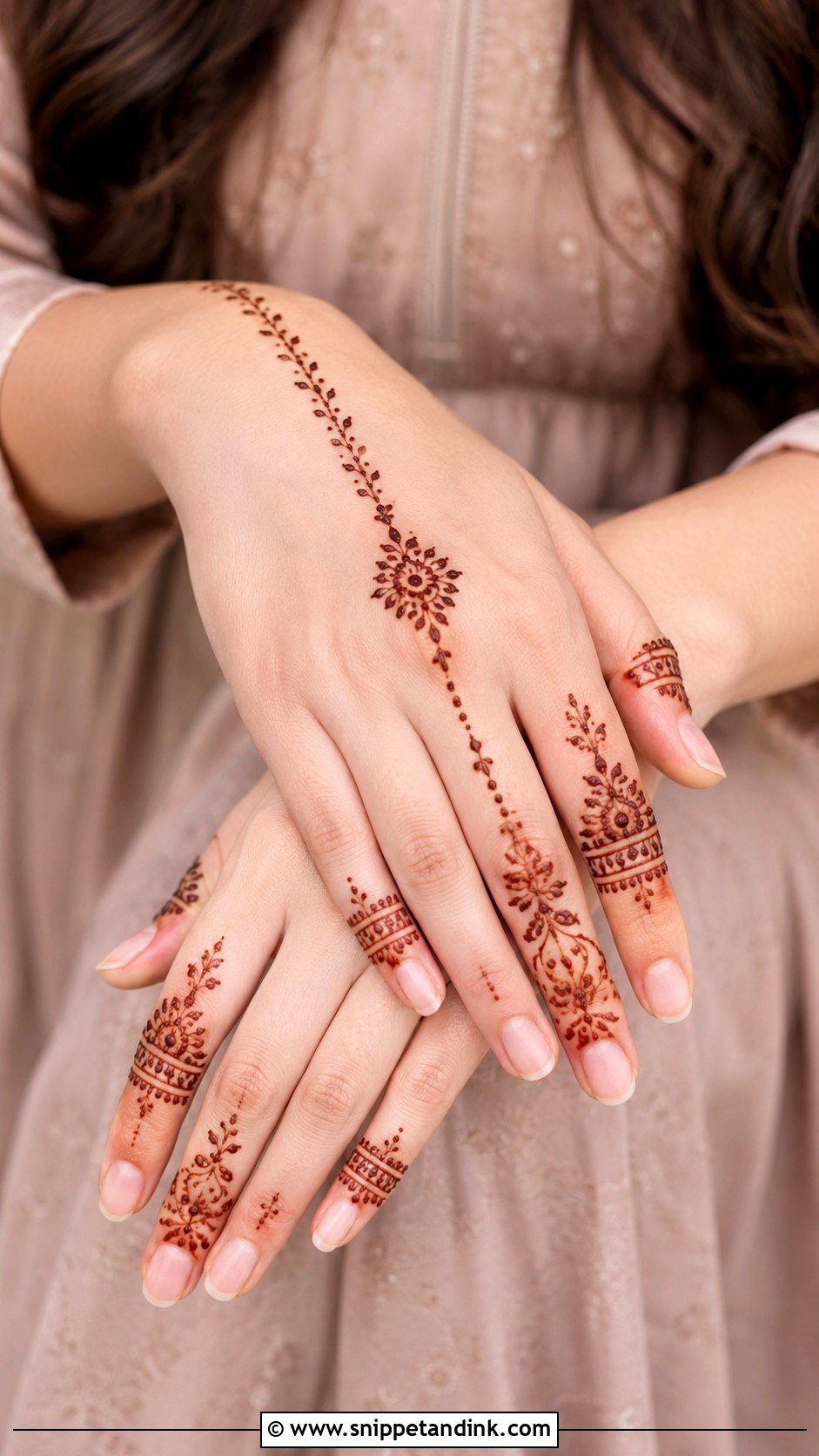
Vertical lines lengthen, so for short fingers I use slim vines, dot chains and narrow finger bands, often with a diagonal trail from the wrist to the middle finger. Thick fingertip blocks are what I’d avoid; a dark cap visually shortens the finger. The main motif stays small or medium. Open space around the center of the back hand is what makes a smaller hand look graceful.
29. Minimal Back Hand Mehndi Design For Long Fingers
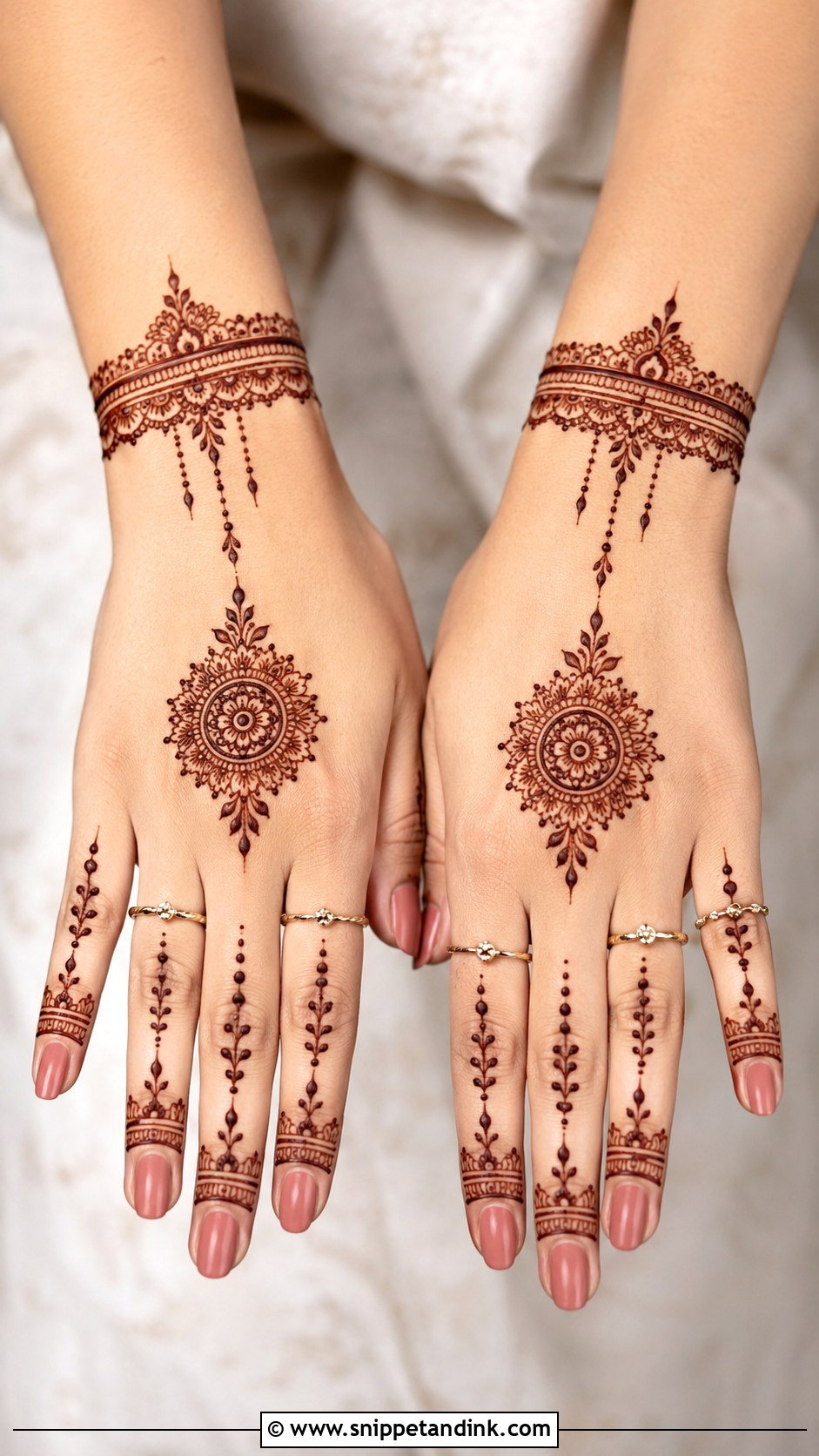
Long fingers can carry ring bands, fingertip vines, slim jaali strips and delicate vertical details, while the back hand stays simple with a small mandala, flower or diamond. I decorate at least three fingers so the hand doesn’t look plain, and keep the wrist to a thin cuff or dotted line. The aim is to dress the length of the fingers without crowding it.
30. Modern Minimal Back Hand Mehndi Design For Weddings
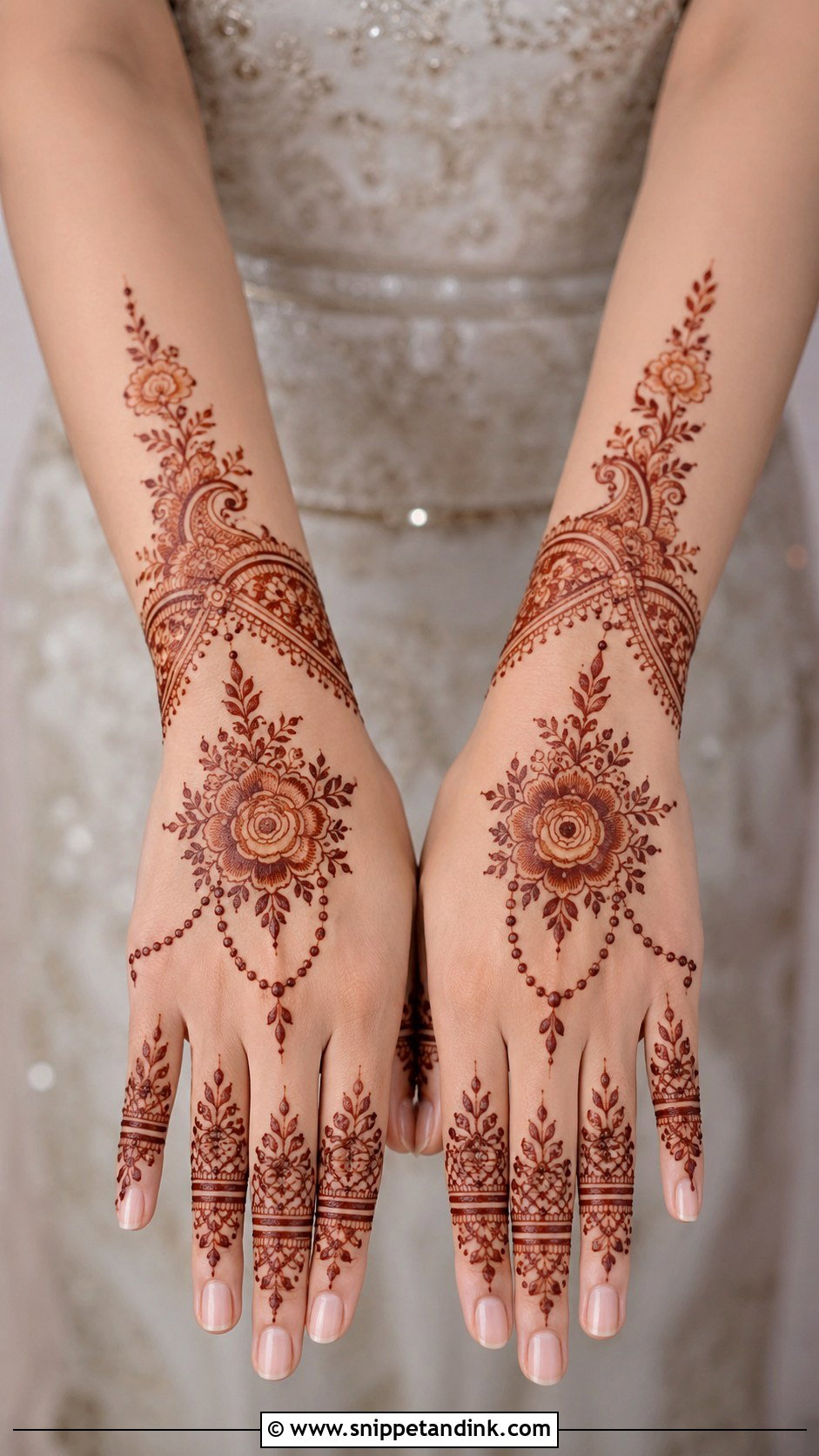
For wedding guests, bridesmaids, sisters of the bride and brides who want something subtle: a central motif, a wrist bracelet and detailed fingers, using florals, paisleys, lotus petals, dot chains or light jaali. I add a little extra detail near the wrist because that’s where bangles frame it in photographs, and keep the rest of the hand airy. It sits comfortably with festive clothing without looking dated.
The Hours While the Paste Dries
A minimal back hand takes much less time to draw than a bridal hand, but the paste still needs hours on the skin to leave a good stain, and during that time your hands are out of action. A little planning makes it far less frustrating.
Do these before you sit down
- Eat, use the bathroom and tie your hair back.
- Wear a top that opens at the front or has loose sleeves you won’t need to pull over your hands.
- Take off rings, bangles and watches, and give your phone to someone else.
Once the design is on
Keep the hand still and flat for the first twenty minutes or so, until the surface stops looking glossy. Warmth helps the stain, so sit somewhere warm rather than under a fan or air conditioner. If you’re sleeping in it, wrap the hand loosely in tissue or a soft cotton glove so the dried paste doesn’t crumble onto the sheets. In the morning, scrape it off rather than washing it, and stay away from water for as long as you can.
The Back of Your Hand Is What the Camera Sees
A back hand doesn’t need heavy coverage to look festive. A clean floral trail, a small mandala, a wrist bracelet, finger rings or a geometric layout all dress the hand with very little clutter, and they dry faster and feel lighter over a long day. Start with how your hand is shaped and what you’ll be wearing on your wrists, then pick the layout that suits both. Eid, a wedding or a family function, there’s room to make any of these your own.
You'll Like These Ideas:








Leave a Reply