
Simple bridal mehndi doesn’t have to look plain. When I sketch a lighter bridal hand, I’m building around open spacing, a few strong motifs and clean finger work rather than filling every millimetre. These layouts take a fraction of the sitting time, they’re far more comfortable through a long day of rituals, and they suit an engagement, a nikah, a haldi or a small courthouse ceremony as easily as a full wedding. Indian, Arabic, Indo-Arabic, Moroccan or minimal henna: every style below is a complete bridal hand, just drawn with more breathing room.
Timing the Application So the Stain Peaks on the Wedding Day
Henna doesn’t arrive at its final colour when the paste comes off. It starts as a bright orange and darkens over roughly 24 to 48 hours as the dye oxidises in the skin. That’s why I book bridal applications one or two days before the main ceremony, never the morning of. Two days out is usually the sweet spot: the stain has reached its deepest maroon right when the photographer starts shooting.
A simple design changes the maths a little. Open layouts have less paste on the skin, so any weakness in aftercare shows faster. Plan for these points:
- Leave the paste on for six to eight hours, or overnight if you can sleep with your hands wrapped loosely in tissue.
- Scrape it off with a blunt edge or rub it off dry. Washing it off with water stops the darkening early.
- Keep the hands away from water until the next morning if possible, and away from soap and hand sanitiser for the first day.
- Avoid waxing, scrubs and manicures after application; exfoliating takes the stained top layer of skin with it.
- Book any manicure before the henna, since remover and buffing will lighten fingertip stain.
Feet stain darker and last longer than hands, so if you’re doing both, the hands will look a shade lighter. That’s normal and nothing to worry about.
Black Henna, Chemical Cones and the Patch Test I Ask For
Natural henna only ever stains in shades of orange, brown and maroon. A cone promising jet black colour in an hour almost always contains PPD or another synthetic dye, and those can cause blistering, scarring and a lasting allergy. I won’t use them on a bride, and you should ask any artist directly what is in her cones. A good answer is short: henna powder, lemon juice or water, sugar and an essential oil.
Even with clean, fresh paste, a small patch test a week or two before the wedding is worth doing, particularly if you have sensitive skin or react to essential oils. Fresh cones are also part of the deal. Natural paste loses strength within days at room temperature, so ask when the cones were mixed and whether they’ve been kept frozen.
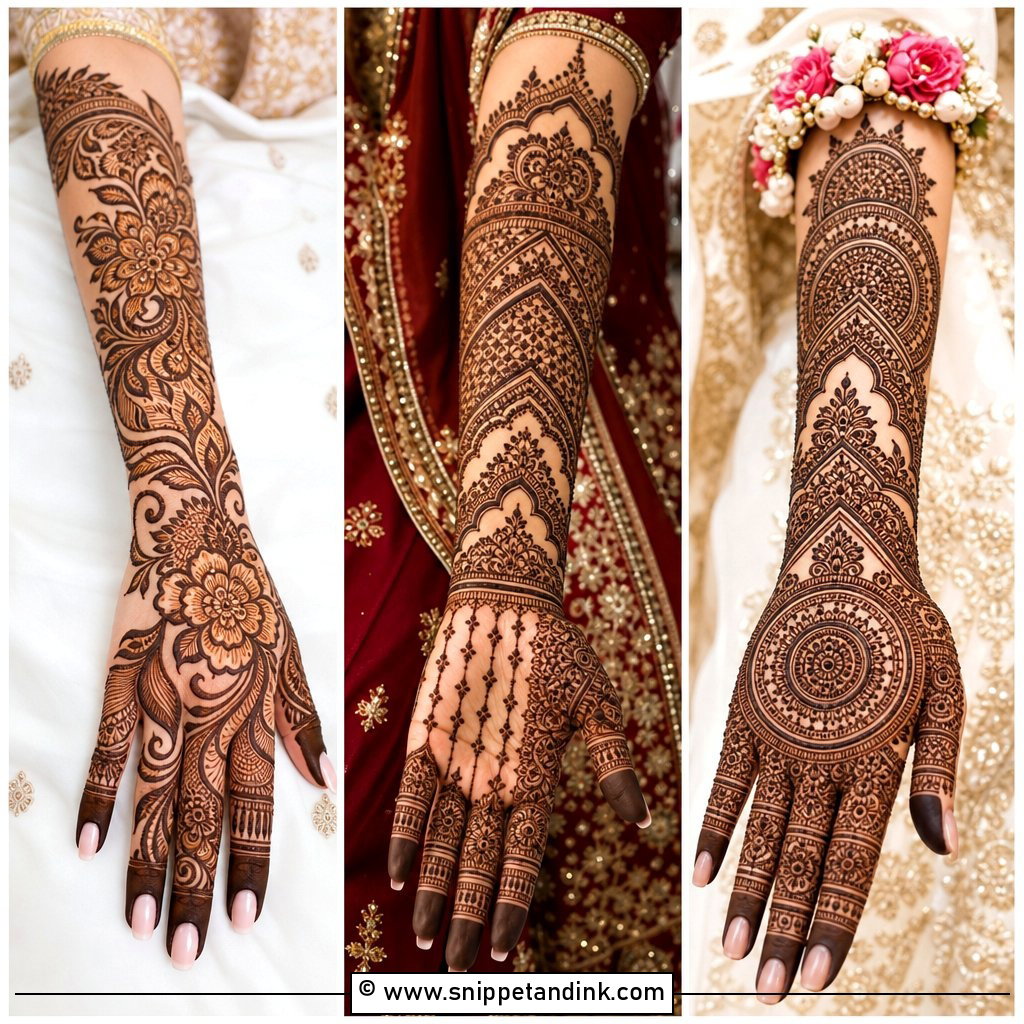
1. Simple Full Hand Bridal Mehndi
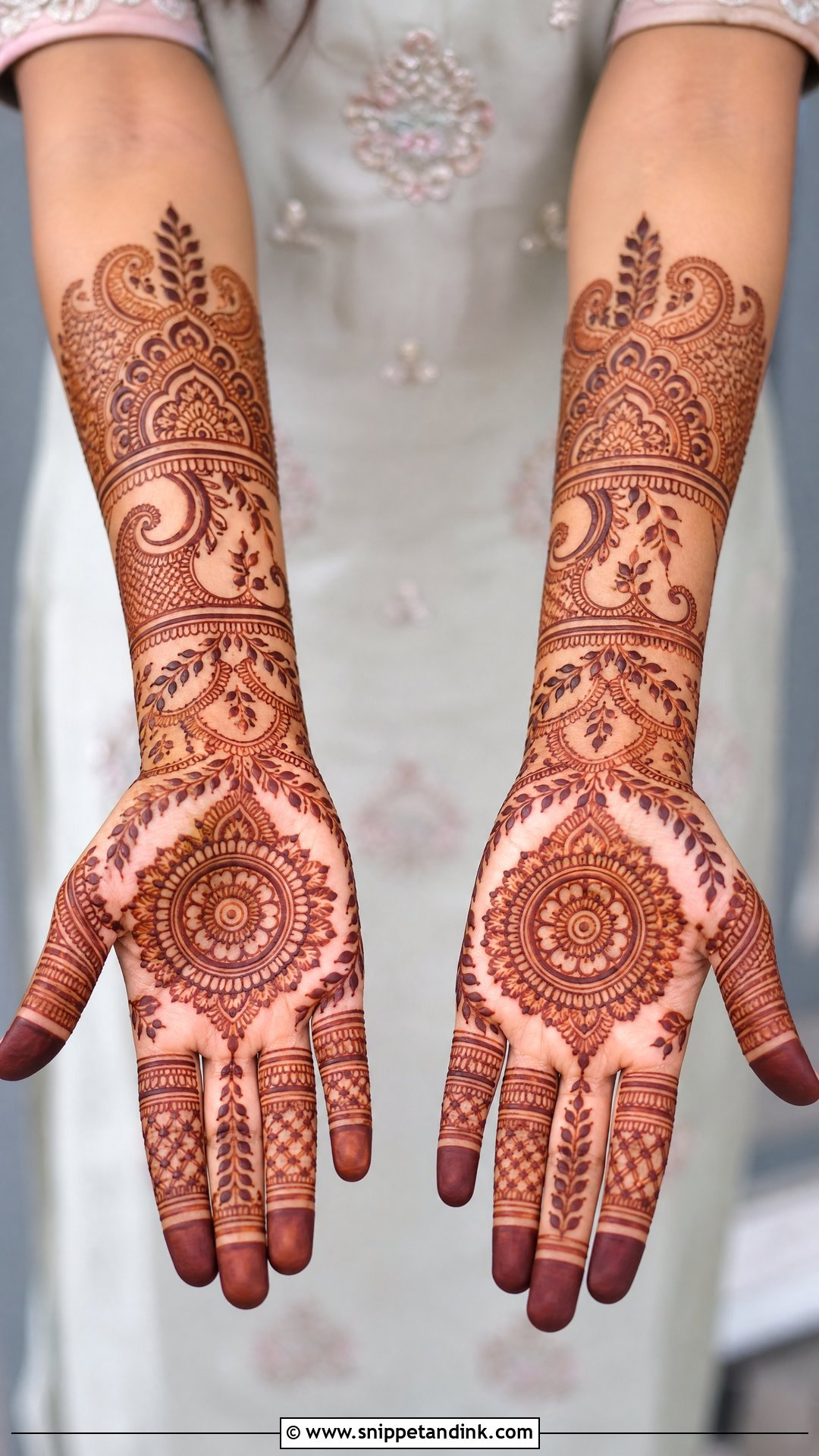
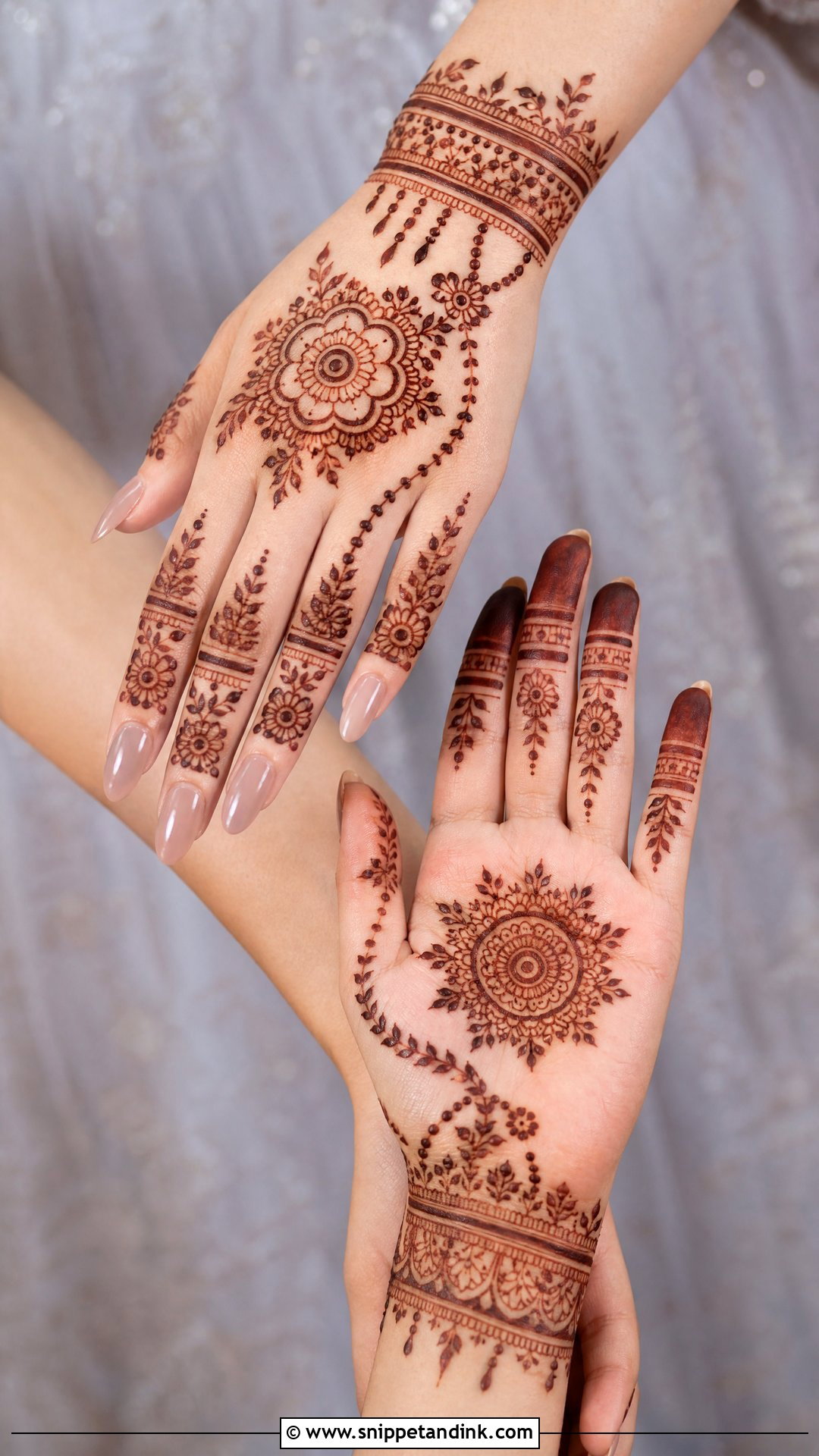
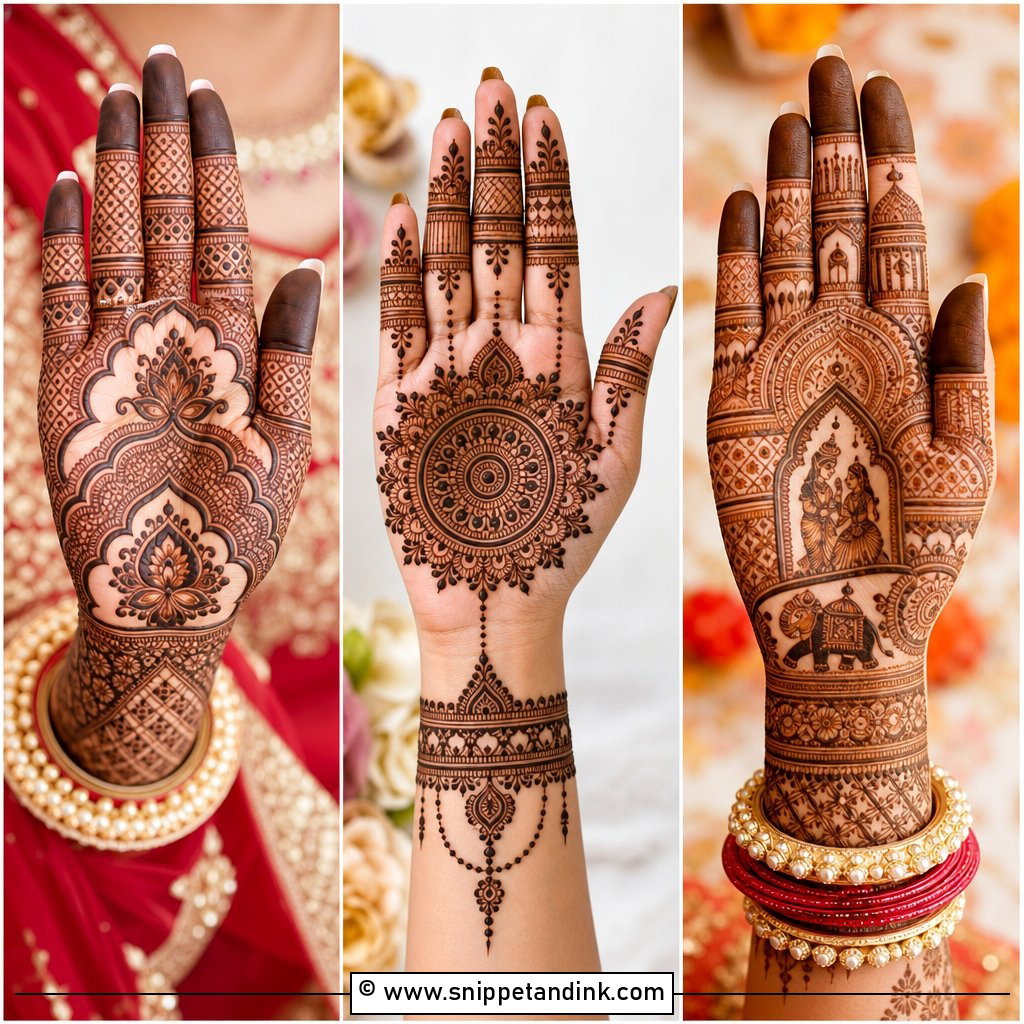
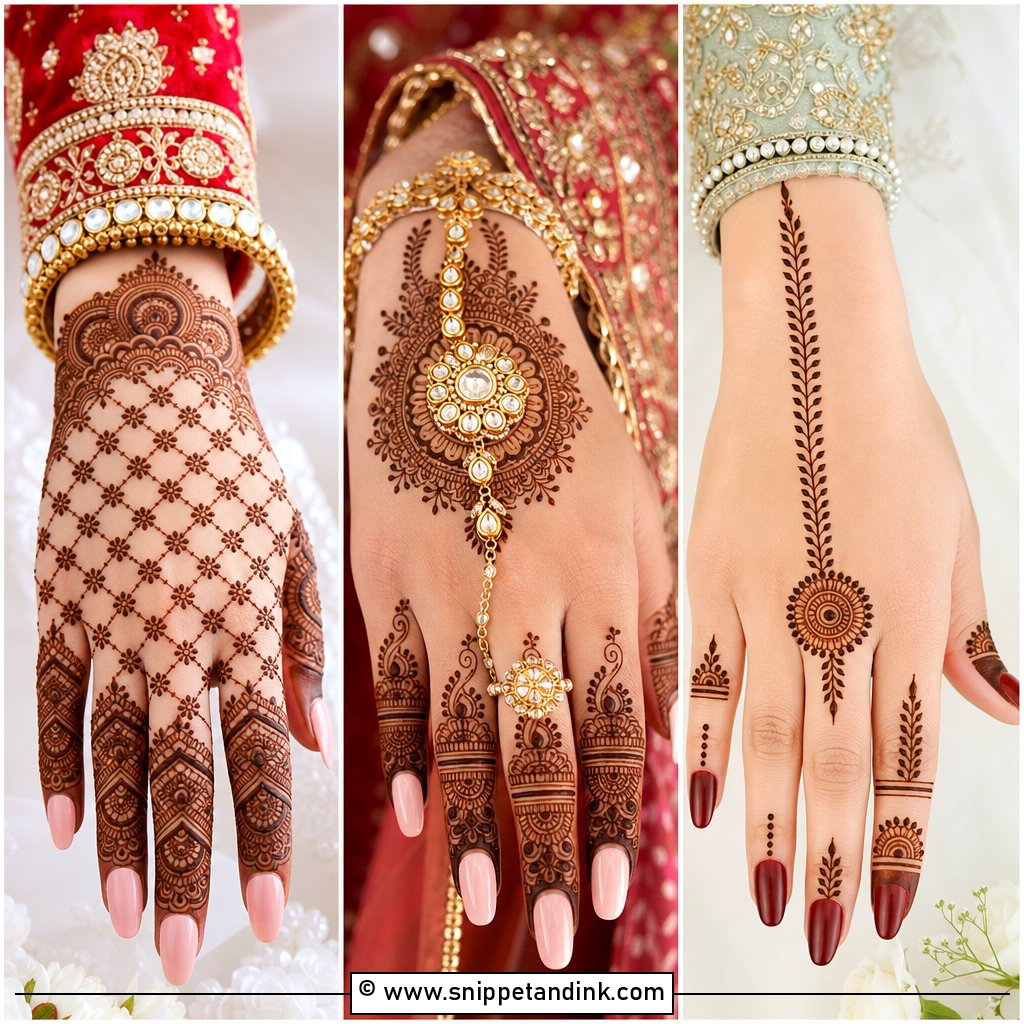
A simple full hand is the one I suggest when a bride wants the traditional coverage map (palm, fingers, wrist and lower forearm) without the crowded finish. A central mandala on the palm anchors it, with paisley borders, small florals and finger bands around it, while the back hand stays lighter with a bracelet band and a soft trail. The thing I protect here is negative space around each main motif. Henna paste spreads slightly as it settles, so motifs drawn too close together merge into one dark patch once the stain deepens.
2. Simple Arabic Bridal Mehndi
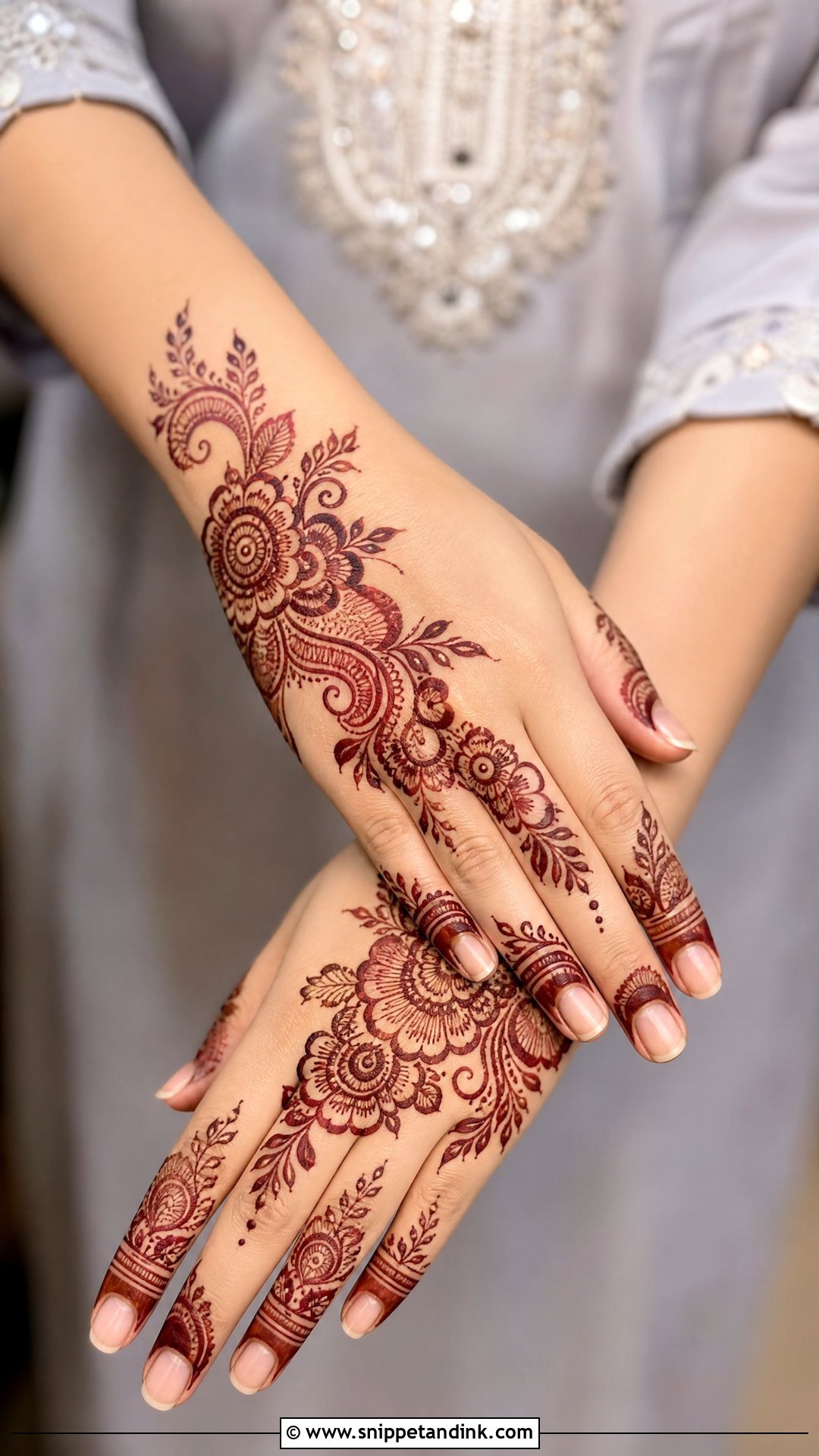
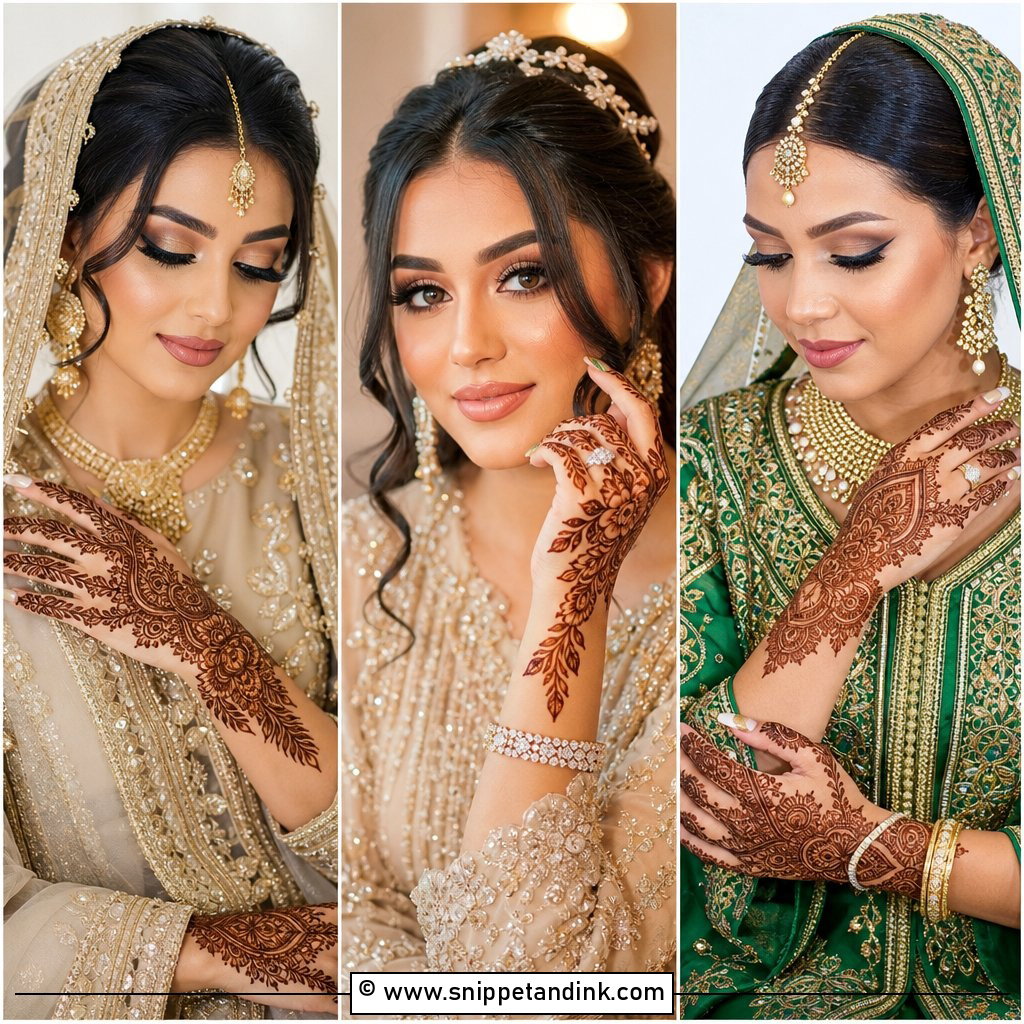
Arabic layouts move diagonally, usually from the outer wrist toward the index finger, with large flowers, shaded leaves and long vines. I fill the leaves with a light shading stroke rather than solid paste, which gives the darker and lighter tones you see in the stain. It’s one of the quickest bridal styles to apply, often well under an hour per side, and the bold shapes sit comfortably next to heavy bangles and a lehenga, sharara or gown.
3. Simple Indian Bridal Mehndi
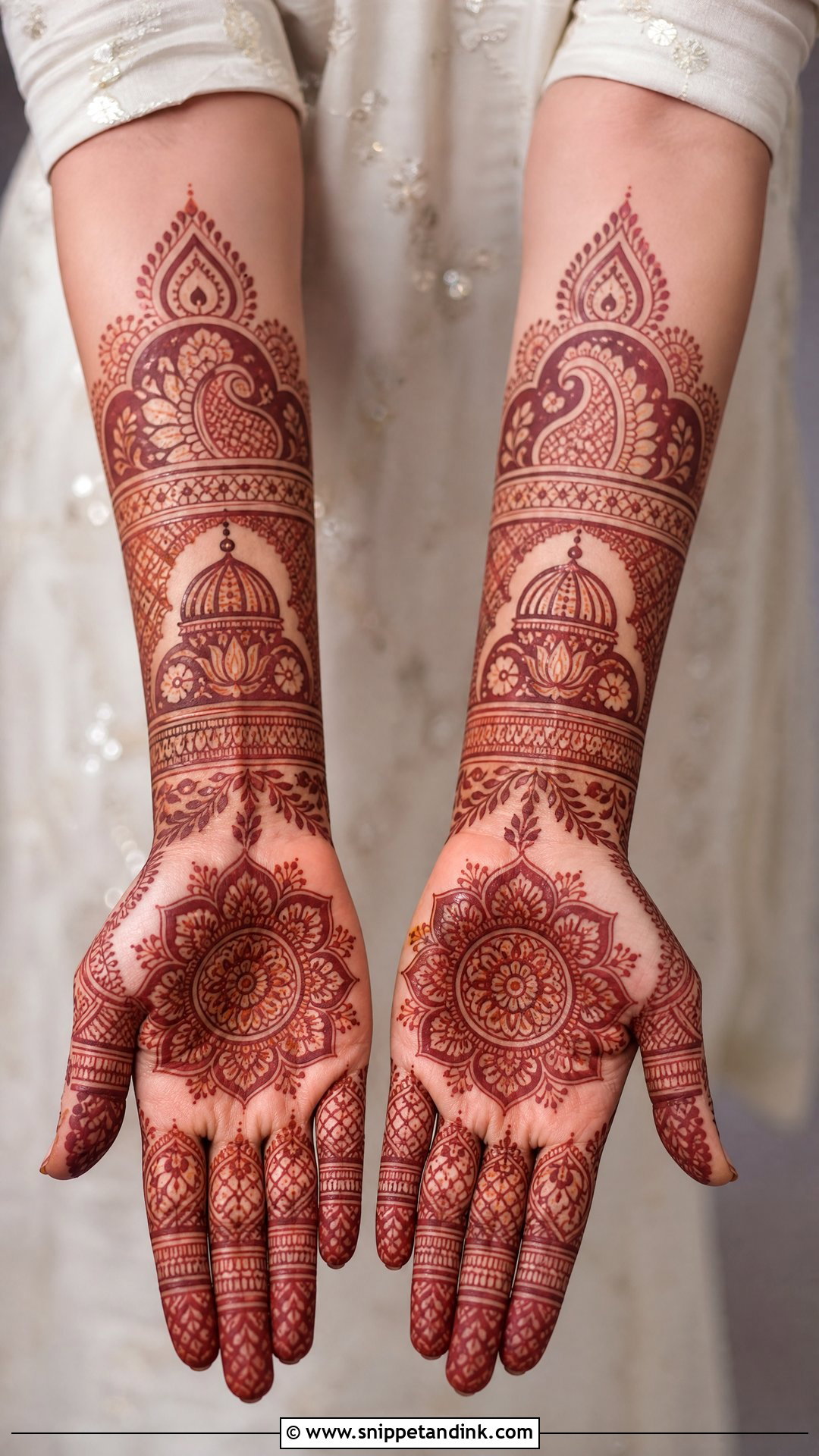
This keeps the recognisable Indian vocabulary (palm mandala, paisley panels, lotus, fine borders) but I leave a finger’s width of bare skin between panels instead of filling it with jaali. On the wrist and forearm, cuff bands and small domes carry the eye upward. Stacked finger patterns look neat under rings. If you want initials hidden somewhere, I’d ask for them inside a paisley on the palm, where the stain is darkest and they won’t disappear. Keep both hands symmetrical; a tiny mismatch is far more visible in a sparse design than in a dense one.
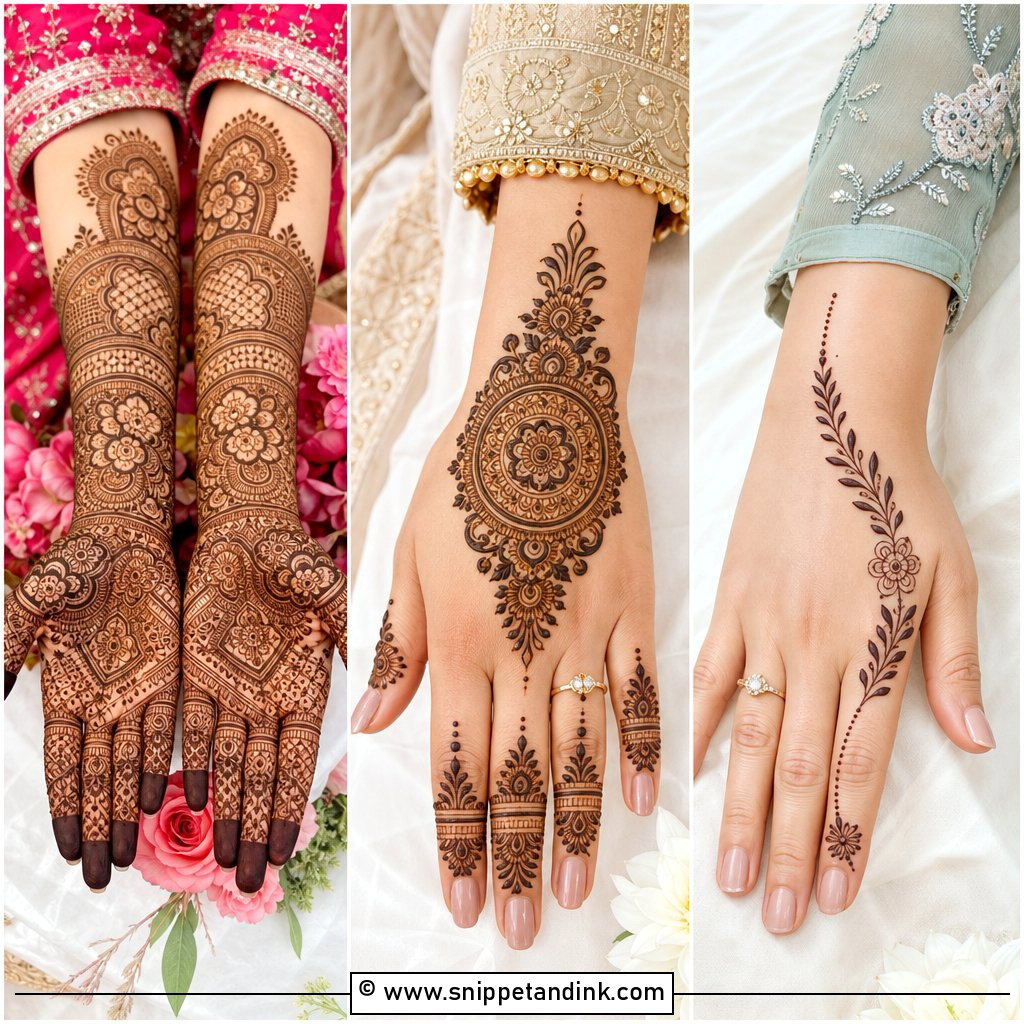
4. Simple Back Hand Bridal Mehndi
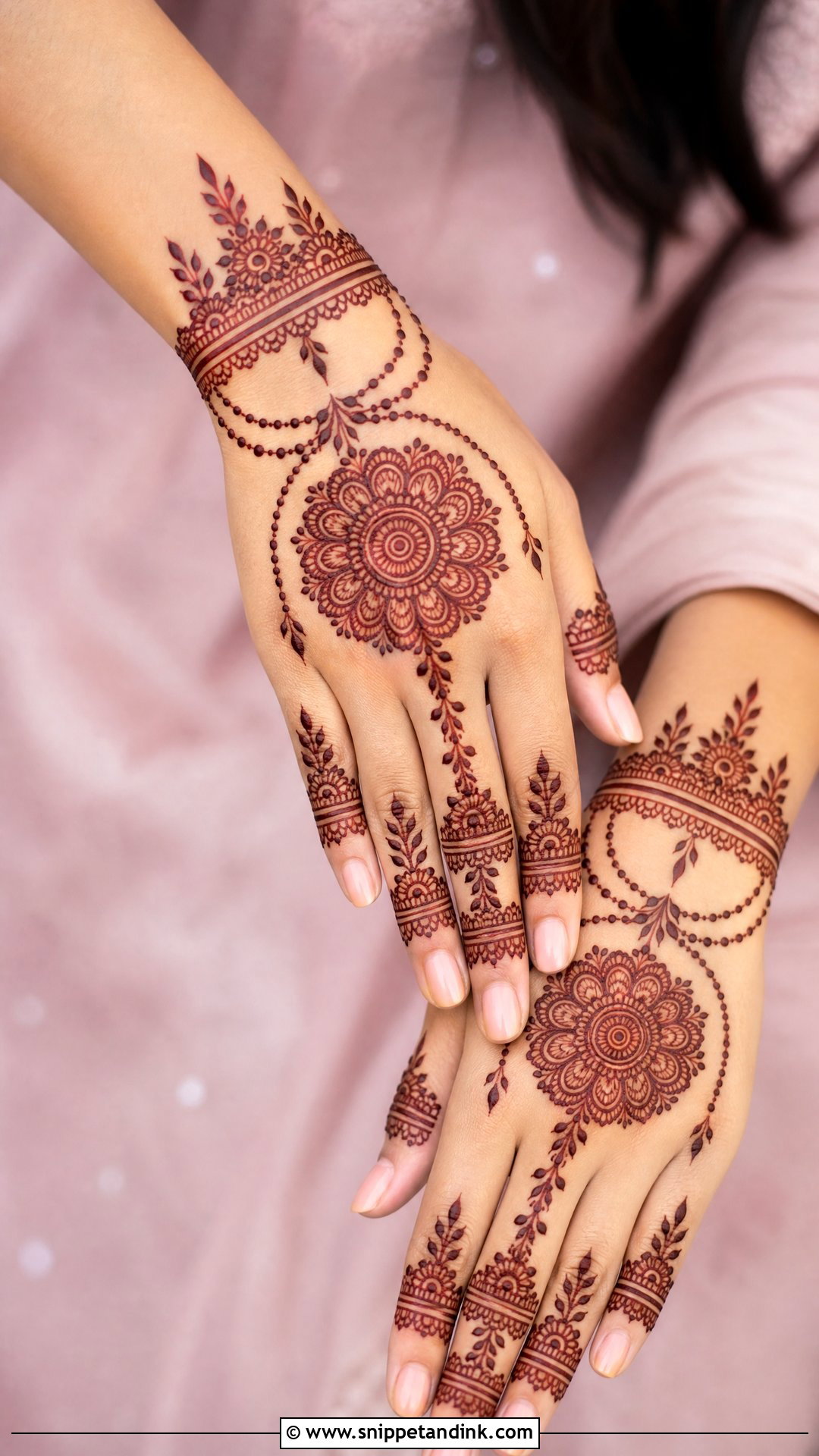
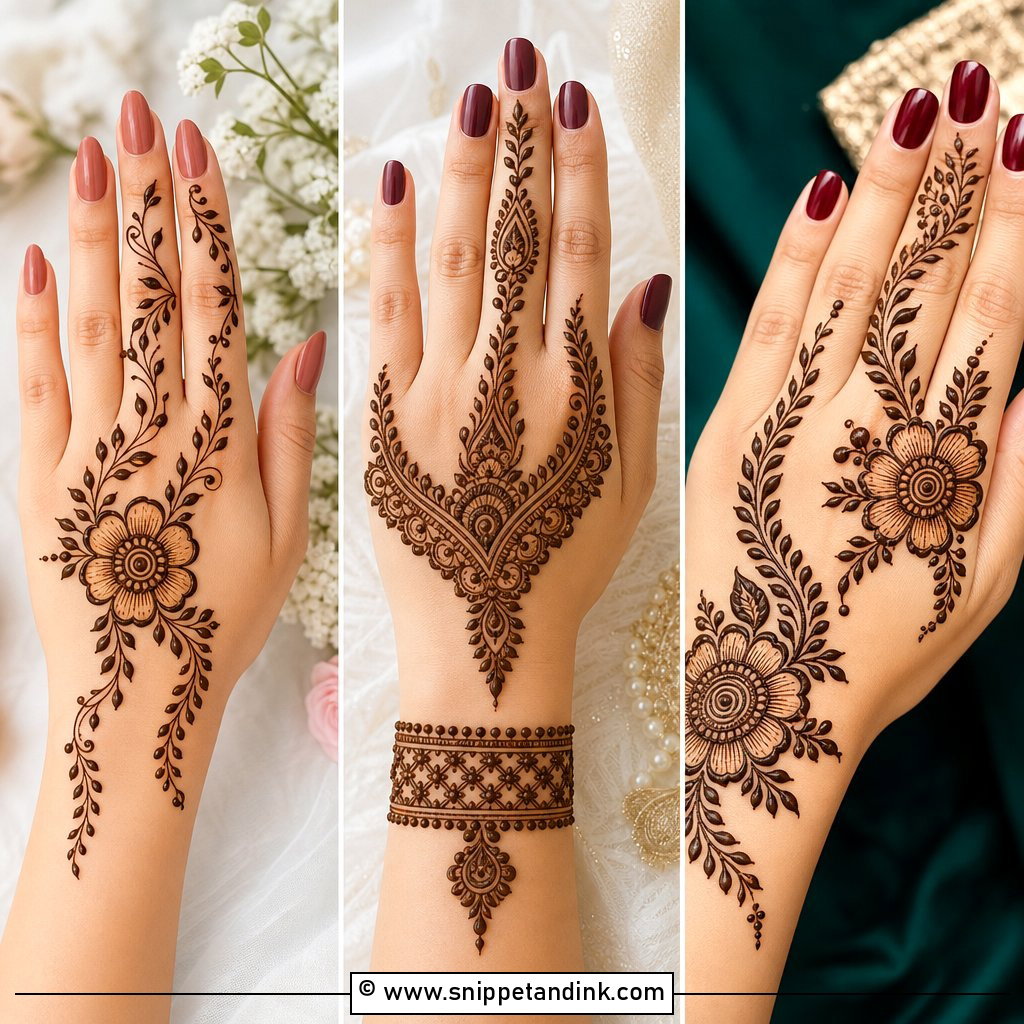
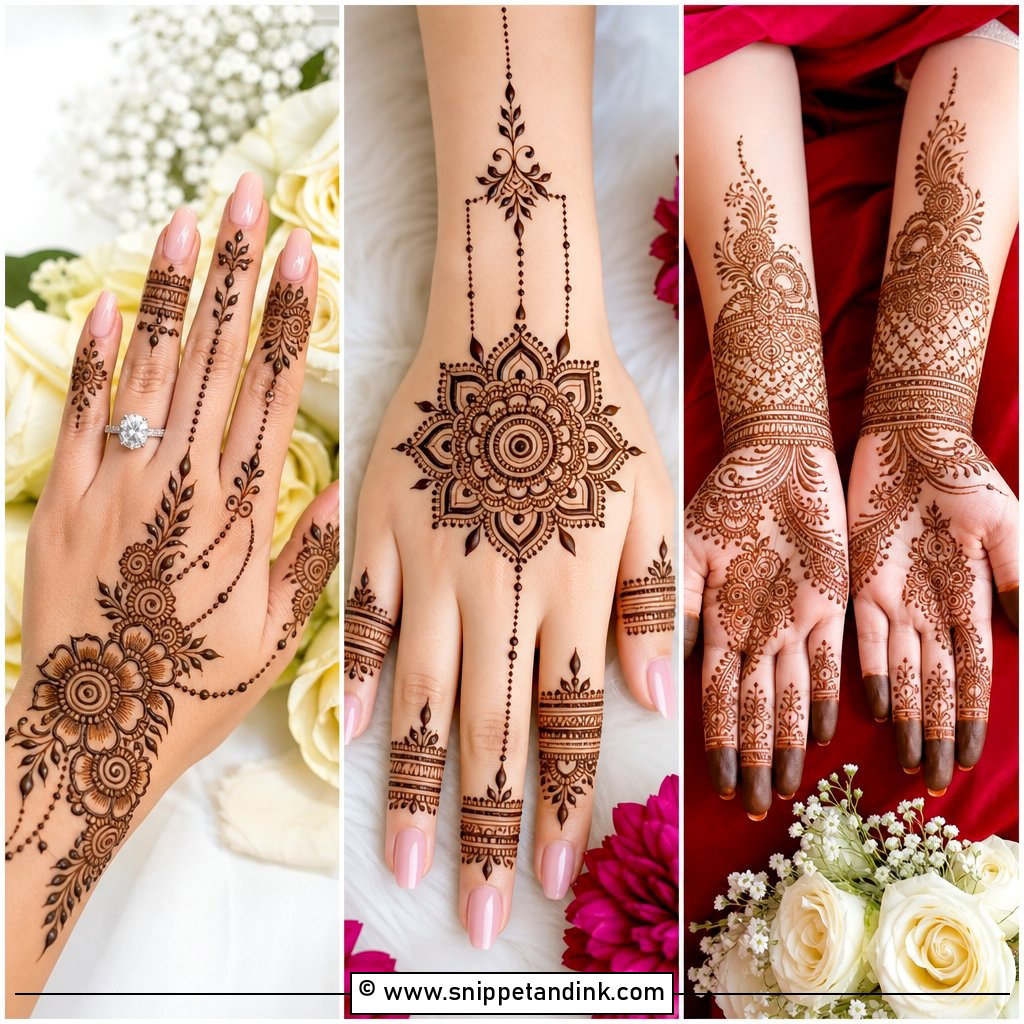
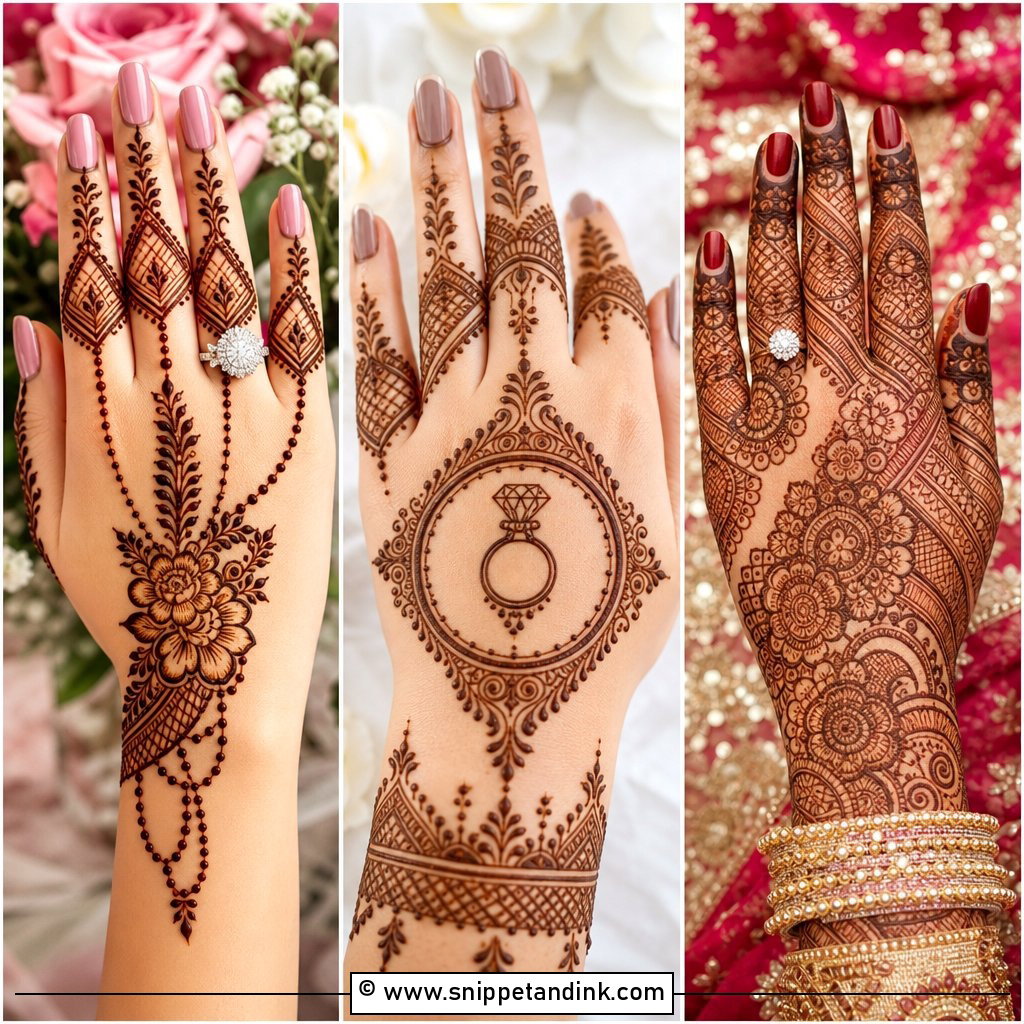
The back hand is what ends up in ring shots, varmala photos and most candid frames, so I spend real care on it. A back hand bridal mehndi design built from a central floral mandala, a bracelet band and a single line running to the middle finger reads like a haath phool drawn in henna. One honest note: the back of the hand stains lighter than the palm because the skin there is thinner and drier, so I keep the lines a little bolder on this side to compensate.
5. Simple Front Hand Bridal Mehndi
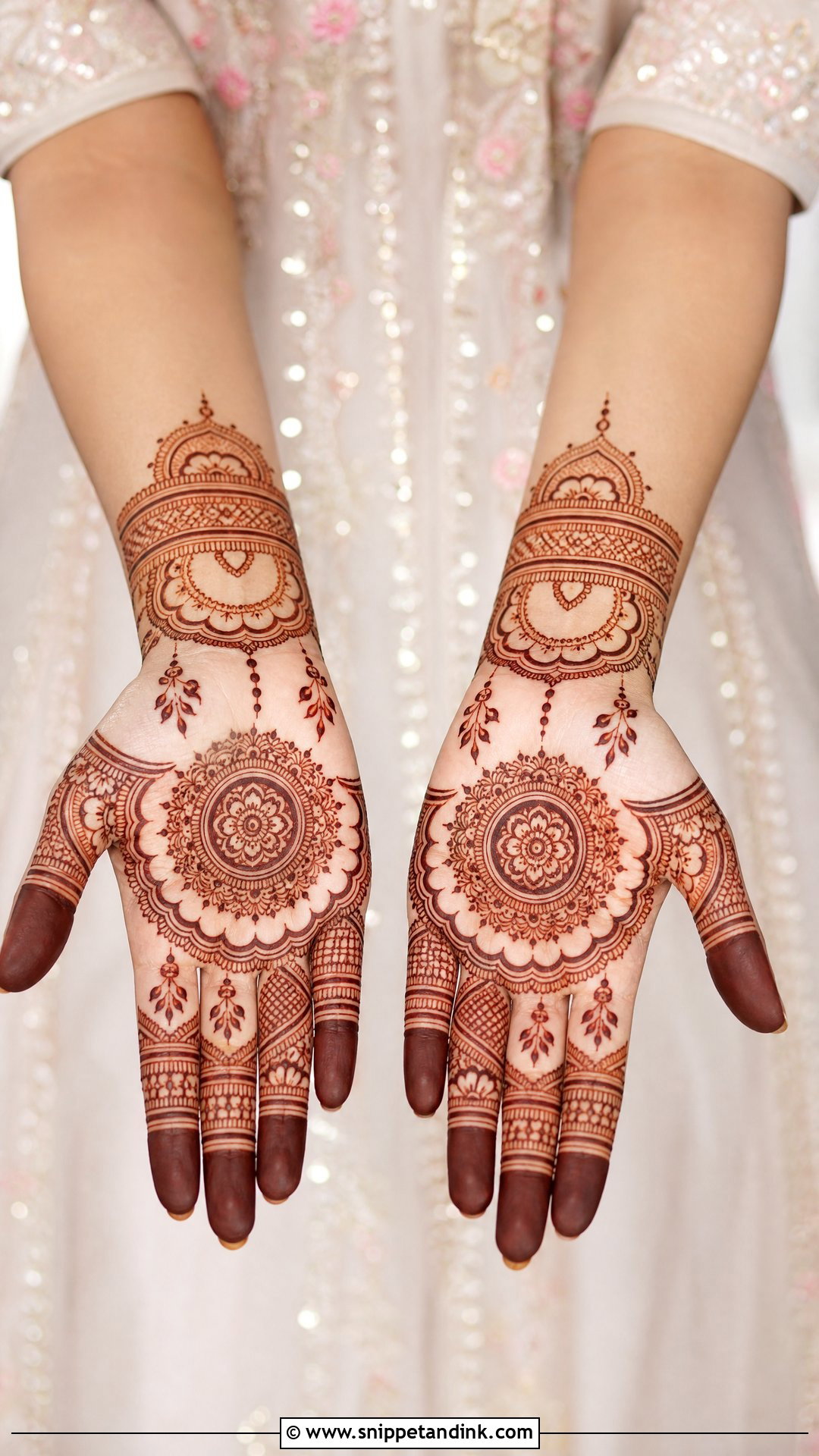
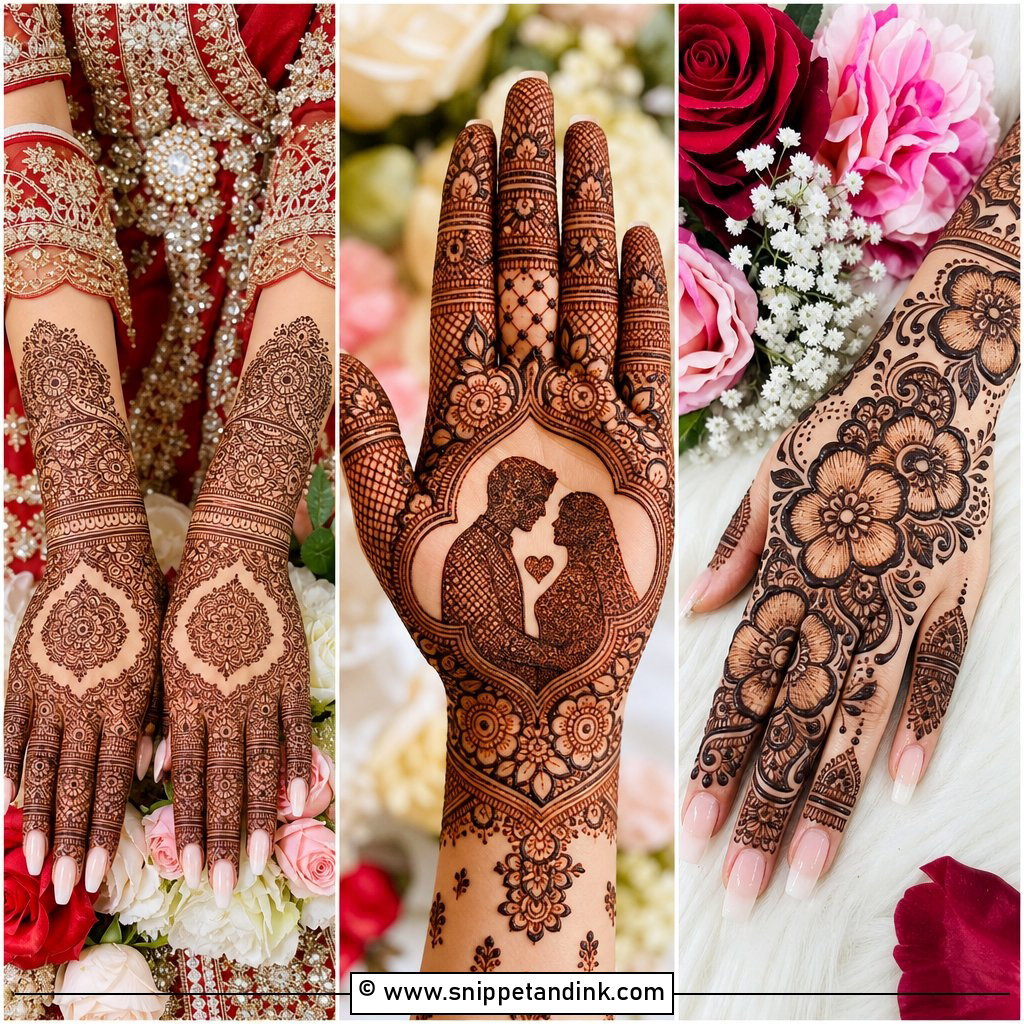
Palms stain darker than anywhere else on the body, which makes the front hand the most forgiving place for a lighter bridal design. I usually centre a round mandala or lotus, then frame it with paisleys and dotted chains. Don’t neglect the fingers. When you hold flowers, a coconut or a ring tray, the fingers are what show, and filled or half-shaded fingertips give the palm a finished edge. If your palms sweat a lot, tell your artist; I keep fine detail away from the centre crease where moisture lifts paste early.
6. Simple Mandala Bridal Mehndi
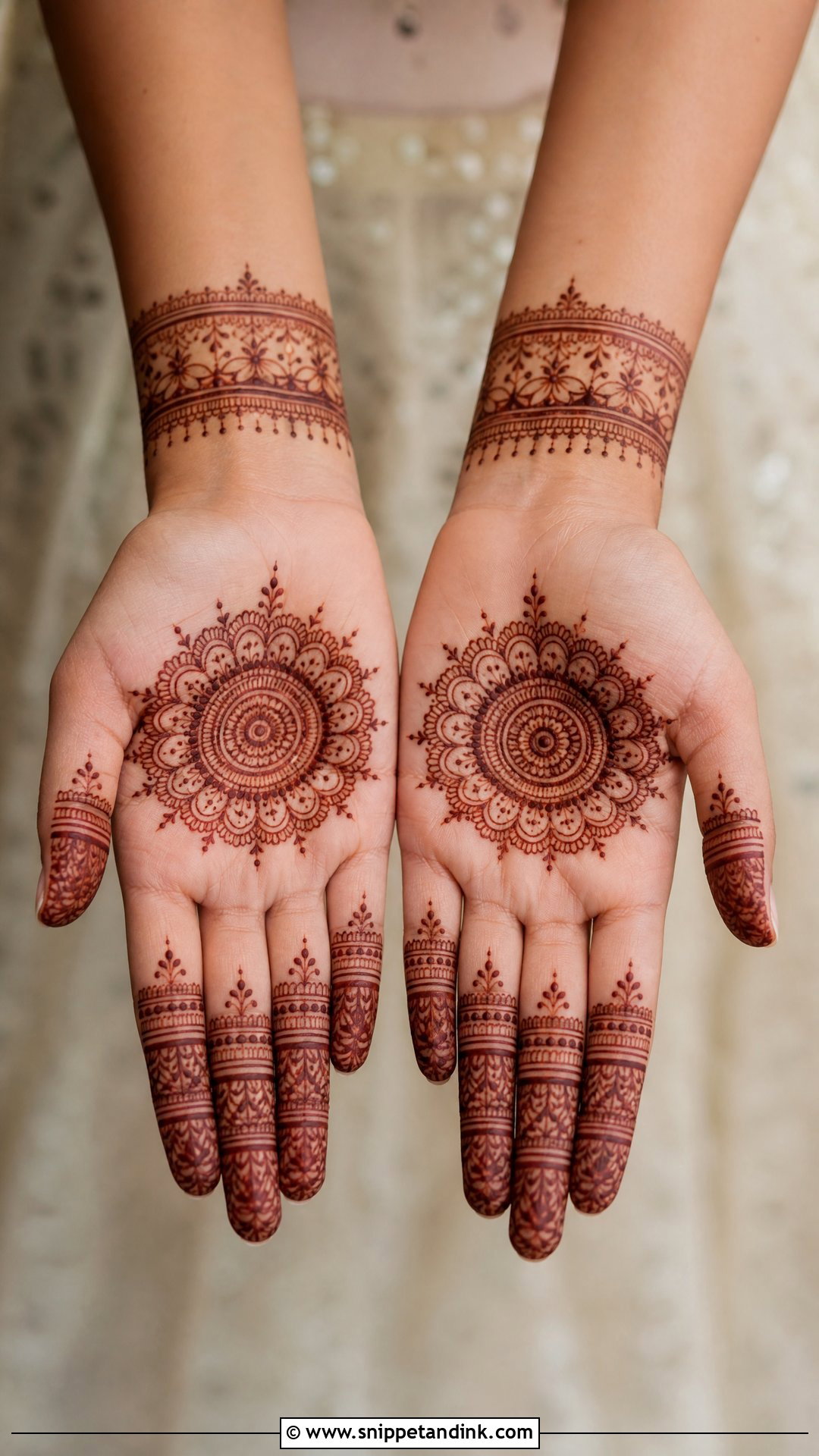
A single mandala on the palm does most of the work. Around it I add scalloped rings, small petals and a few dot borders, then leave the rest of the palm almost bare so the circle reads cleanly. Fingers get slim bands and leafy tips, and a wrist cuff ties the hand to the forearm. The risk with this design is a lopsided circle: I mark the centre point and the outer ring first with tiny dots before drawing a single petal. It suits brides who like symmetry, and it’s a smart choice for a smaller pre-wedding function.
7. Simple Floral Bridal Mehndi
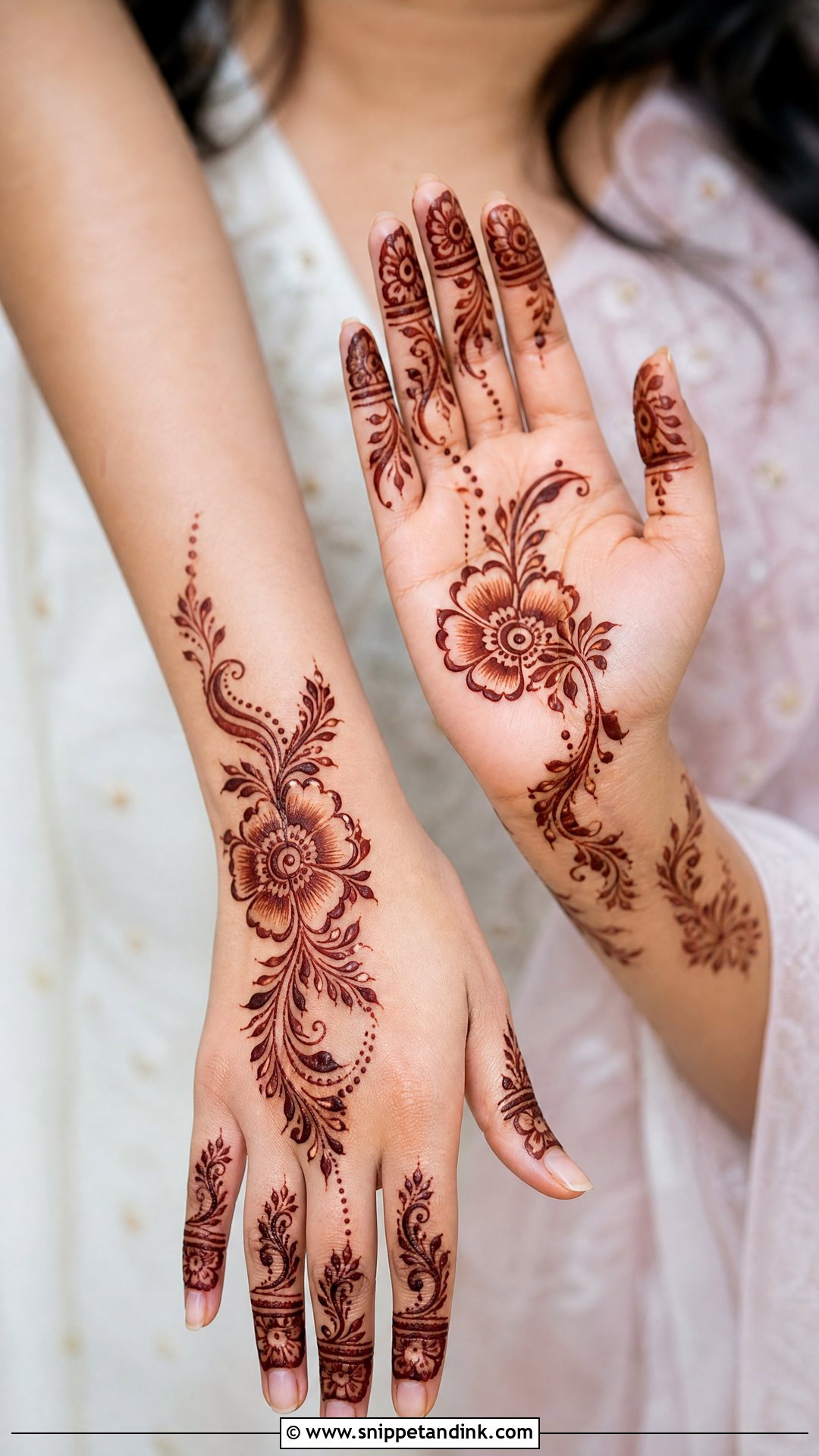
Big open flowers carry a bridal hand far better than dozens of tiny ones, so this is where I tell brides to choose fewer, larger blooms. A rose, a lotus or a five-petal flower sits on the palm and wrist with leaves and light shading in between, and on the back hand a floral trail runs from wrist to finger. The mistake I see most is over-shading each petal; a single shaded edge per petal holds its shape after the stain darkens, while full shading turns the flower into a blot. Floral lehengas and pastel outfits suit this especially well.
8. Simple Paisley Bridal Mehndi
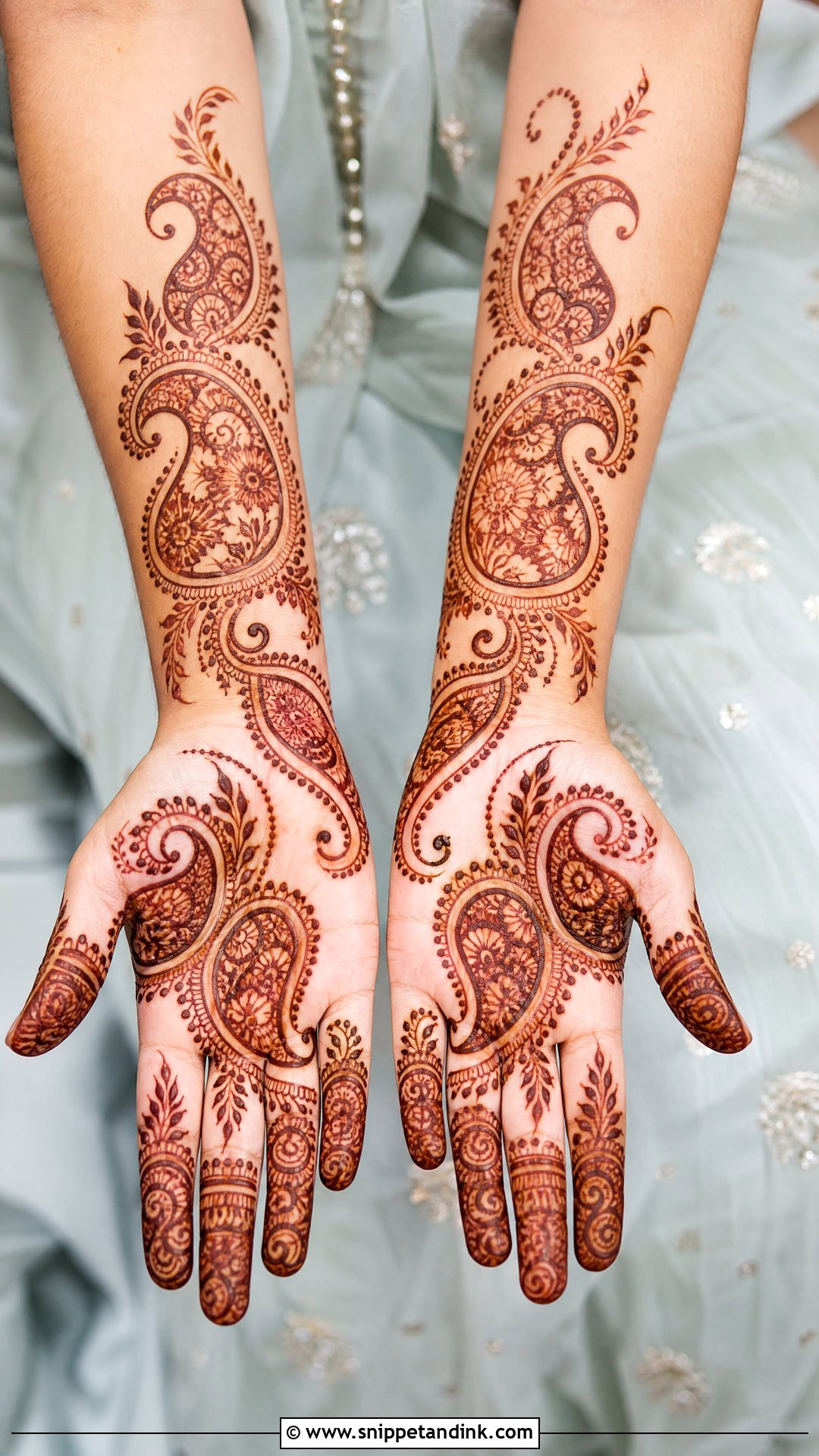
Two or three large paisleys do more than ten small ones. I place one on the palm, one near the wrist and one up the forearm so the eye travels, then fill each paisley lightly with a floral or line pattern instead of solid paste. Slim vines and dotted borders link them. Paisleys are forgiving to draw, but their tips are where a shaky line shows, so ask your artist to finish each curl in one confident stroke. The look feels heritage without the weight of a full traditional hand.
9. Simple Indo Arabic Bridal Mehndi
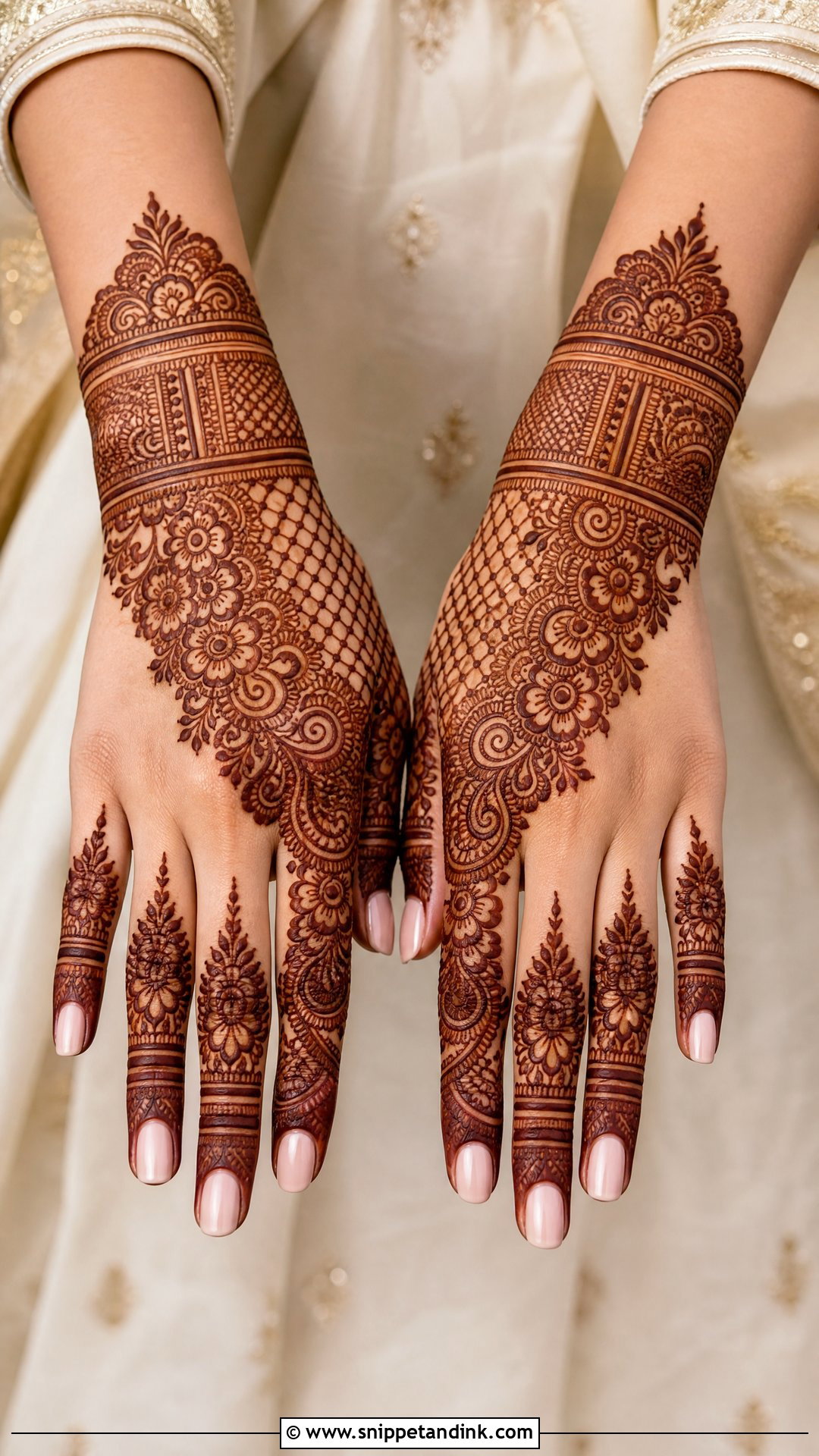
Indo-Arabic takes the diagonal flow of an Arabic trail and fills its gaps with Indian detail: small jaali sections, paisleys, dots. The wrist gets a neat cuff, and the fingers can mix Indian bands with Arabic leafy tips. Fusion is where designs most often turn messy, because two drawing styles fight for attention. My rule is one style leads and the other only fills: the Arabic trail sets the shape, the Indian elements stay inside it. Clean outlines and controlled shading keep it readable at photo distance.
10. Simple Jaali Bridal Mehndi
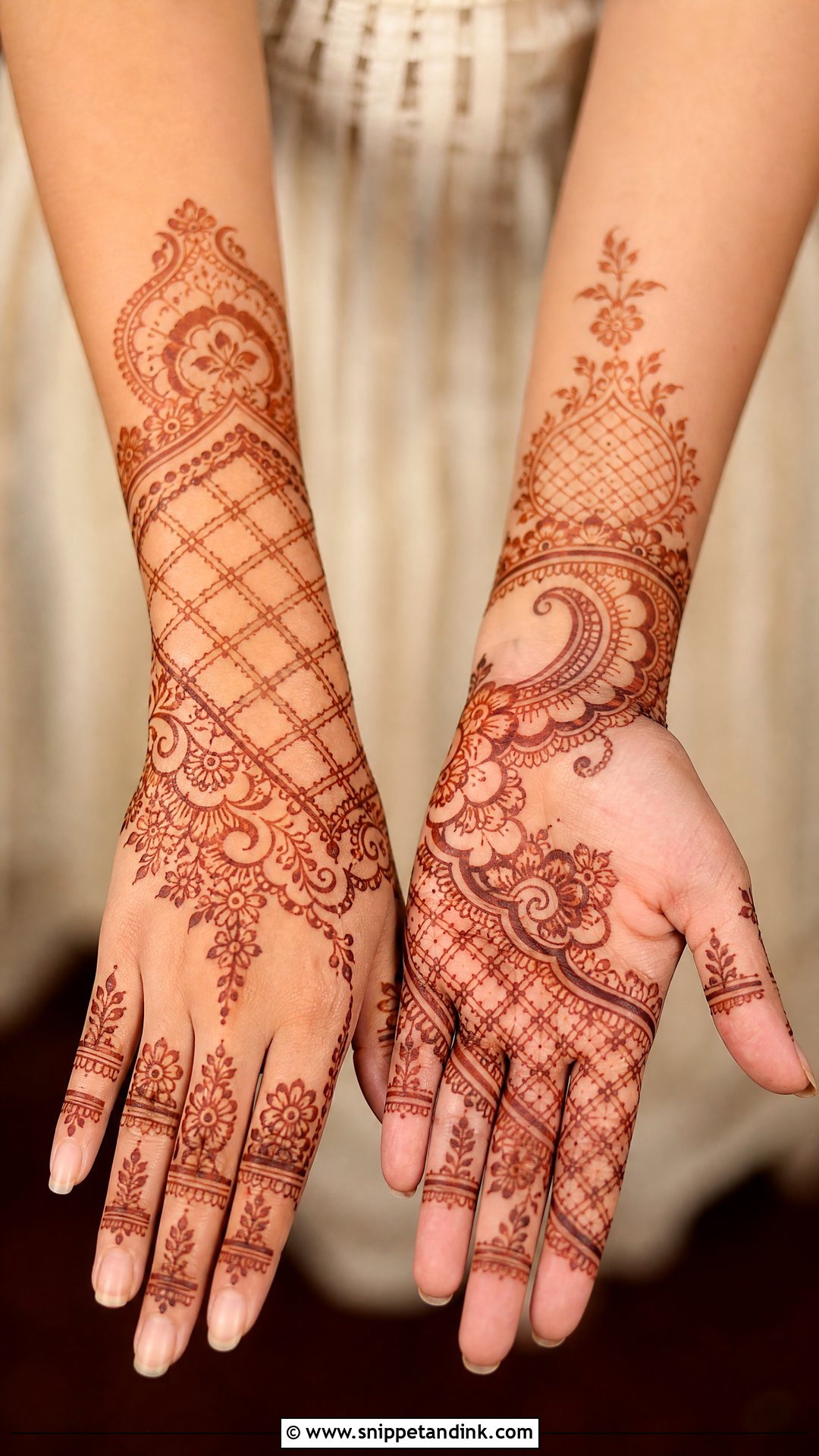
Jaali is a mesh pattern, and on a simple bridal hand I use it in panels rather than across the whole hand. Around the knuckles and wrist on the back hand it reads like a lace glove, framed by floral borders and curved vines, while the fingers carry thin rings and small dots. Even spacing is everything with jaali; if the grid lines drift closer together at one edge, the stain makes that corner look darker and uneven. Fine cones and steady hands matter more here than anywhere else in the list.
11. Simple Bridal Mehndi With Name
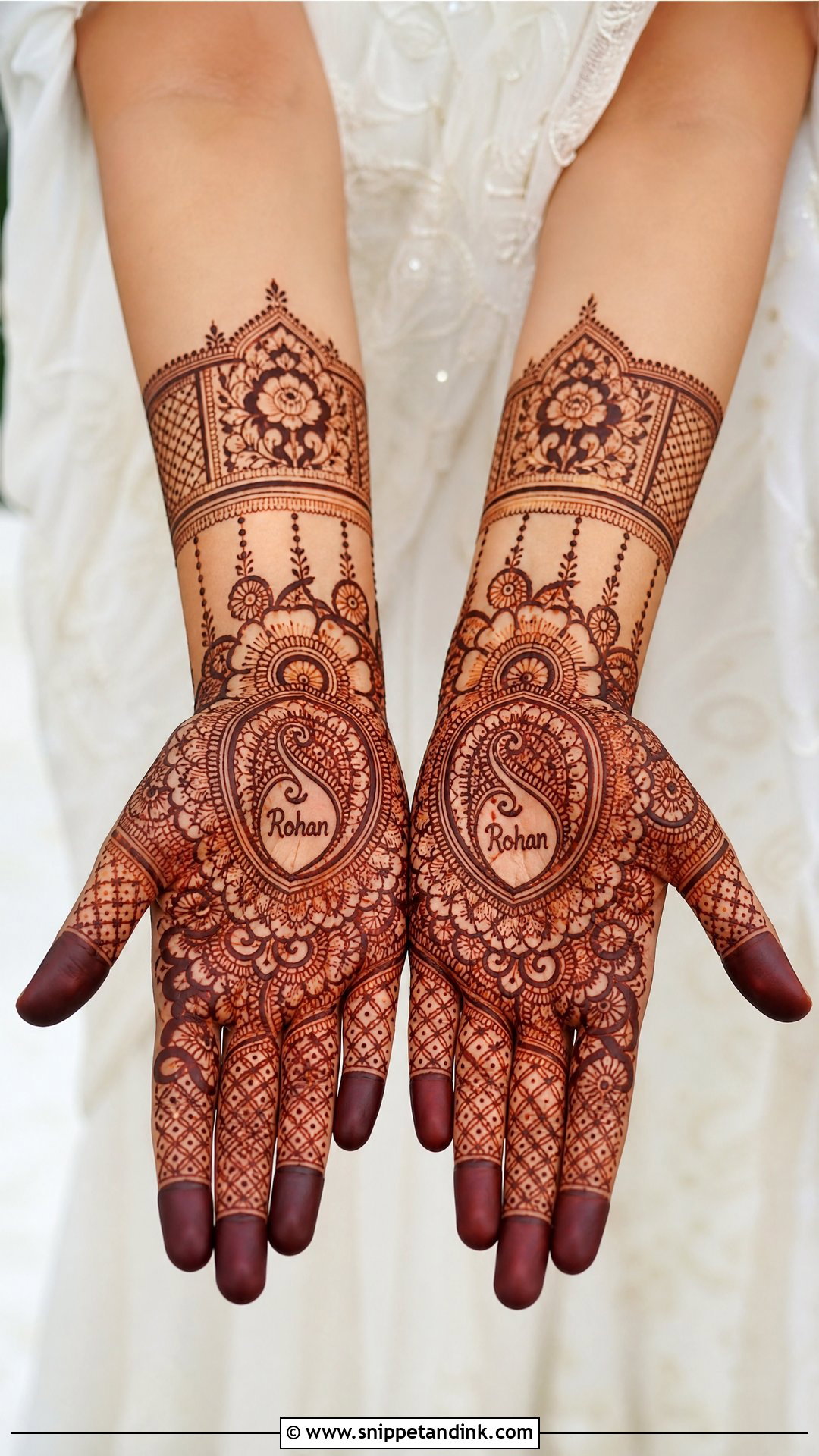
A name or initials make a light design personal without adding coverage. I hide them inside a paisley, curl them into a leafy vine on the palm, or tuck them beside the mandala, and I always write them on the palm side because that’s where the stain will be deep enough to read. Keep the rest of the hand clean so the lettering has room. If your families play the game of the groom searching for his name, keep it small, but not so small that the paste lines fill in.
12. Simple Bride Groom Mehndi
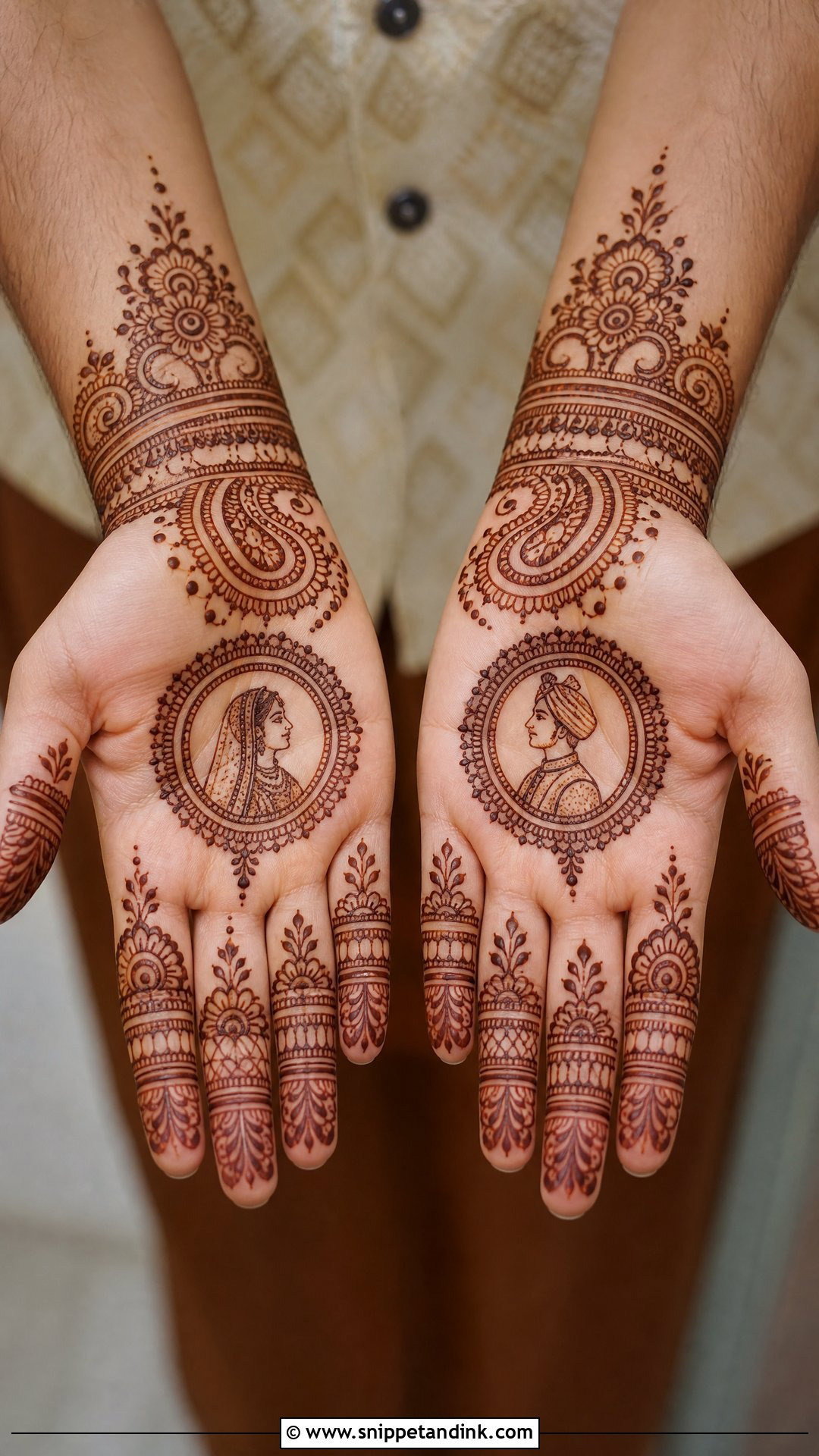
Bride and groom figures don’t need full portrait work. On a simple bridal hand I draw small symbolic figures or minimal line faces inside a circle on each palm, then surround them with plain paisleys, dots and borders. Fine facial detail is exactly what henna struggles with, since lines under about a millimetre apart blur as the stain darkens, so I keep features to a few strokes. Wrists and fingers stay light so the pair remains the focus. It’s a sweet storytelling touch for an engagement or ceremony close-up.
13. Simple Bridal Mehndi For Fingers
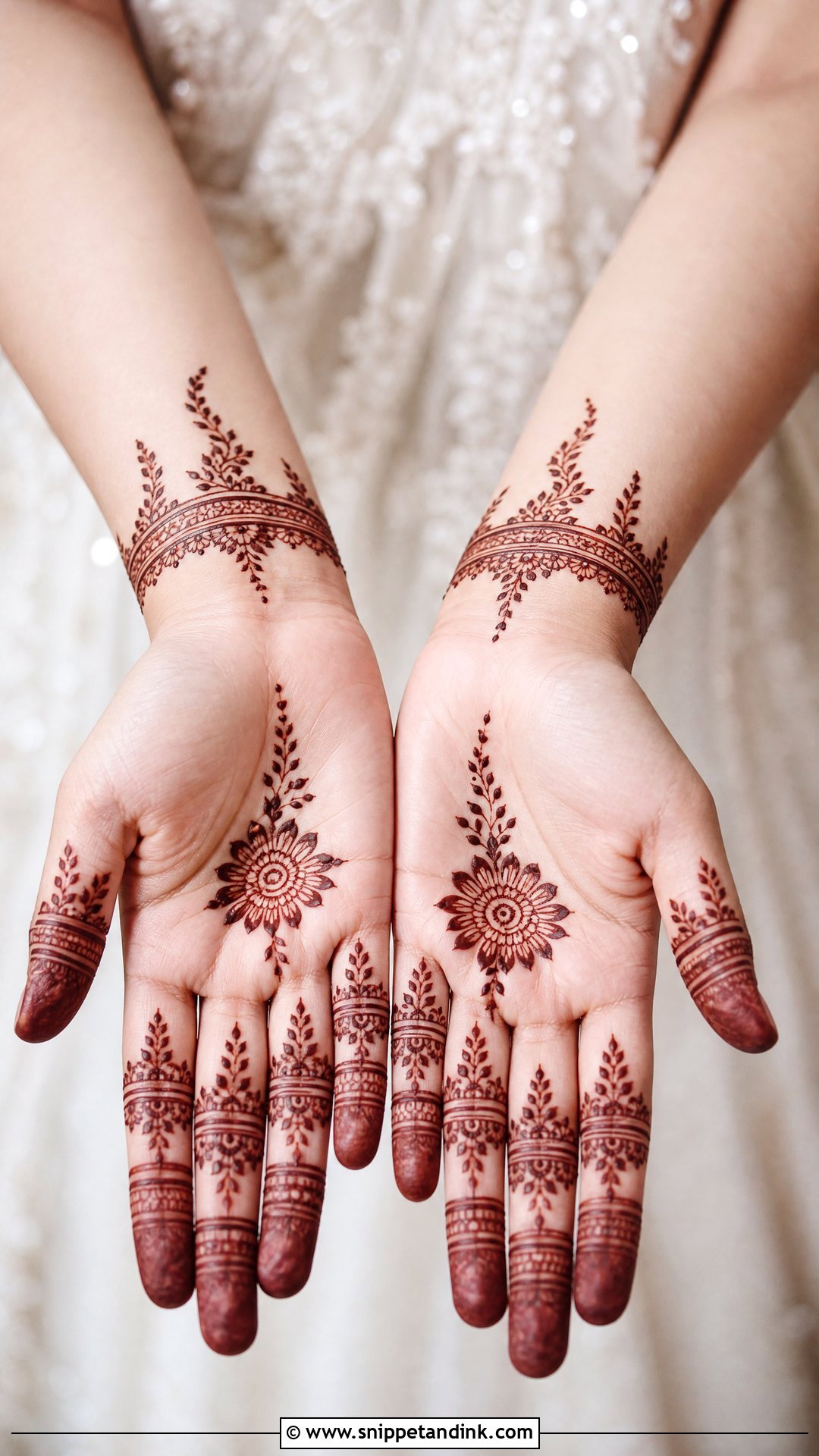
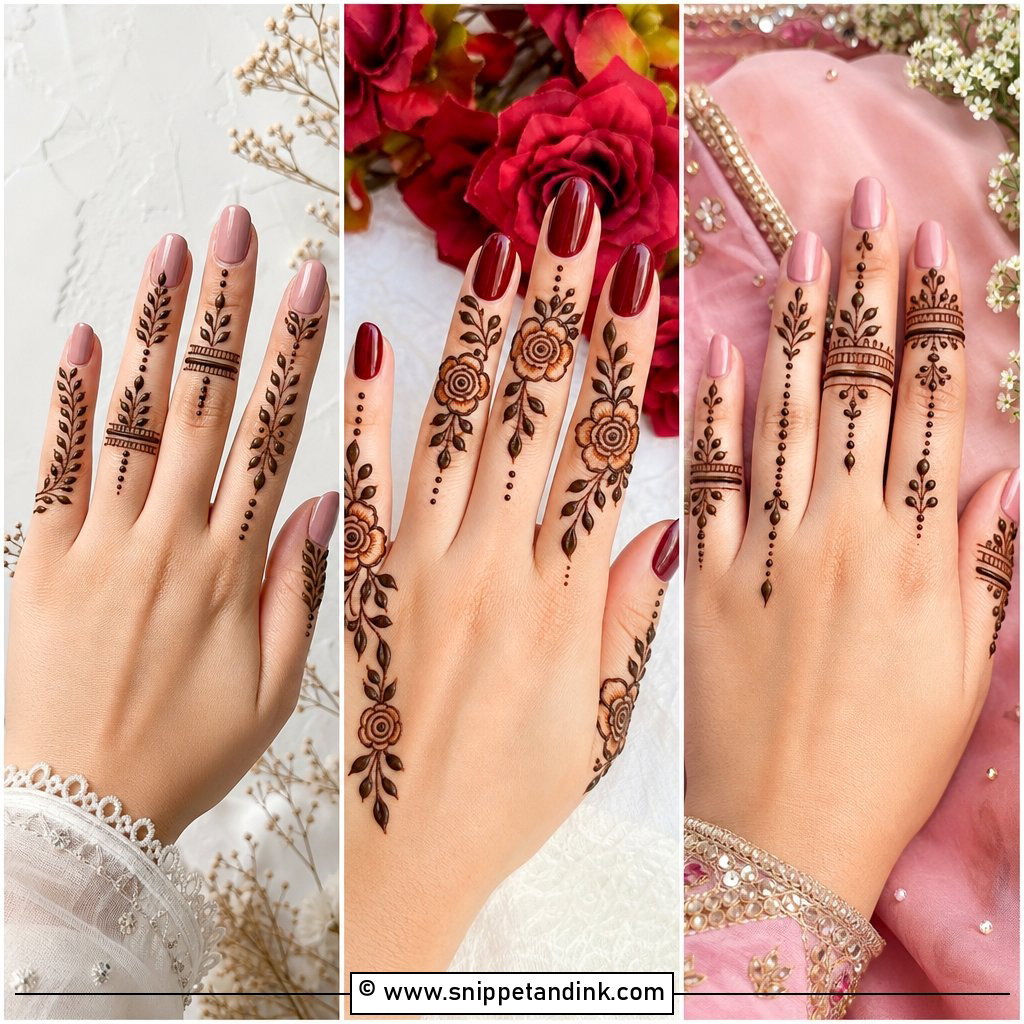
Finger-led mehndi keeps the palm mostly open and puts the detail on each finger: bands, leafy lines, dots and ring-shaped patterns, sometimes joined by a small flower in the centre of the palm or back hand. A slim bracelet line at the wrist finishes it. It’s one of the quickest designs I apply and one of the most comfortable to wear for days afterward. Fingertips do stain very dark, so if you’re planning pale nail polish, ask for the tips to be outlined rather than filled. Matching patterns across all ten fingers keep it tidy.
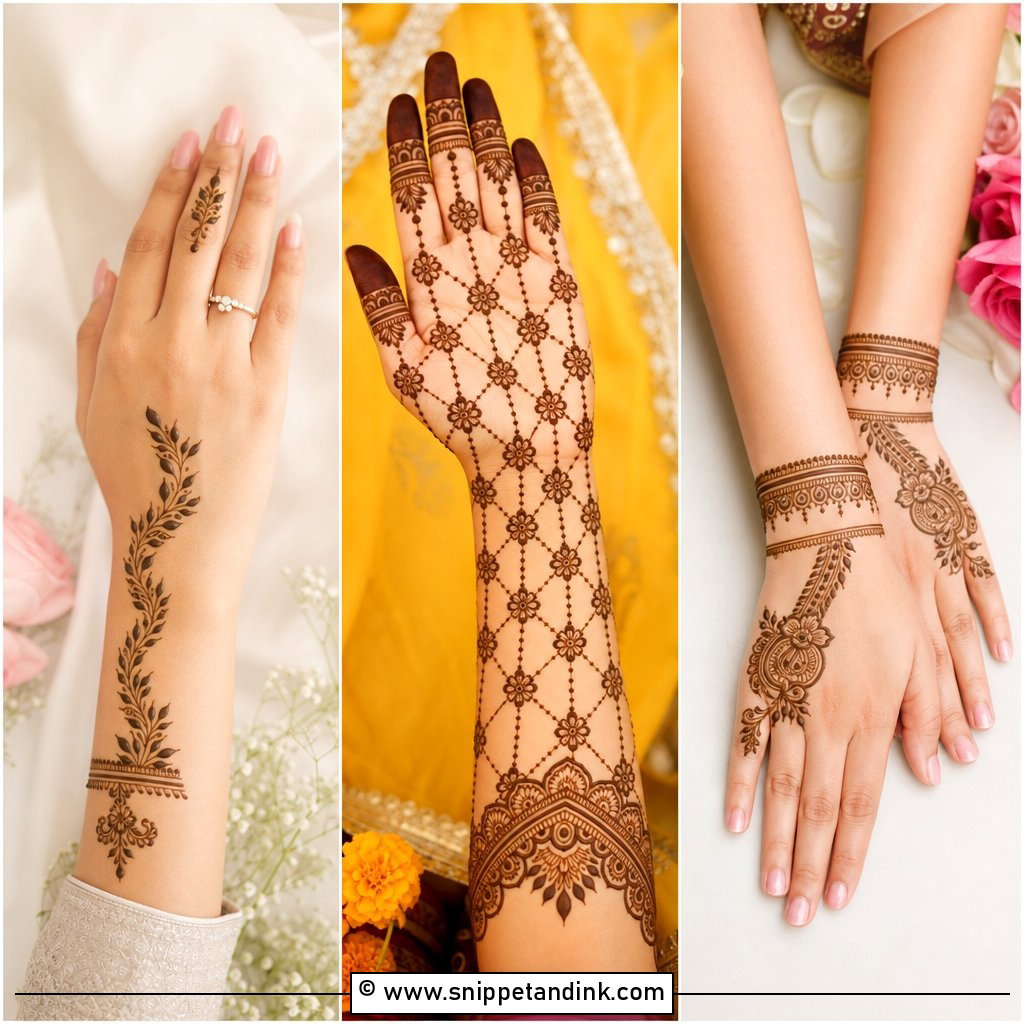
14. Simple Bracelet Bridal Mehndi
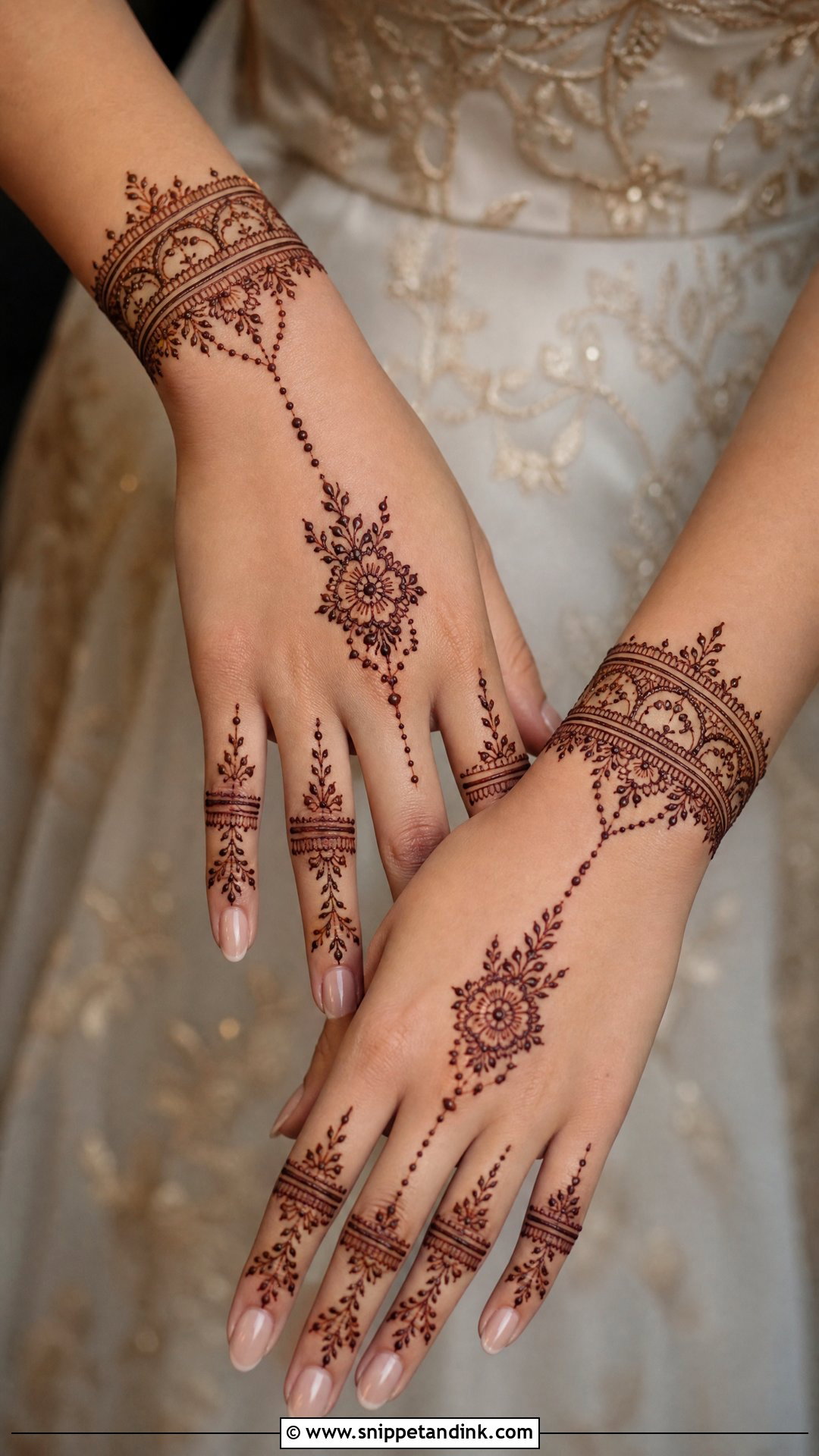
A bracelet bridal mehndi design treats the wrist as the main feature: a cuff, a chain, a floral band or a bangle-inspired ring, with a delicate vine or dotted chain running to the middle finger and a small flower or paisley as the connector. I draw the cuff while the bride rests her forearm flat, because a band drawn with the wrist bent sits crooked once she straightens it. It frames the hand nicely for an engagement, nikah or registry wedding, and it works with or without real bangles worn over it.
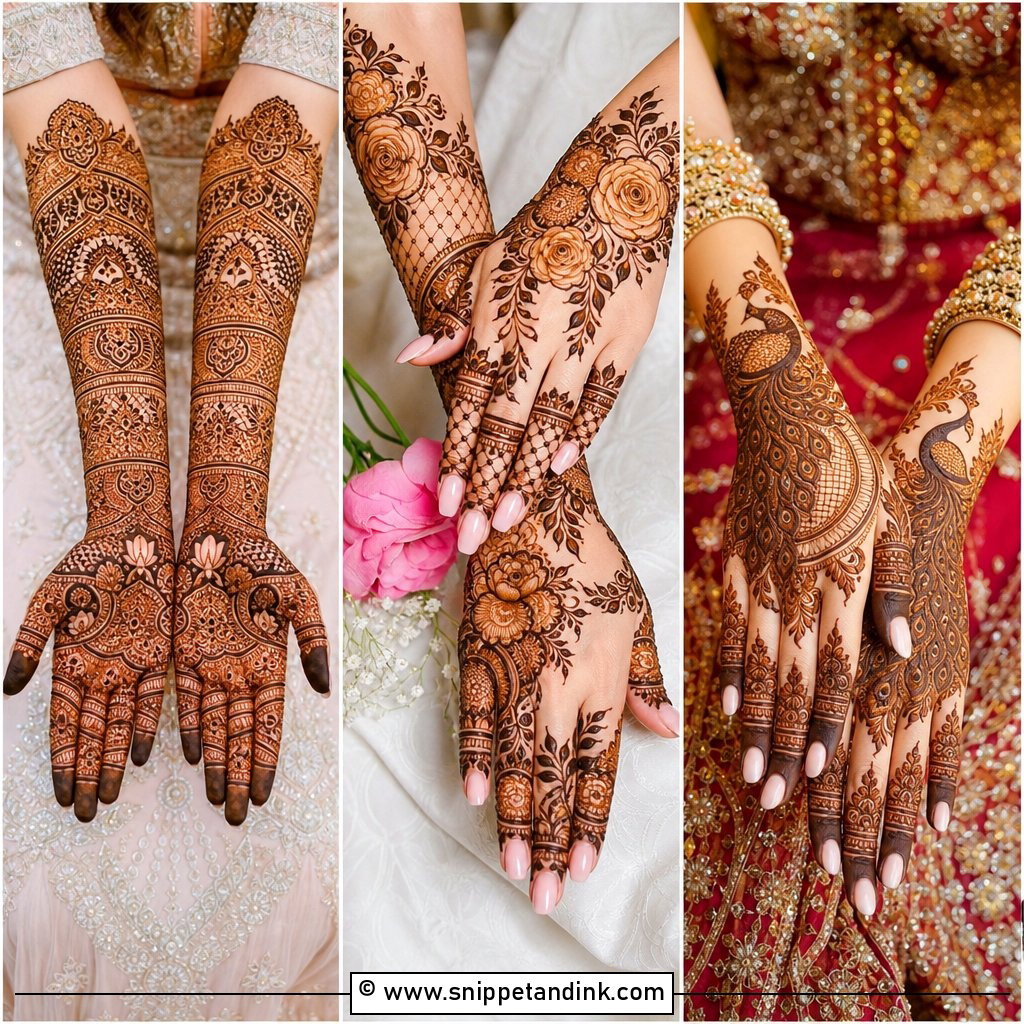

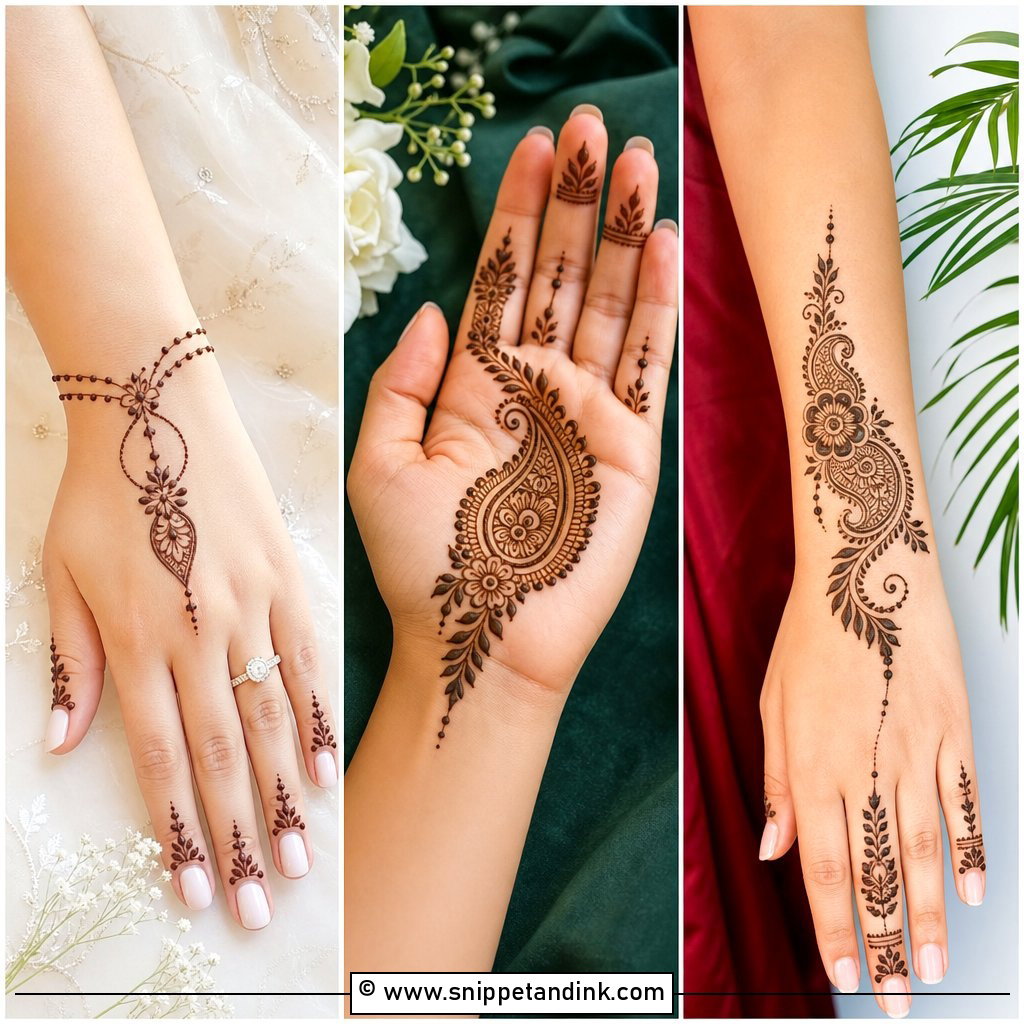
15. Simple Bridal Mehndi For Small Hands
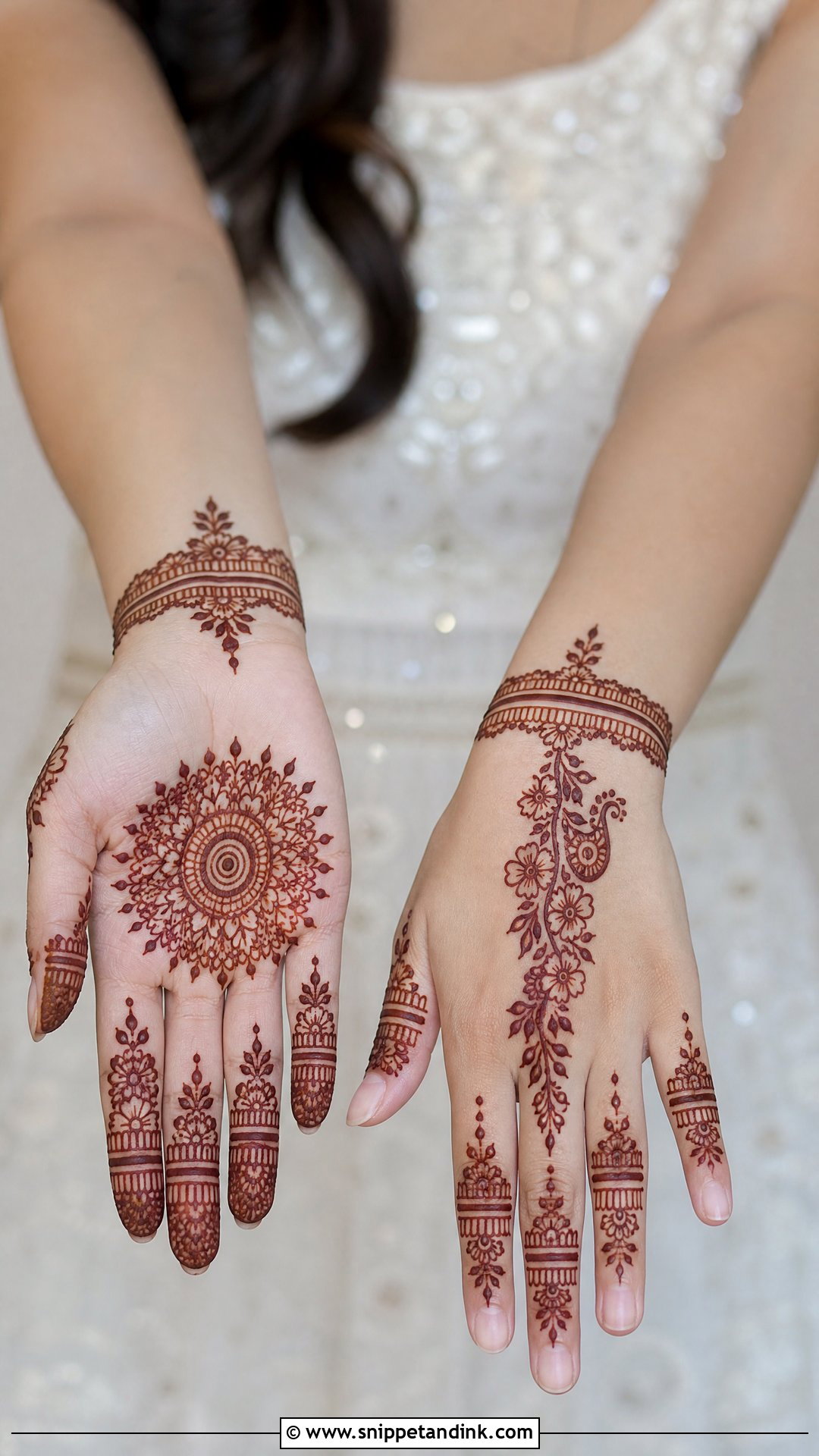
Petite hands need proportion more than detail. On a small hand I’d use a medium palm mandala, slim paisleys, fine finger bands and a short wrist border, and avoid big motifs that swallow the whole hand. Vertical flow is the trick: a back hand trail from wrist to middle finger lengthens the fingers visually. Ask for thin outlines and tighter motif sizes, and make sure the artist sizes the mandala to your palm, not to the photo you brought, which was almost certainly drawn on a larger hand.
16. Simple Bridal Mehndi For Dark Skin
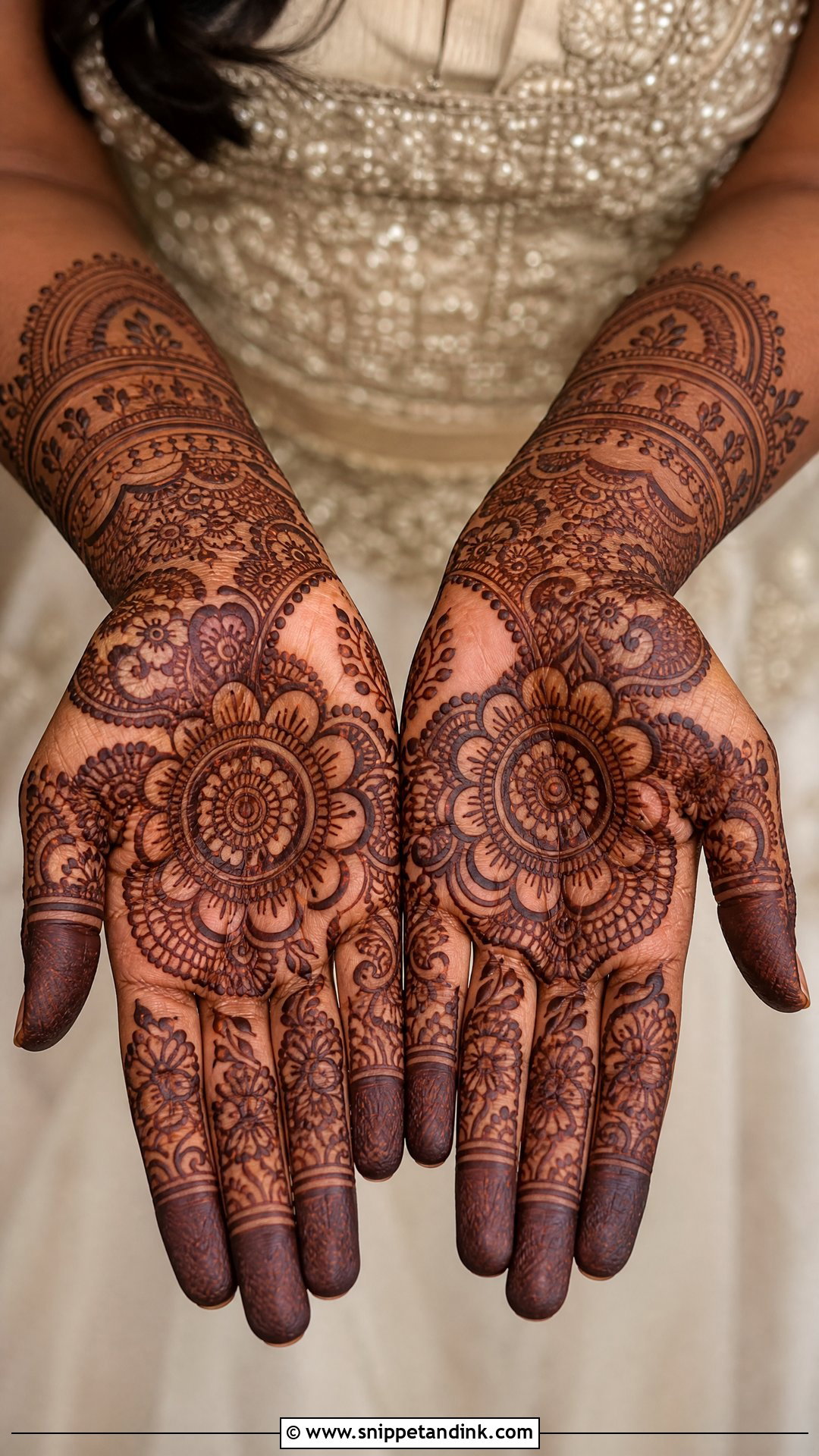
On deeper skin tones, a mature henna stain still shows as a rich brown to maroon, but fine hairlines can lose contrast. That’s why I draw bolder outlines, larger florals, thicker borders and clear gaps for darker-skinned brides, keeping fine work to a few accent areas. Mandalas, paisleys and jaali panels on the palm read best, because the palm holds the deepest stain. Aftercare matters more here than design: leaving the paste on for six to eight hours and keeping water away until the next morning is what gives you that strong contrast.
17. Simple Bridal Mehndi For Fair Skin
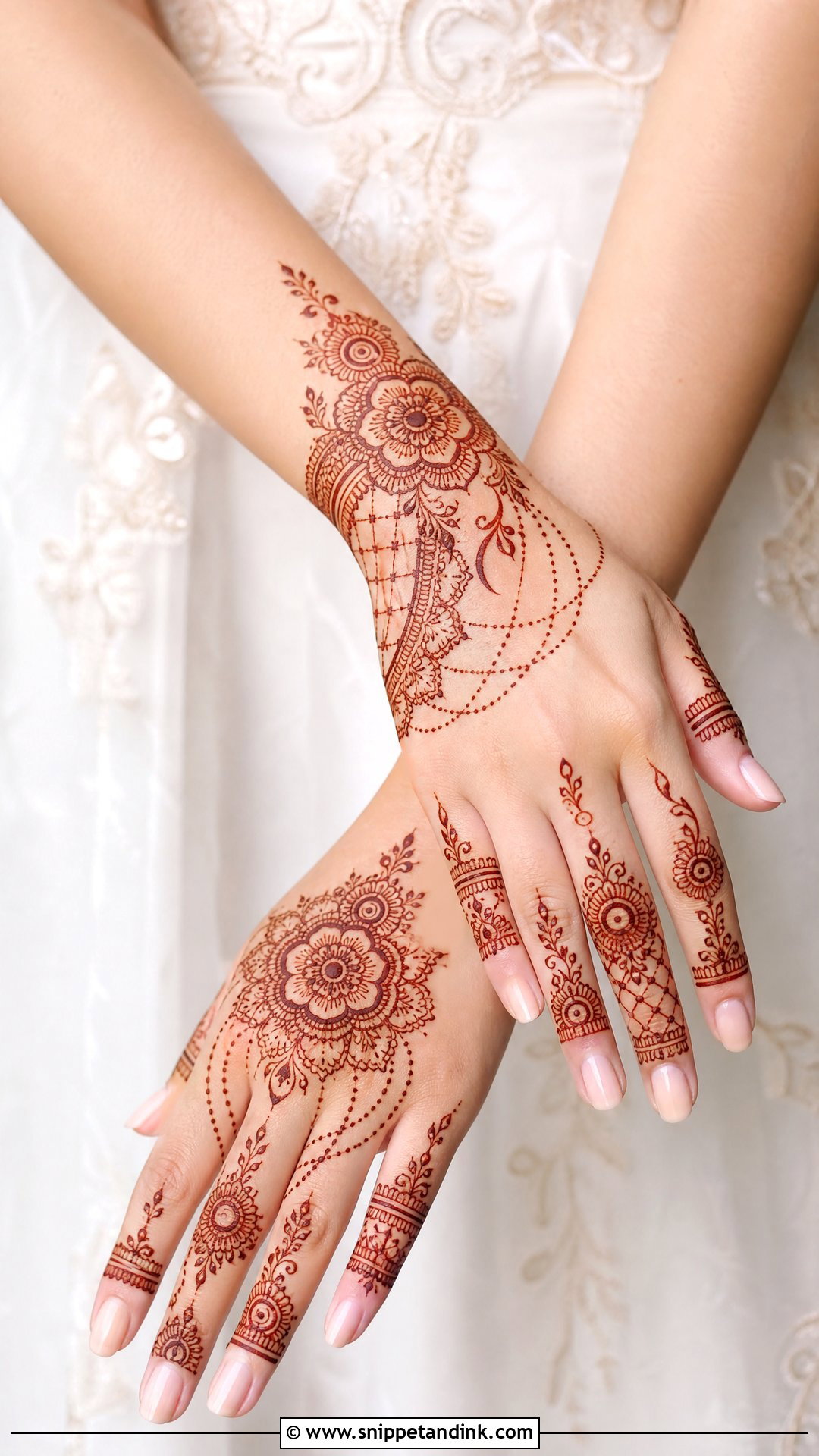
On fair skin even a hairline reads clearly, which means a light bridal design can look rich with very little filling. I lean on a soft floral mandala, thin paisley trails, dotted chains and delicate finger bands, with light shading inside leaves for depth. The flip side is that every wobble shows too, so clean lines matter more than density. The stain usually comes up bright orange on removal and deepens to reddish brown or maroon over the next two days; don’t judge the colour in the first few hours.
18. Simple Bridal Mehndi For Engagement
Engagement mehndi should feel lighter than the wedding hand, and since the ring is the point of the day, I design the back of the left hand around the ring finger. A bracelet band, a small floral mandala or an Arabic trail can frame it, while the palm gets one flower or circle. I leave the base of the ring finger bare or barely outlined, so the ring isn’t sitting on a dark patch of stain in close-ups. It’s quick to apply and doesn’t stop you from greeting guests.
19. Simple Bridal Mehndi For Nikah
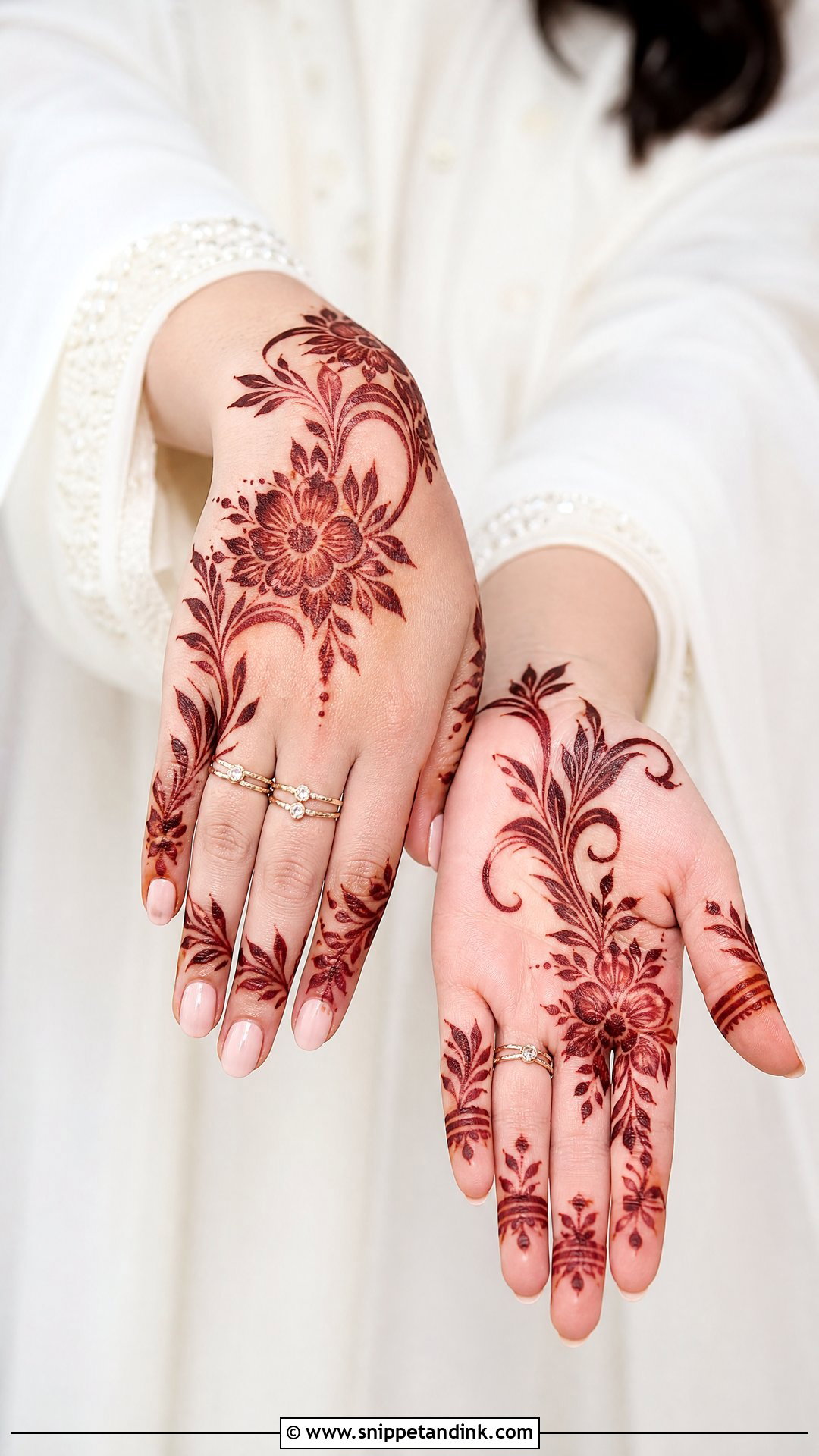
For a nikah I often reach for Arabic and Gulf-inspired layouts: open spaces, bold florals and vines starting at the wrist and moving diagonally across the back hand or palm, with shaded petals, small leaves and clean finger rings. Because hands are cupped for dua and held out during the ring exchange, I check the design from both of those angles before finishing. Mirrored trails with slight variation on each hand look more natural than strict symmetry, and it sits well with ivory, gold, pastel or jewel tones.

20. Simple Bridal Mehndi For Haldi
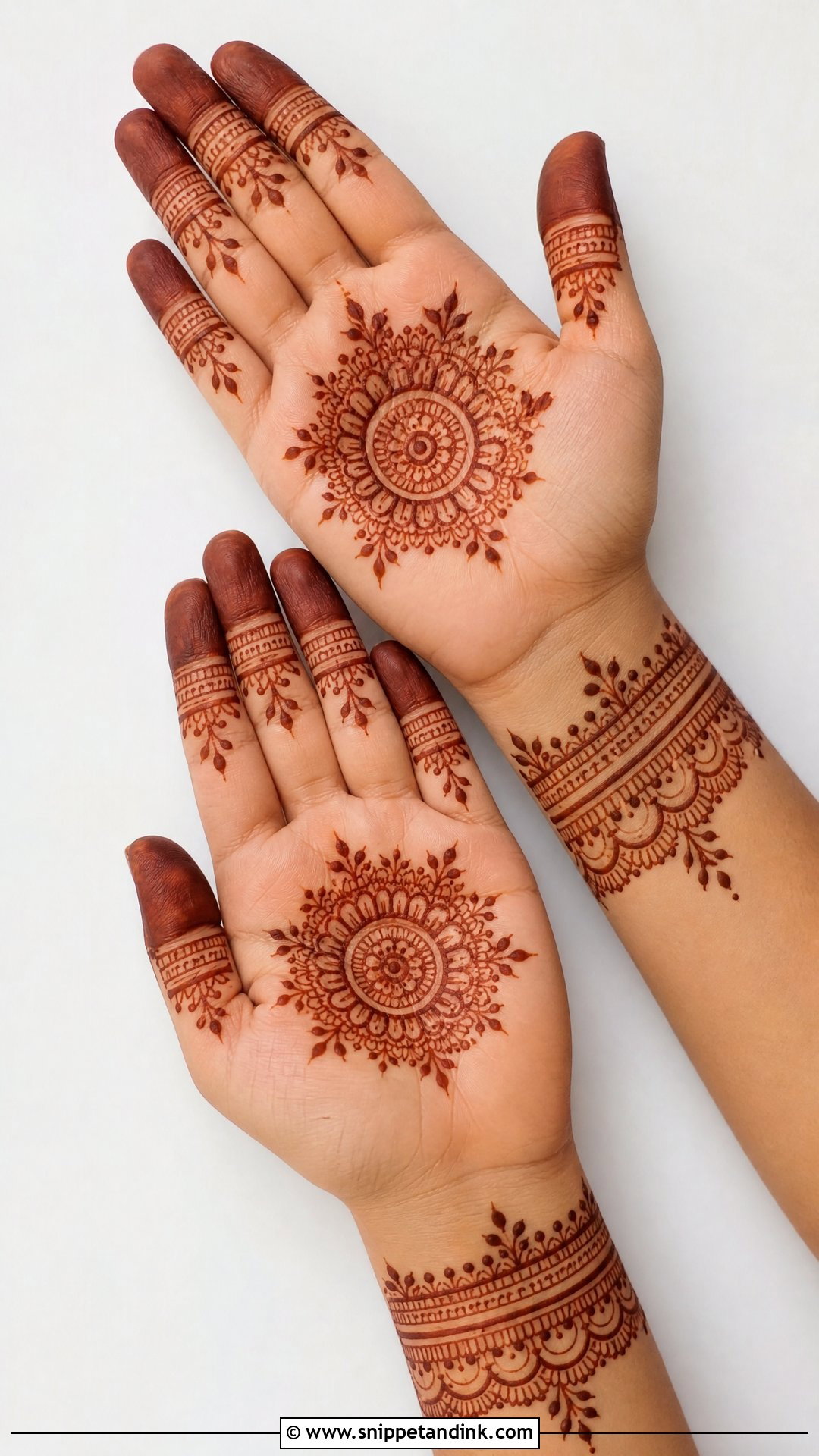
Haldi is messy by nature, and turmeric paste on fresh henna can leave a yellow cast on the skin for a day or so. That’s one reason I keep haldi mehndi minimal: a small palm mandala, sun-like florals, a leafy wrist band and light finger patterns. A lighter design also dries faster, which matters when you’re about to be covered in paste and splashed with water. Many brides keep this one small and save the fuller design for the wedding application itself.
21. Simple Bridal Mehndi For Roka
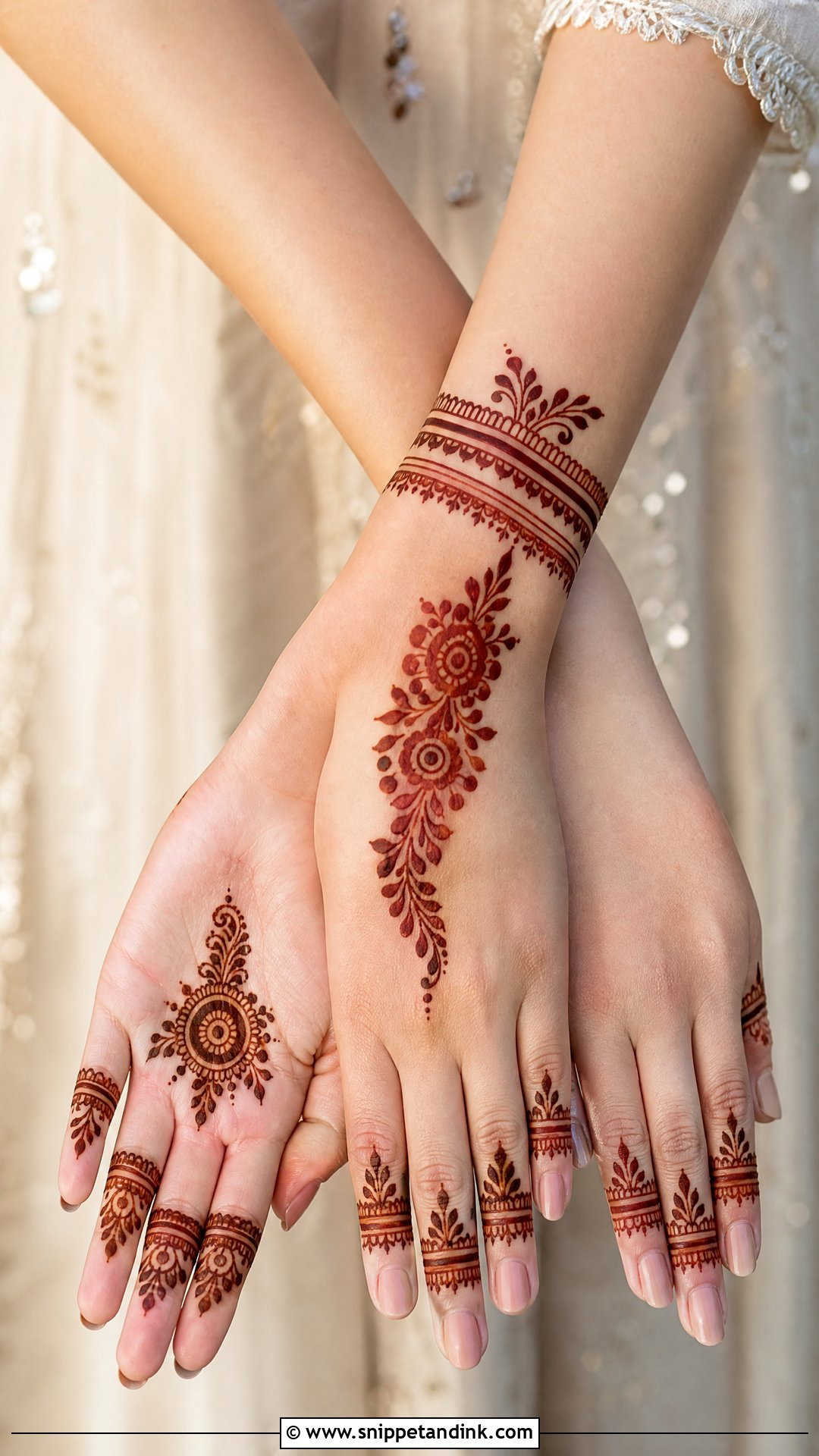
A roka needs mehndi that looks dressed up without stealing from the wedding hand. I’d draw a floral trail on the back hand, a small palm motif and slim wrist detailing, with ring-like bands on the fingers for close-ups. Tiny paisleys or a little mandala near the wrist add a traditional note. Because roka often happens weeks before the wedding, keep it light: the stain fades over one to three weeks, and you don’t want half-faded lines still visible under your bridal design.
22. Simple Bridal Mehndi For Minimal Bride
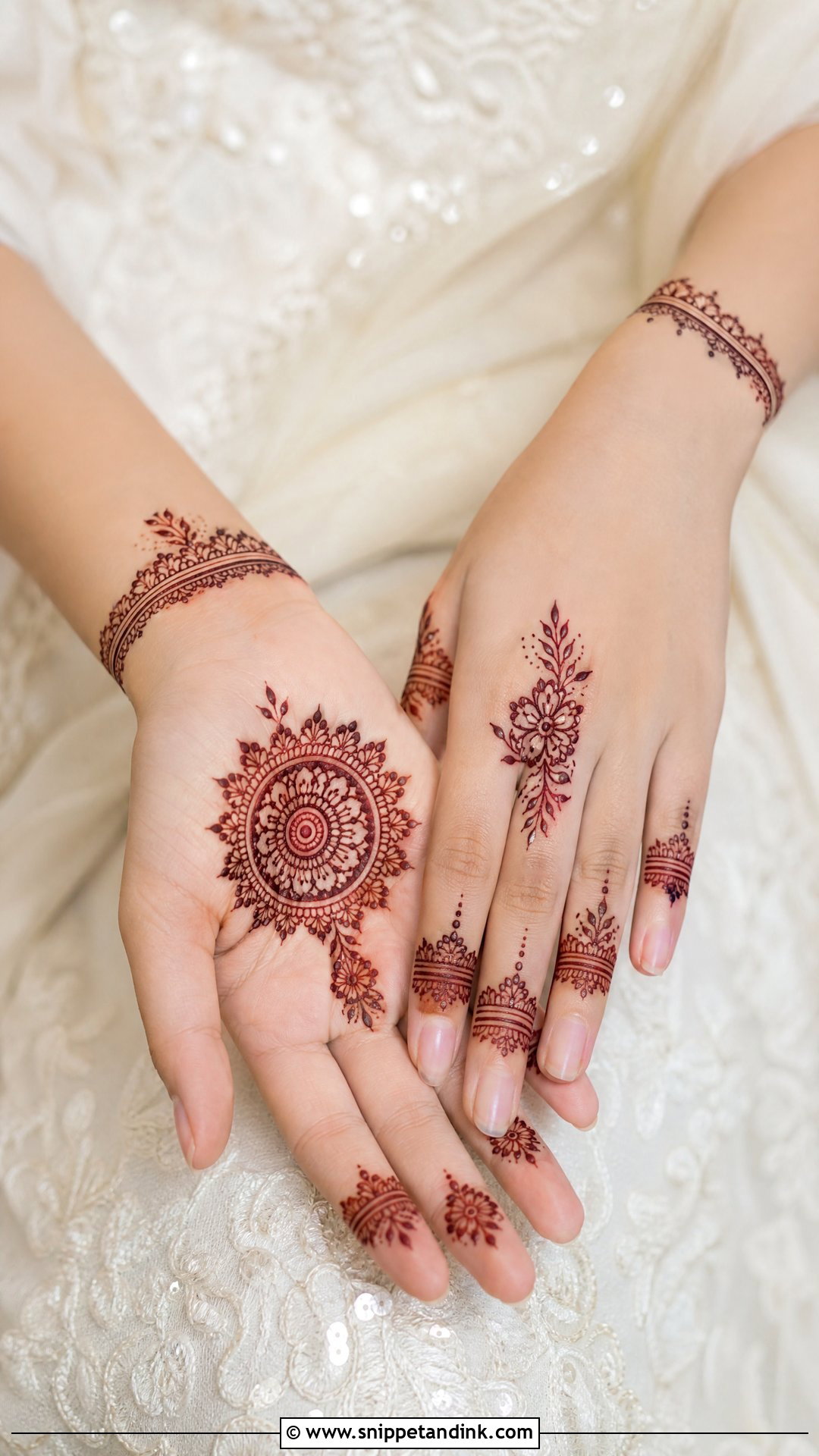
For a truly minimal bride I build the hand around one strong motif, either a palm mandala or a back hand flower, then add slim finger details and a single fine wrist line. Negative space is the design. The hard part is knowing when to stop; I’ll often finish, step back and remove a planned element rather than add one. Dots, fine leaves and simple bands complete it. This leaves room for statement rings and nail art, and it suits a small modern ceremony well.
23. Simple Bridal Mehndi With Lotus
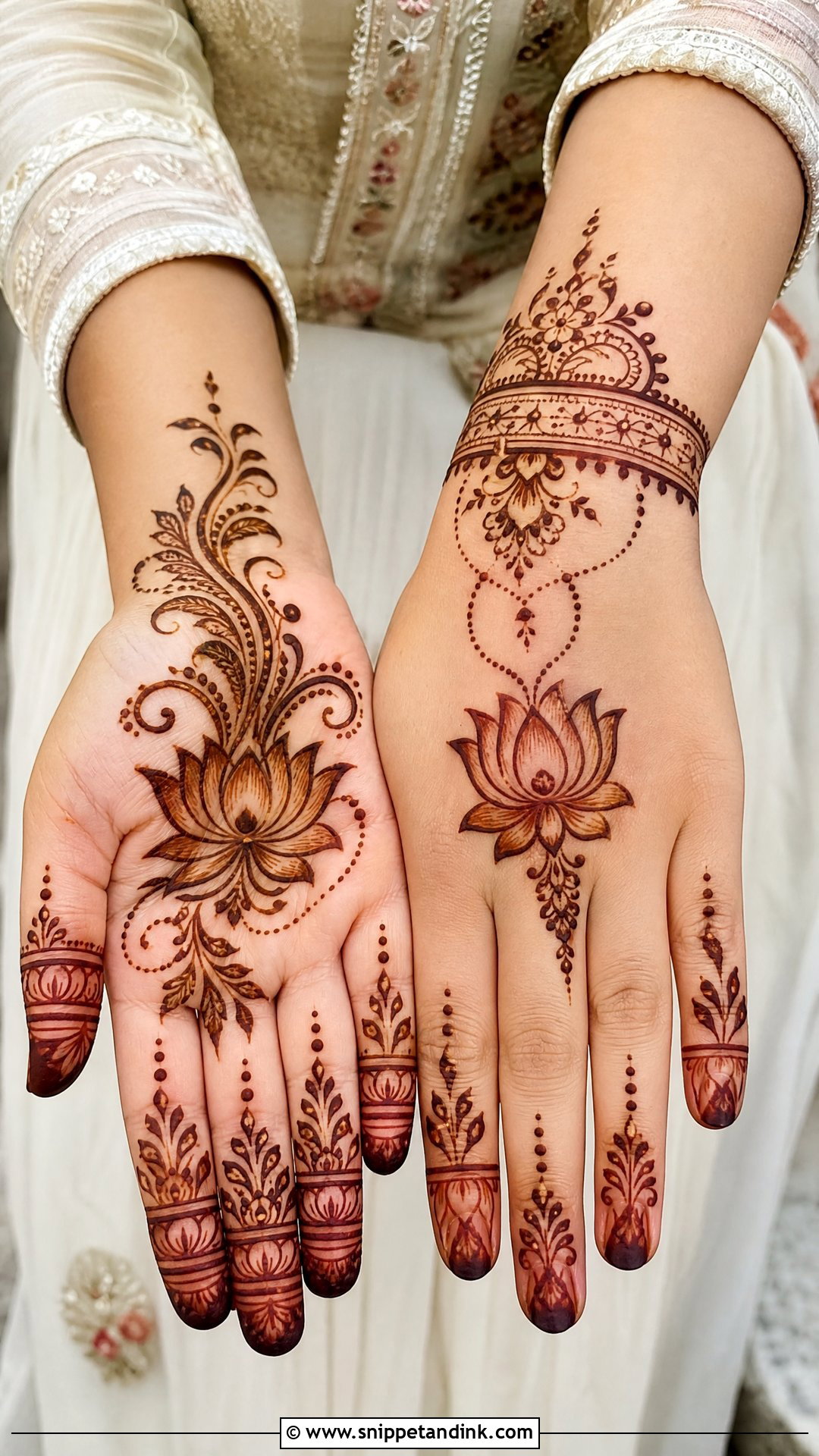
A lotus can sit in the centre of the palm, at the wrist or within a back hand trail, built from curved petals, a leafy stem and a dotted border with light shading. I stick to one or two lotuses per hand; repeat it more and it stops reading as a focal flower and starts looking like wallpaper. Lotus petals overlap in layers, so I draw the back row first and the front row last, which keeps the outlines crisp. It sits naturally with temple jewellery and classic or pastel lehengas.
24. Simple Moroccan Bridal Mehndi
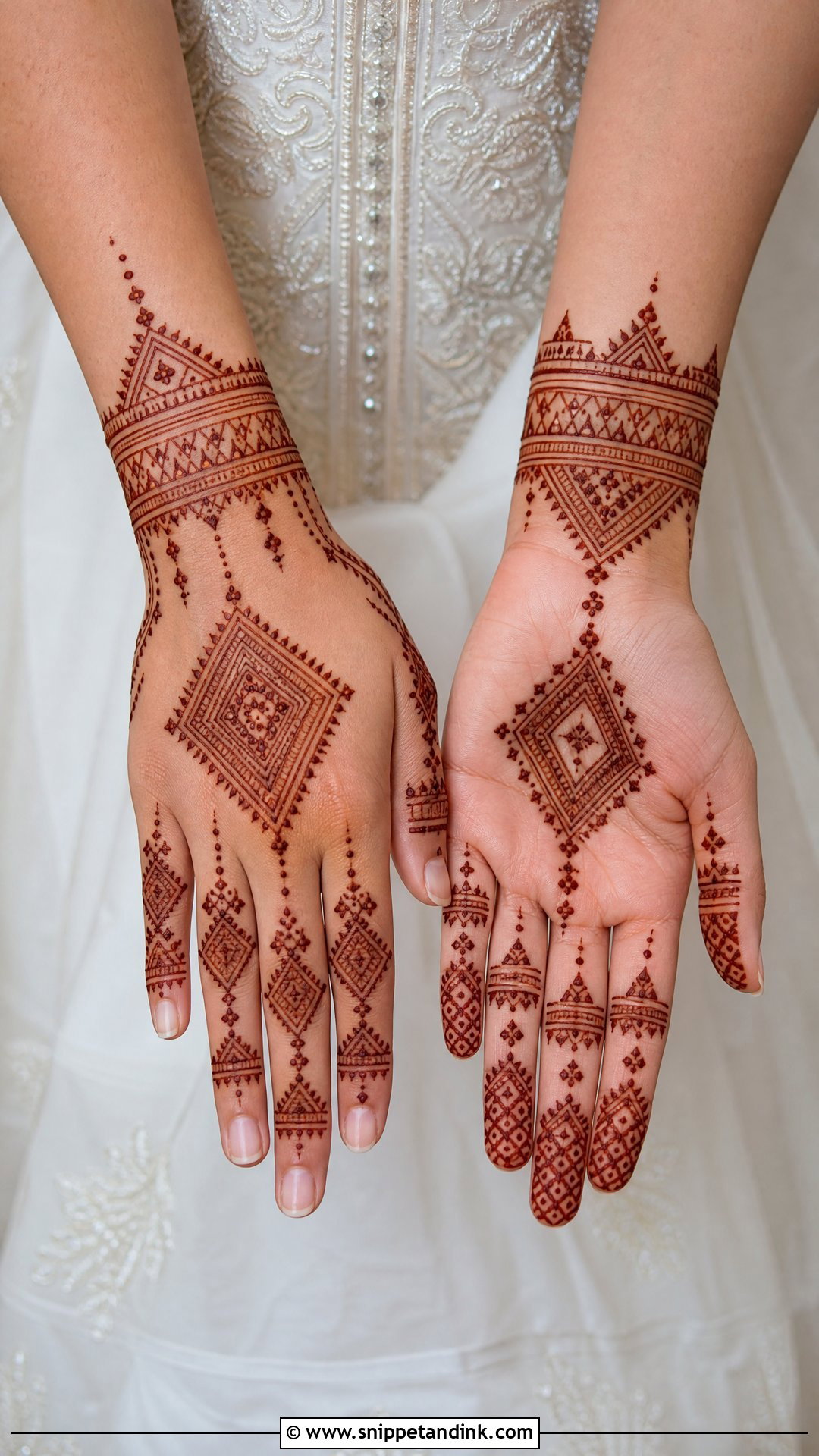
Moroccan henna is built from geometry: straight lines, diamonds, grids and bold spacing, with triangles and diamond chains on the fingers instead of flowers. It’s the least forgiving style for a beginner artist because a straight line shows every tremor. I steady my wrist on the bride’s hand and draw longer lines in short joined strokes. If you want something different from Indian or Arabic work and you’re wearing a modern outfit, it’s a strong option, but only if your artist can show you clean geometric work in her portfolio.
25. Simple Gulf Bridal Mehndi
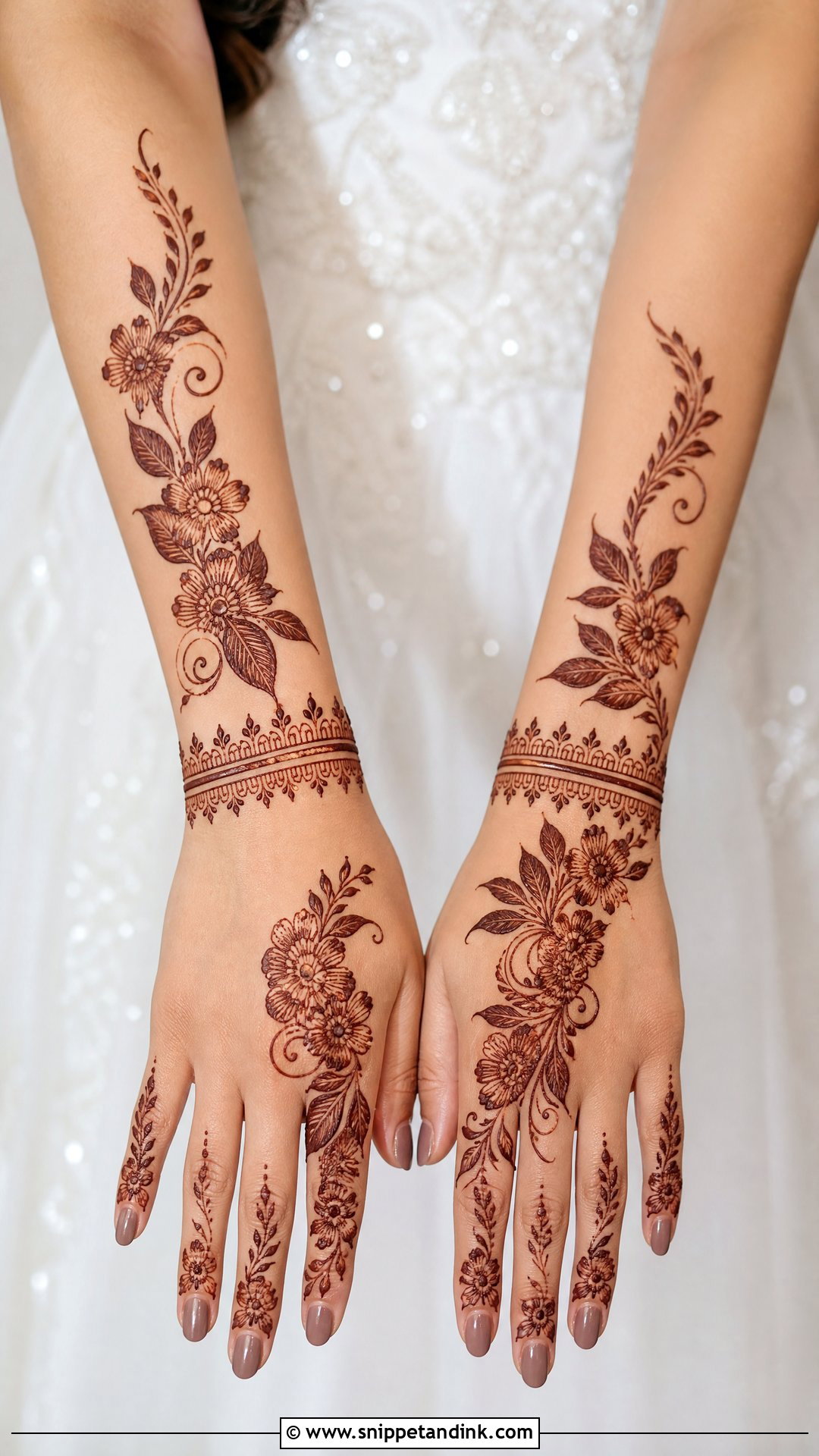
Gulf (Khaleeji-inspired) mehndi uses bold floral clusters, big shaded leaves and wide stretches of bare skin, flowing across the back hand, wrist and fingers. It’s close to Arabic work but more dramatic because the motifs are larger. I add a neat wrist band and balanced finger details so it reads as bridal rather than casual. The large shapes are easy to see from across a room, and they hold up well as the stain fades because there’s no fine work to blur first. Ask for natural henna that matures to deep maroon.
Briefing Your Artist When You Want Less, Not More
Brides who ask for simple mehndi often end up with more coverage than they wanted, because many artists are used to filling space. The fix is to be very specific at the booking, not on the day.
- Bring two or three reference photos and point to what you like in each, such as the spacing, the motif or the finger pattern.
- Say where the design should stop: mid-forearm, wrist or knuckles. A line on your arm is clearer than a description.
- Decide palms, backs or both, and whether each side should match.
- Mention your outfit sleeves and the jewellery you’ll wear, so the design doesn’t vanish under a kada or end awkwardly under a cuff.
- Ask how long your chosen design takes, then add time to sit still while it dries.
A light bridal hand usually takes one to three hours for both sides, against five or more for dense full coverage, though it varies a lot by artist and design. Give yourself that time without guests queuing beside you, and eat something before you start; you won’t have your hands for a while.
Less Coverage, Still Unmistakably Bridal
A light bridal hand still has to carry the weight of the day. Full Indian patterns, Arabic trails, mandalas, jaali panels, bracelets, lotus motifs or minimal finger work can each be scaled to your outfit and ceremony, and the right choice is the one that fits your hand shape, skin tone, jewellery and schedule. If clean beauty appeals to you more than heavy coverage, any of these simple designs will give you meaningful bridal henna you can comfortably wear from the first ritual to the last.
You'll Like These Ideas:





Leave a Reply