
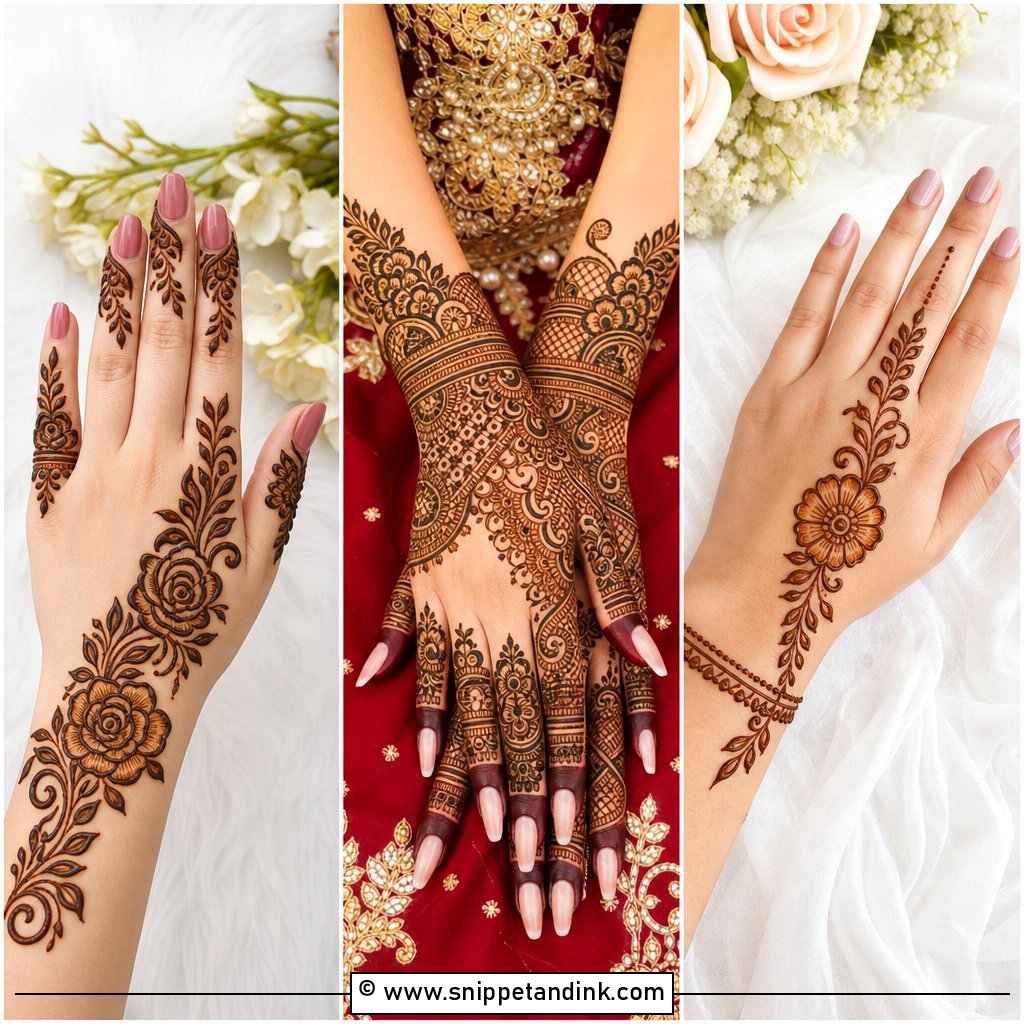
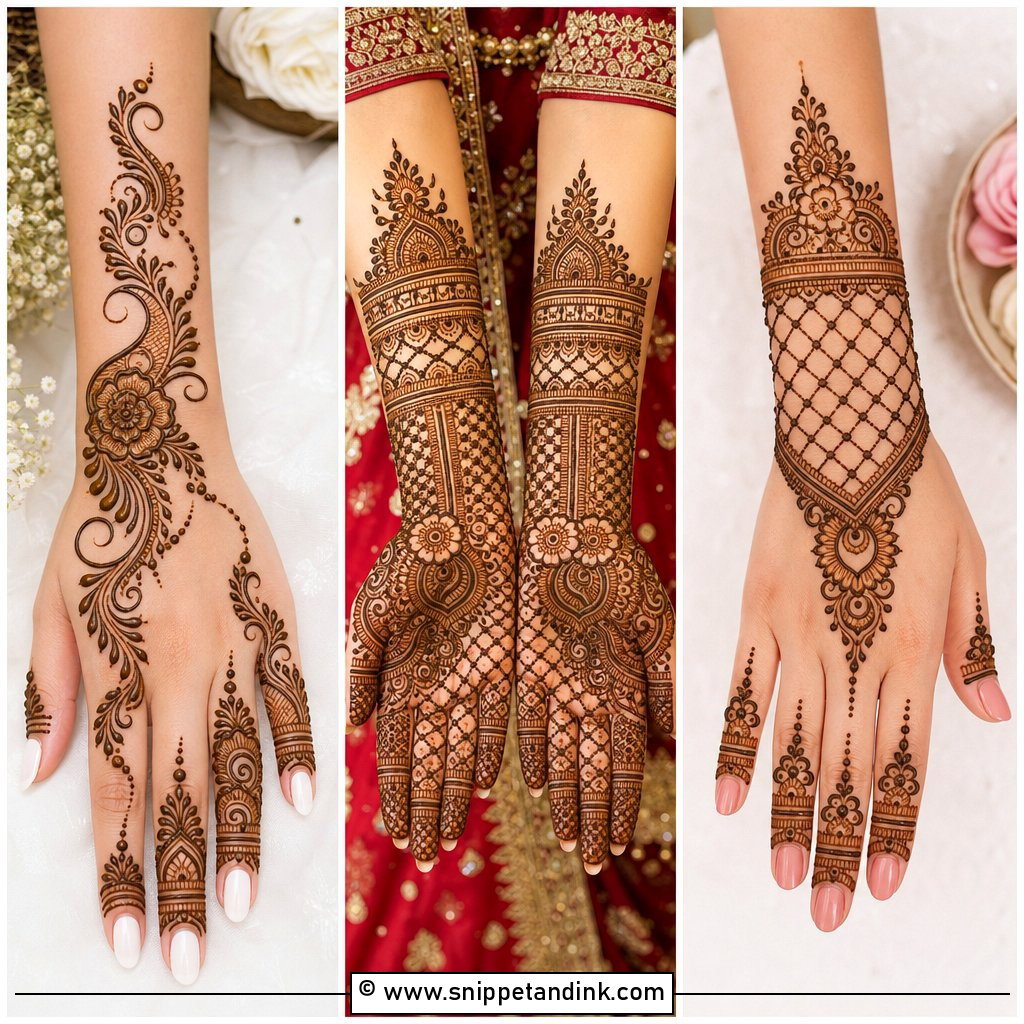
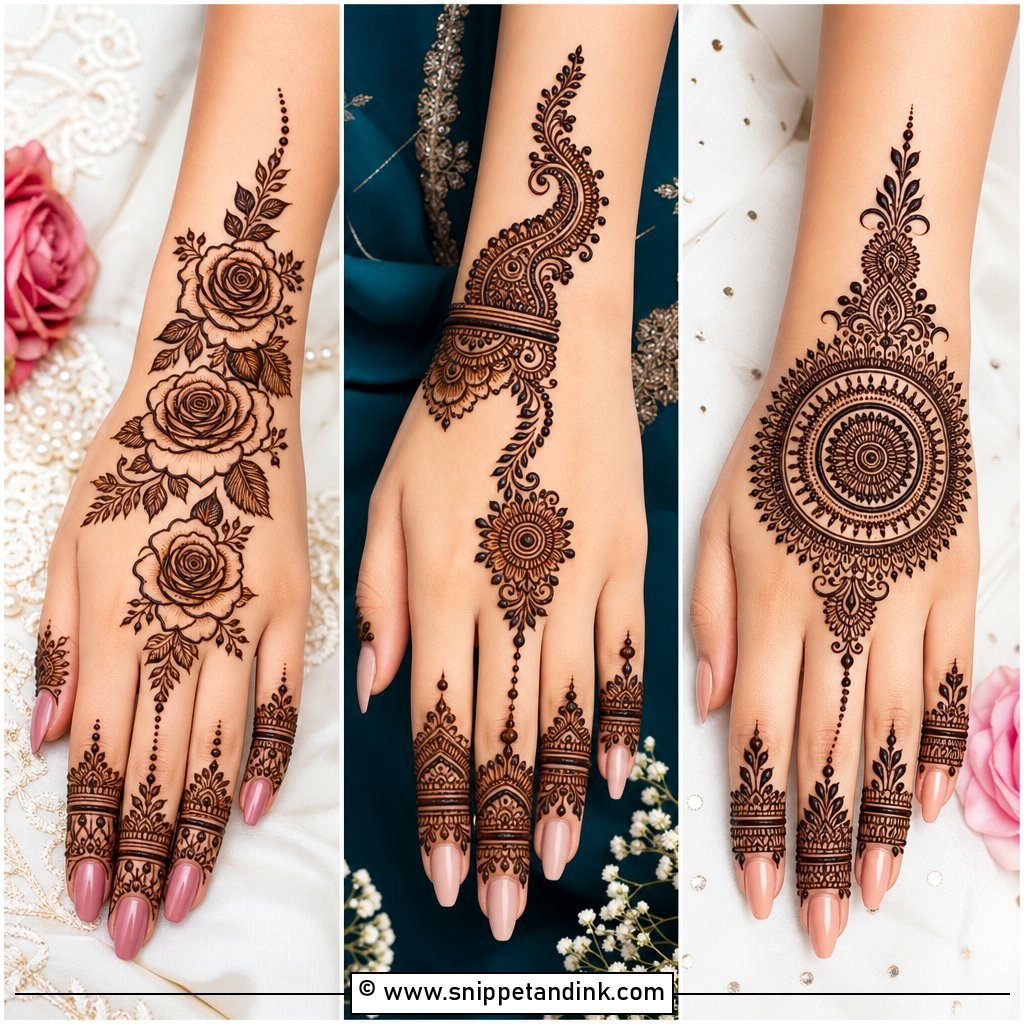
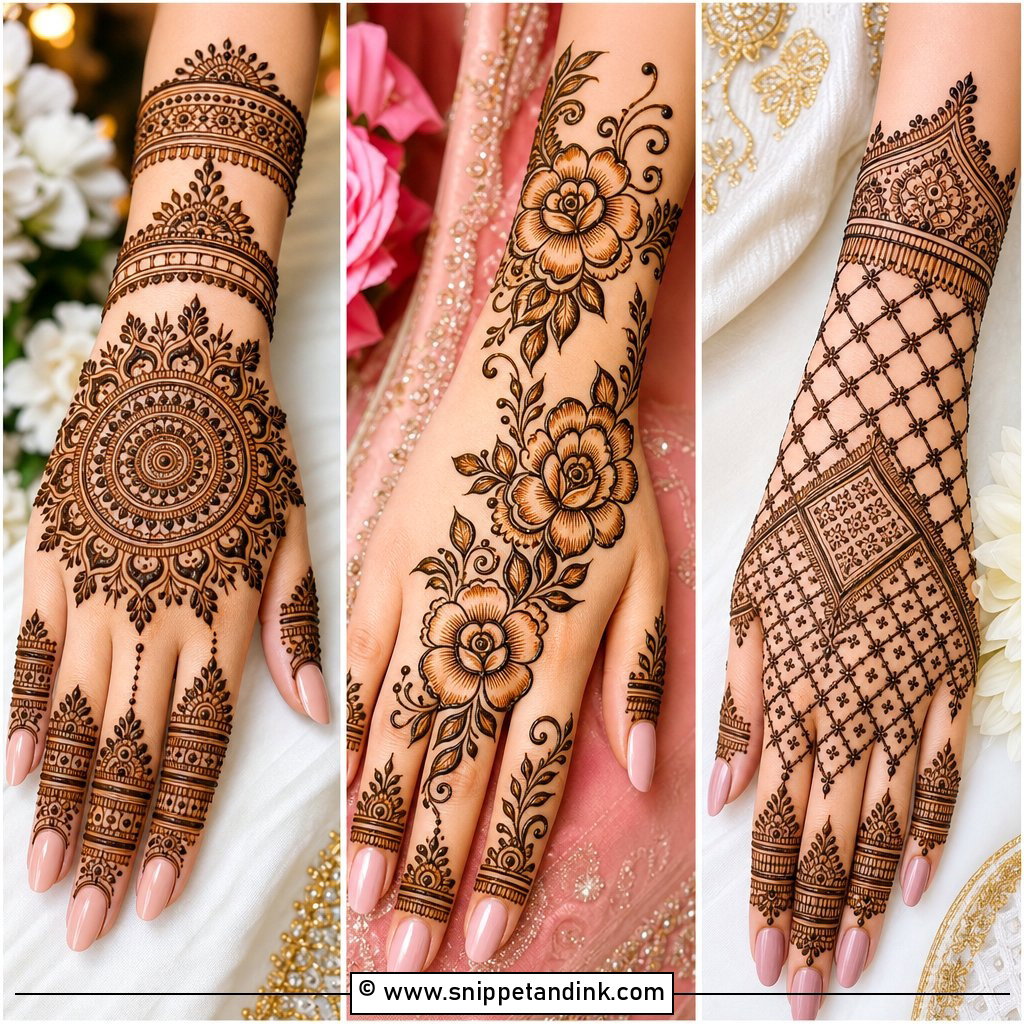
Clients often come to me saying they want ‘Arabic’ without being sure what makes it Arabic. The short answer is space. Instead of filling the hand edge to edge, the design moves in a flowing line of vines, shaded flowers, paisleys and occasional jaali, and the bare skin between them is as deliberate as the motifs. That’s why it suits so many occasions, from a bride’s full hands to a quick Eid trail or a child’s first mehndi. Below are 35 Arabic-style designs, with notes from my own sessions on where each one sits on the hand, how it’s drawn and who I’d steer toward or away from it.
Sleeves, Bangles and Rings Decide Where the Henna Goes
Before I suggest a design, I ask what the client is wearing. Henna sits next to fabric and metal all day, and half the work is placing it where it will actually be seen.
Long or full sleeves
Forearm work disappears under a full sleeve, so I put the effort into the hand and stop the design with a neat cuff just above the wrist bone. That edge shows every time the sleeve shifts, so it should look finished on its own.
Stacked bangles
A heavy stack covers the lower wrist completely. Skip fine wrist detail and move the interest onto the back of the hand. Wait to put the bangles on until the paste has come off, or they’ll drag through it.
Rings and a haathphool
If you’ll wear a hand chain or several rings, tell your artist beforehand. I leave clean channels where the chain will lie, because henna under metal looks cluttered and chains catch on dry paste.
Printed or heavily embroidered outfits
Busy fabric next to busy henna fights for attention. With a heavily worked outfit, I’d choose a lighter Arabic trail with plenty of open skin; with a plain outfit, the hands can carry more.
1. Simple Arabic Mehndi Design
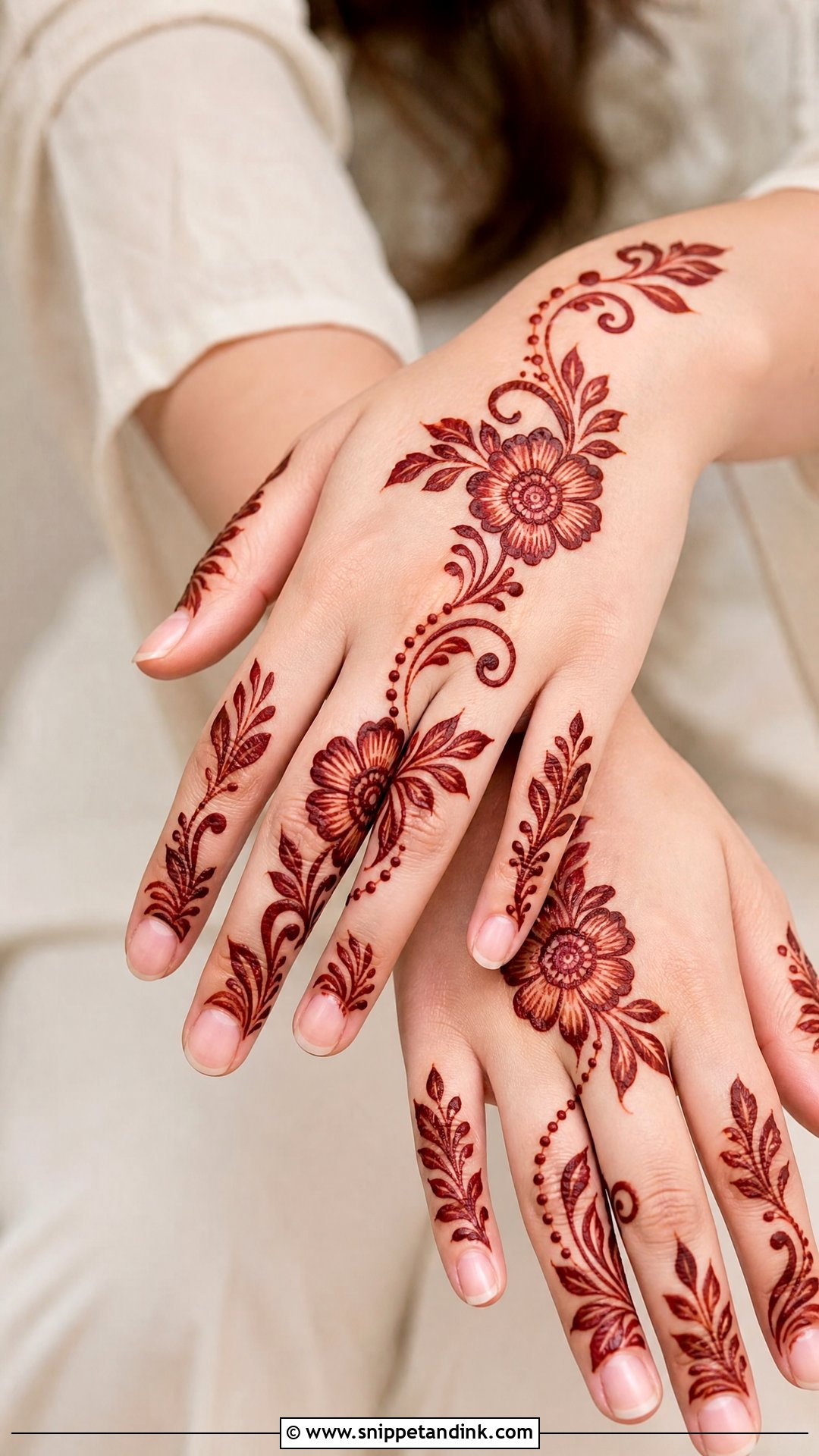
Start here if you’ve never worn henna or you need it done in twenty minutes. One diagonal line runs from the wrist toward the index or middle finger, carrying two or three bold flowers, a few leaves and some dots. I draw the largest flower first, about a third of the way up the hand, and let everything else hang off it. The fingertips can be filled or left bare. Bold outlines matter more than detail on a small design, because thin lines on the back of the hand often stain faintly.
2. Arabic Mehndi Design Front Hand
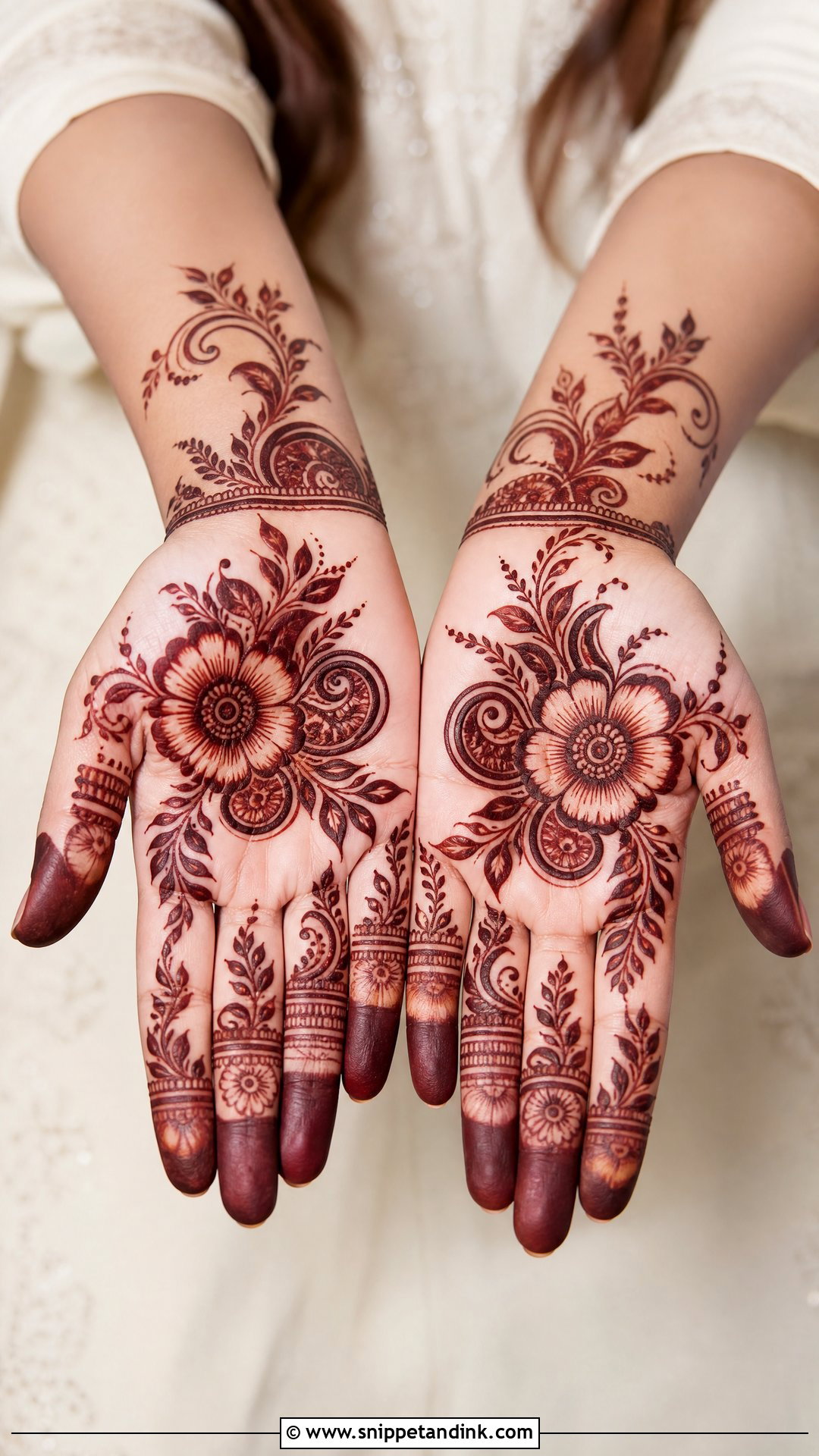
On the palm, I build from a single large flower in the centre and let paisleys, leaves and curved vines run toward the wrist, with matching leafy trails or ring bands on the fingers. The palm can carry much more detail than the back of the hand without looking crowded, since Arabic spacing leaves room around each motif. Ask your artist for thicker outlines around the flowers and fine shading inside the petals. Then keep your fingers spread while it dries; curling them, even slightly, smears the creases of the palm.
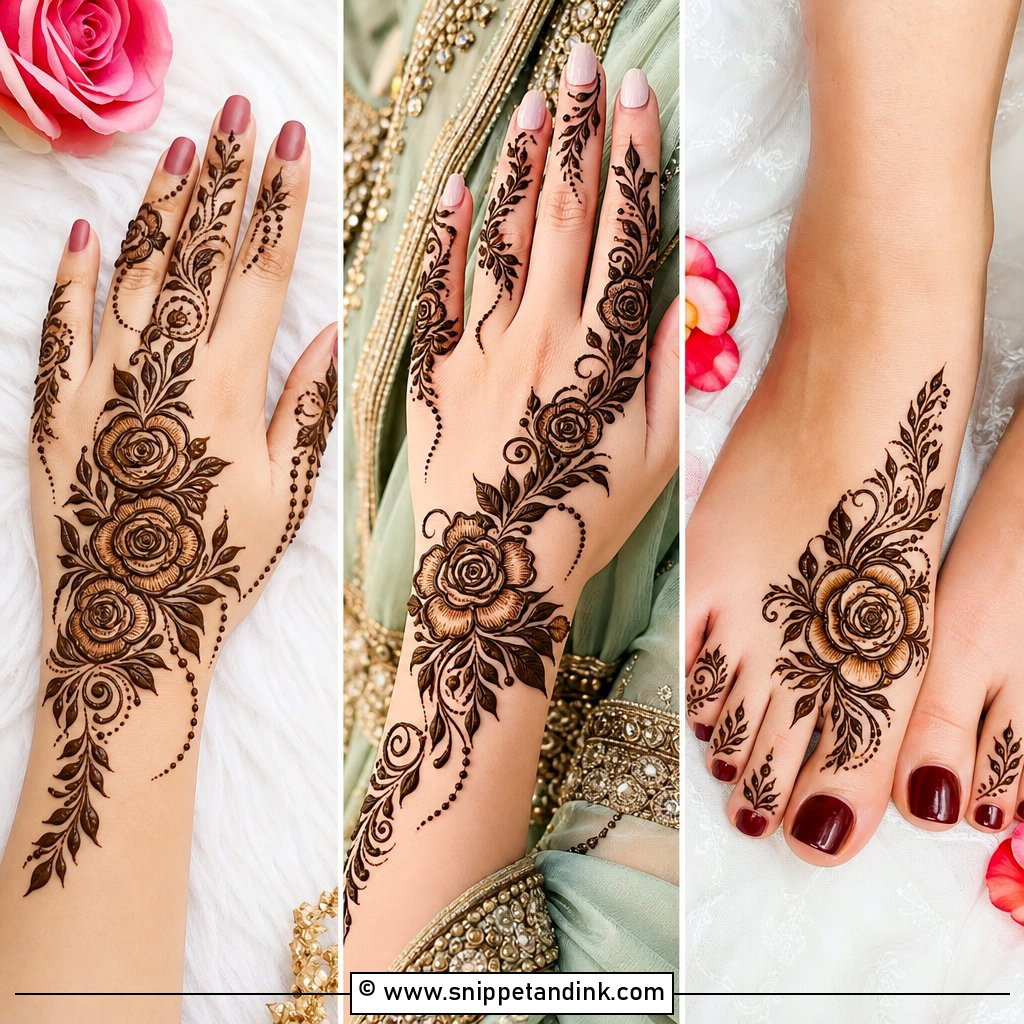
3. Arabic Mehndi Design Back Hand
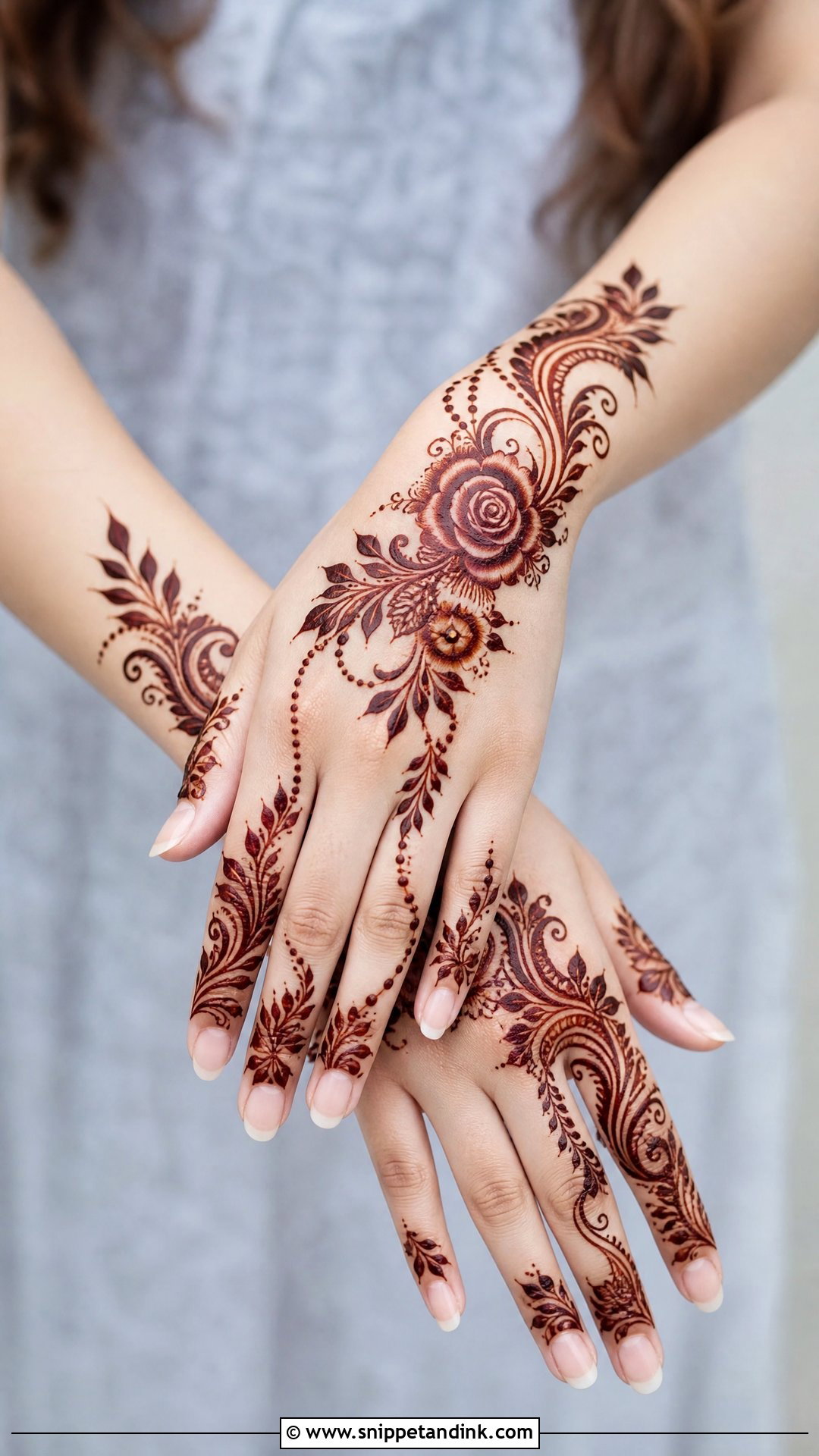
The back of the hand is where most people first notice henna, so it’s the placement I’m asked for most. A classic back-hand Arabic design travels from the wrist to one finger with shaded roses, paisleys, dotted chains and leafy vines, sometimes with a small mandala at the start. It’s quick compared with dense bridal work. One honest caveat: skin on the back of the hand is thinner and stains lighter than the palm, so I draw this placement with slightly heavier lines to get a colour that holds up in photos.
4. Full Hand Arabic Mehndi Design
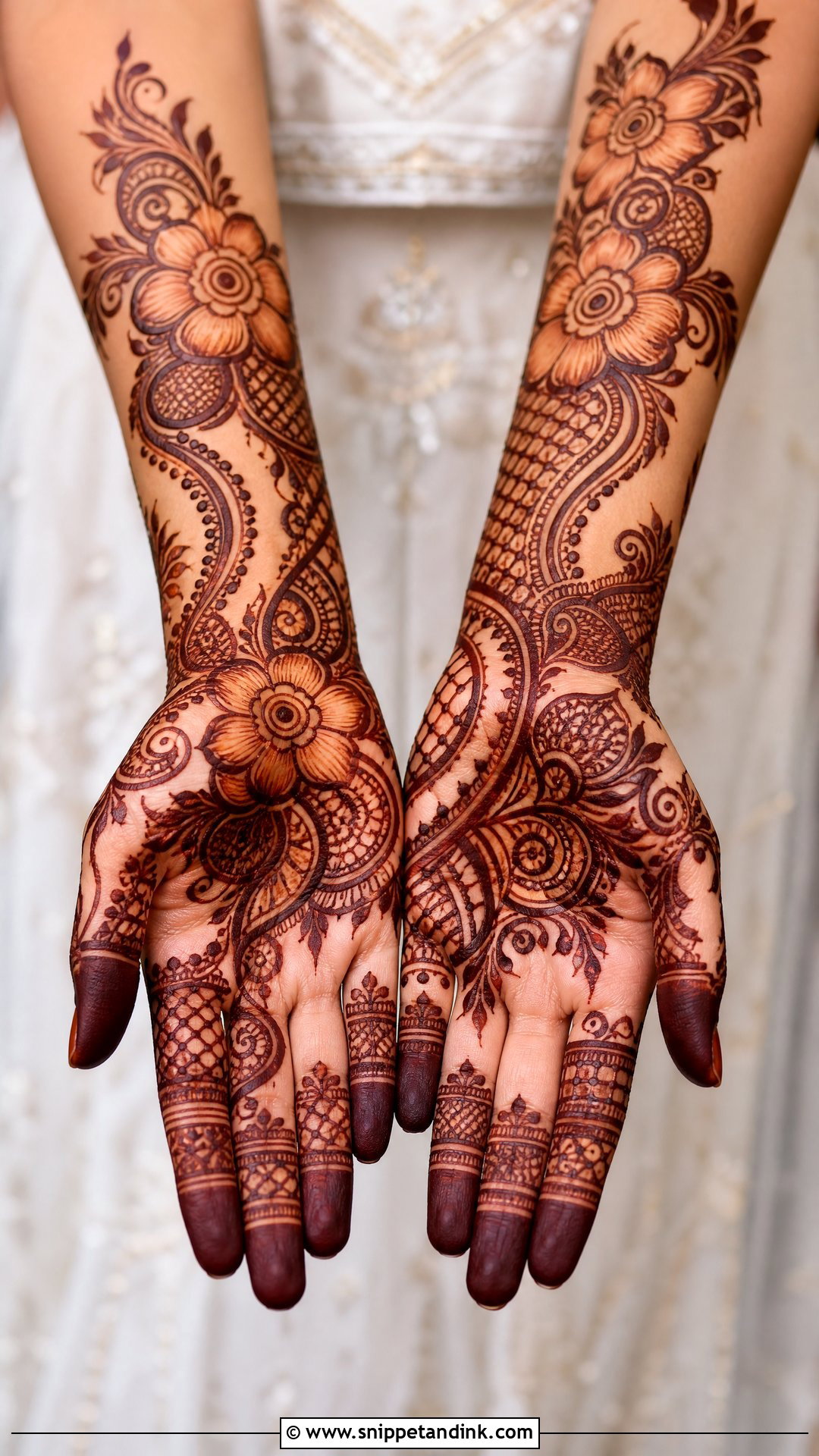
Full Arabic coverage runs from fingertips to wrist, sometimes a little onto the forearm, with floral clusters, paisley chains, leafy stems, jaali panels and curved borders. It never needs every tiny gap filled, which is what makes it far quicker than a traditional full hand and lighter to sit through. I keep three or four large motifs as anchors and let smaller details join them. Bridesmaids and sisters of the bride pick this most, because it looks dressed for the occasion without competing with the bride.
5. Bridal Arabic Mehndi Design
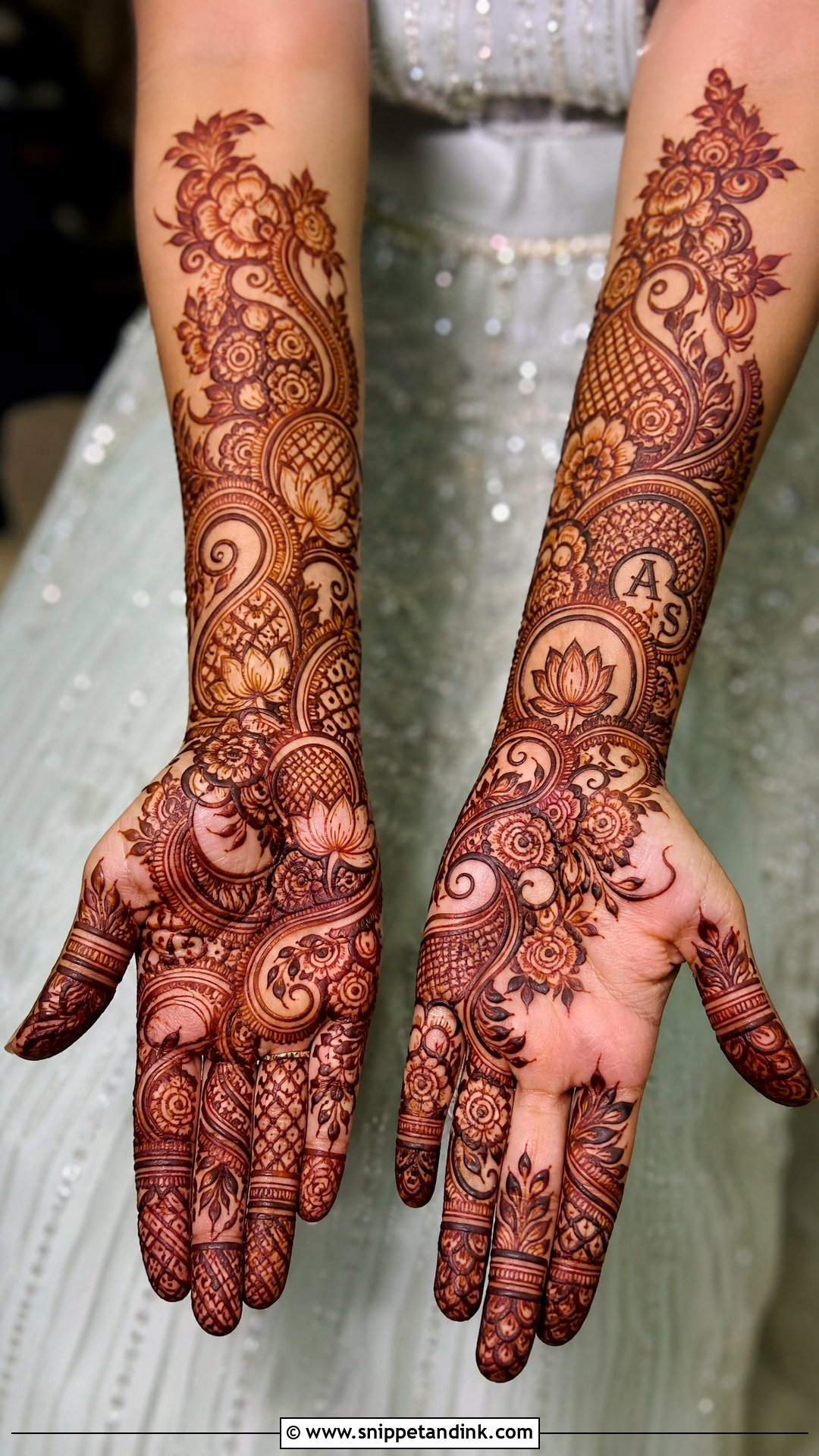
Bridal Arabic mehndi design can cover palm, back, fingers, wrist and forearm with floral trails, paisleys, jaali, lotus motifs and shaded leaves, yet still leave visible gaps. I usually make the two hands related rather than identical: the same flowers and borders, arranged differently, so they look custom when held together. Initials or the wedding date can hide inside a paisley. Plan for a long sitting, often several hours for both hands and arms, and eat beforehand, because you won’t be using your hands for a while.
6. Arabic Floral Mehndi Design
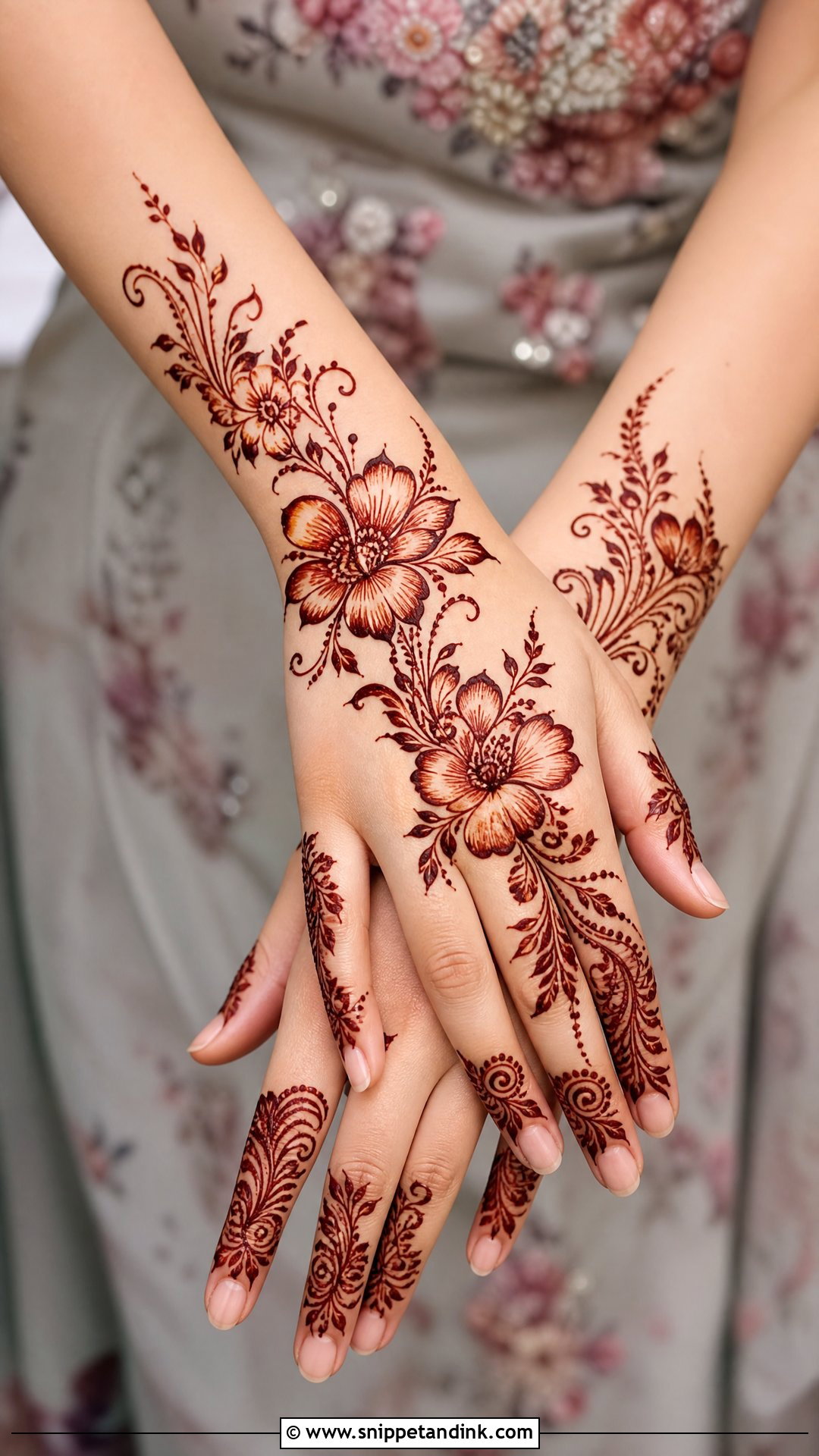
Flowers suit Arabic layouts better than any other motif, because a rounded bloom sits naturally on the curve of a trail. Large roses or round blossoms go on the palm or back of the hand, joined by leafy vines and curved stems, with mini flowers or dotted trails on the fingers. I outline each flower boldly, then add soft shading inside so it looks fuller once the stain develops. It scales from light to heavy, which makes it a safe pick when you don’t yet know what you’ll be wearing.
7. Arabic Rose Mehndi Design
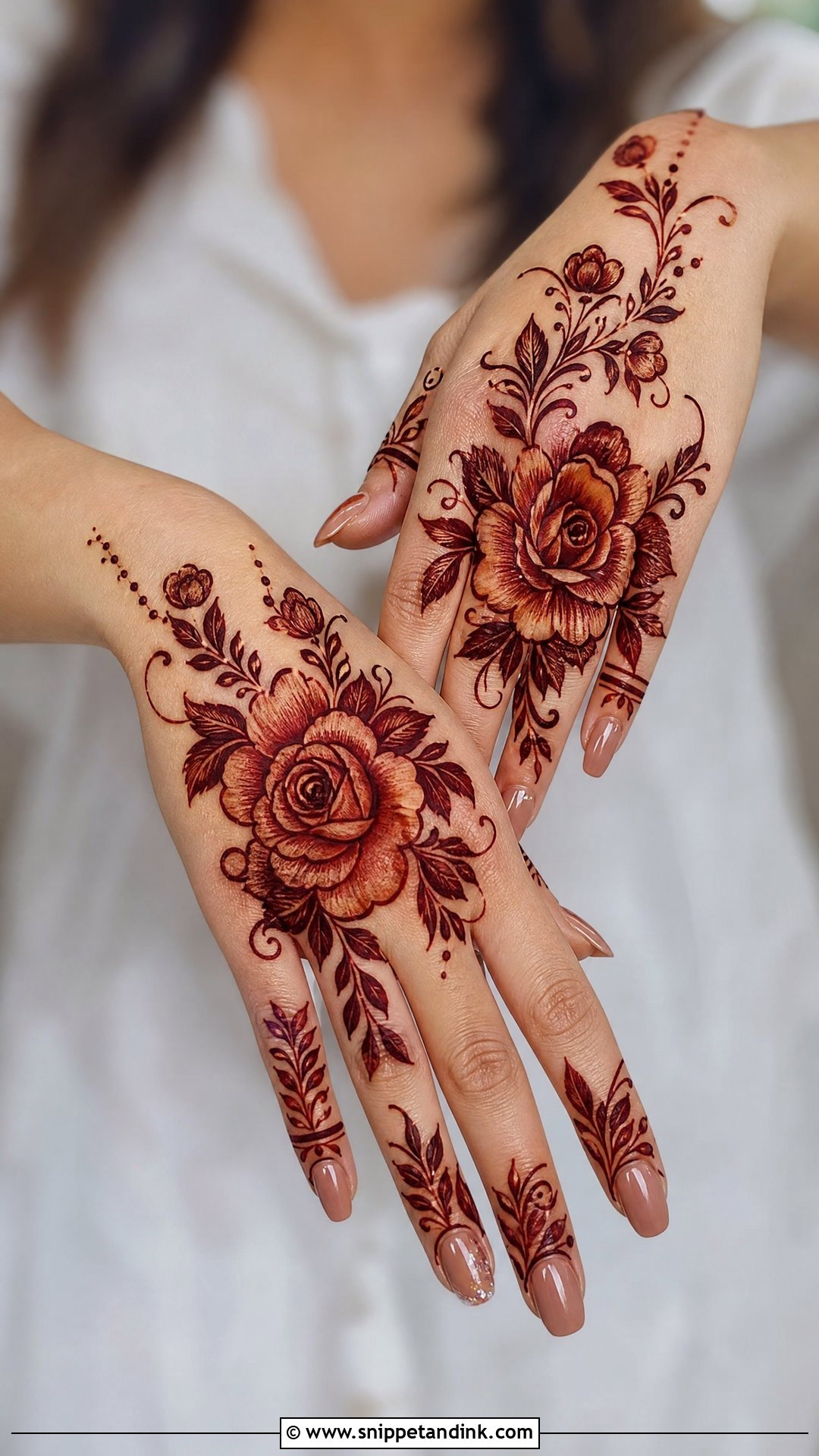
A single big rose needs its petals separated by very fine gaps, or the stain merges them into one dark disc. Shading is what makes them look layered: I put more paste at the base of each petal and drag it thin toward the edge. The rose can sit on the back of the hand, the palm or the wrist, connected to smaller buds and leaves along a curved trail. Leave the space around it open. Fine dots and thin curls finish it, and it suits anyone who prefers a feminine design without lots of tiny filler.
8. Arabic Paisley Mehndi Design
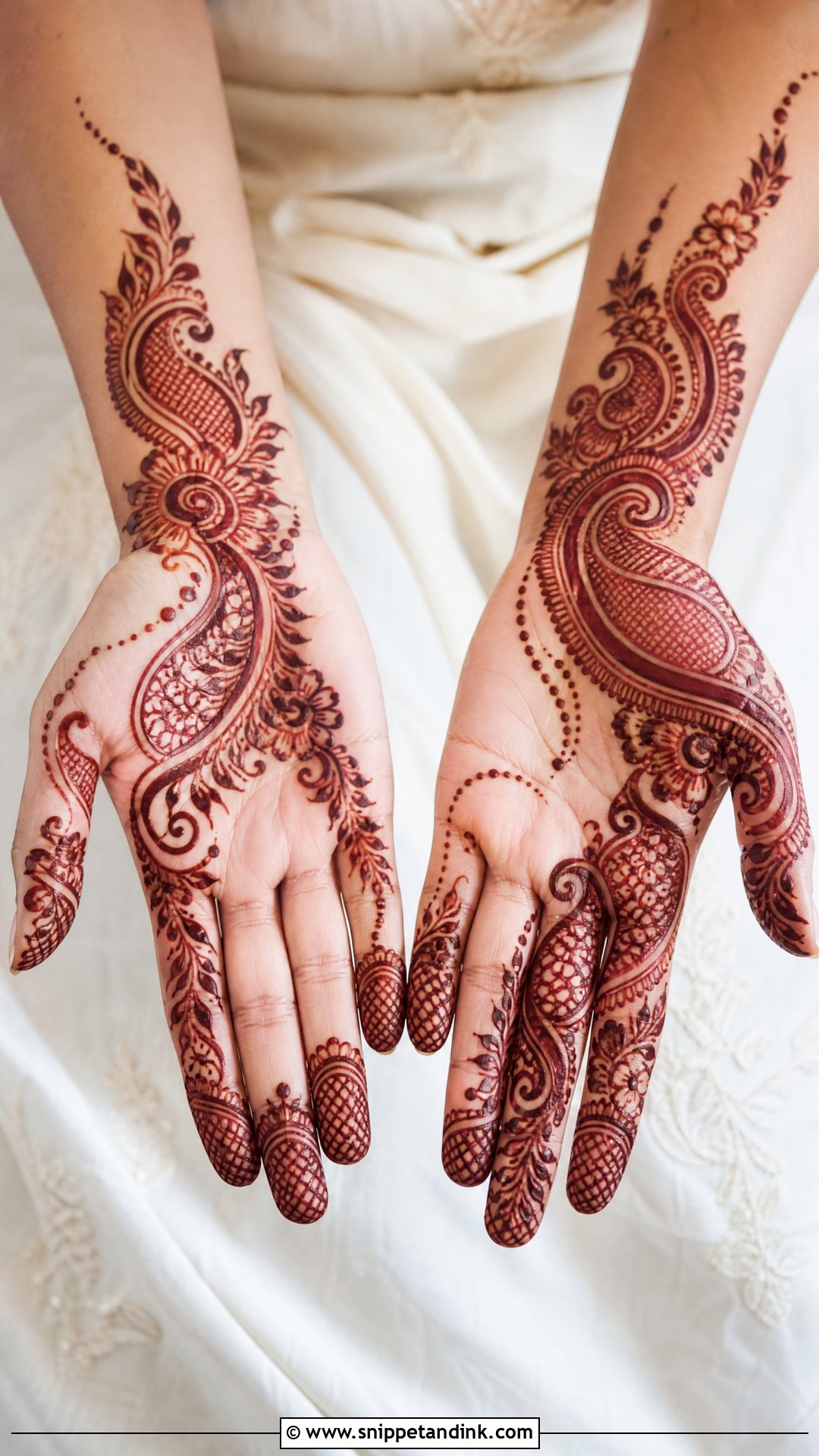
In Arabic work, paisleys look best bold and slightly spaced, rather than nested together as they are in dense Indian patterns. They can cross the palm, follow the wrist or form part of a diagonal back-hand trail, filled with small leaves, mesh, dots or tiny flowers. I alternate the fill from one paisley to the next so the eye has a reason to travel. Paired with flowing vines, they give a traditional feel without weight, which is why older relatives and younger guests often both like this one.
9. Arabic Mandala Mehndi Design
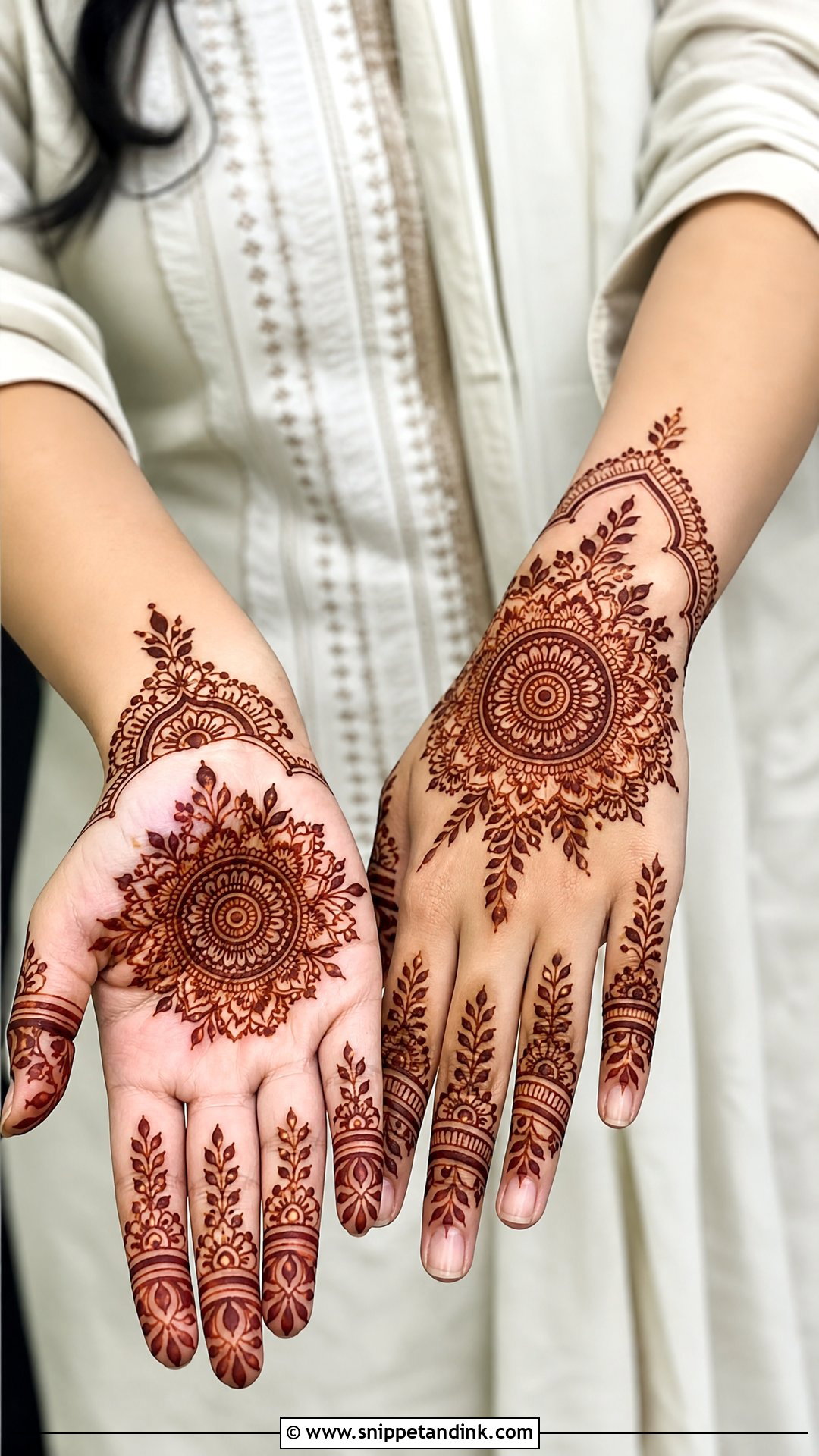
A mandala gives an Arabic design a fixed centre. It sits in the middle of the palm or back of the hand, then curved vines, floral borders and leafy finger patterns extend from it. The size matters more than people expect: a mandala smaller than a coin turns into a dark dot once it stains, so I keep it at least the width of two fingers. Light finger detail and an open wrist balance it. It suits festivals, pujas, Eid gatherings and small family events.
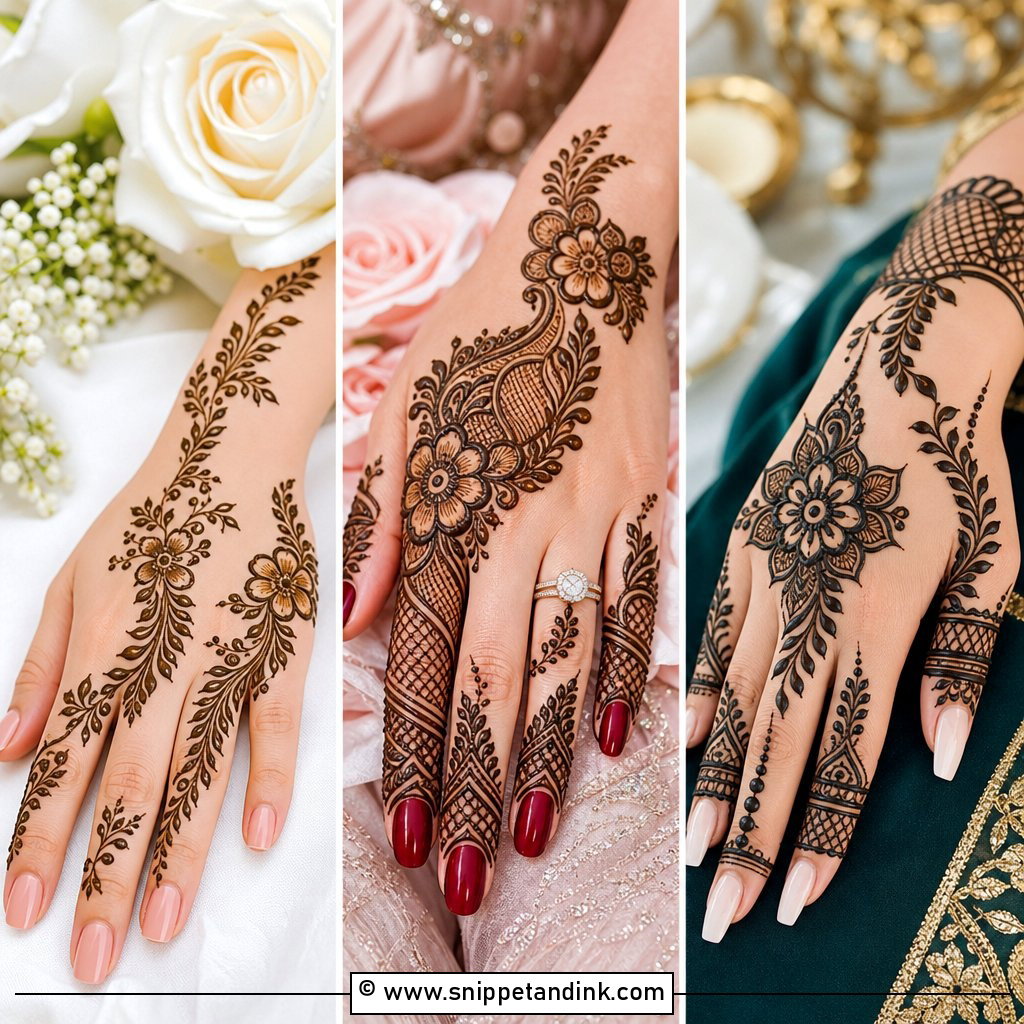
10. Arabic Jaali Mehndi Design
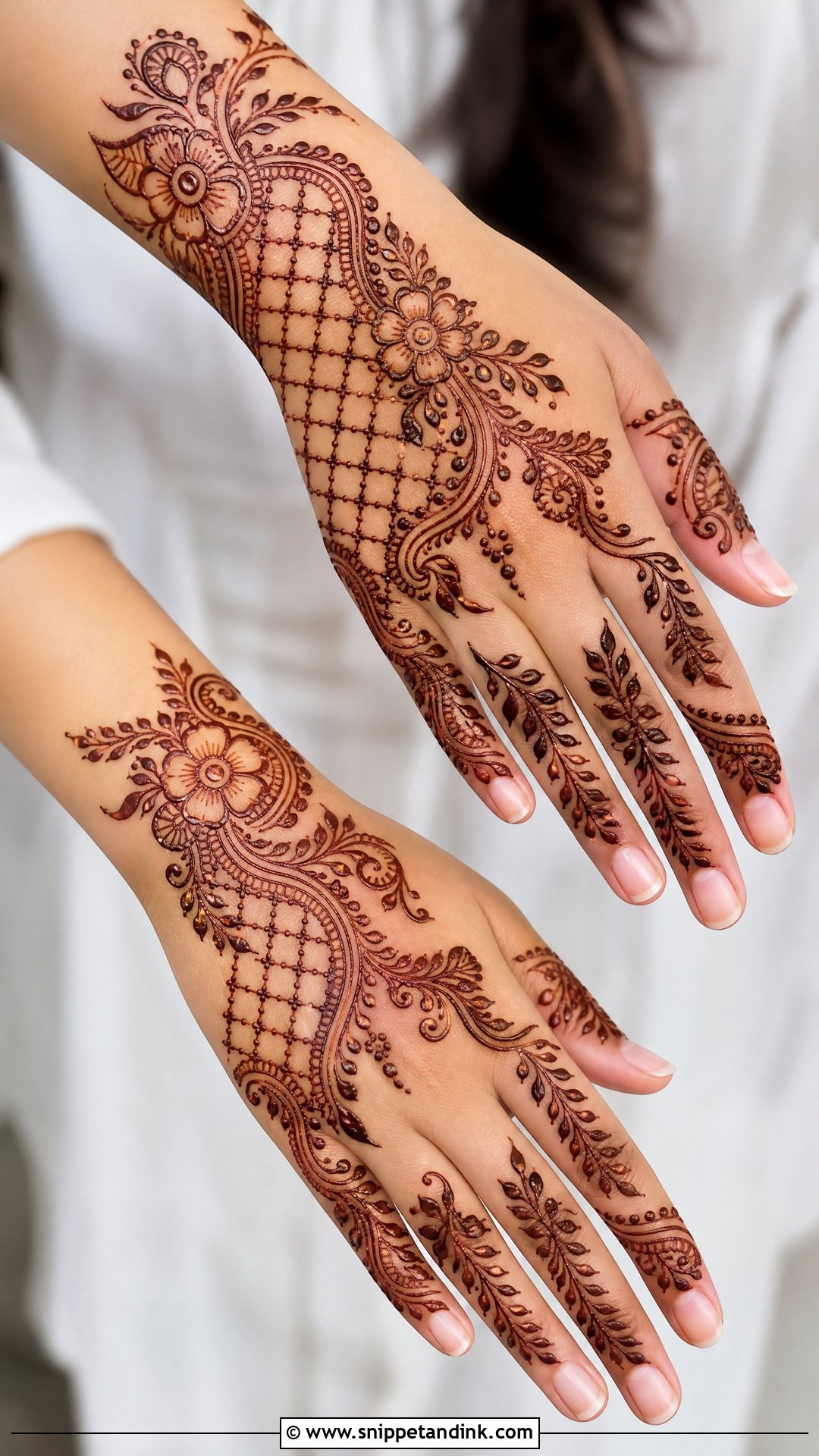
Jaali is a grid of fine crossing lines that reads like lace once the stain develops. A netted panel can sit on the back of the hand, the side of the palm or the wrist, framed by flowers, paisleys and leafy vines. Diamond mesh is the easiest to keep even; curved mesh looks softer but shows every wobble. The lines must be consistent, so I work jaali in one sitting without pausing, and I rest my drawing hand on the client’s to steady it. Bridesmaids and festive events suit it well.
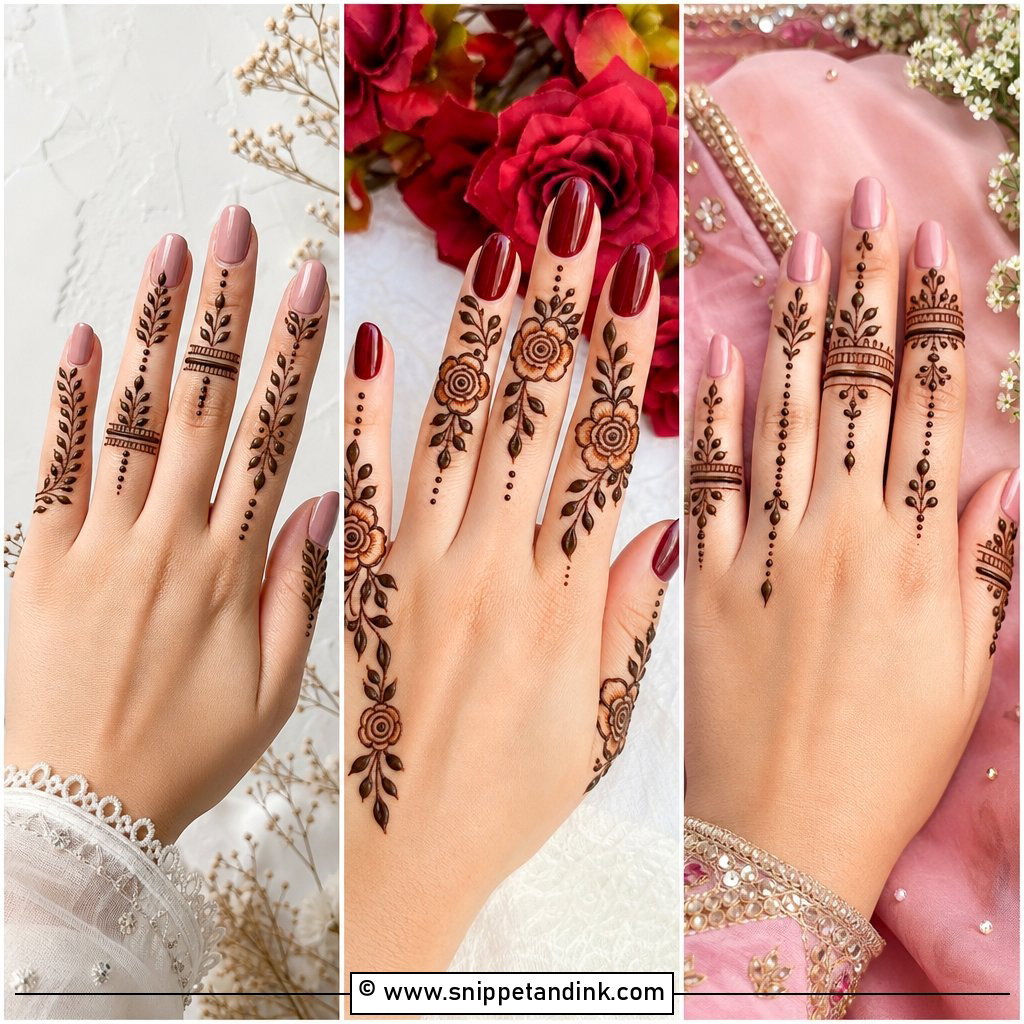
11. Arabic Finger Mehndi Design
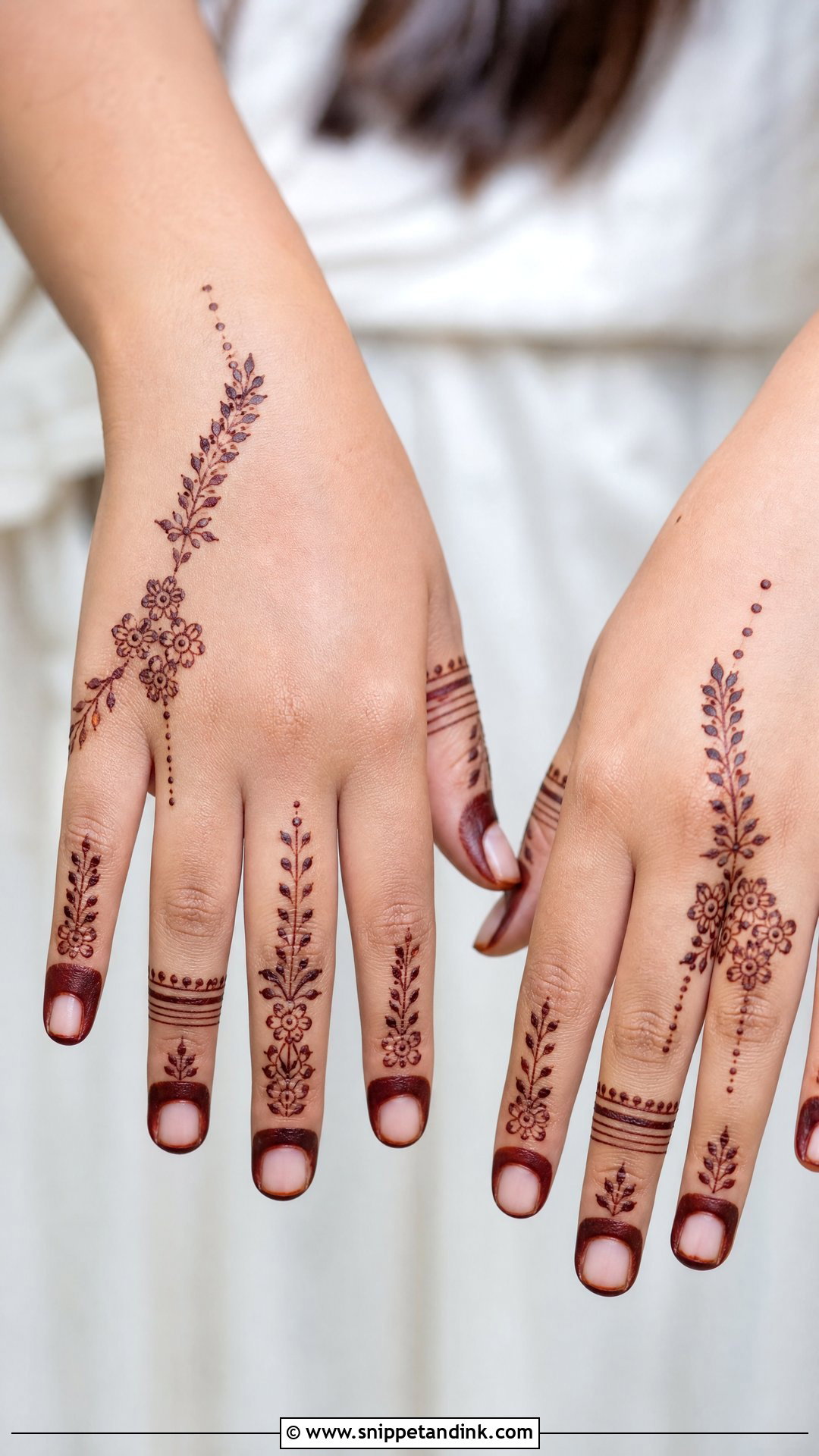
Finger-only henna is my recommendation for anyone who isn’t sure they’ll like the stain. Leafy trails, ring bands, small flowers, dots and shaded fingertips carry the design, while the rest of the hand stays bare or has one small motif near the wrist. I vary each finger slightly but repeat one element, a leaf or a dot pattern, so they look like a set. It’s quick, and it’s easy to wear to work or school. Expect the fingertips to stain darkest of all.
12. Arabic Bel Mehndi Design
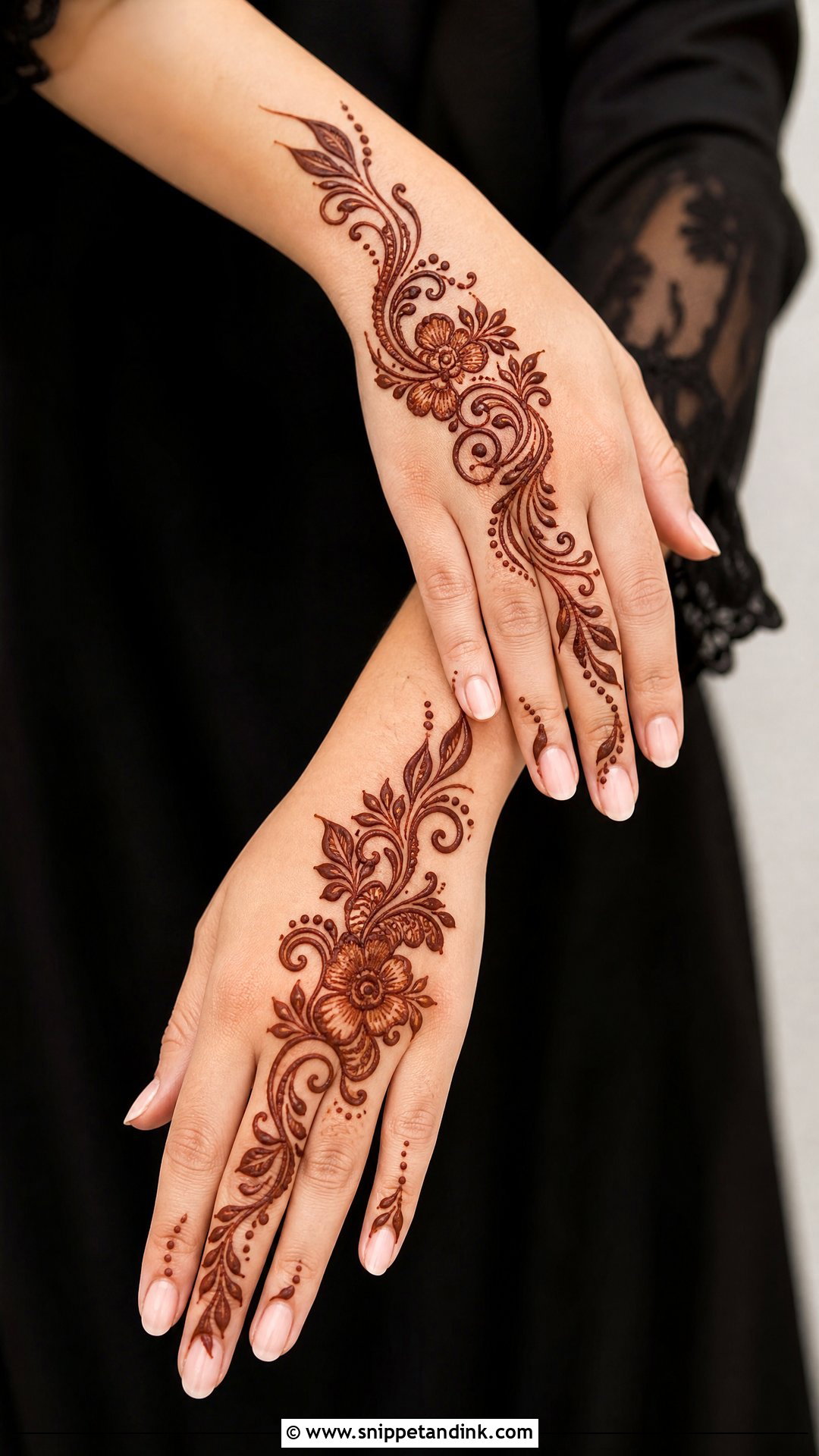
Bel means vine, and it’s the backbone of Arabic henna. The line can start at the wrist and climb toward one finger, or begin near the palm and curve around the thumb side, carrying leaves, flowers, paisleys, dots and fine swirls. It works on both sides of the hand. The vine should bend gently; a stiff, straight bel looks drawn with a ruler. I relax my wrist and pull the cone in long strokes from the shoulder. It’s the design I teach beginners first.
13. Arabic Chain Mehndi Design
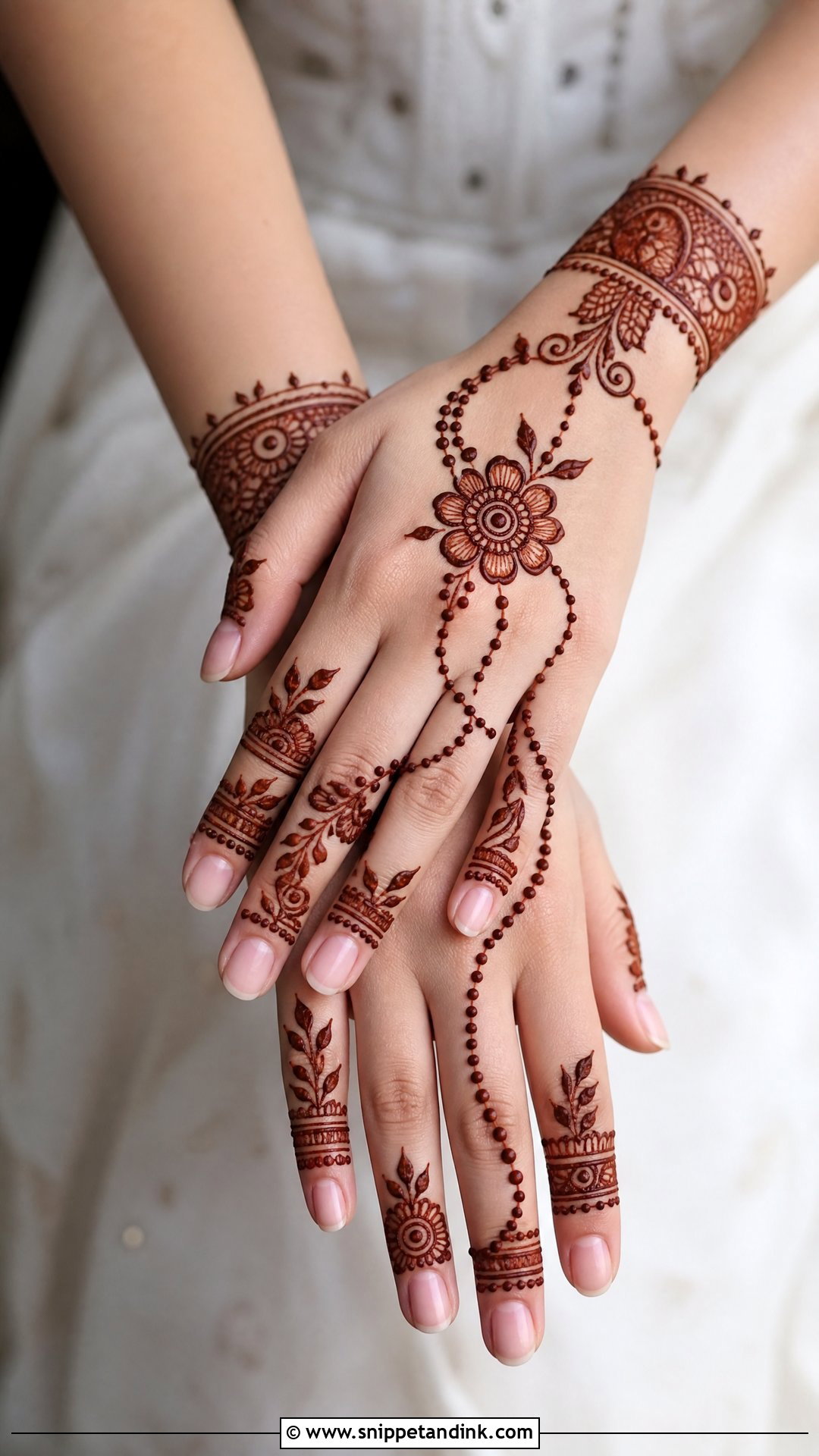
This is henna drawn as jewellery: a wrist cuff, a central floral motif and dotted chains running up to ring bands on the fingers, much like a haathphool. Tiny leaves and small paisleys can sit along the chains. I keep the chains thin and the centre motif bold, because the contrast is what makes it look like metal against skin. It works for bridesmaids and engagement guests who want something light that still looks planned.
14. Arabic Cuff Mehndi Design
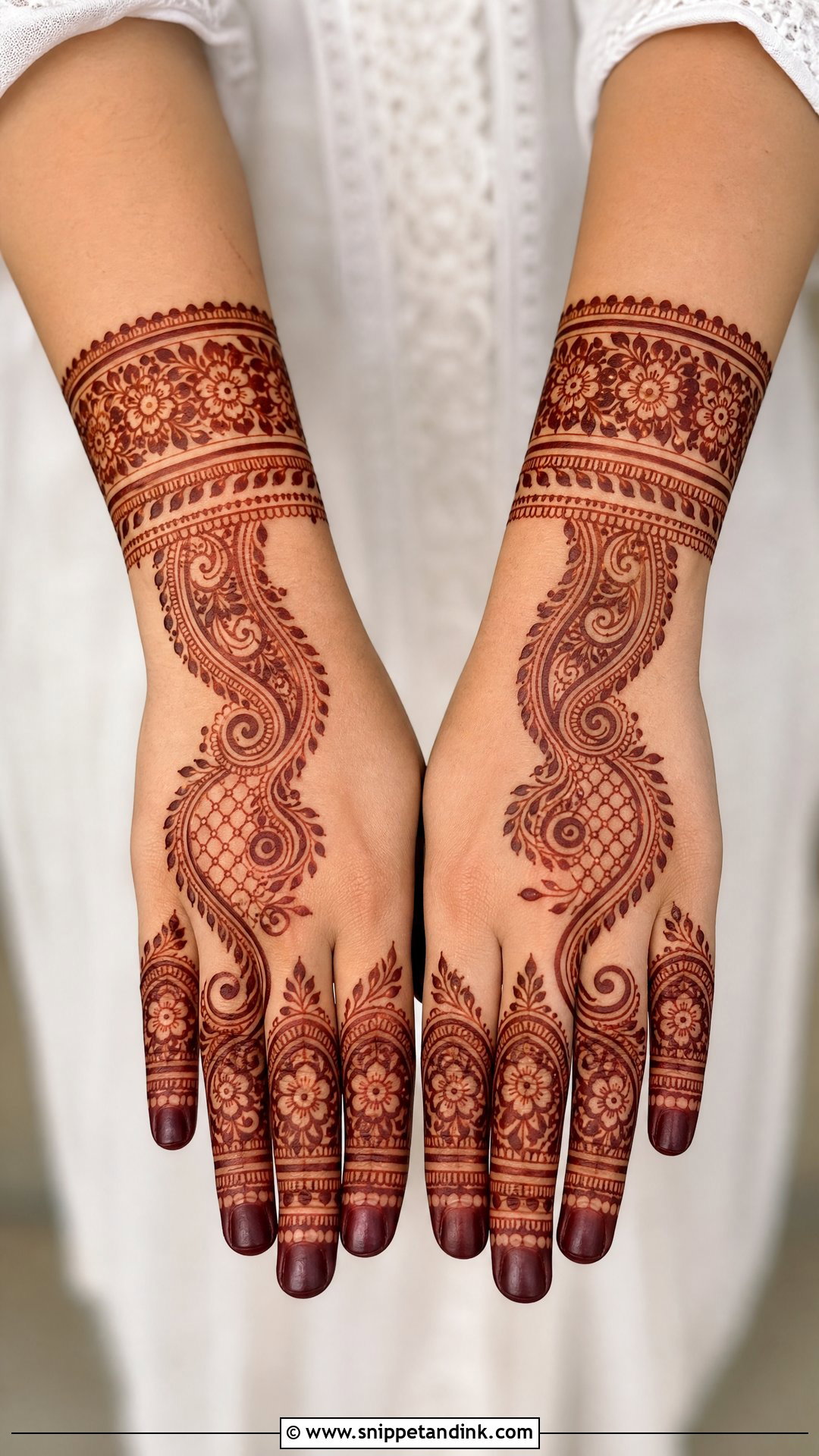
A cuff is wider and bolder than a bracelet, made from floral bands, leafy borders, paisley rows, jaali strips or dotted edges, with a trail reaching toward the middle finger or across the back of the hand. I draw it slightly bolder than the trail so it reads as an accessory. It sits right where bangles rest, which is worth thinking about: heavy metal bangles rubbing on fresh paste will smudge it, so put them on only after the paste has come off.
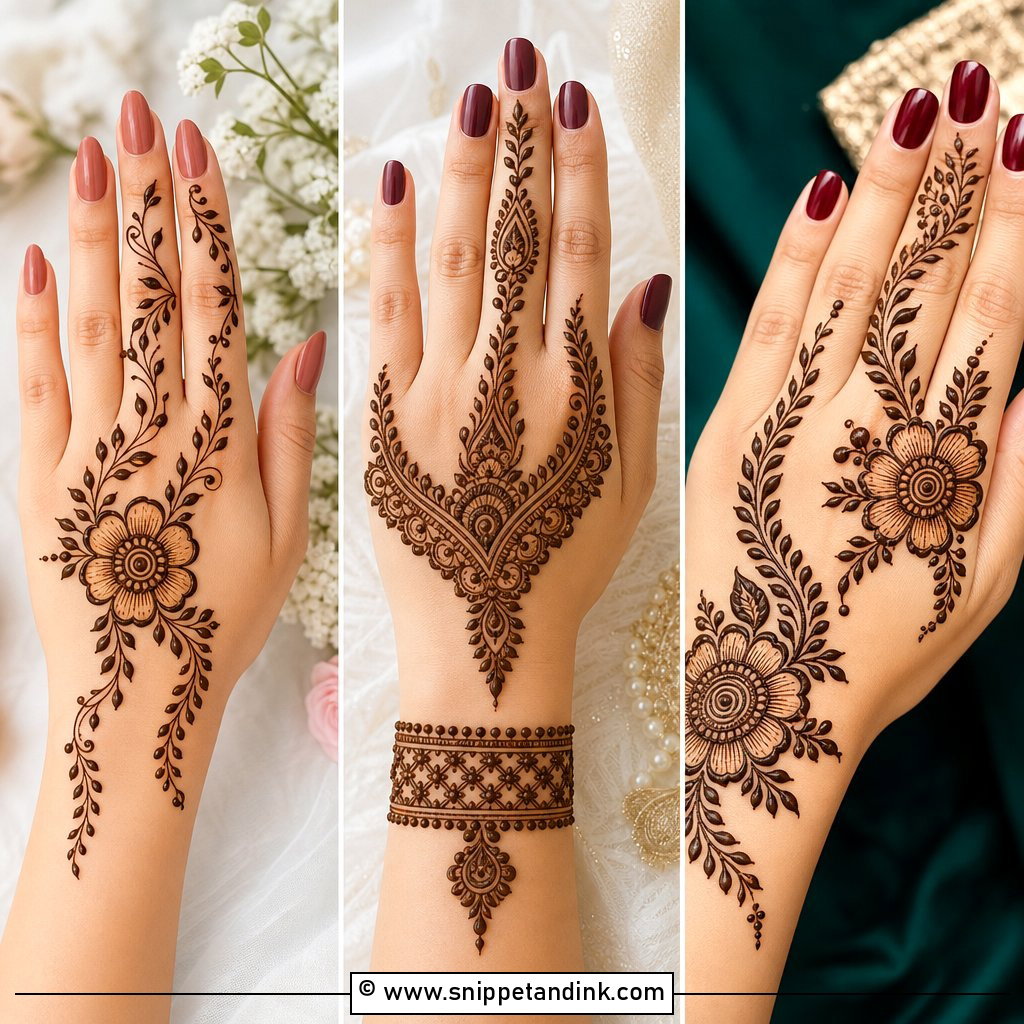
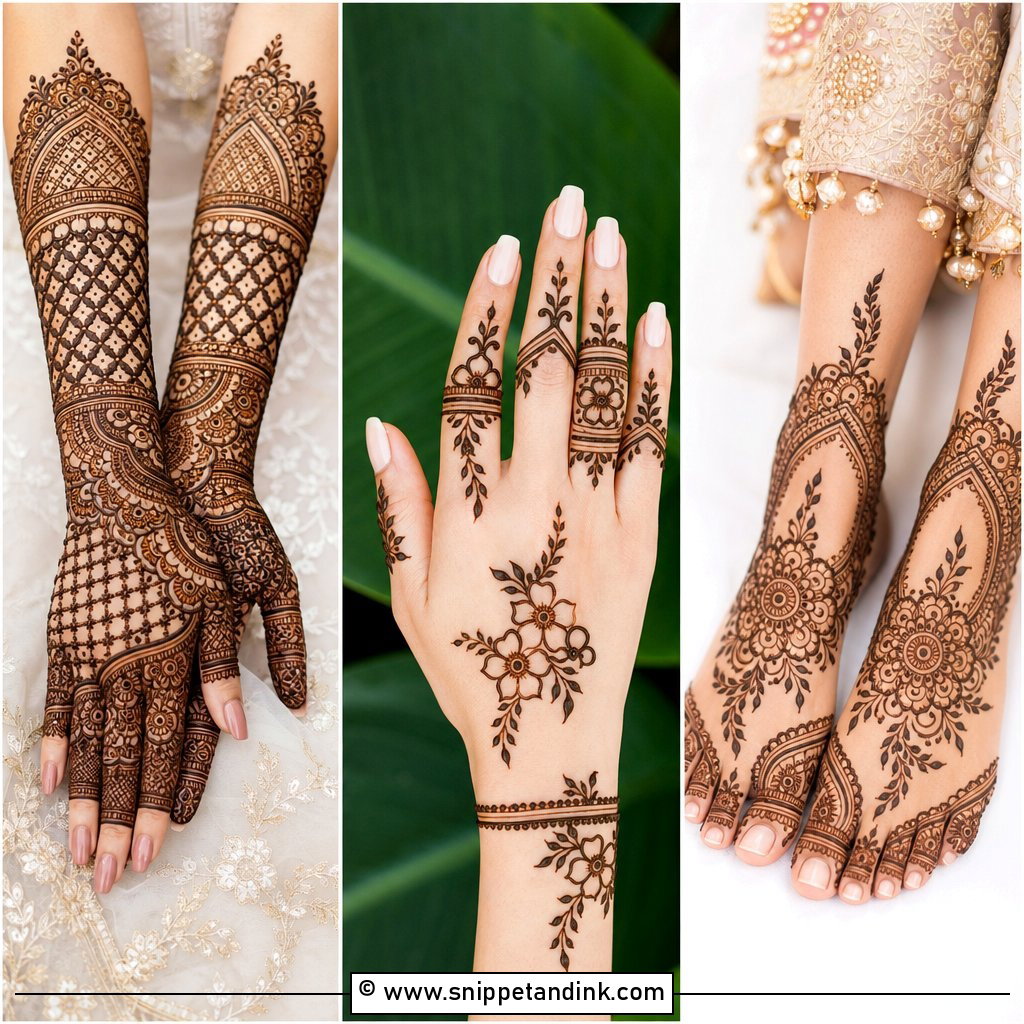
15. Arabic Bracelet Mehndi Design
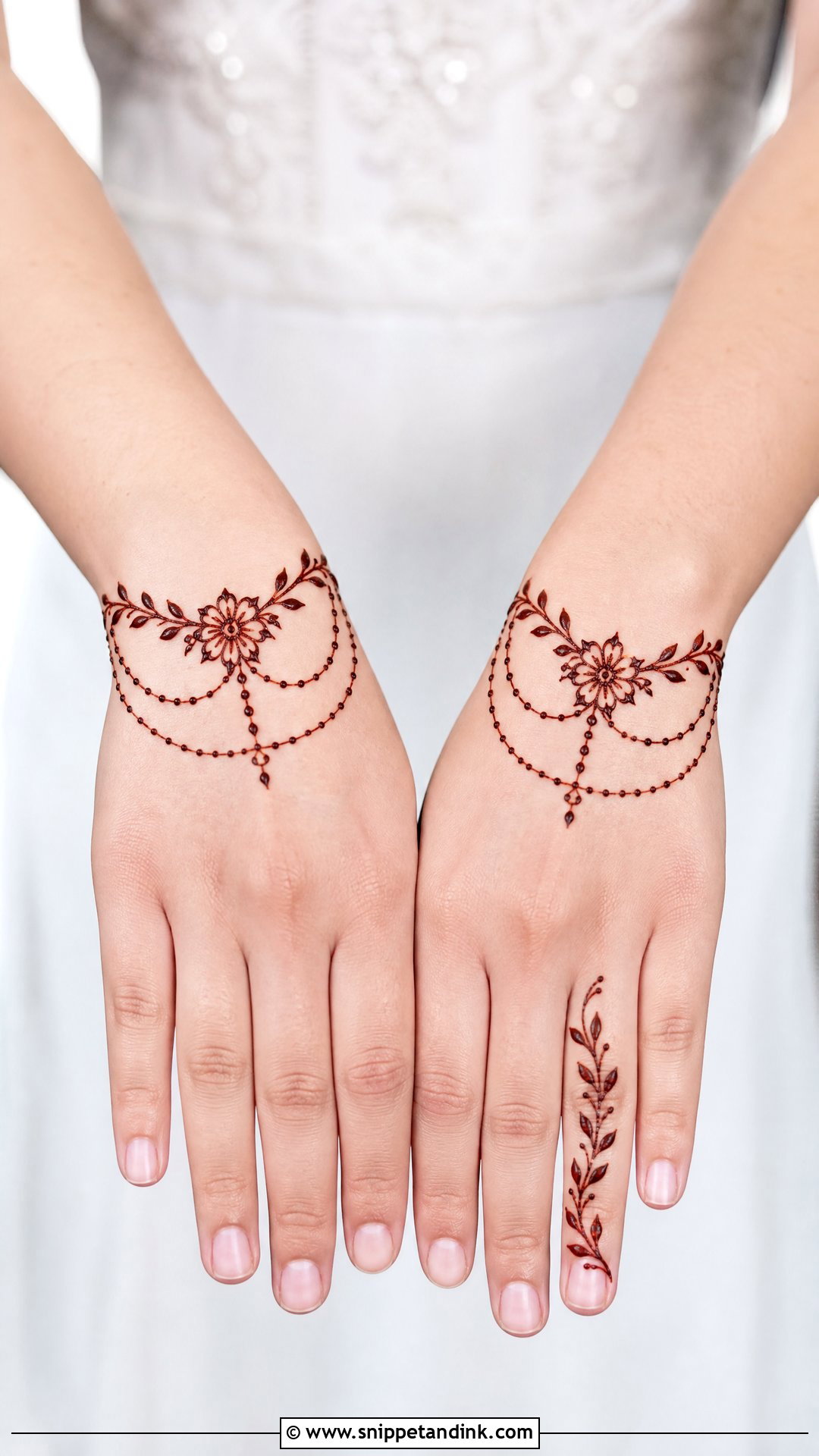
The bracelet is the lighter cousin of the cuff: thin floral vines, dots and curved chains wrapped around the wrist, connected to a finger pattern, with the back of the hand mostly open. A small flower near the centre of the hand can balance it. Because the wrist moves constantly, any uneven line gets noticed, so I draw it with the wrist turned the way it naturally rests. It pairs well with a watch or light rings and suits people who prefer minimal henna.
16. Arabic Eid Mehndi Design
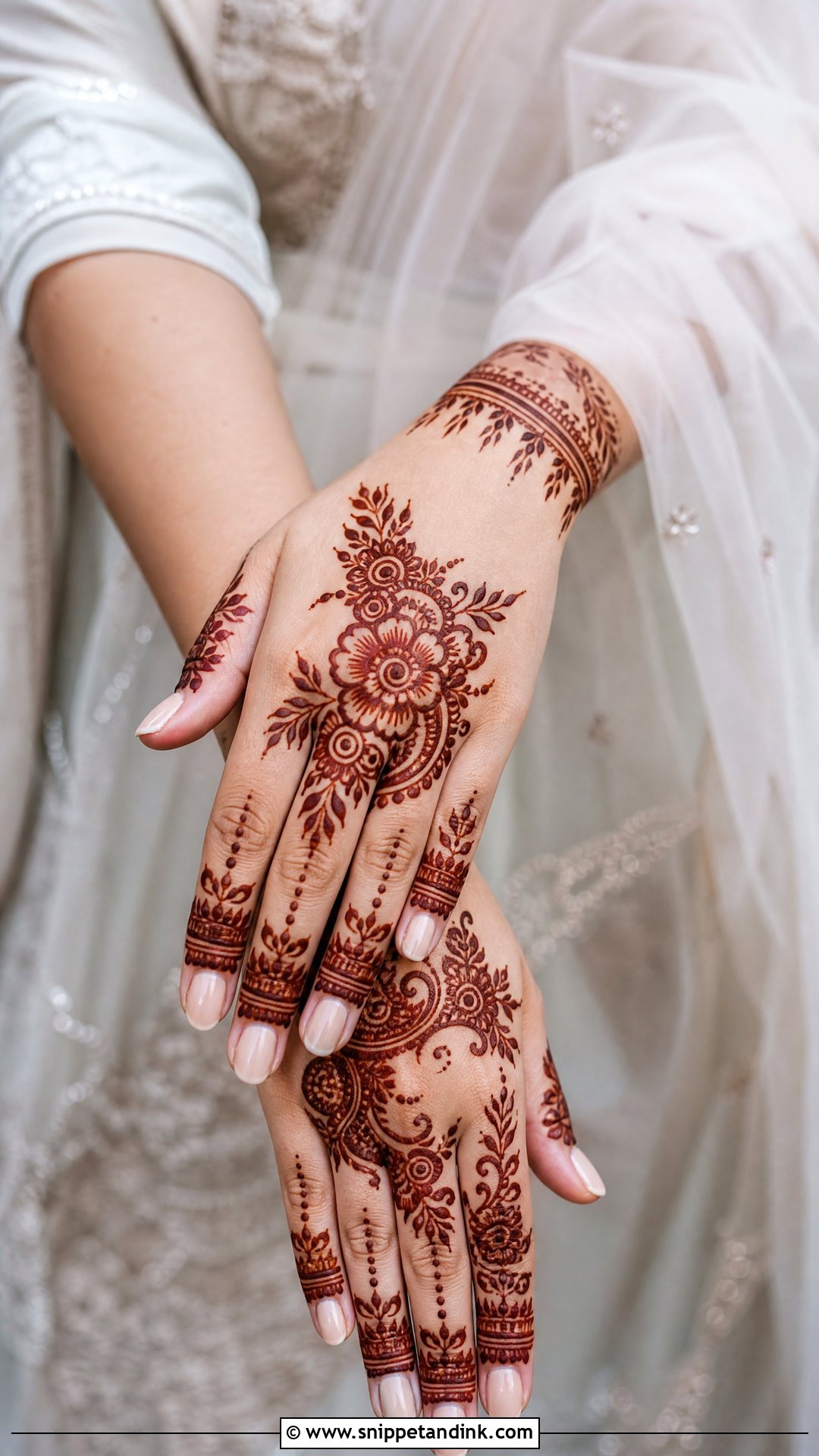
Eid henna has to survive long days of cooking, visiting and hugging, so I keep it practical: bold flowers on the palm or back of the hand, leafy vines along the fingers and a small wrist border. It should be detailed enough for photos but quick enough to apply to the whole family on the night before. Shaded petals and paisley accents add richness. If you’re doing it at home, a diagonal trail is the most forgiving layout, and gaps hide uneven lines.
17. Arabic Engagement Mehndi Design
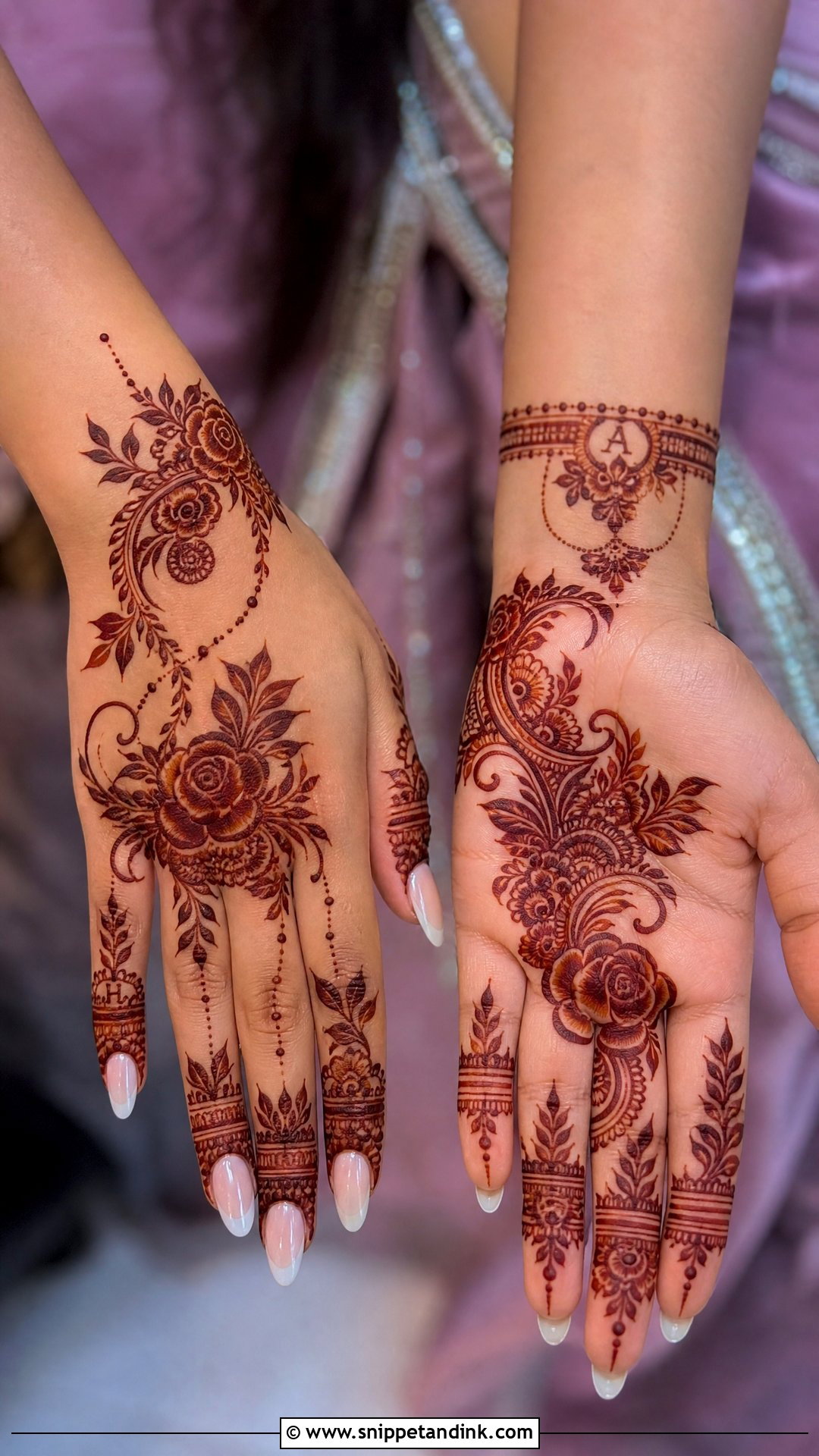
Arabic engagement mehndi design sits between guest henna and bridal henna. I often use a rose or lotus on the back of the hand, a bracelet band at the wrist and finger trails that look like fine jewellery, with paisleys and leaves on the palm and perhaps a small hidden initial. Keeping it open matters, since the ring needs to be the star of the hand. Bold outlines with fine inner filling give it polish. It’s a good way for a bride to try the style before her heavier wedding mehndi.
18. Arabic Bridal Back Hand Mehndi Design
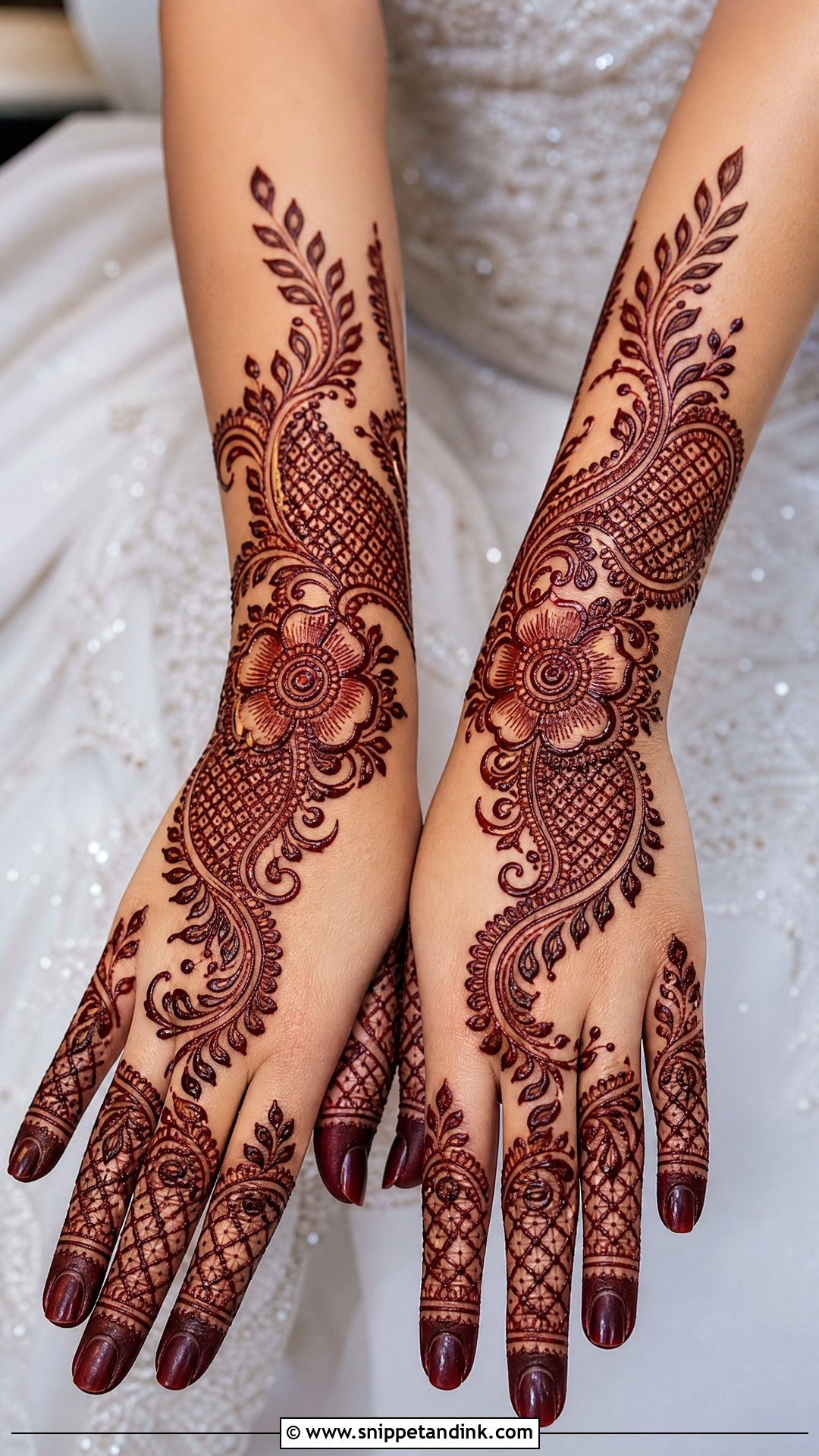
For a bridal back hand, I plan the spacing around the jewellery before drawing anything: where the rings sit, where the bangles end, and where the hathphool chain will run if she’s wearing one. A bold floral or mandala motif near the centre then extends to wrist and fingers with paisleys, jaali and leafy curves. Fingers get fuller coverage for a bridal feel. Skin left visible around the main motif gives the contrast that makes it photograph clearly.
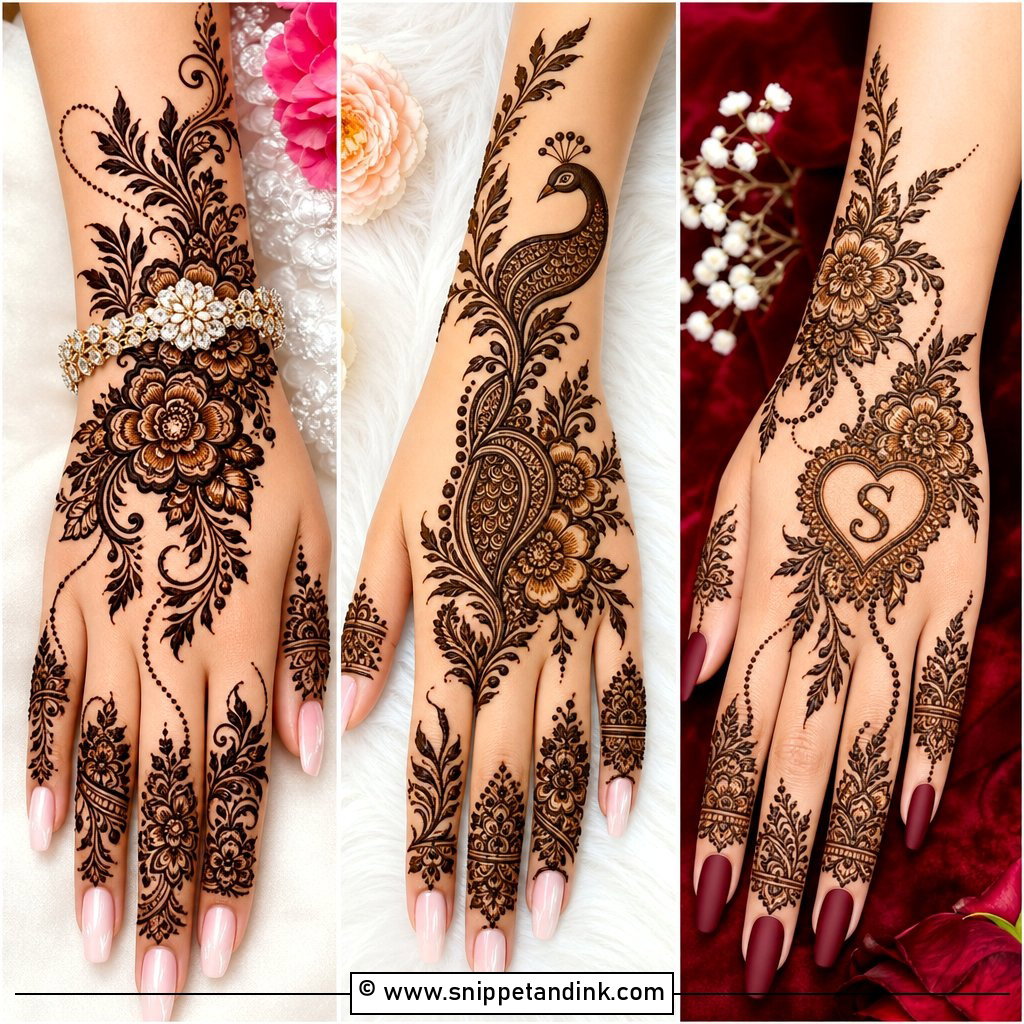
19. Arabic Bridal Front Hand Mehndi Design
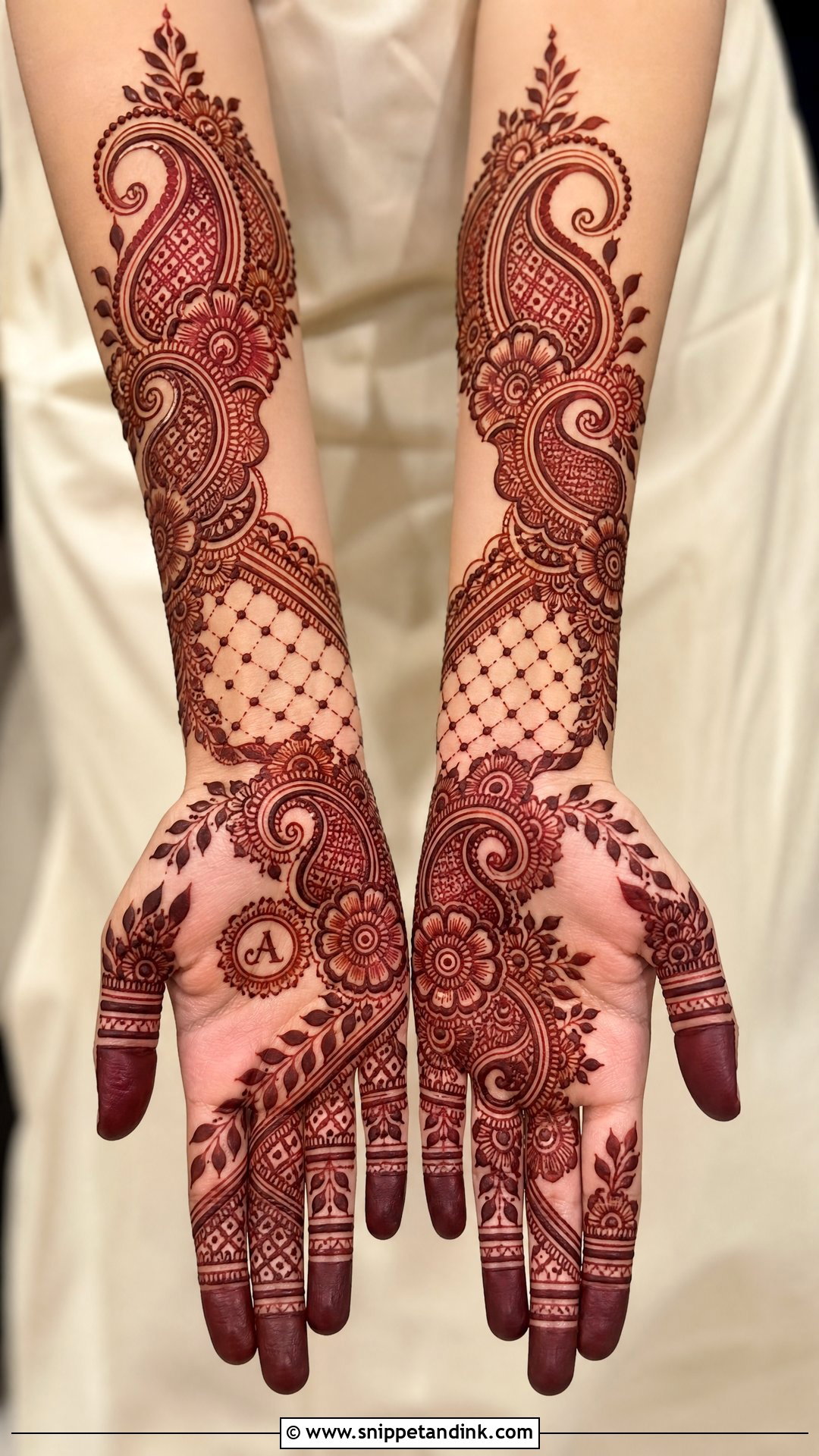
A bridal palm can take the richest work of all, because it stains darkest. I place large paisleys near the centre, floral vines down the sides, jaali strips near the wrist and full finger detail, often with filled fingertips for a traditional look. Leaving part of the centre open keeps it Arabic. Initials, small hearts or other personal motifs can hide in the paisley fillings. Enough detail for a bridal hand, enough space for the stain to read: that balance is the whole job.
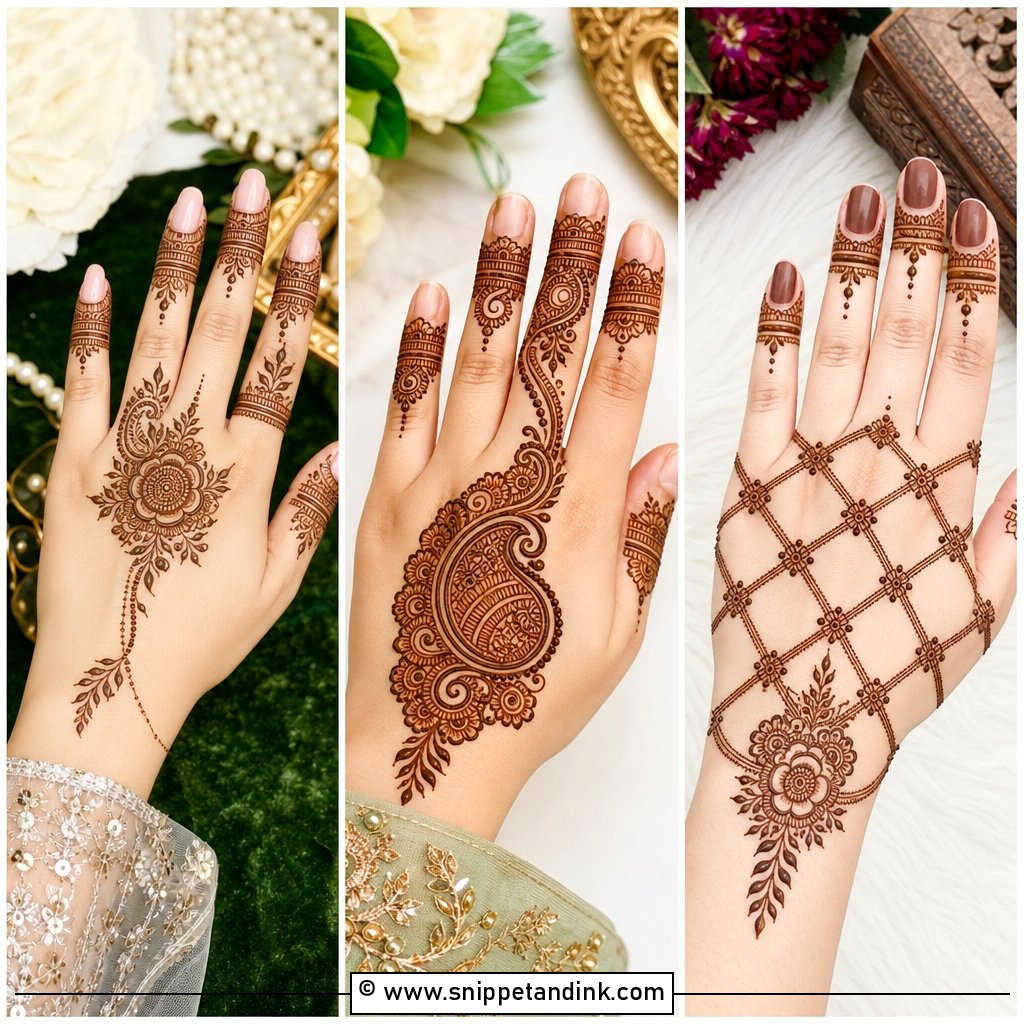
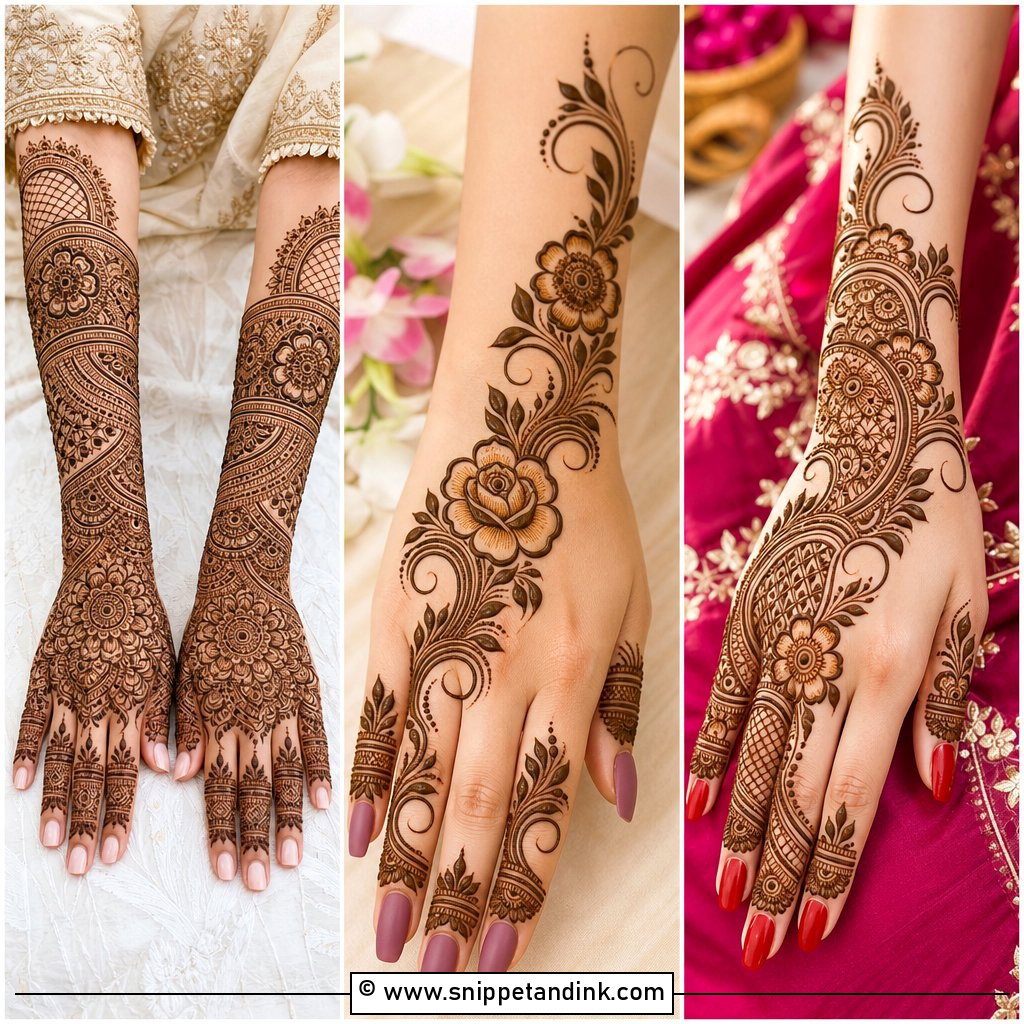
20. Arabic Full Arm Mehndi Design
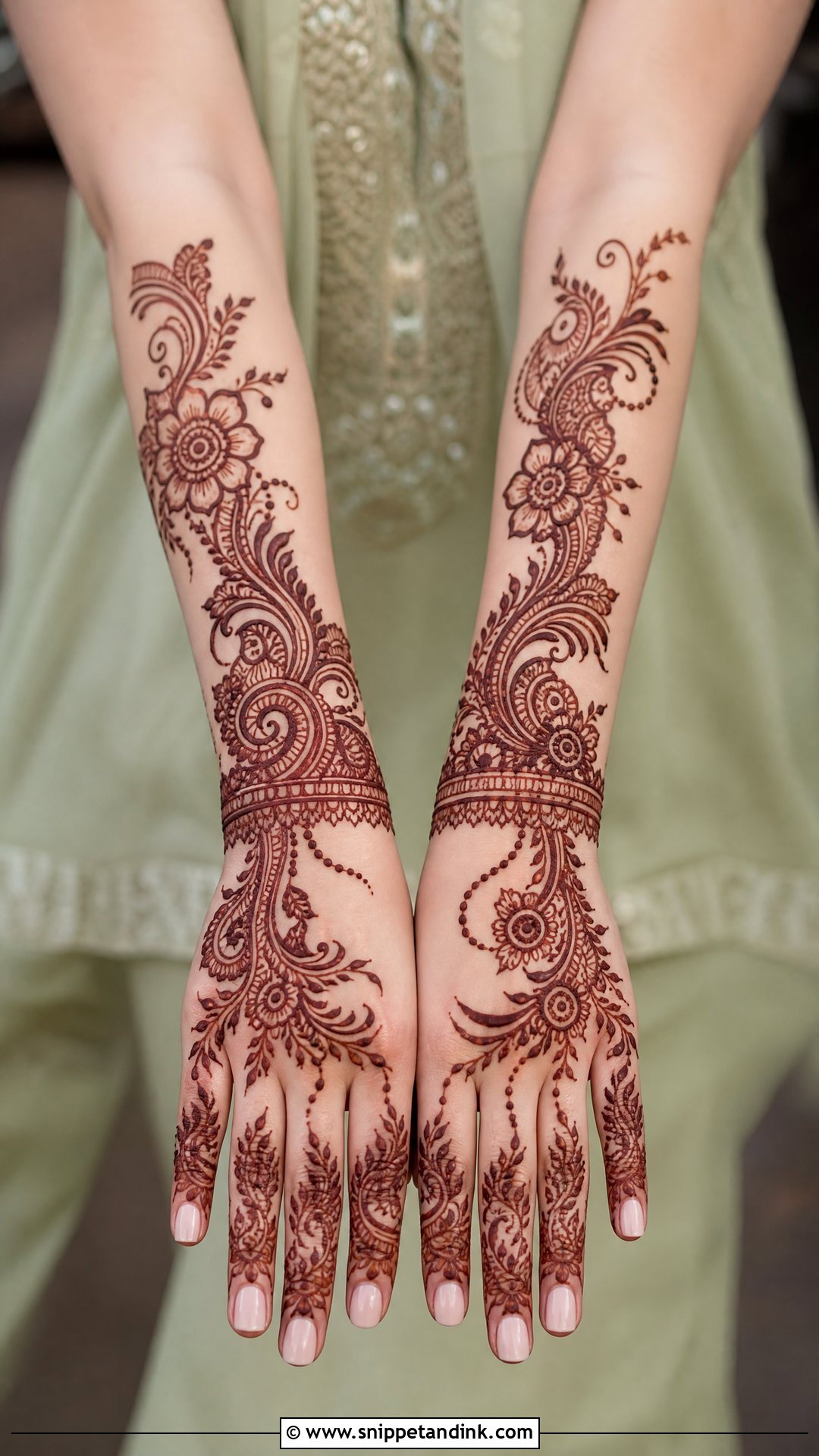
Arm-length Arabic henna starts at the fingertips, covers the hand and continues along the forearm with floral trails, paisleys, vines and bracelet-like bands. It uses open skin as part of the layout, which makes the arm look longer. I put larger motifs near the wrist and taper toward the elbow, because the forearm stains lighter and fine detail high on the arm can barely show. It suits brides wearing short or sheer sleeves, where the full length is visible.
21. Arabic Khaleeji Mehndi Design
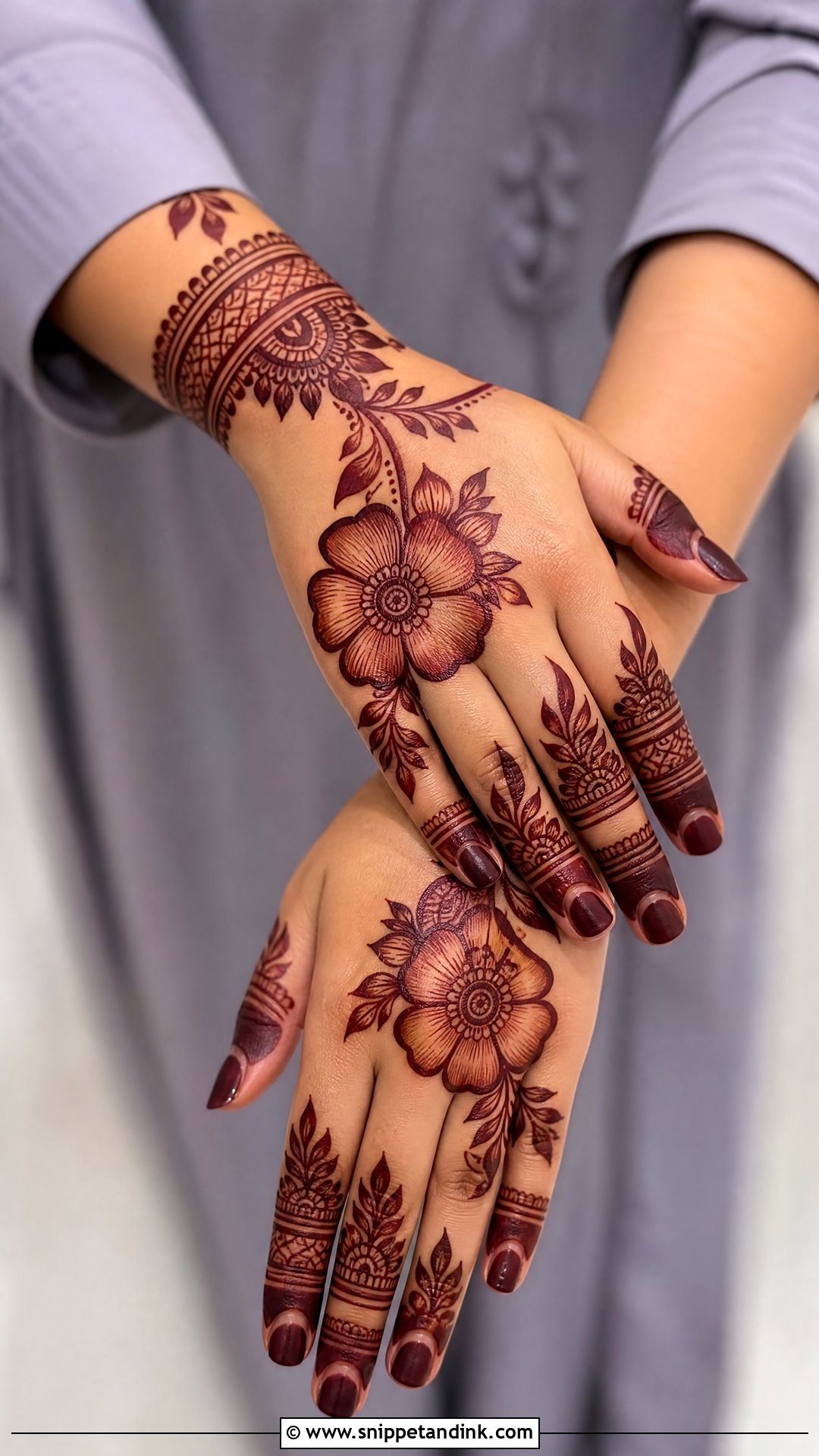
Khaleeji henna, the Gulf style, usually centres on one large motif on the back of the hand or palm with leaves, geometric accents and thick outlines around it, and lighter fingers. It relies on dramatic shading and plenty of bare skin. I mix the paste for this slightly thicker so the outlines stand up proud and stain deep. It suits anyone who wants a design with impact that still isn’t crowded, and it reads very clearly in photos.
22. Arabic Gulf Mehndi Design
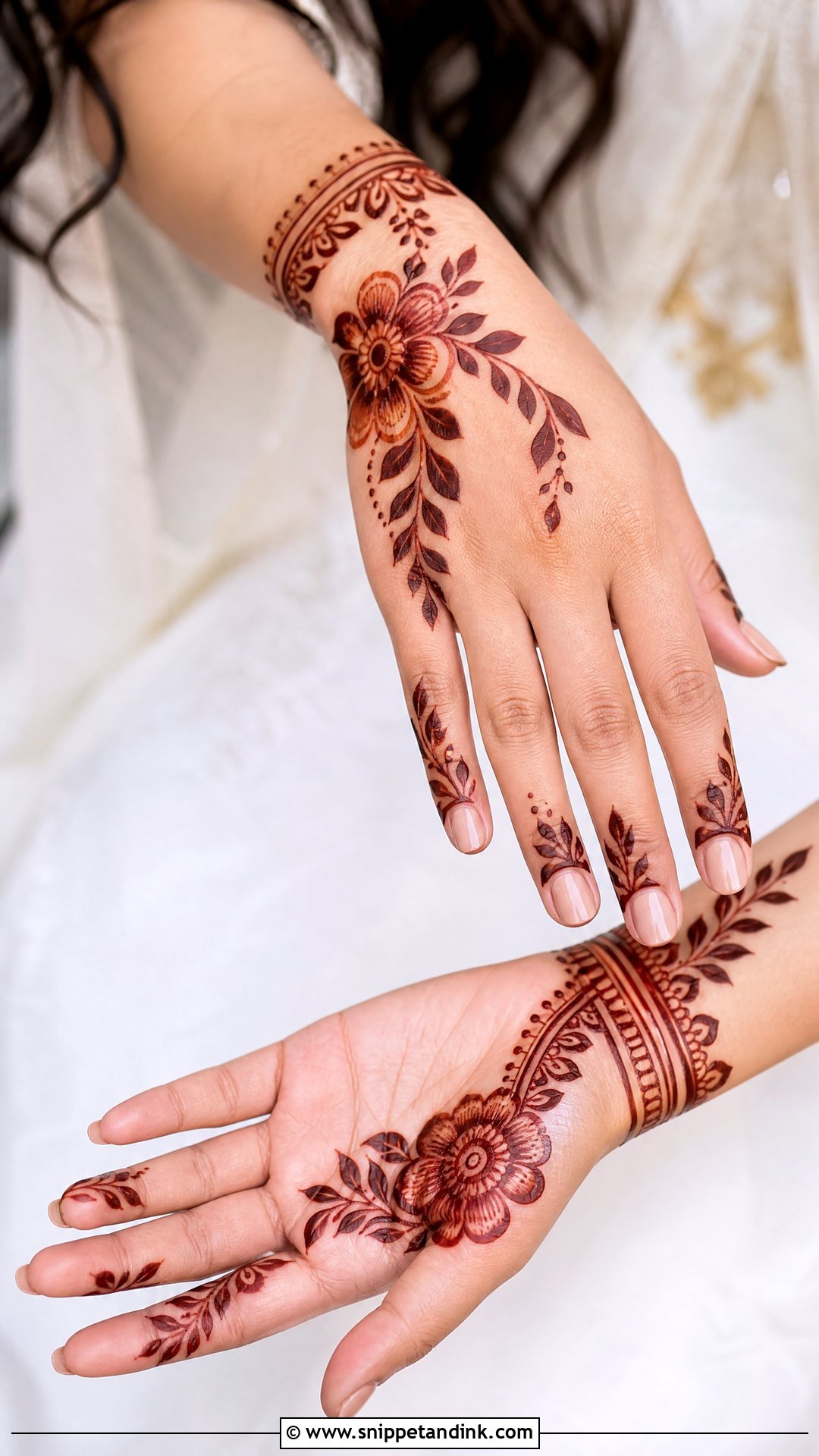
Gulf-style designs often sit on one side of the hand and leave the other side open, a deliberate imbalance that looks current and fashionable. Oversized flowers, leafy curves and geometric borders carry it, with minimal finger detail. Thick outlines and restrained inner patterns are essential; a scatter of tiny fillers weakens the effect immediately. It works for Eid, weddings and formal gatherings, especially for people who dislike busy henna.
23. Arabic Moroccan Mehndi Design
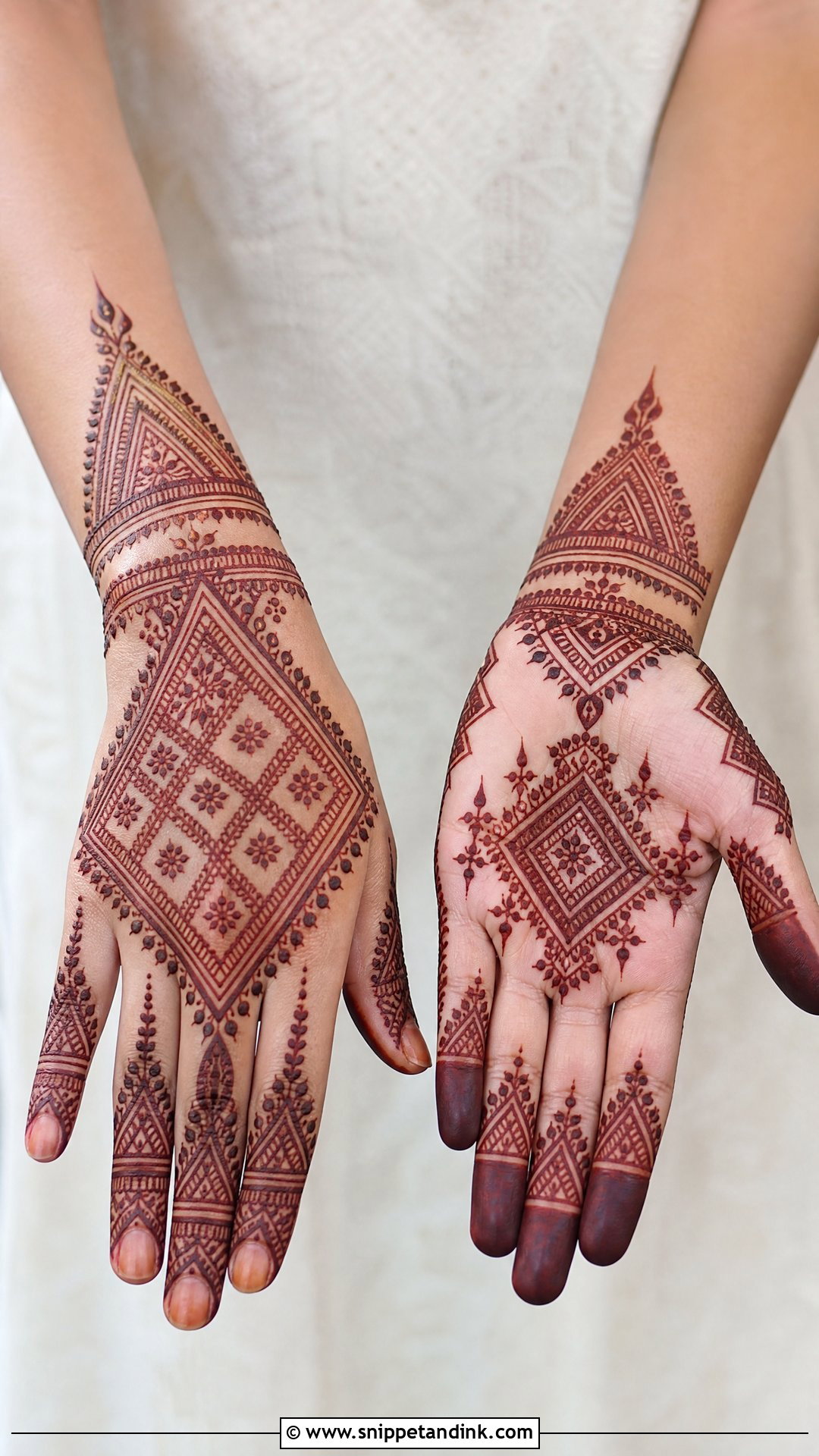
Moroccan-inspired henna brings straight lines into the soft Arabic flow: diamond grids, angular borders, triangles and small floral accents. It can cover the back of the hand, the palm or run from wrist to forearm. Geometry is unforgiving, so I mark key points with tiny dots first and join them, rather than freehanding long straight lines. Delicate dots and leafy edges stop it looking too rigid. Try it if you’re tired of flowers and paisleys.
24. Arabic Indo Arabic Mehndi Design
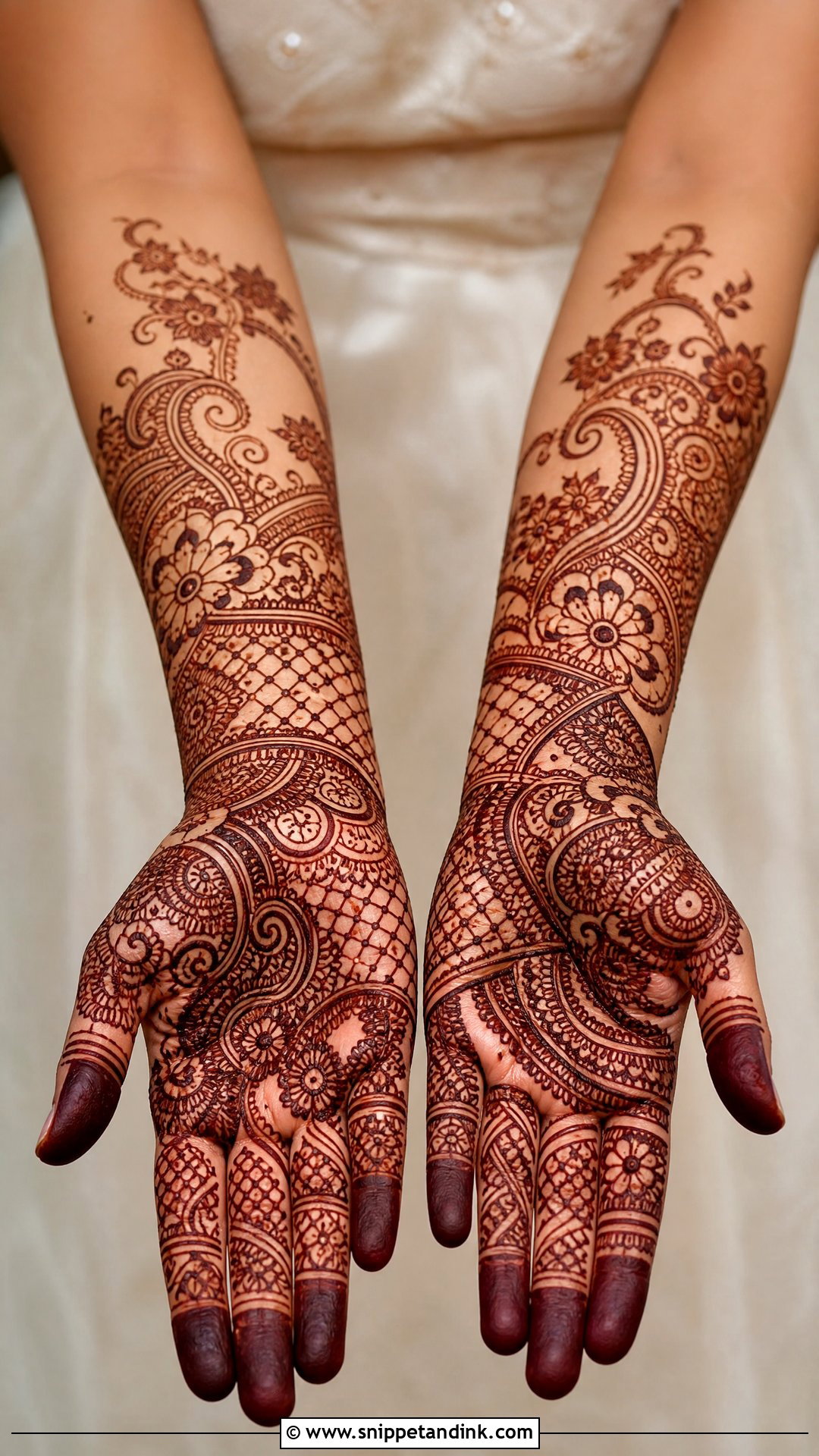
Indo-Arabic designs keep the Arabic trail but fill selected motifs with Indian-style detail: paisleys, mandalas, jaali panels and fuller finger coverage. The way I balance it is simple: the overall layout follows the Arabic diagonal, and the dense Indian work stays inside the shapes rather than spilling into the gaps. That keeps it breathable. It suits bridesmaids, festive events and family weddings, on the front, the back or the full hand.





25. Arabic Shaded Mehndi Design
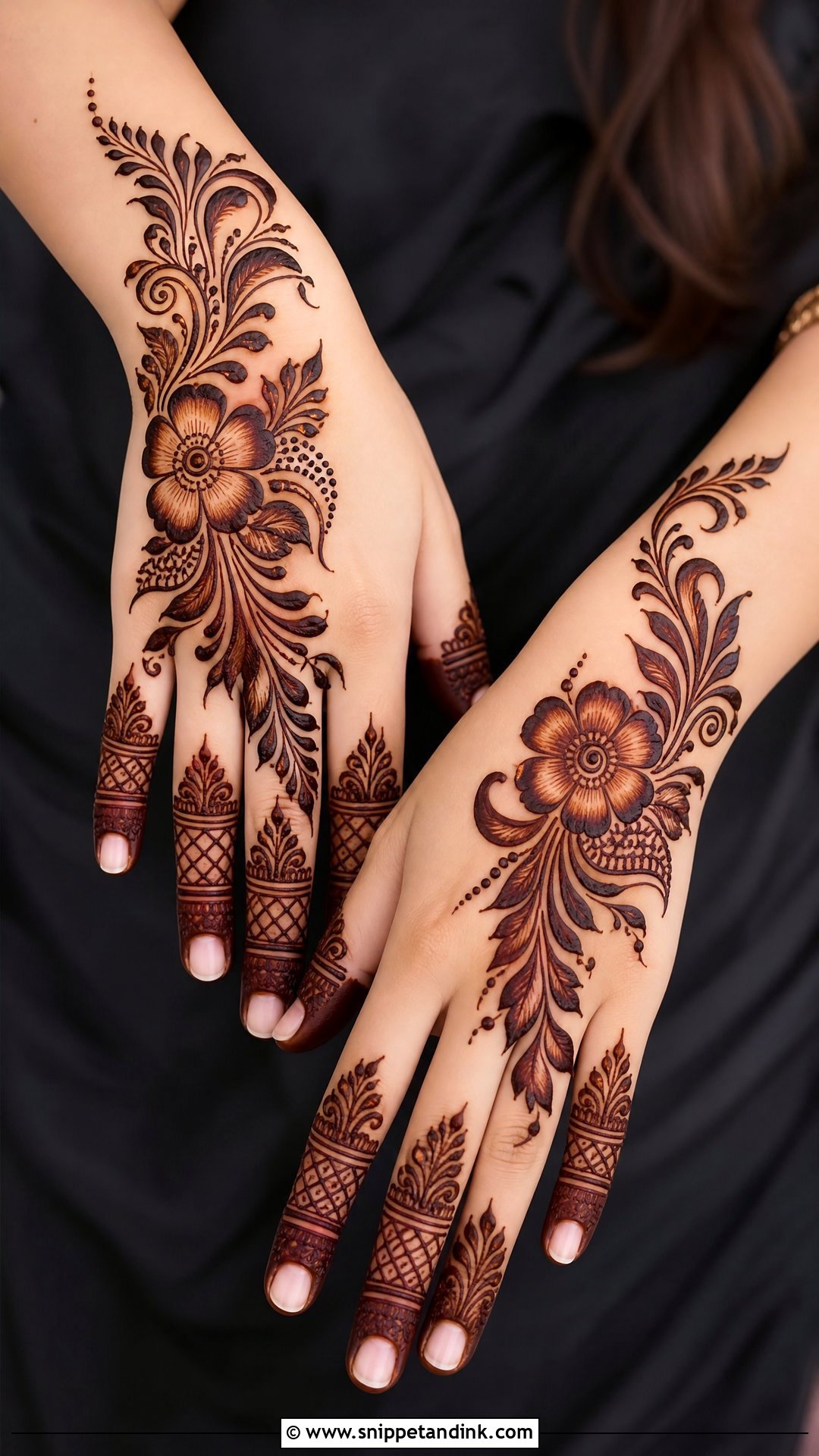
Shading gives dimension: bold outer lines with paste thinned toward the centre of each flower, leaf and paisley, done in fine strokes, a filled gradient or soft parallel lines. It shows best on the back of the hand. The surrounding detail should stay simple, because too many fillers make shaded work look muddy. For shading to show, the thin areas need time to stain, so this is a design to leave on overnight rather than scrape off after two hours.
26. Arabic Peacock Mehndi Design
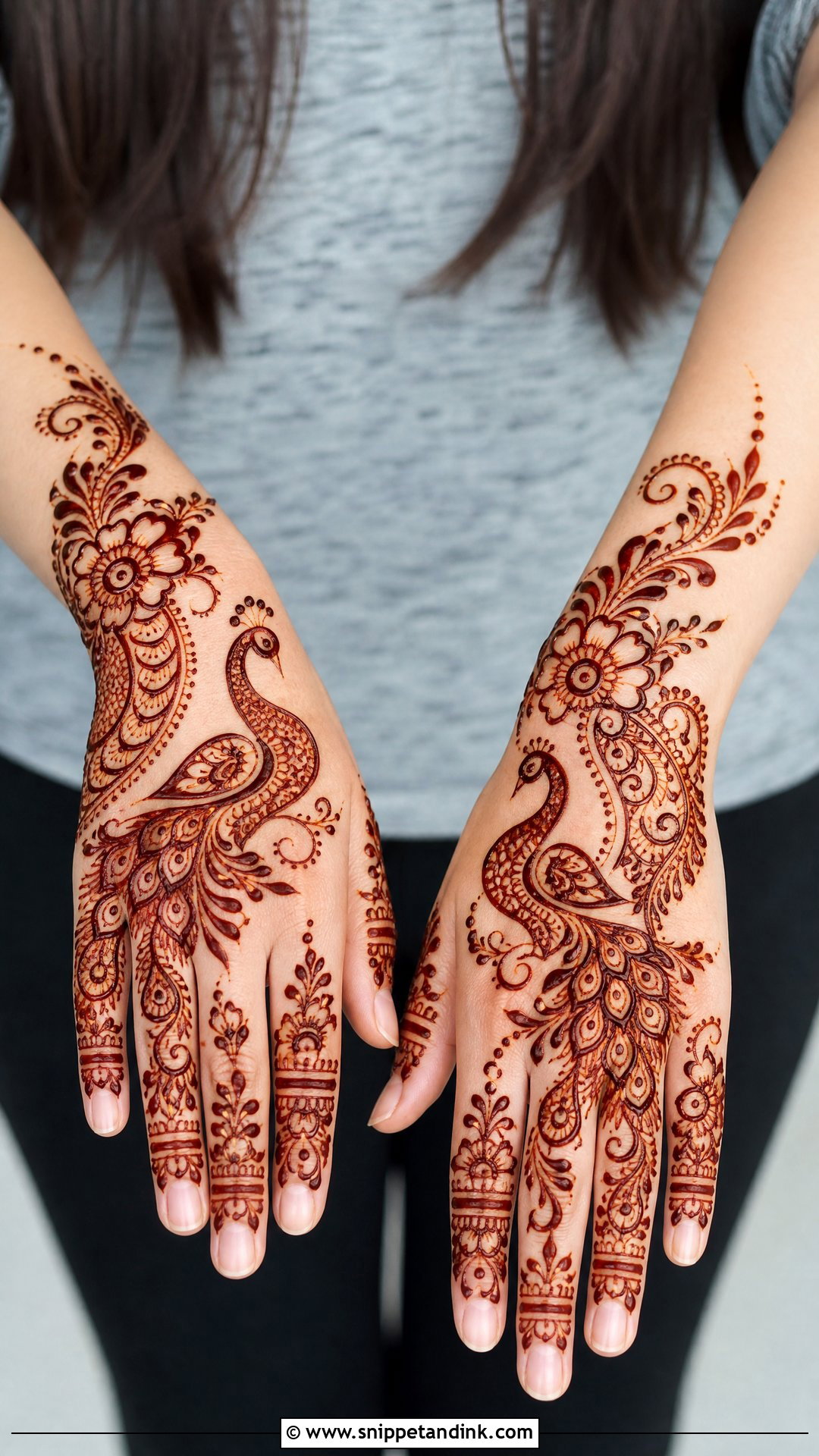
In Arabic style, a peacock doesn’t need dense fill. A bold body, a curved neck and patterned tail feathers give it impact, and the feathers can trail off into floral vines and leafy curves across the palm, wrist or back of the hand. Paisleys and dots around it finish the composition. I draw the eye and beak last, with the finest tip, because they’re what make it recognisable once the stain darkens. It suits weddings, sangeet and cultural celebrations.
27. Arabic Lotus Mehndi Design
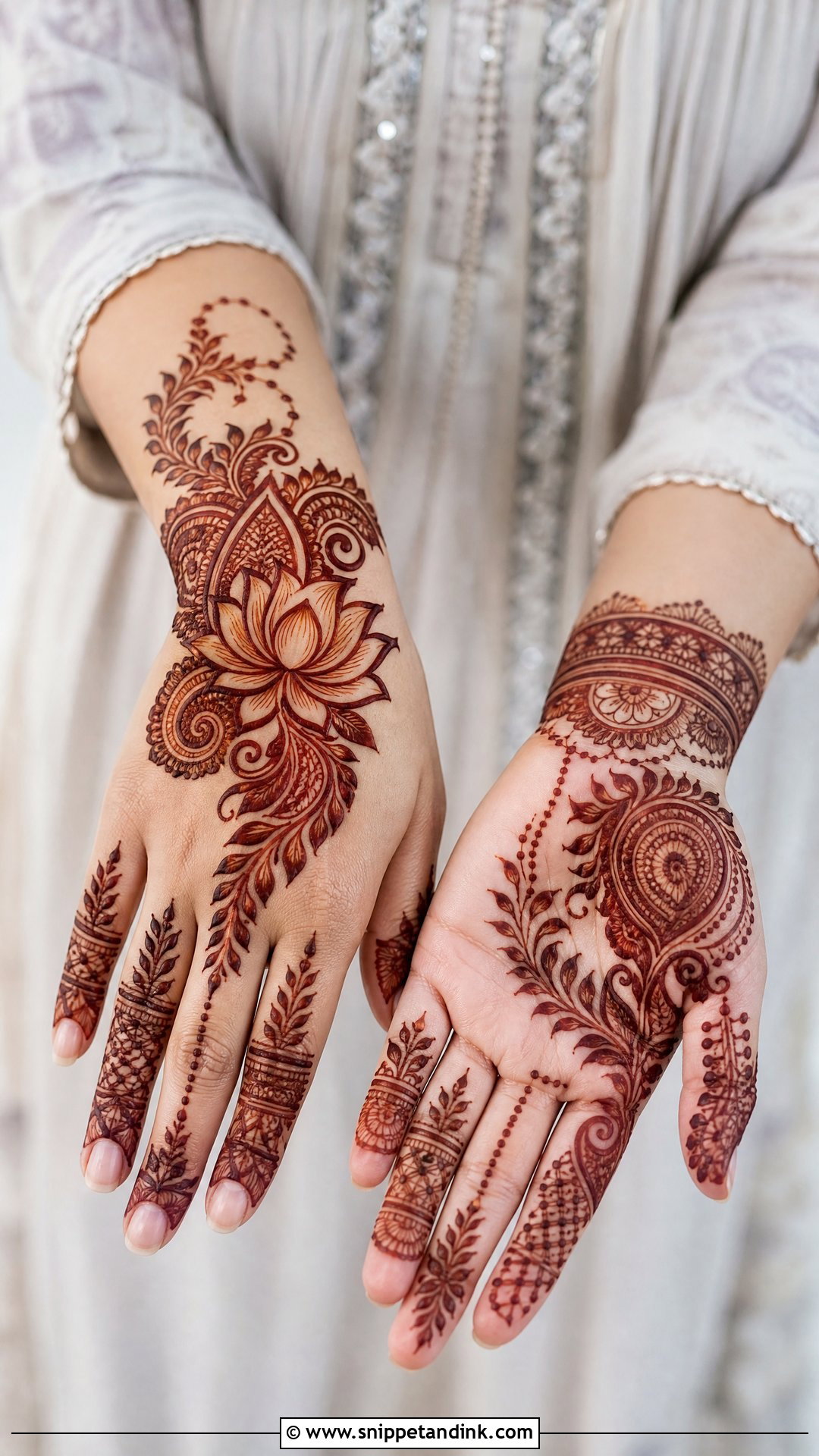
Arabic lotus mehndi design places the flower in the palm centre, on the back of the hand or near the wrist, with vines, leaves and small paisleys running from it. Lotus petals need bold outlines and fine inner curves; I draw the middle petal first and work outward so both sides match. Jaali or mandala details can add depth nearby. Keep the area around the flower open. It suits brides, bridesmaids and family ceremonies with a calmer, traditional feel.
28. Arabic Minimal Mehndi Design
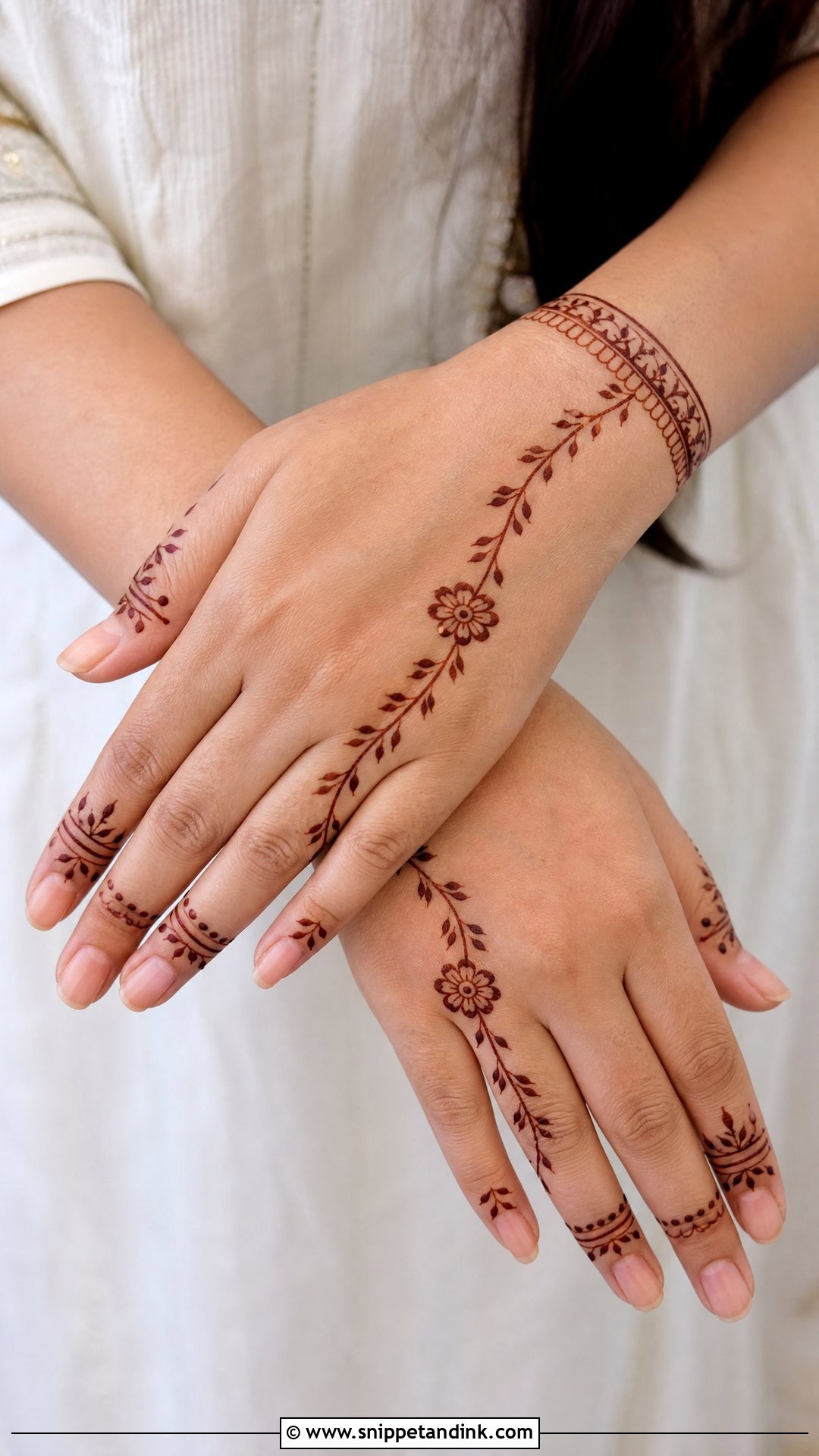
A slim vine across the back of the hand, a small wrist band and simple finger patterns: that’s the whole minimal design. Sometimes it’s one flower near the thumb or a tiny mandala on the palm instead. With so little on the hand, each line is visible, so neatness matters more than anything. Use natural henna and resist adding more. It suits office events, casual Eid gatherings, last-minute celebrations and anyone new to mehndi.
29. Arabic Heavy Mehndi Design
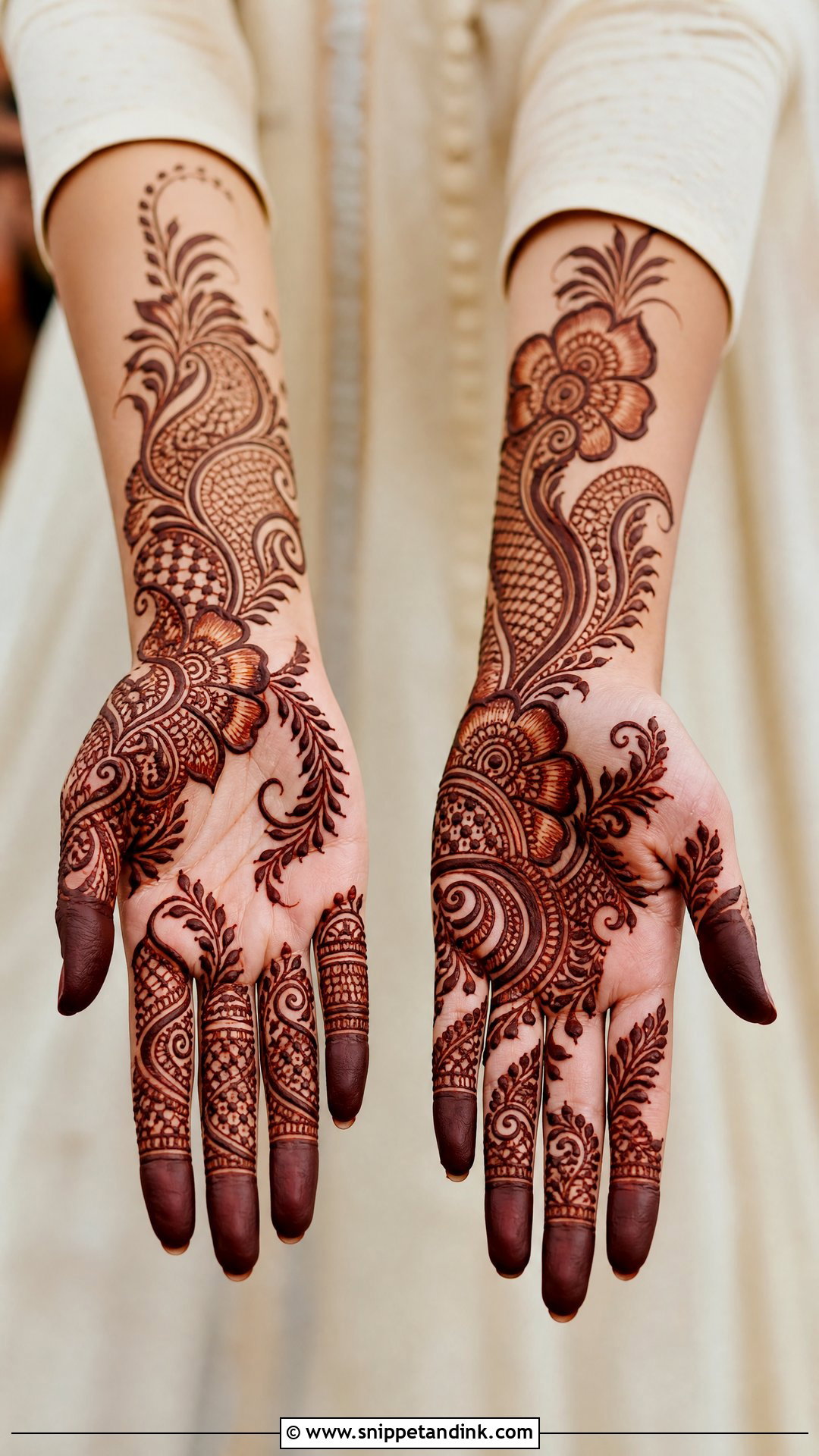
Heavy Arabic henna covers palm, back, fingers and wrist with bold flowers, paisleys, jaali strips, leafy vines and shading, but it stays readable by using larger motifs instead of crowded small ones. Fingers can be filled deeply while the centre carries a clear floral or paisley trail. Plan a long sitting and a quiet evening afterwards, since you can’t use your hands while it dries. It suits weddings, bridesmaids and big festivals.
30. Arabic Round Tikki Mehndi Design
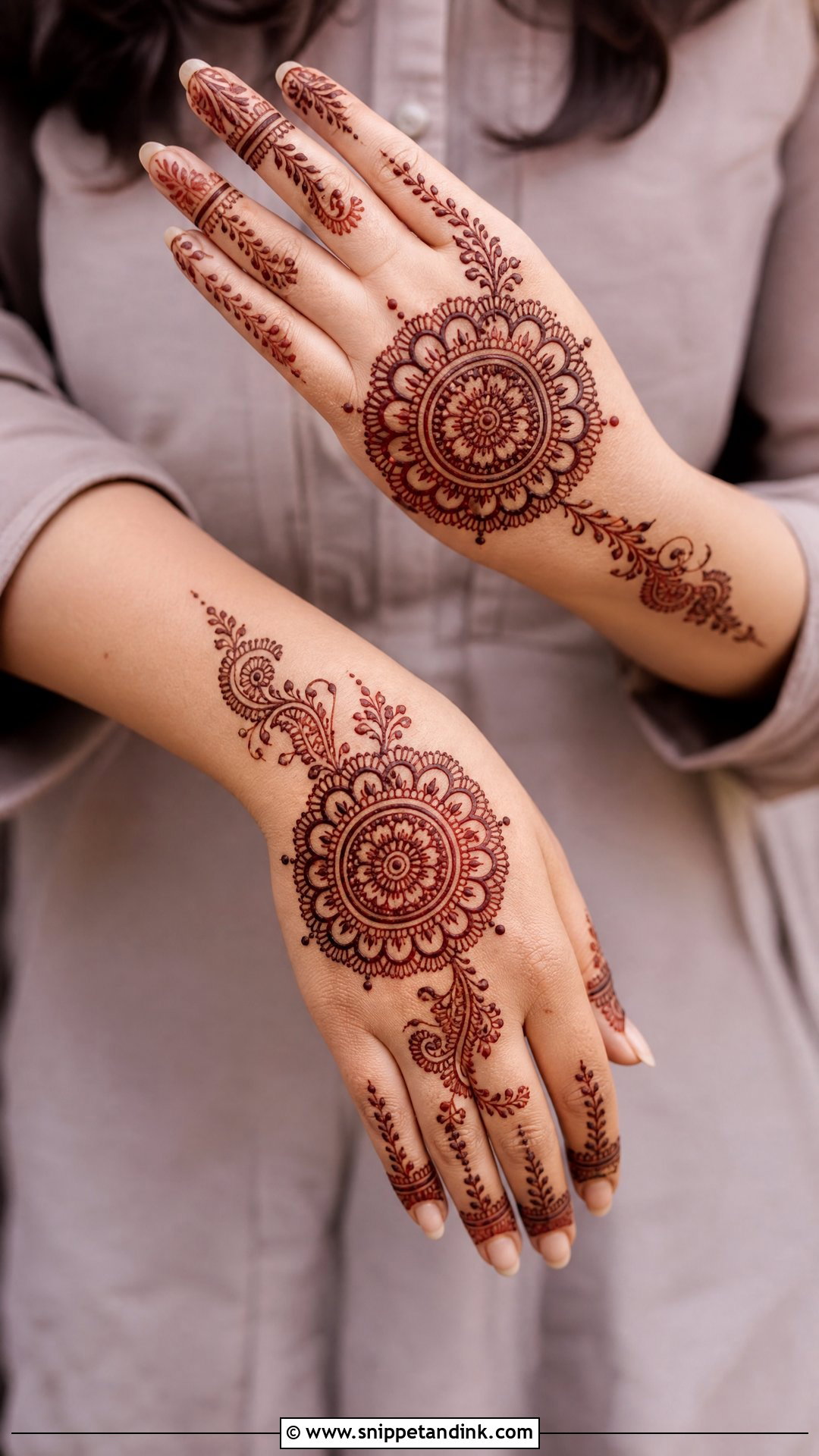
The tikki is a round centre on the palm or back of the hand, ringed with dots, petals and fine rings, with vines and paisleys extending to wrist and fingers. It feels traditional, but the Arabic spacing keeps it airy. The circle has to be properly round and symmetrical, so I turn the client’s hand slowly as I draw rather than twisting my own wrist. Light finger detail gives a modern finish. It suits all ages, from grandmothers to teenagers.
31. Arabic Side Hand Mehndi Design
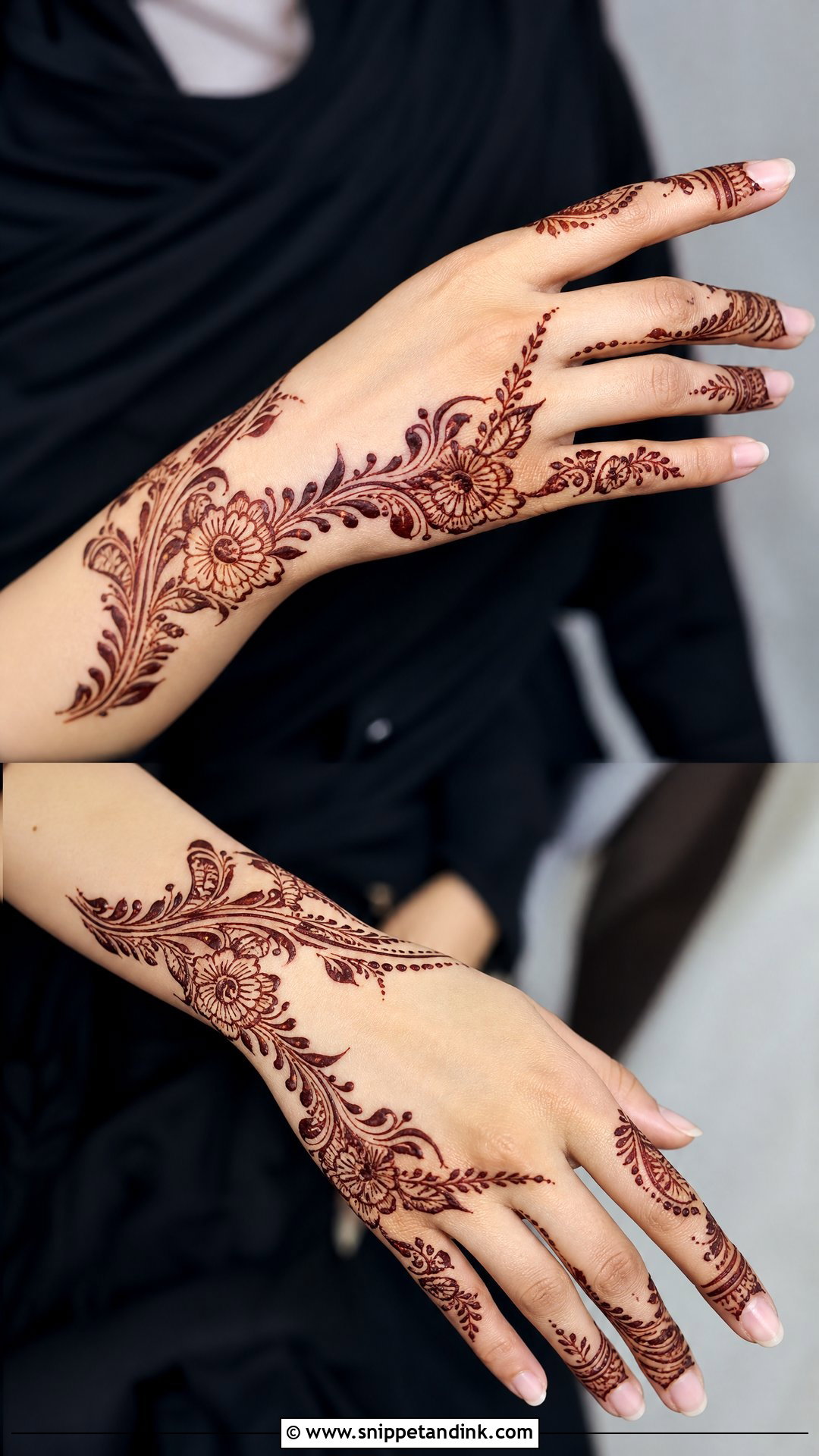
A side-hand design runs along one edge: from the wrist along the little-finger side, or from the thumb toward the index finger. Flowers, leaves, dots, paisleys and curved borders follow the edge while the centre stays open. It frames the hand naturally in photos. I check the trail from the front and the back before finishing, because the edge of the hand is seen from both sides, and a trail that looks balanced on one side can look lopsided on the other.
32. Arabic Thumb Mehndi Design
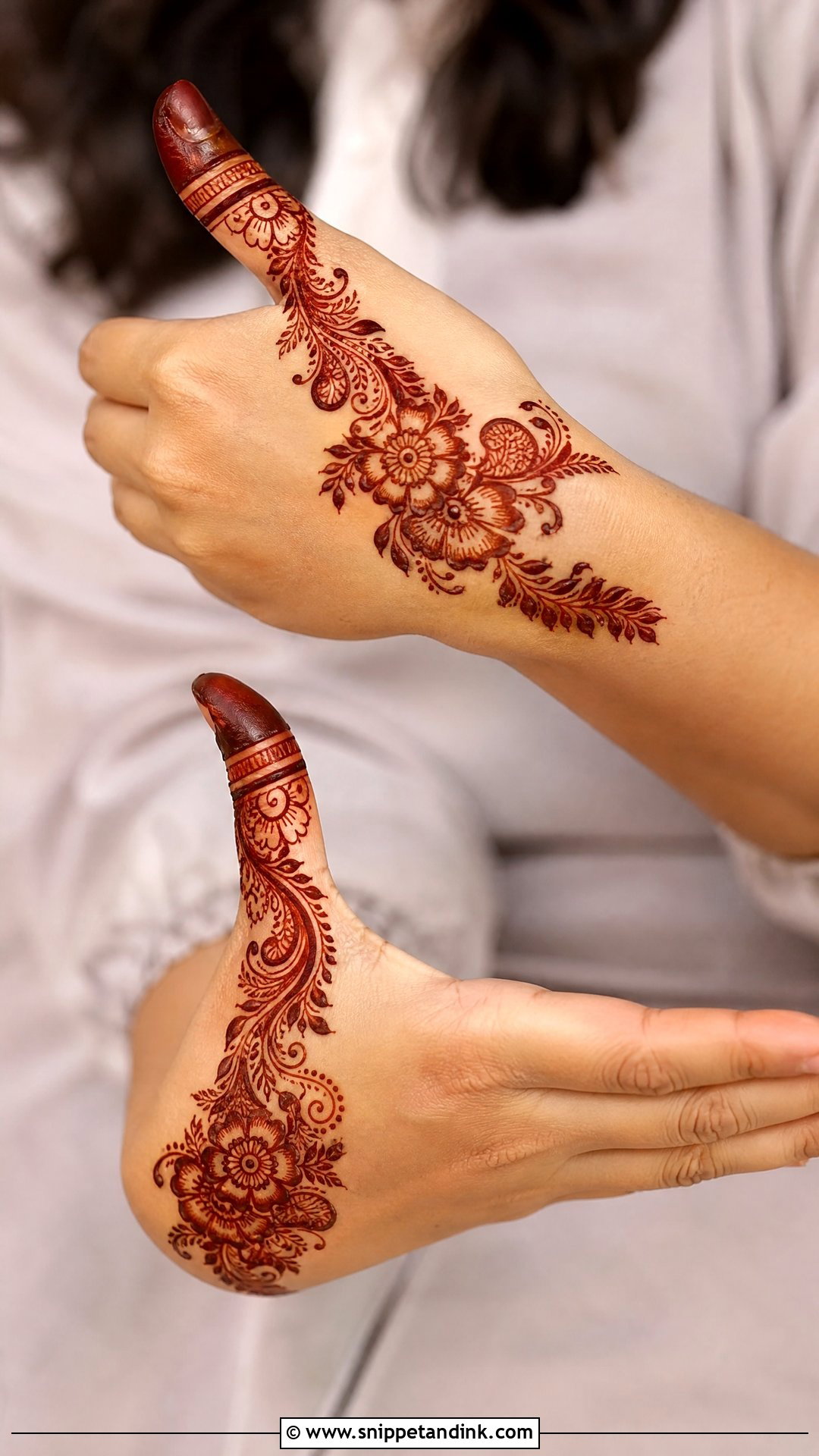
Thumb-focused henna starts with a floral cluster near the base of the thumb and moves across the palm or back of the hand with vines and leaves. The thumb itself carries leafy bands, a small paisley or a shaded tip. It leaves most of the hand open but still looks finished, as long as the thumb motif connects to the wrist or a finger; a lone cluster at the thumb can look abandoned. It’s quick and suits casual functions and simple Eid looks.
33. Arabic Wrist Mehndi Design
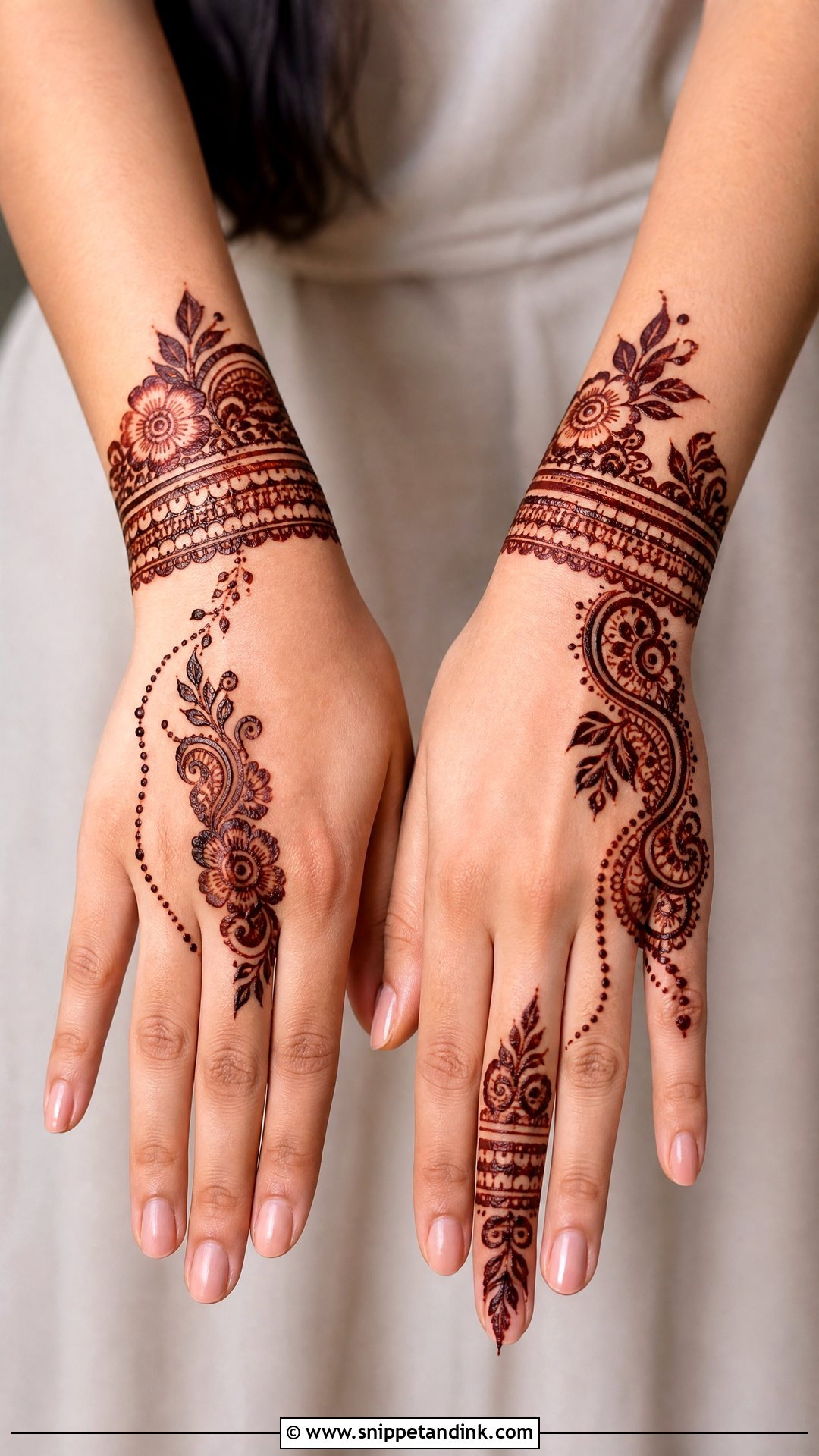
A wrist design is a decorative band, made from bracelet lines, floral cuffs, paisley rows or fine dotted chains, with a small trail moving toward the palm or one finger. It pairs well with bangles and long sleeves, where the wrist detail peeks out as you move. A narrow band looks delicate; a wider one looks festive, especially with a small flower above it. Since the wrist bends constantly, I tell clients to keep it straight for the first half hour.
34. Arabic Kids Mehndi Design
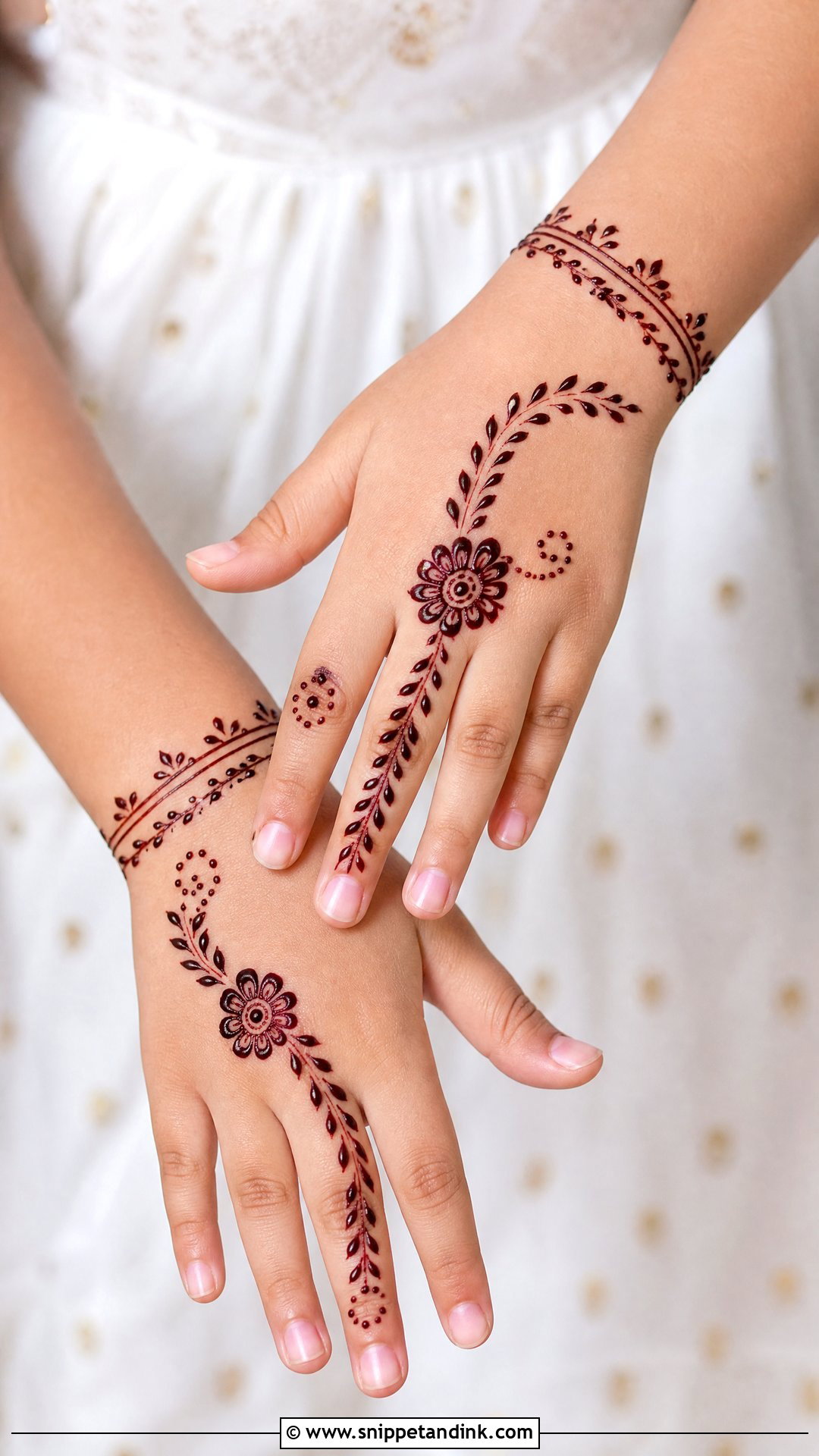
For children, I keep it simple and fast: a small flower on the back of the hand, a leafy trail to one finger and a tiny wrist band, with dots, hearts or leaves to make it fun. Dense patterns don’t work, because most children won’t sit still long. Only natural henna should go on a child’s skin, and I always do a small test dot first for younger children or anyone with sensitive skin. Keep it away from cuts or eczema patches, and stay nearby until it’s dry.
35. Arabic Foot Mehndi Design
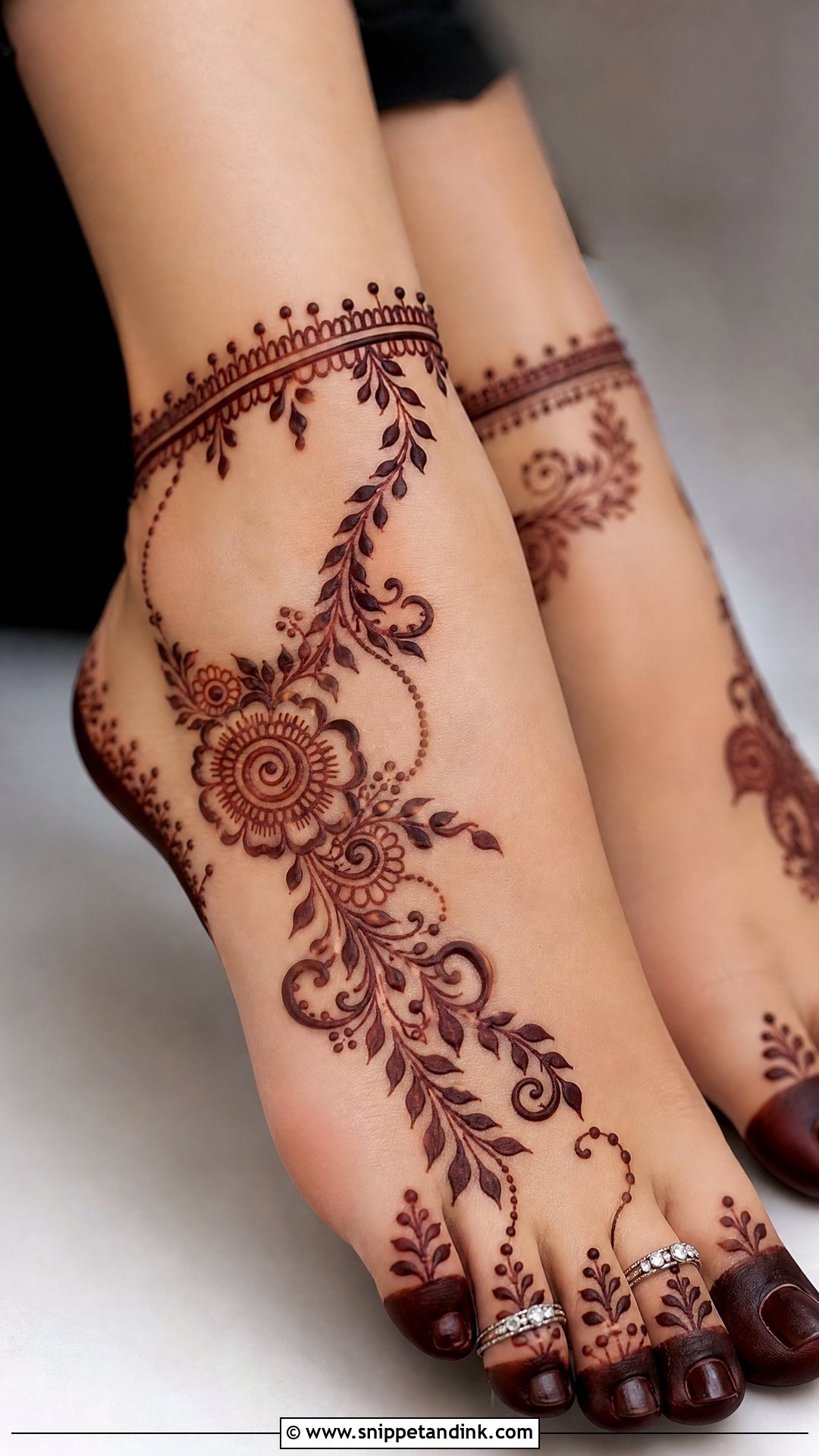
Feet stain darker than hands, often surprisingly so, because the skin on the soles and sides is thick. An Arabic foot design can start near the toes and flow toward the ankle with flowers, paisleys, leaves and dotted curves, with a diagonal trail down the side of the foot and a bracelet band at the ankle. Toes need only small rings or filled tips. Keep it spacious. The practical problem is walking: I ask clients to bring loose slippers and plan to sit with their feet up for a couple of hours.
Pale, Patchy or Smudged: What Can Still Be Done
Henna is a natural dye on living skin, so results vary, and most problems have a cause you can spot. Here’s what I tell clients when something doesn’t go to plan.
- Pale stain after a day: the paste was usually removed too early, the hands were washed straight away, or the skin was cold. Keep your hands warm and dry, and remember the colour keeps deepening for up to two days. You can’t add more depth to the same stain, but a small touch-up of fresh paste on key motifs can help before an event.
- Patchy colour: lotion, oil or sunscreen left on the skin blocks the dye. Wash with soap and dry thoroughly before application, and skip moisturiser that morning.
- A smudge while wet: wipe it straight away with a dry cotton bud, then a slightly damp one. Paste that sits for even a minute leaves a faint mark.
- Lines that bled together: the paste was too runny or the hand was too warm while drawing. Nothing will separate them once stained, so let your artist rework the area into a shaded motif instead.
- Itching, redness or blistering: wash the area and stop. Natural henna rarely causes this; a dark chemical dye often does. See a doctor if the reaction spreads or blisters.
If you want a stain to fade faster, oil the skin and exfoliate gently each day. There is no way to remove it overnight, and scrubbing hard or using bleach only damages the skin under it.
Your Hand Shape Should Set the Layout
Arabic henna adapts to almost any occasion, from a single back-hand trail to full bridal patterns, because the same few elements of bold outlines, vines, flowers, paisleys, jaali and open space are arranged differently each time. Keep it minimal for a casual day and rich for a wedding or festival. Gulf, Moroccan, Indo-Arabic, shaded or bracelet styles all bend to fit a long or short hand, so show your artist your hands and your outfit and let the layout follow.
You'll Like These Ideas:







Leave a Reply