
The palm is where henna stains deepest and where everyone looks first: when you hold out your hands at the haldi, when the ring goes on, when you fold them in your lap for portraits. That makes the front of the hand the place I plan most carefully. Some clients want simple palm designs; brides usually want everything from fingertip to elbow. Below are 35 layouts I draw for weddings, Eid, Diwali, engagements and smaller family functions, with notes on how each one sits on a real palm, how long it takes, and where it can go wrong.
What I Look at on Your Palm Before Drawing
No two palms take a design the same way, so the first few minutes of any sitting are spent just looking at the hand. These are the things that change what I draw.
Finger length and palm width
Long fingers can carry full bands and vertical vines to the tip. Short fingers look longer with a single line running up the center and a cap at the top, rather than stacked horizontal bands that cut them into segments. A wide palm suits a large mandala; a narrow one looks better with a diagonal trail.
Creases and how the hand moves
The deep creases across the palm fold every time you close your hand. A fine motif drawn right across one will crack and look broken in candid photos, so I place the focal design between the major creases and let simpler lines cross them.
Warm or sweaty palms
Warm hands stain darker, which is good news. Damp ones make the paste slide before it grips. If your palms sweat when you’re nervous, wash them with plain water and dry them well before we start, and skip lotion that morning; oil on the skin keeps the dye from taking.
1. Simple Front Hand Mehndi Design
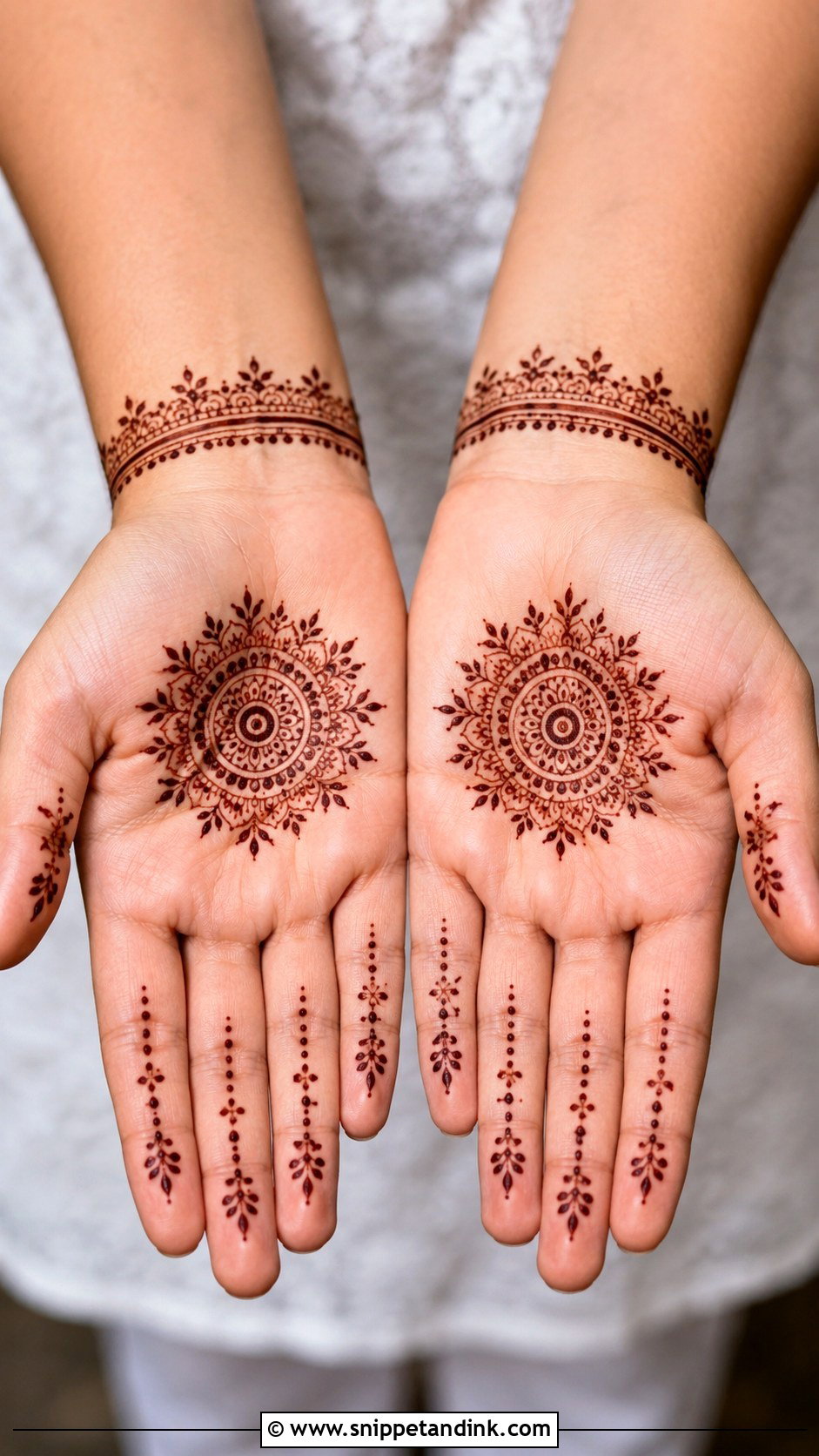
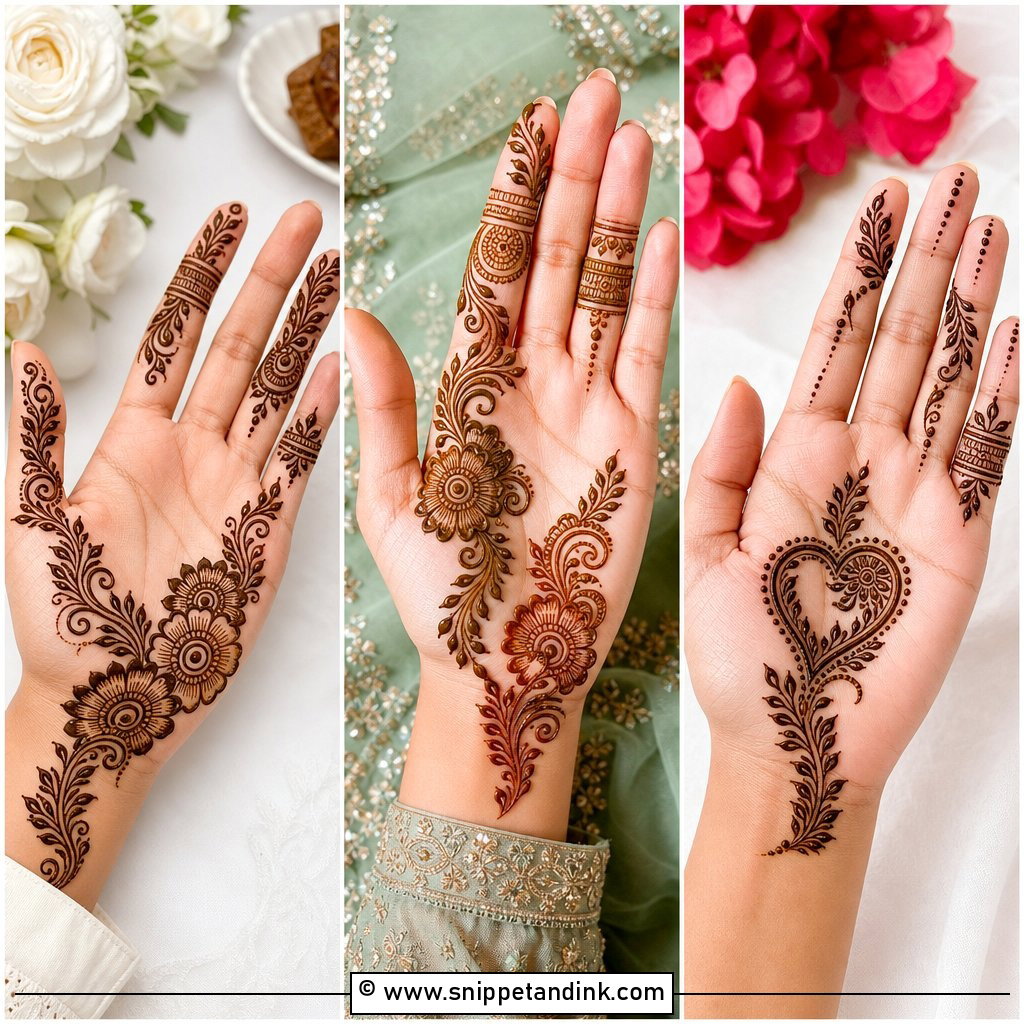
A small mandala, flower or paisley in the palm, a few neat finger lines and a slim wrist border. That’s the whole design, and it relies on spacing. I’d point beginners, young girls and anyone with a short sitting toward it, since it dries in a fraction of the time a full hand needs. Dotted fingertip caps finish it without adding weight.
2. Arabic Front Hand Mehndi Design
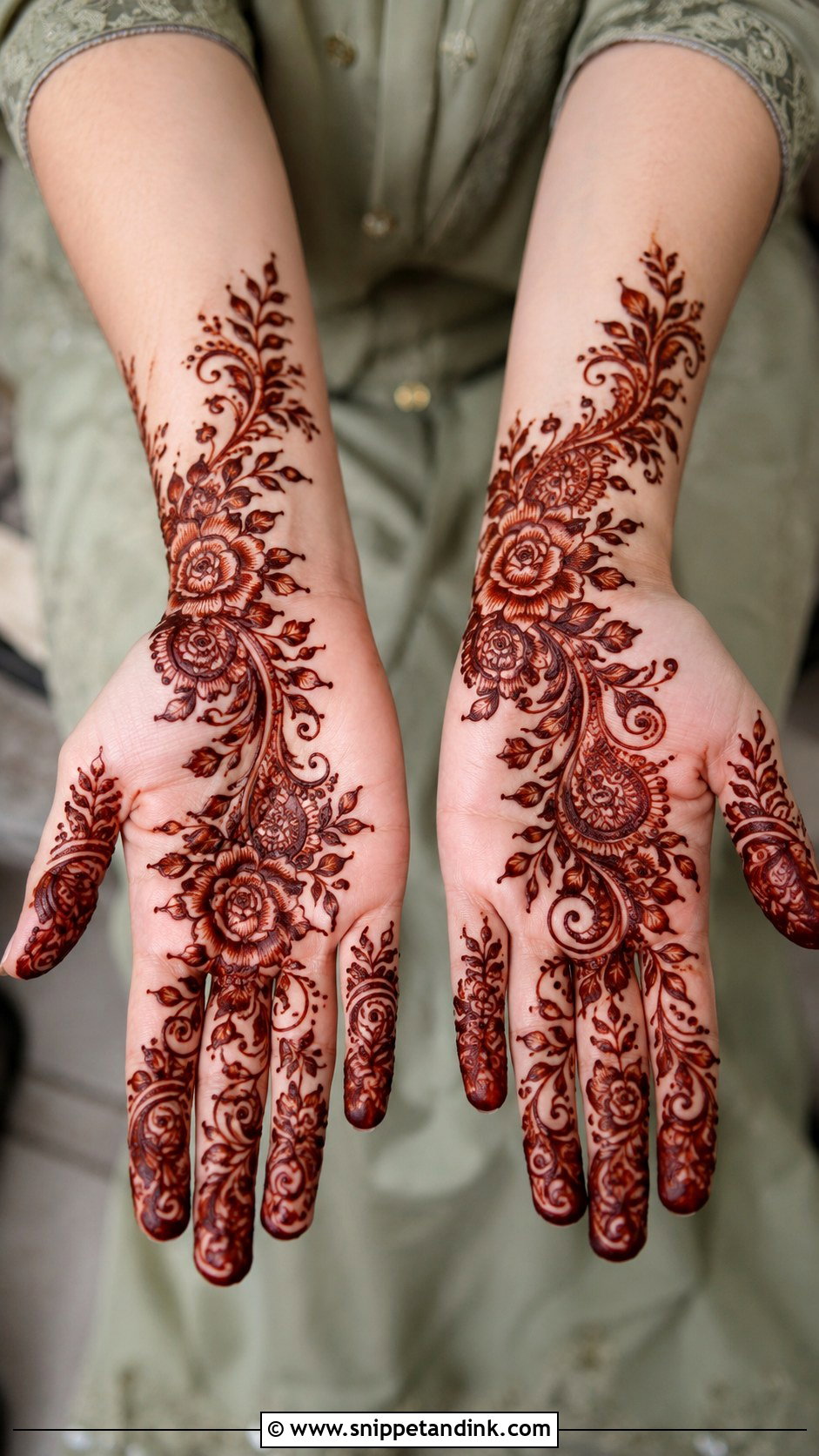
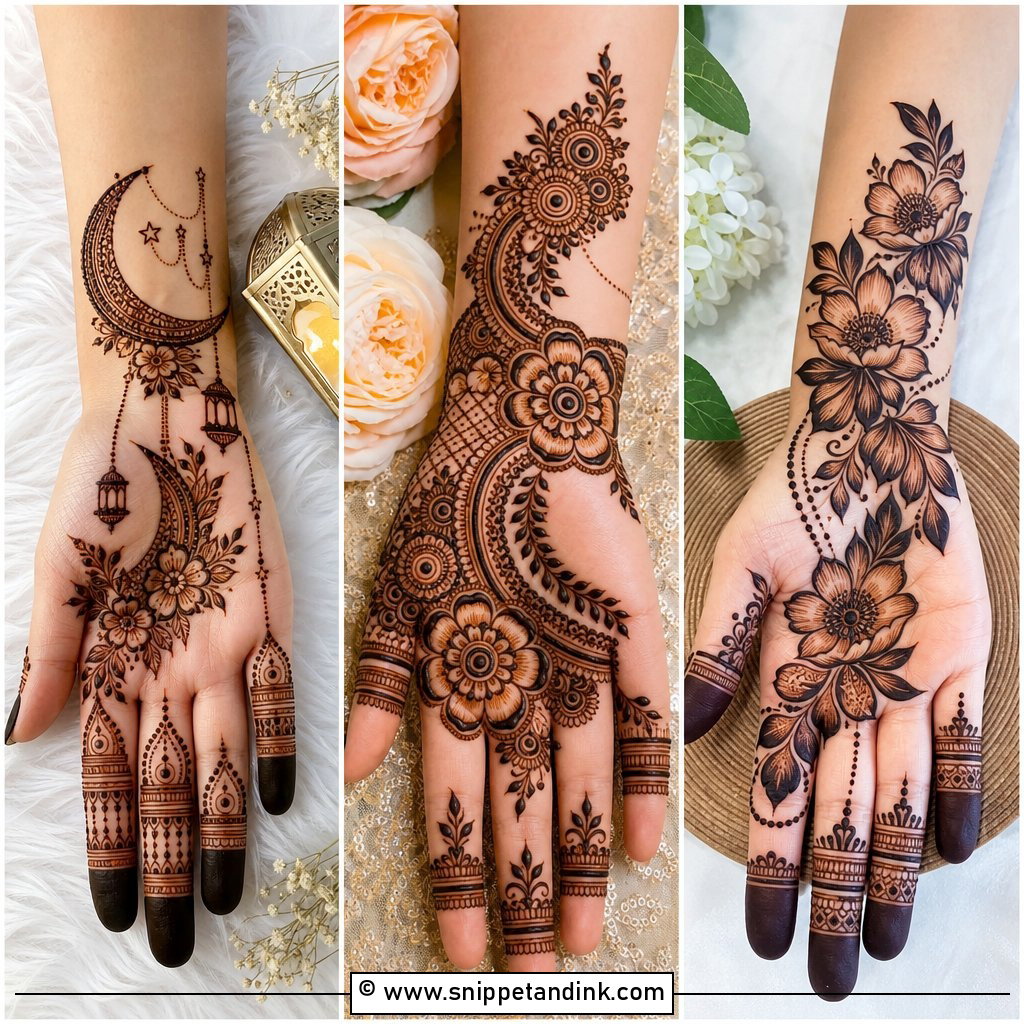
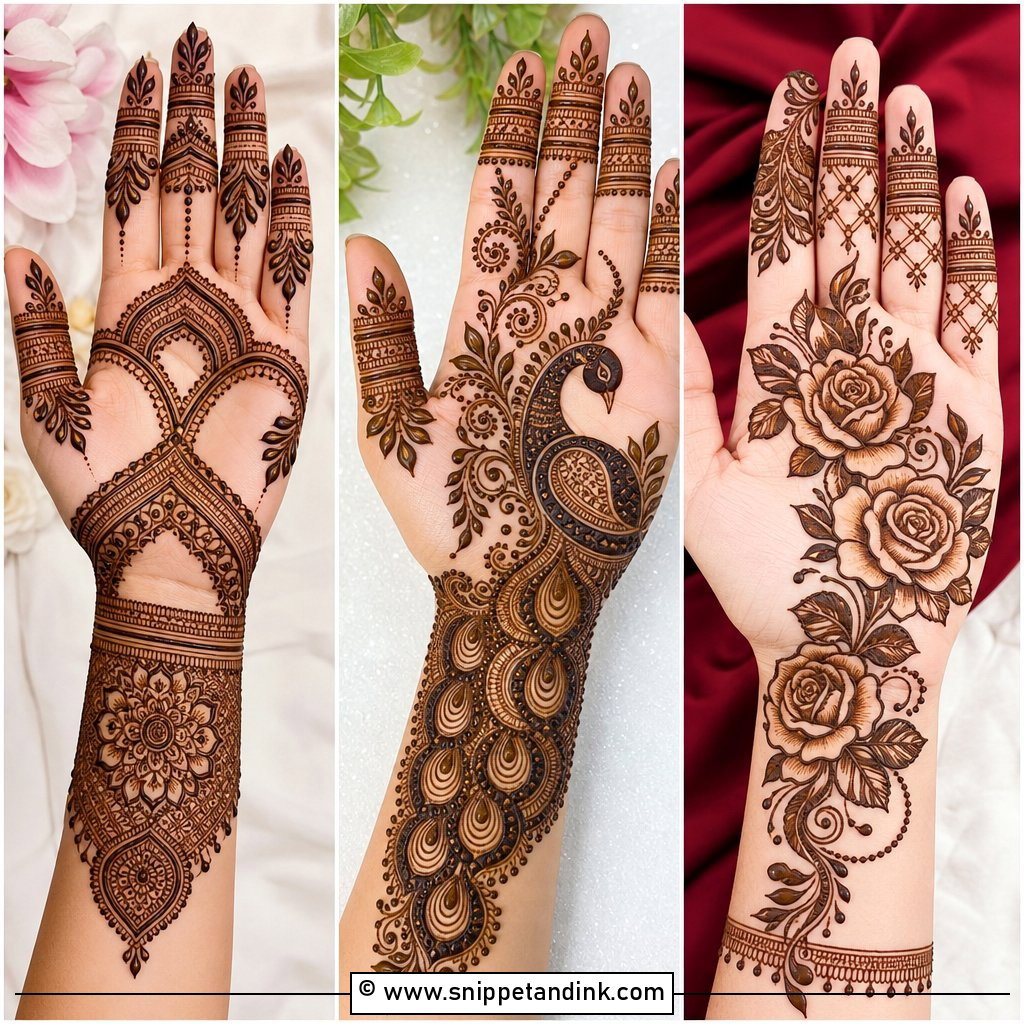
Arabic work moves diagonally from the wrist, across the palm and up toward the index or middle finger, in large flowers, leafy vines and shaded petals. The lines are thicker than Indian work, which means more paste on the skin and a darker, cleaner stain. I like it for Eid and engagement parties. Watch the direction, though: on a palm the trail should follow the natural diagonal crease, not fight it, or it looks crooked when the hand relaxes.
3. Full Front Hand Mehndi Design
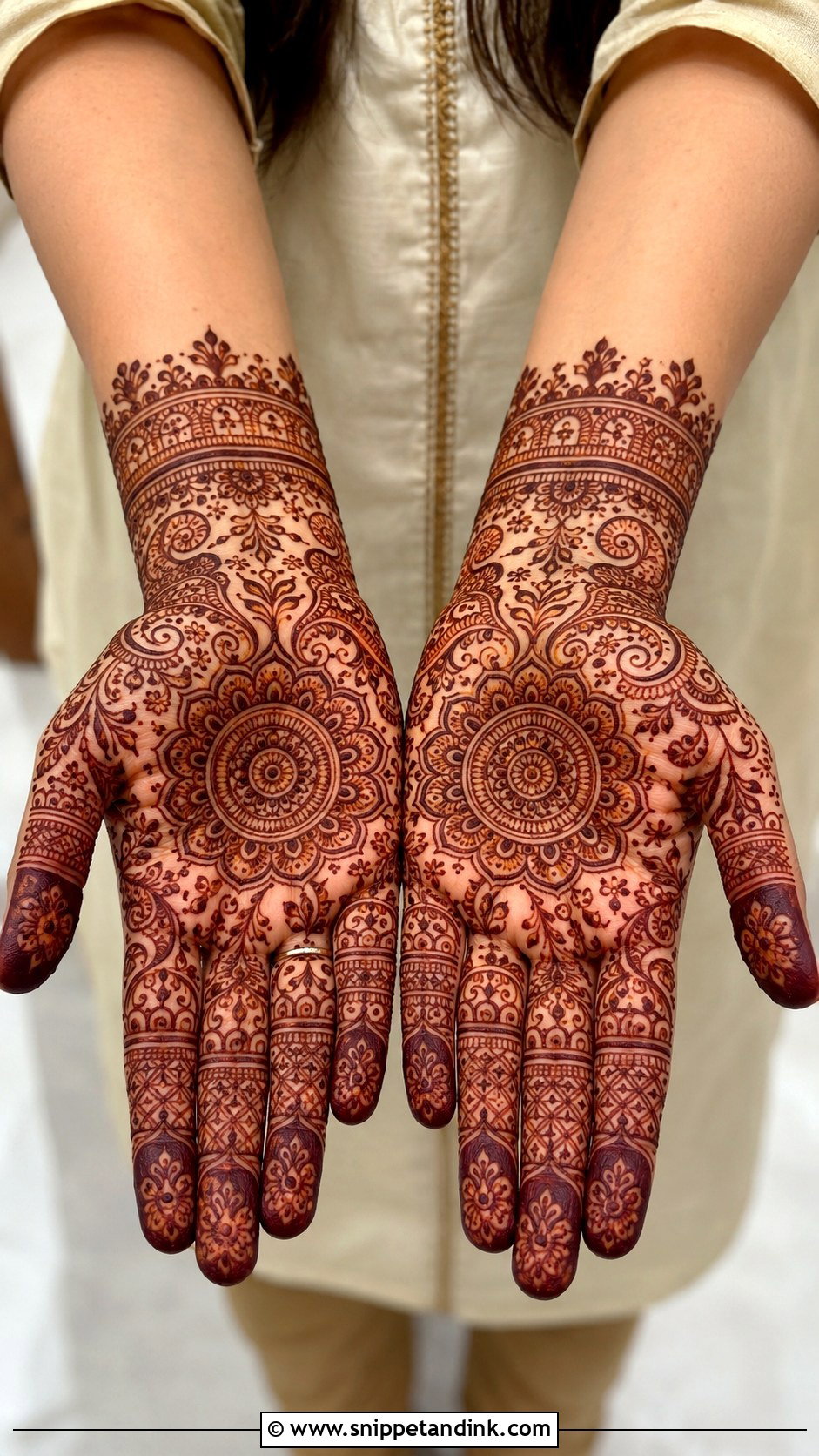
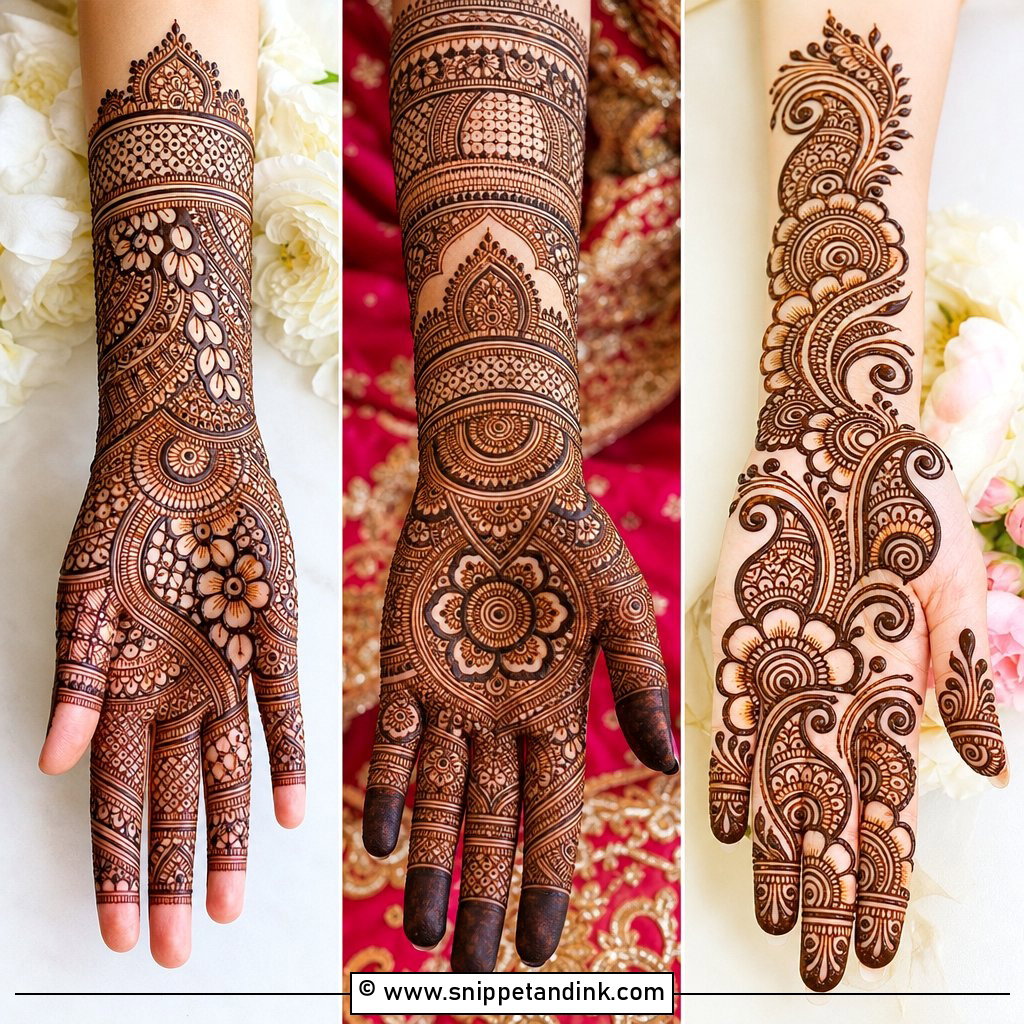
Full coverage takes a connected pattern over the palm, fingers, and wrist, with a mandala, peacock or lotus at the center and vines, jaali and fine curves around it. Fingers are worked from base to tip. It takes hours, and the client needs to plan for that, including someone to hold her phone and her water glass. The thing I protect in a full hand is the outline around each main motif. Without a clear border, the fill swallows the focal design once it stains.
4. Bridal Front Hand Mehndi Design
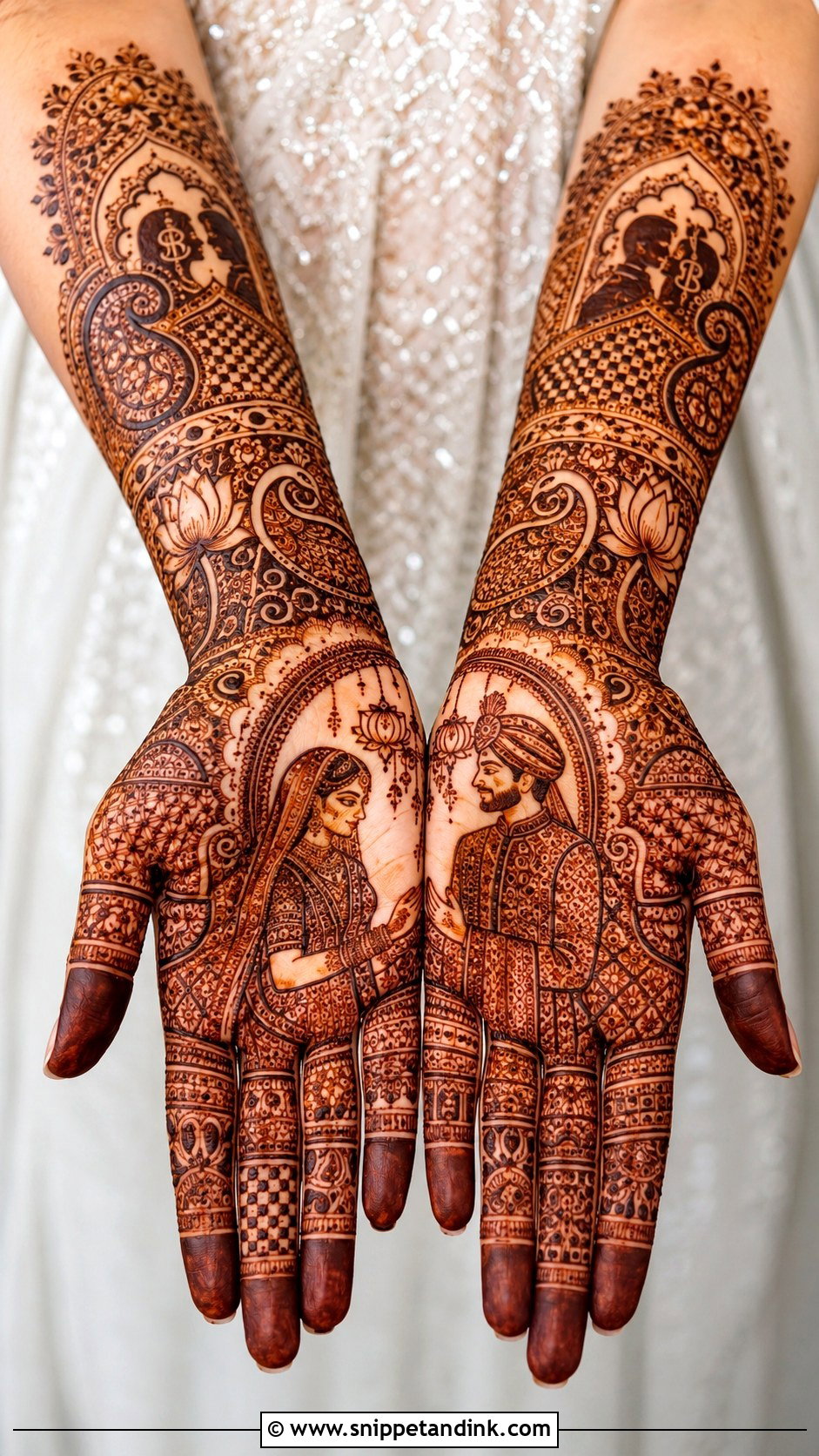
Bridal palms are where the storytelling happens: a bride and groom pair, lotus flowers, peacocks, kalash motifs, wedding bells, initials and hidden names, with fine mesh, paisley chains and floral bands on the fingers. Portrait figures need the most room, so I place them first and plan the rest around them. Hidden names should be small enough to hide but big enough to read once the stain darkens; a name in lines too fine just fills in. I schedule bridal application one to two days before the ceremony so the color peaks on the day.
5. Modern Front Hand Mehndi Design
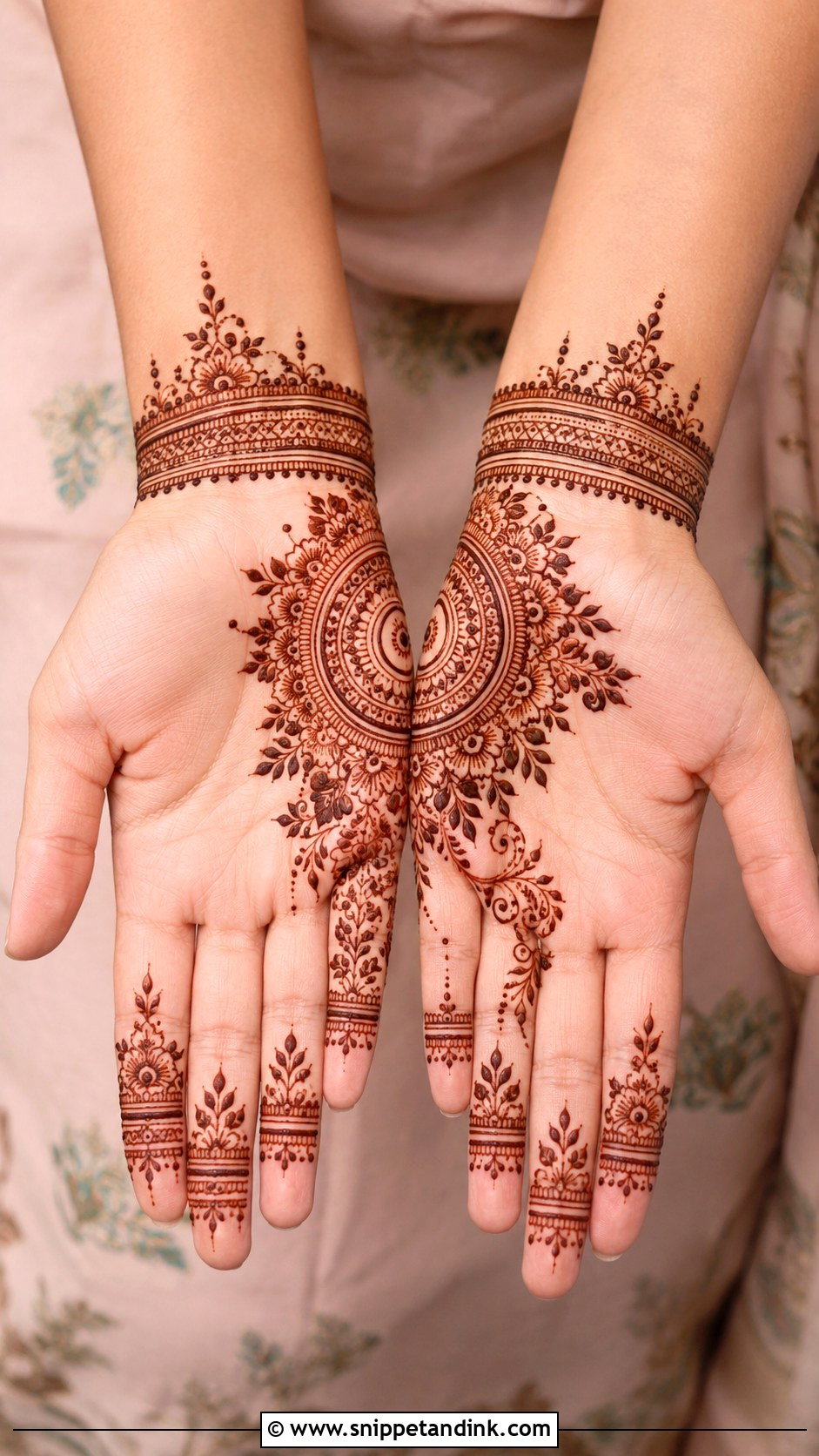
Modern palms use fewer, stronger motifs and a lot of bare skin. A half-mandala on the palm, slim finger work and a wrist band can be the entire design. Asymmetry suits it: one side of the palm open, the other carrying a vine or a cluster of flowers. The open areas have to look deliberate, so I mark the boundary with a light dot line before I start and keep every edge crisp.
6. Indian Front Hand Mehndi Design
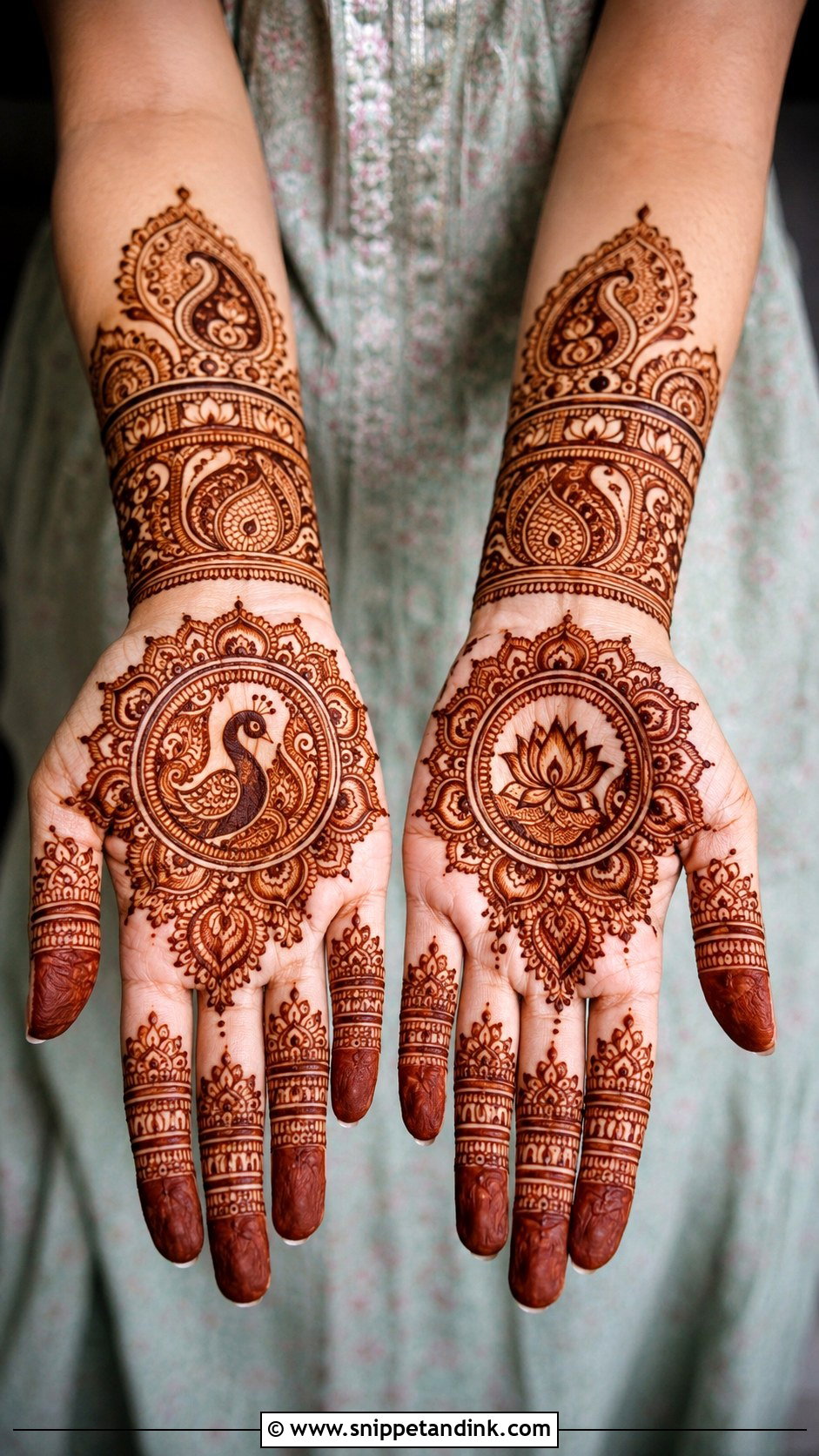
Indian palm work builds a textile-like surface from small repeated motifs: paisleys, peacocks, lotuses, mandalas and fine curved fill, with layered bands and net on the fingers and a cuff at the wrist. I mirror the two palms so they read as a pair when the bride holds them together. Paste matters here more than anywhere. Fine Indian lines need a smooth, well-sifted paste; a gritty batch catches in the cone tip and leaves broken lines that show after staining.
7. Indo Arabic Front Hand Mehndi Design
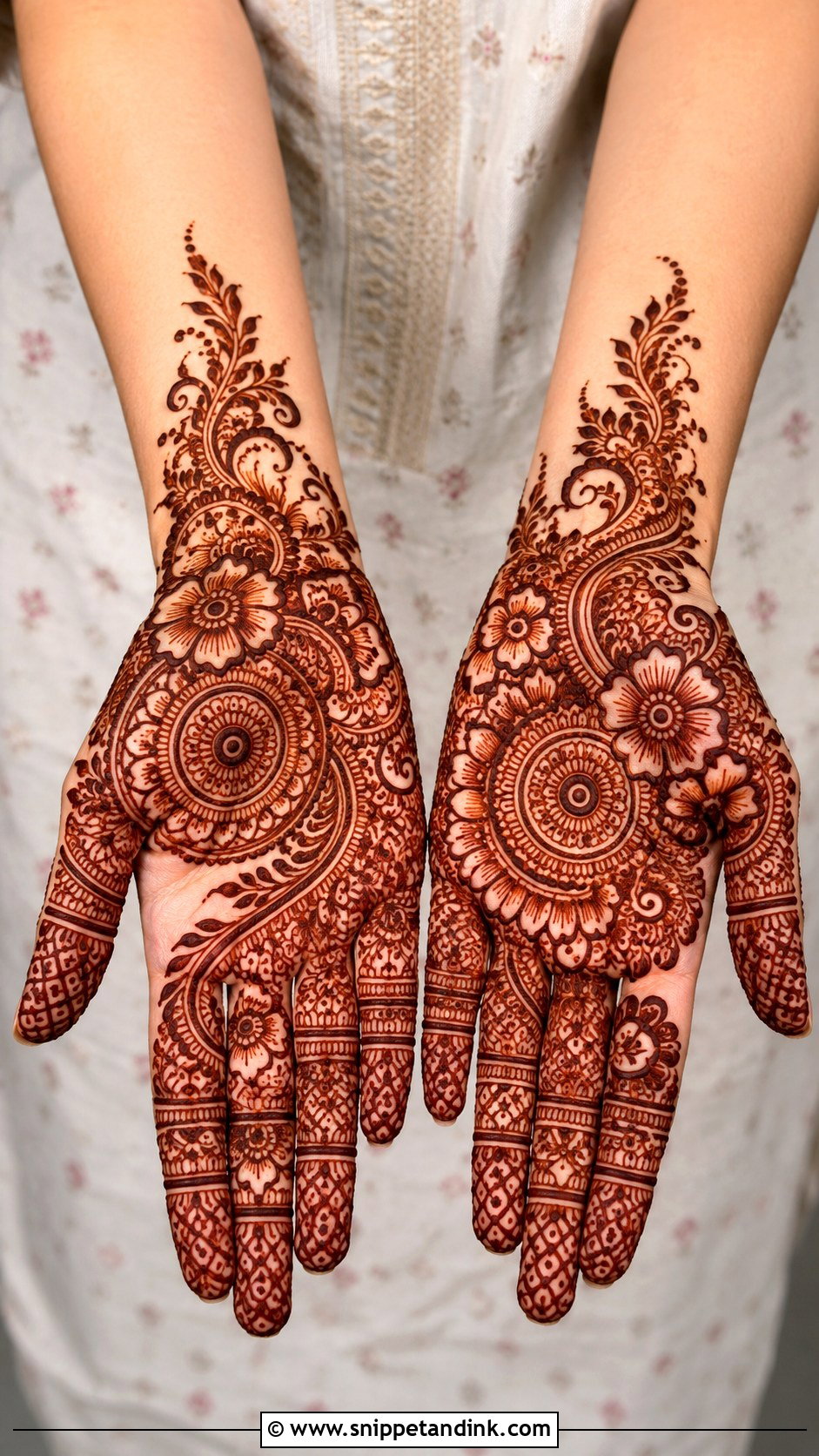
Indo-Arabic gives you Arabic flow with Indian depth. A mandala or paisley sits in the palm, bold flowers and leafy trails run outward on a diagonal, and fine fill sits between the bigger shapes. It’s the layout I suggest most for sisters of the bride and close guests, because I can make it fuller or more open on the spot depending on time. Thick outlines, delicate fill: that contrast does all the work.
8. Mandala Front Hand Mehndi Design
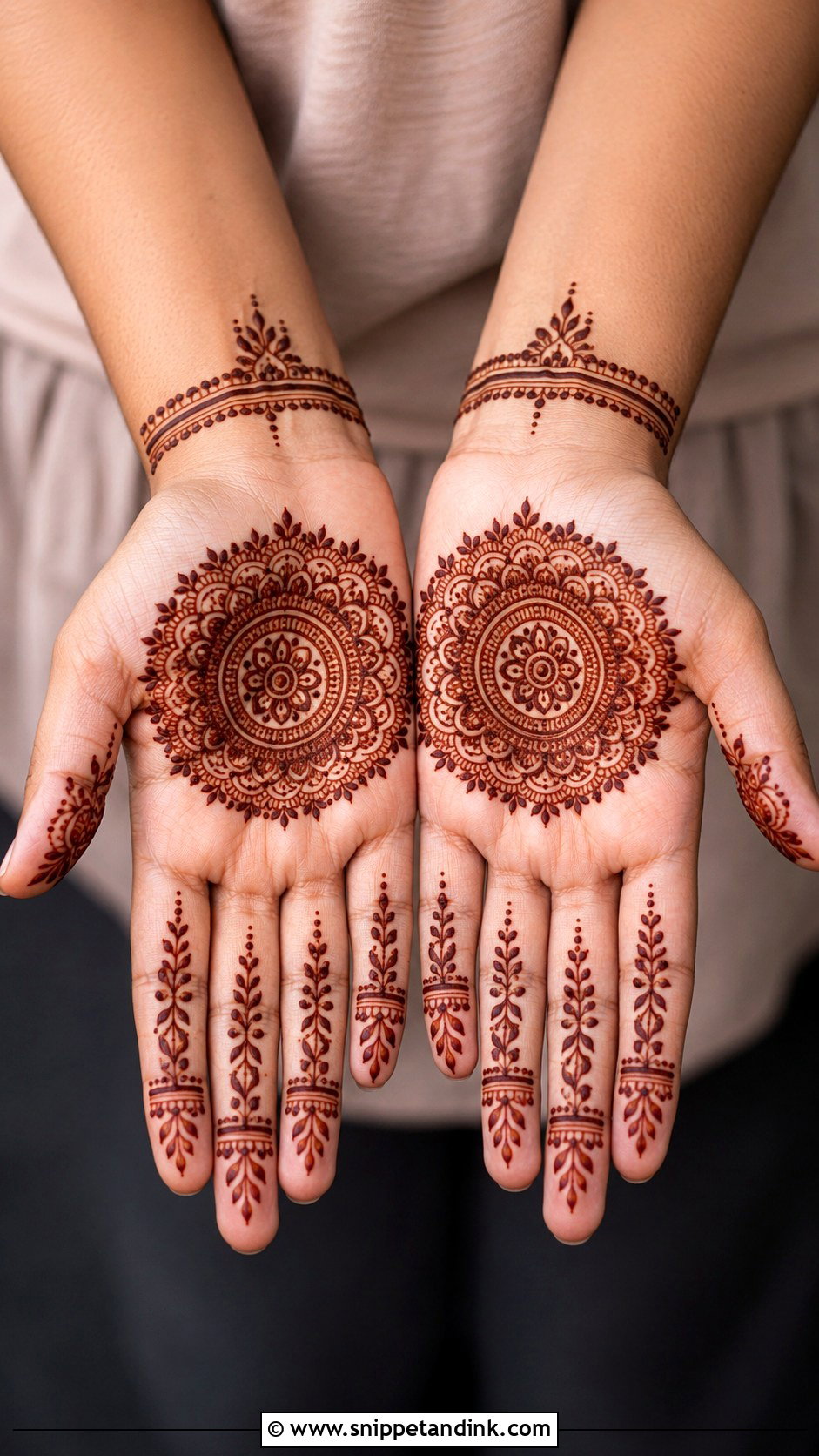
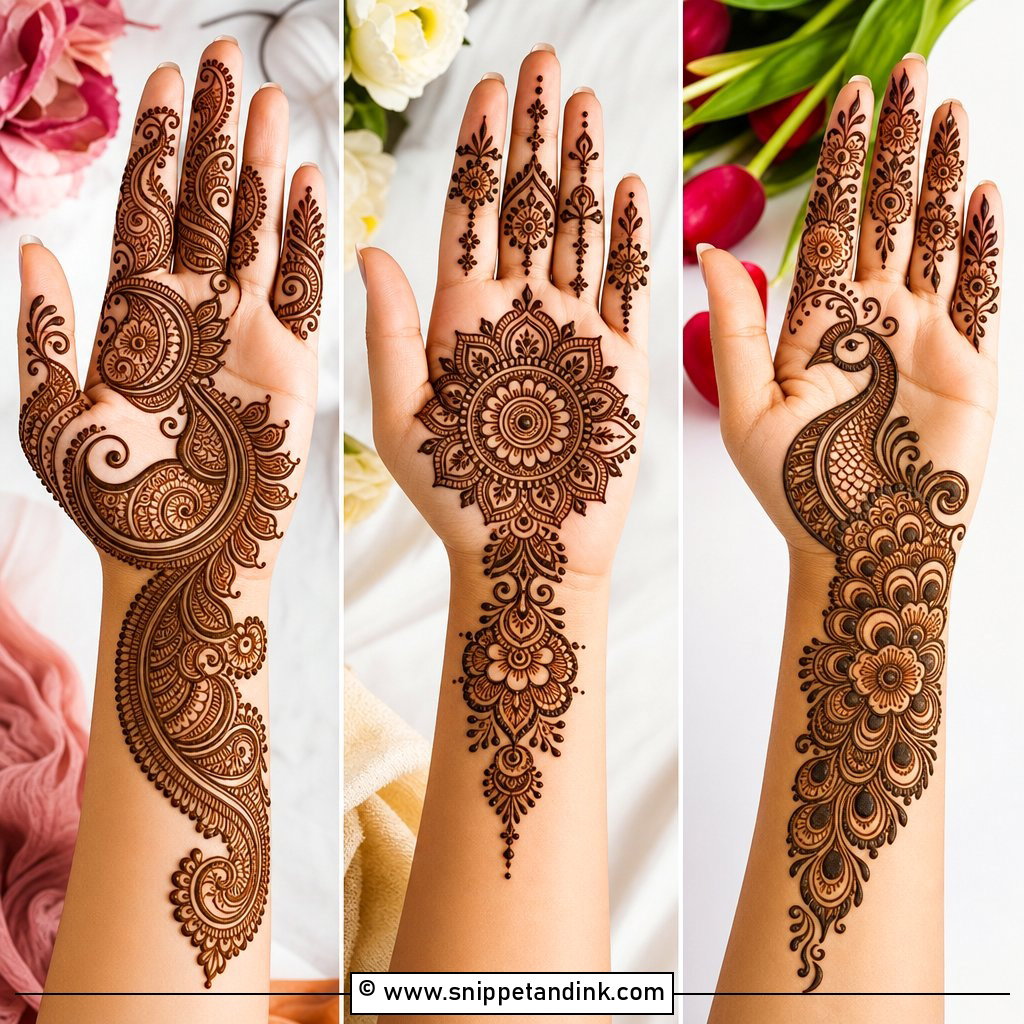
A mandala centered in the palm gives immediate symmetry and suits almost every hand shape. Keep it to clean rings and dots, or build it out with petals, tiny paisleys and shading. The hard part is centering. The middle of the palm isn’t where most people think, so I have the client cup her hand slightly and place the center where the palm naturally hollows. Matching mini mandalas at the fingertips tie it together.
9. Flower Front Hand Mehndi Design
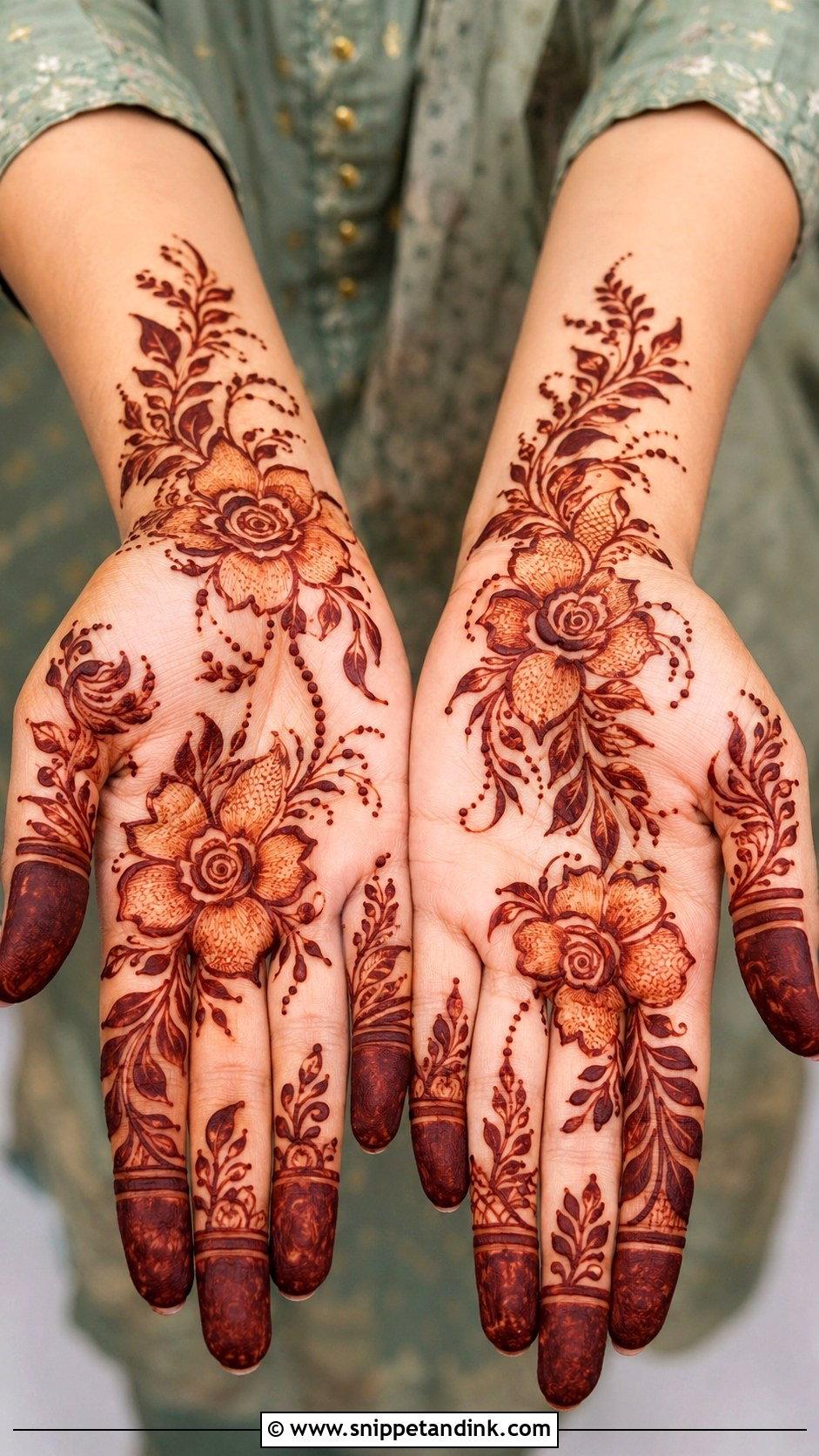
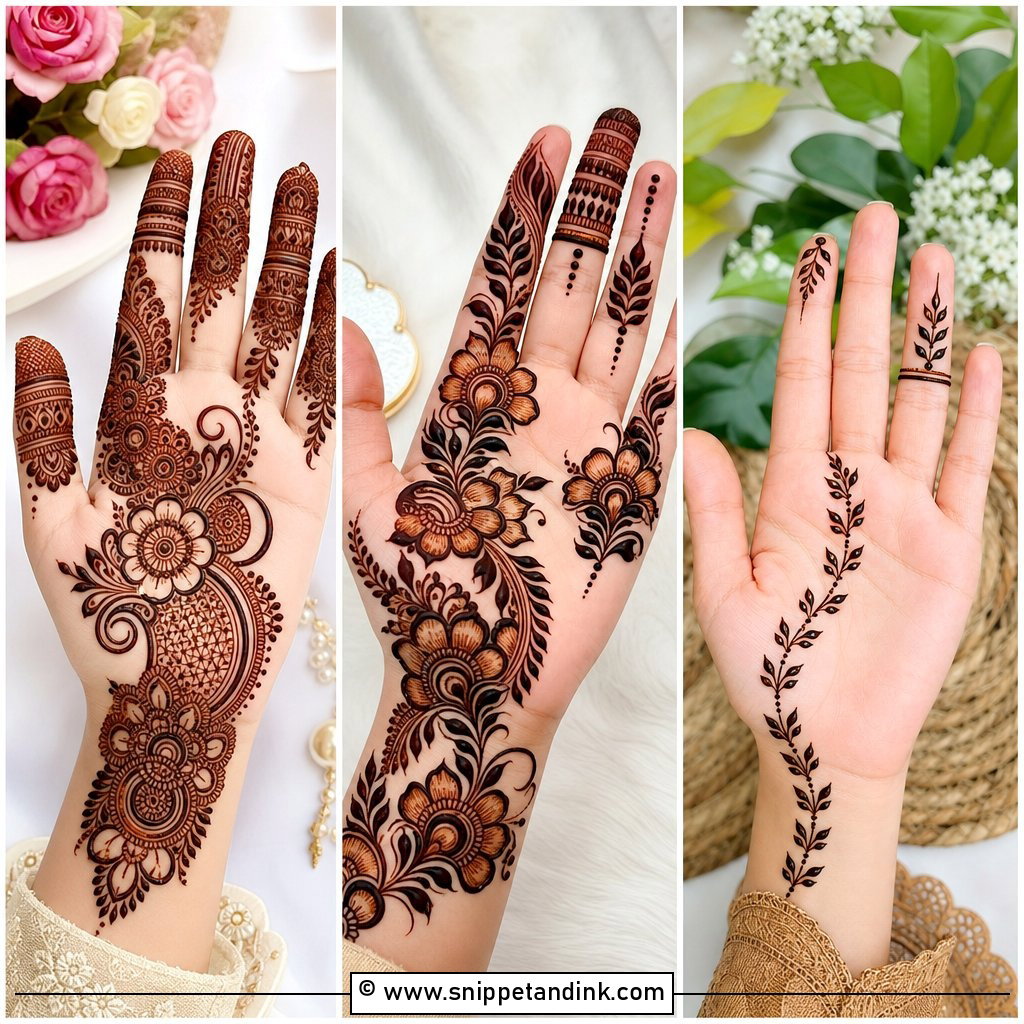
Flowers adapt to any occasion. One big flower in the center with light finger detail is the quick version; a chain of roses, lotus petals and small blossoms running from the wrist to the index finger is the fuller one. I shade the petals with short strokes from the base outward, which leaves a gradient once the stain develops. Leave air between the flowers so the shapes don’t merge into one dark patch.
10. Rose Front Hand Mehndi Design
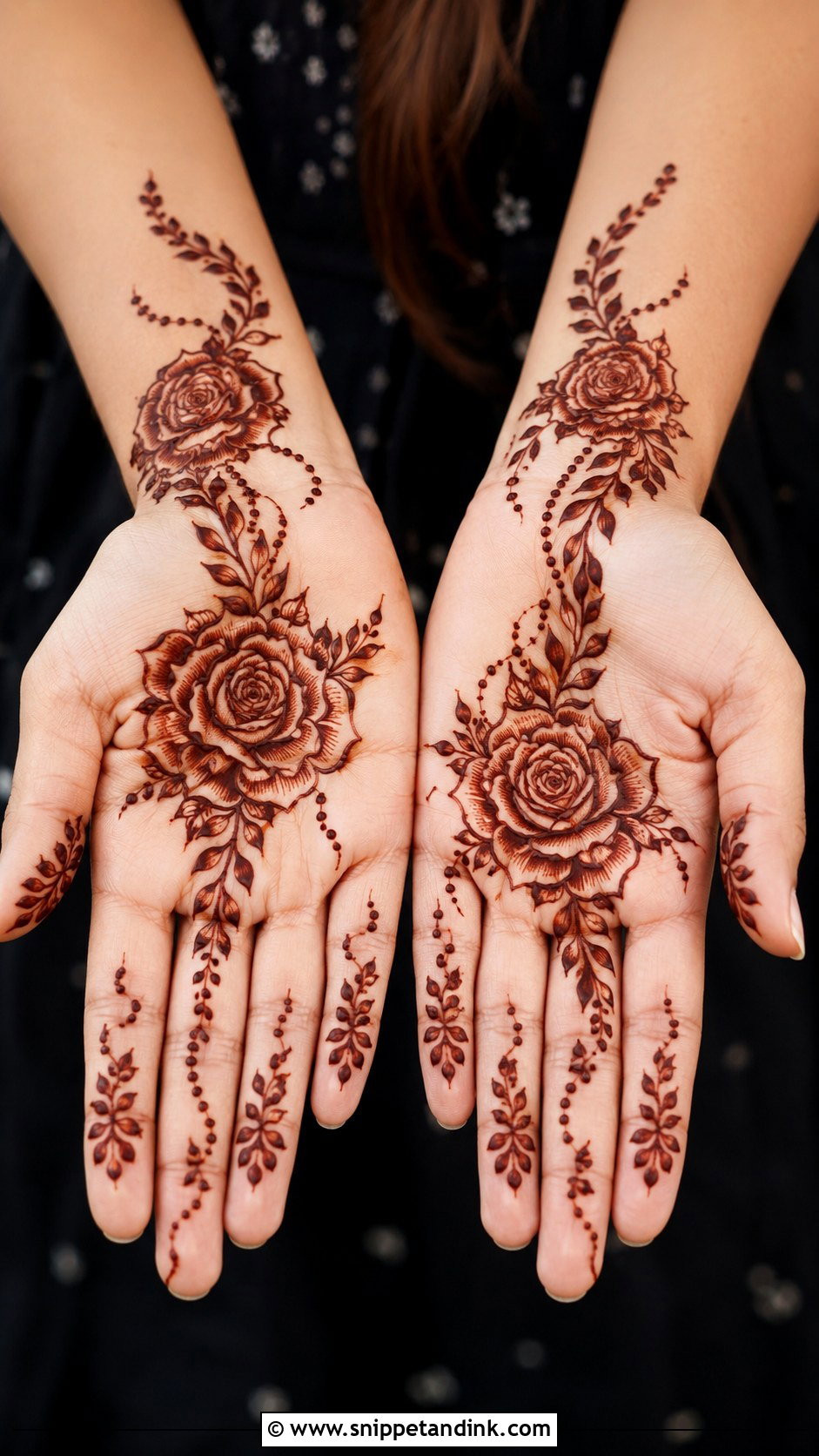
One rose can carry a whole palm without dense fill. It sits in the center, near the wrist or along an Arabic diagonal, with layered petals and leafy stems. What makes a henna rose read as a rose is the tight curl at the heart and the slightly open outer petals; draw them all the same size and it becomes a spiral. Tiny gaps between petals keep the shape visible after the stain darkens. Dotted chains or slim finger vines suit it.
11. Lotus Front Hand Mehndi Design
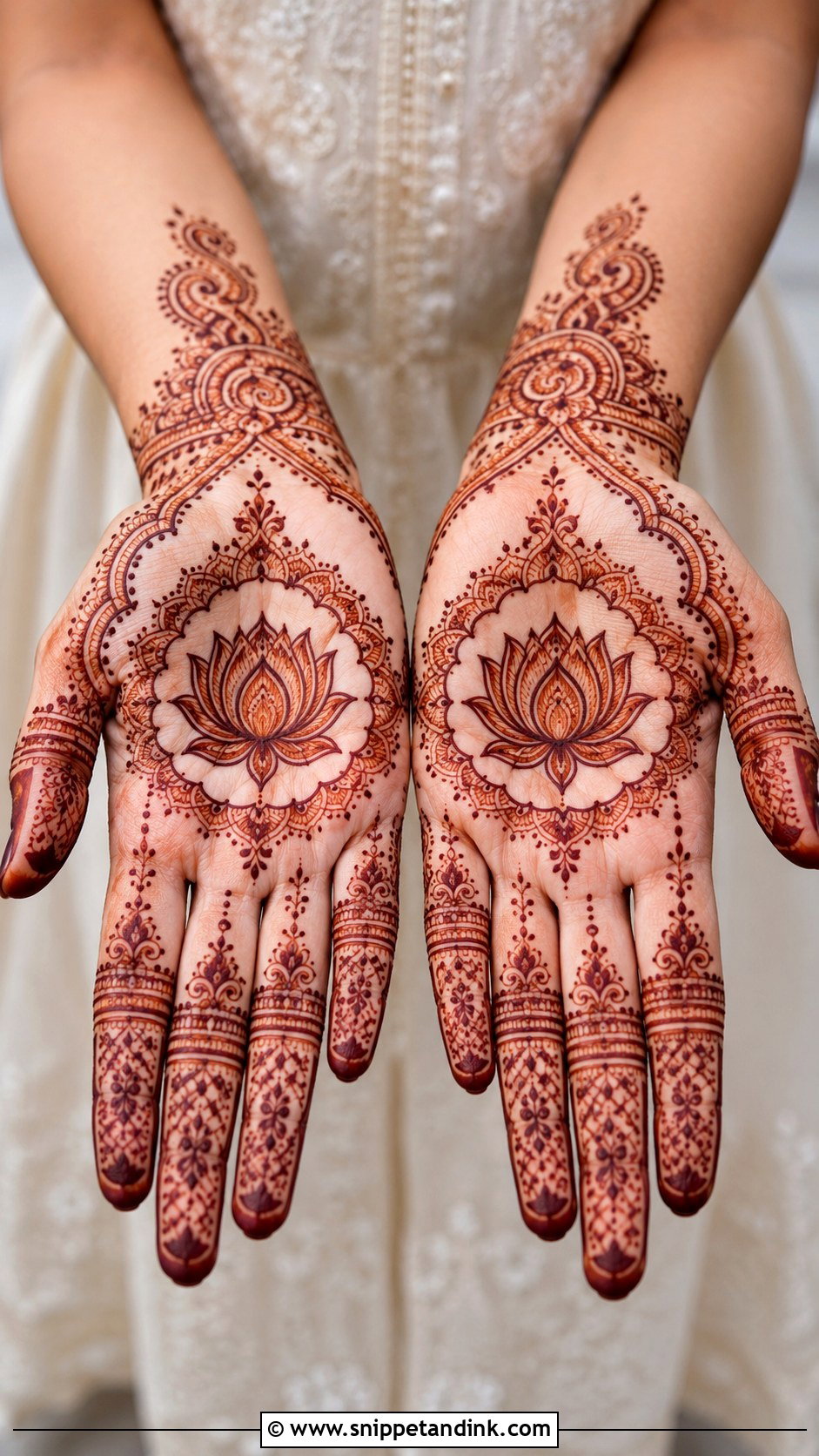
The lotus is often linked with purity and new beginnings, which is why it’s so common at pujas, Diwali and weddings. It can sit in the palm center or anchor the wrist with petals opening toward the fingers. A simple version is clean petals with a dotted border; a grand one adds mandalas, paisleys and jaali. I draw lotus petals wider than they look like they need to be, because henna lines thicken a little as the paste sits, and narrow petals close up.
12. Paisley Front Hand Mehndi Design
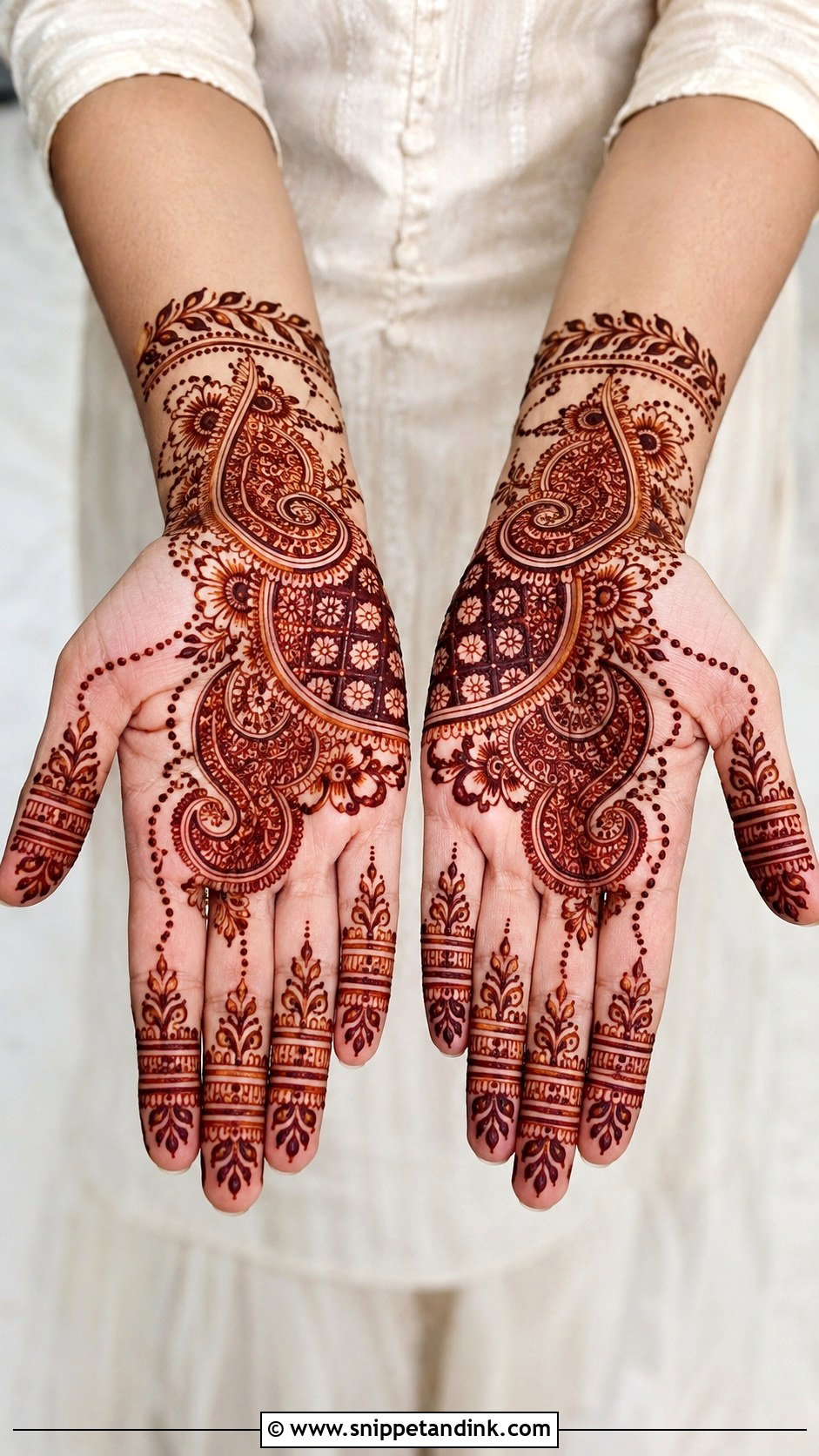
Paisleys are endlessly adaptable. They fill a palm, frame a mandala or run in an Arabic trail, and each one can hold flowers, dots or leaves inside. For a full hand I put larger paisleys on the palm and smaller ones on the fingers; for a lighter look, one bold paisley near the wrist with vines climbing from it. The outer curve should be drawn in a single stroke. A paisley outline built from several short strokes always shows its joins.
13. Peacock Front Hand Mehndi Design
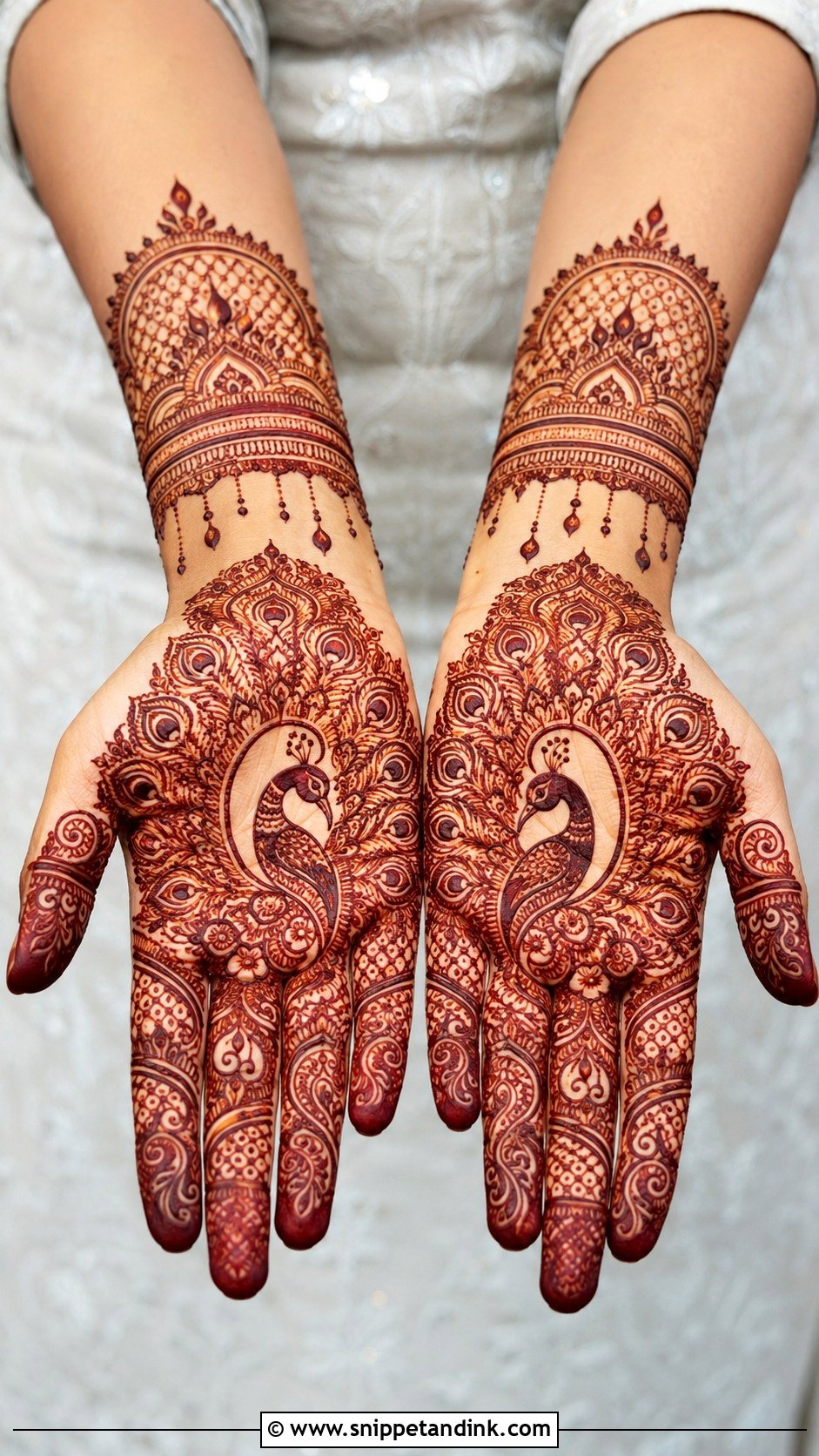
A peacock across the palm, its feathers fanning toward the wrist or fingers, is one of the richest motifs I draw. Feather lines, paisleys, small flowers and curved borders fill around it. I always settle the eye, neck and body first, then the feathers, because a peacock that loses its head in the fill becomes a blob. For a lighter look, a single head and a small feather fan is enough.
14. Jaali Front Hand Mehndi Design
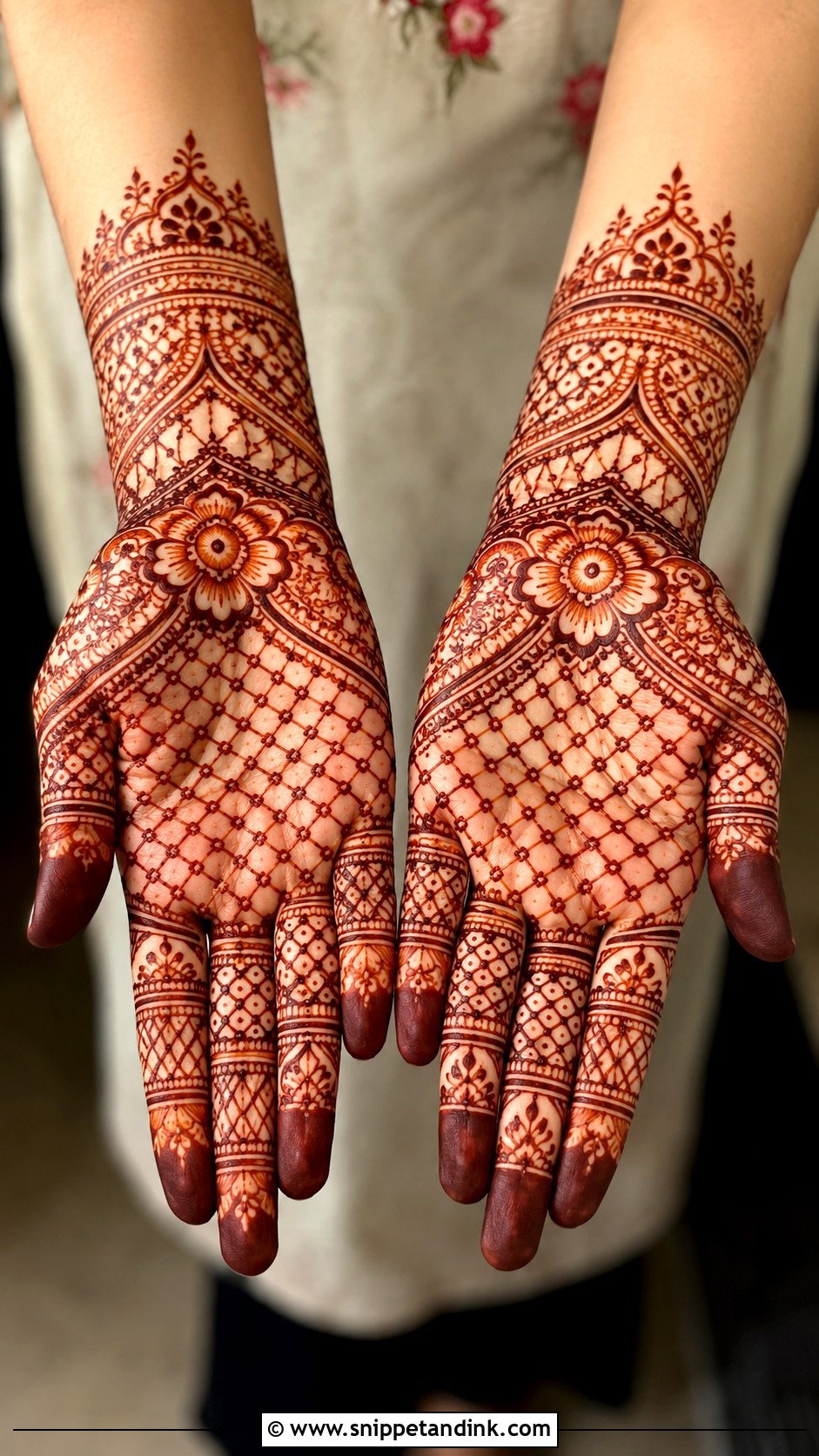
Jaali is net work: fine crossing lines over the palm, fingers or wrist, leaving small diamonds or squares of bare skin. It looks intricate but reads light because of the open grid. Dots or tiny flowers inside the cells add richness. I draw all the lines in one direction across a section before crossing them, which keeps the spacing even. Bold borders or floral motifs around each jaali panel stop it looking like a texture with no edges.


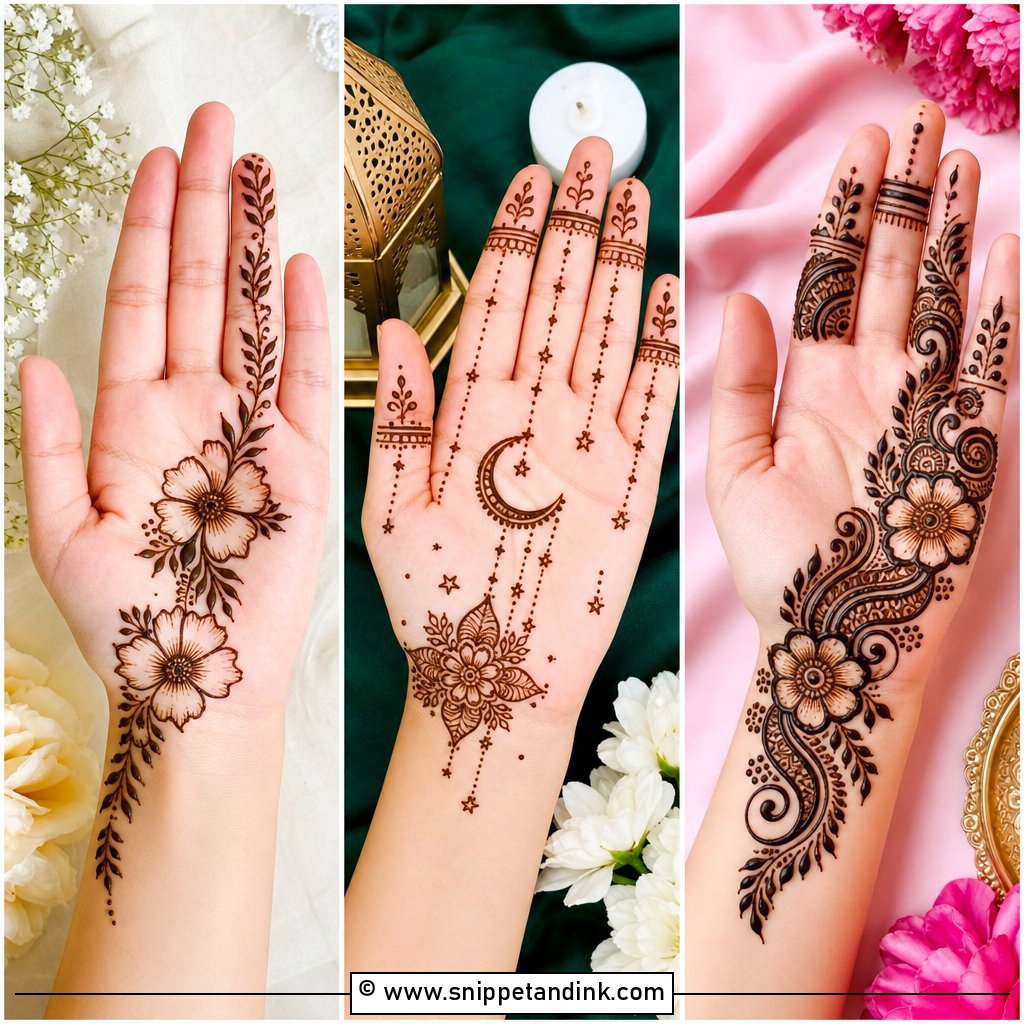
15. Bracelet Front Hand Mehndi Design
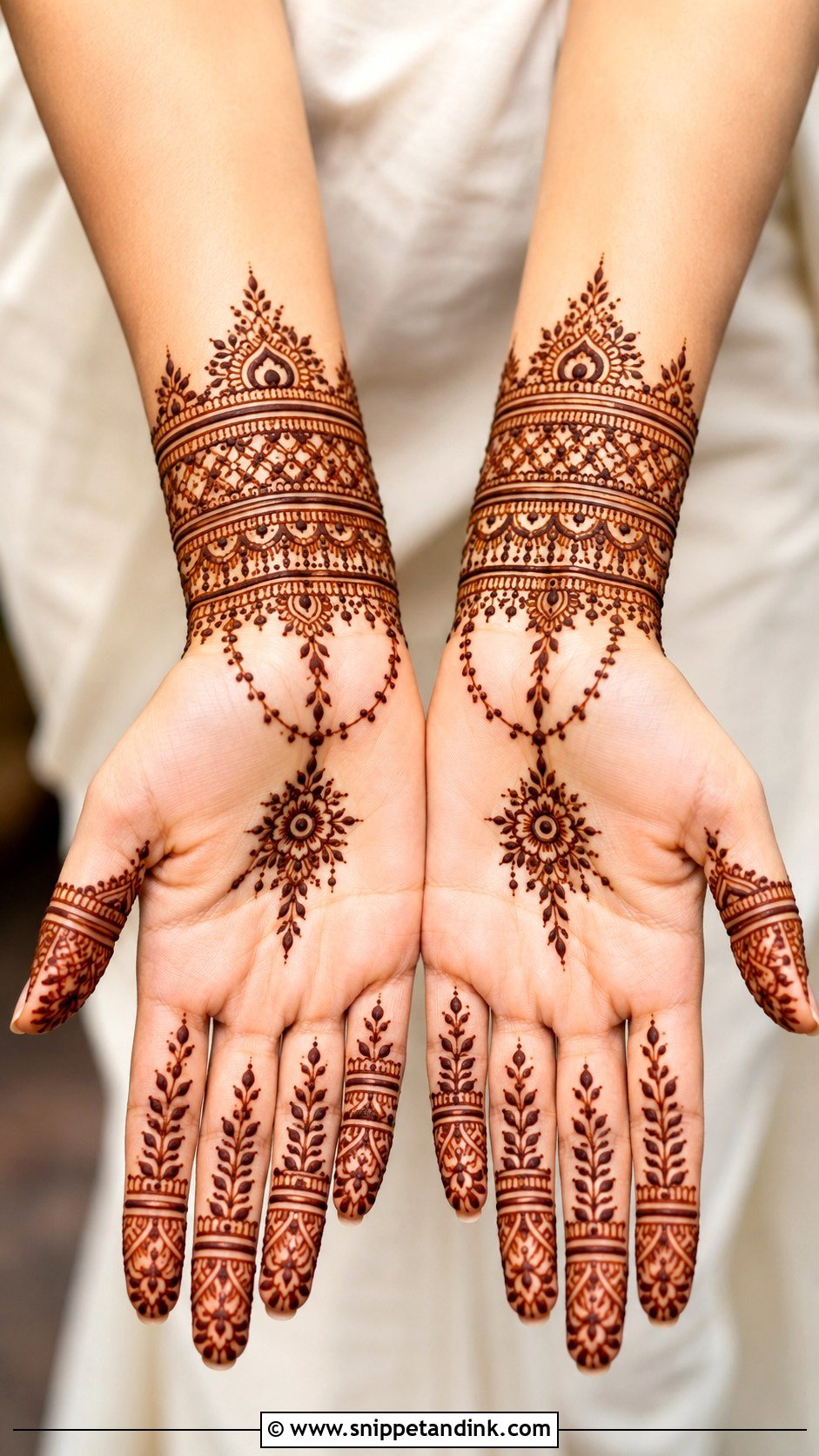
The wrist becomes a henna bangle, with layered bands, dots, chains, flowers or geometric borders, and a vine or small motif leads from it into the palm. Wrist skin stains lighter than the palm, so I make the bracelet lines slightly bolder than I would inside the hand. If the client will wear real bangles, I ask which wrist and how many, so the henna band isn’t hidden under glass. Keep the palm minimal or add a small central flower.
16. Finger Front Hand Mehndi Design
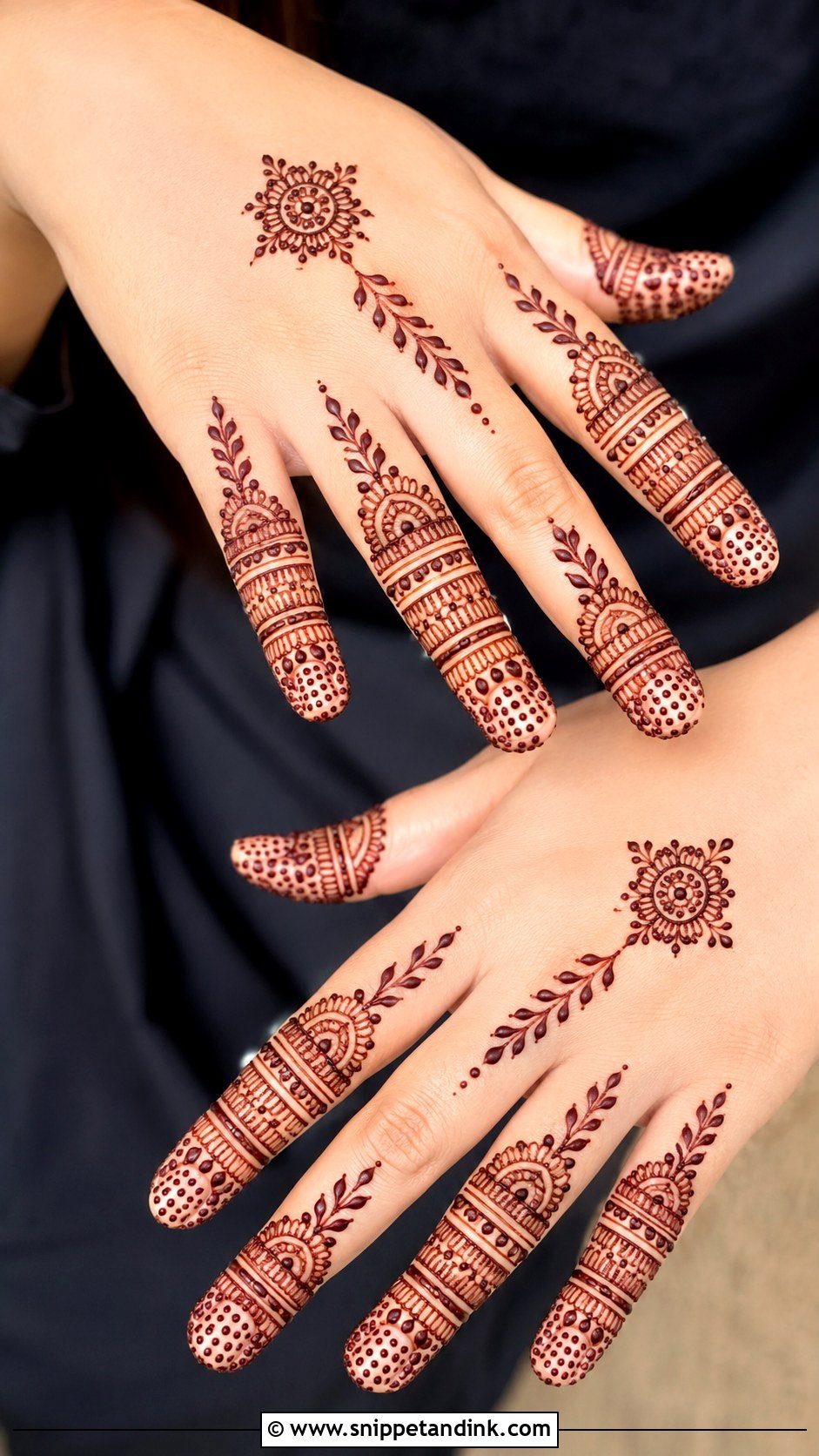
Here the fingers do the talking: leafy trails, ring bands, dots, chevrons, tiny flowers and fingertip fills, with the palm mostly open. It’s quick and modern. The common mistake is giving every finger a different idea. I pick one repeating element, dots or a leaf line, and vary it slightly from finger to finger, so the hand reads as one design. A small motif at the base of the palm connects everything.
17. Palm Front Hand Mehndi Design
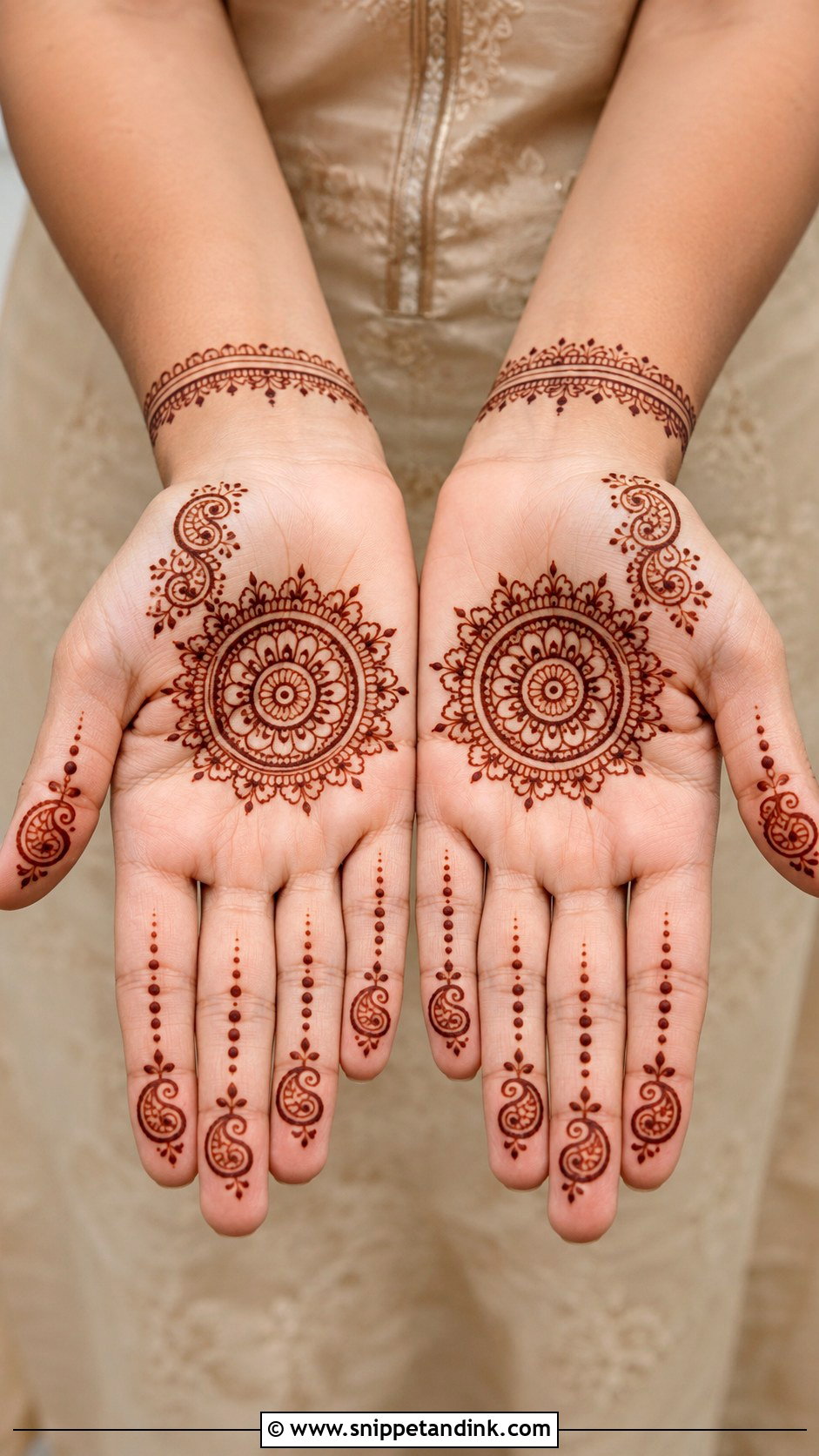
All the artwork sits in the palm: a mandala, lotus, rose, peacock or paisley cluster, with light dots and lines on the fingers and a bare or lightly bordered wrist. I size the motif to the palm. A large mandala on a small hand runs into the creases at the base of the fingers and distorts when the hand closes. Clean edges make this style, so I keep it slightly smaller than the space allows.
18. Minimal Front Hand Mehndi Design
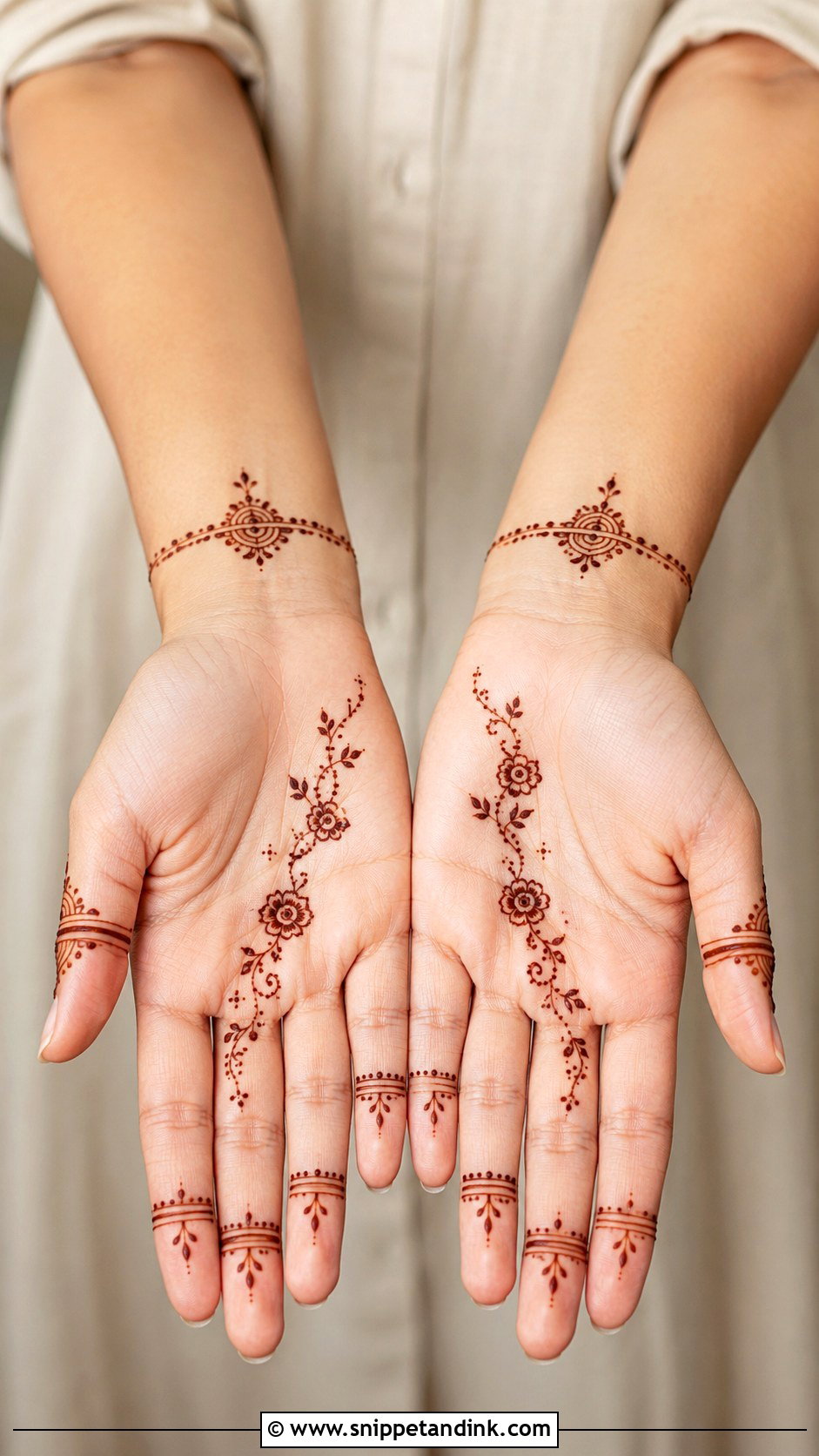
Minimal work is precise placement: a tiny mandala, one floral trail, dotted finger bands or a small bracelet. It suits casual celebrations, office-friendly festivals and modern outfits. Negative space has to look planned or the hand just looks unfinished. Every slip shows in simple work, so I go slower on a minimal hand than on a heavy one.
19. Heavy Front Hand Mehndi Design
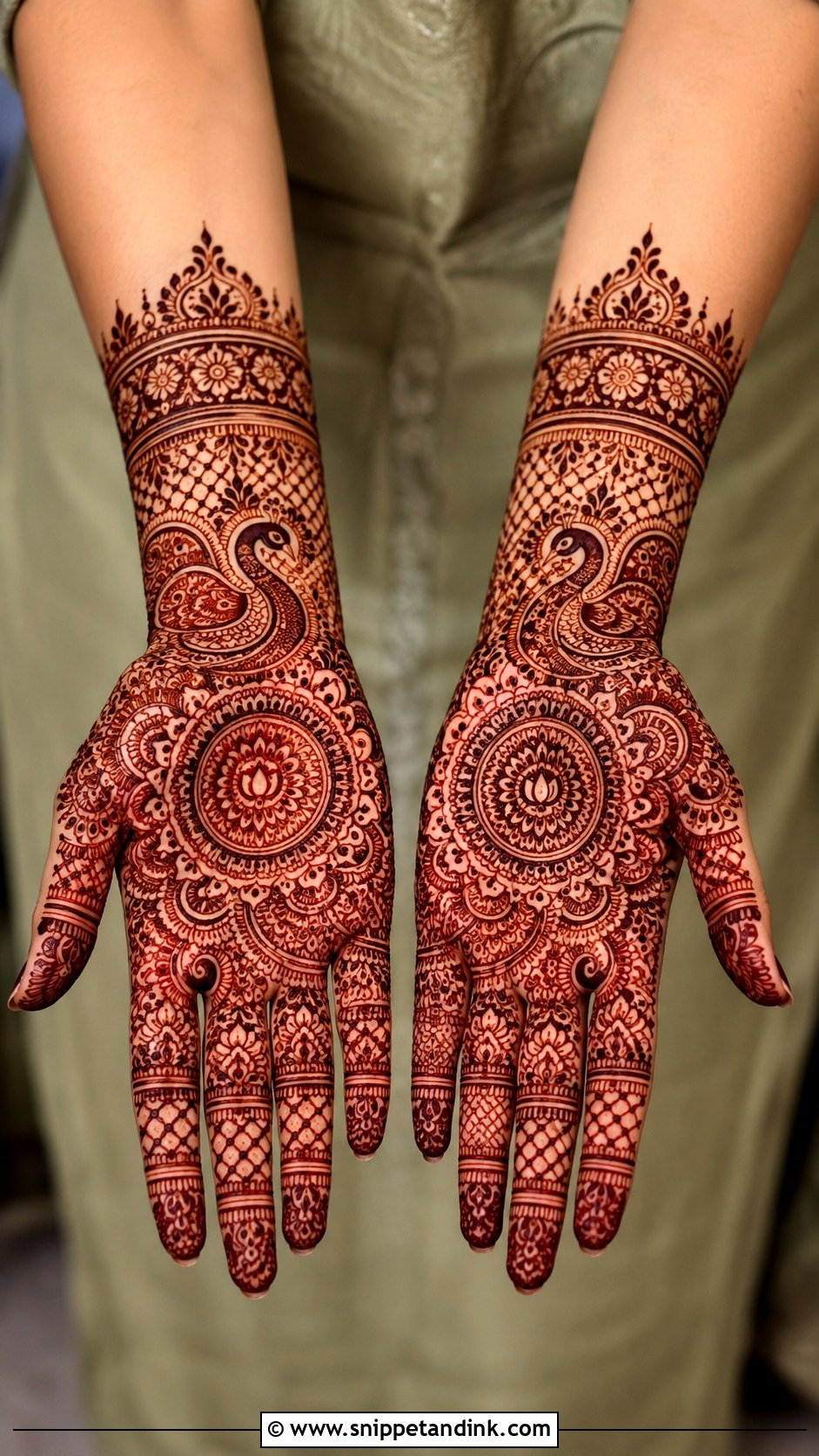
Heavy palms are covered with paisleys, peacocks, jaali, florals, mandalas and fine fill from fingertip to wrist. More paste on the skin means a deep, dramatic stain. Heavy doesn’t have to mean messy, though. I divide the palm into sections with clear borders and leave tiny breathing gaps around each main motif, which keeps it readable in photos after the color darkens to maroon.

20. Easy Front Hand Mehndi Design
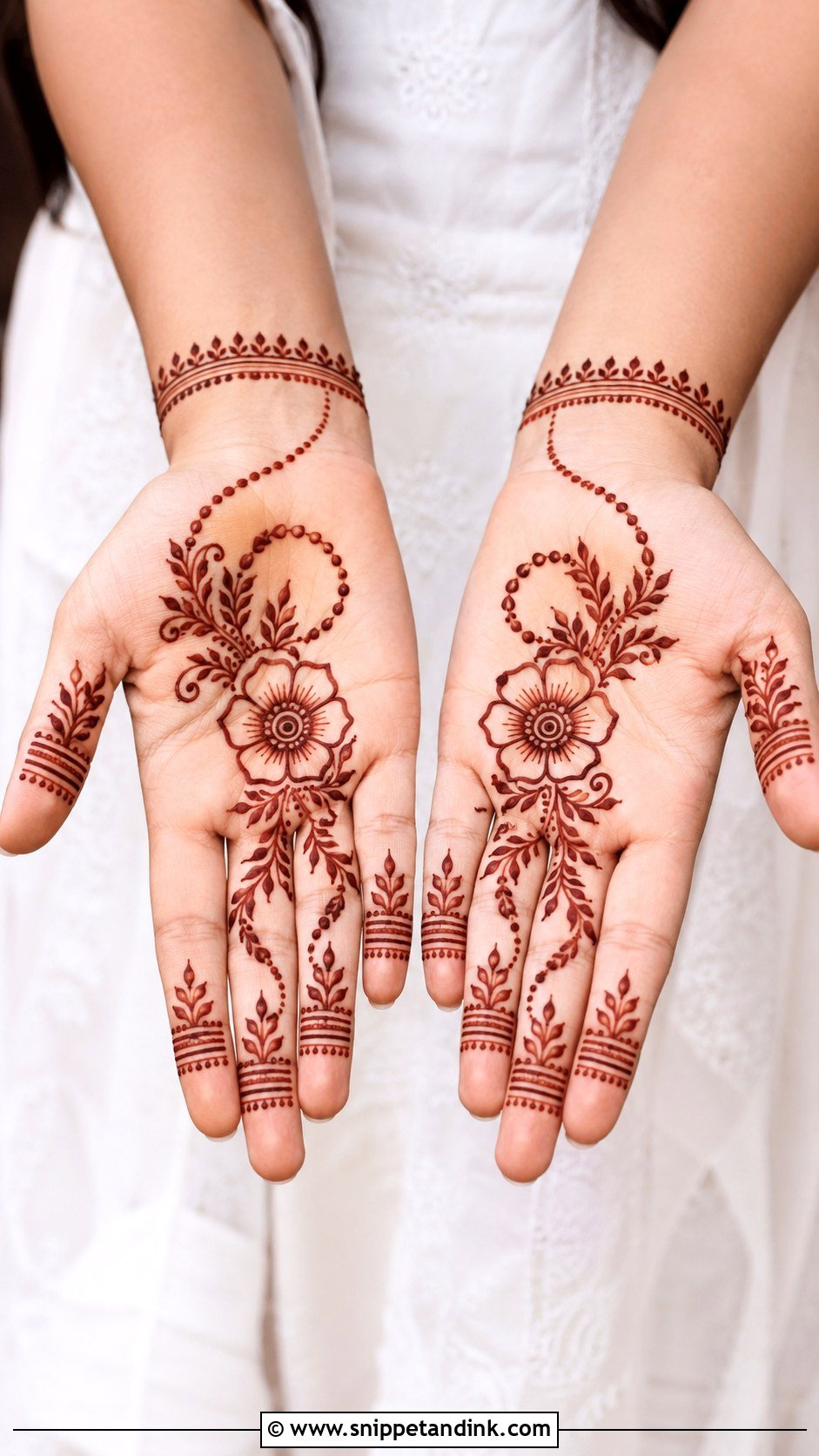
Easy layouts are the ones I show people learning to use a cone: a center flower or mandala, simple finger lines, dotted chains and a small wrist border. Draw the biggest motif first, then add leaves, dots and curves around it. Big shapes are more forgiving than tiny fill, and a rushed complicated design looks worse than a clean simple one. Hold the cone like a pen and squeeze from the top, not the middle, for a steady line.
21. Eid Front Hand Mehndi Design
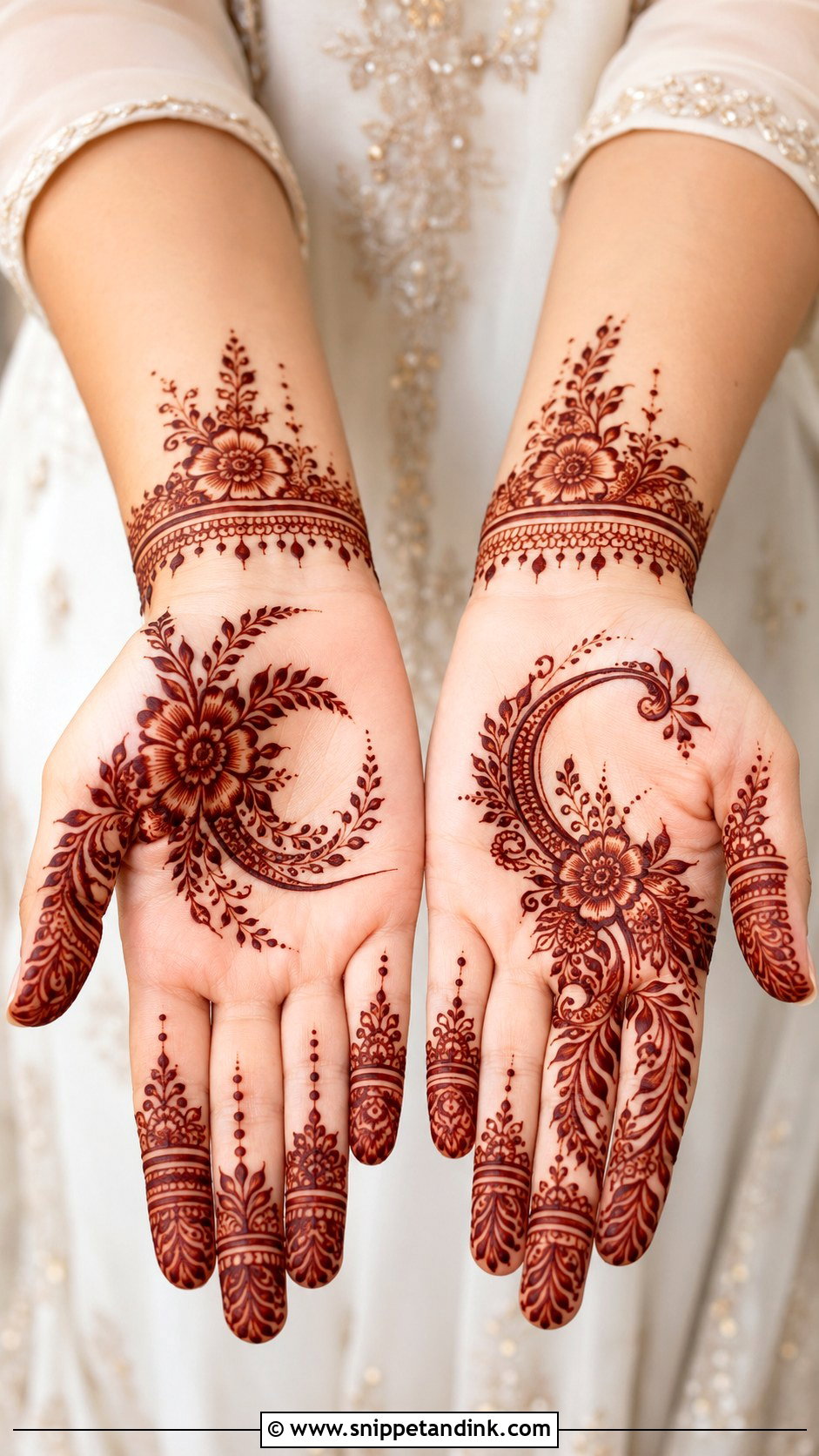
For Eid I see a lot of Arabic florals, crescent curves, leafy vines and bracelet-style wrist bands. Open palms dry faster, which matters on Chand Raat when everyone wants mehndi before midnight, and they look elegant with bangles and rings. A diagonal floral trail reads bold; a mandala with detailed fingers reads softer. Match the density on both hands and finish all ten fingertips the same way.
22. Diwali Front Hand Mehndi Design
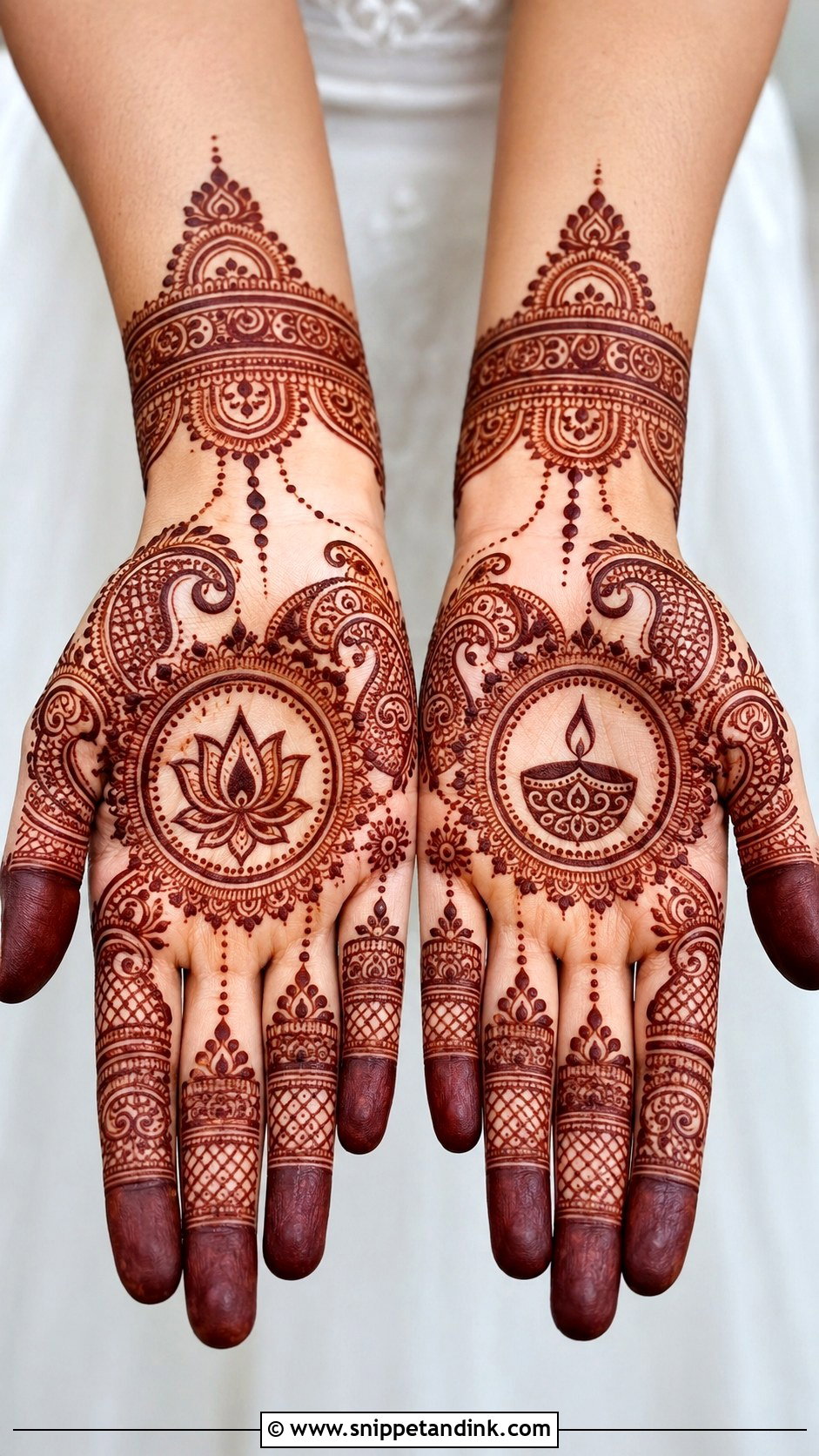
Diwali palms suit mandalas, lotus motifs, paisleys, diyas, floral borders and dotted trails. A lotus or mandala at the center gives a traditional focus, with neat lines and small leaves on the fingers. A diya motif is a nice seasonal touch, and I draw its flame in a single teardrop stroke so it doesn’t fill in. For a fuller look add jaali and a wrist cuff; for a simple one, keep the center strong and leave space around it.
23. Engagement Front Hand Mehndi Design
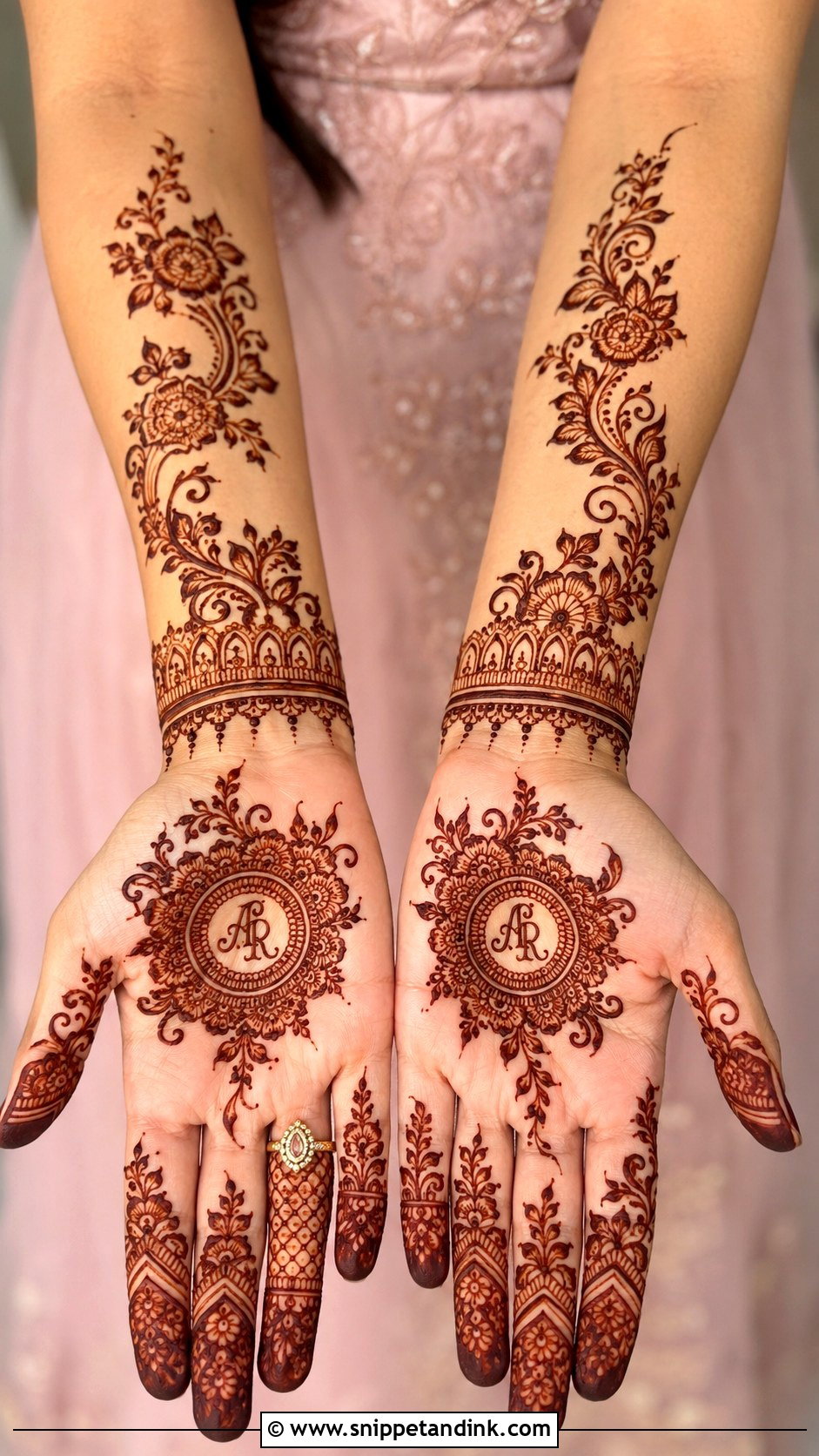
Engagement front hand mehndi design doesn’t need full bridal weight unless you want it. Engagement photos focus on the ring hand, so I build the design to frame the ring finger: a slim vine leading up to it, a band that stops just below where the ring sits, initials tucked near the palm or wrist. Leave the base of the ring finger clear, since a ring over wet or freshly stained henna hides the detail and can smudge it. One main motif with an airy palm, or Indo-Arabic coverage for more richness, both work.
24. Bridesmaid Front Hand Mehndi Design
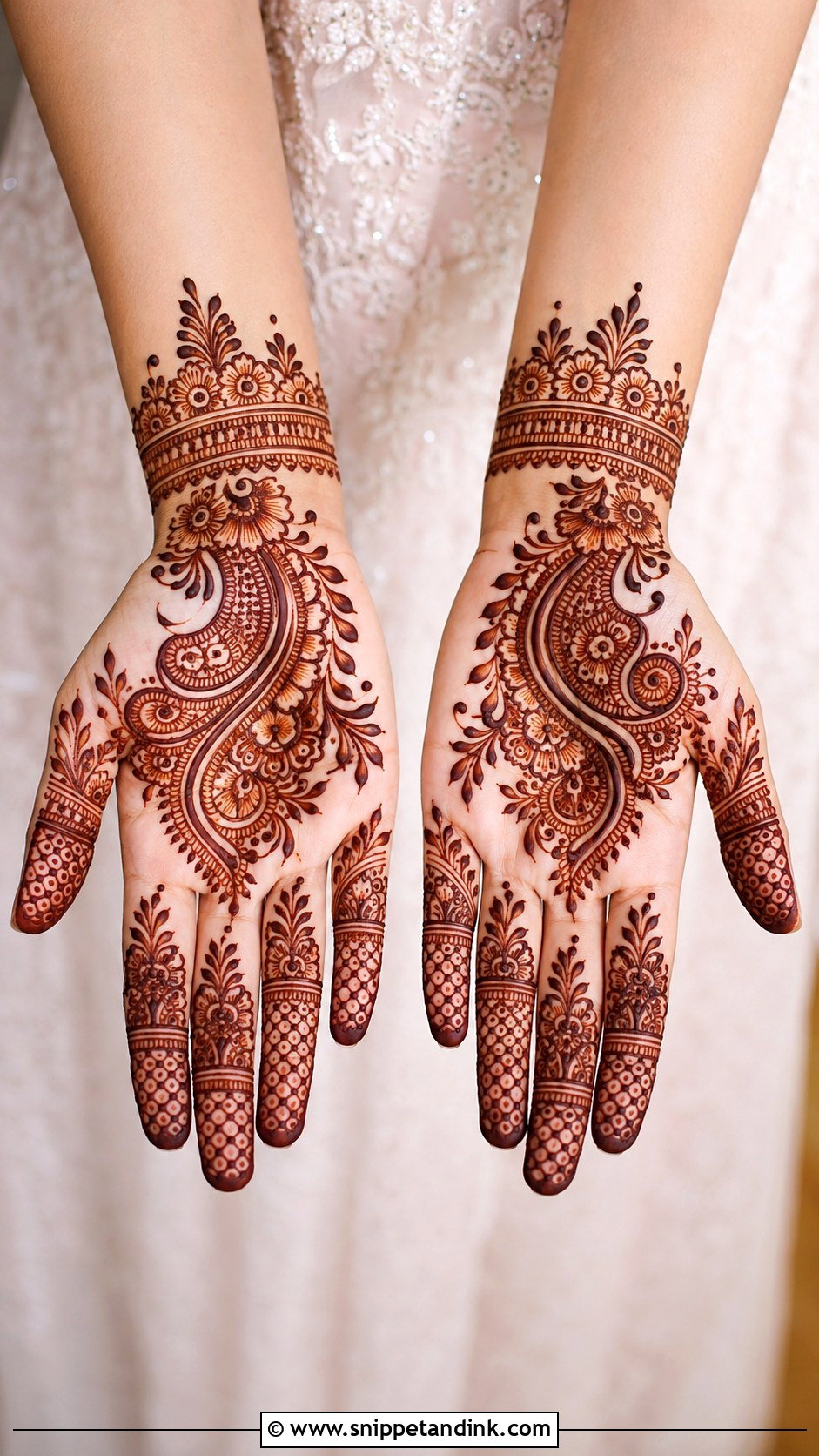
Bridesmaid hands sit between guest mehndi and bridal mehndi: floral trails, paisley palms, mandala centers, jaali fingers and bracelet cuffs, usually stopping at the wrist rather than climbing the forearm. That keeps it wearable through several days of events. I often give a group of bridesmaids the same base motif with small variations, which looks coordinated in group photos without being identical. Medium coverage keeps the focus on the bride.
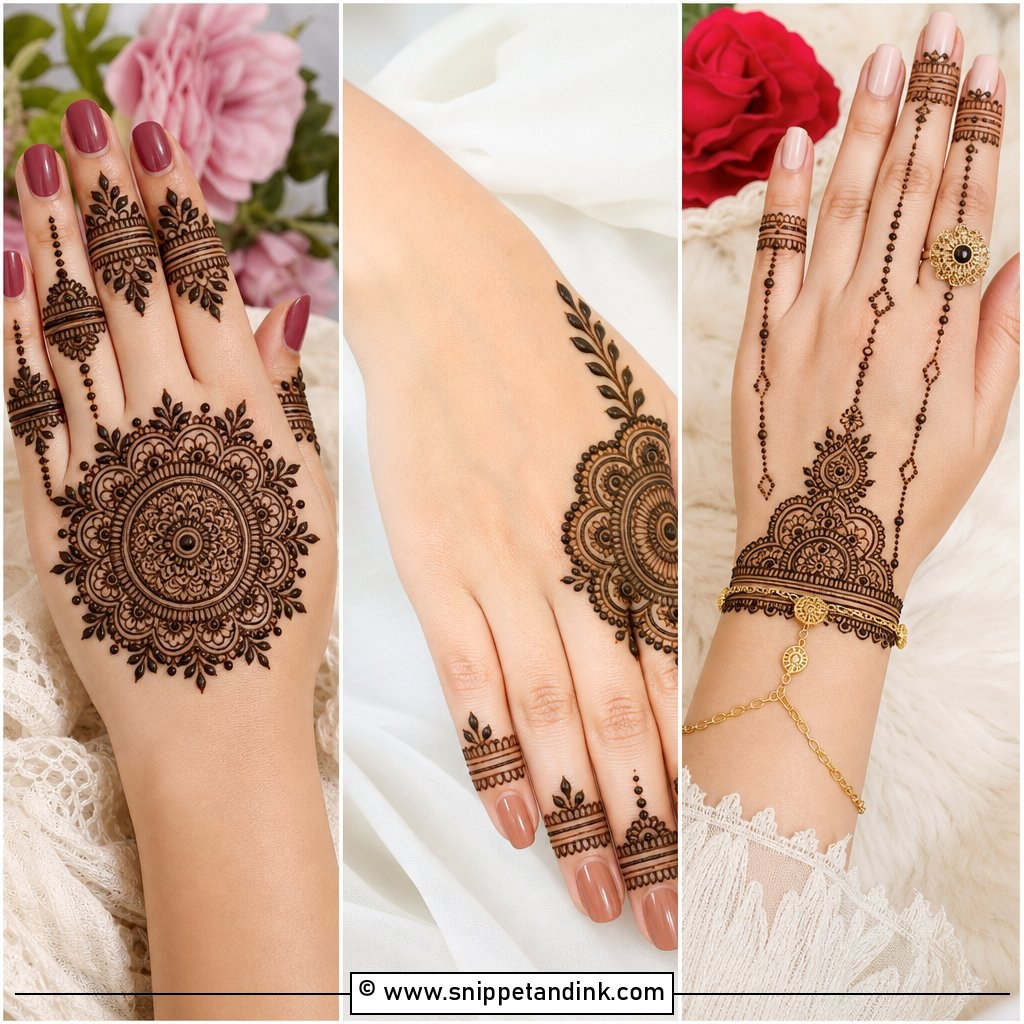



25. Royal Front Hand Mehndi Design
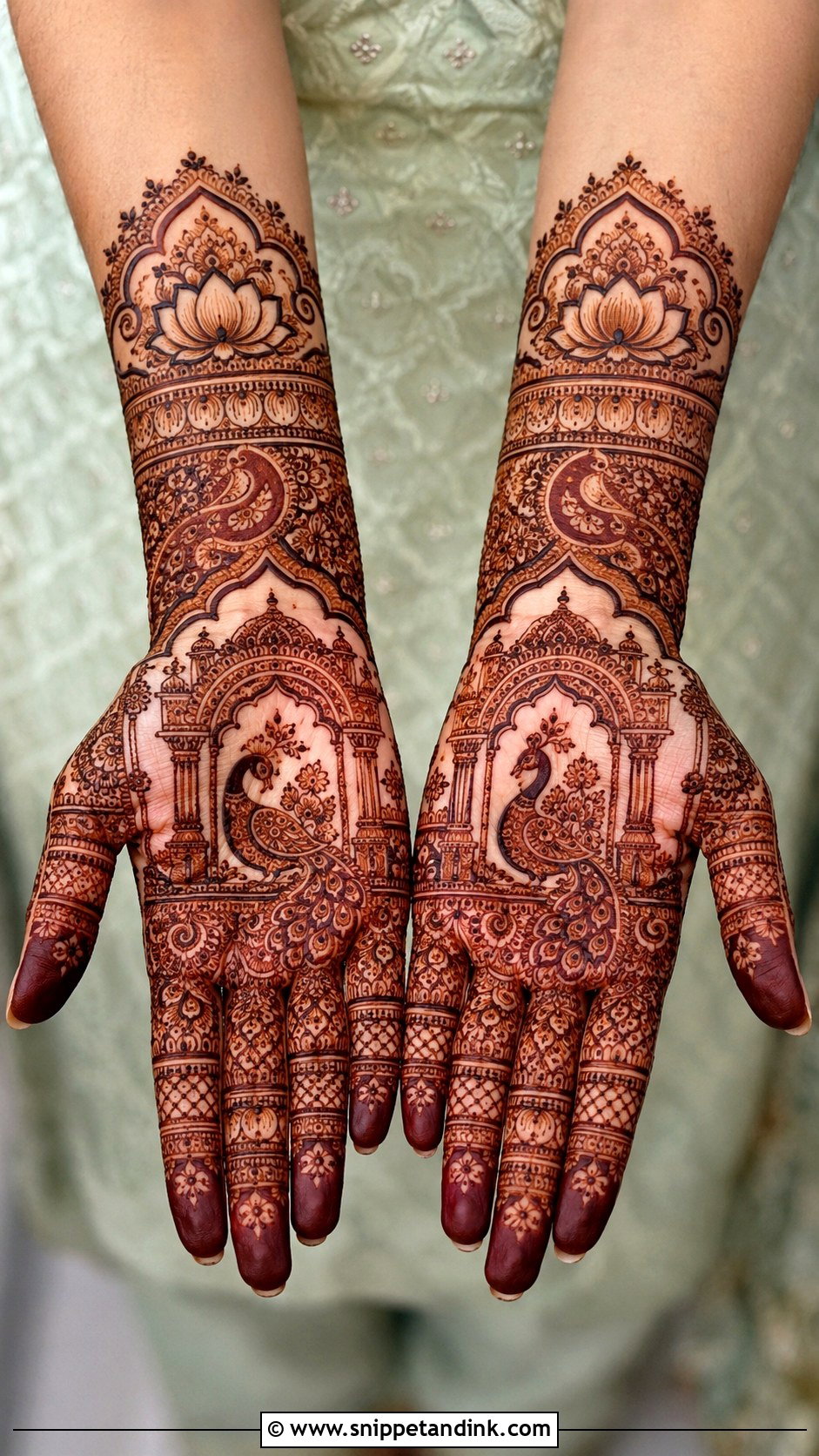
Royal layouts divide the palm into framed sections, almost like carved windows or jewelry panels, filled with peacocks, lotuses, paisleys, arches and ornamental cuffs. It’s a formal structure. Bold frames with delicate fill inside is the whole trick. I draw all the frames first across the palm and fingers, then fill them, so the architecture stays straight. A deep maroon stain suits it best, which means plenty of time with the paste on.
26. Moroccan Front Hand Mehndi Design
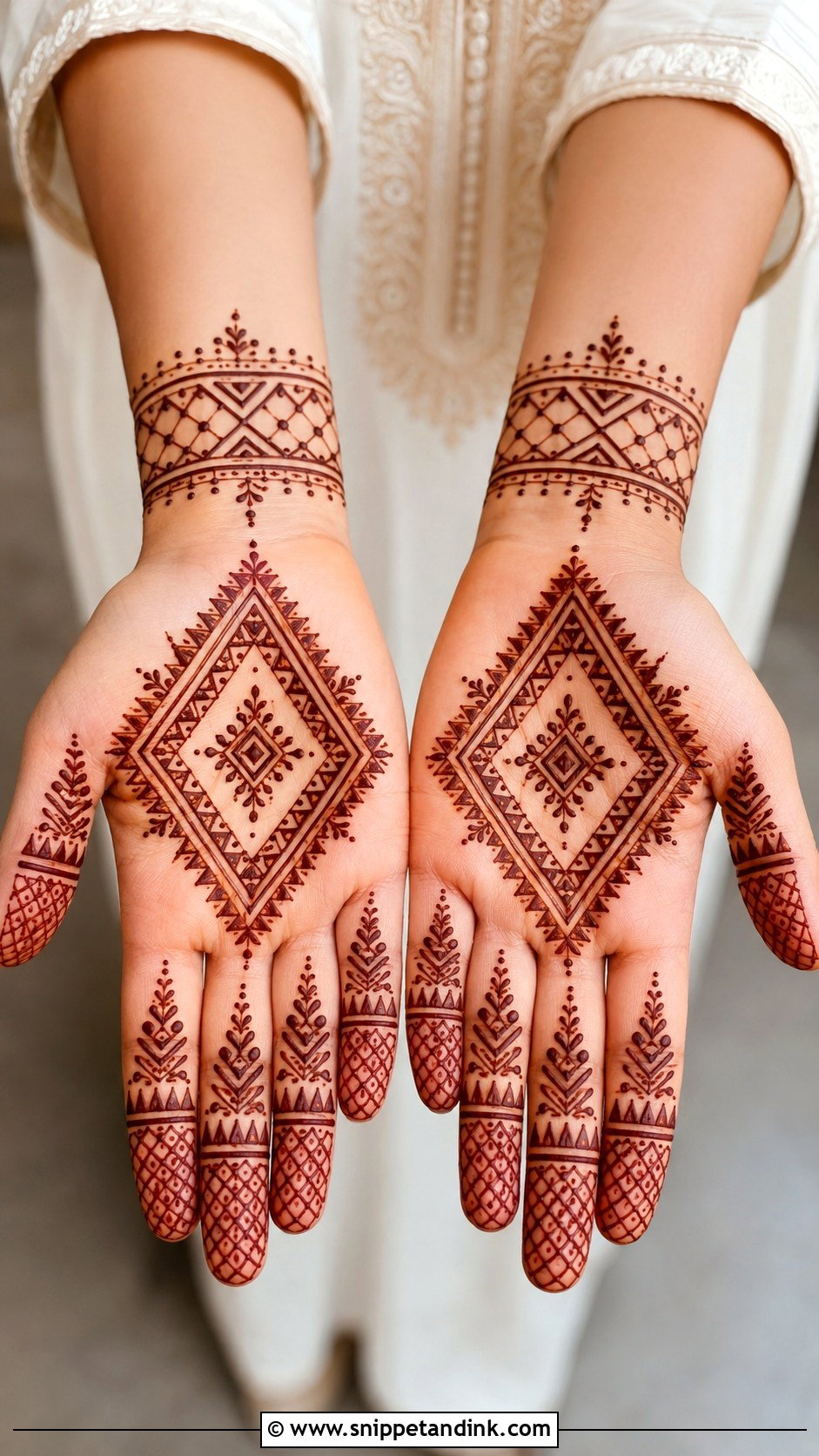
Moroccan-style work swaps flowers for diamonds, triangles, grids, straight lines, dots and angular borders: a bold geometric center with repeated bands on the fingers. It suits fusion outfits and anyone tired of florals. Straight lines are hard on a palm because the skin curves and creases, so I ask the client to keep her hand flat on a cushion and I work in short strokes, checking symmetry often.
27. Gulf Front Hand Mehndi Design
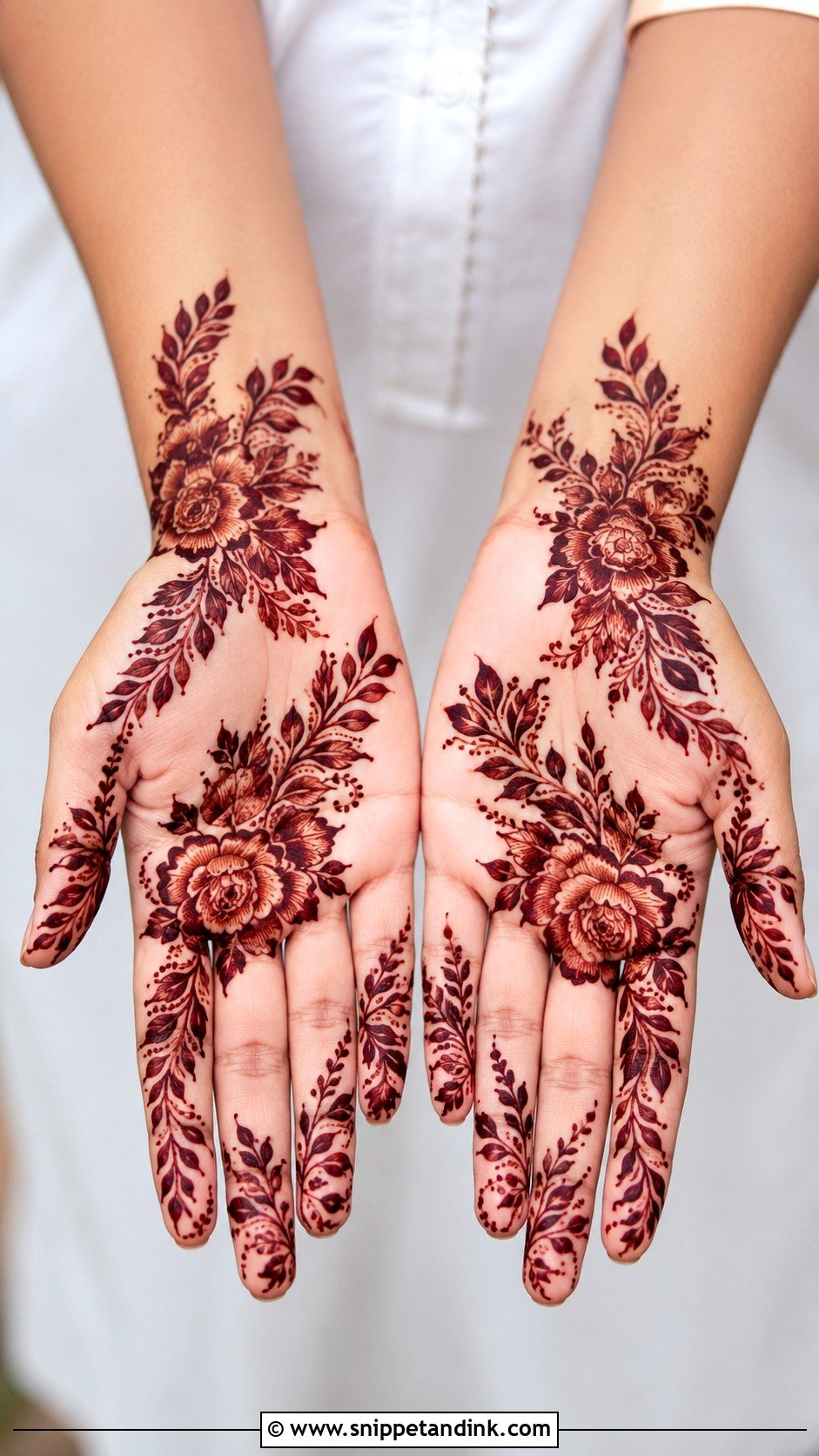
Gulf or Khaleeji work uses big flowers, leafy trails and generous bare skin, with thick outlines and soft shading. It reads from across a room, which is why it suits evening events and pairs well with gold jewelry. Fingers get floral caps, slanted vines or dotted trails. The thick lines carry a lot of paste, so this style stains deep and fades evenly, but it also needs longer to dry before you can touch anything.
28. Pakistani Front Hand Mehndi Design
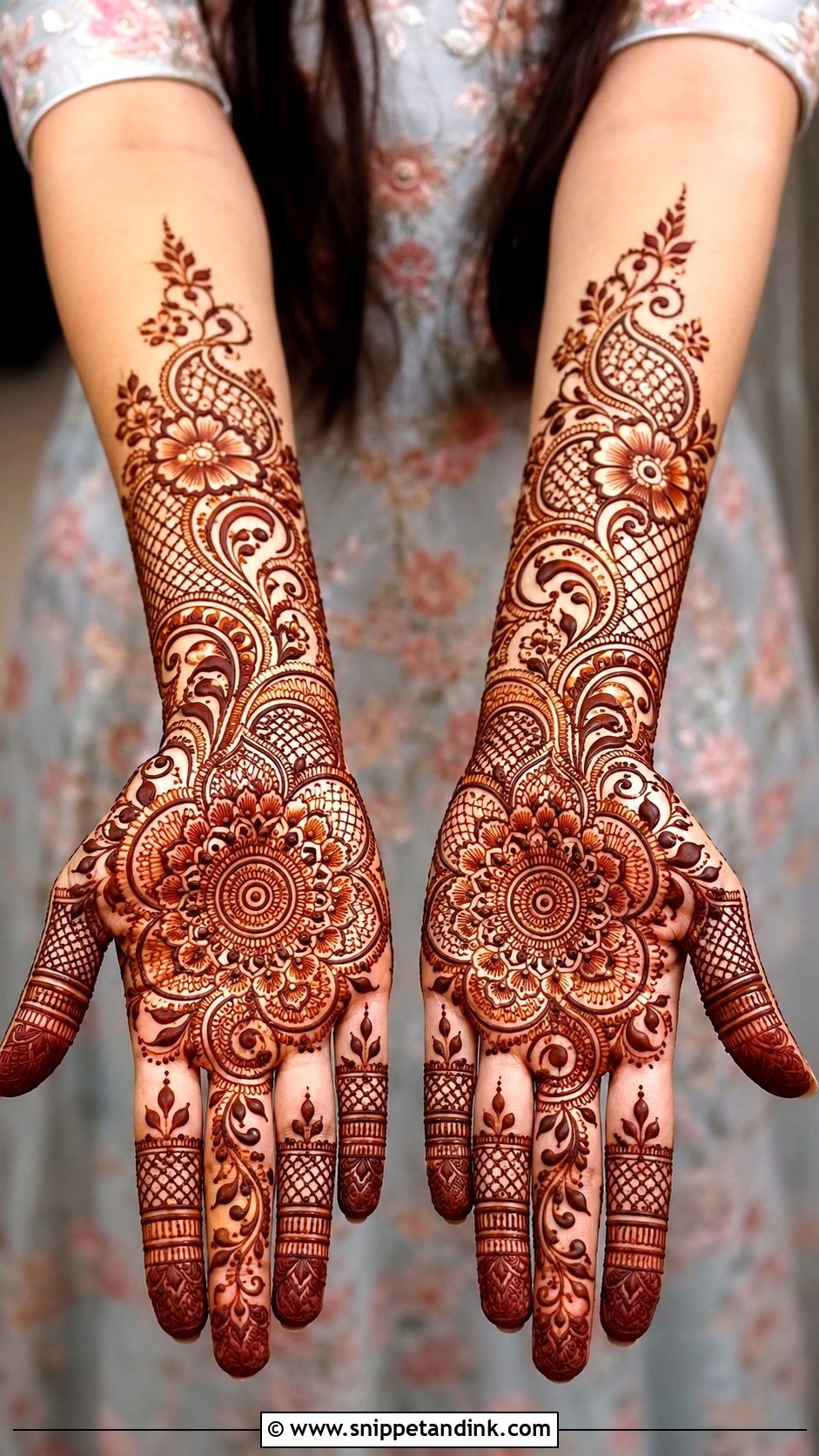
Pakistani palms usually blend Indian detail with Arabic flow and bridal richness: mandalas, paisleys, florals, jaali, leafy vines and carefully filled fingers, often extending a little past the wrist into a cuff or vine. Strong outlines around the main shapes keep a dense palm breathable. For nikah and mehndi night I pick one main motif for the palm and let everything else support it.
29. Half Front Hand Mehndi Design
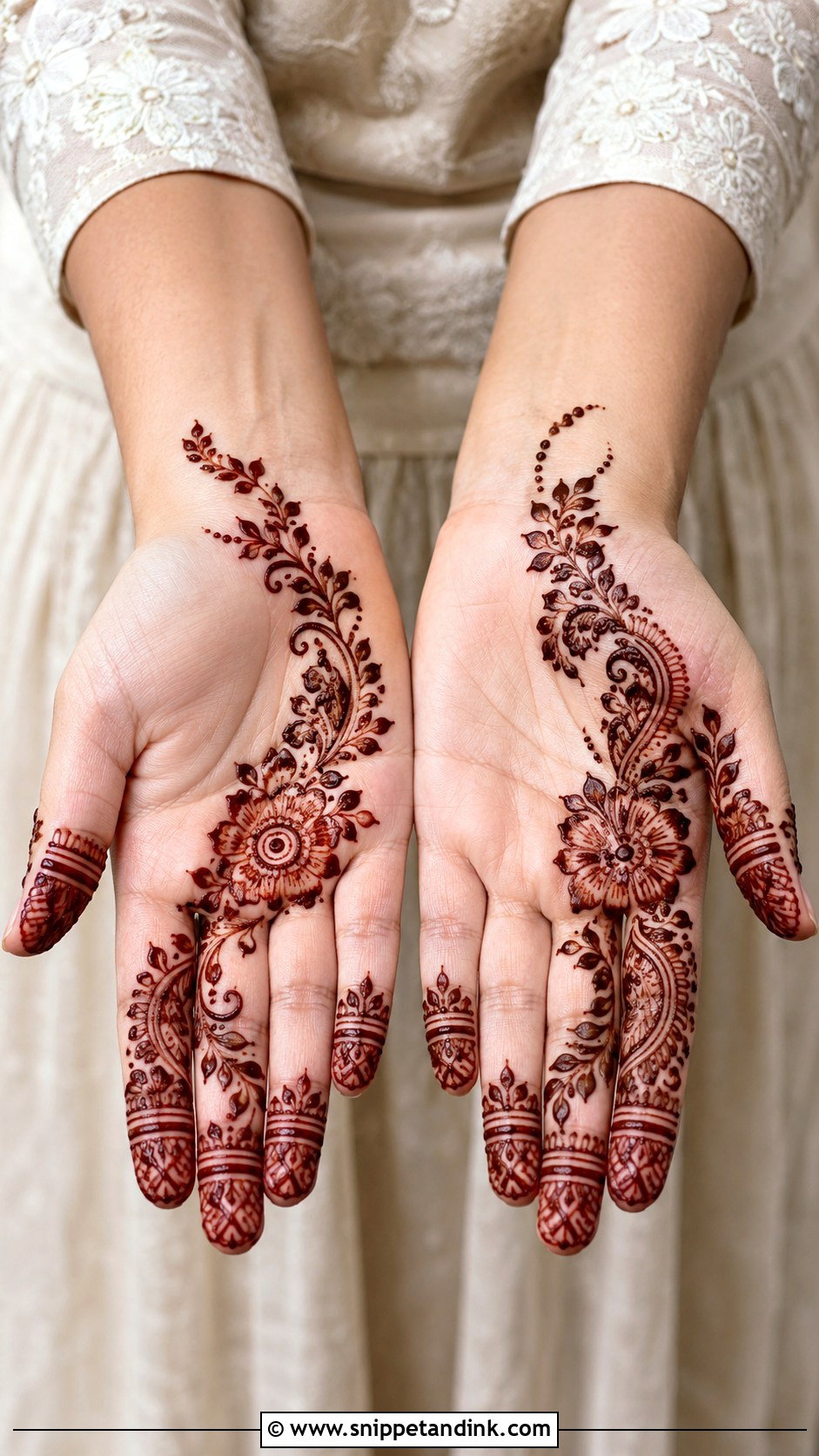
Half designs cover the lower palm and wrist, leaving the upper palm open, or decorate one side on a diagonal. The edge where the design stops is the whole look, so it has to be clean and deliberate; a ragged boundary just looks like the artist ran out of time. Detailed finger work makes a half palm feel finished. It suits engagement guests, bridesmaids and college functions.
30. Round Front Hand Mehndi Design
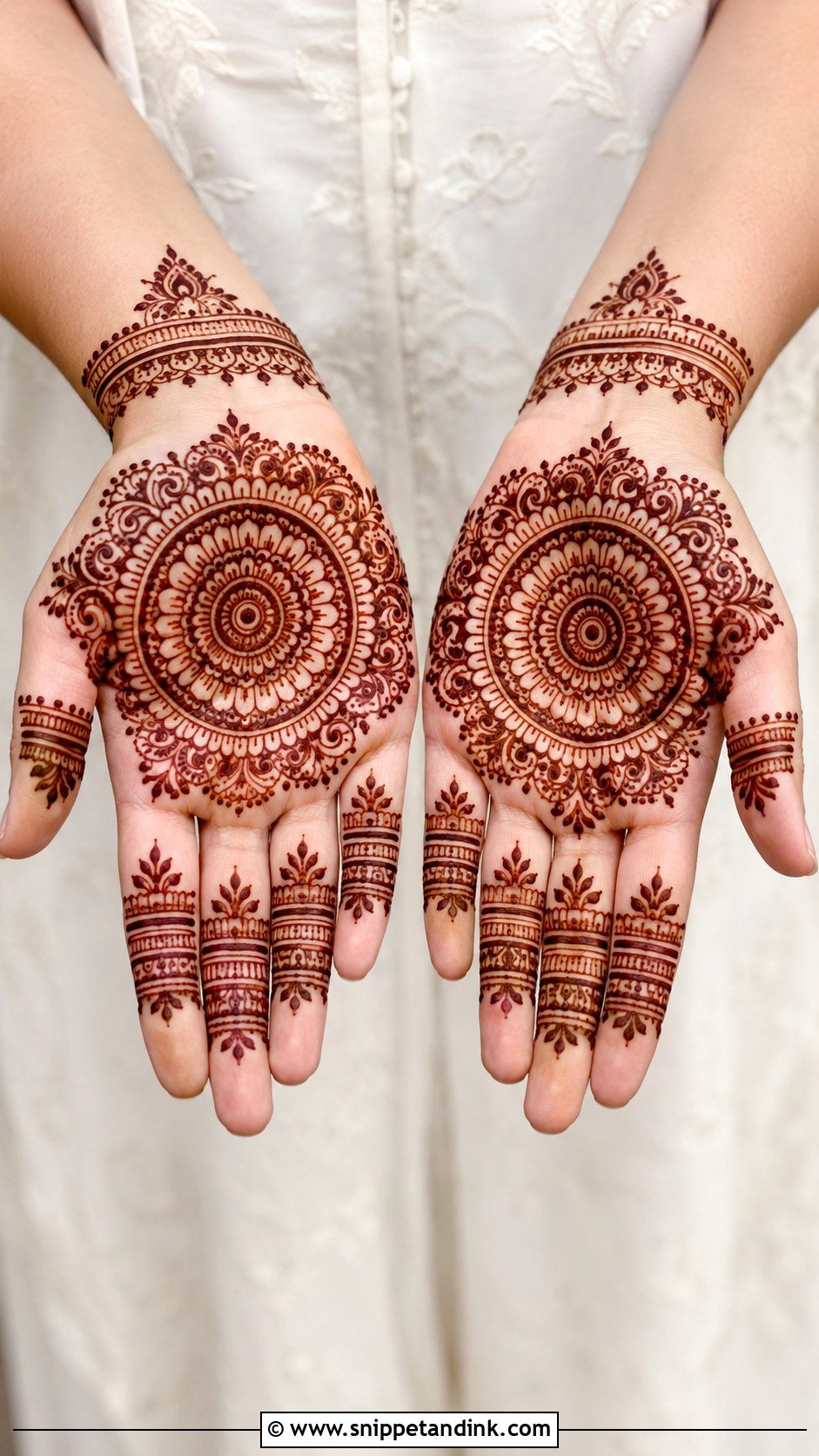
Round designs put a circle at the center of the palm: a mandala, a chakra, a floral ring or a layered sun. Matching bands, dots and small leaves on the fingers complete it. It’s easy to read and pleasing to look at. Centering is everything, and I mark the middle and four compass points with dots before drawing the first ring. Expand it with rings of petals and paisleys for a festival or a smaller bride’s event.
31. Leafy Front Hand Mehndi Design
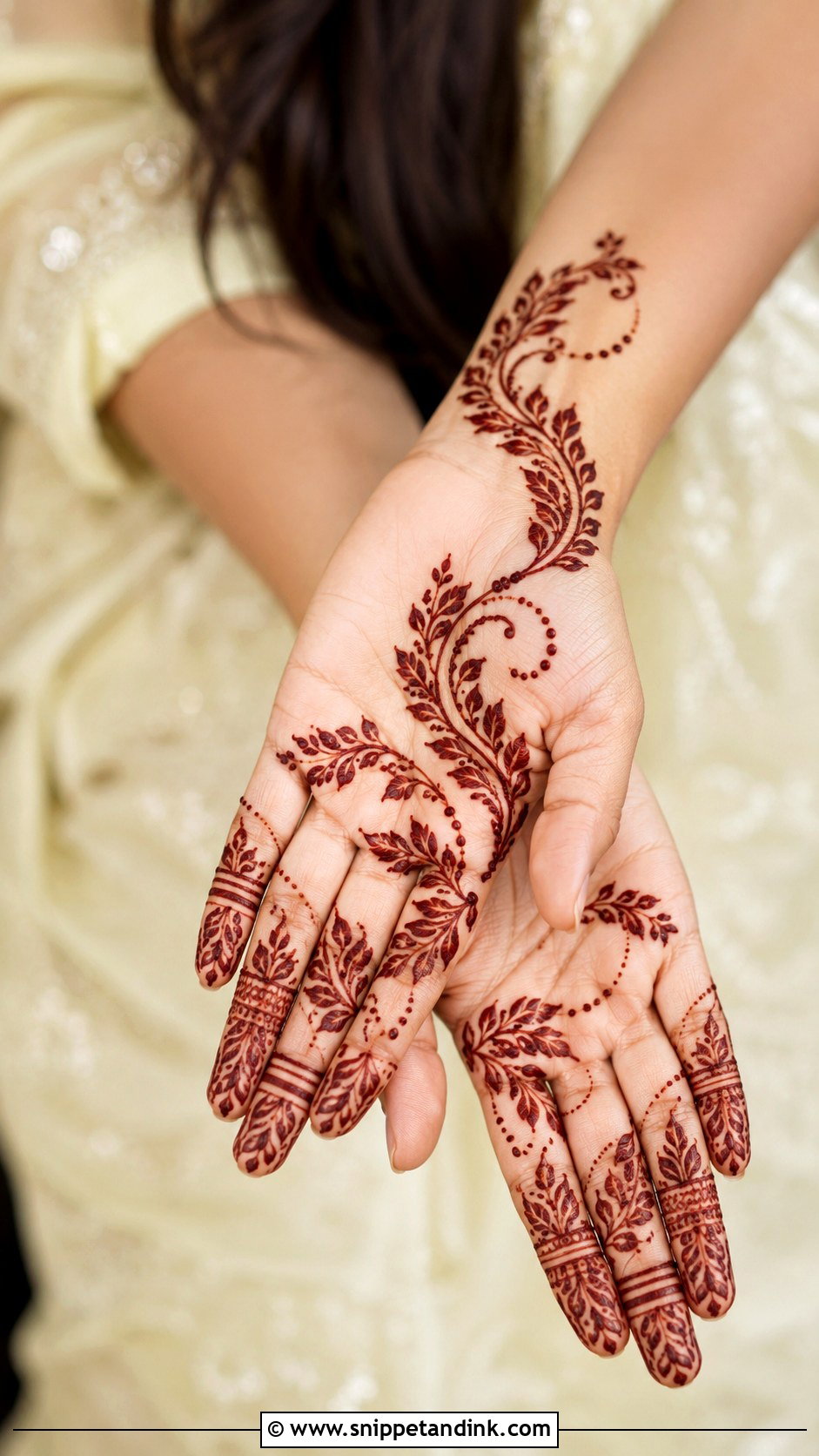
Leafy designs use vines, curved stems and small leaves to create movement, climbing diagonally from the wrist to the fingers or framing a central mandala. Thin leaf outlines read delicate; filled leaves and shaded flowers read bolder. I like it for daytime functions and Eid. Keep the main stem flowing in one continuous line, because a vine with breaks looks hesitant.
32. Shaded Front Hand Mehndi Design
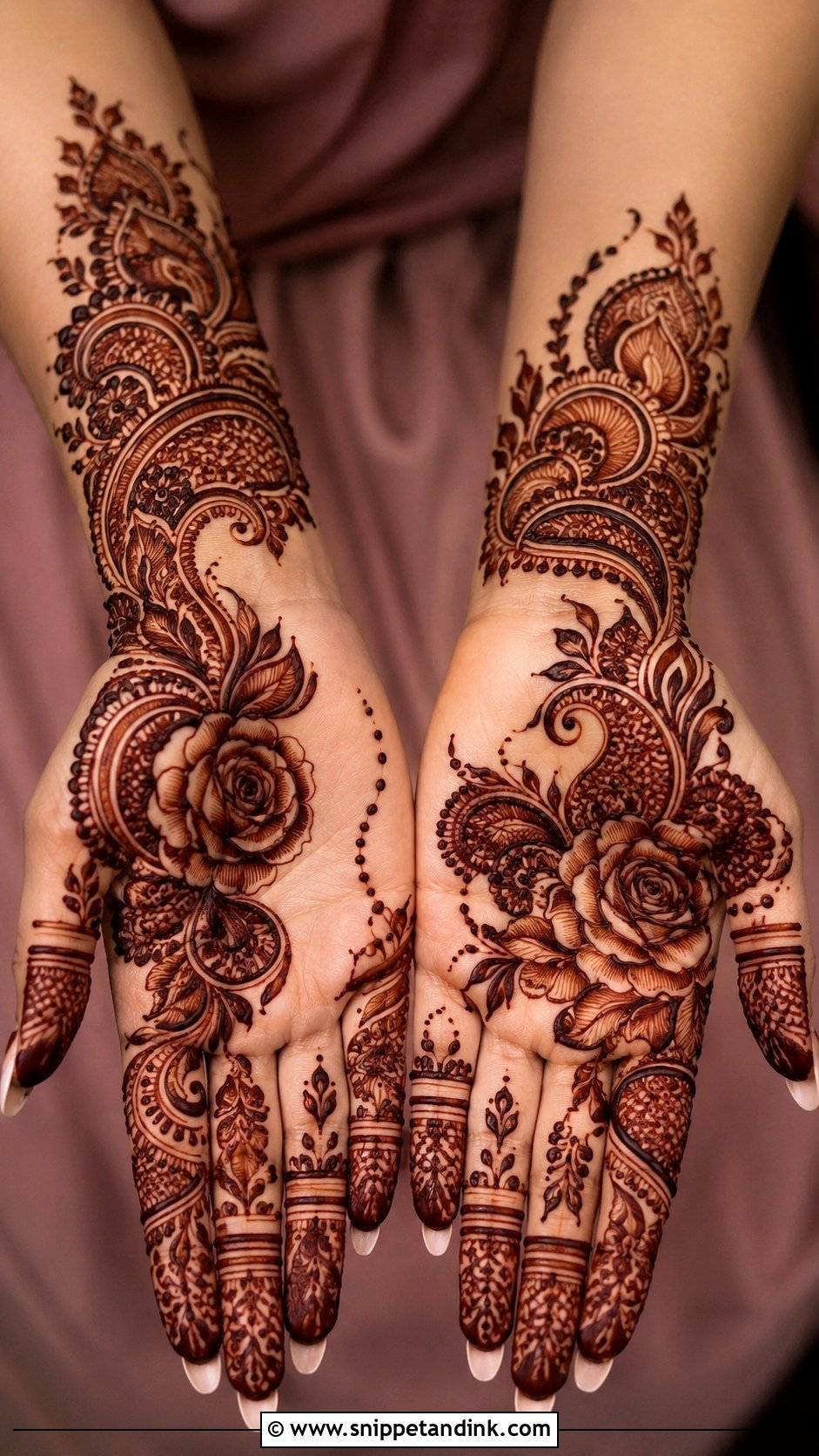
Shading fills petals, leaves, paisleys or borders with soft strokes so they look dimensional. Roses, lotuses, Arabic flowers and peacock feathers gain the most. The technique is a light, even pressure on the cone with closely spaced lines that thin toward one edge; press too hard and it turns into a solid block of color. Leave part of the palm open so the shaded areas stand out, and pair them with bold outlines.
33. Geometric Front Hand Mehndi Design
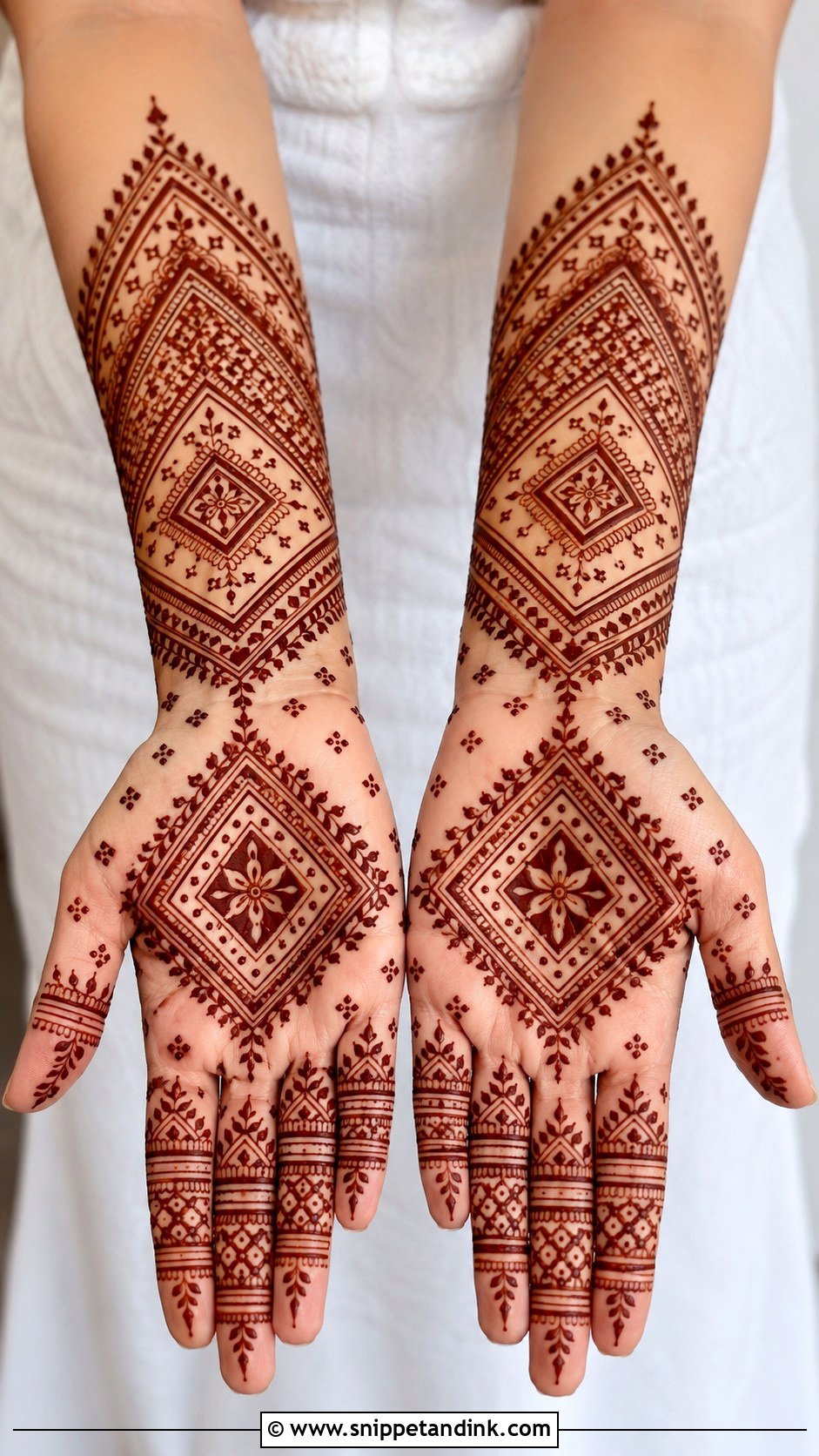
Geometric palms use diamonds, triangles, squares, lines, chevrons and grids. Combine them with a mandala for a softer fusion, or keep everything structured for a Moroccan feel. It suits people who don’t like florals and pairs well with contemporary outfits. Even spacing is non-negotiable, and I measure it by eye against the finger joints, which give natural reference lines.
34. Western Front Hand Mehndi Design
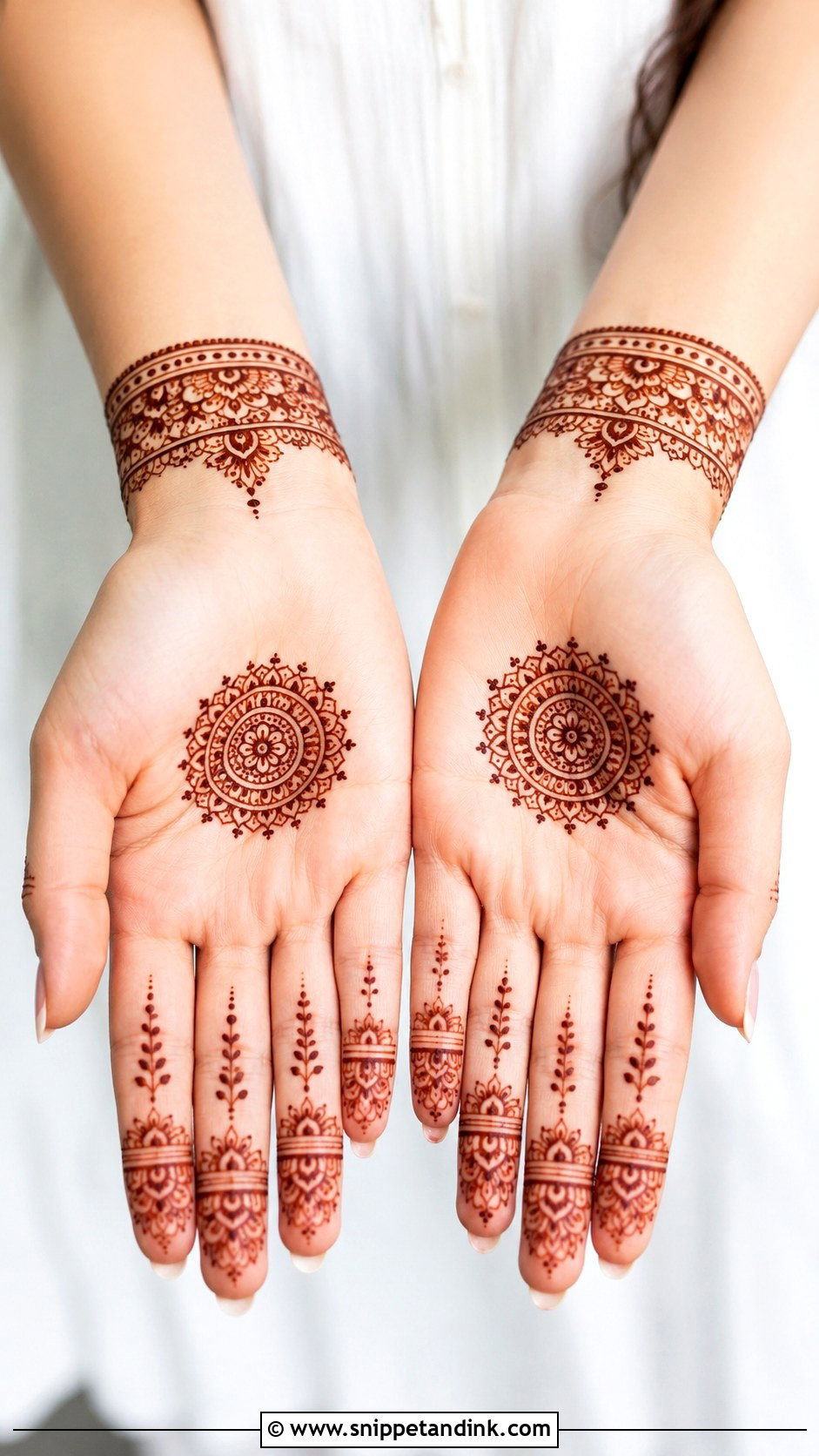
What most people mean by Western mehndi is a modern, minimal look: clean finger bands, a small palm motif, bare skin, a bracelet cuff and fine vines, with no heavy traditional fill. Placement matters more than detail. It suits parties, fusion looks, summer events and first-timers. A small mandala near the palm with delicate finger patterns is my usual starting point, kept light so it sits comfortably with everyday clothes for the week it lasts.
35. Front Hand Mehndi Design For Kids
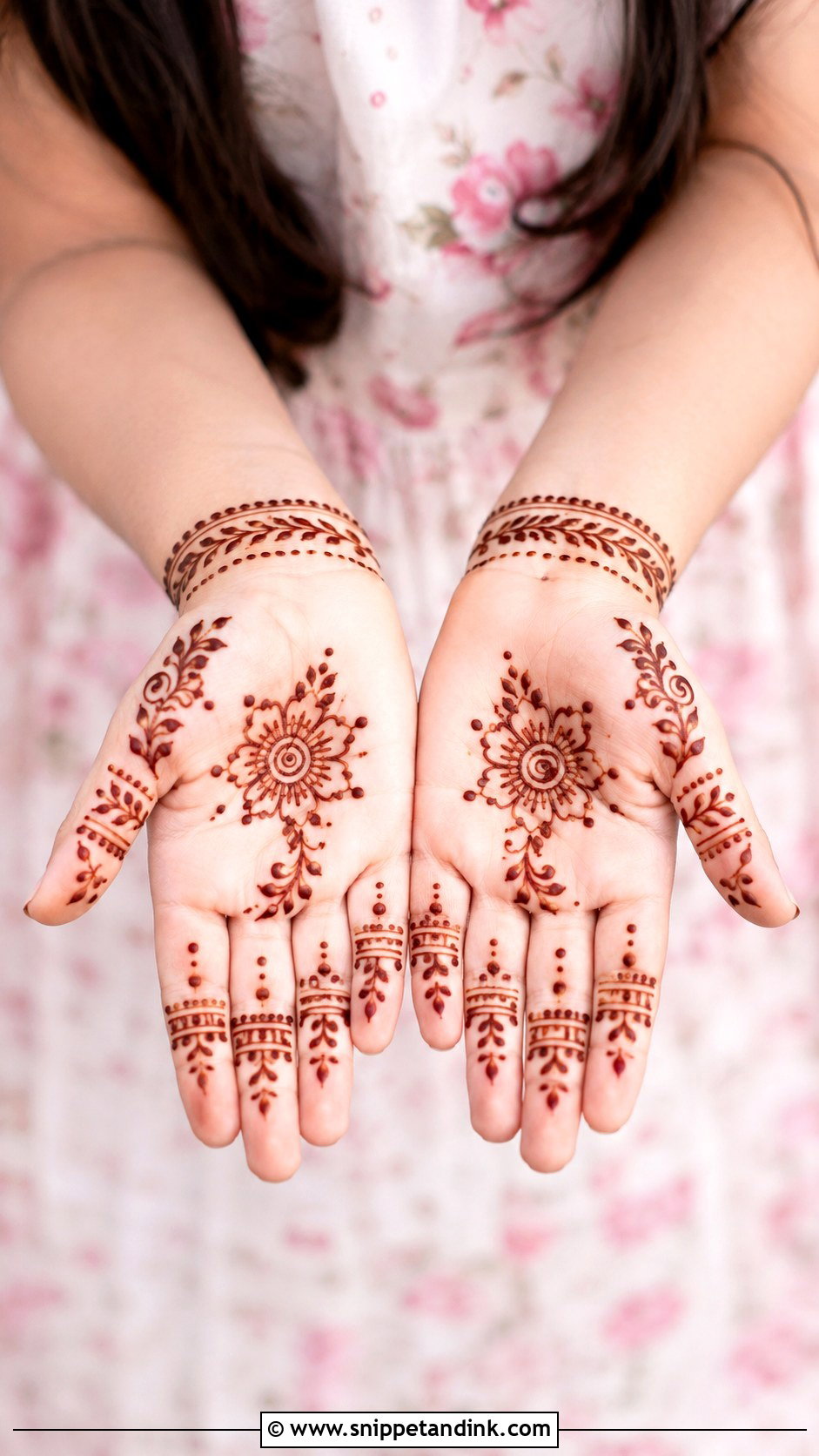
Kids’ designs should be simple and quick: a small flower, a tiny mandala, hearts, dots, a leafy vine or a little wrist band. Children rarely sit still long enough for fine work to dry, so I keep lines a little thicker and the design small enough to finish before attention runs out. A palm flower with dotted fingers is usually enough. Use natural henna only on children, and do a small patch first if the child has sensitive skin.
Hands Off for Six Hours: Life With Wet Paste and a Fresh Stain
Palm henna has one practical problem feet don’t: you need your hands. Once the paste is on, plan to be fed, have your phone held and drink through a straw. I tell brides to use the bathroom before we start and to eat something first, because a full bridal hand keeps you sitting for a long time and then waiting while it dries.
- Let the paste dry until it’s matte, then dab on lemon and sugar so it stays stuck to the skin.
- Keep your hands warm. The old trick of holding them over the smoke of cloves heated on a tava is still common in many families; just keep a safe distance from the heat.
- Leave the paste on overnight if you can, then scrape it off rather than washing it.
- Stay away from water for as long as possible after that, and keep soap and hand sanitizer off the palms for the first day.
- Expect bright orange at first. The stain darkens over the next one to two days.
Palms fade faster than the back of the hand, because they’re washed so often and rubbed by everything you hold. Wearing gloves for dishes, avoiding scrubs, and a little balm or oil before you shower all help it last. Brides with chooda should know the bangles rub the wrist cuff, so that part usually softens first.
A Palm That Still Looks Right a Week Later
Match the design to the occasion and to the time you can give it. A quick mandala suits a casual celebration, while full Indian, Pakistani and bridal palms bring the traditional richness a wedding calls for. Arabic, Gulf and Indo-Arabic layouts give bold motifs with open space, and modern, Moroccan and geometric designs refresh the palm without heavy fill. Across all 35 of the designs above, the hands that look best at the ceremony are the ones planned around the ring, the bangles and the hours the paste needs.
You'll Like These Ideas:










Leave a Reply