
Bridal mehndi that runs from fingertips to forearm is in almost every ceremony photo, from the varmala to the ring shots, so the whole arm has to read as one design. That’s the part brides often miss when they save a single palm motif. When I plan full hand work, I map the palm, the back of the hand, the wrist and the forearm together before I touch a cone, because the joins between them are where a layout either flows or falls apart. Below are twenty layouts I’m asked for most, from dense Indian and Rajasthani work to airy Arabic and Gulf trails, with notes on what each one needs from your artist and from your hands.
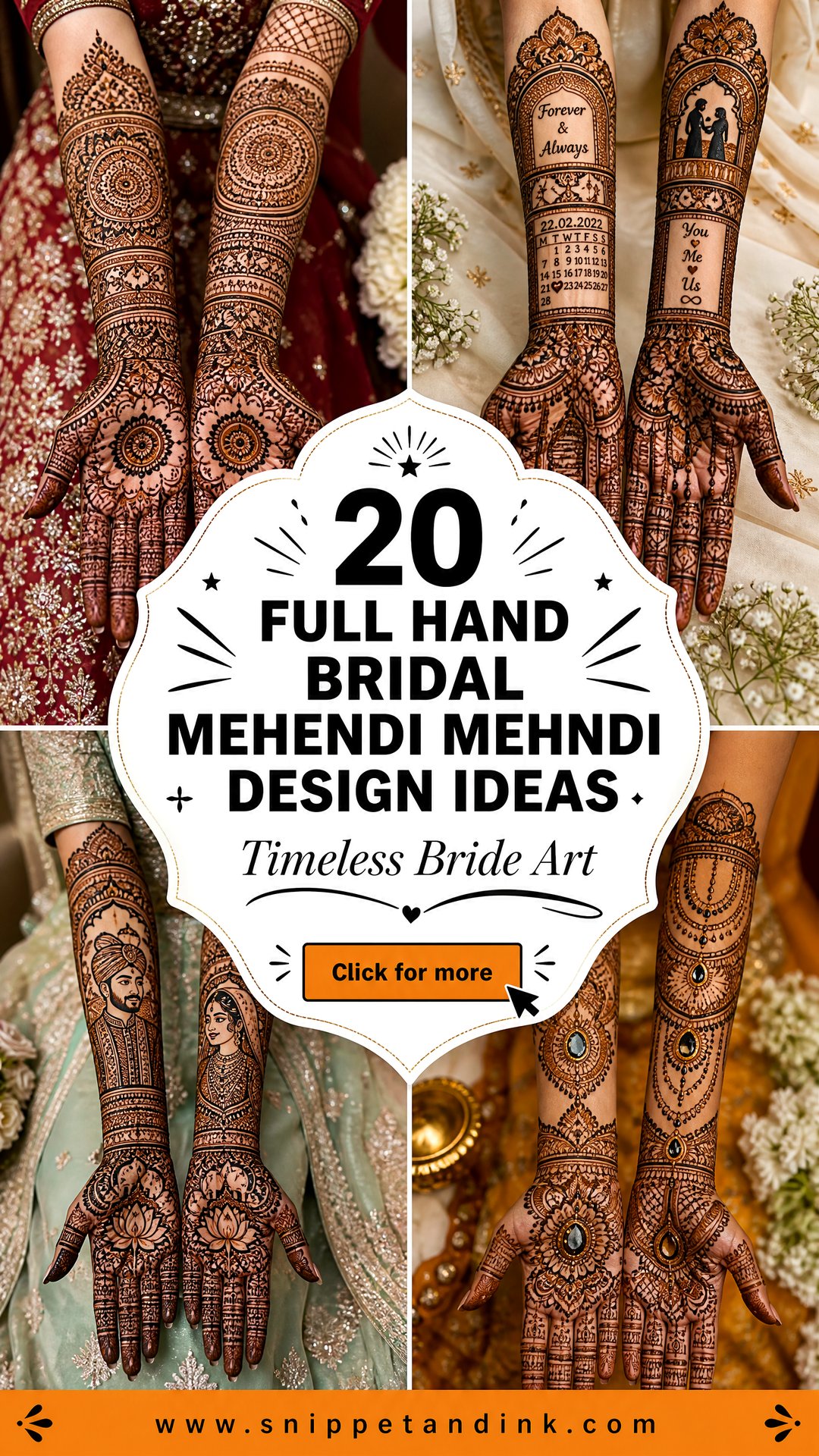
When to Sit for Full Hand Mehndi So the Stain Peaks on the Day
Henna doesn’t show its real color the moment the paste comes off. It starts bright orange and deepens over the next day or two toward reddish brown or maroon. That’s why I schedule bridal full hand work one to two days before the wedding, never the morning of.
Full coverage on both hands and forearms is a long sit. A heavy Indian or Rajasthani layout can take several hours for the front and back of both arms, and portraits add more. Lighter Arabic or Gulf layouts are quicker. Ask your artist for an honest estimate for your chosen design, and plan your mehndi event around it rather than the other way round.
- Exfoliate gently the day before, then skip lotion and oil on the hands and arms on application day. Henna needs clean, dry skin to bond.
- Get any waxing, manicure or nail painting done before the mehndi. Scrubs and chemicals afterward fade the stain early.
- Wear something with short or loose sleeves that you can sit in for hours without touching the paste.
- Eat before you sit. Once both hands are covered, someone else will have to feed you.
1. Full Hand Indian Bridal Mehndi Design
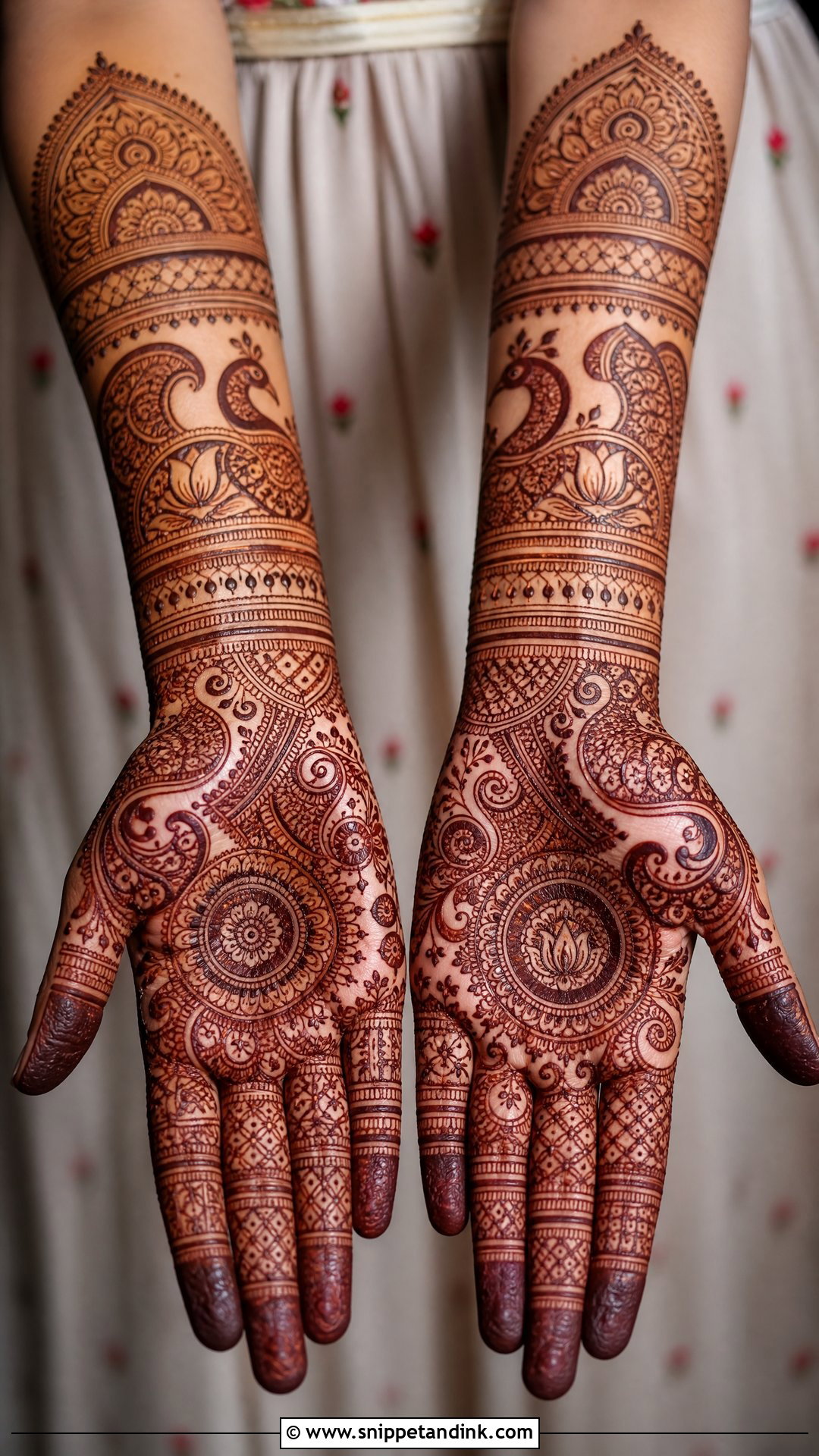
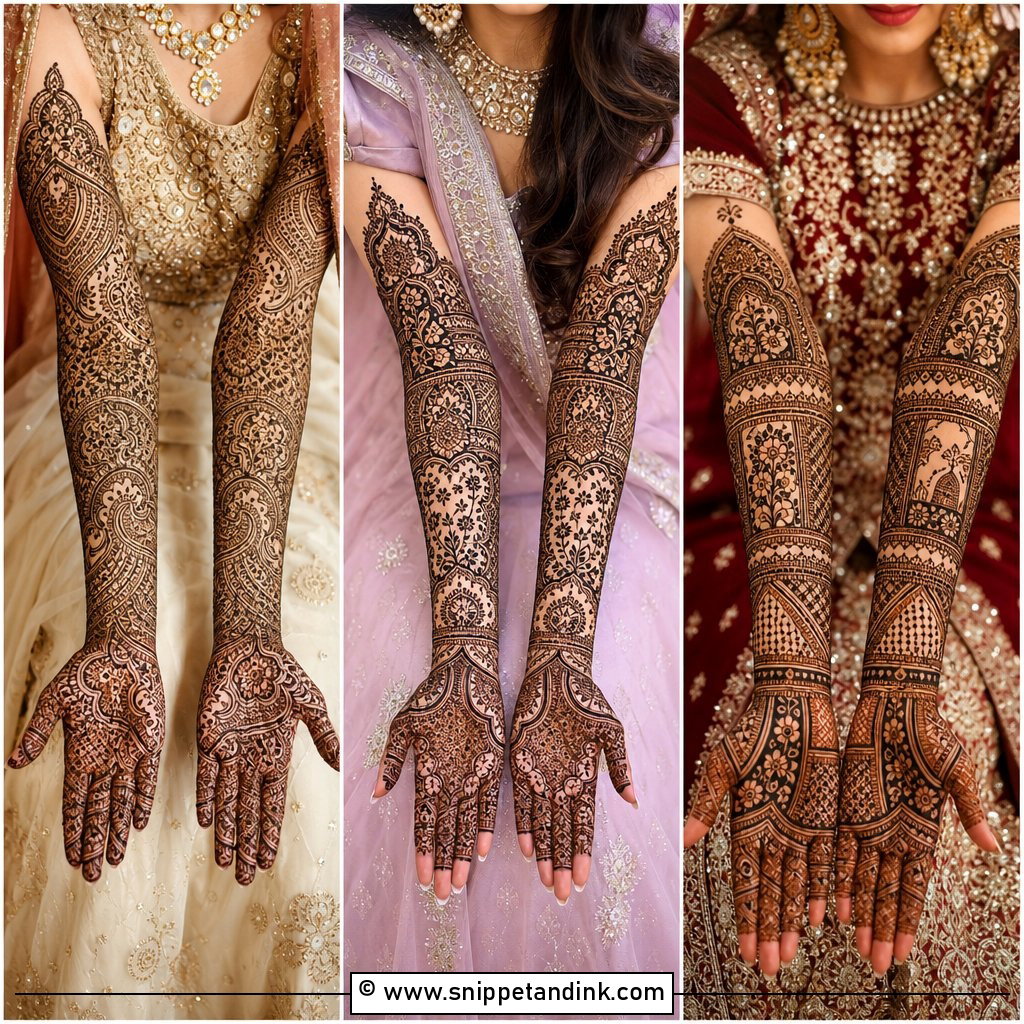
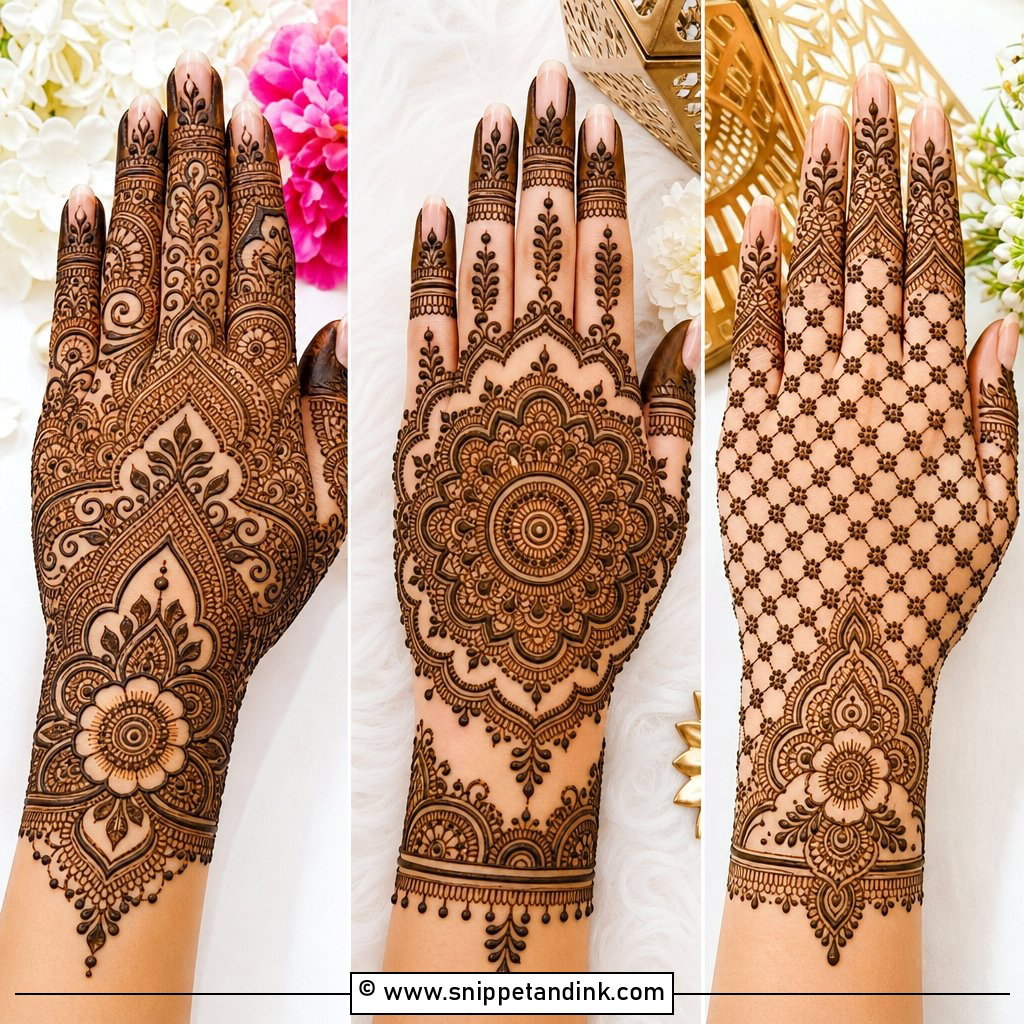
Traditional Indian full coverage is the most demanding layout I do, because there’s almost no empty skin to hide an uneven line. Palms, fingers, wrists and forearms are filled with layered paisleys, lotus, tiny leaves, peacocks, mandalas and fine fillers. I always keep the center of the palm slightly bolder than the rest; otherwise, from a few feet away in photos, the hand turns into a brown blur. It continues past the wrist under heavy bridal bangles, and it suits red, maroon, gold, green and ivory outfits. Expect the deepest, most classic stain from this one, since every part of the skin carries paste.
2. Dulha Dulhan Full Hand Mehndi Design
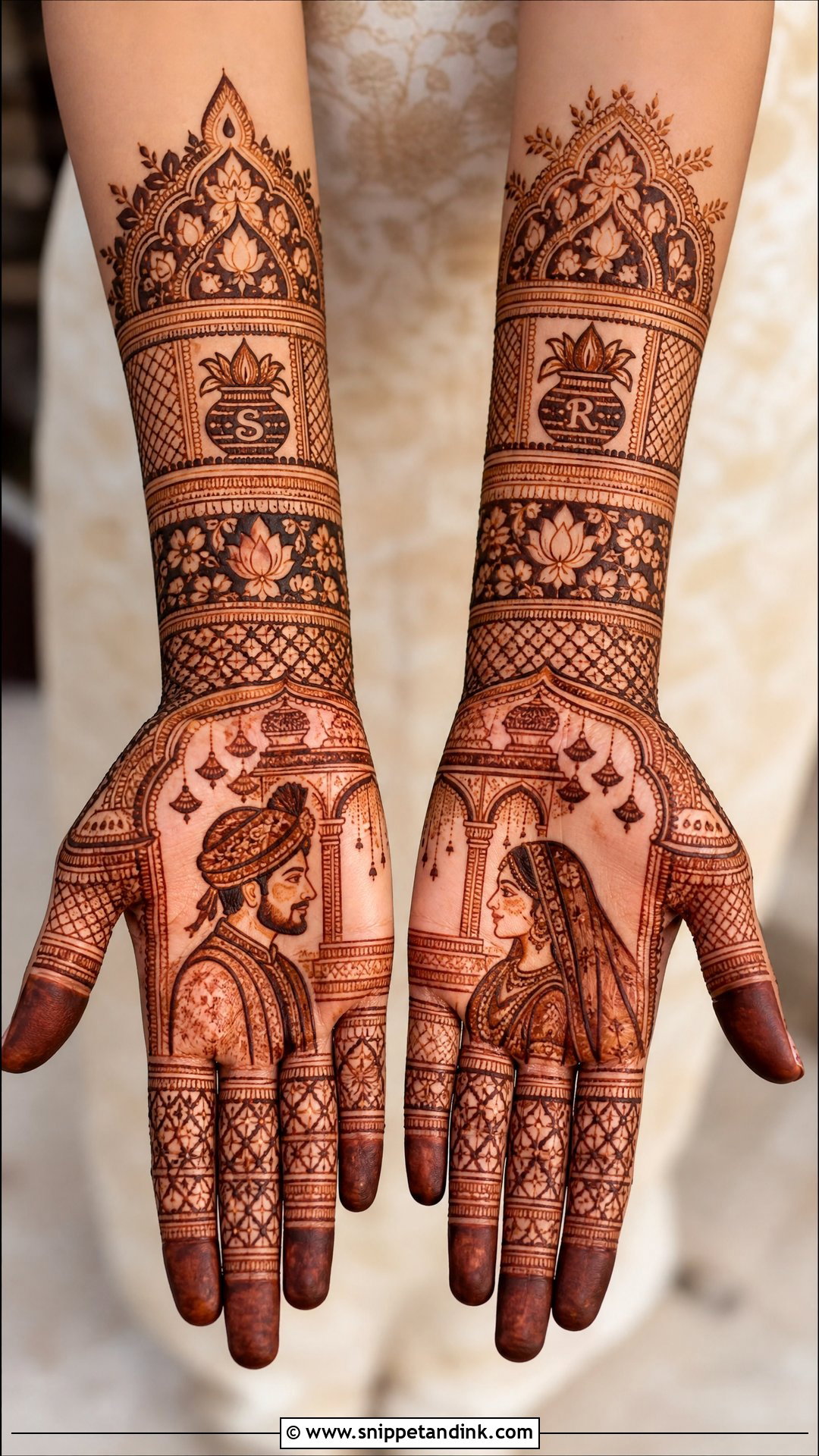
Do you want your mehndi to tell your love story? A dulha dulhan full hand mehndi design puts the bride and groom figures at the center of the palms and builds wedding details around them: mandap shapes, kalash, dholki, shehnai, vines and fine jaali. Sizing is the whole game here. I draw the faces large enough that the features survive the stain darkening and slightly spreading, but not so large that the rest of the palm looks bare. Initials, a date or a hidden name fit neatly into the borders.
3. Arabic Full Hand Bridal Mehndi Design
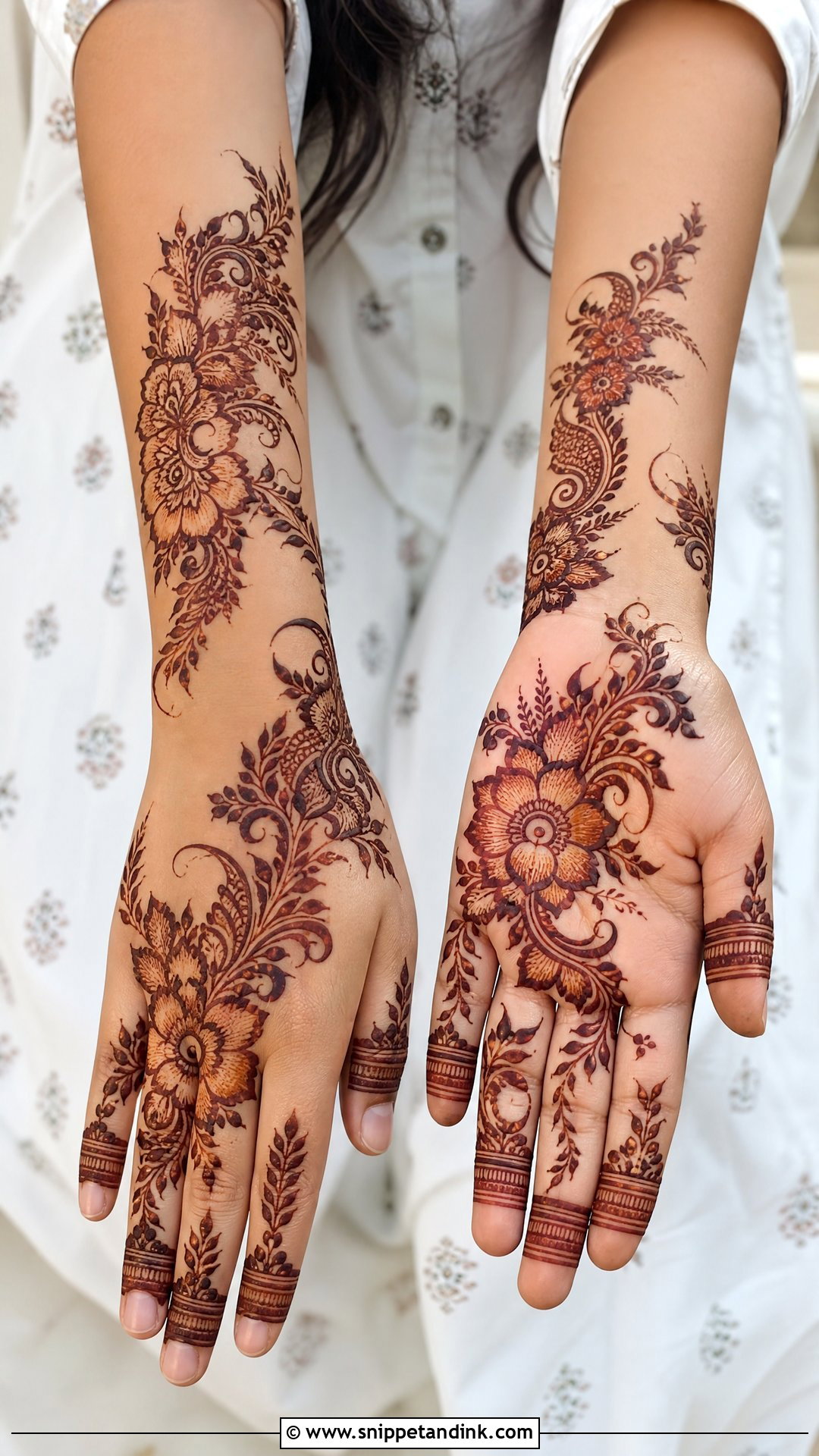
Arabic layouts trade density for flow. A bold diagonal trail of large flowers, leafy vines, shaded petals and curved paisleys crosses the hand, the fingers get matching bands and dotted tips, and the wrist carries the trail up the arm. I shade petals by thinning the line toward the center rather than filling them solid, which gives that two-tone look once it stains. The open skin between motifs is what makes each one readable in photos. If your outfit is heavily embroidered, this is the layout I’d suggest, since it won’t fight the fabric.
4. Indo Arabic Full Hand Bridal Mehndi Design
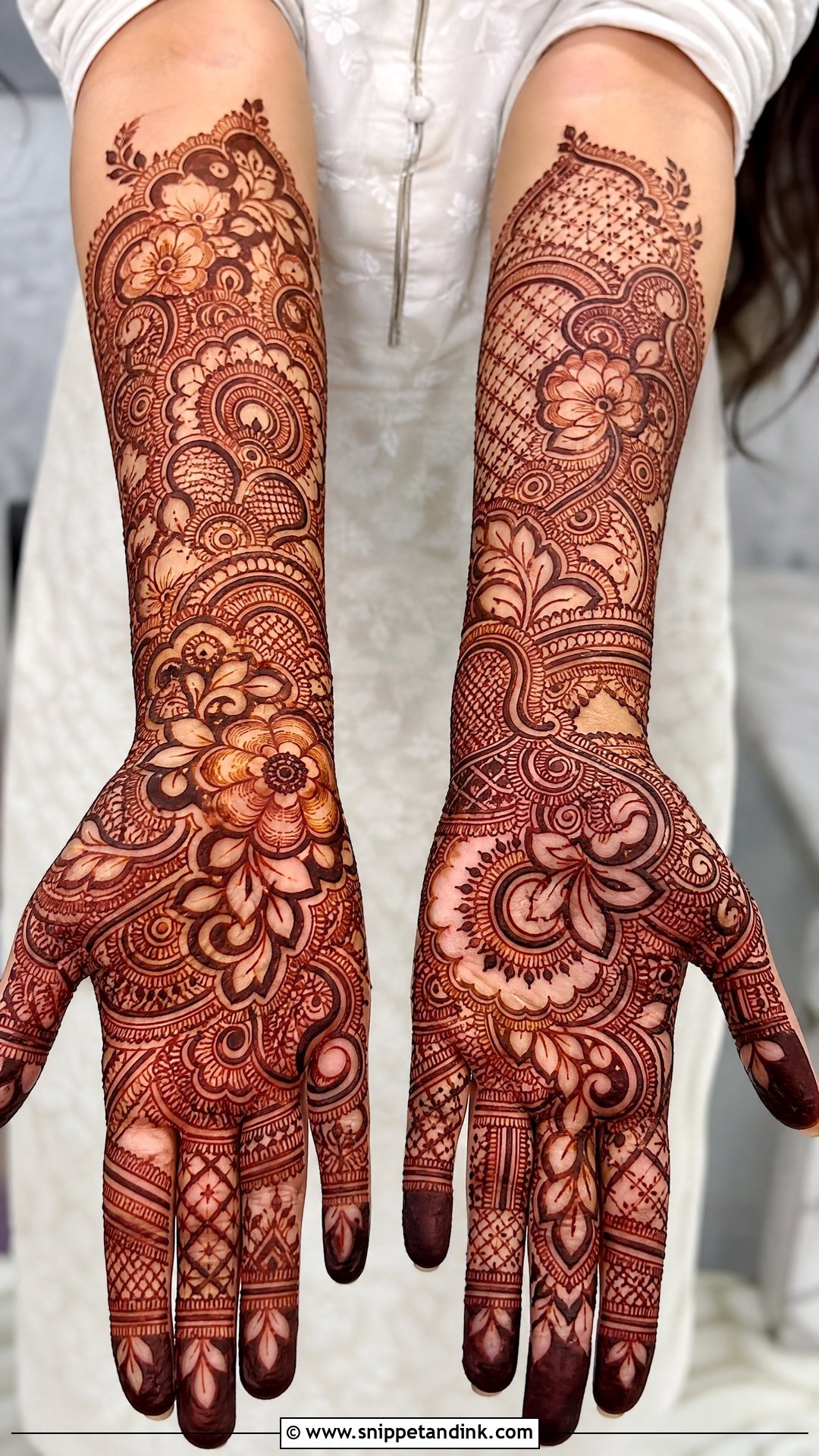
Indo-Arabic is the layout I recommend most to brides who can’t choose, because the palm can hold Indian detail while the back of the hand takes the bolder Arabic flow. A mandala, paisley cluster or bridal motif sits on the palm, and a diagonal floral trail crosses the back. Jaali, leafy borders and shaded sections fill the forearm. The risk is that the two halves feel like two different artists, so I repeat one motif on both sides to tie them together.
5. Peacock Full Hand Bridal Mehndi Design
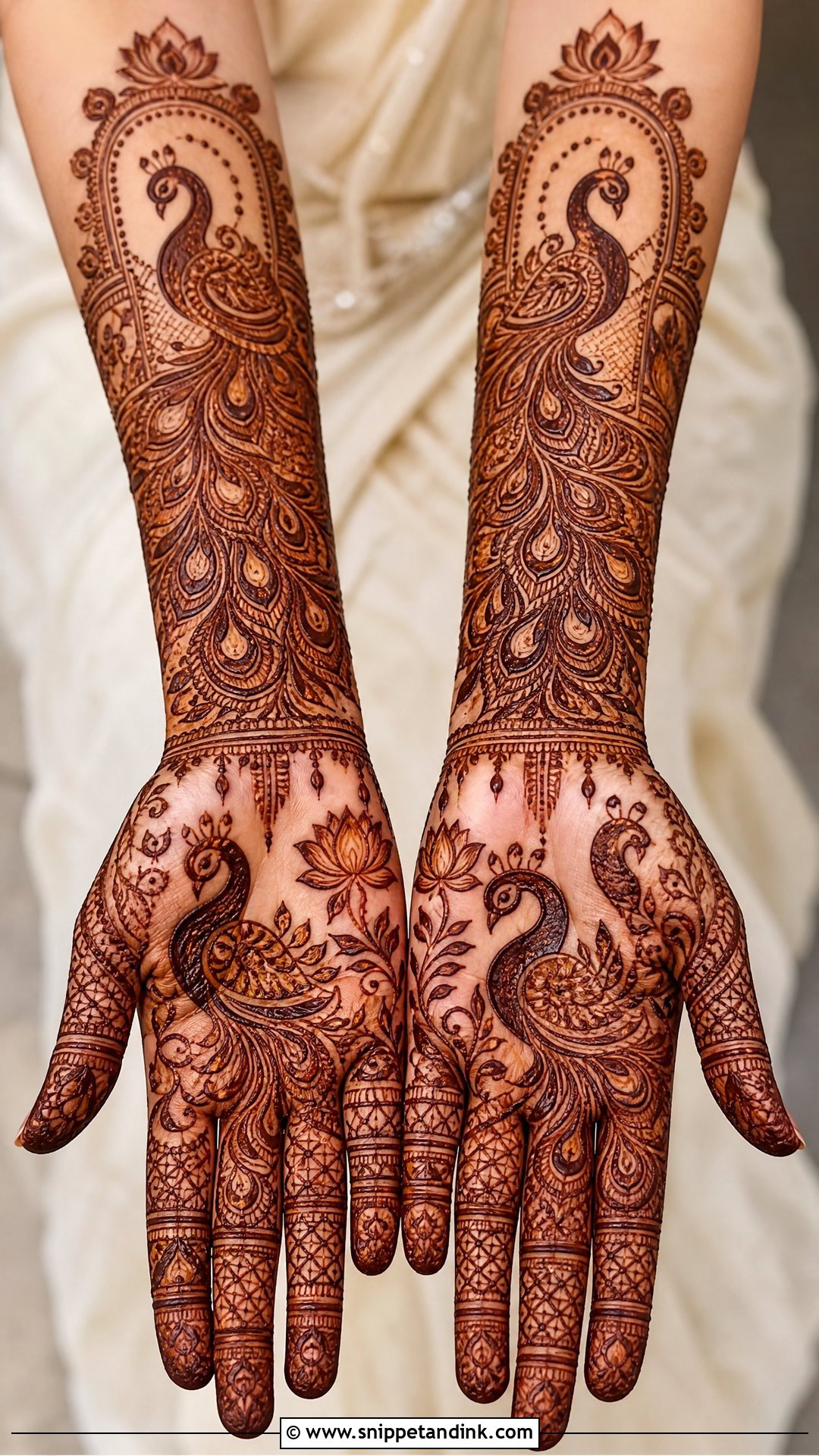
Peacocks are harder to draw than they look. The neck curve and the feather eyes need steady, continuous lines, and a shaky neck is the first thing guests notice. The peacock full hand bridal mehndi design places the bird on the palms, near the wrist or along the forearm, surrounded by lotus, paisley curves, feather lines, dotted chains and fine mesh. I let the tail feathers flow into the surrounding fillers so the bird looks part of the pattern rather than stamped on. Dense fingers and bold wrist cuffs push it toward the regal end; it sits naturally with silk sarees, Indian lehengas and heritage jewelry.
6. Lotus Full Hand Bridal Mehndi Design
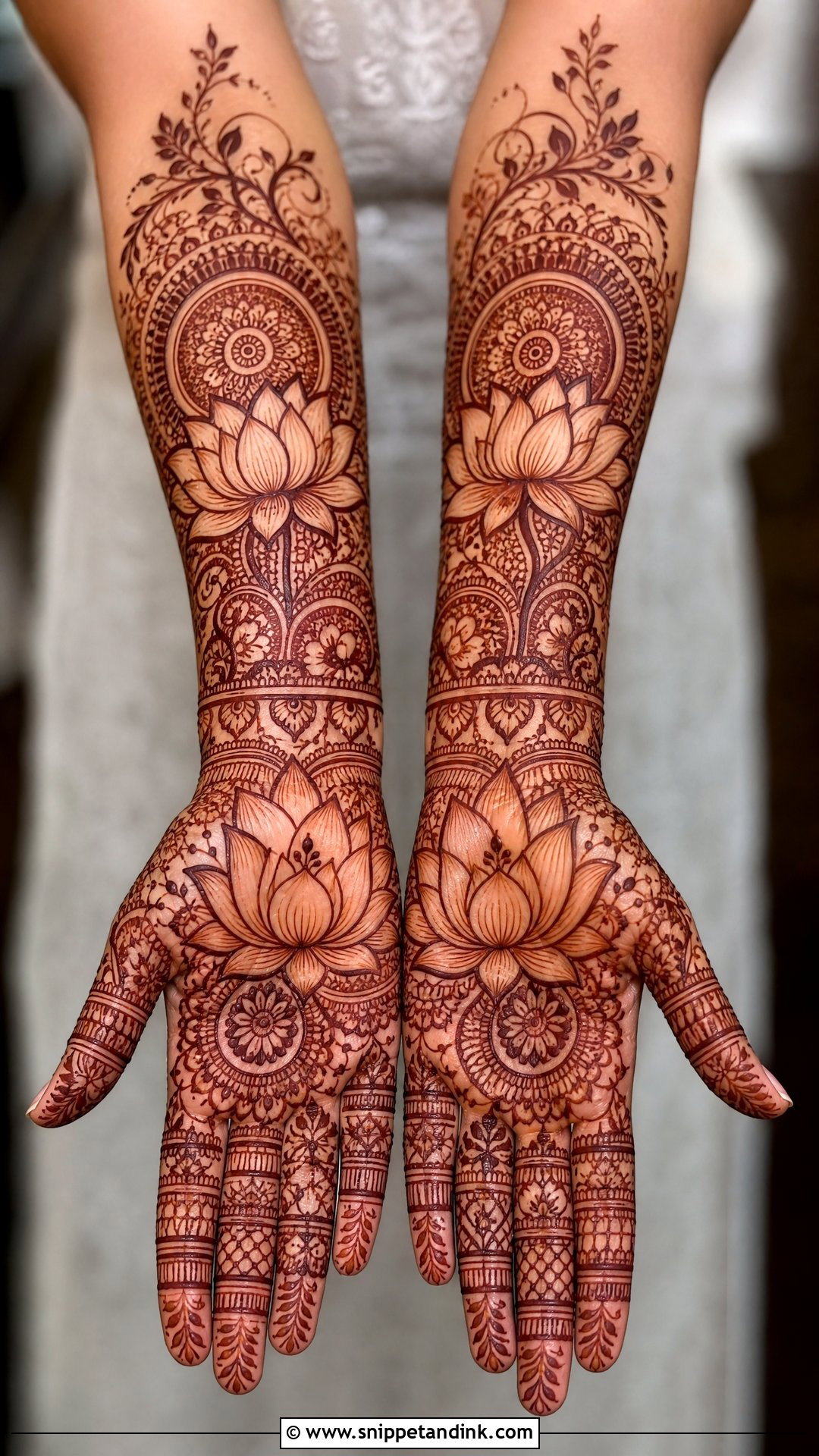
Lotus is the gentlest motif on this list. Its rounded petals soften the hand, and the shaded interiors add richness without needing dense fillers. I use it as a large palm motif, repeat it at the wrist or chain it up the forearm, usually alongside mandalas, paisleys, vines and dotted borders. Petal symmetry is what I watch most closely: one lopsided petal is easy to spot in a close-up. It pairs naturally with pastel lehengas, temple jewelry and floral styling.
7. Mandala Full Hand Bridal Mehndi Design
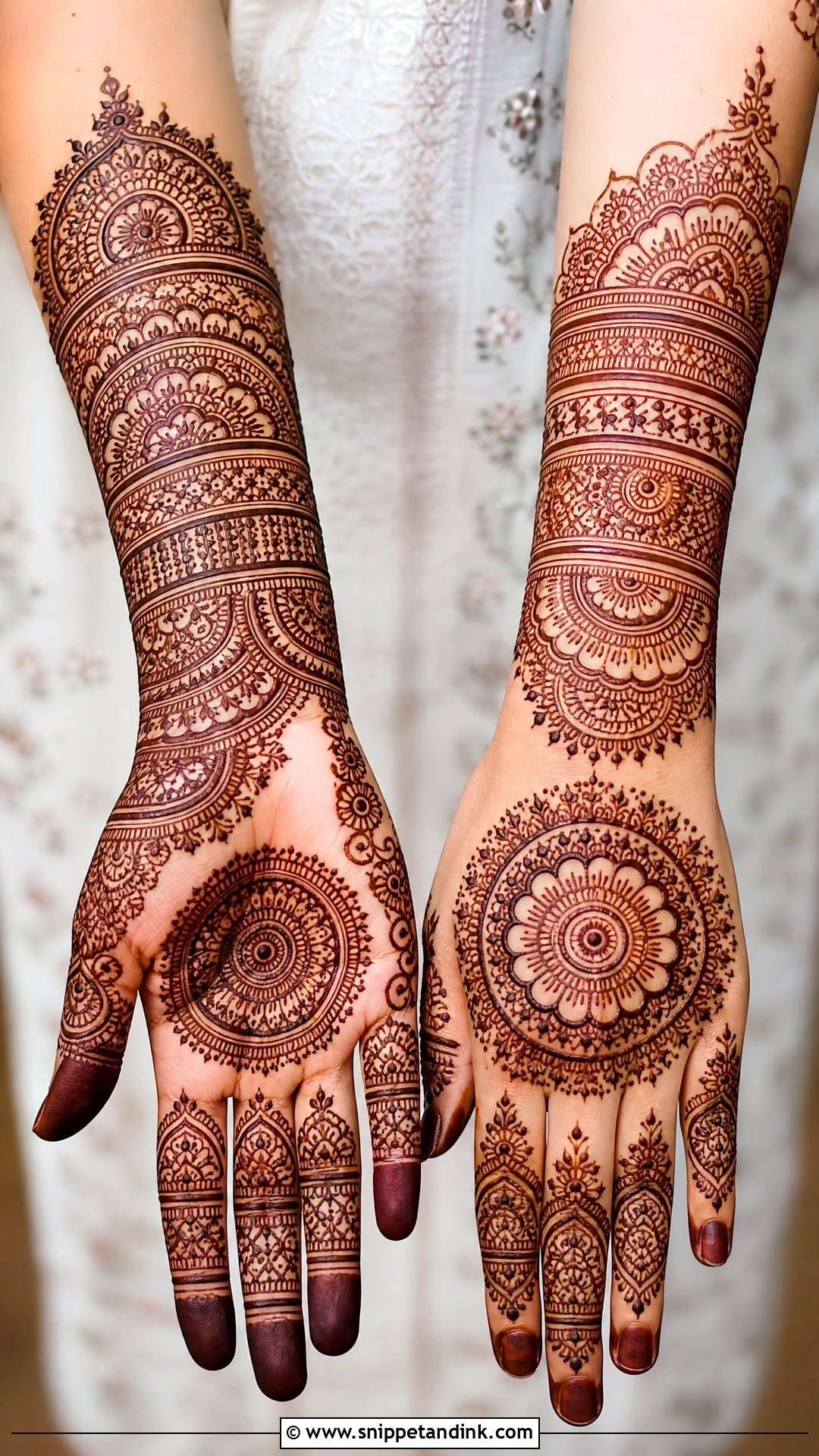
A mandala gives the hand a single, calm focal point, which is why it flatters most hand shapes. The main circle sits in the center of the palm or back of the hand and grows outward in rings of petals, dots, leaves and fine borders. For bridal work it can’t stop at the palm; it continues through the fingers, wrist and forearm with matching cuffs, paisleys and fillers. I start every mandala from the exact center and work outward, because correcting an off-center ring later is nearly impossible. Short, wide palms suit a slightly smaller mandala so the fingers don’t look crowded.
8. Jaali Full Hand Bridal Mehndi Design
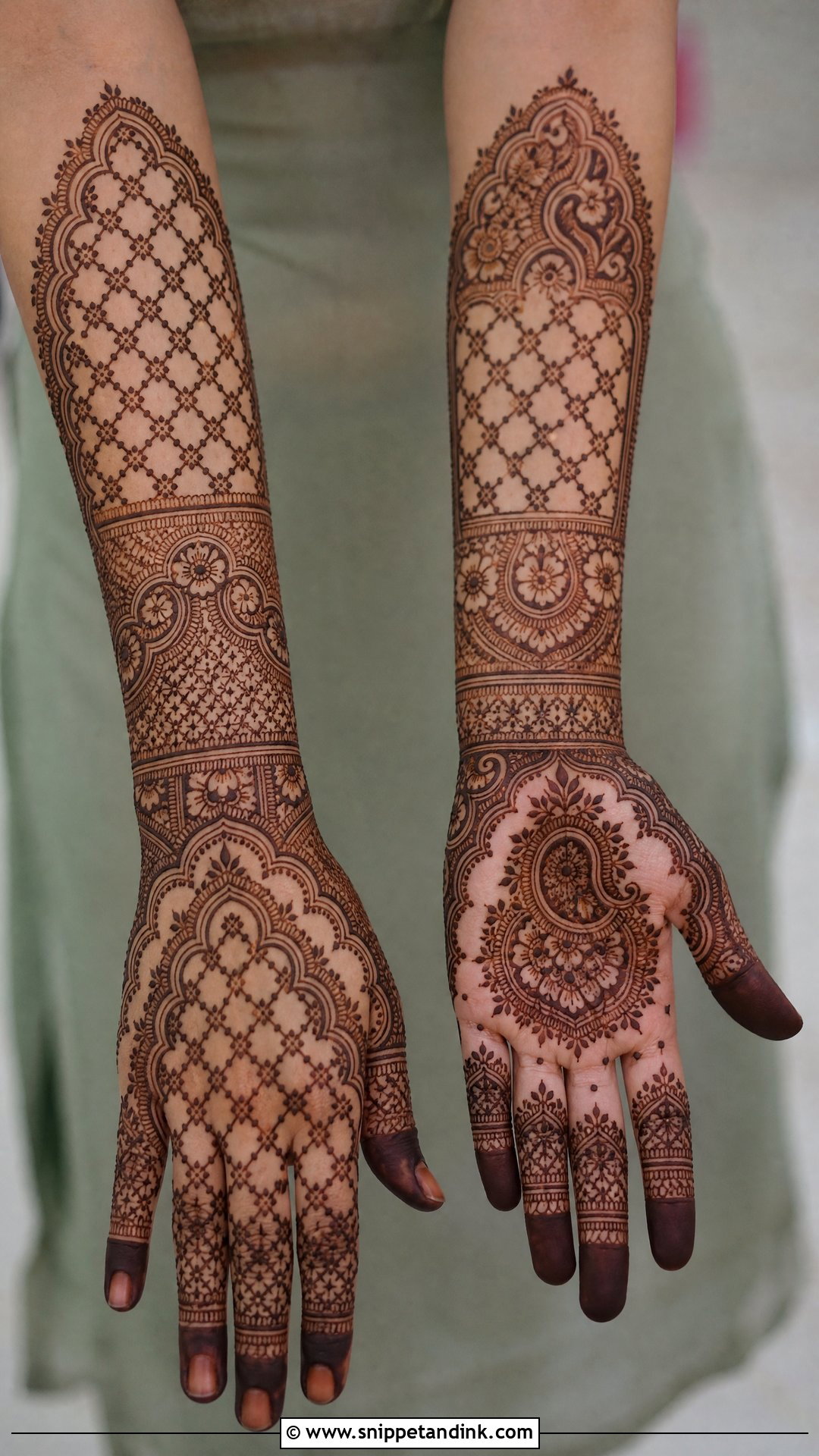
Jaali is the mesh that makes mehndi look like lace, and it’s the most unforgiving fill there is. If the grid spacing wanders, the whole hand looks cluttered, so I work it slowly with a fine-tipped cone and keep the paste consistent. It can cover the palms, the back of the hand, the wrists or the forearms, framed by flowers, paisleys and vines. On the back of the hand it reads like delicate gloves, especially with bold fingertips and bracelet bands at the wrist. Pearl, kundan and diamond-style jewelry sit well against it.
9. Personalized Full Hand Bridal Mehndi Design
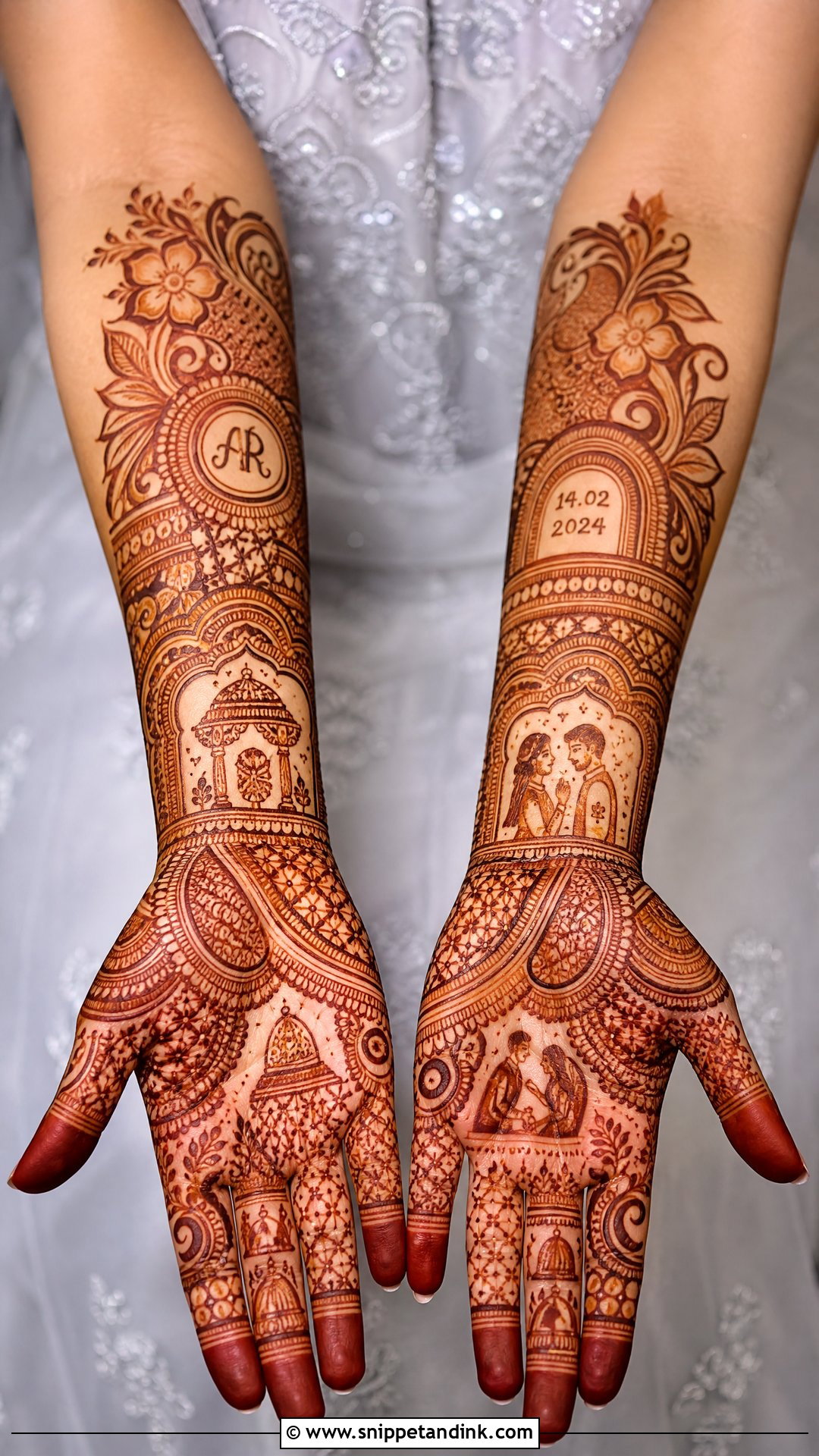
Personal details are the most fun to hide, but the design still has to look bridal first. Initials, the couple’s name, the wedding date, the proposal spot, pet names or small travel symbols all work when they’re folded into florals, mandalas, paisleys or jaali. I put the main custom element where it reads clearly, on the palm or forearm, and tuck the smaller ones into the fingers or cuffs for a reveal later. Send me the exact spelling of names in writing before the day; it’s very hard to fix a letter once the paste is on.
10. Bridal Portrait Full Hand Mehndi Design
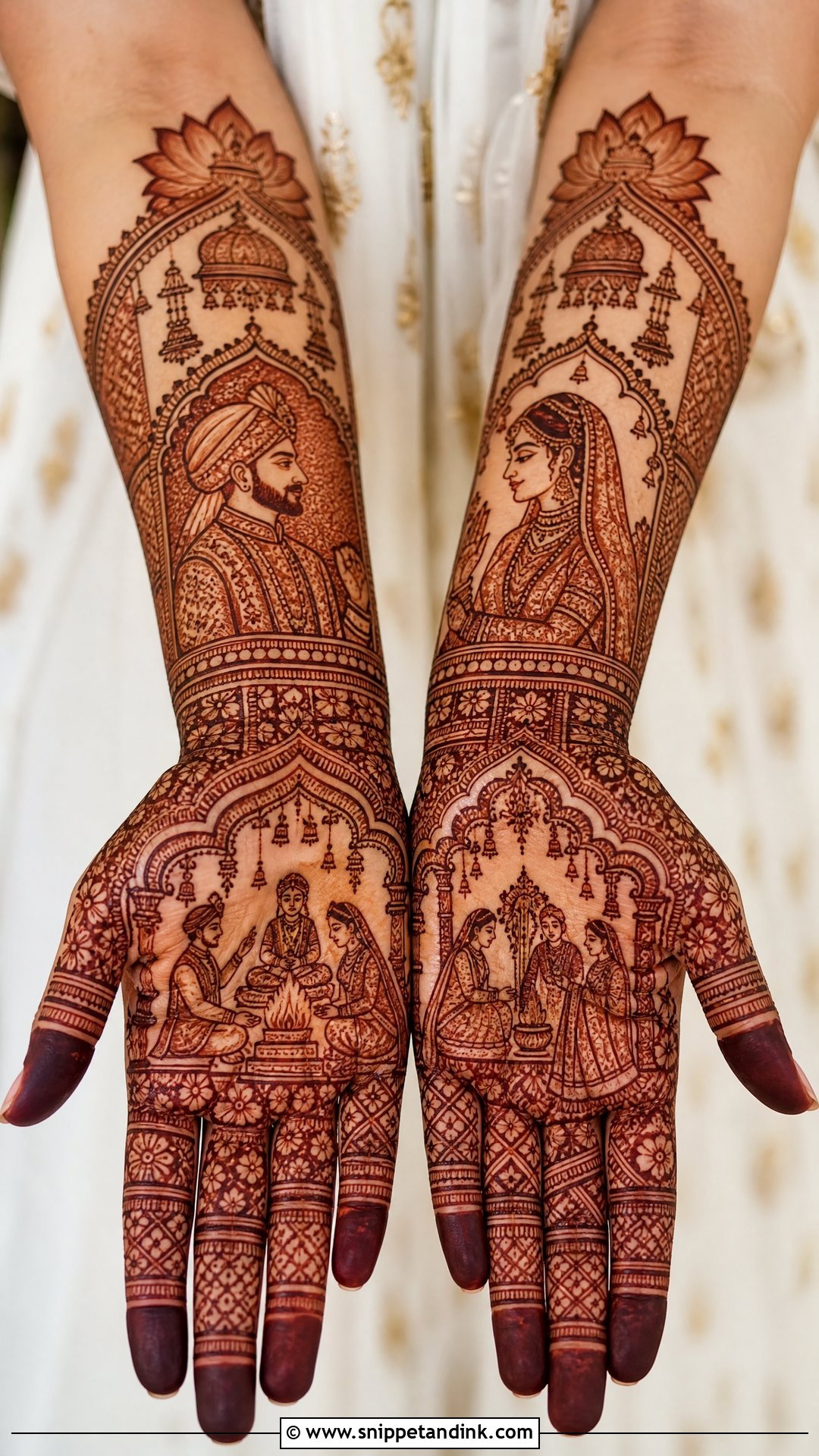
Portrait work needs an artist who can draw faces, not just motifs, so ask to see healed stain photos of their figures before you book. A bridal portrait full hand mehndi design puts detailed bride and groom artwork on the palms, with wedding scenes, mandap arches, lotus borders, paisleys and fine fillers around them. Thin facial lines can disappear as the stain darkens, so I make eyes and noses slightly bolder than they look right in fresh paste. The fingers and wrist stay detailed so the portraits don’t look like stickers on a bare hand.
11. Minimal Full Hand Bridal Mehndi Design
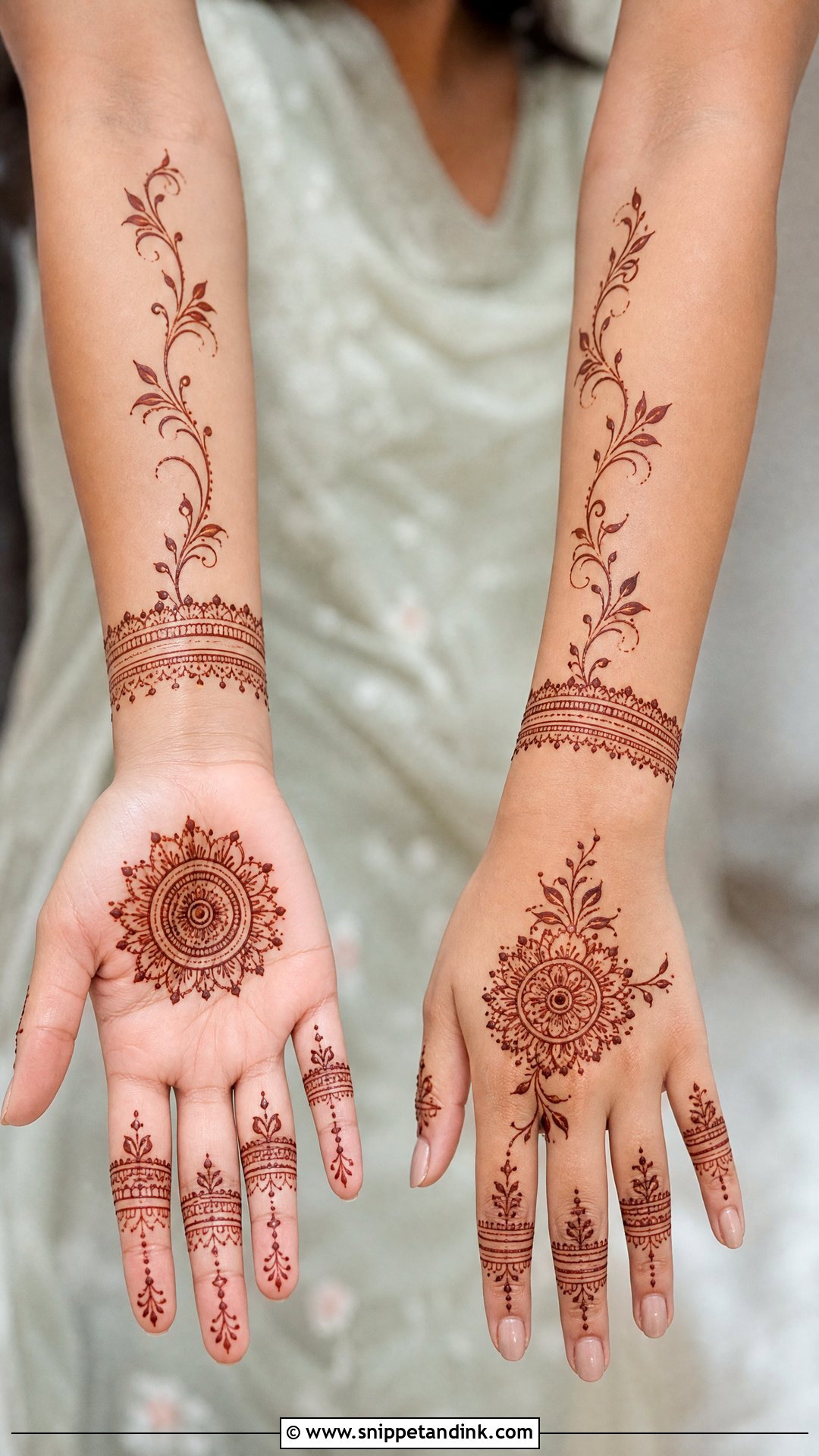
Not every bride wants a heavy look, and I’d never push one on a bride who doesn’t. Minimal full hand work still covers the hand, wrist and forearm, but with open spacing, clean motifs and fewer dense fillers: slim vines, small mandalas, delicate finger patterns and simple bracelet bands. It’s quicker to apply and easier to sit through. The danger is scattered motifs that look like several small tattoos, so I insist on one clear line of flow from fingertip to forearm. Statement jewelry, pastel outfits and intimate ceremonies suit it well.
12. Heavy Full Hand Bridal Mehndi Design
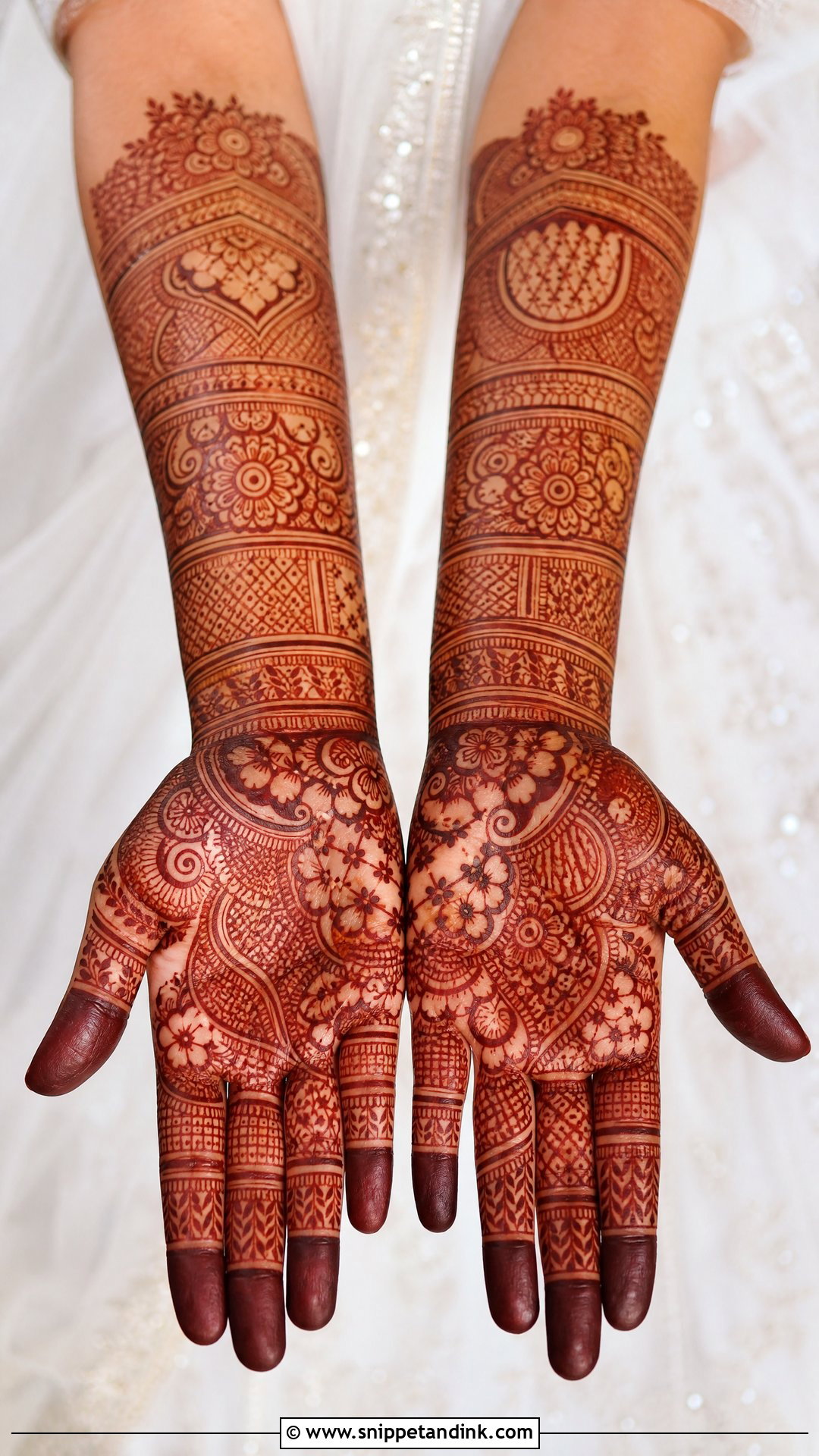
Heavy coverage is what most people picture as dulhan mehndi: palms, fingers, wrists and forearms filled with dense paisleys, floral clusters, mandalas, jaali panels and tiny filler strokes. It takes hours of sitting still, and a tired hand starts to shake, which is why I plan breaks between hands. To keep it from looking messy, I separate large motifs from fillers with clear borders so the design has rhythm rather than random crowding. It’s at its best in wedding photos next to grand lehengas, layered jewelry and bold colors.
13. Rajasthani Full Hand Bridal Mehndi Design
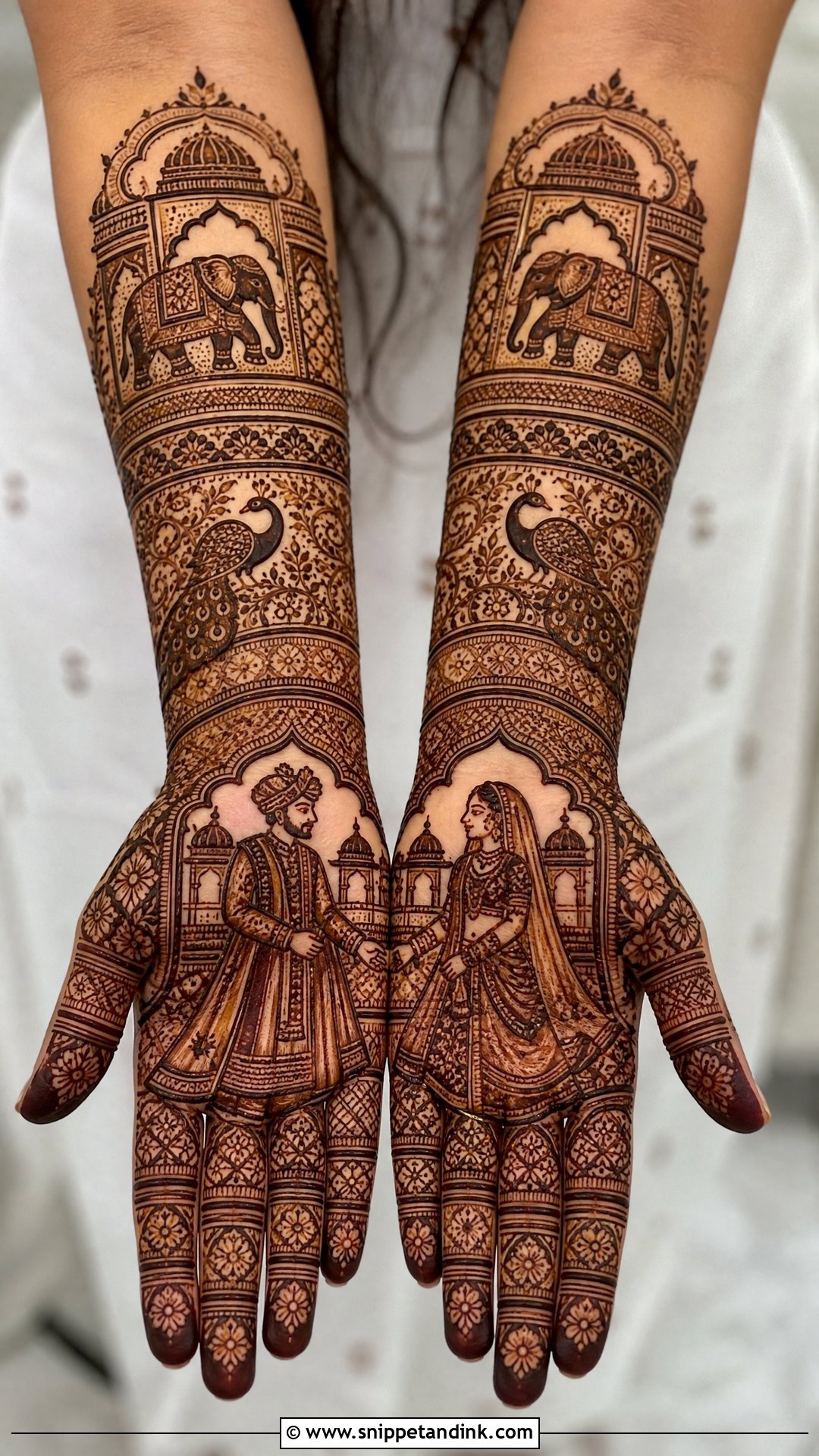
A Rajasthani full hand bridal mehndi design tells a royal story: bride and groom figures, palace arches, elephants, peacocks, paisleys and close mirror symmetry. The palms carry the ceremonial scenes, while the forearms take bold borders and repeating traditional motifs. It sits naturally with bandhani, gota patti, mirror work and traditional Rajasthani jewelry. This is one of the longest applications I do, so plan generous time for both drawing and drying. I keep the main figures crisp and leave a thin gap around them, otherwise they disappear among the fillers.
14. Pakistani Full Hand Bridal Mehndi Design
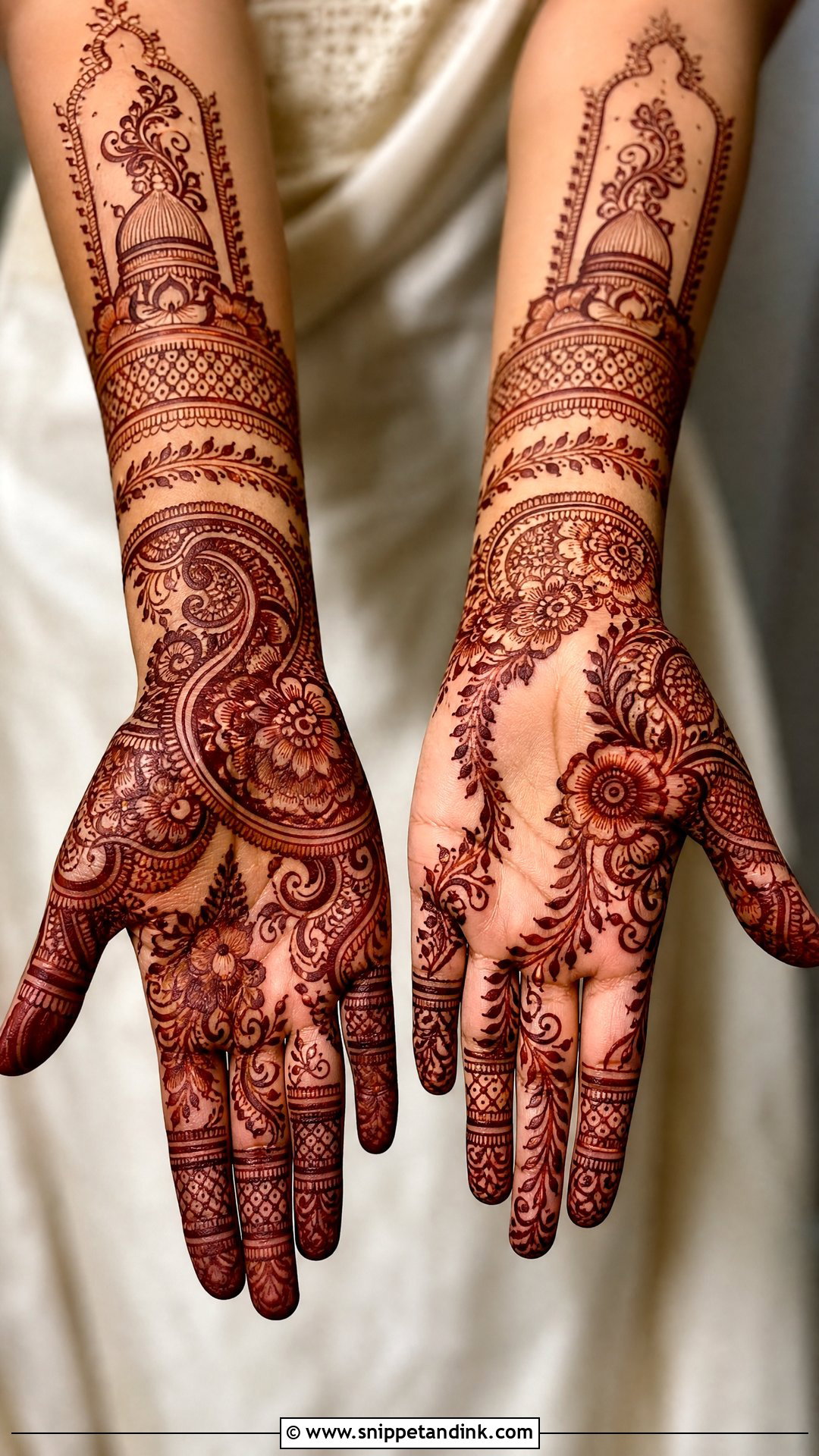
Pakistani bridal mehndi mixes delicate Indian detailing with bold Arabic flow: floral vines, paisley trails, dome shapes, bracelet cuffs, shaded petals and fine finger work. I usually keep the palms dense and the backs of the hands slightly more open, which gives the two sides a pleasing contrast. Clean wrist-to-forearm transitions and symmetrical fingers are what make it look refined rather than busy. It suits gharara, sharara, lehenga and heavily embroidered outfits, and it carries across nikah, walima, and reception looks without needing to change.
15. Moroccan Full Hand Bridal Mehndi Design
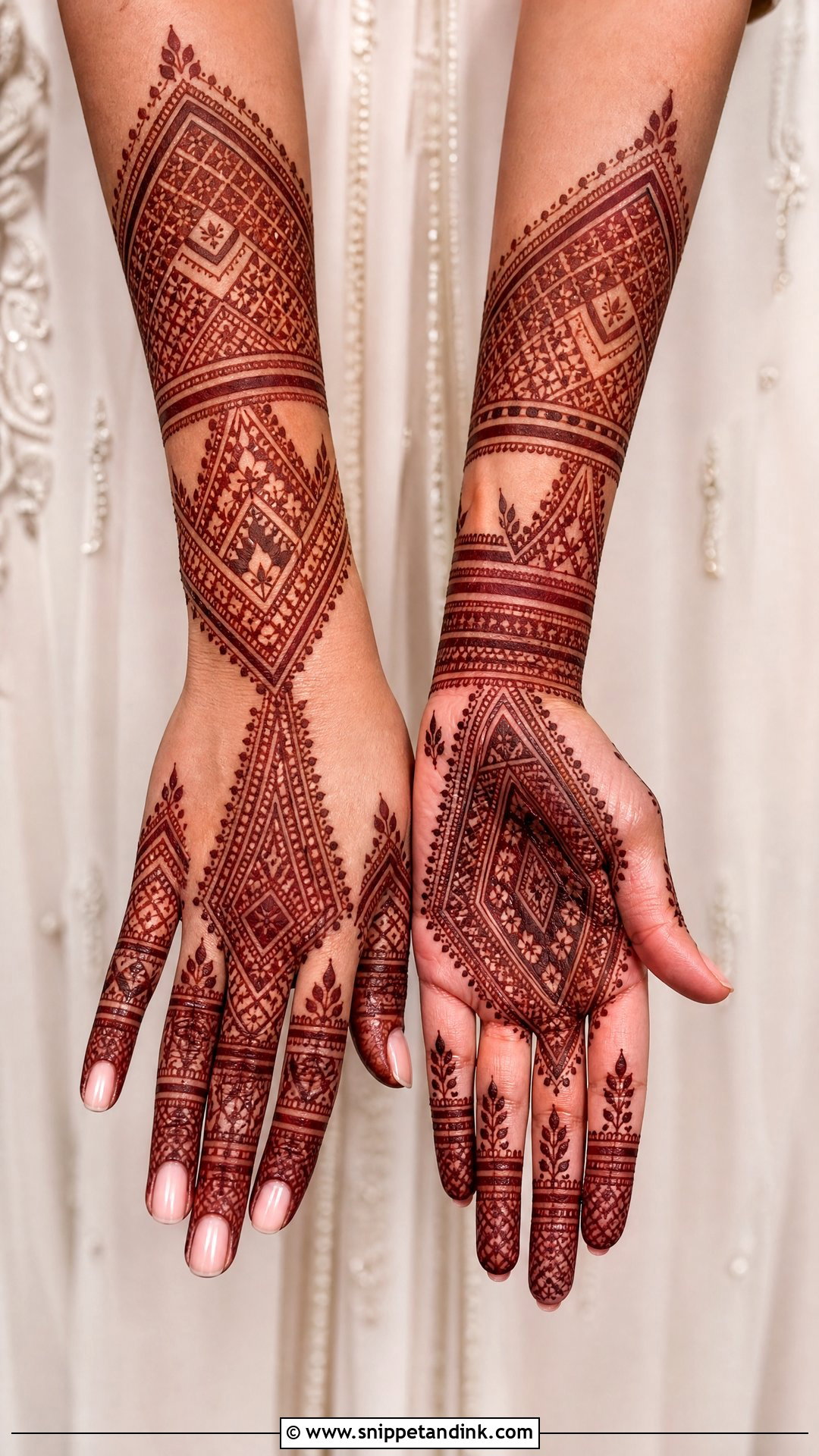
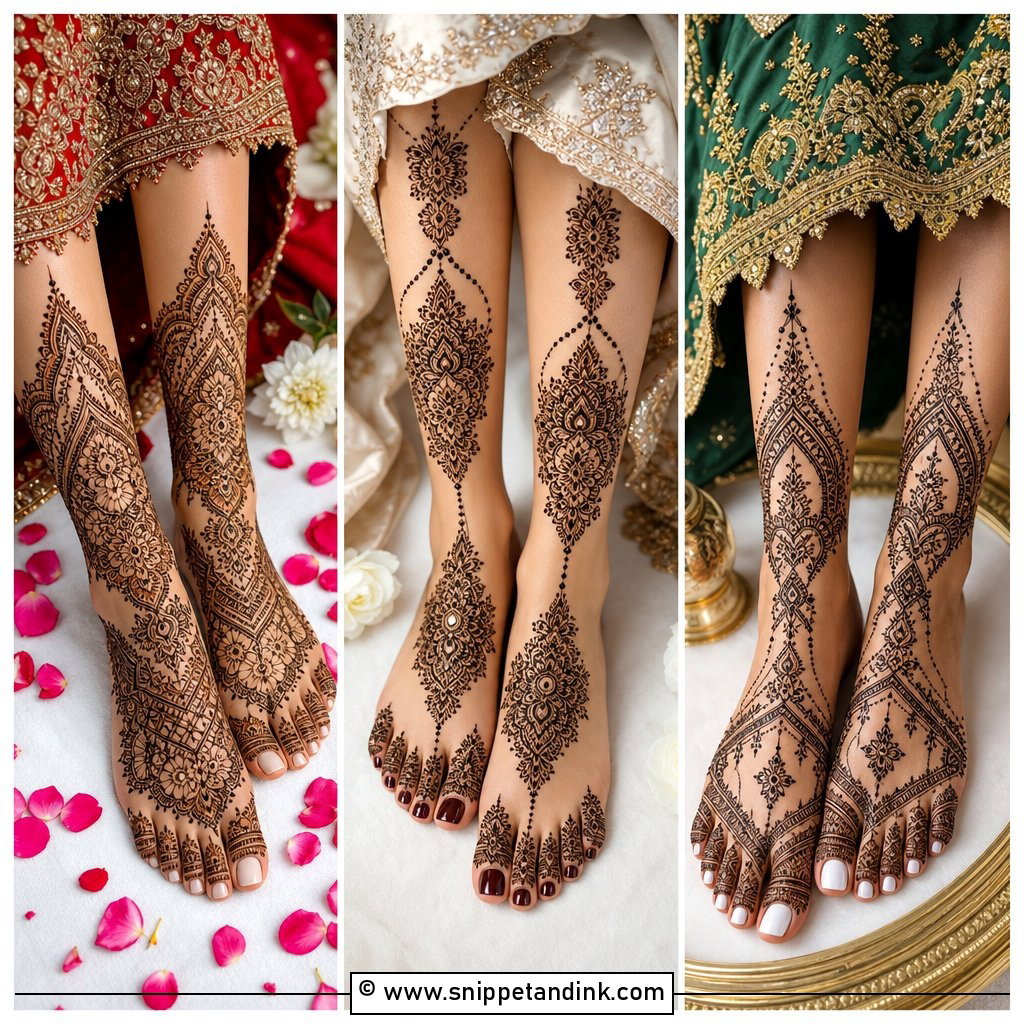
Geometric Moroccan work swaps flowers for diamonds, lines, grids, triangles and bands. The palm gets a central geometric frame, and the wrists and forearms continue in cuff-like sections. Straight lines are the hardest thing to draw in henna, because the skin curves and stretches under the cone, so I steady the hand flat on a cushion and work in short, joined strokes. Small dots, leafy borders or fine fillers soften it enough to feel bridal. Brides who want to move away from paisley, or who wear modern outfits and sleek jewelry, tend to choose this one.
16. Gulf Full Hand Bridal Mehndi Design
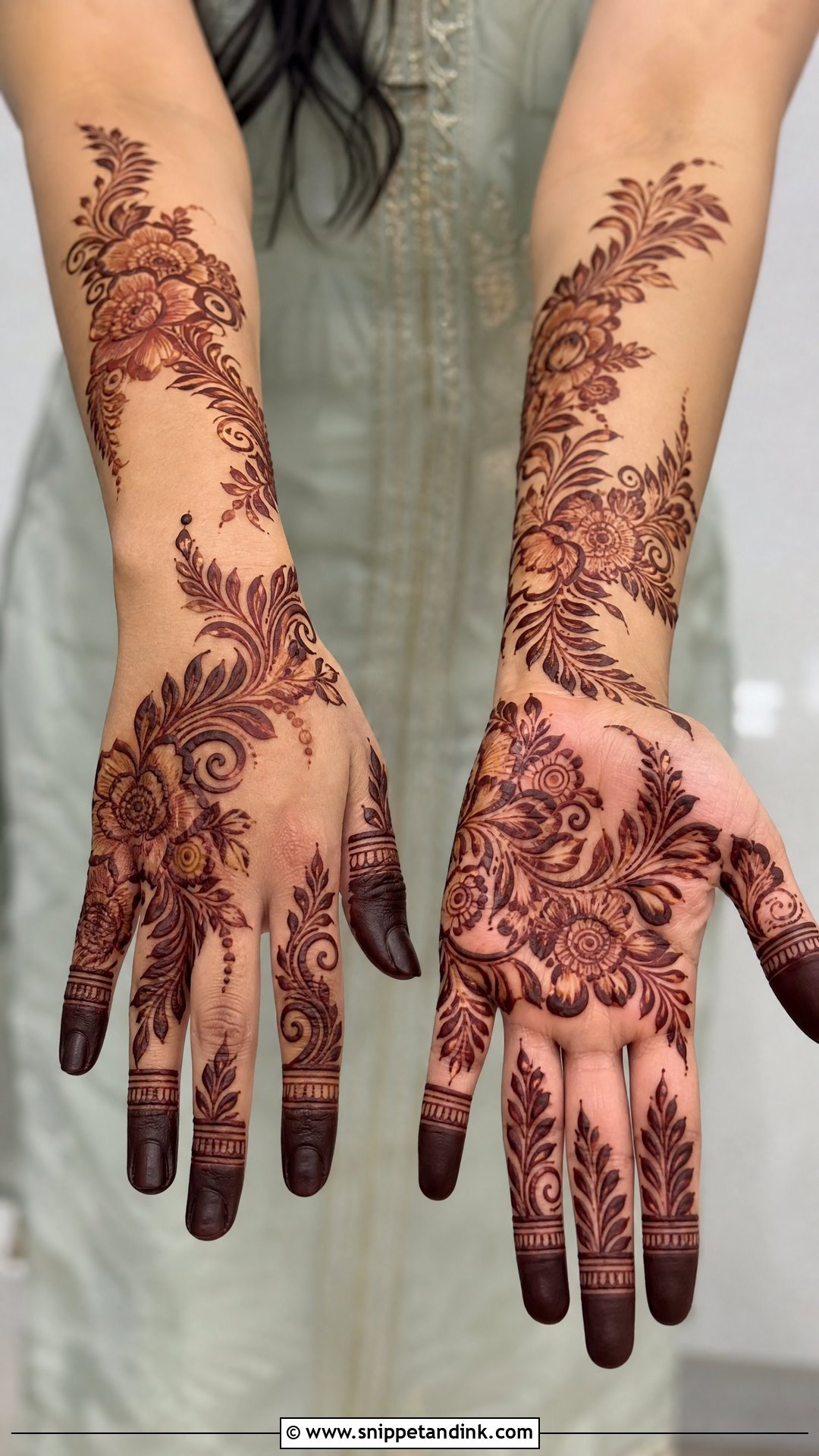
Gulf, or Khaleeji-inspired, mehndi is bold flowers, leafy trails and plenty of negative space. Large floral motifs flow from the fingers to the wrist, and the forearm carries curved vines, shaded petals and deliberate gaps. Because the shapes are big, line quality matters more than detail: wobbly curves and patchy shading show immediately. I use a slightly thicker cone tip for the outlines. On the back of the hand it shows off well next to rings and bangles, and it sits comfortably with gold jewelry, embellished sleeves and richly textured fabrics.
17. Jewelry Full Hand Bridal Mehndi Design
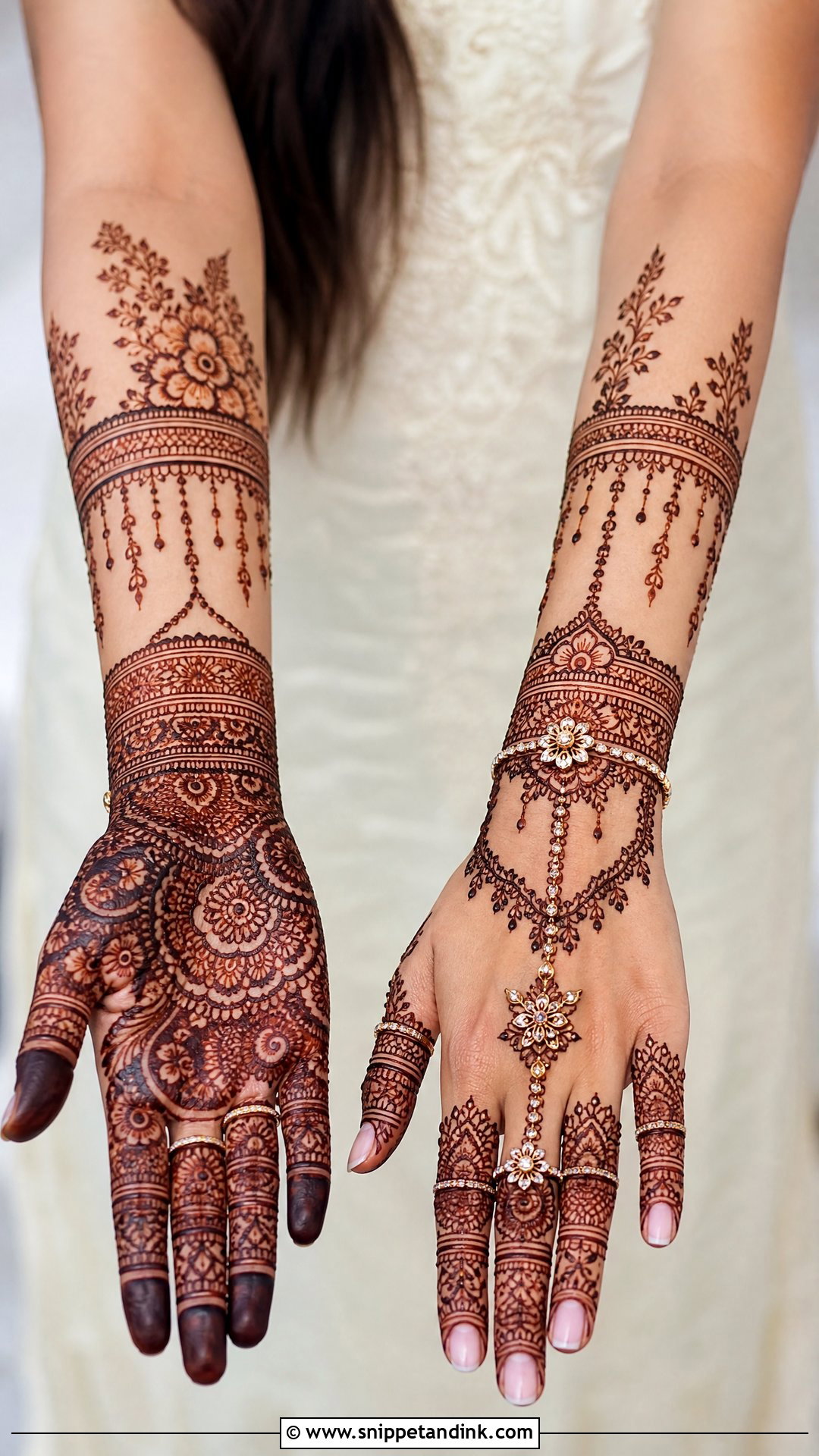
Jewelry-style mehndi draws ornaments onto the skin: haath phool chains, ring bands on the fingers, bracelet cuffs, wrist bangles and small dangling drops. It covers the full hand while still feeling light. I keep the palm traditional with florals or a mandala, and give the back of the hand the jewelry effect. If you’ll wear a real haath phool, tell your artist, because drawn and real chains on top of each other look muddled. Fine fillers around the cuffs and chains stop it looking too plain, and it shows up clearly in ring shots.
18. Floral Full Hand Bridal Mehndi Design
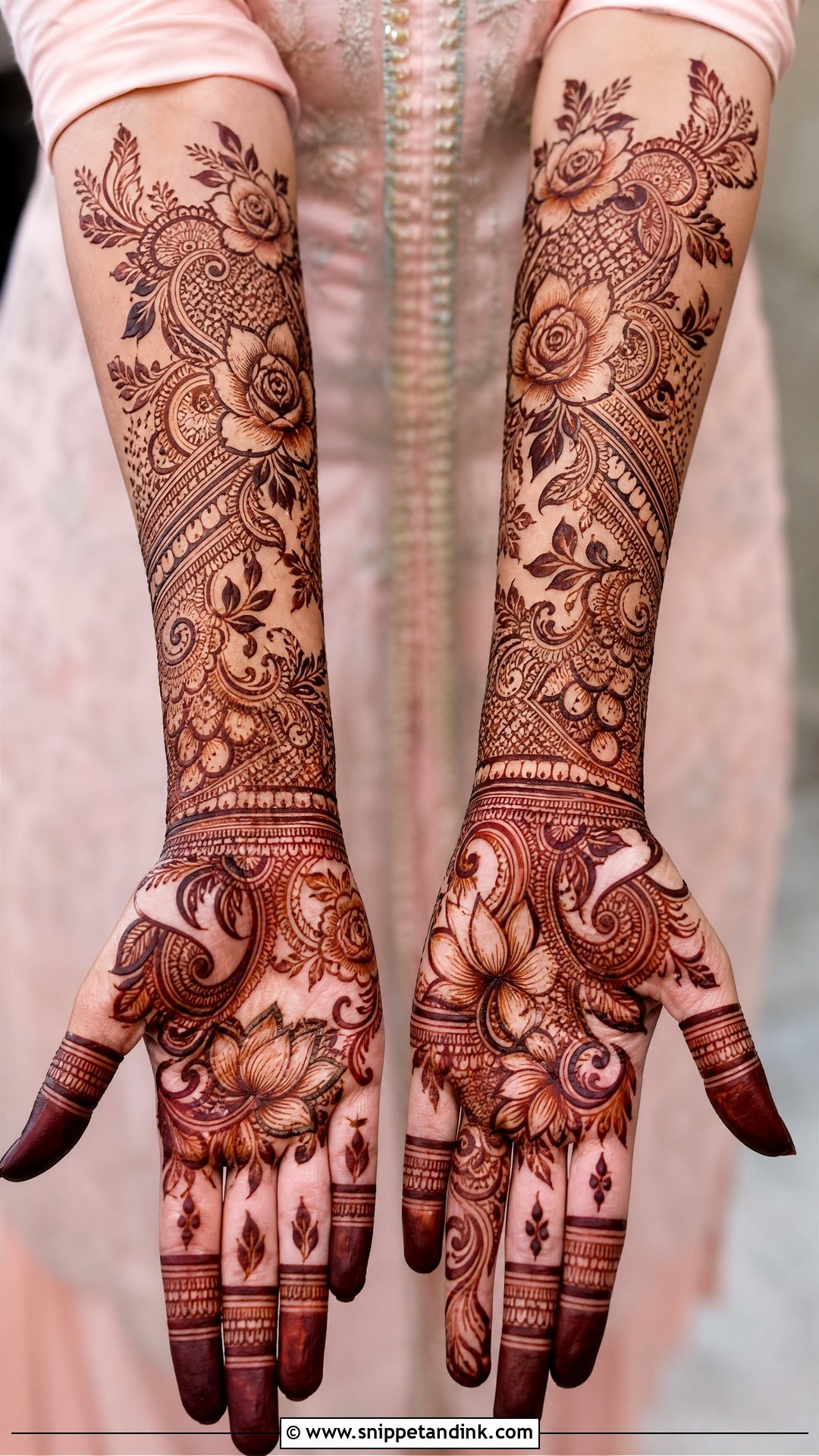
Florals are the easiest style to love and the easiest to adjust. Roses, lotus, small blossoms, vines and shaded petals can run across the palms and forearms, with flower bands or bold filled tips on the fingers. For a romantic look I use larger flowers with light shading; for a classic bridal finish I add paisleys, jaali panels and fine Indian fillers around them. It suits nearly every outfit color, and it’s the layout I’d choose for a bride with floral jewelry or a garden wedding.
19. Front And Back Full Hand Bridal Mehndi Design
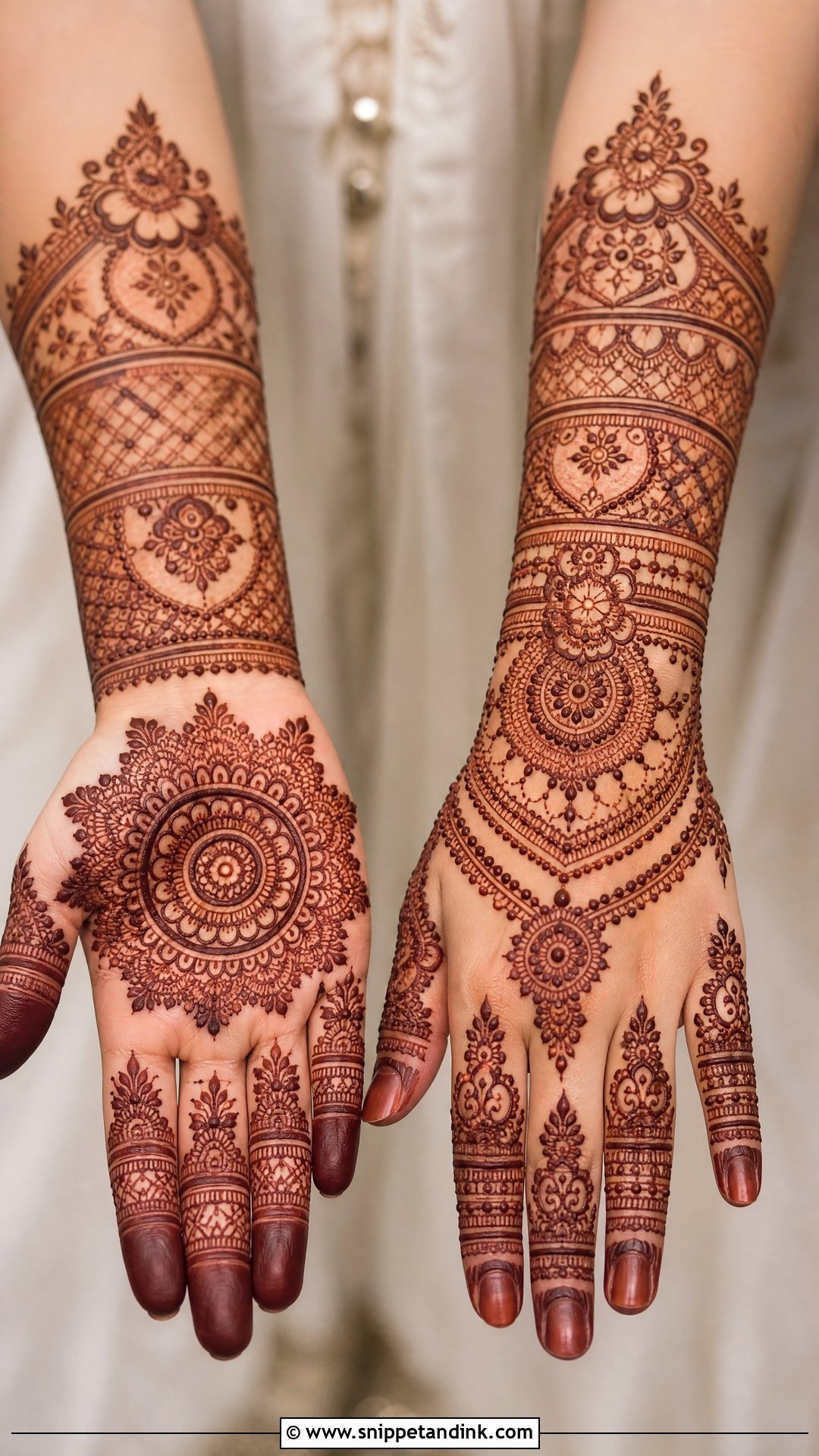
Hands are photographed from every angle on the day, so front and back should look planned together. The palm side carries the detail: mandalas, portraits, paisleys or traditional motifs. The back of the hand takes jewelry patterns, floral trails or jaali. I connect the two through the wrist and forearm with the same border or a repeated motif, so the hand reads as one design from any side. The two hands don’t need to be identical, but they should clearly belong to each other in ceremony photos, ring shots and candid poses.


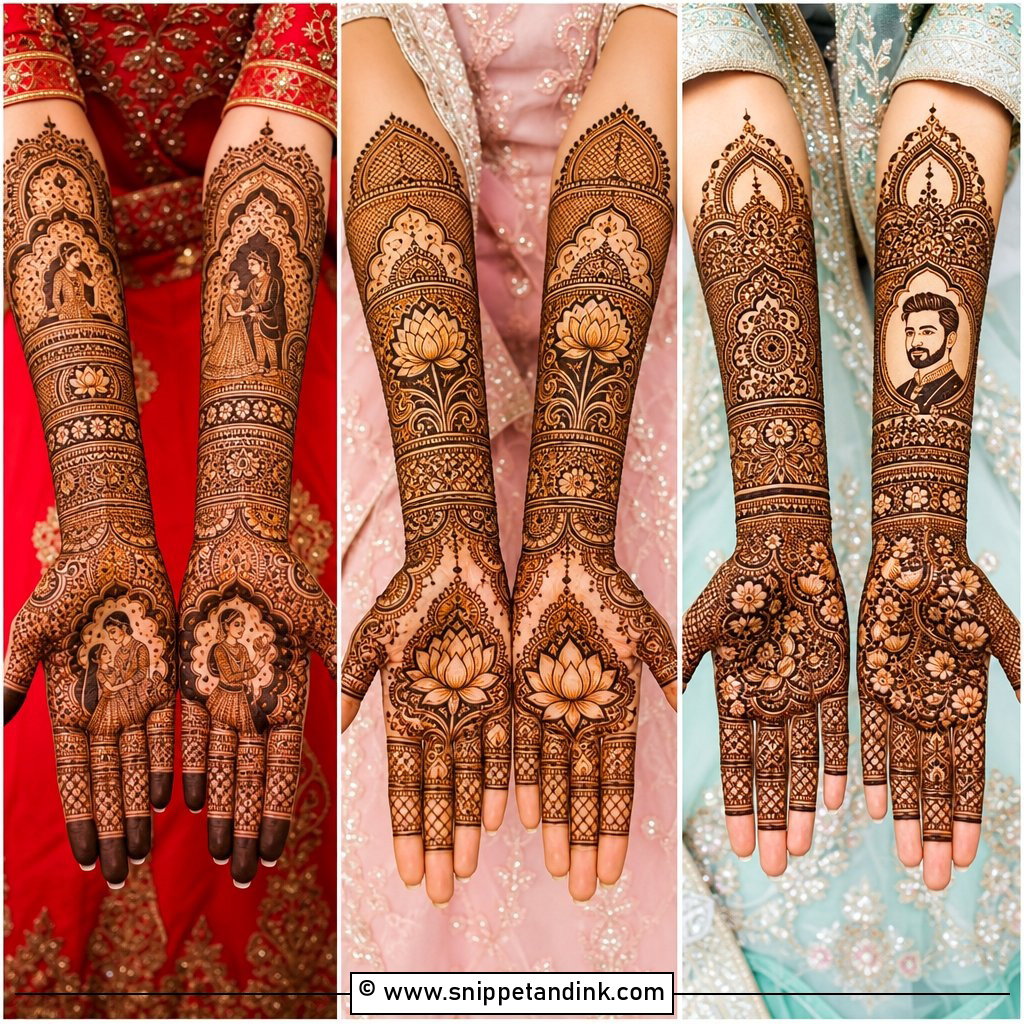

20. Modern Full Hand Bridal Mehndi Design
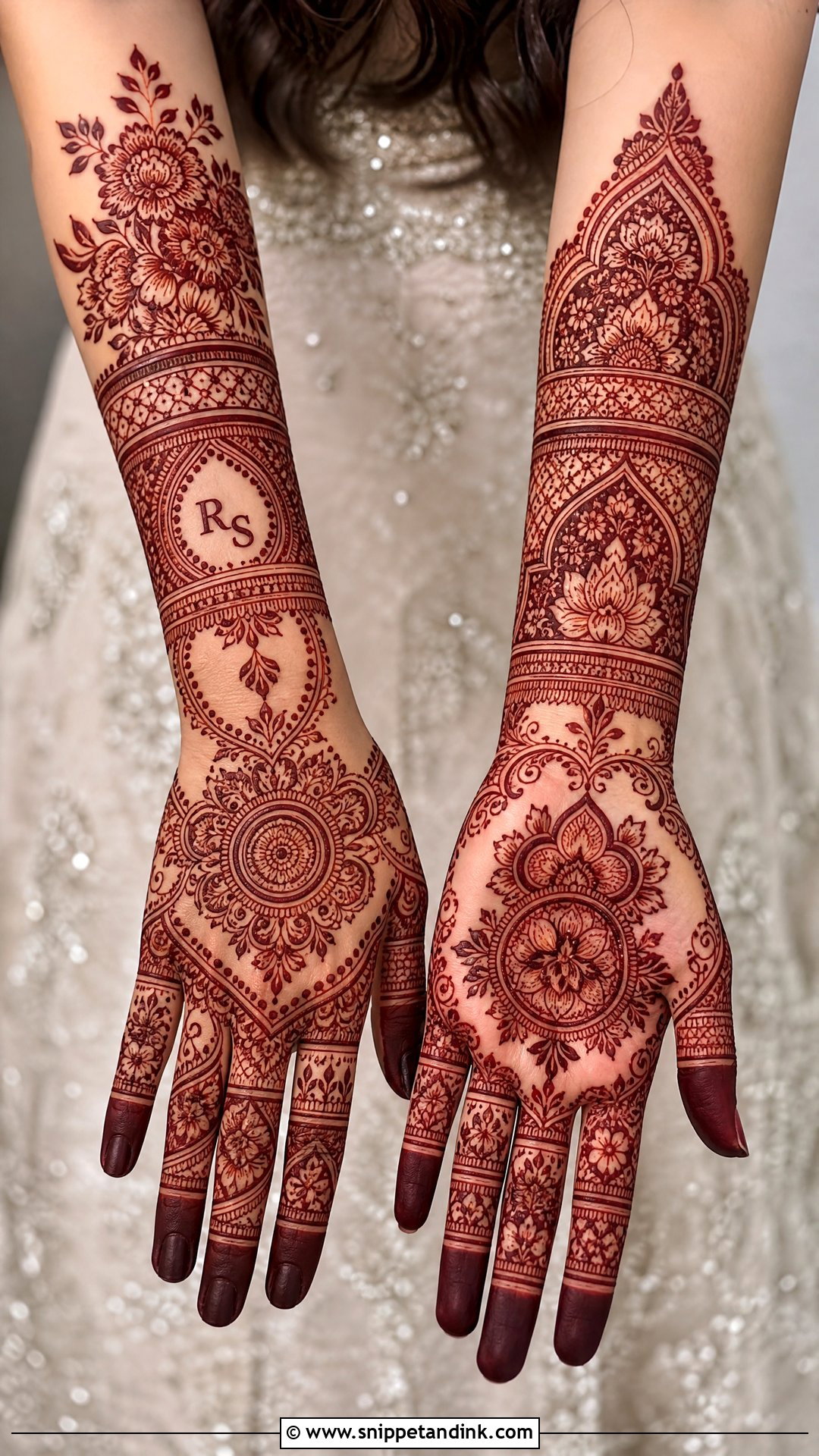
Modern bridal mehndi still covers fingers, palms, wrists and forearms; what changes is the spacing. Clean gaps, bold florals, geometric cuffs, initials and fine-line details replace the crowded classic fill. I often suggest anchoring it with one traditional motif, such as a mandala or a lotus, so it still reads as bridal at a glance. It sits well with contemporary lehengas, fusion outfits and sleek reception looks. The hard part is making open space look intentional, which means every section has to connect to the next.
Darkening the Stain After the Cone Lifts
How dark the color goes depends as much on the hours after application as on the artist. The longer the paste stays in contact with warm skin, the deeper the stain.
- Let the paste dry, then dab on a light lemon and sugar mix so it stays stuck to the skin instead of flaking off early.
- Leave the paste on as long as you comfortably can. Overnight is ideal for bridal work, with the hands wrapped loosely in tissue and medical tape or cotton gloves.
- Scrape the dry paste off with a blunt edge or your fingernail. Don’t wash it off.
- Keep water off the hands for as long as possible afterward, ideally the rest of that day. Water at this stage stops the darkening.
- Keep your hands warm. Many brides warm their palms over a pan of cloves, a long-standing tradition that gives gentle heat; a warm room helps too.
Why I won’t use an instant black cone
Natural henna never stains black, and it never goes dark within an hour. Cones that promise jet-black color quickly may contain chemical dyes such as PPD, which can cause blistering and lasting skin damage. Ask your artist what’s in their paste. Good bridal artists mix their own from henna powder, lemon juice, sugar and essential oil, and they’ll happily tell you so. If you have sensitive skin, ask for a small patch test a week or two ahead.
On the wedding morning, the backs of the hands and the forearms are usually a shade lighter than the palms, because thicker palm skin takes the dye more deeply. That’s normal. A thin layer of balm before photos brings the color forward and makes the lines look crisp.
Sketch the Whole Arm Before the First Line
Think about the whole arm, not one motif. Full hand designs can be traditional, modern, dense, minimal, personal or deeply regional, and the right one depends on your outfit, jewelry, sleeve length and how long you can sit. Decide how far up the arm you want the design to go before the appointment, and pick an artist whose healed stain photos show clean lines from palm to forearm. Any layout here can be scaled up or down to suit you; a good artist will tell you honestly what will and won’t read once it stains.
You'll Like These Ideas:












Leave a Reply