
A bail, also called a bel, is a vine. On the palm it travels diagonally, vertically or in a soft curve, and it decorates the hand without the weight of full coverage. That’s why I suggest it so often for sisters, bridesmaids and guests, and to brides planning a lighter look for one of their functions. It adapts to almost any occasion, from a small puja to Eid, Diwali, Karwa Chauth or a sangeet, and it can carry flowers, leaves, paisleys, mandalas, jaali or Arabic-style open space. The vines below run from quick and plain to detailed enough for a wedding, with notes on how each one sits on a real palm.
Where a Vine Should Run on Your Palm
A vine design is asymmetrical, so placement decides whether it flatters the hand or fights it. Before I draw anything, I ask the client to open and close her hand a few times and I watch where the palm folds. The two deep creases are where paste cracks first and where the design bends whenever the hand closes. I let the vine cross them at an angle rather than run along them.
Mirror the hands or repeat them?
With a diagonal bail you have two options for the pair. Mirrored, the vines point toward each other when you hold your palms together, which looks lovely in a photo of both hands. Repeated in the same direction, they read as one continuous pattern when the hands sit side by side. I’d go mirrored for a bride and leave it to personal taste for everyone else, but decide before the first hand is drawn, not halfway through.
- Long, slim fingers: let the vine finish on a finger rather than at its base.
- Small or short palms: fewer, slightly larger motifs read better than lots of tiny ones.
- Wide palms: a diagonal or S-curve breaks up the width better than a vertical line.
- Sweaty palms: tell your artist. I use a slightly thicker line so the paste dries before it can smudge.
1. Simple Bail Front Hand Mehndi Design
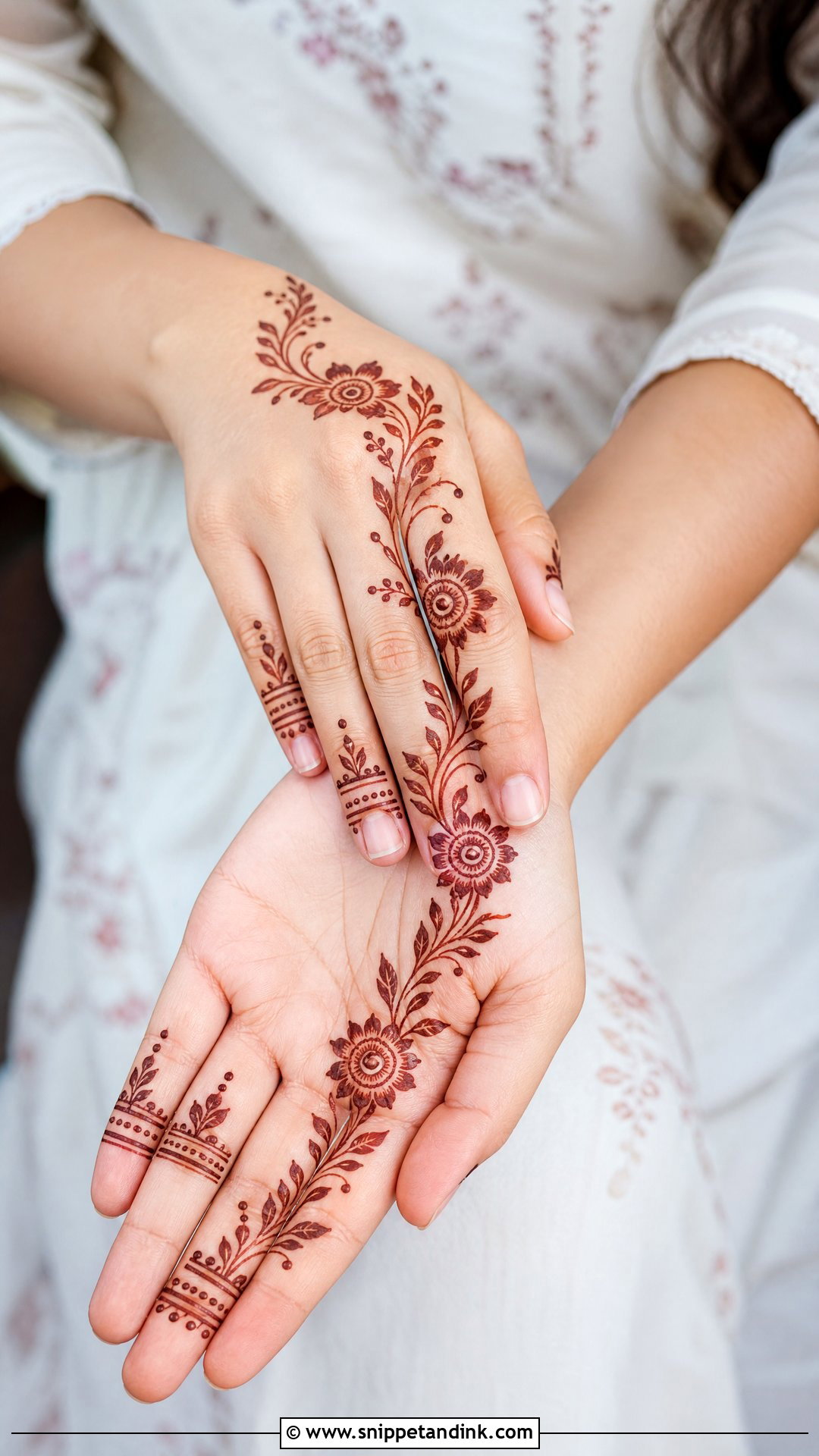
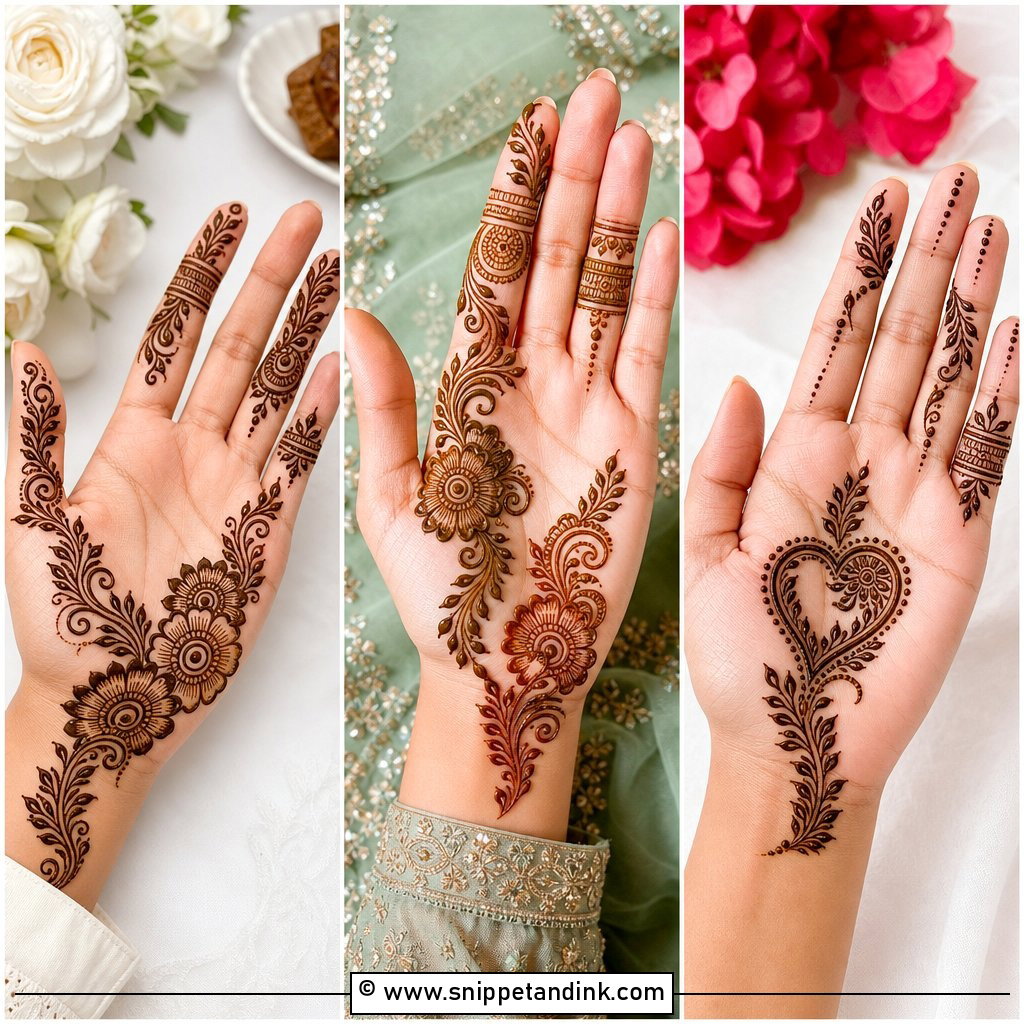
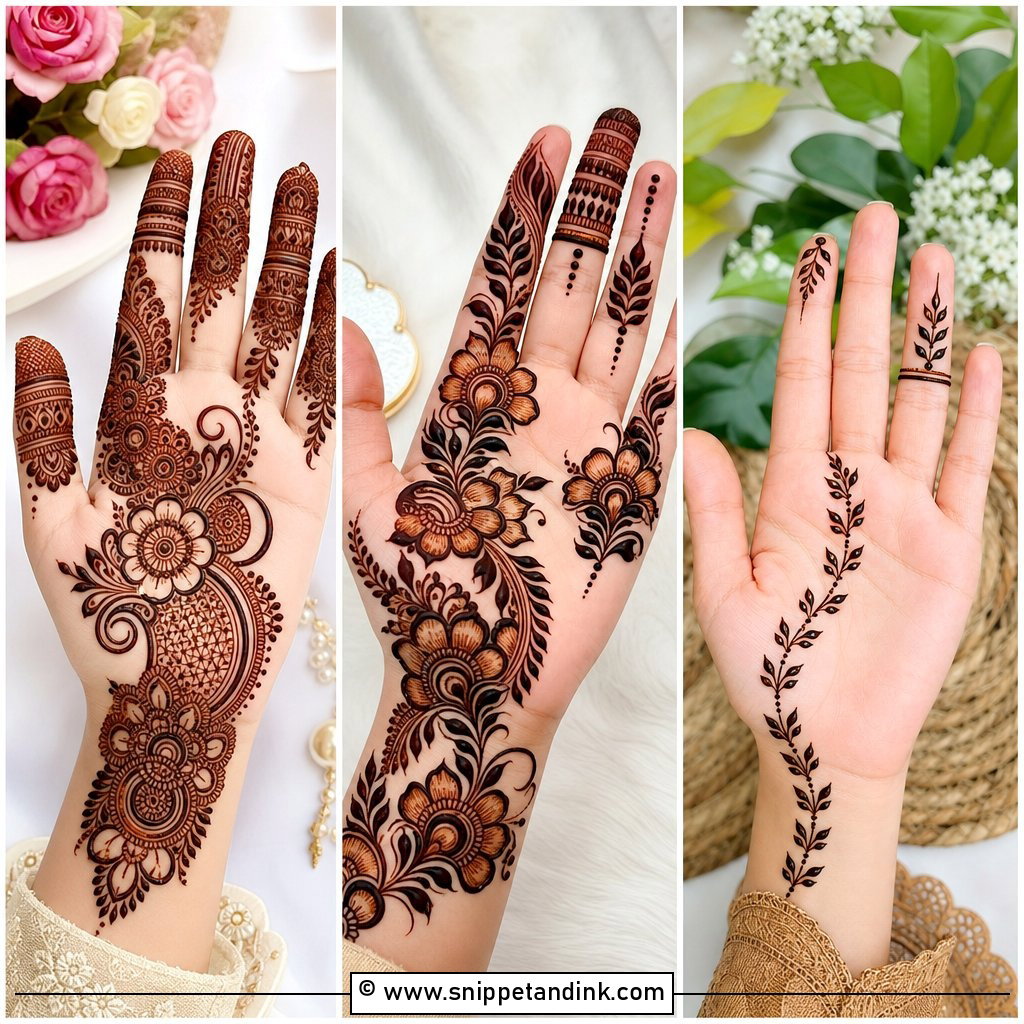
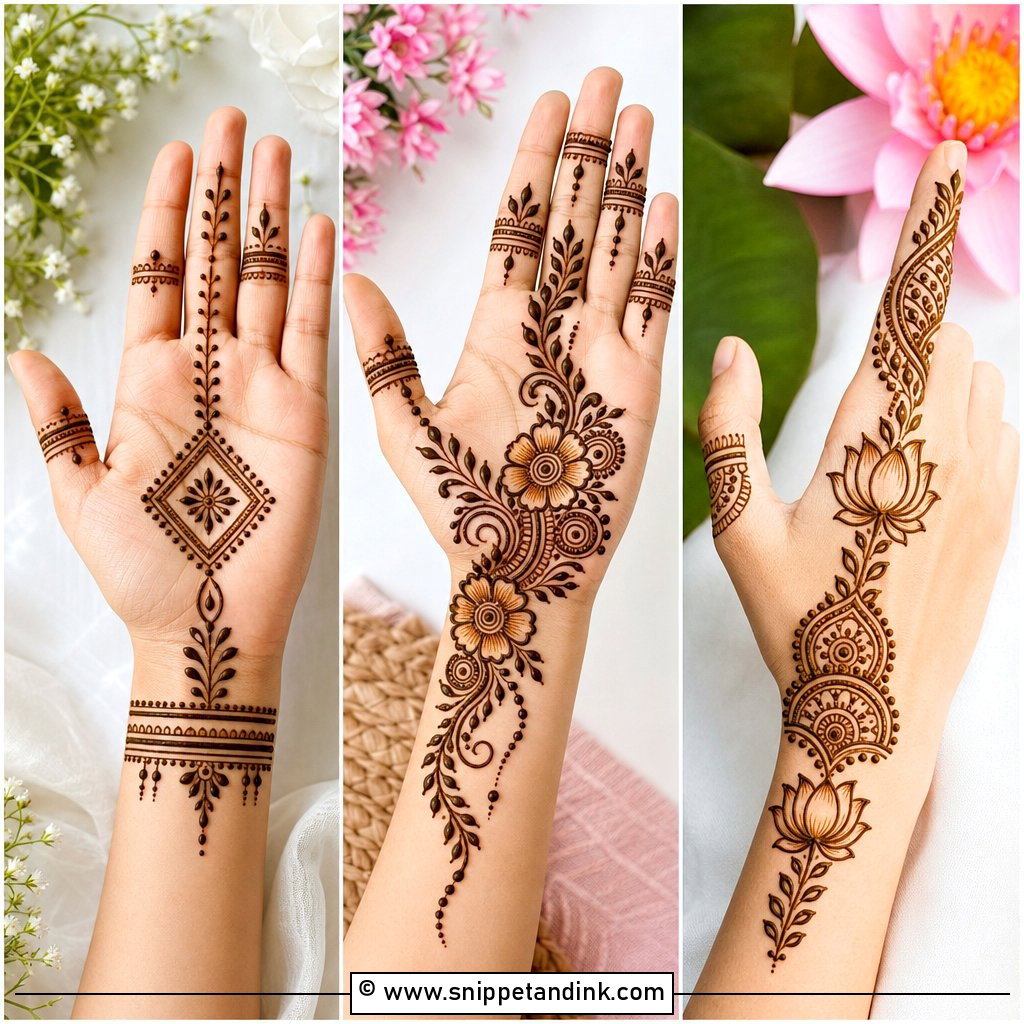
The plain version starts at the wrist and climbs diagonally toward the index or middle finger, with small flowers, curved leaves, dots and thin lines, leaving most of the palm bare. Keep the motifs medium-sized; tiny ones on an open palm look lost. Light bands, dots and leafy tips on the fingers balance it. This is the design I draw when someone at a gathering needs a quick front hand mehndi and still wants it to feel finished, and because the shapes repeat, it’s also the one I give to people practising at home.
2. Arabic Bail Front Hand Mehndi Design
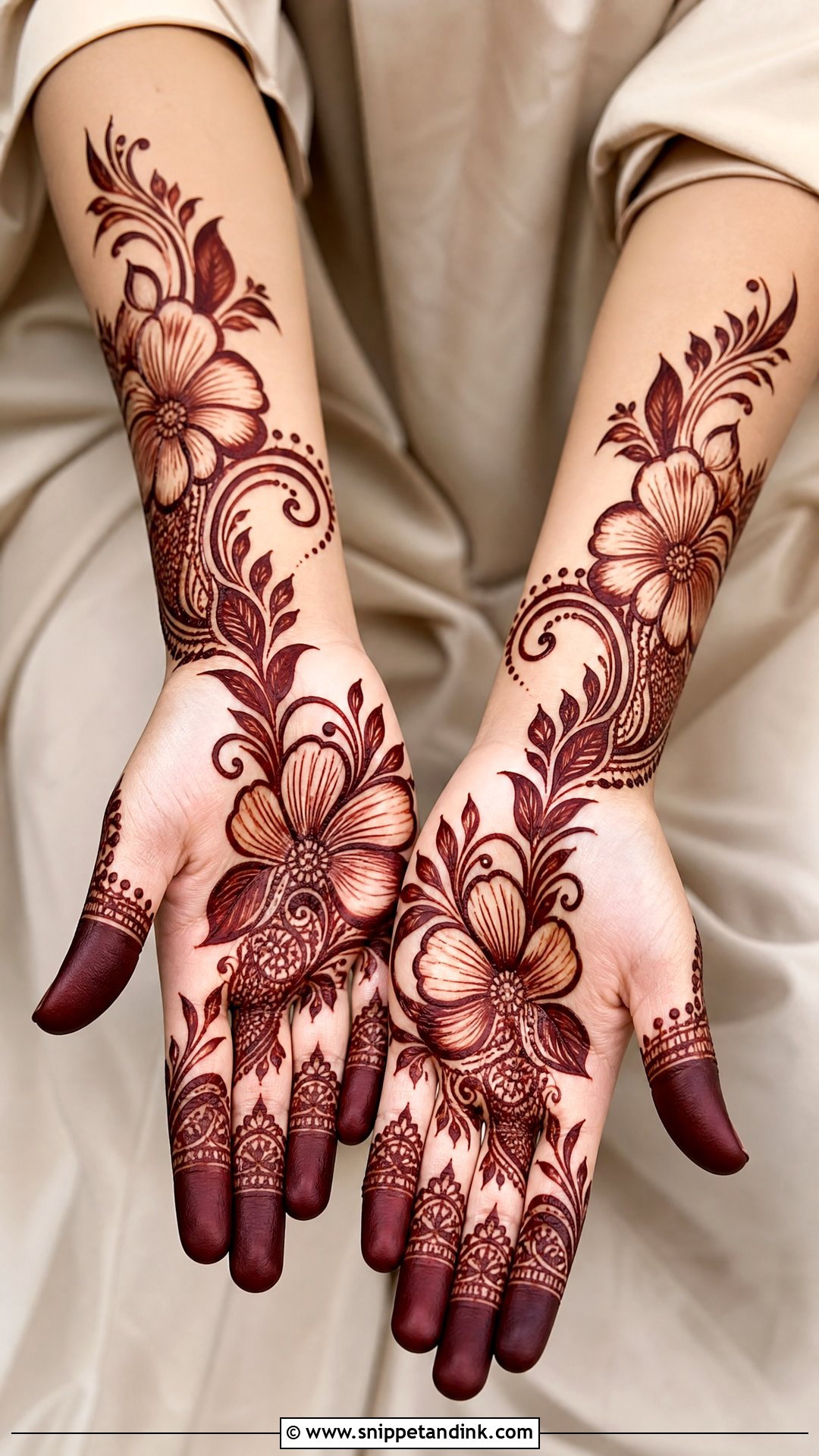
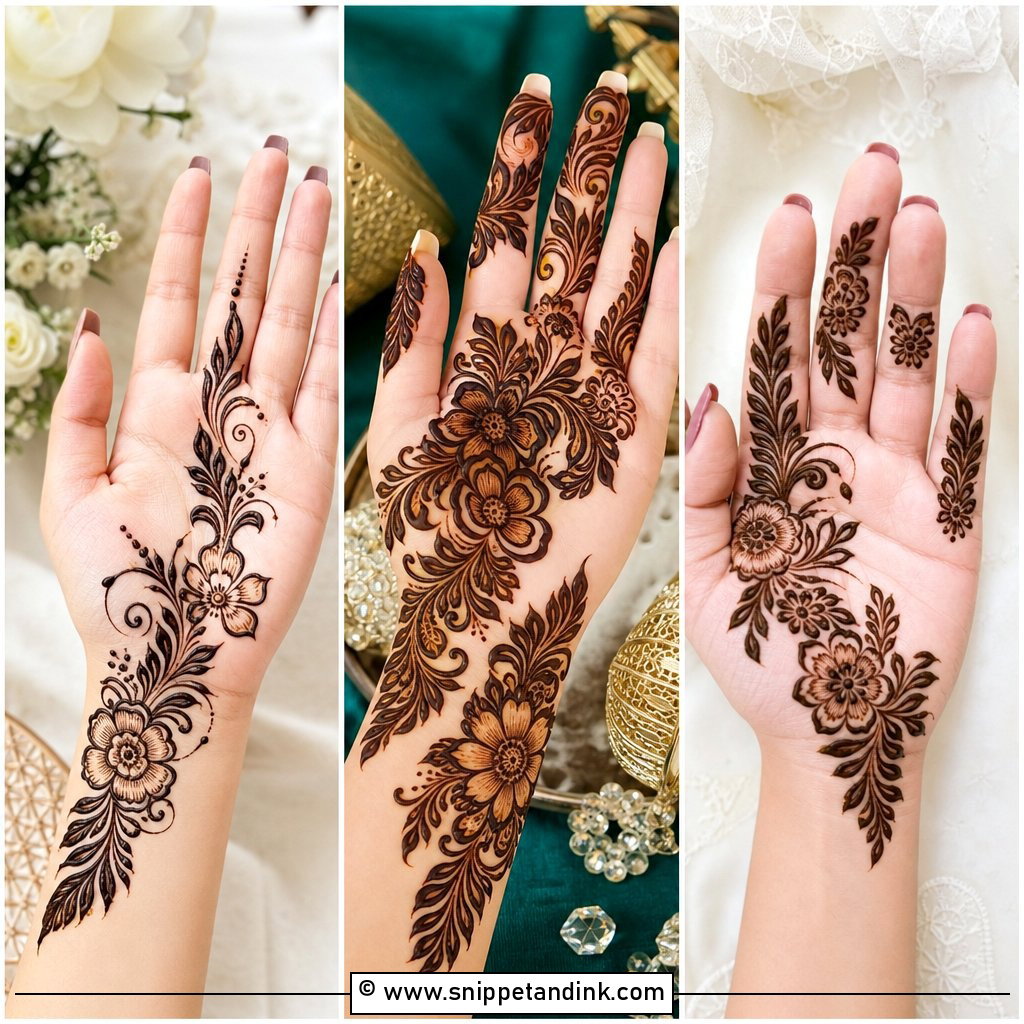
Arabic vines are bold, with large flowers, shaded leaves and curved strokes surrounded by clean open skin. The trail usually runs from the wrist up one side of the palm and finishes near the fingers, and dotted borders keep its edges tidy. Because the strokes are thick, the design stays readable as the stain develops and as it fades later in the week. I add filled fingertips and slim lines across the fingers so the vine connects to the whole front hand design instead of stopping mid-palm.
3. Floral Bail Front Hand Mehndi Design
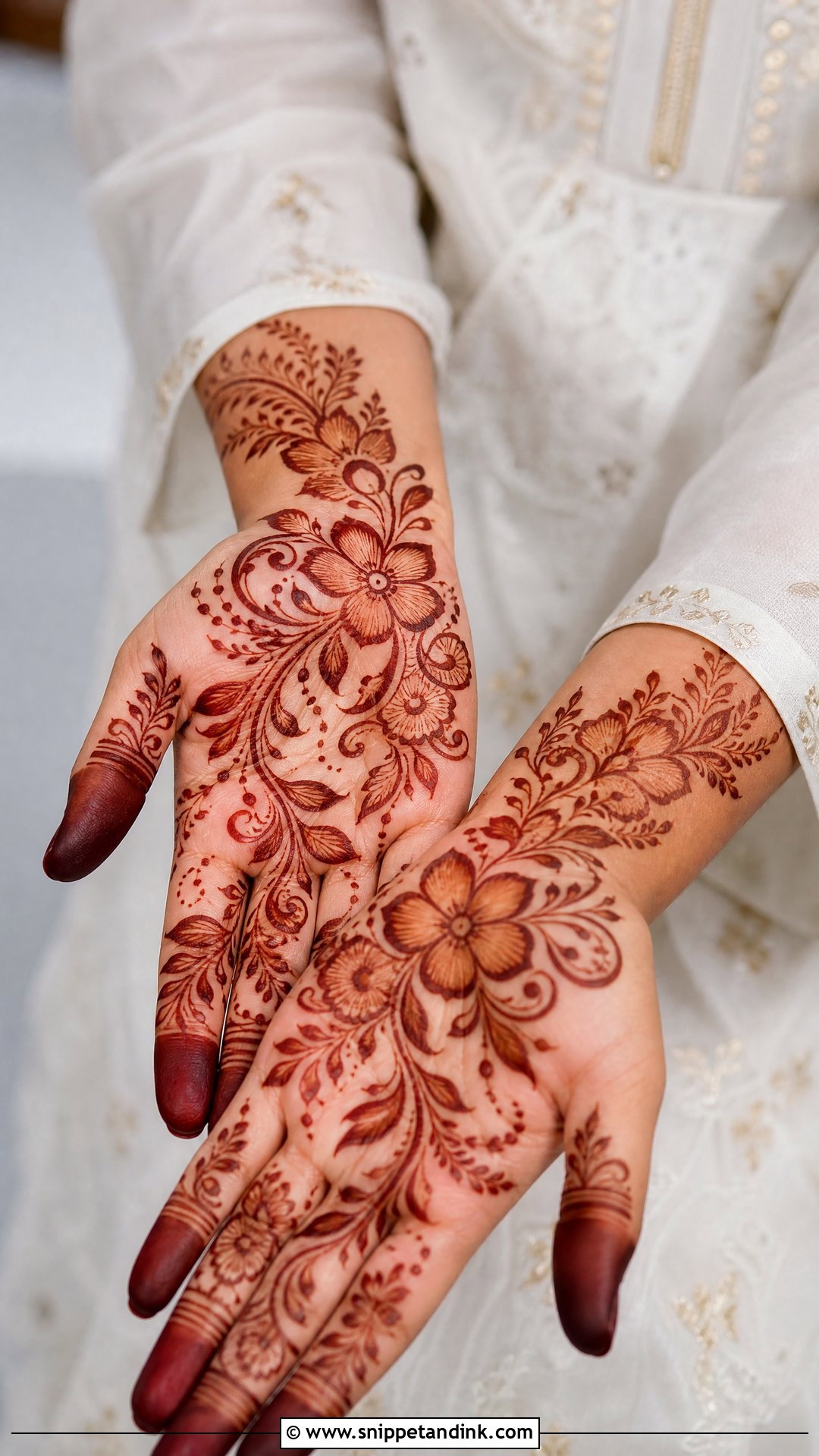
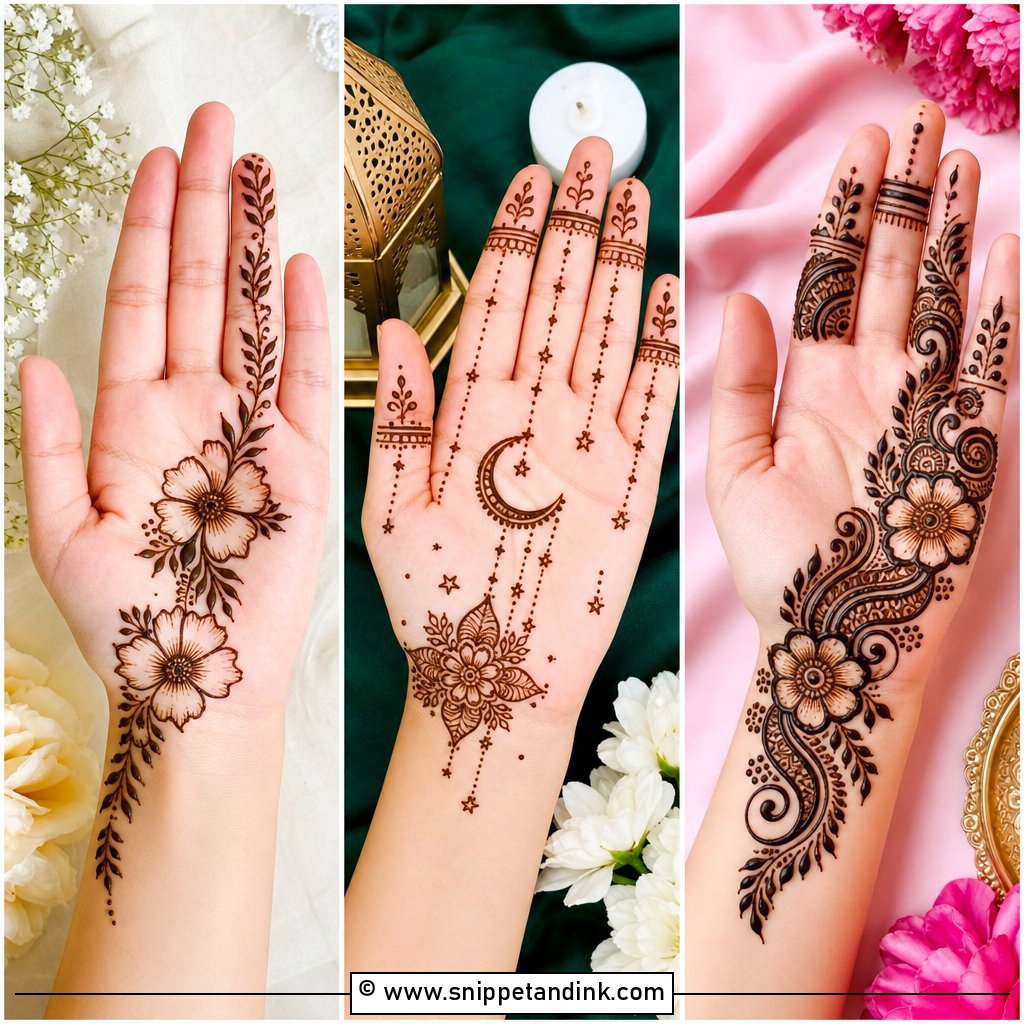
Flowers of different sizes give the vine natural movement. I usually start with a round bloom at the wrist and let connected blossoms travel upward, with small buds and leaves filling the gaps so it never turns dense. Matching petal chains on the fingers tie the hand together. It’s one of the easiest designs to scale for different people at the same event: fuller for a bridesmaid, sparser for a young girl who won’t sit still for long.
4. Rose Bail Front Hand Mehndi Design
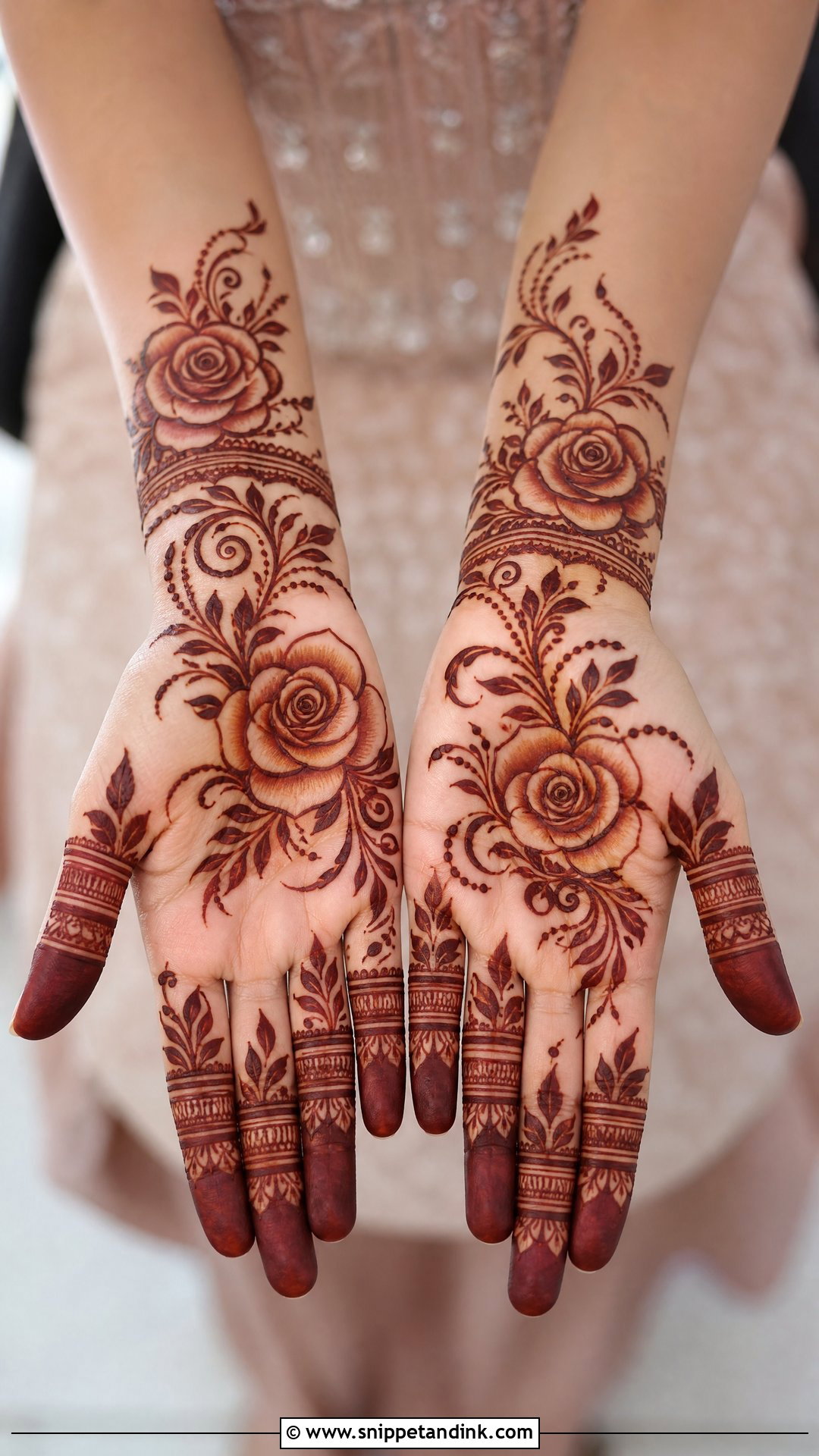
Roses give the palm a romantic feel while staying traditional enough for family functions. The largest rose sits near the lower palm or wrist, with smaller ones flowing diagonally across the hand among curved leaves, spiral vines and dot clusters. Petal shading is what makes a rose recognisable once the stain comes up; without it, a palm rose can read as a cabbage. I leave clean skin around the trail so the roses stay the focus. It’s well suited to engagement functions and Eid.
5. Leaf Bail Front Hand Mehndi Design
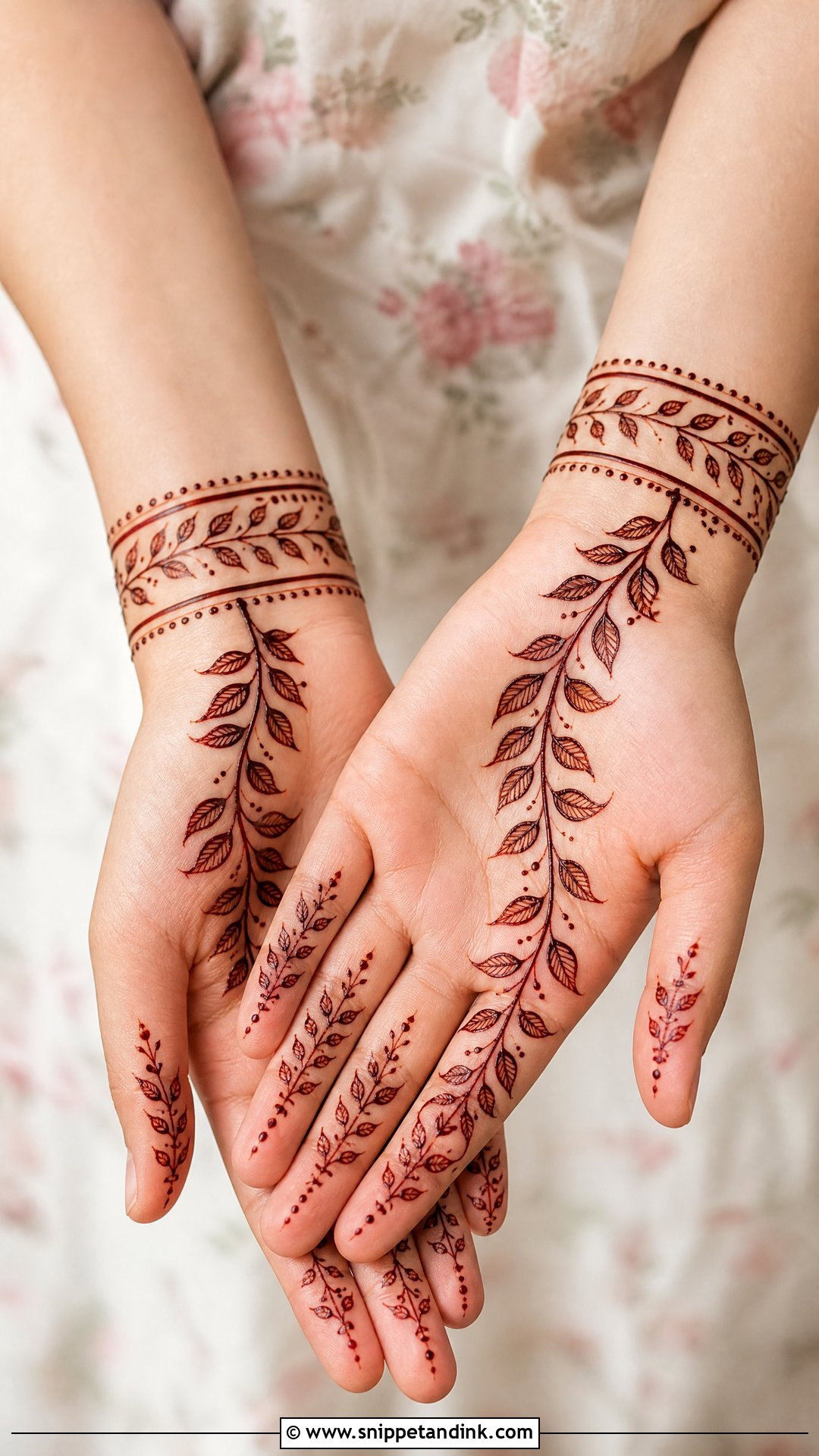
Leaves are the most forgiving motif I draw, and that’s the appeal. A stem runs from the wrist to the fingers with repeated leaves, either single strokes or detailed with inner veins and shading. Tiny dots around the vine and thin wrist bands make it fuller. Beginners get good results here quickly. On longer or older hands it’s especially flattering, since the elongated vine makes the palm look slimmer.
6. Paisley Bail Front Hand Mehndi Design
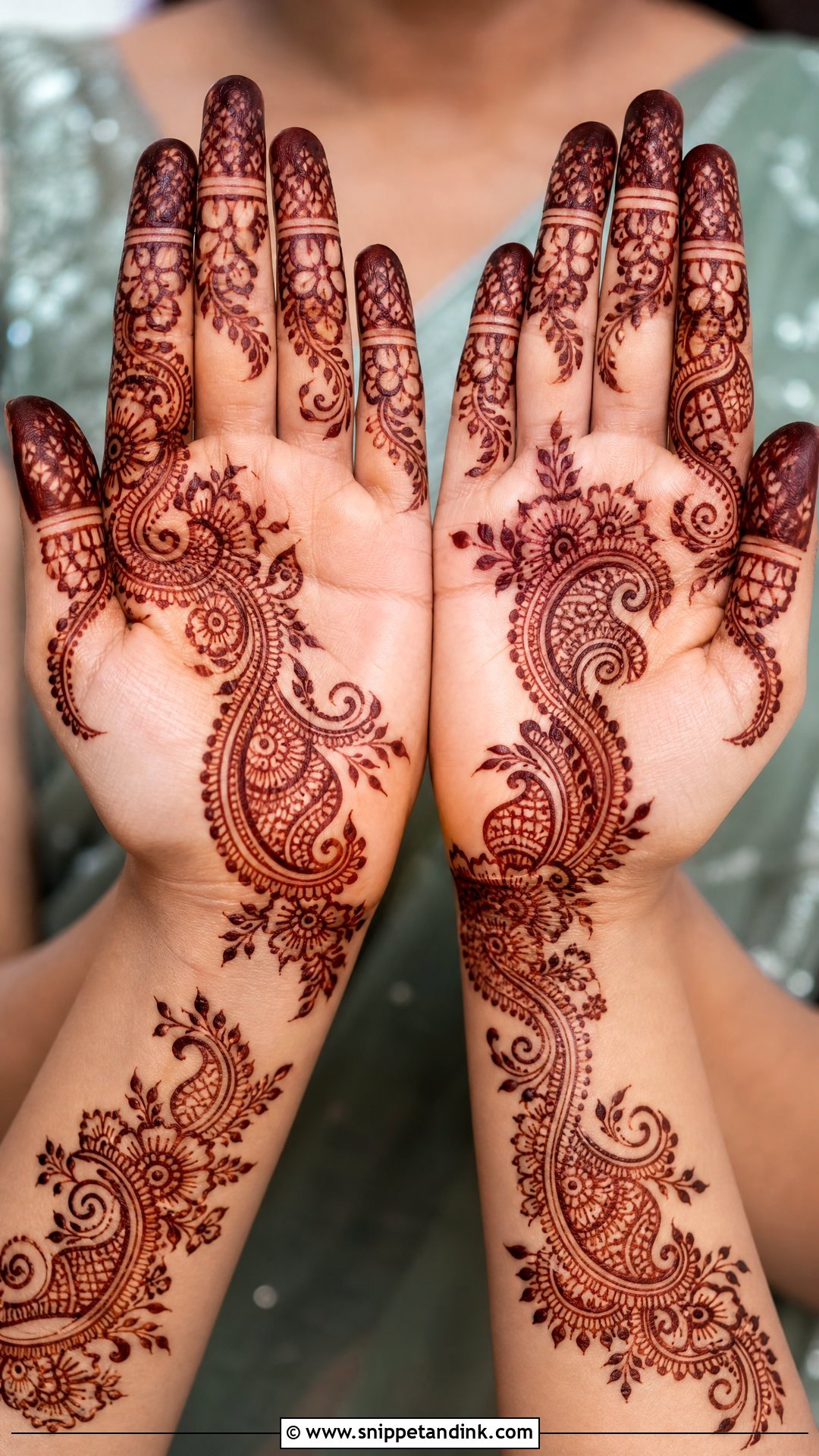
Paisleys bring a traditional Indian feel to a light layout. One large paisley sits near the wrist, with smaller ones curving toward the fingers, each filled with tiny flowers, lines, dots and leaves. Matching bands and fine tips on the fingers complete it. I keep the outer edge of each paisley clean and bold. Palms stain dark, and fine fill right up against the outline can merge into one shape by the second day, which blurs the vine. It sits naturally at a wedding, sangeet, Diwali or Karwa Chauth.
7. Mandala Bail Front Hand Mehndi Design
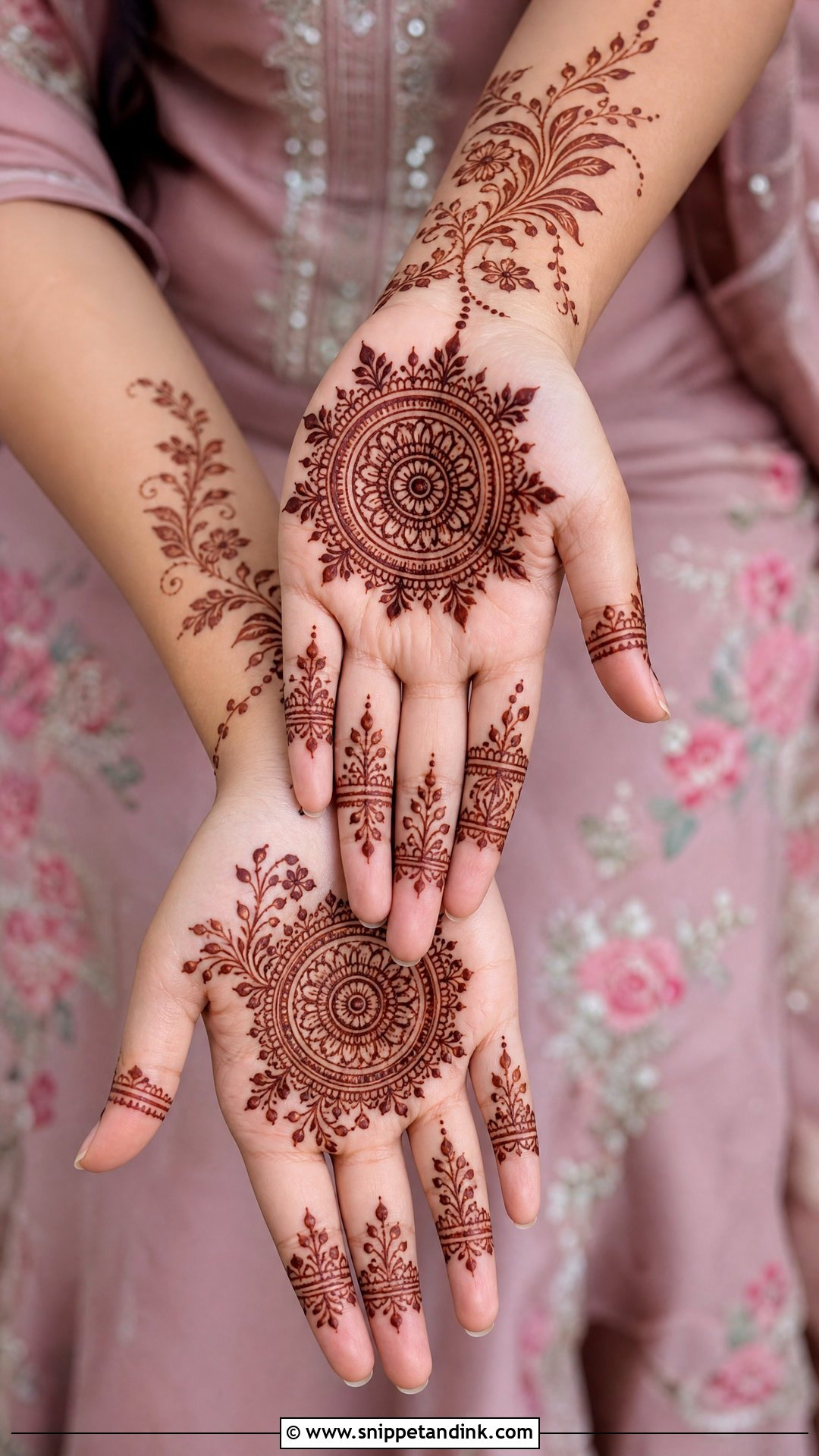
This layout gives the palm a center and a direction at once. A small mandala sits in the middle of the palm or slightly toward the wrist, and a floral or leafy vine grows out of it toward the fingers. Fingers get simple lines, dots and petals to echo the mandala. One thing I check is the deep crease across the palm. A mandala placed right on it bends whenever the hand closes, so I shift it slightly toward the wrist. It suits festive days, family events and simpler mehndi for the bride’s side.
8. Diagonal Bail Front Hand Mehndi Design
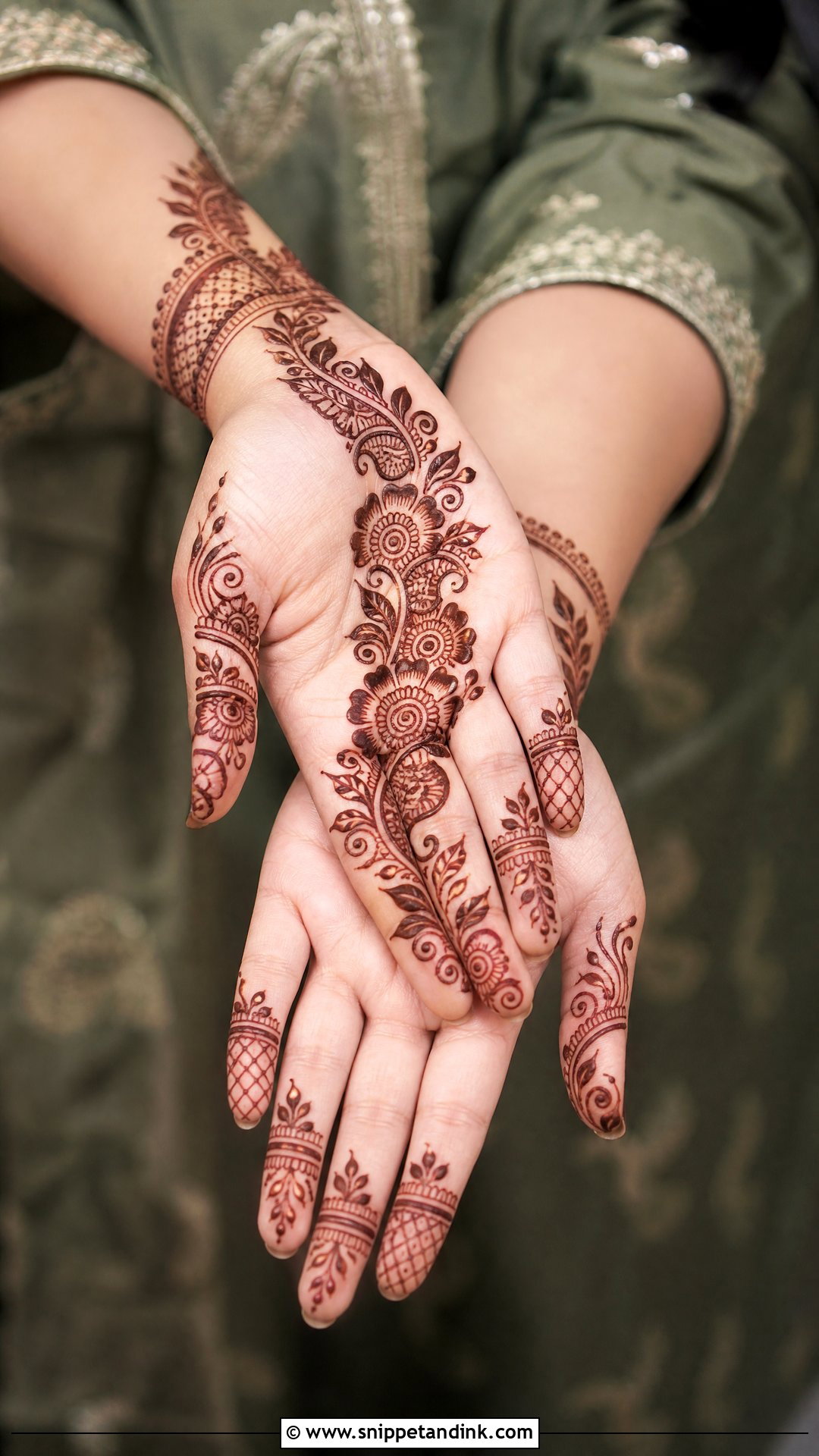
The diagonal is the most flattering vine placement there is. It runs from one corner of the wrist across the palm toward the opposite finger, which lengthens the fingers and leaves enough skin open to feel modern. Flowers, leaves, paisleys or mixed motifs can line the diagonal, with dotted borders on both sides. I keep the finger detail heavier on the side the vine ends and lighter on the open side, so the slant carries through to the fingertips.
9. Side Bail Front Hand Mehndi Design
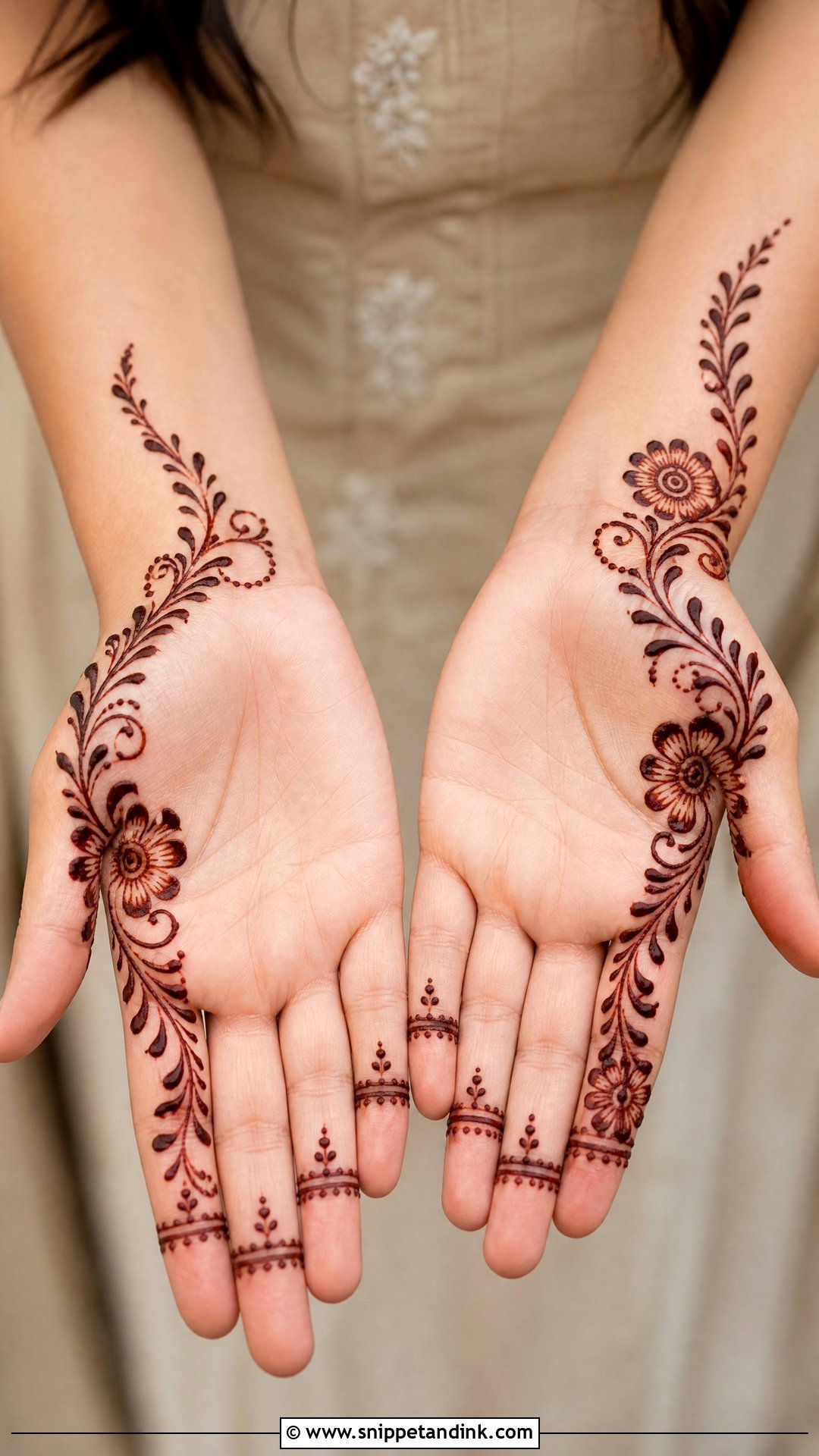
Putting the artwork along one side of the palm leaves the center open, which suits anyone who prefers minimal mehndi but still wants a complete hand. The vine runs from the wrist up the thumb side or the little-finger side, with flowers and leaves curving inward, and slim patterns on two or three fingers connect it visually. My usual question is which side you hold things with. The edge you grip with wears the stain faster, so for someone heading back to work the next day I often place the vine on the thumb side.
10. Full Hand Bail Front Hand Mehndi Design
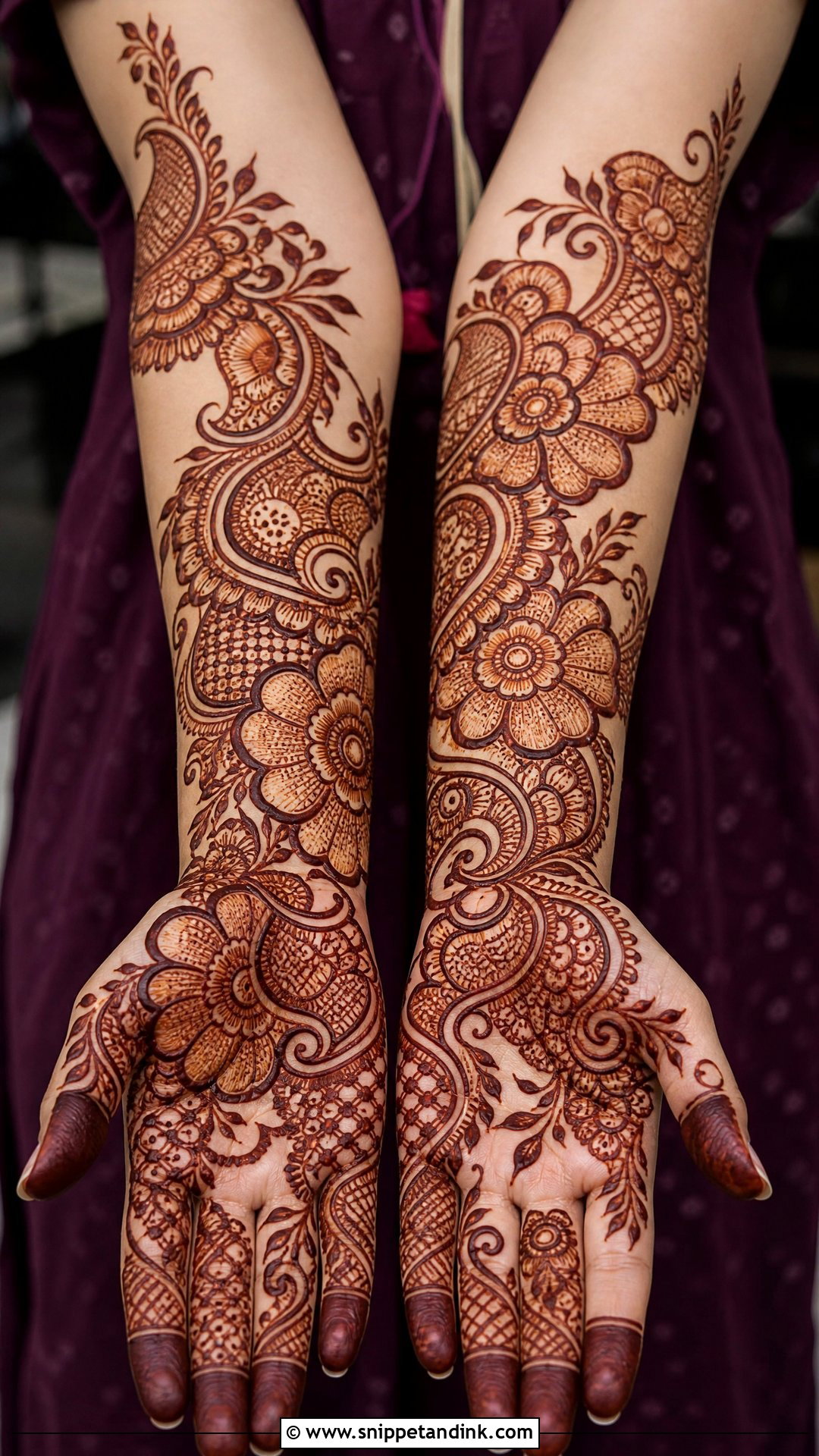
More coverage, same vine. A larger bail runs from the wrist to the fingertips, supported by flowers, paisleys, jaali sections, dots and leafy curves around it. The trick is keeping the main stem bold so it doesn’t vanish into the fillers; I outline it first and fill last. It’s a good middle ground for bridesmaids and close family, traditional but nowhere near as dense as full bridal work, and comfortable through a long event.
11. Bridal Bail Front Hand Mehndi Design
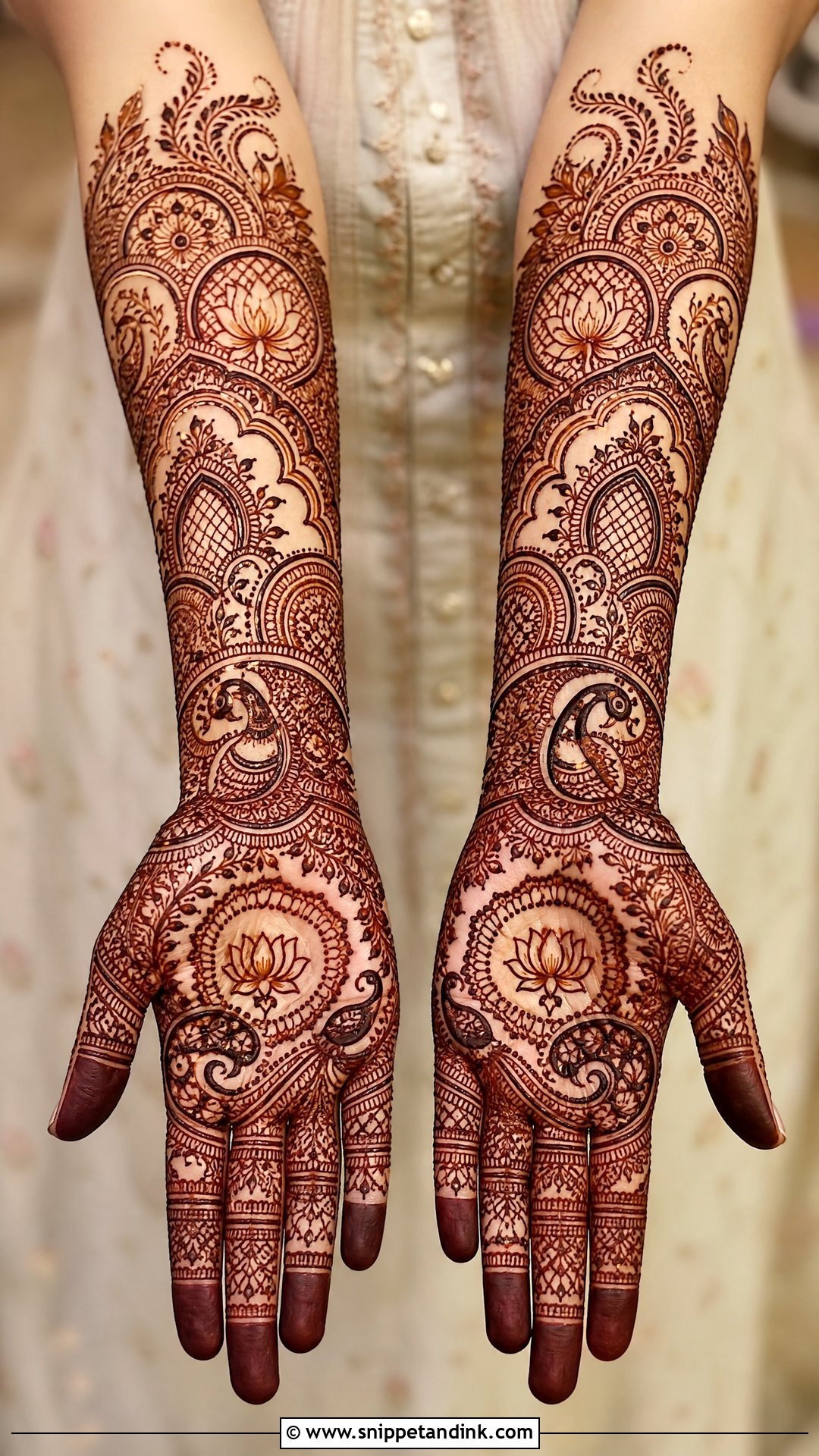
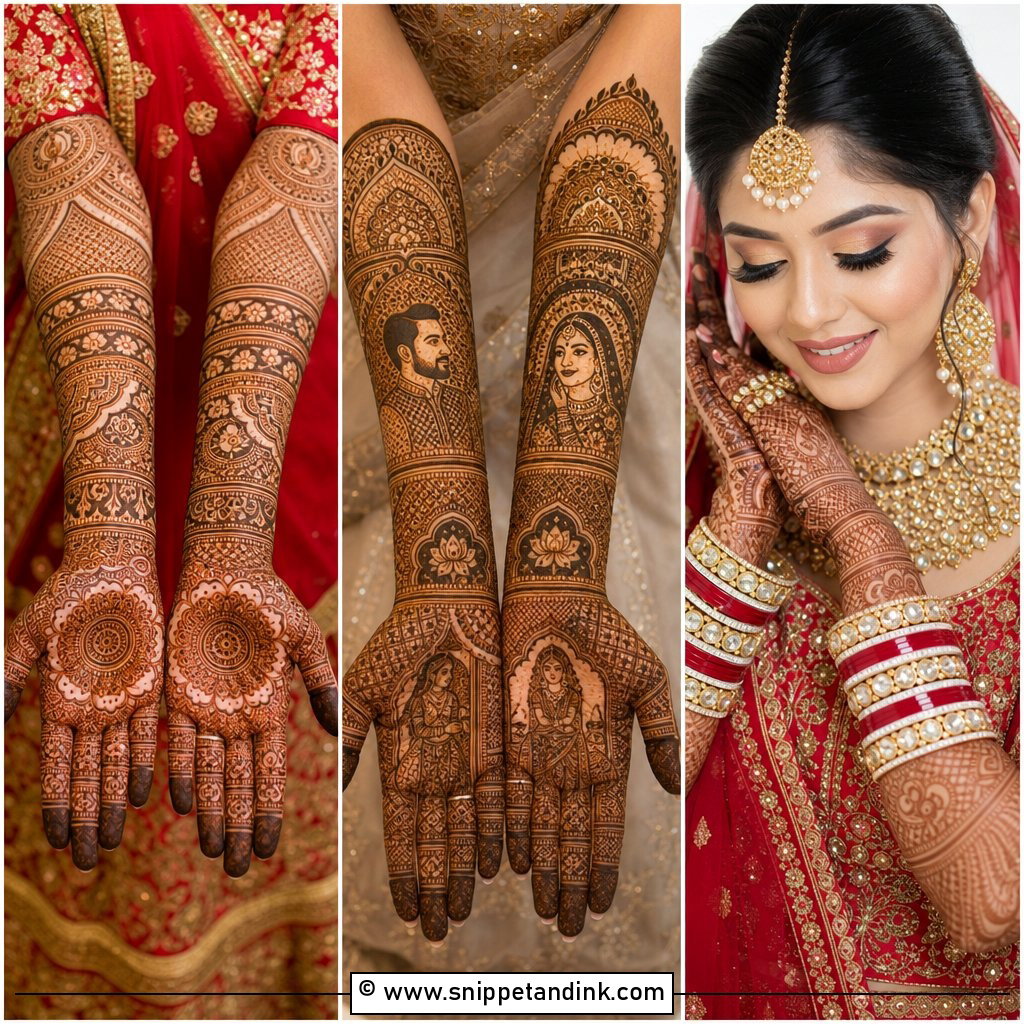
A bridal vine can begin on the forearm and travel across the palm toward the fingers, with paisleys, lotus flowers, peacock accents, jaali panels and fine filler lines. Tiny initials can hide inside it if you’d like. The fingers need rich detail, because the palms are what you hold up in close-ups. I’d recommend this to a bride who finds packed traditional coverage too much but still wants enough work for the ceremony and portraits. Keep the paste on overnight for the deepest colour.
12. Indo Arabic Bail Front Hand Mehndi Design
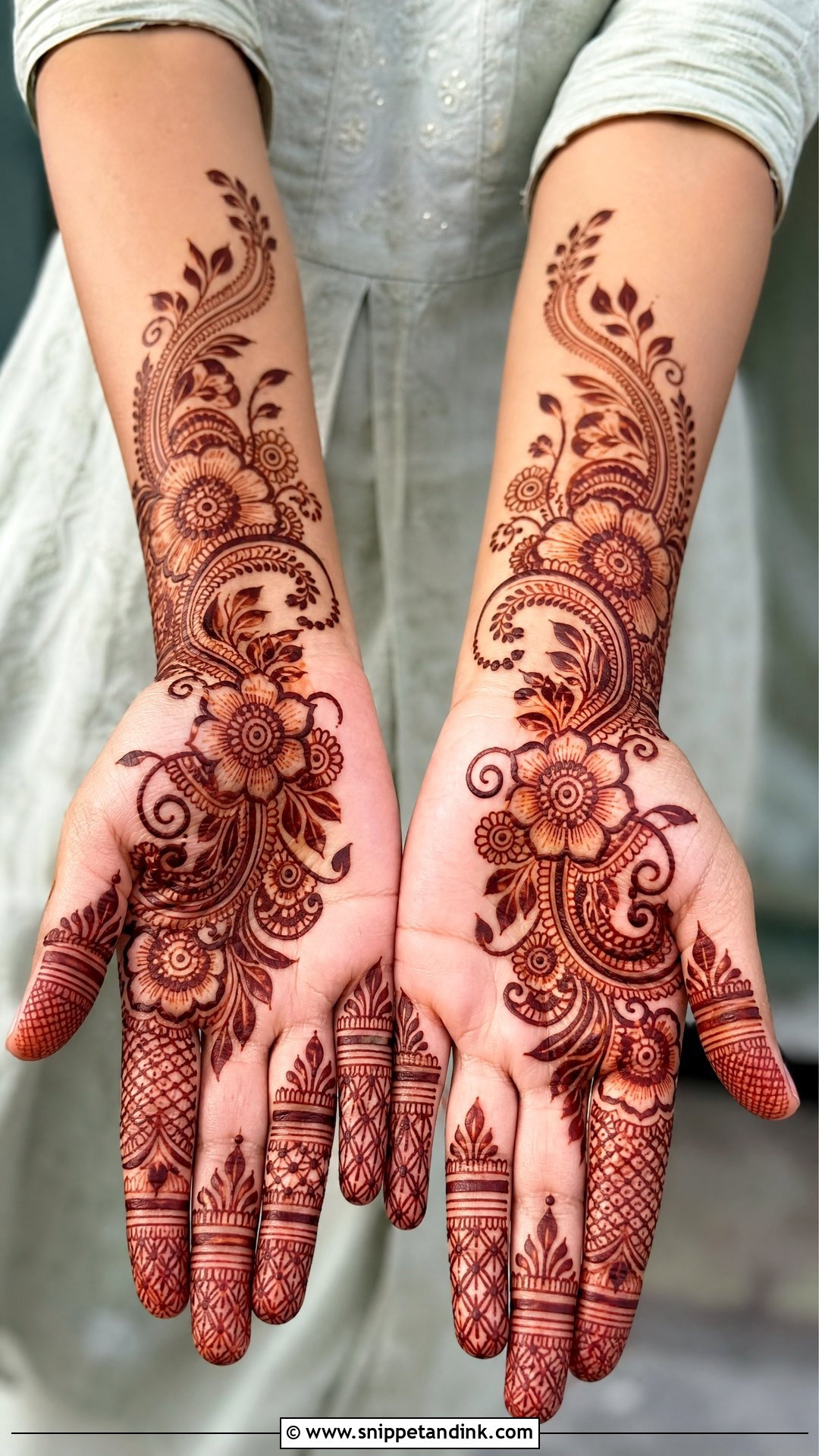
Indo-Arabic vines combine Arabic open flow with fine Indian detailing. The result is a balanced front hand look: bold flowers and paisleys along the vine, filled with tiny lines, dots, spirals and shaded leaves. Leave small gaps between motifs or the Arabic character disappears. The fingers mix bands, leafy tips and fine chains. It has enough detail for weddings, Eid, Diwali and engagements without weighing the hand down.
13. Modern Bail Front Hand Mehndi Design
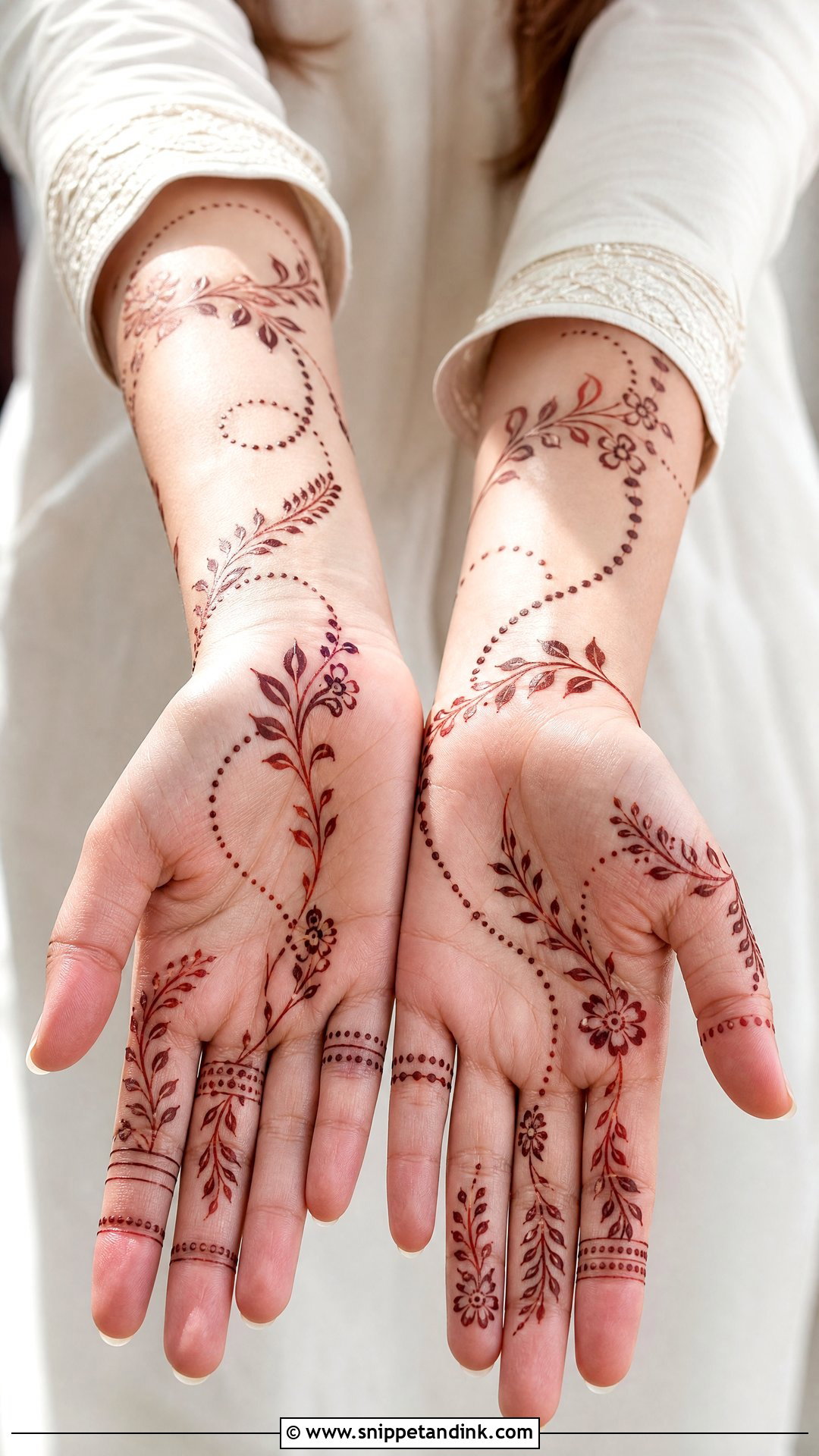
Modern vines rely on one confident line and very few fillers: abstract leaves, small florals, dotted chains and neat finger bands, placed diagonally or vertically depending on the hand. Fingertips stay lightly filled or partly open. This style lives or dies on line quality, so it needs a fine, steady cone. I like it for college events, parties and festive outfits with simple rings and bangles.
14. Easy Bail Front Hand Mehndi Design
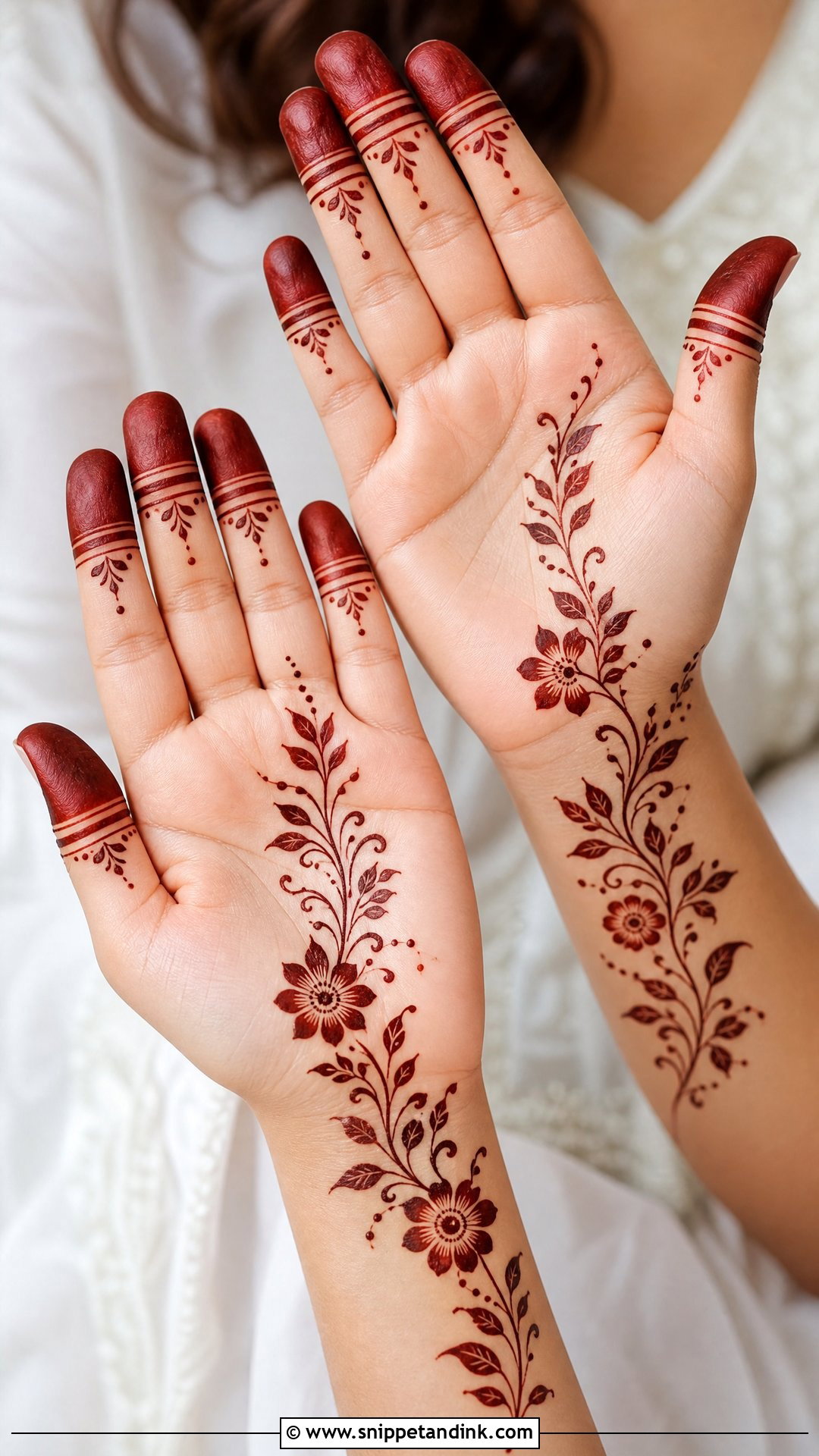
Easy should still look complete. Draw a curved stem from the wrist to the index finger, add repeated leaves on both sides, then small flowers at even gaps, and fill empty spaces with dots. Bands, tiny leaves and filled tips on the fingers finish it. Clean lines and even spacing do more for an easy vine than any extra motif. This is the design I teach first because every shape in it repeats, and it’s quick enough for a last-minute function.



15. Stylish Bail Front Hand Mehndi Design
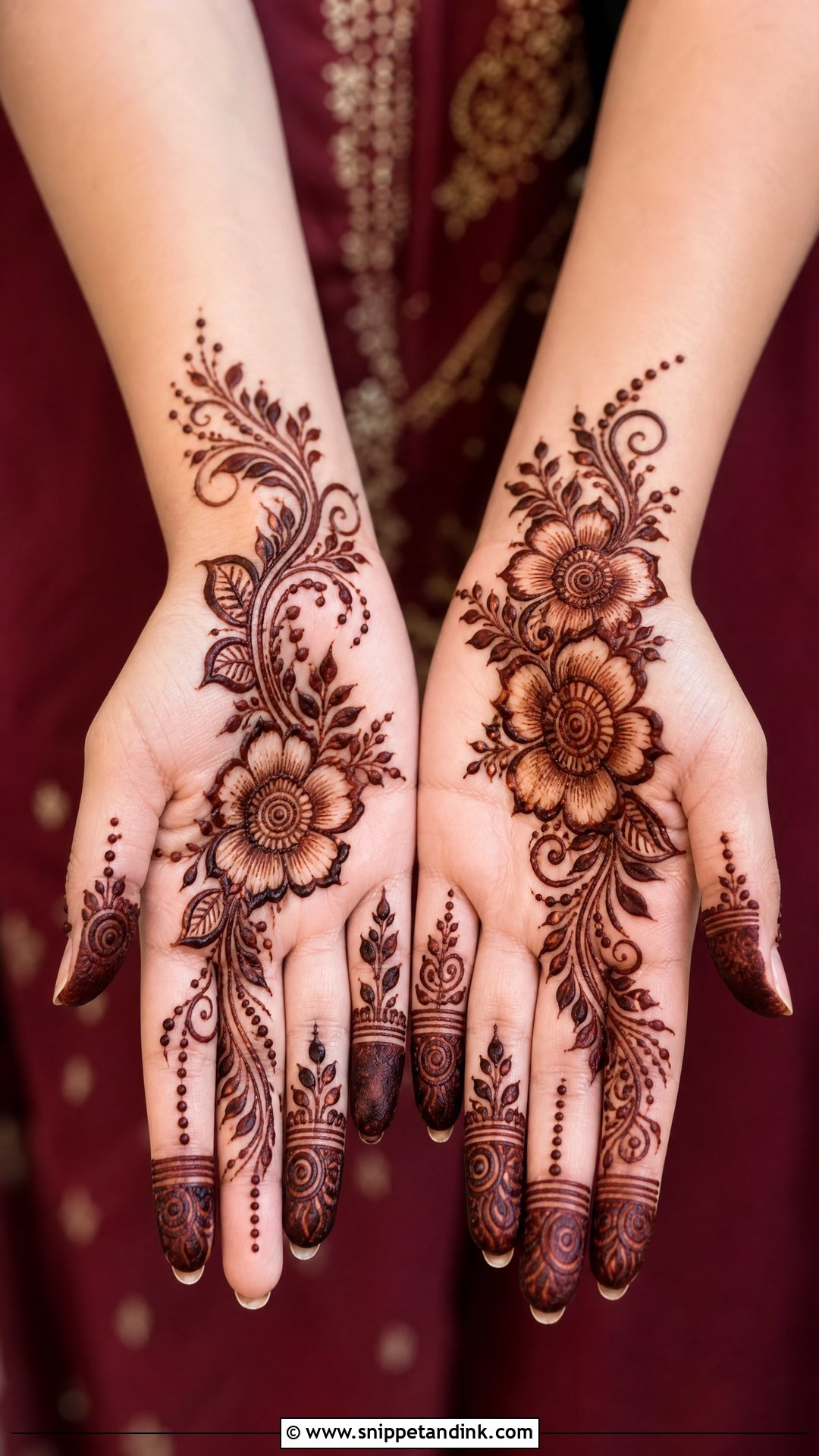
An S-curve across the palm gives this vine its shape, with bold flowers placed at the bends and shaded leaves, fine swirls and dot trails between them. Different but related patterns on each finger, leaves on one, bands on another, tiny florals on a third, add personality without mess. It suits bridesmaids who want something chic. Keep the outer lines sharp; a soft edge spreads slightly as the stain matures on the palm.
16. Heavy Bail Front Hand Mehndi Design
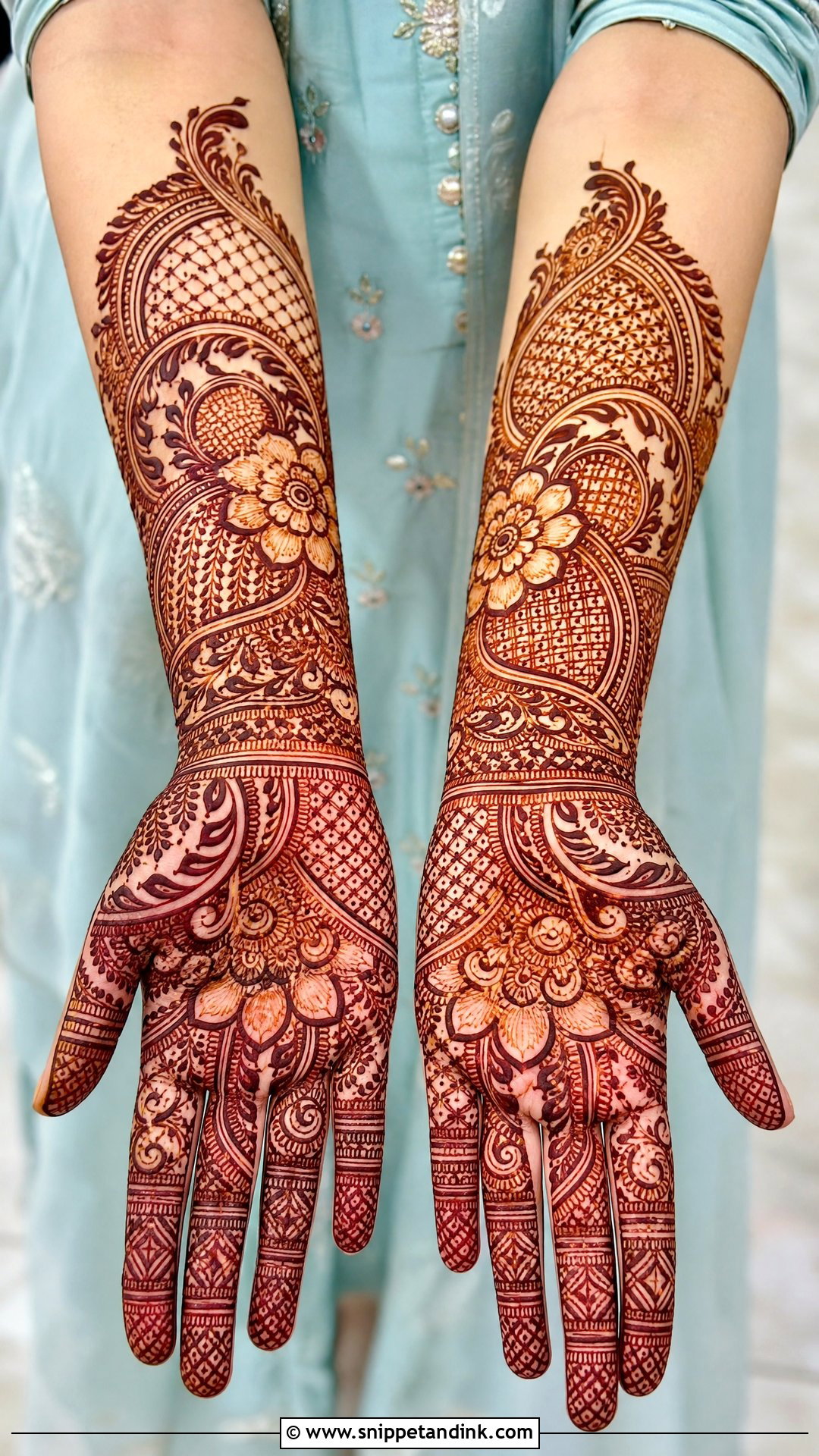
A heavier vine needs a broad stem carrying large flowers, paisleys, filled leaves and detailed inner work, with jaali panels, smaller vines, dots and shaded sections spreading across more of the palm. The wrist gets bracelet bands; the fingers are fully detailed. It’s what close family and wedding guests often ask for when they want a festive look. Even at this density, I keep the vine’s direction obvious, because once it’s lost, the palm just looks crowded.
17. Minimal Bail Front Hand Mehndi Design
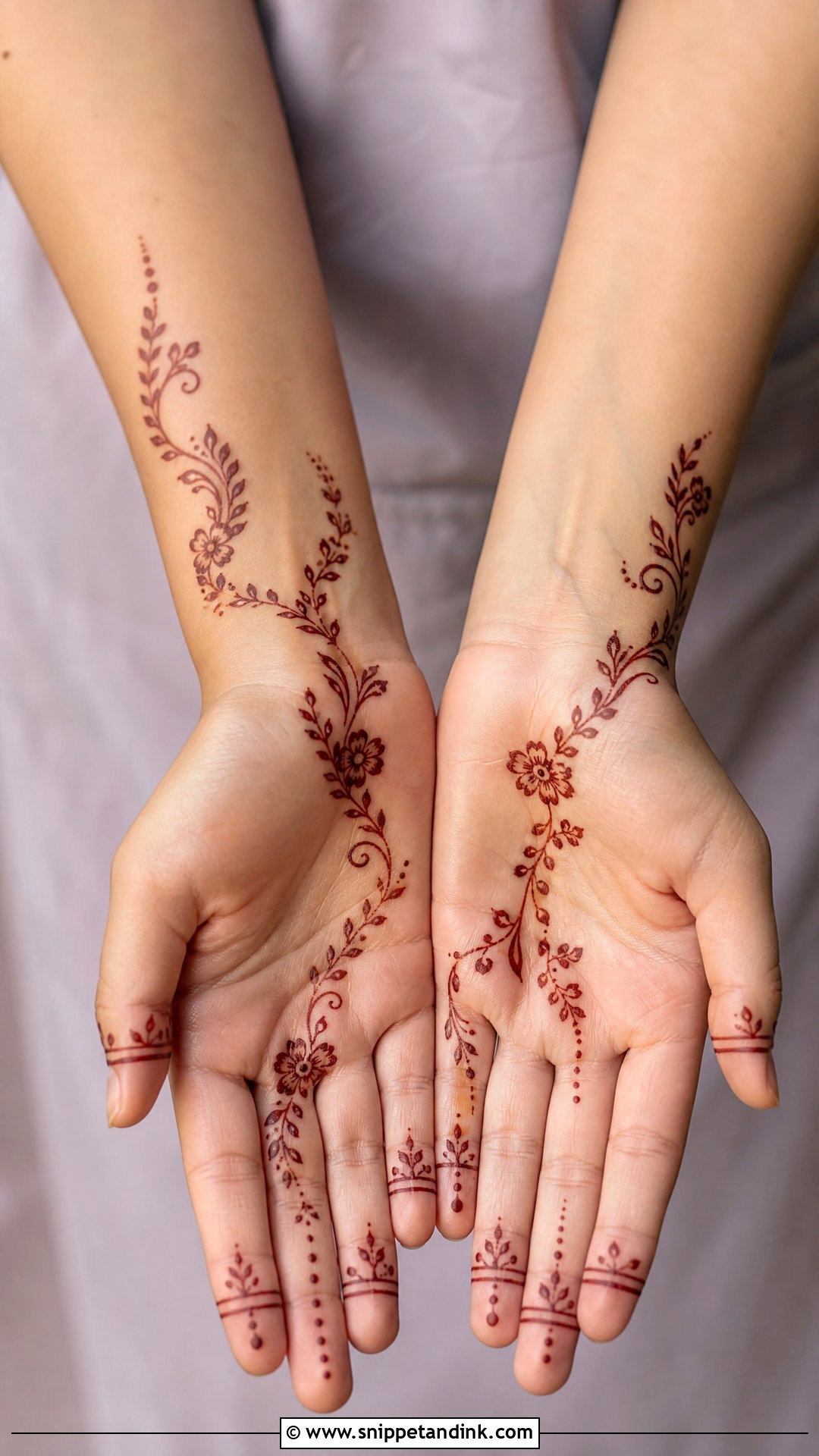
A thin vine with small leaves, tiny flowers and lots of open space is about as light as palm mehndi gets. It can run from the wrist to one finger or sit across the side of the palm, with small dots, thin rings or short leafy accents on the fingers. It’s quick to apply and easy to live with afterward. Use a fine cone line and space every motif evenly, since on a design this sparse any wobble is visible.
18. Finger Bail Front Hand Mehndi Design
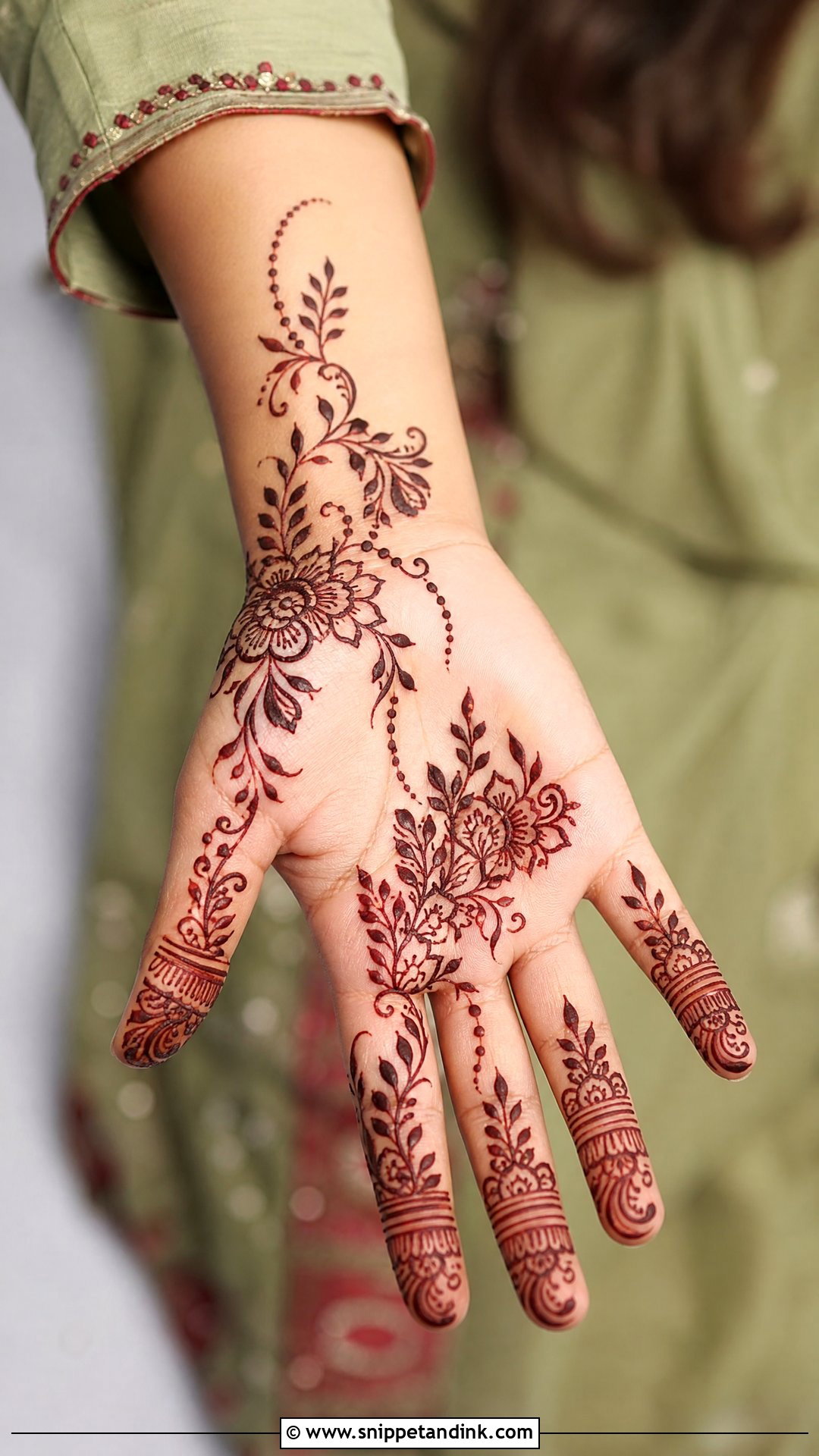
Here the vine keeps going. It starts near the wrist, passes through the center or side of the palm and continues up one or two fingers, making one long line from wrist to fingertip. Small leaves, florals and dot chains keep it connected, while the other fingers get slim bands or half-finger detail. It draws the eye toward rings, so I plan which finger carries the vine once I know where the engagement ring sits.
19. Bracelet Bail Front Hand Mehndi Design
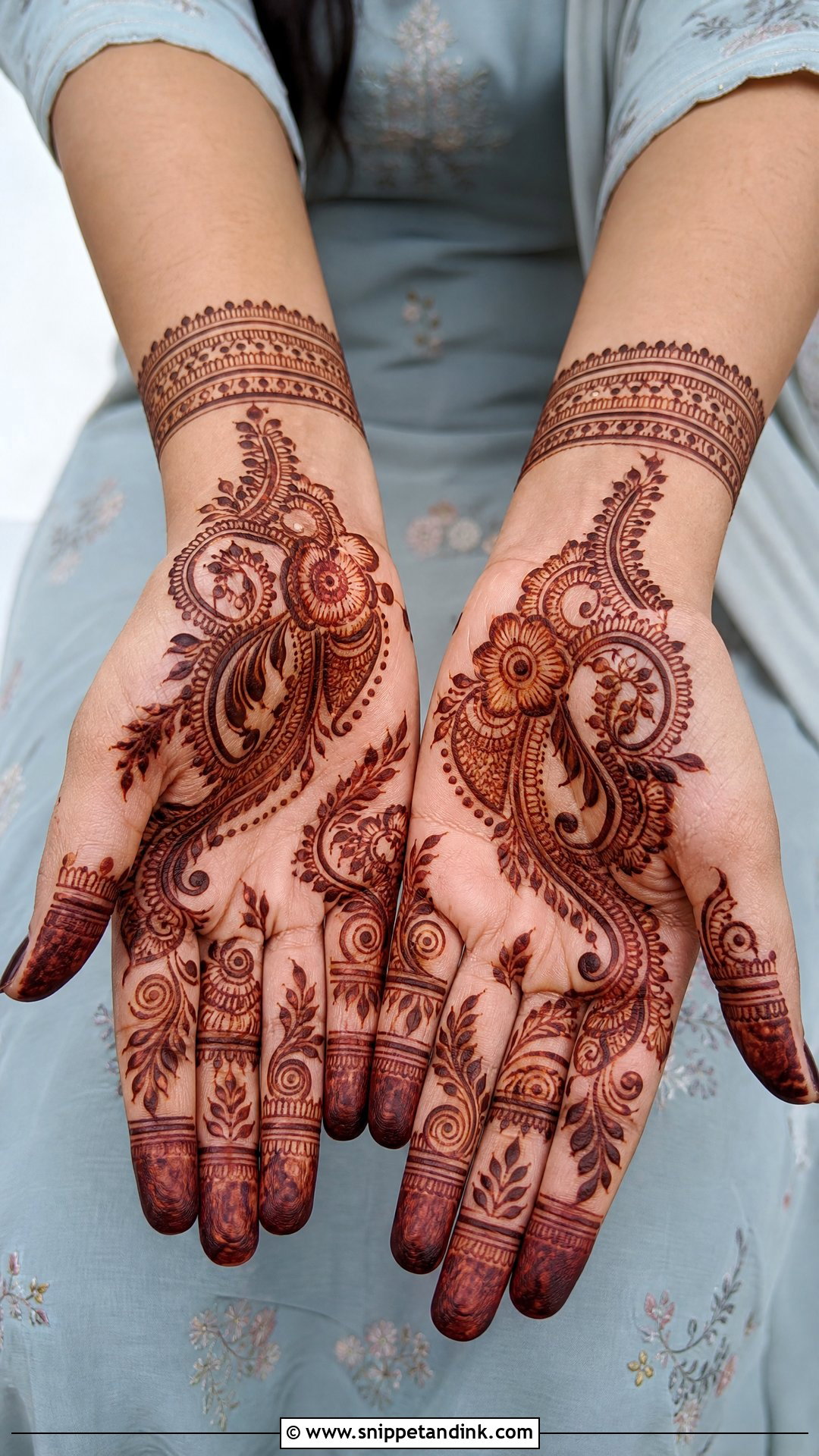
Two or three bands at the wrist, decorated with dots, leaves and small arches, form the bracelet, and the vine grows out of it toward the fingers in flowers, paisleys or leafy curves. It gives a jewelry effect without heavy accessories. The bracelet must be symmetrical or it looks accidental, so I draw it before anything else and check it from both sides of the wrist. It’s popular for bridesmaids and engagement functions.
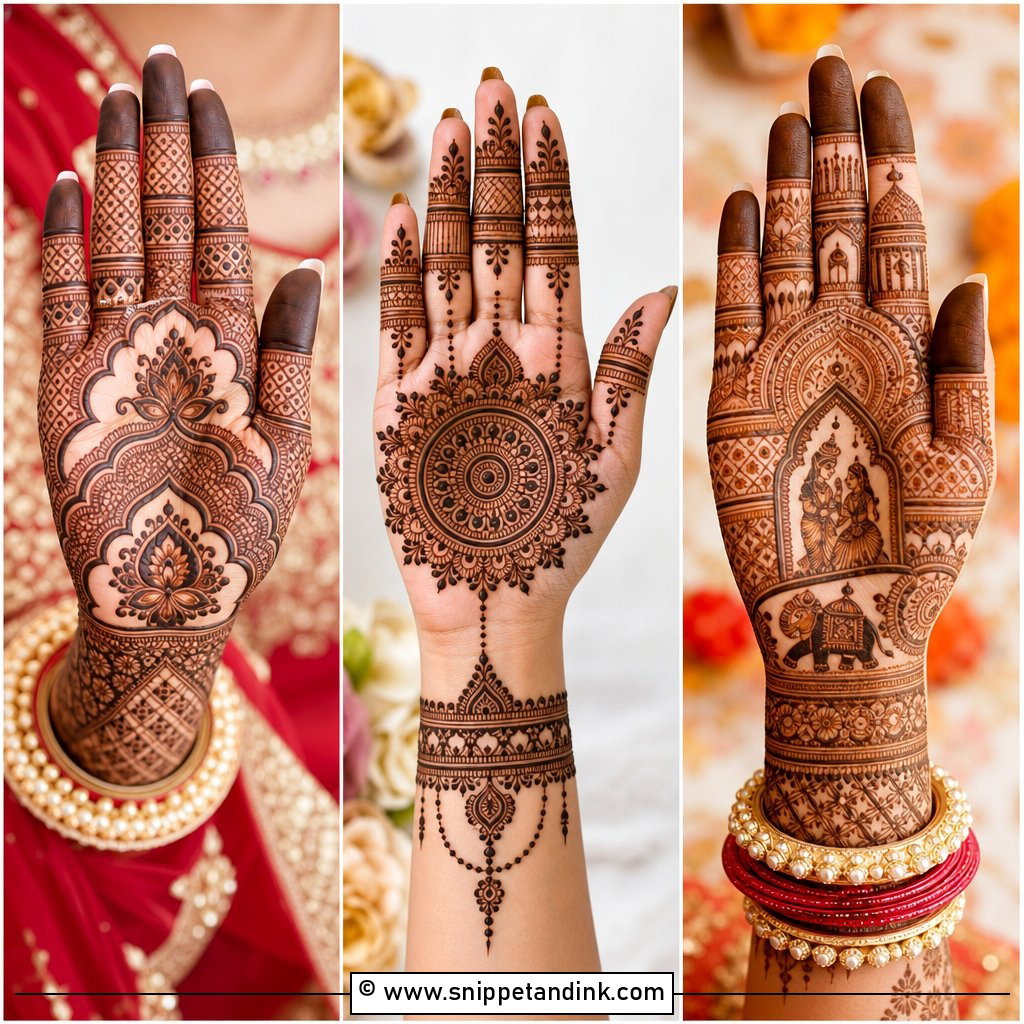
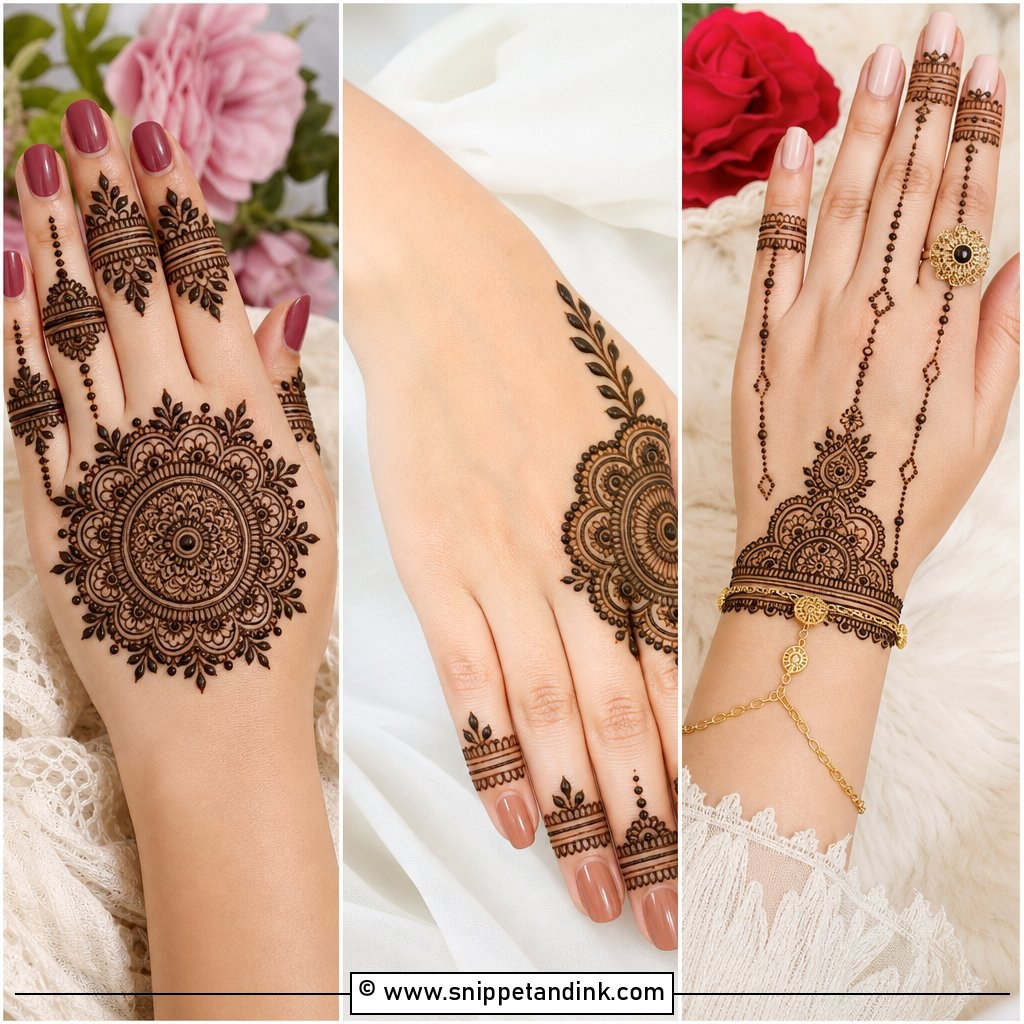
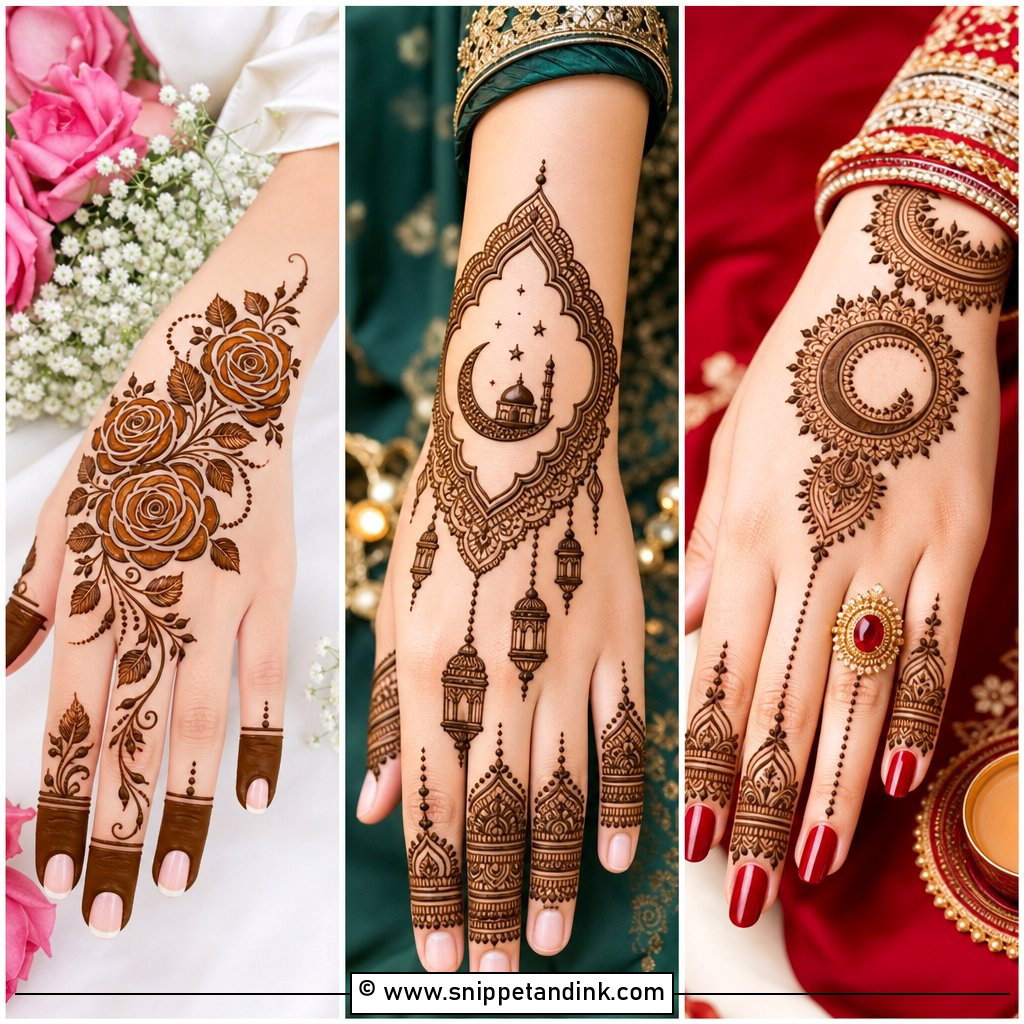


20. Jaali Bail Front Hand Mehndi Design
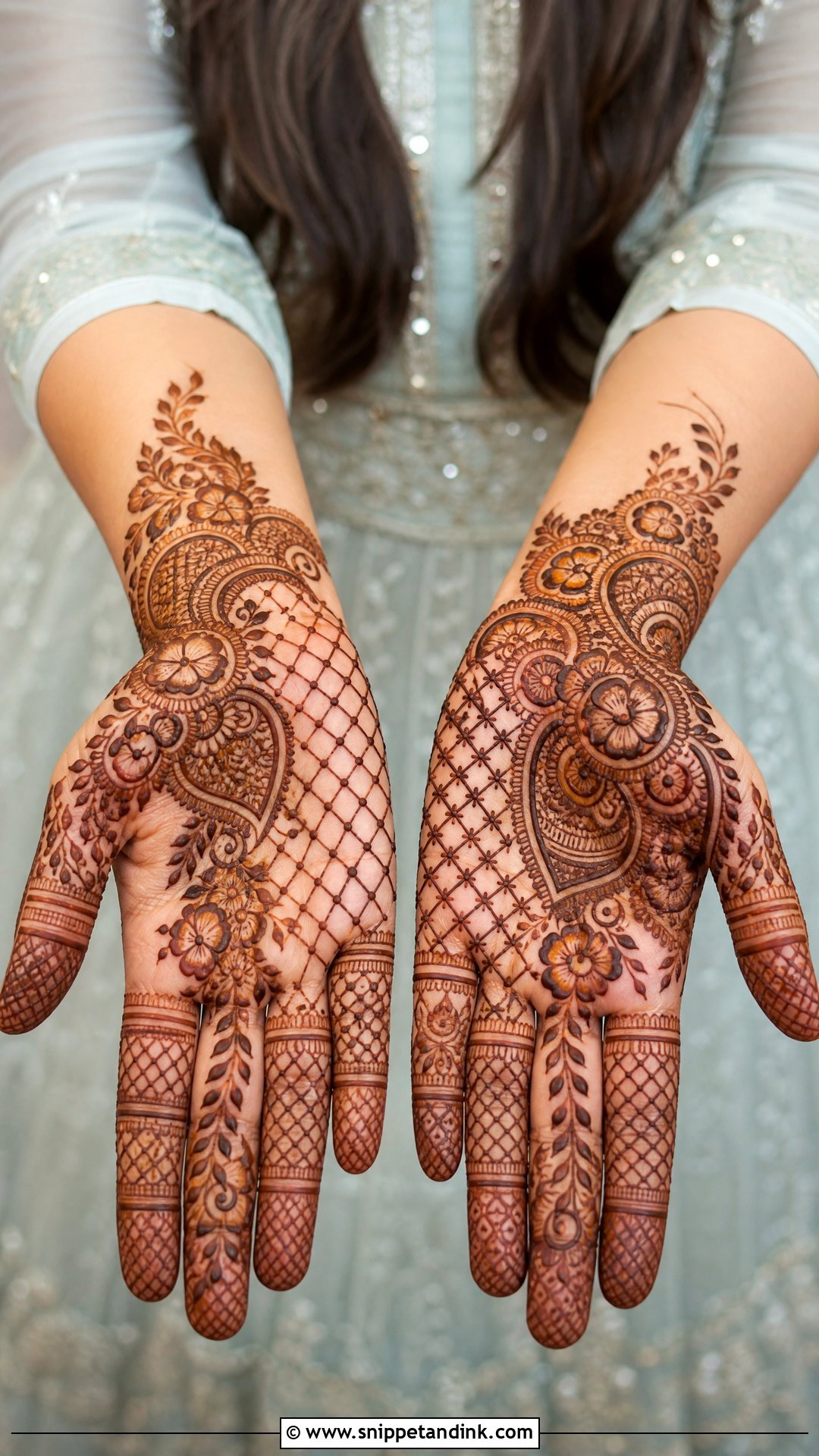
Mesh adds texture to a vine, but it has to be rationed. The bail moves diagonally across the palm with flowers or paisleys as anchors, and small jaali sections fill selected gaps around them. Cover the whole palm in mesh and the vine loses its shape. The fingers can carry matching crisscross detail, dots and slim bands. I’d only recommend it to an artist with a steady hand, because uneven grid lines show immediately on an open palm.
21. Peacock Bail Front Hand Mehndi Design
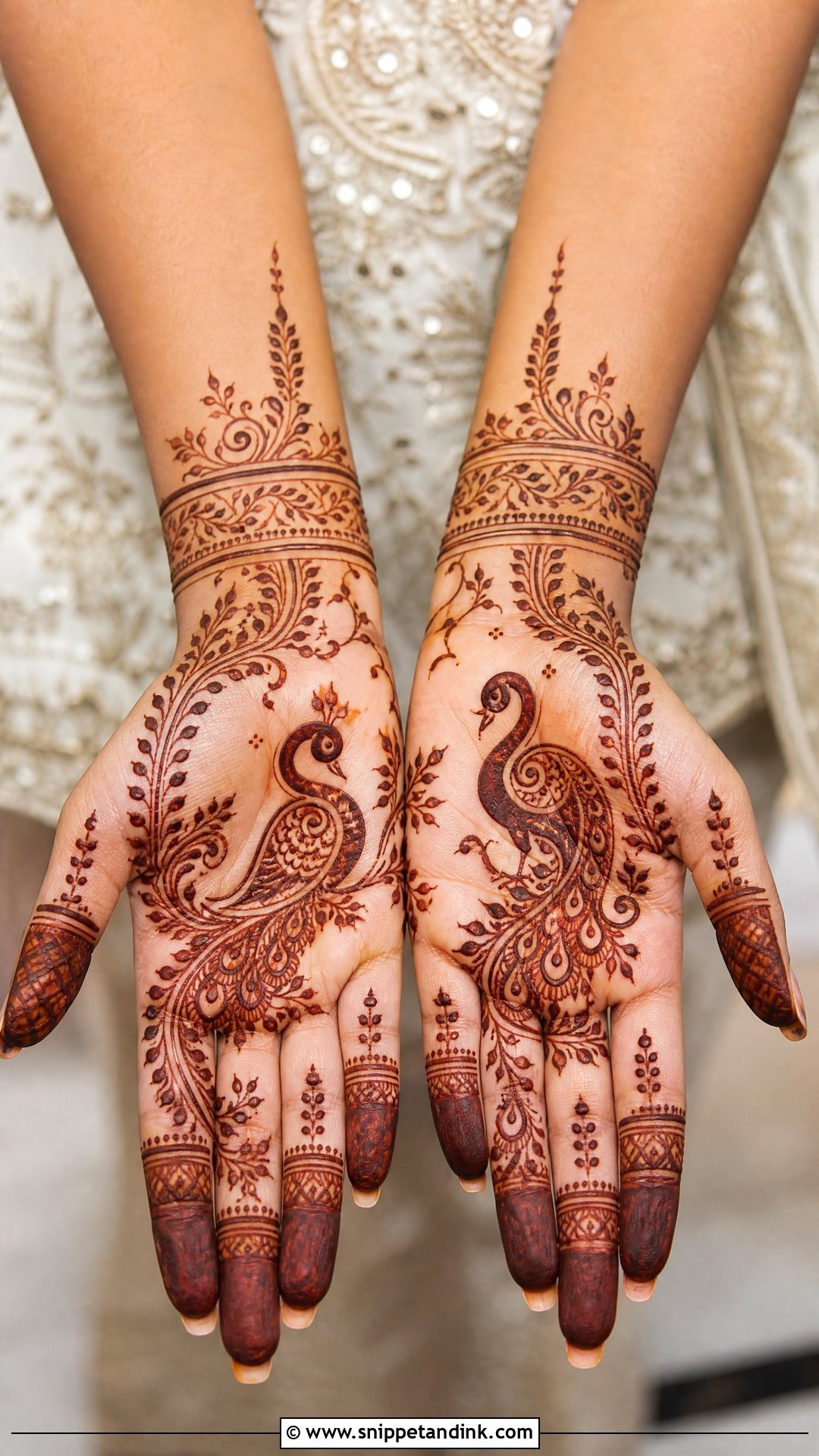
A small peacock near the wrist or lower palm, with a leafy, floral vine climbing above it, keeps the hand festive without full bridal coverage. The feathers are shown with curved lines, dots and small paisleys. Size discipline matters here: if the bird grows too big, it takes over and the vine becomes a background. Feather-like curves and dotted bands on the fingers tie it together for weddings, sangeet, Diwali and other cultural celebrations.
22. Lotus Bail Front Hand Mehndi Design
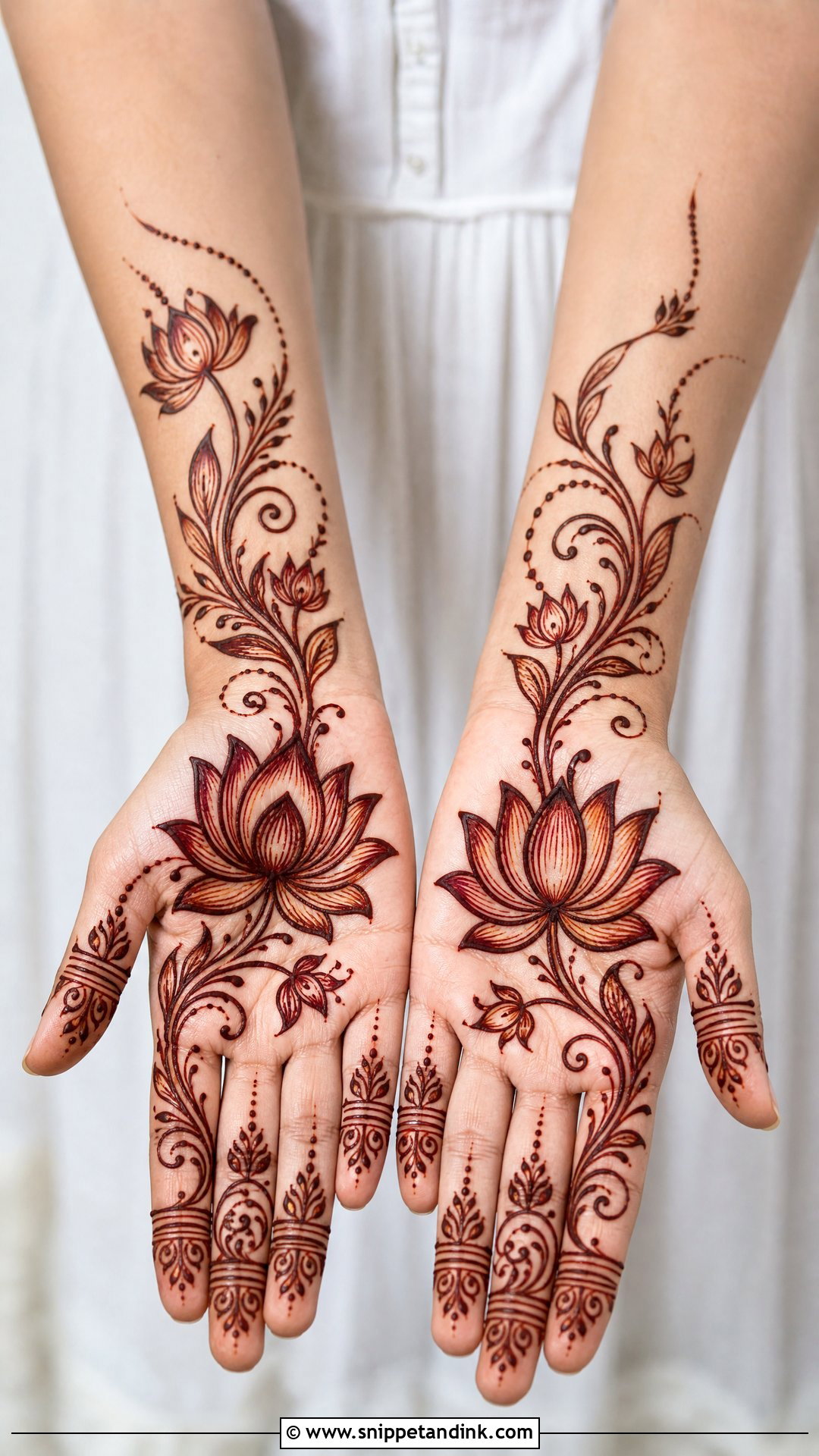
The lotus sits near the center of the palm, with the vine extending toward the fingers and wrist through long leaves, small buds, dots and fine curved lines. Make the petals bold enough to stand out once the colour deepens, as fine petals on a dark-staining palm can fill in. Mini lotus tips or slim leafy trails on the fingers coordinate the hand. Its calm, meaningful feel pairs naturally with traditional outfits and soft jewelry.
23. Moroccan Bail Front Hand Mehndi Design
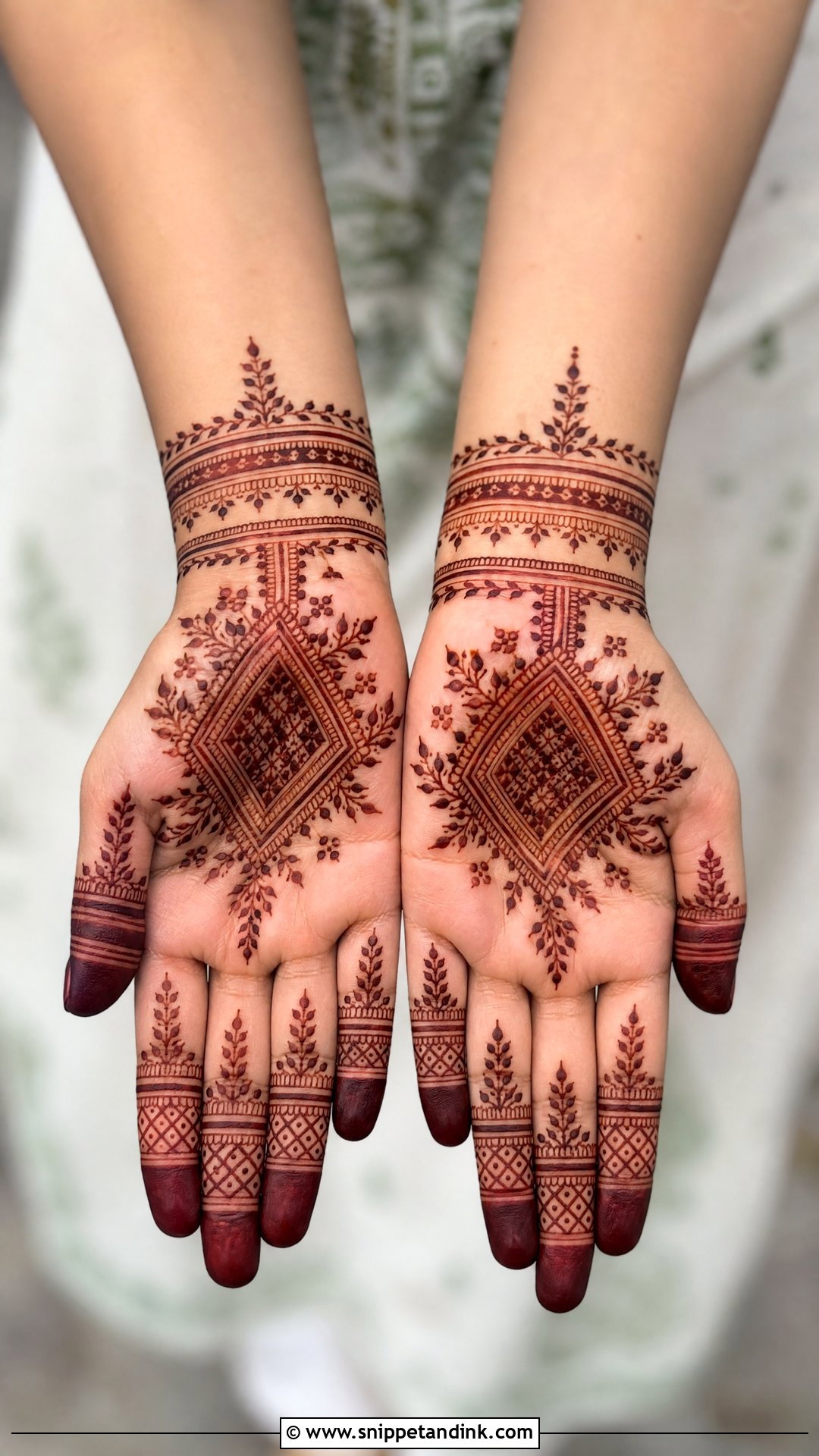
The Moroccan version gives the vine a geometric twist: diamonds, lines, triangles, dots and small structured units repeated along a vertical or diagonal path. A few leaf accents soften it if you like. The fingers carry matching bands, grids, and dotted tips. It’s a good pick for someone who wants a front hand that doesn’t look like everyone else’s at the event. Straight lines need a still hand, so I rest the client’s palm flat on a cushion for this one.
24. Gulf Bail Front Hand Mehndi Design
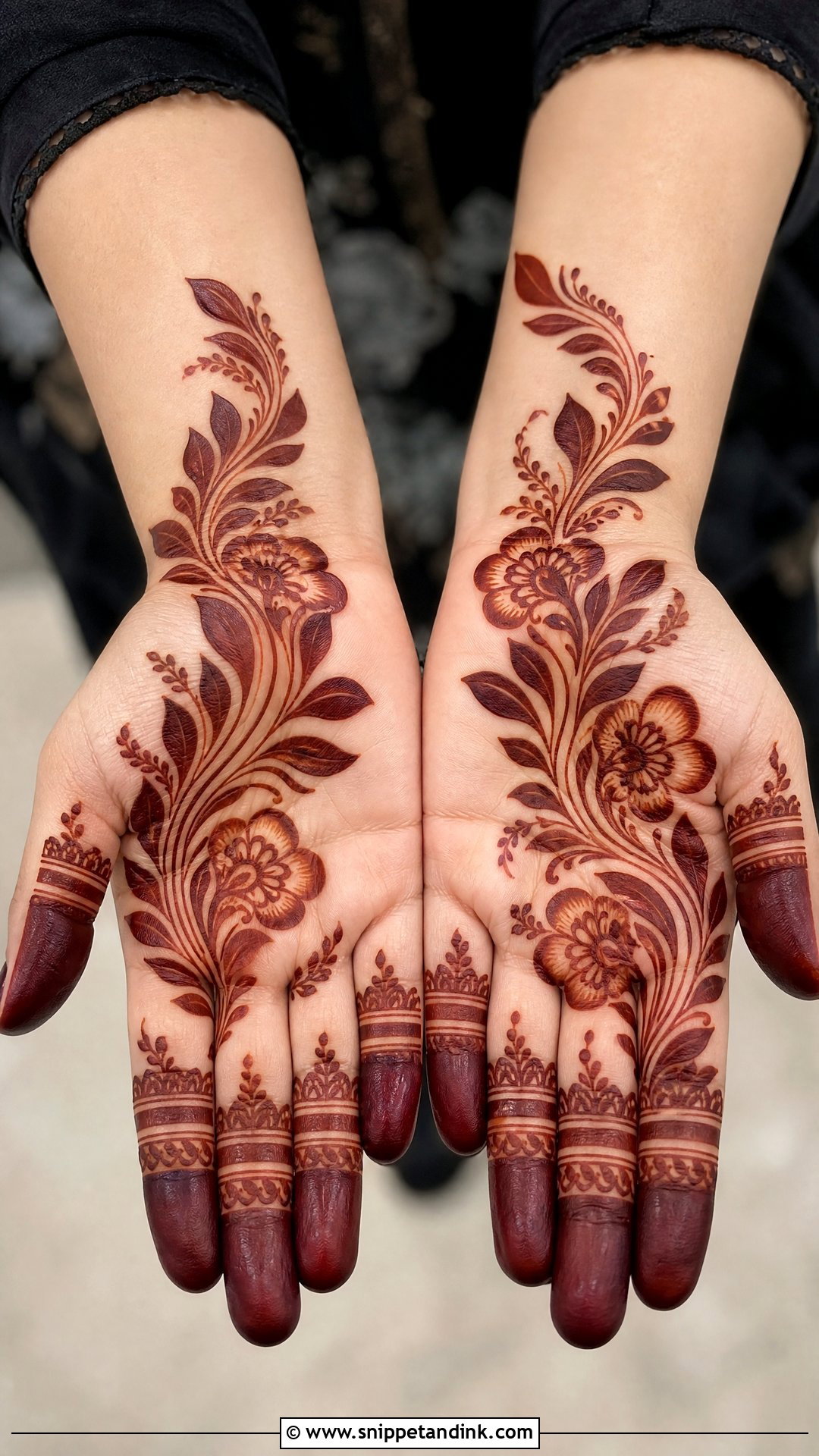
Gulf bail front hand mehndi design relies on thick strokes and confident empty space. Large florals, sweeping leaves and curved branches move across the palm without many tiny fillers, so the contrast does the work. Thick bands, leafy trails and filled tips on the fingers match it. It’s quicker to apply than detailed Indian work, which makes it practical for Eid, evening functions and guests queuing for their turn at a wedding.
25. Shaded Bail Front Hand Mehndi Design
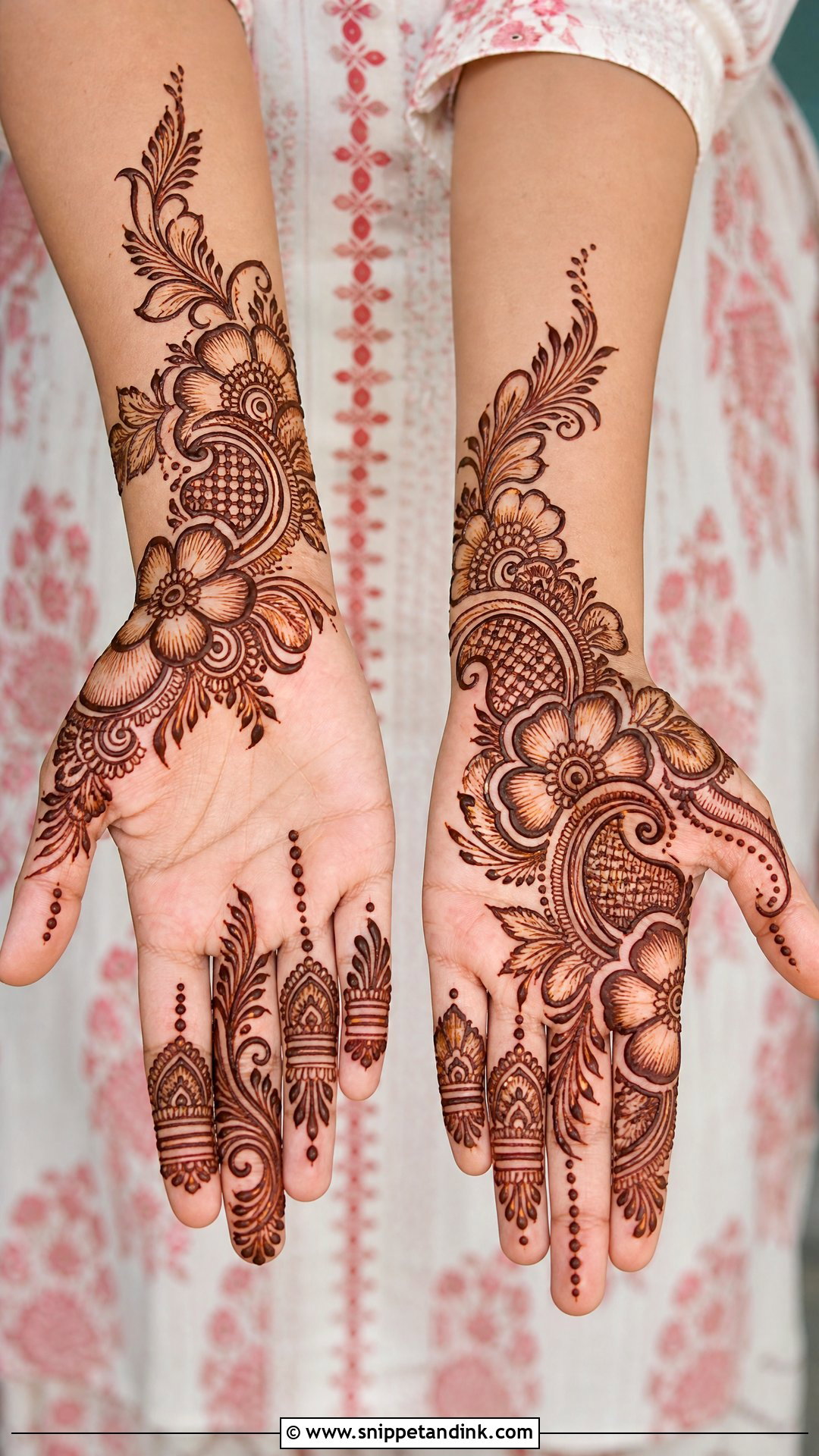
Shading adds depth by thinning the paste on one side of each flower, leaf or paisley along a diagonal trail. Once the stain develops, the thin areas come up lighter and the motifs look dimensional. The balance is a bold outline with fine shading; if the shading paste is laid too thick, it simply stains solid. Shaded leaf chains and plain bands on the fingers keep it balanced. I like it for anyone who appreciates the artistry more than the coverage.
Sitting Through a Palm Design at a Busy Mehndi Night
Palm mehndi asks more of you than back-hand work, because both hands are out of action until the paste is dry. At a crowded function, the people who end up with smudged vines are usually the ones who got up too early to grab a plate or answer the phone.
- Eat, use the bathroom and put your phone on a table or in a friend’s hands before you sit down.
- Keep your palms open and flat. Curling your fingers cracks the paste along the creases.
- Ask for your non-dominant hand first so the dominant one is free a little longer.
- Let each hand dry for twenty to thirty minutes before you stand, and longer for thick work.
- Wear something with sleeves you can push up easily and a neckline that doesn’t need adjusting.
How a palm design wears over the next week
Palms stain the darkest of any part of the body, but they also do the most work, so they’re where you’ll notice fading first. Washing, cooking and gripping gradually wear the colour, and after roughly one to two weeks most palm designs have faded to a soft outline. Thick strokes and bold motifs stay readable longest, while very fine shading softens early. If you want the design to look its best at a particular event, book it a day or two before rather than a week ahead.
From a Single Leafy Stem to a Full Bridal Vine
Leaves and dots keep a vine simple, flowers and paisleys make it festive, and jaali, peacocks and detailed fingers take it toward bridal. Your occasion, your outfit and how long you can sit will usually settle the choice. For a quick look, start with the minimal or easy vines. For weddings and festivals, the heavier, Arabic, Indo-Arabic and shaded versions carry more presence. Whichever you pick, a vine that follows the natural lines of your palm will always look better than one simply drawn across it.
You'll Like These Ideas:







Leave a Reply