
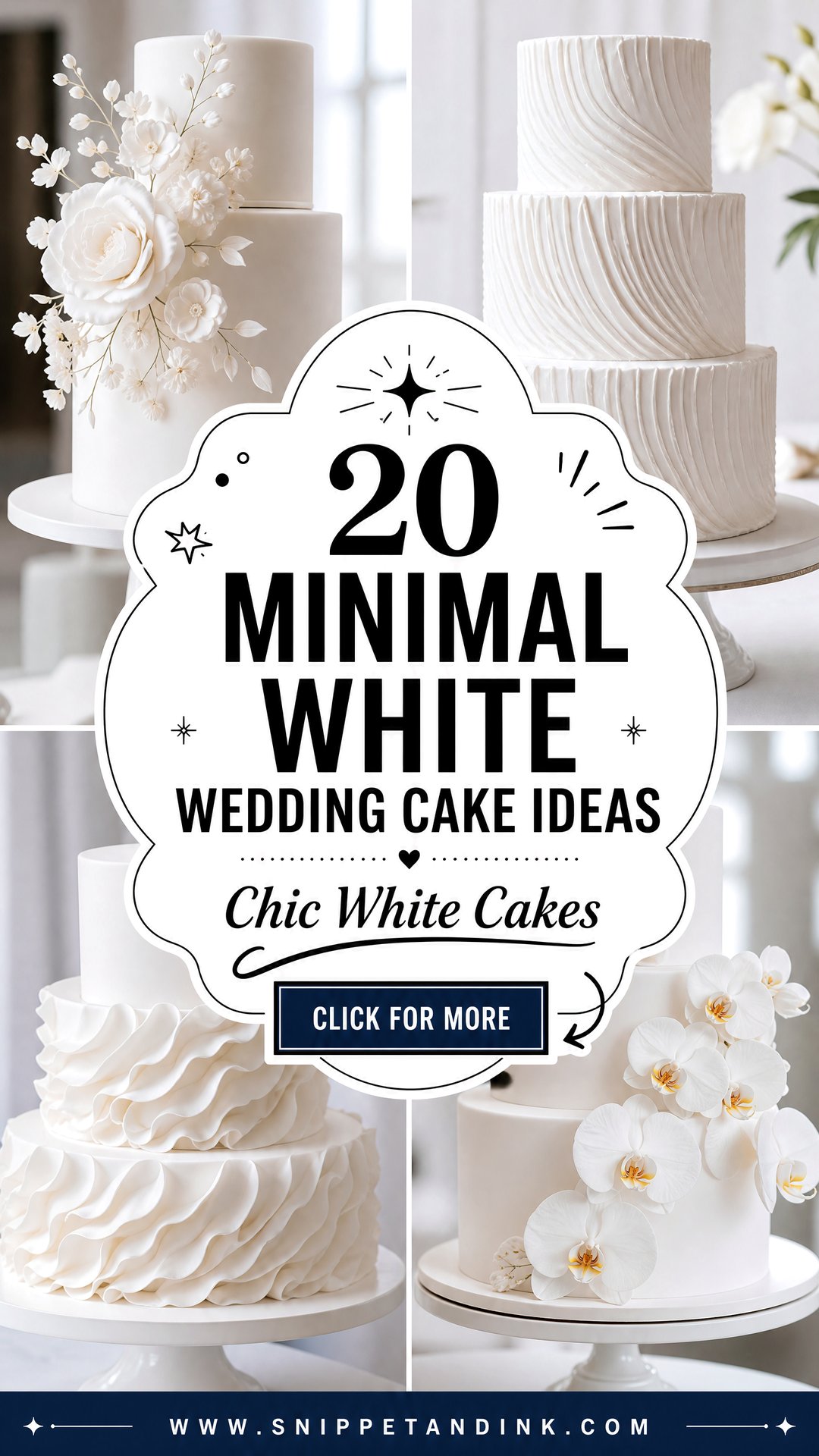
An all-white cake gives a baker nowhere to hide, and I mean that as a compliment to the style. With no color and very little decoration, the eye goes straight to the shape of the tiers, the finish of the frosting and the one detail you’ve chosen. That restraint is why these cakes fit almost any venue, from a garden ceremony to a modern hotel ballroom, and why they still feel personal when the detail is right. Here are 20 ideas I’d happily make, from smooth buttercream and pearl borders to soft bows, white flowers and sculptural tiers.
Pure White Is Harder to Get Than It Sounds
Most couples picture their cake bright white. Real frosting rarely is. Buttercream made with butter carries a natural ivory tint, Swiss meringue is creamier still, and only fondant, or a buttercream made partly with shortening, comes close to paper white.
That matters more than you’d expect, because your cake will stand in photos beside your dress. A bright white cake next to an ivory gown can make the gown look slightly dull, and an ivory cake next to a stark white dress can look yellow. Bring a fabric swatch to your tasting and hold it against the frosting. If you need it whiter, a baker can add the tiniest amount of violet coloring to cancel the yellow, but push it too far and the frosting turns grey.
1. Smooth Buttercream White Wedding Cake
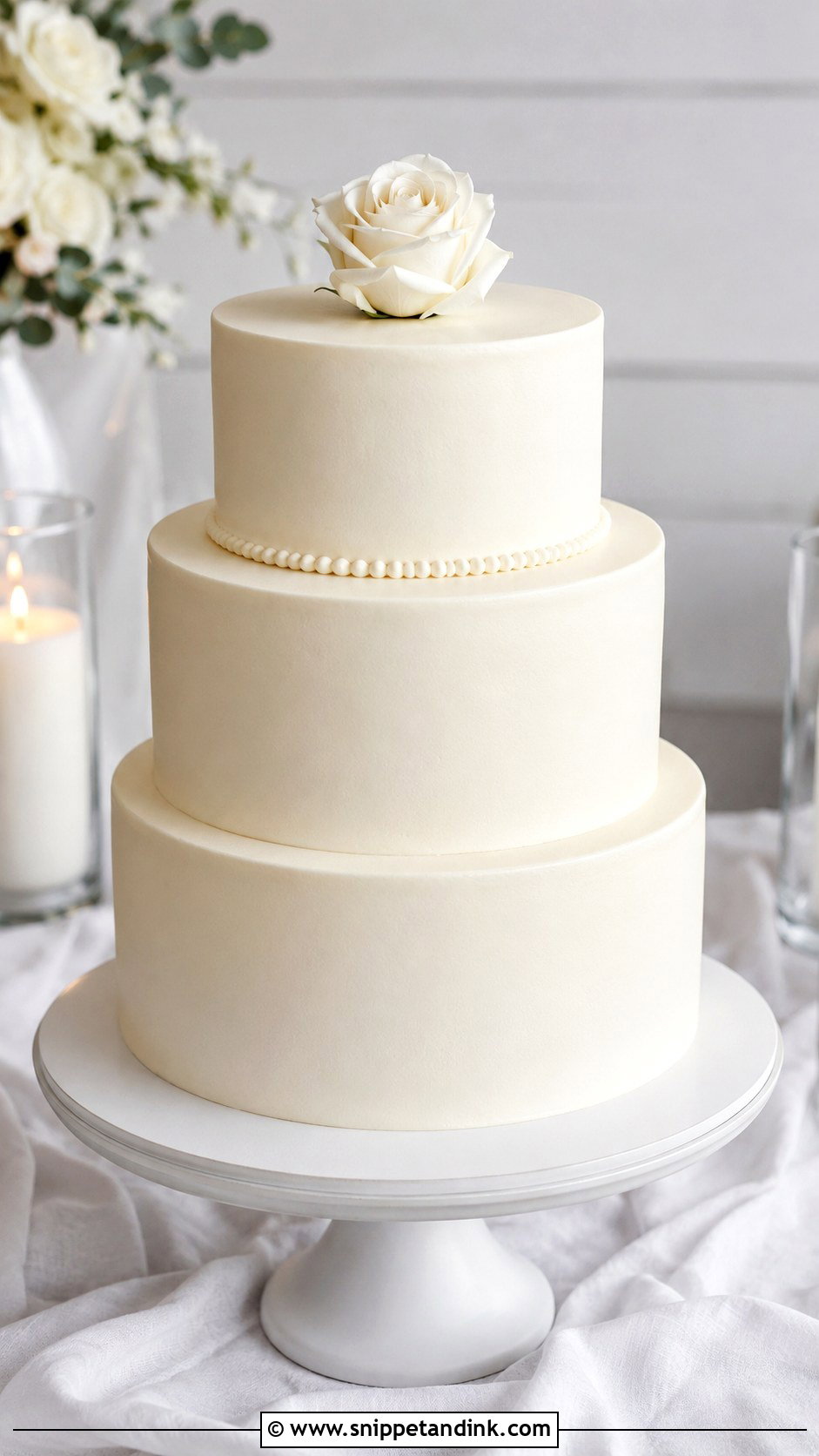
Smooth buttercream looks simple and is one of the most skilled finishes a baker does. I chill each tier, apply a thin crumb coat, chill again, then scrape the final coat with a bench scraper and a warm spatula until the sides are flat. Softly rounded edges feel gentle; sharp edges look modern but take longer, so they can nudge the price up. It works in two, three or four tiers. On a finish that clean, a thin piped border or a single white flower is all it needs.
2. Two Tier White Wedding Cake
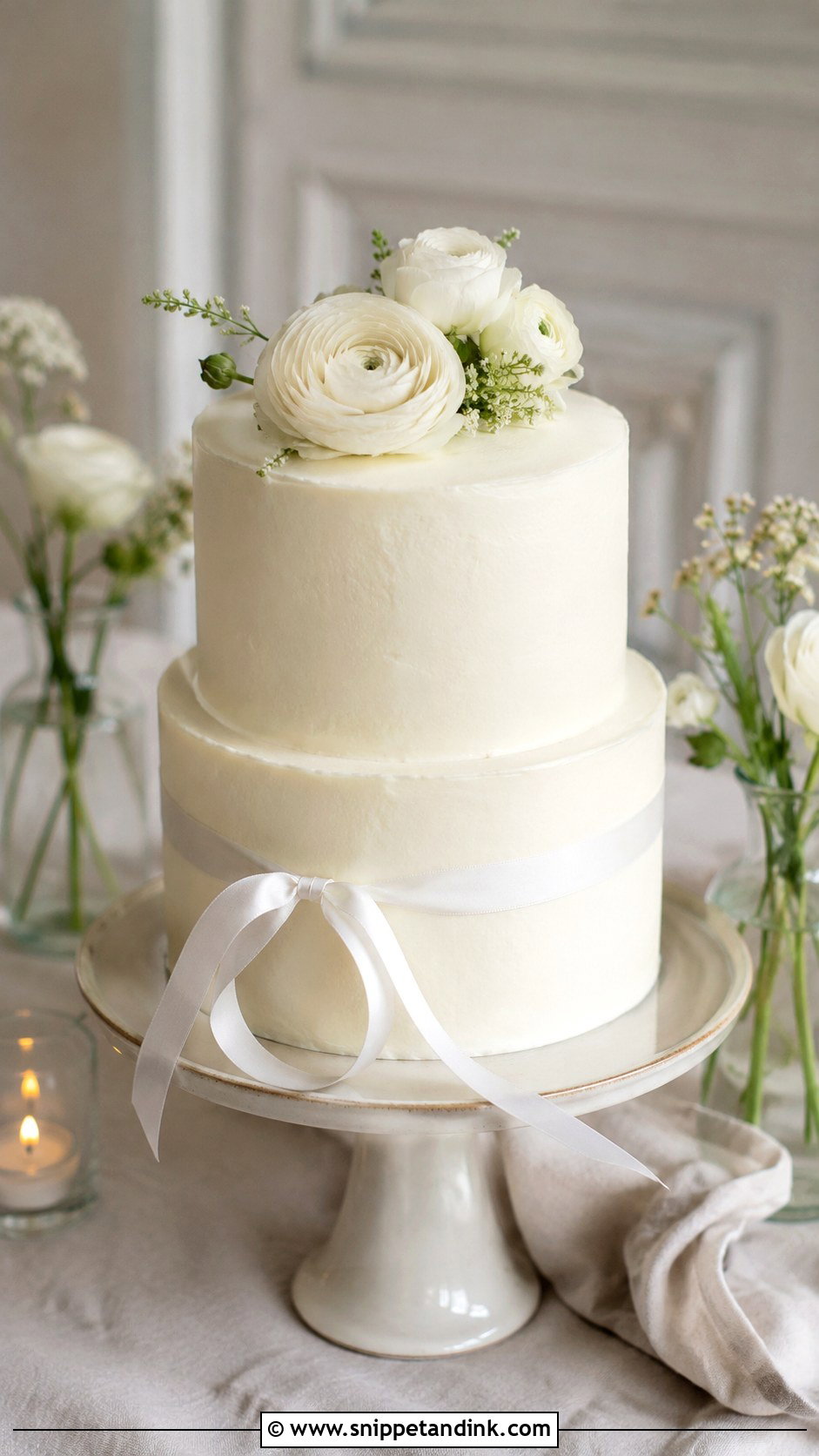
A two tier white wedding cake suits intimate weddings, courthouse celebrations and backyard receptions, where a tall cake would dwarf the room. Depending on the tier sizes and how it’s cut, it usually serves somewhere around 30 to 50 guests. If your list is longer, a plain kitchen cake in the same flavor makes up the difference without adding height. Buttercream and fondant both suit it. Set it on a pedestal stand so it doesn’t look lost on a long table.
3. Three Tier White Wedding Cake
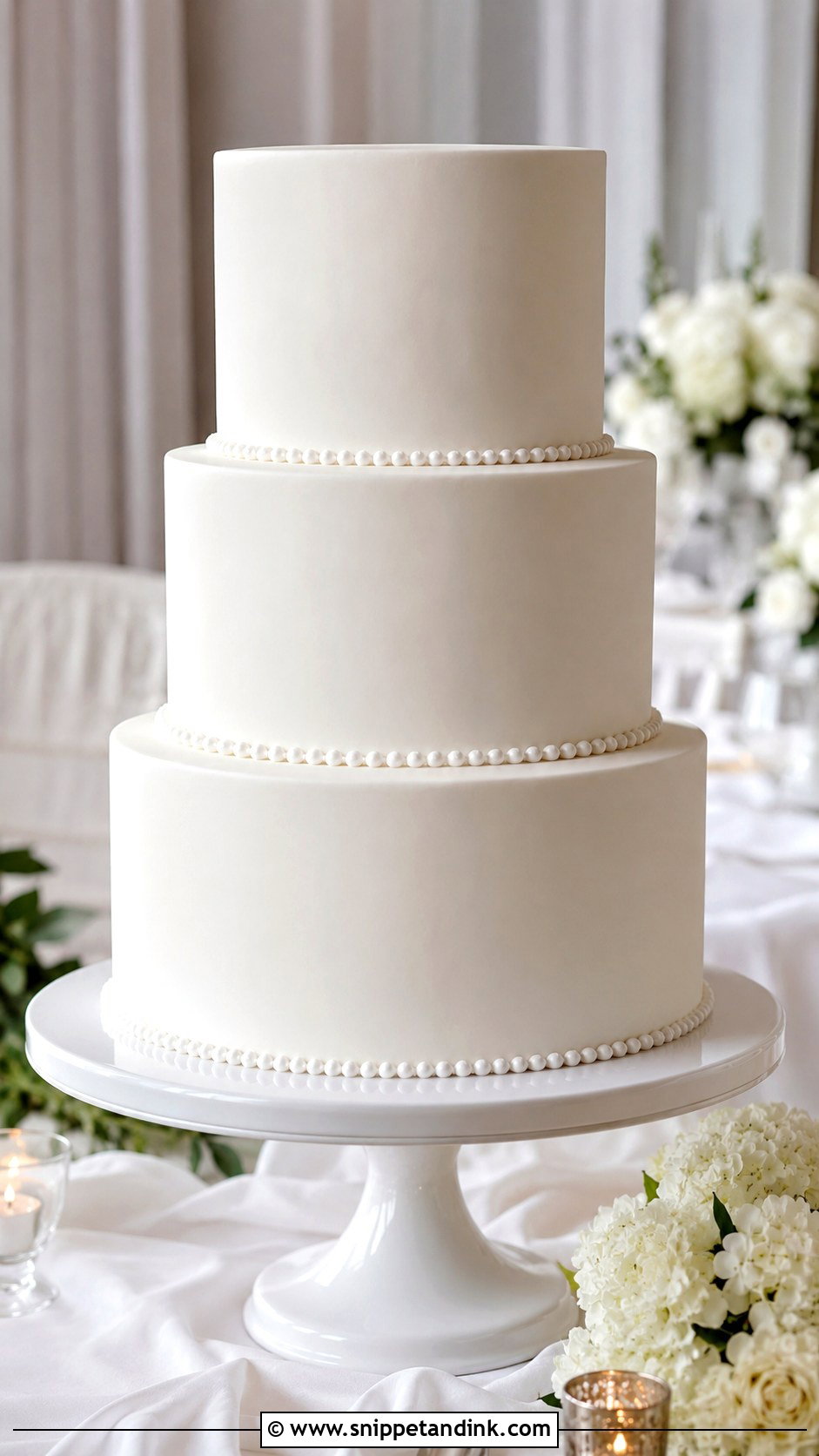
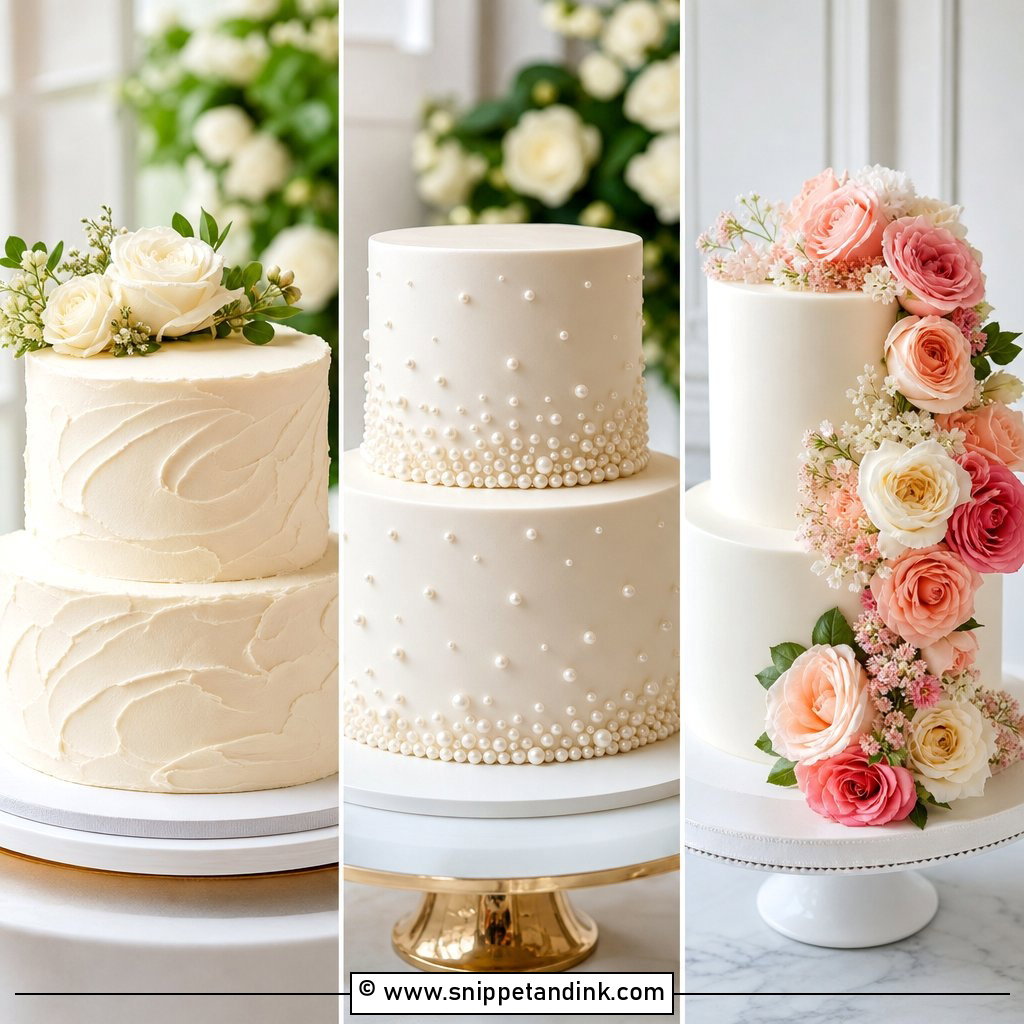
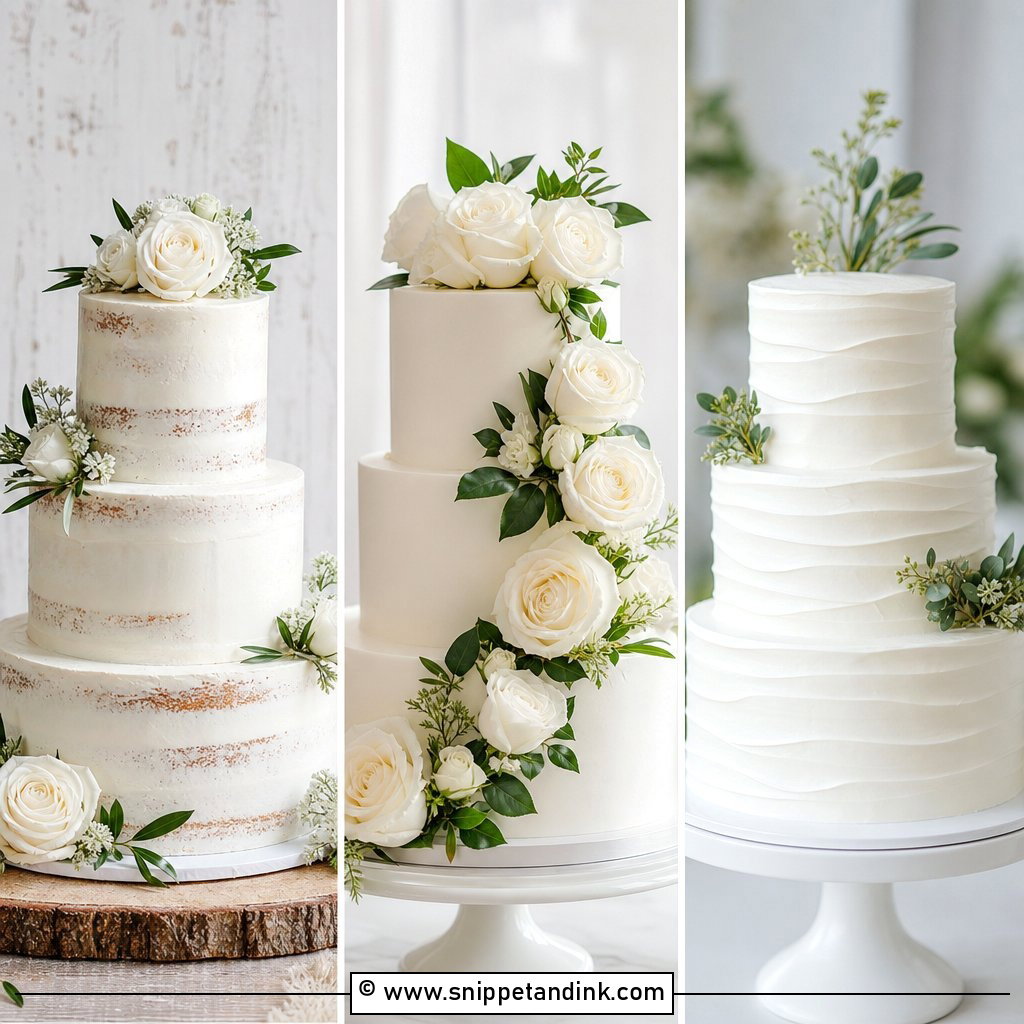
A three tier white wedding cake gives you the traditional silhouette, and its height does a lot of the decorating for you. That height needs hidden support. Every tier above the base sits on a board held up by dowels, which is what keeps the cake from sinking through a long reception. Keep the outside light, perhaps a fine piped edge, a satin ribbon or a ring of tiny sugar pearls. It also lets you serve three different flavors while the outside reads as one cake.
4. White Fondant Wedding Cake
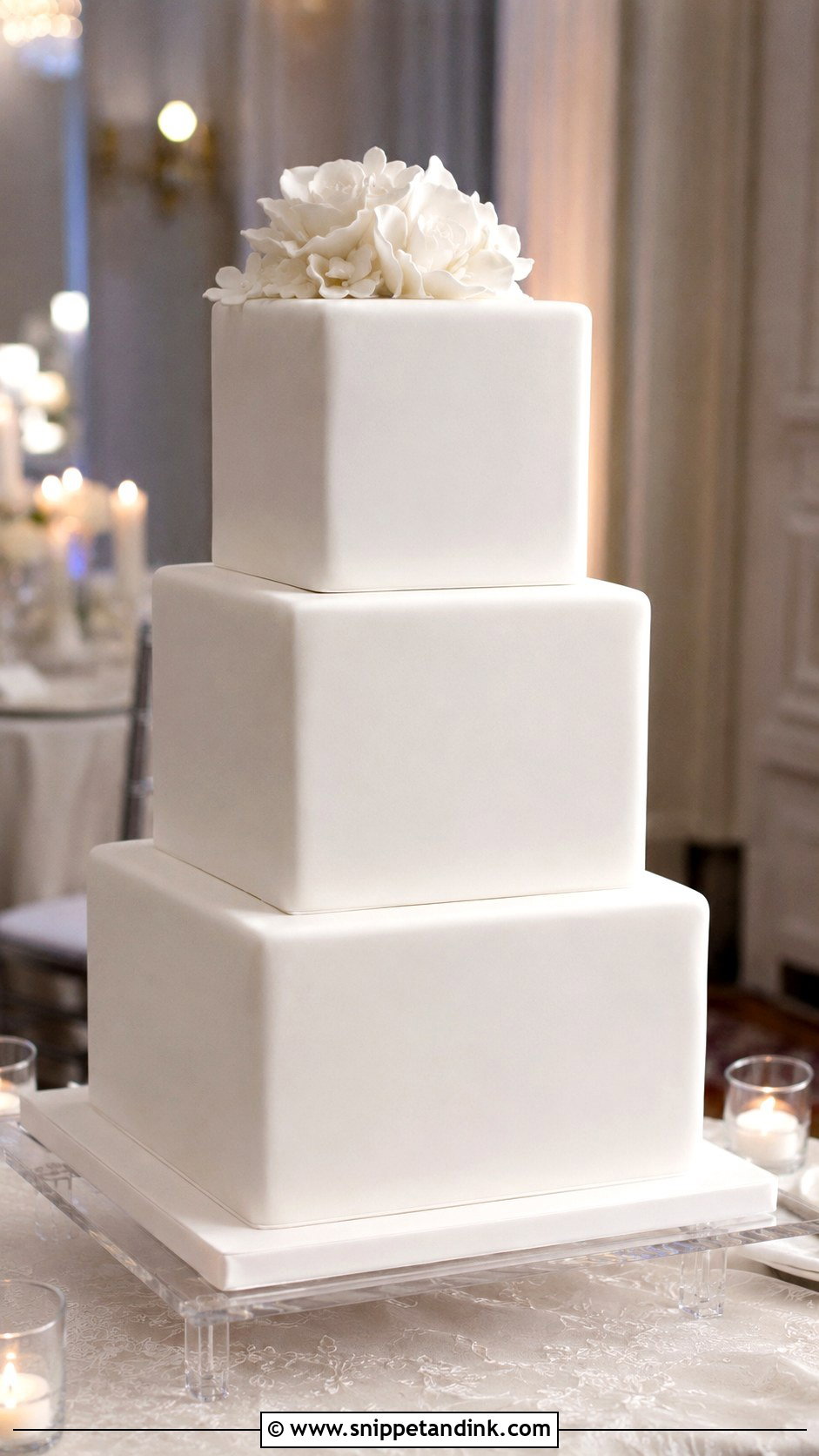
Fondant is my recommendation when you want crisp edges and a very flat surface, especially on geometric or square tiers. It’s rolled into a sheet and smoothed over a firm base, and ganache underneath gives sharper corners than buttercream does. One accent is enough, such as a narrow fondant ribbon or a small cluster of sugar flowers. Be aware that fondant reads brighter white than buttercream, so hold a swatch against your dress fabric before deciding. Ballrooms and black-tie receptions suit it well.
5. White Wedding Cake With Pearls
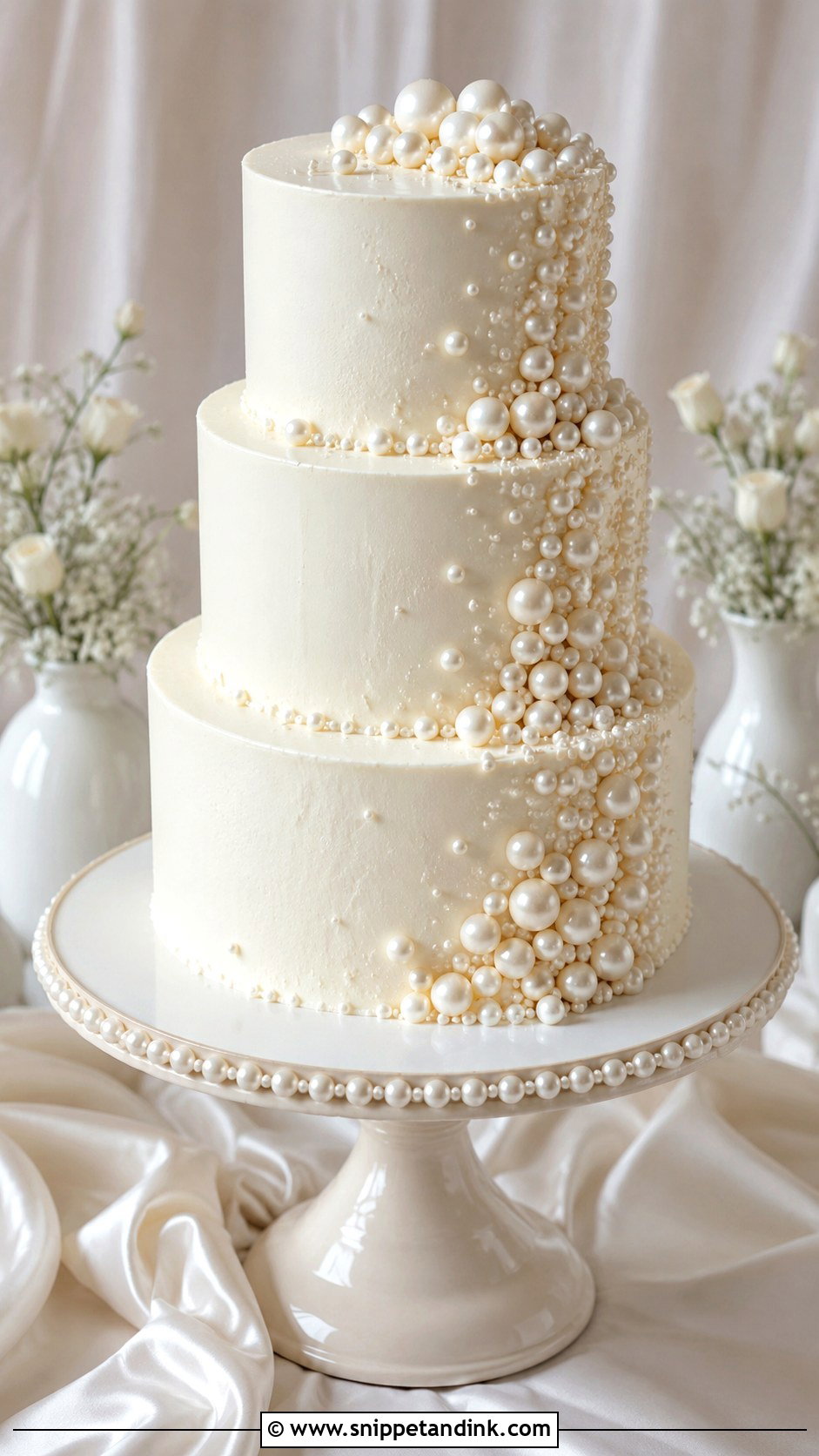
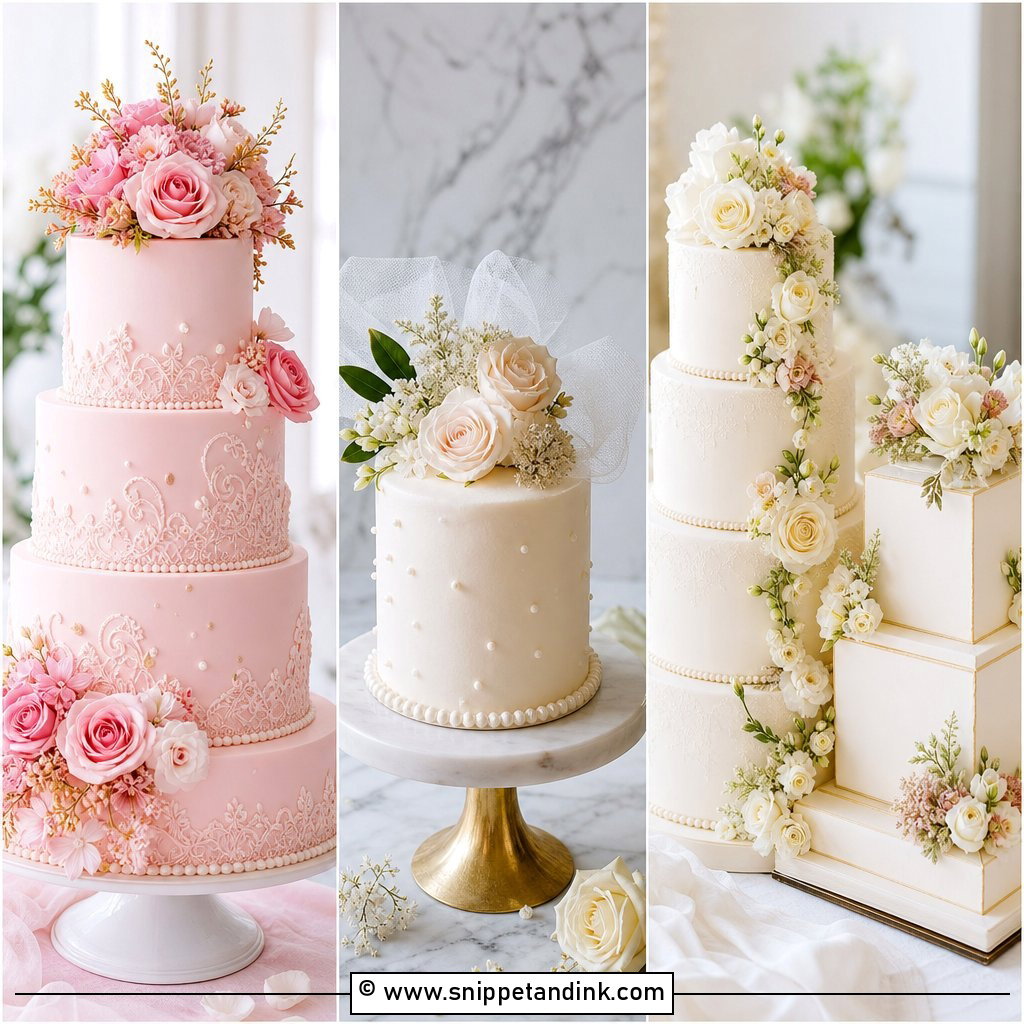
Pearls look intentional on a white cake when they stay in one controlled area. I pipe tiny dots of royal icing as glue and set edible pearls along the base of each tier, down one side or in a single vertical line. Mixing two or three sizes in one cluster looks more modern than a uniform row. On buttercream, the pearls go on after the final chill; placed on soft frosting, they sink slightly and leave a greasy halo. Satin gowns and pearl jewelry are the obvious partners.
6. White Wedding Cake With Bow
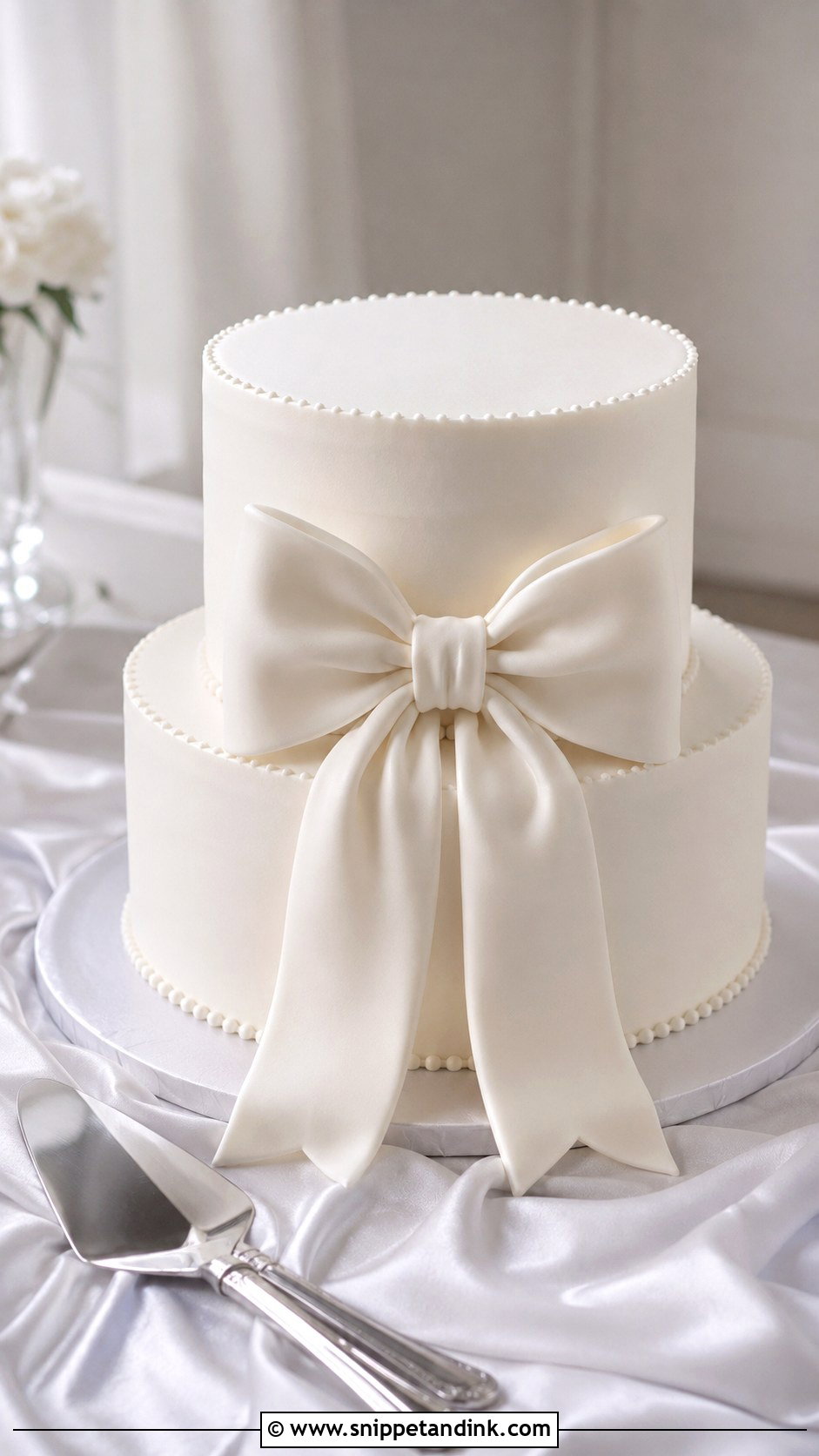
A white wedding cake with a bow needs exactly one bow, placed on the front of one tier. It can be fondant, sugar paste, fabric ribbon or piped buttercream, and each behaves differently. Fabric looks softest but must sit on a thin barrier strip, or butter seeps into it and leaves dark spots. Sugar paste holds its loops best but needs a few days to dry, so it’s made ahead. Keep the frosting smooth around it. It echoes satin and silk gowns with draped details.
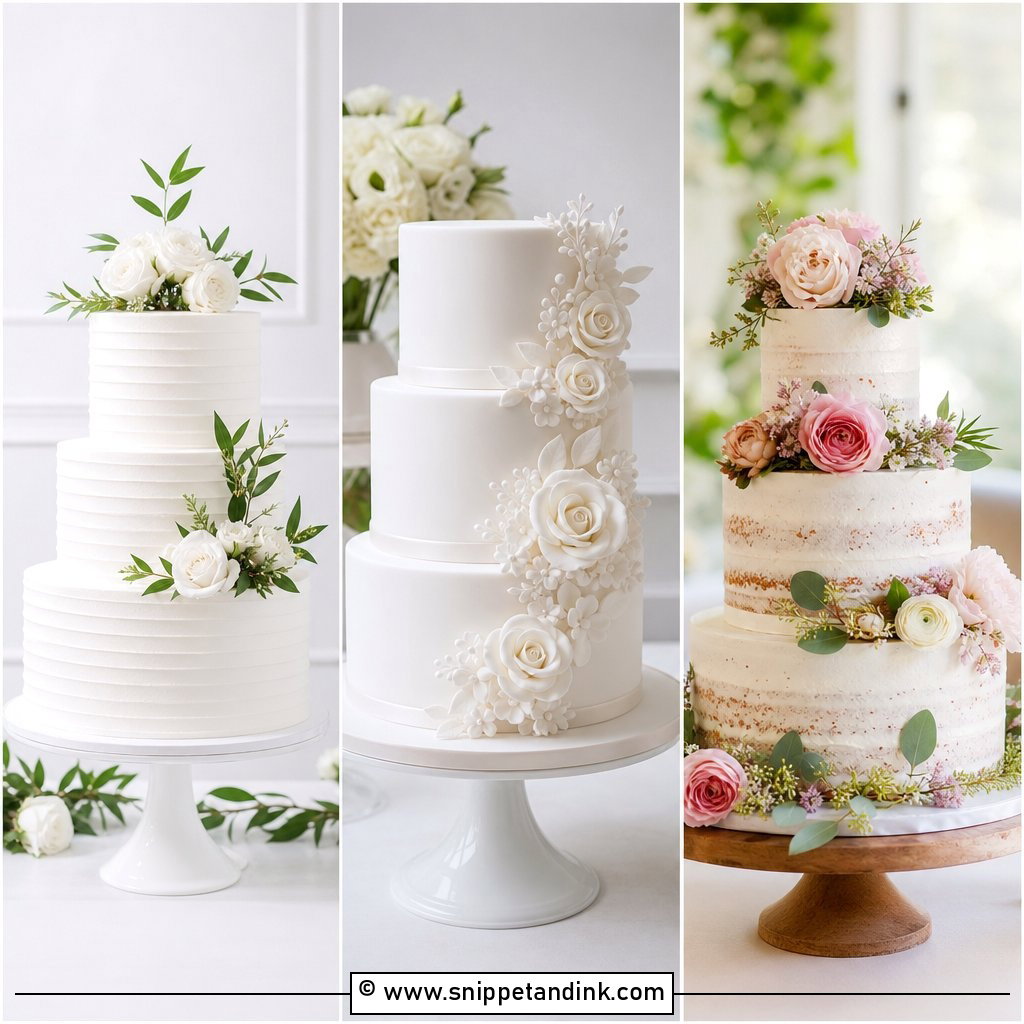
7. White Wedding Cake With Fresh Flowers
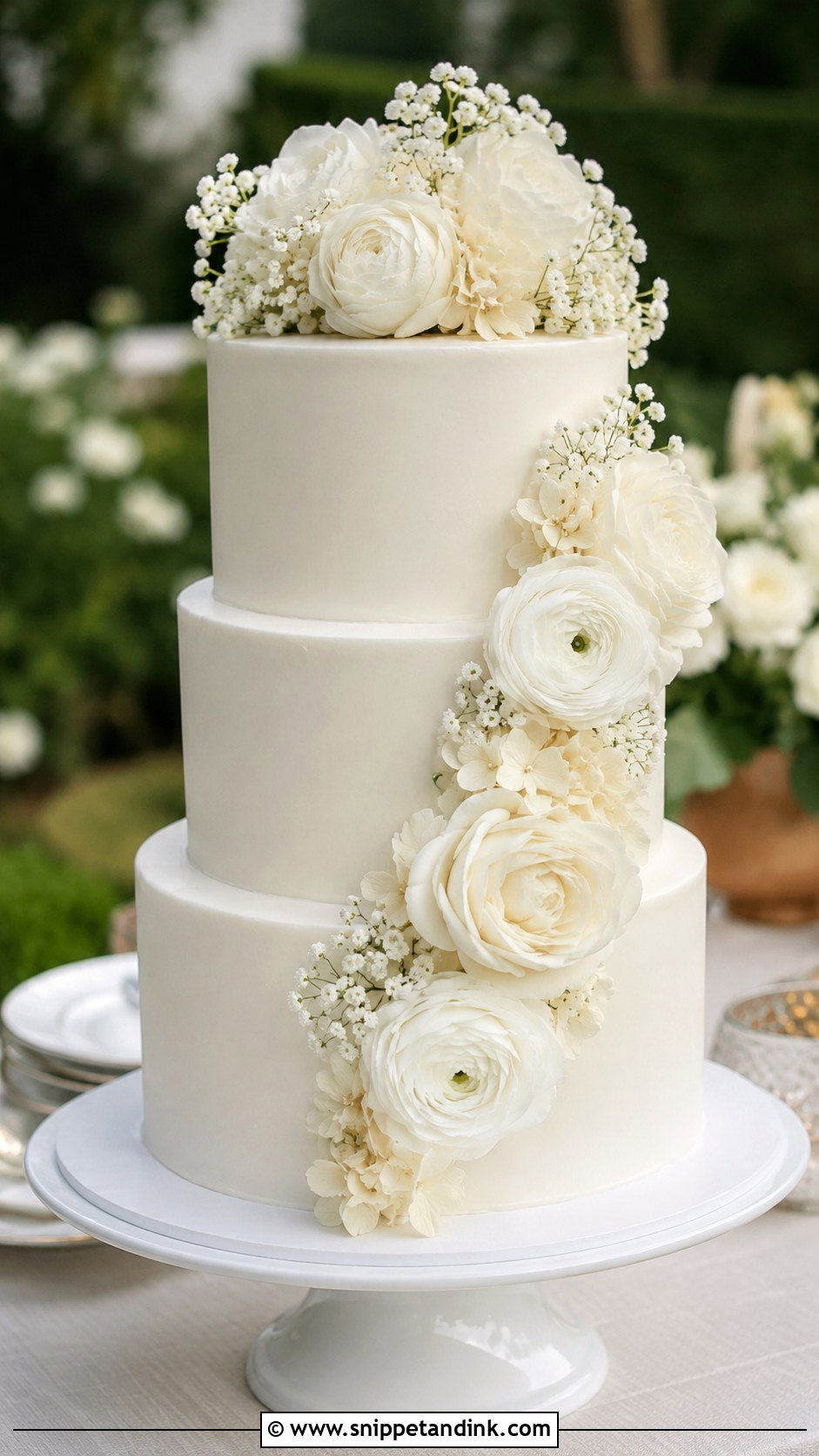
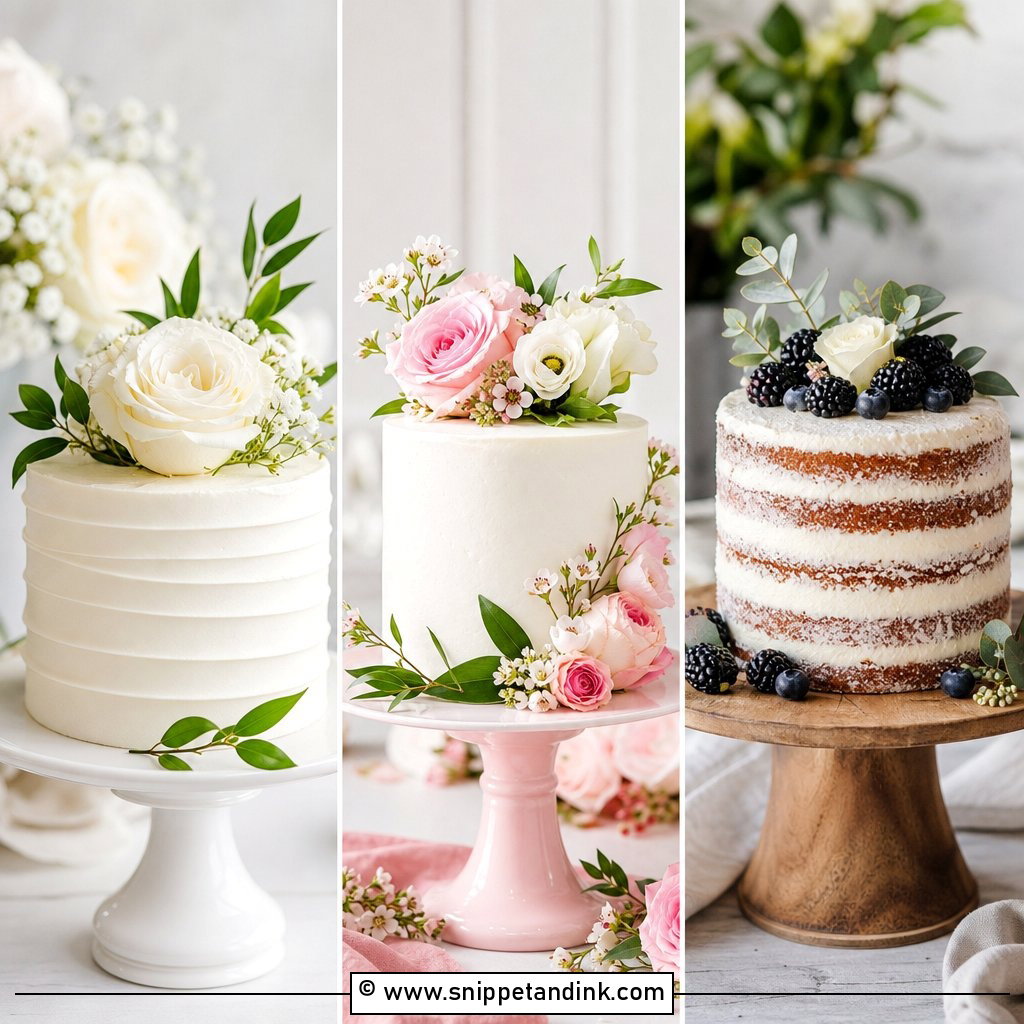
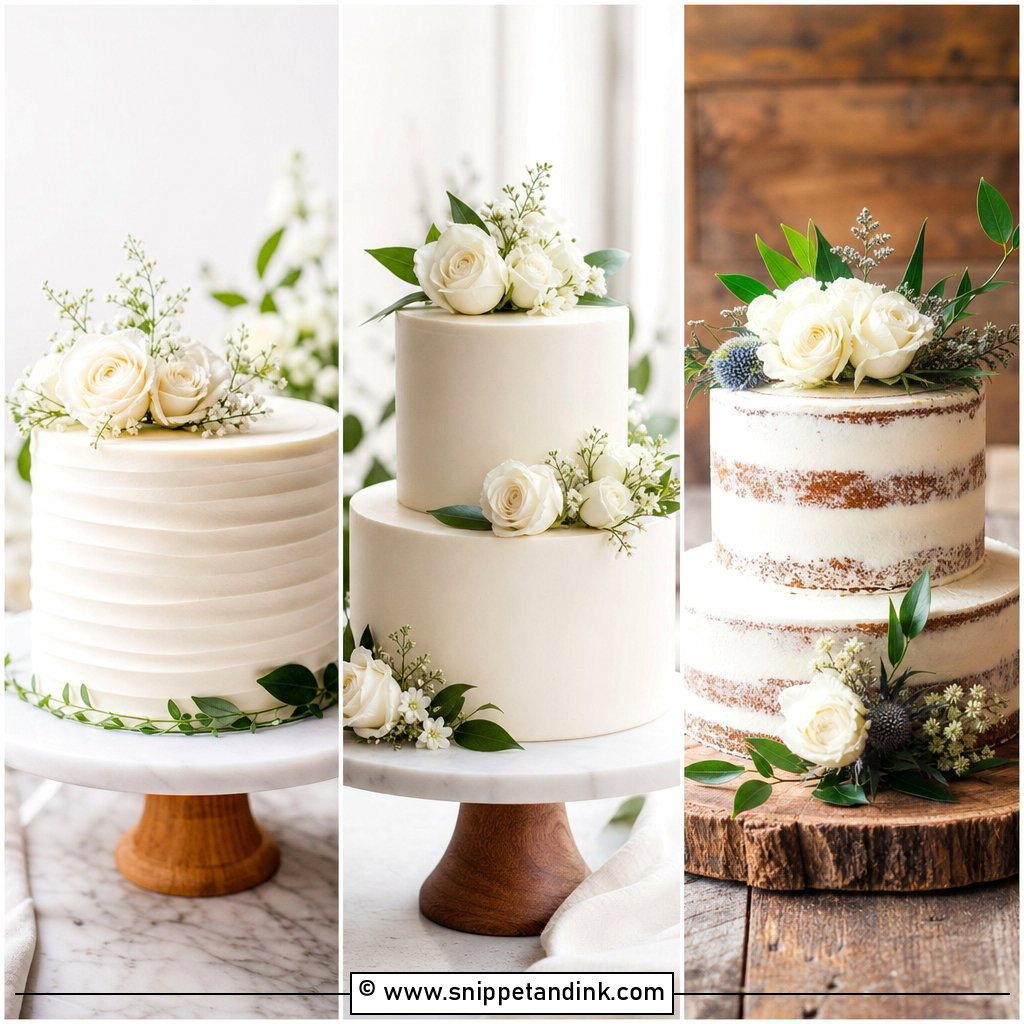
Fresh flowers add romance quickly, and they are also where I see the most safety mistakes. Keep the blooms mostly white, such as roses, ranunculus or orchids, and ask your florist for flowers grown without heavy spraying where possible. Stems should never go straight into the sponge; I wrap them in floral tape or use flower picks so sap never touches the cake. Some white flowers, including lily of the valley and hydrangea, are toxic and don’t belong on a cake at all. Agree in advance who places the flowers and when.
8. White Wedding Cake With Sugar Flowers
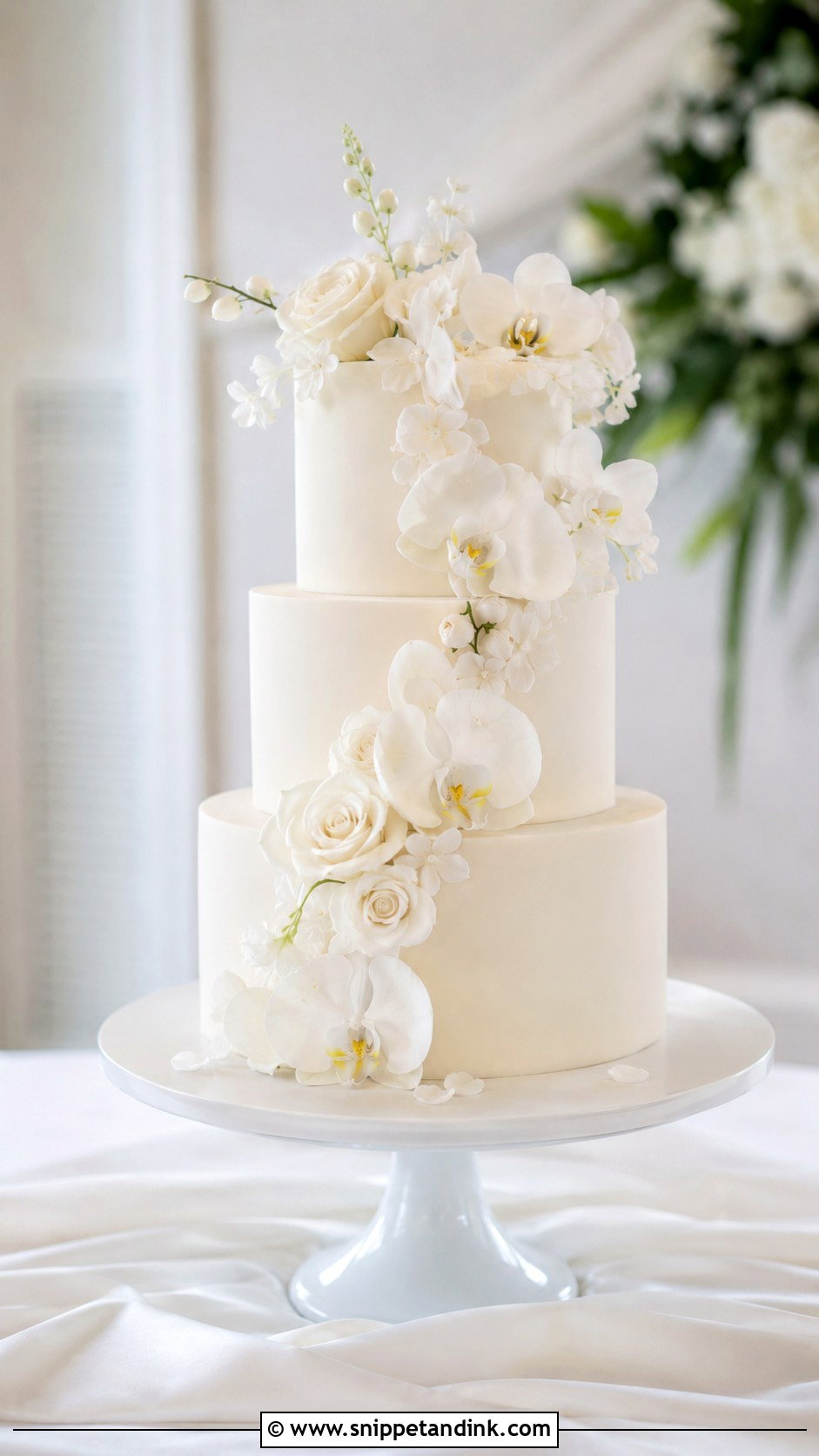
Sugar flowers give you floral detail that won’t wilt, and they’re the safe route when fresh blooms are out of season or not food-safe. Each one is shaped petal by petal from gum paste and left to dry over several days, so they need ordering well ahead. Keep them tonal and few: one large sugar orchid, a small cluster of roses or a single branch of blossom. They’re fragile in transit, so I attach them on site once the cake is stacked.
9. White Wedding Cake With Texture
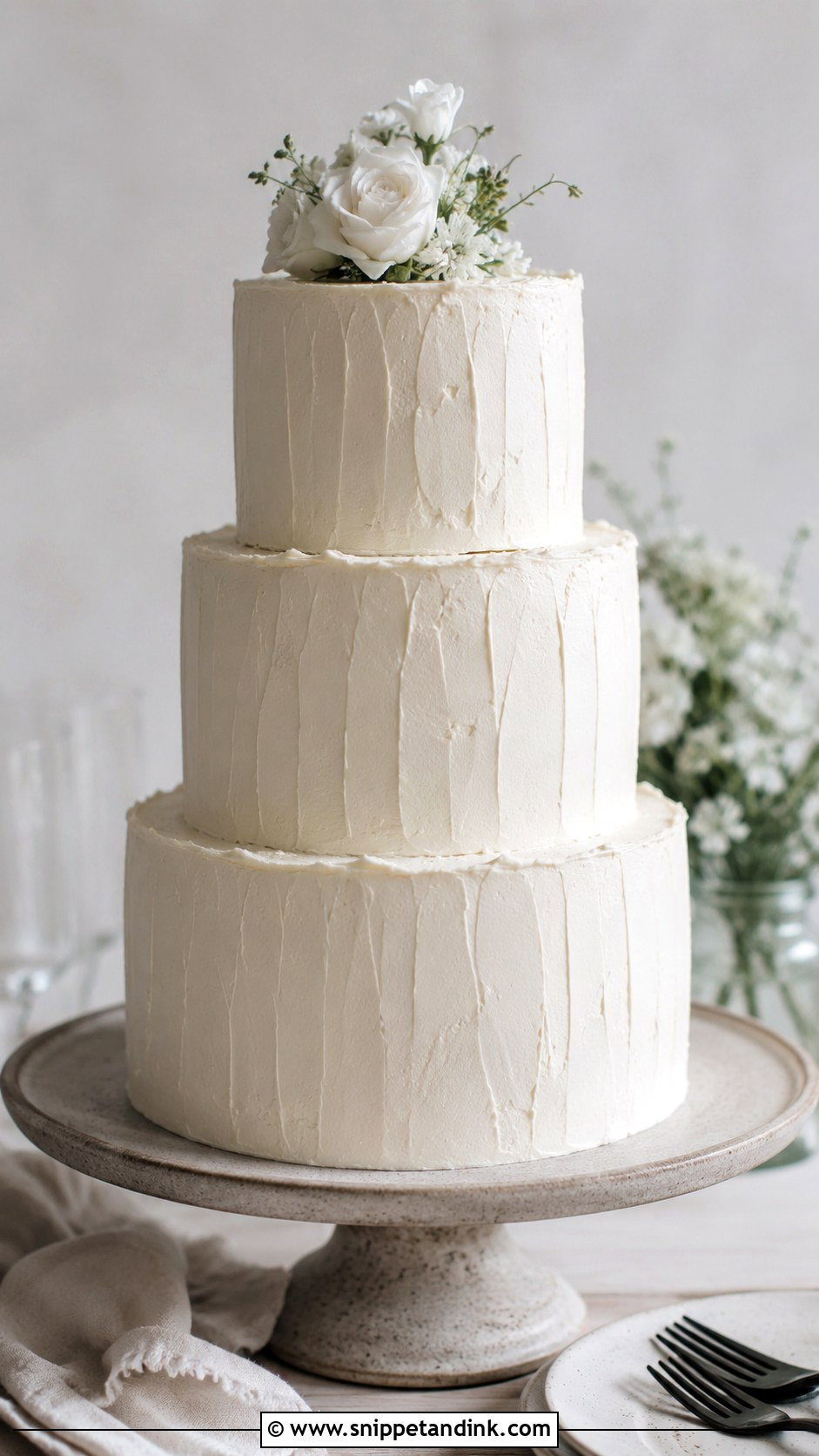
Texture gives white depth without color. Soft spatula marks, gentle vertical lines or a barely-there stucco finish catch light in a way a flat side never does. It’s also the most forgiving finish in warm weather, since a small mark or bulge disappears into the pattern instead of showing on a smooth surface. A small floral accent or a plain stand is enough decoration. Rustic, coastal and outdoor weddings suit it best.
10. White Wedding Cake With Ruffles
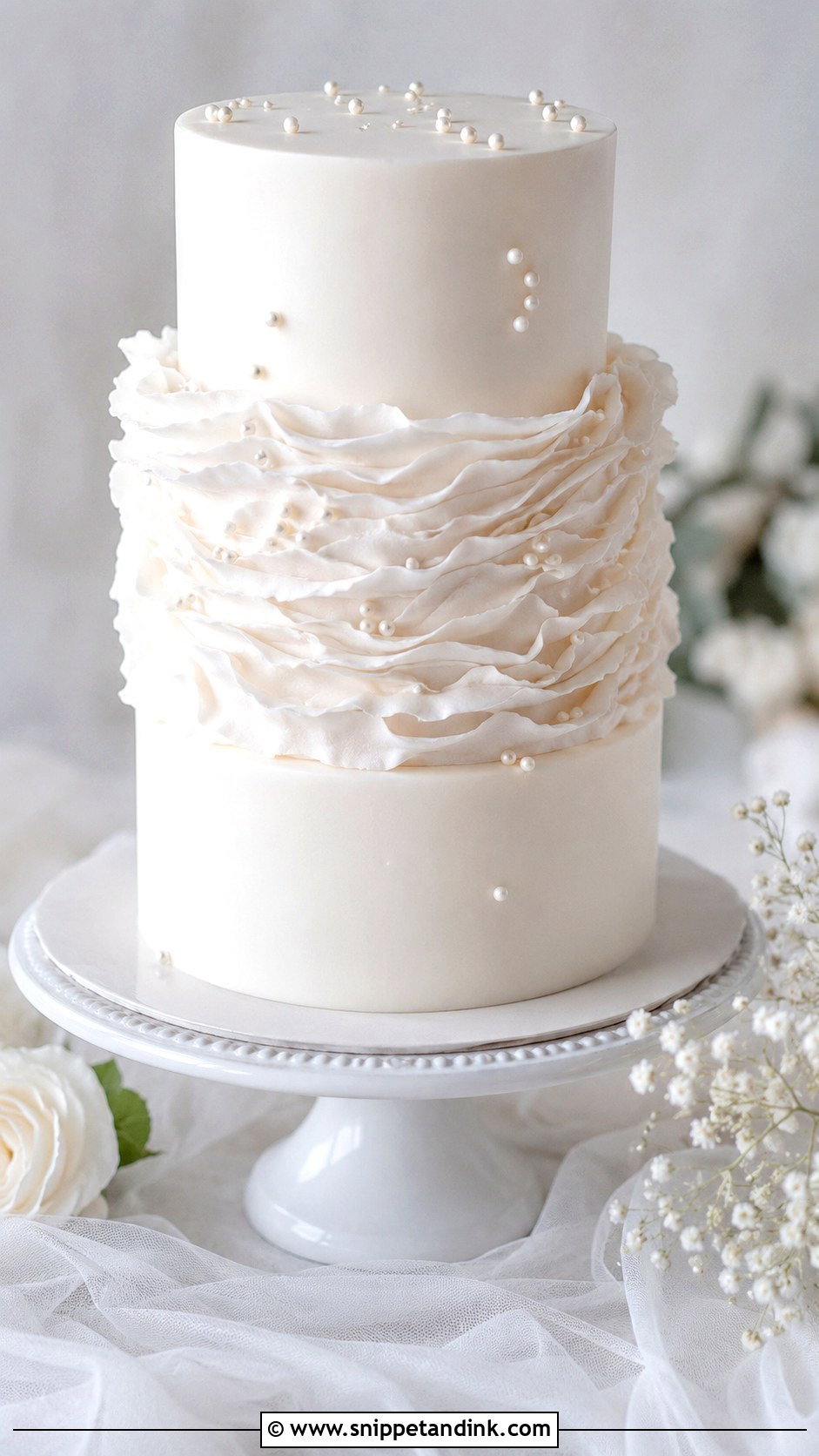
Ruffles add movement, and the minimal version keeps them to one tier, with smooth tiers above or below for contrast. Buttercream ruffles are piped with a petal tip, while fondant and wafer paper ruffles are cut and layered by hand. Wafer paper looks the airiest but wilts in humidity, so I’d steer you away from it at an outdoor summer wedding. Kept all white, the ruffled tier stays calm next to a simple gown and a soft veil.
11. White Wedding Cake With Swiss Meringue Buttercream
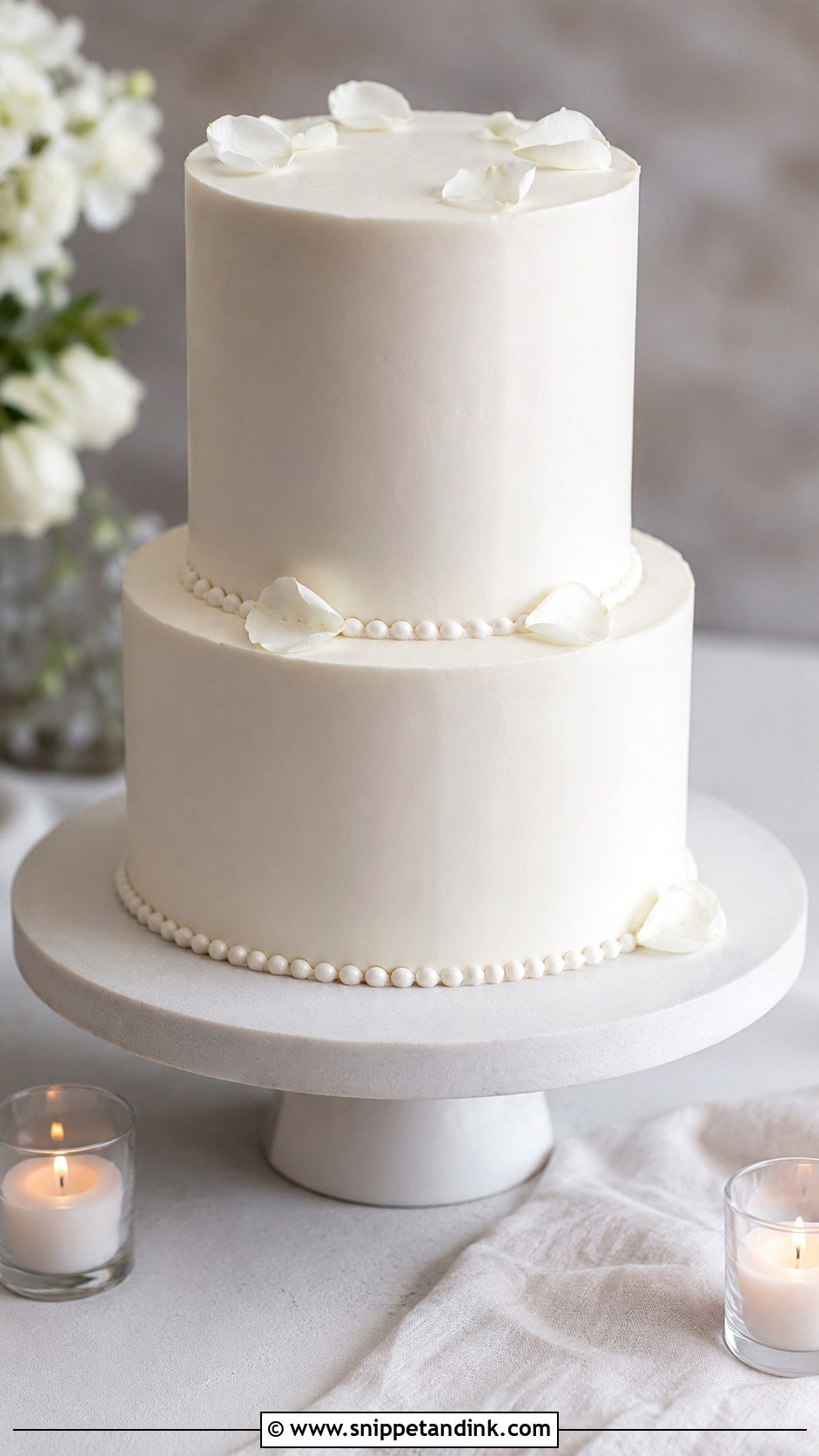
A white cake finished in Swiss meringue buttercream is less sweet and silkier than the classic American kind. It’s made by heating egg whites with sugar, whipping them into meringue, then beating in butter, which is why it’s never pure white; the butter gives it a pale ivory tone. A tiny touch of violet coloring can neutralize the yellow if you need it brighter. It holds clean sides or soft swoops well. It does soften faster in heat, so keep it indoors and out of the sun.
12. White Wedding Cake With Piped Border
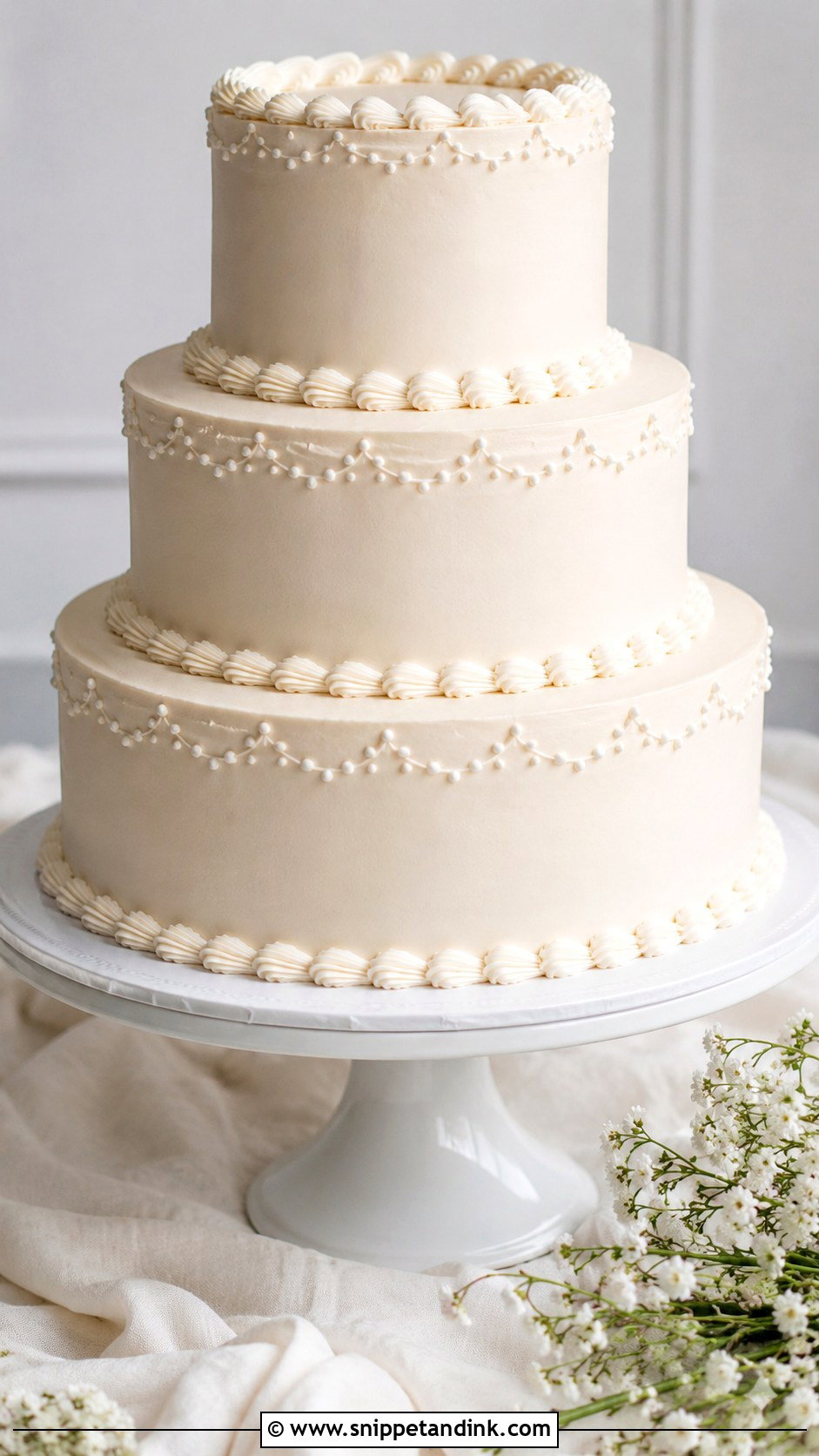
A piped border brings in a classic detail without leaving minimal territory. It might be a tiny shell edge, a row of pearl dots or a thin rope line around each tier. Consistency is everything, so I pipe each tier in one continuous pass at even pressure. A border that thickens and thins is more noticeable than no border. Done evenly, it outlines each tier crisply in photos.
13. White Wedding Cake With Gold Detail
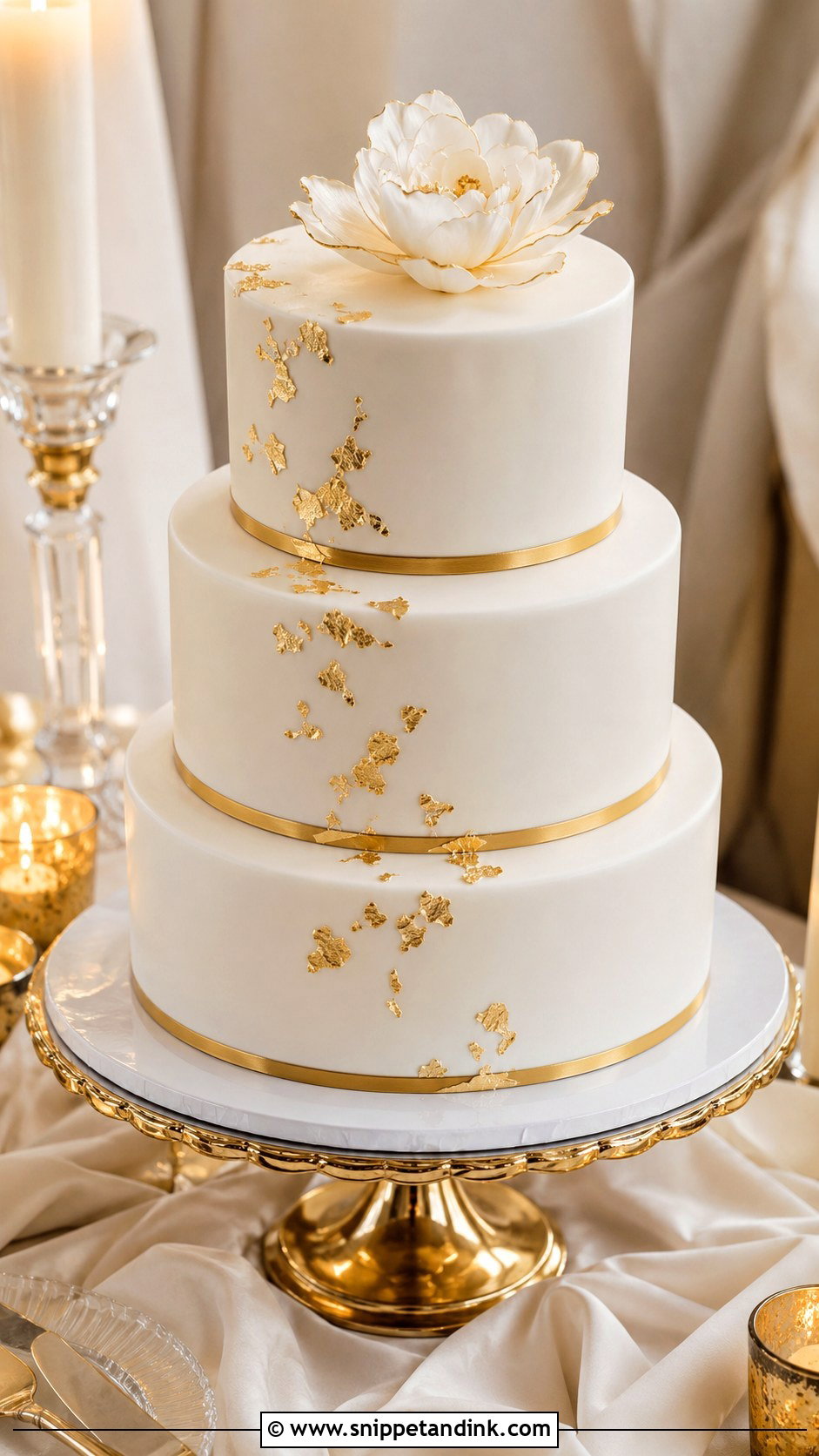
Gold stays minimal if it’s limited to one thin line around a tier, a few flakes on an edge or a brushed touch at the base. I paint it on with edible gold dust mixed into a little clear alcohol, which evaporates and leaves the metallic layer behind. Ask your baker to confirm the gold is labelled edible, not just non-toxic; many craft dusts aren’t meant to be eaten. On an evening reception under candlelight, that small amount of gold warms the whole cake.
14. White Wedding Cake With White Roses
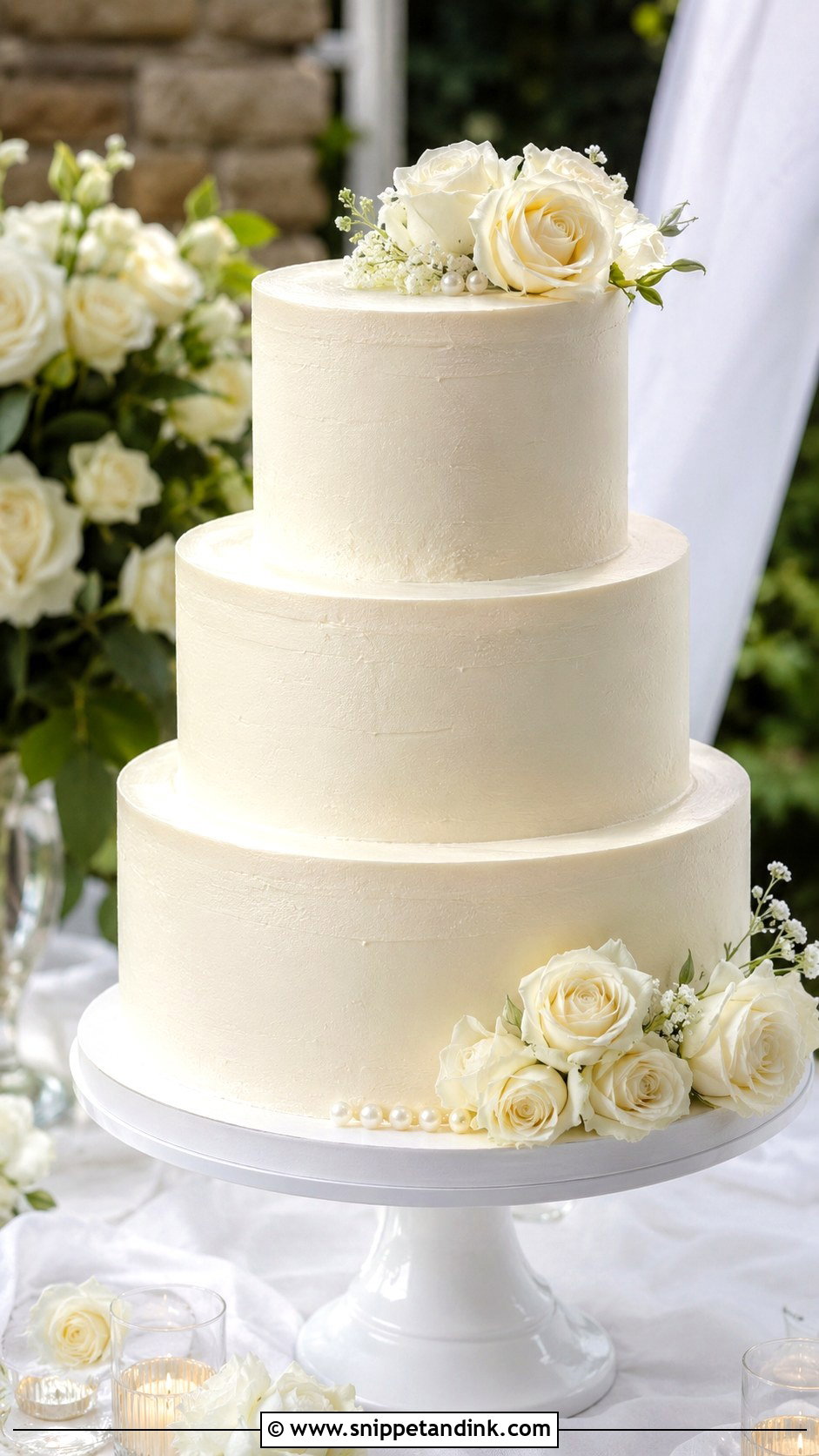
White roses bring a familiar bridal feel, and keeping them white holds the design back. One rose on the top tier, a few at the base or a small diagonal arrangement is plenty. Match the rose to the frosting, because a bright white rose beside ivory buttercream makes the cake look yellowish. Wrap the stems or use picks, as with any fresh flower. It suits a church hall reception as easily as a garden tent.
15. White Wedding Cake With Orchids
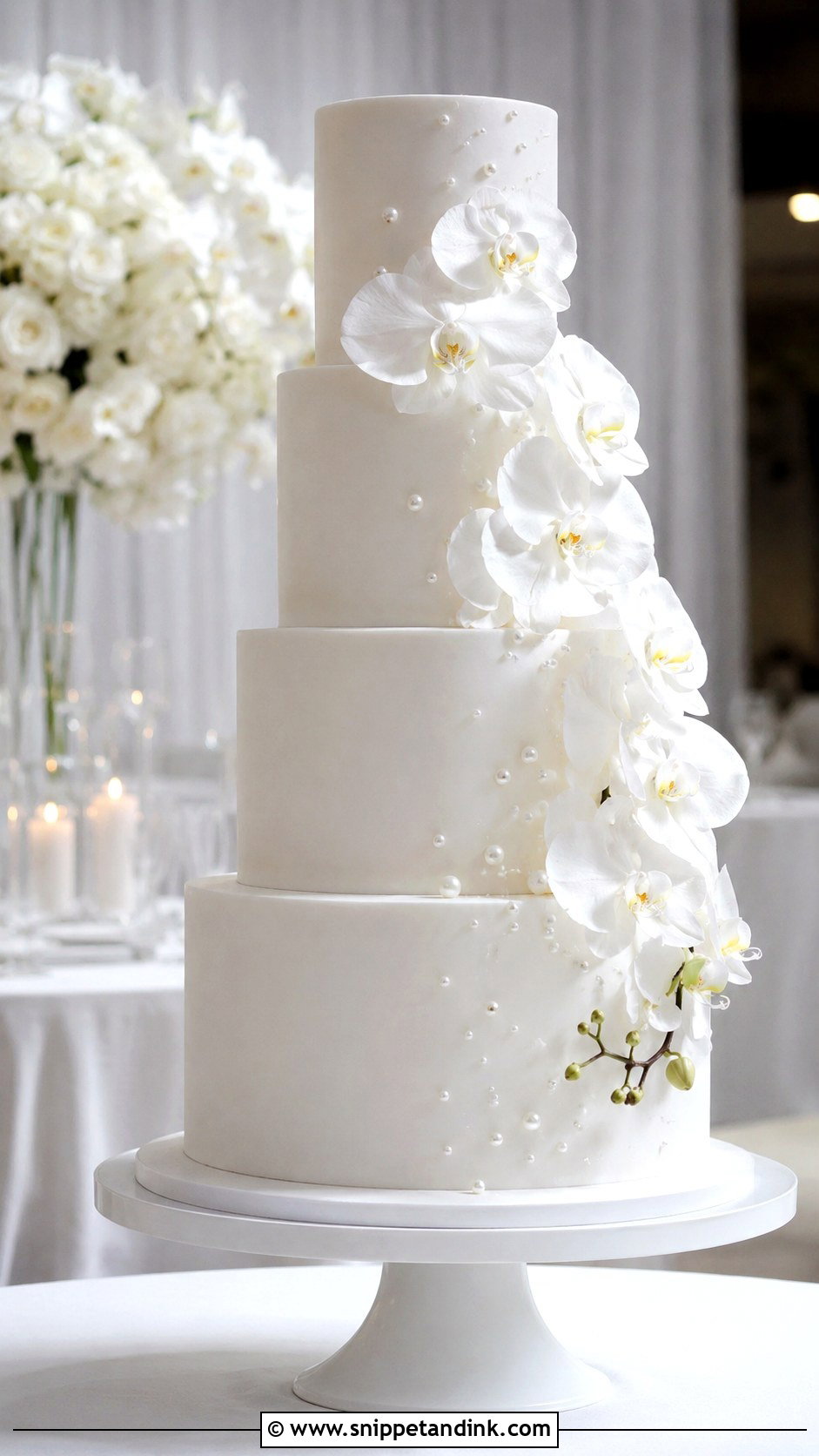
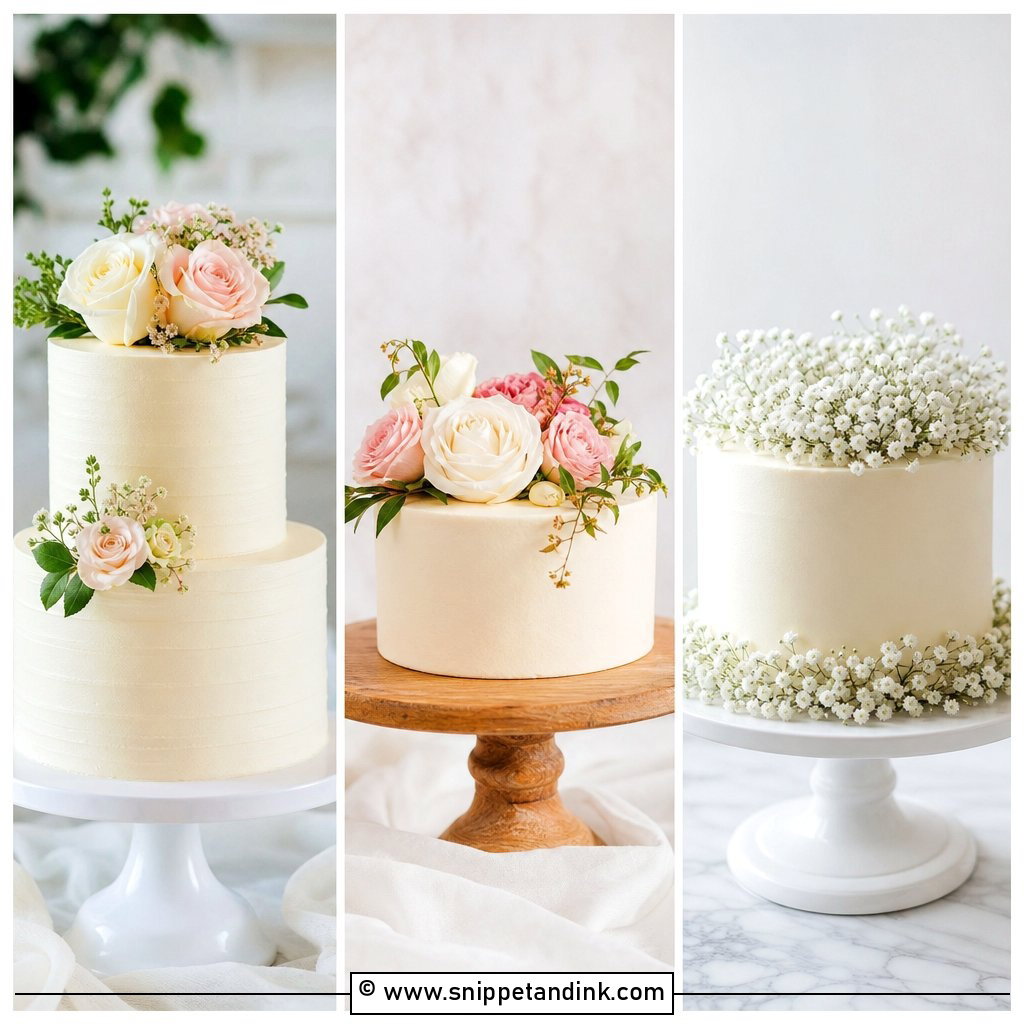
Orchids are sculptural, so a few stems do all the styling. White phalaenopsis look especially clean against smooth buttercream or fondant, trailing lightly down one side or clustered near the top with the rest left plain. The blooms bruise easily and dislike cold, so they should go on just before guests arrive rather than spending the night in the fridge with the cake. Destination weddings and city receptions suit this one.
16. Square White Wedding Cake
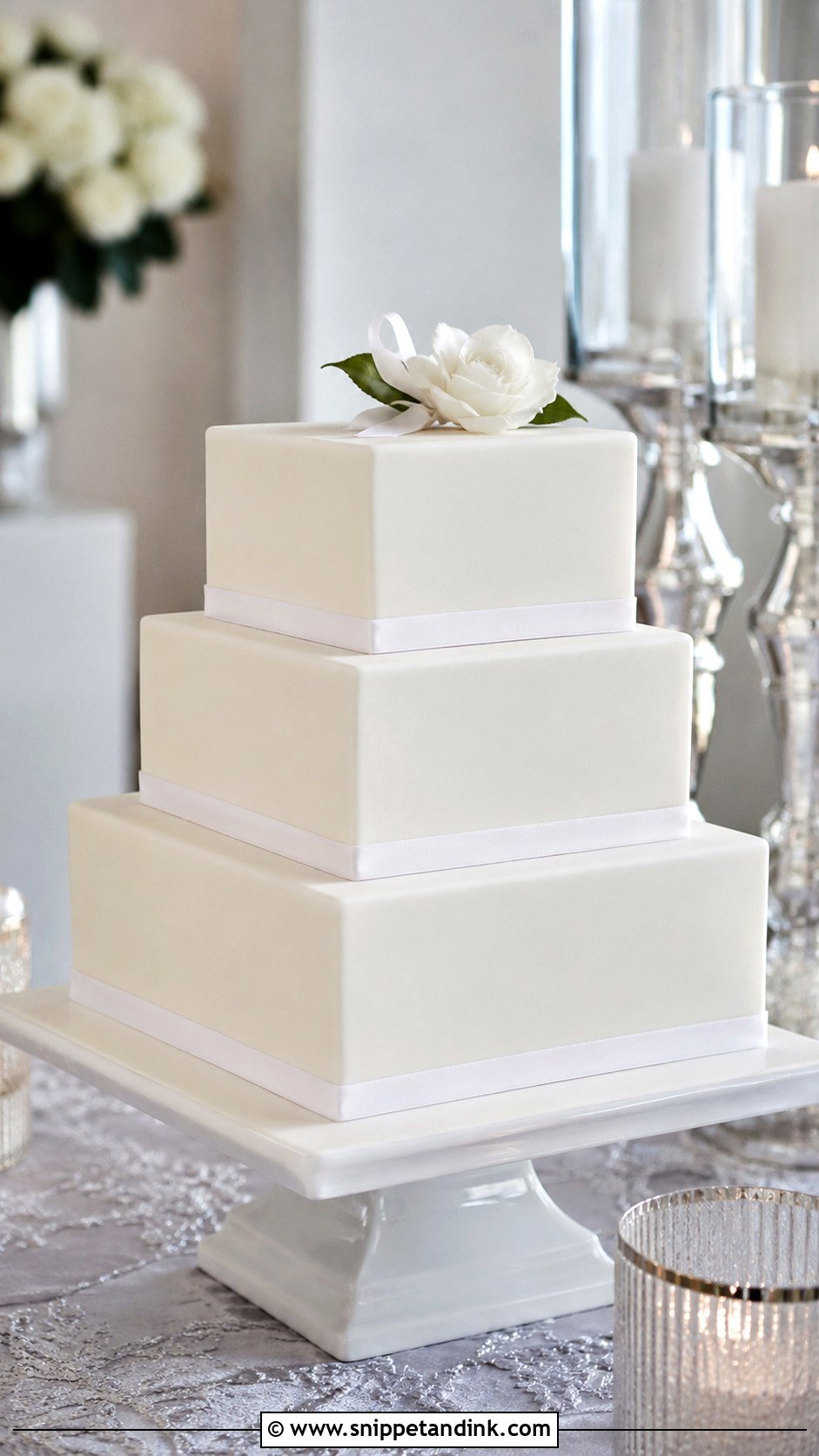
A square cake makes its impact through shape alone. Sharp corners and clean lines look architectural even with almost no decoration. Fondant over ganache gives the crispest corners. Buttercream can work, but corners are the hardest part to keep sharp, so ask to see your baker’s previous square cakes before booking. Square tiers also cut into neater portions, and slightly more of them, than round tiers of the same width. Galleries, lofts and contemporary venues are its natural home.
17. Round White Wedding Cake
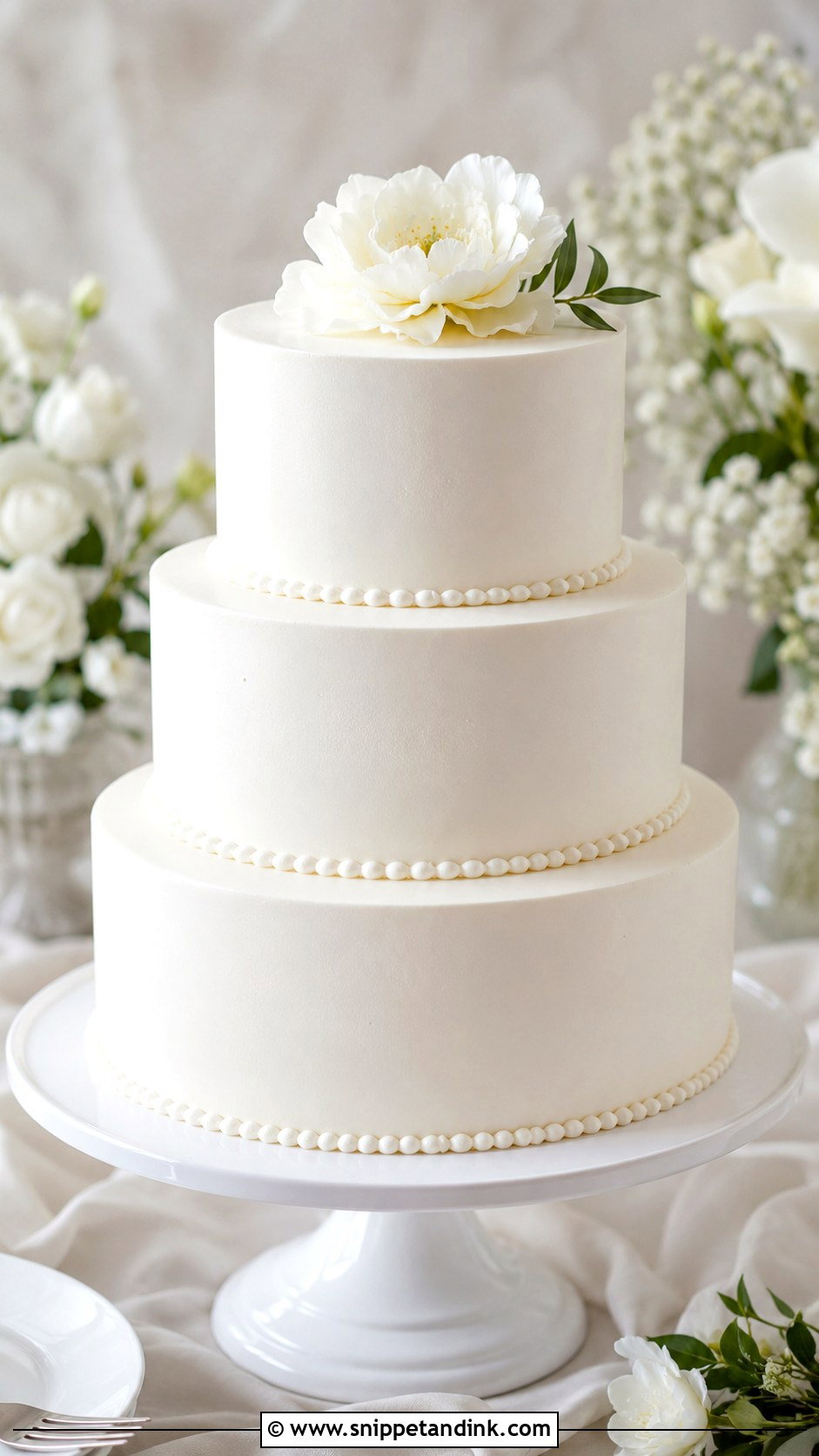
Round is the familiar shape for a reason: it looks balanced from every side, so it works whether the cake sits against a wall or in the middle of the room. Keep the frosting smooth, the tiers simply stacked and add one accent, like a piped border, a few pearls or one white flower. A round cake blends into the reception rather than dominating it, which is exactly what many couples want from a minimal design.
18. White Wedding Cake With Draped Fondant
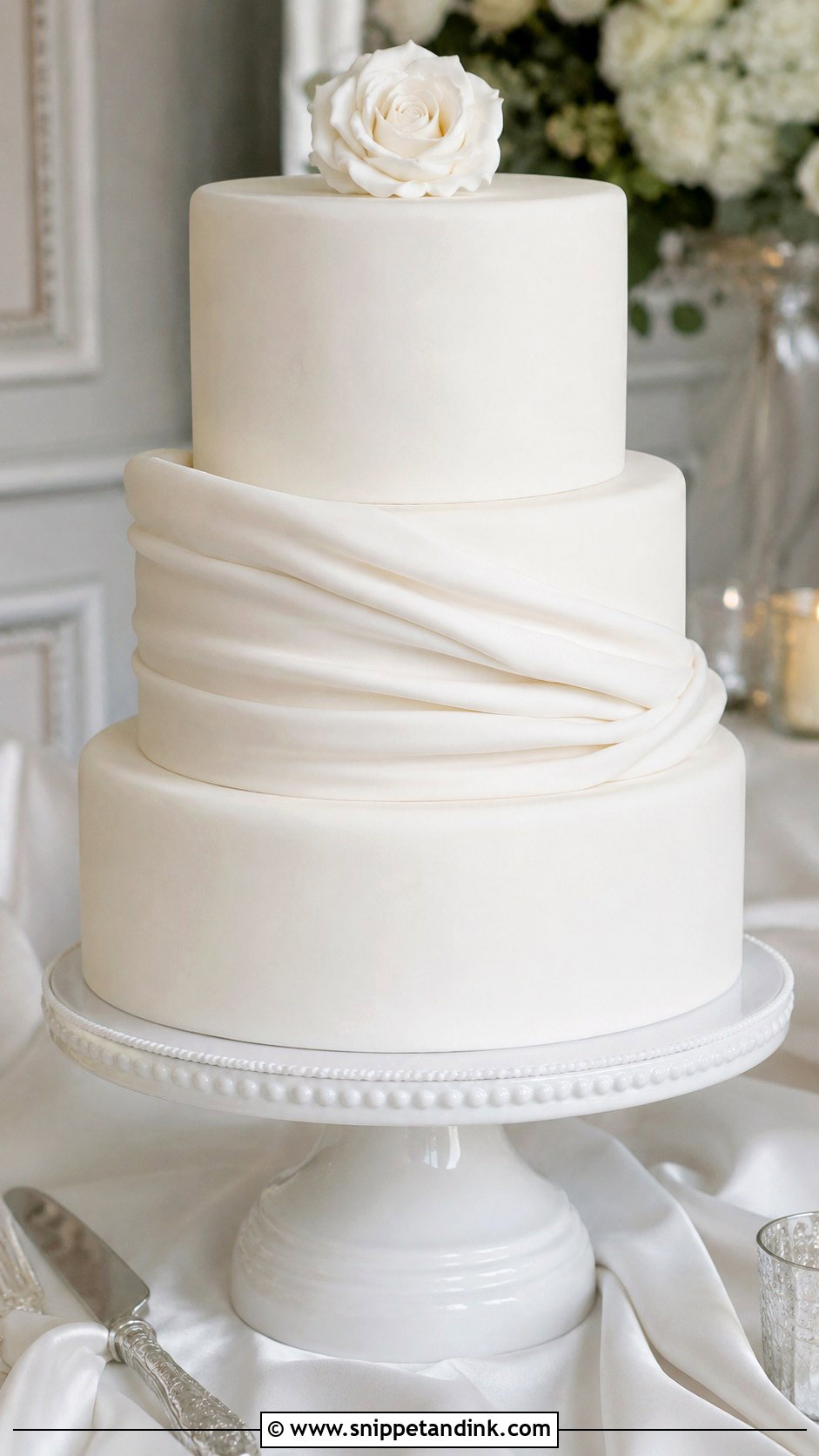
Draped fondant looks like fabric on a clean cake, a folded veil around one tier or a gentle swag along the side. I roll the fondant thin, gather it into soft folds and attach it while it’s still pliable, because once it starts to dry it cracks along every fold. With the color staying white, the texture is the whole detail, so I’d skip extra flowers or pearls. It echoes silk gowns and soft table linens well.
19. White Wedding Cake With Monogram
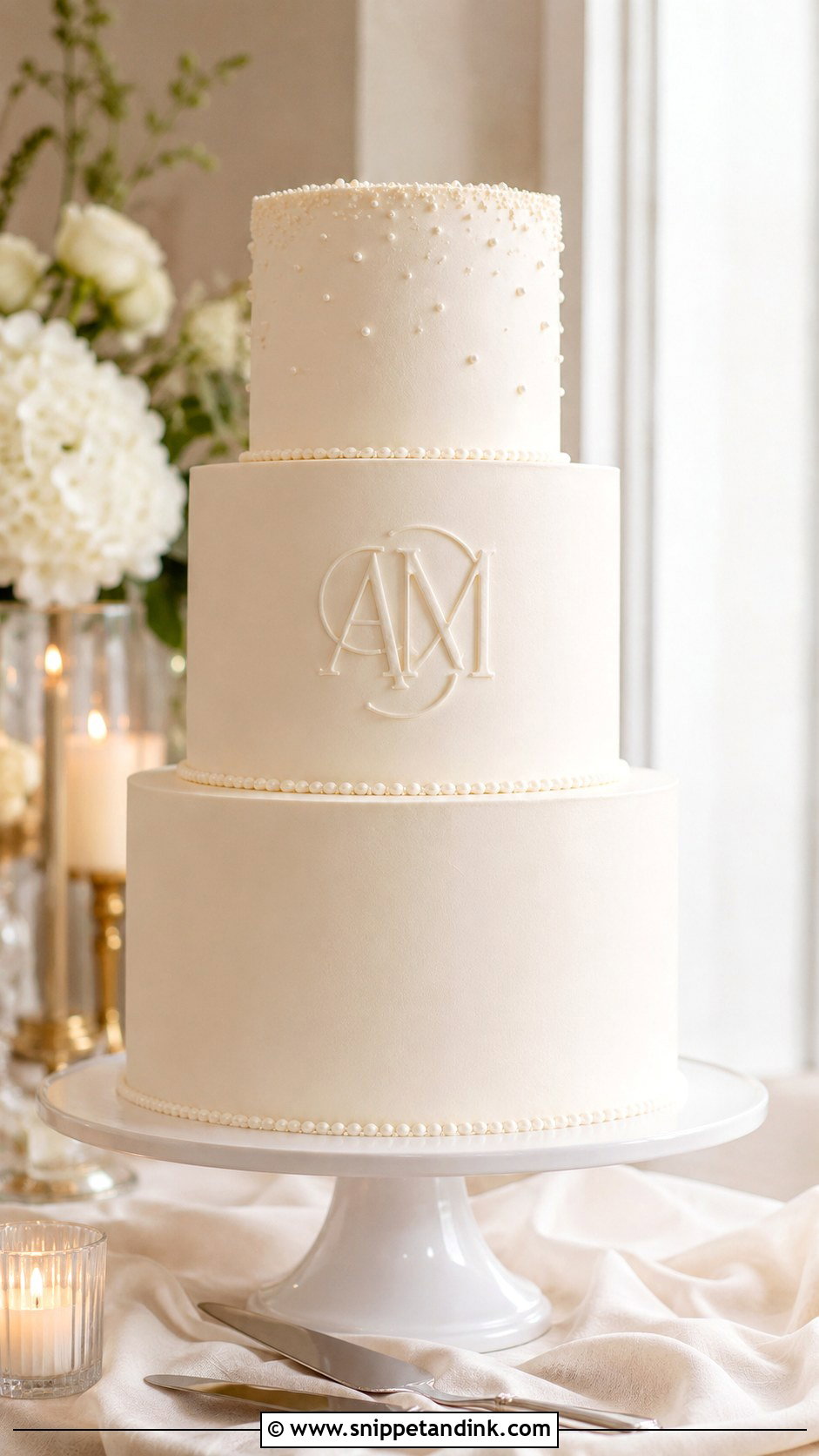
A white wedding cake with a monogram adds something personal without adding color. The letters can be embossed into fondant, piped in white buttercream or added as a small white topper. White-on-white relies on shadow to show, so it needs light from the side. Place it on the front of the middle tier and check where the cake table sits in relation to the windows. Smooth frosting around it keeps the letters legible in photos.
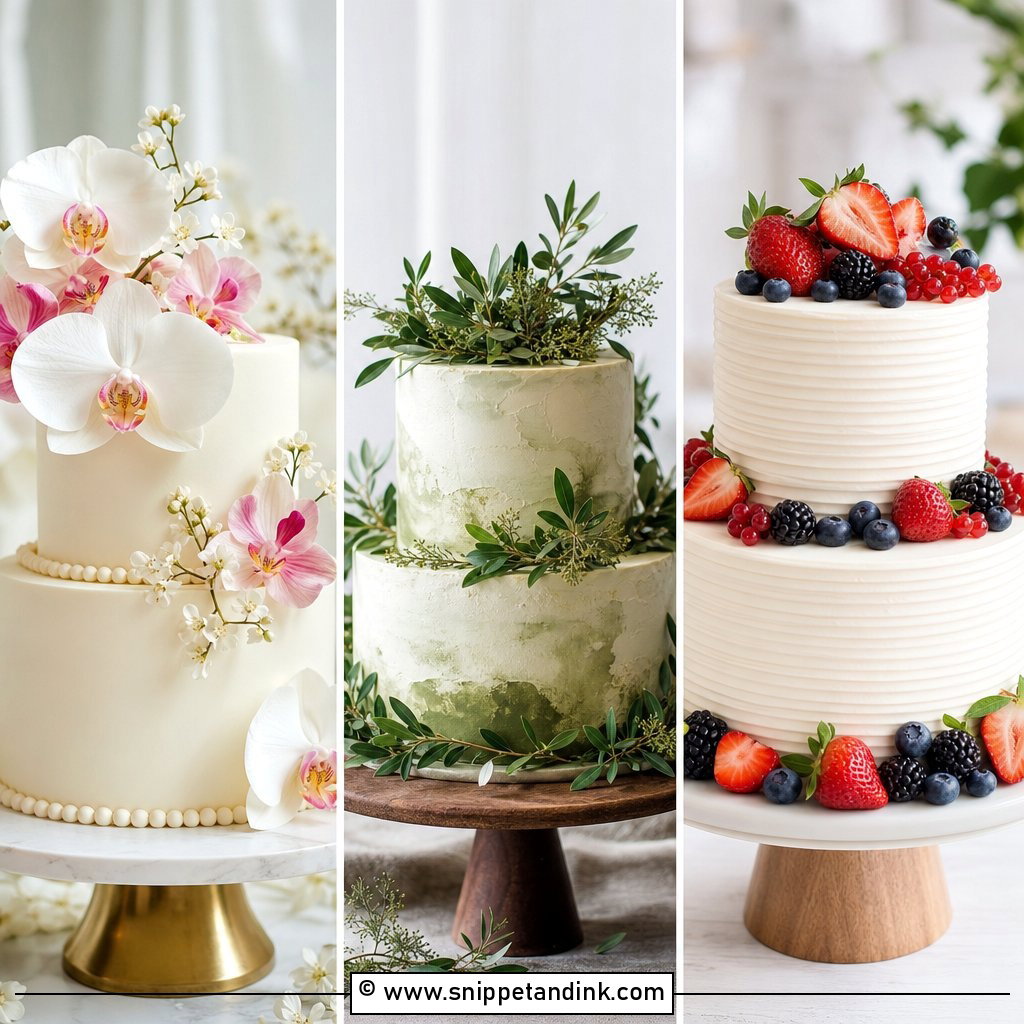
20. Single Tier White Wedding Cake
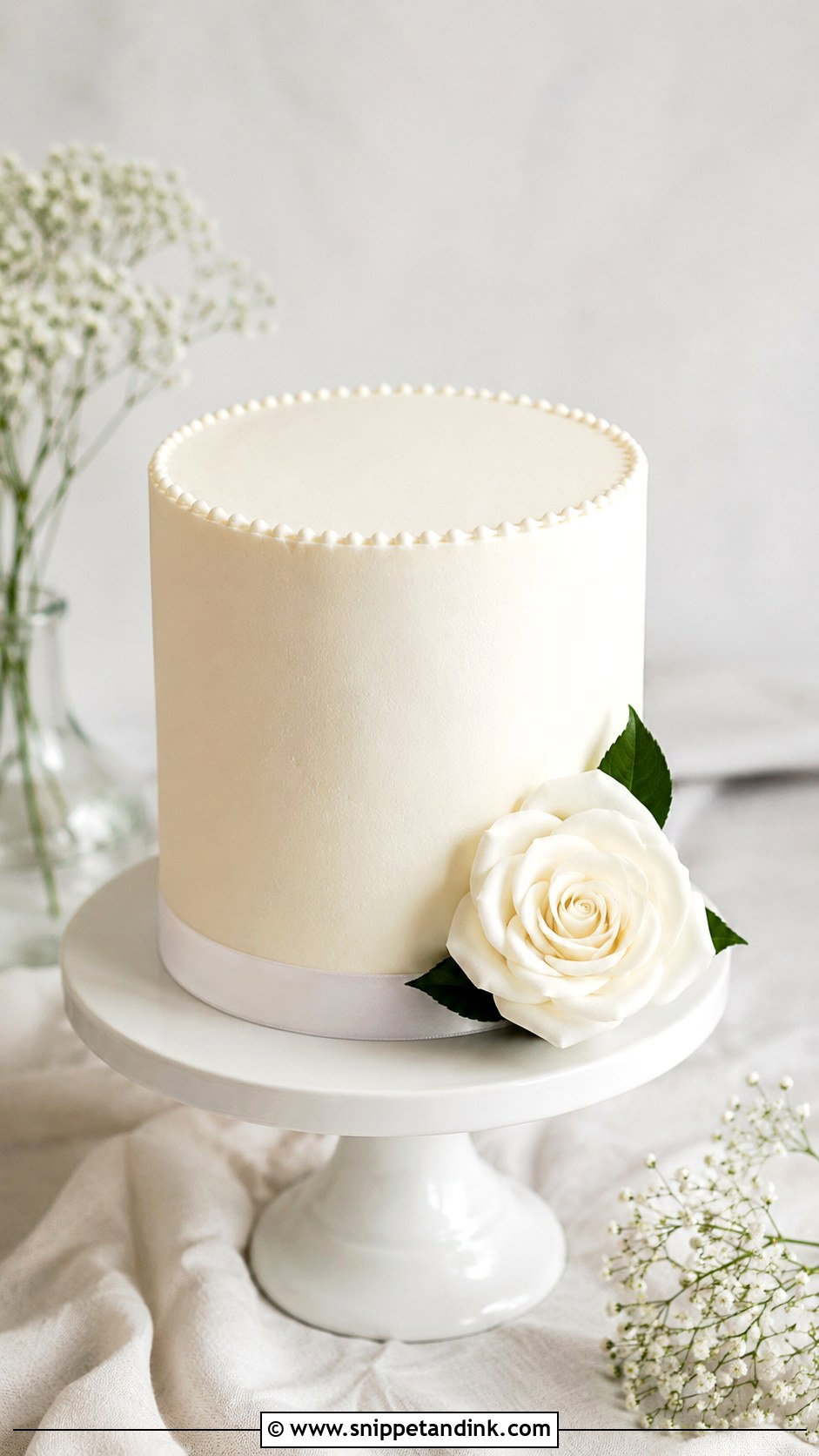
A single tier is the right size for elopements, micro weddings or couples serving a dessert table as well. Make it tall, round and smoothly finished on a raised stand so it still reads as a wedding cake rather than a birthday one. Add one detail, such as a white flower or a satin ribbon. It’s also far easier to transport, with no stacked tiers to shift on the drive. Depending on the diameter, a tall single tier usually serves roughly 12 to 30 guests.
Tiers, Servings and the Delivery Slot
The design conversation is the enjoyable part. These are the practical questions that decide whether the cake arrives as planned.
- Reserve your baker early. Popular cake designers often fill wedding weekends months ahead, and sugar flowers or custom bows add design time on top of that.
- Give a final guest count about a month before. Tier sizes are worked out from portions, and wedding portions are smaller than birthday slices, so the numbers may surprise you.
- Ask about a dummy tier. A foam tier frosted to match adds height for far less than real cake, and a kitchen sheet cake covers extra guests.
- Confirm who delivers, stacks and finishes the cake on site, and when the venue allows access. Tall cakes usually travel as separate tiers and are assembled at the table.
- Check whether the venue charges a cutting fee and whether its staff will cut and plate the cake.
Shade Matters for White Buttercream in Summer
Buttercream softens as soon as a room warms up, and a cake in direct sun can bulge or slide within an hour. Ask for the cake table to be set away from windows, heaters and stage lighting, and keep it indoors or under cover at an outdoor reception. Fondant over ganache copes far better with warm weather. White also shows every fingerprint, so ask the venue team to leave it untouched until the cutting.
One Strong Detail Is Enough on a White Cake
A white cake isn’t a plain cake when the details are chosen with care. Buttercream, fondant, pearls, bows, flowers, texture and sculptural shapes each bring something different to the same palette. Let your venue, your dress, your guest count and the season narrow the options, then keep the finish clean and commit to one strong detail. Everything else on the cake can step back and let it work.
You'll Like These Ideas:





Leave a Reply