
Fresh mehndi trends this year lean toward clean linework and deliberate gaps of bare skin, and I’m glad, because those are the designs that still read clearly once the paste is scraped off and the stain settles. Bold Arabic trails, fine khafif lace, bracelet layouts and full bridal storytelling all sit side by side now. Nobody expects one fixed rule anymore. What I ask every client first is simple: what’s the event, and how long can you sit still? The answers below are grouped so you can match a design to both, from Eid and engagements to the wedding itself.
Matching Coverage to the Event and the Hours You Can Sit Still
Before I pick up a cone, I ask how much time the client has and when the event is. Both change the design more than any trend does. Henna has to stay on the skin for hours to stain well, and the colour keeps developing for a day or two after the paste comes off.
- Under an hour, both hands: finger patterns, a single Arabic trail, a bracelet layout or a minimal mandala.
- One to two hours: Indo-Arabic, shaded florals, full palm, or half-hand work on front and back.
- Bridal, both arms and feet: plan on most of an afternoon or evening for application, plus an overnight wear of the paste. Bring someone to feed you and hold your phone.
- For any event that matters, apply one to two days ahead. A stain is at its darkest roughly 24 to 48 hours after the paste is removed, not the moment it comes off.
If you only have a few hours before the event, choose a design that looks good in orange. Light, airy patterns read fine at that stage; heavy bridal fills look blotchy until they deepen.
1. Arabic Floral Mehndi Design
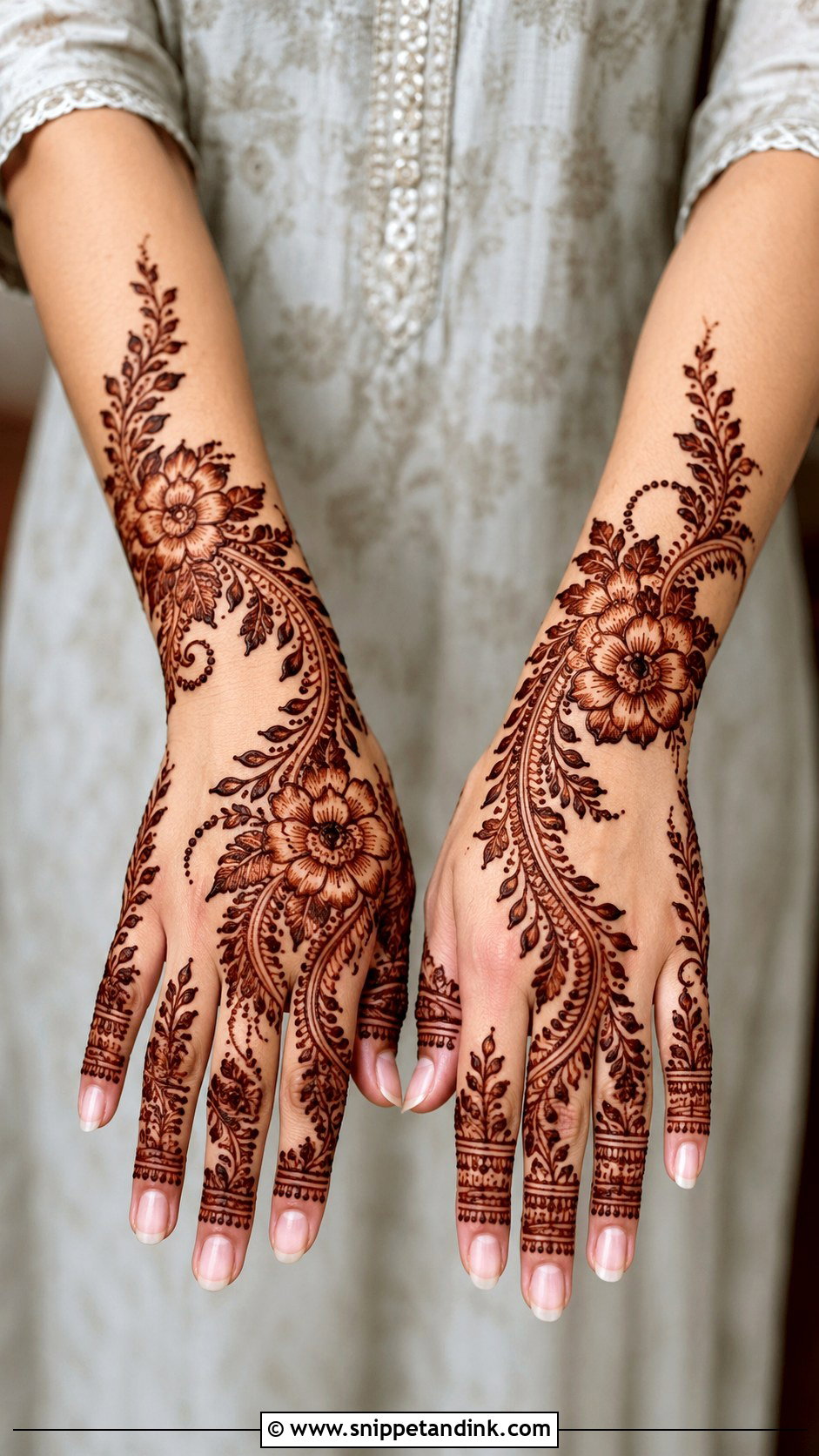
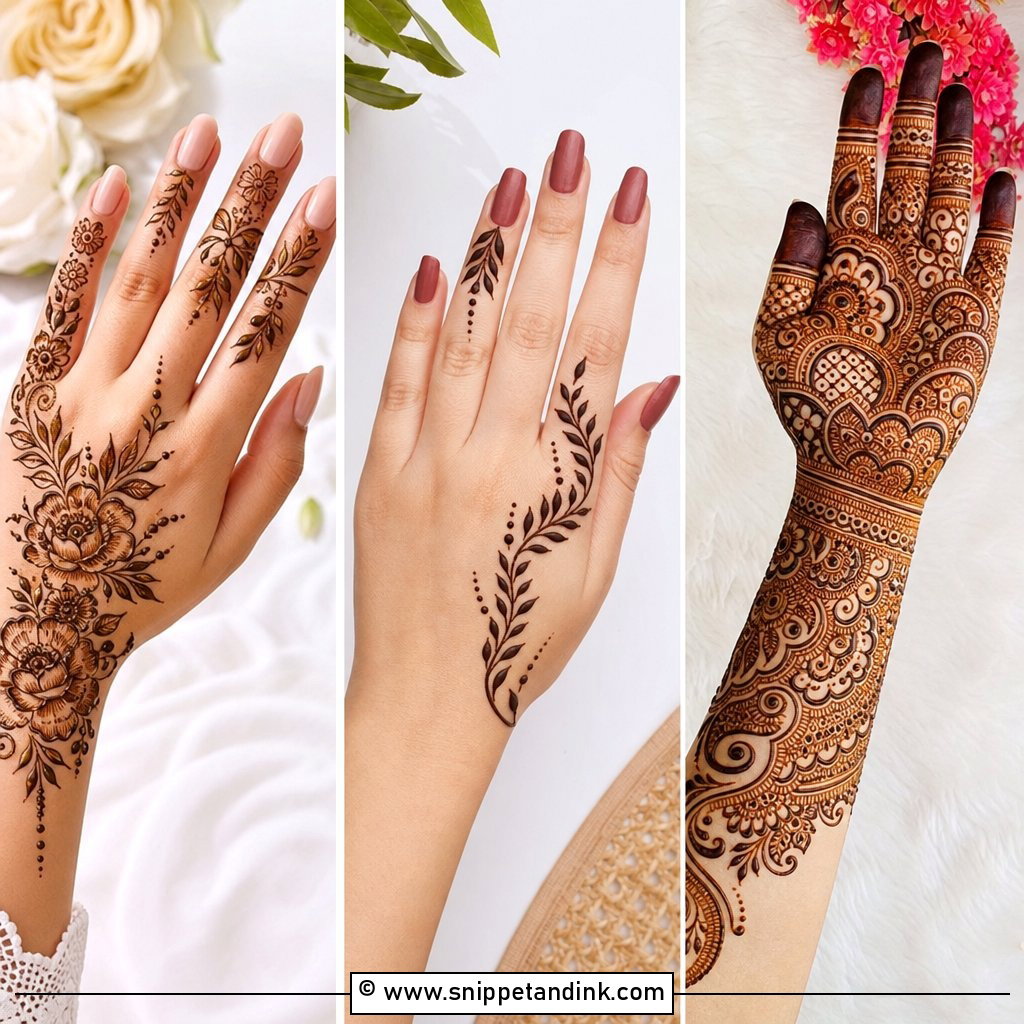
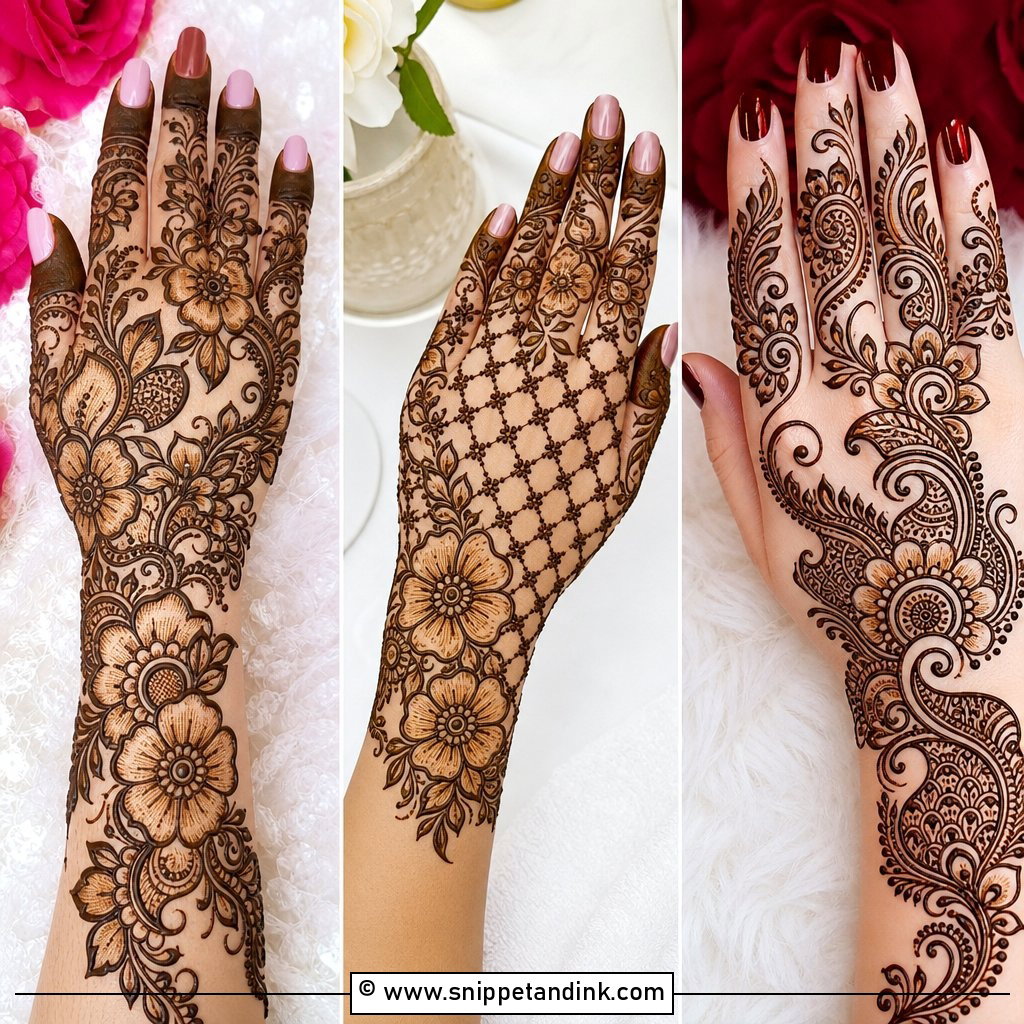
Arabic floral work runs on a diagonal, usually starting at the wrist bone and sweeping toward the index or middle finger, with big open flowers, leafy vines and generous skin left between them. I draw the main trail first in one continuous movement and only then fill the fingers with small leaves and half-flower bands, otherwise the balance tips toward the fingertips. It’s quick to apply, often under half an hour a hand, which is why bridesmaids and Eid guests ask for it. Because the spacing is wide, the natural reddish-brown henna stain stands out on every skin tone, light or deep.
2. Simple Front Hand Mehndi Design
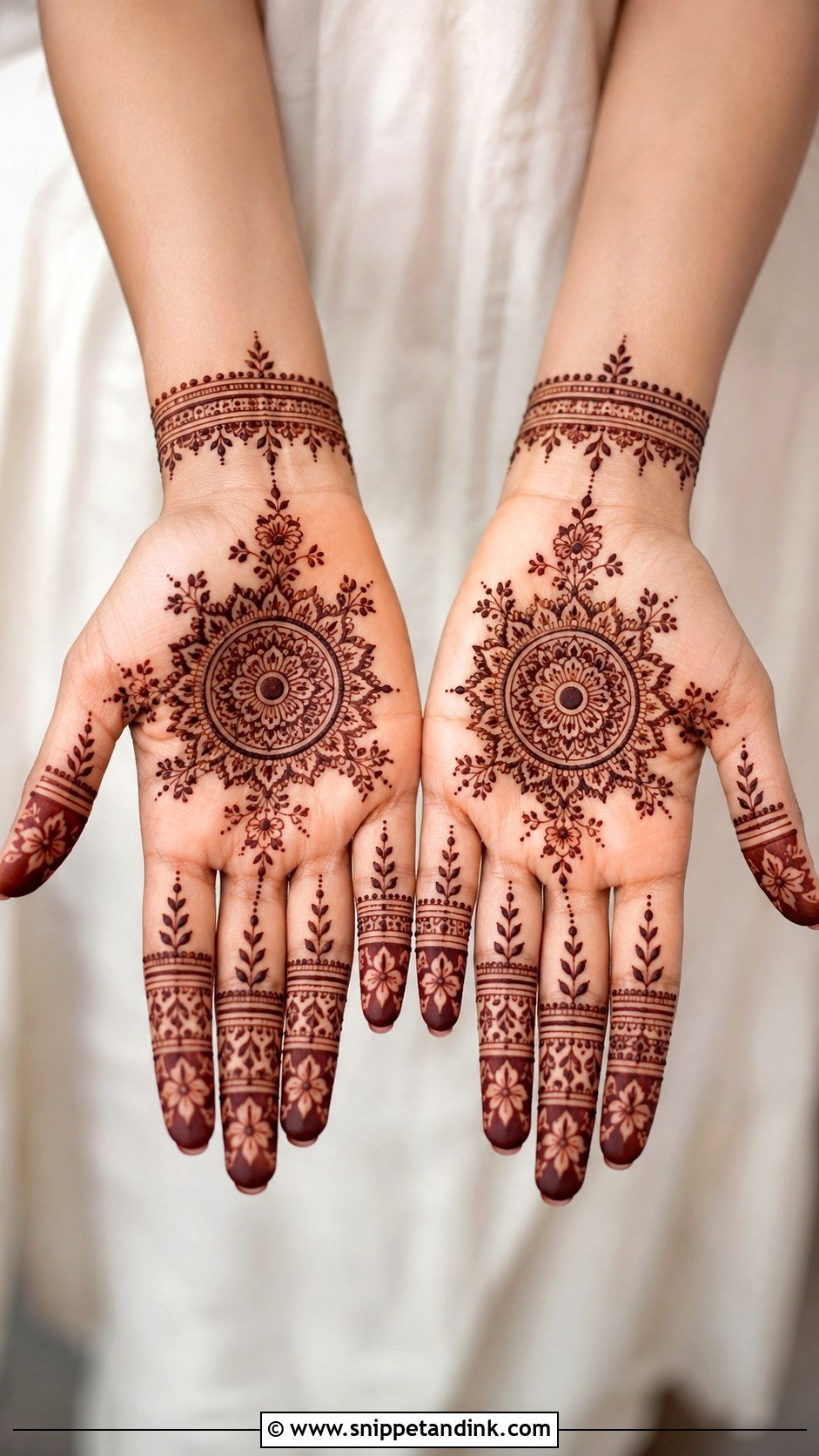
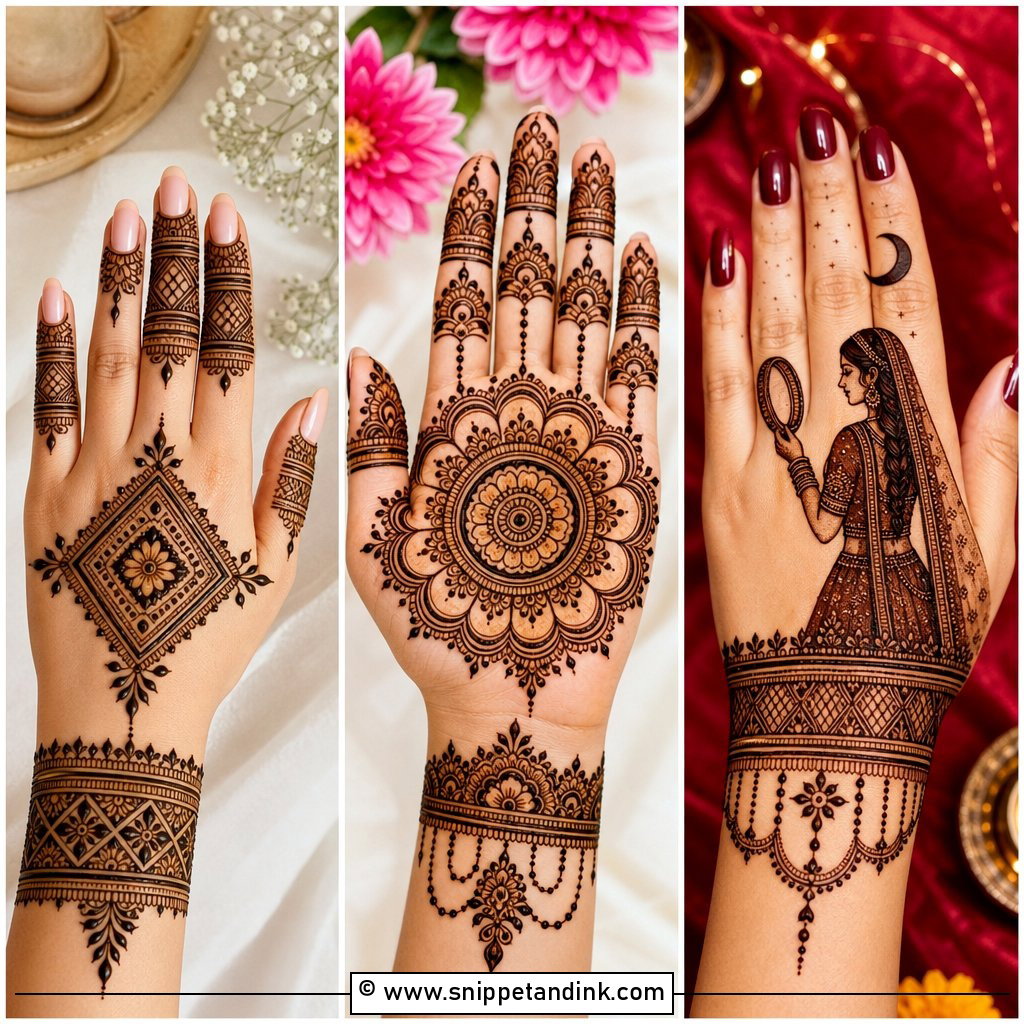
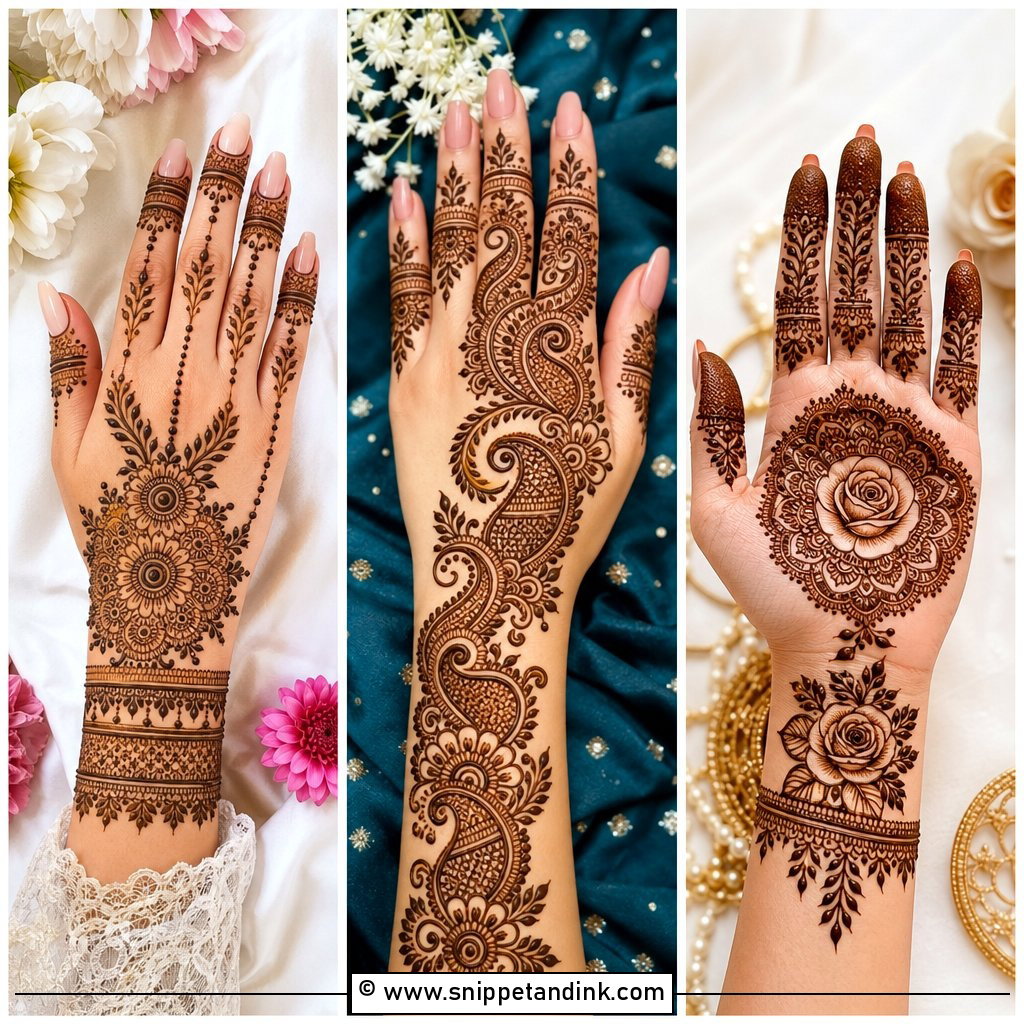
A plain front-hand layout starts with one palm motif, a mandala, flower or paisley, then sends lighter patterns up the fingers. The trap is filling every corner. I keep a clear ring of skin around the central motif so it doesn’t blur when the stain darkens and spreads slightly. Palms take henna faster and deeper than any other part of the hand, so even a modest design comes up rich here. A thin dotted chain at the wrist is enough to finish it for a college event or a small family function.
3. Back Hand Mehndi Design
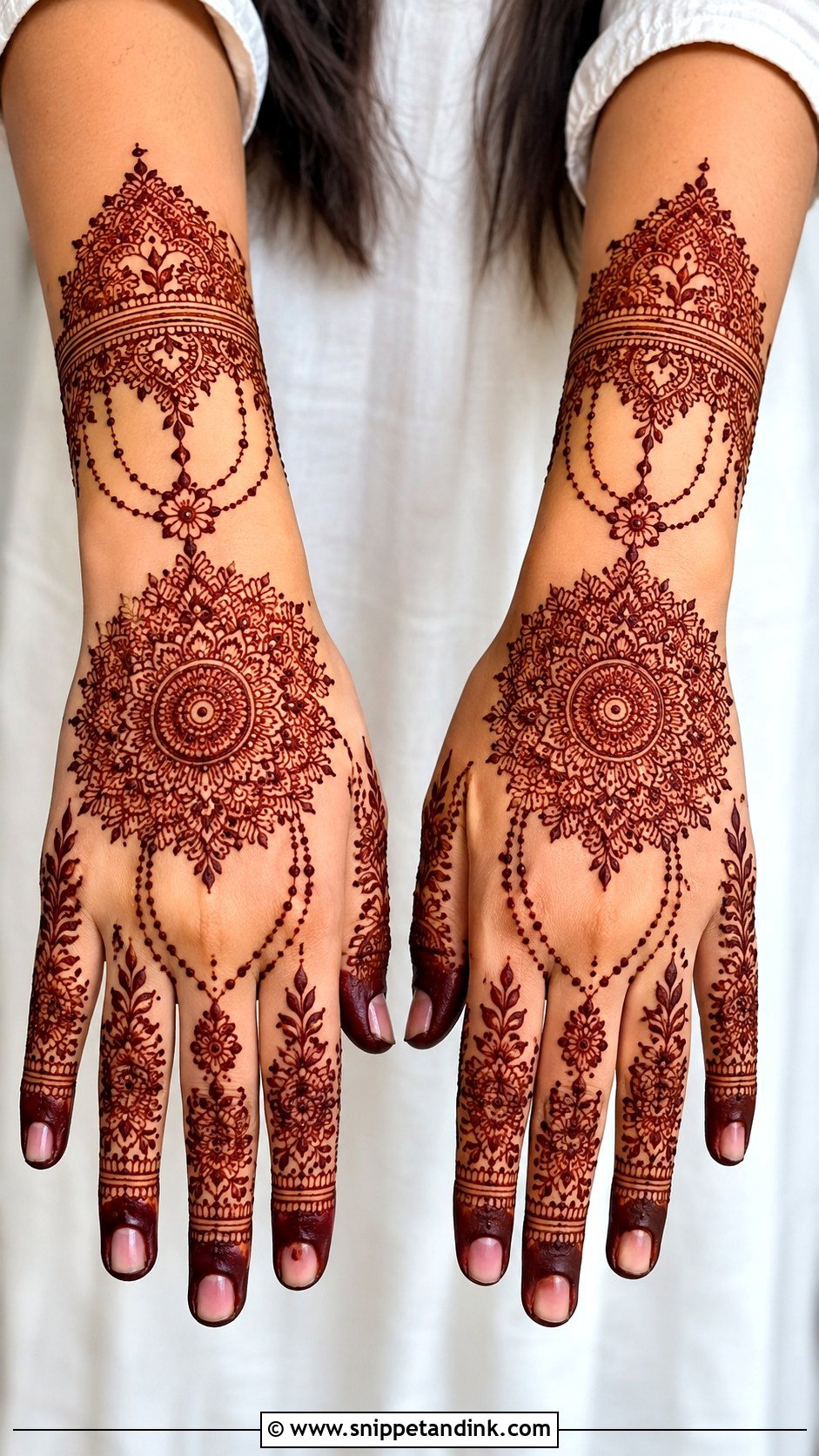
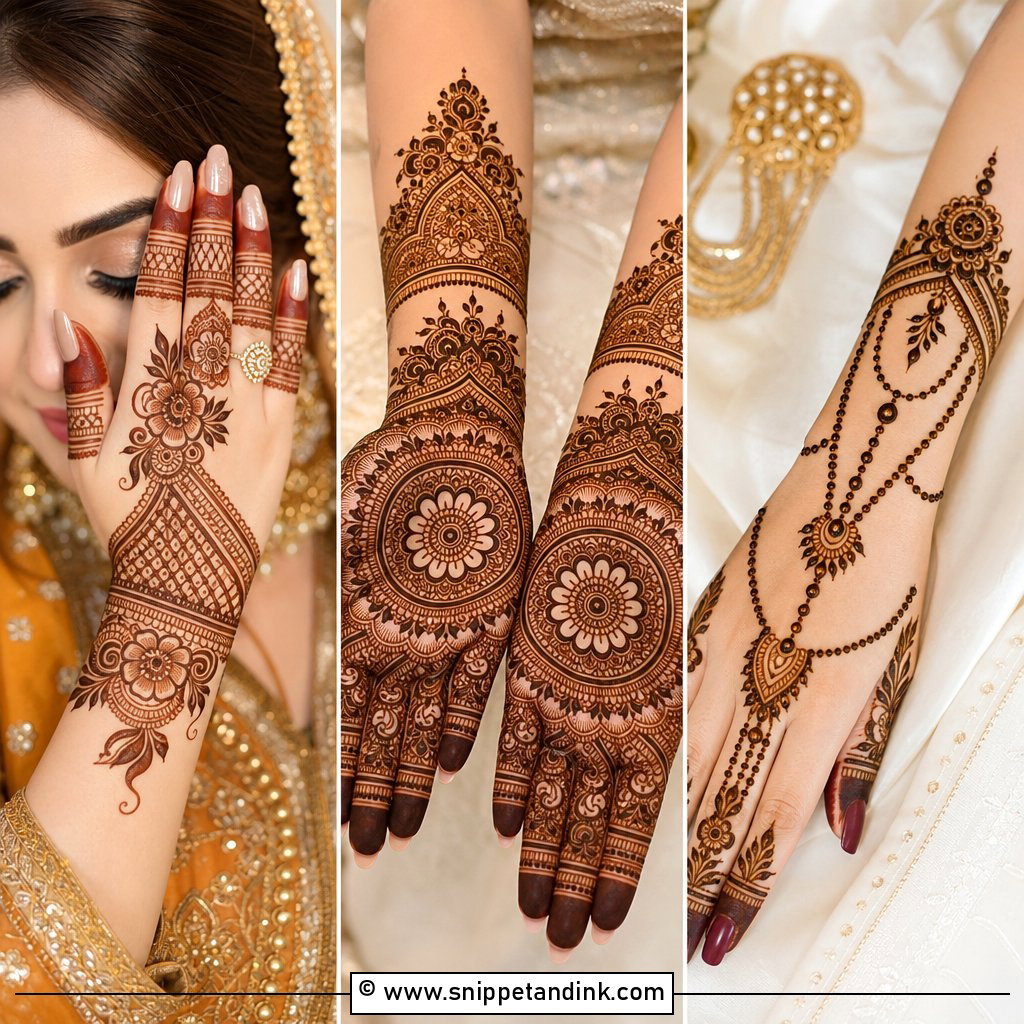
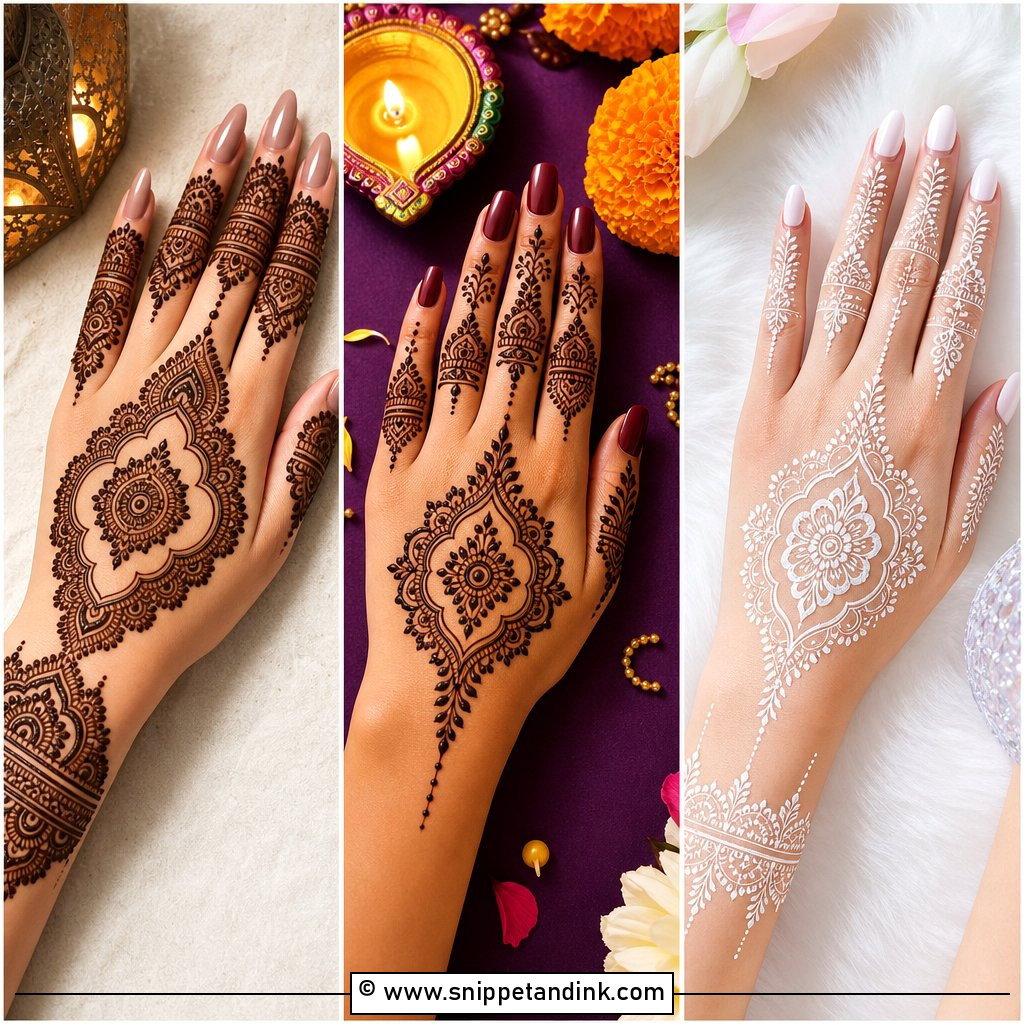
Back-hand mehndi is the one that shows when you’re holding a bouquet, a gift tray or your dupatta, so it earns its place in photos. Typical elements are a central mandala, finger extensions, a wrist cuff and fine connecting lines, drawn in Arabic flowers or a geometric bracelet style. Honest warning: the skin on the back of the hand is thinner and less absorbent than the palm, so the stain lands a shade or two lighter. I compensate with slightly thicker outlines there. The bonus is practical, since your palms stay free for eating and greeting through a long evening.
4. Full Hand Bridal Mehndi Design
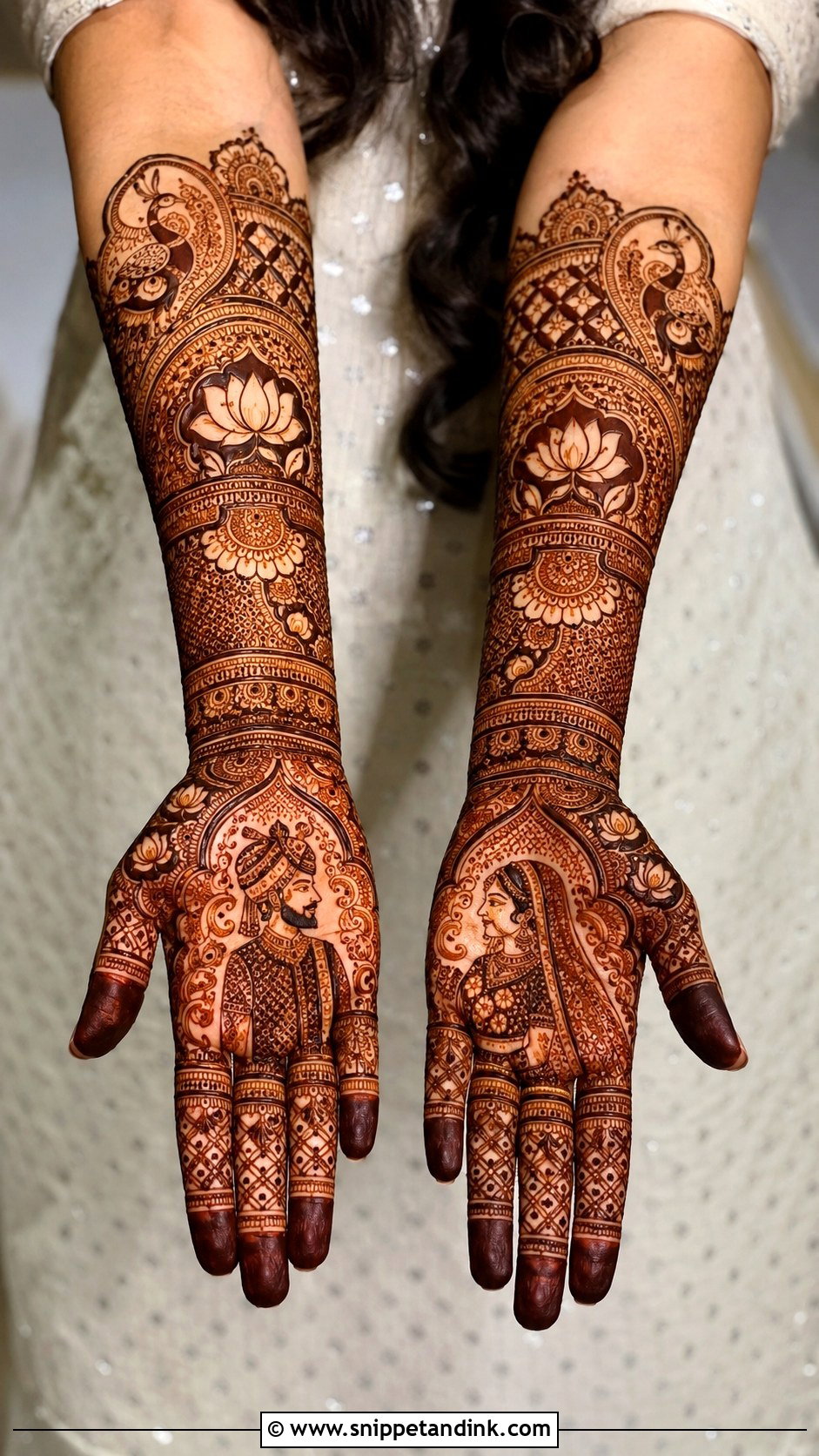
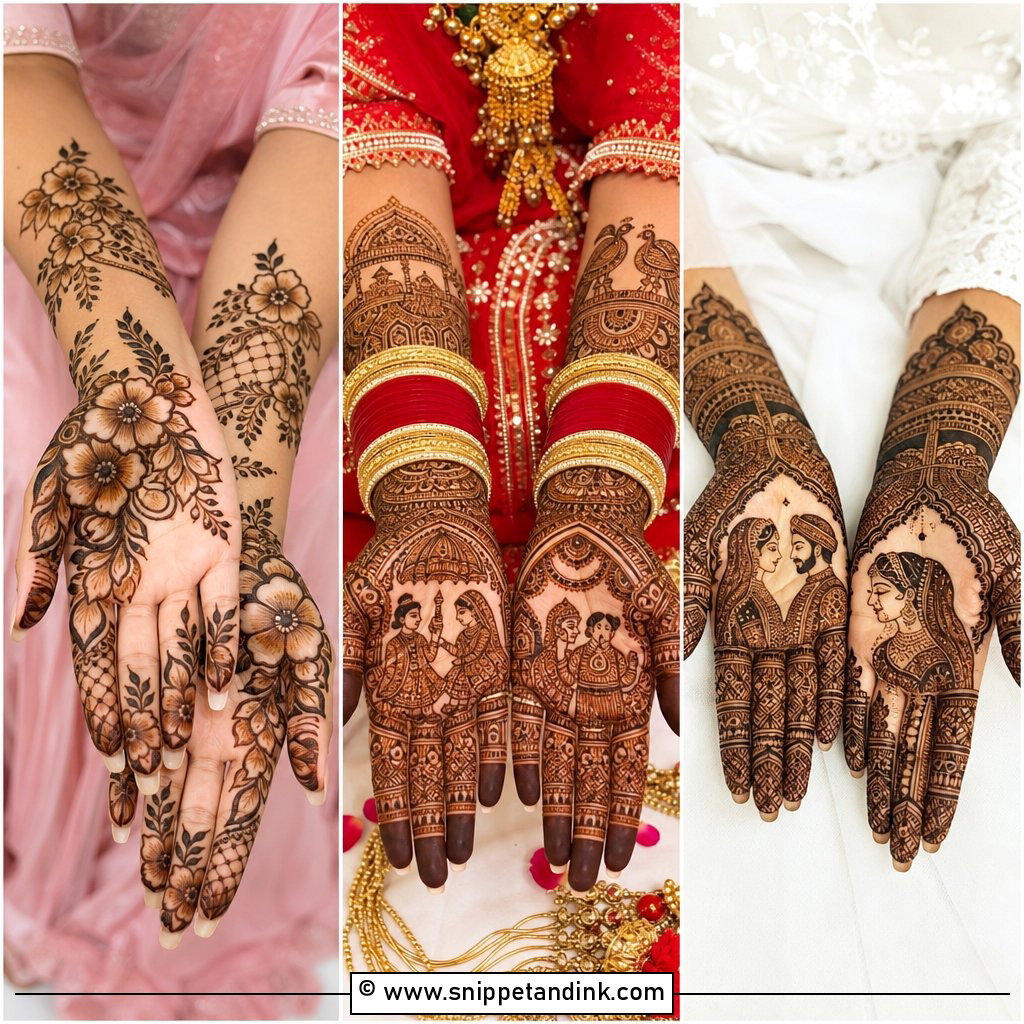
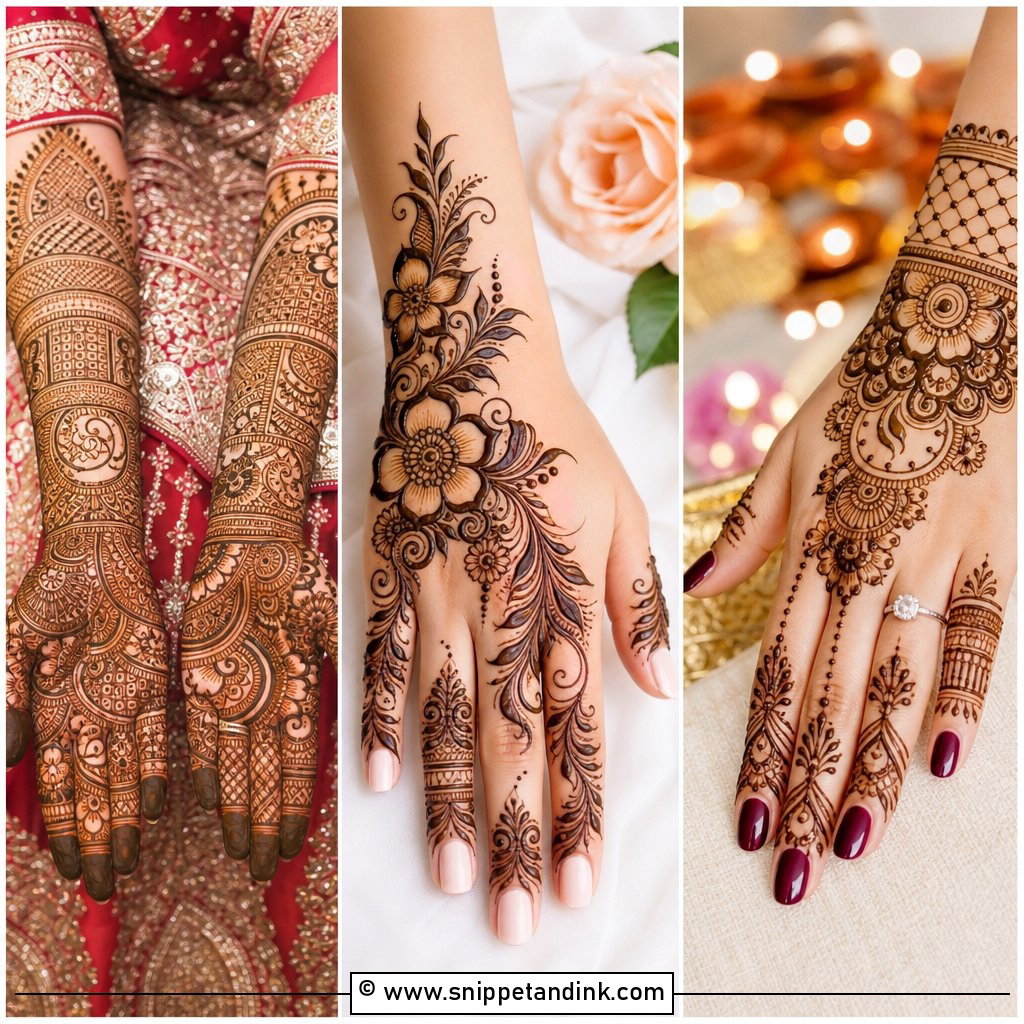
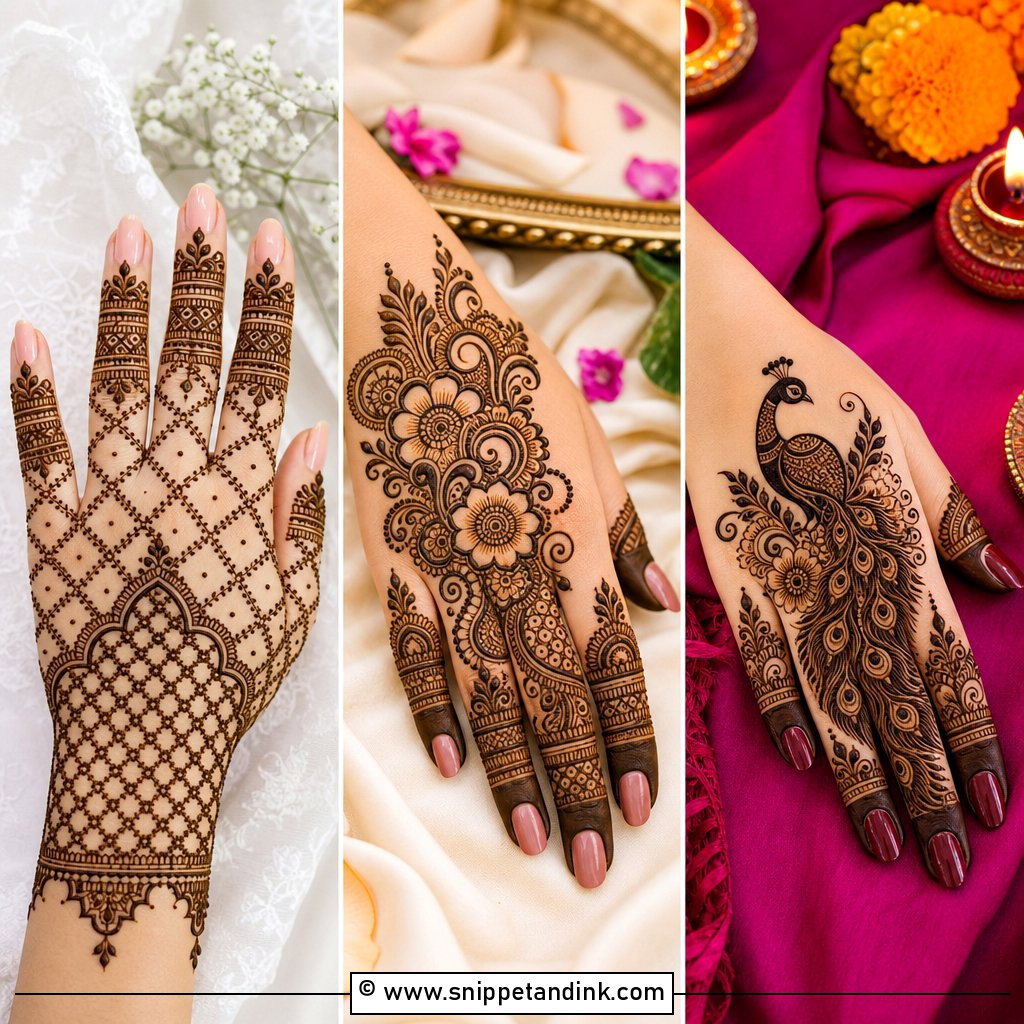
Full bridal coverage takes in the fingertips, palms, wrists and forearms, and the classic vocabulary is paisleys, peacocks, lotus flowers, jaali mesh and the bride-and-groom figures many families still want. What has changed is the organisation. I now divide each arm into clear zones with borders, so a photographer can actually read the story instead of seeing a brown sleeve. Initials, a date or a small symbol from the couple’s life can hide inside a motif. Plan on several hours for both arms and a day of keeping the paste on, so this is never a design to squeeze into the morning of the wedding.
5. Minimal Bridal Mehndi Design
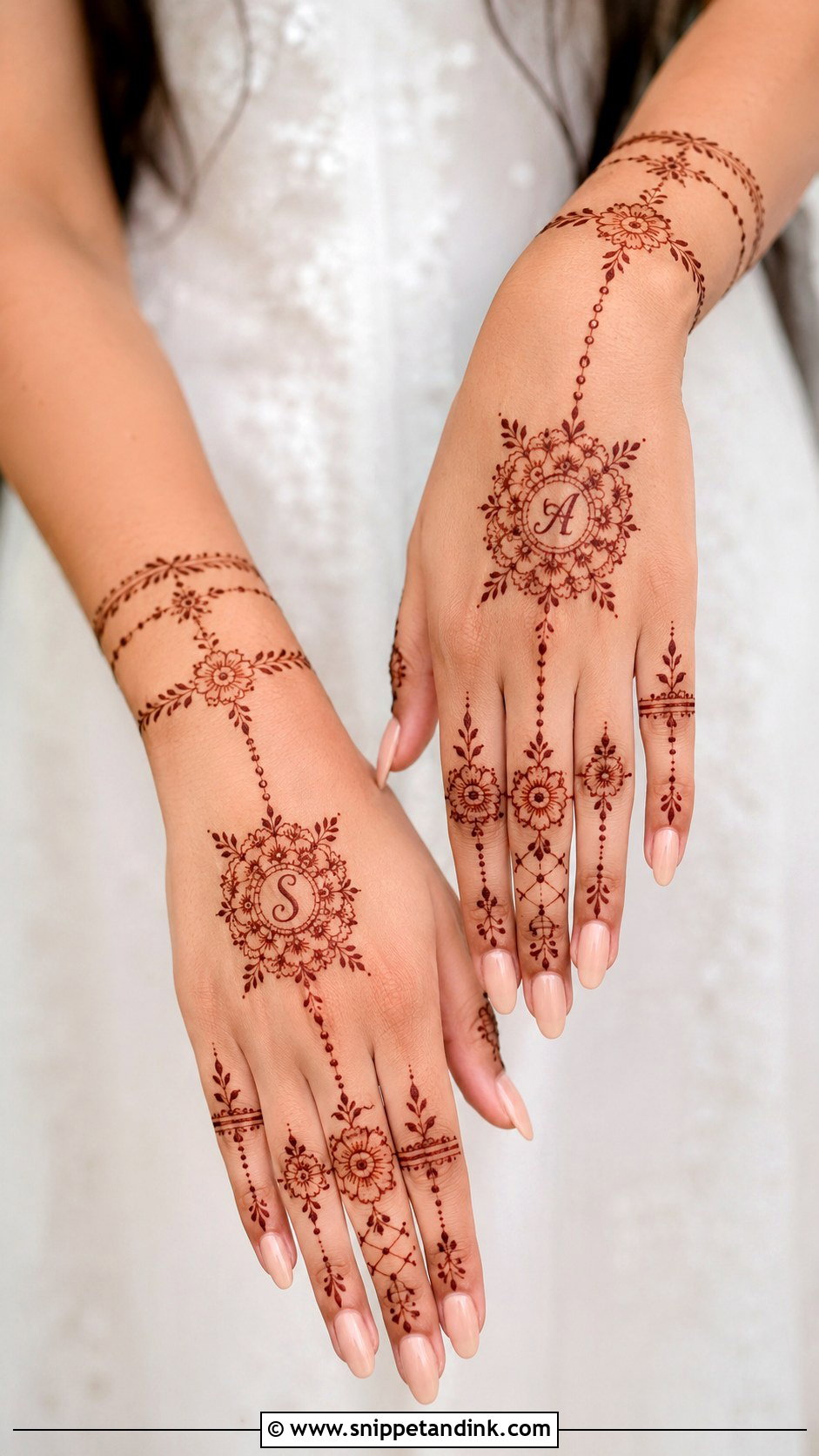
Some brides don’t want henna past the wrist, and that’s a perfectly sound bridal choice. Minimal bridal mehndi concentrates on the palms, fingers and back hand, using thin lines, spaced mandalas and jewelry-like chains in place of dense filling. I find it suits destination weddings and lehengas with heavy sleeves, where forearm work would be hidden anyway. It also lets kaleeras, bangles and rings take the attention. The discipline is placement: with fewer motifs, a single crooked one is obvious, so I sketch the layout on the skin with a very fine line before committing.
6. Indo Arabic Mehndi Design
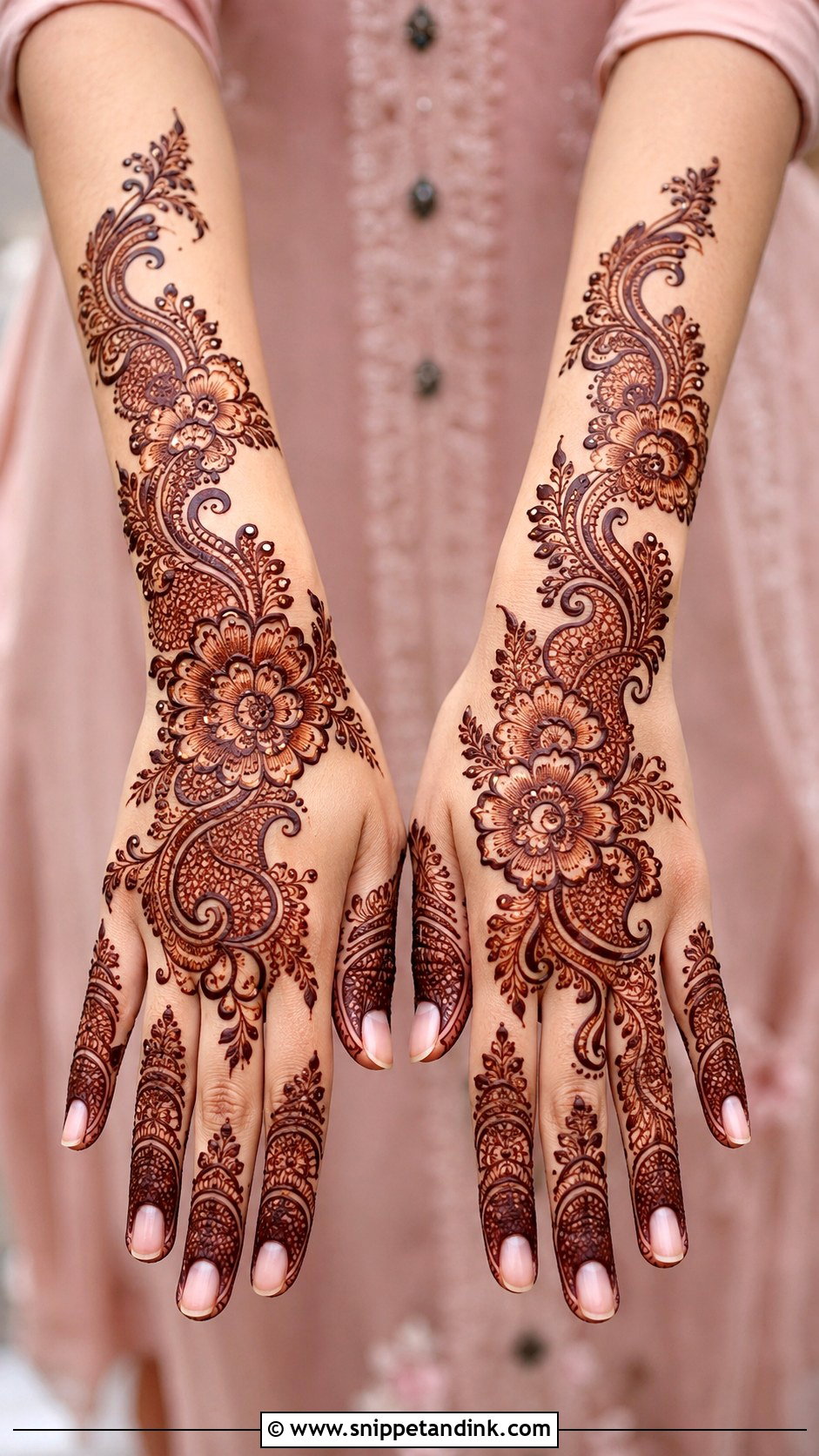
Indo-Arabic is the fusion most of my sangeet and engagement clients land on. The Arabic side gives you movement, a diagonal trail of large shaded flowers, and the Indian side brings depth through paisley clusters, finger caps and small fillers. One common layout begins with a bold wrist motif and travels across the hand. Another puts a palm mandala at the centre and lets Arabic flowers orbit it. Where it goes wrong is when both styles fight for space, so I decide which tradition leads each hand before the first line.
7. Khafif Mehndi Design
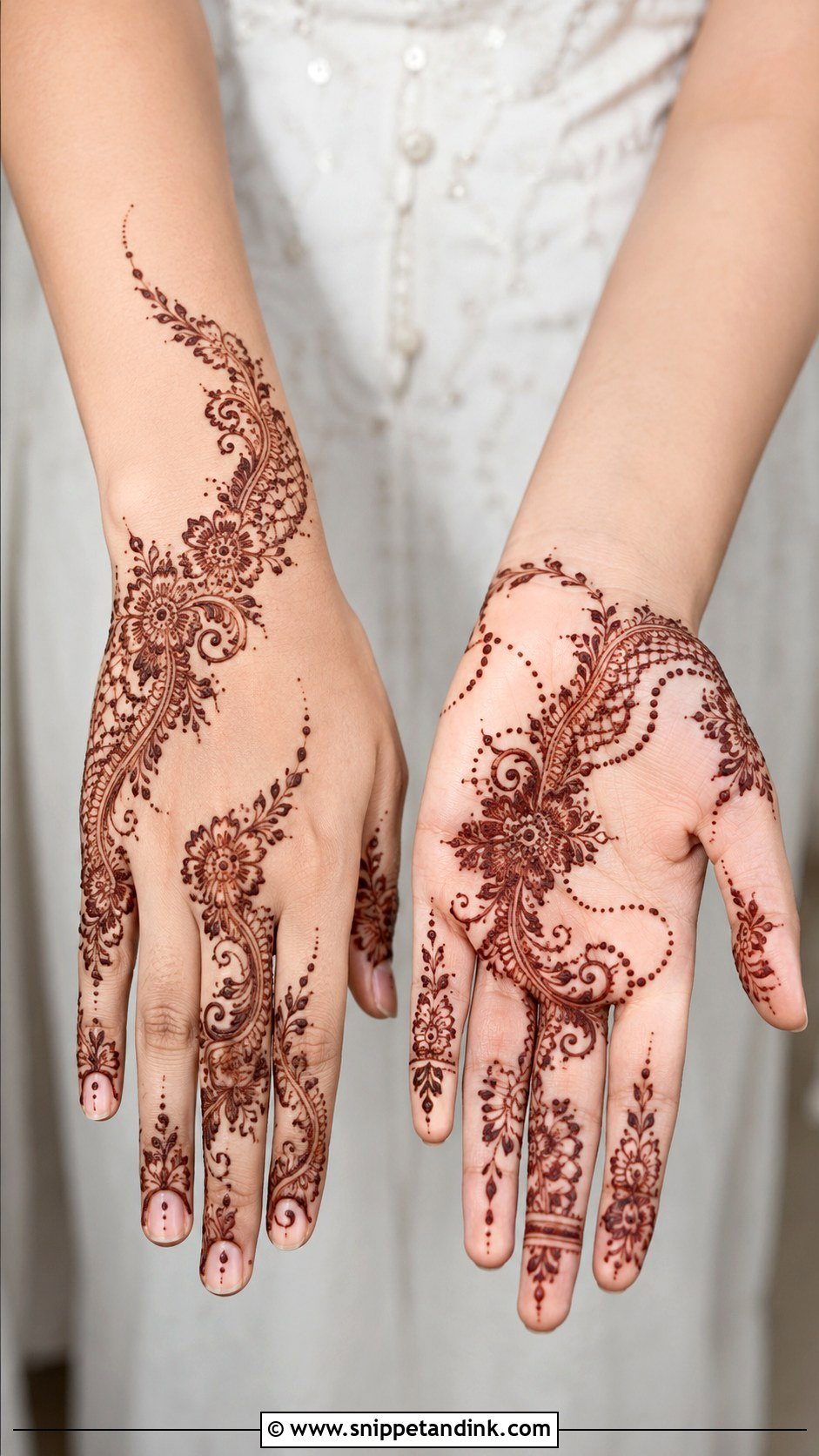
Khafif is fine-line work with a lacy finish: tiny florals, thin vines, dotted trails and curved mesh. It rewards close viewing, which makes it a favourite for nikah functions and Eid evenings. It is also the least forgiving style for the artist. The cone tip has to be cut very small and the paste mixed smooth enough to flow without breaking, and any wobble shows. Very fine lines also stain faintly on oily skin, so I ask clients to wash with plain soap and skip hand cream before we start.
8. Mandala Mehndi Design
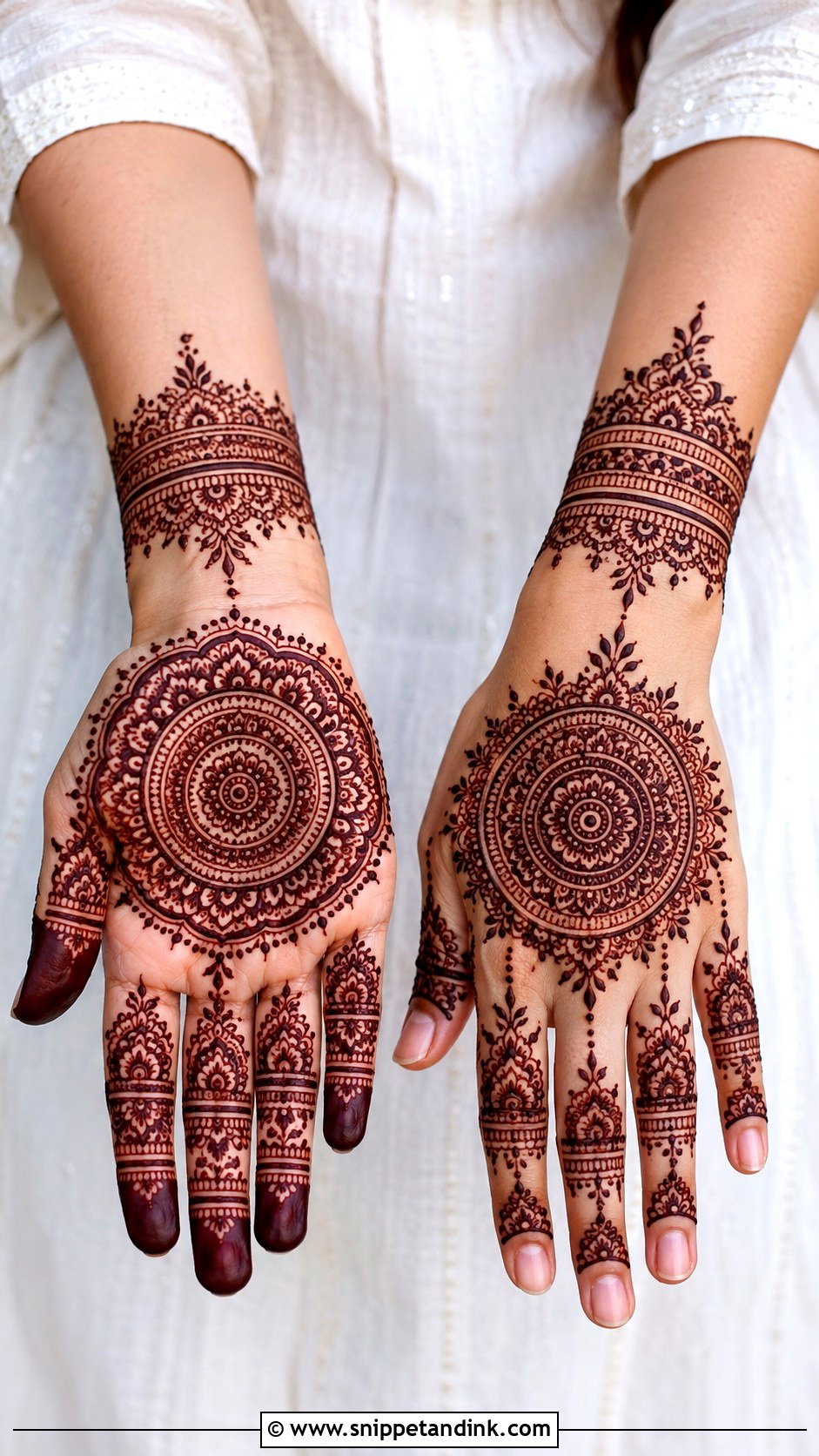
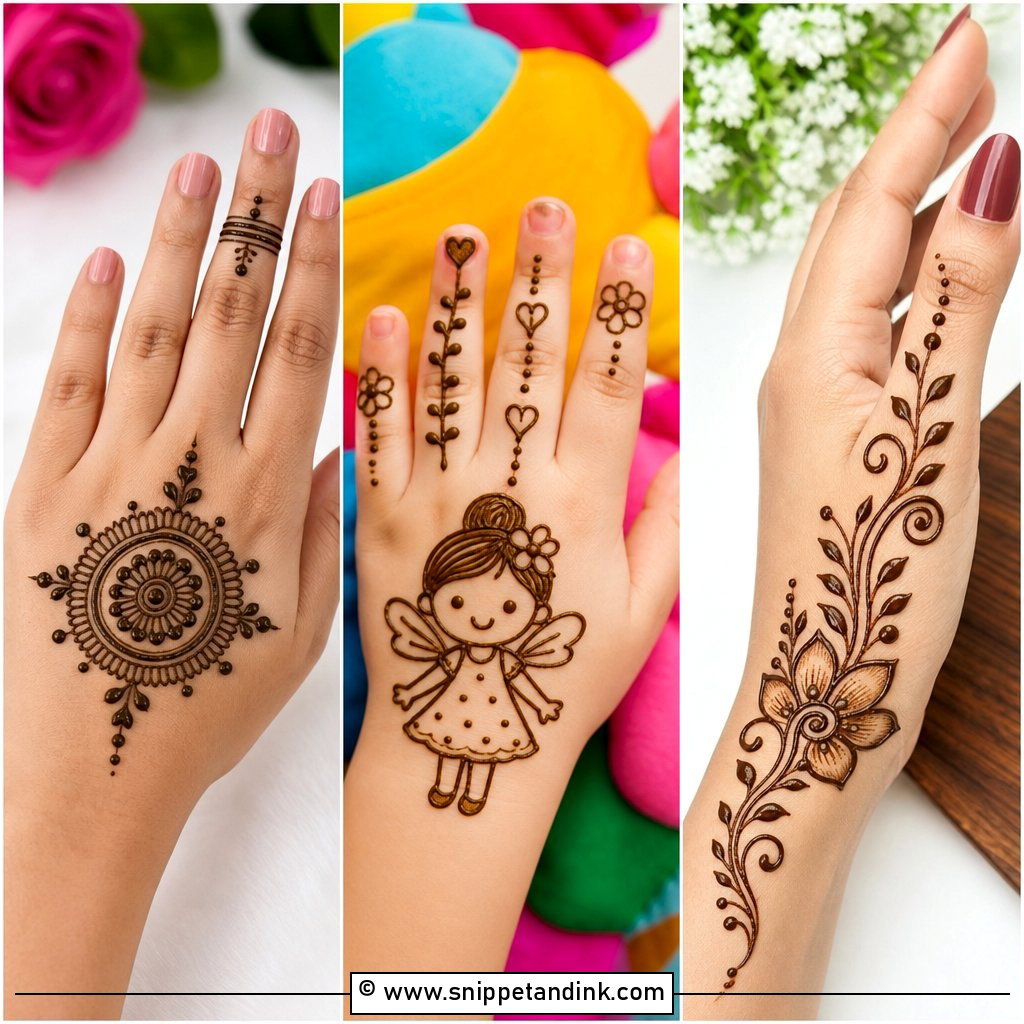
A mandala gives the hand a centre of gravity. The circle usually sits mid-palm or mid back-hand, ringed with petals, dots and small leaves, then joined to the fingers. Its clear structure makes it a good first design for anyone trying henna at home. The circle has to be round, though, and that’s harder than it looks on a curved palm. I ask clients to rest the hand flat on a cushion while I draw the outer ring, because a cupped hand distorts it the moment they relax.
9. Finger Mehndi Design
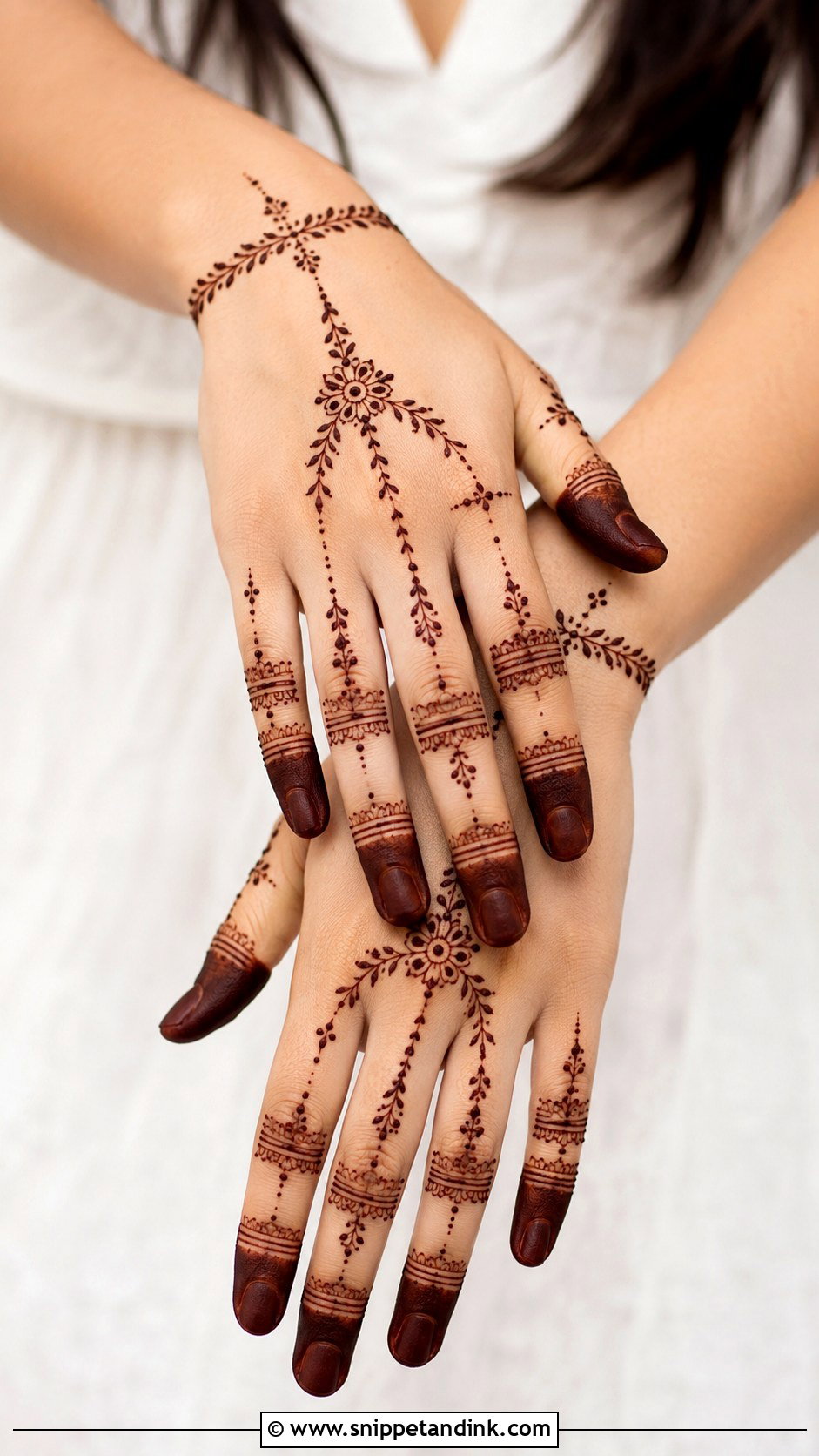
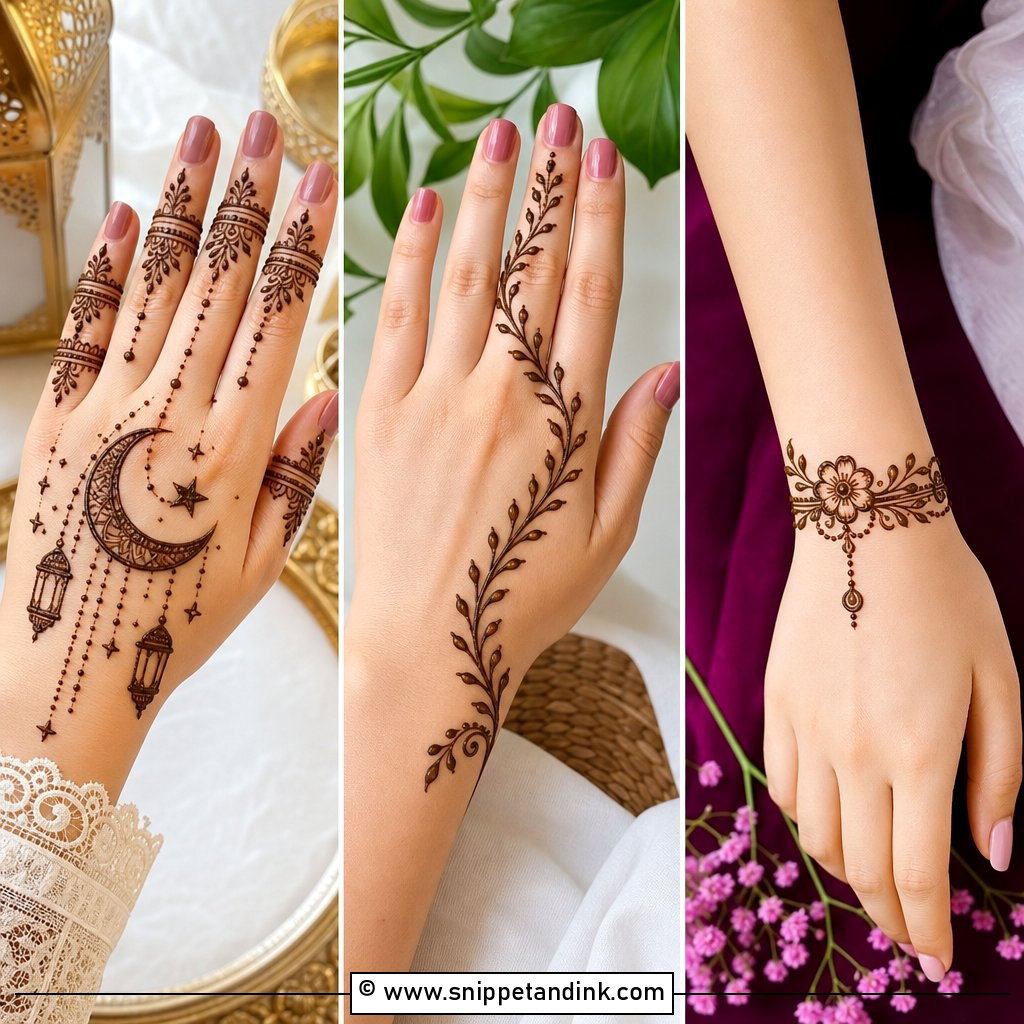
Finger-only mehndi is the lightest way to wear henna and still look dressed for a festival. Bands, leafy trails, small florals and fully filled tips do the work, sometimes with a tiny cuff or a connector line onto the back hand. I like giving each finger a slightly different pattern that shares one repeated element, a dot border or a leaf shape, so it reads as a set. Fingertips stain darkest of all, which is handy here and a little alarming for anyone who isn’t expecting near-black tips.
10. Bracelet Mehndi Design
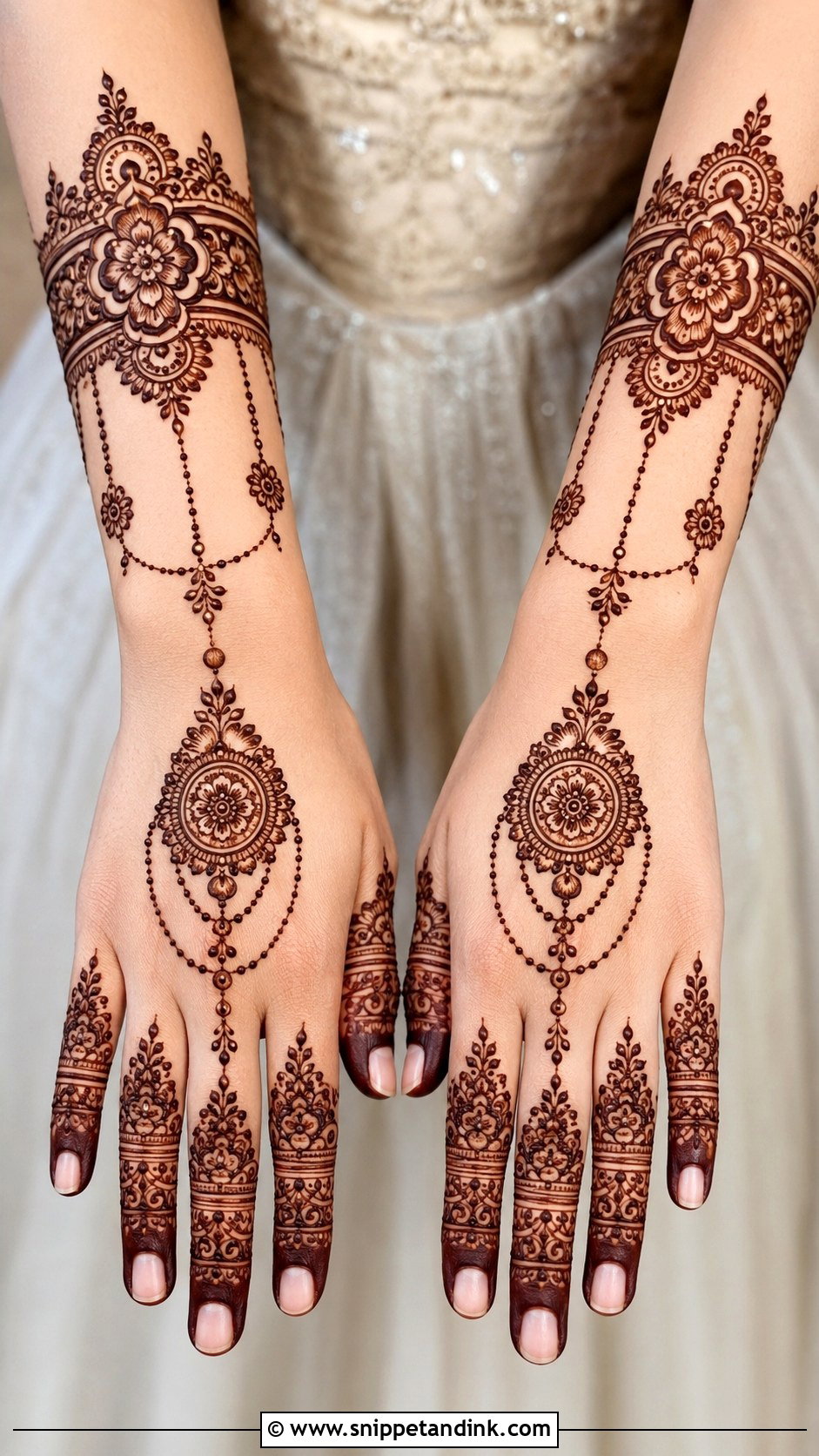
Bracelet mehndi imitates jewelry: a wrist cuff, chains, ring motifs on the fingers and little pendants joining them. Bridesmaids and engagement guests ask for it often because it frames the hand without covering it. A light version is one band and one finger chain; a festive one layers florals and a second cuff. When a client plans to wear real bangles, I place the henna cuff a finger-width above where the bangles will sit, otherwise metal slides over it and hides the work all night.
11. Jaali Mehndi Design
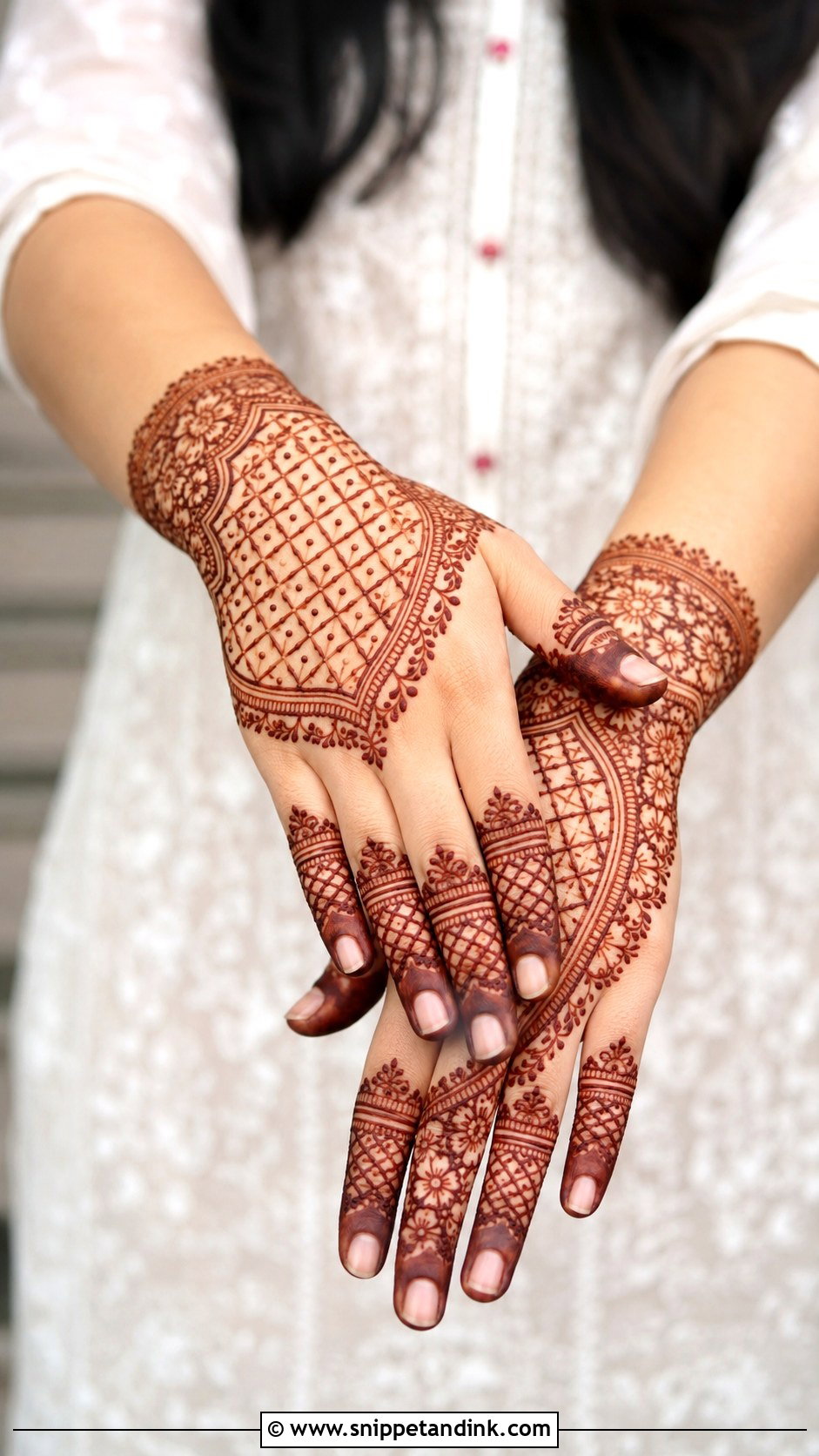
Jaali is henna’s lattice: grids, diamonds and curved nets filled with tiny dots. It adds texture over a large area without needing a big motif everywhere, which is why I use it to fill forearms in bridal work. On the back hand it can read like a lace glove. The whole effect depends on even spacing. One cramped row looks like a smudge once the stain spreads, so I keep the grid open enough that skin shows clearly between every line.
12. Peacock Mehndi Design
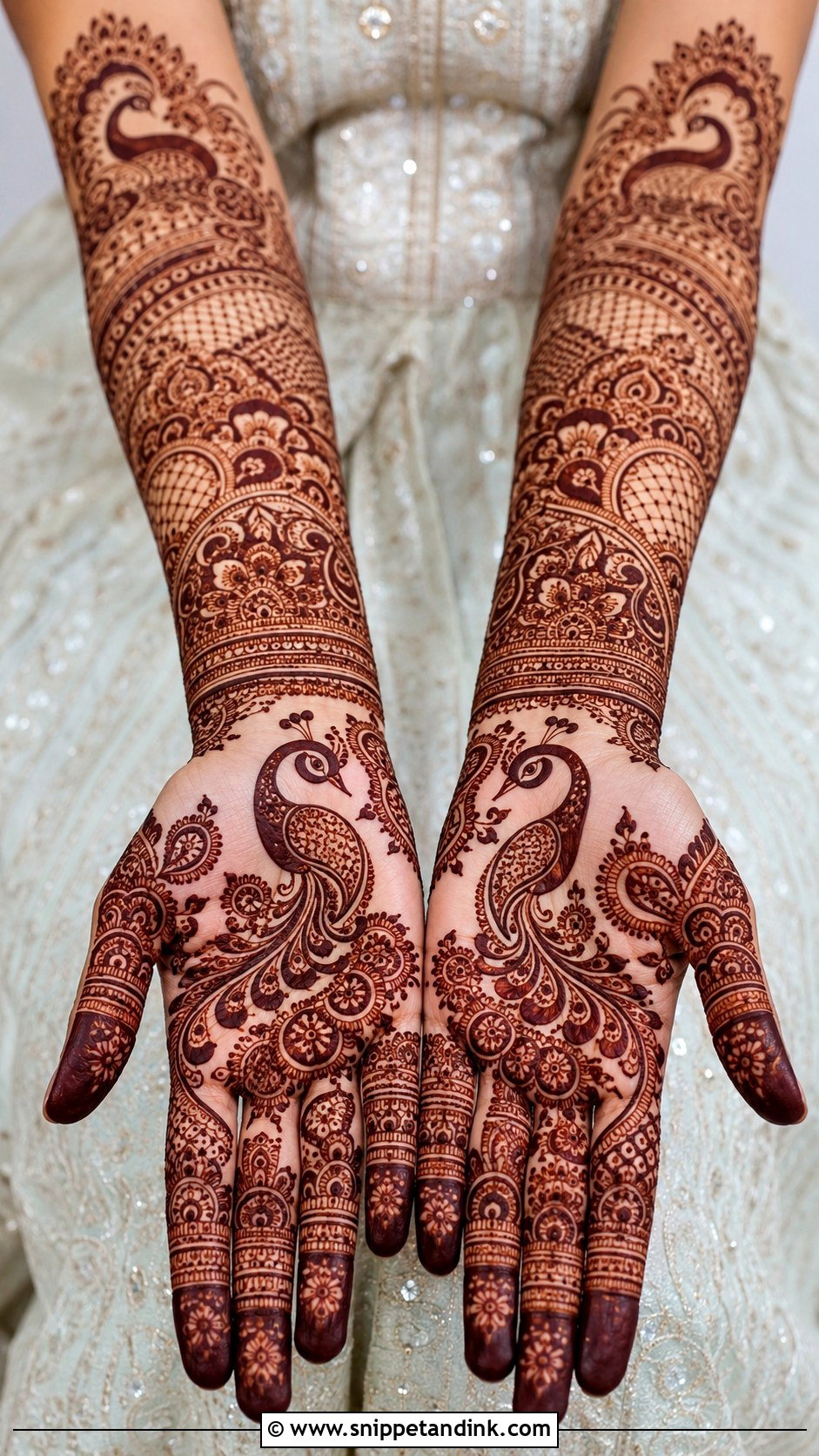
A peacock is the motif most families still associate with bridal henna. The bird can perch on the palm, wrist or forearm with its tail spilling into paisleys and shaded florals. Simplified, it’s one bold peacock with clean fingers; full bridal, it’s surrounded by detail. The feathers give me room for fine lines and dots, but they also swallow the bird if the background is busy. I always frame a peacock in a clear border or a patch of bare skin so the neck and crest stay legible in photographs.
13. Lotus Mehndi Design
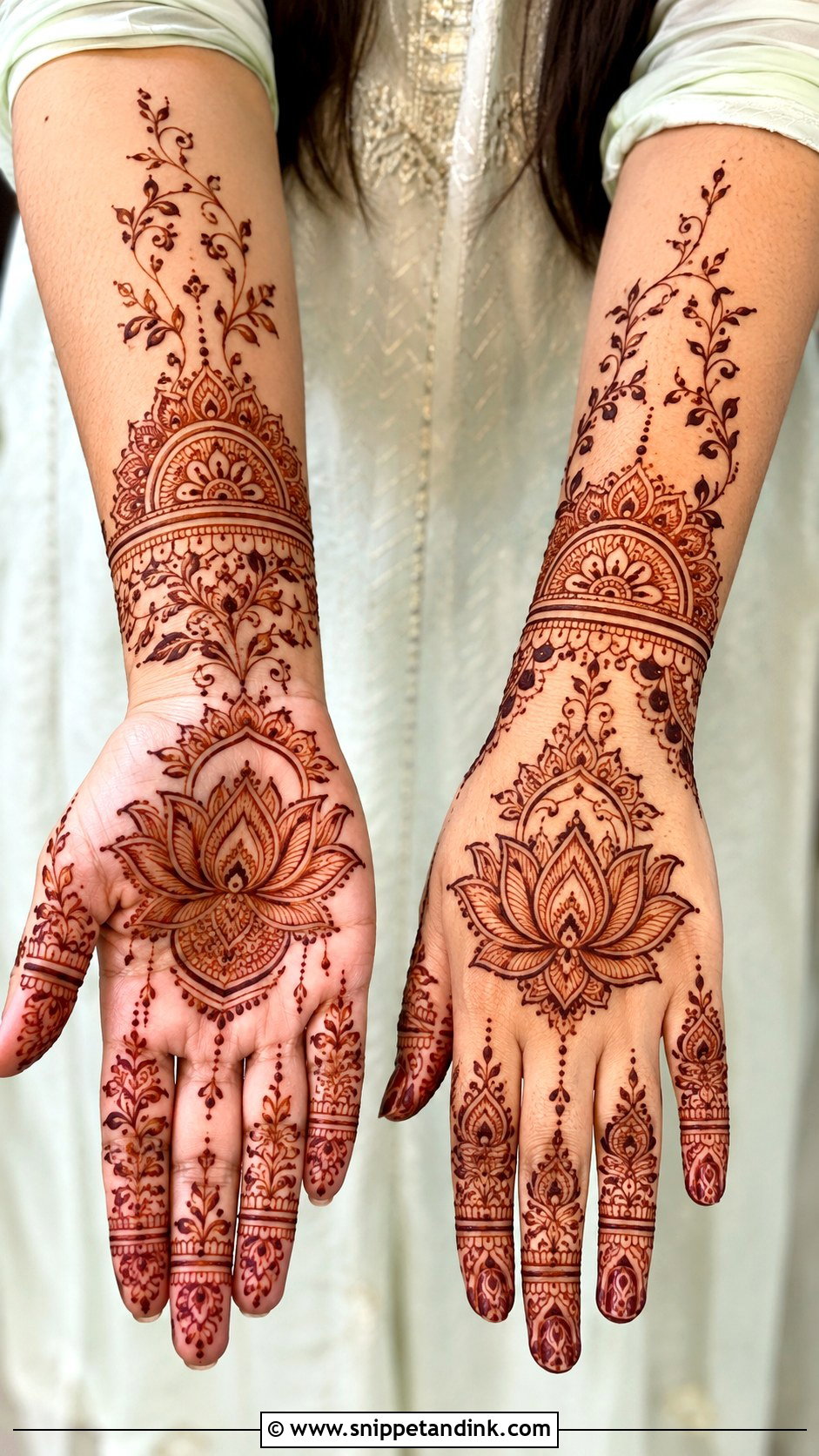
Lotus mehndi design has moved from puja hands into bridal and festive work, and I see why: the petal shape is easy to read even from across a room. A full version puts a large lotus on the palm with matching wrist bands, finger florals and leafy side trails. A pared-back version is a single lotus on the back hand with delicate fingers. Each petal needs a little bare skin around it, because petals drawn touching each other merge into one brown oval as the stain deepens.
14. Moroccan Mehndi Design
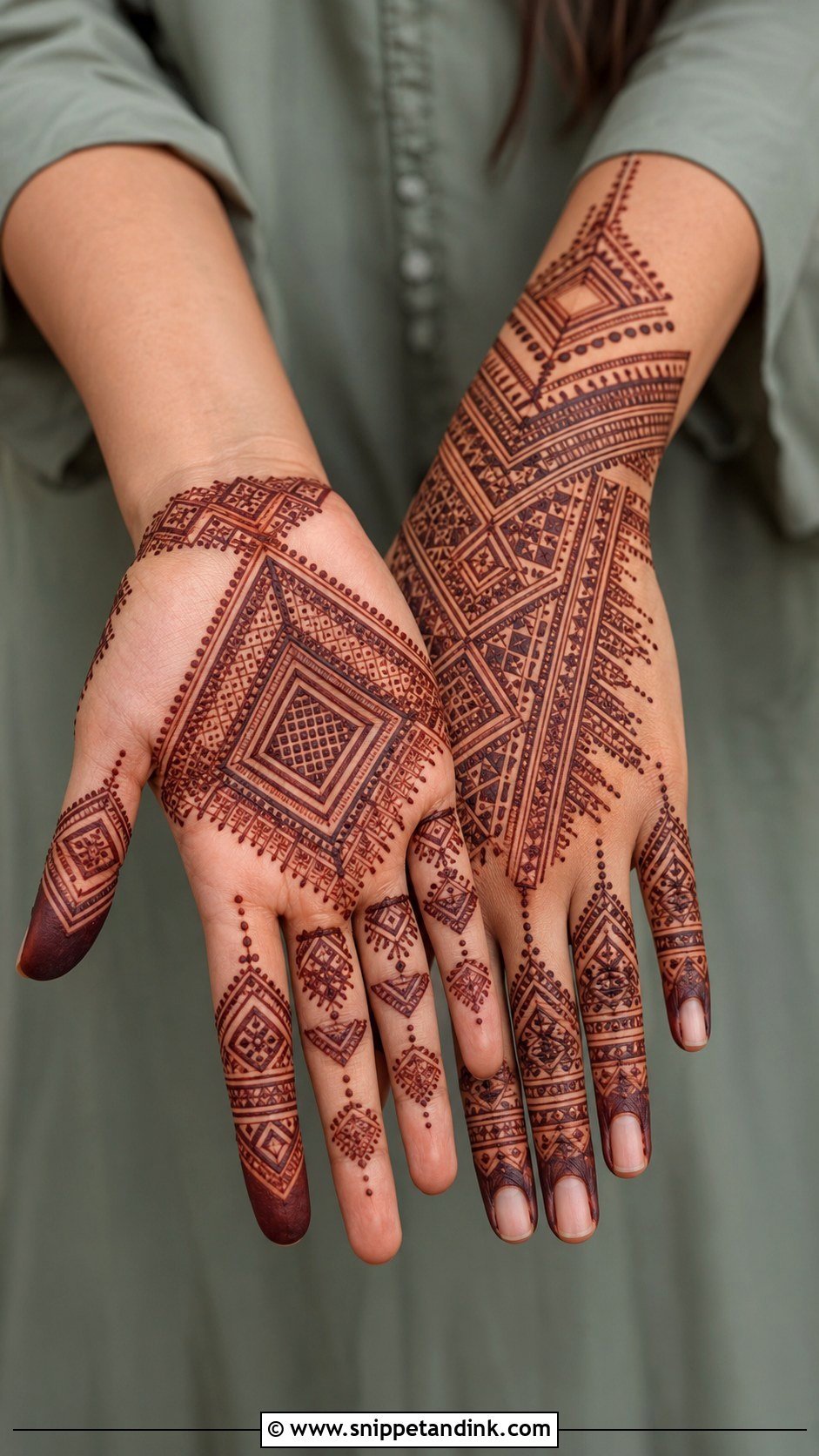
Moroccan henna has little to do with florals. It works in straight lines, diamonds, triangles and grids, panelled across the palm and fingers like woven fabric. Men’s henna, teens and fashion-minded clients gravitate to it. It’s also unforgiving of asymmetry, since the eye catches a crooked line in a grid instantly. I draw the main grid lines on both hands before any filling, checking them side by side, and only then add the small dots or leaves that soften it.



15. Gulf Khaleeji Mehndi Design
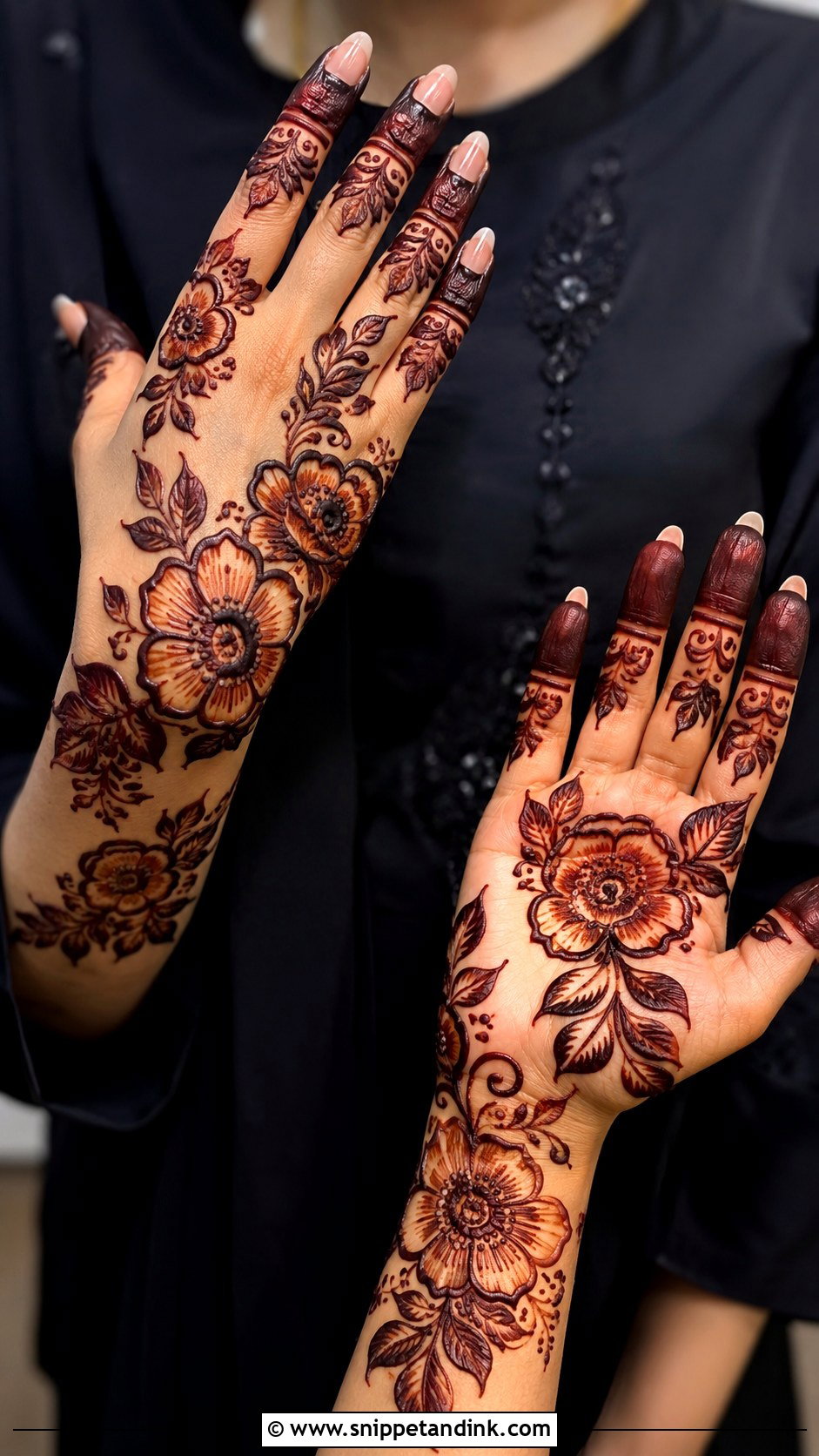
Khaleeji style from the Gulf is bold and dark, with thick outlines, large leaves and shaded petals set in open space. Fingers are often covered heavily while the back of the hand keeps big, confident flowers. For this style the paste matters more than usual. I use a well-sifted mix with a good dye release so thick lines dry without cracking off early, since a cracked outline leaves patchy colour. Done well, it settles into deep maroon and needs no tiny fillers at all.
16. Geometric Mehndi Design
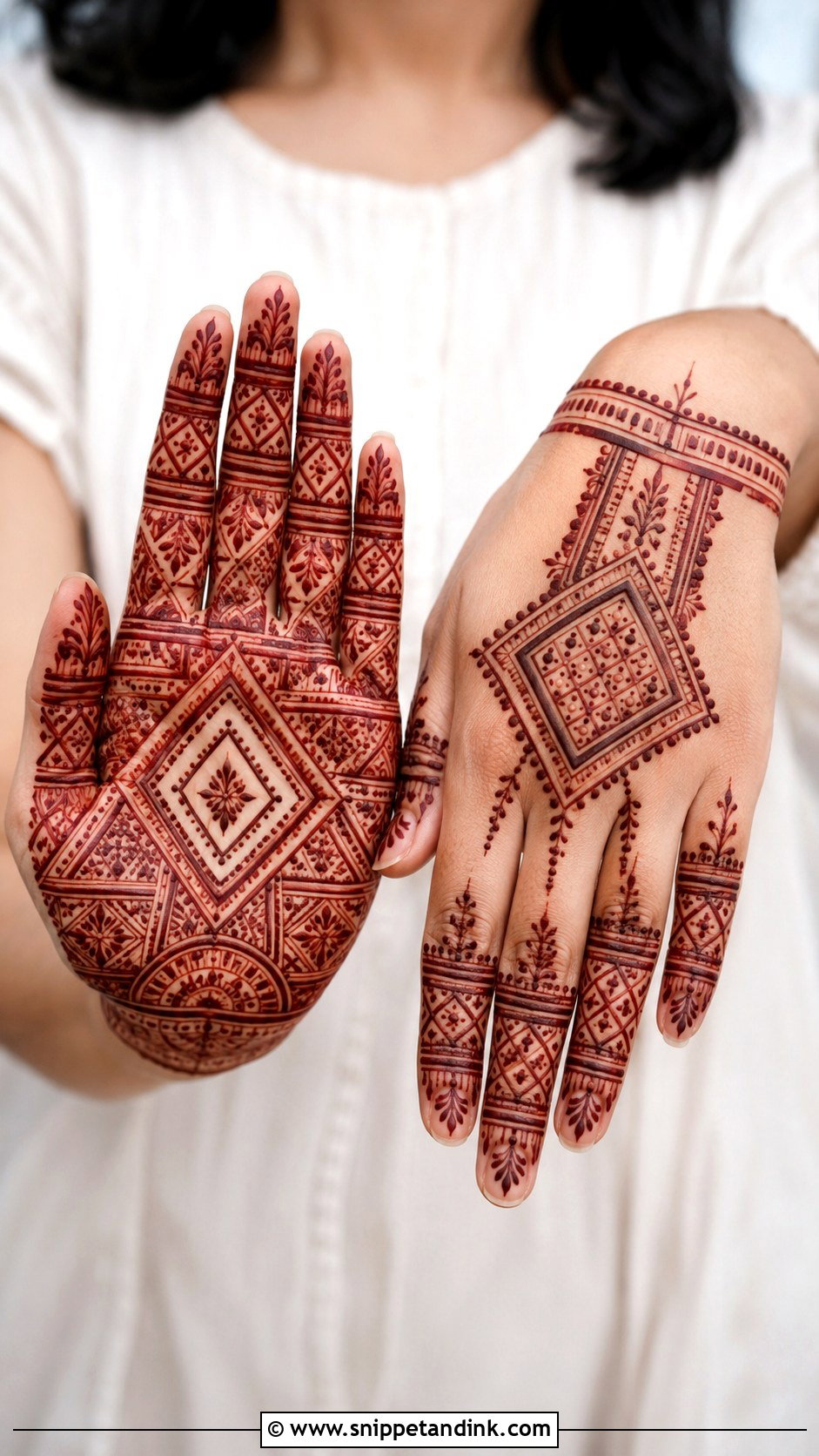
Geometric mehndi uses diamonds, triangles, half-circles and repeating lines across the palm or back hand. It pairs naturally with fusion outfits and is easier to mirror on both hands than a free-flowing floral. The one thing it won’t tolerate is a shaky line. I pull long straight strokes with the cone resting lightly against the skin rather than hovering, which keeps the pressure even. A few tiny flowers or a dotted border inside the panels can soften it if pure geometry feels too stark.
17. Negative Space Mehndi Design
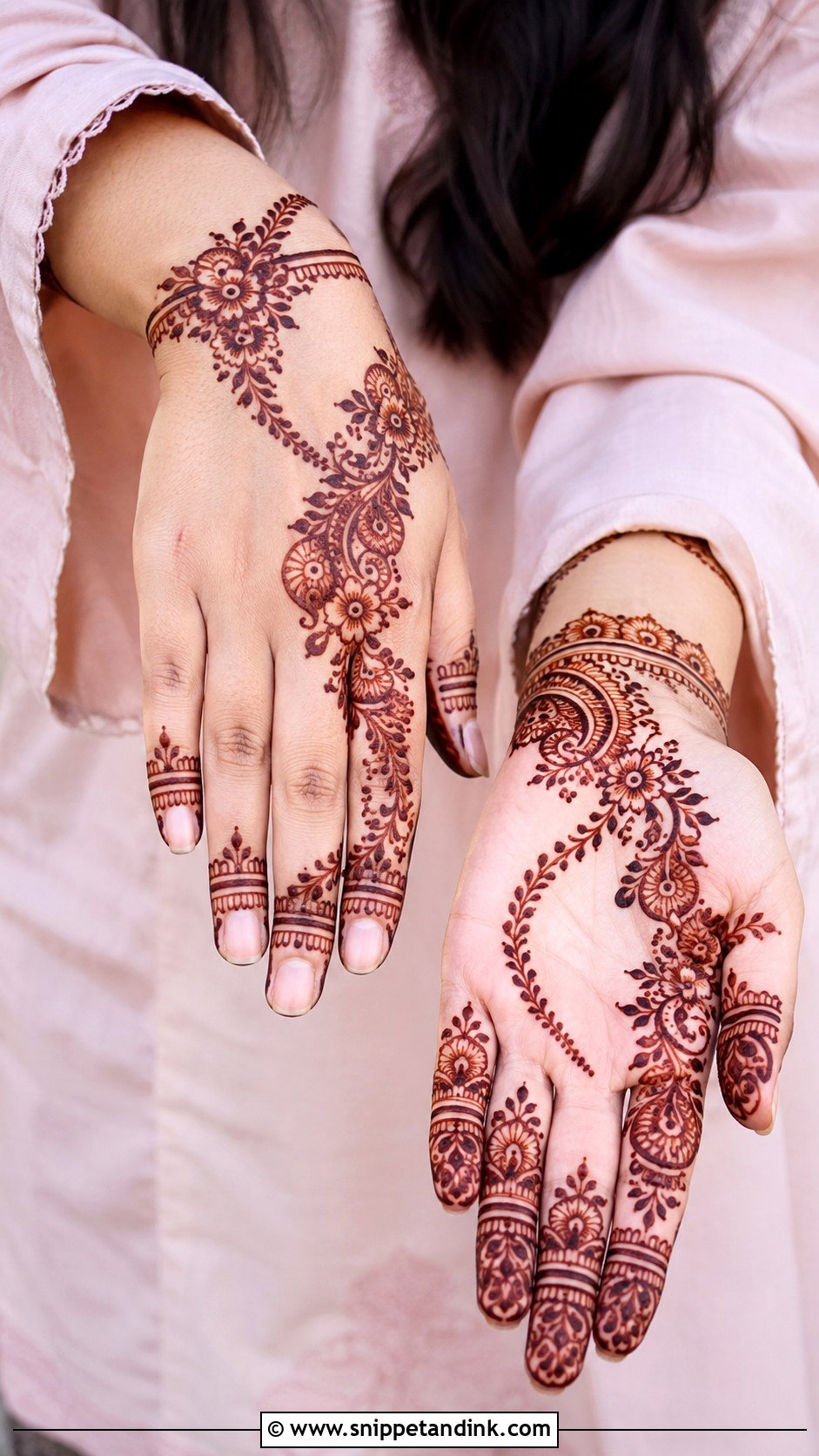
Negative space design treats bare skin as part of the pattern. Flowers, mandalas or bands are outlined with deliberate gaps so each one looks sharp, often along a diagonal Arabic trail with spaced finger details and a light wrist border. Contrast is the whole point, so it reads well even when the stain is lighter than hoped. Random gaps, though, look like unfinished work. I plan the empty shapes as carefully as the drawn ones and repeat them, so the eye understands they’re intentional.
18. Shaded Floral Mehndi Design
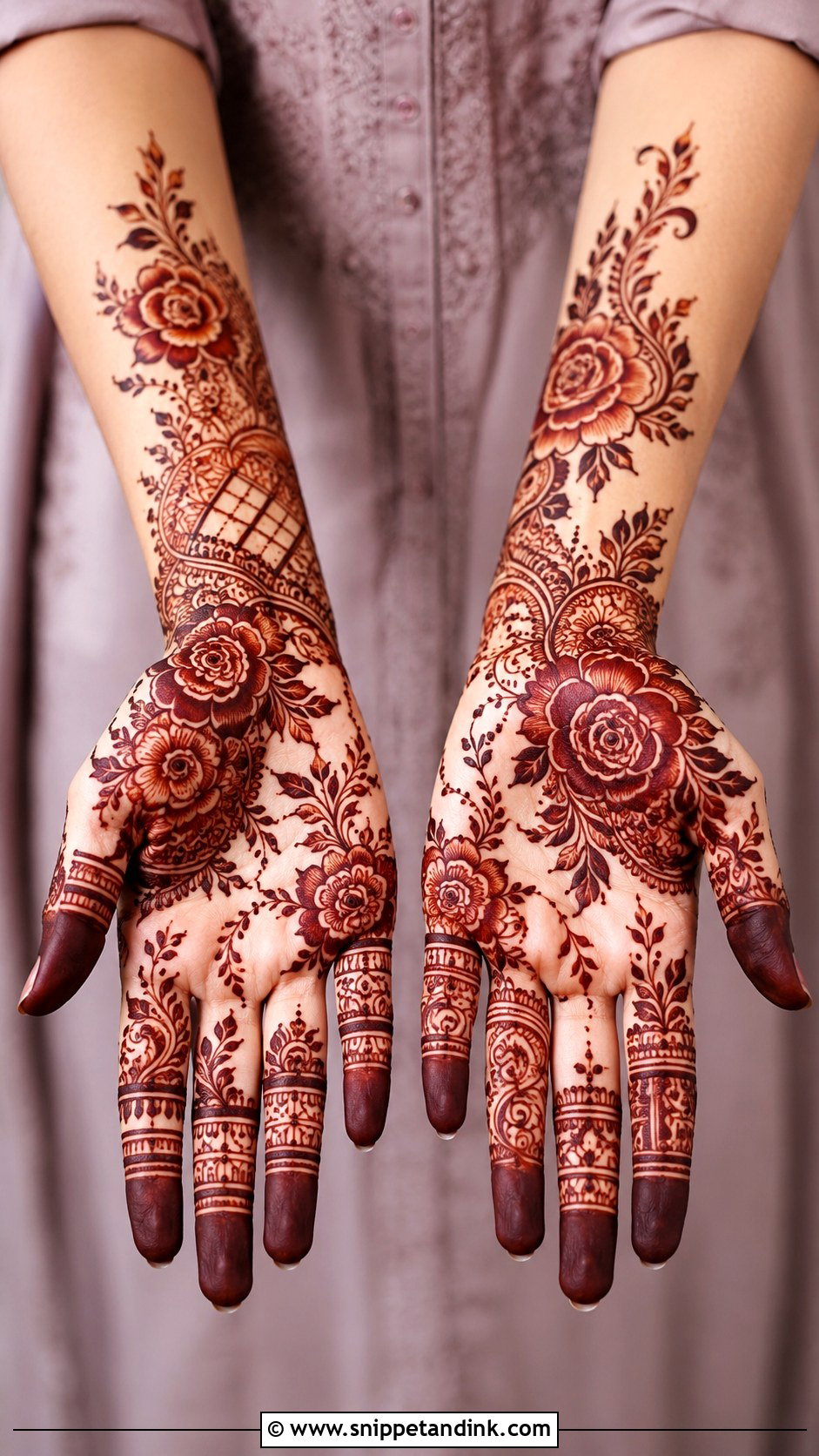
Shading turns flat outlines into petals with depth. Inside each flower I lay thin parallel strokes or a partial fill that fades toward the centre. It suits Arabic, Indo-Arabic and Gulf work, and it lets a few large blooms carry a hand without extra motifs. Shading needs a slightly thinner paste than outlines so the strokes stay fine. Keep the leaves and finger bands plain around shaded flowers; shade everything and the hand loses its focus point.
19. Paisley Mehndi Design
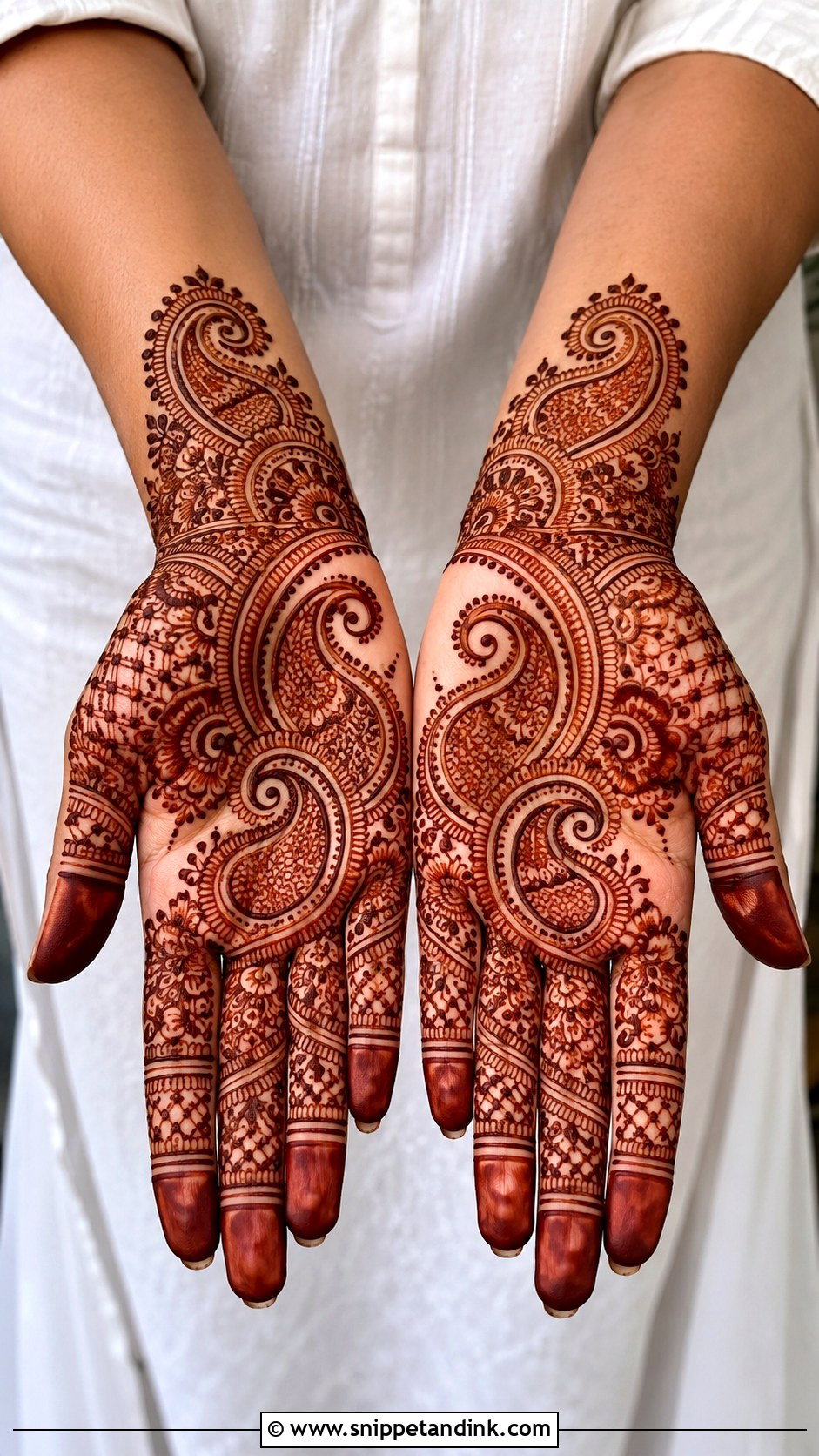
Paisley, the curved mango shape, has survived every trend cycle for good reason. It stretches, tilts and layers to fit any hand, wide palms and slim fingers alike. In bridal work I stack paisleys with floral fillers and jaali panels to fill the forearm gracefully. For a modern hand, I’d use one oversized paisley as the hero and keep everything around it light. The tail of the paisley is where it gets its flow, so I always point it toward the fingers rather than back at the wrist.



20. Rose Mehndi Design
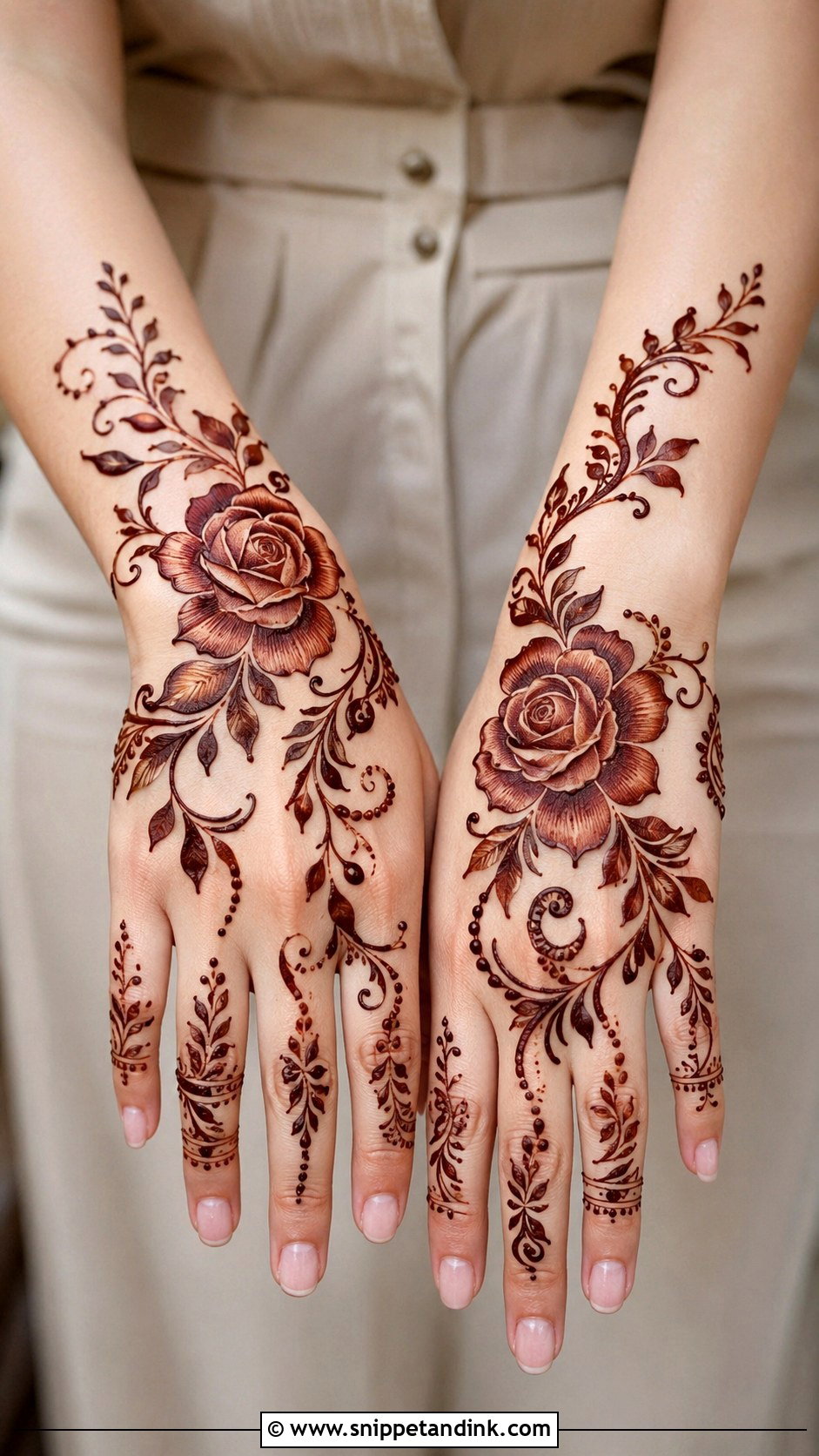
Roses are instantly recognisable in henna, which is why they turn up so often in Arabic and Indo-Arabic work for engagements, receptions and Eid. A large bloom near the wrist with a vine climbing toward the fingers is the layout I’m asked for most. The spiral petals are drawn from the centre outward, and the shading between them is what gives depth once the stain darkens. I keep the fingers detailed but lighter so the roses remain the main subject.
21. Hathphool Mehndi Design
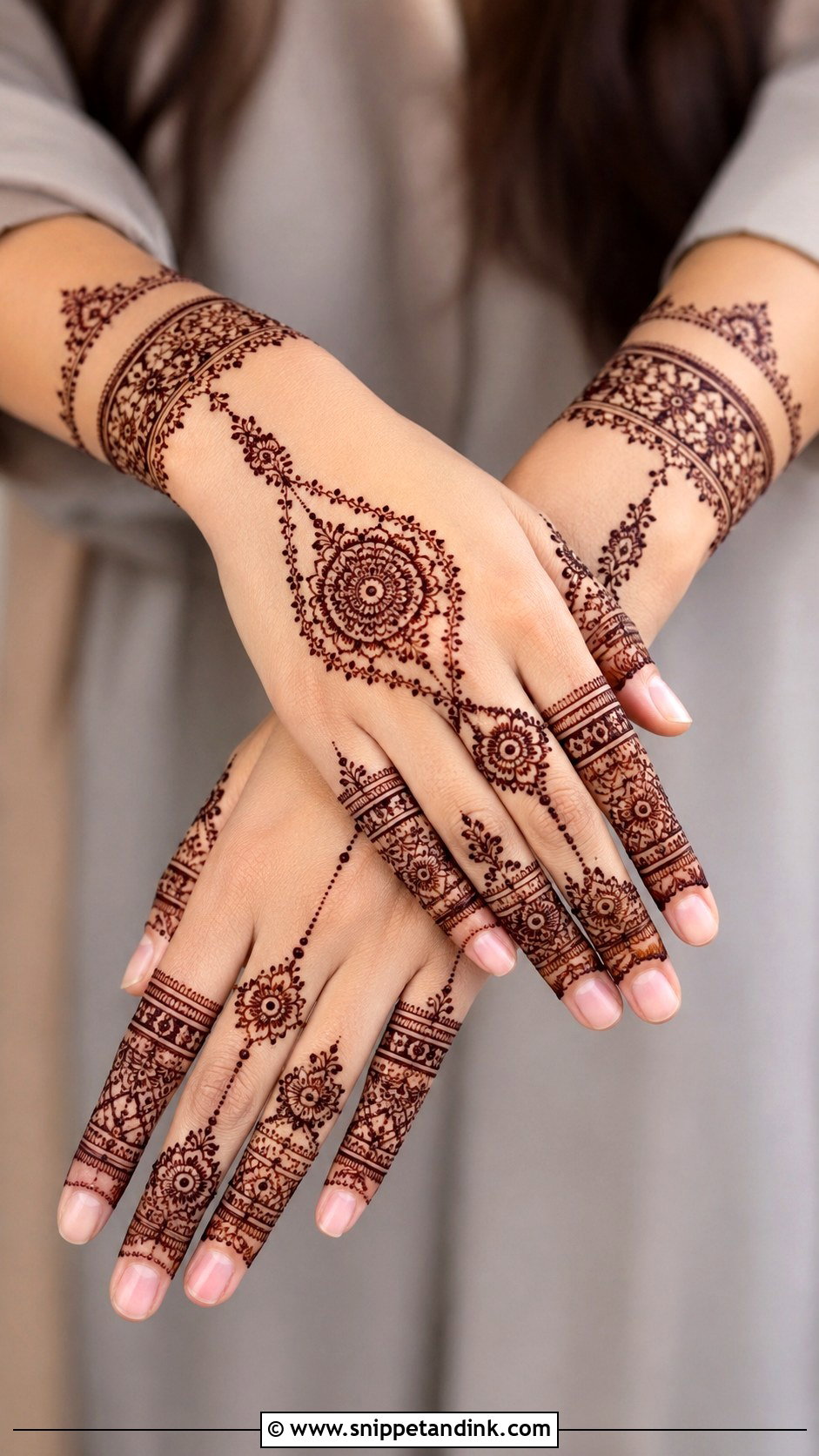
Hathphool mehndi copies the traditional hand ornament: a bracelet at the wrist, ring motifs on the fingers and chains joining them across the back of the hand. It reads clearly there and almost disappears on the palm, so I don’t suggest it for palm-only clients. Pre-wedding shoots and engagement ceremonies suit it well, since it looks like jewelry without any metal. The chains need even spacing and equal tension, as one sagging line makes the whole ornament look slipped.
22. Full Palm Mehndi Design
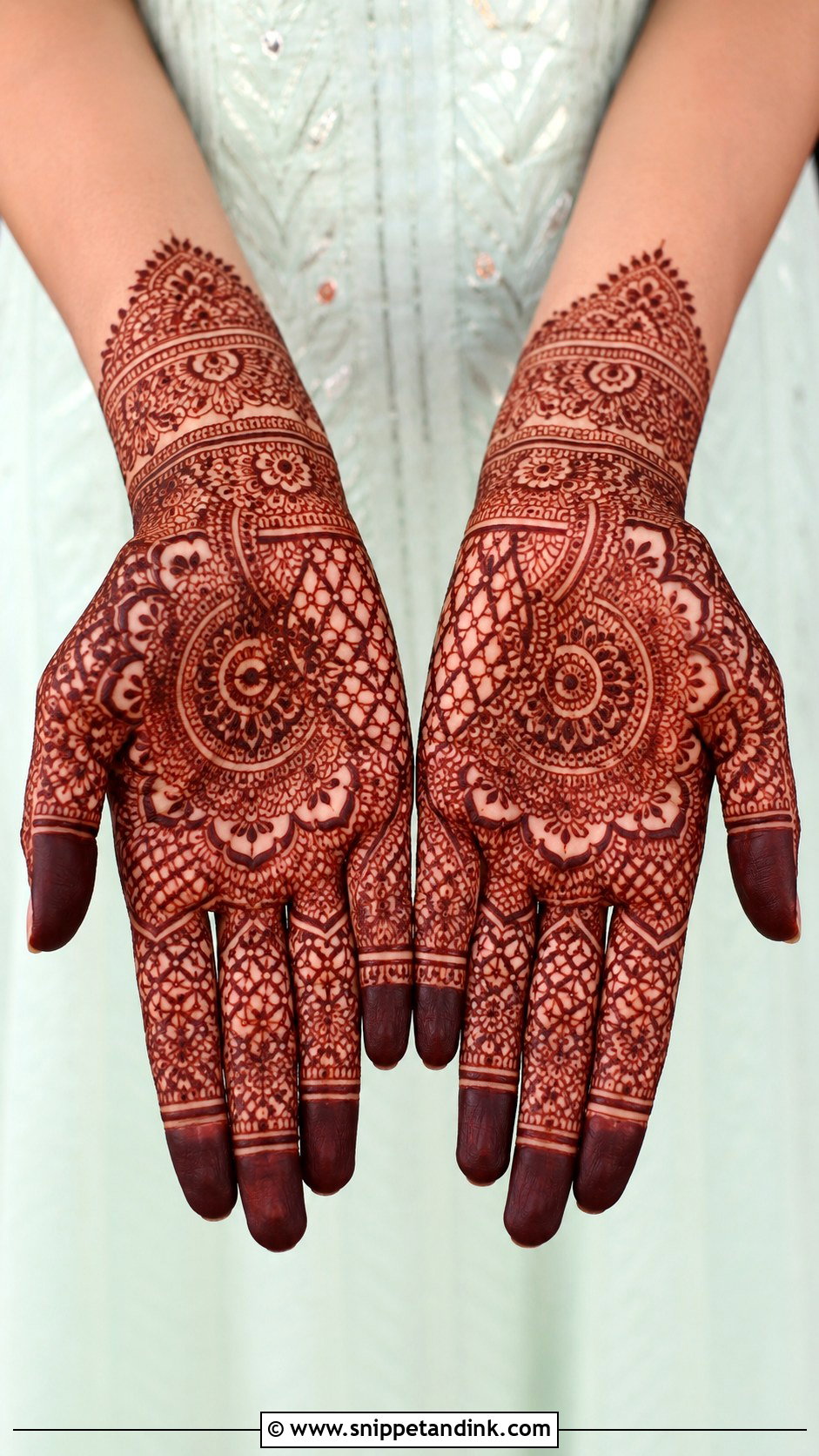
Full palm work gives traditional richness without climbing the arm. The palm fills with mandalas, paisleys, florals, jaali and fine fillers while fingers carry matching bands and tips. It’s practical for festivals because sleeves cover nothing and the palm stains darkest anyway. The risk is a crowded, muddy palm after the stain spreads, so I divide it with clear border lines into sections and leave a hairline of skin between them.
23. Half Hand Mehndi Design
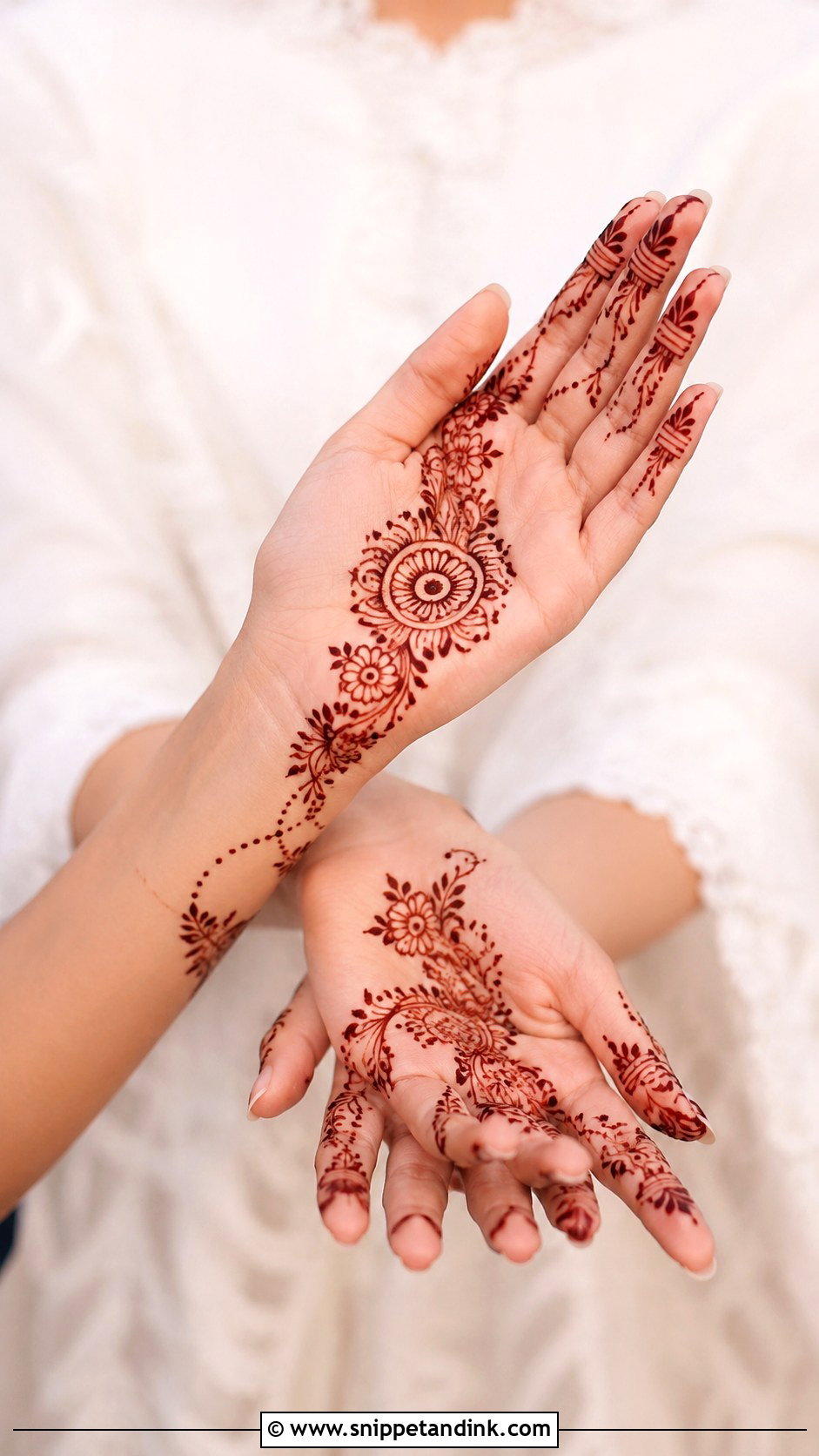
Half-hand designs decorate the fingers, palm centre and wrist while leaving part of the hand bare, sometimes as a diagonal across one side, sometimes a mandala with light fingers and a small cuff. They apply fast and dry comfortably, which is why students and office workers like them for Eid or a workday festival. My rule is one strong focus, either the palm or the wrist. Two competing focal points on half a hand looks unplanned.
24. Engagement Mehndi Design
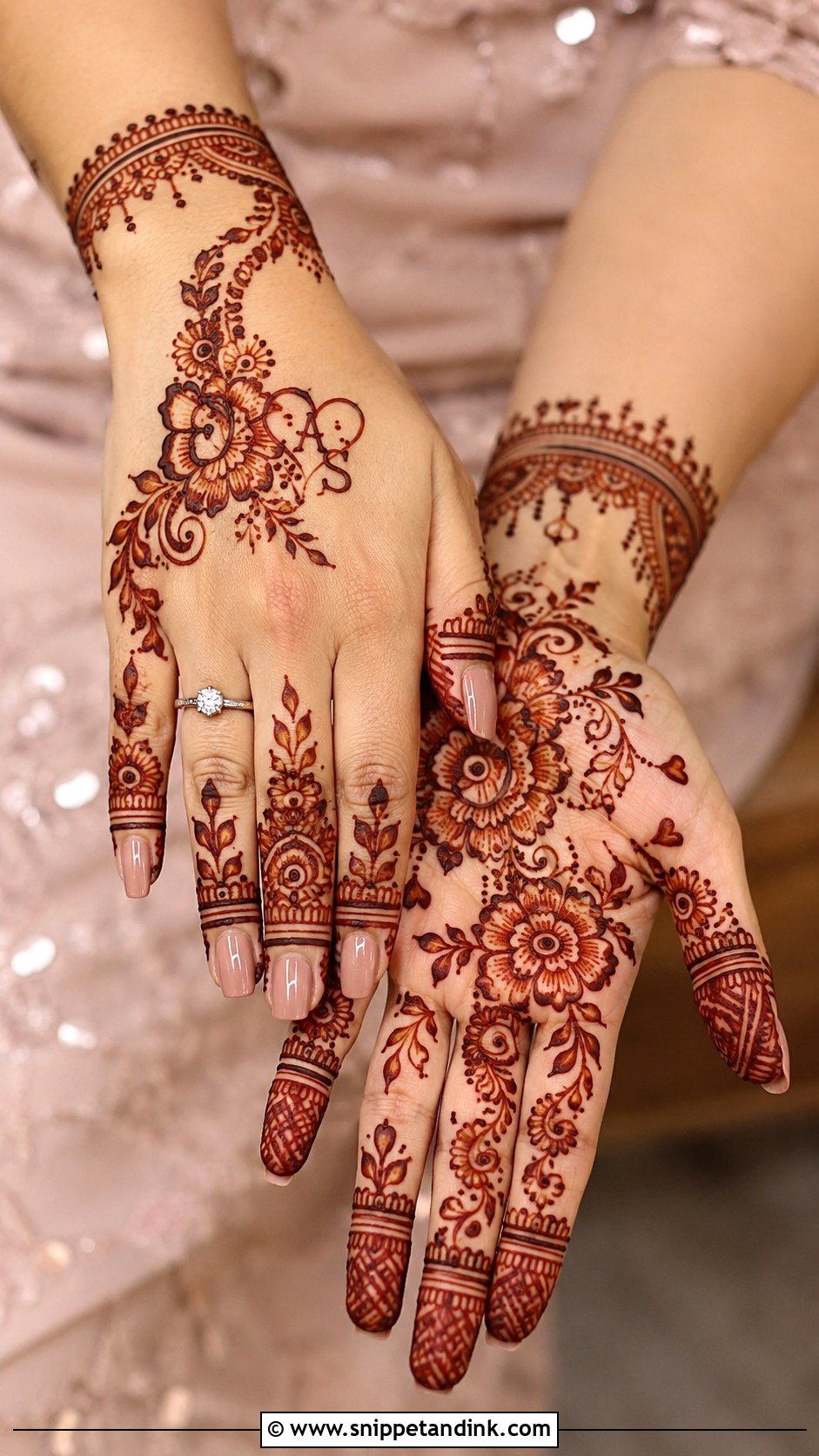
Engagement mehndi design sits between festive and bridal. Initials, ring motifs, florals and bracelet patterns are common, and the ring finger deserves extra care because every engagement photo zooms in on it. I leave a clean band of skin where the ring will sit; henna drawn under a ring gets rubbed and fades unevenly. A small date or heart hidden in a motif adds meaning without turning the hand into a billboard.


25. Eid Mehndi Design
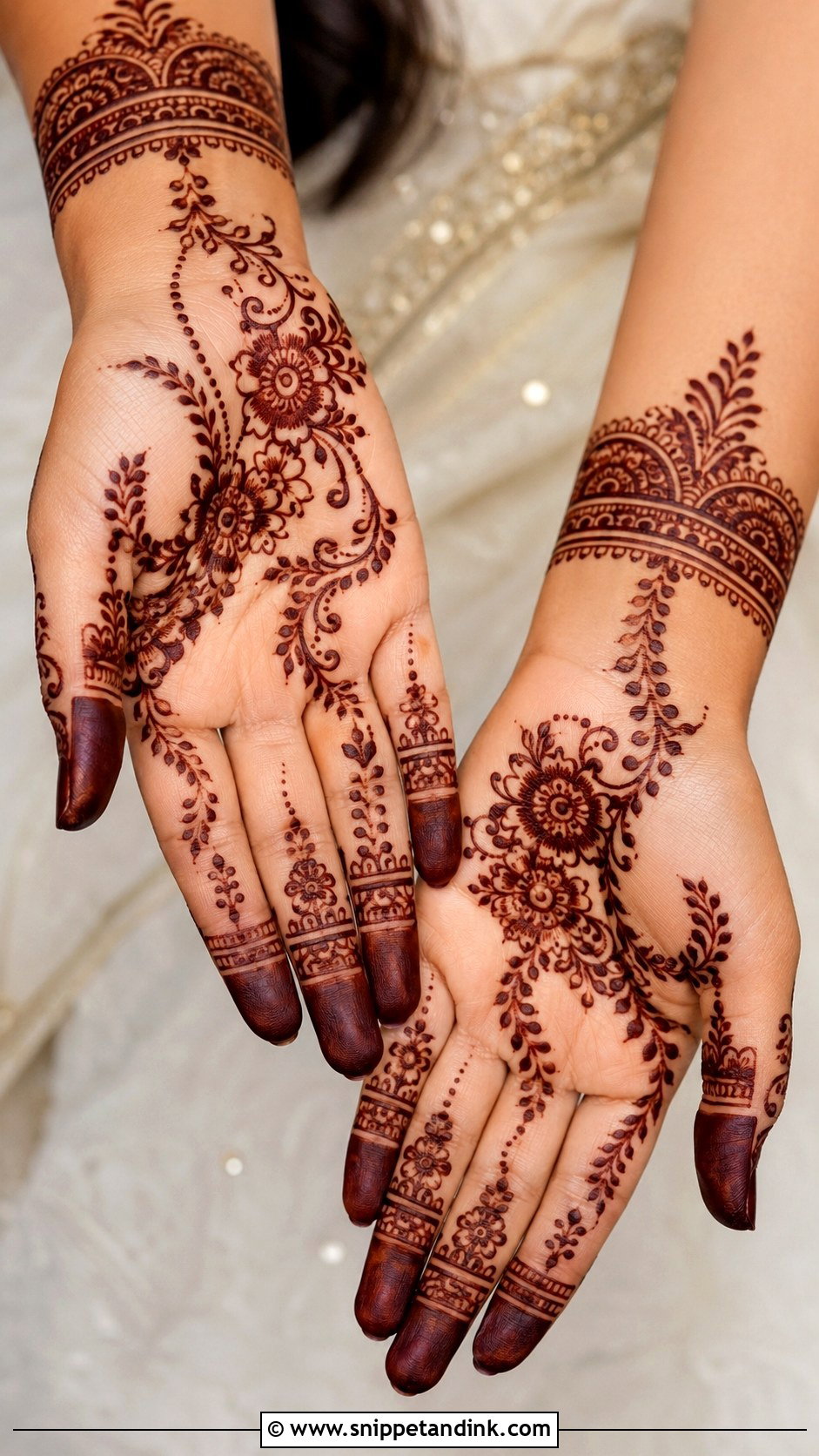
Eid henna has to survive a long day of cooking, hugging and visiting, so comfort matters as much as looks. Arabic trails, khafif back hands, bracelet styles and simple palm mandalas are the usual picks, with open space and detailed fingers. Most of my Eid clients want it done the night before Chand Raat or on Chand Raat itself, which gives an overnight stain that’s dark by morning prayers. Applying at home? Choose bold outlines and fewer tiny fillers. They’re easier to draw steadily and they stain more reliably than hair-thin lines.
26. Festival Mehndi Design
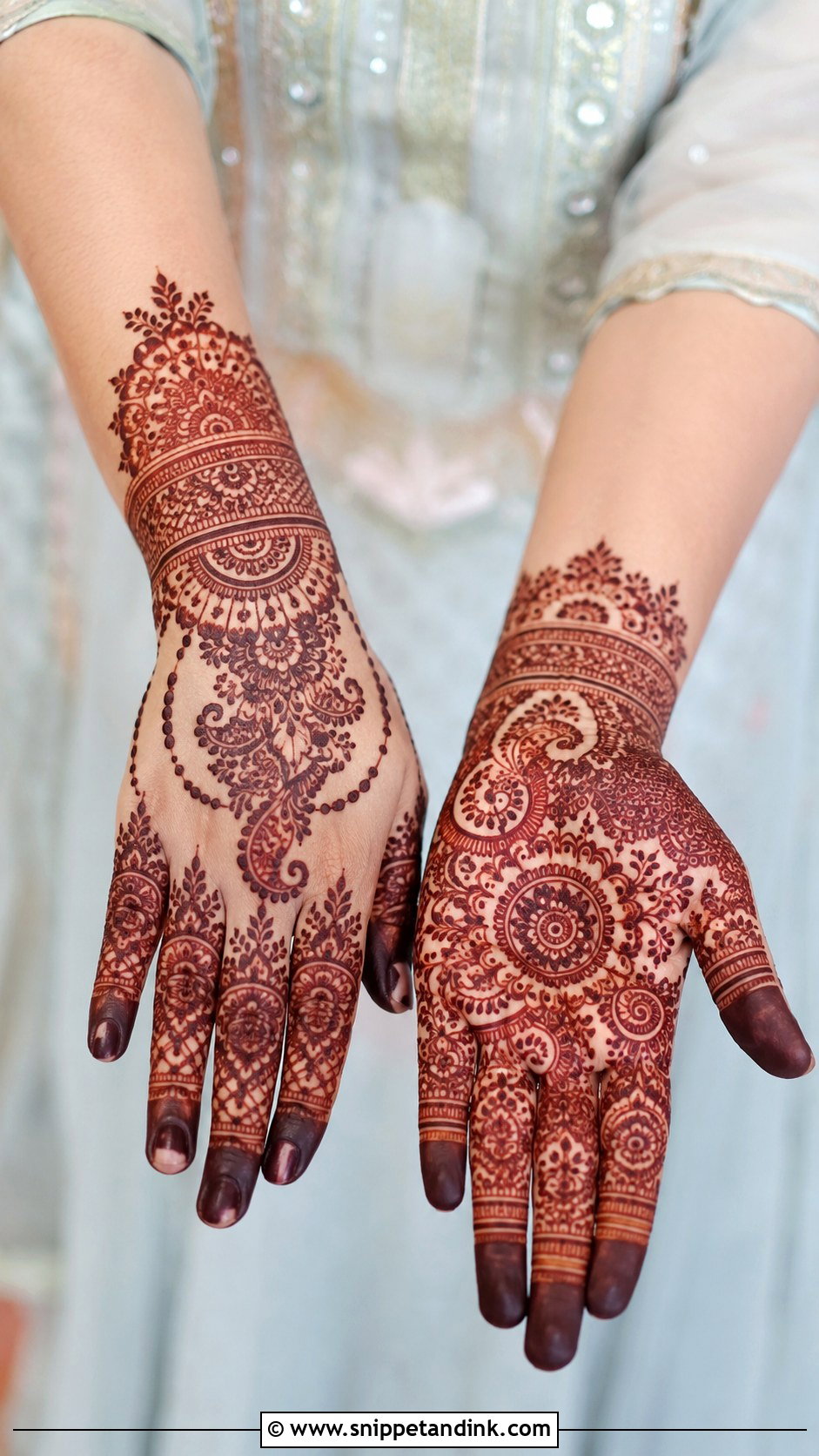
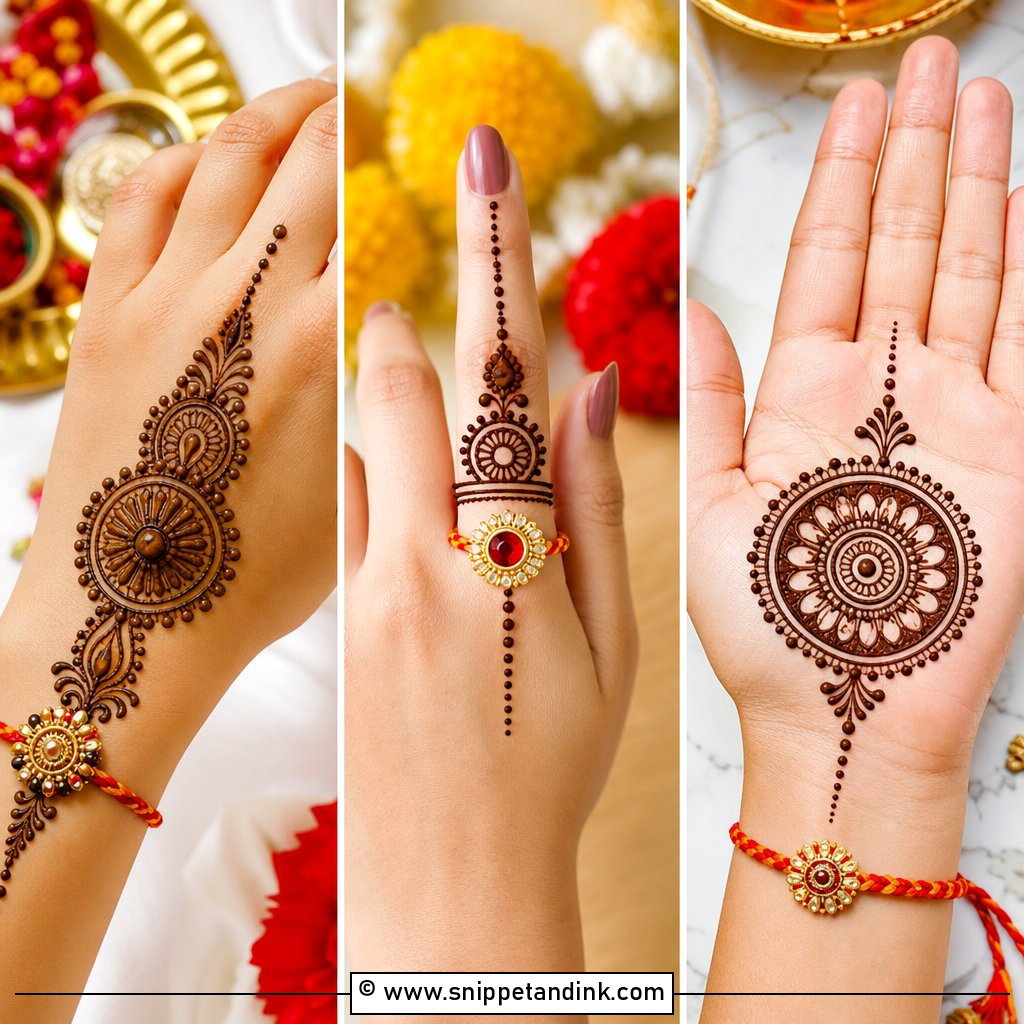
Festival mehndi design for Diwali, Karwa Chauth, Teej or Raksha Bandhan should look decorative without tipping into bridal. I usually suggest one bold palm motif with lighter florals, paisleys or a wrist band around it, and a bracelet layout on the back hand that sits nicely with bangles. Repeating a shared element on both hands makes the pair look finished. For Karwa Chauth specifically, apply the day before; a stain applied the same afternoon will still be orange at moonrise.
27. Modern Minimal Mehndi Design
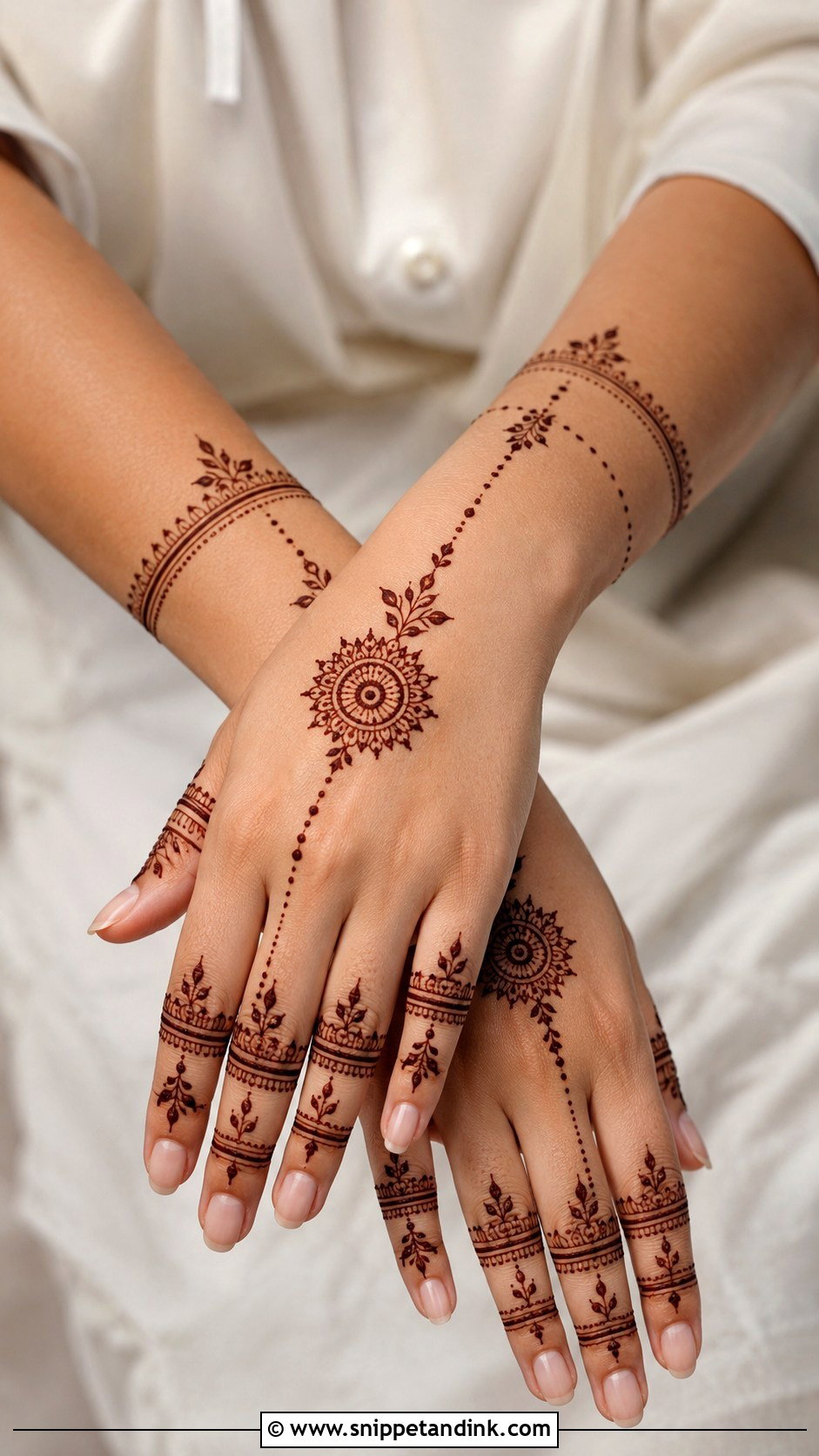
Minimal mehndi is mostly about where you put very little. Fine finger bands, one small mandala, a slim wrist chain or a single floral trail can be enough for a casual outing or a small party. With so few lines, each one has to be clean and deliberate. I’d steer anyone with very dry hands to slightly bolder lines here, as hairline strokes on dry skin can stain unevenly and the gaps make that obvious.
28. White Mehndi Design
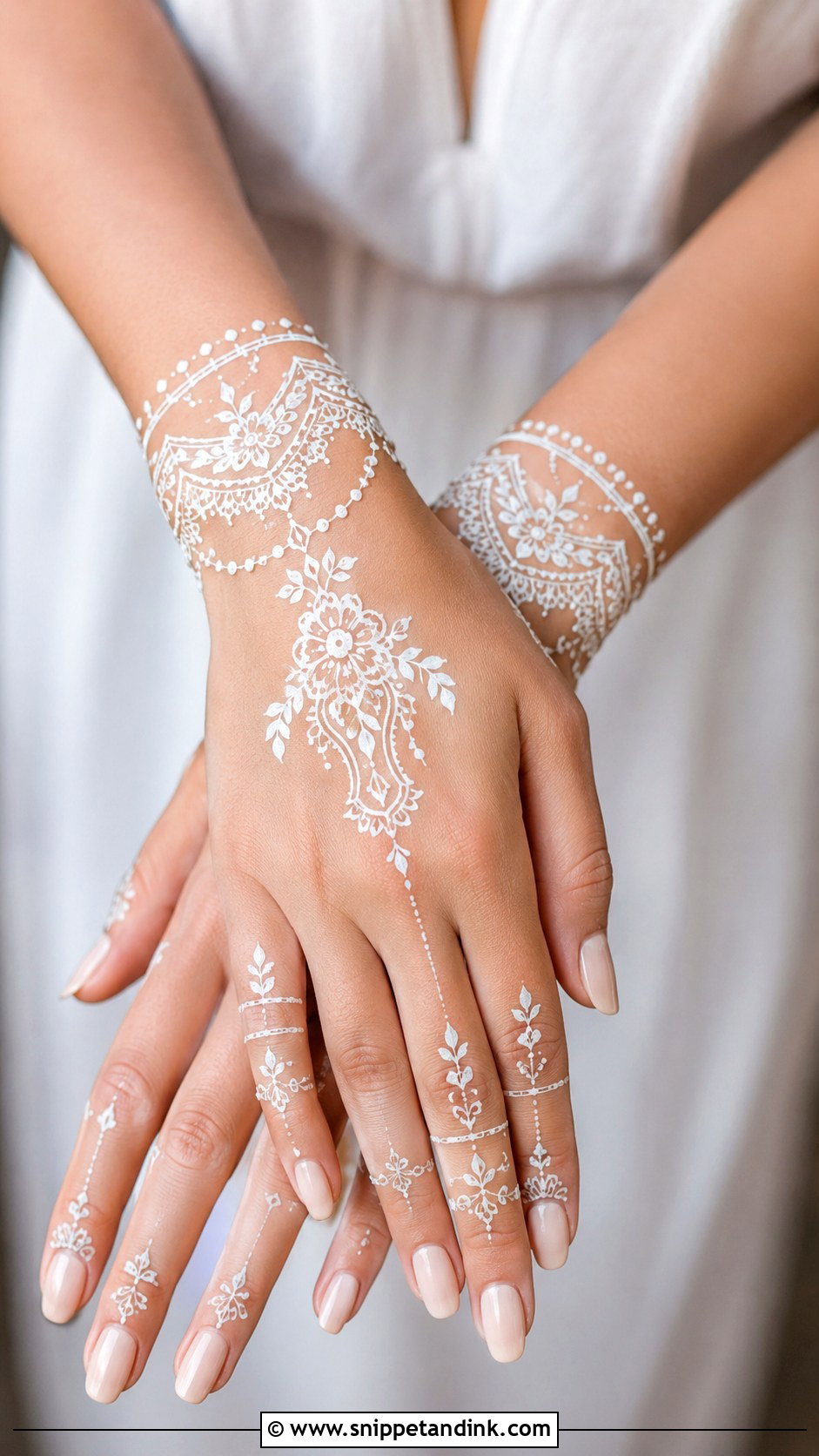
White mehndi is not henna at all. It’s a body-safe cosmetic paint or adhesive, often body art paint, that sits on top of the skin and lasts a day or two at most. That makes it handy for photoshoots, beach events and fusion outfits, and it shows sharply on deeper skin tones. Lace-like back-hand patterns, bracelet chains and delicate fingers suit it best. I always do a small patch test with any white product first, and I avoid putting it on broken or freshly waxed skin.
29. Glitter Mehndi Design
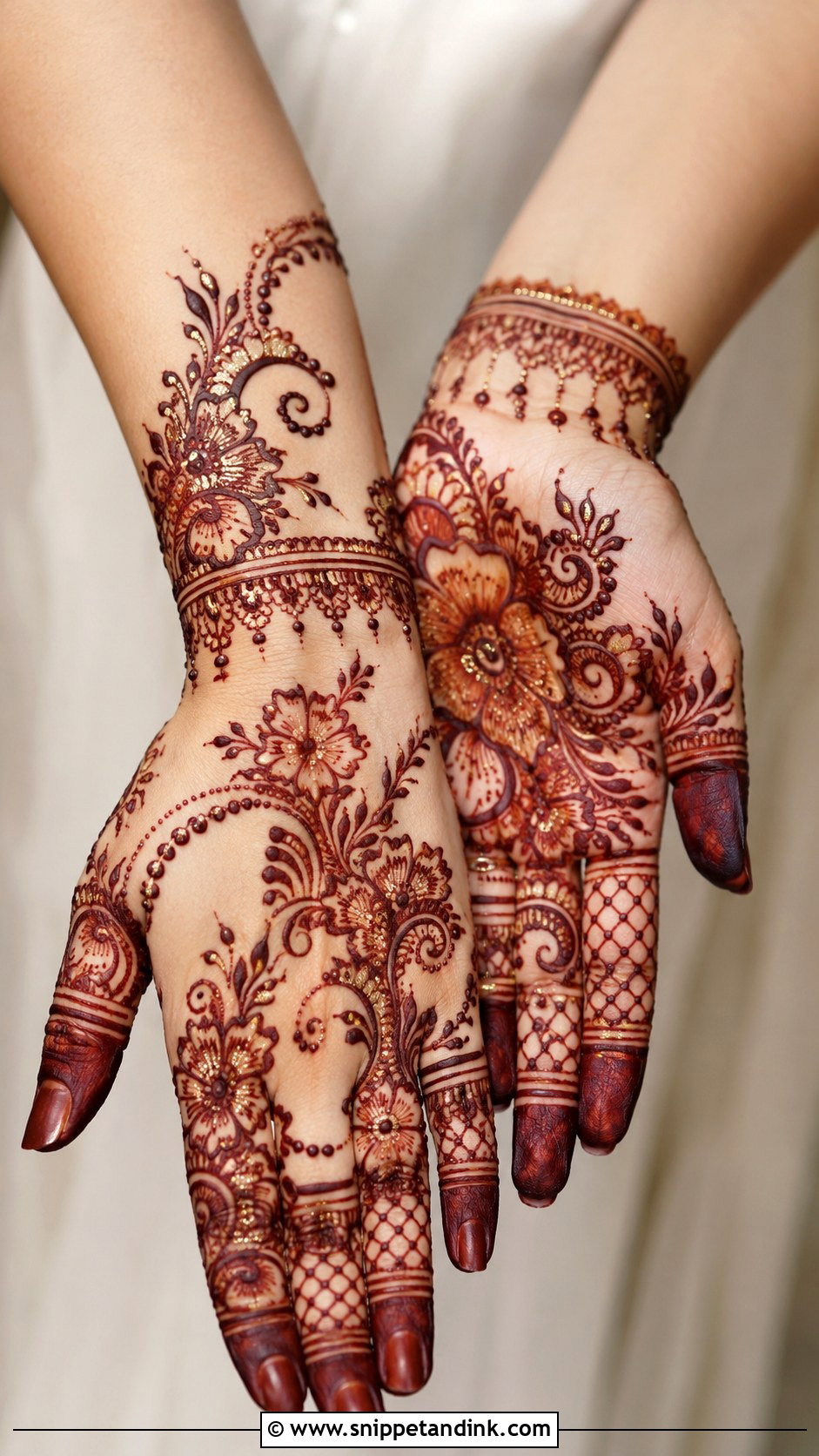
Glitter is added after the henna is finished, never mixed into it. Once the paste has dried and been scraped off, I paint a skin-safe adhesive along selected lines and press cosmetic-grade glitter onto it. Restraint is everything: flowers, borders, dots or the wrist cuff, not the whole hand. Gold and bronze sit well against a natural stain. Expect it to last an evening, not days, which suits a reception or sangeet night exactly.
30. Foot Mehndi Design
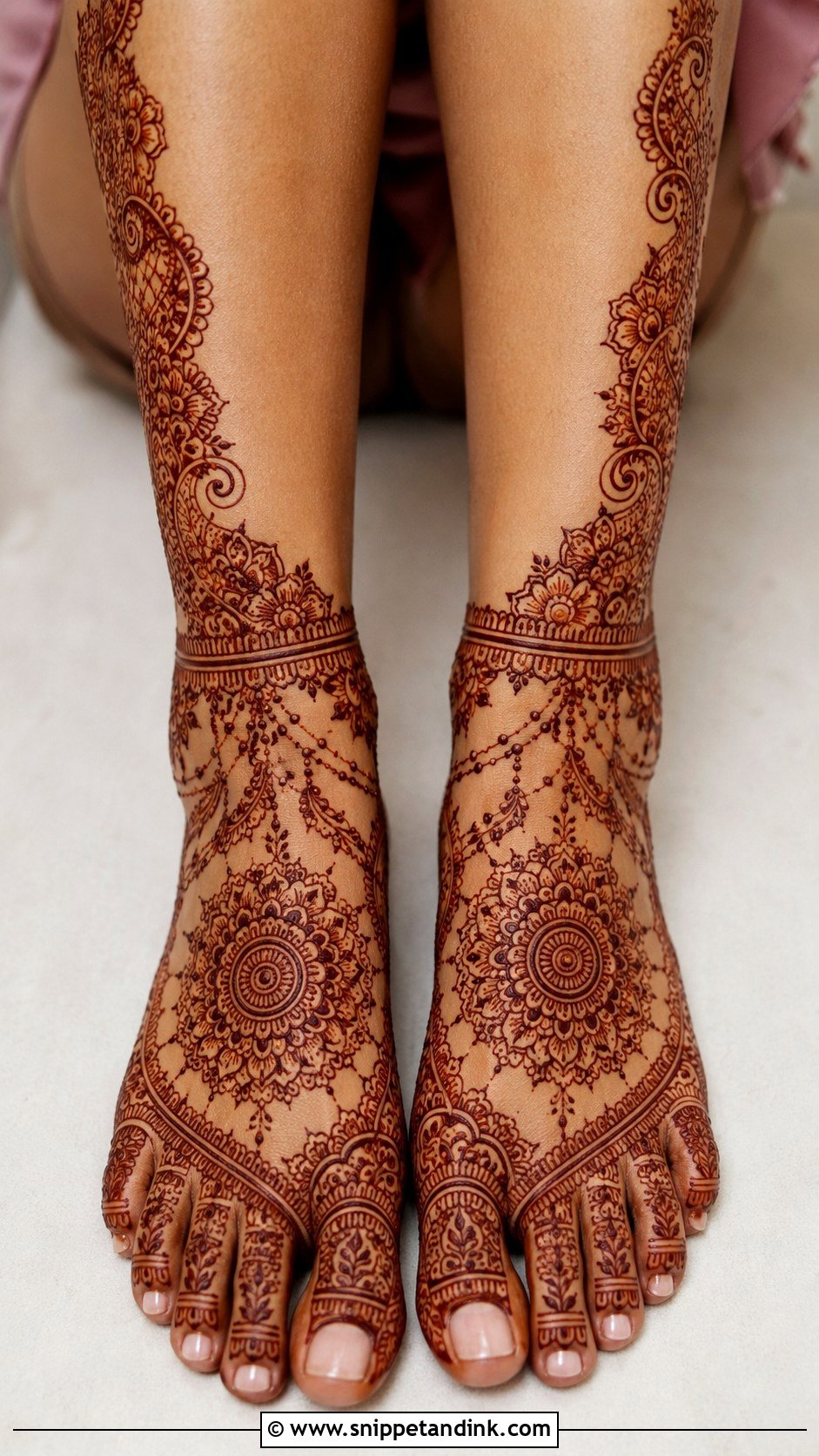
Foot mehndi covers the toes, ankle bands, side trails and a central motif on top of the foot, in florals, paisleys, mandalas, jaali or anklet-style chains. For brides it can extend up the shin; a simpler version stops at the toes and ankle. Feet stain very dark because the skin is thick and warm, often darker than the hands, so I go a little lighter on the filling there. The design should follow the arch and ankle bone rather than sit flat, or it looks pasted on when you walk.
Why Fresh Henna Looks Orange and What Helps It Darken
Every new client panics at the same moment: the paste comes off and the skin is bright orange. That’s normal. The dye in henna, lawsone, binds to the outer layer of skin and oxidises over the next day or two, moving from orange to red-brown and finally to a deep maroon on the palms.
My aftercare routine
- Keep the paste on as long as you can tolerate, ideally six to eight hours or overnight. Longer contact means a deeper stain.
- Dab on a little lemon and sugar mix once the paste is dry to the touch. It helps the paste stay stuck to the skin instead of flaking early. Use a light hand; dripping syrup only makes a mess.
- Keep the hands warm. Cold hands stain weakly, so wrap them loosely or sit somewhere warm rather than by an air conditioner.
- Scrape the dried paste off with a blunt edge or rub it away. Don’t rinse it off with water.
- Stay away from water for the first twelve to twenty-four hours if you can, then avoid soap scrubbing, hot water and chlorine for the next few days. A thin coat of balm before washing helps.
- Expect fading after about one to three weeks as your skin naturally renews. Palms and fingertips hold colour longest.
A Cone That Stains Black in an Hour Is Not Henna
Natural henna never stains black, and it never stains fast. Cones sold as instant or black henna usually contain PPD, a hair-dye chemical that can cause severe blistering, scarring and a lifelong allergy. I mix my own paste from henna powder, lemon juice or water, sugar and essential oil, and I’d urge you to ask any artist what is in her cones. A genuine paste smells earthy and leaves an orange stain first. Anything with a chemical smell, a fixed shelf life of years at room temperature, or a promise of dark colour in minutes should stay off your skin, and especially off a child’s.
Let the Event Decide How Much Henna You Wear
The right design comes down to the occasion, the outfit, how long you can sit, and what you love looking at. Traditional hands lean toward bridal coverage, paisley, peacock, lotus or full palm work. Modern ones lean toward minimal, geometric, negative space, bracelet or hathphool designs. Arabic, Indo-Arabic, khafif and Khaleeji sit in between, with open space doing much of the work. Whatever you pick, give the stain its full two days before the event, and keep both hands speaking the same design language.
You'll Like These Ideas:




Leave a Reply