
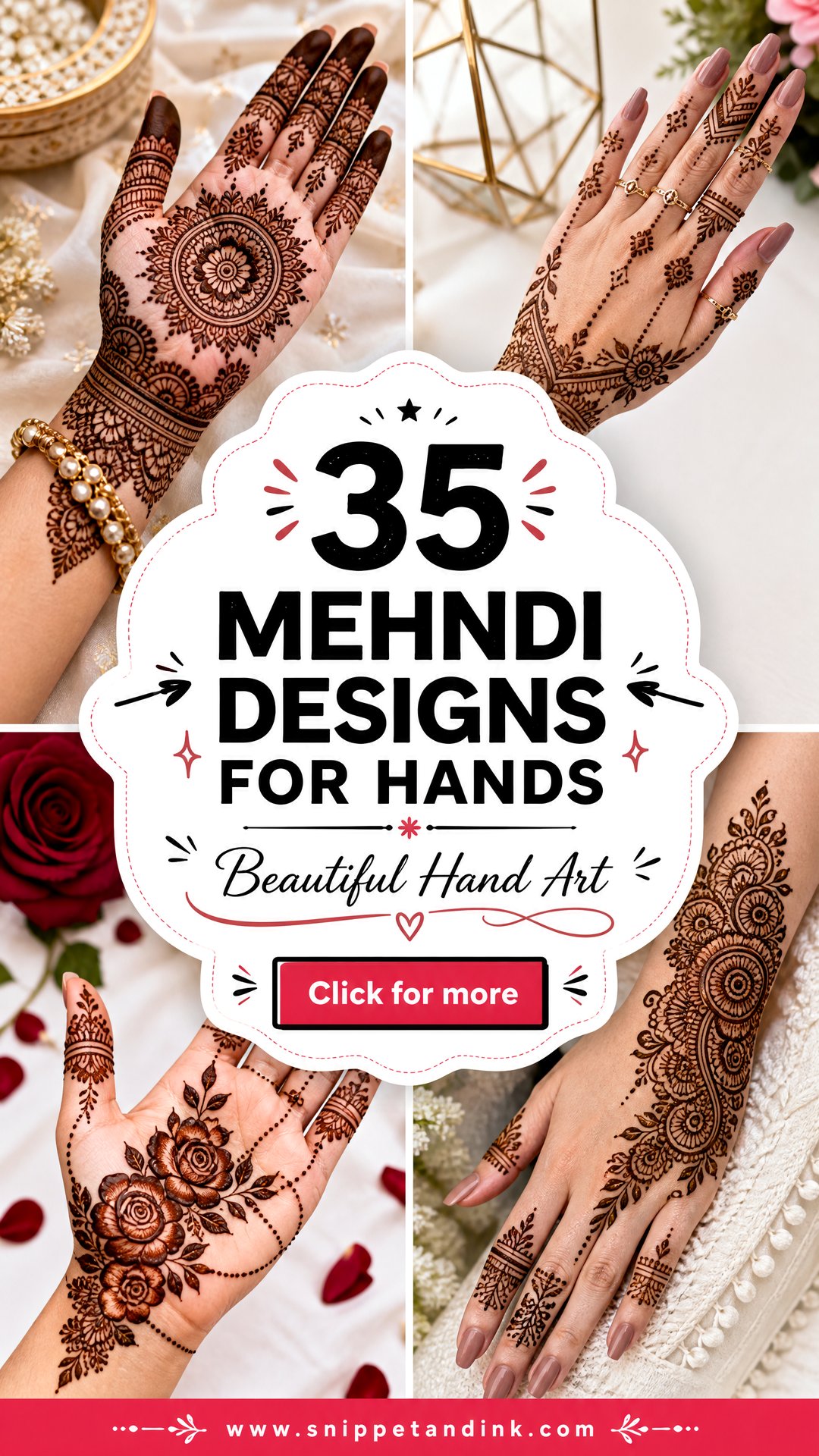
Hand mehndi now covers far more ground than the bridal palm. People book it for weddings as guests, for Eid and Diwali, for family functions, and sometimes just because a free evening and a fresh cone are hard to resist. The styles mix freely too: fine Indian filling, bold Arabic vines, Indo-Arabic spacing, Moroccan geometry and jewelry layouts all sit side by side. What I tell everyone who sits down at my table is that a pretty photo is only half the decision. The other half is your hand: its length, how your fingers bend, how much time you can sit still, and how many days you have before the event. The designs below are grouped so you can show your artist exactly what you mean.
Matching Coverage to Your Hand and Your Calendar
Before I pick up a cone, I look at the hand in front of me. Long fingers and a narrow palm can carry vertical trails and long finger chains; short fingers look longer when the finger work stays light and the main motif sits lower on the palm. Wide palms suit a large central mandala. If your hands sweat a lot, I steer you toward bolder lines, because moisture under fine paste makes it spread before it sets.
Timing matters as much as the design. Henna stain starts out pale orange when the paste comes off and keeps darkening for roughly a day or two afterwards. That is why I schedule most bridal applications one to two days before the wedding, and why a design done on the morning of an event will still look light by the evening.
Rough sitting times to plan around
- Finger-only, bracelet or minimal designs: usually a short sitting per hand.
- Arabic or Indo-Arabic on the back of both hands: allow around an hour or so.
- Full front and back to the wrist: plan for a couple of hours.
- Full bridal arms with forearm work: often several hours, plus drying time before you can move freely.
These vary with the artist’s speed and how detailed the design is, so ask at booking. Bring a reference photo, but also tell me what you will be doing with your hands that week. A bride who is cooking for guests needs a different plan from one who can rest.
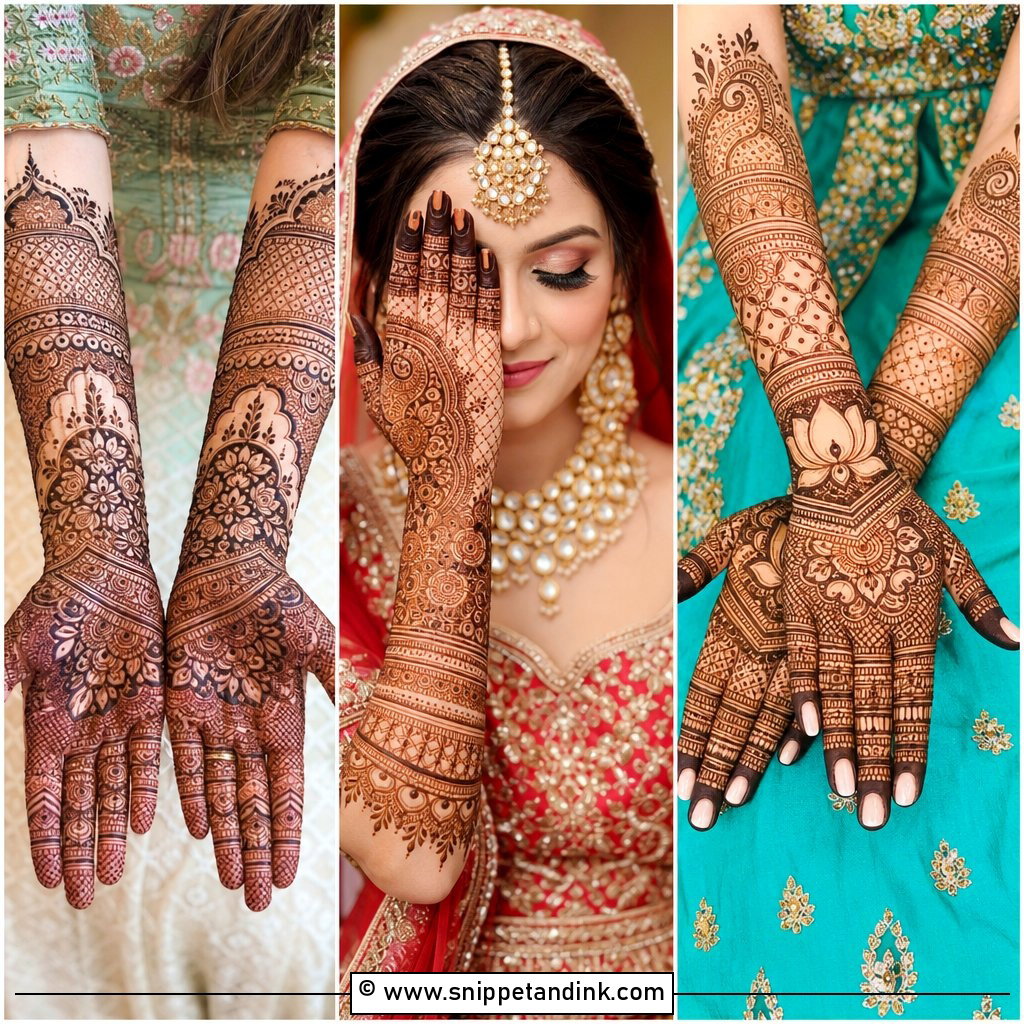
1. Full Hand Bridal Mehndi Design
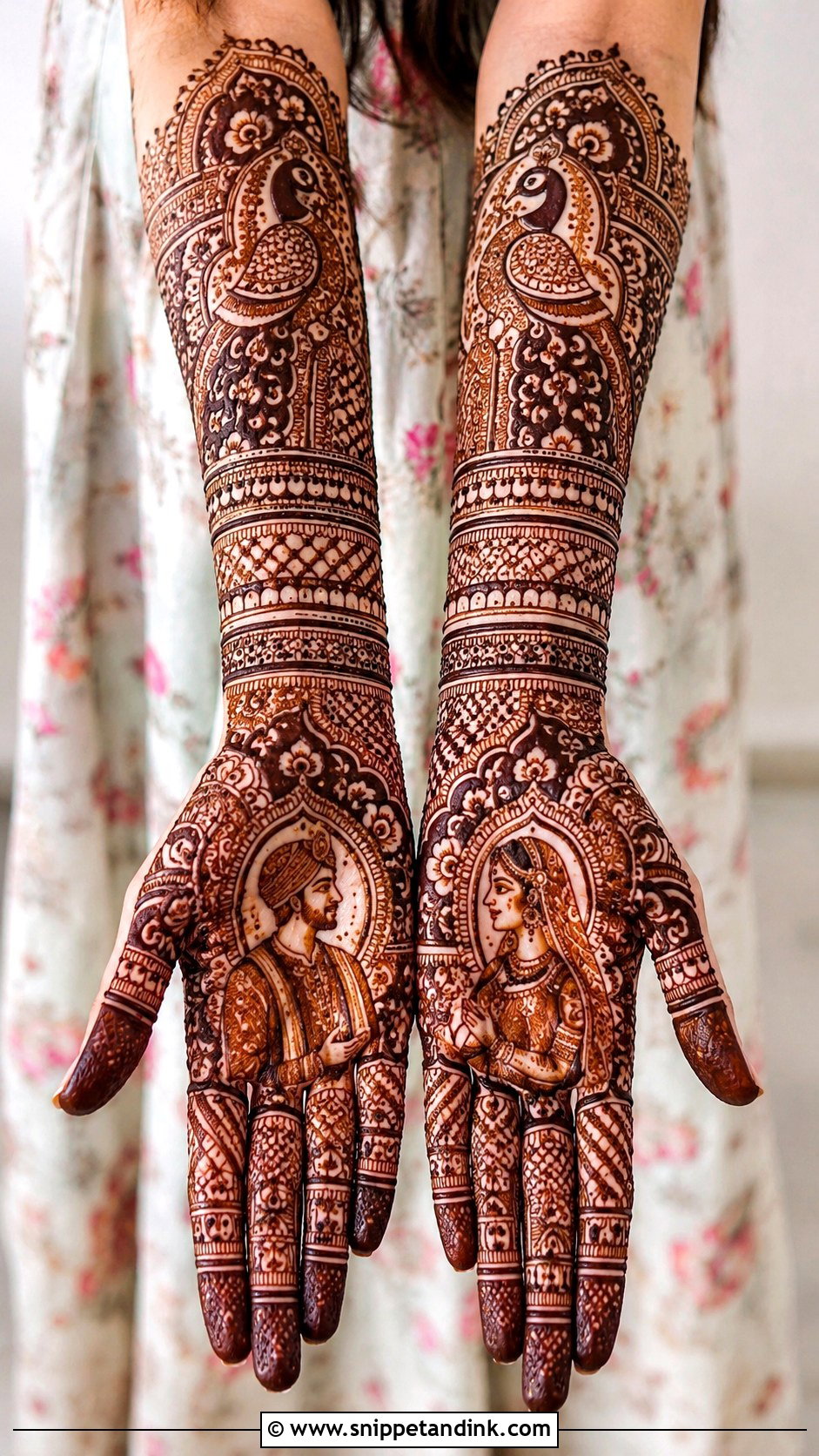
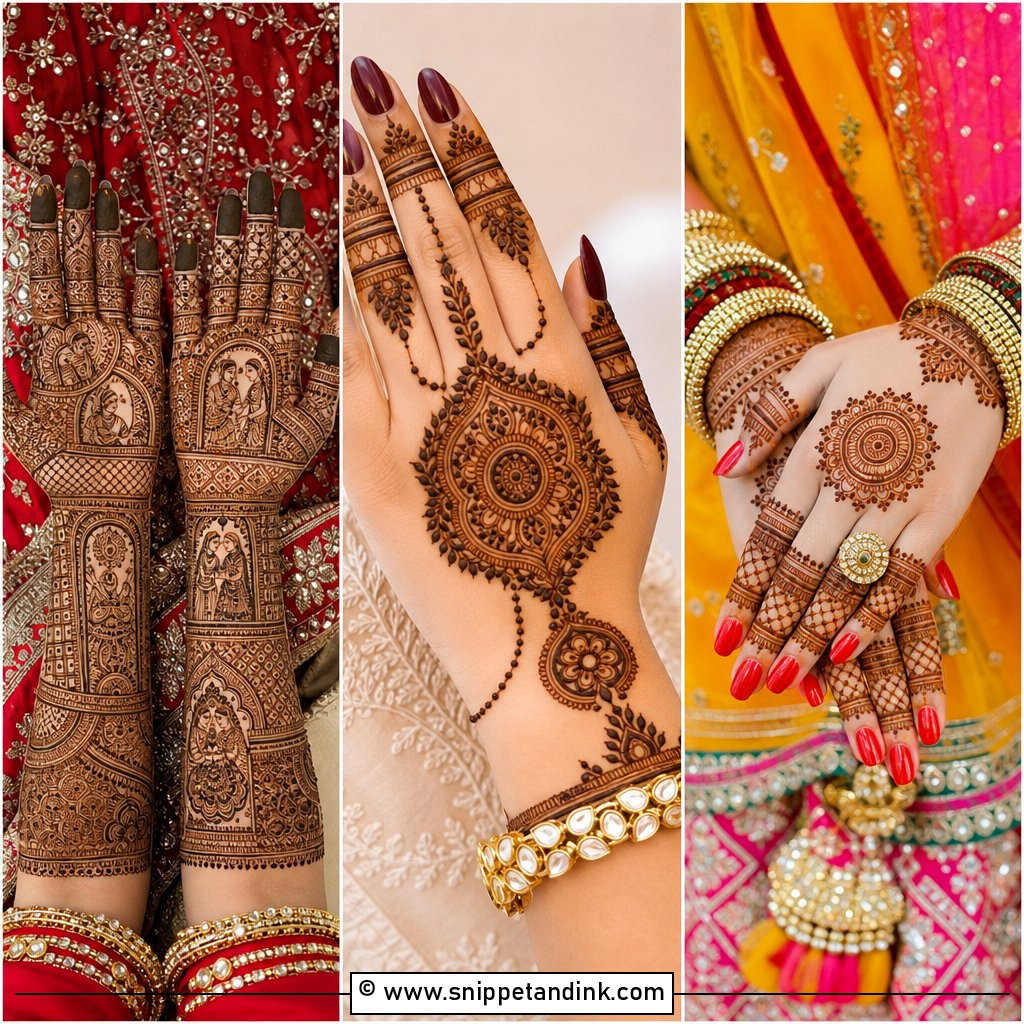
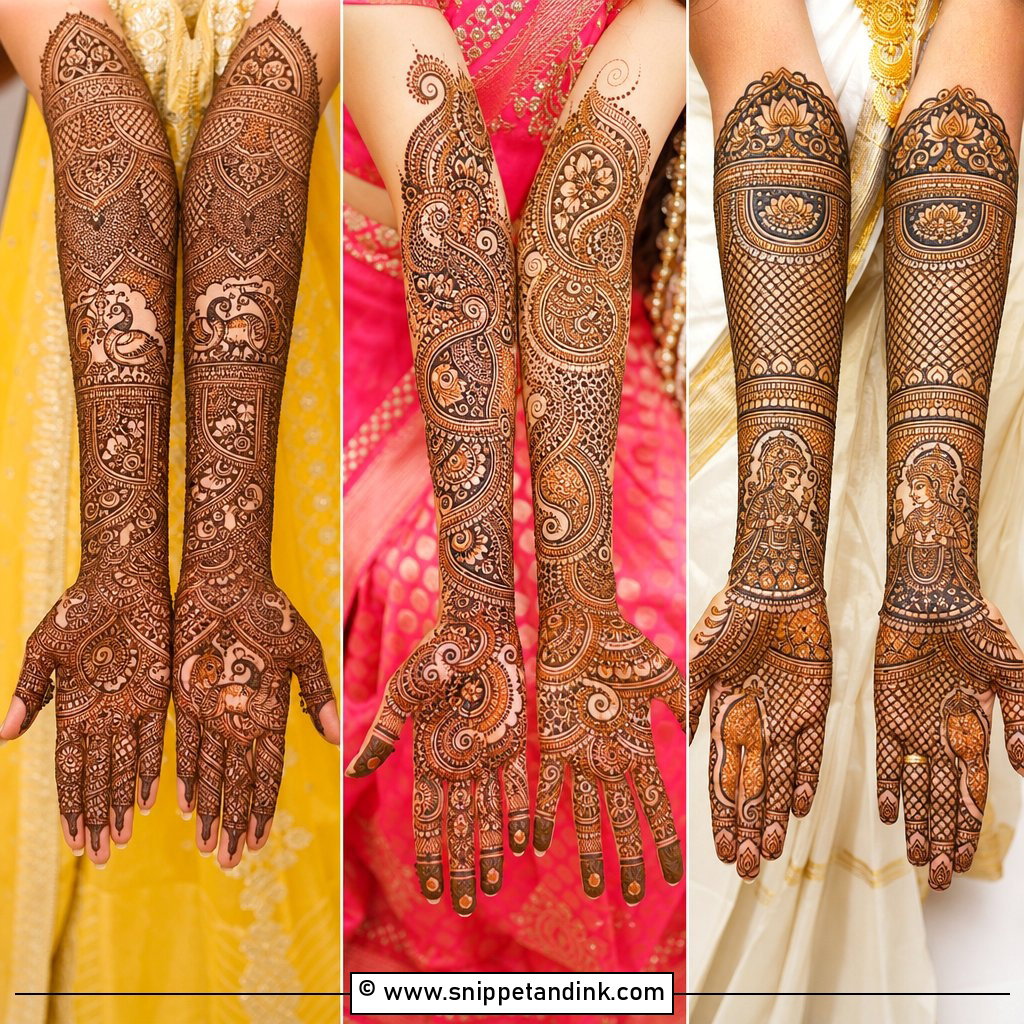
Full bridal coverage runs over the palm, every finger, the wrist and up the forearm, and it is the longest sitting I do. The palm usually carries the main story (paisleys, peacocks, a bride and groom, sometimes hidden initials) while the forearm takes the borders, domes and layered bands. The thing I watch most closely is density. If every gap is filled, the lines bleed into each other as the paste swells, and the stain reads as a brown patch instead of artwork. I deliberately leave hairline gaps of bare skin between motifs. Plan on several hours per pair of arms and book it a day or two before the wedding so the color has time to deepen.
2. Simple Front Hand Mehndi Design
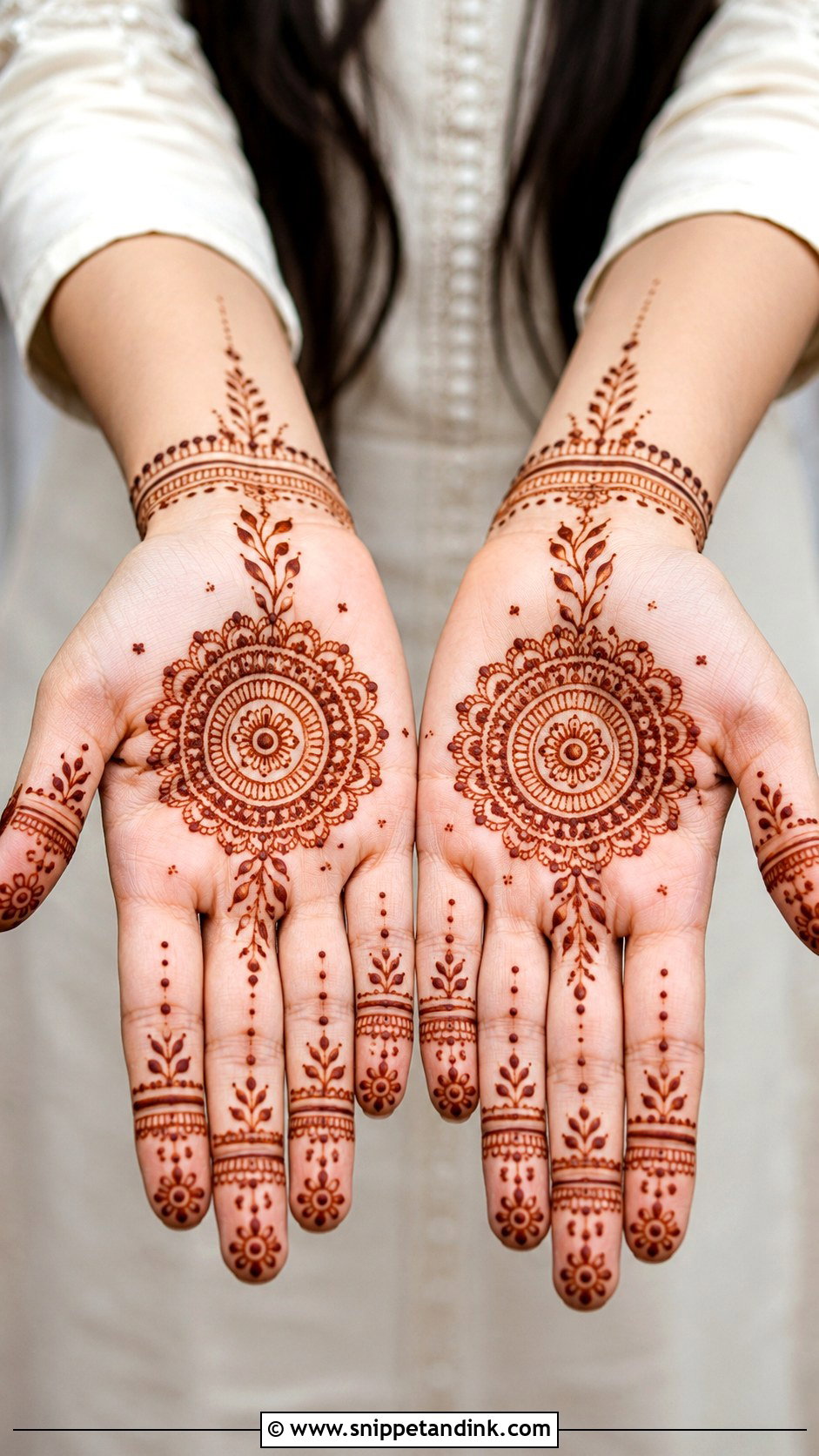
A simple front design starts with one palm motif, usually a mandala, a single flower or a small paisley cluster, and then dresses each finger with leafy lines, dots and a shaded tip. It is the design I recommend to anyone who has never worn henna, because it dries quickly and nothing feels heavy. The mistake I see in quick designs is an off-center palm motif; when the hand closes, it slides toward the thumb and the whole layout looks lopsided. I center it on the hollow of the palm, repeat the same finger pattern on all five fingers, and close with a thin band at the wrist.
3. Back Hand Mehndi Design
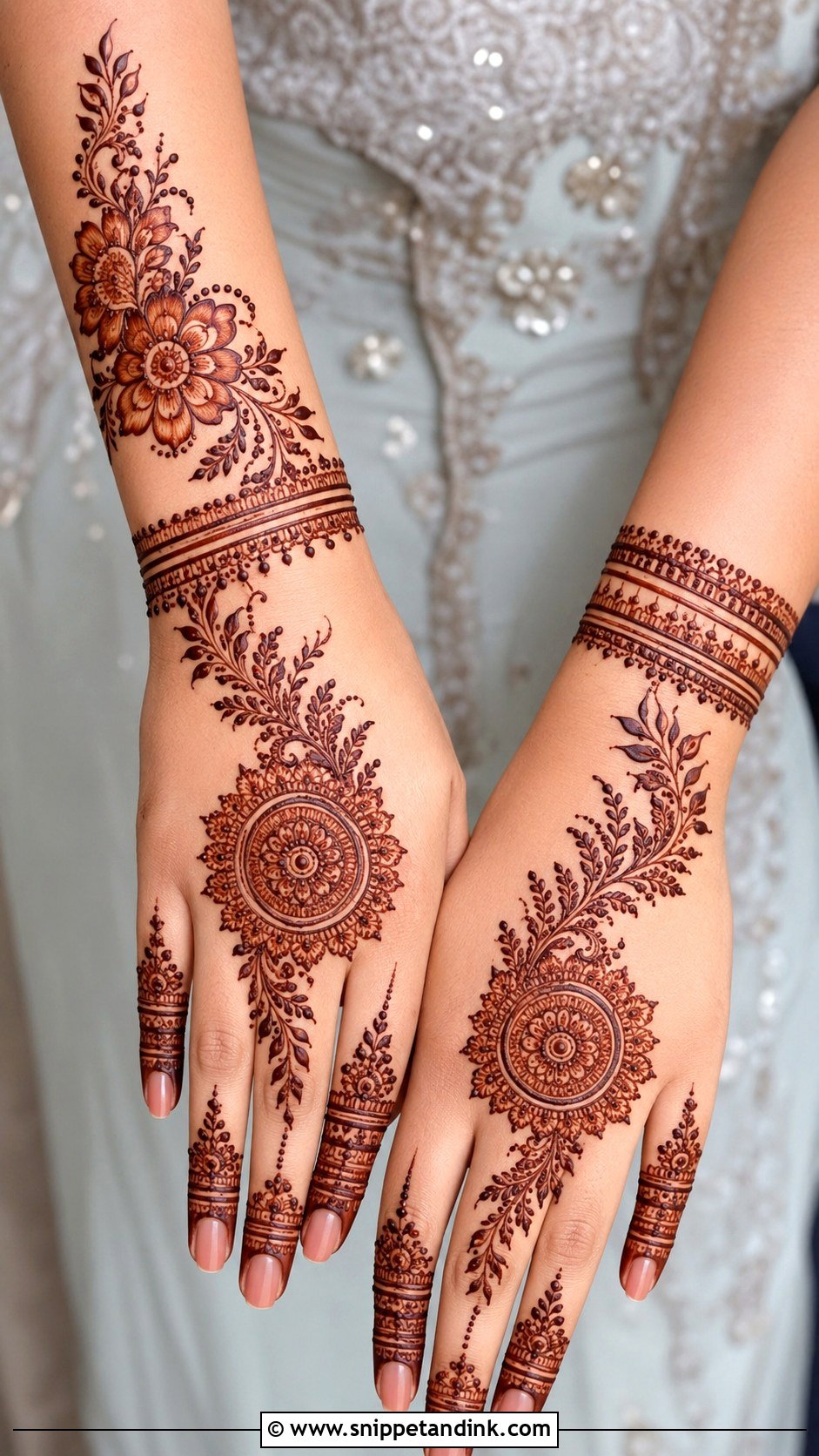
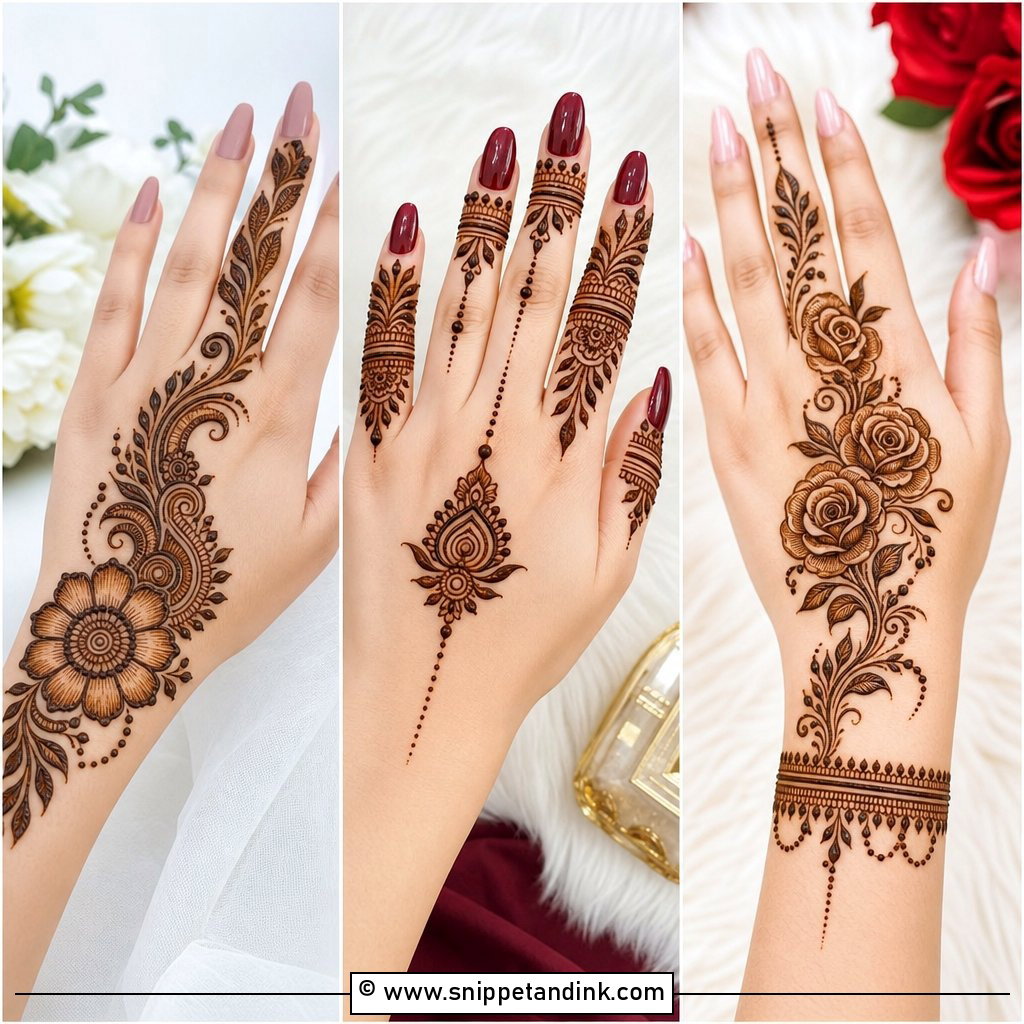
The back of the hand is the side that ends up in photos, next to rings and bangles, so I treat it as the display surface. Diagonal floral trails, a mandala centered over the knuckles, bracelet bands and lace-like finger work all sit well here. Knuckles and tendons move, so I keep the busiest detail on the flat area between them; a dense pattern drawn right over the knuckle cracks when the paste dries and the stain breaks there. Small hands get thinner vines and lighter filling, while long hands can carry a pattern from fingertip to wrist. Bear in mind the back of the hand stains a shade or two lighter than the palm.
4. Arabic Mehndi Design For Hands
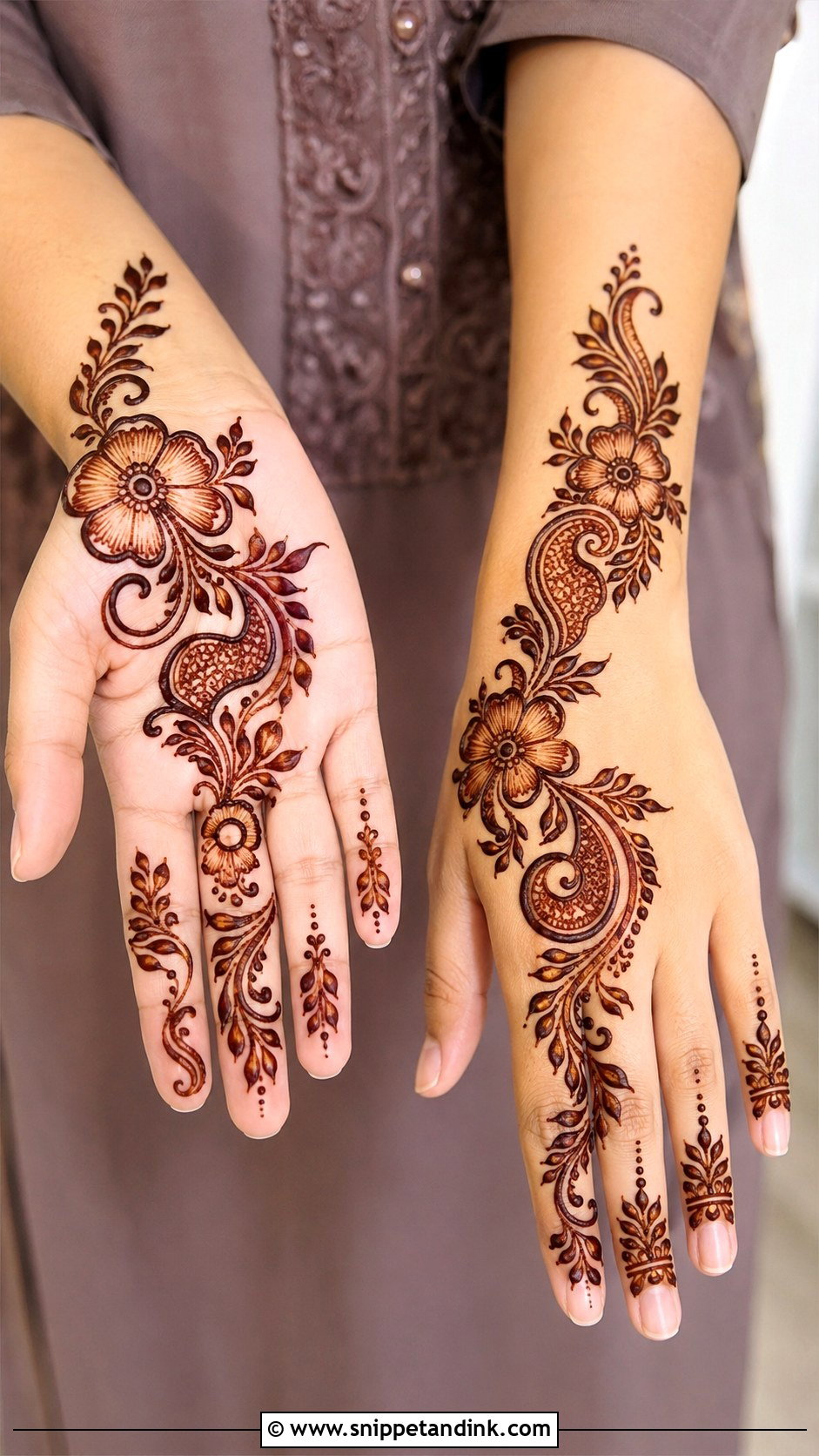
Arabic work is built on flow rather than coverage. A trail of large flowers, leafy vines and shaded petals runs diagonally across the palm or the back of the hand, and plenty of skin is left open. I like it for guests and festival evenings because it goes on fast and reads clearly from across a room. The bolder strokes also hold more paste, so the stain usually comes out stronger than very fine Indian lines. To keep it modern, I semi-fill the fingers and let the main trail begin near the index finger and finish at the wrist.
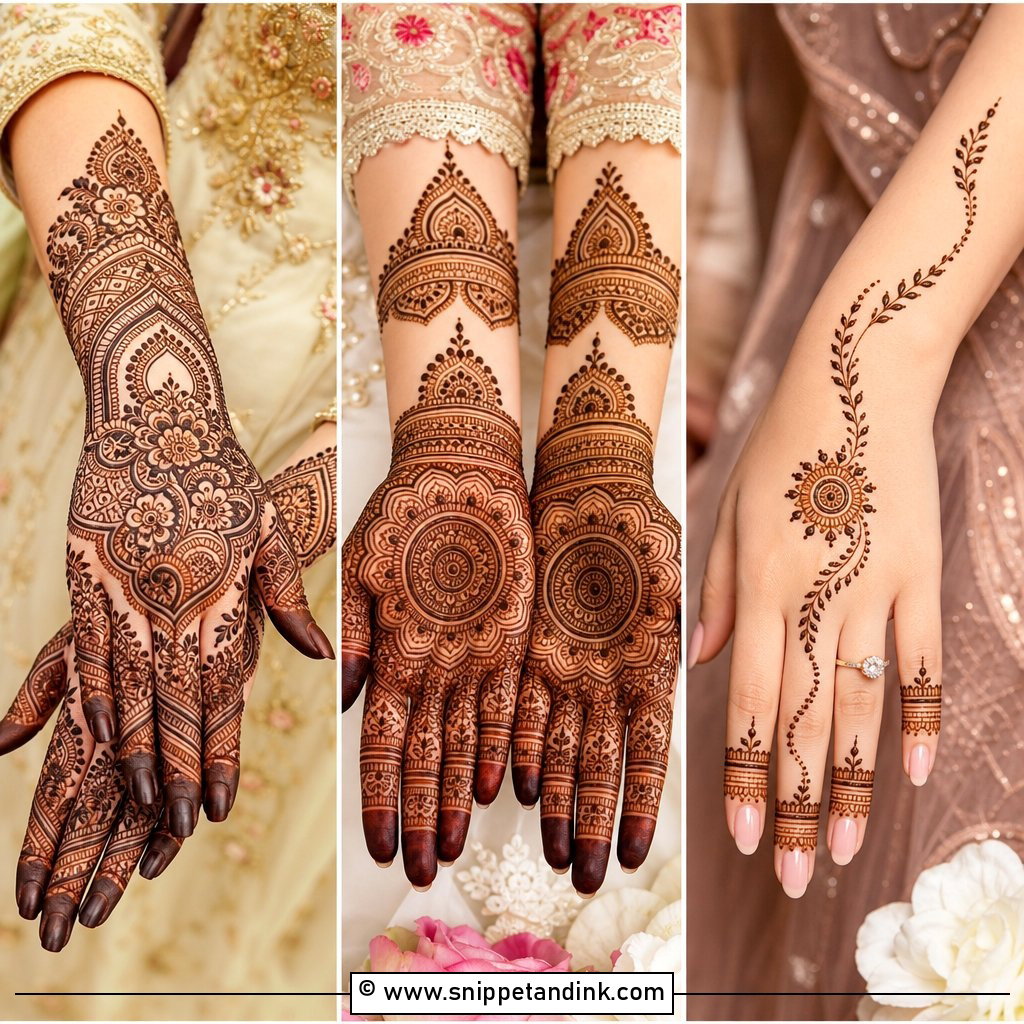
5. Indo Arabic Mehndi Design
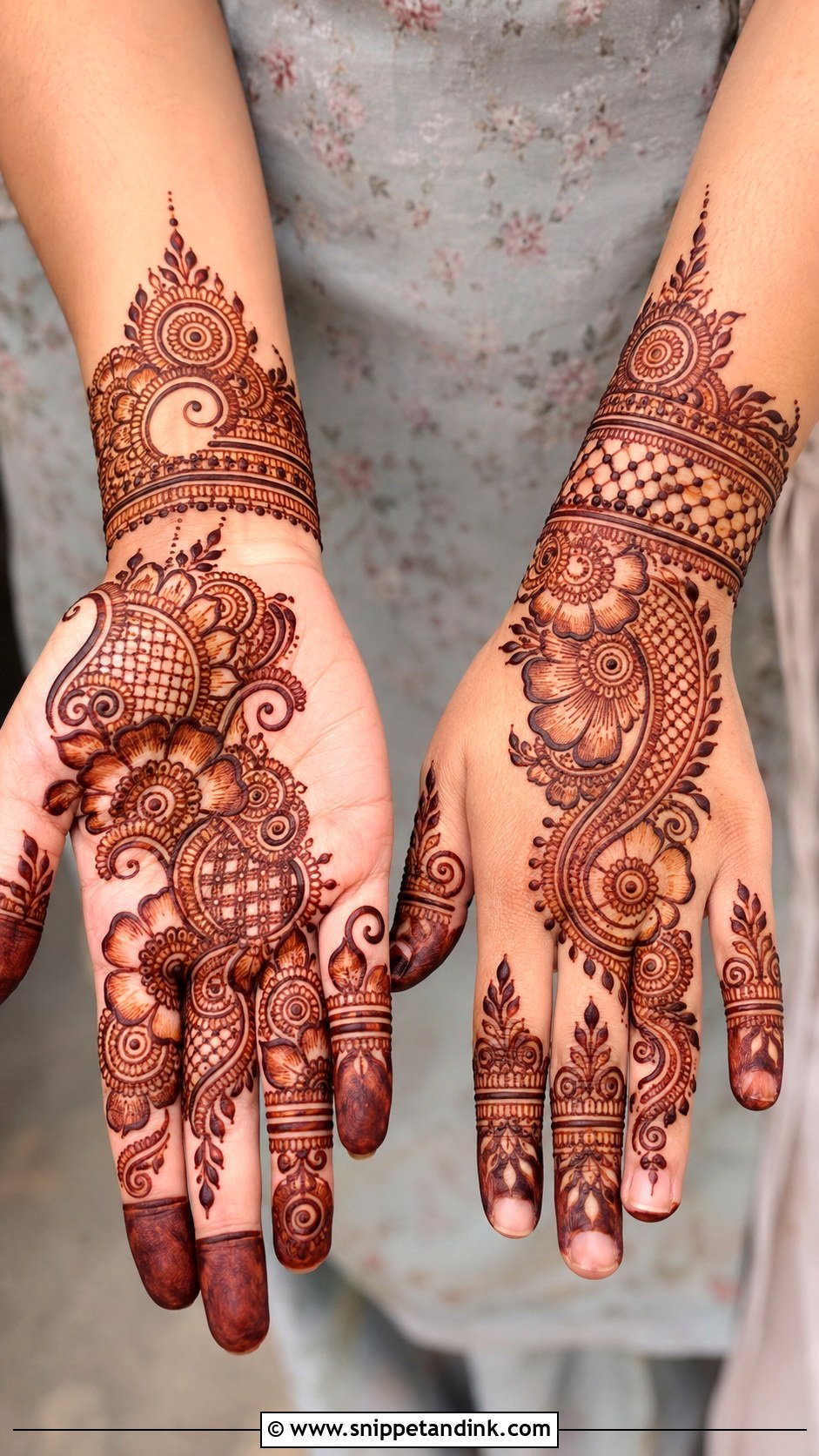
Indo-Arabic is the middle ground I end up drawing most often. The Arabic flow sets the path, and Indian detail fills in around it: paisleys, small mandala sections, a bit of jaali, tiny filler work. The result is a complete hand design that looks generous without the four-hour sitting. Bridesmaids, sisters of the bride and engagement guests ask for it constantly. My rule is a thicker outline around each main shape with delicate filling inside, so the structure still reads once the stain settles into its final color.
6. Indian Mehndi Design For Hands
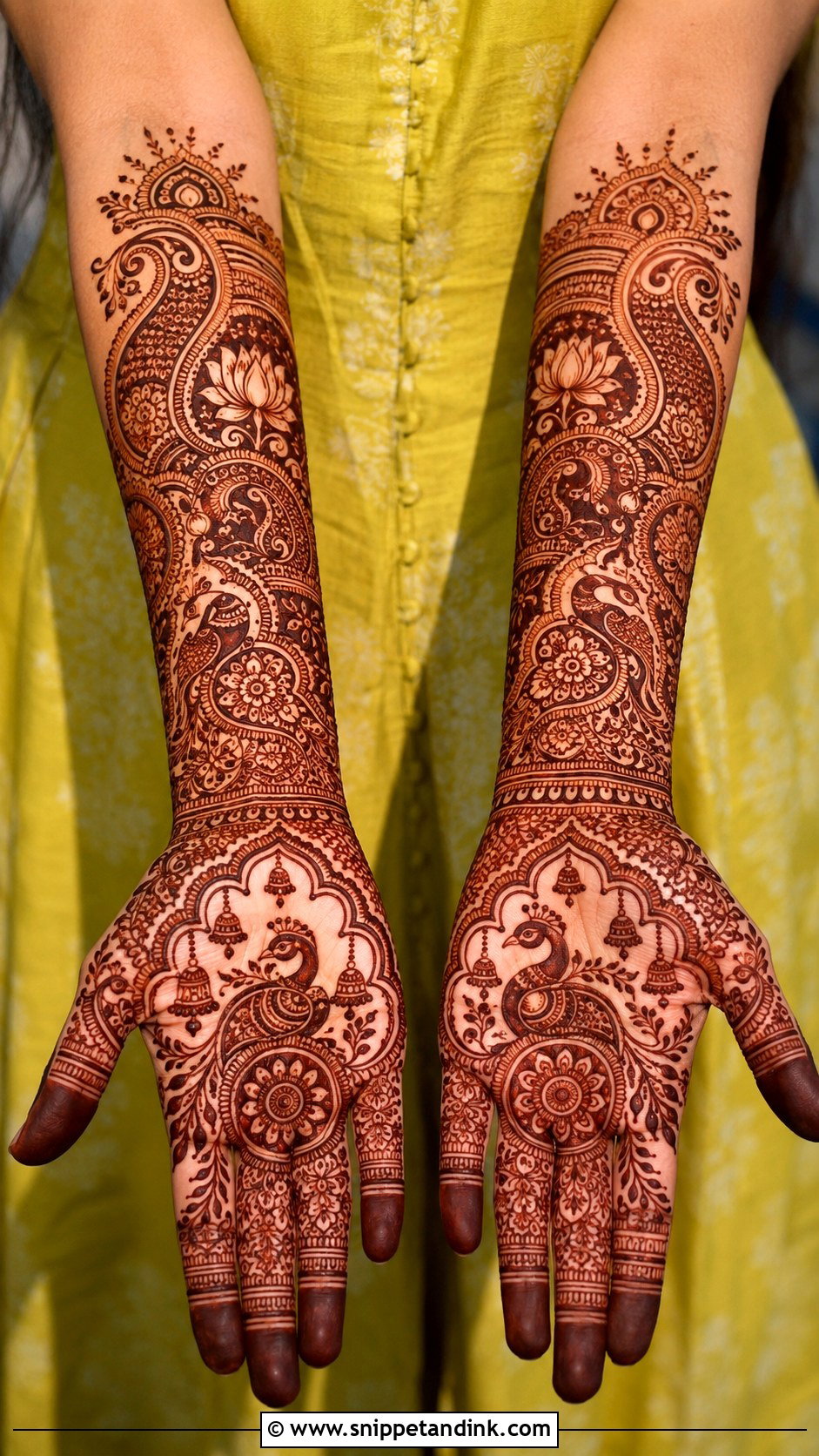
Traditional Indian mehndi is close, precise and full of symbolism: paisleys, lotus, peacocks, bells, nets and stacked borders, often running from fingertip to forearm. For pujas and weddings where the henna itself carries meaning, this is usually what families expect. It can be light or heavy, but it always depends on precision; a wobbly line is very visible in fine filling. I pick one hero motif for the palm and let everything else support it. Fine Indian work needs a smooth, well-strained paste, because a single grit particle in the cone breaks a thin line halfway.
7. Modern Mehndi Design For Hands
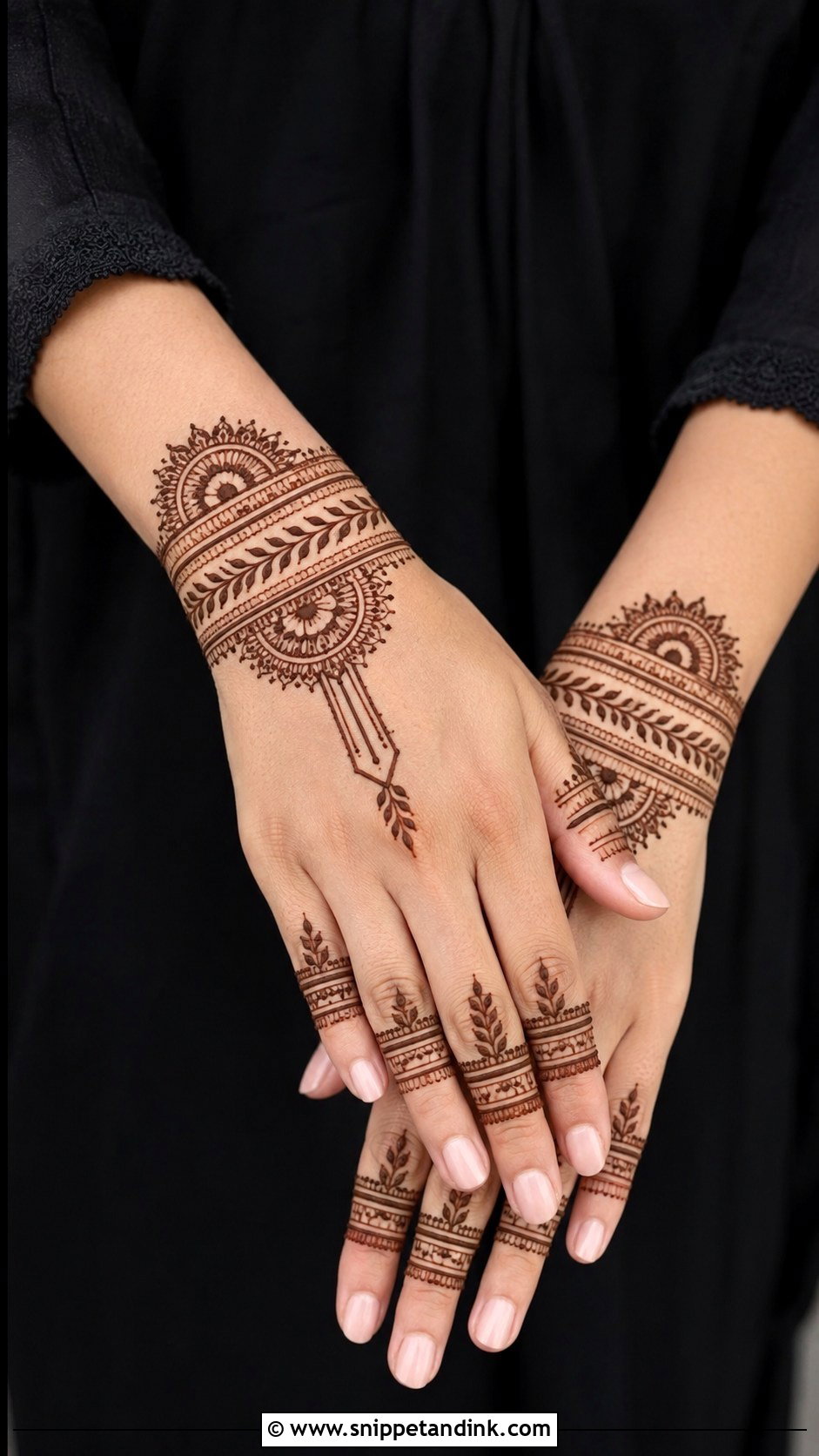
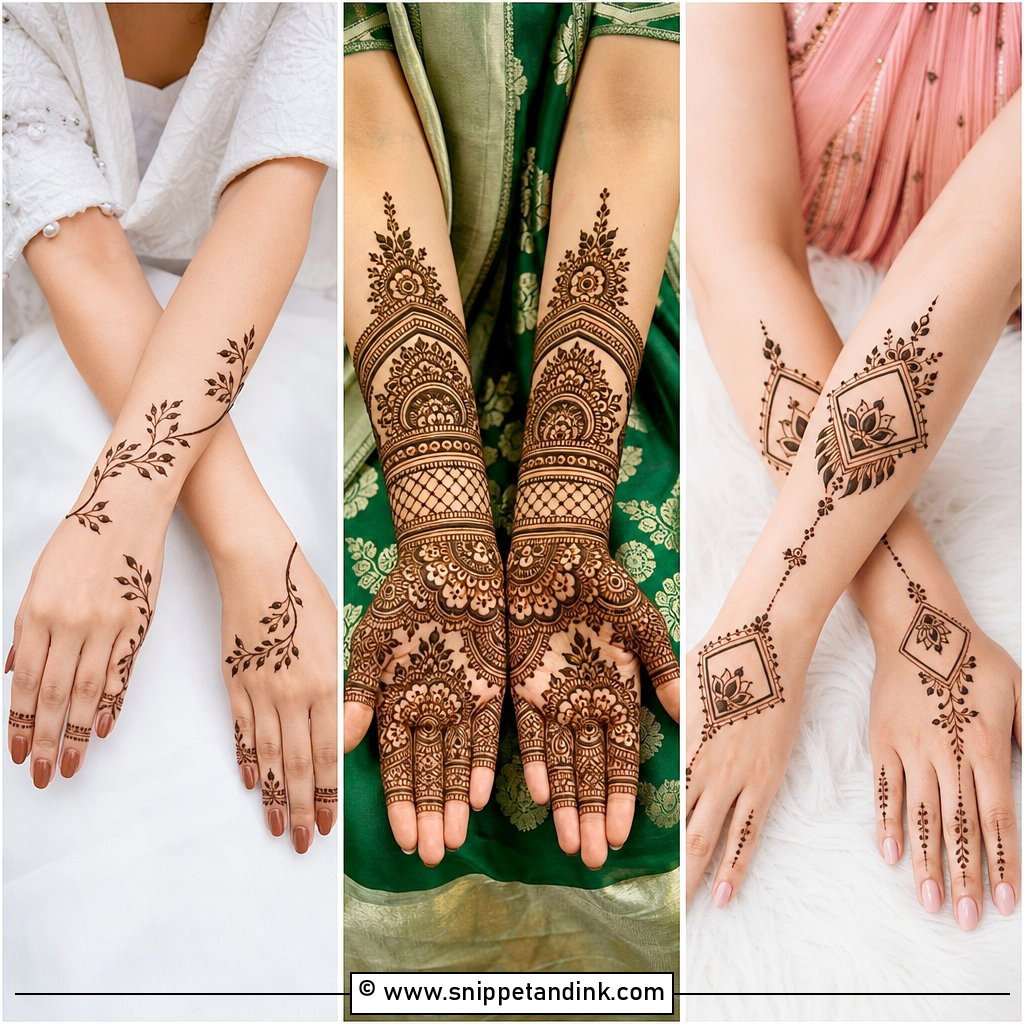
Modern designs get their effect from planned emptiness. Instead of covering the whole hand, I place a few strong elements, maybe a half-mandala on the palm, slim finger rings, a geometric band and a sleek wrist cuff, and leave the rest bare on purpose. This suits people who want henna without looking traditional, and it leaves room for nails, rings and the outfit to be noticed. The difficulty is that there is nowhere to hide. Every line has to look intentional, and every blank area has to look chosen, which takes more planning time than drawing.
8. Minimal Mehndi Design For Hands
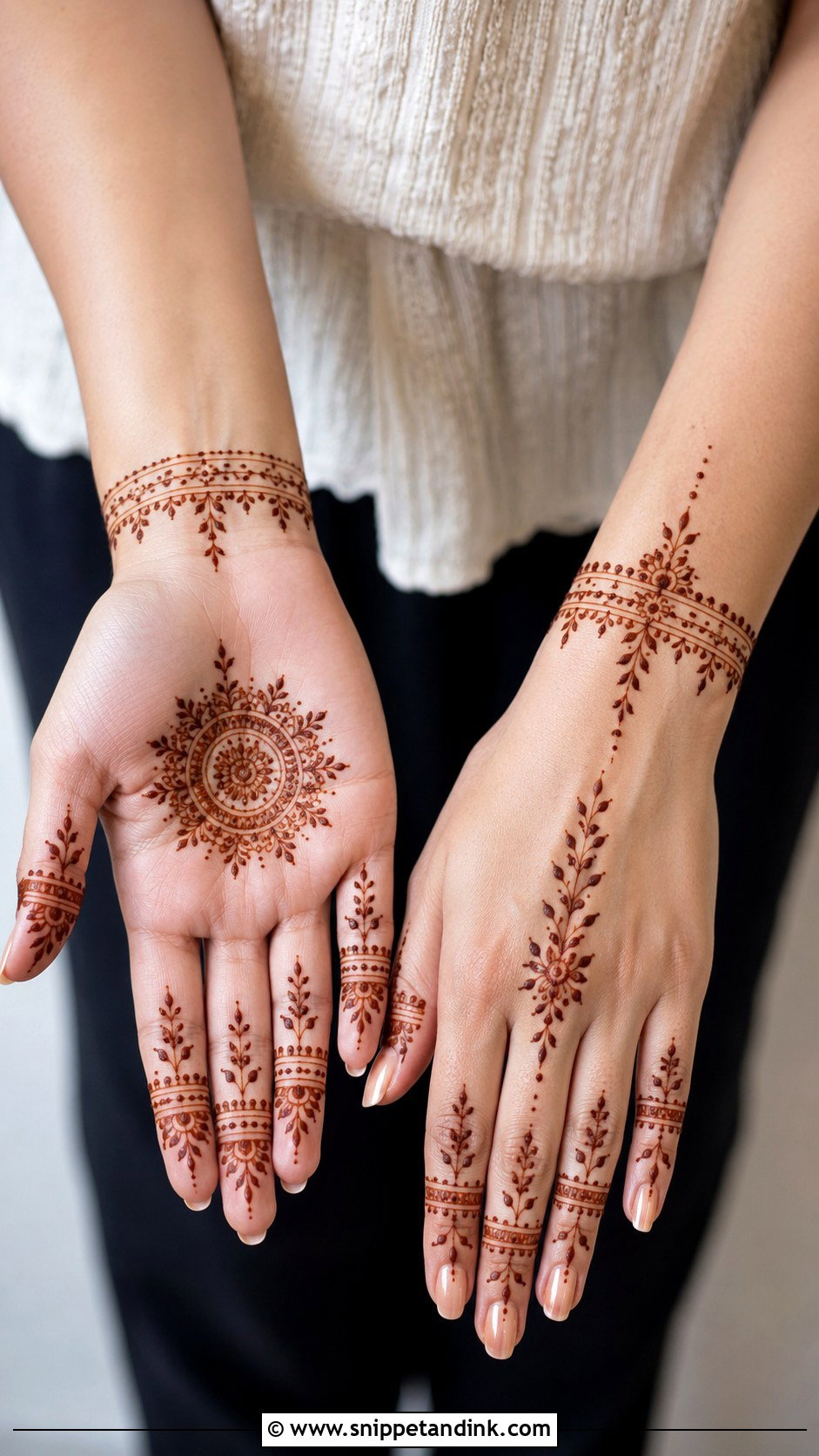
Minimal mehndi keeps the motif count low: a small palm mandala, light finger details, a slim wrist bracelet, a few dots to balance it out. It takes very little time, which is why people ask for it before office parties or the night before a small family gathering. I use my finest tip for it, since thin lines are what keep a small design looking refined. I’d leave the fingertips only lightly decorated rather than fully dipped; a full tip on an otherwise light hand looks heavier than intended once it stains.
9. Finger Mehndi Design For Hands
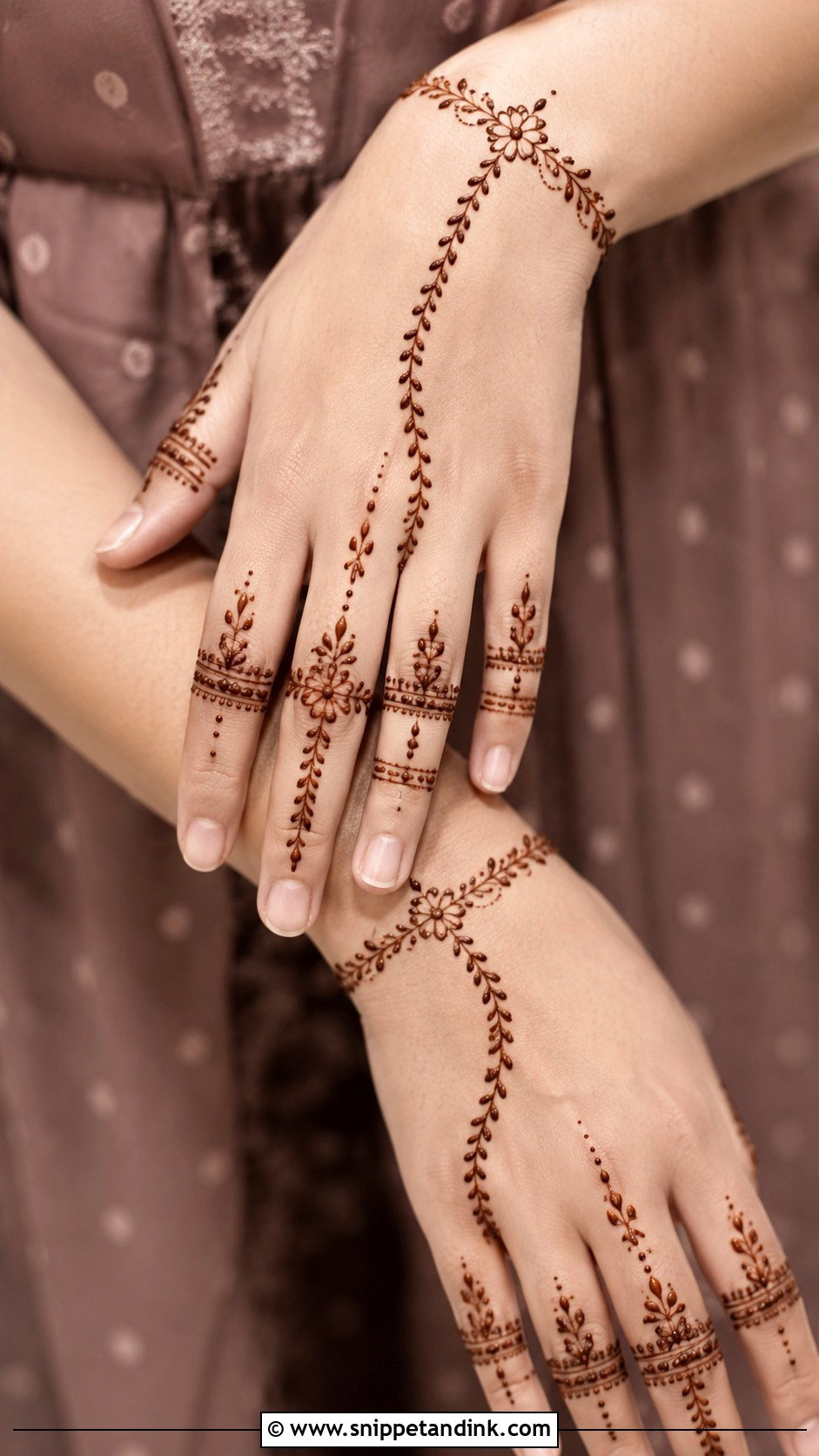
Here the fingers carry almost everything, and the palm or back of the hand stays mostly bare. Ring patterns, leafy chains, tiny flowers, net details and fingertip bands do the work. It dries fast and looks current, and it is the easiest way to wear henna without a full palm stain. Fingers do stain darker than you might expect, so I keep each design light. To stop the hand looking unfinished, I add a small wrist bracelet or a tiny central motif, and I check it against the nail color you plan to wear.
10. Mandala Mehndi Design For Hands
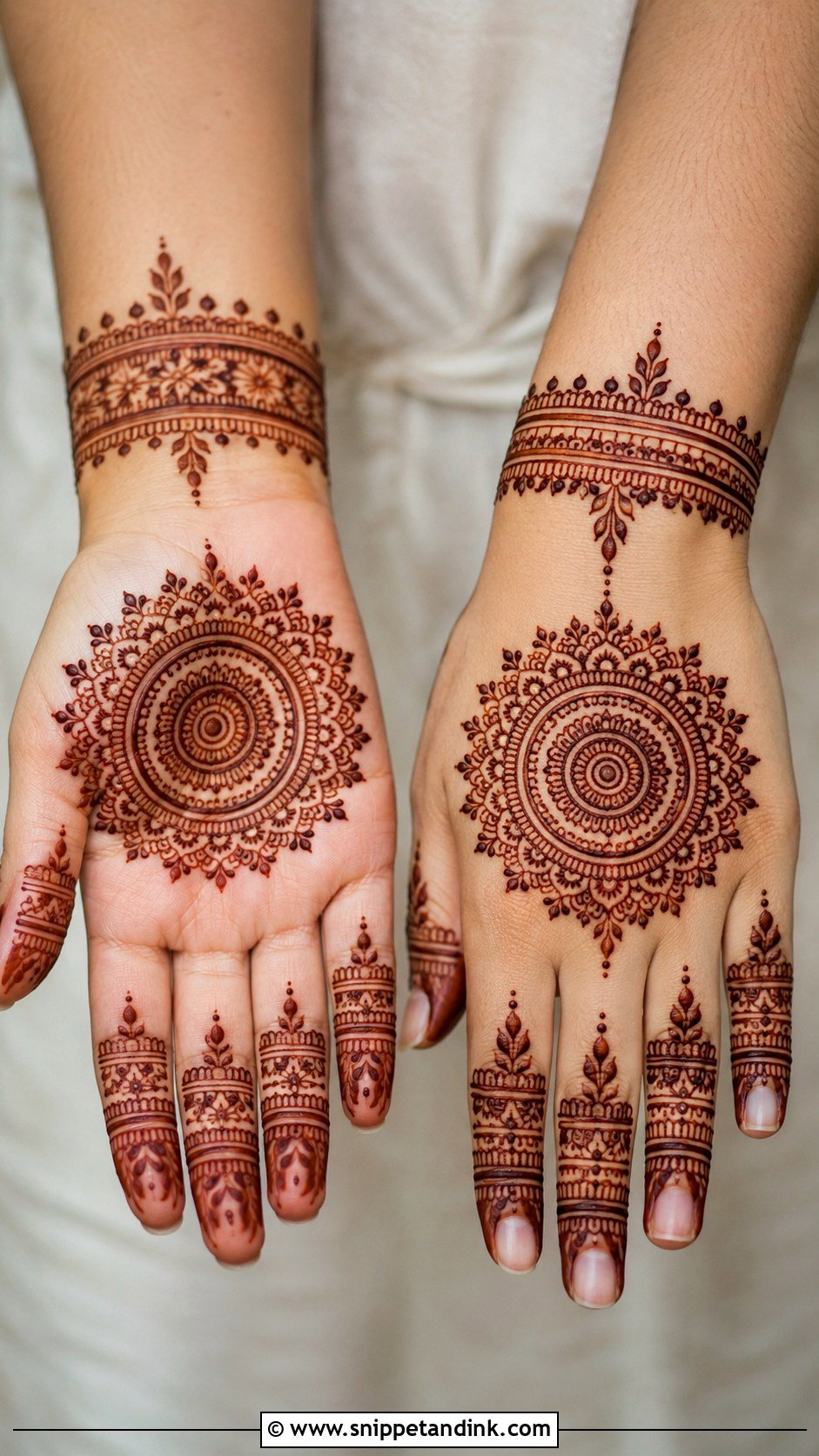
A mandala is the safest focal point I can offer a nervous first-timer. It starts as a circle in the center of the palm or the back of the hand, and the petals, dots and leafy rings grow outward from there, so even light coverage looks finished. On the palm it reads traditional; on the back of the hand it looks more modern. The catch is symmetry. Any wobble in the circle shows immediately, so I sketch the inner ring with dots first and only then commit to the outline.
11. Floral Mehndi Design For Hands
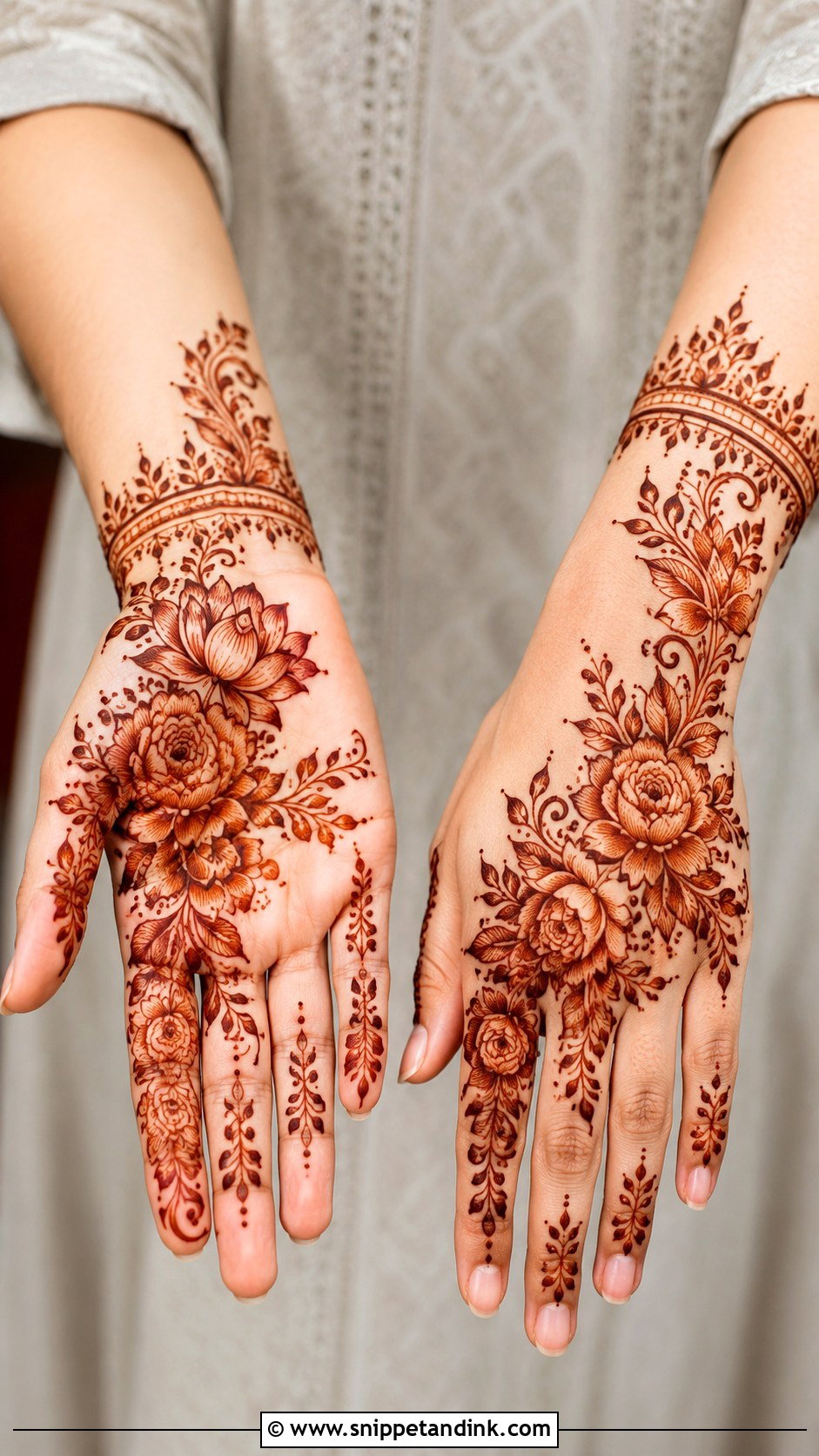
Florals adapt to almost any event because the flower size changes with the space available. Big roses, small blossoms, lotus petals and leafy vines can sit on the palm, run along the back of the hand, or travel from wrist to fingers. For a delicate result I use thin outlines and open petals. For a bold result I switch to Arabic-style flowers with shaded centers. Shading takes practice, though. If the artist presses too hard, the shaded petal turns into a solid blot, so ask to see shaded work in their portfolio first.
12. Rose Mehndi Design For Hands
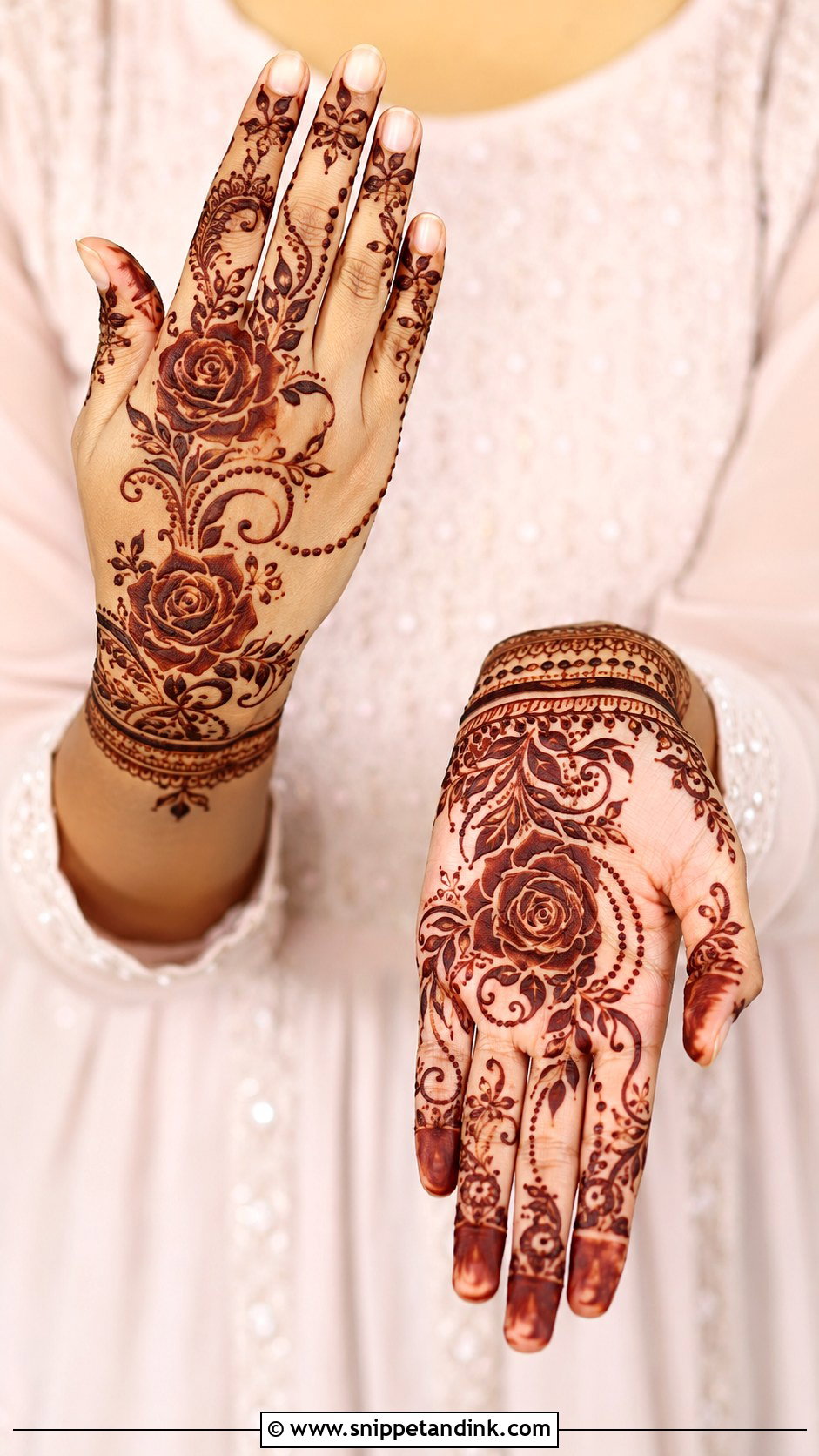
Rose designs give a romantic feel with less work than a full floral layout. One or more roses sit on the palm, the back of the hand or the wrist, linked by leafy trails, curved vines and a bracelet band. My favorite placement is a trail that starts near the index finger and drifts toward the wrist on the back of the hand. Keep the petals bold and resist filling them with tiny details; fine fillers inside a rose stain as a muddy blur rather than petals.
13. Paisley Mehndi Design For Hands
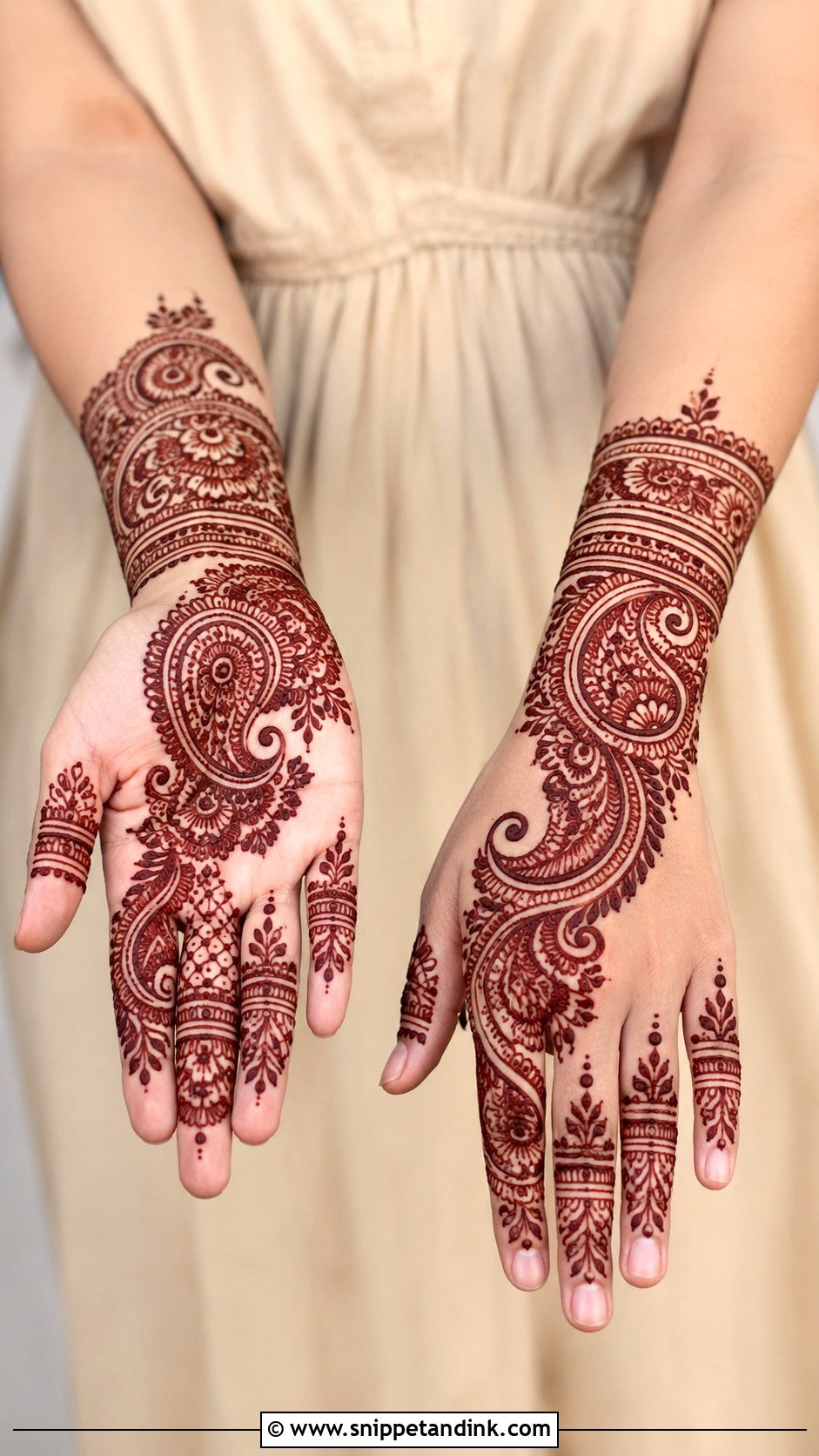
Paisley mehndi design for hands stays popular for good reason. The curved mango shape can hold dots, leaves, florals, grids or fine lines, and it scales from tiny to huge. I often put one large paisley across the palm and let smaller ones step down toward the wrist, or build a diagonal paisley trail on the back of the hand with a few flowers. It is my go-to for Karwa Chauth, Eid and Diwali clients who want something traditional. Bold outlines with detailed filling look rich, as long as some open skin is left around each paisley.
14. Peacock Mehndi Design For Hands
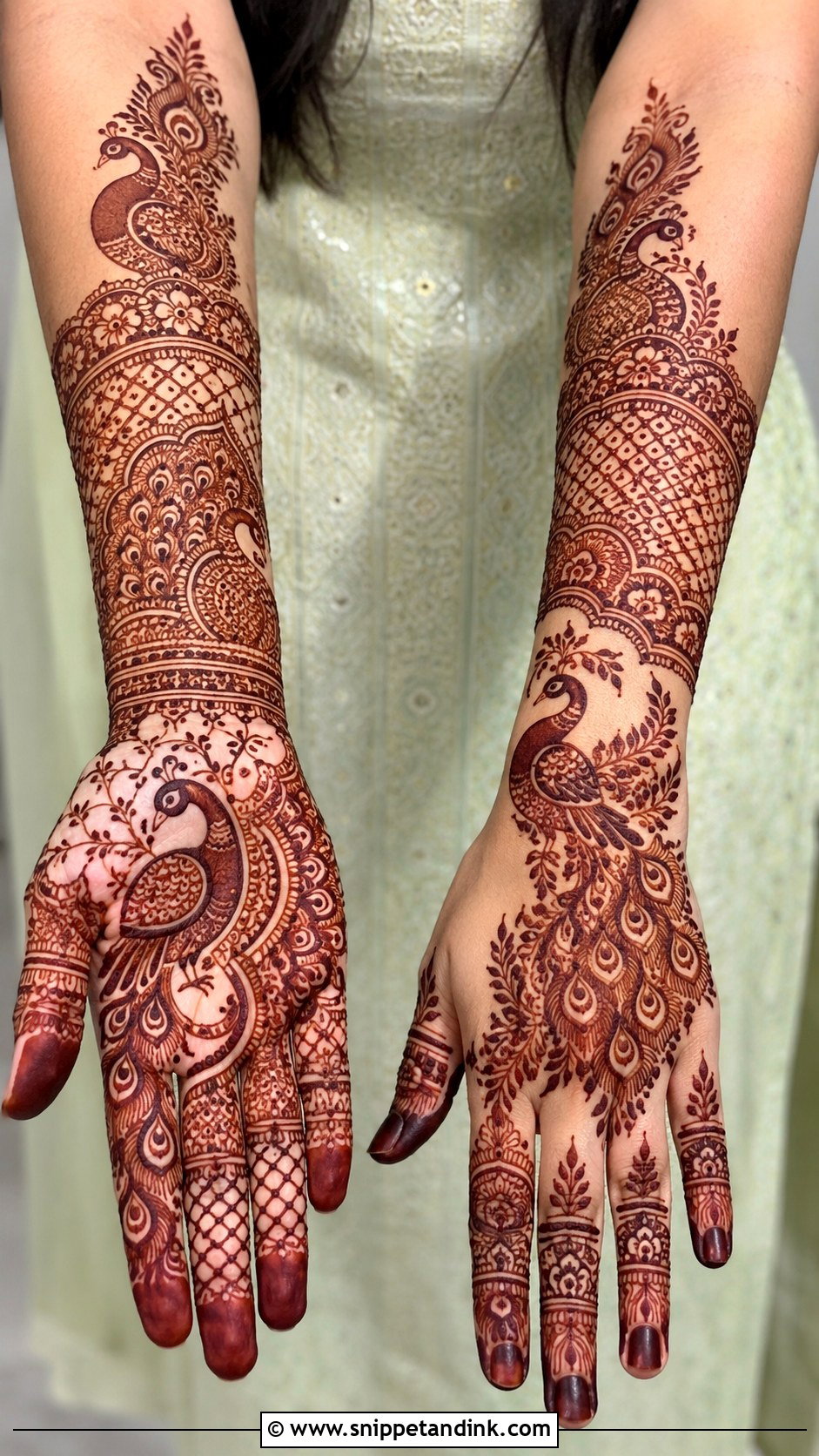
A peacock brings drama and a strong traditional feel, which is why brides ask for it so often. The bird can sit on the palm, the wrist or the forearm, with its tail feathers spreading out into paisleys and curved lines. Smaller peacocks on the back of the hand work well for guests too. The face is where I slow down: the beak, eye and crown need strong outlines and almost no filling, or the head turns into a dark smudge when it stains. Floral borders and a little jaali complete it.

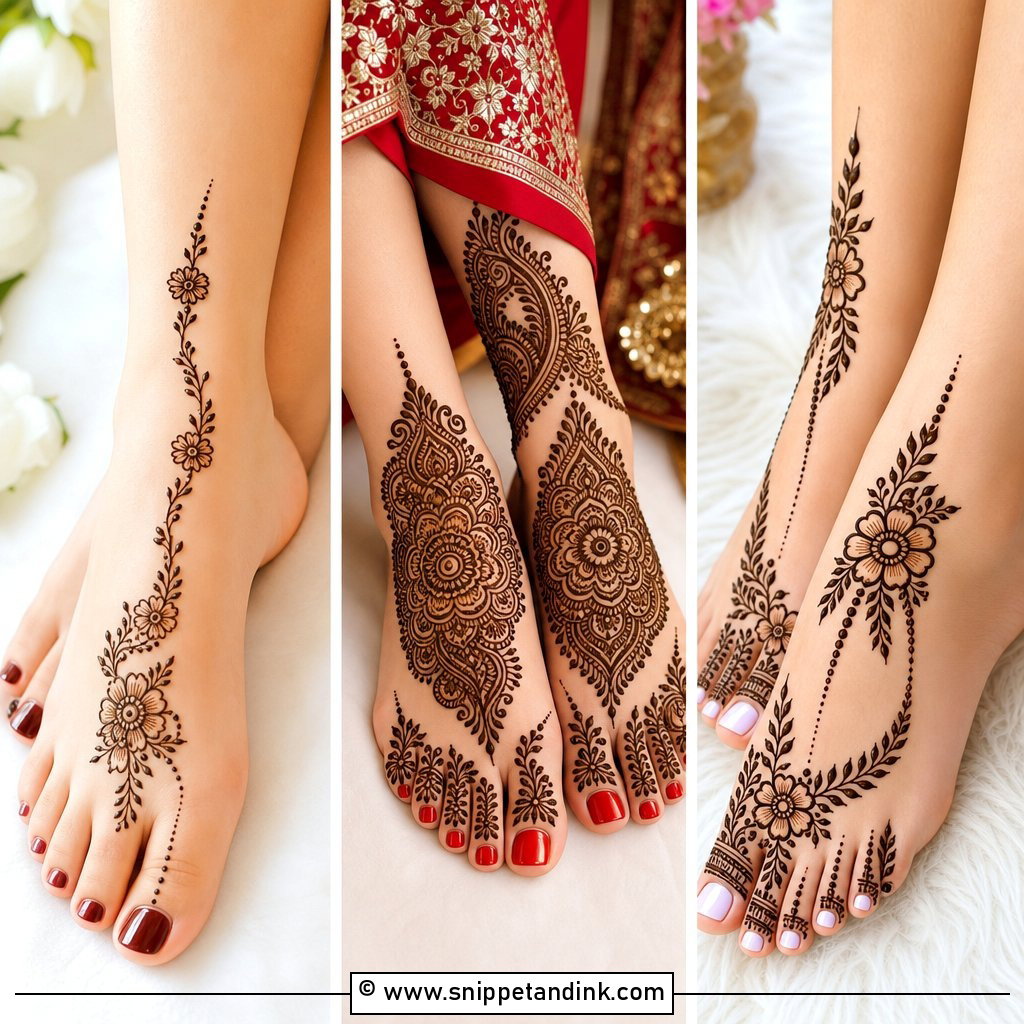
15. Jaali Mehndi Design For Hands
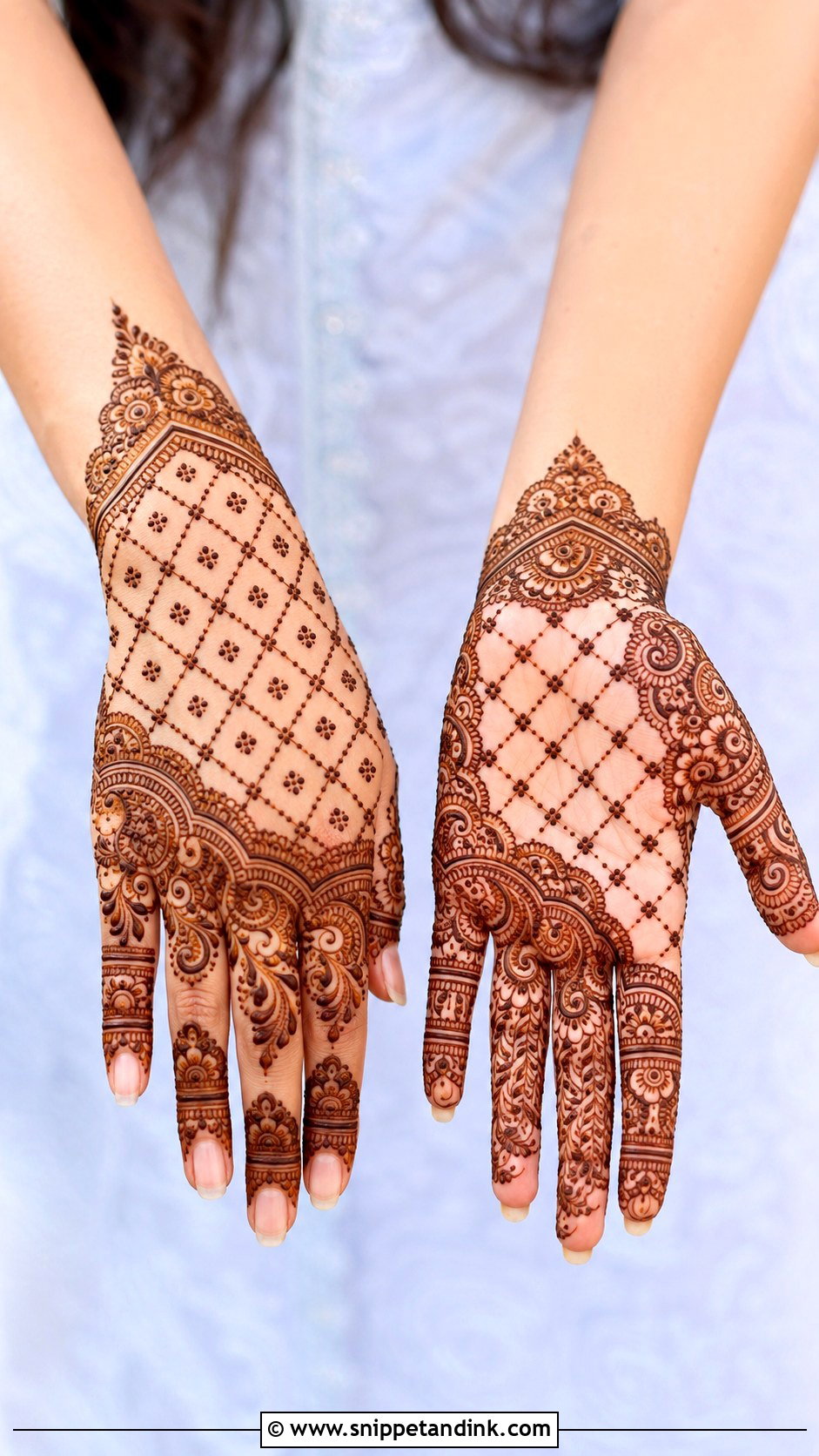
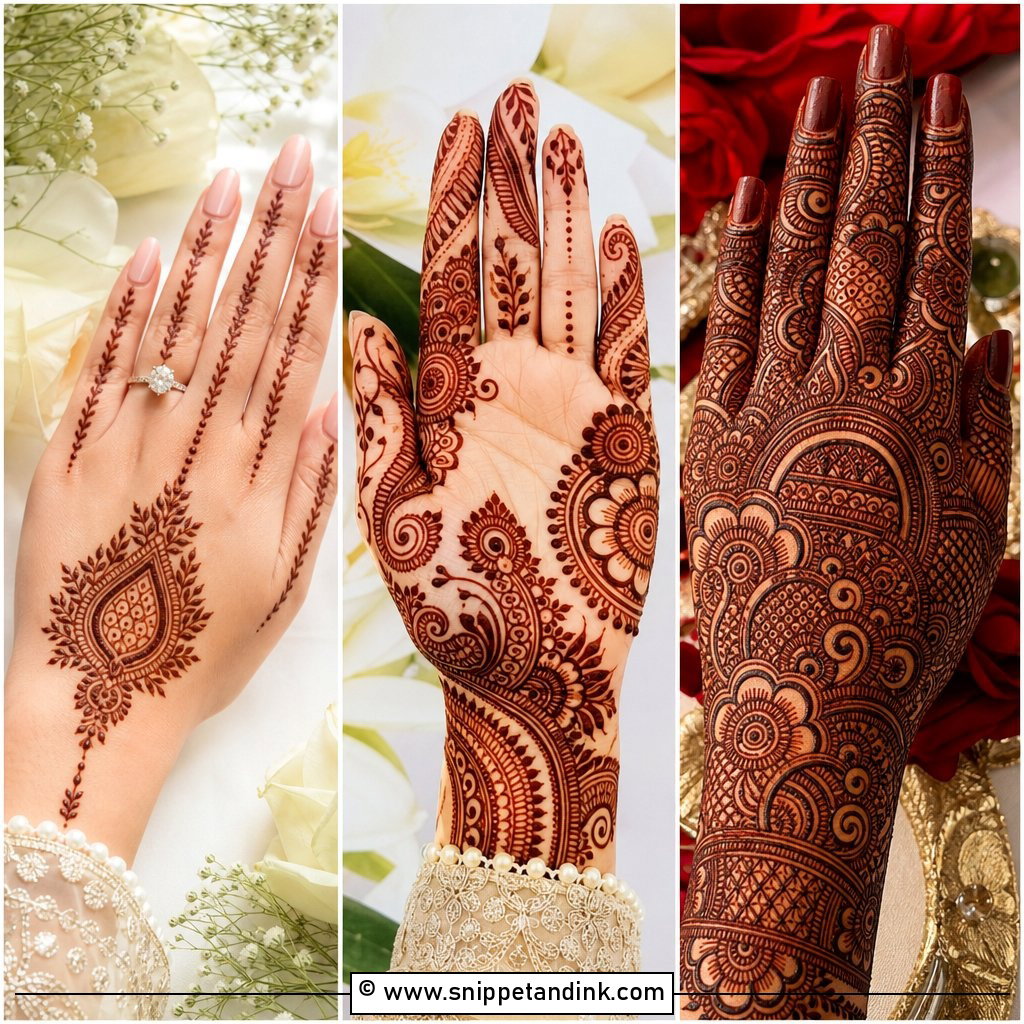
Jaali is mesh, and done well it looks like lace gloves drawn on skin. It can be a simple diamond net, floral netting, or a grid with a dot in every square, and it pairs naturally with bridal and Indo-Arabic designs. Consistency makes or breaks it. The lines need even spacing, and the mesh should not be too tight; small squares close up when the paste swells, and you lose the lace effect. I frame jaali panels with flowers or paisleys so the net has edges to sit inside.
16. Bracelet Mehndi Design For Hands
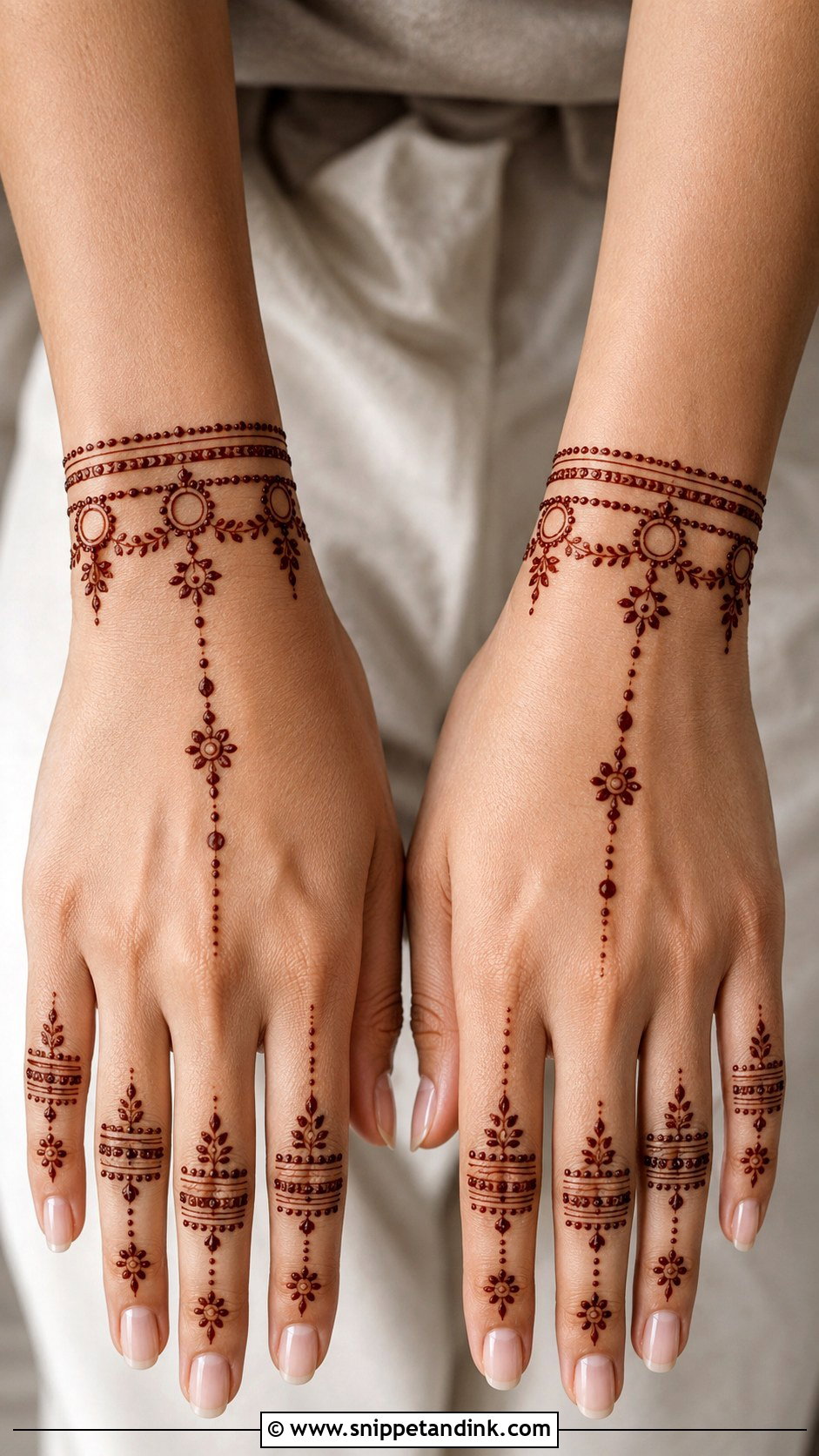
Bracelet designs draw jewelry on with henna: wrist bands, chains, finger rings, dotted strings and little hanging drops. They show best on the back of the hand. I often join the wrist band to the middle finger with a chain line, the way a hathphool sits. Slim bands look refined; thick ones can look like a bruise from a distance once the stain darkens, so I keep them narrow. It sits naturally alongside real bangles without fighting them.
17. Jewelry Mehndi Design For Hands
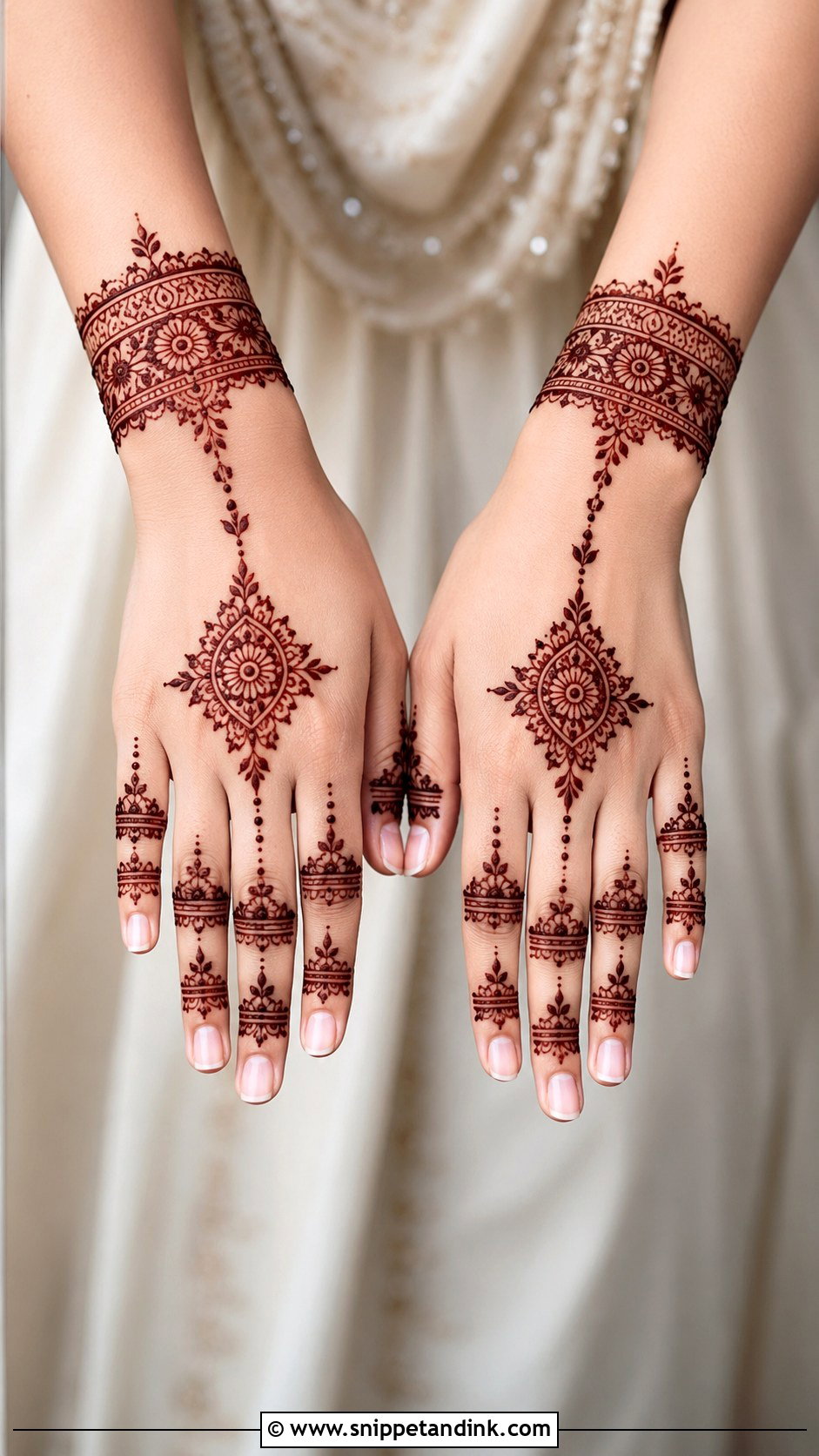
Jewelry mehndi goes a step further than the bracelet and imitates a full hand piece: rings on each finger, a pendant motif in the center, chains running between them and a wide cuff at the wrist. It follows the natural lines of the fingers and wrist, so it moves well with the hand. I put the detail into the central pendant and keep the connecting chains plain, which keeps the whole thing readable in photos. With so much bare skin, it also needs less drying time than heavy designs.
18. Full Back Hand Mehndi Design
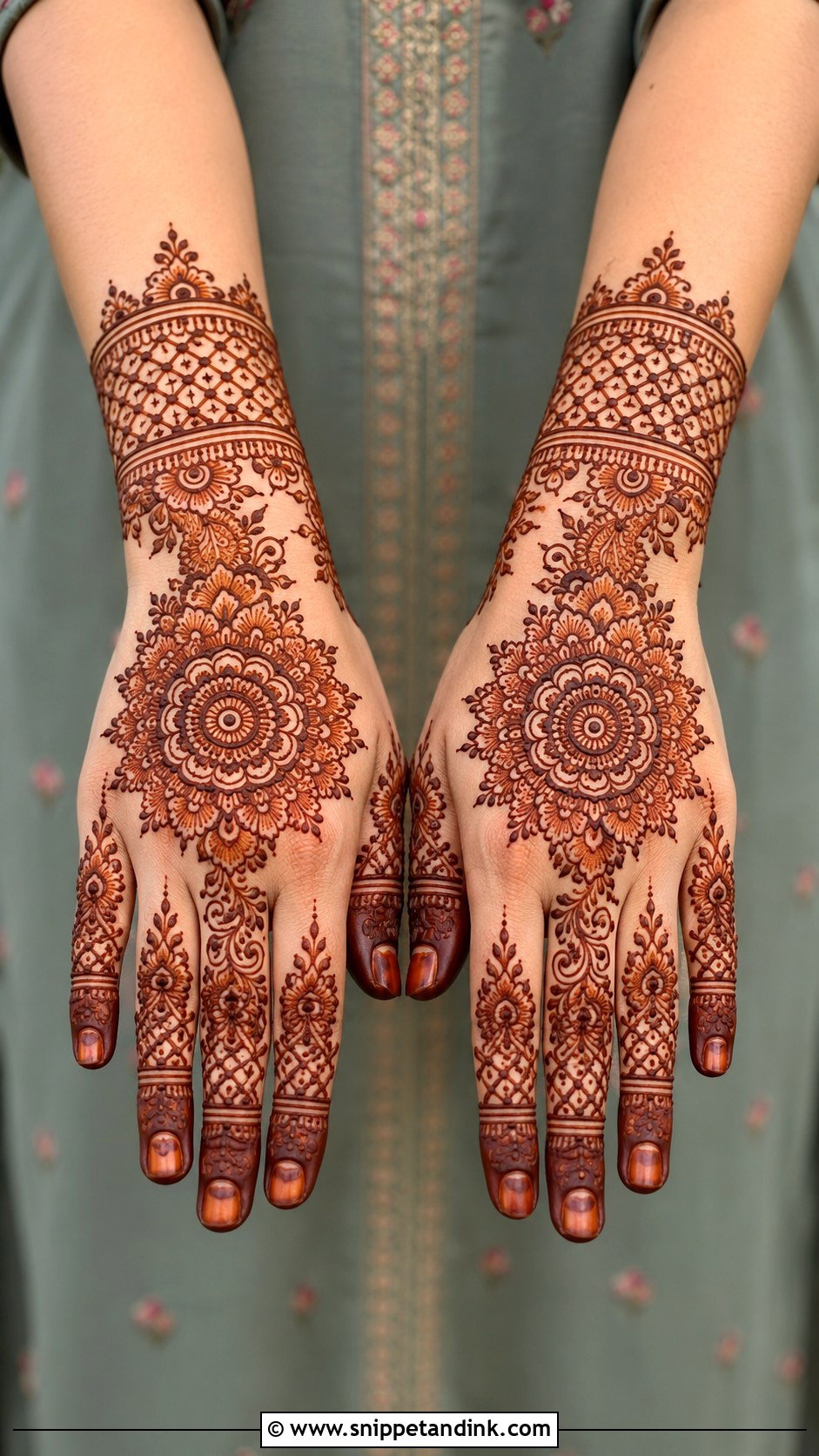
A full back-hand design covers everything visible from fingertips to the wrist without going up the arm. It can be traditional, Arabic, Indo-Arabic or modern, and it usually combines finger bands, a central mandala, floral trails, some jaali and a wrist border. It gives you most of the bridal effect with a shorter sitting. The thing I check is how it sits when you make a loose fist; if the finger work is too crowded, it bunches together when the fingers curl. Balanced spacing is also what keeps the final stain crisp.
19. Full Front Hand Mehndi Design
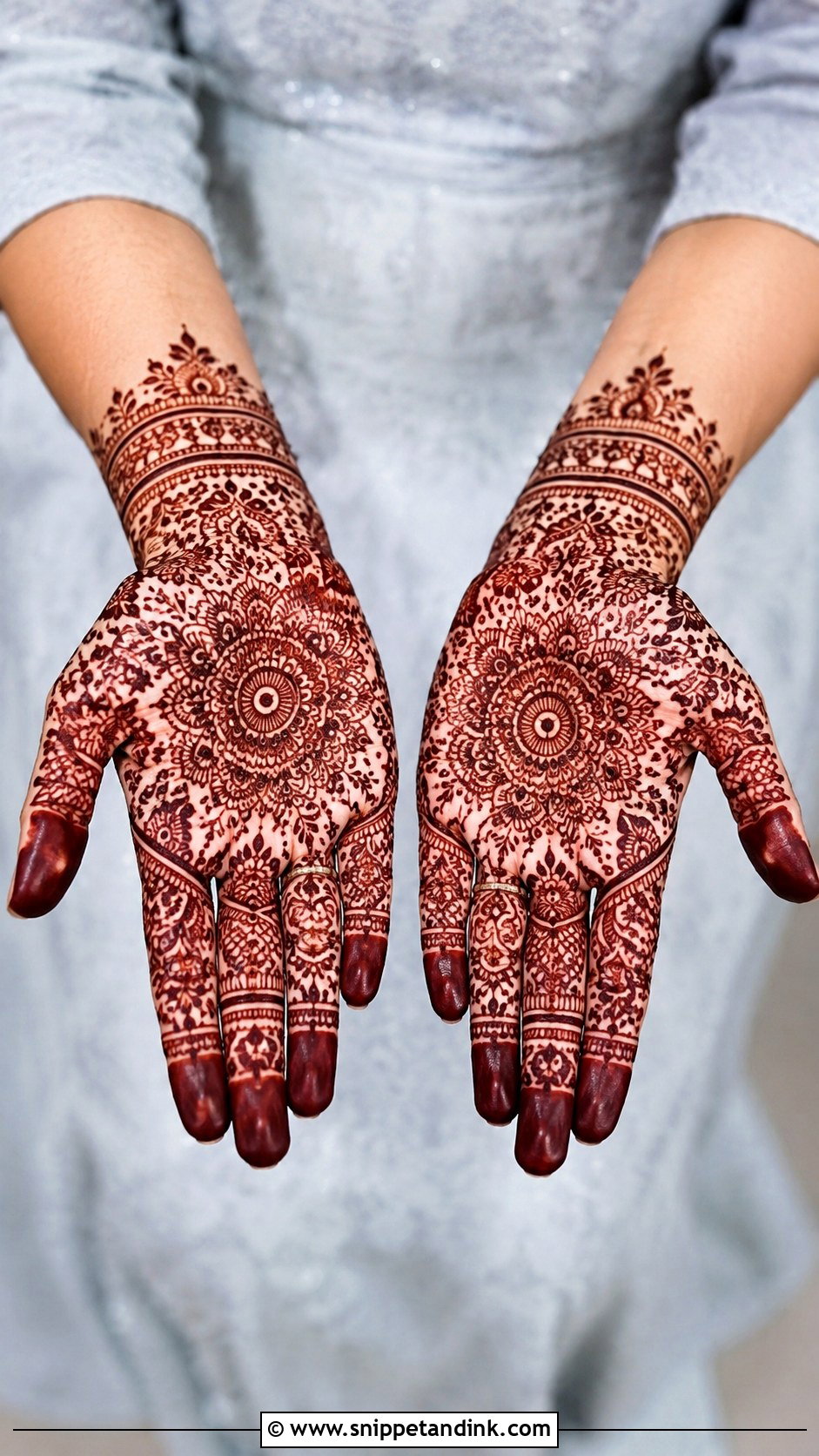
Full front coverage runs over the palm, fingers and wrist. The palm might carry a mandala, a paisley cluster, a peacock or dense Indian work, and the fingers get lines, dots, leaves and detailed tips. Palms stain the darkest of any area on the body because the skin is thicker there, so this is the side for anyone who wants deep color. My one warning: do not make every area equally busy. Choose a single focal point, let the rest support it, and check the design with the fingers slightly bent, because that is how hands sit in most photos.



20. Half Hand Mehndi Design
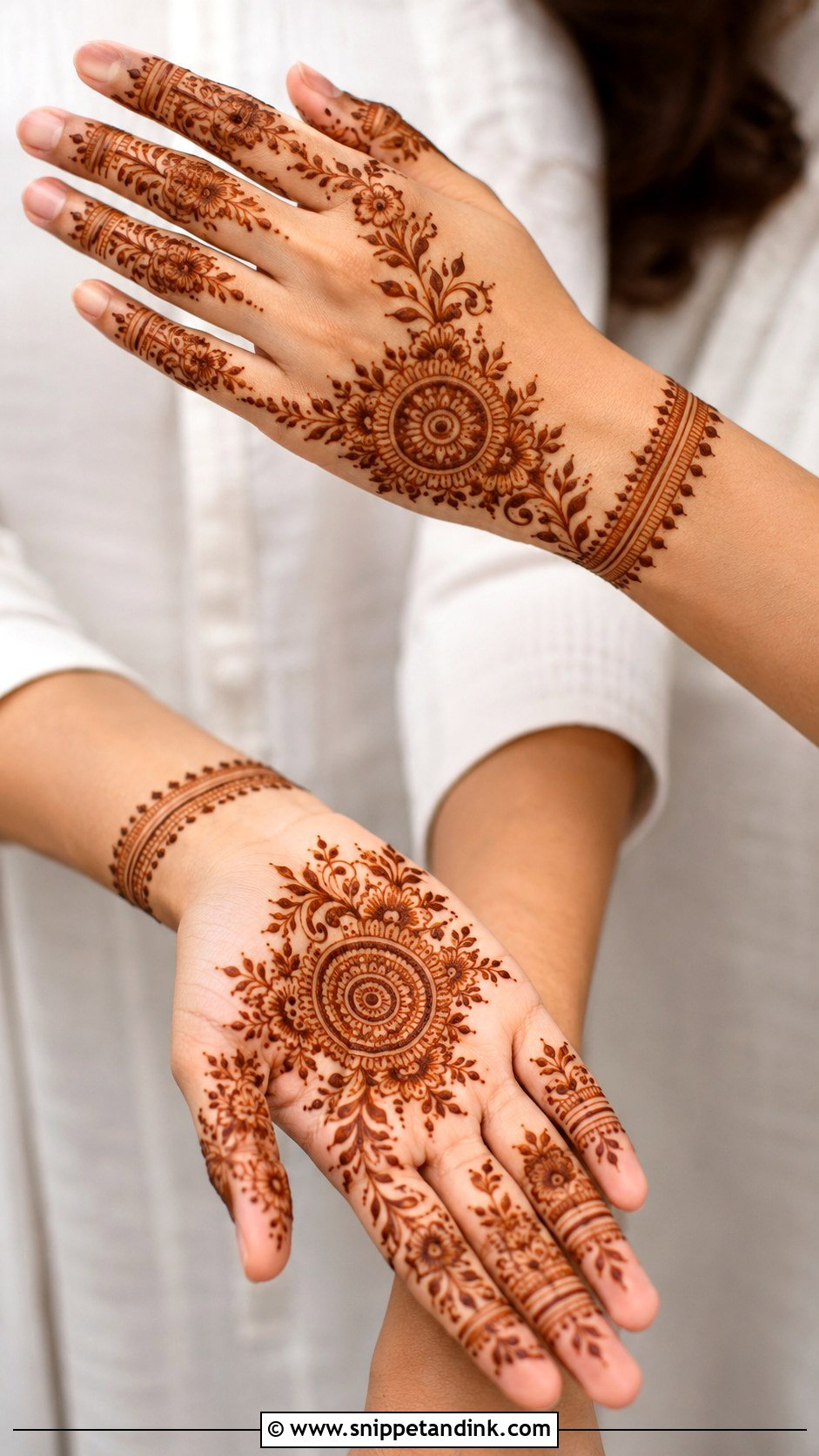
Half-hand coverage stops at the wrist, taking in the fingers, the palm or back of the hand, and part of the wrist. It works for guests, teenagers, and anyone short on time. Simple, floral, Arabic or Indo-Arabic all fit the format. What makes it look complete is a clear start and finish: a palm mandala linked to decorated fingers and closed with a wrist band, or a floral trail flowing from fingertip to wrist on the back. Without that endpoint, it looks like the artist ran out of time.
21. Easy Mehndi Design For Hands
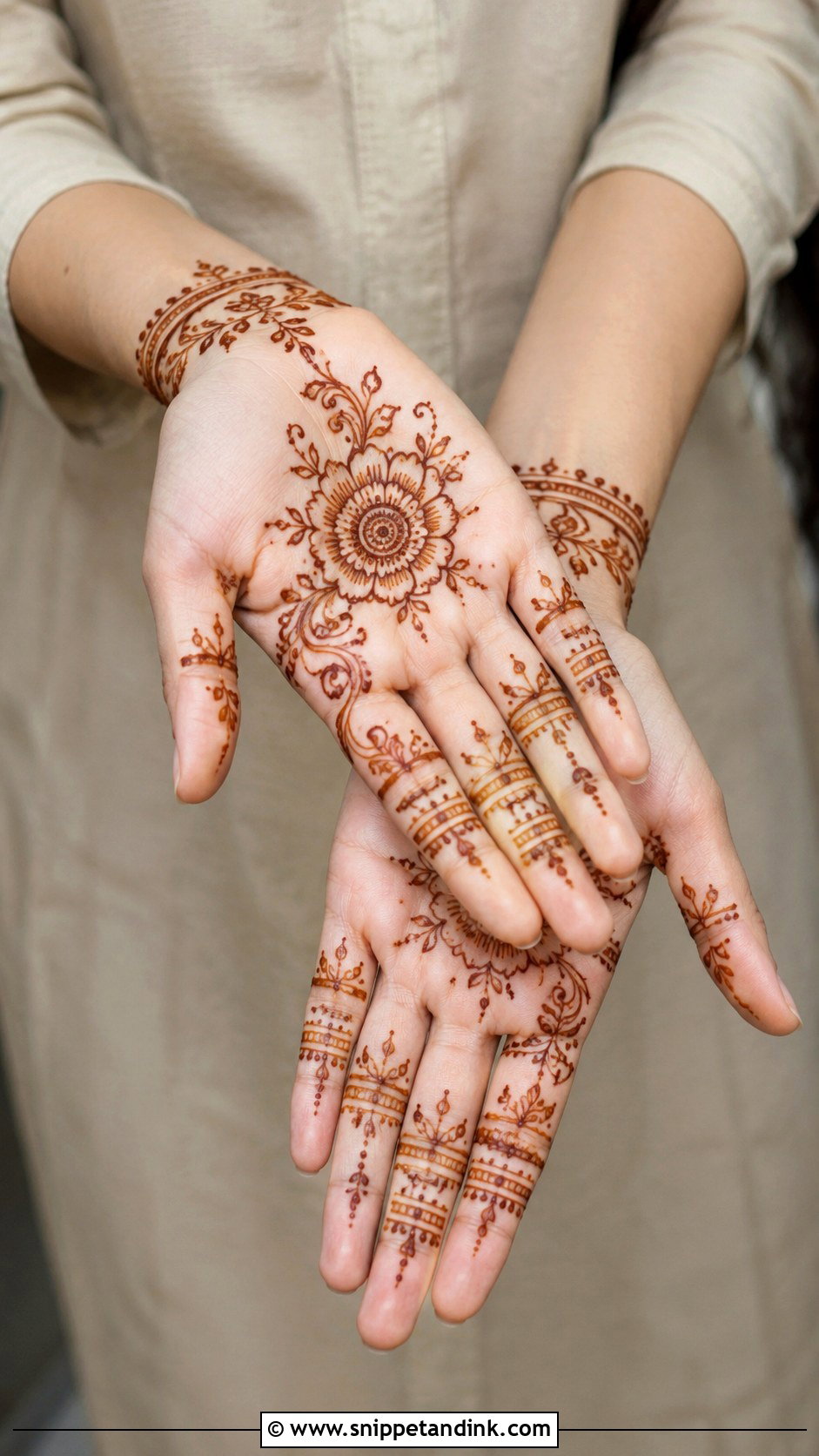
Easy designs skip advanced shading and very fine filling. A palm flower, a couple of leafy vines, dotted borders, finger bands and a small wrist detail are enough. If you are doing it yourself, start with the larger motifs, since a big shape is easier to control with an unsteady cone, then fill gaps with dots and small leaves. I’d still sketch the layout in your head before squeezing; a quick design looks neat only when the placement was planned, even if the drawing was fast.
22. Stylish Mehndi Design For Hands
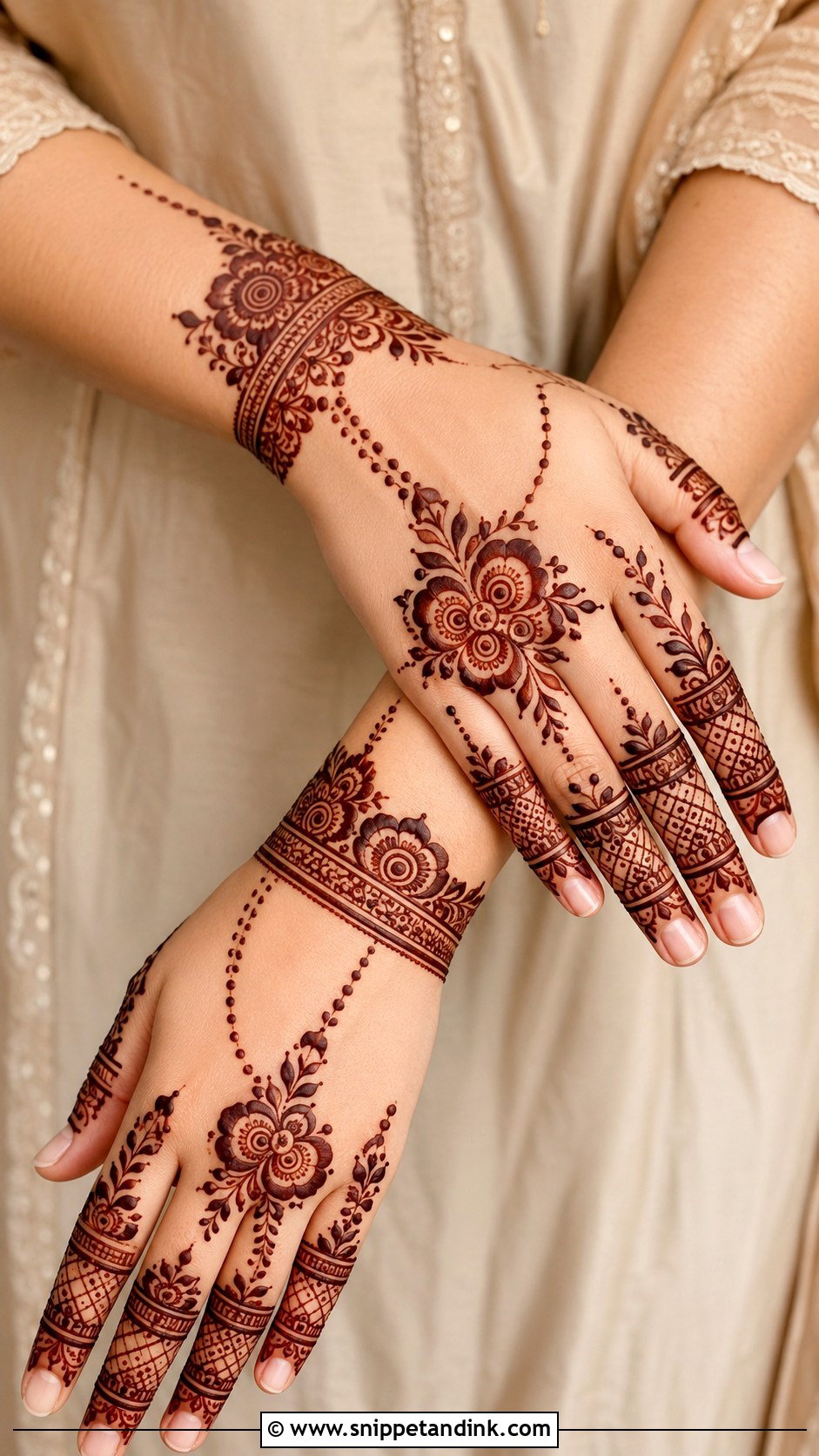
Stylish designs depend on contrast: some bold sections, some fine detail and some open skin. Negative space, bold florals, finger rings, diagonal trails and a statement wrist cuff are the usual parts. It sits between dense bridal work and very plain minimal patterns, which suits guests and engagement events. Contrast is what makes a design read from a distance and still reward a close look. For the most current feel, I put it on the back of the hand with decorated fingers and a strong band at the wrist.
23. Latest Mehndi Design For Hands
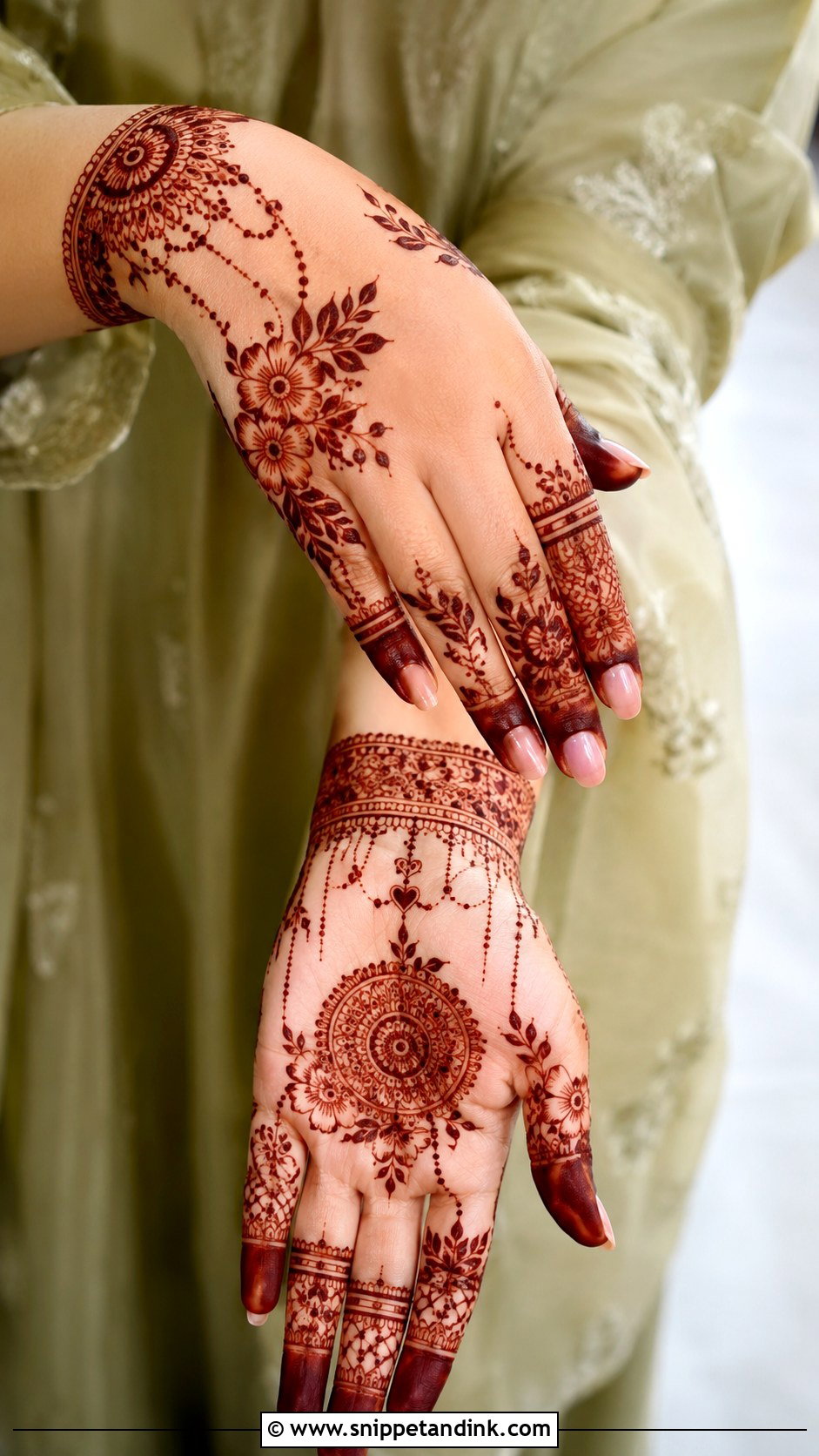
Most of what feels current right now is modern spacing applied to classic motifs. Bold Arabic flowers, clean back-hand trails, mandala palms, jewelry chains and jaali panels keep showing up, and personal touches like initials or a tiny symbol are popular. What dates a design fastest is overcrowding, so I leave more skin open than people expect. Build it around one strong central motif, add finger detail and a wrist finish, and stop there. Trendy only works when the lines are neat and the layout suits your hand.
24. Wedding Guest Mehndi Design For Hands
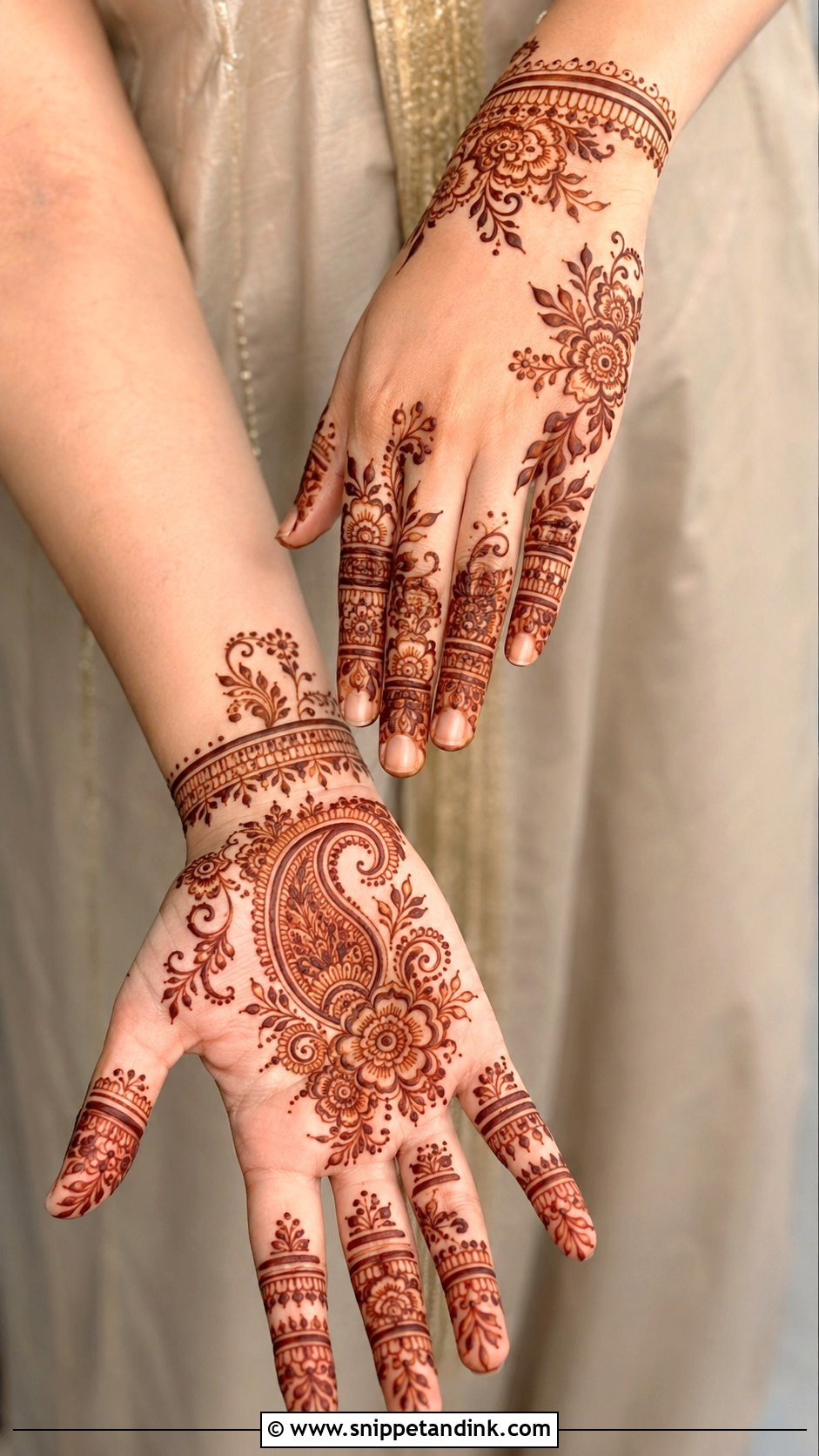
As a guest, the unwritten rule is to stay lighter than the bride. Decorated fingers, a floral or paisley palm and a neat wrist border are plenty, and back-hand Arabic trails or jewelry designs are fine choices too. If you are attending several functions, medium coverage pairs with every outfit you pack. I’d skip bride-and-groom figures and long forearm work unless you are close family, since in many families those are understood to belong to the bride. A guest table at a mehndi night moves quickly, so ask for something the artist can finish in minutes per hand.




25. Eid Mehndi Design For Hands
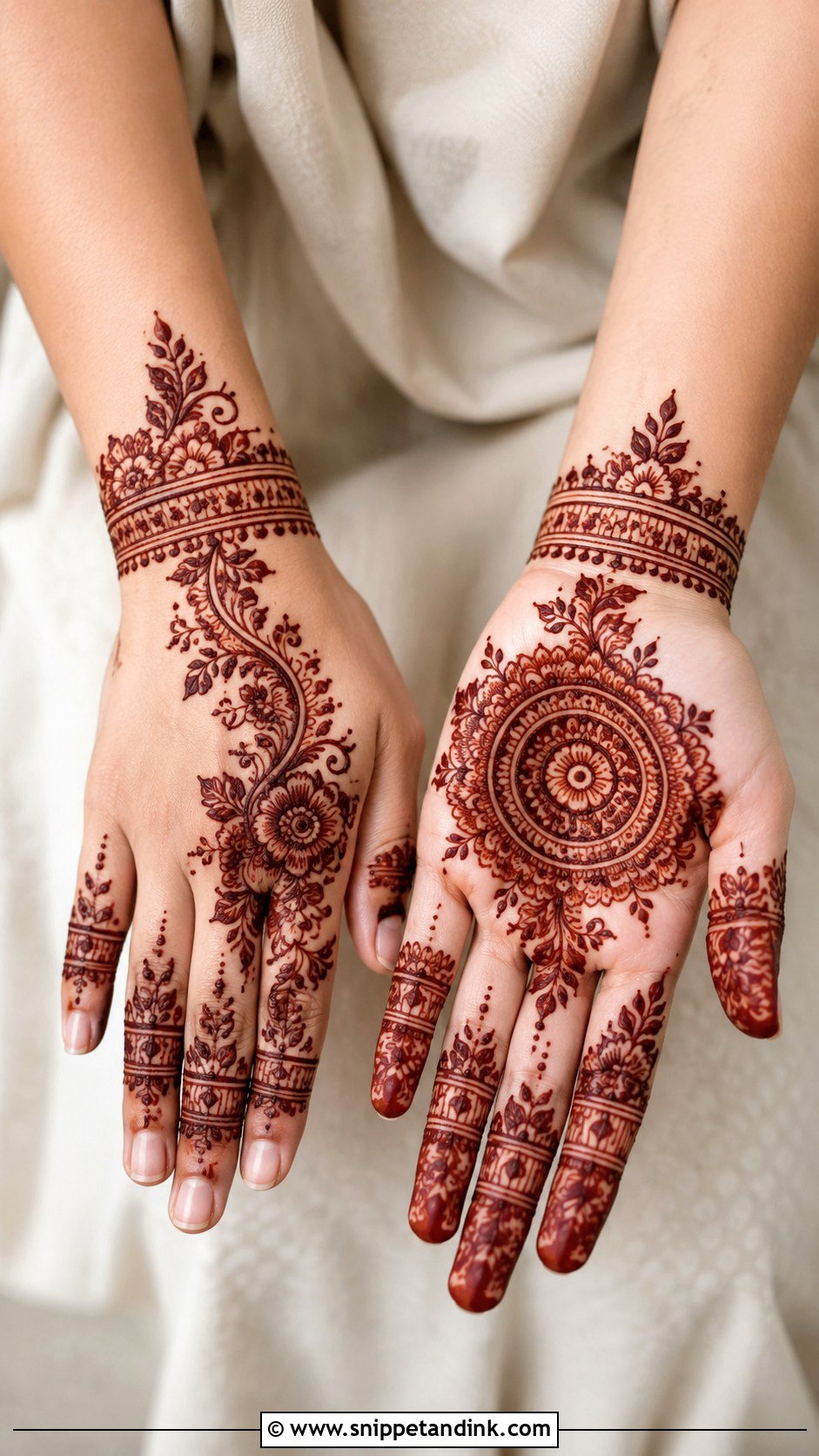
Eid mehndi is usually applied on Chaand Raat, the night before, which gives it a full night to develop before the morning prayers and visits. Arabic floral trails, back-hand jewelry patterns, palm mandalas and clean finger work are the favorites. Bold outlines with open spacing come out clearest after the paste flakes off. Remember what Eid day involves: cooking, serving, greeting and holding children. If you are hosting, a lighter palm design or a back-hand-only design survives the washing up much better than heavy palm work.
26. Diwali Mehndi Design For Hands
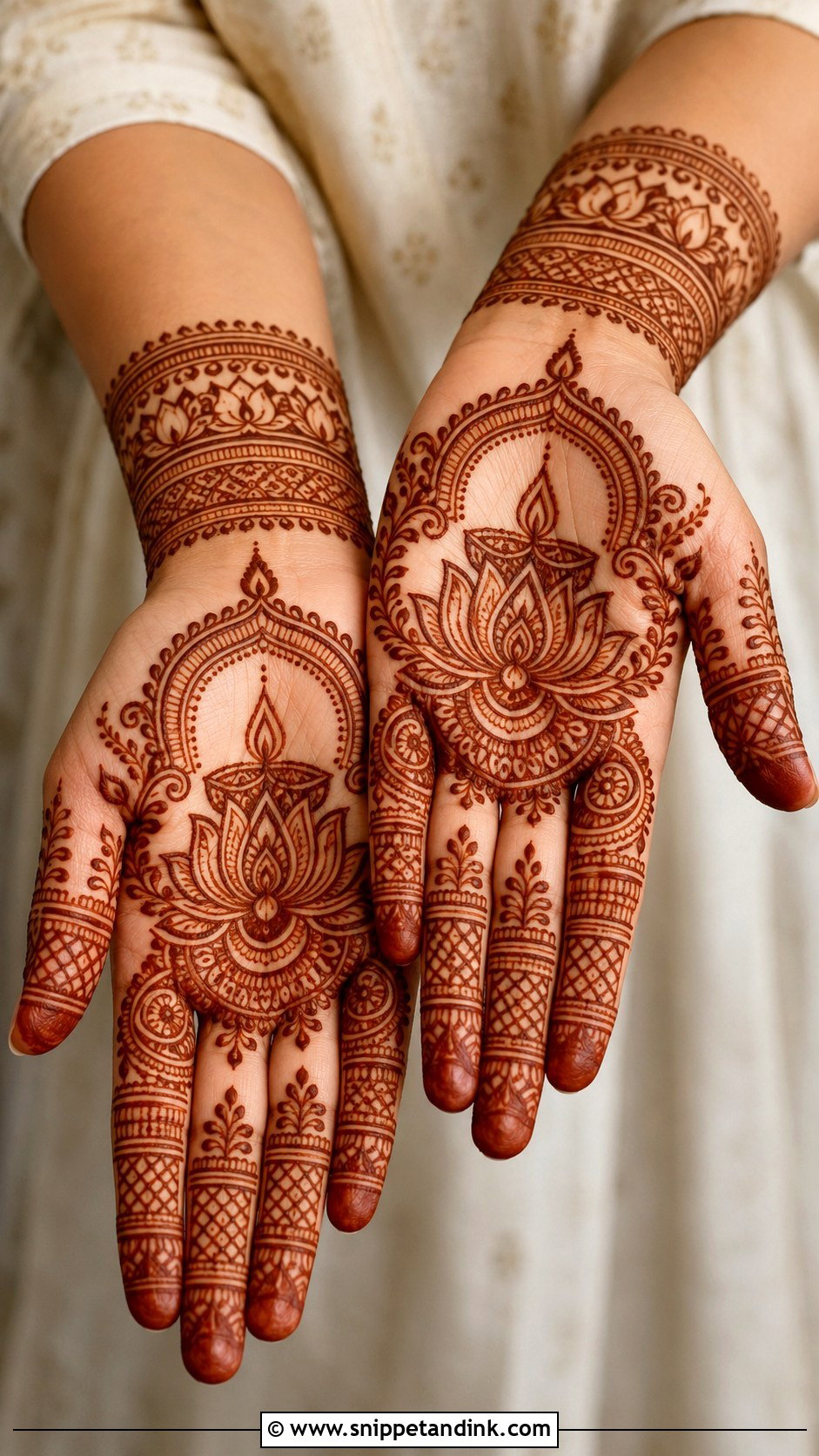
Diwali designs lean on festival imagery: lotus flowers, diya shapes, mandalas, paisleys, leafy borders and decorated fingers. Palm designs feel especially right for this festival because of how they sit with the puja and family rituals. You can keep it to one central mandala or add wrist bands and finger filling. Diwali outfits are often heavily embroidered, so I’d go cleaner on the henna to stop the two competing. Mirror the main motif on both palms and the pair looks deliberate.
27. Karwa Chauth Mehndi Design For Hands
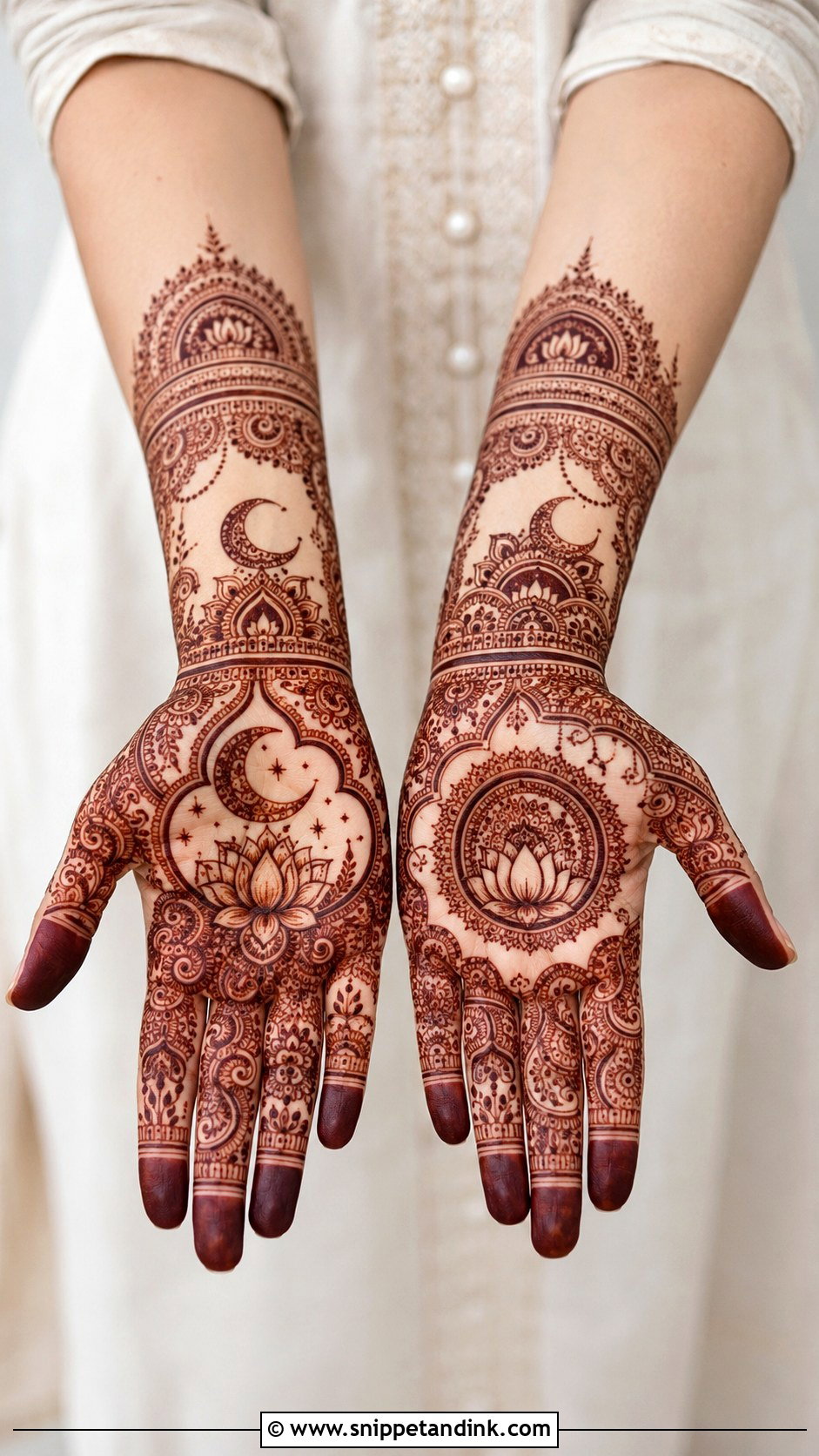
For Karwa Chauth, the henna is part of the ritual for many women, so traditional work dominates. Many prefer full palm or half-hand designs with paisleys, lotus, vines, mandalas and fine filling, sometimes with a crescent moon or a small couple motif tucked in. Both palms are usually covered because the palm stain comes out deepest. Since this is often applied the evening before the fast, I keep the design achievable in one sitting. For a lighter version, an Indo-Arabic layout with open space and a wrist border still looks festive.
28. Engagement Mehndi Design For Hands
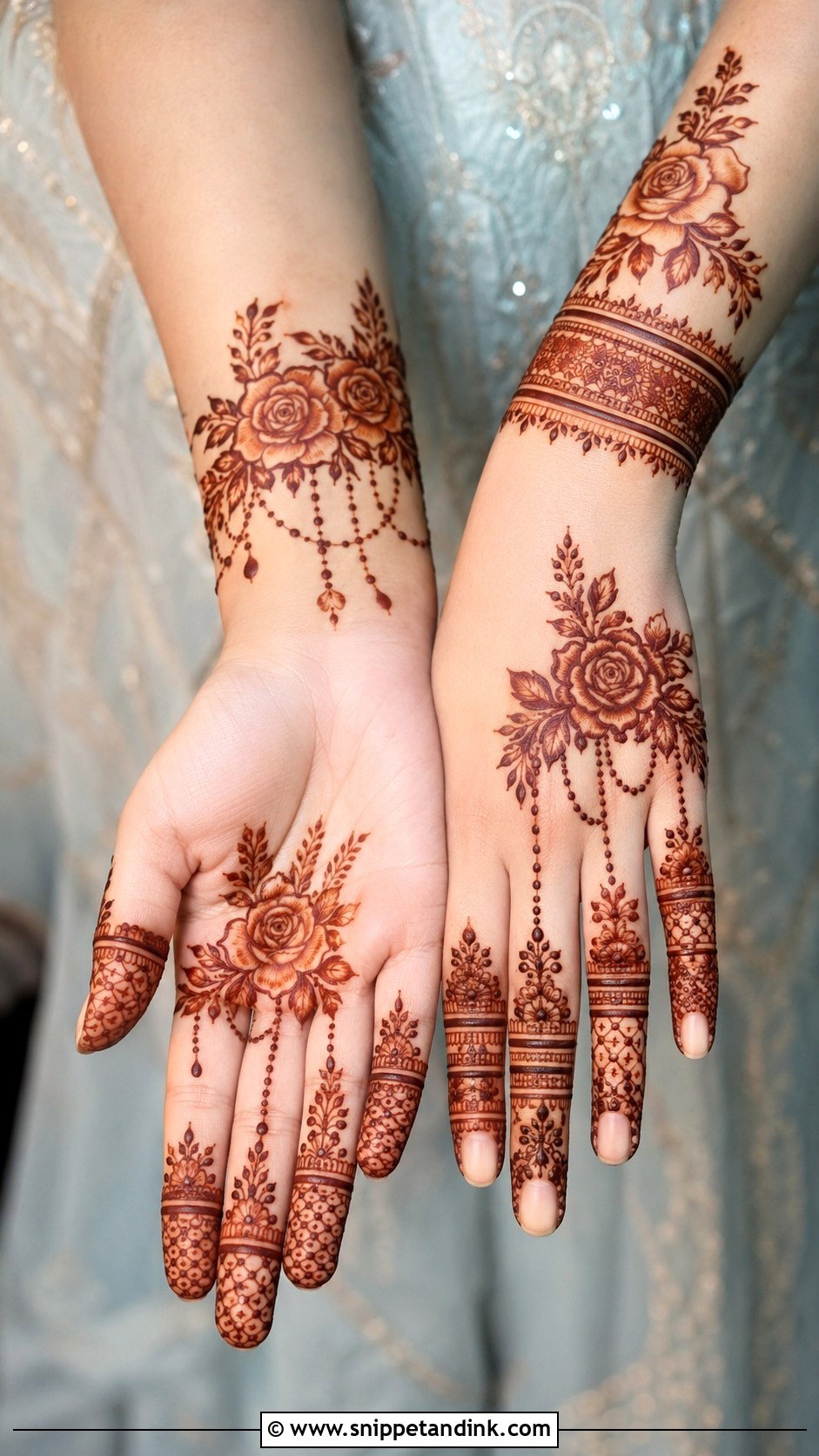
Engagement henna is about the ring finger. Rose motifs, ring-style finger patterns, a bracelet band and delicate palm or back-hand work are typical, and some people add initials or the date. I’d put the strongest detail on the back of the left hand, since that is the hand in every ring photo, and keep the ring finger itself lighter so the band and stone are not lost in the pattern. If your outfit is heavily embellished, go softer on the henna.
29. Bridal Back Hand Mehndi Design
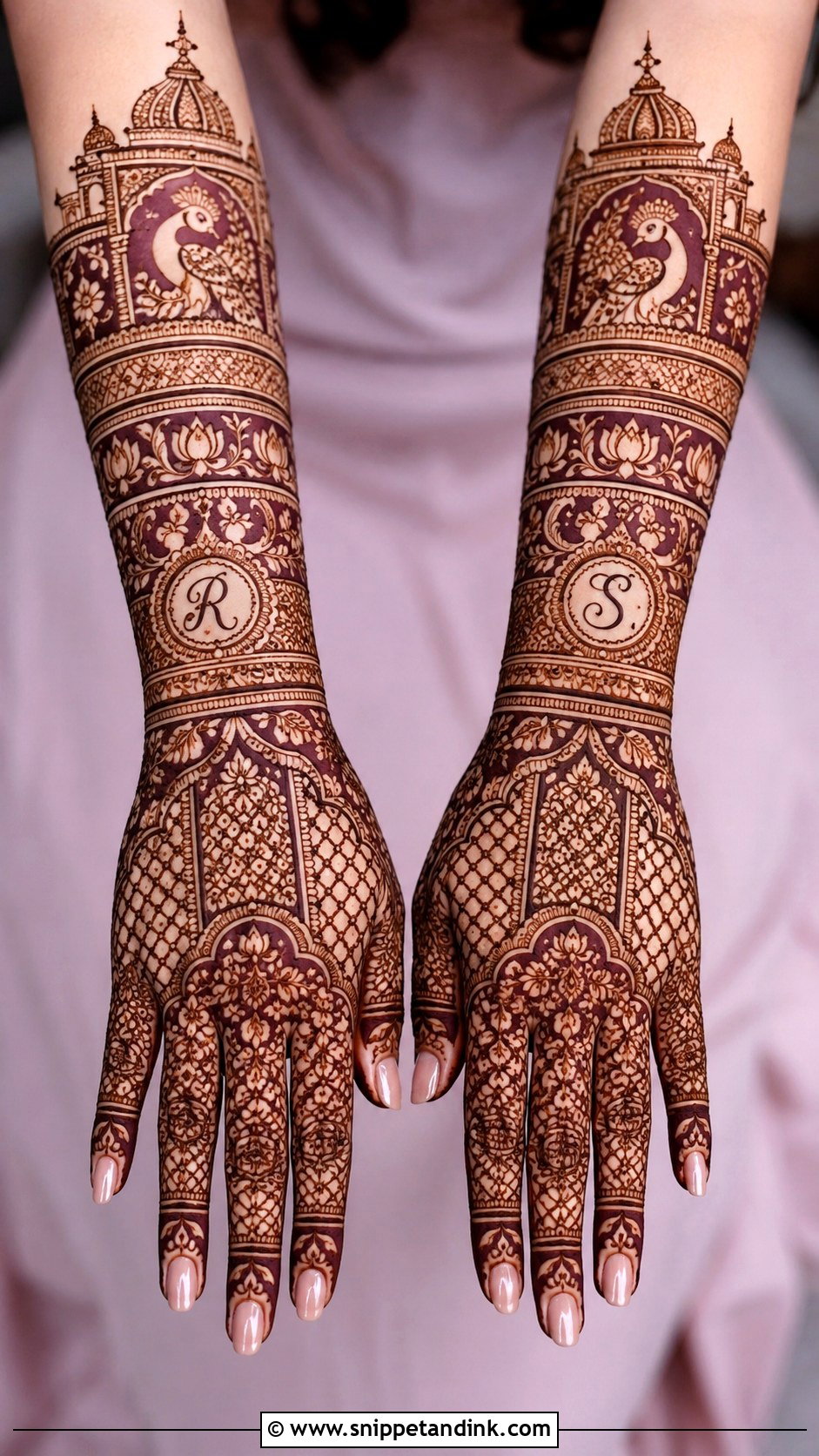
The bridal back hand has to match the bridal palm in richness and line weight, and it is the side most photographed during the ceremony. It usually runs over the fingers, the back of the hand, the wrist and the forearm with jaali panels, floral vines, paisleys, peacocks, domes and bracelet bands, often with initials hidden somewhere. Because it gets so much attention, it needs a strong structure: matching finger detail and a clear finishing border at the wrist. Even when it is dense, I leave tiny gaps so the artwork stays legible after it stains.
30. Moroccan Mehndi Design For Hands
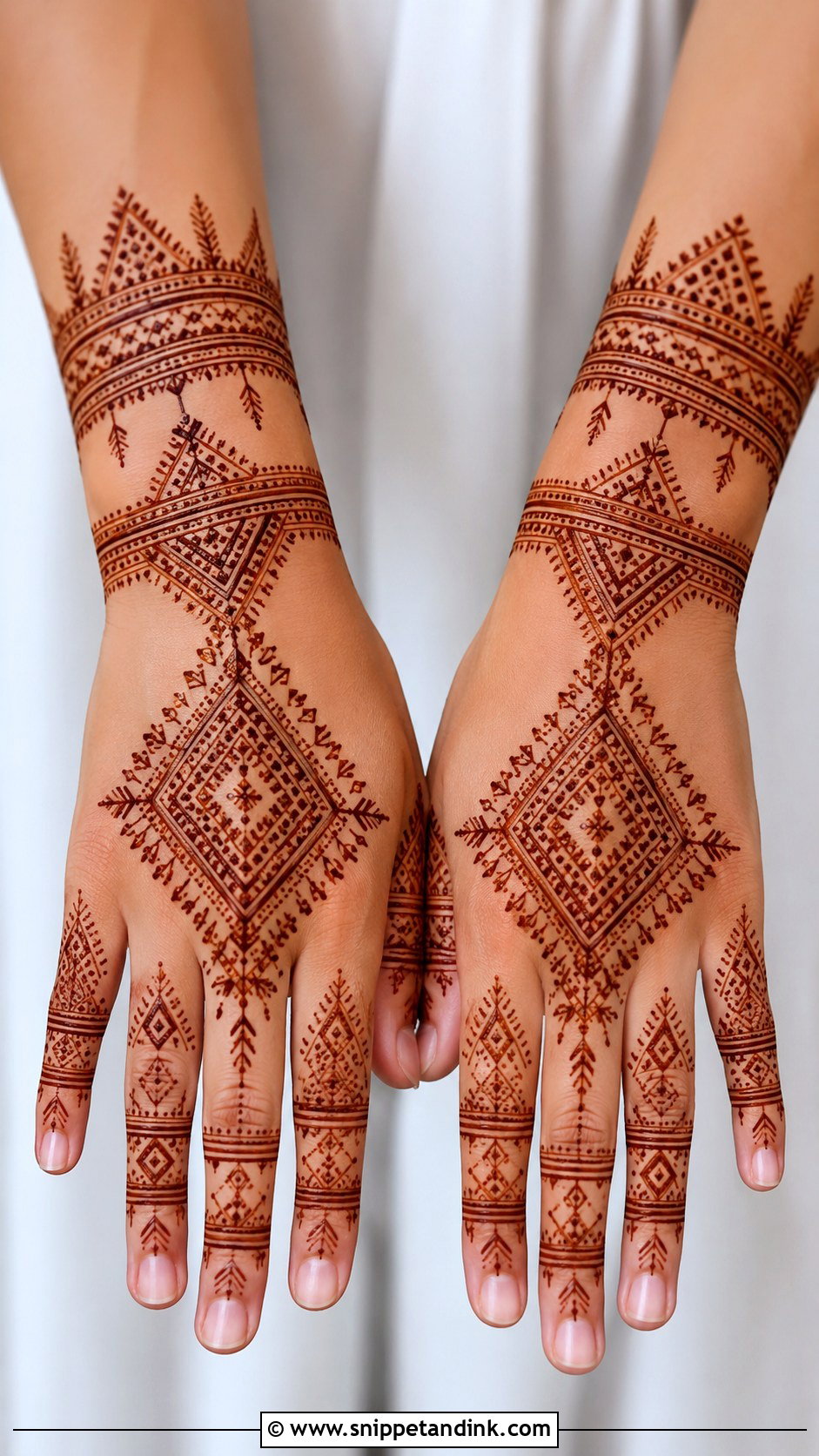
Moroccan work swaps flowers for geometry: diamonds, triangles, straight lines, dots, grids and symmetrical bands. Geometric shapes follow the bones of the hand well, so it looks particularly sharp on the back of the hand and fingers. It can be very minimal or cover the whole hand. A complete version usually pairs finger bands with a central geometric panel and a wrist cuff. Straight lines are less forgiving than curves, so I hold the cone closer and draw in short, steady pulls; an artist who rushes straight lines leaves visible wobbles.
31. Gulf Khaleeji Mehndi Design For Hands
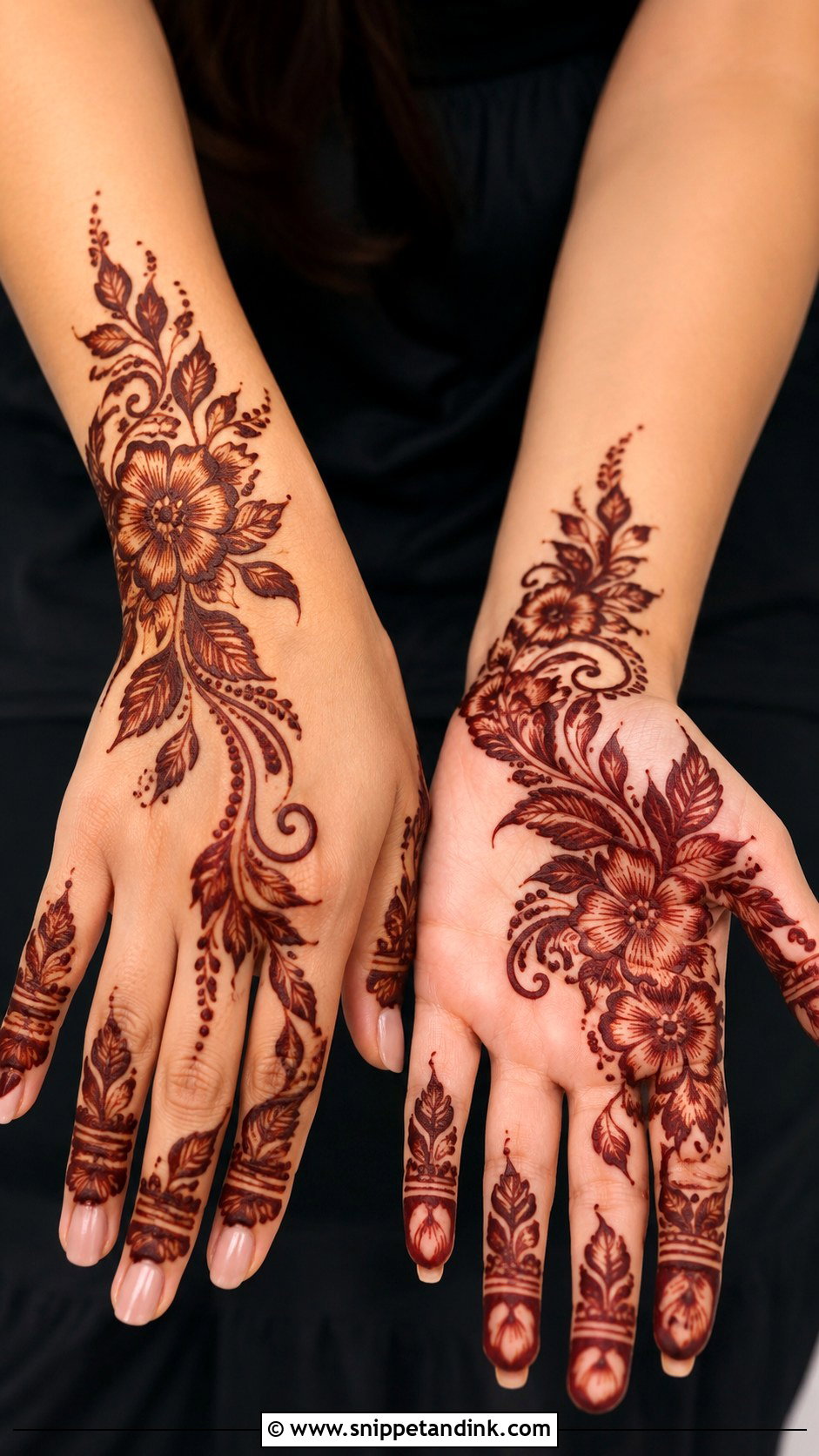
Gulf Khaleeji mehndi design is bold and flowing, built from large flowers, thick leaves, shaded petals and wide trails. It covers the palm, the back of the hand, the fingers and the wrist with a strong Arabic influence, and it looks far more open than fine Indian work. It is popular for Eid, weddings and festive evenings. Khaleeji depends on confident outlines and smooth curves; hesitation shows as a kink in the line. Fingers get bold leaves or fully filled tips, and the generous paste in those thick strokes tends to give a strong stain.
32. Pakistani Mehndi Design For Hands
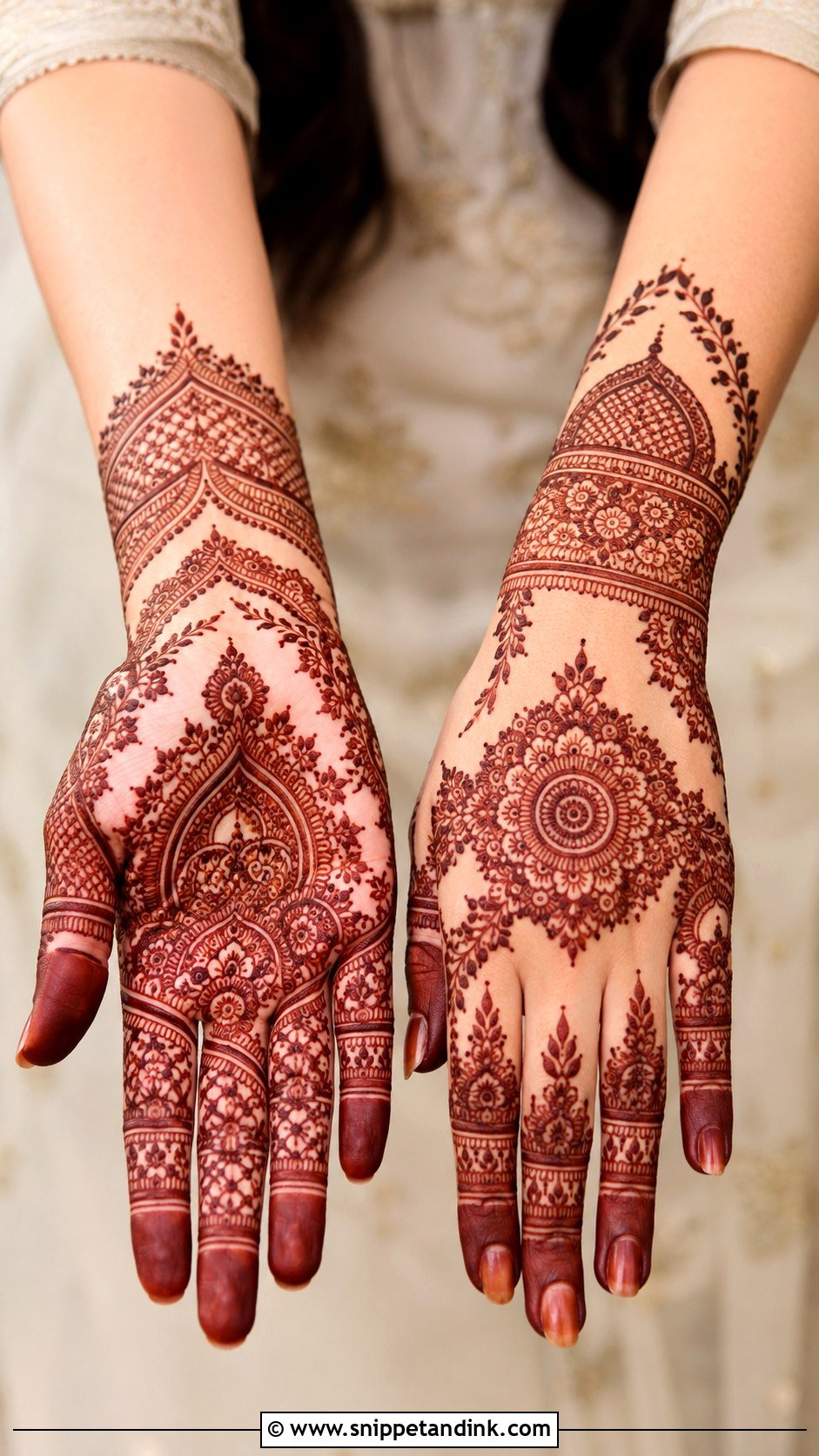
Pakistani mehndi design for hands blends Indian detail with Arabic flow, using florals, paisleys, domes, jaali, leafy trails and fine finger work. It can be heavy for a bride or medium for guests and festivals. What gives it its graceful look is the balance between dense sections and open areas. On the palm I usually start with a mandala or paisley center; on the back, a diagonal floral trail with wrist bands. The detail clients notice most when the hands are held side by side is symmetry, so I check line thickness on both hands before you leave.
33. Kids Mehndi Design For Hands
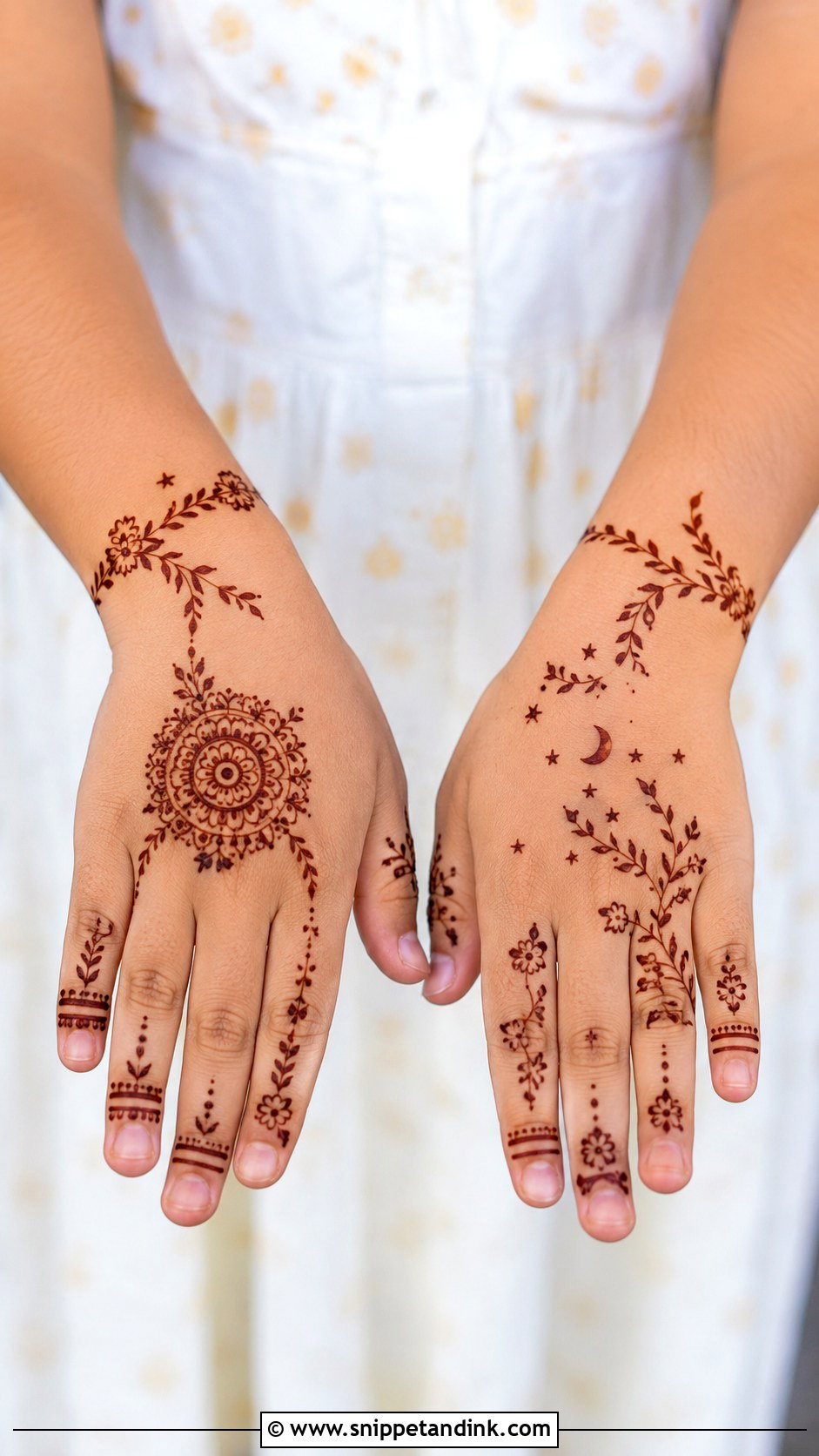
Children rarely sit still for long, so I keep their designs small and quick: a little flower, a butterfly-style motif, a tiny mandala, leafy finger lines and a soft wrist band. Light work dries faster and is much less likely to smudge. I put it on the back of the hand, because children press their palms on everything within minutes. Use natural henna only, and never let a child wear so-called black henna. It often contains PPD, a hair-dye chemical that can cause blistering reactions and lasting sensitivity.
34. Party Mehndi Design For Hands
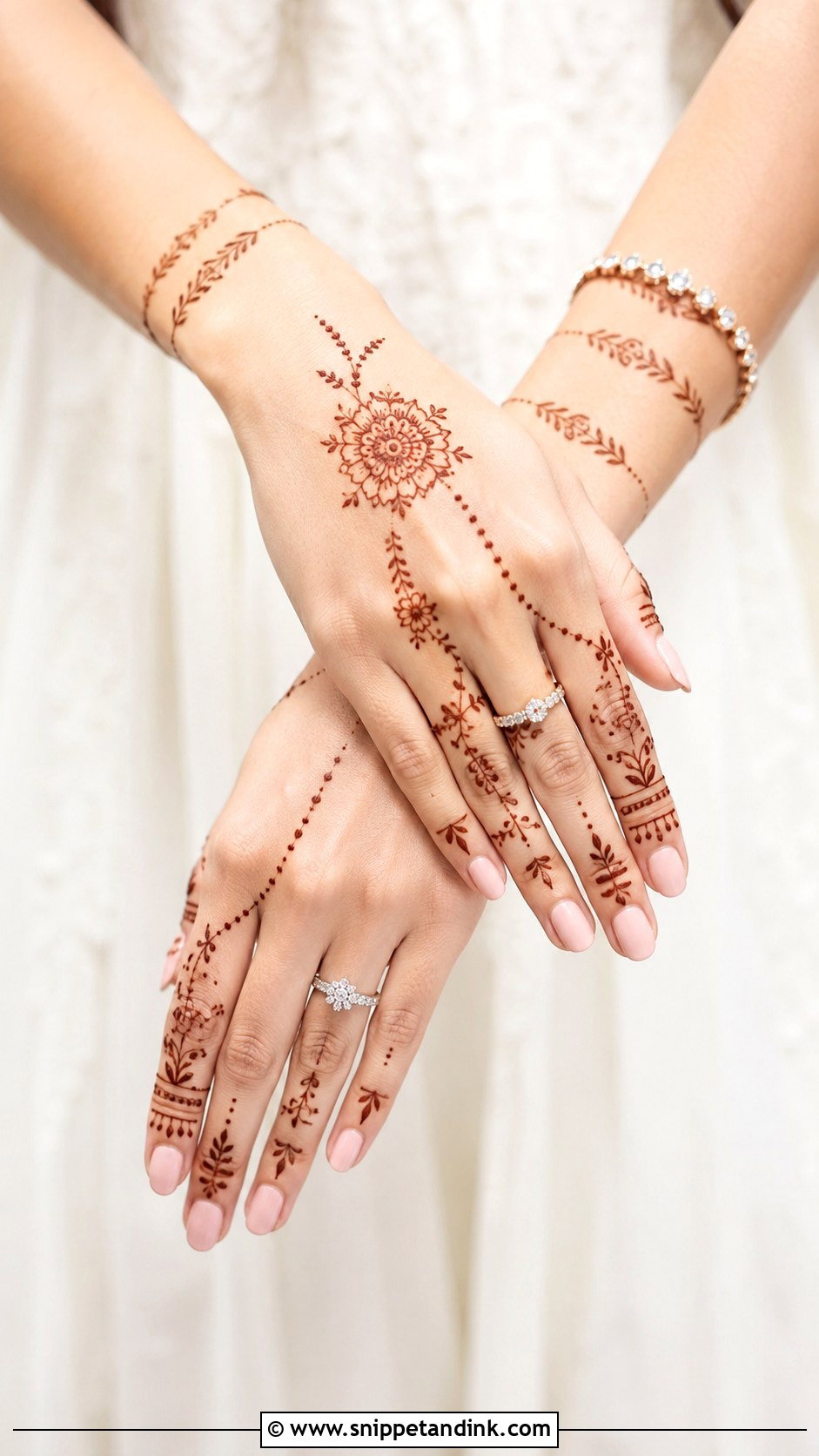
Party mehndi needs to be fast and wearable with whatever you are putting on. Finger rings, bracelet bands, floral trails, negative space and a single statement motif are typical, mostly on the back of the hand where they sit next to accessories and painted nails. For something bold, use a diagonal Arabic flower trail; for something lighter, a jewelry layout with chains and dots. Indoor party lighting is usually warm and bright, and clean lines with open space hold up much better in photos taken under it than fine, dense filling.
35. Both Hands Mehndi Design
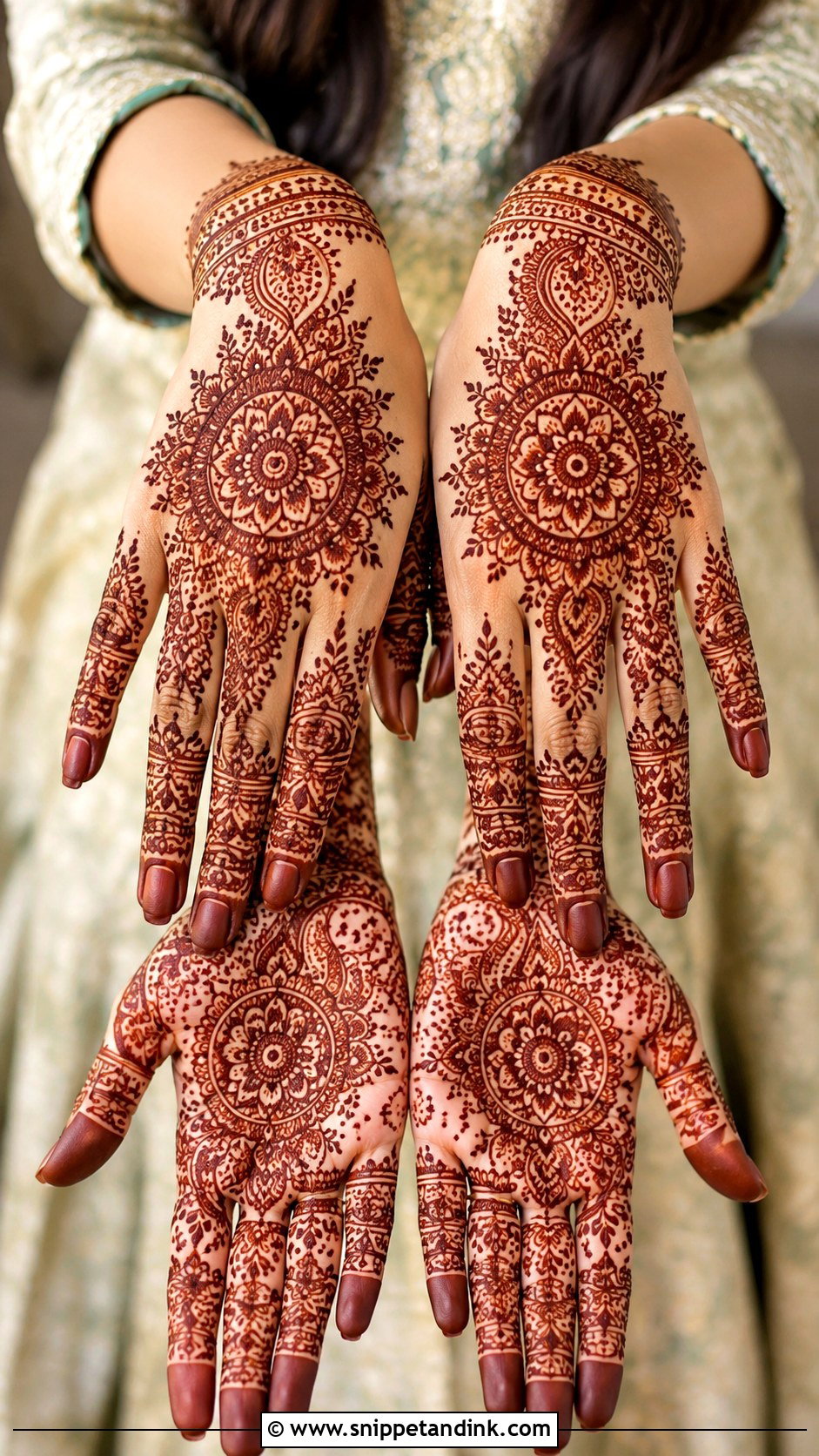
Doing both hands means planning them as a pair. They can be identical, mirrored or complementary; for example, a mandala on one palm and a paisley cluster on the other, sharing the same finger patterns and wrist borders. Brides almost always want this because their hands are photographed together. If you like symmetry, keep the front or back layouts matching. If you prefer something more modern, use related patterns with small differences. Either way, coverage, line weight and finishing details should match, or one hand will always look like an afterthought.
The First Twelve Hours Decide How Dark It Gets
Most of the color you end up with is set by what happens after I put the cone down. Natural henna needs time on the skin, so I ask clients to keep the paste on for at least six hours, and overnight if they can sleep with their hands wrapped loosely in tissue or a cotton glove.
- Once the paste is dry to the touch, dab on a little lemon and sugar mix. It keeps the paste stuck to the skin, but too much makes it runny, so a light dab is enough.
- Keep your hands warm. Cold hands stain weaker; a warm room and warm drinks honestly help.
- Scrape the dried paste off with a blunt edge or your fingernail. Do not wash it off.
- Keep water away for as long as you can, ideally most of the next day. Soap, hand sanitizer and hot dishwater lighten a fresh stain fast.
- A thin layer of a natural balm or oil before showering protects the color.
If the stain still looks orange when you wake up, do not panic. It oxidizes over the next day or so into a reddish brown, and the palms and fingertips always end up darker than the back of the hand or the arm.
Why I Refuse Black Henna and Instant-Color Cones
Any cone that promises dark color in an hour, or that stains black, is not plain henna. Black henna is commonly made with PPD, a hair-dye chemical that can cause blistering, scarring and a lifelong allergy that shows up later with hair dye. Some packaged cones also contain dyes or solvents that give a quick, flat color.
A good natural paste smells earthy, often with essential oil, and stains orange first before deepening over a day or two. If you have sensitive skin, ask your artist for a small patch on the inner arm a couple of days before the full application. I’d much rather lose an appointment than send someone home with a reaction.
Clean Lines Outlast Any Trend in Hand Henna
From a quick palm flower to a full bridal arm, every design here depends on the same few things: a smooth natural paste, neat lines, space left between motifs, and enough days for the stain to develop. Traditional brides tend to gravitate toward Indian, Pakistani, peacock and paisley work, while lighter layouts like Arabic trails, jewelry and bracelet designs suit guests and festivals. Pick a design that fits your hand and your timeline, show your artist the photo, and give the color its full two days to reach its peak.
You'll Like These Ideas:






Leave a Reply