
Bridal mehndi is the one part of the wedding look you carry home on your skin. It frames the hands, sits right under the jewelry, and often holds small private symbols nobody else notices until the stain comes up. The styles brides bring to me now range from dense Indian full-hand work to airy Arabic trails, portrait palms, jaali, mandalas and custom love-story art. Which one is right depends less on fashion than on your outfit sleeves, your ceremony and how long you can sit still. Below are the bridal designs I get asked for most, with what I watch for when I draw each one.
Planning Placement Around Your Sleeves, Jewelry and Sitting Time
Before I sketch anything, I ask to see the outfit, or at least a photo of the sleeves. A full-arm design under a fitted long sleeve is hours of work nobody will see, while a short or sheer sleeve shows every inch of the forearm. The same goes for jewelry: a hathphool or wide kada covers the back of the hand and wrist, so I plan open space or lighter detail where the metal will sit.
Then we talk about time. Dense bridal work on both hands and arms is a long sitting, and you can’t eat, scroll or use the bathroom easily while the paste is wet. If your schedule is tight, a spaced Arabic or jewelry design will look finished in a fraction of the time.
What to bring to your consultation
- Three to five reference photos you love, plus one you dislike, which tells me as much.
- Photos of the outfit sleeves and the main jewelry pieces, especially bangles and hand chains.
- Any personal details you want hidden: initials, a date, a name in another script.
- Allergy history, including any reaction to hair dye or a past dark henna at a fair or beach stall.
A trial on a small patch or one finger a few weeks out shows how your skin takes the stain. Some skin goes deep maroon; some stays a warm brown. It’s better to learn that early than on the morning of your mehndi night.
1. Full Hand Indian Bridal Mehndi Design
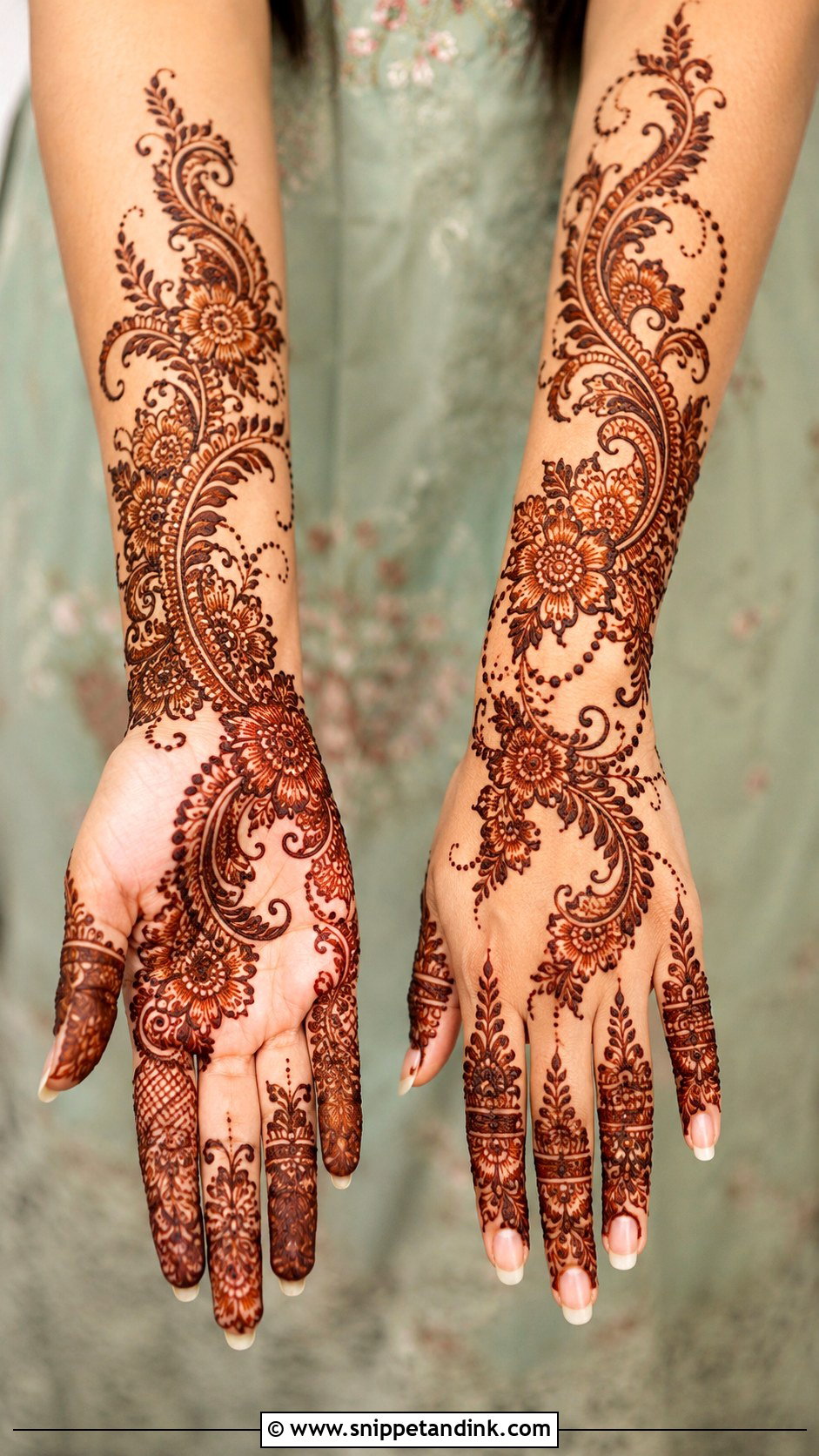
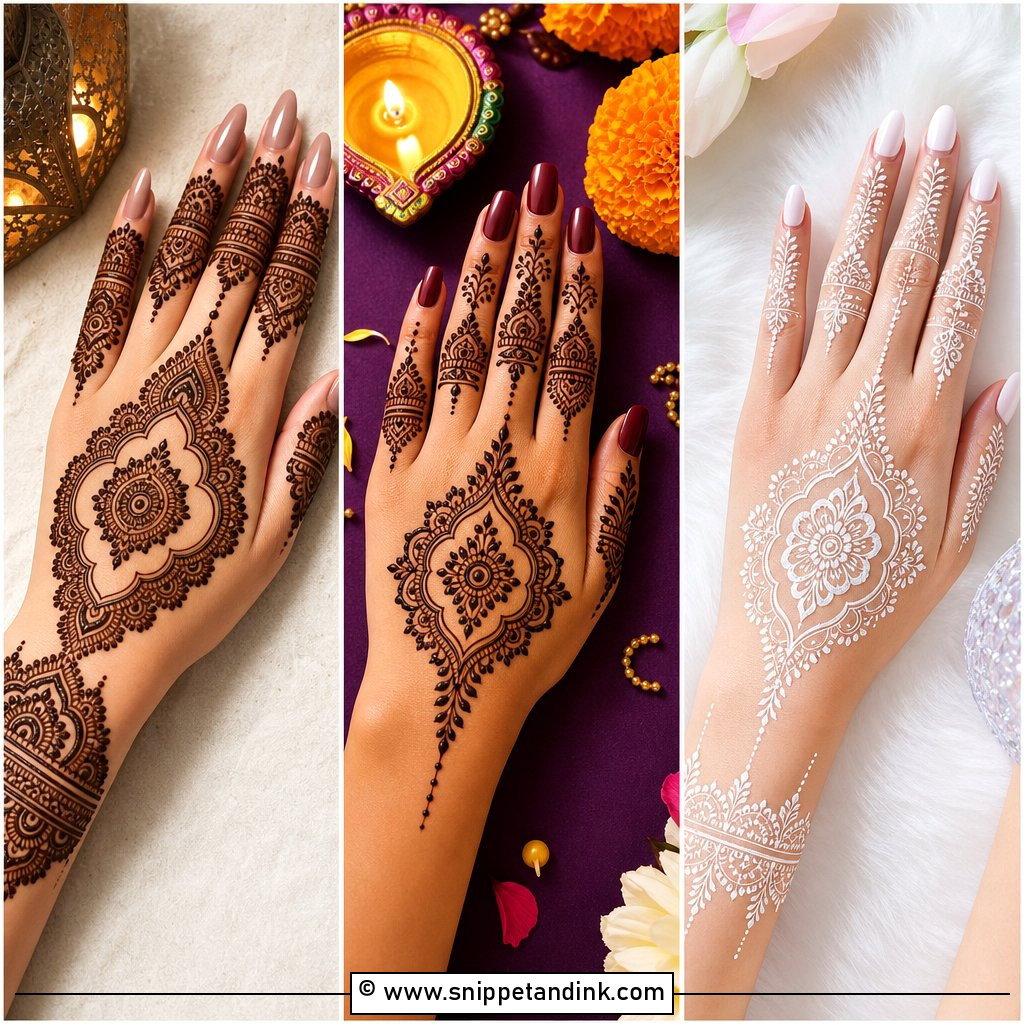
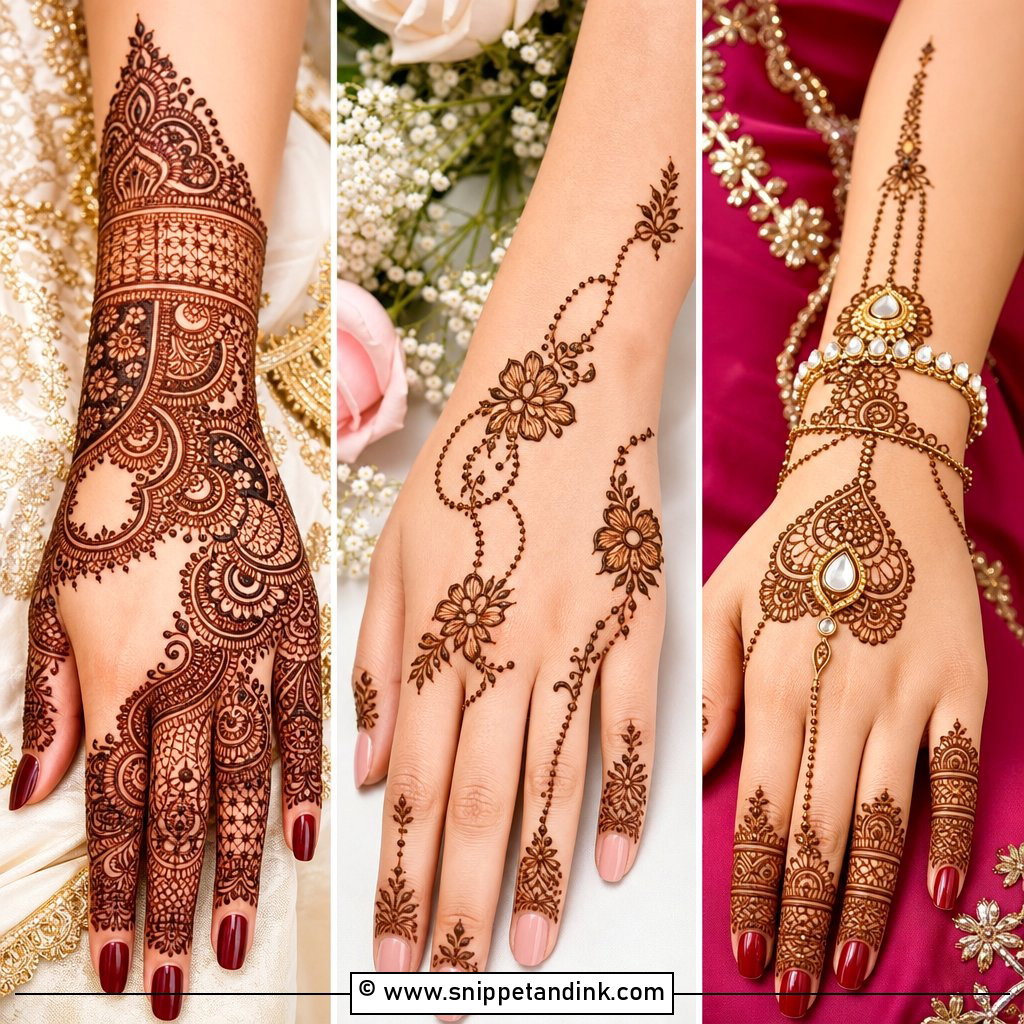
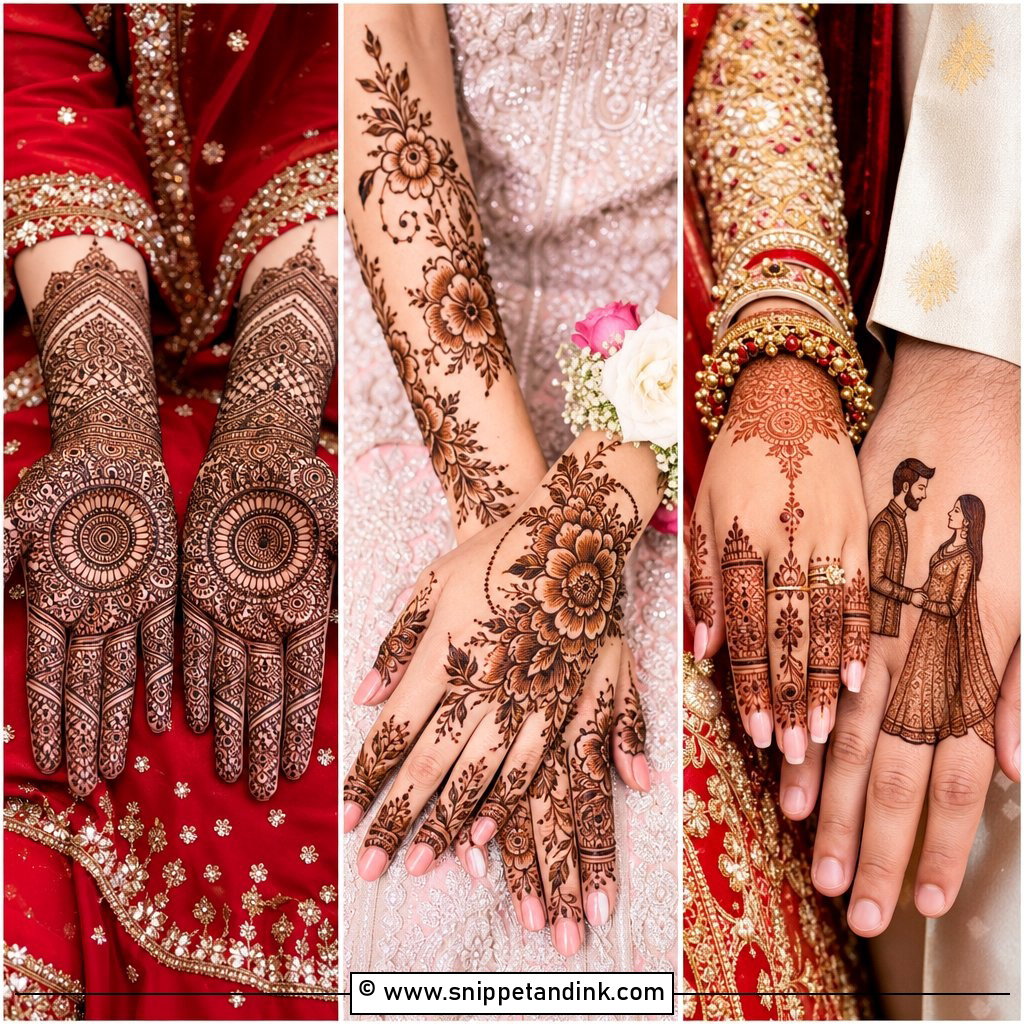
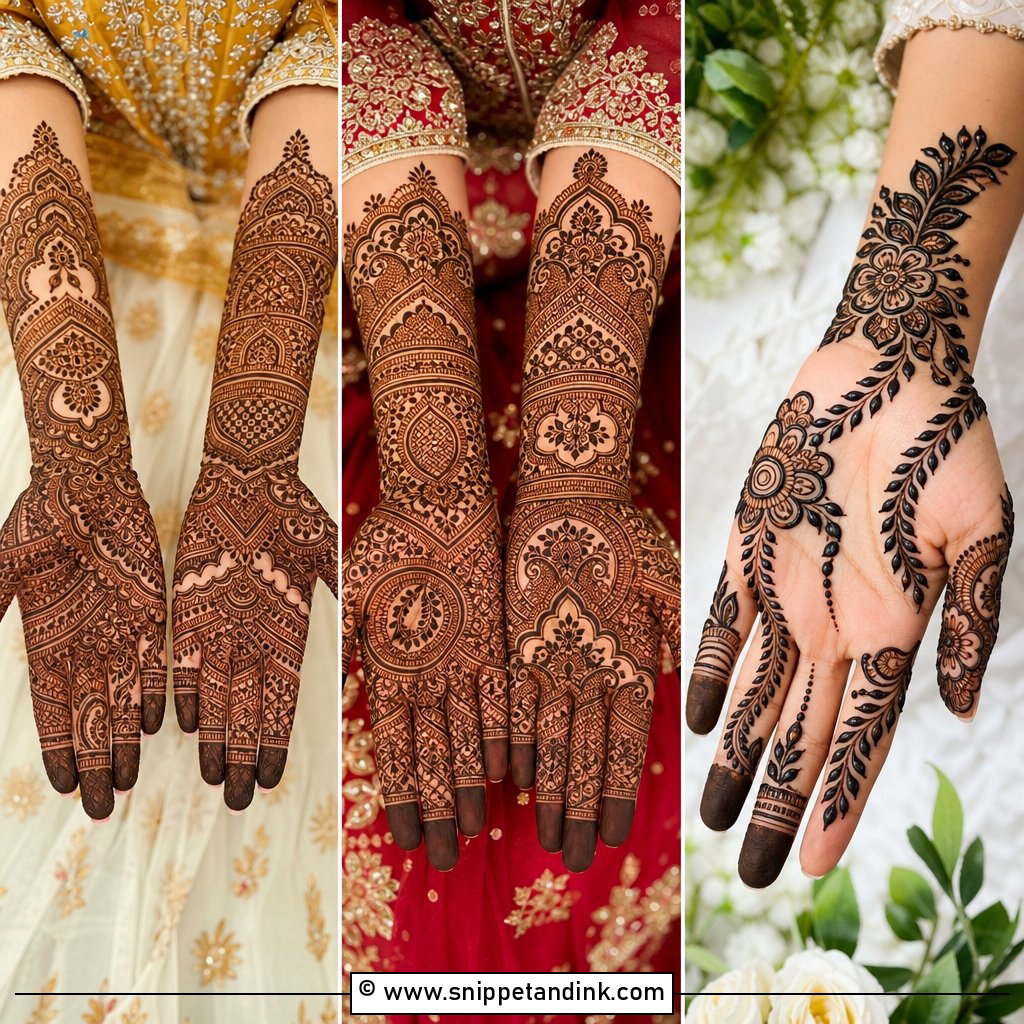
This is the design most families picture when they hear “bridal”: paisleys, lotus, peacocks and tight fillers running from fingertips to forearm on both palms and back hands. It sits naturally with a heavy lehenga or silk saree and gold sets because nothing on the hand looks unfinished next to all that embroidery. The mistake I see in photos is motifs drawn too small, so the palm reads as a brown blur. I keep the main elements on the palm a size larger than people expect and let checks, dots and leafy borders do the filling. Plan on a long sitting; a full set on both hands and arms can take most of an afternoon.
2. Arabic Bridal Mehndi Design
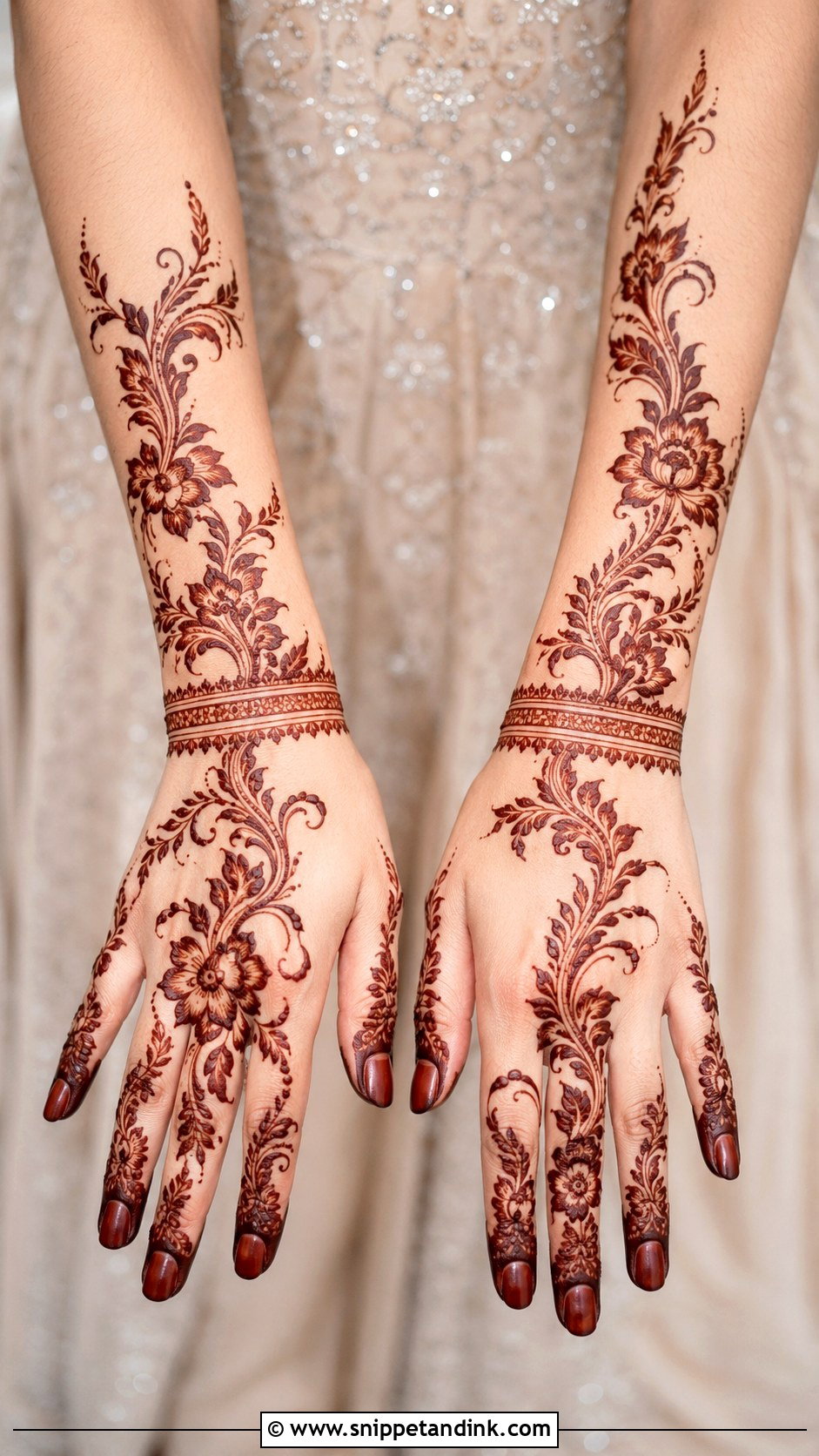
Arabic work is about the gaps. Bold flowers and leaves travel diagonally across the hand and the bare skin between them is part of the design, which is why it suits brides who dislike packed coverage or can only give me a short sitting. Thick outlines also hold a darker stain than fine lines, so it reads clearly in pictures. To make it feel bridal rather than party henna, I run the trail from the fingertips past the wrist and add one or two bracelet bands. Statement rings and slim bangles sit well against all that open space.
3. Indo Arabic Bridal Mehndi Design
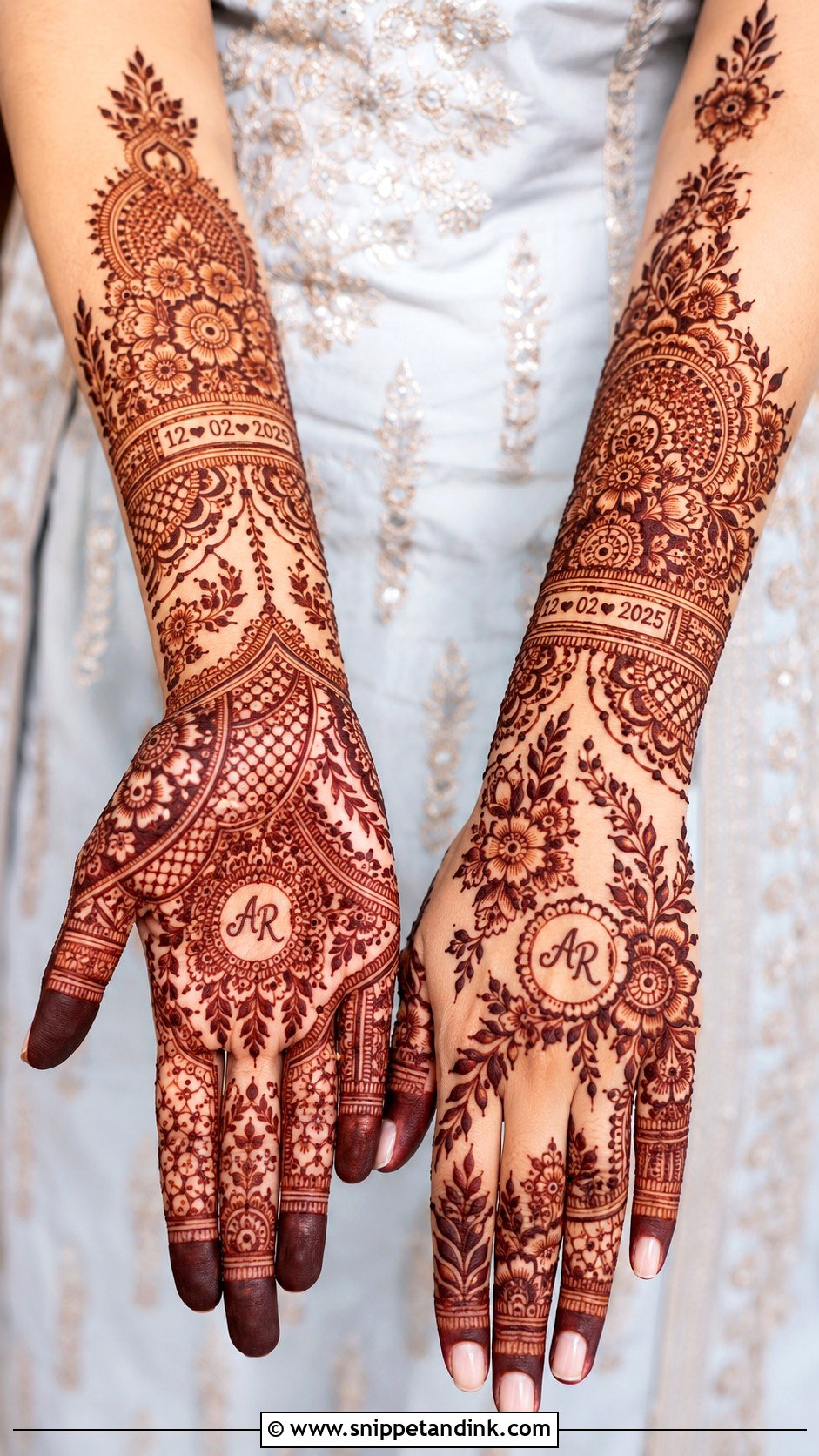
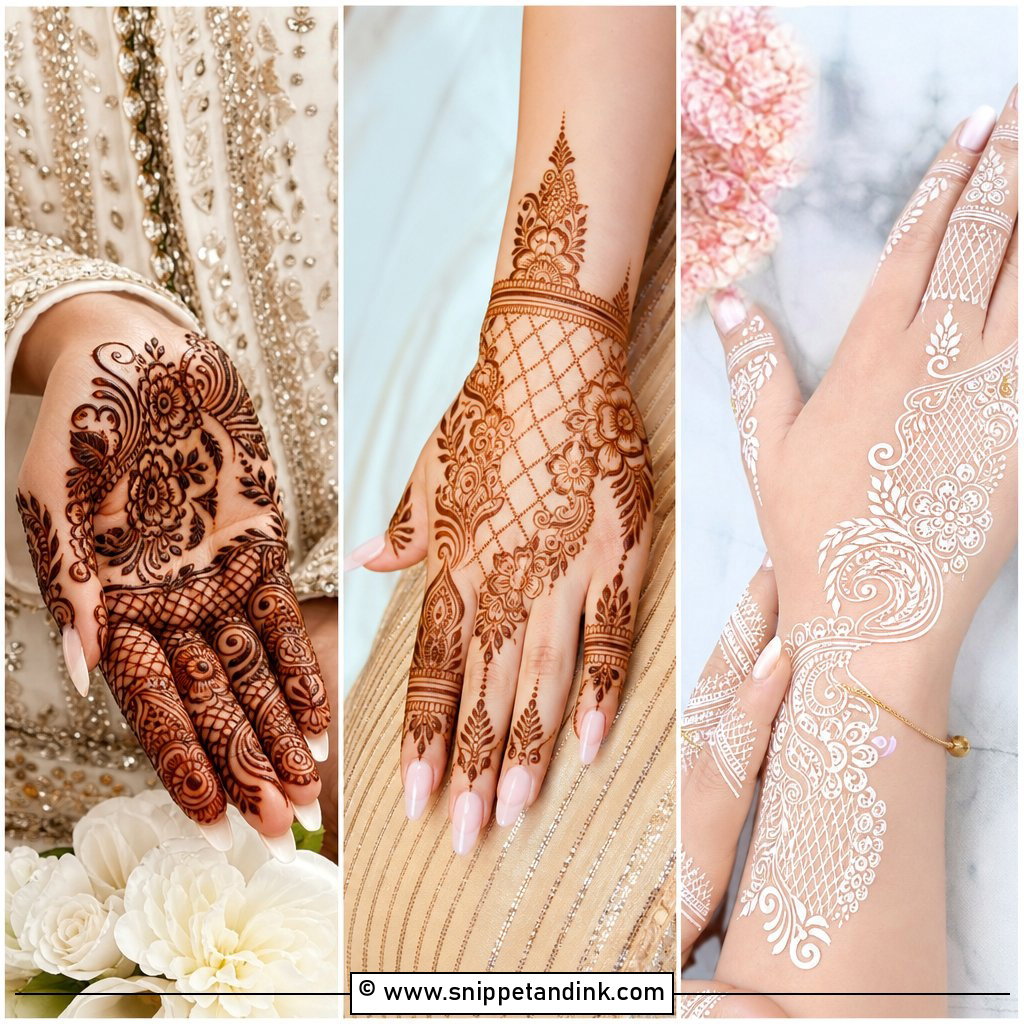
Indo-Arabic takes the flowing placement of Arabic henna and fills parts of it with Indian detail: large flowers on the palm, a paisley vine up the wrist, then mesh, dots and leaf strokes on the fingers. The trick is deciding which areas stay open before I start, otherwise it drifts into full Indian coverage halfway through. It gives a proper bridal look without the hours a dense design needs. I often suggest it for a nikah, an engagement or a destination wedding where you will be travelling and sitting for long stretches is hard.
4. Rajasthani Bridal Mehndi Design
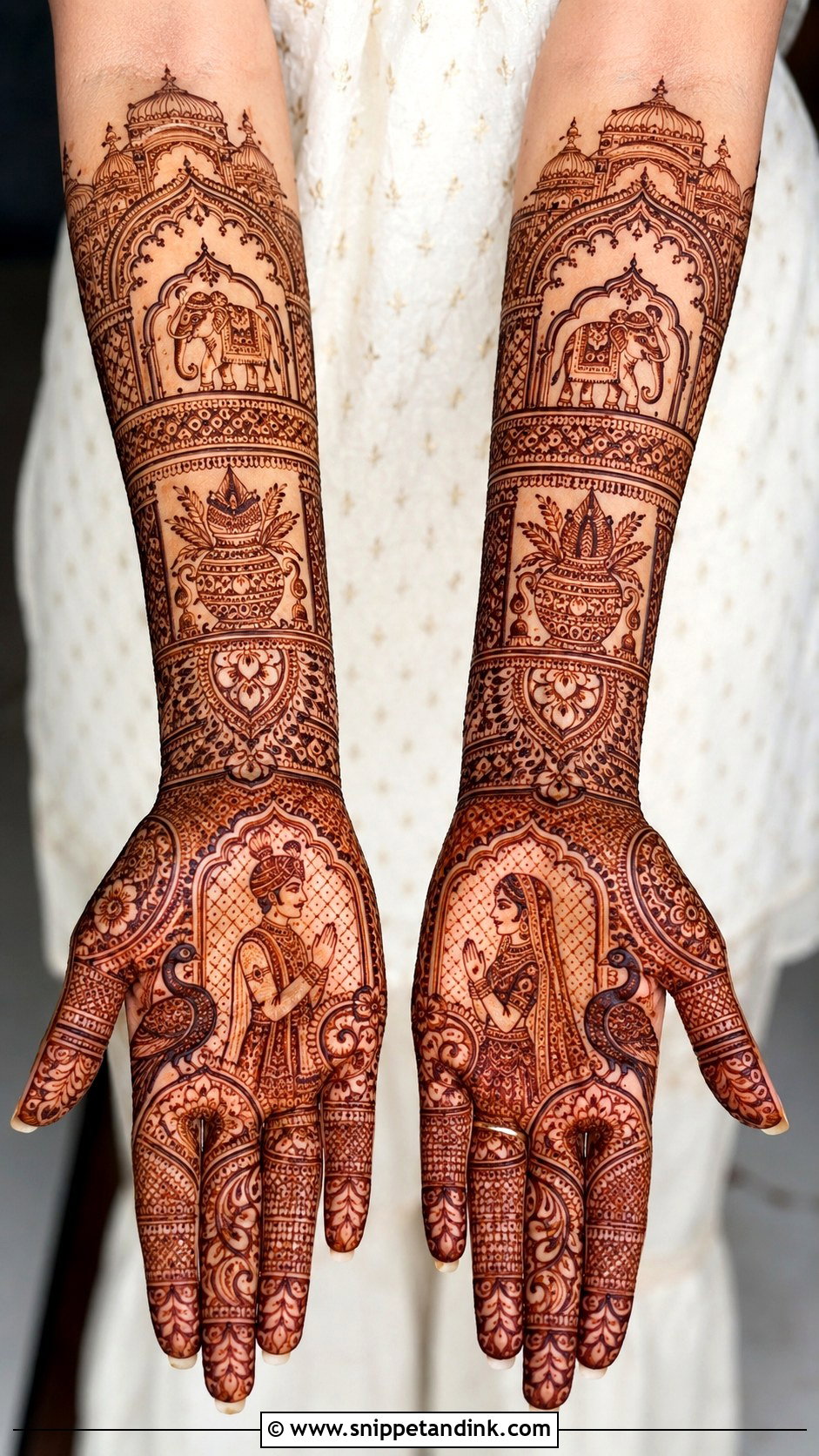
Rajasthani mehndi tells stories inside tight symmetry: bride and groom figures, palace arches, elephants, peacocks, kalash pots and royal borders, usually from fingertips to elbows. Every line here is fine, so a shaky hand or a cone that is too wet ruins it fast. Ask any artist you are considering to show you close-ups of their own Rajasthani work, not just finished-hand photos from far away. Initials or a wedding date can be tucked into an arch or a border. The deep stain sits richly against red, maroon and jewel-toned outfits.
5. Marwari Bridal Mehndi Design
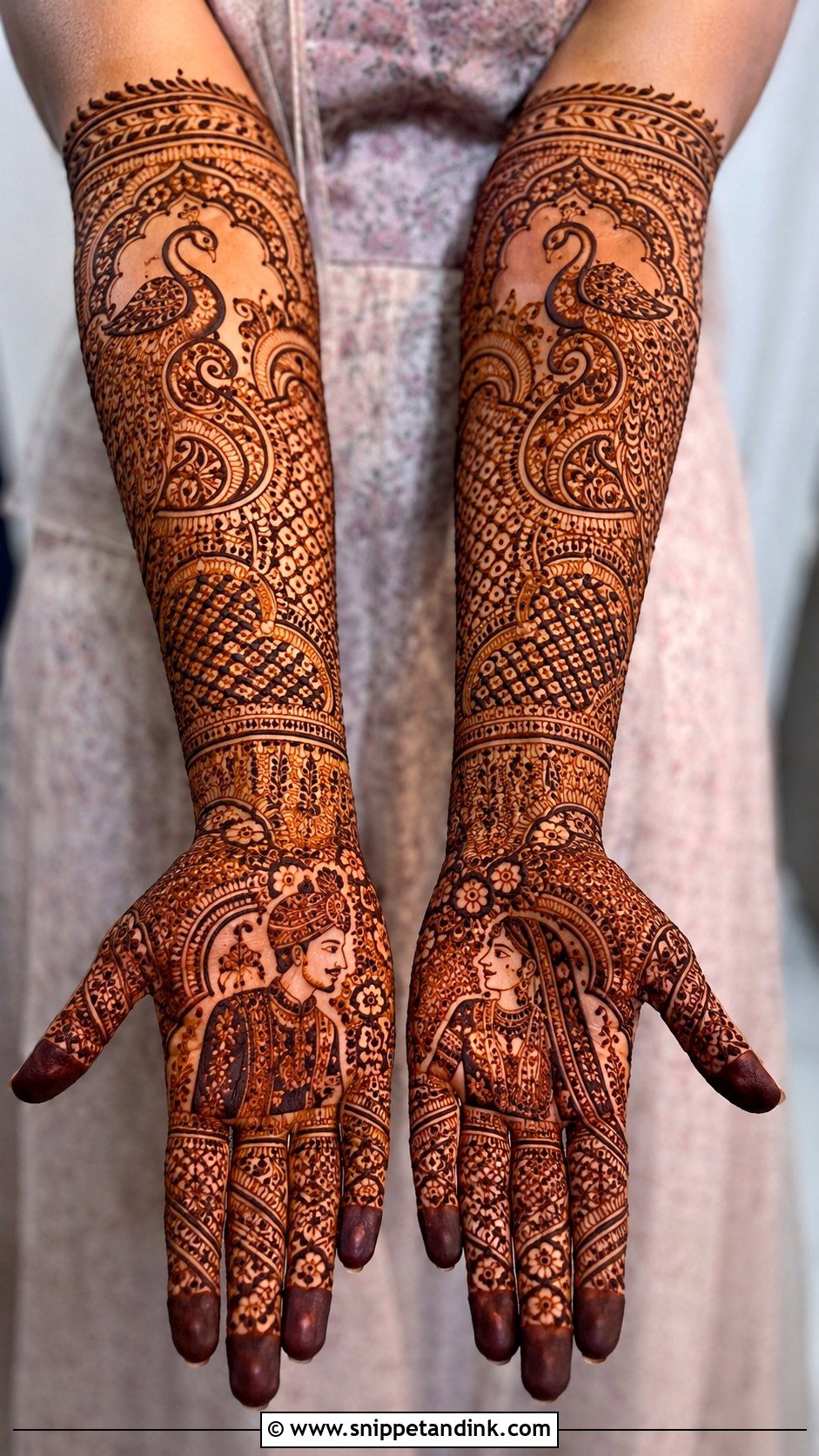
Marwari designs are heavy but organised. Peacocks, paisleys, checked jaali, doli and shehnai figures are each given their own panel, which is what keeps dense coverage from looking messy. When I draw it, I mark the panel divisions with a light line first and fill afterwards. Family symbols and initials slot easily into those boxes. If you have only a couple of hours, though, this is not the style to squeeze in; rushed panels lose their edges.
6. Pakistani Bridal Mehndi Design
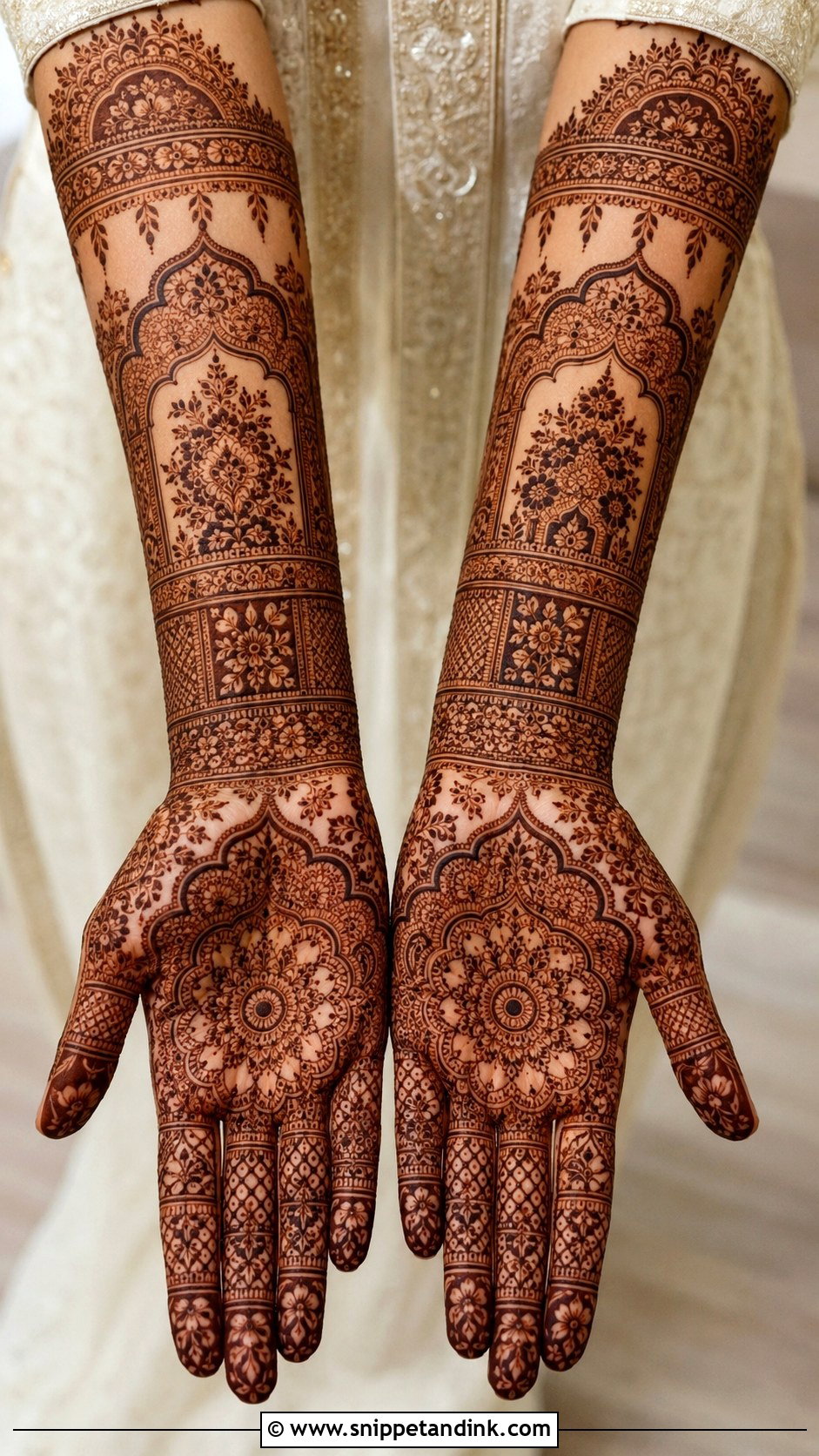
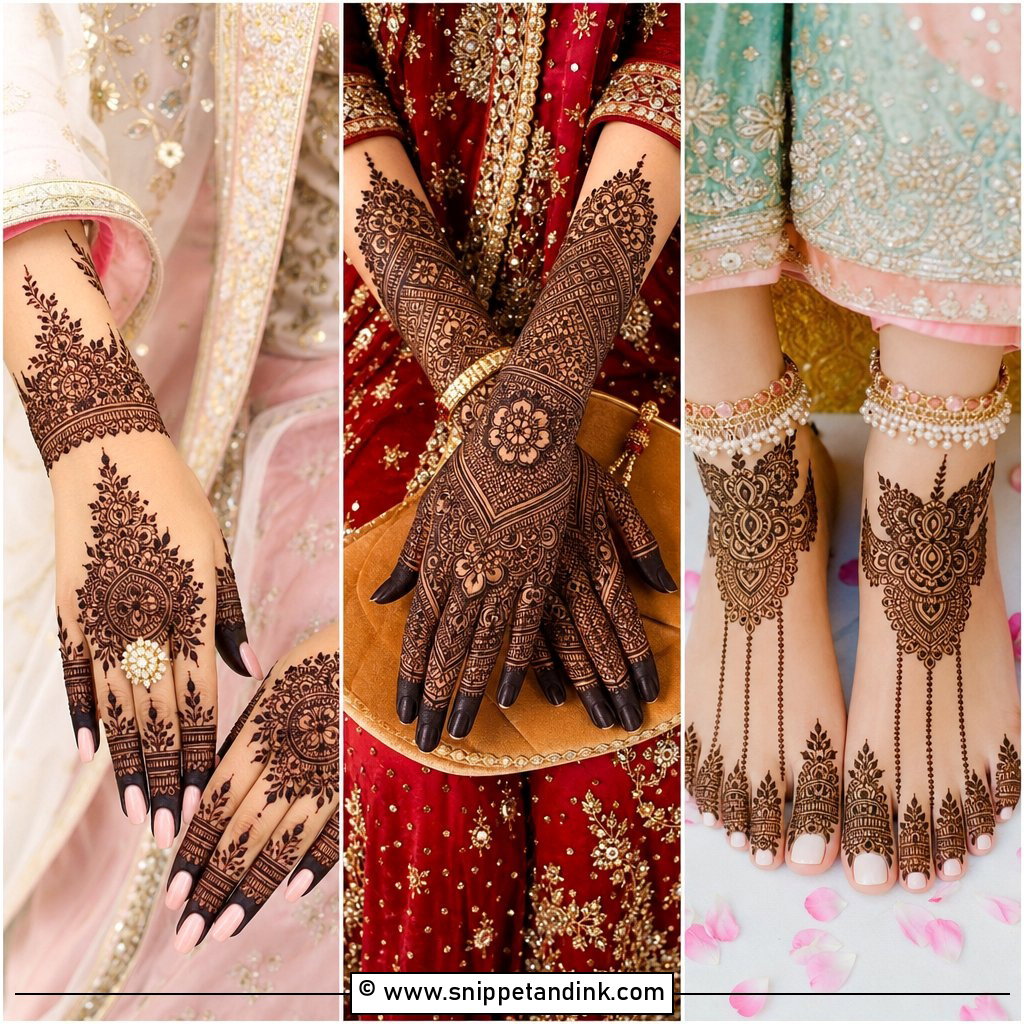
Pakistani bridal henna borrows Indian intricacy and Arabic breathing room, and often adds Mughal arches, domes and fine geometric fillers. A palm usually gets a central mandala or floral, while the wrist and forearm carry bracelet bands and ornamental panels. What makes it look refined is contrast: a few bold shapes held together with very fine lines. It carries well across a nikah, a walima and the events in between, and it can be done full-hand or semi-full depending on how much of the arm your sleeves will show.
7. Moroccan Bridal Mehndi Design
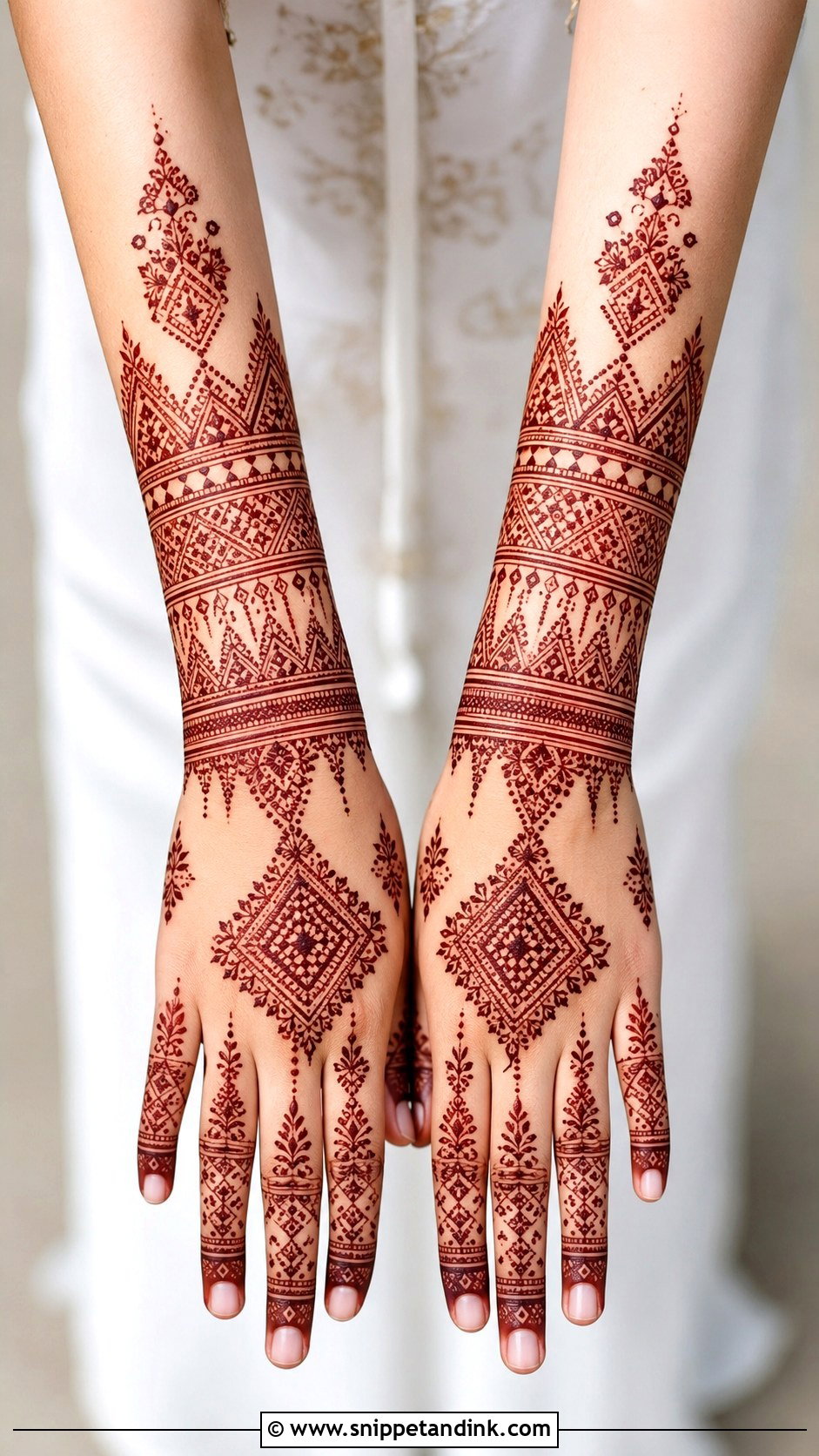
Geometry suits the back of the hand because fingers are already long straight lines, and Moroccan work leans into that with diamonds, triangles, grids and blocks. I rarely do it fully plain for a bride; a few soft floral accents and a wrist cuff stop it looking cold. The lines are usually bolder than Indian fillers, which helps the stain come up crisp. Fusion and contemporary outfits suit it best. With a heavily embroidered red lehenga, I find it can look a little out of place.
8. Gulf Bridal Mehndi Design
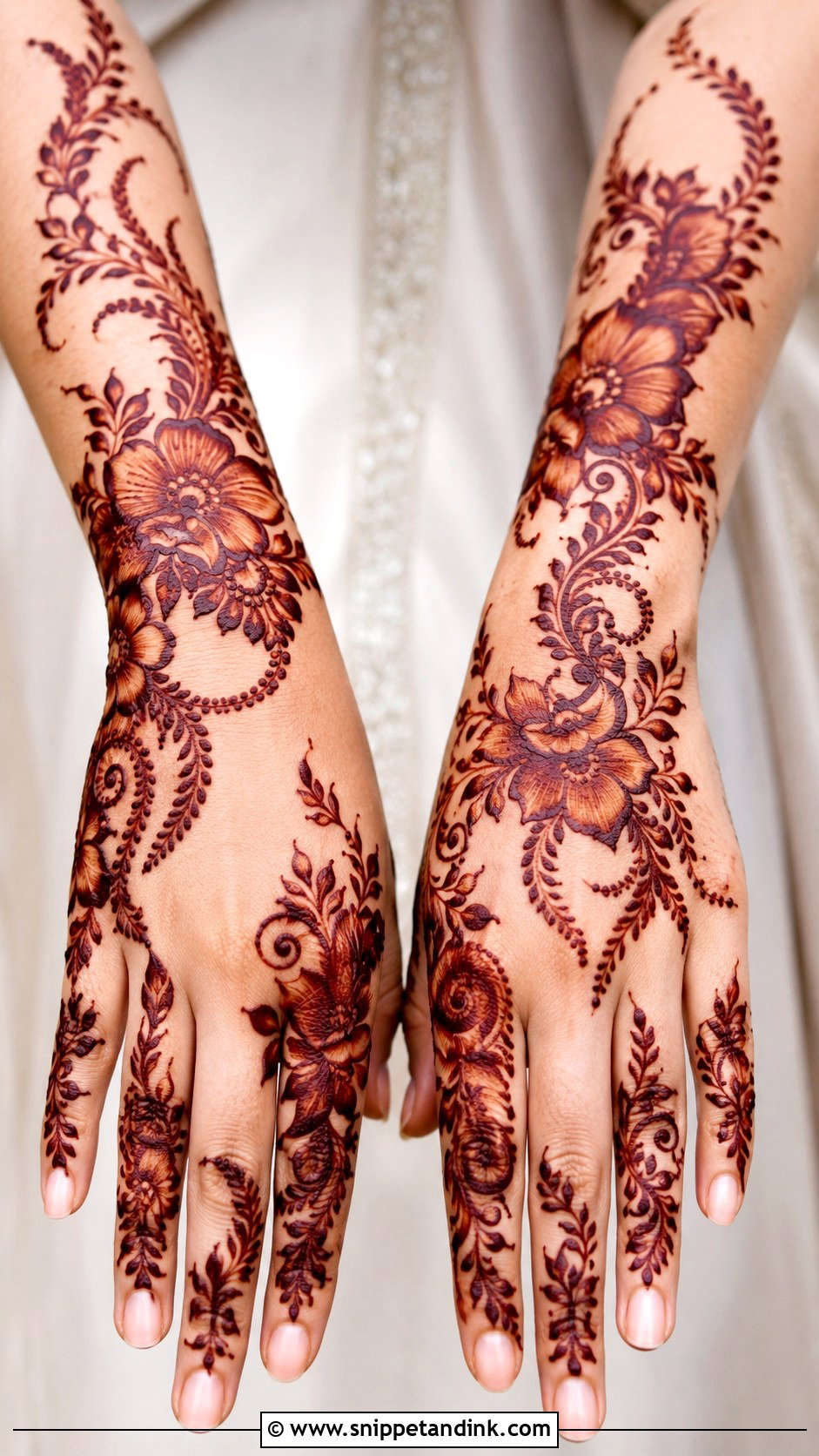
Gulf or Khaleeji henna is built on oversized flowers with shaded petals and sweeping leaf curves that run from finger to forearm. Shading is done by thinning the paste stroke, so it needs a confident hand and a slightly looser cone mix. On the back hand the large motifs sit like jewelry, which is why it is so popular for photos. For a bride, I add finger detailing, a wrist band and a few filler dots around the trail. It works with traditional and modern outfits alike, and it dries faster than dense work, which matters on a busy day.
9. Minimal Bridal Mehndi Design
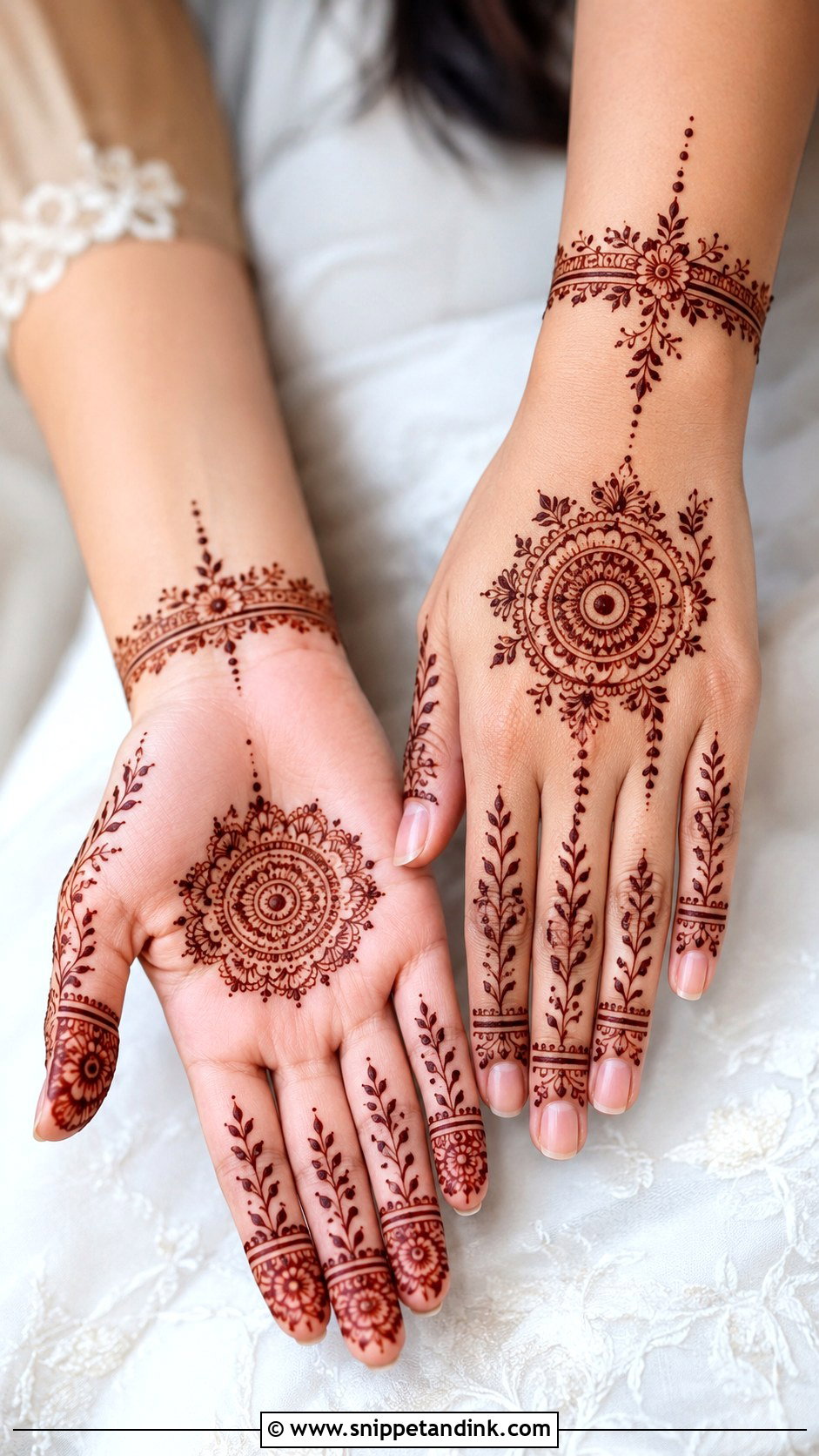
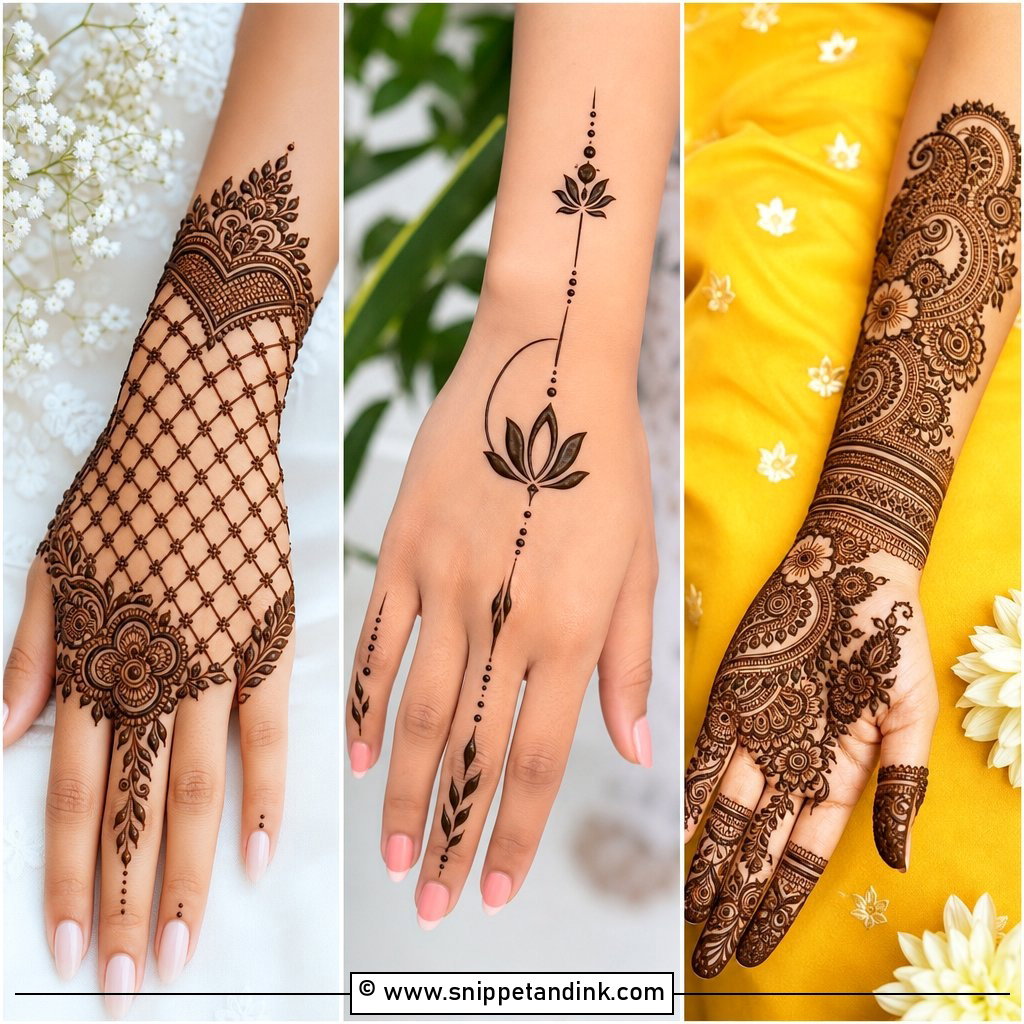
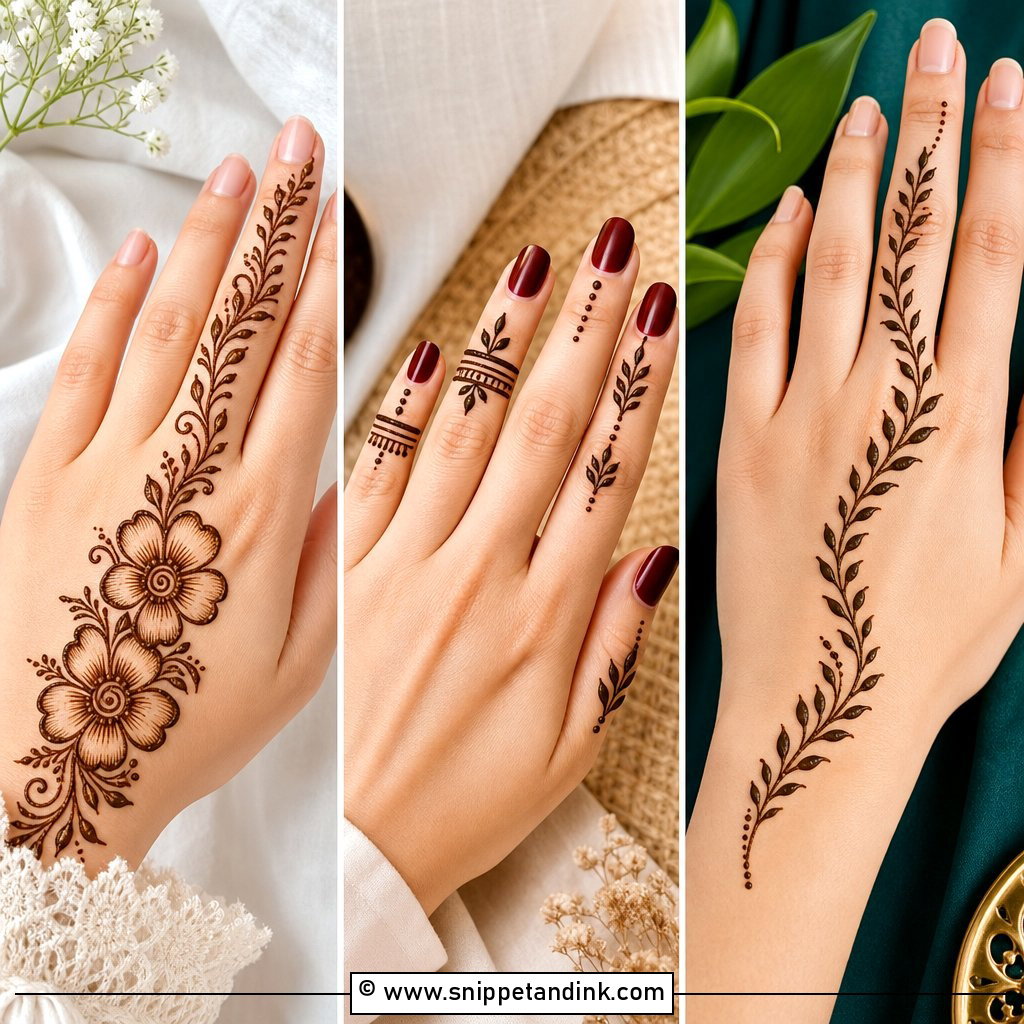
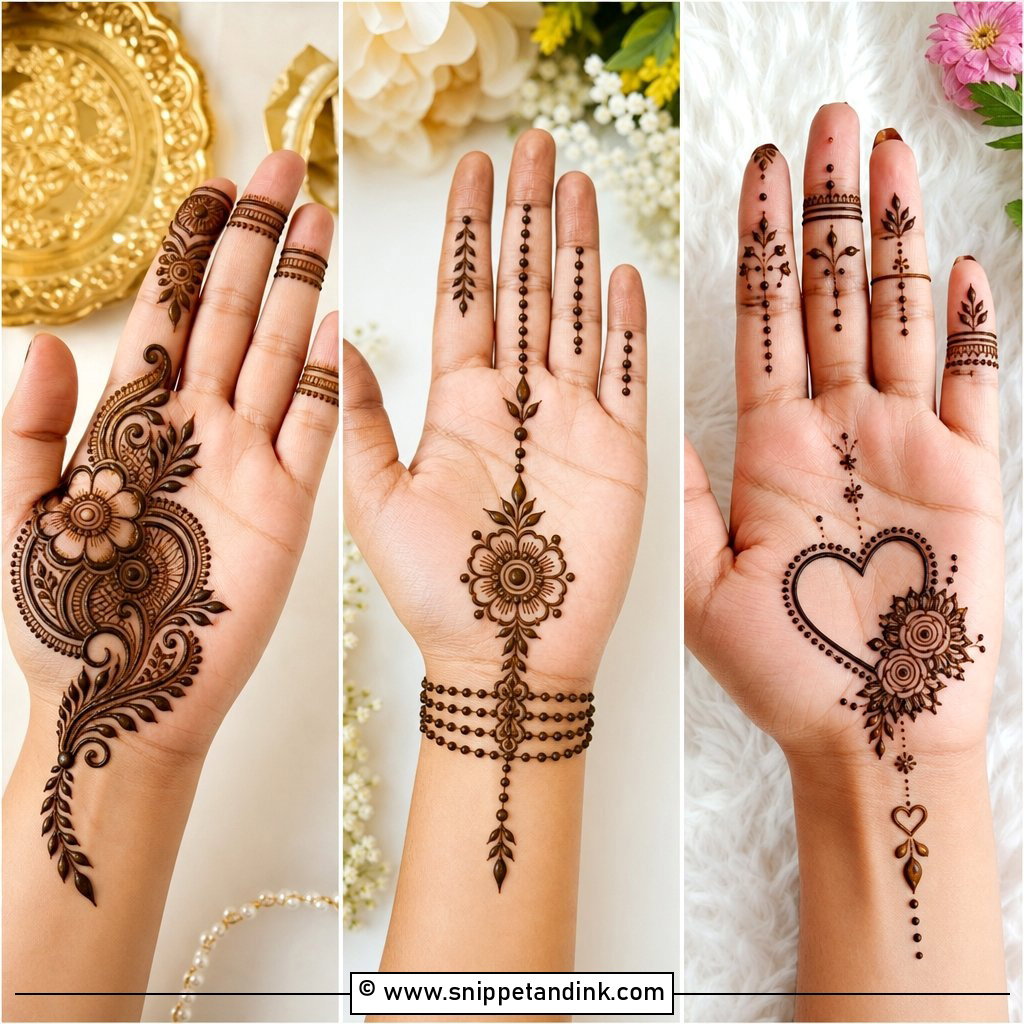
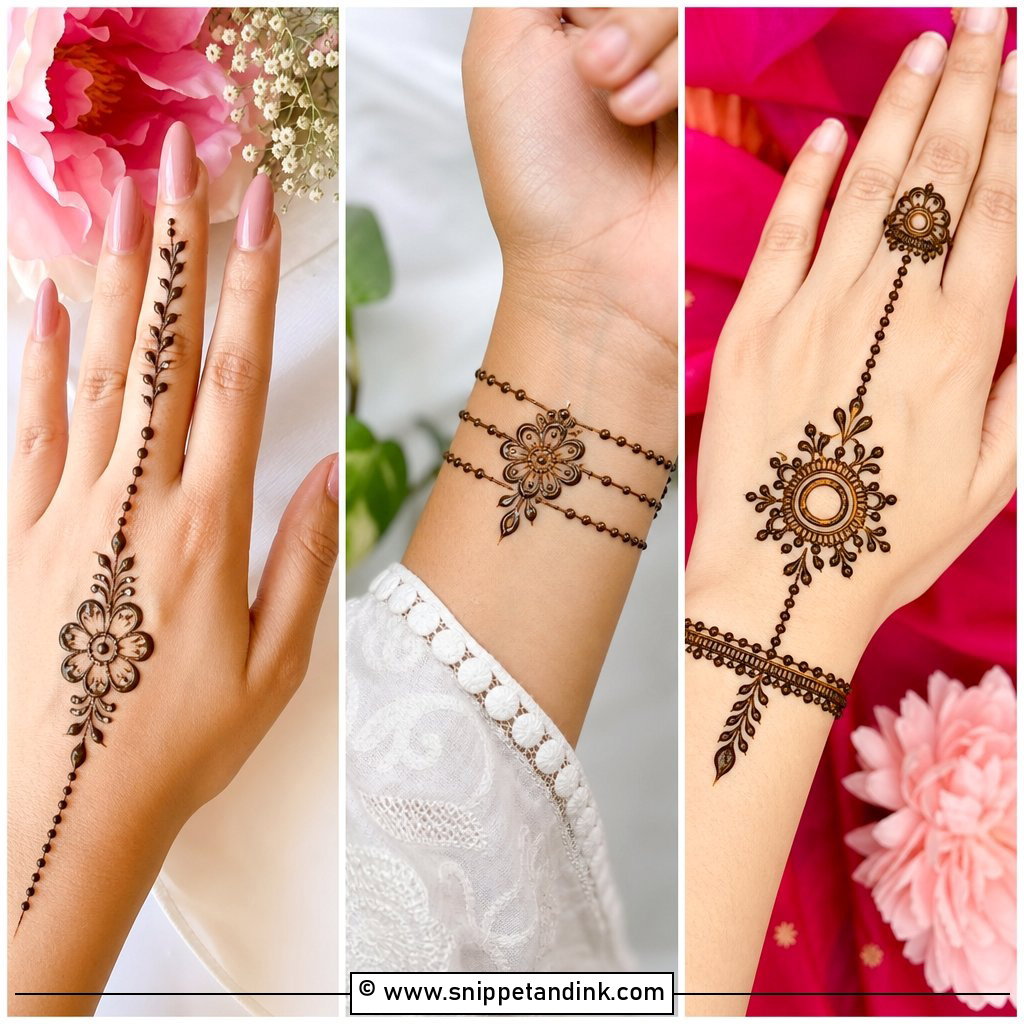
Minimal does not mean careless. With so little on the hand, every wobble shows, so I slow down more for a minimal bridal set than for a crowded one. The usual placements are fingers, a small palm mandala, a wrist band or a short trail up the forearm. It suits intimate weddings, civil ceremonies, pastel lehengas and diamond jewelry. Ask for symmetry between the hands and clean finishing at the fingertips; those two things make it read as bridal rather than casual.
10. Modern Bridal Mehndi Design
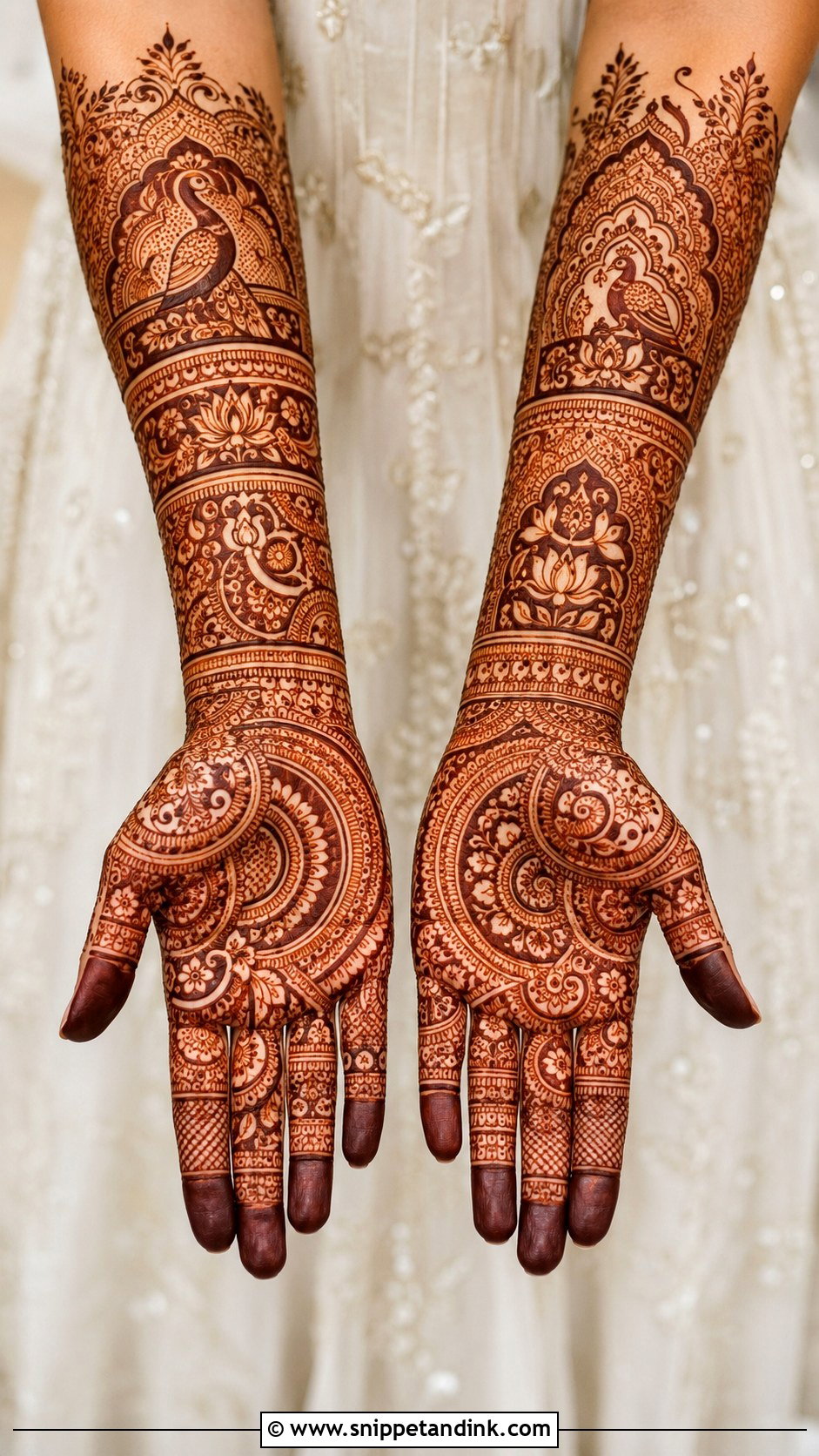
Modern bridal mehndi keeps traditional motifs but gives them room: floral trails, lace bands, a mandala, the couple’s initials or a small symbol from your story. Coverage can be full, half or only palms and back hands. I steer brides toward planned negative space here, because it stays legible in photos and is more comfortable to sit with through a long event. If you want it to feel current without dating quickly, keep the motifs classic and let the spacing be the modern part.
11. Bridal Portrait Mehndi Design
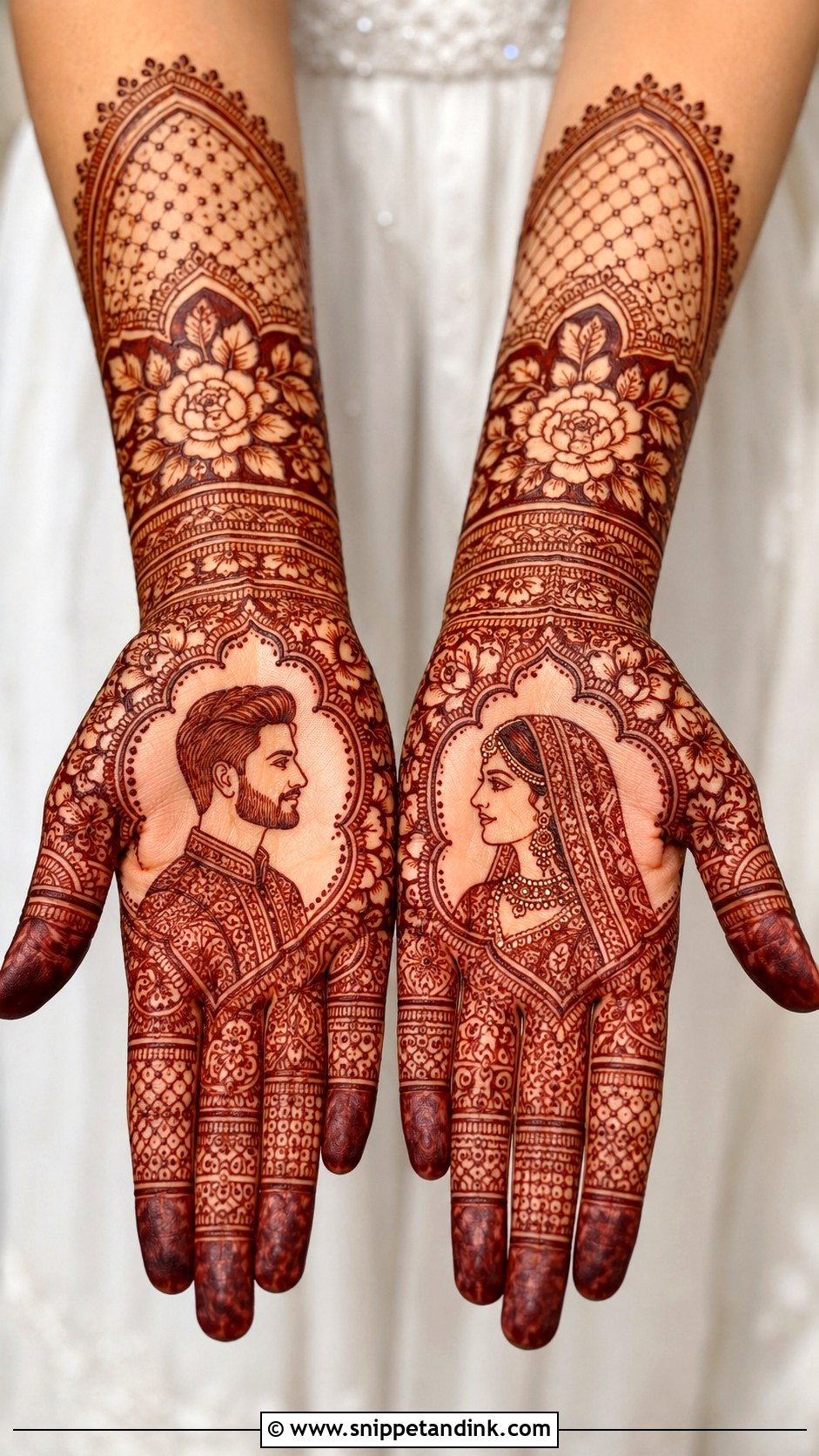
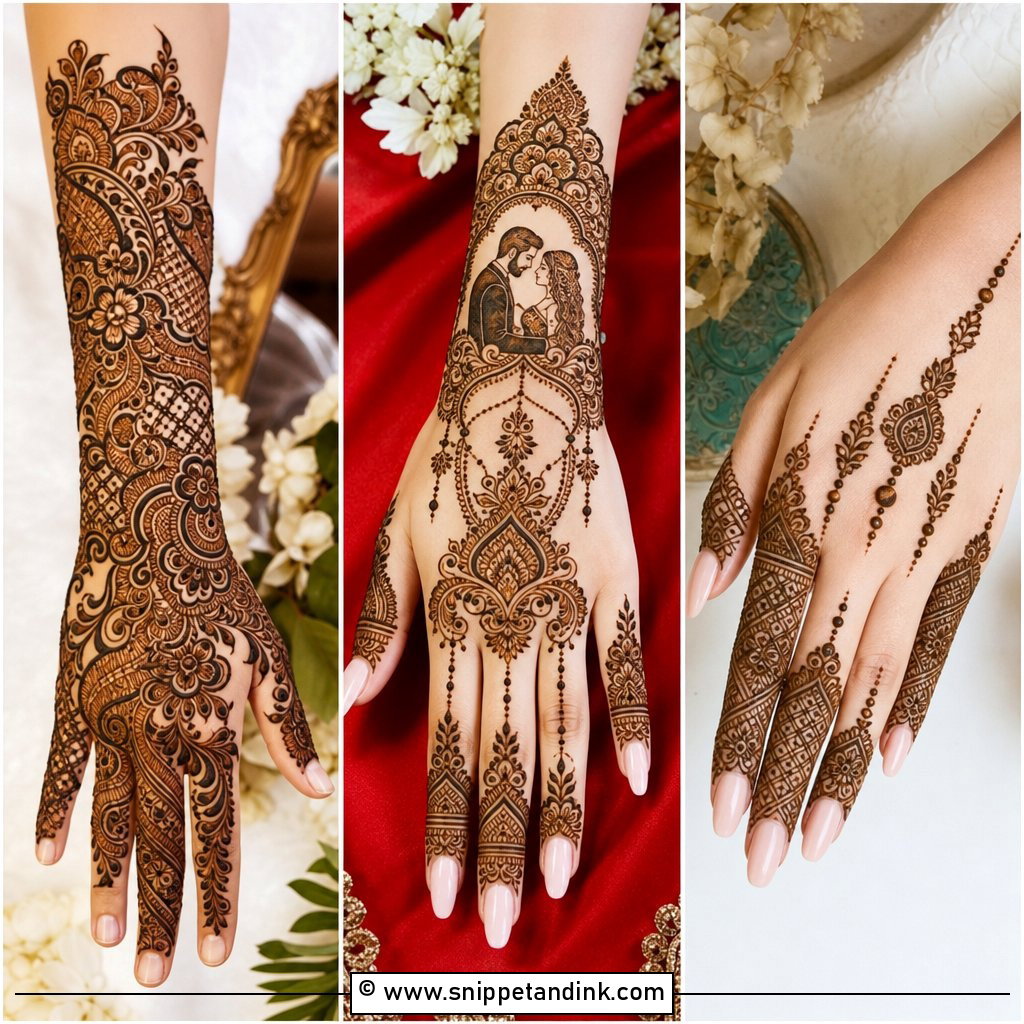
Portrait henna puts a bride on one palm and the groom on the other, framed by florals, paisleys and fine fillers, sometimes with a ritual scene alongside. Faces are the hardest thing in mehndi: a slightly thick line on the nose or eyes changes the whole expression once the stain darkens. I draw faces large, at least most of the palm width, because tiny portraits blur as the paste spreads in the skin. Look at an artist’s healed stain photos of faces before you book. The surrounding pattern should frame the portraits and stay quieter than them.
12. Bride And Groom Mehndi Design
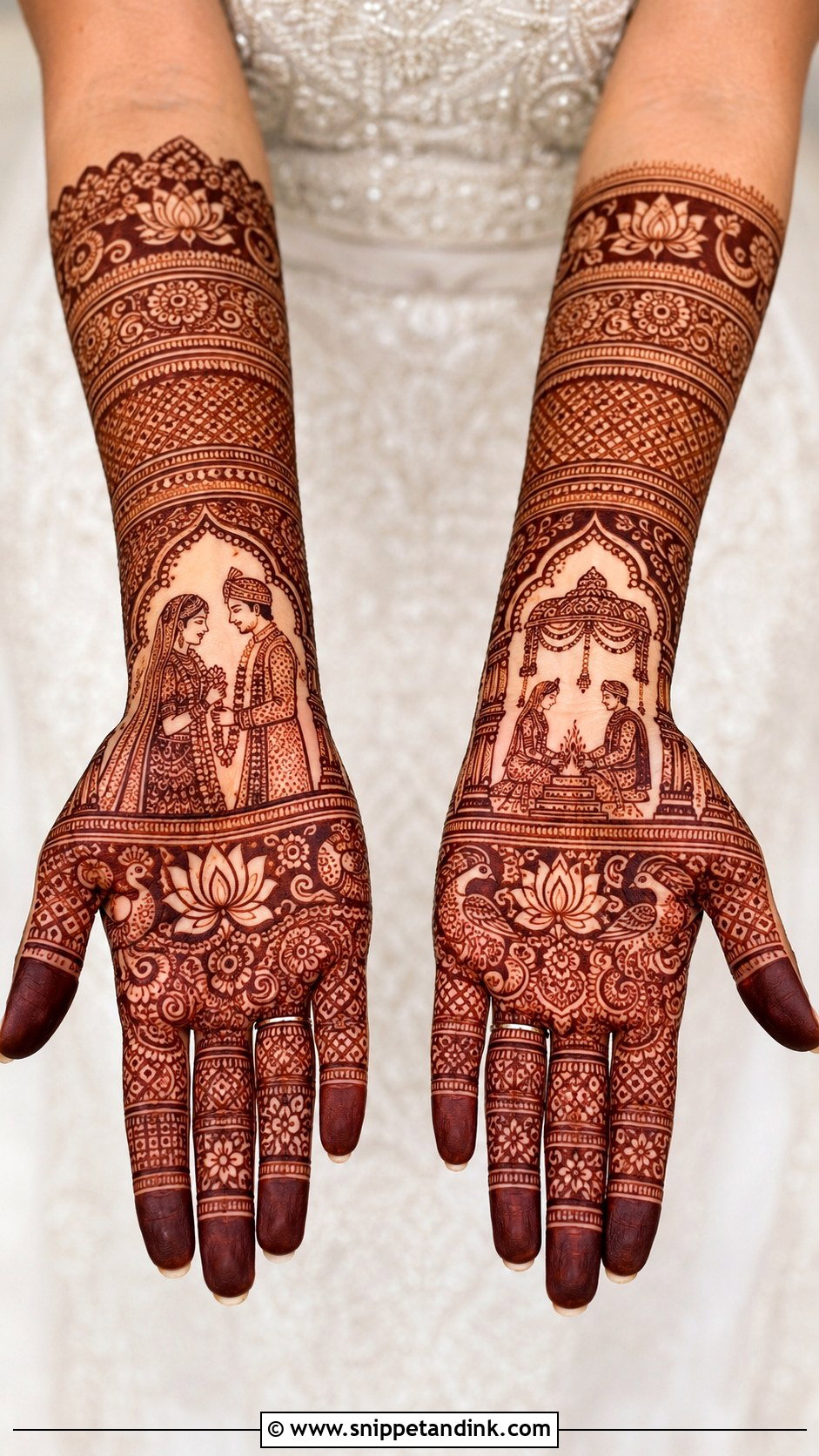
A full Bride and groom mehndi design goes further than two faces. It can show the couple seated, a varmala exchange or a wedding pose inside decorative frames, with lotus borders and lace fillers around them. Most brides place one figure on each palm so the scene completes when the hands are held together, and I check that alignment by having you press your palms together before I draw. A date or initials near the wrist adds a quieter personal layer. Budget extra time; figure work cannot be rushed.
13. Love Story Bridal Mehndi Design
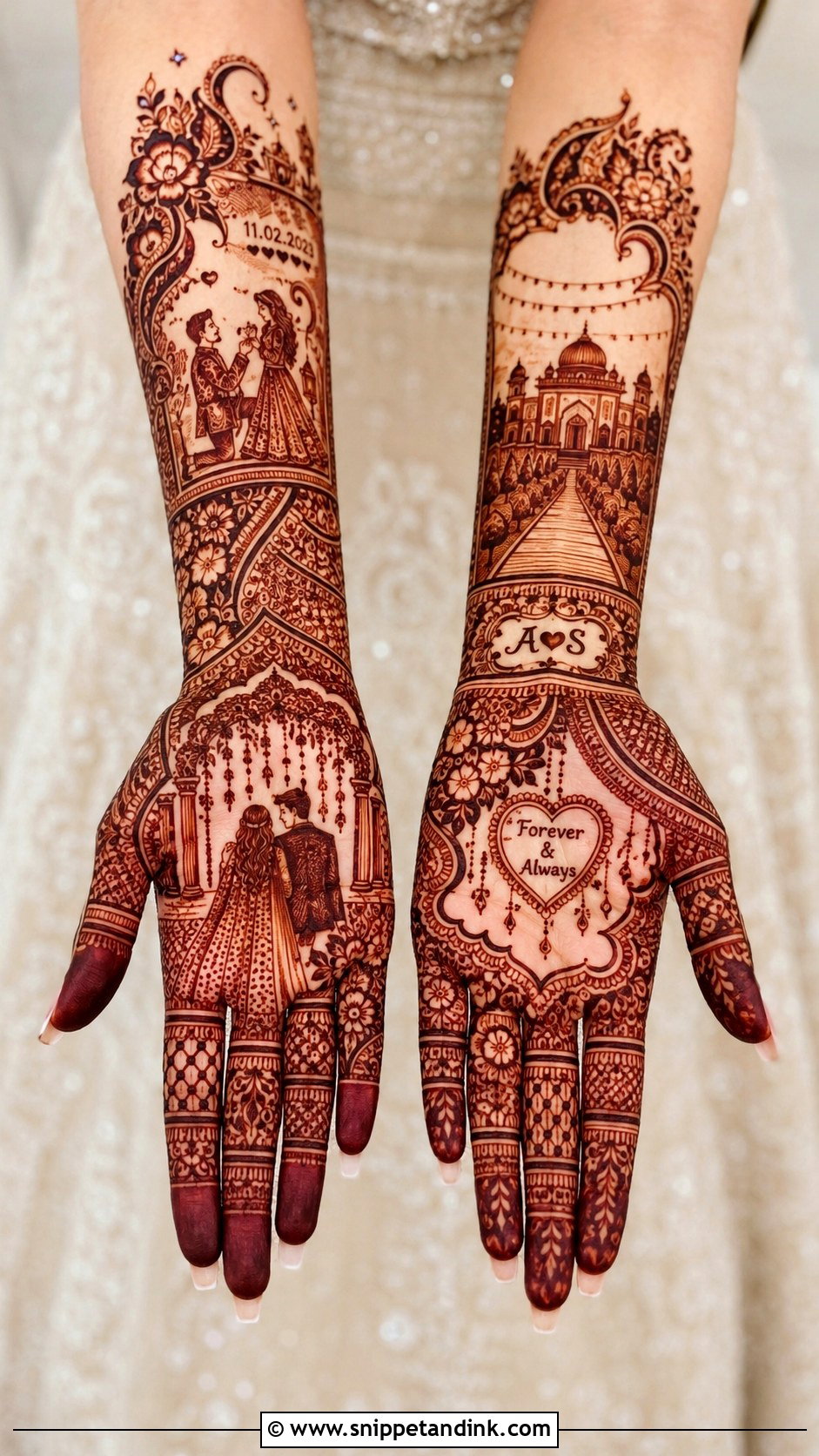
Love-story mehndi turns moments into small panels: where you met, the proposal, a city you share, the venue or a date. The risk is clutter. I ask brides to pick three or four moments and let the rest of the hand stay traditional with florals, jaali and paisley borders. Each moment then gets its own framed space so it is readable. Bring rough sketches or photos of the objects you want; drawing a specific building or pet from memory rarely comes out right.
14. Mandala Bridal Mehndi Design
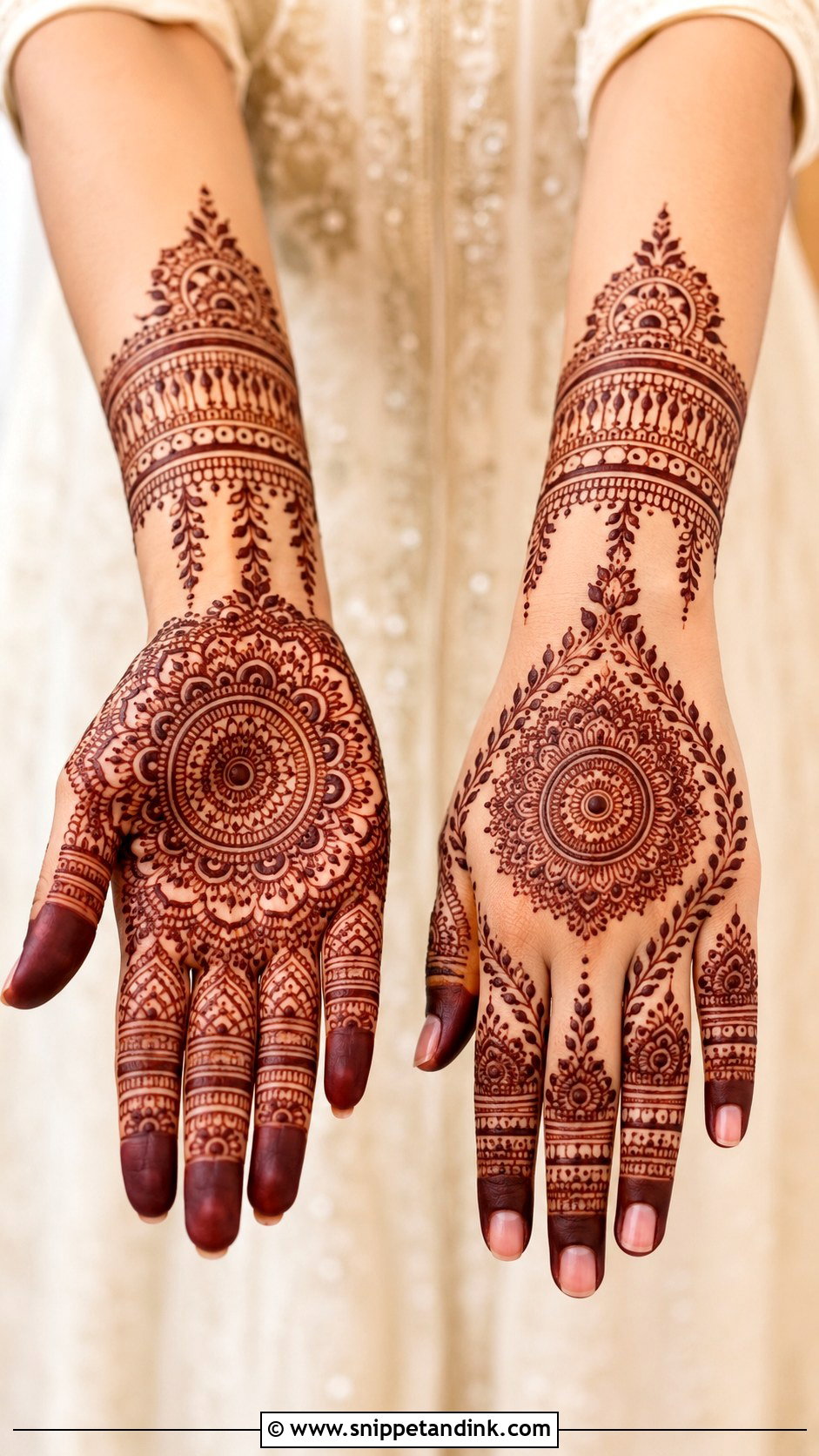
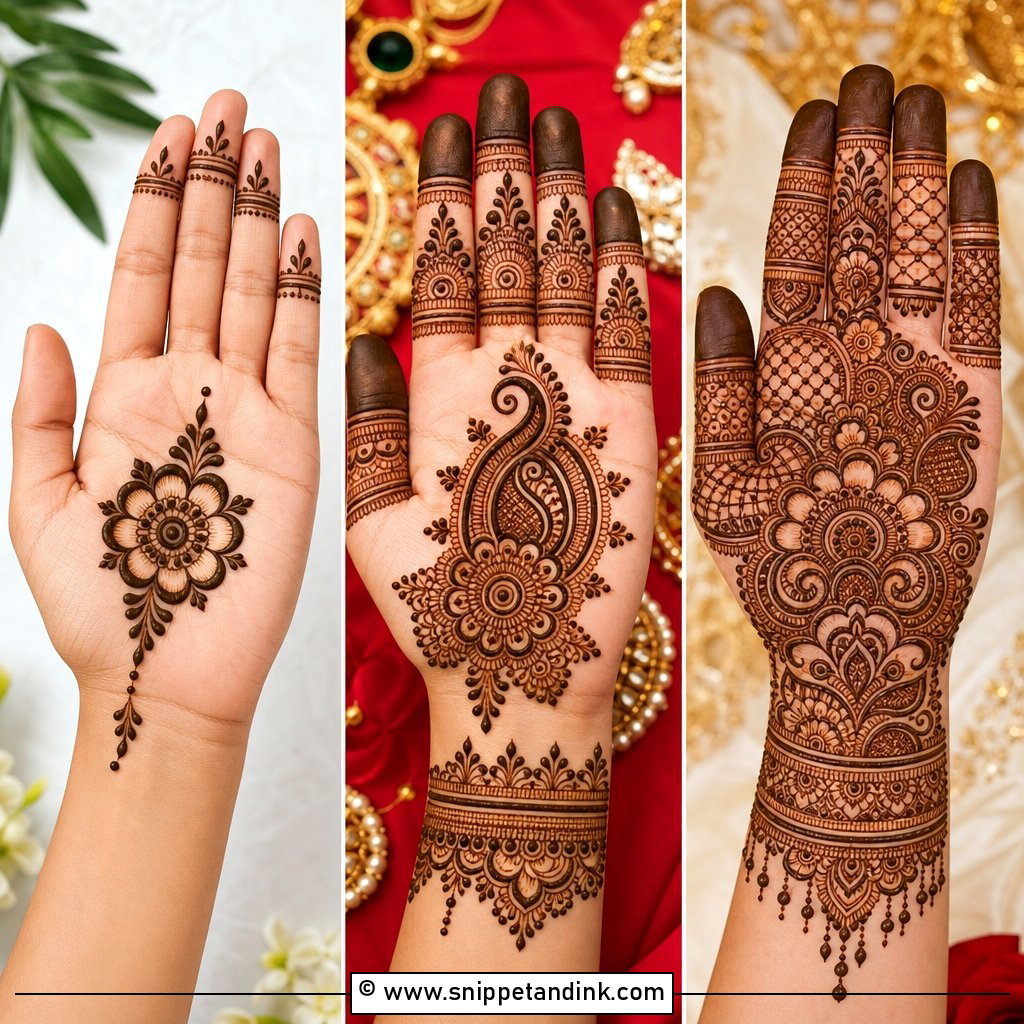
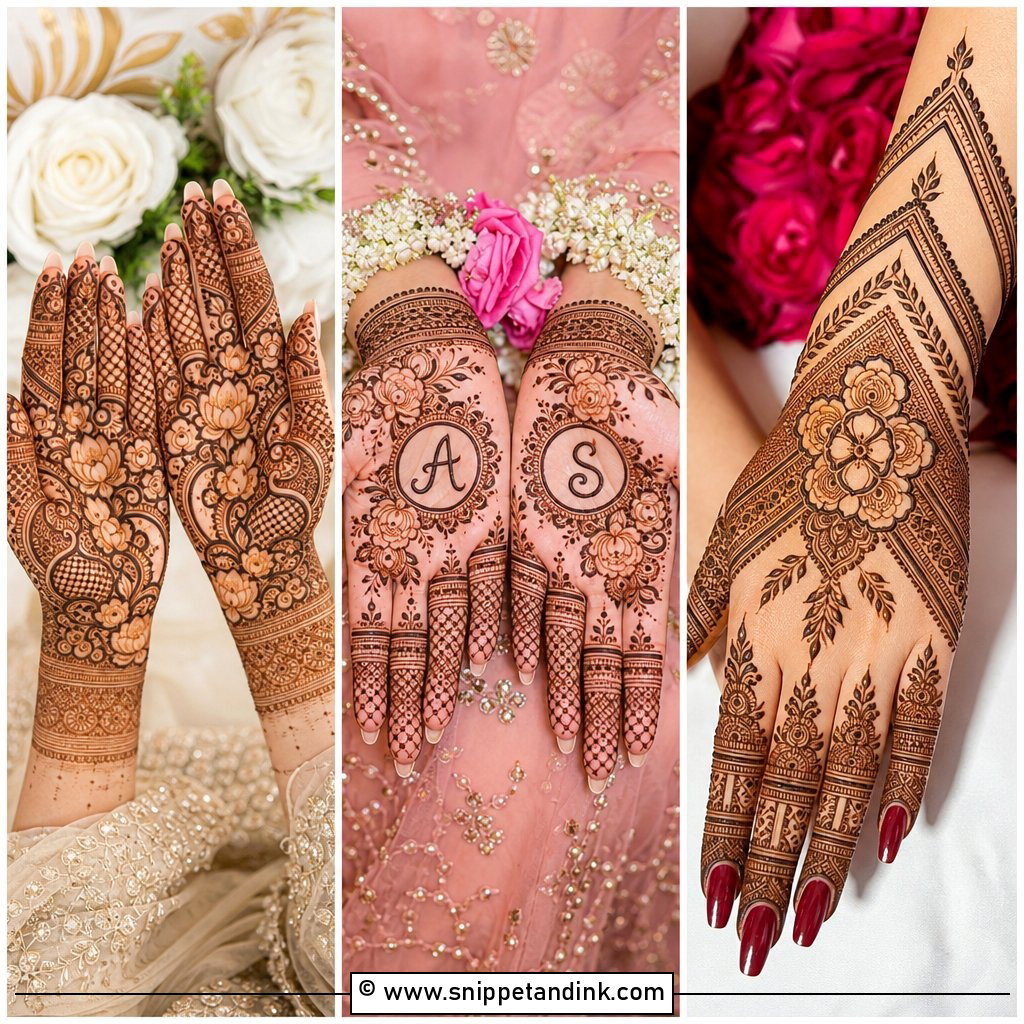
A big palm mandala gives the eye one clear place to land, which makes it calming to look at and easy to photograph. I build it from the centre outward in rings, then link the rings to the fingers and wrist with dots, leaves and fine chains. It can stay simple or go very detailed. The common fault is an off-centre start; I find the true middle of your palm with the hand relaxed, not stretched flat, because that is how it will be seen. A matching mandala on the back hand ties the set together.
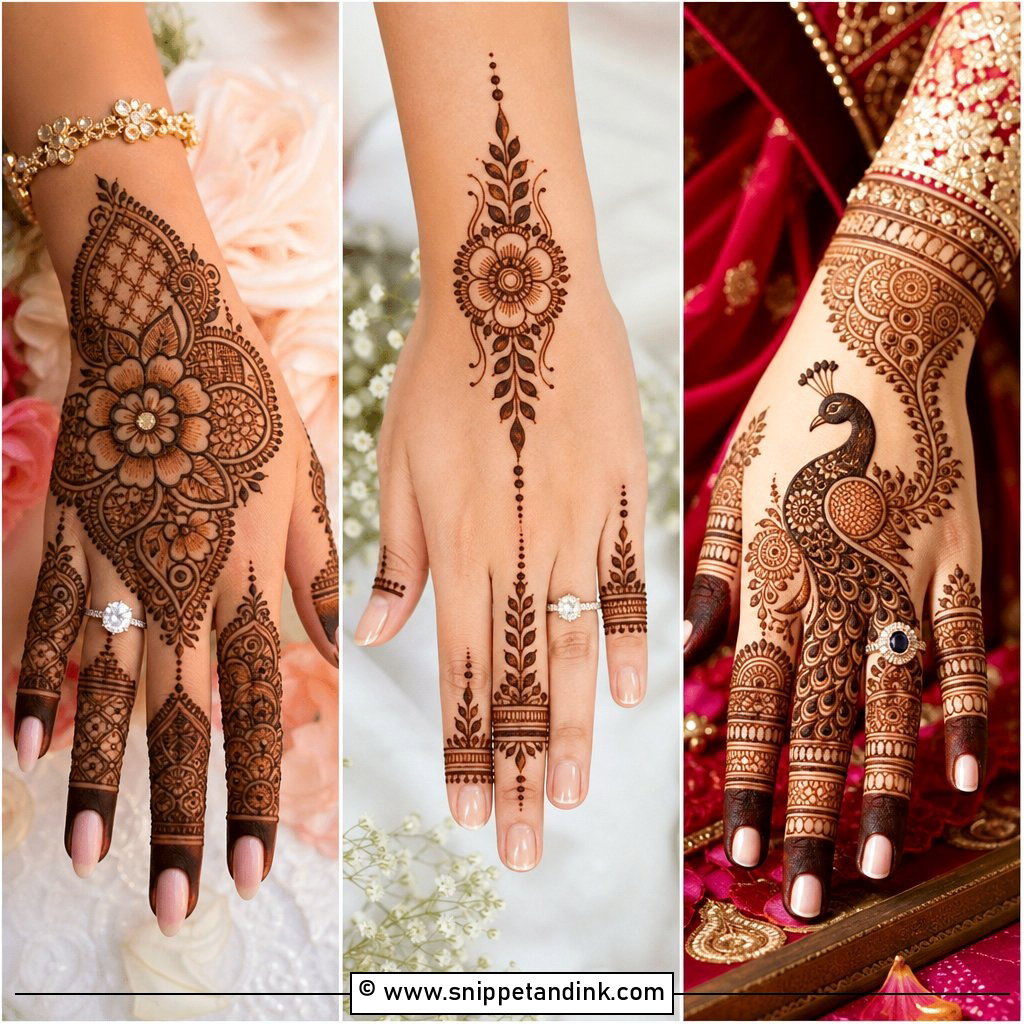
15. Lotus Bridal Mehndi Design
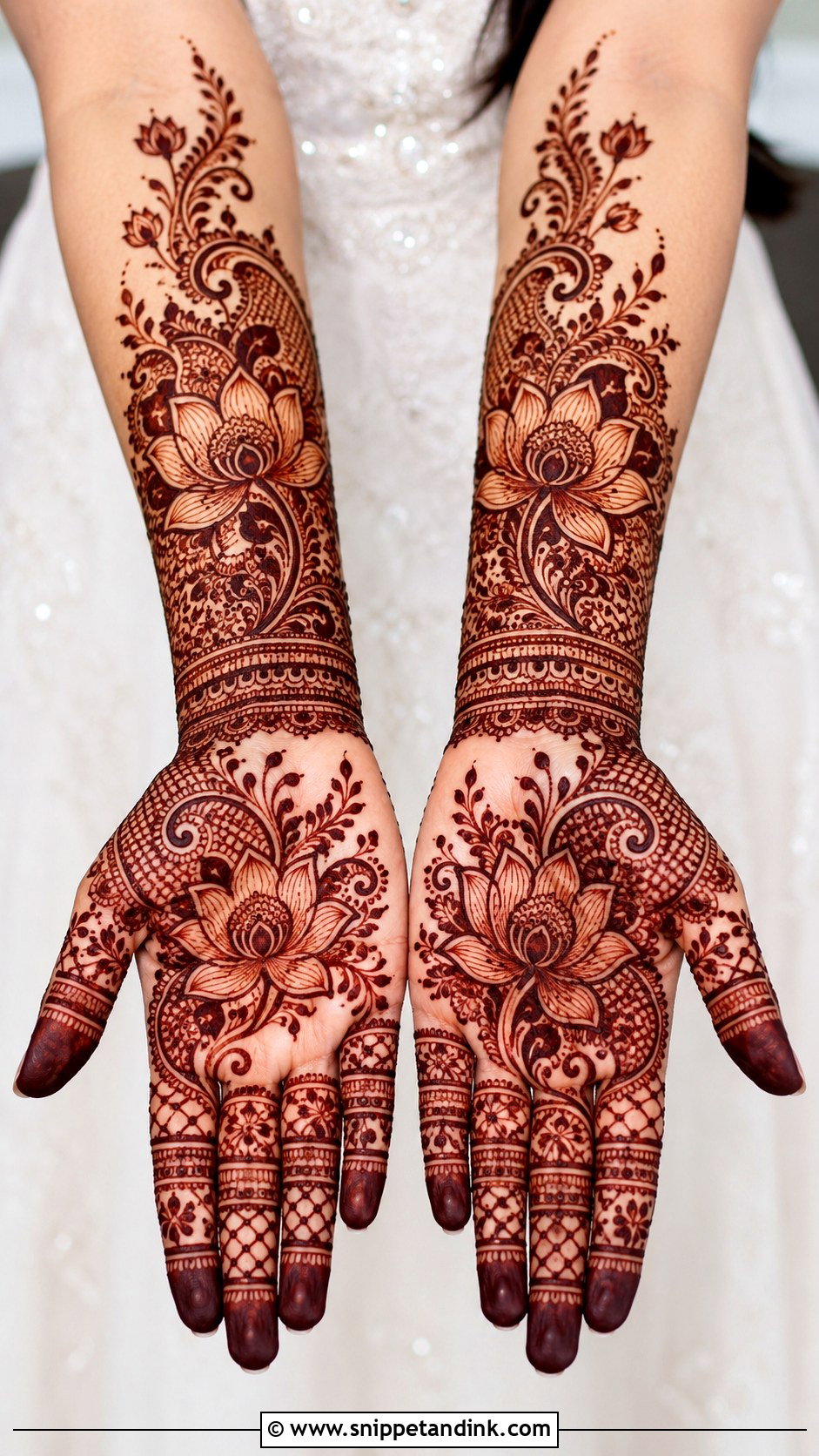
The lotus carries meaning in many traditions and is generous to draw: large blooms on palms or back hands, small buds in borders and finger panels, with paisleys, vines and mesh around them. It gives a traditional feel without leaning on peacocks or portraits. I keep the petals bold and do the shading inside them with fine lines, so the shape survives even if the stain comes up lighter than hoped. It pairs naturally with classic Indian outfits and temple jewelry.
16. Peacock Bridal Mehndi Design
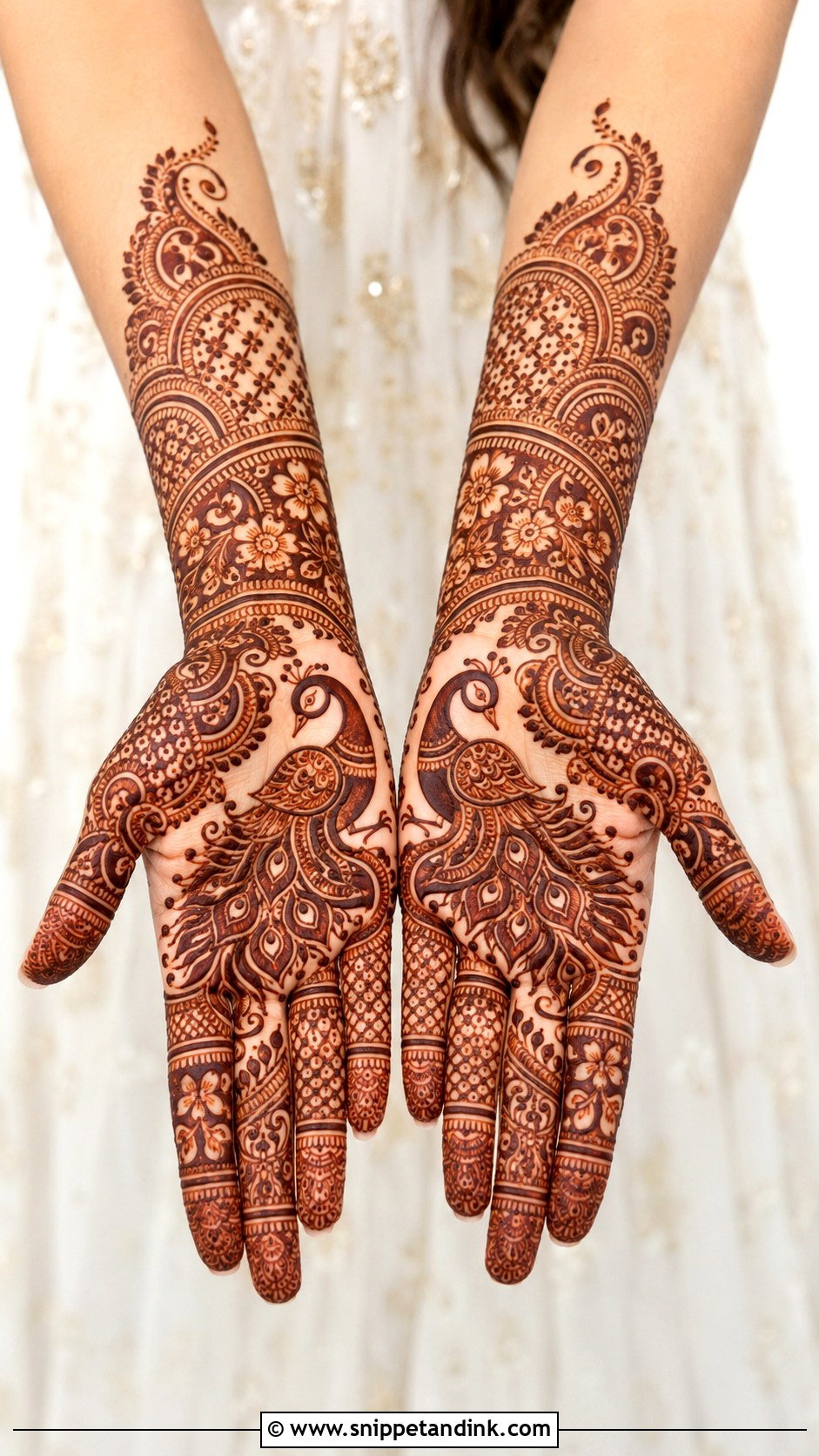
Peacocks are popular because their curved necks fall right into paisley and vine layouts, and the feathers give endless room for checks, dots and swirls. They can sit across the palm, run along the forearm or mirror each other on both hands. I keep the peacock body solid and bold and push all the delicacy into the tail. That contrast is what lets the feather texture show once the stain darkens. It belongs in full-hand work with traditional outfits more than in sparse modern designs.
17. Jaali Bridal Mehndi Design
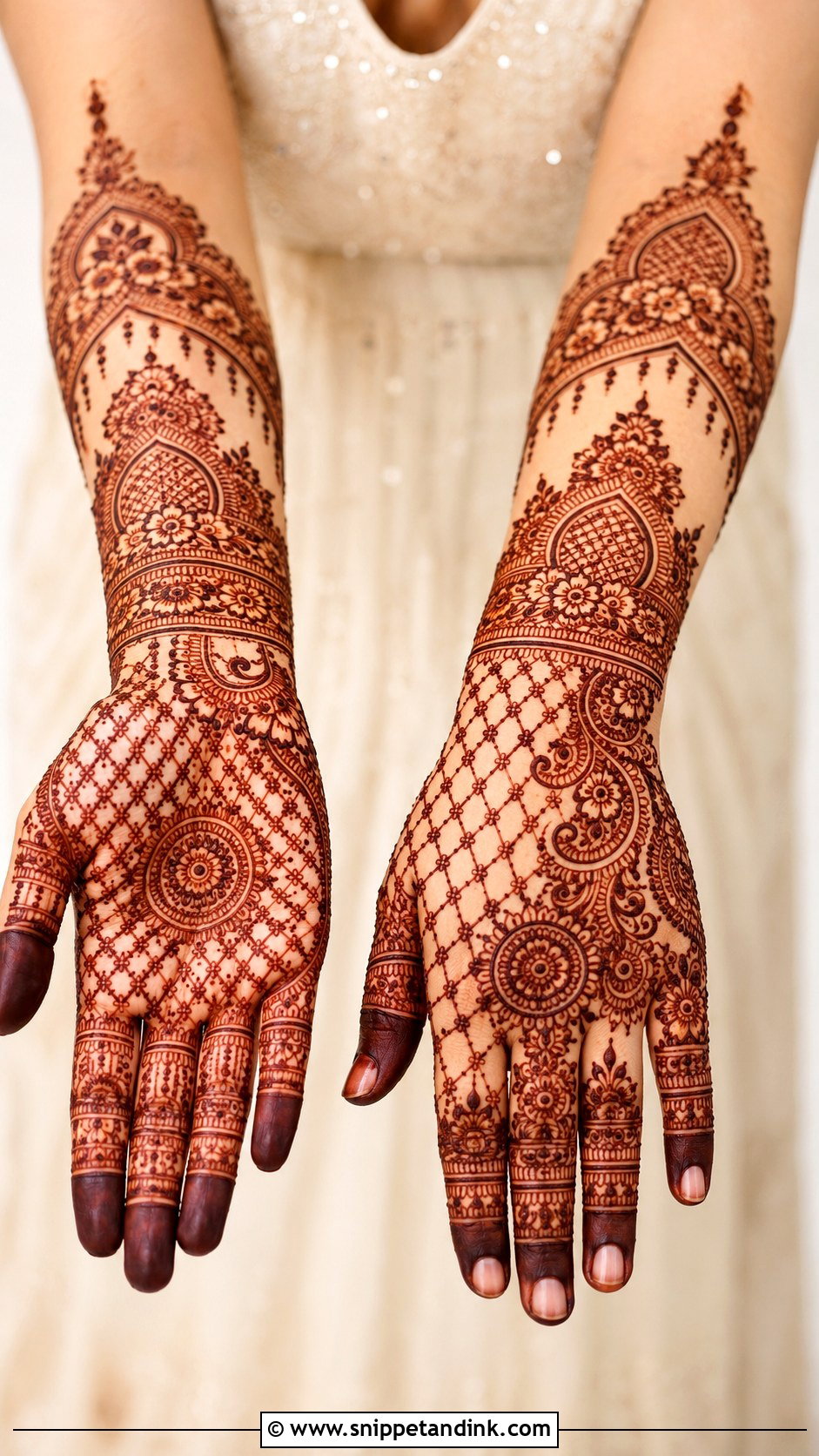
Jaali is the net-like mesh that reads almost like lace on skin. It adds texture without the visual weight of solid filling, so I use it to break up large areas on palms, backs of hands and forearms. The cone has to be steady and the lines even, otherwise the grid looks crooked. Big open jaali sections framed by bold floral borders and filled fingertips make the hand look longer. It also sits nicely under bangles, where it reads like fabric at the wrist.
18. Floral Bridal Mehndi Design
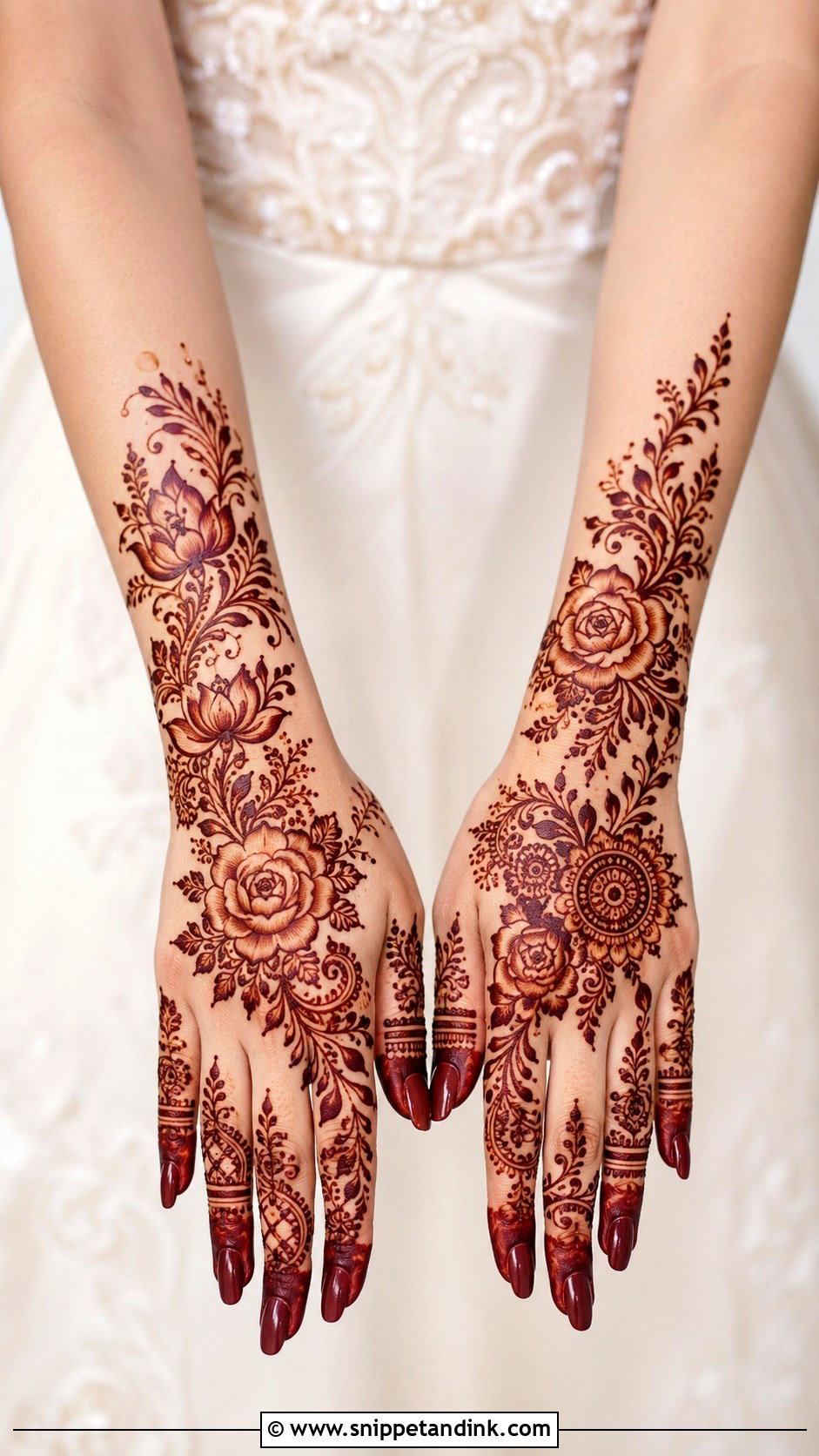
Florals are the most adaptable motif in henna. Roses, lotus, small blossoms and leafy vines can be drawn bold for Arabic spacing or tiny and dense for Indian coverage, as a full hand or a single flowing trail. Brides who want romance without heavy symbolism usually land here. My approach is to mix scale: two or three large flowers anchor the hand and fine fillers carry the fingers and wrist, so there is something to look at both in a close-up and from across the room.
19. Paisley Bridal Mehndi Design
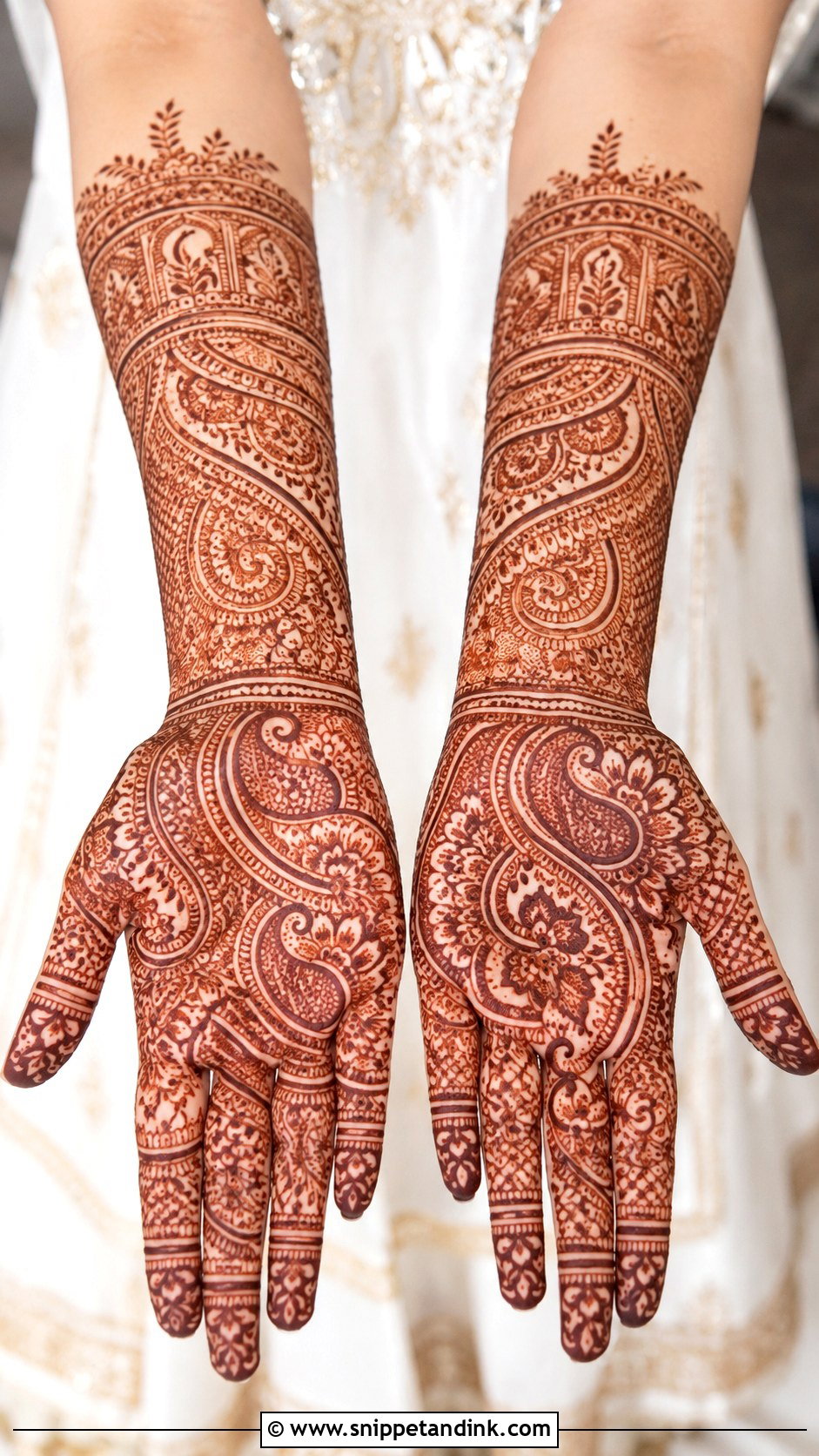
Paisley, the curved teardrop, is the backbone of traditional mehndi. It can be laid in rows, along a trail or as one large palm motif, and its curve follows the bend of the fingers and wrist, so it moves well on the hand. For full coverage that will not look dated in twenty years, this is where I start. To keep it from feeling repetitive, I mix a few large statement paisleys with smaller ones tucked between them.
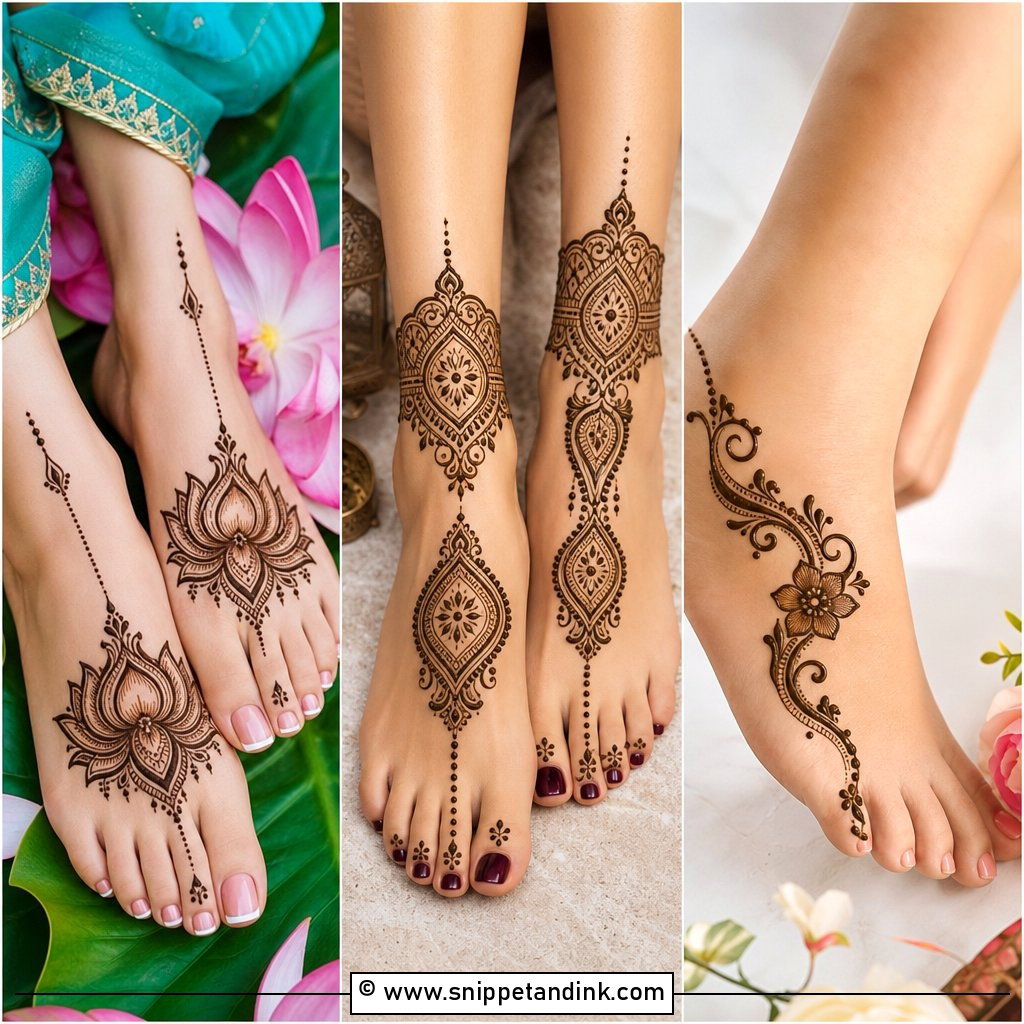
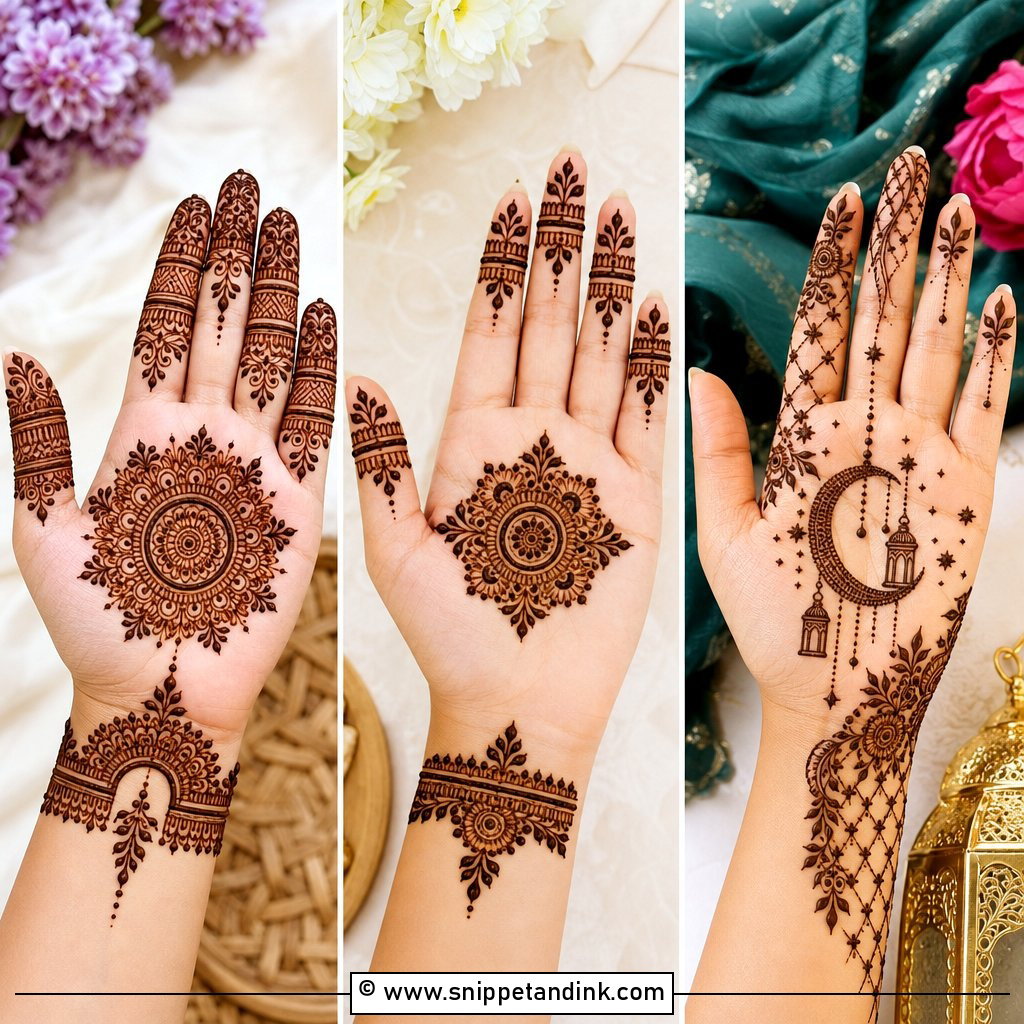
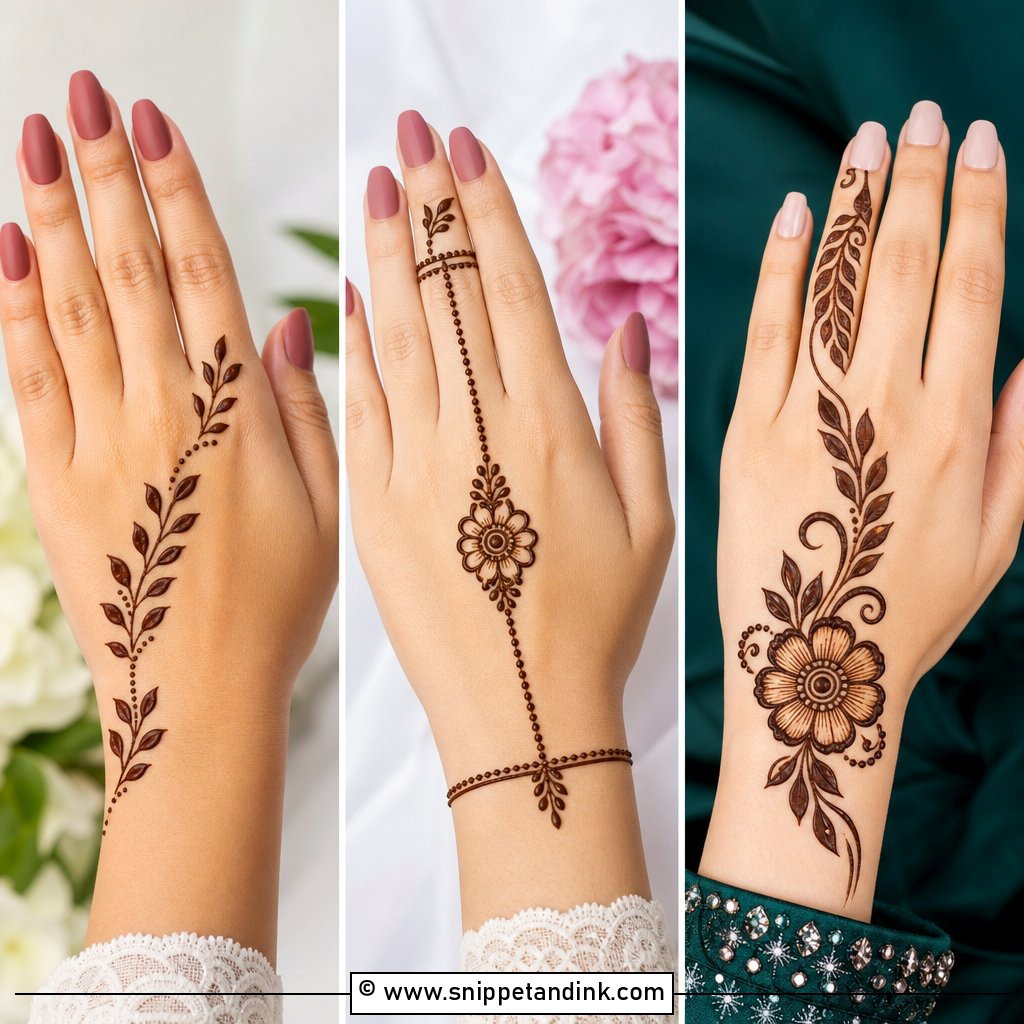
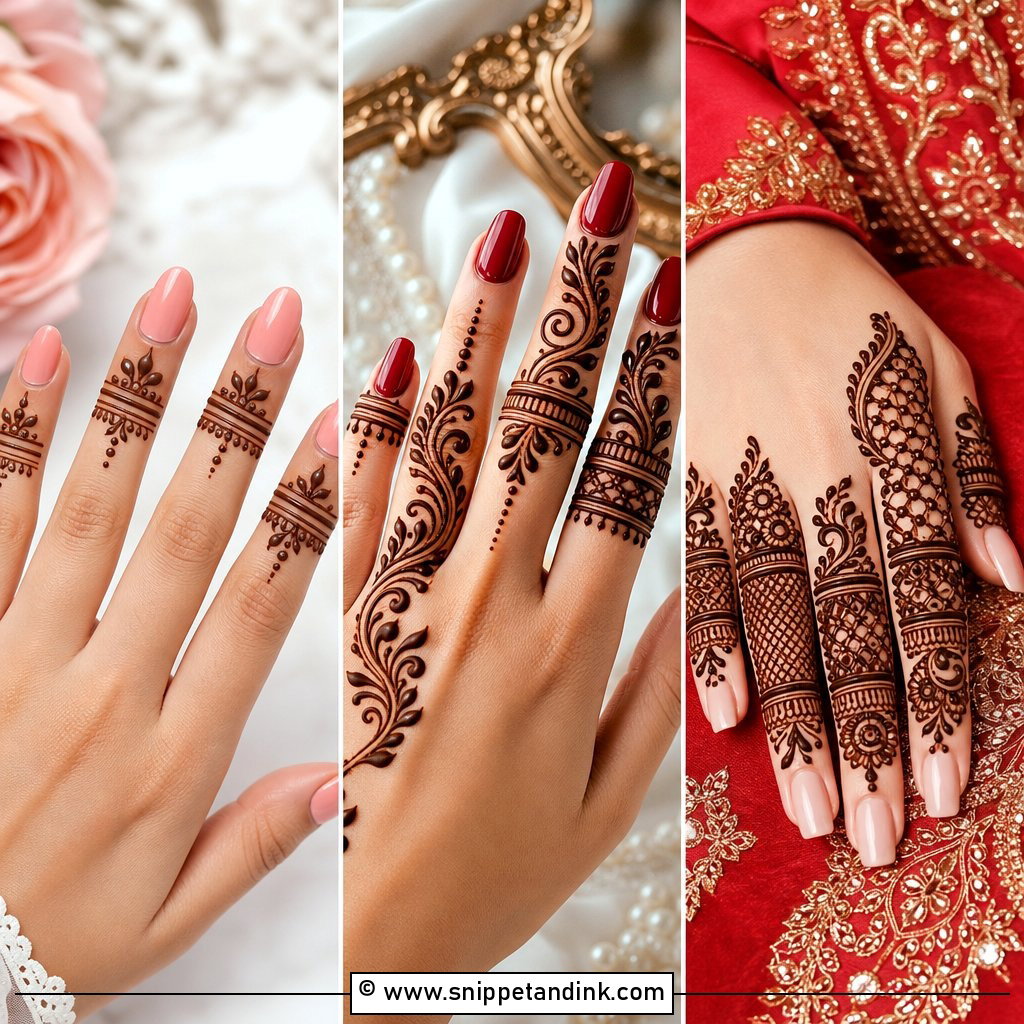
20. Back Hand Bridal Mehndi Design
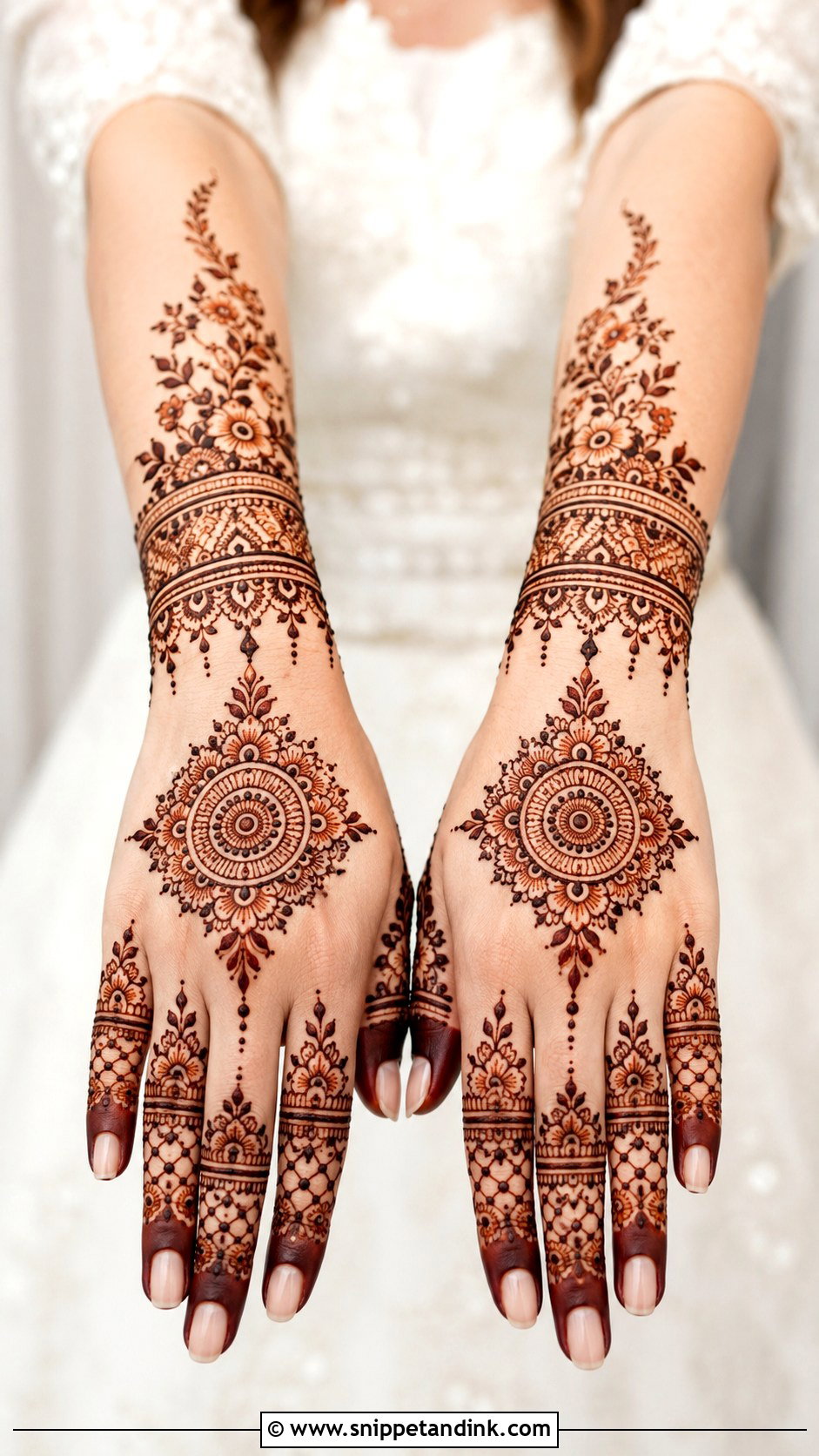
The back of the hand is what everyone sees: ring shots, bangle close-ups and every pose where your hands rest on the outfit. A Back hand bridal mehndi design can carry a central mandala, a floral trail, a bracelet cuff, finger panels and detailing up the forearm, either dense or spaced. It should feel related to the palm without copying it. Skin on the back of the hand is thinner and stains lighter than the palm, so I keep lines a little bolder here to compensate.
21. Front Hand Bridal Mehndi Design
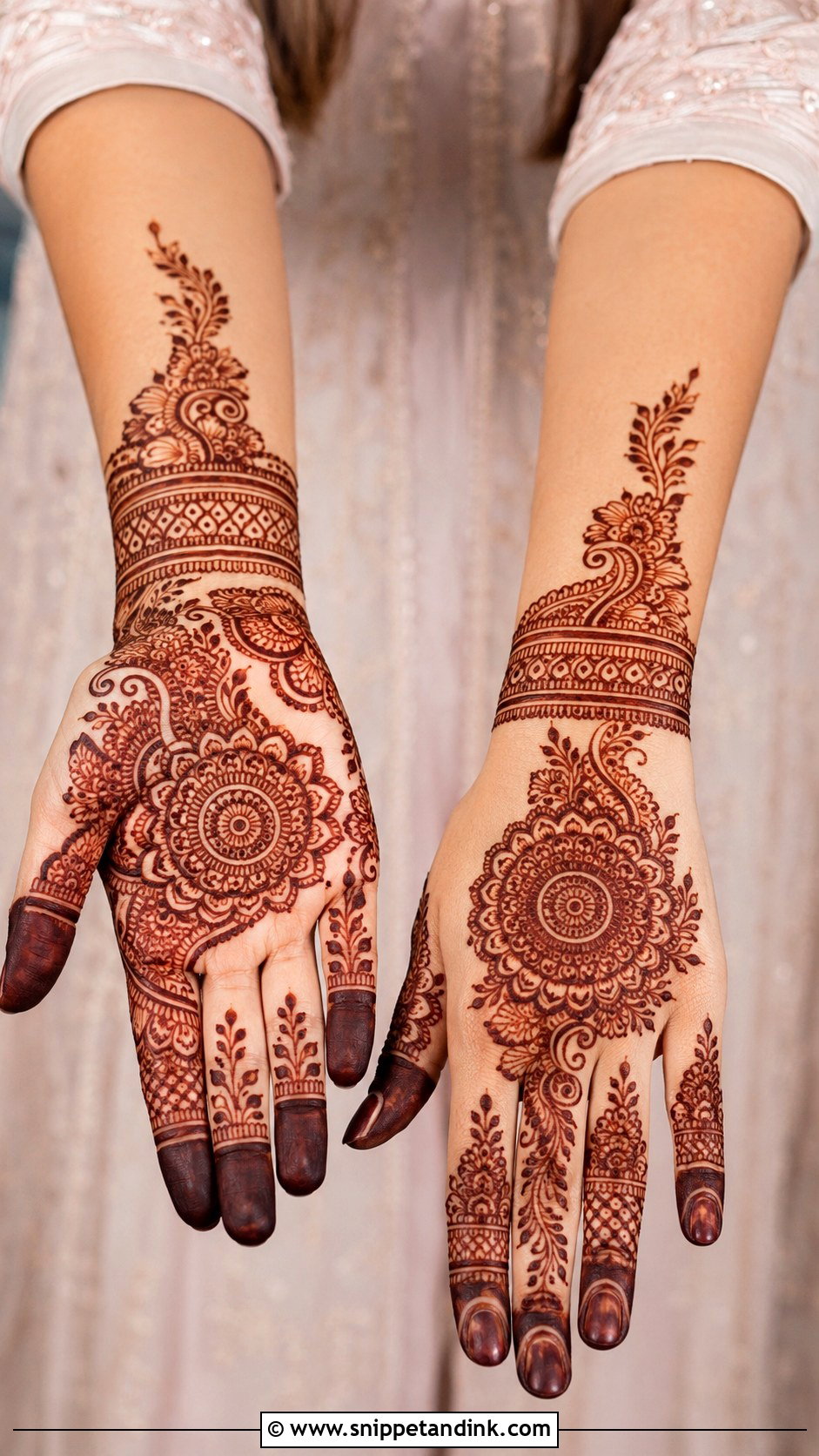
The palm is where henna stains darkest, which is why traditional and personal motifs end up there: mandalas, portraits, bride and groom figures, lotus and hidden initials. It is also a flat surface, so detail photographs clearly. A good palm has a definite centre, decorated fingers and a tidy transition at the wrist crease. I leave small breathing spaces even in a full traditional design, because when every gap is packed the main motifs disappear once the stain deepens.
22. Finger Bridal Mehndi Design
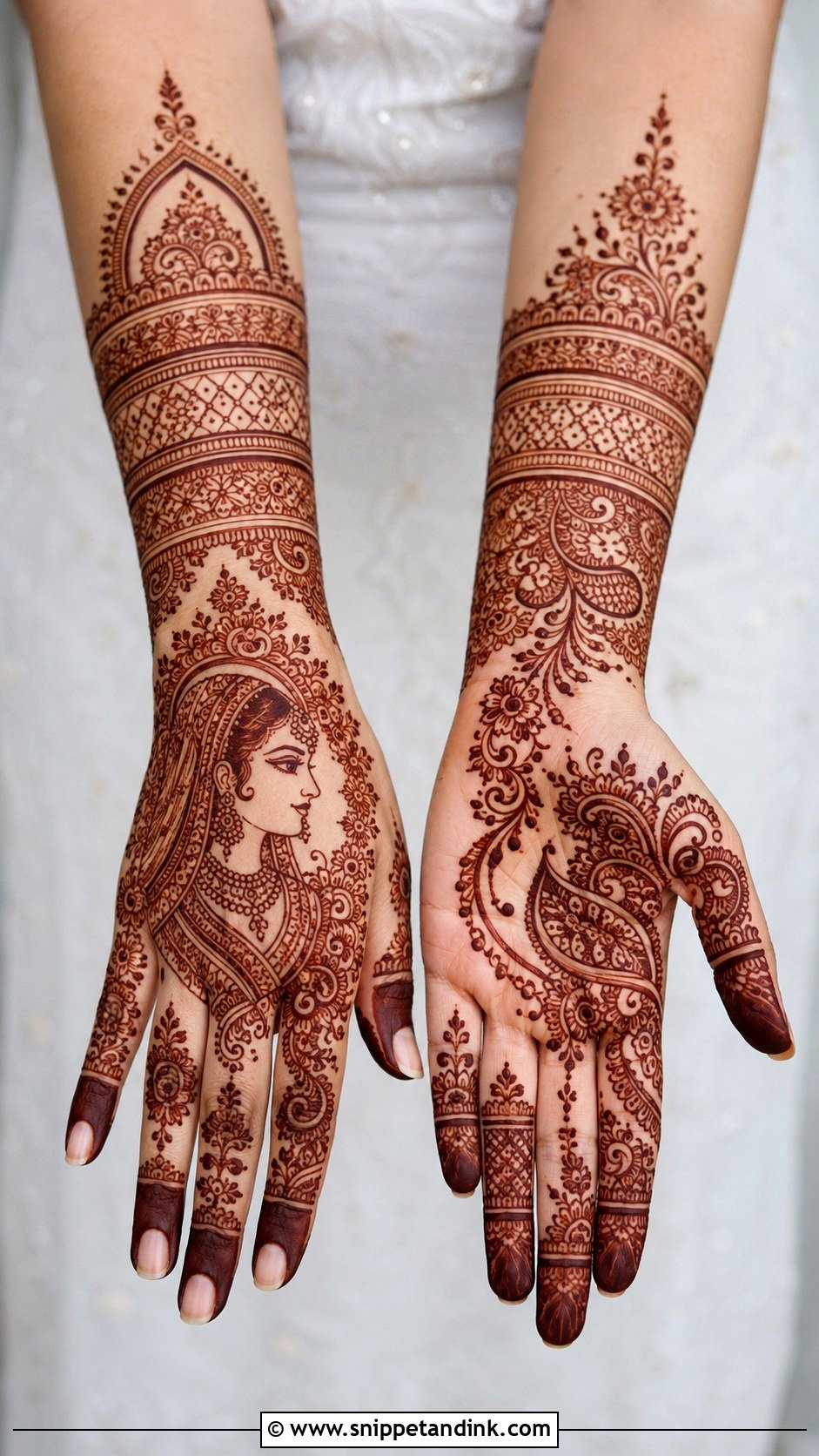
Fingers frame your rings, so I treat them as their own design rather than an afterthought. Filled tips, ring-style bands, leafy lines, tiny florals and dots can be kept delicate or bold. With a minimal look, the fingers can carry most of the design while the palm stays light. With heavy mehndi, the finger panels need to connect into the palm motifs, or you get a visible gap at the knuckles. Fingertips stain the darkest of anywhere on the hand, so filled tips will be the deepest colour in your set.
23. Bracelet Bridal Mehndi Design
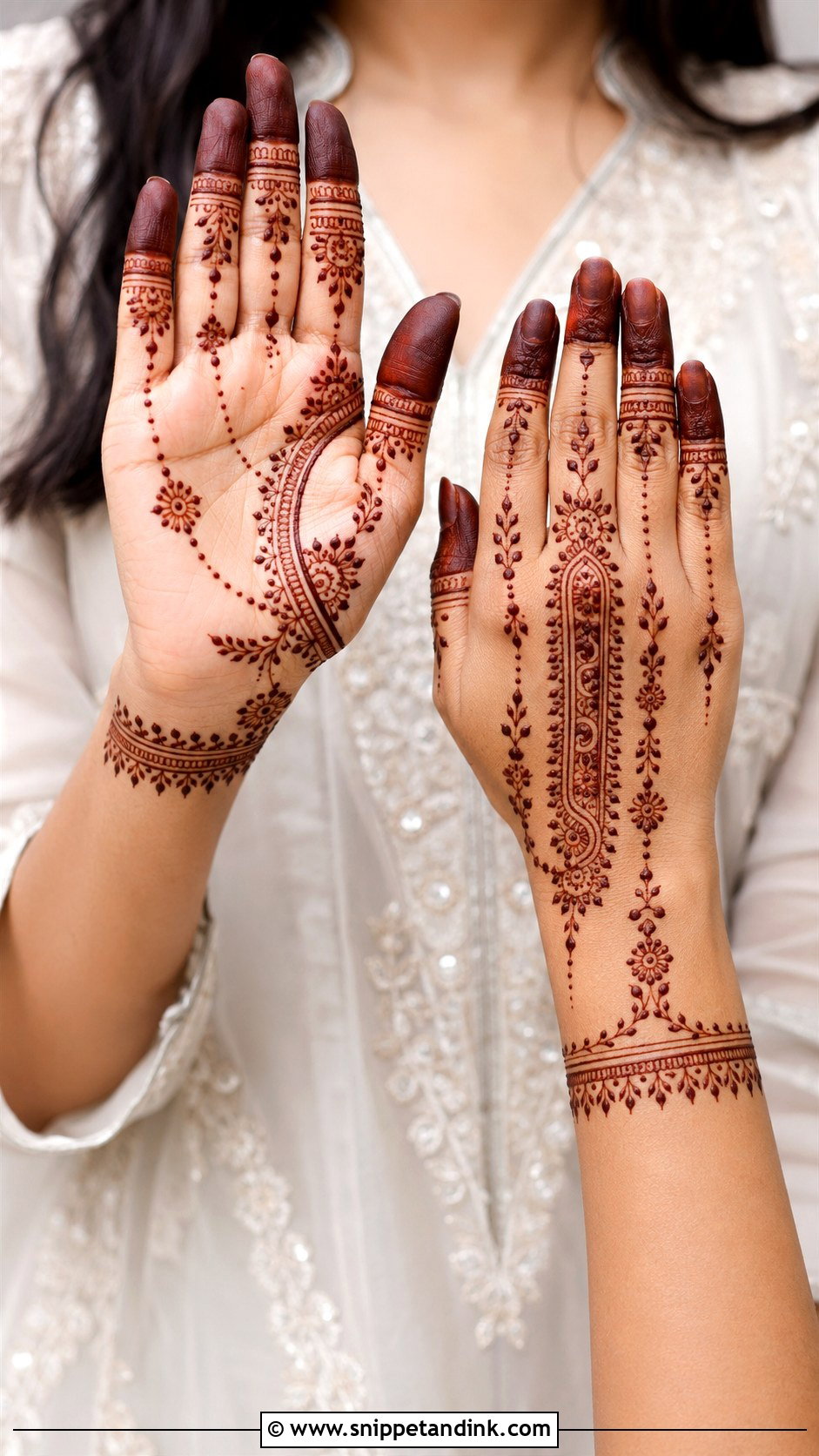
A bracelet design makes the wrist look as if it is wearing a hathphool: cuff bands, chain lines, hanging dots and small florals linking rings to wrist. It gives elegant hands without much arm coverage, and the band can be slim or wide. Pair it with decorated fingers and one central back-hand motif. I place the cuff where your bangles will actually sit, so the henna frames the jewelry instead of disappearing under it. That is why I ask brides to bring their bangles to the appointment.
24. Jewelry Bridal Mehndi Design
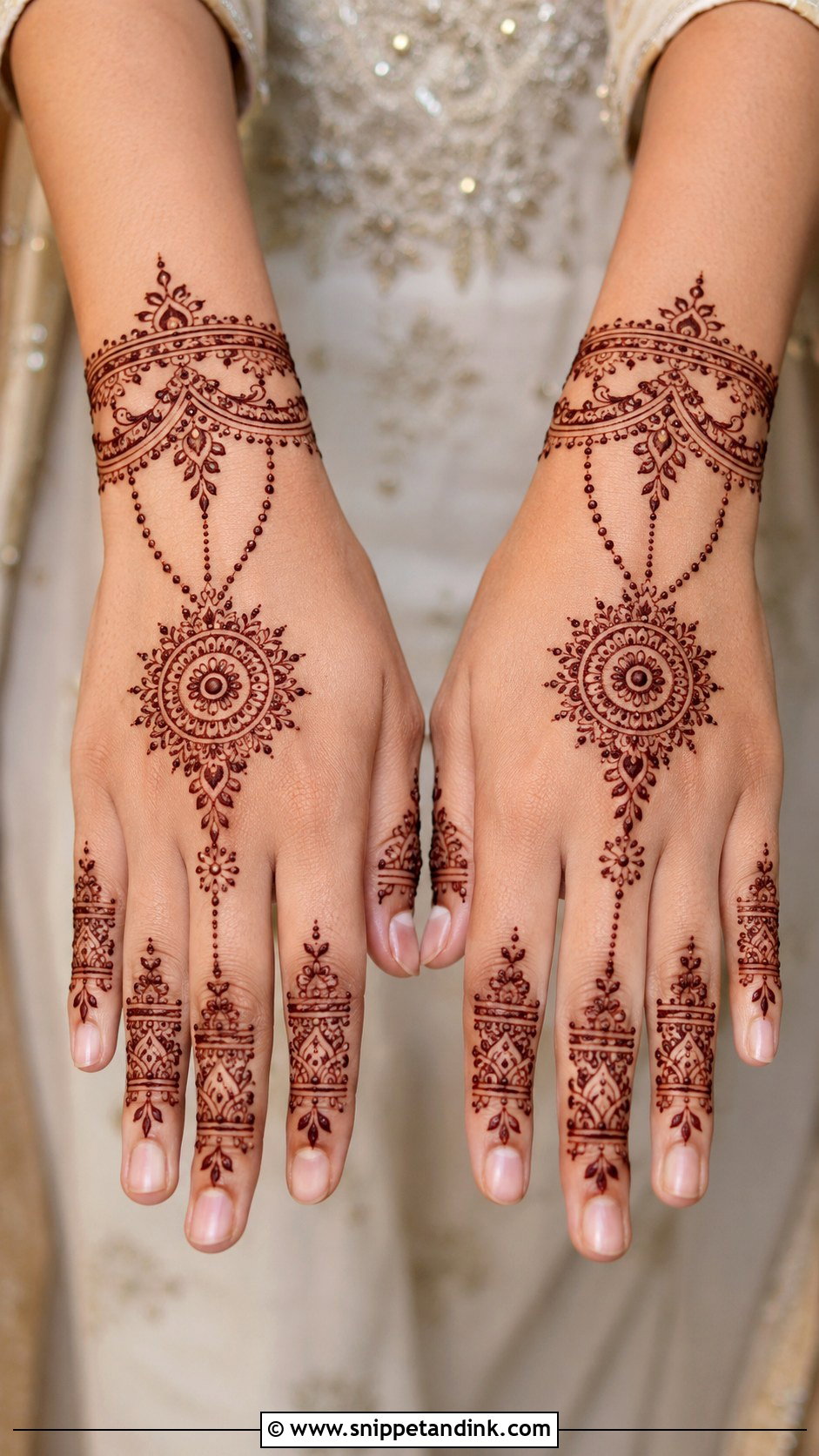
Jewelry mehndi borrows from rings, chains, bracelets and hand harnesses. On the back hand it usually draws a hathphool, a central medallion connected by chains to finger rings and a wrist band, and the chains follow the bones of the hand naturally. It is a light design, quick to apply and comfortable on a long day. Floral cuffs, filled tips and small paisleys make it bridal. I suggest it often for heavily embellished outfits, where a dense pattern would fight with the embroidery.
25. Half Hand Bridal Mehndi Design
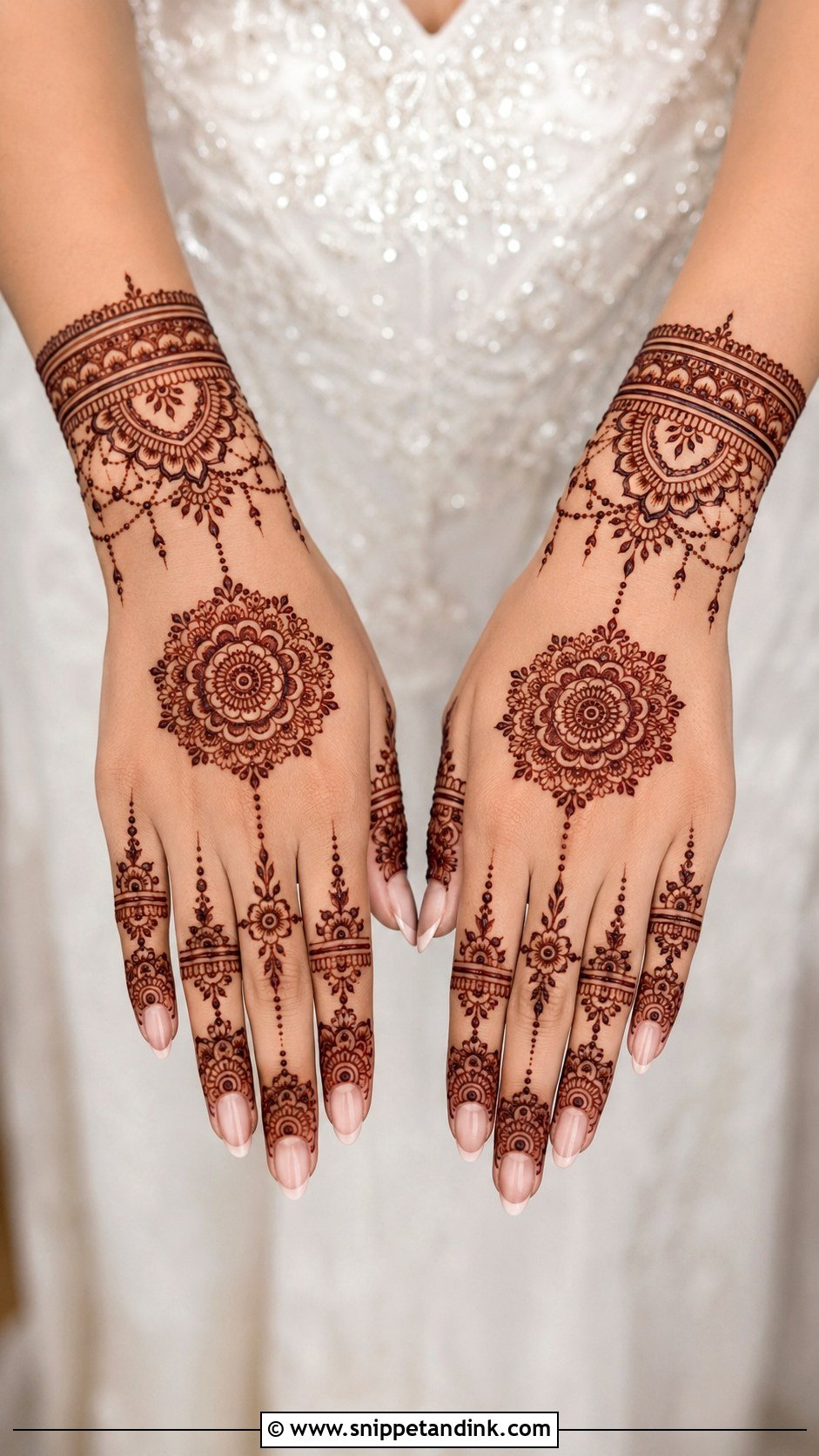
A Half hand bridal mehndi design covers fingers, palm, wrist and a short stretch of forearm, in Indian, Arabic, Indo-Arabic, floral or mandala style. It photographs as properly decorated while keeping the arms free and the sitting shorter. Brides with several events often choose it for one of them. To make it read as bridal, I give it a strong wrist border, fully filled fingers and one clear focal motif, and I end the design at a clean line rather than letting it fade out.
26. Full Arm Bridal Mehndi Design
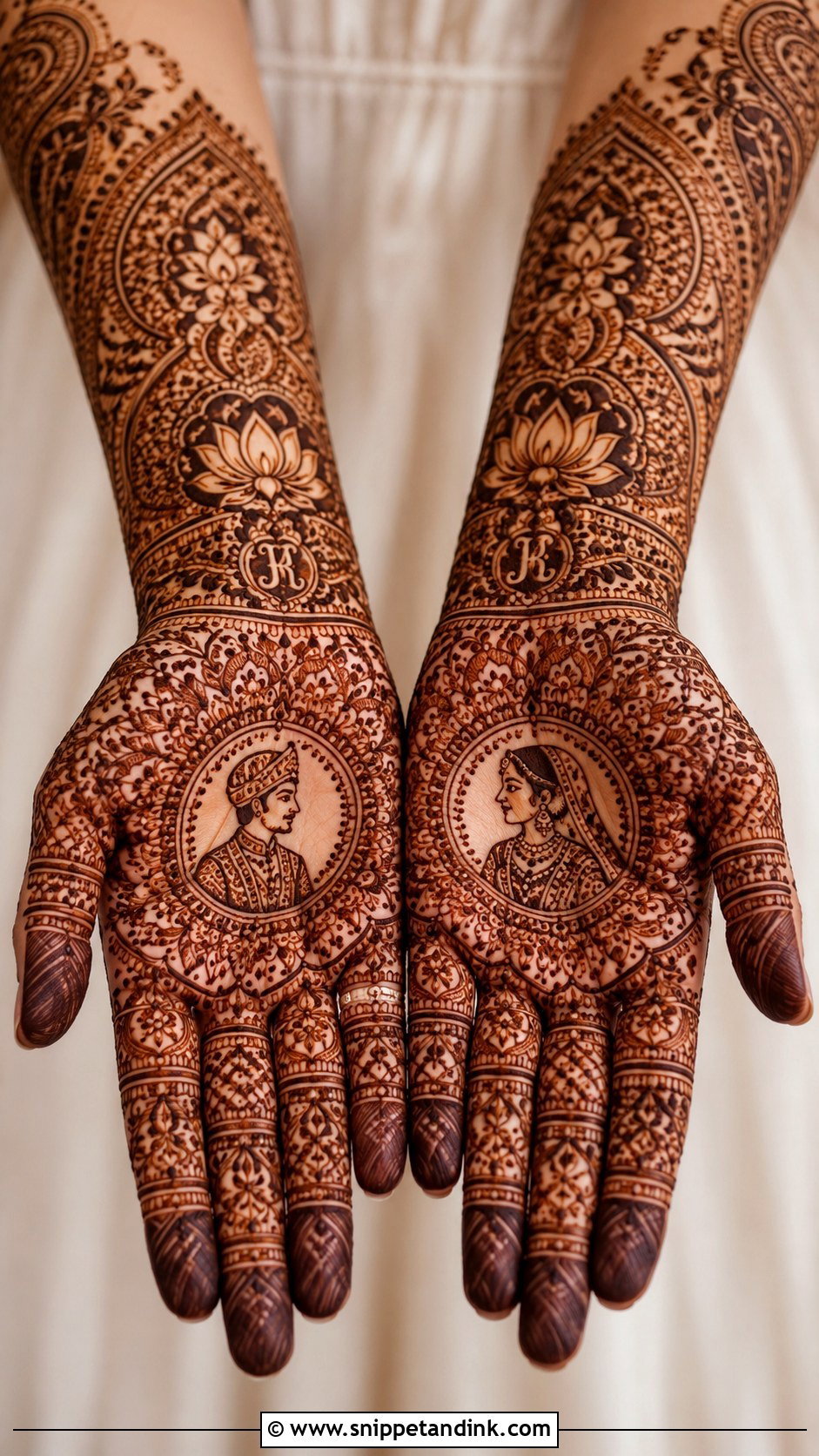
Full-arm work runs from fingertips to elbows or beyond, with room for portraits, mandalas, peacocks, lotus, paisleys, jaali panels and personal details. That much space needs planning: I mark the large motifs at intervals before filling anything, otherwise the forearm crowds up and the elbow end looks rushed. It shows best with sleeveless, short or sheer sleeves; under a long fitted sleeve most of it is hidden. Expect a long sitting and give yourself a full, unhurried day for application.
27. Symmetrical Bridal Mehndi Design
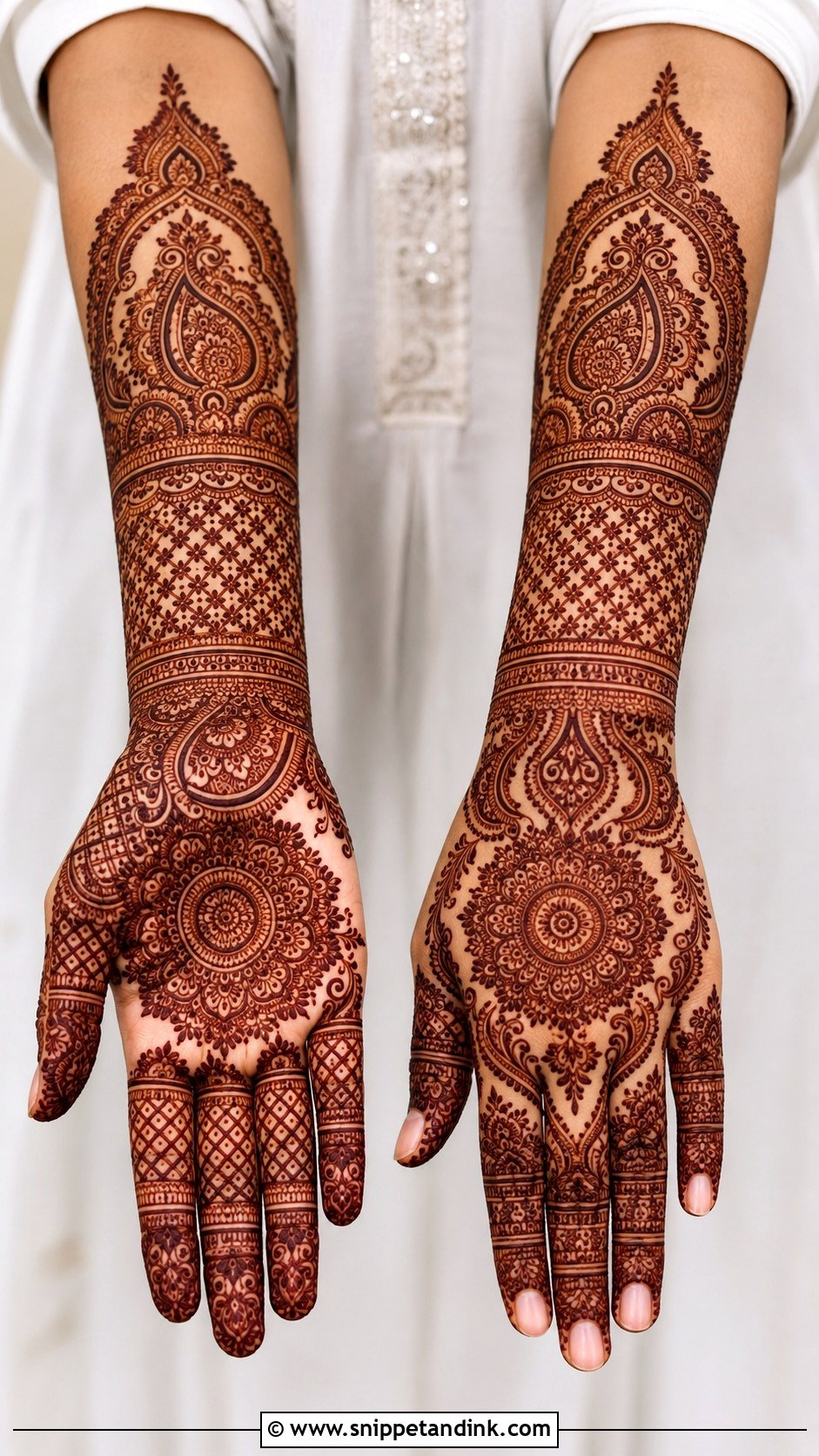
Mirroring the same motifs across both hands gives a calm, balanced look, which is most noticeable when your hands are held together during rituals. Mandalas, paisleys, florals, jaali panels and bracelet bands all suit mirrored layouts, dense or minimal. Symmetry is harder than it looks because each hand is drawn separately; I work section by section, alternating hands, instead of finishing one hand first. Two artists working one hand each is the usual reason a set ends up mismatched.
28. Asymmetric Bridal Mehndi Design
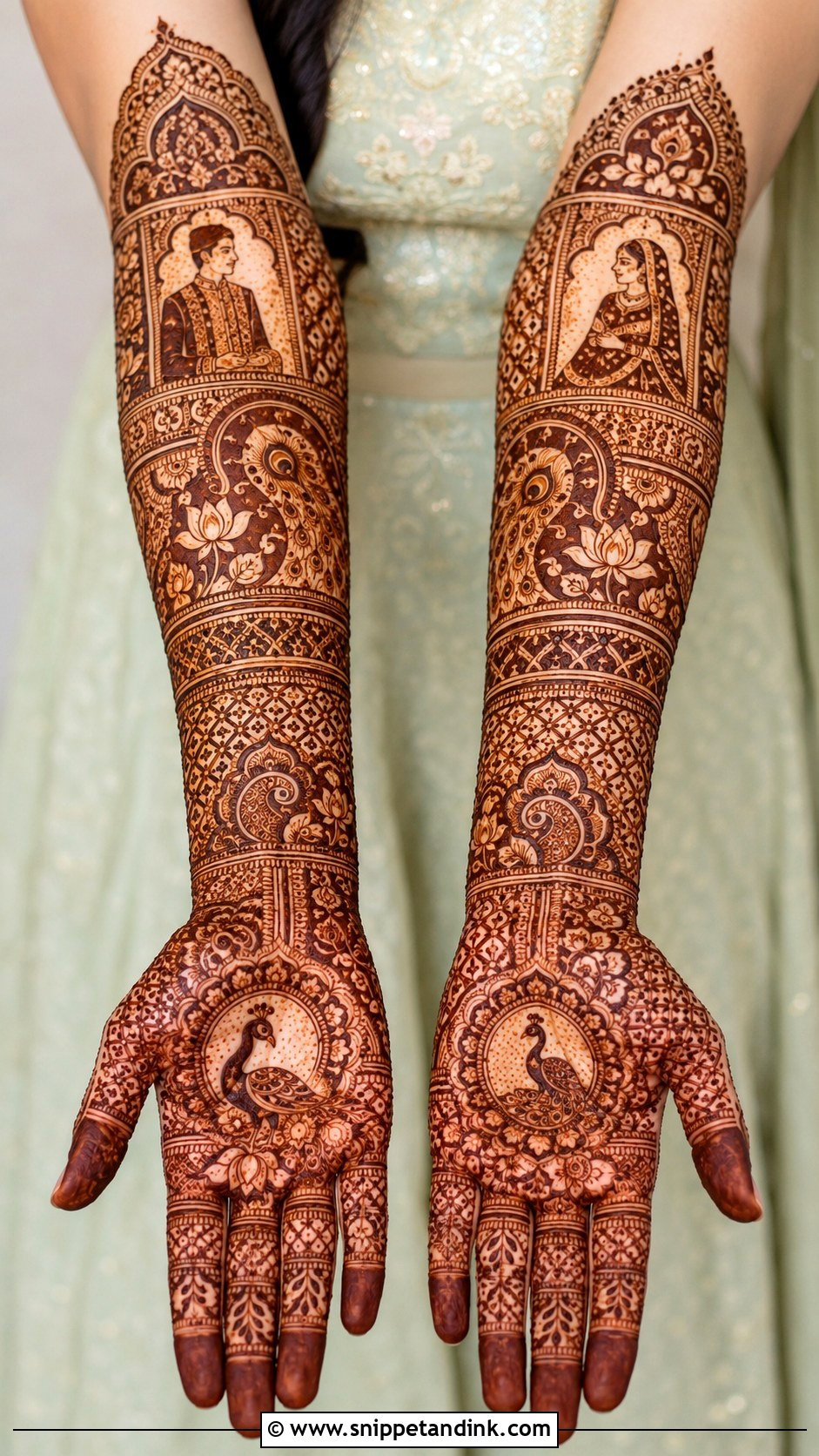
Asymmetric sets let each hand carry something different, a portrait on one and florals or a love-story scene on the other. What keeps them cohesive is shared borders, matching finger patterns and the same filler style. The real rule is equal visual weight: if one hand is much darker or busier, photos look lopsided. It is a good route when you want a date on one side and initials on the other without forcing them into a mirror image.
29. Wedding Date Bridal Mehndi Design
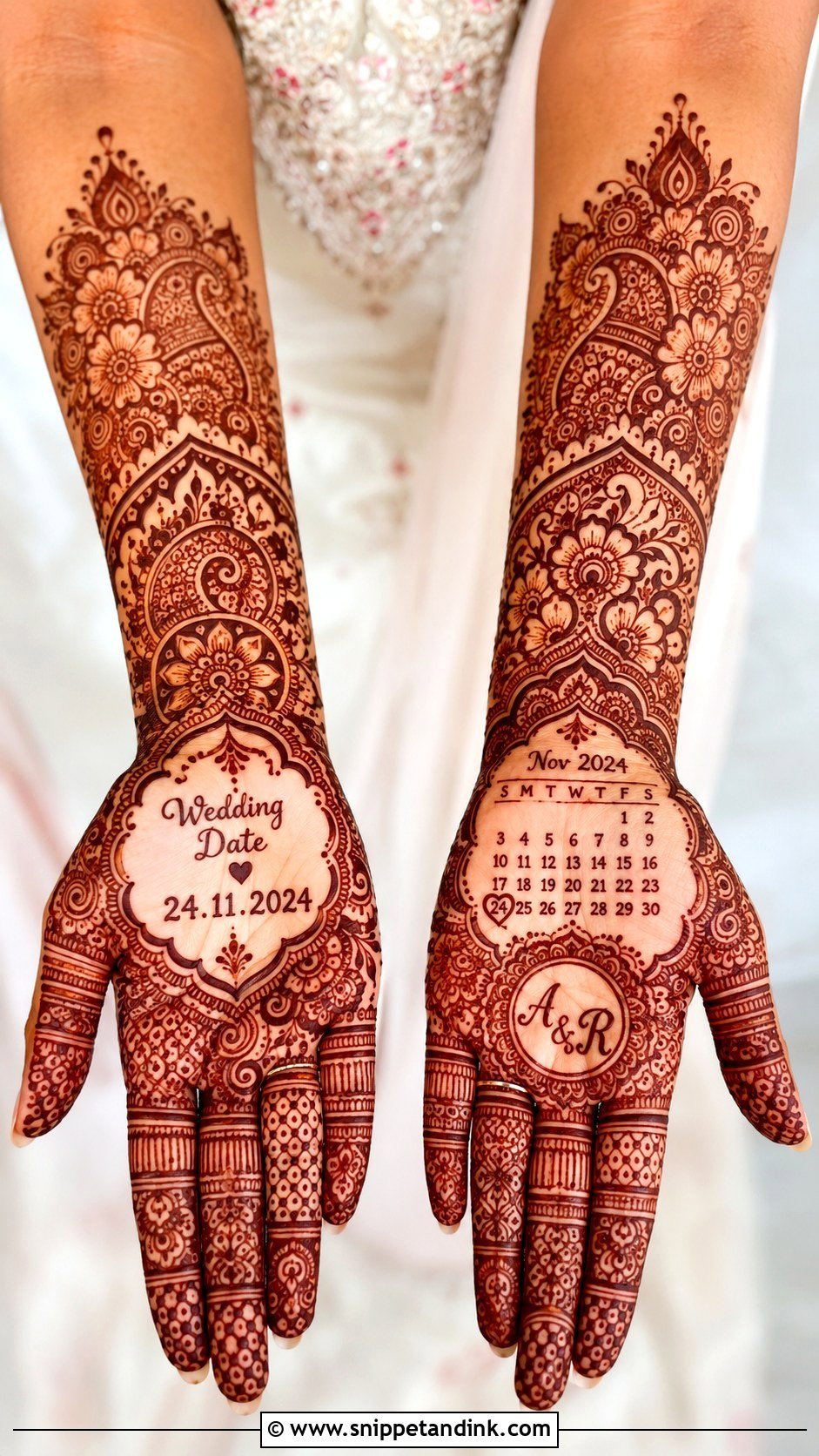
A wedding date can hide inside a mandala, sit in a small frame by the wrist or pair with initials. It works in Indian, Arabic, Indo-Arabic and portrait styles. Numbers are less forgiving than motifs, so I write them slightly larger and spaced, since paste spreads a little and a tight “8” can close up into a blob. Keep it readable but modest unless you want it as the main feature, then surround it with flowers, dots or a tiny calendar motif.
30. Initials Bridal Mehndi Design
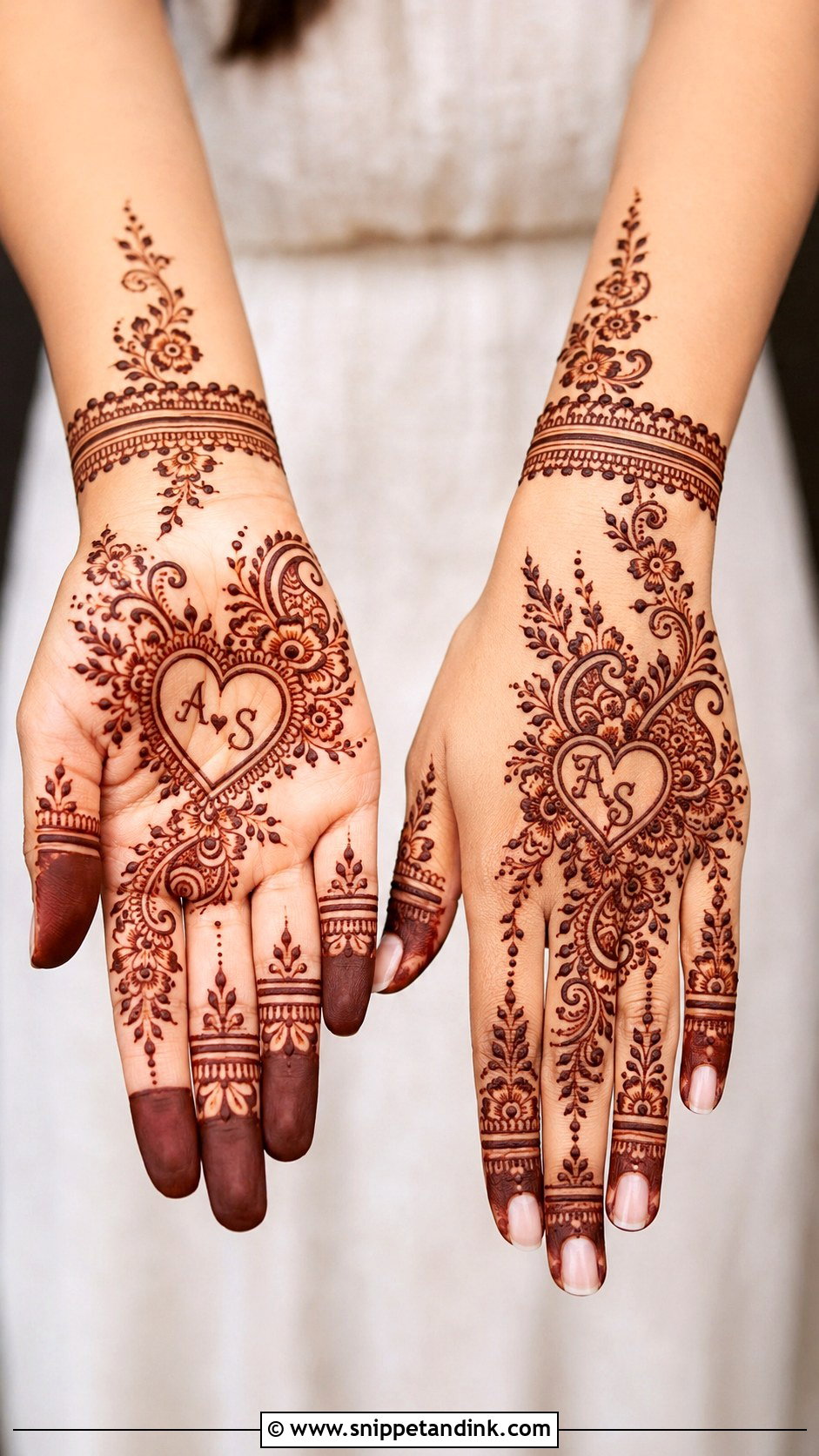
Initials are the classic hidden detail: tucked into a paisley, inside a small heart, along a wrist band or woven into a floral trail. The groom searching for them after the ceremony is a long-standing tradition that guests love watching. They suit heavy and minimal designs alike. I disguise them with the same line weight as the surrounding pattern so they belong to the artwork; letters drawn bolder than everything else are found in seconds.
31. Engagement Bridal Mehndi Design
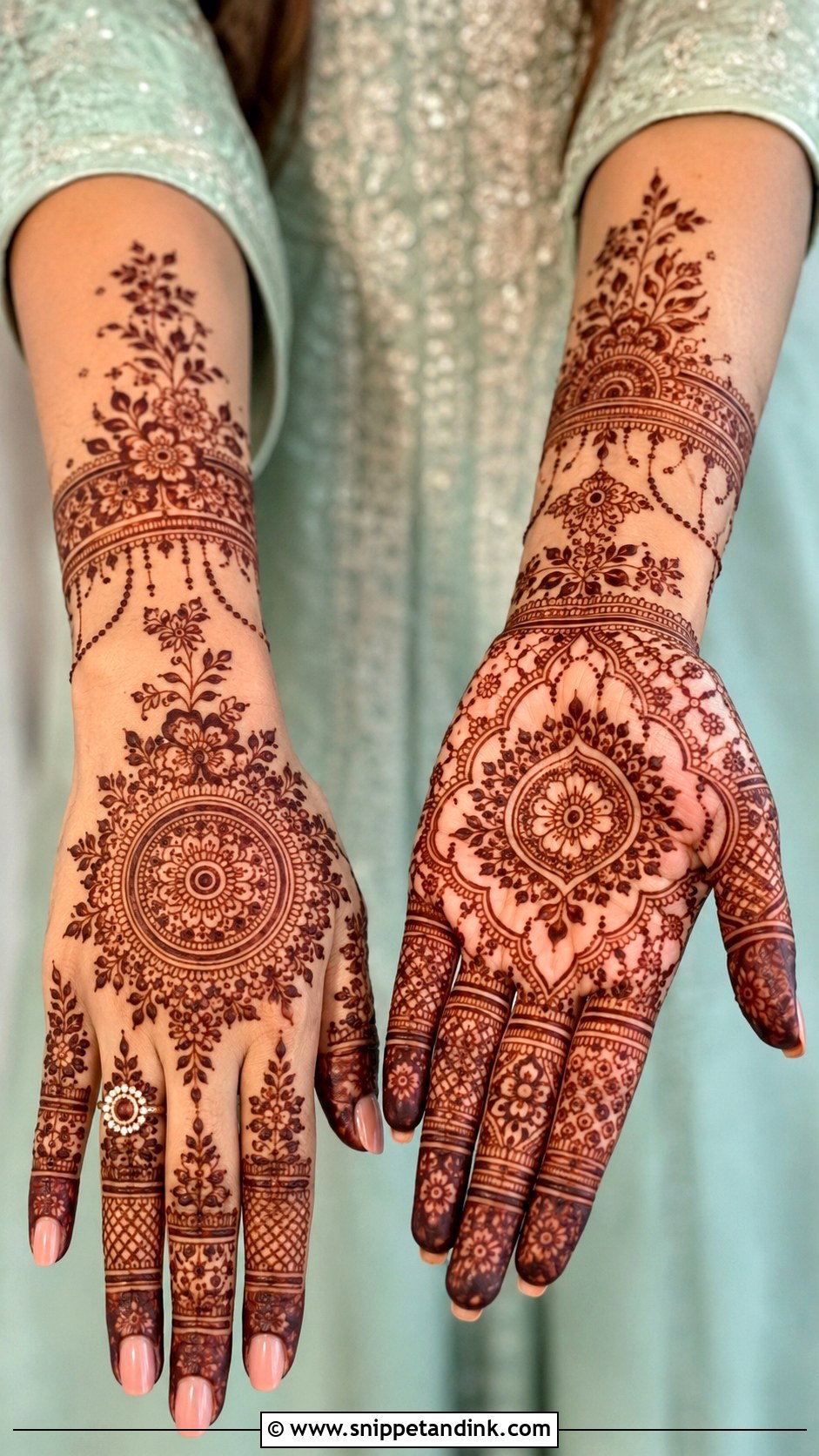
Engagement henna is usually lighter than the wedding set but still polished: ring motifs, bracelet details, florals, mandalas and neat finger work. Photos at an engagement centre on the ring, so the back hand matters more than the palm here, and a clean Indo-Arabic or jewelry design suits it well. Add paisleys and fine wrist borders for a more traditional feel. It is also your chance to test an artist, a paste and your own skin’s stain before the main event, which I always recommend.
32. Nikah Bridal Mehndi Design
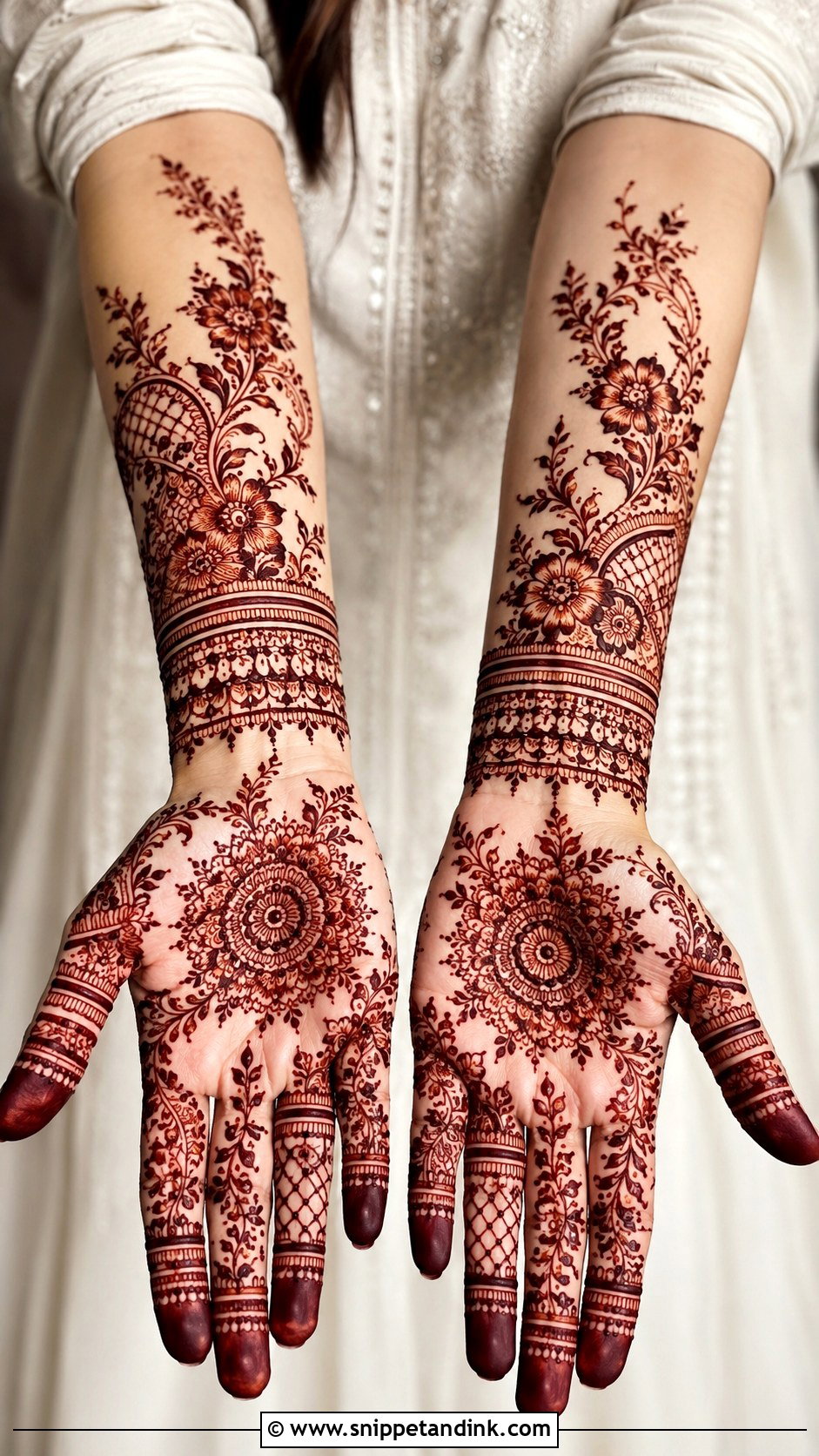
For a nikah, many brides lean toward Arabic, Pakistani or Gulf patterns with florals, vines, jaali and delicate wrist work. A Nikah bridal mehndi design can be full-hand or softly spaced depending on the outfit and setting. My usual balance is florals on the back hands, detailed fingers and a neat palm mandala, with initials or a small date frame by the wrist if you want something personal. It sits well with ivory, gold, pastel, green and deep maroon outfits alike.
33. Reception Bridal Mehndi Design
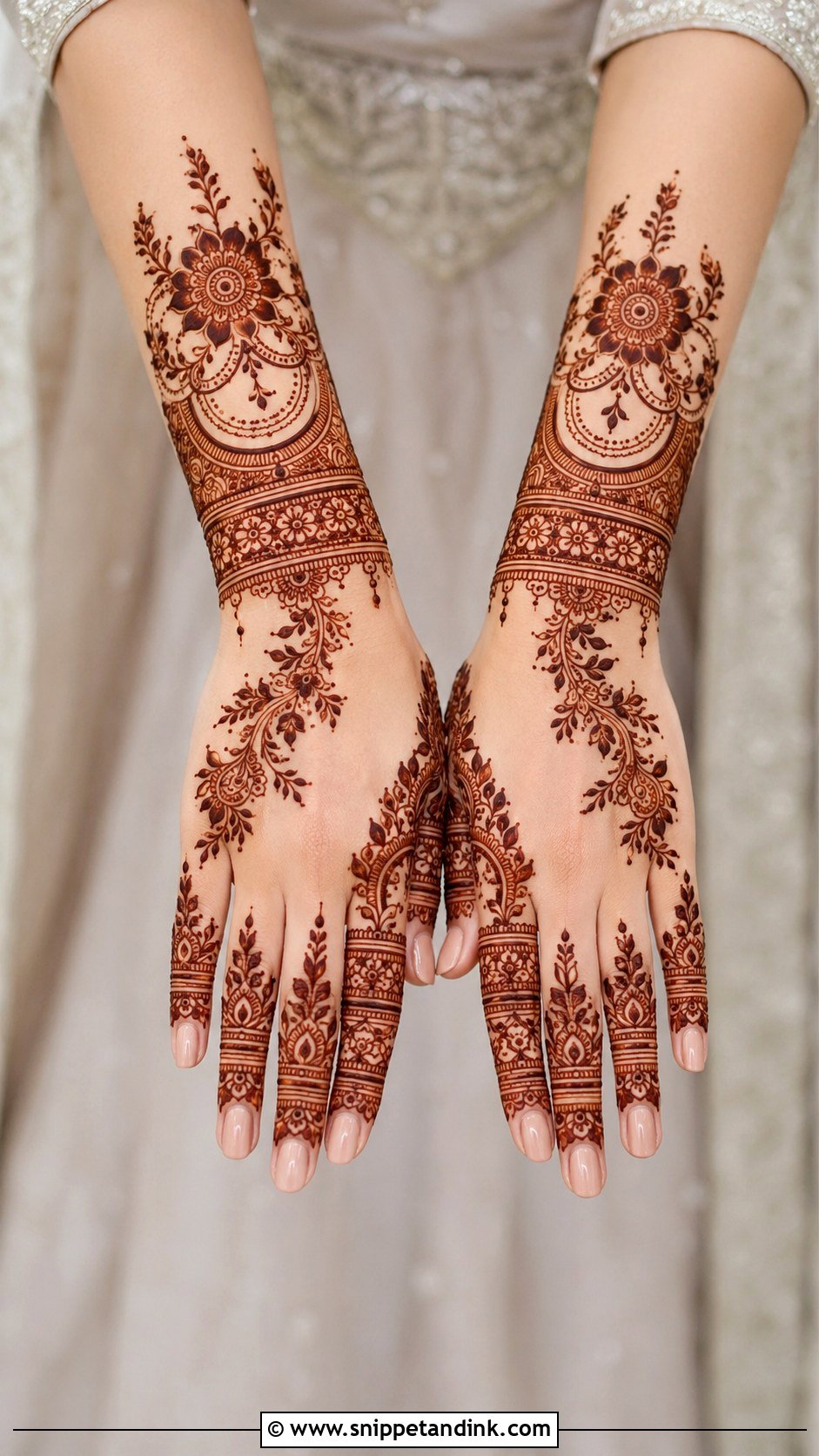
Reception lighting is bright and the photos are often taken from further away, so the design needs to read from a distance. With modern outfits and statement jewelry, lighter full-hand patterns, back-hand trails, jewelry mehndi or Indo-Arabic work tend to suit best. Floral trails, bracelet cuffs and clean finger detail keep it crisp. One honest note: your reception usually shows the same stain as your wedding, often a day or two older and slightly faded, so plan this design together with the main one rather than separately.
34. South Indian Bridal Mehndi Design
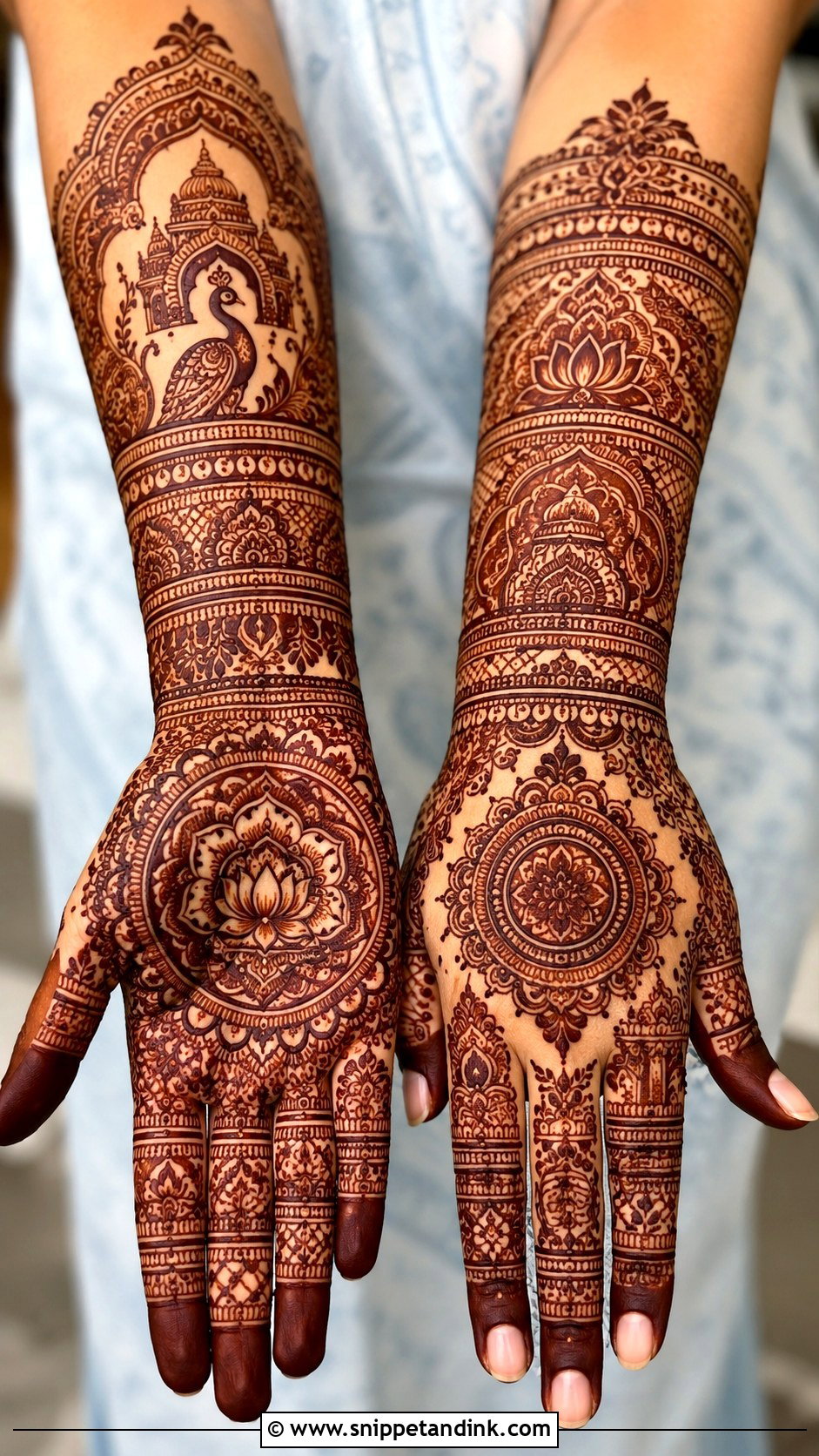
A South Indian bridal mehndi design has to sit beside silk sarees, temple jewelry and jasmine, all of which are already rich. Lotus motifs, paisleys, peacocks, mandalas and leafy borders with neat fingertips are typical. Some brides keep coverage moderate so the jewelry and bangles lead; others go full-hand. A strong palm mandala with decorated fingers and wrist panels is my usual starting point, and lamp or temple-border motifs bring in a regional feel without crowding the hand.
35. Bengali Bridal Mehndi Design
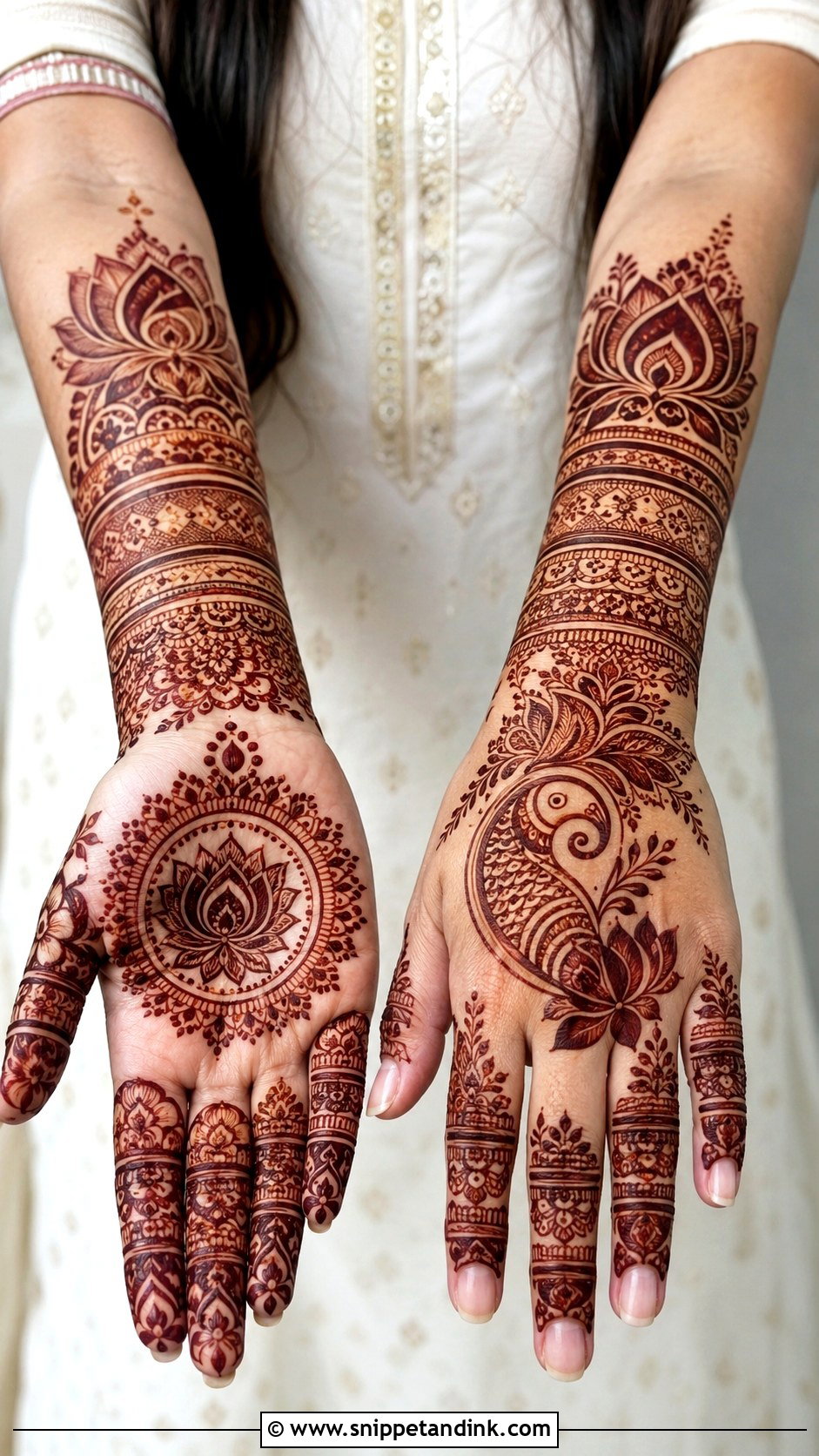
Bengali designs often blend familiar mehndi patterns with motifs that echo the region: lotus, paisley, fish-inspired shapes, alpana-style circles and ornate wrist borders. A central mandala drawn like alpana floor art connects the hands to the rest of the bridal styling. Coverage can be full palms, back hands or forearms. Finish with finger panels and fine floral fillers. The deep stain stands out well against red and white sarees and gold jewelry.
The Two Days After the Paste Comes Off
Freshly scraped henna is bright orange. That’s normal. The stain oxidises and darkens over the next 24 to 48 hours, which is why I schedule bridal application one to two days before the wedding, never the morning of. Applied too early, the colour has already started fading by the reception.
How I tell brides to look after it
- Keep the paste on as long as you can, ideally six hours or overnight. A dab of lemon and sugar keeps it sticking to the skin once it dries.
- Scrape it off with a blunt edge or your fingernail. Don’t wash it off.
- Keep water away for the first 12 to 24 hours. Warmth helps the stain develop, so stay cosy.
- Avoid scrubs, hand sanitiser and chlorinated pools before the wedding; they lift the top layer of stained skin.
- Before your hands get wet, rub a little balm or coconut oil over them as a barrier.
One warning I give every bride: natural henna is never jet black. Paste promising black colour in an hour usually contains PPD, a dye that can cause serious skin reactions and scarring. If a cone or artist offers instant black results, walk away. A genuine stain is orange-brown to deep burgundy, and that is what you want on your skin.
Where Your Mehndi Ends Up Matters More Than the Motif
With this many styles in front of you, start from the mood rather than the motif. Some brides feel most themselves in dense Indian or Rajasthani work; others want Arabic spacing, minimal fingers or modern personal details. Portraits, initials, dates, jaali, peacocks and mandalas can all be mixed in. Match the design to your outfit, your jewelry, your ceremony and how long you can comfortably sit. Save reference images, talk placement through with your artist, and the stain on your hands will be something you look at fondly long after the wedding.
You'll Like These Ideas:


Leave a Reply