
Musical mehndi is one of my favorite requests, because it gives the bride something to talk about when relatives grab her hand at the sangeet. A shehnai, dhol, tabla, sitar, veena, flute or harmonium can be the main motif of a full bridal hand rather than a tiny filler, set inside mandalas, jaali panels, portraits or a wrist-to-forearm trail. The catch is that instruments are full of strings, keys and straight edges, and those details behave differently from paisleys once the stain develops. The twenty ideas below show how each instrument can carry a whole design, with my notes on what makes it read clearly on skin.
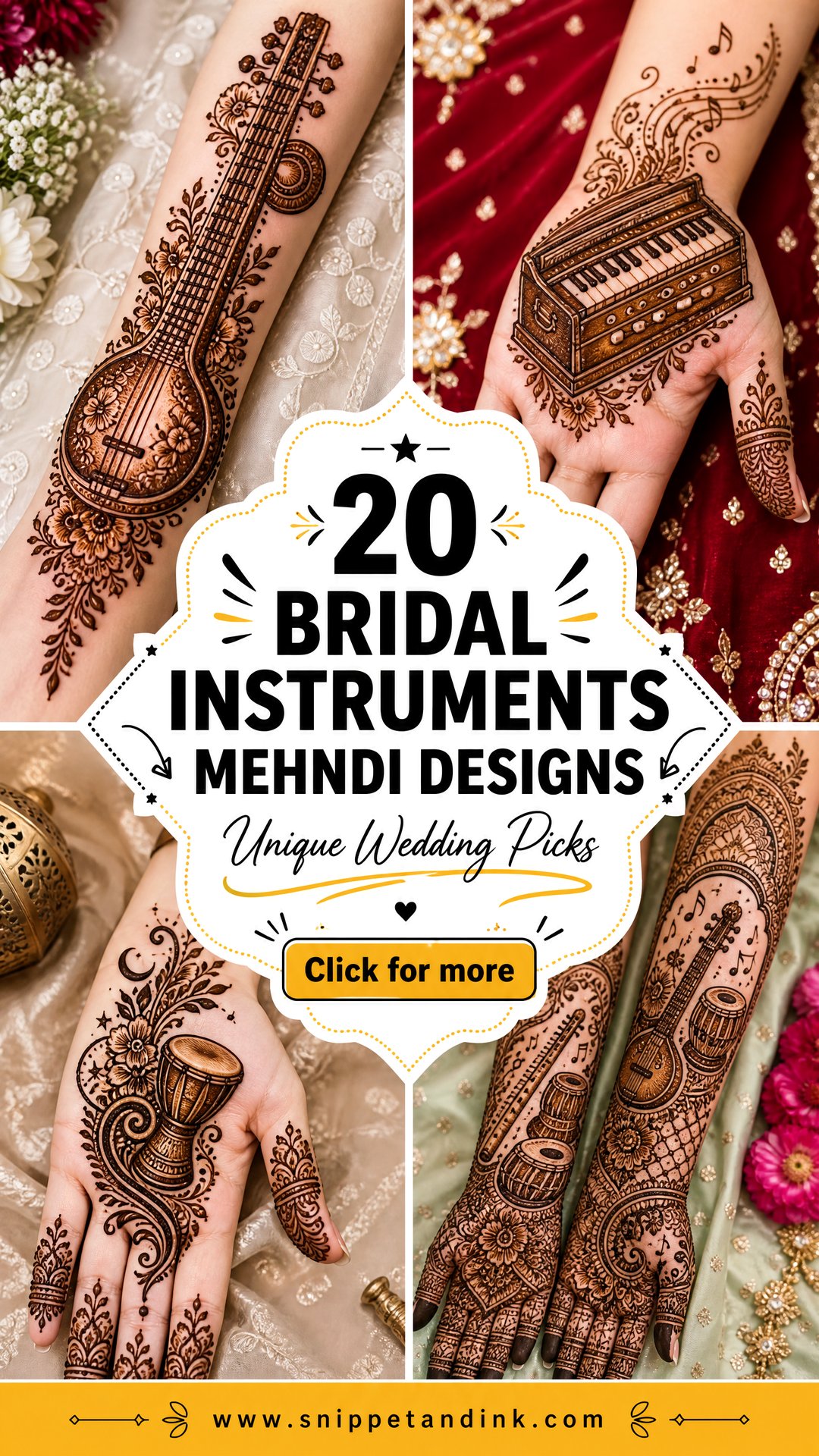
Will Anyone Recognize the Instrument Once It Stains?
That’s the question I ask before drawing any musical motif. Henna lines widen a little as the stain darkens over the first two days, and fine details that looked crisp in wet paste can fill in. Instruments with a bold silhouette, such as the dhol, damru, tabla and flute, survive that softening easily. Strings, frets and keyboard keys don’t, unless they’re drawn with deliberate gaps.
Sizing a motif so the details survive
- Give a stringed instrument at least the length of your palm. Squeezed onto a finger, a sitar becomes a stick.
- Ask for strings with a clear gap between each line, roughly as wide as the line itself.
- Keep fillers away from the instrument’s outline for a few millimeters on every side.
- Put the most detailed instrument on the palm, where the stain comes out darkest, and simpler motifs on the back of the hand.
If your artist can, ask her to sketch the instrument on paper or on her own hand first. Two minutes of drawing tells you whether it will read, and it’s far easier to adjust a sketch than a palm.
1. Shehnai Bridal Instruments Mehndi Design
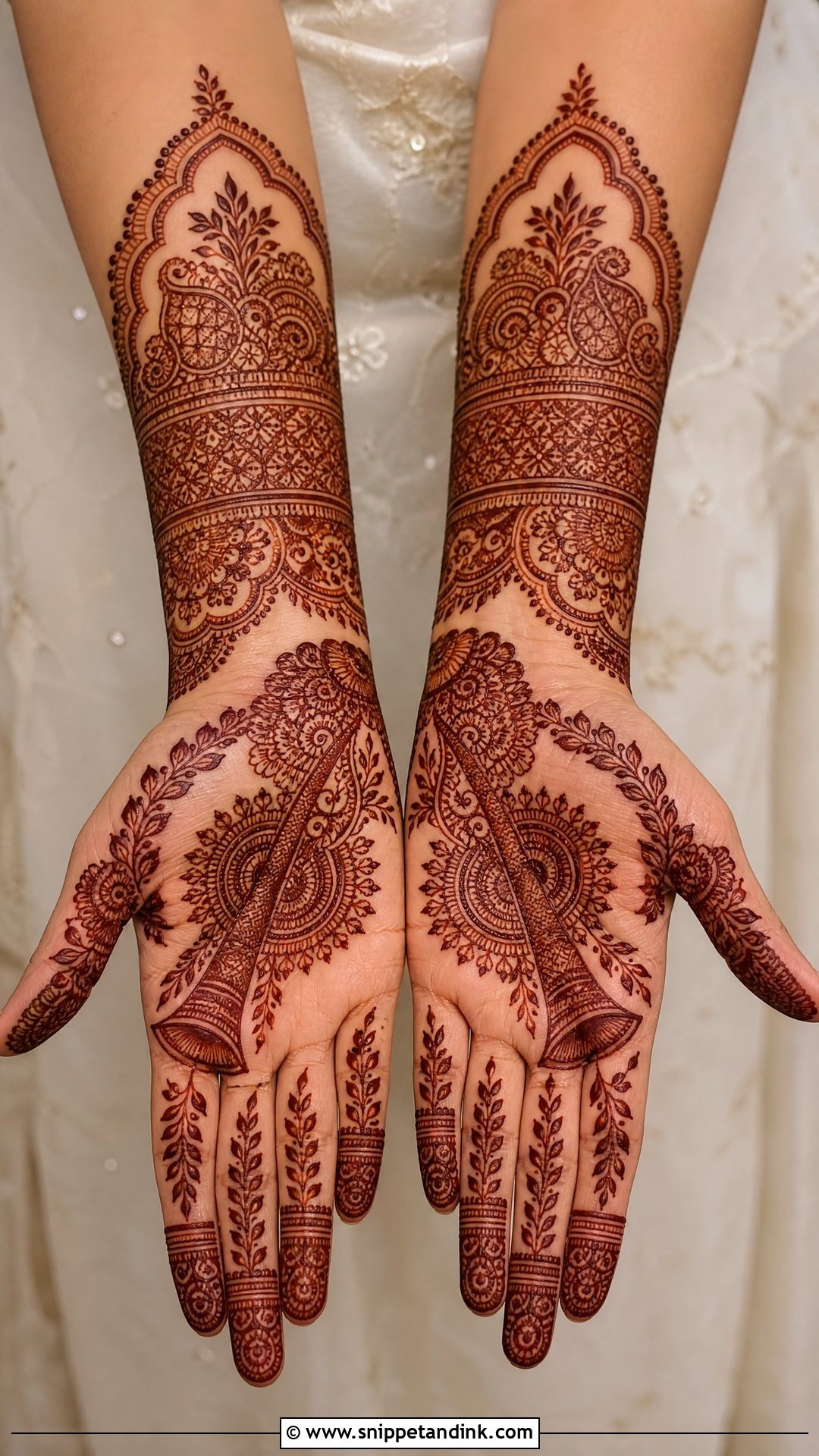
The shehnai is the sound most families connect with auspicious entrances, so it rarely needs explaining. I like two curved shehnai facing each other across the palm with a small mandala or the couple’s initials between them. Keep the fingers light, with slim bands, dots and leafy trails, and finish the wrist with paisley borders and scalloped arches. The one thing I insist on is a bold outline for the instrument itself, since its flared bell loses its shape if the line is thin.
2. Dhol Bridal Instruments Mehndi Design
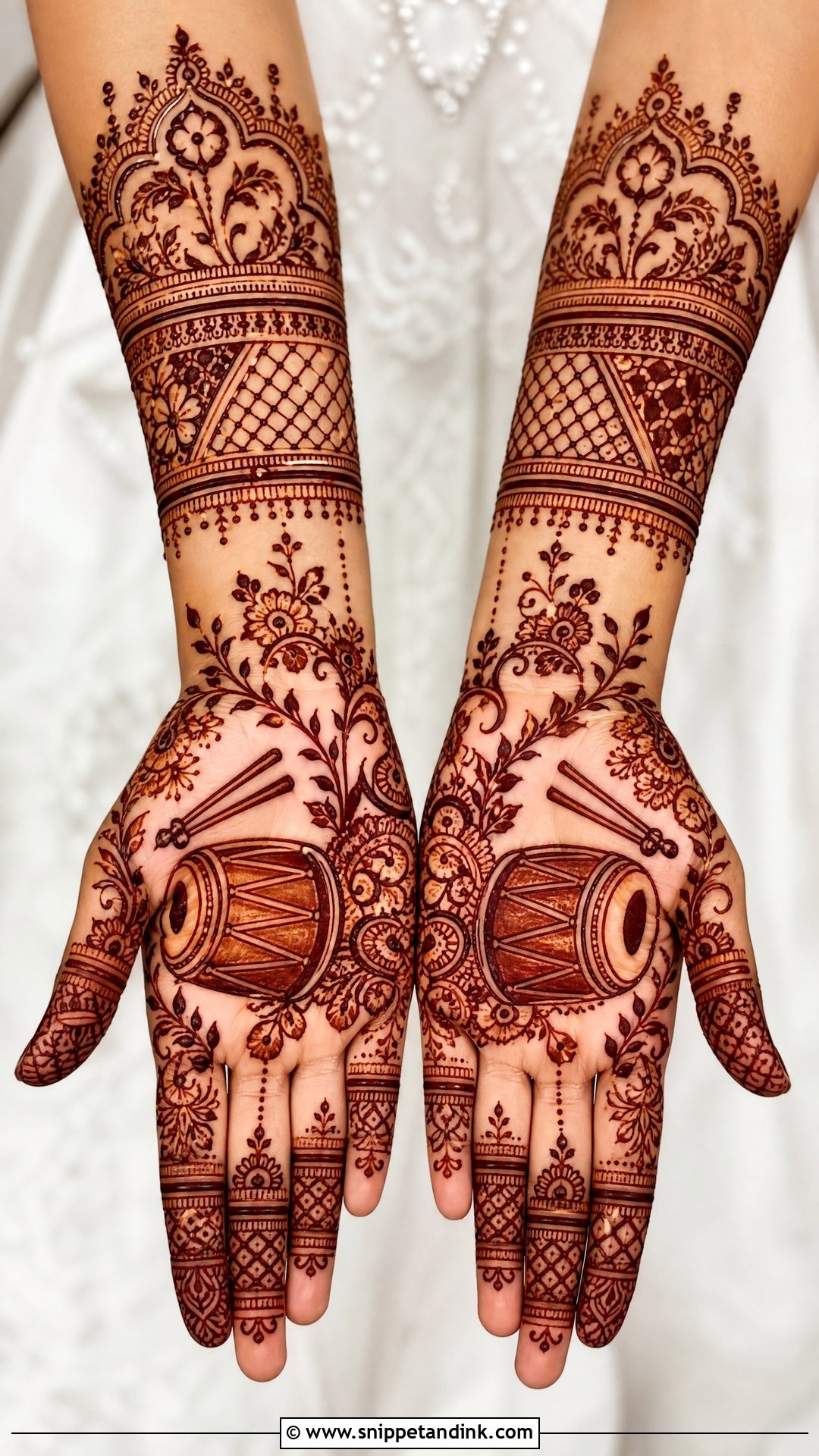
A dhol suits the bride who’ll be dancing at her own sangeet. I put a rounded drum at the center of each palm, framed with floral vines, dotted beats and curved lines that suggest sound, then run dense paisley and jaali panels from the wrist up the forearm. Drumsticks on the fingers, mixed with small leaf chains, tie it together. Draw the dhol a size larger than anything around it. If it matches the neighboring motifs, the eye has nowhere to land and the theme gets lost in photos.
3. Tabla Bridal Instruments Mehndi Design
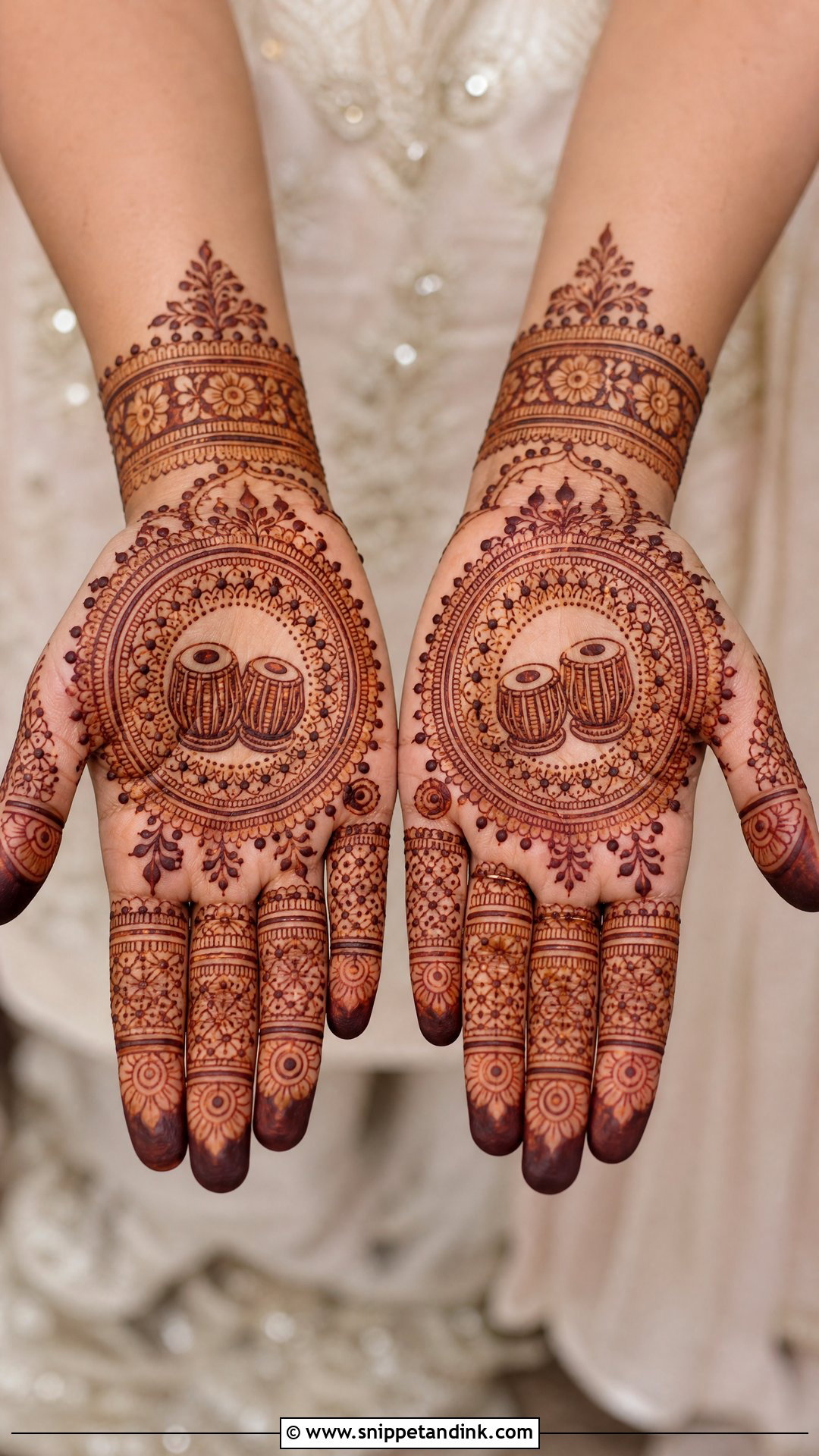
Tabla is the most naturally balanced instrument to draw, because both drums are circles. I often split the pair as the central palm motif, the larger drum on one hand and the smaller one on the other, so the hands complete each other when held together. Mandala rings, tiny petals and dotted rhythm patterns surround each drum, and a bracelet-style band with paisley and lace detail closes the wrist. Of all the instruments here, it blends most easily into a traditional layout.
4. Sitar Bridal Instruments Mehndi Design
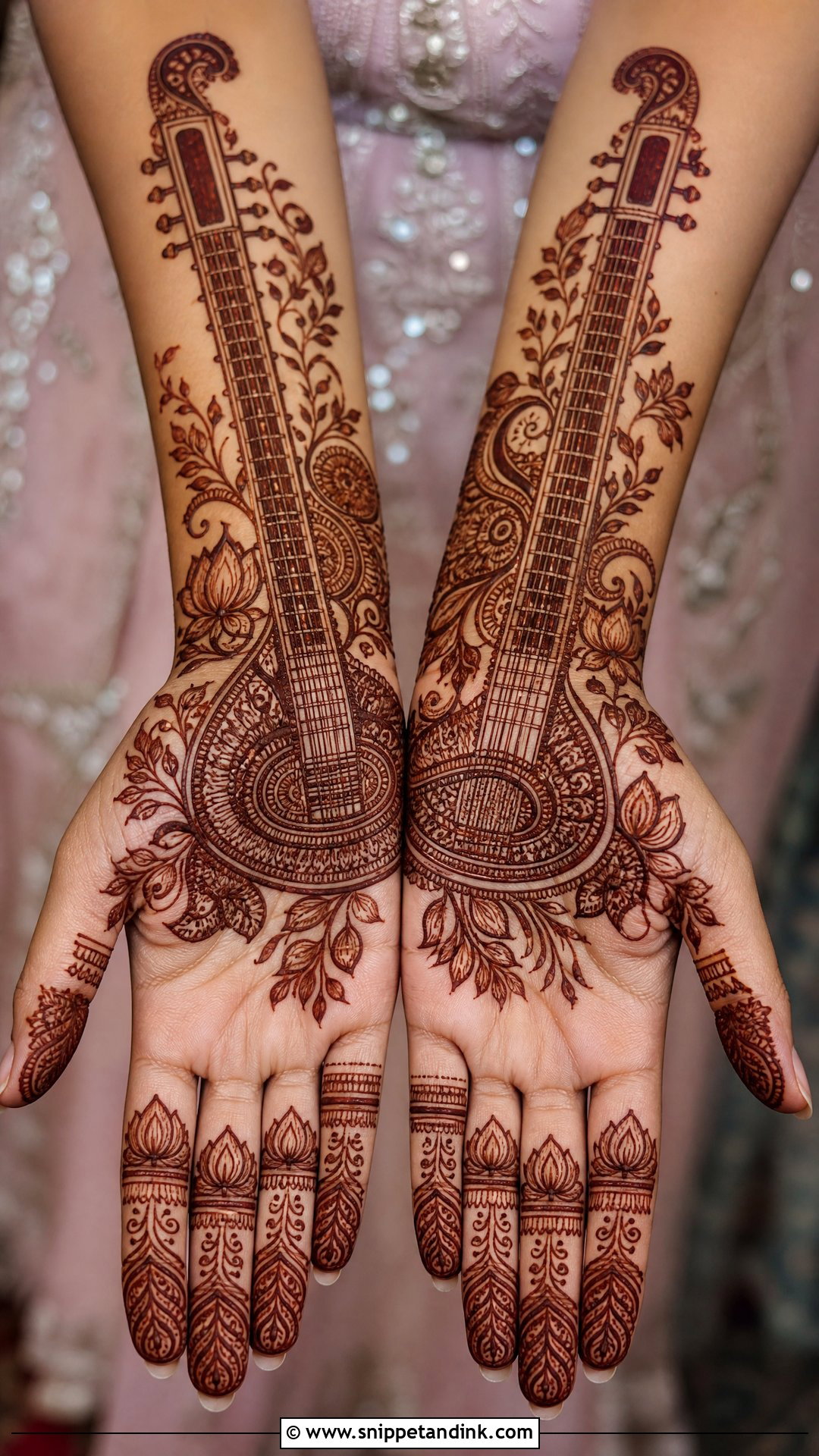
The sitar is long, so I plan it across the wrist and palm together, the gourd near the wrist and the neck reaching toward the fingers. Strings are drawn as fine parallel lines, and this is where I slow down: henna lines spread slightly as the stain darkens, so I leave a gap at least as wide as the line itself or the strings merge into one dark bar. Lotus petals, paisleys and shaded leaves soften the straight neck. On the other hand, a matching mandala with smaller sitar details at the wrist balances the pair without copying it exactly.
5. Veena Bridal Instruments Mehndi Design
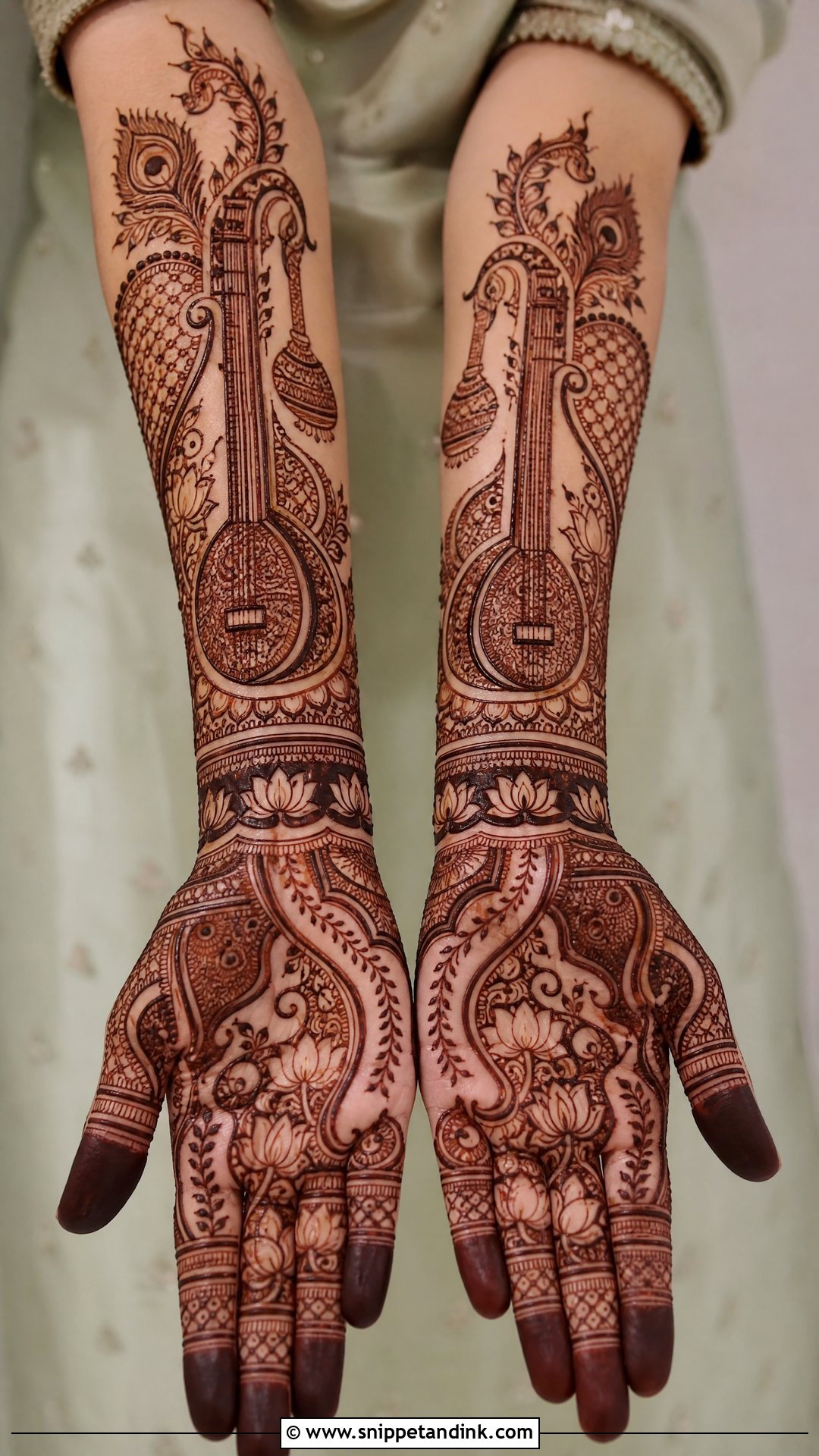
Veena has a graceful curved body and two resonators, and it sits well diagonally across the palm or stretched along the forearm in full-hand Indian bridal mehndi. Peacock feathers, lotus borders and fine jaali mesh around it give the hand a royal weight. I fill the fingertips solid and use vine bands and a few musical notes lower on the fingers. Leave real empty skin around the veena’s outline. Packed tight with fillers, its curves disappear into the background.
6. Flute Bridal Instruments Mehndi Design
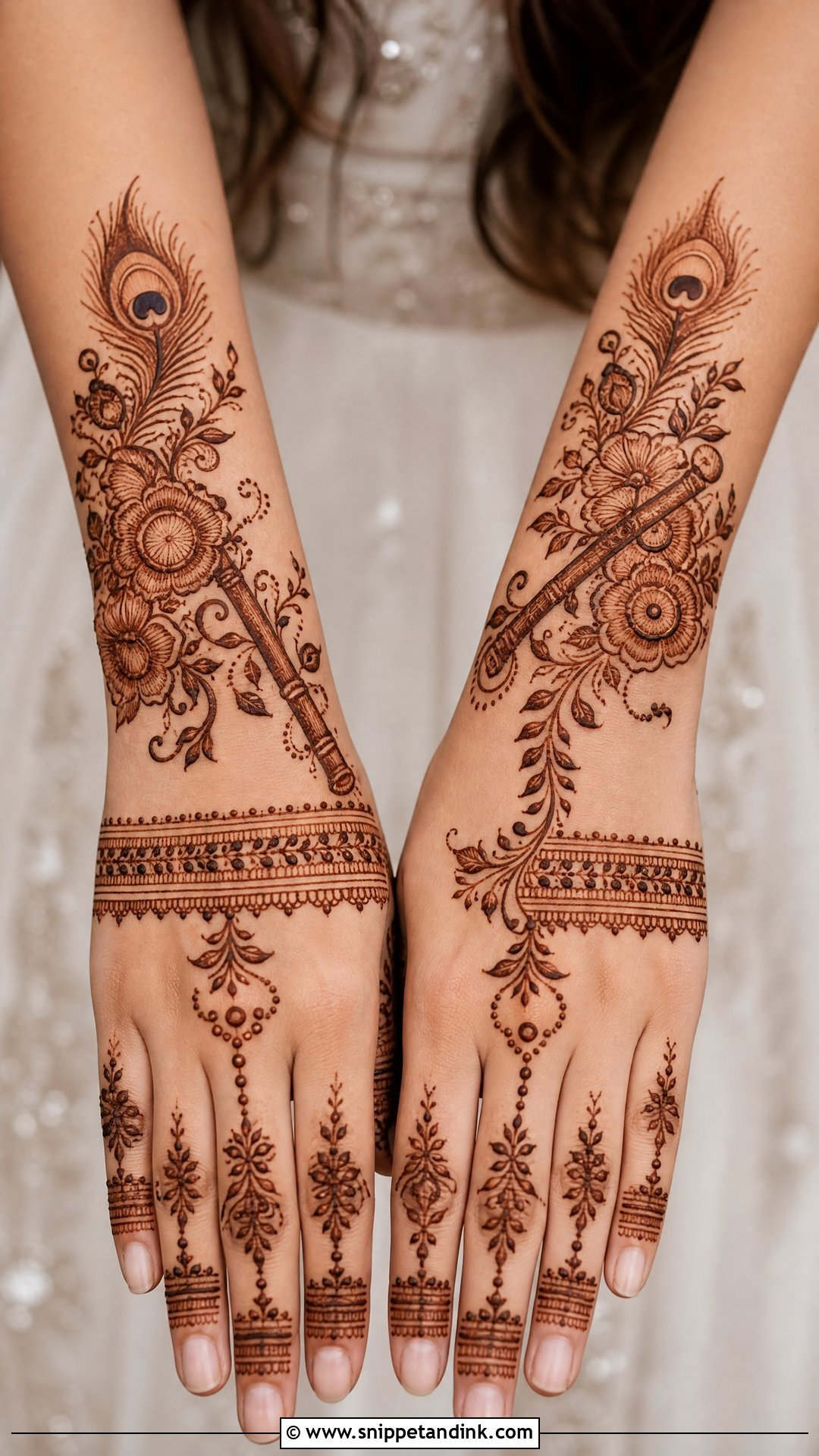
A flute is the easiest instrument for semi-heavy hands, since it’s essentially one clean line. I draw it diagonally across the palm with tiny vines winding around it, floral clusters near the base of the fingers and a cuff at the wrist. Peacock feathers or lotus petals at the ends give it a Krishna reference that many families will recognize immediately. It also translates well to the back of the hand, where the straight shape lines up with ring chains and finger trails.
7. Harmonium Bridal Instruments Mehndi Design
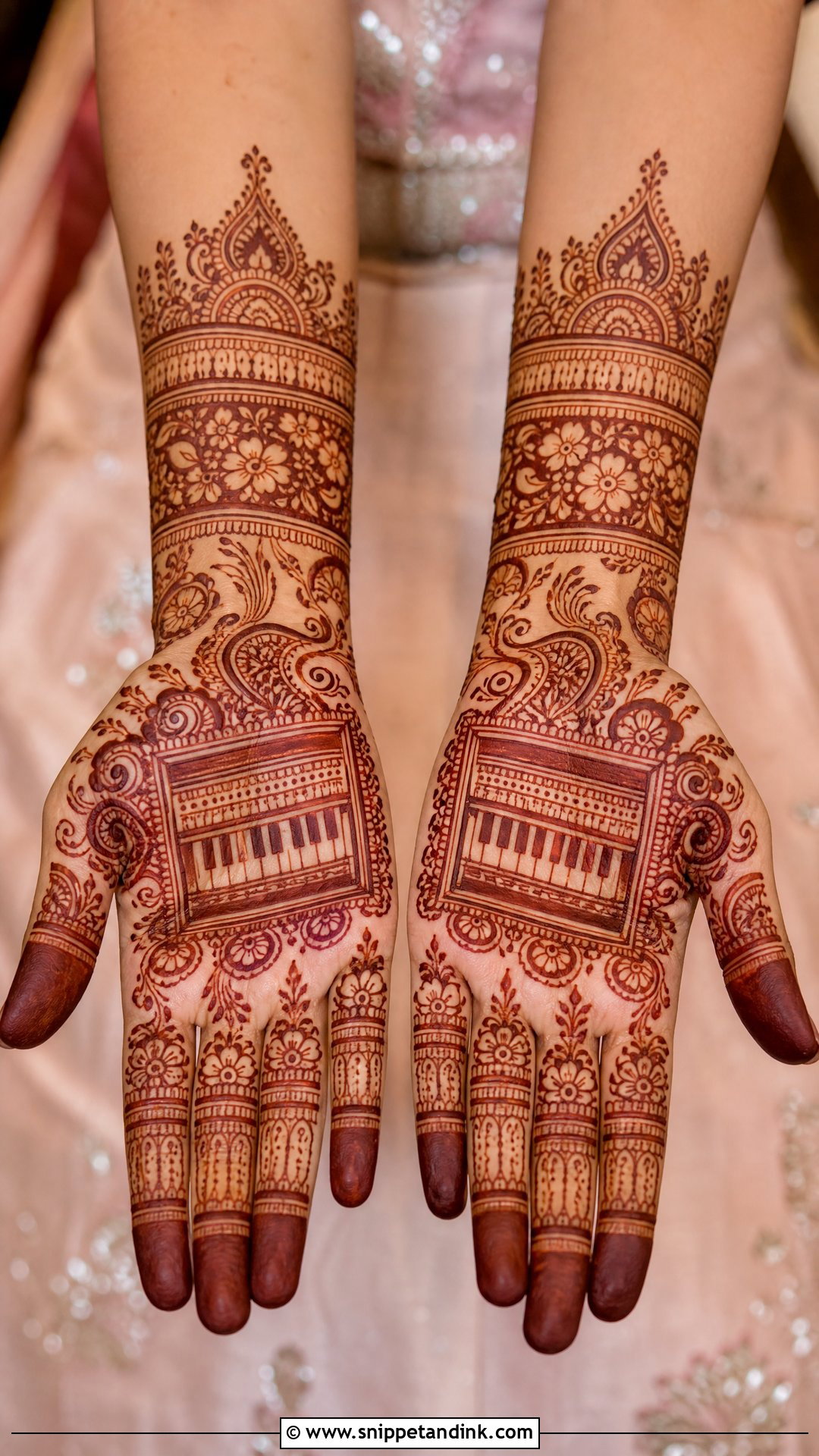
Harmonium keys are the most demanding detail on this list. Each key is a small rectangle, and if the cone wavers by a fraction the keyboard looks crooked, so I only offer this to brides booked with enough time for slow work. Around the instrument go floral frames, paisley corners and a few dots that suggest melody. A rectangular wrist cuff echoes the harmonium’s box shape and ties the design together. It means the most to brides from musical families or those who grew up with devotional singing at home.
8. Guitar Bridal Instruments Mehndi Design
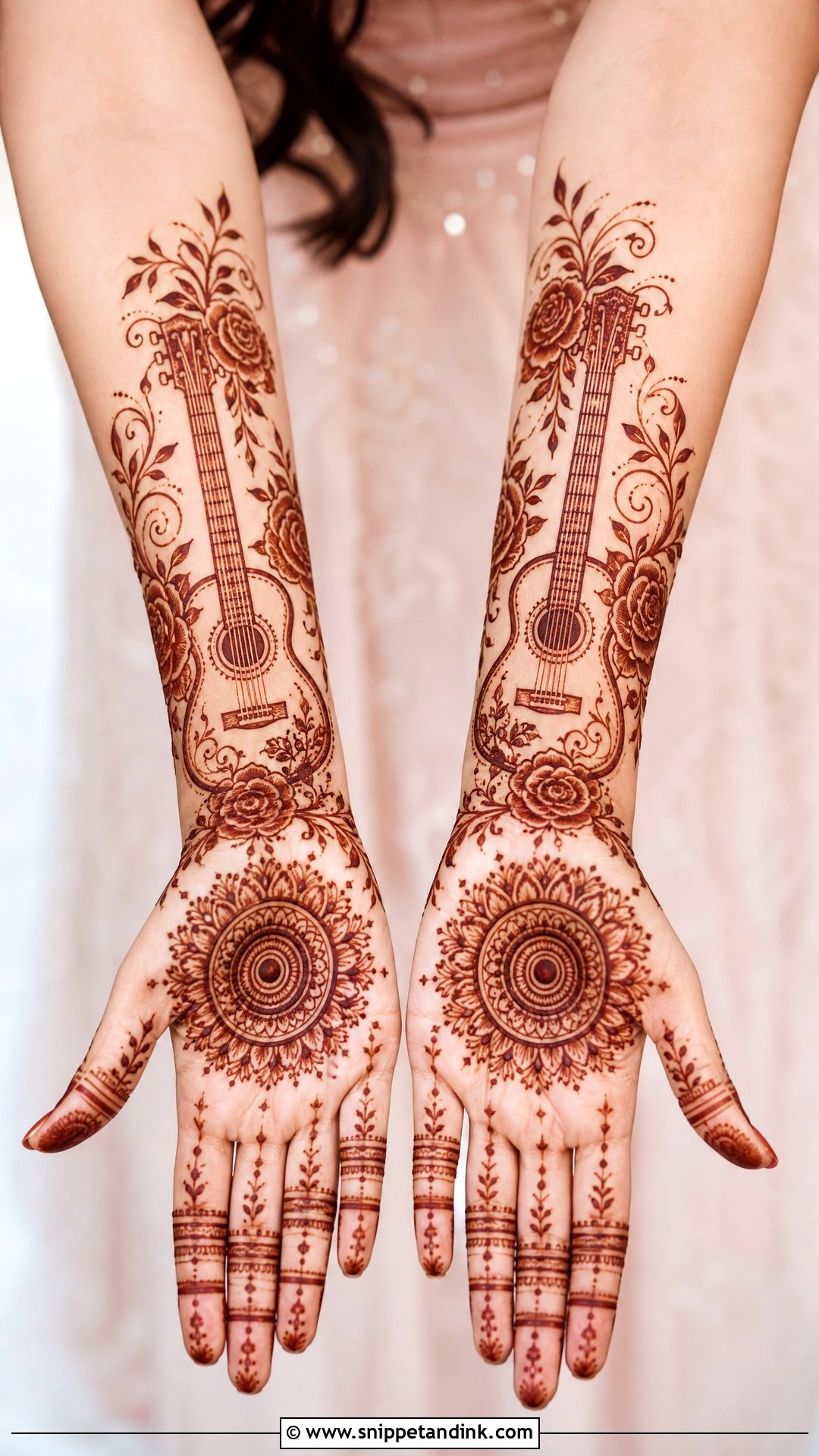
Guitar mehndi works for fusion weddings, engagements or a bride whose love story actually involves a guitar. I lay the body near the wrist with the neck running toward the palm, and frame it with roses, leafy vines and small mandalas so it still feels like bridal henna. A heart-shaped floral mandala or initials on the other hand balances it. Keep the fingers to slim strings, dots and bands. Heavy filling next to a modern instrument starts to look like two different designs fighting.
9. Dholak Bridal Instruments Mehndi Design
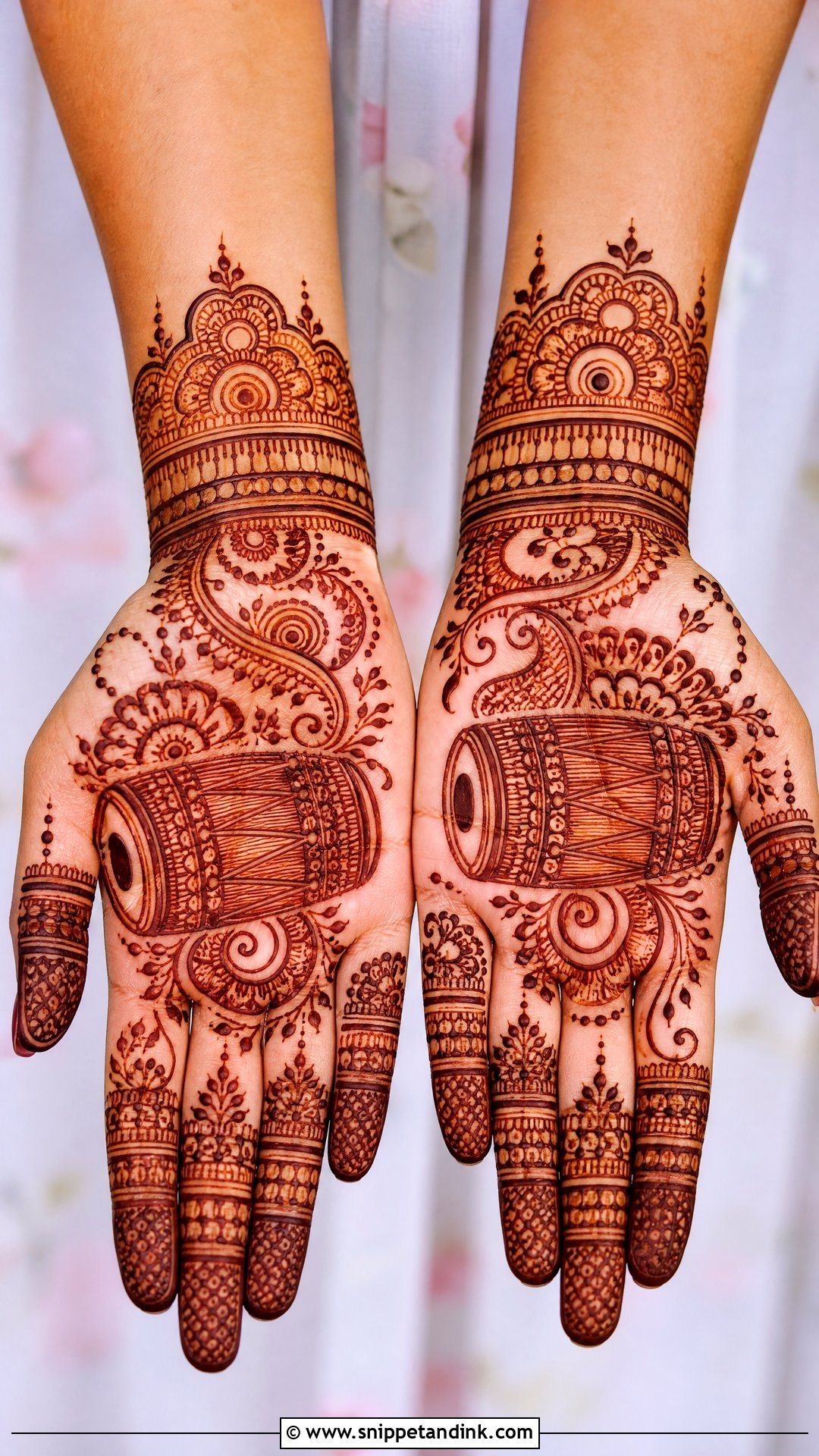
The dholak is the sound of ladies’ sangeet nights, and drawing it horizontally across the palm makes that connection obvious. Dancing dots, paisley vines and floral semicircles sit around it, with a dense wrist cuff of scallops and leaf trails heading up the forearm. Short drumbeat strokes and checkered bands add texture on the fingers. Keep the drum’s center clean and outlined boldly so its rounded body stays the focus.
10. Mridangam Bridal Instruments Mehndi Design
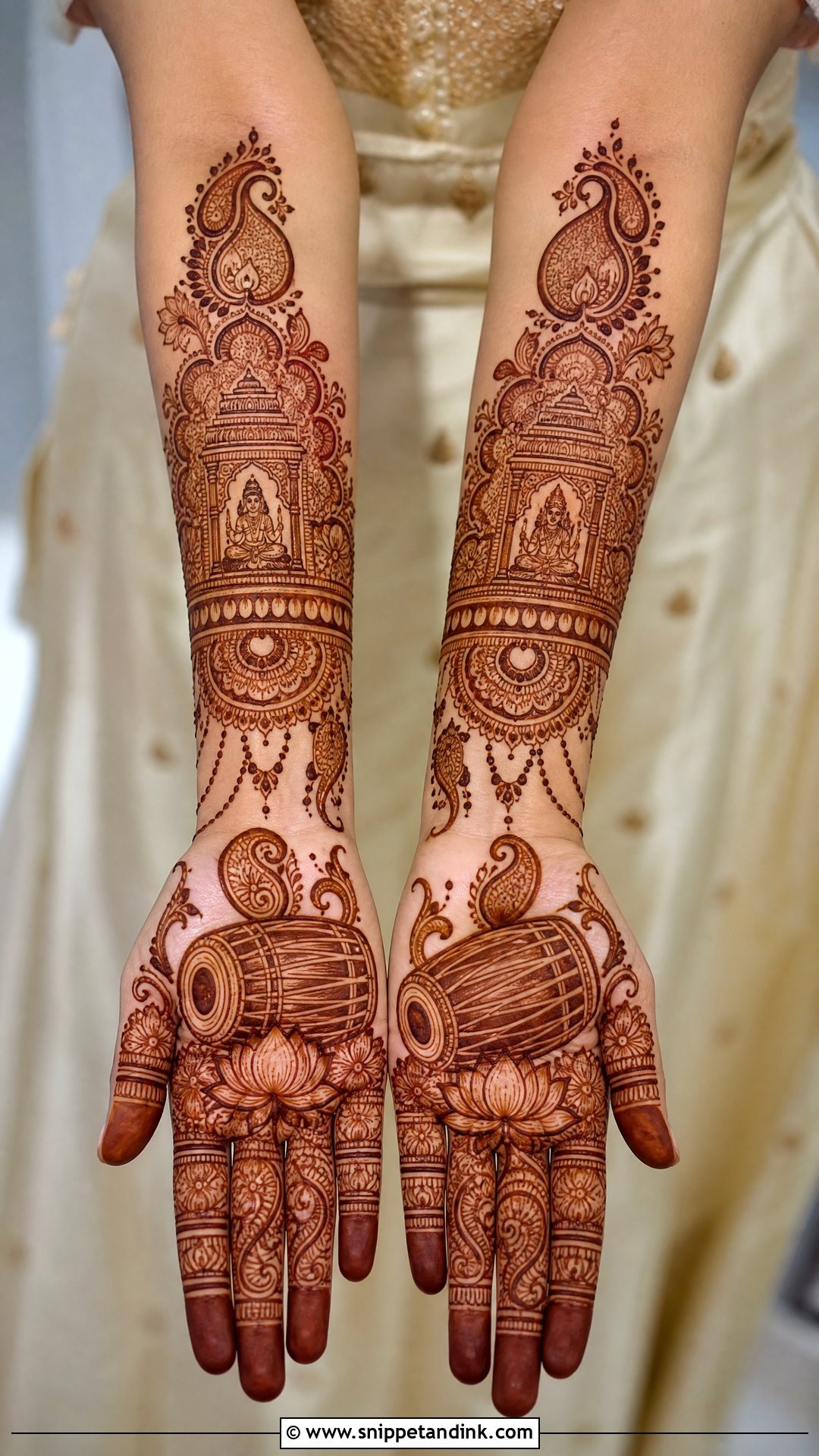
For a South Indian bride, the mridangam carries real cultural weight. Its long barrel sits across the palm or along the forearm, framed by temple borders, lotus petals and mango paisleys, with small rhythmic dots around the drum to suggest movement. I base the wrist cuff on temple jewelry and keep the fingers to neat vertical bands. Because the motif is strong on its own, it doesn’t need many supporting elements, just clean symmetry and fine linework around the barrel.
11. Nadaswaram Bridal Instruments Mehndi Design
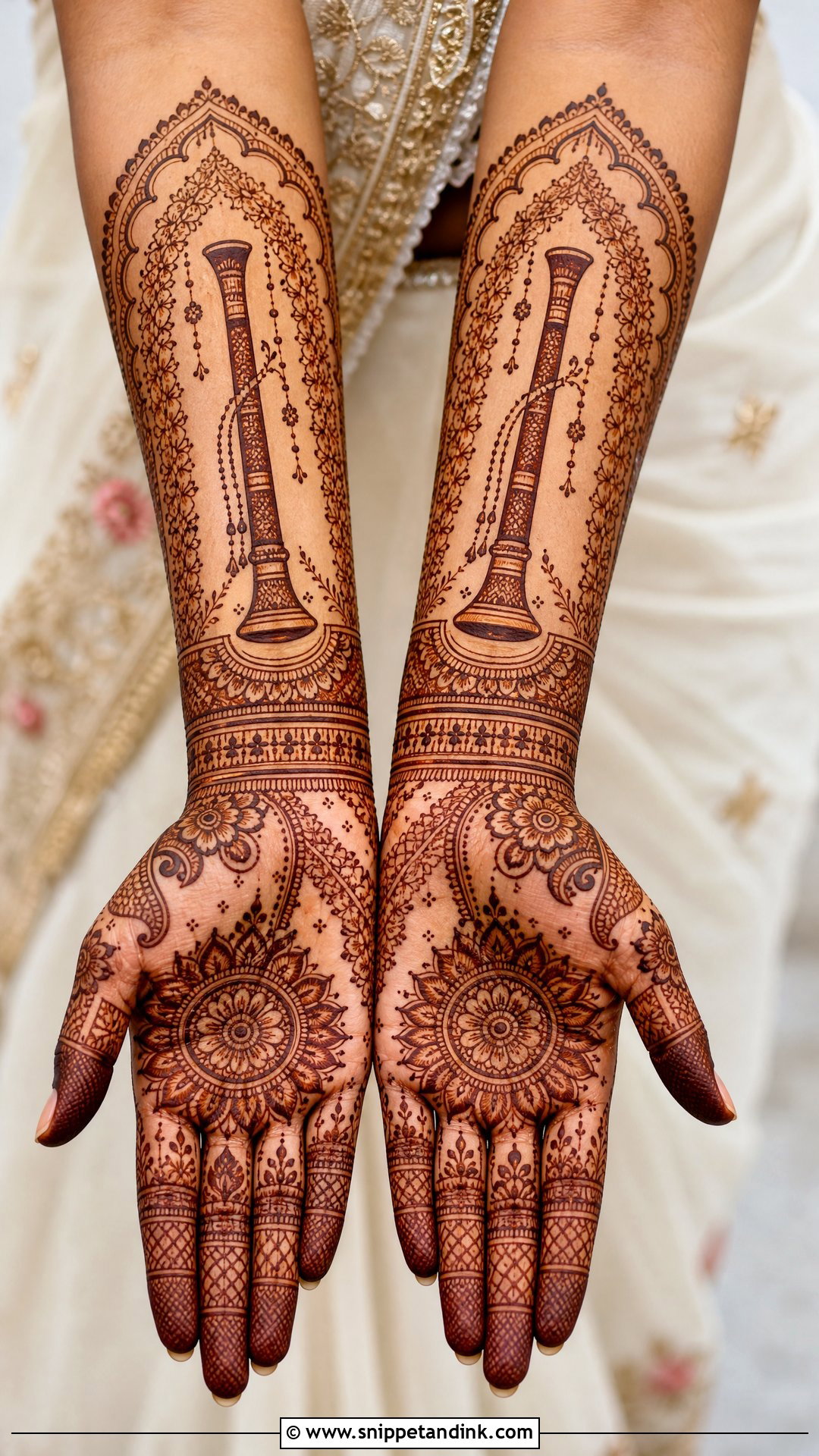
Nadaswaram is the processional sound at many Tamil weddings, which makes it a meaningful pick for South Indian brides. The instrument is long and slim, so I angle it slightly across each palm to follow the hand’s natural line rather than fighting it. Temple arches, jasmine-like floral chains and lotus mandala details surround it, and a structured border along the wrist mimics bridal jewelry. Pair it with a small drum motif or dotted rhythm accents and the hands tell the full story of the procession.
12. Violin Bridal Instruments Mehndi Design
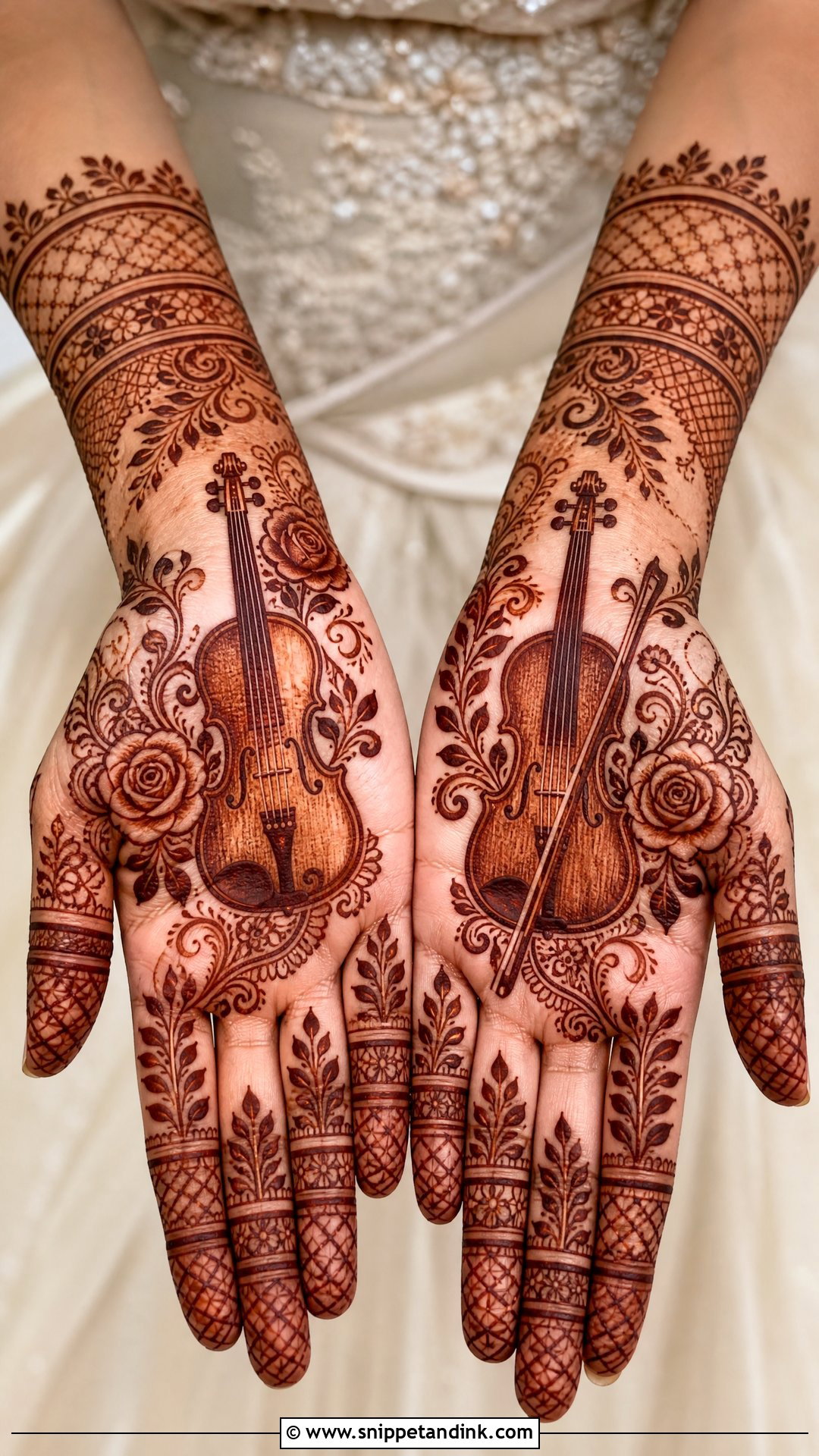
A violin gives the hand a contemporary edge without leaving tradition behind. The body sits in the center of the palm while the bow reaches toward the wrist as a decorative line. Roses, leafy swirls and lace-like jaali keep it bridal, and fine string patterns with tiny floral bands finish the fingers. Its curved waist sits surprisingly naturally next to paisleys and mandalas. I keep the layout airy so the f-holes and scroll stay visible.
13. Sarangi Bridal Instruments Mehndi Design
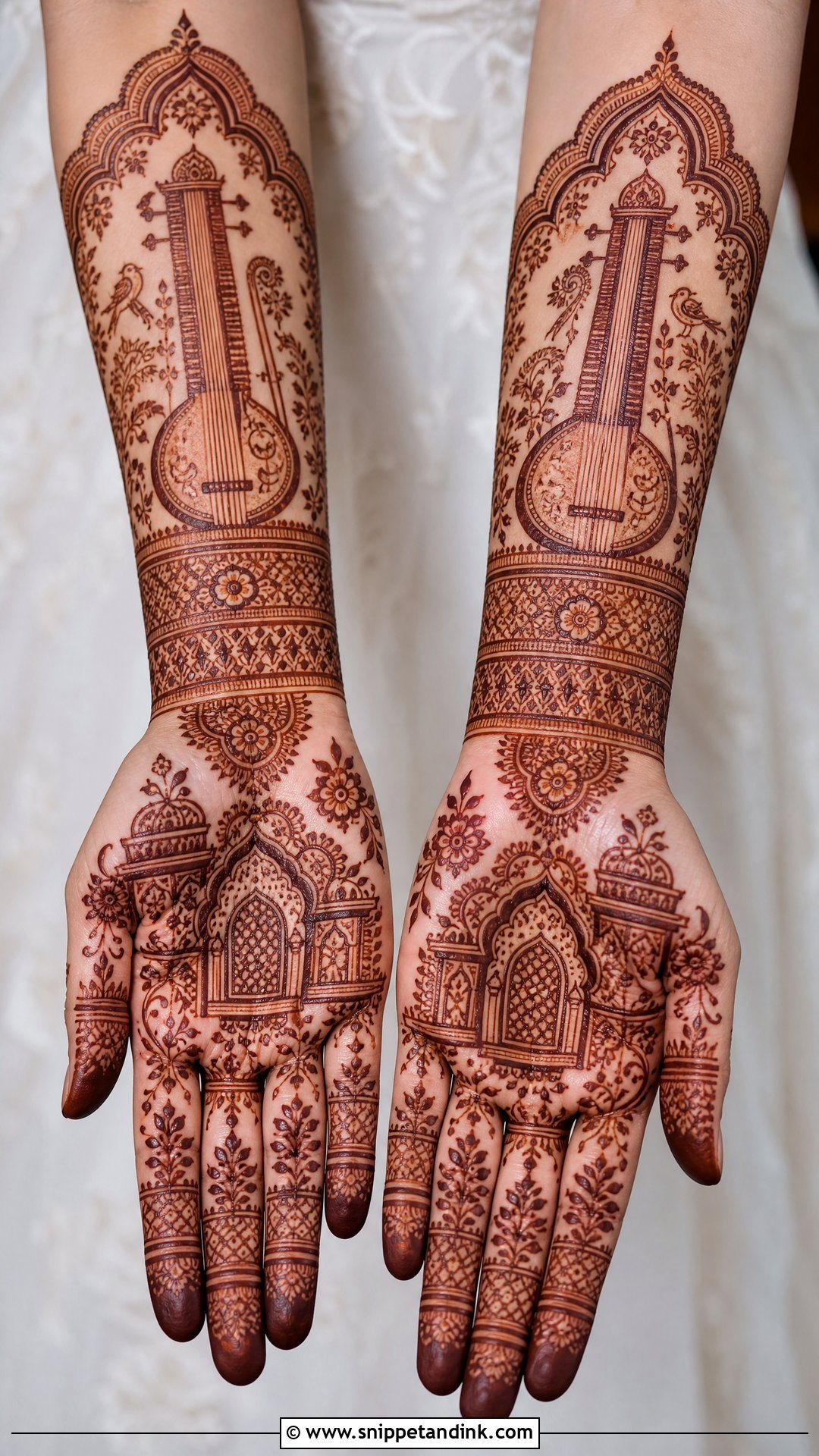
Sarangi is rare in bridal henna, which is exactly why some brides ask for it. I place it on the forearm with its strings and curved body, and put a matching mandala or initials on the palm. Rajasthani arches, small floral sprays and delicate jaali panels frame it, while the fingers get slim bands and dotted vines. The sarangi has a lot of small internal detail. Keep everything around it controlled, or it won’t be recognizable once the stain settles.
14. Santoor Bridal Instruments Mehndi Design
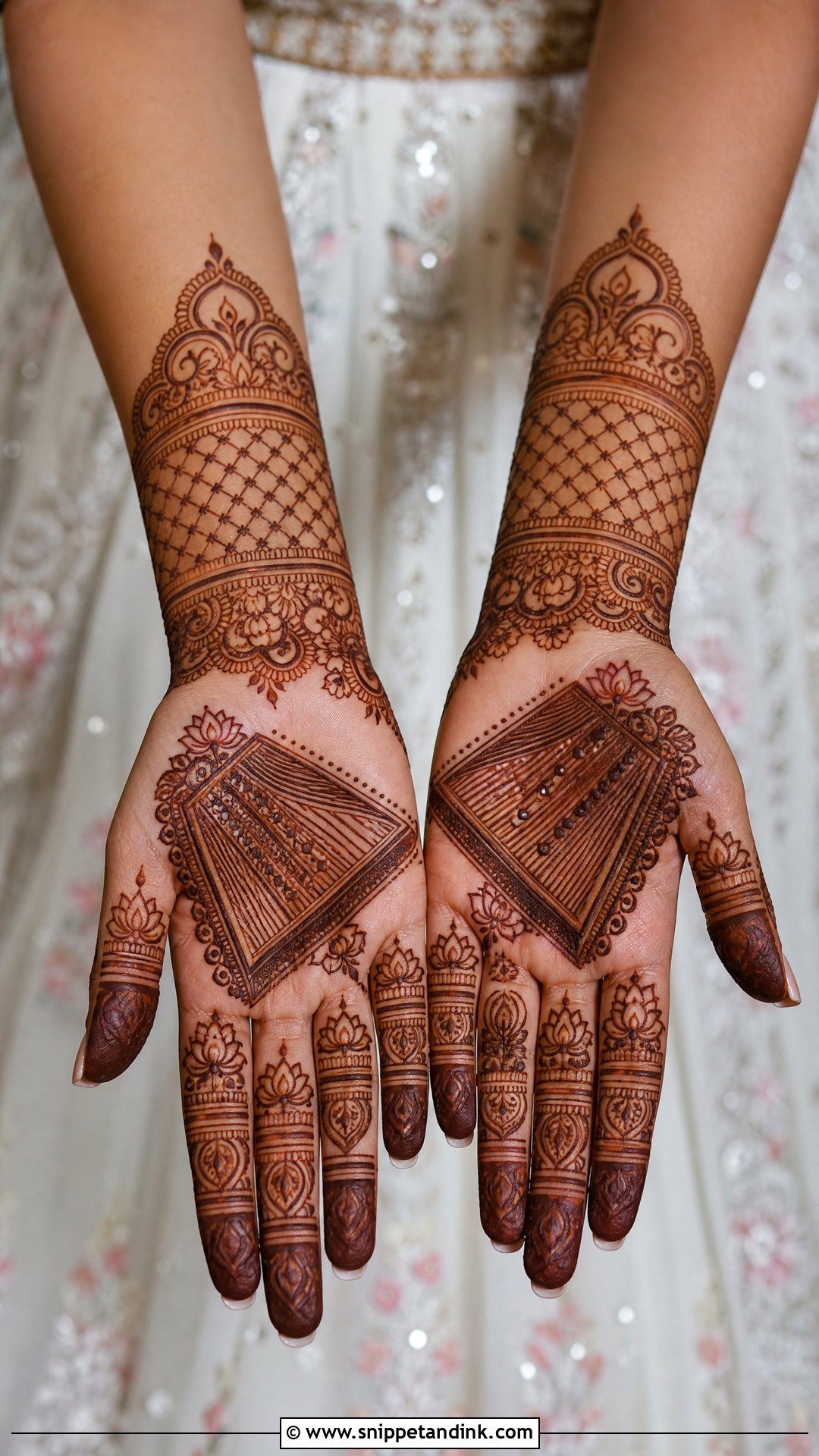
The santoor’s trapezoid frame and rows of strings give a geometric look that suits brides who like order in a design. I set it across the palm with fine parallel strings and small floral corners, then echo its structure with a wide jaali cuff and paisley borders at the wrist. Lotus petals and dotted chains near the fingers soften it. Because the shape is self-contained, it adapts well to front and back hands as a framed centerpiece.
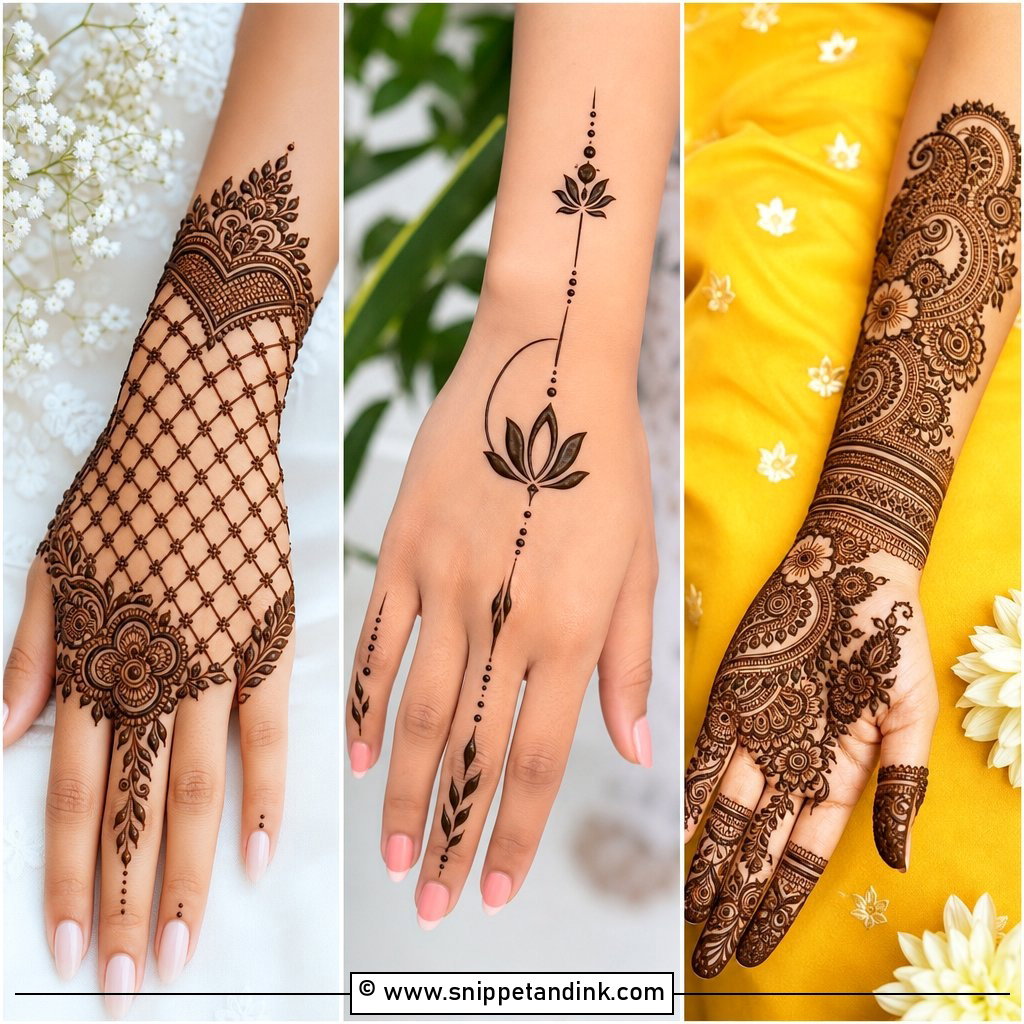
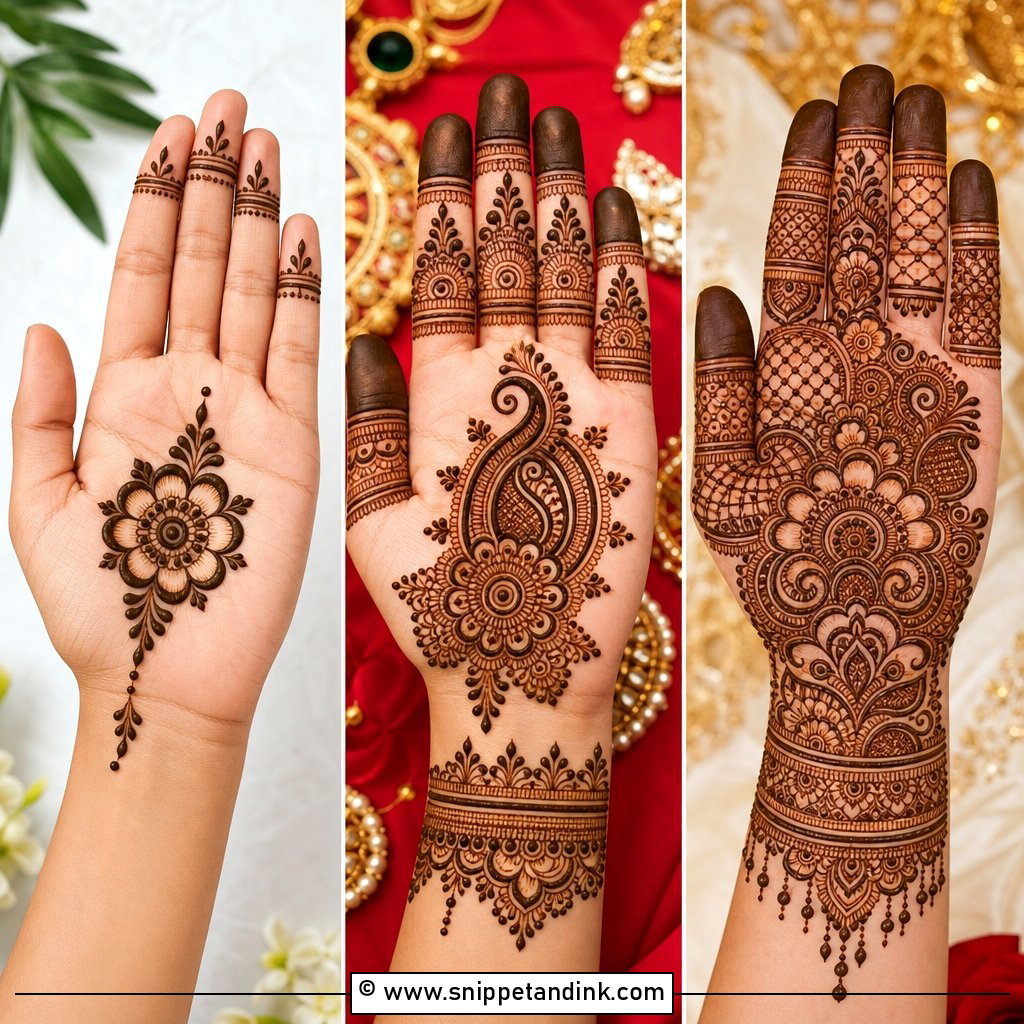
15. Damru Bridal Instruments Mehndi Design
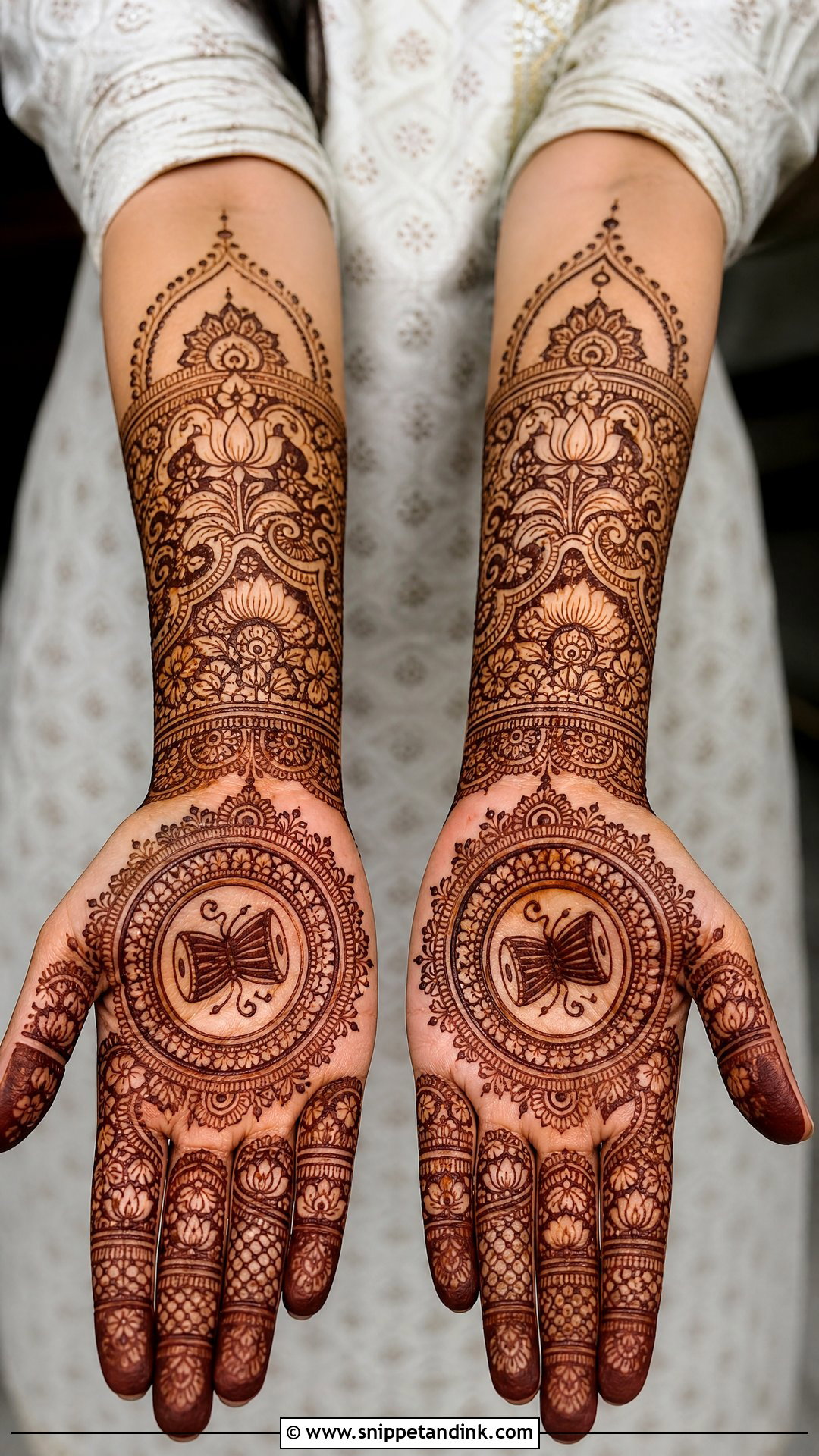
A damru is small and symbolic, often linked to Shiva, and it slips easily into a full bridal hand. I center it on the palm inside a circular mandala with lotus petals and fine dotted rings, then send paisley vines from the wrist toward the forearm. It pairs well with a floral mandala or initials on the opposite palm. The hourglass shape has to be crisp, so I outline it before filling anything nearby.
16. Manjira Bridal Instruments Mehndi Design
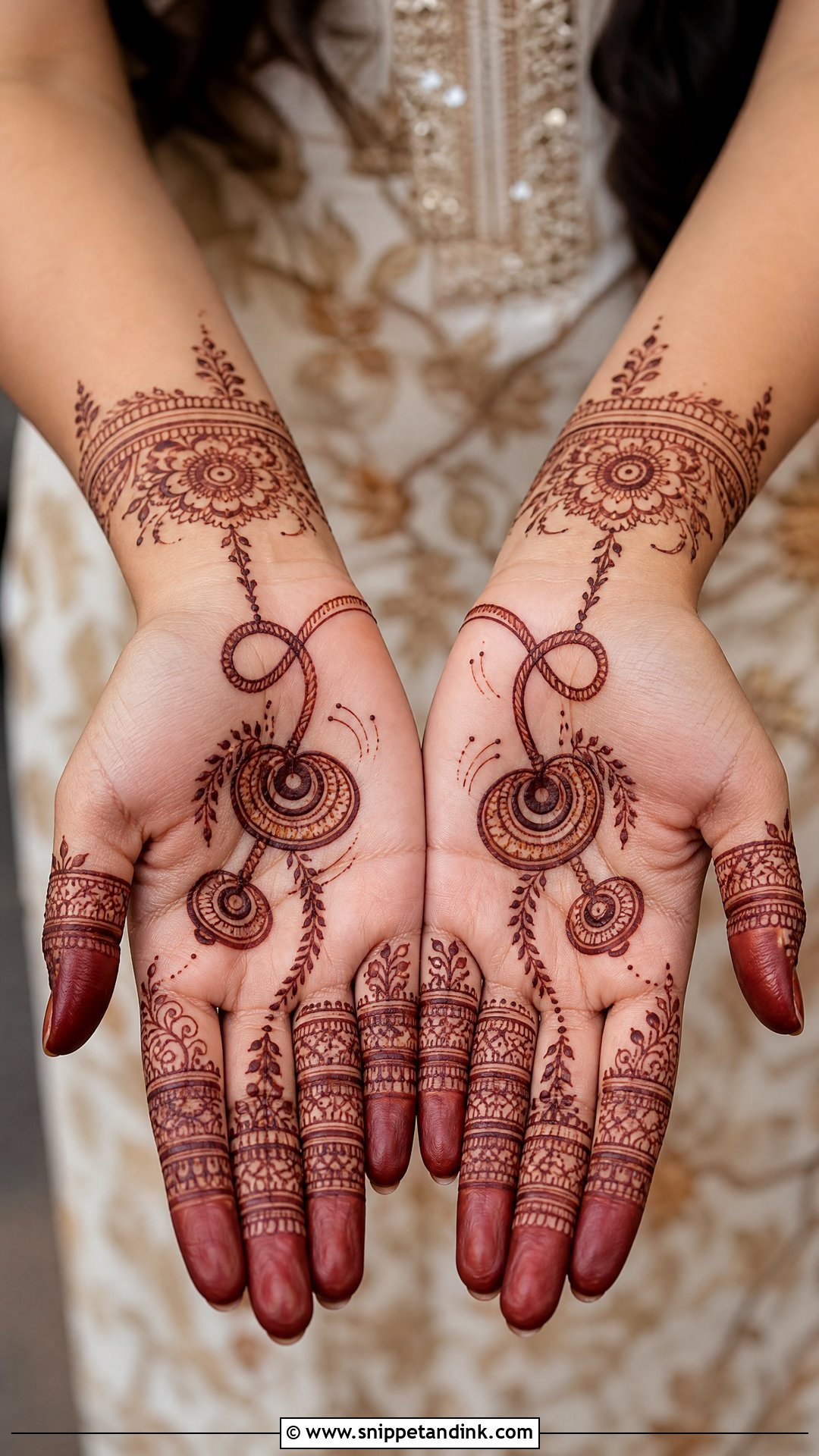
Manjira are tiny hand cymbals, so the motif works best as a pair near the center of the palm, joined by a curved string with dotted motion lines around it. Floral mandalas, leafy trails and bracelet cuffs build it up to bridal weight. I repeat small circles on the fingers to echo the cymbals. On its own the motif suits bridesmaids; with full wrist-to-forearm coverage it carries a bride’s hand.
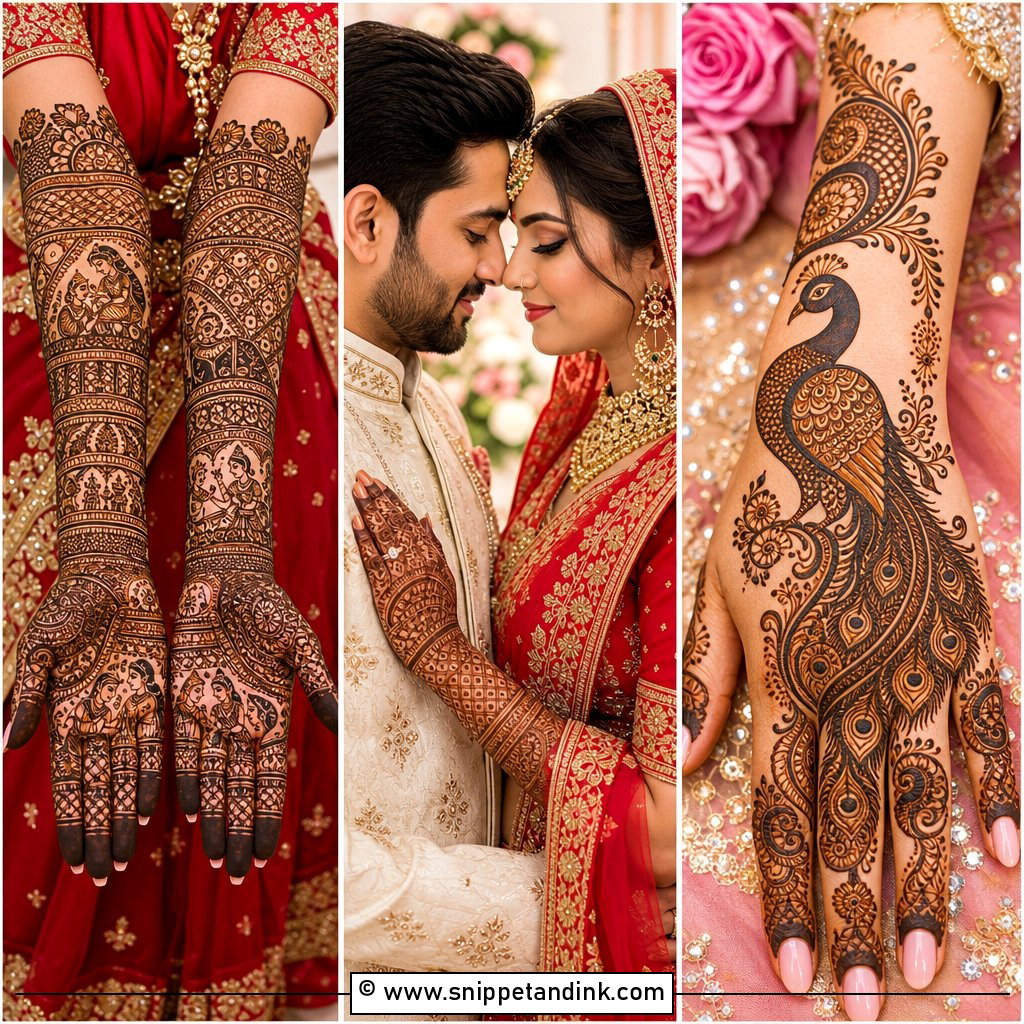
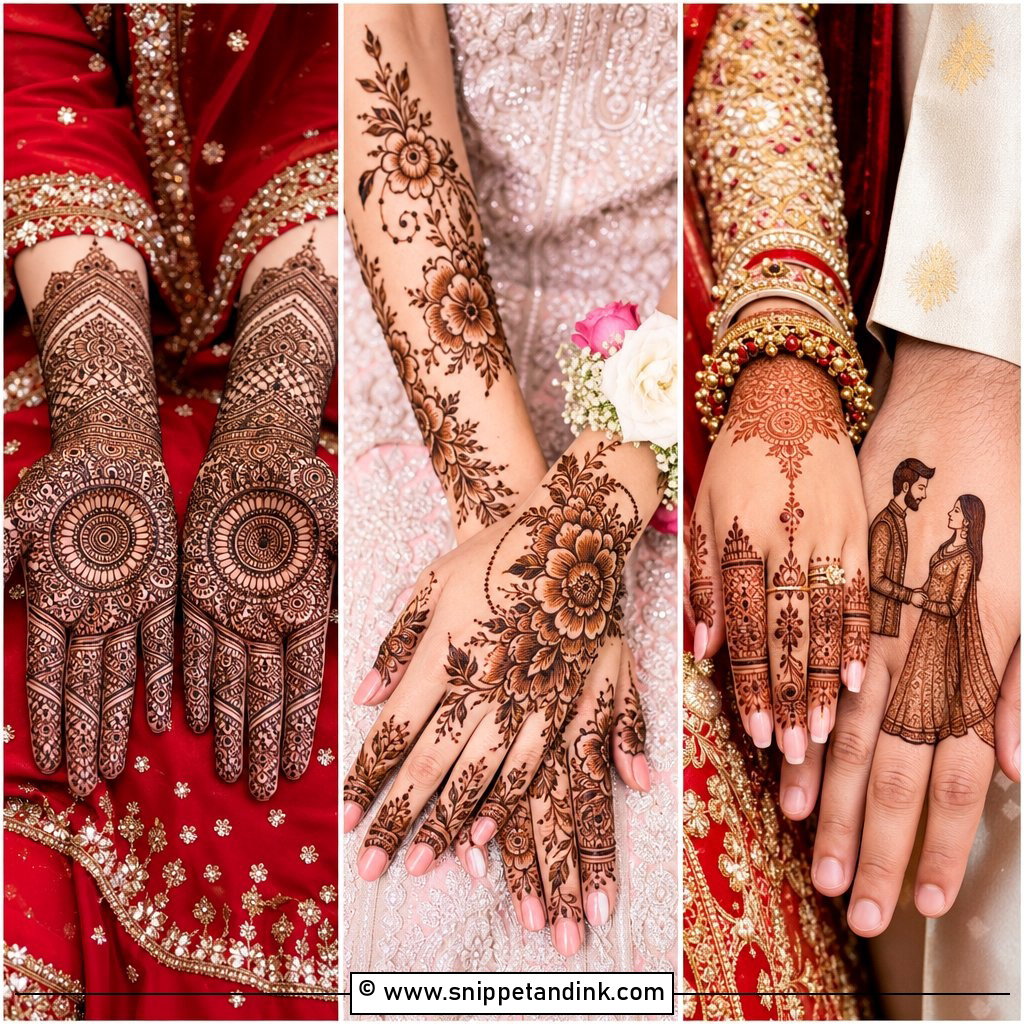
17. Bridal Instruments Mehndi Design With Bride And Groom
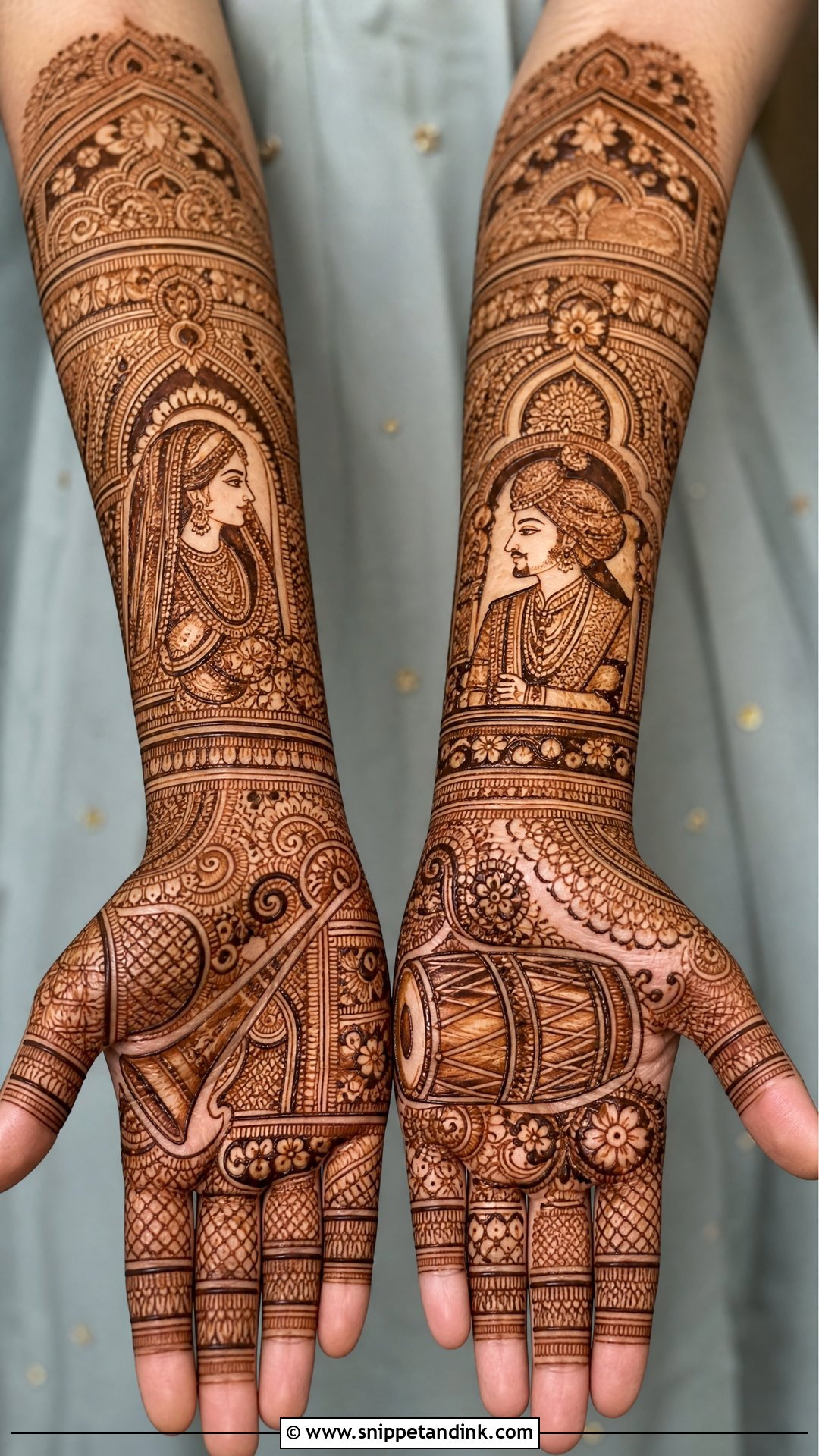
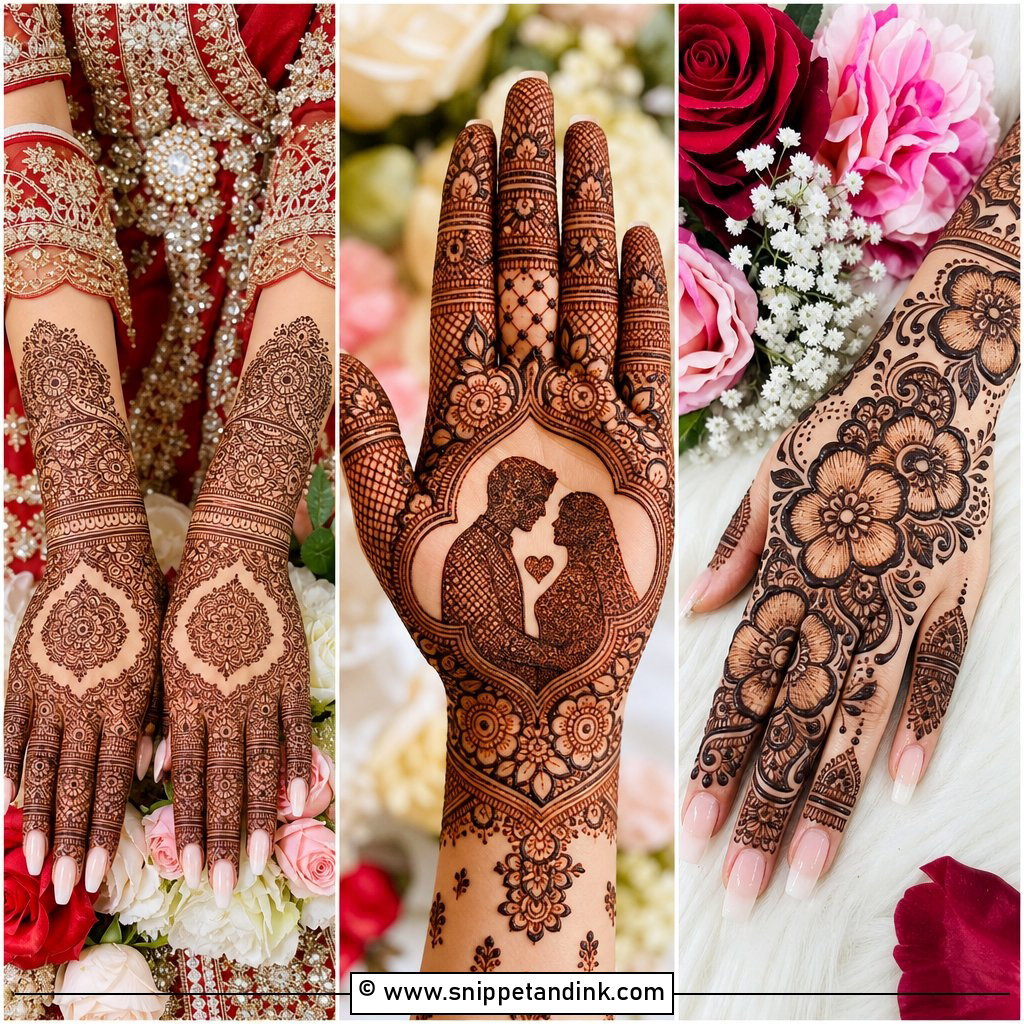
Portrait mehndi turns both hands into one story. The bride and groom sit inside a decorative frame on one palm, with shehnai, dhol or tabla on the other, and floral vines, paisley panels and jaali connect each palm to the wrist. The forearms can carry wedding arches, hidden initials and music-note fillers. Faces are the slowest thing I draw, and they’re the first thing guests examine, so book extra time and don’t let this be squeezed into a short slot.
18. Arabic Bridal Instruments Mehndi Design
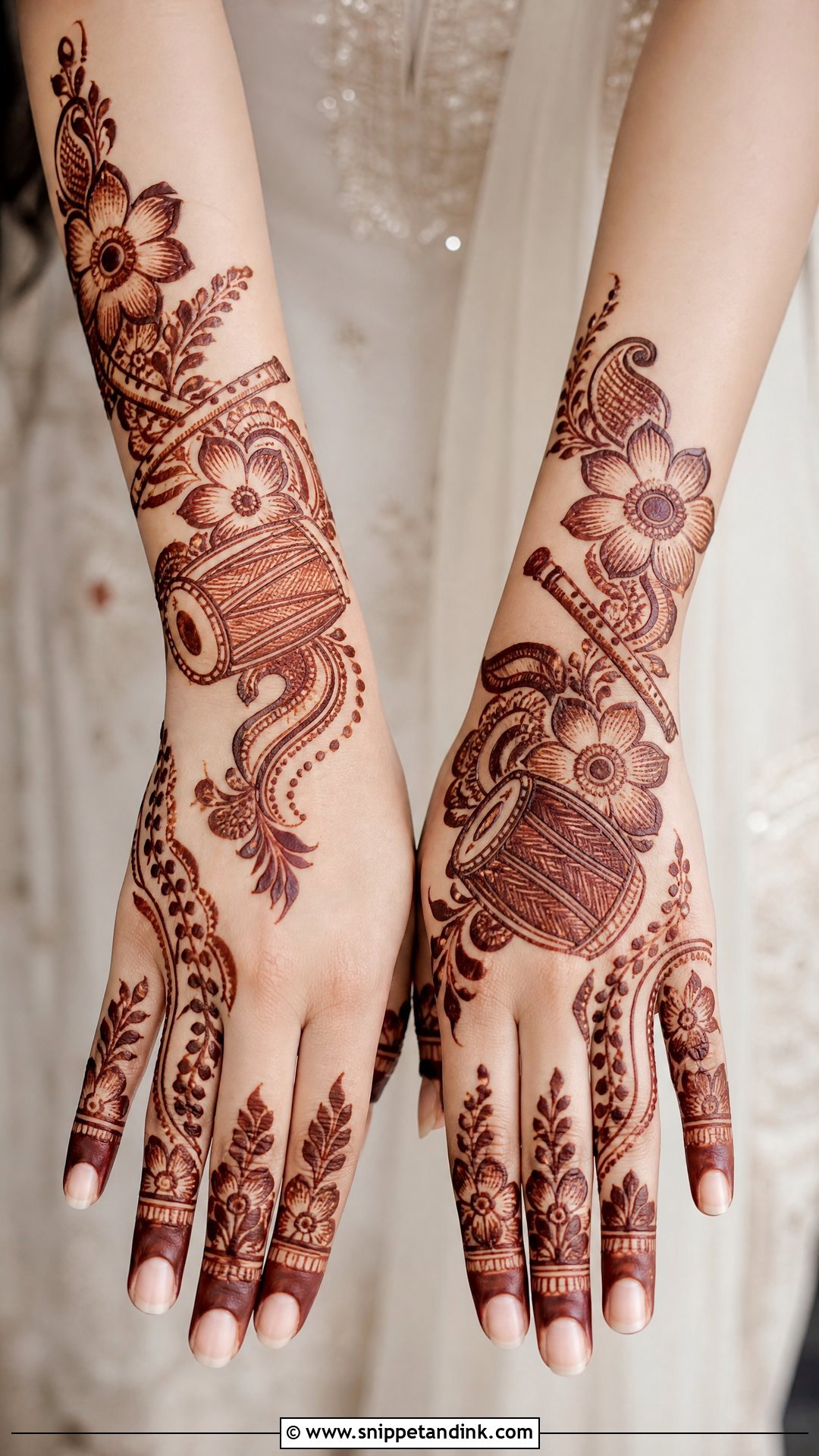
Arabic layouts give musical motifs room to breathe. Instead of covering the whole hand, I run a diagonal trail from the wrist to the index finger and set a flute, dhol or small shehnai between large flowers, leafy vines and bold paisleys. The open skin makes the instrument easy to spot, and the fingers stay light with bands, dots and half-floral tips. It’s much quicker to apply than full Indian work, which helps when you have a long day of functions ahead.
19. Indo-Arabic Bridal Instruments Mehndi Design
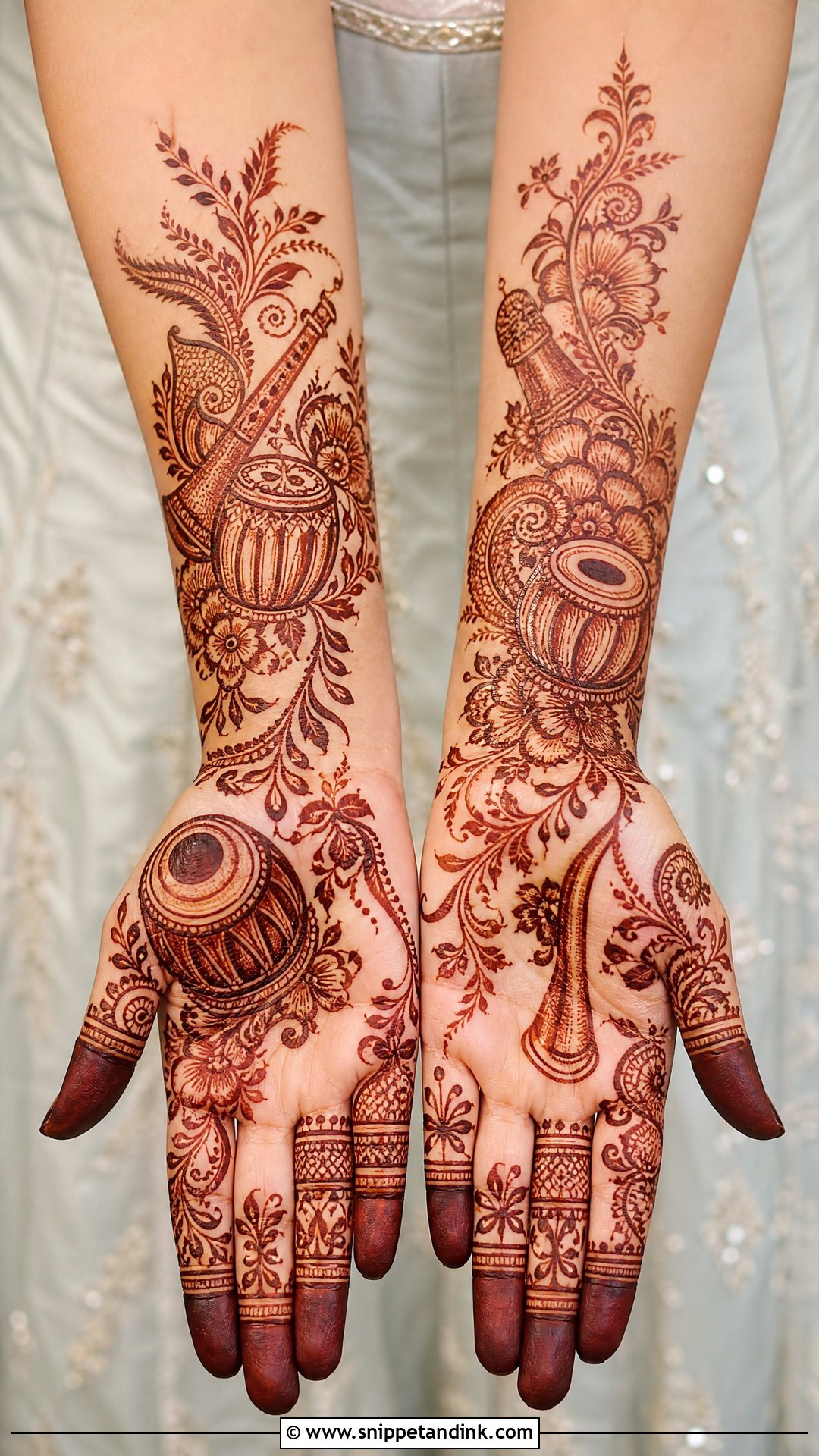
An Indo-Arabic bridal instruments mehndi design puts the instrument in the palm and leaves the forearm open. A bold tabla, shehnai or sitar holds the center, while the wrist and forearm get open floral trails, shaded leaves and paisley curves. The fingers mix filled tips, fine vines and ring bands. I suggest it to brides who want a full bridal look but can’t sit for the hours a dense hand demands. From a distance it reads as heavy; up close you can see each line.
20. Full Hand Bridal Instruments Mehndi Design
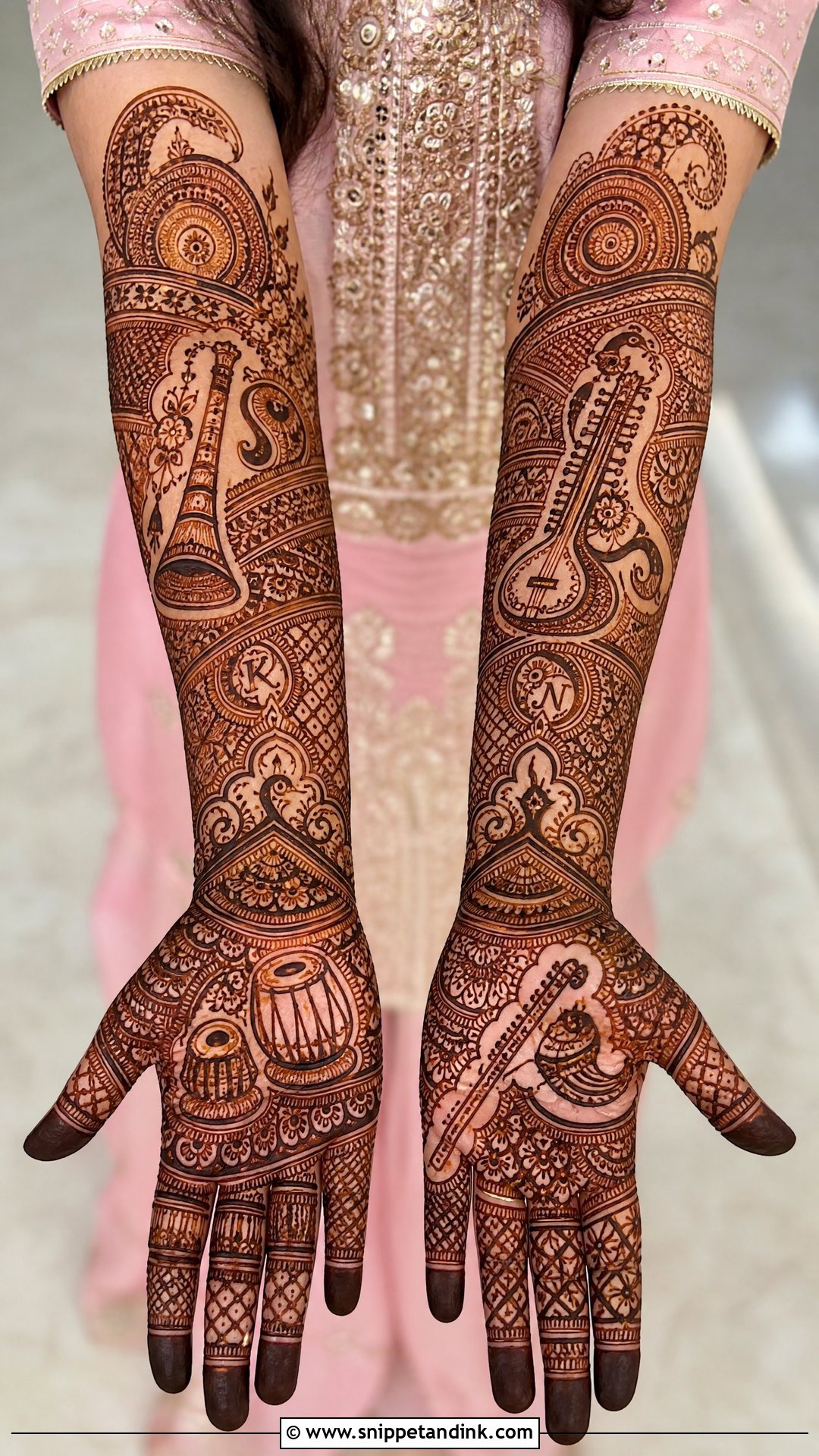
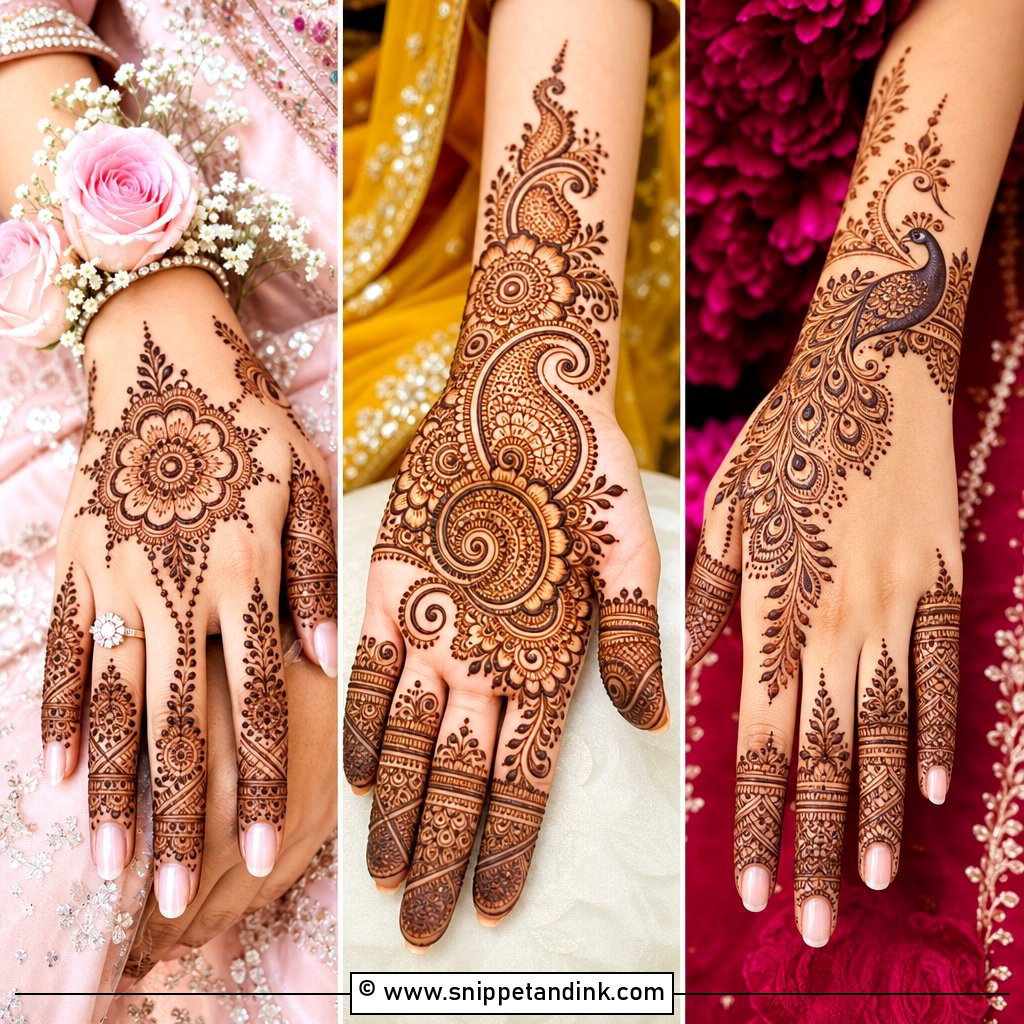
This is the most ambitious version: different instruments on each hand, perhaps shehnai and dhol on one side and sitar, tabla or flute on the other, with mandalas, jaali, paisleys, florals and hidden initials running up the forearms. I keep the fingertips solid and the forearm borders matched so the two hands feel like a set even though their stories differ. Plan for a long sitting and a helper to feed you. It suits a bride who loves heavy mehndi and wants every guest to find a new detail.
A Sketch Session Saves the Shehnai
Musical designs are personal, so the brief matters more than with a floral hand. Tell your artist why you want the instrument. A grandfather who played the harmonium, a first dance to a guitar song or a classical dance background each suggests a different placement and a different supporting cast of motifs.
Bring clear photos of the actual instrument, not other people’s mehndi. Artists draw from memory, and a veena drawn from memory often turns into a sitar. If you want initials or names worked in, decide on spelling and script before the appointment, since changing them mid-design breaks the layout.
Booking enough hands and hours
Instruments with keys or many strings take noticeably longer than florals, and portrait designs longer still. Tell your artist how many instruments you want when you book, not on the day, so she can plan a longer slot or bring a second artist for the forearms. Paste quality counts here too: fresh natural henna flows in thin, even lines, while old or chemical cones break and blob on exactly the fine work these designs depend on.
One Instrument Per Palm Is Usually Enough
Musical mehndi lands when the instrument is obvious at a glance and everything else supports it. Shehnai, dhol, tabla, sitar, flute and veena can each anchor a hand, or several can share a full story across both. Dense Indian work suits a traditional bride, while Arabic and Indo-Arabic spacing gives a lighter, quicker result. Give your artist enough time for the fine strings and keys, and the design will carry the music of your wedding long after the last song.
You'll Like These Ideas:


Leave a Reply