
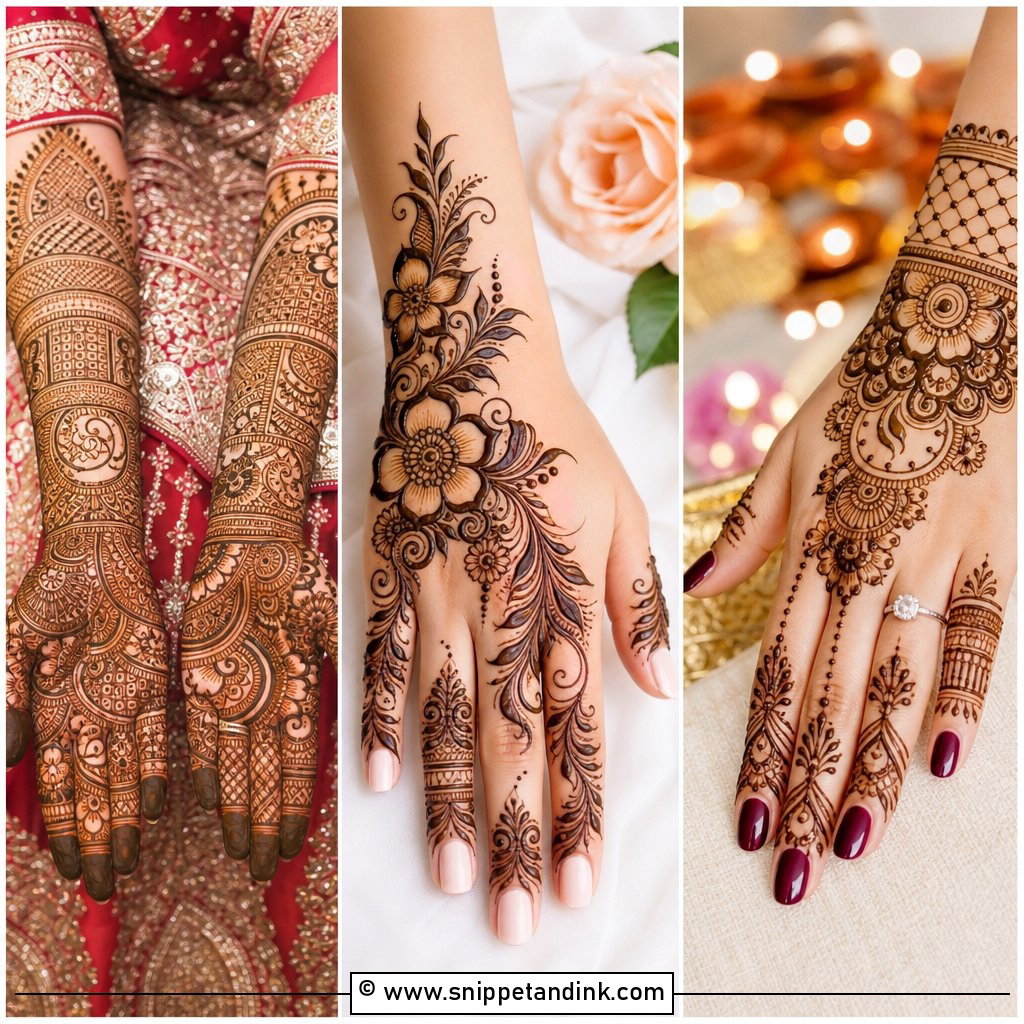
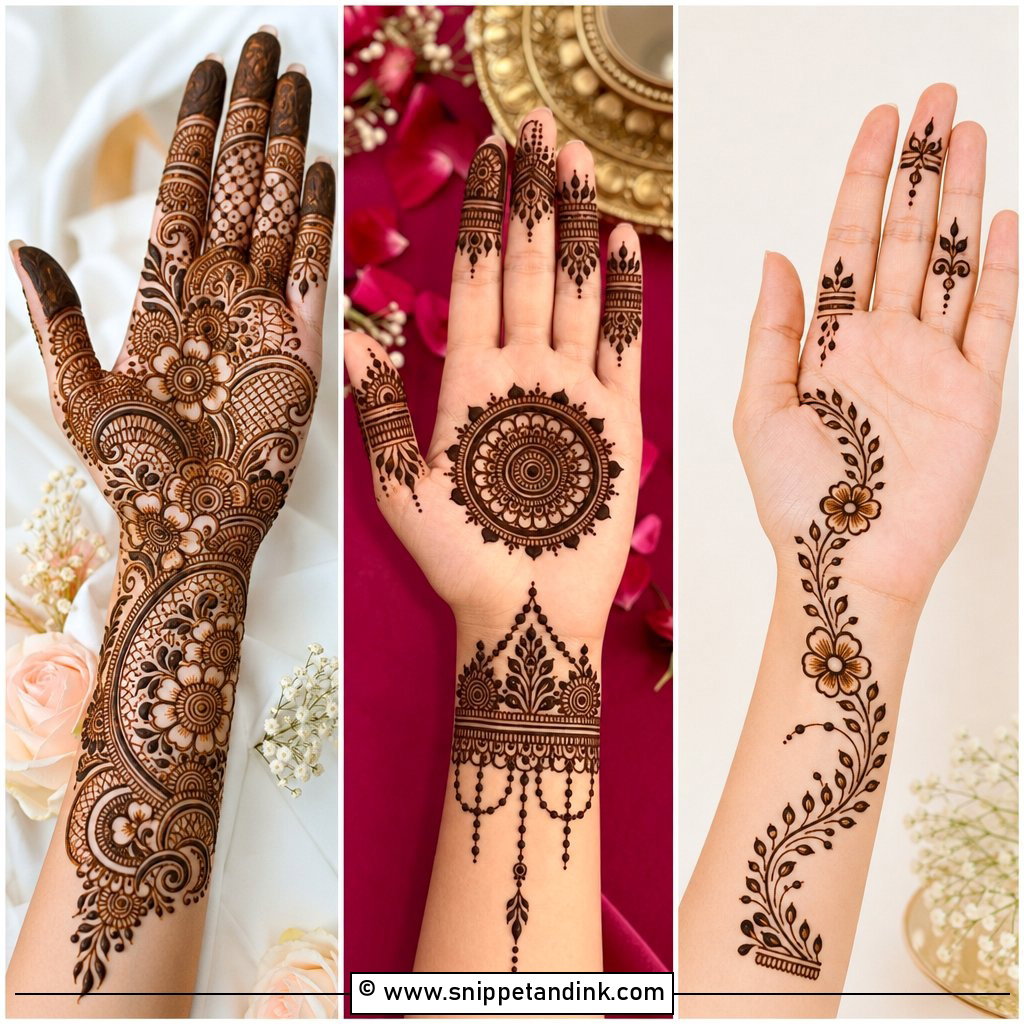
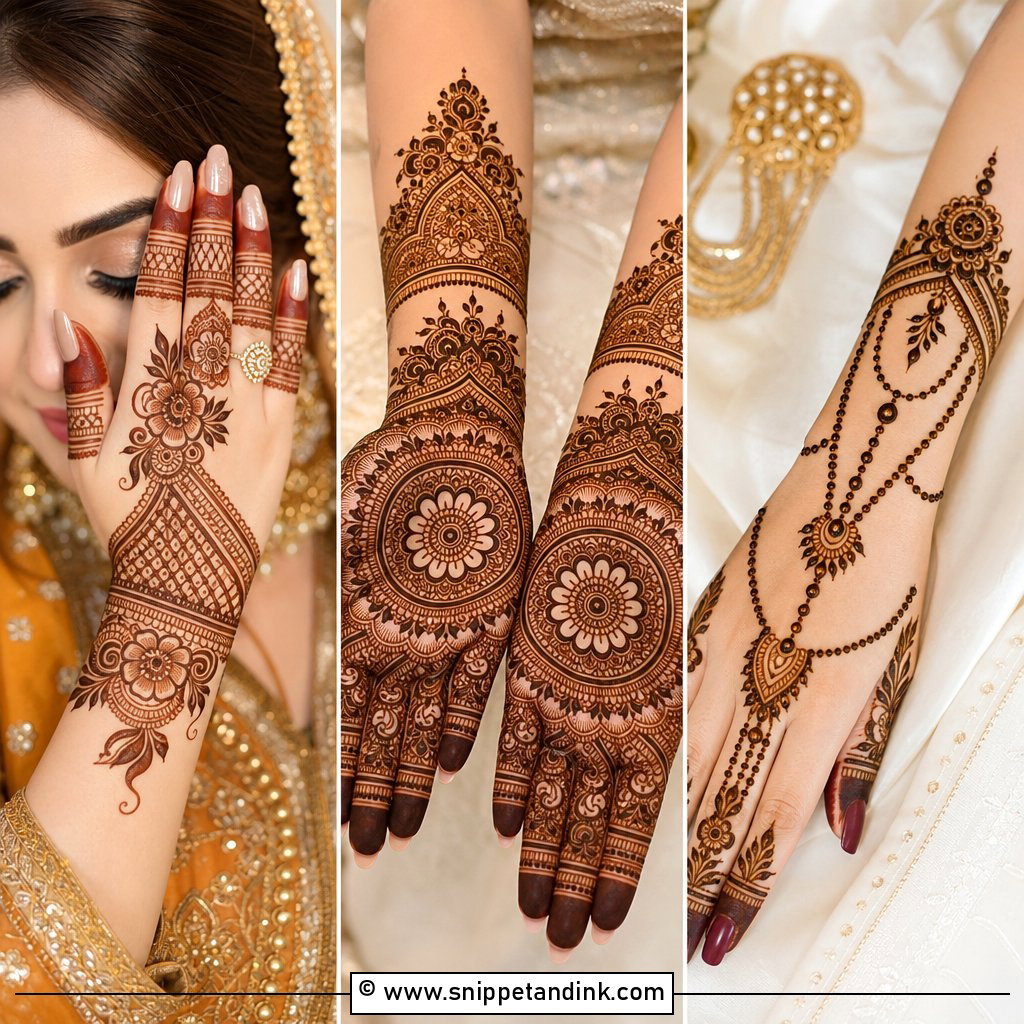
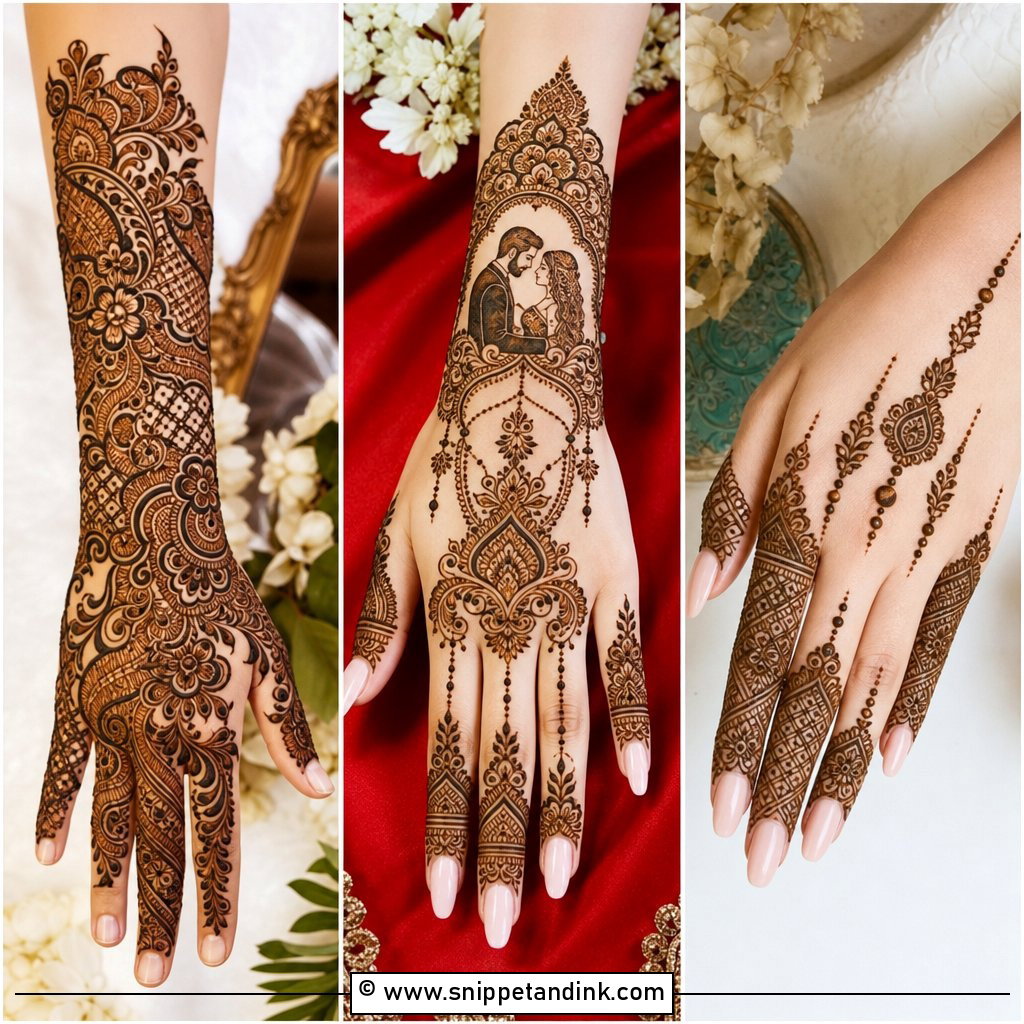
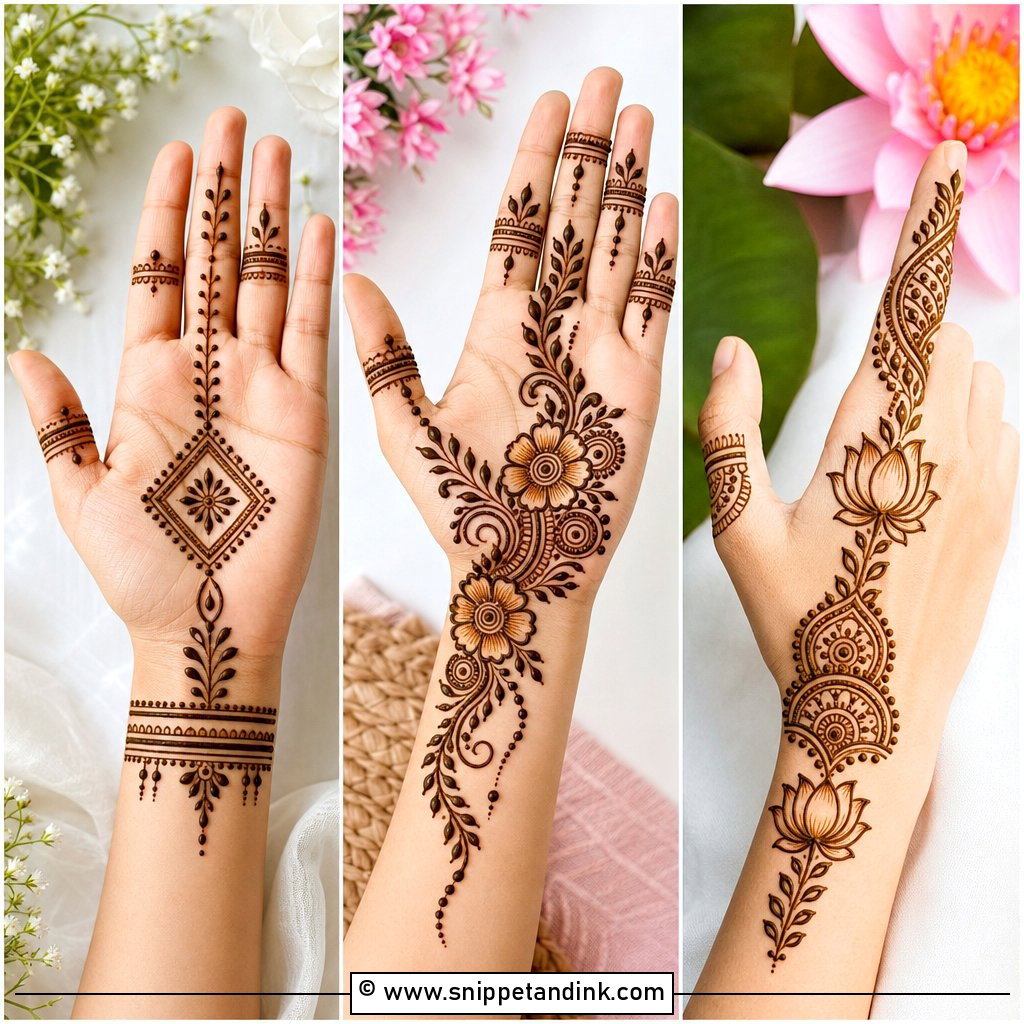
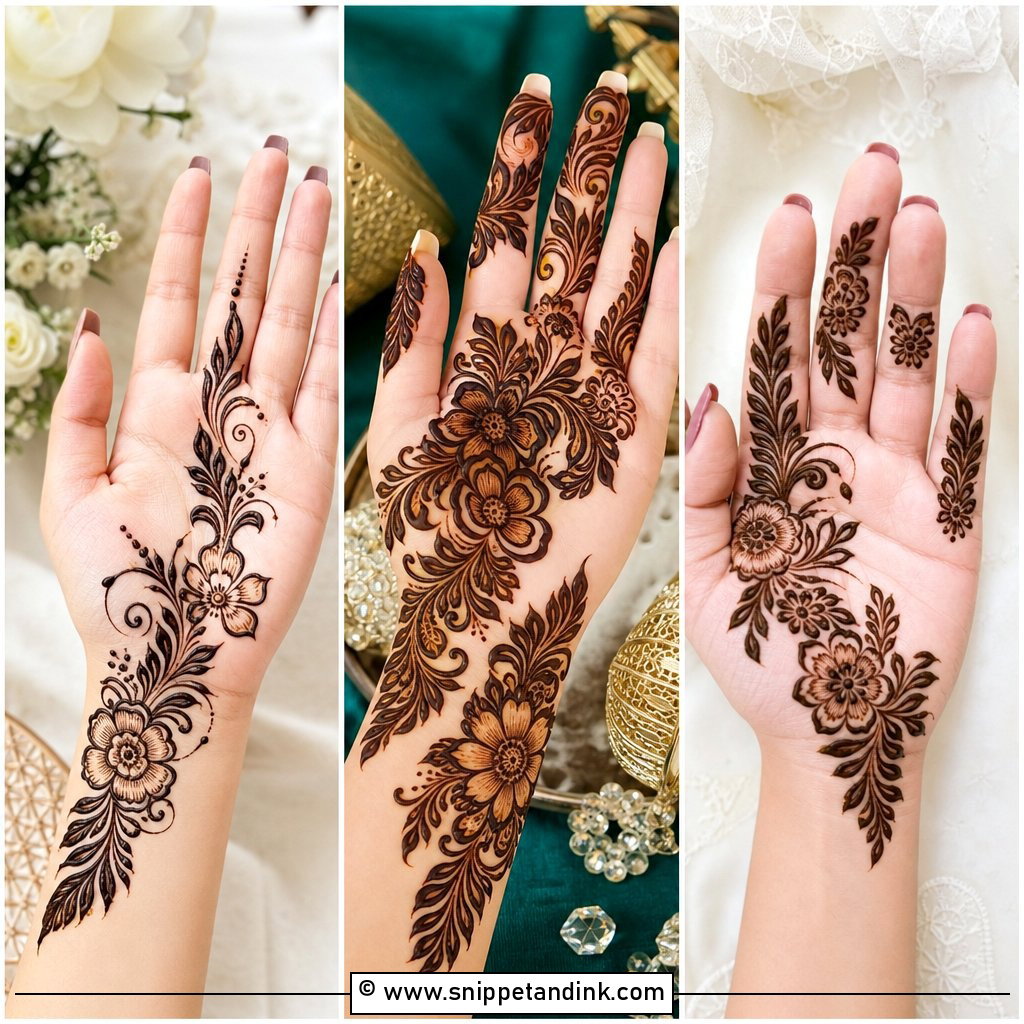
The front of the hand is the part of a bride’s mehndi everyone actually sees: when she lifts her palms for blessings, holds them out for jewelry shots, or joins them during the rituals. The work I’m asked for now mixes traditional Indian filling with Arabic flow, leaves deliberate open skin, and treats palm, fingers, wrist and forearm as one composition rather than four separate patches. Some brides want dense coverage, some want soft floral trails or royal peacock work, some want almost nothing. The right choice depends on your outfit, the ceremony and how long you can sit still. These are the front-hand layouts I’d walk a bride through, with what each one asks of her and of the artist.
Sleeves, Bangles and Sitting Time Decide the Layout
Before I sketch anything, I ask three practical questions. How far up will your sleeves or choli come? Where will your chooda or bangles sit? How many hours can you sit still? Those answers decide the design more than any photo you bring.
- Sleeves: if they end mid-forearm, I stop the main pattern a little above the hem so the edge peeks out instead of being cut off by fabric.
- Bangles and chooda cover the lower wrist. Detailed work there is wasted, so I’d rather put a clean cuff above them.
- Time: front-hand-only bridal work is a shorter sitting; full front and back on both arms can take most of a day.
- Ceremony: if you’ll be photographed with palms up for long rituals, the palm deserves the most planning.
Book the application one or two days before the main event. The stain needs time to deepen, and a design applied on the morning of the wedding will still be orange when you walk in.
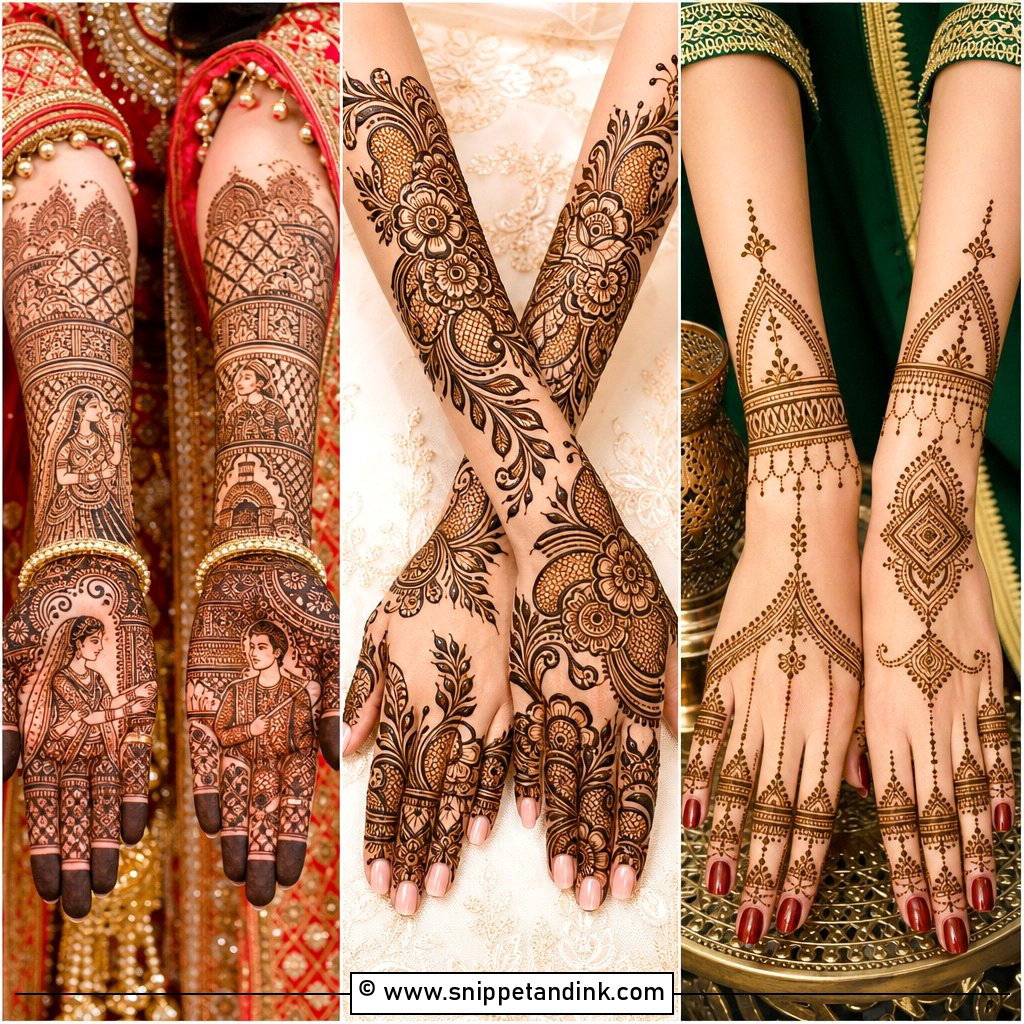
1. Full Hand Bridal Front Hand Mehndi Design
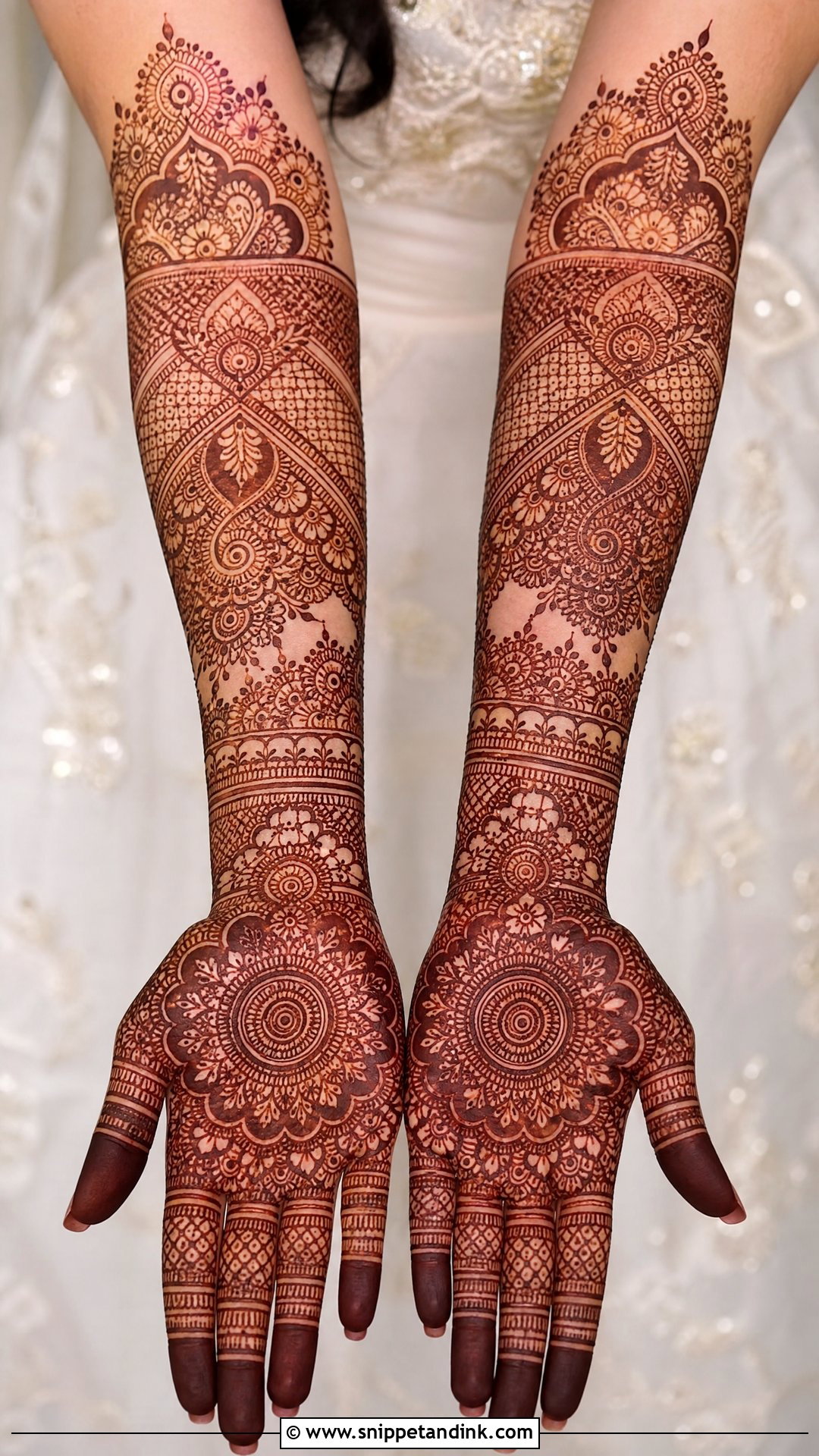
Full coverage runs from fingertips to forearm: a central mandala, lotus or couple motif on the palm, lined and banded fingers, then layered borders, paisleys and jaali up the arm. It’s the most traditional bridal finish and the longest sitting, often several hours for the front alone. What separates good full hand designs from muddy ones is small breathing gaps between sections. Without them, the stain darkens into one brown mass and the detail you sat for disappears in photos. I plan those gaps in pencil-thin lines before I fill anything.
2. Indian Bridal Front Hand Mehndi Design
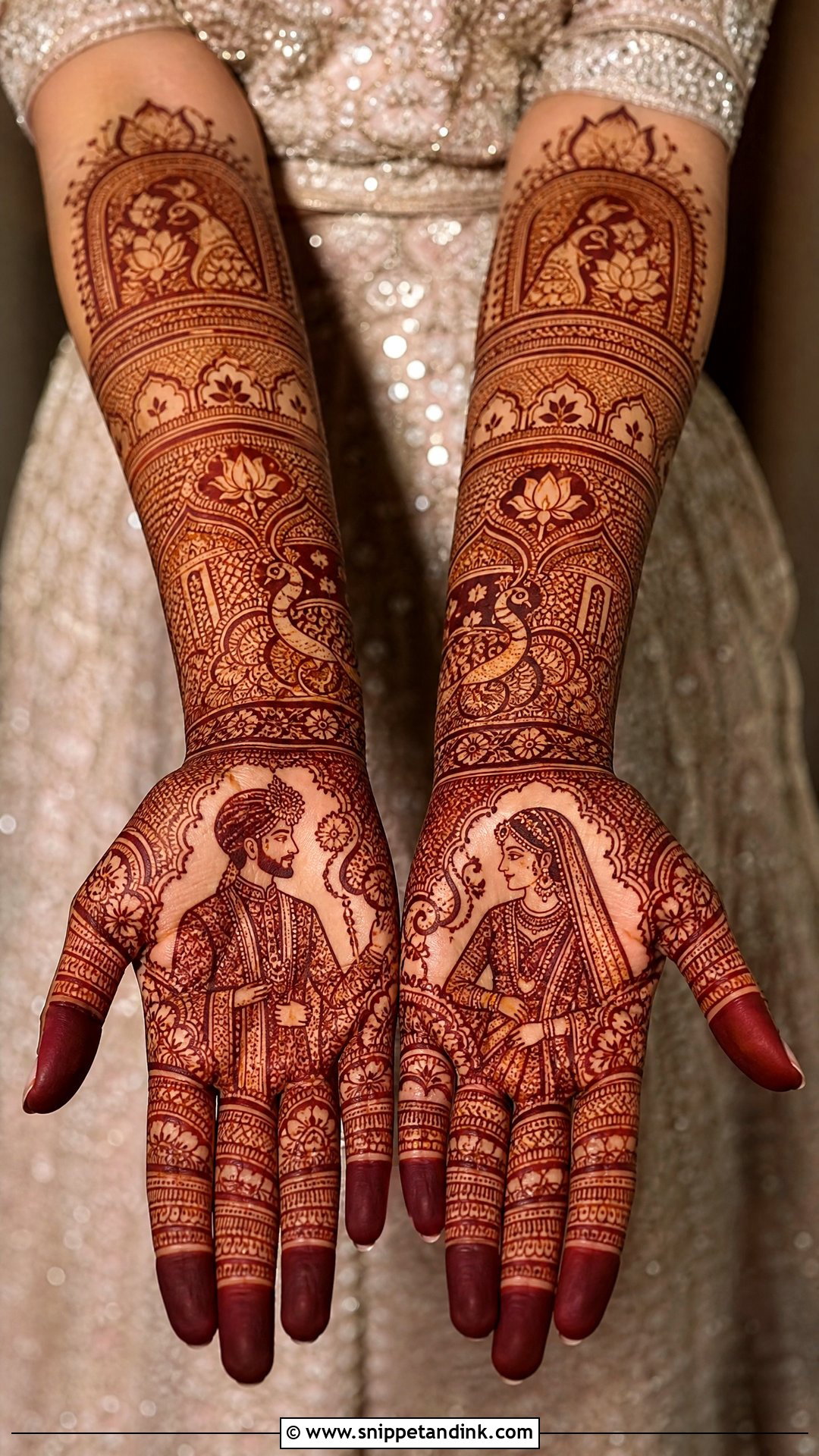
Indian bridal work is where the storytelling lives: paisleys, peacocks, lotus, kalash, mandalas, sometimes portraits of the couple, all held together with fine filler. The palm carries the main scene and the fingers and arm support it. I’ve moved toward giving portraits and focal motifs a clean border of bare skin, because a face buried in filler reads as a smudge once the stain settles. It sits naturally with lehengas, sarees and heavy embroidery, and it holds up to close-up ritual photography when the focal points are clear.
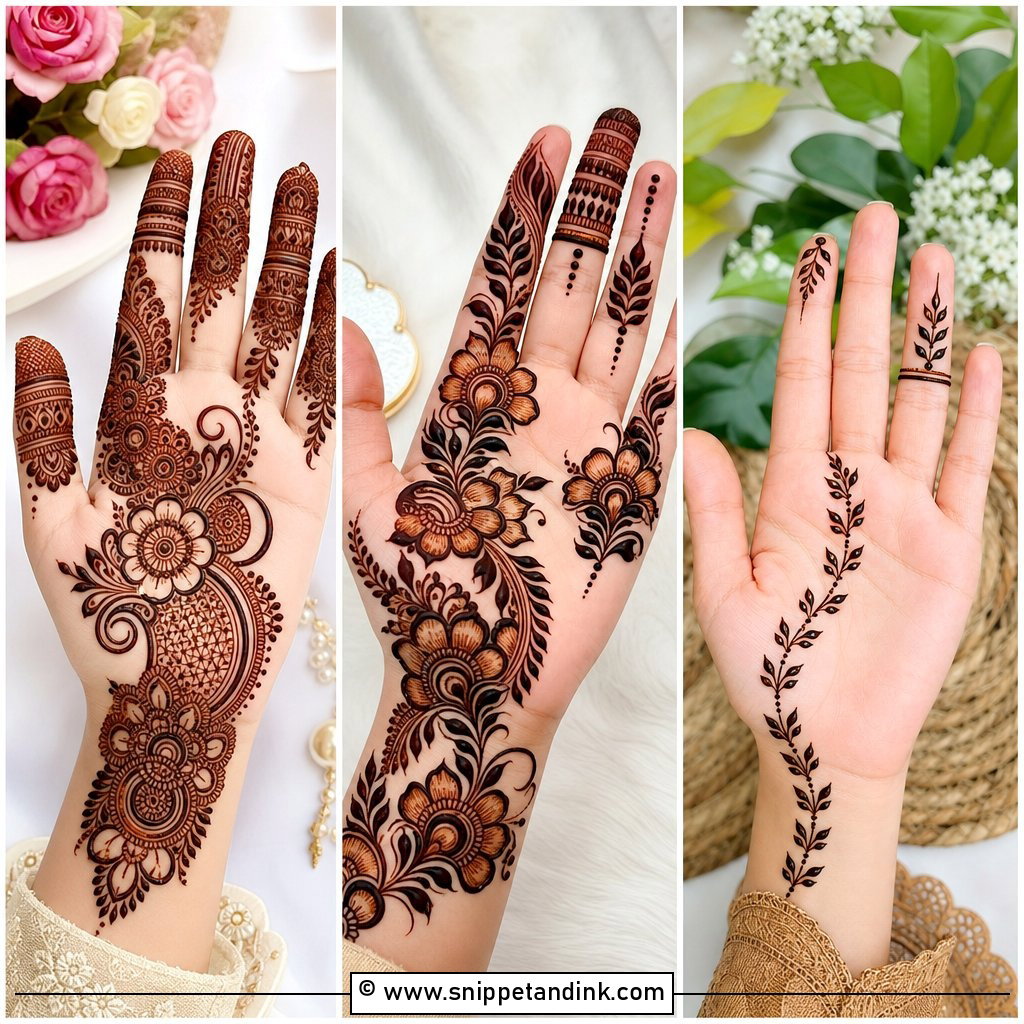
3. Arabic Bridal Front Hand Mehndi Design
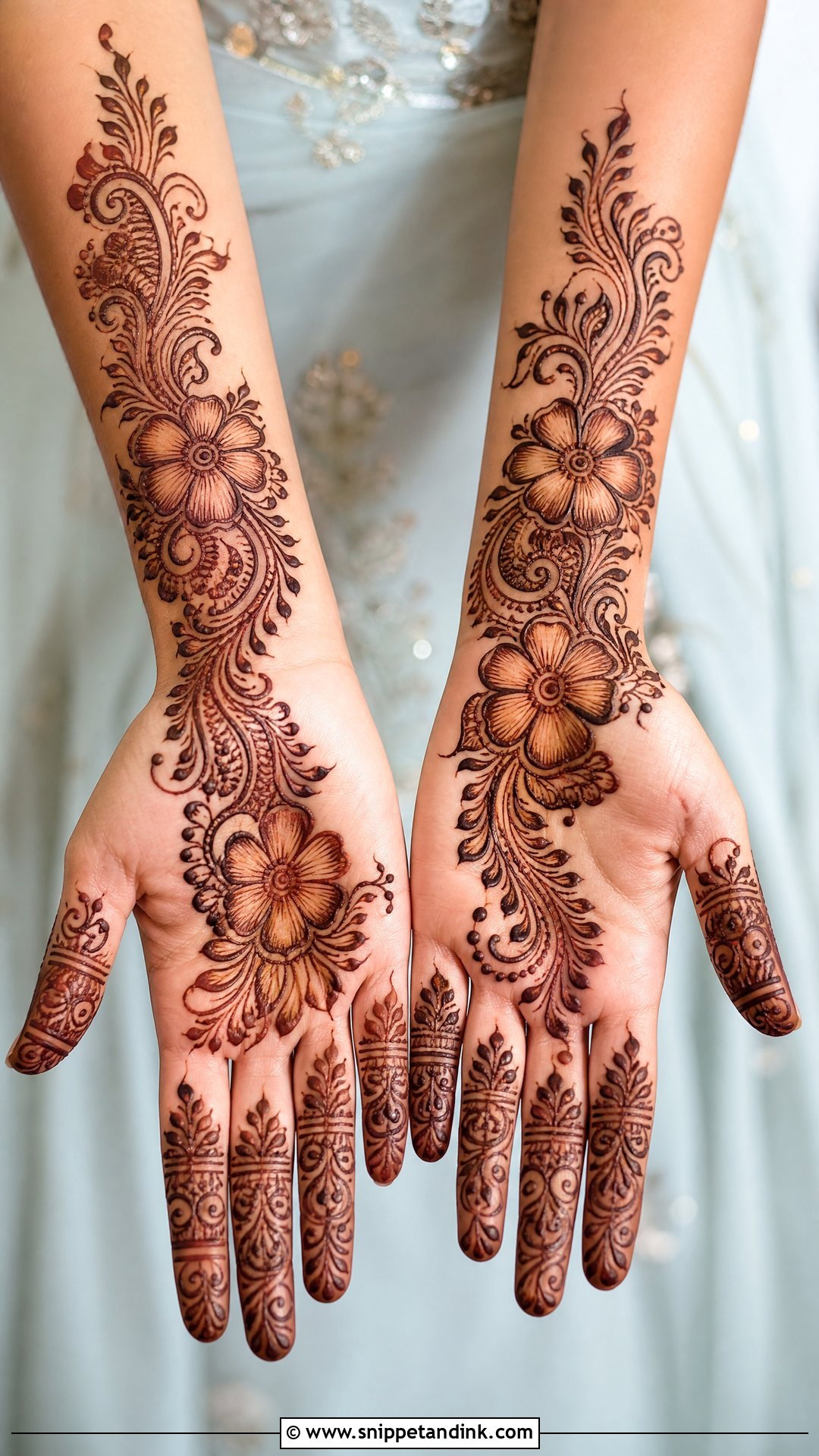
Arabic layouts travel diagonally from wrist to fingers with bold flowers, leafy vines and shaded petals, leaving open skin around them. That open skin is the design, not a shortcut. For a bride I’ll often tuck finer Indian-style detail inside the larger petals so the hand looks richer up close. It suits engagements, nikah, receptions and destination weddings, and the bold outlines stain clearly. The shading needs a thinner cone mix than the outlines, otherwise the gradient turns patchy instead of soft.
4. Indo Arabic Bridal Front Hand Mehndi Design
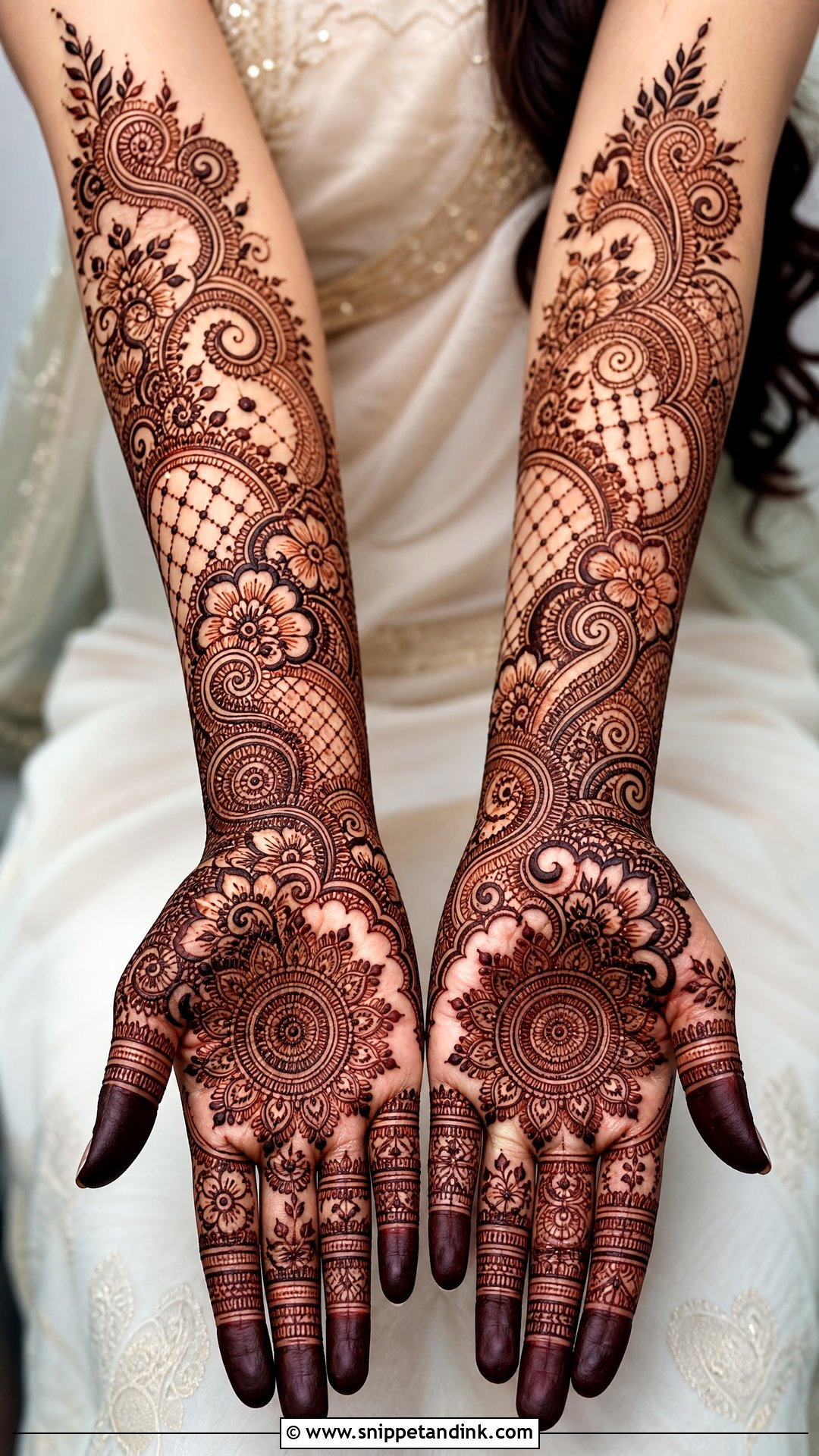
Indo-Arabic takes the sweeping trail of Arabic mehndi and fills its spaces with Indian detail: a mandala, floral cluster or paisley on the palm, then a diagonal flow along the outer hand with jaali, dots and tiny leaves in the gaps. It’s the layout I suggest most when a bride can’t decide, because it reads at a distance and still rewards a close look. I keep the diagonal pointing toward the thumb on both hands, mirrored, so the hands look like a pair when held together.
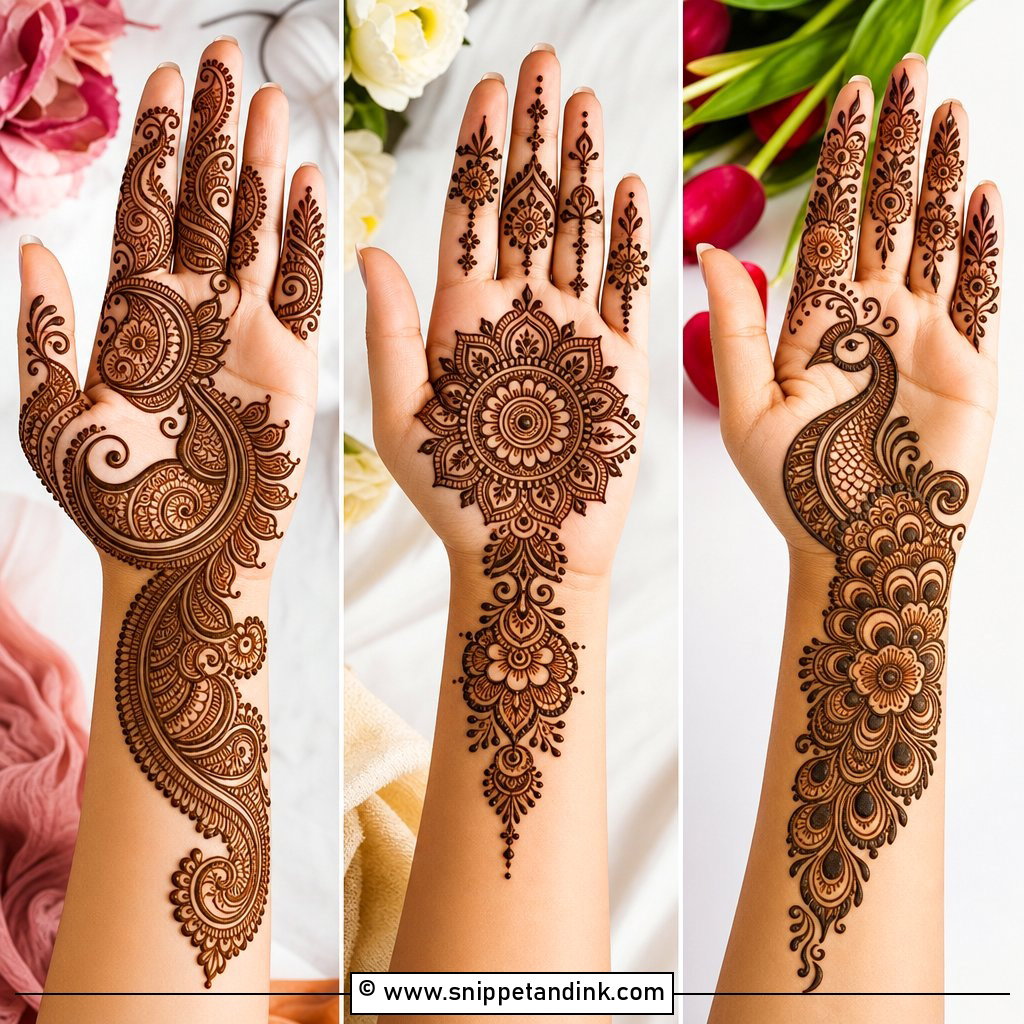
5. Mandala Bridal Front Hand Mehndi Design
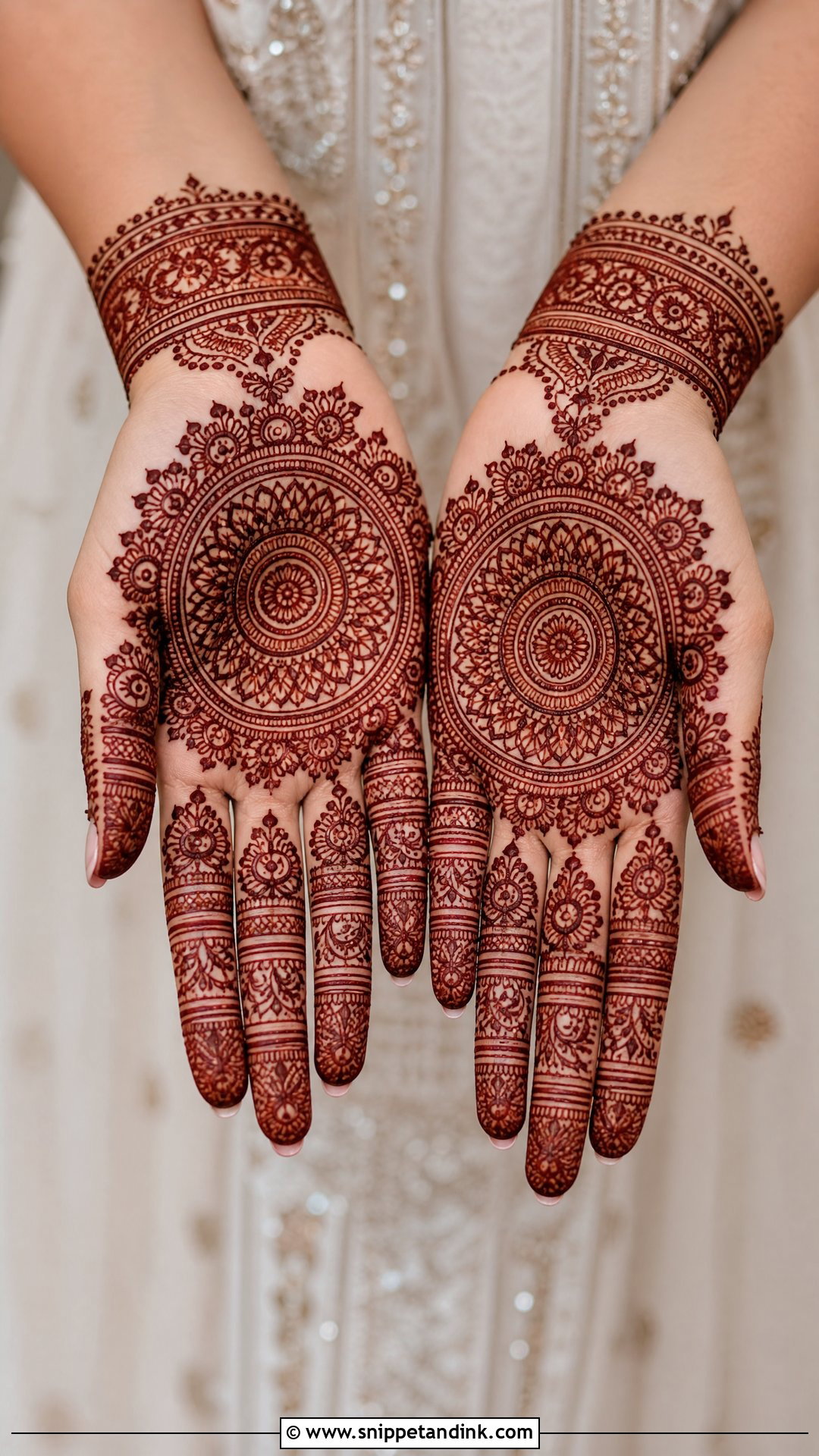
A palm mandala starts from one center point and grows outward in rings of petals, dots and lines. I draw it from the center out and check the circle against the palm crease, since the crease shifts when the hand cups and can pull a slightly off-center mandala into an oval. For a bridal finish, add filled fingertips, wrist cuffs and forearm bands. Softer spacing and lotus edges keep it from feeling heavy. Mirrored on both palms, it photographs clearly beside bangles and rings.
6. Lotus Bridal Front Hand Mehndi Design
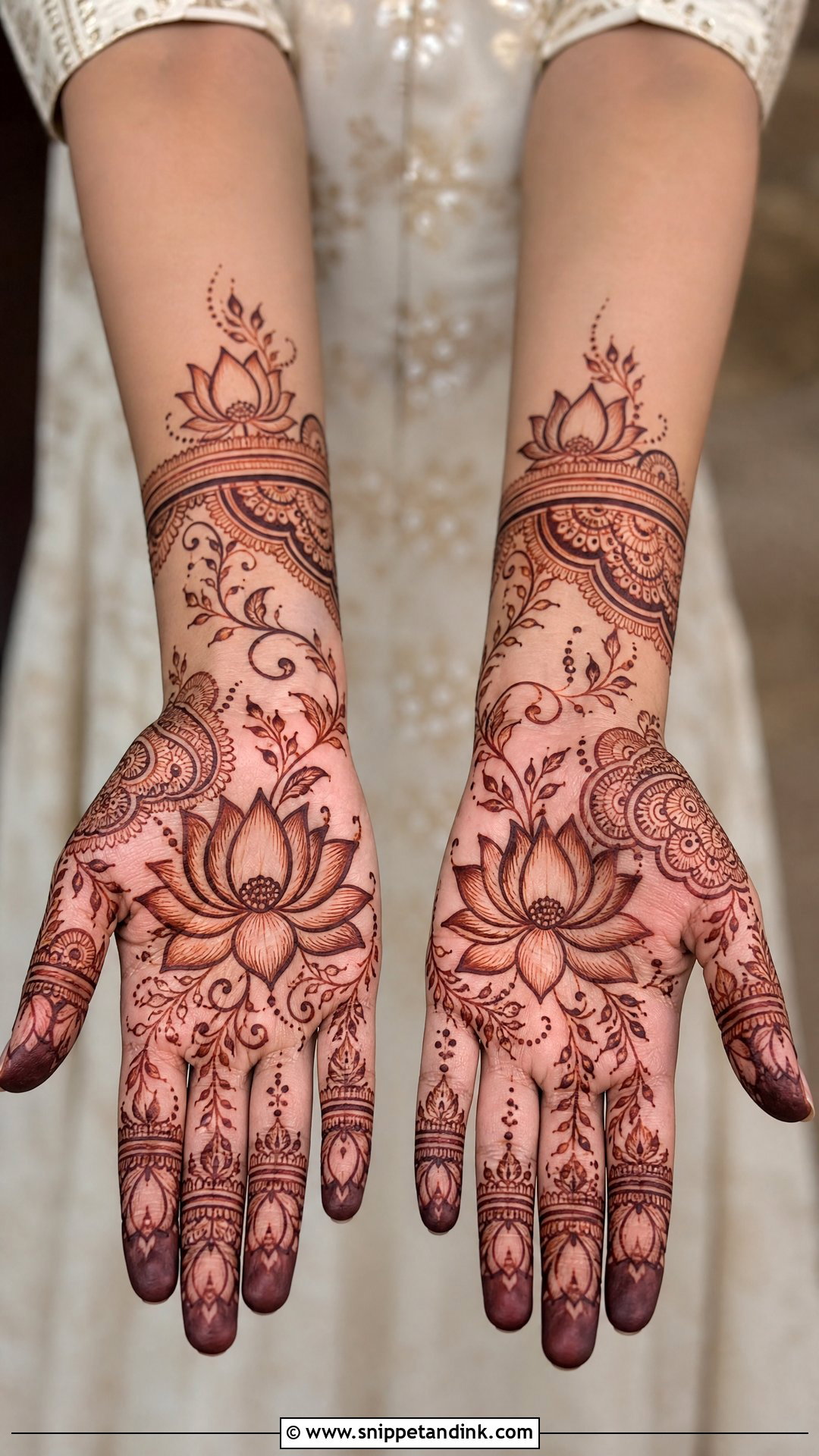
Lotus motifs can sit at the center of the palm, frame the wrist or layer up the forearm. The petals want a firm outline and light inner work, fine lines and dots rather than solid fill, because solid fill on a large petal stains unevenly where the skin is thicker. I pair lotus with slim leafy trails or a little jaali for a cleaner look. It suits pastel outfits, temple jewelry and floral themes, and it carries meaning for many families.
7. Peacock Bridal Front Hand Mehndi Design
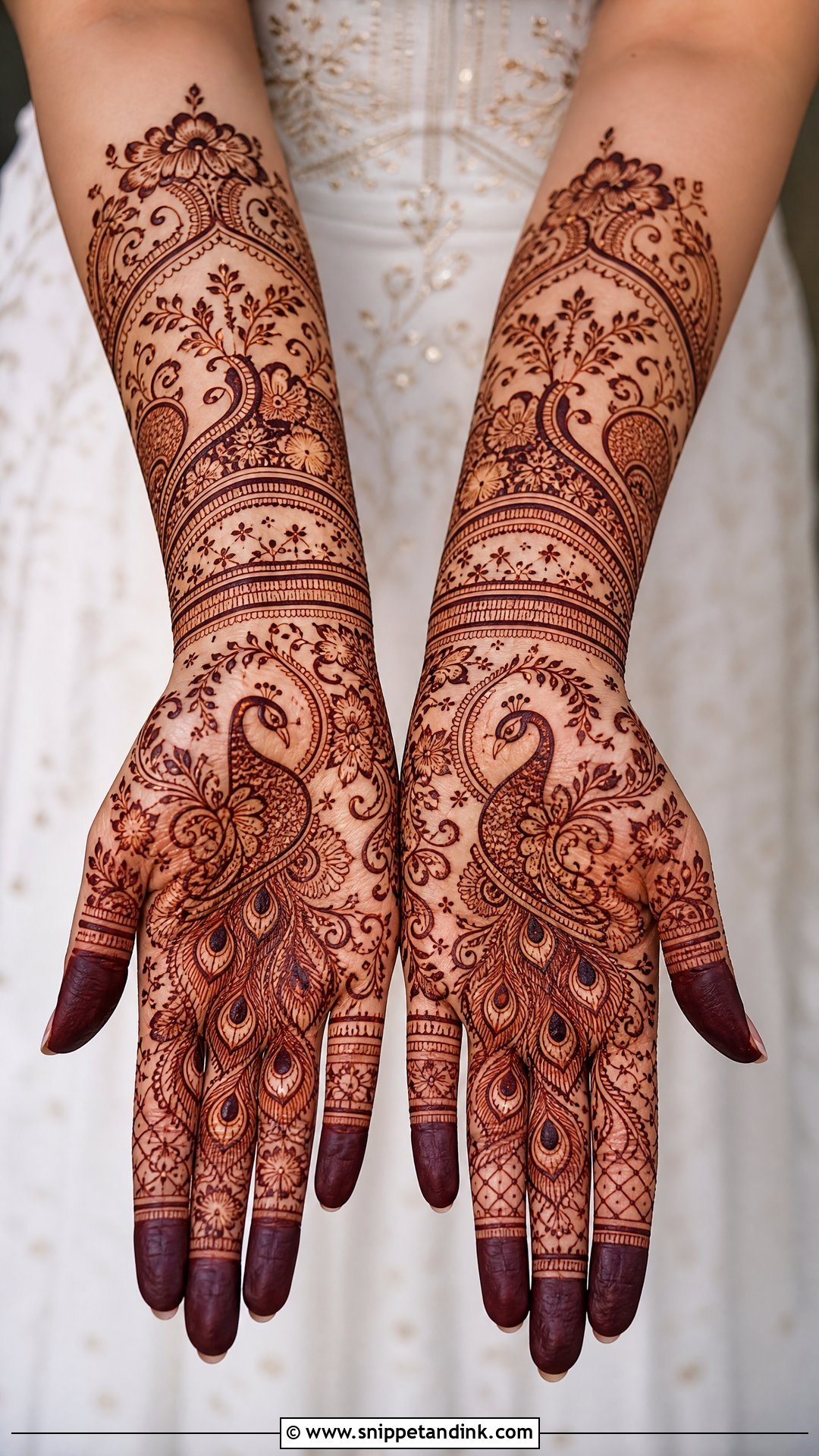
A single strong peacock now reads better than three crowded ones. I place it on the palm, near the wrist or along the forearm, then let the feathers carry the detail with curves, dots and mesh. The neck is the hardest part: it’s a long curve drawn in one stroke, and a wobble there shows more than anywhere else. Lotus borders, filled fingertips and layered wrist bands complete it. It’s at home with red, maroon, gold and jewel-toned outfits at traditional weddings.
8. Bride Groom Bridal Front Hand Mehndi Design
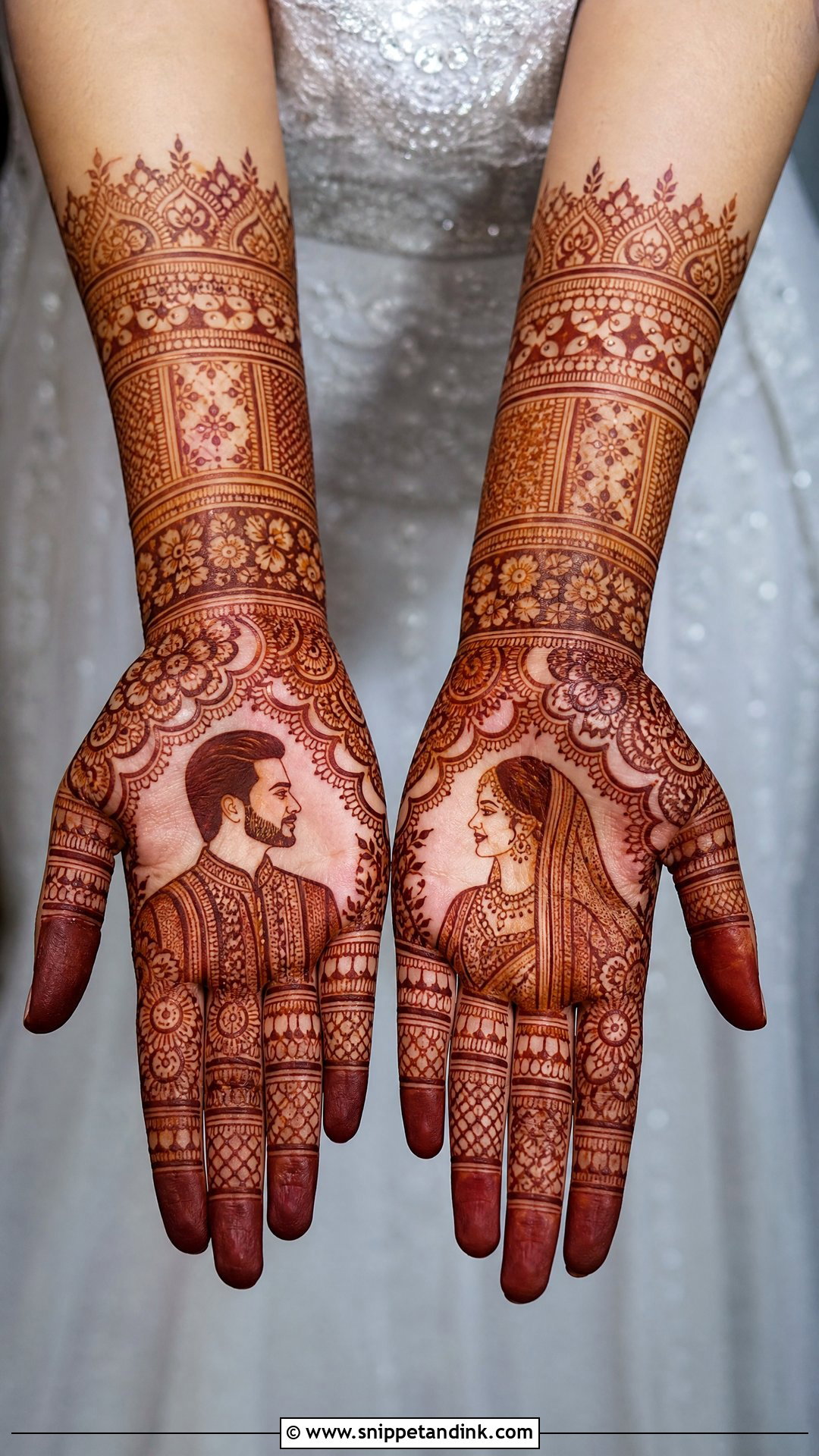
One palm for the bride, one for the groom, framed with mandalas, curtains, paisleys or wedding symbols, with initials, small hearts or ritual details on the fingers. Modern portrait mehndi uses fewer lines for the faces so they stay defined. I’d only book this with an artist whose own portrait work you’ve seen stained, not just freshly applied, because faces blur easily. Placement matters too: I keep the portraits off the deepest palm crease, where the skin folds and distorts the features.
9. Rajasthani Bridal Front Hand Mehndi Design
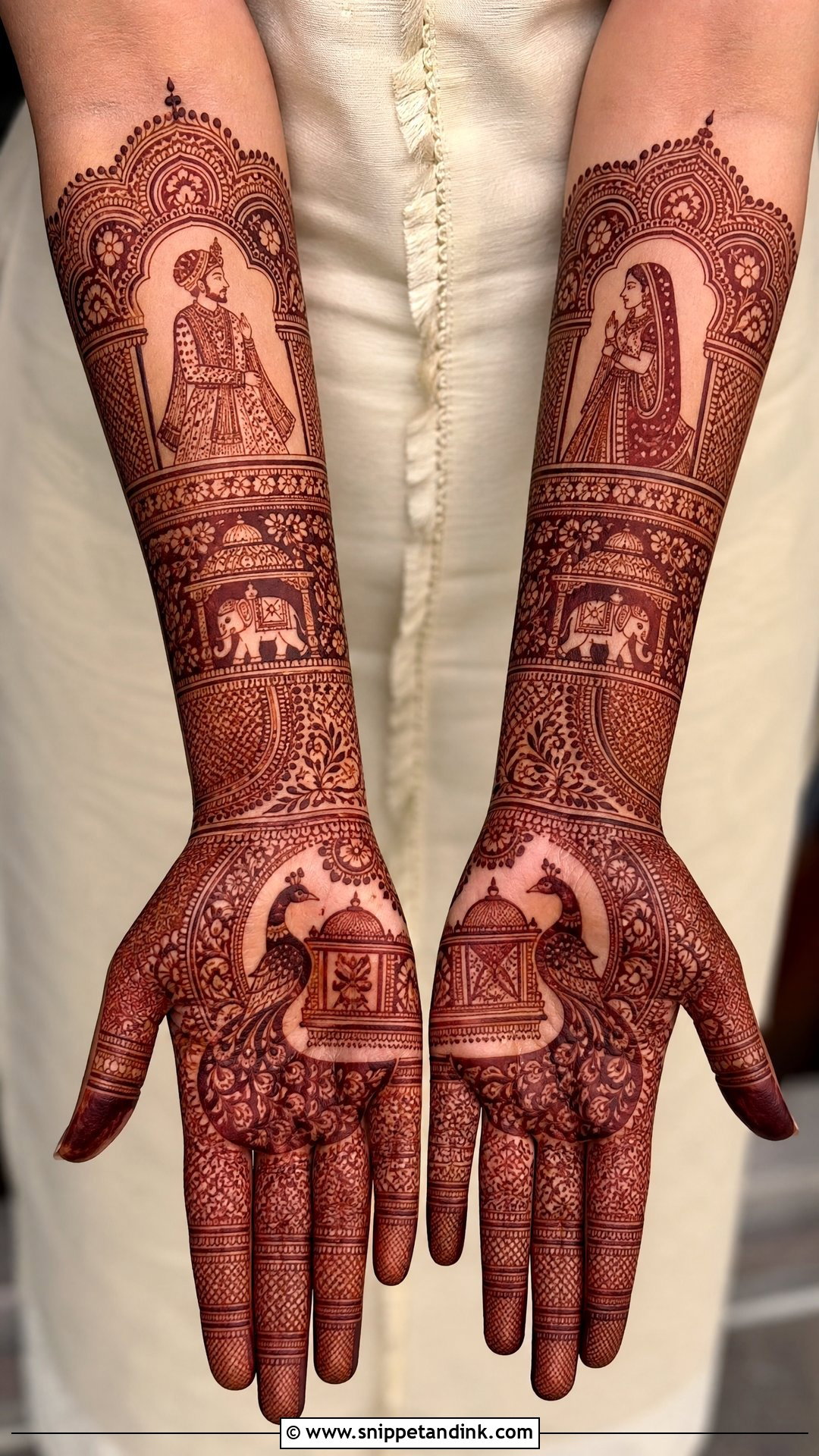
Rajasthani work is dense and ornamental: couple art, elephants, peacocks, palanquins, mirror patterns, paisleys. The palm and forearm are laid out like story panels. The refresh I do is cleaner borders between panels and a little more space around the main figures so they read in close-ups. If heavy mehndi and a regal main-day look are what you’re after, this is it. Expect a long sitting, and ask for breaks to move your fingers, because holding a hand flat for hours makes it ache and shake.
10. Pakistani Bridal Front Hand Mehndi Design
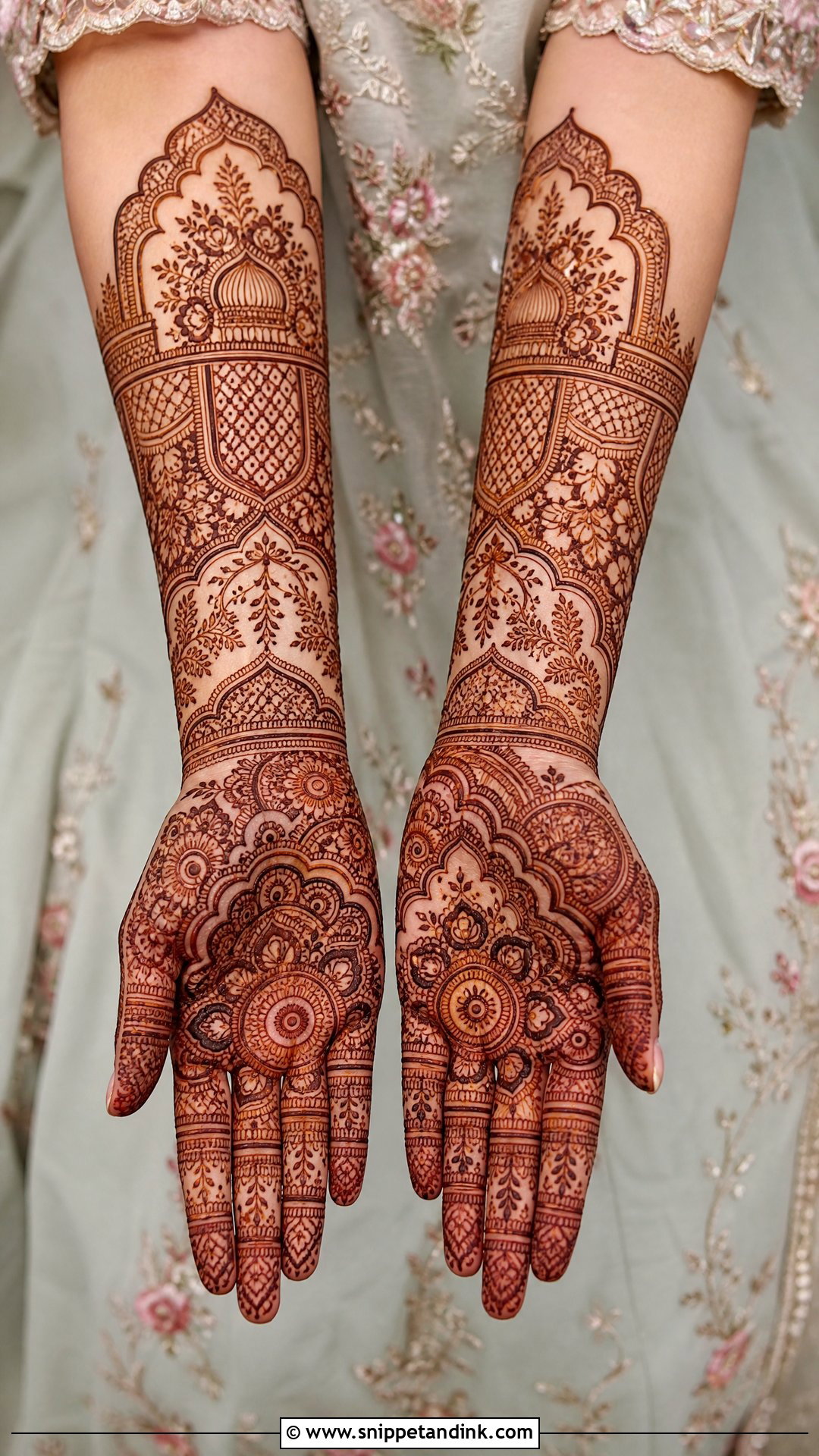
Pakistani bridal mehndi mixes florals, domes, jaali, paisleys and fine fingertip work, usually a touch lighter than very dense Indian coverage. A floral mandala or ornamental frame anchors the palm, with long leafy lines and fine bands on the fingers. Subtle arch shapes and symmetry are common. It suits nikah, walima, engagement and the wedding itself. I’d describe it as detailed coverage that still lets the skin breathe, which keeps it comfortable and clear on camera.
11. Moroccan Bridal Front Hand Mehndi Design
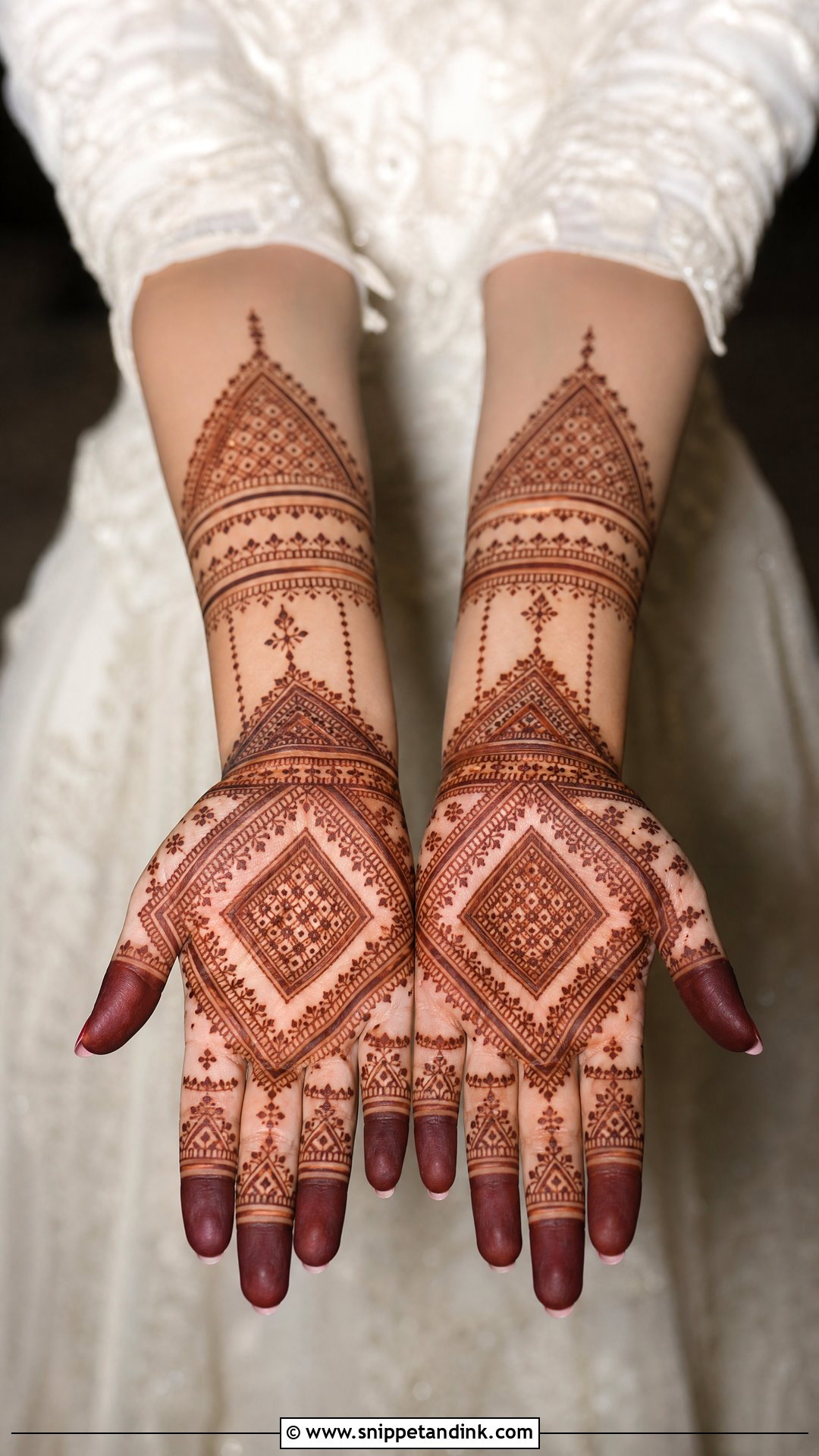
Moroccan henna swaps vines and paisleys for diamonds, grids, triangles and structured bands. On the palm, fingers and wrist it creates strong symmetry, softened with small dots and fine borders. It’s my suggestion for brides who don’t like heavy florals. Straight lines are less forgiving than curves, so I draw them with a fine-tipped cone and steady the hand on a cushion; a shaky line in geometric work stands out immediately. It looks modern while staying rooted in tradition.
12. Gulf Bridal Front Hand Mehndi Design
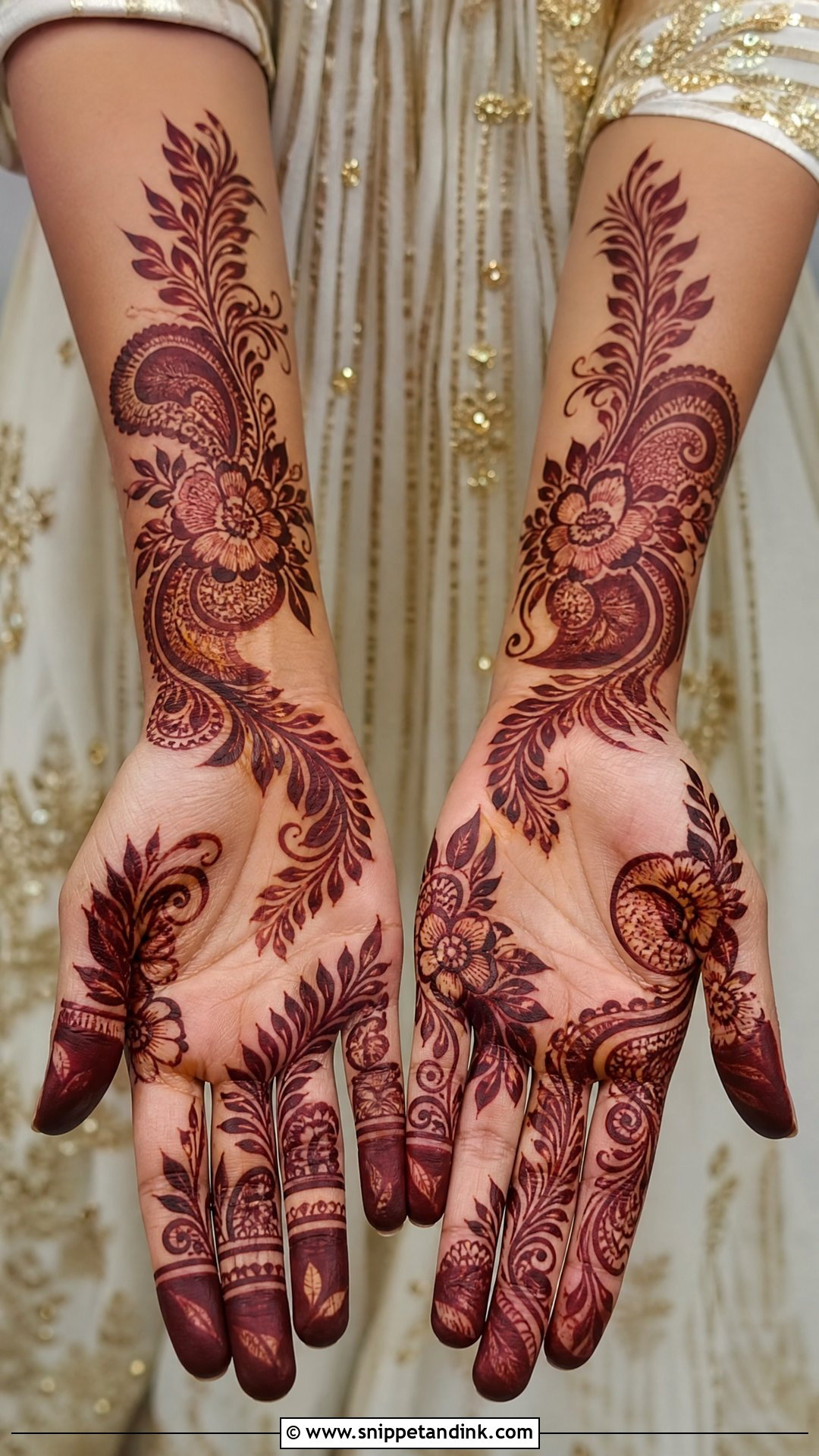
Khaleeji-inspired mehndi uses big florals, leafy curves, open skin and solidly filled areas for contrast, sweeping from the wrist across the palm. The motifs are much larger than Indian filler, so the stain shows strong and clear. Those filled areas need a generous layer of paste to stain evenly, and they are the first spots to crack and flake, so I seal them well. It suits receptions, engagements and modern looks where jewelry and henna share attention.
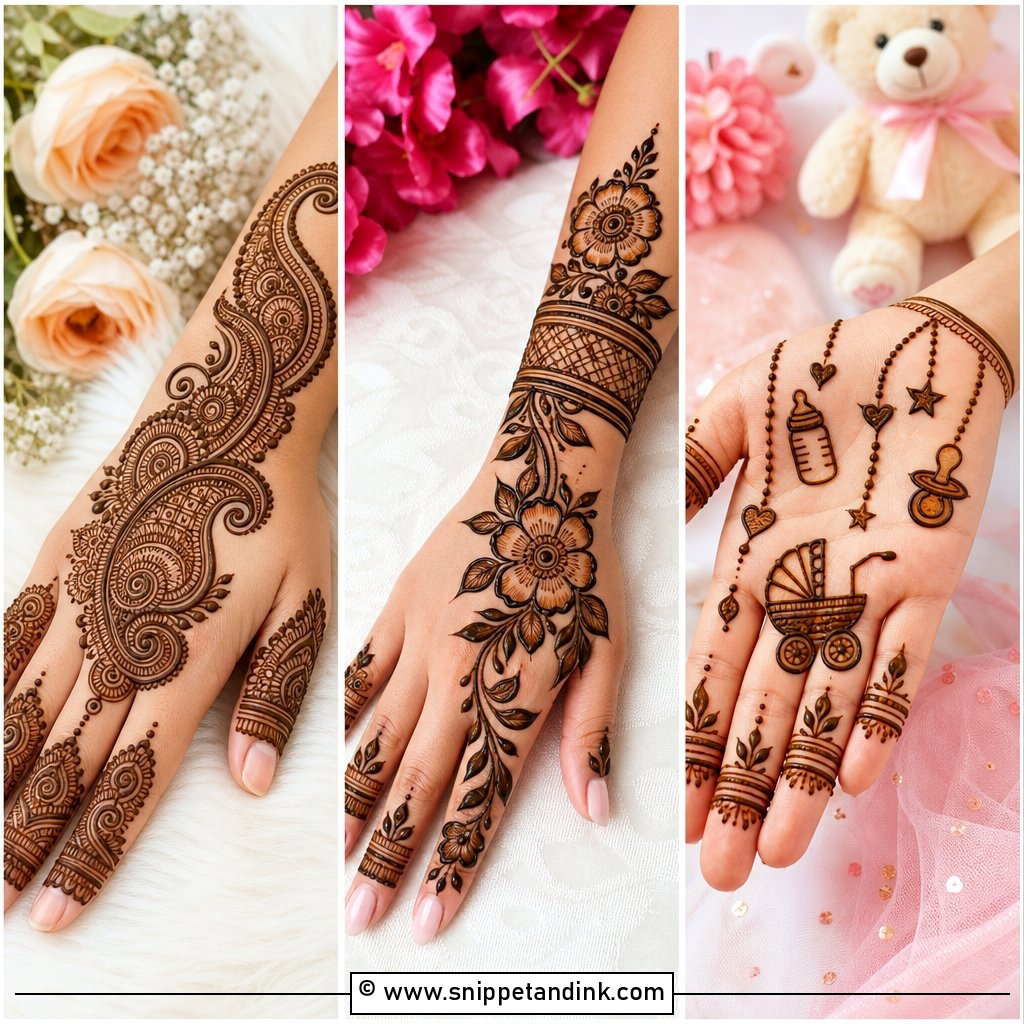
13. Floral Bridal Front Hand Mehndi Design
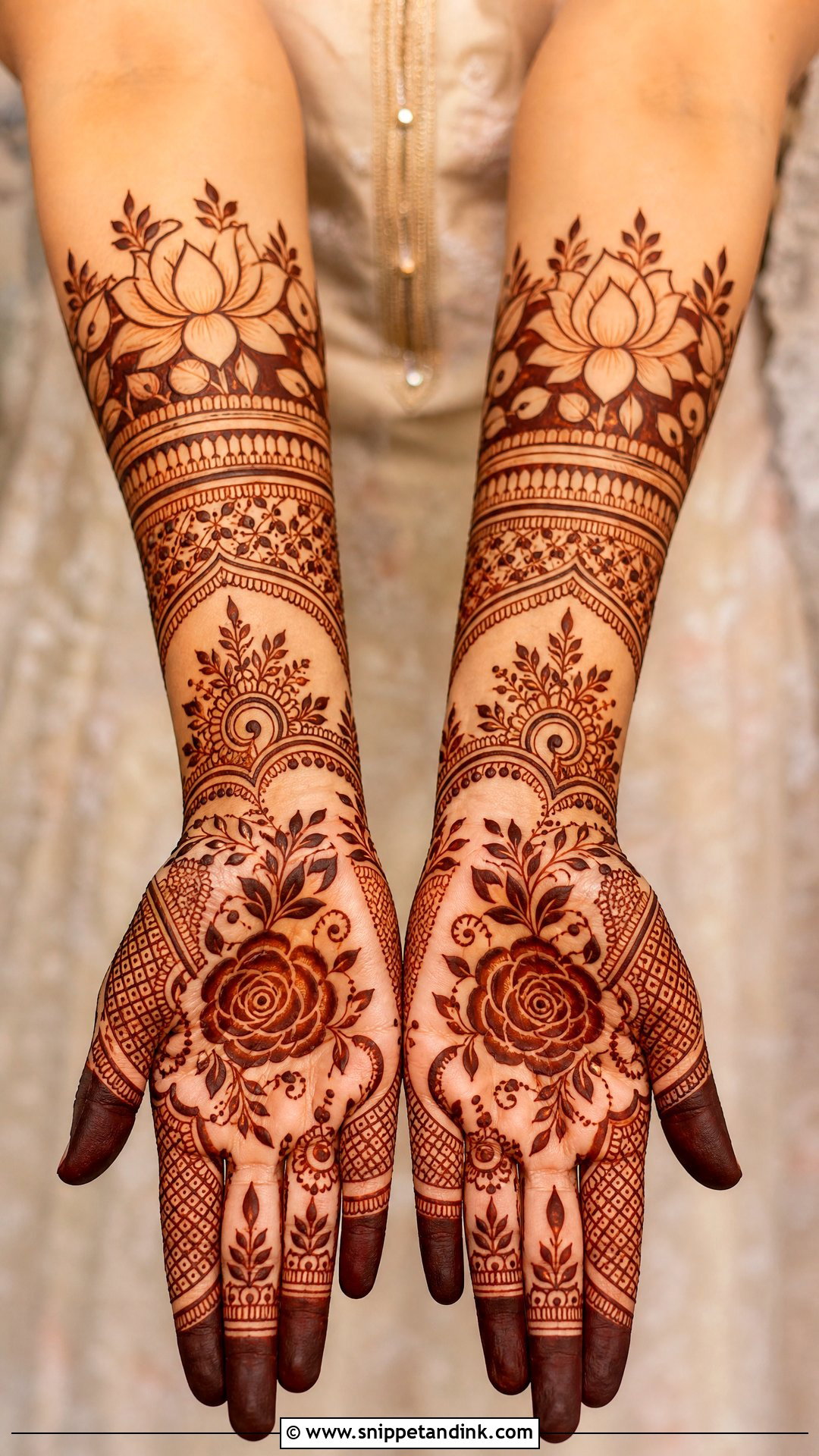
Florals are the most adaptable family I work in: a large rose, lotus or layered flower on the palm, vines, leaves and petal bands on the fingers, floral cuffs and paisley borders for fuller coverage. Bold outlines with lighter inner detail stain the clearest. I can scale florals from a light sangeet design to full bridal, which is why they suit almost anyone. They also sit nicely in ring and bangle photos, since the curves frame the jewelry rather than crowding it.
14. Paisley Bridal Front Hand Mehndi Design
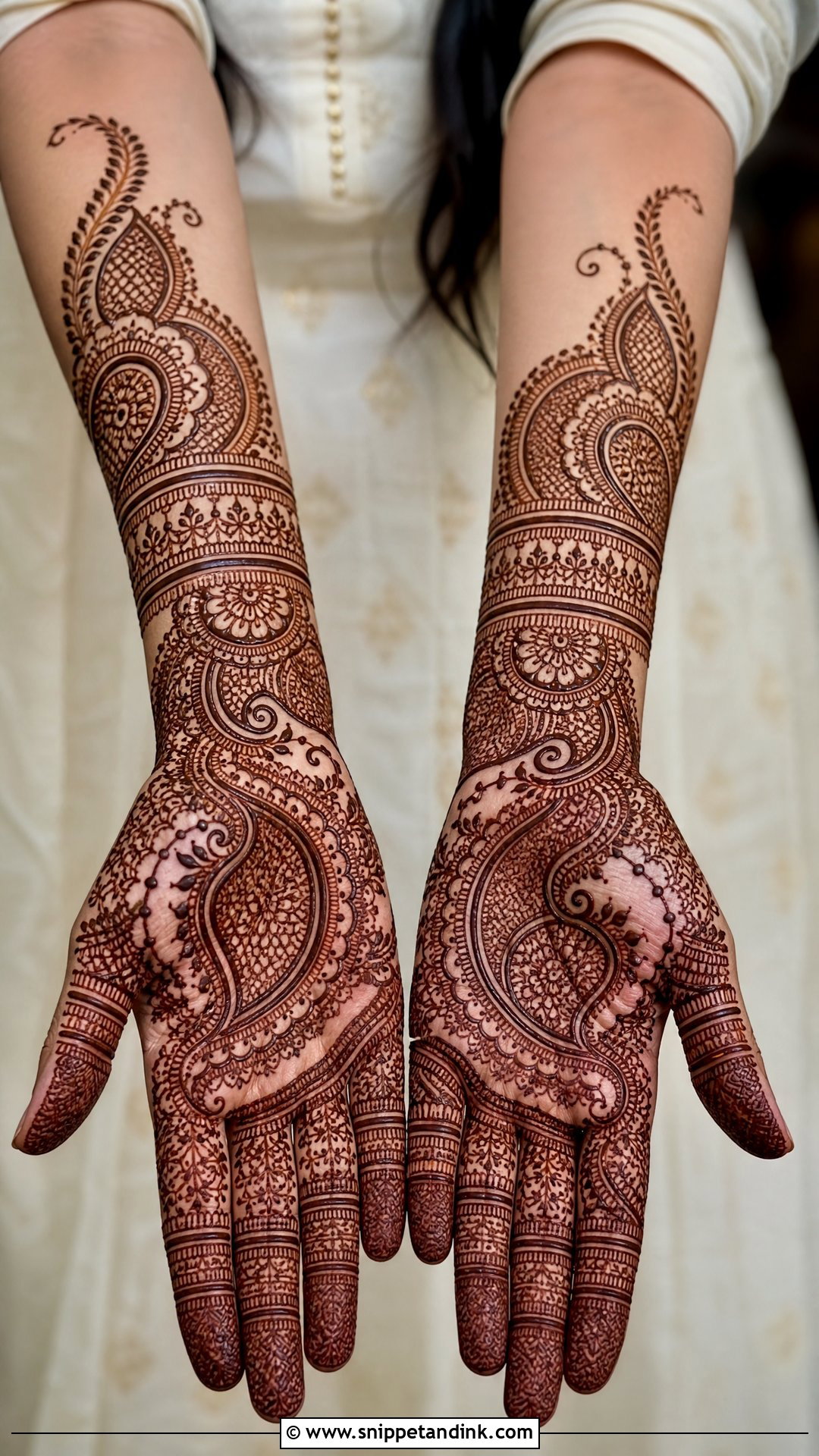
Paisleys curve around the palm, cluster near the wrist or chain into a full forearm pattern, each one filled with tiny flowers, dots, mesh or curved strokes. The flow is what matters now; I angle every paisley so the eye moves along the hand rather than bouncing between motifs. Matching paisley tips or slim leaf lines finish the fingers. It’s my answer when a bride asks for traditional mehndi without portraits, and it suits silk sarees, lehengas and heavy bangles.

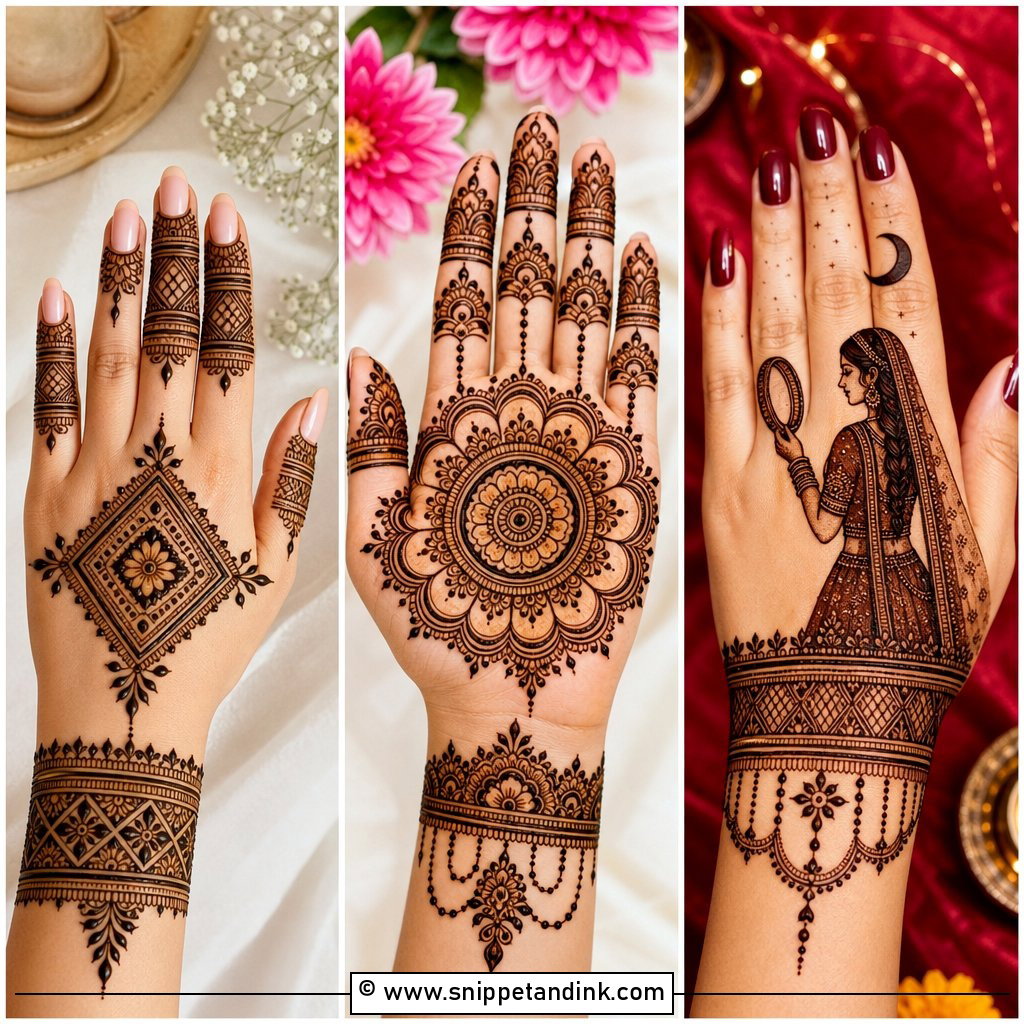
15. Jaali Bridal Front Hand Mehndi Design
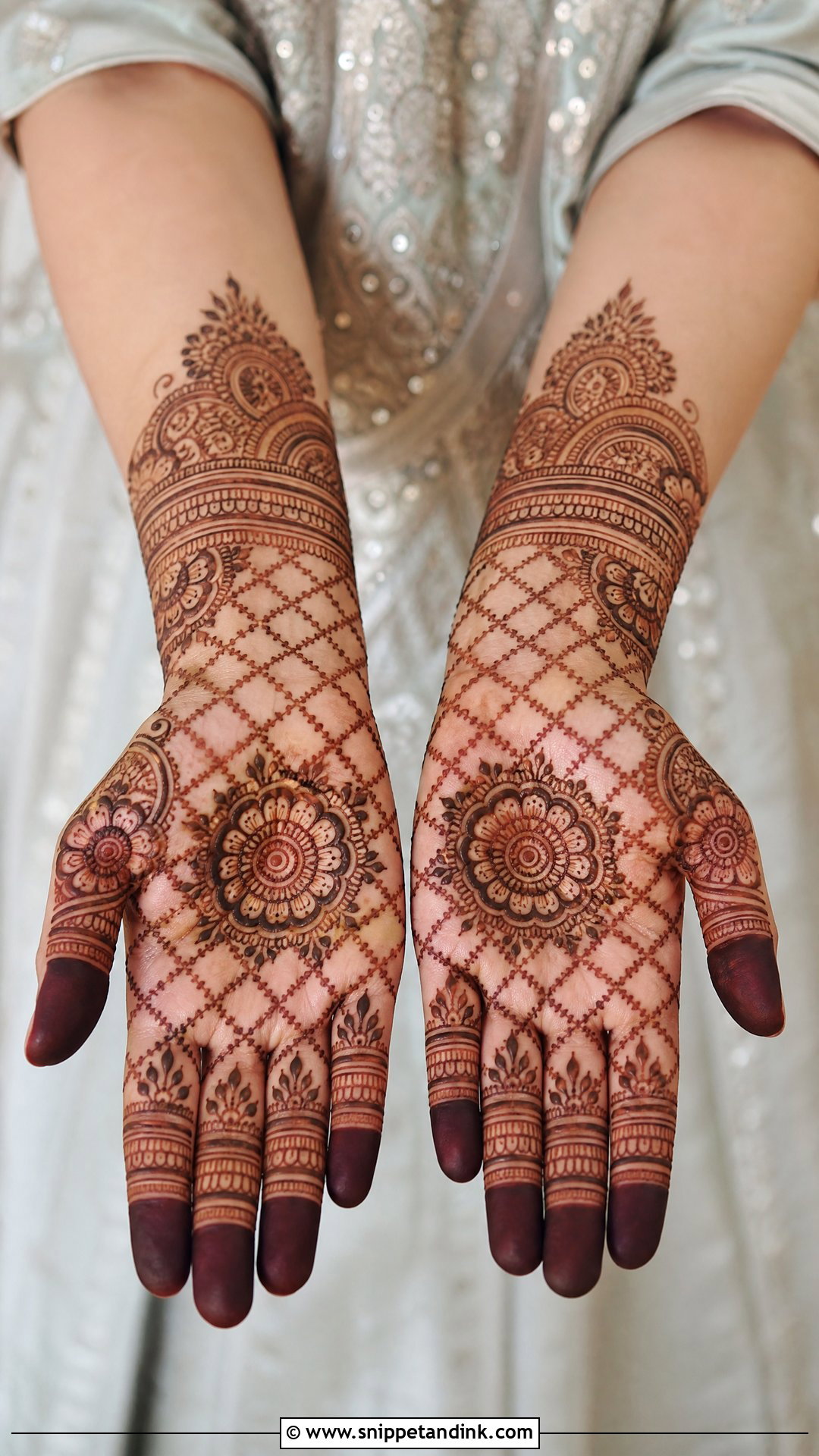
Mesh work adds a fine, net-like texture. A jaali bridal front hand usually mixes sections of grid with florals, mandalas and paisley borders. The mesh has to be even and not too tight: lines drawn closer than the paste spreads will merge as they stain, and the net becomes a dark block. I leave a gap of skin wider than the line itself. Mixed grids and bracelet-style cuffs feel current, and jaali gives texture without weighing the hand down.
16. Jewelry Bridal Front Hand Mehndi Design
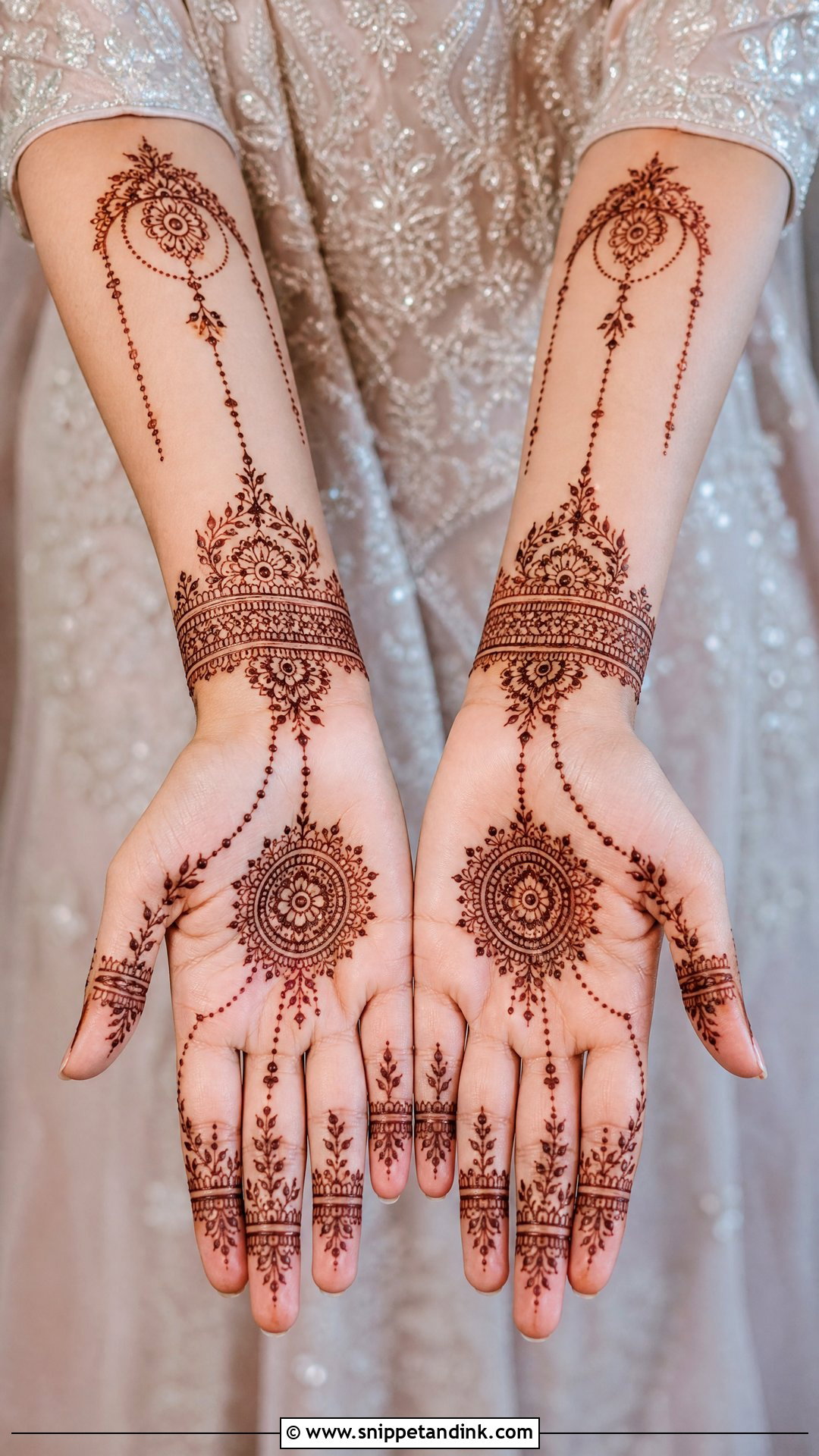
Ring chains, bracelet cuffs, hathphool-inspired lines, finger bands and wrist patterns make the hand look adorned before any real jewelry goes on. The palm stays lighter with a mandala or floral center. I ask brides to bring the actual rings and bangles they’ll wear, so the drawn chains end where the metal begins instead of disappearing under it. It suits engagement, haldi, sangeet and smaller ceremonies, and it supports your jewelry rather than competing with it.
17. Minimal Bridal Front Hand Mehndi Design
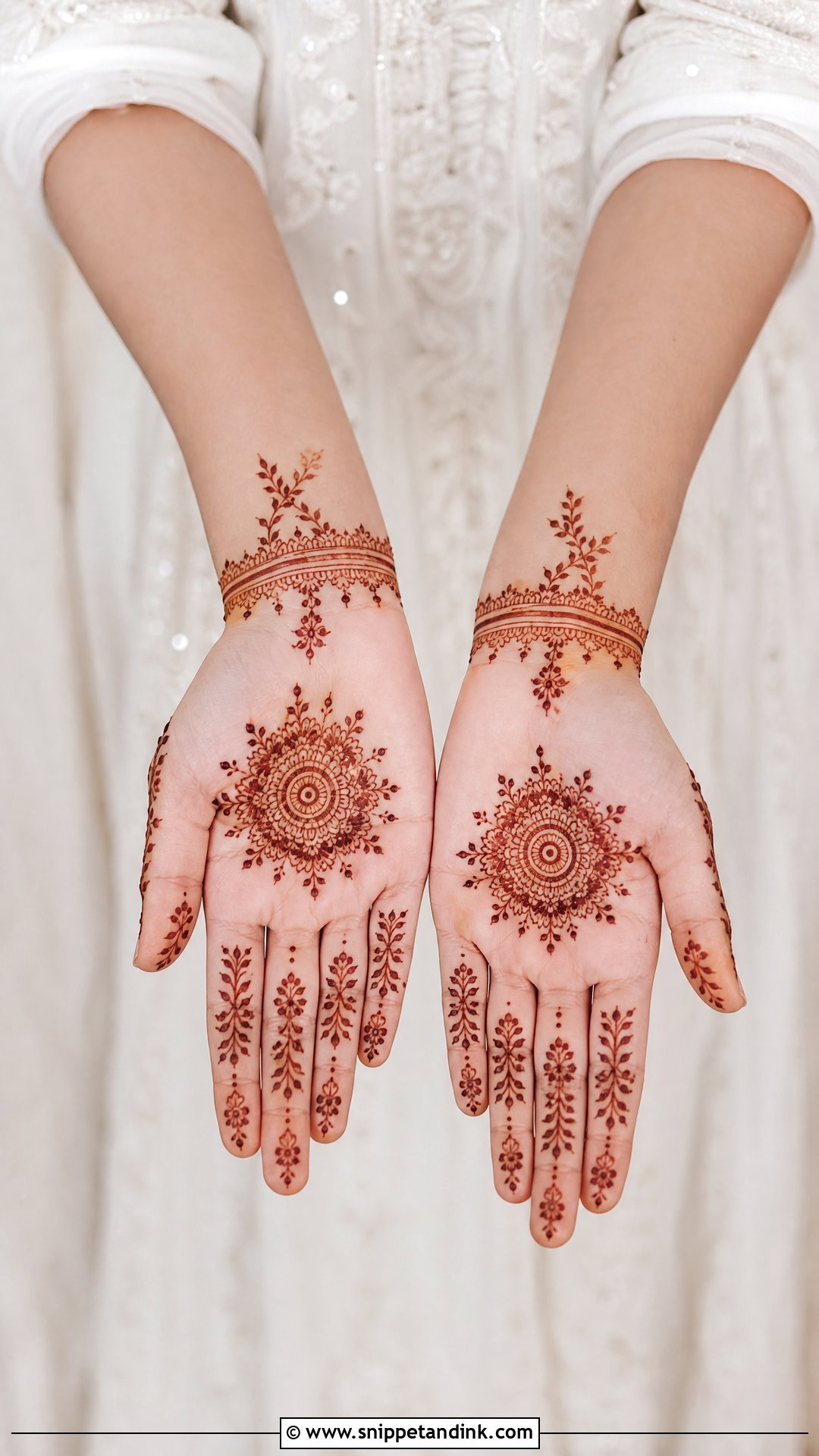
Not every bride wants heavy henna, and a minimal design can still feel bridal. Clean motifs, open spaces, slim vines, a small mandala and neat fingers. One strong palm design and a simple wrist cuff or trail is enough. It suits lightweight outfits, modern ceremonies and destination weddings, and the sitting is much shorter. The catch is that every line is on show, so there’s nothing to hide a wobble behind; I take more care over spacing on a minimal hand than on a full one.
18. Modern Bridal Front Hand Mehndi Design
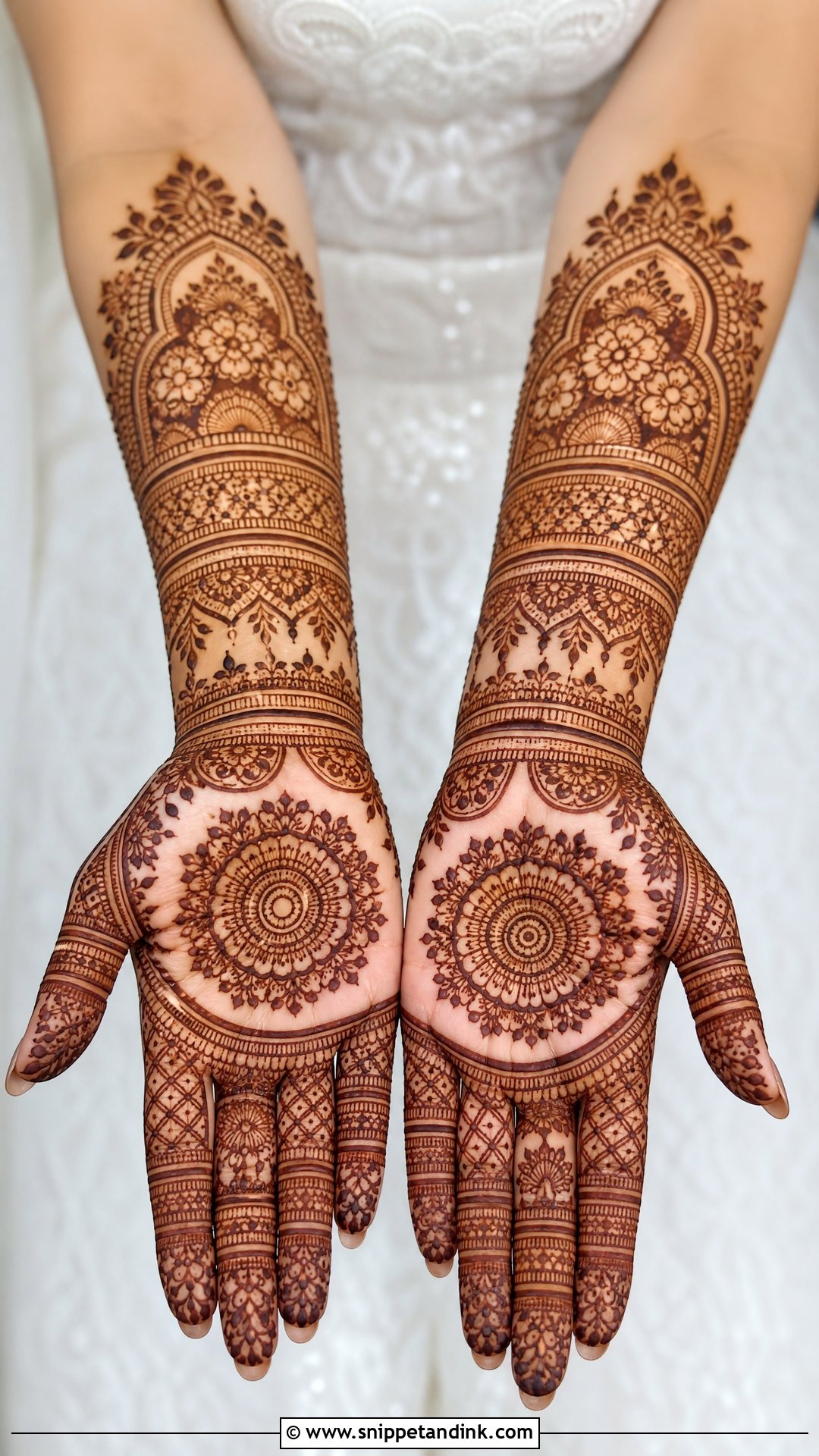
Modern layouts keep traditional henna but play with placement: half-and-half palms, abstract florals, bold mandalas, geometric borders, slim wrist cuffs and open space around key motifs. They don’t hide the shape of the hand. You can keep detailed fingers with an open palm, or a bold palm with simple forearm work. I’d pair this with contemporary lehengas, pastels, fusion wear and statement rings. If your family expects full coverage, talk it through early, since modern layouts can read as unfinished to some elders.
19. Simple Bridal Front Hand Mehndi Design
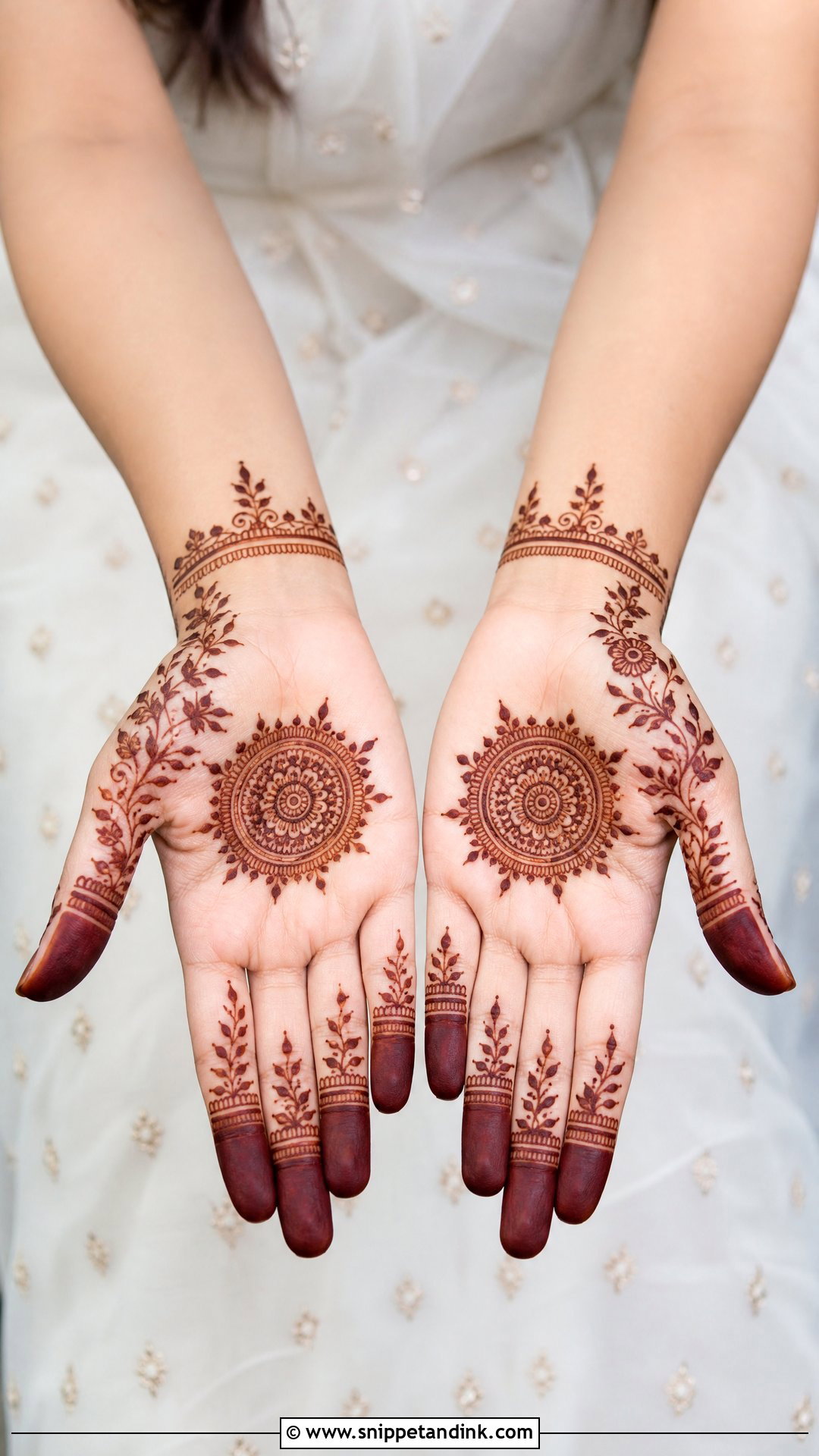
A simple bridal hand might be a palm mandala, floral trails, filled fingertips, light wrist borders and a few leafy details. It still needs to feel complete from fingers to wrist even with lighter coverage. It’s a common choice for intimate weddings, civil ceremonies and pre-wedding events. Larger motifs usually stain more clearly than tiny filler, so a simple design often looks crisper after a day or two than a dense one. It’s comfortable to sit for, too.
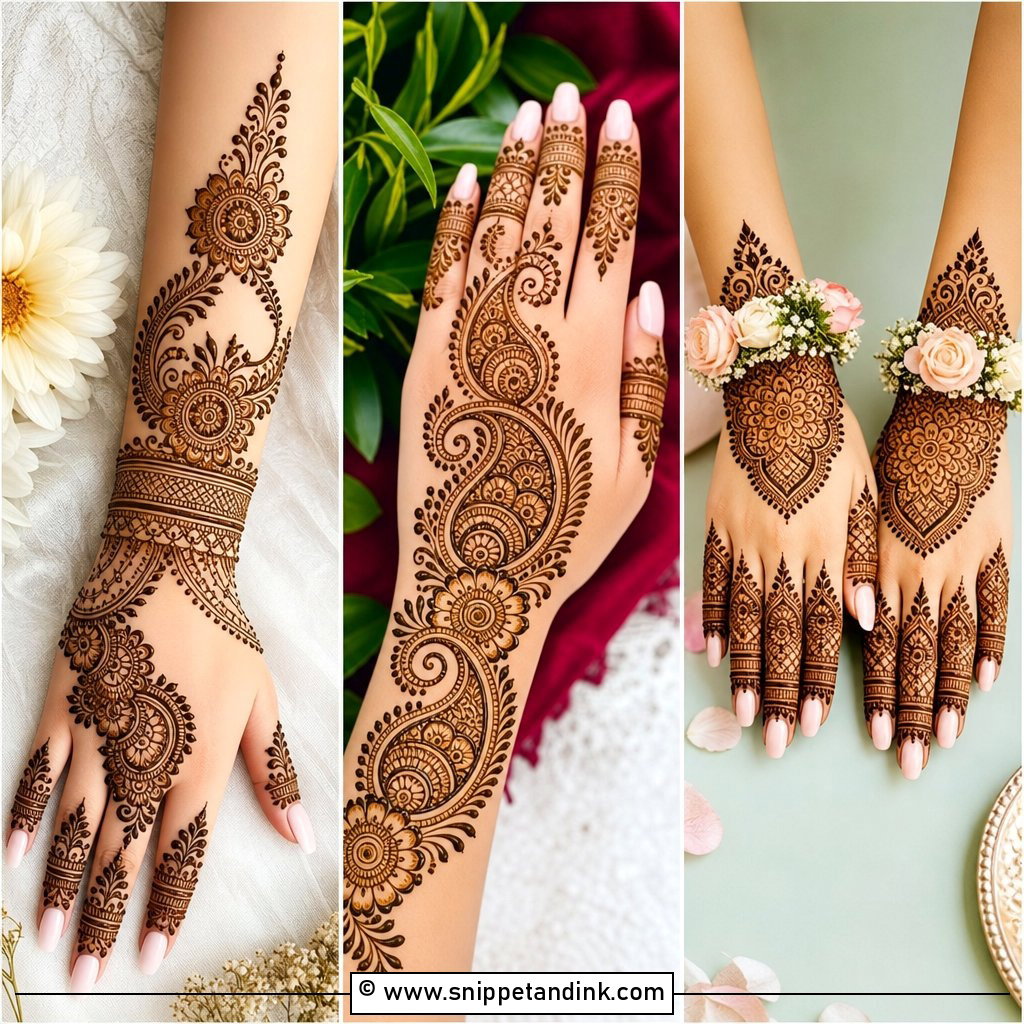




20. Heavy Bridal Front Hand Mehndi Design
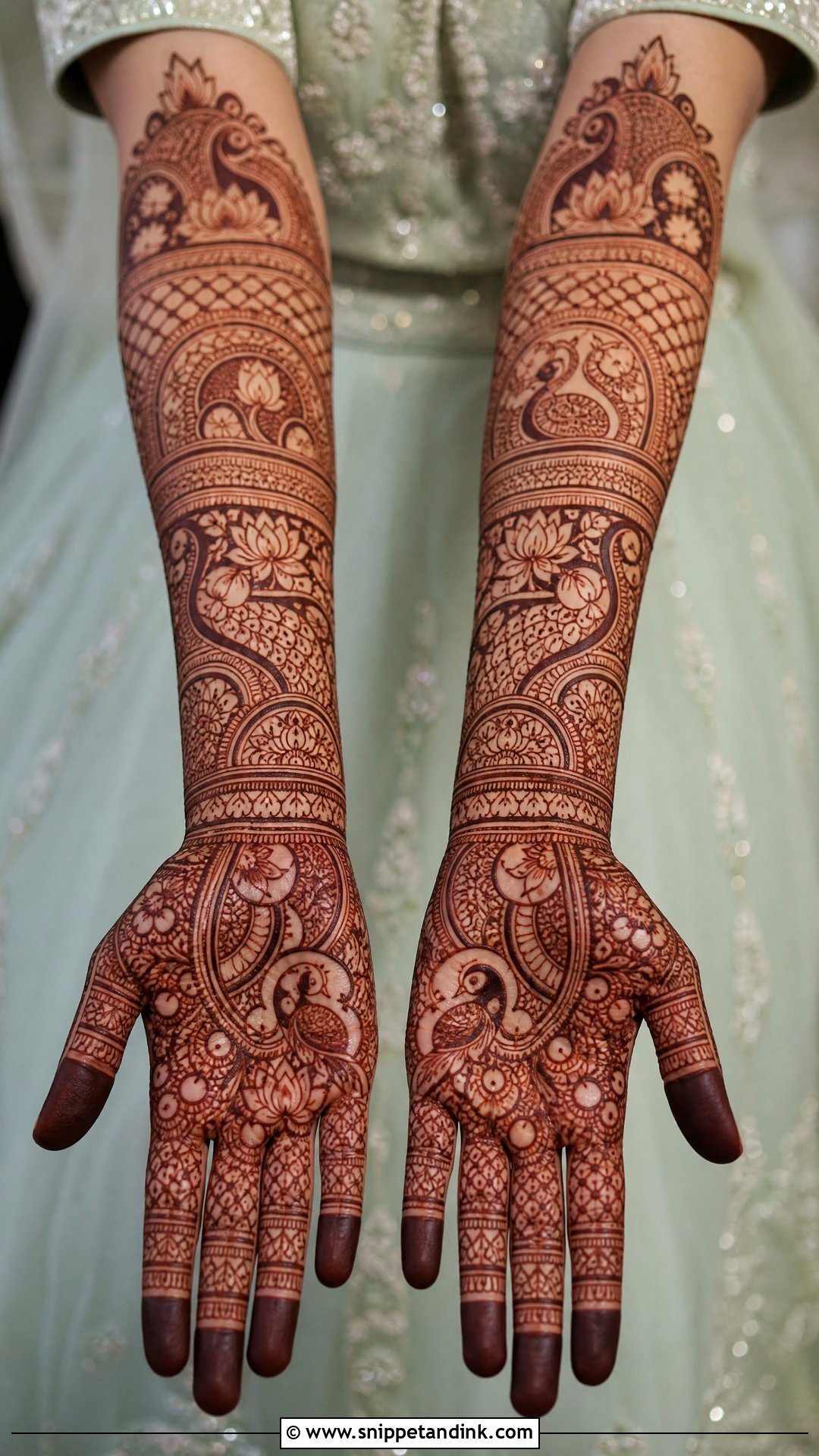
Heavy front-hand work fills palm, fingers, wrist and forearm with peacocks, paisleys, lotus, jaali, mandalas and ornamental bands. It has to be organized into zones with clear focal points, or the darkened stain looks messy. Plan to sit for a long session and to keep the paste on overnight, which is harder with full coverage on both hands, so have someone ready to help with food and water. It suits the main wedding day with traditional red, maroon, gold or heavily embroidered outfits.
21. Symmetrical Bridal Front Hand Mehndi Design
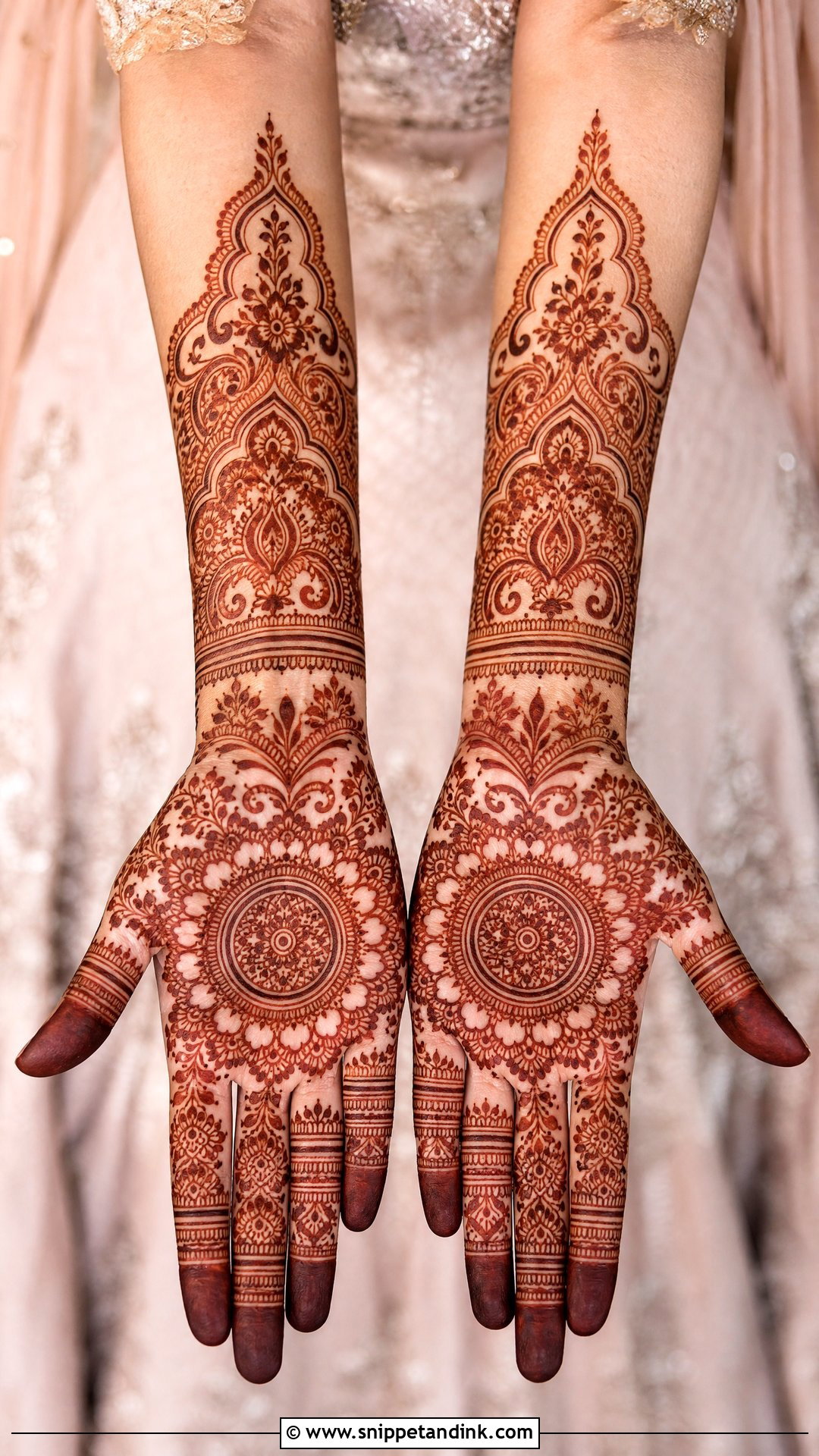
Mirrored mandalas, paisleys, floral trails and wrist cuffs on both hands make the pair look calm and ordered, especially when the bride joins her hands in rituals or portraits. I work the two hands in alternating sections rather than finishing one first, so proportions stay matched; hands are never exactly the same size, and I adjust spacing slightly to make them look identical. Ordered brides love this one, and it looks intentional from every angle.
22. Negative Space Bridal Front Hand Mehndi Design
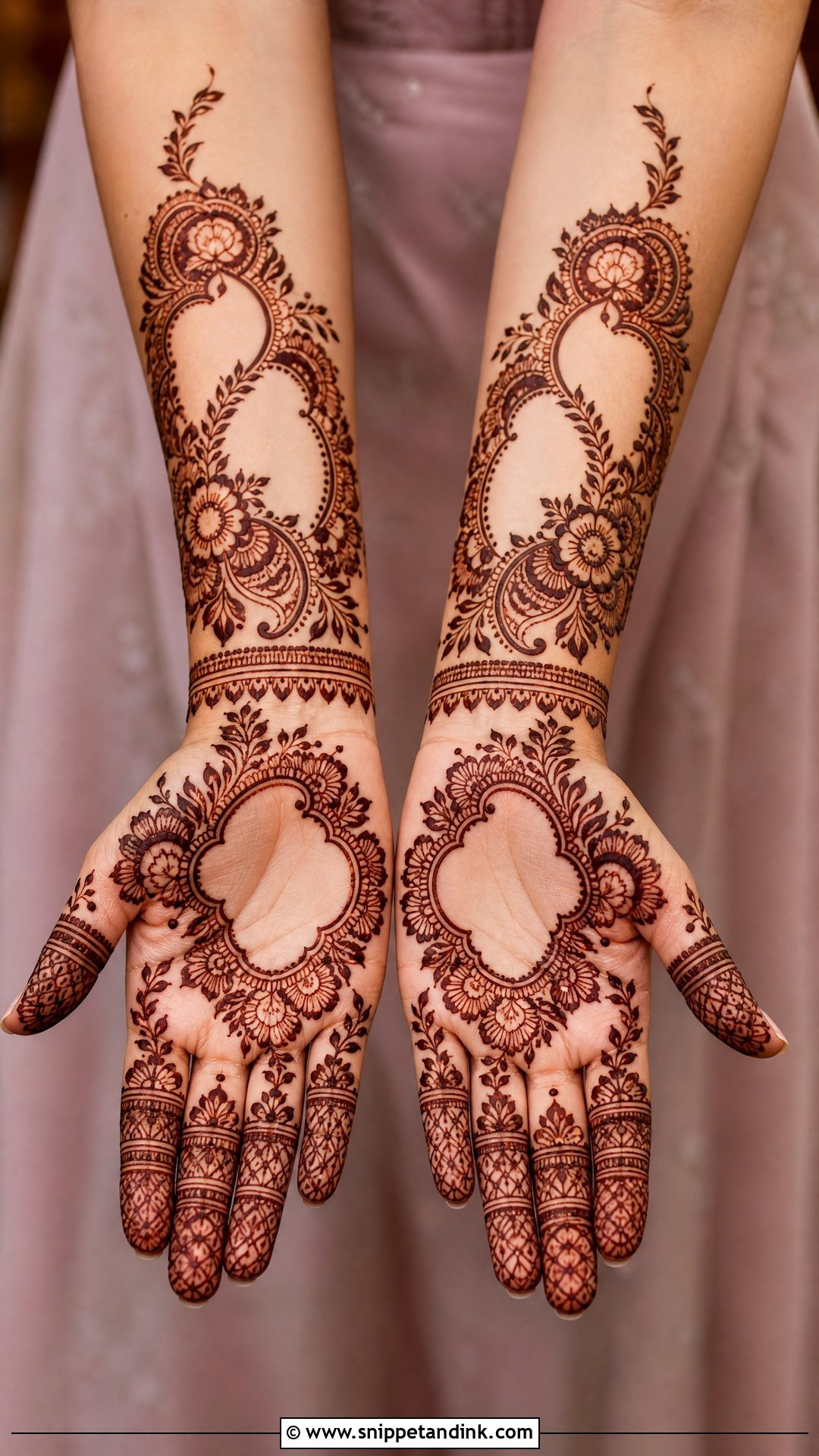
Here empty skin is part of the artwork. Bold outlines, open gaps and carefully placed motifs give flowers, paisleys, mandalas and vines more contrast. A bold floral frame on the palm, fine fingers and a simple cuff is a typical layout. It feels lighter on the hand in warm weather and during long ceremonies. The paste has to be placed with real confidence, since a misplaced line can’t be hidden in filler; any slip has to be wiped within seconds before it stains.
23. Personalized Bridal Front Hand Mehndi Design
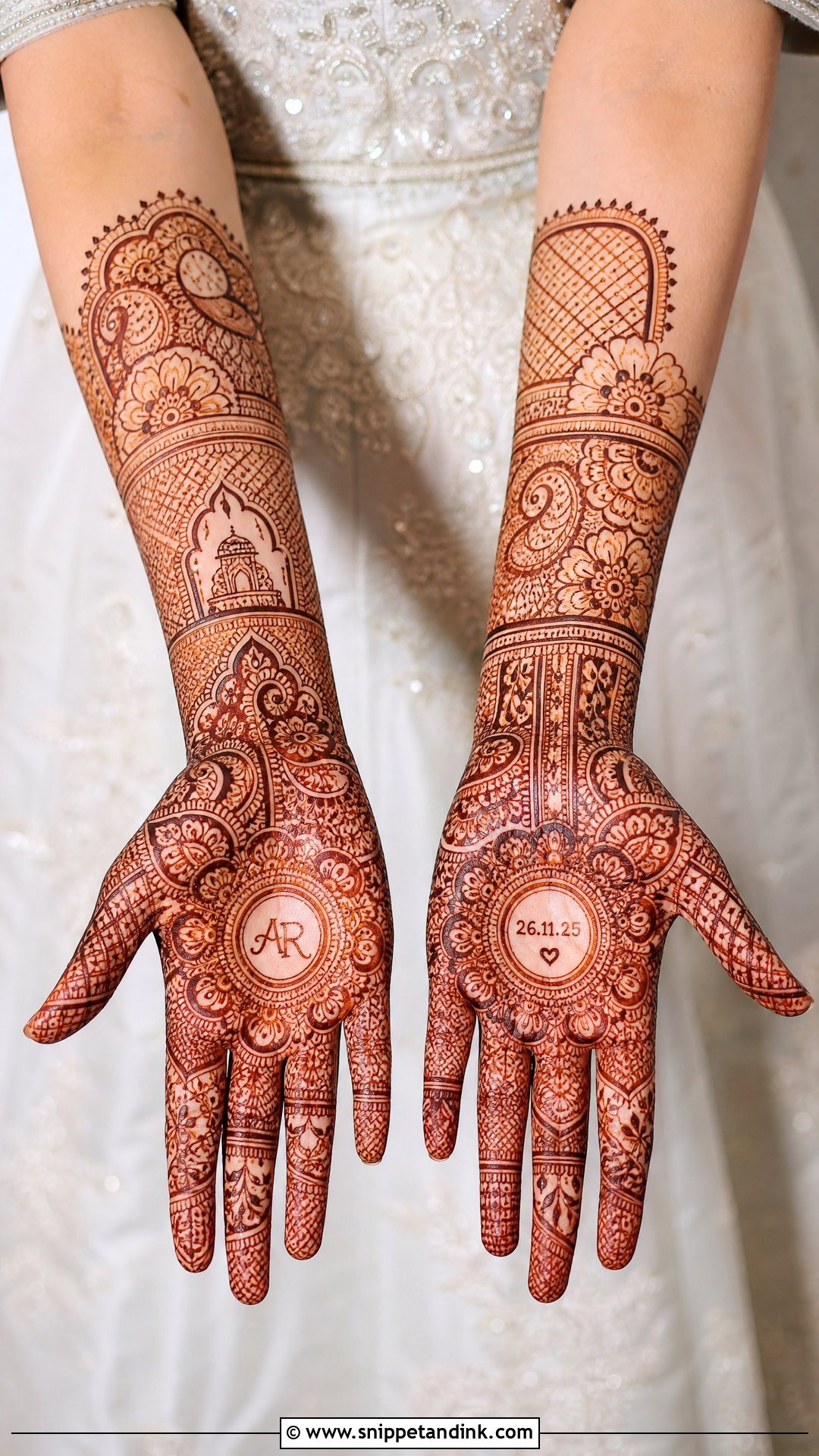
Initials, the wedding date, tiny couple symbols, favorite flowers or cultural details can be worked into the palm and wrist so the design carries your story. I keep personal elements small and hidden in the pattern. Many families enjoy the tradition of the groom searching for his initials. Around them, florals, mandalas, jaali and paisleys keep the hand looking bridal. Send the letters and dates in writing before the session, because spelling mistakes in henna can’t be corrected.
24. Bracelet Bridal Front Hand Mehndi Design
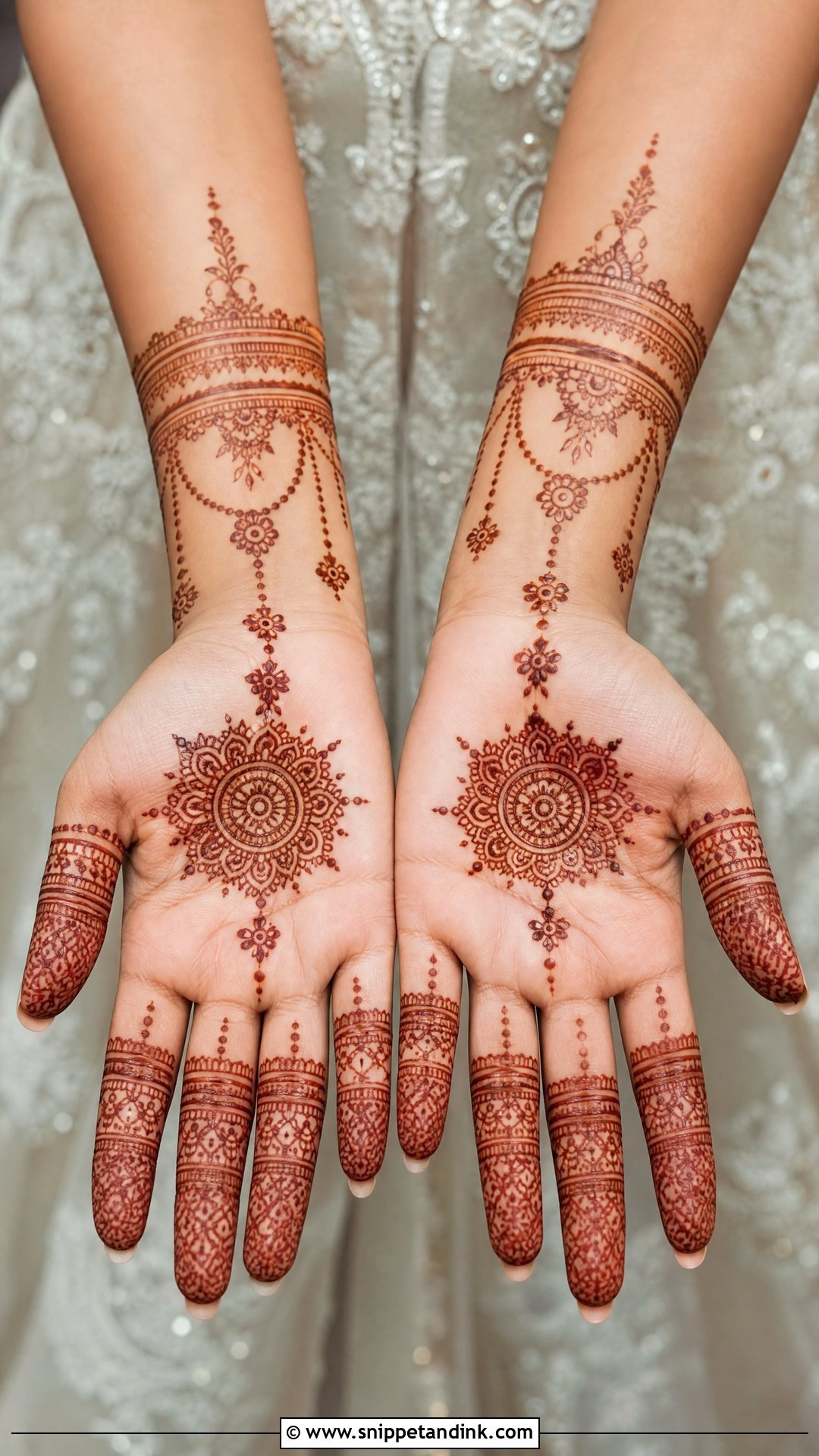
Bracelet-style work concentrates detail on the wrist and fingers: layered cuffs, bangle lines, chains, dots and lace-like bands, with a light mandala or vine on the palm linking them. It pairs well with real bangles, and I place the drawn cuff just above where your bangles will sit so both stay visible. It suits engagement, sangeet and reception. Light coverage can still feel complete when fingers, palm and wrist read as one piece.
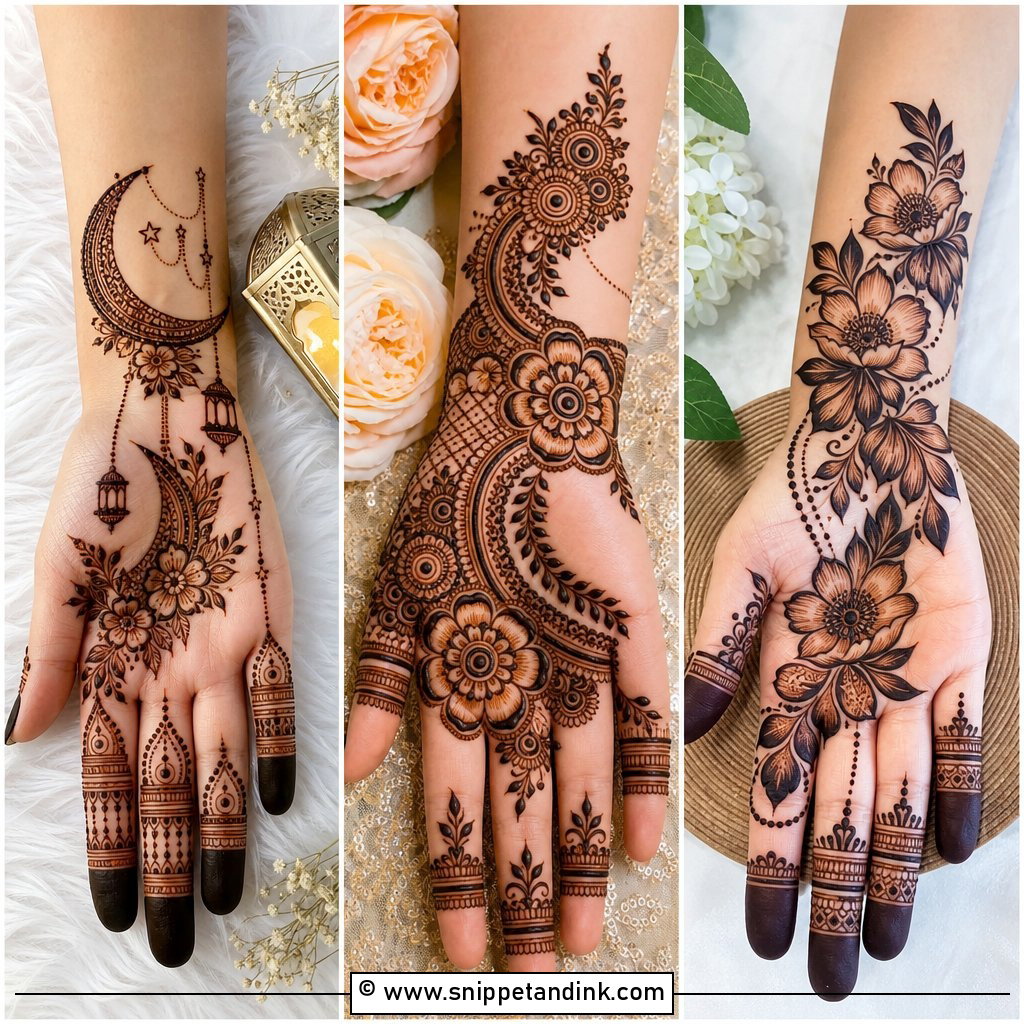
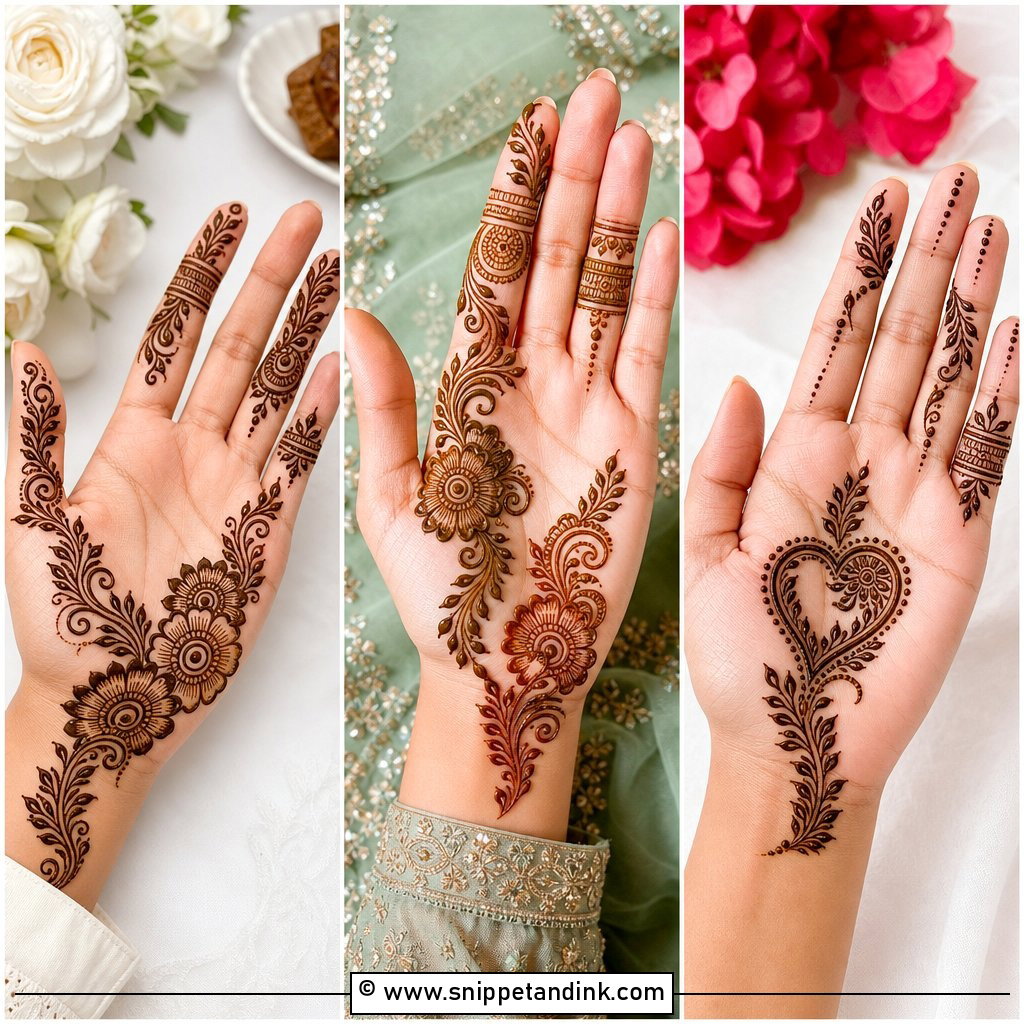
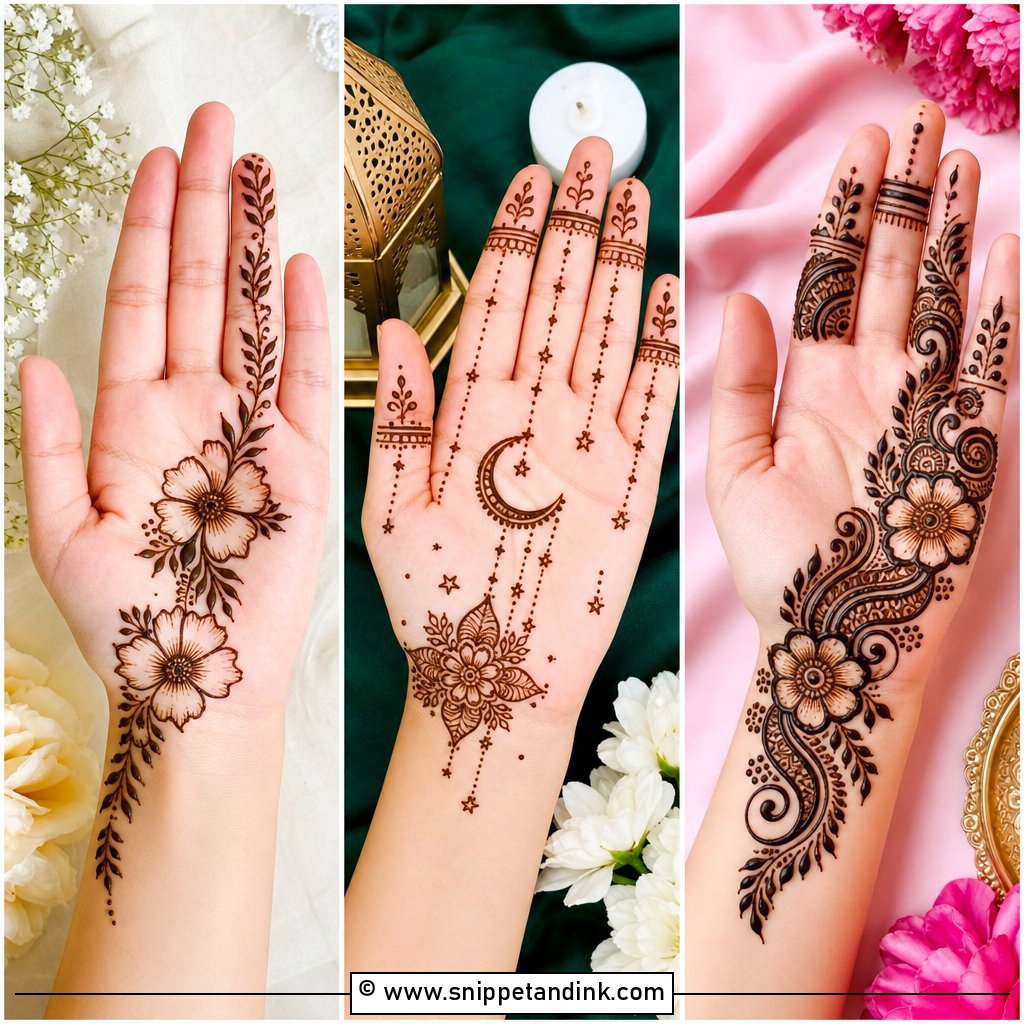

25. Royal Bridal Front Hand Mehndi Design
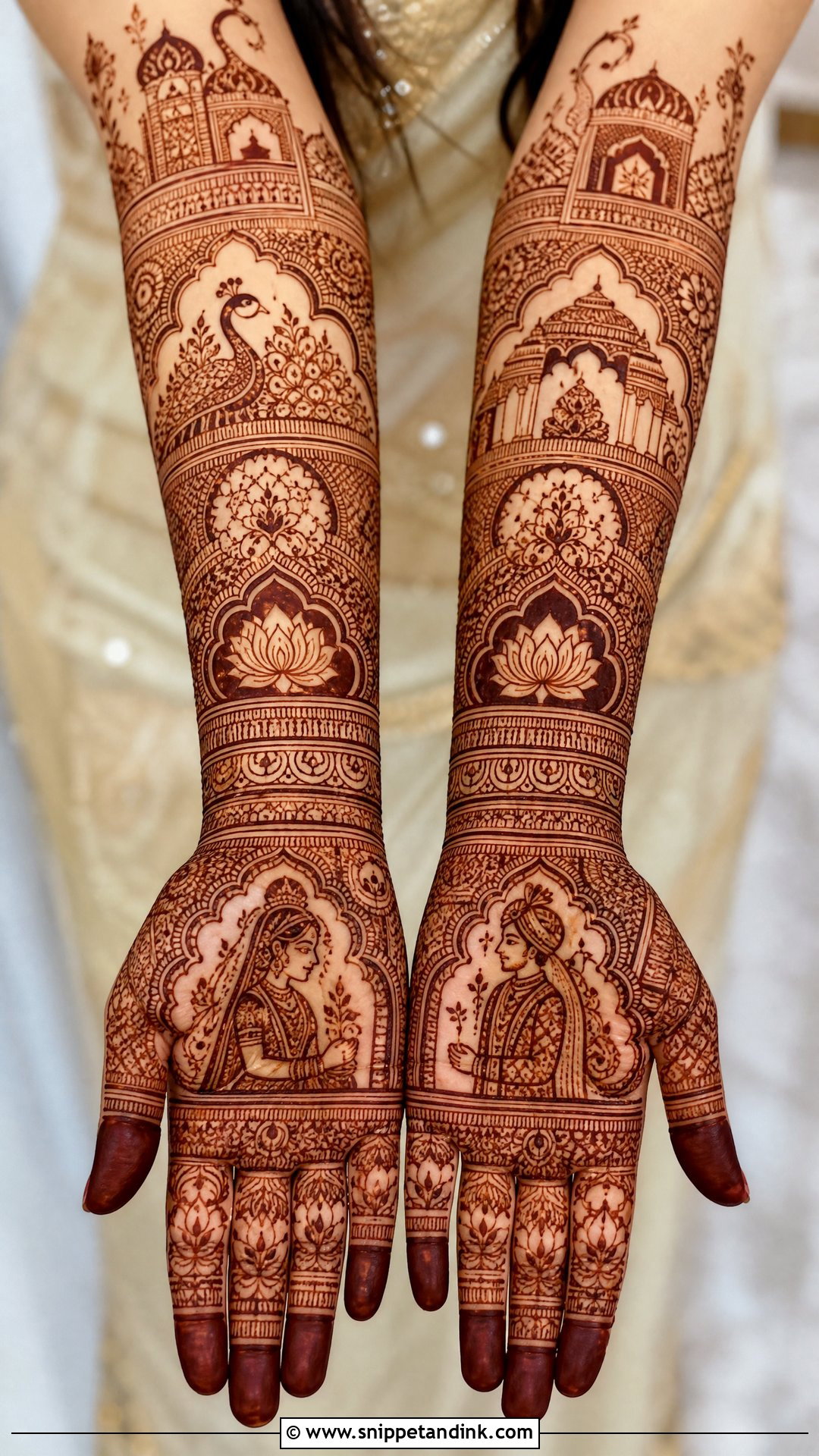
Royal designs bring grandeur: peacocks, lotus, palace arches, paisleys, jaali panels, couple art and layered forearm borders. The palm is the stage and the fingers and wrist carry dense ornament. What makes it luxurious rather than busy is structure, with clear sections the eye can follow. It’s a statement for the main ceremony beside bridal jewelry and a rich outfit. Book your most experienced artist for it; the planning matters as much as the hand skill.
From Orange Paste Mark to Deep Maroon
When the paste comes off, natural henna leaves a bright orange mark. That’s normal. Over the next day or two it oxidizes and deepens toward red-brown or maroon. The palms and fingertips, where skin is thickest, go darkest; the forearm usually stays lighter. If you’re shown a design that’s jet black the moment the paste is removed, it isn’t natural henna, and you should ask what’s in it.
What I tell brides to do once the cone is down
- Leave the paste on as long as you can, ideally six hours or overnight. Wrap loosely if needed so it doesn’t smear in your sleep.
- Let me dab on a light lemon and sugar seal once the paste has started to dry; it keeps it stuck to the skin.
- Scrape the dried paste off with a blunt edge or your fingers. Don’t wash it off.
- Keep water off your hands for as long as you reasonably can, ideally the rest of that day.
- Keep your hands warm. Cold hands stain lighter, so wear socks and sit somewhere warm.
Skip waxing, scrubs and manicures after application. If you have sensitive skin or a history of reactions, ask your artist for a small patch test on the inner arm a few days ahead.
Which Front-Hand Layout Suits Your Ceremony?
A good front-hand design should suit your outfit, jewelry, ceremony and personality, and it should look right in photos as well as in the mirror. Full hand, Indian, Arabic, Indo-Arabic, mandala, floral, jaali, jewelry and personalized work each set a different mood. The strongest work right now is balanced: detail with clear spacing, tradition with modern placement, meaning without clutter. Save the layouts you love, then talk through coverage, timing and stain expectations with your artist well before the wedding.
You'll Like These Ideas:





Leave a Reply