
Palms are where henna does its best work. The skin there is thick and takes the dye deeply, so a palm design almost always stains darker than anything on the back of the hand. It’s also the side people see when you greet guests, hold a clutch or raise your hands for a photo. These are the front-hand layouts I draw most often, from a single centered mandala to full bridal fill, with what I watch for on each one and the hands and occasions it actually suits.
Sitting With Wet Henna on Both Palms
The trade-off with palm henna nobody mentions in the photos: once both palms are covered, you have no usable hands for hours. You can’t eat, open a door, check your phone or go to the bathroom without help. Planning around that makes the difference between a dark stain and a smudged one.
- Eat beforehand and use the bathroom right before the first line goes on.
- Wash your hands with plain soap and dry them fully. No lotion, oil or hand cream that day, because it blocks the dye.
- Wear a loose, short-sleeved or open-sleeved top you can get out of without lifting your arms over your head.
- Have someone nearby to hold your phone, a straw and anything else you’ll need.
- Once the paste is touch-dry, a light dab of lemon and sugar keeps it stuck to the skin longer. Don’t soak it; a wet palm can blur fine lines.
For bridal palms, I’d plan the session for the evening and sleep in the paste, with the hands wrapped loosely in tissue and then a cotton glove or old socks. Palms are the one area where the stain improves noticeably with every extra hour.
1. Simple Front Hand Mehndi Design
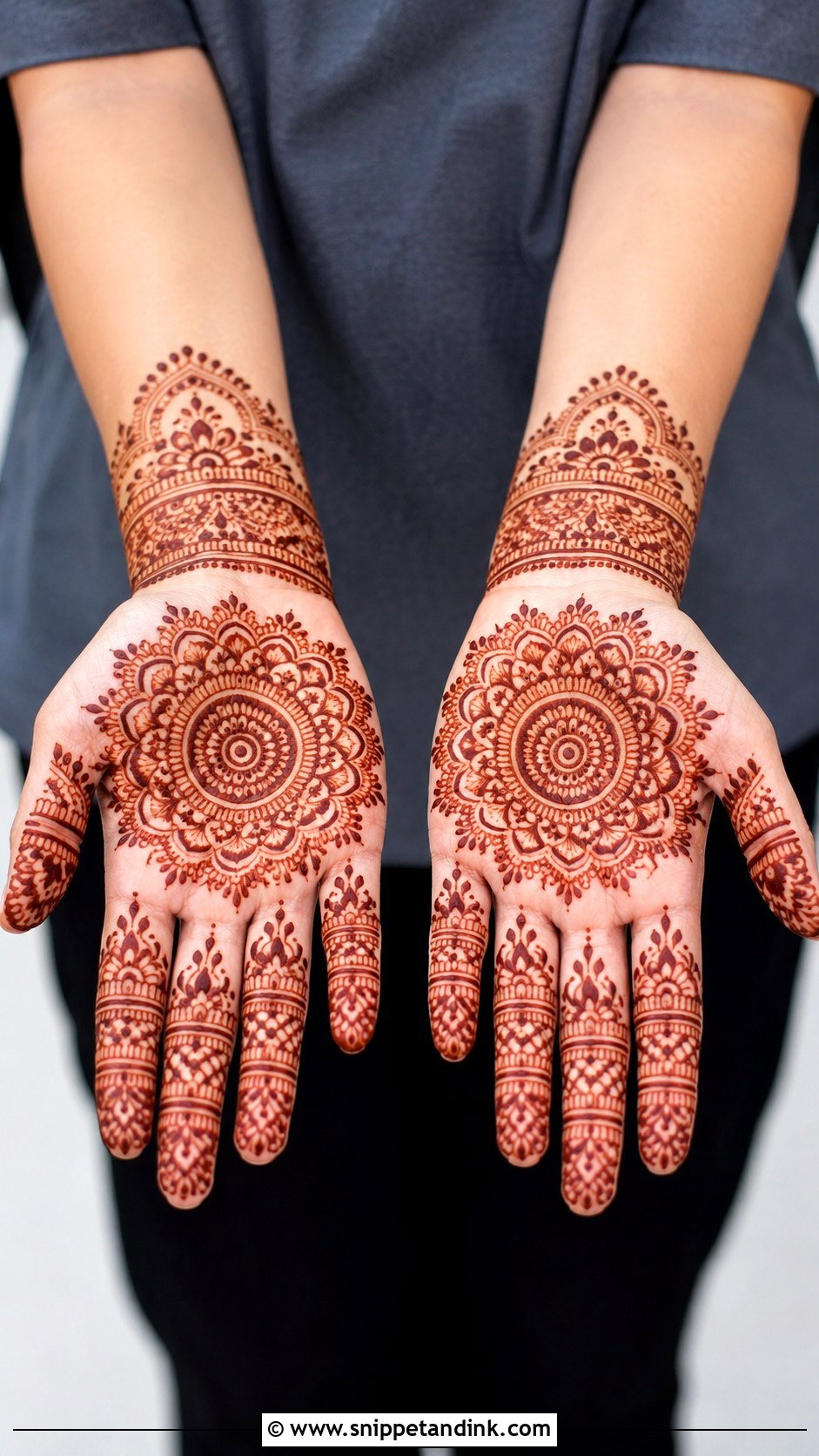
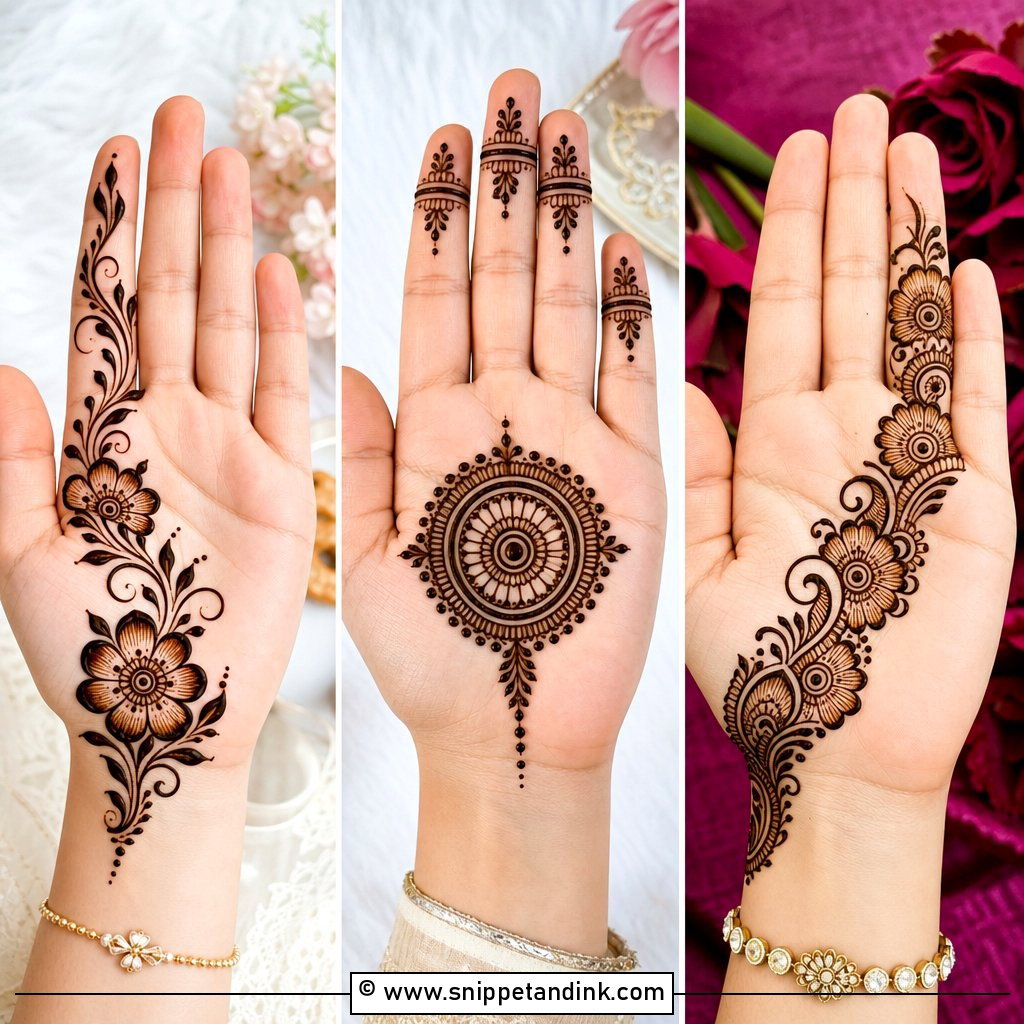
A round mandala or small floral center, matching bands or dots on the fingers, and a slim bracelet at the wrist. That’s the whole design, and it’s my default for a first-timer or a quick family function. On smaller hands I keep the center medium-sized; a big circle on a narrow palm crowds out the creases and looks cramped once the fingers curl. Leave the paste on for several hours and scrape it off rather than washing, and even this simple version stains rich.
2. Arabic Front Hand Mehndi Design
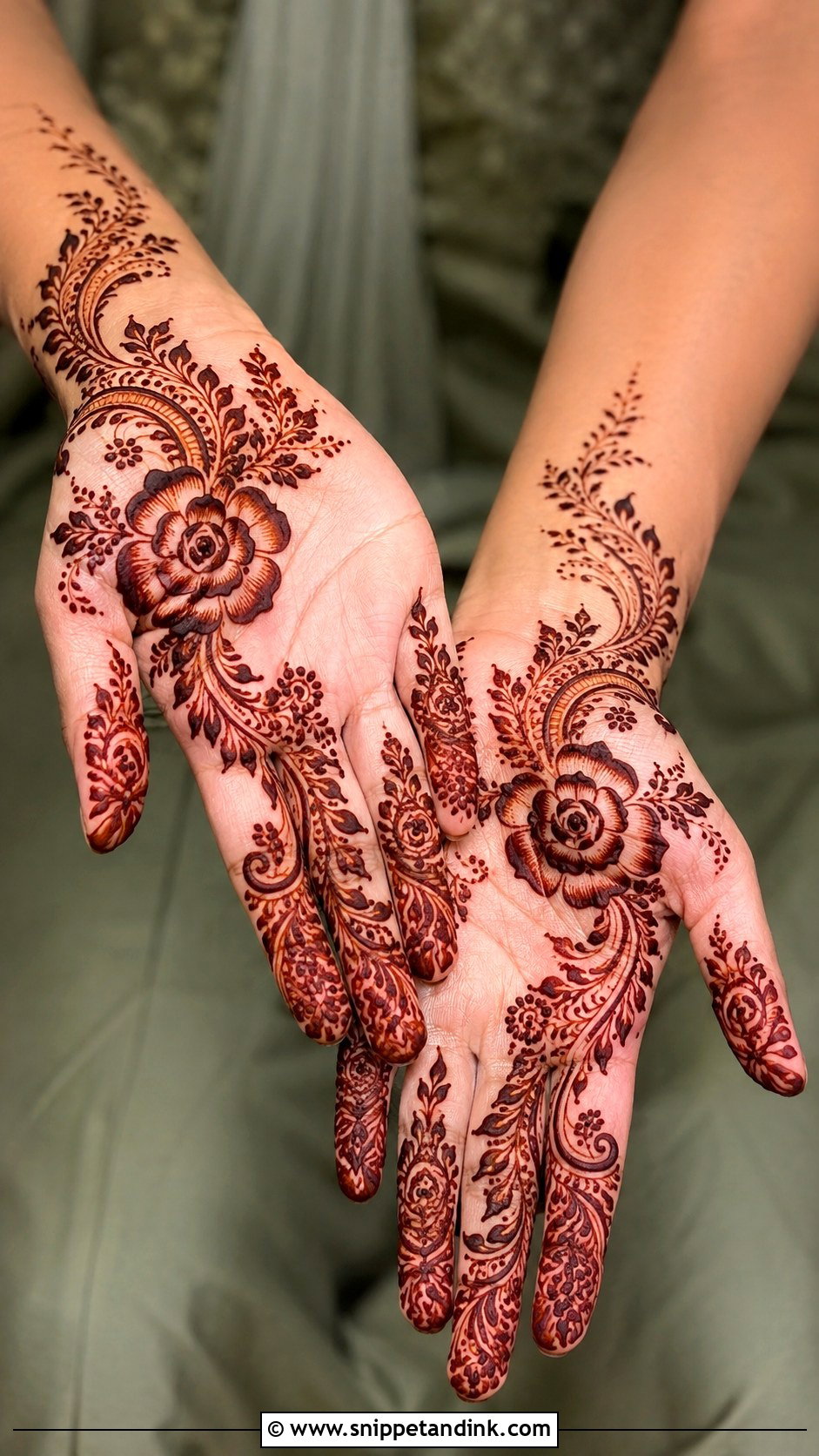
Arabic on the palm usually travels diagonally from the wrist toward the index or middle finger, with big flowers, leafy vines and paisley curves separated by clear skin. It’s quick, often under twenty minutes a hand. The thick outlines carry a lot of paste, and on palm skin that turns into a deep, crisp stain. I keep the fingers partly filled with leafy trails and fingertip shading so the trail has somewhere to land.
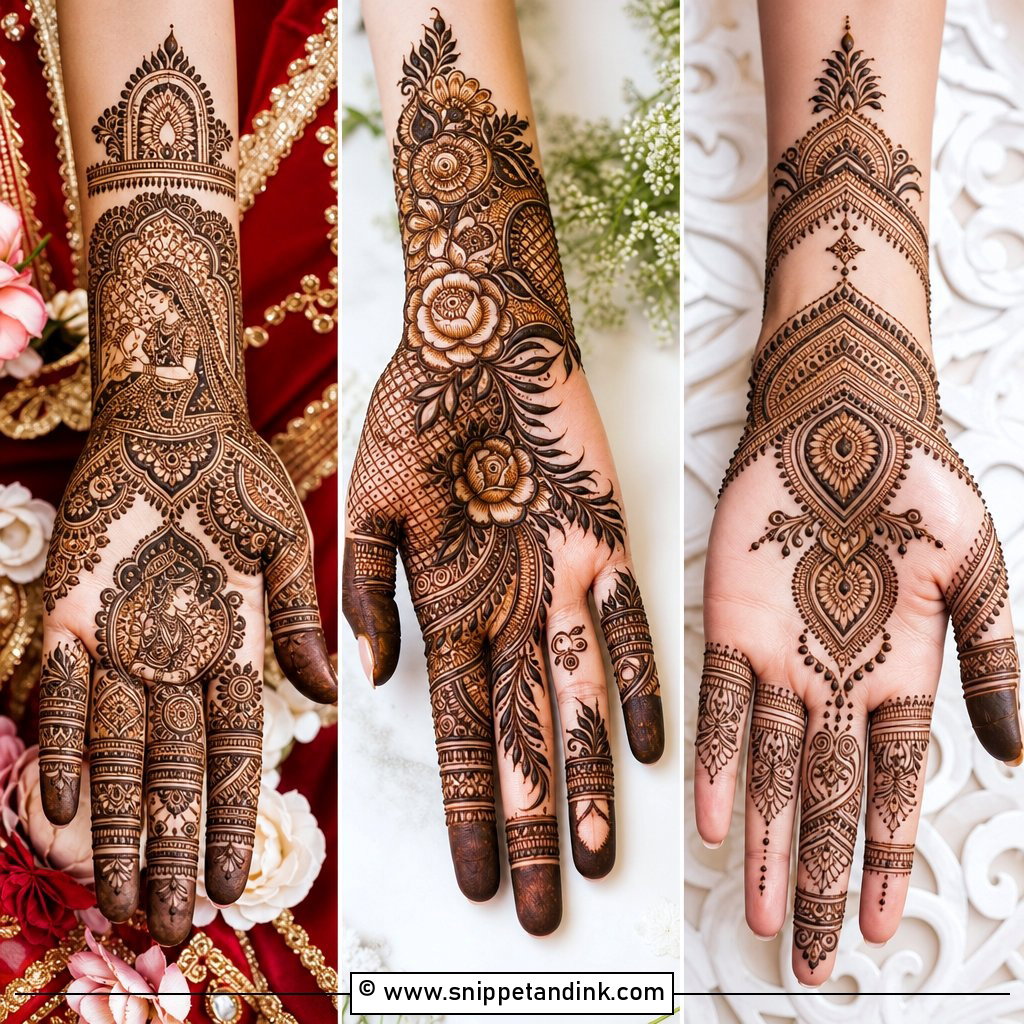
3. Full Hand Front Mehndi Design
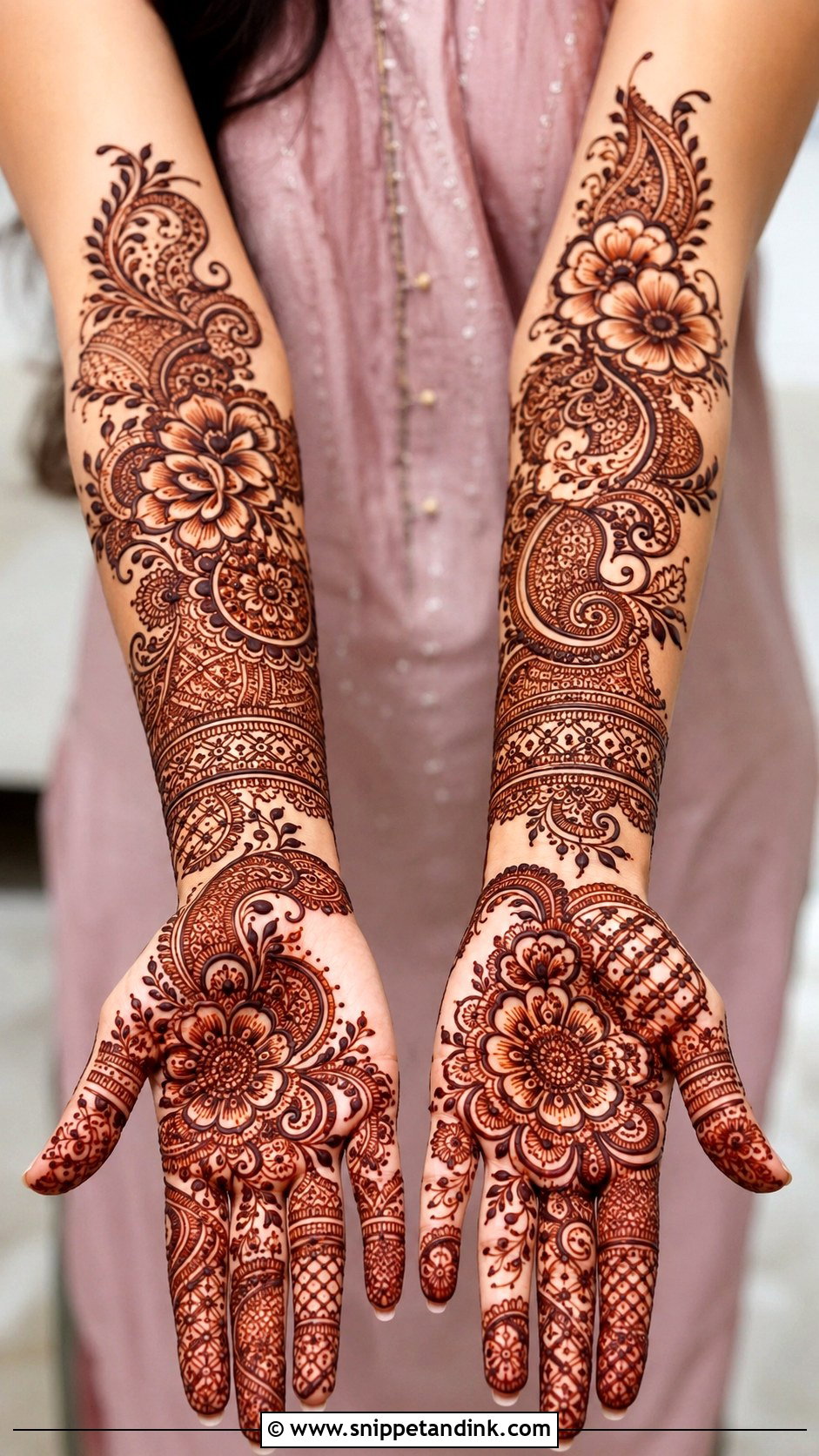
Full front coverage runs from fingertips to wrist and sometimes a little past it, with a centerpiece mandala, lotus, peacock or paisley cluster and fine fillers around it: checks, dots, leaf chains, curls and lace lines. Fingers are fully worked so the whole hand connects. What separates good full-hand work from flat-looking work is variation in scale. I deliberately mix a few large motifs with smaller fill so the eye has somewhere to rest, which is worth asking any artist about before she starts.
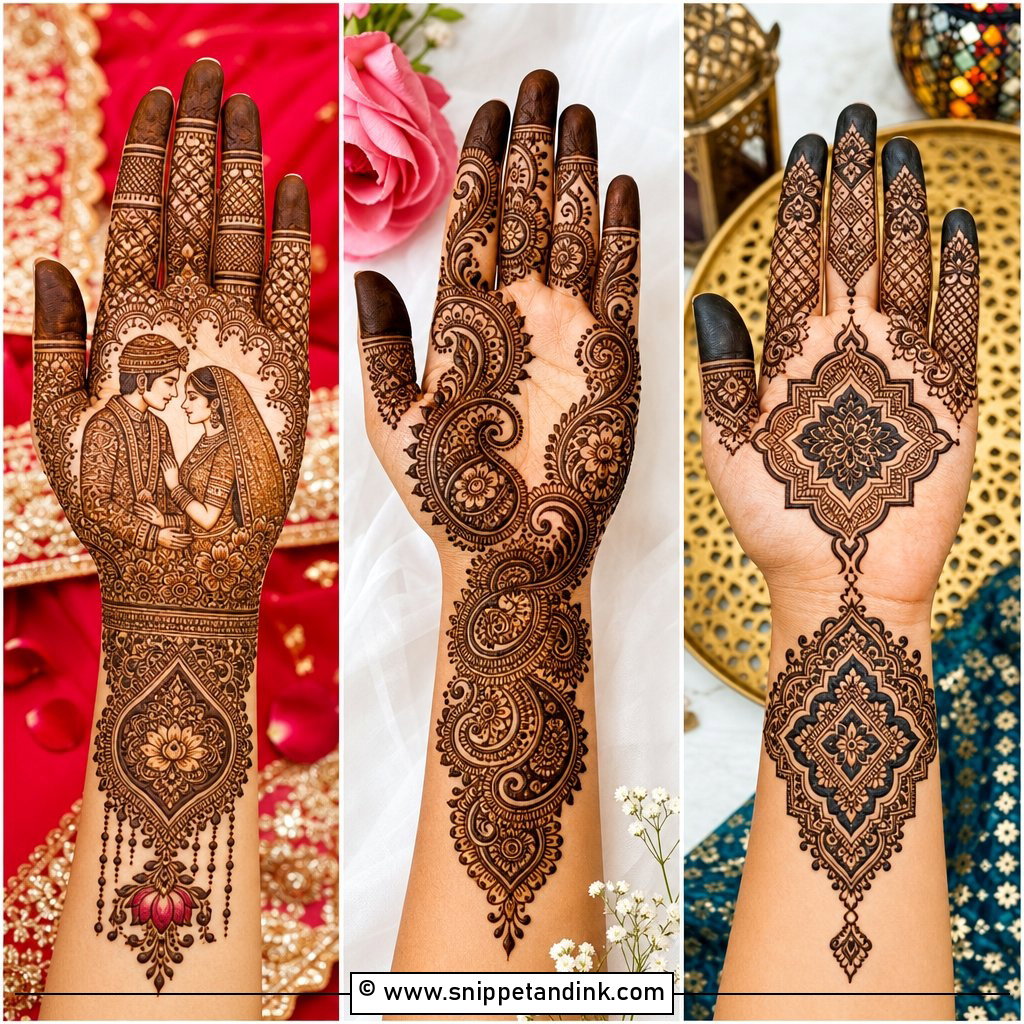
4. Bridal Front Hand Mehndi Design
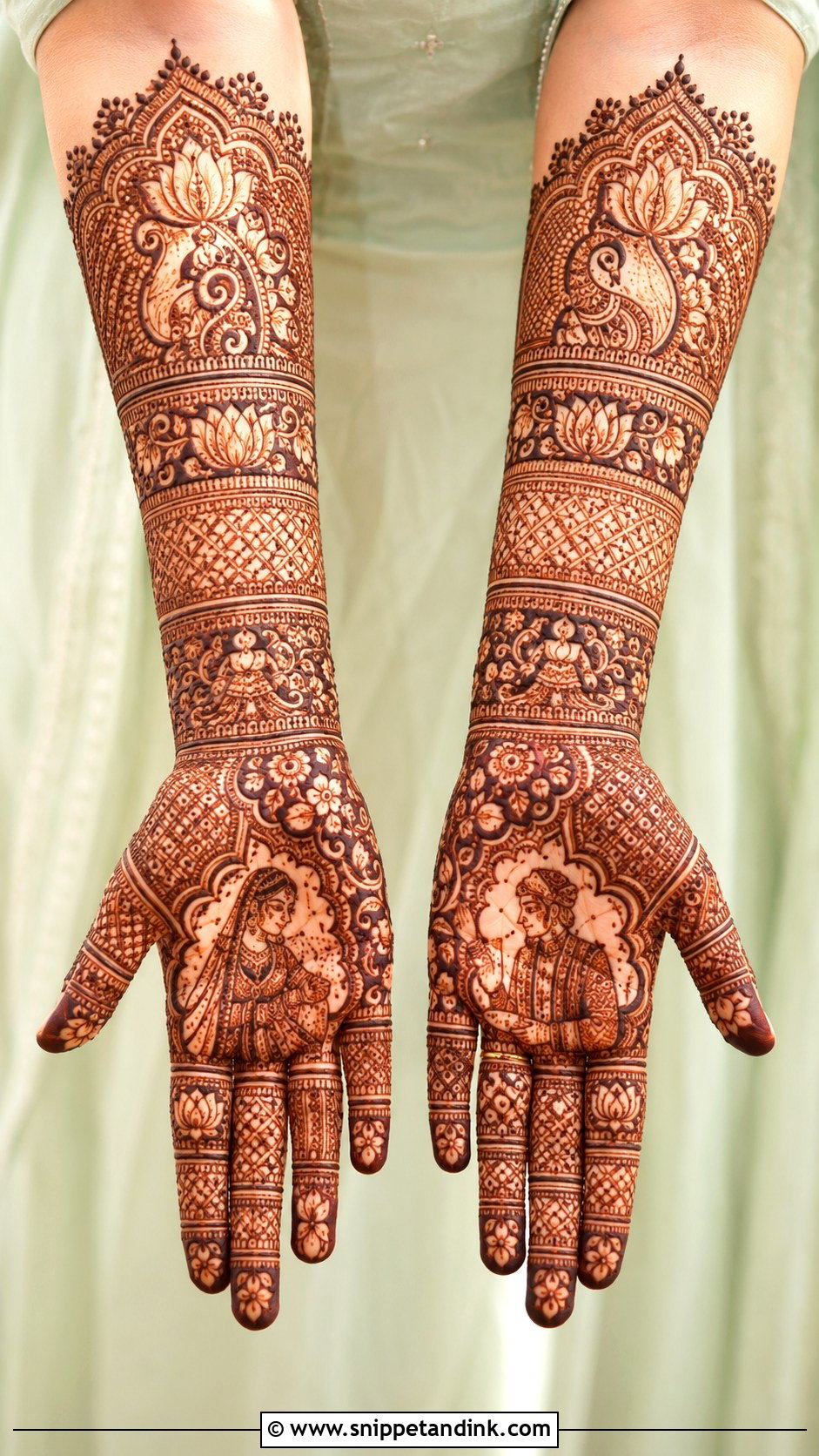
A bridal front hand mehndi design carries the densest, most personal work: palm coverage, fine fingers, wrist cuffs, lotus, paisleys, peacocks, kalash shapes, bride and groom art and hidden initials. Some brides now ask me for cleaner spacing and no portraits, or a blend of Indian and Arabic elements. I always ask about sleeve length and bangles first, because they decide where the wrist work has to end. Book the session one to two days before the wedding so the stain peaks on the day.
5. Mandala Front Hand Mehndi Design
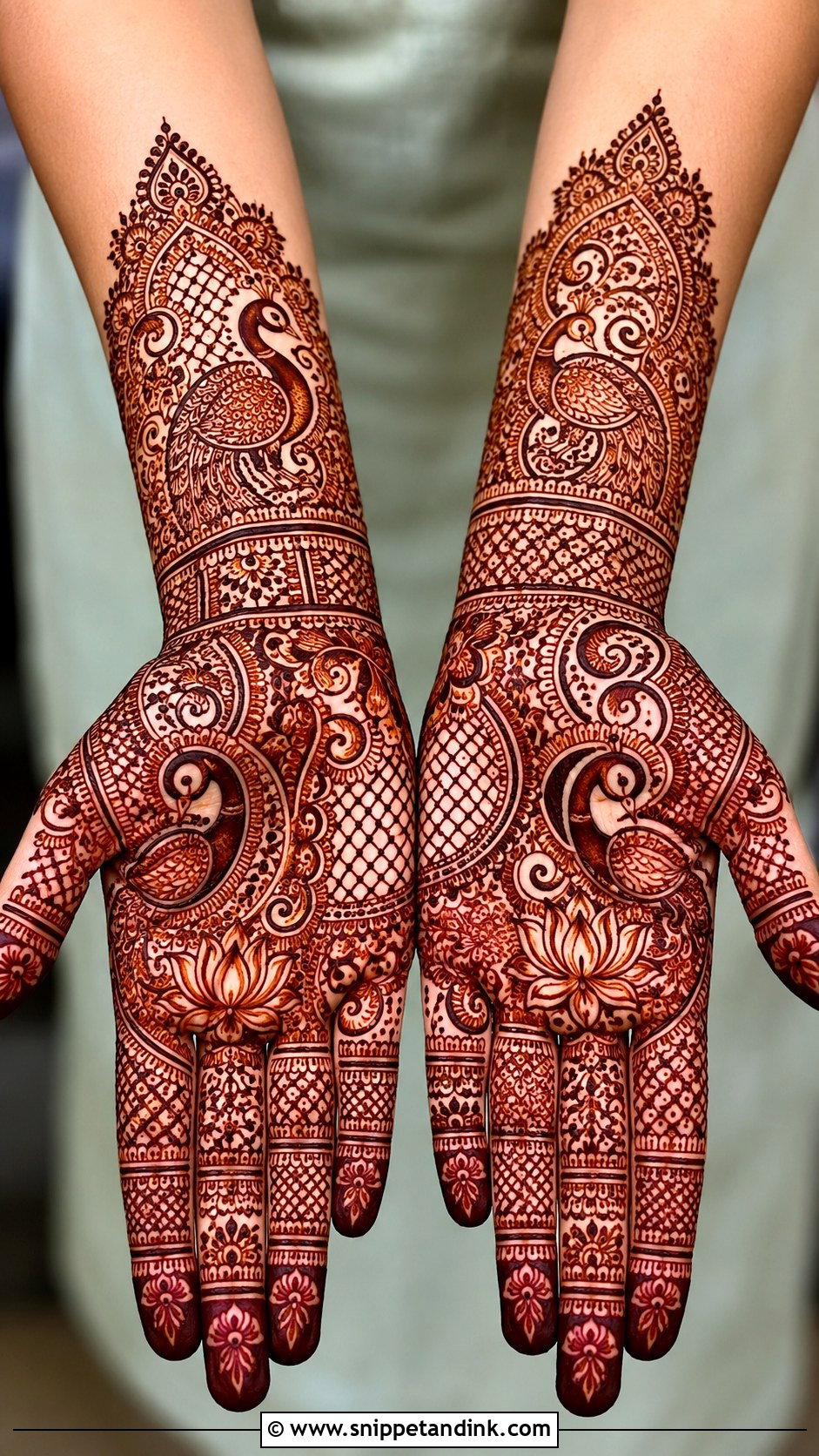
Everything on a mandala palm depends on where the center goes. I place it slightly toward the heel of the hand, not dead center, because when the palm is open toward a camera, the fingers draw the eye up and a true-center circle looks low. Dots, petals, scallops and rings radiate outward, with matching bands or fingertip caps. Give it more open space for a modern look, or heavier fingers and a wrist border for a traditional one.
6. Floral Front Hand Mehndi Design
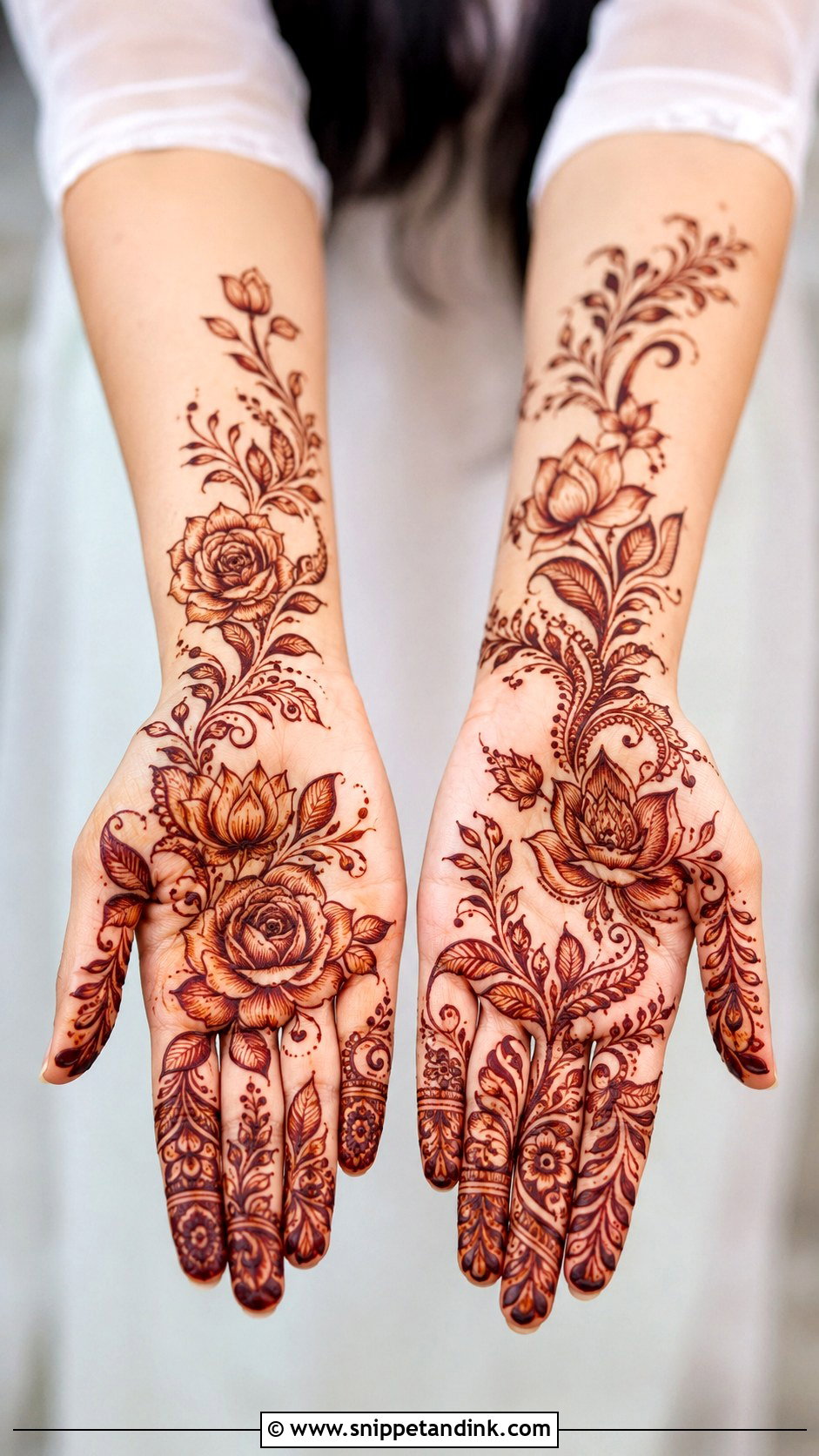
Roses, lotus, small blossoms, leafy vines and shaded petals, laid diagonally in Arabic style or spread evenly in Indian style. Vary the flower sizes. Same-size blooms all over the palm look stamped; a couple of large flowers with small ones and dot trails gives depth. Long fingers and narrow palms carry a floral trail especially well.
7. Indian Front Hand Mehndi Design
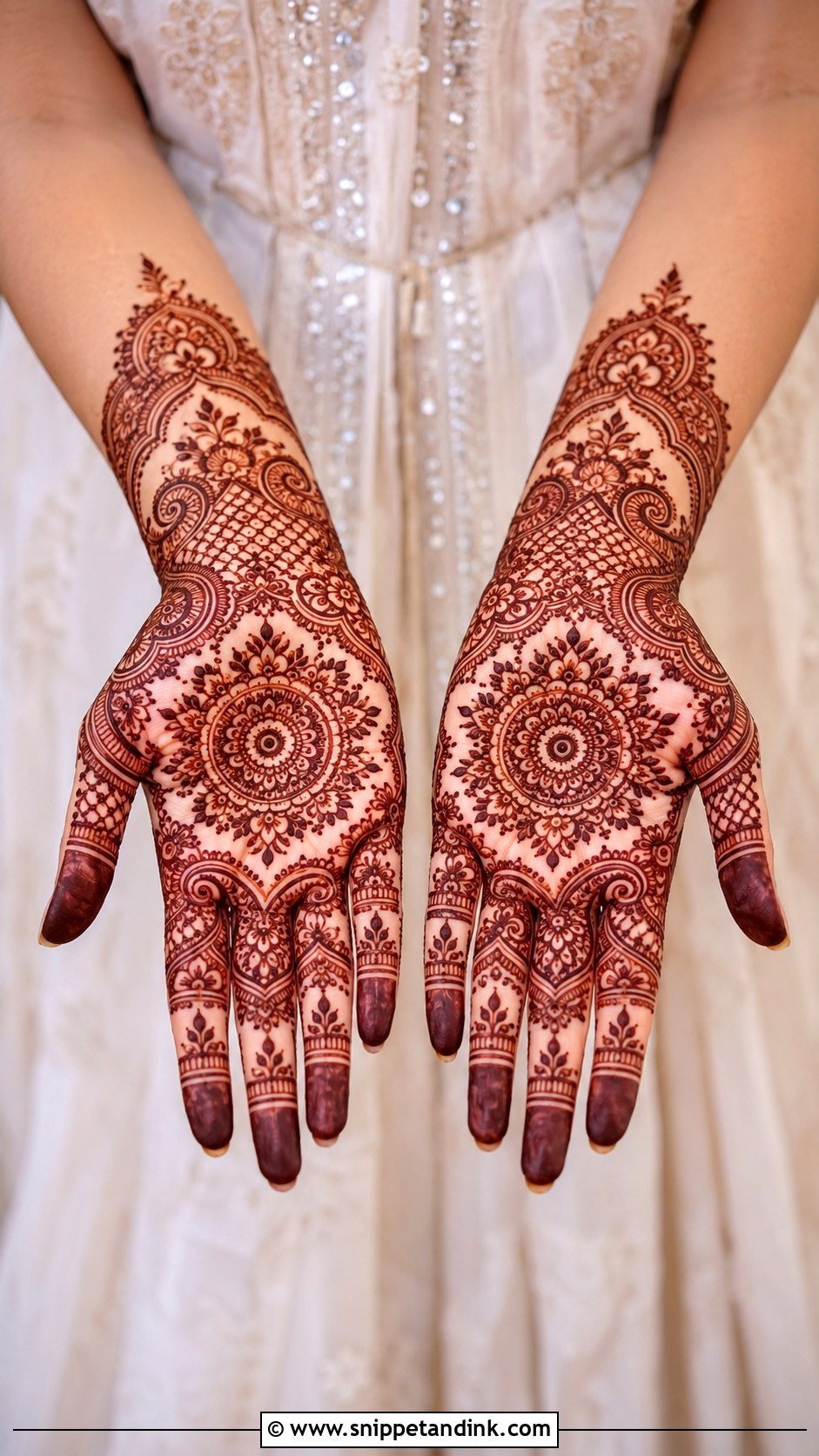
Indian palm work is about coverage and story: paisleys, peacocks, lotus, mandalas, jaali and vines, with small fillers closing the gaps that Arabic designs leave open. Fingers get stacked bands, leaf chains, checks and curls. It’s slow, careful work, and the palm rewards it with the deepest stain on the body. Keep lines fine and spacing even, or the dense fill blurs as the stain darkens over the following two days.
8. Indo Arabic Front Hand Mehndi Design
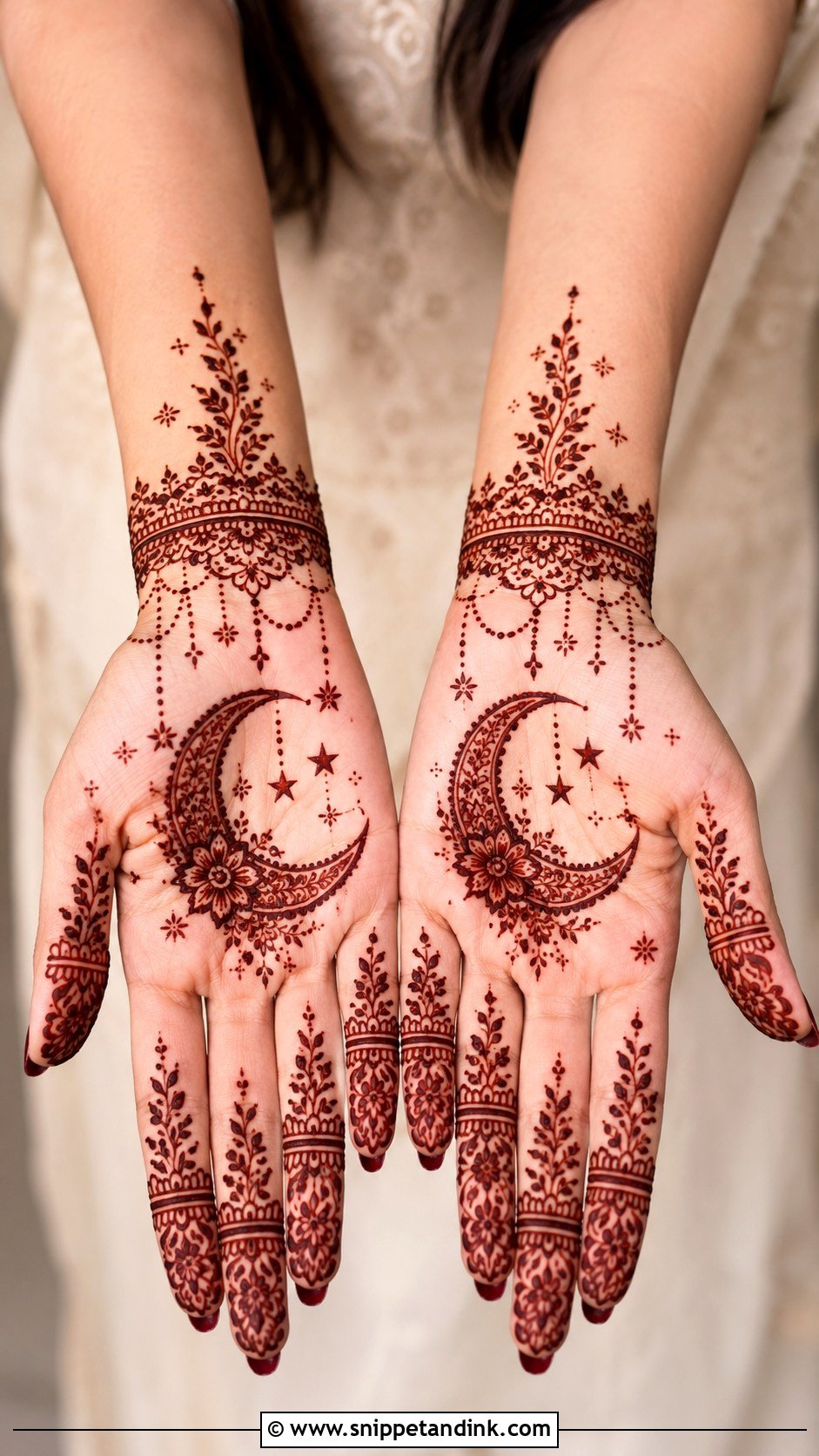
Big diagonal flowers or paisleys with Indian-style fill inside each motif, and open skin between them. That combination is why Indo-Arabic is the most requested design at the weddings I work: it looks festive in photos but doesn’t need a three-hour sitting. A bracelet-style cuff that flows into the palm trail ties the whole thing together.
9. Modern Front Hand Mehndi Design
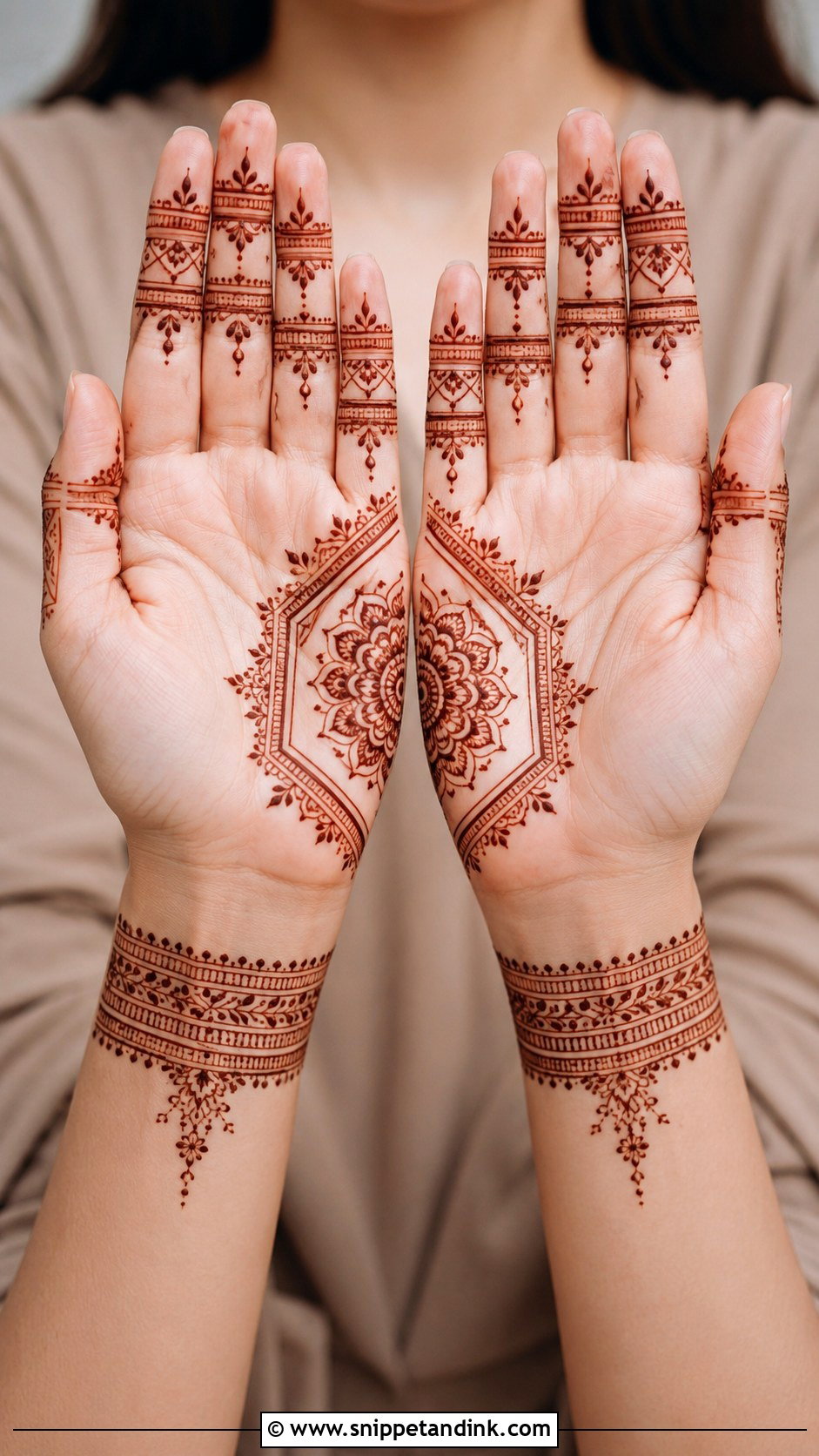
Modern palms use negative space, geometric frames, slim cuffs, half-palm layouts and minimal finger detailing. An off-center mandala, a curved floral trail or a framed jharokha might be the only major element. Because there’s less of it, every line is exposed, so I work slowly with a fine cone tip. It’s well suited to work events and people who find heavy henna uncomfortable.
10. Front Hand Mehndi Design For Eid
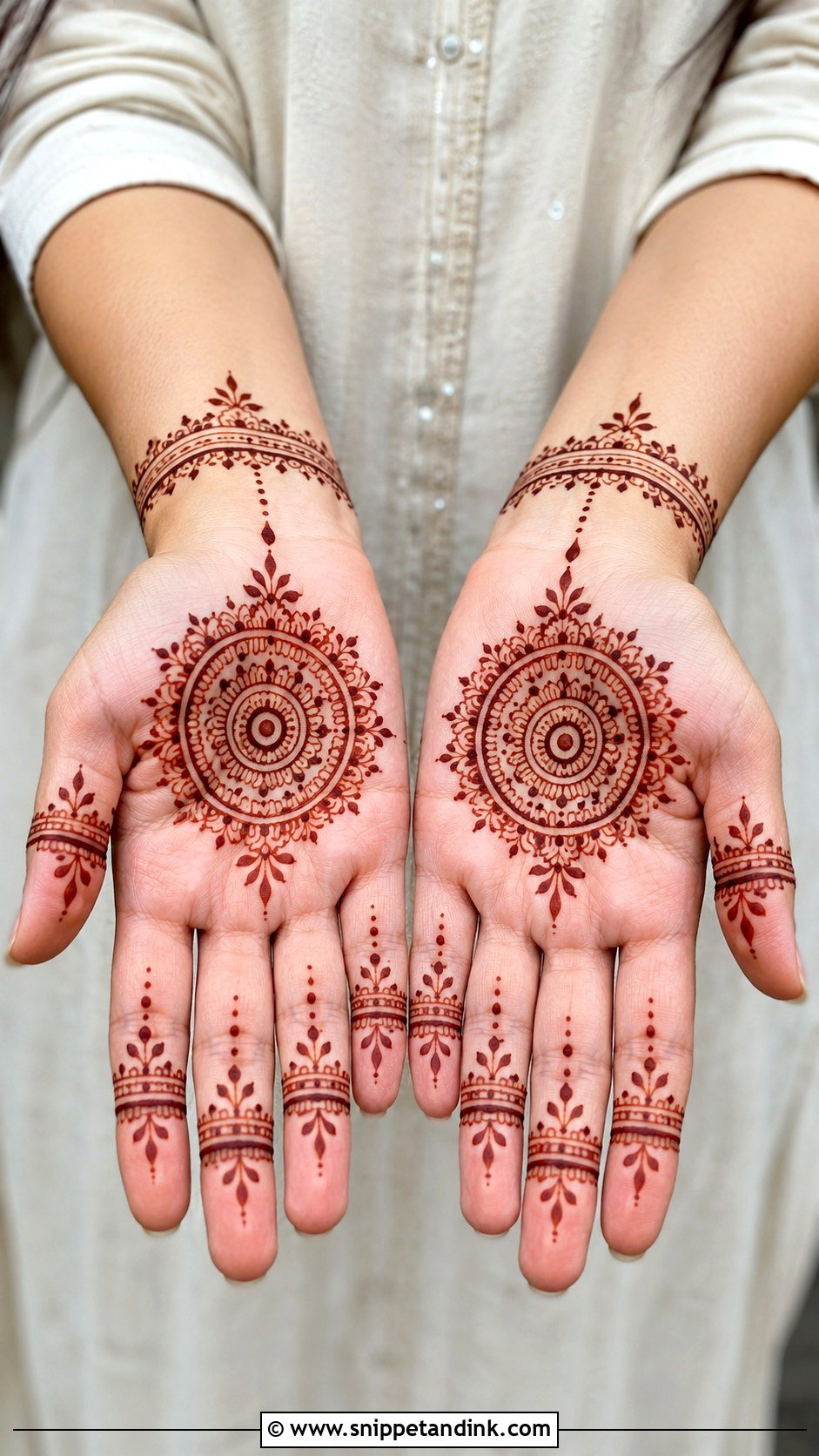
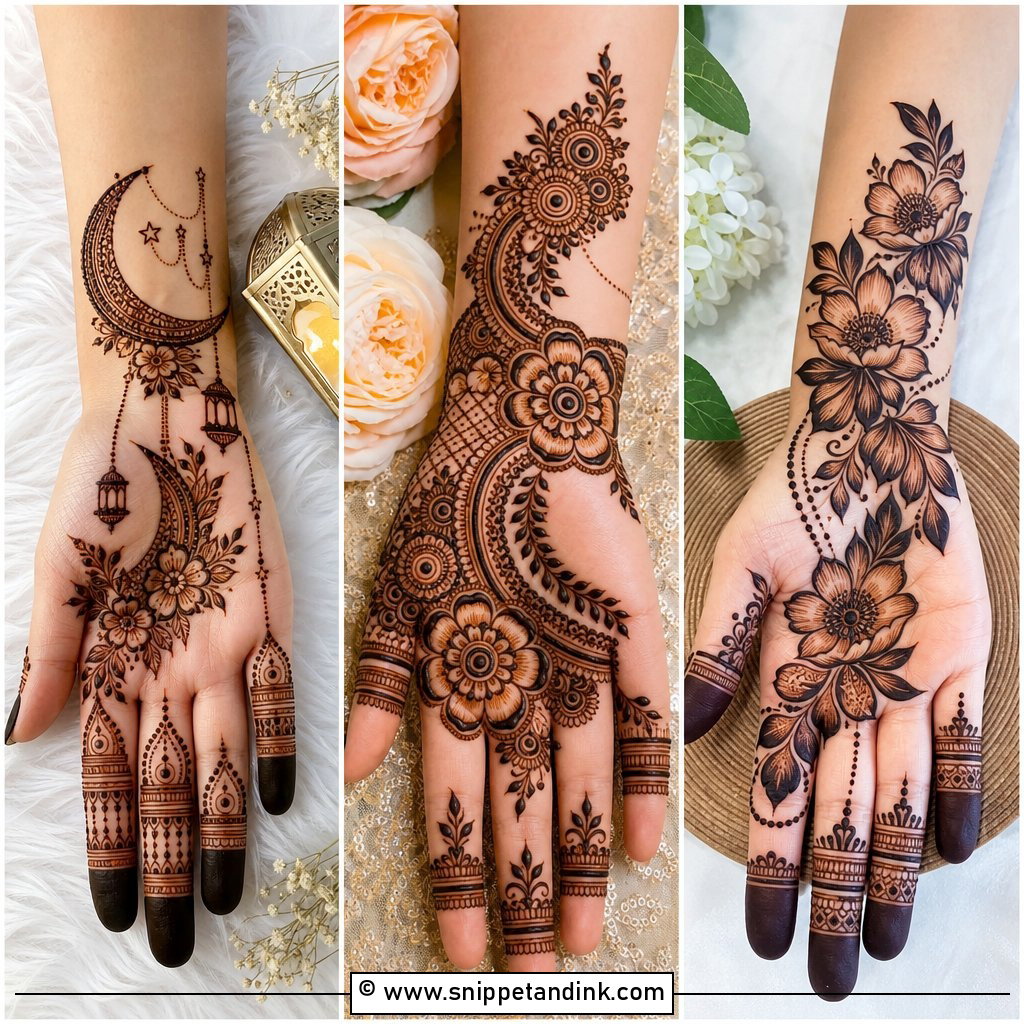
Eid work is a race on chaand raat. Arabic floral trails, crescent mandalas, leafy vines and neat finger patterns move from wrist to palm with open space for a clean finish, and they’re fast enough to keep the queue moving. Small stars, dots and moon curves add the festive note. For young girls I keep it light and quick; for adults I go bolder on the outlines, since a design applied late at night will still be deepening as the day goes on.
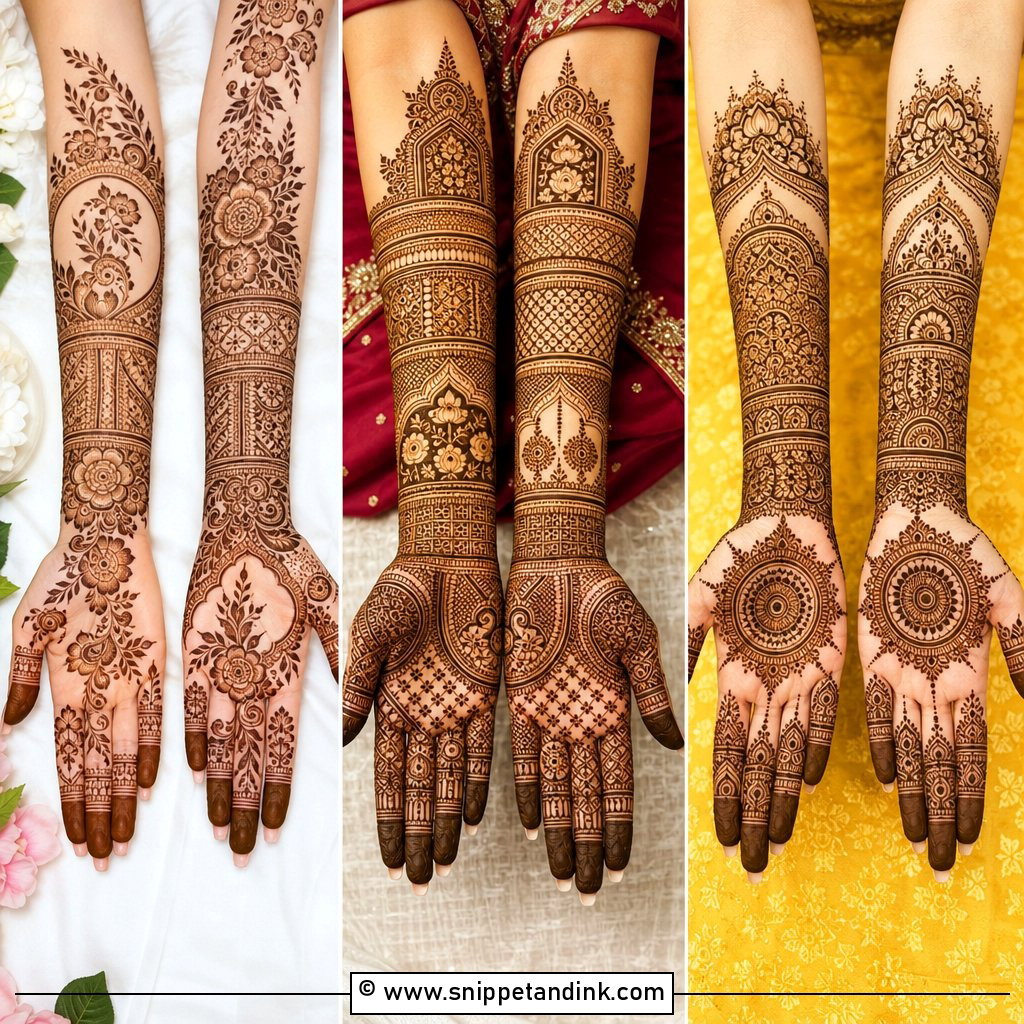
11. Front Hand Mehndi Design For Wedding
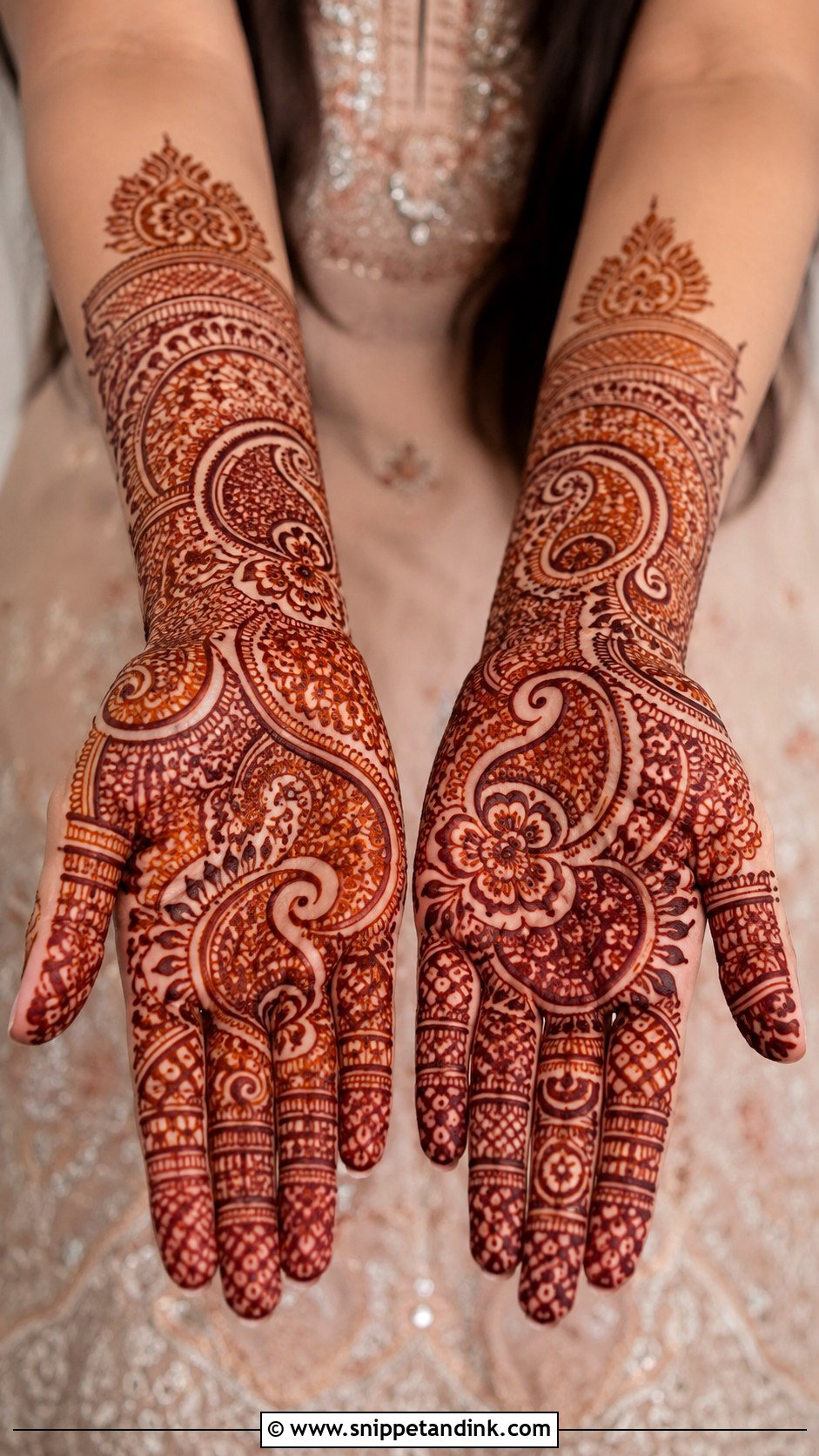
As a wedding guest you want your hands to look complete without rivaling the bride. A wedding front hand mehndi design can be a large palm mandala with a floral cuff, detailed fingers and side vines. Most guests choose Arabic or Indo-Arabic because the sitting is short; close family usually go fuller with paisleys and jaali. Heavy traditional outfits suit detailed fill; lighter outfits suit open florals.
12. Front Hand Mehndi Design For Engagement
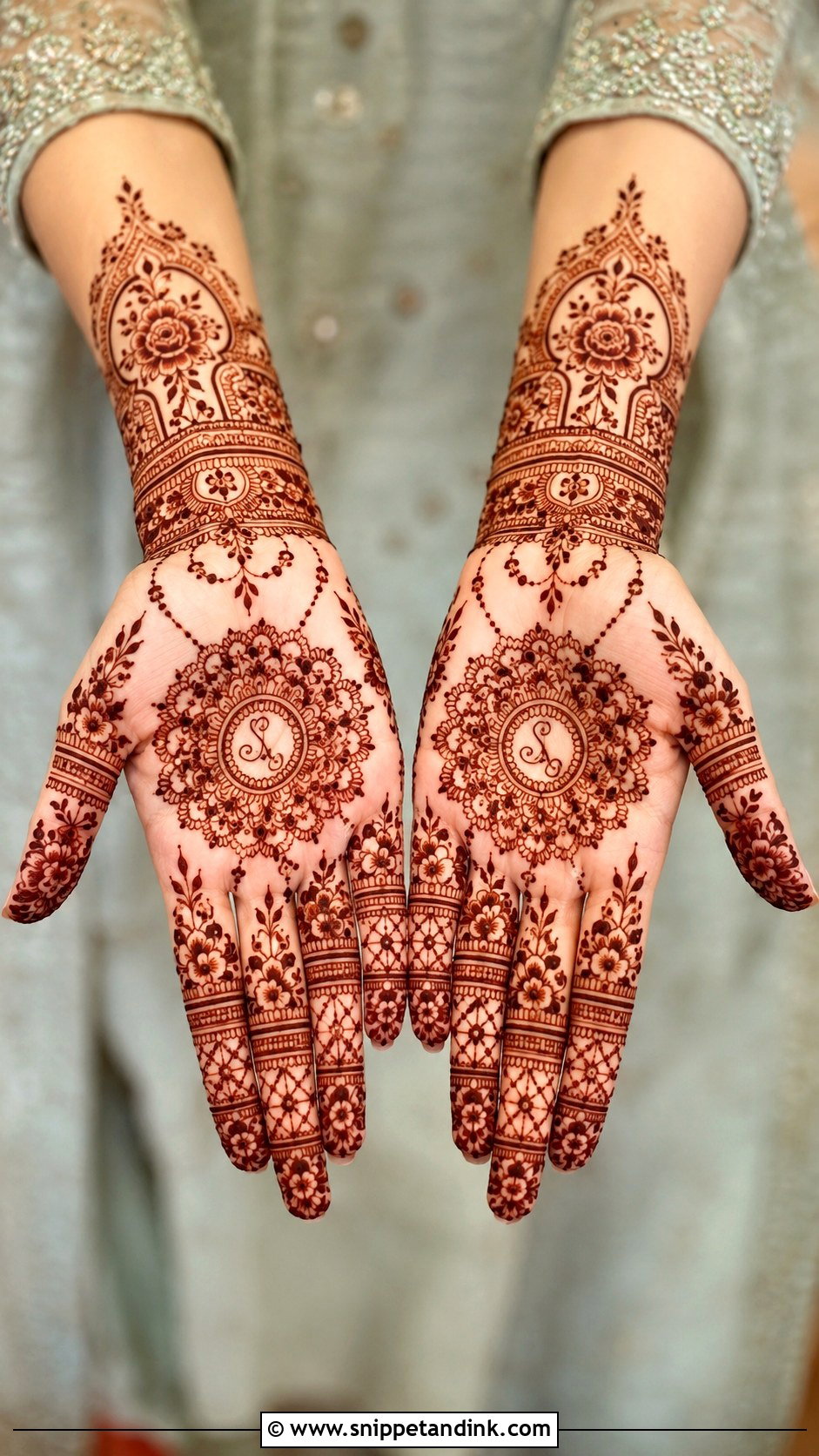
For an engagement I build medium coverage: a central mandala, fine florals, ring-style finger bands and a bracelet at the wrist. Ring photos are taken palm-down as often as palm-up, so I make sure the fingers are finished on both sides. Initials or a small date can go in a quiet corner of the palm. Keep the area around the ring finger simple so the ring stays the focus.
13. Front Hand Mehndi Design For Karwa Chauth
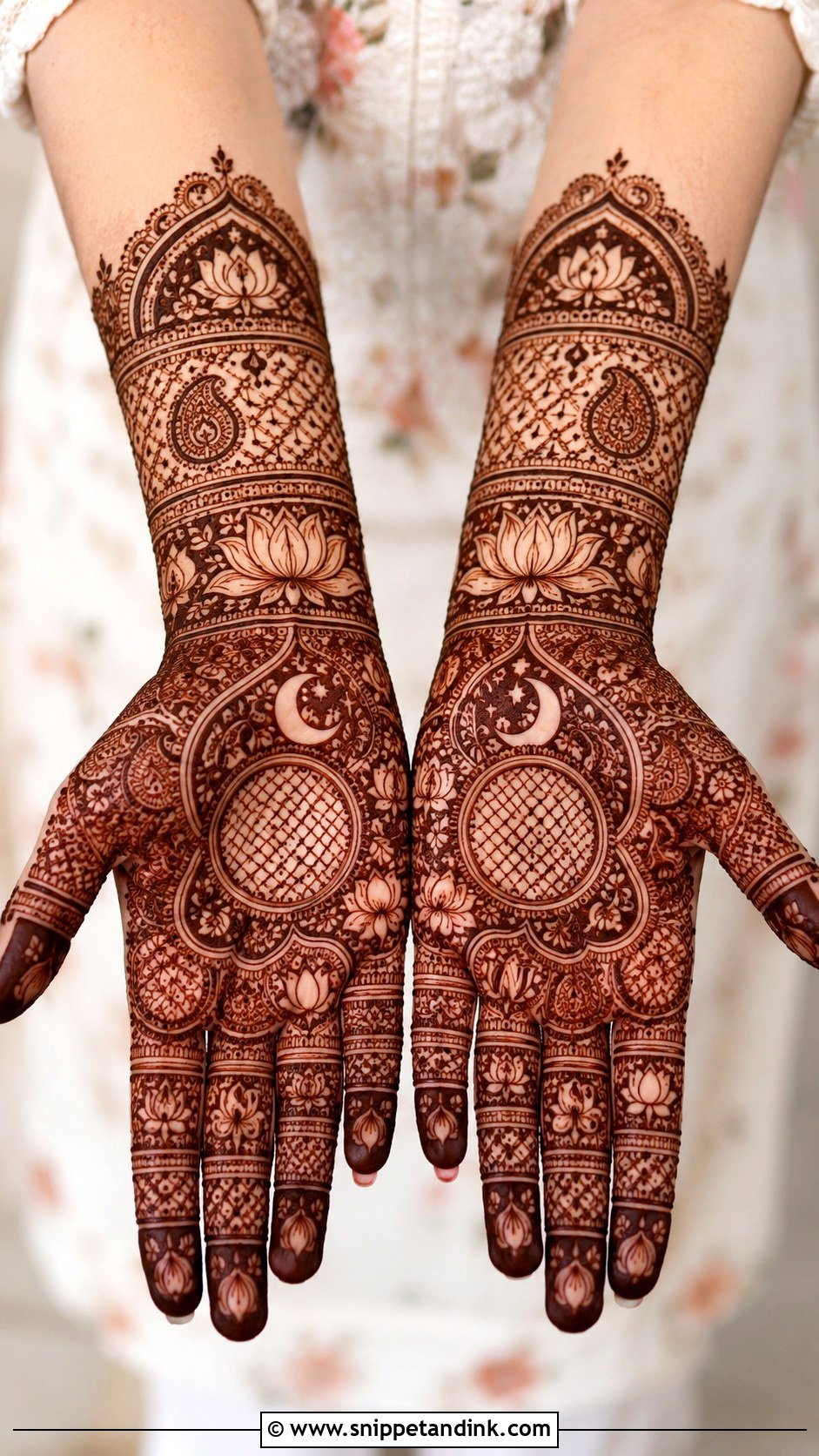
Karwa Chauth designs lean traditional: full palms with moon motifs, sieve-inspired circles, paisleys, lotus and fine wrist cuffs, sometimes with hidden initials. Fingers are usually filled heavily. Since henna is often applied the day before the fast, the stain has time to develop toward maroon by evening. For a modern take, a clean mandala with crescent details and open space around it works well.
14. Front Hand Mehndi Design For Diwali
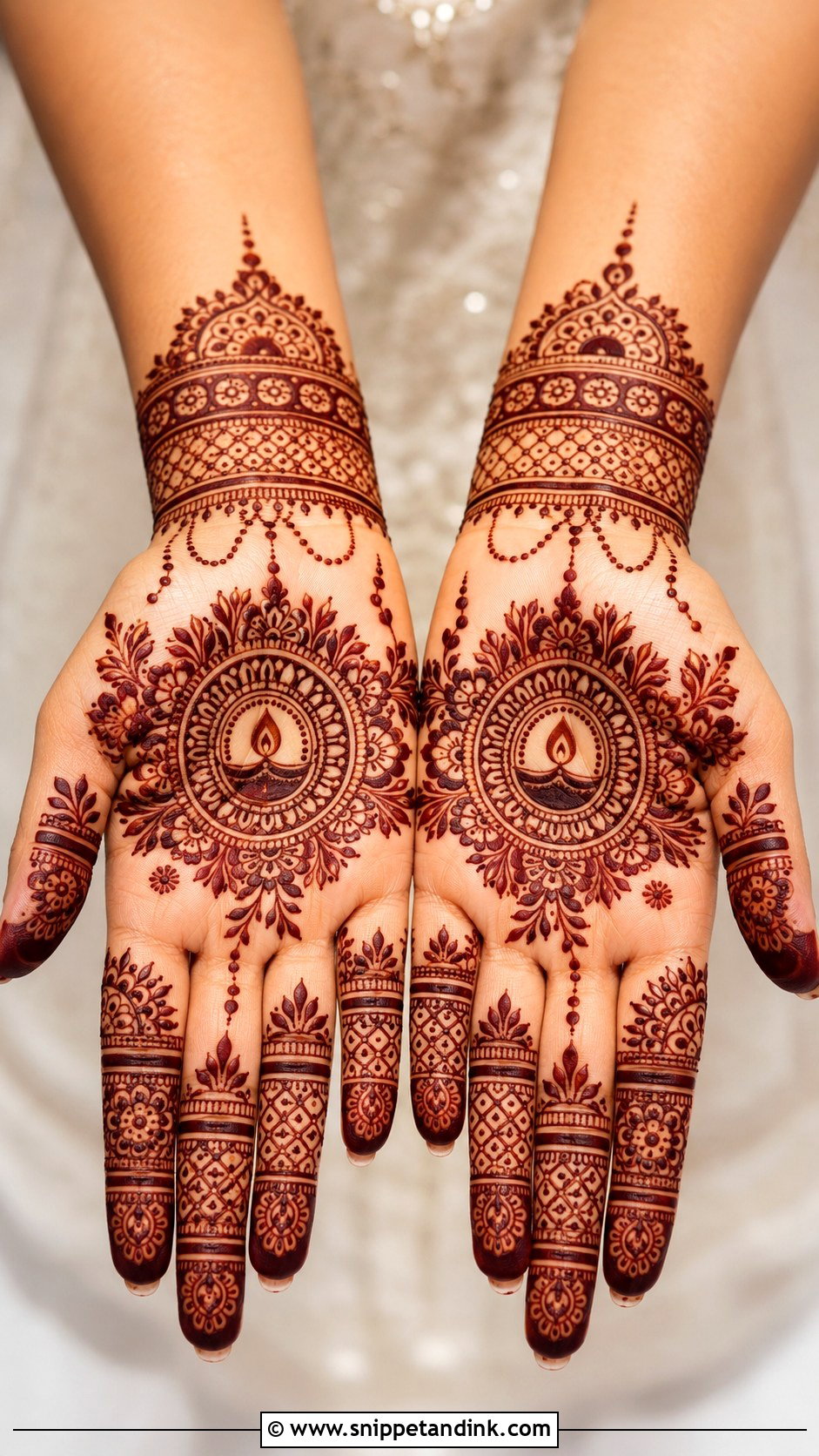
Diwali week is busy, with cooking, cleaning and lighting diyas, so I suggest a palm design you can live with: a rangoli-inspired mandala, small diya shapes, floral trails, dots and clean finger bands. A wrist bracelet makes it look dressed without covering more skin. Get it done before the cooking starts. Oil and frequent washing fade palm henna faster than you’d expect.

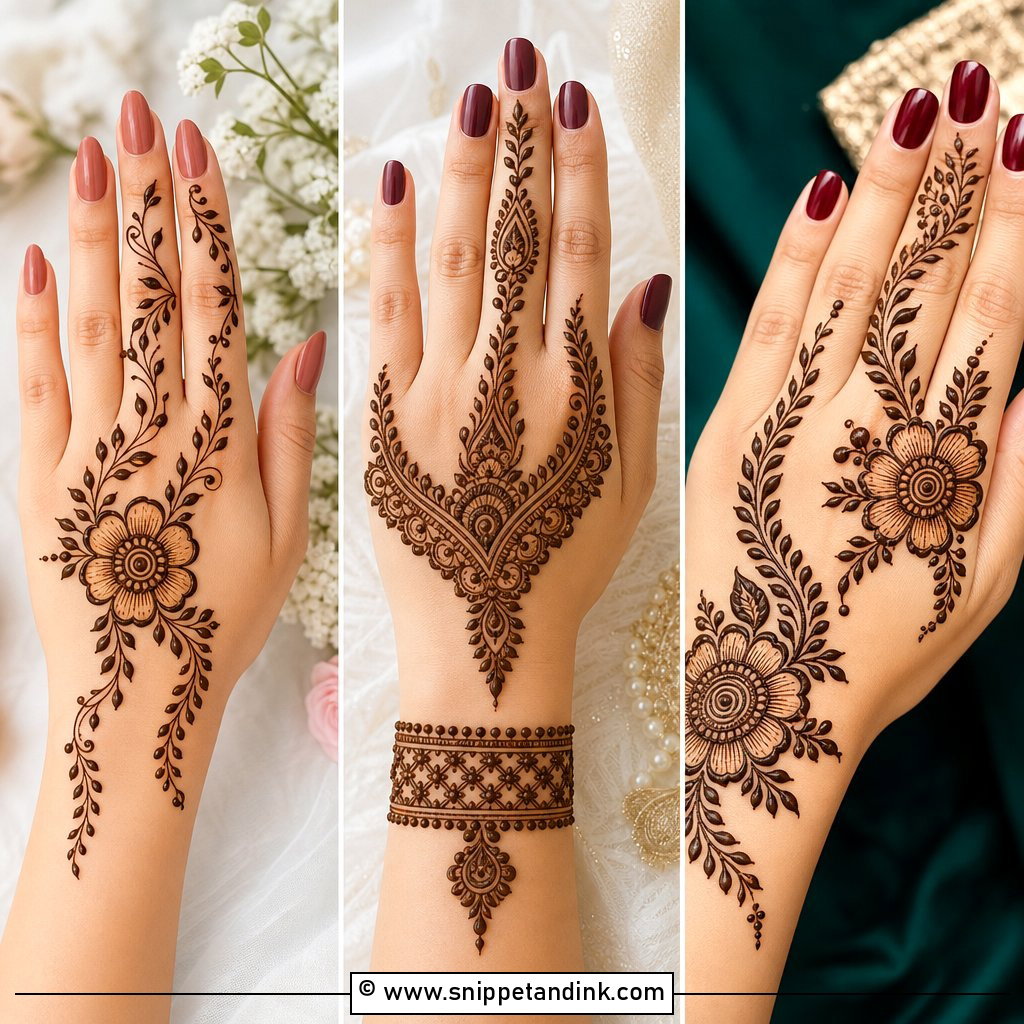
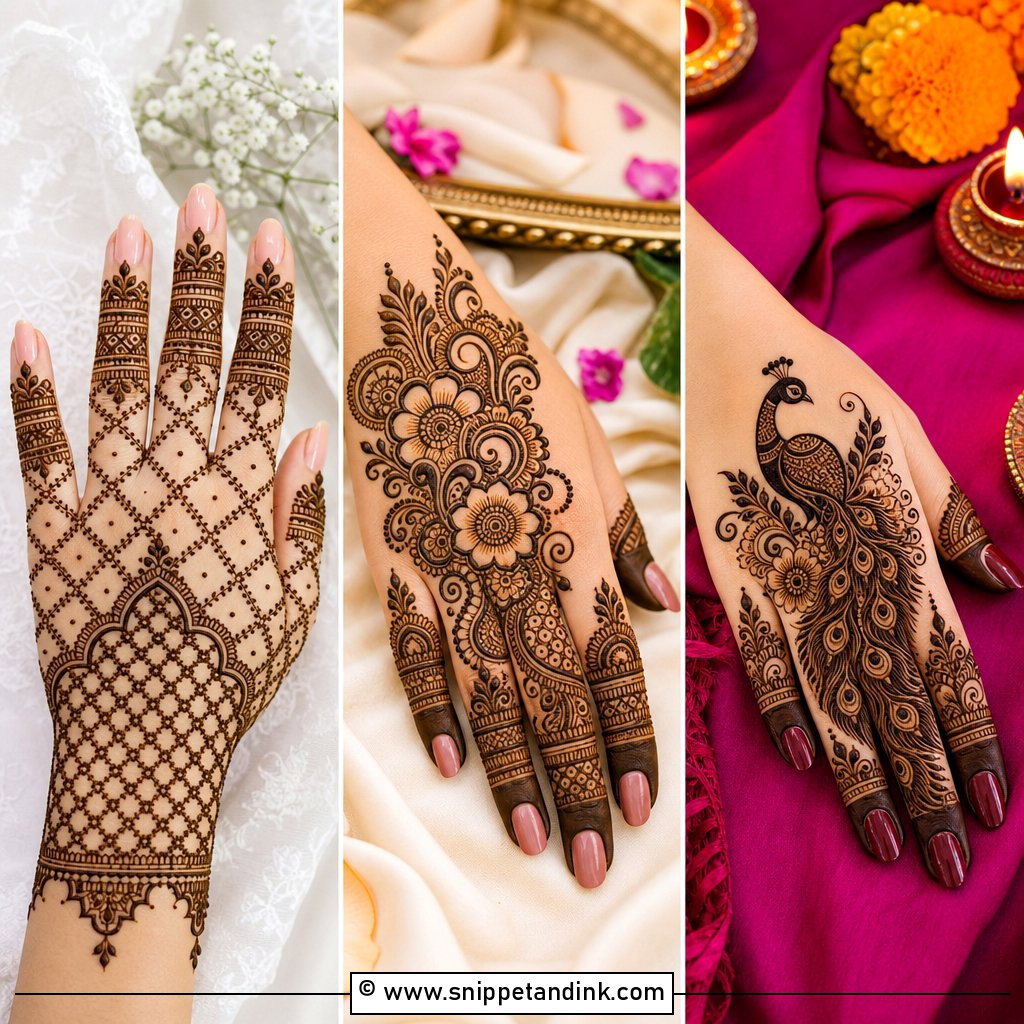
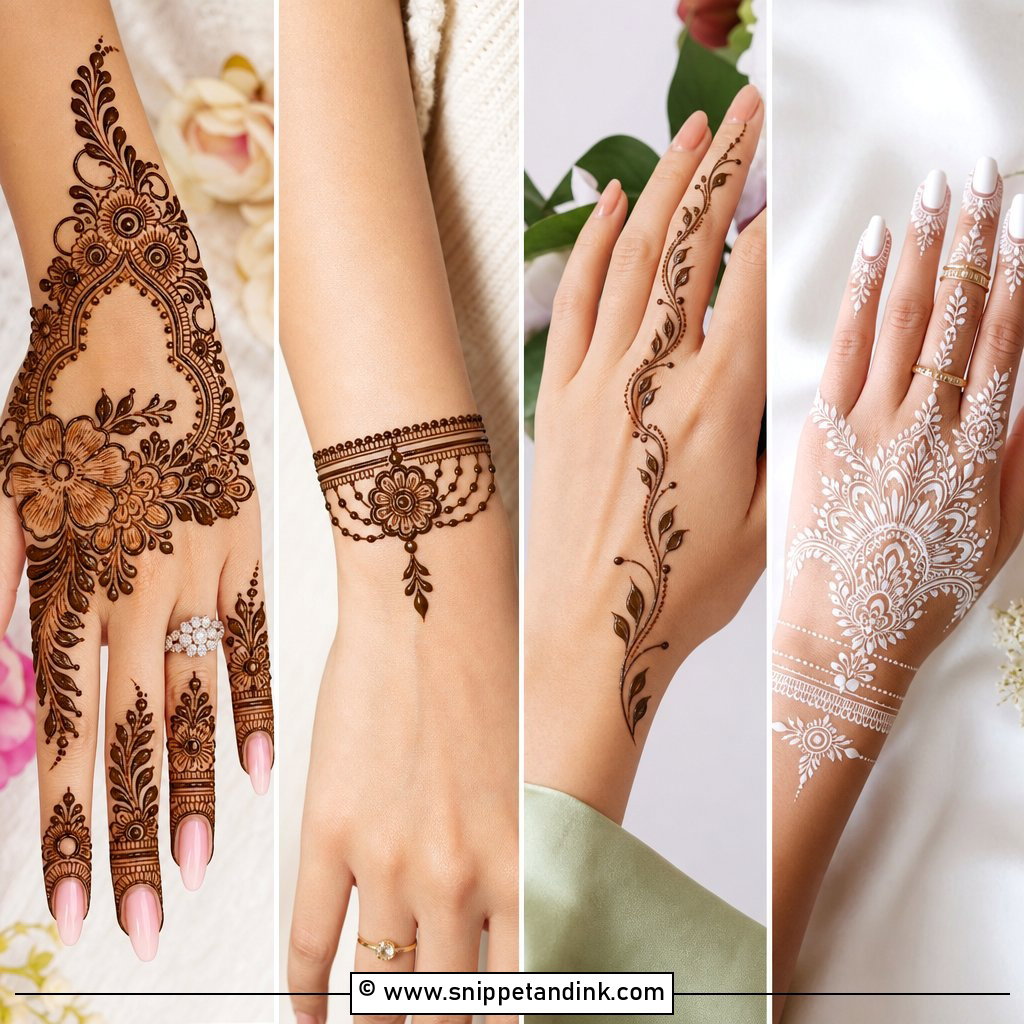
15. Minimal Front Hand Mehndi Design
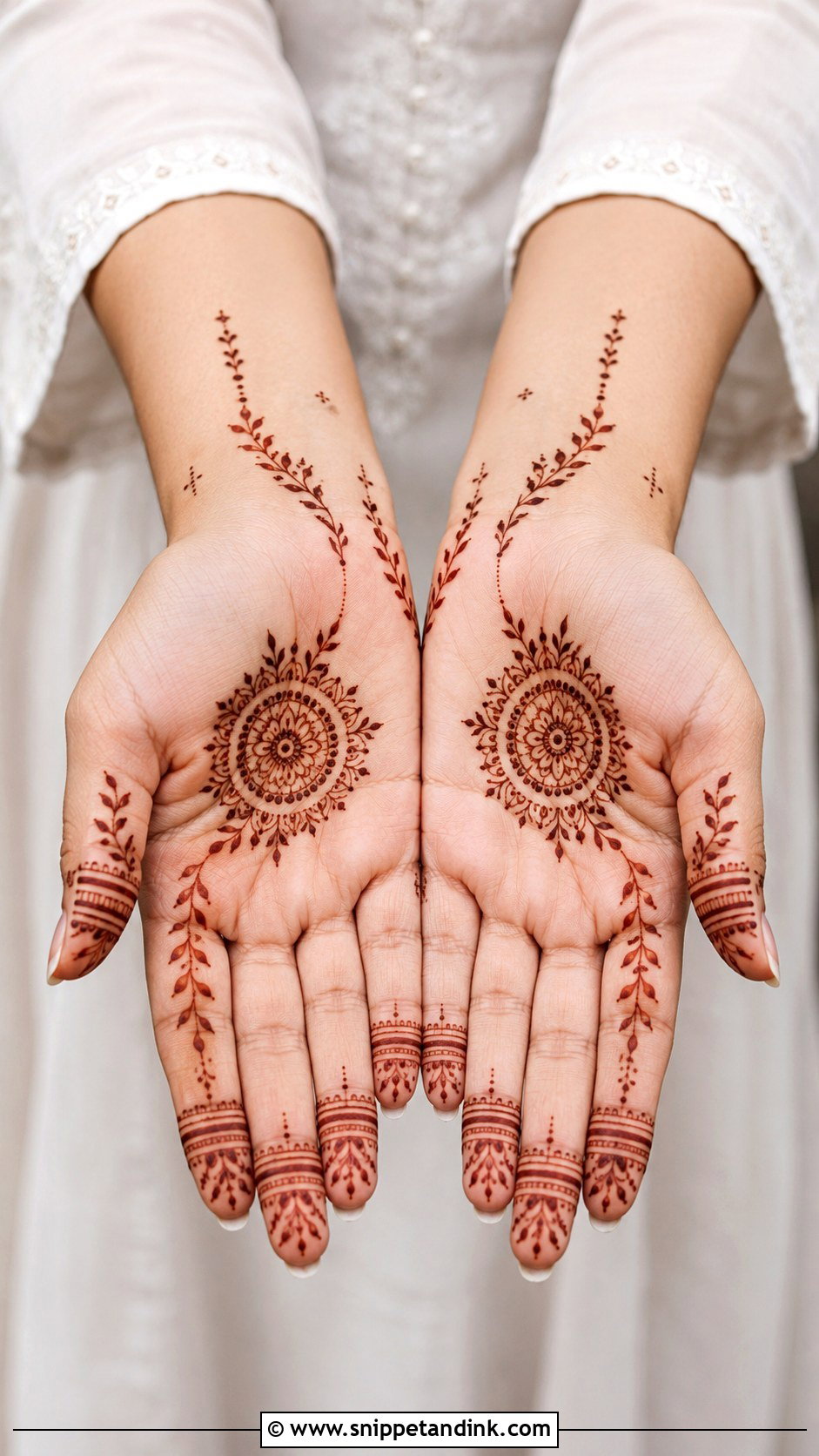
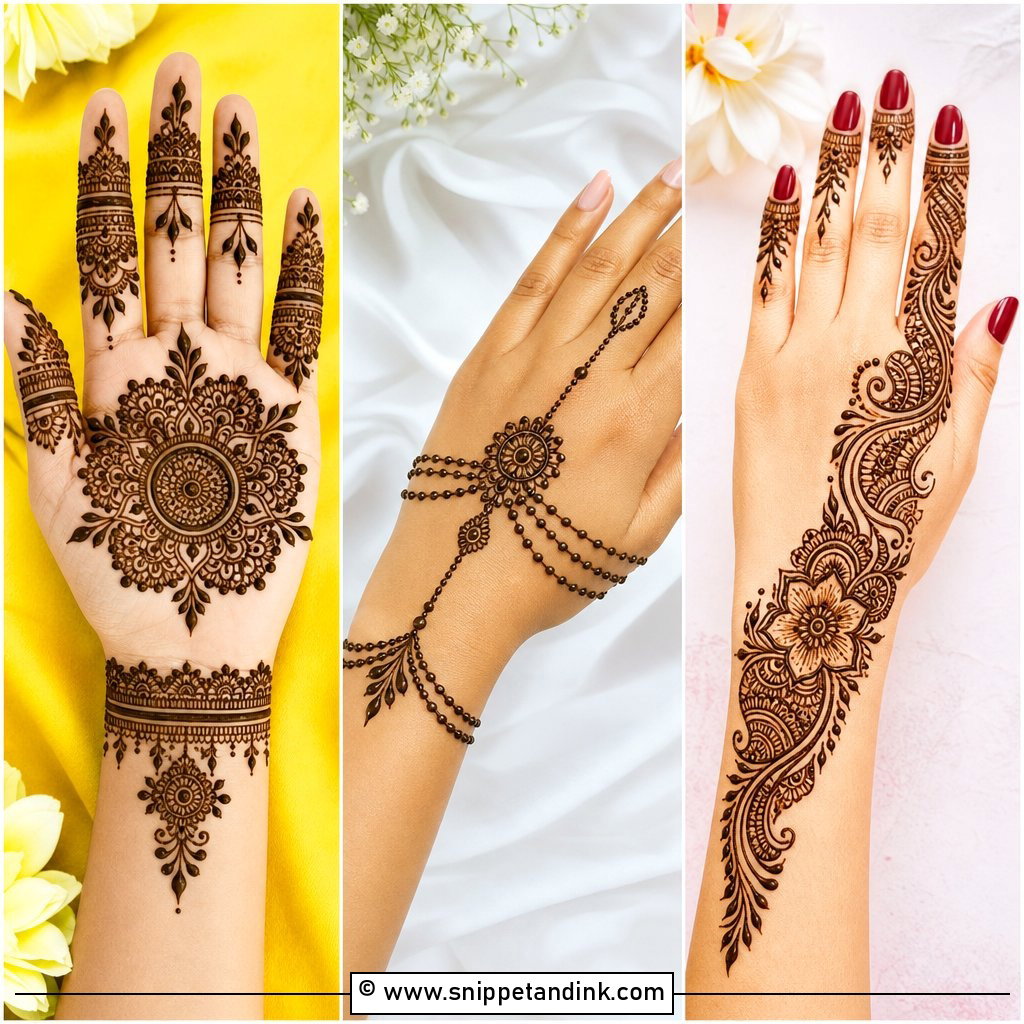
A small palm mandala, a slim leafy trail, light finger bands and a fine wrist line, with open skin as part of the design. Minimal doesn’t mean scattered. I join the palm and fingers with tiny dots or matching bands so it reads as one piece. It suits teens, office events and anyone who dislikes dense henna.
16. Easy Front Hand Mehndi Design
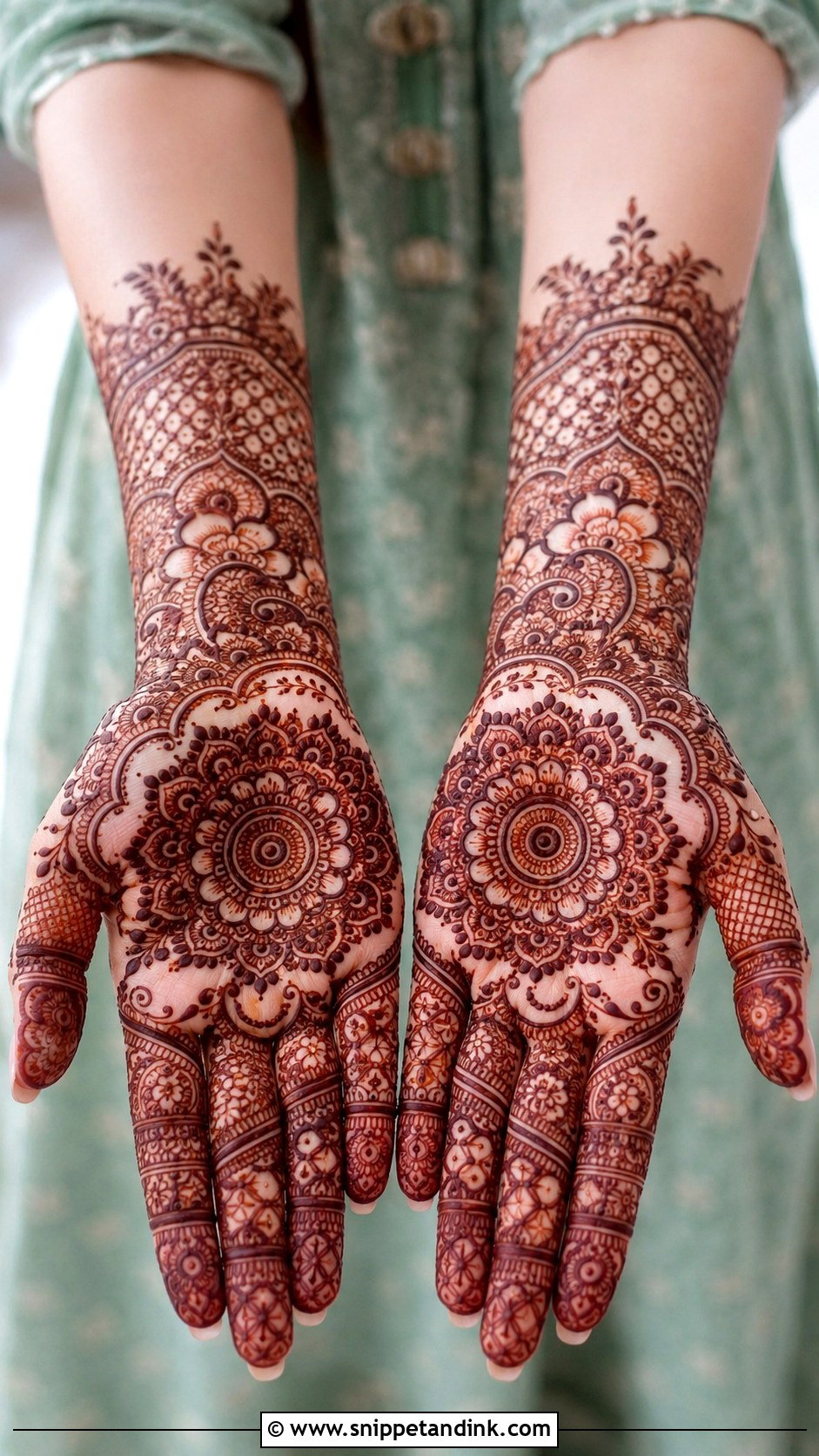
Start with a medium flower, mandala or paisley in the palm, add simple vines toward the fingers and a small bracelet near the wrist. Dots, leaves, curved lines and scalloped borders are the easiest shapes for an unsteady hand. Slow down on the outline; a clean simple design looks far better than an ambitious one with shaky lines. Leave space between motifs, since lines thicken slightly as they stain.
17. Rose Front Hand Mehndi Design
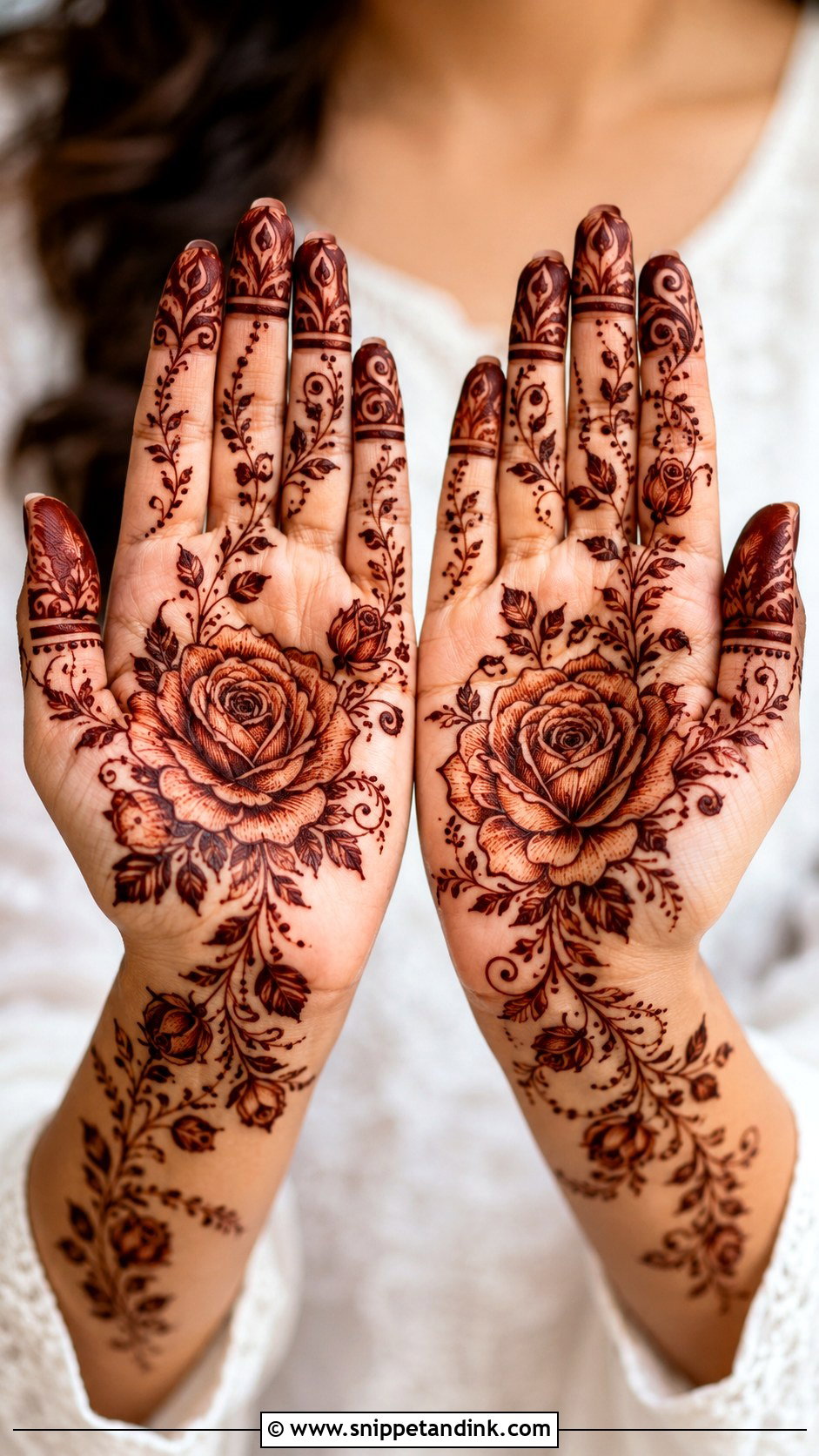
One large rose on the palm with leaves, vines and buds around it, either running diagonally toward the fingers or sitting centered with balanced finger work. I give rose petals thick outlines and light inner shading; without the shading they flatten into circles, and without strong outlines they vanish in a dark stain. A leafy wrist cuff finishes it. Bridesmaids and engagement guests ask for this one a lot.
18. Lotus Front Hand Mehndi Design
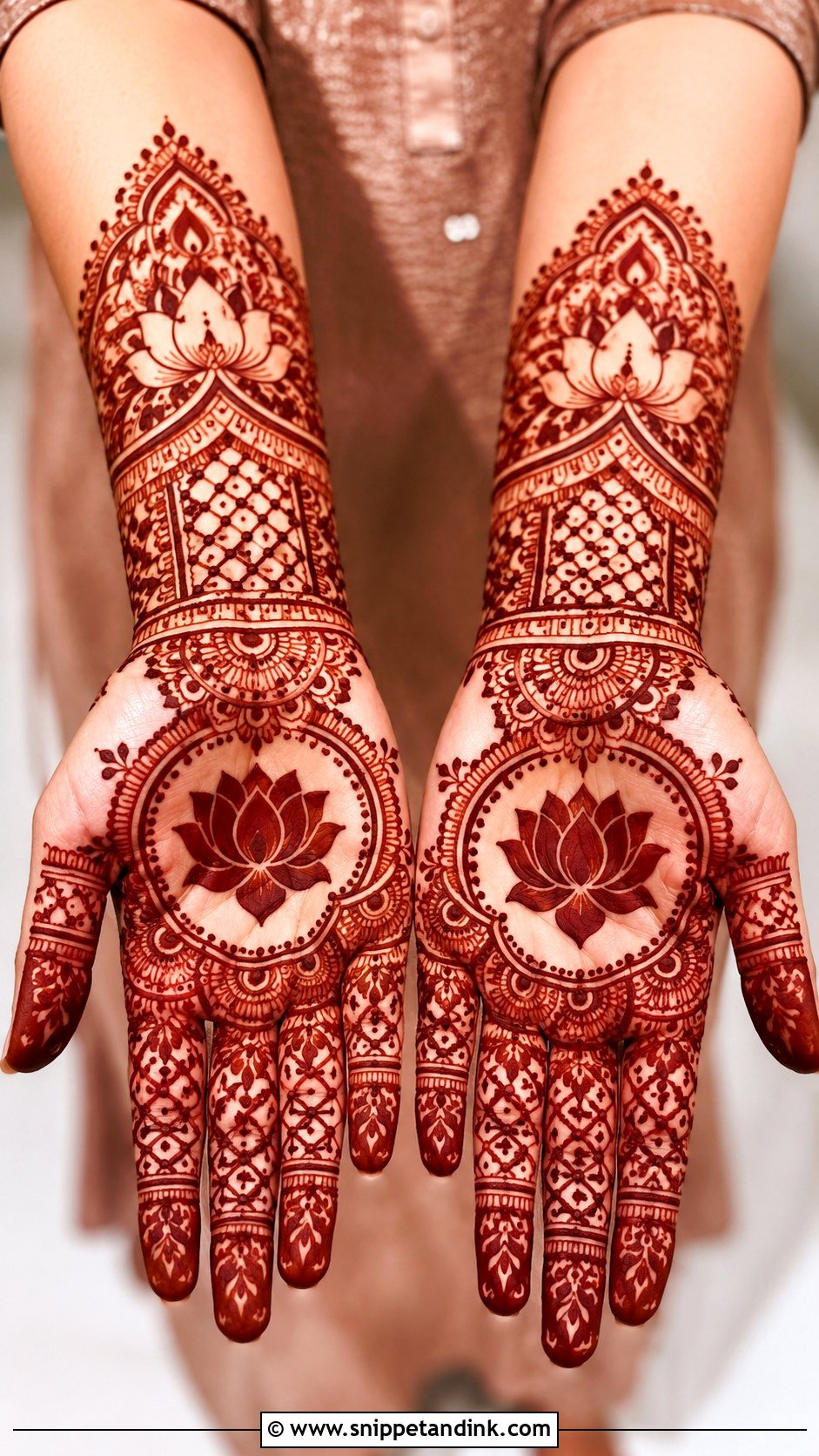
Lotus suits weddings, poojas and festivals because of what it means, and it holds its shape well on a palm. It can be one large central flower or repeated petals around a mandala, linked to detailed fingers with fine vines and dotted chains, with jaali around it for a richer finish. Keep the petals bold. In heavy fill, a fine-lined lotus disappears.
19. Peacock Front Hand Mehndi Design
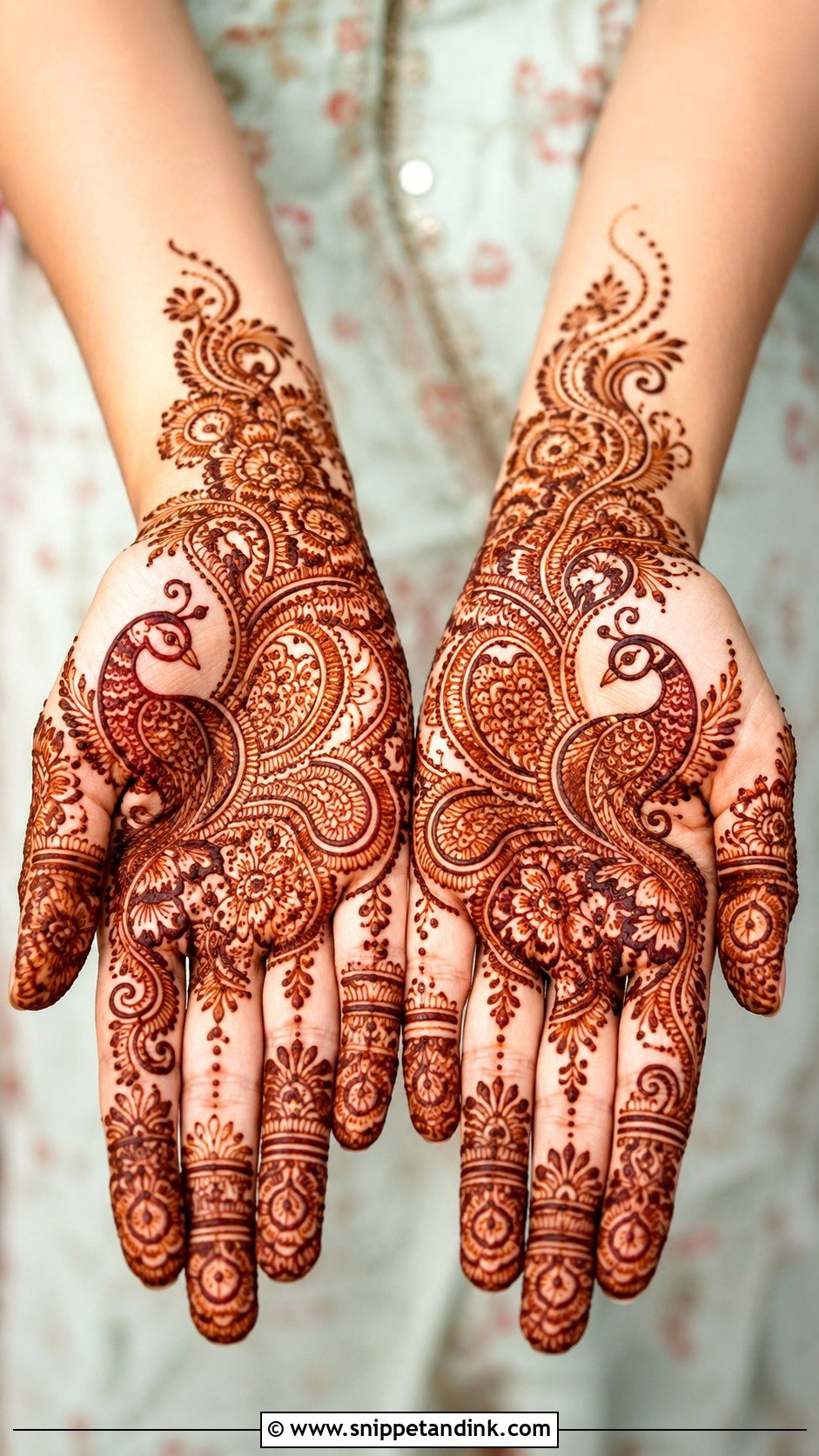
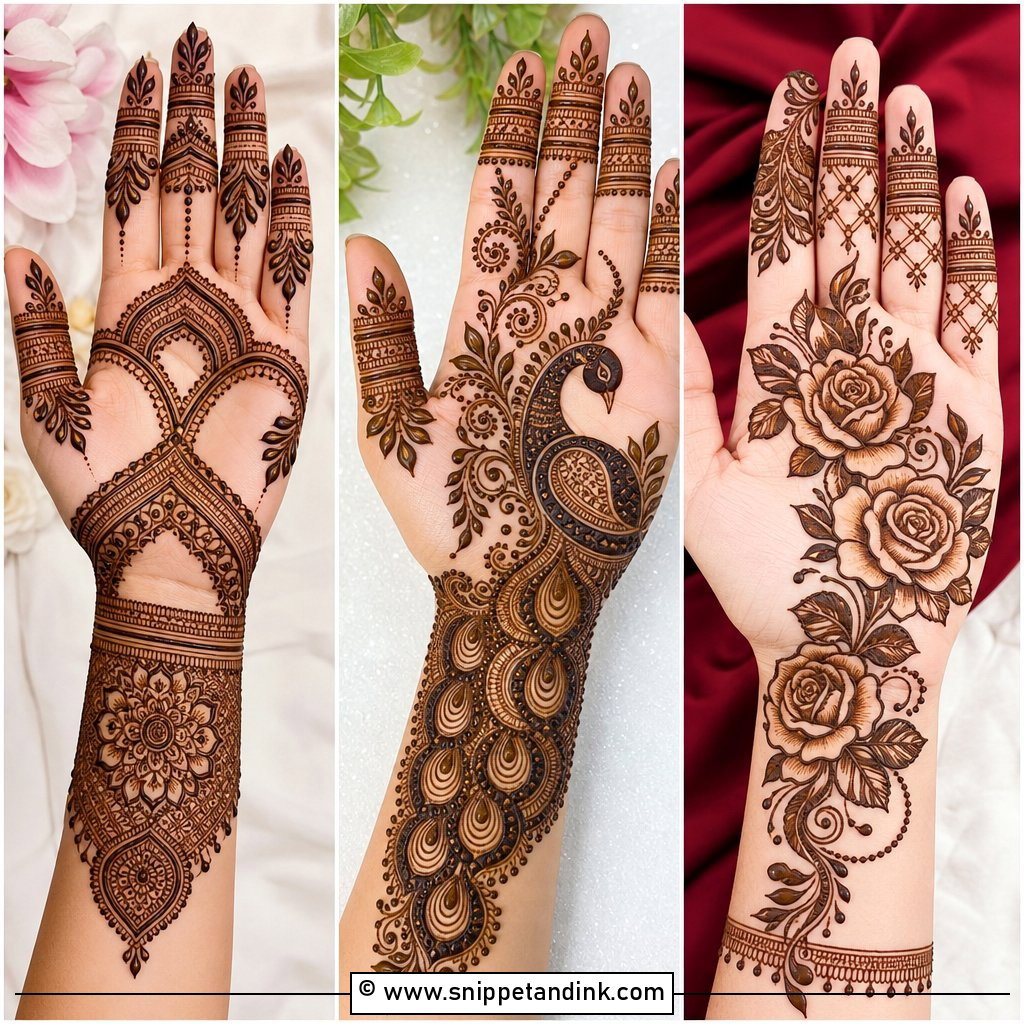
Peacocks across the palm, with feathers flowing toward wrist or fingers, are classic bridal and close-family work. I draw the body and neck outline first, slightly bold, and only add feather detail once that shape is right; a peacock crowded with fill before the outline is set turns into a tangle. Feather-inspired bands on the fingers echo it. No glitter or color needed.


20. Paisley Front Hand Mehndi Design
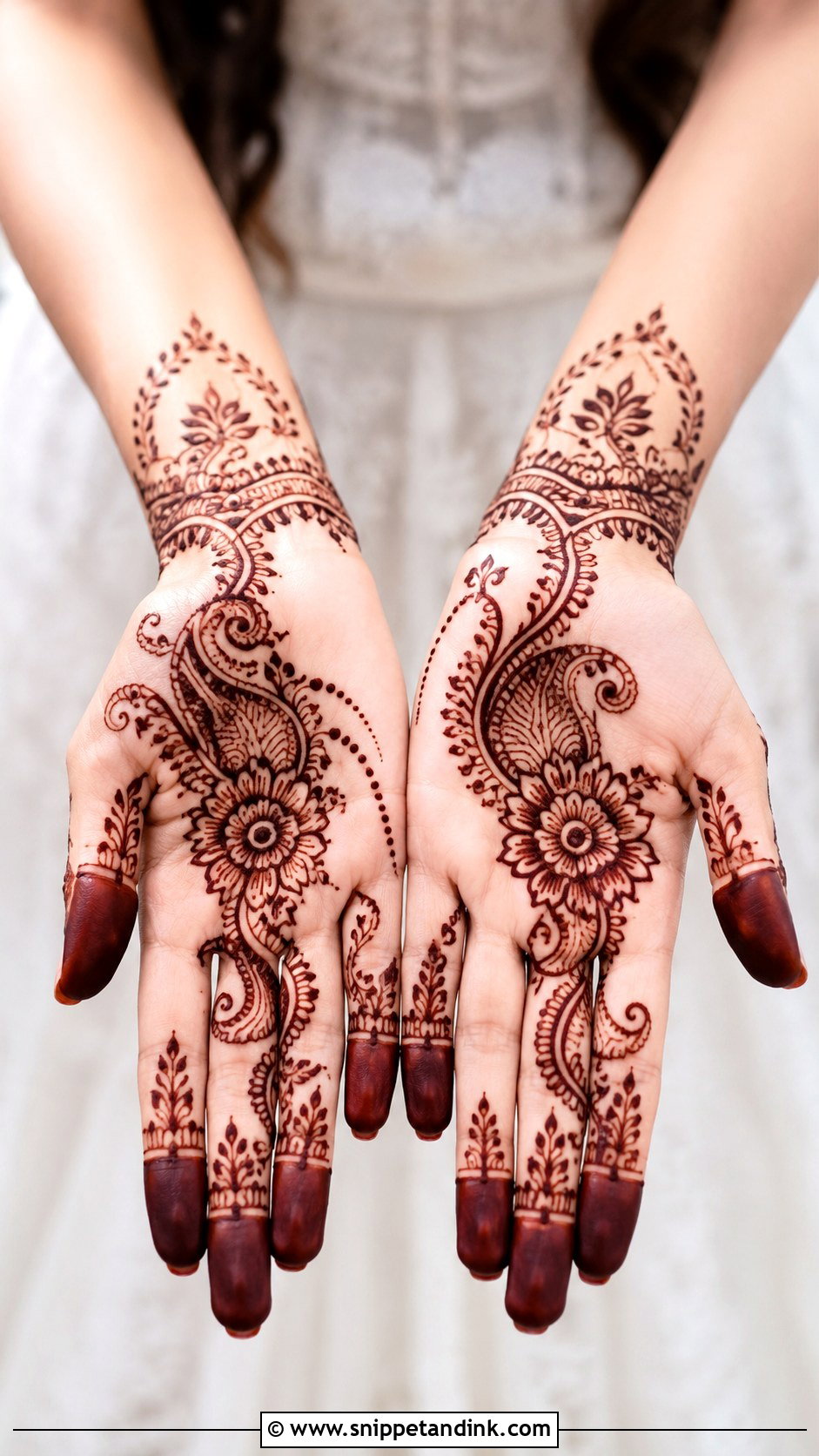
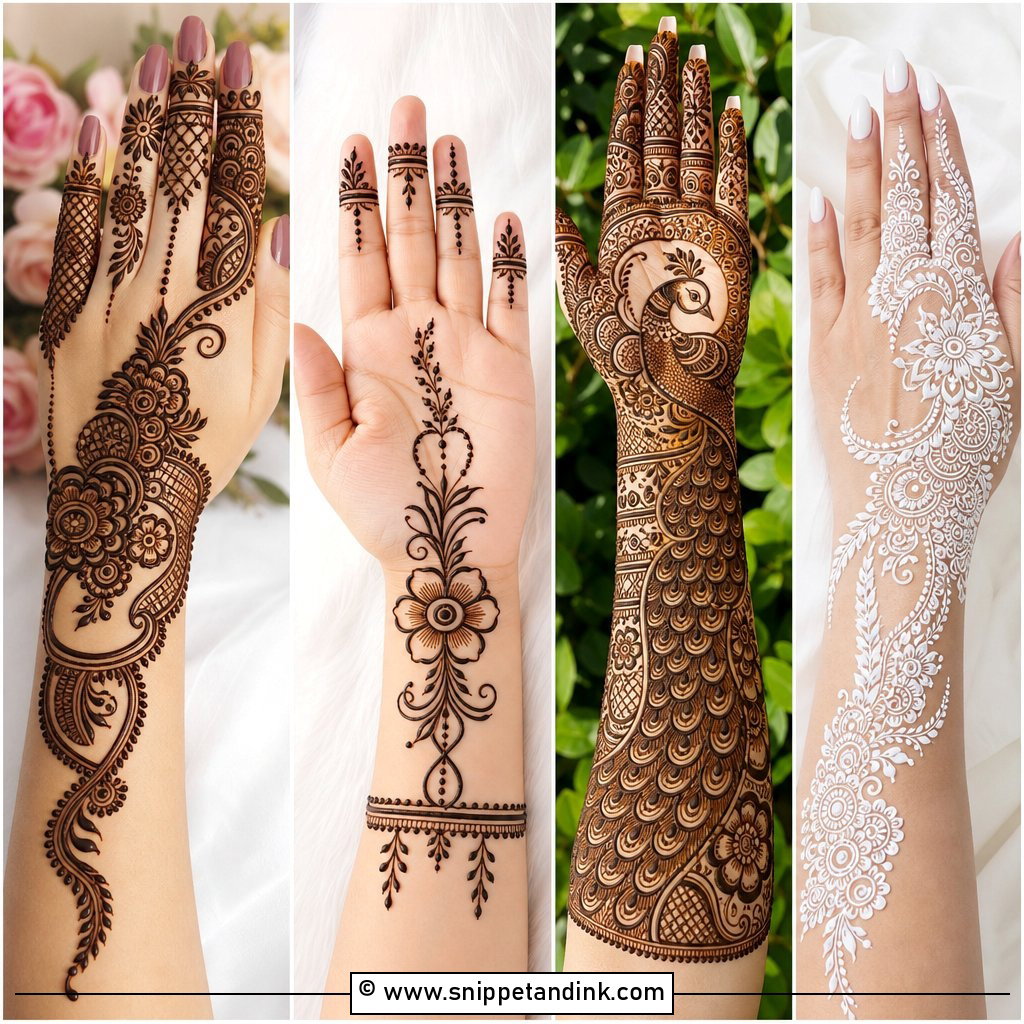
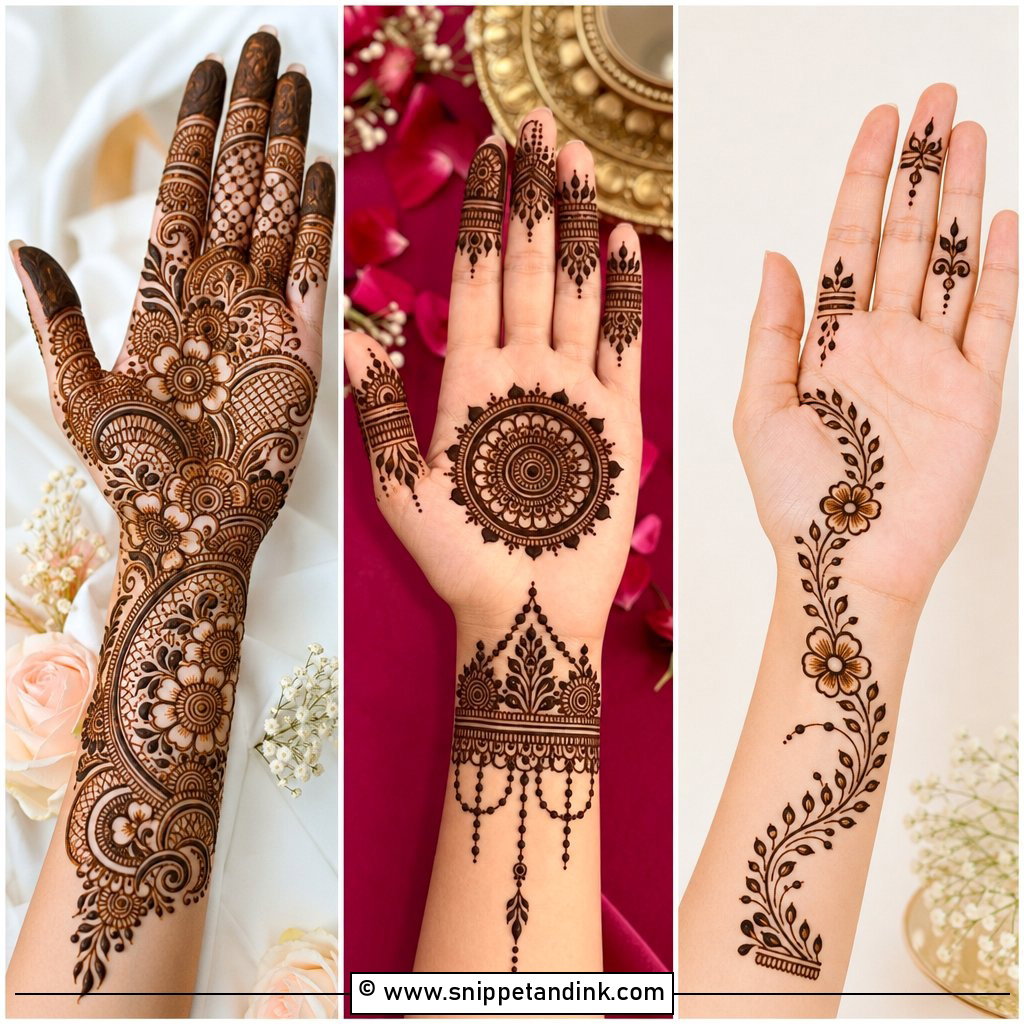
Paisleys are my most adaptable palm motif: a central cluster, a diagonal trail or a full Indian layout, filled with tiny flowers, dots, checks or leaves. They scale up for large palms and down for small ones. Pair bold outlines with open space for a modern look, or fill the background with jaali and curls for weight.
21. Jaali Front Hand Mehndi Design
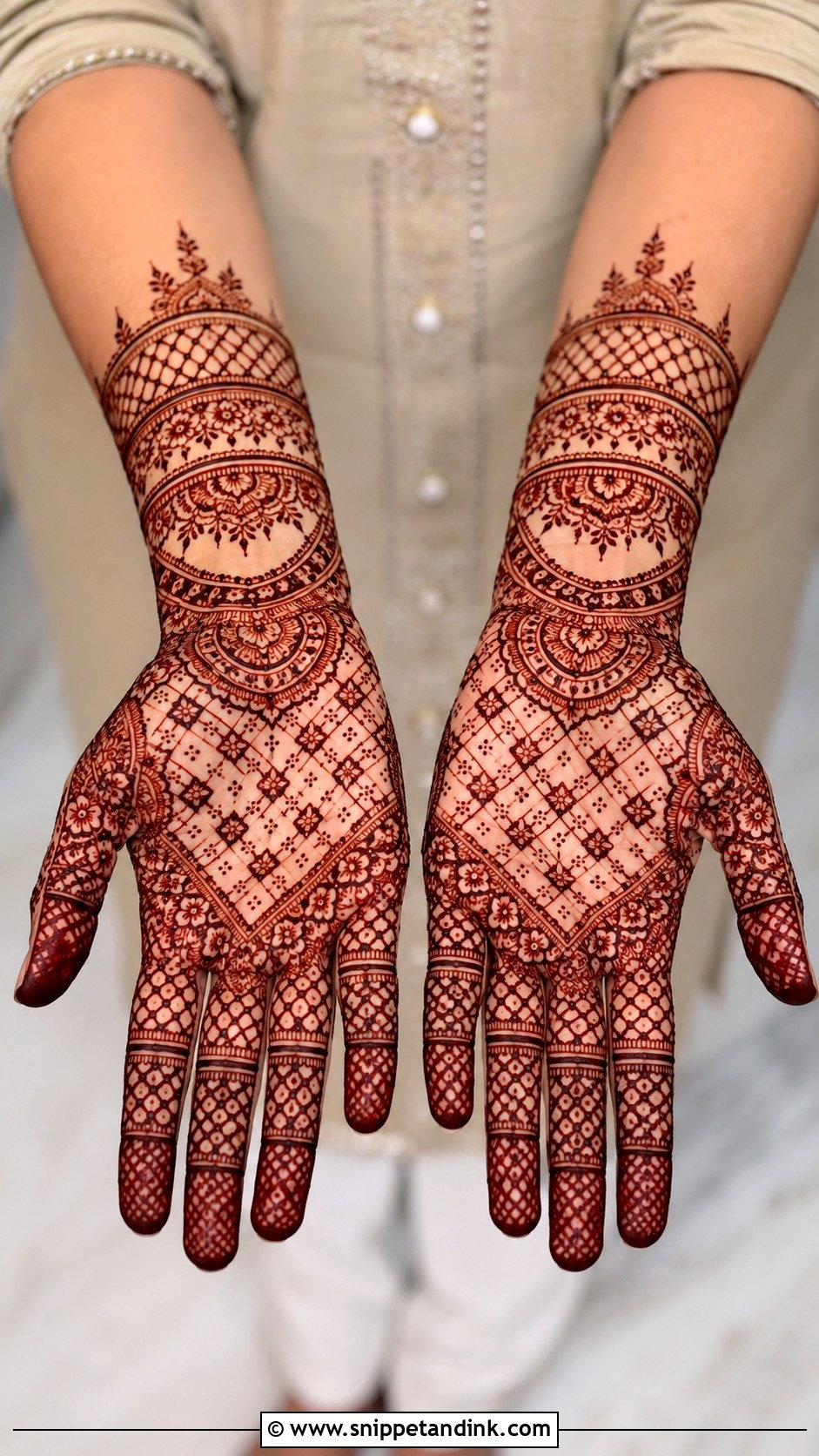
Jaali on the palm can cover one side, ring a mandala or fill spaces between flowers and paisleys, as diamond grids, square checks or curved mesh with dots inside. Palm creases interrupt a mesh, so I bend the grid slightly to follow the lines of the hand rather than fighting them. It fills the palm without adding more large motifs. Balance it with a few open florals so it doesn’t look like a solid patch.
22. Jharokha Front Hand Mehndi Design
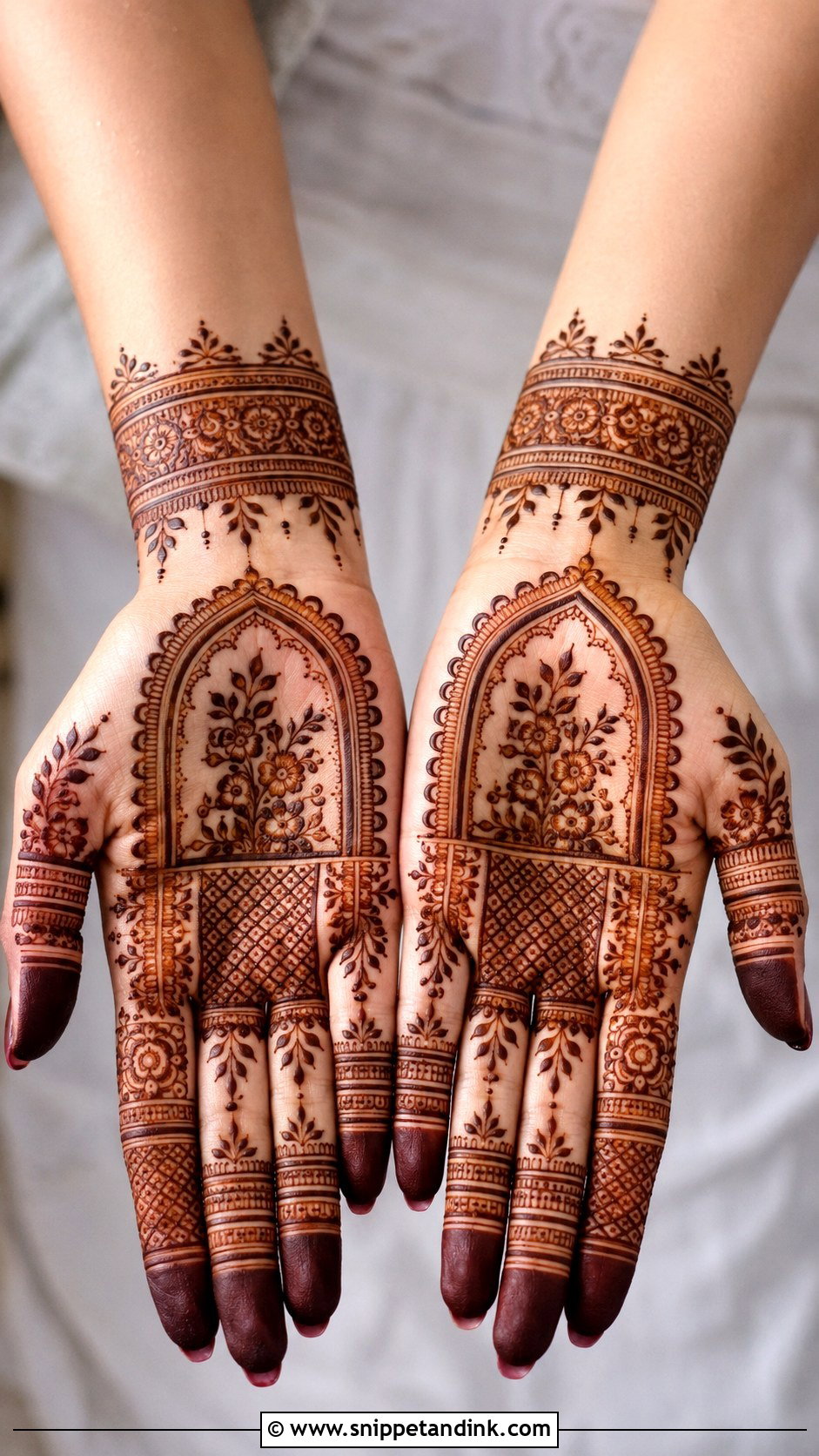
Jharokha frames turn the palm into an arched window, filled with florals, vines, a mandala or fine lattice. Dots, leaf borders and extensions lead to the fingers. The arch has to be symmetrical, and that’s harder on a palm than it looks, so I mark both sides with guide dots first. A slim wrist cuff completes it without stealing attention from the frame.
23. Bracelet Front Hand Mehndi Design
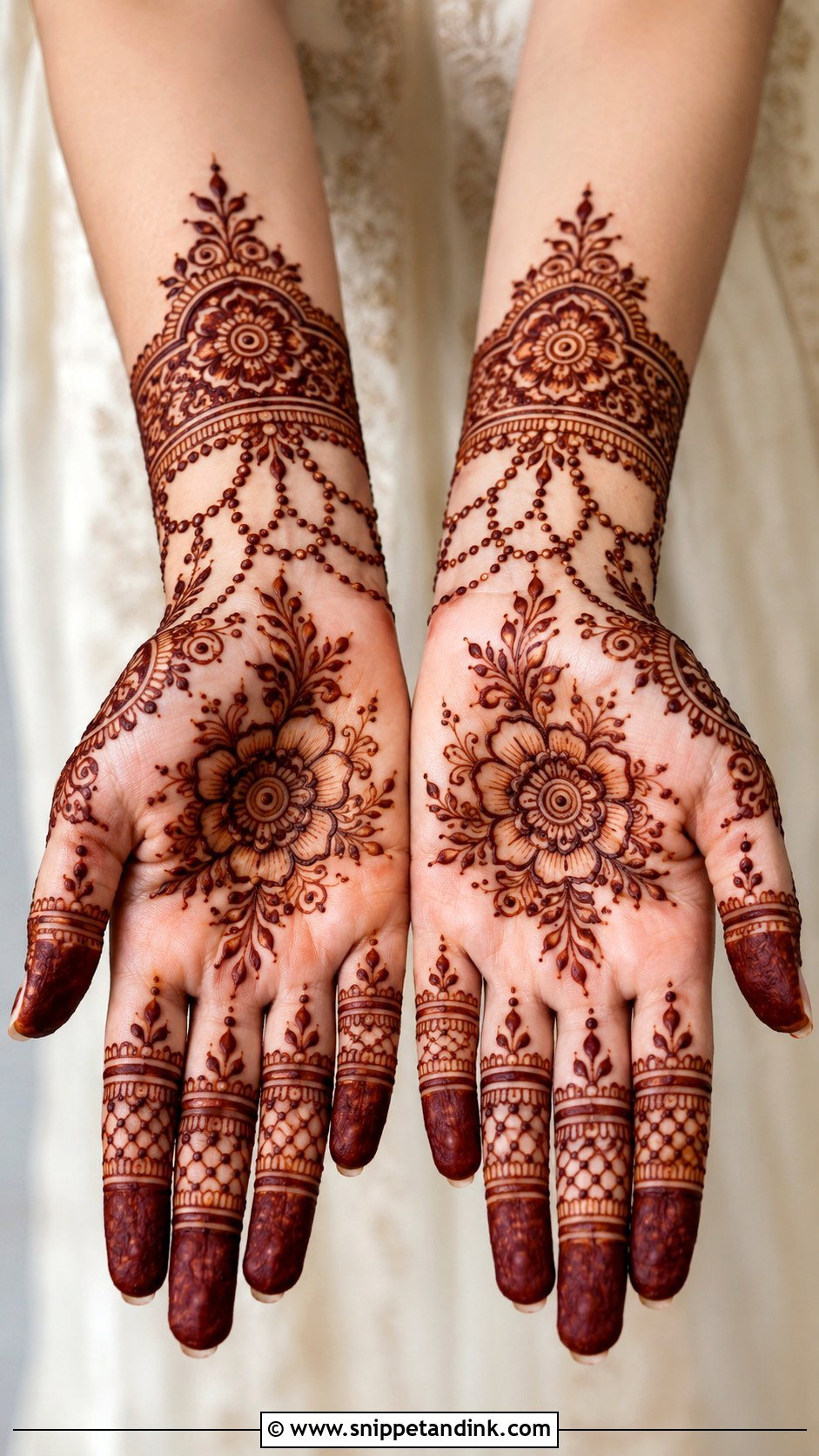
The palm carries a mandala, flower or paisley, the wrist carries bands, chains and bead-like detail, and a thin line or dotted trail joins them. It works with bangles and rings without adding weight. I draw the wrist bracelet with the hand relaxed, not bent back, so it sits evenly once the hand is down. Good for engagements, festivals and bridesmaids.
24. Finger Front Hand Mehndi Design
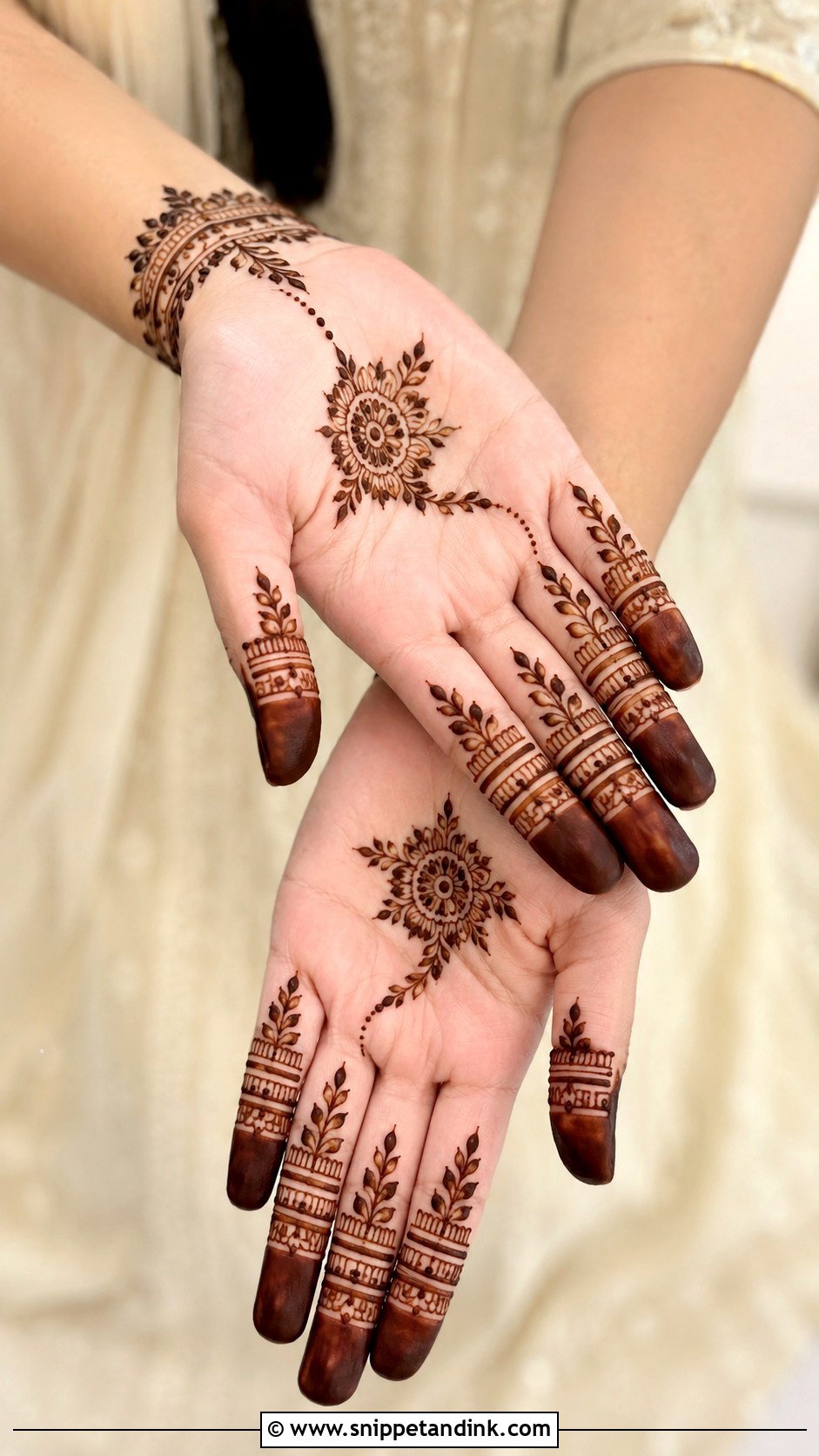
Fingers carry the detail here, with only a small mandala, floral cluster or vine on the palm: stacked bands, leaf chains, dotted rings, fingertip caps, small florals. It’s practical for anyone who needs her palms free soon after. Fingertips take henna very well and stain almost as dark as the palm center. Repeat one or two patterns across all fingers so it looks planned.



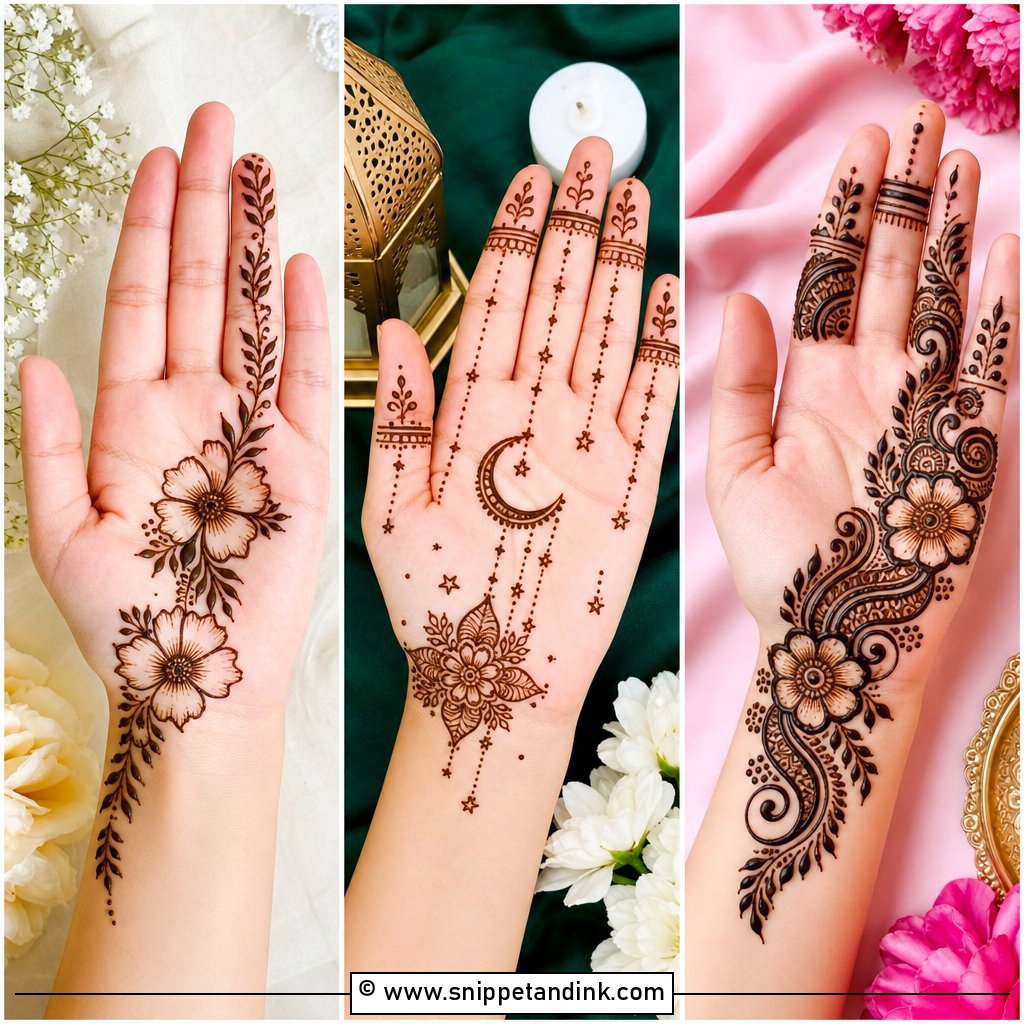

25. Palm Front Hand Mehndi Design
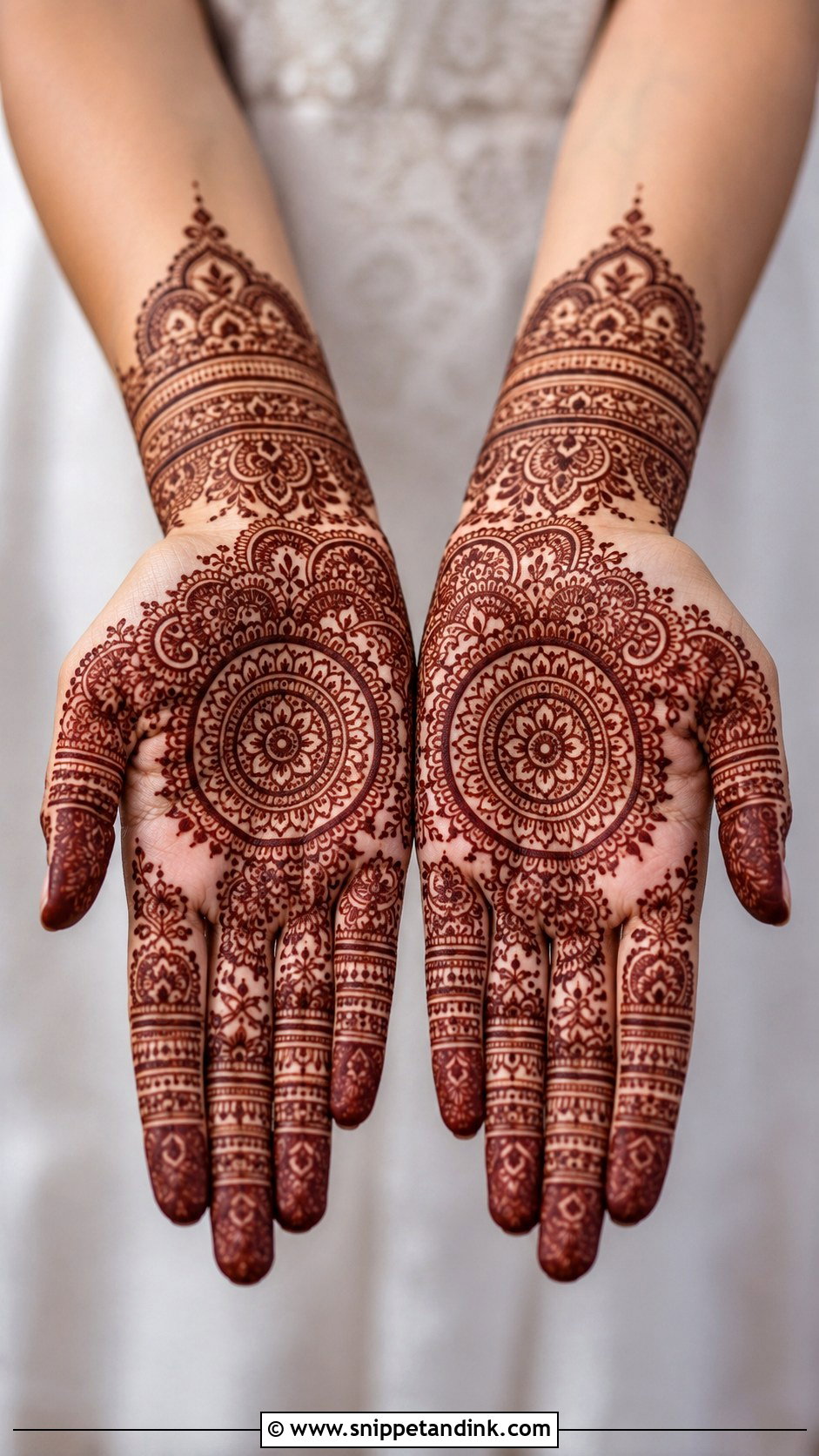
The palm holds the main artwork, a mandala, flower, lotus, paisley cluster or geometric circle, with the fingers dressed up or down to match the occasion. One clean motif with dotted bands is the simple version; vines, scallops, jaali and wrist work around it make the fuller one. Symmetry carries this design. If the center motif is even, the rest can stay simple and still look finished.
26. Geometric Front Hand Mehndi Design
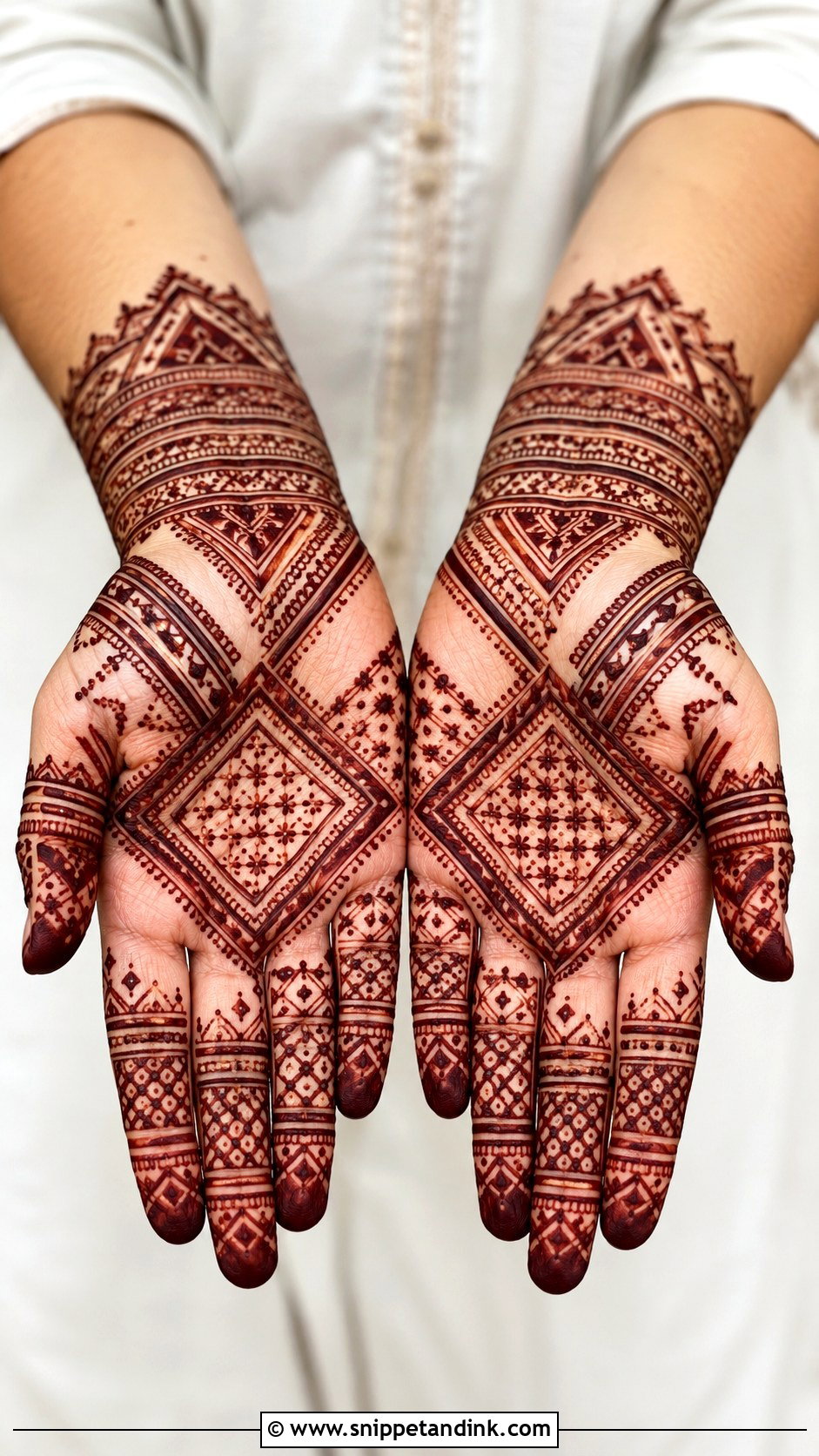
Triangles, diamonds, squares, lines, grids and structured borders, often as a geometric mandala or a sectioned palm, with straight bands and angular leaves on the fingers. Uneven line thickness ruins geometry, so I keep cone pressure constant and draw straight lines in short joined strokes. A few floral touches soften it for anyone who finds pure geometry too strict. Fusion outfits pair well with it.
27. Moroccan Front Hand Mehndi Design
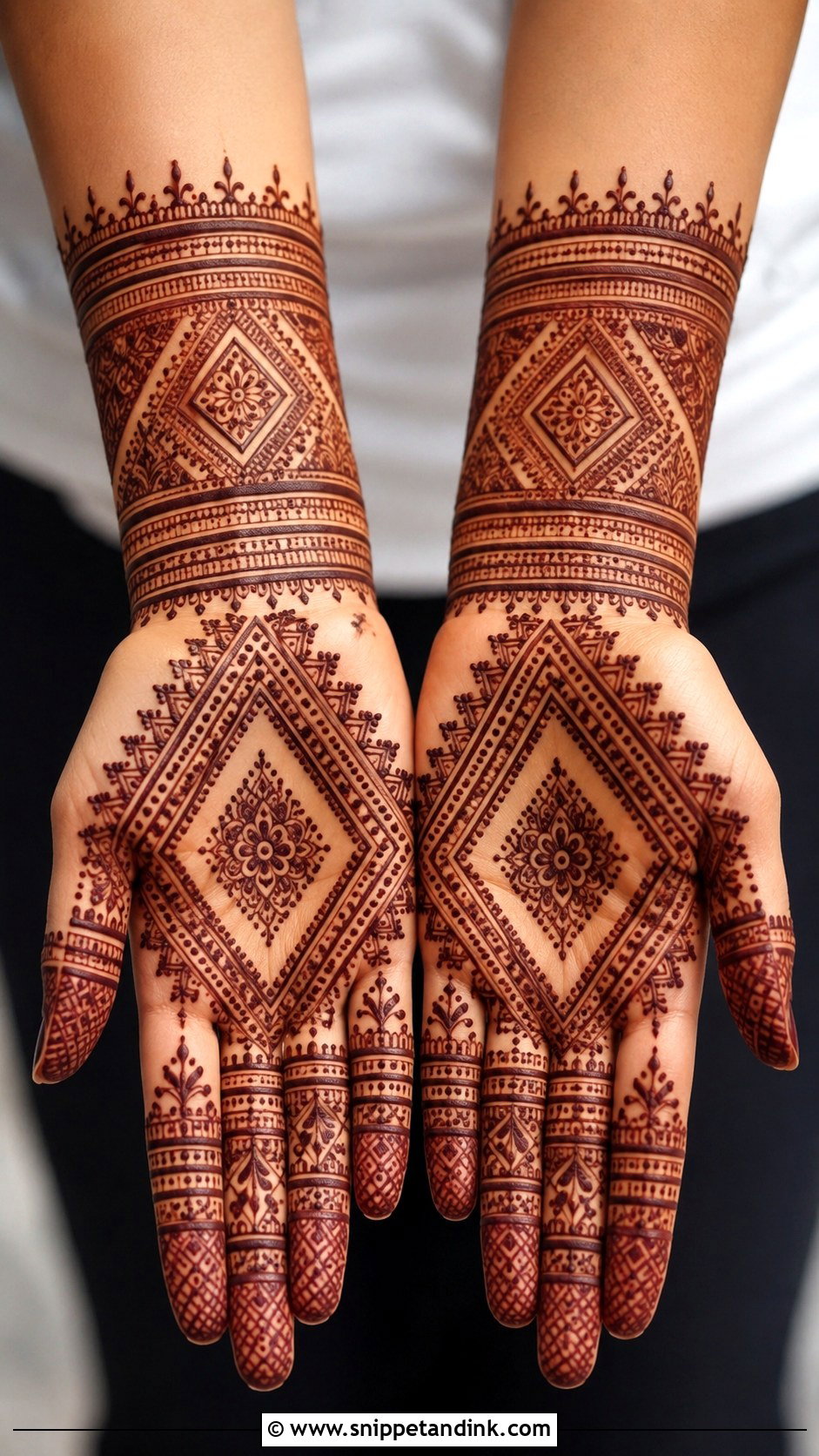
Moroccan palms are bold and graphic: diamond grids, straight lines, triangular blocks, dotted borders and repeated bands from palm to fingers, with a cuff joined to the palm by vertical lines. It’s less common, which is half its appeal. Clean spacing is essential, and a deep, even stain makes it read sharpest, so this is one to leave on overnight.
28. Gulf Front Hand Mehndi Design
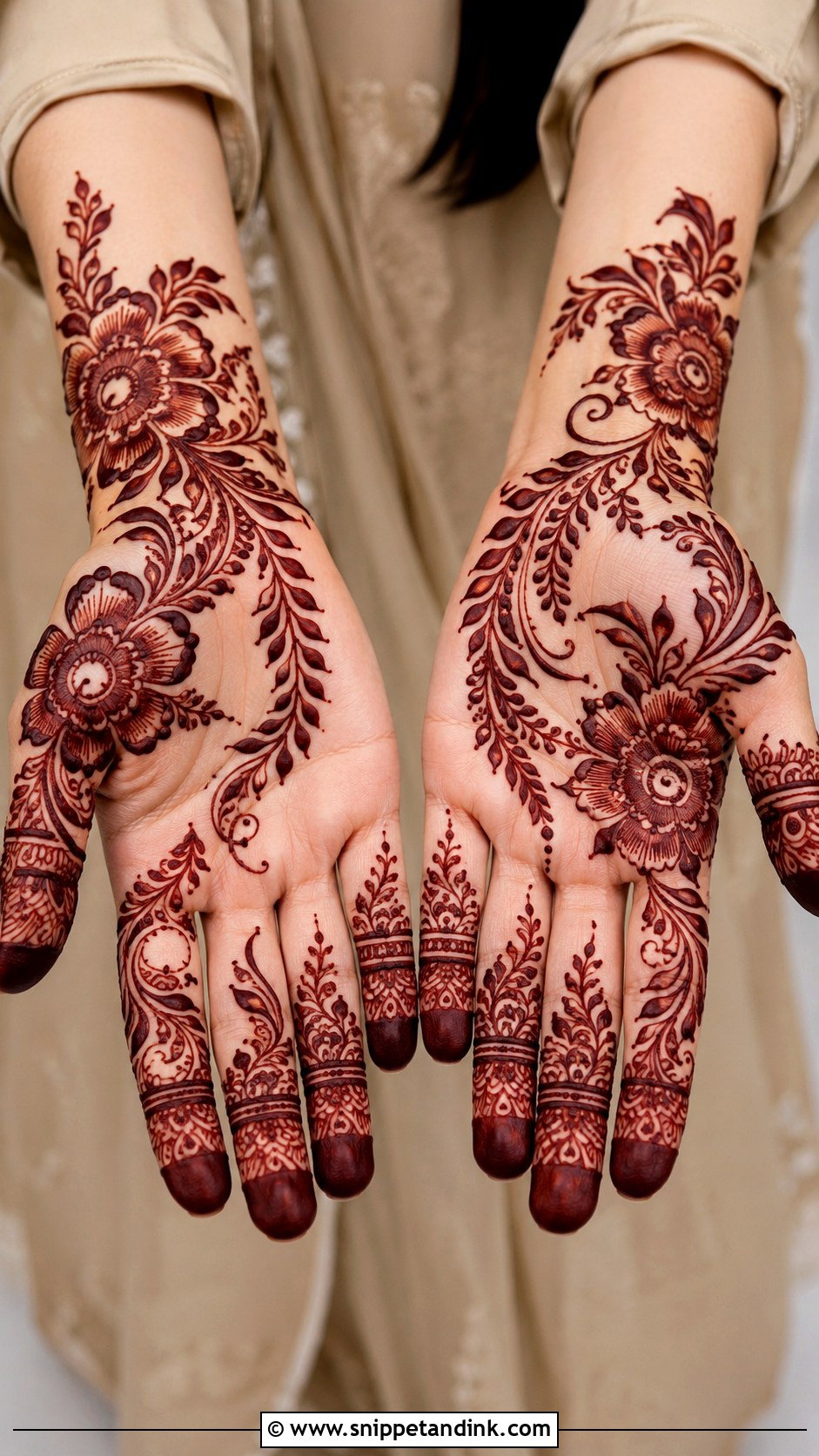
Khaleeji-style palm work moves in a confident trail of bold flowers and leafy branches with clear gaps between them, large florals near the wrist or palm center and leafy extensions on the fingers. It looks luxurious without full coverage. The technique is thick outer lines with fine inner detail; that contrast is what gives Gulf henna its look.
29. Shaded Front Hand Mehndi Design
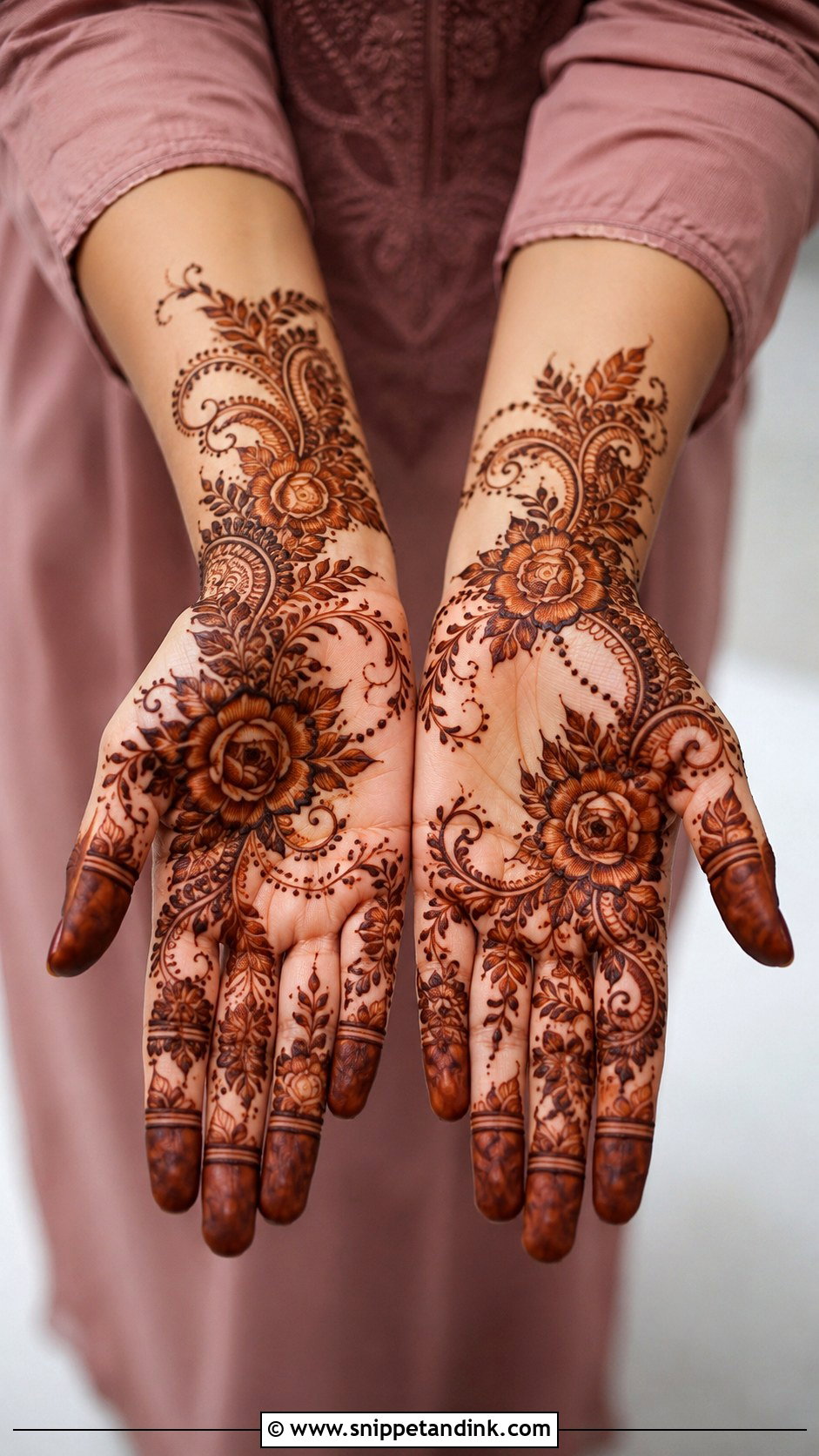
A shaded front hand mehndi design fills petals, leaves, paisleys and borders with graded strokes so they look dimensional. I shade with closely spaced thin lines, never a smear of thick paste, which cracks and falls off before it stains and leaves a patchy result. Pair shaded flowers with crisp outlines and open space. It suits floral designs where the petal layers need definition.
30. Negative Space Front Hand Mehndi Design
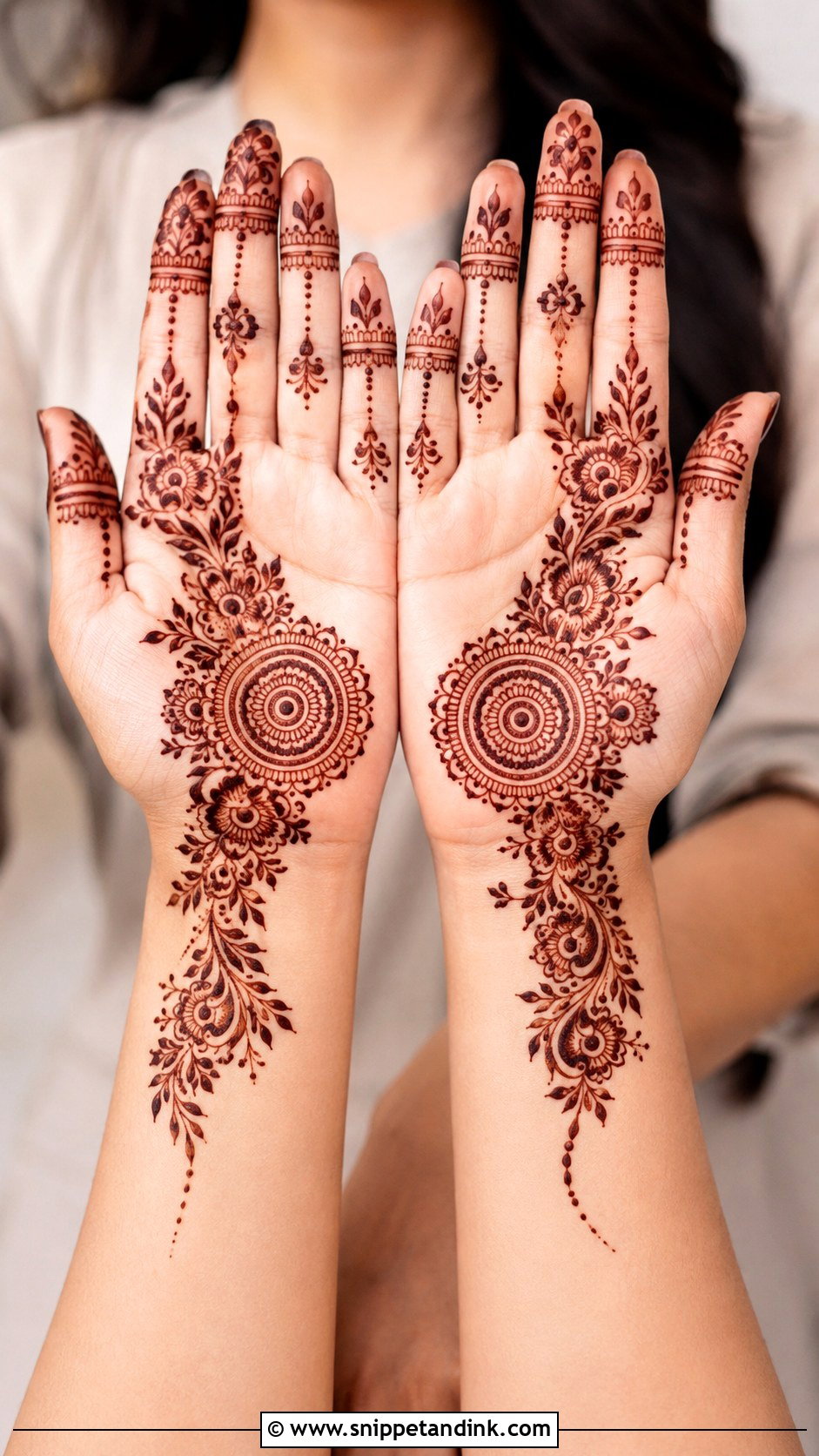
Open skin is part of the artwork: a bold mandala with space around it, or a diagonal floral trail with clean gaps between flowers, fingers echoing the palm. The gaps have to look planned, so I decide where they go before I draw anything rather than leaving whatever’s left over. Strong outlines keep it crisp after staining. It’s comfortable for people who dislike heavy henna.
31. Heavy Front Hand Mehndi Design
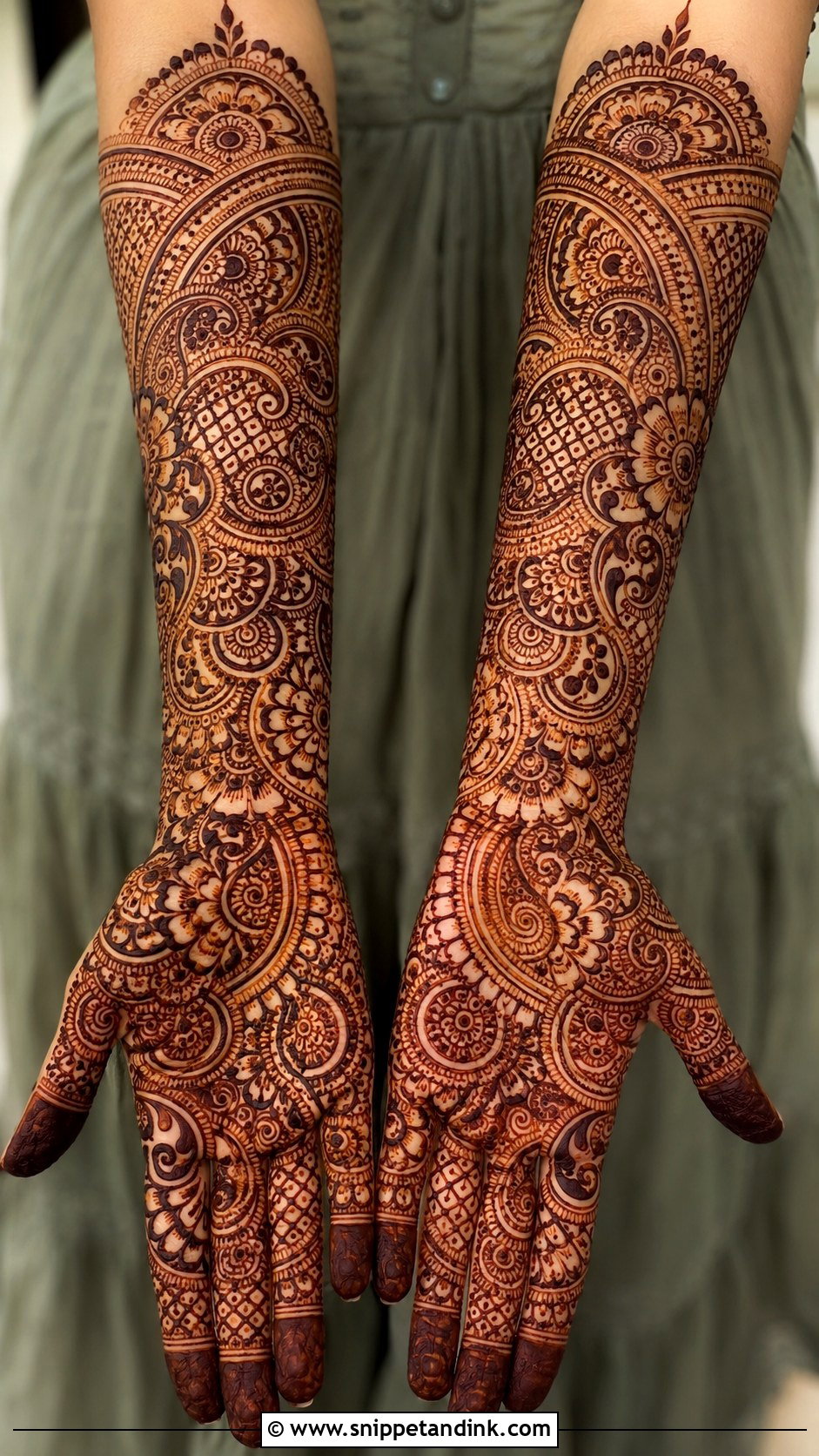
Heavy palm work fills palm, fingers and wrist with paisleys, florals, mandalas, jaali, vines and fillers. It takes time and patience to sit through, and the reward is the darkest, richest stain henna can produce. The structure matters: I use larger motifs as anchors and smaller details as fill. When every element is tiny, the hand reads as noise. It belongs with traditional clothing and jewelry.
32. Stylish Front Hand Mehndi Design
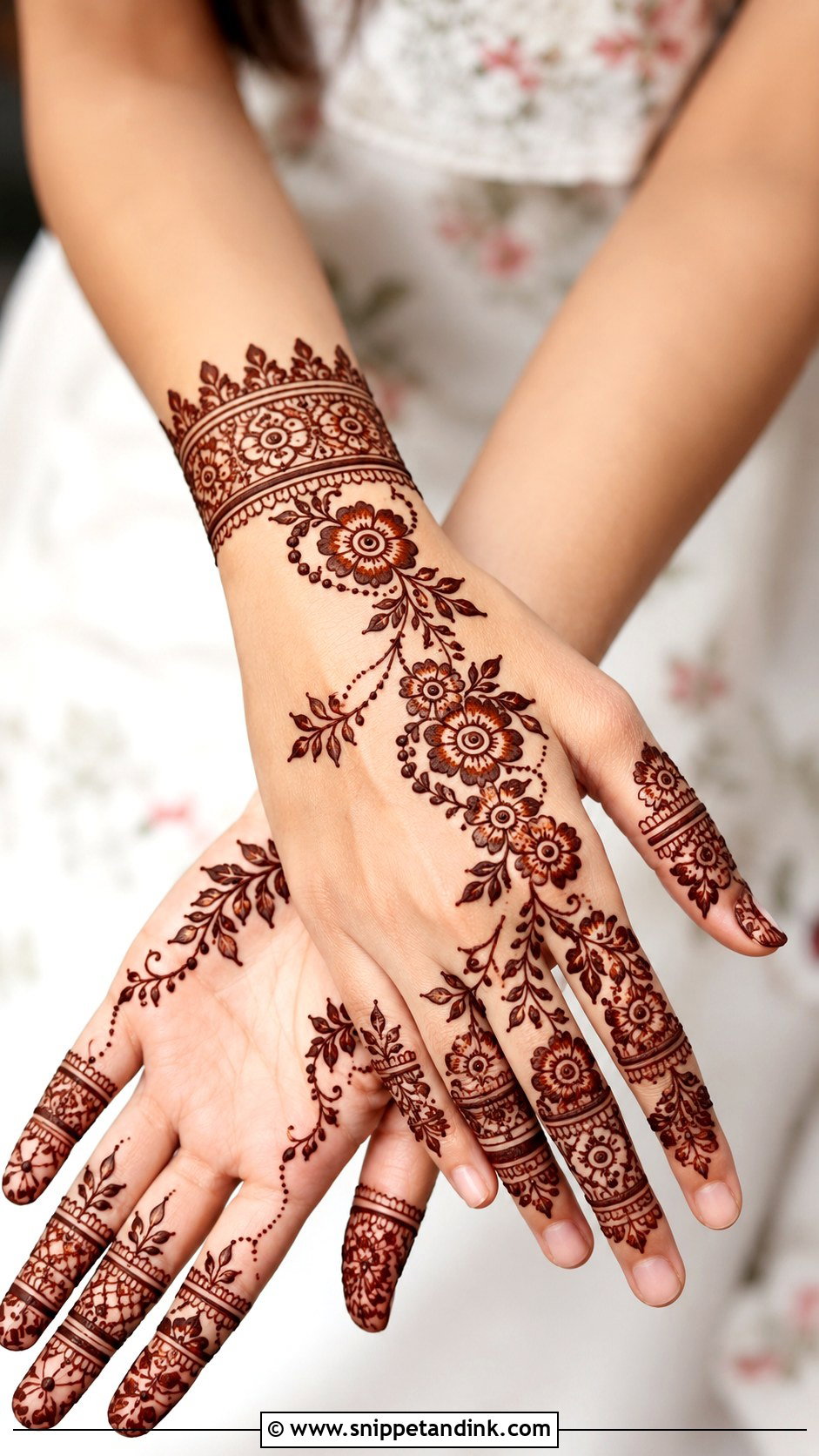
A slanted floral trail, open palm spacing, ring-style finger patterns and a wrist cuff: more polished than beginner henna, much lighter than bridal. Choose bold Arabic flowers, a small mandala or geometric accents depending on the outfit. The fingers define this style, so I spend proportionally more time on them. It should read clean from across a room and detailed up close.
33. New Front Hand Mehndi Design
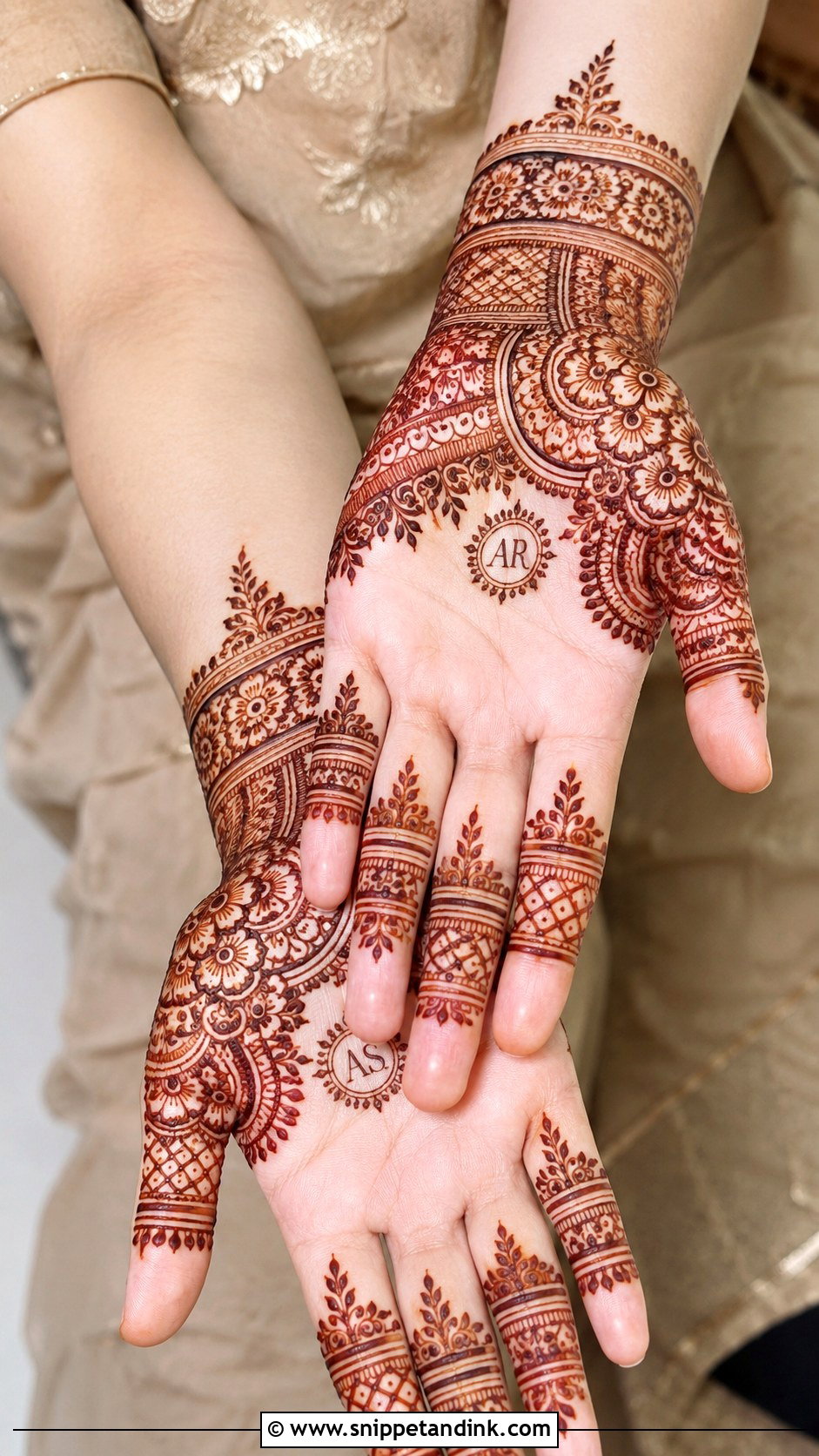
Newer palm layouts move away from the centered pattern: an off-center mandala, a half-palm floral curve, a jharokha frame or a wrist-to-finger trail. Initials, bold outlines and grids mixed with soft florals are all showing up. The ones that work aren’t more complicated, just placed less predictably. I’ll often sketch two placements with dots and let the client choose before committing.
34. Latest Front Hand Mehndi Design
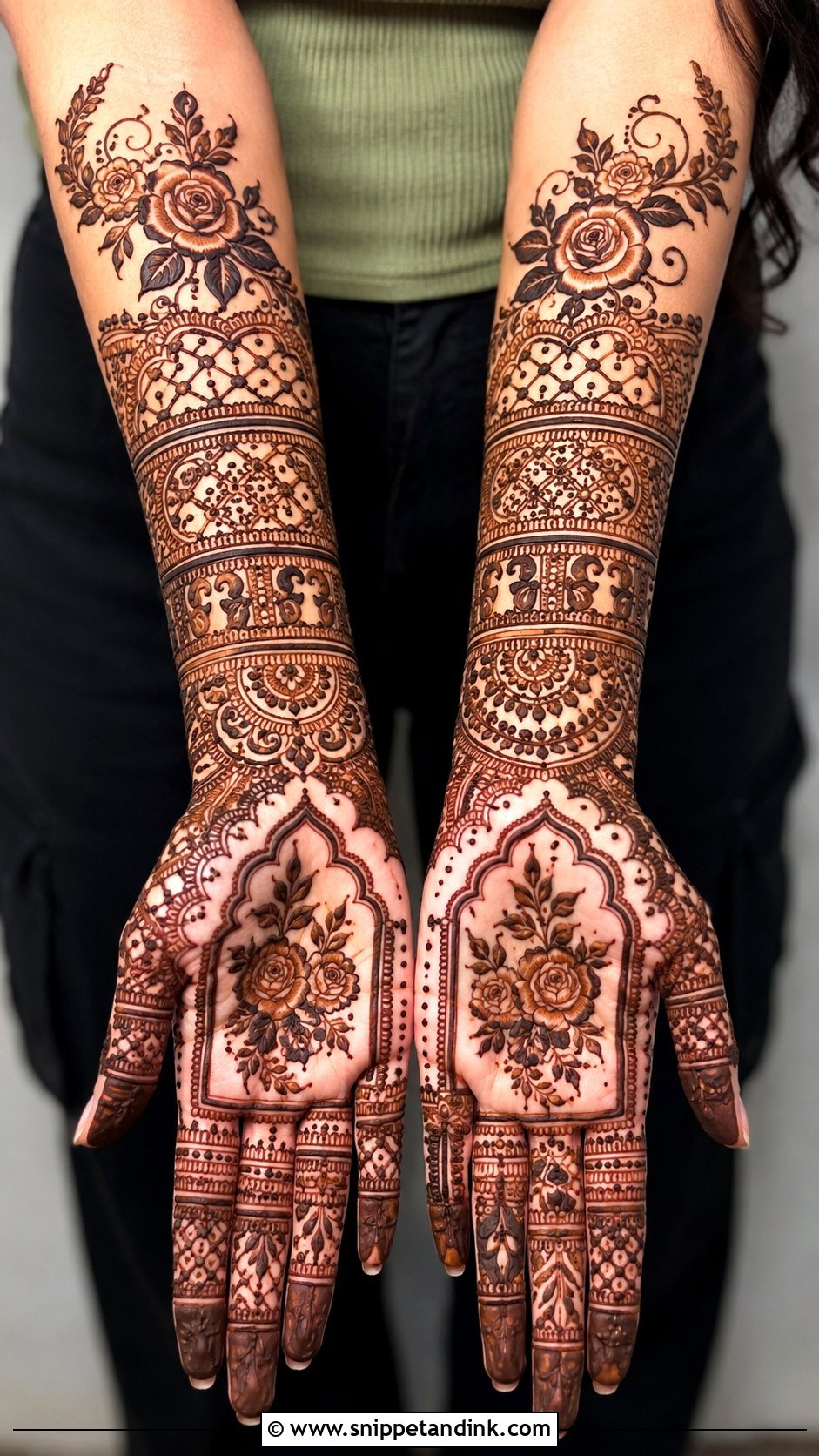
The latest front hand mehndi design trends lean toward clean detail, bold motifs and planned negative space: Arabic rose trails, floral mandalas, jharokha palms, geometric sections, bracelet cuffs and Indo-Arabic fusion. Coverage can be simple, medium or heavy. For a quick event, a floral trail with finger bands; for a wedding, a fuller palm with mandala, jaali and wrist work.
35. Beautiful Front Hand Mehndi Design
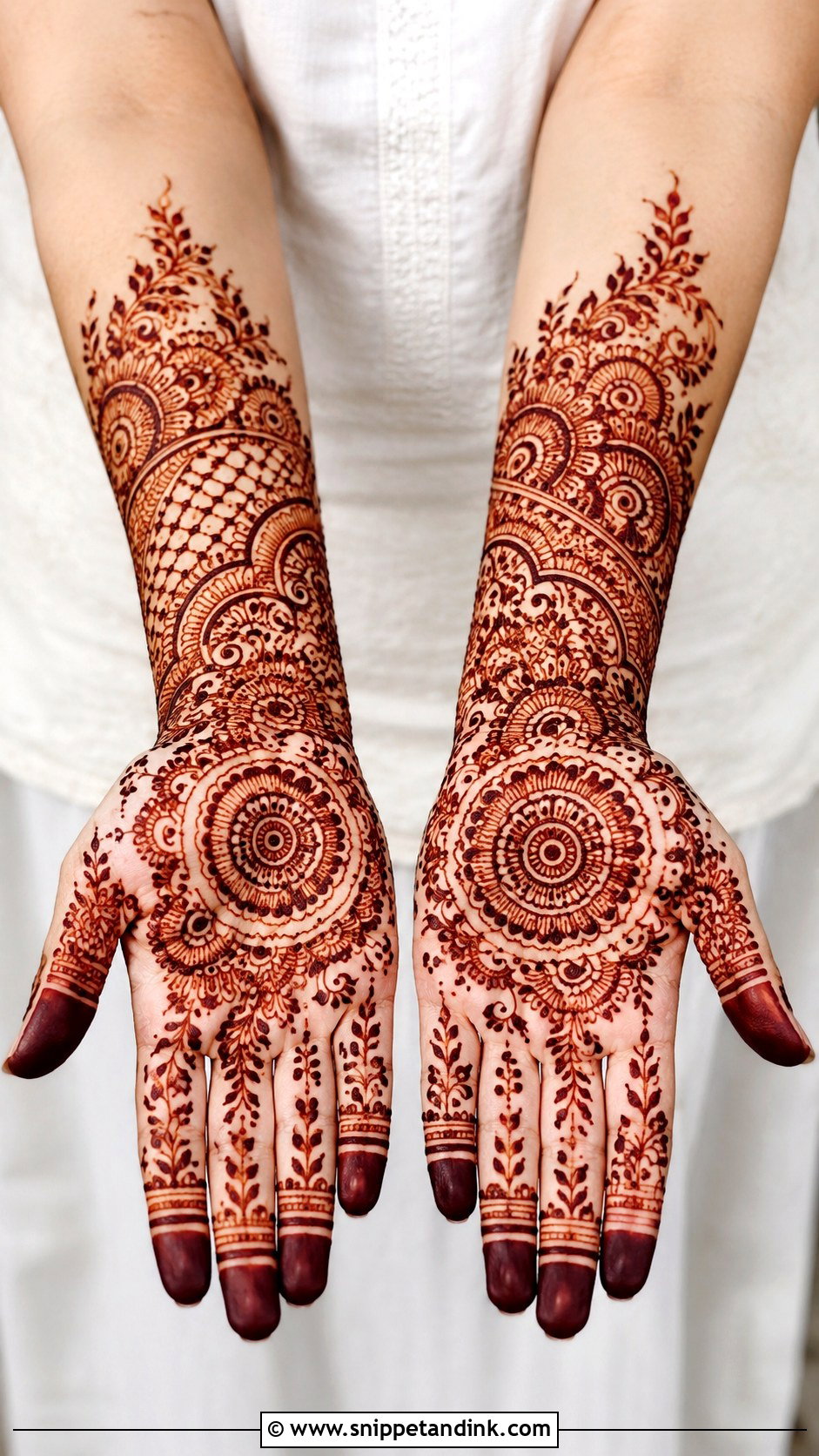
Balance, neatness and flow matter more than the number of patterns. A clear focal point on the palm, coordinated fingers and a wrist detail that closes the design are what I look for in finished work. Florals, paisleys, mandalas, peacocks, jaali or geometry can all get there. On small hands I use lighter spacing and medium motifs; on longer hands, extended vines and detailed fingers. Clean lines make even a simple design look considered.
Is the Paste Safe? Checking a Cone Before It Touches Your Palm
Palm skin absorbs more than the back of the hand, so what’s in the cone matters. Good henna paste is simple: finely sifted henna powder, a liquid such as lemon juice or water, a little sugar, and a skin-safe essential oil to help the stain release. Fresh paste is perishable. Natural cones are kept frozen or refrigerated and used within days of thawing.
Signs a cone isn’t what it claims
- It sits on a warm shop shelf for months without spoiling. Natural paste can’t do that without preservatives.
- It smells strongly of chemicals or kerosene rather than earthy henna and oil.
- The paste is black, or promises a dark stain within an hour.
- There’s no ingredient list at all.
If you have sensitive skin, allergies or you’re pregnant, ask your artist exactly which oil she uses and do a small test patch inside the elbow a day or two before. Some essential oils irritate certain people, and the artist can usually mix a batch with a gentler one or none at all.
Palm Up: Does the Design Still Read When You Open Your Hand?
Your occasion, outfit, hand shape and how long you can sit will narrow the field quickly. Classic Indian, paisley, peacock, lotus and full-hand layouts suit weddings and festivals. Arabic, minimal, negative-space or bracelet designs keep things lighter. Geometric, jharokha, shaded and Indo-Arabic work feels current. Whichever front hand design you pick, the quality of the line matters most, and on a palm, good paste and enough time on the skin do the rest.
You'll Like These Ideas:






Leave a Reply