
Elephants carry old associations with strength, good fortune and celebration, which is why so many brides ask me to work one into their henna. The motif sits comfortably in dense Indian full-hand mehndi and just as well in open Indo-Arabic layouts, and it can travel from palm to forearm to the top of the foot. It’s also one of the harder shapes to draw well: a large body, a curling trunk and decorated blankets all have to stay readable once the stain darkens. Here are 20 elephant layouts, with notes on where each one sits best and what to ask your artist.
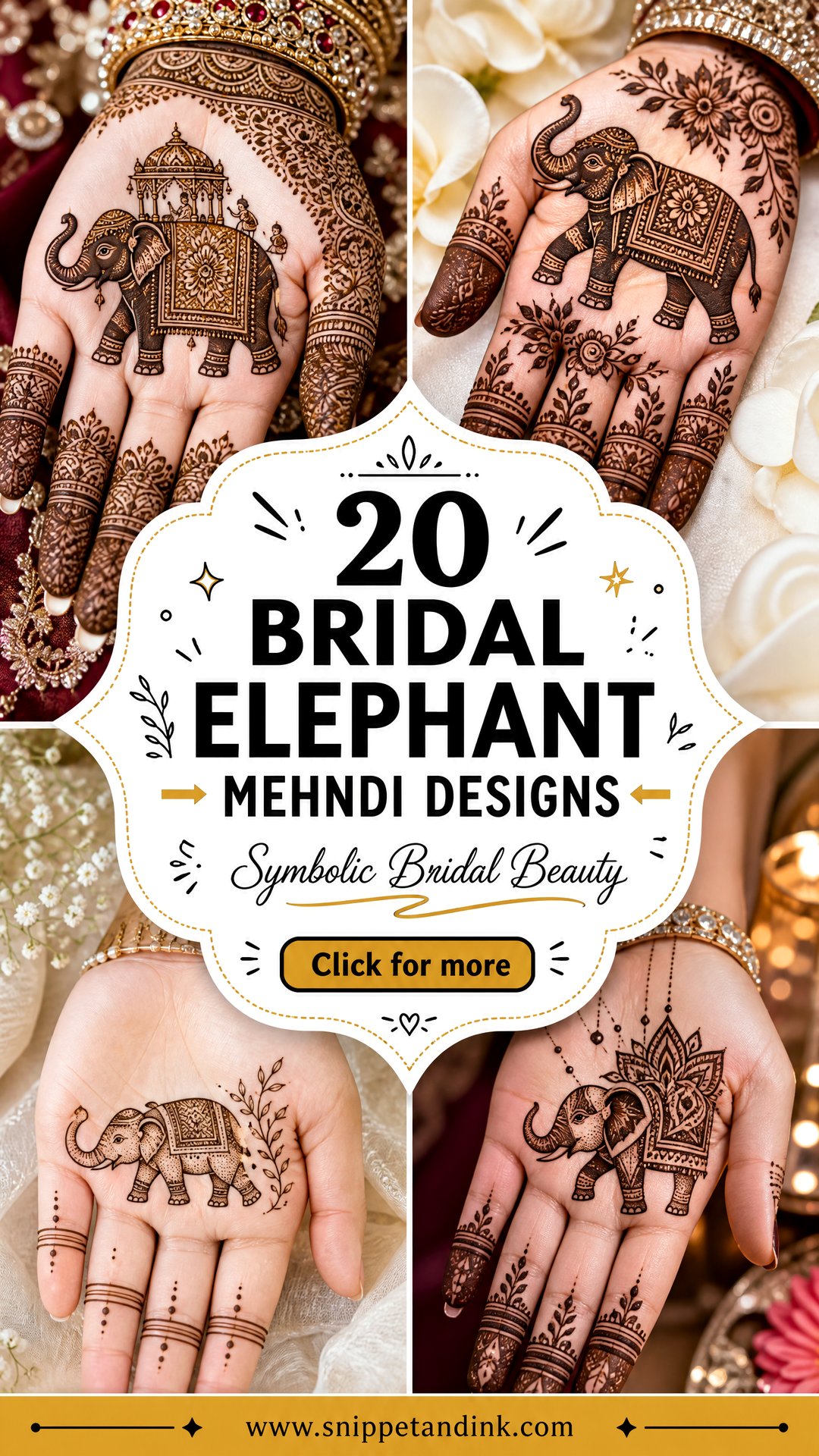
An Elephant Needs Room to Stay Readable
Henna paste spreads slightly as it’s applied and the stain darkens over two days. Fine lines drawn too close together merge into a dark patch. With most motifs that’s forgiving. With an elephant, it isn’t: if the trunk, ear and blanket lines run together, the shape stops looking like an animal.
So when I draw one, I start with a clear outline, then decide where the blanket ends and the bare body begins. The eye, the curl of the trunk and the line of the ear are drawn with small gaps on either side. That bit of open skin is what lets it read after the stain deepens.
How big should it be?
On the palm, an elephant around the size of the palm centre is easiest to read. Smaller ones work as accents on the wrist or fingers, but they need very simple interior detail. If you love tiny elephants, ask for fewer lines inside them, not more.
1. Full Hand Bridal Elephant Mehndi Design
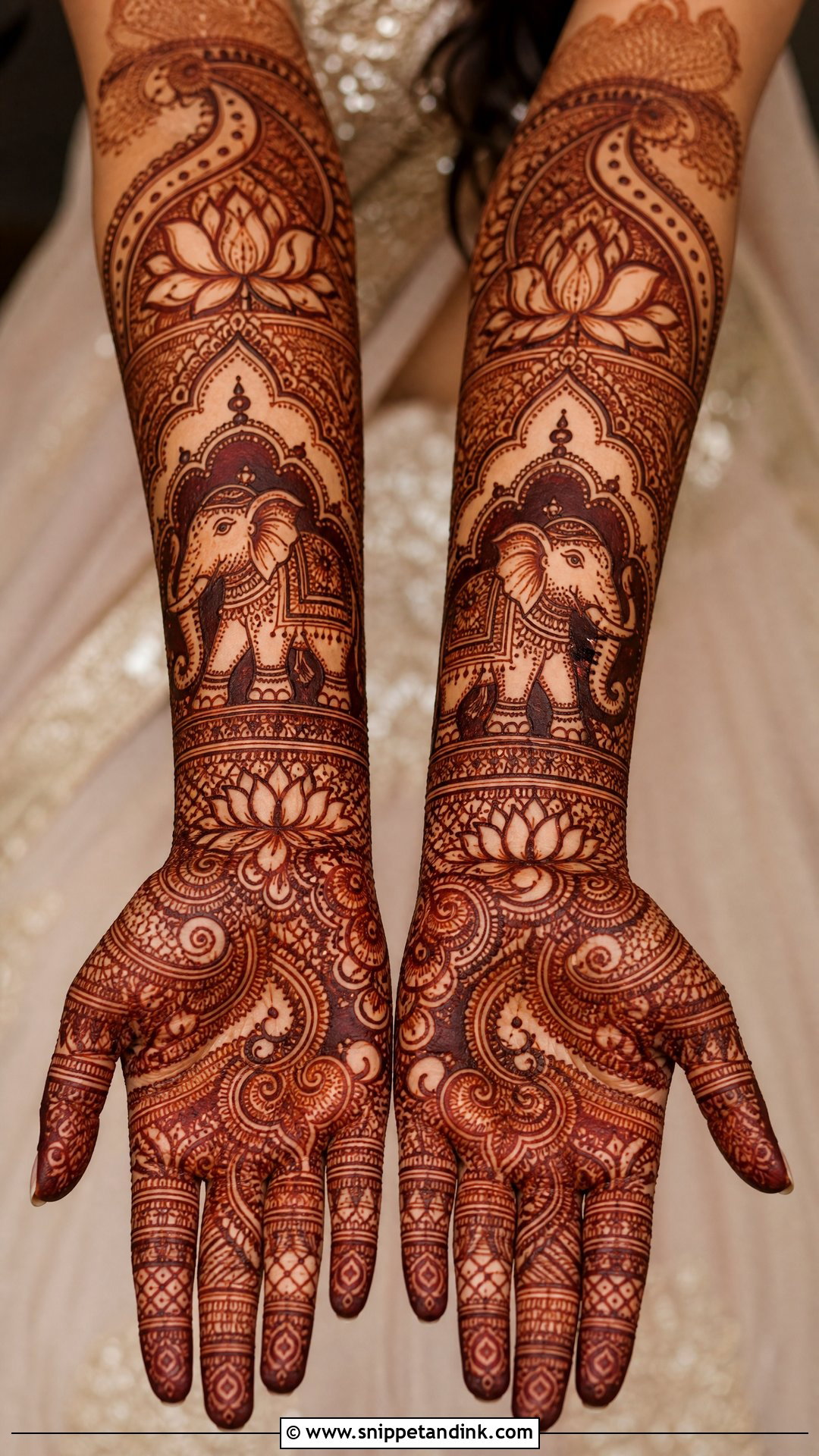
On a full hand, the elephant is the anchor everything else hangs from. I place it first, usually on the palm or forearm, then grow paisleys, florals, mandalas and vines outward to the fingertips and up toward the elbow. Size is the decision that matters most. Too small and it gets lost among the filler; too large and it breaks the flow of the hand. Matching finger patterns and wrist cuffs on both hands keep the pair balanced.
2. Royal Bridal Elephant Mehndi Design
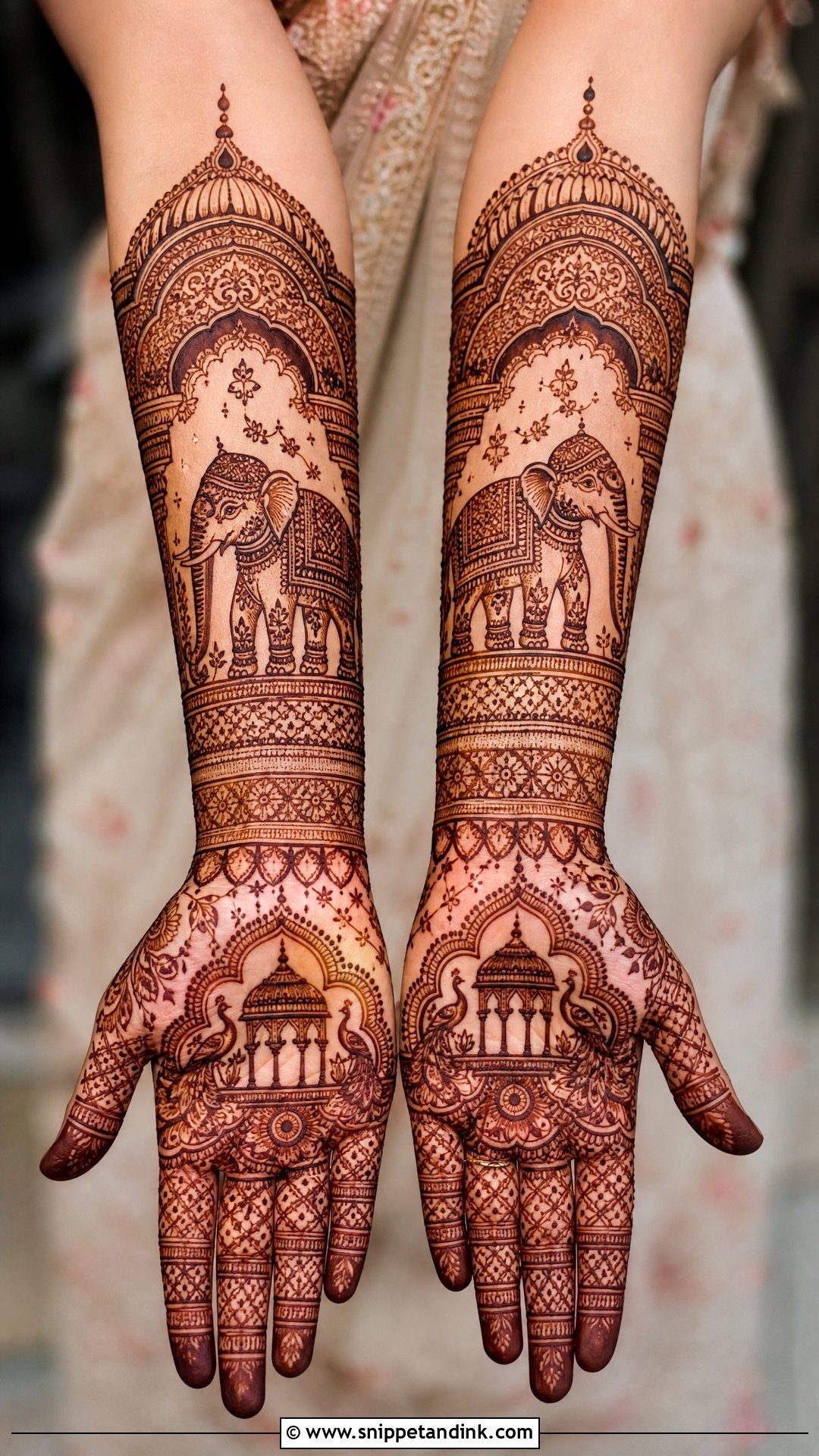
Think of a palace procession: an elephant wearing a decorated saddle, a patterned blanket, forehead jewellery and tiny anklets, with domes, arches, lotus borders and peacocks around it. The background can be dense with dots and lace-like filler, but I always leave a thin clean margin around the elephant’s outline. Without that gap, a dark stain swallows the shape. Heavily embroidered lehengas and sarees suit this ceremonial look.
3. Rajasthani Bridal Elephant Mehndi Design
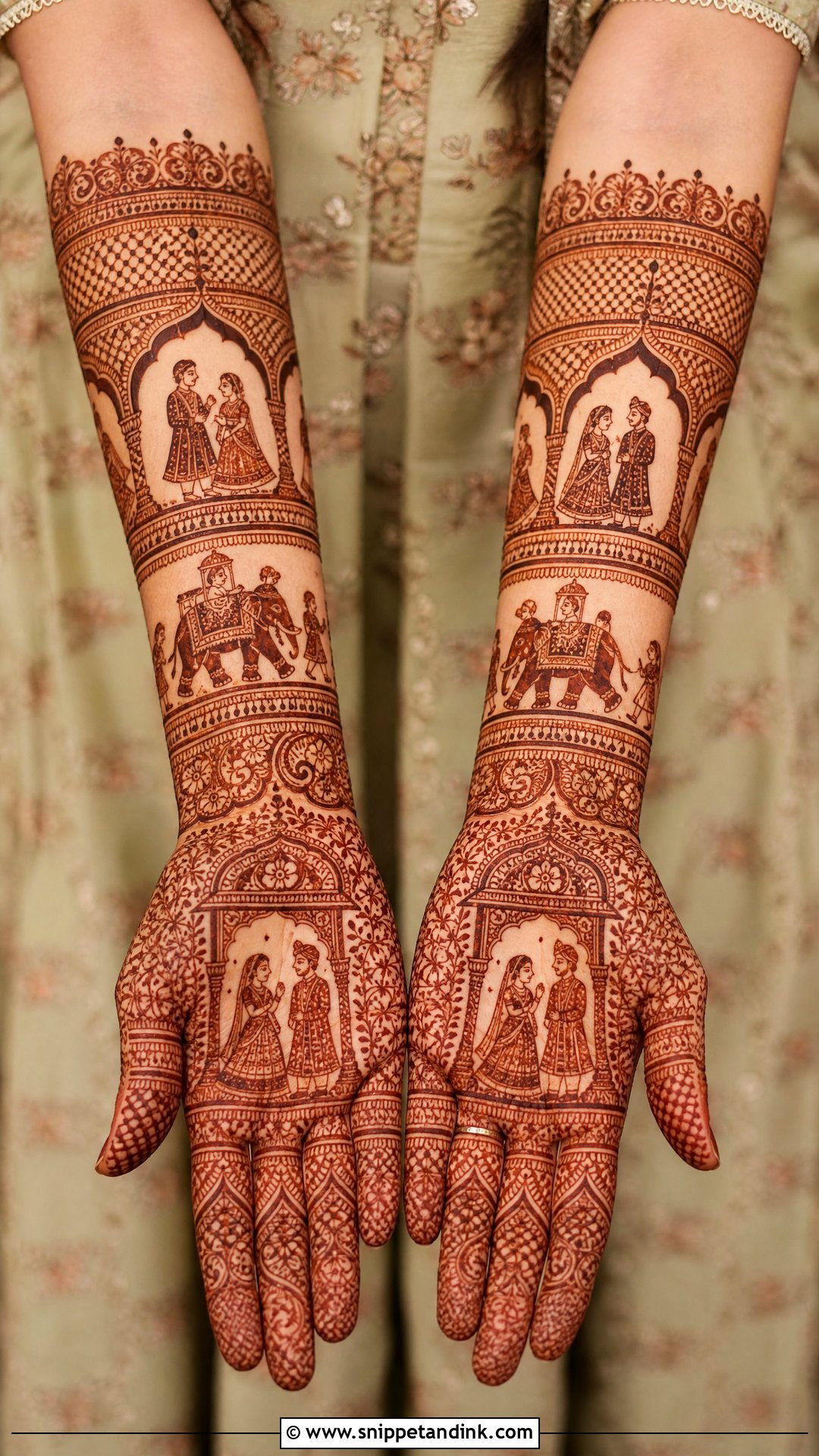
Rajasthani bridal elephant mehndi design puts the elephant inside a scene: jharokha windows, palace arches, doli elements, folk borders and miniature bride and groom figures. It needs full palms and forearms to fit. I usually draw the procession on one hand and the couple on the other so the two hands read as a pair when held together. Fine checks, shaded petals and traditional bands knit the scene together. Allow plenty of time; this is slow, precise work.
4. Indian Bridal Elephant Mehndi Design
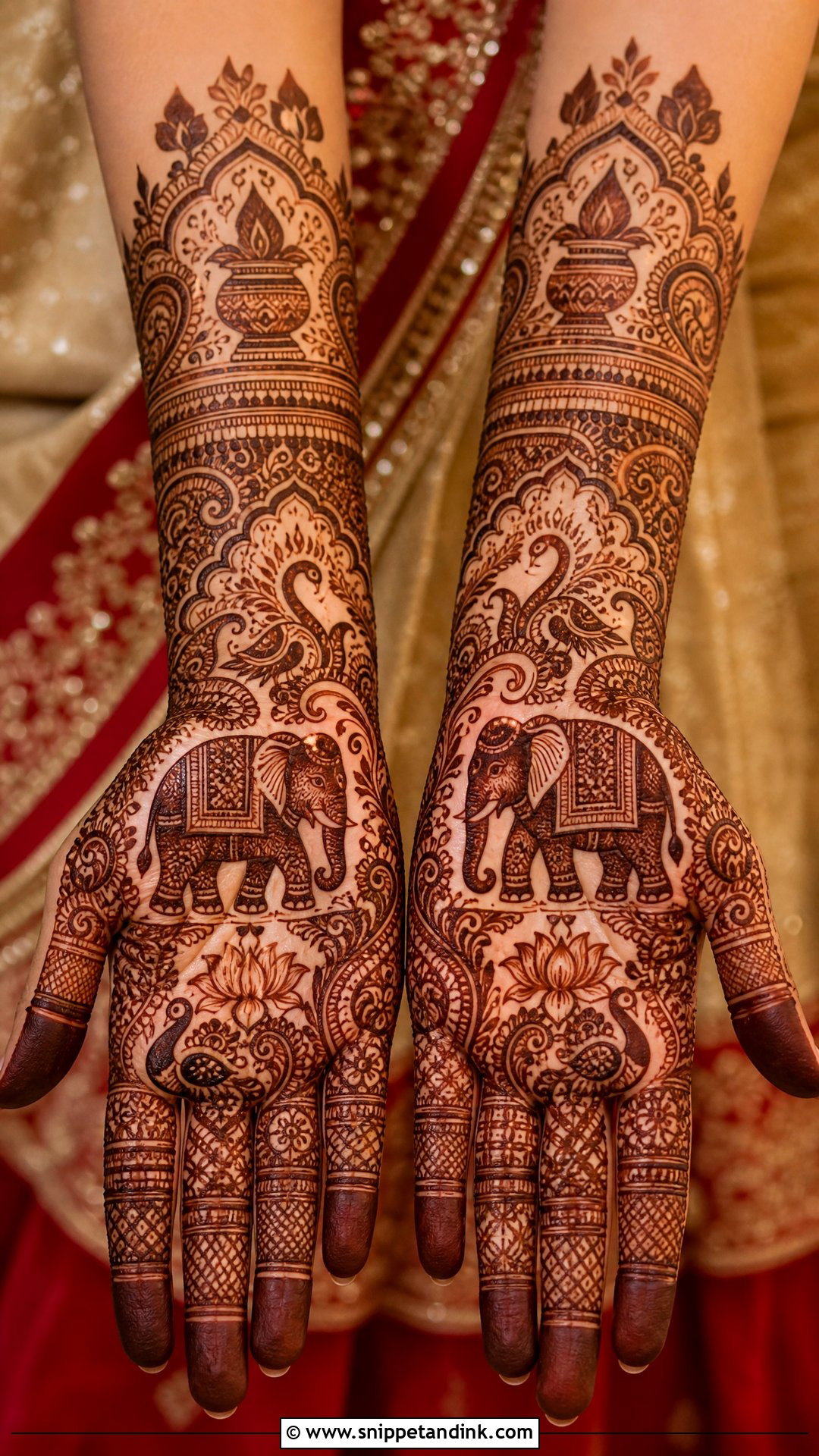
Indian elephant designs pack in paisleys, lotuses, kalash shapes, peacocks, mandalas and couple details, leaving almost no skin bare. The way to keep it from turning into a muddle is to build in layers: the elephant as the bold focal point, then medium floral frames, then the fine filler last. That order is how I work, and it’s worth asking your artist to do the same. Done that way, it gives the deep maroon stain and dense look that suits red outfits and gold bangles.
5. Arabic Bridal Elephant Mehndi Design
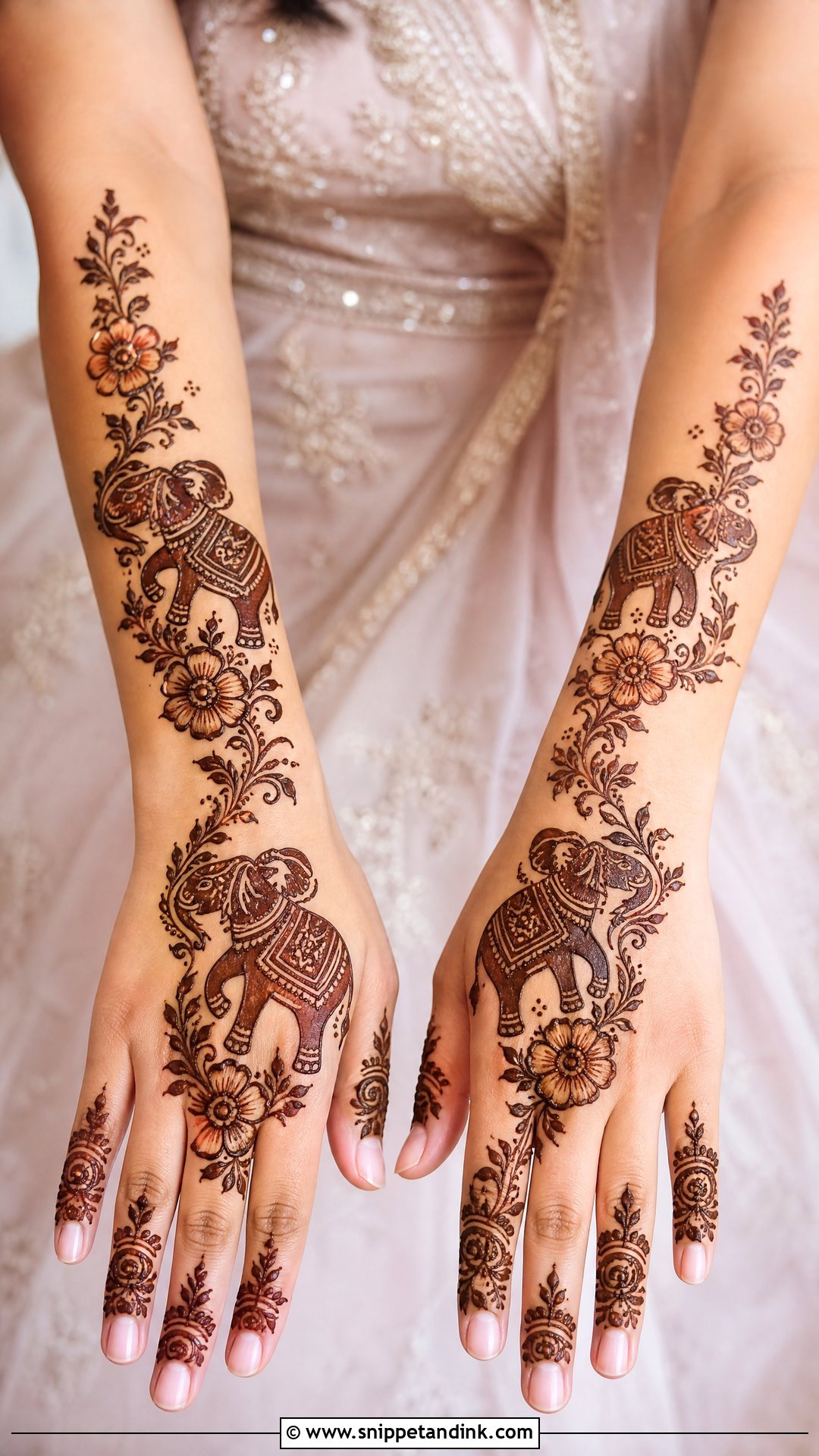
Arabic elephant designs use diagonal trails, shaded flowers, leafy vines and bold outlines with plenty of open skin between them. The elephant might sit on the palm, near the wrist or within a sweeping back-hand trail. Because Arabic strokes are thick, I keep the elephant’s internal detail simple; tiny lines inside a bold outline tend to blur together. Simple leafy lines or small paisleys on the fingers finish it.
6. Indo-Arabic Bridal Elephant Mehndi Design
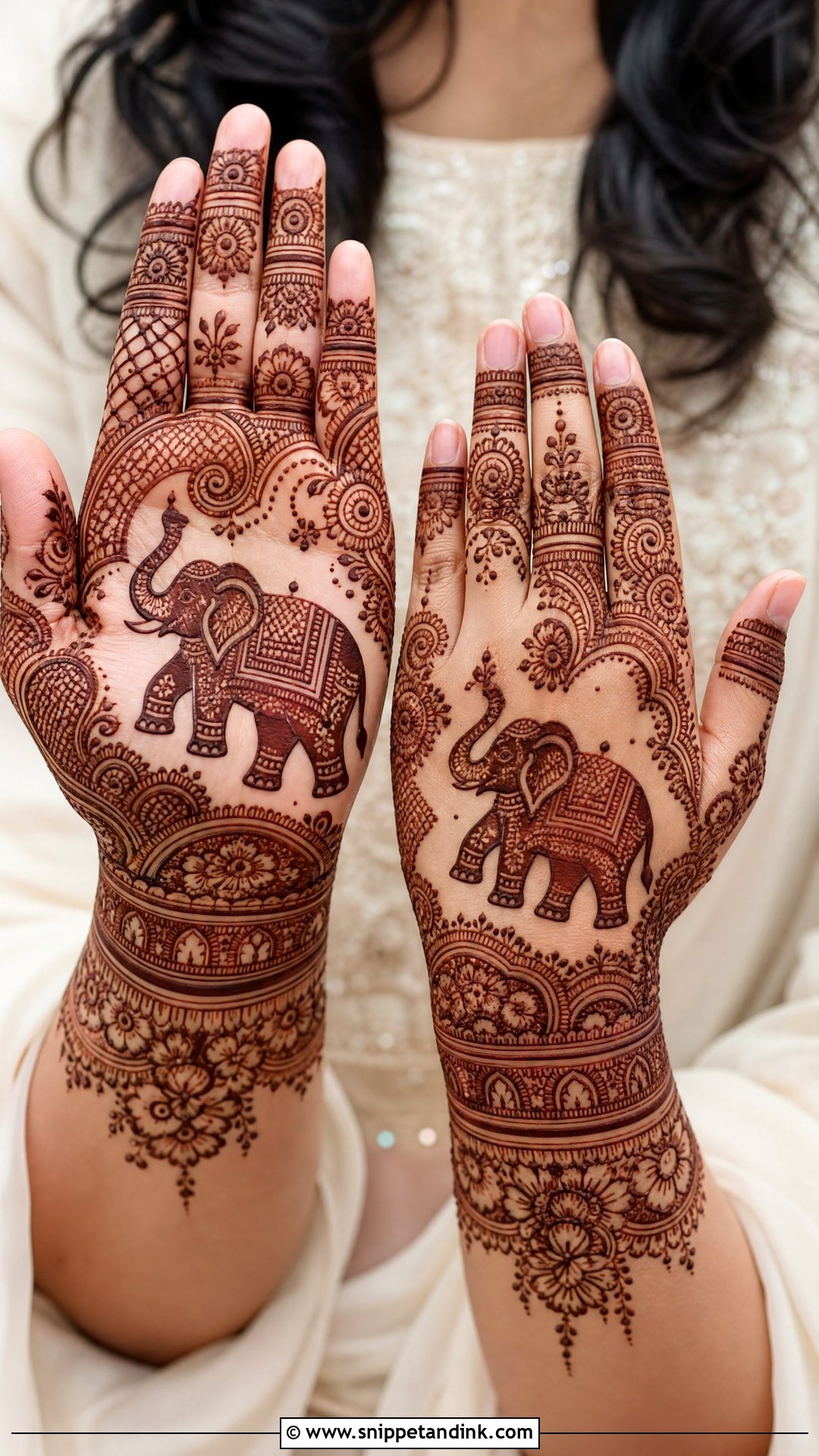
Indo-Arabic mixes Indian richness with the airy flow of Arabic patterns. The elephant becomes a central motif on the palm, while the back carries a matching mandala or floral trail. Bold flowers, open spaces, paisley trails and small netted sections make up the rest, and the fingers get mixed bands, dots and petals. It’s lighter to wear than a fully packed design and suits the engagement, nikah, sangeet or wedding day.
7. Bridal Elephant Mehndi Design For Front Hand
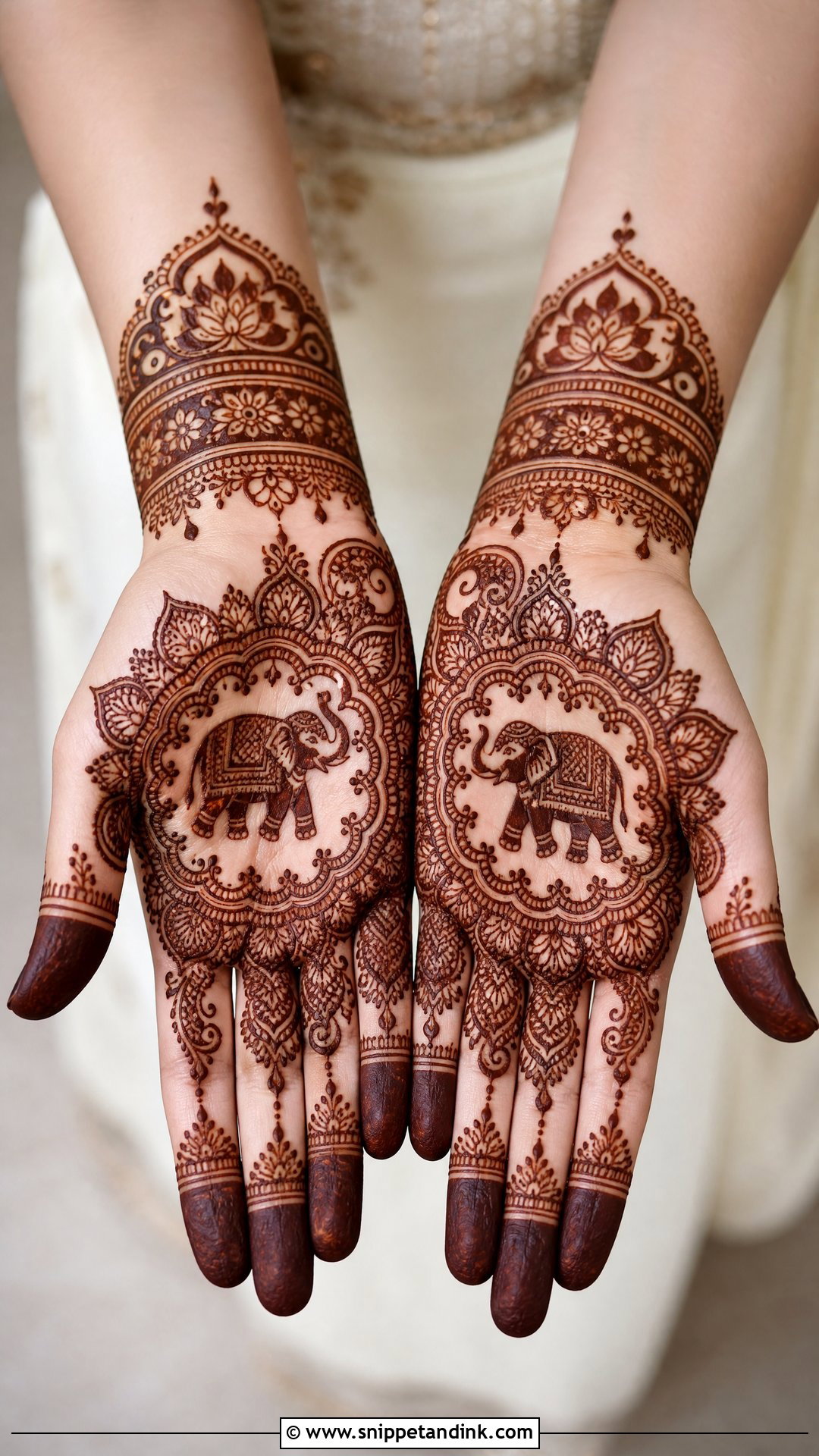
The palm is the best canvas for an elephant: the skin is thick, it stains darkest, and it faces the camera in traditional bridal photos. I set the elephant in the centre and frame it with a mandala, lotus petals, paisley curves or arches. Fingers get coordinated leafy strips, checks, dots or half-flower bands, and the wrist a bracelet border. It keeps the familiar richness of front-hand bridal mehndi with one strong, meaningful centre.
8. Bridal Elephant Mehndi Design For Back Hand
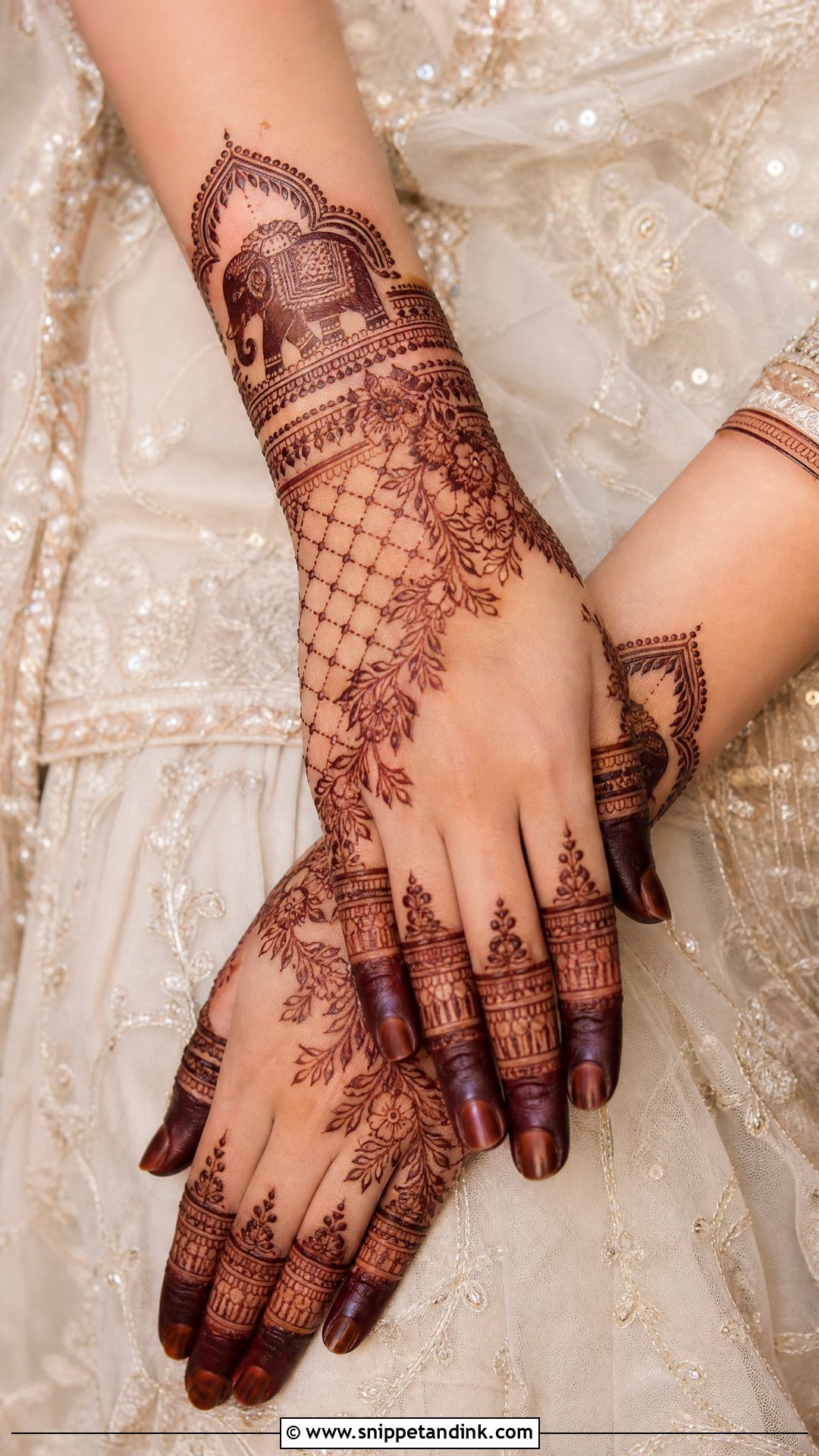
On the back of the hand, I let the design follow the bones, placing the elephant near the centre, on the wrist, or within a diagonal trail toward the fingers. The skin here is thinner and stains lighter than the palm, so I keep the elephant’s lines bolder than I would on the front. Bracelet cuffs, jaali mesh, floral chains and decorated fingertips complete it. It sits naturally under hathphool jewellery and bangles.
9. Bridal Elephant Mehndi Design With Peacock
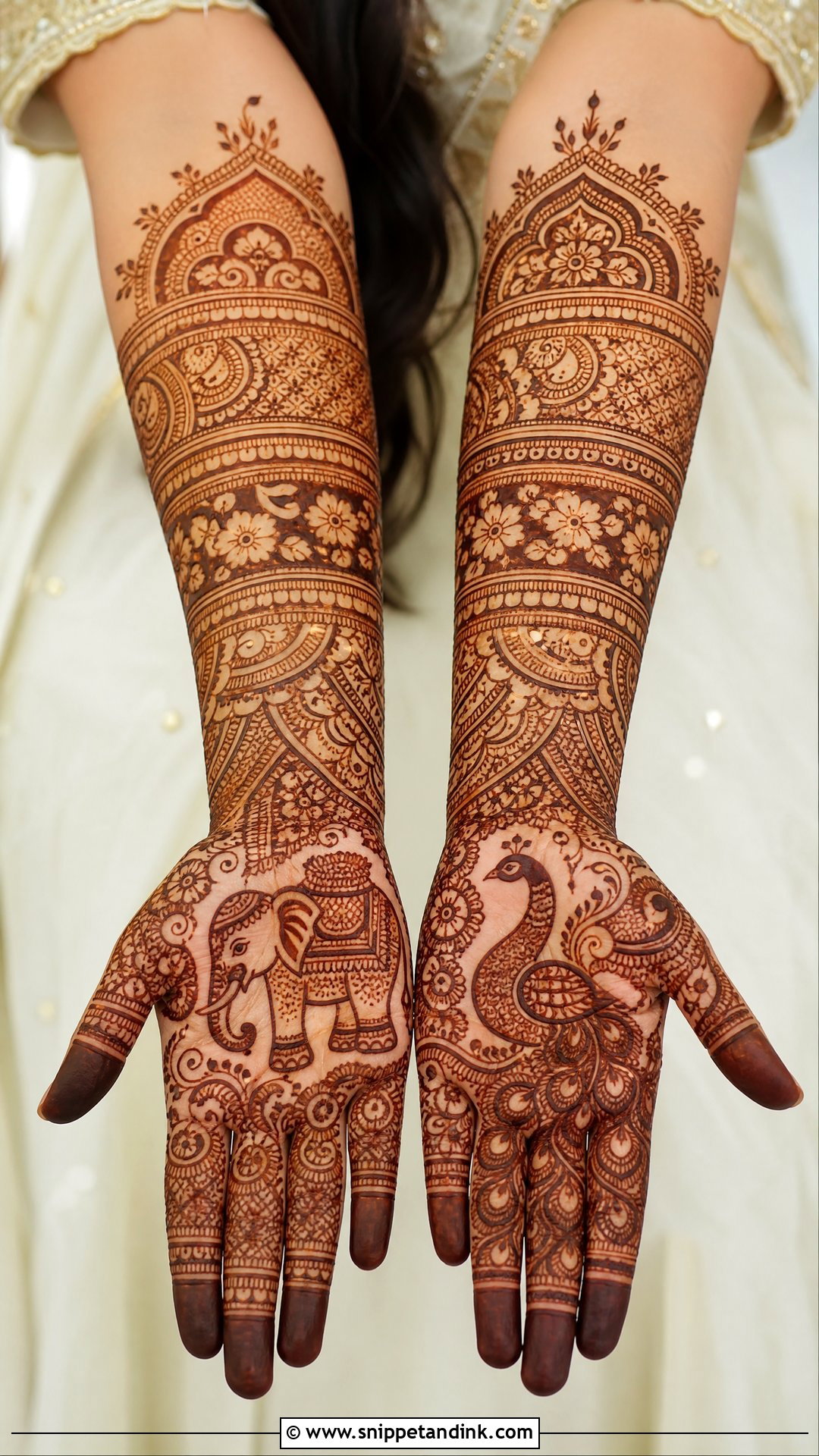
An elephant paired with a peacock gives strength and grace side by side. The usual layout is the elephant on one palm and the peacock on the other, with matching florals and paisleys linking them. Another option is an elephant on the forearm with a peacock feather trail across the palm. The two motifs are different shapes, one heavy and one flowing, so I keep their detail level the same; otherwise one overwhelms the other.
10. Bridal Elephant Mehndi Design With Lotus
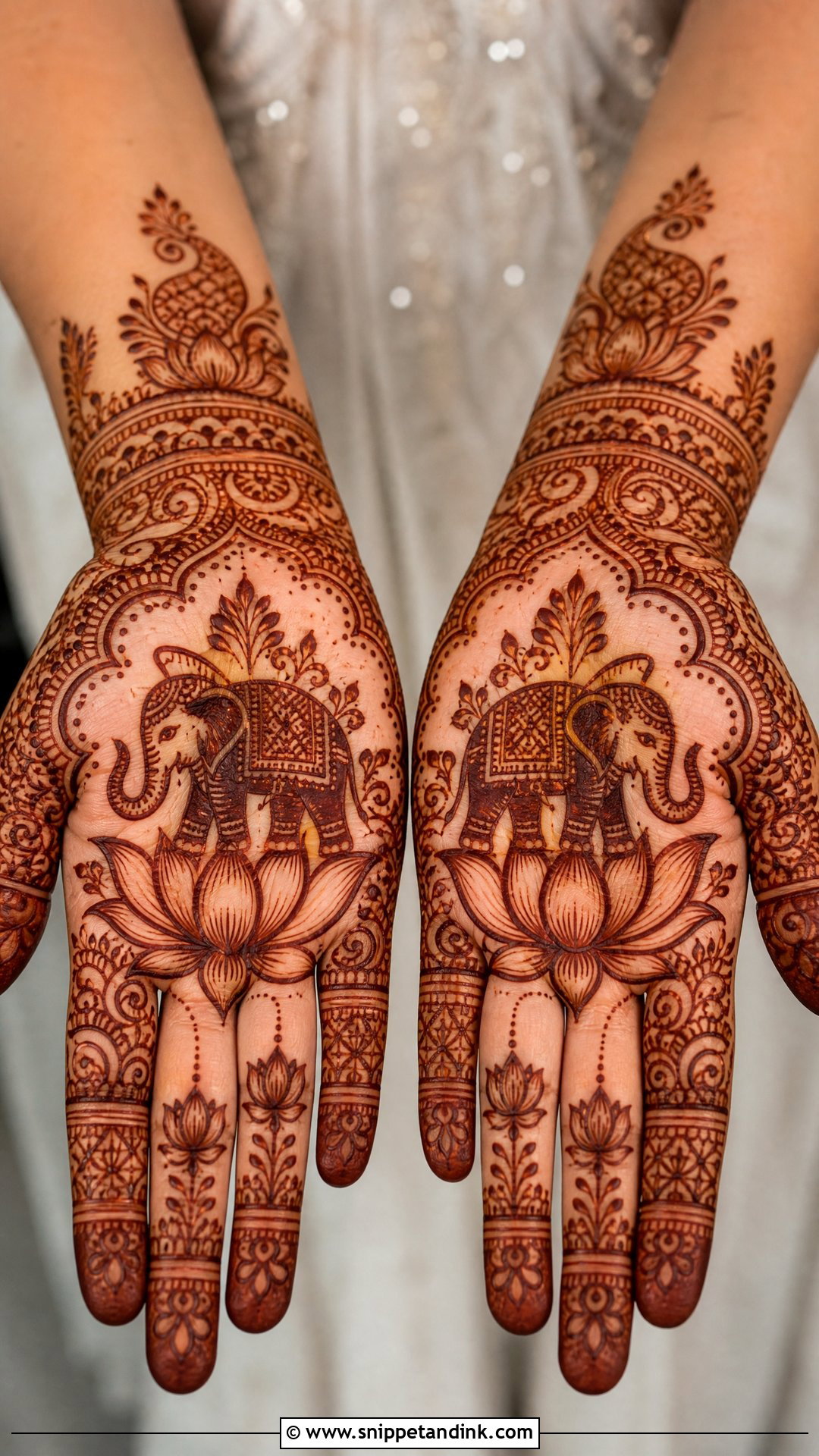
Lotus petals soften the heavy outline of an elephant, so this pairing feels calmer than most. The elephant sits on the palm or forearm framed by layered lotus blooms; lotus bands circle the wrist and small buds sit on the fingers. A larger lotus mandala around the elephant ties it all together. Pastel, pink, red and gold outfits suit it. It’s detailed, but the wide petals stop it from feeling busy.
11. Bridal Elephant Mehndi Design With Mandala
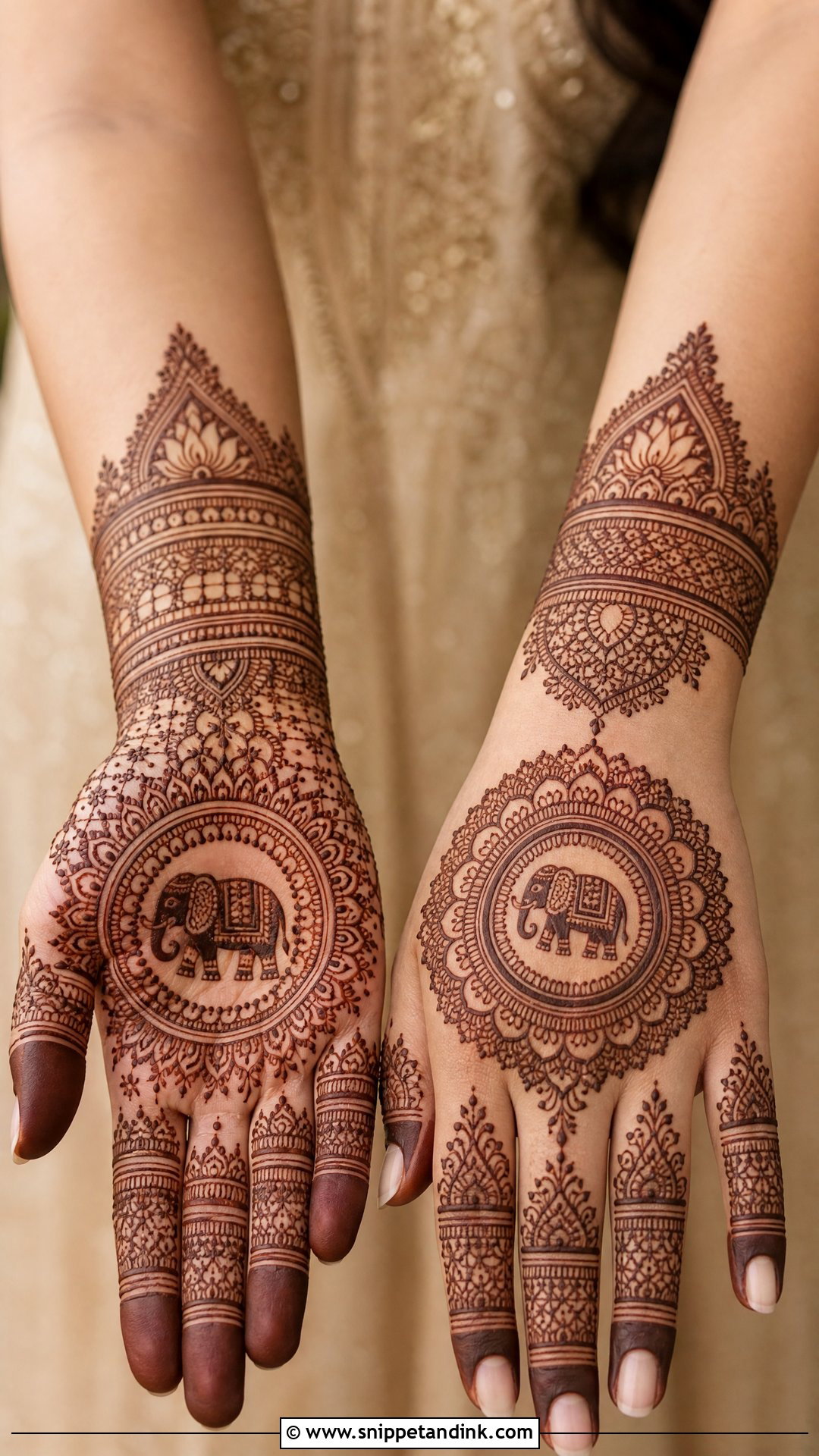
A mandala gives an elephant a round frame, either behind it or above it on the palm. The circle brings order; the elephant brings personality. Mandala rings must be evenly spaced, so this layout rewards a patient artist. Wrist cuffs, finger bands, floral fillers and small paisleys complete the hand. It’s a good choice if you like symmetry and want a design that photographs cleanly from any angle.
12. Bridal Elephant Mehndi Design With Jaali
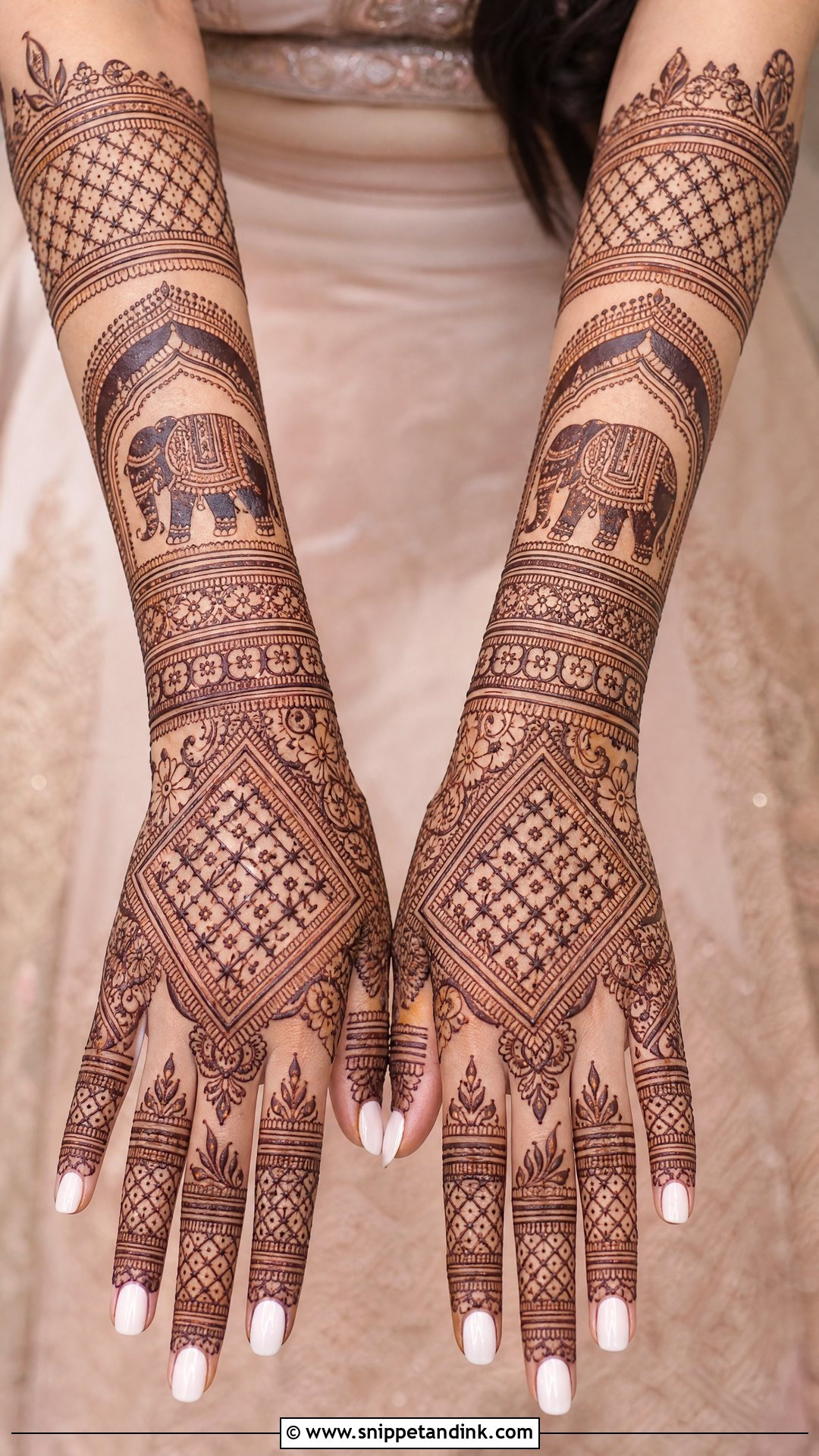
Jaali mesh around an elephant creates contrast: a solid, decorated animal against a fine geometric background. Diamond grids, floral nets, tiny dots and curved lattice panels all work. The risk is the elephant disappearing into the mesh once it stains, so I give it a bold double outline. The elephant usually sits on the palm or wrist with the jaali on the back hand or forearm. Rings and bangles look well against the lace effect.
13. Bridal Elephant Mehndi Design With Bride And Groom
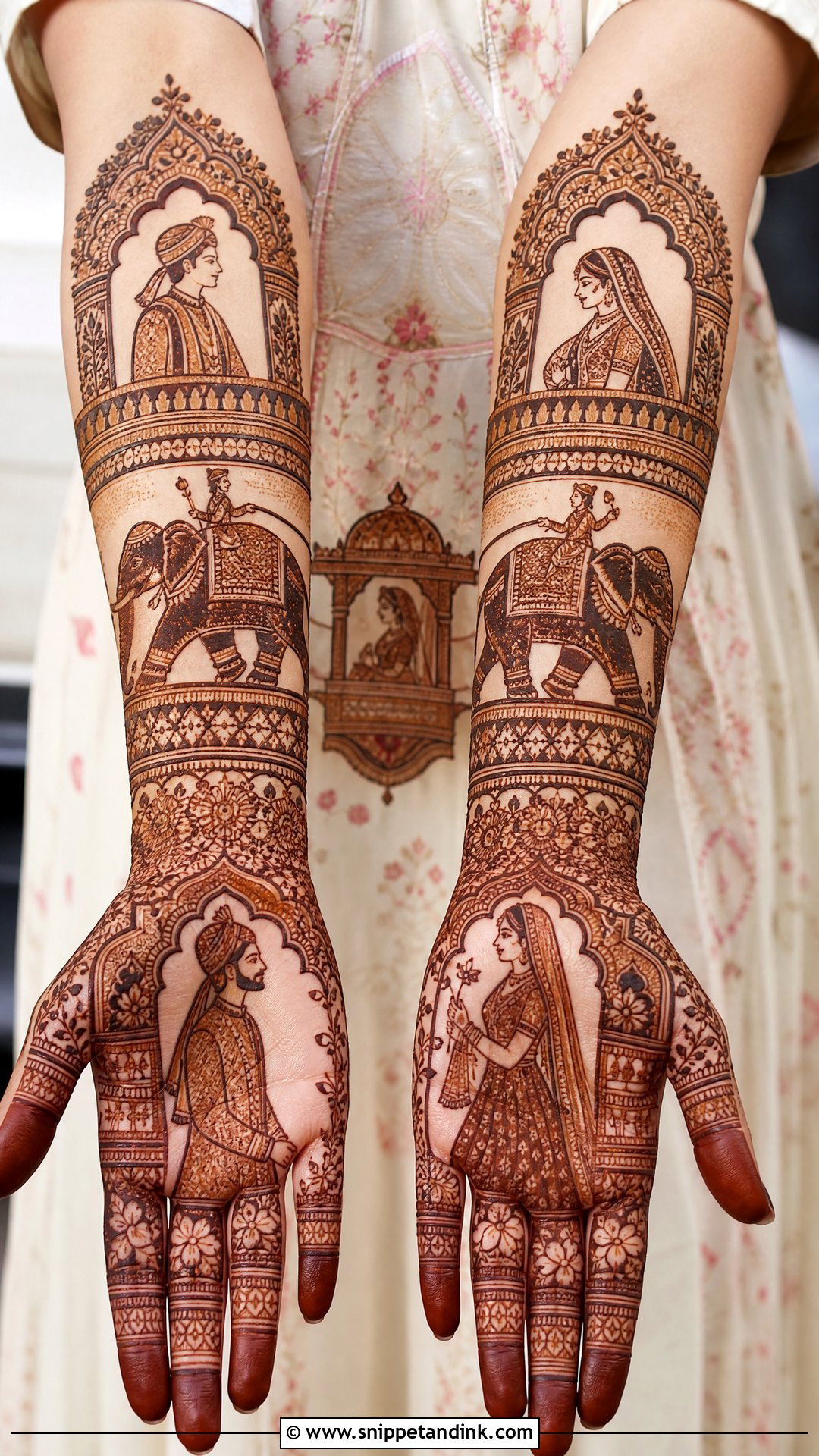
One hand shows the bride and groom; the other shows the elephant as part of the procession. Together, they tell the wedding story. Faces need space and a fine cone tip, so this works on full hands and forearms. Arches, floral borders, mandalas and doli details connect the motifs, and the elephant gets a patterned blanket and small ornaments. Hold both palms side by side in photos so the story reads.
14. Bridal Elephant Mehndi Design With Wedding Date
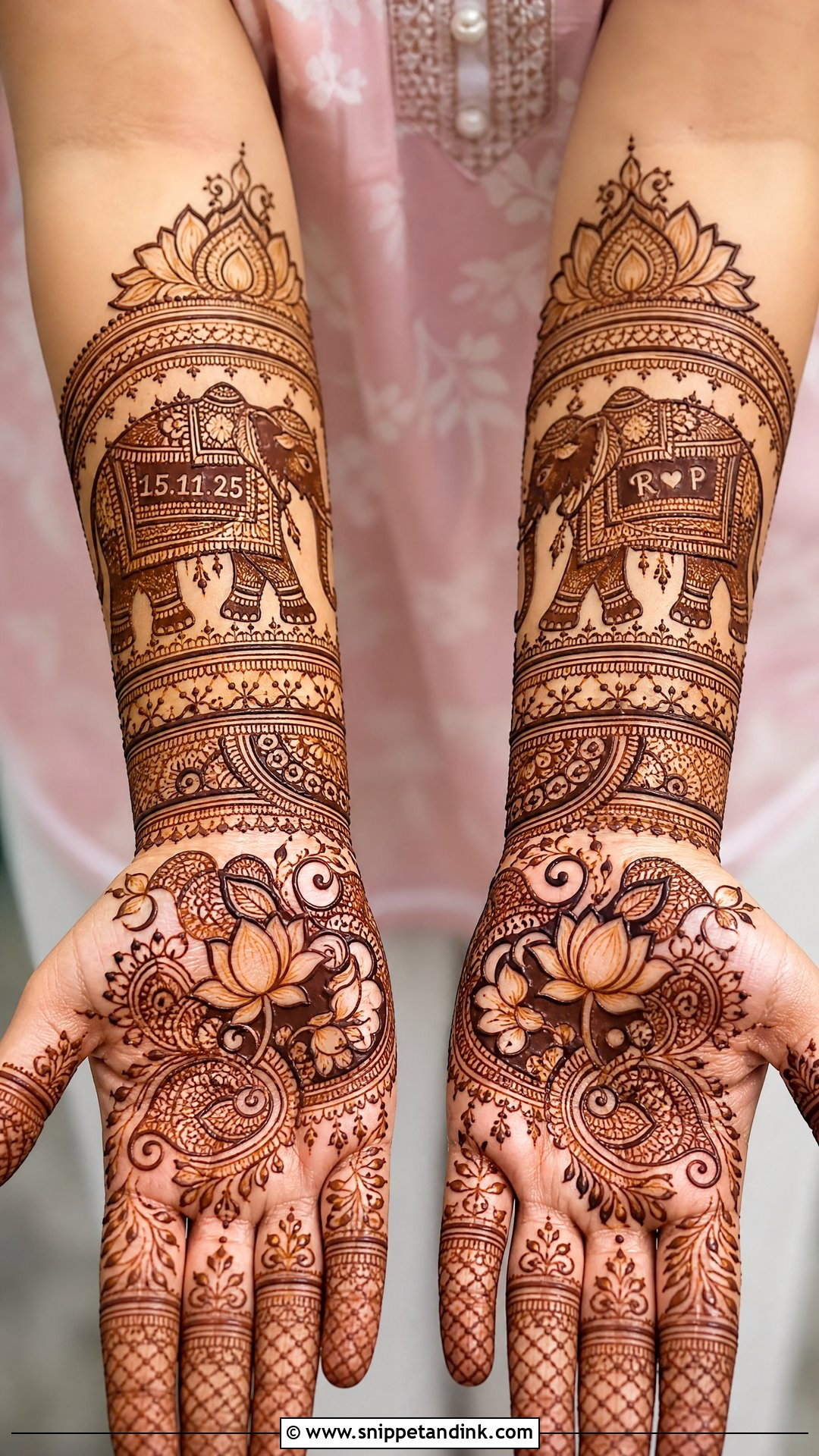
Hiding the wedding date inside the design gives the henna a keepsake quality. I tuck the numbers into the elephant’s blanket, under a palace arch, along a wrist band or inside a floral frame. Numbers must be readable but blended in, so I write them slightly larger than the surrounding filler. Lotuses, paisleys and dotted fillers complete it, and initials can go near the elephant or on the other hand. Send the date to your artist in writing so nothing gets reversed.
15. Minimal Bridal Elephant Mehndi Design
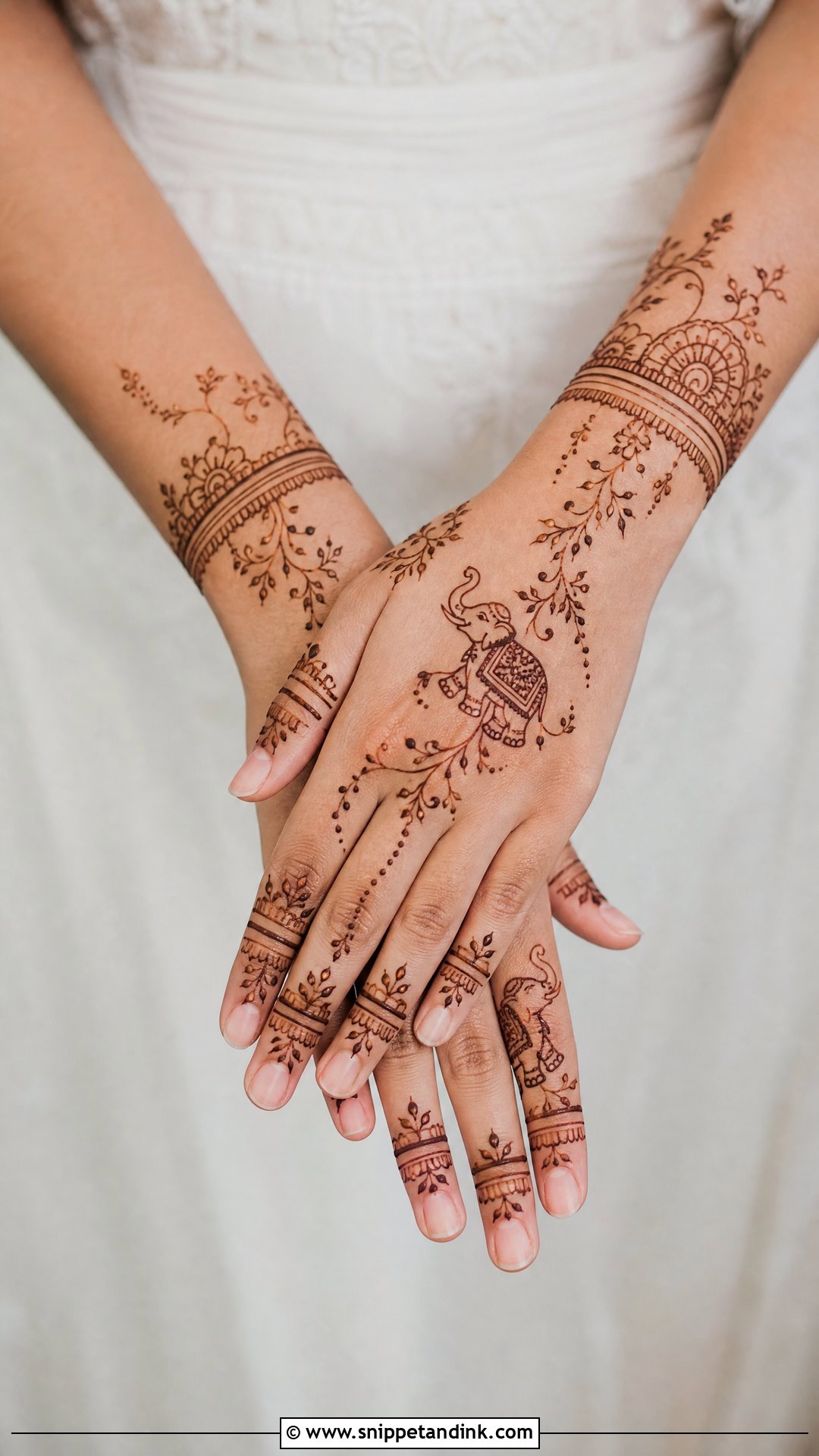
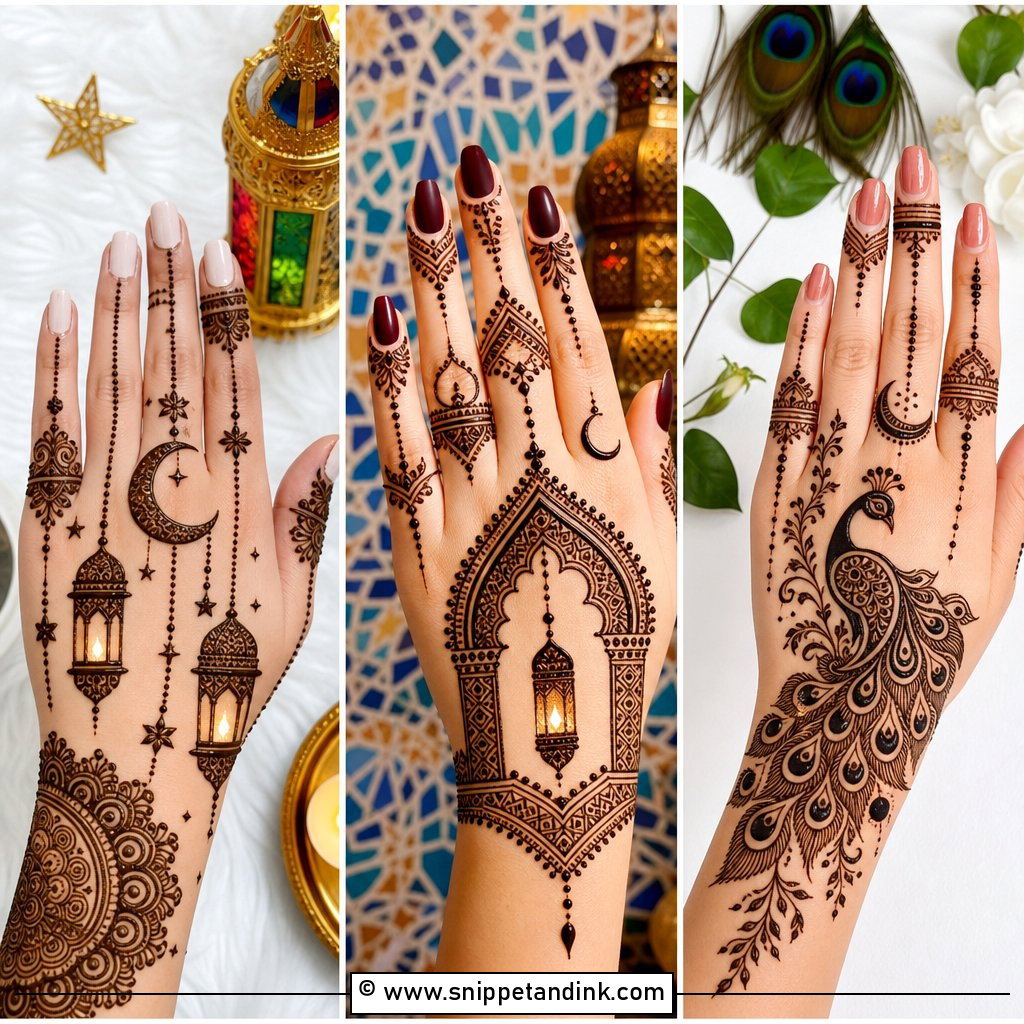
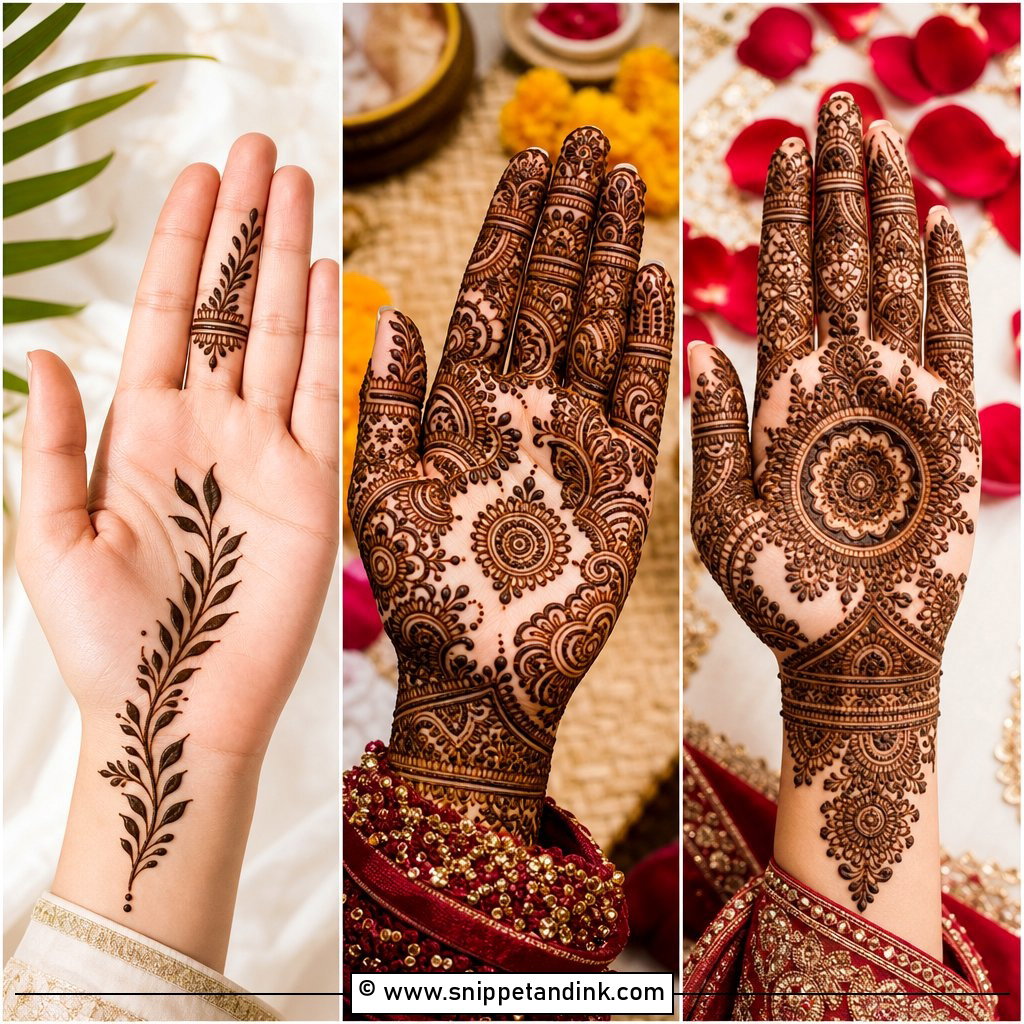
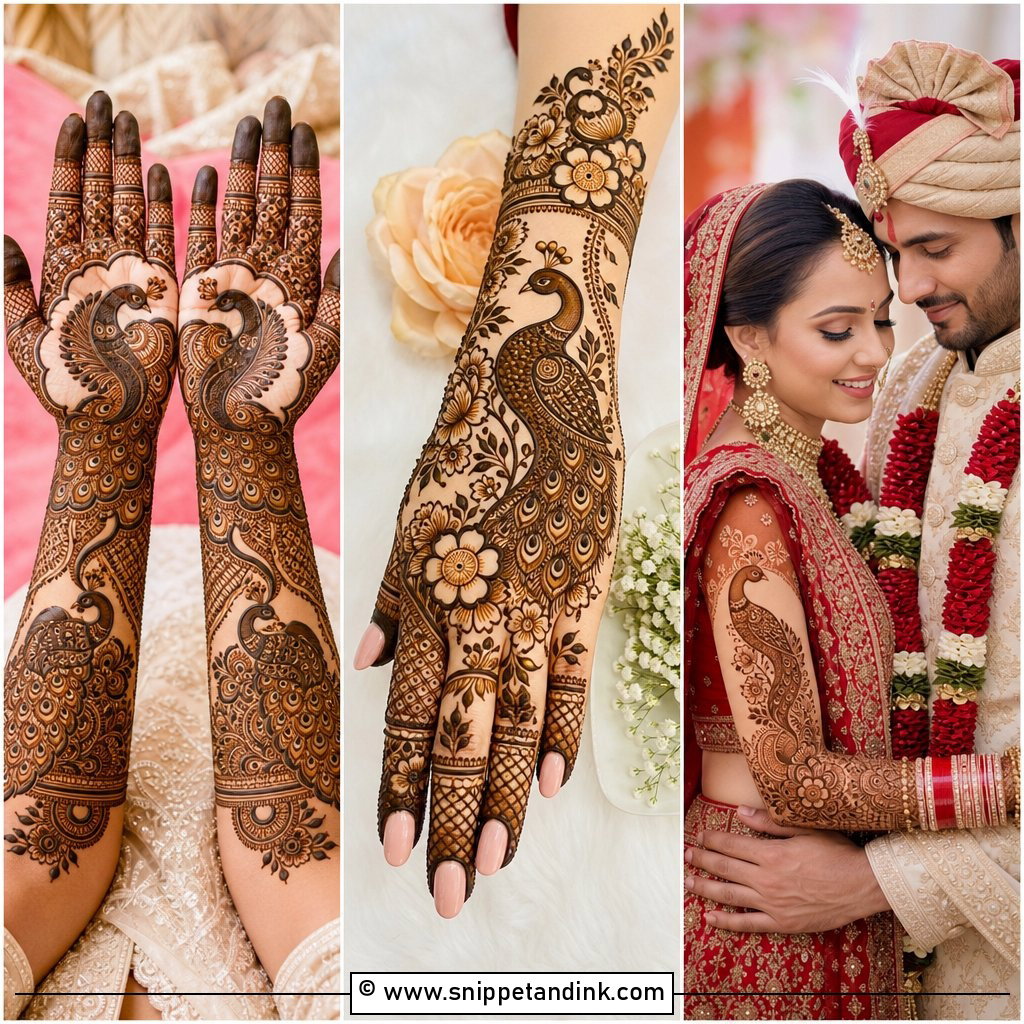
Not every bride wants heavy henna, and a small elephant with clean outlines, soft florals, simple vines and open space still looks bridal. It fits on the back of the hand, the palm centre or a wrist-to-finger trail. Fingers get neat bands, dots and leaves. One strong detail, such as a mandala frame, a bracelet cuff or a lotus border, keeps it feeling like wedding henna. It’s comfortable through every event and quick to apply.
16. Simple Bridal Elephant Mehndi Design
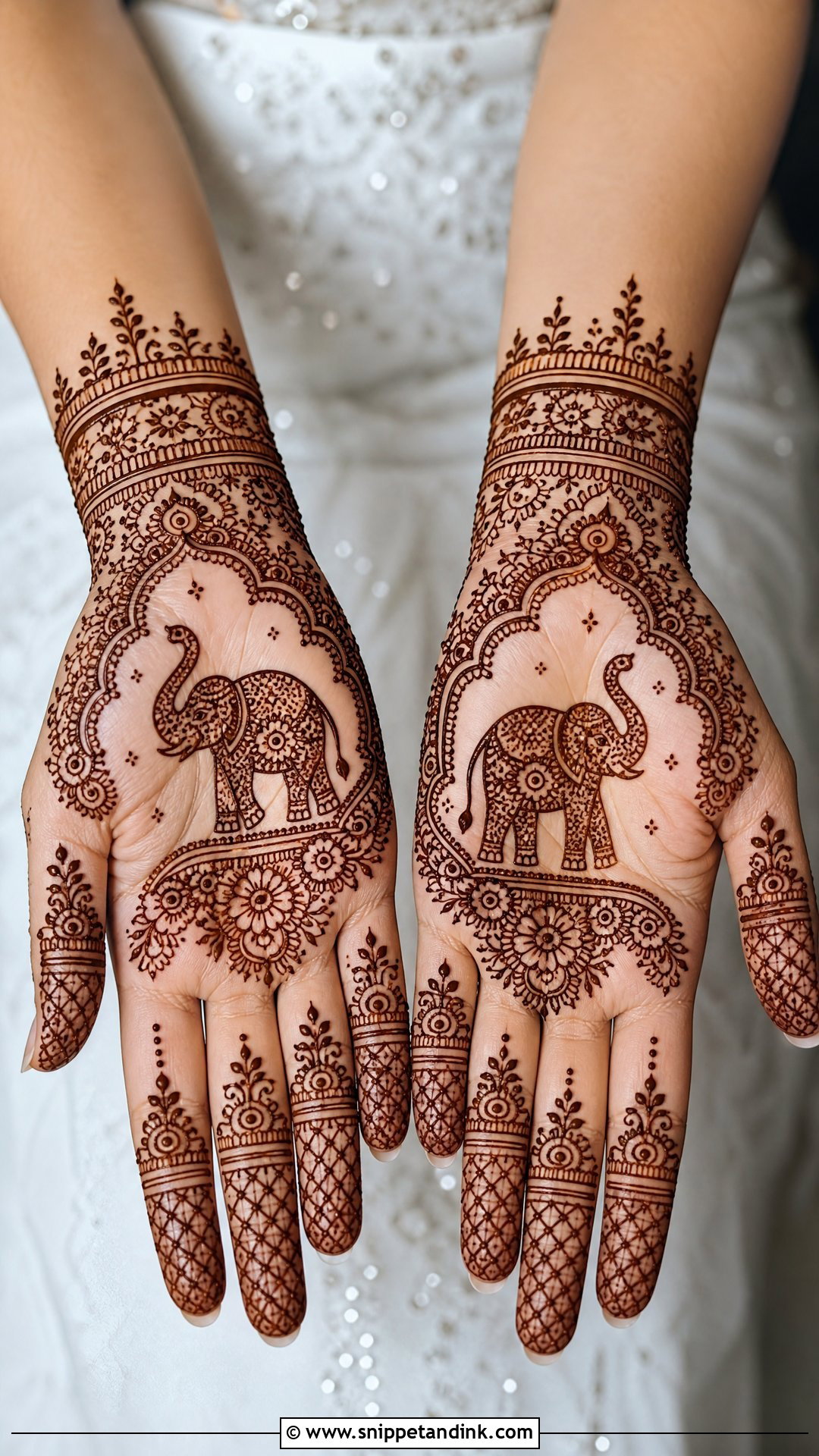
A simple elephant means the outline does the work. I decorate the body with basic lines, dots and small flowers instead of miniature detail, frame it with a floral border or paisleys, and keep the fingers easy. That makes it faster to apply and easier to read once it stains. A wrist cuff and neatly filled fingertips are enough to make it bridal. It suits intimate weddings and bridesmaids who want something related to the bride’s design.
17. Modern Bridal Elephant Mehndi Design
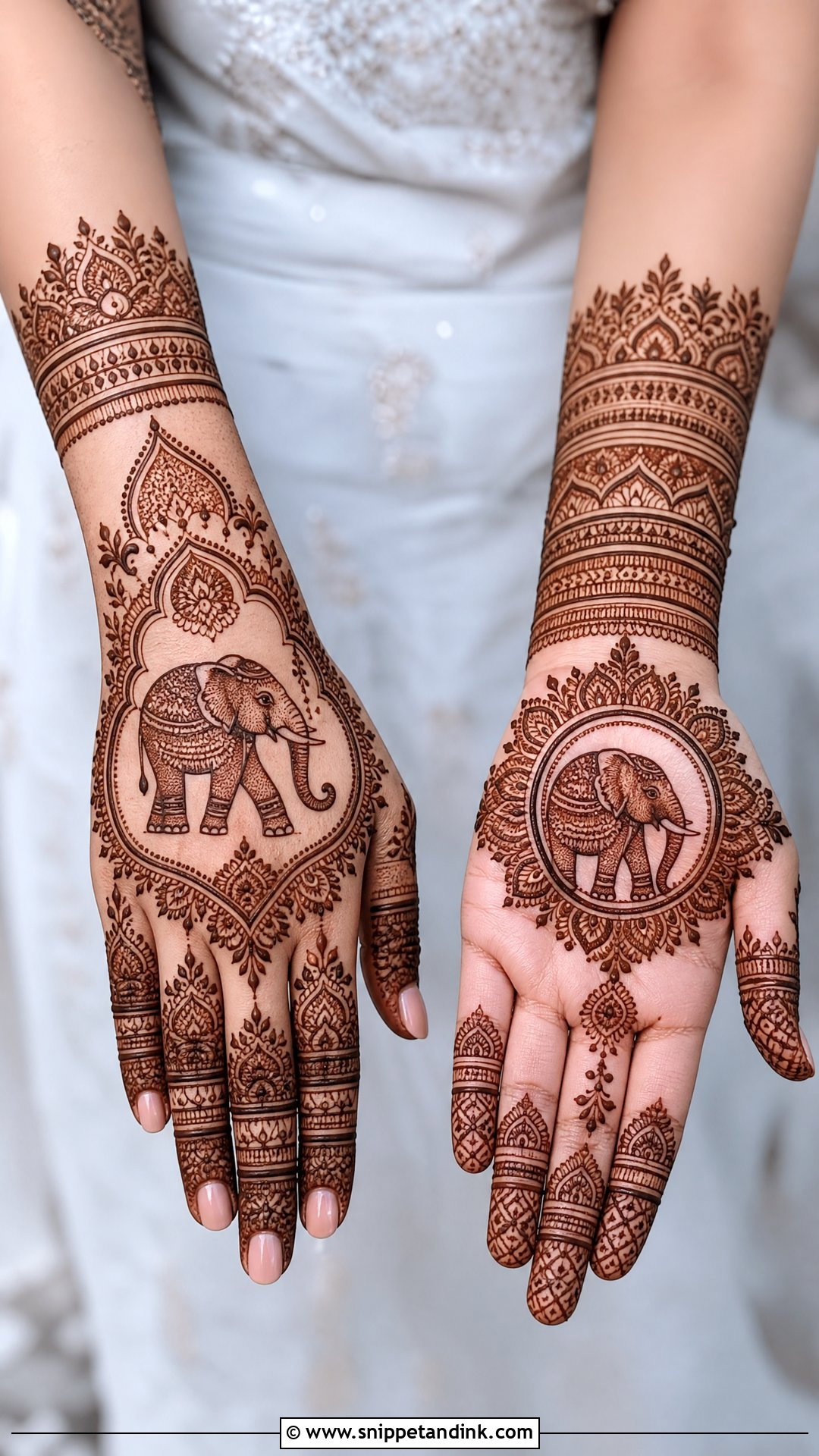
Modern elephant mehndi keeps the motif but updates the layout with negative space, bold outlines, geometric bands, split mandalas and clean finger patterns. The elephant becomes a single statement on the back of the hand or the palm, framed by contemporary florals and structured borders. With so much open skin, every line shows, so spacing has to be even. It suits fusion lehengas, modern outfits and minimal jewellery.
18. Gulf Bridal Elephant Mehndi Design
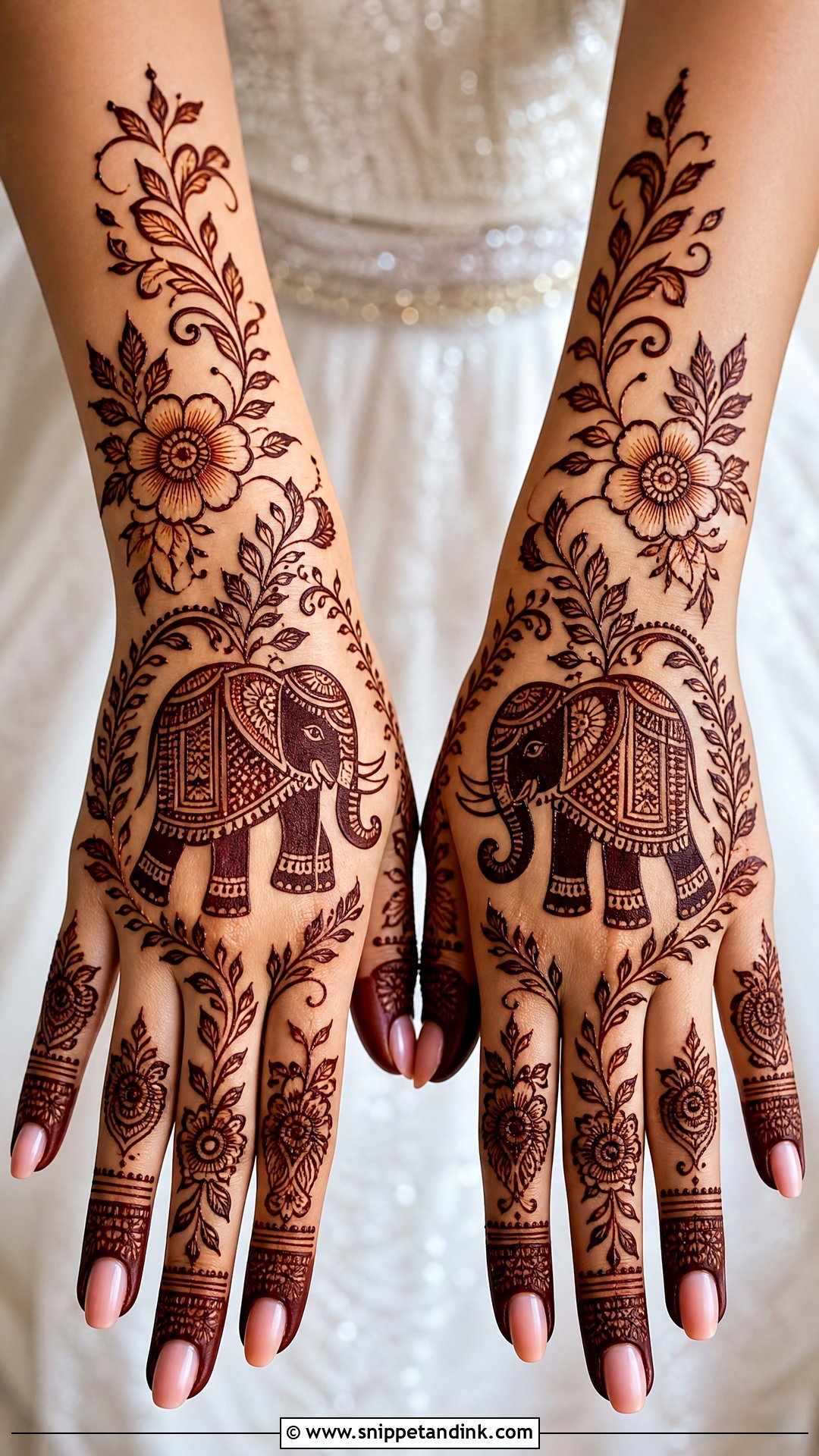
Gulf style is bold and open: thick outlines, shaded flowers, leafy trails, curved vines and plenty of bare skin. The elephant is drawn with a strong outline and only light interior decoration, so it suits the sweep of the pattern across the back of the hand and up the forearm. Fingers get bold floral tips, leafy lines or half-filled sections. It’s a good fit if you want something luxurious but lighter than full Indian coverage.
19. Bridal Elephant Foot Mehndi Design
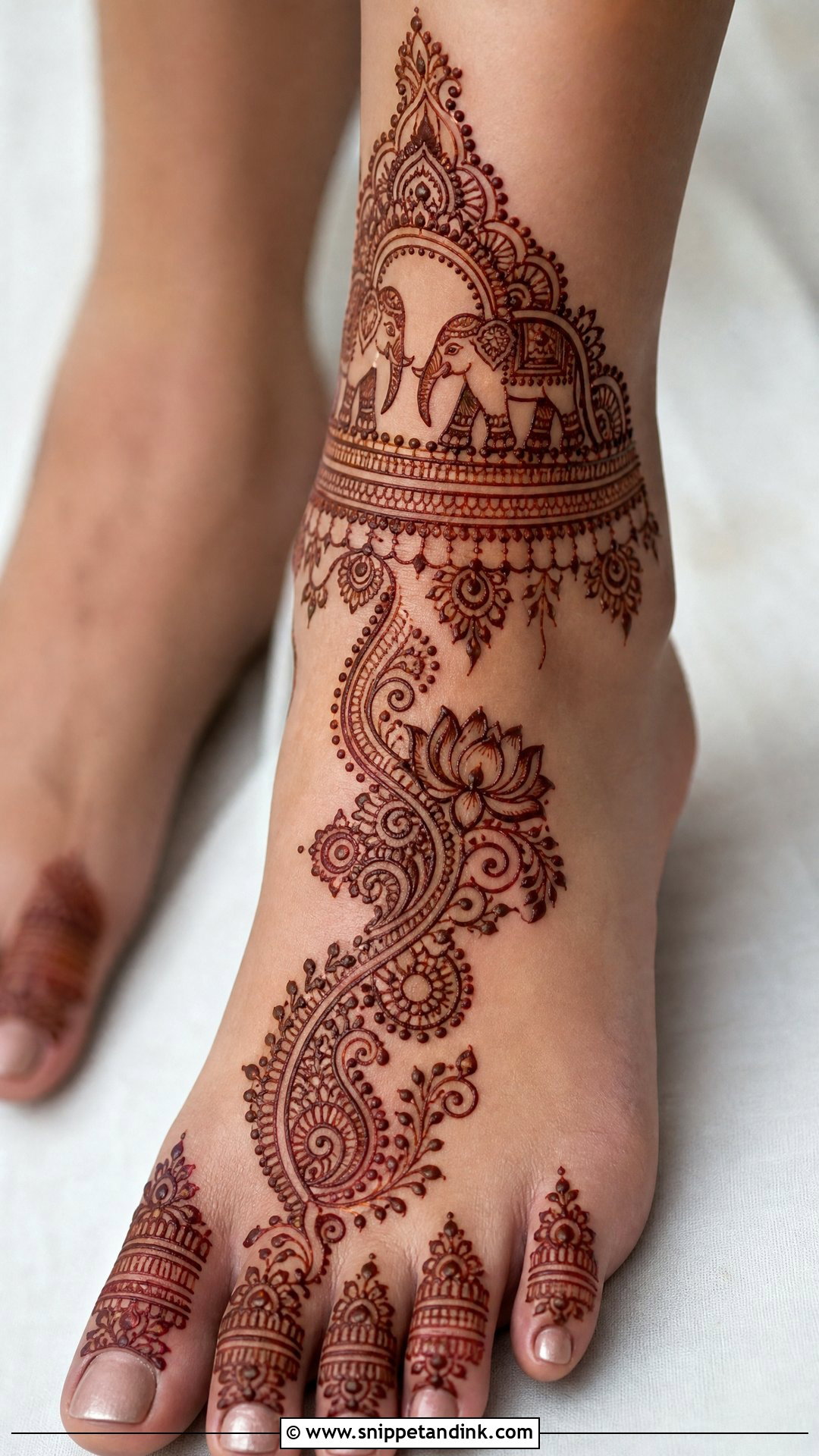
A bridal elephant foot mehndi design places the elephant on top of the foot, near the ankle, or within an anklet-style layout, with lotuses, paisleys, mandalas and leafy trails running toward the toes. Matching it to elephant or palace details on the hands makes the whole set feel planned. Toes get small bands and dots. Feet stain dark but wear down faster, so I’ll say more on that below.

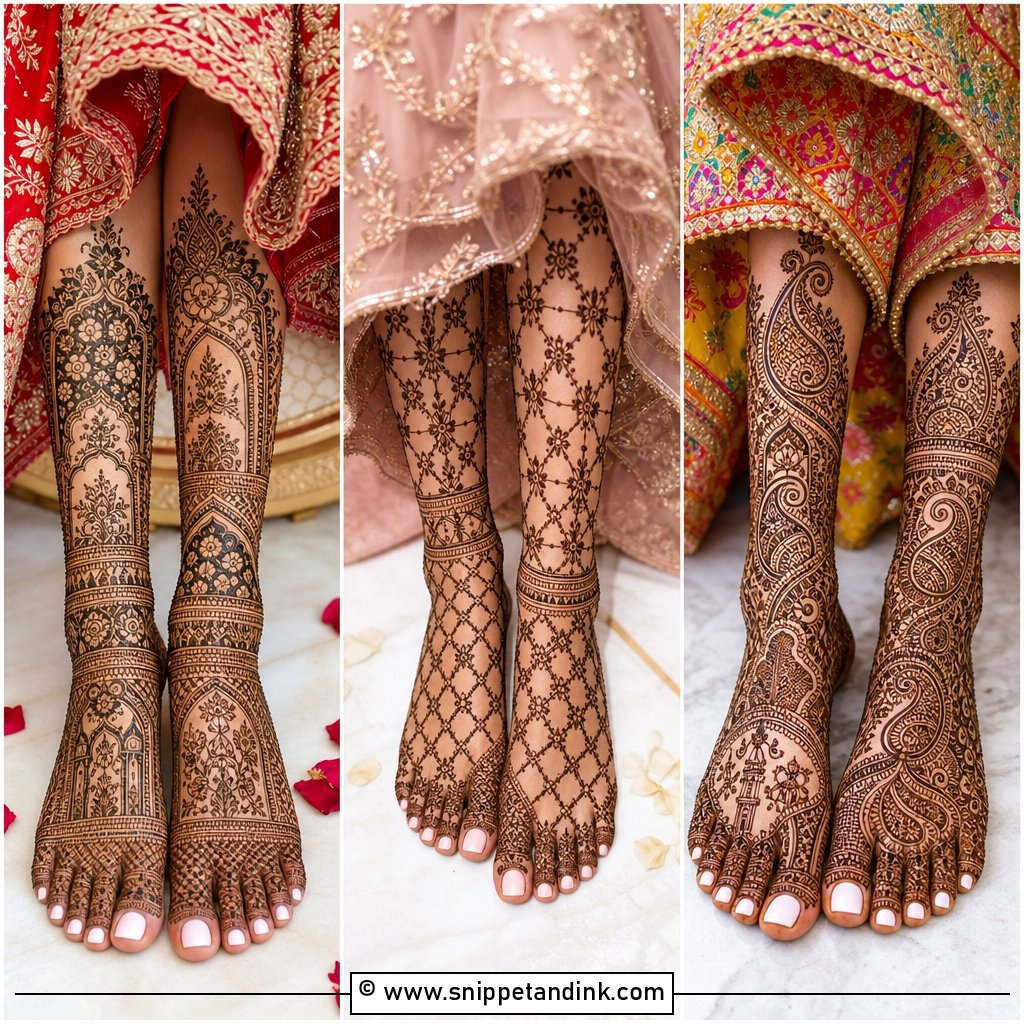

20. Bridal Elephant Mehndi Design For Full Arms
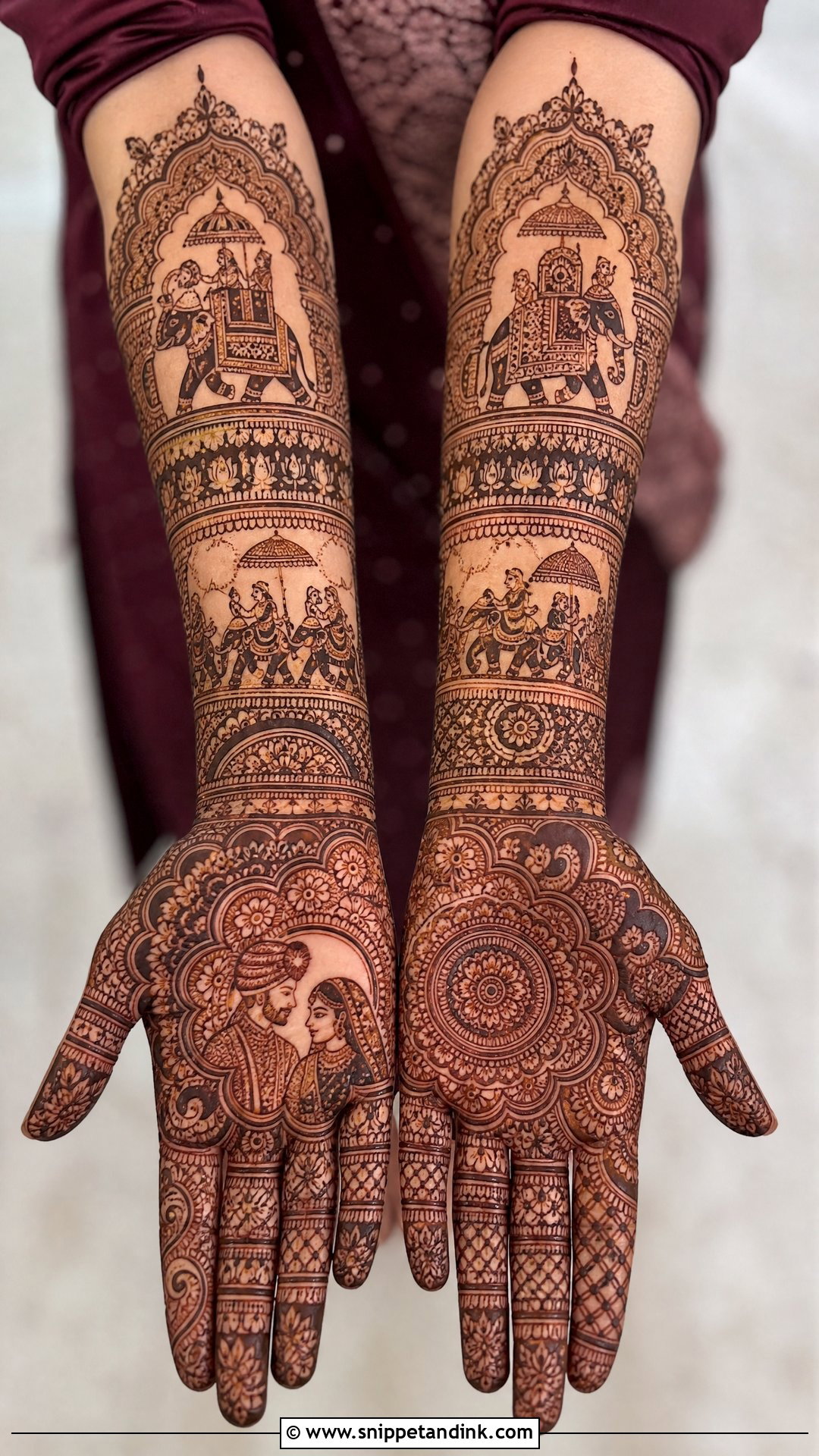
Full-arm coverage is the grandest version: fingertips through the palm, over the wrist and up toward the elbow or beyond. The elephant usually appears on the forearm as a procession, while the palms carry mandalas, couple portraits, lotuses or peacocks. With so much area, clear sections matter, so I divide the arm with borders and cuffs. Without those breaks, a full arm reads as clutter rather than a story. Plan for a very long sitting.
Trunk Up or Trunk Down?
Many families prefer an elephant with its trunk raised, which is widely read as a sign of good luck and celebration. Others don’t mind either way. If it matters to your family, tell your artist before she starts, because the trunk direction sets the shape of the whole motif and is hard to change midway.
Direction matters on the hand too. I usually draw elephants facing inward, toward the centre of the palm or toward each other across two hands, so the pair looks connected when you hold your hands together for photos.
Foot Henna Wears From the Ground Up
The soles and the sides of the feet stain very dark because the skin is thick. They also fade fastest, since walking and shoes rub them every day. Designs on top of the foot hold longer than those near the heel or along the edges.
- Have foot mehndi applied after your hands, so you’re not walking on wet paste.
- Keep feet raised and uncovered until the paste is fully dry.
- Wear soft, open shoes the day after, rather than tight closed ones.
- Avoid pedicures or foot scrubs in the days just before the wedding.
Let the Elephant Lead, Then Build Around It
An elephant can be bold and traditional, soft and floral, minimal and modern, or detailed enough to carry a whole wedding story. What makes it work is balance. Place the elephant first, leave it room to stay readable, and choose surrounding patterns that suit your outfit, jewellery and ceremony. A skilled artist and a sensible layout matter more than the number of motifs you fit in.
You'll Like These Ideas:


Leave a Reply