
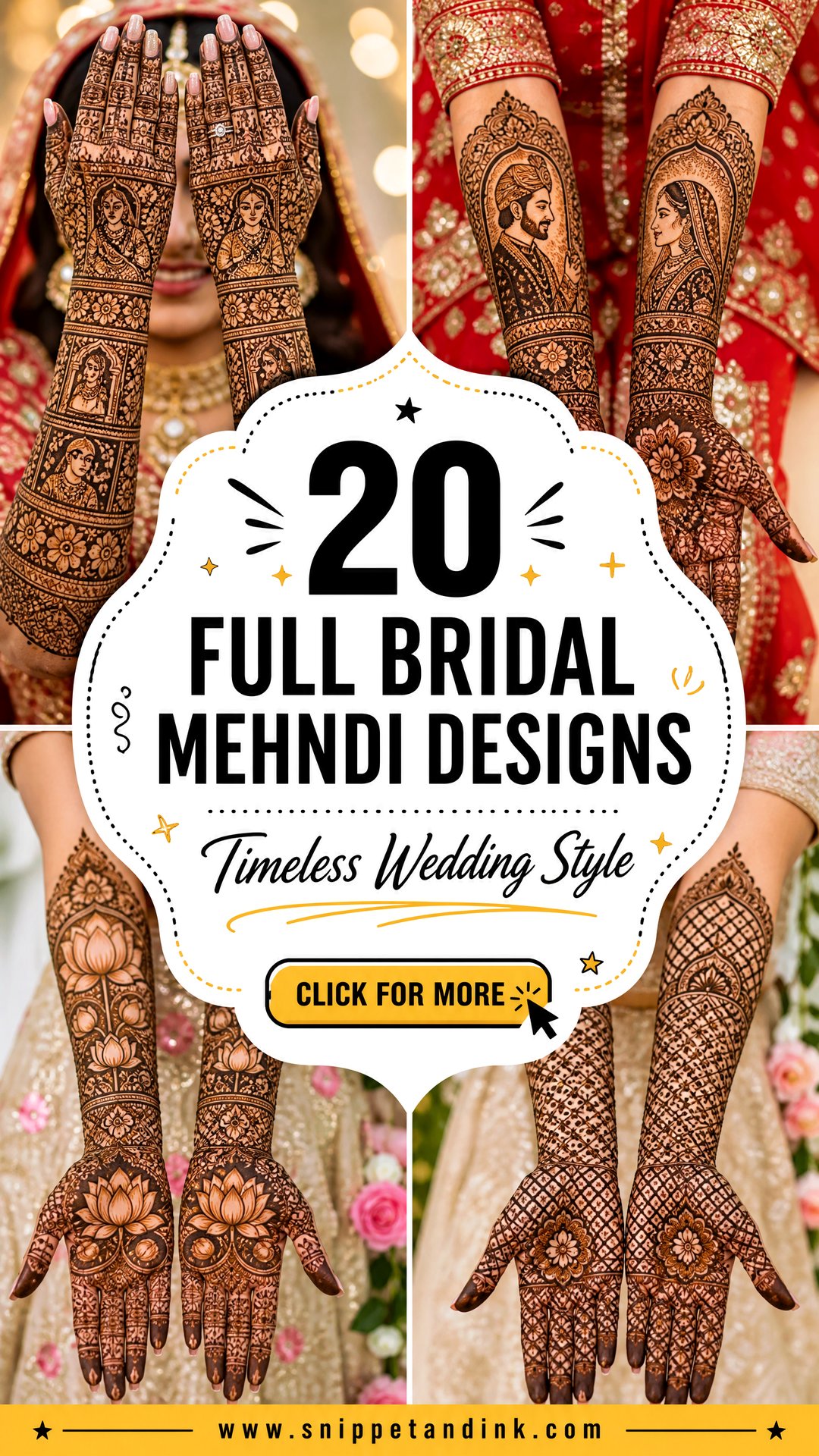
A bride’s mehndi is the one piece of her wedding look that’s drawn directly onto her, by hand, over several hours, and it carries meaning that jewelry doesn’t. Full bridal coverage can be dense and royal, airy and floral, modern with negative space, or crowded with portraits, peacocks and a whole wedding procession. When a bride books me, I ask about her outfit, her jewelry and how far up the arm she wants to go before we talk motifs. Some want packed Indian work to the elbow; others want bold Arabic flow with skin showing. The twenty designs below cover traditional, Arabic and fusion styles, with what each one demands from the artist and from you.
Planning the Hours You’ll Spend in the Chair
Brides often underestimate how long full bridal mehndi takes. Hands front and back up to the forearm usually take several hours on their own, and portraits, wedding scenes or full arms and feet can stretch that across most of a day. Then the paste has to stay on for hours more. So the timing of your mehndi needs as much planning as the design.
Two days before is the sweet spot
The stain starts pale orange when the paste comes off and deepens over the next 24 to 48 hours. Applying it two days before the wedding means it peaks on the day itself. The night before is too late for the darkest color.
Get ready for the sitting
- Eat a proper meal before we start. You won’t be able to use your hands for a while.
- Wear a top with loose or short sleeves that opens at the front, so you can change without smudging the arms.
- Skip lotions and oils on hands and arms that day; they block the stain.
- Have someone nearby to feed you water through a straw, adjust your dupatta and answer your phone.
- Keep the room warm. Warmth helps the stain develop, while a cold air conditioner slows it down.
1. Full Hand Indian Bridal Mehndi Design
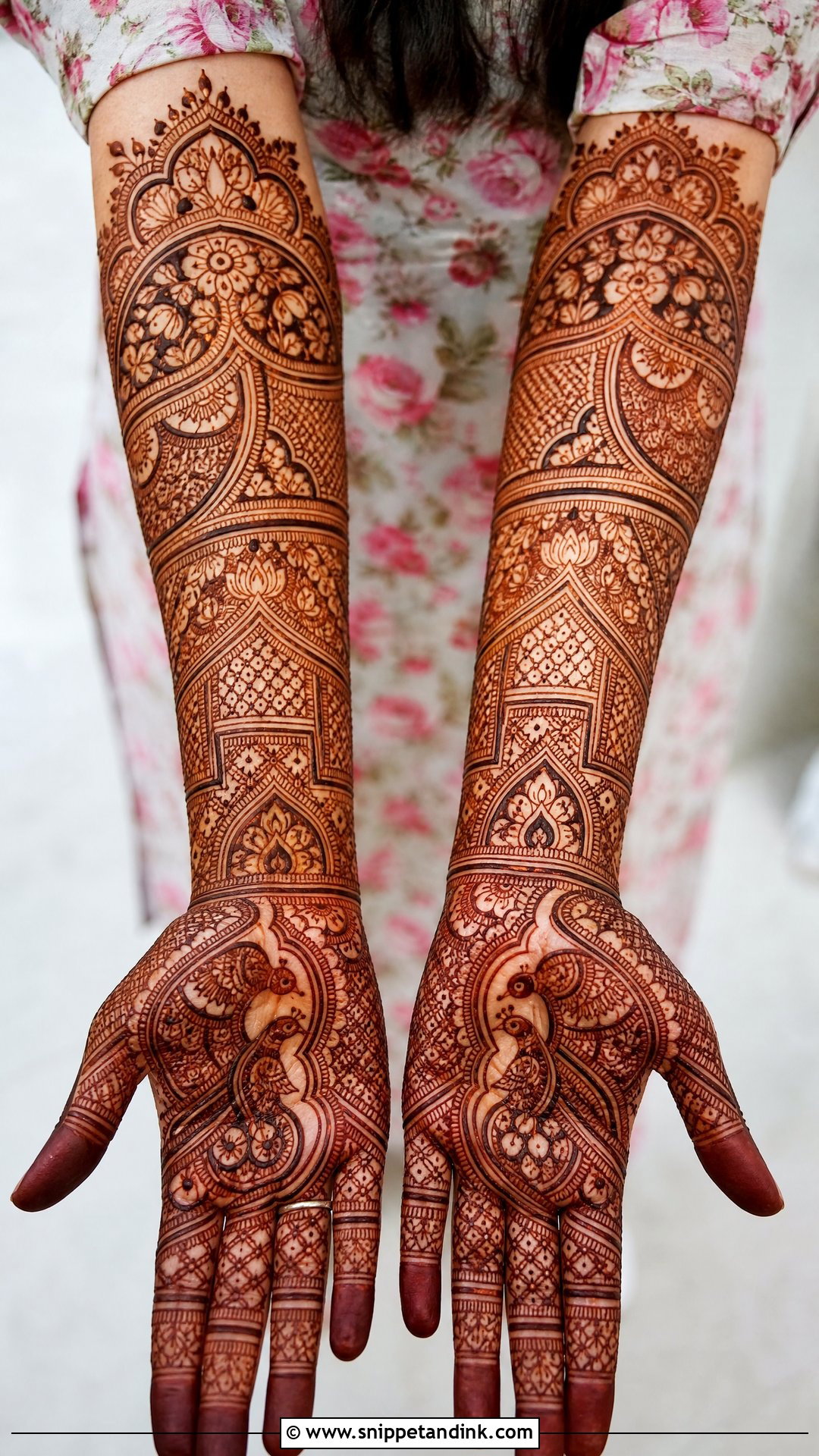
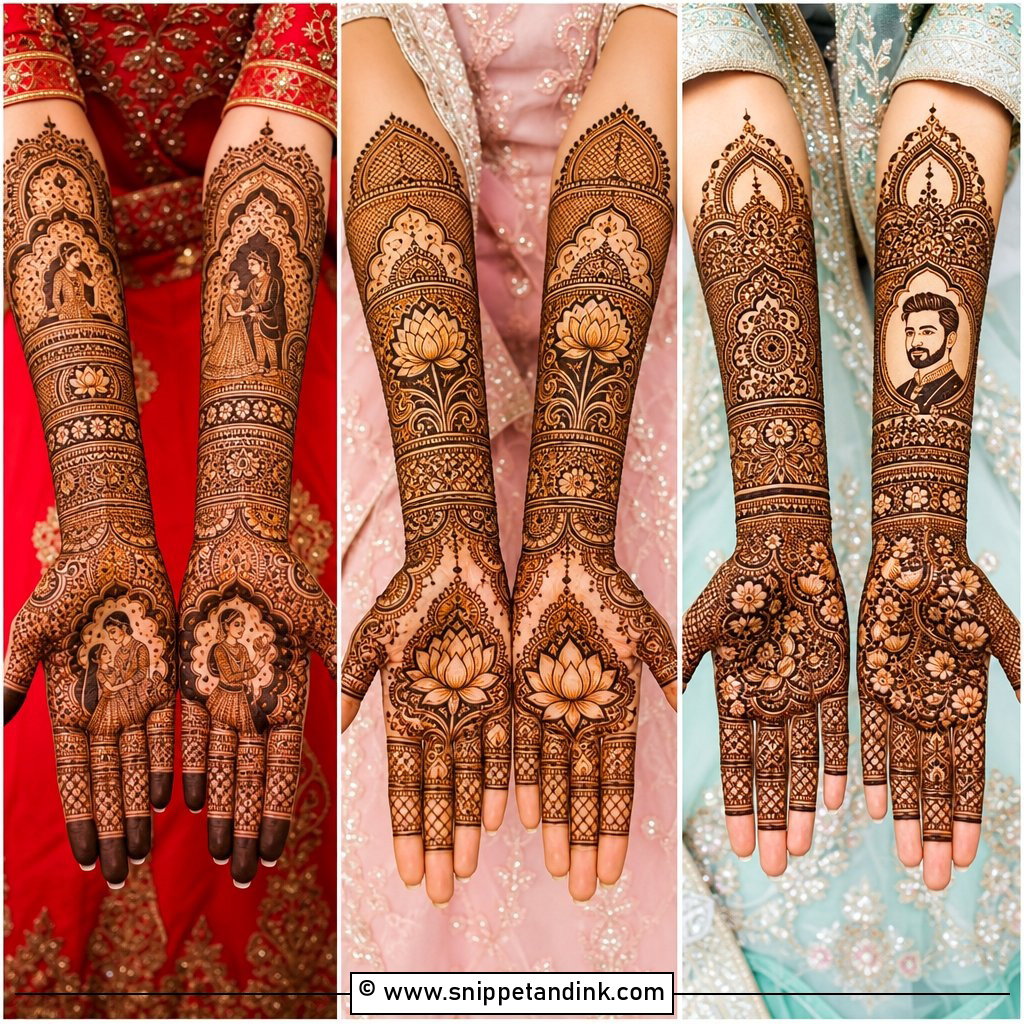
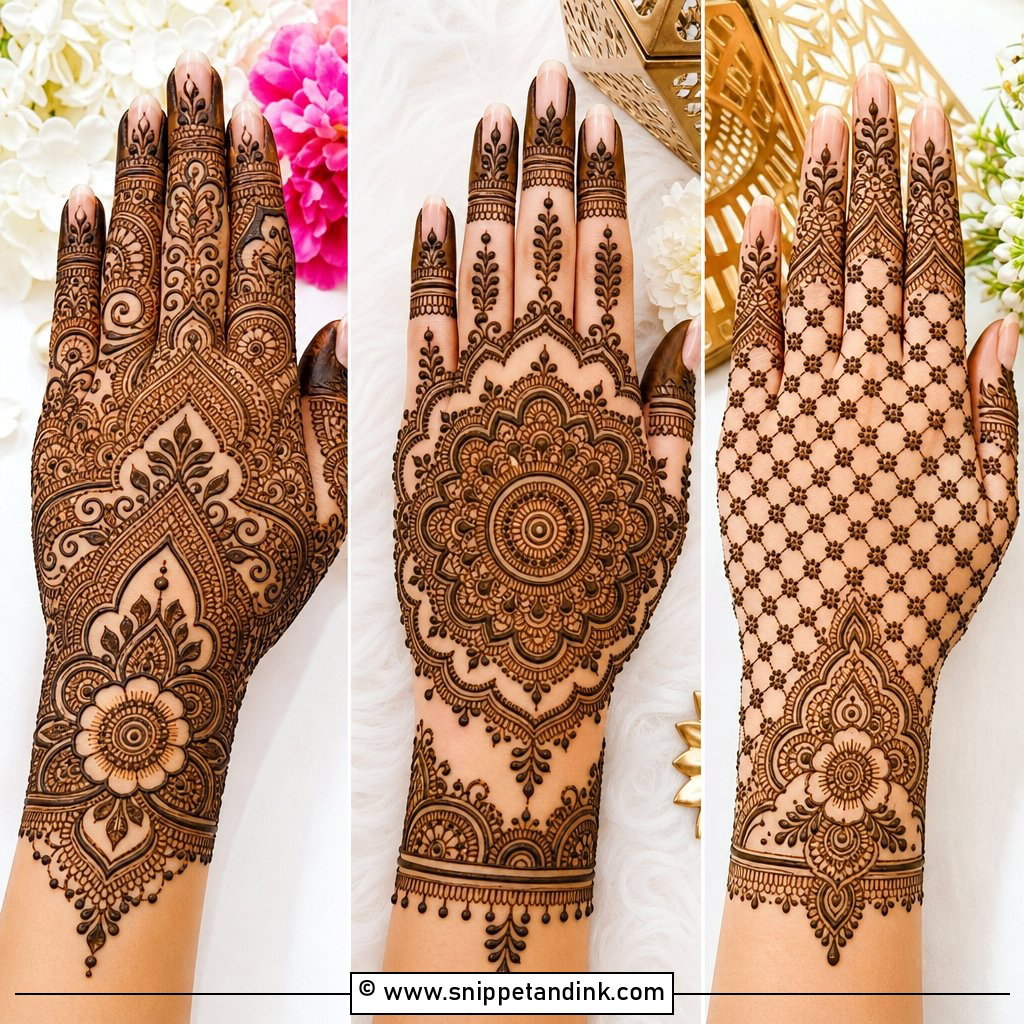
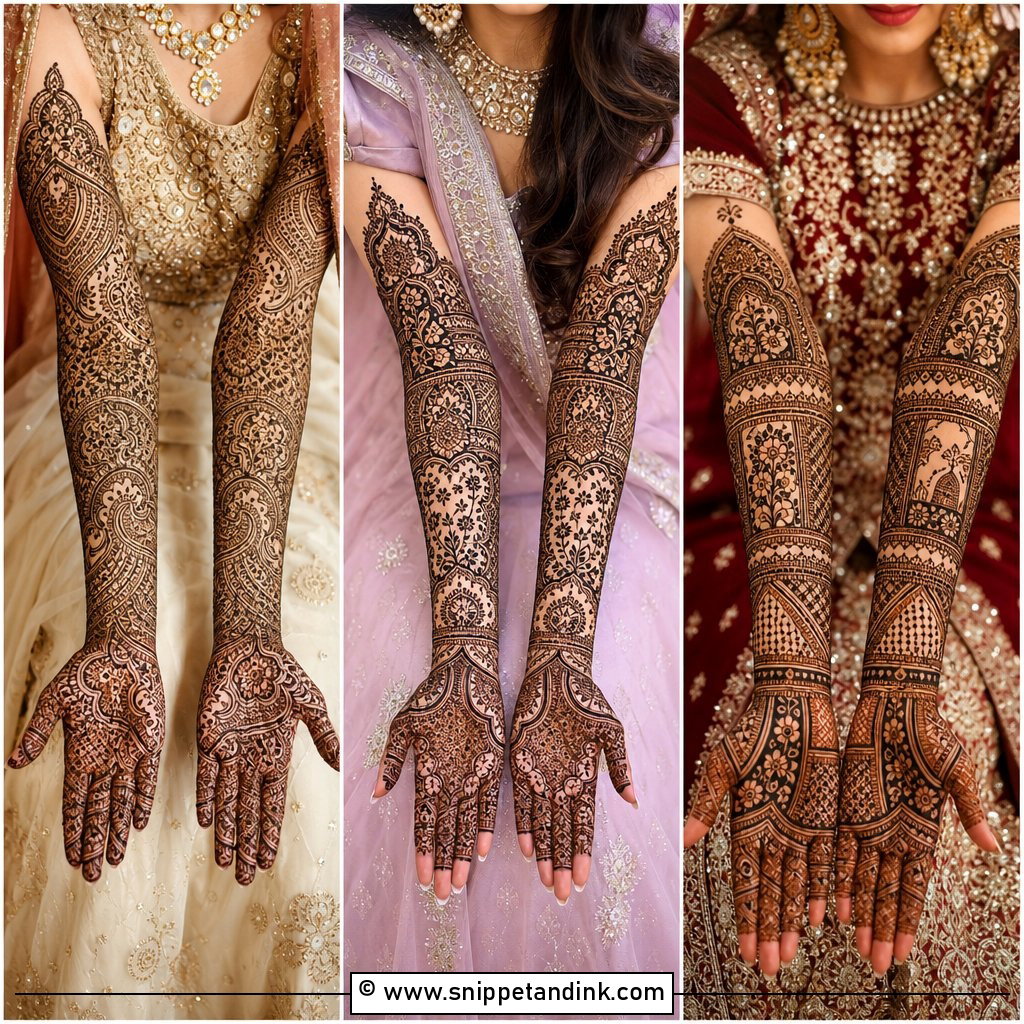
This is the design most people picture: filled fingertips, a heavily worked palm and layered sections climbing from the wrist to the forearm, packed with paisleys, lotus flowers, peacocks, mandalas, jaali and fine filler. Its strength is density, and its risk is the same thing. Without a plan, a fully filled hand turns into noise. I divide the hand into zones first, usually fingers, palm center, wrist band and forearm panels, and give each one a single main motif before any filler goes in. Against red, maroon or gold outfits with kaleeras and stacked bangles, nothing else looks quite as ceremonial.
2. Full Hand Arabic Bridal Mehndi Design
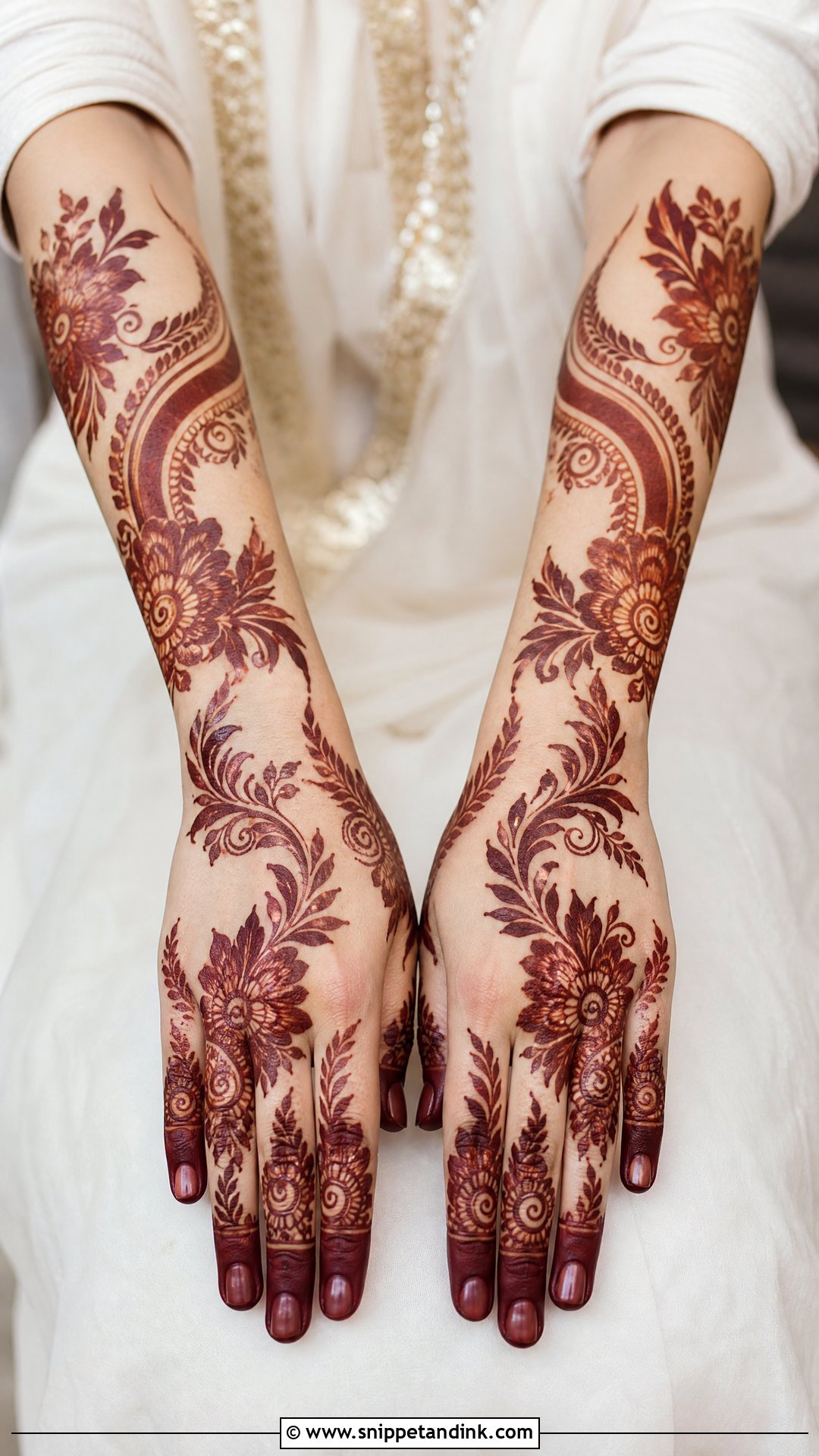
Arabic bridal work suits brides who want bold rather than busy. Large flowers, leafy trails and curved bands flow from the fingers to the forearm, with pockets of bare skin left between them so each motif reads clearly. Because the motifs are larger, it also takes noticeably less time in the chair than full Indian coverage, which matters if your mehndi night is packed with guests waiting their turn. The thick outlines are less forgiving, though. A hesitant line in a bold Arabic stroke shows, so pick an artist whose Arabic portfolio has smooth, confident curves.
3. Full Hand Indo Arabic Bridal Mehndi Design
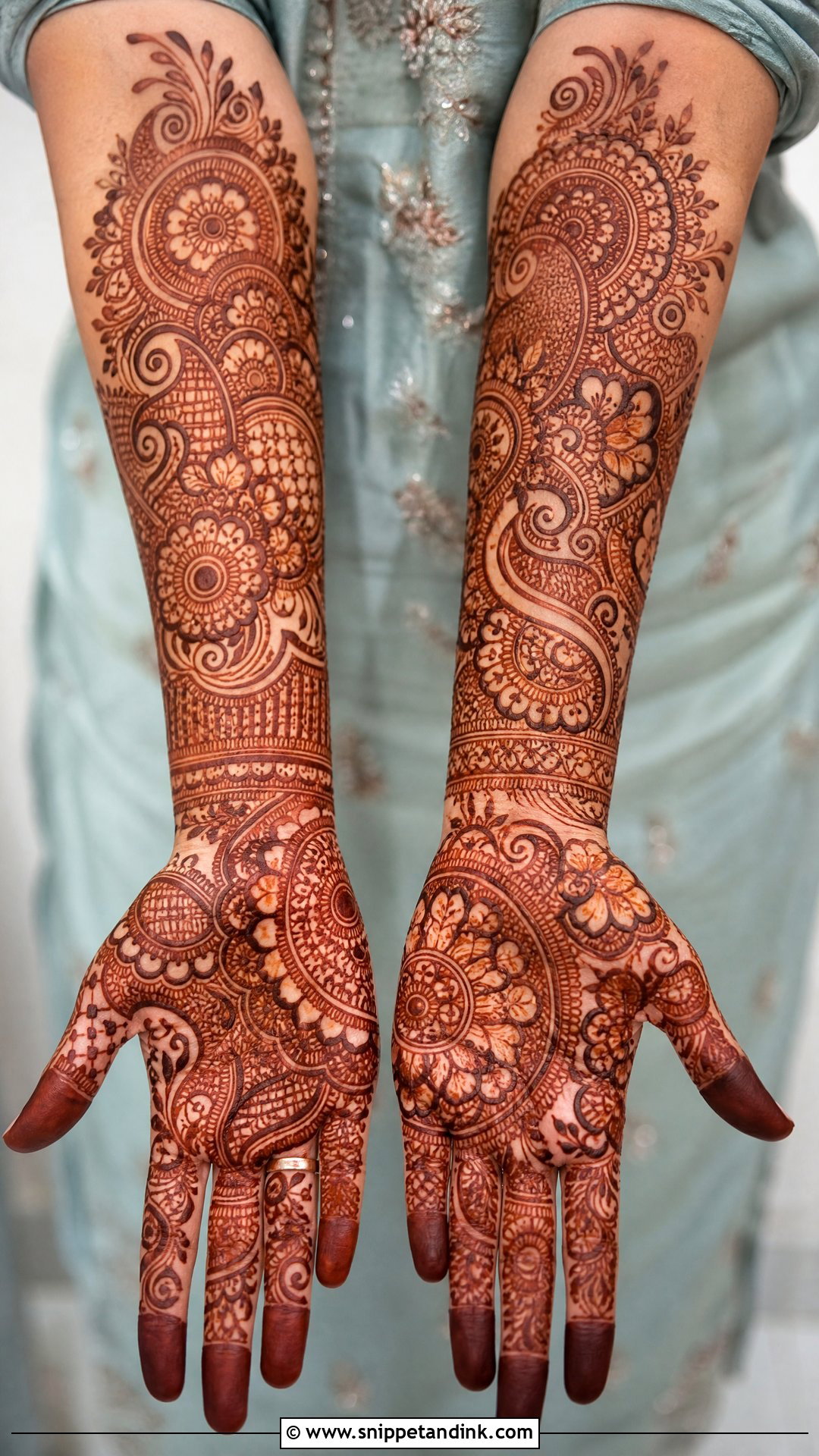
Indo Arabic is where many of my brides land after looking at both styles. I’ll put a mandala or paisley center on the palm in Indian style, then run Arabic diagonal floral trails with mesh sections and leafy borders over the back of the hand. The fingers get detailed bands and dots. The balance is the hard part: if every motif gets fine filling, it drifts into full Indian density and loses its flow. I decide in advance which areas stay open.
4. Full Hand Bridal Mehndi With Bride And Groom Portrait
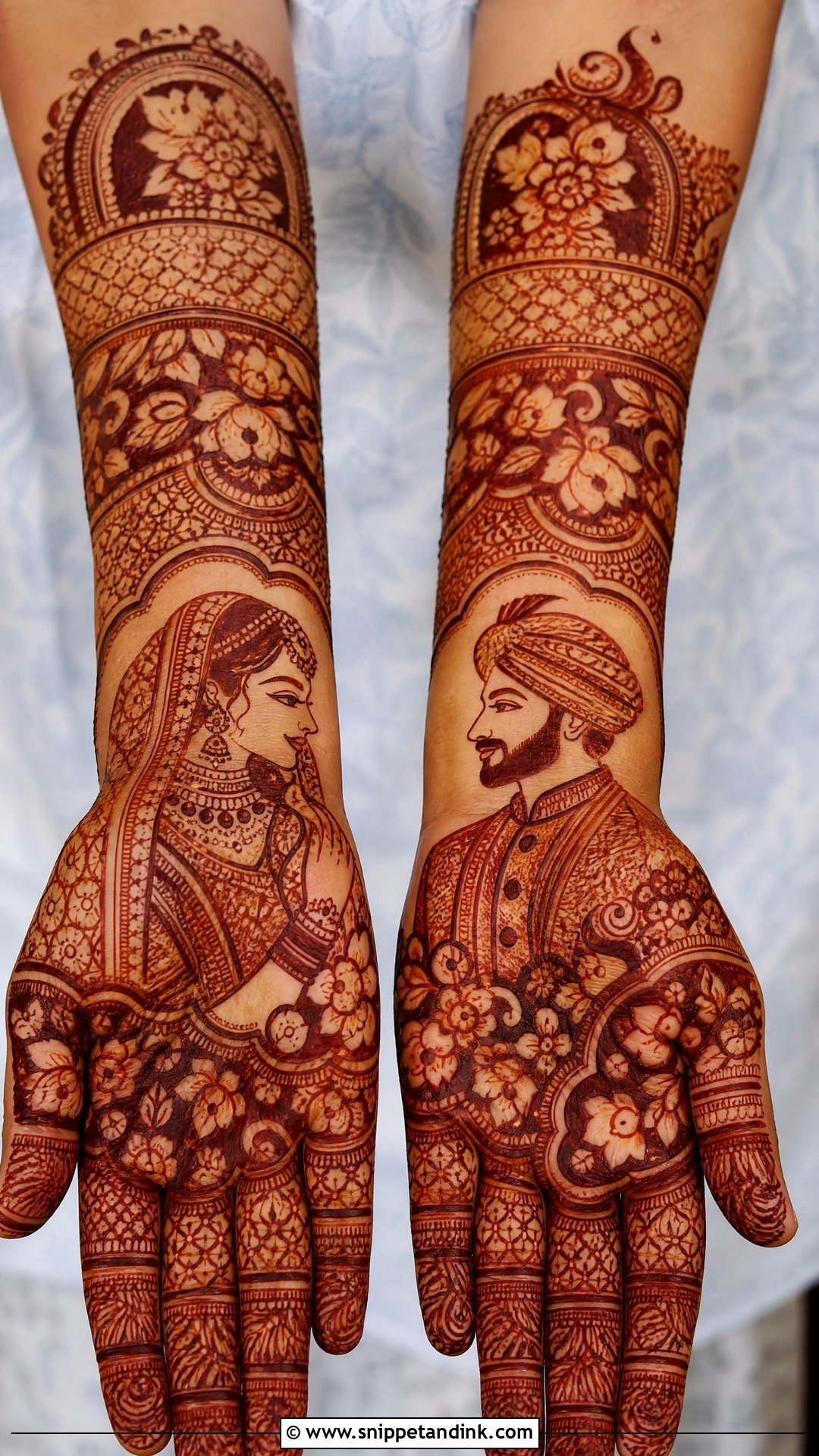
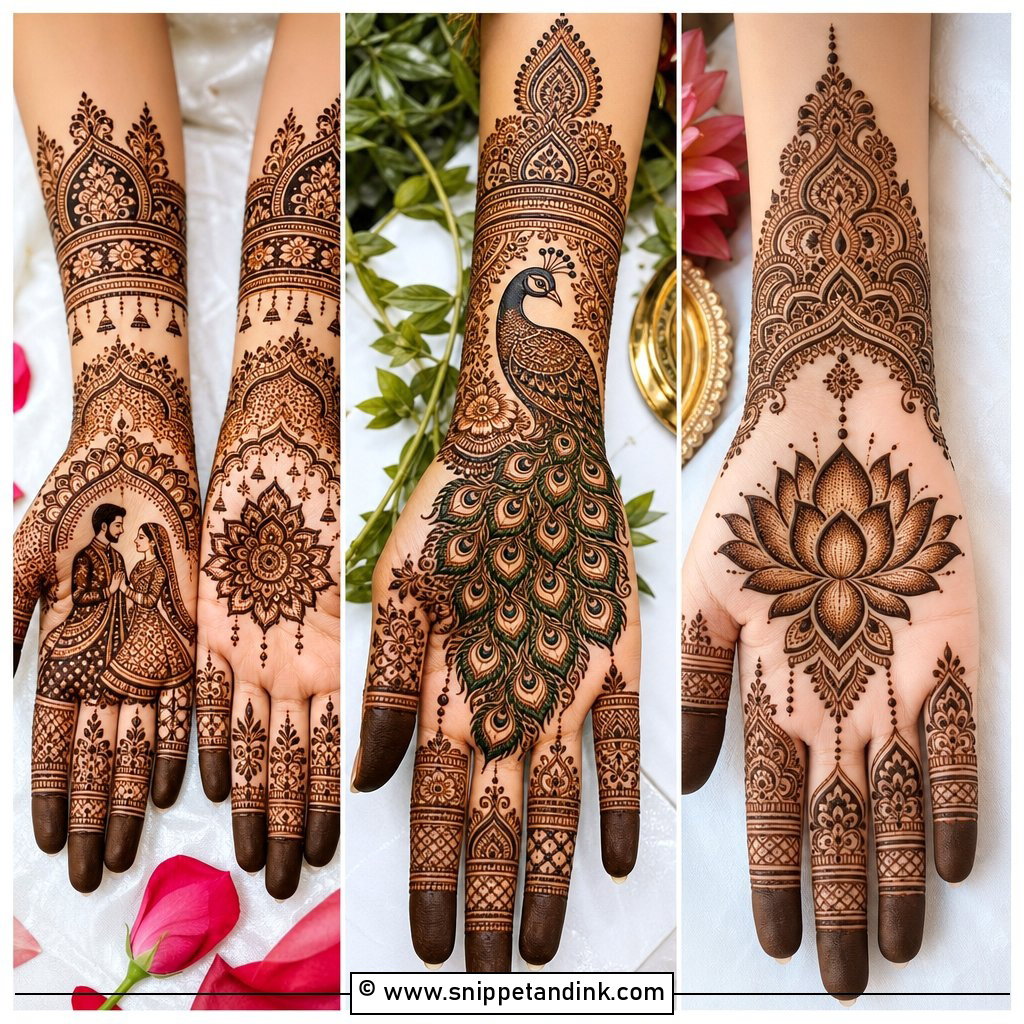
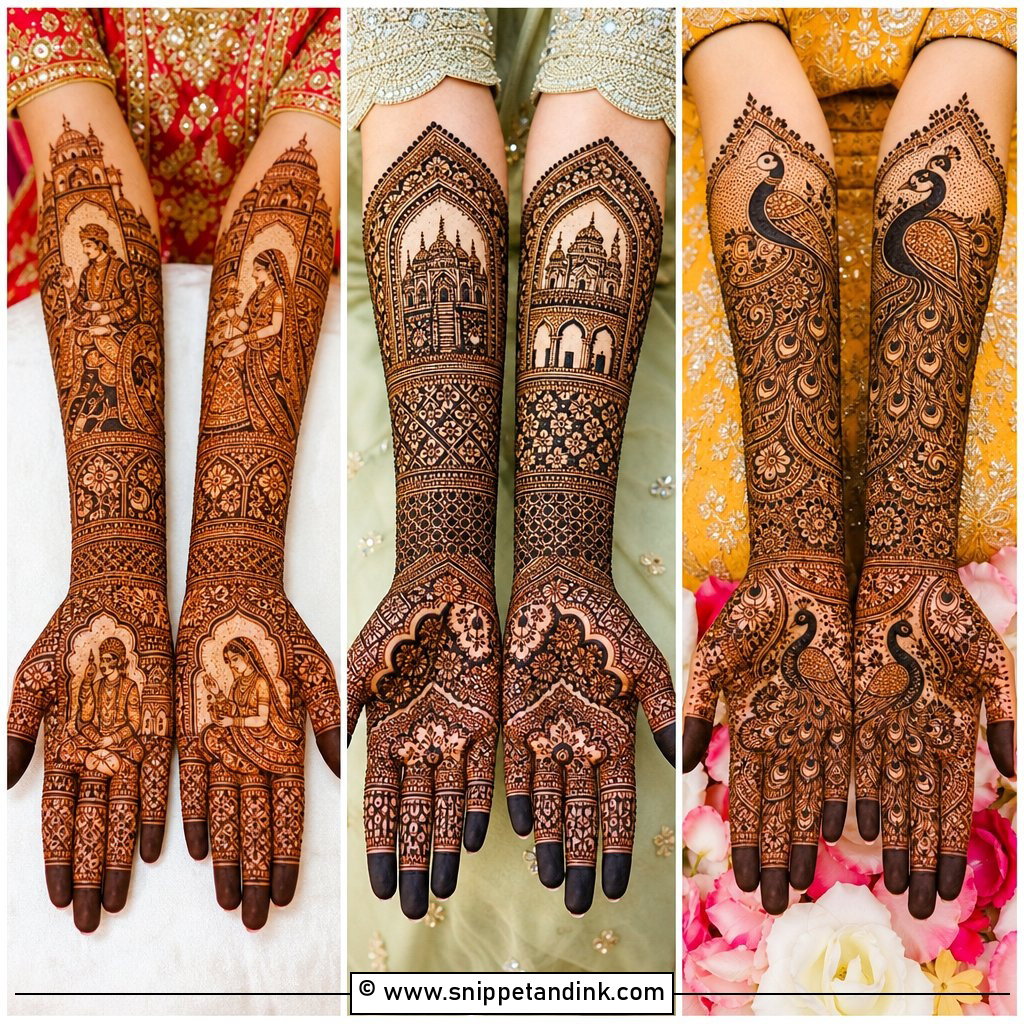
Portrait mehndi puts the bride on one palm and the groom on the other, framed by wedding scenes, flowers, mandalas and paisleys. Some brides add initials, the date or a cultural symbol. Faces are the hardest thing I draw in henna: a fraction of a millimeter on an eye or the curve of a mouth changes the expression, and once the stain develops there’s no correcting it. Portraits also stain best when the lines are clean and slightly spaced, since very fine detail can blur as the paste spreads. Look carefully at an artist’s past portraits after the stain, not just in wet paste, before booking.
5. Full Hand Bridal Mehndi With Peacock Design
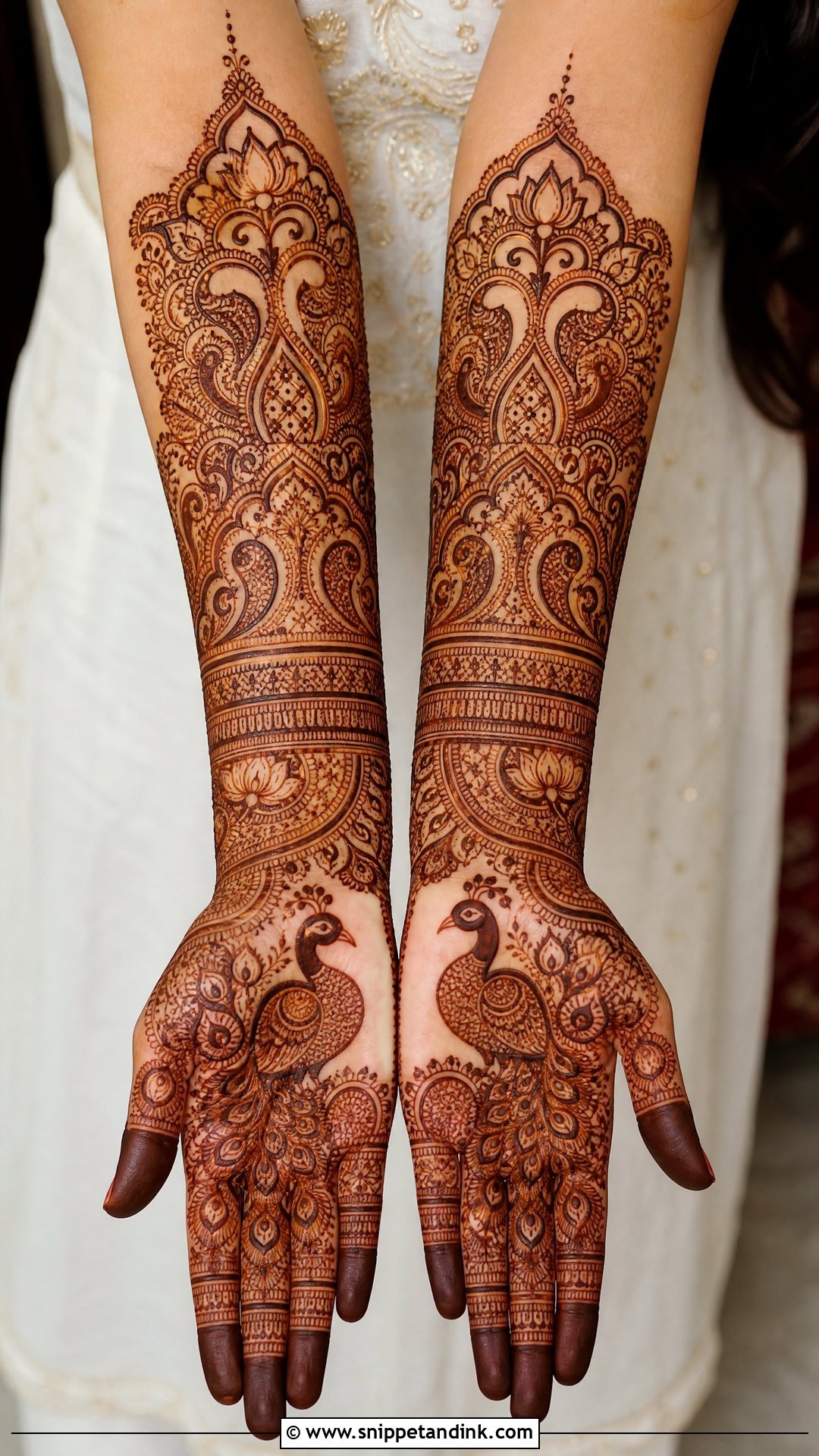
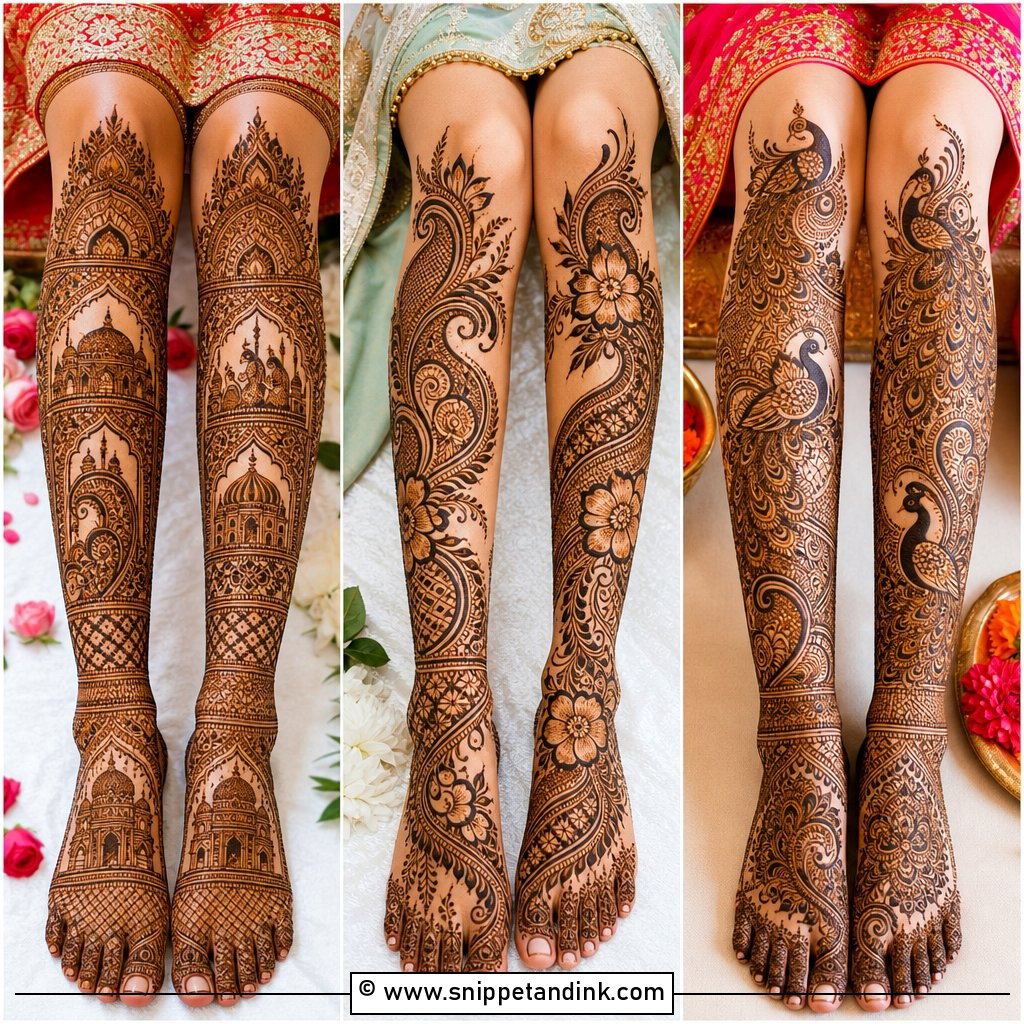
Peacocks give bridal mehndi its royal feel. I usually draw one or two across the palm, wrist or forearm, with feathers filled with fine lines, dots and small leaves, surrounded by paisleys, lotus flowers and mandala borders. On long hands the tail feathers can stretch elegantly toward the wrist; on smaller hands I curve the peacock around the palm so it doesn’t crowd the fingers. Mirrored peacocks facing each other on both palms look complete when the hands are held together in photos.
6. Full Hand Bridal Mehndi With Mandala Design
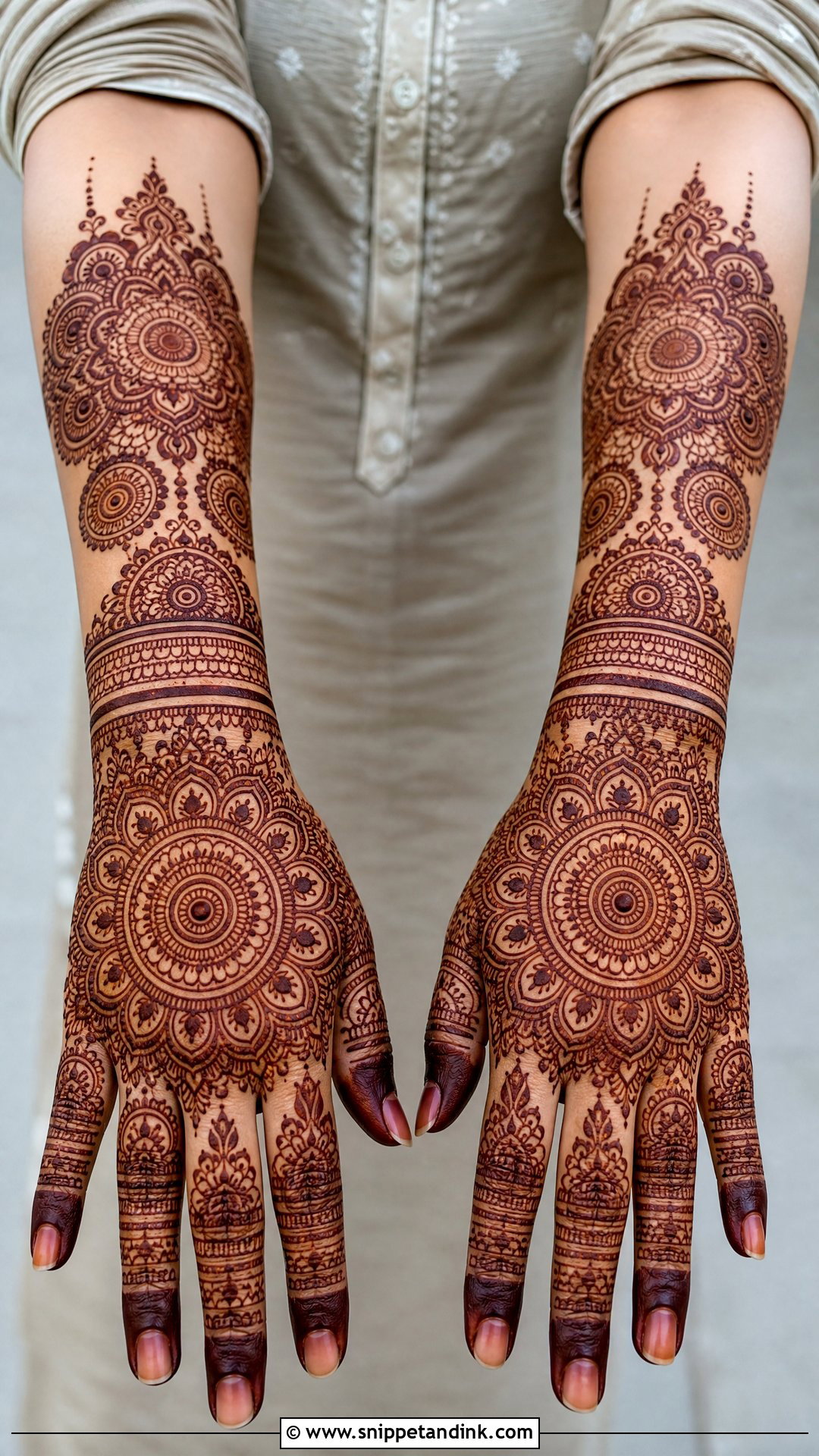
A mandala brings symmetry. It sits at the center of the palm or the back of the hand and radiates out into rings of petals, dots and borders, then connects to wrist bands, finger detail and forearm panels. I draw the outermost ring first as a row of dots to check the circle sits evenly on the palm, because a lopsided mandala is obvious in close-up shots. Round or medium palms suit it naturally. On a long, narrow palm I’ll stretch it into a gentle oval rather than force a circle.
7. Full Hand Bridal Mehndi With Lotus Design
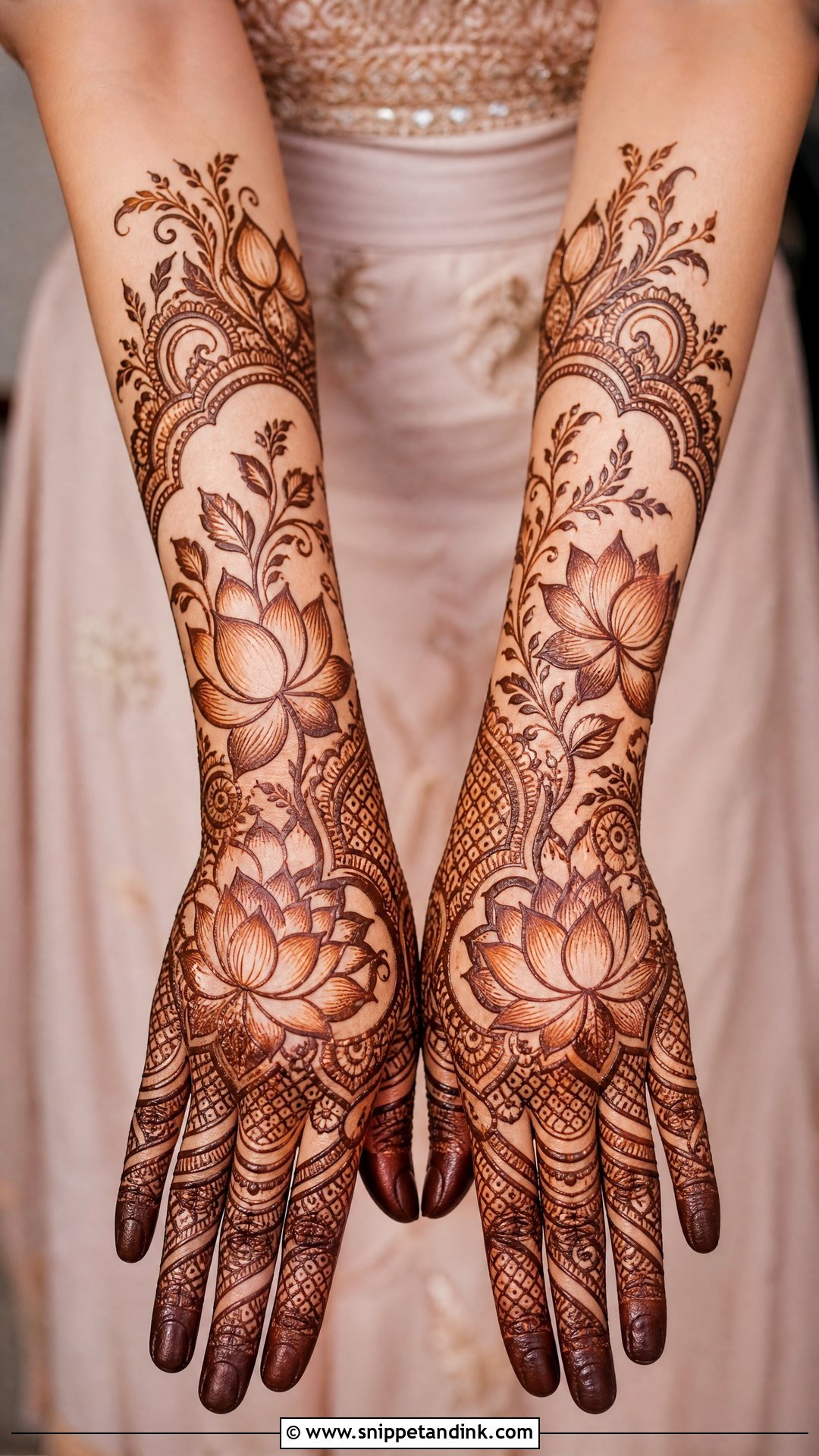
Lotus motifs have a calmer feel than portrait or scene work. A full bridal hand with a lotus design might have a large bloom on each palm, lotus borders at the wrist and smaller repeating flowers up the forearm, tied together with fine vines and shaded petals. I keep the fingers dense and leave a little breathing room around each lotus so its layered petals can be seen. It sits well with pastel lehengas and temple jewelry.
8. Full Hand Bridal Mehndi With Paisley Design
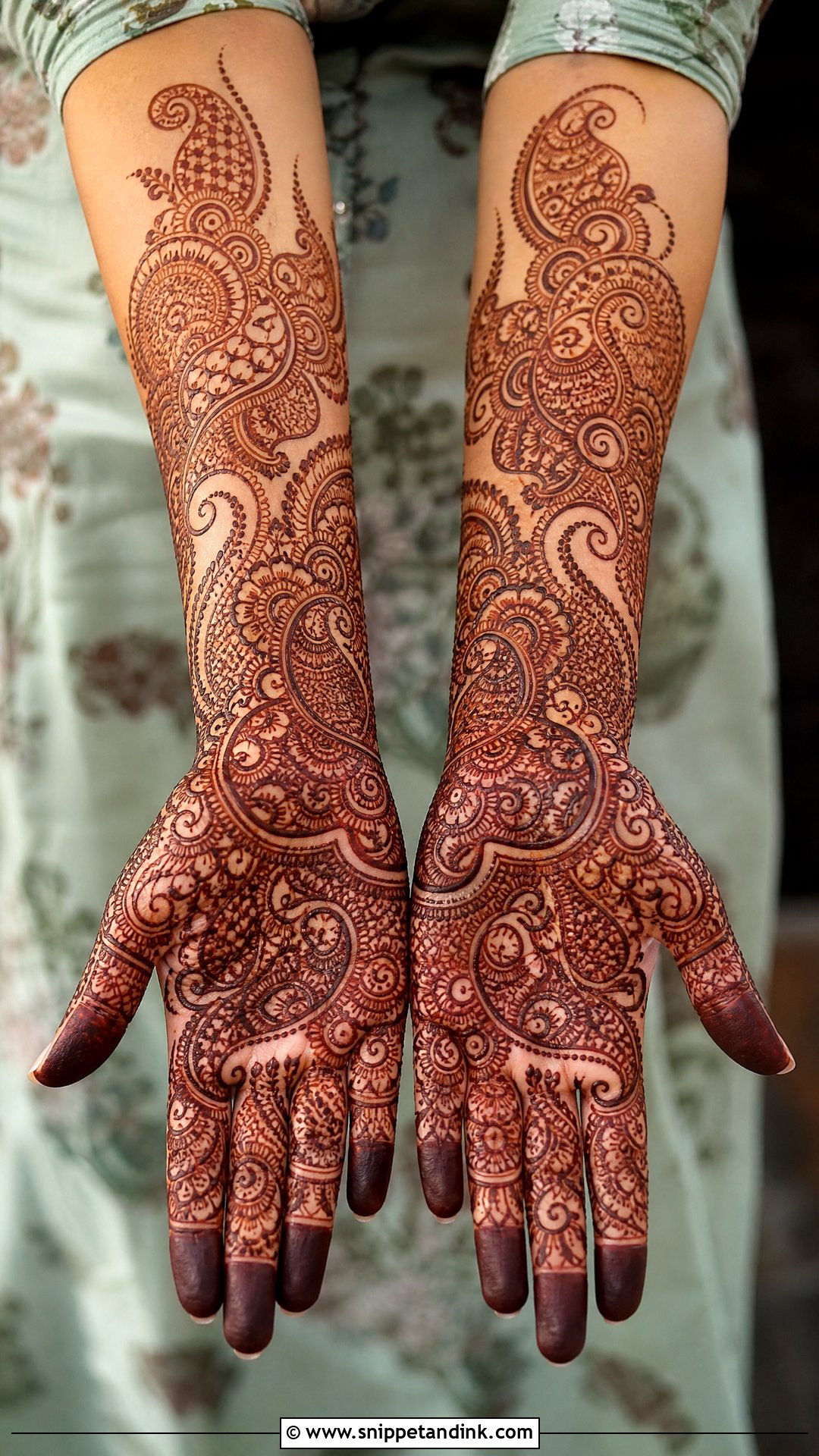
Paisley is the backbone of traditional mehndi, and a hand built around it is hard to get wrong. Large paisleys can anchor the palm while smaller ones form chains up the forearm, each filled with tiny flowers, dotted outlines or fine checks. Their curved teardrop shape follows the way the hand moves, which is why it suits the palm so well. I often turn the tip of the main paisley toward the thumb so it frames the center of the palm when the hand is cupped.
9. Full Hand Bridal Mehndi With Jaali Design
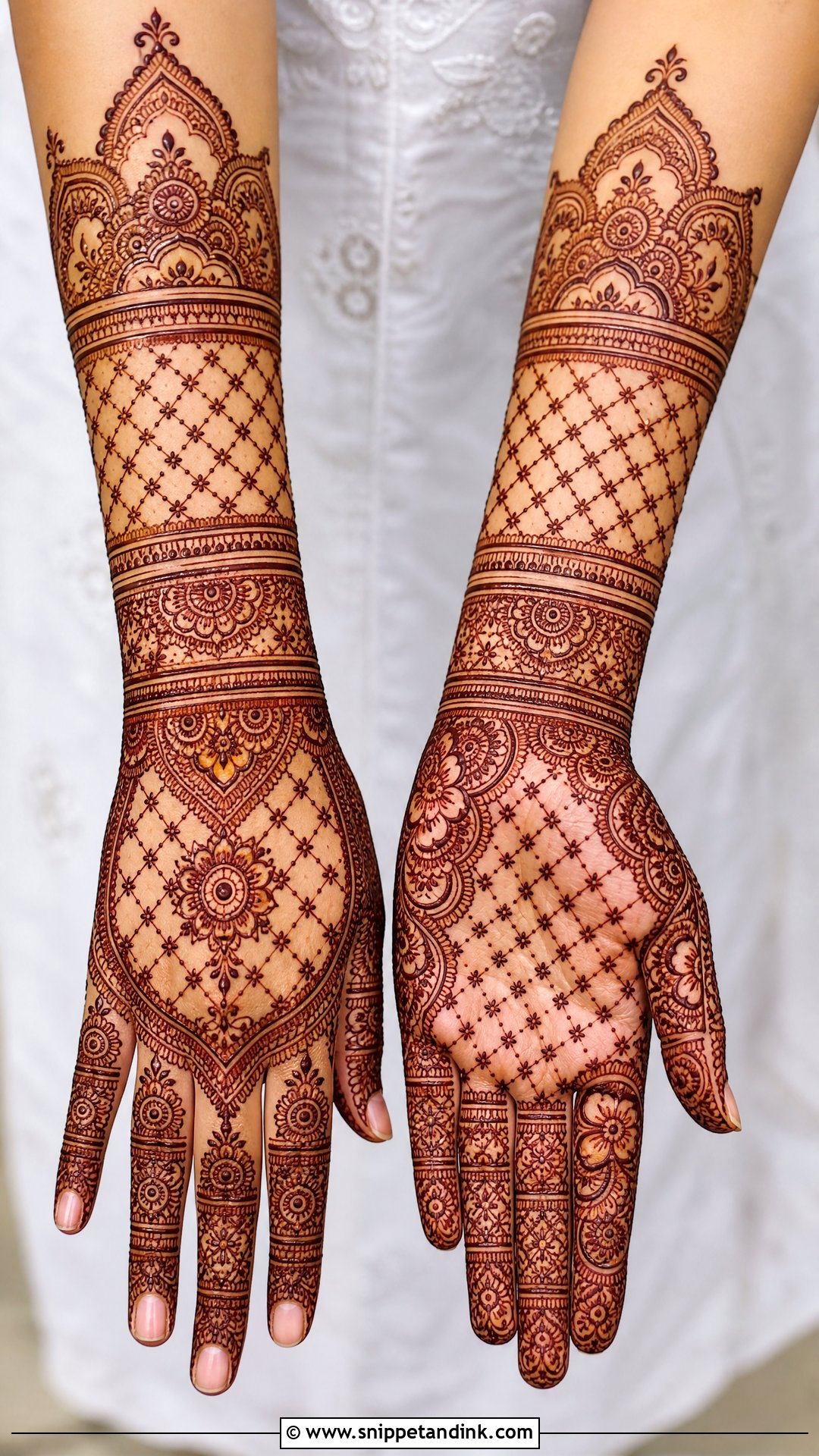
Jaali is a mesh of crossing lines, sometimes with dots, tiny flowers or checks inside the squares. In bridal work I use it on the back of the hand, wrist or forearm, where it reads like lace or a jewelry panel. It gives coverage without the heaviness of full filler. The lines have to be evenly spaced, and a wobbly grid is the most common flaw I see in rushed bridal work. Paired with florals or paisleys on the palm, jaali sections add a cleaner texture that sits well next to rings and hand harnesses.
10. Full Hand Bridal Mehndi With Elephant Design
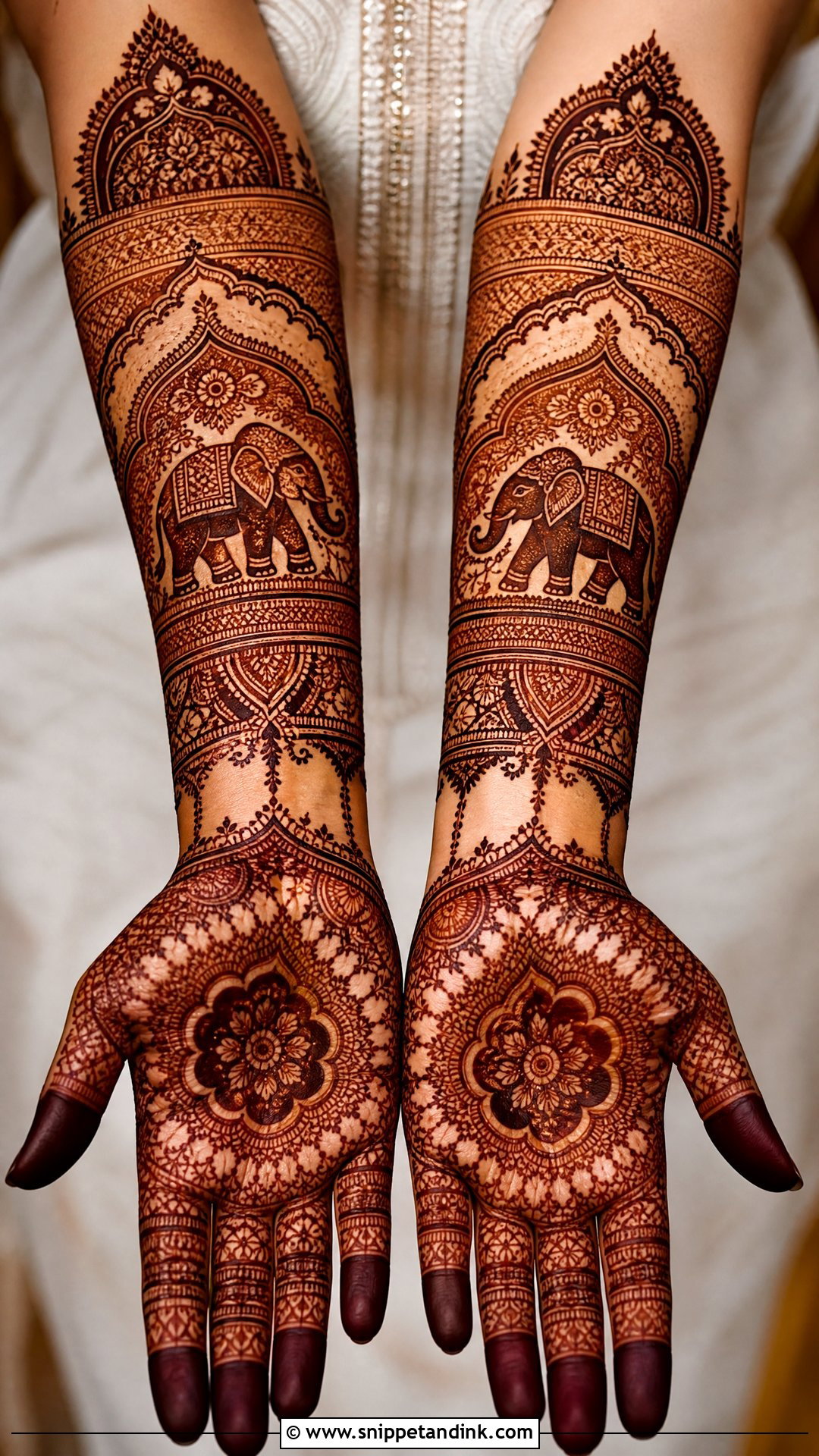
Elephants make a hand feel grand. I place decorated elephants near the forearm, at the wrist or as part of a larger procession, framed by flowers, mandalas and fine filler. Marwari bridal work leans heavily on this kind of elephant design. Because an elephant is a large motif, it needs real space; squeezing one into a small wrist panel makes the trunk and ornaments unreadable. I pair them with palace arches, a doli or peacocks for a full storytelling hand.
11. Full Hand Bridal Mehndi With Doli Design
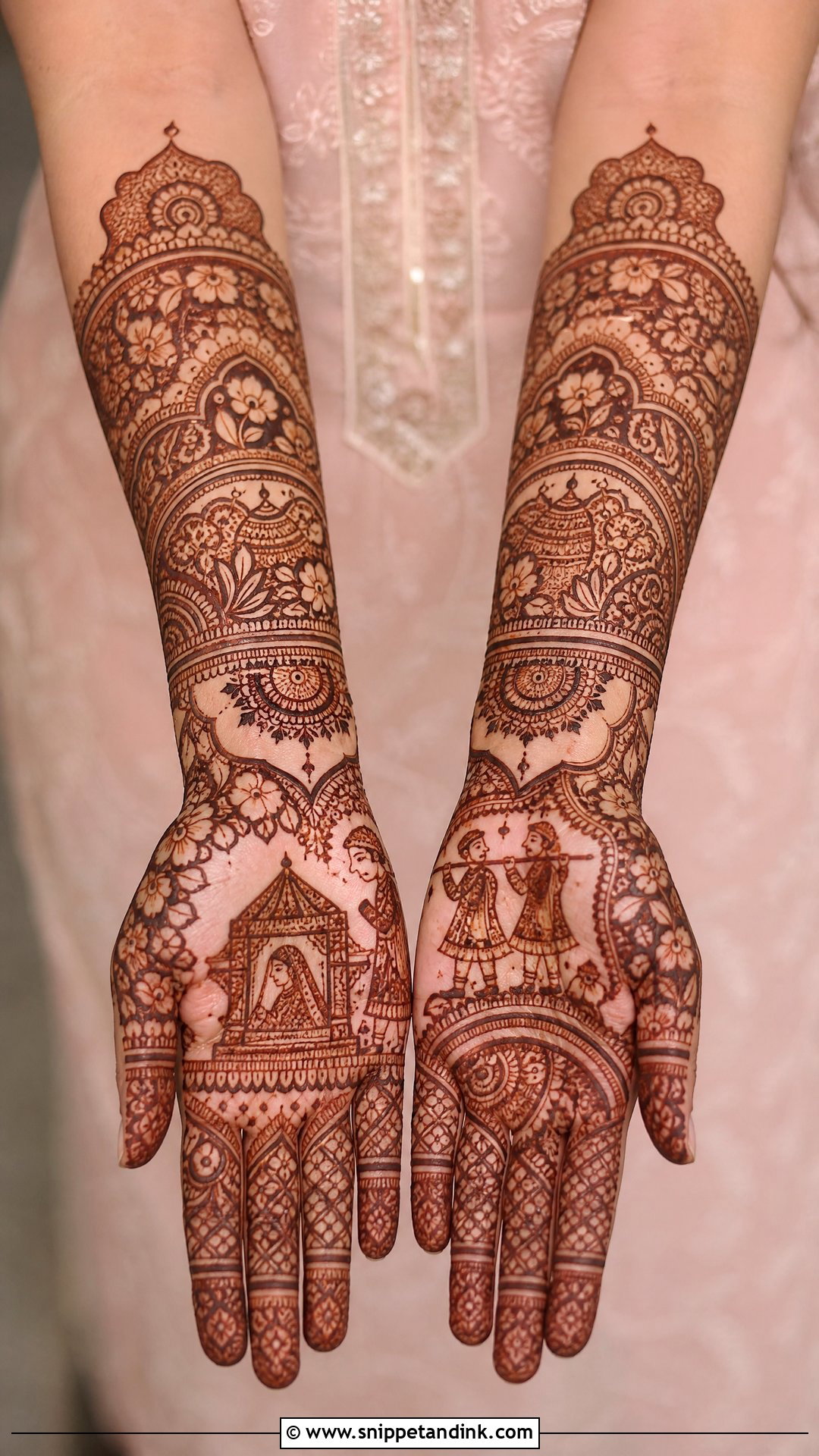
The doli, the palanquin that carries the bride, is an emotional motif for many families because it represents her leaving home. I usually draw it on the palm or forearm with a floral path, small attendants or ceremonial details, and paisley or mandala borders around it. It needs a clear central area with nothing competing nearby. Smaller supporting patterns go around it, and I keep the fingers and wrist bands symmetrical so the busy scene still feels balanced.
12. Full Hand Bridal Mehndi With Wedding Scene
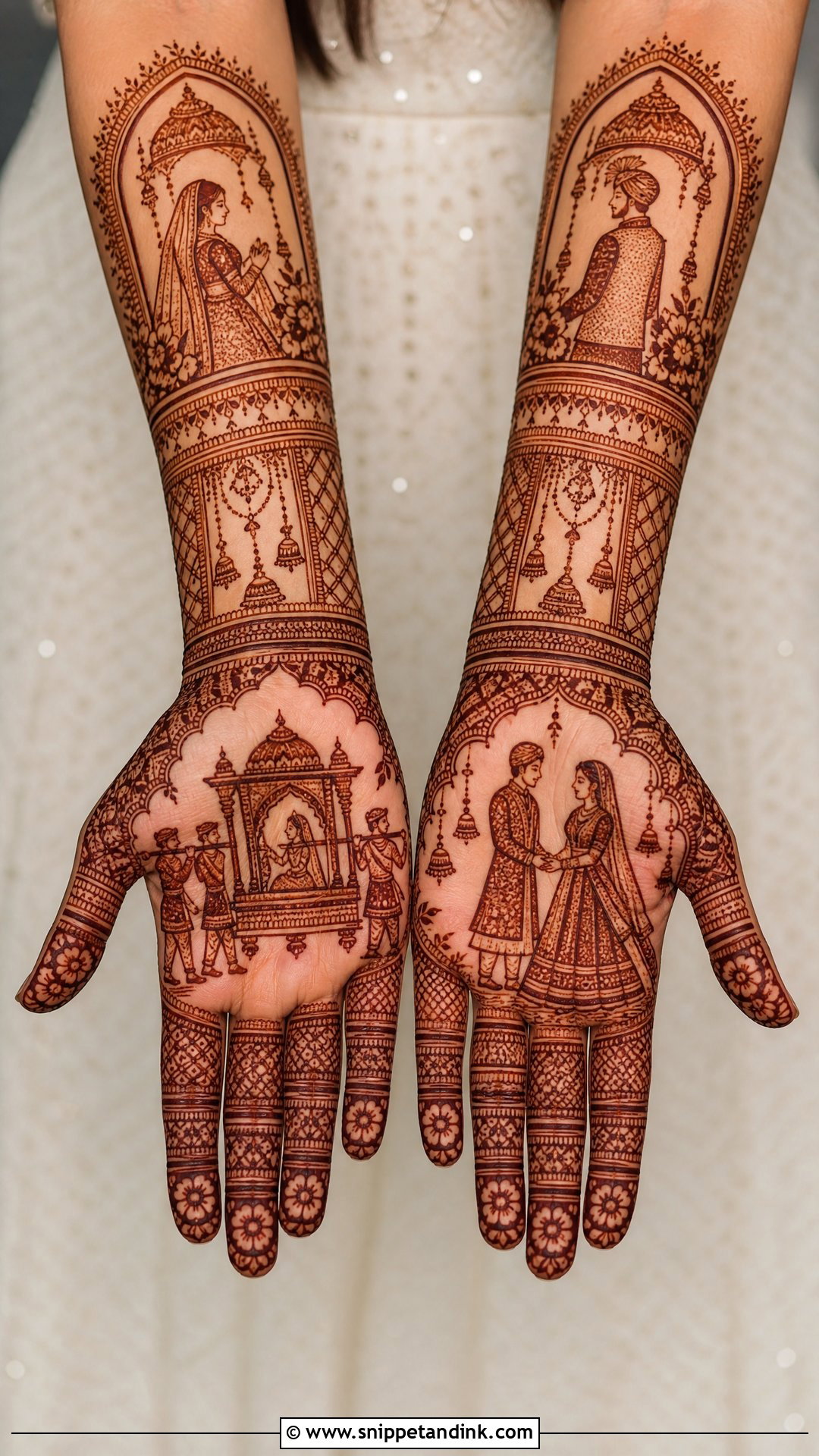
Wedding scene designs turn the hands into a story: bride, groom, doli, musicians, garlands and arches spread across the palms, with florals, jaali and mandalas on the forearms. They are the longest designs I apply. The challenge is legibility, because tiny figures packed too close merge together once the stain darkens. I draw the figures with bold enough outlines to read at a glance, then let guests discover the smaller details up close during the hand poses.
13. Full Hand Bridal Mehndi With Initials
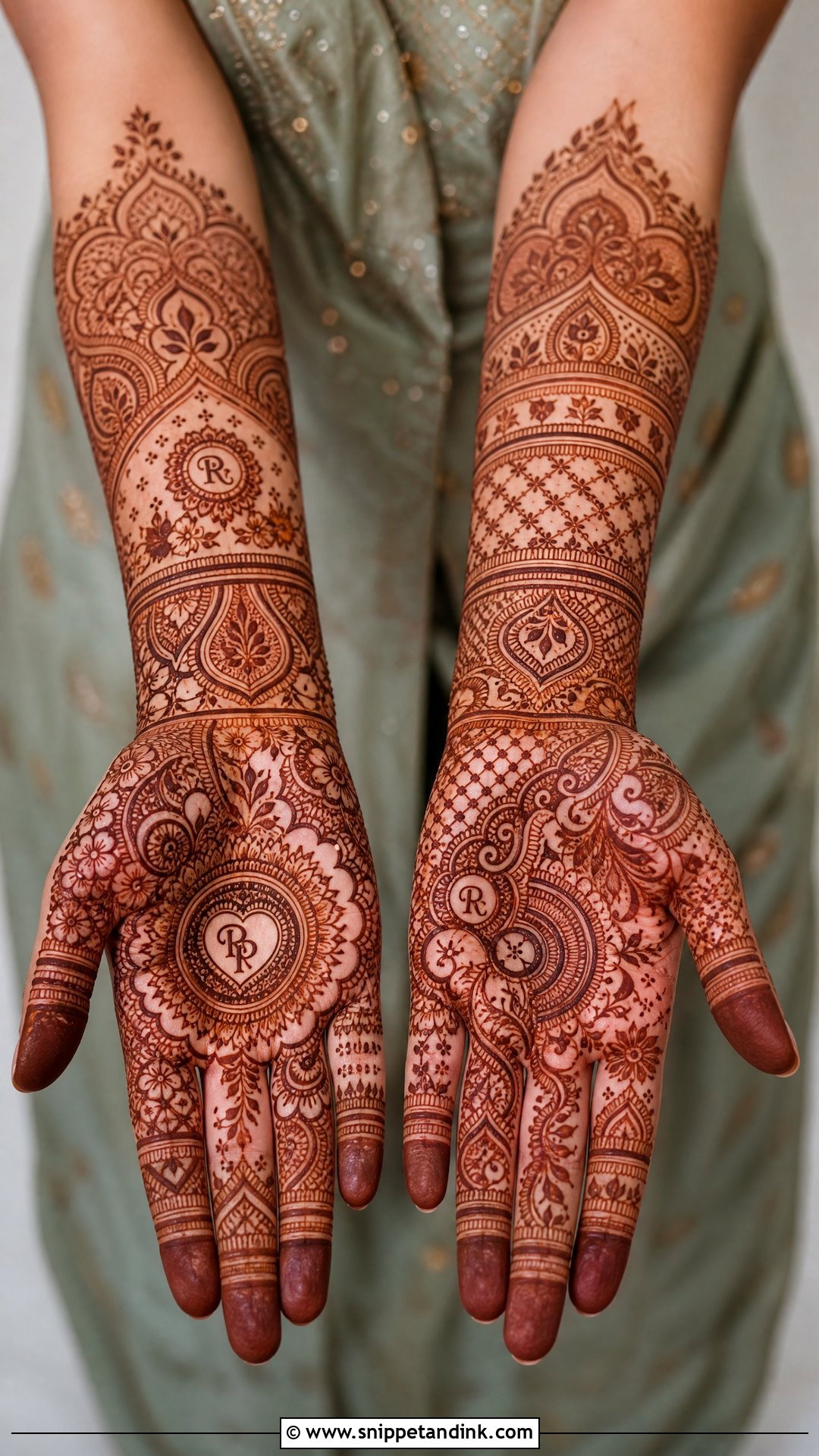
Hidden initials are a favorite tradition: the groom searches for them on the wedding night. I tuck them inside paisleys, flowers, mandalas or jaali squares in your wedding henna, usually on the palm, wrist or lower forearm. The trick is making the letters part of the pattern so the flow doesn’t break. Some brides want them obvious; others want them genuinely hard to find. Tell your artist which, because it changes how deep in the filler they go.
14. Full Hand Bridal Mehndi With Names
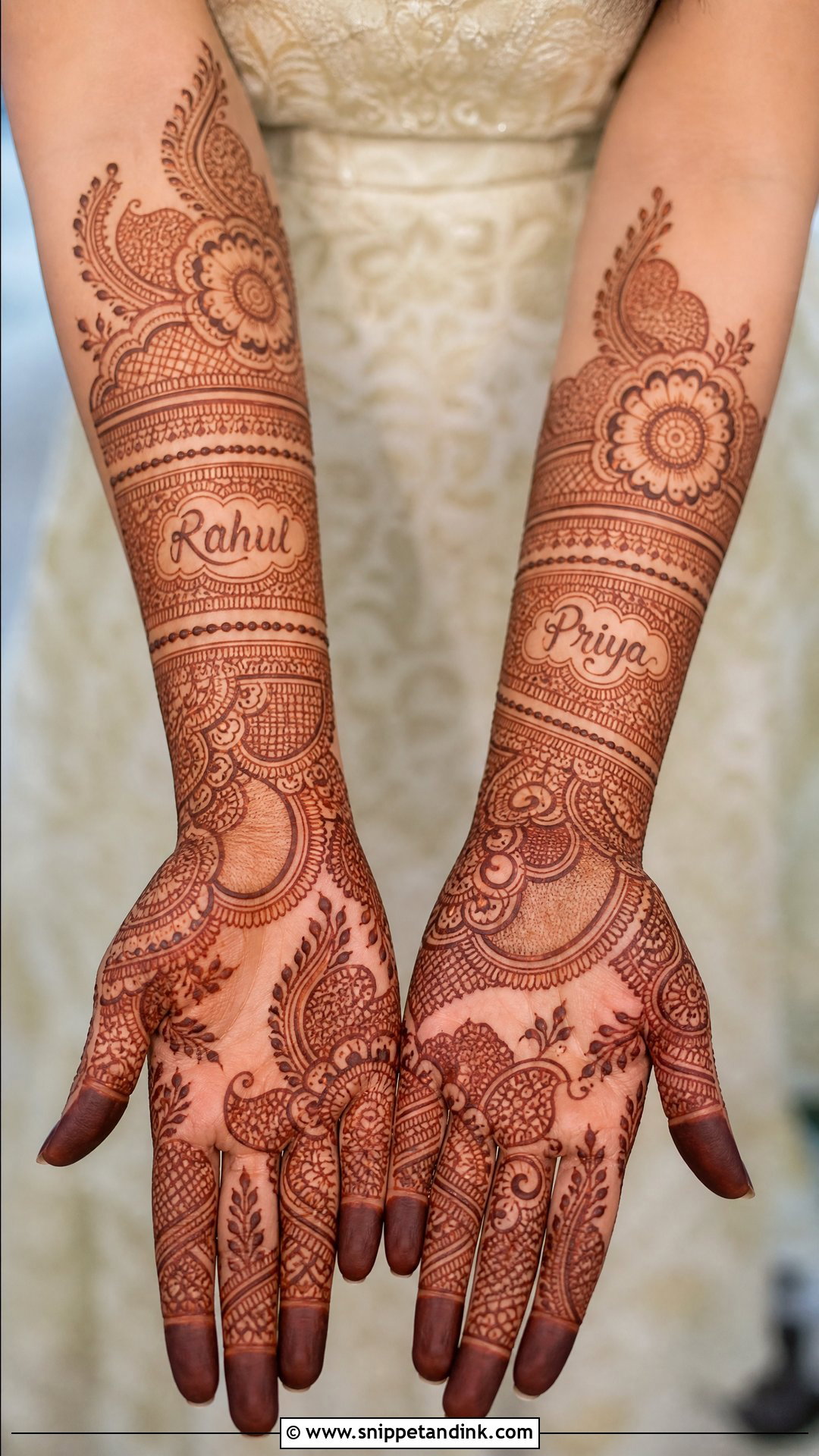
Full names need planning before the cone touches skin. I ask the bride to write the exact spelling down, then sketch the lettering first and build vines, borders and paisleys around it. Names fit best in a decorative band on the forearm or curved along a floral trail. Both names, a date or a short word can all go in. Long names in English or Urdu script take up more space than people expect, so the design around them sometimes has to shift.

15. Full Hand Bridal Mehndi With Bracelet Design
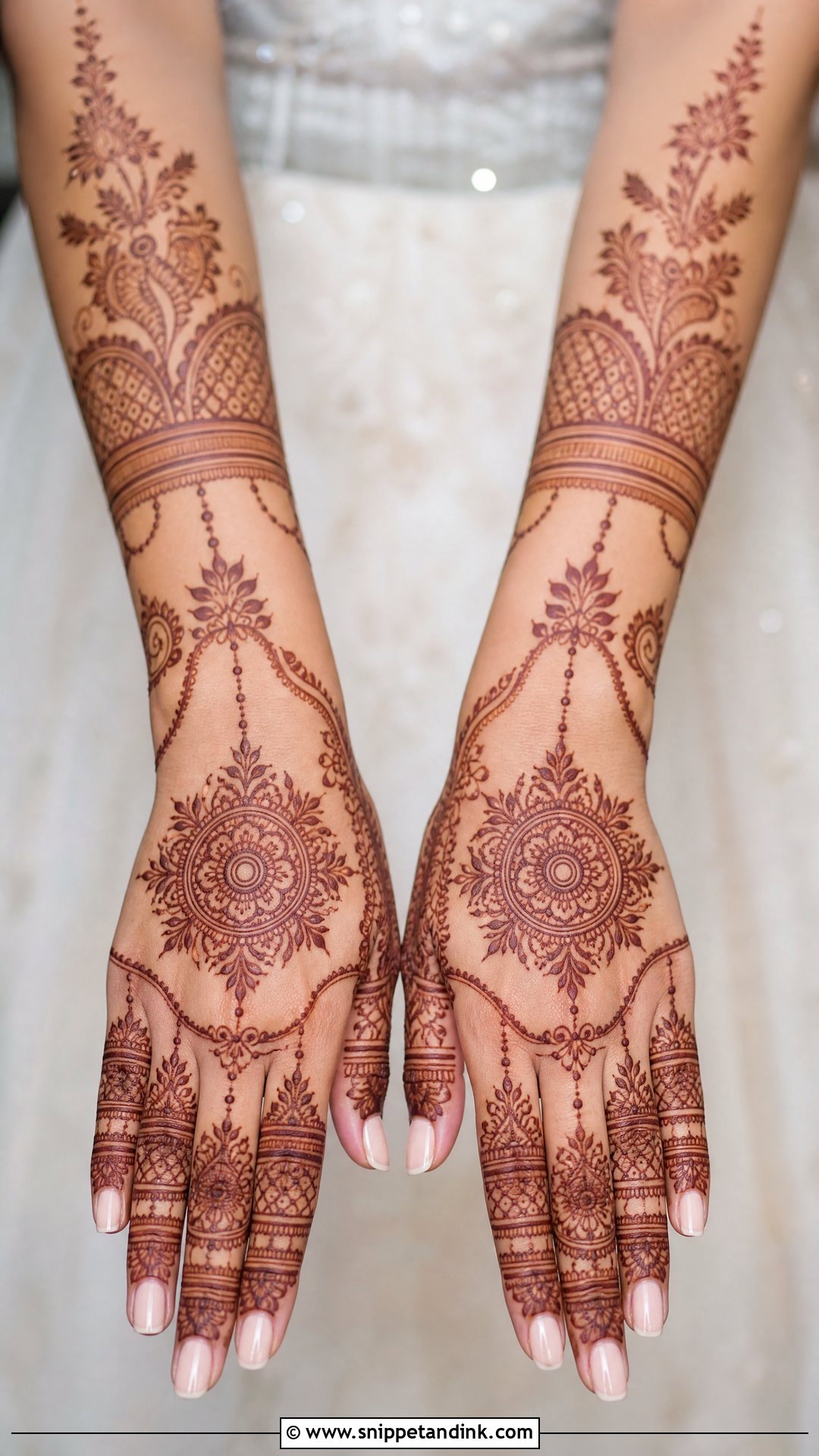
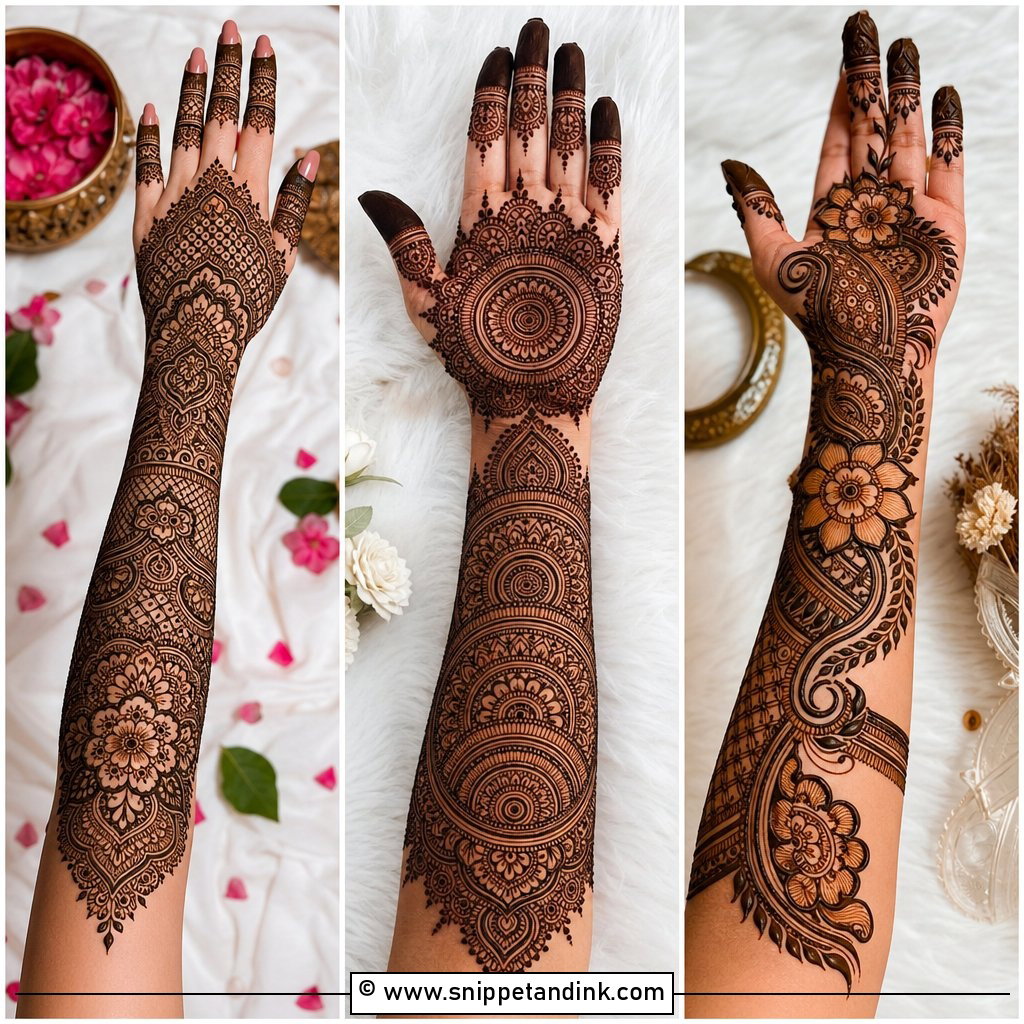
A bracelet design makes the hands look dressed before any jewelry goes on. Wrist cuffs, chain links, ring patterns and finger bands frame the hand, with florals, mandalas or jaali filling the palm and back. The cuff needs to sit just above the wrist crease, not on it, since the crease folds constantly and that’s where drying paste cracks first. It suits brides who’ll stack bangles, because the henna continues the line of the jewelry.
16. Full Hand Bridal Mehndi With Finger Detailing
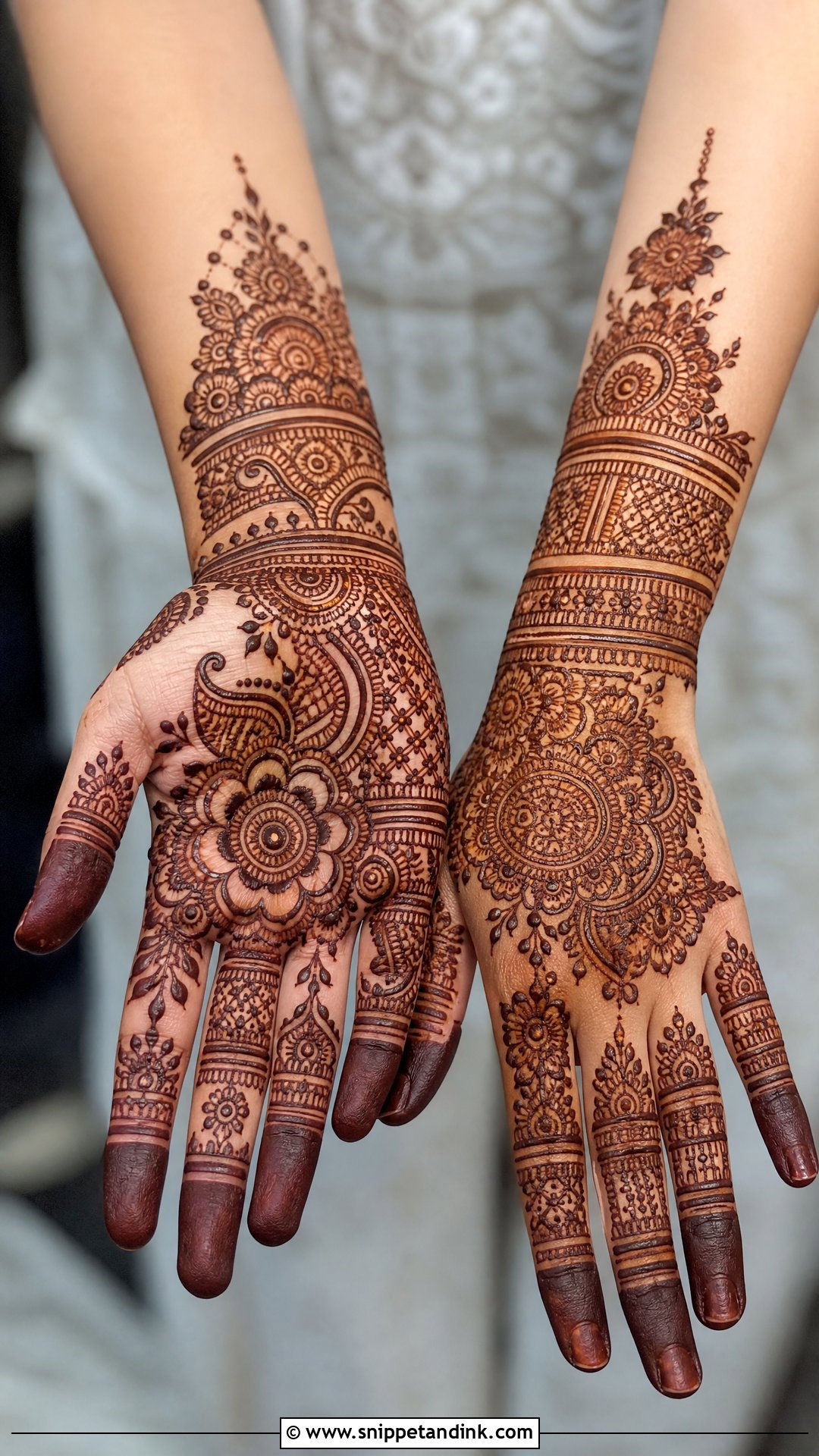
Fingers are in almost every photo, so they deserve real attention. With full finger detailing, each finger gets bands, dots, leaves or mini flowers, and the tips are either solidly filled for a traditional finish or patterned for a modern one. Solid tips stain the darkest part of any design because the paste sits thick there. Long fingers carry it easily. On shorter fingers I keep the bands slim so the fingers don’t look cut into sections.
17. Full Hand Bridal Mehndi With Negative Space
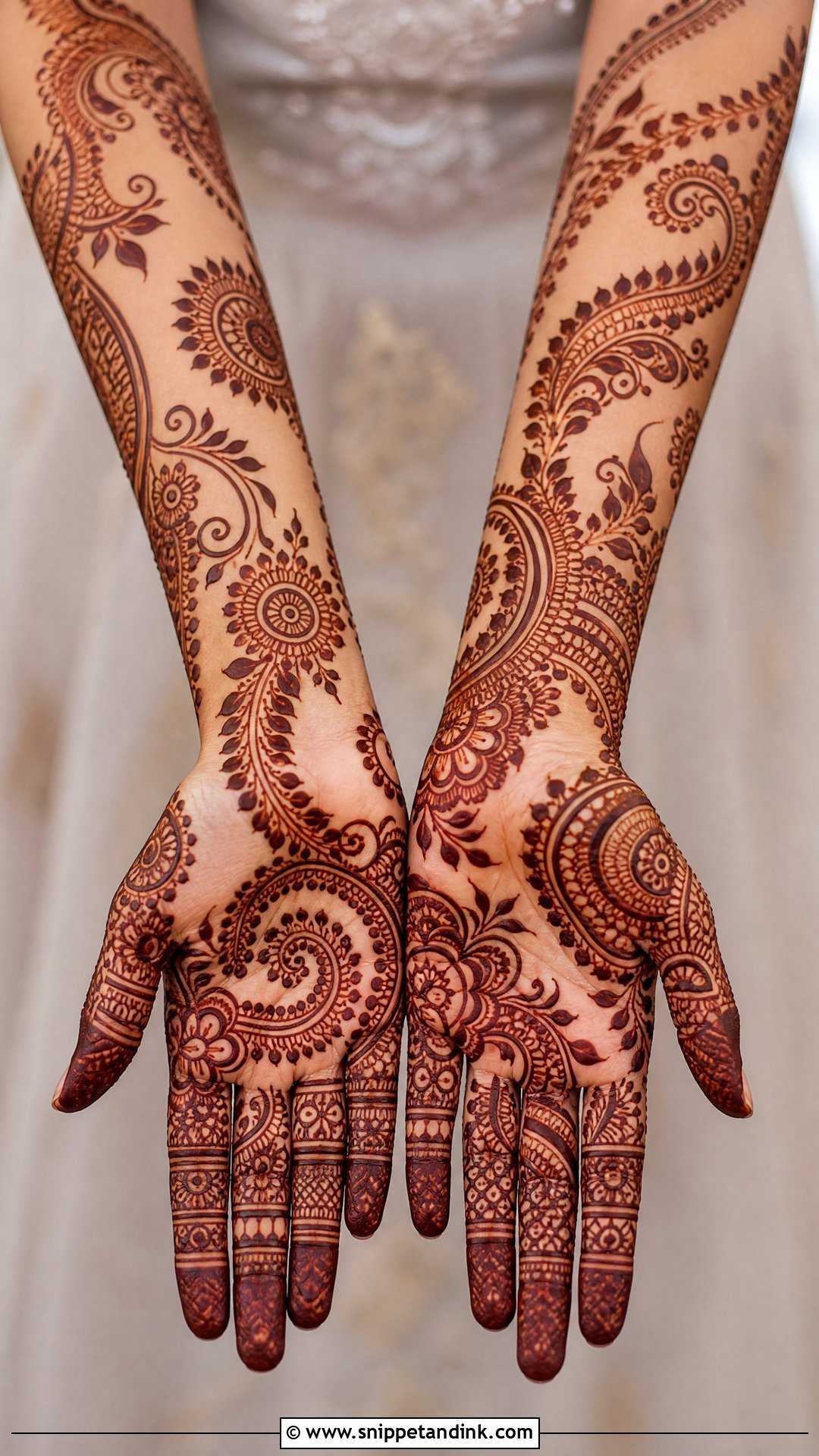
Negative space means planned open areas between motifs. It’s the modern version of full coverage: the design still runs from fingertip to forearm, but the gaps let each flower or mandala stand out clearly. It suits warm-weather weddings and brides who find dense henna overwhelming. Planning is everything here, because random gaps look like I ran out of time while deliberate ones look intentional. Bold outlines keep it from looking too light for a bride.
18. Full Hand Bridal Mehndi With Shaded Floral Design
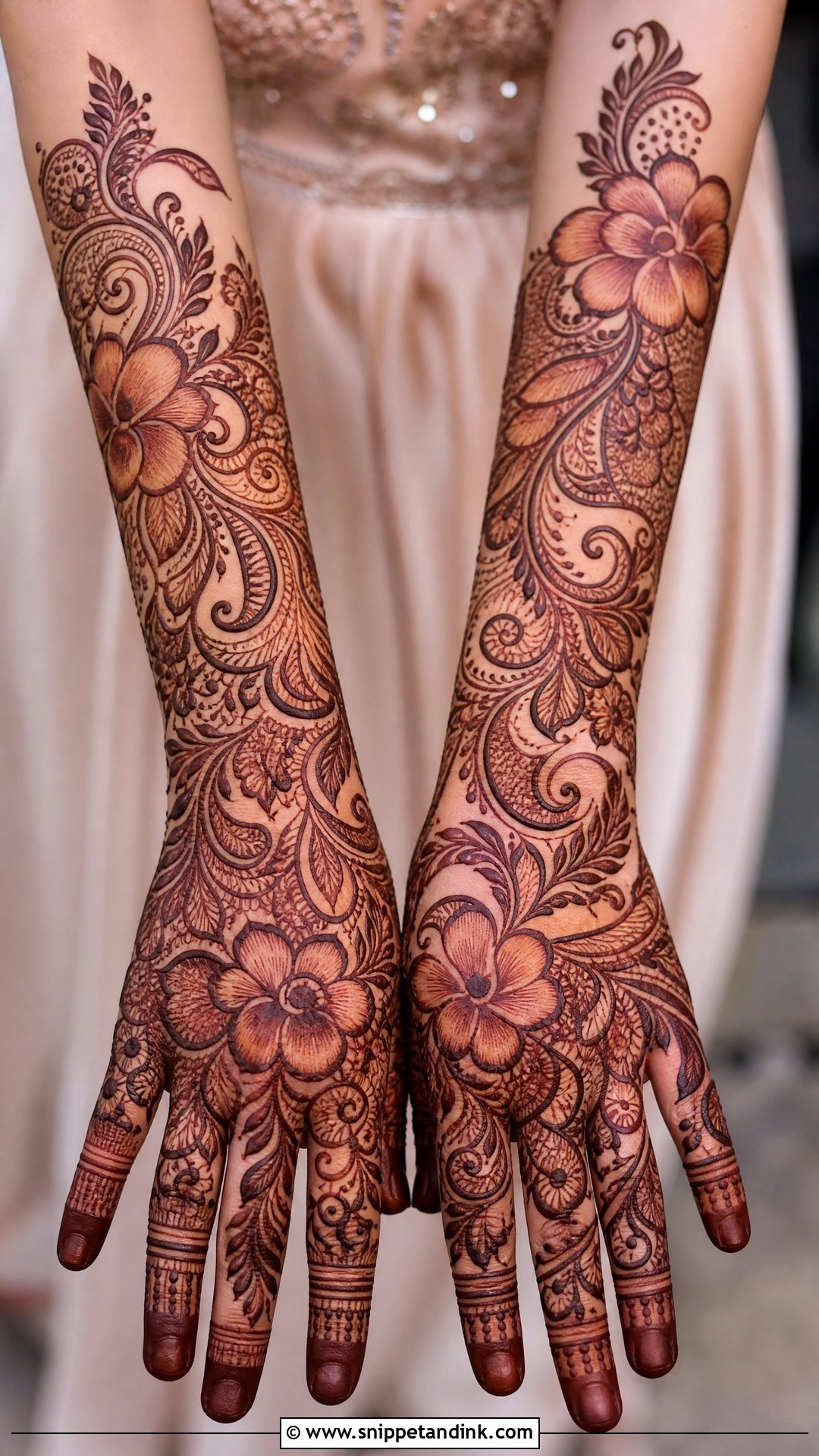
Shading fills the inner edge of each petal, leaf or paisley with a lighter, feathered stroke, which adds depth without crowding the hand with tiny lines. With a shaded floral design, I put a floral cluster on the palm and run a trail up the back of the hand to the forearm. Shading needs fresh, smooth paste. Old or lumpy paste blotches instead of fading. The shaded areas stain slightly lighter than the outlines, which is exactly the gradient you want.
19. Full Hand Bridal Mehndi With Moroccan Pattern
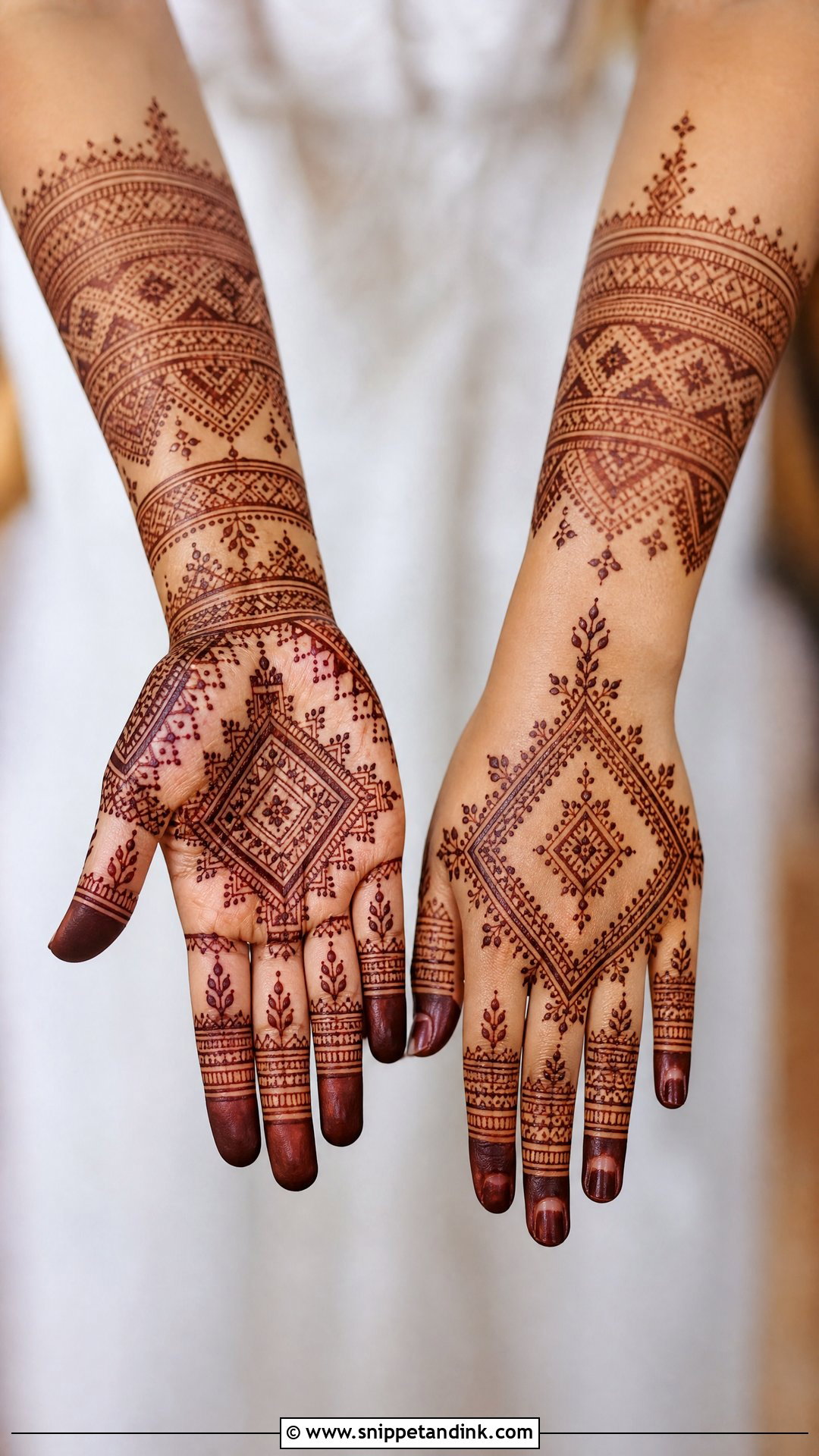
Moroccan-style mehndi is built on geometry: diamonds, grids, angular lines and repeated shapes. On a bride I soften it with a few flowers or paisleys so the hand doesn’t look too hard-edged. The geometry suits the back of the hand and the forearm, where it reads like a structured bracelet. Every line needs to be straight and evenly spaced, so this style shows an artist’s precision more than floral work does. Keep the fingers detailed so they balance the geometric panel.



20. Full Hand Bridal Mehndi With Modern Minimal Design
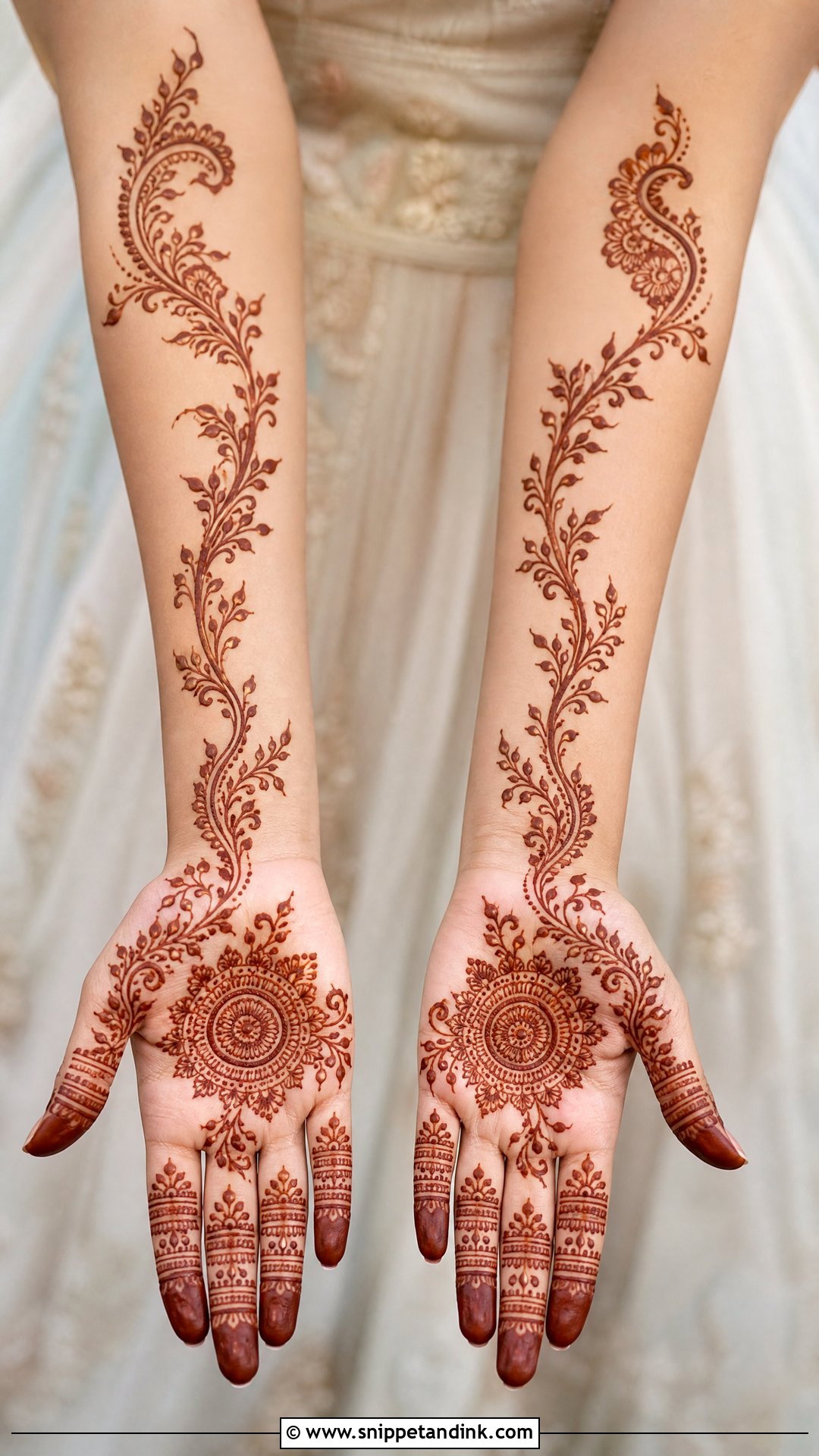
Modern minimal bridal mehndi keeps full coverage but uses slimmer vines, wider spacing, fine mandalas and light wrist-to-forearm patterns. The fingers might get thin bands rather than filled tips, and the palm one main motif. It sits well with contemporary outfits, lighter lehengas and intimate weddings. A practical bonus: it takes less time to apply, and the faded stain in the week after the wedding looks neater than a dense design breaking up.
Approve the Sketch Before Any Personal Motif Goes On
Portraits, names, initials and scenes are the parts of bridal mehndi that can’t be corrected once they stain. That’s why I sketch them on paper or show a rough layout before the bride’s mehndi day, and I ask her to check three things.
- Spelling. Send names in writing, in the script you want. Never trust a spoken spelling for something permanent.
- Placement. Decide which palm carries the bride and which the groom, and where the initials hide.
- Space. A full scene needs the whole palm. If you also want a large mandala, one of them may move to the forearm.
Bring a photo of your outfit and the jewelry you’ll wear on your hands. A heavy hand harness or haath phool covers the back of the hand, so I’ll keep the detail there simpler and put the effort where it will be seen. After the wedding, the stain usually lasts one to three weeks, fading first on the palms where skin renews fastest.
Matching Coverage to Your Outfit, Jewelry and Patience
Deciding gets easier when you think about how much coverage you want, how much detail, and how long you can sit still. Royal storytelling designs like peacocks, elephants, doli scenes and portraits suit a bride who wants heavy tradition. Arabic, Indo Arabic, negative space, shaded floral and minimal layouts give a cleaner finish. Initials, names and dates can be added to any of them. Book an experienced artist early, allow the full application time, and choose a layout that works with your outfit and jewelry rather than against it.
You'll Like These Ideas:









Leave a Reply