
Bridal mehndi gets photographed more closely than almost anything else you wear, and unlike the outfit, it can’t be swapped on the morning. The designs below run from dense full-hand classics and Rajasthani storytelling to open Arabic trails, jaali lace, mandalas, peacocks and patterns that hide a name. When I sit with a bride to pick one, I’m weighing three things: how many hours she can sit still, what her sleeves and jewelry will cover, and how the stain will read across a room as well as in a ring shot. Keep those three in mind as you scroll and the shortlist gets much shorter.
Timing the Application So the Stain Peaks on Your Wedding Day
Natural henna comes off the skin bright orange. Over the next day or two it oxidises and deepens to maroon or dark brown, usually reaching its darkest somewhere between 24 and 48 hours. That is why I book most brides one or two days before the wedding and almost never on the morning itself; henna put on that day will still look orange in your ceremony photos.
Give the appointment more time than you think. A simple bridal design on both hands can take an hour or two. Full hands plus feet often run four to six hours, and full arms longer. Eat first, use the bathroom first, and have someone sitting with you to hold your phone and feed you.
Ask what is in the cone
Good bridal paste is just henna leaf powder, lemon juice or water, sugar and an essential oil such as eucalyptus or lavender. Be wary of anything sold as black henna or promising a dark stain within an hour. Those can contain PPD, a hair-dye chemical that causes serious skin reactions in some people. If your skin is sensitive, I’d do a small patch on the inner arm a week or two ahead.
1. Full Hand Bridal Mehndi Design
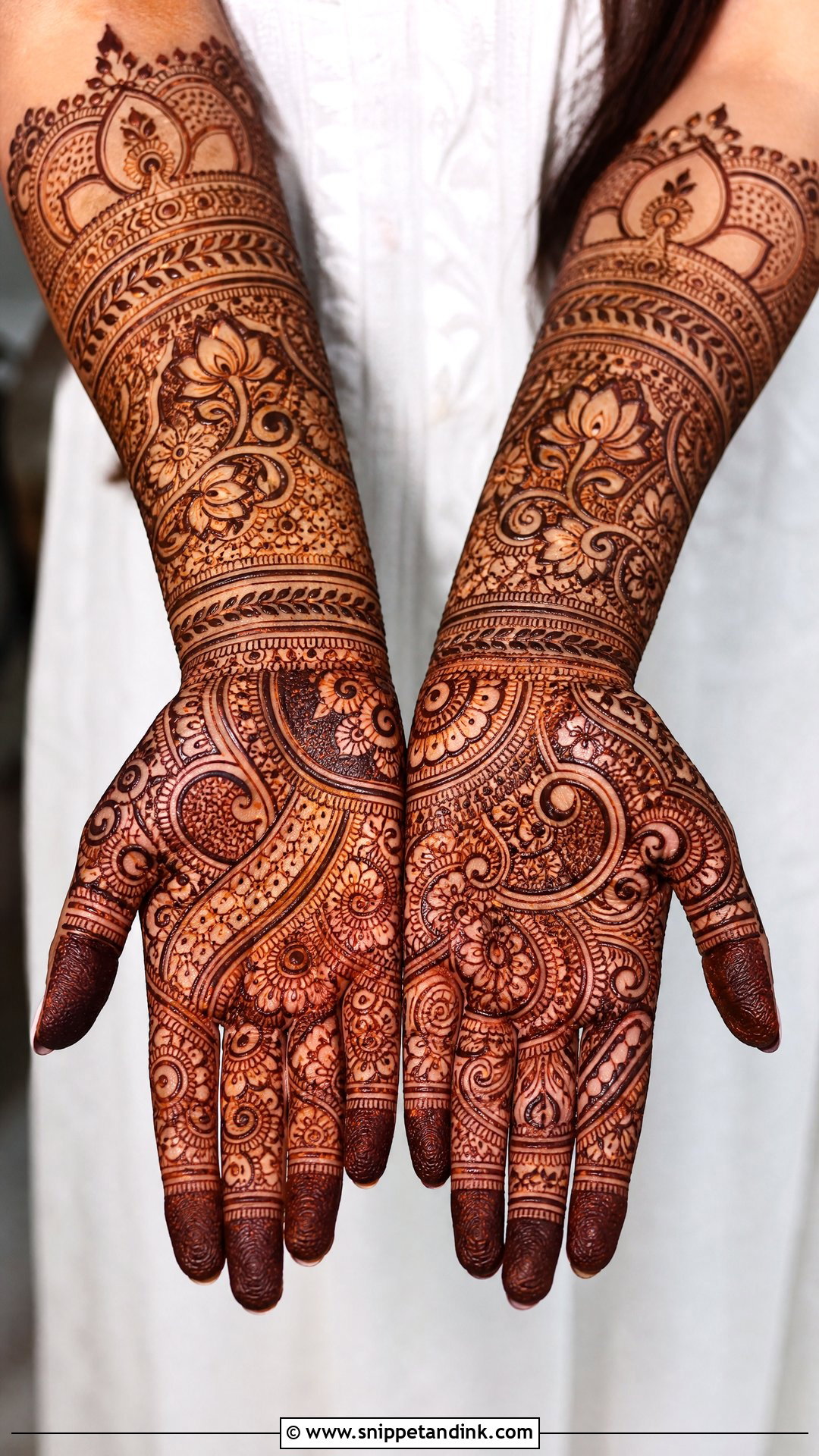
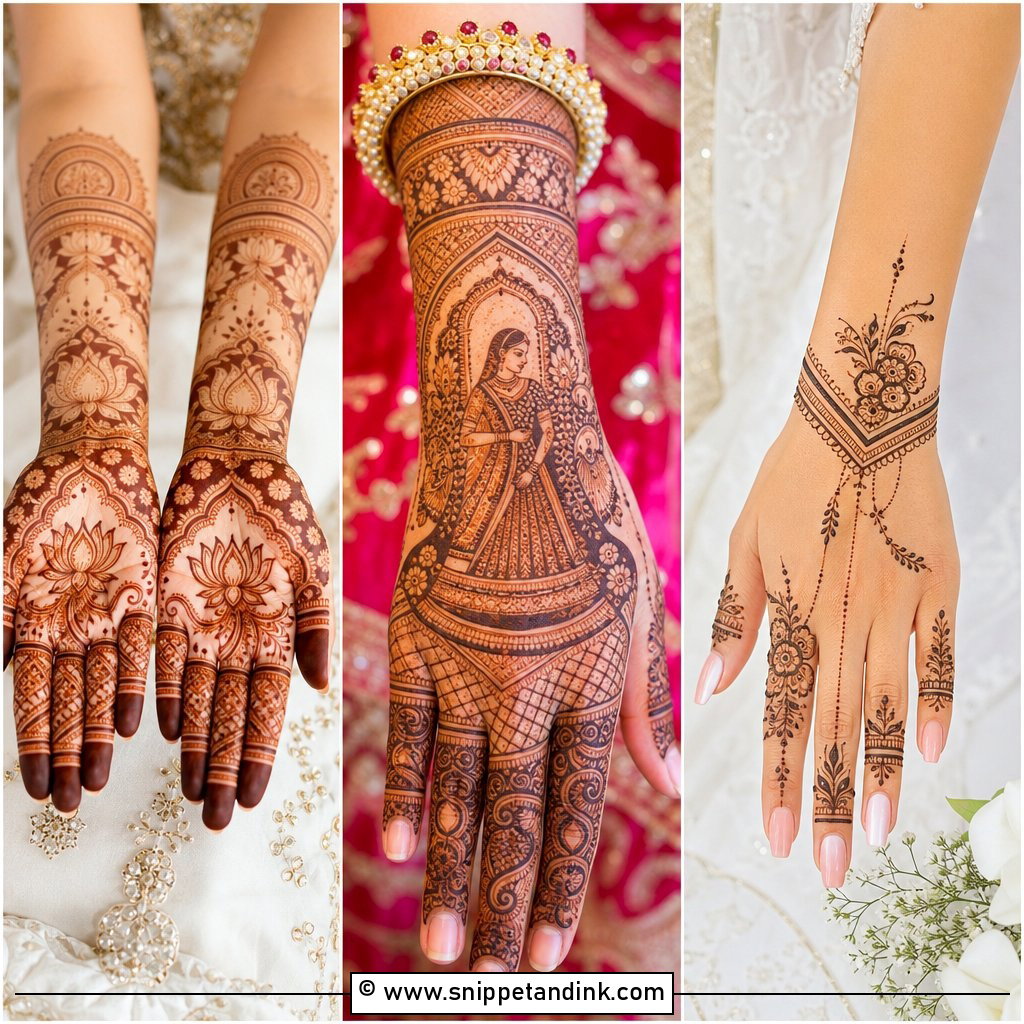
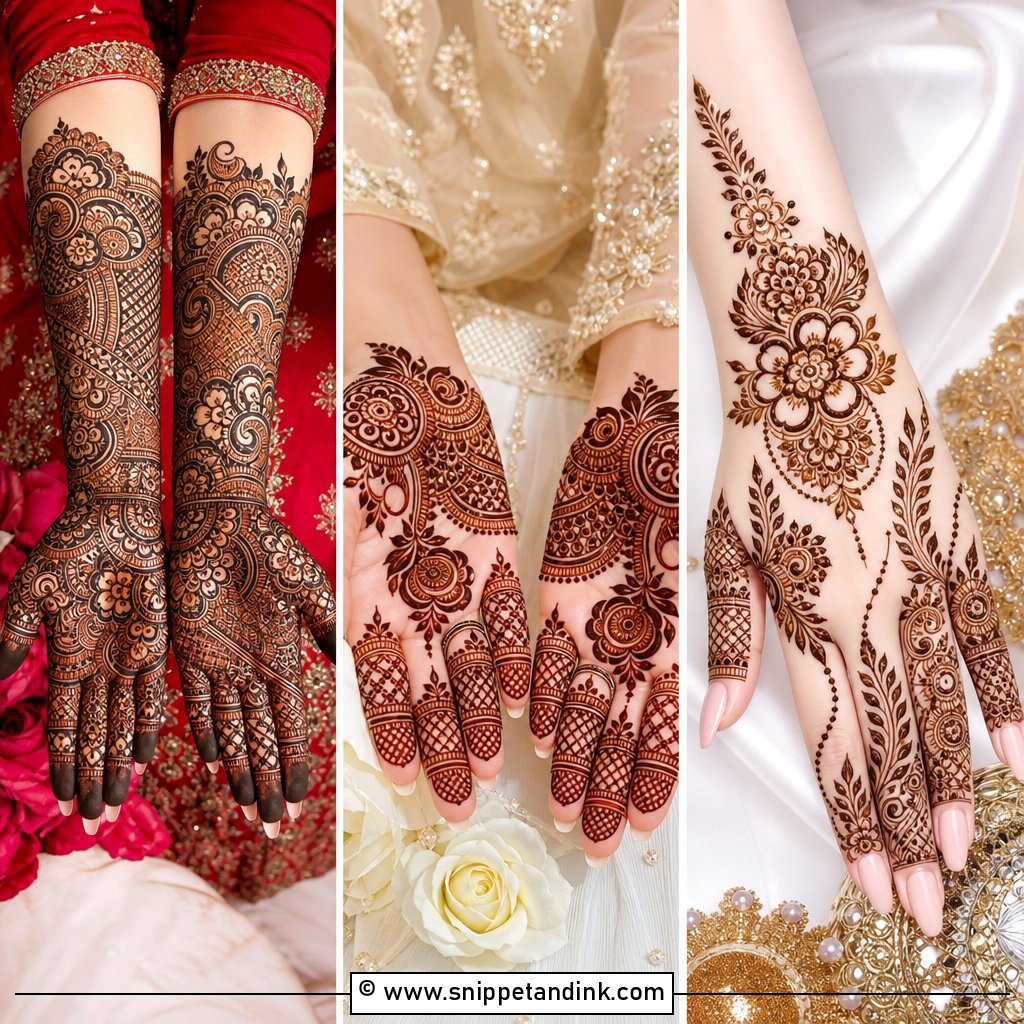
Full coverage means palms, every finger and the wrist into the forearm, layered with paisleys, lotus, vines, leaf borders and fine fillers. On a full hand I draw the bold outlines first and fill afterwards, because the outlines are what survive once the stain settles and the finest lines soften. Book it on a day when you have nowhere else to be; front and back of both hands can run several hours. It belongs with a heavily embroidered lehenga or saree, and it holds up in the close shots of bangles, rings and kalire, where bare skin would look unfinished.
2. Indian Bridal Mehndi Design
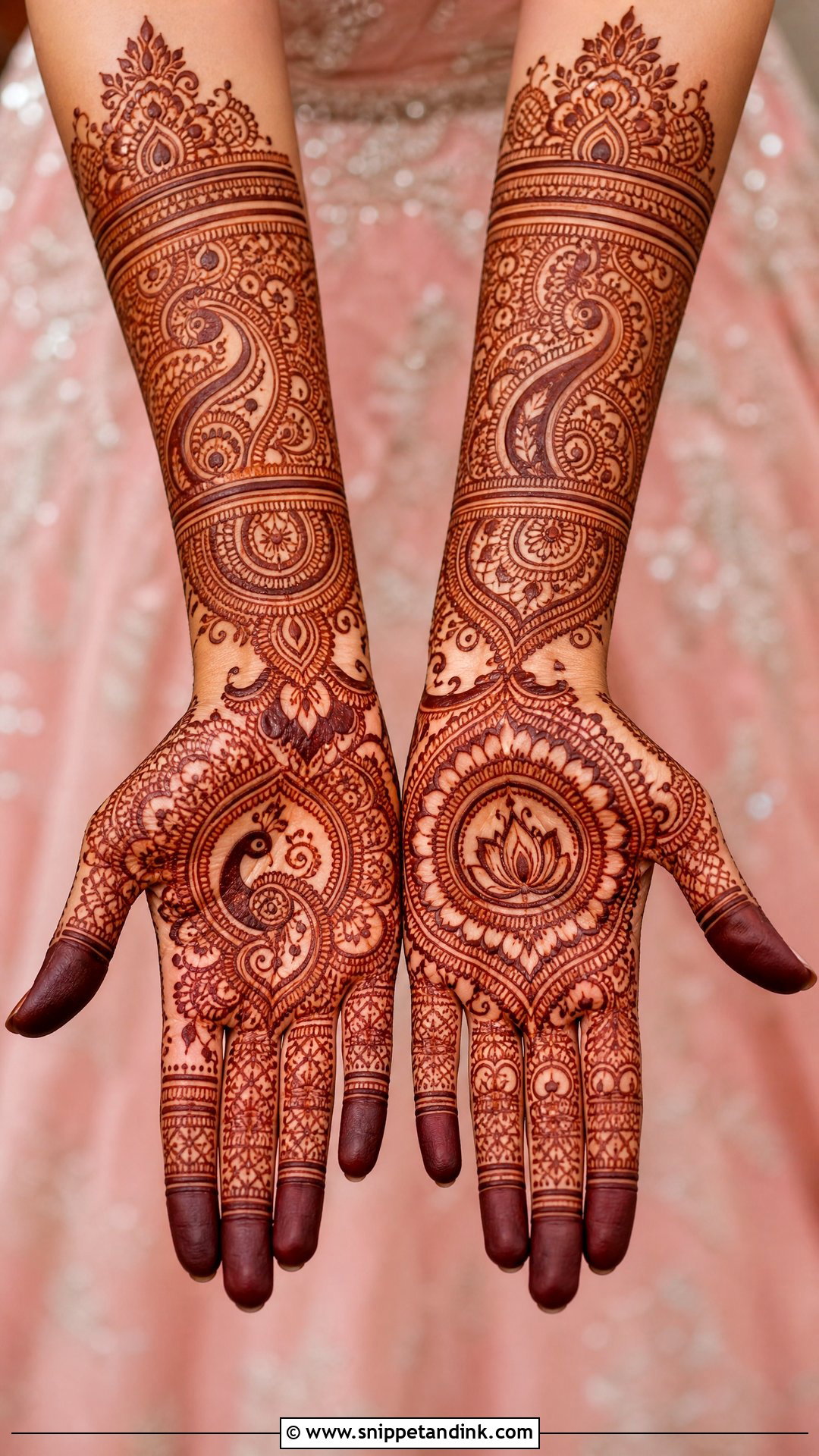
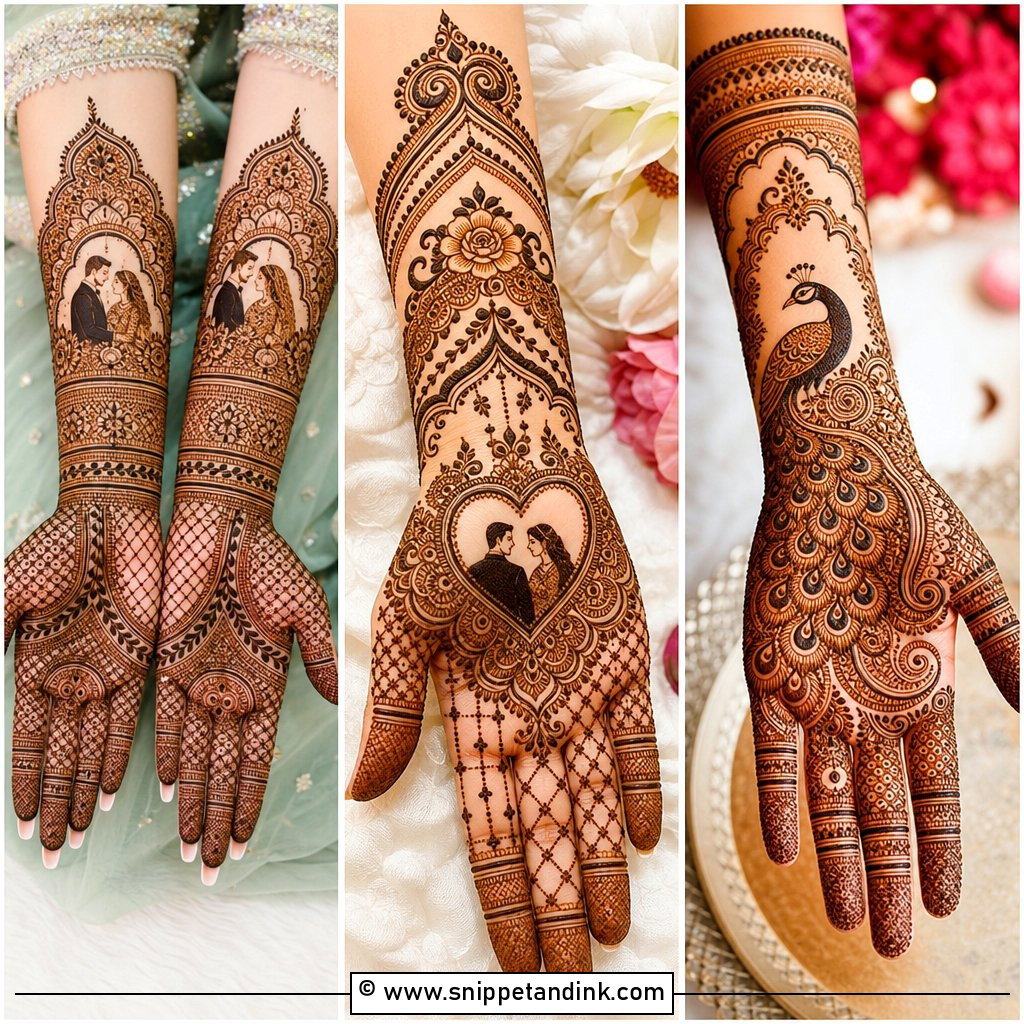
Classic Indian bridal work fills almost every gap: peacocks, paisleys, lotus, mandalas, bride and groom figures and fine checkered fills, often from fingertips to elbows. The density is the point, and also the risk. If the cone is squeezed too fast, tiny dots merge and the hand dries looking muddy instead of detailed, so I slow right down on the filler sections. Hiding the groom’s initials or your date in a paisley is easy here, because there is so much pattern for it to disappear into.
3. Arabic Bridal Mehndi Design
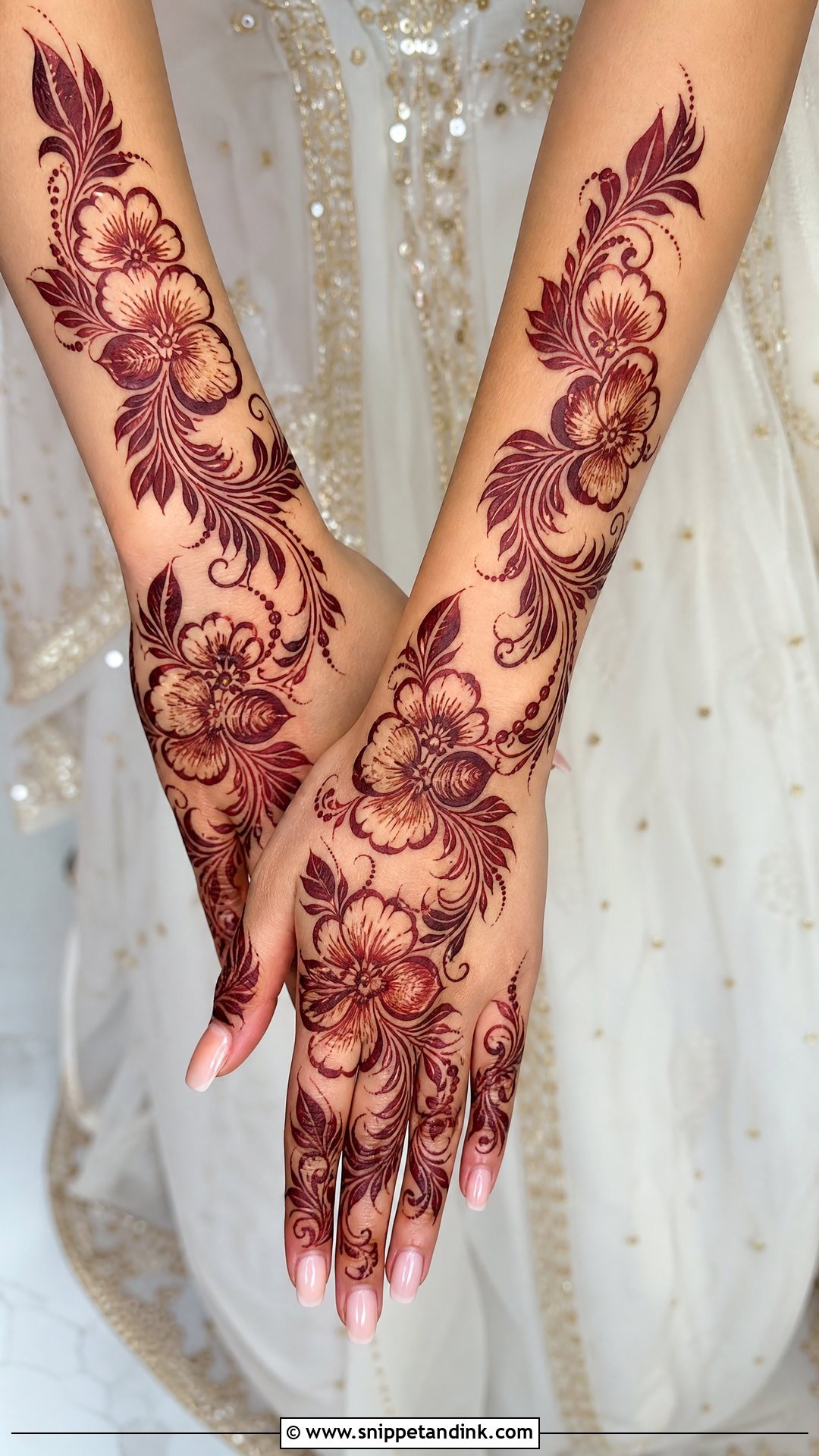
Arabic layouts let skin show between big flowers and shaded petals, usually travelling diagonally from one side of the wrist toward the fingers. I reach for it for nikkah, engagement and reception hands, and for brides who can only give me an hour or two. Bold strokes carry a lot of paste, which is why Arabic designs stain deep and stay readable as they fade. Keep the jewelry delicate; a chunky haath phool fights that diagonal line.
4. Indo Arabic Bridal Mehndi Design
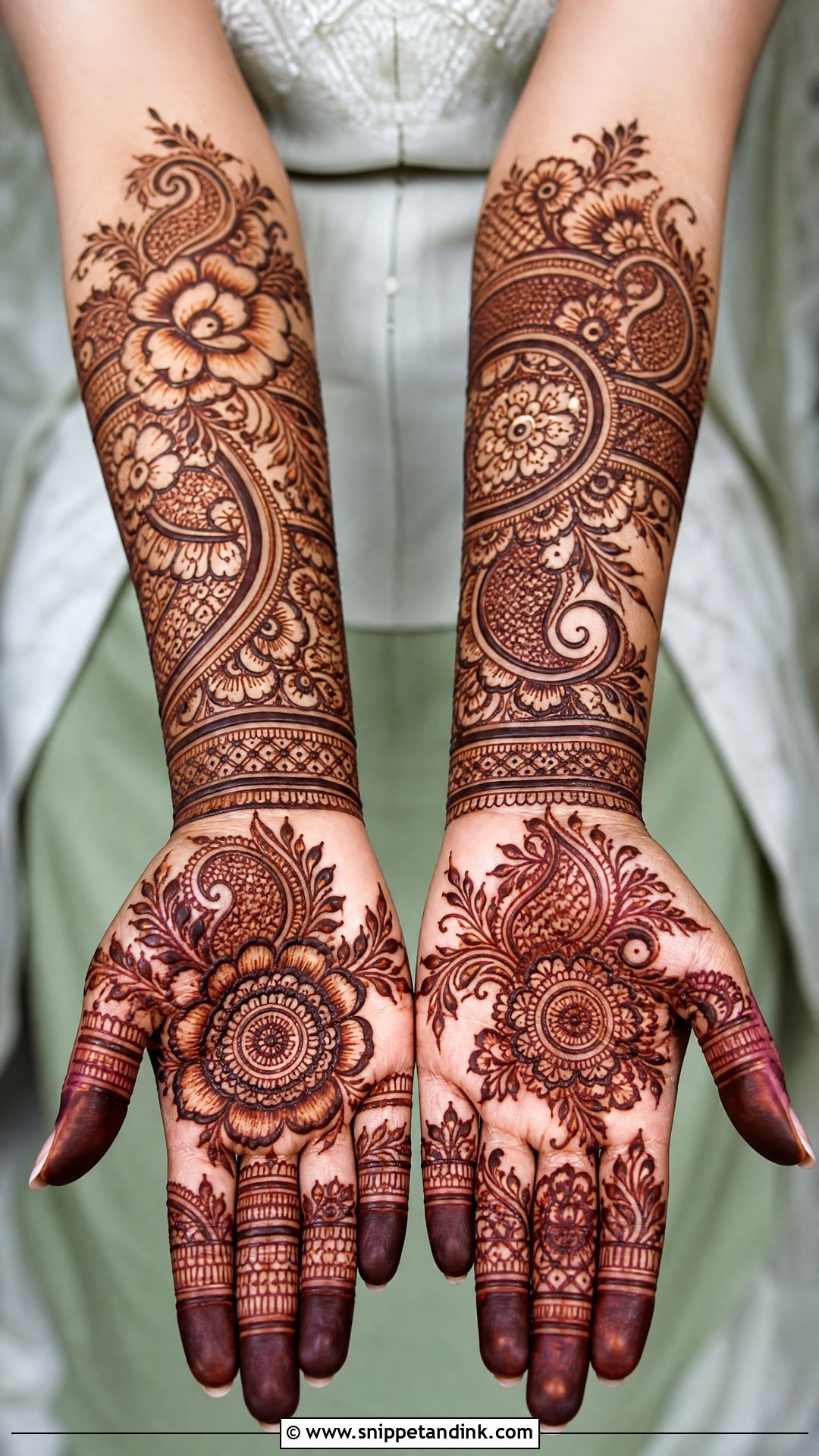
This fusion takes the flow of Arabic patterns and fills chosen areas with Indian detailing: a mandala centre, a paisley band, intricate fingers. The skill is knowing where to stop. I leave open channels running between motifs so the eye can follow the trail, then fill the fingers fully so the hand still reads as bridal. If full Indian coverage feels too busy and pure Arabic too sparse, this is your middle ground, on front or back hands.
5. Rajasthani Bridal Mehndi Design
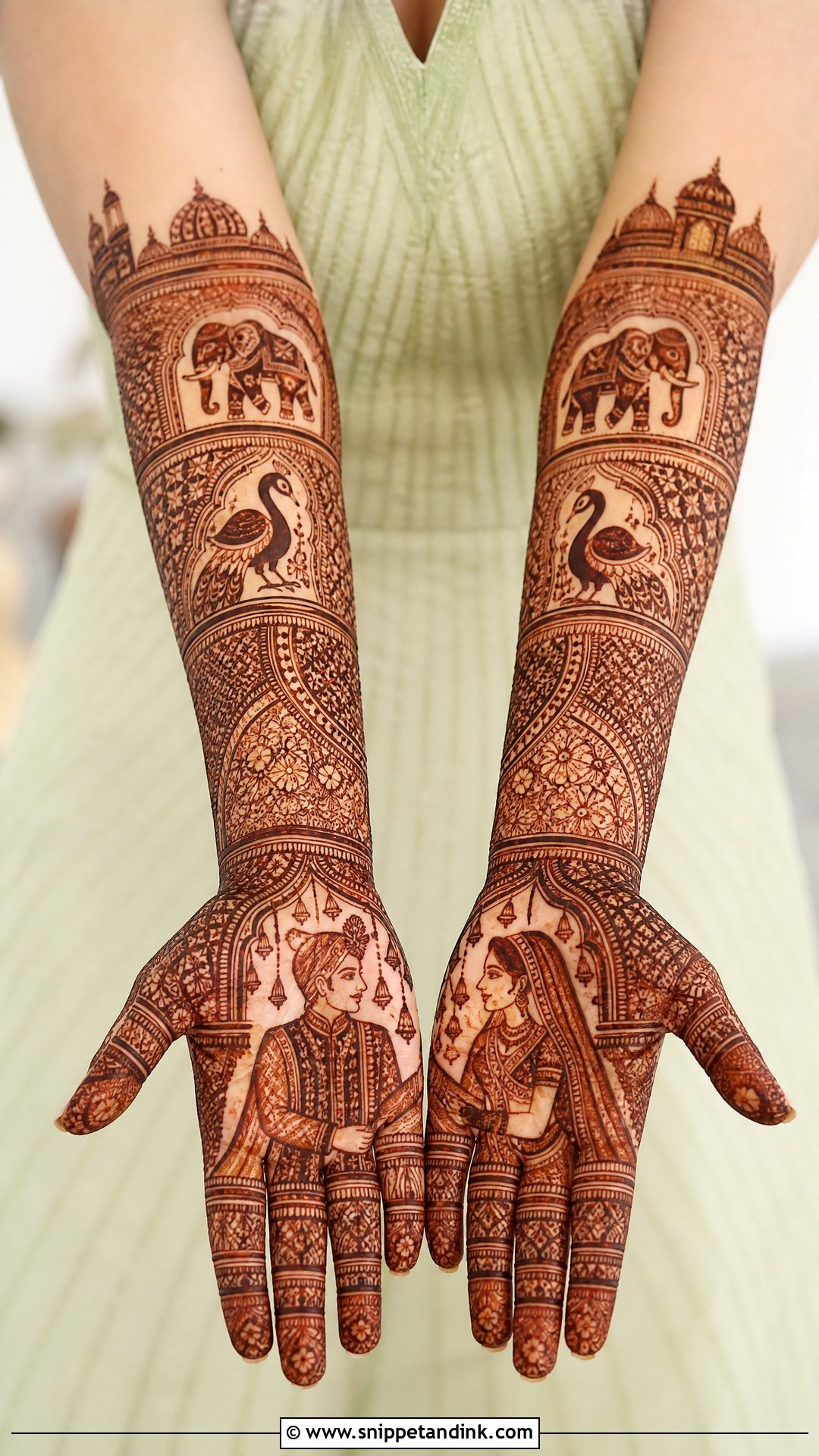
Rajasthani henna tells a story: bride and groom portraits, elephants, a doli, peacocks, domes and heritage borders laid out symmetrically across both hands. Faces are where an inexperienced artist gets found out, so ask for close-up photos of her figure work, not just full-hand shots from a distance. Against red, maroon or gold it looks completely at home. Want your venue or a ritual drawn in? Bring a clear photo so the artist can simplify it into lines a cone can actually make.
6. Marwari Bridal Mehndi Design
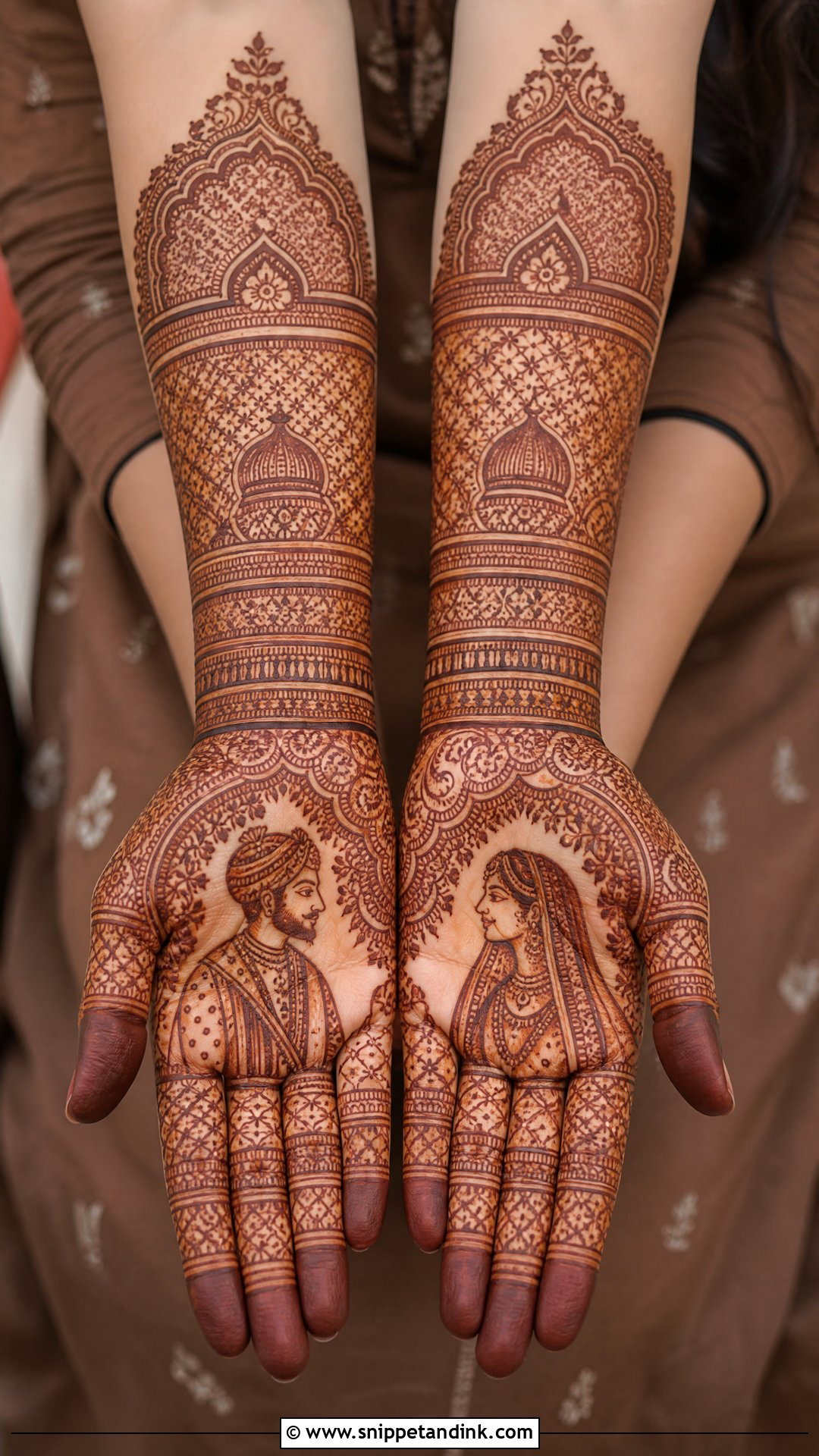
Marwari designs pair bride and groom figures with fully filled palms, bold paisleys, fine net work and heavy wrist bands, and the fingers are almost always filled solid. Those wrist bands sit exactly where chooda and bangles land, so I plan their width around the jewelry. A band that vanishes under a stack of bangles is wasted sitting time. Matched but not identical story panels on each hand keep the pair interesting when you hold them side by side.
7. Pakistani Bridal Mehndi Design
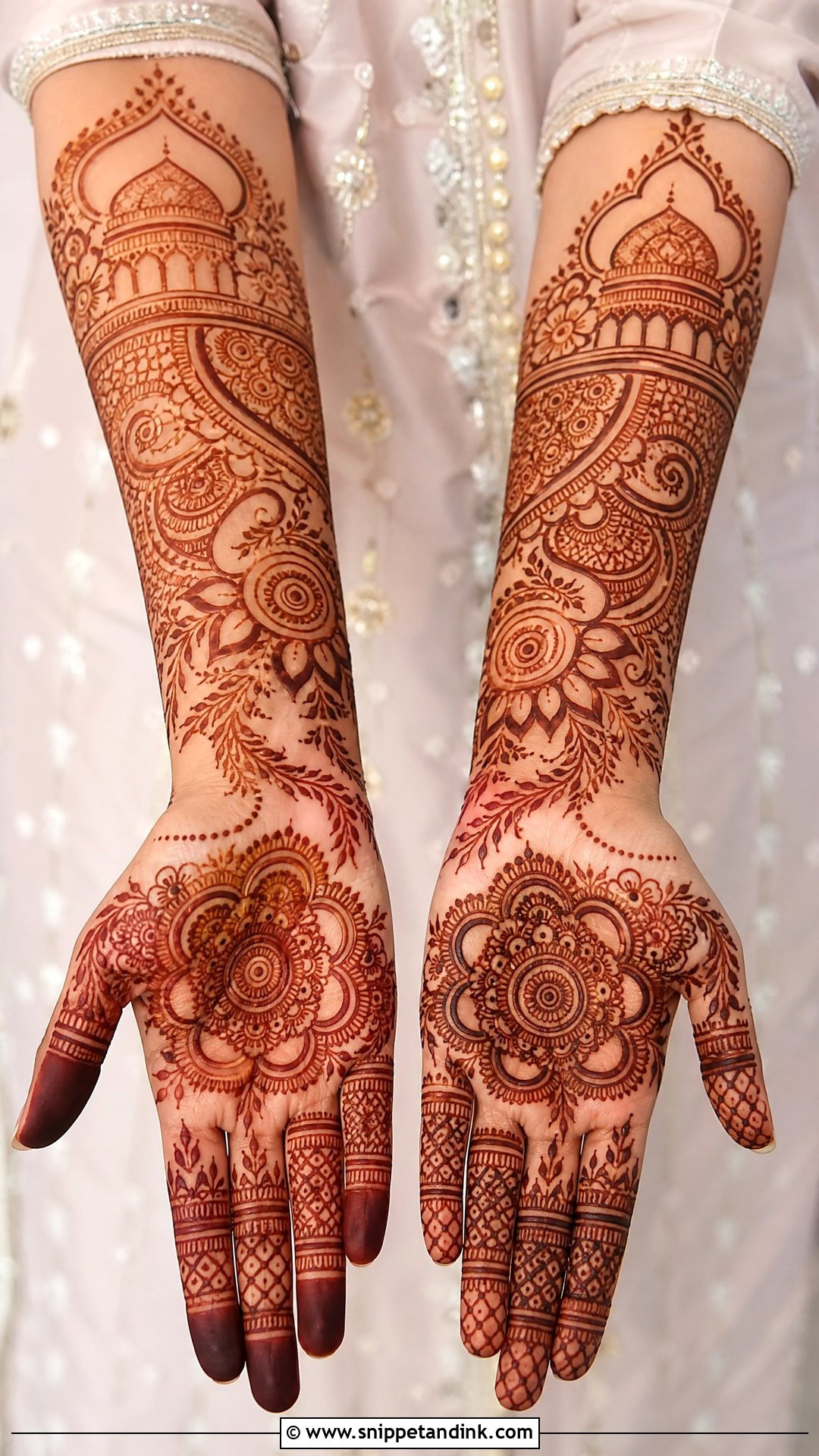
Pakistani bridal mehndi sits between Indian density and Arabic flow: florals, leaves, paisleys, domes and mandalas with softer spacing and long extensions up the forearm. Finger caps and lace-like back hands are typical. I build depth with shading inside the petals, made by thinning the paste line, and I’d choose that over extra fillers every time. Shararas, ghararas and embroidered suits with three-quarter sleeves show the forearm trail well.
8. Portrait Bridal Mehndi Design
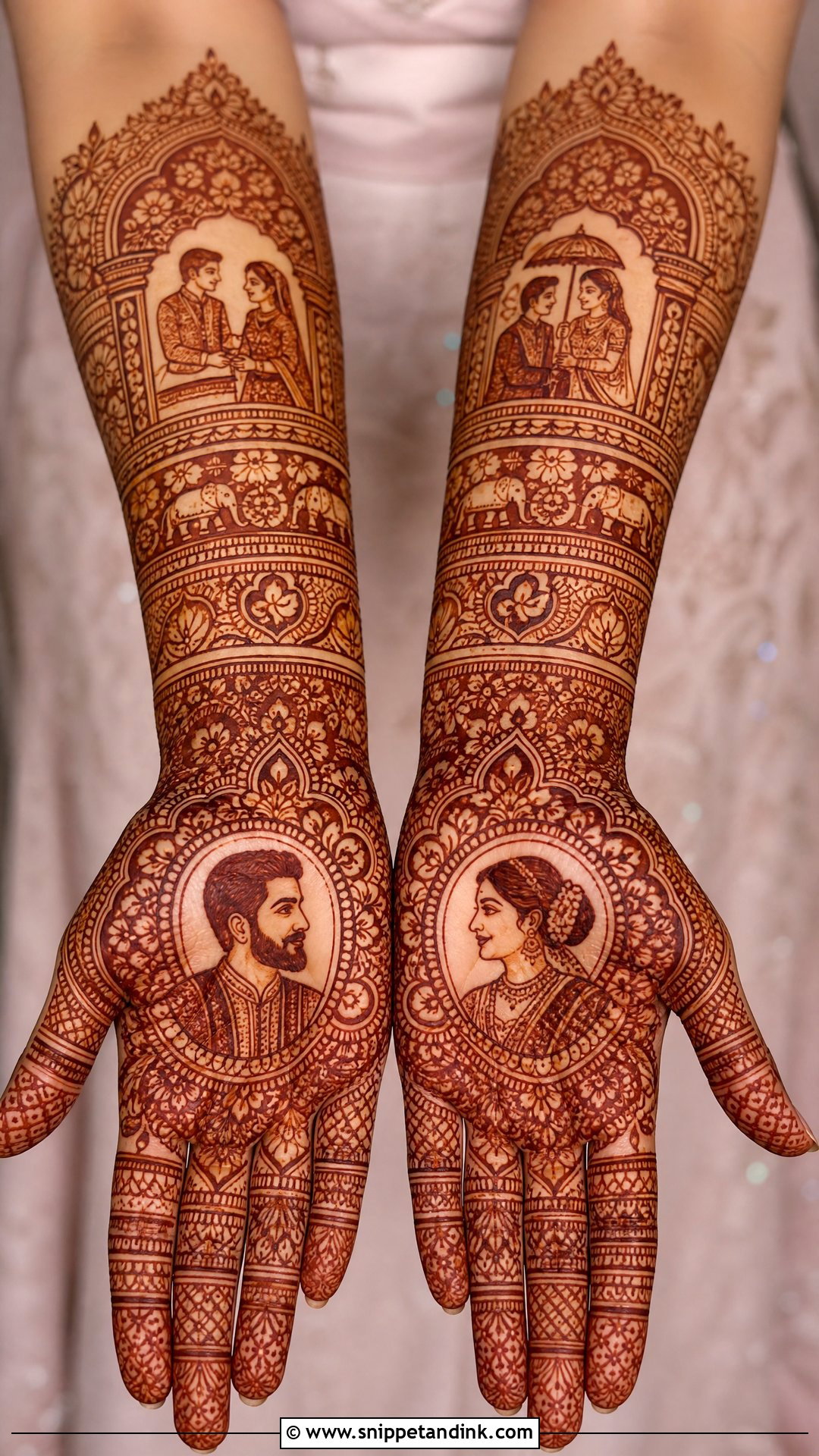
Portrait henna puts faces or scenes onto the palms or forearms: a proposal, a ritual, a couple silhouette. Faces need a steady hand, a fine-tipped cone and room around them, so I keep the surrounding pattern deliberately quieter. Be realistic about how it ages. Very fine facial lines can blur as palm skin turns over in the days after, which means the outlines have to be firm enough to hold the expression. Only book this with an artist who shows real figure work in her portfolio.
9. Bride Groom Mehndi Design
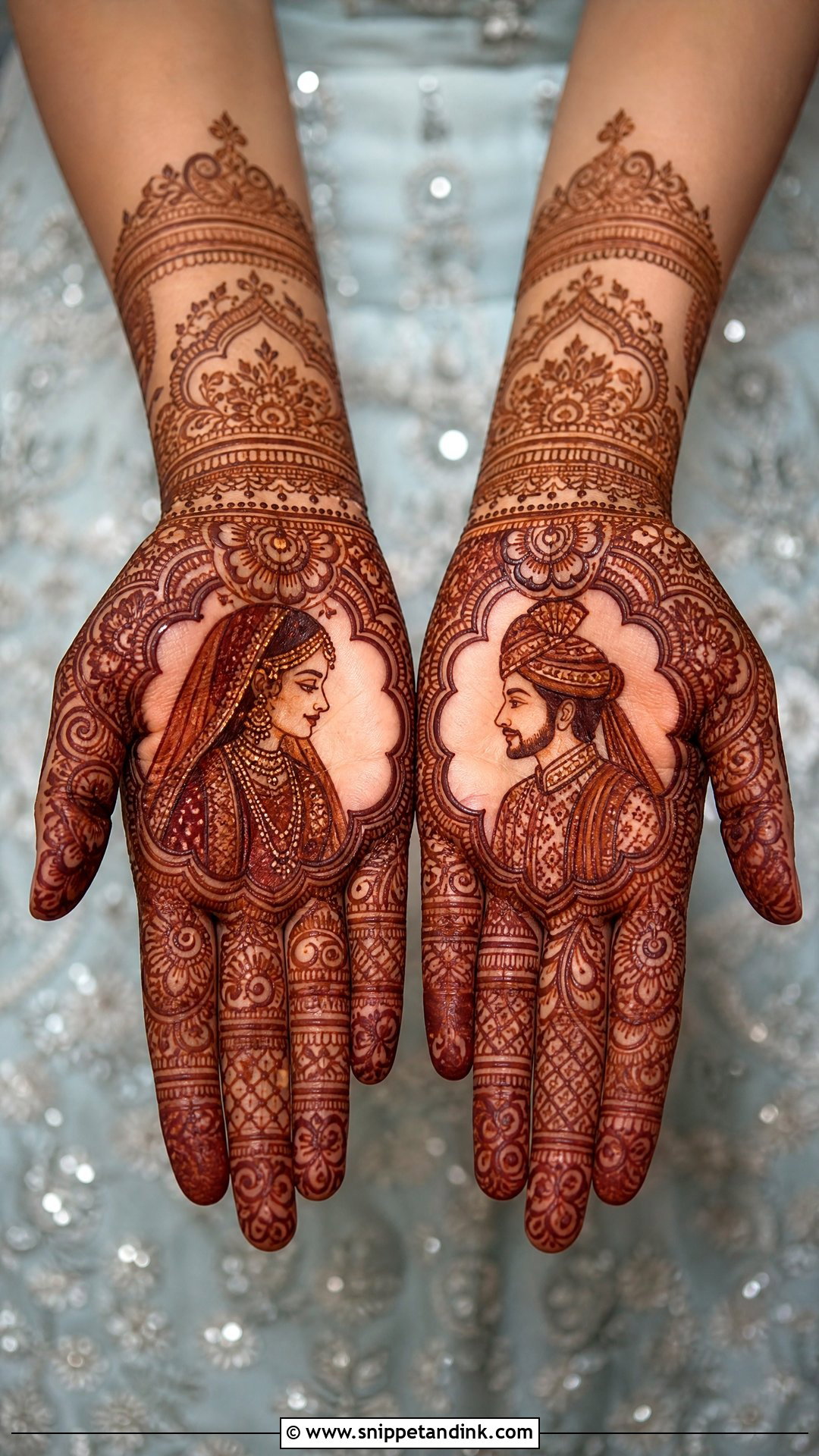
Bride on one palm, groom on the other is the classic version, so the couple meet when you put your hands together. The rest fills with mandalas, paisleys, borders and jaali. Figures drawn too small turn into brown smudges once the stain darkens, so I ask brides to let me draw them bigger than they first imagine. It suits a traditional wedding where you want full coverage with something personal at the centre.
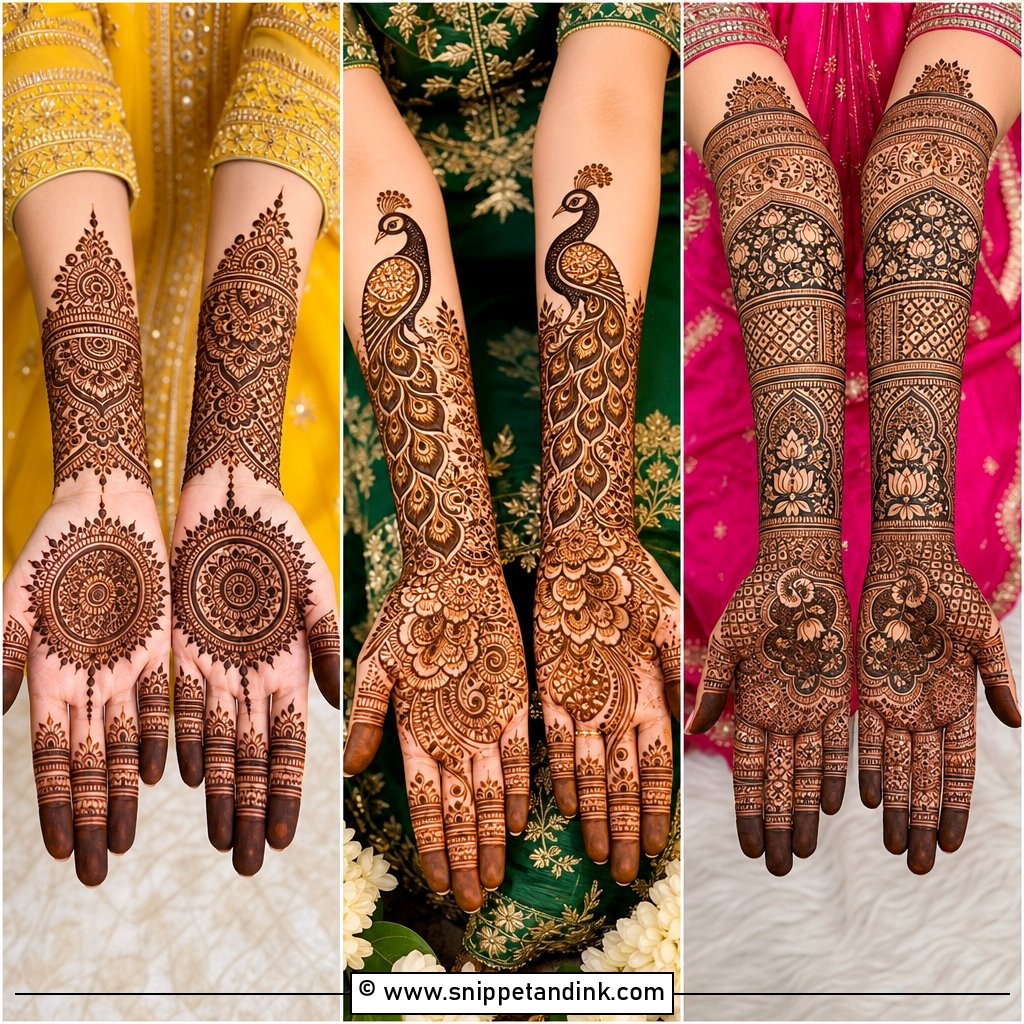
10. Peacock Bridal Mehndi Design
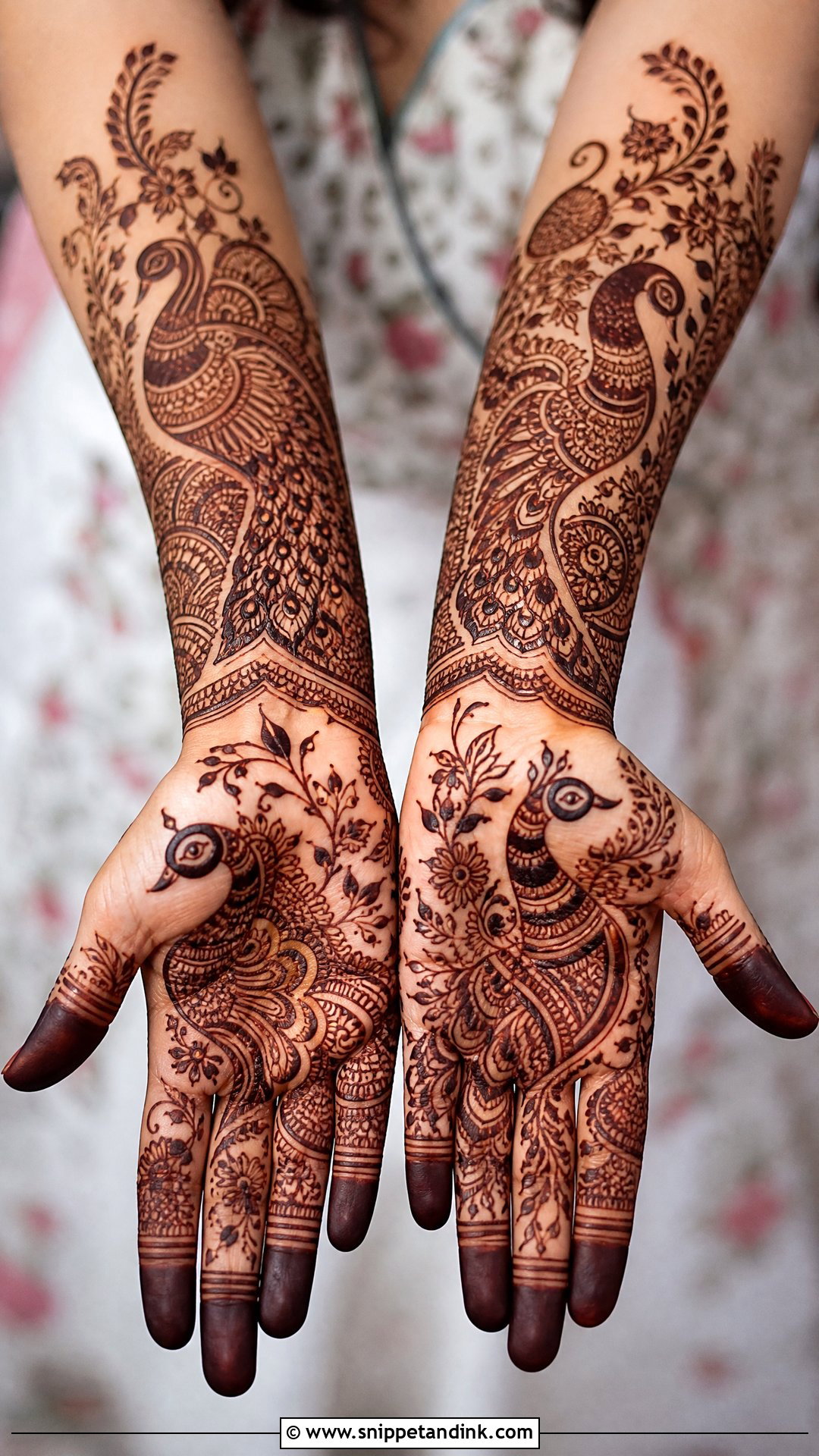
A peacock’s body curves the way a hand curves, which is why it sits so naturally along the side of a palm or up the wrist, its tail feeding into paisleys and vines. It fits full-hand and half-hand layouts alike. Twin peacocks facing each other across both palms is the more dramatic take. The feathers are where I’m careful: packed too tight they merge into a blob, spaced a hair apart they read as feathers.
11. Lotus Bridal Mehndi Design
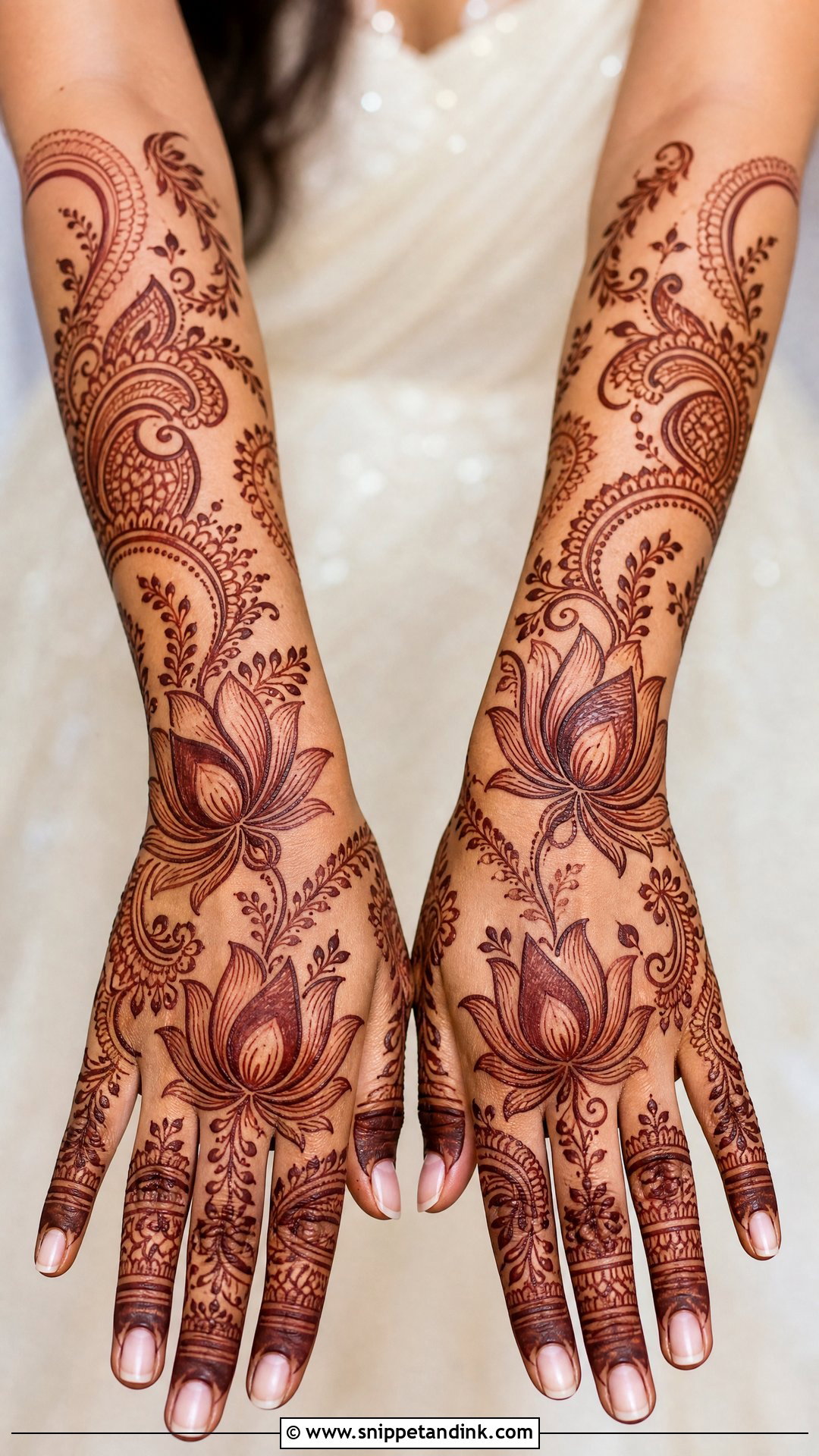
Lotus can be drawn bold or fine, so it adapts to palms, back hands, wrists and forearms. A bridal layout might place a large bloom near the palm centre, smaller ones at the wrist and leaves running up the fingers. Next to pastel outfits and temple jewelry, it feels lighter than a peacock or portrait design. I draw each petal with a thick outer line and a thin inner one; that double edge is what lets the flower read from a distance.
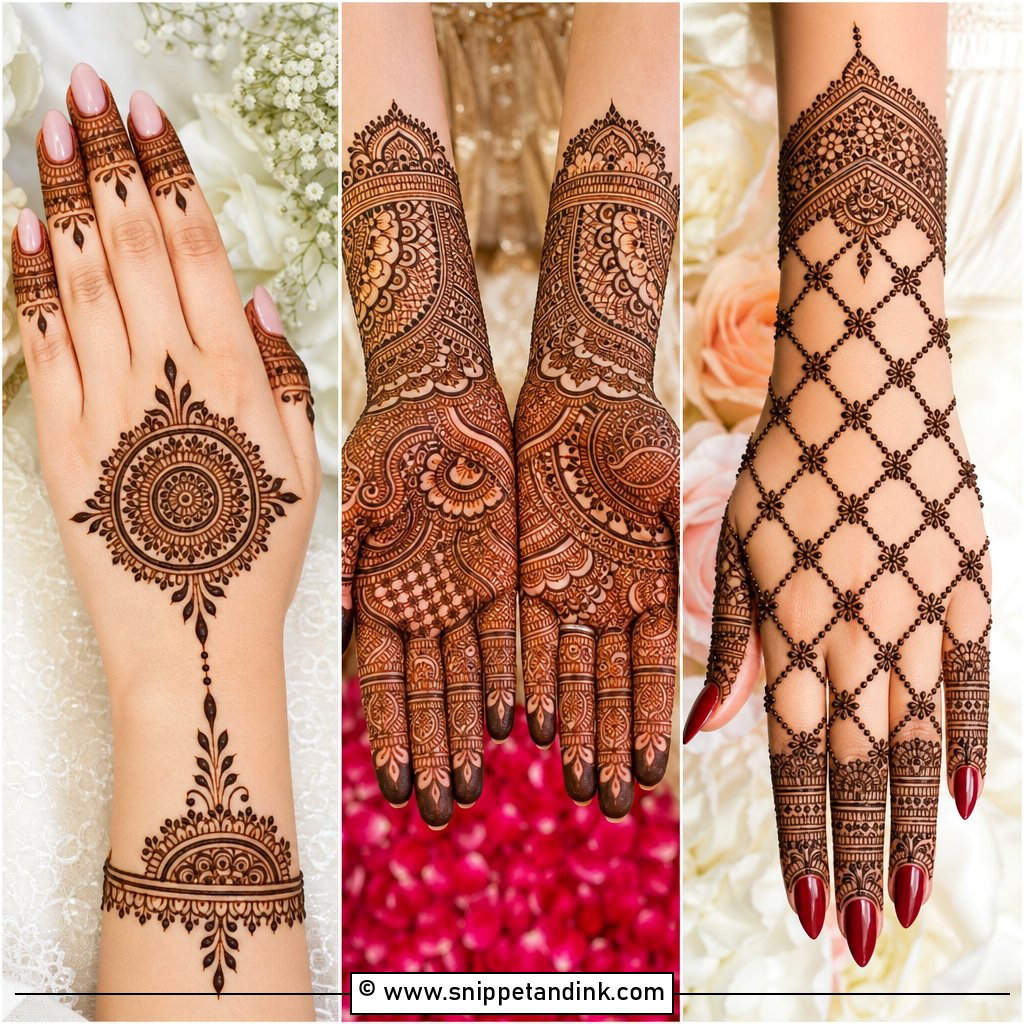
12. Mandala Bridal Mehndi Design
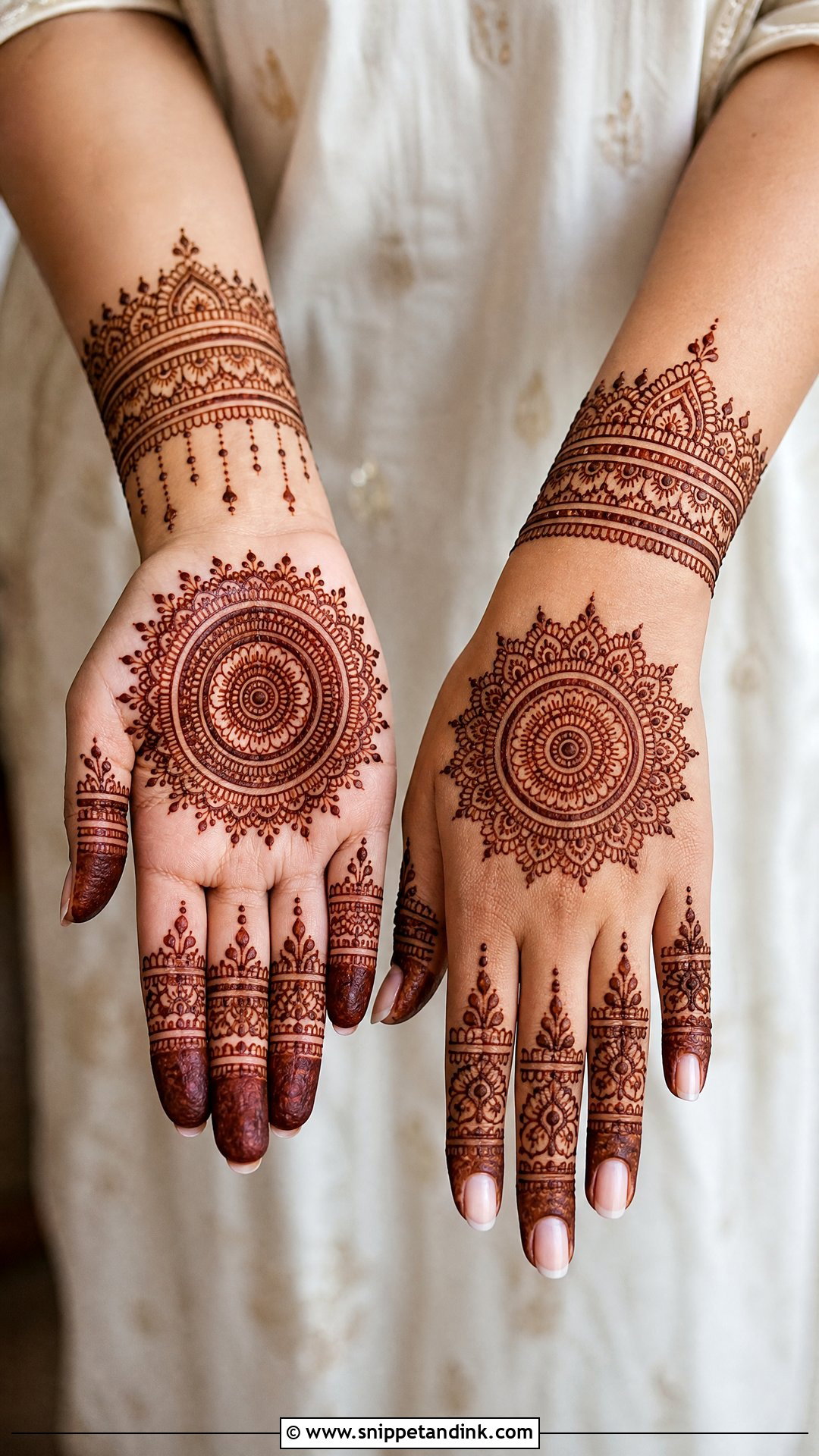
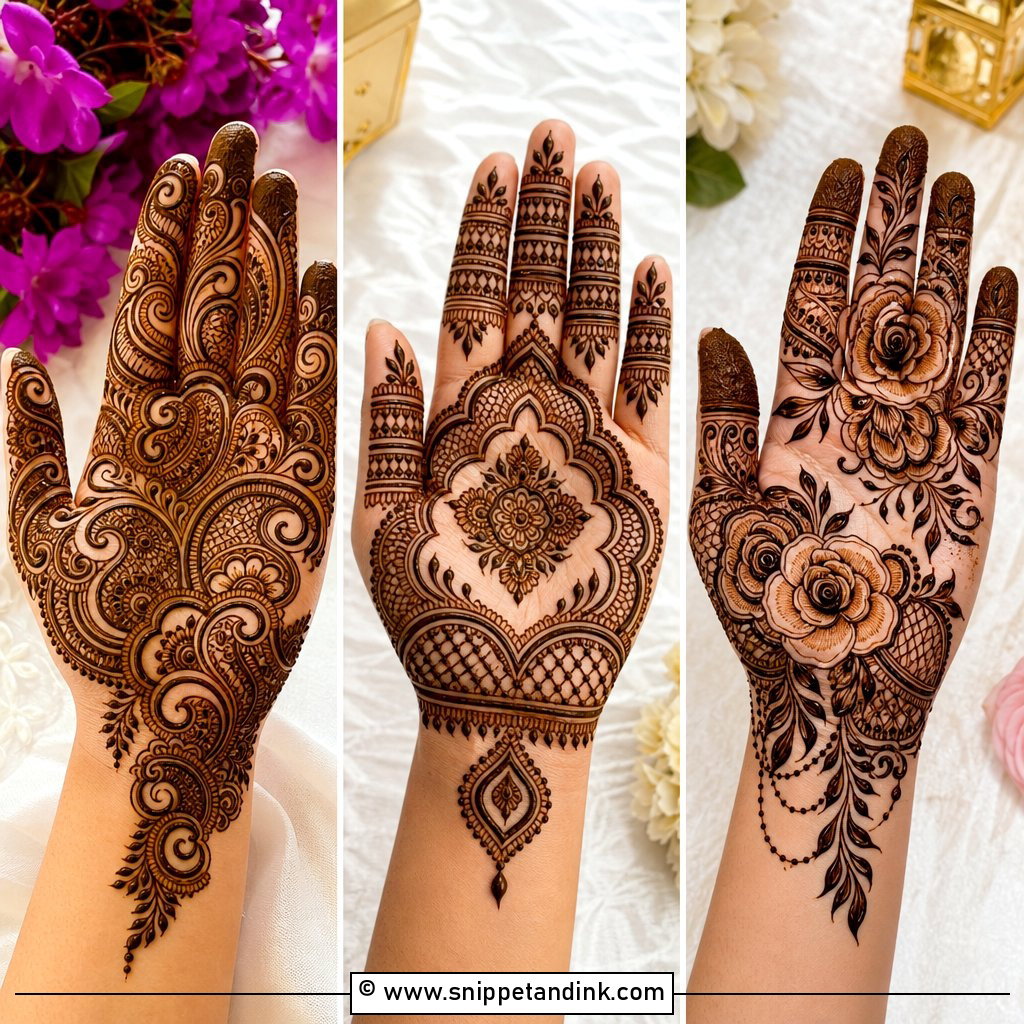
Simple in structure, strong in effect. A mandala starts as one circle in the centre of the palm or back hand and grows outward in rings of petals, dots and small paisleys, then connects to fingers and wrist. Symmetry is unforgiving, so I mark the centre point before anything else and build ring by ring; a circle that drifts off-centre shows in every photo. It can stay minimal or run toward the forearm, and it is the easiest motif to mirror exactly on both hands.
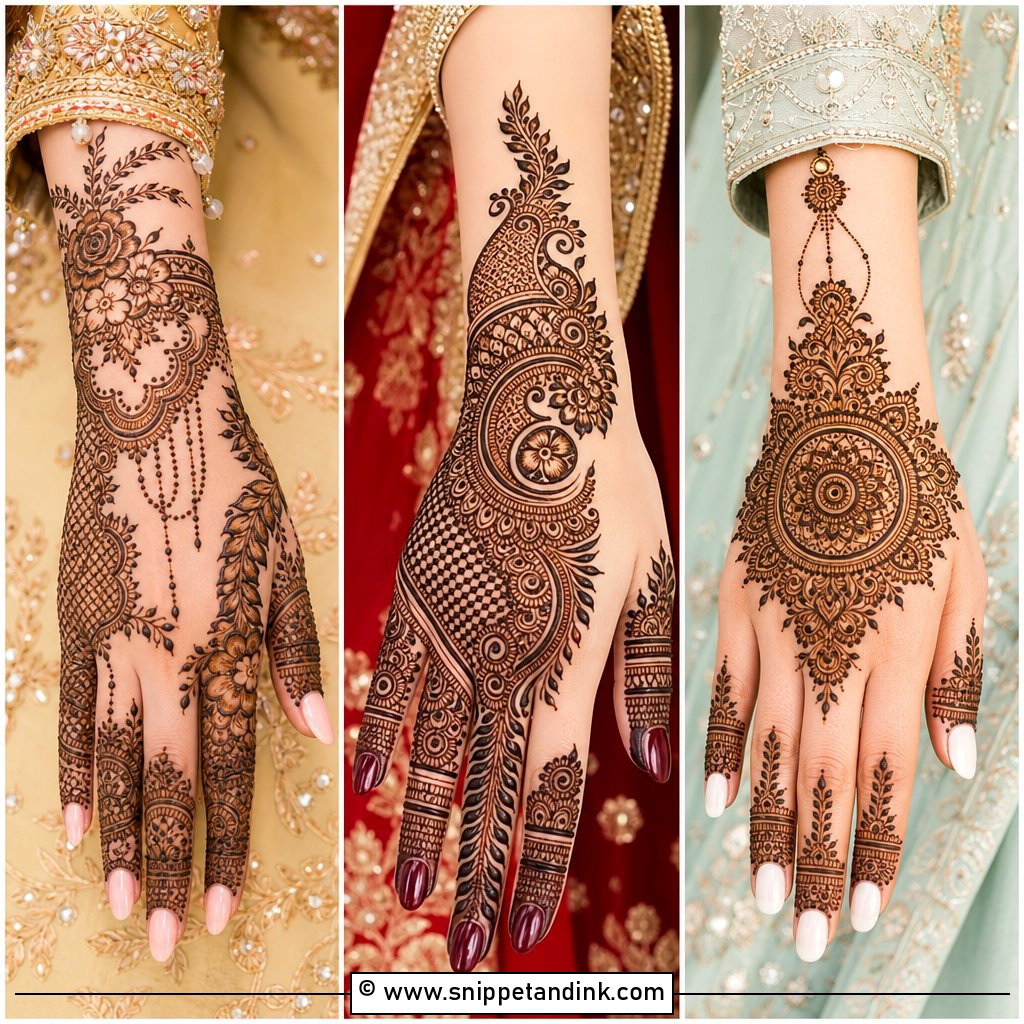
13. Back Hand Bridal Mehndi Design
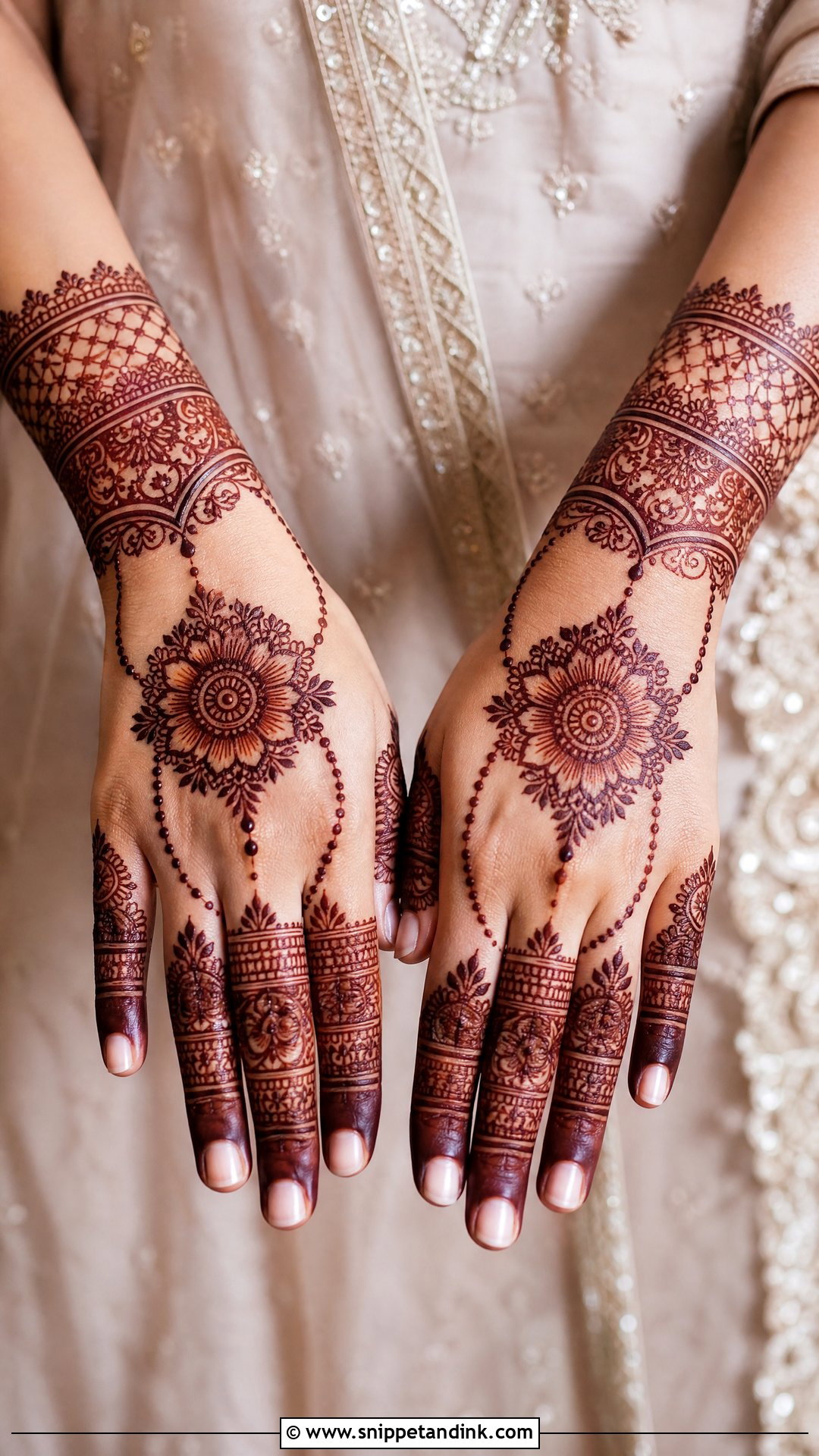
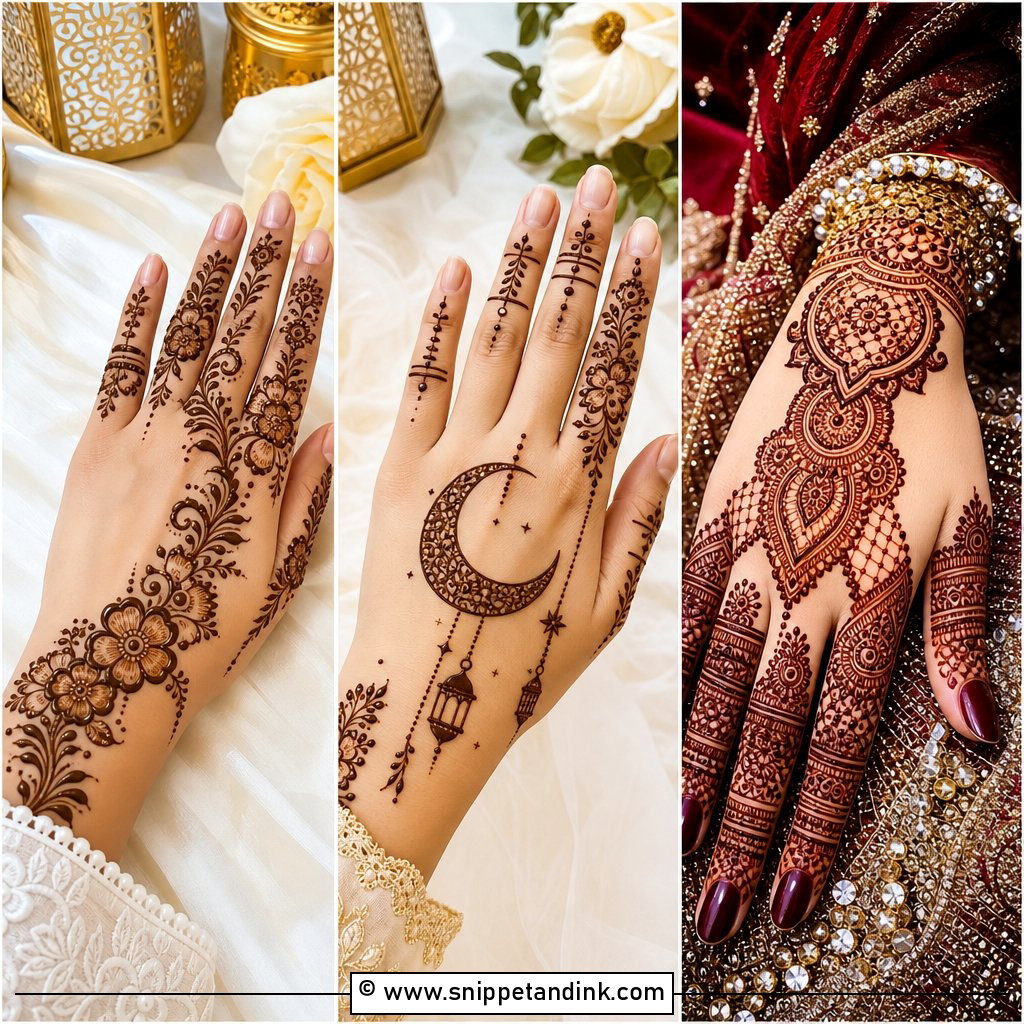
The back of the hand is what shows in ring shots, bangle shots and most posed portraits, so it deserves as much planning as the palm. A central mandala, a floral circle, jaali or a jewelry-style chain usually anchors it, with coordinated fingers and a wrist cuff. Expect it to stain lighter than your palm; bolder lines help make up the difference. I always repeat at least one motif from the front, or the two sides look like the work of different artists.
14. Front Hand Bridal Mehndi Design
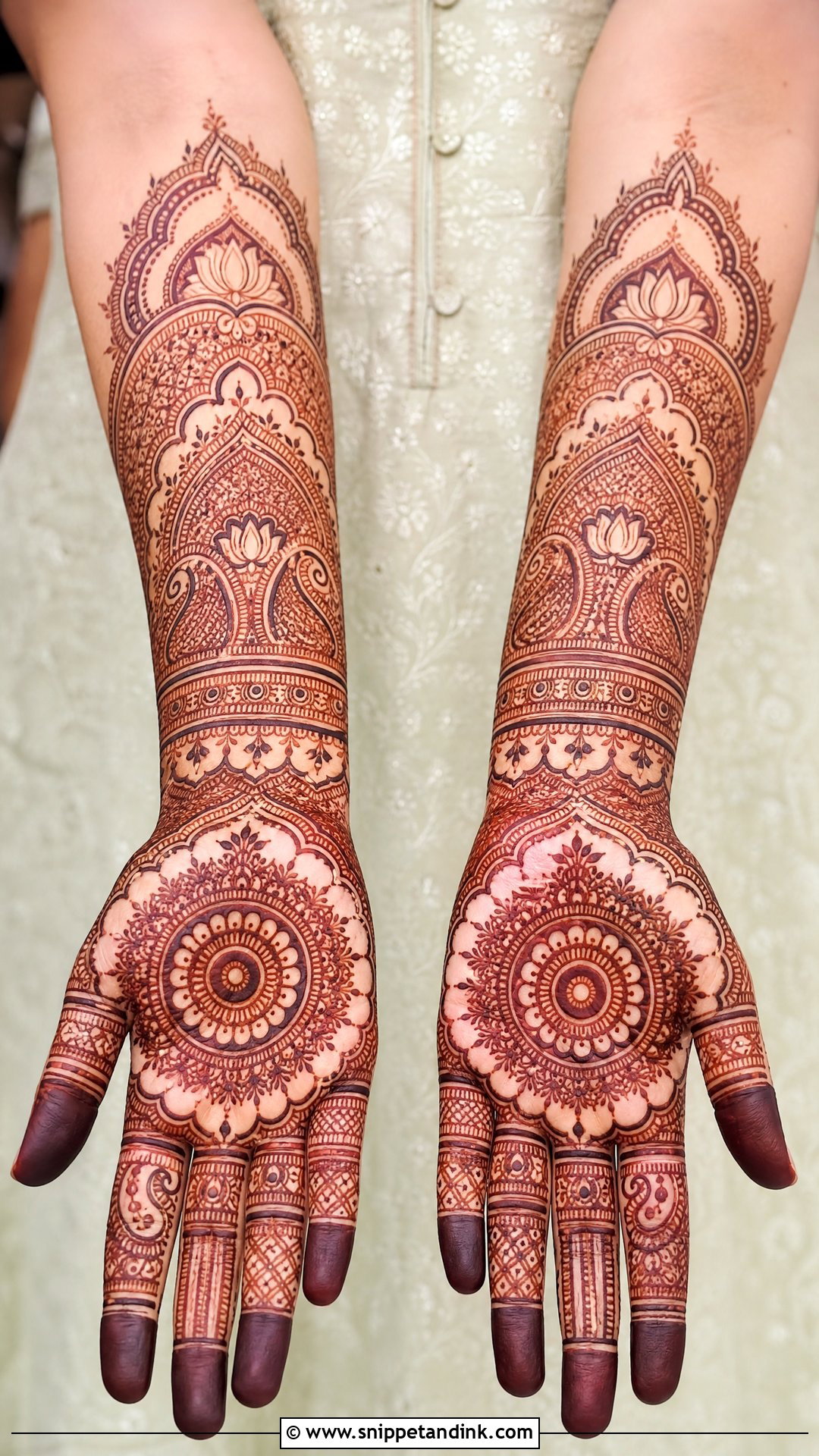
Palms give the most detailed view and also stain the darkest, which is why the important motifs go here: couple art, mandalas, lotus, peacocks, initials and dates. Fingers usually get fine lines, shaded tips and small borders. When you look at references, hold your own palms together. A front design has to balance as a pair, not just as one hand. Small open gaps between fillers keep it clear if you prefer a lighter feel.
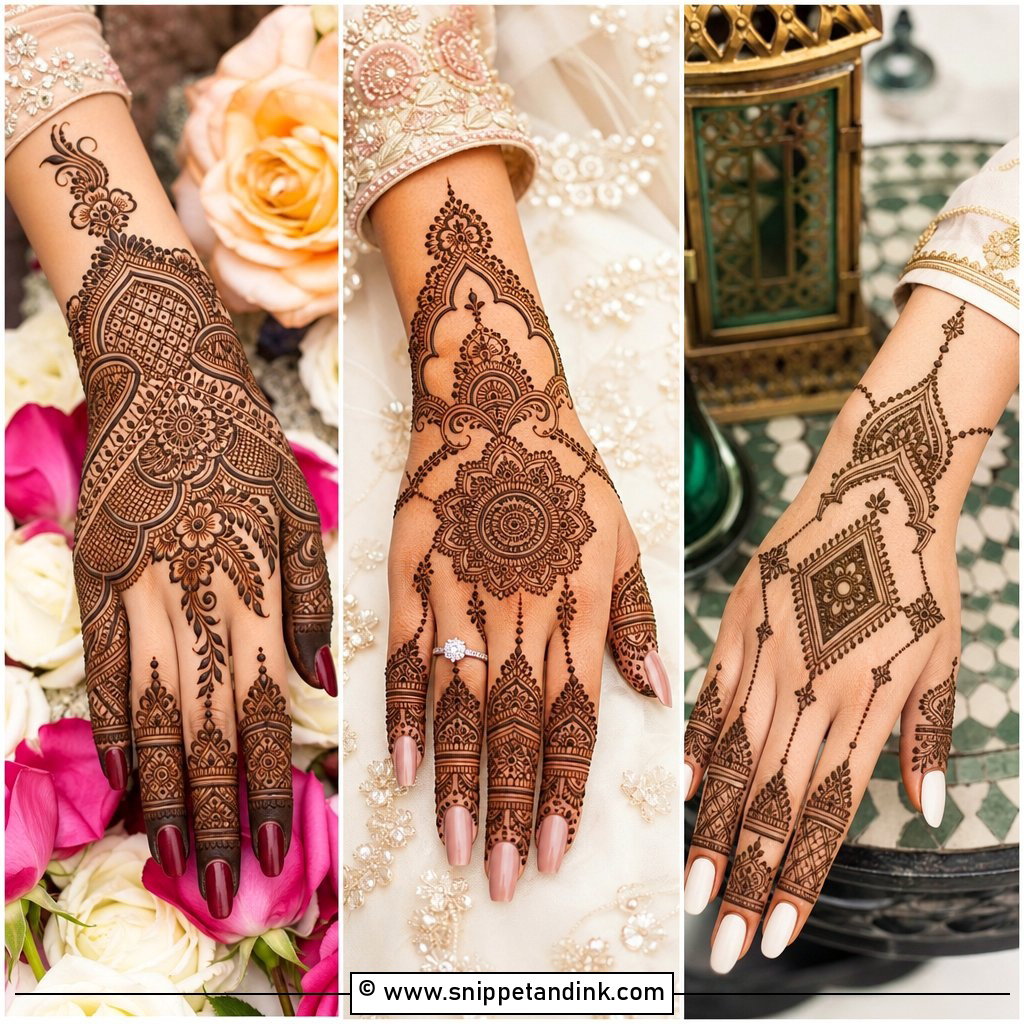
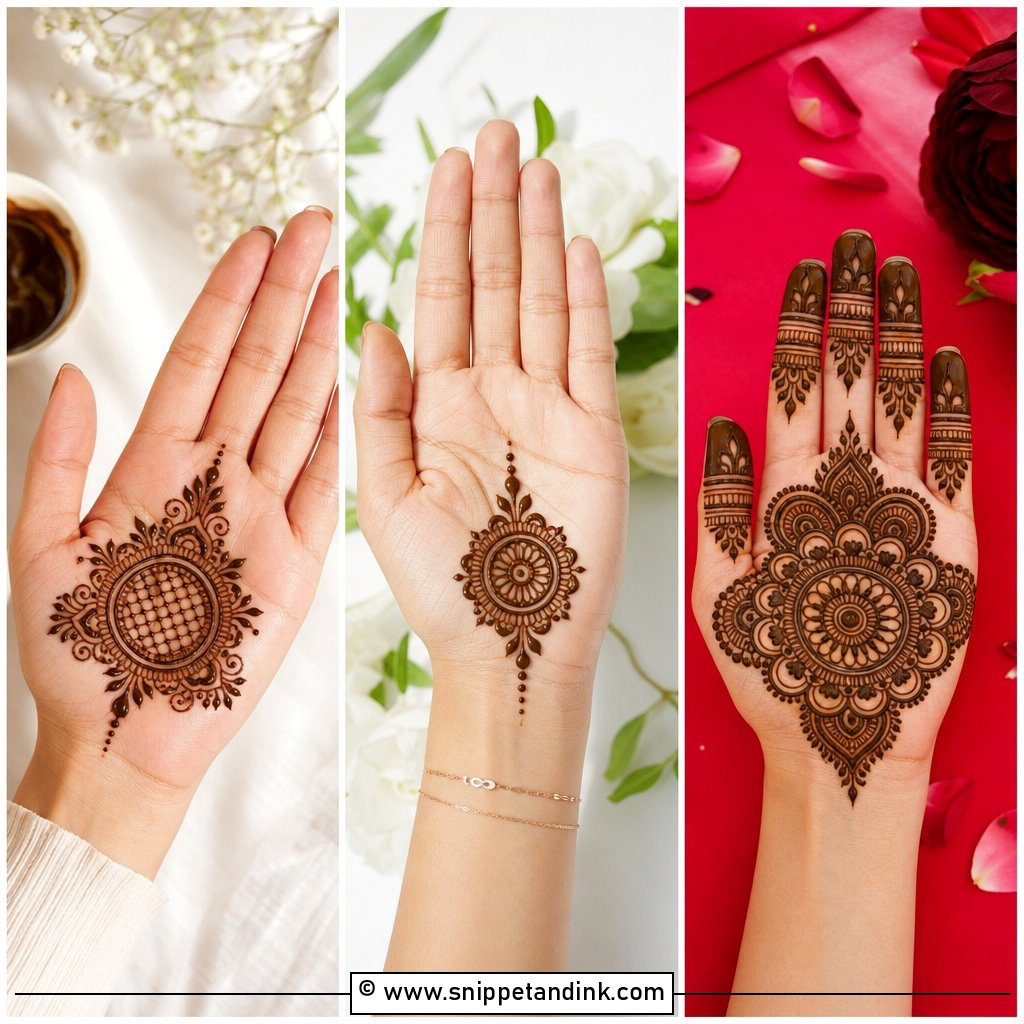
15. Simple Bridal Mehndi Design
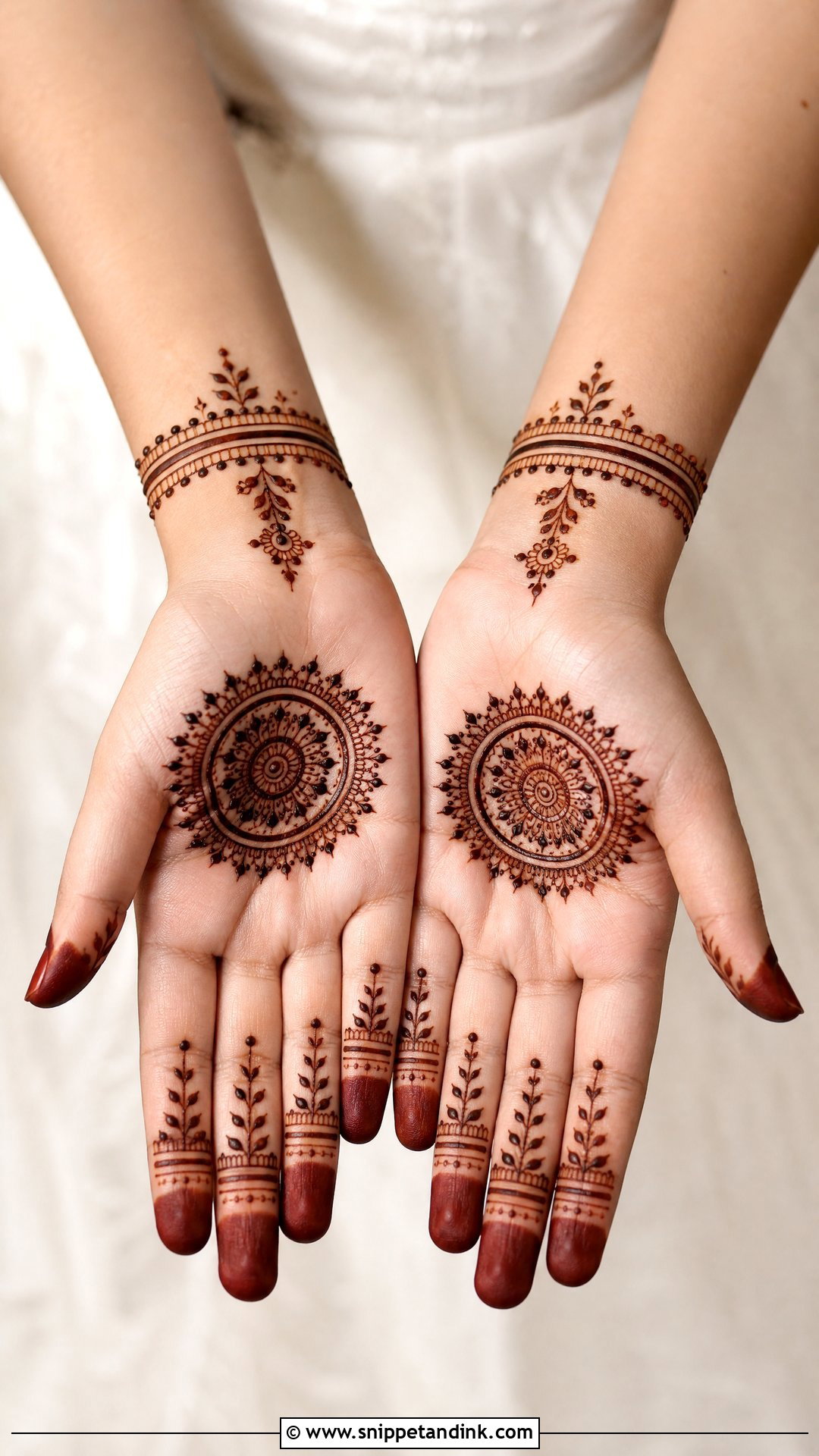
Simple bridal henna rests on one strong idea, a neat mandala, a floral trail, an Arabic vine or spaced paisleys, finished at the wrist, with thin lines and dots on the fingers. I suggest it for court weddings, small ceremonies and engagements, and for brides who know they can’t sit for hours. Simple doesn’t mean unplanned. A clean wrist band, matching fingers and one standout palm motif are what separate bridal minimal from guest henna.
16. Modern Bridal Mehndi Design
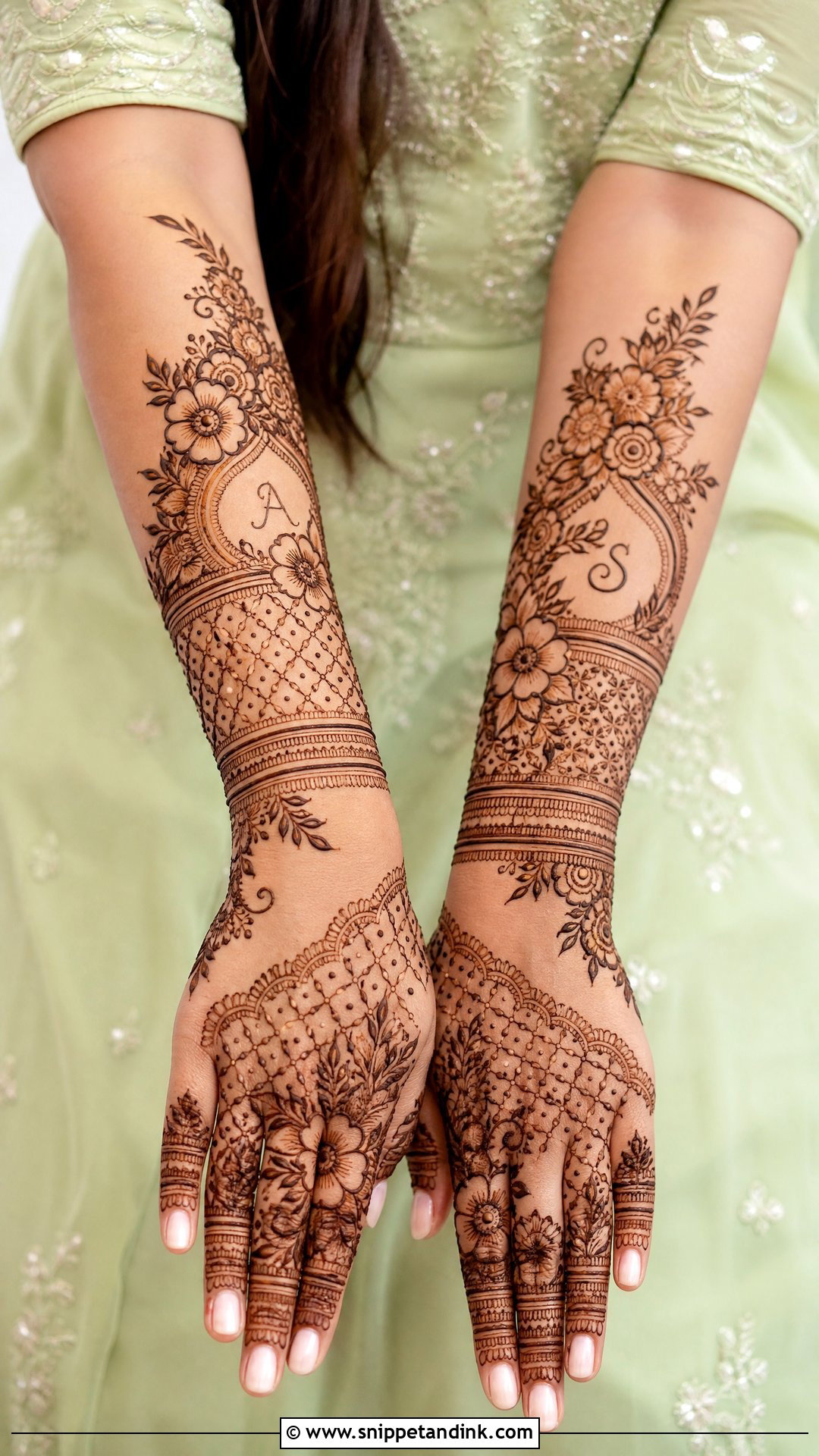
Modern designs keep more skin and use fine-line florals, geometric grids, bracelet details, initials, even a wedding hashtag. Asymmetry is common, with one hand carrying a bold motif and the other a lighter trail. The trap is emptiness. Every open area should look like a decision, so I frame bare skin with a border or a line instead of leaving random gaps. Contemporary lehengas, fusion outfits and minimal jewelry all sit well with it.
17. Minimal Bridal Mehndi Design
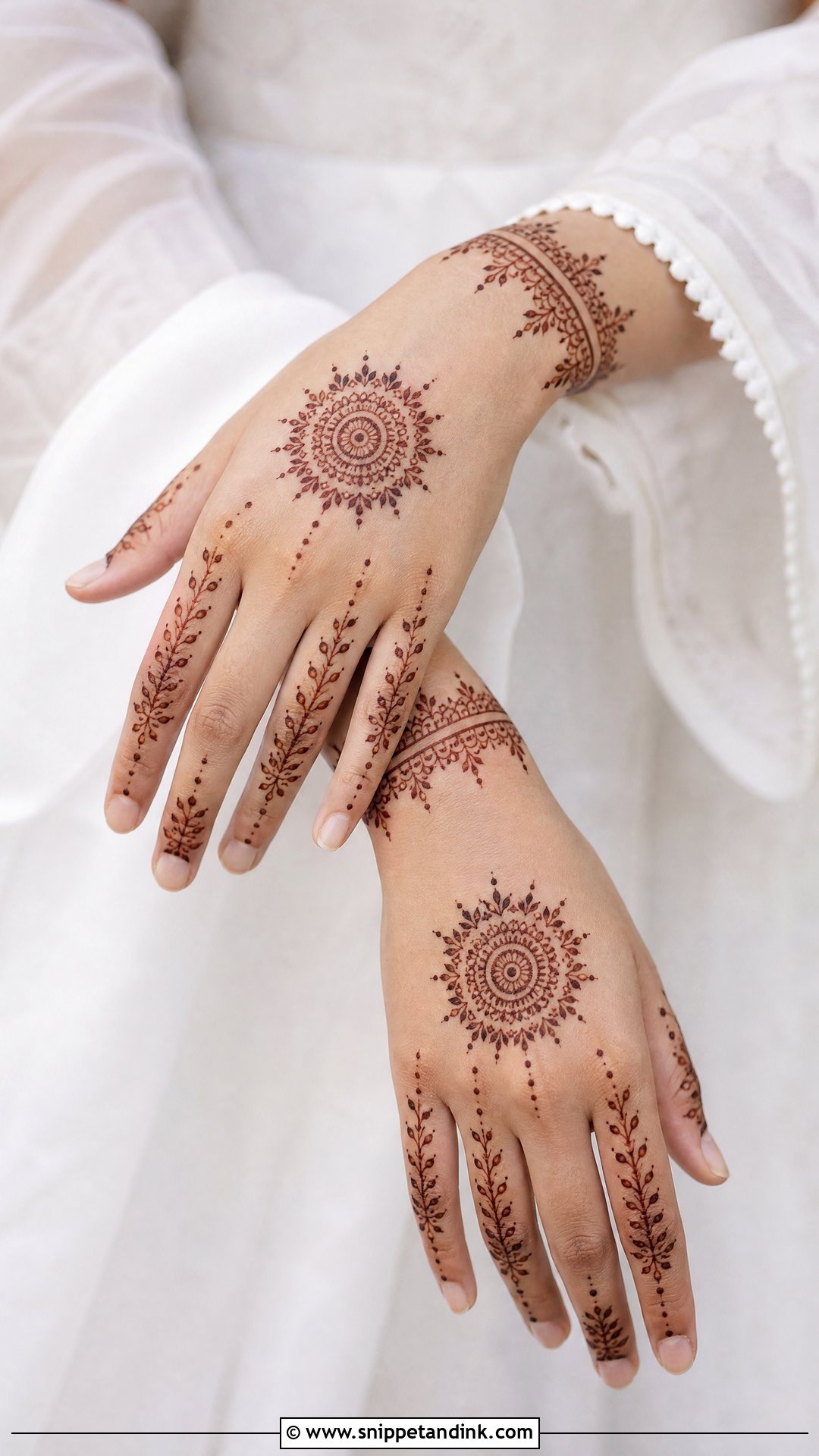
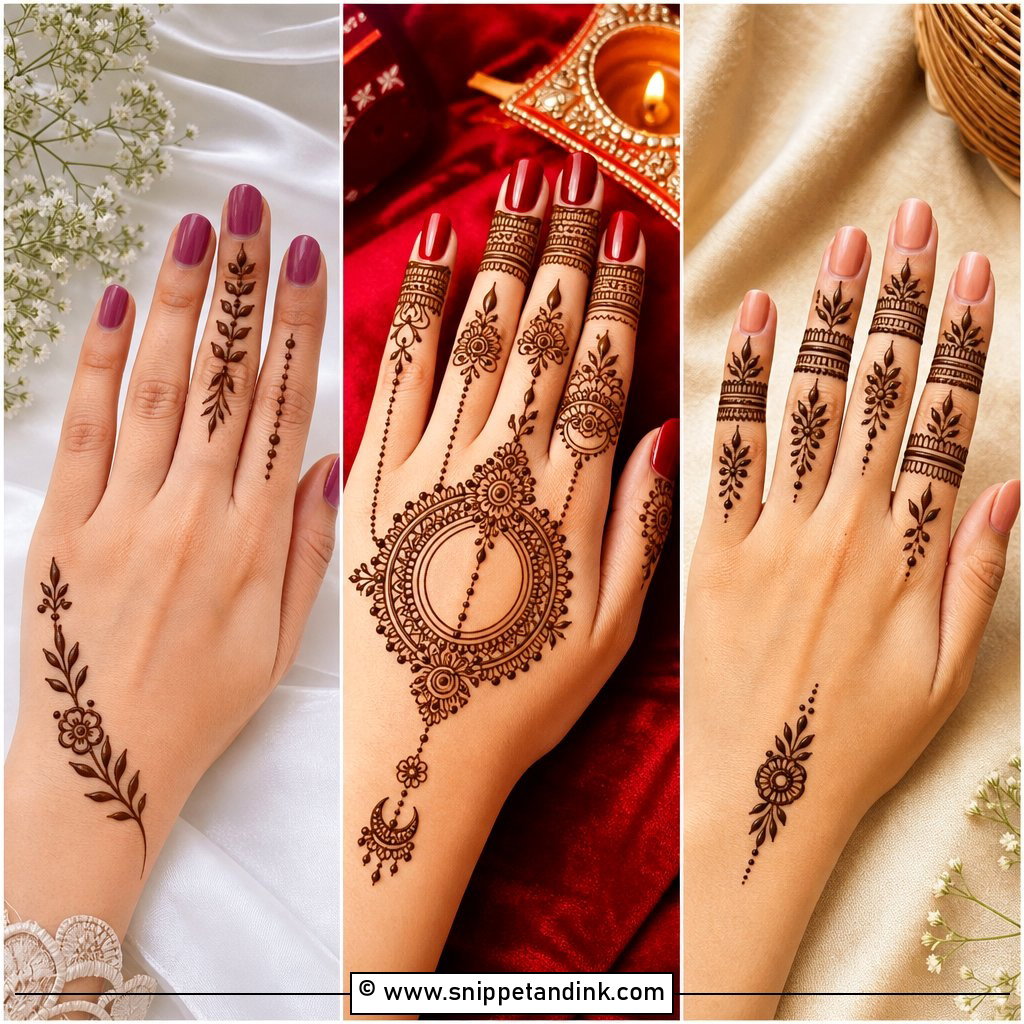
A small palm mandala, a fine wrist cuff, leafy fingers or one trail across the back of the hand: that’s minimal bridal henna. It is quick, which matters if your mehndi falls on a crowded family day, and it suits beach weddings and civil ceremonies. Thin lines carry less paste, so they stain lighter. I tell minimal brides to leave the paste on for as long as they can bear, and to insist on symmetry and sharp linework.
18. Jewelry Bridal Mehndi Design
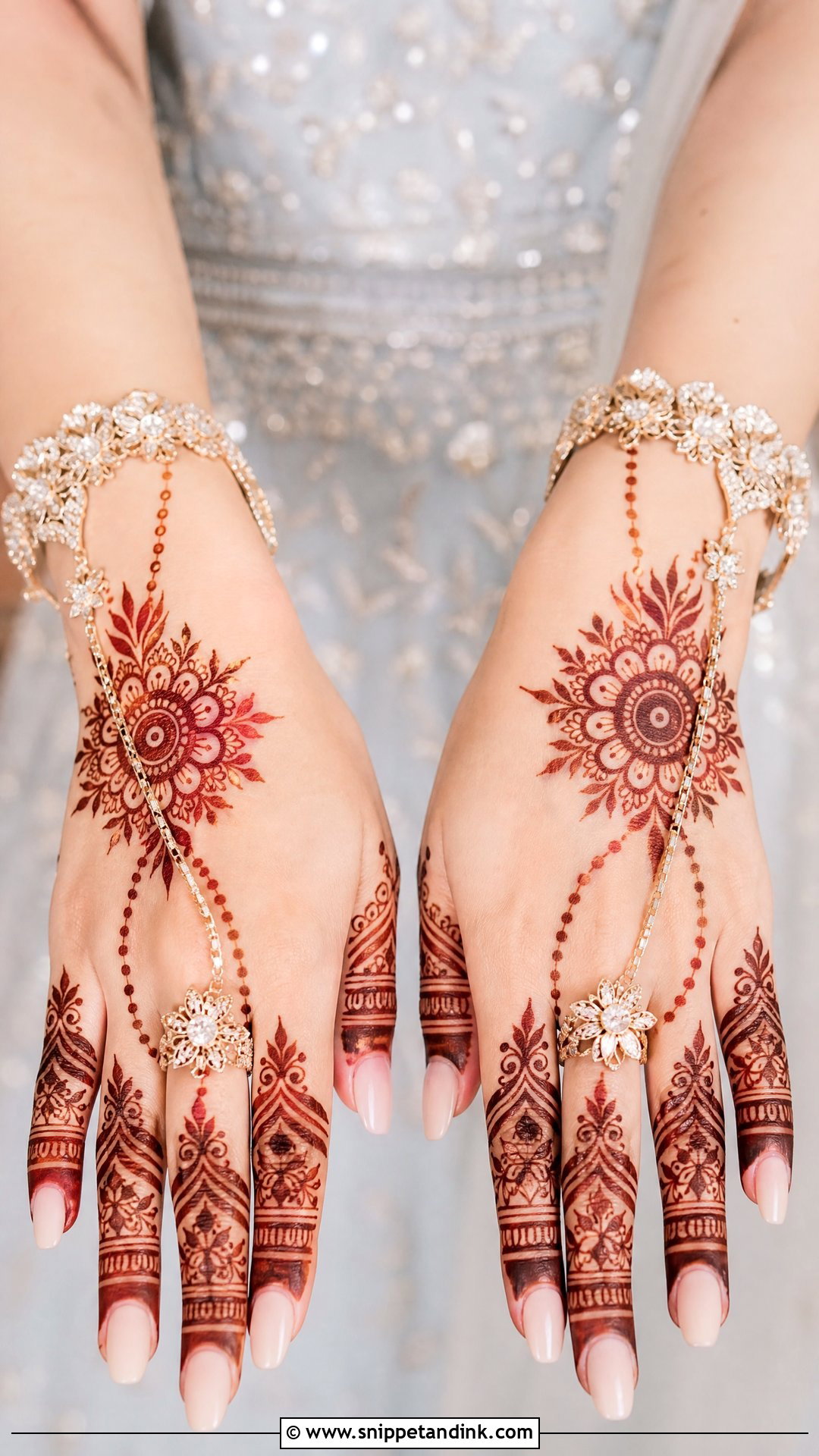
Here the henna draws the ornaments: ring chains, haath phool patterns, bracelet cuffs, finger bands and wrist links, mostly on the back of the hand. Dotted chains and curved leaf strands keep it feminine without dense filling. If you’ll wear heavy real jewelry on top, ask for thinner lines and plan the drawn chain so it doesn’t sit directly under a real ring, where the two would compete. Done well, it still reads as jewelry after you’ve taken everything off.
19. Jaali Bridal Mehndi Design
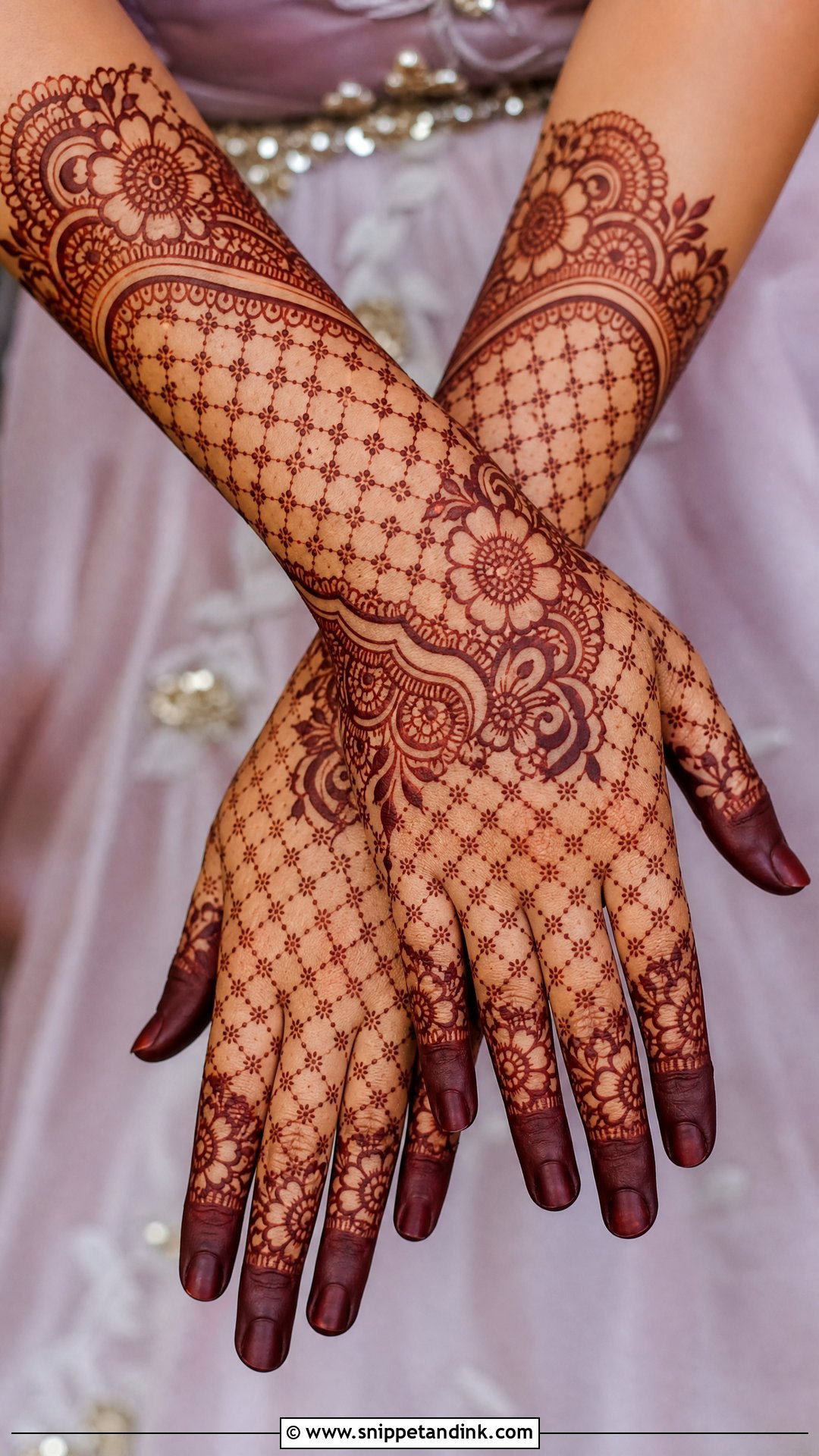
Jaali is a net pattern that gives a lace effect on palms, back hands, fingers or forearms, usually framed by flowers, paisleys and bold borders. It is my favourite way to fill a large area without it looking messy, but the grid has to be evenly spaced, because uneven jaali looks wobbly once stained. I pair fine mesh with larger flowers and darker outlines. Without that contrast the whole hand turns into one flat texture in photos.
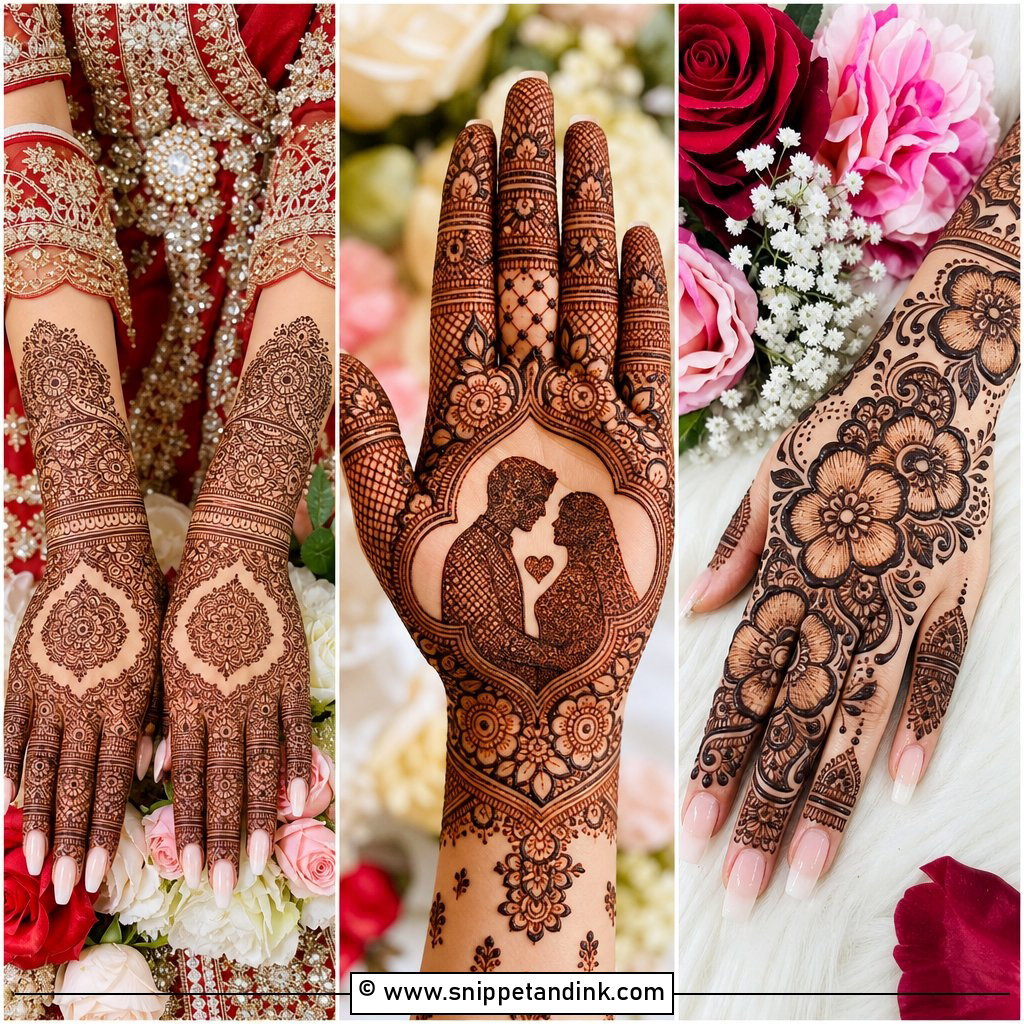
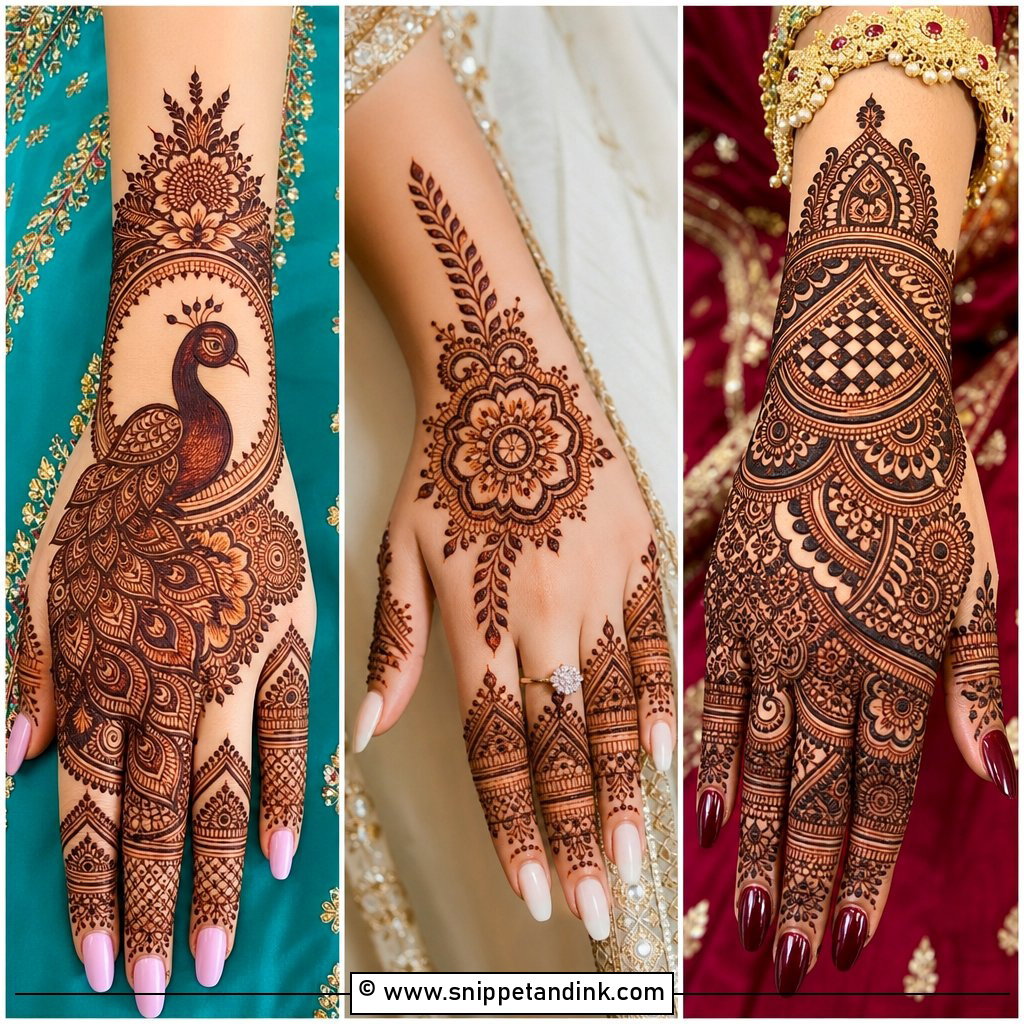
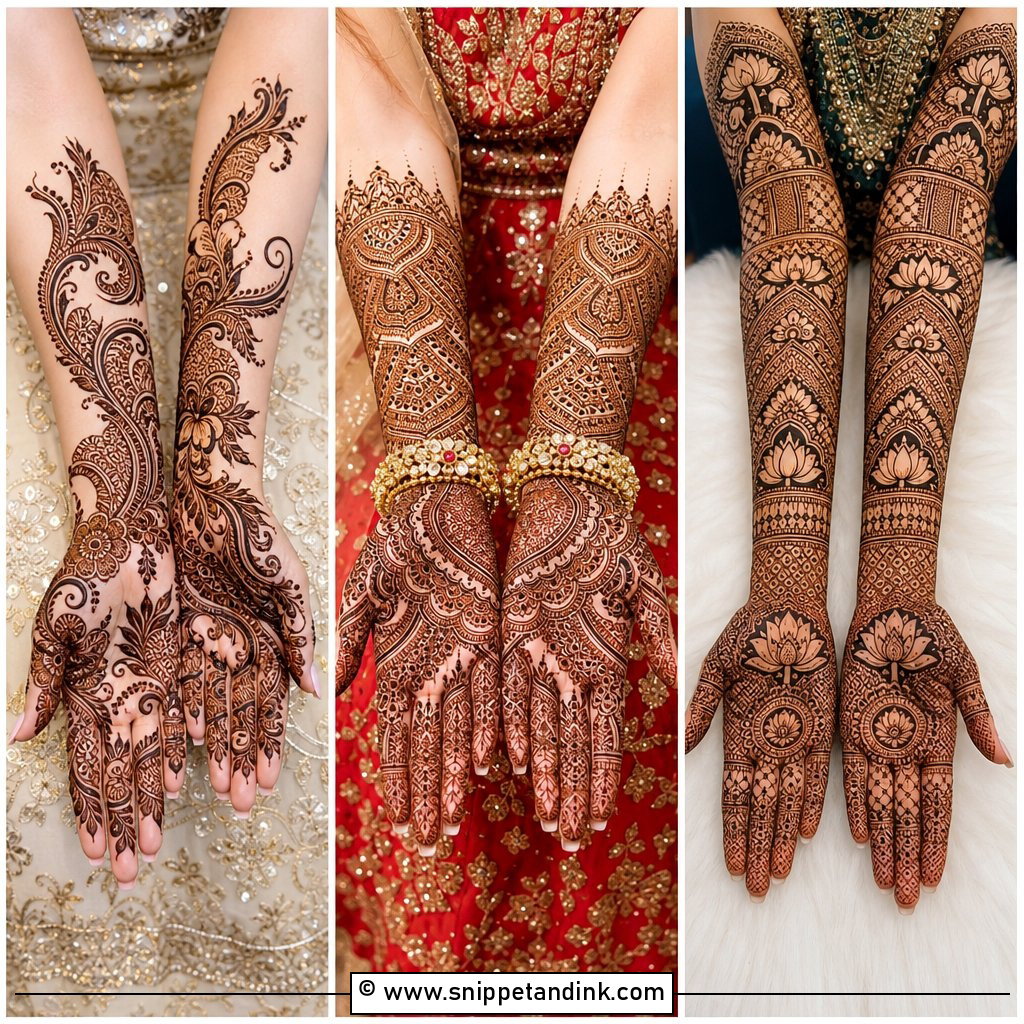
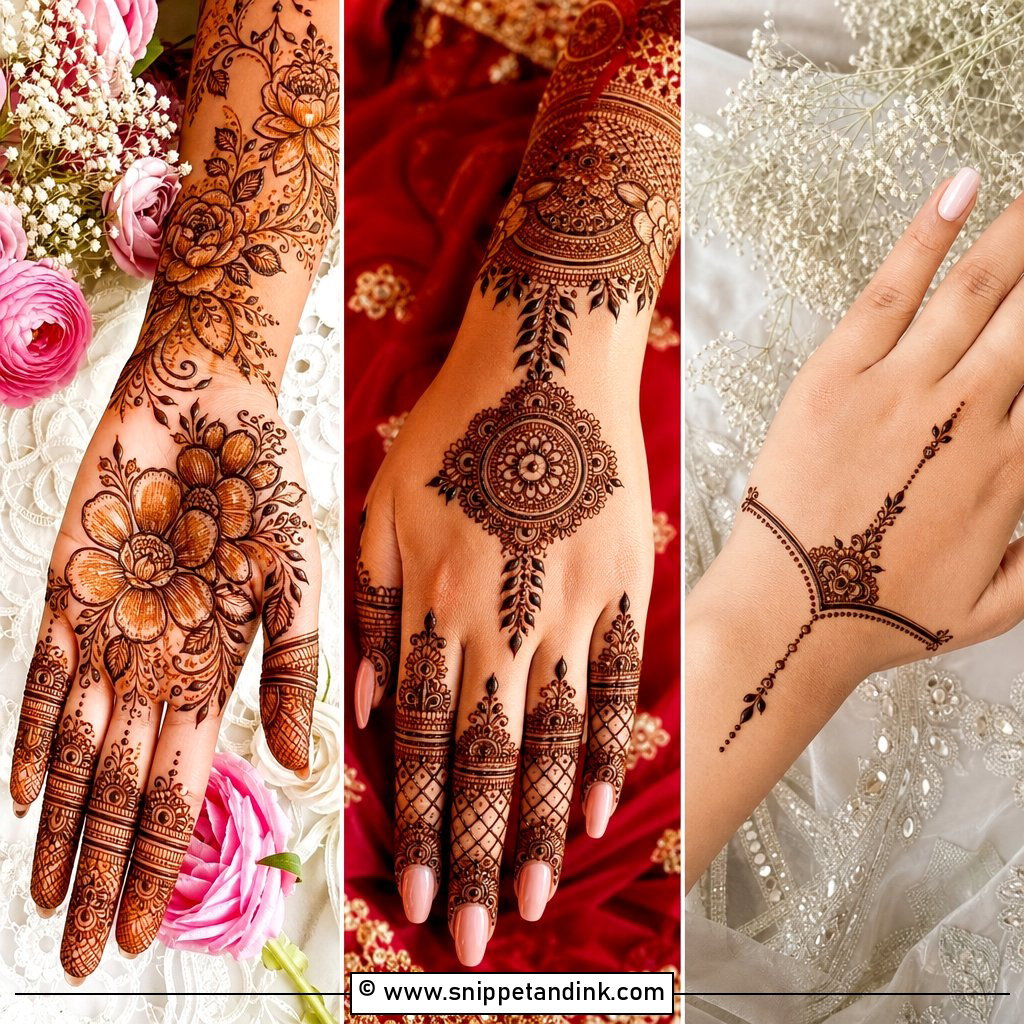
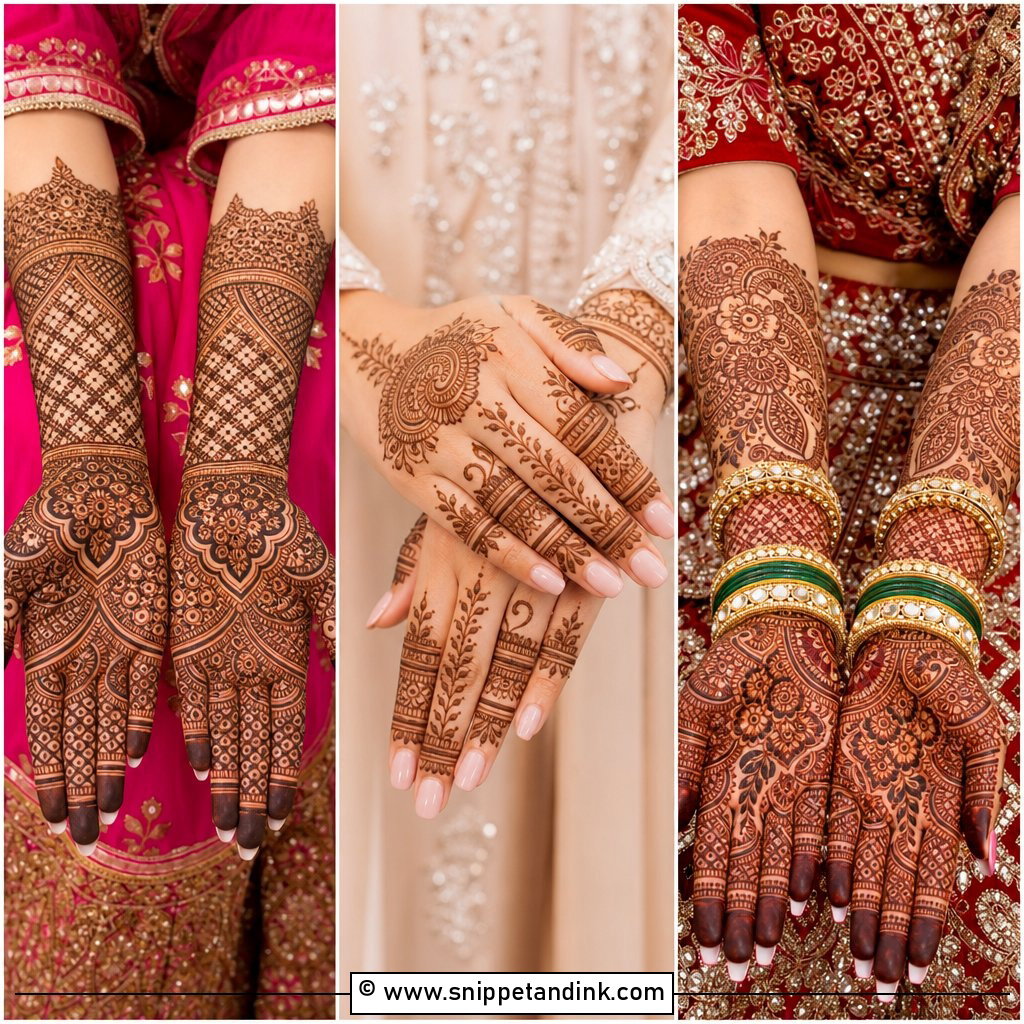
20. Floral Bridal Mehndi Design
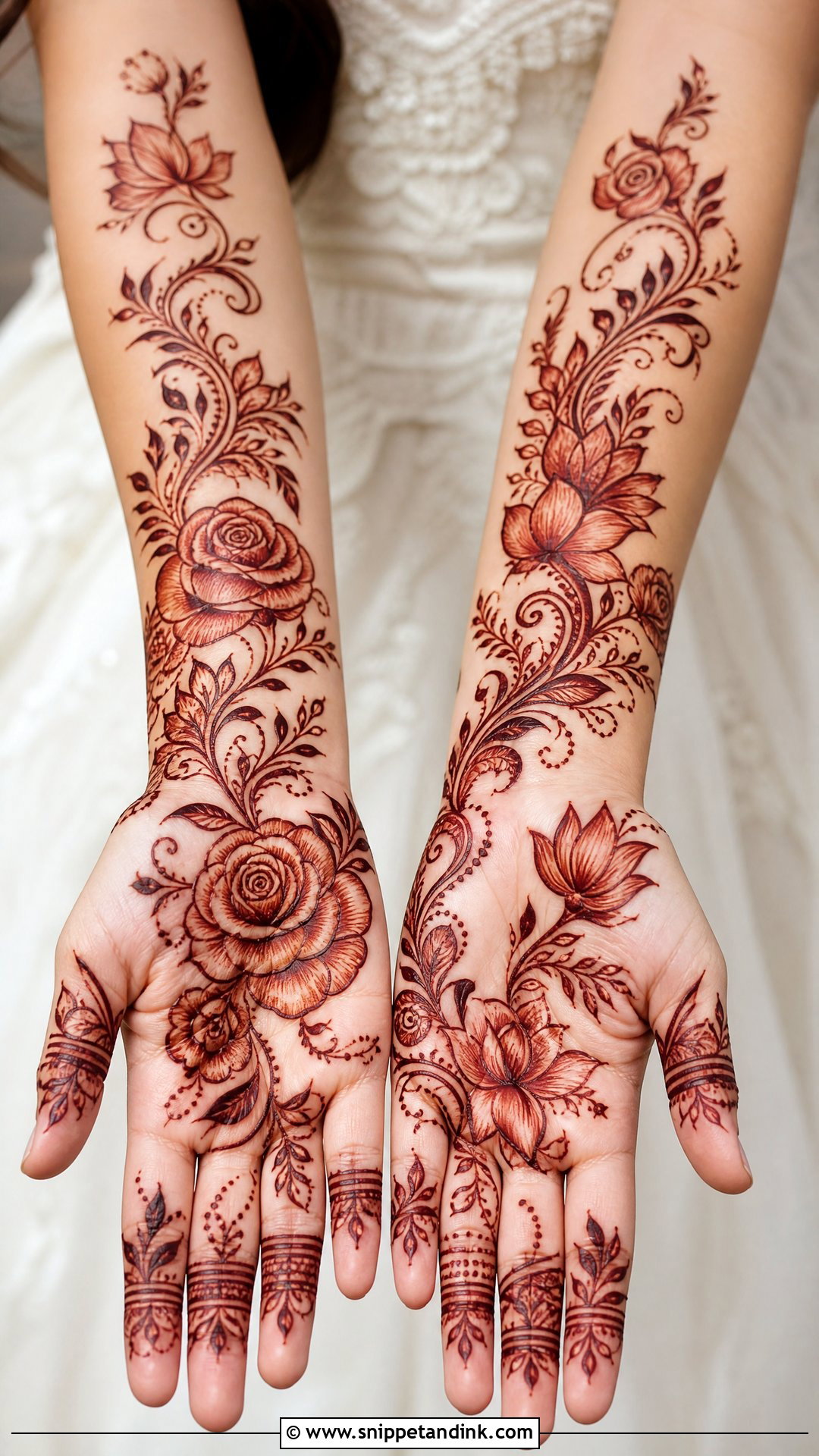
Florals are the easiest to tailor: roses, lotus, small blossoms, leafy vines and petal borders, from fingertips to forearm on a full bridal version. They go with almost any outfit, from bold red to pastel. Floral henna falls flat when every flower is the same size. I mix large blooms with small buds, shade a few petals and run a curving vine through them so the eye has somewhere to travel.
21. Paisley Bridal Mehndi Design
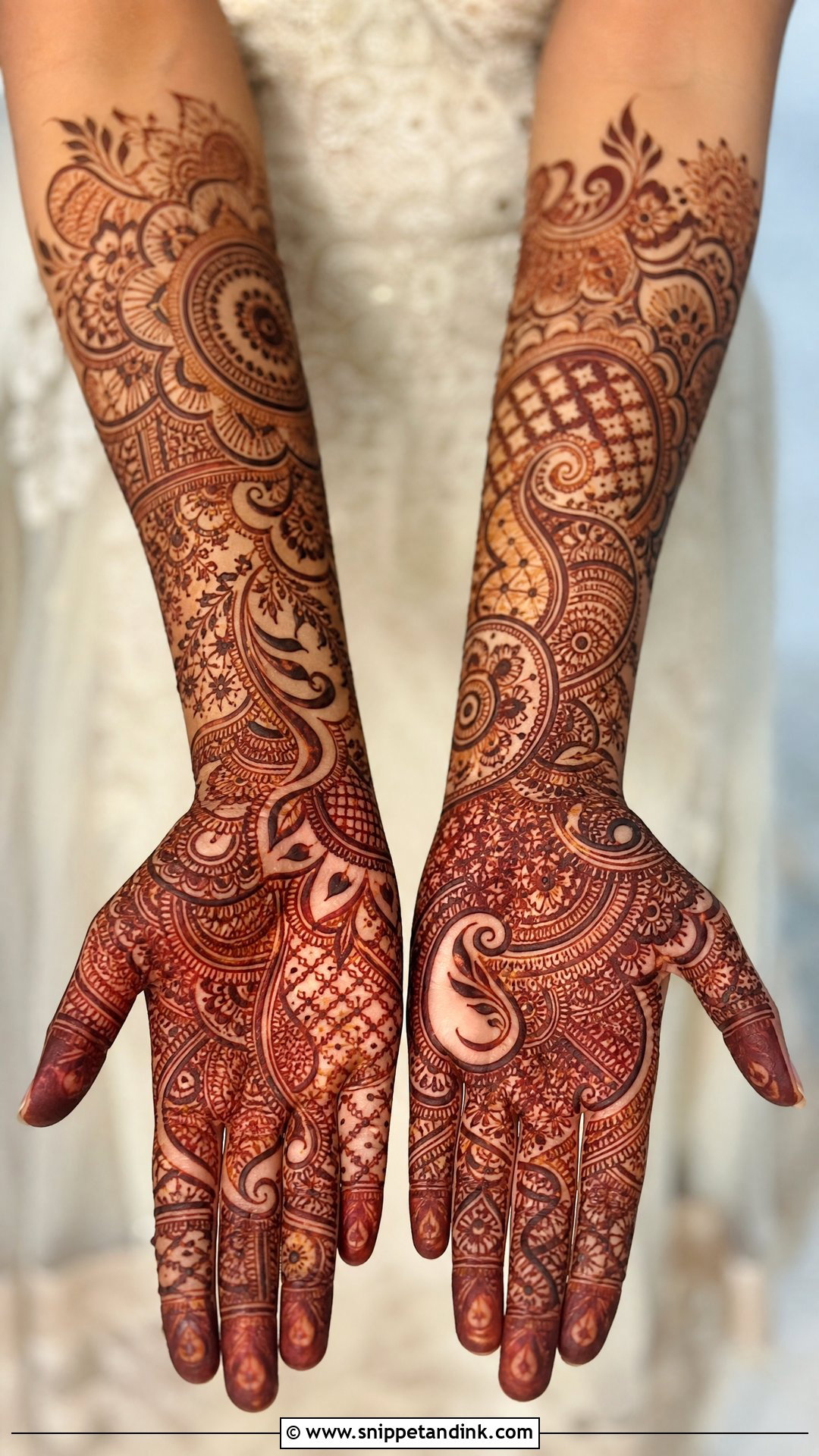
The paisley has never left bridal henna because its curve can hold anything: flowers, dots, leaves, fine lines. A bridal version stacks paisleys of different sizes into a flowing pattern on palms, wrists and forearms, and mixes easily with mandalas, peacocks and jaali. If you want traditional density without faces or figures, start here. I keep the outer edge bold and the inside detailed so the shape stays crisp as the stain darkens.
22. Moroccan Bridal Mehndi Design
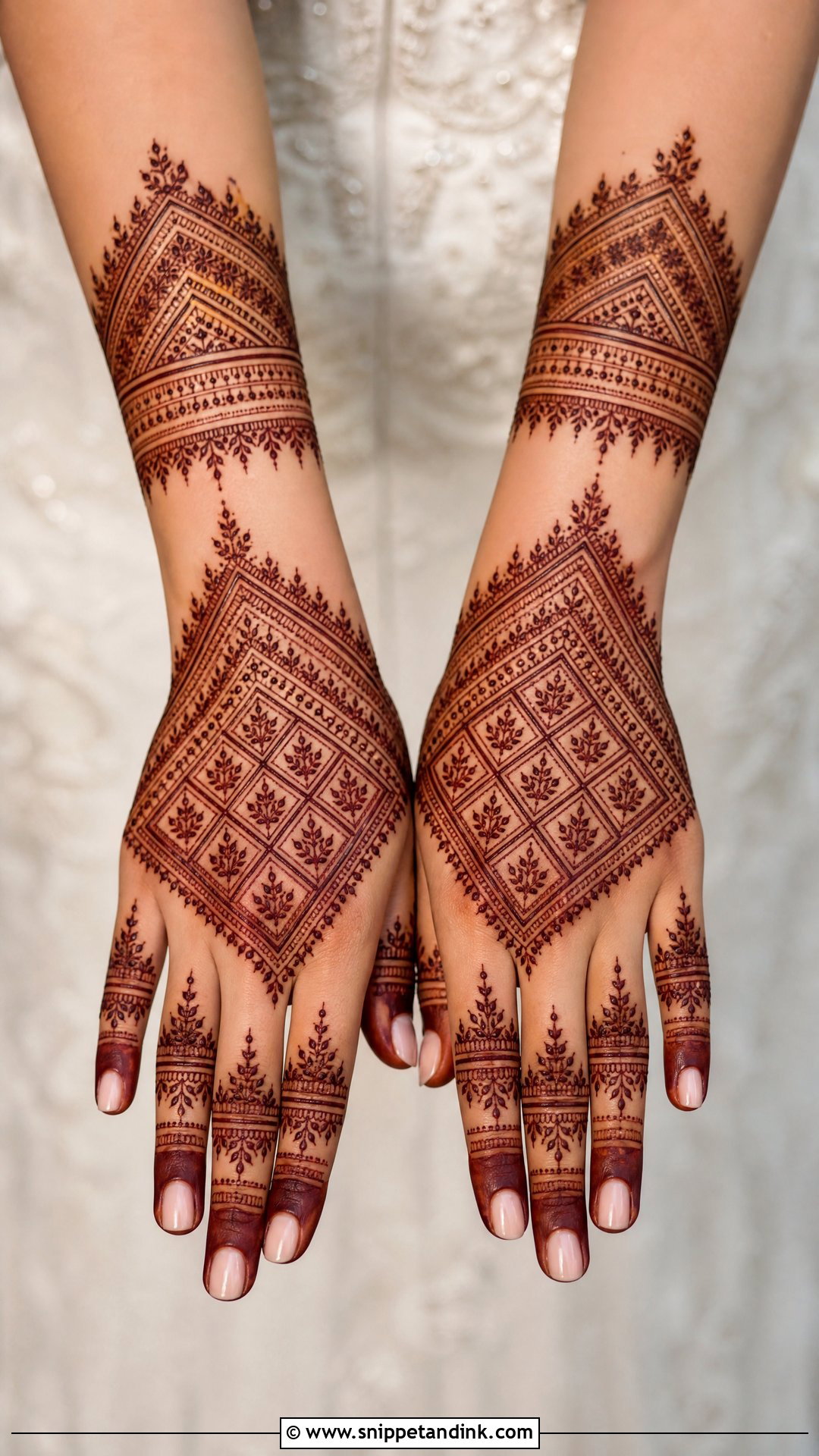
Moroccan designs swap flowers for diamonds, lines, dots, grids and angular borders. The look is structured and a little modern. Straight lines are less forgiving than curves, so a shaky cone shows straight away; check that your artist has geometric work in her portfolio before you book this. On back hands, wrists and forearms the lines form natural bracelet bands, and it blends with Indian or Arabic motifs if you’d like a fusion.
23. Gulf Bridal Mehndi Design
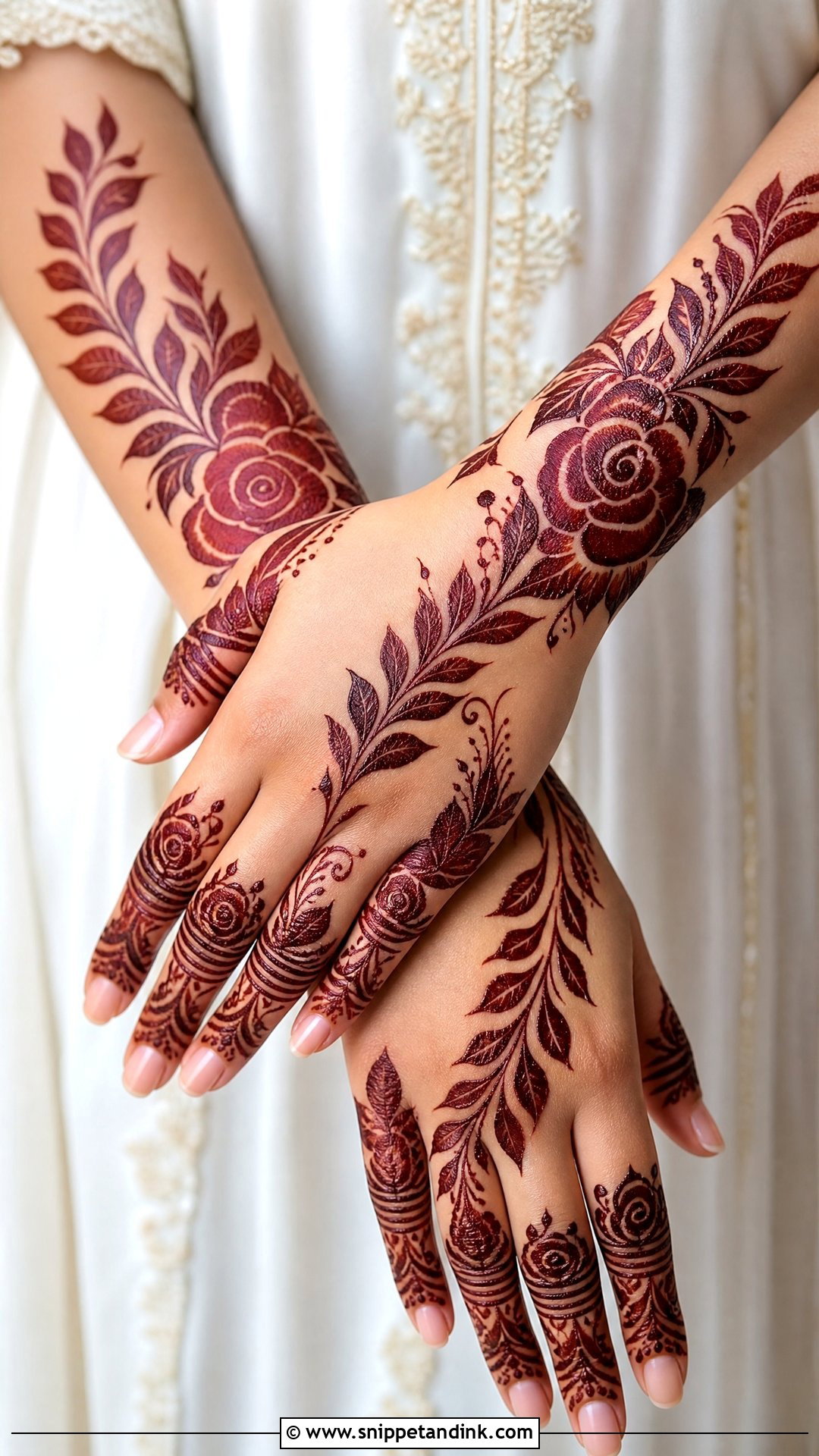
Gulf or Khaleeji-inspired henna sets large florals, leafy trails and thick outlines diagonally across the hand with clean gaps of skin between them. Thick lines hold plenty of paste, so the stain comes up rich. It leaves room for rings and nail colour, which makes it my usual suggestion for a bride with a strong manicure; the two sit side by side without clashing. Back hands and wrist-to-forearm placements suit it best.
24. Finger Bridal Mehndi Design
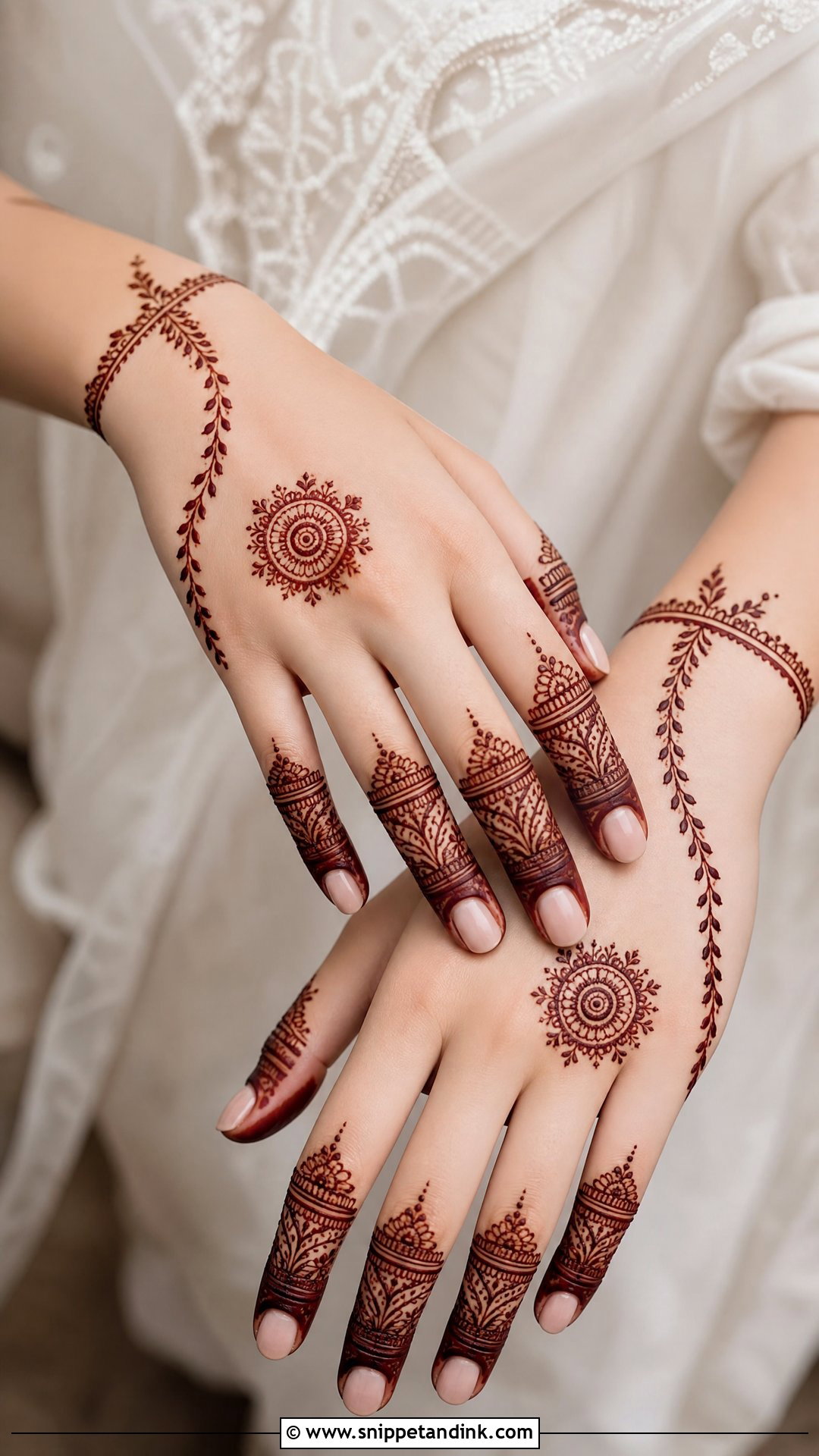
The detail gathers on the fingers, with caps, leafy bands, fine lines, dots and ring-like patterns, while the palm or back stays more open. It still needs a link to the rest of the hand, a mandala, a cuff or a trail, or it looks unfinished. Fingertips stain very dark, so full caps come out deep and almost solid. Choose it if your engagement ring and manicure are meant to be the focus.
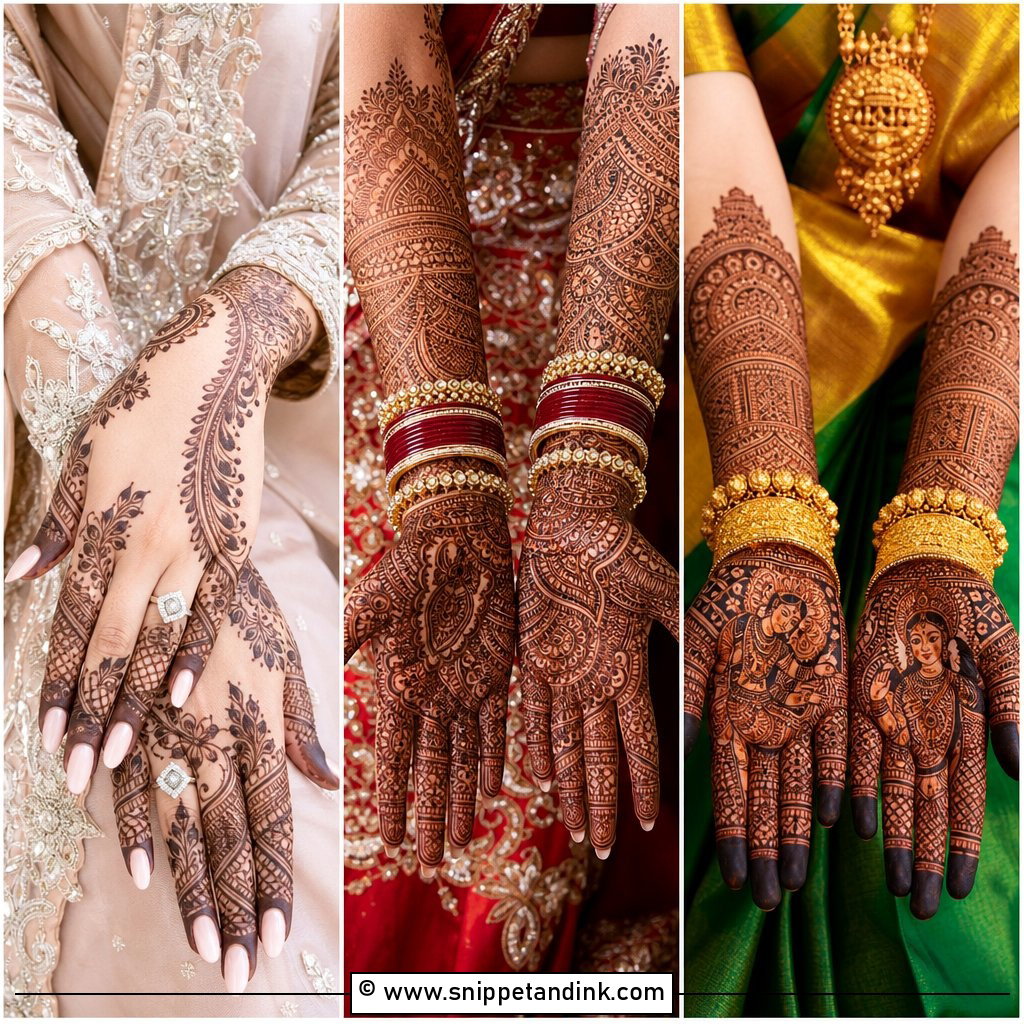
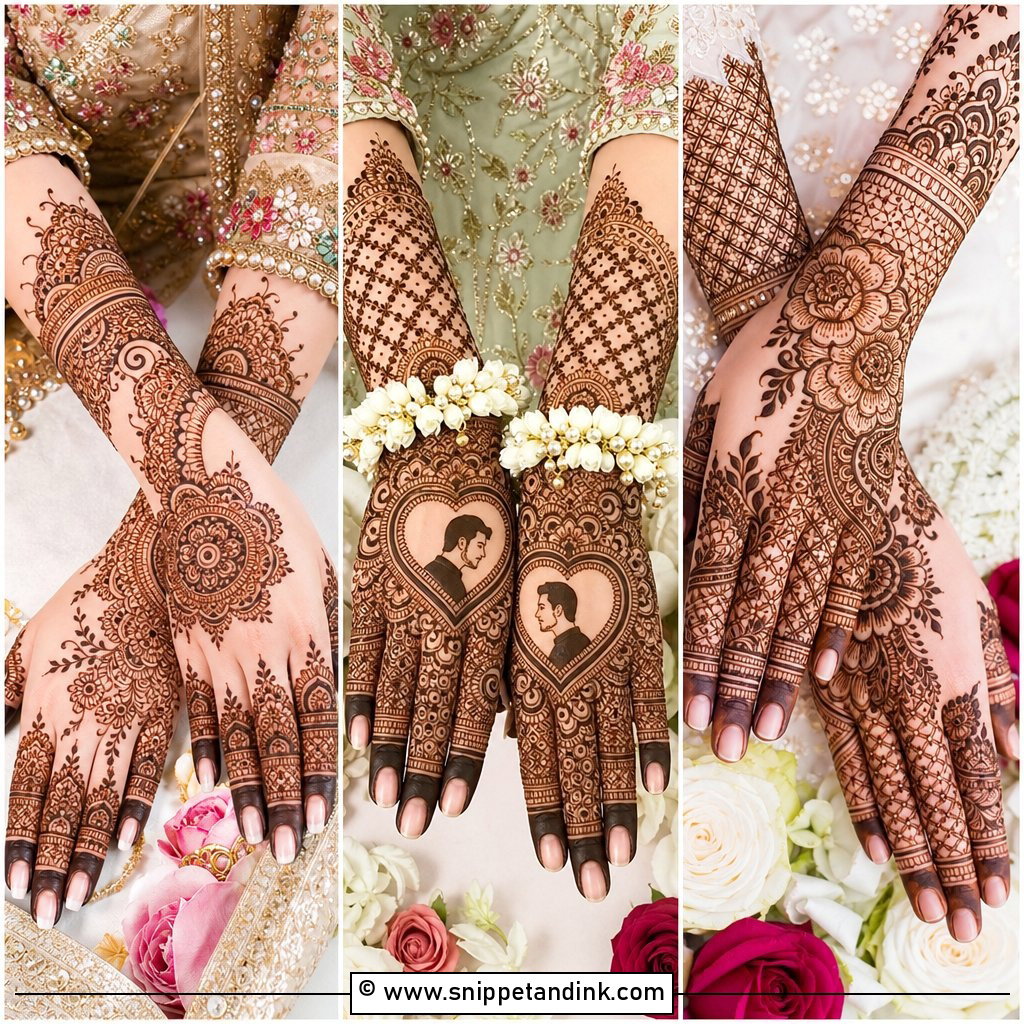
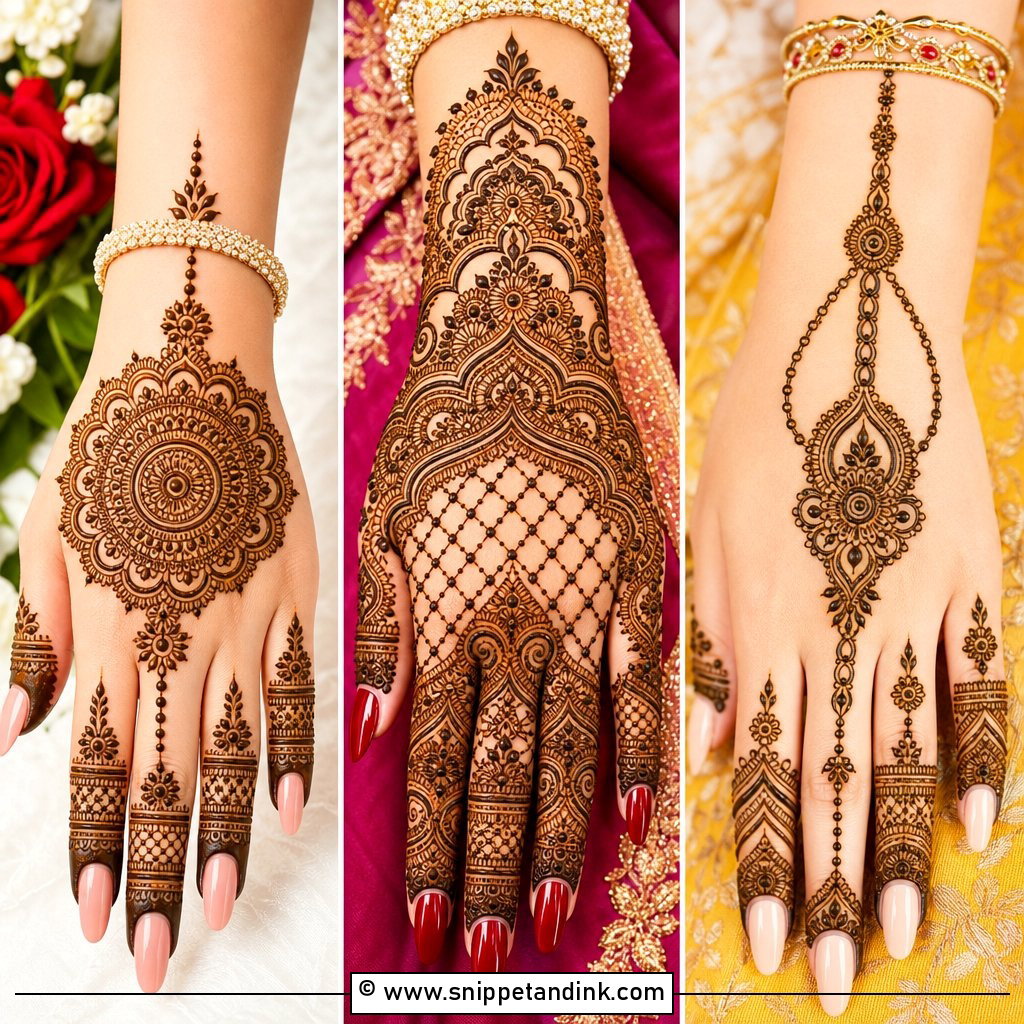
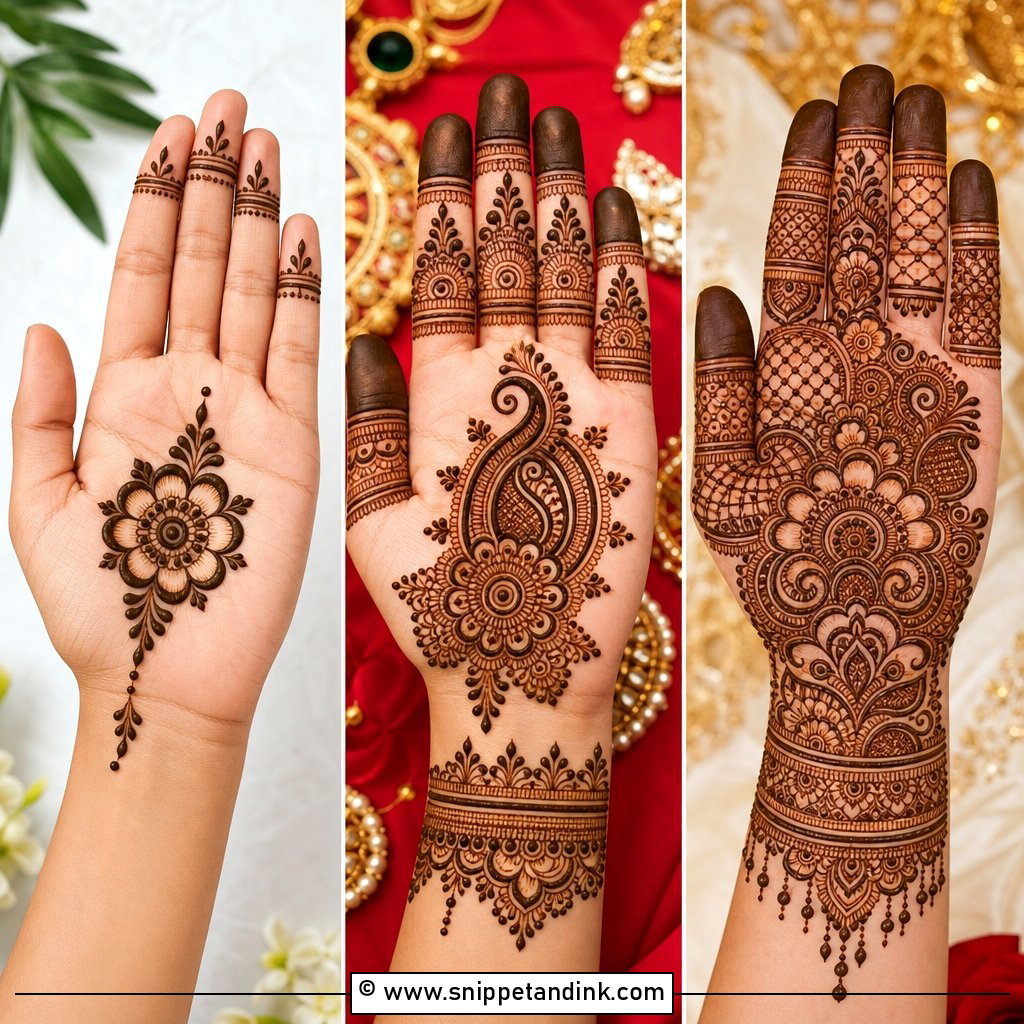
25. Wrist To Forearm Bridal Mehndi Design
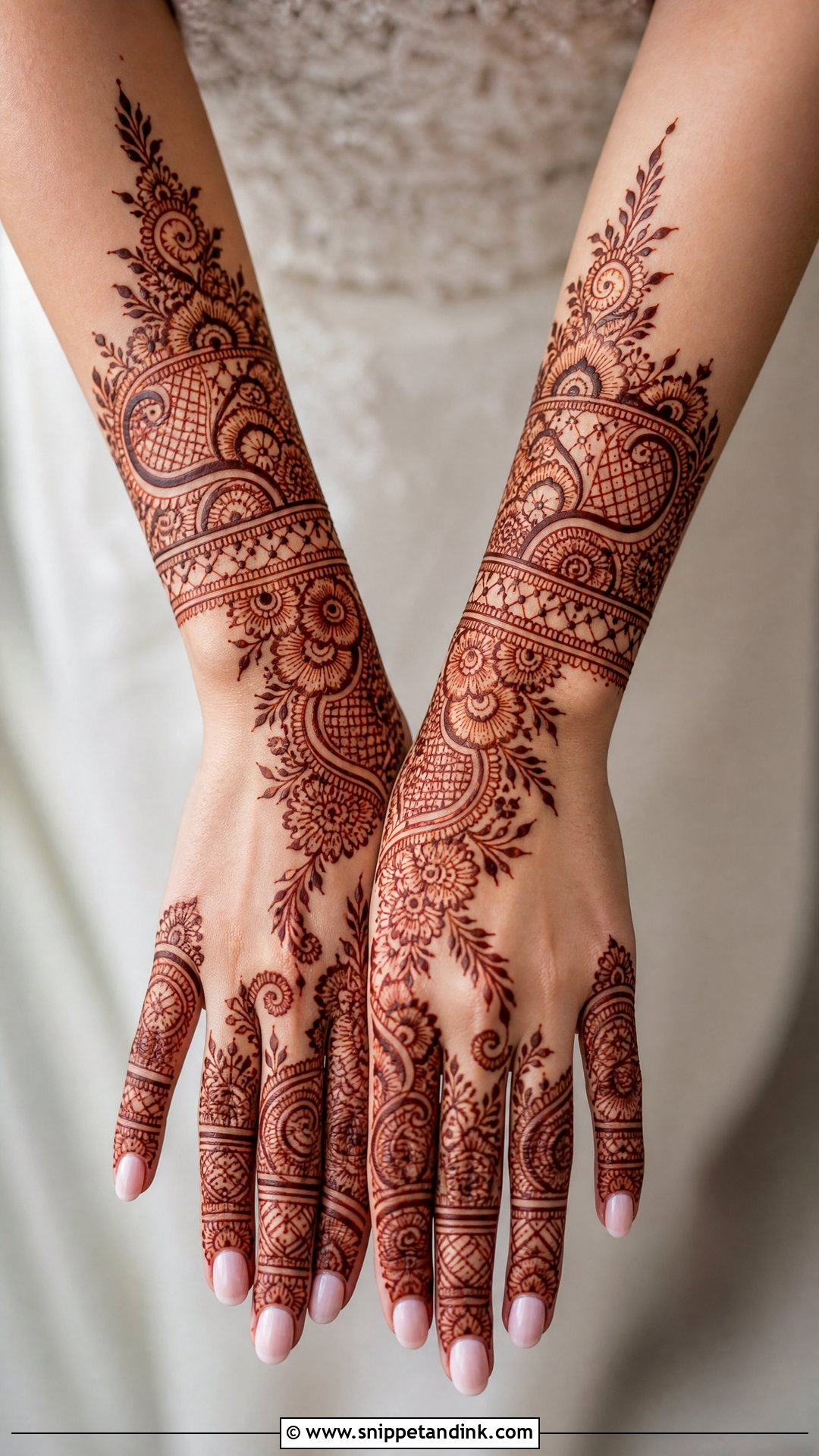
Taking the design past the wrist turns it into a cuff, a sleeve, a bracelet stack or a vine. In sleeveless, short-sleeve or sheer-sleeve outfits, bare forearms can look plain next to busy palms, and this fixes that. Forearm skin stains lighter than palms, so I make my lines slightly bolder as I move up the arm. Go dense for a grand effect. For something lighter, a flowing Arabic trail with open spacing works.
26. Half Hand Bridal Mehndi Design
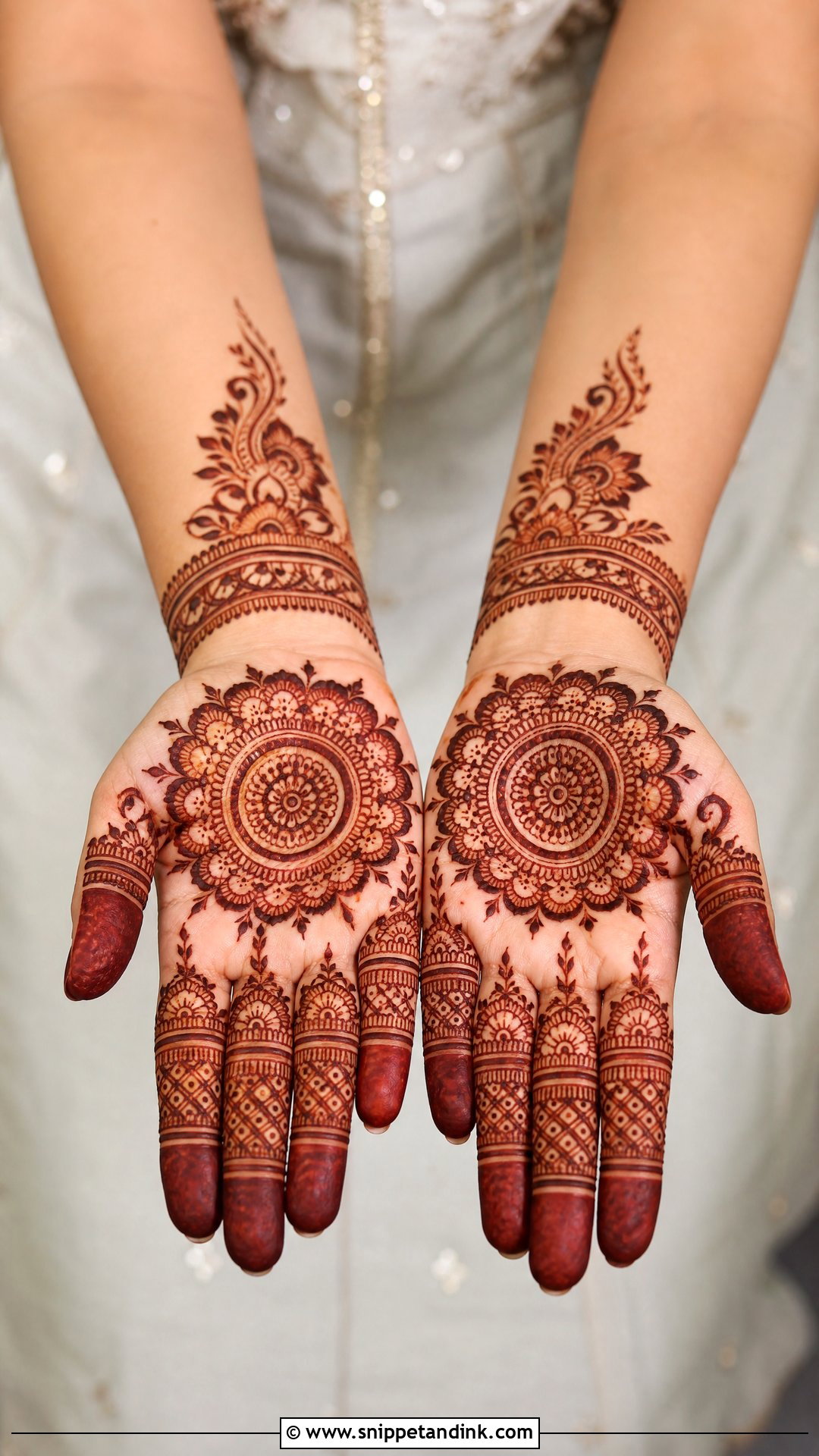
Half hand covers fingers, palm, wrist and a little of the forearm. It cuts the sitting time a lot, which matters more than people expect when guests are arriving and relatives want photos with you. A mandala palm with detailed fingers is the common layout, though an Arabic floral trail suits it too. The strong wrist border is what makes it bridal instead of casual, so don’t let anyone skip it to save ten minutes.
27. Full Arm Bridal Mehndi Design
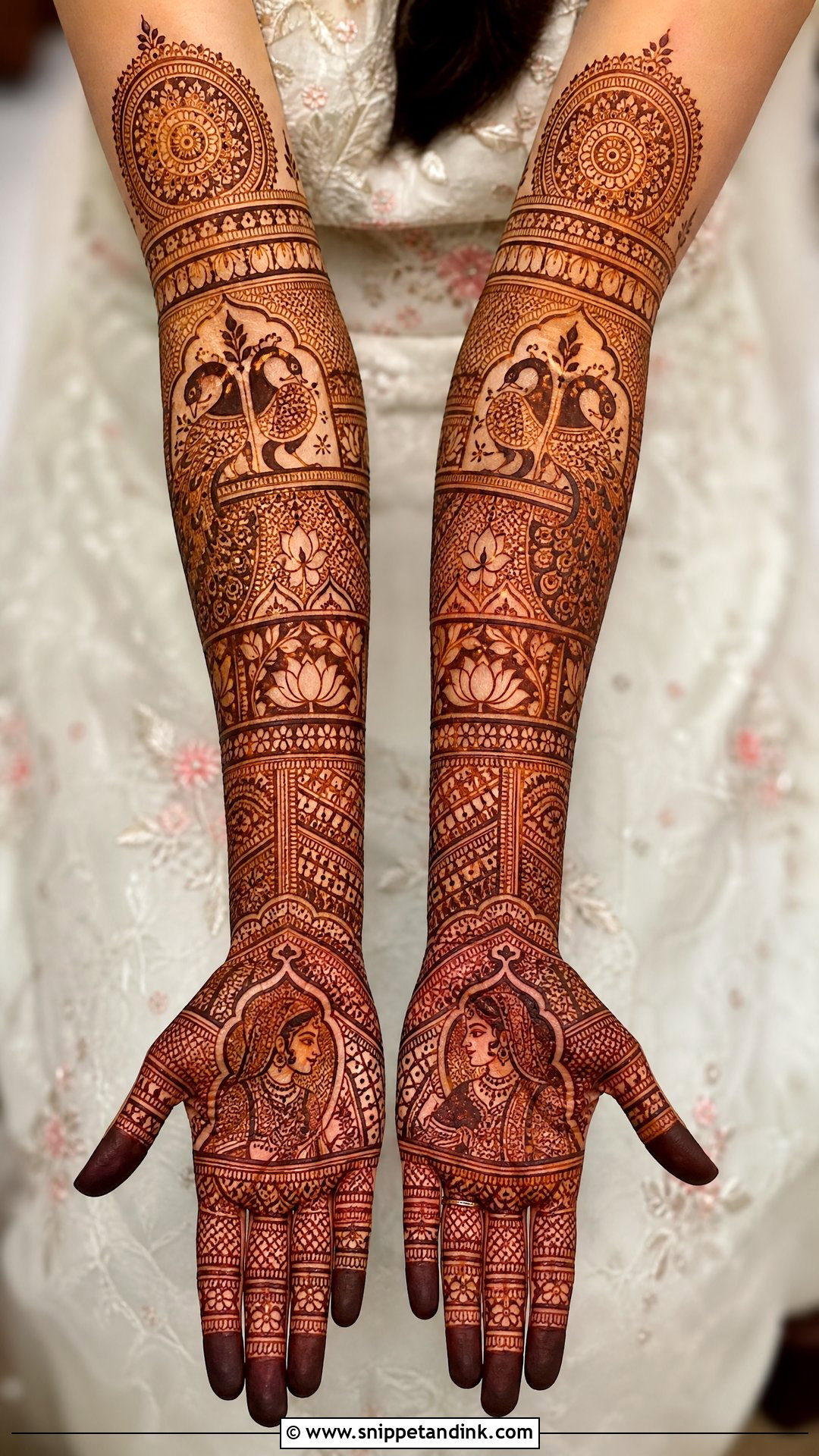
Fingertips to the elbow or higher, carrying portraits, peacocks, mandalas, paisleys, lotus, wedding scenes and dense fillers: this is the most dramatic option and the most demanding. Both arms covered this far can take most of a day, and you’ll need help eating, dressing and using the bathroom while it dries. I divide the arm into clear sections with bands so it doesn’t read as one crowded sleeve. Wear a loose, short-sleeved top you don’t mind staining.
28. Personalized Bridal Mehndi Design
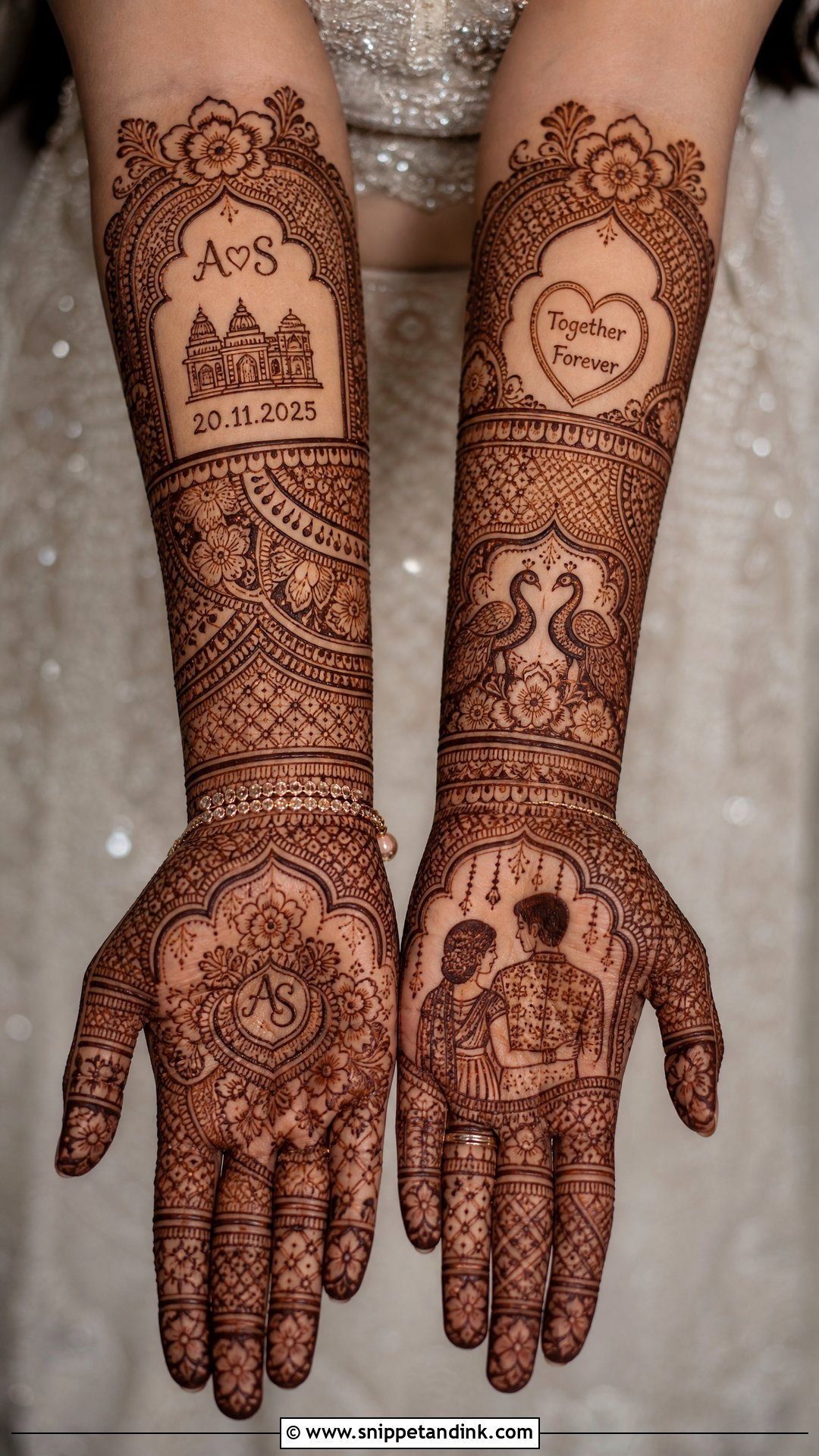
Personal henna turns your story into motifs: initials, dates, proposal symbols, pets, a skyline, travel memories, the venue outline, favourite flowers. They can hide inside a traditional design or take centre stage. The trick is restraint. I’d pick three or four details at most and set them among florals, paisleys or jaali; ten tiny symbols on one hand just become noise in photos.
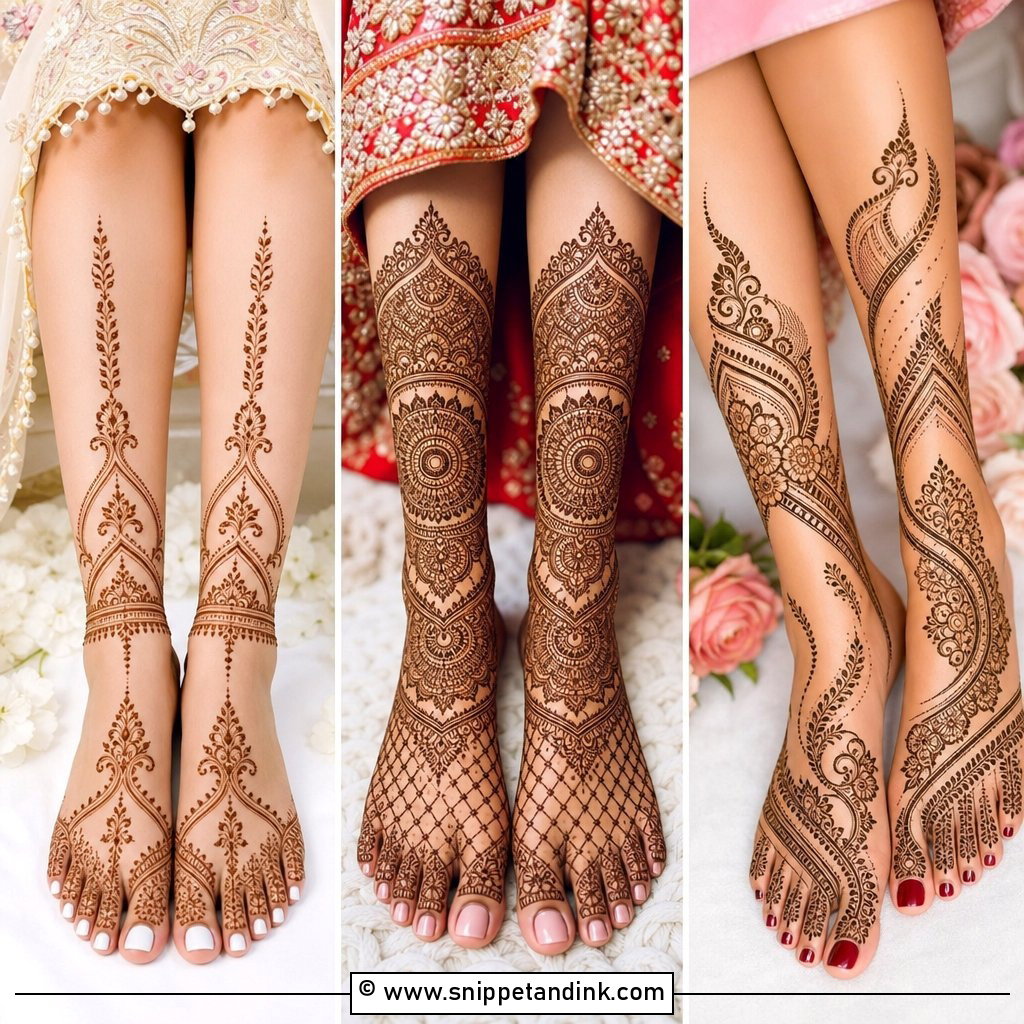
29. Bridal Feet Mehndi Design
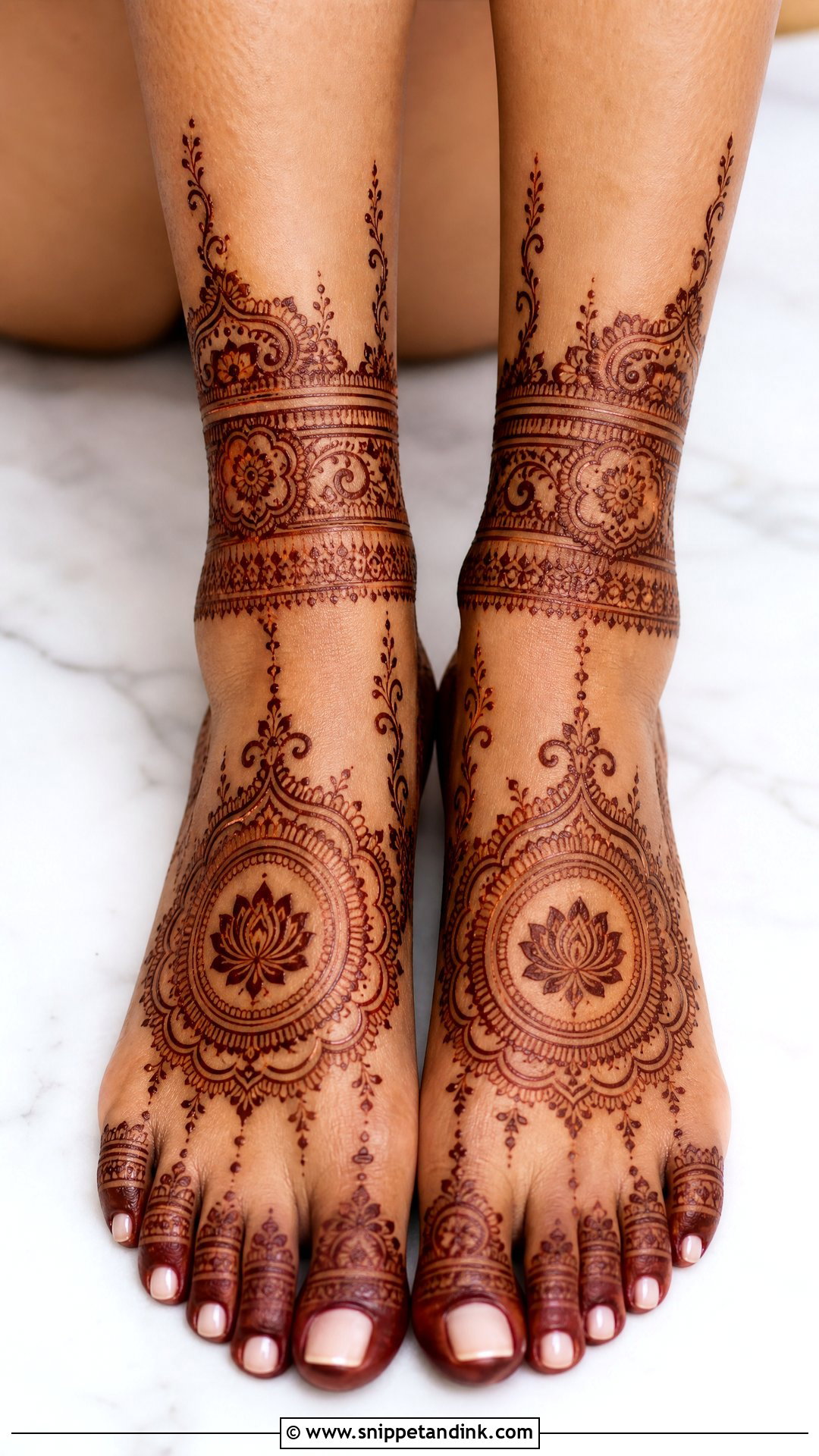
Feet henna covers toes, the top of the foot and the ankle, sometimes a little higher, with mandalas, lotus, anklet patterns, paisleys and vines. Feet often stain darker than hands, so bold outlines and clear spacing pay off. They also mean sitting completely still while the paste dries, so I plan with each bride whether feet go first or last depending on when she needs to walk. In open sandals, the toes and ankle are what people actually see.
30. Bridal Mehndi Design With Name
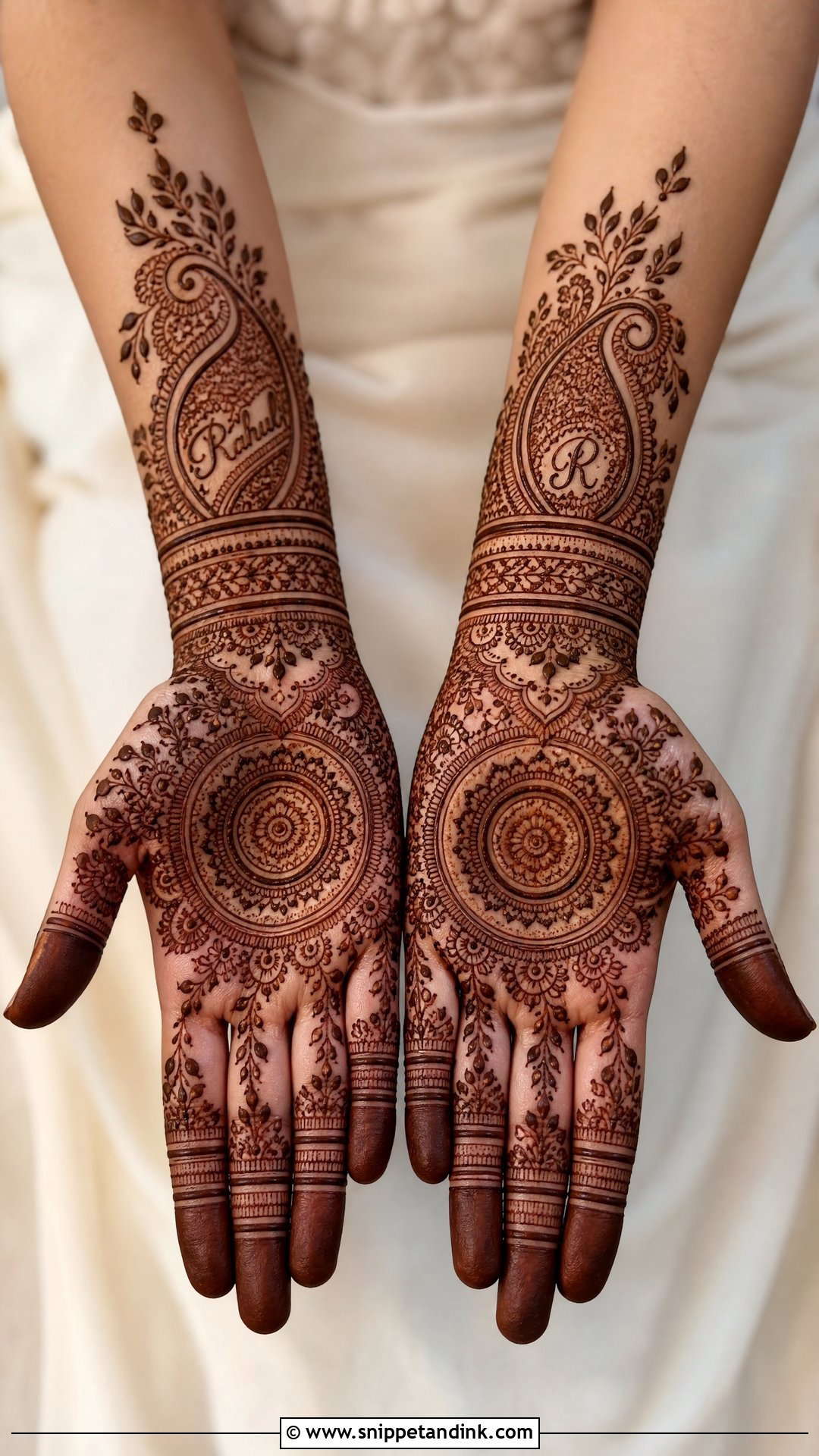
Bridal mehndi design with name is an old, playful tradition: the groom’s name or initials tucked into paisleys, leaves, mandalas, jaali or floral trails, sometimes with your own initials or the date. It works in any style, full or half hand, Indian, Arabic or fusion. The game only works if the name can be found. I place it in an area of cleaner spacing, the palm, wrist or forearm, and size the letters so they survive the stain.
Aftercare From the Moment the Paste Starts to Crack
The stain is made while the paste sits on your skin, so most of the work happens after the artist leaves. These are the habits I give every bride:
- Keep the paste on for at least six to eight hours, overnight if you can sleep with your hands loosely wrapped in tissue or an old cotton cloth.
- Dab a little lemon and sugar mix on once the surface dries; it keeps the paste stuck to the skin instead of flaking off early.
- Scrape the dried paste off with a blunt butter knife or rub it away. Don’t wash it off.
- Stay away from water for the next 12 to 24 hours if you can, and from soap, sanitiser, chlorine and scrubs for longer.
- Keep your hands warm. Stain develops better on warm skin, so a cold, air-conditioned room slows it down.
- Get your manicure and any waxing done before the mehndi, not after; both strip the stain.
If the Colour Comes Up Lighter Than You Hoped
Don’t panic on the first evening. Orange at removal is normal, and the colour keeps building into the next day. A lighter result on the backs of the hands and forearms is also normal, because that skin takes up less dye than palms and fingertips. What you can’t do is redo a stain overnight, so if your first trial with an artist comes out pale, that tells you about her paste, and it is worth knowing weeks ahead rather than two days before the wedding.
Bring Your Sleeves, Your Jewelry and Your Hours to the Consultation
A design works when it fits your outfit, your jewelry, the ceremony and the time you can sit, and when it carries something of you. Dense Indian and Rajasthani work, open Arabic and Gulf trails, minimal and modern layouts can all be mixed, a mandala with florals or portraits framed in jaali. Before your appointment, save a few clear references, decide how far up your arms you want to go, and ask your artist how long it will take and how dark her paste stains. Those answers narrow the list faster than any picture.
You'll Like These Ideas:


Leave a Reply